WO2024214787A1 - フィルムヒータ - Google Patents
フィルムヒータ Download PDFInfo
- Publication number
- WO2024214787A1 WO2024214787A1 PCT/JP2024/014706 JP2024014706W WO2024214787A1 WO 2024214787 A1 WO2024214787 A1 WO 2024214787A1 JP 2024014706 W JP2024014706 W JP 2024014706W WO 2024214787 A1 WO2024214787 A1 WO 2024214787A1
- Authority
- WO
- WIPO (PCT)
- Prior art keywords
- extension
- connection
- extension portion
- film heater
- shielding
- Prior art date
- Legal status (The legal status is an assumption and is not a legal conclusion. Google has not performed a legal analysis and makes no representation as to the accuracy of the status listed.)
- Ceased
Links
Images



Classifications
-
- H—ELECTRICITY
- H05—ELECTRIC TECHNIQUES NOT OTHERWISE PROVIDED FOR
- H05B—ELECTRIC HEATING; ELECTRIC LIGHT SOURCES NOT OTHERWISE PROVIDED FOR; CIRCUIT ARRANGEMENTS FOR ELECTRIC LIGHT SOURCES, IN GENERAL
- H05B3/00—Ohmic-resistance heating
- H05B3/84—Heating arrangements specially adapted for transparent or reflecting areas, e.g. for demisting or de-icing windows, mirrors or vehicle windshields
-
- B—PERFORMING OPERATIONS; TRANSPORTING
- B60—VEHICLES IN GENERAL
- B60J—WINDOWS, WINDSCREENS, NON-FIXED ROOFS, DOORS, OR SIMILAR DEVICES FOR VEHICLES; REMOVABLE EXTERNAL PROTECTIVE COVERINGS SPECIALLY ADAPTED FOR VEHICLES
- B60J1/00—Windows; Windscreens; Accessories therefor
- B60J1/20—Accessories, e.g. wind deflectors, blinds
-
- B—PERFORMING OPERATIONS; TRANSPORTING
- B60—VEHICLES IN GENERAL
- B60S—SERVICING, CLEANING, REPAIRING, SUPPORTING, LIFTING, OR MANOEUVRING OF VEHICLES, NOT OTHERWISE PROVIDED FOR
- B60S1/00—Cleaning of vehicles
- B60S1/02—Cleaning windscreens, windows or optical devices
-
- H—ELECTRICITY
- H05—ELECTRIC TECHNIQUES NOT OTHERWISE PROVIDED FOR
- H05B—ELECTRIC HEATING; ELECTRIC LIGHT SOURCES NOT OTHERWISE PROVIDED FOR; CIRCUIT ARRANGEMENTS FOR ELECTRIC LIGHT SOURCES, IN GENERAL
- H05B3/00—Ohmic-resistance heating
- H05B3/02—Details
- H05B3/03—Electrodes
-
- H—ELECTRICITY
- H05—ELECTRIC TECHNIQUES NOT OTHERWISE PROVIDED FOR
- H05B—ELECTRIC HEATING; ELECTRIC LIGHT SOURCES NOT OTHERWISE PROVIDED FOR; CIRCUIT ARRANGEMENTS FOR ELECTRIC LIGHT SOURCES, IN GENERAL
- H05B2203/00—Aspects relating to Ohmic resistive heating covered by group H05B3/00
- H05B2203/002—Heaters using a particular layout for the resistive material or resistive elements
- H05B2203/003—Heaters using a particular layout for the resistive material or resistive elements using serpentine layout
Definitions
- This disclosure relates to a film heater.
- a conventional film heater that has a transparent conductive film that is substantially hexagonal or substantially trapezoidal, a first connection part that is connected to the hypotenuse of the transparent conductive film, and a second connection part that is connected to the lower bottom part of the transparent conductive film.
- the transparent conductive film generates heat when a current flows through the transparent conductive film between the first connection part and the second connection part.
- the power density which is the power per unit area of the transparent conductive film
- the first connection part is connected to the oblique side part of the transparent conductive film
- the second connection part is connected to the lower bottom part of the transparent conductive film. Therefore, the distance between the first connection part and the second connection part on the lower bottom part side is smaller than the distance between the first connection part and the second connection part on the upper bottom part side.
- An object of the present disclosure is to provide a film heater that suppresses localized heat generation in a transparent conductive film.
- a film heater comprising: a transparent conductive film having a first bottom extending in one direction; a second bottom facing the first bottom in a direction perpendicular to the one direction and the thickness direction of the film heater and having a length in the one direction greater than the length of the first bottom in the one direction; a first oblique side connected to the first bottom and extending in a direction intersecting the one direction; and a second oblique side connected to the side of the first bottom opposite the first oblique side and extending in a direction intersecting the one direction; a first electrode having a first connection portion connected to the first oblique side; and a second electrode having a second connection portion connected to the second oblique side, the transparent conductive film being transparent to electromagnetic waves and generating heat when a current flows in one direction within the transparent conductive film between the first connection portion and the second connection portion, and the length of the first bottom in the one direction is greater than the shortest distance from the second bottom to the first
- the length of the first bottom portion is relatively large, the distance between the first connection portion and the second connection portion is prevented from becoming relatively small. This prevents the power density in the transparent conductive film between the first connection portion and the second connection portion from becoming locally large. This therefore prevents localized heating of the transparent conductive film.
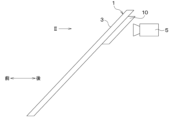
- FIG. 1 is a configuration diagram of a vehicle in which a film heater according to a first embodiment is used;
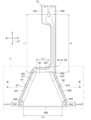
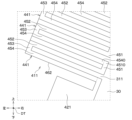
- FIG. 2 is an enlarged view taken along the line II in FIG. 1 .
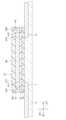
- FIG. FIG. 4 is an enlarged cross-sectional view taken along line IV-IV in FIG.
- FIG. 4 is an enlarged view of part V in FIG. 3 .
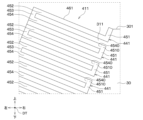
- FIG. 6 is an enlarged view of part VI in FIG. 5 .
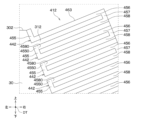
- FIG. 7 is an enlarged view of part VII in FIG. 5 .
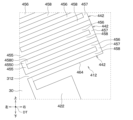
- FIG. 8 is an enlarged view of a portion VIII in FIG. 5 .
- FIG. 6 is an enlarged view of part IX in FIG. 5 .
- FIG. 4 is a front view of a film heater of a comparative example.
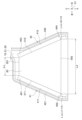
- FIG. 11 is a front view of a film heater according to a second embodiment.
- the film heater of the present embodiment localized heat generation in the transparent conductive film is suppressed.
- the film heater is used in, for example, a vehicle. First, the vehicle will be described.
- the vehicle 1 is equipped with a windshield 3, a camera 5, and a film heater 10.
- the windshield 3 corresponds to a transparent body that transmits electromagnetic waves such as radio waves and light, and ensures forward visibility for the driver of the vehicle 1.
- the windshield 3 has a first shielding portion 7 and a second shielding portion 9.
- the first shielding portion 7 and the second shielding portion 9 are formed of black ceramics or the like, thereby blocking electromagnetic waves.
- the first shielding portion 7 and the second shielding portion 9 are formed on the windshield 3 on the interior side of the vehicle 1.
- the first shielding portion 7 and the second shielding portion 9 are shown with a dot pattern to make the location of the first shielding portion 7 and the second shielding portion 9 easier to understand.
- the first shielding portion 7 and the second shielding portion 9 are formed on the interior side of the vehicle 1, but are not limited thereto, and may be formed on the windshield 3 on the exterior side of the vehicle 1.
- the camera 5 is disposed inside the vehicle cabin at the upper side of the vehicle 1. Furthermore, the camera 5 captures an image of the area ahead of the vehicle 1.
- the film heater 10 is attached to the windshield 3 on the passenger compartment side along the slope of the windshield 3, and faces the camera 5 in the fore-and-aft direction of the vehicle.
- the film heater 10 also generates heat to melt ice, snow, and defog the portion of the windshield 3 that faces the camera 5 in the fore-and-aft direction of the vehicle. This provides a clear field of view for the camera 5.
- the vehicle 1 is configured as described above. Next, the film heater 10 will be described in detail.
- the film heater 10 comprises an adhesive layer 15, a first transparent insulator 21, a second transparent insulator 22, a transparent conductive film 30, a first electrode 41, and a second electrode 42.
- the upper side of the paper in Figure 3 will be simply referred to as the upper side.
- the lower side of the paper in Figure 3 will be simply referred to as the lower side.
- the left side of the paper in Figure 3 will be simply referred to as the left side.
- the right side of the paper in Figure 3 will be simply referred to as the right side.
- the adhesive layer 15 is formed of, for example, OCA. Furthermore, as shown in FIG. 4, the adhesive layer 15 is attached to the passenger compartment side of the windshield 3. Note that OCA is an abbreviation for Optically Clear Adhesive.
- the first transparent insulator 21 and the second transparent insulator 22 are made of a resin such as polycarbonate, and therefore have electrical insulation properties.
- the first transparent insulator 21 is connected to the side of the adhesive layer 15 opposite the windshield 3.
- the transparent conductive film 30 is made of ITO or carbon nanotubes, and is therefore transparent to electromagnetic waves and conductive.
- ITO is an abbreviation for indium tin oxide.
- the transparent conductive film 30 is covered with a first transparent insulator 21 and a second transparent insulator 22. Moreover, the transparent conductive film 30 is formed in a planar shape. Moreover, the transparent conductive film 30 here is formed in a hexagonal shape. Moreover, as shown in Figures 3 and 5, the transparent conductive film 30 has an upper base 301, a lower base 302, a first oblique side portion 311, a second oblique side portion 312, a first intermediate portion 321, and a second intermediate portion 322.
- the upper bottom 301 corresponds to the first bottom and extends in one direction, here the left-right direction.
- the lower bottom 302 corresponds to the second bottom and extends in one direction, here the left-right direction. Furthermore, the lower bottom 302 faces the one direction and a direction perpendicular to the thickness direction DT of the transparent conductive film 30, here the up-down direction.
- the thickness direction DT of the transparent conductive film 30 corresponds to the thickness direction DT of the film heater 10.
- the length of the upper base 301 in the left-right direction is the upper base length Lu.
- the length of the lower base 302 in the left-right direction is the lower base length Ld.
- the lower base length Ld is greater than the upper base length Lu, i.e., Ld>Lu.
- the first oblique side portion 311 is connected to the upper bottom portion 301. Furthermore, the first oblique side portion 311 extends from the boundary with the upper bottom portion 301 in a direction that intersects with one direction, in this case, in the lower left direction.
- the second oblique side portion 312 is connected to the side of the upper base portion 301 opposite to the first oblique side portion 311.
- the second oblique side portion 312 also extends from the boundary with the upper base portion 301 in a direction that intersects with one direction, in this case, in the lower right direction.
- the first intermediate portion 321 is connected to the side of the first oblique side portion 311 opposite the upper bottom portion 301. Furthermore, the first intermediate portion 321 extends in a direction intersecting the direction in which the first oblique side portion 311 extends from the boundary with the first oblique side portion 311, in this case, downward. The first intermediate portion 321 is also connected to the lower bottom portion 302.
- the second intermediate portion 322 is connected to the side of the second oblique side portion 312 opposite the upper bottom portion 301. Furthermore, the second intermediate portion 322 extends in a direction intersecting the direction in which the second oblique side portion 312 extends from the boundary with the second oblique side portion 312, in this case, downward. The second intermediate portion 322 is also connected to the side of the lower bottom portion 302 opposite the first intermediate portion 321.
- the first electrode 41 is formed of a metal such as gold, platinum, silver, copper, or aluminum.
- the first electrode 41 is a positive electrode.
- the first electrode 41 also has a first connection portion 411, a first lead portion 421, and a first terminal portion 431.
- the first connection portion 411 is connected to the boundary between the upper base portion 301 and the first oblique side portion 311 and to the first oblique side portion 311. Furthermore, the first connection portion 411 is covered by the first transparent insulator 21 and the second transparent insulator 22. Also, here, the first shortest distance Lmin1 from the first connection portion 411 to the lower base portion 302 is greater than zero due to the first intermediate portion 321. Furthermore, the first shortest distance Lmin1 is smaller than the upper base portion length Lu, i.e., Lmin1 ⁇ Lu.
- the first connection portion 411 overlaps with the projected first shielding portion 7.
- the first shielding portion 7 is shown with a dot pattern to make the location of the first shielding portion 7 easier to understand.
- the first connection portion 411 has a plurality of first wavy portions 441.
- the first wavy portions 441 are connected to each other and arranged side by side.
- the first wavy portions 441 also include a first extension portion 451, a second extension portion 452, a third extension portion 453, and a fourth extension portion 454.
- the first extension 451 extends in the direction in which the surface of the transparent conductive film 30 extends, here in the direction from the upper bottom 301 toward the lower left.
- the second extension 452 is connected to the first extension 451. Furthermore, the second extension 452 extends in a direction intersecting the direction in which the first extension 451 extends from the boundary with the first extension 451, here in the upper left direction.
- the third extension 453 is connected to the second extension 452. Furthermore, the third extension 453 extends in a direction intersecting the direction in which the second extension 452 extends from the boundary with the second extension 452, here in the lower left direction.
- the fourth extension 454 is connected to the third extension 453.
- the fourth extension 454 extends in a direction intersecting the direction in which the third extension 453 extends from the boundary with the third extension 453, here in the lower right direction.
- the second extension 452 faces the direction in which the fourth extension 454 and the first extension 451 extend, which is the lower left direction in this case.
- the first extension 451, the second extension 452, the third extension 453, and the fourth extension 454 may extend in a curved line.
- the end 4540 of the fourth extension 454 opposite the third extension 453 is connected to the end 4510 of the adjacent first wavy portion 441 opposite the second extension 452 of the first extension 451.
- the first wavy portion 441 closest to the upper bottom portion 301 is defined as the first end portion 461.
- the first wavy portion 441 closest to the lower bottom portion 302 is defined as the second end portion 462.
- the conductivity of the first end portion 461 is smaller than the conductivity of the second end portion 462.
- the length of the path of the current flowing through the first end portion 461 is larger than the length of the path of the current flowing through the second end portion 462.
- the cross-sectional area of the first end portion 461 when the first end portion 461 is cut in a direction perpendicular to the direction of the current flowing through the first end portion 461 is smaller than the cross-sectional area of the second end portion 462 when the second end portion 462 is cut in a direction perpendicular to the direction of the current flowing through the second end portion 462.
- the electrical resistance of the first end portion 461 is larger than the electrical resistance of the second end portion 462.
- the first lead portion 421 is connected to the lower bottom portion 302 and the first intermediate portion 321 as shown in Figures 3 and 5. Furthermore, the first lead portion 421 is connected to the lower bottom portion 302 side of the first connection portion 411. Note that the first lead portion 421 is not limited to being connected to the lower bottom portion 302, the first intermediate portion 321, and the lower bottom portion 302 side of the first connection portion 411, but may be connected to the upper bottom portion 301 side of the first connection portion 411.
- the first lead portion 421 is covered by the first transparent insulator 21 and the second transparent insulator 22.
- the first shielding portion 7 is projected in the thickness direction DT as shown in FIG. 4, the first lead portion 421 overlaps with the projected first shielding portion 7.
- the first lead portion 421, together with the second lead portion 422 described below, extends to surround the transparent conductive film 30, the first connection portion 411, and the second connection portion 412. As a result, the first lead portion 421 faces the first connection portion 411 in the left-right direction and faces the upper bottom portion 301 in the up-down direction.
- the first terminal portion 431 is connected to the first lead portion 421 as shown in FIG. 3.
- the first terminal portion 431 is also connected to a power source (not shown).
- the length from the first terminal portion 431 to the upper base portion 301 in one direction and in a direction perpendicular to the thickness direction DT, here the vertical direction, is defined as the first lead length L1.
- the first lead length L1 is greater than the upper base portion length Lu, i.e., L1>Lu.
- the second electrode 42 is formed of a metal such as gold, platinum, silver, copper, or aluminum.
- the second electrode 42 is a negative electrode.
- the second electrode 42 also has a second connection portion 412, a second lead portion 422, and a second terminal portion 432.
- the second connection portion 412 is connected to the boundary between the upper base portion 301 and the second oblique side portion 312 and to the second oblique side portion 312. Furthermore, the second connection portion 412 is covered by the first transparent insulator 21 and the second transparent insulator 22.
- the second shortest distance Lmin2 from the second connection portion 412 to the lower base portion 302 is greater than zero due to the second intermediate portion 322.
- the second shielding portion 9 when the second shielding portion 9 is projected in the thickness direction DT, the second connection portion 412 overlaps with the projected second shielding portion 9. Note that in FIG. 4, the second shielding portion 9 is shown with a dot pattern to make the location of the second shielding portion 9 easier to understand.
- the second connection portion 412 has a plurality of second wavy portions 442.
- the second wavy portions 442 are connected to each other and arranged side by side.
- the second wavy portions 442 also include a fifth extension portion 455, a sixth extension portion 456, a seventh extension portion 457, and an eighth extension portion 458.
- the fifth extension 455 extends in the direction in which the surface of the transparent conductive film 30 extends, here in the direction from the upper bottom 301 toward the lower right.
- the sixth extension 456 is connected to the fifth extension 455. Furthermore, the sixth extension 456 extends in a direction intersecting the direction in which the fifth extension 455 extends from the boundary with the fifth extension 455, here in the upper right direction.
- the seventh extension 457 is connected to the sixth extension 456. Furthermore, the seventh extension 457 extends in a direction intersecting the direction in which the sixth extension 456 extends from the boundary with the sixth extension 456, here in the lower right direction.
- the eighth extension 458 is connected to the seventh extension 457.
- the eighth extension 458 extends in a direction intersecting the direction in which the seventh extension 457 extends from the boundary with the seventh extension 457, here in the lower left direction.
- the sixth extension 456 faces the direction in which the eighth extension 458 and the fifth extension 455 extend, which is the lower right direction in this case.
- the fifth extension 455, the sixth extension 456, the seventh extension 457, and the eighth extension 458 extend in a straight line, this is not limited to this.
- the fifth extension 455, the sixth extension 456, the seventh extension 457, and the eighth extension 458 may extend in a curved line.
- the end 4580 of the eighth extension 458 opposite the seventh extension 457 is connected to the end 4550 of the fifth extension 455 of the adjacent second wavy portion 442 opposite the sixth extension 456. This allows the adjacent second wavy portions 442 to be connected and aligned side by side. Therefore, the second connection portion 412 has a serpentine shape.
- the second wavy portion 442 closest to the upper bottom portion 301 is the third end portion 463.
- the second wavy portion 442 closest to the lower bottom portion 302 is the fourth end portion 464.
- the conductivity of the third end portion 463 is smaller than the conductivity of the fourth end portion 464.
- the length of the path of the current flowing through the third end portion 463 is larger than the length of the path of the current flowing through the fourth end portion 464.
- the cross-sectional area of the third end portion 463 when the third end portion 463 is cut in a direction perpendicular to the direction of the current flowing through the third end portion 463 is smaller than the cross-sectional area of the fourth end portion 464 when the fourth end portion 464 is cut in a direction perpendicular to the direction of the current flowing through the fourth end portion 464.
- the electrical resistance of the third end portion 463 is larger than the electrical resistance of the fourth end portion 464.
- the second lead portion 422 is connected to the lower bottom portion 302 and the second intermediate portion 322 as shown in Figures 3 and 5. Furthermore, the second lead portion 422 is connected to the lower bottom portion 302 side of the second connection portion 412. Note that the second lead portion 422 is not limited to being connected to the lower bottom portion 302, the second intermediate portion 322, and the lower bottom portion 302 side of the second connection portion 412, but may be connected to the upper bottom portion 301 side of the second connection portion 412.
- the second lead portion 422 is covered by the first transparent insulator 21 and the second transparent insulator 22. Furthermore, as shown in FIG. 4, when the second shielding portion 9 is projected in the thickness direction DT, the second lead portion 422 overlaps with the projected second shielding portion 9. Returning to FIG. 3 and FIG. 5, the second lead portion 422 extends together with the first lead portion 421 so as to surround the transparent conductive film 30, the first connection portion 411, and the second connection portion 412. As a result, the second lead portion 422 faces the second connection portion 412 in the left-right direction.
- the second terminal portion 432 is connected to the second lead portion 422 as shown in FIG. 3.
- the second terminal portion 432 is also connected to a power source (not shown).
- the film heater 10 of the first embodiment is configured as described above. Next, heat generation by the film heater 10 will be explained.
- the first electrode 41 is a positive electrode
- the second electrode 42 is a negative electrode. Therefore, when a power supply (not shown) supplies power to the film heater 10, a current flows from the power supply (not shown) to the first connection portion 411 via the first terminal portion 431 and the first lead portion 421. Furthermore, a current flows from the first connection portion 411 to the second connection portion 412 via the transparent conductive film 30. At this time, a current flows in one direction within the transparent conductive film 30, in this case to the right. This causes the transparent conductive film 30 to generate heat.
- the film heater 10 generates heat. Next, we will explain how localized heat generation in the transparent conductive film 30 is suppressed.
- the first connection part 411 is connected to the first oblique side part 311 and the second oblique side part 312.
- the first lead part 421 is connected to the upper base part 301 and the first connection part 411.
- the second connection part 412 is connected to a part of the lower base part 302.
- the second lead part 422 is connected to the lower base part 302 and the second connection part 412.
- a power source (not shown) supplies power to the film heater 10
- a current flows downward in the transparent conductive film 30 between the first connection part 411 and the second connection part 412, and the transparent conductive film 30 generates heat.
- the distance between the first connection part 411 and the second connection part 412 on the lower base part 302 side in the vertical direction is smaller than the distance between the first connection part 411 and the second connection part 412 on the upper base part 301 side.
- the power density W ⁇ which is the power per unit area, is expressed by the following relational expression (1). Therefore, when the voltage applied to the transparent conductive film 30 and the sheet resistance of the transparent conductive film 30 are fixed, the power density W ⁇ increases as the distance between the first connection portion 411 and the second connection portion 412 decreases.
- V is the voltage applied to the transparent conductive film 30.
- Rs is the sheet resistance of the transparent conductive film 30.
- the sheet resistance is the electrical resistance per unit area.
- H is the distance between the first connection portion 411 and the second connection portion 412.
- the distance between the first connection part 411 and the second connection part 412 on the lower bottom part 302 side is smaller than the distance between the first connection part 411 and the second connection part 412 on the upper bottom part 301 side.
- the voltage applied to the transparent conductive film 30 and the sheet resistance of the transparent conductive film 30 are assumed to be fixed. Therefore, in this case, in the comparative film heater, the power density W ⁇ between the first connection part 411 and the second connection part 412 on the lower bottom part 302 side is larger than the power density W ⁇ between the first connection part 411 and the second connection part 412 on the upper bottom part 301 side. Therefore, local heat generation is likely to occur in the transparent conductive film 30 between the first connection part 411 and the second connection part 412 on the lower bottom part 302 side.
- the lower base length Ld is greater than the upper base length Lu, i.e., the upper base length Lu is smaller than the lower base length Ld.
- the first connection portion 411 is connected to the first oblique side portion 311.
- the second connection portion 412 is connected to the second oblique side portion 312.
- the transparent conductive film 30 generates heat when a current flows in one direction, here, to the right, between the first connection portion 411 and the second connection portion 412.
- the upper base length Lu is greater than the first shortest distance Lmin1 and the second shortest distance Lmin2.
- the upper base length Lu corresponds to the length of the first base in one direction.
- the lower base length Ld corresponds to the length of the second base in one direction.
- the first shortest distance Lmin1 and the second shortest distance Lmin2 correspond to the shortest distance from the second bottom to the first connection part 411 and the second connection part 412.
- the upper base length Lu is relatively large, the distance between the first connection portion 411 and the second connection portion 412 is prevented from becoming relatively small. This prevents the power density W ⁇ in the transparent conductive film 30 between the first connection portion 411 and the second connection portion 412 from becoming locally large. Therefore, localized heat generation in the transparent conductive film 30 is suppressed.
- the film heater 10 of the first embodiment also provides the following effects:
- the first connection portion 411, the second connection portion 412, the first lead portion 421, and the second lead portion 422 are made of a metal such as gold, platinum, silver, copper, or aluminum, and therefore stand out more than the transparent conductive film 30 in appearance.
- the first connection portion 411 overlaps with the projected first shielding portion 7.
- the second connection portion 412 overlaps with the projected second shielding portion 9.
- the first lead portion 421 overlaps with the projected first shielding portion 7.
- the second lead portion 422 overlaps with the projected second shielding portion 9.
- the first connection portion 411, the second connection portion 412, the first lead portion 421, and the second lead portion 422 are hidden by the first shielding portion 7 and the second shielding portion 9, making them difficult to see. This prevents the first connection portion 411, the second connection portion 412, the first lead portion 421, and the second lead portion 422 from standing out in appearance. This prevents a decrease in the design of the film heater 10.
- the first lead length L1 and the second lead length L2 are greater than the upper bottom length Lu.
- the first lead length L1 and the second lead length L2 correspond to the length from the first terminal portion 431 and the second terminal portion 432 to the first bottom in one direction and in a direction perpendicular to the thickness direction DT.
- the electrical resistance of the first end 461 is greater than the electrical resistance of the second end 462.
- the electrical resistance of the third end 463 is greater than the electrical resistance of the fourth end 464.
- the first end 461 corresponds to the end of the first connection portion 411 on the first bottom side.
- the second end 462 corresponds to the end of the first connection portion 411 on the second bottom side.
- the third end 463 corresponds to the end of the second connection portion 412 on the first bottom side.
- the fourth end 464 corresponds to the end of the second connection portion 412 on the second bottom side.
- the electrical resistance between the first connection part 411 and the second connection part 412 on the upper bottom part 301 side is greater than the electrical resistance between the first connection part 411 and the second connection part 412 on the lower bottom part 302 side. Therefore, current is less likely to flow between the first connection part 411 and the second connection part 412 on the upper bottom part 301 side than between the first connection part 411 and the second connection part 412 on the lower bottom part 302 side. Therefore, the amount of heat generated between the first connection part 411 and the second connection part 412 on the upper bottom part 301 side is smaller than the amount of heat generated between the first connection part 411 and the second connection part 412 on the lower bottom part 302 side.
- the upper bottom part length Lu is smaller than the lower bottom part length Ld. Therefore, the variation in the amount of heat generated per unit length in the transparent conductive film 30 is reduced. As a result, the temperature in the transparent conductive film 30 is more likely to be uniform. Therefore, the temperature variation in the transparent conductive film 30 is reduced.
- the first connection portion 411 has a plurality of first wavy portions 441 that are connected to each other and lined up.
- the second connection portion 412 has a plurality of second wavy portions 442 that are connected to each other and lined up.
- the length of the path of the current flowing through the first connection portion 411 can be made longer than when the first connection portion 411 is a uniform plane extending in a direction along the first oblique side portion 311.
- the length of the second oblique side portion 312 when the length of the second oblique side portion 312 is fixed, the length of the path of the current flowing through the second connection portion 412 can be made longer than when the second connection portion 412 is a uniform plane extending in a direction along the second oblique side portion 312. This makes it easier to adjust the length of the path of the current flowing through the first connection portion 411 and the second connection portion 412. This makes it easier to adjust the electrical resistance of the first connection portion 411 and the second connection portion 412.
- the transparent conductive film 30 does not have the first intermediate portion 321 and the second intermediate portion 322, and the lower bottom portion 302 is connected to the first oblique side portion 311 and the second oblique side portion 312. Therefore, the transparent conductive film 30 is formed in a trapezoidal shape.
- the first connection portion 411 is connected to the boundary portion between the upper bottom portion 301 and the first oblique side portion 311 and the first oblique side portion 311, and is also connected to the boundary portion between the first oblique side portion 311 and the lower bottom portion 302.
- the second connection portion 412 is connected to the boundary portion between the upper bottom portion 301 and the second oblique side portion 312 and the second oblique side portion 312, and is also connected to the boundary portion between the second oblique side portion 312 and the lower bottom portion 302. Therefore, the first shortest distance Lmin1 and the second shortest distance Lmin2 are set to zero.
- the film heater 10 of the second embodiment is configured as described above. This second embodiment also achieves the same effects as the first embodiment.
- the film heater 10 performs thawing, snow melting, and defogging of the windshield 3, but is not limited to this.
- the film heater 10 may also perform thawing, snow melting, and defogging of a radar device, Lidar, headlights, etc. (not shown) mounted on the vehicle 1.
- Lidar is an abbreviation for Light Detection and Ranging/Laser Imaging Detection and Ranging.
- the film heater 10 is not limited to being used in the vehicle 1, but may also be used, for example, in equipment not shown.
- the upper bottom portion 301 is connected to the first oblique side portion 311.
- an intermediate portion may be formed between the upper bottom portion 301 and the first oblique side portion 311, which is connected to the upper bottom portion 301 and the first oblique side portion 311 and extends in a direction intersecting the direction in which the upper bottom portion 301 and the first oblique side portion 311 extend.
- the upper base portion 301 and the second oblique side portion 312 are connected.
- an intermediate portion may be formed between the upper base portion 301 and the second oblique side portion 312, which is connected to the upper base portion 301 and the second oblique side portion 312 and extends in a direction intersecting the direction in which the upper base portion 301 and the second oblique side portion 312 extend.
- the first electrode 41 is a positive electrode and the second electrode 42 is a negative electrode.
- the first electrode 41 may be a negative electrode and the second electrode 42 may be a positive electrode.
- the first connection portion 411 and the second connection portion 412 are formed in a serpentine shape by having the first wavy portion 441 and the second wavy portion 442, respectively.
- the first connection portion 411 and the second connection portion 412 are not limited to being formed in a serpentine shape.
- the first connection portion 411 may be formed in a uniform planar shape extending in a direction along the first oblique side portion 311.
- the second connection portion 412 may be formed in a uniform planar shape extending in a direction along the second oblique side portion 312.
- the corners of the first wavy portion 441 and the second wavy portion 442 may be chamfered or rounded.
- the film heater is attached to a transparent body (3) that transmits electromagnetic waves,
- the transparent body has a first shielding portion (7) and a second shielding portion (9) that shield electromagnetic waves, the first connection portion overlaps with the projected first shielding portion when the first shielding portion is projected in the thickness direction, 2.
- the first electrode is A first lead portion (421) connected to the first connection portion; A first terminal portion (431) connected to the first lead portion and connected to a power source; having The second electrode is a second lead portion (422) connected to the second connection portion; a second terminal portion (432) connected to the second lead portion and connected to the power source; having The film heater according to aspect 1 or 2, wherein lengths (L1, L2) from the first terminal portion and the second terminal portion to the first bottom in the one direction and a direction perpendicular to the thickness direction are greater than a length (Lu) to the first bottom in the one direction.
- [Point 4] A film heater described in any one of aspects 1 to 3, wherein the electrical resistance of an end (461) of the first connection portion on the first bottom side is greater than the electrical resistance of an end (462) of the first connection portion on the second bottom side.
- [Point 5] A film heater described in any one of aspects 1 to 4, wherein the electrical resistance of the end (463) of the second connection portion on the first bottom side is greater than the electrical resistance of the end (464) of the second connection portion on the second bottom side.
- the first connection portion has a plurality of wavy portions (441) that are connected to each other and arranged side by side,
- the wavy portion is A first extension portion (451) extending in a direction in which the surface of the transparent conductive film extends;
- a second extension portion (452) connected to the first extension portion and extending in a direction intersecting the direction in which the first extension portion extends;
- a third extension portion (453) connected to the second extension portion and extending in a direction intersecting the direction in which the second extension portion extends;
- a fourth extension portion (454) connected to the third extension portion and extending in a direction intersecting the direction in which the third extension portion extends, thereby facing the second extension portion and the first extension portion in the direction in which the first extension portion extends;
- the wavy portion is a first wavy portion
- the second connection portion has a plurality of second wavy portions (442) connected to each other and arranged side by side,
- the second wavy portion is A fifth extension portion (455) extending in the direction in which the surface of the transparent conductive film extends;
- a sixth extension portion (456) connected to the fifth extension portion and extending in a direction intersecting the direction in which the fifth extension portion extends;
- the film heater is attached to a transparent body (3) that transmits electromagnetic waves,
- the transparent body has a first shielding portion (7) and a second shielding portion (9) that shield electromagnetic waves
- the first electrode is A first lead portion (421) connected to the first connection portion;
- the second electrode is a second lead portion (422) connected to the second connection portion;
- a film heater according to any one of Aspects 1 and 4 to 7, wherein the second lead portion overlaps with the projected second shielding portion when the second shielding portion is projected in the thickness direction.
Landscapes
- Engineering & Computer Science (AREA)
- Mechanical Engineering (AREA)
- Resistance Heating (AREA)
- Surface Heating Bodies (AREA)
Priority Applications (2)
| Application Number | Priority Date | Filing Date | Title |
|---|---|---|---|
| DE112024001687.1T DE112024001687T5 (de) | 2023-04-12 | 2024-04-11 | Heizfolie |
| US19/338,921 US20260020115A1 (en) | 2023-04-12 | 2025-09-24 | Film heater |
Applications Claiming Priority (2)
| Application Number | Priority Date | Filing Date | Title |
|---|---|---|---|
| JP2023-065039 | 2023-04-12 | ||
| JP2023065039A JP2024151579A (ja) | 2023-04-12 | 2023-04-12 | フィルムヒータ |
Related Child Applications (1)
| Application Number | Title | Priority Date | Filing Date |
|---|---|---|---|
| US19/338,921 Continuation US20260020115A1 (en) | 2023-04-12 | 2025-09-24 | Film heater |
Publications (1)
| Publication Number | Publication Date |
|---|---|
| WO2024214787A1 true WO2024214787A1 (ja) | 2024-10-17 |
Family
ID=93059494
Family Applications (1)
| Application Number | Title | Priority Date | Filing Date |
|---|---|---|---|
| PCT/JP2024/014706 Ceased WO2024214787A1 (ja) | 2023-04-12 | 2024-04-11 | フィルムヒータ |
Country Status (4)
| Country | Link |
|---|---|
| US (1) | US20260020115A1 (https=) |
| JP (1) | JP2024151579A (https=) |
| DE (1) | DE112024001687T5 (https=) |
| WO (1) | WO2024214787A1 (https=) |
Citations (8)
| Publication number | Priority date | Publication date | Assignee | Title |
|---|---|---|---|---|
| JPH0584546U (ja) * | 1992-04-21 | 1993-11-16 | 日本板硝子株式会社 | 発熱用導電膜付窓ガラス |
| WO2019230733A1 (ja) * | 2018-05-30 | 2019-12-05 | Agc株式会社 | ガラス |
| WO2022118521A1 (ja) * | 2020-12-01 | 2022-06-09 | Agc株式会社 | ガラス構造体とその製造方法 |
| WO2022167434A1 (de) * | 2021-02-05 | 2022-08-11 | Saint-Gobain Glass France | Verbundscheibe mit elektrisch beheizbarem kamerafenster |
| WO2022255269A1 (ja) * | 2021-06-02 | 2022-12-08 | 株式会社デンソー | ヒータ装置 |
| WO2023277073A1 (ja) * | 2021-06-30 | 2023-01-05 | 日本板硝子株式会社 | 車両用ガラスモジュール |
| WO2023063113A1 (ja) * | 2021-10-15 | 2023-04-20 | 株式会社デンソー | フィルムヒータ |
| WO2023105971A1 (ja) * | 2021-12-08 | 2023-06-15 | Nissha株式会社 | 透明フィルムヒーター |
-
2023
- 2023-04-12 JP JP2023065039A patent/JP2024151579A/ja active Pending
-
2024
- 2024-04-11 DE DE112024001687.1T patent/DE112024001687T5/de active Pending
- 2024-04-11 WO PCT/JP2024/014706 patent/WO2024214787A1/ja not_active Ceased
-
2025
- 2025-09-24 US US19/338,921 patent/US20260020115A1/en active Pending
Patent Citations (8)
| Publication number | Priority date | Publication date | Assignee | Title |
|---|---|---|---|---|
| JPH0584546U (ja) * | 1992-04-21 | 1993-11-16 | 日本板硝子株式会社 | 発熱用導電膜付窓ガラス |
| WO2019230733A1 (ja) * | 2018-05-30 | 2019-12-05 | Agc株式会社 | ガラス |
| WO2022118521A1 (ja) * | 2020-12-01 | 2022-06-09 | Agc株式会社 | ガラス構造体とその製造方法 |
| WO2022167434A1 (de) * | 2021-02-05 | 2022-08-11 | Saint-Gobain Glass France | Verbundscheibe mit elektrisch beheizbarem kamerafenster |
| WO2022255269A1 (ja) * | 2021-06-02 | 2022-12-08 | 株式会社デンソー | ヒータ装置 |
| WO2023277073A1 (ja) * | 2021-06-30 | 2023-01-05 | 日本板硝子株式会社 | 車両用ガラスモジュール |
| WO2023063113A1 (ja) * | 2021-10-15 | 2023-04-20 | 株式会社デンソー | フィルムヒータ |
| WO2023105971A1 (ja) * | 2021-12-08 | 2023-06-15 | Nissha株式会社 | 透明フィルムヒーター |
Also Published As
| Publication number | Publication date |
|---|---|
| JP2024151579A (ja) | 2024-10-25 |
| US20260020115A1 (en) | 2026-01-15 |
| DE112024001687T5 (de) | 2026-02-19 |
Similar Documents
| Publication | Publication Date | Title |
|---|---|---|
| US11603051B2 (en) | Decorative component for vehicle | |
| US11432376B2 (en) | Heating device | |
| US10841984B2 (en) | Side mirror structure having integrated circuit | |
| US20240206018A1 (en) | Film heater | |
| JP2018066705A (ja) | 車両用装飾部品 | |
| CN110579743A (zh) | 支架以及传感器装置 | |
| WO2024214787A1 (ja) | フィルムヒータ | |
| US12581572B2 (en) | Film heater | |
| WO2023224009A1 (ja) | フィルムヒータ | |
| CN116513073A (zh) | 车辆用外饰件 | |
| WO2021200590A1 (ja) | 防曇発熱体 | |
| WO2025192290A1 (ja) | フィルムヒータ | |
| JP7428119B2 (ja) | 防曇装置 | |
| JP2019066231A (ja) | 電波透過カバー | |
| JP7621373B2 (ja) | 車両用センサ装置及び車両用灯具 | |
| JP7505238B2 (ja) | フィルムヒータ | |
| JP2024005882A (ja) | 車両用ヒータ装置 | |
| CN114554635A (zh) | 电磁波透射性加热器 | |
| JP2024013668A (ja) | 放熱体、センサシステム、移動体 | |
| JP2022076607A (ja) | 発熱装置 | |
| CN221081580U (zh) | 加热面板、激光雷达及汽车 | |
| JP2023074488A (ja) | ガラス板 | |
| JP2023000703A (ja) | 電磁波透過カバー用ヒータ | |
| JP2022094697A (ja) | パターン導電体、導電体付きシート、透明発熱カバー及び透明発熱カバーの製造方法 | |
| CN115052377A (zh) | 传感器罩的发热构造 |
Legal Events
| Date | Code | Title | Description |
|---|---|---|---|
| 121 | Ep: the epo has been informed by wipo that ep was designated in this application |
Ref document number: 24788809 Country of ref document: EP Kind code of ref document: A1 |
|
| WWE | Wipo information: entry into national phase |
Ref document number: 112024001687 Country of ref document: DE |
|
| WWP | Wipo information: published in national office |
Ref document number: 112024001687 Country of ref document: DE |
|
| 122 | Ep: pct application non-entry in european phase |
Ref document number: 24788809 Country of ref document: EP Kind code of ref document: A1 |