WO2024204091A1 - 液状エポキシ樹脂組成物及び半導体装置 - Google Patents
液状エポキシ樹脂組成物及び半導体装置 Download PDFInfo
- Publication number
- WO2024204091A1 WO2024204091A1 PCT/JP2024/011751 JP2024011751W WO2024204091A1 WO 2024204091 A1 WO2024204091 A1 WO 2024204091A1 JP 2024011751 W JP2024011751 W JP 2024011751W WO 2024204091 A1 WO2024204091 A1 WO 2024204091A1
- Authority
- WO
- WIPO (PCT)
- Prior art keywords
- epoxy resin
- composition
- resin composition
- group
- liquid epoxy
- Prior art date
- Legal status (The legal status is an assumption and is not a legal conclusion. Google has not performed a legal analysis and makes no representation as to the accuracy of the status listed.)
- Ceased
Links
Images
Classifications
-
- C—CHEMISTRY; METALLURGY
- C08—ORGANIC MACROMOLECULAR COMPOUNDS; THEIR PREPARATION OR CHEMICAL WORKING-UP; COMPOSITIONS BASED THEREON
- C08G—MACROMOLECULAR COMPOUNDS OBTAINED OTHERWISE THAN BY REACTIONS ONLY INVOLVING UNSATURATED CARBON-TO-CARBON BONDS
- C08G59/00—Polycondensates containing more than one epoxy group per molecule; Macromolecules obtained by polymerising compounds containing more than one epoxy group per molecule using curing agents or catalysts which react with the epoxy groups
- C08G59/18—Macromolecules obtained by polymerising compounds containing more than one epoxy group per molecule using curing agents or catalysts which react with the epoxy groups ; e.g. general methods of curing
- C08G59/40—Macromolecules obtained by polymerising compounds containing more than one epoxy group per molecule using curing agents or catalysts which react with the epoxy groups ; e.g. general methods of curing characterised by the curing agents used
- C08G59/50—Amines
-
- C—CHEMISTRY; METALLURGY
- C08—ORGANIC MACROMOLECULAR COMPOUNDS; THEIR PREPARATION OR CHEMICAL WORKING-UP; COMPOSITIONS BASED THEREON
- C08K—Use of inorganic or non-macromolecular organic substances as compounding ingredients
- C08K3/00—Use of inorganic substances as compounding ingredients
- C08K3/01—Use of inorganic substances as compounding ingredients characterized by their specific function
- C08K3/013—Fillers, pigments or reinforcing additives
-
- C—CHEMISTRY; METALLURGY
- C08—ORGANIC MACROMOLECULAR COMPOUNDS; THEIR PREPARATION OR CHEMICAL WORKING-UP; COMPOSITIONS BASED THEREON
- C08L—COMPOSITIONS OF MACROMOLECULAR COMPOUNDS
- C08L63/00—Compositions of epoxy resins; Compositions of derivatives of epoxy resins
-
- H—ELECTRICITY
- H10—SEMICONDUCTOR DEVICES; ELECTRIC SOLID-STATE DEVICES NOT OTHERWISE PROVIDED FOR
- H10W—GENERIC PACKAGES, INTERCONNECTIONS, CONNECTORS OR OTHER CONSTRUCTIONAL DETAILS OF DEVICES COVERED BY CLASS H10
- H10W72/00—Interconnections or connectors in packages
- H10W72/071—Connecting or disconnecting
-
- H—ELECTRICITY
- H10—SEMICONDUCTOR DEVICES; ELECTRIC SOLID-STATE DEVICES NOT OTHERWISE PROVIDED FOR
- H10W—GENERIC PACKAGES, INTERCONNECTIONS, CONNECTORS OR OTHER CONSTRUCTIONAL DETAILS OF DEVICES COVERED BY CLASS H10
- H10W74/00—Encapsulations, e.g. protective coatings
- H10W74/10—Encapsulations, e.g. protective coatings characterised by their shape or disposition
-
- H—ELECTRICITY
- H10—SEMICONDUCTOR DEVICES; ELECTRIC SOLID-STATE DEVICES NOT OTHERWISE PROVIDED FOR
- H10W—GENERIC PACKAGES, INTERCONNECTIONS, CONNECTORS OR OTHER CONSTRUCTIONAL DETAILS OF DEVICES COVERED BY CLASS H10
- H10W74/00—Encapsulations, e.g. protective coatings
- H10W74/40—Encapsulations, e.g. protective coatings characterised by their materials
Definitions
- the present disclosure generally relates to a liquid epoxy resin composition and a semiconductor device. More specifically, the present disclosure provides a liquid epoxy resin composition and a semiconductor device made from the liquid epoxy resin composition.
- Patent Document 1 describes that at least one six-membered lactone condensed with an aromatic or heteroaromatic moiety is applied as a shrinkage inhibitor to an amine-cured epoxy composition used in underfill.
- the objective of the present disclosure is to provide a liquid epoxy resin composition that ensures an appropriate pot life and can suppress the occurrence of cracks in the cured product, and a semiconductor device made from the liquid epoxy resin composition.
- the liquid epoxy resin composition according to one embodiment of the present disclosure contains a lactone compound (A), an epoxy resin (B), an aromatic amine (C), and an inorganic filler (D).
- a semiconductor device includes a substrate, a semiconductor element, and a sealing portion that fills the gap between the substrate and the semiconductor element.
- the sealing portion includes a cured product of the liquid epoxy resin composition.
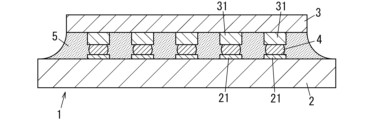
- FIG. 1 shows an example of a semiconductor device manufactured using a liquid epoxy resin composition according to an embodiment of the present disclosure.
- composition (X) contains a lactone compound (A), an epoxy resin (B), an aromatic amine (C), and an inorganic filler (D). This ensures an appropriate pot life and produces a cured product that is less susceptible to cracking.
- the composition (X) of the present disclosure is used to fabricate a semiconductor device. More specifically, the composition (X) is used to fabricate a sealing portion included in the semiconductor device.
- the composition (X) can be suitably used to fabricate a sealing portion included in a semiconductor device in which a semiconductor element and a substrate are joined by solder bumps.
- the composition (X) can be suitably used for underfilling to seal between a semiconductor element and a substrate.
- composition (X) can be used as an underfill material for such semiconductor devices, and can provide good sealing performance to the semiconductor devices.
- the semiconductor elements referred to here include, for example, active elements such as chips, diodes, and thyristors, and passive elements such as capacitors, resistors, and coils.
- the occurrence of cracks can be suppressed in the cured product of composition (X) according to the present disclosure. Therefore, the occurrence of cracks tends to be suppressed in the sealing part made from composition (X). In particular, the number of cracks occurring in the sealing part at the points in contact with the corners of the semiconductor element or at the points in contact with the periphery of the semiconductor element tends to be suppressed.
- composition (X) in this disclosure is not limited to sealing semiconductor devices.
- composition (X) can be used for various purposes depending on the purpose of use.
- composition (X) the viscosity at 25°C is, for example, 100 Pa ⁇ s or less. In this case, the fluidity of composition (X) can be ensured. This makes it easier to use composition (X) as a material for sealing semiconductor devices.
- the viscosity at 25°C is preferably 50.0 Pa ⁇ s or less. In this case, composition (X) is easy to handle. This makes it easier to use composition (X) as a material for sealing semiconductor devices.
- the viscosity at 25°C is more preferably 45.0 Pa ⁇ s or less, and even more preferably 40.0 Pa ⁇ s or less.
- composition (X) the viscosity at 25°C may be 1.0 Pa ⁇ s or more, or may be 5.0 Pa ⁇ s or more.
- the viscosity of composition (X) can be measured, for example, using a B-type viscometer (manufactured by Toki Sangyo Co., Ltd., model number: TVB-10) with the temperature set to 25°C and the rotation speed set to 20.0 rpm.
- composition (X) can be achieved by appropriately selecting the components and adjusting the amounts of each component within the ranges described below.
- composition (X) contains the lactone compound (A).
- the lactone compound (A) has a lactone ring.
- the number of atoms constituting the lactone ring is not particularly limited.
- the number of atoms can be appropriately selected according to the mode of use, but the number is preferably six.
- the lactone ring of the lactone compound (A) is preferably a six-membered ring.
- the crack resistance of the cured product of the composition (X) tends to be increased.
- "crack resistance” means the property of suppressing the occurrence of cracks in the cured product of the liquid epoxy resin composition.
- the lactone ring of the lactone compound (A) may be condensed with, for example, an aromatic ring or a heterocyclic ring, but it is preferable that the lactone ring is condensed with an aromatic ring. Furthermore, it is preferable that the aromatic ring is a benzene ring. In other words, it is preferable that the lactone compound (A) contains at least one type selected from the group consisting of compounds having a chromanone skeleton in the molecule, compounds having a bischromanone skeleton in the molecule, compounds having a coumarin skeleton in the molecule, and compounds having a biscoumarin skeleton in the molecule.
- the compound having a chromanone skeleton and a bischromanone skeleton in the molecule preferably contains 6-methyl-4-phenyl-2-chromanone.
- a chromanone compound preferably contains 6-methyl-4-phenyl-2-chromanone.
- coumarin compounds compounds having a coumarin skeleton and a biscoumarin skeleton in the molecule
- coumarin compounds include, for example, 3-aminocoumarin, 4-hydroxycoumarin, 3,3'-carbonylbis(7-diethylaminocoumarin), 3-benzoyl-7-diethylaminecoumarin, 3,3'-carbonylbis(7-methoxycoumarin), 7-(diethylamino)-4-methylcoumarin, 3-(2-benzothiazole)-7-(diethylamine)coumarin, 3-benzoyl-7-methoxycoumarin, 2,3,6,7-tetrahydro-10-(3-pyridyl)-1H , 5H,11H-[1]benzopyrano[6,7,8-ij]quinolizin-11-one (coumarin 510), 10-(2-benzothiazolyl)-2,3,6,7-tetrahydro-1H,5H,11H-[1]benzopyran
- the coumarin compound contains at least one of 3-aminocoumarin, 7-(diethylamino)-4-methylcoumarin, coumarin 510, coumarin 545, coumarin 545T, and 3,3'-carbonylbis(7-diethylaminocoumarin).
- the increase in viscosity of composition (X) is suppressed, and the crack resistance of the cured product of composition (X) can be improved.
- the lactone compound (A) has, for example, a functional group in the molecule.
- the number or type of functional groups in the lactone compound (A) can be appropriately changed to increase the solubility of the lactone compound (A) in the composition (X).
- Increasing the solubility of the lactone compound (A) in the composition (X) can increase the fluidity of the composition (X) and also increase the crack resistance of the cured product of the composition (X).
- examples of the functional group include an alkyl group having 1 to 4 carbon atoms, a phenyl group, an alkoxy group, an amino group, a primary or secondary alkylamino group having an alkyl group having 1 to 4 carbon atoms, a hydroxyl group, a pyridyl group, a benzothiazolyl group, an alkoxy group, or an acetyl group.
- the alkyl group may be linear or branched.
- the alkyl group of the alkylamino group may be linear or branched. It is preferable that a hydroxyl group is not bonded to the lactone ring in the lactone compound (A).
- the lactone compound (A) contains a lactone compound (A1) that does not have a hydroxyl group bonded to the lactone ring.
- the viscosity of the composition (X) can be particularly reduced.
- lactone compound (A) contains a lactone compound having a specific structure, the appropriate pot life of composition (X) can be ensured and the occurrence of cracks in the cured product of composition (X) can be further suppressed.
- the lactone compound (A) preferably contains a lactone compound (A2) having a structure represented by the following formula (1).
- A2 a lactone compound having a structure represented by the following formula (1).
- R 1 to R 8 are each independent and may be the same or different.
- Each of R 1 to R 8 may be a hydrogen atom, or a functional group such as an alkyl group having 1 to 4 carbon atoms, a phenyl group, an amino group, a primary or secondary alkylamino group having an alkyl group having 1 to 4 carbon atoms, a hydroxyl group, a pyridyl group, a benzothiazolyl group, an alkoxy group, or an acetyl group.
- the alkyl group may be linear or branched.
- the alkyl group of the alkylamino group may be linear or branched.
- Each of R 1 to R 8 may be a monovalent group. Also, each of R 1 to R 8 may be a divalent group. In this case, any two of R 1 to R 8 may be bonded to each other. In this case, any two of R 1 to R 8 that are bonded to each other are both divalent groups.
- each of R 1 to R 8 is an alkylamino group
- the alkyl group in the alkylamino group may be a monovalent group or a divalent group.
- the alkyl group in the alkylamino group is a divalent group, any two of R 1 to R 8 may be bonded via this alkyl group.
- the lactone compound (A) contains the lactone compound (A2)
- at least one of R 1 to R 8 in the above formula (1) is a phenyl group or a methyl group.
- the increase in viscosity of the composition (X) is further suppressed, and the crack resistance of the cured product of the composition (X) can be further improved.
- the sealing part of the semiconductor device is produced from the composition (X)
- the occurrence of cracks in the sealing part at the part contacting the corner of the semiconductor element or the part contacting the periphery of the semiconductor element can be further suppressed.
- R 5 or R 6 is a phenyl group
- R 3 is a methyl group.
- the crack resistance of the cured product of the composition (X) can be particularly improved.
- the sealing part of the semiconductor device is produced from such a composition (X)
- the occurrence of cracks in the sealing part at the part contacting the corner of the semiconductor element can be particularly suppressed.
- the lactone compound (A) preferably contains a lactone compound (A3) having a structure represented by the following formula (2).
- A3 having a structure represented by the following formula (2).
- R 9 to R 22 are each independent and may be the same or different.
- R 9 to R 22 may each be a hydrogen atom or the same functional group as R 1 to R 8 in the above formula (1).
- Z 1 is a linking group.
- Each of R 9 to R 22 may be a monovalent group. Also, each of R 9 to R 22 may be a divalent group. In this case, any two of R 9 to R 22 may be bonded to each other. In this case, any two of R 9 to R 22 that are bonded to each other are both divalent groups.
- the lactone compound (A) contains the lactone compound (A3)
- the crack resistance of the cured product of the composition (X) can be further improved.
- the alkyl group of the alkylamino group may be a monovalent group or a divalent group.
- any two of R 9 to R 22 may be bonded via the alkyl group.
- the lactone compound (A) preferably contains a lactone compound (A4) having a structure represented by the following formula (3).
- a lactone compound (A4) having a structure represented by the following formula (3).
- R 23 to R 28 are each independent and may be the same or different.
- R 23 to R 28 may each be a hydrogen atom or the same functional group as R 1 to R 8 in the above formula (1).
- Each of R 23 to R 28 may be a monovalent group. Also, each of R 23 to R 28 may be a divalent group. In this case, any two of R 23 to R 28 may be bonded together. In this case, any two of R 23 to R 28 that are bonded together are both divalent groups.
- the lactone compound (A) contains the lactone compound (A4)
- at least one of R 23 to R 28 in the above formula (3) is an alkylamino group, a methyl group, or an amino group.
- the increase in viscosity of the composition (X) is further suppressed, and the crack resistance of the cured product of the composition (X) can be further improved.
- the sealing part of a semiconductor device is produced from such a composition (X)
- the occurrence of cracks in the sealing part at the portion in contact with the corner of the semiconductor element or at the portion in contact with the periphery of the semiconductor element can be further suppressed.
- R 28 is an amino group.
- the increase in viscosity of the composition (X) is particularly suppressed, and the crack resistance of the cured product of the composition (X) can be particularly enhanced.
- the sealing part of a semiconductor device is produced from such a composition (X)
- the occurrence of cracks in both the part of the sealing part contacting the corner of the semiconductor element and the part of the sealing part contacting the periphery of the semiconductor element can be particularly suppressed.
- R 24 is an alkylamino group and R 27 is a methyl group.
- the increase in viscosity of the composition (X) is particularly suppressed, and the crack resistance of the cured product of the composition (X) can be particularly improved.
- the sealing part of the semiconductor device is made from the composition (X)
- the occurrence of cracks in the sealing part at the corner of the semiconductor element and at the periphery of the semiconductor element can be particularly suppressed.
- R 23 to R 28 when at least one of R 23 to R 28 is an alkylamino group, the alkyl group in the alkylamino group may be a divalent group.
- the alkyl group in the alkylamino group is a divalent group, any two of R 23 to R 28 may be bonded via this alkyl group.
- Specific examples include a structure as shown in the following formula (4). That is, lactone compound (A4) may contain lactone compound (A41) having a structure as shown in the following formula (4).
- R 24 in the above formula (3) is an alkylamino group having two alkyl groups, and each of the two alkyl groups of the alkylamino group is bonded to R 23 and R 25 , which are bonded to the carbon atom of the aromatic ring contained in the coumarin skeleton.
- each of R 26 to R 28 is independent and may be the same or different.
- R 26 to R 28 are the same as R 26 to R 28 in the above formula (3).
- R 29 to R 32 are alkyl groups having 1 to 4 carbon atoms. It is particularly preferable that all of R 29 to R 32 are methyl groups.
- R 28 is preferably a pyridyl group or a benzothiazolyl group, which tends to enhance the crack resistance of the cured product of the composition (X).
- the lactone compound (A) preferably contains a lactone compound (A5) having a structure represented by the following formula (5).
- a lactone compound (A5) having a structure represented by the following formula (5).
- R 33 to R 42 are each independent and may be the same or different.
- R 33 to R 42 may each be a hydrogen atom or the same functional group as R 1 to R 8 in the above formula (1).
- Z2 is a linking group.
- Z2 may be the same as Z1 in the above formula (2).
- Each of R 33 to R 42 may be a monovalent group. Also, each of R 33 to R 42 may be a divalent group. In this case, any two of R 33 to R 42 may be bonded together. In this case, any two of R 33 to R 42 that are bonded together are both divalent groups.
- the lactone compound (A) contains the lactone compound (A5)
- the crack resistance of the cured product of the composition (X) can be further improved.
- the alkyl group of the alkylamino group may be a monovalent group.
- the alkyl group of the alkylamino group may be a divalent group.
- any two of R 33 to R 42 may be bonded via the alkyl group.
- the melting point of the lactone compound (A) is preferably 220°C or lower. In this case, the fluidity of the composition (X) is ensured, and the crack resistance of the composition (X) can be increased.
- the melting point of the lactone compound (A) is more preferably 170°C or lower, and even more preferably 140°C or lower.
- the melting point of the lactone compound (A) is, for example, 70°C or higher.
- the ratio of the lactone compound (A) is 0.1% by mass or more and 5.0% by mass or less based on the total of the epoxy resin (B) and the aromatic amine (C).
- the ratio of the lactone compound (A) is 0.1% by mass or more based on the total of the epoxy resin (B) and the aromatic amine (C)
- the crack resistance of the cured product of the composition (X) can be increased.
- the ratio of the lactone compound (A) is 5.0% by mass or less based on the total of the epoxy resin (B) and the aromatic amine (C)
- the pot life of the composition (X) can be easily extended.
- the ratio of the lactone compound (A) is more preferably 0.1% by mass or more and even more preferably 0.3% by mass or more based on the total of the epoxy resin (B) and the aromatic amine (C).
- the ratio of the lactone compound (A) is more preferably 1.5% by mass or less and even more preferably 1.0% by mass or less based on the total of the epoxy resin (B) and the aromatic amine (C).
- composition (X) the molar ratio of lactone compound (A) to epoxy resin (B) is preferably within the range of 0.1:99.9 to 10.0:90.0. In this case, the pot life of composition (X) can be easily extended, and the crack resistance of the cured product of composition (X) can be improved.
- composition (X) contains the epoxy resin (B).
- the epoxy resin (B) contains at least one selected from the group consisting of diglycidyl ether type epoxy resins such as p-aminophenol type epoxy resins, naphthalene type epoxy resins, bisphenol A type epoxy resins, bisphenol F type epoxy resins, bisphenol AD type epoxy resins, bisphenol S type epoxy resins, and hydrogenated bisphenol A type epoxy resins; epoxy resins obtained by epoxidizing novolac resins obtained by reacting phenols, such as orthocresol novolac type epoxy resins, with aldehydes; glycidyl ester type epoxy resins obtained by reacting polybasic acids, such as phthalic acid and dimer acid, with epichlorohydrin; and glycidyl amine type epoxy resins obtained by reacting amine compounds, such as diaminodiphenylmethane and isocyanuric acid, with epichlorohydrin.
- diglycidyl ether type epoxy resins such as p-aminophenol type epoxy resin
- the epoxy resin (B) contains at least one of bisphenol A type epoxy resins, bisphenol F type epoxy resins, p-aminophenol type epoxy resins, and naphthalene type epoxy resins.
- the curability of the composition (X) can be particularly enhanced.
- epoxy resin (B) a commercially available product may be used.
- examples of commercially available epoxy resin (B) include bisphenol F type epoxy resin (product name: YDF-8170C, epoxy equivalent: 155 to 165 g/eq.) manufactured by Nippon Steel & Sumikin Chemical Co., Ltd., bisphenol A type epoxy resin (product name: YD-128, epoxy equivalent: 184 to 194 g/eq.) manufactured by Nippon Steel & Sumikin Chemical Co., Ltd., and multifunctional epoxy resin (product name: jER-630, epoxy equivalent: 90 to 105 g/eq.) manufactured by Mitsubishi Chemical Corporation.
- the epoxy resin (B) may be used alone or in combination of two or more types.
- the epoxy resin (B) is preferably liquid at 25°C. In this case, the viscosity of the composition (X) can be reduced. In this embodiment, an epoxy resin that is solid at 25°C can also be used in combination, as long as it does not affect the fluidity of the composition (X). Note that, in the case of epoxy resin (B), being liquid at 25°C means that the viscosity at 25°C is 100 Pa ⁇ s or less.
- the viscosity of the epoxy resin (B) at 25°C is preferably 0.01 Pa ⁇ s or more, and more preferably 0.02 Pa ⁇ s or more.
- the viscosity of the epoxy resin (B) at 25°C is preferably 50.0 Pa ⁇ s or less, and more preferably 20.0 Pa ⁇ s or less.
- the epoxy equivalent of the epoxy resin (B) is, for example, 40 g/eq. or more and 1,000 g/eq. or less. In this case, the reactivity of the epoxy resin (B) with the aromatic amine (C) can be enhanced. As a result, the heat resistance and crack resistance of the cured product of the composition (X) can be enhanced.
- the epoxy equivalent means the mass (g) of the epoxy resin (B) containing 1 mole of epoxy groups.
- the epoxy equivalent of the epoxy resin (B) is preferably 50 g/eq. or more.
- the epoxy equivalent of the epoxy resin (B) is preferably 300 g/eq. or less.
- the epoxy resin (B) preferably contains an epoxy resin (B1) having two or more epoxy groups in one molecule.
- the reactivity of the epoxy resin (B) with the aromatic amine (C) can be enhanced.
- the curability of the composition (X) is enhanced, and the heat resistance and crack resistance of the cured product of the composition (X) can be enhanced.
- the epoxy equivalent of the epoxy resin (B) is, for example, 50 g/eq.
- the epoxy resin (B) contains an epoxy resin (B1) having two or more epoxy groups in one molecule. In this case, the heat resistance and crack resistance of the cured product of the composition (X) can be further improved.
- the composition (X) contains an aromatic amine (C).
- the composition (X) contains an aromatic amine (C), and thus the heat resistance of the cured product of the composition (X) can be improved.
- the composition (X) can achieve high heat resistance and the pot life of the composition (X) can be easily extended, compared with the case where an aliphatic amine is used instead of the aromatic amine (C).
- the aromatic amine (C) refers to an aromatic compound having an amino group.
- Aromatic amine (C) may be liquid or solid as long as it is capable of causing composition (X) to exhibit fluidity at 25°C when contained in composition (X). It is preferable that aromatic amine (C) is liquid at 25°C, in which case the fluidity of composition (X) can be improved.
- aromatic amines (C) include aliphatic aromatic amines such as m-xylylenediamine, aromatic amines with one aromatic ring such as metaphenylenediamine, 1,3-diaminotoluene, 1,4-diaminotoluene, 2,4-diaminotoluene, 3,5-diethyl-2,4-diaminotoluene, 3,5-diethyl-2,6-diaminotoluene, and 2,4-diaminoanisole, 2,4'-diaminodiphenylmethane, 4,4'-diaminodiphenylsulfone, 4,4'-methylenebis(2-ethylenediamine), and the like.
- aromatic amines such as m-xylylenediamine
- aromatic amines with one aromatic ring such as metaphenylenediamine
- 1,3-diaminotoluene 1,4-diaminotolu
- the aromatic amine (C) contains at least one selected from the group consisting of aromatic amines having two aromatic rings, such as ethyl aniline), 3,3'-diethyl-4,4'-diaminodiphenylmethane, 3,3',5,5'-tetramethyl-4,4'-diaminodiphenylmethane, 3,3',5,5'-tetraethyl-4,4'-diaminodiphenylmethane, and polytetramethylene oxide diparaaminobenzoate, condensates of aromatic diamines and epichlorohydrin, and reaction products of aromatic diamines and styrene.
- aromatic amines having two aromatic rings such as ethyl aniline
- 3,3'-diethyl-4,4'-diaminodiphenylmethane 3,3',5,5'-tetramethyl-4,4'-diaminodiphenylmethane
- the aromatic amine (C) contains at least one of diaminodiphenylmethane, m-phenylenediamine, diaminodiphenylsulfone, and diethyltoluenediamine.
- the pot life of the composition (X) can be particularly easily extended.
- Aromatic amine (C) may be, for example, a commercially available product.
- Examples of commercially available products include an amine hardener manufactured by Nippon Kayaku Co., Ltd. (product name: Kayahard AA, amine active hydrogen equivalent: 64 g/eq.) and a modified aromatic amine hardener manufactured by ADEKA Corporation (product name: EH-105L, amine active hydrogen equivalent: 61 g/eq.).
- the amine active hydrogen equivalent of the aromatic amine (C) is, for example, 20 g/eq. or more and 500 g/eq. or less. In this case, the reactivity between the epoxy resin (B) and the aromatic amine (C) can be increased. As a result, the heat resistance and crack resistance of the cured product of the composition (X) can be increased.
- the amine active hydrogen equivalent means the mass (g) of the aromatic amine (C) containing 1 mole of amine active hydrogen.
- the amine active hydrogen equivalent of the aromatic amine (C) is preferably, for example, 30 g/eq. or more.
- the amine active hydrogen equivalent of the aromatic amine (C) is preferably, for example, 100 g/eq. or less.
- the aromatic amine (C) contains an aromatic amine (C1) having two or more amino groups in one molecule.
- the reactivity between the epoxy resin (B) and the aromatic amine (C) can be further increased.
- the amine active hydrogen equivalent of the aromatic amine (C) is 30 g/eq.
- the aromatic amine (C) contains an aromatic amine (C1) having two or more amino groups in one molecule. This can further improve the heat resistance and crack resistance of the cured product of composition (X).
- the ratio of the functional group equivalent of the aromatic amine (C) to the functional group equivalent of the epoxy resin (B) in the composition (X) is 0.6 or more and 1.4 or less.
- the ratio of the functional group equivalent of the aromatic amine (C) to the functional group equivalent of the epoxy resin (B) is 0.6 or more, the proportion of the epoxy resin (B) is not excessively high, so that the epoxy resin (B) and the aromatic amine (C) can react efficiently. Therefore, the number of crosslinking points in the cured product of the composition (X) is not excessively low, so that the glass transition temperature of the cured product can be moderately increased.
- the ratio of the functional group equivalent of the aromatic amine (C) to the functional group equivalent of the epoxy resin (B) is 1.4 or less, the proportion of the aromatic amine (C) is not excessively high, so that the epoxy resin (B) and the aromatic amine (C) can react efficiently.
- the number of crosslinking points in the cured product of composition (X) is not excessively large, and the glass transition temperature of the cured product can be appropriately lowered. This can reduce stress in the cured product of composition (X), thereby improving the crack resistance of the cured product.
- the functional group of the epoxy resin (B) refers to an epoxy group.
- the functional group of the aromatic amine (C) refers to an amino group.
- the ratio of the amine active hydrogen equivalent of the aromatic amine (C) to the epoxy equivalent of the epoxy resin (B) is preferably 0.6 or more and 1.4 or less.
- the ratio of the functional group equivalent of the aromatic amine (C) to the functional group equivalent of the epoxy resin (B) is more preferably 0.7 or more, and even more preferably 0.8 or more.
- the ratio of the functional group equivalent of the aromatic amine (C) to the functional group equivalent of the epoxy resin (B) is more preferably 1.3 or less.
- the composition (X) contains the inorganic filler (D).
- the linear expansion coefficient of the cured product of the composition (X) may be included. Therefore, the stress in the cured product may be reduced.
- the inorganic filler (D) contains at least one component selected from the group consisting of, for example, silica, alumina, and silicon nitride.
- the inorganic filler (D) contains silica.
- Specific examples of the type of silica include, for example, fused silica and crystalline silica. Among these, it is preferable that the silica is fused silica.
- the silica contained in the composition (X) may be used alone or in combination of two or more types.
- the shape of the silica is spherical. In other words, it is preferable that the inorganic filler (D) contains spherical silica. In this case, the fluidity of the composition (X) can be increased.
- the inorganic filler (D) is preferably surface-treated with a surface treatment agent.
- the dispersibility of the inorganic filler (D) in the composition (X) can be increased. This ensures the fluidity of the composition (X) and increases the filling rate of the inorganic filler (D) in the composition (X).
- a silane coupling agent can be suitably used as the surface treatment agent.
- the inorganic filler (D) is preferably surface-treated with a silane coupling agent.
- the inorganic filler (D) preferably contains silica that has been surface-treated with a silane coupling agent.
- the average particle diameter of the inorganic filler (D) is preferably 0.1 ⁇ m or more and 70.0 ⁇ m or less. In this case, the fluidity of the composition (X) can be improved. Furthermore, the average particle diameter of the inorganic filler (D) is more preferably 0.3 ⁇ m or more. The average particle diameter of the inorganic filler (D) is more preferably 20.0 ⁇ m or less.
- the maximum particle size of the inorganic filler (D) is preferably 5.0 ⁇ m or less. In this case, the fluidity of the composition (X) can be improved.
- the maximum particle size of the inorganic filler (D) is more preferably 3.0 ⁇ m or less.
- the maximum particle size of the inorganic filler (D) is preferably 0.1 ⁇ m or more, and more preferably 0.3 ⁇ m or more.
- the average particle size is a volume-based median size calculated from the particle size distribution measured by a laser diffraction/scattering method, and is obtained using a commercially available laser diffraction/scattering particle size distribution measuring device.
- two or more types of inorganic fillers (D) with different average particle sizes may be used.
- the proportion of inorganic filler (D) is preferably 40.0% by mass or more and 80.0% by mass or less with respect to the total amount of composition (X).
- the proportion of inorganic filler (D) is 40.0% by mass or more, the linear expansion coefficient of composition (X) can be sufficiently reduced. This can enhance the crack resistance of the cured product of composition (X).
- the proportion of inorganic filler (D) is 80.0% by mass or less, the fluidity of composition (X) during molding can be ensured.
- the proportion of inorganic filler (D) is more preferably 42.0% by mass or more with respect to composition (X), and even more preferably 45.0% by mass or more.
- the proportion of inorganic filler (D) is more preferably 75.0% by mass or less with respect to the total amount of composition (X), and even more preferably 70.0% by mass or less.
- the composition (X) may contain, in addition to the lactone compound (A), the epoxy resin (B), the aromatic amine (C), and the inorganic filler (D), at least one selected from the group consisting of a resin modifier, an antioxidant, a curing assistant, a coupling agent, a colorant, a thixotropic agent, an ion trapping agent, an antifoaming agent, a leveling agent, and an antioxidant, within a range that does not impair the object of the present disclosure.
- composition (X) may contain a resin modifier.
- the resin modifier contains, for example, a resin.
- the resin contained in the resin modifier contains, for example, at least one type selected from the group consisting of silicone resin, butadiene resin, etc.
- the composition (X) may contain a curing aid.
- the curing aid can accelerate the curing reaction between the epoxy resin (B) and the aromatic amine (C).
- the curing aid contains at least one compound selected from the group consisting of, for example, an aluminum-containing chelate compound, an imidazole-based compound such as 2-ethyl-4-methylimidazole, an organic phosphorus compound such as triphenylphosphine, a quaternary ammonium-based compound, and a phosphonium-based compound.
- the composition (X) may contain a coupling agent.
- the coupling agent can improve the compatibility between the inorganic filler (D) and the epoxy resin (B).
- the coupling agent contains at least one selected from the group consisting of, for example, silane-based compounds, titanium-based compounds, aluminum chelates, and aluminum/zirconium-based compounds.
- the silane-based compound contains at least one selected from the group consisting of, for example, silane compounds having an amino group, epoxy silanes, mercapto silanes, alkyl silanes, ureido silanes, and vinyl silanes.
- silane compounds include vinyltrichlorosilane, vinyltriethoxysilane, vinyltris( ⁇ -methoxyethoxy)silane, ⁇ -methacryloxypropyltrimethoxysilane, ⁇ -(3,4-epoxycyclohexyl)ethyltrimethoxysilane, ⁇ -glycidoxypropyltrimethoxysilane, ⁇ -glycidoxypropylmethyldimethoxysilane, vinyltriacetoxysilane, ⁇ -mercaptopropyltrimethoxysilane, ⁇ -aminopropyltrimethoxysilane, ⁇ -aminopropylmethyldimethoxysilane, Methoxysilane, ⁇ -aminopropyltriethoxysilane, ⁇ -aminopropylmethyldiethoxysilane, ⁇ -anilinopropyltrimethoxysilane, ⁇ -anilinopropyltri
- composition (X) may contain a colorant.
- colorants include inorganic pigments and organic dyes.
- the inorganic pigment contains at least one selected from the group consisting of, for example, carbon black, a complex metal oxide of copper, chromium and manganese, a complex metal oxide of iron and manganese, a complex metal oxide of chromium and iron, a complex metal oxide of cobalt, iron and chromium, a complex metal oxide of copper, iron, manganese and aluminum, and titanium oxide.
- the organic dye contains at least one selected from the group consisting of, for example, alloy dyes such as azo compound chromium complexes, azo dyes, anthraquinone dyes and nigrosine dyes. These colorants may be used alone or in combination of two or more.
- the production method of the composition (X) is not particularly limited as long as it is a method that can uniformly disperse and mix the above components.
- Specific examples of such a method for dispersing and mixing include a method of dispersing and kneading using a three-roll mixer, a planetary mixer, or the like.
- composition (X) can be used to encapsulate a semiconductor device.
- the semiconductor device includes a cured product of composition (X).
- FC-BGA Flip Chip Ball Grid Array
- EBGA Enhanced BGA
- ABGA Advanced BGA
- Stacked-BGA SIP (System in Package)
- WLP Wafer Level Package
- the composition (X) When the composition (X) is used to seal a semiconductor device, it can also be used as an underfill material.
- the composition (X) can be applied from the periphery of a semiconductor element such as a chip using a syringe needle or the like, and the underfill material can be impregnated and permeated between the semiconductor element such as a chip and the substrate by capillary action to fill the gap.
- the size of semiconductor elements to become larger, for the gap between the semiconductor element and the substrate to become narrower, and for the pitch between bumps to become narrower.
- composition (X) according to this embodiment can be applied even when the size of the semiconductor element is 20 x 20 mm or more, the gap between the semiconductor element and the substrate is 50 ⁇ m or less, and the pitch between bumps in the semiconductor device is 150 ⁇ m or less, and it is possible to manufacture a semiconductor device with excellent sealing performance.
- FIG. 1 shows an example of a semiconductor device 1 fabricated using composition (X).
- This semiconductor device 1 comprises a substrate 2, a semiconductor element 3 mounted facing the substrate 2 via bumps 4, and a sealing portion 5 that seals the gap between the substrate 2 and the semiconductor element 3.
- the sealing portion 5 contains a cured product of a liquid sealing resin composition.
- the semiconductor element 3 has a plurality of bump electrodes 31 on the surface facing the substrate 2, and the substrate 2 has conductor wiring 21 on the surface facing the semiconductor element 3.
- the bump electrodes 31 and the conductor wiring 21 are aligned and connected via the bumps 4.
- the bumps 4, the bump electrodes 31, and the conductor wiring 21 are embedded in the sealing portion 5.
- the sealing portion 5 includes a cured product of the composition (X).
- the sealing portion 5 is produced by filling the gap between the substrate 2 and the semiconductor element 3 of the semiconductor device 1 with the composition (X) and then heating and curing the composition (X).
- the composition (X) is dropped onto one side of the side of the semiconductor element 3 using a syringe or the like. By doing so, the composition (X) fills the gap between the semiconductor element 3 and the substrate 2 that is not occupied by the bump 4 due to capillary action. If the substrate 2 is heated by a heating device such as a hot plate at this time, the heat of the substrate 2 is transferred to the composition (X), and the composition (X) can be efficiently filled.
- the temperature of the composition (X) when filling the gap in the semiconductor device 1 is preferably 80°C or higher and 130°C or lower. After the composition (X) penetrates the gap and fills it completely, the semiconductor device 1 is heated in a thermostatic chamber or the like to produce the sealing portion 5.
- the semiconductor device 1 includes the sealing portion 5 produced by the method described above, the substrate 2, and the semiconductor element 3.
- the method for producing the sealing portion 5 is not limited to the method described above. In other words, as long as the sealing portion 5 produced from the composition (X) can exhibit good sealing performance in the semiconductor device 1, any appropriate method can be used as the method for producing the sealing portion 5.
- composition (X) according to the first aspect of the present disclosure contains a lactone compound (A), an epoxy resin (B), an aromatic amine (C), and an inorganic filler (D).
- composition (X) that ensures an appropriate pot life and can suppress the occurrence of cracks in the cured product.
- the proportion of the lactone compound (A) is 0.1% by mass or more and 5.0% by mass or less with respect to the total of the epoxy resin (B) and the aromatic amine (C).
- the crack resistance of the cured product of composition (X) is improved, and the usable life of composition (X) can be easily extended.
- the viscosity at 25°C is 100 Pa ⁇ s or less.
- the molar ratio of the lactone compound (A) to the epoxy resin (B) is within the range of 0.1:99.9 to 10.0:90.0.
- the pot life of composition (X) can be easily extended, and the crack resistance of the cured product of composition (X) can be improved.
- the ratio of the functional group equivalent of the aromatic amine (C) to the functional group equivalent of the epoxy resin (B) is 0.6 or more and 1.4 or less.
- the crack resistance of composition (X) can be improved.
- the lactone compound (A) contains a lactone compound (A1) that does not have a hydroxyl group bonded to the lactone ring.
- the viscosity of composition (X) can be particularly reduced.
- composition (X) according to the seventh aspect of the present disclosure is any one of the first to sixth aspects, in which the epoxy equivalent of the epoxy resin (B) is 50 g/eq. or more and 300 g/eq. or less, and the epoxy resin (B) contains an epoxy resin (B1) having two or more epoxy groups in one molecule.
- the reactivity between the epoxy resin (B) and the aromatic amine (C) can be further increased.
- the heat resistance and crack resistance of the cured product of the composition (X) can be further improved.
- composition (X) according to the eighth aspect of the present disclosure is any one of the first to seventh aspects, in which the amine active hydrogen equivalent of the aromatic amine (C) is 30 g/eq. or more and 100 g/eq. or less, and the aromatic amine (C) contains an aromatic amine (C1) having two or more amino groups in one molecule.
- the reactivity between the epoxy resin (B) and the aromatic amine (C) can be further increased.
- the heat resistance and crack resistance of the cured product of the composition (X) can be further improved.
- composition (X) according to the ninth aspect of the present disclosure is any one of the first to eighth aspects, in which the inorganic filler (D) contains spherical silica.
- the fluidity of composition (X) can be increased.
- the ratio of the inorganic filler (D) to the liquid epoxy resin composition is 40.0% by mass or more and 80.0% by mass or less.
- the linear expansion coefficient of the cured product of composition (X) is sufficiently reduced, and the fluidity of composition (X) can be ensured.
- composition (X) according to the eleventh aspect of the present disclosure is for use in semiconductor encapsulation in any one of the first to tenth aspects.
- composition (X) according to the twelfth aspect of the present disclosure is for use as an underfill in any one of the first to eleventh aspects.
- the semiconductor device (1) includes a substrate (2), a semiconductor element (3), and a sealing portion (5) that fills the gap between the substrate (2) and the semiconductor element (3).
- the sealing portion (5) contains a cured product of the composition (X) according to any one of the first to twelfth aspects.
- Liquid epoxy resin compositions of the examples and comparative examples were prepared by mixing the components shown in Tables 1 to 3. Details of the components are as follows.
- Lactone compound 1 (Tokyo Chemical Industry Co., Ltd. Product name: 7-diethylamino-4-methylcoumarin (melting point 72° C.)).
- Lactone compound 2 (Tokyo Chemical Industry Co., Ltd. Product name: 6-methyl-4-phenyl-2-chromanone (melting point 82°C)).
- Lactone compound 3 (Tokyo Chemical Industry Co., Ltd. Product name: 3-aminocoumarin (melting point 137°C)).
- Lactone compound 4 (Tokyo Chemical Industry Co., Ltd. Product name: Coumarin 510 (melting point 165°C)).
- Lactone compound 5 (Tokyo Chemical Industry Co., Ltd. Product name: 4-hydroxycoumarin (melting point 212°C)).
- Lactone compound 6 (Tokyo Chemical Industry Co., Ltd. Product name: 3,3'-carbonylbis(7-diethylaminocoumarin) (melting point 217°C)).
- Epoxy resin 1 bisphenol F type epoxy resin (manufactured by Nippon Steel Chemical & Material Co., Ltd., product name: YDF-8170C, epoxy equivalent 160 g/eq.).
- Epoxy resin 2 Bisphenol A type epoxy resin (manufactured by Nippon Steel Chemical & Material Co., Ltd., product name: YDF-8125, epoxy equivalent 173 g/eq.).
- Epoxy resin 3 Glycidylamine type epoxy resin (manufactured by ADEKA Corporation, product name: EP-3950S, epoxy equivalent 95 g/eq.).
- Aromatic amine 1 3,3'-diethyl-4,4'-diaminodiphenylmethane (manufactured by Nippon Kayaku Co., Ltd., product name: Kayahard-AA, amine active hydrogen equivalent: 64 g/eq.).
- Aromatic amine 2 Dimethylthiotoluenediamine (manufactured by ADEKA Corporation, product name: EH105L, amine active hydrogen equivalent: 61 g/eq.).
- Aromatic amine 3 Diethyltoluenediamine (manufactured by Mitsubishi Chemical Corporation, product name: WA, amine active hydrogen equivalent: 45 g/eq.).
- Inorganic filler 1 Silica (average particle size 0.7 ⁇ m, maximum particle size 1.0 ⁇ m) prepared by a sol-gel method and surface-treated with a silane coupling agent having a phenylamino group.
- Resin modifier 1 A liquid masterbatch in which core-shell rubber particles are dispersed as single particles at a high concentration in an epoxy resin (manufactured by Kaneka Corporation, product name: MX-965).
- Antioxidant 1 Hindered phenol (manufactured by Lianglong Japan Co., Ltd., product name: RIANOX 1010).
- ⁇ Crack evaluation> First, a 10 mm square silicon die and a 20 mm square silicon die were prepared. Next, the liquid epoxy resin composition of each Example and Comparative Example was applied to the 20 mm square silicon die in an amount of 0.1 mg, and the die was placed on a hot plate set at 100° C. Next, after 10 minutes had elapsed since the 20 mm square silicon die was placed on the hot plate, the 10 mm square silicon die was placed on the surface of the 20 mm square silicon die on which the liquid epoxy resin composition had been applied, to prepare a sample.
- Comparative Example 1 does not contain a lactone compound when compared to Examples 1 to 10, and therefore the crack evaluation was not good.
- Comparative Example 2 contains an antioxidant, but does not contain a lactone compound when compared to Examples 1 to 10, and therefore the crack evaluation was not good.
- Comparative Example 3 contains a resin modifier, but does not contain a lactone compound when compared to Examples 1 to 10, and therefore the crack evaluation was not good.
Landscapes
- Chemical & Material Sciences (AREA)
- Health & Medical Sciences (AREA)
- Chemical Kinetics & Catalysis (AREA)
- Medicinal Chemistry (AREA)
- Polymers & Plastics (AREA)
- Organic Chemistry (AREA)
- Epoxy Resins (AREA)
- Compositions Of Macromolecular Compounds (AREA)
Priority Applications (1)
| Application Number | Priority Date | Filing Date | Title |
|---|---|---|---|
| JP2025510873A JPWO2024204091A1 (https=) | 2023-03-30 | 2024-03-25 |
Applications Claiming Priority (2)
| Application Number | Priority Date | Filing Date | Title |
|---|---|---|---|
| JP2023056703 | 2023-03-30 | ||
| JP2023-056703 | 2023-03-30 |
Publications (1)
| Publication Number | Publication Date |
|---|---|
| WO2024204091A1 true WO2024204091A1 (ja) | 2024-10-03 |
Family
ID=92905417
Family Applications (1)
| Application Number | Title | Priority Date | Filing Date |
|---|---|---|---|
| PCT/JP2024/011751 Ceased WO2024204091A1 (ja) | 2023-03-30 | 2024-03-25 | 液状エポキシ樹脂組成物及び半導体装置 |
Country Status (3)
| Country | Link |
|---|---|
| JP (1) | JPWO2024204091A1 (https=) |
| TW (1) | TW202442741A (https=) |
| WO (1) | WO2024204091A1 (https=) |
Citations (11)
| Publication number | Priority date | Publication date | Assignee | Title |
|---|---|---|---|---|
| JP2001335619A (ja) * | 1999-12-28 | 2001-12-04 | Kanegafuchi Chem Ind Co Ltd | エポキシ変性ポリイミドおよび、これを用いた感光性組成物、カバーレイフィルム、ソルダーレジスト、プリント配線板 |
| JP2009126980A (ja) * | 2007-11-26 | 2009-06-11 | Sumitomo Bakelite Co Ltd | 液状封止樹脂組成物、半導体装置および半導体装置の製造方法 |
| JP2015083634A (ja) * | 2013-10-25 | 2015-04-30 | 日立化成株式会社 | エポキシ樹脂組成物、このエポキシ樹脂組成物を用いた電子部品装置及び電子部品装置の製造方法。 |
| JP2017028050A (ja) * | 2015-07-21 | 2017-02-02 | 日立化成株式会社 | アンダーフィル材及びそれを用いた電子部品装置 |
| JP2017171873A (ja) * | 2016-03-16 | 2017-09-28 | 住友ベークライト株式会社 | エポキシ樹脂組成物および半導体装置 |
| JP2018039981A (ja) * | 2016-09-05 | 2018-03-15 | 住友ベークライト株式会社 | エポキシ樹脂組成物および半導体装置 |
| JP2018062606A (ja) * | 2016-10-14 | 2018-04-19 | 日立化成株式会社 | アンダーフィル材、電子部品装置及び電子部品装置の製造方法 |
| JP2020084050A (ja) * | 2018-11-27 | 2020-06-04 | 住友化学株式会社 | エポキシ樹脂組成物及びその硬化物 |
| WO2021241286A1 (ja) * | 2020-05-27 | 2021-12-02 | 住友化学株式会社 | エポキシ樹脂組成物及びその硬化物 |
| CN113999636A (zh) * | 2021-02-08 | 2022-02-01 | 东阳市福雕文化创意有限公司 | 单组分热固性预涂粘合剂 |
| JP2024051882A (ja) * | 2022-09-30 | 2024-04-11 | 旭化成株式会社 | エポキシ樹脂組成物、硬化物、及び半導体装置 |
-
2024
- 2024-03-25 JP JP2025510873A patent/JPWO2024204091A1/ja active Pending
- 2024-03-25 WO PCT/JP2024/011751 patent/WO2024204091A1/ja not_active Ceased
- 2024-03-26 TW TW113111225A patent/TW202442741A/zh unknown
Patent Citations (11)
| Publication number | Priority date | Publication date | Assignee | Title |
|---|---|---|---|---|
| JP2001335619A (ja) * | 1999-12-28 | 2001-12-04 | Kanegafuchi Chem Ind Co Ltd | エポキシ変性ポリイミドおよび、これを用いた感光性組成物、カバーレイフィルム、ソルダーレジスト、プリント配線板 |
| JP2009126980A (ja) * | 2007-11-26 | 2009-06-11 | Sumitomo Bakelite Co Ltd | 液状封止樹脂組成物、半導体装置および半導体装置の製造方法 |
| JP2015083634A (ja) * | 2013-10-25 | 2015-04-30 | 日立化成株式会社 | エポキシ樹脂組成物、このエポキシ樹脂組成物を用いた電子部品装置及び電子部品装置の製造方法。 |
| JP2017028050A (ja) * | 2015-07-21 | 2017-02-02 | 日立化成株式会社 | アンダーフィル材及びそれを用いた電子部品装置 |
| JP2017171873A (ja) * | 2016-03-16 | 2017-09-28 | 住友ベークライト株式会社 | エポキシ樹脂組成物および半導体装置 |
| JP2018039981A (ja) * | 2016-09-05 | 2018-03-15 | 住友ベークライト株式会社 | エポキシ樹脂組成物および半導体装置 |
| JP2018062606A (ja) * | 2016-10-14 | 2018-04-19 | 日立化成株式会社 | アンダーフィル材、電子部品装置及び電子部品装置の製造方法 |
| JP2020084050A (ja) * | 2018-11-27 | 2020-06-04 | 住友化学株式会社 | エポキシ樹脂組成物及びその硬化物 |
| WO2021241286A1 (ja) * | 2020-05-27 | 2021-12-02 | 住友化学株式会社 | エポキシ樹脂組成物及びその硬化物 |
| CN113999636A (zh) * | 2021-02-08 | 2022-02-01 | 东阳市福雕文化创意有限公司 | 单组分热固性预涂粘合剂 |
| JP2024051882A (ja) * | 2022-09-30 | 2024-04-11 | 旭化成株式会社 | エポキシ樹脂組成物、硬化物、及び半導体装置 |
Also Published As
| Publication number | Publication date |
|---|---|
| TW202442741A (zh) | 2024-11-01 |
| JPWO2024204091A1 (https=) | 2024-10-03 |
Similar Documents
| Publication | Publication Date | Title |
|---|---|---|
| TWI507485B (zh) | 半導體樹脂封裝材料 | |
| CN104470989B (zh) | 液态封装材料、使用该材料的电子部件 | |
| JP4892164B2 (ja) | 液状エポキシ樹脂組成物及び電子部品装置 | |
| JP7823646B2 (ja) | 液状樹脂組成物並びに電子部品装置及びその製造方法 | |
| JP7343977B2 (ja) | 封止用液状エポキシ樹脂組成物及び電子部品装置 | |
| JP7167912B2 (ja) | 液状封止樹脂組成物、電子部品装置及び電子部品装置の製造方法 | |
| JP7715983B2 (ja) | アンダーフィル用液状樹脂組成物、電子部品装置、及び電子部品装置の製造方法 | |
| CN118165465A (zh) | 一种液体环氧树脂组合物、制备方法及应用 | |
| JP2020066697A (ja) | 液状樹脂組成物並びに電子部品装置及びその製造方法 | |
| JP2021174939A (ja) | アンダーフィル用樹脂組成物及びその製造方法、半導体装置の製造方法、並びに半導体装置 | |
| JP6286959B2 (ja) | エポキシ樹脂組成物、電子部品装置及び電子部品装置の製造方法 | |
| WO2024204091A1 (ja) | 液状エポキシ樹脂組成物及び半導体装置 | |
| JP5647769B2 (ja) | Cof封止用樹脂組成物 | |
| JP2015054952A (ja) | エポキシ樹脂組成物、電子部品装置及び電子部品装置の製造方法 | |
| JP2025088138A (ja) | 樹脂組成物及び半導体装置 | |
| JP7786113B2 (ja) | アンダーフィル用液状樹脂組成物、電子部品装置及び電子部品装置の製造方法 | |
| JPH02305848A (ja) | 液状エポキシ樹脂組成物及びその硬化物 | |
| JP2019081816A (ja) | アンダーフィル用液状樹脂組成物、電子部品装置、及び電子部品装置の製造方法 | |
| JPWO2005080502A1 (ja) | アンダーフィル用液状エポキシ樹脂組成物および同組成物を用いて封止した半導体装置 | |
| CN115895543B (zh) | 一种微波辐射固化的芯片级底部填充胶 | |
| WO2026048972A1 (ja) | 液状樹脂組成物並びに電子部品装置及びその製造方法 | |
| WO2026048971A1 (ja) | 液状樹脂組成物並びに電子部品装置及びその製造方法 | |
| TW202342637A (zh) | 液狀密封用樹脂組成物及半導體裝置 | |
| WO2025110104A1 (ja) | 樹脂組成物及び半導体装置 | |
| WO2025121410A1 (ja) | 樹脂組成物及び半導体装置 |
Legal Events
| Date | Code | Title | Description |
|---|---|---|---|
| 121 | Ep: the epo has been informed by wipo that ep was designated in this application |
Ref document number: 24780208 Country of ref document: EP Kind code of ref document: A1 |
|
| ENP | Entry into the national phase |
Ref document number: 2025510873 Country of ref document: JP Kind code of ref document: A |
|
| WWE | Wipo information: entry into national phase |
Ref document number: 2025510873 Country of ref document: JP |
|
| NENP | Non-entry into the national phase |
Ref country code: DE |
|
| 122 | Ep: pct application non-entry in european phase |
Ref document number: 24780208 Country of ref document: EP Kind code of ref document: A1 |