WO2024202198A1 - 接合体の製造方法 - Google Patents
接合体の製造方法 Download PDFInfo
- Publication number
- WO2024202198A1 WO2024202198A1 PCT/JP2023/040884 JP2023040884W WO2024202198A1 WO 2024202198 A1 WO2024202198 A1 WO 2024202198A1 JP 2023040884 W JP2023040884 W JP 2023040884W WO 2024202198 A1 WO2024202198 A1 WO 2024202198A1
- Authority
- WO
- WIPO (PCT)
- Prior art keywords
- intermediate layer
- bonding
- polishing
- piezoelectric material
- substrate
- Prior art date
- Legal status (The legal status is an assumption and is not a legal conclusion. Google has not performed a legal analysis and makes no representation as to the accuracy of the status listed.)
- Ceased
Links
Images

Classifications
-
- B—PERFORMING OPERATIONS; TRANSPORTING
- B24—GRINDING; POLISHING
- B24B—MACHINES, DEVICES, OR PROCESSES FOR GRINDING OR POLISHING; DRESSING OR CONDITIONING OF ABRADING SURFACES; FEEDING OF GRINDING, POLISHING, OR LAPPING AGENTS
- B24B37/00—Lapping machines or devices; Accessories
- B24B37/04—Lapping machines or devices; Accessories designed for working plane surfaces
- B24B37/07—Lapping machines or devices; Accessories designed for working plane surfaces characterised by the movement of the work or lapping tool
- B24B37/08—Lapping machines or devices; Accessories designed for working plane surfaces characterised by the movement of the work or lapping tool for double side lapping
-
- H—ELECTRICITY
- H03—ELECTRONIC CIRCUITRY
- H03H—IMPEDANCE NETWORKS, e.g. RESONANT CIRCUITS; RESONATORS
- H03H3/00—Apparatus or processes specially adapted for the manufacture of impedance networks, resonating circuits, resonators
- H03H3/007—Apparatus or processes specially adapted for the manufacture of impedance networks, resonating circuits, resonators for the manufacture of electromechanical resonators or networks
- H03H3/02—Apparatus or processes specially adapted for the manufacture of impedance networks, resonating circuits, resonators for the manufacture of electromechanical resonators or networks for the manufacture of piezoelectric or electrostrictive resonators or networks
-
- H—ELECTRICITY
- H03—ELECTRONIC CIRCUITRY
- H03H—IMPEDANCE NETWORKS, e.g. RESONANT CIRCUITS; RESONATORS
- H03H3/00—Apparatus or processes specially adapted for the manufacture of impedance networks, resonating circuits, resonators
- H03H3/007—Apparatus or processes specially adapted for the manufacture of impedance networks, resonating circuits, resonators for the manufacture of electromechanical resonators or networks
- H03H3/08—Apparatus or processes specially adapted for the manufacture of impedance networks, resonating circuits, resonators for the manufacture of electromechanical resonators or networks for the manufacture of resonators or networks using surface acoustic waves
-
- H—ELECTRICITY
- H03—ELECTRONIC CIRCUITRY
- H03H—IMPEDANCE NETWORKS, e.g. RESONANT CIRCUITS; RESONATORS
- H03H9/00—Networks comprising electromechanical or electro-acoustic elements; Electromechanical resonators
- H03H9/02—Details
- H03H9/02535—Details of surface acoustic wave devices
- H03H9/02543—Characteristics of substrate, e.g. cutting angles
- H03H9/02559—Characteristics of substrate, e.g. cutting angles of lithium niobate or lithium-tantalate substrates
-
- H—ELECTRICITY
- H03—ELECTRONIC CIRCUITRY
- H03H—IMPEDANCE NETWORKS, e.g. RESONANT CIRCUITS; RESONATORS
- H03H9/00—Networks comprising electromechanical or electro-acoustic elements; Electromechanical resonators
- H03H9/02—Details
- H03H9/02535—Details of surface acoustic wave devices
- H03H9/02543—Characteristics of substrate, e.g. cutting angles
- H03H9/02574—Characteristics of substrate, e.g. cutting angles of combined substrates, multilayered substrates, piezoelectrical layers on not-piezoelectrical substrate
-
- H—ELECTRICITY
- H03—ELECTRONIC CIRCUITRY
- H03H—IMPEDANCE NETWORKS, e.g. RESONANT CIRCUITS; RESONATORS
- H03H9/00—Networks comprising electromechanical or electro-acoustic elements; Electromechanical resonators
- H03H9/25—Constructional features of resonators using surface acoustic waves
-
- H—ELECTRICITY
- H10—SEMICONDUCTOR DEVICES; ELECTRIC SOLID-STATE DEVICES NOT OTHERWISE PROVIDED FOR
- H10N—ELECTRIC SOLID-STATE DEVICES NOT OTHERWISE PROVIDED FOR
- H10N30/00—Piezoelectric or electrostrictive devices
- H10N30/01—Manufacture or treatment
- H10N30/07—Forming of piezoelectric or electrostrictive parts or bodies on an electrical element or another base
- H10N30/072—Forming of piezoelectric or electrostrictive parts or bodies on an electrical element or another base by laminating or bonding of piezoelectric or electrostrictive bodies
- H10N30/073—Forming of piezoelectric or electrostrictive parts or bodies on an electrical element or another base by laminating or bonding of piezoelectric or electrostrictive bodies by fusion of metals or by adhesives
Definitions
- the present invention relates to a method for manufacturing a bonded body that can be suitably used for elastic wave elements, etc.
- FBARs Film Bulk Acoustic Resonators
- One such surface acoustic wave device is one in which a support substrate is bonded to a piezoelectric material substrate that propagates surface acoustic waves, and a comb-shaped electrode capable of exciting surface acoustic waves is provided on the surface of the piezoelectric material substrate.
- Patent Document 1 In bonded substrates intended for surface acoustic wave devices, it has been reported that spurious signals can be reduced by roughening the surface of the piezoelectric material substrate (Patent Document 1, Patent Document 2). It is also known to roughen the surface of the piezoelectric substrate, provide a filling layer on the rough surface to flatten it, and then adhere this filling layer to the silicon substrate via an adhesive layer. In this method, epoxy or acrylic resins are used for the filling layer and adhesive layer, and by roughening the bonding surface of the piezoelectric material substrate, reflection of bulk waves is suppressed and spurious signals are reduced. In addition, because the unevenness of the rough surface of the piezoelectric material substrate is filled and flattened before bonding, air bubbles are less likely to become trapped in the adhesive layer.
- Double-sided polishing is a commonly used method for polishing semiconductor silicon wafers, in which the wafer is placed in a carrier that holds the wafer and polished from both sides (Patent Document 3).
- the objective of the present invention is to provide an intermediate layer on the rough surface of a piezoelectric material substrate, subject the piezoelectric material substrate and intermediate layer to double-sided polishing, and then suppress peeling of the bonded body when bonding the bonding surface of the intermediate layer to a support substrate.
- the present invention provides a method for producing a piezoelectric material substrate having a first main surface and a second main surface, the method comprising the steps of: providing an intermediate layer on the first main surface of a piezoelectric material substrate having a first main surface and a second main surface to obtain a laminate;
- a method for producing a bonded body comprising: a polishing step of polishing the second main surface of the piezoelectric material substrate and a bonding surface of the intermediate layer by subjecting the laminate to double-sided polishing; and a bonding step of bonding the bonding surface of the intermediate layer to a support substrate,
- the ratio of the average polishing amount of the outer periphery of the intermediate layer to the average polishing amount of the inner periphery of the intermediate layer is 1.1 or more and 1.2 or less.
- the inventors have studied the cause of peeling occurring mainly along the outer periphery of the intermediate layer when bonding the bonding surface of the intermediate layer to a support substrate after providing an intermediate layer on the rough surface of a piezoelectric substrate and subjecting the piezoelectric substrate and intermediate layer to double-sided polishing. This phenomenon did not occur when double-sided polishing of a silicon substrate.
- the inventor further studied the pressure distribution applied from the polishing pad to the piezoelectric material substrate and the intermediate layer.
- the polishing pad is elastic, so the pad tends to sink into the outer periphery of the silicon wafer during processing, and the pad sinks, causing the outer periphery to be scraped more strongly than the center.
- the opposite phenomenon has been observed. For this reason, we investigated the pressure distribution applied to the laminate during processing.
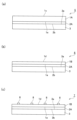
- FIG. 1A shows a bonded body 5
- FIG. 1B shows a state in which the piezoelectric material substrate of the bonded body has been polished
- FIG. 1C shows an acoustic wave element 7 .
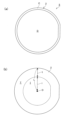
- 4A shows the peeling pattern in the bonded body 5
- FIG. 4B shows the outer and inner peripheries of the intermediate layer 2 .
- a piezoelectric material substrate 1 having a first main surface 1a and a second main surface 1b is prepared.
- the first main surface 1a is roughened.
- an intermediate layer 2 is provided on the main surface 1a of the piezoelectric material substrate to produce a laminate 10.
- the laminate 10 is subjected to a double-sided polishing process.
- the second main surface 1b of the piezoelectric material substrate 1 is polished to produce a piezoelectric material substrate 1A having a polished surface 1c (see FIG. 1(b)).
- the surface 2a of the intermediate layer is polished to produce an intermediate layer 2A having a polished bonding surface 2b.
- a neutralizing beam is irradiated to the bonding surface 2b of the intermediate layer 2 as indicated by the arrow A to activate the bonding surface 2b.
- the bonding surface 3a of the support substrate 3 is activated by irradiating it with a neutralizing beam as shown by arrow B.
- the bonding surface 3a of the support substrate 3 and the bonding surface 2b of the intermediate layer 2A are directly bonded to each other to obtain a bonded body 5.
- the polished surface 1c of the piezoelectric material substrate 1A of the bonded body is further polished to reduce the thickness of the piezoelectric material substrate 1B as shown in Fig. 2(b) to obtain a bonded body 6.
- Reference numeral 1d denotes the polished surface.
- a surface acoustic wave element 7 is fabricated by forming a predetermined electrode 8 on the polished surface 1d of the piezoelectric material substrate 1B.
- the ratio of the average polishing amount of the outer periphery of the intermediate layer to the average polishing amount of the inner periphery of the intermediate layer (average polishing amount of outer periphery/average polishing amount of inner periphery) is set to 1.1 or more and 1.2 or less.
- each average polishing amount is measured as follows.
- the outer periphery and inner periphery of the intermediate layer are defined as follows. That is, as shown in Fig. 3(b), the width (radius) of the intermediate layer 2 is defined as L.
- the intermediate layer 2 is not a perfect circle but has an orientation flat, and in such a case, the radius of an imaginary circle including the entire outer contour of the intermediate layer 2 is defined as L.
- the region of width (radius) i as viewed from the center O of the imaginary circle is defined as the inner periphery, and the approximately ring-shaped region of width t outside of this is defined as the outer periphery T.
- i 0.93 x L
- Otsuka Electronics Co., Ltd. the film thicknesses of the outer peripheral portion T and the inner peripheral portion I before and after processing were measured using a microspectrophotometer (OPTM manufactured by Otsuka Electronics Co., Ltd.). However, since it is difficult to define the film thickness on the rough surface, measurements were taken at 80 points, and the average value was taken as the film thickness.
- the bonded body of the present invention is not particularly limited, and it can be suitably applied to, for example, an acoustic wave element or an optical element.
- acoustic wave elements include surface acoustic wave devices, Lamb wave elements, and thin film resonators (FBARs).
- a surface acoustic wave device has an input IDT (Interdigital Transducer) electrode (also called a comb electrode or interdigital electrode) that excites surface acoustic waves, and an output IDT electrode that receives the surface acoustic waves, provided on the surface of a piezoelectric material substrate.
- IDT Interdigital Transducer
- an electric field is generated between the electrodes, exciting the surface acoustic wave and propagating it across the piezoelectric substrate.
- the propagated surface acoustic wave can then be extracted as an electrical signal from the output IDT electrode provided in the propagation direction.
- the piezoelectric material substrate may have a metal film on its bottom surface.
- the metal film serves to increase the electromechanical coupling coefficient near the back surface of the piezoelectric substrate when a Lamb wave element is manufactured as an elastic wave device.
- the Lamb wave element has a structure in which a comb-tooth electrode is formed on the surface of the piezoelectric substrate, and the metal film of the piezoelectric substrate is exposed by a cavity provided in the support substrate. Examples of materials for such metal films include aluminum, aluminum alloys, copper, and gold.
- a composite substrate including a piezoelectric substrate that does not have a metal film on its bottom surface may be used.
- the bottom surface of the piezoelectric material substrate may also have a metal film and an insulating film.
- the metal film acts as an electrode when a thin-film resonator is manufactured as an acoustic wave device.
- the thin-film resonator has electrodes formed on the front and back surfaces of the piezoelectric substrate, and the insulating film is made into a cavity so that the metal film of the piezoelectric substrate is exposed.
- Examples of materials for such metal films include molybdenum, ruthenium, tungsten, chromium, and aluminum.
- Examples of materials for the insulating film include silicon dioxide, phosphorus silica glass, and boron phosphorus silica glass.
- optical elements include optical switching elements, wavelength conversion elements, and optical modulation elements. It is also possible to form a periodic polarization inversion structure in a piezoelectric material substrate.
- the piezoelectric material substrate used in the present invention may be single crystal or polycrystalline.
- Specific examples of the material of the piezoelectric material substrate include lithium tantalate (LT) single crystal, lithium niobate (LN) single crystal, lithium niobate-lithium tantalate solid solution single crystal, quartz, and lithium borate.
- LT or LN is more preferable.
- the normal direction of the main surface of the piezoelectric material substrate is not particularly limited, but for example, when the piezoelectric material substrate is made of LT, it is preferable to use a direction rotated 32 to 55 degrees from the Y axis to the Z axis around the X axis, which is the propagation direction of the surface acoustic wave, and Euler angle (180°, 58 to 35°, 180°) because the propagation loss is small.
- the piezoelectric material substrate is made of LN
- the size of the piezoelectric material substrate is not particularly limited, but may be, for example, 100 to 200 mm in diameter and 0.15 to 1 ⁇ m in thickness.
- the preferred materials for the support substrate are silicon, sapphire, and quartz.
- the intermediate layer is made of one or more materials selected from the group consisting of silicon oxide, silicon nitride, aluminum nitride, alumina, tantalum pentoxide, mullite, niobium pentoxide, and titanium oxide.
- the method for forming the intermediate layer is not limited, but examples include sputtering, chemical vapor deposition (CVD), and deposition.
- one of the main surfaces of the piezoelectric material substrate is processed to form a rough surface.
- This rough surface is a surface on which periodic unevenness is uniformly formed within the surface, with an arithmetic mean roughness in the range of 0.05 ⁇ m ⁇ Ra ⁇ 0.5 ⁇ m and a height Ry from the lowest valley bottom to the highest peak in the range of 0.5 ⁇ m ⁇ Ry ⁇ 5 ⁇ m.
- the suitable roughness depends on the wavelength of the elastic wave and is appropriately selected so as to suppress the reflection of the bulk wave.
- Surface roughening methods include grinding, polishing, etching, sandblasting, and the like.
- each flat surface must have an Ra of ⁇ 1 nm, but it is more preferable to have a Ra of 0.3 nm or less.
- the bonding surface of the intermediate layer and the bonding surface of the support substrate are irradiated with a neutralizing beam to activate each bonding surface.
- a neutralizing beam When performing surface activation using a neutralizing beam, a saddle field type fast atom beam source is used as the beam source. Then, an inert gas is introduced into the chamber, and a high voltage is applied to the electrode from a DC power supply. This causes a saddle field type electric field to be generated between the electrode (positive electrode) and the housing (negative electrode), causing the electrons e to move, generating a beam of atoms and ions from the inert gas.
- the ion beam is neutralized by the grid, and a beam of neutral atoms is emitted from the fast atom beam source.
- the atomic species that compose the beam is preferably an inert gas (argon, nitrogen, etc.).
- the voltage during activation by beam irradiation is preferably 0.5 to 2.0 kV, and the current is preferably 50 to 200 mA.
- the temperature during this process is room temperature, but specifically, 40°C or less is preferable, and 30°C or less is even more preferable.
- the temperature during bonding is particularly preferably 20°C or more and 25°C or less.
- the pressure during bonding is preferably 100 to 20,000 N.
- a bonded assembly was produced according to the method described with reference to FIGS. Specifically, a lithium tantalate substrate (LT substrate) having an orientation flat portion (OF portion), a diameter of 6 inches, and a thickness of 350 ⁇ m was used as the piezoelectric material substrate 1. In addition, a silicon substrate having an OF portion, a diameter of 6 inches, and a thickness of 230 ⁇ m was prepared as the support substrate 3.
- the LT substrate was a 46° Y-cut X-propagation LT substrate in which the propagation direction of the surface acoustic wave (SAW) was X and the cut-out angle was a rotated Y-cut plate.
- SAW surface acoustic wave
- the main surface 1a of the piezoelectric material substrate 1 and the joint surface 3a of the support substrate 3 were mirror-polished so that the arithmetic mean roughness Ra was 1 nm.
- the arithmetic mean roughness was evaluated by an atomic force microscope (AFM) in a square field of view of 10 ⁇ m long x 10 ⁇ m wide.
- the main surface 1a of the piezoelectric material substrate 1 was roughened.
- the roughening was carried out as follows. Lapping is preferred for roughening the main surface 1a of the piezoelectric material substrate 1. Rough abrasive grains such as GC#1000 or GC#2500 are used for lapping. The rough surface thus roughened was measured with a New View 7300 manufactured by Zygo Corporation, and showed an Ra of 100 to 300 nm and an Rmax value of 1.4 to 4.0 um.
- a sputtering device was used to form an intermediate layer 2 having a thickness of 6 um on the rough surface of a 6-inch, 350 ⁇ m-thick piezoelectric material substrate.
- the roughness of the bonding surface 2a of the intermediate layer 2 was measured using a white light interferometer (New View manufactured by Zygo), it was found that unevenness of 2 um was formed in terms of the P-V value, so the polishing amount was set to 2.5 um.
- a carrier for double-side polishing was prepared, and the laminate 10 was set inside the carrier. A urethane pad was used as the polishing pad, and colloidal silica was used as the polishing abrasive grains.
- the thickness of the intermediate layer was measured using a microspectrophotometric film thickness meter (OPTM manufactured by Otsuka Electronics). At that time, a radius of 70 mm was used as the boundary, and the average polishing amount in the inner circumference I and the average polishing amount in the outer circumference T and their ratio were calculated.
- the average polishing amount in the outer circumference/average polishing amount in the inner circumference was adjusted as shown in Table 1.
- the bonding surface 2b of the intermediate layer 2 and the bonding surface 3a of the support substrate 3 were cleaned to remove dirt, and then introduced into a vacuum chamber. After evacuation to the 10-6 Pa range, the bonding surfaces of each substrate were irradiated with a fast atomic beam (accelerating voltage 1 kV, Ar flow rate 27 sccm) for 120 sec. Next, the bonding surfaces of the intermediate layer and the support substrate were brought into contact with each other, and then pressed with 10,000 N for 2 minutes to bond them.
- a fast atomic beam accelerating voltage 1 kV, Ar flow rate 27 sccm
- the surface 1b of the piezoelectric material substrate 1 was ground and polished so that the thickness was reduced from the original thickness of 250 ⁇ m to 3 ⁇ m.
- the peeled area ratio was calculated by image processing using the image of the bonded body for the peeled portion at the interface between the intermediate layer and the support substrate. Specifically, the peeled area was calculated by identifying the peeled portion between the intermediate layer and the support substrate by the difference in contrast through image processing, and the ratio of the peeled area to the total area of the piezoelectric layer was taken as the ratio of the area of the peeled portion to the total area of the bonded surface of the intermediate layer. Then, the ratio (%) of the area of the peeled portion to the total area of the bonded surface of the intermediate layer was measured, and the results are shown in Table 1.
- the peeling area ratio increases mainly due to peeling at the edge of the outer peripheral portion.
- the ratio of the average polished amount of the outer peripheral portion to the average polished amount of the inner peripheral portion is within the range of 1.1 to 1.2, that is, when the outer peripheral portion is polished slightly more than the inner peripheral portion, the peeled area ratio unexpectedly drops significantly.
- this ratio exceeds 1.2, it was found that the peeled area ratio increases.
Landscapes
- Physics & Mathematics (AREA)
- Acoustics & Sound (AREA)
- Engineering & Computer Science (AREA)
- Manufacturing & Machinery (AREA)
- Chemical & Material Sciences (AREA)
- Materials Engineering (AREA)
- Mechanical Engineering (AREA)
- Surface Acoustic Wave Elements And Circuit Networks Thereof (AREA)
- Mechanical Treatment Of Semiconductor (AREA)
Priority Applications (5)
| Application Number | Priority Date | Filing Date | Title |
|---|---|---|---|
| DE112023005816.4T DE112023005816T5 (de) | 2023-03-28 | 2023-11-14 | Verfahren zur Herstellung eines Verbundkörpers |
| JP2025509691A JP7803004B2 (ja) | 2023-03-28 | 2023-11-14 | 接合体の製造方法 |
| KR1020257034082A KR20250160194A (ko) | 2023-03-28 | 2023-11-14 | 접합체의 제조 방법 |
| CN202380080021.6A CN120883509A (zh) | 2023-03-28 | 2023-11-14 | 接合体的制造方法 |
| US19/341,066 US20260025117A1 (en) | 2023-03-28 | 2025-09-26 | Method for manufacturing bonded body |
Applications Claiming Priority (2)
| Application Number | Priority Date | Filing Date | Title |
|---|---|---|---|
| JP2023051421 | 2023-03-28 | ||
| JP2023-051421 | 2023-03-28 |
Related Child Applications (1)
| Application Number | Title | Priority Date | Filing Date |
|---|---|---|---|
| US19/341,066 Continuation US20260025117A1 (en) | 2023-03-28 | 2025-09-26 | Method for manufacturing bonded body |
Publications (1)
| Publication Number | Publication Date |
|---|---|
| WO2024202198A1 true WO2024202198A1 (ja) | 2024-10-03 |
Family
ID=92903782
Family Applications (1)
| Application Number | Title | Priority Date | Filing Date |
|---|---|---|---|
| PCT/JP2023/040884 Ceased WO2024202198A1 (ja) | 2023-03-28 | 2023-11-14 | 接合体の製造方法 |
Country Status (7)
| Country | Link |
|---|---|
| US (1) | US20260025117A1 (https=) |
| JP (1) | JP7803004B2 (https=) |
| KR (1) | KR20250160194A (https=) |
| CN (1) | CN120883509A (https=) |
| DE (1) | DE112023005816T5 (https=) |
| TW (1) | TWI894823B (https=) |
| WO (1) | WO2024202198A1 (https=) |
Citations (5)
| Publication number | Priority date | Publication date | Assignee | Title |
|---|---|---|---|---|
| JP2003303793A (ja) * | 2002-04-12 | 2003-10-24 | Hitachi Ltd | 研磨装置および半導体装置の製造方法 |
| JP2018061258A (ja) * | 2016-07-20 | 2018-04-12 | 信越化学工業株式会社 | 表面弾性波デバイス用複合基板及びその製造方法とこの複合基板を用いた表面弾性波デバイス |
| JP2019526194A (ja) * | 2016-06-30 | 2019-09-12 | ソイテック | 表面弾性波デバイスのためのハイブリッド構造 |
| US20200168501A1 (en) * | 2018-11-27 | 2020-05-28 | Shanghai Simgui Technology Co., Ltd. | Method for planarizing wafer surface |
| JP2022174977A (ja) * | 2021-05-12 | 2022-11-25 | 太陽誘電株式会社 | 弾性波デバイス、フィルタ、マルチプレクサ並びにウエハおよびその製造方法 |
Family Cites Families (10)
| Publication number | Priority date | Publication date | Assignee | Title |
|---|---|---|---|---|
| JP2000269774A (ja) * | 1999-03-18 | 2000-09-29 | Murata Mfg Co Ltd | 圧電振動素子及び圧電共振部品 |
| CN102624352B (zh) | 2010-10-06 | 2015-12-09 | 日本碍子株式会社 | 复合基板的制造方法以及复合基板 |
| JP6226774B2 (ja) | 2014-02-25 | 2017-11-08 | 日本碍子株式会社 | 複合基板の製法及び複合基板 |
| WO2017163722A1 (ja) | 2016-03-25 | 2017-09-28 | 日本碍子株式会社 | 接合方法 |
| JP6747599B2 (ja) | 2017-08-31 | 2020-08-26 | 株式会社Sumco | シリコンウェーハの両面研磨方法 |
| CN112074622B (zh) * | 2018-05-16 | 2021-07-27 | 日本碍子株式会社 | 压电性材料基板与支撑基板的接合体 |
| KR102402925B1 (ko) * | 2019-11-29 | 2022-05-30 | 엔지케이 인슐레이터 엘티디 | 압전성 재료 기판과 지지 기판의 접합체 |
| EP4149118A4 (en) * | 2020-05-07 | 2023-10-18 | FUJIFILM Corporation | PIEZOELECTRIC ELEMENT AND PIEZOELECTRIC SPEAKER |
| JP2023550606A (ja) * | 2020-11-03 | 2023-12-04 | コーニング インコーポレイテッド | 仮結合プロセスを使用する基板の薄化 |
| CN114631260B (zh) | 2021-09-01 | 2023-05-02 | 福建晶安光电有限公司 | 滤波器用基板的加工方法、基板及tc-saw滤波器 |
-
2023
- 2023-11-14 KR KR1020257034082A patent/KR20250160194A/ko active Pending
- 2023-11-14 JP JP2025509691A patent/JP7803004B2/ja active Active
- 2023-11-14 WO PCT/JP2023/040884 patent/WO2024202198A1/ja not_active Ceased
- 2023-11-14 DE DE112023005816.4T patent/DE112023005816T5/de active Pending
- 2023-11-14 CN CN202380080021.6A patent/CN120883509A/zh active Pending
-
2024
- 2024-02-22 TW TW113106264A patent/TWI894823B/zh active
-
2025
- 2025-09-26 US US19/341,066 patent/US20260025117A1/en active Pending
Patent Citations (5)
| Publication number | Priority date | Publication date | Assignee | Title |
|---|---|---|---|---|
| JP2003303793A (ja) * | 2002-04-12 | 2003-10-24 | Hitachi Ltd | 研磨装置および半導体装置の製造方法 |
| JP2019526194A (ja) * | 2016-06-30 | 2019-09-12 | ソイテック | 表面弾性波デバイスのためのハイブリッド構造 |
| JP2018061258A (ja) * | 2016-07-20 | 2018-04-12 | 信越化学工業株式会社 | 表面弾性波デバイス用複合基板及びその製造方法とこの複合基板を用いた表面弾性波デバイス |
| US20200168501A1 (en) * | 2018-11-27 | 2020-05-28 | Shanghai Simgui Technology Co., Ltd. | Method for planarizing wafer surface |
| JP2022174977A (ja) * | 2021-05-12 | 2022-11-25 | 太陽誘電株式会社 | 弾性波デバイス、フィルタ、マルチプレクサ並びにウエハおよびその製造方法 |
Also Published As
| Publication number | Publication date |
|---|---|
| DE112023005816T5 (de) | 2025-11-27 |
| TWI894823B (zh) | 2025-08-21 |
| CN120883509A (zh) | 2025-10-31 |
| TW202439780A (zh) | 2024-10-01 |
| JPWO2024202198A1 (https=) | 2024-10-03 |
| KR20250160194A (ko) | 2025-11-11 |
| JP7803004B2 (ja) | 2026-01-20 |
| US20260025117A1 (en) | 2026-01-22 |
Similar Documents
| Publication | Publication Date | Title |
|---|---|---|
| JP6427712B2 (ja) | 接合方法 | |
| JP6427713B2 (ja) | 接合方法 | |
| TWI780103B (zh) | 彈性波元件及其製造方法 | |
| WO2018180827A1 (ja) | 接合体および弾性波素子 | |
| WO2018096797A1 (ja) | 接合体 | |
| JP6605184B1 (ja) | 接合体および弾性波素子 | |
| JPWO2018203430A1 (ja) | 弾性波素子およびその製造方法 | |
| JP7803004B2 (ja) | 接合体の製造方法 | |
| JP6612002B1 (ja) | 接合体および弾性波素子 | |
| US20220190804A1 (en) | Composite substrate for acoustic wave device | |
| CN114731150A (zh) | 压电性材料基板与支撑基板的接合体 |
Legal Events
| Date | Code | Title | Description |
|---|---|---|---|
| 121 | Ep: the epo has been informed by wipo that ep was designated in this application |
Ref document number: 23930826 Country of ref document: EP Kind code of ref document: A1 |
|
| WWE | Wipo information: entry into national phase |
Ref document number: 2025509691 Country of ref document: JP |
|
| WWE | Wipo information: entry into national phase |
Ref document number: 202380080021.6 Country of ref document: CN |
|
| ENP | Entry into the national phase |
Ref document number: 1020257034082 Country of ref document: KR Free format text: ST27 STATUS EVENT CODE: A-0-1-A10-A15-NAP-PA0105 (AS PROVIDED BY THE NATIONAL OFFICE) |
|
| WWE | Wipo information: entry into national phase |
Ref document number: KR1020257034082 Country of ref document: KR Ref document number: 1020257034082 Country of ref document: KR |
|
| WWE | Wipo information: entry into national phase |
Ref document number: 112023005816 Country of ref document: DE |
|
| WWP | Wipo information: published in national office |
Ref document number: 202380080021.6 Country of ref document: CN |
|
| 122 | Ep: pct application non-entry in european phase |
Ref document number: 23930826 Country of ref document: EP Kind code of ref document: A1 |