WO2024190261A1 - 保存安定性に優れるスチレンスルホン酸アンモニウム組成物、並びにその製造方法 - Google Patents
保存安定性に優れるスチレンスルホン酸アンモニウム組成物、並びにその製造方法 Download PDFInfo
- Publication number
- WO2024190261A1 WO2024190261A1 PCT/JP2024/005404 JP2024005404W WO2024190261A1 WO 2024190261 A1 WO2024190261 A1 WO 2024190261A1 JP 2024005404 W JP2024005404 W JP 2024005404W WO 2024190261 A1 WO2024190261 A1 WO 2024190261A1
- Authority
- WO
- WIPO (PCT)
- Prior art keywords
- composition
- ammonium
- content
- weight
- amss
- Prior art date
- Legal status (The legal status is an assumption and is not a legal conclusion. Google has not performed a legal analysis and makes no representation as to the accuracy of the status listed.)
- Ceased
Links
Images





Classifications
-
- C—CHEMISTRY; METALLURGY
- C07—ORGANIC CHEMISTRY
- C07C—ACYCLIC OR CARBOCYCLIC COMPOUNDS
- C07C303/00—Preparation of esters or amides of sulfuric acids; Preparation of sulfonic acids or of their esters, halides, anhydrides or amides
- C07C303/42—Separation; Purification; Stabilisation; Use of additives
-
- C—CHEMISTRY; METALLURGY
- C07—ORGANIC CHEMISTRY
- C07C—ACYCLIC OR CARBOCYCLIC COMPOUNDS
- C07C309/00—Sulfonic acids; Halides, esters, or anhydrides thereof
- C07C309/01—Sulfonic acids
- C07C309/28—Sulfonic acids having sulfo groups bound to carbon atoms of six-membered aromatic rings of a carbon skeleton
- C07C309/29—Sulfonic acids having sulfo groups bound to carbon atoms of six-membered aromatic rings of a carbon skeleton of non-condensed six-membered aromatic rings
-
- C—CHEMISTRY; METALLURGY
- C07—ORGANIC CHEMISTRY
- C07C—ACYCLIC OR CARBOCYCLIC COMPOUNDS
- C07C309/00—Sulfonic acids; Halides, esters, or anhydrides thereof
- C07C309/01—Sulfonic acids
- C07C309/28—Sulfonic acids having sulfo groups bound to carbon atoms of six-membered aromatic rings of a carbon skeleton
- C07C309/29—Sulfonic acids having sulfo groups bound to carbon atoms of six-membered aromatic rings of a carbon skeleton of non-condensed six-membered aromatic rings
- C07C309/30—Sulfonic acids having sulfo groups bound to carbon atoms of six-membered aromatic rings of a carbon skeleton of non-condensed six-membered aromatic rings of six-membered aromatic rings substituted by alkyl groups
-
- C—CHEMISTRY; METALLURGY
- C08—ORGANIC MACROMOLECULAR COMPOUNDS; THEIR PREPARATION OR CHEMICAL WORKING-UP; COMPOSITIONS BASED THEREON
- C08F—MACROMOLECULAR COMPOUNDS OBTAINED BY REACTIONS ONLY INVOLVING CARBON-TO-CARBON UNSATURATED BONDS
- C08F12/00—Homopolymers and copolymers of compounds having one or more unsaturated aliphatic radicals, each having only one carbon-to-carbon double bond, and at least one being terminated by an aromatic carbocyclic ring
- C08F12/02—Monomers containing only one unsaturated aliphatic radical
- C08F12/04—Monomers containing only one unsaturated aliphatic radical containing one ring
- C08F12/14—Monomers containing only one unsaturated aliphatic radical containing one ring substituted by hetero atoms or groups containing heteroatoms
- C08F12/30—Sulfur
-
- C—CHEMISTRY; METALLURGY
- C08—ORGANIC MACROMOLECULAR COMPOUNDS; THEIR PREPARATION OR CHEMICAL WORKING-UP; COMPOSITIONS BASED THEREON
- C08L—COMPOSITIONS OF MACROMOLECULAR COMPOUNDS
- C08L25/00—Compositions of, homopolymers or copolymers of compounds having one or more unsaturated aliphatic radicals, each having only one carbon-to-carbon double bond, and at least one being terminated by an aromatic carbocyclic ring; Compositions of derivatives of such polymers
- C08L25/18—Homopolymers or copolymers of aromatic monomers containing elements other than carbon and hydrogen
Definitions
- the present invention relates to an ammonium styrene sulfonate composition that has excellent storage stability and is inhibited from losing purity and discoloring due to natural polymerization during long-term storage, as well as a simple method for producing the same.
- Sodium styrenesulfonate is a water-soluble monomer with strong electrolyte properties and surface activity, and is used in a wide range of industrial fields due to its excellent heat resistance and radical polymerization properties.
- sodium styrenesulfonate has long been used as a reactive emulsifier in the production of acrylic emulsions for water-based paints and water-based adhesives.
- emulsion-polymerizing radically polymerizable monomers such as acrylic acid esters and methacrylic acid esters
- the amount of conventional emulsifiers added can be reduced and instead a small amount of sodium styrenesulfonate can be added and copolymerized, improving the colloidal stability of the polymer emulsion and the water resistance and adhesion of the emulsion coating film.
- Non-Patent Document 1 a decrease in water resistance of the emulsion coating film and corrosion of iron nails used in wooden construction. Therefore, most of the anionic emulsifiers used in the production of acrylic emulsions are non-metallic ammonium salts (e.g., Patent Documents 1 and 2).
- sodium polystyrenesulfonate which is a polymer of sodium styrenesulfonate
- electronic material applications such as a dispersant for carbon nanotubes, a chemical mechanical polishing (CMP) slurry for semiconductor substrates, and a cleaning agent for post-polishing (e.g., Patent Documents 3 to 5).
- CMP chemical mechanical polishing
- Patent Documents 3 to 5 metal and halogen components are a cause of defects and corrosion in substrates, so it is required that they are as free of these as possible (e.g., Patent Document 6). Therefore, ammonium salts of polystyrene sulfonic acid that contain as little metal or halogen as possible are more preferred.
- Patent Documents 7 and 8 Non-Patent Document 2
- Patent Document 7 sodium styrenesulfonate and ammonium sulfate are dissolved in methanol at 60° C. to cause a cation exchange reaction, and then the mixture is cooled to 30° C. to precipitate sodium sulfate produced by the cation exchange. The precipitated sodium sulfate is then filtered off to recover a methanol solution of ammonium styrenesulfonate, and the methanol solution is further concentrated to dryness to obtain ammonium styrenesulfonate solid.
- This method is described as utilizing the difference in solubility in methanol between ammonium styrenesulfonate produced by cation exchange and sodium sulfate.
- the total reaction substrate concentration is low at about 9% by weight, and it takes time to concentrate and dry, so polymers are likely to be produced during this time, and methanol used as a reaction solvent is toxic and flammable, so there are safety issues. Furthermore, this method does not necessarily produce high-purity ammonium styrenesulfonate.
- sodium styrenesulfonate usually contains 2% to 3% by weight of sodium bromide as an impurity, but sodium bromide and ammonium bromide produced by cation exchange between sodium bromide and ammonium sulfate dissolve in methanol, so bromine remains in ammonium styrenesulfonate.
- the ammonium styrenesulfonate obtained by the above method has a more serious problem in terms of industrialization in that it has inferior storage stability compared to sodium styrenesulfonate. The cause of this problem was thought to be the lack of an appropriate polymerization inhibitor.
- Patent Document 8 paratoluidine hydrochloride is added to an aqueous solution of sodium styrenesulfonate, and the toluidine styrenesulfonate salt precipitated by salt exchange is recovered. The toluidine salt is then poured into an aqueous ammonia solution to perform salt exchange again, thereby obtaining an aqueous solution of ammonium styrenesulfonate.
- Non-Patent Document 2 describes, for example, that by blowing hydrogen chloride gas into sodium styrenesulfonate dispersed in acetone, the sodium styrenesulfonate is converted into acetone-soluble styrenesulfonic acid and acetone-insoluble sodium chloride, and then the sodium chloride is filtered off to recover an acetone solution of styrenesulfonic acid, which is then neutralized with ammonia to obtain ammonium styrenesulfonate.
- ammonium styrenesulfonate Due to the above background, ammonium styrenesulfonate has not yet been industrially developed, and there has been a strong demand for ammonium styrenesulfonate that combines storage stability with high purity suitable for the above applications, as well as a simple, environmentally friendly method for producing it.
- the present invention has been made in consideration of the above background and problems, and aims to provide an ammonium styrenesulfonate composition that combines long-term storage stability and high purity, as well as a simple and environmentally friendly method for producing the same, which avoids the use of harmful and hazardous organic solvents and gases.
- the inventors have discovered that by controlling the moisture, type and content of polymerization inhibitor, and specific metal content contained in the ammonium styrene sulfonate composition within specific ranges, the long-term storage stability, which was previously an issue, can be significantly improved, and that by using an alkali metal salt of styrene sulfonate, an inorganic ammonium salt, a specific polymerization inhibitor, and water as a solvent and conducting reactive crystallization under specific conditions, a high-purity ammonium styrene sulfonate composition with excellent long-term storage stability can be produced without using harmful and dangerous organic solvents or gases, and without going through strong acidic conditions that tend to produce polymers, and have thus completed the present invention.
- the styrene sulfonate salts referred to below are usually para-isomers, but as is commonly known, they also include positional isomers such as meta-isomers and ortho-isomers.
- An ammonium styrenesulfonate composition having the following characteristics (1) to (6): (1) the content of ammonium styrenesulfonate in the composition is 88.0% by weight or more, (2) the content of water in the composition is 10.00% by weight or less, (3) the content of alkali metal in the composition is 0.50% by weight or less, (4) the content of halogen in the composition is 1.00% by weight or less, (5) the content of polymer in the composition is 0.20% by weight or less, and (6) the content of polymerization inhibitor in the composition is 2000 ppm or less [2]
- the content of water in the composition is 0.10% by weight to 10.00% by weight.
- the alkali metal content in the composition is 0.50% by weight or less;
- the halogen content in the composition is 1.00% by weight or less;
- the polymer content in the composition is 0.20% by weight or less; and
- the polymerization inhibitor content in the composition is 20 ppm to 2000 ppm.
- the content of ammonium styrenesulfonate in the composition is 94.00% by weight or more.
- the content of water in the composition is 0.10% by weight to 6.00% by weight.
- the alkali metal content in the composition is 0.50% by weight or less; (4) The halogen content in the composition is 0.10% by weight or less; (5) The polymer content in the composition is 0.20% by weight or less; and (6) The polymerization inhibitor content in the composition is 20 ppm to 1000 ppm.
- the polymerization inhibitor is 2-methoxyphenol, 3-methoxyphenol, 4-methoxyphenol, 4-ethoxyphenol, 4-cyanophenol, 4-butoxyphenol, 3-ethoxyphenol, 2,5-dimethoxyphenol, 2,6-dimethoxyphenol, 2,6-di-tert-butylphenol, 2,4-di-tert-butylphenol, 2,6-di-tert-butyl-4-methylphenol, 4-tert-butylcatechol, hydroquinone, methylhydroquinone, 2-methoxyhydroquinone, or tert-butylhydroquinone.
- ammonium N-nitrosophenylhydroxylamine 4-hydroxy-2,2,6,6-tetramethylpiperidine 1-oxyl, 4-(2-hydroxypropoxy-3-(2-hydroxyethoxy))-2,2,6,6-tetramethylpiperidin-1-ol, 4-(3-hydroxypropoxy-2-(2-hydroxyethoxy))-2,2,6,6-tetramethylpiperidin-1-ol, and salicylic acid hydrazide.
- the ammonium styrenesulfonate composition according to any one of items [1] to [3].
- a method for producing an ammonium styrenesulfonate composition comprising contacting sodium or potassium styrenesulfonate with an inorganic ammonium salt in water in the presence of 7 mol % or less of a polymerization inhibitor based on the amount of sodium or potassium styrenesulfonate to cause a cation exchange reaction, cooling the mixture to precipitate ammonium styrenesulfonate crystals, and filtering the crystals,
- the ratio of the ammonium cation to the alkali metal styrenesulfonate is 1.50 equivalents to 3.00 equivalents;
- the total solid content in the reaction system is 25.00% by weight to 50.00% by weight
- the method for producing ammonium styrenesulfonate composition according to any one of items [1] to [3], wherein the temperature for contacting sodium or potassium styrenesulfonate with an inorganic ammonium salt is 30°C to 80°C
- a method for producing an ammonium styrenesulfonate composition comprising contacting sodium or potassium styrenesulfonate with an inorganic ammonium salt in water in the presence of 7 mol % or less of a polymerization inhibitor based on the amount of sodium or potassium styrenesulfonate to cause a cation exchange reaction, cooling the mixture to precipitate ammonium styrenesulfonate crystals, and filtering out the crystals,
- the ratio of the ammonium cation to the alkali metal styrenesulfonate is 1.50 equivalents to 3.00 equivalents;
- the total solid content in the reaction system is 25.00% by weight to 45.00% by weight
- a method for producing an ammonium styrenesulfonate composition comprising: bringing sodium or potassium styrenesulfonate into contact with an in
- a method for producing an ammonium styrenesulfonate composition comprising contacting sodium or potassium styrenesulfonate with an inorganic ammonium salt in water in the presence of 5 mol % or less of a polymerization inhibitor based on the amount of sodium or potassium styrenesulfonate to cause a cation exchange reaction, cooling the mixture to precipitate ammonium styrenesulfonate crystals, and filtering out the crystals,
- the ratio of the ammonium cation to the alkali metal styrenesulfonate is 2.00 equivalents to 2.50 equivalents;
- the total solid content in the reaction system is 35.00% by weight to 45.00% by weight
- a method for producing an ammonium styrenesulfonate composition comprising: bringing sodium or potassium styrenesulfonate into contact with an in
- ammonium styrene sulfonate composition of the present invention can be produced without using dangerous and harmful raw materials or through unstable intermediates, and by optimizing the composition, the decrease in purity and coloration during long-term storage, which were obstacles to industrialization, are significantly reduced, making it extremely useful for producing acrylic emulsions and ammonium styrene sulfonate polymers for electronic materials.
- the ammonium styrene sulfonate composition of the present invention dissolves in polar organic solvents, it is extremely useful for producing electrolyte membranes and modifying polymer substrates by graft polymerization.
- FIG. 1 is a schematic diagram of a wet crystal (composition) of AmSS.
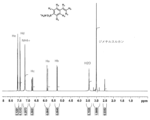
- 1 is a proton nuclear magnetic resonance spectrum chart of the AmSS composition obtained in Example 1. The horizontal axis represents the chemical shift (ppm), and the four decimal places at the bottom of the chart represent the integral ratio of the protons bonded to each carbon atom.
- Ha to He in the structural formula correspond to Ha to He near each peak, and the peak near 3 ppm corresponds to the methyl proton of dimethyl sulfone added as an internal standard.
- 1 is an optical microscope photograph (magnification: 100 times) of the AmSS composition obtained in Example 1. In the photograph, the scale indicated by the blue line represents 250 ⁇ m.
- FIG. 1 is an optical microscope photograph (magnification: 100x) of the AmSS composition before drying obtained in Example 5.
- the scale indicated by the blue line represents 250 ⁇ m.
- 2 is a proton nuclear magnetic resonance spectrum chart of AmSS obtained in Comparative Example 11, and the numerical values in the figure are the same as those in FIG. 1 is an optical microscope photograph (magnification: 200 times) of AmSS obtained in Comparative Example 11.
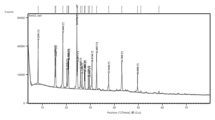
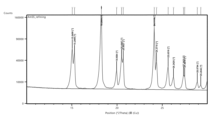
- the scale indicated by the white line represents 50 ⁇ m. 1 shows the powder X-ray diffraction pattern of the AmSS wet crystals obtained in Example 5.
- the vertical axis shows the diffraction intensity (unit: counts)
- the horizontal axis shows the diffraction angle 2 ⁇ (unit: degree)
- the numerical value above each peak in the figure shows the detection angle of the peak top.
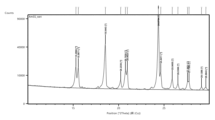
- 8 is an enlarged view of FIG. 7 (horizontal axis enlargement range: 10° ⁇ 2 ⁇ 30°).
- the values in the figure are the same as those in FIG. 1 is a diagram showing the powder X-ray diffraction pattern of the dried AmSS crystals (wet crystals dried with a rotary evaporator) obtained in Example 5.
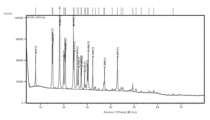
- the values in the figure are the same as those in FIG. 1 is a diagram showing the powder X-ray diffraction pattern of NaSS, the raw material used in Example 5.
- the values in the figure are the same as those in FIG. 11 (horizontal axis enlarged range: 10° ⁇ 2 ⁇ 30°).
- the values in the figure are the same as those in FIG. 1 is a diagram showing the powder X-ray diffraction pattern of the dried AmSS crystals (wet crystals dried with a rotary evaporator) obtained in Example 6.
- the values in the figure are the same as those in FIG. 13 (horizontal axis enlarged range: 10° ⁇ 2 ⁇ 30°).
- the values in the figure are the same as those in FIG.
- present embodiment The following provides a detailed explanation of the form for carrying out the present invention (hereinafter referred to as the "present embodiment"). Note that the present invention is not limited to the present embodiment. The present invention can be carried out with appropriate modifications within the scope of its gist.
- AmSS ammonium styrene sulfonate
- NaSS Sodium styrenesulfonate
- AmSS composition of the present invention is a powdered vinyl monomer with extremely excellent storage stability, and when stored at room temperature, there is no decrease in purity or coloration due to natural polymerization for at least 3 to 4 years after production.
- NaSS is produced by reacting 4-(2-bromoethyl)benzenesulfonic acid with sodium hydroxide in water, but the anhydrous salt (anhydrous crystals) has the problem that the crystal powder solidifies and the purity decreases due to natural polymerization at room temperature within about 6 months to 1 year after production.
- NaSS hemihydrate with improved storage stability, and is formed into stable crystals with two molecules of NaSS and one molecule of water.
- adhesion water 2% by weight to 3% by weight
- the total moisture content in the product NaSS is usually 6% by weight to 8% by weight.
- sodium nitrite or the like is added as a polymerization inhibitor, and about 20 ppm to 100 ppm of nitrite remains in the NaSS product.
- LiSS lithium styrenesulfonate
- inorganic ammonium salts lithium nitrite or sodium nitrite
- AmSS is preferentially crystallized to form a slurry
- AmSS can be obtained very simply by filtering the slurry.
- the present inventors therefore conducted a detailed investigation into factors that affect the storage stability of the above-mentioned AmSS, and found that the following components (1) to (3) and their amounts are important, and that by controlling these components within specific ranges, it is possible to significantly suppress the decrease in purity and coloration due to polymerization during long-term storage.
- the water content in the AmSS composition is 10.00% by weight or less, and the lower the water content, the better in terms of storage stability and fluidity, more preferably 6.00% by weight or less, and particularly preferably 5.00% by weight or less.
- the lower the water content the easier it becomes to be charged, increasing the risk of scattering or dust explosion during handling, and a long drying process is required to reduce the moisture as much as possible, so in practice, the water content in the composition is 0.10% by weight or more.
- the content of the polymerization inhibitor contained in the AmSS composition depends on the type of polymerization inhibitor, but is usually 20 ppm or more, more preferably 100 ppm or more. If the content of the polymerization inhibitor is less than 20 ppm, sufficient stability may not be obtained. On the other hand, if the content is too much, it may adversely affect the polymerization rate, polymerization degree, and color of AmSS when using the AmSS composition, so it is 2000 ppm or less, more preferably 1000 ppm or less, and even more preferably 500 ppm or less.
- the coloring mechanism of the AmSS composition is not necessarily clear, but it is presumed that the interaction of alkali metals such as lithium metal, nitrous acid, and phenol-based polymerization inhibitors is involved.
- At least the lithium and nitrous acid contents are preferably as low as possible, and the lithium content is preferably 20 ppm or less, usually 1 ppm or less, and the nitrous acid content is preferably 20 ppm or less.
- the nitrous acid content here is basically derived from the sodium nitrite and lithium nitrite contained in the raw materials NaSS and LiSS, and is a nitrite anion that can be quantified by ion chromatography or the like.
- the purity of the AmSS composition is preferably 88.00% by weight or more, more preferably 94.00% by weight or more, and particularly preferably 95.00% by weight or more.
- the purity can be improved by forcibly drying the AmSS composition or washing it with a water-soluble organic solvent such as alcohol or acetone to reduce the water content.
- the above-mentioned polymerization inhibitor is not particularly limited as long as it is soluble in water or the reaction solution and suppresses the natural polymerization of AmSS, and examples of the polymerization inhibitor include phenol-based polymerization inhibitors such as 2-methoxyphenol, 3-methoxyphenol, 4-methoxyphenol, 4-ethoxyphenol, 4-cyanophenol, 4-butoxyphenol, 3-ethoxyphenol, 2,6-dimethoxyphenol, 2,5-dimethoxyphenol, 4-isopropoxyphenol, 1,4-dihydroxy-2-methoxybenzene, hydroquinone, methylhydroquinone, 2-methoxyhydroquinone, and 2,4-dinitrophenol; semi-hindered phenol-based polymerization inhibitors such as 4-tert-butylcatechol, butylhydroxyanisole, and tert-butylhydroquinone; 2,6-di-tert- Examples of the polymerization inhibitor include hindered phenol-based polymerization inhibitors such as butyl
- Nitrite-based polymerization inhibitors such as sodium nitrite and lithium nitrite used in the production of NaSS and LiSS may have a negative effect on the coloring resistance of AmSS, so it is preferable to avoid them.
- the amount of electrostatic charge per unit mass of the AmSS composition of the present invention is 0.200 ⁇ C/g or less.
- the median diameter of the AmSS crystals in the AmSS composition is preferably 30 ⁇ m to 700 ⁇ m from the viewpoint of ensuring moisture absorption resistance, high fluidity, low dust generation, and dust explosion resistance.
- the larger the crystal size of AmSS is the better the drainage and the higher the purity of AmSS is, which is preferable, but if the crystal size is too large, the drainage may actually decrease, so it is more preferable that it is 500 ⁇ m or less.
- the median diameter is less than 30 ⁇ m, the drainage will decrease significantly.
- the crystals or crystal aggregates will be broken and become smaller, but from the viewpoint of suppressing moisture absorption, dust generation, and dust explosion, it is preferable to maintain the median diameter at 30 ⁇ m or more.
- the AmSS composition of the present invention When the AmSS composition of the present invention is stored in a sealed state at least at 60°C for 60 days, the polymer content in the composition is 0.20% by weight or less, and the storage stability is extremely excellent due to the control of moisture and the presence of a suitable polymerization inhibitor.
- the AmSS composition is colored due to the oxidation of AmSS or the polymerization inhibitor, it is not preferable for applications where color is important, such as paints and adhesives.
- the AmSS composition of the present invention stored in a sealed state at 60°C for 60 days has an APHA value of 100 or less when made into a 10% by weight aqueous solution.
- the water content in the AmSS composition can be quantified by 1 H-NMR, a Karl Fischer moisture meter, a dry weight method using a thermostatic dryer, an infrared moisture meter, etc.
- the infrared moisture meter is the simplest and has good reproducibility.
- the content of ammonium styrenesulfonate in the AmSS composition i.e., purity, can be quantified by quantification of active vinyl groups by oxidation-reduction titration (see, for example, JP 2014-80505 A, paragraph 0055), proton nuclear magnetic resonance spectroscopy ( 1 H-NMR method), high performance liquid chromatography (HPLC) method, or the like.
- 1 H-NMR method proton nuclear magnetic resonance spectroscopy
- HPLC high performance liquid chromatography
- the ammonium styrene sulfonate content in the AmSS composition can be quantified from the ratio of the integral value of the methyl protons of dimethyl sulfone to the integral value of the protons derived from the styrene sulfonic acid skeleton, for example, the protons of the vinyl group.
- any of the above-mentioned methods cannot distinguish between alkali metal styrene sulfonate and ammonium styrene sulfonate, it is necessary to confirm the molar ratio of the ammonium cation relative to the styrene sulfonic acid unit and the metal content by elemental analysis or 1 H-NMR.
- the crystal shape of the obtained AmSS composition is usually a roughly circular or square plate shape, and the shape and size can be measured using an optical microscope or an electron microscope, but in the present invention, a median diameter that can be easily and reproducibly measured using a laser diffraction/scattering type particle size distribution analyzer is used.
- a laser diffraction/scattering type particle size distribution analyzer calculates the particle size by regarding a sample as a spherical particle, and the median diameter is the diameter at which the larger and smaller sides are equal when a sample is divided into two at a certain particle size.
- the content of the polymerization inhibitor in the AmSS composition can be quantified by gas chromatography (GC), high performance liquid chromatography (HPLC), ion chromatography (IC), or the like depending on the type of polymerization inhibitor.
- the alkali metals and halogens that may be contained in the AmSS composition of the present invention are impurities derived from the raw materials, and considering use in water-based paints, the less the better.
- the alkali metal content in the composition is preferably 0.50% by weight or less, and the halogen content is preferably 1.00% by weight or less.
- the alkali metal content in the composition is more preferably 0.50% by weight or less, and the halogen content is more preferably 0.10% by weight or less.
- the content of these metals can be quantified using inductively coupled plasma spectrometry (ICP-AES) or the like.
- Impurities such as halogens can be quantified using ion chromatography (IC) or the Volhardt method.
- the polymers that may be contained in the AmSS composition of the present invention are impurities derived from raw materials or generated during production or storage.
- AmSS is used to produce an acrylic emulsion
- AmSS is often dissolved in water or an organic solvent and filtered before use, but since the presence of polymeric components dramatically deteriorates filterability, it is preferable that the polymeric components are as small as possible.
- the amount of charged charge per unit mass of the AmSS composition can be measured using a small-sized pneumatic transport type charge evaluation device (Suzuki Teruo; Journal of the Electrostatic Society, Vol. 25, vol. 1, pp. 37-44, 2001), an electrolytic flying type charge amount measurement device (DIT Corporation), an E-SPART analyzer (Tsuji Keishi; Crushing, No. 5, pp. 84-88, 2014), or the like.
- the method for producing the AmSS composition of the present invention will be described below.
- the inventors have succeeded in finding a composition that maintains long-term storage stability without impairing the polymerizability of the AmSS composition when it is used, and have then conducted extensive research into a simple method for producing the AmSS composition.
- the targeted process is simply represented by the following flow chart. That is, the process is based on the cation exchange reaction between an alkali metal salt of styrenesulfonate and an inorganic ammonium salt, just like the conventional process.
- AmSS can be easily obtained by the cation exchange reaction between LiSS and inorganic ammonium salts, but the solubility of LiSS in water is about twice as high as that of AmSS, so AmSS crystallizes preferentially.
- the manufacturing method of the present invention uses NaSS or potassium styrenesulfonate (hereinafter referred to as KSS), which have a lower solubility in water than AmSS, and it is generally difficult to imagine that high-purity AmSS can be obtained under such conditions.
- KSS potassium styrenesulfonate
- AmSS is a strong electrolyte type hydrophilic compound
- adhesion of the mother liquor (filtrate) is unavoidable, and more precisely, it becomes a wet crystal (composition) as shown in the schematic diagram of Figure 1.
- the amount of impurities in the AmSS composition is determined by the amount of adhesion of the mother liquor, which contains a high concentration of inorganic salts. It would be ideal if AmSS crystals with a small amount of adhesion of the mother liquor, i.e., with excellent drainage properties, could be grown in the reaction system, but it was found that a relatively high total substrate concentration is necessary to obtain good quality AmSS crystals.
- the impurity concentration in the AmSS composition does not decrease even if drainage properties are improved.
- the inventors have discovered extremely manufacturing conditions that can achieve both storage stability and high purity of AmSS.
- AmSS crystallizes preferentially under the production conditions of the present invention is not entirely clear, but is presumed to be as follows.
- water with a high dielectric constant is used as the reaction solvent instead of an organic solvent, and 1.50 equivalents or more of ammonium cations are added to NaSS (sodium styrenesulfonate) or KSS (potassium styrenesulfonate). Since the degree of ionic dissociation of both is high, it can be said that the conditions are favorable for at least the cation exchange reaction to proceed.
- the difference in cation size is considered.
- the size of lithium cation is smaller than that of sodium cation, and the size of sodium cation is smaller than that of ammonium cation, but it is known that the smaller the cation size, the easier it is to be hydrated.
- LiSS, NaSS and AmSS are actually crystallized from an aqueous solution, LiSS has poor drainage because it is prone to form extremely fine needle-like crystals, and the amount of adhering water is easily more than 20% by weight.
- the manufacturing method will be described in more detail below.
- water, styrenesulfonic acid alkali metal salt, inorganic ammonium salt and polymerization inhibitor are charged in a specific composition in a reactor, and the raw materials are dissolved or partially dissolved while stirring at a specific temperature for a specific time.
- AmSS crystals are precipitated and grown while cooling to a predetermined temperature at a specific speed.
- the precipitated AmSS crystals are then filtered to obtain the AmSS composition of the present invention.
- the alkali metal salt of styrenesulfonate that can be used includes sodium salt and potassium salt.
- alkaline earth metal salts of styrenesulfonate such as calcium styrenesulfonate can also be used, but the sodium salt, which is mass-produced, is more preferred.
- inorganic ammonium salts include ammonium chloride, ammonium bromide, ammonium sulfate, ammonium nitrate, ammonium phosphate, ammonium dihydrogen phosphate, diammonium hydrogen phosphate, and ammonium acetate.
- ammonium chloride, ammonium sulfate, ammonium nitrate, ammonium phosphate, ammonium dihydrogen phosphate, and diammonium hydrogen phosphate are more preferable.
- ammonium chloride, ammonium sulfate, and ammonium nitrate are more preferable.
- ammonium sulfate and ammonium nitrate are more preferable.
- AmSS is produced using ammonium chloride, it is possible to produce a high-purity AmSS composition with fewer impurities such as halogens by purifying it using the method described below.
- the polymerization inhibitor is as described above.
- the ratio of ammonium cation to alkali metal salt of styrenesulfonate is preferably 1.50 to 3.00 equivalents. If the equivalent ratio is less than 1.50 equivalents, the cation exchange rate is low and the salt concentration in the system is reduced, which may make it difficult to produce high-quality AmSS crystals with good drainage properties. On the other hand, if the equivalent ratio exceeds 3.00 equivalents, no improvement in drainage properties is observed, and the inorganic salt concentration in the adhered mother liquor increases, which may reduce the purity of the AmSS composition. From the viewpoint of the balance between the inorganic salt concentration in the mother liquor and drainage properties, 2.00 to 2.50 equivalents are more preferable.
- the total solid content in the reaction system is preferably 25.00% by weight to 50.00% by weight. If the total solid content is less than 25.00% by weight, not only the yield but also the drainage property is reduced, while if the total solid content exceeds 50.00% by weight, the inorganic salt concentration in the mother liquor increases, and the purity of the AmSS composition may decrease. From the viewpoint of the balance between the inorganic salt concentration in the mother liquor and the drainage property, 25.00% by weight to 45.00% by weight, 30.00% by weight to 45.00% by weight, and 35.00% by weight to 45.00% by weight are preferable.
- the total solid content herein means the sum of raw materials present in the reaction system that are solid at room temperature, impurities contained in the raw materials that are solid at room temperature, and by-products that are solid at room temperature.
- the reaction temperature is preferably 30° C. to 80° C.
- the reaction temperature is more preferably 30° C. to 60° C., and even more preferably 40° C. to 60° C.
- the reaction time is 10 minutes to 20 hours and can be adjusted depending on the substrate concentration and reaction temperature. In order to prevent spontaneous polymerization during the reaction, the reaction time is preferably 30 minutes to 20 hours, more preferably 10 minutes to 10 hours, and particularly preferably 30 minutes to 10 hours.
- the cooling and filtration temperature is 5° C. to 30° C., and after reaching a predetermined cooling temperature, the mixture is further aged for 0.5 to 5 hours. If the cooling temperature is lower than 5° C., impurities such as inorganic salts and moisture in the AmSS composition may increase, and if it exceeds 30° C., the yield may decrease significantly. Therefore, the cooling temperature is more preferably 5° C. to 25° C., and even more preferably 5° C. to 20° C.
- the cooling rate can be adjusted according to the heating temperature and the total solid content, but is preferably 3°C to 40°C per hour. If the cooling rate is too fast, the crystal size may become small and the drainage property may decrease.
- the moisture and inorganic salts in the AmSS composition may increase.
- the cooling rate is extremely slow, the crystals may collapse and the drainage property may decrease, so the cooling rate is more preferably 5°C to 30°C per hour.
- the mixture In order to increase the crystal size of AmSS and improve the drainage property, it is more preferable to cool the mixture to a predetermined temperature to precipitate crystals, then reheat the mixture to a temperature at which all the crystals do not dissolve, and then cool the mixture again, which is called temperature swing crystallization.
- the raw materials When the raw materials are charged into the reactor, they may be charged in the form of powder, or may be charged as a saturated aqueous solution of each raw material.
- the method of charging may be either batch charging or sequential charging.
- Dropping an aqueous solution or saturated aqueous solution of an inorganic ammonium salt into an aqueous solution or slurry of an alkali metal styrenesulfonate reduces the inclusion of the inorganic salt into the precipitated AmSS crystals, resulting in a higher quality AmSS composition.
- a powder or slurry of an alkali metal styrenesulfonate may be added to an aqueous solution of an inorganic ammonium salt, this is disadvantageous in terms of the scattering of the powder and the sedimentation of the slurry.
- the reaction system may be in an inert atmosphere or an air atmosphere, but an air atmosphere is more preferable from the viewpoint of suppressing spontaneous polymerization during the reaction.
- AmSS can be added as seed crystals from the start of the reaction to the cooling period in order to increase the crystal size of AmSS and improve drainage.
- the amount of seed crystals added is preferably 1.0 mol% to 20.0 mol% of the styrene sulfonic acid units in the system, and more preferably 1.0 mol% to 10.0 mol% when productivity and thermal history are taken into consideration.
- the molar ratio of ammonium cation to alkali metal styrene sulfonate specified in the manufacturing method of the present invention varies with the addition of AmSS seed crystals, but the ammonium cations referred to here are limited to those derived from inorganic ammonium salts charged as raw materials, and do not include ammonium cations derived from seed crystals.
- a water-soluble organic solvent that is a poor solvent may be added to the reaction system.
- examples include alcohols such as methanol, ethanol, and 2-propanol, ketones such as acetone, nitriles such as acetonitrile, and ethers such as tetrahydrofuran.
- alcohols such as methanol, ethanol, and 2-propanol
- ketones such as acetone
- nitriles such as acetonitrile
- ethers such as tetrahydrofuran.
- water alone is the preferred solvent for industrial methods.
- the slurry can be filtered by centrifugal filtration, pressure filtration, vacuum filtration, filter press, etc., but centrifugal filtration is more preferred because it has a large processing capacity and can be processed in a relatively short time. Furthermore, impurities can be further reduced by recrystallizing the obtained AmSS composition using water or a mixed solvent of water and the above-mentioned water-soluble organic solvent. In this case, from the viewpoint of productivity, it is preferable that the total solid content in the system is 50.00% to 60.00% by weight, the heating temperature is 40°C to 60°C, and the cooling and filtration temperatures are 10°C to 25°C. When recrystallizing and purifying, it is preferable to add 7 mol% or less of the above-mentioned polymerization inhibitor to the AmSS.
- the AmSS composition may also be dried using a tray vacuum dryer, a conical agitator dryer (Nauta mixer), a vacuum rotary dryer (conical dryer), a rotary kiln dryer, a spray dryer, a pleated dryer, a double cylindrical drying filter, a vacuum vibration dryer, or the like.
- a tray vacuum dryer a conical agitator dryer (Nauta mixer), a vacuum rotary dryer (conical dryer), a rotary kiln dryer, a spray dryer, a pleated dryer, a double cylindrical drying filter, a vacuum vibration dryer, or the like.
- ammonia may volatilize, decreasing the ammonia neutralization degree of styrene sulfonic acid, which may actually decrease the storage stability of the AmSS composition, so it is advisable to maintain the ammonia neutralization degree at 100% as much as possible.
- the AmSS composition of the present invention is soluble in water and can therefore be used to produce aqueous polymer emulsions, hollow polymer particles, aqueous solutions of ammonium polystyrene sulfonate, etc.
- it is soluble in polar organic solvents and is therefore extremely useful in the manufacture of polymer electrolyte membranes (e.g., U.S. Pat. No. 6,221,248) and in the surface modification of organic materials using graft polymerization (e.g., Kyoichi Saito, Polymer Adsorbent Revolution by Graft Polymerization, pp. 8-10, Maruzen Publishing, published in 2014; NHV Corporation website https://www.nhv.jp/blog/post723/).
- Powder X-ray diffraction (PXRD) patterns can be measured by standard protocols. As described above, the AmSS composition of the present invention is presumed to be stabilized by anhydrous salt crystals, and the PXRD patterns are presumed to be due to this.
- the AmSS composition of the present invention has diffraction peaks at least at diffraction angles 2 ⁇ of 8.1 ⁇ 0.2°, 15.2 ⁇ 0.2°, 15.4 ⁇ 0.2°, 18.4 ⁇ 0.2°, 20.1 ⁇ 0.2°, 20.6 ⁇ 0.2°, 20.8 ⁇ 0.2°, 24.2 ⁇ 0.2°, 25.8 ⁇ 0.2°, 27.5 ⁇ 0.2°, 30.5 ⁇ 0.2°, 32.5 ⁇ 0.2°, 37.5 ⁇ 0.2°, 43.0 ⁇ 0.2°, and 49.6° ⁇ 0.2, and particularly has strong diffraction peaks at diffraction angles 2 ⁇ of 8.1 ⁇ 0.2°, 15.2 ⁇ 0.2°, 18.4 ⁇ 0.2°, 20.6 ⁇ 0.2°, 24.2 ⁇ 0.2°, 32.5 ⁇ 0.2°, and 43.0 ⁇ 0.2°.
- Sodium styrene sulfonate (NaSS): manufactured by Tosoh Finechem Co., Ltd., purity 88.2%, sodium bromide 2.2% by weight, sodium hydroxide 0.40% by weight, sodium sulfate 0.50% by weight, water 7.2% by weight, polymer content 0.01% by weight, nitrite content 70 ppm
- Lithium styrene sulfonate LiSS: manufactured by Tosoh Finechem Co., Ltd., purity 85.3%, lithium bromide 2.5% by weight, lithium hydroxide 0.45% by weight, lithium sulfate 0.50% by weight, water 7.1% by weight, polymer content 0.04% by weight, nitrite content 60 ppm
- Ammonium chloride Manufactured by FUJIFILM Wako Pure Chemical Industries, Ltd., Special reagent ammonium sulfate: Manufactured by FUJIFILM Wako Pure Chemical Industries,
- A 100 ⁇ [0.01006 ⁇ (a-b) ⁇ f]/(S ⁇ 5/500)
- A: AmSS content (%) a: Amount of sodium thiosulfate solution required for blank test (ml) b: Aqueous sodium thiosulfate solution required for this test (ml) f: titer of sodium thiosulfate aqueous solution S: sample amount (g)
- NH 4 /SS [n/(nH)]/[s/(sH)] s: integral value of the peak derived from the vinyl group of SS (peak position: ⁇ 5.30 ppm, d)
- the peak positions are those when dimethylsulfoxide-d6 is used as the heavy solvent, and the chemical shifts vary slightly depending on the amount of impurities.
- AmSS content (weight%) (B/Mb) x (a/aH)/(b/bH) x Ma/S x 100
- a Integrated value of the peak derived from the vinyl group of AmSS (peak position: ⁇ 5.30 ppm, d)
- b Integrated value of the peak derived from the internal standard dimethyl sulfone (peak position: ⁇ 3.00 ppm, s)
- Ma Molecular weight of AmSS Mb: Molecular weight of internal standard
- B Amount of internal standard collected (g)
- S Amount of sample collected (g)
- the moisture content of the AmSS composition exceeds 10% by weight, the dispersibility in hexane decreases, so the moisture content of the AmSS composition was dried in advance to 10% by weight or less using a rotary evaporator and used in sample preparation.
- X-ray diffraction (XRD) measurement of AmSS> The compositions obtained in the examples were ground in a mortar and subjected to XRD measurement by the following method: All sample preparations and measurements were performed in an air atmosphere, and the measurement data was analyzed using HighScore Plus XRD analysis software.
- Example 1 Preparation of AmSS using NaSS and ammonium sulfate (1) 290.00 g of NaSS powder, 3.17 g of 4-methoxyphenol, 185.04 g of ammonium sulfate, and 719.30 g of ion-exchanged water were charged into a cylindrical 2 L glass separable flask equipped with a reflux condenser, and a cation exchange reaction was carried out with stirring for 60 minutes at an internal temperature of 45° C. The mixture was then cooled to 25° C. over 4 hours and aged for 2 hours to obtain a white slurry. The slurry was then centrifuged (600G x 15 min, room temperature) to obtain 203.68 g of plate-like wet crystals (Fig.
- the slurry had good drainage properties, and the moisture content of the wet crystals was 8.00 wt% as determined by an infrared moisture meter.
- the sodium content of the above wet crystals was determined by ICP to be 0.27% by weight (theoretical Na content in pure NaSS is 11.1% by weight), the nitrogen content was determined by elemental analysis to be 6.7% by weight (theoretical nitrogen content in pure AmSS is 7.0% by weight), and the molar ratio of ammonium cations to styrene sulfonic acid units determined by 1H -NMR was 1.00 (Figure 2) (theoretical molar ratio of ammonium cations to styrene sulfonic acid units in pure AmSS is 1.00).
- the wet crystals were determined to be the target AmSS composition.
- the AmSS content, i.e., purity, of the AmSS composition determined by oxidation-reduction titration was 90.6% by weight (the yield based on the molar basis of the raw material NaSS was 74%).
- the reaction recipe and results are summarized in Table 1.
- Example 2 Preparation of AmSS using NaSS and ammonium sulfate (2) 290.00 g of NaSS powder, 7.00 g of 4-methoxyphenol, 230.00 g of ammonium sulfate, and 750.00 g of ion-exchanged water were charged into a cylindrical 2 L glass separable flask equipped with a reflux condenser, and a cation exchange reaction was carried out while stirring for 60 minutes at an internal temperature of 45° C. using a stirrer. Thereafter, the mixture was cooled to 35° C. over 30 minutes and held for 10 minutes, and then the internal temperature was raised again to 45° C. When the internal temperature reached 45° C., heating was stopped, and the mixture was cooled to 25° C.
- Example 2 The slurry was then centrifuged under the same conditions as in Example 1 to obtain 195.36 g of plate-like wet crystals.
- the slurry had good drainage properties, and the moisture content determined by an infrared moisture meter was 7.86% by weight.
- the sodium content of the above wet crystals was determined by ICP to be 0.27% by weight (theoretical Na content in pure NaSS is 11.1% by weight), the nitrogen content was determined by elemental analysis to be 6.7% by weight (theoretical nitrogen content in pure AmSS is 7.0% by weight), and the molar ratio of ammonium cations to styrene sulfonic acid units determined by 1H -NMR was 1.01 (theoretical molar ratio of ammonium cations to styrene sulfonic acid units in pure AmSS is 1.00). Therefore, the wet crystals were determined to be the target AmSS composition.
- the AmSS content, i.e., purity, of the AmSS composition determined by oxidation-reduction titration was 90.8% by weight (the yield based on the molar basis of the raw material NaSS was 71%).
- the reaction recipe and results are summarized in Table 1. It is clear that the alkali metal content, halogen content, and polymer content in the AmSS composition were low and the AmSS composition had a high purity compared to Comparative Examples 1-2, 4-6, 7, and 11 (Tables 5 and 7). In addition, the median diameter of the AmSS was 349 ⁇ m, which is much larger than the 11 ⁇ m shown in Comparative Example 11 (Table 7). Therefore, the dust generation is expected to be lower than that of Comparative Example 11.
- the AmSS composition has a low moisture content and contains 889 ppm of 4-methoxyphenol, it is clear that the storage stability is superior to that of Comparative Example 3 (Table 5). Furthermore, since the lithium content and nitrite content are low, it is clear that the AmSS composition is less likely to discolor than Comparative Examples 8 to 10 (Table 6). The amount of charged charge per unit mass of the AmSS composition was 0.082 ⁇ C/g, which was slightly lower than that of Comparative Example 11 (Table 7) which had a low moisture content.
- Example 3 Preparation of AmSS using NaSS and ammonium sulfate (3) -Synthesis of AmSS-
- the feed composition and temperature conditions were changed to those shown in Table 1, and the same procedure as in Example 1 was carried out to obtain plate-like wet crystals presumed to be AmSS.
- Example 4 Preparation of AmSS using NaSS and ammonium sulfate (4) -Synthesis of AmSS- 290.00g of NaSS powder, 1.58g of 4-methoxyphenol, 184.55g of ammonium sulfate, and 1450.00g of ion-exchanged water were charged into a cylindrical 2L glass separable flask equipped with a reflux condenser, and a cation exchange reaction was carried out while stirring for 30 minutes at an internal temperature of 45 ° C. using a stirrer. After that, it was cooled to an internal temperature of 30 ° C.
- Example 2 the AmSS composition obtained in Example 1 was added as seed crystals and stirred for 10 minutes (the charge ratio of ammonium cation derived from ammonium sulfate to NaSS was 2.25 equivalents, and the total solid content was 25.46% by weight). Then, it was cooled to 10 ° C. over 3 hours, and aged for 2 hours as it was, to obtain a white slurry liquid. Then, the slurry liquid was centrifuged in the same manner as in Example 1 to obtain 239.12g of plate-shaped wet crystals.
- the above wet crystals were determined to be the AmSS composition. Since the AmSS composition contains 156 ppm of 4-methoxyphenol, it is clear that the storage stability is superior to that of Comparative Example 3 (Table 5). Furthermore, since the lithium content and nitrite content are low, it is clear that the composition is less likely to become discolored than Comparative Examples 8 to 10 (Table 6). In addition, the median diameter of the AmSS was 356 ⁇ m, which is much larger than the 11 ⁇ m (Table 7) shown in Comparative Example 11, and therefore the dust generation is expected to be lower than that of Comparative Example 11. In addition, the charged charge per unit mass of the AmSS composition was 0.077 ⁇ C/g, which was slightly lower than that of Comparative Example 11 (Table 7) which had a low moisture content.
- Example 5 Preparation of AmSS using NaSS and ammonium sulfate (5) 423.79 g of NaSS powder, 4.65 g of 4-methoxyphenol, 269.90 g of ammonium sulfate, and 1048.89 g of ion-exchanged water were charged into a cylindrical 2 L glass separable flask equipped with a reflux condenser, and a cation exchange reaction was carried out with stirring for 60 minutes at an internal temperature of 45° C. The mixture was then cooled to 15° C. over 5 hours and aged for 2 hours to obtain a white slurry. The slurry was then centrifuged (600G x 20 minutes, room temperature) to obtain 320.66 g of plate-like wet crystals.
- the slurry had good drainage properties, and the moisture content of the wet crystals was 5.10% by weight as determined by an infrared moisture meter.
- the wet crystals were dried using a rotary evaporator at 40° C. for 30 minutes (pressure 660 Pa) to obtain 293.35 g of dry crystals.
- the sodium content of AmSS determined by ICP was 0.21% by weight, the nitrogen content determined by elemental analysis was 6.8% by weight, and the molar ratio of ammonium cations to styrenesulfonic acid units determined by 1H -NMR was 1.00. Therefore, the dried crystals were determined to be the target AmSS composition.
- the AmSS content, i.e., purity, of the dried crystals determined by oxidation-reduction titration was 98.4% by weight (the yield based on the molar basis of the raw material NaSS was 82%).
- the reaction recipe and results are summarized in Table 3.
- the wet crystals have good drying properties, and the moisture content after drying with a rotary evaporator is reduced to 0.27% by weight. This drying property remains unchanged even after storing the wet crystals in a sealed container at room temperature for at least 6 months.
- the moisture content of the NaSS used as the raw material is 3.69% by weight even when dried under the same conditions.
- the moisture contained in the wet crystals of AmSS is attached water, and the drying property is completely different from the crystal water contained in the raw material NaSS. That is, it is considered that the AmSS composition of the present invention is stabilized by anhydrous salt crystals.
- the alkali metal, halogen and polymer contents in the AmSS composition were low and it was clear that the AmSS composition had a high purity as compared with Comparative Examples 1 and 2, 4 to 6, 7 and 11 (Tables 5 and 7) described later.
- the median diameter of the AmSS was 367 ⁇ m, which is much larger than the 11 ⁇ m shown in Comparative Example 11 (Table 7). Therefore, the dust generation is expected to be lower than that of Comparative Example 11.
- the AmSS composition has a low moisture content and contains 289 ppm of 4-methoxyphenol, it is clear that the storage stability is superior to that of Comparative Example 3 (Table 4). Furthermore, since the lithium content and nitrite content are low, it is clear that the composition is far less likely to become discolored than Comparative Examples 8 to 10 (Table 6). Furthermore, after the 60°C storage stability test was extended to at least 210 days, the polymer content was 0.03% by weight, indicating extremely high stability.
- the AmSS composition had a charged charge per unit mass of 0.093 ⁇ C/g, which was higher than those of Examples 1 to 4, but slightly lower than that of Comparative Example 11 (Table 7) in which the particle size was small.
- Example 6 Purification of AmSS composition 132.90 g of the AmSS composition obtained in Example 1, 0.74 g of 4-methoxyphenol, and 85.00 g of ion-exchanged water were charged into a cylindrical 0.5 L glass separable flask equipped with a reflux condenser, and stirred at an internal temperature of 55°C for 60 minutes using a stirrer. After that, the mixture was cooled to an internal temperature of 35°C over 60 minutes, and then heated again to 45°C. When the internal temperature reached 45°C, heating was stopped, and the mixture was cooled to an internal temperature of 25°C over 4 hours. After aging for 2 hours, the slurry was centrifuged in the same manner as in Example 1 to obtain 95.43 g of AmSS composition.
- the dried AmSS composition was placed in a glass petri dish and left in a thermo-hygrostat at 30°C and 75% relative humidity for 24 hours, after which the moisture content was 0.52% by weight.
- the same procedure was performed with NaSS with a moisture content of 0.15% by weight, which was prepared by vacuum drying at 60°C for 12 hours, and the moisture content increased to 4.95% by weight.
- NaSS is stabilized as a hemihydrate crystal
- the AmSS composition of the present invention is stabilized as an anhydrous salt crystal.
- the dried AmSS composition was pulverized at room temperature for 10 seconds at 4000 rpm using a small benchtop power mill (P-02S, manufactured by Showa Kagaku Kikai Kosakusho Co., Ltd.), resulting in a reduction in median diameter to 56 ⁇ m.
- P-02S manufactured by Showa Kagaku Kikai Kosakusho Co., Ltd.
- the pulverized material was collected in a glass petri dish and left in a thermo-hygrostat at 30° C. and a relative humidity of 75% for 24 hours.
- the moisture content only increased to 0.58% by weight. This is because the AmSS composition is stabilized by anhydrous salt crystals.
- Comparative Example 1 Preparation of AmSS using NaSS and ammonium sulfate (6)
- the production of AmSS was attempted by changing the feed composition and temperature conditions to those shown in Table 5.
- Table 5 From the analysis results of the sodium and nitrogen contents in the obtained wet crystals (Table 5), the wet crystals were determined to be an AmSS composition.
- the water content of the composition was high at 18.90 wt %, and the purity was low at 77.2%, which was clearly inferior to the purity of Examples 1 to 4.
- 169 ppm of 4-methoxyphenol was present, the storage stability was clearly inferior to that of Examples 1 to 4. This was due to the high water content, and the increase in water content was probably due to the total solid content being too low during the reaction.
- Comparative Example 2 Preparation of AmSS using NaSS and ammonium sulfate (7)
- Example 4 the production of AmSS was attempted by changing the feed composition and temperature conditions to those shown in Table 5. From the analysis results of the sodium and nitrogen contents in the obtained wet crystals (Table 5), the wet crystals were determined to be an AmSS composition. However, due to poor drainage of the slurry, the water content of the composition was high at 21.00 wt %, and the purity was low at 75.2%, which was clearly inferior to the purity of Examples 1 to 4. Although 174 ppm of 4-methoxyphenol was present, the storage stability was clearly inferior to that of Examples 1 to 4. This was due to the high moisture content, and the increase in moisture was probably due to the addition of too much ammonium sulfate relative to NaSS during the reaction.
- Comparative Example 3 Preparation of AmSS using NaSS and ammonium chloride (1)
- Example 4 the inorganic ammonium salt species, the charged composition, and the temperature conditions were changed to those shown in Table 5, and an attempt was made to produce AmSS.
- Table 5 the wet crystals were determined to be the AmSS composition.
- the drainage of the slurry was good, and the water content of the AmSS composition was low at 7.54 wt.%, and the halogen content was somewhat high, but the purity was 90.1%, which was equivalent to Examples 1 to 4.
- the storage stability was clearly inferior to that of Examples 1 to 4. This is thought to be because, although the moisture content was low, the 4-methoxyphenol content was too low at 16 ppm.
- Comparative Example 4 Preparation of AmSS using NaSS and ammonium chloride (2)
- the production of AmSS was attempted by changing the inorganic ammonium salt species, the charged composition, and the temperature conditions to those shown in Table 5.
- the wet crystals were determined to be an AmSS composition, but due to poor drainage of the slurry, the water content of the composition was 17.30% by weight, the halogen content was high at 2.01% by weight, and the purity was low at 80.1%, which was clearly inferior to the purity of Examples 1 to 4. This is thought to be because the reaction temperature was too low.
- the 4-methoxyphenol content in the AmSS composition was 78 ppm, the storage stability was significantly inferior to that of Examples 1 to 4. This is believed to be due to the high moisture content.
- Comparative Example 5 Preparation of AmSS using NaSS and ammonium chloride (3)
- the production of AmSS was attempted by changing the inorganic ammonium salt species, the feed composition, and the temperature conditions to those shown in Table 5.
- Analysis of the obtained wet crystals revealed that the sodium content was very high at 6.47 wt % and the cation exchange rate was less than 50% (Table 5). This is believed to be because the molar ratio of ammonium cations added to NaSS was too low at 0.96 equivalents.
- Example 6 Preparation of AmSS using NaSS and ammonium sulfate (8) -Synthesis of AmSS-
- the preparation of AmSS was attempted by changing the feed composition and temperature conditions to those shown in Table 5. From the results of the sodium content and nitrogen content in the obtained wet crystals, the wet crystals were judged to be the AmSS composition (Table 5). The drainage of the slurry was good, and the water content of the AmSS composition was low at 7.75% by weight, the halogen content was low at 0.02% by weight, and the purity was high at 90.4%, which was equivalent to that of Example 4.
- Comparative Example 7 Preparation of AmSS using NaSS and ammonium sulfate (9)
- the reaction temperature was changed from 60°C to 85°C to attempt the production of AmSS.
- the wet crystals were determined to be the AmSS composition (Table 5).
- the drainage of the slurry was poor, and the water content of the AmSS composition was high at 13.70% by weight, so the purity was low at 84.3% by weight, which was clearly inferior to Examples 1 to 4. This is thought to be because the reaction temperature was too high, so good quality crystals were not produced, and because the amount of polymer produced increased, resulting in a decrease in drainage.
- the 4-methoxyphenol content in the AmSS composition was 394 ppm, the storage stability was significantly inferior to that of Examples 1 to 4 due to the high moisture content.
- Comparative Example 8 Preparation of AmSS using LiSS and ammonium chloride (1) LiSS powder 541.54g, lithium nitrite (40 wt% aqueous solution) 1.20g, ammonium chloride 150.18g and ion-exchanged water 1135.09g were charged into a cylindrical 2L glass separable flask equipped with a reflux condenser, and a cation exchange reaction was carried out while stirring for 60 minutes at an internal temperature of 35 ° C. using a stirrer. Then, it was cooled to 5 ° C. over 5 hours and cooled to an internal temperature of 5 ° C. The mixture was aged for 2 hours to obtain a white slurry liquid.
- LiSS powder 541.54g, lithium nitrite (40 wt% aqueous solution) 1.20g, ammonium chloride 150.18g and ion-exchanged water 1135.09g were charged into a cylindrical 2L glass separable flask equipped with a reflux condenser
- the slurry liquid was centrifuged under the same conditions as in Example 1 to obtain 423.65g of diamond-shaped plate-shaped wet crystals.
- the drainage of the slurry was good, and the moisture content determined by an infrared moisture meter was 9.62 wt%.
- the lithium content of the above wet crystals determined by ICP was 0.13 wt% (theoretical Li content in pure LiSS is 3.65 wt%), the sodium content was 5 ppm, the nitrogen content of the AmSS composition determined by elemental analysis was 6.3 wt% (theoretical nitrogen content in pure AmSS is 7.0 wt%), and the molar ratio of ammonium cations to styrene sulfonic acid units determined by 1H -NMR was 1.01 (theoretical molar ratio of ammonium cations to styrene sulfonic acid units in pure AmSS is 1.00), so the wet crystals were determined to be the target AmSS composition.
- the AmSS content, i.e., purity, of the AmSS composition determined by oxidation-reduction titration was 89.2% (the yield based on the raw LiSS molar content was 77%).
- the purity of the AmSS composition was equivalent to that of Examples 1 to 4 (Table 1), but since it did not contain 4-methoxyphenol, its storage stability was significantly inferior to that of Examples 1 to 4.
- Comparative Example 9 Preparation of AmSS using LiSS and ammonium sulfate (2)
- AmSS was produced by changing the inorganic ammonium salt species, the charged composition, and the temperature conditions to those shown in Table 6, and adding 4-methoxyphenol. From the analysis of the lithium content of the wet crystals, the wet crystals were determined to be an AmSS composition. The drainage of the slurry was good, and the AmSS composition had a low water content of 6.82 wt.% and a low halogen content of 0.09 wt.%, and a high purity of 92.5%, which were equivalent to those of Examples 1 to 4.
- Comparative Example 10 Preparation of AmSS using LiSS and ammonium sulfate (3)
- the type and amount of polymerization inhibitor were changed to the conditions shown in Table 6, and AmSS was produced. From the analysis of the lithium content of the wet crystals, the wet crystals were determined to be an AmSS composition.
- the drainage of the slurry was good, and the AmSS composition had a low water content of 6.91% by weight and a low halogen content of 0.08% by weight, and a high purity of 92.6%, which were equivalent to those of Examples 1 to 4.
- the methoxyphenol content in the above AmSS composition was 420 ppm, the nitrite content was 72 ppm, and the spontaneous polymerization during storage at 60°C was suppressed to the same extent as in Examples 1 to 4, but the APHA value increased. The reason for this is unclear, but it is presumed that some kind of interaction between the lithium cation, 4-methoxyphenol, and the nitrite anion is involved.
- Comparative Example 11 Example 1 of JP-A-50-149642 In a 1L four-neck flask equipped with a cooling tube, 500.00 g of methanol, 25.01 g of NaSS powder, and 25.02 g of ammonium sulfate were collected and heated in a 65°C bath for 3 hours while stirring with a magnetic stirrer. The system was slightly cloudy and the raw materials were almost dissolved (the ratio of ammonium cation to NaSS was 3.54 equivalents, and the total solid content was 8.79% by weight). After that, when the system was allowed to cool to 30°C, a solid that was thought to be sodium sulfate precipitated.
- the reaction solution was suction-filtered using a circulation aspirator to filter the precipitate, and the filtrate was concentrated and dried using a rotary evaporator at 50°C for 2 hours to obtain 21.53 g of dry powder (Figure 6).
- the moisture content was 0.50% by weight.
- the active vinyl groups of the dry powder were then quantified by oxidation-reduction titration. As a result, assuming that the dry powder was AmSS, the purity was 98.0%.
- the sodium content determined by ICP was 5.3% by weight (theoretical Na content in pure NaSS is 11.1% by weight), the nitrogen content determined by elemental analysis was 3.4% by weight (theoretical nitrogen content in pure AmSS is 7.0% by weight), and the molar ratio of ammonium cations to styrenesulfonic acid units determined by 1 H-NMR was 0.54 (theoretical molar ratio of ammonium cations to styrenesulfonic acid units in pure AmSS was 1.00 ( Figure 5)). Therefore, it was estimated that about 50% of the dry powder was NaSS, and the cation exchange rate was about 50%.
- the above dry powder had a low moisture content, the storage stability was inferior to that of Examples 1 to 4 since it did not contain 4-methoxyphenol. Furthermore, the median diameter of the above dry powder was very small, at 11 ⁇ m, and the powder was clearly more dust-generating than Examples 1 to 4. In addition, the amount of charge per unit mass of the dry powder was 0.110 ⁇ C/g, which is larger than those of Examples 1 to 5, and therefore the powder is likely to be highly dispersible and has a high risk of dust explosion.
- Example 7 Preparation of AmSS using NaSS and ammonium sulfate (10) ETPE Ammonium sulfate (73.01 g) and ion-exchanged water (255.00 g) were charged into a cylindrical 0.5 L glass separable flask equipped with a reflux condenser, and dissolved while being heated to an internal temperature of 40° C. under stirring. After confirming that ammonium sulfate had dissolved, 115.03 g of NaSS powder and 0.70 g of 4-ethoxyphenol were added to the reactor, and a cation exchange reaction was carried out for 60 minutes while stirring at an internal temperature of 48° C. The mixture was then cooled to 25° C.
- the slurry was then centrifuged (600G x 20 minutes, room temperature) to obtain 82.85 g of plate-like wet crystals.
- the slurry had good drainage properties, and the moisture content of the wet crystals was 5.97% by weight as determined by an infrared moisture meter.
- the wet crystals were dried using a rotary evaporator at 40° C. for 30 minutes (pressure 660 Pa) to obtain 77.82 g of dry crystals (water content 0.41% by weight). From the analytical results of the sodium and nitrogen contents in the dried crystals (Table 8), the dried crystals were determined to be the desired AmSS composition.
- the AmSS content, i.e., purity, of the dried crystals determined by oxidation-reduction titration was 97.9% by weight (the yield based on the molar basis of the raw material NaSS was 77%).
- the alkali metal, halogen and polymer contents in the AmSS composition were low and it was clear that the AmSS composition had a high purity as compared with Comparative Examples 1-2, 4-5, 7 and 11 (Tables 5 and 7).
- the median diameter of the AmSS was 362 ⁇ m, which is much larger than the 11 ⁇ m shown in Comparative Example 11 (Table 7). Therefore, the dust generation is expected to be lower than that of Comparative Example 11.
- the AmSS composition has a low moisture content and contains 169 ppm of 4-ethoxyphenol, it is clear that the storage stability is superior to that of Comparative Examples 1 to 4 and Comparative Examples 6 to 7 (Table 5). Furthermore, since the lithium content and nitrite content are low, it is clear that the AmSS composition is much less likely to become discolored than Comparative Examples 8 to 10 (Table 6). The amount of charged charge per unit mass of the AmSS composition was 0.090 ⁇ C/g, which was slightly lower than that of Comparative Example 11 (Table 7) in which the particle size was small.
- Example 8 Preparation of AmSS using NaSS and ammonium sulfate (11) TBC AmSS was produced under the same conditions as in Example 7, except that the polymerization inhibitor was changed to 4-tert-butylcatechol and the amount added was reduced. As a result, 83.83 g of plate-shaped wet crystals were obtained. The slurry had good drainage properties, and the moisture content of the wet crystals measured with an infrared moisture meter was 7.16 wt %. The wet crystals were dried using a rotary evaporator, and 77.9 g of dry crystals were obtained (moisture content: 0.37 wt %).
- the dried crystals were determined to be the desired AmSS composition.
- the AmSS content, i.e., purity, of the above dried crystals determined by oxidation-reduction titration was 98.0% by weight (the yield based on the molar basis of the raw material NaSS was 77%).
- the alkali metal, halogen and polymer contents in the AmSS composition were low and it is clear that the AmSS composition has a high purity as compared with Comparative Examples 1 to 6, 7 and 11 (Tables 5 and 7).
- the median diameter of the AmSS was 345 ⁇ m, which is much larger than the 11 ⁇ m shown in Comparative Example 11 (Table 7).
- the dust generation is expected to be lower than that of Comparative Example 11.
- the AmSS composition has a low moisture content and contains 38 ppm of 4-tert-butylcatechol, it is clear that the storage stability is superior to that of Comparative Examples 8 to 10 (Table 6).
- the composition has a low lithium content and nitrite content, and a low content of 4-tert-butylcatechol, which is prone to discoloration, it is clear that the composition is less prone to discoloration than Comparative Examples 8 to 10 (Table 6).
- the amount of charged charge per unit mass of the AmSS composition was 0.091 ⁇ C/g, which was slightly lower than that of Comparative Example 11 (Table 7) in which the particle size was small.
- Example 9 Preparation of AmSS using NaSS and ammonium sulfate (12) H-TEMPO AmSS was produced under the same conditions as in Example 8, except that the polymerization inhibitor was changed to 4-hydroxy-2,2,6,6-tetramethylpiperidine 1-oxyl, and 85.74 g of plate-shaped wet crystals were obtained.
- the slurry had good drainage properties, and the moisture content of the wet crystals was 7.91% by weight as determined by an infrared moisture meter.
- the wet crystals were dried using a rotary evaporator to obtain 79.28 g of dry crystals (moisture content: 0.40% by weight).
- the dried crystals were determined to be the desired AmSS composition.
- the AmSS content, i.e., purity, of the dried crystals determined by oxidation-reduction titration was 97.8% by weight (the yield based on the molar basis of the raw material NaSS was 78%).
- the alkali metal, halogen and polymer contents in the AmSS composition were low and it is clear that the AmSS composition has a high purity as compared with Comparative Examples 1-2, 4-5, 7 and 11 (Tables 5 and 7).
- the median diameter of the AmSS was 350 ⁇ m, which is much larger than the 11 ⁇ m shown in Comparative Example 11 (Table 7).
- the AmSS composition has a low moisture content and contains 43 ppm of 4-hydroxy-2,2,6,6-tetramethylpiperidine 1-oxyl, which has a high polymerization-inhibiting ability, and therefore, it is clear that the storage stability is superior to that of Comparative Examples 1 to 4 and Comparative Examples 6 to 7 (Table 5). Furthermore, it has a low lithium content and nitrite content, and contains a low content of 4-hydroxy-2,2,6,6-tetramethylpiperidine 1-oxyl, which is colored, and therefore, it is clear that the AmSS composition is less likely to color than Comparative Examples 8 to 10 (Table 6). The amount of charged charge per unit mass of the AmSS composition was 0.091 ⁇ C/g, which was slightly lower than that of Comparative Example 11 (Table 7) in which the particle size was small.
- Example 10 Preparation of AmSS using NaSS and ammonium nitrate (1) H-TEMPO Ammonium nitrate (89.00 g) and ion-exchanged water (285.00 g) were charged into a cylindrical 0.5 L glass separable flask equipped with a reflux condenser, and dissolved while being heated to an internal temperature of 40° C. under stirring. After confirming that ammonium nitrate had dissolved, NaSS powder (115.04 g) and 4-hydroxy-2,2,6,6-tetramethylpiperidine 1-oxyl (0.25 g) were added to the reactor, and a cation exchange reaction was carried out at an internal temperature of 50° C. for 30 minutes while stirring. The mixture was then cooled to 20° C.
- the slurry was then centrifuged (600G x 20 minutes, room temperature) to obtain 81.75 g of plate-like wet crystals.
- the slurry had good drainage properties, and the moisture content of the wet crystals was 6.55% by weight as determined by an infrared moisture meter.
- the wet crystals were dried using a rotary evaporator at 40° C. for 30 minutes (pressure 660 Pa) to obtain 76.60 g of dry crystals (water content 0.85% by weight). Based on the analysis results of the sodium and nitrogen contents in the dried crystals (Table 9), the dried crystals were determined to be the desired AmSS composition.
- the AmSS content, i.e., purity, of the above dried crystals determined by oxidation-reduction titration was 96.5% by weight (the yield based on the molar basis of the raw material NaSS was 75%).
- the alkali metal, halogen and polymer contents in the AmSS composition were low and it is clear that the AmSS composition has a high purity as compared with Comparative Examples 1-2, 4-5, 7 and 11 (Tables 5 and 7).
- the median diameter of the AmSS was 374 ⁇ m, which is much larger than the 11 ⁇ m shown in Comparative Example 11 (Table 7). Therefore, the dust generation is expected to be lower than that of Comparative Example 11.
- the AmSS composition contains less water and 49 ppm of 4-hydroxy-2,2,6,6-tetramethylpiperidine 1-oxyl, which has a high polymerization inhibitory ability, and therefore, it is clear that the storage stability is superior to that of Comparative Examples 1 to 4 and Comparative Examples 6 to 7 (Table 5). Furthermore, it is clear that, since the lithium content and nitrite content are low, the AmSS composition is less likely to be discolored than Comparative Examples 8 to 10 (Table 6). The amount of charged charge per unit mass of the AmSS composition was 0.088 ⁇ C/g, which was slightly lower than that of Comparative Example 11 (Table 7) in which the particle size was small.
- Example 11 Preparation of AmSS using NaSS and ammonium nitrate (2)
- MEPE 89.00 g of ammonium nitrate and 239.70 g of ion-exchanged water were charged into a cylindrical 0.5 L glass separable flask equipped with a reflux condenser, and dissolved while being heated to an internal temperature of 40° C. under stirring.
- 115.04 g of NaSS powder and 1.20 g of 4-methoxyphenol were added to the reactor, and a cation exchange reaction was carried out for 30 minutes while stirring at an internal temperature of 55° C. After that, the mixture was cooled to 20° C.
- the slurry was then centrifuged (600G x 20 minutes, room temperature) to obtain 91.32 g of plate-like wet crystals.
- the slurry had good drainage properties, and the moisture content of the wet crystals was 5.83% by weight as determined by an infrared moisture meter.
- the wet crystals were dried using a rotary evaporator at 40° C. for 30 minutes (pressure 660 Pa) to obtain 86.30 g of dry crystals (water content 0.88% by weight). Based on the analysis results of the sodium and nitrogen contents in the dried crystals (Table 9), the dried crystals were determined to be the desired AmSS composition.
- the AmSS content, i.e., purity, of the dried crystals determined by oxidation-reduction titration was 96.7% by weight (yield based on the molar basis of the raw material NaSS was 84%).
- the alkali metal, halogen and polymer contents in the AmSS composition were low and it was clear that the AmSS composition had a high purity as compared with Comparative Examples 1 and 2, 4 and 5, 7 and 11 (Tables 5 and 7) described later.
- the median diameter of the AmSS was 341 ⁇ m, which is much larger than the 11 ⁇ m shown in Comparative Example 11 (Table 7). Therefore, the dust generation is expected to be lower than that of Comparative Example 11.
- the AmSS composition has a low moisture content and contains 223 ppm of 4-methoxyphenol, it is clear that the storage stability is superior to that of Comparative Examples 1 to 4 and Comparative Examples 6 to 7 (Table 5). Furthermore, since the lithium content and nitrite content are low, it is clear that the AmSS composition is much less likely to become discolored than Comparative Examples 8 to 10 (Table 6). The amount of charged charge per unit mass of the AmSS composition was 0.088 ⁇ C/g, which was slightly lower than that of Comparative Example 11 (Table 7) in which the particle size was small.
- Example 12 Preparation of AmSS using NaSS and ammonium nitrate (3)
- MEPE 103.00 g of NaSS powder, 0.44 g of 4-methoxyphenol, and 142.00 g of ion-exchanged water were charged into a cylindrical 0.5 L glass separable flask equipped with a reflux condenser, and slurried while being heated to an internal temperature of 40° C. under stirring.
- the mixture was cooled to 20° C. over 5 hours, and aged for 2 hours to obtain a white slurry.
- the slurry was then centrifuged (600G x 20 minutes, room temperature) to obtain 82.11 g of plate-like wet crystals.
- the slurry had good drainage properties, and the moisture content of the wet crystals was 7.75% by weight as determined by an infrared moisture meter.
- the wet crystals were dried using a rotary evaporator at 40° C. for 30 minutes (pressure 660 Pa) to obtain 76.41 g of dry crystals (water content 1.62% by weight). Based on the analysis results of the sodium and nitrogen contents in the dried crystals (Table 9), the dried crystals were determined to be the desired AmSS composition.
- the AmSS content, i.e., purity, of the above dried crystals determined by oxidation-reduction titration was 94.5% by weight (yield based on the molar basis of the raw material NaSS was 81%).
- the alkali metal, halogen and polymer contents in the AmSS composition were low and it was clear that the AmSS composition had a high purity as compared with Comparative Examples 1 and 2, 4 and 5, 7 and 11 (Tables 5 and 7) described later.
- the median diameter of the AmSS was 390 ⁇ m, which is much larger than the 11 ⁇ m shown in Comparative Example 11 (Table 7). Therefore, the dust generation is expected to be lower than that of Comparative Example 11.
- the AmSS composition has a low moisture content and contains 280 ppm of 4-methoxyphenol, it is clear that the storage stability is superior to that of Comparative Examples 1 to 4 and Comparative Examples 6 to 7 (Table 5). Furthermore, since the lithium content and nitrite content are low, it is clear that the AmSS composition is much less likely to become discolored than Comparative Examples 8 to 10 (Table 6). The amount of charged charge per unit mass of the AmSS composition was 0.084 ⁇ C/g, which was slightly lower than that of Comparative Example 11 (Table 7) in which the particle size was small.
- Example 13 Preparation of AmSS using NaSS and ammonium nitrate (4) MEPE
- 115.04.00 g of NaSS powder, 0.49 g of 4-methoxyphenol, and 115.00 g of ion-exchanged water were charged and slurried while being heated to an internal temperature of 40° C. under stirring.
- the mixture was cooled to 20° C. over 5 hours and aged for 2 hours to obtain a white slurry.
- the slurry was then centrifuged (600G x 20 minutes, room temperature) to obtain 99.74 g of plate-like wet crystals.
- the slurry had good drainage properties, and the moisture content of the wet crystals was 7.45% by weight as determined by an infrared moisture meter.
- the wet crystals were dried using a rotary evaporator at 40° C. for 30 minutes (pressure 660 Pa) to obtain 93.48 g of dry crystals (water content 1.31% by weight). Based on the analysis results of the sodium and nitrogen contents in the dried crystals (Table 9), the dried crystals were determined to be the desired AmSS composition.
- the AmSS content, i.e., purity, of the dried crystals determined by oxidation-reduction titration was 95.3% by weight (yield based on the molar basis of the raw material NaSS was 90%).
- the alkali metal, halogen and polymer contents in the AmSS composition were low and it was clear that the AmSS composition had a high purity as compared with Comparative Examples 1 and 2, 4 and 5, 6 and 7 and 11 (Tables 5 and 7) described later.
- the median diameter of the AmSS was 386 ⁇ m, which is much larger than the 11 ⁇ m shown in Comparative Example 11 (Table 7). Therefore, the dust generation is expected to be lower than that of Comparative Example 11.
- the AmSS composition has a low moisture content and contains 412 ppm of 4-methoxyphenol, it is clear that the storage stability is superior to that of Comparative Examples 1 to 4 and Comparative Examples 6 to 7 (Table 5). Furthermore, since the lithium content and nitrite content are low, it is clear that the AmSS composition is much less likely to become discolored than Comparative Examples 8 to 10 (Table 6). The amount of charged charge per unit mass of the AmSS composition was 0.079 ⁇ C/g, which was slightly lower than that of Comparative Example 11 (Table 7) in which the particle size was small.
- Comparative Example 12 Preparation of AmSS using NaSS and ammonium nitrate (5)
- MEPE 115.01 g of NaSS powder, 1.20 g of 4-methoxyphenol, 89.00 g of ammonium nitrate, and 165.00 g of ion-exchanged water were charged into a cylindrical 0.5 L glass separable flask equipped with a reflux condenser, and a cation exchange reaction was carried out with stirring for 60 minutes at an internal temperature of 60° C. After that, the mixture was cooled to 20° C. over 5 hours and aged for 2 hours to obtain a white slurry liquid.
- the slurry was then centrifuged (600G x 20 minutes, room temperature) to obtain 110.00 g of plate-like wet crystals.
- the slurry had poor drainage properties, and the moisture content of the wet crystals as determined by an infrared moisture meter was 15.50% by weight.
- the wet crystals were dried using a rotary evaporator at 40° C. for 30 minutes (pressure 660 Pa) to obtain 92.67 g of dry crystals (water content 1.98% by weight).
- the AmSS content of the above dried crystals i.e., the purity, determined by oxidation-reduction titration was 92.7% by weight (the yield based on the molar basis of the raw material NaSS was 95%), but the sodium content determined by ICP was 0.65% by weight, which was significantly higher than that of Example 13. This was because the total solid content during the reaction was too high.
- the amount of charged charge per unit mass of the AmSS composition was 0.078 ⁇ C/g, which was slightly lower than that of Comparative Example 11 (Table 7) in which the particle size was small.
Landscapes
- Chemical & Material Sciences (AREA)
- Organic Chemistry (AREA)
- Health & Medical Sciences (AREA)
- Chemical Kinetics & Catalysis (AREA)
- Medicinal Chemistry (AREA)
- Polymers & Plastics (AREA)
- Organic Low-Molecular-Weight Compounds And Preparation Thereof (AREA)
Priority Applications (4)
| Application Number | Priority Date | Filing Date | Title |
|---|---|---|---|
| JP2025506611A JPWO2024190261A1 (https=) | 2023-03-16 | 2024-02-16 | |
| KR1020257031332A KR20250159675A (ko) | 2023-03-16 | 2024-02-16 | 보존 안정성이 우수한 스티렌 술폰산 암모늄 조성물 및 그 제조방법 |
| CN202480017849.1A CN120835877A (zh) | 2023-03-16 | 2024-02-16 | 保存稳定性优异的苯乙烯磺酸铵组合物及其制造方法 |
| EP24770376.2A EP4682139A1 (en) | 2023-03-16 | 2024-02-16 | Ammonium styrene sulfonate composition with excellent storage stability and production method therefor |
Applications Claiming Priority (4)
| Application Number | Priority Date | Filing Date | Title |
|---|---|---|---|
| JP2023041575 | 2023-03-16 | ||
| JP2023-041575 | 2023-03-16 | ||
| JP2023189014 | 2023-11-06 | ||
| JP2023-189014 | 2023-11-06 |
Publications (1)
| Publication Number | Publication Date |
|---|---|
| WO2024190261A1 true WO2024190261A1 (ja) | 2024-09-19 |
Family
ID=92755316
Family Applications (1)
| Application Number | Title | Priority Date | Filing Date |
|---|---|---|---|
| PCT/JP2024/005404 Ceased WO2024190261A1 (ja) | 2023-03-16 | 2024-02-16 | 保存安定性に優れるスチレンスルホン酸アンモニウム組成物、並びにその製造方法 |
Country Status (5)
| Country | Link |
|---|---|
| EP (1) | EP4682139A1 (https=) |
| JP (1) | JPWO2024190261A1 (https=) |
| KR (1) | KR20250159675A (https=) |
| CN (1) | CN120835877A (https=) |
| WO (1) | WO2024190261A1 (https=) |
Cited By (1)
| Publication number | Priority date | Publication date | Assignee | Title |
|---|---|---|---|---|
| CN120888250A (zh) * | 2025-09-30 | 2025-11-04 | 张家界齐汇新材料有限公司 | 一种耐高温热熔胶膜及其制备方法 |
Citations (17)
| Publication number | Priority date | Publication date | Assignee | Title |
|---|---|---|---|---|
| JPS50149642A (https=) | 1974-05-27 | 1975-11-29 | ||
| JPS5126842A (en) | 1974-08-29 | 1976-03-05 | Toyo Soda Mfg Co Ltd | Pp suchirensurupponsananmoniumu no seizoho |
| JPS56102986A (en) * | 1980-01-21 | 1981-08-17 | Toyo Soda Mfg Co Ltd | Separation of turbidity from aqueous ammonium styrene sulphonate solution |
| JPH10152465A (ja) | 1996-11-21 | 1998-06-09 | Tosoh Corp | スチレンスルホン酸ナトリウム半水和物、それよりなる組成物及びその製造方法 |
| US6221248B1 (en) | 1998-03-23 | 2001-04-24 | Ionics Incorporated | Styrene sulfonate cation exchange membrane |
| JP3460246B2 (ja) | 1993-03-29 | 2003-10-27 | 旭化成株式会社 | 水性樹脂分散体 |
| JP3585588B2 (ja) | 1995-08-09 | 2004-11-04 | 昭和高分子株式会社 | 合成樹脂水性エマルジョン組成物 |
| JP5482194B2 (ja) | 2009-03-31 | 2014-04-23 | 東レ株式会社 | カーボンナノチューブ水性分散液、導電性複合体およびその製造方法 |
| JP2014080505A (ja) | 2012-10-16 | 2014-05-08 | Tosoh Organic Chemical Co Ltd | 色相が優れた高純度パラスチレンスルホン酸ナトリウム、それを用いた色相が優れたポリスチレンスルホン酸ナトリウム、ならびに当該ポリスチレンスルホン酸ナトリウムを用いた分散剤、および衣料仕上げ用の合成糊 |
| JP2015209374A (ja) * | 2014-04-23 | 2015-11-24 | 旭化成ケミカルズ株式会社 | 芳香族ビニル化合物の精製方法 |
| JP2017061422A (ja) * | 2015-09-24 | 2017-03-30 | 東ソー有機化学株式会社 | 高純度パラスチレンスルホン酸エステル及びその製造方法 |
| JP6618355B2 (ja) | 2015-12-28 | 2019-12-11 | 花王株式会社 | 研磨液組成物 |
| WO2020184306A1 (ja) | 2019-03-11 | 2020-09-17 | 日産化学株式会社 | 有機溶媒の製造方法 |
| JP2021044537A (ja) | 2019-09-06 | 2021-03-18 | 株式会社フジミインコーポレーテッド | 表面処理組成物、表面処理組成物の製造方法、表面処理方法、および半導体基板の製造方法 |
| JP2022025184A (ja) * | 2020-07-29 | 2022-02-10 | 東ソー・ファインケム株式会社 | 自然重合が抑制されたスチレンスルホン酸リチウムの極性有機溶剤溶液及び自然重合を抑制する方法 |
| JP2022160712A (ja) * | 2021-04-07 | 2022-10-20 | 東ソー・ファインケム株式会社 | スチレンスルホン酸重合体含有水性組成物及びそれを用いた乾燥塗膜 |
| JP2023155952A (ja) * | 2022-04-12 | 2023-10-24 | 東ソー・ファインケム株式会社 | スチレンスルホン酸アンモニウム構造単位で分散安定化されたポリマーエマルション組成物及びその製造方法 |
Family Cites Families (4)
| Publication number | Priority date | Publication date | Assignee | Title |
|---|---|---|---|---|
| JP4093731B2 (ja) * | 2001-04-20 | 2008-06-04 | 上野製薬株式会社 | パラヒドロキシ安息香酸またはパラヒドロキシ安息香酸エステルの造粒物およびその製法 |
| JP5954798B2 (ja) * | 2011-11-16 | 2016-07-20 | 東ソー有機化学株式会社 | 高純度パラスチレンスルホン酸(塩)、それを用いたポリスチレンスルホン酸(塩)、およびポリスチレンスルホン酸(塩)を用いた、分散剤、導電性ポリマードーパント、ナノカーボン材料水性分散体、導電性ポリマー水性分散体、ならびにポリスチレンスルホン酸(塩)の製造方法 |
| WO2017041204A1 (en) * | 2015-09-07 | 2017-03-16 | Rhodia Operations | Use of polymerization inhibitor compositions |
| CN120712176A (zh) | 2023-02-02 | 2025-09-26 | 凸版控股株式会社 | 层叠体、包装材料、包装体及包装物品 |
-
2024
- 2024-02-16 JP JP2025506611A patent/JPWO2024190261A1/ja active Pending
- 2024-02-16 KR KR1020257031332A patent/KR20250159675A/ko active Pending
- 2024-02-16 WO PCT/JP2024/005404 patent/WO2024190261A1/ja not_active Ceased
- 2024-02-16 EP EP24770376.2A patent/EP4682139A1/en active Pending
- 2024-02-16 CN CN202480017849.1A patent/CN120835877A/zh active Pending
Patent Citations (17)
| Publication number | Priority date | Publication date | Assignee | Title |
|---|---|---|---|---|
| JPS50149642A (https=) | 1974-05-27 | 1975-11-29 | ||
| JPS5126842A (en) | 1974-08-29 | 1976-03-05 | Toyo Soda Mfg Co Ltd | Pp suchirensurupponsananmoniumu no seizoho |
| JPS56102986A (en) * | 1980-01-21 | 1981-08-17 | Toyo Soda Mfg Co Ltd | Separation of turbidity from aqueous ammonium styrene sulphonate solution |
| JP3460246B2 (ja) | 1993-03-29 | 2003-10-27 | 旭化成株式会社 | 水性樹脂分散体 |
| JP3585588B2 (ja) | 1995-08-09 | 2004-11-04 | 昭和高分子株式会社 | 合成樹脂水性エマルジョン組成物 |
| JPH10152465A (ja) | 1996-11-21 | 1998-06-09 | Tosoh Corp | スチレンスルホン酸ナトリウム半水和物、それよりなる組成物及びその製造方法 |
| US6221248B1 (en) | 1998-03-23 | 2001-04-24 | Ionics Incorporated | Styrene sulfonate cation exchange membrane |
| JP5482194B2 (ja) | 2009-03-31 | 2014-04-23 | 東レ株式会社 | カーボンナノチューブ水性分散液、導電性複合体およびその製造方法 |
| JP2014080505A (ja) | 2012-10-16 | 2014-05-08 | Tosoh Organic Chemical Co Ltd | 色相が優れた高純度パラスチレンスルホン酸ナトリウム、それを用いた色相が優れたポリスチレンスルホン酸ナトリウム、ならびに当該ポリスチレンスルホン酸ナトリウムを用いた分散剤、および衣料仕上げ用の合成糊 |
| JP2015209374A (ja) * | 2014-04-23 | 2015-11-24 | 旭化成ケミカルズ株式会社 | 芳香族ビニル化合物の精製方法 |
| JP2017061422A (ja) * | 2015-09-24 | 2017-03-30 | 東ソー有機化学株式会社 | 高純度パラスチレンスルホン酸エステル及びその製造方法 |
| JP6618355B2 (ja) | 2015-12-28 | 2019-12-11 | 花王株式会社 | 研磨液組成物 |
| WO2020184306A1 (ja) | 2019-03-11 | 2020-09-17 | 日産化学株式会社 | 有機溶媒の製造方法 |
| JP2021044537A (ja) | 2019-09-06 | 2021-03-18 | 株式会社フジミインコーポレーテッド | 表面処理組成物、表面処理組成物の製造方法、表面処理方法、および半導体基板の製造方法 |
| JP2022025184A (ja) * | 2020-07-29 | 2022-02-10 | 東ソー・ファインケム株式会社 | 自然重合が抑制されたスチレンスルホン酸リチウムの極性有機溶剤溶液及び自然重合を抑制する方法 |
| JP2022160712A (ja) * | 2021-04-07 | 2022-10-20 | 東ソー・ファインケム株式会社 | スチレンスルホン酸重合体含有水性組成物及びそれを用いた乾燥塗膜 |
| JP2023155952A (ja) * | 2022-04-12 | 2023-10-24 | 東ソー・ファインケム株式会社 | スチレンスルホン酸アンモニウム構造単位で分散安定化されたポリマーエマルション組成物及びその製造方法 |
Non-Patent Citations (6)
| Title |
|---|
| HATTORI TATSUO, KIHARA KEIICHI, TAMABAYASHI HANZO, OHBA RYOJI, TANAKA TETSUO, ODA YASUHIRO, KATSURAGAWA KANZI: "Studies on the Further New Uses of Bromine (Part II): Sodium and Ammonium p-Styrenesulfonates; Preparation and Uses", SCIENTIFIC REPORT OF TOYO SODA MANUFACTURING COMPANY, TOYO SODA MANUFACTURING COMPANY, vol. 24, no. 1, 1 January 1980 (1980-01-01), JP, pages 3 - 12, XP093209374 * |
| J.C.SALAMONE; POLYMER LETTERS EDITION, vol. 15, 1977, pages 487 - 491 |
| JOSE M.ASUA, EUROPEAN POLYMER JOURNAL, vol. 93, 2017, pages 480 - 494 |
| KEISUKE TSUJI, PULVERIZATION, vol. 5, 2014, pages 84 - 88 |
| TERUO SUZUKI, PROCEEDINGS OF THE INSTITUTE OF ELECTROSTATICS JAPAN, vol. 1, no. 25, 2001, pages 37 - 44 |
| TOYO SODA RESEARCH REPORT, vol. 24, no. 1, 1980, pages 3 - 11 |
Cited By (1)
| Publication number | Priority date | Publication date | Assignee | Title |
|---|---|---|---|---|
| CN120888250A (zh) * | 2025-09-30 | 2025-11-04 | 张家界齐汇新材料有限公司 | 一种耐高温热熔胶膜及其制备方法 |
Also Published As
| Publication number | Publication date |
|---|---|
| JPWO2024190261A1 (https=) | 2024-09-19 |
| EP4682139A1 (en) | 2026-01-21 |
| KR20250159675A (ko) | 2025-11-11 |
| CN120835877A (zh) | 2025-10-24 |
Similar Documents
| Publication | Publication Date | Title |
|---|---|---|
| US20070166622A1 (en) | Method for the production of hydrogen-bis (chelato) borates and alkali metal-bis (chelalo) borates | |
| WO2006132339A1 (ja) | リチウムイオン電池用固体高分子電解質及びリチウムイオン電池 | |
| WO2024190261A1 (ja) | 保存安定性に優れるスチレンスルホン酸アンモニウム組成物、並びにその製造方法 | |
| CN101310857B (zh) | 一种制备高纯度Keggin结构杂多酸的方法 | |
| US20240279259A1 (en) | Lithium difluoro-bis(oxalate)phosphate, preparation method therefor, and application thereof | |
| CN119390965B (zh) | 一种陶瓷用分散剂的制备方法 | |
| JP6180718B2 (ja) | ヨウ化リチウム水溶液の製造方法及びその利用 | |
| US20200190230A1 (en) | Process for converting a polymeric ester to a polymeric acid | |
| EP3103793B1 (en) | Lithium styrene sulfonate | |
| JP2024119124A (ja) | スチレンスルホン酸アンモニウムの製造方法 | |
| CN108862334A (zh) | 一种用于盐湖卤水中提锂的螯合剂除镁方法 | |
| CN100460318C (zh) | 一种以仲钨酸铵为原料制备磷钨酸的方法 | |
| EP4707309A1 (en) | Method for producing organic lithium salt, composition containing said organic lithium salt, and polymer | |
| CN112969456B (zh) | 柠檬酸铁水合物的制造方法 | |
| WO2023184786A1 (zh) | 一种模板剂及其制备方法和应用 | |
| JP2009029728A (ja) | アダマンチル(メタ)アクリレート類の製造方法 | |
| US20250092171A1 (en) | High-purity 4-(2-bromoethyl)benzenesulfonic acid, high-purity styrenesulfonic acid compound derived therefrom, and polymer thereof, and methods for producing same | |
| CN116023281B (zh) | 一种羟烷基叔胺氨基磺酸盐、晶体及其制备方法与应用 | |
| JP6568426B2 (ja) | ビス(2−ハロエチル)ベンゼンスルホン酸又はその塩、及びその製造方法、並びにビス(2−ハロエチル)ベンゼンスルホン酸を前駆体とするジビニルベンゼンスルホン酸又はその塩の製造方法 | |
| CN103044294A (zh) | 一种2-丙烯酰胺基十六烷磺酸的制备方法 | |
| JPH06184073A (ja) | 2−カルバモイルエチルメタクリレート | |
| WO2020100912A1 (ja) | クエン酸第二鉄水和物の製造方法 | |
| JP2024073728A (ja) | 粘土含有石膏組成物用分散剤 | |
| CN119504651A (zh) | 一种2-溴-5-吗啉基苯甲酸甲酯的制备方法 | |
| JP2002308823A (ja) | フェニレンジオキシジ酢酸類の製造方法 |
Legal Events
| Date | Code | Title | Description |
|---|---|---|---|
| 121 | Ep: the epo has been informed by wipo that ep was designated in this application |
Ref document number: 24770376 Country of ref document: EP Kind code of ref document: A1 |
|
| WWE | Wipo information: entry into national phase |
Ref document number: 2025506611 Country of ref document: JP |
|
| WWE | Wipo information: entry into national phase |
Ref document number: 202480017849.1 Country of ref document: CN |
|
| ENP | Entry into the national phase |
Ref document number: 1020257031332 Country of ref document: KR Free format text: ST27 STATUS EVENT CODE: A-0-1-A10-A15-NAP-PA0105 (AS PROVIDED BY THE NATIONAL OFFICE) |
|
| WWE | Wipo information: entry into national phase |
Ref document number: 2024770376 Country of ref document: EP |
|
| NENP | Non-entry into the national phase |
Ref country code: DE |
|
| WWP | Wipo information: published in national office |
Ref document number: 202480017849.1 Country of ref document: CN |
|
| ENP | Entry into the national phase |
Ref document number: 2024770376 Country of ref document: EP Effective date: 20251016 |
|
| ENP | Entry into the national phase |
Ref document number: 2024770376 Country of ref document: EP Effective date: 20251016 |
|
| ENP | Entry into the national phase |
Ref document number: 2024770376 Country of ref document: EP Effective date: 20251016 |
|
| ENP | Entry into the national phase |
Ref document number: 2024770376 Country of ref document: EP Effective date: 20251016 |
|
| ENP | Entry into the national phase |
Ref document number: 2024770376 Country of ref document: EP Effective date: 20251016 |
|
| WWP | Wipo information: published in national office |
Ref document number: 2024770376 Country of ref document: EP |