WO2024111666A1 - 蒟蒻糊等からなる結着食材、保形された食品及び保形された食品の製造方法 - Google Patents
蒟蒻糊等からなる結着食材、保形された食品及び保形された食品の製造方法 Download PDFInfo
- Publication number
- WO2024111666A1 WO2024111666A1 PCT/JP2023/042254 JP2023042254W WO2024111666A1 WO 2024111666 A1 WO2024111666 A1 WO 2024111666A1 JP 2023042254 W JP2023042254 W JP 2023042254W WO 2024111666 A1 WO2024111666 A1 WO 2024111666A1
- Authority
- WO
- WIPO (PCT)
- Prior art keywords
- ingredients
- mixed
- binding
- shape
- konnyaku
- Prior art date
- Legal status (The legal status is an assumption and is not a legal conclusion. Google has not performed a legal analysis and makes no representation as to the accuracy of the status listed.)
- Ceased
Links
Images


Classifications
-
- A—HUMAN NECESSITIES
- A23—FOODS OR FOODSTUFFS; TREATMENT THEREOF, NOT COVERED BY OTHER CLASSES
- A23L—FOODS, FOODSTUFFS OR NON-ALCOHOLIC BEVERAGES, NOT OTHERWISE PROVIDED FOR; PREPARATION OR TREATMENT THEREOF
- A23L29/00—Foods or foodstuffs containing additives; Preparation or treatment thereof
- A23L29/20—Foods or foodstuffs containing additives; Preparation or treatment thereof containing gelling or thickening agents
- A23L29/206—Foods or foodstuffs containing additives; Preparation or treatment thereof containing gelling or thickening agents of vegetable origin
- A23L29/244—Foods or foodstuffs containing additives; Preparation or treatment thereof containing gelling or thickening agents of vegetable origin from corms, tubers or roots, e.g. glucomannan
-
- A—HUMAN NECESSITIES
- A23—FOODS OR FOODSTUFFS; TREATMENT THEREOF, NOT COVERED BY OTHER CLASSES
- A23B—PRESERVATION OF FOODS, FOODSTUFFS OR NON-ALCOHOLIC BEVERAGES; CHEMICAL RIPENING OF FRUIT OR VEGETABLES
- A23B2/00—Preservation of foods or foodstuffs, in general
- A23B2/90—Preservation of foods or foodstuffs, in general by drying or kilning; Subsequent reconstitution
- A23B2/91—Preservation of foods or foodstuffs, in general by drying or kilning; Subsequent reconstitution with addition of chemicals before or during drying
-
- A—HUMAN NECESSITIES
- A23—FOODS OR FOODSTUFFS; TREATMENT THEREOF, NOT COVERED BY OTHER CLASSES
- A23L—FOODS, FOODSTUFFS OR NON-ALCOHOLIC BEVERAGES, NOT OTHERWISE PROVIDED FOR; PREPARATION OR TREATMENT THEREOF
- A23L19/00—Products from fruits or vegetables; Preparation or treatment thereof
-
- A—HUMAN NECESSITIES
- A23—FOODS OR FOODSTUFFS; TREATMENT THEREOF, NOT COVERED BY OTHER CLASSES
- A23L—FOODS, FOODSTUFFS OR NON-ALCOHOLIC BEVERAGES, NOT OTHERWISE PROVIDED FOR; PREPARATION OR TREATMENT THEREOF
- A23L25/00—Food consisting mainly of nutmeat or seeds; Preparation or treatment thereof
-
- A—HUMAN NECESSITIES
- A23—FOODS OR FOODSTUFFS; TREATMENT THEREOF, NOT COVERED BY OTHER CLASSES
- A23L—FOODS, FOODSTUFFS OR NON-ALCOHOLIC BEVERAGES, NOT OTHERWISE PROVIDED FOR; PREPARATION OR TREATMENT THEREOF
- A23L25/00—Food consisting mainly of nutmeat or seeds; Preparation or treatment thereof
- A23L25/30—Mashed or comminuted products, e.g. pulp, pastes, meal, powders; Products made therefrom, e.g. blocks, flakes, snacks; Liquid or semi-liquid products
-
- A—HUMAN NECESSITIES
- A23—FOODS OR FOODSTUFFS; TREATMENT THEREOF, NOT COVERED BY OTHER CLASSES
- A23L—FOODS, FOODSTUFFS OR NON-ALCOHOLIC BEVERAGES, NOT OTHERWISE PROVIDED FOR; PREPARATION OR TREATMENT THEREOF
- A23L5/00—Preparation or treatment of foods or foodstuffs, in general; Food or foodstuffs obtained thereby; Materials therefor
Definitions
- the present invention relates to food materials that are bound together using konnyaku paste, foods that have retained their shape, and methods for producing foods that have retained their shape.
- Patent Document 1 discloses a method for producing tofu konjac.
- warm water is used to prepare konjac paste, and a low-viscosity tofu paste additive material is added to the konjac paste in a low-viscosity state before the konjac paste as a liquid mixture of konjac flour and warm water thickens, and these are mixed uniformly to obtain the konjac paste.
- konnyaku flour is mixed in to increase water retention, elasticity, and dietary fiber as a nutritional component. It is thought that the maintenance of the shape of these foods, such as their shape retention and molding power, is not achieved from the glucomannan in konnyaku flour.
- konnyaku jelly retains its shape and is molded by gelatin
- pasta with konnyaku flour retains its shape and is molded by wheat gluten.
- shirataki pasta Other products made from konnyaku that resemble other ingredients include shirataki pasta and vegan sashimi.
- the shape retention and shaping are due to the power of glucomannan, but it is thought that most of the binding material for glucomannan is water.
- wheat flour, sugar, honey, starch syrup, and chocolate have traditionally been used as viscous binders that bind food together.
- konnyaku tends not to be used to bind ingredients together.
- the binding ingredients flour, sugar, honey, and starch syrup contain a lot of carbohydrates, and chocolate contains a lot of fat.
- flour, sugar, honey, starch syrup, and chocolate impart flavors and tastes to the ingredients that are to be bound together.
- the present invention aims to provide food materials bound together using konjac paste and the like that are free of or have reduced carbohydrates and lipids, and that are designed to prevent adverse effects on the flavor and taste of the food materials to be bound, foods that have retained their shape, and a method for producing foods that have retained their shape.
- a first aspect of the present invention is a binding food material that is mixed with food materials, dried, and used to retain a food product of a predetermined shape, and is characterized by being made of 0.5 to 5.0 wt % konnyaku paste obtained by swelling konnyaku refined powder.
- Such a binding food material is preferably made of a coagulant-containing konnyaku paste, in which a coagulant is added to the konnyaku paste so that the pH of the paste becomes 8 to 14.
- the coagulant-containing konnyaku paste is a heat-treated konnyaku paste that has been heated at 80 to 95° C. for 50 minutes or more and then cooled.
- the konjac paste is frozen before drying, and that the konjac paste has a concentration of 1.0 to 3.0 wt %.
- a second aspect of the present invention is a method for producing a shape-retaining food product, comprising a preparation step of preparing the binding ingredients and ingredients to be mixed as described above in (1), a shaping step of mixing the binding ingredients and the ingredients to be mixed and shaping them into a predetermined shape, and a drying step of drying the shaped ingredients.
- a second aspect of the present invention is a method for producing a shape-retaining food product, comprising a preparation step of preparing the binding ingredients and the ingredients to be mixed as described above in (2), a shaping step of mixing the binding ingredients and the ingredients to be mixed and shaping them into a predetermined shape, and a drying step of drying the shaped ingredients.
- a second aspect of the present invention is a method for producing a shape-retaining food product, comprising a preparation step of preparing the binding ingredients and the ingredients to be mixed as described above in (3), a shaping step of mixing the binding ingredients and the ingredients to be mixed and shaping them into a predetermined shape, and a drying step of drying the shaped ingredients.
- a second aspect of the present invention is a method for producing a shape-retaining food product, comprising a preparation step of preparing the binding ingredients and the ingredients to be mixed as described above in (4), a shaping step of mixing the binding ingredients and the ingredients to be mixed and shaping them into a predetermined shape, a freezing step of freezing the shaped ingredients, and a drying step of drying the shaped ingredients.
- the ingredients to be mixed preferably contain nuts.
- a shape-retaining food product according to a third aspect of the present invention comprises ingredients to be mixed and the binding ingredients of (1) described above which are mixed with the ingredients to be mixed, and the mixture of the ingredients to be mixed and the binding ingredients is formed into a predetermined shape and dried.
- a shape-retaining food product according to a third aspect of the present invention comprises ingredients to be mixed and the binding ingredients of (2) described above which are mixed with the ingredients to be mixed, and the mixture of the ingredients to be mixed and the binding ingredients is formed into a predetermined shape and dried.
- a shape-retaining food product according to a third aspect of the present invention comprises ingredients to be mixed and the binding ingredients of (3) described above which are mixed with the ingredients to be mixed, and the mixture of the ingredients to be mixed and the binding ingredients is formed into a predetermined shape and dried.
- a shape-retaining food product according to a third aspect of the present invention comprises ingredients to be mixed and the binding ingredients described in (4) above which are mixed with the ingredients to be mixed, and the mixture of the ingredients to be mixed and the binding ingredients is formed into a predetermined shape, frozen, and then dried.
- the ingredients to be mixed include nuts.
- the present invention is therefore able to bind ingredients with almost no increase in carbohydrate or lipid content. Furthermore, it is able to bind ingredients while retaining the taste and flavor of the ingredients being bound.
- FIG. 1 shows a schematic process diagram of a method for producing block-shaped food of the present invention.
- 2 shows a schematic process diagram of a method for producing the bound food material of FIG. 1;
- FIG. 2 is a schematic diagram showing a partially cutaway storage bag.
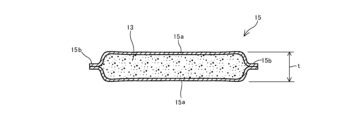
- 4 is a schematic cross-sectional view of the storage bag of FIG. 3 with food ingredients stored therein.
- a method for producing a shape-retaining food using a binding food material includes the steps of mixing the food material to be bound (food material to be mixed) with the binding food material, forming the mixture, and drying the mixture.
- a binding food material made of konnyaku paste or the like makes it possible to produce a healthier food (food that retains its shape) that is lower in sugar than conventional binding food materials such as starch syrup, sugar, syrup, honey, starch syrup, or wheat flour, lower in fat than conventional binding food materials such as chocolate, and has increased dietary fiber compared to conventional binding food materials.
- chocolate and starch syrup must be heated before they can be mixed with the food materials to be mixed, whereas a binding food material made of konnyaku paste or the like can be mixed at room temperature, eliminating the need for prior heating.
- the binding ingredients made from konnyaku paste and the like have almost no flavor, the natural flavors of the ingredients to be mixed can be utilized, and seasonings can be added freely.
- food products that have been manufactured using adhesive ingredients such as konnyaku paste are less likely to lose their shape at room temperature.
- the assumed room temperature is about 25°C, but they also retain their shape at temperatures as high as 40°C during the Japanese summer.
- binding ingredients made of konnyaku paste and the like (hereinafter simply referred to as binding ingredients) will be described later.
- FIG. 1 shows a schematic process diagram of the method for producing shape-retaining food of the present invention (hereinafter referred to as the production method).
- 1 includes a preparation step S (see dashed double-dashed line) consisting of a step S1 of preparing a binding food material 2 and a step S2 of preparing a food material 3 to be mixed, a step S3 of mixing the binding food material 2 and the food material 3 to be mixed, shaping them, and obtaining a shaped food material 4, and a drying step S4 of drying the shaped food material 4.
- Shape-retaining food product 5 is produced by drying the shaped food material 4.
- a binding food material 2 is prepared.
- the binding food material 2 is any one of konnyaku paste 11, coagulant-containing konnyaku paste 13, and heat-treated konnyaku paste 14 (see FIG. 2). These will be described later.
- the ratio based on the weight of the binding ingredients 2 and the ingredients 3 to be mixed will depend on the properties of the ingredients 3 to be mixed, but is generally adjusted as appropriate depending on the concentration of the binding ingredients 2, the size of the ingredients 3 to be mixed, the degree of moisture penetration into the ingredients 3 to be mixed, the drying time in the drying step (S5), and the desired texture, such as the feel and mouthfeel, of the shape-retained food 5.
- the ingredients 3 to be mixed are prepared.
- the ingredients 3 to be mixed include powdered or granular materials, solid materials such as seeds, gel-like materials such as gummies and jellies, and paste-like ingredients such as jams and boiled seaweed that are viscous and do not have a specific shape but can maintain their shape to some extent without being placed in a container.
- the shape of the ingredients may be the shape of the material itself, or a shape obtained by cutting or crushing the material.
- the size of the powder, grain, or small piece-like ingredients is not particularly limited. They may also be ingredients containing moisture such as soybean pulp or paste-like ingredients. For example, if these ingredients containing moisture and paste-like ingredients are ingredients that are easily decomposed or broken down after the moisture dries, they may be the ingredients 3 to be mixed in the manufacturing method of the present invention.
- ingredients 3 to mix examples include nuts and seeds (e.g., cereals) and/or nuts, soybean pulp, fruits or dried fruits, vegetables or dried vegetables, gummies or jellies made from fruit juice solidified with gelatin, grains such as wheat and sesame, beans, soybean pulp as a moist ingredient, jam as a paste-like ingredient, seaweed, and tsukudani seaweed.
- nuts and seeds e.g., cereals
- soybean pulp e.g., nuts, soybean pulp, fruits or dried fruits, vegetables or dried vegetables
- gummies or jellies made from fruit juice solidified with gelatin, grains such as wheat and sesame, beans, soybean pulp as a moist ingredient, jam as a paste-like ingredient, seaweed, and tsukudani seaweed.
- moisture or seasonings for flavoring such as soy sauce, mirin, sake, vinegar, salt, pepper, shichimi, etc., may be added to adjust the taste of the food material. Other seasonings may also be used.
- dietary fiber may be added.
- the texture can be adjusted by the type and amount of vegetable fiber.
- inulin is preferably used as the dietary fiber.
- the ingredients 3 to be mixed are not particularly limited.
- the seeds and nuts are a general term for edible fruits and seeds that are enclosed in a hard skin or shell. Nuts are a general term for nuts among the seeds and nuts, and some legumes that are generally recognized as nuts.
- the content of the seeds and nuts used is not particularly limited and may be adjusted as appropriate.
- the seeds and nuts and/or nuts are at least one type selected from the group consisting of sesame, peanuts, almonds, walnuts, cashew nuts, and pecan nuts.
- the concentration and amount of the bound food ingredient 2, as well as the drying temperature and time in the drying step S4, may be adjusted taking into account the moisture content.
- step S3 the binding ingredients 2 and the ingredients 3 to be mixed are mixed and shaped.
- a known device such as a mixing tank may be used for mixing.
- the temperature during mixing is not particularly limited, but from the viewpoint of uniformly and easily dispersing the ingredients, a temperature of about 25°C, which is room temperature, is preferable.
- a temperature of 5 to 70°C may also be used.
- chocolate or starch syrup must be heated before it can be mixed with the food material 3, whereas the binding food material 2 can be mixed at room temperature of 5 to 70°C, including 25°C, preferably 15 to 30°C, and more preferably 20 to 27°C, and therefore does not require prior heating.
- milk and dairy products sweeteners, oils and fats, emulsifiers, stabilizers, flavors, and colorings may be added as necessary. It is also possible to not use any of these. For example, to add sweetness, sweeteners, sugar, honey, starch syrup, etc. may be added. Also, to add viscosity, thickening stabilizers, wheat flour, sugar, honey, chocolate, etc. may be added. Details of thickening stabilizers and sweeteners will be described later.
- the food material is formed into a block shape that is large enough to be easily handled by hand.
- the shape is preferably one that is suitable for carrying or one that is enjoyable to look at.
- shapes that are suitable for carrying include rods, spheres, and plates.
- shapes that are enjoyable to look at include stars, moons, and character shapes.
- any shape can be adopted, including pyramidal shapes such as cones and square pyramids, and cubic shapes including rectangular parallelepipeds.
- the shape is not particularly limited.
- the mixture is molded by filling it into a mold or container as necessary. It may also be placed in a predetermined amount on cooking paper, a plate, etc., without filling it into a container. It may also be placed on cooking paper, a plate, etc. after adjusting the shape using hands or a mold.
- step S4 the shaped food material 4 is dried. It may be dried by heating, by hot air, by freeze-drying, or by frying in oil.
- the shape of the shaped food material 4 is retained in step S4. By retaining the shape, the shaped state can be maintained and the food material can be prevented from peeling or crumbling. Peeling and crumbling can be prevented to an extent that makes it easy to handle with hands. For example, it is preferable that the shape is retained to an extent that the food material does not peel off, crumble, or stick to the hand when held in the hand.
- the drying temperature and drying time are adjusted to appropriate values depending on the desired texture, such as the texture and mouthfeel, of the block-shaped food 5 and the amount of moisture to be adjusted.
- the drying temperature is 30 to 100° C. when a food dehydrator is used, 140 to 200° C. when deep-frying, 30 to 250° C. when a convection oven is used, and when drying by freeze-drying, drying is performed under reduced pressure at about ⁇ 30° C.
- the drying time is 10 minutes to 24 hours, and when deep-frying, 0.5 minutes to 10 minutes. Other drying temperatures and drying times may also be used.
- the shape-retaining food 5 is suitable for low-calorie foods, low-sugar foods, diet foods, etc., because the food 3 to be mixed is bound with the binding food material 2 made of konnyaku or the like. In addition, since it is possible to prevent any influence on the flavor and taste of the food to be bound, it is suitable for use in natural foods that make use of the flavor and taste of the ingredients. It is also suitable for adding new flavors.
- the block-shaped food product 5 includes a nut bar, an energy bar, a protein bar, a cereal bar, and the like.
- Fig. 2 shows a schematic diagram of the manufacturing method of the bound food material 2.
- the manufacturing method 8 of the bound food material 2 shown in Fig. 2 includes a step R1 of preparing refined konnyaku powder 9, a step R2 of preparing water 10, a step R3 of swelling the refined konnyaku powder 9, a step R4 of adding an alkaline coagulant 12 to the swollen food material (konnyaku paste) 11 and kneading it, a step R5 of heating the food material mixed with the coagulant (konnyaku paste containing coagulant) 13 while kneading it, and a step R6 of cooling it to room temperature or below. After cooling in step R6, a heat-treated konnyaku paste 14 is obtained.
- Konnyaku flour or konnyaku refined flour is, for example, a product obtained by drying and grinding konnyaku yam to remove starch, and is composed almost entirely of a water-soluble dietary fiber called konnyaku glucomannan.
- konnyaku yam is, for example, a plant, and may refer to the root part.
- the konnyaku paste is, for example, a sol-like product made by dissolving konnyaku flour or konnyaku powder in water.
- the konnyaku is a gel-like product made by adding an alkaline coagulant to the konnyaku paste and heating it to coagulate it.
- Steps R3, R3 Water 10 is added to the konnyaku refined powder 9 to swell it.
- the concentration of the konnyaku refined powder is 1 to 3 wt %. It is preferable to slowly swell it with cold water to dissolve the konnyaku refined powder.
- Konnyaku paste 11 is obtained. Steps R1, R2 and R3 correspond to the method for producing konnyaku paste 6.
- the concentration of the konnyaku refined powder may be 0.5 to 5 wt %.
- Steps R4 An alkaline coagulant 12 is added to the paste 11. A coagulant-containing konnyaku paste 13 is obtained. Steps R1, R2, R3 and R4 correspond to the method 6 for producing konnyaku paste.
- the coagulant-containing konnyaku paste 13 has a pH of 8 to 14, preferably a pH of 11 or more, for example, a pH of 13 to 14, preferably a pH of 13.5 to 14.
- the coagulant-containing konnyaku paste 13 may have a somewhat improved binding effect due to the gelation caused by heating in the drying step S4.
- alkaline coagulant 12 examples include calcined shell calcium, hydroxide compounds such as sodium hydroxide, potassium hydroxide, calcium hydroxide, and magnesium hydroxide, carbonates such as sodium bicarbonate, sodium carbonate, potassium carbonate, calcium carbonate, and magnesium carbonate, sulfates such as calcium sulfate, potassium sulfate, sodium sulfate, and magnesium sulfate, and organic acid salts such as sodium citrate, sodium tartrate, sodium malate, sodium acetate, and sodium lactate. Furthermore, a mixture of some of these may be used.
- hydroxide compounds such as sodium hydroxide, potassium hydroxide, calcium hydroxide, and magnesium hydroxide
- carbonates such as sodium bicarbonate, sodium carbonate, potassium carbonate, calcium carbonate, and magnesium carbonate
- sulfates such as calcium sulfate, potassium sulfate, sodium sulfate, and magnesium sulfate
- organic acid salts such as sodium citrate, sodium tartrate
- pH adjusters include adipic acid, citric acid, trisodium citrate, glucono delta lactone, gluconic acid, potassium gluconate, sodium gluconate, succinic acid, monosodium succinate, disodium succinate, sodium acetate, DL-tartaric acid, L-tartaric acid, DL-potassium hydrogen tartrate, L-potassium hydrogen tartrate, DL-sodium tartrate, L-sodium tartrate, potassium carbonate (anhydrous), sodium bicarbonate, sodium carbonate, carbon dioxide, lactic acid, potassium lactate, sodium lactate, glacial acetic acid, disodium dihydrogen pyrophosphate, fumaric acid, monosodium fumarate, DL-malic acid, sodium DL-malate, phosphoric acid, dipotassium hydrogen phosphate, potassium dihydrogen phosphate, disodium hydrogen phosphate, sodium dihydrogen phosphate, and further arginine, lysine, histidine,
- the coagulant-containing konjac paste 13 is heated at 60 to 90° C. for 50 minutes or more, preferably at 80 to 90° C. for 50 to 120 minutes.
- the heating time varies depending on the pH and heating temperature. The higher the pH and the heating temperature, the shorter the heating time tends to be.
- the obtained heat-treated konnyaku paste 14 has a pH of 8 to 14.0, preferably about pH 8 to 9.0. For example, it is a paste-like texture like jam. Since the heat-treated konnyaku paste 14 is heated in an alkaline environment and cooled, it is considered to be in a state where gelation has progressed to some extent. In addition, since the heat-treated konnyaku paste 14 is heated in the alkaline region in the heating step R5, gelation has progressed to some extent. Therefore, heating in the drying step S4 may cause the gelation to progress further to some extent, thereby improving the binding effect to some extent.
- Example of Heat-Treated Konjac Paste 14 10 to 30 g of konnyaku flour refined powder was mixed with 1000 ml of water, an alkaline coagulant 12 was added, and the mixture was heated at a temperature of 60 to 90° C. for 50 to 120 minutes and cooled to a temperature of about 20° C. to obtain a heat-treated konnyaku paste 14.
- the manufacturing method 8a includes a step R4a in which the coagulant-containing konnyaku paste 13 is stored in a storage bag 15 (see FIG. 3) in a flat plate shape of approximately uniform thickness after adding the coagulant (see the dotted arrow). After that, the storage bag 15 is heated at 80° C. or higher for 60 to 100 minutes (R5), and the storage bag 15 is cooled to near room temperature (R6).
- the storage bag 15 allows the coagulant-containing konnyaku paste 13 to be in a flat or thin plate shape, so that the entire product can be heated almost uniformly.
- the coagulant-containing konnyaku paste 13 and the storage bag 15 can be sterilized during heating.
- the coagulant-containing konnyaku paste 13 can also be cooled almost uniformly. By heating and cooling the coagulant-containing konnyaku paste 13 almost uniformly, the heat-treated konnyaku 14 can be obtained efficiently.
- FIG. 3 is a schematic diagram of a partially cut-out storage bag used in another manufacturing method 8a.
- the storage bag 15 shown in Fig. 3 has an edge 15b formed by sealing the periphery of two overlapping sheet-like members 15a, 15a to a predetermined width.
- the dimensions of the storage bag 15 used in the manufacturing process are 30 cm x 20 cm, and the content is 920 ml.
- the width of the edge 15b is 0.8 to 1 cm.
- the width of the edge 15b is about 0.2 to 2 cm, preferably about 0.5 to 1.5 cm.
- the upper end (top of the figure) of the storage bag 15 is not sealed, but forms an opening 15c.
- the opening 15c is sealed to form the edge 15b (see the two-dot chain line).
- the storage bag 15 contains the coagulant-containing konnyaku paste 13, it is formed into a flat plate of approximately uniform thickness (see symbol t in Figure 4). As the storage bag 15 has edge 15b, it tends to maintain the flat shape.
- the thickness t is 0.5 to 5 cm, and preferably 1 to 3 cm.
- the figure shows a manufacturing method according to another embodiment (hereinafter, referred to as another manufacturing method).
- the other manufacturing method 1a shown in the figure includes a freezing step (step S6) between the mixing and molding step (step S3) and the drying step (step S4).
- Step S6 Freezing step
- the freezing temperature is ⁇ 5 to ⁇ 40° C., preferably ⁇ 5 to ⁇ 20° C. In this embodiment, it is about ⁇ 18° C.
- the freezing time is, for example, 2 hours or more, preferably 8 hours or more, i.e., about overnight. When freezing in a freezer at about ⁇ 18° C. for 8 hours or more, the solidification or gelation of the shaped food material 4 is more reliable.
- the solidified konnyaku paste 11 is generally called konnyaku.
- the heat-treated konnyaku paste 14 exhibits properties different from those of the konnyaku paste 11 and konnyaku.
- the heat-treated konnyaku paste 14 exists as a paste at room temperature, and when frozen, it solidifies or gels, and even when thawed, the solidified or gelled state is maintained.
- the degree of solidification or gelation tends to be higher as the amount of konnyaku refined flour 7 in the heat-treated konnyaku paste 14 increases. This tendency is related to the power to bind ingredients.
- Example of frying after freezing When nuts are used as the mixed ingredient 3, 50g of the ingredient 4 formed into a block shape (20g of which is the binding ingredient) is frozen and fried in oil at about 170°C for 6 minutes to make a nut bar. If the frying time is 2 minutes, the moisture inside tends not to evaporate easily. If the frying time is 8 minutes, the bar tends to have a burnt smell.
- a sweetener is added to sweeten the block-shaped food 5.
- the sweetener may be added in steps S1 and S2 for preparing the binding ingredients 2 or the ingredients 3 to be mixed, or in the mixing step S3 (see FIG. 1).
- the sweetener may be mixed in advance with the binding food material 2.
- the sweetener may be mixed at any stage up to the completion of the konnyaku paste 11, the coagulant-containing konnyaku paste 13, or the heat-treated konnyaku paste 14. Furthermore, in the case of the heat-treated konnyaku paste 14, the sweetener may be mixed after the heating step R5.
- sweeteners are broadly divided into carbohydrate-based and non-carbohydrate-based sweeteners.
- Non-carbohydrate sweeteners include natural sweeteners and synthetic sweeteners.
- Specific carbohydrate-based sweeteners include, for example, sugar; starch-derived sugars such as glucose, fructose, maltose, starch syrup, isomerized sugar, isomaltooligosaccharide, trehalose, etc.; sugar alcohols such as sorbitol, mannitol, maltitol, reduced starch syrup, reduced palatinose, xylitol, erythritol, etc.; and other sugars such as fructooligosaccharides, galactooligosaccharides, xylooligosaccharides, lactose oligosaccharides, soybean oligosaccharides, raffinose, lactose, etc.
- Non-saccharide sweeteners include natural sweeteners such as stevia, licorice (glycyrrhizin), and monk fruit; and synthetic sweeteners such as saccharin, aspartame, acesulfame K, and sucralose. These ingredients may also be obtained by mixing natural ingredients.
- the sweetener may be one having a lower energy content than sugar.
- Sugar may be used as a supplement.
- the sweetener may be a mixture of the above sweeteners.
- a non-carbohydrate-based or carbohydrate-based sweetener other than sugar may be used.Furthermore, a non-carbohydrate-based sweetener may be used and carbohydrate-based sweeteners may be omitted.
- the amount of non-sugar sweetener is adjusted to compensate for the sweetness that would be lost by reducing the amount of sugar. In this case, it is preferable to reduce the calories and/or carbohydrates compared to the amount of sugar required for the intended sweetness.
- a sweetener and konnyaku flour 9 are blended to compensate for the loss of binding power caused by the reduction in sugar. It is further preferred that a sweetener and konnyaku flour 9 are blended to compensate for the viscosity caused by reducing the sugar.
- modified version 2 a thickening stabilizer is added to facilitate the shaping of the block-shaped food material 4 and to bind the food material 3 to be mixed.
- the process of mixing the thickening stabilizer is the same as in modified version 1 described above.
- thickening stabilizer When a thickening stabilizer is used, examples of the stabilizer include plant-derived stabilizers (thickening polysaccharides) such as carrageenan, guar gum, locust bean gum, (microcrystalline) cellulose, pectin, starch, gum arabic, etc.; animal-derived stabilizers such as gelatin, casein, sodium caseinate, etc.; and synthetic stabilizers such as carboxymethylcellulose (CMC), methylcellulose, etc. When a thickening stabilizer is used, the amount of the binding food material 2 may be reduced. These ingredients may be obtained by mixing natural ingredients. Also, ingredients rich in fibrous ingredients may be used. For example, powdered kelp or laver may be mixed (see Example 8).
- plant-derived stabilizers thickening polysaccharides
- carrageenan such as carrageenan, guar gum, locust bean gum, (microcrystalline) cellulose, pectin, starch, gum arabic, etc.
- animal-derived stabilizers
- modified versions of manufacturing methods 1 and 1a The following describes modified versions of manufacturing methods 1 and 1a.
- flavors are added to impart aroma to the block-shaped food material 4.
- the process of mixing the flavors is the same as in modified versions 1 and 2 described above.
- Flavoring is used to reduce the konnyaku odor, which is thought to be mainly due to residual trimethylamine contained in the skin and the alkaline odor produced when the konnyaku is solidified.
- Flavors may be obtained by blending natural ingredients such as squeezed fruit juices such as lemon, apple, grape, orange, etc.
- the sweetener, thickening stabilizer, or flavor is acidic, it is preferable to adjust the overall pH to alkaline.
- the heat-treated konnyaku paste 14 they may be added after the heating step R5 so as not to hinder the progress of gelation in the heating step R5.
- the above-mentioned modified examples 1, 2, and 3 may be used in combination as appropriate.
- Example of food 5 retained in a block shape (Example 1: Nut bar, heat-treated konjac paste 14)
- a food product 5 (hereinafter referred to as block-shaped food product 5) that is bound and retained in a block shape using heat-treated konnyaku paste 14 will be described.
- a nut bar was manufactured by the above-mentioned other manufacturing method 1a. Using a household mixer, almonds, cashew nuts, and walnuts were roughly crushed to obtain a total of 400 g of mixed nut food material (food material to be mixed 3).
- Example 2 Nut bar, heat-treated konjac paste 14
- the second embodiment is almost the same as the first embodiment, so a description of the same parts will be omitted.
- Example 2 almonds, cashew nuts, walnuts, and peanuts were roughly crushed to prepare a total of 400 g of mixed nuts (ingredients 3 to be mixed). For example, each almond, cashew nut, and peanut was divided into approximately 16 pieces, and each walnut was divided into approximately 4 pieces. 350 g of the prepared mixed nuts food material was spread thinly and shaped, and dried in a convection oven at 100° C. for 100 minutes. After drying, the mixture was cut into pieces that could be picked up by hand. The completed nut bar was not completely dried near the center of the back side. Therefore, it is necessary to dry the heat-treated konnyaku paste 14 evenly.
- a third embodiment of the block-shaped food 5 will be described below.
- the third embodiment is almost the same as the first embodiment, so a description of the same parts will be omitted.
- a food ingredient (food ingredient 3 to be mixed) consisting of mixed nuts consisting of 30 g of peanuts divided into 16 pieces, 15 g of walnuts divided into 4 pieces, 5 g of pumpkin seeds, and 7 g of almonds divided into 4 pieces, 7 g of Lakanto S (trade name) manufactured by Saraya Co., Ltd. as a sweetener, and 30 g of heat-treated konnyaku paste 14 containing 1.5 wt% of konnyaku refined powder 9 were prepared and mixed.
- the mixed food ingredients were placed in a madeleine mold and heated at 110°C for 60 minutes in an oven. Then, the bar was removed from the madeleine mold, turned over, and heated under the same conditions. The completed nut bar was well bonded.
- the amount of heat-treated konnyaku paste 14 was reduced from 30 g to 20 g, the food material consisting of mixed nuts crumbled with a small amount of force. Therefore, it is considered that the amount of heat-treated konnyaku paste 14 should be 30 g or more.
- a fourth embodiment of the block-shaped food 5 will be described below.
- the fourth embodiment is almost the same as the first embodiment, so a description of the same parts will be omitted.
- a mixed nut food material (food material to be mixed 3) consisting of 60 g of peanuts, 30 g of walnuts, 10 g of pumpkin seeds, and 14 g of almonds, 7 g of Lakanto S (trade name) manufactured by Saraya Co., Ltd. as a sweetener, 1 g of seasoning such as salt, and 60 g of heat-treated konnyaku paste 14 containing 1.5 wt% of konnyaku refined powder 9 were prepared and mixed.
- the mixed food material was placed in a baking mold and heated at 110°C for 60 minutes using a convection oven while applying dry air. After that, it was removed from the baking mold, turned over, and heated under the same conditions. The completed nut bar was well bonded.
- Example 5 Nut bar, heat-treated konjac paste 14
- Example 5 of the block-shaped food 5 will be described below.
- Example 5 is different from Example 4 in that the drying conditions in the convection oven were changed to heating at 110°C for 40 minutes. The other conditions were the same.
- the drying conditions in the convection oven were changed to heating at 110°C for 40 minutes. The other conditions were the same.
- some moisture remained in the heat-treated konnyaku paste 14. For this reason, it is understood that sufficient drying time is required to dry the heat-treated konjac paste 14.
- Example 6 Nuts bar, konjac paste 11
- Example 6 of the block-shaped food 5 will be described below.
- Example 6 is different from Example 4 in that the heat-treated konnyaku paste 14 is not used, but the konnyaku paste 11 containing 1.5 wt % of the konnyaku refined powder 9 is used. The other conditions are the same. The completed nut bar was bound together.
- Example 7 Nut bar, konjac paste containing coagulant 13
- Example 7 of the block-shaped food 5 will be described below.
- Example 7 uses 60.2 g of konnyaku paste 13 containing 1.5 wt % of konnyaku refined powder 9 as a coagulant, instead of the heat-treated konnyaku paste 14, as compared to Example 4.
- 0.2 g of calcium carbonate is contained as a coagulant.
- the other conditions are the same.
- the completed nut bar was bound together.
- Example 8 Nut bar, kelp powder, coagulant-containing konjac paste 13
- Example 8 of the block-shaped food 5 will be described below.
- 60 g of mixed nut food material food material 3 to be mixed
- 25 g of heat-treated konnyaku paste 14 containing 1.5 wt % of konnyaku refined powder 9, and 0.5 g of konnyaku powder were prepared and mixed.
- the mixed food material was placed in a baking mold and heated at 110°C for 60 minutes using a convection oven while applying dry air. After that, it was removed from the baking mold, turned over and heated under the same conditions.
- the completed nut bar was well bonded.
- the amount of heat-treated konnyaku paste 14 was reduced by the amount of kelp powder used as a thickening stabilizer.
- Coarse powder may be used in the konnyaku refined powder 9 in Fig. 2. In that case, the coarse powder is first crushed before being used for processing.
- the block-shaped food material 4 may be dried by rapid heating.
- baking or broiling may be performed.
- the above-described embodiments may be used in any suitable combination with the modifications, other embodiments, and other aspects.
- the heat-treated konnyaku paste 14 has gelled to some extent, and it is assumed that the long molecular chains are entangled and bonded, and that the entanglements are filled with water.
- the above-mentioned binding food material 2 is a binding food material 2 for mixing with food material 3, drying, and forming the mixed food material into a predetermined shape to maintain its shape, and is characterized by being made of 0.5 to 5.0 wt % konnyaku paste 11 obtained by swelling konnyaku refined powder 9.
- the konnyaku paste 11 as the binding ingredients 2 penetrates into the gaps and holes on the surfaces of the ingredients 3 to be mixed, hardens as it dries, and binds the ingredients 3 together as if binding small holes (anchor effect).
- a healthy food (block-shaped food 5) can be produced which is lower in sugar content than conventional binding ingredients such as starch syrup, sugar, syrup, honey and wheat flour, lower in fat content than conventional binding ingredients such as chocolate, and has enhanced dietary fiber content compared to conventional binding ingredients.
- conventional binding ingredients such as starch syrup, sugar, syrup, honey and wheat flour
- conventional binding ingredients such as starch syrup, sugar, syrup, honey and wheat flour
- the binding ingredients made of konnyaku paste and the like have almost no flavor, the natural flavor of the ingredients to be bound can be utilized, and furthermore, seasoning can be freely added.
- block-shaped foods manufactured using binding ingredients such as konnyaku paste do not easily lose their shape at room temperature. The room temperature is assumed to be about 25°C, but they also do not lose their shape even at outside temperatures of around 40°C in the Japanese summer.
- Such binding food materials are made of konnyaku paste containing a coagulant, in which a coagulant has been added to the konnyaku paste so that the pH is between 8 and 14. Therefore, when heated during drying, the paste gels to some extent, enhancing the binding effect.
- the coagulant-containing konnyaku paste is made of heat-treated konnyaku paste that has been heated at 80 to 95°C for 50 minutes or more and then cooled. Since the paste is heated in an alkaline condition and is in a gently gelled state, the paste can be further gelled by heating during drying, thereby enhancing the binding effect.
- the konjac paste is frozen before drying, and that the konjac paste has a concentration of 1.0 to 3.0 wt %.
- the above-mentioned method 1 (1a) for producing block-shaped food is characterized by comprising a preparation step of preparing the binding ingredients 2 and the ingredients 3 to be mixed as described above in (1, 2, 3), a shaping step of mixing the binding ingredients 2 and the ingredients 3 to be mixed and shaping them into a block, and a drying step of drying the block-shaped ingredients 4.
- the above-mentioned method 1 (1a) for producing a block-shaped food product is characterized by comprising a preparation step of preparing the binding ingredients 2 and the ingredients 3 to be mixed as described in (4) above, a forming step of mixing the binding ingredients 2 and the ingredients 3 to be mixed and forming them into a block shape, a freezing step of freezing the block-shaped ingredients, and a drying step of drying the block-shaped ingredients 4.
- a healthy block-shaped food 5 can be produced which is low in sugar and fat and has increased dietary fiber content.
- the binding food material 2 made of konnyaku paste or the like has almost no taste, the natural taste of the food material 3 to be bound can be utilized, and further, seasoning can be freely added.
- the block-shaped food 5 produced using the binding food material 2 made of konnyaku paste or the like is less likely to lose its shape at room temperature.
- the room temperature is assumed to be about 25°C, but the food is also prevented from losing its shape even at outside temperatures of around 40°C in the Japanese summer.
- chocolate or starch syrup must be heated before it can be mixed with the food material 3, whereas a binding food material 2 made of konjac paste or the like can be mixed at room temperature, eliminating the need for prior heating.
- freezing ensures that the food material 4 solidifies or gels by solidifying or gelling the food material 4. The solidified or gelled state is maintained even after thawing.
Landscapes
- Chemical & Material Sciences (AREA)
- Life Sciences & Earth Sciences (AREA)
- Engineering & Computer Science (AREA)
- Food Science & Technology (AREA)
- Polymers & Plastics (AREA)
- Health & Medical Sciences (AREA)
- Nutrition Science (AREA)
- Dispersion Chemistry (AREA)
- Wood Science & Technology (AREA)
- Zoology (AREA)
- Preparation Of Fruits And Vegetables (AREA)
Priority Applications (2)
| Application Number | Priority Date | Filing Date | Title |
|---|---|---|---|
| JP2024560209A JPWO2024111666A1 (https=) | 2022-11-26 | 2023-11-24 | |
| US19/211,366 US20250275564A1 (en) | 2022-11-26 | 2025-05-19 | Binder including konjac paste and other components, shape-retained food product, and method for manufacturing shape-retained food product |
Applications Claiming Priority (2)
| Application Number | Priority Date | Filing Date | Title |
|---|---|---|---|
| JP2022-188790 | 2022-11-26 | ||
| JP2022188790 | 2022-11-26 |
Related Child Applications (1)
| Application Number | Title | Priority Date | Filing Date |
|---|---|---|---|
| US19/211,366 Continuation US20250275564A1 (en) | 2022-11-26 | 2025-05-19 | Binder including konjac paste and other components, shape-retained food product, and method for manufacturing shape-retained food product |
Publications (1)
| Publication Number | Publication Date |
|---|---|
| WO2024111666A1 true WO2024111666A1 (ja) | 2024-05-30 |
Family
ID=91196207
Family Applications (1)
| Application Number | Title | Priority Date | Filing Date |
|---|---|---|---|
| PCT/JP2023/042254 Ceased WO2024111666A1 (ja) | 2022-11-26 | 2023-11-24 | 蒟蒻糊等からなる結着食材、保形された食品及び保形された食品の製造方法 |
Country Status (3)
| Country | Link |
|---|---|
| US (1) | US20250275564A1 (https=) |
| JP (1) | JPWO2024111666A1 (https=) |
| WO (1) | WO2024111666A1 (https=) |
Citations (4)
| Publication number | Priority date | Publication date | Assignee | Title |
|---|---|---|---|---|
| JPS59203467A (ja) * | 1983-04-30 | 1984-11-17 | Kazuo Hara | 新規なコンニヤクの食品及び食品添加物及びその利用方法 |
| JPH0412107B2 (https=) * | 1982-12-16 | 1992-03-03 | Kibun Kk | |
| JP2022113668A (ja) * | 2021-01-25 | 2022-08-04 | 株式会社Sydecas | 蒟蒻食材の製造方法及びゲル状蒟蒻由来食品の製造方法 |
| JP2022178282A (ja) * | 2021-05-19 | 2022-12-02 | 株式会社Sydecas | 蒟蒻由来のシロップの製造方法、結着又は成型された食品の製造方法及び結着又は成型された食品 |
-
2023
- 2023-11-24 JP JP2024560209A patent/JPWO2024111666A1/ja active Pending
- 2023-11-24 WO PCT/JP2023/042254 patent/WO2024111666A1/ja not_active Ceased
-
2025
- 2025-05-19 US US19/211,366 patent/US20250275564A1/en active Pending
Patent Citations (4)
| Publication number | Priority date | Publication date | Assignee | Title |
|---|---|---|---|---|
| JPH0412107B2 (https=) * | 1982-12-16 | 1992-03-03 | Kibun Kk | |
| JPS59203467A (ja) * | 1983-04-30 | 1984-11-17 | Kazuo Hara | 新規なコンニヤクの食品及び食品添加物及びその利用方法 |
| JP2022113668A (ja) * | 2021-01-25 | 2022-08-04 | 株式会社Sydecas | 蒟蒻食材の製造方法及びゲル状蒟蒻由来食品の製造方法 |
| JP2022178282A (ja) * | 2021-05-19 | 2022-12-02 | 株式会社Sydecas | 蒟蒻由来のシロップの製造方法、結着又は成型された食品の製造方法及び結着又は成型された食品 |
Non-Patent Citations (4)
| Title |
|---|
| ANONYMOUS: "[NinjaFoods] Launches next-generation healthy snack made from nuts solidified with liquid konjac", 23 October 2023 (2023-10-23), XP093174402, Retrieved from the Internet <URL:https://prtimes.jp/main/html/rd/p/000000096.000029701.html> * |
| ANONYMOUS: "Konnyaku Food Tech decides to launch limited early release of beta version of Natural Nuts Bar", 20 November 2022 (2022-11-20), XP093174398, Retrieved from the Internet <URL:https://prtimes.jp/main/html/rd/p/000000061.000029701.html> * |
| ANONYMOUS: "Konnyaku Food Tech launches next-generation protein bar co-development project", 19 November 2022 (2022-11-19), XP093174399, Retrieved from the Internet <URL:https://prtimes.jp/main/html/rd/p/000000060.000029701.html> * |
| ANONYMOUS: "Next-generation konjac food tech, natural protein bar (nut bar) without sugar, flour or chocolate, begins pre-sale on Makuake", 21 December 2022 (2022-12-21), XP093174400, Retrieved from the Internet <URL:https://presswalker.jp/press/6344> * |
Also Published As
| Publication number | Publication date |
|---|---|
| JPWO2024111666A1 (https=) | 2024-05-30 |
| US20250275564A1 (en) | 2025-09-04 |
Similar Documents
| Publication | Publication Date | Title |
|---|---|---|
| JP4512135B2 (ja) | 機能性砂糖代替物 | |
| BRPI0707914A2 (pt) | substituição funcional de açúcar | |
| US20070065557A1 (en) | Non sweet binder for savory food product | |
| WO2024111666A1 (ja) | 蒟蒻糊等からなる結着食材、保形された食品及び保形された食品の製造方法 | |
| JP5836089B2 (ja) | 豆腐加工弾力性食品及びその製法 | |
| JP7839533B2 (ja) | 蒟蒻由来のシロップの製造方法、結着又は成型された食品の製造方法及び結着又は成型された食品 | |
| JP3469954B2 (ja) | 低カロリーあん状食品の製造方法 | |
| JP2004215646A (ja) | 加工食品用離水防止剤 | |
| KR101794053B1 (ko) | 두부강정의 제조방법 | |
| JPH09238631A (ja) | こんにゃく餅 | |
| JP2002000209A (ja) | 豆腐ペーストの製造方法 | |
| CN100355352C (zh) | 软糖 | |
| JP6947884B2 (ja) | 食品用シート状組成物 | |
| JP4900952B2 (ja) | 咀嚼・口内滞留特性が向上した食品の製造法 | |
| JPH1142057A (ja) | 澱粉老化防止用組成物及び澱粉含有食品の老化防止法 | |
| US20210337844A1 (en) | Prebiotic Fiber Bars and Method of Making | |
| KR20180068078A (ko) | 푸딩용 동치미 및 이를 활용한 동치미 푸딩의 제조방법 | |
| KR101899314B1 (ko) | 감자옹심이가 함유된 황태 수프의 제조방법 | |
| JP2601732B2 (ja) | 魚肉ハンバーグ | |
| JP3710403B2 (ja) | 凍豆腐風こんにゃく食品の製造方法 | |
| JP3157379B2 (ja) | 外観、食感の改善された粉末食品素材 | |
| TW202547368A (zh) | 冷凍乾燥鹽麴及含有鹽麴之調味料 | |
| CN115087365A (zh) | 用于制备汤羹片的方法 | |
| JP6599264B2 (ja) | 乾燥具材含有組成物の製造方法 | |
| JP2024146793A (ja) | 冷凍ゲル状調味料、該冷凍ゲル状調味料を含む食肉加工食品、及びそれらの製造方法 |
Legal Events
| Date | Code | Title | Description |
|---|---|---|---|
| 121 | Ep: the epo has been informed by wipo that ep was designated in this application |
Ref document number: 23894668 Country of ref document: EP Kind code of ref document: A1 |
|
| WWE | Wipo information: entry into national phase |
Ref document number: 2024560209 Country of ref document: JP |
|
| NENP | Non-entry into the national phase |
Ref country code: DE |
|
| WWE | Wipo information: entry into national phase |
Ref document number: 11202503276Y Country of ref document: SG |
|
| WWP | Wipo information: published in national office |
Ref document number: 11202503276Y Country of ref document: SG |
|
| 122 | Ep: pct application non-entry in european phase |
Ref document number: 23894668 Country of ref document: EP Kind code of ref document: A1 |