WO2024089948A1 - 電子部品および電子部品の実装構造 - Google Patents
電子部品および電子部品の実装構造 Download PDFInfo
- Publication number
- WO2024089948A1 WO2024089948A1 PCT/JP2023/025663 JP2023025663W WO2024089948A1 WO 2024089948 A1 WO2024089948 A1 WO 2024089948A1 JP 2023025663 W JP2023025663 W JP 2023025663W WO 2024089948 A1 WO2024089948 A1 WO 2024089948A1
- Authority
- WO
- WIPO (PCT)
- Prior art keywords
- substrate
- pair
- electronic component
- external electrode
- land
- Prior art date
- Legal status (The legal status is an assumption and is not a legal conclusion. Google has not performed a legal analysis and makes no representation as to the accuracy of the status listed.)
- Ceased
Links
Images





Classifications
-
- H—ELECTRICITY
- H01—ELECTRIC ELEMENTS
- H01G—CAPACITORS; CAPACITORS, RECTIFIERS, DETECTORS, SWITCHING DEVICES, LIGHT-SENSITIVE OR TEMPERATURE-SENSITIVE DEVICES OF THE ELECTROLYTIC TYPE
- H01G2/00—Details of capacitors not covered by a single one of groups H01G4/00-H01G11/00
- H01G2/02—Mountings
- H01G2/06—Mountings specially adapted for mounting on a printed-circuit support
- H01G2/065—Mountings specially adapted for mounting on a printed-circuit support for surface mounting, e.g. chip capacitors
-
- H—ELECTRICITY
- H01—ELECTRIC ELEMENTS
- H01G—CAPACITORS; CAPACITORS, RECTIFIERS, DETECTORS, SWITCHING DEVICES, LIGHT-SENSITIVE OR TEMPERATURE-SENSITIVE DEVICES OF THE ELECTROLYTIC TYPE
- H01G2/00—Details of capacitors not covered by a single one of groups H01G4/00-H01G11/00
- H01G2/02—Mountings
- H01G2/06—Mountings specially adapted for mounting on a printed-circuit support
-
- H—ELECTRICITY
- H01—ELECTRIC ELEMENTS
- H01G—CAPACITORS; CAPACITORS, RECTIFIERS, DETECTORS, SWITCHING DEVICES, LIGHT-SENSITIVE OR TEMPERATURE-SENSITIVE DEVICES OF THE ELECTROLYTIC TYPE
- H01G4/00—Fixed capacitors; Processes of their manufacture
- H01G4/002—Details
- H01G4/005—Electrodes
- H01G4/008—Selection of materials
-
- H—ELECTRICITY
- H01—ELECTRIC ELEMENTS
- H01G—CAPACITORS; CAPACITORS, RECTIFIERS, DETECTORS, SWITCHING DEVICES, LIGHT-SENSITIVE OR TEMPERATURE-SENSITIVE DEVICES OF THE ELECTROLYTIC TYPE
- H01G4/00—Fixed capacitors; Processes of their manufacture
- H01G4/002—Details
- H01G4/005—Electrodes
- H01G4/012—Form of non-self-supporting electrodes
-
- H—ELECTRICITY
- H01—ELECTRIC ELEMENTS
- H01G—CAPACITORS; CAPACITORS, RECTIFIERS, DETECTORS, SWITCHING DEVICES, LIGHT-SENSITIVE OR TEMPERATURE-SENSITIVE DEVICES OF THE ELECTROLYTIC TYPE
- H01G4/00—Fixed capacitors; Processes of their manufacture
- H01G4/002—Details
- H01G4/018—Dielectrics
- H01G4/06—Solid dielectrics
- H01G4/08—Inorganic dielectrics
- H01G4/12—Ceramic dielectrics
-
- H—ELECTRICITY
- H01—ELECTRIC ELEMENTS
- H01G—CAPACITORS; CAPACITORS, RECTIFIERS, DETECTORS, SWITCHING DEVICES, LIGHT-SENSITIVE OR TEMPERATURE-SENSITIVE DEVICES OF THE ELECTROLYTIC TYPE
- H01G4/00—Fixed capacitors; Processes of their manufacture
- H01G4/002—Details
- H01G4/018—Dielectrics
- H01G4/06—Solid dielectrics
- H01G4/08—Inorganic dielectrics
- H01G4/12—Ceramic dielectrics
- H01G4/1209—Ceramic dielectrics characterised by the ceramic dielectric material
- H01G4/1218—Ceramic dielectrics characterised by the ceramic dielectric material based on titanium oxides or titanates
- H01G4/1227—Ceramic dielectrics characterised by the ceramic dielectric material based on titanium oxides or titanates based on alkaline earth titanates
-
- H—ELECTRICITY
- H01—ELECTRIC ELEMENTS
- H01G—CAPACITORS; CAPACITORS, RECTIFIERS, DETECTORS, SWITCHING DEVICES, LIGHT-SENSITIVE OR TEMPERATURE-SENSITIVE DEVICES OF THE ELECTROLYTIC TYPE
- H01G4/00—Fixed capacitors; Processes of their manufacture
- H01G4/002—Details
- H01G4/224—Housing; Encapsulation
-
- H—ELECTRICITY
- H01—ELECTRIC ELEMENTS
- H01G—CAPACITORS; CAPACITORS, RECTIFIERS, DETECTORS, SWITCHING DEVICES, LIGHT-SENSITIVE OR TEMPERATURE-SENSITIVE DEVICES OF THE ELECTROLYTIC TYPE
- H01G4/00—Fixed capacitors; Processes of their manufacture
- H01G4/002—Details
- H01G4/228—Terminals
- H01G4/232—Terminals electrically connecting two or more layers of a stacked or rolled capacitor
-
- H—ELECTRICITY
- H01—ELECTRIC ELEMENTS
- H01G—CAPACITORS; CAPACITORS, RECTIFIERS, DETECTORS, SWITCHING DEVICES, LIGHT-SENSITIVE OR TEMPERATURE-SENSITIVE DEVICES OF THE ELECTROLYTIC TYPE
- H01G4/00—Fixed capacitors; Processes of their manufacture
- H01G4/002—Details
- H01G4/228—Terminals
- H01G4/232—Terminals electrically connecting two or more layers of a stacked or rolled capacitor
- H01G4/2325—Terminals electrically connecting two or more layers of a stacked or rolled capacitor characterised by the material of the terminals
-
- H—ELECTRICITY
- H01—ELECTRIC ELEMENTS
- H01G—CAPACITORS; CAPACITORS, RECTIFIERS, DETECTORS, SWITCHING DEVICES, LIGHT-SENSITIVE OR TEMPERATURE-SENSITIVE DEVICES OF THE ELECTROLYTIC TYPE
- H01G4/00—Fixed capacitors; Processes of their manufacture
- H01G4/30—Stacked capacitors
-
- H—ELECTRICITY
- H05—ELECTRIC TECHNIQUES NOT OTHERWISE PROVIDED FOR
- H05K—PRINTED CIRCUITS; CASINGS OR CONSTRUCTIONAL DETAILS OF ELECTRIC APPARATUS; MANUFACTURE OF ASSEMBLAGES OF ELECTRICAL COMPONENTS
- H05K1/00—Printed circuits
- H05K1/02—Details
- H05K1/03—Use of materials for the substrate
Definitions
- the present invention relates to electronic components and mounting structures for electronic components.
- multilayer ceramic capacitors have been known as electronic components with a two-terminal structure, in which external electrodes are disposed at both ends of a rectangular parallelepiped body in which multiple dielectric layers and multiple internal electrode layers are alternately stacked.
- Multilayer ceramic capacitors are mounted on a circuit-bearing substrate by connecting the external electrodes by soldering to a pair of lands provided on the substrate (see Patent Document 1, etc.).
- multilayer ceramic capacitors have external electrodes that protrude downward toward the substrate further than the substrate. Therefore, the external electrodes come into contact with the lands, and a space is left between the substrate surface and the substrate.
- the present invention aims to provide an electronic component and a mounting structure for the electronic component that can suppress the occurrence of cracks.
- the electronic component of the present invention comprises a component body having a length direction, and a pair of external electrodes disposed at both ends of the component body in the length direction, and the component body has a protrusion that protrudes outward beyond the pair of external electrodes in a direction perpendicular to the length direction in at least a portion of the portion exposed between the pair of external electrodes.
- the electronic component mounting structure of the present invention is a mounting structure for an electronic component in which a pair of external electrodes of the electronic component are each connected to a pair of lands arranged at a distance from each other on the surface of a substrate, the electronic component having a component body and the pair of external electrodes arranged on the component body, the component body being in contact with the substrate, and a gap being present between each of the pair of external electrodes and the substrate.
- the present invention provides electronic components and electronic component mounting structures that can suppress the occurrence of cracks.
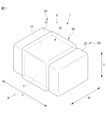
- FIG. 1 is a schematic perspective view of a multilayer ceramic capacitor according to an embodiment
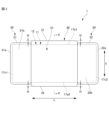
- FIG. 2 is a view taken in the direction of the arrow II in FIG. 1 .
- FIG. 2 is a view taken in the direction of the arrow III in FIG. 1 .
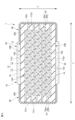
- 4 is a cross-sectional view taken along line IV-IV of FIG. 2.
- FIG. 1 is a plan view showing a mounting structure according to an embodiment.
- FIG. 8 is a cross-sectional view taken along line VIII-VIII of FIG. 7.
- FIG. 9 is an enlarged view of part IX in FIG. 8 .
- FIG. 10 is a diagram showing a conventional mounting structure, and corresponds to FIG. 9 .
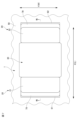
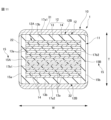
- FIG. 6 is a WT cross-sectional view showing a modified example of the multilayer ceramic capacitor according to the embodiment, and corresponds to FIG. 5 .
- FIG. 1 is a schematic perspective view of a multilayer ceramic capacitor 1 as an electronic component according to the embodiment.
- FIG. 2 is a view taken in the direction of the arrow II in FIG. 1.
- FIG. 3 is a view taken in the direction of the arrow III in FIG. 1.
- FIG. 4 is a cross-sectional view taken along the line IV-IV in FIG. 2.
- FIG. 5 is a cross-sectional view taken along the line V-V in FIG. 3.
- the multilayer ceramic capacitor 1 of the embodiment has a generally rectangular parallelepiped shape as a whole.
- the multilayer ceramic capacitor 1 includes a component body 10 and a pair of external electrodes 20 that are spaced apart from each other and disposed on the component body 10.
- the component body 10 has a base portion 11 and a central outer peripheral portion 30 provided on the base portion 11.
- arrow L indicates the length direction of the multilayer ceramic capacitor 1 and the element body 11.
- arrow W indicates the width direction perpendicular to the length direction of the multilayer ceramic capacitor 1 and the element body 11.
- arrow T indicates the stacking direction perpendicular to the length direction L and width direction W of the multilayer ceramic capacitor 1 and the element body 11.
- the stacking direction T corresponds to the thickness direction of the multilayer ceramic capacitor 1 and the element body 11.
- the cross-sectional view shown in FIG. 4 shows an LT cross-section, which is a cross-section along the length direction L and stacking direction T of the multilayer ceramic capacitor 1 at the center of the width direction W.
- the cross-sectional view shown in FIG. 5 shows a WT cross-section, which is a cross-section along the width direction W and stacking direction T of the multilayer ceramic capacitor 1 at the center of the length direction L.
- the dimensions of the multilayer ceramic capacitor 1 include, but are not limited to, for example, a length direction L of 0.2 mm or more and 1.2 mm or less, a width direction W of 0.1 mm or more and 0.7 mm or less, and a stacking direction T of 0.1 mm or more and 0.7 mm or less.
- the pair of external electrodes 20 includes a first external electrode 21 arranged at one end of the element body 11 in the longitudinal direction L, and a second external electrode 22 arranged at the other end of the element body 11 in the longitudinal direction L.
- first external electrode 21 and the second external electrode 22 which have the same configuration, are described without distinction, both may be simply referred to as external electrodes 20.
- the first external electrode 21 and the second external electrode 22 are both composed of a laminated film of a sintered metal layer 20a and a plating layer 20b.
- the sintered metal layer 20a is formed by baking a paste of, for example, Cu, Ni, Ag, Pd, Ag-Pd alloy, Au, or the like.
- the plating layer 20b is composed of, for example, a Ni plating layer and a Sn plating layer covering it.
- the plating layer 20b may alternatively be a Cu plating layer or an Au plating layer.
- the external electrode 20 may be composed of only a plating layer, or may be formed using a conductive resin paste.
- the element body 11 includes a laminate 12 and a pair of side dielectric ceramic layers 15 that cover both widthwise sides of the laminate 12.
- the laminate 12 includes a plurality of dielectric ceramic layers 13 alternately stacked in a stacking direction T, and internal electrode layers 14 as internal electrodes.
- the laminate 12 has a stacking direction T, a length direction L, and a width direction W, which are the same directions as the multilayer ceramic capacitor 1 and the element portion 11.
- the dielectric ceramic layer 13 and the side dielectric ceramic layer 15 are formed by firing a ceramic material mainly composed of barium titanate, for example.
- the dielectric ceramic layer 13 and the side dielectric ceramic layer 15 may be formed of other ceramic materials with high dielectric constants (e.g., those mainly composed of CaTiO3 , SrTiO3 , CaZrO3 , etc.).
- the ceramic material forming the dielectric ceramic layer 13 and the side dielectric ceramic layer 15 contains additives such as Si, Mg, Mn, Sn, Cu, rare earth elements, Ni, and Al, for example, for the purpose of adjusting the composition.
- the dielectric ceramic layer 13 and the side dielectric ceramic layer 15 may be formed of the same material or different materials from the ceramic materials as described above.
- the internal electrode layer 14 is formed from a metal material such as Ni, Cu, Ag, Pd, an Ag-Pd alloy, Au, etc.
- the internal electrode layer 14 is not limited to these metal materials and may be formed from other conductive materials.
- one of a pair of adjacent internal electrode layers 14 sandwiching one dielectric ceramic layer 13 in the stacking direction T is electrically connected to a first external electrode 21, and the other is electrically connected to a second external electrode 22.
- the dielectric ceramic layer 13 has a plurality of first dielectric ceramic layers 13a sandwiched between the internal electrode layers 14, and a pair of second dielectric ceramic layers 13b arranged at both ends in the stacking direction T and having a thickness greater than that of the first dielectric ceramic layers 13a.
- the laminate 12 has an inner layer portion 12A in which the multiple internal electrode layers 14 face each other with the first dielectric ceramic layer 13a interposed therebetween, and a pair of outer layer portions 12B arranged to sandwich the inner layer portion 12A in the lamination direction. That is, in the inner layer portion 12A, the multiple internal electrode layers 14 are alternately laminated with the first dielectric ceramic layer 13a interposed therebetween.
- the laminate 12 has a first main surface 17a1 and a second main surface 17a2 that face each other in the stacking direction T.
- the laminate 12 has a first side surface 17b1 and a second side surface 17b2 that face each other in the width direction W.
- the laminate 12 has a first end surface 17c1 and a second end surface 17c2 that face each other in the length direction L.
- a first external electrode 21 is disposed on the first end surface 17c1
- a second external electrode 22 is disposed on the second end surface 17c2.
- side dielectric ceramic layers 15 are disposed on the first side 17b1 and the second side 17b2 of the laminate 12.
- the pair of side dielectric ceramic layers 15 includes a first side dielectric ceramic layer 15A covering the first side 17b1 and a second side dielectric ceramic layer 15B covering the second side 17b2.
- first side dielectric ceramic layer 15A and the second side dielectric ceramic layer 15B which have the same configuration, are described without distinction, both may be simply referred to as side dielectric ceramic layers 15.
- the first side dielectric ceramic layer 15A has a third side 15a which constitutes one side of the element body 11.
- the second side dielectric ceramic layer 15B has a fourth side 15b which constitutes the other side of the element body 11.
- the third side 15a and the fourth side 15b face each other as a pair in the width direction W.
- the pair of faces which face each other in the stacking direction T of the element body 11 are none other than the first main surface 17a1 and the second main surface 17a2 of the laminate 12. Therefore, hereinafter, the first main surface 17a1 and the second main surface 17a2 of the laminate 12 may be referred to as the first main surface 17a1 and the second main surface 17a2 of the element body 11.
- the first external electrode 21 is disposed on the first end face 17c1, and the second external electrode 22 is disposed on the second end face 17c2.
- the first external electrode 21 is formed so as to cover the entire surface of the first end face 17c1 and to span four faces, namely the mutually opposing first main face 17a1 and second main face 17a2, and the mutually opposing first side face 17b1 and second side face 17b2.
- the first external electrode 21 has an end surface portion 21a that covers the entire surface of the first end surface 17c1, and a rectangular cylindrical bent portion 21b that bends inward from the periphery of the end surface portion 21a in the length direction L to cover parts of the first and second main surfaces 17a1 and 17a2 of the element body portion 11 and parts of the third and fourth side surfaces 15a and 15b of the element body portion 11.
- the second external electrode 22 has an end surface portion 22a that covers the entire surface of the second end surface 17c2, and a rectangular cylindrical bent portion 22b that bends inward from the periphery of the end surface portion 22a in the length direction L to cover parts of the first and second main surfaces 17a1 and 17a2 of the element body portion 11 and parts of the third and fourth side surfaces 15a and 15b of the element body portion 11.
- the central outer peripheral portion 30 is a portion exposed between the pair of external electrodes 20.
- the central outer peripheral portion 30 covers the outer peripheral surface of the element body portion 11 between the pair of external electrodes 20, i.e., the first main surface 17a1 and the second main surface 17a2, the third side surface 15a and the fourth side surface 15b between the pair of external electrodes 20, a total of four surfaces.
- the central outer peripheral portion 30 is provided on the entire outer periphery of the component body 10.
- the thickness of the central outer periphery 30 covering each of the first and second principal faces 17a1 and 17a2, and each of the third and fourth side faces 15a and 15b of the element body 11, i.e., the dimension from each of the surfaces of the first and second principal faces 17a1 and 17a2, and each of the third and fourth side faces 15a and 15b to the surface of the central outer periphery 30, is greater than the film thickness of the bent portions 21b and 22b of the external electrode 20. Therefore, the central outer periphery 30 protrudes outward in the stacking direction T and in the width direction W beyond the bent portions 21b and 22b.
- the central outer peripheral portion 30 includes a first protrusion 31 covering the first main surface 17a1, a second protrusion 32 covering the second main surface 17a2, a third protrusion 33 covering the third side surface 15a, and a fourth protrusion 34 covering the fourth side surface 15b.
- the first protrusion 31 and the second protrusion 32 protrude outward in the stacking direction T perpendicular to the length direction L beyond the surfaces of the bent portions 21b and 22b of the external electrode 20.
- the third protrusion 33 and the fourth protrusion 34 protrude outward in the width direction W perpendicular to the length direction L beyond the surfaces of the bent portions 21b and 22b of the external electrode 20.
- the stacking direction T and the width direction W are each a direction perpendicular to the length direction.
- the central outer peripheral portion 30 having the first protrusion 31, the second protrusion 32, the third protrusion 33, and the fourth protrusion 34 is an example of a protrusion that protrudes outward from the external electrode 20 in a direction perpendicular to the length direction L.
- each dimension H is preferably 15 ⁇ m or more.
- the surface of the first protrusion 31 is flat and approximately parallel to the first main surface 17a1.
- the surface of the second protrusion 32 is flat and approximately parallel to the second main surface 17a2.
- the surface of the third protrusion 33 is flat and approximately parallel to the third side surface 15a.
- the surface of the fourth protrusion 34 is flat and approximately parallel to the fourth side surface 15b.
- the central outer periphery 30 can be formed on the surface of the base body 11 from at least one of ceramic and resin materials. If the central outer periphery 30 is ceramic, it may be the same ceramic material as the dielectric ceramic layer 13 or the side dielectric ceramic layer 15. If the central outer periphery 30 is formed from resin, a synthetic resin such as epoxy resin or acrylic resin is used.
- FIG. 6 shows the steps of the method for manufacturing the multilayer ceramic capacitor 1 in the order of (a) to (d).
- the central outer periphery 30 is formed from ceramic.
- the element part 11 is produced.
- the element part 11 is produced by, for example, laminating a ceramic material such as a ceramic green sheet that will become the dielectric ceramic layer 13 and a conductive material such as a conductive paste that will become the internal electrode layer 14 to form a laminate 12, and then attaching a ceramic material such as a ceramic green sheet that will become the side dielectric ceramic layer 15 to the first side surface 17b1 and the second side surface 17b2 of the laminate 12.
- a ceramic material such as a ceramic green sheet that will become the central outer peripheral portion 30 is attached to the element part 11. This produces the component body 10 before firing.
- this component body 10 is fired to produce the component body 10 after firing shown in FIG.
- the central outer peripheral portion 30 can be formed, for example, after the external electrodes 20 are formed, by injecting and applying a liquid resin material onto the outer peripheral surface of the element portion 11 between the external electrodes 20 using an appropriate jig, and then curing the applied resin material.
- FIG. 7 is a plan view showing the mounting structure according to the embodiment.
- FIG. 8 is a cross-sectional view taken along line VIII-VIII in FIG. 7.
- the multilayer ceramic capacitor 1 is mounted on a substrate 50.
- the mounting structure according to the embodiment is a structure in which a pair of external electrodes 20 of the multilayer ceramic capacitor 1 are each connected to a first land 61 and a second land 62 that are arranged spaced apart from each other on the surface of the substrate 50.
- the substrate 50 is formed in a sheet shape from an insulating material such as resin, glass, glass epoxy, paper phenol, ceramics, etc. Areas of the surface of the substrate 50 that require insulation are covered with a resist film.
- the laminated ceramic capacitor 1 is mounted on the substrate 50 with the length direction L approximately parallel to the X direction shown in Figures 7 and 8, and the width direction W approximately parallel to the Y direction perpendicular to the X direction.
- the X direction and the Y direction are both planar directions along the surface of the substrate 50.
- Figure 7 also shows the length direction L and the width direction W of the laminated ceramic capacitor 1.
- Figure 8 also shows the length direction L and the lamination direction T of the laminated ceramic capacitor 1.
- Z in Figure 8 indicates the up-down direction perpendicular to the X direction and the Y direction.
- the substrate 50 may be made of glass or paper fibers.
- the fibers that make up the substrate may have a fiber direction that extends in one direction.
- the mounting position of the multilayer ceramic capacitor 1 is set so that the fiber direction extends in the X direction in Figures 7 and 8.
- the multilayer ceramic capacitor 1 is arranged so that the direction in which the pair of external electrodes 20 are spaced apart from each other is parallel to the fiber direction of the substrate 50.
- Arranged parallel means that the two directions are arranged so that they form an angle of -5° or more and less than +5°.
- the first land 61 and the second land 62 are arranged at a distance from each other in the X direction. Both the first land 61 and the second land 62 are rectangular in plan view and have the same dimensions. A separation portion 51 covered with a resist film is provided between the first land 61 and the second land 62. The first land 61 and the second land 62 are arranged in parallel in the X direction at a distance from each other, with the separation portion 51 between them, so that their positions in the Y direction are the same.
- the bent portion 21b of the first external electrode 21 is connected to the first land 61
- the bent portion 22b of the second external electrode 22 is connected to the second land 62.
- the first connecting bent portion 21b1 which is the portion of the first bent portion 21b that covers the second main surface 17a2 of the element body portion 11
- the second connecting bent portion 22b1 which is the portion of the second bent portion 22b that covers the second main surface 17a2 of the element body portion 11
- the connecting portions of the first external electrode 21 and the second external electrode 22 to the substrate 50 may be the portions of the bent portions 21b and 22b that cover the first main surface 17a1.
- the connection portions of the first external electrode 21 and the second external electrode 22 to the substrate 50 may be portions that cover the first side surface 17b1 of the bent portion 21b and the bent portion 22b, or may be portions that cover the second side surface 17b2.
- Each of the first land 61 and the second land 62 is connected to a wiring (not shown) formed on the substrate 50.
- the first land 61 and the second land 62 are provided at the ends of the wiring.
- the wiring is discontinuous with the separation portion 51 in between, and is conductive when the multilayer ceramic capacitor 1 is connected to the first land 61 and the second land 62.
- the first land 61, the second land 62 and the above wiring are preferably formed from a highly conductive metal, for example, by depositing a Cu film on the surface of the substrate 50.
- the highly conductive metal may also be Ag, Au, etc.
- the second protrusion 32 of the central peripheral portion 30 of the multilayer ceramic capacitor 1 is set on and in contact with the surface of the separation portion 51 of the substrate 50.
- the second protrusion 32 is a portion that covers the second main surface 17a2 of the element portion 11.
- the surface of the second protrusion 32 that contacts the surface of the substrate 50 is flat and approximately parallel to the second main surface 17a2. Therefore, the multilayer ceramic capacitor 1 can be set on the substrate 50 in a stable position.
- the first connection bend 21b1 of the first external electrode 21 faces the first land 61 of the substrate 50
- the second connection bend 22b1 of the second external electrode 22 faces the second land 62 of the substrate 50.
- the second protrusion 32 protrudes downward (outside the lamination direction T of the laminated ceramic capacitor 1) in FIG. 8 from the first connection bend 21b1 and the second connection bend 22b1 on both sides of the length direction L. Therefore, in the laminated ceramic capacitor 1 in which the second protrusion 32 is set in the separation portion 51, a gap G exists between the first connection bend 21b1 and the first land 61, and between the second connection bend 22b1 and the second land 62. In other words, the first external electrode 21 and the second external electrode 22 are in a floating state above the surface of the substrate 50.
- the gap G is equal to the dimension H of the protrusion from the first bend 21b and the second bend 22b in the central outer periphery 30 shown in FIG. 3. In other words, the gap G is preferably 15 ⁇ m or more.
- the multilayer ceramic capacitor 1 is mounted on the substrate 50.
- the first external electrode 21 is soldered to the first land 61
- the second external electrode 22 is soldered to the second land 62.
- the first external electrode 21 and the first land 61, and the second external electrode 22 and the second land 62 are each electrically connected via solder 70.
- Figure 9 is an enlarged view of the portion indicated by IX in Figure 8. As shown in Figure 9, the solder 70 fills the gap G between the first connection bend 21b1 of the first external electrode 21 and the first land 61, and is provided from this gap G to the end surface portion 21a of the first external electrode 21.
- FIG. 10 shows a state in which a conventional multilayer ceramic capacitor is mounted on a substrate 50, and shows a portion corresponding to FIG. 9.
- the same reference numerals are used for components corresponding to the embodiment.
- the first external electrode 21 protrudes downward from the element part 11 of the component body 10, so that the first external electrode 21 contacts the first land 61. Therefore, when the multilayer ceramic capacitor is set on the substrate 50, there is no gap G between the first external electrode 21 and the first land 61 as in the embodiment.
- the solder 70 does not easily penetrate between the first external electrode 21 and the first land 61, and it is difficult to obtain a sufficient amount of solder 70 between the first external electrode 21 and the first land 61. If the amount of solder 70 in this area is insufficient, and stress is applied to the substrate 50 such that it bends the length direction L of the multilayer ceramic capacitor, causing the substrate 50 to bend, stress is likely to concentrate on the edge 23b of the bent portion 21b, and there is a risk that a crack K will occur in the element portion 11 starting from this edge 23b.
- a gap G exists between the first external electrode 21 and the first land 61, so that a sufficient amount of solder 70 can be filled between the first external electrode 21 and the first land 61 in the soldered state. If the gap G is 15 ⁇ m or more, the amount of solder 70 between the first external electrode 21 and the first land 61 can be sufficient. Therefore, when the substrate 50 is warped as described above, stress is less likely to concentrate on the edge 23b of the bent portion 21b, and the occurrence of cracks in the element portion 11 starting from this edge 23b is suppressed.
- FIG. 9 shows the first external electrode 21 side of the pair of external electrodes 20, the second external electrode 22 is similar, and as shown in FIG. 8, a gap G also exists between the second connection bend 22b1 of the second external electrode 22 and the second land 62, so the solder 70 also fills this gap G. Therefore, the occurrence of cracks in the element portion 11 is similarly suppressed in the second external electrode 22 as well.
- the multilayer ceramic capacitor 1 according to the embodiment described above provides the following effects.
- the multilayer ceramic capacitor 1 comprises a component body 10 having a length direction L, and a pair of external electrodes 20 disposed at both ends of the component body 10 in the length direction L, and the component body 10 has a central outer peripheral portion 30 in at least a portion of the portion exposed between the pair of external electrodes 20, which protrudes outward in a direction perpendicular to the length direction L beyond the pair of external electrodes 20.
- the multilayer ceramic capacitor 1 When mounting the multilayer ceramic capacitor 1 according to the embodiment on the substrate 50, the multilayer ceramic capacitor 1 is set in a predetermined mounting position on the substrate 50, and the central outer periphery 30 comes into contact with the surface of the substrate 50, creating a gap G between the external electrode 20 and the first land 61 and second land 62.
- the solder 70 fills the gap G. This allows a sufficient amount of solder 70 to fill the gap between the external electrode 20 and the first land 61 and second land 62. Therefore, when the substrate 50 bends, the stress generated at that time is less likely to be transmitted to the element part 11, and the occurrence of cracks in the element part 11 can be suppressed.
- the central outer peripheral portion 30 protrudes 15 ⁇ m or more outward from the external electrode 20 in the one direction.
- the gap G between the external electrode 20 and the first land 61 and second land 62 is 15 ⁇ m or more, so that a sufficient amount of solder 70 can be filled into this gap G.
- the solder 70 is able to adequately block the stress transmission from the substrate 50 to the element part 11, and the occurrence of cracks in the element part 11 can be suppressed.
- the central outer periphery 30 is provided around the entire outer periphery of the component body 10.
- a gap G can be created between the external electrode 20 and the first and second lands 61 and 62. This means that there is no need to select the orientation of the multilayer ceramic capacitor 1 when it is set relative to the substrate 50, simplifying the mounting process.
- the component body 10 has an element part 11 including an internal electrode layer 14, and a central outer peripheral part 30 is disposed on the surface of the element part 11, and this central outer peripheral part 30 includes at least one of ceramic and resin.
- the central outer periphery 30 allows the central outer periphery 30 to be easily formed in the desired position and shape.
- the base portion 11 and the central outer periphery 30 can be manufactured by firing them simultaneously, improving manufacturing efficiency.
- the mounting structure according to the embodiment is a mounting structure for a multilayer ceramic capacitor 1 in which a pair of external electrodes 20 are each connected to a first land 61 and a second land 62 that are spaced apart from each other and arranged on the surface of a substrate 50.
- the multilayer ceramic capacitor 1 has a component body 10 and a pair of external electrodes 20 arranged on the component body 10, the component body 10 is in contact with the substrate 50, and a gap G exists between each of the pair of external electrodes 20 and the substrate 50.
- the solder 70 fills the gap G. This allows a sufficient amount of solder 70 to fill between the external electrode 20 and the first land 61 and the second land 62. Therefore, when the substrate 50 bends, the resulting stress is less likely to be transmitted to the element part 11, and the occurrence of cracks in the element part 11 can be suppressed.
- the gap G between each of the pair of external electrodes 20 and the substrate 50 is 15 ⁇ m or more.
- solder 70 is able to adequately block the transfer of stress from the substrate 50 to the element part 11, preventing cracks from occurring in the element part 11.
- the substrate 50 has a fiber direction extending in one direction, and the multilayer ceramic capacitor 1 is preferably arranged such that the direction in which the pair of external electrodes 20 are spaced apart from each other is parallel to the fiber direction. In the embodiment, the direction in which the pair of external electrodes 20 are spaced apart from each other is the length direction L.
- the multilayer ceramic capacitor 1 is more susceptible to stress when stress is applied that bends the length direction L than when stress is applied that bends the width direction W.
- the rigidity of the fibers of the substrate 50 helps to prevent stress being applied to the multilayer ceramic capacitor 1 compared to when it is arranged in a direction intersecting the fiber direction. This can improve the effect of suppressing the occurrence of cracks.
- the protrusions that cause the external electrodes 20 to be raised above the surface of the substrate 50 do not have to be located on the entire outer periphery of the component body 10.
- they may be located in only two places: a first protrusion 31 provided on the first main surface 17a1 of the element body 11, and a second protrusion 32 provided on the second main surface 17a2 of the element body 11.
- the multilayer ceramic capacitor 1 is set on the substrate 50 so that either the first protrusion 31 or the second protrusion 32 is in contact with the surface of the substrate 50.
- only one of the first protrusion 31 and the second protrusion 32 may be provided.
- the protrusions may be provided in only two locations: a third protrusion 33 provided on the third side surface 15a of the element body 11, and a fourth protrusion 34 provided on the fourth side surface 15b of the element body 11.
- the multilayer ceramic capacitor 1 is set on the substrate 50 so that either the third protrusion 33 or the fourth protrusion 34 is in contact with the surface of the substrate 50.
- only one of the third protrusion 33 and the fourth protrusion 34 may be provided.
- the multilayer ceramic capacitor 1 in the above embodiment is an example of an electronic component, but the electronic components of the present disclosure are not limited to this, and other two-terminal electronic components such as thermistors and inductors can also be applied.
- Multilayer ceramic capacitor (electronic component) 10 Component body 11 Body portion 14 Internal electrode layer (internal electrode) 20 External electrode 21 First external electrode 22 Second external electrode 30 Central outer peripheral portion (protruding portion) 50 Substrate 61 First land (land) 62 Second Land (Land) G Gap
Landscapes
- Engineering & Computer Science (AREA)
- Power Engineering (AREA)
- Microelectronics & Electronic Packaging (AREA)
- Manufacturing & Machinery (AREA)
- Chemical & Material Sciences (AREA)
- Ceramic Engineering (AREA)
- Inorganic Chemistry (AREA)
- Materials Engineering (AREA)
- Ceramic Capacitors (AREA)
- Fixed Capacitors And Capacitor Manufacturing Machines (AREA)
Priority Applications (4)
| Application Number | Priority Date | Filing Date | Title |
|---|---|---|---|
| JP2024552828A JP7852736B2 (ja) | 2022-10-28 | 2023-07-12 | 電子部品および電子部品の実装構造 |
| KR1020257004939A KR20250038729A (ko) | 2022-10-28 | 2023-07-12 | 전자부품 및 전자부품의 실장 구조 |
| CN202380067565.9A CN119923701A (zh) | 2022-10-28 | 2023-07-12 | 电子部件以及电子部件的安装构造 |
| US18/789,816 US20240387105A1 (en) | 2022-10-28 | 2024-07-31 | Electronic component and mounting structure for electronic component |
Applications Claiming Priority (2)
| Application Number | Priority Date | Filing Date | Title |
|---|---|---|---|
| JP2022173005 | 2022-10-28 | ||
| JP2022-173005 | 2022-10-28 |
Related Child Applications (1)
| Application Number | Title | Priority Date | Filing Date |
|---|---|---|---|
| US18/789,816 Continuation US20240387105A1 (en) | 2022-10-28 | 2024-07-31 | Electronic component and mounting structure for electronic component |
Publications (1)
| Publication Number | Publication Date |
|---|---|
| WO2024089948A1 true WO2024089948A1 (ja) | 2024-05-02 |
Family
ID=90830548
Family Applications (1)
| Application Number | Title | Priority Date | Filing Date |
|---|---|---|---|
| PCT/JP2023/025663 Ceased WO2024089948A1 (ja) | 2022-10-28 | 2023-07-12 | 電子部品および電子部品の実装構造 |
Country Status (5)
| Country | Link |
|---|---|
| US (1) | US20240387105A1 (https=) |
| JP (1) | JP7852736B2 (https=) |
| KR (1) | KR20250038729A (https=) |
| CN (1) | CN119923701A (https=) |
| WO (1) | WO2024089948A1 (https=) |
Citations (8)
| Publication number | Priority date | Publication date | Assignee | Title |
|---|---|---|---|---|
| JPS49129048U (https=) * | 1973-03-06 | 1974-11-06 | ||
| JPS5966189A (ja) * | 1982-10-08 | 1984-04-14 | 株式会社日立製作所 | 部品実装方式 |
| JPH0533568U (ja) * | 1991-10-03 | 1993-04-30 | 三菱電機株式会社 | リードレス部品実装構造 |
| JPH0917607A (ja) * | 1995-06-26 | 1997-01-17 | Taiyo Yuden Co Ltd | チップ状回路部品とその製造方法 |
| JPH1097942A (ja) * | 1996-09-24 | 1998-04-14 | Mitsubishi Materials Corp | 積層磁器コンデンサ |
| JP2010153445A (ja) * | 2008-12-24 | 2010-07-08 | Murata Mfg Co Ltd | 電子部品およびその製造方法 |
| JP2014096474A (ja) * | 2012-11-09 | 2014-05-22 | Murata Mfg Co Ltd | 積層セラミックコンデンサ |
| JP2014239196A (ja) * | 2013-06-10 | 2014-12-18 | 株式会社デンソー | 表面実装型半導体パッケージ、および、その実装構造 |
Family Cites Families (11)
| Publication number | Priority date | Publication date | Assignee | Title |
|---|---|---|---|---|
| JPS639122U (https=) * | 1986-07-03 | 1988-01-21 | ||
| JP2000252606A (ja) * | 1999-03-02 | 2000-09-14 | Murata Mfg Co Ltd | 電子部品および電子部品の実装構造 |
| US6787884B2 (en) * | 2002-05-30 | 2004-09-07 | Matsushita Electric Industrial Co., Ltd. | Circuit component, circuit component package, circuit component built-in module, circuit component package production and circuit component built-in module production |
| JP2014086606A (ja) | 2012-10-25 | 2014-05-12 | Taiyo Yuden Co Ltd | 積層セラミックコンデンサの実装構造 |
| JP5958479B2 (ja) * | 2014-01-31 | 2016-08-02 | 株式会社村田製作所 | 電子部品の実装構造体 |
| KR20160108905A (ko) * | 2015-03-09 | 2016-09-21 | 삼성전기주식회사 | 적층 세라믹 전자 부품 및 그 제조 방법 |
| JP2017220523A (ja) * | 2016-06-06 | 2017-12-14 | 株式会社村田製作所 | 積層セラミック電子部品 |
| KR102624876B1 (ko) * | 2019-08-28 | 2024-01-15 | 삼성전기주식회사 | 적층형 전자 부품 |
| US11219121B2 (en) * | 2020-01-08 | 2022-01-04 | Honeywell International Inc. | Circuit board assembly with electronic surface mount device and mount arrangement for thermal protection |
| JP7419406B2 (ja) * | 2020-02-06 | 2024-01-22 | 田辺三菱製薬株式会社 | Brd4蛋白質分解誘導作用を有するスルホンアミドあるいはスルフィンアミド化合物及びその医薬としての用途 |
| JP2023098648A (ja) * | 2021-12-28 | 2023-07-10 | サムソン エレクトロ-メカニックス カンパニーリミテッド. | 積層型電子部品 |
-
2023
- 2023-07-12 JP JP2024552828A patent/JP7852736B2/ja active Active
- 2023-07-12 WO PCT/JP2023/025663 patent/WO2024089948A1/ja not_active Ceased
- 2023-07-12 CN CN202380067565.9A patent/CN119923701A/zh active Pending
- 2023-07-12 KR KR1020257004939A patent/KR20250038729A/ko active Pending
-
2024
- 2024-07-31 US US18/789,816 patent/US20240387105A1/en active Pending
Patent Citations (8)
| Publication number | Priority date | Publication date | Assignee | Title |
|---|---|---|---|---|
| JPS49129048U (https=) * | 1973-03-06 | 1974-11-06 | ||
| JPS5966189A (ja) * | 1982-10-08 | 1984-04-14 | 株式会社日立製作所 | 部品実装方式 |
| JPH0533568U (ja) * | 1991-10-03 | 1993-04-30 | 三菱電機株式会社 | リードレス部品実装構造 |
| JPH0917607A (ja) * | 1995-06-26 | 1997-01-17 | Taiyo Yuden Co Ltd | チップ状回路部品とその製造方法 |
| JPH1097942A (ja) * | 1996-09-24 | 1998-04-14 | Mitsubishi Materials Corp | 積層磁器コンデンサ |
| JP2010153445A (ja) * | 2008-12-24 | 2010-07-08 | Murata Mfg Co Ltd | 電子部品およびその製造方法 |
| JP2014096474A (ja) * | 2012-11-09 | 2014-05-22 | Murata Mfg Co Ltd | 積層セラミックコンデンサ |
| JP2014239196A (ja) * | 2013-06-10 | 2014-12-18 | 株式会社デンソー | 表面実装型半導体パッケージ、および、その実装構造 |
Also Published As
| Publication number | Publication date |
|---|---|
| US20240387105A1 (en) | 2024-11-21 |
| KR20250038729A (ko) | 2025-03-19 |
| JPWO2024089948A1 (https=) | 2024-05-02 |
| CN119923701A (zh) | 2025-05-02 |
| JP7852736B2 (ja) | 2026-04-28 |
Similar Documents
| Publication | Publication Date | Title |
|---|---|---|
| US12283427B2 (en) | Multilayer ceramic capacitor and method of manufacturing multilayer ceramic capacitor | |
| JP6520433B2 (ja) | 積層コイル部品 | |
| US11915852B2 (en) | Electronic component | |
| JP2008091400A (ja) | 積層セラミックコンデンサ及びその製造方法 | |
| KR20210131240A (ko) | 적층 세라믹 콘덴서 | |
| JP2016149487A (ja) | 積層コンデンサ | |
| KR101824904B1 (ko) | 콘덴서 소자, 및 그것을 포함하는 복합 전자부품 | |
| JP2016149484A (ja) | 積層コンデンサ | |
| JP6497127B2 (ja) | 積層コンデンサ | |
| JP7361250B2 (ja) | 積層電子部品の製造方法 | |
| JP7762821B2 (ja) | 積層コイル部品 | |
| JP2000277382A (ja) | 多連型積層セラミックコンデンサ及びその製造方法 | |
| JP7852736B2 (ja) | 電子部品および電子部品の実装構造 | |
| JP2000106322A (ja) | 積層セラミックコンデンサ | |
| CN114446574A (zh) | 层叠线圈部件 | |
| JP2020035795A (ja) | 積層コイル部品 | |
| JP7631051B2 (ja) | 積層型インダクタ | |
| JP4487613B2 (ja) | 積層セラミック電子部品 | |
| JP4646779B2 (ja) | 積層コンデンサ、積層コンデンサの実装構造および積層コンデンサの製造方法 | |
| WO2024262157A1 (ja) | 積層電子部品 | |
| CN119948584A (zh) | 层叠陶瓷电容器 | |
| WO2026074705A1 (ja) | 積層セラミックコンデンサ | |
| WO2025099997A1 (ja) | 電子部品の実装構造 | |
| JP2022104526A (ja) | 電子部品 | |
| JP2022104174A (ja) | 電子部品 |
Legal Events
| Date | Code | Title | Description |
|---|---|---|---|
| 121 | Ep: the epo has been informed by wipo that ep was designated in this application |
Ref document number: 23882165 Country of ref document: EP Kind code of ref document: A1 |
|
| ENP | Entry into the national phase |
Ref document number: 20257004939 Country of ref document: KR Kind code of ref document: A |
|
| WWE | Wipo information: entry into national phase |
Ref document number: 1020257004939 Country of ref document: KR |
|
| WWE | Wipo information: entry into national phase |
Ref document number: 2024552828 Country of ref document: JP |
|
| WWP | Wipo information: published in national office |
Ref document number: 1020257004939 Country of ref document: KR |
|
| WWE | Wipo information: entry into national phase |
Ref document number: 202380067565.9 Country of ref document: CN |
|
| WWP | Wipo information: published in national office |
Ref document number: 202380067565.9 Country of ref document: CN |
|
| NENP | Non-entry into the national phase |
Ref country code: DE |
|
| 122 | Ep: pct application non-entry in european phase |
Ref document number: 23882165 Country of ref document: EP Kind code of ref document: A1 |