WO2024028982A1 - 電力変換装置 - Google Patents
電力変換装置 Download PDFInfo
- Publication number
- WO2024028982A1 WO2024028982A1 PCT/JP2022/029664 JP2022029664W WO2024028982A1 WO 2024028982 A1 WO2024028982 A1 WO 2024028982A1 JP 2022029664 W JP2022029664 W JP 2022029664W WO 2024028982 A1 WO2024028982 A1 WO 2024028982A1
- Authority
- WO
- WIPO (PCT)
- Prior art keywords
- voltage
- value
- power
- conversion device
- power conversion
- Prior art date
- Legal status (The legal status is an assumption and is not a legal conclusion. Google has not performed a legal analysis and makes no representation as to the accuracy of the status listed.)
- Ceased
Links
Images






Classifications
-
- H—ELECTRICITY
- H02—GENERATION; CONVERSION OR DISTRIBUTION OF ELECTRIC POWER
- H02M—APPARATUS FOR CONVERSION BETWEEN AC AND AC, BETWEEN AC AND DC, OR BETWEEN DC AND DC, AND FOR USE WITH MAINS OR SIMILAR POWER SUPPLY SYSTEMS; CONVERSION OF DC OR AC INPUT POWER INTO SURGE OUTPUT POWER; CONTROL OR REGULATION THEREOF
- H02M7/00—Conversion of AC power input into DC power output; Conversion of DC power input into AC power output
- H02M7/42—Conversion of DC power input into AC power output without possibility of reversal
- H02M7/44—Conversion of DC power input into AC power output without possibility of reversal by static converters
- H02M7/48—Conversion of DC power input into AC power output without possibility of reversal by static converters using discharge tubes with control electrode or semiconductor devices with control electrode
- H02M7/483—Converters with outputs that each can have more than two voltages levels
- H02M7/49—Combination of the output voltage waveforms of a plurality of converters
-
- H—ELECTRICITY
- H02—GENERATION; CONVERSION OR DISTRIBUTION OF ELECTRIC POWER
- H02M—APPARATUS FOR CONVERSION BETWEEN AC AND AC, BETWEEN AC AND DC, OR BETWEEN DC AND DC, AND FOR USE WITH MAINS OR SIMILAR POWER SUPPLY SYSTEMS; CONVERSION OF DC OR AC INPUT POWER INTO SURGE OUTPUT POWER; CONTROL OR REGULATION THEREOF
- H02M1/00—Details of apparatus for conversion
- H02M1/0067—Converter structures employing plural converter units, other than for parallel operation of the units on a single load
-
- H—ELECTRICITY
- H02—GENERATION; CONVERSION OR DISTRIBUTION OF ELECTRIC POWER
- H02M—APPARATUS FOR CONVERSION BETWEEN AC AND AC, BETWEEN AC AND DC, OR BETWEEN DC AND DC, AND FOR USE WITH MAINS OR SIMILAR POWER SUPPLY SYSTEMS; CONVERSION OF DC OR AC INPUT POWER INTO SURGE OUTPUT POWER; CONTROL OR REGULATION THEREOF
- H02M7/00—Conversion of AC power input into DC power output; Conversion of DC power input into AC power output
- H02M7/42—Conversion of DC power input into AC power output without possibility of reversal
- H02M7/44—Conversion of DC power input into AC power output without possibility of reversal by static converters
- H02M7/48—Conversion of DC power input into AC power output without possibility of reversal by static converters using discharge tubes with control electrode or semiconductor devices with control electrode
- H02M7/501—Conversion of DC power input into AC power output without possibility of reversal by static converters using discharge tubes with control electrode or semiconductor devices with control electrode sinusoidal output voltages being obtained by the combination of several pulse-voltages having different amplitude and width
-
- H—ELECTRICITY
- H02—GENERATION; CONVERSION OR DISTRIBUTION OF ELECTRIC POWER
- H02M—APPARATUS FOR CONVERSION BETWEEN AC AND AC, BETWEEN AC AND DC, OR BETWEEN DC AND DC, AND FOR USE WITH MAINS OR SIMILAR POWER SUPPLY SYSTEMS; CONVERSION OF DC OR AC INPUT POWER INTO SURGE OUTPUT POWER; CONTROL OR REGULATION THEREOF
- H02M7/00—Conversion of AC power input into DC power output; Conversion of DC power input into AC power output
- H02M7/42—Conversion of DC power input into AC power output without possibility of reversal
- H02M7/44—Conversion of DC power input into AC power output without possibility of reversal by static converters
- H02M7/48—Conversion of DC power input into AC power output without possibility of reversal by static converters using discharge tubes with control electrode or semiconductor devices with control electrode
- H02M7/53—Conversion of DC power input into AC power output without possibility of reversal by static converters using discharge tubes with control electrode or semiconductor devices with control electrode using devices of a triode or transistor type requiring continuous application of a control signal
Definitions
- This application relates to a power conversion device.
- a gradation control type power converter As one type of power converter, a gradation control type power converter is known that can output a smooth AC waveform to a load without requiring a large-capacity output filter.
- a gradation control type power conversion device is configured by a plurality of single-phase inverters connected in series.
- This disclosed power conversion device performs gradation control on a total voltage of voltages respectively output from a plurality of single-phase inverters and outputs the resultant voltage to a load (see, for example, Patent Document 1).
- the waveform When outputting a high voltage sine wave close to the rated value with a conventional power conversion device, the waveform can be formed by combining many output voltage levels of single-phase inverters, so it is possible to form a smooth AC waveform close to a sine wave. can.
- a conventional power conversion device outputs a low voltage sine wave, there is a problem that a smooth AC waveform cannot be formed because the number of output voltage levels of single-phase inverters that are combined to form the waveform is small. Ta.
- the present application was made in order to solve the above-mentioned problems, and provides a power conversion device that can form a smooth AC waveform even when outputting a low voltage AC waveform in a power conversion device that has a plurality of single-phase inverters.
- the purpose is to provide.
- the power conversion device of the present application includes three or more single-phase inverters that each convert DC power into AC power, and a control unit that controls the single-phase inverters.
- Three or more single-phase inverters are connected in series, and when the absolute value of the output voltage of each single-phase inverter is taken as the voltage absolute value, and the minimum value of the voltage absolute values is taken as the minimum voltage value,
- the absolute voltage value of at least one single-phase inverter is set to a value that is a power of 2 or 3 times the minimum voltage value
- the absolute voltage value of at least one other single-phase inverter is set to a value that is a power of 2 or 3 times the minimum voltage value. is set to a real number multiple including .
- the absolute voltage value of at least one of the three or more single-phase inverters is set to a value that is a power of 2 times the minimum voltage value or a power of 3 times the minimum voltage value, and Since the voltage absolute value of one single-phase inverter is set to a value that is a real number multiple of the minimum voltage value, including a decimal, a smooth AC waveform can be formed even when outputting a low voltage AC waveform.
- FIG. 1 is a configuration diagram of a power conversion device according to Embodiment 1.
- FIG. FIG. 2 is a configuration diagram of a single-phase inverter of the power conversion device according to the first embodiment.
- 1 is a configuration diagram of a power conversion device according to Embodiment 1.
- FIG. 3 is an explanatory diagram showing the overall output voltage in the power conversion device according to the first embodiment.
- FIG. 2 is a configuration diagram of a power conversion device of a comparative example according to Embodiment 1.
- FIG. FIG. 3 is an explanatory diagram showing the overall output voltage in the power converter device of the comparative example according to the first embodiment.
- FIG. 3 is an explanatory diagram showing the overall output voltage in the power conversion device according to the first embodiment.
- FIG. 1 is a configuration diagram of a power conversion device according to Embodiment 1.
- FIG. FIG. 3 is an explanatory diagram showing the overall output voltage in the power conversion device according to the first embodiment.
- FIG. 2 is a configuration diagram of a power conversion device according to a second embodiment.
- FIG. 7 is an explanatory diagram showing the overall output voltage in the power conversion device according to the second embodiment.
- FIG. 3 is a configuration diagram of a power conversion device according to a third embodiment.
- FIG. 3 is a configuration diagram of a power conversion device according to a third embodiment.
- FIG. 7 is an explanatory diagram showing the overall output voltage in the power conversion device according to the third embodiment.
- 3 is a diagram showing a hardware configuration that implements a control unit of a power conversion device according to embodiments 1 to 3.
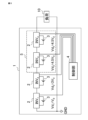
- FIG. 1 is a configuration diagram of a power conversion device according to Embodiment 1.
- three or more single-phase inverters 2 are connected in series.
- n single-phase inverters 2, INV 1 , INV 2 , INV 3 , . . . INV n-1 , INV n are connected in series.
- n is a natural number.
- a DC power supply 3 is connected to each single-phase inverter 2 .
- the output voltage of the DC power supply 3 connected to the single-phase inverter 2 of INV n is expressed as Vd n .
- Each single-phase inverter 2 converts DC power supplied from a DC power supply 3 into gradation-controlled AC power.
- a control unit 4 is connected to each single-phase inverter 2 .
- the control unit 4 controls each single-phase inverter 2 and outputs the sum of the output voltages of each single-phase inverter 2 to the load 10 as a total output voltage.
- the power conversion device 1 of this embodiment includes an inverter group 5 configured by two or more single-phase inverters connected in series.
- an inverter group 5 is composed of a single-phase inverter of INV n-1 and a single-phase inverter of INV n . Details of the inverter group 5 will be described later.
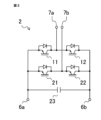
- FIG. 2 is a configuration diagram of a single-phase inverter of the power conversion device according to the present embodiment.
- Each single-phase inverter 2 has a full bridge circuit composed of four switching elements 11, 12, 21, 22 and a capacitor 23. Diodes are connected in antiparallel to each of the four switching elements 11, 12, 21, and 22.
- the switching elements 11, 12, 21, 22 are, for example, IGBTs (Insulated Gate Bipolar Transistors), MOSFETs (Metal-Oxide-Semiconductor Field-Effect Transistors). r) etc.
- MOSFETs Metal-Oxide-Semiconductor Field-Effect Transistors
- body diodes of the MOSFETs may be used instead of the diodes connected in antiparallel as described above.
- Input terminals 6a and 6b are connected to both ends of the capacitor 23, respectively.
- a DC power supply is connected between input terminals 6a and 6b.
- An output terminal 7a is connected between switching element 11 and switching element 12 forming one bridge circuit, and an output terminal 7b is connected between switching element 21 and switching element 22 forming the other bridge circuit.
- Another single-phase inverter 2 or load 10 is connected between output terminals 7a and 7b.
- each switching element may be configured with a plurality of switching elements connected in series to increase the withstand voltage, and each switching element may be configured with a plurality of switching elements connected in parallel to increase the current. Good too.
- Each single-phase inverter 2 can output a positive voltage, a negative voltage, and a zero voltage between output terminals 7a and 7b.
- the direction of the voltage between the output terminals 7a and 7b is defined as a positive voltage if the potential of the output terminal 7b is higher than the potential of the output terminal 7a.
- the positive terminal of the DC power supply is connected to the input terminal 6b side, and the negative terminal thereof is connected to the input terminal 6a side.
- Single-phase inverter 2 outputs a positive voltage between output terminals 7a and 7b by setting switching elements 11 and 22 on and switching elements 12 and 21 off.
- the single-phase inverter 2 outputs a negative voltage between the output terminals 7a and 7b by setting the switching elements 11 and 22 to OFF and setting the switching elements 12 and 21 to ON. Furthermore, the single-phase inverter 2 outputs zero voltage between the output terminals 7a and 7b by setting the switching elements 11 and 21 to ON or by setting the switching elements 12 and 22 to ON.
- the output voltage of the single-phase inverter is It is assumed to be the same as the voltage of the DC power supply. Therefore, from now on, the output voltage of the single-phase inverter will be explained as the voltage of the DC power supply. Furthermore, when explaining the ratio of the output voltages of the single-phase inverter 2, it is assumed that it is the ratio of the absolute values of the output voltages of the single-phase inverter 2.
- the total voltage of the DC power supplies connected to the inverter group 5 is Let's consider the case in terms of power supply voltage. In that case, the voltage of the DC power supply connected to each single-phase inverter is set to a ratio that is a power of 2 or 3 times the minimum voltage value, when the ratio of the minimum voltage value is 1. . In this embodiment, a power converter device in which the voltage of a DC power supply connected to each single-phase inverter is set to a ratio of a power of three will be described.
- Vd 1 :Vd 2 :Vd 3 :...:Vd n-1 +Vd n 3 0 :3 1 :3 2 :...:3 n-2
- Vd n-1 +Vd n is the total voltage of the DC power supplies connected to the single-phase inverters INV n-1 and INV n constituting the inverter group 5, respectively.
- at least one of Vd n-1 and Vd n is set to a ratio including a digit smaller than the minimum voltage value ratio 1, such as 4.5.
- a ratio that includes a digit smaller than the ratio 1 of the minimum voltage value will be referred to as a real number multiple of the minimum voltage value that includes a decimal.
- a real number including a decimal number is a real number that has a value other than 0 below the decimal point, and is, for example, a value such as 1.5, 2.6, or 3.65.
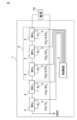
- FIG. 3 is a configuration diagram of a power conversion device configured with four single-phase inverters according to this embodiment.
- the power converter 1 shown in FIG. 3 includes four single-phase inverters 2, INV 1 , INV 2 , INV 3 , and INV 4 , and four DC power supplies 3 connected to the single-phase inverters 2, respectively. are doing.
- Vd 1 V 0
- Vd 2 3V 0
- Vd 3 4.5V 0
- Vd 4 4 .5V Set to 0
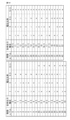
- FIG. 4 is an explanatory diagram showing the overall output voltage in the power conversion device of this embodiment.
- FIG. 4 shows the combination of voltages output by each single-phase inverter with respect to the overall output voltage.
- the voltage ratio indicates the voltage ratio of four DC power sources
- the total output voltage indicates the ratio of the total output voltage to the minimum ratio 1 of the voltage ratios.
- "+" indicates that a positive voltage is output from the corresponding single-phase inverter
- "-" indicates that a negative voltage is output
- a blank column indicates that a zero voltage is output.
- the single-phase inverter of INV 1 with a voltage ratio of 1 outputs a positive voltage
- the single-phase inverter of INV 2 with a voltage ratio of 3 outputs a negative voltage
- FIG. 5 is a configuration diagram of a power conversion device of a comparative example according to the present embodiment.
- FIG. 6 is an explanatory diagram showing the overall output voltage in the power conversion device of the comparative example according to the present embodiment.
- the overall output voltage in the power converter of this embodiment shown in FIG. 4 and the overall output voltage in the power converter of the comparative example shown in FIG. 6 will be compared.
- the maximum value of the overall output voltage is 13, which is the same for the power converter of this embodiment and the power converter of the comparative example.
- the power converter of this embodiment can output the overall output voltage between 0 and 13 at 22 divided gradation levels, whereas the power converter of the comparative example can only output a total output voltage between 0 and 13 at 13 divided gradation levels. That is, in the power conversion device of the comparative example, the entire output voltage can only be output at a gradation level that is an integral multiple of the minimum voltage value.
- the overall output voltage if the overall output voltage is in the range from 0 to 9, the overall output voltage can be output at a gradation level that is 0.5 times the minimum voltage value.
- a comparison will be made between the power converter of this embodiment and the power converter of a comparative example, in which a sine wave having a peak value of 3V 0 is output.
- the total output voltage is 0, ⁇ 0.5V 0 , ⁇ 1V 0 , ⁇ 1.5V 0 , ⁇ 2V 0 , ⁇ 2.5V 0 , ⁇ 3V 0 , a total of 13 output voltages.
- a sine wave can be formed at gradation levels.
- a sine wave can be formed only at a total of seven gradation levels where the overall output voltage is 0, ⁇ 1V 0 , ⁇ 2V 0 , and ⁇ 3V 0 .
- the power conversion device of this embodiment includes three or more single-phase inverters that convert DC power into AC power, and a control unit that sends gradation control signals to each of the single-phase inverters.
- the minimum value of the output voltage of the single-phase inverter is set to the minimum voltage value
- the output voltage of at least one single-phase inverter is set to a value that is a power of 3 times the minimum voltage value
- the output voltage of at least one other single-phase inverter is set to a value that is a power of 3 times the minimum voltage value.
- the output voltage of the phase inverter is set to a value that is a real number multiple of the minimum voltage value, including a decimal number. Therefore, the power conversion device of this embodiment can form a smooth AC waveform even when outputting a low voltage AC waveform.
- the power conversion device of this embodiment has an inverter group configured by connecting two or more single-phase inverters in series, the power applied to each single-phase inverter constituting the inverter group is DC voltage can be reduced. Therefore, electronic components with low withstand voltage can be used as the switching elements and capacitors that constitute the single-phase inverter. Generally, the lower the withstand voltage of an electronic component, the lower the power loss and the faster the response speed. By using electronic components with low withstand voltage, power conversion devices can be made smaller, have lower losses, and have higher speeds.
- the inverter group is provided at the position of the single-phase inverter with the highest output voltage, but the inverter group is not limited to this position.
- an inverter group is provided at the position of the single-phase inverter where the voltage ratio is 9 in the power converter of the comparative example shown in FIG.
- the inverter group may be provided at the position of the single-phase inverter where the voltage ratio is 3 in the power converter.
- the power conversion device of this embodiment includes one inverter group, it may include a plurality of inverter groups.
- the single-phase inverter with a voltage ratio of 3 may be replaced with an inverter group.
- the single-phase inverter of INV 3 included in the inverter group 5 The output changes from zero output to positive voltage output, and from positive voltage output to zero voltage output.
- the number of times the single-phase inverters included in the inverter group 5 are switched increases, and the switching loss may increase.
- switching loss is a problem, for example during heavy load operation where the load current or load power increases, the output voltage is set to a power of 3 times the minimum voltage value without using a single-phase inverter included in the inverter group. It is also possible to reduce switching losses by using only a single-phase inverter. In this way, it is also possible to take into consideration the smoothness of the output waveform and the priority of low switching loss, depending on the load situation, and to switch the operation mode.
- the output voltages of the plurality of single-phase inverters included in the inverter group are the same.
- the switching single-phase inverter may be replaced within the inverter group 5.
- the number of switching cycles of the single-phase inverter of INV 3 that outputs 4.5V is the same as 4.5V.
- the number of switching times is greater than that of the single-phase inverter of INV 4 that outputs the output.
- the switching of the single-phase inverter of INV 3 when the overall output voltage is between 0V 0 and 5V 0 may be replaced by the switching of the single-phase inverter of INV 4 in the next period of the sine wave.
- the single-phase inverters INV 3 and INV 4 may be alternately switched in a sine wave having the same period. By operating in this way, it is possible to prevent switching losses from being concentrated in one single-phase inverter.
- the output voltages of the plurality of single-phase inverters included in the inverter group may be different.
- FIG. 7 is an explanatory diagram showing the overall output voltage in the power conversion device of this embodiment set as described above. As shown in FIG. 7, by setting the output voltages of the plurality of single-phase inverters included in the inverter group 5 to different values, in the power conversion device of this embodiment, the overall output voltage can be adjusted between 0 and 13. It can output in 32 divided gradation levels.
- a power conversion device in which the output voltages of multiple single-phase inverters included in an inverter group are set to different values is a power conversion device in which the output voltages of multiple single-phase inverters included in an inverter group are set to the same value.
- the number of gradation level divisions can be increased compared to .
- the power conversion device of this embodiment described so far is a power conversion device in which an inverter group is composed of two single-phase inverters.
- the number of single-phase inverters constituting the inverter group may be three or more.
- FIG. 8 is a configuration diagram of a power conversion device according to this embodiment.
- the inverter group 5 is composed of three single-phase inverters, INV 3 , INV 4 , and INV 5 .
- Vd 3 and Vd 5 are set to values that are real number multiples of the minimum voltage value, including decimals.
- FIG. 9 is an explanatory diagram showing the overall output voltage in the power conversion device of this embodiment set as described above.
- the overall output voltage can be divided into 24 gradation levels between 0 and 13. Can be output. Note that, as shown in FIG. 4, the gradation level in a power converter device in which the number of single-phase inverters included in the inverter group 5 is two is divided into 22.
- a power conversion device in which the number of single-phase inverters included in an inverter group is set to three has a lower gradation level than a power conversion device in which the number of single-phase inverters included in an inverter group is set to two. You can increase the number of level divisions.
- the voltages of the DC power supplies connected to the three single-phase inverters included in the inverter group are 2.5V 0 , 3V 0 , and 3.5V 0 . is set to .
- one of the three DC power supplies included in the inverter group is set to a voltage that is an integral multiple of the minimum voltage value.
- the voltages of all DC power supplies connected to each single-phase inverter included in the inverter group are not required to be set to a value that is a real number multiple of the minimum voltage value, including decimals. .
- a power conversion device that includes three or more single-phase inverters that each convert DC power into AC power, and a control unit that sends a gradation control signal to each of the single-phase inverters
- the ratio of the total output voltage of the single-phase inverters included in the inverter group to the output voltage of the single-phase inverters not included in the inverter group is set to a power of three.
- the output voltage of at least one single-phase inverter included in the inverter group is set to a value that is a real number multiple, including a decimal, of the minimum voltage value of the output voltage of the single-phase inverter.
- the power converter configured in this manner can form a smooth AC waveform even when outputting a low voltage AC waveform.
- the power conversion device configured in this manner can reduce the DC voltage applied to the single-phase inverter included in the inverter group. Therefore, electronic components with low withstand voltage can be used as the switching elements and capacitors that constitute the single-phase inverter, and the power conversion device can be made smaller, lower in loss, and faster.
- Embodiment 2 In Embodiment 1, a power converter device has been described in which the voltage of the DC power supply connected to each single-phase inverter is set to a value that is a power of three. In Embodiment 2, a power conversion device will be described in which the voltage of a DC power supply connected to each single-phase inverter is set to a value that is a power of two.
- Vd 1 :Vd 2 :Vd 3 :...:Vd n-1 +Vd n 2 0 :2 1 :2 2 :...:2 n-2
- Vd n-1 +Vd n is the total voltage of the DC power supplies connected to the single-phase inverters INV n-1 and INV n constituting the inverter group 5, respectively.
- at least one of Vd n-1 and Vd n is set to a value that is a real number multiple of the minimum voltage value, including a decimal number.
- FIG. 10 is a configuration diagram of a power conversion device configured with four single-phase inverters according to this embodiment.
- FIG. 11 is an explanatory diagram showing the overall output voltage in the power conversion device of this embodiment.
- FIG. 11 shows the combination of voltages output by each single-phase inverter with respect to the overall output voltage.
- the gradation level can be adjusted with a voltage value that is half the minimum voltage value until the overall output voltage is 6. From this, even in a power conversion device where the voltage of the DC power supply connected to each single-phase inverter is set to a value that is a power of 2, it is possible to output a low voltage AC waveform by providing a group of inverters. However, it is possible to form a smooth AC waveform.
- a power conversion device that includes three or more single-phase inverters that each convert DC power into AC power, and a control unit that sends a gradation control signal to each of the single-phase inverters
- the ratio of the total output voltage of the single-phase inverters included in the inverter group to the output voltage of the single-phase inverters not included in the inverter group is set to a power of two.
- the output voltage of at least one single-phase inverter included in the inverter group is set to a value that is a real number multiple, including a decimal, of the minimum voltage value of the output voltage of the single-phase inverter.
- the power converter configured in this manner can form a smooth AC waveform even when outputting a low voltage AC waveform.
- the power conversion device configured in this manner can reduce the DC voltage applied to the single-phase inverter included in the inverter group. Therefore, electronic components with low withstand voltage can be used as the switching elements and capacitors that constitute the single-phase inverter, and the power conversion device can be made smaller, lower in loss, and faster.
- FIG. 12 is a configuration diagram of a power conversion device according to Embodiment 3.
- k+m+1 single-phase inverters 2 are connected in series.
- k is a natural number
- m is an integer of 0 or more.
- k+m is 2 or more.
- a DC power supply 3 is connected to each single-phase inverter 2 .
- the output voltage of the DC power supply 3 connected to the single-phase inverter 2 of INV n is expressed as Vd n .
- Each single-phase inverter 2 converts DC power supplied from a DC power supply 3 into gradation-controlled AC power.
- a control unit 4 is connected to each single-phase inverter 2 .
- the control unit 4 controls each single-phase inverter 2 and outputs the sum of the output voltages of each single-phase inverter 2 to the load 10 as a total output voltage.
- the output voltage of the single-phase inverter is the same as the voltage of the DC power supply, similarly to the first embodiment. Therefore, from now on, the output voltage of the single-phase inverter will be explained as the voltage of the DC power supply.
- Vd 1 :Vd 2 :Vd 3 :...:Vd k 3 0 :3 1 :3 2 :...:3 K-1
- the output voltage Vd k+1 of the DC power supply 3 connected to the single-phase inverter 2 of INV k +1 is set within the following range.
- Vd k+1 :Vd k+2 :Vd k+3 :...:Vd k+m+1 3 0 :3 1 :3 2 :...:3 m
- m is an integer greater than or equal to 0, and m may be set to 0. In that case, the single-phase inverter of INV k+1 becomes the single-phase inverter that outputs the maximum output voltage.
- FIG. 13 is a configuration diagram of a power conversion device configured with four single-phase inverters according to this embodiment.
- the power converter 1 shown in FIG. 13 includes four single-phase inverters 2, INV1 , INV2 , INV3 , and INV4 , and four DC power supplies 3 connected to the single-phase inverters 2, respectively. are doing.
- Vd 1 V 0
- Vd 2 3V 0
- Vd 3 4.5V 0
- Vd 4 13. .5V Set to 0
- FIG. 14 is an explanatory diagram showing the overall output voltage in the power conversion device of this embodiment.
- FIG. 14 shows the combination of voltages output by each single-phase inverter with respect to the overall output voltage.
- the gradation level can be adjusted with a voltage value that is half the minimum voltage value until the overall output voltage is 18. For this reason, the power conversion device of this embodiment can form a smooth AC waveform even when outputting a low voltage AC waveform.
- Vd 3 is set to a value 4.5 times the minimum voltage value. Therefore, the gradation levels of the entire output voltage are spaced at intervals of 0.5 times the minimum voltage value.
- the value after the decimal point of a real number multiple value including a decimal number is not limited to 0.5.
- Vd 3 may be set to a value 4.3 times or 4.7 times the minimum voltage value.
- FIG. 14 since the intervals between the gradation levels of the overall output voltage are constant, it is preferable to set the value after the decimal point of the value multiplied by a real number including a decimal number to 0.5.
- the single-phase inverter with INV 4 that outputs the maximum voltage switches from zero output to positive voltage output, and from positive voltage output to zero output.
- the number of times the single-phase inverter that outputs the maximum voltage is switched increases, which may increase switching loss.
- switching loss is a problem, for example during heavy load operation where the load current or load power increases, the output voltage is set to a power of 3 times the minimum voltage value instead of using a single-phase inverter that outputs the maximum voltage. It is also possible to reduce switching losses by using only a single-phase inverter. In this way, it is also possible to take into consideration the smoothness of the output waveform and the priority of low switching loss, depending on the load situation, and to switch the operation mode.
- the power conversion device of this embodiment described so far has a configuration in which the ratio of the output voltages of the single-phase inverter is a power of three.
- the ratio of the output voltages of the single-phase inverter may be a power of two.
- Vd 1 :Vd 2 :Vd 3 :...:Vd k 2 0 :2 1 :2 2 :...:2 k-1
- the output voltage Vd k+1 of the DC power supply 3 connected to the single-phase inverter 2 of INV k +1 is set within the following range.
- Vd k+1 :Vd k+2 :Vd k+3 :...:Vd k+m+1 2 0 :2 1 :2 2 :...:2 m
- control unit 4 includes a processor 100 and a storage device 101, as an example of hardware is shown in FIG.
- the storage device includes a volatile storage device such as a random access memory and a nonvolatile auxiliary storage device such as a flash memory. Further, an auxiliary storage device such as a hard disk may be provided instead of the flash memory.
- Processor 100 executes a program input from storage device 101. In this case, the program is input from the auxiliary storage device to the processor 100 via the volatile storage device.
- the processor 100 may output data such as calculation results to a volatile storage device of the storage device 101, or may store data in an auxiliary storage device via the volatile storage device.
- the control unit 4 may be a digital controller such as an FPGA (Field Programmable Gate Array) or an MCU (Micro Controller Unit). Alternatively, the control unit 4 may have a configuration in which an analog circuit and a digital controller are mixed.
- 1 Power conversion device 2 Single phase inverter, 3 DC power supply, 4 Control unit, 5 Inverter group, 6a, 6b input terminals, 7a, 7b output terminals, 10 Load, 11, 12, 21, 22 Switching element, 23 Capacitor, 100 processor, 101 storage device.
Landscapes
- Engineering & Computer Science (AREA)
- Power Engineering (AREA)
- Inverter Devices (AREA)
- Dc-Dc Converters (AREA)
Priority Applications (5)
| Application Number | Priority Date | Filing Date | Title |
|---|---|---|---|
| JP2024538571A JP7781285B2 (ja) | 2022-08-02 | 2022-08-02 | 電力変換装置 |
| PCT/JP2022/029664 WO2024028982A1 (ja) | 2022-08-02 | 2022-08-02 | 電力変換装置 |
| KR1020257001909A KR20250028380A (ko) | 2022-08-02 | 2022-08-02 | 전력 변환 장치 |
| CN202280098742.5A CN119678358A (zh) | 2022-08-02 | 2022-08-02 | 电力变换装置 |
| TW111150586A TWI859683B (zh) | 2022-08-02 | 2022-12-29 | 電力轉換裝置 |
Applications Claiming Priority (1)
| Application Number | Priority Date | Filing Date | Title |
|---|---|---|---|
| PCT/JP2022/029664 WO2024028982A1 (ja) | 2022-08-02 | 2022-08-02 | 電力変換装置 |
Publications (1)
| Publication Number | Publication Date |
|---|---|
| WO2024028982A1 true WO2024028982A1 (ja) | 2024-02-08 |
Family
ID=89848697
Family Applications (1)
| Application Number | Title | Priority Date | Filing Date |
|---|---|---|---|
| PCT/JP2022/029664 Ceased WO2024028982A1 (ja) | 2022-08-02 | 2022-08-02 | 電力変換装置 |
Country Status (5)
| Country | Link |
|---|---|
| JP (1) | JP7781285B2 (https=) |
| KR (1) | KR20250028380A (https=) |
| CN (1) | CN119678358A (https=) |
| TW (1) | TWI859683B (https=) |
| WO (1) | WO2024028982A1 (https=) |
Cited By (2)
| Publication number | Priority date | Publication date | Assignee | Title |
|---|---|---|---|---|
| JP7570579B1 (ja) * | 2024-04-23 | 2024-10-21 | 三菱電機株式会社 | 電力変換装置 |
| WO2025224839A1 (ja) * | 2024-04-23 | 2025-10-30 | 三菱電機株式会社 | 電力変換装置 |
Citations (4)
| Publication number | Priority date | Publication date | Assignee | Title |
|---|---|---|---|---|
| JP2004328831A (ja) * | 2003-04-22 | 2004-11-18 | Mitsubishi Electric Corp | 電圧変動補償装置 |
| JP2006238630A (ja) * | 2005-02-25 | 2006-09-07 | Mitsubishi Electric Corp | 電力変換装置 |
| WO2011024137A1 (en) * | 2009-08-31 | 2011-03-03 | Koninklijke Philips Electronics N.V. | Multi-level inverter apparatus and inversion method |
| JP2013240161A (ja) * | 2012-05-14 | 2013-11-28 | Mitsubishi Electric Corp | 電力変換装置 |
Family Cites Families (10)
| Publication number | Priority date | Publication date | Assignee | Title |
|---|---|---|---|---|
| JP4029709B2 (ja) | 2002-04-05 | 2008-01-09 | 三菱電機株式会社 | 電力変換装置 |
| JP2004064830A (ja) | 2002-07-25 | 2004-02-26 | Mitsubishi Electric Corp | 電力変換装置 |
| WO2005041384A1 (ja) | 2003-10-27 | 2005-05-06 | Mitsubishi Denki Kabushiki Kaisha | 電源装置 |
| JP4490309B2 (ja) | 2005-02-25 | 2010-06-23 | 三菱電機株式会社 | 電力変換装置 |
| WO2007111018A1 (ja) * | 2006-03-27 | 2007-10-04 | Mitsubishi Electric Corporation | 電力変換装置 |
| EP2383877B1 (en) * | 2009-01-29 | 2018-09-05 | Mitsubishi Electric Corporation | Power conversion device |
| JP5154587B2 (ja) | 2010-01-28 | 2013-02-27 | 三菱電機株式会社 | 電力変換装置 |
| JP5734672B2 (ja) | 2011-01-12 | 2015-06-17 | 株式会社東芝 | 半導体電力変換装置 |
| JP6233216B2 (ja) * | 2014-07-08 | 2017-11-22 | 住友電気工業株式会社 | 電力変換装置及び三相交流電源装置 |
| WO2021100116A1 (ja) * | 2019-11-19 | 2021-05-27 | 三菱電機株式会社 | 電力変換装置 |
-
2022
- 2022-08-02 JP JP2024538571A patent/JP7781285B2/ja active Active
- 2022-08-02 CN CN202280098742.5A patent/CN119678358A/zh active Pending
- 2022-08-02 KR KR1020257001909A patent/KR20250028380A/ko active Pending
- 2022-08-02 WO PCT/JP2022/029664 patent/WO2024028982A1/ja not_active Ceased
- 2022-12-29 TW TW111150586A patent/TWI859683B/zh active
Patent Citations (4)
| Publication number | Priority date | Publication date | Assignee | Title |
|---|---|---|---|---|
| JP2004328831A (ja) * | 2003-04-22 | 2004-11-18 | Mitsubishi Electric Corp | 電圧変動補償装置 |
| JP2006238630A (ja) * | 2005-02-25 | 2006-09-07 | Mitsubishi Electric Corp | 電力変換装置 |
| WO2011024137A1 (en) * | 2009-08-31 | 2011-03-03 | Koninklijke Philips Electronics N.V. | Multi-level inverter apparatus and inversion method |
| JP2013240161A (ja) * | 2012-05-14 | 2013-11-28 | Mitsubishi Electric Corp | 電力変換装置 |
Cited By (3)
| Publication number | Priority date | Publication date | Assignee | Title |
|---|---|---|---|---|
| JP7570579B1 (ja) * | 2024-04-23 | 2024-10-21 | 三菱電機株式会社 | 電力変換装置 |
| WO2025224839A1 (ja) * | 2024-04-23 | 2025-10-30 | 三菱電機株式会社 | 電力変換装置 |
| WO2025224838A1 (ja) * | 2024-04-23 | 2025-10-30 | 三菱電機株式会社 | 電力変換装置 |
Also Published As
| Publication number | Publication date |
|---|---|
| KR20250028380A (ko) | 2025-02-28 |
| TW202408144A (zh) | 2024-02-16 |
| JPWO2024028982A1 (https=) | 2024-02-08 |
| JP7781285B2 (ja) | 2025-12-05 |
| CN119678358A (zh) | 2025-03-21 |
| TWI859683B (zh) | 2024-10-21 |
Similar Documents
| Publication | Publication Date | Title |
|---|---|---|
| EP2651024B1 (en) | Multilevel power converter | |
| JP5974516B2 (ja) | 5レベル電力変換装置 | |
| JP2013146117A (ja) | マルチレベル電力変換回路 | |
| WO2024028982A1 (ja) | 電力変換装置 | |
| WO2024053452A1 (ja) | マルチレベルインバータ | |
| JP2014135799A (ja) | 電力変換装置 | |
| US7471532B1 (en) | Electric circuit, in particular for a medium-voltage power converter | |
| JP4759673B2 (ja) | マルチレベルコンバータ及びその制御方法 | |
| WO2014162591A1 (ja) | 電力変換装置 | |
| JP2014204457A (ja) | 電力変換装置 | |
| JP6009985B2 (ja) | 電力変換装置 | |
| US11038436B2 (en) | Inverter system | |
| JP2013085358A (ja) | 電力変換装置 | |
| Thiyagarajan | Modified symmetrical inverter topology and switching pulse generation using logic gates | |
| WO2018230107A1 (ja) | マルチレベル電力変換装置 | |
| RU2705586C1 (ru) | Трехфазный статический преобразователь частоты с непосредственной связью | |
| CN113037114A (zh) | 一种三相五电平逆变电路及其工作方法 | |
| TWI767805B (zh) | 切換式電容轉換電路及其中的切換轉換單元 | |
| Thiyagarajan | New asymmetric 25-level inverter topology with reduced switch count | |
| Bayat et al. | Provide a new basic unit for cascaded multilevel inverter by reducing the maximum blocking voltage and switches | |
| JP7054816B2 (ja) | 電力変換装置 | |
| Bhalekar et al. | Simulated Evaluation of Modern Multilevel Inverter Topologies | |
| JP2002058256A (ja) | 電力変換器の制御装置 | |
| SU1305817A1 (ru) | Преобразователь посто нного напр жени в трехфазное квазисинусоидальное напр жение | |
| Dhal | Reduction of Switches in Multilevel Inverter: Analysis for Low and High Voltage Applications |
Legal Events
| Date | Code | Title | Description |
|---|---|---|---|
| 121 | Ep: the epo has been informed by wipo that ep was designated in this application |
Ref document number: 22953971 Country of ref document: EP Kind code of ref document: A1 |
|
| ENP | Entry into the national phase |
Ref document number: 2024538571 Country of ref document: JP Kind code of ref document: A |
|
| WWE | Wipo information: entry into national phase |
Ref document number: 18995178 Country of ref document: US |
|
| ENP | Entry into the national phase |
Ref document number: 20257001909 Country of ref document: KR Kind code of ref document: A |
|
| WWE | Wipo information: entry into national phase |
Ref document number: 202280098742.5 Country of ref document: CN |
|
| WWP | Wipo information: published in national office |
Ref document number: 1020257001909 Country of ref document: KR |
|
| NENP | Non-entry into the national phase |
Ref country code: DE |
|
| WWP | Wipo information: published in national office |
Ref document number: 202280098742.5 Country of ref document: CN |
|
| 122 | Ep: pct application non-entry in european phase |
Ref document number: 22953971 Country of ref document: EP Kind code of ref document: A1 |