WO2024005071A1 - エネルギー線硬化型フィルム状透明接着剤、これを含むデバイス及び該デバイスの製造方法 - Google Patents
エネルギー線硬化型フィルム状透明接着剤、これを含むデバイス及び該デバイスの製造方法 Download PDFInfo
- Publication number
- WO2024005071A1 WO2024005071A1 PCT/JP2023/023974 JP2023023974W WO2024005071A1 WO 2024005071 A1 WO2024005071 A1 WO 2024005071A1 JP 2023023974 W JP2023023974 W JP 2023023974W WO 2024005071 A1 WO2024005071 A1 WO 2024005071A1
- Authority
- WO
- WIPO (PCT)
- Prior art keywords
- film
- adhesive
- energy ray
- mass
- curable
- Prior art date
- Legal status (The legal status is an assumption and is not a legal conclusion. Google has not performed a legal analysis and makes no representation as to the accuracy of the status listed.)
- Ceased
Links
Images
Classifications
-
- C—CHEMISTRY; METALLURGY
- C09—DYES; PAINTS; POLISHES; NATURAL RESINS; ADHESIVES; COMPOSITIONS NOT OTHERWISE PROVIDED FOR; APPLICATIONS OF MATERIALS NOT OTHERWISE PROVIDED FOR
- C09J—ADHESIVES; NON-MECHANICAL ASPECTS OF ADHESIVE PROCESSES IN GENERAL; ADHESIVE PROCESSES NOT PROVIDED FOR ELSEWHERE; USE OF MATERIALS AS ADHESIVES
- C09J163/00—Adhesives based on epoxy resins; Adhesives based on derivatives of epoxy resins
-
- C—CHEMISTRY; METALLURGY
- C08—ORGANIC MACROMOLECULAR COMPOUNDS; THEIR PREPARATION OR CHEMICAL WORKING-UP; COMPOSITIONS BASED THEREON
- C08L—COMPOSITIONS OF MACROMOLECULAR COMPOUNDS
- C08L71/00—Compositions of polyethers obtained by reactions forming an ether link in the main chain; Compositions of derivatives of such polymers
- C08L71/08—Polyethers derived from hydroxy compounds or from their metallic derivatives
- C08L71/10—Polyethers derived from hydroxy compounds or from their metallic derivatives from phenols
- C08L71/12—Polyphenylene oxides
-
- C—CHEMISTRY; METALLURGY
- C09—DYES; PAINTS; POLISHES; NATURAL RESINS; ADHESIVES; COMPOSITIONS NOT OTHERWISE PROVIDED FOR; APPLICATIONS OF MATERIALS NOT OTHERWISE PROVIDED FOR
- C09J—ADHESIVES; NON-MECHANICAL ASPECTS OF ADHESIVE PROCESSES IN GENERAL; ADHESIVE PROCESSES NOT PROVIDED FOR ELSEWHERE; USE OF MATERIALS AS ADHESIVES
- C09J11/00—Features of adhesives not provided for in group C09J9/00, e.g. additives
- C09J11/02—Non-macromolecular additives
- C09J11/04—Non-macromolecular additives inorganic
-
- C—CHEMISTRY; METALLURGY
- C09—DYES; PAINTS; POLISHES; NATURAL RESINS; ADHESIVES; COMPOSITIONS NOT OTHERWISE PROVIDED FOR; APPLICATIONS OF MATERIALS NOT OTHERWISE PROVIDED FOR
- C09J—ADHESIVES; NON-MECHANICAL ASPECTS OF ADHESIVE PROCESSES IN GENERAL; ADHESIVE PROCESSES NOT PROVIDED FOR ELSEWHERE; USE OF MATERIALS AS ADHESIVES
- C09J11/00—Features of adhesives not provided for in group C09J9/00, e.g. additives
- C09J11/02—Non-macromolecular additives
- C09J11/06—Non-macromolecular additives organic
-
- C—CHEMISTRY; METALLURGY
- C09—DYES; PAINTS; POLISHES; NATURAL RESINS; ADHESIVES; COMPOSITIONS NOT OTHERWISE PROVIDED FOR; APPLICATIONS OF MATERIALS NOT OTHERWISE PROVIDED FOR
- C09J—ADHESIVES; NON-MECHANICAL ASPECTS OF ADHESIVE PROCESSES IN GENERAL; ADHESIVE PROCESSES NOT PROVIDED FOR ELSEWHERE; USE OF MATERIALS AS ADHESIVES
- C09J11/00—Features of adhesives not provided for in group C09J9/00, e.g. additives
- C09J11/08—Macromolecular additives
-
- C—CHEMISTRY; METALLURGY
- C09—DYES; PAINTS; POLISHES; NATURAL RESINS; ADHESIVES; COMPOSITIONS NOT OTHERWISE PROVIDED FOR; APPLICATIONS OF MATERIALS NOT OTHERWISE PROVIDED FOR
- C09J—ADHESIVES; NON-MECHANICAL ASPECTS OF ADHESIVE PROCESSES IN GENERAL; ADHESIVE PROCESSES NOT PROVIDED FOR ELSEWHERE; USE OF MATERIALS AS ADHESIVES
- C09J171/00—Adhesives based on polyethers obtained by reactions forming an ether link in the main chain; Adhesives based on derivatives of such polymers
- C09J171/08—Polyethers derived from hydroxy compounds or from their metallic derivatives
- C09J171/10—Polyethers derived from hydroxy compounds or from their metallic derivatives from phenols
- C09J171/12—Polyphenylene oxides
Definitions
- the present invention relates to an energy beam-curable film-like transparent adhesive, a device including the same, and a method for manufacturing the device.
- Photographic devices such as digital still cameras and digital video cameras incorporate image sensors (imaging devices) such as CMOS image sensors and CCD image sensors.
- An image sensor photoelectrically converts incident light into an electrical signal using a photodiode, and a digital image is formed through signal processing.
- a color filter, a microlens, etc. are arranged on the surface of the photodiode, if necessary, and a transparent protective film such as a glass plate is usually arranged on the surface of the laminate.
- a transparent protective film is fixed via a film adhesive or the like. Adhesives used to bond and fix the transparent protective film of image sensors are required to have sufficient transparency to transmit light.
- an image display device functional elements (organic electroluminescence (organic EL) elements, liquid crystal panels, micro light emitting diodes (micro LEDs), semiconductor elements such as transistors, etc.) are arranged on a support base material, and in some cases, a functional layer (a protective layer, a gas barrier layer (sealing layer), a hard code layer, etc.) is disposed on the surface of the functional element. Adhesives used for adhering and fixing these functional elements and functional layers may also be required to have sufficient transparency. Film adhesives themselves are known in various compositions and are widely used not only in image sensors and image display devices, but also in the manufacture of electronic devices and their components.
- Patent Document 1 discloses a sheet-like adhesive containing a phenoxy resin having a glass transition temperature of 110° C. or higher, a polyfunctional epoxy resin, and a photocationic polymerization initiator, and in a specific embodiment thereof, a photocationic polymerization initiator is disclosed.
- a polymerization initiator 4-(phenylthio)phenyldiphenylsulfonium hexafluorophosphate and the like are used.
- This sheet adhesive is said to have excellent shape stability under high temperature conditions.
- Patent Document 2 discloses an adhesive having active energy ray curability, in which the X value calculated from the a * value and b * value defined by the CIE1976L * a * b * color system of the adhesive is
- This disclosure discloses an adhesive in which the color difference ⁇ E * a defined by the same color system before and after curing is in a specific range.
- This adhesive contains a dye whose color disappears due to irradiation with active energy rays, a photoinitiator, and further contains a (meth)acrylic acid ester polymer, a crosslinking agent, and an active energy ray-curable component. do. According to this adhesive, it is said that curing due to irradiation with active energy rays can be easily confirmed.
- Patent Document 3 discloses an organic electroluminescent element sealant containing 100 parts by mass of a bisphenol-type epoxy resin as a photocationic polymerizable compound and 0.1 to 100 parts by mass of a specific sulfonium borate salt as a photocationic polymerization agent. is disclosed. This sealing material exhibits excellent photocurability and is said to be suitable for sealing electroluminescent devices.
- Patent Document 1 discloses that in a specific embodiment, ultraviolet (UV) irradiation at 2000 mJ/cm 2 and further heating at 100° C.
- UV ultraviolet
- Patent Document 2 discloses that in a specific embodiment, the curing of the adhesive layer is almost completed with an irradiation dose of 2000 mJ/cm 2 .
- Patent Document 3 discloses that in a specific embodiment, UV irradiation at 2000 mJ/cm 2 and curing heating at 80° C. are performed to harden the sealing material.
- the amount of energy ray irradiation increases, an exothermic phenomenon may occur as a side reaction accompanying the curing reaction even without applying heat, and as a result, the functional element may be exposed to high temperatures. In this case, problems such as poor reliability and decreased transparency due to deterioration of the adhesive strength of the adhesive itself tend to occur.
- a film-like transparent adhesive that can be cured with a small amount of energy ray irradiation, has high reactivity, and does not easily lose adhesive strength at high temperatures.
- it may be placed in a high-temperature environment during use, or the device itself may become hot due to heat generated from inside (for example, a device installed in a car).
- adhesives that do not easily lose adhesive strength at high temperatures.
- fillers are often added to adhesives to increase adhesive strength. The adhesion reliability of the adhesive can be improved by adding filler.
- the present invention provides an energy ray-curable film-like transparent adhesive that can be cured with a small amount of energy ray irradiation and exhibit sufficient adhesive strength, has excellent transparency after curing, and does not easily lose adhesive strength at high temperatures.
- the challenge is to provide.
- Another object of the present invention is to provide a device containing the energy ray-curable transparent film adhesive, and a method for manufacturing a device using the energy ray-curable transparent film adhesive.
- An energy beam-curable film-like transparent adhesive containing an epoxy resin, a phenoxy resin, and a photocationic polymerization initiator containing antimony in the anion moiety.
- [7] The energy ray-curable film-like transparent adhesive according to any one of [1] to [6], which contains a silane coupling agent.
- [8] The energy ray-curable film-like transparent adhesive according to any one of [1] to [7], which contains a curing retarder.
- [9] The energy ray-curable film-like transparent adhesive according to any one of [1] to [8], which contains a filler.
- [11] A method for manufacturing a device, the method comprising bonding constituent members using the energy ray-curable film-like transparent adhesive according to any one of [1] to [9].
- the numerical range expressed using " ⁇ ” means a range that includes the numerical values written before and after " ⁇ " as the lower limit and upper limit.
- the energy ray-curable film-like transparent adhesive of the present invention cures with a small amount of energy ray irradiation, exhibits sufficient adhesive strength, has high transparency, and does not easily lose adhesive strength at high temperatures. Furthermore, even when the energy ray-curable transparent film adhesive of the present invention is applied as an adhesive to devices with low heat resistance, damage to the device can be suppressed, and the adhesive reliability of the resulting device is further improved. be able to.
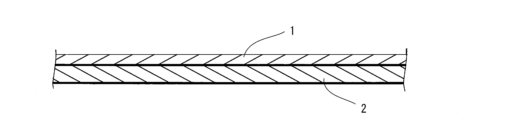
- FIG. 1 is a cross-sectional view schematically showing the structure of a film adhesive with a release film prepared in an example.
- the energy ray-curable transparent film adhesive of the present invention (hereinafter also simply referred to as "the film adhesive of the present invention") comprises an epoxy resin, a phenoxy resin, and a photocationic polymerization initiator containing antimony in the anion moiety. Contains.
- the film-like adhesive of the present invention is in a state before curing, that is, in a B-stage state, and is cured by energy ray irradiation to exhibit adhesive strength with an adherend. Therefore, the film adhesive of the present invention is a film made of a curable composition.
- the film adhesive of the present invention can be suitably used for adhesion and sealing of device constituent members.
- Examples of devices include digital still cameras, digital video cameras, organic EL devices, liquid crystal panel devices, micro LED devices, smartphones, personal computers, televisions, and the like.
- the film adhesive of the present invention is particularly useful for structural members of optical products that require high transparency (e.g., organic EL devices, liquid crystal panels, micro LED devices, etc.) (e.g. lenses, transparent protective films, glass It is suitable for adhesive applications and sealing applications such as substrates, functional elements and functional layers described below, and laminates thereof, etc.).
- Energy rays include light rays such as ultraviolet (UV) light or ionizing radiation such as electron beams.
- the energy rays are ultraviolet rays.
- the film adhesive of the present invention does not use a thermal polymerization initiator.
- the film adhesive of the present invention contains at least one epoxy resin.
- the epoxy resin may be any resin having an epoxy group, and a wide variety of epoxy resins that can be used in adhesives can be used. In epoxy resins, epoxy groups react with reactive groups of other components or undergo ring-opening polymerization between epoxy groups to form a crosslinked structure in the resin composition.
- the epoxy resin is one having an epoxy equivalent of 3000 g/eq or less.
- epoxy equivalent refers to the number of grams (g/eq) of a resin containing 1 gram equivalent of epoxy groups.
- the epoxy equivalent of the epoxy resin is preferably 100 to 3000 g/eq, more preferably 180 to 1500 g/eq.
- the epoxy equivalent is preferably large. For example, it is preferably 200 g/eq or more, more preferably 200 to 3000 g/eq, even more preferably 200 to 1500 g/eq. Conversely, when the epoxy resin does not have an alicyclic structure, the epoxy equivalent can be made smaller. For example, it is preferably less than 200 g/eq, more preferably 100 to 195 g/eq, even more preferably 120 to 195 g/eq, even more preferably 130 to 195 g/eq.
- an epoxy resin having an alicyclic structure and a small epoxy equivalent e.g., an epoxy resin with an epoxy equivalent of 500 g/eq or less, preferably an epoxy equivalent of 300 g/eq
- epoxy resin and an epoxy resin with an alicyclic structure and a large epoxy equivalent (for example, an epoxy resin with an epoxy equivalent of 600 to 1300 g/eq, preferably an epoxy resin with an epoxy equivalent of 900 to 1300 g/eq) You may.
- the skeletons of epoxy resins include phenol novolak type, orthocresol novolak type, cresol novolak type, dicyclopentadiene type, biphenyl type, fluorene bisphenol type, triazine type, naphthol type, naphthalene diol type, triphenylmethane type, and tetraphenyl type.
- bisphenol A type, bisphenol F type, bisphenol AD type, bisphenol S type, and trimethylolmethane type are preferred from the viewpoint of obtaining a film adhesive having low resin crystallinity and good appearance.
- the epoxy resin described above is preferably an epoxy resin having a bisphenol structure.
- the above-mentioned epoxy resin is preferably an epoxy resin having an alicyclic structure, more preferably a hydrogenated (hydrogenated) bisphenol type epoxy resin (an epoxy resin having a hydrogenated bisphenol structure), and a hydrogenated bisphenol A type epoxy resin. Resins are more preferred. From the viewpoint of reducing yellowing of the cured product of the film adhesive of the present invention and increasing transparency, it is preferable to use an epoxy resin having an alicyclic structure, and it is more preferable to use an epoxy resin having a hydrogenated bisphenol structure. preferable.
- the epoxy resin may be a liquid epoxy resin or a solid epoxy resin. From the viewpoint of suppressing stickiness and improving handling properties, it is preferable to use a solid epoxy resin alone or to use a solid epoxy resin and a liquid epoxy resin together.
- the weight average molecular weight of the epoxy resin is preferably 100 to 3,000, more preferably 200 to 1,500.
- the weight average molecular weight is a value determined by GPC (Gel Permeation Chromatography) analysis.
- the content of epoxy resin in the solid content (components other than the solvent) of the film adhesive of the present invention is preferably 10 to 80% by mass, more preferably 25 to 80% by mass, and even more preferably 30 to 80% by mass. , more preferably 40 to 75% by weight, even more preferably 50 to 75% by weight, and most preferably 60 to 70% by weight.
- the film adhesive of the present invention contains at least one phenoxy resin.
- the phenoxy resin is a component that suppresses film tackiness at room temperature (23° C.) and imparts film-forming properties (film-forming properties) when a film-like adhesive is formed.
- the phenoxy resin has an epoxy equivalent (mass of resin per equivalent of epoxy group) exceeding 3000 g/eq. In other words, even if the resin has the structure of a phenoxy resin, a resin having an epoxy equivalent of 3000 g/eq or less is classified as an epoxy resin.
- Phenoxy resin can be obtained by conventional methods. For example, it can be obtained by reacting bisphenol or a biphenol compound with an epihalohydrin such as epichlorohydrin, or by reacting a liquid epoxy resin with a bisphenol or biphenol compound.
- an epihalohydrin such as epichlorohydrin
- the glass transition temperature (Tg) of the phenoxy resin is preferably 160°C or lower, more preferably 120°C or lower, even more preferably lower than 110°C, even more preferably 100°C or lower, and particularly preferably 90°C or lower.
- the Tg of the phenoxy resin is preferably 0°C or higher, preferably 10°C or higher, 20°C or higher, 30°C or higher, 40°C or higher, and 50°C or higher.
- the temperature may be 60°C or higher, 70°C or higher, and preferably 80°C or higher.
- the Tg of the phenoxy resin is preferably 0 to 160°C, preferably 10 to 125°C, preferably 30 to 120°C, preferably 50 to 120°C, and preferably 70 to 120°C.
- the temperature is preferably from 80 to 120°C, preferably from 80 to 110°C, and preferably from 80 to 100°C.
- the Tg of the phenoxy resin is preferably 80°C or higher.
- the Tg of the phenoxy resin is preferably 10 to 120°C, preferably 80 to 120°C, and 80°C to 110°C. It is also preferably less than 80°C to 100°C.
- the Tg of the above phenoxy resin is the peak top temperature of tan ⁇ in dynamic viscoelasticity measurement. Specifically, Tg can be determined as follows.
- a solution prepared by dissolving a phenoxy resin is applied onto a release film and dried by heating to form a film (polymer film) made of a phenoxy resin on the release film.
- the release film was peeled off and removed from this polymer film, and the polymer film was measured using a dynamic viscoelasticity measuring device (trade name: Rheogel-E4000F, manufactured by UBM) at a temperature range of 20 to 300°C with increasing temperature. Measurement is performed at a speed of 5° C./min and a frequency of 1 Hz.
- the obtained tan ⁇ peak top temperature (the temperature at which tan ⁇ is at its maximum) is defined as Tg.
- the weight average molecular weight of the above phenoxy resin is usually 10,000 or more. There is no particular limit to the upper limit, but 5,000,000 or less is practical.
- the weight average molecular weight of the phenoxy resin is determined in terms of polystyrene by GPC (Gel Permeation Chromatography).
- bisphenol A type phenoxy resin bisphenol A type phenoxy resin, biphenyl skeleton and cyclohexane skeleton containing phenoxy resin, or bisphenol F + 1,6-hexanediol diglycidyl ether type phenoxy resin can be preferably used.
- the content of the phenoxy resin can be, for example, 30 to 500 parts by mass, may be 30 to 400 parts by mass, or 30 to 400 parts by mass, based on 100 parts by mass of the epoxy resin.
- the amount may be 300 parts by weight, 40 to 250 parts by weight, 40 to 120 parts by weight, and preferably 40 to 80 parts by weight.
- the film adhesive of the present invention contains a photocationic polymerization initiator containing antimony at the anionic site (hereinafter also simply referred to as "photocationic polymerization initiator").
- photocationic polymerization initiator containing antimony at the anionic site
- Containing antimony at the anion site means having an anion containing an antimony atom at the anion site.
- the photocationic polymerization initiator is preferably an onium salt having the above-mentioned anion site and cation site, and more preferably an aromatic onium salt.
- the anion moiety of the photocationic polymerization initiator may be any anion containing an antimony atom, preferably SbF 4 - and SbF 6 - , and more preferably SbF 6 - .
- the cation moiety of the photocationic polymerization initiator is not particularly limited, and sulfonium compound ions, iodonium compound ions, ammonium compound ions, phosphonium compound ions, pyridinium compound ions, etc. are preferable, and sulfonium compound ions and iodonium compound ions are more preferable.
- the cation site is not particularly limited as long as it has a structure that functions as a cationic photopolymerization initiator. From the viewpoint of light absorption, it is preferable to have an aromatic group. As the aromatic group, an aryl group is preferable, and a phenyl group is more preferable.
- Cationic photopolymerization initiators can also be classified as sulfonium salt compounds, iodonium salt compounds, ammonium salt compounds, phosphonium salt compounds, and pyridinium salt compounds when classified according to the type of cation site. These may be used alone or in combination of two or more.
- the photocationic polymerization initiator is preferably a UV cationic polymerization initiator.
- the content of the photocationic polymerization initiator may be 0.5 to 30 parts by weight, and may be 1 to 20 parts by weight, based on 100 parts by weight of the epoxy resin. , may be 1 to 15 parts by weight, preferably 2 to 10 parts by weight, and preferably 2 to 8 parts by weight.
- the film adhesive of the present invention may contain a silane coupling agent as an additive.
- a silane coupling agent has at least one hydrolyzable group such as an alkoxy group or an aryloxy group bonded to a silicon atom, and may also have an alkyl group, an alkenyl group, or an aryl group bonded to the silicon atom. good.
- the alkyl group is preferably substituted with an amino group, an alkoxy group, an epoxy group, or a (meth)acryloyloxy group; Those substituted with an oxy group are more preferred.
- silane coupling agent examples include 2-(3,4-epoxycyclohexyl)ethyltrimethoxysilane, 3-glycidyloxypropyltrimethoxysilane, 3-glycidyloxypropyltriethoxysilane, and 3-glycidyloxypropylmethyldimethoxysilane.
- Silane 3-glycidyloxypropylmethyldiethoxysilane, dimethyldimethoxysilane, dimethyldiethoxysilane, methyltrimethoxysilane, methyltriethoxysilane, phenyltrimethoxysilane, phenyltriethoxysilane, N-phenyl-3-aminopropyltri Examples include methoxysilane, 3-methacryloyloxypropylmethyldimethoxysilane, 3-methacryloyloxypropyltrimethoxysilane, 3-methacryloyloxypropylmethyldiethoxysilane, and 3-methacryloyloxypropyltriethoxysilane.
- the content of the silane coupling agent can be 0.1 to 20 parts by mass, and 0.5 parts by mass, based on 100 parts by mass of the epoxy resin.
- the amount may be 1 to 10 parts by weight, 1 to 7 parts by weight, preferably 1 to 5 parts by weight, and preferably 1 to 3 parts by weight.
- the film adhesive of the present invention may contain a curing retarder as an additive.
- a curing retarder By using a delayed curing agent, the adhesion to the adherend is improved and the adhesive strength is improved.
- the curing retarder those commonly used in adhesives can be used.
- the curing retarder include polyether compounds.
- the polyether compounds include polyethylene glycol, polypropylene glycol, polytetramethylene glycol, calixarene, and crown ether compounds. Among these, crown ether compounds are preferred. Examples of the crown ether include 18-crown-6-ether and 15-crown-5-ether.
- the content of the curing retarder can be 0.01 to 20 parts by mass, and 0.1 to 10 parts by mass, based on 100 parts by mass of the epoxy resin.
- the amount may be 0.1 to 8 parts by weight, preferably 0.1 to 5 parts by weight, and preferably 0.1 to 3 parts by weight.
- the film adhesive of the present invention may contain a filler. That is, the film adhesive of the present invention can be in a form containing a filler or in a form not containing a filler. However, the film adhesive of the present invention exhibits suitable adhesive strength even without containing a filler.
- the filler is preferably an inorganic filler.
- inorganic fillers include ceramics such as silica, clay, gypsum, calcium carbonate, barium sulfate, alumina (aluminum oxide), beryllium oxide, magnesium oxide, silicon carbide, silicon nitride, aluminum nitride, and boron nitride; aluminum;
- inorganic powders such as metals such as copper, silver, gold, nickel, chromium, lead, tin, zinc, palladium, and solder, alloys, and carbons such as carbon nanotubes and graphene.
- the inorganic filler may be surface-treated or surface-modified, and agents used for such surface treatment or surface modification include silane coupling agents, phosphoric acid or phosphoric acid compounds, surfactants, etc. can be mentioned.
- the shape of the inorganic filler includes flakes, needles, filaments, spheres, and scales, but spherical particles are preferred from the viewpoint of high filling and fluidity.
- the content of the filler in the film adhesive is preferably 70% by mass or less, more preferably 60% by mass or less based on the solid content of the film adhesive.
- the content is preferably 50% by mass or less, and preferably 40% by mass or less.
- the content of the filler in the film adhesive may be 1% by mass or more, may be 2% by mass or more, and may be 4% by mass or more. It is also preferable to do so.
- the content of the filler in the film-like adhesive can be 71 to 70% by mass based on the solid content of the film-like adhesive, and 2 to 2% by mass. It can be 60% by mass, 4 to 50% by mass, 4 to 40% by mass, and preferably 10 to 30% by mass.
- the film adhesive of the present invention may further contain an organic solvent, an ion trapping agent, a curing catalyst, a viscosity modifier, an antioxidant, a flame retardant, a coloring agent, and the like.
- an organic solvent for example, an organic solvent, an ion trapping agent, a curing catalyst, a viscosity modifier, an antioxidant, a flame retardant, a coloring agent, and the like.
- other additives of WO 2017/158994 may be included.
- the total content of the epoxy resin, phenoxy resin, and cationic photopolymerization initiator in the film adhesive of the present invention can be, for example, 30% by mass or more, and 40% by mass or more. It is preferably 50% by mass or more, and more preferably 50% by mass or more. The proportion may be 60% by mass or more, 70% by mass or more, 80% by mass or more, or 90% by mass or more.
- the term "film” means a thin film having a thickness of 200 ⁇ m or less.
- the shape, size, etc. are not particularly limited and can be adjusted as appropriate depending on the manner of use.
- the thickness of the film adhesive of the present invention and the cured product obtained by curing this film adhesive are usually 1 to 100 ⁇ m, preferably 2 to 80 ⁇ m, and preferably 5 to 50 ⁇ m.
- the thickness can be measured by a contact/linear gauge method (desktop contact type thickness measuring device).
- the cured product of the film adhesive of the present invention preferably has a glass transition temperature (Tg) of 64°C or higher, more preferably 80°C or higher.
- Tg of the cured product of the film adhesive is the peak top temperature of tan ⁇ in dynamic viscoelasticity measurement.
- Tg can be determined as follows.
- the film-like adhesive is laminated using a laminator at 70° C. to a thickness of 0.3 mm, and is irradiated with ultraviolet rays using the mercury lamp described above at 23° C. under irradiation conditions of 500 mJ/cm 2 to cause a curing reaction.
- the obtained cured sample is cut into a 5 mm wide piece to be used as a measurement sample.
- the measurement sample was measured using a dynamic viscoelasticity measuring device RSAIII (manufactured by TA Instruments) under the following conditions: distance between chucks 20 mm, frequency 10 Hz, measurement temperature range -40°C to 250°C, and temperature increase rate 5°C/min. Measure below.
- the obtained tan ⁇ peak top temperature (the temperature at which tan ⁇ is at its maximum) is defined as the Tg of the cured product of the film adhesive.
- Tg of the cured product of the film adhesive of the present invention is X°C, it means that when there are two or more Tg's of the cured product, the Tg on the lowest temperature side is X°C. .
- the Tg of the cured product of the film adhesive of the present invention when there are two or more Tg's of the cured product, the Tg of the lowest temperature side is 80°C or higher. do.
- the Tg of the cured product of the film adhesive of the present invention is preferably 80°C or higher, more preferably 90°C or higher, and still more preferably 100°C or higher.
- the Tg of the cured film adhesive of the present invention is preferably 80 to 150°C, more preferably 80 to 140°C, even more preferably 90 to 130°C, even more preferably 100 to 130°C. Tg can also be 110-125°C.
- the cured film adhesive of the present invention preferably has parallel light transmittance of 70% or more.
- the above-mentioned parallel light transmittance means parallel light transmittance at 400 nm.
- Film adhesives generally tend to yellow when irradiated with energy rays, so transparency can be evaluated using the parallel light transmittance at the above wavelength of the obtained cured product as an index. That is, the parallel light transmittance at 400 nm can be representative of the parallel light transmittance in the visible light range other than 400 nm.
- the parallel light transmittance of the cured product of the film adhesive of the present invention is preferably 80% or more, more preferably 85% or more, and even more preferably 90% or more. A practical upper limit of the parallel light transmittance is 100%.
- the parallel light transmittance of the cured film adhesive of the present invention is preferably 80 to 100%.
- Parallel light transmittance can be measured using a spectrophotometer.
- the parallel light transmittance of the cured product is determined as follows.
- the film adhesive was laminated using a laminator at 70° C. to a thickness of 0.3 mm, and cured at 500 mJ/cm 2 .
- the obtained cured sample is cut into 5 cm square pieces to be used as measurement samples.
- the parallel light transmittance of the measurement sample at a wavelength of 400 nm is determined using a spectrophotometer (UV-visible spectrophotometer UV-1800, manufactured by Shimadzu Corporation).
- the cured film adhesive of the present invention preferably has a storage modulus (hereinafter also simply referred to as "storage modulus”) at room temperature (23° C.) of 0.8 GPa or more.
- the storage modulus of the cured product is more preferably 1.0 GPa or more, and even more preferably 1.2 GPa or more.
- the storage modulus of the cured product is preferably 7.0 GPa or less, more preferably 6.0 GPa or less, even more preferably 5.5 GPa or less, and particularly preferably 5.0 GPa or less.
- the storage modulus of the cured product may be 0.8 to 7.0 GPa, 0.8 to 6.0 GPa, preferably 1.0 to 5.5 GPa, and 1.
- the storage modulus of the cured product is determined as follows.
- the film adhesive was laminated using a laminator at 70° C. to a thickness of 0.3 mm, and cured at 500 mJ/cm 2 .
- the obtained cured sample is cut into a 5 mm wide piece to be used as a measurement sample.
- the measurement sample was heated from -40°C to 250°C at a heating rate of 5°C/min using a dynamic viscoelasticity measuring device RSAIII (manufactured by TA Instruments) under tension conditions of a chuck distance of 20 mm and a frequency of 10 Hz.
- the storage modulus at 23° C. is determined by increasing the temperature under the following conditions.
- the storage modulus of the cured product of the film adhesive of the present invention is determined by the chemical structure (skeleton, type of functional group, etc.) of the epoxy resin, molecular weight, epoxy equivalent, and content of the phenoxy resin (skeleton, type of functional group, etc.). chemical structure (skeleton, type of functional group, etc.) and content of the photocationic polymerization initiator, fillers in the adhesive, and other additives. It can be controlled by the type and content of the agent.
- the film adhesive of the present invention is prepared by preparing a composition (varnish) by mixing each component of the film adhesive, and coating this composition on a release film or a desired base material. By drying if necessary, it can be obtained on the above-mentioned release film or base material.
- the composition (varnish) formed by mixing the constituent components of the adhesive layer usually contains an organic solvent.
- any known method can be appropriately employed, and examples thereof include methods using a roll knife coater, a gravure coater, a die coater, a reverse coater, and the like. Drying can be carried out as long as the organic solvent can be removed to form a film adhesive without substantially causing a curing reaction, and can be carried out, for example, by holding at a temperature of 80 to 150° C. for 1 to 20 minutes.
- the film adhesive of the present invention is preferably stored in a light-shielded state before use (before the curing reaction).
- the temperature conditions during light-shielding storage are not particularly limited, and may be at room temperature or refrigerated.
- the method for manufacturing the device of the present invention is not particularly limited as long as it is a method for manufacturing a device using the film adhesive of the present invention.
- One embodiment of the method for manufacturing a device of the present invention includes bonding constituent members using the film adhesive of the present invention. Therefore, the device of the present invention includes a structure in which constituent members are bonded using the film adhesive of the present invention.
- the structural members constituting the device to which the film adhesive of the present invention is applied are not particularly limited, and include, for example, the above-mentioned functional elements and functional layers, laminates thereof, and the like.
- An embodiment of the device manufacturing method of the present invention uses the film adhesive of the present invention to bond between these members, for example, a laminate containing a functional element (a functional element and a laminate disposed on one or both sides thereof). between the base material and the laminate containing the functional element, between the first base material and the second base material (the first base material and the second base material) A laminate including a functional element may further be formed on the side opposite to the adhesive layer of one or both of the base materials. Therefore, in one embodiment of the device manufacturing method of the present invention, the film adhesive of the present invention is placed on the surface of one component constituting the device, and the device is constructed by sandwiching the film adhesive. This method includes a step of disposing another component and subjecting the film adhesive to a curing reaction.
- the conditions for the curing reaction described above can be appropriately set in consideration of the type of curing agent, the heat resistance of the functional element, and the like.
- the adhesive layer can be sufficiently cured by irradiating it with ultraviolet rays of 100 to 1500 mJ/cm 2 using a mercury lamp or the like.
- the upper limit of the irradiation amount is preferably 700 mJ/cm 2 or less, more preferably 600 mJ/cm 2 or less.
- Example 1 ⁇ Preparation of film adhesive> (Example 1)
- ST-3000 trade name, hydrogenated bisphenol A type liquid epoxy resin, epoxy equivalent: 225 g/eq, manufactured by Nippon Steel Chemical & Materials Co., Ltd.
- YP-50 trade name, bisphenol A type phenoxy resin, Tg: 84°C, manufactured by Nippon Steel Chemical & Materials Co., Ltd.
- MEK MEK
- this resin varnish was transferred to an 800 ml planetary mixer, and WPI-116 (trade name, UV cationic polymerization initiator (iodonium salt type, anion moiety: SbF 6 - ), Fujifilm Wako Pure Chemical Industries, Ltd.) was used as a polymerization initiator.
- WPI-116 trade name, UV cationic polymerization initiator (iodonium salt type, anion moiety: SbF 6 - ), Fujifilm Wako Pure Chemical Industries, Ltd.
- Example 2 Phenoxy resin was added to 86 parts by mass of YX7200B35 (trade name, phenoxy resin containing biphenyl skeleton and cyclohexane skeleton, Tg: 150°C, nonvolatile content 35% by mass, epoxy equivalent: 9000 g/eq, manufactured by Mitsubishi Chemical Corporation) (of which phenoxy resin ( A film adhesive with a release film was obtained in the same manner as in Example 1, except that the solid content was 30 parts by mass.
- YX7200B35 trade name, phenoxy resin containing biphenyl skeleton and cyclohexane skeleton, Tg: 150°C, nonvolatile content 35% by mass, epoxy equivalent: 9000 g/eq, manufactured by Mitsubishi Chemical Corporation
- Example 3 A film with a release film was prepared in the same manner as in Example 1, except that the epoxy resin was 70 parts by mass of 828 (trade name, bisphenol A type epoxy resin, epoxy equivalent: 185 g/eq, manufactured by Nippon Steel Chemical & Materials Co., Ltd.). A shaped adhesive was obtained.
- 828 trade name, bisphenol A type epoxy resin, epoxy equivalent: 185 g/eq, manufactured by Nippon Steel Chemical & Materials Co., Ltd.
- Example 4 Example 1 except that 1 part by mass of KBM-402 (trade name, silane coupling agent (3-glycidyloxypropylmethyldimethoxysilane), manufactured by Shin-Etsu Chemical Co., Ltd.) was added as an additive to the mixed varnish. A film adhesive with a release film was obtained in the same manner.
- KBM-402 trade name, silane coupling agent (3-glycidyloxypropylmethyldimethoxysilane), manufactured by Shin-Etsu Chemical Co., Ltd.
- Example 5 A release film was prepared in the same manner as in Example 1, except that 0.1 part by mass of 18-crown-6-ether (trade name, cure retardant, manufactured by Tokyo Kasei Kogyo Co., Ltd.) was added as an additive to the mixed varnish. A coated film adhesive was obtained.
- 18-crown-6-ether trade name, cure retardant, manufactured by Tokyo Kasei Kogyo Co., Ltd.
- Epoxy resin was mixed with 50 parts by mass of ST-3000 (trade name, hydrogenated bisphenol A type liquid epoxy resin, epoxy equivalent: 225 g/eq, manufactured by Nippon Steel Chemical & Materials Co., Ltd.) and YX8040 (trade name, hydrogenated bisphenol A type solid epoxy resin).
- a film adhesive with a release film was obtained in the same manner as in Example 1, except that the epoxy resin, epoxy equivalent: 1200 g/eq, manufactured by Mitsubishi Chemical Corporation, was 20 parts by mass.
- Example 7 Example except that 33 parts by mass (including 20 parts by mass of silica filler) of YC100C-MLA (trade name, silica filler slurry, solid content: 60%, manufactured by Admatex Co., Ltd.) was added to the mixed varnish as a filler. A film adhesive with a release film was obtained in the same manner as in Example 1.
- Example 8 The blending amount of the epoxy resin was 50 parts by mass, the blending amount of the phenoxy resin was 50 parts by mass, and the polymerization initiator was CPI-101A (trade name, UV cationic polymerization initiator (sulfonium salt type, anion moiety: SbF 6 - ) A film adhesive with a release film was obtained in the same manner as in Example 1, except that the amount was 2 parts by mass (manufactured by San-Apro Co., Ltd.).
- Example 9 The same procedure as in Example 4 was carried out, except that the polymerization initiator was 2 parts by mass of CPI-101A (trade name, UV cationic polymerization initiator (sulfonium salt type, anionic moiety: SbF 6 - ), manufactured by San-Apro Co., Ltd.). A film adhesive with a release film was obtained.
- CPI-101A trade name, UV cationic polymerization initiator (sulfonium salt type, anionic moiety: SbF 6 - ), manufactured by San-Apro Co., Ltd.
- Example 10 A film adhesive with a release film was obtained in the same manner as in Example 1, except that the amount of the epoxy resin was 30 parts by mass and the amount of the phenoxy resin was 70 parts by mass.
- Example 11 The blending amount of the epoxy resin was 50 parts by mass, and the phenoxy resin was 50 parts by mass of YX7180 (trade name, bisphenol F + 1,6-hexanediol diglycidyl ether type phenoxy resin, Tg: 15°C, manufactured by Mitsubishi Chemical Corporation). Except for the above, a film adhesive with a release film was obtained in the same manner as in Example 1.
- Example 12 The same procedure as in Example 1 was carried out, except that the phenoxy resin was 30 parts by mass of YX7180 (trade name, bisphenol F + 1,6-hexanediol diglycidyl ether type phenoxy resin, Tg: 15 ° C., manufactured by Mitsubishi Chemical Corporation). A film adhesive with a release film was obtained.
- YX7180 trade name, bisphenol F + 1,6-hexanediol diglycidyl ether type phenoxy resin, Tg: 15 ° C., manufactured by Mitsubishi Chemical Corporation.
- Example 13 Example except that 67 parts by mass (including 40 parts by mass of silica filler) of YC100C-MLA (trade name, silica filler slurry, solid content: 60%, manufactured by Admatex Co., Ltd.) was added to the mixed varnish as a filler.
- a film adhesive with a release film was obtained in the same manner as in Example 1.
- the blending amount of the epoxy resin was 40 parts by mass, and phenoxy resin YX7200B35 (trade name, phenoxy resin containing biphenyl skeleton and cyclohexane skeleton, Tg: 150°C, nonvolatile content 35% by mass, epoxy equivalent: 9000 g/eq, manufactured by Mitsubishi Chemical Corporation) ) was blended in an amount of 171 parts by mass (including 60 parts by mass of phenoxy resin (solid content)), and the polymerization initiator was CPI-100P (trade name, UV cationic polymerization initiator (sulfonium salt type, anion moiety: PF 6 ⁇ )).
- a film adhesive with a release film was obtained in the same manner as in Example 2, except that the amount was 2 parts by mass (manufactured by San-Apro Co., Ltd.).
- the blending amount of the epoxy resin was 50 parts by mass, and phenoxy resin YX7200B35 (trade name, phenoxy resin containing biphenyl skeleton and cyclohexane skeleton, Tg: 150°C, nonvolatile content 35% by mass, epoxy equivalent: 9000 g/eq, manufactured by Mitsubishi Chemical Corporation) ) was mixed in an amount of 142 parts by mass (including 50 parts by mass of phenoxy resin (solid content)), and the polymerization initiator was CPI-200K (trade name, UV cationic polymerization initiator (sulfonium salt type, anion moiety: PF 3 (C A film adhesive with a release film was obtained in the same manner as in Example 2 , except that the amount was 2 parts by mass.
- phenoxy resin YX7200B35 trade name, phenoxy resin containing biphenyl skeleton and cyclohexane skeleton, Tg: 150°C, nonvolatile content 35% by mass, epoxy equivalent:
- Example 4 The same procedure as in Example 1 was carried out, except that the polymerization initiator was 2 parts by mass of CPI-100P (trade name, UV cationic polymerization initiator (sulfonium salt type, anionic moiety: PF 6 - ), manufactured by San-Apro Co., Ltd.). A film adhesive with a release film was obtained.
- CPI-100P trade name, UV cationic polymerization initiator (sulfonium salt type, anionic moiety: PF 6 - ), manufactured by San-Apro Co., Ltd.
- Comparative example 7 A film adhesive with a release film was obtained in the same manner as in Comparative Example 6, except that 2 parts by mass of benzophenone (UV radical polymerization initiator, manufactured by Tokyo Chemical Industry Co., Ltd.) was used as the polymerization initiator.
- benzophenone UV radical polymerization initiator, manufactured by Tokyo Chemical Industry Co., Ltd.
- Comparative example 8 Comparative Example 6 except that the polymerization initiator was 2 parts by mass of WPI-116 (trade name, UV cationic polymerization initiator (iodonium salt type, anionic moiety: SbF 6 - ), manufactured by Fujifilm Wako Pure Chemical Industries, Ltd.) A film adhesive with a release film was obtained in the same manner as above.
- WPI-116 trade name, UV cationic polymerization initiator (iodonium salt type, anionic moiety: SbF 6 - ), manufactured by Fujifilm Wako Pure Chemical Industries, Ltd.
- Table 1 shows the composition of the film adhesive of each Example and Comparative Example.
- the sample surface temperature before and after UV irradiation was measured, and the presence or absence of heat generation due to UV irradiation was also evaluated.
- the surface temperature was measured using a non-contact surface thermometer (FT3700, manufactured by Hioki Electric Co., Ltd.), and the surface temperature after UV irradiation was measured within 5 seconds after UV irradiation.
- the difference in surface temperature before and after UV irradiation is listed in Table 1.
- ⁇ Parallel light transmittance measurement> The transparency of the cured film adhesive was evaluated by parallel light transmittance at a wavelength of 400 nm.
- the cured sample prepared above was cut into 5 cm square pieces to be used as measurement samples.
- the parallel light transmittance of each measurement sample obtained was measured using a spectrophotometer (UV-visible spectrophotometer UV-1800, manufactured by Shimadzu Corporation), and the parallel light transmittance at a wavelength of 400 nm was determined.
- a dicing film and a dicing frame (Product name: DTF2-8-1H001, manufactured by DISCO) was crimped.
- a dicing device product name: DFD-6340, product name: DFD-6340, (manufactured by DISCO) to a size of 2 mm x 2 mm from the dummy silicon wafer side in the thickness direction of the film adhesive to a depth that extends to the entire thickness of the film adhesive.
- a dummy chip with adhesive was obtained on the dicing film.
- the adhesive-attached dummy chip was picked up from the dicing film using a die bonder (product name: DB-800, manufactured by Hitachi High-Technologies), and was subjected to dicing at 80° C., under a pressure of 0.1 MPa (load: 400 gf), for a time of 1.0 seconds. Under these conditions, the adhesive side of the adhesive-attached dummy chip and a glass plate (thickness 700 ⁇ m, length 10 mm x width 10 mm) as an adherend substrate were bonded together at the center of the glass plate and thermocompression bonded.
- a die bonder product name: DB-800, manufactured by Hitachi High-Technologies
- UV irradiation was performed from the glass plate side using a UV irradiation machine at a predetermined UV irradiation amount (described in the "UV irradiation amount” column of "Reliability Evaluation” in the table) to cure the adhesive.
- a test piece having a dummy chip, a cured adhesive, and a glass plate was obtained.
- 2) Measurement of shear strength The shear strength between the cured adhesive of the test piece obtained above and the glass plate was measured using a universal bond tester (product name: Series 4000PXY, manufactured by Nordson Advanced Technologies). .
- the test conditions were a measurement speed of 100 ⁇ m/s and a measurement height of 740 ⁇ m, and the shear strength was measured when the dummy chip in the test piece was pushed out horizontally with respect to the test piece.
- the shear strength was measured at two measurement temperatures (room temperature (23° C.) and high temperature (100° C.)), and the rate of change in shear strength was determined and evaluated using the following evaluation criteria.
- the shear strength was measured after each adherend adhered via the cured film adhesive was stored at the above measurement temperature for 1 minute. A rating of A or higher was considered a pass. Note that each of the film adhesives of Examples 1 to 13 exhibited sufficiently high shear strength immediately after curing by UV irradiation.
- Rate of change in shear strength ⁇ (shear strength at room temperature - shear strength at high temperature)/shear strength at room temperature ⁇ x 100 [%] -Evaluation criteria- AA: Rate of change in shear strength is less than 5% A: Rate of change in shear strength is 5% or more and less than 10% B: Rate of change in shear strength is 10% or more and less than 40% C: Rate of change in shear strength is 40% or more
- the film adhesive of the present invention can be sufficiently cured with a small amount of radiation, and has excellent adhesive strength, transparency, and adhesive reliability at high temperatures. Furthermore, it can be seen that the reliability of devices can be improved by using the film adhesive of the present invention for manufacturing devices. Furthermore, it can be seen that transparency can be further improved when a phenoxy resin having a Tg of 120° C. or less is used as the phenoxy resin (comparison between Example 1 and Example 2). It can be seen that transparency can be further improved by using an epoxy resin having a hydrogenated bisphenol structure as the epoxy resin (comparison between Example 1 and Example 3).
- the adhesive strength of the cured product can be further increased. Specifically, the Tg and storage modulus of the cured product can be further increased, and the adhesive strength can be increased. It can be seen that this contributes to improvement (comparison of Example 1 and Examples 11 and 12). It can be seen that when the content of the filler is reduced to about 20% by mass of the solid content of the film adhesive, the parallel light transmittance can be more reliably increased to 80% or more (Example 7 and Comparison of Example 13).
Landscapes
- Chemical & Material Sciences (AREA)
- Organic Chemistry (AREA)
- Chemical Kinetics & Catalysis (AREA)
- Inorganic Chemistry (AREA)
- Health & Medical Sciences (AREA)
- Medicinal Chemistry (AREA)
- Polymers & Plastics (AREA)
- Adhesives Or Adhesive Processes (AREA)
- Adhesive Tapes (AREA)
- Epoxy Resins (AREA)
Priority Applications (3)
| Application Number | Priority Date | Filing Date | Title |
|---|---|---|---|
| CN202380034722.6A CN119032146A (zh) | 2022-06-30 | 2023-06-28 | 能量射线固化型膜状透明粘接剂、包含该膜状透明粘接剂的器件和该器件的制造方法 |
| KR1020247033162A KR20250026151A (ko) | 2022-06-30 | 2023-06-28 | 에너지선 경화성 필름형 투명 접착제, 이를 포함하는 디바이스 및 그 디바이스의 제조 방법 |
| JP2024505109A JP7470885B1 (ja) | 2022-06-30 | 2023-06-28 | エネルギー線硬化型フィルム状透明接着剤、これを含むデバイス及び該デバイスの製造方法 |
Applications Claiming Priority (2)
| Application Number | Priority Date | Filing Date | Title |
|---|---|---|---|
| JP2022105913 | 2022-06-30 | ||
| JP2022-105913 | 2022-06-30 |
Publications (1)
| Publication Number | Publication Date |
|---|---|
| WO2024005071A1 true WO2024005071A1 (ja) | 2024-01-04 |
Family
ID=89382422
Family Applications (1)
| Application Number | Title | Priority Date | Filing Date |
|---|---|---|---|
| PCT/JP2023/023974 Ceased WO2024005071A1 (ja) | 2022-06-30 | 2023-06-28 | エネルギー線硬化型フィルム状透明接着剤、これを含むデバイス及び該デバイスの製造方法 |
Country Status (5)
| Country | Link |
|---|---|
| JP (1) | JP7470885B1 (https=) |
| KR (1) | KR20250026151A (https=) |
| CN (1) | CN119032146A (https=) |
| TW (1) | TWI876401B (https=) |
| WO (1) | WO2024005071A1 (https=) |
Citations (8)
| Publication number | Priority date | Publication date | Assignee | Title |
|---|---|---|---|---|
| JP2002254660A (ja) * | 2000-12-28 | 2002-09-11 | Canon Inc | インクジェットヘッドの製造方法およびその製造方法によるインクジェットヘッド |
| JP2003253221A (ja) * | 2002-02-28 | 2003-09-10 | Hitachi Chem Co Ltd | 接着フィルム及びそれを用いた電極の接続構造 |
| WO2003106582A1 (ja) * | 2002-01-10 | 2003-12-24 | 積水化学工業株式会社 | 有機エレクトロルミネッセンス素子封止用接着剤及びその応用 |
| JP2006233203A (ja) * | 2005-01-31 | 2006-09-07 | Asahi Kasei Electronics Co Ltd | 異方導電性接着剤フィルム |
| JP2007197617A (ja) * | 2006-01-29 | 2007-08-09 | Nitto Denko Corp | 接着フィルム |
| JP2016171284A (ja) * | 2015-03-16 | 2016-09-23 | デクセリアルズ株式会社 | 接続構造体、及び接続構造体の製造方法 |
| JP2017504664A (ja) * | 2013-11-29 | 2017-02-09 | エルジー・ハウシス・リミテッドLg Hausys,Ltd. | 接着フィルム形成用組成物、光硬化前加工用粘着フィルム、接着フィルム及び電子ペーパー表示装置 |
| JP2018524426A (ja) * | 2015-06-04 | 2018-08-30 | スリーエム イノベイティブ プロパティズ カンパニー | 車両用ガラスにハードウェアを接合する方法 |
Family Cites Families (4)
| Publication number | Priority date | Publication date | Assignee | Title |
|---|---|---|---|---|
| JP7138511B2 (ja) | 2018-08-13 | 2022-09-16 | リンテック株式会社 | 粘着剤、粘着シートおよび表示体 |
| WO2020196240A1 (ja) | 2019-03-28 | 2020-10-01 | リンテック株式会社 | シート状接着剤、封止シート、電子デバイスの封止体、及び、電子デバイスの封止体の製造方法 |
| WO2021117396A1 (ja) * | 2019-12-11 | 2021-06-17 | 株式会社スリーボンド | カチオン硬化性組成物、硬化物および接合体 |
| JP2022019609A (ja) * | 2020-07-16 | 2022-01-27 | 住友ベークライト株式会社 | 感光性樹脂組成物、電子デバイスの製造方法、電子デバイスおよび感光性樹脂組成物の製造方法 |
-
2023
- 2023-06-28 WO PCT/JP2023/023974 patent/WO2024005071A1/ja not_active Ceased
- 2023-06-28 JP JP2024505109A patent/JP7470885B1/ja active Active
- 2023-06-28 CN CN202380034722.6A patent/CN119032146A/zh active Pending
- 2023-06-28 KR KR1020247033162A patent/KR20250026151A/ko active Pending
- 2023-06-28 TW TW112124138A patent/TWI876401B/zh active
Patent Citations (8)
| Publication number | Priority date | Publication date | Assignee | Title |
|---|---|---|---|---|
| JP2002254660A (ja) * | 2000-12-28 | 2002-09-11 | Canon Inc | インクジェットヘッドの製造方法およびその製造方法によるインクジェットヘッド |
| WO2003106582A1 (ja) * | 2002-01-10 | 2003-12-24 | 積水化学工業株式会社 | 有機エレクトロルミネッセンス素子封止用接着剤及びその応用 |
| JP2003253221A (ja) * | 2002-02-28 | 2003-09-10 | Hitachi Chem Co Ltd | 接着フィルム及びそれを用いた電極の接続構造 |
| JP2006233203A (ja) * | 2005-01-31 | 2006-09-07 | Asahi Kasei Electronics Co Ltd | 異方導電性接着剤フィルム |
| JP2007197617A (ja) * | 2006-01-29 | 2007-08-09 | Nitto Denko Corp | 接着フィルム |
| JP2017504664A (ja) * | 2013-11-29 | 2017-02-09 | エルジー・ハウシス・リミテッドLg Hausys,Ltd. | 接着フィルム形成用組成物、光硬化前加工用粘着フィルム、接着フィルム及び電子ペーパー表示装置 |
| JP2016171284A (ja) * | 2015-03-16 | 2016-09-23 | デクセリアルズ株式会社 | 接続構造体、及び接続構造体の製造方法 |
| JP2018524426A (ja) * | 2015-06-04 | 2018-08-30 | スリーエム イノベイティブ プロパティズ カンパニー | 車両用ガラスにハードウェアを接合する方法 |
Also Published As
| Publication number | Publication date |
|---|---|
| JPWO2024005071A1 (https=) | 2024-01-04 |
| JP7470885B1 (ja) | 2024-04-18 |
| CN119032146A (zh) | 2024-11-26 |
| KR20250026151A (ko) | 2025-02-25 |
| TWI876401B (zh) | 2025-03-11 |
| TW202403000A (zh) | 2024-01-16 |
Similar Documents
| Publication | Publication Date | Title |
|---|---|---|
| CN101578344A (zh) | 光波导用粘接剂组合物、使用其的光波导用粘接薄膜和光波导用粘附粘接片、以及使用它们的光学装置 | |
| TW201533132A (zh) | 保護膜形成用組成物、保護膜形成用薄片、及附有保護膜的晶片 | |
| TW201420661A (zh) | 保護膜形成用組成物、保護膜形成用薄片以及附有硬化保護膜之晶片 | |
| KR102602545B1 (ko) | 수지 시트 및 반도체 장치 | |
| JP2019067852A (ja) | 樹脂シート、およびその製造方法 | |
| WO2023145610A1 (ja) | 硬化性樹脂フィルム、複合シート、半導体チップ、及び半導体チップの製造方法 | |
| JP7527823B2 (ja) | フィルム状接着剤 | |
| JP7471880B2 (ja) | フィルム状接着剤及びダイシングダイボンディングシート | |
| JP7470885B1 (ja) | エネルギー線硬化型フィルム状透明接着剤、これを含むデバイス及び該デバイスの製造方法 | |
| TW202100694A (zh) | 膜狀接著劑以及半導體加工用片 | |
| JP7497299B2 (ja) | フィルム状接着剤、積層シート、複合シート、及び積層体の製造方法 | |
| JP7445086B2 (ja) | フレキシブルデバイス用フィルム状接着剤、フレキシブルデバイス用接着シート、及びフレキシブルデバイスの製造方法 | |
| JP7450116B2 (ja) | フレキシブルデバイス用樹脂組成物、フレキシブルデバイス用フィルム状接着剤、フレキシブルデバイス用接着シート、及びフレキシブルデバイスの製造方法 | |
| WO2020175428A1 (ja) | 第1保護膜付きワーク加工物の製造方法 | |
| TW202100629A (zh) | 熱硬化性樹脂膜、第1保護膜形成用片、套件、以及附第1保護膜之工件加工物之製造方法 | |
| CN113165347B (zh) | 膜状粘合剂、层叠片、复合片及层叠体的制造方法 | |
| TW202100604A (zh) | 膜狀接著劑以及半導體加工用片 | |
| JP7421497B2 (ja) | フィルム状接着剤、積層シート、複合シート、及び積層体の製造方法 | |
| JP7471879B2 (ja) | フィルム状接着剤及びダイシングダイボンディングシート | |
| WO2023112685A1 (ja) | フレキシブルデバイス用基材・接着剤層一体型シート、及びフレキキシブルデバイスの製造方法 | |
| JP2025086713A (ja) | 樹脂膜形成フィルムおよび樹脂膜付きワーク個片化物の製造方法 | |
| WO2025197679A1 (ja) | 熱硬化性樹脂フィルム、ダイシング・ダイボンディング一体型フィルム、及び半導体装置の製造方法 | |
| JP2026020760A (ja) | 保護膜形成フィルム、及び保護膜付きワーク加工物の製造方法 | |
| JP2022153305A (ja) | ダイシングダイボンディングシート及び半導体装置の製造方法 | |
| CN120418930A (zh) | 树脂膜形成用片 |
Legal Events
| Date | Code | Title | Description |
|---|---|---|---|
| ENP | Entry into the national phase |
Ref document number: 2024505109 Country of ref document: JP Kind code of ref document: A |
|
| 121 | Ep: the epo has been informed by wipo that ep was designated in this application |
Ref document number: 23831511 Country of ref document: EP Kind code of ref document: A1 |
|
| WWE | Wipo information: entry into national phase |
Ref document number: 202380034722.6 Country of ref document: CN |
|
| NENP | Non-entry into the national phase |
Ref country code: DE |
|
| WWP | Wipo information: published in national office |
Ref document number: 1020247033162 Country of ref document: KR |
|
| 122 | Ep: pct application non-entry in european phase |
Ref document number: 23831511 Country of ref document: EP Kind code of ref document: A1 |