WO2024004752A1 - SiC基板の製造方法、及びSiC基板研磨用研磨材スラリー - Google Patents
SiC基板の製造方法、及びSiC基板研磨用研磨材スラリー Download PDFInfo
- Publication number
- WO2024004752A1 WO2024004752A1 PCT/JP2023/022709 JP2023022709W WO2024004752A1 WO 2024004752 A1 WO2024004752 A1 WO 2024004752A1 JP 2023022709 W JP2023022709 W JP 2023022709W WO 2024004752 A1 WO2024004752 A1 WO 2024004752A1
- Authority
- WO
- WIPO (PCT)
- Prior art keywords
- polishing
- sic substrate
- abrasive slurry
- abrasive
- manganese oxide
- Prior art date
- Legal status (The legal status is an assumption and is not a legal conclusion. Google has not performed a legal analysis and makes no representation as to the accuracy of the status listed.)
- Ceased
Links
Images

Classifications
-
- C—CHEMISTRY; METALLURGY
- C09—DYES; PAINTS; POLISHES; NATURAL RESINS; ADHESIVES; COMPOSITIONS NOT OTHERWISE PROVIDED FOR; APPLICATIONS OF MATERIALS NOT OTHERWISE PROVIDED FOR
- C09G—POLISHING COMPOSITIONS; SKI WAXES
- C09G1/00—Polishing compositions
- C09G1/02—Polishing compositions containing abrasives or grinding agents
-
- C—CHEMISTRY; METALLURGY
- C09—DYES; PAINTS; POLISHES; NATURAL RESINS; ADHESIVES; COMPOSITIONS NOT OTHERWISE PROVIDED FOR; APPLICATIONS OF MATERIALS NOT OTHERWISE PROVIDED FOR
- C09K—MATERIALS FOR MISCELLANEOUS APPLICATIONS, NOT PROVIDED FOR ELSEWHERE
- C09K3/00—Materials not provided for elsewhere
- C09K3/14—Anti-slip materials; Abrasives
-
- C—CHEMISTRY; METALLURGY
- C09—DYES; PAINTS; POLISHES; NATURAL RESINS; ADHESIVES; COMPOSITIONS NOT OTHERWISE PROVIDED FOR; APPLICATIONS OF MATERIALS NOT OTHERWISE PROVIDED FOR
- C09K—MATERIALS FOR MISCELLANEOUS APPLICATIONS, NOT PROVIDED FOR ELSEWHERE
- C09K3/00—Materials not provided for elsewhere
- C09K3/14—Anti-slip materials; Abrasives
- C09K3/1454—Abrasive powders, suspensions and pastes for polishing
-
- C—CHEMISTRY; METALLURGY
- C30—CRYSTAL GROWTH
- C30B—SINGLE-CRYSTAL GROWTH; UNIDIRECTIONAL SOLIDIFICATION OF EUTECTIC MATERIAL OR UNIDIRECTIONAL DEMIXING OF EUTECTOID MATERIAL; REFINING BY ZONE-MELTING OF MATERIAL; PRODUCTION OF A HOMOGENEOUS POLYCRYSTALLINE MATERIAL WITH DEFINED STRUCTURE; SINGLE CRYSTALS OR HOMOGENEOUS POLYCRYSTALLINE MATERIAL WITH DEFINED STRUCTURE; AFTER-TREATMENT OF SINGLE CRYSTALS OR A HOMOGENEOUS POLYCRYSTALLINE MATERIAL WITH DEFINED STRUCTURE; APPARATUS THEREFOR
- C30B29/00—Single crystals or homogeneous polycrystalline material with defined structure characterised by the material or by their shape
- C30B29/10—Inorganic compounds or compositions
- C30B29/36—Carbides
-
- C—CHEMISTRY; METALLURGY
- C30—CRYSTAL GROWTH
- C30B—SINGLE-CRYSTAL GROWTH; UNIDIRECTIONAL SOLIDIFICATION OF EUTECTIC MATERIAL OR UNIDIRECTIONAL DEMIXING OF EUTECTOID MATERIAL; REFINING BY ZONE-MELTING OF MATERIAL; PRODUCTION OF A HOMOGENEOUS POLYCRYSTALLINE MATERIAL WITH DEFINED STRUCTURE; SINGLE CRYSTALS OR HOMOGENEOUS POLYCRYSTALLINE MATERIAL WITH DEFINED STRUCTURE; AFTER-TREATMENT OF SINGLE CRYSTALS OR A HOMOGENEOUS POLYCRYSTALLINE MATERIAL WITH DEFINED STRUCTURE; APPARATUS THEREFOR
- C30B33/00—After-treatment of single crystals or homogeneous polycrystalline material with defined structure
-
- H—ELECTRICITY
- H10—SEMICONDUCTOR DEVICES; ELECTRIC SOLID-STATE DEVICES NOT OTHERWISE PROVIDED FOR
- H10P—GENERIC PROCESSES OR APPARATUS FOR THE MANUFACTURE OR TREATMENT OF DEVICES COVERED BY CLASS H10
- H10P52/00—Grinding, lapping or polishing of wafers, substrates or parts of devices
-
- H—ELECTRICITY
- H10—SEMICONDUCTOR DEVICES; ELECTRIC SOLID-STATE DEVICES NOT OTHERWISE PROVIDED FOR
- H10P—GENERIC PROCESSES OR APPARATUS FOR THE MANUFACTURE OR TREATMENT OF DEVICES COVERED BY CLASS H10
- H10P52/00—Grinding, lapping or polishing of wafers, substrates or parts of devices
- H10P52/40—Chemomechanical polishing [CMP]
- H10P52/402—Chemomechanical polishing [CMP] of semiconductor materials
Definitions
- the present invention relates to a method for manufacturing a SiC substrate and an abrasive slurry for polishing a SiC substrate.
- power semiconductor elements called power devices use materials such as silicon carbide (SiC), gallium nitride, and diamond instead of silicon, which has traditionally been used as a substrate, to achieve high breakdown voltage and large capacity. Electric current is required. Substrates made of these materials have a larger band gap than conventional silicon substrates, so they can withstand higher voltages.
- SiC silicon carbide
- gallium nitride gallium nitride
- diamond instead of silicon, which has traditionally been used as a substrate, to achieve high breakdown voltage and large capacity. Electric current is required.
- Substrates made of these materials have a larger band gap than conventional silicon substrates, so they can withstand higher voltages.
- a substrate made of silicon carbide (hereinafter referred to as a SiC substrate) is not only excellent in hardness, heat resistance, and scientific stability, but also excellent in terms of cost.
- SiC substrates are susceptible to defects such as processing damage inside the crystal called crystal defects and latent scratches, and scratches on the substrate surface, on the surface and inside thereof.
- latent flaw refers to crystal disturbance (altered layer) that does not appear on the surface of the SiC substrate.
- SiC substrates have higher hardness than conventional silicon substrates
- CMP Chemical Mechanical Polishing
- abrasive slurries that are suitable for polishing processes such as polishing methods.
- an abrasive slurry containing silica or alumina abrasive grains as a main component has been proposed as an abrasive slurry used in the polishing process.
- An abrasive slurry containing a dispersion medium is disclosed.
- the present invention provides a method for manufacturing a SiC substrate that can manufacture a SiC substrate with few latent scratches, and an abrasive slurry for polishing a SiC substrate.
- the method for manufacturing a SiC substrate of the present invention is to polish the main surface of a SiC substrate using manganese oxide abrasive grains containing manganese oxide particles, permanganate ions, and phosphoric acids. It is characterized by having a polishing process of polishing with a material slurry.
- a SiC substrate for a power device is manufactured from a bulk single crystal ingot of SiC manufactured by a sublimation method or the like.
- the outer periphery of the ingot is processed into a cylindrical shape by grinding, and then sliced into thin disc shapes using a wire saw, slicing machine, etc., and the outer periphery of the sliced thin disc-shaped ingot is chamfered.
- a SiC substrate of a predetermined size is obtained.
- the main surface of the SiC substrate thus obtained is subjected to a grinding process using a mechanical grinding method to adjust the irregularities and parallelism of the main surface of the SiC substrate.
- the main surface of the SiC substrate may be a Si plane or a C plane.
- the main surface of the SiC substrate whose unevenness and parallelism have been adjusted, is subjected to a polishing process using a CMP (Chemical Mechanical Polishing) method or the like to finish the main surface of the SiC substrate into a mirror surface.
- CMP Chemical Mechanical Polishing
- the SiC substrate that has been processed as described above is physically and chemically cleaned to remove deposits, dirt, etc.
- the SiC substrate from which deposits and dirt have been washed off is dried, and the main surface of the SiC substrate is inspected for any visible or latent scratches.
- An SiC epitaxial film is grown on the main surface of a mirror-finished SiC substrate by chemical vapor deposition (CVD), and if necessary, the above grinding process or the above polishing process is performed. Good too.
- CVD chemical vapor deposition
- the SiC substrate for power devices is manufactured.
- the main surface of the SiC substrate is treated with manganese oxide abrasive grains containing manganese oxide particles, which will be described later, permanganate ions, and phosphoric acids.
- a SiC substrate with fewer latent scratches can be manufactured.
- an abrasive slurry containing manganese oxide abrasive grains containing manganese oxide particles, permanganate ions, and phosphoric acids is supplied to a polishing pad, and the polishing pad is brought into contact with the surface to be polished of the SiC substrate. and polishing is done by the relative movement between the two.
- the abrasive slurry supplied to the polishing pad is obtained by collecting the abrasive slurry supplied to the polishing pad and used for polishing, even if the abrasive slurry is poured over the polishing pad.
- a method of circulating the abrasive slurry such as repeatedly performing an operation of supplying the abrasive slurry to the polishing pad again, may be used.
- the amount used can be reduced.
- the polishing pad for example, a conventionally used nonwoven fabric, a pad made by impregnating this with a resin such as polyurethane or epoxy, a suede material, or the like can be used.
- the polishing pressure should be 0.5 x 10 4 Pa or more and 1.0 x 10 5 Pa or less, especially 1.0 x 10 4 Pa or more and 5.0 x 10 4 Pa or less, depending on the polishing force and handling of the polishing jig. This is preferable from the viewpoint of ease.
- the supply amount of the abrasive slurry is preferably 10 mL/min or more and 500 mL/min or less, and more preferably 50 mL/min or more and 250 mL/min or less.
- Latent flaws generated on the main surface of the SiC substrate can be observed using, for example, a mirror electronic inspection device (Mirelis VM1000, manufactured by Hitachi High-Tech Corporation). Specifically, a 6-inch SiC substrate is set in a mirror electronic inspection device, and a 5 mm square virtual chip is placed on the set SiC substrate. Next, a plurality of imaging points are set for each virtual chip. Defects such as latent flaws can then be detected from images captured based on the imaging points.
- Mirelis VM1000 manufactured by Hitachi High-Tech Corporation
- the inspection technology used in the above-mentioned mirror electronic inspection device is to apply a negative potential close to the accelerating voltage of the electron beam to the substrate surface, so that the electron beam, which is irradiated over the entire inspection field of view on the substrate surface, is applied near the substrate surface.
- the inverted electrons (hereinafter referred to as mirror electrons) are imaged with an electron lens to obtain an electron image for inspection.
- a defect inspection device using a mirror electron microscope simultaneously irradiates the substrate with ultraviolet rays, and the ultraviolet irradiation excites charges over a certain depth from the sample surface. This charge inside the sample is captured by crystal defects, causing local charging and distorting the equipotential surface of the sample.
- the abrasive slurry for polishing a SiC substrate of the present invention is characterized by having manganese oxide abrasive grains containing manganese oxide particles, permanganate ions, and phosphoric acids.
- the abrasive slurry for polishing a SiC substrate of the present invention has excellent dispersibility and exhibits a high polishing rate because it contains manganese oxide abrasive grains containing manganese oxide particles, permanganate ions, and phosphoric acids.
- the manganese oxide particles contained in the manganese oxide abrasive grains include manganese (II) oxide (MnO), dimanganese (III) trioxide (Mn 2 O 3 ), manganese (IV) dioxide (MnO 2 ), and trimanganese tetroxide ( II, III) (Mn 3 O 4 ), and the like.
- the manganese oxide abrasive grains may be one type or a mixture of two or more types of manganese oxide particles.
- the manganese oxide abrasive grains may be the manganese oxide abrasive grains as long as they do not impair the effect of preventing warping and cracking due to the Twyman effect on the SiC substrate, which is the object to be polished by the abrasive slurry for polishing a SiC substrate of the present invention. It may also contain abrasive grains other than particles. Abrasive grains other than manganese oxide particles include compounds such as oxides, hydroxides, and carbides of at least one element selected from Mg, B, Si, Ce, Al, Zr, Fe, Ti, and Cr, and other carbon. Examples include materials.
- manganese oxide particles are composited with abrasive grains other than manganese oxide particles, for example, manganese oxide particles are surface-coated with abrasive grains other than manganese oxide particles, or manganese oxide particles are combined with abrasive grains other than manganese oxide particles. The surface may be coated.
- the manganese oxide abrasive grains have a particle diameter (D50) at 50% of the cumulative volume measured by laser diffraction/scattering particle size distribution measurement method of 0.1 ⁇ m or more, from the viewpoint of having high polishing power, and 5.0 ⁇ m or less. This is preferable from the viewpoint of suppressing roughness of the surface of the object to be polished, for example, a SiC substrate.
- the manganese oxide abrasive grains it is more preferable for the manganese oxide abrasive grains to have a particle size (D50) at 50% of the cumulative volume measured by laser diffraction/scattering particle size distribution measuring method of 0.15 ⁇ m or more and 4.5 ⁇ m or less, and 0.2 ⁇ m or more and 4.0 ⁇ m or less. It is more preferable that it is below.
- the particle size (D50) at 50% of the cumulative volume measured by the laser diffraction/scattering particle size distribution measuring method of the manganese oxide abrasive grains is determined by A measurement sample is prepared by diluting a mixture of grains crushed with beads with water so that the concentration of this mixture becomes approximately 0.01%. Then, measurement is performed using a laser diffraction/scattering particle size distribution measuring device (MT3300EXII, manufactured by Micro Track Bell Co., Ltd.).
- the content of manganese oxide abrasive grains contained in the abrasive slurry for polishing SiC substrates of the present invention is determined from the viewpoint of sufficiently increasing the polishing rate of high hardness materials such as silicon carbide, and from the viewpoint of suitably fluidizing the abrasive grains in the polishing slurry. From the viewpoint of ensuring and preventing agglomeration, the content is preferably 0.5% by mass or more and 20% by mass or less, more preferably 0.5% by mass or more and 10% by mass or less, based on the total amount of the polishing slurry. .
- the content of manganese oxide particles contained in the manganese oxide abrasive grains is more preferably 1% by mass or more and 5% by mass or less from the viewpoint of sufficiently increasing the polishing rate.
- the content in the abrasive slurry for polishing a SiC substrate of the present invention is the content in the polishing slurry before the start of polishing.
- the abrasive slurry for polishing a SiC substrate of the present invention contains permanganate ions (MnO 4 ⁇ ) in addition to the above-mentioned manganese oxide abrasive grains.
- permanganate ions By using permanganate ions as an oxidizing agent in combination with manganese oxide abrasive grains, permanganate ions can have high abrasive power against highly hard materials such as silicon carbide.
- the source of permanganate ions is preferably permanganate.
- the permanganate include alkali metal salts of permanganic acid and alkaline earth metal salts of permanganate.
- the permanganates that are the source of permanganate ions an alkali of permanganate is used.
- Metal salts are preferred, and sodium permanganate or potassium permanganate is more preferred. Note that these permanganates may be used alone or in combination of two or more.
- the content of permanganate ions in the abrasive slurry for polishing a SiC substrate of the present invention is set to 0.5 mass by mass with respect to the total amount of the abrasive slurry for polishing a SiC substrate of the present invention from the viewpoint of sufficiently increasing the polishing rate. % or more.
- the content of permanganate ions in the abrasive slurry for polishing a SiC substrate of the present invention is determined from the viewpoint of preventing crystal precipitation by increasing the amount added, and from the viewpoint of ensuring safety in handling the abrasive slurry.
- the amount is 3.2% by mass or less based on the total amount of the abrasive slurry for polishing a SiC substrate of the present invention. That is, the content of permanganate ions is preferably 0.5% by mass or more and 3.2% by mass or less, and 1.0% by mass or more, based on the total amount of the abrasive slurry for polishing a SiC substrate of the present invention. More preferably, it is 2.1% by mass or less. Note that the content of permanganate ions is measured by ion chromatography or spectrophotometric analysis.
- the abrasive slurry for polishing a SiC substrate of the present invention contains phosphoric acids in addition to the above-mentioned manganese oxide abrasive grains and permanganate ions.
- phosphoric acids are used in combination with manganese oxide abrasive grains and permanganate ions, the dispersibility of the abrasive slurry for polishing SiC substrates of the present invention can be improved.
- the phosphoric acids contained in the abrasive slurry for polishing a SiC substrate of the present invention are preferably, for example, inorganic phosphorus compounds.
- a phosphoric acid compound sodium phosphate (trisodium phosphate (anhydrous) (Na 3 PO 4 ), CAS number: 7601-54-9; trisodium phosphate dodecahydrate (Na 3 PO 4 ); 4 ⁇ 12H 2 O), CAS number: 10101-89-0; Sodium phosphate monobasic (NaH 2 PO 4 ), CAS number: 7558-80-7; Sodium phosphate dibasic (Na 2 HPO 4 ) , CAS number: 7558-79-4), potassium phosphate (tripotassium phosphate (anhydrous) (K 3 PO 4 ), CAS number: 7778-53-2; tripotassium phosphate monohydrate (K 3 PO 4 ⁇ H 2 O), CAS number: 27176-10-9; Potassium phosphate
- metaphosphoric acid compound examples include sodium metaphosphate (NaPO 3 ) n , CAS number: 35270-09-8) and potassium metaphosphate (KPO 3 ) n , CAS number: 7790-53-6.
- hexametaphosphoric acid compounds examples include sodium hexametaphosphate (NaH 7 P 6 O 18 ), CAS number: 10124-56-8.
- sodium pyrophosphate sodium pyrophosphate (sodium pyrophosphate (anhydrous) (Na 4 P 2 O 7 ), CAS number: 7722-88-5; sodium pyrophosphate decahydrate (Na 4 P 2 O 7.10H ) 2 O), CAS number: 13472-36-1; acidic sodium pyrophosphate (Na 2 H 2 P 2 O 7 ), CAS number: 7758-16-9), potassium pyrophosphate (K 4 P 2 O 7 ) , CAS number: 7320-34-5.
- sodium polyphosphate Na 3 P 3 O 10 X 2
- potassium polyphosphate K 3 P 3 O 10 X 2
- CAS number 68956-75-2
- tripolyphosphate compounds examples include sodium tripolyphosphate (Na 5 P 3 O 10 ), CAS number: 7758-29-4, and potassium tripolyphosphate (K 5 P 3 O 10 ), CAS number: 13845-36-8. .
- salts and hydrates of these include salts and hydrates of these.
- alkali metal salts and alkaline earth metal salts are preferred, and sodium salts and potassium salts are particularly preferred.
- metaphosphoric acid compounds, hexametaphosphoric acid compounds, pyrophosphoric acid compounds (sodium pyrophosphate, pyrophosphoric acid More preferred are potassium), polyphosphoric acid compounds (sodium polyphosphate and potassium polyphosphate), and tripolyphosphoric acid compounds. Note that these phosphoric acids may be used alone or in combination of two or more.
- the phosphoric acid contained in the abrasive slurry for polishing a SiC substrate of the present invention is characterized in that it is a pyrophosphoric acid compound. It is preferable that the phosphoric acid contained in the abrasive slurry for polishing a SiC substrate of the present invention is a pyrophosphoric acid compound from the viewpoint of high dispersibility and the viewpoint of sufficiently increasing the polishing rate.
- the pyrophosphoric acid compounds alkali metal salts of pyrophosphoric acid and alkaline earth metal salts of pyrophosphoric acid are more preferred, and sodium pyrophosphate and potassium pyrophosphate are particularly preferred.
- the content of phosphoric acids in the abrasive slurry for polishing a SiC substrate of the present invention is 0.01% by mass or more based on the total amount of the abrasive slurry for polishing a SiC substrate of the present invention from the viewpoint of dispersibility. and preferable.
- the content of phosphoric acids in the abrasive slurry for polishing SiC substrates of the present invention is such that even if the amount added is increased, the polishing rate tends to be saturated.
- the amount is preferably 0.1% by mass or less based on the total amount of the slurry.
- the content of phosphoric acids is preferably 0.01% by mass or more and 0.1% by mass or less based on the total amount of the abrasive slurry for polishing SiC substrates of the present invention, and from the viewpoint of improving dispersibility, The content is more preferably .02% by mass or more, and from the viewpoint of sufficiently increasing the polishing rate, it is more preferably 0.05% by mass or less.
- the content of phosphoric acids is the total amount of those classified as phosphoric acids.
- the content of phosphoric acids in the abrasive slurry for polishing a SiC substrate of the present invention is expressed as a mass ratio to the manganese oxide abrasive grain content in the abrasive slurry for polishing a SiC substrate of the present invention, and is 0.5%.
- the content is preferably 5.0% or less. It is more preferably 0.8% or more and 3.0% or less, and even more preferably 1.0% or more and 2.0% or less.
- the abrasive slurry for polishing a SiC substrate of the present invention is characterized in that it further contains a cellulose-based surfactant and/or a cationic surfactant.
- the abrasive slurry for polishing a SiC substrate of the present invention can improve low friction properties by further containing a cellulose-based surfactant and/or a cationic surfactant.
- Anionic surfactants, cationic surfactants, and nonionic surfactants are all known as cellulose-based surfactants.
- anionic surfactants include those in which a negative group, such as a carboxyl group, an alkoxyl group, or a hydroxyl group, is introduced into the cellulose skeleton.
- examples of the cationic surfactant include cationized cellulose.
- examples of the nonionic group include alkyl celluloses such as ethyl cellulose, hydroxyethyl cellulose, hydroxypropyl cellulose, hydroxyethyl methyl cellulose, and hydroxypropyl methyl cellulose.
- carboxymethylcellulose is a compound in which carboxymethyl groups are bonded to some of the hydroxyl groups of glucopyranose monomers that constitute the cellulose skeleton.
- carboxymethylcellulose derivatives include alkali metal salts of carboxymethylcellulose, specifically salts such as sodium or potassium salts.
- examples of carboxymethyl cellulose derivatives include those having a hydroxyl group, an alkyl group, etc. bonded to the side chain thereof within a range that does not impair the surfactant effect of carboxymethyl cellulose.
- Other cellulose-based surfactants include crystalline cellulose and modified products thereof (for example, Avicel manufactured by Asahi Kasei Corporation). Note that these cellulose-based surfactants may be used alone or in combination of two or more.
- examples of the cationic surfactant include amine salt type surfactants and quaternary ammonium salt type surfactants, but those having a quaternary ammonium ion moiety are preferable.
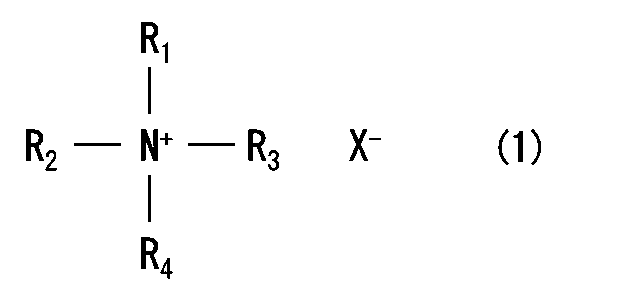
- examples of the cationic surfactant having a quaternary ammonium ion moiety include a salt represented by the following general formula (1).
- R 1 , R 2 , R 3 , and R 4 are each independently an alkyl group, an aryl group, or an arylalkyl group, or R 1 , R 2 , and R 3 is bonded to form a pyridine ring, R 4 is an alkyl group, aryl group, or arylalkyl group, and X ⁇ is a monovalent anion.
- the alkyl groups represented by R 1 , R 2 , R 3 , and R 4 preferably have 1 to 20 carbon atoms, and specifically include a methyl group, an ethyl group, Propyl group, isopropyl group, n-butyl group, s-butyl group, t-butyl group, isobutyl group, amyl group, isoamyl group, t-amyl group, hexyl group, heptyl group, isoheptyl group, t-heptyl group, n - octyl group, isooctyl group, 2-ethylhexyl group, t-octyl group, nonyl group, isononyl group, decyl group, isodecyl group, undecyl group, dodecyl group, tridecyl group, isotridecyl group, tetradecyl
- the aryl group represented by R 1 , R 2 , R 3 and R 4 is preferably a phenyl group.
- the arylalkyl group represented by R 1 , R 2 , R 3 , and R 4 is preferably a benzyl group, a phenethyl group, or the like.
- the monovalent anion represented by X ⁇ is preferably a halide ion.
- the halide ion is preferably a chloride ion or a bromide ion.
- the aromatic ring in the aryl group or arylalkyl group represented by R 1 , R 2 , R 3 , and R 4 and the pyridine ring formed by bonding R 1 , R 2 , and R 3 are an alkyl group or an amino group.
- the methylene group in the arylalkyl group may be substituted with -O-.
- the pyridine ring formed by bonding R 1 , R 2 and R 3 may be fused with a benzene ring.
- distearyldimethylammonium chloride expressed formula C 18 H 37 N + C 18 H 37 (CH 3 ) 2 ⁇ Cl ⁇
- the total content of the cellulose surfactant and/or cationic surfactant in the abrasive slurry for polishing a SiC substrate of the present invention is determined from the viewpoint of improving low friction property. It is preferable that the amount is 0.1% by mass or more based on the total amount of the slurry. In addition, from the viewpoint of sufficiently increasing the polishing rate, the total content of the cellulose surfactant and/or cationic surfactant in the abrasive slurry for polishing a SiC substrate of the present invention is The amount is preferably 1% by mass or less based on the total amount of the slurry.
- the total content of the cellulose-based surfactant and/or cationic surfactant is 0.1% by mass or more and 1% by mass or less based on the total amount of the abrasive slurry for polishing a SiC substrate of the present invention. It is preferably 0.1% by mass or more and 0.5% by mass or less.
- the total content of cellulose-based surfactants and/or cationic surfactants refers to any of the cellulose-based surfactants and/or cationic surfactants. If only one of them is contained, the content is that amount; if both are contained, it is their total amount.
- the abrasive slurry for polishing a SiC substrate of the present invention includes a group containing polycarboxylic acid, polycarboxylic acid salt, salt of naphthalene sulfonic acid formalin condensate, polyvinyl alcohol, polyethylene glycose, polyvinylpyrrolidone, and a copolymer thereof. It is characterized by further containing a polymer additive containing one or more water-soluble organic polymers selected from the following.
- the abrasive slurry for polishing SiC substrates of the present invention contains polycarboxylic acids, polycarboxylic acid salts, salts of naphthalene sulfonic acid formalin condensates, polyvinyl
- a polymer additive containing one or more water-soluble organic polymers selected from the group including alcohol, polyethylene glycose, polyvinylpyrrolidone, and copolymers thereof the pot life after mixing is increased. It can be made longer.
- the water-soluble organic polymer described above has a number average molecular weight (Mn) of 1,000 to 10,000 and a weight average molecular weight (Mw) of 1,000 or more in terms of polyethylene glycol (PEG) measured by gel permeation chromatography (GPC). 1,000,000 or less, the z-average molecular weight (Mz) is 5,000 or more and 1,000,000 or less, the dispersity (Mw/Mn), which is the ratio of Mw to Mn, is 0.1 or more and 150 or less, and the ratio of Mz to Mw (Mz/Mw) is 0. It is preferably 1 or more and 20 or less.
- the number average molecular weight (Mn) is more preferably 2000 or more and 8000 or less.
- the number average molecular weight (Mn) may be 3000 or more and 6000 or less.
- the weight average molecular weight (Mw) is more preferably 3,500 or more and 100,000 or less, and even more preferably 4,000 or more and 50,000 or less.
- the weight average molecular weight (Mw) may be 5,000 or more and 20,000 or less. It is more preferable that the z-average molecular weight (Mz) is 6,000 or more and 100,000 or less.
- the z-average molecular weight (Mz) may be 6,500 or more and 75,000 or less, or 7,000 or more and 50,000 or less.
- the degree of dispersion (Mw/Mn) is more preferably 0.5 or more and 75 or less, and even more preferably 0.8 or more and 10 or less. Typically, the degree of dispersion (Mw/Mn) may be 0.9 or more and 5.
- the ratio of Mz to Mw (Mz/Mw) is more preferably 0.5 or more and 15 or less, and even more preferably 0.8 or more and 10 or less. Typically, the ratio of Mz to Mw (Mz/Mw) may be 0.9 or more and 5 or less.
- CMC carboxymethyl cellulose
- the number average molecular weight (Mn), weight average molecular weight (Mw), and z average molecular weight (Mz) in terms of polyethylene glycol (PEG) measured by GPC can be measured and analyzed under the following conditions.
- Mn number average molecular weight
- Mw weight average molecular weight
- Mz z average molecular weight
- the viscosity of an aqueous solution containing 1% by mass of a water-soluble organic polymer at a liquid temperature of 25° C. is preferably 10,000 mPa ⁇ s or more and 30,000 mPa ⁇ s or less.
- the viscosity may be 11,000 mPa ⁇ s or more and 27,000 mPa ⁇ s or less, 12,000 mPa ⁇ s or more and 24,000 mPa ⁇ s or less, or 13,000 mPa ⁇ s or more and 21,000 mPa ⁇ s or less.
- the viscosity of the water-soluble organic polymer was measured using a digital rotational viscometer DV3T (manufactured by Eiko Seiki Co., Ltd.), and the value was measured at a rotational speed of 0.01 rpm.
- the polymer additive is one or more water-soluble organic polymers selected from polycarboxylic acids, polycarboxylate salts, and copolymers thereof.
- the polymer additive is one or more water-soluble organic polymers selected from polyacrylic acid, polymaleic acid, polyacrylates, polymaleates, and copolymers thereof.
- the polymer additive is particularly preferably a polyacrylate, and even more preferably, the polymer additive is an ammonium polyacrylate salt.
- the content of the polymer additive in the abrasive slurry for polishing a SiC substrate of the present invention is 0.006% by mass or more based on the total amount of the abrasive slurry for polishing a SiC substrate of the present invention. It is preferable that In addition, from the viewpoint of sufficiently increasing the polishing rate, the content of the polymer additive in the abrasive slurry for polishing a SiC substrate of the present invention is set to 0.05% based on the total amount of the abrasive slurry for polishing a SiC substrate of the present invention. It is preferable that it is less than % by mass.
- the content of the polymer additive is preferably 0.006% by mass or more and 0.05% by mass or less, and 0.01% by mass or more, based on the total amount of the abrasive slurry for polishing a SiC substrate of the present invention. More preferably, it is 0.03% by mass or less.
- the content of polymer additives is the total amount of those classified as the above-mentioned polymer additives.
- the content of the polymer additive in the abrasive slurry for polishing a SiC substrate of the present invention is expressed as a mass ratio to the manganese oxide abrasive grain content in the abrasive slurry for polishing a SiC substrate of the present invention. It is preferably 3% or more and 2.5% or less, more preferably 0.4% or more and 2.0% or less, and even more preferably 0.5% or more and 1.0% or less.
- the abrasive slurry for polishing a SiC substrate of the present invention contains the above-mentioned manganese oxide abrasive grains, permanganate ions, phosphoric acids, cellulose-based surfactants, and/or cationic surfactants, or polymer additives.
- a dispersion medium for dissolving or dispersing is preferably water, a water-soluble organic solvent such as alcohol, a ketone, or a mixture thereof, since the polishing rate can be sufficiently increased, and water is more preferable.
- the content of the dispersion medium is preferably 60% by mass or more and 99.9% by mass or less, and more preferably 80% by mass or more and 90% by mass or less, based on the total amount of the abrasive slurry for polishing a SiC substrate.
- the abrasive slurry for polishing a SiC substrate of the present invention further includes the above-mentioned manganese oxide abrasive grains, permanganate ions, phosphoric acids, cellulose-based surfactants, and/or cationic surfactants, or polymer additives, and It may contain any additives other than the dispersion medium.
- the optional additives include a dispersant, a pH adjuster, a viscosity adjuster, a chelating agent, and a rust preventive.
- the content of the optional additive is preferably 40% by mass or less, more preferably 20% by mass or less, and 10% by mass or less based on the total amount of the abrasive slurry for polishing a SiC substrate of the present invention. and even more preferable.
- the abrasive slurry for polishing a SiC substrate of the present invention contains the above-mentioned manganese oxide abrasive grains, permanganate ions, phosphoric acids, cellulose surfactants, and/or cationic surfactants, and/or polymer additives,
- the dispersion medium and any additives may be mixed as appropriate, and for example, a kit may be prepared in which these components are divided into two or more agents.
- the kit may have any configuration as long as it can sufficiently exhibit its polishing ability when preparing the abrasive slurry for polishing a SiC substrate.
- the abrasive slurry for polishing a SiC substrate of the invention described above can be used in a finishing CMP (Chemical Mechanical Polishing) process etc. after lapping the SiC substrate. It is possible to sufficiently increase the polishing rate and effectively prevent warping and cracking due to the Twyman effect.
- the SiC substrate is usually a single-crystal silicon carbide substrate, and its crystal system is usually hexagonal or rhombohedral. Hexagonal crystals are preferred from the viewpoint of exhibiting the following properties. Hexagonal polymorphs include 2H, 4H, 6H, 8H, and 10H. The rhombohedral polymorph is 15R.
- the object to be polished with the abrasive slurry for polishing a SiC substrate of the present invention is not limited to a SiC substrate, and may be a high hardness material having a Mohs hardness of 8 or more, for example.
- Mohs hardness is a numerical expression of hardness based on the scratches on a standard material, and can be measured by a conventional method using a Mohs hardness meter.
- standard materials are designated from 1 to 10 in descending order of softness, and the specific standard materials are 1 for Mohs hardness: talc, 2 for gypsum, 3 for calcite, 4 for fluorite, and 5 for apatite.
- ⁇ is orthoclase
- 7 is quartz
- 8 is topaz
- 9 is corundum
- 10 is diamond.
- high hardness materials having a Mohs hardness of 8 or higher include silicon carbide (Mohs hardness of about 9), gallium nitride (Mohs hardness of about 9), and diamond.
- the mixture containing the mixed and pulverized manganese dioxide (abrasive grains, MnO 2 ) in the container is separated from the beads using a centrifuge (himac CT 6E manufactured by Hitachi Koki Co., Ltd.), and the supernatant liquid is collected. do.
- the solid content concentration in the collected supernatant liquid that is, the concentration of manganese oxide abrasive grains
- concentration of manganese oxide abrasive grains is measured using a heating moisture meter, and pure water is added to obtain a predetermined concentration to obtain an abrasive slurry intermediate.
- a cellulose-based surfactant and/or a cationic surfactant may be added to and mixed with the obtained abrasive slurry intermediate.
- the abrasive slurry intermediate and potassium permanganate (KMnO 4 ) are mixed. Then, by mixing the abrasive slurry intermediate and potassium permanganate (KMnO 4 ), the abrasive slurry for polishing a SiC substrate of the present invention is obtained.
- X to Y when expressed as "X to Y" (X, Y are arbitrary numbers), unless otherwise specified, it means “more than or equal to X and less than or equal to Y”, and also means “preferably greater than X” or “preferably is less than Y.” In addition, when expressing “more than or equal to X” (X is an arbitrary number) or “less than or equal to Y” (where Y is an arbitrary number), the expression “preferably greater than X” or "preferably less than Y” is used. It also includes intent.
- the method for manufacturing a SiC substrate and the abrasive slurry for polishing a SiC substrate of the present invention can manufacture a SiC substrate with fewer latent scratches.
- Example 1 is a list of physical property values and measurement results of abrasive slurries according to Example 1 and Comparative Example 1.
- the SiC substrate manufactured by the SiC substrate manufacturing method according to the embodiment of the present invention and the abrasive slurry for polishing the SiC substrate used in the polishing process of the manufacturing method will be further described with reference to the following examples.
- the following examples do not limit the present invention.
- Example 1 an abrasive slurry for polishing a SiC substrate used in the polishing process of the method for manufacturing a SiC substrate according to Example 1 was manufactured as follows.
- the contents of these components are such that the content of manganese dioxide is 30% by mass and the content of sodium pyrophosphate is 0.3% by mass with respect to the total amount of the abrasive slurry for polishing SiC substrates according to Example 1. Prepared.
- the mixture containing the mixed and pulverized manganese dioxide in the container was separated from the beads using a centrifuge (Himac CT 6E, manufactured by Hitachi Koki Co., Ltd.), and the supernatant liquid was collected.
- the supernatant liquid obtained in the above will be used as the measurement sample before addition of potassium permanganate in the dispersibility test described below.
- the solid content concentration in the collected supernatant liquid that is, the manganese oxide abrasive grain concentration
- Carboxymethyl cellulose which is a cellulose-based surfactant, was added to the obtained abrasive slurry intermediate in an amount of 0.25% by mass based on the total amount of the abrasive slurry for polishing a SiC substrate according to Example 1, Mixed.
- the abrasive slurry intermediate by mixing the abrasive slurry intermediate and a potassium permanganate (KMnO 4 ) aqueous solution having a KMnO 4 mass % concentration of 3.2 mass %, the abrasive slurry for polishing a SiC substrate according to Example 1 was prepared. I got it. The content of permanganate ions was adjusted to 2.1% by mass based on the total amount of the abrasive slurry for polishing a SiC substrate according to Example 1. Moreover, the mass ratio of the total content of phosphoric acids to the manganese oxide abrasive grain content according to Example 1 was 1%.
- a potassium permanganate (KMnO 4 ) aqueous solution having a KMnO 4 mass % concentration of 3.2 mass %
- the abrasive slurry for polishing a SiC substrate according to Example 1 obtained in this step becomes a measurement sample after addition of potassium permanganate in a dispersibility test described below. Further, the composition of the abrasive slurry for polishing a SiC substrate shown in FIG. 1 is the composition of the final product.
- the abrasive slurry for polishing the SiC substrate according to Example 1 was supplied to a polishing pad (IC1000, manufactured by Nitta DuPont), and the main surface of the SiC substrate was brought into contact with the polishing pad, and the relative movement between the two The SiC substrate according to Example 1 was obtained by polishing.
- the polishing device used was a single-sided polishing machine ARW-681M manufactured by M.A.T.
- the rotation speed of the surface plate was set to 40 rpm, and the peripheral speed was set to 7,665 cm/min. Further, the carrier rotation speed was set to 40 rpm, and the outer peripheral speed was set to 641 cm/min.
- the load during polishing was 4.3 psi (approximately 2.94 ⁇ 10 4 Pa).
- the supply amount of 1 L of the abrasive slurry for polishing a SiC substrate according to Example 1 was 250 mL/min, and the slurry was supplied to the polishing pad in a circulating manner.
- Comparative example 1 In Comparative Example 1, (i) instead of manganese dioxide (MnO 2 ) used in Example 1, alumina (Al 2 O 3 ) was added in an amount of 6.5% by mass based on the total amount of the abrasive slurry according to Comparative Example 1. (ii) The content of potassium permanganate (KMnO 4 ) to be mixed with the abrasive slurry intermediate was 1.0% relative to the total amount of the abrasive slurry for polishing a SiC substrate according to Example 1. (iii) The content of sodium pyrophosphate was adjusted to be 0.046% by mass based on the total amount of the abrasive slurry for polishing SiC substrates according to Comparative Example 1. and (iv) An abrasive slurry for polishing a SiC substrate according to Comparative Example 1 was obtained by carrying out the same manufacturing method as in Example 1 except that no cellulose-based surfactant was added.
- MnO 2 manganese dioxide
- Example 2 the abrasive slurry for polishing a SiC substrate according to Comparative Example 1 is supplied to a polishing pad, the main surface of the SiC substrate is brought into contact with the polishing pad, and polishing is performed by relative movement between the two. , a SiC substrate according to Comparative Example 1 was obtained.
- ⁇ Particle size evaluation> The mixture containing the abrasive grains mixed and crushed in a paint shaker in the abrasive slurry for polishing SiC substrates according to Example 1 and Comparative Example 1 was mixed with water so that the concentration of the mixture was about 0.01%. A sample for measurement was prepared by diluting it. Then, using a laser diffraction/scattering particle size distribution analyzer (manufactured by Micro Track Bell Co., Ltd.: MT3300EXII), the particle size (D50) at a volume-based integrated fraction of 50% was measured.
- D50 laser diffraction/scattering particle size distribution analyzer
- the dispersibility before adding potassium permanganate was evaluated as follows.
- the mixture containing the abrasive grains mixed and crushed in a paint shaker in the abrasive slurry for polishing SiC substrates according to Example 1 and Comparative Example 1 was mixed with water so that the concentration of the mixture was about 0.01% by mass.
- a sample for measurement was prepared by diluting with Then, using a laser diffraction/scattering method particle size distribution analyzer (MT3300EXII, manufactured by Micro Track Bell Co., Ltd.), the particle size (D50) at a volume-based integrated fraction of 50% was measured, and if D50 was 0.6 ⁇ m or less, If so, it was evaluated as “Good”, and if D50 exceeded 0.6 ⁇ m, it was evaluated as “Bad”.
- the polishing rates of the abrasive slurries for polishing SiC substrates according to Example 1 and Comparative Example 1 were evaluated according to the following procedure.
- the object to be polished was a CMP-processed 4H-SiC substrate with a diameter of 6 inches and an off angle of 4°.
- the polishing test was performed on the Si surface of the substrate.
- As the polishing device a single-sided polishing machine ARW-681M manufactured by M.A.T. was used.
- As the polishing pad attached to the surface plate IC1000 manufactured by Nitta DuPont was used.
- the rotation speed of the surface plate was set to 40 rpm, and the peripheral speed was set to 7,665 cm/min.
- the carrier rotation speed was set to 40 rpm, and the outer peripheral speed was set to 641 cm/min. Furthermore, the load during polishing was 4.3 psi (approximately 2.94 ⁇ 10 4 Pa).
- the supply rate of the abrasive slurry was 250 mL/min, and polishing was performed for 1 hour, and the polishing rate was determined from the difference in mass of the substrate to be polished before and after polishing. If the polishing rate was 0.10 ⁇ m/h or more, it was evaluated as “Good”, and if the polishing rate was less than 0.10 ⁇ m/h, it was evaluated as “Bad”.
- ⁇ Crystal precipitation test> Samples of abrasive slurries for polishing SiC substrates according to Example 1 and Comparative Example 1 were prepared. Each prepared sample was stored in a refrigerator set at 10°C for 24 hours. Thereafter, each sample was taken out of the refrigerator, and the solid content concentration in each sample, that is, the total value of the manganese oxide abrasive grain concentration and potassium permanganate concentration, was determined using a heating moisture meter. If the solid content concentration after storage is 90% or more of the solid content concentration before storage, it is evaluated as "Good”. If the retention rate was less than 90%, it was evaluated as "x (Bad)".
- Visual flaw evaluation was performed by observing the entire Si surface of the SiC substrates according to Example 1 and Comparative Example 1 using a SiC wafer defect apparatus (manufactured by Lasertec Corporation: WASAVI series SICA6X) using confocal differential interference method. Specifically, an image of the Si surface area excluding 5 mm of the outer circumference of a 6-inch SiC substrate was imaged in SD mode, and visible flaws were detected by straight line detection using stochastic Hough transformation. Then, the density of visible flaws was calculated by dividing the number of detected visible flaws by the area of the SiC substrate.
- a SiC wafer defect apparatus manufactured by Lasertec Corporation: WASAVI series SICA6X
- Latent flaw evaluation was performed by observing the entire Si surface of the SiC substrates according to Example 1 and Comparative Example 1 using a mirror electronic inspection device (Mirelis VM1000, manufactured by Hitachi High-Tech Corporation). Specifically, a 6-inch SiC substrate was set in a mirror electronic inspection device (Mirelis VM1000, manufactured by Hitachi High-Tech Corporation), and a 5 mm square virtual chip was placed on the set SiC substrate in an area excluding the outer 5 mm. did. A total of 64 imaging points of 80 ⁇ m x 80 ⁇ m were set for each virtual chip, and defects such as latent flaws were detected by automatic defect classification from images taken based on the imaging points.
- the latent flaw density was calculated by dividing the total number of latent flaws detected at all imaging points (35,904 locations) by the total imaged area.
- the calculated latent flaw density was 1,300 flaws/cm 2 or less, the number of latent flaws was considered to be small and was evaluated as "Good”.
- the calculated latent flaw density was more than 1,300 flaws/cm 2 , it was determined that there were many latent flaws and was evaluated as "x (Bad)."
- the abrasive slurry for polishing a SiC substrate according to Example 1 has a particle size distribution determined by laser diffraction/scattering method before and after addition of potassium permanganate, which is a source of permanganate ions. Both of the particle diameters (D50) at a volume-based integrated fraction of 50% were 0.6 ⁇ m or less, indicating excellent dispersibility.
- the abrasive slurry for polishing a SiC substrate according to Example 1 exhibited a high polishing rate, as the polishing rate was 0.10 ⁇ m/h or more.
- the density of visible flaws on the entire Si surface of the SiC substrate according to Example 1 was 0 flaws/cm 2 . Further, the latent flaw density on the entire Si surface of the SiC substrate according to Example 1 was 131 flaws/cm 2 , and the number of latent flaws could be reduced.
- the invention disclosed in this specification is specified by changing a partial configuration of these to other configurations disclosed in this specification, or these This includes configurations specified by adding other configurations disclosed in this specification to the configuration, or generalized configurations specified by deleting these partial configurations to the extent that partial effects can be obtained.
- the method for manufacturing a SiC substrate and the abrasive slurry for polishing a SiC substrate according to the present invention can manufacture a SiC substrate with fewer latent scratches.
- the SiC substrate manufacturing method and the abrasive slurry for polishing a SiC substrate according to the present invention have excellent dispersibility, it is easy to clean the SiC substrate and the polishing pad, which are the objects to be polished, and the cleaning water This leads to a reduction in environmental burden from the viewpoints of being able to suppress the amount of water used, the washing time being shortened, and the amount of wastewater treated.
- the method for manufacturing a SiC substrate and the abrasive slurry for polishing a SiC substrate according to the present invention exhibit a high polishing rate, the polishing processing time can be shortened.
Landscapes
- Chemical & Material Sciences (AREA)
- Organic Chemistry (AREA)
- Engineering & Computer Science (AREA)
- Materials Engineering (AREA)
- Crystallography & Structural Chemistry (AREA)
- Metallurgy (AREA)
- Inorganic Chemistry (AREA)
- Finish Polishing, Edge Sharpening, And Grinding By Specific Grinding Devices (AREA)
- Mechanical Treatment Of Semiconductor (AREA)
Abstract
Description
本発明のSiC基板研磨用研磨材スラリーは、酸化マンガン粒子を含む酸化マンガン砥粒と、過マンガン酸イオンと、リン酸類と、を有することにより、分散性に優れ、高い研磨レートを示す。
本発明のSiC基板研磨用研磨材スラリーに含まれるリン酸類が、ピロリン酸化合物であると、高い分散性の観点及び研磨レートを十分高める観点から好ましい。ピロリン酸化合物中、ピロリン酸のアルカリ金属塩や、ピロリン酸のアルカリ土類金属塩であるとより好ましく、特にピロリン酸ナトリウムや、ピロリン酸カリウムであると好ましい。
本発明のSiC基板研磨用研磨材スラリーは、セルロース系界面活性剤、およびまたは陽イオン界面活性剤をさらに含有することより、低フリクション性を向上させることができる。
本発明のSiC基板研磨用研磨材スラリーは、上述した酸化マンガン砥粒、過マンガン酸イオン、及びリン酸類の他に、ポリカルボン酸、ポリカルボン酸塩、ナフタレンスルホン酸ホルマリン縮合物の塩、ポリビニルアルコール、ポリエチレングリコース、ポリビニルピロリドン、及びそれらの共重合体を含む群から選択される1以上の水溶性有機高分子を含む高分子添加剤をさらに含有することにより、混合した後の可使時間を長くすることができる。
=分子量の測定条件=
測定装置:HPLC Prominenceシリーズ(株式会社島津製作所製)
装置構成:CBM20A、DGU-20A3R、LC-20AD、SIL-20ACHT、CTO-20AC、RID-10A
カラム:Shodex OHpak SB-803 HQ (株式会社レゾナック製)
温度:40℃
流速:1.0ml/min
検出器:示唆屈折率検出器
溶離液:0.1M塩化ナトリウム水溶液
=解析ソフト=
ソフトウェア:LabSolutions/LCsolution GPC(株式会社島津製作所製)
バージョン:1.25 SP2
先ず、実施例1に係るSiC基板の製造方法の研磨処理工程で用いられるSiC基板研磨用研磨材スラリーは、以下の通り、製造した。
比較例1は、(i)実施例1で用いた二酸化マンガン(MnO2)に代えて、アルミナ(Al2O3)を、比較例1に係る研磨材スラリー全量に対し、6.5質量%となるように調製したこと、(ii)研磨材スラリー中間体と混合する過マンガン酸カリウム(KMnO4)の含有量は、実施例1に係るSiC基板研磨用研磨材スラリー全量に対し、1.3質量%となるように調製したこと、(iii)ピロリン酸ナトリウムの含有量を、比較例1に係るSiC基板研磨用研磨材スラリー全量に対し、0.046質量%となるように調製したこと、及び(iv)セルロース系界面活性媒を添加しなかったこと以外、実施例1と同様な製造方法を実施し、比較例1に係るSiC基板研磨用研磨材スラリーを得た。
実施例1及び比較例1に係るSiC基板研磨用研磨材スラリーにおけるペイントシェーカーで混合粉砕された砥粒を含有する混合物を、それらの混合物の濃度が0.01%濃度程度になるように水で希釈することにより、計測用試料を調製した。そして、レーザ回折・散乱法粒度分布測定装置(マイクロトラックベル株式会社製:MT3300EXII)を用いて、体積基準の積算分率50%の粒径(D50)を測定した。
実施例1及び比較例1に係るSiC基板研磨用研磨材スラリーの分散性を、過マンガン酸イオンの供給源である過マンガン酸カリウムの添加前と添加後について、それぞれ評価した。
実施例1及び比較例1に係るSiC基板研磨用研磨材スラリーの付着性は、上述した過マンガン酸カリウムの添加後の分散性評価で用いた試料が入った容器(アズワン社製広口びん アイボーイ250ml)を反転させた際の当該容器への各研磨材スラリーの付着状態を、試験者が視認にて、下記の通り判断した。試料が入った容器を反転した際、当該試料が容器に付着しなければ「〇〇(VeryGood)」と評価し、当該試料が容器の底のみに付着したものを「〇(Good)」と評価し、当該試料が容器の底及び側面や、側面に付着したものを「×(Bad)」と評価した。
実施例1及び比較例1に係るSiC基板研磨用研磨材スラリーの研磨レートを、以下の手順により評価した。研磨対象は直径6インチ、オフ角が4°のCMP加工後の4H-SiC基板を用いた。当該研磨試験は基板のSi面に対して行った。研磨装置は、エム・エー・ティー社製片面研磨機ARW-681Mを用いた。定盤に取り付ける研磨パッドは、ニッタ・デュポン社製IC1000を用いた。定盤の回転数は40rpm、外周部速度は7,665cm/minに設定した。また、キャリア回転数は40rpm、外周部速度は641cm/minに設定した。さらに研磨時の荷重は4.3psi(約2.94×104Pa)とした。研磨材スラリーの供給量は250mL/minとして、1時間研磨して研磨前後の研磨対象である基板の質量差から研磨レートを求めた。そして、研磨レートが0.10μm/h以上であれば「〇(Good)」と評価し、研磨レートが0.10μm/h未満であれば「×(Bad)」と評価した。
実施例1及び比較例1に係るSiC基板研磨用研磨材スラリーの各サンプルを調製した。調整した各サンプルを10℃に設定した冷蔵庫内に24時間保管した。その後、各サンプルを冷蔵庫から取り出し、加熱式水分計を用いて各サンプル中の固形分濃度、すなわち酸化マンガン砥粒濃度と過マンガン酸カリウム濃度との合計値を求めた。そして、保管後の固形分濃度が、保管前の固形分濃度の維持率90%以上であれば「〇(Good)」と評価し、保管後の固形分濃度が、保管前の固形分濃度の維持率90%未満であれば「×(Bad)」と評価した。
実施例1及び比較例1に係るSiC基板のSi面全体を、共焦点微分干渉法によるSiCウェハ欠陥装置(レーザーテック社製:WASAVIシリーズ SICA6X)を用いて観察することにより顕傷評価を実施した。具体的には、6インチSiC基板の外周部5mmを除くSi面領域をSDモードにより撮像し、確率的Hough変換を用いた直線検出により顕傷を検出した。そして、検出された顕傷本数をSiC基板の面積で割ることにより顕傷密度を算出した。算出したSiC基板のSi面全体における顕傷密度が、5個/cm2以下であった場合は、顕傷が少ないとして、「〇(Good)」と評価した。一方、算出したSiC基板のSi面全体における顕傷密度が、5個/cm2超であった場合は、顕傷が多いとして、「×(Bad)」と評価した。
実施例1及び比較例1に係るSiC基板のSi面全体を、ミラー電子式検査装置(株式会社日立ハイテク製:Mirelis VM1000)を用いて観察することにより潜傷評価を実施した。具体的には、ミラー電子式検査装置(株式会社日立ハイテク製:Mirelis VM1000)に、6インチSiC基板をセットし、セットしたSiC基板上の外周部5mmを除く領域に5mm角の仮想チップを配置した。その仮想チップごとに、80μm×80μmの撮像点を計64箇所設定し、撮像点に基づいて撮像した画像から自動欠陥分類により潜傷などの欠陥を検出した。そして、全撮像点(35,904箇所)にて検出された潜傷の合計数を撮像した総面積で割ることにより潜傷密度を算出した。算出した潜傷密度が1,300個/cm2以下であった場合は、潜傷が少ないとして、「〇(Good)」と評価した。一方、算出した潜傷密度が1,300個/cm2超であった場合は、潜傷が多いとして、「×(Bad)」と評価した。
Claims (10)
- SiC基板の主面を、酸化マンガン粒子を含む酸化マンガン砥粒と、過マンガン酸イオンと、リン酸類とを含有する研磨材スラリーにより研磨する研磨処理工程を有することを特徴とするSiC基板の製造方法。
- 酸化マンガン粒子を含む酸化マンガン砥粒と、
過マンガン酸イオンと、
リン酸類と、
を有することを特徴とするSiC基板研磨用研磨材スラリー。 - 前記リン酸類が、ピロリン酸化合物であることを特徴とする請求項2に記載のSiC基板研磨用研磨材スラリー。
- 前記ピロリン酸化合物が、ピロリン酸の金属塩であることを特徴とする請求項3に記載のSiC基板研磨用研磨材スラリー。
- セルロース系界面活性剤、およびまたは陽イオン界面活性剤をさらに含有することを特徴とする請求項2~4の何れか1つに記載のSiC基板研磨用研磨材スラリー。
- 前記セルロース系界面活性剤が、カルボキシメチルセルロースを含有することを特徴とする請求項5に記載のSiC基板研磨用研磨材スラリー。
- ポリカルボン酸、ポリカルボン酸塩、ナフタレンスルホン酸ホルマリン縮合物の塩、ポリビニルアルコール、ポリエチレングリコース、ポリビニルピロリドン、及びそれらの共重合体を含む群から選択される1以上の水溶性有機高分子を含む高分子添加剤をさらに含有することを特徴とする請求項2~4の何れか1つに記載のSiC基板研磨用研磨材スラリー。
- 前記高分子添加剤が、ポリカルボン酸、ポリカルボン酸塩、及びそれらの共重合体から選択される1種以上の水溶性有機高分子であることを特徴とする請求項7に記載の研磨材スラリー。
- 前記高分子添加剤が、ポリアクリル酸、ポリマレイン酸、ポリアクリル酸塩、ポリマレイン酸塩、及びそれらの共重合体から選択される1種以上の水溶性有機高分子であることを特徴とする請求項8に記載の研磨材スラリー。
- 前記高分子添加剤が、ポリアクリル酸アンモニウム塩であることを特徴とする請求項9に記載の研磨材スラリー。
Priority Applications (3)
| Application Number | Priority Date | Filing Date | Title |
|---|---|---|---|
| KR1020247040165A KR20250026163A (ko) | 2022-06-27 | 2023-06-20 | SiC 기판의 제조 방법 및 SiC 기판 연마용 연마재 슬러리 |
| CN202380047738.0A CN119384714A (zh) | 2022-06-27 | 2023-06-20 | SiC基板的制造方法及SiC基板研磨用研磨材浆料 |
| JP2023571424A JP7610042B2 (ja) | 2022-06-27 | 2023-06-20 | SiC基板の製造方法、及びSiC基板研磨用研磨材スラリー |
Applications Claiming Priority (2)
| Application Number | Priority Date | Filing Date | Title |
|---|---|---|---|
| JP2022-102368 | 2022-06-27 | ||
| JP2022102368 | 2022-06-27 |
Publications (1)
| Publication Number | Publication Date |
|---|---|
| WO2024004752A1 true WO2024004752A1 (ja) | 2024-01-04 |
Family
ID=89382203
Family Applications (1)
| Application Number | Title | Priority Date | Filing Date |
|---|---|---|---|
| PCT/JP2023/022709 Ceased WO2024004752A1 (ja) | 2022-06-27 | 2023-06-20 | SiC基板の製造方法、及びSiC基板研磨用研磨材スラリー |
Country Status (5)
| Country | Link |
|---|---|
| JP (1) | JP7610042B2 (ja) |
| KR (1) | KR20250026163A (ja) |
| CN (1) | CN119384714A (ja) |
| TW (1) | TWI890081B (ja) |
| WO (1) | WO2024004752A1 (ja) |
Cited By (1)
| Publication number | Priority date | Publication date | Assignee | Title |
|---|---|---|---|---|
| WO2025198914A1 (en) * | 2024-03-19 | 2025-09-25 | Cerium Optical Products (Usa) Inc. | Composition for polishing ophthalmic substrate and method of polishing ophthalmic substrate |
Citations (4)
| Publication number | Priority date | Publication date | Assignee | Title |
|---|---|---|---|---|
| WO2013054883A1 (ja) * | 2011-10-13 | 2013-04-18 | 三井金属鉱業株式会社 | 研摩材スラリー及び研摩方法 |
| WO2013088928A1 (ja) * | 2011-12-14 | 2013-06-20 | 旭硝子株式会社 | 洗浄剤、および炭化ケイ素単結晶基板の製造方法 |
| WO2018116521A1 (ja) * | 2016-12-22 | 2018-06-28 | 三井金属鉱業株式会社 | 研摩液及び研摩方法 |
| WO2020255921A1 (ja) * | 2019-06-17 | 2020-12-24 | 株式会社フジミインコーポレーテッド | 研磨用組成物 |
Family Cites Families (10)
| Publication number | Priority date | Publication date | Assignee | Title |
|---|---|---|---|---|
| KR100472882B1 (ko) * | 1999-01-18 | 2005-03-07 | 가부시끼가이샤 도시바 | 수계 분산체, 이를 이용한 화학 기계 연마용 수계 분산체조성물, 웨이퍼 표면의 연마 방법 및 반도체 장치의 제조방법 |
| JP2005117027A (ja) | 2003-09-16 | 2005-04-28 | Matsushita Electric Ind Co Ltd | SiC基板の製造方法 |
| JP4990543B2 (ja) | 2006-03-23 | 2012-08-01 | 富士フイルム株式会社 | 金属用研磨液 |
| JP6552245B2 (ja) | 2015-03-31 | 2019-07-31 | 株式会社フジミインコーポレーテッド | 研磨用組成物および研磨物の製造方法 |
| JP2018075700A (ja) * | 2016-11-11 | 2018-05-17 | 株式会社フジミインコーポレーテッド | 物品の製造方法 |
| US11078380B2 (en) * | 2017-07-10 | 2021-08-03 | Entegris, Inc. | Hard abrasive particle-free polishing of hard materials |
| JP7133414B2 (ja) * | 2018-09-20 | 2022-09-08 | 株式会社フジミインコーポレーテッド | 研磨用組成物 |
| JP7292844B2 (ja) * | 2018-09-28 | 2023-06-19 | 株式会社フジミインコーポレーテッド | 研磨用組成物、基板の研磨方法および基板の製造方法 |
| CN111303772A (zh) * | 2020-02-25 | 2020-06-19 | 山西烁科晶体有限公司 | 一种超快速低损碳化硅衬底抛光液及其制备方法 |
| CN114410226A (zh) * | 2022-01-27 | 2022-04-29 | 中国科学院上海微系统与信息技术研究所 | 一种抛光液及其制备方法和应用 |
-
2023
- 2023-06-20 WO PCT/JP2023/022709 patent/WO2024004752A1/ja not_active Ceased
- 2023-06-20 KR KR1020247040165A patent/KR20250026163A/ko active Pending
- 2023-06-20 JP JP2023571424A patent/JP7610042B2/ja active Active
- 2023-06-20 CN CN202380047738.0A patent/CN119384714A/zh active Pending
- 2023-06-21 TW TW112123483A patent/TWI890081B/zh active
Patent Citations (4)
| Publication number | Priority date | Publication date | Assignee | Title |
|---|---|---|---|---|
| WO2013054883A1 (ja) * | 2011-10-13 | 2013-04-18 | 三井金属鉱業株式会社 | 研摩材スラリー及び研摩方法 |
| WO2013088928A1 (ja) * | 2011-12-14 | 2013-06-20 | 旭硝子株式会社 | 洗浄剤、および炭化ケイ素単結晶基板の製造方法 |
| WO2018116521A1 (ja) * | 2016-12-22 | 2018-06-28 | 三井金属鉱業株式会社 | 研摩液及び研摩方法 |
| WO2020255921A1 (ja) * | 2019-06-17 | 2020-12-24 | 株式会社フジミインコーポレーテッド | 研磨用組成物 |
Cited By (1)
| Publication number | Priority date | Publication date | Assignee | Title |
|---|---|---|---|---|
| WO2025198914A1 (en) * | 2024-03-19 | 2025-09-25 | Cerium Optical Products (Usa) Inc. | Composition for polishing ophthalmic substrate and method of polishing ophthalmic substrate |
Also Published As
| Publication number | Publication date |
|---|---|
| TW202409224A (zh) | 2024-03-01 |
| JPWO2024004752A1 (ja) | 2024-01-04 |
| JP7610042B2 (ja) | 2025-01-07 |
| KR20250026163A (ko) | 2025-02-25 |
| TWI890081B (zh) | 2025-07-11 |
| CN119384714A (zh) | 2025-01-28 |
Similar Documents
| Publication | Publication Date | Title |
|---|---|---|
| KR101216373B1 (ko) | 세리아 재료 및 그 형성 방법 | |
| CN110072956B (zh) | 研磨液以及研磨方法 | |
| JP6273281B2 (ja) | サファイア表面を研磨する方法 | |
| US9896604B2 (en) | Methods of polishing sapphire surfaces | |
| JP7610042B2 (ja) | SiC基板の製造方法、及びSiC基板研磨用研磨材スラリー | |
| TWI447797B (zh) | 矽晶圓的研磨方法以及矽晶圓 | |
| JP7614404B2 (ja) | 研磨材スラリー及びその研磨方法 | |
| JP4267546B2 (ja) | 基板の製造方法 | |
| JP7610041B2 (ja) | 研磨材スラリー及びその研磨方法 | |
| JP7819409B2 (ja) | 研磨材スラリー及びその研磨方法 | |
| JP2014124760A (ja) | 電子材料用研磨液 | |
| JP2025102250A (ja) | 研磨材スラリー及びその研磨方法 | |
| JP7460844B1 (ja) | 磁気ディスク基板用研磨液組成物 | |
| JP7319157B2 (ja) | 研磨用組成物 | |
| JP3986410B2 (ja) | セリウム系研摩材スラリーの製造方法及びそれにより得られたセリウム系研摩材スラリー |
Legal Events
| Date | Code | Title | Description |
|---|---|---|---|
| ENP | Entry into the national phase |
Ref document number: 2023571424 Country of ref document: JP Kind code of ref document: A |
|
| 121 | Ep: the epo has been informed by wipo that ep was designated in this application |
Ref document number: 23831198 Country of ref document: EP Kind code of ref document: A1 |
|
| WWE | Wipo information: entry into national phase |
Ref document number: 202380047738.0 Country of ref document: CN |
|
| NENP | Non-entry into the national phase |
Ref country code: DE |
|
| WWP | Wipo information: published in national office |
Ref document number: 202380047738.0 Country of ref document: CN |
|
| WWP | Wipo information: published in national office |
Ref document number: 1020247040165 Country of ref document: KR |
|
| 122 | Ep: pct application non-entry in european phase |
Ref document number: 23831198 Country of ref document: EP Kind code of ref document: A1 |