WO2023243255A1 - 接合型発光素子ウェーハの製造方法およびマイクロledの移載方法 - Google Patents
接合型発光素子ウェーハの製造方法およびマイクロledの移載方法 Download PDFInfo
- Publication number
- WO2023243255A1 WO2023243255A1 PCT/JP2023/017250 JP2023017250W WO2023243255A1 WO 2023243255 A1 WO2023243255 A1 WO 2023243255A1 JP 2023017250 W JP2023017250 W JP 2023017250W WO 2023243255 A1 WO2023243255 A1 WO 2023243255A1
- Authority
- WO
- WIPO (PCT)
- Prior art keywords
- bonded
- light emitting
- emitting device
- wafer
- map data
- Prior art date
- Legal status (The legal status is an assumption and is not a legal conclusion. Google has not performed a legal analysis and makes no representation as to the accuracy of the status listed.)
- Ceased
Links
Images









Classifications
-
- H—ELECTRICITY
- H10—SEMICONDUCTOR DEVICES; ELECTRIC SOLID-STATE DEVICES NOT OTHERWISE PROVIDED FOR
- H10P—GENERIC PROCESSES OR APPARATUS FOR THE MANUFACTURE OR TREATMENT OF DEVICES COVERED BY CLASS H10
- H10P74/00—Testing or measuring during manufacture or treatment of wafers, substrates or devices
- H10P74/23—Testing or measuring during manufacture or treatment of wafers, substrates or devices characterised by multiple measurements, corrections, marking or sorting processes
-
- H—ELECTRICITY
- H10—SEMICONDUCTOR DEVICES; ELECTRIC SOLID-STATE DEVICES NOT OTHERWISE PROVIDED FOR
- H10H—INORGANIC LIGHT-EMITTING SEMICONDUCTOR DEVICES HAVING POTENTIAL BARRIERS
- H10H20/00—Individual inorganic light-emitting semiconductor devices having potential barriers, e.g. light-emitting diodes [LED]
- H10H20/01—Manufacture or treatment
- H10H20/011—Manufacture or treatment of bodies, e.g. forming semiconductor layers
- H10H20/018—Bonding of wafers
-
- H—ELECTRICITY
- H10—SEMICONDUCTOR DEVICES; ELECTRIC SOLID-STATE DEVICES NOT OTHERWISE PROVIDED FOR
- H10H—INORGANIC LIGHT-EMITTING SEMICONDUCTOR DEVICES HAVING POTENTIAL BARRIERS
- H10H29/00—Integrated devices, or assemblies of multiple devices, comprising at least one light-emitting semiconductor element covered by group H10H20/00
- H10H29/01—Manufacture or treatment
- H10H29/03—Manufacture or treatment using mass transfer of LEDs, e.g. by using liquid suspensions
-
- H—ELECTRICITY
- H10—SEMICONDUCTOR DEVICES; ELECTRIC SOLID-STATE DEVICES NOT OTHERWISE PROVIDED FOR
- H10P—GENERIC PROCESSES OR APPARATUS FOR THE MANUFACTURE OR TREATMENT OF DEVICES COVERED BY CLASS H10
- H10P95/00—Generic processes or apparatus for manufacture or treatments not covered by the other groups of this subclass
- H10P95/11—Separation of active layers from substrates
-
- H—ELECTRICITY
- H10—SEMICONDUCTOR DEVICES; ELECTRIC SOLID-STATE DEVICES NOT OTHERWISE PROVIDED FOR
- H10H—INORGANIC LIGHT-EMITTING SEMICONDUCTOR DEVICES HAVING POTENTIAL BARRIERS
- H10H20/00—Individual inorganic light-emitting semiconductor devices having potential barriers, e.g. light-emitting diodes [LED]
- H10H20/01—Manufacture or treatment
- H10H20/011—Manufacture or treatment of bodies, e.g. forming semiconductor layers
- H10H20/019—Removal of at least a part of a substrate on which semiconductor layers have been formed
-
- H—ELECTRICITY
- H10—SEMICONDUCTOR DEVICES; ELECTRIC SOLID-STATE DEVICES NOT OTHERWISE PROVIDED FOR
- H10H—INORGANIC LIGHT-EMITTING SEMICONDUCTOR DEVICES HAVING POTENTIAL BARRIERS
- H10H20/00—Individual inorganic light-emitting semiconductor devices having potential barriers, e.g. light-emitting diodes [LED]
- H10H20/01—Manufacture or treatment
- H10H20/021—Singulating, e.g. dicing
-
- H—ELECTRICITY
- H10—SEMICONDUCTOR DEVICES; ELECTRIC SOLID-STATE DEVICES NOT OTHERWISE PROVIDED FOR
- H10H—INORGANIC LIGHT-EMITTING SEMICONDUCTOR DEVICES HAVING POTENTIAL BARRIERS
- H10H20/00—Individual inorganic light-emitting semiconductor devices having potential barriers, e.g. light-emitting diodes [LED]
- H10H20/80—Constructional details
- H10H20/81—Bodies
- H10H20/822—Materials of the light-emitting regions
- H10H20/824—Materials of the light-emitting regions comprising only Group III-V materials, e.g. GaP
Definitions
- the present invention relates to a method for manufacturing a bonded light emitting device wafer and a method for transferring micro LEDs.
- a bonding wafer technology using BCB has been disclosed as a wafer for AlGaInP micro-LEDs ( ⁇ -LEDs).
- the defective bonding portion has a convex shape, which causes a drop in shape and dimensional accuracy during the device structure manufacturing process, especially during photolithography processing.
- the convex portion causes non-uniformity in the applied pressure, causing a transfer defect.
- Patent Document 1 discloses a technique for holding dice by suction.
- the heights of the dies are all within a certain tolerance range. If a convex portion is formed on a wafer before device fabrication due to poor bonding, the height of the die after device fabrication will be uneven. Therefore, in the prior art illustrated here, defects occur during transfer. Furthermore, since the transfer is carried out in bulk, the technology cannot selectively remove defective parts.
- Patent Document 2 discloses a technique for picking up dice using an electrostatic method, but as in Patent Document 1, it is assumed that the die is picked up on a single plate-shaped jig, and when a convex portion occurs. , this method cannot be applied.
- Patent Document 1 a technique for selectively removing defective portions from a ⁇ -LED epitaxial layer portion that is firmly bonded to a wafer to be bonded via a BCB or from a device-processed ⁇ -LED die is disclosed in Patent Document 1. -3 are not disclosed.
- Patent Documents 4 and 5 disclose techniques for detecting defects mainly due to foreign substances in organic EL and removing them by laser irradiation.
- Patent Document 6 discloses a defective LED removing device that detects and removes defective LED chips.
- LEDs with poor brightness are removed using a suction nozzle.
- Patent Document 7 discloses a method of evaluating LEDs for defects that are optically and electrically malfunctioning, removing defective LEDs, and leaving good quality LEDs.
- the defective LED removal process in US Pat. A beam is applied to cut the metal substrate.
- JP 2021-019162 Publication Japanese Patent Application Publication No. 2018-163900 Japanese Patent Application Publication No. 2009-21572 Japanese Patent Application Publication No. 2004-119243 International Publication No. WO2010/092749 JP 2020-129658 Publication Special Publication No. 2008-527719
- the defective bonding portion becomes apparent as a convex shape of the epitaxial layer on the side from which the starting substrate is removed.
- the size of the convex defect caused by poor curing of BCB is about 100 to 300 ⁇ m in height and about 500 to 5000 ⁇ m in width, which has an adverse effect on photolithography.
- the wafer and photomask are brought into close contact in a vacuum state, so the mask is adjusted to match the TTV (Total Thickness Variation: the difference between the maximum and minimum thickness) of the wafer. and transform.
- the adhesive layer functions as an adhesive even in the defective part, and the defective part is maintained without peeling or peeling due to vacuum suction or tensile strength comparable to adhesive.
- the defective part is not limited to a defective junction part, but also includes a part with defective element characteristics. Similar to defective junctions, such defective element characteristics are difficult to detect only by PL characteristic inspection or visual inspection, and abnormalities may be noticed only after mounting and energizing.
- the present invention was made in order to solve the above problems, and it selectively removes defective parts of a light emitting element structure that becomes a micro LED bonded to a wafer to be bonded via an adhesive, thereby producing a bonded type. It is an object of the present invention to provide a method for manufacturing a bonded light emitting device wafer that can manufacture a light emitting device wafer, and a method for transferring micro LEDs that can prevent defective micro LEDs from being transferred.
- a light emitting element structure that becomes a micro LED and a substrate to be bonded that is transparent to the laser beam for removal are bonded together through an adhesive that absorbs the laser beam for removal.
- a method for manufacturing a bonded light emitting device wafer comprising: a step of bonding the light emitting element structure and the bonded substrate via the adhesive to obtain a bonded wafer; optically investigating the defective portion of the bonded wafer and creating map data for removal; Based on the removal map data, the removal laser beam is incident on the defective portion of the bonded wafer from the bonded substrate side, and the removal laser beam is applied to the portion of the adhesive included in the defective portion.
- defective parts of the bonded wafer are optically investigated to create removal map data, and laser light irradiation is performed based on the created removal map data. , it is possible to selectively remove defective portions (for example, defective bonding portions and defective device characteristics portions) of the light emitting device structures included in the bonded light emitting device wafer. Further, in the method for manufacturing a bonded light emitting device wafer of the present invention, defective portions of the light emitting device structure can be easily and selectively removed without using mechanical methods. That is, according to the method for manufacturing a bonded light emitting device wafer of the present invention, a bonded light emitting device wafer in which defective portions of the light emitting device structures are removed can be easily manufactured.
- the removal map data In the step of creating the removal map data, obtaining a photoluminescence spectrum for the bonded wafer, and creating first map data regarding the defective portion using the peak wavelength, peak intensity, and/or peak half-width as criteria; photographing the bonded wafer from the side of the substrate to be bonded with a CCD camera, and creating second map data regarding the defective portion based on the color tone of the image obtained by photography;
- the removal map data is created using the first map data and the second map data.
- the removal map data can be created for the bonded wafer including the light emitting device structure subjected to the device separation process.
- the first map data and the second map data may be created for a bonded wafer including light emitting device structures separated into devices, and the map data for removal may be created by combining them. By doing so, the defective portion of the light emitting element structure can be easily and selectively removed without affecting the good portion of the light emitting element structure.
- the step of creating the removal map data Obtaining topology data by irradiating the surface of the light emitting element structure of the bonded wafer from an oblique direction with a laser beam for topology detection, and creating topology map data regarding the defective part based on the topology data. Do further, creating removal map data regarding the defective part using the first map data, the second map data, and the topology map data; After removing the portion of the light emitting element structure that is included in the defective portion, the light emitting element structure may be subjected to element isolation processing.
- a laser beam having a wavelength of 170 nm or more and 360 nm or less can be used as the removal laser beam.
- the laser beam for removal is not particularly limited as long as it can pass through the substrates to be joined and is absorbed by the adhesive, but a laser beam with a wavelength of 170 nm or more and 360 nm or less can be used.
- an adhesive having a light absorption edge in a wavelength range of 170 nm or more and 360 nm or less can be used.
- Such an adhesive can be easily evaporated using an ablation laser beam having a wavelength of 170 nm or more and 360 nm or less.
- the adhesive one selected from the group consisting of benzocyclobutene, silicone resin, epoxy resin, SOG, polyimide, and amorphous fluororesin can be used.
- the adhesive is not particularly limited as long as it absorbs the removal laser beam, but for example, by using such an adhesive, the light emitting element structure can be firmly bonded to the substrate to be bonded.
- the protective material it is preferable to use a polyvinyl acetate-containing protective material or a polyvinyl alcohol-containing protective material.
- Such a protective material is preferred because it can be easily removed.
- defective portions for example, defective bonding portions and defective device characteristics portions
- the light emitting device structures included in the bonded light emitting device wafer are selectively removed.
- a bonded light emitting device wafer in which the defective portion of the light emitting device structure has been removed can be manufactured. Therefore, according to the micro LED transfer method of the present invention, it is possible to prevent a defective light emitting element structure, that is, a defective micro LED from being transferred.
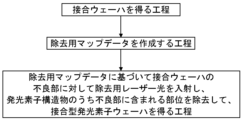
- FIG. 1 is a schematic flowchart of a method for manufacturing a bonded light emitting device wafer of the present invention.
- FIG. 2 is a schematic cross-sectional view showing a part of the process of obtaining a bonded wafer in the first embodiment of the method for manufacturing a bonded light emitting device wafer of the present invention. It is a schematic sectional view showing another part of the process of obtaining a bonded wafer in the first embodiment of the method for manufacturing a bonded light emitting device wafer of the present invention.
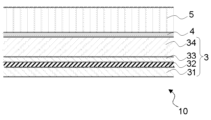
- FIG. 2 is a schematic cross-sectional view of a bonded wafer obtained in a step of obtaining a bonded wafer in the first embodiment of the method for manufacturing a bonded light emitting device wafer of the present invention.
- FIG. 1 is a schematic flowchart of a method for manufacturing a bonded light emitting device wafer of the present invention.
- FIG. 2 is a schematic cross-sectional view showing a part of the process of obtaining a bonded wafer
- FIG. 3 is a schematic cross-sectional view showing another part of the process of obtaining a bonded light emitting device wafer in the first embodiment of the method for manufacturing a bonded light emitting device wafer of the present invention. This is part of the map data for removal used in the first embodiment of the method for manufacturing a bonded light emitting device wafer of the present invention.
- FIG. 3 is a schematic plan view showing irradiation with laser light for removal in the first embodiment of the method for manufacturing a bonded light emitting device wafer of the present invention.
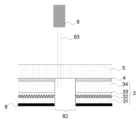
- FIG. 3 is a schematic cross-sectional view showing irradiation with laser light for removal in the first embodiment of the method for manufacturing a bonded light emitting device wafer of the present invention.
- FIG. 2 is a schematic plan view of the light emitting device structure after a defective portion of the light emitting device structure is removed in the first embodiment of the method for manufacturing a bonded light emitting device wafer of the present invention.
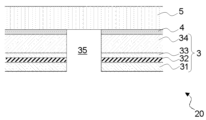
- FIG. 2 is a schematic cross-sectional view of a bonded light emitting device wafer obtained after removing a defective portion of the light emitting device structure in the first embodiment of the method for manufacturing a bonded light emitting device wafer of the present invention.
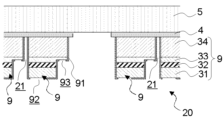
- FIG. 2 is a schematic cross-sectional view of a bonded light emitting device wafer after device separation processing in the first embodiment of the method for manufacturing a bonded light emitting device wafer of the present invention.
- the present inventors optically investigated defective parts of bonded wafers, created removal map data, and bonded wafers by laser light irradiation based on the created removal map data.
- the present invention has been completed based on the discovery that defective portions of light emitting device structures included in molded light emitting device wafers can be selectively removed.
- the present invention also provides a micro LED transfer method for transferring the micro LEDs from a bonded light emitting element wafer containing the micro LEDs to a transfer substrate, comprising: Producing a bonded light emitting device wafer including the light emitting device structure subjected to the device separation process by the method for manufacturing a bonded light emitting device wafer of the present invention,
- the method for transferring a micro LED is characterized in that the light emitting element structure serving as the micro LED is transferred from the bonded light emitting element wafer to the transfer substrate.
- FIG. 1 shows a schematic flowchart of the method for manufacturing a bonded light emitting device wafer of the present invention.
- the method for manufacturing a bonded light emitting device wafer of the present invention generally includes a step of obtaining a bonded wafer, a step of creating map data for removal, and a laser beam for removing a defective portion of the bonded wafer based on the map data for removal.
- the method includes a step of applying light and removing a portion of the light emitting device structure that is included in the defective portion to obtain a bonded light emitting device wafer.
- a 0.1 ⁇ m thick first conductivity type Ga x In 1-x P (0.4 ⁇ x ⁇ 0.6)
- a first etch stop layer and a second etch stop layer of GaAs of the first conductivity type having a thickness of 0.1 ⁇ m are sequentially grown to form an etch stop layer 2.
- a 1.0 ⁇ m thick layer of (Al y Ga 1-y ) x In 1-x P of the first conductivity type (0.4 ⁇ x ⁇ 0.
- An EPW (epitaxial wafer) 100 having a light emitting device structure 3 as an epitaxial functional layer in which a biconductive type GaP window layer 34 is sequentially grown is prepared.
- the portion from the first cladding layer 31 to the second cladding layer 33 is referred to as a DH structure. Further, the light emitting element structure 3 is processed into an element (
- each layer is not a single composition layer, but includes the concept of having multiple composition layers within the illustrated range of compositions.
- the concept includes the concept that the carrier concentration level is not uniform in each layer, but has a plurality of levels in each layer.
- the active layer 32 may be composed of a single composition, or even if it has a structure in which a plurality of barrier layers and active layers are alternately laminated, it goes without saying that both have similar functions. Needless to say, it is selectable.
- benzocyclobutene (BCB) 4 is spin coated as an adhesive (thermosetting bonding member) on the EPW 100, and the light emitting element structure 3 is attached to the sapphire wafer, which is the substrate 5 to be bonded, via the adhesive 4.
- the EPW bonded substrate 200 shown in FIG. 3 in which the light emitting element structure 3 of the EPW 100 and the sapphire wafer 5 are bonded via the BCB 4 is produced by stacking them facing each other and thermocompression bonding.
- the designed thickness of the BCB4 layer was 0.6 ⁇ m.
- the substrate 5 to be bonded is exemplified as sapphire, but the substrate 5 to be bonded is not limited to sapphire. It goes without saying that such materials can also be selected. In addition to sapphire, quartz can also be selected.
- the case where the BCB 4 is applied in a layered manner is exemplified, but it goes without saying that the adhesive 4 is not limited to the layered form. It goes without saying that similar results can be obtained by patterning photosensitive BCB into isolated islands, lines, or other shapes and performing the bonding process.
- the GaAs starting substrate 1 is removed by wet etching to expose the first etch stop layer, and then the etchant is switched to remove the second etch stop layer.
- the etch stop layer 2 is removed, the first cladding layer 31 is exposed, and as shown in FIG.
- a bonded wafer (EP bonded substrate) 10 bonded via 4 is fabricated.
- a BCB thickness of 0.6 ⁇ m is illustrated, but the thickness of the adhesive 4 is not limited to this thickness, and the same effect can be obtained even if it is thicker or thinner than this thickness. Needless to say.
- FIG. 5 shows a schematic plan view of an example of a bonded wafer obtained in the process of obtaining a bonded wafer of this embodiment.
- a bonded wafer 10 shown in FIG. 5 includes a light emitting element structure 3 bonded to a wafer 5 to be bonded via an adhesive (not shown).
- the wafer 5 to be bonded includes a light emitting element structure non-bonded region 51 to which the light emitting element structure 3 is not bonded, on its outer periphery.
- first map data regarding the defective part topology map data regarding the defective part, and second map data regarding the defective part are created, and these map data are used to create removal map data regarding the defective part. .
- First map data First, the entire region of the bonded wafer 10 is irradiated with a laser having a wavelength of 325 to 532 nm and a spot diameter of 100 ⁇ m at a pitch of 25 ⁇ m, photoluminescence (PL) spectra are collected, and first map data is created.
- the laser wavelength can be selected from any of the wavelengths listed above, but in this embodiment, a solid-state laser with an oscillation wavelength of 532 nm was used.
- the design wavelength of the EPW 100 is designed to be 632 nm, and the position within the range of 632 ⁇ 5 nm is set as a passing point, and the other wavelength range is set as a failing point. 1. Create map data.
- wavelength is exemplified as an inspection item for defective parts, but it goes without saying that the criterion is not limited to wavelength alone.
- stress is applied to the convex defective portion due to deformation, and cracks may occur in some cases. Since the half-width of the peak increases due to large stress and the PL strength decreases significantly due to the occurrence of cracks, the first map data may be created using the PL strength and half-width as criteria for judgment, or in addition. .
- Topology map data A laser beam having an oscillation wavelength of 532 nm is irradiated obliquely onto the surface of the bonded wafer 10 in FIG. 4 on the light emitting element structure 3 side.
- the laser is irradiated over the entire surface of the wafer at a pitch of 25 ⁇ m, and the deviation in the reflection angle is measured. Since the reflection angle shifts upward in the convex portion of the light emitting element structure 3, and shifts downward in the concave portion, topology data is collected from the shift in the reflection angle.
- the height tolerance as a threshold, create topology map data in which points within the tolerance are considered passing points, and other points are judged as failing points.
- the defective parts of the first map data, topology map data, and second map data obtained as described above are superimposed to create map data for removal. Although the positions of the three types of map meshes do not match, an area defined as a defective part in any one type of map is defined as a defective part, and map data for removal is created.
- a bonded light emitting device wafer by injecting a laser beam for removal into the defective portion of the bonded wafer based on the removal map data and removing the portion included in the defective portion of the light emitting device structure>
- a bonded light emitting device wafer is obtained by the procedure described below with reference to FIGS. 6 to 16.
- a protective material 6 is applied on the surface of the bonded wafer 10 from which the starting substrate has been removed.
- the protective material 6 Hogomax (trademark: SDS containing propylene glycol monomethyl ether/polyvinyl alcohol) manufactured by DISCO was applied by spin coating, but the material of the protective material 6 is limited to Hogomax. Any material can be selected as long as it has the function of a protective material and is easy to remove. Besides Hogomax, for example polyvinyl acetate and polyvinyl alcohol are also suitable.
- the bonded wafer 10 coated with the protective material 6 is introduced into the laser processing section.
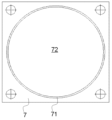
- the bonded wafer 10 is held by a bonded wafer receiving jig 7 as shown in FIG. 7, for example, and introduced into the laser processing section.
- the bonded wafer receiving jig 7 shown in FIG. 7 is provided with an opening region 72 in the center, and the periphery of the opening region 72 is a wafer receiving groove portion 71.
- the light emitting element structure 3 is positioned in the opening area 72, as shown in FIG.
- the bonded wafer 10 is introduced so that the surface coated with the protective material 6 faces down.
- the case where the coated side of the protective material 6 is facing down is illustrated, but it is not limited to the state where the protective material 6 is set facing down, and it is also possible to set the protective material 6 with the coated side facing the top or side. Needless to say.
- the coated surface of the protective material 6 is facing downward, the defective parts to be removed by sublimation of the BCB4 layer, which will be described later, will tend to fall to the bottom of the wafer due to gravity, so debris adhering to the coated surface of the protective material 6 will be removed. This is preferable because it can reduce the amount of
- the method of introduction is not limited to the downward direction.
- the light emitting element structure 3 is not bonded to a width of about 1 to 2 mm at the outer circumference of the bonded wafer 10, and the substrate to be bonded (sapphire substrate) 5 or the adhesive 4 is exposed. There is an element structure non-bonding region 51.
- a removal laser is irradiated from the bonded substrate (sapphire substrate) 5 side of the bonded wafer 10 to the region defined as a defective portion based on the removal map data obtained previously.
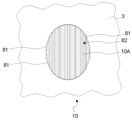
- FIG. 9 shows part of an example of removal map data.
- the removal map data shown in FIG. 9 mainly shows the defective part 10A of the bonded wafer 10.
- the defective portion 10A includes a defective portion of the light emitting element structure 3.
- the removal laser beam 83 is incident from the side of the substrate 5 to be bonded, and the removal laser beam 83 is absorbed by the portion of the BCB (adhesive) 4 that was included in the defective part 10A of the bonded wafer 10.
- the portion included in the defective portion 10A sublimates and becomes a gas that breaks the light emitting element structure 3, and the adhesive force of the defective portion of the light emitting element structure 3 to the substrate 5 due to the BCB 4 decreases.
- a KrF excimer laser with a wavelength of 248 nm was used as the laser beam 83 for removal, but it is not limited to this wavelength. Any laser beam can be selected as long as it is absorbed by the laser beam.
- a laser beam (ultraviolet light) having a wavelength of 170 nm or more and 360 nm or less can be used as the removal laser beam 83.
- the bonded wafer 10 is taken out from the laser processing section, and the protective material 6 is removed by cleaning with pure water with the surface coated with the protective material 6 facing upward.
- a bonded light emitting device wafer 20 is obtained, as shown in FIG. be able to.
- the wafer 20 before the protective material 6 is removed can also be called a bonded light emitting device wafer.
- the light emitting element structure 3 is a structure that becomes a micro LED, and can be subjected to element isolation processing as shown below, for example. An example of processing will be described below.
- a mask pattern is formed on the light emitting element structure 3 by photolithography, and element separation processing is performed on the light emitting element structure 3 by ICP.
- the light emitting element structure 3 becomes elements 9 separated by the separation grooves 21 (light emitting element structures subjected to element isolation processing, that is, dice) 9, as shown in FIG.
- Gases used for ICP are, for example, chlorine and argon.
- the ICP processing is performed twice, for example, a step of exposing the layer of BCB4 and a step of exposing a part of the main surface of the second cladding layer 33.
- electrodes 94 and 95 are formed in contact with the first conductivity type layer or the second conductivity type layer, respectively, and heat treatment is performed to form an ohmic contact.
- the first conductivity type is N type
- the second conductivity type is P type
- the N type electrode 94 that contacts the first cladding layer 31, which is the N type layer, through the opening 92 is made of Au and Si.
- a metal containing Au and Be was used for the P-type electrode 95 that contacts the second cladding layer 33, which is a P-type layer, through the opening 93.
- BCB is used as the adhesive 4, but the material of the adhesive 4 used in the present invention is not limited to BCB as long as it absorbs the removal laser beam 83.
- the material of the adhesive 4 used in the present invention is not limited to BCB as long as it absorbs the removal laser beam 83.
- the adhesive 4 has a light absorption edge in a wavelength range of 170 nm or more and 360 nm or less, Sublimation can be easily performed using the removal laser beam 83 having a wavelength of 170 nm or more and 360 nm or less that can pass through the substrate 5 .
- a protective material is applied to the surface of the device obtained by separating the light emitting device structure of the bonded wafer. Then, in the same procedure as in the first embodiment, a laser is irradiated from the sapphire substrate side to remove the defective portion. Thereafter, similarly to the first embodiment, the protective material is washed with water and removed. Thereby, it is possible to obtain a bonded light emitting element wafer in which the light emitting element structure (element) from which the defective portion has been removed and the substrate to be bonded are bonded via an adhesive.
- an EPW 100 having the EPW structure shown in FIG. 2 was obtained using the same procedure as described above.
- map data for removal was created using the following steps.
- a laser with a wavelength of 532 nm and a spot diameter of 100 um was irradiated onto the entire region of the bonded wafer 10 at a pitch of 25 ⁇ m, PL spectra were collected, and map data was created.
- the design wavelength of the EPW was designed to be 632 nm, and the first map data was created with positions within the range of 632 ⁇ 5 nm as passing points and other wavelength ranges as failing points.
- topology map data in which points within the tolerance are considered passing points, and other points are judged as failing points.
- the bonded wafer 10 was photographed from the sapphire substrate 5 side with a CCD camera, and second map data was created in which pass/fail was determined based on the contrast difference using a 25 ⁇ m pitch mesh.
- a protective material 6 was applied by spin coating with Hogomax (trademark) manufactured by DISCO, as shown in FIG.
- the bonded wafer 10 coated with the protective material 6 is held by the bonded wafer receiving jig 7 shown in FIG. 7 as shown in FIG. 8, and introduced into the laser processing section with the surface coated with the protective material 6 facing downward. did. At this time, as shown in FIG. 8, the wafer was held so that the wafer receiving groove 71 of the jig 7 covered the light emitting element structure non-bonding region 51 where the sapphire substrate 5 was exposed.
- the wavelength is applied only to the area defined as the defective part 10A (and a slight protruding part that can be said to be a defective part) according to the removal map data.
- the defective portion was removed by irradiation with a 248 nm KrF excimer laser.
- the wafer was taken out from the laser processing section, and the protective material 6 was removed as shown in FIG. 13 by cleaning with pure water with the surface coated with the protective material 6 facing upward.
- a mask pattern was formed on the light emitting element structure 30 by photolithography, and element separation was performed by ICP using chlorine and argon gas.
- the ICP processing was performed twice: a step of exposing the BCB layer 4 and a step of exposing a part of the main surface of the second cladding layer 33.
- the light emitting element structure 30 was made into elements 9 separated by the isolation grooves 21 (light emitting element structure subjected to element isolation processing), as shown in FIG.
- the process of obtaining the bonded wafer 10 was the same as in the first example, and the element separation process and the electrode forming process were performed in the same manner as in the second example.
- map data creation and removal were not performed, so the defective portion of the light emitting element structure was maintained as it was.
- the removal rate slightly exceeded 100% because cracks sometimes appeared in the parts.
- the defective parts were removed in the die state, so even when the BCB sublimates and breaks the light emitting element structure, there is a separation groove between the dice, so the impact does not propagate to the adjacent good parts.
- the removal rate was 100%. In the case of the comparative example, the removal rate was 0% because it was not removed.
- the values in parentheses are the variations among the 10 sheets, and the values outside the parentheses are the average values.
- the mounting die yield (number of dice effective as a device/number of dice that can be obtained from one piece) ) was over 90% on average.
- stress concentration on the defective convex portion occurred during the process of pressing the die against the transfer substrate during transfer, and only the defective die was removed. Not only that, the surrounding dice also suffered damage such as cracks and chips. For this reason, the yield was significantly lower than in the embodiment in which almost only the convex defective areas could be removed.
- the final mounting yield is improved in the first and second embodiments in which the defective part is removed by LLO before the die is transferred to the transfer board and then the mounting process is started. be able to.
- a micro-LED transfer method for transferring the micro-LEDs from a bonded-type light-emitting device wafer containing micro-LEDs to a transfer substrate comprising: A bonded light emitting device wafer including the light emitting device structure subjected to the element separation process is manufactured by the manufacturing method, and the light emitting device structure as the micro LED is transferred from the bonded light emitting device wafer to the transfer substrate.
Landscapes
- Led Devices (AREA)
Priority Applications (4)
| Application Number | Priority Date | Filing Date | Title |
|---|---|---|---|
| US18/865,613 US20250316541A1 (en) | 2022-06-15 | 2023-05-08 | Method for producing bonded light-emitting device wafer and method for transferring micro led |
| CN202380044584.XA CN119325643A (zh) | 2022-06-15 | 2023-05-08 | 接合型发光元件晶圆的制造方法及微led的移载方法 |
| EP23823558.4A EP4542632A1 (en) | 2022-06-15 | 2023-05-08 | Method for producing bonded light-emitting element wafer and method for transferring micro-led |
| JP2024528371A JP7740548B2 (ja) | 2022-06-15 | 2023-05-08 | 接合型発光素子ウェーハの製造方法およびマイクロledの移載方法 |
Applications Claiming Priority (2)
| Application Number | Priority Date | Filing Date | Title |
|---|---|---|---|
| JP2022-096574 | 2022-06-15 | ||
| JP2022096574 | 2022-06-15 |
Publications (1)
| Publication Number | Publication Date |
|---|---|
| WO2023243255A1 true WO2023243255A1 (ja) | 2023-12-21 |
Family
ID=89191002
Family Applications (1)
| Application Number | Title | Priority Date | Filing Date |
|---|---|---|---|
| PCT/JP2023/017250 Ceased WO2023243255A1 (ja) | 2022-06-15 | 2023-05-08 | 接合型発光素子ウェーハの製造方法およびマイクロledの移載方法 |
Country Status (6)
| Country | Link |
|---|---|
| US (1) | US20250316541A1 (https=) |
| EP (1) | EP4542632A1 (https=) |
| JP (1) | JP7740548B2 (https=) |
| CN (1) | CN119325643A (https=) |
| TW (1) | TW202414510A (https=) |
| WO (1) | WO2023243255A1 (https=) |
Citations (10)
| Publication number | Priority date | Publication date | Assignee | Title |
|---|---|---|---|---|
| JPH118438A (ja) * | 1997-06-16 | 1999-01-12 | Furukawa Electric Co Ltd:The | 半導体レーザ装置の製造方法 |
| JP2004119243A (ja) | 2002-09-27 | 2004-04-15 | Dainippon Printing Co Ltd | 有機エレクトロルミネッセント素子の欠陥除去方法 |
| JP2008527719A (ja) | 2005-01-11 | 2008-07-24 | セミエルイーディーズ コーポレーション | 発光ダイオードアレイを製造するためのシステム及び方法 |
| JP2009021572A (ja) | 2007-06-12 | 2009-01-29 | Shin Etsu Handotai Co Ltd | 欠陥検出方法及び欠陥検出システム並びに発光素子の製造方法 |
| WO2010092749A1 (ja) | 2009-02-10 | 2010-08-19 | パナソニック株式会社 | 有機elディスプレイおよびその製造方法 |
| JP2016502265A (ja) * | 2012-11-12 | 2016-01-21 | 晶元光▲電▼股▲ふん▼有限公司 | 半導体発光素子及びその製造方法 |
| JP2018163900A (ja) | 2017-03-24 | 2018-10-18 | 東レエンジニアリング株式会社 | ピックアップ方法、ピックアップ装置、及び実装装置 |
| JP2020129658A (ja) | 2019-02-11 | 2020-08-27 | エスティーアイ カンパニー リミテッド | 不良led除去装置 |
| JP2021019162A (ja) | 2019-07-23 | 2021-02-15 | 株式会社ディスコ | 光デバイスの移設方法 |
| JP2021158159A (ja) * | 2020-03-25 | 2021-10-07 | 信越半導体株式会社 | 接合ウェーハの製造方法及び接合ウェーハ |
-
2023
- 2023-05-08 WO PCT/JP2023/017250 patent/WO2023243255A1/ja not_active Ceased
- 2023-05-08 US US18/865,613 patent/US20250316541A1/en active Pending
- 2023-05-08 CN CN202380044584.XA patent/CN119325643A/zh active Pending
- 2023-05-08 JP JP2024528371A patent/JP7740548B2/ja active Active
- 2023-05-08 EP EP23823558.4A patent/EP4542632A1/en active Pending
- 2023-05-22 TW TW112118864A patent/TW202414510A/zh unknown
Patent Citations (10)
| Publication number | Priority date | Publication date | Assignee | Title |
|---|---|---|---|---|
| JPH118438A (ja) * | 1997-06-16 | 1999-01-12 | Furukawa Electric Co Ltd:The | 半導体レーザ装置の製造方法 |
| JP2004119243A (ja) | 2002-09-27 | 2004-04-15 | Dainippon Printing Co Ltd | 有機エレクトロルミネッセント素子の欠陥除去方法 |
| JP2008527719A (ja) | 2005-01-11 | 2008-07-24 | セミエルイーディーズ コーポレーション | 発光ダイオードアレイを製造するためのシステム及び方法 |
| JP2009021572A (ja) | 2007-06-12 | 2009-01-29 | Shin Etsu Handotai Co Ltd | 欠陥検出方法及び欠陥検出システム並びに発光素子の製造方法 |
| WO2010092749A1 (ja) | 2009-02-10 | 2010-08-19 | パナソニック株式会社 | 有機elディスプレイおよびその製造方法 |
| JP2016502265A (ja) * | 2012-11-12 | 2016-01-21 | 晶元光▲電▼股▲ふん▼有限公司 | 半導体発光素子及びその製造方法 |
| JP2018163900A (ja) | 2017-03-24 | 2018-10-18 | 東レエンジニアリング株式会社 | ピックアップ方法、ピックアップ装置、及び実装装置 |
| JP2020129658A (ja) | 2019-02-11 | 2020-08-27 | エスティーアイ カンパニー リミテッド | 不良led除去装置 |
| JP2021019162A (ja) | 2019-07-23 | 2021-02-15 | 株式会社ディスコ | 光デバイスの移設方法 |
| JP2021158159A (ja) * | 2020-03-25 | 2021-10-07 | 信越半導体株式会社 | 接合ウェーハの製造方法及び接合ウェーハ |
Also Published As
| Publication number | Publication date |
|---|---|
| JP7740548B2 (ja) | 2025-09-17 |
| US20250316541A1 (en) | 2025-10-09 |
| CN119325643A (zh) | 2025-01-17 |
| JPWO2023243255A1 (https=) | 2023-12-21 |
| EP4542632A1 (en) | 2025-04-23 |
| TW202414510A (zh) | 2024-04-01 |
Similar Documents
| Publication | Publication Date | Title |
|---|---|---|
| EP2063469B1 (en) | Method of manufacturing vertical light emitting diode | |
| WO2024004680A1 (ja) | 接合型発光素子ウェーハ及びその製造方法 | |
| KR100451950B1 (ko) | 이미지 센서 소자 웨이퍼 소잉 방법 | |
| KR100579028B1 (ko) | 반도체 소자 및 그 제조 방법 | |
| US7494900B2 (en) | Back side wafer dicing | |
| US20080280421A1 (en) | Wafer dividing method | |
| JP2004031526A (ja) | 3族窒化物系化合物半導体素子の製造方法 | |
| CN108767081B (zh) | 倒装发光二极管及其制作方法 | |
| JP4427993B2 (ja) | 半導体発光素子の製造方法 | |
| CN111180391B (zh) | 剥离方法 | |
| US8759195B2 (en) | Optical device wafer processing method | |
| WO2023243255A1 (ja) | 接合型発光素子ウェーハの製造方法およびマイクロledの移載方法 | |
| JP7746957B2 (ja) | 接合型発光素子ウェーハの製造方法 | |
| JP2002314123A (ja) | 素子の転写方法及びこれを用いた素子の配列方法、画像表示装置の製造方法 | |
| JP2011192708A (ja) | 半導体発光素子および半導体発光素子の製造方法 | |
| JPH0288261A (ja) | Ledアレイの収率を改善する方法 | |
| JP2005286098A (ja) | Iii族窒化物系化合物半導体素子のおよびその製造方法 | |
| WO2015140849A1 (ja) | 紫外線発光素子の製造方法、紫外線発光素子 | |
| TW202414515A (zh) | 微型led用接合型晶圓的製造方法 | |
| FR3104809A1 (fr) | Procede de realisation d’une couche de materiau structuree | |
| JP7138297B2 (ja) | 素子チップの製造方法 | |
| JPWO2023243255A5 (https=) | ||
| JP2025119698A (ja) | 半導体素子及びその製造方法 | |
| JP4126913B2 (ja) | 半導体発光素子、画像表示装置、照明装置及びこれらの製造方法 | |
| KR20240002926A (ko) | 디바이스 웨이퍼의 가공 방법 |
Legal Events
| Date | Code | Title | Description |
|---|---|---|---|
| 121 | Ep: the epo has been informed by wipo that ep was designated in this application |
Ref document number: 23823558 Country of ref document: EP Kind code of ref document: A1 |
|
| WWE | Wipo information: entry into national phase |
Ref document number: 2024528371 Country of ref document: JP |
|
| WWE | Wipo information: entry into national phase |
Ref document number: 18865613 Country of ref document: US |
|
| WWE | Wipo information: entry into national phase |
Ref document number: 202380044584.X Country of ref document: CN |
|
| WWE | Wipo information: entry into national phase |
Ref document number: 2023823558 Country of ref document: EP |
|
| NENP | Non-entry into the national phase |
Ref country code: DE |
|
| WWP | Wipo information: published in national office |
Ref document number: 202380044584.X Country of ref document: CN |
|
| ENP | Entry into the national phase |
Ref document number: 2023823558 Country of ref document: EP Effective date: 20250115 |
|
| WWP | Wipo information: published in national office |
Ref document number: 2023823558 Country of ref document: EP |
|
| WWP | Wipo information: published in national office |
Ref document number: 18865613 Country of ref document: US |