WO2023190239A1 - 二次電池用負極材料および二次電池 - Google Patents
二次電池用負極材料および二次電池 Download PDFInfo
- Publication number
- WO2023190239A1 WO2023190239A1 PCT/JP2023/011987 JP2023011987W WO2023190239A1 WO 2023190239 A1 WO2023190239 A1 WO 2023190239A1 JP 2023011987 W JP2023011987 W JP 2023011987W WO 2023190239 A1 WO2023190239 A1 WO 2023190239A1
- Authority
- WO
- WIPO (PCT)
- Prior art keywords
- silicon
- negative electrode
- phase
- lithium
- secondary battery
- Prior art date
- Legal status (The legal status is an assumption and is not a legal conclusion. Google has not performed a legal analysis and makes no representation as to the accuracy of the status listed.)
- Ceased
Links
Images

Classifications
-
- H—ELECTRICITY
- H01—ELECTRIC ELEMENTS
- H01M—PROCESSES OR MEANS, e.g. BATTERIES, FOR THE DIRECT CONVERSION OF CHEMICAL ENERGY INTO ELECTRICAL ENERGY
- H01M4/00—Electrodes
- H01M4/02—Electrodes composed of, or comprising, active material
- H01M4/36—Selection of substances as active materials, active masses, active liquids
- H01M4/362—Composites
- H01M4/366—Composites as layered products
-
- H—ELECTRICITY
- H01—ELECTRIC ELEMENTS
- H01M—PROCESSES OR MEANS, e.g. BATTERIES, FOR THE DIRECT CONVERSION OF CHEMICAL ENERGY INTO ELECTRICAL ENERGY
- H01M10/00—Secondary cells; Manufacture thereof
- H01M10/05—Accumulators with non-aqueous electrolyte
- H01M10/052—Li-accumulators
- H01M10/0525—Rocking-chair batteries, i.e. batteries with lithium insertion or intercalation in both electrodes; Lithium-ion batteries
-
- H—ELECTRICITY
- H01—ELECTRIC ELEMENTS
- H01M—PROCESSES OR MEANS, e.g. BATTERIES, FOR THE DIRECT CONVERSION OF CHEMICAL ENERGY INTO ELECTRICAL ENERGY
- H01M10/00—Secondary cells; Manufacture thereof
- H01M10/42—Methods or arrangements for servicing or maintenance of secondary cells or secondary half-cells
- H01M10/4235—Safety or regulating additives or arrangements in electrodes, separators or electrolyte
-
- H—ELECTRICITY
- H01—ELECTRIC ELEMENTS
- H01M—PROCESSES OR MEANS, e.g. BATTERIES, FOR THE DIRECT CONVERSION OF CHEMICAL ENERGY INTO ELECTRICAL ENERGY
- H01M4/00—Electrodes
- H01M4/02—Electrodes composed of, or comprising, active material
- H01M4/13—Electrodes for accumulators with non-aqueous electrolyte, e.g. for lithium-accumulators; Processes of manufacture thereof
- H01M4/134—Electrodes based on metals, Si or alloys
-
- H—ELECTRICITY
- H01—ELECTRIC ELEMENTS
- H01M—PROCESSES OR MEANS, e.g. BATTERIES, FOR THE DIRECT CONVERSION OF CHEMICAL ENERGY INTO ELECTRICAL ENERGY
- H01M4/00—Electrodes
- H01M4/02—Electrodes composed of, or comprising, active material
- H01M4/36—Selection of substances as active materials, active masses, active liquids
- H01M4/38—Selection of substances as active materials, active masses, active liquids of elements or alloys
- H01M4/386—Silicon or alloys based on silicon
-
- H—ELECTRICITY
- H01—ELECTRIC ELEMENTS
- H01M—PROCESSES OR MEANS, e.g. BATTERIES, FOR THE DIRECT CONVERSION OF CHEMICAL ENERGY INTO ELECTRICAL ENERGY
- H01M4/00—Electrodes
- H01M4/02—Electrodes composed of, or comprising, active material
- H01M4/36—Selection of substances as active materials, active masses, active liquids
- H01M4/58—Selection of substances as active materials, active masses, active liquids of inorganic compounds other than oxides or hydroxides, e.g. sulfides, selenides, tellurides, halogenides or LiCoFy; of polyanionic structures, e.g. phosphates, silicates or borates
- H01M4/5825—Oxygenated metallic salts or polyanionic structures, e.g. borates, phosphates, silicates, olivines
-
- H—ELECTRICITY
- H01—ELECTRIC ELEMENTS
- H01M—PROCESSES OR MEANS, e.g. BATTERIES, FOR THE DIRECT CONVERSION OF CHEMICAL ENERGY INTO ELECTRICAL ENERGY
- H01M4/00—Electrodes
- H01M4/02—Electrodes composed of, or comprising, active material
- H01M4/62—Selection of inactive substances as ingredients for active masses, e.g. binders, fillers
-
- H—ELECTRICITY
- H01—ELECTRIC ELEMENTS
- H01M—PROCESSES OR MEANS, e.g. BATTERIES, FOR THE DIRECT CONVERSION OF CHEMICAL ENERGY INTO ELECTRICAL ENERGY
- H01M4/00—Electrodes
- H01M4/02—Electrodes composed of, or comprising, active material
- H01M4/62—Selection of inactive substances as ingredients for active masses, e.g. binders, fillers
- H01M4/621—Binders
- H01M4/622—Binders being polymers
- H01M4/623—Binders being polymers fluorinated polymers
-
- H—ELECTRICITY
- H01—ELECTRIC ELEMENTS
- H01M—PROCESSES OR MEANS, e.g. BATTERIES, FOR THE DIRECT CONVERSION OF CHEMICAL ENERGY INTO ELECTRICAL ENERGY
- H01M4/00—Electrodes
- H01M4/02—Electrodes composed of, or comprising, active material
- H01M4/62—Selection of inactive substances as ingredients for active masses, e.g. binders, fillers
- H01M4/624—Electric conductive fillers
- H01M4/625—Carbon or graphite
-
- H—ELECTRICITY
- H01—ELECTRIC ELEMENTS
- H01M—PROCESSES OR MEANS, e.g. BATTERIES, FOR THE DIRECT CONVERSION OF CHEMICAL ENERGY INTO ELECTRICAL ENERGY
- H01M4/00—Electrodes
- H01M4/02—Electrodes composed of, or comprising, active material
- H01M4/62—Selection of inactive substances as ingredients for active masses, e.g. binders, fillers
- H01M4/628—Inhibitors, e.g. gassing inhibitors, corrosion inhibitors
-
- H—ELECTRICITY
- H01—ELECTRIC ELEMENTS
- H01M—PROCESSES OR MEANS, e.g. BATTERIES, FOR THE DIRECT CONVERSION OF CHEMICAL ENERGY INTO ELECTRICAL ENERGY
- H01M4/00—Electrodes
- H01M4/02—Electrodes composed of, or comprising, active material
- H01M2004/026—Electrodes composed of, or comprising, active material characterised by the polarity
- H01M2004/027—Negative electrodes
-
- H—ELECTRICITY
- H01—ELECTRIC ELEMENTS
- H01M—PROCESSES OR MEANS, e.g. BATTERIES, FOR THE DIRECT CONVERSION OF CHEMICAL ENERGY INTO ELECTRICAL ENERGY
- H01M2300/00—Electrolytes
- H01M2300/0017—Non-aqueous electrolytes
- H01M2300/002—Inorganic electrolyte
-
- H—ELECTRICITY
- H01—ELECTRIC ELEMENTS
- H01M—PROCESSES OR MEANS, e.g. BATTERIES, FOR THE DIRECT CONVERSION OF CHEMICAL ENERGY INTO ELECTRICAL ENERGY
- H01M4/00—Electrodes
- H01M4/02—Electrodes composed of, or comprising, active material
- H01M4/04—Processes of manufacture in general
- H01M4/0402—Methods of deposition of the material
- H01M4/0404—Methods of deposition of the material by coating on electrode collectors
-
- Y—GENERAL TAGGING OF NEW TECHNOLOGICAL DEVELOPMENTS; GENERAL TAGGING OF CROSS-SECTIONAL TECHNOLOGIES SPANNING OVER SEVERAL SECTIONS OF THE IPC; TECHNICAL SUBJECTS COVERED BY FORMER USPC CROSS-REFERENCE ART COLLECTIONS [XRACs] AND DIGESTS
- Y02—TECHNOLOGIES OR APPLICATIONS FOR MITIGATION OR ADAPTATION AGAINST CLIMATE CHANGE
- Y02E—REDUCTION OF GREENHOUSE GAS [GHG] EMISSIONS, RELATED TO ENERGY GENERATION, TRANSMISSION OR DISTRIBUTION
- Y02E60/00—Enabling technologies; Technologies with a potential or indirect contribution to GHG emissions mitigation
- Y02E60/10—Energy storage using batteries
Definitions
- the present disclosure relates to a negative electrode material for a secondary battery and a secondary battery.
- Non-aqueous electrolyte secondary batteries typified by lithium ion secondary batteries, are used as power sources for electronic devices such as mobile terminals, power sources for vehicles such as electric cars, etc.
- Graphite is generally used as a negative electrode active material for non-aqueous electrolyte secondary batteries.
- negative electrode active materials with higher capacity density (capacity per unit mass) than graphite has been considered for non-aqueous electrolyte secondary batteries.
- a negative electrode active material for example, composite particles comprising a silicate phase and a silicon phase dispersed within the silicate phase have been studied.
- Patent Document 1 discloses a silicate phase containing Li, Si, and M x (an alkali metal, an alkaline earth metal, and an element other than Si), silicon particles dispersed in the silicate phase , and the silicate phase.
- metal particles whose main component is one or more metals or alloys selected from Fe, Cr, Ni, Mn, Cu, Mo, Zn, and Al dispersed in the silicate phase;
- the content of each element relative to the total of the elements is 3 to 45 mol% for Li, 40 to 78 mol% for Si, and 1 to 40 mol% for M x . Proposed.
- Patent Document 2 discloses a silicate phase containing Li, Si, and M x (an alkali metal, an alkaline earth metal, and an element other than Si), silicon particles dispersed in the silicate phase , and the silicate phase.
- a negative electrode active material for a secondary battery has been proposed in which Si is 40 to 78 mol % and M x is 1 to 40 mol %.
- the silicate phase of the composite particles tends to be gradually eroded due to side reactions in batteries containing non-aqueous electrolytes. This erosion causes the composite particles to deteriorate and the cycle characteristics of the battery to deteriorate.
- Patent Documents 1 and 2 can suppress the destruction of particles due to expansion and contraction of silicon during charging and discharging to some extent, suppression of side reactions is still insufficient.
- one aspect of the present disclosure includes silicon-containing particles and a coating layer that covers at least a portion of the surface of the silicon-containing particles, and the silicon-containing particles include an ion-conducting phase and an ion-conducting phase.
- the present invention relates to a negative electrode material for a secondary battery, the coating layer comprising a lithium sulfonate compound and a hydrophobic polymer compound.
- Another aspect of the present disclosure includes silicon-containing particles and a coating layer covering at least a portion of the surface of the silicon-containing particles, wherein the silicon-containing particles include an ion-conducting phase and a dispersion within the ion-conducting phase.
- the present invention relates to a negative electrode material for a secondary battery, wherein the coating layer includes a lithium sulfonate compound and a water-insoluble polymer compound.
- Yet another aspect of the present disclosure relates to a secondary battery including a positive electrode, a negative electrode, and a nonaqueous electrolyte, the negative electrode containing the above negative electrode material for a secondary battery.
- deterioration in cycle characteristics of a secondary battery including a negative electrode containing silicon-containing particles can be suppressed.
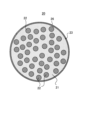
- FIG. 1 is a cross-sectional view schematically showing a negative electrode material for a secondary battery according to an embodiment of the present disclosure.
- FIG. 1 is a partially cutaway schematic perspective view of a secondary battery according to an embodiment of the present disclosure.
- a negative electrode material for a secondary battery includes silicon-containing particles and a coating layer that covers at least a portion of the surface of the silicon-containing particles.
- the silicon-containing particles include an ion-conducting phase and a silicon phase dispersed within the ion-conducting phase.
- the coating layer includes a lithium sulfonate compound and a hydrophobic polymer compound.
- the coating layer is a mixed layer of a lithium sulfonate compound and a hydrophobic polymer compound.
- silicon-containing particles are also referred to as "composite particles.”
- the ion conductive phase may include, for example, at least one selected from the group consisting of a silicate phase, a silicon oxide phase, and a carbon phase.
- a silicate phase and the silicon oxide phase will also be referred to as a "silicon compound phase.”
- Composite particles in which a silicon phase is dispersed within a silicate phase are also referred to as “silicate phase-containing composite particles.”
- Composite particles in which a silicon phase is dispersed within a silicon oxide phase are also referred to as “silicon oxide phase-containing composite particles.”
- Composite particles in which a silicon phase is dispersed within a carbon phase are also referred to as "carbon phase-containing composite particles.”
- the composite particles By coating the surface of the composite particles (ion-conducting phase) with a sulfonate lithium compound, the composite particles are protected from the non-aqueous electrolyte, suppressing side reactions with the non-aqueous electrolyte, and thereby preventing erosion of the ion-conducting phase. suppressed. Deterioration in cycle characteristics of the secondary battery due to deterioration of the composite particles due to the corrosion is suppressed.
- the retention of the lithium sulfonate compound on the surface of the composite particle is improved, and the surface of the composite particle is effectively coated with the lithium sulfonate compound.
- the effect of inhibiting erosion of the ion conductive phase by the lithium sulfonate compound can be significantly obtained.
- the negative electrode is produced by, for example, preparing a slurry containing a negative electrode material and water, applying the slurry to a negative electrode current collector, drying it, and rolling it as necessary to form a negative electrode mixture layer.
- Ru The presence of the hydrophobic polymer compound on the surface of the negative electrode material suppresses dissolution of the lithium sulfonate compound in water during slurry preparation.
- the hydrophobic polymer compound is preferably a material that has both excellent binding properties and hydrophobicity.
- a slurry is prepared by adding a lithium sulfonate compound, a hydrophobic polymer compound, and water to composite particles, the lithium sulfonate compound will dissolve in water, making it difficult to efficiently support the lithium sulfonate compound on the surface of the composite particles. .
- a sulfonic acid lithium compound is a lithium salt of a sulfonic acid compound.
- a sulfonic acid compound is an organic compound having a sulfonic acid group (SO 3 H).
- the sulfonic acid compound may be a monosulfonic acid compound or a disulfonic acid compound.
- the lithium sulfonate compound is preferably a compound represented by the following general formula (1).
- R is an n-valent aliphatic hydrocarbon group having 1 to 5 carbon atoms, and n is 1 or 2.
- the lithium sulfonate compound more preferably contains at least one selected from the group consisting of lithium methanesulfonate, lithium ethanesulfonate, and lithium propanesulfonate, and particularly preferably contains lithium methanesulfonate. .
- the amount of the sulfonate lithium compound covering the surface of the composite particle (hereinafter also referred to as the supported amount of the sulfonate lithium compound) may be 1 part by mass or more with respect to 100 parts by mass of the composite particle, and may be 1 part by mass or more.
- the amount may be 1 part or more and 6 parts by mass or less, or 2 parts or more and 6 parts by mass.
- the supported amount of the lithium sulfonate compound is 1 part by mass or more, the surface of the composite particles can be sufficiently coated with the lithium sulfonate compound, and the effect of suppressing side reactions caused by the lithium sulfonate compound can be easily obtained.
- the supported amount of the lithium sulfonate compound is 6 parts by mass or less, it is easy to obtain a negative electrode material (coating layer) with low resistance.
- the lithium sulfonate compound can be supported on the surface of the composite particles in an amount within the above range.
- hydrophobic polymer compound It is desirable that the hydrophobic polymer compound has good binding and heat melting properties. In this case, the lithium sulfonate compound can be firmly supported on the surface of the composite particles by the hydrophobic polymer compound, and the effect of suppressing side reactions by the lithium sulfonate compound can be stably obtained. Hydrophobic polymer compounds are poorly soluble in water.
- the hydrophobic polymer compound preferably contains a fluororesin.
- Fluororesins include polyvinylidene fluoride (PVDF), polytetrafluoroethylene, tetrafluoroethylene-perfluoroalkyl vinyl ether copolymer, tetrafluoroethylene-hexafluoropropylene copolymer, tetrafluoroethylene-ethylene copolymer, and chlorotrifluoride. It is preferable that at least one member selected from the group consisting of fluoroethylene-ethylene copolymer and polychlorotrifluoroethylene is included. Among them, PVDF is more preferable. In the case of PVDF, it has good binding properties, a low melting point, and can form a coating layer at a low heat treatment temperature.
- the hydrophobic polymer compound may include a polymer containing vinylidene fluoride units in addition to polyvinylidene fluoride.
- polymers containing vinylidene fluoride units include copolymers of vinylidene fluoride and other monomers. Examples of other monomers include hexafluoropropylene (HFP) and tetrafluoroethylene (TFE).
- HFP hexafluoropropylene
- TFE tetrafluoroethylene
- polymers containing vinylidene fluoride units include polyvinylidene fluoride and modified products thereof, vinylidene fluoride-hexafluoropropylene copolymers, vinylidene fluoride-chlorotrifluoroethylene copolymers, and the like.
- the content of vinylidene fluoride units is, for example, 30 mol% or more, and may be 50 mol% or more.
- the amount of the hydrophobic polymer compound covering the surface of the composite particle may be 1 part by mass or more with respect to 100 parts by mass of the composite particle, and 1 part by mass The amount may be 1 part or more and 6 parts by mass or less, or 2 parts or more and 6 parts by mass.
- the supported amount of the hydrophobic polymer compound is 1 part by mass or more, the effect of improving the retention of the lithium sulfonate compound on the surface of the composite particle by the hydrophobic polymer compound can be sufficiently obtained.
- the amount of the hydrophobic polymer compound supported is 6 parts by mass or less, a negative electrode material (coating layer) with low resistance can be easily obtained.
- the amount of the lithium sulfonate compound and fluororesin supported is determined by the following method.
- the negative electrode material is washed with N-methyl-2-pyrrolidone (NMP), the fluororesin is dissolved, and the difference in mass of NMP before and after dissolution is determined as the mass of the fluororesin. Thereafter, the residue not dissolved in NMP is washed with water to dissolve the lithium sulfonate compound. The mass of the lithium sulfonate compound dissolved in water is determined by quantitative analysis such as ICP emission spectroscopy.
- NMP N-methyl-2-pyrrolidone
- the remaining mass that does not dissolve in water and NMP is determined as the mass of the silicon compound phase-containing composite particles.
- the negative electrode material includes silicon compound phase-containing composite particles having a conductive layer
- quantitative analysis of carbon is performed using a carbon-sulfur analyzer or the like for the remainder that does not dissolve in water and NMP.
- the amount of carbon required is derived from the carbon material of the conductive layer.
- the mass of the silicon compound phase-containing composite particles is determined by subtracting the mass of carbon determined by analysis from the remaining mass that does not dissolve in water and NMP.
- the amount of supported fluororesin is determined by (mass of fluororesin/mass of composite particles) x 100.
- the amount of the lithium sulfonate compound supported is determined by (mass of the lithium sulfonate compound/mass of the composite particle) x 100.
- the thickness of the coating layer is preferably so thin that it does not substantially affect the average particle size of the composite particles.
- the thickness of the coating layer is preferably 1 nm or more.
- the thickness of the coating layer is preferably 300 nm or less.
- the thickness of the covering layer may be smaller than the thickness of the conductive layer described below.
- the thickness of the coating layer can be measured by observing the cross section of the composite particle using an electron microscope. A scanning electron microscope (SEM) or a TEM (transmission electron microscope) is used as the electron microscope.
- a conductive layer containing a conductive carbon material may be interposed between the composite particles and the coating layer. That is, the coating layer may be formed to cover the conductive layer on the surface of the composite particle.
- the thickness of the conductive layer is preferably so thin that it does not substantially affect the average particle size of the composite particles. From the viewpoint of ensuring conductivity, the thickness of the conductive layer is preferably 1 nm or more. From the viewpoint of suppressing an increase in resistance, the total thickness of the coating layer and the conductive layer is preferably 300 nm or less. The thickness of the conductive layer can be measured in the same manner as for the covering layer.
- the conductive layer is formed by mixing the raw material of the conductive carbon material and the composite particles, and firing the mixture to carbonize the raw material of the conductive carbon material.
- a raw material for the conductive material for example, coal pitch or coal tar pitch, petroleum pitch, phenol resin, etc. can be used.
- the mixture of the raw material of the conductive carbon material and the composite particles is fired, for example, in an inert atmosphere (for example, an atmosphere of argon, nitrogen, etc.).
- the firing temperature is preferably 450°C or higher and 1000°C or lower. When the temperature is in the above temperature range, it is easy to form a conductive layer with high conductivity in a silicate phase with low crystallinity.
- the firing temperature is preferably 550°C or higher and 900°C or lower, more preferably 650°C or higher and 850°C or lower.
- the firing time is, for example, 1 hour or more and 10 hours or less.
- the method for producing the coating layer includes, for example, a mixing treatment step of dryly mixing composite particles (or composite particles having a conductive layer) with powders of a lithium sulfonate compound and a hydrophobic polymer compound to obtain a mixture; and a heat treatment step of heat treating the mixture.
- a mixing treatment step of dryly mixing composite particles (or composite particles having a conductive layer) with powders of a lithium sulfonate compound and a hydrophobic polymer compound to obtain a mixture
- a heat treatment step of heat treating the mixture When the composite particle has a conductive layer on its surface, a coating layer is formed on the surface of the composite particle via the conductive layer.
- an intermediate (mixture) in which a mixture of a lithium sulfonate compound and a hydrophobic polymer compound is attached to the surface of the composite particles is obtained.
- a ball mill method can be used for the dry mixing process.
- the amount of the sulfonate lithium compound added may be 1 part by mass or more and 6 parts by mass or less with respect to 100 parts by mass of the composite particles.
- the amount of the hydrophobic polymer compound added may be 1 part by mass or more and 6 parts by mass or less with respect to 100 parts by mass of the composite particles.
- the intermediate is heated, for example, to a temperature equal to or higher than the melting point of the hydrophobic polymer compound.
- the hydrophobic polymer compound in the mixture is liquefied, and the composite particles and the sulfonate lithium compound are liquefied to fill the gaps between the composite particles and the sulfonate lithium compound particles, as well as the gaps between the sulfonate lithium compound particles. Penetrates and diffuses around particles. This increases the retention of the lithium sulfonate compound on the surface of the composite particles.
- a coating layer is formed which is a mixed layer of a lithium sulfonate compound and a hydrophobic polymer compound.
- Composite particles having a coating layer are obtained by crushing the mixture after heat treatment.
- the heat treatment be performed at a temperature above the melting point of the hydrophobic polymer compound and below the decomposition temperature of the hydrophobic polymer compound.
- the heat treatment temperature may be above the melting point (150°C to 170°C) and below the decomposition temperature (340°C) of PVDF, for example, 200°C to 250°C. preferable.
- the heat treatment may be performed under an inert gas atmosphere.
- the heat treatment time may be, for example, about 1 to 3 hours.
- the particle sizes of the lithium sulfonate compound and the hydrophobic polymer compound added in the mixing treatment step are each smaller than the particle size of the composite particles. In this case, it is easy to uniformly cover the surface of the composite particles (coating layer) with the lithium sulfonate compound and the hydrophobic polymer compound.
- the average particle size of the lithium sulfonate compound and the hydrophobic polymer compound may be 1 to 100 ⁇ m, and 1 to 10 ⁇ m, respectively.
- a peak derived from the lithium sulfonate compound is observed in the surface layer portion (including the outermost surface) of the coating layer.
- the peak is a peak with a binding energy of around 165 to 170 eV and an intensity (c/s) of 200 to 1000.
- a negative electrode material for a secondary battery includes silicon-containing particles and a coating layer that covers at least a portion of the surface of the silicon-containing particles.
- the silicon-containing particles include an ion-conducting phase and a silicon phase dispersed within the ion-conducting phase.
- the coating layer includes a lithium sulfonate compound and a water-insoluble polymer compound.
- the coating layer is a mixed layer of a lithium sulfonate compound and a water-insoluble polymer compound.
- water-insoluble polymer compound dissolves less than 0.02 g (or 0.01 g or less) when 1 g of the polymer compound is added to 100 g of water at 25° C. and the water is sufficiently stirred.
- water-insoluble polymer compounds include hydrophobic polymer compounds (e.g. fluororesin), polymethyl methacrylate, polyethylene terephthalate, polybutylene terephthalate, polyacrylonitrile, polyimide, polyamide, polyethylene, polypropylene, polystyrene, polyvinyl chloride, polycarbonate, etc. can be mentioned.
- the composite particles have a structure in which a silicon phase is dispersed within an ion-conducting phase (matrix).
- the stress associated with expansion and contraction of the silicon phase during charging and discharging is alleviated by the ion conductive phase, and cracks and cracks in the composite particles are suppressed. Therefore, it is possible to achieve both high capacity due to silicon content and improvement in cycle characteristics.
- the ion conductive phase may include a silicon compound phase (at least one of a silicate phase and a silicon oxide phase), and may include a carbon phase.
- the ion conductive phase may be composed of one phase or may be composed of multiple phases.
- the silicon oxide phase is composed of a compound of Si and O.
- the main component (eg 95-100% by weight) of the silicon oxide phase may be silicon dioxide.
- the silicate phase is composed of a compound containing a metal element, silicon (Si), and oxygen (O).
- the silicate phase contains at least lithium silicate.
- lithium ions can easily move in and out of the silicate phase.
- the term "main component” refers to a component that accounts for 50% by mass or more of the total mass of the silicon compound phase, and may account for 70% by mass or more.
- the ion conductive phase is composed of a silicon compound phase, and contains a lithium silicate phase as a main component, and may also contain a small amount of a silicon oxide phase.
- the composite particles may be composite particles containing a silicate phase and a silicon phase dispersed within the silicate phase (silicate phase-containing composite particles).
- the silicate phase-containing composite particles can be produced by, for example, grinding a mixture of silicate and raw material silicon with a ball mill or the like while stirring to form fine particles, heat-treating the mixture in an inert atmosphere, and grinding the sintered product obtained by the heat treatment. It can be obtained by
- the silicate phase contains at least one of an alkali metal element (a Group 1 element other than hydrogen in the long period periodic table) and a group 2 element in the long period periodic table.
- Alkali metal elements include lithium (Li), potassium (K), sodium (Na), and the like.
- Group 2 elements include magnesium (Mg), calcium (Ca), strontium (Sr), barium (Ba), and the like.
- the silicate phase may further contain other elements such as rare earth elements such as lanthanum (La), aluminum (Al), and boron (B).
- Lithium silicate is a silicate containing lithium (Li), silicon (Si), and oxygen (O).
- the atomic ratio of O to Si in lithium silicate: O/Si is, for example, more than 2 and less than 4.
- O/Si ratio is more than 2 and less than 4 (z in the formula described below is 0 ⁇ z ⁇ 2), it is advantageous in terms of stability of the silicate phase and lithium ion conductivity.
- the O/Si ratio is greater than 2 and less than 3.
- the atomic ratio of Li to Si in the lithium silicate: Li/Si is, for example, more than 0 and less than 4.
- the average particle size of the fine silicon phase dispersed within the silicate phase may be 500 nm or less, 200 nm or more, or 50 nm or less.
- the average particle size of the silicon phase is measured by observing a cross section of the negative electrode material using SEM or TEM. Specifically, it is determined by averaging the maximum diameters of 100 arbitrary silicon phases.
- the silicon phase dispersed within the silicate phase is a particulate phase of simple silicon (Si) and is composed of a single crystallite or a plurality of crystallites.
- the crystallite size of the silicon phase may be 5 nm or more and 50 nm or less. When the crystallite size of the silicon phase is 50 nm or less, the amount of volume change due to expansion and contraction of silicon particles during charging and discharging can be reduced, and the cycle characteristics can be further improved.
- the crystallite size of the silicon phase is calculated from the half-width of the diffraction peak attributed to the Si (111) plane of the X-ray diffraction (XRD) pattern using the Scherrer equation.
- the content of the silicon phase in the silicate phase-containing composite particles may be 30% by mass or more and 90% by mass or less, and 35% by mass or more and 75% by mass or less. It may be.
- composition of the silicate phase-containing composite particles can be determined, for example, by the following analysis method.
- ⁇ EDX> Ten composite particles having a maximum diameter of 5 ⁇ m or more are randomly selected from the cross-sectional image of the backscattered electron image of the negative electrode mixture layer, and element mapping analysis using energy dispersive X-rays (EDX) is performed on each of them. Calculate the area ratio of the target element using image analysis software. The observation magnification is preferably 2,000 to 20,000 times. The measured values of the area ratio of a predetermined element contained in 10 particles are averaged. The content of the target element is calculated from the obtained average value.
- ⁇ SEM-EDX measurement conditions > Processing equipment: JEOL, SM-09010 (Cross Section Polisher) Processing conditions: Acceleration voltage 6kV Current value: 140 ⁇ A Vacuum degree: 1 ⁇ 10 -3 ⁇ 2 ⁇ 10 -3 Pa Measuring device: Electron microscope HITACHI SU-70 Acceleration voltage during analysis: 10kV Field: Free mode Probe current mode: Medium Probe current range: High Anode Ap.: 3 OBJ Ap.:2 Analysis area: 1 ⁇ m square Analysis software: EDAX Genesis CPS:20500 Lsec:50 Time constant: 3.2
- ⁇ AES> From the cross-sectional image of the backscattered electron image of the negative electrode mixture layer, 10 composite particles with a maximum particle size of 5 ⁇ m or more are randomly selected, and each is analyzed using an Auger electron spectroscopy (AES) analyzer (for example, JEOL, JAMP). -9510F) for qualitative and quantitative analysis of elements.
- AES Auger electron spectroscopy
- the measurement conditions may be, for example, an acceleration voltage of 10 kV, a beam current of 10 nA, and an analysis area of 20 ⁇ m ⁇ .
- the content is calculated by averaging the content of a predetermined element contained in 10 particles.
- mapping analysis by EDX or AES is performed on a range 1 ⁇ m inside from the peripheral edge of the cross section of the composite particle so that the measurement range does not include a thin film or a conductive layer. Mapping analysis also allows confirmation of the distribution state of the carbon material inside the composite particles. At the end of the cycle, it becomes difficult to distinguish between decomposition products of non-aqueous electrolytes, so it is preferable to measure samples before the cycle or at the beginning of the cycle.
- ⁇ ICP> A sample of composite particles is completely dissolved in a heated acid solution (a mixed acid of hydrofluoric acid, nitric acid, and sulfuric acid), and carbon in the solution residue is removed by filtration. Thereafter, the obtained filtrate is analyzed by inductively coupled plasma emission spectroscopy (ICP) to measure the spectral intensity of each element. Next, a calibration curve is created using commercially available standard solutions of the elements, and the content of each element contained in the composite particles is calculated.
- ICP inductively coupled plasma emission spectroscopy
- the contents of B, Na, K, and Al contained in the silicate phase can be quantitatively analyzed in accordance with JIS R3105 (1995) (analysis method for borosilicate glass).
- silicate phase and a silicon phase are present in the silicate phase-containing composite particles, they can be distinguished and quantified by using Si-NMR.
- the Si content obtained by the above method is the sum of the amount of Si constituting the silicon phase and the amount of Si in the silicate phase.
- the amount of Si element contained in the composite particles is divided into a silicate phase and a silicon phase using the results of quantitative analysis by Si-NMR. Note that a mixture containing a silicate phase and a silicon phase with a known Si content in a predetermined ratio may be used as a standard substance necessary for quantitative determination.
- Si-NMR measurement conditions Desirable Si-NMR measurement conditions are shown below. ⁇ Si-NMR measurement conditions> Measuring device: Solid-state nuclear magnetic resonance spectrum measuring device (INOVA-400) manufactured by Varian Probe: Varian 7mm CPMAS-2 MAS: 4.2kHz MAS speed: 4kHz Pulse: DD (45° pulse + signal acquisition time 1H decoupled) Repetition time: 1200sec ⁇ 3000sec Observation width: 100kHz Observation center: around -100ppm Signal acquisition time: 0.05sec Accumulated number of times: 560 Sample amount: 207.6mg
- a raw material mixture containing a raw material containing Si and a Li raw material in a predetermined ratio is used as a raw material for lithium silicate.
- the raw material mixture may contain other elements M as needed.
- a mixture prepared by mixing a predetermined amount of the above raw materials is melted, and the melt is passed through a metal roll to form flakes to produce lithium silicate. Thereafter, the flaked silicate is crystallized by heat treatment in an air atmosphere at a temperature above the glass transition point and below the melting point. Note that it is also possible to use the flaked silicate without crystallizing it. It is also possible to produce a silicate by solid phase reaction by firing a mixture of a predetermined amount at a temperature below the melting point without dissolving the mixture.
- Silicon oxide can be used as the Si raw material.
- Li raw material for example, lithium carbonate, lithium oxide, lithium hydroxide, lithium hydride, etc. can be used. These may be used alone or in combination of two or more.
- raw materials for element M include oxides, hydroxides, carbonate compounds, hydrides, nitrates, and sulfates of each element.
- Si raw material that has not reacted with the Li raw material may remain in the lithium silicate. The remaining Si raw material is dispersed in the lithium silicate as fine crystals of silicon oxide.
- Step (ii) (Step of obtaining silicate composite particles)
- lithium silicate is mixed with raw material silicon to form a composite.
- composite particles are produced through the following steps (a) to (c).
- raw material silicon powder and lithium silicate powder are mixed at a mass ratio of, for example, 20:80 to 95:5.
- coarse silicon particles having an average particle size of approximately several ⁇ m to several tens of ⁇ m may be used.
- Process (b) Next, using a pulverizing device such as a ball mill, the mixture of raw material silicon and lithium silicate is pulverized and composited while being made into fine particles. At this time, an organic solvent may be added to the mixture and wet pulverization may be performed. A predetermined amount of the organic solvent may be charged into the grinding container at once at the beginning of the grinding, or a predetermined amount of the organic solvent may be charged into the grinding container intermittently in multiple portions during the grinding process. The organic solvent serves to prevent the object to be crushed from adhering to the inner wall of the crushing container.
- a pulverizing device such as a ball mill
- organic solvent examples include alcohols, ethers, fatty acids, alkanes, cycloalkanes, silicate esters, metal alkoxides, etc.
- organic solvent alcohols, ethers, fatty acids, alkanes, cycloalkanes, silicate esters, metal alkoxides, etc.
- Coarse silicon particles having an average particle size of several ⁇ m to several tens of ⁇ m may be used as the raw material silicon.
- the silicon particles finally obtained have a crystallite size of 5 nm or more and 50 nm or less, which is calculated by Scherrer's formula from the half-width of the diffraction peak attributed to the Si (111) plane in the X-ray diffraction pattern. Preferably controlled.
- the raw material silicon and lithium silicate may be separately made into fine particles and then mixed.
- silicon nanoparticles and amorphous lithium silicate nanoparticles may be produced and mixed without using a pulverizer.
- a known method such as a gas phase method (for example, plasma method) or a liquid phase method (for example, liquid phase reduction method) may be used.
- the pulverized product is fired while applying pressure using a hot press or the like to obtain a sintered body.
- Firing is performed, for example, in an inert atmosphere (eg, an atmosphere of argon, nitrogen, etc.).
- the firing temperature is preferably 450°C or higher and 1000°C or lower. When the temperature is in the above temperature range, fine silicon particles are easily dispersed within the silicate phase having low crystallinity. During sintering, the lithium silicate softens and flows to fill the gaps between silicon particles. As a result, a dense block-shaped sintered body can be obtained in which the silicate phase is the sea part and the silicon particles are the island parts.
- the firing temperature is preferably 550°C or higher and 900°C or lower, more preferably 650°C or higher and 850°C or lower.
- the firing time is, for example, 1 hour or more and 10 hours or less.
- silicate composite particles By crushing the obtained sintered body, silicate composite particles can be obtained. By appropriately selecting the pulverization conditions, silicate composite particles having a predetermined average particle size can be obtained. Through steps (i) and (ii), composite particles having a silicate phase as a matrix and a silicon phase dispersed in the matrix are obtained.
- the composite particles may be composite particles containing a silicon oxide phase and a silicon phase dispersed within the silicon oxide phase (silicon oxide phase-containing composite particles).
- the silicon oxide phase-containing composite particles are expressed, for example, by the formula SiOX (0.5 ⁇ X ⁇ 1.6).
- the silicon oxide phase-containing composite particles can be obtained, for example, by heat-treating silicon monoxide and separating it into a silicon oxide phase and a fine silicon phase by a disproportionation reaction.
- the composite particles may be composite particles containing a carbon phase and a silicon phase dispersed in the carbon phase (carbon phase-containing composite particles).
- Carbon phase-containing composite particles can be produced by, for example, grinding a mixture of a carbon source and raw material silicon with a ball mill or the like while stirring to form fine particles, heat-treating the mixture in an inert atmosphere, and turning the sintered product obtained by the heat treatment into fine particles. Obtained by grinding.
- the carbon source for example, saccharides such as carboxymethyl cellulose (CMC), water-soluble resins such as polyvinylpyrrolidone, etc. are used.
- the carbon phase has electrical conductivity, in carbon phase-containing composite particles, even if voids are formed around the composite particles, the points of contact between the composite particles and their surroundings are easily maintained. As a result, a decrease in capacity due to repeated charge/discharge cycles can be easily suppressed.
- the carbon phase may be comprised of amorphous carbon.
- the amorphous carbon may be hard carbon, soft carbon, or other materials.
- Amorphous carbon generally refers to a carbon material in which the average interplanar spacing d002 of (002) planes measured by X-ray diffraction exceeds 0.34 nm.
- the content of the silicon phase in the carbon phase-containing composite particles may be 30% by mass or more and 80% by mass or less, or 40% by mass or more and 70% by mass or less. It may be.
- the average particle diameter of the composite particles is, for example, 1 ⁇ m or more and 25 ⁇ m or less, and may be 4 ⁇ m or more and 15 ⁇ m or less. Within the above range, good battery performance is likely to be obtained.
- the average particle size means the particle size (volume average particle size) at which the volume integrated value is 50% in the particle size distribution measured by laser diffraction scattering method.
- the measuring device for example, "LA-750" manufactured by Horiba, Ltd. (HORIBA) can be used.
- FIG. 1 schematically shows a cross section of the negative electrode material 20.
- the negative electrode material 20 includes composite particles 23 (base particles) and a coating layer 26 that covers the surfaces of the composite particles 23.
- the composite particles 23 include an ion conductive phase 21 and a silicon phase (silicon particles) 22 dispersed within the ion conductive phase 21.
- the composite particles 23 have a sea-island structure in which fine silicon phases 22 are dispersed in a matrix of the ion-conducting phase 21 .
- Covering layer 26 includes a lithium sulfonate compound and a hydrophobic polymer compound.
- the negative electrode material may contain other elements in addition to the composite particles and the coating layer. For example, a conductive layer may be interposed between the composite particles and the coating layer.
- a secondary battery according to an embodiment of the present disclosure includes a positive electrode, a negative electrode, and a nonaqueous electrolyte.
- the negative electrode contains the above negative electrode material for secondary batteries.
- the negative electrode of the secondary battery and the like will be explained below.
- the negative electrode includes, for example, a negative electrode current collector and a negative electrode mixture layer supported on the surface of the negative electrode current collector.
- the negative electrode mixture layer can be formed by applying a negative electrode slurry in which the negative electrode mixture is dispersed in a dispersion medium onto the surface of the negative electrode current collector and drying it. The dried coating film may be rolled if necessary.
- the negative electrode mixture layer may be formed on one surface or both surfaces of the negative electrode current collector.
- the negative electrode mixture contains the above-mentioned negative electrode material as an essential component, and can also contain a binder, a conductive agent, a thickener, etc. as optional components.
- the silicon particles in the composite particles can absorb a large amount of lithium ions, which contributes to increasing the capacity of the negative electrode.
- the negative electrode active material may further contain other active materials that electrochemically insert and release lithium ions.
- a carbon-based active material is preferable.
- the volume of the composite particles expands and contracts as the composite particles are charged and discharged, so when their proportion in the negative electrode active material increases, poor contact between the negative electrode active material and the negative electrode current collector is likely to occur as the composite particles are charged and discharged.
- composite particles and a carbon-based active material in combination it is possible to achieve excellent cycle characteristics while imparting the high capacity of the silicon phase to the negative electrode.
- the proportion of the composite particles in the total of the composite particles and the carbon-based active material is, for example, preferably 0.5 to 15% by mass, more preferably 1 to 5% by mass. This makes it easier to achieve both higher capacity and improved cycle characteristics.
- Examples of the carbon-based active material include graphite, graphitizable carbon (soft carbon), and non-graphitizable carbon (hard carbon). Among these, graphite is preferable because it has excellent charging/discharging stability and low irreversible capacity.
- Graphite means a material having a graphite-type crystal structure, and includes, for example, natural graphite, artificial graphite, graphitized mesophase carbon particles, and the like.
- One type of carbon-based active material may be used alone, or two or more types may be used in combination.
- the negative electrode current collector a non-porous conductive substrate (metal foil, etc.) or a porous conductive substrate (mesh body, net body, punched sheet, etc.) is used.
- the material of the negative electrode current collector include stainless steel, nickel, nickel alloy, copper, and copper alloy.
- the thickness of the negative electrode current collector is not particularly limited, but from the viewpoint of balance between strength and weight reduction of the negative electrode, it is preferably 1 to 50 ⁇ m, more preferably 5 to 20 ⁇ m.
- binder examples include fluororesin, polyolefin resin, polyamide resin, polyimide resin, vinyl resin, styrene-butadiene copolymer rubber (SBR), polyacrylic acid, and derivatives thereof. These may be used alone or in combination of two or more.
- conductive agent examples include carbon black, conductive fibers, carbon fluoride, and organic conductive materials. These may be used alone or in combination of two or more.
- thickeners include carboxymethyl cellulose (CMC) and polyvinyl alcohol. These may be used alone or in combination of two or more.
- dispersion medium examples include water, alcohol, ether, N-methyl-2-pyrrolidone (NMP), and a mixed solvent thereof.
- the positive electrode includes, for example, a positive electrode current collector and a positive electrode mixture layer supported on the surface of the positive electrode current collector.
- the positive electrode mixture layer can be formed by applying a positive electrode slurry in which the positive electrode mixture is dispersed in a dispersion medium onto the surface of the positive electrode current collector and drying the slurry. The dried coating film may be rolled if necessary.
- the positive electrode mixture layer may be formed on one surface or both surfaces of the positive electrode current collector.
- the positive electrode mixture contains a positive electrode active material as an essential component, and can contain a binder, a conductive agent, etc. as optional components.
- a lithium composite metal oxide can be used as the positive electrode active material.
- lithium composite metal oxides include Li a CoO 2 , Li a NiO 2 , Li a MnO 2 , Li a Co b Ni 1-b O 2 , Li a Co b M 1-b O c , Li a Ni 1- bMbOc , LiaMn2O4 , LiaMn2 - bMbO4 , LiMePO4 , and Li2MePO4F .
- M is at least one selected from the group consisting of Na, Mg, Sc, Y, Mn, Fe, Co, Ni, Cu, Zn, Al, Cr, Pb, Sb, and B.
- Me contains at least a transition element (for example, contains at least one selected from the group consisting of Mn, Fe, Co, and Ni).
- a transition element for example, contains at least one selected from the group consisting of Mn, Fe, Co, and Ni.
- 0 ⁇ a ⁇ 1.2, 0 ⁇ b ⁇ 0.9, and 2.0 ⁇ c ⁇ 2.3 Note that the a value indicating the molar ratio of lithium increases or decreases due to charging and discharging.
- binder and conductive agent those similar to those exemplified for the negative electrode can be used.
- conductive agent graphite such as natural graphite or artificial graphite may be used.
- the shape and thickness of the positive electrode current collector can be selected from a shape and range similar to those of the negative electrode current collector.
- Examples of the material for the positive electrode current collector include stainless steel, aluminum, aluminum alloy, and titanium.
- the non-aqueous electrolyte includes a non-aqueous solvent and a lithium salt dissolved in the non-aqueous solvent.
- the concentration of lithium salt in the nonaqueous electrolyte is, for example, 0.5 to 2 mol/L.
- the non-aqueous electrolyte may contain known additives.
- non-aqueous solvent for example, cyclic carbonate, chain carbonate, cyclic carboxylic acid ester, etc. are used.
- cyclic carbonate examples include propylene carbonate (PC) and ethylene carbonate (EC).
- chain carbonate esters examples include diethyl carbonate (DEC), ethylmethyl carbonate (EMC), and dimethyl carbonate (DMC).
- DEC diethyl carbonate
- EMC ethylmethyl carbonate
- DMC dimethyl carbonate
- examples of the cyclic carboxylic acid ester include ⁇ -butyrolactone (GBL) and ⁇ -valerolactone (GVL).
- the non-aqueous solvents may be used alone or in combination of two or more.
- lithium salts examples include lithium salts of chlorine-containing acids (LiClO 4 , LiAlCl 4 , LiB 10 Cl 10 , etc.), lithium salts of fluorine-containing acids (LiPF 6 , LiBF 4 , LiSbF 6 , LiAsF 6 , LiCF 3 SO 3 , LiCF 3 CO 2 etc.), lithium salts of fluorine-containing acid imides (LiN(CF 3 SO 2 ) 2 , LiN(CF 3 SO 2 ) (C 4 F 9 SO 2 ), LiN(C 2 F 5 SO 2 ) 2 ), lithium halide (LiCl, LiBr, LiI, etc.), etc. can be used.
- One type of lithium salt may be used alone, or two or more types may be used in combination.
- Separator usually, it is desirable to interpose a separator between the positive electrode and the negative electrode.
- the separator has high ion permeability, appropriate mechanical strength, and insulation properties.
- a microporous thin film, woven fabric, nonwoven fabric, etc. can be used.
- the material of the separator for example, polyolefin such as polypropylene and polyethylene can be used.
- An example of the structure of a secondary battery is a structure in which an electrode group formed by winding a positive electrode and a negative electrode with a separator in between, and a nonaqueous electrolyte are housed in an exterior body.
- an electrode group formed by winding a positive electrode and a negative electrode with a separator in between, and a nonaqueous electrolyte are housed in an exterior body.
- other types of electrode groups may be applied, such as a stacked electrode group in which a positive electrode and a negative electrode are stacked with a separator in between.
- the secondary battery may have any form, such as a cylindrical shape, a square shape, a coin shape, a button shape, a laminate shape, etc., for example.
- FIG. 2 is a partially cutaway schematic perspective view of a secondary battery according to an embodiment of the present disclosure.
- the battery includes a rectangular battery case 4 with a bottom, an electrode group 1 housed in the battery case 4, and a non-aqueous electrolyte (not shown).
- the electrode group 1 includes a long strip-shaped negative electrode, a long strip-shaped positive electrode, and a separator interposed between them to prevent direct contact.
- the electrode group 1 is formed by winding a negative electrode, a positive electrode, and a separator around a flat core, and then removing the core.
- One end of the negative electrode lead 3 is attached to the negative electrode current collector by welding or the like.
- the other end of the negative electrode lead 3 is electrically connected to a negative electrode terminal 6 provided on the sealing plate 5 via a resin insulating plate (not shown).
- the negative electrode terminal 6 is insulated from the sealing plate 5 by a resin gasket 7.
- One end of a positive electrode lead 2 is attached to the positive electrode current collector by welding or the like.
- the other end of the positive electrode lead 2 is connected to the back surface of the sealing plate 5 via an insulating plate. That is, the positive electrode lead 2 is electrically connected to the battery case 4 which also serves as a positive electrode terminal.
- the insulating plate isolates the electrode group 1 and the sealing plate 5 as well as the negative electrode lead 3 and the battery case 4.
- the peripheral edge of the sealing plate 5 fits into the open end of the battery case 4, and the fitting portion is laser welded. In this way, the opening of the battery case 4 is sealed with the sealing plate 5.
- a non-aqueous electrolyte injection hole provided in the sealing plate 5 is closed with a sealing plug 8 .
- Lithium carbonate (Li 2 CO 3 ) as a Li raw material and silicon dioxide (SiO 2 ) as a Si raw material were mixed so that the atomic ratio: Si/Li was 1.05 to obtain a mixture.
- the mixture was calcined at 800° C. for 10 hours in an inert gas atmosphere to obtain lithium silicate (Li 2 Si 2 O 5 ).
- the obtained lithium silicate was pulverized to an average particle size of 10 ⁇ m.
- Pulverized lithium silicate and raw material silicon (3N, average particle size 10 ⁇ m) were mixed at a mass ratio of 40:60.
- the mixture was filled into a pot (made of SUS, volume: 500 mL) of a planetary ball mill (manufactured by Fritsch, P-5).
- 24 SUS balls 24 SUS balls (diameter 20 mm) were placed in the pot, the lid was closed, and the mixture was pulverized at 200 rpm for 50 hours in an inert atmosphere.
- the powdered mixture was taken out in an inert atmosphere and fired at 600° C. for 4 hours while applying pressure from a hot press in an inert atmosphere to obtain a sintered body of the mixture.
- the resulting sintered mixture was pulverized and passed through a 40 ⁇ m mesh to obtain composite particles (silicate phase-containing composite particles). Thereafter, composite particles with an average particle size of 10 ⁇ m were obtained using a sieve.
- the crystallite size of the silicon phase was 15 nm.
- the silicon phase was in the form of particles, and the average particle size of the silicon phase was 20 nm.
- the main component of the silicate phase was Li 2 Si 2 O 5 , and the content of the silicon phase in the silicate phase-containing composite particles was 60% by mass.
- Lithium methanesulfonate (MSL) and polyvinylidene fluoride (PVDF) powders are added to the composite particles having a conductive layer, and a dry mixing process is performed to adhere MSL and PVDF to the surface of the composite particles having a conductive layer, An intermediate was obtained.
- the amounts of MSL and PVDF added were set to the values shown in Table 1 with respect to 100 parts by mass of the composite particles.
- the dry mixing process was performed by a ball mill method, and a rocking mill manufactured by Seiwa Giken Co., Ltd. was used as the device.
- the dry mixing process was performed using a zirconia ball (3 mm in diameter) at an ambient temperature of room temperature (25° C.) for 30 minutes.
- the obtained intermediate was heat-treated at 250°C for 2 hours in an inert atmosphere to liquefy the PVDF attached to the surface of the composite particles and increase the retention of MSL on the surface of the composite particles. Ta. In this way, a coating layer (a mixed layer of MSL and PVDF) was formed on the surface of the composite particles having a conductive layer, and a negative electrode material was obtained.
- Graphite and composite particles (negative electrode material) having a conductive layer and a coating layer were mixed at a mass ratio of 90:10, and this was used as a negative electrode active material.
- a negative electrode slurry was prepared by adding 1 part by mass of carboxymethyl cellulose (CMC) and 1.5 parts by mass of styrene-butadiene rubber (SBR) to 97.5 parts by mass of the negative electrode active material, and further adding a predetermined amount of water.
- CMC carboxymethyl cellulose
- SBR styrene-butadiene rubber
- Negative electrode slurry is applied to both sides of the copper foil that is the negative electrode current collector, the coating is dried, rolled, and then cut into a predetermined size to form a negative electrode mix layer on both sides of the negative electrode current collector. I got it. At this time, a negative electrode current collector exposed portion was provided in a part of the negative electrode.
- a positive electrode slurry was prepared by adding 2.5 parts by mass of acetylene black and 2.5 parts by mass of polyvinylidene fluoride to 95 parts by mass of the positive electrode active material, and further adding an appropriate amount of N-methyl-2-pyrrolidone (NMP). did.
- NMP N-methyl-2-pyrrolidone
- a lithium transition metal composite oxide represented by LiNi 0.88 Co 0.09 Al 0.03 O 2 was used as the positive electrode active material.
- a positive electrode slurry is applied to both sides of an aluminum foil that is a positive electrode current collector, the coating is dried, rolled, and then cut into a predetermined size to form a positive electrode mixture layer on both sides of the positive electrode current collector. I got it. At this time, a positive electrode current collector exposed portion was provided in a part of the positive electrode.
- Ethylene carbonate (EC), ethyl methyl carbonate (EMC), and dimethyl carbonate (DMC) were mixed at a volume ratio of 20:5:75 to obtain a mixed solvent.
- a non-aqueous electrolyte was prepared by dissolving lithium hexafluorophosphate in a mixed solvent at a concentration of 1 mol/liter.
- a positive electrode lead was attached to the positive electrode current collector exposed portion of the positive electrode, and a nickel negative electrode lead was attached to the negative electrode current collector exposed portion of the negative electrode.
- a positive electrode and a negative electrode were spirally wound with a polyolefin separator in between, and then pressed in the radial direction to produce a flat wound electrode body.
- This electrode body was housed in an exterior body made of an aluminum laminate sheet, and after injecting a nonaqueous electrolyte, the opening of the exterior body was sealed to obtain a secondary battery for evaluation.
- A1 to A3 are secondary batteries of Examples 1 to 3.
- a secondary battery B1 was obtained in the same manner as the secondary battery A1 of Example 1, except that a coating layer was not formed on the surface of the composite particles having a conductive layer.
- a secondary battery B2 was obtained in the same manner as the secondary battery A1 of Example 1 except that PVDF was not added in the dry mixing process.
- a secondary battery B3 was obtained in the same manner as the secondary battery A1 of Example 1 except that MSL was not added in the dry mixing process.
- the initial charge/discharge efficiency E (%) was determined by the following formula.
- the initial side reaction amount was determined by the following formula. Note that E0 in the formula is the initial charge/discharge efficiency of the secondary battery B1 of Comparative Example 1.
- the discharge capacity retention rate R (%) was determined by the following formula.
- Discharge capacity maintenance rate R (discharge capacity C2/discharge capacity C1) x 100
- the cycle deterioration rate was determined by the following formula. Note that R0 in the formula is the discharge capacity maintenance rate of the secondary battery B1 of Comparative Example 1.
- Cycle deterioration rate ⁇ (100-R)/(100-R0) ⁇ 100
- Table 1 The evaluation results are shown in Table 1.
- the initial capacity is expressed as a relative value (index) when the initial capacity of secondary battery B1 of Comparative Example 1 is set to 100.
- the secondary batteries A1 to A3 had a high initial capacity, and a small amount of initial side reactions and a small cycle deterioration rate.
- the secondary batteries A1 to A3 had better cycle characteristics than the secondary batteries B1 to B3.
- Carbon phase-containing composite particles were used as the composite particles. Carbon phase-containing composite particles were produced as follows.
- Coal pitch manufactured by JFE Chemical Corporation, MCP250
- raw material silicon 3N, average particle size 10 ⁇ m
- the mixture was filled into a pot (made of SUS, volume: 500 mL) of a planetary ball mill (manufactured by Fritsch, P-5), 24 SUS balls (diameter 20 mm) were placed in the pot, the lid was closed, and the pot was heated in an inert atmosphere. , 200 rpm for 50 hours to obtain a composite of silicon phase and carbon source.
- the composite of the silicon phase and carbon source is fired in an inert gas atmosphere to carbonize the carbon source and obtain a sintered product in which the silicon phase is dispersed within the carbon phase containing amorphous carbon. Ta. Thereafter, the sintered product was pulverized using a jet mill to obtain carbon phase-containing composite particles with an average particle size of 10 ⁇ m.
- the crystallite size of the silicon phase was 15 nm.
- the silicon phase was in the form of particles, and the average particle size of the silicon phase was 20 nm.
- the content of the silicon phase in the carbon phase-containing composite particles was 60% by mass.
- a conductive layer was not formed on the surface of the carbon phase-containing composite particles.
- Examples were prepared in the same manner as secondary batteries A1 to A3 of Examples 1 to 3, except that carbon phase-containing composite particles were used instead of silicate phase-containing composite particles having a conductive layer in the negative electrode material manufacturing process.
- Four to six secondary batteries A4 to A6 were obtained.
- secondary batteries B4 to B6 of Comparative Examples 4 to 6 were produced in the same manner as secondary batteries B1 to B3 of Comparative Examples 1 to 3, respectively.
- the secondary batteries A4 to A6 and B4 to B6 obtained above were evaluated in the same manner as above.
- E0 in the formula for calculating the initial side reaction amount and R0 in the formula for calculating the cycle deterioration rate are the initial charge/discharge efficiency and discharge capacity maintenance rate of the secondary battery B4 of Comparative Example 4, respectively.
- the initial capacity is expressed as a relative value (index) when the value of the initial capacity of secondary battery B4 of Comparative Example 4 is set to 100.
- Secondary batteries A4 to A6 had a high initial capacity, and a small amount of initial side reactions and a small cycle deterioration rate. Secondary batteries A4 to A6 had better cycle characteristics than secondary batteries B4 to B6.
- the nonaqueous electrolyte secondary battery according to the present disclosure is useful as a main power source for mobile communication devices, portable electronic devices, and the like.
Landscapes
- Chemical & Material Sciences (AREA)
- Chemical Kinetics & Catalysis (AREA)
- Electrochemistry (AREA)
- General Chemical & Material Sciences (AREA)
- Engineering & Computer Science (AREA)
- Composite Materials (AREA)
- Manufacturing & Machinery (AREA)
- Materials Engineering (AREA)
- Crystallography & Structural Chemistry (AREA)
- Inorganic Chemistry (AREA)
- Battery Electrode And Active Subsutance (AREA)
Priority Applications (4)
| Application Number | Priority Date | Filing Date | Title |
|---|---|---|---|
| JP2024512405A JPWO2023190239A1 (https=) | 2022-03-31 | 2023-03-24 | |
| CN202380028025.XA CN118891751A (zh) | 2022-03-31 | 2023-03-24 | 二次电池用负极材料和二次电池 |
| EP23780249.1A EP4503185A4 (en) | 2022-03-31 | 2023-03-24 | NEGATIVE ELECTRODE MATERIAL FOR SECONDARY BATTERY AND SECONDARY BATTERY |
| US18/848,636 US20250219061A1 (en) | 2022-03-31 | 2023-03-24 | Negative-electrode material for secondary battery, and secondary battery |
Applications Claiming Priority (2)
| Application Number | Priority Date | Filing Date | Title |
|---|---|---|---|
| JP2022-060662 | 2022-03-31 | ||
| JP2022060662 | 2022-03-31 |
Publications (1)
| Publication Number | Publication Date |
|---|---|
| WO2023190239A1 true WO2023190239A1 (ja) | 2023-10-05 |
Family
ID=88201686
Family Applications (1)
| Application Number | Title | Priority Date | Filing Date |
|---|---|---|---|
| PCT/JP2023/011987 Ceased WO2023190239A1 (ja) | 2022-03-31 | 2023-03-24 | 二次電池用負極材料および二次電池 |
Country Status (5)
| Country | Link |
|---|---|
| US (1) | US20250219061A1 (https=) |
| EP (1) | EP4503185A4 (https=) |
| JP (1) | JPWO2023190239A1 (https=) |
| CN (1) | CN118891751A (https=) |
| WO (1) | WO2023190239A1 (https=) |
Cited By (1)
| Publication number | Priority date | Publication date | Assignee | Title |
|---|---|---|---|---|
| CN118572094A (zh) * | 2024-08-01 | 2024-08-30 | 国科炭美新材料(湖州)有限公司 | 一种硅碳复合负极材料及其制备方法和应用 |
Citations (6)
| Publication number | Priority date | Publication date | Assignee | Title |
|---|---|---|---|---|
| WO2014119375A1 (ja) * | 2013-02-04 | 2014-08-07 | 日本電気株式会社 | 二次電池用負極およびその製造方法、それを用いた二次電池 |
| JP2015159050A (ja) * | 2014-02-25 | 2015-09-03 | 株式会社日立製作所 | Li電池用材料 |
| WO2019151026A1 (ja) | 2018-01-30 | 2019-08-08 | パナソニックIpマネジメント株式会社 | 二次電池用負極活物質及び二次電池 |
| WO2019151016A1 (ja) | 2018-01-30 | 2019-08-08 | パナソニックIpマネジメント株式会社 | 二次電池用負極活物質及び二次電池 |
| JP2022029448A (ja) * | 2020-08-04 | 2022-02-17 | 三菱ケミカル株式会社 | 非水系電解液及び該非水系電解液を備える非水系電解液二次電池 |
| CN114400306A (zh) * | 2021-12-20 | 2022-04-26 | 惠州亿纬锂能股份有限公司 | 一种硅基复合负极材料及其制备方法和电化学储能装置 |
-
2023
- 2023-03-24 EP EP23780249.1A patent/EP4503185A4/en active Pending
- 2023-03-24 WO PCT/JP2023/011987 patent/WO2023190239A1/ja not_active Ceased
- 2023-03-24 JP JP2024512405A patent/JPWO2023190239A1/ja active Pending
- 2023-03-24 CN CN202380028025.XA patent/CN118891751A/zh active Pending
- 2023-03-24 US US18/848,636 patent/US20250219061A1/en active Pending
Patent Citations (6)
| Publication number | Priority date | Publication date | Assignee | Title |
|---|---|---|---|---|
| WO2014119375A1 (ja) * | 2013-02-04 | 2014-08-07 | 日本電気株式会社 | 二次電池用負極およびその製造方法、それを用いた二次電池 |
| JP2015159050A (ja) * | 2014-02-25 | 2015-09-03 | 株式会社日立製作所 | Li電池用材料 |
| WO2019151026A1 (ja) | 2018-01-30 | 2019-08-08 | パナソニックIpマネジメント株式会社 | 二次電池用負極活物質及び二次電池 |
| WO2019151016A1 (ja) | 2018-01-30 | 2019-08-08 | パナソニックIpマネジメント株式会社 | 二次電池用負極活物質及び二次電池 |
| JP2022029448A (ja) * | 2020-08-04 | 2022-02-17 | 三菱ケミカル株式会社 | 非水系電解液及び該非水系電解液を備える非水系電解液二次電池 |
| CN114400306A (zh) * | 2021-12-20 | 2022-04-26 | 惠州亿纬锂能股份有限公司 | 一种硅基复合负极材料及其制备方法和电化学储能装置 |
Non-Patent Citations (1)
| Title |
|---|
| See also references of EP4503185A4 |
Cited By (2)
| Publication number | Priority date | Publication date | Assignee | Title |
|---|---|---|---|---|
| CN118572094A (zh) * | 2024-08-01 | 2024-08-30 | 国科炭美新材料(湖州)有限公司 | 一种硅碳复合负极材料及其制备方法和应用 |
| CN118572094B (zh) * | 2024-08-01 | 2025-02-11 | 国科炭美新材料(湖州)有限公司 | 一种硅碳复合负极材料及其制备方法和应用 |
Also Published As
| Publication number | Publication date |
|---|---|
| CN118891751A (zh) | 2024-11-01 |
| US20250219061A1 (en) | 2025-07-03 |
| EP4503185A4 (en) | 2025-10-08 |
| JPWO2023190239A1 (https=) | 2023-10-05 |
| EP4503185A1 (en) | 2025-02-05 |
Similar Documents
| Publication | Publication Date | Title |
|---|---|---|
| CN110024188B (zh) | 负极材料及非水电解质二次电池 | |
| CN111357135B (zh) | 锂离子电池 | |
| JP7748650B2 (ja) | 二次電池用負極活物質および二次電池 | |
| JP7710186B2 (ja) | 二次電池 | |
| CN114175315B (zh) | 非水电解质二次电池用负极材料和非水电解质二次电池 | |
| WO2022113500A1 (ja) | 非水電解質二次電池用負極材料および非水電解質二次電池 | |
| WO2023053947A1 (ja) | 二次電池 | |
| WO2020202843A1 (ja) | 非水電解質二次電池 | |
| WO2023053946A1 (ja) | 二次電池 | |
| JP7417903B2 (ja) | 二次電池用負極活物質および二次電池 | |
| JP2017050204A (ja) | 非水電解質二次電池用正極材料、その製造方法および非水電解質二次電池 | |
| US20260112640A1 (en) | Negative-electrode material for secondary battery, and secondary battery | |
| WO2024070708A1 (ja) | 二次電池用負極材料および二次電池 | |
| US20240396023A1 (en) | Negative electrode active substance for secondary battery, method for producing same, and secondary battery | |
| CN112119519B (zh) | 二次电池用负极活性物质和二次电池 | |
| CN115398674A (zh) | 二次电池用负极活性物质和使用其的二次电池 | |
| WO2023171580A1 (ja) | 二次電池用負極活物質および二次電池 | |
| WO2023042864A1 (ja) | 二次電池用負極活物質および二次電池 | |
| WO2023190239A1 (ja) | 二次電池用負極材料および二次電池 | |
| WO2023190241A1 (ja) | 二次電池用負極材料および二次電池 | |
| WO2024004520A1 (ja) | 二次電池用負極材料、および、二次電池 | |
| JP7738265B2 (ja) | 二次電池用負極活物質および二次電池 | |
| CN112136234B (zh) | 二次电池用负极活性物质和二次电池 | |
| JP7788645B2 (ja) | 二次電池用負極活物質およびこれを用いた二次電池 | |
| WO2025164419A1 (ja) | 負極活物質および電池 |
Legal Events
| Date | Code | Title | Description |
|---|---|---|---|
| 121 | Ep: the epo has been informed by wipo that ep was designated in this application |
Ref document number: 23780249 Country of ref document: EP Kind code of ref document: A1 |
|
| ENP | Entry into the national phase |
Ref document number: 2024512405 Country of ref document: JP Kind code of ref document: A |
|
| WWE | Wipo information: entry into national phase |
Ref document number: 202380028025.X Country of ref document: CN |
|
| WWE | Wipo information: entry into national phase |
Ref document number: 18848636 Country of ref document: US |
|
| WWE | Wipo information: entry into national phase |
Ref document number: 2023780249 Country of ref document: EP |
|
| ENP | Entry into the national phase |
Ref document number: 2023780249 Country of ref document: EP Effective date: 20241031 |
|
| NENP | Non-entry into the national phase |
Ref country code: DE |
|
| WWP | Wipo information: published in national office |
Ref document number: 18848636 Country of ref document: US |