WO2023171284A1 - 感光性樹脂組成物、硬化物、硬化物の製造方法、有機el表示装置および表示装置 - Google Patents
感光性樹脂組成物、硬化物、硬化物の製造方法、有機el表示装置および表示装置 Download PDFInfo
- Publication number
- WO2023171284A1 WO2023171284A1 PCT/JP2023/005379 JP2023005379W WO2023171284A1 WO 2023171284 A1 WO2023171284 A1 WO 2023171284A1 JP 2023005379 W JP2023005379 W JP 2023005379W WO 2023171284 A1 WO2023171284 A1 WO 2023171284A1
- Authority
- WO
- WIPO (PCT)
- Prior art keywords
- resin composition
- photosensitive resin
- organic
- component
- cured product
- Prior art date
- Legal status (The legal status is an assumption and is not a legal conclusion. Google has not performed a legal analysis and makes no representation as to the accuracy of the status listed.)
- Ceased
Links
Images

Classifications
-
- H—ELECTRICITY
- H10—SEMICONDUCTOR DEVICES; ELECTRIC SOLID-STATE DEVICES NOT OTHERWISE PROVIDED FOR
- H10K—ORGANIC ELECTRIC SOLID-STATE DEVICES
- H10K59/00—Integrated devices, or assemblies of multiple devices, comprising at least one organic light-emitting element covered by group H10K50/00
- H10K59/80—Constructional details
- H10K59/8791—Arrangements for improving contrast, e.g. preventing reflection of ambient light
-
- C—CHEMISTRY; METALLURGY
- C08—ORGANIC MACROMOLECULAR COMPOUNDS; THEIR PREPARATION OR CHEMICAL WORKING-UP; COMPOSITIONS BASED THEREON
- C08G—MACROMOLECULAR COMPOUNDS OBTAINED OTHERWISE THAN BY REACTIONS ONLY INVOLVING UNSATURATED CARBON-TO-CARBON BONDS
- C08G73/00—Macromolecular compounds obtained by reactions forming a linkage containing nitrogen with or without oxygen or carbon in the main chain of the macromolecule, not provided for in groups C08G12/00 - C08G71/00
- C08G73/06—Polycondensates having nitrogen-containing heterocyclic rings in the main chain of the macromolecule
- C08G73/10—Polyimides; Polyester-imides; Polyamide-imides; Polyamide acids or similar polyimide precursors
-
- C—CHEMISTRY; METALLURGY
- C08—ORGANIC MACROMOLECULAR COMPOUNDS; THEIR PREPARATION OR CHEMICAL WORKING-UP; COMPOSITIONS BASED THEREON
- C08G—MACROMOLECULAR COMPOUNDS OBTAINED OTHERWISE THAN BY REACTIONS ONLY INVOLVING UNSATURATED CARBON-TO-CARBON BONDS
- C08G73/00—Macromolecular compounds obtained by reactions forming a linkage containing nitrogen with or without oxygen or carbon in the main chain of the macromolecule, not provided for in groups C08G12/00 - C08G71/00
- C08G73/06—Polycondensates having nitrogen-containing heterocyclic rings in the main chain of the macromolecule
- C08G73/10—Polyimides; Polyester-imides; Polyamide-imides; Polyamide acids or similar polyimide precursors
- C08G73/1039—Polyimides; Polyester-imides; Polyamide-imides; Polyamide acids or similar polyimide precursors comprising halogen-containing substituents
-
- C—CHEMISTRY; METALLURGY
- C08—ORGANIC MACROMOLECULAR COMPOUNDS; THEIR PREPARATION OR CHEMICAL WORKING-UP; COMPOSITIONS BASED THEREON
- C08G—MACROMOLECULAR COMPOUNDS OBTAINED OTHERWISE THAN BY REACTIONS ONLY INVOLVING UNSATURATED CARBON-TO-CARBON BONDS
- C08G73/00—Macromolecular compounds obtained by reactions forming a linkage containing nitrogen with or without oxygen or carbon in the main chain of the macromolecule, not provided for in groups C08G12/00 - C08G71/00
- C08G73/06—Polycondensates having nitrogen-containing heterocyclic rings in the main chain of the macromolecule
- C08G73/10—Polyimides; Polyester-imides; Polyamide-imides; Polyamide acids or similar polyimide precursors
- C08G73/1046—Polyimides containing oxygen in the form of ether bonds in the main chain
- C08G73/1053—Polyimides containing oxygen in the form of ether bonds in the main chain with oxygen only in the tetracarboxylic moiety
-
- C—CHEMISTRY; METALLURGY
- C08—ORGANIC MACROMOLECULAR COMPOUNDS; THEIR PREPARATION OR CHEMICAL WORKING-UP; COMPOSITIONS BASED THEREON
- C08G—MACROMOLECULAR COMPOUNDS OBTAINED OTHERWISE THAN BY REACTIONS ONLY INVOLVING UNSATURATED CARBON-TO-CARBON BONDS
- C08G73/00—Macromolecular compounds obtained by reactions forming a linkage containing nitrogen with or without oxygen or carbon in the main chain of the macromolecule, not provided for in groups C08G12/00 - C08G71/00
- C08G73/06—Polycondensates having nitrogen-containing heterocyclic rings in the main chain of the macromolecule
- C08G73/10—Polyimides; Polyester-imides; Polyamide-imides; Polyamide acids or similar polyimide precursors
- C08G73/12—Unsaturated polyimide precursors
-
- C—CHEMISTRY; METALLURGY
- C08—ORGANIC MACROMOLECULAR COMPOUNDS; THEIR PREPARATION OR CHEMICAL WORKING-UP; COMPOSITIONS BASED THEREON
- C08K—Use of inorganic or non-macromolecular organic substances as compounding ingredients
- C08K5/00—Use of organic ingredients
- C08K5/04—Oxygen-containing compounds
- C08K5/13—Phenols; Phenolates
- C08K5/138—Phenolates
-
- C—CHEMISTRY; METALLURGY
- C08—ORGANIC MACROMOLECULAR COMPOUNDS; THEIR PREPARATION OR CHEMICAL WORKING-UP; COMPOSITIONS BASED THEREON
- C08K—Use of inorganic or non-macromolecular organic substances as compounding ingredients
- C08K5/00—Use of organic ingredients
- C08K5/16—Nitrogen-containing compounds
- C08K5/34—Heterocyclic compounds having nitrogen in the ring
- C08K5/3467—Heterocyclic compounds having nitrogen in the ring having more than two nitrogen atoms in the ring
- C08K5/3477—Six-membered rings
- C08K5/3492—Triazines
-
- C—CHEMISTRY; METALLURGY
- C08—ORGANIC MACROMOLECULAR COMPOUNDS; THEIR PREPARATION OR CHEMICAL WORKING-UP; COMPOSITIONS BASED THEREON
- C08L—COMPOSITIONS OF MACROMOLECULAR COMPOUNDS
- C08L79/00—Compositions of macromolecular compounds obtained by reactions forming in the main chain of the macromolecule a linkage containing nitrogen with or without oxygen or carbon only, not provided for in groups C08L61/00 - C08L77/00
- C08L79/04—Polycondensates having nitrogen-containing heterocyclic rings in the main chain; Polyhydrazides; Polyamide acids or similar polyimide precursors
- C08L79/08—Polyimides; Polyester-imides; Polyamide-imides; Polyamide acids or similar polyimide precursors
-
- G—PHYSICS
- G03—PHOTOGRAPHY; CINEMATOGRAPHY; ANALOGOUS TECHNIQUES USING WAVES OTHER THAN OPTICAL WAVES; ELECTROGRAPHY; HOLOGRAPHY
- G03F—PHOTOMECHANICAL PRODUCTION OF TEXTURED OR PATTERNED SURFACES, e.g. FOR PRINTING, FOR PROCESSING OF SEMICONDUCTOR DEVICES; MATERIALS THEREFOR; ORIGINALS THEREFOR; APPARATUS SPECIALLY ADAPTED THEREFOR
- G03F7/00—Photomechanical, e.g. photolithographic, production of textured or patterned surfaces, e.g. printing surfaces; Materials therefor, e.g. comprising photoresists; Apparatus specially adapted therefor
- G03F7/0005—Production of optical devices or components in so far as characterised by the lithographic processes or materials used therefor
- G03F7/0007—Filters, e.g. additive colour filters; Components for display devices
-
- G—PHYSICS
- G03—PHOTOGRAPHY; CINEMATOGRAPHY; ANALOGOUS TECHNIQUES USING WAVES OTHER THAN OPTICAL WAVES; ELECTROGRAPHY; HOLOGRAPHY
- G03F—PHOTOMECHANICAL PRODUCTION OF TEXTURED OR PATTERNED SURFACES, e.g. FOR PRINTING, FOR PROCESSING OF SEMICONDUCTOR DEVICES; MATERIALS THEREFOR; ORIGINALS THEREFOR; APPARATUS SPECIALLY ADAPTED THEREFOR
- G03F7/00—Photomechanical, e.g. photolithographic, production of textured or patterned surfaces, e.g. printing surfaces; Materials therefor, e.g. comprising photoresists; Apparatus specially adapted therefor
- G03F7/004—Photosensitive materials
-
- G—PHYSICS
- G03—PHOTOGRAPHY; CINEMATOGRAPHY; ANALOGOUS TECHNIQUES USING WAVES OTHER THAN OPTICAL WAVES; ELECTROGRAPHY; HOLOGRAPHY
- G03F—PHOTOMECHANICAL PRODUCTION OF TEXTURED OR PATTERNED SURFACES, e.g. FOR PRINTING, FOR PROCESSING OF SEMICONDUCTOR DEVICES; MATERIALS THEREFOR; ORIGINALS THEREFOR; APPARATUS SPECIALLY ADAPTED THEREFOR
- G03F7/00—Photomechanical, e.g. photolithographic, production of textured or patterned surfaces, e.g. printing surfaces; Materials therefor, e.g. comprising photoresists; Apparatus specially adapted therefor
- G03F7/004—Photosensitive materials
- G03F7/0045—Photosensitive materials with organic non-macromolecular light-sensitive compounds not otherwise provided for, e.g. dissolution inhibitors
-
- G—PHYSICS
- G03—PHOTOGRAPHY; CINEMATOGRAPHY; ANALOGOUS TECHNIQUES USING WAVES OTHER THAN OPTICAL WAVES; ELECTROGRAPHY; HOLOGRAPHY
- G03F—PHOTOMECHANICAL PRODUCTION OF TEXTURED OR PATTERNED SURFACES, e.g. FOR PRINTING, FOR PROCESSING OF SEMICONDUCTOR DEVICES; MATERIALS THEREFOR; ORIGINALS THEREFOR; APPARATUS SPECIALLY ADAPTED THEREFOR
- G03F7/00—Photomechanical, e.g. photolithographic, production of textured or patterned surfaces, e.g. printing surfaces; Materials therefor, e.g. comprising photoresists; Apparatus specially adapted therefor
- G03F7/004—Photosensitive materials
- G03F7/022—Quinonediazides
- G03F7/0226—Quinonediazides characterised by the non-macromolecular additives
-
- G—PHYSICS
- G03—PHOTOGRAPHY; CINEMATOGRAPHY; ANALOGOUS TECHNIQUES USING WAVES OTHER THAN OPTICAL WAVES; ELECTROGRAPHY; HOLOGRAPHY
- G03F—PHOTOMECHANICAL PRODUCTION OF TEXTURED OR PATTERNED SURFACES, e.g. FOR PRINTING, FOR PROCESSING OF SEMICONDUCTOR DEVICES; MATERIALS THEREFOR; ORIGINALS THEREFOR; APPARATUS SPECIALLY ADAPTED THEREFOR
- G03F7/00—Photomechanical, e.g. photolithographic, production of textured or patterned surfaces, e.g. printing surfaces; Materials therefor, e.g. comprising photoresists; Apparatus specially adapted therefor
- G03F7/004—Photosensitive materials
- G03F7/022—Quinonediazides
- G03F7/023—Macromolecular quinonediazides; Macromolecular additives, e.g. binders
-
- G—PHYSICS
- G03—PHOTOGRAPHY; CINEMATOGRAPHY; ANALOGOUS TECHNIQUES USING WAVES OTHER THAN OPTICAL WAVES; ELECTROGRAPHY; HOLOGRAPHY
- G03F—PHOTOMECHANICAL PRODUCTION OF TEXTURED OR PATTERNED SURFACES, e.g. FOR PRINTING, FOR PROCESSING OF SEMICONDUCTOR DEVICES; MATERIALS THEREFOR; ORIGINALS THEREFOR; APPARATUS SPECIALLY ADAPTED THEREFOR
- G03F7/00—Photomechanical, e.g. photolithographic, production of textured or patterned surfaces, e.g. printing surfaces; Materials therefor, e.g. comprising photoresists; Apparatus specially adapted therefor
- G03F7/004—Photosensitive materials
- G03F7/027—Non-macromolecular photopolymerisable compounds having carbon-to-carbon double bonds, e.g. ethylenic compounds
- G03F7/032—Non-macromolecular photopolymerisable compounds having carbon-to-carbon double bonds, e.g. ethylenic compounds with binders
- G03F7/037—Non-macromolecular photopolymerisable compounds having carbon-to-carbon double bonds, e.g. ethylenic compounds with binders the binders being polyamides or polyimides
-
- G—PHYSICS
- G03—PHOTOGRAPHY; CINEMATOGRAPHY; ANALOGOUS TECHNIQUES USING WAVES OTHER THAN OPTICAL WAVES; ELECTROGRAPHY; HOLOGRAPHY
- G03F—PHOTOMECHANICAL PRODUCTION OF TEXTURED OR PATTERNED SURFACES, e.g. FOR PRINTING, FOR PROCESSING OF SEMICONDUCTOR DEVICES; MATERIALS THEREFOR; ORIGINALS THEREFOR; APPARATUS SPECIALLY ADAPTED THEREFOR
- G03F7/00—Photomechanical, e.g. photolithographic, production of textured or patterned surfaces, e.g. printing surfaces; Materials therefor, e.g. comprising photoresists; Apparatus specially adapted therefor
- G03F7/004—Photosensitive materials
- G03F7/039—Macromolecular compounds which are photodegradable, e.g. positive electron resists
- G03F7/0392—Macromolecular compounds which are photodegradable, e.g. positive electron resists the macromolecular compound being present in a chemically amplified positive photoresist composition
-
- G—PHYSICS
- G03—PHOTOGRAPHY; CINEMATOGRAPHY; ANALOGOUS TECHNIQUES USING WAVES OTHER THAN OPTICAL WAVES; ELECTROGRAPHY; HOLOGRAPHY
- G03F—PHOTOMECHANICAL PRODUCTION OF TEXTURED OR PATTERNED SURFACES, e.g. FOR PRINTING, FOR PROCESSING OF SEMICONDUCTOR DEVICES; MATERIALS THEREFOR; ORIGINALS THEREFOR; APPARATUS SPECIALLY ADAPTED THEREFOR
- G03F7/00—Photomechanical, e.g. photolithographic, production of textured or patterned surfaces, e.g. printing surfaces; Materials therefor, e.g. comprising photoresists; Apparatus specially adapted therefor
- G03F7/004—Photosensitive materials
- G03F7/09—Photosensitive materials characterised by structural details, e.g. supports, auxiliary layers
- G03F7/094—Multilayer resist systems, e.g. planarising layers
-
- G—PHYSICS
- G09—EDUCATION; CRYPTOGRAPHY; DISPLAY; ADVERTISING; SEALS
- G09F—DISPLAYING; ADVERTISING; SIGNS; LABELS OR NAME-PLATES; SEALS
- G09F9/00—Indicating arrangements for variable information in which the information is built-up on a support by selection or combination of individual elements
- G09F9/30—Indicating arrangements for variable information in which the information is built-up on a support by selection or combination of individual elements in which the desired character or characters are formed by combining individual elements
-
- H—ELECTRICITY
- H05—ELECTRIC TECHNIQUES NOT OTHERWISE PROVIDED FOR
- H05B—ELECTRIC HEATING; ELECTRIC LIGHT SOURCES NOT OTHERWISE PROVIDED FOR; CIRCUIT ARRANGEMENTS FOR ELECTRIC LIGHT SOURCES, IN GENERAL
- H05B33/00—Electroluminescent light sources
- H05B33/02—Details
- H05B33/06—Electrode terminals
-
- H—ELECTRICITY
- H05—ELECTRIC TECHNIQUES NOT OTHERWISE PROVIDED FOR
- H05B—ELECTRIC HEATING; ELECTRIC LIGHT SOURCES NOT OTHERWISE PROVIDED FOR; CIRCUIT ARRANGEMENTS FOR ELECTRIC LIGHT SOURCES, IN GENERAL
- H05B33/00—Electroluminescent light sources
- H05B33/10—Apparatus or processes specially adapted to the manufacture of electroluminescent light sources
-
- H—ELECTRICITY
- H05—ELECTRIC TECHNIQUES NOT OTHERWISE PROVIDED FOR
- H05B—ELECTRIC HEATING; ELECTRIC LIGHT SOURCES NOT OTHERWISE PROVIDED FOR; CIRCUIT ARRANGEMENTS FOR ELECTRIC LIGHT SOURCES, IN GENERAL
- H05B33/00—Electroluminescent light sources
- H05B33/12—Light sources with substantially two-dimensional [2D] radiating surfaces
-
- H—ELECTRICITY
- H05—ELECTRIC TECHNIQUES NOT OTHERWISE PROVIDED FOR
- H05B—ELECTRIC HEATING; ELECTRIC LIGHT SOURCES NOT OTHERWISE PROVIDED FOR; CIRCUIT ARRANGEMENTS FOR ELECTRIC LIGHT SOURCES, IN GENERAL
- H05B33/00—Electroluminescent light sources
- H05B33/12—Light sources with substantially two-dimensional [2D] radiating surfaces
- H05B33/22—Light sources with substantially two-dimensional [2D] radiating surfaces characterised by the chemical or physical composition or the arrangement of auxiliary dielectric or reflective layers
-
- H—ELECTRICITY
- H05—ELECTRIC TECHNIQUES NOT OTHERWISE PROVIDED FOR
- H05B—ELECTRIC HEATING; ELECTRIC LIGHT SOURCES NOT OTHERWISE PROVIDED FOR; CIRCUIT ARRANGEMENTS FOR ELECTRIC LIGHT SOURCES, IN GENERAL
- H05B33/00—Electroluminescent light sources
- H05B33/12—Light sources with substantially two-dimensional [2D] radiating surfaces
- H05B33/26—Light sources with substantially two-dimensional [2D] radiating surfaces characterised by the composition or arrangement of the conductive material used as an electrode
-
- H—ELECTRICITY
- H10—SEMICONDUCTOR DEVICES; ELECTRIC SOLID-STATE DEVICES NOT OTHERWISE PROVIDED FOR
- H10K—ORGANIC ELECTRIC SOLID-STATE DEVICES
- H10K50/00—Organic light-emitting devices
-
- H—ELECTRICITY
- H10—SEMICONDUCTOR DEVICES; ELECTRIC SOLID-STATE DEVICES NOT OTHERWISE PROVIDED FOR
- H10K—ORGANIC ELECTRIC SOLID-STATE DEVICES
- H10K59/00—Integrated devices, or assemblies of multiple devices, comprising at least one organic light-emitting element covered by group H10K50/00
-
- H—ELECTRICITY
- H10—SEMICONDUCTOR DEVICES; ELECTRIC SOLID-STATE DEVICES NOT OTHERWISE PROVIDED FOR
- H10K—ORGANIC ELECTRIC SOLID-STATE DEVICES
- H10K59/00—Integrated devices, or assemblies of multiple devices, comprising at least one organic light-emitting element covered by group H10K50/00
- H10K59/10—OLED displays
- H10K59/12—Active-matrix OLED [AMOLED] displays
- H10K59/124—Insulating layers formed between TFT elements and OLED elements
-
- H—ELECTRICITY
- H10—SEMICONDUCTOR DEVICES; ELECTRIC SOLID-STATE DEVICES NOT OTHERWISE PROVIDED FOR
- H10K—ORGANIC ELECTRIC SOLID-STATE DEVICES
- H10K59/00—Integrated devices, or assemblies of multiple devices, comprising at least one organic light-emitting element covered by group H10K50/00
- H10K59/10—OLED displays
- H10K59/12—Active-matrix OLED [AMOLED] displays
- H10K59/131—Interconnections, e.g. wiring lines or terminals
-
- H—ELECTRICITY
- H10—SEMICONDUCTOR DEVICES; ELECTRIC SOLID-STATE DEVICES NOT OTHERWISE PROVIDED FOR
- H10K—ORGANIC ELECTRIC SOLID-STATE DEVICES
- H10K59/00—Integrated devices, or assemblies of multiple devices, comprising at least one organic light-emitting element covered by group H10K50/00
- H10K59/30—Devices specially adapted for multicolour light emission
- H10K59/38—Devices specially adapted for multicolour light emission comprising colour filters or colour changing media [CCM]
-
- H—ELECTRICITY
- H10—SEMICONDUCTOR DEVICES; ELECTRIC SOLID-STATE DEVICES NOT OTHERWISE PROVIDED FOR
- H10K—ORGANIC ELECTRIC SOLID-STATE DEVICES
- H10K59/00—Integrated devices, or assemblies of multiple devices, comprising at least one organic light-emitting element covered by group H10K50/00
- H10K59/80—Constructional details
- H10K59/8791—Arrangements for improving contrast, e.g. preventing reflection of ambient light
- H10K59/8792—Arrangements for improving contrast, e.g. preventing reflection of ambient light comprising light absorbing layers, e.g. black layers
Definitions
- the present invention relates to a photosensitive resin composition that can be suitably used for flattening layers, insulating layers, etc. of organic EL display devices.
- an organic EL display device has a driving circuit, a planarization layer, a first electrode, an insulating layer, a light emitting layer, and a second electrode on a substrate, and a voltage is applied between the first electrode and the second electrode facing each other. It can emit light by applying .
- photosensitive resin compositions that can be patterned by ultraviolet irradiation are generally used as materials for the flattening layer and materials for the insulating layer.
- photosensitive resin compositions using polyimide resins are preferably used because the resin has high heat resistance and little gas components are generated from the cured product, so that highly reliable organic EL display devices can be obtained. ing.
- TFT drive thin film transistors
- it is required to lower the ultraviolet light transmittance of the insulating layer and the planarization layer in order to prevent malfunctions caused by light entering the TFT.
- thinner polarizing plates and display devices without polarizing plates have been developed, and visible light transmission through insulating layers and flattening layers is being developed to improve contrast. There is also a need to lower the rate.
- a method of adding a coloring agent such as for example, a method of adding an esterified quinone diazide compound and at least one coloring agent selected from dyes, inorganic pigments, and organic pigments to an alkali-soluble heat-resistant resin (see Patent Document 2), an alkali made of polyimide and/or a polyimide precursor
- a photosensitizer and a yellow, red, or blue dye and/or pigment to a soluble resin
- the resin composition prepared by the method described in Patent Document 1 does not have sufficient UV light blocking properties, and the resin composition prepared by the method described in Patent Documents 2 and 3 is generally used as an exposure light source. Since it contains a coloring material that absorbs in the exposure wavelength range of 350 nm to 450 nm of the mercury lamp used in mercury lamps, there is a problem of deterioration of exposure sensitivity.
- a technique for lowering the transmittance of ultraviolet light in a cured product there is a method of adding a novolac resin, a photosensitizer, and a polymer other than the novolac resin (see Patent Document 4), which lowers the transmittance of visible light.
- Techniques for increasing blackness include adding a quinonediazide compound to an alkali-soluble resin and using a thermochromic compound that develops color when heated and exhibits an absorption maximum between 350 nm and 700 nm; There is a method (see Patent Document 5) in which a compound having an absorption maximum is added to the compound.
- the photosensitive resin composition of the present invention has the following configuration.
- Alkali-soluble resin (a), aromatic hydrocarbon having at least one aromatic C-H bond and at least three phenolic hydroxyl groups in one aromatic ring (b), represented by formula (1)
- R 10 represents a hydrogen atom or an alkyl group. Each * represents a bond, but no carbonyl group is adjacent to the nitrogen atom.
- R 1 to R 6 are each independently a hydrogen atom, an alkyl group having 1 to 10 carbon atoms, an alkenyl group having 2 to 10 carbon atoms, and an alkenyl ether group having 2 to 10 carbon atoms. , a methylol group, or an alkoxymethyl group.However, at least one of R 1 to R 6 is a methylol group or an alkoxymethyl group.
- [4] Furthermore, in 300 to 800 nm, it has a maximum absorption wavelength in the range of 490 nm or more and less than 800 nm, and in 300 to 800 nm, it has a maximum absorption wavelength in the range of 490 nm or more and less than 800 nm.
- the photosensitive resin composition according to any one of [1] to [3], comprising a colorant (d) having an absorbance Abs 365 ratio at 365 nm of 0.1% or more and less than 60%.
- Component (d) is a dye (d1-1) having a maximum absorption wavelength in the range of 490 nm or more and less than 580 nm in the range of 300 to 800 nm and/or a dye (d1-1) with the maximum absorption wavelength in the range of 580 nm to less than 800 nm in the range of 300 to 800 nm.
- the component (d) contains an ionic dye forming an ion pair of an organic anion moiety and an organic cation moiety, and the organic anion moiety and the organic cation moiety form an organic anion moiety of an acidic dye and a base, respectively.
- Component (a) contains one or more selected from the group consisting of polyimide, polyimide precursor, polybenzoxazole, polybenzoxazole precursor, polyamideimide, polyamideimide precursor, and copolymers thereof.
- the total mass of all chlorine atoms and all bromine atoms contained in the photosensitive resin composition is 150 ppm or less with respect to the total mass of the solid content excluding the solvent in the photosensitive resin composition [1 ] to [12].
- the photosensitive resin composition according to any one of [12].
- An organic EL display device having a driving circuit, a planarizing layer, a first electrode, an insulating layer, a light emitting layer, and a second electrode on a substrate, the planarizing layer and/or the insulating layer comprising [14] ] An organic EL display device having the cured product according to the above.
- the flattening layer and/or the insulating layer has the cured product, and the flattening layer and/or the insulating layer has an OD value in visible light of 0.5 to 1.5 per 1 ⁇ m of film thickness.
- the organic EL display device according to [16] or [17].
- organic EL display device according to any one of [15] to [18], wherein the organic EL display device further includes a color filter having a black matrix.
- a display device comprising at least metal wiring, the cured product according to [14], and a plurality of light emitting elements, wherein the light emitting element is provided with a pair of electrode terminals on one of its surfaces,
- the display device is configured such that an electrode terminal is connected to a plurality of the metal wirings extending in the cured product, and the plurality of metal wirings maintain electrical insulation due to the cured product.
- R 10 represents a hydrogen atom or an alkyl group. Each * represents a bond, but no carbonyl group is adjacent to the nitrogen atom.
- R 10 represents a hydrogen atom or an alkyl group. Each * represents a bond, but no carbonyl group is adjacent to the nitrogen atom.
- R 22 A cured product formed on a support, in which cutting is performed from the surface of the cured product toward the support by an Ar gas cluster ion beam method, and the primary ion species is Bi 3 ++ and the primary ion current is 0. 137 C 7 H 5 O 3 in the cured product measured by time-of-flight secondary ion mass spectrometry with the measurement condition being that the primary ion irradiation area was 1 pA and the area inside a rectangle with a side length of 200 ⁇ m.
- the photosensitive resin composition of the present invention has high sensitivity and can form a film with low transmittance after curing regardless of the heating atmosphere during curing.
- FIG. 1 is a cross-sectional view of an example of an organic EL display device.
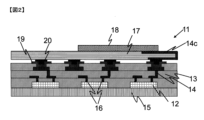
- FIG. 2 is a cross-sectional view of an example of a display device.
- the photosensitive resin composition of the present invention comprises an alkali-soluble resin (a), an aromatic hydrocarbon (b) having at least one aromatic C-H bond and at least three phenolic hydroxyl groups in one aromatic ring, and an aromatic hydrocarbon having the formula Contains a thermal crosslinking agent (c) having a partial structure represented by (1) and a photosensitive compound (e).
- R 10 represents a hydrogen atom or an alkyl group. Each * represents a bond, but no carbonyl group is adjacent to the nitrogen atom.
- component (a) alkali-soluble resin
- Alkali-soluble means that a solution of the resin dissolved in ⁇ -butyrolactone is applied onto a silicon wafer, prebaked at 120°C for 4 minutes to form a prebaked film with a thickness of 10 ⁇ m ⁇ 0.5 ⁇ m, and the prebaked film is It means that the dissolution rate determined from the decrease in film thickness when immersed in a 2.38 mass % tetramethylammonium hydroxide aqueous solution at ⁇ 1° C. for 1 minute and then rinsed with pure water is 50 nm/min or more.
- component (a) Since component (a) has alkali solubility, it has a hydroxyl group and/or an acidic group in the structural unit of the resin and/or at the end of its main chain.
- the acidic group include a carboxy group, a phenolic hydroxyl group, and a sulfonic acid group.
- Components (a) include polyimide, polyimide precursor, polybenzoxazole, polybenzoxazole precursor, polyamideimide, polyamideimide precursor, polyamide, polymer of radically polymerizable monomer having acidic group, siloxane resin, cardo resin , phenol resin, and other known materials may be included, but are not limited thereto.
- the photosensitive resin composition of the present invention may contain two or more of these resins.
- the cured product has high long-term reliability when used in organic EL display devices due to its high development adhesion, excellent heat resistance, and low outgassing amount at high temperatures.
- component (a) may contain one or more selected from the group consisting of polyimide, polyimide precursor, polybenzoxazole, polybenzoxazole precursor, polyamideimide, polyamideimide precursor, and copolymers thereof.
- it includes polyimide, a polyimide precursor, a polybenzoxazole precursor, or a copolymer thereof.
- component (a) contains a polyimide precursor or a polybenzoxazole precursor.
- the polyimide precursor refers to a resin that is converted into polyimide by heat treatment or chemical treatment, and includes, for example, polyamic acid, polyamic acid ester, and the like.
- the polybenzoxazole precursor refers to a resin that is converted into polybenzoxazole by heat treatment or chemical treatment, and is, for example, polyhydroxyamide.
- polyimide precursor and polybenzoxazole precursor have a structural unit represented by the following formula (3), and the polyimide has a structural unit represented by the following formula (4). It may contain two or more kinds of these, or it may contain a resin obtained by copolymerizing the structural unit represented by formula (3) and the structural unit represented by formula (4).
- X represents an organic group having 4 to 40 carbon atoms and a valence of 2 to 8
- Y represents an organic group having 6 to 40 carbon atoms and a valence of 2 to 11.
- R 11 and R 13 each independently represent a hydroxyl group or a sulfonic acid group.
- R 12 and R 14 each independently represent a hydrogen atom or a monovalent hydrocarbon group having 1 to 20 carbon atoms.
- t, u and w represent integers from 0 to 3
- v represents an integer from 0 to 6.
- the structural unit represented by formula (3) represents a structural unit of a polyimide precursor
- u ⁇ 2 represents a structural unit of a polybenzoxazole precursor.
- v ⁇ 2 at least two of the plurality of R 13s are hydroxyl groups.
- E represents an organic group having 4 to 40 carbon atoms and a valence of 4 to 10
- G represents an organic group having 6 to 40 carbon atoms and a valence of 2 to 8.
- R 15 and R 16 each independently represent a carboxy group, a sulfonic acid group or a hydroxyl group.
- x and y each independently represent an integer from 0 to 6. However, x+y>0.
- the polyimide, polyimide precursor, polybenzoxazole precursor, or copolymer thereof preferably has 5 to 100,000 structural units represented by formula (3) or formula (4). Moreover, in addition to the structural unit represented by formula (3) or formula (4), it may have other structural units. In this case, it is preferable to have the structural unit represented by formula (3) or formula (4) in an amount of 50 mol % or more out of 100 mol % of the total structural units.
- X(R 11 ) t (COOR 12 ) u represents an acid residue.
- X is an organic group having 4 to 40 carbon atoms and having a valence of 2 to 8. Among these, a divalent to 8-valent organic group containing an aromatic ring or a cycloaliphatic group is preferable.
- acid residues include dicarboxylic acid residues such as terephthalic acid, isophthalic acid, diphenyl ether dicarboxylic acid, bis(carboxyphenyl)hexafluoropropane, biphenyl dicarboxylic acid, benzophenone dicarboxylic acid, and triphenyl dicarboxylic acid, trimellitic acid, Tricarboxylic acid residues such as trimesic acid, diphenyl ethertricarboxylic acid, biphenyltricarboxylic acid, pyromellitic acid, 3,3',4,4'-biphenyltetracarboxylic acid, 2,3,3',4'-biphenyltetracarboxylic acid acid, 2,2',3,3'-biphenyltetracarboxylic acid, 3,3',4,4'-benzophenonetetracarboxylic acid, 2,2',3,3'-benzophenonetetracarboxylic acid
- R 20 represents an oxygen atom, C(CF 3 ) 2 or C(CH 3 ) 2 .
- R 21 and R 22 each independently represent a hydrogen atom or a hydroxyl group.
- one or two carboxy groups correspond to (COOR 12 ) in formula (1).
- E(R 15 ) x represents a residue of an acid dianhydride.
- E is an organic group having 4 to 40 carbon atoms and a valence of 4 to 10, and preferably an organic group containing an aromatic ring or a cycloaliphatic group.
- the acid dianhydride residues include pyromellitic dianhydride, 3,3',4,4'-biphenyltetracarboxylic dianhydride, 2,3,3',4'- Biphenyltetracarboxylic dianhydride, 2,2',3,3'-biphenyltetracarboxylic dianhydride, 3,3',4,4'-benzophenonetetracarboxylic dianhydride, 2,2',3 , 3'-benzophenonetetracarboxylic dianhydride, 2,2-bis(3,4-dicarboxyphenyl)propane dianhydride, 2,2-bis(2,3-dicarboxyphenyl)propane dianhydride, 1,1-bis(3,4-dicarboxyphenyl)ethane dianhydride, 1,1-bis(2,3-dicarboxyphenyl)ethane dianhydride, bis(3,4-dicarboxyphenyl)me
- Examples include dianhydride, residues of aliphatic tetracarboxylic dianhydrides containing cycloaliphatic groups such as 1,2,3,4-cyclopentanetetracarboxylic dianhydride, and the like.
- E(R 15 ) x may have two or more of these residues.
- R 20 represents an oxygen atom, C(CF 3 ) 2 or C(CH 3 ) 2 .
- R 21 and R 22 each independently represent a hydrogen atom or a hydroxyl group.
- Y(R 13 ) v (COOR 14 ) w in the above formula (3) and G(R 16 ) y in the above formula (4) represent a diamine residue.
- Y is an organic group having 6 to 40 carbon atoms and having a valence of 2 to 11, particularly preferably a 2 to 11 valent organic group containing an aromatic ring or a cycloaliphatic group.
- G is an organic group having 6 to 40 carbon atoms and having a valence of 2 to 8. Among these, a divalent to 8-valent organic group containing an aromatic ring or a cycloaliphatic group is preferable.
- diamine residues include 3,4'-diaminodiphenyl ether, 4,4'-diaminodiphenyl ether, 3,4'-diaminodiphenylmethane, 4,4'-diaminodiphenylmethane, 1,4-bis( 4-aminophenoxy)benzene, benzidine, m-phenylenediamine, p-phenylenediamine, 1,5-naphthalenediamine, 2,6-naphthalenediamine, bis(4-aminophenoxy)biphenyl, bis ⁇ 4-(4-amino) phenoxy)phenyl ⁇ ether, 1,4-bis(4-aminophenoxy)benzene, 2,2'-dimethyl-4,4'-diaminobiphenyl, 2,2'-diethyl-4,4'-diaminobiphenyl, 3 , 3'-dimethyl-4,4'-diaminobiphenyl, 3,3
- R 20 represents an oxygen atom, C(CF 3 ) 2 or C(CH 3 ) 2 .
- R 21 to R 24 each independently represent a hydrogen atom or a hydroxyl group.
- the terminals of these resins may be sealed with a known acidic group-containing monoamine, acid anhydride, acid chloride, monocarboxylic acid, or active ester compound.
- Component (a) may be synthesized by a known method.
- the method for producing polyamic acid which is a polyimide precursor
- examples of the method for producing polyamic acid, which is a polyimide precursor include a method in which a tetracarboxylic dianhydride and a diamine compound are reacted in a solvent at a low temperature.
- a tetracarboxylic dianhydride and a diamine compound are reacted in a solvent at a low temperature.
- a diester is obtained with tetracarboxylic dianhydride and alcohol, and then a condensing agent is used.
- Examples include a method of reacting with an amine in a solvent in the presence of a dicarboxylic acid, a method of obtaining a diester with a tetracarboxylic dianhydride and an alcohol, then converting the remaining dicarboxylic acid into acid chloride, and reacting it with an amine in a solvent. It will be done. From the viewpoint of ease of synthesis, it is preferable to include a step of reacting a polyamic acid with an esterifying agent.
- the esterifying agent is not particularly limited and any known method can be applied, but N,N-dimethylformamide dialkyl acetal is preferred since the resulting resin can be easily purified.
- Examples of the method for producing polyhydroxyamide, which is a polybenzoxazole precursor include a method in which a bisaminophenol compound and a dicarboxylic acid are subjected to a condensation reaction in a solvent. Specifically, for example, a method in which a dehydration condensation agent such as dicyclohexylcarbodiimide (DCC) and an acid are reacted, and a bisaminophenol compound is added thereto. Examples include a method in which a solution of dicarboxylic acid dichloride is dropped into a solution of a bisaminophenol compound to which a tertiary amine such as pyridine is added.
- a dehydration condensation agent such as dicyclohexylcarbodiimide (DCC) and an acid are reacted
- a bisaminophenol compound is added thereto.
- Examples of the method for producing polyimide include a method of dehydrating and ring-closing the polyamic acid or polyamic acid ester obtained by the method described above in a solvent.
- Examples of methods for dehydration and ring closure include chemical treatment with acids or bases, heat treatment, and the like.
- Examples of the method for producing polybenzoxazole include a method in which the polyhydroxyamide obtained by the method described above is dehydrated and ring-closed in a solvent.
- Examples of methods for dehydration and ring closure include chemical treatment with acids or bases, heat treatment, and the like.
- Examples of the polyamide-imide precursor include tricarboxylic acid, a corresponding tricarboxylic anhydride, a polymer of a tricarboxylic anhydride halide, and a diamine compound, and a polymer of trimellitic anhydride and an aromatic diamine compound is preferred.
- Examples of the method for producing the polyamide-imide precursor include a method of reacting tricarboxylic acid, the corresponding tricarboxylic anhydride, tricarboxylic anhydride halide, etc. with a diamine compound in a solvent at low temperature.
- Examples of methods for producing polyamide-imide include a method in which trimellitic anhydride and an aromatic diisocyanate are reacted in a solvent, a method in which the polyamide-imide precursor obtained by the above method is dehydrated and ring-closed in a solvent, and the like.
- Examples of methods for dehydration and ring closure include chemical treatment with acids or bases, heat treatment, and the like.
- polymers of radically polymerizable monomers having acidic groups include acrylic resins and polyhydroxystyrene resins.
- the radically polymerizable monomer having an acidic group known materials can be used, such as o-hydroxystyrene, m-hydroxystyrene, p-hydroxystyrene, alkyl and alkoxy substituted products thereof, methacrylic acid and Mention may be made of acrylic acid as well as haloalkyl, alkoxy, halogen, nitro and cyano substituted products thereof in the ⁇ -position.
- o-hydroxystyrene, m-hydroxystyrene, p-hydroxystyrene, and alkyl- and alkoxy-substituted derivatives thereof are particularly effective in sensitivity and resolution during patterning, residual film rate after development, heat deformation resistance, and resistance. It is preferably used in terms of solvent properties, adhesion to the substrate, storage stability of the solution, etc. One or more types of these can be used.
- radically polymerizable monomers having acidic groups known materials can be used, such as styrene, alkyl at the ⁇ -position, o-position, m-position, or p-position of styrene, Alkoxy, halogen, haloalkyl, nitro, cyano, amide, ester substituted products, diolefins such as butadiene and isoprene, esterified products of methacrylic acid or acrylic acid, and the like can be used. These can be used alone or in combination of two or more.
- Examples of the cardo resin include resins having a cardo structure, that is, a skeletal structure in which two cyclic structures are bonded to a quaternary carbon atom constituting a cyclic structure.
- a common cardo structure has a benzene ring attached to a fluorene ring.
- Specific examples of skeletal structures in which two cyclic structures are bonded to a quaternary carbon atom constituting a cyclic structure include a fluorene skeleton, a bisphenol fluorene skeleton, a bisaminophenylfluorene skeleton, a fluorene skeleton having an epoxy group, and an acrylic group. Examples include a fluorene skeleton having a fluorene skeleton.
- Cardo resin is formed by polymerizing a skeleton having a cardo structure through a reaction between functional groups bonded thereto.
- Cardo resin has a structure (cardo structure) in which a main chain and a bulky side chain are connected by one element, and has a cyclic structure in a direction substantially perpendicular to the main chain.
- monomers having a cardo structure include bis(glycidyloxyphenyl)fluorene type epoxy resin, 9,9-bis(4-hydroxyphenyl)fluorene, and 9,9-bis(4-hydroxy-3-methyl).
- Bisphenols containing a cardo structure such as phenyl)fluorene, 9,9-bis(cyanoalkyl)fluorenes such as 9,9-bis(cyanomethyl)fluorene, and 9,9-bis(3-aminopropyl)fluorene.
- a cardo structure such as phenyl)fluorene
- 9,9-bis(cyanoalkyl)fluorenes such as 9,9-bis(cyanomethyl)fluorene
- 9,9-bis(3-aminopropyl)fluorene include 9,9-bis(aminoalkyl)fluorenes.
- Cardo resin is a polymer obtained by polymerizing a monomer having a cardo structure, but it may also be a copolymer with other copolymerizable monomers.
- phenol resins such as novolak phenol resin and resol phenol resin, which can be obtained by polycondensing various phenols alone or in mixtures of multiple types with aldehydes such as formalin.
- phenols constituting the novolak phenol resin and resol phenol resin examples include phenol, p-cresol, m-cresol, o-cresol, 2,3-dimethylphenol, 2,4-dimethylphenol, and 2,5-dimethylphenol.
- aldehydes include paraformaldehyde, acetaldehyde, benzaldehyde, hydroxybenzaldehyde, chloroacetaldehyde, and the like, and these can be used alone or as a mixture of a plurality of them.
- polysiloxane examples include known polysiloxanes obtained by hydrolyzing and dehydrating one or more types selected from tetrafunctional organosilane, trifunctional organosilane, bifunctional organosilane, and monofunctional organosilane. .
- organosilanes include tetrafunctional silanes such as tetramethoxysilane, tetraethoxysilane, tetraacetoxysilane, and tetraphenoxysilane, methyltrimethoxysilane, methyltriethoxysilane, ethyltrimethoxysilane, ethyltriethoxysilane, Vinyltrimethoxysilane, vinyltriethoxysilane, 3-methacryloxypropyltrimethoxysilane, 3-methacryloxypropyltriethoxysilane, 3-acryloxypropyltrimethoxysilane, phenyltrimethoxysilane, phenyltriethoxysilane, p-hydroxy Phenyltrimethoxysilane, 1-(p-hydroxyphenyl)ethyltrimethoxysilane, 2-(p-hydroxyphenyl)ethyltrimethoxysilane, 1-
- Monofunctional silanes such as bifunctional silane, trimethylmethoxysilane, tri-n-butylethoxysilane, (3-glycidoxypropyl)dimethylmethoxysilane, and (3-glycidoxypropyl)dimethylethoxysilane are mentioned. Two or more types of these organosilanes may be used.
- silicate compounds such as methyl silicate 51 manufactured by Fuso Chemical Industry Co., Ltd. and M silicate 51 manufactured by Tama Chemical Industry Co., Ltd. may be copolymerized.
- Polysiloxanes are synthesized by hydrolyzing and partially condensing monomers such as organosilanes.
- partial condensation refers to not condensing all of the Si--OH of the hydrolyzate, but leaving some of the Si--OH in the resulting polysiloxane.
- Conventional methods can be used for hydrolysis and partial condensation. For example, a method may be used in which a solvent, water, and if necessary a catalyst are added to an organosilane mixture, and the mixture is heated and stirred at 50 to 150° C. for about 0.5 to 100 hours. During stirring, if necessary, hydrolysis by-products (alcohols such as methanol) and condensation by-products (water) may be distilled off.
- acid catalysts and base catalysts are preferably used.
- acid catalysts include hydrochloric acid, nitric acid, sulfuric acid, hydrofluoric acid, phosphoric acid, acetic acid, trifluoroacetic acid, formic acid, polycarboxylic acids or their anhydrides, ion exchange resins, and the like.
- base catalysts include triethylamine, tripropylamine, tributylamine, tripentylamine, trihexylamine, triheptylamine, trioctylamine, diethylamine, triethanolamine, diethanolamine, sodium hydroxide, potassium hydroxide, amino Examples include alkoxysilanes having groups, ion exchange resins, and the like.
- the solvent used in the production of component (a) is not particularly limited, and includes alkylene glycol monoalkyl ethers such as ethylene glycol monomethyl ether and propylene glycol monomethyl ether, alkyl acetates such as propyl acetate, butyl acetate, isobutyl acetate, etc.
- Ketones such as methyl isobutyl ketone and methyl propyl ketone, alcohols such as butyl alcohol and isobutyl alcohol, ethyl lactate, butyl lactate, dipropylene glycol dimethyl ether, diethylene glycol dimethyl ether, diethylene glycol ethyl methyl ether, diethylene glycol diethyl ether, 3-methoxybutyl acetate , ethylene glycol monoethyl ether acetate, gamma butyrolactone, N-methyl-2-pyrrolidone, diacetone alcohol, N-cyclohexyl-2-pyrrolidone, N,N-dimethylformamide, N,N-dimethylacetamide, dimethyl sulfoxide, propylene glycol Monomethyl ether acetate, N,N-dimethylisobutyric acid amide, 3-methoxy-N,N-dimethylpropionamide, 3-butoxy-N,N-dimethyl
- the photosensitive resin composition of the present invention further comprises an aromatic hydrocarbon (b) (hereinafter referred to as component (b)) having at least one aromatic C--H bond and at least three phenolic hydroxyl groups in one aromatic ring. ). Since the photosensitive resin composition of the present invention contains the component (b) and the thermal crosslinking agent (c) having a partial structure represented by the formula (1) described below, it develops color by heating regardless of the atmosphere during curing. However, after curing, the transmittance in the range of 300 nm to 500 nm can be lowered.
- neither the component (b) nor the thermal crosslinking agent (c) having a partial structure represented by formula (1) has absorption in the wavelength range of 300 nm to 500 nm, so before curing, it is generally used as an exposure light source. It does not block the exposure wavelength range of 350 nm to 450 nm of a mercury lamp, which is commonly used, and can form patterns with high sensitivity. Further, in the range of 300 to 800 nm described below, the maximum absorption wavelength is in the range of 490 nm or more and less than 800 nm, and the ratio of absorbance Abs 365 at 365 nm to absorbance Abs max at the maximum absorption wavelength is 0.1% or more and less than 60%. By containing a certain colorant (d), a film having high visible light blocking properties after curing can be obtained.
- the aromatic hydrocarbon structure possessed by component (b) includes known monocyclic and fused polycyclic structures. Further, the aromatic hydrocarbon has at least one aromatic CH bond and at least three phenolic hydroxyl groups in one aromatic ring.
- An aromatic hydrocarbon having at least one aromatic C--H bond in one aromatic ring means that one or more unsubstituted aromatic C--H bonds are present in the aromatic ring.
- a state having at least one aromatic C-H bond and at least three phenolic hydroxyl groups in one aromatic ring refers to a state having at least one aromatic C-H bond and at least three phenolic hydroxyl groups in a single aromatic ring.
- Compounds exhibiting a state having three phenolic hydroxyl groups such as having three aromatic rings having at least one aromatic CH bond and one phenolic hydroxyl group, are not included in the embodiments of the present invention.
- Specific examples of the component (b) include, but are not limited to, the structures shown below.
- R 7 independently represents a monovalent organic group having 1 to 20 carbon atoms, k represents an integer of 0 to 2, l represents an integer of 0 to 6, and m represents an integer of 3 to 9. However, ⁇ (2k+6) ⁇ (l+m) ⁇ 1.
- Component has at least one aromatic C--H bond in one aromatic ring, thereby forming a crosslinking structure with a thermal crosslinking agent (c) having a partial structure represented by formula (1) described below.
- the transmittance in the range of 300 nm to 500 nm can be lowered.
- the number of aromatic C--H bonds in one aromatic ring contained in component (b) is one or more, preferably two or more, and more preferably three or more.
- the number of crosslinking points with the thermal crosslinking agent (c) having a partial structure represented by formula (1) increases. This is preferable because the transmittance can be further lowered.
- aromatic hydrocarbons having at least one aromatic C-H bond and three phenolic hydroxyl groups in one aromatic ring include phloroglucinol, pyrogallol, 1,2,4-trihydroxybenzene, 2,4 , 5-trihydroxybenzaldehyde, 2,3,4-trihydroxybenzaldehyde, 3,4,5-trihydroxybenzaldehyde, galacetophenone, 2,3,4-trihydroxybenzoic acid, gallic acid, methyl gallate, ethyl gallate , propyl gallate, octyl gallate, 2,3,4-trihydroxybenzophenone, 2,3,4,4'-tetrahydroxybenzophenone, 4,4'-isopropylidene dipyrogallol, and the like.
- aromatic hydrocarbons having at least one aromatic C-H bond and four or more phenolic hydroxyl groups in one aromatic ring include 1,2,3,4-tetrahydroxybenzene, 1,2,3, Examples include 5-tetrahydroxybenzene, 1,2,4,5-tetrahydroxybenzene, and leucoquinizarin.
- component (b) should be such that at least one substitution position of the other phenolic hydroxyl group for any of the phenolic hydroxyl groups in component (b) is ortho. It is preferably the position or the para position, and more preferably the para position.
- the transmittance in the range of 300 nm to 500 nm after curing can be further reduced. This is presumed to be because the crosslinked product after curing with the component (b) and the thermal crosslinking agent (c) having the partial structure represented by formula (1) takes an orthoquinone or paraquinone structure, thereby increasing the coloring property. be done.
- examples of the compound (b1) in which at least one substitution position of the other phenolic hydroxyl group with respect to one of the phenolic hydroxyl groups is ortho position include pyrogallol, 1,2,4-trihydroxy Benzene, 2,4,5-trihydroxybenzaldehyde, 2,3,4-trihydroxybenzaldehyde, 3,4,5-trihydroxybenzaldehyde, galacetophenone, 2,3,4-trihydroxybenzoic acid, gallic acid, gallic acid Methyl, ethyl gallate, propyl gallate, octyl gallate, 2,3,4-trihydroxybenzophenone, 2,3,4,4'-tetrahydroxybenzophenone, 4,4'-isopropylidene dipyrogallol, 1,2 , 3,4-tetrahydroxybenzene, 1,2,3,5-tetrahydroxybenzene, 1,2,4,5-tetrahydroxybenzene and the like.
- compounds (b2) in which at least one substitution position of the other phenolic hydroxyl group with respect to one of the phenolic hydroxyl groups is at the para position include 1,2,4-trihydroxybenzene, 2 , 4,5-trihydroxybenzaldehyde, 1,2,3,4-tetrahydroxybenzene, 1,2,3,5-tetrahydroxybenzene, 1,2,4,5-tetrahydroxybenzene, leucoquinizarin, etc.
- the upper limit of the molecular weight of component (b) is not particularly limited, but is preferably 1000 or less, preferably 800 or less, and more preferably 600 or less.
- the lower limit of the molecular weight of component (b) is 126 or more.
- the content of component (b) is preferably 1 part by mass or more, more preferably 5 parts by mass or more, and even more preferably 10 parts by mass or more, based on 100 parts by mass of component (a).
- a thermal crosslinking agent (c) having a partial structure represented by formula (1) described below.
- the transmittance can be lowered from 300 nm to 500 nm.
- the content of component (b) is preferably 50 parts by mass or less, more preferably 40 parts by mass or less, even more preferably 30 parts by mass or less, and 20 parts by mass or less with respect to 100 parts by mass of component (a). Particularly preferred.
- the photosensitive resin composition of the present invention further includes a thermal crosslinking agent (c) (hereinafter sometimes referred to as component (c)) having a partial structure represented by formula (1).
- R 10 represents a hydrogen atom or an alkyl group. Each * represents a bond, but no carbonyl group is adjacent to the nitrogen atom.
- the photosensitive resin composition of the present invention develops color upon heating regardless of the atmosphere during curing, and can reduce the transmittance in the range of 300 nm to 500 nm after curing.
- component (c) has a partial structure represented by formula (1), that is, a methylol group or an alkoxymethyl group directly substituted on a nitrogen atom, it can form a crosslinked product with component (b).
- Component (c) preferably has two or more partial structures represented by formula (1) in the molecule, more preferably three or more, still more preferably four or more, and six or more. is most preferable.
- the partial structure represented by formula (1) if two methylol groups or alkoxymethyl groups are bonded from the same nitrogen atom, if the molecule has two partial structures represented by formula (1), I reckon.
- the number of partial structures represented by formula (1) contained in the molecule of component (c) but it is, for example, 20 or less.
- R 10 represents a hydrogen atom or an alkyl group, and from the viewpoint of improving the storage stability of the photosensitive resin composition, R 10 is preferably an alkyl group having 1 to 10 carbon atoms.
- the alkyl group include a methyl group, an ethyl group, a propyl group, a butyl group, and the like.
- no carbonyl group is adjacent to the nitrogen atom.
- the reactivity of the methylol group or alkoxymethyl group increases, resulting in the formation of a crosslinked product with component (b).
- the transmittance in the range of 300 nm to 500 nm after curing can be lowered.
- the substituent adjacent to the nitrogen atom is not particularly limited as long as it is other than a carbonyl group, and may have a hydrogen atom, a methylol group, an alkoxymethyl group, or a substituent.
- Alkyl group, optionally substituted alkenyl group, optionally substituted alkenyl ether group, optionally substituted aryl group, or optionally substituted hetero group Aryl groups and the like can be adjacent.
- the substituent adjacent to the nitrogen atom in formula (1) is an aryl group that may have a substituent or an aryl group that may have a substituent.
- at least one adjacent heteroaryl group is present, including, but not limited to, compounds having the structures shown below.
- R 10 each independently represents a hydrogen atom or an alkyl group.
- L represents a single bond, an oxygen atom, C(CF 3 ) 2 , C(CH 3 ) 2 , SO 2 or CO.
- M represents a nitrogen atom, CH or CCH3 .
- R 1 to R 6 each independently represent a hydrogen atom, an alkyl group having 1 to 10 carbon atoms, an alkenyl group having 2 to 10 carbon atoms, an alkenyl ether group having 2 to 10 carbon atoms, a methylol group, an alkoxymethyl group represents. However, at least one of R 1 to R 6 is a methylol group or an alkoxymethyl group.
- the component (c) of the present invention is a triazine ring-containing compound (c1) represented by formula (2) (hereinafter sometimes referred to as component (c1)). ) is preferably included. That is, the photosensitive resin composition of the present invention comprises an alkali-soluble resin (a), an aromatic hydrocarbon having at least one aromatic CH bond and at least three phenolic hydroxyl groups in one aromatic ring (b) , a photosensitive resin composition containing a triazine ring-containing compound represented by formula (2) and a photosensitive compound (e) is preferred.
- R 1 to R 6 each independently represent a hydrogen atom, an alkyl group having 1 to 10 carbon atoms, an alkenyl group having 2 to 10 carbon atoms, an alkenyl ether group having 2 to 10 carbon atoms, Represents a methylol group or an alkoxymethyl group. However, at least one of R 1 to R 6 is a methylol group or an alkoxymethyl group.
- At least one of R 1 to R 6 has a methylol group or an alkoxymethyl group, and two or more methylol groups or alkoxymethyl groups Preferably, there are three or more, more preferably four or more, and most preferably all six are methylol groups or alkoxymethyl groups.
- the alkoxymethyl group include a methoxymethyl group, an ethoxymethyl group, a propoxymethyl group, and a butoxymethyl group.
- component (c) in addition to commercially available products, those synthesized by known methods can be used.
- a compound containing a primary amino group or a secondary amino group can be reacted with formaldehyde under basic conditions to obtain a compound in which a methylol group is substituted on the nitrogen atom.
- a compound in which an alkoxymethyl group is substituted on the nitrogen atom can be obtained.
- the upper limit of the molecular weight of component (c) is not particularly limited, but is preferably 1000 or less, preferably 800 or less, and more preferably 600 or less.
- the lower limit of the molecular weight of component (c) is 47 or more.
- the content of component (c) is preferably 1 part by mass or more, more preferably 5 parts by mass or more, and even more preferably 10 parts by mass or more, based on 100 parts by mass of the alkali-soluble resin (a).
- the transmittance in the range of 300 nm to 500 nm can be lowered after curing.
- the content of component (c) is preferably 100 parts by mass or less, more preferably 80 parts by mass or less, even more preferably 50 parts by mass or less, and 30 parts by mass or less with respect to 100 parts by mass of component (a). Particularly preferred.
- the sensitivity of the photosensitive resin composition can be improved.
- the photosensitive resin composition of the present invention further contains a photosensitive compound (e) (hereinafter sometimes referred to as component (e)).
- a photosensitive compound (e) hereinafter sometimes referred to as component (e)
- the content of component (e) is preferably 0.1 part by mass or more, more preferably 1 part by mass or more, and 10 parts by mass or more based on 100 parts by mass of component (a). More preferred.
- the content of component (e) is determined based on 100 parts by mass of component (a). The amount is preferably 100 parts by mass or less.
- Component (e) may include a photoacid generator (e1), a photopolymerization initiator (e2), and the like.
- the photoacid generator (e1) is a compound that generates an acid upon exposure to light
- the photopolymerization initiator (e2) is a compound that generates radicals by bond cleavage and/or reaction upon exposure to light.
- the photoacid generator (e1) By containing the photoacid generator (e1), acid is generated in the light irradiated area, the solubility of the light irradiated area in an alkaline aqueous solution increases, and a positive relief pattern in which the light irradiated area dissolves can be obtained. can.
- the photoacid generator (e1) and the epoxy compound or thermal crosslinking agent described later the acid generated in the light irradiated area promotes the crosslinking reaction of the epoxy compound or thermal crosslinking agent, and the light irradiated area becomes insolubilized. A negative relief pattern can be obtained.
- component (e) is a photoacid generator that can obtain a positive relief pattern. It is preferable to include (e1).
- the photoacid generator (e1) may contain, for example, a quinonediazide compound.
- the photosensitive resin composition of the present invention preferably contains two or more types of photoacid generators (e1), and when it contains two or more types, a photosensitive resin composition with higher sensitivity can be obtained. .
- Quinonediazide compounds include those in which the sulfonic acid of quinonediazide is bonded to a polyhydroxy compound through an ester bond, those in which the sulfonic acid of quinonediazide is bonded to a polyamino compound through a sulfonamide bond, and those in which the sulfonic acid of quinonediazide is bonded to a polyhydroxy polyamino compound through an ester bond and/or a sulfonate bond. It can contain amide bonds, etc.
- both a 5-naphthoquinonediazide sulfonyl group and a 4-naphthoquinonediazide sulfonyl group are preferably used. It may contain a naphthoquinone diazide sulfonyl ester compound having a 4-naphthoquinone diazide sulfonyl group and a 5-naphthoquinone diazide sulfonyl group in the same molecule, or it may contain a 4-naphthoquinone diazide sulfonyl ester compound and a 5-naphthoquinone diazide sulfonyl ester compound.
- the 4-naphthoquinonediazide sulfonyl ester compound has absorption in the i-line region of a mercury lamp and is suitable for i-line exposure.
- the 5-naphthoquinonediazide sulfonyl ester compound has absorption extending to the G-line region of a mercury lamp, and is suitable for G-line exposure.
- the above quinonediazide compound can be synthesized from a compound having a phenolic hydroxyl group and a quinonediazide sulfonic acid compound by any esterification reaction. By using these quinonediazide compounds, resolution, sensitivity, and film retention rate are further improved.
- the content of the photoacid generator (e1) is preferably 0.1 parts by mass or more, more preferably 10 parts by mass or more, and 25 parts by mass based on 100 parts by mass of component (a). Part or more is more preferable.
- the content of the photoacid generator (e1) is set to 100% by mass of component (a). It is preferably 100 parts by mass or less.
- photopolymerization initiator (e2) examples include benzyl ketal photopolymerization initiators, ⁇ -hydroxyketone photopolymerization initiators, ⁇ -aminoketone photopolymerization initiators, acylphosphine oxide photopolymerization initiators, and oxime esters.
- the photosensitive resin composition of the present invention may contain two or more types of photopolymerization initiators (e2).
- the photopolymerization initiator (e2) more preferably contains an ⁇ -aminoketone photopolymerization initiator, an acylphosphine oxide photopolymerization initiator, or an oxime ester photopolymerization initiator.
- Examples of ⁇ -aminoketone photopolymerization initiators include 2-methyl-1-[4-(methylthio)phenyl]-2-morpholinopropan-1-one, 2-benzyl-2-dimethylamino-1-(4 -morpholinophenyl)-butan-1-one, 2-dimethylamino-2-(4-methylbenzyl)-1-(4-morpholinophenyl)-butan-1-one, 3,6-bis(2-methyl- It can contain 2-morpholinopropionyl)-9-octyl-9H-carbazole and the like.
- acylphosphine oxide photopolymerization initiators include 2,4,6-trimethylbenzoyl-diphenylphosphine oxide, bis(2,4,6-trimethylbenzoyl)-phenylphosphine oxide, bis(2,6-dimethoxybenzoyl) )-(2,4,4-trimethylpentyl)phosphine oxide, etc.
- oxime ester photopolymerization initiators include 1-phenylpropane-1,2-dione-2-(O-ethoxycarbonyl)oxime, 1-phenylbutane-1,2-dione-2-(O-methoxycarbonyl) carbonyl)oxime, 1,3-diphenylpropane-1,2,3-trione-2-(O-ethoxycarbonyl)oxime, 1-[4-(phenylthio)phenyl]octane-1,2-dione-2-( O-benzoyl)oxime, 1-[4-[4-(carboxyphenyl)thio]phenyl]propane-1,2-dione-2-(O-acetyl)oxime, 1-[9-ethyl-6-(2 -methylbenzoyl)-9H-carbazol-3-yl]ethanone-1-(O-acetyl)oxime, 1-[9-ethyl-6-[2-methyl-4-[1-
- the content of the photopolymerization initiator (e2) is preferably 0.1 part by mass or more, more preferably is 1 part by mass or more, more preferably 10 parts by mass or more.
- the content of the photopolymerization initiator (e2) is 50 parts by mass based on a total of 100 parts by mass of component (a) and the radically polymerizable compound described below. Part or less is preferred.
- the photosensitive resin composition of the present invention further has a maximum absorption wavelength in a range of 490 nm or more and less than 800 nm in a range of 300 to 800 nm, and a maximum absorption wavelength in a range of 490 nm or more and less than 800 nm in a range of 300 to 800 nm.
- a colorant (d) (hereinafter sometimes referred to as component (d)) having a ratio of absorbance Abs 365 at 365 nm to absorbance Abs max at wavelength of 0.1% or more and less than 60%.
- component (d) a colorant having a ratio of absorbance Abs 365 at 365 nm to absorbance Abs max at wavelength of 0.1% or more and less than 60%.
- Component (d) has a maximum absorption wavelength in the range of 490 nm or more and less than 800 nm in the range of 300 to 800 nm.
- the transmittance in the range of 300 nm to 500 nm can be lowered after curing, so by combining the component (d), it is possible to block the entire visible light after curing.
- Component (d) has a ratio of absorbance Abs 365 at 365 nm to absorbance Abs max at the maximum absorption wavelength in any range of 490 nm or more and less than 800 nm in 300 to 800 nm (hereinafter referred to as the ratio of absorbance Abs 365 to absorbance Abs max ) of 0. .1% or more and less than 60%.
- the ratio of absorbance Abs 365 to absorbance Abs max represents the ratio (%) of absorbance Abs 365 divided by absorbance Abs max and then multiplied by 100. When the ratio of absorbance Abs 365 to absorbance Abs max is 0.1% or more and less than 60%, it is possible to form a pattern with high sensitivity.
- the ratio of absorbance Abs 365 to absorbance Abs max is less than 60%, preferably less than 40%, more preferably less than 20%, even more preferably less than 15%, and most preferably less than 10%.
- the lower limit of the ratio of absorbance Abs 365 to absorbance Abs max is 0.1% or more.
- component (d) contains a dye (d1) and/or a pigment (d2).
- Component (d) preferably contains at least one kind, for example, it contains one kind of dye (d1) or pigment (d2), or it contains two or more kinds of dye (d1) or pigment (d2). It is preferable to contain one or more dyes (d1) and one or more pigments (d2).
- the component (d) preferably contains a dye (d1).
- the dye (d1) is preferably an ionic dye that forms an ion pair of organic ions.
- the pigment (d2) is preferable to contain the pigment (d2) from the viewpoint of suppressing fading of the colorant in the heat treatment step of the photosensitive resin composition described later.
- component (d) preferably has a sulfonic acid group and/or a sulfonate group.
- Component (d) is a colorant (d-1) (hereinafter sometimes referred to as component (d-1)) that has a maximum absorption wavelength in the range of 490 nm or more and less than 580 nm in the range of 300 to 800 nm; It is preferable to contain a colorant (d-2) (hereinafter sometimes referred to as component (d-2)) having a maximum absorption wavelength in the range of 580 nm or more and less than 800 nm in the range of 300 to 800 nm. .
- the component (d-1) is a dye (d1-1) having a maximum absorption wavelength in the range of 490 nm or more and less than 580 nm in the range of 300 to 800 nm, and/or a dye (d1-1) that has a maximum absorption wavelength in the range of 490 nm or more and less than 580 nm in the range of 300 to 800 nm. It is preferable to contain a pigment (d2-1) having a maximum absorption wavelength in any range below 580 nm.
- the component (d-2) is a dye (d1-2) that has a maximum absorption wavelength in the range of 580 nm or more and less than 800 nm in the range of 300 to 800 nm, and/or It is preferable to contain a pigment (d2-2) having a maximum absorption wavelength in any range below 800 nm.
- Component (d) is a dye (d1-1) having a maximum absorption wavelength in the range of 490 nm or more and less than 580 nm in the range of 300 to 800 nm and/or a dye in the range of 580 nm to less than 800 nm in the range of 300 to 800 nm. It is preferable to include a dye (d1-2) having a maximum absorption wavelength.
- a dye (d1-1) component may be simply referred to as (d1-1) component, (d2-1) component, (d1-2) component, and (d2-2) component, respectively.
- the dye (d1) is a dye that is soluble in a solvent that dissolves component (a) and compatible with the resin, has heat resistance, and light resistance, from the viewpoint of storage stability, fading during curing, and color fading during light irradiation. It is preferable that the dye contains a high amount of dye. Since the component (d1-1) has a maximum absorption wavelength in the range of 490 nm or more and less than 580 nm in the range of 300 to 800 nm, it can contain, for example, a red dye or a purple dye.
- the component (d1-2) has a maximum absorption wavelength in a range of 580 nm or more and 800 nm or less in the range of 300 to 800 nm, and therefore includes, for example, a blue dye or a green dye.
- the photosensitive resin composition of the present invention contains the component (d1-1) and the component (d1-2), from the viewpoint of increasing heat resistance and maintaining visible light blocking property after curing (d1-1) It is preferable that either the component or the (d1-2) component has a xanthene structure, and it is more preferable that both the (d1-1) component and the (d1-2) component have a xanthene structure.
- the skeleton structure of the dye (d1) includes, but is not limited to, anthraquinone, azo, phthalocyanine, methine, oxazine, quinoline, triarylmethane, and xanthene.
- anthraquinone-based, azo-based, methine-based, triarylmethane-based, and xanthene-based are preferred from the viewpoint of solubility in solvents and heat resistance.
- xanthene type is more preferable.
- each of these dyes may be used alone or as a metal-containing complex salt system.
- the dye (d1) preferably contains an ionic dye (d1a) (hereinafter sometimes referred to as the (d1a) component) forming an ion pair of an organic anion moiety and an organic cation moiety.
- Component (d1a) refers to a salt-forming compound consisting of an organic anion moiety and a non-dye organic cation moiety, a salt-forming compound consisting of a basic dye organic cation moiety and a non-dye organic anion moiety, or an acidic dye organic anion moiety.
- a salt-forming compound consisting of the organic cation moiety of a basic dye a salt-forming compound consisting of the organic cation moiety of a basic dye.
- the ionic dye of the present invention is composed of an organic anion part of an acidic dye and an organic cation part of a basic dye. It is preferable to include a salt-forming compound. That is, the component (d) contains an ionic dye forming an ion pair of an organic anion moiety and an organic cation moiety, and the organic anion moiety and the organic cation moiety form a basic and organic anion moiety of the acidic dye, respectively. Preferably, it consists of an organic cation moiety of a dye.
- a salt-forming compound consisting of an organic anion part of an acid dye and an organic cation part of a non-dye can be produced by using an acid dye as a raw material and replacing the counter cation with a non-dye organic cation by a known method.
- a salt-forming compound consisting of a basic dye organic cation moiety and a non-dye organic anion moiety can be produced by using a basic dye as a raw material and replacing the counter anion with a non-dye organic anion by a known method.
- a salt-forming compound consisting of an organic anion moiety of an acidic dye and an organic cation moiety of a basic dye can be produced by using the acidic dye and the basic dye as raw materials and exchanging their respective counterions by a known method.
- the acidic dye that is the raw material for the component (d1a) is an anionic water-soluble dye that is a compound having an acidic substituent such as a sulfo group or a carboxy group in the dye molecule, or a salt thereof.
- acidic dyes include those that have an acidic substituent such as a sulfo group or a carboxy group and are classified as direct dyes.
- acidic dyes examples include C.I. I. Acid Yellow 1, 17, 18, 23, 25, 36, 38, 42, 44, 54, 59, 72, 78, 151; C. I. Acid Orange 7, 10, 12, 19, 20, 22, 28, 30, 52, 56, 74, 127; C. I. Acid Red 1, 3, 4, 6, 8, 11, 12, 14, 18, 26, 27, 33, 37, 53, 57, 88, 106, 108, 111, 114, 131, 137, 138, 151, 154, 158, 159, 173, 184, 186, 215, 257, 266, 296, 337; C. I. Acid Brown 2, 4, 13, 248; C. I. Acid Violet 11, 56, 58; C. I.
- Azo acid dyes such as Acid Blue 92, 102, 113, 117; C.I. I. Quinoline acid dyes such as Acid Yellow 2, 3, and 5; C.I. I. Xanthene acid dyes such as Acid Red 50, 51, 52, 87, 91, 92, 93, 94, 289; C.I. I. Acid Red 82, 92; C. I. Acid Violet 41, 42, 43; C. I. Acid Blue 14, 23, 25, 27, 40, 45, 78, 80, 127:1, 129, 145, 167, 230; C. I. Anthraquinone acid dyes such as Acid Green 25 and 27; C.I. I. Acid Violet 49; C. I.
- Acid Blue 7, 9, 22, 83, 90 C. I. Acid Green 9, 50; C. I. Triarylmethane acid dye such as Food Green 3; C.I. I. Phthalocyanine acid dyes such as Acid Blue 249; C.I. I. Examples include indigoid acid dyes such as Acid Blue 74.
- the acid dye preferably contains a xanthene acid dye from the viewpoint of high heat resistance.
- the xanthene acid dye is C.I. I. It is more preferable to contain rhodamine acid dyes such as Acid Red 50, 52, and 289.
- R in the ionic formula is a hydrocarbon group having 1 to 20 carbon atoms that may each independently have a substituent and may have a heteroatom in the carbon chain.
- the molecular weight of the organic cation part of the non-dye is preferably 1000 or less, It is preferably 700 or less, more preferably 400 or less.
- the lower limit of the molecular weight of the non-dye organic cation moiety is not particularly limited, but is preferably 1 or more, and more preferably 100 or more.
- the basic dye used as the raw material for the component (d1a) is a compound having a basic group such as an amino group or an imino group in the molecule, or a salt thereof, and is a dye that becomes a cation in an aqueous solution. .
- Examples of basic dyes include C.I. I. Basic Red 17, 22, 23, 25, 29, 30, 38, 39, 46, 46:1, 82; C.I. I. Basic Orange 2, 24, 25; C. I. Basic Violet 18; C. I. Basic Yellow 15, 24, 25, 32, 36, 41, 73, 80; C. I. Basic brown 1; C. I. Azo basic dyes such as Basic Blue 41, 54, 64, 66, 67, 129; C.I. I. Basic Red 1, 2; C. I. xanthene basic dyes such as Basic Violet 10 and 11; C.I. I. Basic Yellow 11, 13, 21, 23, 28; C. I. Basic Orange 21;C. I. Basic Red 13, 14; C. I. Methine basic dyes such as Basic Violet 16, 39; C.I.
- Anthraquinone basic dyes such as Basic Blue 22, 35, 45, 47; C.I. I. Basic Violet 1, 2, 3, 4, 13, 14, 23; C. I. Basic Blue 1, 5, 7, 8, 11, 15, 18, 21, 24, 26; C. I. Examples include triarylmethane basic dyes such as Basic Green 1 and 4, and xanthene basic dyes having the structure shown below.
- R 25 to R 31 each independently represent a hydrogen atom, an alkyl group having 1 to 10 carbon atoms, or an aryl group having 6 to 10 carbon atoms which may have a substituent.
- the basic dye preferably contains xanthene-based basic dyes and triarylmethane-based basic dyes because they can increase the blackness of the cured product, and xanthene-based acidic dyes are preferred from the viewpoint of high heat resistance.
- it contains a dye.
- the non-dye organic anion moieties that are the raw materials for component (d1a) include aliphatic or aromatic sulfonate ions, aliphatic or aromatic carboxylate ions, and sulfonimide anions [(RSO 2 ) 2 N] - , borate anion (BR 4 ) -, and the like.
- the non-dye organic anion moiety is an aliphatic or aromatic sulfonate. ions, aliphatic or aromatic carboxylate ions are preferred.
- the non-dye organic anion moiety is preferably an aliphatic or aromatic sulfonate ion.
- R in the ionic formula of the organic anion part of the non-dye may each independently have a substituent, and may be a hydrocarbon group having 1 to 20 carbon atoms that may have a heteroatom in the carbon chain. It is.
- the molecular weight of the organic anion part of the non-dye is preferably 1000 or less, It is preferably 700 or less, more preferably 400 or less.
- the lower limit of the molecular weight of the non-dye anion moiety is not particularly limited, but is preferably 1 or more, and more preferably 100 or more.
- the organic anion part and/or the organic cation part of the component (d1a) have a xanthene skeleton.
- organic anions having a xanthene skeleton include the above-mentioned xanthene acid dyes
- organic cations having a xanthene skeleton include the above-mentioned basic xanthene dyes.
- the component (d1a) preferably has an acidic group from the viewpoint of increasing alkali solubility during development and improving sensitivity.
- the acidic group include a carboxy group, a phenolic hydroxyl group, a sulfonic acid group, and a sulfonate group, with sulfonic acid groups and sulfonate groups being particularly preferred.
- Salt-forming compounds by ion exchange of acidic dyes and basic dyes can be produced by known methods. For example, if you prepare an aqueous solution of an acidic dye and an aqueous solution of a basic dye and mix them slowly while stirring, a salt-forming compound consisting of the organic anion part of the acidic dye and the organic cation part of the basic dye will be precipitated. generate. By collecting this by filtration, the salt-forming compound can be obtained. The obtained salt-forming compound is preferably dried at about 60 to 70°C.
- the photosensitive resin composition of the present invention may contain two or more types of components (d1a), but when the photosensitive resin composition of the present invention contains n types of components (d1a), the components contained in the photosensitive resin composition It is preferable that the organic ions are (n+1) species. However, n represents an integer from 2 to 10.
- the organic ions contained in the photosensitive resin composition herein refer to not only the organic ions constituting the ionic dye but also all organic ions contained in the photosensitive resin composition. For example, when the photosensitive resin composition contains n types of components (d1a) in which the organic anion moieties and organic cation moieties are different, the number of organic ions contained in the photosensitive resin composition is (n ⁇ 2).
- n 3
- n 3
- n 3
- the pigment (d2) is preferably a pigment with high heat resistance and light resistance from the viewpoint of fading during curing and light irradiation. Since the component (d2-1) has a maximum absorption wavelength in the range of 490 nm or more and less than 580 nm in the range of 300 to 800 nm, it can contain, for example, a red pigment or a purple pigment.
- the component (d2-2) has a maximum absorption wavelength in a range of 580 nm or more and 800 nm or less in the range of 300 to 800 nm, and thus includes, for example, a blue pigment or a green pigment.
- organic pigments are expressed by color index (C.I.) numbers.
- Examples of the (d2-1) component include red pigments such as Pigment Red 48:1, 122, 168, 177, 202, 206, 207, 209, 224, 242, 254, Pigment Violet 19, 23, 29, 32, etc. , 33, 36, 37, 38 and the like.
- Examples of the (d2-2) component include blue pigments such as Pigment Blue 15 (15:3, 15:4, 15:6, etc.), 21, 22, 60, 64, Pigment Green 7, 10, 36, 47, etc. , 58, and other green pigments. Moreover, pigments other than these can also be contained.
- the organic pigment used as the pigment (d2) may contain one that has been subjected to surface treatment such as rosin treatment, acidic group treatment, basic group treatment, etc., if necessary. Moreover, it can be contained together with a dispersant depending on the case.
- the dispersant can contain, for example, a cationic, anionic, nonionic, amphoteric, silicone, or fluorine-based surfactant.
- the content of component (d) is preferably 0.1 to 300 parts by weight, more preferably 0.2 to 200 parts by weight, and particularly preferably 1 to 200 parts by weight, based on 100 parts by weight of component (a).
- the content of component (d) is 0.1 part by mass or more per 100 parts by mass of component (a)
- light of the corresponding wavelength can be absorbed.
- the amount to 300 parts by mass or less light of the corresponding wavelength can be absorbed while maintaining the adhesion strength between the photosensitive colored resin film and the substrate, the heat resistance of the film after heat treatment, and the mechanical properties.
- the photosensitive resin composition of the present invention may contain colorants other than the component (d). By containing other colorants in addition to component (d), the other colorants absorb light transmitted through the film of the photosensitive resin composition or light reflected from the film of the photosensitive resin composition. It is possible to provide a light-shielding property that blocks light of a certain wavelength. By imparting light-shielding properties, when the cured product of the present invention, which will be described later, is used as a flattening layer and/or an insulating layer of an organic EL display device, it prevents deterioration, malfunction, leakage current, etc. due to light entering the TFT. be able to. Furthermore, reflection of external light from wiring and TFTs can be suppressed, and contrast between light-emitting areas and non-light-emitting areas can be improved.
- the photosensitive resin composition of the present invention may contain a radically polymerizable compound.
- the photosensitive resin composition contains a photopolymerization initiator (e2)
- a radically polymerizable compound refers to a compound having a plurality of ethylenically unsaturated double bonds in its molecule.
- the radicals generated from the photopolymerization initiator (e2) advance radical polymerization of the radically polymerizable compound, and the light irradiated area becomes insolubilized, thereby making it possible to obtain a negative pattern.
- the radically polymerizable compound a compound having a (meth)acrylic group, which allows radical polymerization to proceed easily, is preferable. From the viewpoint of improving the sensitivity during exposure and improving the hardness of the cured product, compounds having two or more (meth)acrylic groups in the molecule are more preferred.
- the double bond equivalent of the radically polymerizable compound is preferably 80 to 400 g/mol from the viewpoint of improving the sensitivity during exposure and improving the hardness of the cured product.
- radically polymerizable compounds include trimethylolpropane tri(meth)acrylate, ditrimethylolpropane tri(meth)acrylate, ditrimethylolpropane tetra(meth)acrylate, pentaerythritol tri(meth)acrylate, and pentaerythritol tetra(meth)acrylate.
- the content of the radically polymerizable compound is preferably 15 parts by mass or more, and 30 parts by mass, based on a total of 100 parts by mass of component (a) and the radically polymerizable compound. Part or more is more preferable.
- it is preferably 65 parts by mass or less, and 50 parts by mass or less, based on a total of 100 parts by mass of component (a) and the radically polymerizable compound. More preferred.
- the photosensitive resin composition of the present invention may contain a thermal crosslinking agent other than component (c).
- thermal crosslinking agent refers to a compound having at least two heat-reactive functional groups such as an alkoxymethyl group, a methylol group, an epoxy group, or an oxetanyl group in its molecule.
- crosslinking occurs between the thermal crosslinking agent and component (a) or between the thermal crosslinking agents and improves the heat resistance, chemical resistance, and bending resistance of the cured product after thermosetting. I can do it.
- the thermal crosslinking agent is preferably a compound with low reactivity with phenolic hydroxyl groups, and alkoxymethyl groups are preferred. This is presumed to be because in the crosslinked product consisting of components (b) and (c), when the phenolic hydroxyl group of component (b) reacts with the thermal crosslinking agent, the crosslinked product becomes difficult to form a quinone structure.
- Preferred examples of compounds having at least two alkoxymethyl groups or methylol groups include DML-PC, DML-PEP, DML-OC, DML-OEP, DML-34X, DML-PTBP, DML-PCHP, DML-OCHP, DML-PFP, DML-PSBP, DML-POP, DML-MBOC, DML-MBPC, DML-MTrisPC, DML-BisOC-Z, DML-BisOCHP-Z, DML-BPC, DML-BisOC-P, DMOM-PC, DMOM-PTBP, DMOM-MBPC, TriML-P, TriML-35XL, TML-HQ, TML-BP, TML-pp-BPF, TML-BPE, TML-BPA, TML-BPAF, TML-BPAP, TMOM-BP, TMOM-BPE, TMOM-BPA, TMOM-BPAF, TMOM-BPAP, HML-TPPHBA,
- Preferred examples of compounds having at least two epoxy groups include “Epolite” (registered trademark) 40E, “Epolite” 100E, “Epolite” 200E, “Epolite” 400E, “Epolite” 70P, “Epolite” 200P, “Epolite” “400P,” “Epolite” 1500NP, “Epolite” 80MF, “Epolite” 4000, “Epolite” 3002 (manufactured by Kyoeisha Chemical Co., Ltd.), “Denacol” (registered trademark) EX-212L, “Denacol” EX-214L , “Denacol” EX-216L, “Denacol” EX-850L (manufactured by Nagase ChemteX Co., Ltd.), GAN, GOT (manufactured by Nippon Kayaku Co., Ltd.), “Epicote” (registered trademark) 828, “Epic
- Examples of the compound having at least two oxetanyl groups include etanacol EHO, etanacol OXBP, etanacol OXTP, etanacol OXMA (manufactured by Ube Industries, Ltd.), oxetanated phenol novolak, and the like.
- the thermal crosslinking agent may be contained in a combination of two or more types.
- the content of the thermal crosslinking agent is preferably 1 part by mass or more and 30 parts by mass or less in 100 parts by mass of the total amount of the photosensitive resin composition excluding the solvent. If the content of the thermal crosslinking agent is 1 part by mass or more in 100 parts by mass of the total amount of the photosensitive resin composition excluding the solvent, the chemical resistance of the cured product can be further improved. Further, when the content of the thermal crosslinking agent is 30 parts by mass or less in 100 parts by mass of the total amount of the photosensitive resin composition excluding the solvent, the storage stability of the photosensitive resin composition is excellent.
- the photosensitive resin composition of the present invention may contain a solvent. By containing a solvent, it can be made into a varnish state and the applicability can be improved.
- solvents include polar aprotic solvents such as ⁇ -butyrolactone, ethylene glycol monomethyl ether, ethylene glycol monoethyl ether, ethylene glycol mono-n-propyl ether, ethylene glycol mono-n-butyl ether, diethylene glycol monomethyl ether, and diethylene glycol monomethyl ether.
- polar aprotic solvents such as ⁇ -butyrolactone, ethylene glycol monomethyl ether, ethylene glycol monoethyl ether, ethylene glycol mono-n-propyl ether, ethylene glycol mono-n-butyl ether, diethylene glycol monomethyl ether, and diethylene glycol monomethyl ether.
- Ethyl ether diethylene glycol mono-n-propyl ether, diethylene glycol mono-n-butyl ether, triethylene glycol monomethyl ether, triethylene glycol monoethyl ether, propylene glycol monomethyl ether, propylene glycol monoethyl ether, propylene glycol mono-n-propyl ether , propylene glycol mono-n-butyl ether, dipropylene glycol monomethyl ether, dipropylene glycol monoethyl ether, dipropylene glycol mono-n-propyl ether, dipropylene glycol mono-n-butyl ether, tripropylene glycol monomethyl ether, tripropylene glycol Ethers such as monoethyl ether, tetrahydrofuran, dioxane, ketones such as acetone, methyl ethyl ketone, diisobutyl ketone, cyclohexanone, 2-heptanone,
- the content of the solvent is not particularly limited, but is preferably 100 to 3,000 parts by weight, more preferably 150 to 2,000 parts by weight, based on 100 parts by weight of the total amount of the photosensitive resin composition excluding the solvent.
- the proportion of the solvent having a boiling point of 180° C. or higher in 100 parts by mass of the total amount of solvent is preferably 20 parts by mass or less, more preferably 10 parts by mass or less.
- the photosensitive resin composition of the present invention may contain an adhesion improver.
- adhesion improvers include vinyltrimethoxysilane, vinyltriethoxysilane, epoxycyclohexylethyltrimethoxysilane, 3-glycidoxypropyltrimethoxysilane, 3-glycidoxypropyltriethoxysilane, p-styryltrimethoxysilane, Silane coupling agents such as 3-aminopropyltrimethoxysilane, 3-aminopropyltriethoxysilane, N-phenyl-3-aminopropyltrimethoxysilane, titanium chelating agents, aluminum chelating agents, aromatic amine compounds and alkoxy group containing It can contain a compound obtained by reacting a silicon compound.
- adhesion improvers when developing a resin film, it is possible to improve the development adhesion with the base material such as silicon wafer, indium tin oxide (ITO), SiO 2 , silicon nitride, etc. . Furthermore, resistance to oxygen plasma used for cleaning and UV ozone treatment can be increased.
- the content of the adhesion improver is preferably 0.01 to 10 parts by mass in 100 parts by mass of the total amount of the photosensitive resin composition excluding the solvent.
- the photosensitive resin composition of the present invention may contain an adhesion improver, and can improve wettability with a substrate.
- surfactants for example, SH series, SD series, ST series of Dow Corning Toray Industries, Inc., BYK series of BYK Chemie Japan Co., Ltd., KP series of Shin-Etsu Chemical Co., Ltd., and NOF Corporation 's Disform series, DIC Corporation's "Megafac (registered trademark)” series, Sumitomo 3M Ltd.'s Florado series, Asahi Glass Co., Ltd.'s "Surflon (registered trademark)” series, "Asahi Guard (registered trademark)” )” series, fluorine-based surfactants such as Omnova Solutions’ Polyfox series, Kyoeisha Chemical Co., Ltd.’s Polyflow series, Kusumoto Kasei Co., Ltd.’s “Disparon (registered trademark)” series, etc.
- the content is preferably 0.001 to 1 part by mass based on 100 parts by mass of the total amount of the photosensitive resin composition excluding the solvent.
- the photosensitive resin composition of the present invention may contain inorganic particles.
- Preferred specific examples of inorganic particles include silicon oxide, titanium oxide, barium titanate, alumina, talc, and the like.
- the primary particle diameter of the inorganic particles is preferably 100 nm or less, more preferably 60 nm or less.
- the content of the inorganic particles is preferably 5 to 90 parts by mass in 100 parts by mass of the total amount of the photosensitive resin composition excluding the solvent.
- the photosensitive resin composition of the present invention is characterized in that the total mass of all chlorine atoms and all bromine atoms contained in the photosensitive resin composition is relative to the total mass of solid content excluding the solvent in the photosensitive resin composition. , is preferably 150 ppm or less, more preferably 100 ppm or less, and even more preferably less than 2 ppm, which is the lower detection limit of combustion ion chromatography.
- the photosensitive resin composition of the present invention can be improved.
- the storage stability of the resin composition during frozen storage can be improved.
- the total mass of all chlorine atoms and all bromine atoms contained in a photosensitive resin composition can be determined by, for example, burning the photosensitive resin composition at 900 to 1000°C in the combustion tube of an analyzer and absorbing the generated gas into a solution. Afterwards, a part of the absorbed liquid can be analyzed by combustion ion chromatography.
- ⁇ Method for manufacturing photosensitive resin composition> a method for producing the photosensitive resin composition of the present invention will be explained.
- the photosensitive resin composition of the present invention can be obtained by dissolving inorganic particles and the like.
- Dissolution methods include stirring and heating.
- the heating temperature is preferably set within a range that does not impair the performance of the photosensitive resin composition, and is usually from room temperature to 80°C.
- the order in which the components are dissolved is not particularly limited, and for example, a method may be used in which the compounds with the lowest solubility are dissolved in order.
- ingredients that tend to generate bubbles during stirring and dissolution such as surfactants and some adhesion improvers, by adding them last after dissolving other ingredients, it is possible to prevent dissolution of other ingredients due to the generation of bubbles. can be prevented.
- the obtained photosensitive resin composition is preferably filtered using a filtration filter to remove dust and particles.
- a filtration filter to remove dust and particles.
- the filter pore diameter include, but are not limited to, 0.5 ⁇ m, 0.2 ⁇ m, 0.1 ⁇ m, 0.07 ⁇ m, 0.05 ⁇ m, and 0.02 ⁇ m.
- the material for the filter include polypropylene (PP), polyethylene (PE), nylon (NY), and polytetrafluoroethylene (PTFE). Among these, polyethylene and nylon are preferred.
- the method for producing a cured product of the present invention includes a step of forming a resin film made of the photosensitive resin composition of the present invention on a substrate, a step of exposing the resin film, a step of developing the exposed resin film, and a step of developing the exposed resin film.
- the resin film can be obtained by applying the photosensitive resin composition of the present invention to obtain a coated film of the photosensitive resin composition, and drying the coated film.
- a known substrate such as a glass substrate can be used.
- Examples of methods for applying the photosensitive resin composition of the present invention include spin coating, slit coating, dip coating, spray coating, and printing.
- the slit coating method is preferred because it allows coating with a small amount of coating liquid and is advantageous for cost reduction.
- the amount of coating liquid required for the slit coating method is, for example, about 1/5 to 1/10 as compared to the spin coating method.
- Examples of slit nozzles used for coating include "Linear Coater” manufactured by Dainippon Screen Mfg. Co., Ltd., "Spinless” manufactured by Tokyo Ohka Kogyo Co., Ltd., “TS Coater” manufactured by Toray Engineering Co., Ltd., and Chugai Roko Kogyo Co., Ltd.
- the coating speed is generally in the range of 10 mm/sec to 400 mm/sec.
- the thickness of the coating film varies depending on the solid content concentration, viscosity, etc. of the photosensitive resin composition, but it is usually applied so that the film thickness after drying is 0.1 to 10 ⁇ m, preferably 0.3 to 5 ⁇ m. Ru.
- the substrate to which the photosensitive resin composition is applied may be pretreated with the adhesion improver described above.
- a pretreatment method for example, 0.5 to 20% by mass of the adhesion improver is added to a solvent such as isopropanol, ethanol, methanol, water, tetrahydrofuran, propylene glycol monomethyl ether acetate, propylene glycol monomethyl ether, ethyl lactate, diethyl adipate, etc.
- a method of treating the surface of a base material using a dissolved solution can be mentioned. Examples of methods for treating the surface of the substrate include spin coating, slit die coating, bar coating, dip coating, spray coating, and steam treatment.
- the reduced pressure drying speed depends on the vacuum chamber volume, vacuum pump capacity, piping diameter between the chamber and the pump, etc., but for example, the pressure in the vacuum chamber is reduced to 40 Pa after 60 seconds with no coated substrate, etc. It is preferable to set it to .
- Typical reduced pressure drying time is often about 30 seconds to 100 seconds, and the pressure reached in the vacuum chamber at the end of reduced pressure drying is usually 100 Pa or less when the coated substrate is present.
- the coating film is generally dried by heating. This process is also called prebaking.
- prebaking For drying, use a hot plate, oven, infrared rays, etc.
- the coating film is heated while being held directly on the plate or on a jig such as a proxy pin installed on the plate.
- the heating time is preferably 1 minute to several hours.
- the heating temperature varies depending on the type and purpose of the coating film, but from the viewpoint of accelerating solvent drying during prebaking, it is preferably 80° C. or higher, and more preferably 90° C. or higher.
- the temperature is preferably 150°C or lower, and more preferably 140°C or lower.
- the resin film of the present invention can be patterned.
- a desired pattern can be formed by exposing the resin film to actinic radiation through a photomask having a desired pattern and developing the resin film.
- the photomask used during exposure is preferably a halftone photomask having a light-transmitting part, a light-shielding part, and a semi-transparent part.
- a pattern having a step shape can be formed after development.
- the part formed from the light-shielding part corresponds to the thick film part
- the part formed from the light-shielding part corresponds to the thick film part
- the part formed from the half-transparent part corresponds to the thick film part.
- the portion formed from the tone exposure portion corresponds to the thin film portion.
- the transmittance of the semi-transparent part is preferably 5% or more, and more preferably 10% or more.
- the transmittance of the semi-transparent part is within the above-mentioned range, it is possible to clearly form a step between the thick film part and the thin film part.
- the transmittance of the semi-transparent part is preferably 30% or less, preferably 25% or less, more preferably 20% or less, and most preferably 15% or less.
- the film thickness of the thin film part can be formed thickly, even when forming a black cured product with a low OD value in visible light per 1 ⁇ m of film thickness. , it is possible to increase the OD value of the entire film.
- Actinic rays used for exposure include ultraviolet rays, visible rays, electron beams, and X-rays.
- i-line 365 nm
- h-line 405 nm
- g-line 436 nm
- the exposed area dissolves in the developer.
- the exposed area is cured and becomes insoluble in the developer.
- a desired pattern is formed by removing the exposed areas in the case of a positive type and the non-exposed areas in the case of a negative type with a developer.
- a developer tetramethylammonium hydroxide, diethanolamine, diethylaminoethanol, sodium hydroxide, potassium hydroxide, sodium carbonate, potassium carbonate, triethylamine, diethylamine, methylamine, dimethylamine, dimethylaminoethyl acetate, dimethylaminoethanol, dimethyl
- alkaline compounds such as aminoethyl methacrylate, cyclohexylamine, ethylenediamine, hexamethylenediamine are preferred.
- Polar solvents such as N-methyl-2-pyrrolidone, N,N-dimethylformamide, N,N-dimethylacetamide, dimethyl sulfoxide, ⁇ -butyrolactone, and dimethylacrylamide, and alcohols such as methanol, ethanol, and isopropanol are added to these alkaline aqueous solutions.
- esters such as ethyl lactate and propylene glycol monomethyl ether acetate, ketones such as cyclopentanone, cyclohexanone, isobutyl ketone, and methyl isobutyl ketone may be added.
- Examples of the developing method include spray, paddle, immersion, and ultrasonic methods.
- Rinsing treatment may be performed by adding alcohols such as ethanol and isopropyl alcohol, esters such as ethyl lactate, and propylene glycol monomethyl ether acetate to distilled water.
- the heat treatment temperature is preferably 180°C or higher, more preferably 200°C or higher, even more preferably 230°C or higher, and particularly preferably 250°C or higher, from the viewpoint of further reducing the amount of outgas generated from the cured product.
- the temperature is preferably 500°C or lower, more preferably 450°C or lower. In this temperature range, the temperature may be raised stepwise or continuously.
- the heat treatment time is preferably 30 minutes or more from the viewpoint of further reducing the amount of outgas.
- the heating time is preferably 3 hours or less.
- Examples include a method in which heat treatment is performed at 150° C. and 250° C. for 30 minutes each, and a method in which heat treatment is performed while increasing the temperature linearly from room temperature to 300° C. over 2 hours.
- the first embodiment of the cured product of the present invention is a cured product obtained by curing the photosensitive resin composition of the present invention (hereinafter sometimes referred to as the cured product of the first embodiment).
- the photosensitive resin composition of the present invention contains a polyimide precursor, a polybenzoxazole precursor, a copolymer thereof, or a copolymer of these and polyimide, the imide ring and oxazole ring are removed by heat treatment. As a result, heat resistance and chemical resistance can be further improved.
- the ultraviolet light transmittance of the cured product can be lowered. Furthermore, in the present invention, by using the components (b), (c), and (d) in combination, the visible light transmittance of the cured product can be lowered and a black cured product can be obtained.
- the heat treatment temperature is preferably 180°C or higher, more preferably 200°C or higher, even more preferably 230°C or higher, and particularly preferably 250°C or higher, from the viewpoint of further reducing the amount of outgas generated from the cured product. On the other hand, from the viewpoint of improving the film toughness of the cured product, the temperature is preferably 500°C or lower, more preferably 450°C or lower.
- the temperature may be raised stepwise or continuously.
- the heat treatment time is preferably 30 minutes or more from the viewpoint of further reducing the amount of outgas. Further, from the viewpoint of improving the film toughness of the cured product, the heating time is preferably 3 hours or less. Examples include a method of performing heat treatment at 150° C. and 250° C. for 30 minutes each, and a method of performing heat treatment while increasing the temperature linearly from room temperature to 300° C. over 2 hours.
- a second embodiment of the cured product of the present invention includes a crosslinked product of 1,2,4-trihydroxybenzene or pyrogallol and a thermal crosslinking agent (c) having a partial structure represented by formula (1). It is a cured product (hereinafter sometimes referred to as the cured product of the second embodiment).
- R 10 represents a hydrogen atom or an alkyl group. Each * represents a bond, but no carbonyl group is adjacent to the nitrogen atom.
- the cured product has a particle diameter of 300 nm to 500 nm.
- a thermal crosslinking agent (c) having a partial structure represented by formula (1)
- the cured product has a particle diameter of 300 nm to 500 nm.
- a crosslinked product of 1,2,4-trihydroxybenzene or pyrogallol and a thermal crosslinking agent (c) having a partial structure represented by formula (1) is represented by formula (1). It is a compound in which OR 10 in the thermal crosslinking agent (c) having a partial structure is removed by heat and crosslinked with the aromatic C-H bond in 1,2,4-trihydroxybenzene or pyrogallol through a methylene bond. , the partial structure shown below, and a partial structure that becomes a quinone structure by dehydrogenation from the partial structure shown below.
- Each * represents a bond, but no carbonyl group is adjacent to the nitrogen atom.
- the thermal crosslinking agent (c) having a partial structure represented by formula (1) has two or more partial structures represented by formula (1) in the molecule, at least one crosslinking point has 1, It is sufficient to form a crosslinked product with 2,4-trihydroxybenzene or pyrogallol in the molecule, and it may also form a crosslinked product with another compound at another crosslinking point.
- thermal crosslinking agent (c) having a partial structure represented by formula (1) in the cured product of the second aspect is the thermal crosslinking agent (c) having a partial structure represented by formula (1) described above. It is the same as agent (c).
- a third aspect of the cured product of the present invention is a cured product formed on a support, which is cut from the surface of the cured product in the direction of the support by an Ar gas cluster ion beam method, so that primary ion species are Curing measured by time-of-flight secondary ion mass spectrometry using Bi 3 ++ , primary ion current of 0.1 pA, and primary ion irradiation area inside a rectangular area with a side length of 200 ⁇ m.
- a cured product in which the normalized secondary ion strength of 137 C 7 H 5 O 3 - in the product is 1.0 ⁇ 10 -4 or more (hereinafter sometimes referred to as the cured product of the third embodiment). be.
- the normalized secondary ion intensity in the present invention is the secondary ion intensity obtained by normalizing the integrated intensity of 137 C 7 H 5 O 3 - ions by the total number of primary ions irradiated, and the total number of primary ions irradiated is: It can be calculated by multiplying the number of primary ion irradiations per time by the cumulative number of times per depth point and the number of depth points from the surface of the cured product to the support.
- the cured product of the third embodiment is included in a flattening layer and/or pixel division layer of an organic EL display element described below, curing of a region 2 ⁇ m or more away from the contact hole end or pixel opening end in the planar direction. It is preferable to perform time-of-flight secondary ion mass spectrometry on the surface of the object.
- An area of 2 ⁇ m or less in the plane direction from the edge of the contact hole or the edge of the pixel opening overlaps the bottom of the cured material, making the film thickness from the surface of the cured material to the support non-uniform within the analysis area, resulting in a deep layer within the measurement area.
- the number of points may not be stable.
- time-of-flight secondary ion mass spectrometry when performing time-of-flight secondary ion mass spectrometry on a cured product included in an organic EL display device, it is necessary to expose the surface of the cured product.
- An example of a method for exposing the surface of a cured product will be described below, but the exposing method is not limited to the following.
- time-of-flight secondary ion mass spectrometry may be performed with the support interface between the cured product and either support exposed.
- the upper part of the surface of the target cured product can be removed to expose the surface of the cured product.
- an exposure method using chemical etching involves dissolving both or one of the electrodes sandwiched between the top and bottom of the pixel dividing layer with acid or alkali, creating gaps between the top and bottom of the cured material, and then peeling off the laminate. The surface of the cured product can be exposed using this method.
- the cover glass of the organic EL display device is removed, and the laminate including the exposed organic EL layer and pixel dividing layer is assembled and cut diagonally to the light extraction direction. By cutting, the surface of the cured product can be exposed.
- the primary ion species is Bi 3 ++
- the primary ion current is 0.1 pA
- the primary ion irradiation area is a square with a side length of 200 ⁇ m.
- the normalized secondary ion intensity of 137 C 7 H 5 O 3 ⁇ in the cured product measured by time-of-flight secondary ion mass spectrometry using the measurement conditions of the inner region of 1.0 ⁇ 10 ⁇ 4 By doing so, the transmittance of the cured product in the range of 300 nm to 500 nm can be lowered.
- the cured product of the third embodiment includes, for example, a resin film on a support made of a composition containing component (a), trihydroxybenzene, and a thermal crosslinking agent (c) having a partial structure represented by formula (1). It can be obtained by heat treatment. This is because the crosslinked product of trihydroxybenzene and the thermal crosslinking agent (c) having a partial structure represented by formula (1) is dehydrogenated to form a quinone structure, resulting in fragment ion 137 C 7 H 5 O 3 This is presumed to be because the concentration of - increases in the cured product.
- the normalized secondary ion strength of 137 C 7 H 5 O 3 ⁇ in the cured product of the third embodiment is 1.0 ⁇ 10 ⁇ 4 or more, and the transmittance of the cured product from 300 nm to 500 nm is From the viewpoint of further lowering it, it is preferably 2.0 ⁇ 10 ⁇ 4 or more, and more preferably 3.0 ⁇ 10 ⁇ 4 or more.
- the upper limit of the normalized secondary ion strength of 137 C 7 H 5 O 3 - in the cured product is not particularly limited, but is preferably 1.0 ⁇ 10 -2 or less.
- thermal crosslinking agent (c) having a partial structure represented by formula (1) in the cured product of the third aspect is the thermal crosslinking agent (c) having a partial structure represented by formula (1) described above. It is the same as agent (c).
- the photosensitive resin composition and cured product of the present invention are suitable for surface protection layers and interlayer insulating layers of semiconductor devices, insulating layers of organic electroluminescence (hereinafter referred to as EL) devices, and driving of display devices using organic EL devices.
- EL organic electroluminescence
- a display device including a first electrode formed on a substrate and a second electrode provided opposite to the first electrode, for example, a display device using an LCD, ECD, ELD, or organic electroluminescent element. It can also be used as an insulating layer for devices such as (organic electroluminescent devices).
- organic electroluminescent devices an organic EL display device, a semiconductor device, and a semiconductor electronic component will be explained as examples.
- the organic EL display device of the present invention is an organic EL display device having a drive circuit, a planarization layer, a first electrode, an insulating layer, a light emitting layer, and a second electrode on a substrate, the planarization layer and/or the insulating layer.
- the layer contains the cured product of the present invention.
- the planarizing layer and/or the insulating layer contains the cured product of the present invention
- the transmittance at a wavelength of 450 nm is less than 30%, malfunctions due to ultraviolet light entering the TFT can be prevented in an organic EL display device using an oxide semiconductor layer TFT.
- the transmittance at a wavelength of 450 nm is preferably less than 30%, more preferably less than 20%, and even more preferably less than 10%.
- the lower limit of the transmittance at a wavelength of 450 nm is not particularly limited, but is 0.01% or more.
- the OD value (optical density) in visible light per 1 ⁇ m of film thickness of the planarizing layer and/or the insulating layer is 0.5 to 1. .5 is preferred.
- the OD value is 0.5 or more, the light-shielding property can be improved by the cured product, so in display devices such as organic EL display devices or liquid crystal display devices, external light reflection is further reduced and contrast in image display is improved. can be improved.
- the OD value is preferably 0.5 or more, more preferably 0.6 or more, even more preferably 0.7 or more, and particularly preferably 0.8 or more.
- the OD value is 1.5 or less, the sensitivity during exposure when used as a photosensitive resin composition containing a photosensitive compound can be improved. From the viewpoint of high sensitivity, the OD value is 1.5 or less, more preferably 1.0 or less.
- the thickness of the insulating layer is preferably 1.0 to 5.0 ⁇ m, more preferably 1.5 ⁇ m or more, and even more preferably 2.0 ⁇ m or more.
- an active matrix display device has a TFT on a substrate made of glass or various plastics, and wiring located on the side of the TFT and connected to the TFT, and covering unevenness on top of the TFT.
- a flattening layer is provided, and a display element is further provided on the flattening layer.
- the display element and the wiring are connected through contact holes formed in the planarization layer.
- the substrate having the aforementioned drive circuit be an organic EL display device containing a resin film.
- a cured product obtained by curing the photosensitive resin composition of the present invention is particularly preferable to use as an insulating layer or a flattening layer of such a flexible display device because it has excellent bending resistance.
- Polyimide is particularly preferred as the resin film from the viewpoint of improving the adhesion to the cured product obtained by curing the photosensitive resin composition of the present invention.
- the organic EL display device further includes a color filter having a black matrix in order to enhance the effect of reducing external light reflection.
- the black matrix preferably contains a resin such as an epoxy resin, an acrylic resin, a urethane resin, a polyester resin, a polyimide resin, a polyolefin resin, or a siloxane resin.
- the black matrix contains a colorant.
- a black organic pigment for example, a black organic pigment, a color mixing organic pigment, an inorganic pigment, etc.
- the black organic pigment include carbon black, perylene black, aniline black, and benzofuranone pigments.
- the mixed color organic pigment may include, for example, a mixture of two or more pigments such as red, blue, green, purple, yellow, magenta and/or cyan to create a pseudo-black color.
- black inorganic pigments include graphite; fine particles of metals such as titanium, copper, iron, manganese, cobalt, chromium, nickel, zinc, calcium, and silver; metal oxides; metal composite oxides; metal sulfides; metal nitrides. metal oxynitrides; metal carbides, etc.
- the OD value of the black matrix is preferably 1.5 or more, more preferably 2.5 or more, and even more preferably 4.5 or more.
- FIG. 1 shows a cross-sectional view of an example of an organic EL display device.
- Bottom-gate or top-gate TFTs (thin film transistors) 1 are provided in a matrix on a substrate 6, and a TFT insulating layer 3 is formed to cover the TFTs 1. Further, on this TFT insulating layer 3, a wiring 2 connected to the TFT 1 is provided. Further, a planarization layer 4 is provided on the TFT insulating layer 3 in such a manner that the wiring 2 is buried therein. A contact hole 7 reaching the wiring 2 is provided in the planarization layer 4 . An ITO (transparent electrode) 5 is formed on the planarization layer 4 while being connected to the wiring 2 through the contact hole 7 .
- ITO transparent electrode
- the ITO 5 becomes an electrode of a display element (for example, an organic EL element). Then, an insulating layer 8 is formed to cover the periphery of the ITO 5.
- the organic EL element may be of a top emission type that emits light from the side opposite to the substrate 6, or may be of a bottom emission type that extracts light from the side of the substrate 6. In this way, an active matrix type organic EL display device is obtained in which each organic EL element is connected to a TFT 1 for driving the organic EL element.
- the TFT insulating layer 3, planarization layer 4 and/or insulating layer 8 are formed by forming a resin film made of the photosensitive resin composition of the present invention, exposing the resin film, and exposing the resin film to light as described above. It can be formed by a step of developing and a step of heat-treating the developed resin film. An organic EL display device can be obtained by a manufacturing method including these steps.
- a display device other than the organic EL display device of the present invention is a display device having at least metal wiring, a cured product of the present invention, and a plurality of light emitting elements, wherein the light emitting element has a pair of electrode terminals on either side.
- the pair of electrode terminals are connected to a plurality of metal wirings extending in the cured product, and the plurality of metal wirings are configured to maintain electrical insulation due to the cured product. .
- the display device 11 has a plurality of light emitting elements 12 arranged on a counter substrate 15, and a cured material 13 arranged on the light emitting elements 12.
- the term "on the light emitting element” means not only the surface of the light emitting element but also the support substrate or the upper side of the light emitting element.
- a configuration is illustrated in which a plurality of cured products 13 are further laminated on the cured product 13 arranged so as to be in contact with at least a portion of the light emitting element 12, and a total of three layers are laminated.
- the cured product 13 may be a single layer.
- the light emitting element 12 has a pair of electrode terminals 16 on a surface opposite to the surface in contact with the counter substrate 15, and each electrode terminal 16 is connected to a metal wiring 14 extending in the cured material 13. Note that if the plurality of metal wirings 14 extending in the cured product 13 are covered with the cured product 13, the cured product 13 also functions as an insulating layer, so that the structure maintains electrical insulation. It has become.
- the metal wiring has a structure that maintains electrical insulation because the portions of the metal wiring that require electrical insulation are covered with a cured product obtained by curing the photosensitive resin composition containing the alkali-soluble resin (a). It means to be exposed.
- the state in which the insulating layer has electrical insulation properties means the state in which the volume resistivity of the insulating layer is 10 12 ⁇ cm or more.
- the light emitting element 12 is electrically connected to a driving element 18 added to a light emitting element driving board 17 provided at a position facing the counter substrate 15 through the metal wirings 14 and 14c. Light emission can be controlled.
- the light emitting element driving board 17 is electrically connected to the metal wiring 14 via, for example, a solder bump 20.
- a barrier metal 19 may be provided to prevent diffusion of metal such as the metal wiring 14.
- the cured product 13 is black and has an OD value of 0.5 to 1.5 in visible light per 1 ⁇ m of thickness of the insulating layer.
- the cured product can improve the light-shielding property, so it can further reduce the visualization of electrode wiring and reflection of external light in display devices such as organic EL display devices or liquid crystal display devices. , the contrast in image display can be improved.
- the OD value is 1.5 or less, the sensitivity during exposure when used as a photosensitive resin composition containing a photosensitive compound can be improved.
- TMAH tetramethylammonium aqueous solution
- the obtained pattern was observed at a magnification of 20 times using an FPD microscope MX61 (manufactured by Olympus Corporation), and the opening diameter of the hole was measured. The minimum exposure amount at which the opening diameter of the contact hole reached 10 ⁇ m was determined, and this was taken as the sensitivity. If the sensitivity is less than 90mJ/ cm2 , it is judged as "A”, if it is 90mJ/ cm2 or more and less than 120mJ/ cm2 , it is judged as "B”, and if it is 120mJ/cm2 or more , it is judged as "C". did.
- the transmission spectrum of the thus obtained cured film was measured using an ultraviolet-visible spectrophotometer MultiSpec-1500 (manufactured by Shimadzu Corporation) at a wavelength of 300 nm to 800 nm.
- the transmittance at a wavelength of 450 nm was determined.
- S if the transmittance at a wavelength of 450 nm at a film thickness of 2.0 ⁇ m after curing was less than 10%
- A if it was 10% or more and less than 20%
- S if the OD value per 1 ⁇ m is 0.70 or more and the transmittance at a wavelength of 450 nm is less than 10%; "A” if the OD value per 1 ⁇ m is 0.70 or more and the transmittance at a wavelength of 450 nm is 10% or more and less than 20%; “B” if the OD value per 1 ⁇ m is 0.70 or more and the transmittance at a wavelength of 450 nm is 20% or more and less than 30%; “C” if the OD value per 1 ⁇ m is 0.70 or more and the transmittance at a wavelength of 450 nm is 30% or more; "A” if the OD value per 1 ⁇ m is less than 0.70 and 0.50 or more and the transmittance at a wavelength of 450 nm is less than 10%; “B” if the OD value per 1 ⁇ m is less than 0.70 and 0.50 or more and the transmittance at a wavelength of 450 nm is 10% or more and less than 20%
- the film thickness and OD value of the cured film were similarly measured, and the obtained OD value was divided by the film thickness of the cured film to calculate the OD value per 1 ⁇ m after curing twice.
- the absolute value of the difference between the OD value per 1 ⁇ m after curing once and the OD value per 1 ⁇ m after curing twice was determined as the amount of change in OD value due to repeated curing, and the amount of change in OD value due to repeated curing was 0.05. If it was less than 0.15, it was determined to be "A,” if it was less than 0.15 and 0.05 or more, it was determined to be "B,” and if it was 0.15 or more, it was determined to be "C.”
- each varnish was stored for 60 days in a freezer at -18°C after filtration. It was applied onto a wafer and dried on a hot plate at 100° C. for 3 minutes to obtain a photosensitive resin film with a thickness of 1000 nm.
- the number of foreign particles having a size of 0.27 ⁇ m or more was measured using a wafer surface inspection device “WM-10” manufactured by Topcon Corporation. The measurement area was approximately 201 cm 2 inside a circle with a radius of 8 cm from the center of the wafer, and the number of foreign particles (defect density) per 1 cm 2 of the coating film was determined.
- Synthesis Example 1 Synthesis of hydroxyl group-containing diamine compound ( ⁇ ) 18.3 g (0.05 mol) of 2,2-bis(3-amino-4-hydroxyphenyl)hexafluoropropane (hereinafter referred to as BAHF) was mixed with 100 mL of acetone, It was dissolved in 17.4 g (0.3 mol) of propylene oxide and cooled to -15°C. A solution of 20.4 g (0.11 mol) of 3-nitrobenzoyl chloride dissolved in 100 mL of acetone was added dropwise thereto. After the dropwise addition was completed, the mixture was allowed to react at -15°C for 4 hours, and then returned to room temperature. The precipitated white solid was filtered off and dried under vacuum at 50°C.
- BAHF 2,2-bis(3-amino-4-hydroxyphenyl)hexafluoropropane
- Synthesis Example 2 Synthesis of quinonediazide compound (e-1) Under a stream of dry nitrogen, 21.22 g (0.05 mol) of TrisP-PA (trade name, manufactured by Honshu Kagaku Kogyo Co., Ltd.) and 5-naphthoquinonediazide sulfonyl acid chloride 26 .87 g (0.10 mol) was dissolved in 450 g of 1,4-dioxane at room temperature. To this, 15.18 g of triethylamine mixed with 50 g of 1,4-dioxane was added dropwise so that the temperature inside the system did not rise above 35°C. After the dropwise addition, the mixture was stirred at 30°C for 2 hours.
- TrisP-PA trade name, manufactured by Honshu Kagaku Kogyo Co., Ltd.
- Synthesis Example 3 Synthesis of alkali-soluble resin (a-1) Under a stream of dry nitrogen, 31.0 g (0.10 mol) of 3,3',4,4'-diphenyl ether tetracarboxylic dianhydride (hereinafter referred to as ODPA) was dissolved in 500 g of N-methylpyrrolidone (hereinafter referred to as NMP).
- NMP N-methylpyrrolidone
- SiDA 1,3-bis(3-aminopropyl)tetramethyldisiloxane
- Synthesis Example 4 Production of ionic dye d1-2-2 18.46 g (0.05 mol) of the compound represented by ( ⁇ -1) in the following reaction formula, 120 g of sulfolane, 13.63 g of zinc chloride, and 4-ethoxyaniline A mixture of 20.58 g (0.15 mol) was heated and stirred at 170° C. for 8 hours. After the reaction was completed, the reaction solution was allowed to cool to room temperature, and then added dropwise to 450 g of 17.5% hydrochloric acid at 0 to 10° C. and stirred for 1 hour.
- GBL ⁇ -Butyrolactone EL: Ethyl lactate PGME: Propylene glycol monomethyl ether b-1: Phloroglucinol b1-1: Pyrogallol (at least one substitution position of the other phenolic hydroxyl group for any phenolic hydroxyl group is ortho) Aromatic hydrocarbon (b)) that satisfies the condition that b12-1: 1,2,4-trihydroxybenzene (aromatic that satisfies the conditions that at least one substitution position of the other phenolic hydroxyl group with respect to any phenolic hydroxyl group is ortho position and para position Hydrocarbon (b)) b'-1: 1,6-dihydroxynaphthalene b'-2: 4,4',4''-methylidine trisphenol b'-3: Hexahydroxybenzene d1-1-1: C.
- Example 1 10.0 g of polyimide precursor (a-1), 2.0 g of aromatic compound (b-1), 2.0 g of triazine ring-containing compound (c-1), 2.0 g of photosensitive compound (e-1), After dissolving in a mixed solution of 10 g of GBL, 20 g of EL, and 70 g of PGME, it was filtered through a 0.2 ⁇ m polytetrafluoroethylene filter to obtain varnish AA of a positive photosensitive resin composition. Using the obtained varnish, sensitivity, ultraviolet light shielding property, and chemical resistance were evaluated as described above. However, for evaluation of ultraviolet light shielding property and chemical resistance, a cured film cured in a nitrogen atmosphere was used.
- Examples 2-3, 5-12, Comparative Examples 1-7 A photosensitive resin composition was prepared in the same manner as in Example 1 except that the (a) component, (b) component, (c) component, (e) component, other components, and solvent were changed as shown in Tables 2 and 3. got the varnish. Using the obtained varnish, sensitivity, ultraviolet light shielding property, and chemical resistance were evaluated as described above. However, for evaluation of ultraviolet light shielding property and chemical resistance, a cured film cured in a nitrogen atmosphere was used.
- Example 4 Using the varnish AC obtained in Example 3, sensitivity, ultraviolet light shielding property, and chemical resistance were evaluated as described above. However, for evaluation of ultraviolet light shielding property and chemical resistance, a cured film cured in an atmospheric atmosphere was used.
- Example 13 Polyimide precursor (a-1) 10.0g, aromatic compound (b-1) 2.0g, thermal crosslinking agent (c-1) 2.0g, colorant (d1a-1-1) 1.0g, coloring
- a-2-1 aromatic compound
- c-1 thermal crosslinking agent
- colorant d1a-1-1) 1.0g
- coloring After dissolving 0.8 g of agent (d1a-2-1) and 2.0 g of photosensitive compound (e-1) in a mixed solution of 10 g of GBL, 20 g of EL, and 70 g of PGME, the mixture was filtered with a 0.2 ⁇ m polytetrafluoroethylene filter. It was filtered to obtain varnish BA of a positive photosensitive resin composition. Using the obtained varnish, sensitivity, visible light shielding property, and chemical resistance were evaluated as described above. However, for evaluation of visible light shielding property and chemical resistance, a cured film cured in a nitrogen atmosphere was used.
- Example 14-25 Comparative Examples 8-12 Example 12 except that component (a), component (b), component (c), component (d), component (e), thermal crosslinking agent, other components, and solvent were changed as shown in Tables 4 and 5.
- a varnish of a photosensitive resin composition was obtained.
- sensitivity, visible light shielding property, and chemical resistance were evaluated as described above.
- a cured film cured in a nitrogen atmosphere was used.
- Example 26 Using the varnish BC obtained in Example 15, the amount of change in OD value due to repeated curing and the frozen storage stability were evaluated as described above. However, for evaluating the amount of change in OD value due to repeated curing, a cured film cured under a nitrogen atmosphere was used.
- Example 27 The change in OD value due to repeated curing and the evaluation of frozen storage stability were carried out in the same manner as in Example 26, except that the varnish BM obtained in Example 25 was used instead of the varnish BC obtained in Example 15. went. However, for evaluating the amount of change in OD value due to repeated curing, a cured film cured under a nitrogen atmosphere was used.
- Example 28 A cured film made of the varnish AI obtained in Example 10 on a 5 cm square glass substrate was extracted with 10 ml of tetrahydrofuran heated to 40°C, and the obtained extract was subjected to LC-LC under the following conditions. MS analysis was performed.
- APCI atmospheric pressure chemical ionization
- Example 29 Using the cured film on a 5 cm square glass substrate made of varnish AC obtained in Example 3, normalization of 137 C 7 H 5 O 3 - in the cured product was carried out by TOF-SIMS under the following conditions. The ionic strength was measured. Note that the normalized secondary ion intensity of 137 C 7 H 5 O 3 - was calculated by dividing the 137 C 7 H 5 O 3 - ion intensity by the total number of primary ions irradiated. The total number of primary ion irradiations is the value obtained by multiplying the number of primary ion irradiations per time by the cumulative number of times per depth point and the number of depth points from the surface of the cured product to the glass substrate.
- TOF.SIMS5 manufactured by ION-TOF Ar cluster size (median): 1600 Primary ion: Bi 3 ++ Primary ion acceleration voltage: 30kV Primary ion current: 0.1pA Time for one measurement cycle: 140 ⁇ s Number of scans: 1 scan/cycle Measurement range: 200 ⁇ m x 200 ⁇ m Number of accumulations per depth point: 256 x 256 times/point Number of primary ions irradiated per time: 43.7 times/time
- the number of points from the surface of the cured product to the glass substrate was 89, The integrated intensity of 137 C 7 H 5 O 3 ⁇ ions was 69327.09, and the normalized secondary ion intensity of 137 C 7 H 5 O 3 ⁇ in the cured product was 2.7 ⁇ 10 ⁇ 4 .
- Comparative example 13 TOF-SIMS was carried out in the same manner as in Example 29, except that a cured film of varnish XA obtained in Comparative Example 1 on a 5 cm square glass substrate was used instead of Varnish AC obtained in Example 3.
- the normalized secondary ion strength of 137 C 7 H 5 O 3 ⁇ in the cured product was measured using the following method. As a result of the analysis, the number of points from the surface of the cured product to the glass substrate is 110, and the integrated intensity of 137 C 7 H 5 O 3 - ions is 15821.09, which is the standard for 137 C 7 H 5 O 3 - in the cured product.
- the secondary ion strength was 5.0 ⁇ 10 ⁇ 5 .
- composition and evaluation results of each example and comparative example are shown in Tables 2 to 6.
- TFT thin film transistor
- Wiring 3 TFT insulating layer 4: Flattening layer 5: ITO (transparent electrode) 6: Substrate 7: Contact hole 8: Insulating layer 11: Display device 12: Light emitting element 13: Cured material 14, 14c: Metal wiring 15: Counter substrate 16: Electrode terminal 17: Light emitting element drive substrate 18: Drive element 19: Barrier Metal 20: Solder bump
Landscapes
- Physics & Mathematics (AREA)
- General Physics & Mathematics (AREA)
- Chemical & Material Sciences (AREA)
- Spectroscopy & Molecular Physics (AREA)
- Engineering & Computer Science (AREA)
- Polymers & Plastics (AREA)
- Organic Chemistry (AREA)
- Health & Medical Sciences (AREA)
- Medicinal Chemistry (AREA)
- Chemical Kinetics & Catalysis (AREA)
- Microelectronics & Electronic Packaging (AREA)
- Structural Engineering (AREA)
- Architecture (AREA)
- Optics & Photonics (AREA)
- Theoretical Computer Science (AREA)
- Manufacturing & Machinery (AREA)
- Materials For Photolithography (AREA)
- Electroluminescent Light Sources (AREA)
- Macromolecular Compounds Obtained By Forming Nitrogen-Containing Linkages In General (AREA)
Priority Applications (4)
| Application Number | Priority Date | Filing Date | Title |
|---|---|---|---|
| JP2023514900A JPWO2023171284A1 (https=) | 2022-03-11 | 2023-02-16 | |
| CN202380021458.2A CN118679427A (zh) | 2022-03-11 | 2023-02-16 | 感光性树脂组合物、硬化物、硬化物的制造方法、有机el显示装置及显示装置 |
| US18/843,415 US20250172873A1 (en) | 2022-03-11 | 2023-02-16 | Photosensitive resin composition, cured article, method for manufacturing cured article, organic el display device, and display device |
| KR1020247027509A KR20240161633A (ko) | 2022-03-11 | 2023-02-16 | 감광성 수지 조성물, 경화물, 경화물의 제조 방법, 유기 el 표시 장치 및 표시 장치 |
Applications Claiming Priority (4)
| Application Number | Priority Date | Filing Date | Title |
|---|---|---|---|
| JP2022037755 | 2022-03-11 | ||
| JP2022-037755 | 2022-03-11 | ||
| JP2022132335 | 2022-08-23 | ||
| JP2022-132335 | 2022-08-23 |
Publications (1)
| Publication Number | Publication Date |
|---|---|
| WO2023171284A1 true WO2023171284A1 (ja) | 2023-09-14 |
Family
ID=87936765
Family Applications (1)
| Application Number | Title | Priority Date | Filing Date |
|---|---|---|---|
| PCT/JP2023/005379 Ceased WO2023171284A1 (ja) | 2022-03-11 | 2023-02-16 | 感光性樹脂組成物、硬化物、硬化物の製造方法、有機el表示装置および表示装置 |
Country Status (5)
| Country | Link |
|---|---|
| US (1) | US20250172873A1 (https=) |
| JP (1) | JPWO2023171284A1 (https=) |
| KR (1) | KR20240161633A (https=) |
| TW (1) | TW202336096A (https=) |
| WO (1) | WO2023171284A1 (https=) |
Citations (4)
| Publication number | Priority date | Publication date | Assignee | Title |
|---|---|---|---|---|
| JP2003344998A (ja) * | 2002-05-22 | 2003-12-03 | Fuji Photo Film Co Ltd | マゼンタ用感光性着色組成物、カラーフィルターの製造方法、及びカラーフィルター |
| JP2008033102A (ja) * | 2006-07-31 | 2008-02-14 | Tokyo Ohka Kogyo Co Ltd | レジスト組成物およびレジストパターン形成方法 |
| JP2009009934A (ja) * | 2007-05-29 | 2009-01-15 | Jsr Corp | 感放射線性樹脂組成物、絶縁膜および有機el表示素子 |
| JP2021096353A (ja) * | 2019-12-17 | 2021-06-24 | 東京応化工業株式会社 | レジスト組成物及びレジストパターン形成方法 |
Family Cites Families (5)
| Publication number | Priority date | Publication date | Assignee | Title |
|---|---|---|---|---|
| JP4360168B2 (ja) | 2002-10-01 | 2009-11-11 | 東レ株式会社 | ポジ型感光性樹脂組成物 |
| JP4483371B2 (ja) | 2003-04-07 | 2010-06-16 | 東レ株式会社 | 感光性樹脂組成物 |
| SG173468A1 (en) | 2009-01-29 | 2011-09-29 | Toray Industries | Resin composition and display device formed using same |
| JP5613851B1 (ja) | 2014-02-28 | 2014-10-29 | Jsr株式会社 | 表示又は照明装置 |
| SG11201707976RA (en) | 2015-04-01 | 2017-10-30 | Toray Industries | Photosensitive colored resin composition |
-
2023
- 2023-02-16 JP JP2023514900A patent/JPWO2023171284A1/ja active Pending
- 2023-02-16 US US18/843,415 patent/US20250172873A1/en active Pending
- 2023-02-16 KR KR1020247027509A patent/KR20240161633A/ko active Pending
- 2023-02-16 WO PCT/JP2023/005379 patent/WO2023171284A1/ja not_active Ceased
- 2023-03-02 TW TW112107438A patent/TW202336096A/zh unknown
Patent Citations (4)
| Publication number | Priority date | Publication date | Assignee | Title |
|---|---|---|---|---|
| JP2003344998A (ja) * | 2002-05-22 | 2003-12-03 | Fuji Photo Film Co Ltd | マゼンタ用感光性着色組成物、カラーフィルターの製造方法、及びカラーフィルター |
| JP2008033102A (ja) * | 2006-07-31 | 2008-02-14 | Tokyo Ohka Kogyo Co Ltd | レジスト組成物およびレジストパターン形成方法 |
| JP2009009934A (ja) * | 2007-05-29 | 2009-01-15 | Jsr Corp | 感放射線性樹脂組成物、絶縁膜および有機el表示素子 |
| JP2021096353A (ja) * | 2019-12-17 | 2021-06-24 | 東京応化工業株式会社 | レジスト組成物及びレジストパターン形成方法 |
Also Published As
| Publication number | Publication date |
|---|---|
| KR20240161633A (ko) | 2024-11-12 |
| JPWO2023171284A1 (https=) | 2023-09-14 |
| US20250172873A1 (en) | 2025-05-29 |
| TW202336096A (zh) | 2023-09-16 |
Similar Documents
| Publication | Publication Date | Title |
|---|---|---|
| JP6521030B2 (ja) | 感光性着色樹脂組成物 | |
| JP6988485B2 (ja) | 樹脂組成物、樹脂シート、硬化膜、有機el表示装置、半導体電子部品、半導体装置および有機el表示装置の製造方法 | |
| CN108604061B (zh) | 固化膜及正型感光性树脂组合物 | |
| JP7352176B2 (ja) | 感光性樹脂組成物、硬化膜、および該硬化膜を用いた表示装置 | |
| KR20170063707A (ko) | 유기 el 표시 장치 | |
| KR102813261B1 (ko) | 감광성 수지 조성물, 감광성 수지 시트, 경화막, 경화막의 제조 방법, 유기 el 표시 장치, 및 전자 부품 | |
| JP2004145320A (ja) | ポジ型感光性樹脂組成物 | |
| JP7544136B2 (ja) | キサンテン化合物、樹脂組成物、硬化物、硬化物の製造方法、有機el表示装置および表示装置 | |
| KR102926281B1 (ko) | 유기 el 표시 장치, 경화물의 제조 방법 및 유기 el 표시 장치의 제조 방법 | |
| WO2023171487A1 (ja) | 感光性樹脂組成物、硬化物、表示装置および表示装置の製造方法 | |
| WO2023095785A1 (ja) | 感光性樹脂組成物、硬化物、有機el表示装置、半導体装置および硬化物の製造方法 | |
| WO2023171284A1 (ja) | 感光性樹脂組成物、硬化物、硬化物の製造方法、有機el表示装置および表示装置 | |
| WO2022181350A1 (ja) | 感光性樹脂組成物、硬化物、積層体、表示装置、および表示装置の製造方法 | |
| CN118679427A (zh) | 感光性树脂组合物、硬化物、硬化物的制造方法、有机el显示装置及显示装置 | |
| WO2023120352A1 (ja) | 感光性樹脂組成物、硬化物、硬化物の製造方法、有機el表示装置および表示装置 | |
| TW202243910A (zh) | 積層體、顯示裝置及顯示裝置之製造方法 |
Legal Events
| Date | Code | Title | Description |
|---|---|---|---|
| WWE | Wipo information: entry into national phase |
Ref document number: 2023514900 Country of ref document: JP |
|
| 121 | Ep: the epo has been informed by wipo that ep was designated in this application |
Ref document number: 23766464 Country of ref document: EP Kind code of ref document: A1 |
|
| WWE | Wipo information: entry into national phase |
Ref document number: 202380021458.2 Country of ref document: CN |
|
| WWE | Wipo information: entry into national phase |
Ref document number: 18843415 Country of ref document: US |
|
| NENP | Non-entry into the national phase |
Ref country code: DE |
|
| 122 | Ep: pct application non-entry in european phase |
Ref document number: 23766464 Country of ref document: EP Kind code of ref document: A1 |
|
| WWP | Wipo information: published in national office |
Ref document number: 18843415 Country of ref document: US |