WO2023157632A1 - 積層フィルム - Google Patents
積層フィルム Download PDFInfo
- Publication number
- WO2023157632A1 WO2023157632A1 PCT/JP2023/003029 JP2023003029W WO2023157632A1 WO 2023157632 A1 WO2023157632 A1 WO 2023157632A1 JP 2023003029 W JP2023003029 W JP 2023003029W WO 2023157632 A1 WO2023157632 A1 WO 2023157632A1
- Authority
- WO
- WIPO (PCT)
- Prior art keywords
- layer
- laminated film
- particles
- resin
- cloth
- Prior art date
- Legal status (The legal status is an assumption and is not a legal conclusion. Google has not performed a legal analysis and makes no representation as to the accuracy of the status listed.)
- Ceased
Links
Images

Classifications
-
- B—PERFORMING OPERATIONS; TRANSPORTING
- B32—LAYERED PRODUCTS
- B32B—LAYERED PRODUCTS, i.e. PRODUCTS BUILT-UP OF STRATA OF FLAT OR NON-FLAT, e.g. CELLULAR OR HONEYCOMB, FORM
- B32B27/00—Layered products comprising a layer of synthetic resin
- B32B27/18—Layered products comprising a layer of synthetic resin characterised by the use of special additives
- B32B27/20—Layered products comprising a layer of synthetic resin characterised by the use of special additives using fillers, pigments, thixotroping agents
-
- B—PERFORMING OPERATIONS; TRANSPORTING
- B32—LAYERED PRODUCTS
- B32B—LAYERED PRODUCTS, i.e. PRODUCTS BUILT-UP OF STRATA OF FLAT OR NON-FLAT, e.g. CELLULAR OR HONEYCOMB, FORM
- B32B3/00—Layered products comprising a layer with external or internal discontinuities or unevennesses, or a layer of non-planar shape; Layered products comprising a layer having particular features of form
- B32B3/26—Layered products comprising a layer with external or internal discontinuities or unevennesses, or a layer of non-planar shape; Layered products comprising a layer having particular features of form characterised by a particular shape of the outline of the cross-section of a continuous layer; characterised by a layer with cavities or internal voids ; characterised by an apertured layer
- B32B3/30—Layered products comprising a layer with external or internal discontinuities or unevennesses, or a layer of non-planar shape; Layered products comprising a layer having particular features of form characterised by a particular shape of the outline of the cross-section of a continuous layer; characterised by a layer with cavities or internal voids ; characterised by an apertured layer characterised by a layer formed with recesses or projections, e.g. hollows, grooves, protuberances, ribs
-
- B—PERFORMING OPERATIONS; TRANSPORTING
- B32—LAYERED PRODUCTS
- B32B—LAYERED PRODUCTS, i.e. PRODUCTS BUILT-UP OF STRATA OF FLAT OR NON-FLAT, e.g. CELLULAR OR HONEYCOMB, FORM
- B32B7/00—Layered products characterised by the relation between layers; Layered products characterised by the relative orientation of features between layers, or by the relative values of a measurable parameter between layers, i.e. products comprising layers having different physical, chemical or physicochemical properties; Layered products characterised by the interconnection of layers
- B32B7/02—Physical, chemical or physicochemical properties
- B32B7/022—Mechanical properties
-
- C—CHEMISTRY; METALLURGY
- C09—DYES; PAINTS; POLISHES; NATURAL RESINS; ADHESIVES; COMPOSITIONS NOT OTHERWISE PROVIDED FOR; APPLICATIONS OF MATERIALS NOT OTHERWISE PROVIDED FOR
- C09J—ADHESIVES; NON-MECHANICAL ASPECTS OF ADHESIVE PROCESSES IN GENERAL; ADHESIVE PROCESSES NOT PROVIDED FOR ELSEWHERE; USE OF MATERIALS AS ADHESIVES
- C09J11/00—Features of adhesives not provided for in group C09J9/00, e.g. additives
- C09J11/02—Non-macromolecular additives
- C09J11/06—Non-macromolecular additives organic
-
- C—CHEMISTRY; METALLURGY
- C09—DYES; PAINTS; POLISHES; NATURAL RESINS; ADHESIVES; COMPOSITIONS NOT OTHERWISE PROVIDED FOR; APPLICATIONS OF MATERIALS NOT OTHERWISE PROVIDED FOR
- C09J—ADHESIVES; NON-MECHANICAL ASPECTS OF ADHESIVE PROCESSES IN GENERAL; ADHESIVE PROCESSES NOT PROVIDED FOR ELSEWHERE; USE OF MATERIALS AS ADHESIVES
- C09J125/00—Adhesives based on homopolymers or copolymers of compounds having one or more unsaturated aliphatic radicals, each having only one carbon-to-carbon double bond, and at least one being terminated by an aromatic carbocyclic ring; Adhesives based on derivatives of such polymers
- C09J125/02—Homopolymers or copolymers of hydrocarbons
- C09J125/04—Homopolymers or copolymers of styrene
-
- C—CHEMISTRY; METALLURGY
- C09—DYES; PAINTS; POLISHES; NATURAL RESINS; ADHESIVES; COMPOSITIONS NOT OTHERWISE PROVIDED FOR; APPLICATIONS OF MATERIALS NOT OTHERWISE PROVIDED FOR
- C09J—ADHESIVES; NON-MECHANICAL ASPECTS OF ADHESIVE PROCESSES IN GENERAL; ADHESIVE PROCESSES NOT PROVIDED FOR ELSEWHERE; USE OF MATERIALS AS ADHESIVES
- C09J7/00—Adhesives in the form of films or foils
Definitions
- the present invention relates to a laminated film that is excellent in adhesion and tactile feel to materials having uneven surfaces such as cloth and non-woven fabric.
- Patent Document 1 discloses that a filler having a particle size larger than the thickness of the resin layer is dispersed in a resin layer having adhesiveness.
- a film is disclosed in which the filler is completely buried in the resin layer. Adhesion to rolls etc. in a production line etc. can be reduced by setting it as such an aspect, and the handleability of a film improves.
- Patent Literature 2 discloses a film having a surface formed of particles and an adhesive resin, and the particles are placed on the surface of the adhesive resin layer. By adopting such a mode, when the surface is touched, the contact between the adhesive layer and the skin is suppressed by the particles, so the tactile feel of the film is improved.
- Patent Document 1 Although it is possible to achieve both adhesion to cloth and handling properties, there is a problem that the outermost surface becomes an adhesive layer and the tactile sensation deteriorates. Moreover, in the technique of Patent Document 2, there is a problem that the tactile sensation is deteriorated because the particles on the surface fall off or are buried.
- the object of the present invention is to improve the drawbacks of the prior art and to provide a laminated film that has the mechanical properties necessary for use as a laminated film, and that has excellent adhesion to cloth and the like and good touch.
- the present invention consists of the following configurations.
- (1) A laminated film having different peel strengths to cloth on both sides, wherein layer A is the outermost layer on the side with relatively high peel strength to cloth, layer A contains a resin and particles, and the layer A A laminated film having a skewness (Rsk), which is the surface roughness of a layer, of 1.00 or more and 4.00 or less, and a particle exposure rate of 40% or more and 80% or less.
- Rsk skewness
- Y/X is 5.0 or more and 20.0 or less
- X ⁇ m is the thickness of the A layer
- Y ⁇ m is the average particle size of the particles contained in the A layer. film.
- the layer A contains at least one kind of adhesive resin, and the adhesive resin has a dispersibility of 25% or more.
- the present invention it is possible to provide a laminated film that has the mechanical properties necessary for use as a laminated film, and that is excellent in adhesion to cloth and the like and in tactile sensation.
- FIG. 2 is an enlarged top view of the laminated film according to one embodiment of the present invention when observed from the A layer side.
- FIG. 3 is a sectional view taken along the line I-I' of the laminated film of FIG. 2; It is the image which observed the convex part of the laminated
- the laminated film of the present invention is a laminated film having different peel strengths to cloth on both sides, and when layer A is the outermost layer on the side with relatively high peel strength to cloth, layer A contains resin and particles.
- the skewness (Rsk), which is the surface roughness of the A layer, is 1.00 or more and 4.00 or less, and the grain exposure rate is 40% or more and 80% or less.
- a film refers to a sheet-like molded body whose main component is a thermoplastic resin
- a laminated film refers to a film having multiple layers with different compositions.
- the phrase "mainly composed of a thermoplastic resin” means that the thermoplastic resin is contained in an amount of more than 50% by mass and not more than 100% by mass in all components constituting the film.
- the laminated film of the present invention has different peel strengths to cloth on both sides.
- “Both sides have different peel strengths to cloth” means that the difference between the peel strength to cloth on the side with relatively large peel strength to cloth and the peel strength to cloth on the opposite side is 0.05 N / cm It means that it is more than At this time, the outermost layer on the surface side having relatively high peel strength against the cloth is defined as the A layer, and the outermost layer on the opposite side is defined as the B layer.
- the peel strength to cloth can be measured by the following procedure. First, a rectangular laminated film sample of 10 mm x 100 mm was obtained, and the obtained laminated film sample was placed on a polyester white cloth (hereinafter sometimes simply referred to as cloth) conforming to JIS L 0803:2011. , a laminating roller with a load of 1 kg is reciprocated once to bring them into close contact with each other. After that, the laminated film sample is peeled from the short side at a tensile speed of 300 mm/min, and the peel strength against the cloth is measured by the method specified in JIS Z 0237:2009.
- the method of making the laminated film "different peel strengths against cloth on both sides” is not particularly limited as long as it does not impair the effect of the present invention.
- a method of making the compositions different from each other can be mentioned. More specifically, it is a method in which the content of an adhesive resin (described later) in one of the arbitrarily selected outermost layers differs from the content of an adhesive resin in the other outermost layer.
- the surface of the outermost layer with a high content of the adhesive resin is usually "a surface with a relatively large peel strength against the cloth", and the outermost layer with a high content of the adhesive resin is the A layer, The outermost layer on the opposite side is the B layer. At this time, by increasing the difference between the content of the adhesive resin in the A layer and the content of the adhesive resin in the B layer, it is possible to increase the difference in the peel strength to the cloth on both sides.
- the content of the adhesive resin in the A layer refers to the content (% by mass) of the adhesive resin when all the constituent components of the A layer are 100% by mass, and the content of the adhesive resin in the B layer are also interpreted in the same way.
- the B layer does not necessarily have to contain the adhesive resin.
- the tacky resin can improve adhesion to cloth or the like, but is inferior in terms of mechanical strength to the resin that can be used in the layer B described later. Therefore, by adopting such an aspect, it is possible to easily achieve both the mechanical properties of the laminated film and the adhesion to a cloth or the like.
- another layer may exist between the A layer and the B layer as long as the effect of the present invention is not impaired.
- the surface of layer A of the laminated film of the present invention contains resin and particles.
- the resin in layer A preferably contains a thermoplastic elastomer and an adhesive resin from the viewpoint of adhesion to cloth and the like and productivity.
- thermoplastic elastomer has a hard segment phase and a soft segment phase, so that it has rubber elasticity at 25 ° C., while the hard segment is formed in the general thermoplastic molding temperature range of 100 ° C. to 300 ° C. It refers to a high molecular weight material that can be molded in the same manner as general thermoplastic resins by exhibiting fluidity in the phase.
- Thermoplastic elastomers that can be used for layer A include, for example, polyester elastomers, polyolefin elastomers, polyamide elastomers, polyurethane elastomers, styrene elastomers, and polyacrylic elastomers, which can be used singly or in combination. can be done. Among them, it is preferable to use a styrene-based elastomer from the viewpoint of the adhesiveness of the resulting laminated film to cloth or the like.
- styrene-based elastomers examples include styrene-butadiene block copolymers, styrene-ethylenepropylene block copolymers, styrene-butadiene-styrene block copolymers, styrene-isoprene-styrene block copolymers, styrene-ethylenebutylene- Styrene block copolymers, styrene-ethylene propylene-styrene block copolymers, and the like.
- Tacky resins are rosin-based resins, terpene-based resins, and petroleum-based resins. Such a tacky resin expresses tackiness by a plasticizing action when blended with a polymeric material. Therefore, when the A layer contains more adhesive resin than the B layer, the adhesion between the A layer and cloth or the like is improved. "A layer contains more adhesive resin than B layer” means that the content (% by mass) of the adhesive resin in the A layer is greater than the content (% by mass) of the adhesive resin in the B layer Say.
- a rosin-based resin is a resin whose main component is rosin acid (abietic acid, parastric acid, isopimaric acid, etc.).
- the rosin-based resin that can be used in the laminated film of the present invention can be obtained, for example, as a residue remaining after collecting balsams such as pine resin, which is the sap of plants of the Pinaceae family, and distilling turpentine essential oil.
- Specific examples of rosin-based resins include unmodified rosins such as gum rosin, wood rosin, and tall oil rosin, and modified resins obtained by modifying these unmodified rosins by hydrogenation, disproportionation, polymerization, other chemical modifications, and the like. rosin and the like.
- Petroleum-based resin refers to a resin obtained by polymerizing a part of the by-product oil of naphtha cracking (such as highly unsaturated dienes).
- Petroleum resins that can be used in the laminated film of the present invention include, for example, aliphatic petroleum resins, aromatic petroleum resins, aliphatic/aromatic copolymer petroleum resins, and hydrogenated products thereof. etc.
- Terpene-based resins refer to polymers of terpene monomers, copolymers of terpene monomers and other monomers, and derivatives thereof.
- Terpene-based resins include, for example, ⁇ -pinene polymer, ⁇ -pinene polymer, dipentene polymer, and modified terpene resins such as terpene phenol resin, styrene-modified terpene resin, and hydrogenated terpene resin. be done.
- the particles contained in layer A are not particularly limited as long as the effects of the present invention are not impaired, and may be either inorganic particles or organic particles. Particles or multiple types of organic particles may be combined. Examples of inorganic particles include silica, calcium carbonate, magnesium carbonate, barium carbonate, calcium sulfate, calcium phosphate, magnesium phosphate, kaolin, aluminum oxide, zirconium oxide, and titanium oxide.
- Organic particles that can be used in the laminated film of the present invention include polyethylene resins, polyolefin resins, acrylic resins, urethane resins, styrene resins, urea resins, phenol resins, epoxy resins, and the like.
- the shape of the particles is not particularly limited as long as it does not impair the effects of the present invention, and may be spherical, massive, rod-like, flat, etc., and if necessary, different shapes can be used together. Although it is possible, it is preferably spherical from the viewpoint of the tactile sensation of the resulting laminated film.
- the average particle diameter of the particles contained in layer A is not particularly limited as long as the effects of the present invention are not impaired, but it is preferably 10 ⁇ m or more and 100 ⁇ m or less, more preferably 40 ⁇ m or more and 80 ⁇ m or less. If the average particle size of the particles in the layer A is 10 ⁇ m or more, the surface of the layer A can be easily formed as unevenness, and the tactile sensation of the surface of the layer A can be easily enhanced. On the other hand, when the average particle diameter of the particles in the A layer is 100 ⁇ m or less, it is possible to reduce the falling off of the particles from the A layer.
- the average particle size of the particles in layer A can be determined by the following procedure. First, using a laser microscope, the surface of the layer A is observed at a magnification at which the entire non-agglomerated particles forming a convex shape with a height of 5 ⁇ m or more from the particle-free portion of the layer A surface can be seen. to obtain an observation image. Draw a square or rectangle that completely surrounds the non-aggregated particles in layer A in the obtained observation image and has the smallest area, and measures the length of one side in the case of a square and the length in the case of a rectangle. The average value of the lengths of the sides and short sides is taken as the particle diameter of the particles. The same measurement is repeated 10 times at different measurement locations, and the average value of the 10 obtained values is defined as the average particle diameter ( ⁇ m) of the particles in the layer A.
- the content of particles contained in layer A is preferably 20% by mass or more and 60% by mass or less, more preferably 30% by mass or more and 50% by mass or less. If the content of the particles contained in layer A is 20% by mass or more, unevenness can be easily formed on the surface of layer A, and the contact area between the user's skin and the adhesive resin is reduced. , a laminated film having excellent tactile sensation can be obtained. On the other hand, if the content of the particles contained in the layer A is 60% by mass or less, the adhesion of the resulting laminated film to cloth or the like is improved.
- the content of particles contained in the A layer refers to the amount of particles in the A layer when all the components constituting the A layer are taken as 100% by mass.
- the content of particles contained in layer A can be measured by the following procedure. First, the laminated film is cut into 10 cm ⁇ 10 cm and weighed. Furthermore, the cut laminate film is immersed in toluene for 30 minutes or more, taken out, and the mass of the dried film is measured. The difference in mass before and after immersion in toluene is the mass of the A layer. Next, the particles in the toluene liquid are taken out, and the mass of the particles after drying is measured. The value of (mass of particles)/(mass of A layer) is defined as the content of particles contained in the A layer. Note that the organic solvent in which the laminated film is immersed can be appropriately replaced with another one as long as the particles are a component that dissolves in toluene.
- the skewness (Rsk) which is the surface roughness of the layer A in the laminated film of the present invention, is 1.00 or more and 4.00 or less.
- Rsk is preferably 1.20 or more and 4.00 or less, more preferably 1.70 or more and 4.00 or less. If the Rsk is 1.00 or more, a laminated film having both good adhesion to cloth and tactile feel can be obtained. If the Rsk is 4.00 or less, it is possible to reduce the shedding of particles in the A layer.
- the tactile sensation here refers to the tactile sensation when touching the A layer side of the laminated film, which can be evaluated using the coefficient of friction of the A layer as an index. More specifically, it means that the lower the coefficient of friction of the A layer, the less sticky feeling when touched, and the better the tactile feel.
- the friction coefficient of the A layer can be measured with a known roughness/friction tester (for example, KES-SESRU, manufactured by Kato Tech Co., Ltd.), and the measurement conditions when using the device are shown in Examples. It is shown.
- the skewness (Rsk) on the surface of the A layer can be adjusted by adjusting the average particle size of the particles, the content of the particles, and the coating amount of the composition for forming the A layer.
- the Rsk can be increased by increasing the average particle size of the particles, increasing the content of the particles, or decreasing the coating amount of the composition for forming the A layer.
- Rsk can be reduced by reducing the average particle diameter of the particles, reducing the content of the particles, or increasing the coating amount of the composition for forming the A layer.
- Skewness can be measured by the following procedure. First, the surface of the layer A is observed with a laser microscope at a magnification such that 20 or more and 40 or less particles forming convex portions on the surface of the layer A are reflected in the screen. Next, the surface roughness of the photographed image is determined using the measurement function of the laser microscope. For surface roughness, Rsk is calculated using a formula based on JIS B0601:2001 with no cutoff.
- the exposure rate of particles in the laminated film of the present invention is 40% or more and 80% or less.
- the particle exposure ratio indicates the ratio of the area of the particles contained in the A layer exposed from the adhesive layer. It is particularly preferable that the grain exposure rate is 40% or more and 60% or less. If the exposure rate of the particles is 40% or more, the contact area between the user's skin and the adhesive resin is reduced, so that a laminated film with excellent tactile sensation can be obtained. If the exposure rate of the particles is 80% or less, falling off of the particles in the A layer can be reduced.
- the exposure rate of the particles can be adjusted by adjusting the coating amount and viscosity of the A-layer forming composition in the coating method after adopting the coating method that forms the adhesive layer in the manufacturing method. Specifically, the exposure rate of the particles can be increased by reducing the coating amount of the composition for forming the A layer or by reducing the viscosity. Also, the exposure rate of the particles can be reduced by increasing the coating amount of the composition for forming the A layer or by increasing the viscosity.
- the surface of the layer A is examined with a laser microscope, and one convex portion, which is independent on the surface of the layer A and has a clear difference between the surface condition of the exposed particles and the surface condition of the adhesive layer covering the particles, is captured in the screen. Observe at magnification. If the difference between the surface state of the exposed particles and the surface state of the adhesive layer covering the particles is not clear, the contrast and brightness are adjusted or bivalentized as necessary.
- the length of the longest straight line (14 in FIG. 4) that passes through the exposed portion of the particle is measured using the measurement function of the laser microscope. Furthermore, the length of the longest straight line (15 in FIG.
- Y/X is preferably 5.0 or more and 20.0 or less, where X ⁇ m is the thickness of the A layer and Y ⁇ m is the average particle diameter of the particles contained in the A layer. Y/X is more preferably 5.0 or more and 10.0 or less.
- Y/X By setting Y/X to 5.0 or more, a laminated film with excellent tactile sensation can be obtained. By setting Y/X to 20.0 or less, it is possible to reduce the shedding of particles in the A layer.
- the thickness of the A layer is the thickness of the portion of the A layer where there are no particles, and can be obtained by the following method.
- the laminated film of the present invention was cut in parallel with the thickness direction using a microtome at a knife inclination angle of 3°.
- the cross section of the A layer was observed using a scanning electron microscope, and the thickness of the A layer was measured using the length measurement function of the microscope at a location where no particles were present. After that, the same measurement was repeated 9 times by changing the sampling position, and the average value of the thickness of the layer A at 10 points in total was taken as the thickness ( ⁇ m) of the layer A of the laminated film.
- the A layer may contain components other than those mentioned above as long as the effects of the present invention are not impaired.
- examples of such components include lubricants, antioxidants, UV stabilizers, matting agents, antibacterial agents, deodorants, weathering agents, antioxidants, ion exchange agents, coloring pigments, and dyes. be done.
- the layer B in the laminated film of the present invention is not particularly limited, it preferably contains thermoplastic resins such as polyester-based resins, polyolefin-based resins, and polystyrene-based resins as main components.
- the term "main component” refers to a component contained in the layer in an amount of more than 50% by mass and not more than 100% by mass when the total resin components constituting the layer are taken as 100% by mass.
- Polyester-based resins refer to homopolyesters and copolyesters that are polycondensates of a dicarboxylic acid component skeleton and a diol component skeleton.
- homopolyesters include polyethylene terephthalate, polypropylene terephthalate, polybutylene terephthalate, polyethylene-2,6-naphthalate, poly-1,4-cyclohexanedimethylene terephthalate, and polyethylene diphenylate.
- a copolyester is a polycondensate composed of at least two components selected from the following components having a dicarboxylic acid skeleton and components having a glycol skeleton.
- Components having a dicarboxylic acid skeleton include terephthalic acid, isophthalic acid, phthalic acid, 1,4-naphthalenedicarboxylic acid, 1,5-naphthalenedicarboxylic acid, 2,6-naphthalenedicarboxylic acid, and 4,4′-diphenyldicarboxylic acid. , 4,4′-diphenylsulfonedicarboxylic acid, adipic acid, sebacic acid, dimer acid, cyclohexanedicarboxylic acid and their ester derivatives.
- Components having a glycol skeleton include ethylene glycol, 1,2-propanediol, 1,3-butanediol, 1,4-butanediol, 1,5-pentadiol, diethylene glycol, polyalkylene glycol, 2,2-bis (4'- ⁇ -hydroxyethoxyphenyl)propane, isosorbate, 1,4-cyclohexanedimethanol, spiroglycol and the like.
- Polyolefin resin refers to homopolymers of olefins such as ethylene and propylene, or copolymers containing multiple olefins.
- homopolymers of olefins include polyethylene and polypropylene.
- Copolymers containing olefins include ethylene/propylene copolymers, ethylene/vinyl acetate copolymers, ethylene/vinyl alcohol copolymers, and ethylene/vinyl chloride copolymers.
- Polystyrene resin refers to a styrene homopolymer or a copolymer containing styrene.
- styrene homopolymers include polystyrene.
- copolymers containing styrene include acrylnitrostyrene, acrylonitrile butanediene styrene, and the like.
- homopolymers of olefins include polyethylene and polypropylene.
- Copolymers with heterogeneous polyolefins include ethylene/propylene copolymers, ethylene/vinyl acetate copolymers, ethylene/vinyl alcohol copolymers, ethylene/vinyl chloride copolymers, and the like.
- the layer B in the laminated film of the present invention preferably contains polyethylene as a main component, from the viewpoint of easily setting the Young's modulus of the laminated film to be within the preferable range described later.
- a plurality of polyolefin-based resins and other resins may be used in combination within a range that does not impair the effects of the present invention.
- the B layer may contain a filler as long as it does not impair its effect.
- a filler refers to a substance added to improve various properties, or an inert substance added for the purpose of increasing the volume, increasing the volume, or reducing the cost of a product.
- the type of filler is not particularly limited as long as it does not impair the effects of the present invention, and inorganic fillers and/or organic fillers can be used.
- the filler may be of one type or a mixture of a plurality of types as long as the effects of the present invention are not impaired.
- the filler is preferably an inorganic filler, and metal carbonates such as calcium carbonate, barium carbonate, and magnesium carbonate, barium sulfate, and calcium sulfate.
- metal carbonates such as calcium carbonate, barium carbonate, and magnesium carbonate, barium sulfate, and calcium sulfate.
- metal sulfates such as metal sulfates, metal oxides such as titanium oxide and zinc oxide, silicon oxide (silica), aluminosilicate, mica, talc, kaolin, clay, and composite oxides such as montmorillonite can be used. More preferably, from the viewpoint of versatility and cost, it is even more preferable to use calcium carbonate alone or in combination with other fillers.
- the content of the filler in the B layer is not particularly limited as long as it does not impair the effects of the present invention, but from the viewpoint of making the Young's modulus of the laminated film to be easily within the preferable range described later, the total resin component of the B layer is 100 When expressed as parts by mass, it is preferably 5 parts by mass or more and 200 parts by mass or less, more preferably 10 parts by mass or more and 150 parts by mass or less.
- the B layer may contain components other than the components described above within a range that does not impair the effects of the present invention. Examples of such components include lubricants, antioxidants, UV stabilizers, matting agents, antibacterial agents, deodorants, weathering agents, antioxidants, ion exchange agents, coloring pigments, and dyes. be done.
- the laminated film of the present invention preferably has a maximum Young's modulus of 800 MPa or more and 2000 MPa or less in order to maintain the mechanical properties and ensure the followability to the cloth when it is brought into close contact with the cloth.
- a maximum Young's modulus of 800 MPa or more By setting the maximum value of the Young's modulus of the laminated film to 800 MPa or more, the mechanical properties of the laminated film are ensured, and the handleability is improved.
- the maximum value of the Young's modulus of the laminated film to 2000 MPa or less, the conformability to cloth or the like is improved. From the above viewpoint, a more preferable range of the maximum value of Young's modulus is 800 MPa or more and 1500 MPa.
- the method for adjusting the maximum value of the Young's modulus of the laminated film is not particularly limited as long as it does not impair the effects of the present invention, but there is a method of changing the composition of the base layer. More specifically, the maximum value of Young's modulus can be increased by using a resin with low flexibility as a component of the base material layer or by increasing the ratio thereof.
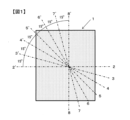
- FIG. 1 is a schematic diagram showing the measurement direction of Young's modulus.
- a rectangular measurement sample with a size of 100 mm (width direction) ⁇ 10 mm (longitudinal direction) was prepared from the laminated film 1, and under the conditions of a tensile strength of 200 mm / min, a temperature of 23 ° C., and a humidity of 65% RH, ASTM-D882: 1990, the Young's modulus in the width direction (2-2′ in FIG. 1) is measured. The same measurement is repeated five times, and the average value of the obtained values is defined as the Young's modulus in the width direction.
- the measurement direction is shifted clockwise by 15° (4-4' ⁇ 8-8' (longitudinal direction) in FIG. 1), and the Young's modulus is similarly measured.
- the Young's modulus values in the seven directions thus obtained are compared, and the largest value is taken as the maximum value of the Young's modulus of the laminated film. If the width direction or the longitudinal direction cannot be specified, the maximum value of the Young's modulus of the laminated film can be determined by arbitrarily determining the initial measurement direction and following the same procedure.
- the layer A contains at least one adhesive resin, and the adhesive resin has a dispersibility of 25% or more. is preferred.
- the dispersibility of the tacky resin is 25% or more, the tacky resin other than the tacky resin constituting the A layer such as a thermoplastic elastomer is sufficiently dispersed to improve the adhesion to the cloth, which is preferable.
- the dispersibility of the adhesive resin can be obtained from the area ratio of the bright portion when the phase contrast image of the adhesive layer is observed with an atomic force microscope (AFM) and the obtained image is binarized.
- AFM atomic force microscope
- As a method of increasing the dispersibility of the adhesive resin there is a method of changing the type of dilution rate of the composition for obtaining the A layer.
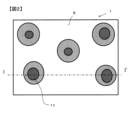
- FIG. 2 is an enlarged top view of the laminated film according to one embodiment of the present invention when observed from the layer A side
- FIG. 3 is a cross-sectional view of the laminated film of FIG.
- the laminated film 1 of the present invention has a two-kind two-layer structure of an A layer 9 and a B layer 10 , and the A layer 9 is composed of particles 11 and a resin 12 .
- Protrusions 13 are formed on the surface of the A layer 9 by particles 11 protruding from the A layer.
- a composition for obtaining a layer A dissolved in a known solvent or the like is applied to other layers such as the B layer and dried (hereinafter referred to as a coating method). There is.) is preferably used.
- a coating method the composition for obtaining the A layer is applied to other layers such as the B layer, and the solution of the adhesive layer repels the particles by leveling, so the desired particle exposure rate can be easily obtained. be done.
- the following methods can be used as the coating method.
- the ingredients for obtaining the A layer other than the particles are dissolved in a known solvent (e.g., toluene, methyl ethyl ketone (MEK), etc.), and then the particles are added.
- the solution containing the particles is applied onto the B layer, and the solvent is removed by drying in an oven to form the A layer.
- a bar coating method, a comma coating method, a slit die coating method, a gravure coating method, or the like can be preferably used.
- the surface of the layer A is independent on the surface of the layer A with a laser microscope (VK-X100, manufactured by Keyence Corporation), and the surface state of the exposed particles and the surface state of the adhesive layer covering the particles. Observation was made at a magnification such that one convex portion with a clear difference was captured within the screen. Then, using the measurement function of the laser microscope, the length of the exposed portion with the longest straight line length was measured. Furthermore, the length of the exposed portion of the straight line perpendicular to the measured straight line was measured, and the area of the circle whose radius was 1/2 of the average value of the lengths of the two points was defined as the area of the exposed portion.
- the area of a circle having a radius of 1/2 of the average particle diameter of the particles was defined as the average area of the particles. Then, (area of exposed portion)/(average area of particles) ⁇ 100 was defined as the exposure rate of particles. In addition, the same measurement was performed 10 times by changing the measurement location, and the average value of the 10 obtained values was calculated. The average particle diameter of the particles was measured in "(3) Average particle diameter of particles in layer A" described later.
- the measurement direction was the direction rotated 15° clockwise in the plane of the laminated film from the width direction, and the measurement was performed in the same manner. Thereafter, as shown in FIG. 1, the measurement direction was shifted clockwise by 15° (4-4′ ⁇ 8-8′ (longitudinal direction) in FIG. 1), and Young's modulus was measured in the same manner.
- the maximum value of the Young's modulus values in the seven directions thus obtained was defined as the maximum value (MPa) of the Young's modulus of the laminated film.
- Thickness of layer A The laminated film was cut parallel to the thickness direction at a knife inclination angle of 3° using a microtome. Next, the cross section of the A layer was observed using a scanning electron microscope, and the thickness of the A layer was measured using the length measurement function of the microscope at a location where no particles were present. After that, the same measurement was repeated 9 times at different sampling positions, and the average value of the thicknesses of the layer A at a total of 10 points was taken as the thickness ( ⁇ m) of the layer A of the laminated film.
- Thickness of layer B The laminated film was cut parallel to the thickness direction with a knife inclination angle of 3° using a microtome. Next, the cross section of the B layer was observed using a scanning electron microscope, and the thickness of the B layer was measured using the length measurement function of the microscope at a location where no particles were present. After that, the same measurement was repeated 9 times by changing the sampling position, and the average value of the thickness of the B layer at a total of 10 points was taken as the thickness ( ⁇ m) of the B layer of the laminated film.
- a phase contrast image of layer A was observed under the following conditions using an atomic force microscope (AFM) (Dimension Fast Scan SPM System, manufactured by Bruker Nano).
- AFM atomic force microscope
- the dispersibility (%) of the adhesive resin in the layer A was obtained from the area ratio of the bright portion when the image was binarized.
- ⁇ Measurement mode Tapping mode ⁇ Cantilever Material: Silicon nitride Thickness: 0.6 nm Length: 27nm Width: 32nm Resonant frequency: 1400kHz Spring constant: 18N/m ⁇ Measurement conditions Scan size: 500 nm Scan rate: 2.66Hz Amplitude Setpoint: 100-200mV Drive Amplitude: 12.9 mV.
- Friction coefficient of layer A A measurement sample was obtained by cutting the laminated film into a square size of 50 mm (width direction) x 150 mm (longitudinal direction). The friction coefficient was measured with a roughness/friction tester (KES-SESRU, manufactured by Kato Tech Co., Ltd.) under the following conditions. The measurement position was changed and the measurement was performed 5 times, and the average value was taken as the coefficient of friction of the A layer. ⁇ Measurement conditions> Friction terminal type: Fingerprint type Friction terminal load: 25gf Speed: 5mm/sec.
- Adhesive layer resin of layer A Adhesive layer resin of layer A
- Adhesive layer solution mixture of toluene, styrene-isoprene-styrene copolymer and adhesive resin (petroleum resin, terpene resin, terpene phenol resin), GR-1025M-1, manufactured by Big Technos Co., Ltd.
- Adhesive layer solution mixture of toluene, styrene-isoprene-styrene copolymer and adhesive resin (terpene resin, rosin resin, phenolic resin), GR-1045M-1, manufactured by Big Technos Co., Ltd.).
- C1 polyethylene particles (XM-330, average particle size 65 ⁇ m, manufactured by Mitsui Chemicals, Inc.)
- C2 polyethylene particles (XM-220, average particle size 30 ⁇ m, manufactured by Mitsui Chemicals, Inc.).
- PET polyester film (4F56, manufactured by Toray Industries, Inc.)
- PE polyethylene film
- PFL-10A manufactured by Toyo Heisei Polymer Co., Ltd.
- Example 1 Adhesive layer resin, diluent solvent, particles and color pigment were mixed according to the formulation shown in Table 1 to obtain a solution for forming layer A. Next, the solution was coated with a bar coater so that the mass of the A layer per 1 m 2 of the laminated film (hereinafter simply referred to as “the mass of the A layer”, including the tables) was 10 g / m 2 . It was coated on the film of the layer and dried at 80° C. for 1 minute to obtain a laminated film. Table 2 shows the physical properties and evaluation results of the obtained laminated film.
- Example 2 (Examples 2 to 15, Comparative Examples 1 to 4) A laminated film was obtained in the same manner as in Example 1 except that the composition of the solution for forming the A layer and the B layer were as shown in Table 1. Table 2 shows the physical properties and evaluation results of the obtained laminated film.
- the laminated film of the present invention is preferably used for medical and sanitary materials such as bed sheets, pillow covers, back sheets of absorbent articles such as sanitary napkins and paper diapers, etc., which require adhesion to cloth and the like and handling properties. can be used.
- medical and sanitary materials such as bed sheets, pillow covers, back sheets of absorbent articles such as sanitary napkins and paper diapers, etc., which require adhesion to cloth and the like and handling properties. can be used.
- it can be used as an alternative to hook-and-loop fasteners because it has handling properties similar to hook-and-loop fasteners, and can be repeatedly adhered to any object, such as cloth, and has a wide selection of bonding partners. can do.
Landscapes
- Chemical & Material Sciences (AREA)
- Organic Chemistry (AREA)
- Engineering & Computer Science (AREA)
- Mechanical Engineering (AREA)
- Laminated Bodies (AREA)
Priority Applications (2)
| Application Number | Priority Date | Filing Date | Title |
|---|---|---|---|
| CN202380014664.0A CN118339019A (zh) | 2022-02-17 | 2023-01-31 | 层叠膜 |
| JP2023507279A JPWO2023157632A1 (cg-RX-API-DMAC7.html) | 2022-02-17 | 2023-01-31 |
Applications Claiming Priority (2)
| Application Number | Priority Date | Filing Date | Title |
|---|---|---|---|
| JP2022-022760 | 2022-02-17 | ||
| JP2022022760 | 2022-02-17 |
Publications (1)
| Publication Number | Publication Date |
|---|---|
| WO2023157632A1 true WO2023157632A1 (ja) | 2023-08-24 |
Family
ID=87578430
Family Applications (1)
| Application Number | Title | Priority Date | Filing Date |
|---|---|---|---|
| PCT/JP2023/003029 Ceased WO2023157632A1 (ja) | 2022-02-17 | 2023-01-31 | 積層フィルム |
Country Status (4)
| Country | Link |
|---|---|
| JP (1) | JPWO2023157632A1 (cg-RX-API-DMAC7.html) |
| CN (1) | CN118339019A (cg-RX-API-DMAC7.html) |
| TW (1) | TW202335860A (cg-RX-API-DMAC7.html) |
| WO (1) | WO2023157632A1 (cg-RX-API-DMAC7.html) |
Cited By (1)
| Publication number | Priority date | Publication date | Assignee | Title |
|---|---|---|---|---|
| WO2026042558A1 (ja) * | 2024-08-20 | 2026-02-26 | 東レ株式会社 | 積層フィルム |
Citations (7)
| Publication number | Priority date | Publication date | Assignee | Title |
|---|---|---|---|---|
| US6656319B1 (en) * | 2000-10-25 | 2003-12-02 | 3M Innovative Properties Company | Fluid-activatable adhesive articles and methods |
| JP2019031596A (ja) * | 2017-08-07 | 2019-02-28 | 東レ株式会社 | フィルム |
| WO2019188787A1 (ja) * | 2018-03-28 | 2019-10-03 | 東レ株式会社 | フィルム |
| CN111527166A (zh) * | 2017-11-03 | 2020-08-11 | Gcp应用技术有限公司 | 具有颗粒状聚合物外保护层的预铺膜 |
| JP2020189407A (ja) * | 2019-05-20 | 2020-11-26 | 東洋紡フイルムソリューション株式会社 | 積層ポリステルフィルムおよびそれを用いた塗布型磁気記録テープ |
| JP2020199768A (ja) * | 2019-06-04 | 2020-12-17 | 東レ株式会社 | 積層フィルム |
| JP2021142722A (ja) * | 2020-03-13 | 2021-09-24 | 東レ株式会社 | 積層フィルム |
Family Cites Families (4)
| Publication number | Priority date | Publication date | Assignee | Title |
|---|---|---|---|---|
| JP4332204B2 (ja) * | 2007-09-21 | 2009-09-16 | 積水化学工業株式会社 | 離型フィルム |
| JP5719290B2 (ja) * | 2010-03-12 | 2015-05-13 | 積水化学工業株式会社 | 離型フィルム及び離型フィルムの製造方法 |
| WO2017022765A1 (ja) * | 2015-08-05 | 2017-02-09 | 東レ株式会社 | 積層フィルムおよびその製造方法 |
| WO2018181453A1 (ja) * | 2017-03-29 | 2018-10-04 | 三井化学東セロ株式会社 | 粘着性積層フィルムおよび構造体 |
-
2023
- 2023-01-31 JP JP2023507279A patent/JPWO2023157632A1/ja active Pending
- 2023-01-31 WO PCT/JP2023/003029 patent/WO2023157632A1/ja not_active Ceased
- 2023-01-31 CN CN202380014664.0A patent/CN118339019A/zh active Pending
- 2023-02-08 TW TW112104390A patent/TW202335860A/zh unknown
Patent Citations (7)
| Publication number | Priority date | Publication date | Assignee | Title |
|---|---|---|---|---|
| US6656319B1 (en) * | 2000-10-25 | 2003-12-02 | 3M Innovative Properties Company | Fluid-activatable adhesive articles and methods |
| JP2019031596A (ja) * | 2017-08-07 | 2019-02-28 | 東レ株式会社 | フィルム |
| CN111527166A (zh) * | 2017-11-03 | 2020-08-11 | Gcp应用技术有限公司 | 具有颗粒状聚合物外保护层的预铺膜 |
| WO2019188787A1 (ja) * | 2018-03-28 | 2019-10-03 | 東レ株式会社 | フィルム |
| JP2020189407A (ja) * | 2019-05-20 | 2020-11-26 | 東洋紡フイルムソリューション株式会社 | 積層ポリステルフィルムおよびそれを用いた塗布型磁気記録テープ |
| JP2020199768A (ja) * | 2019-06-04 | 2020-12-17 | 東レ株式会社 | 積層フィルム |
| JP2021142722A (ja) * | 2020-03-13 | 2021-09-24 | 東レ株式会社 | 積層フィルム |
Cited By (1)
| Publication number | Priority date | Publication date | Assignee | Title |
|---|---|---|---|---|
| WO2026042558A1 (ja) * | 2024-08-20 | 2026-02-26 | 東レ株式会社 | 積層フィルム |
Also Published As
| Publication number | Publication date |
|---|---|
| JPWO2023157632A1 (cg-RX-API-DMAC7.html) | 2023-08-24 |
| CN118339019A (zh) | 2024-07-12 |
| TW202335860A (zh) | 2023-09-16 |
Similar Documents
| Publication | Publication Date | Title |
|---|---|---|
| JP4052021B2 (ja) | 配向ポリエステルフィルムおよびそれを用いた積層フィルム | |
| US7396578B2 (en) | Adhesion-promoted , heatsealable and peelable polyester film, process for its production and its use | |
| JP5518054B2 (ja) | 抗菌ポリマーフィルム及び抗菌ポリマーフィルムの製造方法 | |
| JP4976259B2 (ja) | 偏光フィルム製造工程で支持体として用いられる支持体用フィルム | |
| JP2011201118A (ja) | 離型フィルム | |
| KR20060105565A (ko) | 박리 필름 | |
| JP7338466B2 (ja) | フィルム | |
| US8067105B2 (en) | Biaxially oriented film | |
| JP7619406B2 (ja) | 積層フィルム | |
| WO2023157632A1 (ja) | 積層フィルム | |
| JP7439651B2 (ja) | 積層フィルム | |
| KR101308222B1 (ko) | 플렉시블 디스플레이 기판용 적층 폴리에스테르 필름 | |
| JP2006247870A (ja) | ヒートシール性二軸延伸積層フィルム | |
| JP7687018B2 (ja) | 積層フィルム | |
| JP5937358B2 (ja) | 離型フィルム | |
| KR102144544B1 (ko) | 견고한 금속 층이 부착된 금속화된 불투명 필름 | |
| JP2025021407A (ja) | 積層フィルム | |
| JP2013136208A (ja) | 離型フィルム | |
| JP2021142722A (ja) | 積層フィルム | |
| JP2013199573A (ja) | 粘着フィルム | |
| WO2026042558A1 (ja) | 積層フィルム | |
| JP2024007605A (ja) | 粘着テープ | |
| JP3699347B2 (ja) | 反射防止用易接着性積層フィルム | |
| JP6277798B2 (ja) | 基材レス両面粘着シート用離型フィルム | |
| JP2006187949A (ja) | インモールド転写用フィルム |
Legal Events
| Date | Code | Title | Description |
|---|---|---|---|
| WWE | Wipo information: entry into national phase |
Ref document number: 2023507279 Country of ref document: JP |
|
| 121 | Ep: the epo has been informed by wipo that ep was designated in this application |
Ref document number: 23756160 Country of ref document: EP Kind code of ref document: A1 |
|
| WWE | Wipo information: entry into national phase |
Ref document number: 202380014664.0 Country of ref document: CN |
|
| WWE | Wipo information: entry into national phase |
Ref document number: 2401005147 Country of ref document: TH |
|
| NENP | Non-entry into the national phase |
Ref country code: DE |
|
| 122 | Ep: pct application non-entry in european phase |
Ref document number: 23756160 Country of ref document: EP Kind code of ref document: A1 |