WO2023136273A1 - 接着剤組成物、回路接続用接着剤フィルム、及び、接続構造体の製造方法 - Google Patents
接着剤組成物、回路接続用接着剤フィルム、及び、接続構造体の製造方法 Download PDFInfo
- Publication number
- WO2023136273A1 WO2023136273A1 PCT/JP2023/000533 JP2023000533W WO2023136273A1 WO 2023136273 A1 WO2023136273 A1 WO 2023136273A1 JP 2023000533 W JP2023000533 W JP 2023000533W WO 2023136273 A1 WO2023136273 A1 WO 2023136273A1
- Authority
- WO
- WIPO (PCT)
- Prior art keywords
- mass
- group
- less
- circuit
- component
- Prior art date
- Legal status (The legal status is an assumption and is not a legal conclusion. Google has not performed a legal analysis and makes no representation as to the accuracy of the status listed.)
- Ceased
Links
Images



Classifications
-
- C—CHEMISTRY; METALLURGY
- C09—DYES; PAINTS; POLISHES; NATURAL RESINS; ADHESIVES; COMPOSITIONS NOT OTHERWISE PROVIDED FOR; APPLICATIONS OF MATERIALS NOT OTHERWISE PROVIDED FOR
- C09J—ADHESIVES; NON-MECHANICAL ASPECTS OF ADHESIVE PROCESSES IN GENERAL; ADHESIVE PROCESSES NOT PROVIDED FOR ELSEWHERE; USE OF MATERIALS AS ADHESIVES
- C09J163/00—Adhesives based on epoxy resins; Adhesives based on derivatives of epoxy resins
-
- C—CHEMISTRY; METALLURGY
- C09—DYES; PAINTS; POLISHES; NATURAL RESINS; ADHESIVES; COMPOSITIONS NOT OTHERWISE PROVIDED FOR; APPLICATIONS OF MATERIALS NOT OTHERWISE PROVIDED FOR
- C09J—ADHESIVES; NON-MECHANICAL ASPECTS OF ADHESIVE PROCESSES IN GENERAL; ADHESIVE PROCESSES NOT PROVIDED FOR ELSEWHERE; USE OF MATERIALS AS ADHESIVES
- C09J11/00—Features of adhesives not provided for in group C09J9/00, e.g. additives
-
- C—CHEMISTRY; METALLURGY
- C09—DYES; PAINTS; POLISHES; NATURAL RESINS; ADHESIVES; COMPOSITIONS NOT OTHERWISE PROVIDED FOR; APPLICATIONS OF MATERIALS NOT OTHERWISE PROVIDED FOR
- C09J—ADHESIVES; NON-MECHANICAL ASPECTS OF ADHESIVE PROCESSES IN GENERAL; ADHESIVE PROCESSES NOT PROVIDED FOR ELSEWHERE; USE OF MATERIALS AS ADHESIVES
- C09J11/00—Features of adhesives not provided for in group C09J9/00, e.g. additives
- C09J11/02—Non-macromolecular additives
- C09J11/06—Non-macromolecular additives organic
-
- C—CHEMISTRY; METALLURGY
- C09—DYES; PAINTS; POLISHES; NATURAL RESINS; ADHESIVES; COMPOSITIONS NOT OTHERWISE PROVIDED FOR; APPLICATIONS OF MATERIALS NOT OTHERWISE PROVIDED FOR
- C09J—ADHESIVES; NON-MECHANICAL ASPECTS OF ADHESIVE PROCESSES IN GENERAL; ADHESIVE PROCESSES NOT PROVIDED FOR ELSEWHERE; USE OF MATERIALS AS ADHESIVES
- C09J11/00—Features of adhesives not provided for in group C09J9/00, e.g. additives
- C09J11/08—Macromolecular additives
-
- C—CHEMISTRY; METALLURGY
- C09—DYES; PAINTS; POLISHES; NATURAL RESINS; ADHESIVES; COMPOSITIONS NOT OTHERWISE PROVIDED FOR; APPLICATIONS OF MATERIALS NOT OTHERWISE PROVIDED FOR
- C09J—ADHESIVES; NON-MECHANICAL ASPECTS OF ADHESIVE PROCESSES IN GENERAL; ADHESIVE PROCESSES NOT PROVIDED FOR ELSEWHERE; USE OF MATERIALS AS ADHESIVES
- C09J7/00—Adhesives in the form of films or foils
- C09J7/30—Adhesives in the form of films or foils characterised by the adhesive composition
-
- C—CHEMISTRY; METALLURGY
- C09—DYES; PAINTS; POLISHES; NATURAL RESINS; ADHESIVES; COMPOSITIONS NOT OTHERWISE PROVIDED FOR; APPLICATIONS OF MATERIALS NOT OTHERWISE PROVIDED FOR
- C09J—ADHESIVES; NON-MECHANICAL ASPECTS OF ADHESIVE PROCESSES IN GENERAL; ADHESIVE PROCESSES NOT PROVIDED FOR ELSEWHERE; USE OF MATERIALS AS ADHESIVES
- C09J9/00—Adhesives characterised by their physical nature or the effects produced, e.g. glue sticks
- C09J9/02—Electrically-conducting adhesives
-
- H—ELECTRICITY
- H01—ELECTRIC ELEMENTS
- H01B—CABLES; CONDUCTORS; INSULATORS; SELECTION OF MATERIALS FOR THEIR CONDUCTIVE, INSULATING OR DIELECTRIC PROPERTIES
- H01B1/00—Conductors or conductive bodies characterised by the conductive materials; Selection of materials as conductors
- H01B1/20—Conductive material dispersed in non-conductive organic material
-
- H—ELECTRICITY
- H05—ELECTRIC TECHNIQUES NOT OTHERWISE PROVIDED FOR
- H05K—PRINTED CIRCUITS; CASINGS OR CONSTRUCTIONAL DETAILS OF ELECTRIC APPARATUS; MANUFACTURE OF ASSEMBLAGES OF ELECTRICAL COMPONENTS
- H05K1/00—Printed circuits
- H05K1/02—Details
- H05K1/03—Use of materials for the substrate
-
- H—ELECTRICITY
- H05—ELECTRIC TECHNIQUES NOT OTHERWISE PROVIDED FOR
- H05K—PRINTED CIRCUITS; CASINGS OR CONSTRUCTIONAL DETAILS OF ELECTRIC APPARATUS; MANUFACTURE OF ASSEMBLAGES OF ELECTRICAL COMPONENTS
- H05K3/00—Apparatus or processes for manufacturing printed circuits
- H05K3/30—Assembling printed circuits with electric components, e.g. with resistors
- H05K3/32—Assembling printed circuits with electric components, e.g. with resistors electrically connecting electric components or wires to printed circuits
- H05K3/321—Assembling printed circuits with electric components, e.g. with resistors electrically connecting electric components or wires to printed circuits by conductive adhesives
-
- C—CHEMISTRY; METALLURGY
- C08—ORGANIC MACROMOLECULAR COMPOUNDS; THEIR PREPARATION OR CHEMICAL WORKING-UP; COMPOSITIONS BASED THEREON
- C08K—Use of inorganic or non-macromolecular organic substances as compounding ingredients
- C08K2201/00—Specific properties of additives
- C08K2201/001—Conductive additives
Definitions
- the present disclosure relates to an adhesive composition, an adhesive film for circuit connection, and a method for manufacturing a connection structure.
- an adhesive for circuit connection having anisotropic conductivity in which conductive particles are dispersed in the adhesive.
- Films are known (see, for example, Patent Documents 1 to 4 below).
- Such an adhesive film is used for connection between a liquid crystal display (LCD) panel and a tape carrier package (TCP: Tape Carrier Package) or a chip on flex (COF: Chip On Flex) on which a semiconductor for driving the LCD is mounted, Alternatively, it is widely used for electrical connection between a printed wiring board and TCP or COF.
- a circuit-connecting adhesive film having anisotropic conductivity is used as a circuit-connecting material.
- connection reliability In addition, in recent years, the level of demand for connection reliability of mounting bodies that apply adhesive films has increased. In order to improve connection reliability, it is required that the mounting body have HAST resistance so that the adhesive film does not easily peel off even after severe tests such as HAST (Highly Accelerated Stress Test). .
- the present disclosure can be mounted from a low temperature (e.g., 120° C.) to a high temperature (e.g., 150° C.), and in both cases of low temperature mounting and high temperature mounting, even after the HAST test
- An object of the present invention is to provide an adhesive composition capable of realizing excellent appearance.
- Another object of the present disclosure is to provide an adhesive film for circuit connection, a connection structure, and a method for producing a connection structure using the adhesive composition.
- One aspect of the present disclosure includes the following [1] to [7].
- the component (A) contains a polyfunctional epoxy resin, containing a pyridinium salt as the component (B), the pyridinium salt has a benzyl group at the 1-position and an electron-withdrawing group at the 2-position;
- the adhesive composition wherein the benzyl group has an electron donating group.
- the adhesive composition according to [1] wherein the epoxy resin is an aromatic epoxy resin.
- [3] The adhesive composition according to [1] or [2], further containing conductive particles.
- An adhesive film for circuit connection having a region formed from the adhesive composition according to any one of [1] to [3].
- [5] comprising a first region containing a first adhesive component and a second region adjacent to the first region containing a second adhesive component; An adhesive film for circuit connection, wherein one or both of the first region and the second region are formed from the adhesive composition according to any one of [1] to [3]. .
- the adhesive film for circuit connection according to [4] or [5] is interposed. and thermocompression bonding the first circuit member and the second circuit member to electrically connect the first electrode and the second electrode to each other.
- mounting is possible from a low temperature (for example, 120° C.) to a high temperature (for example, 150° C.), and even after the HAST test in both low-temperature mounting and high-temperature mounting
- a low temperature for example, 120° C.
- a high temperature for example, 150° C.
- an adhesive composition capable of achieving excellent appearance.
- FIG. 1 is a schematic cross-sectional view showing an embodiment of an adhesive film for circuit connection
- FIG. 1 is a schematic cross-sectional view showing an embodiment of an adhesive film for circuit connection
- FIG. It is a schematic cross section which shows one Embodiment of a connection structure.
- FIG. 4 is a schematic cross-sectional view showing a method of manufacturing the connection structure of FIG. 3;
- the upper limit or lower limit of the numerical range may be replaced with the values shown in the examples.
- the lower and upper limits of a numerical range can be arbitrarily combined with the lower and upper limits of other numerical ranges, respectively.
- both numerical values A and B are included in the numerical range as lower and upper limits, respectively.
- the description "10 or more” means 10 and a numerical value exceeding 10, and this also applies when the numerical values are different.
- the description "10 or less” means 10 and less than 10, and the same applies when the numerical values are different.
- each component and material exemplified in this specification may be used singly or in combination of two or more unless otherwise specified.
- each component in the composition refers to the total amount of the multiple substances present in the composition when there are multiple substances corresponding to each component in the composition, unless otherwise specified.
- (meth)acrylate means at least one of acrylate and methacrylate corresponding thereto.
- epoxy group includes a substituent containing an epoxy group in its structure, such as a glycidyl group and a glycidyloxy group.
- the adhesive composition of the present embodiment contains at least (A) an epoxy resin (hereinafter also referred to as (A) component) and (B) a curing agent (hereinafter also referred to as (B) component).
- the adhesive composition of the present embodiment contains a polyfunctional epoxy resin as component (A).
- the polyfunctional epoxy resin may be, for example, an aromatic epoxy resin (polyfunctional aromatic epoxy resin), and may contain more than 90% by mass of the aromatic epoxy resin based on the total amount of component (A).
- the aromatic epoxy resin may include, for example, (A1) a polyfunctional epoxy resin having a skeleton represented by the following general formula (1) (hereinafter also referred to as component (A1)).
- An aromatic epoxy resin is an epoxy resin having an aromatic ring in its molecule. Since the polyfunctional epoxy resin is an aromatic epoxy resin (polyfunctional aromatic epoxy resin), the polyfunctional epoxy resin has a rigid skeleton, so the adhesive has a better appearance even after the HAST test. A composition can be obtained.
- X 1 represents an oxygen atom, a sulfur atom, or an alkylene group having 1 to 10 carbon atoms. From the viewpoint of peeling resistance, X 1 may be -CH 2 -.
- a polyfunctional epoxy resin represented by the following general formula (2) can be used as the component (A1).
- X 1 represents an oxygen atom, a sulfur atom, or an alkylene group having 1 to 10 carbon atoms; group, m and n each represent an integer of 1 to 7, and m+n is 2 or more.
- a polyfunctional epoxy resin represented by the following general formula (3) can be used as the component (A1).
- R 11 , R 12 , R 21 and R 22 each independently represent a hydrogen atom, a glycidyl group or a glycidyloxy group, and two of R 11 , R 12 , R 21 and R 22 The above is a glycidyl group or a glycidyloxy group.
- R 11 and R 22 are a glycidyl group or a glycidyloxy group
- R 12 and R 21 may be hydrogen atoms
- all of R 11 , R 12 , R 21 and R 22 are glycidyl or a glycidyloxy group.
- the (A1) component can be used singly or in combination of two or more.
- the content of component (A1) in the adhesive composition may be 10 to 70% by mass, or 20 to 60% by mass, based on the total amount of the adhesive composition (excluding conductive particles). good too.
- the adhesive composition of this embodiment may contain an aromatic epoxy resin other than the (A1) component.
- an epoxy resin having a trisphenolmethane structure hereinafter also referred to as component (A2)
- an epoxy resin having a bisphenol structure and having a glycidyl group and a glycidyloxy group hereinafter also referred to as component (A3)
- component (A4) a novolak-type epoxy resin having an aralkyl skeleton
- component (A5) component a tetravalent organic group and an aromatic ring bonded to the organic group, wherein the aromatic ring is an epoxy group and an epoxy resin having a substituent containing
- the (A2) component has the following general formula (2A) from the viewpoint that it is easier to achieve excellent connection resistance and excellent appearance even after the HAST test in both cases of low temperature mounting and high temperature mounting. It may be a compound represented by.
- R 23 , R 24 and R 25 each independently represent a hydrogen atom or an organic group, and at least one of R 23 , R 24 and R 25 is an epoxy represents an organic group having a group, R26 represents a hydrogen atom or an alkyl group, and R27 represents a hydrogen atom or an organic group.
- Examples of organic groups represented by R 23 , R 24 and R 25 include alkyl groups, alkyl ether groups and alkenyl groups. These organic groups may have a substituent. The number of carbon atoms in the organic group may be, for example, 2 or more, or 3 or more, or 8 or less, 6 or less, or 4 or less. At least one of R 23 , R 24 and R 25 may be an organic group having a glycidyl group or an organic group having a glycidyloxy group. R 23 , R 24 and R 25 may be the same or different. R 23 , R 24 , and R 25 are all from the viewpoint of easily realizing excellent connection resistance and excellent appearance even after the HAST test in both cases of low-temperature mounting and high-temperature mounting. It may be an organic group having a glycidyl group or an organic group having a glycidyloxy group.
- R 26 is an alkyl group
- the alkyl group may be, for example, a methyl group, an ethyl group, or a propyl group.
- the alkyl group may have a substituent.
- R 26 may be a hydrogen atom from the viewpoint of easily achieving excellent connection resistance and excellent appearance even after the HAST test in both cases of low temperature mounting and high temperature mounting.
- the organic group represented by R 27 may be, for example, an alkyl group, an alkyl ether group, or an alkenyl group.
- the organic group may have a substituent.
- R 27 may be an alkyl group from the viewpoint of more easily realizing excellent connection resistance and excellent appearance even after the HAST test in both cases of low-temperature mounting and high-temperature mounting. It may be an alkyl group having a group or an alkyl group having a phenyl group.
- a phenyl group may have a substituent, for example, an epoxy group, a glycidyl group, or a glycidyloxy group.
- R 27 has a phenyl group having a glycidyloxy group from the viewpoint of more easily realizing excellent connection resistance and excellent appearance even after the HAST test in both cases of low temperature mounting and high temperature mounting. It may be an alkyl group.
- the number of epoxy groups possessed by component (A2) may be 2 or more, 3 or more, or 4 or more, and may be 15 or less, 12 or less, or 10 or less.
- the epoxy equivalent of component (A2) may be, for example, 100 to 300 g/eq, or 150 to 250 g/eq.
- Epoxy equivalent means a value measured according to JIS K7236.
- the (A2) component may be a compound represented by the following formula (2B).
- k represents an integer of 1 to 3.
- the (A3) component is selected from the following general viewpoints, from the viewpoint of easily realizing an excellent appearance even after the HAST test and from the viewpoint of better adhesion, in both cases of low-temperature mounting and high-temperature mounting. It may be a compound represented by formula (3A).
- R 33 , R 34 , R 35 and R 36 each independently represent a hydrogen atom, an organic group, an organic group having a glycidyl group, or an organic group having a glycidyloxy group
- At least one of R 33 , R 34 , R 35 and R 36 represents an organic group having a glycidyl group
- at least one of R 33 , R 34 , R 35 and R 36 is glycidyl It represents an organic group having an oxy group
- R 37 and R 38 each independently represent a hydrogen atom or an organic group.
- Examples of organic groups represented by R 33 , R 34 , R 35 and R 36 include alkyl groups, alkyl ether groups and alkenyl groups. These organic groups may have a substituent.
- the number of carbon atoms in the organic group may be, for example, 2 or more, or 3 or more, or 8 or less, 6 or less, or 4 or less.
- R 33 , R 34 , R 35 and R 36 may be the same or different.
- R 33 and R 34 are respectively They may be different, and one of R 33 and R 34 may be an organic group having a glycidyl group, and the other may be an organic group having a glycidyloxy group.
- R 35 and R 36 are respectively They may be different, and one of R 35 and R 36 may be an organic group having a glycidyl group, and the other may be an organic group having a glycidyloxy group.
- R 37 and/or R 38 are organic groups
- the organic groups include, for example, alkyl groups, aryl groups, alkyl ether groups, and alkenyl groups. These organic groups may have a substituent.
- Alkyl groups may be, for example, methyl, ethyl, or propyl groups.
- the alkyl group may have a substituent.
- R 37 and R 38 are hydrogen in both cases of low-temperature mounting and high-temperature mounting, from the viewpoint of more easily realizing an excellent appearance even after the HAST test and from the viewpoint of better adhesion. It may be an atom or an alkyl group, or it may be a methyl group.
- the number of epoxy groups possessed by component (A3) may be 2 or more, 3 or more, or 4 or more, and may be 10 or less, 8 or less, 6 or less, or 4 or less.
- the component (A3) may be a compound represented by the following formula (3B).
- the aralkyl skeleton of component (A4) means a structure in which hydrogen atoms of aromatic hydrocarbons are substituted with alkyl groups.
- the component (A4) novolak-type epoxy resin having an aralkyl skeleton
- the component (A4) means a compound obtained by glycidylating the hydroxyl group of a novolac compound having a structure in which the hydrogen atoms of an aromatic hydrocarbon are substituted with alkyl groups.
- the (A4) component has the following general formula (4A) from the viewpoint that it is easier to achieve excellent connection resistance and excellent appearance even after the HAST test in both cases of low-temperature mounting and high-temperature mounting. It may be a compound having a structure represented by
- R 44 represents an alkyl group, a and b each independently represent an integer of 1 to 3, c represents an integer of 1 to 3, n represents an integer of 1 to 10 and m is an integer of 1-3. ]
- R 44 examples include a methyl group, an ethyl group, a normal propyl group, an isopropyl group and the like. These alkyl groups may have a substituent. R44 may be an ethyl group from the viewpoint of easily achieving excellent connection resistance and excellent appearance even after the HAST test in both cases of low temperature mounting and high temperature mounting.
- a and b may each independently be an integer of 1 to 2, or may be 1;
- c may be an integer of 1 to 2, or 1.
- n may be an integer of 1-10 or an integer of 2-5.
- n may be an integer of 1 to 3, or may be 1 to 2.
- the number of epoxy groups possessed by component (A4) may be 2 or more, 3 or more, 4 or more, or 5 or more, and may be 10 or less, 8 or less, 6 or less, or 4 or less.
- the epoxy equivalent of component (A4) may be, for example, 150 to 350 g/eq, or 200 to 300 g/eq.
- Epoxy equivalent means a value measured according to JIS K7236.
- the number average molecular weight of component (A4) may be 200 or more, 400 or more, or 600 or more, and may be 2,000 or less, 1,500 or less, or 1,000 or less.
- the number average molecular weight in the present specification means a value measured using gel permeation chromatography (GPC) under the following conditions and determined using polystyrene as a standard substance.
- the component (A4) may be a compound represented by the following formula (4B).
- formula (4B) n represents an integer of 1 to 5, and m represents an integer of 1 to 2.
- the (A5) component has a tetravalent organic group with 4 1 aromatic ring may be attached, and each of the 4 aromatic rings may have an epoxy group. At this time, the four aromatic rings may be different from each other, and in both cases of low-temperature mounting and high-temperature mounting, even after the HAST test, excellent connection resistance and excellent appearance are more achieved. From the viewpoint of simplicity, they may be the same.
- the (A4) component may be, for example, a compound represented by the following general formula (5A).
- R 51 represents a tetravalent organic group
- R 52 represents an epoxy group-containing organic group
- Examples of organic groups represented by R 51 include alkyl groups, alkyl ether groups, and alkenyl groups. These organic groups may have a substituent. The number of carbon atoms in the organic group may be, for example, 2 or more, or 3 or more, or 8 or less, 6 or less, 4 or less, or 3 or less. R 51 may be an alkyl group, or an ethyl may be a base.
- R 52 may be an organic group having a glycidyl group or an organic group having a glycidyloxy group.
- R52 is an organic group having a glycidyloxy group from the viewpoint of easily achieving excellent connection resistance and excellent appearance even after the HAST test in both low-temperature mounting and high-temperature mounting.
- the number of epoxy groups possessed by component (A5) may be 2 or more, 3 or more, or 4 or more, and may be 10 or less, 8 or less, 6 or less, or 4 or less.
- the epoxy equivalent of component (A5) may be, for example, 100 to 300 g/eq, or 150 to 250 g/eq.
- Epoxy equivalent means a value measured according to JIS K7236.
- the component (A5) may be a compound represented by the following formula (5B).
- the adhesive composition of the present embodiment may contain an aliphatic epoxy resin (multifunctional aliphatic epoxy resin) as a polyfunctional epoxy resin.
- the aliphatic epoxy resin may be an epoxy resin obtained by glycidylating an aliphatic polyhydric alcohol (hereinafter also referred to as component (A6)).
- Component (A6) is an epoxy compound obtained by glycidylating an aliphatic polyhydric alcohol.
- aliphatic polyhydric alcohols include trimethylolpropane, glycerin, erythritol, pentaerythritol, sorbitol, and 1,2,3-trihydroxycyclohexane.
- 1,3,5-trihydroxycyclohexane, xylitol and inositol 1,4-cyclohexanedimethanol, 1,2,4-cyclohexanetrimethanol, 1,2,4,5-cyclohexanetetramethanol, 1,1, 4,4-cyclohexanetetramethanol, 1,3,5-cyclohexanetriol, 1,4-cyclohexanediol.
- the number of hydroxy groups in the aliphatic polyhydric alcohol is 2, from the viewpoint of making it easier to achieve excellent connection resistance and excellent appearance even after the HAST test in both low-temperature mounting and high-temperature mounting. 3 or more, or 4 or more, or 6 or less, 5 or less, or 4 or less.
- the (A6) component may have a cyclic structure, and in both cases of low-temperature mounting and high-temperature mounting, it is easier to achieve excellent connection resistance and excellent appearance even after the HAST test. Therefore, it does not have to have a cyclic structure. That is, the (A6) component may be an epoxy resin obtained by glycidylating an aliphatic chain polyhydric alcohol.
- the number of carbon atoms in the (A6) component is 12 or more and 14 from the viewpoint of easily realizing excellent connection resistance and excellent appearance even after the HAST test in both low-temperature mounting and high-temperature mounting. or more, or 16 or more, and may be 30 or less, 25 or less, 20 or less, or 18 or less.
- the epoxy equivalent of component (A6) may be 50 to 300 g/eq, or 80 to 200 g/eq.
- Epoxy equivalent means a value measured according to JIS K7236.
- the number of epoxy groups possessed by component (A6) may be 2 or more, 3 or more, or 4 or more, and may be 10 or less, 8 or less, 6 or less, or 4 or less.
- Component (A6) is a compound obtained by glycidylating pentaerythritol from the viewpoint of easily achieving excellent connection resistance and excellent appearance even after the HAST test in both cases of low-temperature mounting and high-temperature mounting. may be
- the polyfunctional epoxy resin may be a trifunctional or higher epoxy resin.
- a trifunctional or higher epoxy resin means an epoxy resin having three or more epoxy groups. Since component (A) contains a trifunctional or more functional epoxy resin, it is possible to realize a better appearance even after the HAST test in both cases of low-temperature mounting and high-temperature mounting.
- the number of functional groups of the polyfunctional epoxy resin may be 4 or more, 10 or less, 8 or less, 6 or less, 5 or less, or 4 or less.
- the molecular weight of the polyfunctional epoxy resin may be 100 or more, 150 or more, 200 or more, 250 or more, or 300 or more, It may be 1000 or less, 900 or less, 800 or less, 700 or less, or 650 or less.
- the epoxy equivalent of the polyfunctional epoxy resin may be 50 g/eq or more, 80 g/eq or more, 100 g/eq or more, 120 g/eq or more, 140 g/eq or more, 160 g/eq or more, or 180 g/eq or more, 5000 g/eq or less, 4000 g/eq or less, 3500 g/eq or less, 3000 g/eq or less, 2500 g/eq or less, 2000 g/eq or less, 1500 g/eq or less, 1000 g/eq or less, 800 g/eq or less, 600 g/eq or less, It may be 400 g/eq or less, 300 g/eq or less, 250 g/eq or less, or 200 g/eq or less.
- the polyfunctional epoxy resin may be solid at room temperature (25°C).
- room temperature 25°C.
- multifunctional epoxy resins are solid at room temperature makes it easier to achieve good appearance, even after HAST testing, compared to epoxy compounds that are liquid at room temperature.
- the polyfunctional epoxy resin has a polyfunctional epoxy resin having a skeleton represented by general formula (1), an epoxy resin having a trisphenolmethane structure, and a bisphenol structure, and has a glycidyl group and a glycidyloxy group.
- Epoxy compounds, novolac type epoxy resins having an aralkyl skeleton, epoxy resins having a tetravalent organic group and an aromatic ring bonded to the organic group, the aromatic ring having a substituent containing an epoxy group, and fatty It may contain at least one selected from the group consisting of epoxy resins obtained by glycidylating group polyhydric alcohols.
- the polyfunctional epoxy resin has a skeleton represented by the general formula (1) from the viewpoint of realizing a better appearance even after the HAST test in both cases of low-temperature mounting and high-temperature mounting.
- a functional epoxy resin an epoxy resin having a trisphenolmethane structure, an epoxy compound having a bisphenol structure and having a glycidyl group and a glycidyloxy group, a tetravalent organic group, and an aromatic ring bonded to the organic group , wherein the aromatic ring has a substituent containing an epoxy group, and at least one selected from the group consisting of an epoxy resin obtained by glycidylating an aliphatic polyhydric alcohol.
- the polyfunctional epoxy resin may contain a difunctional or less epoxy resin together with any one of the (A1) to (A6) components.
- the crosslinking density can be adjusted by including a difunctional or less epoxy resin together with any one of the components (A1) to (A6).
- the adhesive composition of the present embodiment may contain any one of the components (A1) to (A6) alone, or may contain two or more of the components (A1) to (A6). Epoxy resins other than components (A1) to (A6) may be included together with components (A1) to (A6).
- the adhesive composition of this embodiment can contain a second aromatic epoxy resin other than the components (A1) to (A6).
- bisphenol A type epoxy resin bisphenol S type epoxy resin, phenol novolak type epoxy resin, cresol novolak type epoxy resin, bisphenol A novolac type epoxy resin, bisphenol F novolac type epoxy resin, tetramethyl bisphenol A type epoxy resin, 3′,4′-epoxycyclohexylmethyl-3,4-epoxycyclohexane carboxylate (bi-7-oxabicyclo[4,1,0]heptane), xylene-novolac type glycidyl ether, and the like. be done.
- the adhesive composition of the present embodiment may contain other epoxy resins than the aromatic epoxy resin as the (A) component.
- Other epoxy resins include aliphatic epoxy resins and cycloaliphatic epoxy resins.
- the adhesive composition of the present embodiment may contain resins other than epoxy resins, for example, it may contain cationic polymerizable compounds in addition to epoxy resins.
- cationic polymerizable compounds include oxetane compounds.
- the adhesive composition may contain an oxetane compound. Moreover, from the viewpoint of easily achieving both low-temperature curability and good storage stability, the adhesive composition does not need to contain an oxetane compound.
- the adhesive composition may contain an epoxy resin and an oxetane compound.
- oxetane compounds include xylylenebisoxetane, 2-ethylhexyloxetane, 3-hydroxymethyl-3-methyloxetane, 3-hydroxymethyl-3-ethyloxetane, 3-hydroxymethyl-3-propyloxetane, 3-hydroxy methyl-3-n-butyloxetane, 3-hydroxymethyl-3-phenyloxetane, 3-hydroxymethyl-3-benzyloxetane, 3-hydroxyethyl-3-methyloxetane, 3-hydroxyethyl-3-ethyloxetane, 3- Hydroxyethyl-3-propyloxetane, 3-hydroxyethyl-3-phenyloxetane, 3-hydroxypropyl-3-methyloxetane, 3-hydroxypropyl-3-ethyloxetane, 3-hydroxypropyl-3-propyloxetane, 3-hydroxypropyl-3-propyloxetane, 3- Hydroxypropyl-3-phen
- the content of component (A) is 10% by mass or more, 20% by mass or more, 30% by mass or more, or 35% by mass or more, based on the total mass of the adhesive composition. % by mass or more. From the viewpoint of ensuring the formability of the adhesive composition, the content of component (A) is 70% by mass or less, 60% by mass or less, 50% by mass or less, or 45% by mass or less, based on the total mass of the adhesive composition. % by mass or less.
- the content of the component (A) is, in both cases of low-temperature mounting and high-temperature mounting, from the viewpoint of making it easier to achieve an excellent appearance even after the HAST test, and from the viewpoint of better adhesion, It may be 50% by mass or more, 70% by mass or more, 80% by mass or more, 90% by mass or more, or 95% by mass or more based on the total mass of the cationic polymerizable compound.
- the content of component (A) in the cationically polymerizable compound may be substantially 100% by mass (an embodiment in which the cationically polymerizable compound is composed of component (A)).
- the total content of the components (A1) to (A6) in the component (A) makes it easier to achieve an excellent appearance even after the HAST test in both low-temperature mounting and high-temperature mounting. , and from the viewpoint of better sticking properties, it may be 10% by mass or more, 20% by mass or more, 30% by mass or more, or 40% by mass or more based on the total mass of component (A).
- the total content of components (A1) to (A6) in component (A) is 100% by mass or less, 90% by mass or less, 80% by mass or less, and 70% by mass or less, based on the total mass of component (A). , or 60% by mass or less.
- the adhesive composition of the present embodiment contains (B1) an onium-based compound (hereinafter also referred to as (B1) component) as the (B) component.
- onium salts such as sulfonium salts, pyridinium salts, phosphonium salts, ammonium salts, diazonium salts, iodonium salts, and anilinium salts can be used.
- Onium salt anions include BF 4 ⁇ , BR 4 ⁇ (R represents a phenyl group substituted with two or more fluorine atoms or two or more trifluoromethyl groups), PF 6 ⁇ , SbF 6 ⁇ , AsF 6 - and the like.
- the (B1) component can be used singly or in combination of two or more.
- the (B1) component may be a pyridinium salt or a sulfonium salt.
- the (B1) component may be, for example, a compound represented by the following general formula (8).
- R 81 , R 82 , R 83 and R 84 are each independently a hydrogen atom, a substituted or unsubstituted alkyl group, a substituted or unsubstituted aryl group, a substituted or unsubstituted alkenyl group, , a substituted or unsubstituted heterocyclic group, a substituted or unsubstituted alkoxyl group, a substituted or unsubstituted aryloxy group, or a substituted or unsubstituted heterocyclic oxy group, and R 81 , R 82 , R 83 and R 84 may combine with each other to form a ring structure, and X - represents an anion.
- X - represents an anion.
- alkyl groups examples include methyl group, ethyl group, propyl group, isopropyl group, butyl group, isobutyl group, n-pentyl group, n-hexyl group, n-heptyl group and aralkyl group.
- Aralkyl groups include benzyl, naphthylmethyl, and cinnamyl groups. These alkyl groups may have a substituent.
- aryl groups examples include phenyl groups, naphthyl groups, and biphenyl groups. These aryl groups may have a substituent.
- Examples of the above alkenyl groups include propenyl groups, 2-butenyl groups, 2-pentanyl groups, and 2-hexanyl groups.
- a pyridinyl group etc. are mentioned as said heterocyclic group.
- the above alkoxyl groups include methoxy, ethoxy, propoxy, butoxy and the like.
- Examples of the aryloxy group include a 4-phenylmethoxy group, a 4-phenylethoxy group, a 4-phenyloxycarbonylmethyl group, and the like.
- Examples of the heterocyclic oxy group include a 4-cyclohexane oxide group. These groups may have a substituent.
- substituents for each group such as the above alkyl group and aryl group include alkyl groups such as methyl group, ethyl group, propyl group, isopropyl group, butyl group, isobutyl group, t-butyl group, pentyl group and hexyl group; aryl groups such as phenyl group and naphthyl group; alkoxy groups such as methoxy group, ethoxy group, propoxy group and butoxy group; alkoxycarbonyl groups such as acetoxy group, propionyloxy group, decylcarbonyloxy group and dodecylcarbonyloxy group; methoxycarbonyl group, ethoxycarbonyl group, ester group such as benzoyloxy group; phenylthio group; halogen atom such as fluorine atom, chlorine atom, bromine atom and iodine atom; cyano group; nitro group; The substitution position of these substituents
- X - in formula (8) represents the counter anion of the nitrogen onium cation.
- X ⁇ includes, for example, SbF 6 ⁇ , PF 6 ⁇ , B(C 6 F 5 ) 4 ⁇ , Ga(C 6 F 5 ) 4 ⁇ , Ga(C 6 F 5 ) 2 F 2 ⁇ , Ga(C 6 F 5 )F 3 ⁇ , and C(CF 3 SO 2 ) 3 — .
- SbF 6 ⁇ , (C 6 F 5 ) 4 B ⁇ , (CF 3 SO 2 ) 3 C ⁇ may be used from the viewpoint of obtaining better curability when the nucleophilicity of the anion is low.
- R 81 , R 82 , R 83 and R 84 lowers the decomposition temperature of the initiator and further improves curability. From the viewpoint of improvement, it may be a substituted or unsubstituted benzyl group, a substituted or unsubstituted naphthylmethyl group, or a substituted or unsubstituted cinnamyl group.
- R 81 , R 82 , R 83 and R 84 may be bonded to each other to form a ring structure, for example, adjacent groups among R 81 , R 82 , R 83 and R 84 are bonded to each other. may form a ring structure.
- Nitrogen onium cations having a ring structure include, for example, cations represented by the following general formula (9).
- the ring structure Q includes a heterocyclic ring, an aromatic ring, a heteroaromatic ring (pyridinium ring, etc.), an alicyclic ring, and the like.
- the ring structure Q may be, for example, a multi-membered ring such as a four-, five-, six-, or seven-membered ring.
- Ring structure Q may be unsubstituted or may have a substituent.
- substituents include the substituents described above for each group such as an alkyl group and an aryl group.
- m represents 1 or 2;
- R 95 may be a group equivalent to R 81 , R 82 , R 83 and R 84 .
- Component (B1) may be a compound that exhibits activity at a temperature of 80 to 250° C. from the viewpoint of better storage stability.
- anilinium salt (anilinium salt compound) and pyridinium salt (pyridinium salt compound) may be at least one selected from the group consisting of
- the anilinium salt is an N-alkylanilinium salt, an N,N-dialkylanilinium salt, or an N,N,N-trialkylanilinium salt from the viewpoint of lowering the decomposition temperature and further improving the curability. good too.
- anilinium salts include N-benzyl-N,N-dimethylanilinium salts, N-(4-nitrobenzyl)-N,N-dimethylanilinium salts, N-(4-methoxybenzyl)-N, N-dimethylanilinium salt, N-( ⁇ -phenylbenzyl)-N,N-dimethylanilinium salt, N-( ⁇ -methylbenzyl)-N,N-dimethylanilinium salt, N-(1-naphthylmethyl )-N,N-dimethylanilinium salts, N-cinnamyl-N,N-dimethylanilinium salts, onium salts with substituted benzylanilinium cations (e.g., K-PURE CXC-1612 (manufactured by KING Industries, counter anion : SbF 6 ), K-PURE CXC-1738 (manufactured by KING Industries, counter anion: PF
- the aromatic ring bonded to the nitrogen atom in these compounds may be unsubstituted or may have a substituent.
- examples of the anilinium salt in which the aromatic ring has a substituent include N-(1-naphthylmethyl)-N,N-dimethyl(4-bromophenyl)anilinium salt.
- the anilinium salt is selected from the group consisting of N-benzyl-N,N-dialkylanilinium salts and N-naphthylmethyl-N,N-dialkylanilinium salts from the viewpoint of lowering the decomposition temperature and further improving curability. At least one kind may be selected.
- pyridinium salt A a pyridinium salt having a benzyl group at the 1-position, an electron-withdrawing group at the 2-position, and the benzyl group having an electron-donating group (hereinafter also referred to as "pyridinium salt A") is used. be able to.
- pyridinium salt A has a pyridine ring and a benzene ring, with an electron-withdrawing group located ortho to the nitrogen atom of the pyridine ring, with the benzene ring having an electron-donating group.
- the adhesive composition of the present embodiment contains pyridinium salt A as component (B).
- a low temperature e.g., 120 ° C.
- a high temperature e.g. 150 ° C.
- excellent appearance can be achieved even after HAST testing.
- the pyridinium salt A may be a compound composed of a pyridinium cation and an anion.
- the 1-position of a pyridinium salt or a pyridinium cation means the position of the nitrogen atom in the pyridine ring of a pyridinium salt or a pyridinium cation.
- Pyridinium salt A may be, for example, a compound represented by the following general formula (4).
- R 31 represents an electron-withdrawing group
- R 32 represents an electron-donating group
- X - represents an anion.
- Examples of the electron-withdrawing group that the pyridinium salt A has at the 2-position include a cyano group, a halogeno group, a nitro group, a carbonyl group, a carboxy group, a sulfo group, and the like.
- the halogeno group includes a fluoro group, a chloro group, a bromo group, an iodo group and the like.
- the electron-withdrawing group may be a cyano group or a halogeno group, or a cyano group or a chloro group, from the viewpoint of enhancing the activity of the curing agent and curing the adhesive composition in a shorter time. good.
- Pyridinium salt A may contain an electron withdrawing group other than the voltage withdrawing group located at the 2-position.
- the number of electron-withdrawing groups that the pyridinium salt A has may be 3 or less, 2 or less, or 1.
- Examples of the electron-donating group of the benzyl group located at the 1-position of the pyridinium salt A include an alkyl group, an alkoxy group, a hydroxyl group, an amino group, and an alkylamino group.
- the alkyl group includes methyl group, ethyl group, normal propyl group, isopropyl group and the like.
- the alkoxy group includes a methoxy group, an ethoxy group, and the like.
- the electron-withdrawing group may be an alkyl group or an alkoxy group, or may be a methyl group or a methoxy group, from the viewpoint of increasing the activity of the curing agent and curing the adhesive composition in a shorter time. .
- the benzene ring may contain a plurality of electron-donating groups, and the number of electron-donating groups possessed by the benzyl group located at the 1-position of the pyridinium salt A may be 1 or more, 2 or more, or 3 or more.
- the benzyl group placed at the 1-position of pyridinium salt A is the 4-position (4-position when the bonding position of the benzyl group to the pyridine ring is the 1-position.
- the para-position to the bonding position of the benzyl group to the pyridine ring may have at least one electron donating group.
- any of the three electron-donating groups may be an alkyl group or a methyl group.
- the pyridinium salt A may have an alkyl group as an electron donating group at each of the 2-, 4- and 6-positions of the benzyl group when the bonding position of the benzyl group to the pyridine ring is the 1-position.
- the curing agent contains a pyridinium salt in which the benzyl group located at the 1-position of the pyridinium salt A has 3 electron-donating groups, and the electron-donating groups are all alkyl groups (or methyl groups),
- An adhesive film using such a curing agent has excellent physical properties (eg, elastic modulus). Therefore, an adhesive film using such a curing agent can achieve, for example, both excellent adhesion to circuit members and excellent releasability of the base material from the adhesive film.
- the adhesive film using such a curing agent for example, has excellent storage stability, and even when the adhesive film is stored for a certain period of time (for example, 15 hours at 40 ° C.), it is excellent for circuit members.
- the number of electron-donating groups of the benzyl group located at the 1-position of the pyridinium salt A is 3, so that the low-temperature curability can be maintained for a certain period of time (for example, 15 hours at 40° C.). This is thought to be due to the well-balanced structure that prevents deterioration during storage (excellent storage stability).
- Pyridinium cations of pyridinium salt A include 2-cyano-1-(4-methoxybenzyl)pyridinium cation, 2-chloro-1-(4-methoxybenzyl)pyridinium cation, 2-bromo-1-(4-methoxybenzyl) ) pyridinium cation, 2-cyano-1-(4-methylbenzyl)pyridinium cation, 2-chloro-1-(4-methylbenzyl)pyridinium cation, 2-bromo-1-(4-methylbenzyl)pyridinium cation, 2 -cyano-1-(2,4,6-trimethylbenzyl)pyridinium cation, 2-chloro-1-(2,4,6-trimethylbenzyl)pyridinium cation, 2-bromo-1-(2,4,6- trimethylbenzyl)pyridinium cation and the like.
- the pyridinium cation of pyridinium salt A is 2-cyano-1-(4-methoxybenzyl) pyridinium cation, 2-chloro-1-(4-methoxy at least selected from the group consisting of benzyl)pyridinium cation, 2-cyano-1-(2,4,6-trimethylbenzyl)pyridinium cation, and 2-chloro-1-(2,4,6-trimethylbenzyl)pyridinium cation may be of one kind.
- the anions of pyridinium salt A are SbF 6 ⁇ , PF 6 ⁇ , PF X (CF 3 ) 6-X ⁇ (where X is an integer of 1 to 5), BF 4 ⁇ , B(C 6 F 5 ) 4 ⁇ , RSO 3 ⁇ (where R is an alkyl group having 1 to 3 carbon atoms or a substituted or unsubstituted aryl group), C(SO 2 CF 3 ) 3 ⁇ , B(C 6 H 3 (CF 3 ) 2 ) 4 - (provided that CF 3 groups are substituted at the 3,5-positions of the phenyl group), and the like.
- the anion of pyridinium salt A may be B(C 6 F 5 ) 4 — .
- the anion of pyridinium salt A may be B(C 6 F 5 ) 4 — from the viewpoint of excellent connection resistance even after a high temperature and high humidity test (for example, 85° C., 85% RH, 250 hours). .
- the pyridinium salt A may be a compound in which the above pyridinium cation and the above anion are combined. That is, the pyridinium salt A may contain at least any of the above pyridinium cations and any of the above anions.
- Pyridinium salt A is 2-cyano-1-(4-methoxybenzyl)pyridinium tetrakis(pentafluorophenyl)borate, 2-chloro-1- (4-methoxybenzyl)pyridinium tetrakis(pentafluorophenyl)borate, 2-cyano-1-(2,4,6-trimethylbenzyl)pyridinium tetrakis(pentafluorophenyl)borate, and 2-chloro-1-( It may be at least one selected from the group consisting of 2,4,6-trimethylbenzyl)pyridinium tetrakis(pentafluorophenyl)borate.
- the content of pyridinium salt A in the curing agent may be 80% by mass or more, 90% by mass or more, or 95% by mass or more, based on the total mass of the curing agent, and 100% by mass (substantially the curing agent is Embodiment) consisting of pyridinium salt A).
- the curing agent may contain pyridinium salts other than pyridinium salt A.
- the content of pyridinium salts other than pyridinium salt A in the curing agent may be 20% by mass or less, 10% by mass or less, or 5% by mass or less, based on the total mass of the curing agent, and may be 0% by mass (substantially
- the curing agent comprises a pyridinium salt A).
- the curing agent containing pyridinium salt A is, for example, at least one of a pyridine compound having an electron withdrawing group at the 2-position, a benzyl chloride compound having an electron donating group, or a benzyl bromide compound having an electron donating group, and an alkali metal A step of reacting an iodide salt (e.g., sodium iodide) of (e.g., sodium iodide) in a solvent (e.g., acetonitrile) to obtain a pyridinium iodide having a pyridine ring and a benzene ring; (for example, dichloromethane) to obtain pyridinium salt A.
- an iodide salt e.g., sodium iodide
- a solvent e.g., acetonitrile
- the pyridine compound having an electron withdrawing group at the 2-position may be a pyridine compound having the above electron withdrawing group at the 2-position, such as 2-cyanopyridine and 2-chloropyridine.
- the benzyl chloride compound having an electron donating group may be the above benzyl chloride compound having an electron donating group, such as 4-methoxybenzyl chloride and 2,4,6-trimethylbenzyl chloride.
- the benzyl bromide compound having an electron donating group may be the benzyl bromide compound having an electron donating group as described above, such as 4-methoxybenzyl bromide and 2,4,6-trimethylbenzyl bromide.
- the anion salt may be any compound capable of introducing the anion of the pyridinium salt A, and may be, for example, the lithium salt, sodium salt, potassium salt, or cesium salt of the anion of the pyridinium salt A.
- the reaction may be carried out, for example, at room temperature (20-30°C).
- the reaction time can be, for example, 10-50 hours or 20-30 hours.
- the solvent used may be removed by washing the resulting pyridinium iodide with acetone, distilled water, or the like, and vacuum drying.
- the yield of pyridinium iodide may be 40% or higher, 55% or higher, 70% or higher, or 80% or higher.
- the yield of pyridinium iodide is the ratio of the amount actually obtained to the maximum amount of pyridinium iodide obtainable from the raw materials used in the synthesis of pyridinium iodide.
- the reaction may be carried out, for example, at room temperature (20-30°C).
- the reaction time can be, for example, 1-15 hours or 1-5 hours.
- the solvent used may be removed by washing the obtained pyridinium salt A with acetone, distilled water, or the like, and vacuum drying.
- the yield of pyridinium salt A may be 70% or more, 80% or more, or 85% or more.
- the yield of pyridinium salt A is the ratio of the amount actually obtained to the maximum amount of pyridinium salt A obtainable from the pyridinium iodide used in the synthesis of pyridinium salt A.
- pyridinium salt A was obtained can be confirmed by measuring the obtained compound by nuclear magnetic resonance spectroscopy ( 1 H-NMR). Specifically, it can be confirmed by the method described in Examples below.
- the curing agent may contain, for example, a sulfonium salt represented by the following general formula (6).
- R 61 and R 62 each independently represent an organic group containing a hydrogen atom, an alkyl group having 1 to 20 carbon atoms, or a substituted or unsubstituted aromatic hydrocarbon group; represents an alkyl group having 1 to 6 carbon atoms, and X - represents an anion.
- the sulfonium salt may be an aromatic sulfonium salt from the viewpoint of compatibility between storage stability and low-temperature activity. That is, at least one of R 61 and R 62 in formula (6) may be an organic group containing a substituted or unsubstituted aromatic hydrocarbon group.
- X - in formula (6) may be, for example, SbF 6 - , (C 6 F 5 ) 4 B - , (CF 3 SO 2 ) 3 C - .
- the curing agent may contain, for example, a sulfonium salt represented by the following general formula (5).
- R 41 represents a phenyl group, a 1-naphthyl group, a 2-naphthyl group, or a phenyl group having a substituent at the o, m, or p position
- R 42 and R 43 are electron donating group and Y- represents an anion.
- substituents of a phenyl group having a substituent include a methyl group, a cyano group, a halogeno group, a nitro group, an acetyl group, a carbonyl group, a carboxy group, and a sulfo group.
- the halogeno group includes a fluoro group, a chloro group, a bromo group, an iodo group and the like.
- electron-donating groups include amino groups, hydroxyl groups, and methyl groups.
- Y ⁇ includes SbF 6 ⁇ , PF 6 ⁇ , PF X (CF 3 ) 6-X ⁇ (where X is an integer of 1 to 5), BF 4 ⁇ , B(C 6 F 5 ) 4 ⁇ , RSO 3 - (wherein R is an alkyl group having 1 to 3 carbon atoms, or a substituted or unsubstituted aryl group), C(SO 2 CF 3 ) 3 - , B(C 6 H 3 (CF 3 ) 2 ) 4 - ( However, the CF 3 group is substituted at the 3,5-position of the phenyl group) and the like.
- Sulfonium salts include 1-naphthylmethylmethyl-p-hydroxyphenylsulfonium hexafluoroantimonate (manufactured by Sanshin Chemical Industry Co., Ltd., trade name “SI-60”), 4-hydroxy-2-methylphenylmethylnaphthalene-1-
- ylmethylsulfonium salt, 3-methyl-2-butenyldimethylsulfonium salt, 3-methyl-2-butenyltetramethylenesulfonium salt, cinnamyldimethylsulfonium salt, and cinnamyltetramethylenesulfonium salt can be used. can.
- the content of component (B) in the adhesive composition is 1% by mass or more, 2% by mass or more, 3% by mass or more, based on the total mass of the adhesive composition. It may be 4% by mass or more, or 5% by mass or more. From the viewpoint of improving the physical properties of the cured product, the content of component (B) in the adhesive composition is 20% by mass or less, 15% by mass or less, 10% by mass or less, based on the total mass of the adhesive composition. It may be 8% by mass or less, or 6% by mass or less. From these viewpoints, the content of component (B) in the adhesive composition may be 1 to 20% by mass based on the total mass of the adhesive composition. The content of the pyridinium salt A in the adhesive composition may be within the above content range.
- the content of the component (B) in the adhesive composition is 1% by mass or more, 3% by mass or more, 5% by mass or more, based on the total mass of the adhesive composition excluding the conductive particles. % by mass or more, or 7% by mass or more. From the viewpoint of improving the physical properties of the cured product, the content of the component (B) in the adhesive composition is 30% by mass or less, 25% by mass or less, 20% by mass or less, based on the total mass of the adhesive composition excluding the conductive particles. % by mass or less, 15% by mass or less, or 10% by mass or less.
- the content of component (B) in the adhesive composition may be 1 to 30% by mass based on the total mass of the adhesive composition excluding the conductive particles.
- the content of the pyridinium salt A in the adhesive composition may be within the above content range.
- the content of component (B) in the adhesive composition is 1% by mass or more and 3% by mass, based on the total mass of the adhesive composition excluding conductive particles and fillers. 5% by mass or more, or 7% by mass or more. From the viewpoint of improving the physical properties of the cured product, the content of component (B) in the adhesive composition is 30% by mass or less and 25% by mass, based on the total mass of the adhesive composition excluding conductive particles and fillers. Below, it may be 20 mass % or less, 15 mass % or less, or 10 mass % or less.
- the content of component (B) in the adhesive composition may be 1 to 30% by mass based on the total mass of the adhesive composition excluding the conductive particles and filler.
- the content of the pyridinium salt A in the adhesive composition may be within the above content range.
- the content of component (B) in the adhesive composition is 1 part by mass or more, 5 parts by mass or more, 8 parts by mass or more, based on 100 parts by mass of component (A). It may be 10 parts by mass or more, or 12 parts by mass or more. From the viewpoint of improving the physical properties of the cured product, the content of component (B) in the adhesive composition is 40 parts by mass or less, 30 parts by mass or less, 20 parts by mass or less, based on 100 parts by mass of component (A). It may be 18 parts by mass or less, or 16 parts by mass or less. From these points of view, the content of component (B) in the adhesive composition may be 1 to 40 parts by mass based on 100 parts by mass of component (A). The content of the pyridinium salt A in the adhesive composition may be within the above content range.
- the adhesive composition of the present embodiment may contain a thermoplastic resin (component (C)).
- a thermoplastic resin By containing a thermoplastic resin, the adhesive composition can be easily formed into a film.
- thermoplastic resins include phenoxy resins, epoxy resins, polyester resins, polyamide resins, polyurethane resins, polyester urethane resins, acrylic rubbers, and the like. These may be used individually by 1 type, and may be used in combination of 2 or more types. If the epoxy equivalent of the epoxy resin is 400 g/eq or more, it shall be treated as a thermoplastic resin.
- the weight average molecular weight (Mw) of the thermoplastic resin may be, for example, 5000 or more, 10000 or more, 20000 or more, or 40000 or more, and may be 200000 or less, 100000 or less, 80000 or less, or 60000 or less.
- the weight average molecular weight of the thermoplastic resin is measured by gel permeation chromatography (GPC) and converted using a standard polystyrene calibration curve.
- the content of the thermoplastic resin may be 5% by mass or more, 10% by mass or more, or 15% by mass or more based on the total mass of the adhesive composition.
- the content of the thermoplastic resin may be 50% by mass or less, 35% by mass or less, 20% by mass or less, or 10% by mass or less based on the total mass of the adhesive composition.
- the content of the thermoplastic resin may be 10 parts by mass or more, 30 parts by mass or more, 50 parts by mass or more, or 60 parts by mass or more based on 100 parts by mass of the cationic polymerizable compound.
- the content of the thermoplastic resin may be 120 parts by mass or less, 90 parts by mass or less, 60 parts by mass or less, 40 parts by mass or less, or 20 parts by mass or less based on 100 parts by mass of the cationic polymerizable compound.
- the adhesive composition may contain conductive particles.
- the conductive particles are not particularly limited as long as they are conductive particles.
- Metal particles composed of metals such as gold, silver, palladium, nickel, copper, and solder; conductive carbon particles composed of conductive carbon.
- coated conductive particles comprising a core containing non-conductive glass, ceramic, plastic (polystyrene, etc.), etc., and a coating layer containing the metal or conductive carbon described above and covering the core;
- the conductive particles are easily deformed by heating and/or pressurization, and when the electrodes are electrically connected to each other, the contact area between the electrodes and the conductive particles is increased to improve the conductivity between the electrodes. It may be coated conductive particles from the viewpoint of further improvement.
- the average particle size of the conductive particles may be 1 ⁇ m or more, 2 ⁇ m or more, or 2.5 ⁇ m or more from the viewpoint of excellent dispersibility and conductivity.
- the average particle size of the conductive particles may be 20 ⁇ m or less, 15 ⁇ m or less, 10 ⁇ m or less, 8 ⁇ m or less, 6 ⁇ m or less, 5.5 ⁇ m or less, or 5 ⁇ m or less from the viewpoint of ensuring insulation between adjacent electrodes. From these viewpoints, the average particle size of the conductive particles may be 1 to 20 ⁇ m, 1 to 15 ⁇ m, 1 to 10 ⁇ m, 1 to 8 ⁇ m, or 1 to 6 ⁇ m.
- the average particle size of the conductive particles is obtained by observing 300 conductive particles contained in the adhesive composition using a scanning electron microscope (SEM), measuring the particle size of each conductive particle, and determining the average particle size of 300 conductive particles. It is the average value of particle diameters.
- the particle diameter of the conductive particles is the diameter of a circle circumscribing the conductive particles in the observation image using the SEM.
- the particle density of the conductive particles in the adhesive composition may be 100/mm 2 or more, 1000/mm 2 or more, or 3000/mm 2 or more from the viewpoint of obtaining stable connection resistance.
- the particle density of the conductive particles in the adhesive composition may be 100000/ mm2 or less, 50000/ mm2 or less, or 30000/mm2 or less from the viewpoint of ensuring insulation between adjacent electrodes. . From these points of view, the particle density of the conductive particles in the adhesive composition may be from 100 to 100,000/mm 2 , from 1,000 to 50,000/mm 2 , or from 3,000 to 30,000/mm 2 .
- the content of the conductive particles may be 10% by mass or more, 20% by mass or more, or 25% by mass or more based on the total mass of the adhesive composition.
- the content of the conductive particles may be 50 wt% or less, 40 wt% or less, or 35 wt% or less based on the total weight of the adhesive composition.
- the content of the conductive particles may be 10 parts by mass or more, 30 parts by mass or more, 50 parts by mass or more, or 70 parts by mass or more based on 100 parts by mass of component (A).
- the content of the conductive particles may be 200 parts by mass or less, 150 parts by mass or less, 120 parts by mass or less, or 100 parts by mass or less based on 100 parts by mass of component (A).
- the adhesive composition may further contain a coupling agent.
- the adhesive composition can further improve adhesiveness by containing a coupling agent.
- the coupling agent may be a silane coupling agent, such as vinyltrimethoxysilane, vinyltriethoxysilane, 3-glycidoxypropyltrimethoxysilane, 3-glycidoxypropylmethyldiethoxysilane, 3-( meth) acryloxypropylmethyldimethoxysilane, 3-(meth)acryloxypropyltrimethoxysilane, 3-(meth)acryloxypropylmethyldiethoxysilane, 3-(meth)acryloxypropyltriethoxysilane, N-2- (aminoethyl)-3-aminopropylmethyldimethoxysilane, N-phenyl-3-aminopropyltrimethoxysilane, 3-ureidopropyltriethoxysilane, 3-mercaptopropyltrimethoxysilane,
- the content of the coupling agent may be 0.5% by mass or more, 1% by mass or more, or 2% by mass or more based on the total mass of the adhesive composition.
- the content of the coupling agent may be 15 wt% or less, 10 wt% or less, or 5 wt% or less based on the total weight of the adhesive composition.
- the content of the coupling agent may be 1 part by mass or more, 3 parts by mass or more, or 5 parts by mass or more based on 100 parts by mass of component (A).
- the content of the coupling agent may be 30 parts by mass or less, 20 parts by mass or less, 10 parts by mass or less, or 8 parts by mass or less based on 100 parts by mass of component (A).
- the adhesive composition may further contain a filler.
- the adhesive composition can further improve connection reliability by containing a filler.
- Fillers include non-conductive fillers (eg, non-conductive particles).
- the filler may be either an inorganic filler or an organic filler.
- inorganic fillers include metal oxide particles such as silica particles, alumina particles, silica-alumina particles, titania particles, and zirconia particles; and metal nitride particles. These may be used individually by 1 type, and may be used in combination of 2 or more types.
- organic fillers examples include silicone particles, methacrylate/butadiene/styrene particles, acrylic/silicone particles, polyamide particles, and polyimide particles. These may be used individually by 1 type, and may be used in combination of 2 or more types.
- the filler may be an inorganic filler or silica particles from the viewpoint of improving the film formability and the reliability of the connected structure.
- the silica particles may be crystalline silica particles or amorphous silica particles, and these silica particles may be synthetic.
- a method for synthesizing silica may be a dry method or a wet method.
- the silica particles may contain at least one selected from the group consisting of fumed silica particles and sol-gel silica particles.
- the silica particles may be surface-treated silica particles from the viewpoint of excellent dispersibility in the adhesive component.
- the surface-treated silica particles are obtained, for example, by hydrophobizing the hydroxyl groups on the surfaces of silica particles with a silane compound or a silane coupling agent.
- the surface-treated silica particles may be, for example, silica particles surface-treated with a silane compound such as an alkoxysilane compound, a disilazane compound, or a siloxane compound, or may be silica particles surface-treated with a silane coupling agent. .
- Alkoxysilane compounds include methyltrimethoxysilane, dimethyldimethoxysilane, phenyltrimethoxysilane, dimethoxydiphenylsilane, tetraethoxysilane, methyltriethoxysilane, dimethyldiethoxysilane, phenyltriethoxysilane, n-propyltrimethoxysilane, n-propyltriethoxysilane, hexyltrimethoxysilane, hexyltriethoxysilane, octyltriethoxysilane, decyltrimethoxysilane, 1,6-bis(trimethoxysilyl)hexane, 3,3,3-trifluoropropyltrimethoxy Silane etc. are mentioned.
- Disilazane compounds include 1,1,1,3,3,3-hexamethyldisilazane, 1,3-diphenyltetramethyldisilazane, 1,3-bis(3,3,3,-trifluoropropyl)- 1,1,3,3-Tetramethyldisilazane, 1,3-divinyl-1,1,3,3-tetramethyldisilazane and the like.
- siloxane compounds include tetradecamethylcycloheptasiloxane, decamethylcyclopentasiloxane, hexaphenylcyclosiloxane, octadecamethylcyclononasiloxane, hexadecamethylcyclooctasiloxane, dodecamethylcyclohexasiloxane, octaphenylcyclotetrasiloxane, hexa methylcyclotrisiloxane, heptaphenyldisiloxane, tetradecamethylhexasiloxane, dodecamethylpentasiloxane, hexamethyldisiloxane, decamethyltetrasiloxane, hexamethoxydisiloxane, octamethyltrisiloxane, octamethylcyclotetrasiloxane, 1,3 -vinylte
- Silane coupling agents include vinyltrimethoxysilane, vinyltriethoxysilane, 2-(3,4-epoxycyclohexyl)ethyltrimethoxysilane, 3-glycidoxypropylmethyldimethoxysilane, 3-glycidoxypropyltrimethoxysilane.
- Silica particles surface-treated with a silane compound or a silane coupling agent are treated with 3-methacryloxypropyltrimethoxysilane, vinyltrimethoxysilane, trimethoxyphenyl in order to further hydrophobize the hydroxyl group residues on the silica particle surface.
- the surface may be treated with a silane compound such as silane to make it more hydrophobic.
- the surface-treated silica particles When the adhesive composition is used as an adhesive film for circuit connection, the surface-treated silica particles have a viewpoint that the fluidity is easily controlled when the adhesive film for circuit connection is pressure-bonded, and the connection structure after pressure-bonding.
- At least one selected from the group consisting of a reaction product of silica and trimethoxyoctylsilane and a reaction product of silica and bis(trimethylsilyl)amine may be included.
- the content of the filler may be 1% by mass or more, 3% by mass or more, or 5% by mass or more based on the total mass of the adhesive composition.
- the filler content may be 50 wt% or less, 40 wt% or less, or 35 wt% or less based on the total weight of the adhesive composition.
- the content of the filler may be 1 part by mass or more, 5 parts by mass or more, or 10 parts by mass or more based on 100 parts by mass of component (A).
- the content of the filler may be 200 parts by mass or less, 150 parts by mass or less, or 100 parts by mass or less based on 100 parts by mass of component (A).
- the adhesive composition may further contain components other than the above components.
- a stabilizer, a coloring agent, an antioxidant, a curing agent other than the curing agent containing the pyridinium salt A, and the like may be contained.
- the adhesive composition may further contain a radical polymerizable compound and a radical polymerization initiator.
- radically polymerizable compounds include acrylic compounds.
- acrylic compounds include (meth)acrylic acid compounds, (meth)acrylate compounds, and imide compounds thereof. These may be used in the form of monomers or oligomers, or may be used in combination of monomers and oligomers.
- a radically polymerizable compound may be used alone or in combination of two or more.
- acrylic compounds include alkyl (meth)acrylate compounds such as methyl acrylate, ethyl acrylate, isopropyl acrylate and isobutyl acrylate; Polyol poly(meth)acrylate compounds; 2-hydroxy-1,3-diacryloxypropane, 2,2-bis[4-(acryloxymethoxy)phenyl]propane, 2,2-bis[4-(acryloxypoly aryloxy-hydroxyalkyl (meth)acrylate compounds such as ethoxy)phenyl]propane; dicyclopentenyl acrylate, tricyclodecanyl acrylate, and tris(acryloyloxyethyl) isocyanurate;
- alkyl (meth)acrylate compounds such as methyl acrylate, ethyl acrylate, isopropyl acrylate and isobutyl acrylate
- Polyol poly(meth)acrylate compounds 2-hydroxy-1,3-diacryloxypropane, 2,2-bis
- the radical polymerization initiator may generate free radicals by light or heat.
- radical polymerization initiators include organic peroxides and azo compounds.
- Organic peroxides include peroxyesters, dialkyl peroxides, diacyl peroxides, peroxydicarbonates, peroxyketals, hydroperoxides, and silyl peroxides.
- a radical polymerization initiator may be used alone or in combination of two or more.
- Peroxy esters include cumyl peroxyneodecanoate, 1,1,3,3-tetramethylbutyl peroxyneodecanoate, 1-cyclohexyl-1-methylethyl peroxyneodecanoate, t-hexyl peroxyneodecanoate, t-butyl peroxypivalate, 1,1,3,3-tetramethylbutylperoxy-2-ethylhexanoate, 2,5-dimethyl-2,5-di(2- ethylhexanoylperoxy)hexane, 1-cyclohexyl-1-methylethylperoxy-2-ethylhexanoate, L-hexylperoxy-2-ethylhexanoate, L-butylperoxy-2-ethylhexanoate t-Butylperoxyisobutyrate, 1,1-bis(t-butylperoxy)cyclohexane, t
- Dialkyl peroxides include ⁇ , ⁇ '-bis(t-butylperoxy)diisopropylbenzene, dicumyl peroxide, 2,5-dimethyl-2,5-di(t-butylperoxy)hexane, t-butyl cumyl peroxide and the like.
- hydroperoxides include diisopropylbenzene hydroperoxide and cumene hydroperoxide.
- Diacyl peroxides include isobutyl peroxide, 2,4-dichlorobenzoyl peroxide, 3,5,5-trimethylhexanoyl peroxide, octanoyl peroxide, lauroyl peroxide, stearoyl peroxide, succinic peroxide, and benzoyl peroxide. peroxytoluene, benzoyl peroxide, and the like.
- peroxydicarbonates examples include di-n-propyl peroxydicarbonate, diisopropyl peroxydicarbonate, bis(4-t-butylcyclohexyl) peroxydicarbonate, di-2-ethoxymethoxyperoxydicarbonate, di (2-ethylhexylperoxy)dicarbonate, dimethoxybutylperoxydicarbonate, and di(3-methyl-3-methoxybutylperoxy)dicarbonate.
- peroxyketals include 1,1-bis(t-hexylperoxy)-3,3,5-trimethylcyclohexane, 1,1-bis(t-hexylperoxy)cyclohexane, 1,1-bis (t-butylperoxy)-3,3,5-trimethylcyclohexane, 1,1-(t-butylperoxy)cyclododecane, 2,2-bis(t-butylperoxy)decane and the like.
- silyl peroxide examples include t-butyltrimethylsilyl peroxide, bis(t-butyl)dimethylsilyl peroxide, t-butyltrivinylsilyl peroxide, bis(t-butyl)divinylsilyl peroxide, tris(t -butyl)vinylsilyl peroxide, t-butyltriallylsilyl peroxide, bis(t-butyl)diallylsilyl peroxide, tris(t-butyl)allylsilyl peroxide, and the like.
- the circuit-connecting adhesive film of this embodiment has a region formed from the above-described adhesive composition of this embodiment.
- the regions may be films or layers. That is, another embodiment of the present disclosure is a circuit-connecting adhesive film containing a component (A) and a component (B), and containing a polyfunctional epoxy resin as the component (A).
- the circuit-connecting adhesive film may contain conductive particles.
- the particle density of the conductive particles in the adhesive film for circuit connection is 100 particles/mm2 or more , 1000 particles/mm, from the viewpoint of obtaining stable connection resistance. It may be 2 or more, or 3000/mm 2 or more.
- the particle density of the conductive particles in the adhesive film for circuit connection is 100,000 particles/mm 2 or less, 50,000 particles/mm 2 or less, or 30,000 particles/mm 2 or less from the viewpoint of ensuring insulation between adjacent electrodes. you can From these viewpoints, the particle density of the conductive particles in the adhesive film for circuit connection may be 100 to 100000/mm 2 , 1000 to 50000/mm 2 or 3000 to 30000/mm 2 .
- the content of the conductive particles may be 10% by mass or more, 20% by mass or more, or 25% by mass or more based on the total mass of the circuit connection adhesive film.
- the content of the conductive particles may be 50% by mass or less, 40% by mass or less, or 35% by mass or less based on the total mass of the circuit-connecting adhesive film.
- the content of the conductive particles may be 10 parts by mass or more, 30 parts by mass or more, 50 parts by mass or more, or 70 parts by mass or more based on 100 parts by mass of component (A).
- the content of the conductive particles may be 200 parts by mass or less, 150 parts by mass or less, 120 parts by mass or less, or 100 parts by mass or less based on 100 parts by mass of component (A).
- the content of the component (A) in the circuit-connecting adhesive film is 10% by mass or more and 20% by mass, based on the total mass of the circuit-connecting adhesive film. % by mass or more, 25% by mass or more, or 30% by mass or more. From the viewpoint of ensuring the formability of the circuit-connecting adhesive film, the content of component (A) in the circuit-connecting adhesive film is 60% by mass or less, 50% by mass or less, based on the total mass of the circuit-connecting adhesive film. % by mass or less, 45% by mass or less, or 40% by mass or less. From these viewpoints, the content of component (A) in the circuit-connecting adhesive film may be 10 to 60% by mass based on the total mass of the circuit-connecting adhesive film.
- the content of the polyfunctional epoxy resin in the circuit-connecting adhesive film is 5% by mass or more and 10% by mass, based on the total mass of the circuit-connecting adhesive film. % by mass or more, 12% by mass or more, or 15% by mass or more. From the viewpoint of securing the formability of the circuit-connecting adhesive film, the content of the polyfunctional epoxy resin in the circuit-connecting adhesive film is 50% by mass or less, 40% by mass or less, based on the total mass of the circuit-connecting adhesive film. % by mass or less, 35% by mass or less, or 30% by mass or less. From these viewpoints, the content of the polyfunctional epoxy resin in the circuit-connecting adhesive film may be 5 to 50% by mass, or 10 to 50% by mass, based on the total mass of the circuit-connecting adhesive film. .
- the content of the component (B) in the adhesive film for circuit connection is 1% by mass or more, 2% by mass or more, 3% by mass or more, based on the total mass of the adhesive film for circuit connection. % by mass or more, 4% by mass or more, or 5% by mass or more. From the viewpoint of improving the physical properties of the cured product, the content of the component (B) in the circuit-connecting adhesive film is 20% by mass or less, 15% by mass or less, 10% by mass or less, based on the total mass of the circuit-connecting adhesive film. % by mass or less, 8% by mass or less, or 6% by mass or less. From these viewpoints, the content of the component (B) in the circuit-connecting adhesive film may be 1 to 20% by mass based on the total mass of the circuit-connecting adhesive film.
- the content of the component (B) in the circuit-connecting adhesive film is 1% by mass or more and 3% by mass, based on the total mass of the circuit-connecting adhesive film excluding the conductive particles. % or more, 5 mass % or more, or 7 mass % or more.
- the content of the component (B) in the circuit-connecting adhesive film is 30% by mass or less and 25% by mass, based on the total mass of the circuit-connecting adhesive film excluding the conductive particles. % or less, 20 mass % or less, 15 mass % or less, or 10 mass % or less.
- the content of the component (B) in the circuit-connecting adhesive film may be 1 to 30% by mass based on the total mass of the circuit-connecting adhesive film excluding the conductive particles.
- the content of the component (B) in the circuit-connecting adhesive film is 1% by mass or more, based on the total mass of the circuit-connecting adhesive film excluding conductive particles and fillers, from the viewpoint of sufficiently promoting the curing reaction. , 3% by mass or more, 5% by mass or more, or 7% by mass or more.
- the content of the component (B) in the circuit-connecting adhesive film is 30% by mass or less, based on the total mass of the circuit-connecting adhesive film excluding conductive particles and fillers, from the viewpoint of improving the physical properties of the cured product. , 25% by mass or less, 20% by mass or less, 15% by mass or less, or 10% by mass or less. From these viewpoints, the content of the component (B) in the circuit-connecting adhesive film may be 1 to 30% by mass based on the total mass of the circuit-connecting adhesive film excluding the conductive particles and the filler. good.
- the content of the thermoplastic resin in the circuit-connecting adhesive film may be 5% by mass or more, 10% by mass or more, or 15% by mass or more based on the total mass of the circuit-connecting adhesive film.
- the content of the thermoplastic resin in the circuit-connecting adhesive film may be 40% by mass or less, 30% by mass or less, or 20% by mass or less based on the total mass of the circuit-connecting adhesive film.
- the content of the coupling agent in the circuit-connecting adhesive film is 0.5% by mass or more, 1% by mass or more, or 1.5% by mass or more based on the total mass of the circuit-connecting adhesive film. good too.
- the content of the coupling agent in the circuit-connecting adhesive film may be 10% by mass or less, 5% by mass or less, or 3% by mass or less based on the total mass of the circuit-connecting adhesive film.
- the content of the filler in the circuit-connecting adhesive film may be 1% by mass or more, 3% by mass or more, or 5% by mass or more based on the total mass of the circuit-connecting adhesive film.
- the content of the filler in the circuit-connecting adhesive film may be 50% by mass or less, 40% by mass or less, or 35% by mass or less based on the total mass of the circuit-connecting adhesive film.
- the content of each component in the adhesive film for circuit connection based on 100 parts by mass of component (A) is the same as the content of each component based on 100 parts by mass of component (A) in the above adhesive composition. may be within the range.
- the circuit-connecting adhesive film may be a single layer or may have a multi-layer structure in which multiple layers are laminated.
- the circuit-connecting adhesive film includes, for example, a first adhesive layer containing component (A) and component (B), and a first adhesive layer.
- a second adhesive layer other than the adhesive layer may be provided. That is, the circuit-connecting adhesive film may comprise a first adhesive layer and a second adhesive layer laminated on the first adhesive layer. At least one of the first adhesive layer and the second adhesive layer may contain component (A), component (B), and conductive particles.
- the content of each of the above components in each layer may be within the above content range based on the total mass of each layer.
- the circuit-connecting adhesive film may have multiple regions with different component types and contents.
- the circuit-connecting adhesive film may comprise, for example, a first region and a second region disposed on the first region, the first region comprising components (A) and (B ) component and the region containing the . That is, the adhesive film for circuit connection includes a first region which is a region formed from a first adhesive composition containing the component (A) and the component (B), and the first region and a second region, which is a region formed from a second adhesive composition disposed thereon.
- the content of each of the above components in each region may be within the above content range based on the total mass of each region.
- the circuit connection adhesive film may be provided on a substrate (for example, PET film) or the like.
- the substrate-attached adhesive film for circuit connection is produced, for example, by applying an adhesive composition containing conductive particles onto the substrate using a knife coater, roll coater, applicator, comma coater, die coater, or the like. can do.
- FIG. 1 is a schematic cross-sectional view showing a circuit-connecting adhesive film according to one embodiment.
- the circuit-connecting adhesive film 1 is, in one embodiment, composed of a single layer consisting of an adhesive component 2 and conductive particles 3 dispersed in the adhesive component 2 .
- the adhesive component 2 contains at least the components (A) and (B) described above.
- the circuit-connecting adhesive film 1 may be in an uncured state or in a partially cured state.
- the thickness of the circuit connection adhesive film 1 may be, for example, 3 ⁇ m or more or 10 ⁇ m or more, and may be 30 ⁇ m or less or 20 ⁇ m or less.
- the circuit connecting adhesive film comprises a first region comprising a first adhesive component and a second region comprising a second adhesive component adjacent to the first region. and one or both of the first region and the second region may be formed of the adhesive composition of the present embodiment described above. Each of the first region and the second region may be a layer.
- the circuit-connecting adhesive film may have a multilayer structure having two or more layers, for example, as shown in FIG. (First adhesive layer consisting of adhesive component 2A and conductive particles 3A dispersed in adhesive component 2A) 1A and layer not containing conductive particles (second adhesive layer consisting of adhesive component 2B layer) 1B.
- the first adhesive layer 1A is a layer made of an adhesive composition (first adhesive composition) containing at least the above-described components (A) and (B), and conductive particles. It's okay.
- the second adhesive layer 1B may be a layer made of an adhesive composition (second adhesive composition) containing at least the components (A) and (B) described above. The kind, content, etc.
- first adhesive layer 1A and the second adhesive layer 1B of the circuit-connecting adhesive film 1 may each be in an uncured state or in a partially cured state.
- the thickness of the first adhesive layer 1A may be, for example, 1 ⁇ m or more or 3 ⁇ m or more, and may be 15 ⁇ m or less or 10 ⁇ m or less.
- the thickness of the second adhesive layer 1B may be, for example, 1 ⁇ m or more or 3 ⁇ m or more, and may be 20 ⁇ m or less or 15 ⁇ m or less.
- the thickness of the first adhesive layer 1A may be the same as or different from the thickness of the second adhesive layer 1B.
- the ratio of the thickness of the first adhesive layer 1A to the thickness of the second adhesive layer 1B is 0.1. or more, or 0.3 or more, and may be 1.5 or less, or 0.5 or less.
- the circuit connection adhesive film may be an anisotropic conductive adhesive film (anisotropic conductive film) or a conductive adhesive film without anisotropic conductivity.
- FIG. 1 Another embodiment of the present disclosure includes a first circuit member having a first electrode, a second circuit member having a second electrode, and disposed between the first circuit member and the second circuit member. and a connecting portion for electrically connecting the first electrode and the second electrode to each other, wherein the connecting portion contains the cured adhesive film for circuit connection.
- FIG. 3 is a schematic cross-sectional view showing one embodiment of the connection structure.
- the structure 10 includes a first circuit member 4 and a second circuit member 5 facing each other, and a first circuit member 4 and a first circuit member 5 between the first circuit member 4 and the second circuit member 5 .
- a connecting portion 6 that connects the circuit member 4 and the second circuit member 5 is provided.
- the first circuit member 4 includes a first circuit board 41 and a first electrode 42 formed on the main surface 41 a of the first circuit board 41 .
- the second circuit member 5 includes a second circuit board 51 and second electrodes 52 formed on the main surface 51 a of the second circuit board 51 .
- the first circuit member 4 and the second circuit member 5 are not particularly limited as long as they are formed with electrodes that require electrical connection.
- members (circuit members, etc.) on which electrodes are formed include inorganic substrates such as semiconductors, glass, and ceramics; polyimide substrates such as TCP, FPC, and COF; electrodes on films such as polycarbonate, polyester, and polyethersulfone; A printed wiring board or the like is used, and a plurality of these may be used in combination.
- the connection part 6 contains the cured product of the adhesive film 1 for circuit connection, and contains the insulating substance 7 which is the cured product of the adhesive component 2 and the conductive particles 3 .
- the conductive particles 3 are placed not only between the opposing first electrode 42 and the second electrode 52, but also between the main surface 41a of the first circuit board 41 and the main surface 51a of the second circuit board 51. may be placed.
- the first electrode 42 and the second electrode 52 are electrically connected via the conductive particles 3 . That is, the conductive particles 3 are in contact with both the first electrode 42 and the second electrode 52 .
- the first electrode 42 and the second electrode 52 facing each other are electrically connected via the conductive particles 3, as described above. Therefore, the connection resistance between the first electrode 42 and the second electrode 52 is sufficiently reduced. Therefore, the current flow between the first electrode 42 and the second electrode 52 can be made smooth, and the functions of the first circuit member 4 and the second circuit member 5 can be fully exhibited. can be done.
- connection structure Another embodiment of the present disclosure is to interpose the circuit connection adhesive film between a first circuit member having a first electrode and a second circuit member having a second electrode,
- a method of manufacturing a connection structure comprising the step of thermally compressing a first circuit member and a second circuit member to electrically connect the first electrode and the second electrode to each other.
- FIG. 4 is a schematic cross-sectional view showing one embodiment of a method for manufacturing a connection structure.
- a first circuit member 4 and a circuit-connecting adhesive film 1 are prepared.
- the circuit-connecting adhesive film 1 is placed on the main surface 41 a of the first circuit member 4 .
- the circuit-connecting adhesive film 1 is laminated on a substrate (not shown), the circuit-connecting adhesive film 1 side of the substrate is directed toward the first circuit member 4, A laminate is placed on the first circuit member 4 .
- the adhesive film 1 for circuit connection has a first adhesive layer 1A and a second adhesive layer 1B as shown in FIG. Therefore, it is preferable to arrange the side of the adhesive layer (first adhesive layer 1A) containing conductive particles in contact with the main surface 41a of the first circuit member 4 .
- circuit-connecting adhesive film 1 is pressurized in the directions of arrows A and B in FIG. 4(a) to temporarily connect the circuit-connecting adhesive film 1 to the first circuit member 4 (FIG. reference). At this time, heating may be performed together with the pressurization.
- the second electrode 52 side is directed toward the first circuit member 4 . (that is, in a state in which the first electrode 42 and the second electrode 52 are arranged to face each other, and the circuit connection adhesive is placed between the first circuit member 4 and the second circuit member 5 A second circuit member 5 is further arranged (with the film 1 interposed).
- the circuit-connecting adhesive film 1 is laminated on a substrate (not shown), the substrate is peeled off and then the second circuit member 5 is arranged on the circuit-connecting adhesive film 1. .
- circuit-connecting adhesive film 1 is thermocompression bonded in the directions of arrows A and B in FIG. 4(c). As a result, the circuit-connecting adhesive film 1 is cured, and final connection is established to electrically connect the first electrode 42 and the second electrode 52 to each other. As a result, a structure 10 as shown in FIG. 3 is obtained.
- the adhesive component 2 is cured to become the insulating material 7 while the distance between the first electrode 42 and the second electrode 52 is sufficiently reduced. , the first circuit member 4 and the second circuit member 5 are firmly connected via the connecting portion 6 .
- a sufficiently high adhesive strength is maintained for a long period of time. Therefore, in the structure 10, the change over time of the distance between the first electrode 42 and the second electrode 52 is sufficiently suppressed, and the long-term reliability of the electrical characteristics between the first electrode 42 and the second electrode 52 is maintained. is superior.
- the obtained compound was measured by nuclear magnetic resonance spectroscopy (1H-NMR, manufactured by JEOL Ltd., JNM-ECX400II), and the following spectral data were obtained. Measurement by 1 H-NMR confirmed that the obtained compound was 2-cyano-1-(2,4,6-trimethylbenzyl)pyridinium tetrakis(pentafluorophenyl)borate having the following structure.
- the molecular weight of the obtained phenoxy resin a was measured by a high-performance liquid chromatograph (manufactured by Tosoh Corporation, GP8020, columns: Gelpack GL-A150S and GLA160S manufactured by Hitachi Chemical Co., Ltd., eluent: tetrahydrofuran, flow rate: 1.0 mL/min).
- a layer made of nickel was formed on the surface of the crosslinked polystyrene particles so as to have a layer thickness of 0.15 ⁇ m to obtain conductive particles having an average particle size of 3.0 ⁇ m.
- Epoxy resin A1 Bisphenol A type epoxy resin (trade name: YL980, manufactured by Mitsubishi Chemical Corporation)
- A2 Tetrafunctional naphthalene skeleton epoxy resin (trade name: HP4700, manufactured by DIC Corporation)
- A6 Trisphenolmethane type epoxy resin (trade name: jER1032H60, polyfunctional epoxy resin, manufactured by Mitsubishi Chemical Corporation)
- A7 Tetrakisphenolethane type epoxy resin (trade name: jER1031S, tetrafunctional epoxy resin, manufactured by Mitsubishi Chemical Corporation)
- A8 Novolak-type epoxy resin having an aralkyl skeleton (trade name: YX7700, trifunctional epoxy resin, manufactured by Mitsubishi Chemical Corporation)
- A9 Bisphenol A type epoxy resin (trade name: BATG, tetrafunctional epoxy resin, epoxy resin having two glycidyl groups and two glycidyloxy groups, manufactured by Showa Denko K.K.)
- A10 Aliphatic epoxy resin (trade name: PETG, te
- a second adhesive composition was applied onto the substrate (PET film) to form a second adhesive layer on the substrate. Furthermore, the first adhesive composition is applied on the second adhesive layer to form the first adhesive layer, the first adhesive layer, the second adhesive layer, the substrate were laminated in this order to prepare an adhesive film for circuit connection.
- the thickness of the first adhesive layer of the adhesive film for circuit connection was 7 ⁇ m
- the thickness of the second adhesive layer was 7 ⁇ m.
- connection structure AlNd (100 nm)/Mo (50 nm)/AlNd (100 nm)/Mo (50 nm)/ An ITO (100 nm) wiring pattern (pattern width: 19 ⁇ m, inter-electrode space: 5 ⁇ m) was prepared.
- an IC chip in which bump electrodes are arranged in two rows in a zigzag pattern (outer shape: 0.9 mm ⁇ 20.3 mm, thickness: 0.3 mm, size of bump electrode: 70 ⁇ m ⁇ 12 ⁇ m, bump electrode space: 12 ⁇ m, bump electrode thickness: 8 ⁇ m).
- a connection structure was produced using each circuit connection adhesive film of each example and comparative example.
- the first adhesive layer of the circuit connecting adhesive film was placed on the first circuit member.
- a thermocompression bonding device (LD-06, manufactured by Ohashi Seisakusho Co., Ltd.) consisting of a ceramic heater stage and a tool (8 mm ⁇ 50 mm), under the conditions of 60 ° C. and 0.98 MPa (10 kgf / cm 2 ).
- the circuit connecting adhesive film was attached to the first circuit member by applying heat and pressure for 1 second.
- the base material on the opposite side of the circuit-connecting adhesive film to the first circuit member was peeled off, and the bump electrodes of the first circuit member and the circuit electrodes of the second circuit member were aligned.
- a PTFE sheet with a thickness of 50 ⁇ m is used as a cushioning material on a pedestal heated to 90 ° C. for 5 seconds at the mounting temperature shown in Table 2, and heated at 60 MPa.
- the second adhesive layer of the adhesive film for circuit connection was adhered to the second circuit member to produce a connected structure.
- the temperature was the measured maximum temperature of the adhesive film for circuit connection, and the pressure was a value calculated with respect to the total area of the surfaces of the bump electrodes of the second circuit member facing the first circuit member.
- HAST test Appearance after HAST test was evaluated.
- the HAST test was performed by installing an accelerated life tester (manufactured by Hirayama Seisakusho Co., Ltd., trade name: PC-242HSR2, conditions: 110° C./85% RH/150 hours).
- Appearance evaluation Evaluation A when the peeling area of the adhesive film for circuit connection is less than 1% of the area of the adhesive surface, evaluation B when 1% or more and less than 5%, and 5% or more and 50%. Those with less than 50% were evaluated as evaluation C, and those with 50% or more were evaluated as evaluation D. Table 2 shows the evaluation results.
- the cationically polymerizable compound contains a polyfunctional epoxy resin, has a benzyl group at the 1-position as a curing agent, and has an electron-withdrawing group at the 2-position, and the benzyl group is an electron.
- the adhesive composition containing a pyridinium salt having a donor group can be mounted from a low temperature (e.g., 120°C) to a high temperature (e.g., 150°C), and can be mounted at both low temperature mounting and high temperature mounting. , it was confirmed that an excellent appearance can be achieved even after the HAST test.
Landscapes
- Chemical & Material Sciences (AREA)
- Organic Chemistry (AREA)
- Engineering & Computer Science (AREA)
- Microelectronics & Electronic Packaging (AREA)
- Manufacturing & Machinery (AREA)
- Dispersion Chemistry (AREA)
- Physics & Mathematics (AREA)
- Spectroscopy & Molecular Physics (AREA)
- Adhesives Or Adhesive Processes (AREA)
- Epoxy Resins (AREA)
- Health & Medical Sciences (AREA)
- Chemical Kinetics & Catalysis (AREA)
- Medicinal Chemistry (AREA)
- Polymers & Plastics (AREA)
Abstract
Description
[1](A)エポキシ樹脂と、(B)硬化剤と、を含有し、
前記(A)成分として、多官能エポキシ樹脂を含み、
前記(B)成分として、ピリジニウム塩を含有し、
前記ピリジニウム塩が、1位にベンジル基を有し、且つ、2位に電子求引基を有し、
前記ベンジル基が電子供与基を有する、接着剤組成物。
[2]前記エポキシ樹脂が芳香族系エポキシ樹脂である、[1]に記載の接着剤組成物。
[3]導電粒子を更に含有する、[1]又は[2]に記載の接着剤組成物。
[4][1]~[3]のいずれか一つに記載の接着剤組成物により形成された領域を有する、回路接続用接着剤フィルム。
[5]第1の接着剤成分を含む第1の領域と、該第1の領域に隣接して設けられた、第2の接着剤成分を含む第2の領域と、を備え、
前記第1の領域及び前記第2の領域のうちの一方又は両方が、[1]~[3]のいずれか一つに記載の接着剤組成物により形成されている、回路接続用接着剤フィルム。
[6]第一の電極を有する第一の回路部材と、
第二の電極を有する第二の回路部材と、
前記第一の回路部材及び前記第二の回路部材の間に配置され、前記第一の電極及び前記第二の電極を互いに電気的に接続する接続部と、
を備え、
前記接続部が、[4]又は[5]に記載の回路接続用接着剤フィルムの硬化物を含む、接続構造体。
[7]第一の電極を有する第一の回路部材と、第二の電極を有する第二の回路部材との間に、[4]又は[5]に記載の回路接続用接着剤フィルムを介在させ、前記第一の回路部材及び前記第二の回路部材を熱圧着して、前記第一の電極及び前記第二の電極を互いに電気的に接続する工程を備える、接続構造体の製造方法。
本実施形態の接着剤組成物は、(A)エポキシ樹脂(以下、(A)成分ともいう)と、(B)硬化剤(以下、(B)成分ともいう)とを少なくとも含有する。
本実施形態の接着剤組成物は、(A)成分として、多官能エポキシ樹脂を含む。多官能エポキシ樹脂は、例えば、芳香族系エポキシ樹脂(多官能芳香族系エポキシ樹脂)であってもよく、芳香族系エポキシ樹脂を、(A)成分全量基準で90質量%超含んでもよく、芳香族系エポキシ樹脂として、例えば、(A1)下記一般式(1)で表される骨格を有する多官能エポキシ樹脂(以下、(A1)成分ともいう)を含んでもよい。芳香族系エポキシ樹脂とは、分子内に芳香環を有するエポキシ樹脂である。多官能エポキシ樹脂が、芳香族系エポキシ樹脂(多官能芳香族系エポキシ樹脂)であることにより、多官能エポキシ樹脂は剛直な骨格を有するため、HAST試験後であっても外観がより優れる接着剤組成物を得ることができる。

まず、(A1)成分について説明する。
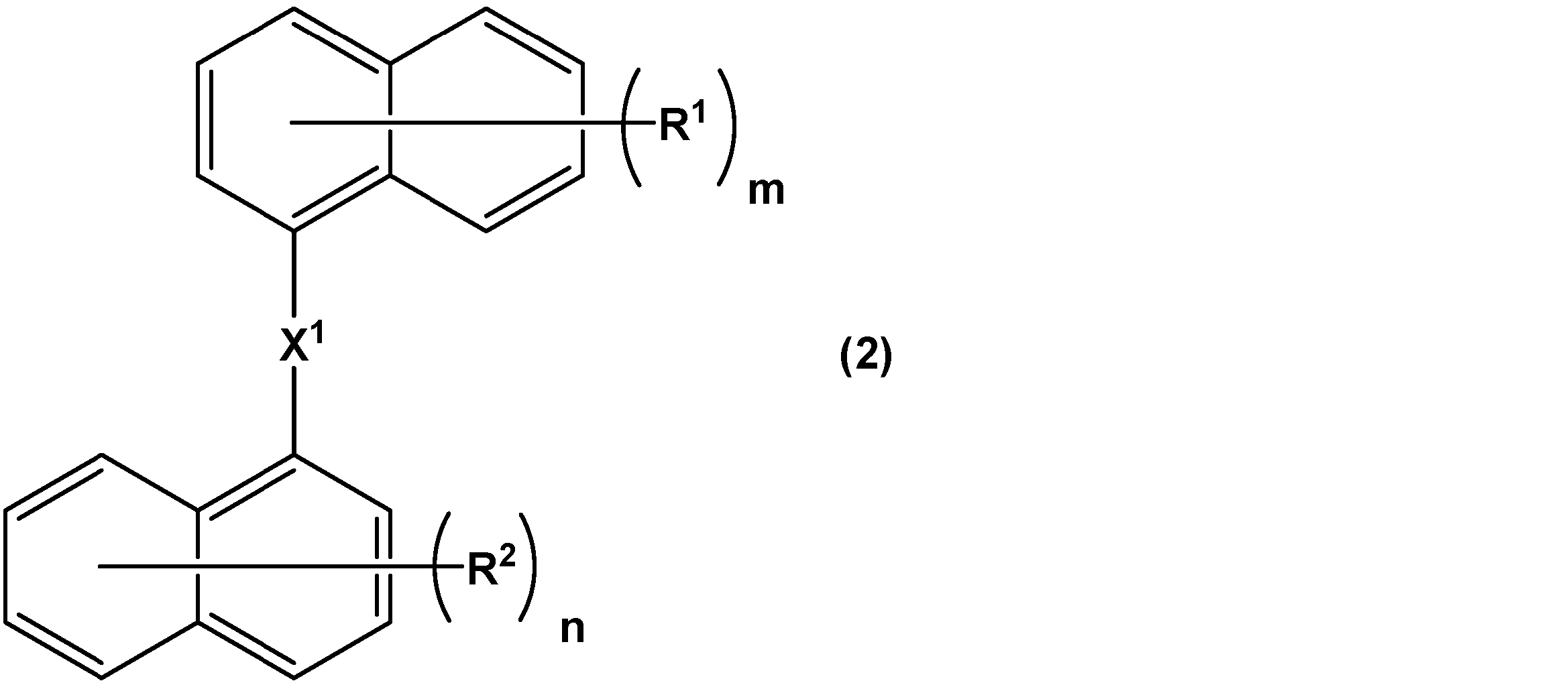
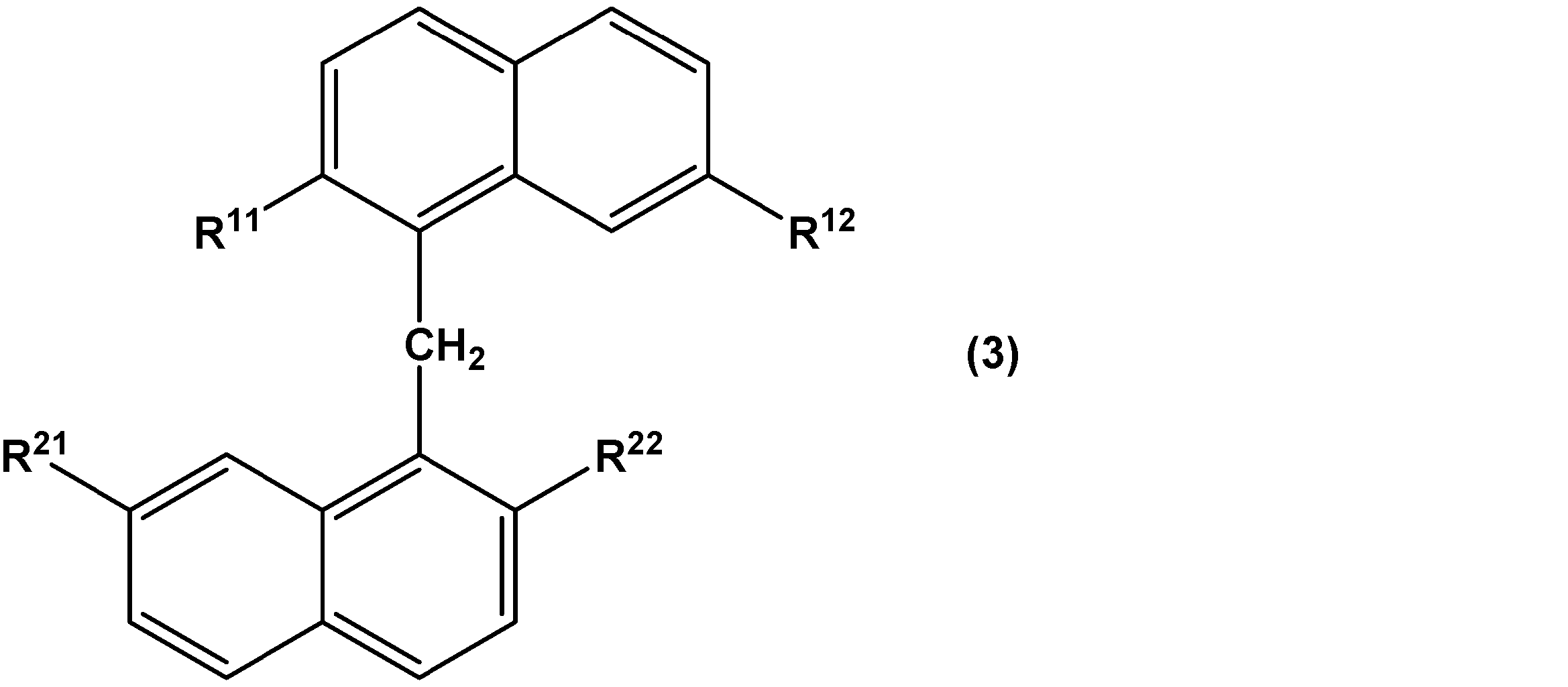

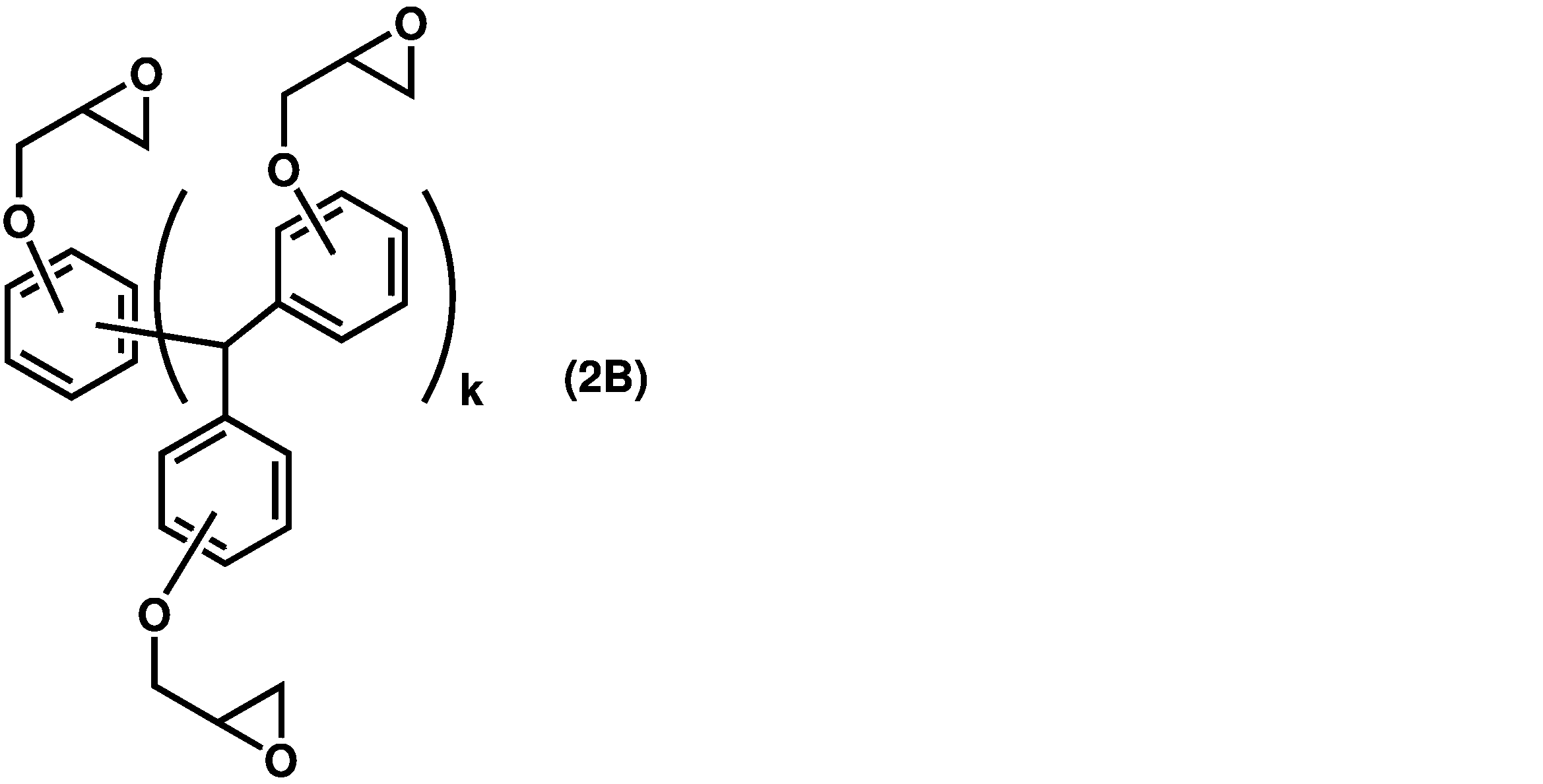


・測定機器:HLC-8320GPC(製品名、東ソー(株)製)
・分析カラム:TSKgel SuperMultipore HZ-H(3本連結)(製品名、東ソー(株)製)
・ガードカラム:TSKguardcolumn SuperMP(HZ)-H(製品名、東ソー(株)製)
・溶離液:THF
・測定温度:25℃


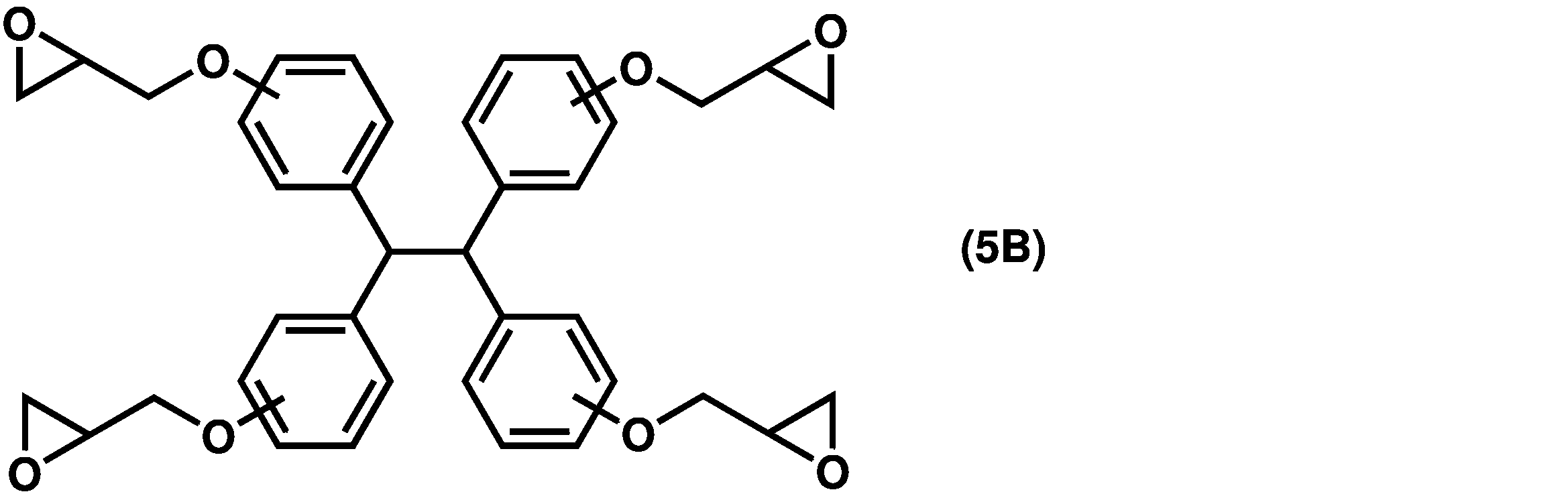
本実施形態の接着剤組成物は、(B)成分として、(B1)オニウム系化合物(以下、(B1)成分ともいう)を含む。




本実施形態の接着剤組成物は、熱可塑性樹脂((C)成分)を含有してもよい。接着剤組成物は、熱可塑性樹脂を含有することで、フィルム状に形成しやすくなる。熱可塑性樹脂としては、フェノキシ樹脂、エポキシ樹脂、ポリエステル樹脂、ポリアミド樹脂、ポリウレタン樹脂、ポリエステルウレタン樹脂、アクリルゴム等が挙げられる。これらは、一種を単独で用いてもよく、二種以上を組み合わせて用いてもよい。エポキシ樹脂のエポキシ当量が400g/eq以上であれば、熱可塑性樹脂として扱うものとする。
本実施形態の回路接続用接着剤フィルムは、上述した本実施形態の接着剤組成物により形成された領域を有する。領域は、フィルム状であってもよく、層であってもよい。すなわち、本開示の他の一実施形態は、(A)成分と、(B)成分と、を含有し、(A)成分として多官能エポキシ樹脂を含有する、回路接続用接着剤フィルムである。回路接続用接着剤フィルムは、導電粒子を含有していてもよい。
本開示の他の実施形態は、第一の電極を有する第一の回路部材と、第二の電極を有する第二の回路部材と、第一の回路部材及び第二の回路部材の間に配置され、第一の電極及び第二の電極を互いに電気的に接続する接続部と、を備え、接続部が、上記の回路接続用接着剤フィルムの硬化物を含む、接続構造体である。
本開示の他の実施形態は、第一の電極を有する第一の回路部材と、第二の電極を有する第二の回路部材との間に、上記の回路接続用接着剤フィルムを介在させ、第一の回路部材及び第二の回路部材を熱圧着して、第一の電極及び第二の電極を互いに電気的に接続する工程を備える、接続構造体の製造方法である。
アセトニトリル100mLと、スターラーチップと、を300mL三角フラスコに入れ、マグネチックスターラー上に設置した。2-シアノピリジン12.5g(120mmol、東京化成工業株式会社製)、2,4,6-トリメチルベンジルクロリド16.8g(100mmol、東京化成工業株式会社製)、及びヨウ化ナトリウム17.8g(119mmol、東京化成工業株式会社製)を300mL三角フラスコ中のアセトニトリルに加え、室温(25℃)で24時間反応させて結晶を得た。得られた結晶をガラスフィルターでろ過し、ガラスフィルター上の結晶をアセトン及び蒸留水により洗浄後、真空乾燥することで、29.1gの2-シアノ-1-(2,4,6-トリメチルベンジル)ピリジニウム・ヨーダイド(収率80%)を得た。
1H-NMR(400MHz,CD3OD),δ:2.26(s,6H),2.32(s,3H),6.10(s,2H),7.08(s,2H),8.25(td,1H,J=3.2,6.4Hz)8.43(d,1H,J=6.4Hz)8.77-8.82(m,2H)
ジムロート冷却管と、塩化カルシウム管と、攪拌モーターに接続されたテフロン(登録商標)攪拌棒と、を装着した3000mLの3つ口フラスコ中で、4,4’-(9-フルオレニリデン)-ジフェノール45g(シグマアルドリッチジャパン株式会社製)及び3,3’,5,5’-テトラメチルビフェノールジグリシジルエーテル50g(商品名:YX-4000H、三菱化学株式会社製)をN-メチルピロリドン1000mLに溶解して反応液とした。この反応液に炭酸カリウム21gを加え、マントルヒーターで110℃に加熱しながら3時間攪拌した。攪拌後の反応液を1000mLのメタノールが入ったビーカーに滴下し、吸引ろ過することによって生成した沈殿物をろ取した。ろ取した沈殿物をさらに300mLのメタノールで3回洗浄して、フェノキシ樹脂aを75g得た。得られたフェノキシ樹脂aの分子量を高速液体クロマトグラフ(東ソー株式会社製、GP8020、カラム:日立化成工業株式会社製Gelpack GL-A150S及びGLA160S、溶離液:テトラヒドロフラン、流速:1.0mL/分)を用いて測定したところ、ポリスチレン換算でMn=15769、Mw=38045、Mw/Mn=2.413であった。
架橋ポリスチレン粒子の表面上に、層の厚さが0.15μmとなるようにニッケルからなる層を形成して、平均粒子径3.0μmの導電粒子を得た。
表1に示す配合量(単位:質量部)で各成分を混合し、第一の接着剤層を形成する第一の接着剤組成物、及び第二の接着剤層を形成する第二の接着剤組成物を調製した。なお、表1中の各成分の詳細は以下のとおりであり、表中の各成分の配合量は不揮発分の配合量を表す。
・エポキシ樹脂
A1:ビスフェノールA型エポキシ樹脂(商品名:YL980、三菱ケミカル株式会社製)
A2:4官能ナフタレン骨格エポキシ樹脂(商品名:HP4700、DIC株式会社製)
A6:トリスフェノールメタン型エポキシ樹脂(商品名:jER1032H60、多官能エポキシ樹脂、三菱ケミカル株式会社製)
A7:テトラキスフェノールエタン型エポキシ樹脂(商品名:jER1031S、4官能エポキシ樹脂、三菱ケミカル株式会社製)
A8:アラルキル骨格を有するノボラック型エポキシ樹脂(商品名:YX7700、3官能エポキシ樹脂、三菱ケミカル株式会社製)
A9:ビスフェノールA型エポキシ樹脂(商品名:BATG、4官能エポキシ樹脂、2つのグリシジル基と2つのグリシジルオキシ基を有するエポキシ樹脂、昭和電工株式会社製)
A10:脂肪族エポキシ樹脂(商品名:PETG、4官能エポキシ樹脂、昭和電工株式会社製)
A11:ビスフェノールF型エポキシ樹脂(商品名:YL983U、2官能エポキシ樹脂、三菱ケミカル株式会社製)
・硬化剤
B1:上記で合成したピリジニウム塩
B2:1-ナフチルメチルメチル-p-ヒドロキシフェニルスルホニウムヘキサフルオロアンチモネート(商品名:SI-60、三新化学工業株式会社製)
・熱可塑性樹脂
C1:上記で合成したフェノキシ樹脂a
C2:エポキシ樹脂(商品名:jER1010、三菱ケミカル株式会社製、エポキシ当量:3000~5000g/eq)
・充填材
D1:表面処理されたシリカ粒子(シリカとビス(トリメチルシリル)アミンとの加水分解生成物)
D2:表面処理されたシリカ微粒子(トリメトキシオクチルシランとシリカの加水分解生成物、商品名:アエロジルR805、Evonik Industries AG社製、有機溶媒で不揮発分の含有量を10質量%に希釈したものを使用)
・カップリング剤
E1:3-グリシドキシプロピルトリメトキシシラン(商品名:KBM-403、信越化学工業株式会社製)
・導電粒子
F1:上記で作製した導電粒子
第一の回路部材として、無アルカリガラス基板(OA-11、日本電気硝子株式会社製、外形:38mm×28mm、厚さ:0.3mm)の表面に、AlNd(100nm)/Mo(50nm)/ITO(100nm)の配線パターン(パターン幅:19μm、電極間スペース:5μm)を形成したものを準備した。第二の回路部材として、バンプ電極を2列で千鳥状に配列したICチップ(外形:0.9mm×20.3mm、厚さ:0.3mm、バンプ電極の大きさ:70μm×12μm、バンプ電極間スペース:12μm、バンプ電極厚さ:8μm)を準備した。
HAST試験後の外観を評価した。HAST試験は、加速寿命試験装置(株式会社平山製作所製、商品名:PC-242HSR2、条件:110℃/85%RH/150時間)に設置し、HAST試験を実施した。外観の評価は、回路接続用接着剤フィルムの剥離面積が接着面の面積に対して1%未満であるものを評価A、1%以上5%未満であるものを評価B、5%以上50%未満であるものを評価C、50%以上であるものを評価Dとして、評価した。評価結果を表2に示す。
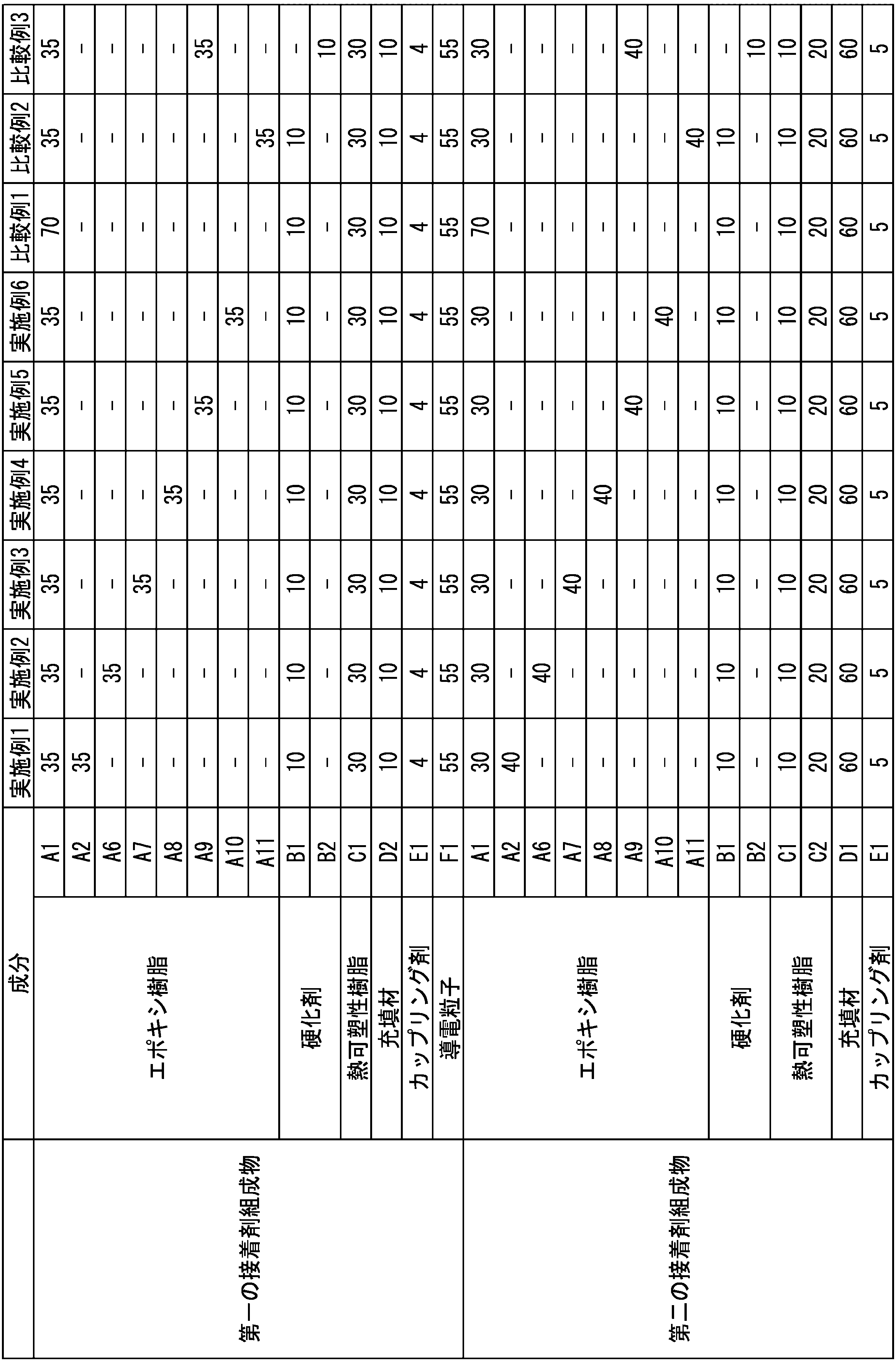
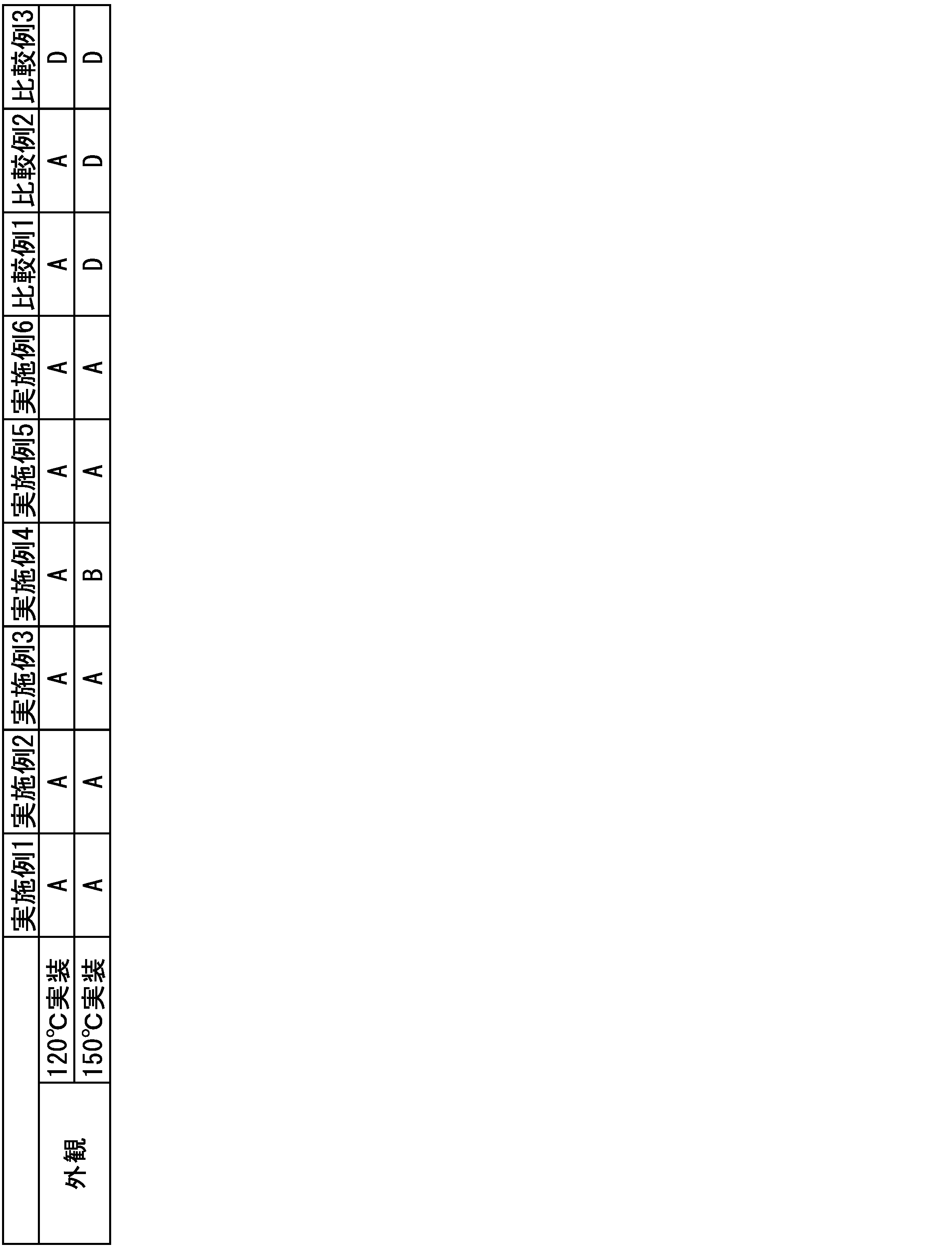
Claims (7)
- (A)エポキシ樹脂と、(B)硬化剤と、を含有し、
前記(A)成分として、多官能エポキシ樹脂を含み、
前記(B)成分として、ピリジニウム塩を含有し、
前記ピリジニウム塩が、1位にベンジル基を有し、且つ、2位に電子求引基を有し、
前記ベンジル基が電子供与基を有する、接着剤組成物。 - 前記エポキシ樹脂が芳香族系エポキシ樹脂である、請求項1に記載の接着剤組成物。
- 導電粒子を更に含有する、請求項1に記載の接着剤組成物。
- 請求項1又は2に記載の接着剤組成物により形成された領域を有する、回路接続用接着剤フィルム。
- 第1の接着剤成分を含む第1の領域と、該第1の領域に隣接して設けられた、第2の接着剤成分を含む第2の領域と、を備え、
前記第1の領域及び前記第2の領域のうちの一方又は両方が、請求項1又は2に記載の接着剤組成物により形成されている、回路接続用接着剤フィルム。 - 第一の電極を有する第一の回路部材と、
第二の電極を有する第二の回路部材と、
前記第一の回路部材及び前記第二の回路部材の間に配置され、前記第一の電極及び前記第二の電極を互いに電気的に接続する接続部と、
を備え、
前記接続部が、請求項3に記載の回路接続用接着剤フィルムの硬化物を含む、接続構造体。 - 第一の電極を有する第一の回路部材と、第二の電極を有する第二の回路部材との間に、請求項3に記載の回路接続用接着剤フィルムを介在させ、前記第一の回路部材及び前記第二の回路部材を熱圧着して、前記第一の電極及び前記第二の電極を互いに電気的に接続する工程を備える、接続構造体の製造方法。
Priority Applications (3)
| Application Number | Priority Date | Filing Date | Title |
|---|---|---|---|
| KR1020247025854A KR20240134924A (ko) | 2022-01-12 | 2023-01-12 | 접착제 조성물, 회로 접속용 접착제 필름, 및, 접속 구조체의 제조 방법 |
| CN202380016576.4A CN118525070A (zh) | 2022-01-12 | 2023-01-12 | 黏合剂组合物、电路连接用黏合剂膜及连接结构体的制造方法 |
| JP2023574052A JPWO2023136273A1 (ja) | 2022-01-12 | 2023-01-12 |
Applications Claiming Priority (2)
| Application Number | Priority Date | Filing Date | Title |
|---|---|---|---|
| JP2022-002747 | 2022-01-12 | ||
| JP2022002747 | 2022-01-12 |
Publications (1)
| Publication Number | Publication Date |
|---|---|
| WO2023136273A1 true WO2023136273A1 (ja) | 2023-07-20 |
Family
ID=87279093
Family Applications (4)
| Application Number | Title | Priority Date | Filing Date |
|---|---|---|---|
| PCT/JP2023/000534 Ceased WO2023136274A1 (ja) | 2022-01-12 | 2023-01-12 | 接着剤組成物、回路接続用接着剤フィルム、及び、接続構造体の製造方法 |
| PCT/JP2023/000533 Ceased WO2023136273A1 (ja) | 2022-01-12 | 2023-01-12 | 接着剤組成物、回路接続用接着剤フィルム、及び、接続構造体の製造方法 |
| PCT/JP2023/000529 Ceased WO2023136272A1 (ja) | 2022-01-12 | 2023-01-12 | 接着剤組成物、回路接続用接着剤フィルム、及び、接続構造体の製造方法 |
| PCT/JP2023/000595 Ceased WO2023136286A1 (ja) | 2022-01-12 | 2023-01-12 | 接着剤組成物、回路接続用接着剤フィルム、及び、接続構造体の製造方法 |
Family Applications Before (1)
| Application Number | Title | Priority Date | Filing Date |
|---|---|---|---|
| PCT/JP2023/000534 Ceased WO2023136274A1 (ja) | 2022-01-12 | 2023-01-12 | 接着剤組成物、回路接続用接着剤フィルム、及び、接続構造体の製造方法 |
Family Applications After (2)
| Application Number | Title | Priority Date | Filing Date |
|---|---|---|---|
| PCT/JP2023/000529 Ceased WO2023136272A1 (ja) | 2022-01-12 | 2023-01-12 | 接着剤組成物、回路接続用接着剤フィルム、及び、接続構造体の製造方法 |
| PCT/JP2023/000595 Ceased WO2023136286A1 (ja) | 2022-01-12 | 2023-01-12 | 接着剤組成物、回路接続用接着剤フィルム、及び、接続構造体の製造方法 |
Country Status (5)
| Country | Link |
|---|---|
| JP (4) | JPWO2023136272A1 (ja) |
| KR (3) | KR20240134924A (ja) |
| CN (4) | CN118742619A (ja) |
| TW (2) | TW202336201A (ja) |
| WO (4) | WO2023136274A1 (ja) |
Cited By (2)
| Publication number | Priority date | Publication date | Assignee | Title |
|---|---|---|---|---|
| WO2024150765A1 (ja) * | 2023-01-12 | 2024-07-18 | 株式会社レゾナック | 接着剤組成物、回路接続用接着剤フィルム、接続構造体及び接続構造体の製造方法 |
| WO2024150767A1 (ja) * | 2023-01-12 | 2024-07-18 | 株式会社レゾナック | 接着剤組成物、回路接続用接着剤フィルム、接続構造体及び接続構造体の製造方法 |
Citations (6)
| Publication number | Priority date | Publication date | Assignee | Title |
|---|---|---|---|---|
| JPH01299803A (ja) * | 1988-05-27 | 1989-12-04 | Nippon Paint Co Ltd | 熱硬化性樹脂組成物 |
| JPH03109465A (ja) * | 1989-04-10 | 1991-05-09 | Dainippon Ink & Chem Inc | 熱硬化性樹脂組成物 |
| JPH055006A (ja) * | 1990-11-16 | 1993-01-14 | Nippon Kayaku Co Ltd | カチオン重合性有機材料組成物および当該組成物の安定化法 |
| JPH05262813A (ja) * | 1991-04-12 | 1993-10-12 | Nippon Soda Co Ltd | 硬化性組成物 |
| JPH09194816A (ja) * | 1996-01-22 | 1997-07-29 | Toyo Ink Mfg Co Ltd | 感エネルギー線酸発生剤、感エネルギー線酸発生剤組成物、硬化性組成物およびその硬化物 |
| JP2022164657A (ja) * | 2021-04-16 | 2022-10-27 | 昭和電工マテリアルズ株式会社 | 接着剤組成物、回路接続用接着剤フィルム、接続構造体及び接続構造体の製造方法 |
Family Cites Families (15)
| Publication number | Priority date | Publication date | Assignee | Title |
|---|---|---|---|---|
| JPS5549617B2 (ja) * | 1972-11-20 | 1980-12-12 | ||
| JPS60191228A (ja) | 1984-10-29 | 1985-09-28 | Seiko Epson Corp | 表示装置の接続構造 |
| JPH01251787A (ja) | 1988-03-31 | 1989-10-06 | Toshiba Corp | 電子部品の接続装置 |
| JP3137202B2 (ja) * | 1990-10-30 | 2001-02-19 | 大日本インキ化学工業株式会社 | エポキシ樹脂、その製造方法及びエポキシ樹脂組成物 |
| JP3907217B2 (ja) | 1993-07-29 | 2007-04-18 | 日立化成工業株式会社 | 回路接続材料とその接続材料を用いた回路の接続方法 |
| JPH08315885A (ja) * | 1995-05-16 | 1996-11-29 | Hitachi Chem Co Ltd | 回路接続材料 |
| AU8648598A (en) * | 1998-08-13 | 2000-03-06 | Hitachi Chemical Company, Ltd. | Adhesive for bonding circuit members, circuit board, and method of producing thesame |
| JP6007663B2 (ja) * | 2012-08-10 | 2016-10-12 | 味の素株式会社 | 樹脂組成物 |
| CN107406728B (zh) * | 2015-03-27 | 2020-12-01 | 东丽株式会社 | 粘接组合物片材及其制造方法以及半导体器件 |
| JP7013638B2 (ja) * | 2016-05-31 | 2022-02-01 | 昭和電工マテリアルズ株式会社 | 接着剤組成物及びフィルム状接着剤組成物 |
| JP7039984B2 (ja) | 2017-12-14 | 2022-03-23 | 昭和電工マテリアルズ株式会社 | 回路接続用接着剤組成物及び回路接続構造体 |
| JP7396932B2 (ja) * | 2020-03-02 | 2023-12-12 | Mcppイノベーション合同会社 | 樹脂組成物及びその溶液 |
| JP6950844B1 (ja) * | 2020-09-25 | 2021-10-13 | 東洋インキScホールディングス株式会社 | 硬化性組成物、硬化物およびその製造方法 |
| JPWO2022124336A1 (ja) * | 2020-12-09 | 2022-06-16 | ||
| WO2022220285A1 (ja) * | 2021-04-16 | 2022-10-20 | 昭和電工マテリアルズ株式会社 | 硬化剤、接着剤組成物、回路接続用接着剤フィルム、接続構造体及び接続構造体の製造方法 |
-
2023
- 2023-01-11 TW TW112101212A patent/TW202336201A/zh unknown
- 2023-01-11 TW TW112101213A patent/TW202341186A/zh unknown
- 2023-01-12 CN CN202380016561.8A patent/CN118742619A/zh active Pending
- 2023-01-12 CN CN202380016462.XA patent/CN118510859A/zh active Pending
- 2023-01-12 CN CN202380016576.4A patent/CN118525070A/zh active Pending
- 2023-01-12 JP JP2023574051A patent/JPWO2023136272A1/ja active Pending
- 2023-01-12 WO PCT/JP2023/000534 patent/WO2023136274A1/ja not_active Ceased
- 2023-01-12 JP JP2023574053A patent/JPWO2023136274A1/ja active Pending
- 2023-01-12 WO PCT/JP2023/000533 patent/WO2023136273A1/ja not_active Ceased
- 2023-01-12 KR KR1020247025854A patent/KR20240134924A/ko active Pending
- 2023-01-12 KR KR1020247026331A patent/KR20240134938A/ko active Pending
- 2023-01-12 KR KR1020247025852A patent/KR20240134151A/ko active Pending
- 2023-01-12 JP JP2023574052A patent/JPWO2023136273A1/ja active Pending
- 2023-01-12 CN CN202380016622.0A patent/CN118715300A/zh active Pending
- 2023-01-12 WO PCT/JP2023/000529 patent/WO2023136272A1/ja not_active Ceased
- 2023-01-12 JP JP2023574063A patent/JPWO2023136286A1/ja active Pending
- 2023-01-12 WO PCT/JP2023/000595 patent/WO2023136286A1/ja not_active Ceased
Patent Citations (6)
| Publication number | Priority date | Publication date | Assignee | Title |
|---|---|---|---|---|
| JPH01299803A (ja) * | 1988-05-27 | 1989-12-04 | Nippon Paint Co Ltd | 熱硬化性樹脂組成物 |
| JPH03109465A (ja) * | 1989-04-10 | 1991-05-09 | Dainippon Ink & Chem Inc | 熱硬化性樹脂組成物 |
| JPH055006A (ja) * | 1990-11-16 | 1993-01-14 | Nippon Kayaku Co Ltd | カチオン重合性有機材料組成物および当該組成物の安定化法 |
| JPH05262813A (ja) * | 1991-04-12 | 1993-10-12 | Nippon Soda Co Ltd | 硬化性組成物 |
| JPH09194816A (ja) * | 1996-01-22 | 1997-07-29 | Toyo Ink Mfg Co Ltd | 感エネルギー線酸発生剤、感エネルギー線酸発生剤組成物、硬化性組成物およびその硬化物 |
| JP2022164657A (ja) * | 2021-04-16 | 2022-10-27 | 昭和電工マテリアルズ株式会社 | 接着剤組成物、回路接続用接着剤フィルム、接続構造体及び接続構造体の製造方法 |
Cited By (2)
| Publication number | Priority date | Publication date | Assignee | Title |
|---|---|---|---|---|
| WO2024150765A1 (ja) * | 2023-01-12 | 2024-07-18 | 株式会社レゾナック | 接着剤組成物、回路接続用接着剤フィルム、接続構造体及び接続構造体の製造方法 |
| WO2024150767A1 (ja) * | 2023-01-12 | 2024-07-18 | 株式会社レゾナック | 接着剤組成物、回路接続用接着剤フィルム、接続構造体及び接続構造体の製造方法 |
Also Published As
| Publication number | Publication date |
|---|---|
| JPWO2023136272A1 (ja) | 2023-07-20 |
| WO2023136272A1 (ja) | 2023-07-20 |
| CN118525070A (zh) | 2024-08-20 |
| JPWO2023136273A1 (ja) | 2023-07-20 |
| TW202336201A (zh) | 2023-09-16 |
| WO2023136274A1 (ja) | 2023-07-20 |
| JPWO2023136274A1 (ja) | 2023-07-20 |
| KR20240134151A (ko) | 2024-09-06 |
| TW202341186A (zh) | 2023-10-16 |
| KR20240134924A (ko) | 2024-09-10 |
| JPWO2023136286A1 (ja) | 2023-07-20 |
| CN118510859A (zh) | 2024-08-16 |
| CN118715300A (zh) | 2024-09-27 |
| KR20240134938A (ko) | 2024-09-10 |
| CN118742619A (zh) | 2024-10-01 |
| WO2023136286A1 (ja) | 2023-07-20 |
Similar Documents
| Publication | Publication Date | Title |
|---|---|---|
| JP7214912B2 (ja) | 接着剤組成物、回路接続用接着剤フィルム、接続構造体及び接続構造体の製造方法 | |
| JP2024099206A (ja) | 接着剤組成物、回路接続用接着剤フィルム、接続構造体及び接続構造体の製造方法 | |
| WO2023136274A1 (ja) | 接着剤組成物、回路接続用接着剤フィルム、及び、接続構造体の製造方法 | |
| WO2022220285A1 (ja) | 硬化剤、接着剤組成物、回路接続用接着剤フィルム、接続構造体及び接続構造体の製造方法 | |
| JP7608801B2 (ja) | 回路接続用接着剤、接続構造体及び接続構造体の製造方法 | |
| JP2024099219A (ja) | 接着剤組成物、回路接続用接着剤フィルム、接続構造体及び接続構造体の製造方法 | |
| JP2024099217A (ja) | 接着剤組成物、回路接続用接着剤フィルム、接続構造体及び接続構造体の製造方法 | |
| JP7729201B2 (ja) | 接着剤組成物、回路接続用接着剤フィルム、接続構造体及び接続構造体の製造方法 | |
| JP2024099224A (ja) | 接着剤組成物、回路接続用接着剤フィルム、接続構造体及び接続構造体の製造方法 | |
| JP2024099220A (ja) | 接着剤組成物、回路接続用接着剤フィルム、接続構造体及び接続構造体の製造方法 | |
| JP2024099305A (ja) | 接着剤組成物、回路接続用接着剤フィルム、接続構造体及び接続構造体の製造方法 | |
| JP7740254B2 (ja) | 回路接続用接着剤フィルム、接続構造体、及び接続構造体の製造方法 | |
| JP7608800B2 (ja) | 回路接続用接着剤、接続構造体及び接続構造体の製造方法 | |
| TWI921517B (zh) | 固化劑、接著劑組成物、電路連接用接著劑膜、連接結構體及連接結構體之製造方法 | |
| WO2025018368A1 (ja) | 接着剤組成物、回路接続用接着剤フィルム、接続構造体及び接続構造体の製造方法 | |
| CN117500896A (zh) | 固化剂、黏合剂组合物、电路连接用黏合剂膜、连接结构体及连接结构体的制造方法 |
Legal Events
| Date | Code | Title | Description |
|---|---|---|---|
| 121 | Ep: the epo has been informed by wipo that ep was designated in this application |
Ref document number: 23740281 Country of ref document: EP Kind code of ref document: A1 |
|
| WWE | Wipo information: entry into national phase |
Ref document number: 2023574052 Country of ref document: JP |
|
| WWE | Wipo information: entry into national phase |
Ref document number: 202380016576.4 Country of ref document: CN |
|
| NENP | Non-entry into the national phase |
Ref country code: DE |
|
| 122 | Ep: pct application non-entry in european phase |
Ref document number: 23740281 Country of ref document: EP Kind code of ref document: A1 |