WO2023101018A1 - 毛髪洗浄剤組成物 - Google Patents
毛髪洗浄剤組成物 Download PDFInfo
- Publication number
- WO2023101018A1 WO2023101018A1 PCT/JP2022/044607 JP2022044607W WO2023101018A1 WO 2023101018 A1 WO2023101018 A1 WO 2023101018A1 JP 2022044607 W JP2022044607 W JP 2022044607W WO 2023101018 A1 WO2023101018 A1 WO 2023101018A1
- Authority
- WO
- WIPO (PCT)
- Prior art keywords
- mass
- hair
- acid
- less
- cleansing composition
- Prior art date
- Legal status (The legal status is an assumption and is not a legal conclusion. Google has not performed a legal analysis and makes no representation as to the accuracy of the status listed.)
- Ceased
Links
Images
Classifications
-
- A—HUMAN NECESSITIES
- A61—MEDICAL OR VETERINARY SCIENCE; HYGIENE
- A61K—PREPARATIONS FOR MEDICAL, DENTAL OR TOILETRY PURPOSES
- A61K8/00—Cosmetics or similar toiletry preparations
- A61K8/18—Cosmetics or similar toiletry preparations characterised by the composition
- A61K8/30—Cosmetics or similar toiletry preparations characterised by the composition containing organic compounds
- A61K8/33—Cosmetics or similar toiletry preparations characterised by the composition containing organic compounds containing oxygen
- A61K8/34—Alcohols
- A61K8/345—Alcohols containing more than one hydroxy group
-
- A—HUMAN NECESSITIES
- A61—MEDICAL OR VETERINARY SCIENCE; HYGIENE
- A61K—PREPARATIONS FOR MEDICAL, DENTAL OR TOILETRY PURPOSES
- A61K8/00—Cosmetics or similar toiletry preparations
- A61K8/18—Cosmetics or similar toiletry preparations characterised by the composition
- A61K8/30—Cosmetics or similar toiletry preparations characterised by the composition containing organic compounds
- A61K8/33—Cosmetics or similar toiletry preparations characterised by the composition containing organic compounds containing oxygen
- A61K8/36—Carboxylic acids; Salts or anhydrides thereof
- A61K8/365—Hydroxycarboxylic acids; Ketocarboxylic acids
-
- A—HUMAN NECESSITIES
- A61—MEDICAL OR VETERINARY SCIENCE; HYGIENE
- A61K—PREPARATIONS FOR MEDICAL, DENTAL OR TOILETRY PURPOSES
- A61K8/00—Cosmetics or similar toiletry preparations
- A61K8/18—Cosmetics or similar toiletry preparations characterised by the composition
- A61K8/30—Cosmetics or similar toiletry preparations characterised by the composition containing organic compounds
- A61K8/33—Cosmetics or similar toiletry preparations characterised by the composition containing organic compounds containing oxygen
- A61K8/39—Derivatives containing from 2 to 10 oxyalkylene groups
-
- A—HUMAN NECESSITIES
- A61—MEDICAL OR VETERINARY SCIENCE; HYGIENE
- A61K—PREPARATIONS FOR MEDICAL, DENTAL OR TOILETRY PURPOSES
- A61K8/00—Cosmetics or similar toiletry preparations
- A61K8/18—Cosmetics or similar toiletry preparations characterised by the composition
- A61K8/30—Cosmetics or similar toiletry preparations characterised by the composition containing organic compounds
- A61K8/40—Cosmetics or similar toiletry preparations characterised by the composition containing organic compounds containing nitrogen
- A61K8/44—Aminocarboxylic acids or derivatives thereof, e.g. aminocarboxylic acids containing sulfur; Salts; Esters or N-acylated derivatives thereof
-
- A—HUMAN NECESSITIES
- A61—MEDICAL OR VETERINARY SCIENCE; HYGIENE
- A61K—PREPARATIONS FOR MEDICAL, DENTAL OR TOILETRY PURPOSES
- A61K8/00—Cosmetics or similar toiletry preparations
- A61K8/18—Cosmetics or similar toiletry preparations characterised by the composition
- A61K8/30—Cosmetics or similar toiletry preparations characterised by the composition containing organic compounds
- A61K8/46—Cosmetics or similar toiletry preparations characterised by the composition containing organic compounds containing sulfur
- A61K8/463—Cosmetics or similar toiletry preparations characterised by the composition containing organic compounds containing sulfur containing sulfuric acid derivatives, e.g. sodium lauryl sulfate
-
- A—HUMAN NECESSITIES
- A61—MEDICAL OR VETERINARY SCIENCE; HYGIENE
- A61K—PREPARATIONS FOR MEDICAL, DENTAL OR TOILETRY PURPOSES
- A61K8/00—Cosmetics or similar toiletry preparations
- A61K8/18—Cosmetics or similar toiletry preparations characterised by the composition
- A61K8/30—Cosmetics or similar toiletry preparations characterised by the composition containing organic compounds
- A61K8/46—Cosmetics or similar toiletry preparations characterised by the composition containing organic compounds containing sulfur
- A61K8/466—Cosmetics or similar toiletry preparations characterised by the composition containing organic compounds containing sulfur containing sulfonic acid derivatives; Salts
-
- A—HUMAN NECESSITIES
- A61—MEDICAL OR VETERINARY SCIENCE; HYGIENE
- A61Q—SPECIFIC USE OF COSMETICS OR SIMILAR TOILETRY PREPARATIONS
- A61Q5/00—Preparations for care of the hair
- A61Q5/02—Preparations for cleaning the hair
Definitions
- the present invention relates to a hair cleanser composition.
- Patent Documents 1 to 4 Conventionally, various hair cosmetics have been proposed for the purpose of finishing the waves and curls of hair in a desirable state and keeping them beautiful (for example, Patent Documents 1 to 4).
- Patent Document 1 JP-A-04-230614 (Patent Document 2) JP-A-2015-105271 (Patent Document 3) JP-A-2012-131784 (Patent Document 4) JP-A-2020-186222
- the present invention provides a hair cleansing composition containing the following components (a), (b) and (c).
- Patent Literatures 1 to 3 impart elasticity to the hair or gather hair bundles by bonding the hair surface, and control the structure of the hair bundles to make waves and curls look beautiful. is not intended at all.
- Patent Document 4 when calcium ions in water are accumulated in the hair during daily washing, the direction of the curl is partially reversed, resulting in a disordered shape, which impairs the beauty.
- the hair is treated with three specific hair treatment agents in a predetermined order, the calcium ions accumulated in the hair flow out and the inside of the hair is reformed, and the phase is evenly aligned. It is described that it becomes a beautiful curl shape.
- the hair treatment described in Patent Document 4 uses three agents and is a treatment that involves standing time and heating, which is complicated and time-consuming for consumers.
- the present invention relates to a hair cleanser composition that can control the structure of hair bundles and form uniform, three-dimensional, cohesive and beautiful wavy curls only by the daily hair care action of washing the hair.
- the present inventor found that beautiful wave curls can be formed with high reproducibility by making the hair bundles in a wet state have a helical structure. Furthermore, by washing the hair having wave curls with a hair cleanser containing a specific compound, the wet bundles of hair after washing tend to form spirals, resulting in uniform curls and three-dimensional hair.
- the present invention was completed based on the finding that beautiful wave curls with coherence can be achieved.
- the hair cleansing composition of the present invention makes it easy for wet hair tufts after washing to form a spiral shape, and can form uniform, three-dimensional, coherent and beautiful wave curls.
- Component (a) one or more compounds selected from polyalkylene glycol ethers and alkylene glycols
- Component (a) is one or more compounds selected from polyalkylene glycol ethers and alkylene glycols.
- Polyalkylene glycol ethers include compounds represented by the following general formula (1).
- R 1 represents a hydrogen atom or a methyl group
- R 2 represents an alkyl group having 1 to 5 carbon atoms
- n represents a number of 2 to 6.
- R 1 is preferably a hydrogen atom
- R 2 is preferably an alkyl group having 2 to 4 carbon atoms
- n is preferably a number of 2 to 3.
- Examples of compounds represented by the general formula (1) include diethylene glycol monomethyl ether (methyl carbitol), diethylene glycol monoethyl ether (ethyl carbitol), diethylene glycol monopropyl ether (propyl carbitol), and diethylene glycol monobutyl ether (butyl carbitol). , triethylene glycol monomethyl ether, triethylene glycol monoethyl ether, etc., and diethylene glycol monoethyl ether (ethyl carbitol), diethylene glycol monobutyl ether (butyl Carbitol), triethylene glycol monomethyl ether are preferred.
- Alkylene glycols include ethylene glycol, 1,3-propanediol, 1,3-butanediol, 3-methyl-1,3-butanediol (isoprene glycol), etc., and can be applied to wet hair bundles after washing.
- 3-Methyl-1,3-butanediol (isoprene glycol) is preferable from the viewpoint of making it easier to form a
- diethylene glycol monoethyl ether ethyl carbitol
- diethylene glycol monobutyl ether butyl carbitol
- diethylene glycol monobutyl ether butyl carbitol
- diethylene glycol monoethyl ether ethyl carbitol
- diethylene glycol monobutyl ether butyl carbitol
- triethylene glycol monomethyl ether and 3-methyl-1,3-butanediol isoprene glycol
- diethylene glycol monoethyl ether ethyl carbitol
- diethylene glycol monobutyl ether butyl carbitol
- Component (a) can be used alone or in combination of two or more.
- the content of component (a) in the hair cleansing composition makes it easier for the wet hair tresses to form spirals after shampooing, thereby improving the cohesion of curls.
- it is 0.1% by mass or more, preferably 0.5% by mass or more, more preferably 1.0% by mass or more, still more preferably 2.0% by mass or more, and still more preferably 3.0% by mass or more.
- the content is 18% by mass or less, preferably 15% by mass or less, and more preferably 12% by mass.
- component (a) in the hair cleansing composition is 0.1 to 18% by mass, preferably 0.5 to 15% by mass, more preferably 1.0 to 15% by mass, still more preferably 2.0%. ⁇ 12% by mass, more preferably 3.0 to 10% by mass.
- Carboxylic acid type anionic surfactants include N-acylamino acid salts, N-acyl-N-alkylamino acid salts, amide type N-acylamino acid salts, alkyl ether carboxylates, fatty acid salts, alkyl succinate or succinic acid.
- Examples include alkenyl salts, and sulfonic acid-type anionic surfactants include sulfosuccinate, isethionate, taurine, alkylbenzenesulfonate, ⁇ -olefinsulfonate, and alkanesulfonic acid surfactants.
- Examples of ether sulfate type anionic surfactants include polyoxyethylene alkyl ether sulfates, alkyl ether sulfates, and the like.
- Amphoteric surfactants include imidazoline, carbobetaine, amidobetaine, sulfobetaine, hydroxysulfobetaine, amidosulfobetaine and the like. As component (b), any one of them can be used alone or in combination of two or more. It is more preferable to contain one or more anionic surfactants selected from surfactants and one or more amphoteric surfactants.
- Anionic surfactants include N-acyl amino acid salts, alkyl ether carboxylates, ⁇ -olefins, from the viewpoint of making wet hair tresses after washing more likely to form a spiral shape and improving curl coherence and uniformity.
- One or more selected from sulfonates, polyoxyethylene alkyl ether sulfates and alkyl ether sulfates are preferred, and alkyl ether carboxylates, ⁇ -olefin sulfonates, polyoxyethylene alkyl ether sulfates and alkyl ether sulfates are preferred.
- the acyl group of the N-acylamino acid salt is preferably a fatty acid residue having 8 to 14 carbon atoms, and the amino acid moiety of the N-acylamino acid salt is glycine and Neutral amino acids selected from alanine, acidic amino acids selected from glutamic acid and aspartic acid are preferred, acidic amino acids are more preferred, and glutamic acid is even more preferred.
- N-lauroyl glutamate one or more selected from N-lauroyl glutamate, N-myristoyl glutamate, N-cocoyl glutamate and N-lauroyl aspartate are preferable, and N-lauroyl glutamate, N-myristoyl glutamate and N
- One or more selected from -cocoyl glutamate is more preferable, and N-cocoyl glutamate is even more preferable.
- the alkyl ether carboxylate is preferably an alkyl ether carboxylate having an alkyl group with 8 to 14 carbon atoms, an alkyl group having 8 to 14 carbon atoms, and an average addition mole of ethylene oxide groups.
- Alkyl ether carboxylates with numbers from 1 to 5 are more preferred.
- the ⁇ -olefin sulfonate is preferably an ⁇ -olefin having an alkyl group having 10 to 18 carbon atoms, more preferably having 12 to 16 carbon atoms, and a tetradecene sulfone having 14 carbon atoms. Acid salts are more preferred.
- Polyoxyethylene alkyl ether sulfates and alkyl ether sulfates are preferably polyoxyethylene alkyl ether sulfates and alkyl ether sulfates in which the alkyl group has 8 to 14 carbon atoms from the above-mentioned viewpoint, and in particular, the alkyl group has carbon atoms.
- Polyoxyethylene alkyl ether sulfates having a number of 8 to 14 and an average number of added moles of ethylene oxide groups of 1 to 5 are preferred.
- counter ions for the anionic group of these anionic surfactants include alkali metal ions such as sodium ion and potassium ion; alkaline earth metal ions such as calcium ion and magnesium ion; ammonium ion; Examples include alkanolammonium having 1 to 3 alkanol groups (eg, monoethanolammonium, diethanolammonium, triethanolammonium, triisopropanolammonium, etc.).
- amphoteric surfactant one or more selected from carbobetaine and sulfobetaine are preferred, more specifically, from the viewpoint of making wet hair bundles after shampooing easier to form a spiral shape and improving the coherence and uniformity of curls.
- one or more selected from fatty acid amidoalkylbetaines and alkylhydroxysulfobetaines are preferred, and fatty acid amidopropylbetaines having a fatty acid group with 8 to 14 carbon atoms and alkylhydroxysulfobetaines having an alkyl group with 8 to 14 carbon atoms are preferred.
- One or more selected from are more preferable, and one or more selected from lauramidopropyl betaine and lauryl hydroxysultaine are even more preferable.
- the content of component (b) in the hair cleansing composition should be at least 5% by mass from the viewpoint of making the wet hair tresses after shampooing easier to form spirals and improving curl coherence and uniformity. , preferably 8% by mass or more, more preferably 12% by mass or more, and preferably 30% by mass or less, more preferably 25% by mass or less, and even more preferably 20% by mass or less.
- Component (c) organic acid or salt thereof
- an organic acid having 8 or less carbon atoms is preferable from the viewpoint of making the wet hair tresses after shampooing easier to form a spiral shape and improving curl coherence and uniformity.
- Dicarboxylic acids of 8 or less, tricarboxylic acids, hydroxycarboxylic acids, and carboxylic acids having an aldehyde group are more preferred, and hydroxycarboxylic acids are even more preferred.
- dicarboxylic acids such as malonic acid, succinic acid, glutaric acid, adipic acid, maleic acid, fumaric acid, phthalic acid, oxalic acid, malic acid, and tartaric acid
- tricarboxylic acids such as citric acid
- hydroxycarboxylic acids include glycolic acid, lactic acid, hydroxyacrylic acid, oxybutyric acid, glyceric acid, malic acid, tartaric acid and citric acid
- carboxylic acids having an aldehyde group include glyoxylic acid.
- one or more hydroxycarboxylic acids selected from glycolic acid, lactic acid, malic acid, tartaric acid and citric acid are preferable, and one or more hydroxycarboxylic acids selected from lactic acid, malic acid and tartaric acid are more preferable. More preferred are one or more hydroxycarboxylic acids selected from lactic acid and malic acid.
- Salts of these organic acids include salts with alkali metals, alkaline earth metals, ammonia, and organic compounds. These organic acids or salts thereof can be used alone or in combination of two or more.
- the content of component (c) in the hair cleansing composition is preferably 0.1% by mass from the viewpoints of improving the retention of component (a) on the hair and making it easier for the wet hair tresses to form spirals after shampooing.
- more preferably 0.2% by mass or more, still more preferably 0.5% by mass or more, and from the viewpoint of suppressing squeaks during rinsing and making wet hair bundles after shampooing easier to spiral preferably 5 % by mass or less, more preferably 2% by mass or less, and even more preferably 1% by mass or less.
- the mass ratio (a)/(c) of the component (a) to the component (c) in the hair cleansing composition of the present invention makes it easier for wet hair tresses after shampooing to form spirals, curls together, From the viewpoint of improving uniformity, it is preferably 0.5 or more, more preferably 1.0 or more, still more preferably 3 or more, still more preferably 5 or more, and preferably 100 or less, more preferably 50 or less, and still more preferably 30 or less, more preferably 25 or less.
- the hair cleansing composition of the present invention preferably further contains a nonionic surfactant as component (d).
- Nonionic surfactants include alkyl glucosides, sorbitan fatty acid esters, glycerin fatty acid esters, polyglycerin fatty acid esters, propylene glycol fatty acid esters, polyethylene glycol fatty acid esters, sucrose fatty acid esters, polyoxyethylene fatty acid esters, polyoxyethylene sorbitan Fatty acid ester, polyoxyethylene alkyl ether, polyoxypropylene alkyl ether, alkyl glyceryl ether, polyoxyethylene sorbitol fatty acid ester, polyoxyethylene glycerin fatty acid ester, polyoxyethylene propylene glycol fatty acid ester, polyoxyethylene castor oil, polyoxyethylene Hydrogenated Castor Oil, Polyoxyethylene Hydrogenated Castor Oil Fatty Acid Ester, Polyoxyethylene Phytostanol Ether,
- alkyl glucosides one or more selected from alkyl glucosides, polyoxyethylene alkyl ethers, polyoxypropylene alkyl ethers, and alkyl glyceryl ethers are preferred from the viewpoint of making wet hair tresses after shampooing easier to form a spiral, and alkyl glucosides.
- polyoxypropylene alkyl ethers and alkyl glyceryl ethers are more preferred, and alkyl glucosides are even more preferred.
- Component (d) can be used alone or in combination of two or more.
- the alkyl glucoside is an alkyl glucoside having an alkyl group having preferably 8 to 22 carbon atoms, more preferably 8 to 18 carbon atoms, and still more preferably 8 to 12 carbon atoms.
- Specific examples include "Mydol 10" (decyl glucoside) and "AG-124" (lauryl glucoside) manufactured by Kao Corporation.
- the polyoxyethylene alkyl ether is preferably a polyoxyethylene alkyl having an alkyl group having 8 to 22 carbon atoms, more preferably 8 to 18 carbon atoms, and still more preferably 8 to 12 carbon atoms. is ether. Specific examples thereof include “Emulgen 103" (Laureth-3), “Emulgen 116” (Laureth-16), and “Emulgen 306P” (Steareth-6) manufactured by Kao Corporation.
- the polyoxypropylene alkyl ether preferably has an alkyl group having 8 to 22 carbon atoms, more preferably 8 to 18 carbon atoms, and still more preferably 8 to 12 carbon atoms, polyoxypropylene It is an alkyl ether.
- Specific examples thereof include Kao Softcare GP-1 (PPG-3 caprylyl ether) manufactured by Kao Corporation.
- the alkyl glyceryl ether includes alkyl glyceryl ethers having an alkyl group having preferably 8 to 22 carbon atoms, more preferably 8 to 18 carbon atoms, still more preferably 8 to 12 carbon atoms.
- Specific examples thereof include "Penetol GE-ID” (isodecylglyceryl ether) manufactured by Kao Corporation.
- the content of component (d) in the hair cleansing composition is preferably 0.1 from the viewpoint of improving the persistence of component (a) on the hair and facilitating the formation of spirals in wet hair bundles after shampooing. It is at least 0.5% by mass, more preferably at least 0.5% by mass, and still more preferably at least 1% by mass. It also improves the natural feeling of use and storage stability, and makes wet hair bundles after shampooing easier to spiral. From the viewpoint, it is preferably 10% by mass or less, more preferably 8% by mass or less, and even more preferably 5% by mass or less.
- the hair cleansing composition of the present invention preferably further contains a cationic polymer as component (e) in order to impart a smooth feel during shampooing and rinsing.
- a cationic polymer include cationic cellulose, cationic starch, cationic guar gum, diallyl quaternary ammonium salt/acrylamide copolymer, vinylimidazolium trichloride/vinylpyrrolidone copolymer, and hydroxyethylcellulose/dimethyldiallylammonium chloride.
- Copolymer vinylpyrrolidone/quaternized dimethylaminoethyl methacrylate copolymer, polyvinylpyrrolidone/alkylaminoacrylate copolymer, polyvinylpyrrolidone/alkylaminoacrylate/vinylcaprolactam copolymer, vinylpyrrolidone/methacrylamidopropyl trimethylammonium chloride Copolymer, alkylacrylamide/acrylate/alkylaminoalkylacrylamide/polyethylene glycol methacrylate copolymer, adipic acid/dimethylaminohydroxypropylethylenetriamine copolymer (Sandos Co., Caltaletin, USA), JP-A-11-71435, JP-A-11-71435, JP-A-11-71435, JP-A-11-71435 Examples thereof include cationic polymers described in JP-A-53-139734 and JP-A-60-36407.
- Marquat 550 (Lubrizol Co., copolymer of acrylamide and diallyldimethylammonium salt; INCI name Polyquaternium-7), Rubiquat FC370 (BASF Co., 1-vinyl-2-pyrrolidone and 1-vinyl-3-methyl Copolymers of imidazolium salts; INCI name Polyquaternium-16), Gaffquat 755N (Ashland Co., copolymers of 1-vinyl-2-pyrrolidone and dimethylaminoethyl methacrylate; INCI name Polyquaternium-11), Ucare Polymer JR and LR series (Amercol Co., Ltd., salt of reaction product of trimethylammonium-substituted epoxide and hydroxyethyl cellulose; INCI name Polyquaternium-10), Poise C-60H, Poise C-80M, Poise C-150L (Kao Co., trimethylammonium-substitute
- cationized cellulose cationized starch, cationized guar gum, cationized tara gum, and cationized fenugreek are used from the viewpoint of making wet hair strands after washing more likely to form a spiral shape and improving curl coherence and uniformity.
- Cationized polysaccharides such as gums and cationized locust bean gum are preferred, more preferably one or more selected from cationized cellulose and cationized guar gum, and cationized cellulose is even more preferred.
- the cationic substitution degree of the cationized cellulose is preferably 0.01 to 1, and the molecular weight is preferably 100,000 to 8,000,000.
- Component (e) can be used alone or in combination of two or more.
- the content of component (e) in the hair cleansing composition makes it easier for wet hair tresses to form spirals after shampooing, and curls to stay together.
- it is preferably 0.01% by mass or more, more preferably 0.1% by mass or more, still more preferably 0.2% by mass or more, and preferably 5% by mass or less, more preferably 3% by mass or less. , more preferably 1% by mass or less.
- the hair cleansing composition of the present invention may further contain other ingredients commonly used in hair cleansing agents, depending on the purpose.
- Ester oils such as isopropyl palmitate, isopropyl myristate, octyldodecyl myristate, hexyl laurate, cetyl lactate, propylene glycol monostearate, oleyl oleate, hexadecyl 2-ethylhexanoate, isononyl isononanoate, tridecyl isononanoate, etc.
- Waxes such as beeswax, whale wax, lanolin, carnauba wax
- Solvents such as benzyl alcohol, phenoxyethanol, 2-benzyloxyethanol, glycerin
- Silicones such as dimethylpolysiloxane and amino-modified silicone
- Zinc pyrithione benzalkonium chloride, etc.
- antidandruff agents vitamins; bactericides; anti-inflammatory agents; antiseptics; chelating agents; moisturizing agents such as panthenol; Obtained protein or hydrolyzate thereof, protein obtained from silk or hydrolyzate thereof, protein-containing extract obtained from leguminous plant seeds, panax ginseng extract, rice germ extract, fucus extract, camellia extract, Extracts such as aloe extract, shell ginger leaf extract, chlorella extract; pearl powder such as mica titanium; perfume; pigment; UV absorber; antioxidant; ENCYCLOPEDIA OF SHAMPOO INGREDIENTS (MICELLE PRESS)).
- the hair cleansing composition of the present invention uses water as a medium
- lower alcohols such as ethanol and 1,3-butylene glycol can be used in combination as a medium other than water.
- the hair cleansing composition of the present invention may further contain an anionic or amphoteric film-forming polymer from the viewpoint of imparting a smooth feel during shampooing and rinsing, or improving hair setting properties.
- the anionic or amphoteric film-forming polymer may reduce the formation of a non-inverted helical shape or reduce the reproducibility of curling.
- substantially free means that the content in the composition is less than 0.01% by mass, preferably 0% by mass.
- a film-forming polymer means a polymer capable of forming a film on the keratin material when dried.
- film-forming polymers examples include film-forming polymers.
- ⁇ Anionic film-forming polymer> An anionic film-forming polymer containing crotonic acid, maleic acid, maleic acid monoester, or itaconic acid as a structural unit: It is not particularly limited as long as it contains crotonic acid, maleic acid, maleic acid monoester, or itaconic acid as a structural unit, but is copolymerized with one or more of vinyl ethers, vinyl esters, and vinyl alcohols. is mentioned.
- methyl vinyl ether/alkyl maleate copolymer (ISP Gantrez ES-225, ES-425, SP-215, etc.), vinyl acetate/crotonic acid copolymer (National Starch Resin 28- 1310, etc.), vinyl acetate/crotonic acid/vinyl neodecanoate copolymer (National Starch Resin 28-2930, etc.), vinyl acetate/crotonic acid/vinyl propionate copolymer (BASF's Rubiset CAP, etc.), vinyl alcohol / itaconic acid copolymer (KM-118 manufactured by Kuraray Co., Ltd.) and the like.
- ISP Gantrez ES-225, ES-425, SP-215, etc. vinyl acetate/crotonic acid copolymer
- vinyl acetate/crotonic acid copolymer National Starch Resin 28- 1310, etc.
- An anionic film-forming polymer containing (meth)acrylic acid as a structural unit examples thereof include vinyl polymers containing (meth)acrylic acid as a structural unit. Specifically, acrylic acid / ethyl acrylate / Nt-butylacrylamide copolymer (BASF Ultrahold 8, Ultrahold Strong, etc.), octyl acrylamide / acrylic acid copolymer (National Starch Unformer V- 42, etc.), acrylates/methacrylates/acrylic acid/methacrylic acid copolymers (Union Carbide's Amahold DR25, etc.), acrylates/diacetone acrylamide copolymers (Goo Kagaku Kogyo Co., Ltd.'s Plussize L9540B (2-amino- 2-methyl-1-propyl alcohol neutralized product), etc.), acrylates/C1-18 alkyl acrylates/C1-8 alkyl acrylamide copolymer (Plussize L9909B manufactured by Goo
- -Natural anionic film-forming polymers having either carboxy or sulfate groups Although it is not particularly limited as long as it is a natural polysaccharide having either a carboxyl group or a sulfate group, carrageenan (Mitsubishi Rayon Co., Soagina LX22, Soagina ML210, etc.), xanthan gum (Dainippon Pharmaceutical Co., Ltd., Echo Gum T, etc.), etc., can be mentioned. .
- -Polyester having either a carboxy group or a sulfonic acid group Although not particularly limited, water-dispersible polyesters (AQ38S, AQ55S, etc. manufactured by Eastman Kodak Co.) and the like can be mentioned.
- amphoteric film-forming polymer examples include, but are not limited to, vinyl polymers.
- the amphoteric polymer means a copolymer containing one or more anionic monomers and one or more cationic monomers as structural units, and a so-called betaine monomer having both an anionic portion and a cationic portion in the monomer structure. It contains both copolymers containing one or more as structural units.
- dimethyldiallylammonium/acrylamide/acrylic acid copolymer such as Marquat 3331 manufactured by Calgon
- N-methacryloyloxyethyl-N,N-dimethylammonium- ⁇ -N-methylcarboxybetaine/methacrylic acid alkyl ester copolymer Mitsubishi Kagaku Yukaformer M-75, Yukaformer SM, etc.
- octylacrylamide/acrylates/butylaminoethyl methacrylate copolymer National Starch Amphomer 28-4910, etc.
- the hair cleansing composition of the present invention may further contain a compound with a reducing action.
- compounds with a reducing action compounds having a thiol group or an aldehyde group, sulfites, and sulfinic acids, in addition to accelerating hair damage, reduce the formation of non-inverted helical shapes and curl. Since there is a possibility of lowering reproducibility, it is preferable not to contain substantially.
- a compound having a reducing action having an ascorbyl group may cause the above-mentioned problem depending on the content, so the content thereof in the hair cleansing composition is preferably less than 1% by mass, more preferably less than 0.5% by mass. , more preferably less than 0.1% by mass, and even more preferably less than 0.05% by mass.
- Specific examples of compounds with a reducing action having a thiol group include thioglycolic acid, thiolactic acid, cysteine, cysteamine, homocysteine, glutathione, thioglycerol, thiomalic acid, 2-mercaptopropionic acid, and 3-mercaptopropionic acid. , thiodiglycol, 2-mercaptoethanol, dithiothreitol, N-acetylcysteine, esters and amides of thioglycolic acid or thiolactic acid, and the like.
- Formaldehyde, 1,3,5-trioxane, paraformaldehyde, formalin and the like are specifically mentioned as compounds with a reducing action having an aldehyde group.
- methylene glycol is a compound that exists in equilibrium in aqueous formaldehyde and is virtually synonymous with formalin and is therefore included in this definition.
- Sulfites include ammonium sulfite, ammonium hydrogen sulfite, sodium sulfite, sodium hydrogen sulfite, potassium sulfite, and potassium hydrogen sulfite.
- Sulfinic acids include sulfinates, benzenesulfinates, and the like.
- Ascorbic acid, erythorbic acid, salts or esters thereof, and the like are examples of compounds having an ascorbyl group and having a reducing action. Specific examples include ascorbic acid, sodium ascorbate, potassium ascorbate, calcium ascorbate, ammonium ascorbate, monoethanolamine ascorbate, diethanolamine ascorbate, erythorbic acid, sodium erythorbate, disodium ascorbate sulfate, and ascorbic acid.
- the pH of the hair cleansing composition of the present invention is preferably 3 or higher, more preferably 3.5 or higher, still more preferably 4 or higher, and even more preferably 5 or higher, from the viewpoint of storage stability of the formulation. From the viewpoint of reducing damage to the scalp, it is preferably 8 or less, more preferably 7.5 or less, still more preferably 7 or less, and even more preferably 6 or less.
- the pH of the hair cleansing composition refers to the value at 25°C when diluted 20 times by mass with water, and specifically refers to the value measured by the method described in Examples. .
- the dosage form of the hair cleansing composition of the present invention can be in any form such as liquid, milky lotion, cream, and foam.
- the hair cleansing composition of the present invention is applied to wavy curled hair, preferably wavy curled hair that has been thoroughly moistened with water, applied to the entire hair, lathered well, and then rinsed off before use. Thereafter, drying such as towel drying is optionally performed, and it is preferable to perform a scrunch operation on wet hair having a mass ratio of water to hair (water/hair) of 0.05 or more and 1 or less.
- the scrunch operation is preferably one or more operations selected from the following 1) to 3). From the viewpoint of improving the uniformity, it is preferable to perform one or more operations selected from 1) and 3), and it is more preferable to perform the operation of 3).
- the tresses may rest on a towel spread over the palm of the hand. 1) Grasp or knead the hair 2) Twist the hair 3) Place the hair on the palm of your hand, lift it up and release it
- the mass ratio of water to the hair is 0.05 or more and 1 or less, preferably 0.1 or more, more preferably 0.2 or more, still more preferably 0.3 or more, still more preferably 0.5 or more, and preferably 0.9 or less, more preferably 0.8 or less.
- the number of repetitions of the scrunch operation is preferably 1 or more, or more, for a handful of hair bundles, from the viewpoint of making the wet hair bundles after shampooing easier to form a spiral shape and improving the coherence and uniformity of curls. It is preferably 3 times or more, more preferably 5 times or more, and from the viewpoint of reducing labor, it is preferably 50 times or less, more preferably 30 times or less, and still more preferably 20 times or less.
- the hair after scrunch treatment may optionally be subjected to a drying process and a styling process using a hair styling agent.
- the wet hair bundles after washing can be easily formed into a spiral shape, and the curls are uniform and three-dimensional. It is possible to form beautiful wave curls that are effective and cohesive.
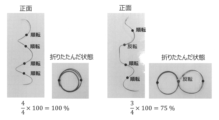
- the helical structure of wet hair bundles after shampooing can be evaluated by the helical ratio represented by the following formula.
- Spiral rate (%) (number of forward rotation points / total number of curl points) x 100 ("Number of forward rotation points” is the number of places where a curl is curled in the same direction as half a turn before when a bundle of hair is placed from the tip and the direction of the curl is observed from the root side of the tress. number)
- a hair cleansing composition containing the following components (a), (b) and (c).
- R 1 represents a hydrogen atom or a methyl group, preferably a hydrogen atom
- R 2 represents an alkyl group having 1 to 5 carbon atoms, preferably 2 to 4 carbon atoms, and n is 2 to 6, preferably 2 to Shows the number of 3.
- Polyalkylene glycol ether in component (a) is preferably diethylene glycol monomethyl ether (methyl carbitol), diethylene glycol monoethyl ether (ethyl carbitol), diethylene glycol monopropyl ether (propyl carbitol), diethylene glycol monobutyl ether (butyl carbitol) , triethylene glycol monomethyl ether, and one or more selected from triethylene glycol monoethyl ether, more preferably from diethylene glycol monoethyl ether (ethyl carbitol), diethylene glycol monobutyl ether (butyl carbitol), and triethylene glycol monomethyl ether
- the hair cleansing composition according to ⁇ 1> or ⁇ 2> which is one or more selected.
- the alkylene glycol in component (a) is preferably one or more selected from ethylene glycol, 1,3-propanediol, 1,3-butanediol, and 3-methyl-1,3-butanediol (isoprene glycol);
- Component (a) is preferably selected from diethylene glycol monoethyl ether (ethyl carbitol), diethylene glycol monobutyl ether (butyl carbitol), triethylene glycol monomethyl ether and 3-methyl-1,3-butanediol (isoprene glycol) More preferably one or more selected from diethylene glycol monoethyl ether (ethyl carbitol), diethylene glycol monobutyl ether (butyl carbitol) and triethylene glycol monomethyl ether, more preferably diethylene glycol monoethyl ether (ethyl carbitol)
- component (a) is 0.1% by mass or more, preferably 0.5% by mass or more, more preferably 1.0% by mass or more, still more preferably 2.0% by mass or more, still more preferably 3.0% by mass or more, Further, the content is 18% by mass or less, preferably 15% by mass or less, more preferably 12% by mass or less, and even more preferably 10% by mass or less, according to any one of ⁇ 1> to ⁇ 5>.
- a hair cleanser composition is 0.1% by mass or more, preferably 0.5% by mass or more, more preferably 1.0% by mass or more, still more preferably 2.0% by mass or more, still more preferably 3.0% by mass or more, Further, the content is 18% by mass or less, preferably 15% by mass or less, more preferably 12% by mass or less, and even more preferably 10% by mass or less, according to any one of ⁇ 1> to ⁇ 5>.
- a hair cleanser composition is 0.1% by mass or more, preferably 0.5% by mass or more, more preferably 1.0% by mass or more
- Component (b) is preferably N-acylamino acid salt, N-acyl-N-alkylamino acid salt, amide type N-acylamino acid salt, alkyl ether carboxylate, fatty acid salt, alkyl succinate or alkenyl succinate salt , sulfosuccinate anionic surfactants, isethionate anionic surfactants, taurine anionic surfactants, alkylbenzene sulfonate anionic surfactants, ⁇ -olefin sulfonate anionic surfactants One selected from surfactants, alkanesulfonic acid-type anionic surfactants, polyoxyalkyl ether sulfates, alkyl ether sulfates, imidazolines, carbobetaines, amidobetaines, sulfobetaines, hydroxysulfobetaines, and amidosulfobetaines
- the hair cleansing composition according to any one of ⁇ 1> to ⁇ 6
- the anionic surfactant of component (b) is preferably selected from N-acylamino acid salts, alkyl ether carboxylates, ⁇ -olefin sulfonates, polyoxyethylene alkyl ether sulfates and alkyl ether sulfates1 more preferably one or more selected from alkyl ether carboxylates, ⁇ -olefin sulfonates, polyoxyethylene alkyl ether sulfates and alkyl ether sulfates, more preferably ⁇ -olefin sulfonates and poly
- the hair cleansing composition according to any one of ⁇ 1> to ⁇ 7>, which contains one or more selected from oxyethylene alkyl ether sulfates, more preferably polyoxyethylene alkyl ether sulfates.
- the amphoteric surfactant of component (b) is preferably one or more selected from carbobetaines and sulfobetaines, more preferably one or more selected from fatty acid amide alkylbetaines and alkylhydroxysulfobetaines, more preferably one or more selected from fatty acid groups.
- One or more selected from fatty acid amidopropylbetaine having 8 to 14 carbon atoms and alkylhydroxysulfobetaine having alkyl group having 8 to 14 carbon atoms, more preferably selected from lauramidopropylbetaine and laurylhydroxysultaine The hair cleansing composition according to any one of ⁇ 1> to ⁇ 8>, which is one or more.
- Component (b) is preferably one or more anionic surfactants selected from carboxylic acid-type anionic surfactants, sulfonate-type anionic surfactants, and ether sulfate-type anionic surfactants; and one or more amphoteric surfactants.
- component (b) is 5% by mass or more, preferably 8% by mass or more, more preferably 12% by mass or more, and preferably 30% by mass or less, more preferably 25% by mass or less. , and more preferably 20% by mass or less, the hair cleansing composition according to any one of ⁇ 1> to ⁇ 10>.
- Component (c) is preferably an organic acid having 8 or less carbon atoms or a salt thereof, more preferably a dicarboxylic acid, a tricarboxylic acid, a hydroxycarboxylic acid having 8 or less carbon atoms, a carboxylic acid having an aldehyde group or a salt thereof, more preferably is a hydroxycarboxylic acid having 8 or less carbon atoms or a salt thereof, according to any one of ⁇ 1> to ⁇ 11>.
- Component (c) is preferably one or more hydroxycarboxylic acids selected from glycolic acid, lactic acid, malic acid, tartaric acid and citric acid or salts thereof, more preferably one selected from lactic acid, malic acid and tartaric acid
- component (c) is preferably 0.1% by mass or more, more preferably 0.2% by mass or more, still more preferably 0.5% by mass or more, and is preferably 5% by mass or less, more preferably 2% by mass or less. , and more preferably 1% by mass or less, the hair cleansing composition according to any one of ⁇ 1> to ⁇ 13>.
- the mass ratio (a)/(c) of component (a) to component (c) is preferably 0.5 or more, more preferably 1.0 or more, still more preferably 3 or more, still more preferably 5 or more, and preferably
- ⁇ 16> The hair cleansing composition according to any one of ⁇ 1> to ⁇ 15>, further comprising one or more nonionic surfactants as component (d).
- Component (d) is preferably alkyl glucoside, sorbitan fatty acid ester, glycerin fatty acid ester, polyglycerin fatty acid ester, propylene glycol fatty acid ester, polyethylene glycol fatty acid ester, sucrose fatty acid ester, polyoxyethylene fatty acid ester, polyoxyethylene sorbitan fatty acid Ester, polyoxyethylene alkyl ether, polyoxypropylene alkyl ether, alkyl glyceryl ether, polyoxyethylene sorbitol fatty acid ester, polyoxyethylene glycerin fatty acid ester, polyoxyethylene propylene glycol fatty acid ester, polyoxyethylene castor oil, polyoxyethylene hardening castor oil, polyoxyethylene hydrogenated castor oil fatty acid ester, polyoxyethylene phytostanol ether, polyoxyethylene phytosterose ether, polyoxyethylene cholestanol ether, polyoxyethylene cholesteryl ether, polyoxyalkylene-mod
- the content of component (d) is preferably 0.1% by mass or more, more preferably 0.5% by mass or more, still more preferably 1% by mass or more, and is preferably 10% by mass or less, more preferably 8% by mass or less. , and more preferably 5% by mass or less, the hair cleansing composition according to ⁇ 16> or ⁇ 17>.
- Component (e) is preferably one or more selected from cationic cellulose, cationic starch, cationic guar gum, cationic tara gum, cationic fenugreek gum and cationic locust bean gum, more preferably cationic cellulose and cationic
- the hair cleansing composition according to ⁇ 19> which contains one or more selected from guar gum, more preferably cationized cellulose.
- the content of component (e) is preferably 0.01% by mass or more, more preferably 0.1% by mass or more, still more preferably 0.2% by mass or more, and is preferably 5% by mass or less, more preferably 3% by mass or less. , and more preferably 1% by mass or less, the hair cleansing composition according to ⁇ 19> or ⁇ 20>.
- the content of the anionic or amphoteric film-forming polymer is preferably 5% by mass or less, more preferably 1% by mass or less, still more preferably 0.5% by mass or less, still more preferably 0.1% by mass or less, and even more preferably
- the hair cleansing composition according to any one of ⁇ 1> to ⁇ 22> which does not substantially contain a reducing compound selected from compounds having a thiol group or an aldehyde group, sulfites, and sulfinic acids. .
- the content of the reducing compound having an ascorbyl group is preferably less than 1% by mass, more preferably less than 0.5% by mass, even more preferably less than 0.1% by mass, and even more preferably less than 0.05% by mass ⁇ 1 > to the hair cleansing composition according to any one of ⁇ 23>.
- the pH at 25°C when diluted 20 times by mass with water is preferably 3 or higher, more preferably 3.5 or higher, still more preferably 4 or higher, still more preferably 5 or higher, and preferably 8 or lower, more preferably 8 or lower.
- the hair cleansing composition according to any one of ⁇ 1> to ⁇ 25> is applied to the wavy curled hair that has been thoroughly moistened with water, and then applied to the entire hair. Then, a hair treatment method in which a scrunch operation is performed while the hair is still wet.
- a hair cleansing composition containing the following components (a), (b) and (c).
- N-acyl amino acid salts alkyl ether carboxylates, ⁇ -olefin sulfonates, polyoxyethylene alkyl ether sulfates, alkyl ether sulfates, fatty acid amide alkyl betaine and alkyl
- One or more hydroxycarboxylic acids selected from glycolic acid, lactic acid, malic acid, tartaric acid and citric acid or salt
- a hair cleansing composition containing the following components (a), (b) and (c).
- a hair cleansing composition containing the following components (a), (b), (c) and (d).
- a hair cleansing composition containing the following components (a), (b), (c) and (e).
- a hair cleansing composition containing the following components (a), (b), (c), (d) and (e).
- (a) One or more compounds selected from diethylene glycol monoethyl ether (ethyl carbitol), diethylene glycol monobutyl ether (butyl carbitol) and triethylene glycol monomethyl ether 2.0% by mass or more and 12% by mass or less
- (b) N-acyl One or more selected from amino acid salts, alkyl ether carboxylates, ⁇ -olefin sulfonates and polyoxyethylene alkyl ether sulfates and alkyl hydroxysulfobetaine 8% by mass or more and 25% by mass or less
- (c) Glycolic acid, lactic acid , malic acid, tartaric acid and citric acid, or one or more hydroxycarboxylic acids or salts thereof 0.2% by mass or more and 2% by mass or less
- ⁇ 33> The hair cleansing composition according to any one of ⁇ 28> to ⁇ 32>, wherein the mass ratio (a)/(c) of component (a) to component (c) is 0.5 or more and 100 or less.
- ⁇ 34> The hair cleansing composition according to any one of ⁇ 28> to ⁇ 32>, wherein the mass ratio (a)/(c) of component (a) to component (c) is 1.0 or more and 50 or less.
- ⁇ 35> The hair cleansing composition according to any one of ⁇ 28> to ⁇ 32>, wherein the mass ratio (a)/(c) of component (a) to component (c) is 3 or more and 30 or less.
- ⁇ 36> The hair cleansing composition according to any one of ⁇ 28> to ⁇ 32>, wherein the mass ratio (a)/(c) of component (a) to component (c) is 5 or more and 25 or less.
- ⁇ Spiral rate (%) After rinsing, the tresses were allowed to drain naturally without moving them for 10 seconds, and then scrunched 10 times on a towel. As shown in the example in FIG. 1, a bundle of hair is placed from the tip so as to be folded, and the curl is counted every half round of the curl. It is assumed that a beautiful curl is formed at a portion curled in the same direction as (forward rotation portion). A larger number of forward rotation points indicates that the curls are evener. According to the following formula, the ratio of the total number of forward rotation points to the total number of curl points of the tress is defined as the spiral rate. In addition, in the evaluation, the average value of the spiral rate of 5 bundles of tress was adopted.
- Spiral rate (%) (number of forward rotation points / total number of curl points) x 100
- Number of forward rotation points is the number of places where a curl is curled in the same direction as half a turn before when a bundle of hair is placed from the tip and the direction of the curl is observed from the root side of the tress. number
- Comparative Example 1 is given as 5 as a bundle with a wide bundle width (scattered), and the score of Example 1 is given as 1 as a bundle with a narrow width (collected). The width difference was divided into 5 equal parts and evaluated as each score.
- the pH at 25°C is in the range of 3.5 to 7.5.
- the hair cleansing composition of the present example makes the wet hair after shampooing more likely to form a spiral shape, and the curls are evenly arranged to form three-dimensional, coherent and beautiful wave curls. know that it can be done.
- Formulation examples 1-3 Table 6 shows formulation examples of the hair cleansing composition of the present invention.
Landscapes
- Health & Medical Sciences (AREA)
- Life Sciences & Earth Sciences (AREA)
- Animal Behavior & Ethology (AREA)
- General Health & Medical Sciences (AREA)
- Public Health (AREA)
- Veterinary Medicine (AREA)
- Birds (AREA)
- Epidemiology (AREA)
- Emergency Medicine (AREA)
- Cosmetics (AREA)
Priority Applications (2)
| Application Number | Priority Date | Filing Date | Title |
|---|---|---|---|
| US18/713,856 US20250064695A1 (en) | 2021-12-03 | 2022-12-02 | Hair cleansing composition |
| EP22901448.5A EP4442326A4 (en) | 2021-12-03 | 2022-12-02 | HAIR CLEANSING COMPOSITION |
Applications Claiming Priority (2)
| Application Number | Priority Date | Filing Date | Title |
|---|---|---|---|
| JP2021-197232 | 2021-12-03 | ||
| JP2021197232 | 2021-12-03 |
Publications (1)
| Publication Number | Publication Date |
|---|---|
| WO2023101018A1 true WO2023101018A1 (ja) | 2023-06-08 |
Family
ID=86612437
Family Applications (1)
| Application Number | Title | Priority Date | Filing Date |
|---|---|---|---|
| PCT/JP2022/044607 Ceased WO2023101018A1 (ja) | 2021-12-03 | 2022-12-02 | 毛髪洗浄剤組成物 |
Country Status (5)
| Country | Link |
|---|---|
| US (1) | US20250064695A1 (https=) |
| EP (1) | EP4442326A4 (https=) |
| JP (1) | JP2023083264A (https=) |
| TW (1) | TW202332422A (https=) |
| WO (1) | WO2023101018A1 (https=) |
Citations (10)
| Publication number | Priority date | Publication date | Assignee | Title |
|---|---|---|---|---|
| JPS53139734A (en) | 1977-03-15 | 1978-12-06 | Oreal | Keratin treating composition |
| JPS6036407A (ja) | 1983-07-01 | 1985-02-25 | ロレアル | 化粧品組成物 |
| JPH04230614A (ja) | 1990-12-28 | 1992-08-19 | Kao Corp | 毛髪化粧料 |
| JPH1171435A (ja) | 1997-06-11 | 1999-03-16 | Kao Corp | カチオン性基含有共重合体及び増粘剤 |
| JP2003212733A (ja) * | 2002-01-21 | 2003-07-30 | Kao Corp | 毛髪洗浄剤 |
| JP2012131784A (ja) | 2010-11-30 | 2012-07-12 | Kao Corp | 毛髪化粧料 |
| JP2012207019A (ja) * | 2011-03-16 | 2012-10-25 | Shiseido Co Ltd | 濃縮液状毛髪洗浄剤組成物 |
| JP2015105271A (ja) | 2013-12-03 | 2015-06-08 | 花王株式会社 | 整髪剤組成物 |
| JP2020512979A (ja) * | 2017-03-31 | 2020-04-30 | ロレアル | ヘアトリートメント組成物 |
| JP2020186222A (ja) | 2019-05-10 | 2020-11-19 | 花王株式会社 | 毛髪処理方法 |
Family Cites Families (7)
| Publication number | Priority date | Publication date | Assignee | Title |
|---|---|---|---|---|
| DE3871974T2 (de) * | 1987-02-12 | 1993-01-14 | Estee Lauder Inc | Haarschutzmittel und verfahren. |
| FR2761600B1 (fr) * | 1998-06-19 | 2000-03-31 | Oreal | Composition moussante pour le lavage et le traitement des cheveux et/ou du cuir chevelu a base d'un principe actif, d'un tensioactif anionique, d'un tensioactif amphotere et d'un agent propenetrant |
| JP2003095842A (ja) * | 2001-09-21 | 2003-04-03 | Sunstar Inc | 化粧料 |
| EP1466592A1 (en) * | 2003-04-07 | 2004-10-13 | Kao Corporation | Cleansing compositions |
| US20160287566A1 (en) * | 2015-04-04 | 2016-10-06 | Thomas Lynn Busby | Anti-demodectic active agents and topical compositions for the treatment of demodicosis in humans and animals |
| US20180280267A1 (en) * | 2017-03-31 | 2018-10-04 | L'oreal | Kits and methods for treating hair |
| CN110787111A (zh) * | 2019-12-10 | 2020-02-14 | 相建明 | 一种具有显著改善脱发功效的洗发露 |
-
2022
- 2022-12-02 JP JP2022193601A patent/JP2023083264A/ja active Pending
- 2022-12-02 US US18/713,856 patent/US20250064695A1/en active Pending
- 2022-12-02 TW TW111146394A patent/TW202332422A/zh unknown
- 2022-12-02 EP EP22901448.5A patent/EP4442326A4/en active Pending
- 2022-12-02 WO PCT/JP2022/044607 patent/WO2023101018A1/ja not_active Ceased
Patent Citations (10)
| Publication number | Priority date | Publication date | Assignee | Title |
|---|---|---|---|---|
| JPS53139734A (en) | 1977-03-15 | 1978-12-06 | Oreal | Keratin treating composition |
| JPS6036407A (ja) | 1983-07-01 | 1985-02-25 | ロレアル | 化粧品組成物 |
| JPH04230614A (ja) | 1990-12-28 | 1992-08-19 | Kao Corp | 毛髪化粧料 |
| JPH1171435A (ja) | 1997-06-11 | 1999-03-16 | Kao Corp | カチオン性基含有共重合体及び増粘剤 |
| JP2003212733A (ja) * | 2002-01-21 | 2003-07-30 | Kao Corp | 毛髪洗浄剤 |
| JP2012131784A (ja) | 2010-11-30 | 2012-07-12 | Kao Corp | 毛髪化粧料 |
| JP2012207019A (ja) * | 2011-03-16 | 2012-10-25 | Shiseido Co Ltd | 濃縮液状毛髪洗浄剤組成物 |
| JP2015105271A (ja) | 2013-12-03 | 2015-06-08 | 花王株式会社 | 整髪剤組成物 |
| JP2020512979A (ja) * | 2017-03-31 | 2020-04-30 | ロレアル | ヘアトリートメント組成物 |
| JP2020186222A (ja) | 2019-05-10 | 2020-11-19 | 花王株式会社 | 毛髪処理方法 |
Non-Patent Citations (1)
| Title |
|---|
| See also references of EP4442326A4 |
Also Published As
| Publication number | Publication date |
|---|---|
| TW202332422A (zh) | 2023-08-16 |
| EP4442326A4 (en) | 2025-12-24 |
| US20250064695A1 (en) | 2025-02-27 |
| EP4442326A1 (en) | 2024-10-09 |
| JP2023083264A (ja) | 2023-06-15 |
Similar Documents
| Publication | Publication Date | Title |
|---|---|---|
| RU2214220C1 (ru) | Композиция и способ мытья и/или кондиционирования кератиновых материалов, кондиционирующий агент | |
| CN105579025B (zh) | 用于头发半永久性拉直以及头发拉直后处理的方法 | |
| CN105555253B (zh) | 用于处理头发的方法 | |
| JP3895074B2 (ja) | 洗浄用化粧品組成物及びその用途 | |
| JP5005163B2 (ja) | カチオン両性ポリマーおよびアニオン有用物質を含有する毛髪処理用の組成物および方法 | |
| JP3823079B2 (ja) | メタクリル酸コポリマーと油を含有する化粧品用組成物及びその用途 | |
| JP2000247846A (ja) | アニオン性のヒドロキシアルキルエーテル界面活性剤とカチオン性ポリマーを含有する化粧品組成物及びその用途 | |
| JP3283227B2 (ja) | Lcstタイプまたはucstタイプの臨界温度を示すポリマーの、化粧品または皮膚用製剤の製造中および製造用への用途、およびそれを含む組成物 | |
| JPH1045545A (ja) | デンドリマー含有毛髪処理用化粧品 | |
| JP2001226217A (ja) | 両性デンプンとカチオン性コンディショナーを含有する化粧品用組成物及びその用途 | |
| KR102215425B1 (ko) | 티올-베이스 화합물을 함유하는 모발용 화장료 조성물 및 모발의 클렌징 및 처리 방법 | |
| JP2002241241A (ja) | 酸化アルミニウムの粒子、少なくとも一つのアニオン性界面活性剤及び少なくとも一つの両性又はノニオン性界面活性剤を含む洗浄組成物 | |
| JP4909883B2 (ja) | 糖ラクトンを含有するヘアトリートメント組成物 | |
| AU2004203564A1 (en) | Cosmetic composition for hair | |
| BR112013013626B1 (pt) | "composição cosmética, uso de uma composição cosmética e processo para tratar materiais queratínicos" | |
| JP2003104829A (ja) | メタクリル酸コポリマー、ジメチコーン、真珠光沢剤及びカチオン性ポリマーを含有する化粧品用組成物及びその用途 | |
| EP3037084A1 (en) | Hair treatment process | |
| JP2003104854A (ja) | メタクリル酸コポリマー、シリコーン、及びカチオン性ポリマーを含有する化粧品用組成物及びその用途 | |
| JP6795497B2 (ja) | 毛髪処理剤 | |
| WO2023101018A1 (ja) | 毛髪洗浄剤組成物 | |
| CN112566701A (zh) | 包含超支化共聚物和头发定型聚合物的化妆品组合物 | |
| EP3463276B1 (en) | Process for treating hair | |
| JP2023083263A (ja) | 毛髪処理方法 | |
| JP2004196806A (ja) | 両性界面活性剤と真珠光沢剤を含有する化粧品組成物とその用途 | |
| JPH08511250A (ja) | 少なくとも1種のアルキルガラクトシドウロネート型アニオン界面活性剤および少なくとも1種の両性ポリマーを含有する化粧用組成物 |
Legal Events
| Date | Code | Title | Description |
|---|---|---|---|
| 121 | Ep: the epo has been informed by wipo that ep was designated in this application |
Ref document number: 22901448 Country of ref document: EP Kind code of ref document: A1 |
|
| WWE | Wipo information: entry into national phase |
Ref document number: 18713856 Country of ref document: US |
|
| NENP | Non-entry into the national phase |
Ref country code: DE |
|
| ENP | Entry into the national phase |
Ref document number: 2022901448 Country of ref document: EP Effective date: 20240703 |
|
| WWP | Wipo information: published in national office |
Ref document number: 18713856 Country of ref document: US |