WO2023074211A1 - 人工毛髪用アクリル系繊維、人工毛髪用アクリル系捲縮繊維、それを含む頭飾製品、及びその製造方法 - Google Patents
人工毛髪用アクリル系繊維、人工毛髪用アクリル系捲縮繊維、それを含む頭飾製品、及びその製造方法 Download PDFInfo
- Publication number
- WO2023074211A1 WO2023074211A1 PCT/JP2022/035472 JP2022035472W WO2023074211A1 WO 2023074211 A1 WO2023074211 A1 WO 2023074211A1 JP 2022035472 W JP2022035472 W JP 2022035472W WO 2023074211 A1 WO2023074211 A1 WO 2023074211A1
- Authority
- WO
- WIPO (PCT)
- Prior art keywords
- fiber
- acrylic
- artificial hair
- less
- crimped
- Prior art date
- Legal status (The legal status is an assumption and is not a legal conclusion. Google has not performed a legal analysis and makes no representation as to the accuracy of the status listed.)
- Ceased
Links
Images







Classifications
-
- D—TEXTILES; PAPER
- D01—NATURAL OR MAN-MADE THREADS OR FIBRES; SPINNING
- D01F—CHEMICAL FEATURES IN THE MANUFACTURE OF ARTIFICIAL FILAMENTS, THREADS, FIBRES, BRISTLES OR RIBBONS; APPARATUS SPECIALLY ADAPTED FOR THE MANUFACTURE OF CARBON FILAMENTS
- D01F6/00—Monocomponent artificial filaments or the like of synthetic polymers; Manufacture thereof
- D01F6/28—Monocomponent artificial filaments or the like of synthetic polymers; Manufacture thereof from copolymers obtained by reactions only involving carbon-to-carbon unsaturated bonds
- D01F6/40—Modacrylic fibres, i.e. containing 35 to 85% acrylonitrile
-
- A—HUMAN NECESSITIES
- A41—WEARING APPAREL
- A41G—ARTIFICIAL FLOWERS; WIGS; MASKS; FEATHERS
- A41G3/00—Wigs
-
- A—HUMAN NECESSITIES
- A41—WEARING APPAREL
- A41G—ARTIFICIAL FLOWERS; WIGS; MASKS; FEATHERS
- A41G3/00—Wigs
- A41G3/0083—Wigs characterised by their hair filaments
-
- A—HUMAN NECESSITIES
- A41—WEARING APPAREL
- A41G—ARTIFICIAL FLOWERS; WIGS; MASKS; FEATHERS
- A41G5/00—Hair pieces, inserts, rolls, pads, or the like; Toupées
- A41G5/0006—Toupées covering a bald portion of the head
-
- A—HUMAN NECESSITIES
- A41—WEARING APPAREL
- A41G—ARTIFICIAL FLOWERS; WIGS; MASKS; FEATHERS
- A41G5/00—Hair pieces, inserts, rolls, pads, or the like; Toupées
- A41G5/004—Hairpieces, e.g. hair extensions
-
- D—TEXTILES; PAPER
- D01—NATURAL OR MAN-MADE THREADS OR FIBRES; SPINNING
- D01D—MECHANICAL METHODS OR APPARATUS IN THE MANUFACTURE OF ARTIFICIAL FILAMENTS, THREADS, FIBRES, BRISTLES OR RIBBONS
- D01D5/00—Formation of filaments, threads, or the like
- D01D5/04—Dry spinning methods
-
- D—TEXTILES; PAPER
- D01—NATURAL OR MAN-MADE THREADS OR FIBRES; SPINNING
- D01D—MECHANICAL METHODS OR APPARATUS IN THE MANUFACTURE OF ARTIFICIAL FILAMENTS, THREADS, FIBRES, BRISTLES OR RIBBONS
- D01D5/00—Formation of filaments, threads, or the like
- D01D5/06—Wet spinning methods
-
- D—TEXTILES; PAPER
- D01—NATURAL OR MAN-MADE THREADS OR FIBRES; SPINNING
- D01D—MECHANICAL METHODS OR APPARATUS IN THE MANUFACTURE OF ARTIFICIAL FILAMENTS, THREADS, FIBRES, BRISTLES OR RIBBONS
- D01D5/00—Formation of filaments, threads, or the like
- D01D5/253—Formation of filaments, threads, or the like with a non-circular cross section; Spinnerette packs therefor
-
- D—TEXTILES; PAPER
- D01—NATURAL OR MAN-MADE THREADS OR FIBRES; SPINNING
- D01F—CHEMICAL FEATURES IN THE MANUFACTURE OF ARTIFICIAL FILAMENTS, THREADS, FIBRES, BRISTLES OR RIBBONS; APPARATUS SPECIALLY ADAPTED FOR THE MANUFACTURE OF CARBON FILAMENTS
- D01F6/00—Monocomponent artificial filaments or the like of synthetic polymers; Manufacture thereof
- D01F6/28—Monocomponent artificial filaments or the like of synthetic polymers; Manufacture thereof from copolymers obtained by reactions only involving carbon-to-carbon unsaturated bonds
- D01F6/38—Monocomponent artificial filaments or the like of synthetic polymers; Manufacture thereof from copolymers obtained by reactions only involving carbon-to-carbon unsaturated bonds comprising unsaturated nitriles as the major constituent
-
- D—TEXTILES; PAPER
- D02—YARNS; MECHANICAL FINISHING OF YARNS OR ROPES; WARPING OR BEAMING
- D02G—CRIMPING OR CURLING FIBRES, FILAMENTS, THREADS, OR YARNS; YARNS OR THREADS
- D02G1/00—Producing crimped or curled fibres, filaments, yarns, or threads, giving them latent characteristics
- D02G1/004—Producing crimped or curled fibres, filaments, yarns, or threads, giving them latent characteristics by heating fibres, filaments, yarns or threads so as to create a temperature gradient across their diameter, thereby imparting them latent asymmetrical shrinkage properties
-
- D—TEXTILES; PAPER
- D10—INDEXING SCHEME ASSOCIATED WITH SUBLASSES OF SECTION D, RELATING TO TEXTILES
- D10B—INDEXING SCHEME ASSOCIATED WITH SUBLASSES OF SECTION D, RELATING TO TEXTILES
- D10B2321/00—Fibres made from polymers obtained by reactions only involving carbon-to-carbon unsaturated bonds
- D10B2321/10—Fibres made from polymers obtained by reactions only involving carbon-to-carbon unsaturated bonds polymers of unsaturated nitriles, e.g. polyacrylonitrile, polyvinylidene cyanide
- D10B2321/101—Fibres made from polymers obtained by reactions only involving carbon-to-carbon unsaturated bonds polymers of unsaturated nitriles, e.g. polyacrylonitrile, polyvinylidene cyanide modacrylic
-
- D—TEXTILES; PAPER
- D10—INDEXING SCHEME ASSOCIATED WITH SUBLASSES OF SECTION D, RELATING TO TEXTILES
- D10B—INDEXING SCHEME ASSOCIATED WITH SUBLASSES OF SECTION D, RELATING TO TEXTILES
- D10B2401/00—Physical properties
- D10B2401/04—Heat-responsive characteristics
-
- D—TEXTILES; PAPER
- D10—INDEXING SCHEME ASSOCIATED WITH SUBLASSES OF SECTION D, RELATING TO TEXTILES
- D10B—INDEXING SCHEME ASSOCIATED WITH SUBLASSES OF SECTION D, RELATING TO TEXTILES
- D10B2503/00—Domestic or personal
- D10B2503/08—Wigs
Definitions
- the present invention relates to an acrylic fiber for artificial hair used in head ornament products, an acrylic crimped fiber for artificial hair, a head ornament product containing the same, and a method for producing the same.
- Patent Literature 1 proposes an acrylic fiber for artificial hair that has a specific cross-sectional shape to increase volume, improve tactile sensation and twist workability, and a head ornament product using the same.
- Braids woven with artificial hair are known as headdress products. Hair arrangement can be enjoyed by attaching the braid to the user's own hair. For wearers with uneven hair lengths, especially for small children whose hair is not fully grown and aligned, the artificial hair may be crimped unevenly or irregularly ( Crimp) is desired.
- the present invention is for artificial hair that, even when crimped irregularly, has a good tactile sensation, has a high volume, and can develop crimps that are excellent in compatibility with one's own hair.
- an acrylic fiber an acrylic crimped fiber for artificial hair, a headdress containing the same, and a method for producing the same.
- One or more embodiments of the present invention provide an acrylic fiber for artificial hair composed of an acrylic copolymer, which has a dry heat shrinkage rate of
- the acrylic fiber for artificial hair has a torsional rigidity of 30% or more and 70% or less and a twisting rigidity of 0.3 mg ⁇ cm 2 or more and 2.0 mg ⁇ cm 2 or less.
- One or more embodiments of the present invention are acrylic crimped fibers for artificial hair composed of an acrylic copolymer, having a number of crimps of 10/10 cm or more and an average crimp height per 10 cm of fiber. is 1.5 mm or more, out of ten continuous crimps, at least two crimps have different crimp widths, at least two crimps have different crimp heights, and have two or more different crimp directions. for acrylic crimped fibers.
- One or more embodiments of the present invention relate to a headdress product containing the acrylic fiber for artificial hair or the crimped acrylic fiber for artificial hair.
- One or more embodiments of the present invention are the method for producing acrylic fibers for artificial hair, comprising the step of wet-spinning a spinning solution containing an acrylic copolymer using a spinning nozzle to obtain a coagulated yarn; A primary drawing step of wet drawing the obtained coagulated yarn, and a secondary drawing step of dry drawing the obtained primary drawn yarn, without performing a relaxation treatment after the secondary drawing step, acrylic for artificial hair It relates to a method for manufacturing fibers.
- One or more embodiments of the present invention are the method for producing acrylic crimped fibers for artificial hair, comprising a step of wet-spinning a spinning solution containing an acrylic copolymer using a spinning nozzle to obtain a coagulated yarn. , a primary drawing step of wet drawing the obtained coagulated yarn, a secondary drawing step of dry drawing the obtained primary drawn yarn, and the obtained secondary drawn yarn at a temperature of 90 ° C. or higher and 150 ° C. or lower for 5
- the present invention relates to a method for producing an acrylic crimped fiber for artificial hair, which includes a step of heat-shrinking for 60 minutes or less under no tension to impart crimps.
- the artificial hair has a good tactile sensation, has a high volume, and can develop crimps that are excellent in compatibility with the user's own hair.
- for artificial hair that is irregularly crimped has good tactile sensation, has high volume, and expresses crimps that are excellent in compatibility with one's own hair.
- Acrylic crimped fibers can be provided.
- a crimp that has a good tactile sensation, has a high volume, and is excellent in compatibility with one's own hair can be obtained. It is possible to obtain an acrylic fiber for artificial hair that can be expressed.
- irregular crimps are imparted, and a crimp that has a good tactile sensation, a high volume, and excellent compatibility with one's own hair is developed. An acrylic crimped fiber for artificial hair can be obtained.
- FIG. 1 is a schematic cross-sectional view of an example anchor Y-shaped fiber cross-section;
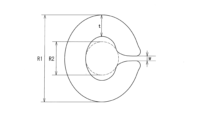
- FIG. 1 is a schematic cross-sectional view of an example C-shaped fiber cross-section;
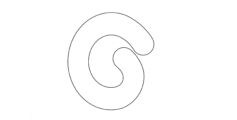
- FIG. 1 is a schematic cross-sectional view of an example figure 6 fiber cross-section;
- FIG. It is a schematic cross-sectional view explaining each dimension in the Y-shaped anchor fiber cross section of one example.
- It is a schematic cross-sectional view explaining each dimension in a C-shaped fiber cross section of one example.
- FIG. 4 is a schematic cross-sectional view explaining each dimension in an example of a figure 6 fiber cross section.
- 1 is a schematic cross-sectional view of an example wet spinning nozzle;
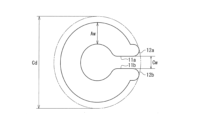
- FIG. 1 is a schematic cross-sectional view of an example wet spinning nozzle;
- FIG. 1 is a schematic cross-sectional view of an example wet spinning nozzle;
- FIG. 1 is a schematic cross-sectional view of an example wet spinning nozzle;
- FIG. 1 is a schematic diagram showing the appearance of an acrylic crimped fiber having irregular crimps.
- FIG. It is a schematic diagram explaining the crimp height and crimp width in an acrylic crimped fiber of an example.
- 1 is a cross-sectional photograph (400 times) of the acrylic fiber of Example 1.
- FIG. 4 is a cross-sectional photograph (400 times) of the acrylic fiber of Example 2.
- FIG. 4 is a cross-sectional photograph (400 times) of the acrylic fiber of Example 3.
- FIG. 4 is a cross-sectional photograph (400 times) of the acrylic fiber of Comparative Example 1.
- FIG. 4 is a cross-sectional photograph (400 times) of the acrylic fiber of Comparative Example 6.
- FIG. 4 is a cross-sectional photograph (400 times) of the acrylic fiber of Comparative Example 6.
- the inventors of the present invention have determined that the dry heat shrinkage rate and torsional rigidity of an acrylic fiber for artificial hair composed of an acrylic copolymer are determined by dry heat treatment at a temperature of 90° C. or higher and 180° C. or lower for 30 minutes. Specifically, the dry heat shrinkage rate is high and the torsional rigidity is low, so that even when irregular crimps are applied, the texture is good, the volume is high, and the hair is compatible with the natural hair. It was found that crimps with excellent properties can be expressed.
- the term “irregular crimp” means that out of 10 continuous crimps, at least two crimps have different crimp widths, at least two crimps have different crimp heights, and two or more crimps have different crimp heights. Means to have a crimp direction.
- the acrylic fiber for artificial hair has a dry heat shrinkage rate (hereinafter simply referred to as "dry heat shrinkage rate") of 30% or more and 70% or less when subjected to a dry heat treatment at a temperature of 90° C. or more and 180° C. or less for 30 minutes. be.
- dry heat shrinkage rate 30% or more
- 70% or less when subjected to a dry heat treatment at a temperature of 90° C. or more and 180° C. or less for 30 minutes.
- the upper limit of the dry heat shrinkage rate when the acrylic fiber for artificial hair is subjected to dry heat treatment at a temperature of 90° C. or higher and 180° C. or lower for 30 minutes is preferably 65% or less, 60% or less, 55% or less, 50% or less, 49 % or less, 48% or less, 47% or less, or 46% or less.
- the lower limit of the dry heat shrinkage of the acrylic fiber for artificial hair when dry heat treated at a temperature of 90° C. to 180° C. for 30 minutes is preferably 33% or more, 35% or more, or 37% or more.
- the acrylic fiber for artificial hair has a dry heat shrinkage of preferably 33% or more and 60% or less, more preferably 35% when dry heat treated at a temperature of 90°C or more and 180°C or less for 30 minutes. % or more and 50% or less, more preferably 37% or more and 46% or less.
- the dry heat shrinkage rate of the acrylic fiber for artificial hair when dry heat treated at a temperature of 95° C. or higher and 170° C. or lower for 30 minutes satisfies the above range, and the dry heat treatment is performed at a temperature of 100° C. or higher and 160° C. or lower for 30 minutes. It is more preferable that the dry heat shrinkage rate after dry heat treatment satisfies the above range, and the dry heat shrinkage rate after dry heat treatment at a temperature of 110 ° C. or higher and 150 ° C. or lower for 30 minutes satisfies the above range, and 120 ° C. for 30 minutes. It is particularly preferable that the dry heat shrinkage ratio after dry heat treatment satisfies the above range.
- the dry heat shrinkage rate is defined as the fiber length of the fiber bundle before and after the heat treatment, which is obtained by subjecting a fiber bundle of predetermined fibers to dry heat treatment for 30 minutes in a non-tensioned state in a soaking dryer set to a predetermined temperature. Based on this, it is calculated by the following formula 1.
- La is the fiber length of the fiber bundle under 50g load before heat treatment
- Lb is the fiber length of the fiber bundle under 50g load after heat treatment.
- the torsional rigidity of the acrylic fiber for artificial hair is 0.3 mg ⁇ cm 2 or more and 2.0 mg ⁇ cm 2 or less. With a torsional rigidity of 2.0 mg ⁇ cm 2 or less, the acrylic fiber for artificial hair has a high volume even when crimped irregularly, and crimps that are excellent in compatibility with one's own hair. can be expressed. Further, when the torsional rigidity is 0.3 mg ⁇ cm 2 or more, the strength against external force is increased.
- torsional rigidity is measured under the conditions of a torsional rotation number of ⁇ 3 rotations and a torsional speed of 12°/sec. Specifically, it can be measured as described in Examples. .
- the lower limit of the torsional rigidity is preferably 0.4 mg ⁇ cm 2 or more, 0.5 mg ⁇ cm 2 or more, 0.6 mg ⁇ cm 2 or more, 0.7 mg ⁇ cm 2 or more, or 0 .8 mg ⁇ cm 2 or more.
- the upper limit of torsional stiffness is preferably 1.95 mg ⁇ cm 2 or less, 1.90 mg ⁇ cm 2 or less, 1.85 mg ⁇ cm 2 or less, 1.80 mg ⁇ cm 2 or less. 75 mg ⁇ cm 2 or less, or 1.70 mg ⁇ cm 2 or less.
- the preferred range of torsional stiffness may be any combination of the above upper and lower limits.
- the torsional stiffness of the acrylic fiber for artificial hair is preferably 0.4 mg ⁇ cm 2 or more and 1.9 mg ⁇ cm 2 or less, more preferably 0.5 mg ⁇ cm 2 or more and 1.7 mg ⁇ cm 2 or more. cm 2 or less.
- the fineness of the acrylic fiber for artificial hair is not particularly limited, it is preferably 25 dtex or more and 95 dtex or less, more preferably 30 dtex or more and 75 dtex or less, and 35 dtex or more and 65 dtex or less from the viewpoint of suitable use as artificial hair. is more preferred.
- the cross-sectional shape of the acrylic fiber for artificial hair is not particularly limited, but examples include Y-shape, anchor Y-shape, C-shape, hexagon-shape, dumbbell-shape, horseshoe-shape, ellipse-shape, and circle-shape.
- the cross-section of a fiber means the cross-section. From the viewpoint of expressing sufficient volume when crimped, it is preferable to have voids.
- the acrylic fiber for artificial hair is selected from the group consisting of a Y-shaped anchor, a C-shaped anchor, and a 6-shaped anchor, from the viewpoint that the torsional rigidity easily satisfies the above-described range and that sufficient volume is exhibited when crimped. It is more preferable to have one or more cross-sectional shapes that It is more preferable that the acrylic fiber for artificial hair has a Y-shaped anchor from the viewpoint of further improving the tactile sensation.
- the anchor Y-shaped fiber cross section is composed of, for example, three T-shaped protrusions radially protruding from the center, and the upper sides of the T-shaped protrusions are arc-shaped bulging away from the center.
- Arc-shaped means any shape similar to a circular arc.
- the shape may include a curved shape including a part of an ellipse, which is the same as a circular arc in view of common technical knowledge, and may partially include a straight portion.
- the arc may or may not be bilaterally symmetrical.
- FIG. 1 shows a schematic cross-sectional view of an example of an acrylic fiber for artificial hair having a Y-shaped fiber cross section.
- the acrylic fiber for artificial hair 1 has a cross section composed of three T-shaped projections 3 projecting radially from a central portion 2, and an upper side (portion) 4 of the T-shaped projection extends from the central portion 2. It has an arc shape that bulges in the direction of separation.
- the T-shaped protrusion 3 has an upper side (portion) 4 and a lower protrusion 5 .
- the central portion 2 may have a substantially circular or substantially elliptical shape.
- the distance between adjacent ends of the upper sides of adjacent T-shaped protrusions is, although not particularly limited, 16.5 mm from the viewpoint of increasing the volume. It is preferably 0 ⁇ m or more.
- the distance between adjacent ends of the upper sides of adjacent T-shaped protrusions should be 50.0 ⁇ m or less. is preferred, and 35.0 ⁇ m or less is more preferred.
- the distance between adjacent ends of the upper sides of adjacent T-shaped projections is indicated by W.
- the thickness of the upper side of the T-shaped protrusion is set to the radius of the circumscribed circle in the fiber cross section. is preferably 10% or more and 50% or less, more preferably 25% or more and 45% or less.
- the thickness of the upper side of the T-shaped projection is a straight line connecting two intersections of the upper side of the T-shaped projection and the lower projection of the T-shaped projection from the vertex of the upper side of the T-shaped projection. means the vertical distance to In this specification, the apex of the upper side of the T-shaped projection is furthest from the center point of the fiber cross section.
- H denotes the thickness of the upper side of the T-shaped protrusion.
- the maximum length of the upper side of the T-shaped protrusion is It is preferably 1.5 times or more and 4 times or less, more preferably 1.9 times or more and 2.6 times or less, the minimum length of the upper side of the .
- the maximum length of the upper side of the T-shaped protrusion means the length between two ends of the upper side of the T-shaped protrusion
- the minimum length of the upper side of the T-shaped protrusion is , means the length of a straight line connecting two intersections of the upper side of the T-shaped protrusion and the lower protrusion of the T-shaped protrusion.
- the maximum length of the upper side of the T-shaped protrusion is indicated by Lx
- the minimum length of the upper side of the T-shaped protrusion is indicated by Ln.
- the circumscribed circle radius in the fiber cross section is 45.0 ⁇ m or more and 60.0 ⁇ m or less, although not particularly limited, for example, from the viewpoint of further increasing volume and touch. is preferred.
- a circumscribed circle in a fiber cross section means a circle passing through the vertices of the upper sides of the three T-shaped projections. In FIG. 4, the circumscribed circle radius is indicated by D. In FIG.
- the width of the T-shaped projection in the cross section of the fiber is not particularly limited, but from the viewpoint of preventing cracking of the fiber cross section and increasing the volume, the width of the T-shaped protrusion in the fiber cross section is 11.0 ⁇ m or more. 0 ⁇ m or less, and more preferably 12.0 ⁇ m or more and 20.0 ⁇ m or less.
- the width of the T-shaped protrusion is indicated by A.
- FIG. 2 is a schematic cross-sectional view of an example of an acrylic fiber for artificial hair having a C-shaped cross-sectional shape.
- the two ends of the C-shape are separated from each other to form an opening, but the two ends of the C-shape may be in contact with each other.
- FIG. 3 is a schematic cross-sectional view of an example of an acrylic fiber for artificial hair having a six-shaped cross-sectional shape.
- the 6-shape can also be referred to as a shape that is a modified C-shape, and more specifically, can be referred to as a shape in which one end of the C-shape is located inside the other end.
- the two ends of the figure 6 are separated from each other to form an opening, but the two ends of the figure 6 may be in contact with each other.
- the diameter of the circumscribed circle of the fiber cross section (hereinafter also referred to as the circumscribed circle diameter) is not particularly limited, but from the viewpoint of further improving the volume and touch feeling ) is preferably 75 ⁇ m or more and 100 ⁇ m or less, more preferably 80 ⁇ m or more and 95 ⁇ m or less.
- the circumscribed circle diameter is indicated by R1.
- the hollow part of the fiber cross section is preferably 30 ⁇ m or more and 50 ⁇ m or less, more preferably 32 ⁇ m or more and 48 ⁇ m or less. 5 and 6, the inscribed circle diameter is indicated by R2.
- the thickness of the fiber cross section is not particularly limited, but from the viewpoint that the torsional rigidity easily satisfies the above range and the volume and touch feel are further improved. , preferably 10 ⁇ m or more and 26 ⁇ m or less, more preferably 11 ⁇ m or more and 25 ⁇ m or less. In FIGS. 5 and 6 the thickness is indicated by t.
- the distance between two ends in the fiber cross section is preferably 10 ⁇ m or less, although not particularly limited, from the viewpoint of further improving volume and touch. It is preferably 5 ⁇ m or less, more preferably 5 ⁇ m or less.
- W the distance between the two ends in the fiber cross-section.
- W is 0 ⁇ m.
- the fiber cross-section has the shape of a figure 6, the distance between the two ends of the fiber cross-section will be 0 ⁇ m.
- the acrylic fiber for artificial hair is not particularly limited, but from the viewpoint of expressing sufficient volume when crimped, it is preferable that the porosity of the cross section of the fiber is 20% or more and 50% or less. % or more and 50% or less, more preferably 35% or more and 45% or less.
- the area of the circumscribed circle of the fiber cross section and the area of the fiber cross section are calculated, and the porosity is obtained by the following formula 2.
- the area of the circumscribed circle of the fiber cross section is the area of the circle whose diameter is the maximum length of the line segments connecting any two points on the outer periphery of the fiber cross section.
- Porosity (%) 100 ⁇ (area of circumscribed circle of fiber cross section - area of fiber cross section) / area of circumscribed circle of fiber cross section
- All acrylic fibers for artificial hair do not necessarily have the same fineness, cross-sectional shape, and cross-sectional size, and fibers with different fineness, cross-sectional shape, and cross-sectional size may be mixed.
- the acrylic copolymer constituting the acrylic fiber for artificial hair is not particularly limited.
- an acrylic copolymer containing less than 95% by weight of acrylonitrile and more than 5% by weight of other monomers can be used.
- Acrylic copolymers can be used, preferably containing less than 80% by weight of acrylonitrile and more than 20% by weight of other monomers.
- monomers copolymerizable with acrylonitrile can be appropriately used.
- the acrylic copolymer constituting the acrylic fiber for artificial hair contains 29.5% to 79.5% by weight of acrylonitrile and 20% to 70% by weight of vinyl chloride and/or vinylidene chloride.
- the acrylic copolymer contains 29.5% to 79.5% by weight of acrylonitrile, 20% to 70% by weight of vinyl chloride and/or vinylidene chloride, and a sulfonic acid group-containing vinyl monomer. It is more preferable to polymerize a total of 100% by weight of a monomer mixture containing 0.5% by weight or more and 5% by weight or less.
- the acrylonitrile content in the acrylic copolymer is 29.5% by weight or more and 79.5% by weight or less, the heat resistance is improved.
- the acrylic copolymer contains 34.5% to 74.5% by weight of acrylonitrile, 25% to 65% by weight of vinyl chloride and/or vinylidene chloride, and a sulfonic acid group-containing vinyl Containing 0.5% to 5% by weight of monomers, particularly preferably 39.5% to 74.5% by weight of acrylonitrile, 25% to 60% by weight of vinyl chloride, and a sulfonic acid group It contains 0.5% by weight or more and 5% by weight or less of the contained vinyl monomer. From the standpoint of better tactile sensation, the acrylic copolymer preferably contains vinyl chloride.
- the sulfonic acid group-containing vinyl monomer is not particularly limited, but examples include allylsulfonic acid, methallylsulfonic acid, styrenesulfonic acid, isoprenesulfonic acid, 2-acrylamido-2-methylpropanesulfonic acid, and sodium salts thereof. metal salts such as and amine salts can be used.
- the sulfonic acid group-containing vinyl monomer may be used alone or in combination of two or more.
- the acrylic fibers for artificial hair may contain other additives for improving the fiber properties as necessary, as long as they do not impair the effects of the present invention.
- the additives include gloss modifiers such as titanium dioxide, silicon dioxide, esters and ethers of cellulose derivatives such as cellulose acetate, colorants such as organic pigments, inorganic pigments, and dyes, and light resistance and heat resistance.
- Stabilizers for improvement fiber sizing agents such as urethane-based polymers and cationic ester polymers for improving workability during blade and twist processing, and inorganic or scavenging agents that supplement isovaleric acid, which is an odor component generated from the scalp.
- Functional agents such as organic deodorants and fragrances that impart a citrus smell to artificial hair fibers can be mentioned.
- the acrylic fiber for artificial hair described above can be produced, for example, by wet spinning a spinning solution containing an acrylic copolymer.
- a spinning solution can be obtained, for example, by dissolving an acrylic copolymer in an organic solvent.
- the acrylic copolymer those described above can be appropriately used.
- the organic solvent is not particularly limited, and a good solvent for acrylic copolymers can be used as appropriate.
- examples include methyl sulfoxide (DMSO), dimethylacetamide (DMAc), N,N-dimethylformamide (DMF), acetone and the like. From the viewpoint of versatility, acetone may be used.
- the spinning solution may contain a small amount of water, for example 1.5% to 4.8% by weight of water.
- the spinning solution may, if necessary, contain other additives for improving fiber properties as long as they do not impair the effects of the present invention.
- the additives include gloss modifiers such as titanium dioxide, silicon dioxide, esters and ethers of cellulose derivatives such as cellulose acetate, colorants such as organic pigments, inorganic pigments and dyes, and light resistance and heat resistance improvement. Stabilizers and the like for
- the method for producing acrylic fibers for artificial hair includes at least a coagulation step, a primary drawing step, and a secondary drawing step, and preferably no relaxation treatment is performed after the secondary drawing step.
- a fiber with a high dry heat shrinkage is obtained.
- the term “relaxation treatment” means a relaxation treatment commonly performed in the field of fibers, for example, heat treatment at a temperature of 100° C. or higher and 200° C. or lower so that the fibers shrink in the fiber axial direction.
- the rate of fiber shrinkage during the relaxation treatment is indicated by the relaxation rate.
- the relaxation rate in the relaxation treatment is usually 5% or more.
- a relaxation rate of 5% means that the fiber contracted by 5% due to the relaxation treatment, that is, the fiber length of the fiber after the relaxation treatment was 95% of the fiber length of the fiber before the relaxation treatment.
- the spinning solution is discharged through a spinning nozzle into a coagulation bath and coagulated to form threads (coagulated threads).
- the nozzle used for wet spinning is not particularly limited, and a nozzle corresponding to a desired fiber cross section can be used as appropriate.
- a nozzle having a Y-shaped cross section acrylic fibers having a Y-shaped cross section can be obtained.
- FIG. 7 shows a schematic cross-sectional view of a nozzle having an anchor Y-shaped cross-sectional shape of one example.
- the axial width Aw may be 0.02 mm or more and 1.0 mm or less
- the canal width Cw may be 0.02 mm or more and 1.0 mm or less
- the circumscribed The circle diameter Cd may be 0.01 mm or more and 1.0 mm or less
- the hole area may be 0.05 mm 2 or more and 1.0 mm 2 or less.
- FIG. 8 has a C-shaped cross-sectional shape with two ends separated from each other; is a schematic cross-sectional view of a nozzle (hereinafter also referred to as an I-type spinning nozzle) in which the straight portions of are parallel to each other.
- the two ends of the C-shape respectively have straight portions 11a, 11b and projections 12a, 12b, and the straight portions 11a and 11b are parallel to each other.
- the linear portion and the protruding portion can be appropriately adjusted according to the desired cross-sectional shape and size of the fiber.
- the circumscribed circle diameter Cd may be 0.37 mm or more and 0.60 mm or less
- the canal width Cw may be 0.06 mm or more and 0.24 mm or less
- the slit width Aw may be 0. 0.06 mm or more and 0.15 mm or less
- the hole area may be 0.0850 mm 2 or more and 0.1256 mm 2 or less.
- FIG. 9 shows a schematic cross-sectional view of a nozzle having a C-shaped cross-section in which one end is located inside the other end (hereinafter also referred to as type II spinning nozzle). It is In the type II spinning nozzle, one end 13a of the C-shape is located inside the other end 13b. The degree of displacement between the positions of the two ends can be appropriately adjusted according to the desired cross-sectional shape and size of the fiber.
- the circumscribed circle diameter Cd may be 0.37 mm or more and 0.60 mm or less
- the canal width Cw may be 0.06 mm or more and 0.24 mm or less
- the slit width Aw may be 0.06 mm or more and 0.15 mm or less
- the hole area may be 0.0850 mm 2 or more and 0.1256 mm 2 or less.
- the spinning speed is not particularly limited, for example, from the viewpoint of industrial productivity, it is preferably 2 m/min or more and 17 m/min or less.
- the nozzle draft is not particularly limited, it is preferably 0.8 or more and 2.0 or less from the viewpoint of manufacturing process stability.
- an aqueous solution with a good solvent such as dimethylsulfoxide having a concentration of 20% by weight or more and 70% by weight or less can be used.
- the temperature of the coagulation bath can be between 5°C and 40°C. If the concentration of the organic solvent in the coagulation bath is too low, coagulation will be accelerated and the coagulation structure will become rough, tending to form voids inside the fibers.
- the coagulated yarn is wet drawn to obtain a primary drawn yarn.
- the acrylic fiber (coagulated yarn) is preferably bath-drawn in a drawing bath.
- the drawing bath can be an aqueous solution having a lower concentration of a good solvent such as dimethylsulfoxide than the coagulation bath.
- the temperature of the wet drawing is preferably 30° C. or higher and 100° C. or lower, more preferably 40° C. or higher and 95° C. or lower, and 50° C. or higher, from the viewpoint of spinning stability. It is more preferably 93° C. or less.
- the draw ratio is not particularly limited, but from the viewpoint of increasing the strength and productivity of the fiber, it is preferably 2 times or more and 8 times or less.
- the bath stretching step may be performed after the water washing step described later, or the primary stretching and the water washing may be performed at the same time.
- the water washing step it is desirable to remove the organic solvent such as acetone from the acrylic fibers by washing the acrylic fibers with hot water of 30°C or higher.
- the coagulated yarn may be led to warm water of 30° C. or higher, and primary drawing and water washing may be performed simultaneously.
- the water washing process for example, by using hot water of 70° C. or higher, it becomes easier to remove a good solvent such as acetone in the acrylic fiber.
- the upper limit of the water temperature during washing is preferably 95°C or less.
- the drying temperature is not particularly limited, but is, for example, 110° C. or higher and 190° C. or lower.
- the drawing temperature for the secondary drawing is not particularly limited, but from the viewpoint of spinning stability, it is preferably 110° C. or higher and 190° C. or lower, like the drying temperature.
- the draw ratio is not particularly limited, but is preferably 1 to 4 times, more preferably 1 to 3 times, and even more preferably 1 to 2 times.
- the total draw ratio of the primary draw and the secondary draw is preferably 2 to 10 times, more preferably 2 to 8 times, and 2 to 6 times. It is more preferable that there is 2 times or more, and it is particularly preferable that it is 2 times or more and 4 times or less.
- an oil solution may be used to apply an oil solution.
- the oil solution may contain other additives for improving the fiber properties as long as they do not impair the effects of the present invention.
- additives include fiber sizing agents.
- an acrylic crimped fiber for artificial hair composed of an acrylic copolymer has a number of crimps of 10/10 cm or more and a crimp height of 1.5 mm or more, Out of 10 continuous crimps, at least two crimps have different crimp widths, at least two crimps have different crimp heights, and have two or more different crimp directions, that is, acrylic crimped fibers for artificial hair It has been found that by having irregular crimps, it has a good touch feeling, has a high volume, and has a good compatibility between the crimp and the own hair.
- FIG. 11 shows an acrylic crimped fiber for artificial hair with random crimps, i.e., at least two crimps with different crimp widths, at least two crimps with different crimp heights, and two or more different crimp directions. Schematically shows the appearance of
- the number of crimps of the acrylic crimped fibers for artificial hair is preferably 11/10 cm or more, more preferably 12/10 cm or more, from the viewpoint of further increasing the volume and the compatibility between the crimps and the user's own hair.
- the upper limit of the number of crimps of the acrylic crimped fiber for artificial hair is not particularly limited, it is preferably 30 crimps/10 cm or less, more preferably 25 crimps/10 cm or less, more preferably 20 crimps from the viewpoint of tactile sensation. It is more preferable that it is 1/10 cm or less.
- the number of crimps of the acrylic crimped fiber for artificial hair is preferably 10/10 cm or more and 30/10 cm or less, more preferably 11/10 cm or more and 25/10 cm or less. , more preferably 12/10 cm or more and 20/10 cm or less.
- the number of crimps of acrylic crimped fibers for artificial hair is determined by arbitrarily selecting 5 acrylic crimped fibers for artificial hair, and attaching both ends of each fiber (fiber length 20 cm) to A4 size graph paper. Means the number of crimps generated per 10 cm of fiber length when fixed to , and averaged for 5 fibers.
- the term crimp means a crimped portion composed of two points of contact between a fiber and a graph paper, and a portion of the fiber that is not in contact with the graph paper between the two points of contact. A crimp may have more than one peak.
- the average crimp height per 10 cm of the fiber is preferably 1.6 mm or more, more preferably 1.7 mm or more, from the viewpoint of increasing the volume and the compatibility between the crimp and the own hair. More preferably 1.8 mm or more, particularly preferably 1.9 mm or more.
- the upper limit of the average crimp height per 10 cm of fiber is not particularly limited, but from the viewpoint of tactile sensation, it is preferably 3.0 mm or less, more preferably 2.9 mm or less, and still more preferably 2.0 mm or less. 0.8 mm or less, even more preferably 2.7 mm or less, even more preferably 2.5 mm or less.
- the average crimp height per 10 cm of fiber is specifically 1.5 mm or more and 3.0 mm or less, 1.6 mm or more and 2.9 mm or less, or 1.7 mm or more and 2.8 mm. Below, it is preferably 1.8 mm or more and 2.7 mm or less, or 1.9 mm or more and 2.5 mm or less.
- the average crimp height per 10 cm of fiber is obtained by arbitrarily selecting 5 acrylic crimped fibers for artificial hair, and cutting both ends of each fiber (fiber length 20 cm) into A4 size.
- the height of all crimp crests (crimp height) generated in a fiber length of 10 cm is measured and averaged when fixed on graph paper.
- the crimp height means the height of the highest crest.
- the volume of the crimped acrylic fibers for artificial hair is preferably 25 mm or more, more preferably 26 mm or more, even more preferably 27 mm or more, and particularly preferably 28 mm or more.
- the upper limit of the volume of the acrylic crimped fiber for artificial hair is not particularly limited, it is preferably 50 mm or less, more preferably 48 mm or less, and 47 mm or less from the viewpoint of a natural appearance. is more preferable, and 45 mm or less is even more preferable.
- the volume of the acrylic crimped fiber for artificial hair is preferably 25 mm or more and 50 mm or less, 26 mm or more and 48 mm or less, 27 mm or more and 47 mm or less, or 28 mm or more and 45 mm or less.
- the volume of acrylic crimped fibers for artificial hair can be measured as follows. (1) Acrylic crimped fibers for artificial hair are processed into a 38-inch (approximately 96.5 cm, approximately 50 g) fiber bundle, the central portion is rubber-fastened, and the central portion is folded back to obtain a two fold. A fiber bundle is used as a sample. (2) Place the sample on the support base (length 12 cm x width 1.6 cm x height 10 cm) of the bulk measuring machine so that the fiber length direction coincides with the length direction of the bulk measuring machine. A rectangular weight (length 17 cm x width 1.5 cm x height 0.5 cm, 20 g) is placed on top of the sample in parallel so that the fiber length direction of the sample matches the length direction of the weight. Measure the bulkiness (height) of the sample at the marked area to obtain the volume.
- the acrylic crimped fiber for artificial hair has the same torsional rigidity, fiber cross-sectional shape and cross-sectional size, fineness, and porosity as described above for the acrylic fiber for artificial hair, twisting rigidity, fiber cross-sectional shape and cross-sectional size, It is preferable to have fineness and porosity.
- the above contents described in the acrylic fiber for artificial hair can be used as they are, and detailed explanations are given for the torsional rigidity, fiber cross-sectional shape and cross-sectional size, fineness, and porosity of the acrylic crimped fiber for artificial hair. omitted.
- the acrylic crimped fiber for artificial hair can be composed of an acrylic copolymer similar to the acrylic copolymer described above for the acrylic fiber for artificial hair.
- the above description of the acrylic fiber for artificial hair can be used as it is, and the detailed description of the acrylic copolymer constituting the crimped acrylic fiber for artificial hair is omitted.
- the crimped acrylic fibers for artificial hair are preferably irregularly crimped acrylic fibers for artificial hair. That is, the crimped acrylic fibers for artificial hair can be produced by imparting irregular crimps to the acrylic fibers for artificial hair described above.
- the crimp is not limited as long as it is an irregular crimp, but the irregular crimp is applied by thermally shrinking the acrylic fiber for artificial hair described above in a non-tensioned state (that is, in a free state).
- the acrylic crimped fiber for artificial hair has irregular crimps due to heat shrinkage, so that the artificial hair has sufficient volume when worn by a small child and has crimps that are excellent in compatibility with the user's own hair. An acrylic crimped fiber for use is obtained.
- the temperature and time of the heat treatment are not particularly limited.
- the temperature is preferably 90° C. or higher and 150° C. or lower, more preferably 100° C. or higher and 140° C. or lower, more preferably 105° C. or higher and 135° C. or lower, from the viewpoint of easily obtaining crimped acrylic crimped fibers for artificial hair.
- the time is preferably 5 minutes or more and 60 minutes or less, more preferably 10 minutes or more and 50 minutes or less, and even more preferably 15 minutes or more and 40 minutes or less.
- a gear crimp method As a processing method for imparting crimps, there is a gear crimp method other than heat shrinking of fibers. However, in the gear crimp method, since fine crimps are imparted to the fibers at regular intervals, they tend to be regular. As a processing method for imparting crimps, a gear crimping method may be combined with heat shrinkage of fibers, but only heat shrinkage of fibers is preferable.
- the method for producing acrylic crimped fibers for artificial hair includes a coagulation step of wet-spinning a spinning solution containing an acrylic copolymer using a spinning nozzle to obtain a coagulated yarn, and the resulting coagulated yarn.
- the coagulating step, the primary drawing step and the secondary drawing step can be performed in the same manner as described in the method for producing acrylic fibers for artificial hair, and the description is omitted here.
- a headdress product can be constructed using the acrylic fiber for artificial hair and/or the acrylic crimped fiber for artificial hair described above as artificial hair.
- the head ornament product may appropriately contain other artificial hair or natural fibers such as human hair and animal hair. Examples of other artificial hair include, but are not particularly limited to, polyvinyl chloride fibers, nylon fibers, polyester fibers, regenerated collagen fibers, and the like.
- headdress products include hair fiber bundles, weaving, wigs, braids, toupes, hair extensions and hair accessories, with braids being particularly preferred.
- Example 1 ⁇ Production of acrylic fiber> An acrylic copolymer composed of 49% by mass of acrylonitrile, 50% by mass of vinyl chloride, and 1% by mass of sodium styrenesulfonate was dissolved in acetone to prepare a spinning solution having a resin concentration of 29.5% by mass. This spinning solution was extruded into a coagulation bath consisting of an acetone aqueous solution of 25% by mass at 25° C. using an anchor Y-shaped spinning nozzle having the cross-sectional shape shown in FIG. 7 and the cross-sectional size shown in Table 1, and the spinning speed was 3 m. /min and a nozzle draft of 1.17.
- the resulting fiber was drawn 1.6 times in a drawing bath of 20% by mass of acetone aqueous solution at 50°C.
- the obtained drawn fiber was washed with warm water of 80° C., dried at 130° C. and then drawn 1.9 times to obtain an acrylic fiber.
- Example 2 Acrylic fibers and crimped acrylic fibers were obtained in the same manner as in Example 1 except that a C-shaped nozzle having the cross-sectional shape shown in FIG. 9 and the cross-sectional size shown in Table 1 was used.
- Example 3 Acrylic fibers and crimped acrylic fibers were obtained in the same manner as in Example 1 except that a C-shaped nozzle having the cross-sectional shape shown in FIG. 9 and the cross-sectional size shown in Table 1 was used.
- Comparative example 2 Acrylic fibers and crimped acrylic fibers were obtained in the same manner as in Comparative Example 1, except that the fibers were stretched at 130°C and then relaxed at a relaxation rate of 10% at 150°C.
- the single fiber fineness, dry heat shrinkage and torsional rigidity of the acrylic fibers of Examples and Comparative Examples were measured as follows.
- the volume, crimp number and crimp height of the acrylic crimped fibers of Examples and Comparative Examples were measured as follows. Table 2 shows the results.
- the fineness of one acrylic fiber is measured at a measurement length of 50 mm using an autobiographic fineness meter (DENICON DC-21A, Search Co., Ltd.), and the average value of the fineness of a total of 20 fibers is taken as a single fiber. It was taken as the fineness.
- torsional rigidity An acrylic fiber (single yarn) with a length of 3 cm was set in a torsion tester (KES-YN1, Kato Tech Co., Ltd.), and the torsional rigidity was measured under the conditions of a torsion speed of ⁇ 3 rotations and a torsion speed of 12°/sec. , and the average value of five measurements was calculated as the torsional stiffness value (unit: mg ⁇ cm 2 ).
- a rectangular weight (length 17 cm x width 1.5 cm x height 0.5 cm, 20 g) is placed on top of the sample in parallel so that the fiber length direction and the length direction of the weight match, and the place where the weight is placed
- the volume was determined by measuring the height of the sample after crimping. If the volume is greater than or equal to 25mm, it indicates that the volume is acceptable.
- the crimp means a crimped portion composed of two points of contact where the fiber and the graph paper are in contact, and a portion of the fiber that is not in contact with the graph paper between the two points of contact. It may have two or more peaks.
- the crimp means a crimped portion composed of two points of contact between the fiber and the graph paper, and a portion of the fiber that is not in contact with the graph paper between the two points of contact.
- the crimp height means the height of the highest crest.
- crimps 101 are formed at junctions 111 and 112 where fibers 110 and graph paper (not shown) are in contact, and between junctions 111 and 112 the fibers that are not in contact with the graph paper. It means a crimped portion composed of a portion 120, the crimp 102 is a contact point 112 and a contact point 113 where the fiber 110 and the graph paper are in contact, and a portion 130 of the fiber not in contact with the graph paper between the contact points 112 and 113.
- means a crimped portion composed of The crimp heights of crimp 101 and crimp 102 are designated h1 and h2, respectively.
- the crimp means a crimped portion composed of two points of contact where the fiber and the grid paper are in contact, and a portion of the fiber that is not in contact with the graph paper between the two points of contact, and the crimp width is , means the distance between two points of contact where the fiber and the graph paper are in contact.
- the crimp widths of crimp 101 and crimp 102 are indicated by w1 and w2, respectively.
- crimp direction Five acrylic crimped fibers are arbitrarily selected, and both ends of each fiber (fiber length 20 cm) are fixed to A4 size graph paper, facing the graph paper, the fiber axis direction is the X axis, and the graph paper is facing.
- the direction perpendicular to the fiber axis is set as the Y axis and the direction perpendicular to the graph paper is set as the Z axis
- the adjacent crimps are oriented in the XY axis direction, the XZ axis direction, the YZ axis direction, and the The crimping direction was obtained by evaluating which direction of the XYZ axis direction corresponds.
- the tactile sensation of the crimped acrylic fiber was sensory evaluated according to the following evaluation criteria. When the evaluation value is 3 or more, it indicates that the tactile sensation is acceptable. ⁇ Evaluation Criteria> 5: Very soft 4: Soft 3: Slightly soft 2: Slightly hard 1: Hard
- the acrylic crimped fibers were comprehensively evaluated according to the following evaluation criteria. Good: Passed in all evaluation items among volume, number of crimps, average crimp height, irregular crimps, and tactile feel. Poor: At least one of the following criteria failed: volume, number of crimps, average crimp height, irregular crimps, and feel.
- the area of the circumscribed circle of the fiber cross section is the area of the circle whose diameter is the maximum length of the line segments connecting any two points on the outer periphery of the fiber cross section.
- Porosity (%) 100 ⁇ (area of circumscribed circle of fiber cross section - area of fiber cross section) / area of circumscribed circle of fiber cross section
- the acrylic fibers of Examples have good tactile sensation even when crimped irregularly, have a high volume, and form crimps that are excellent in compatibility with one's own hair. was manifesting.
- the present invention includes, but is not limited to, at least the following embodiments.
- An acrylic fiber for artificial hair composed of an acrylic copolymer, A dry heat shrinkage rate of 30% or more and 70% or less when dry heat treatment is performed at a temperature of 90° C. or more and 180° C. or less for 30 minutes, and An acrylic fiber for artificial hair having a twisting rigidity of 0.3 mg ⁇ cm 2 or more and 2.0 mg ⁇ cm 2 or less.
- the acrylic fiber for artificial hair according to [1] which has one or more cross-sectional shapes selected from the group consisting of anchor Y-shape, C-shape and 6-shape.
- An acrylic crimped fiber for artificial hair composed of an acrylic copolymer, The number of crimps is 10/10 cm or more, The average crimp height per 10 cm of fiber is 1.5 mm or more, An acrylic crimped fiber for artificial hair, wherein at least two of ten continuous crimps have different crimp widths, at least two crimps have different crimp heights, and have two or more different crimp directions.
- the acrylic crimped fiber for artificial hair according to [5] which has one or more cross-sectional shapes selected from the group consisting of anchor Y-shape, C-shape and 6-shape.
- [7] The acrylic crimped fiber for artificial hair according to [5] or [6], which has a single fiber fineness of 25 dtex or more and 95 dtex or less.
- [8] The acrylic crimped fiber for artificial hair according to any one of [5] to [7], wherein the fiber cross section has a void ratio of 20% or more and 50% or less.
- a method for producing an acrylic crimped fiber for artificial hair according to any one of [5] to [8], A coagulation step of wet-spinning a spinning solution containing an acrylic copolymer using a spinning nozzle to obtain a coagulated yarn; a primary drawing step of wet drawing the obtained coagulated yarn; A secondary drawing step of dry-drawing the obtained primary drawn yarn, and the obtained secondary drawn yarn is crimped by heat shrinking at a temperature of 90 ° C. or higher and 150 ° C. or lower for 5 minutes or more and 60 minutes or less without tension.
- a method for producing acrylic crimped fibers for artificial hair comprising a step of imparting
Landscapes
- Engineering & Computer Science (AREA)
- Textile Engineering (AREA)
- Mechanical Engineering (AREA)
- Chemical & Material Sciences (AREA)
- Chemical Kinetics & Catalysis (AREA)
- General Chemical & Material Sciences (AREA)
- Artificial Filaments (AREA)
Priority Applications (2)
| Application Number | Priority Date | Filing Date | Title |
|---|---|---|---|
| US18/705,098 US20240417889A1 (en) | 2021-10-29 | 2022-09-22 | Acrylic fiber for artificial hair, crimped acrylic fiber for artificial hair, hair ornament product including the same, and production method therefor |
| JP2023556205A JPWO2023074211A1 (https=) | 2021-10-29 | 2022-09-22 |
Applications Claiming Priority (2)
| Application Number | Priority Date | Filing Date | Title |
|---|---|---|---|
| JP2021177897 | 2021-10-29 | ||
| JP2021-177897 | 2021-10-29 |
Publications (1)
| Publication Number | Publication Date |
|---|---|
| WO2023074211A1 true WO2023074211A1 (ja) | 2023-05-04 |
Family
ID=86159828
Family Applications (1)
| Application Number | Title | Priority Date | Filing Date |
|---|---|---|---|
| PCT/JP2022/035472 Ceased WO2023074211A1 (ja) | 2021-10-29 | 2022-09-22 | 人工毛髪用アクリル系繊維、人工毛髪用アクリル系捲縮繊維、それを含む頭飾製品、及びその製造方法 |
Country Status (3)
| Country | Link |
|---|---|
| US (1) | US20240417889A1 (https=) |
| JP (1) | JPWO2023074211A1 (https=) |
| WO (1) | WO2023074211A1 (https=) |
Cited By (4)
| Publication number | Priority date | Publication date | Assignee | Title |
|---|---|---|---|---|
| WO2024195346A1 (ja) * | 2023-03-22 | 2024-09-26 | 株式会社カネカ | 人工毛髪用ポリアクリロニトリル系繊維束、それを含む頭飾製品、及びその製造方法 |
| WO2025028364A1 (ja) * | 2023-07-31 | 2025-02-06 | デンカ株式会社 | 人工毛髪用繊維、頭髪装飾製品及び人工毛髪用繊維の溶融押出のためのノズル |
| WO2026083839A1 (ja) * | 2024-10-16 | 2026-04-23 | 株式会社カネカ | 人工毛髪用繊維束 |
| WO2026083838A1 (ja) * | 2024-10-16 | 2026-04-23 | 株式会社カネカ | 人工毛髪用繊維束 |
Families Citing this family (1)
| Publication number | Priority date | Publication date | Assignee | Title |
|---|---|---|---|---|
| CN120591905B (zh) * | 2025-08-11 | 2025-09-30 | 江苏德力化纤有限公司 | 一种中空七叶哑铃形纤维长丝制备设备及制备方法 |
Citations (7)
| Publication number | Priority date | Publication date | Assignee | Title |
|---|---|---|---|---|
| JPH06287801A (ja) * | 1993-04-01 | 1994-10-11 | Kanegafuchi Chem Ind Co Ltd | 人形毛髪用捲縮ファイバーの製法 |
| JPH08296115A (ja) * | 1995-04-28 | 1996-11-12 | Kanegafuchi Chem Ind Co Ltd | 人工毛髪用繊維及びそれを用いた頭飾用繊維束 |
| JPH09302513A (ja) * | 1996-05-15 | 1997-11-25 | Kanegafuchi Chem Ind Co Ltd | 人工毛髪用捲縮繊維の製造方法 |
| US20060237869A1 (en) * | 2005-04-20 | 2006-10-26 | Modtech Co., Ltd. | Method for producing a fiber for an artificial hair by polyvinyl chloride/acryl-copolymer blends |
| WO2020039704A1 (ja) * | 2018-08-23 | 2020-02-27 | 株式会社カネカ | 人工毛髪用アクリル系繊維、及びそれを含む頭飾製品 |
| CN112064135A (zh) * | 2020-08-31 | 2020-12-11 | 安徽澳美工艺品有限公司 | 一种抗菌阻燃性能好的假发纤维的制造方法 |
| US20200397079A1 (en) * | 2018-01-16 | 2020-12-24 | Yg Chem Co., Ltd. | Continuous strand of filaments having gradient-length characteristic implemented by kinky texture and spiral rotational twist, and manufacturing method therefor |
Family Cites Families (2)
| Publication number | Priority date | Publication date | Assignee | Title |
|---|---|---|---|---|
| JP3865731B2 (ja) * | 2001-12-28 | 2007-01-10 | 三菱レイヨン株式会社 | 高収縮性アクリル系繊維及び該繊維を含むパイル組成物並びに該パイル組成物を用いた立毛布帛 |
| JP2008285772A (ja) * | 2007-05-15 | 2008-11-27 | Kaneka Corp | 人工毛髪およびそれからなる頭飾製品 |
-
2022
- 2022-09-22 US US18/705,098 patent/US20240417889A1/en active Pending
- 2022-09-22 JP JP2023556205A patent/JPWO2023074211A1/ja active Pending
- 2022-09-22 WO PCT/JP2022/035472 patent/WO2023074211A1/ja not_active Ceased
Patent Citations (7)
| Publication number | Priority date | Publication date | Assignee | Title |
|---|---|---|---|---|
| JPH06287801A (ja) * | 1993-04-01 | 1994-10-11 | Kanegafuchi Chem Ind Co Ltd | 人形毛髪用捲縮ファイバーの製法 |
| JPH08296115A (ja) * | 1995-04-28 | 1996-11-12 | Kanegafuchi Chem Ind Co Ltd | 人工毛髪用繊維及びそれを用いた頭飾用繊維束 |
| JPH09302513A (ja) * | 1996-05-15 | 1997-11-25 | Kanegafuchi Chem Ind Co Ltd | 人工毛髪用捲縮繊維の製造方法 |
| US20060237869A1 (en) * | 2005-04-20 | 2006-10-26 | Modtech Co., Ltd. | Method for producing a fiber for an artificial hair by polyvinyl chloride/acryl-copolymer blends |
| US20200397079A1 (en) * | 2018-01-16 | 2020-12-24 | Yg Chem Co., Ltd. | Continuous strand of filaments having gradient-length characteristic implemented by kinky texture and spiral rotational twist, and manufacturing method therefor |
| WO2020039704A1 (ja) * | 2018-08-23 | 2020-02-27 | 株式会社カネカ | 人工毛髪用アクリル系繊維、及びそれを含む頭飾製品 |
| CN112064135A (zh) * | 2020-08-31 | 2020-12-11 | 安徽澳美工艺品有限公司 | 一种抗菌阻燃性能好的假发纤维的制造方法 |
Cited By (4)
| Publication number | Priority date | Publication date | Assignee | Title |
|---|---|---|---|---|
| WO2024195346A1 (ja) * | 2023-03-22 | 2024-09-26 | 株式会社カネカ | 人工毛髪用ポリアクリロニトリル系繊維束、それを含む頭飾製品、及びその製造方法 |
| WO2025028364A1 (ja) * | 2023-07-31 | 2025-02-06 | デンカ株式会社 | 人工毛髪用繊維、頭髪装飾製品及び人工毛髪用繊維の溶融押出のためのノズル |
| WO2026083839A1 (ja) * | 2024-10-16 | 2026-04-23 | 株式会社カネカ | 人工毛髪用繊維束 |
| WO2026083838A1 (ja) * | 2024-10-16 | 2026-04-23 | 株式会社カネカ | 人工毛髪用繊維束 |
Also Published As
| Publication number | Publication date |
|---|---|
| JPWO2023074211A1 (https=) | 2023-05-04 |
| US20240417889A1 (en) | 2024-12-19 |
Similar Documents
| Publication | Publication Date | Title |
|---|---|---|
| WO2023074211A1 (ja) | 人工毛髪用アクリル系繊維、人工毛髪用アクリル系捲縮繊維、それを含む頭飾製品、及びその製造方法 | |
| JP7245841B2 (ja) | 人工毛髪用アクリル系繊維、及びそれを含む頭飾製品 | |
| JP5176960B2 (ja) | 加工性の改良された人工毛髪用繊維及びそれを用いた頭髪装飾品 | |
| JP5552114B2 (ja) | 人工毛髪用繊維と、その用途及び製造方法 | |
| JP3389735B2 (ja) | 嵩高性に優れた人工毛髪用繊維 | |
| JP5817942B2 (ja) | 高収縮性アクリル繊維と同繊維を含む紡績糸と同紡績糸を用いた段差パイル布帛 | |
| WO2010038679A1 (ja) | みの毛、それを用いた頭飾製品及びみの毛の製造方法 | |
| KR0130470B1 (ko) | 인조 모발용 폴리비닐 클라로이드 섬유 및 그 제조방법 | |
| US20240401243A1 (en) | Acrylic fiber for artificial hair, hair ornament product including the same, and production method therefor | |
| JP5105871B2 (ja) | 人工毛髪用収縮性繊維 | |
| JP5122133B2 (ja) | 人工頭髪繊維束及びそれからなる頭飾製品 | |
| KR100985425B1 (ko) | 스타일어빌리티가 개선된 아크릴계 합성 섬유 | |
| KR101154906B1 (ko) | 인공 모발용 섬유 다발 및 그것을 사용한 두발 장식 제품 | |
| JP4857469B2 (ja) | 人工毛髪 | |
| JP2007009336A (ja) | 人工毛髪用繊維束 | |
| WO2024195346A1 (ja) | 人工毛髪用ポリアクリロニトリル系繊維束、それを含む頭飾製品、及びその製造方法 | |
| JP2008002041A (ja) | 人工毛髪用繊維およびその製造方法 | |
| JP2002227028A (ja) | アクリル系人工毛髪繊維およびそれからなる頭飾製品 | |
| JP2025136055A (ja) | 人工毛髪用ポリアクリロニトリル系繊維の製造方法 | |
| KR20260040440A (ko) | 폴리아크릴로니트릴계 인공 모발, 그것을 포함하는 헤드 장식 제품, 및 그 제조 방법 | |
| JP4722881B2 (ja) | 合成繊維束、及び合成繊維束の製造方法 | |
| JP2002227020A (ja) | 人工毛髪繊維及びそれからなる頭飾製品 | |
| JP2006307387A (ja) | 人工毛髪用収縮性繊維を含有する頭飾製品用繊維束ならびに頭飾製品 |
Legal Events
| Date | Code | Title | Description |
|---|---|---|---|
| 121 | Ep: the epo has been informed by wipo that ep was designated in this application |
Ref document number: 22886544 Country of ref document: EP Kind code of ref document: A1 |
|
| WWE | Wipo information: entry into national phase |
Ref document number: 2023556205 Country of ref document: JP |
|
| WWE | Wipo information: entry into national phase |
Ref document number: 18705098 Country of ref document: US |
|
| 122 | Ep: pct application non-entry in european phase |
Ref document number: 22886544 Country of ref document: EP Kind code of ref document: A1 |