WO2023063301A1 - フッ素含有芳香族化合物の製造方法 - Google Patents
フッ素含有芳香族化合物の製造方法 Download PDFInfo
- Publication number
- WO2023063301A1 WO2023063301A1 PCT/JP2022/037838 JP2022037838W WO2023063301A1 WO 2023063301 A1 WO2023063301 A1 WO 2023063301A1 JP 2022037838 W JP2022037838 W JP 2022037838W WO 2023063301 A1 WO2023063301 A1 WO 2023063301A1
- Authority
- WO
- WIPO (PCT)
- Prior art keywords
- general formula
- group
- compound represented
- mol
- integer
- Prior art date
- Legal status (The legal status is an assumption and is not a legal conclusion. Google has not performed a legal analysis and makes no representation as to the accuracy of the status listed.)
- Ceased
Links
Classifications
-
- C—CHEMISTRY; METALLURGY
- C07—ORGANIC CHEMISTRY
- C07C—ACYCLIC OR CARBOCYCLIC COMPOUNDS
- C07C17/00—Preparation of halogenated hydrocarbons
- C07C17/093—Preparation of halogenated hydrocarbons by replacement by halogens
- C07C17/20—Preparation of halogenated hydrocarbons by replacement by halogens of halogen atoms by other halogen atoms
- C07C17/21—Preparation of halogenated hydrocarbons by replacement by halogens of halogen atoms by other halogen atoms with simultaneous increase of the number of halogen atoms
-
- C—CHEMISTRY; METALLURGY
- C07—ORGANIC CHEMISTRY
- C07C—ACYCLIC OR CARBOCYCLIC COMPOUNDS
- C07C25/00—Compounds containing at least one halogen atom bound to a six-membered aromatic ring
- C07C25/02—Monocyclic aromatic halogenated hydrocarbons
- C07C25/13—Monocyclic aromatic halogenated hydrocarbons containing fluorine
-
- C—CHEMISTRY; METALLURGY
- C09—DYES; PAINTS; POLISHES; NATURAL RESINS; ADHESIVES; COMPOSITIONS NOT OTHERWISE PROVIDED FOR; APPLICATIONS OF MATERIALS NOT OTHERWISE PROVIDED FOR
- C09K—MATERIALS FOR MISCELLANEOUS APPLICATIONS, NOT PROVIDED FOR ELSEWHERE
- C09K3/00—Materials not provided for elsewhere
- C09K3/30—Materials not provided for elsewhere for aerosols
Definitions
- the present disclosure relates to a method for producing a fluorine-containing aromatic compound.
- a fluorine-containing aromatic compound typified by perfluorotoluene, which is expected as a next-generation etching gas
- a fluorine-containing aromatic compound typified by perfluorotoluene
- perfluorotoluene which is expected as a next-generation etching gas
- 1 to 5% by mass of tetrakis(diethylamino)phosphonium salt is used as a catalyst. It is known to carry out the fluorination of halogenated aromatic compounds with ⁇ 1.4 equivalents of an alkali metal or alkaline earth metal fluoride (see US Pat.
- An object of the present disclosure is to provide a novel method capable of efficiently producing a fluorine-containing aromatic compound.
- the present disclosure includes the following configurations.
- R 1 represents a hydrogen atom, a hydroxyl group, a fluorine atom, a cyano group, a nitro group, a hydrocarbon group or a perfluoroalkyl group.
- X 1 is the same or different and represents a halogen atom other than a fluorine atom.
- n represents an integer of 1-6.
- n1 represents an integer of 1-6. However, when n ⁇ n1 and n is an integer of 2-6, n1 represents an integer of 2-6.
- R 1 , X 1 and n are the same as above.
- a compound represented by A production method comprising a step of reacting with a metal fluoride and fluorinating two or more X 1 when n is an integer of 2 or more to produce a compound represented by the general formula (1). .
- Section 2. The production method according to Item 1, wherein the fluorination is performed in a system having a water content of 700 ppm by mass or less.
- Section 3 The production method according to claim 1 or 2, wherein said n is an integer of 3-6.
- Item 4. The production method according to any one of Items 1 to 3, wherein the metal fluoride is an alkali metal or alkaline earth metal fluoride.
- a composition comprising difluorobenzotrifluoride and at least one halogenated fluorobenzotrifluoride selected from the group consisting of chlorofluorobenzotrifluoride, bromofluorobenzotrifluoride and iodofluorobenzotrifluoride.
- the content of the difluorobenzotrifluoride is 60.0 to 99.9 mol% and the content of the halogenated fluorobenzotrifluoride is 0.1 to 40.0 mol% based on the total amount of the composition being 100 mol%. 6.
- Item 7. The composition according to Item 5 or 6, which is used as a solvent for organic synthesis, an agricultural chemical intermediate, or a pharmaceutical intermediate.
- Item 9 The content of the pentafluorobenzotrifluoride is 60.0 to 99.9 mol% and the content of the halogenated fluorobenzotrifluoride is 0.1 to 40.9 mol% based on the total amount of the composition being 100 mol%.
- Item 9 The composition according to Item 8, which is 0 mol%.
- Item 10 The composition according to item 8 or 9, which is used as an etching gas or a cleaning gas.
- selectivity means the ratio (mol%) of the total molar amount of the target compound contained in the outflow gas to the total molar amount of compounds other than the raw material compounds in the outflow gas from the reactor outlet. do.
- the conversion rate refers to the ratio (mol%) of the total molar amount of compounds other than the raw material compound contained in the outflow gas from the reactor outlet to the molar amount of the raw material compound supplied to the reactor. means.
- yield means the ratio (mol%) of the total molar amount of the target compound contained in the outflow gas from the reactor outlet to the molar amount of the raw material compound supplied to the reactor.
- Patent Document 1 using 1 to 5% by mass of tetrakis(diethylamino)phosphonium salt as a catalyst, 1.2 to 1.4 equivalents of alkali metal or alkaline earth metal fluoride (especially potassium fluoride) , describes the fluorination of halogenated aromatic compounds. There is a need for new methods by which aromatic compounds can be produced.
- a manufacturing method according to a first aspect of the present disclosure includes: General formula (1):
- R 1 represents a hydrogen atom, a hydroxyl group, a fluorine atom, a cyano group, a nitro group, a hydrocarbon group or a perfluoroalkyl group.
- X 1 is the same or different and represents a halogen atom other than a fluorine atom.
- n represents an integer of 1-6.
- n1 represents an integer of 1-6. However, when n ⁇ n1 and n is an integer of 2-6, n1 represents an integer of 2-6.
- R 1 , X 1 and n are the same as above.
- R 1 represents a hydrogen atom, a hydroxyl group, a fluorine atom, a cyano group, a nitro group, a hydrocarbon group or a perfluoroalkyl group.
- X 1 is the same or different and represents a halogen atom other than a fluorine atom.
- n represents an integer of 1-6.
- the hydrocarbon group represented by R 1 is not particularly limited, and examples thereof include an alkyl group, an aryl group and the like, and groups formed by any combination thereof (eg, an aralkyl group, an alkylaryl group, alkylaralkyl group) and the like.
- the alkyl group as the hydrocarbon group represented by R 1 may be linear, branched or cyclic (preferably linear or branched, more preferably linear ) are included.
- the number of carbon atoms in the alkyl group is not particularly limited, and the conversion rate of the reaction, the selectivity of the compound represented by general formula (1), the general formula (1) From the viewpoint of the yield of the represented compound, for example, 1 to 20 is preferable, 3 to 15 is more preferable, and 5 to 10 is even more preferable.
- the number of carbon atoms in the alkyl group is not particularly limited, and the conversion rate of the reaction, the selectivity of the compound represented by the general formula (1), the yield of the compound represented by the general formula (1) etc., for example, 3 to 8 are preferable, and 4 to 7 are more preferable.
- alkyl group examples include methyl group, ethyl group, n-propyl group, isopropyl group, n-butyl group, isobutyl group, sec-butyl group, tert-butyl group, n-pentyl group and neopentyl group. , n-hexyl group, 3-methylpentyl group, n-heptyl group, n-octyl group, cyclopentyl group, cyclohexyl group, cycloheptyl group and the like.
- the aryl group as the hydrocarbon group represented by R 1 is not particularly limited, but the conversion rate of the reaction, the selectivity of the compound represented by the general formula (1), the general formula (1) From the viewpoint of yield and the like of the compound represented by, those having 6 to 20 carbon atoms are preferable, those having 6 to 12 carbon atoms are more preferable, and those having 6 to 10 carbon atoms are even more preferable.
- the aryl group can be either monocyclic or polycyclic (eg, bicyclic, tricyclic, etc.), but is preferably monocyclic.
- aryl group examples include phenyl, naphthyl, biphenyl, pentalenyl, indenyl, anthranyl, tetracenyl, pentacenyl, pyrenyl, perylenyl, fluorenyl, and phenanthryl groups. be done.
- the aralkyl group as the hydrocarbon group represented by R 1 is not particularly limited, but the conversion rate of the reaction, the selectivity of the compound represented by the general formula (1), the From the viewpoint of the yield of the compound represented by, for example, hydrogen atoms (eg, 1 to 3, preferably 1 and an aralkyl group in which one hydrogen atom) is substituted by the above aryl group.
- hydrogen atoms eg, 1 to 3, preferably 1 and an aralkyl group in which one hydrogen atom
- aralkyl group examples include a benzyl group and a phenethyl group.
- the alkylaryl group as the hydrocarbon group represented by R 1 is not particularly limited, but the conversion rate of the reaction, the selectivity of the compound represented by the general formula (1), the general formula (1 ), for example, the hydrogen atoms (for example, 1 to 3, preferably 1 hydrogen atom) of the aryl group are linear or branched and have 1 to 6 carbon atoms. (preferably 1 to 2) alkylaryl groups substituted with alkyl groups, and the like.
- alkylaryl group examples include a tolyl group and a xylyl group.
- the alkylaralkyl group as the hydrocarbon group represented by R 1 is not particularly limited, but the conversion rate of the reaction, the selectivity of the compound represented by the general formula (1), the general formula (1 ), for example, hydrogen atoms on the aromatic ring of the aralkyl group (eg, 1 to 3, preferably 1 hydrogen atom) are linear or branched carbon Examples thereof include alkylaralkyl groups substituted with alkyl groups of number 1 to 6 (preferably 1 to 2).
- examples of the substituent of the hydrocarbon group represented by R 1 include an alkoxy group and a halogen atom.
- the number of substituents is not particularly limited, and is preferably 0 to 6, more preferably 0 to 3, even more preferably 0 to 1.
- the alkoxy group as a substituent of the hydrocarbon group is not particularly limited, and may be linear or branched optionally substituted with a halogen atom (fluorine atom, chlorine atom, bromine atom, iodine atom, etc.) or the like.
- a (preferably linear) alkoxy group having 1 to 8, preferably 1 to 5, more preferably 1 to 3 carbon atoms can be mentioned.
- the number of substituents is not particularly limited, and is preferably 0 to 6, more preferably 0 to 3, even more preferably 0 to 1.
- optionally substituted alkoxy groups include methoxy, ethoxy, n-propoxy, isopropoxy, n-butoxy, isobutoxy, sec-butoxy, tert-butoxy, per A fluoromethoxy group, a perfluoroethoxy group, and the like can be mentioned.
- the halogen atom as a substituent of the above hydrocarbon group is not particularly limited, and examples thereof include a fluorine atom, a chlorine atom, a bromine atom and an iodine atom.
- the perfluoroalkyl group represented by R 1 means an alkyl group in which all hydrogen atoms are substituted with fluorine atoms.
- Any of linear, branched and cyclic perfluoroalkyl groups can be adopted. Among them, a straight-chain perfluoroalkyl group is preferable from the viewpoint of the conversion rate of the reaction, the selectivity of the compound represented by the general formula (1), the yield of the compound represented by the general formula (1), and the like.
- the number of carbon atoms in the perfluoroalkyl group is not particularly limited, but it is 1 to 5 are preferred, 1 to 4 are more preferred, and 1 to 3 are even more preferred from the viewpoint of ratio and the like.
- perfluoroalkyl groups include a trifluoromethyl group, a pentafluoroethyl group, a heptafluoropropyl group, and the like.
- the halogen atom other than the fluorine atom represented by X 1 is not particularly limited, and includes a chlorine atom, a bromine atom, an iodine atom and the like.
- the substitution number n of X 1 is not particularly limited, the conversion rate of the reaction, the selectivity of the compound represented by the general formula (1), the compound represented by the general formula (1) 1 to 6 is preferable, and 2 to 6, 3 to 6, 4 to 6, 5 to 6, etc. can also be used.
- R 1 and X 1 are the same as above.
- n represents an integer of 3-6.
- It is a compound represented by
- a known or commercially available product can be used as the compound represented by the above general formula (2).
- the compounds represented by the general formula (2) can be used alone, or two or more of them can be used in combination.
- X 1 which are halogen atoms other than fluorine
- n in the general formula (2) is an integer of 2 or more
- two or more (especially all) of them are fluorinated compounds are selectively synthesized.
- R 1 remains unreacted even after fluorination with a metal fluoride in the presence of a specific phosphonium salt.
- the reaction of the first aspect of the present disclosure is either a batch type in which the raw materials are charged into the reactor at once, or a flow type in which the product is withdrawn from the reactor while continuously supplying the raw materials into the reactor. method can also be adopted. Since the reaction of the present disclosure is not a very fast reaction, it is preferred to adopt a batch mode.
- the phosphonium salt used in the production method of the first aspect of the present disclosure is a phosphonium salt having one or more alkyl groups.
- This phosphonium salt has, for example, general formula (3):
- R 3 , R 4 , R 5 and R 6 are the same or different and represent a hydrocarbon group. However, at least one of R 3 , R 4 , R 5 and R 6 is an alkyl group. Y represents a counter anion. ] Phosphonium salts represented by
- R 3 , R 4 , R 5 and R 6 include those mentioned above. The same applies to the type and number of substituents.
- R 3 , R 4 , R 5 and R 6 are preferably sites where carbon atoms are bonded to the central phosphorus atom.
- the selectivity of the compound represented by the general formula (1), the yield of the compound represented by the general formula (1), etc., R 3 , R 4 , R 5 and R 6 at least one (1, 2, 3 or 4) of is an alkyl group.
- R 3 , R 4 , R 5 and R 6 are alkyl groups is preferred.
- at least one (1, 2, 3 or 4) of R 3 , R 4 , R 5 and R 6 has 1 to 20 carbon atoms, preferably 3 to 15 carbon atoms, more preferably 4 to 12, more preferably 5 to 10 alkyl groups are preferred.
- the selectivity of the compound represented by the general formula (1), the yield of the compound represented by the general formula (1), etc. are particularly improved, It is also possible to particularly reduce the amount of impurities produced.
- the counter anion represented by Y is not particularly limited, and various anions can be employed. ⁇ ), bromide ion (Br ⁇ ), iodide ion (I ⁇ ), etc.), tetrafluoroborate ion (BF 4 ⁇ ), hydrogen sulfate ion (HSO 4 ⁇ ), acetate ion (CH 3 COO ⁇ ), hexa Fluorophosphate ion (PF 6 ⁇ ) and the like are included.
- phosphonium salts known or commercially available products can be used. Moreover, the above phosphonium salts can be used alone, or two or more of them can be used in combination.
- the amount of the phosphonium salt used is not particularly limited, but the conversion rate of the reaction, the selectivity of the compound represented by general formula (1), the general formula (1) From the viewpoint of the yield of the compound represented by the general formula (2), relative to 1 mol of the compound represented by the general formula (2), preferably 0.01 to 10 mol, more preferably 0.1 to 5 mol, 1 to 2.5 mol is more preferred.
- the metal fluoride is not particularly limited as long as it can fluorinate halogen atoms other than fluorine in the compound represented by the general formula (2). From the viewpoint of the selectivity of the compound represented by (1), the yield of the compound represented by the general formula (1), etc., alkali metal or alkaline earth metal fluorides are preferable, and alkali metal fluorides are more preferable. Therefore, examples of metals constituting metal fluorides include alkali metals such as lithium, sodium, potassium and cesium; alkaline earth metals such as magnesium, calcium and barium. These metals can be used alone or in combination of two or more.
- metal fluorides that meet these conditions include alkali metal fluorides such as lithium fluoride, sodium fluoride, potassium fluoride, and cesium fluoride; magnesium fluoride, calcium fluoride, and barium fluoride. and alkaline earth metal fluorides such as Among them, lithium fluoride, sodium fluoride, fluoride Alkali metal fluorides such as potassium and cesium fluoride are preferred, and potassium fluoride is more preferred.
- metal fluorides known or commercially available products can be used. Moreover, said metal fluoride can also be used individually and can also be used in combination of 2 or more types.
- the amount of metal fluoride used is not particularly limited, but the conversion rate of the reaction, the selectivity of the compound represented by general formula (1), the general formula (1 ), relative to 1 mol of the compound represented by the general formula (2), is preferably 0.01 to 30 mol, more preferably 0.1 to 20 mol, 1 ⁇ 15 moles is more preferred.
- the total amount within the above range.
- solvent used in the production method in the production method of the first aspect of the present disclosure is particularly capable of dissolving the compound represented by the general formula (2), phosphonium salt, metal fluoride, etc., and , the conversion of the reaction, the selectivity of the compound represented by the general formula (1), the yield of the compound represented by the general formula (1), etc., a solvent containing a nitrogen-containing organic compound, preferably nitrogen Use containing polar solvents.
- solvents examples include amide compounds (N,N-dimethylformamide, N,N-diethylformamide, N,N-dimethylacetamide, N,N-diisopropylformamide, N-methyl-2-pyrrolidone, 1, 3-dimethyl-2-imidazolidinone, 1,3-dimethyl-3,4,5,6-tetrahydropyrimidinone, hexamethylphosphoric triamide, etc.), amine compounds (triethylamine, 1-methylpyrrolidine, etc.), pyridine compounds (pyridine, methylpyridine, etc.), quinoline compounds (quinoline, methylquinoline, etc.), and the like.
- amide compounds N,N-dimethylformamide, N,N-diethylformamide, N,N-dimethylacetamide, N,N-diisopropylformamide, N-methyl-2-pyrrolidone, 1, 3-dimethyl-2-imidazolidinone, 1,3-dimethyl-3,
- amide compounds, pyridine compounds and the like are preferable from the viewpoint of the conversion rate of the reaction, the selectivity of the compound represented by the general formula (1), the yield of the compound represented by the general formula (1), and the like.
- N,N-dimethylformamide, N,N-diethylformamide, N,N-diisopropylformamide, N-methyl-2 -pyrrolidone, pyridine and the like are more preferred, and N,N-dimethylformamide, N-methyl-2-pyrrolidone, pyridine and the like are particularly preferred
- solvents known or commercially available products can be used. Moreover, these solvents can be used alone or in combination of two or more.
- the amount of solvent used is not particularly limited as long as it is the amount of solvent, and it can be an excess amount. From the viewpoint of the yield of the compound represented by the general formula (2), it is preferably 80 to 10000 parts by mass, more preferably 100 to 1000 parts by mass, and 150 to 800 parts by mass. is more preferred.
- reaction temperature can be a mild condition, the conversion rate of the reaction, the yield of the compound represented by the general formula (1), From the viewpoints of easy improvement of selectivity and the like and easy reduction of by-products, the temperature is generally preferably 0 to 400°C, more preferably 25 to 300°C, and even more preferably 50 to 200°C.
- reaction time of the reaction of the first aspect of the present disclosure (maintenance time at the highest temperature) can be set to the extent that the reaction progresses sufficiently, and the conversion rate of the reaction, the general formula (1 ), the yield of the compound represented by general formula (1), etc., the time is preferably 1 minute to 48 hours, more preferably 5 minutes to 24 hours.
- reaction pressure of the reaction of the first aspect of the present disclosure is the conversion rate of the reaction, the selectivity of the compound represented by the general formula (1), the compound represented by the general formula (1) -2 to 2 MPa, more preferably -1 to 1 MPa, and even more preferably -0.5 to 0.5 MPa from the viewpoint of the yield of .
- pressure is assumed to be gauge pressure unless otherwise specified.
- the reactor for reacting the compound represented by the general formula (2) with the metal fluoride has the shape and structure as long as it can withstand the above temperature and pressure. It is not particularly limited. Examples of reactors include vertical reactors, horizontal reactors, multitubular reactors, and the like. Examples of materials for the reactor include glass, stainless steel, iron, nickel, and iron-nickel alloys.
- Examples of the inert gas include nitrogen, helium, argon, and the like. Among these inert gases, nitrogen is preferable from the viewpoint of cost reduction.
- the amount of water in the system depends on the conversion rate of the reaction, the selectivity of the compound represented by the general formula (1), the yield of the compound represented by the general formula (1). From the viewpoint of rate, etc., it is preferably 700 mass ppm or less, more preferably 0.1 to 650 mass ppm, still more preferably 1 to 600 mass ppm, and particularly preferably 10 to 500 mass ppm.
- the amount of water in the system is contained in the reaction system, with the total amount of the reagents used in the reaction (the compound represented by the general formula (2), phosphonium salt, metal fluoride, solvent, etc.) being 100% by mass. means the total amount of water.
- water can be added to the reaction system to adjust the amount of water in the system. In the present disclosure, the water content in the system is measured with a Karl Fischer moisture meter.
- the compound represented by the general formula (1) can be obtained by performing a purification treatment according to a conventional method as necessary.
- Target compound (general formula (1))
- the target compound thus produced has the general formula (1):
- R 1 represents a hydrogen atom, a hydroxyl group, a fluorine atom, a cyano group, a nitro group, a hydrocarbon group or a perfluoroalkyl group.
- X 1 is the same or different and represents a halogen atom other than a fluorine atom.
- n represents an integer of 1-6.
- n1 represents an integer of 1-6. However, when n ⁇ n1 and n is an integer of 2-6, n1 represents an integer of 2-6.
- R 1 , X 1 and n are as described above. However, since the number of X 1 in general formula (1) is nn1, n ⁇ n1 is necessarily satisfied. Also, when n is an integer of 2 or more, it is preferable that two or more X 1 are fluorinated.
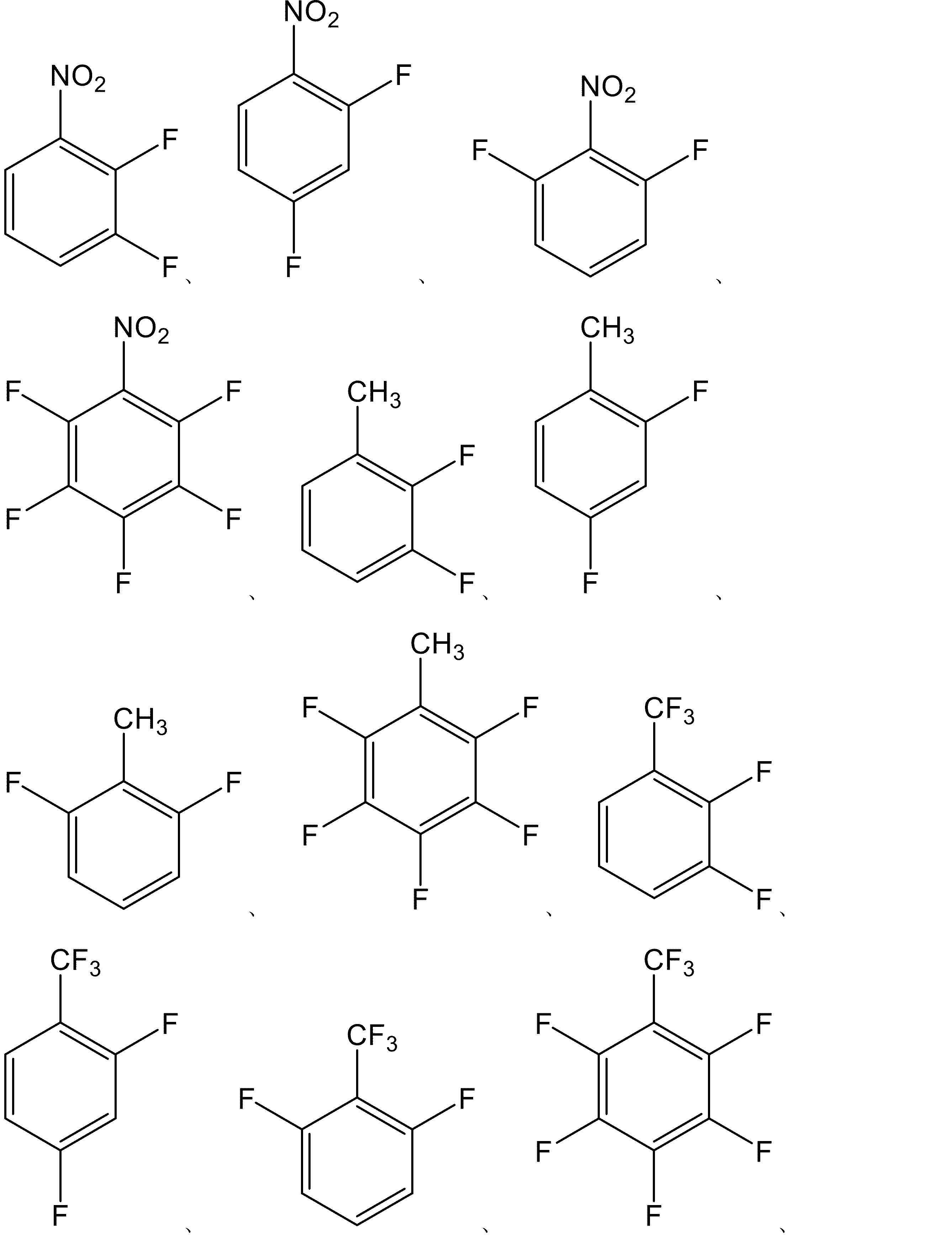
- the compound represented by general formula (1) which is the target compound produced in the present disclosure, is specifically
- Part 2 Method for producing fluorine-containing aromatic compound
- R 1 represents a hydrogen atom, a hydroxyl group, a fluorine atom, a cyano group, a nitro group, a hydrocarbon group or a perfluoroalkyl group.
- X 1 is the same or different and represents a halogen atom other than a fluorine atom.
- n represents an integer of 3-6.
- n1 represents an integer of 2-6. However, n ⁇ n1.
- R 1 , X 1 and n are the same as above.
- R 1 represents a hydrogen atom, a hydroxyl group, a fluorine atom, a cyano group, a nitro group, a hydrocarbon group or a perfluoroalkyl group.
- X 1 is the same or different and represents a halogen atom other than a fluorine atom.
- n represents an integer of 3-6.
- It is a compound represented by
- the hydrocarbon group and perfluoroalkyl group represented by R 1 and the halogen atom other than the fluorine atom represented by X 1 include the above "(1-1) starting compound (general formula (2) )” can be adopted for the hydrocarbon group and perfluoroalkyl group represented by R 1 and the halogen atom other than the fluorine atom represented by X 1 .
- Preferred types and specific examples are also the same.
- n which is the number of substitutions of X 1 , is the conversion rate of the reaction, the selectivity of the compound represented by the general formula (1A), the yield of the compound represented by the general formula (1A), etc. from the point of view, it is 3 to 6, and may be 4 to 6, 5 to 6, and the like.
- the phosphonium salt can adopt the description of "(1-3) phosphonium salt" above. Preferred types and specific examples are also the same.
- the metal fluoride can adopt the description of "(1-4) metal fluoride" above. Preferred types and specific examples are also the same.
- the solvent can adopt the description of "(2-2) Solvent” above. Preferred types and specific examples are also the same.
- reaction temperature can adopt the description of "(1-6) Reaction temperature” above.
- a preferable range is also the same.
- reaction time can adopt the description of "(1-7) reaction time” above.
- a preferable range is also the same.
- reaction pressure can adopt the description of "(1-8) Reaction pressure" above. Preferred types and specific examples are also the same.
- examples of reactions can adopt the description of "(1-9) Examples of reactions" above. Preferred types and specific examples are also the same.
- the solvent used in the production method in the second aspect of the present disclosure is not particularly limited, but in particular, the compound represented by the general formula (2A), phosphonium salt, metal fluoride, etc. are dissolved.
- a polar organic solvent is preferable from the viewpoint of excellent conversion of the reaction, selectivity of the compound represented by the general formula (1A), yield of the compound represented by the general formula (1A), and the like.
- solvents examples include amide compounds (N,N-dimethylformamide, N,N-diethylformamide, N,N-dimethylacetamide, N,N-diisopropylformamide, N-methyl-2-pyrrolidone, 1, 3-dimethyl-2-imidazolidinone, 1,3-dimethyl-3,4,5,6-tetrahydropyrimidinone, hexamethylphosphoric triamide, etc.), amine compounds (triethylamine, 1-methylpyrrolidine, etc.), pyridine compounds (pyridine, methylpyridine, etc.), quinoline compounds (quinoline, methylquinoline, etc.), and the like.
- amide compounds N,N-dimethylformamide, N,N-diethylformamide, N,N-dimethylacetamide, N,N-diisopropylformamide, N-methyl-2-pyrrolidone, 1, 3-dimethyl-2-imidazolidinone, 1,3-dimethyl-3,
- amide compounds, pyridine compounds and the like are preferable from the viewpoint of the conversion rate of the reaction, the selectivity of the compound represented by the general formula (1A), the yield of the compound represented by the general formula (1A), and the like.
- N,N-dimethylformamide, N,N-diethylformamide, N,N-diisopropylformamide, N-methyl-2 -pyrrolidone, pyridine and the like are more preferred
- N,N-dimethylformamide, N-methyl-2-pyrrolidone, pyridine and the like are more preferred,
- solvents known or commercially available products can be used. Moreover, these solvents can be used alone or in combination of two or more.
- the amount of solvent used is not particularly limited as long as it is the amount of solvent, and can be an excess amount. From the viewpoint of the yield of the compound represented by the general formula (2A), it is preferably 80 to 10000 parts by mass, more preferably 100 to 1000 parts by mass, and 150 to 800 parts by mass. is more preferred.
- Target compound (2-4)
- the target compound thus produced has the general formula (1A):
- R 1 represents a hydrogen atom, a hydroxyl group, a fluorine atom, a cyano group, a nitro group, a hydrocarbon group or a perfluoroalkyl group.
- X 1 is the same or different and represents a halogen atom other than a fluorine atom.
- n represents an integer of 3-6.
- n1 represents an integer of 2-6. However, n ⁇ n1.
- R 1 , X 1 and n1 are as described above. However, since the number of X 1 in general formula (1) is nn1, n ⁇ n1 is necessarily satisfied.
- Part 3 Method for producing fluorine-containing aromatic compound (Part 3)
- the production method according to the third aspect of the present disclosure comprises general formula (1):
- R 1 represents a hydrogen atom, a hydroxyl group, a fluorine atom, a cyano group, a nitro group, a hydrocarbon group or a perfluoroalkyl group.
- X 1 is the same or different and represents a halogen atom other than a fluorine atom.
- n represents an integer of 1-6.
- n1 represents an integer of 1-6. However, when n ⁇ n1 and n is an integer of 2-6, n1 represents an integer of 2-6.
- R 1 , X 1 and n are the same as above.
- the metal fluoride can adopt the description of "(1-4) metal fluoride" above. Preferred types and specific examples are also the same.
- the solvent can adopt the description of "(2-3) solvent” above. Preferred types and specific examples are also the same.
- reaction temperature can adopt the description of "(1-6) Reaction temperature” above.
- a preferable range is also the same.
- reaction time can adopt the description of "(1-7) reaction time” above.
- a preferable range is also the same.
- reaction pressure can adopt the description of "(1-8) Reaction pressure" above. Preferred types and specific examples are also the same.
- examples of reactions can adopt the description of "(1-9) Examples of reactions" above. Preferred types and specific examples are also the same.
- the compound represented by general formula (1) which is the target compound
- the phosphonium salt used in the third aspect of the present disclosure is a phosphonium salt having one or more alkyl groups with 3 or more carbon atoms.
- This phosphonium salt has, for example, general formula (3A):
- R 3a , R 4a , R 5a and R 6a are the same or different and represent a hydrocarbon group. However, at least one of R 3a , R 4a , R 5a and R 6a is an alkyl group having 3 or more carbon atoms. Y represents a counter anion. ] Phosphonium salts represented by
- R 3a , R 4a , R 5a and R 6a include those mentioned above. The same applies to the type and number of substituents. It should be noted that R 3a , R 4a , R 5a and R 6a are preferably sites where carbon atoms are bonded to the central phosphorus atom.
- R 3a , R 4a , R 5a and R 6a At least one of (1, 2, 3 or 4) is an alkyl group having 3 or more carbon atoms.
- R 3a , R 4a , R 5a and R 6a are alkyl groups is preferred.
- at least one (1, 2, 3 or 4) of R 3a , R 4a , R 5a and R 6a has 3 or more carbon atoms, preferably 4 to 20, more preferably 5 to 15 is an alkyl group of
- the selectivity of the compound represented by the general formula (1), the yield of the compound represented by the general formula (1), etc. are particularly improved, The production of impurities can be particularly reduced.
- phosphonium salts known or commercially available products can be used. Moreover, the above phosphonium salts can be used alone, or two or more of them can be used in combination.
- the amount of the phosphonium salt used is not particularly limited, but the conversion rate of the reaction, the selectivity of the compound represented by the general formula (1), the general formula (1) From the viewpoint of the yield of the compound represented by the general formula (2), it is preferably 0.01 to 10 mol, more preferably 0.1 to 5 mol, 1 to 2.5 Molar is more preferred. When using a plurality of phosphonium salts, it is preferable to adjust the total amount within the above range.
- Composition (Part 1) As described above, the compound represented by general formula (1) can be obtained. Difluorobenzotrifluoride and one of X 1 in general formula (2) in the form of a composition containing at least one halogenated fluorobenzotrifluoride selected from the group consisting of chlorofluorobenzotrifluoride, bromofluorobenzotrifluoride and iodofluorobenzotrifluoride as a partially fluorinated compound sometimes obtained.
- Difluorobenzotrifluoride as the compound represented by the general formula (1) is not particularly limited, but 2,3-difluorobenzotrifluoride, 2,4-difluorobenzotrifluoride, 2,6-difluorobenzotrifluoride etc. These difluorobenzotrifluorides can be used alone or in combination of two or more.
- Halogenated fluorobenzotrifluoride as a compound in which only part of X 1 in general formula (2) is fluorinated is not particularly limited, but 2-chloro-3-fluorobenzotrifluoride, 2-chloro-4 -fluorobenzotrifluoride, 2-chloro-6-fluorobenzotrifluoride, 3-chloro-2-fluorobenzotrifluoride, 4-chloro-2-fluorobenzotrifluoride, 6-chloro-2-fluorobenzotrifluoride, 2-bromo-3-fluorobenzotrifluoride, 2-bromo-4-fluorobenzotrifluoride, 2-bromo-6-fluorobenzotrifluoride, 3-bromo-2-fluorobenzotrifluoride, 4-bromo-2- fluorobenzotrifluoride, 6-bromo-2-fluorobenzotrifluoride, 2-iodo-3-fluorobenzotrifluoride, 2-iodo-4-fluorobenzotrifluoride, 2-io
- the content of difluorobenzotrifluoride is 60.0 to 99.9 mol %, 65.0 to 99.5 mol %, 70 .0 to 99.0 mol%, 75.0 to 98.5 mol%, 80.0 to 98.0 mol%, 85.0 to 97.5 mol%, 90.0 to 97.0 mol%, etc. It is also possible to
- the total amount of the composition of the present disclosure according to the first aspect is 100 mol%
- the halogenated fluorobenzotrifluoride is 0.1 to 40.0 mol%, 0.5 to 35.0 mol%, 1.0 to 30.0 mol%, 1.5 to 25.0 mol%, 2.0 to 20.0 mol%, 2.5 to 15.0 mol%, 3.0 to 10.0 mol%, etc. It is also possible to
- composition of the present disclosure according to such a first aspect can be effectively used for various applications such as organic synthesis solvents, agricultural chemical intermediates, and pharmaceutical intermediates.
- composition (Part 2) As described above, the compound represented by the general formula (1) can be obtained.
- Pentafluorobenzotrifluoride and X 1 in the general formula (2) Partially fluorinated compounds such as chlorotetrafluorobenzotrifluoride, bromotetrafluorobenzotrifluoride, iodotetrafluorobenzotrifluoride, dichlorotrifluorobenzotrifluoride, dibromotrifluorobenzotrifluoride, diiodotrifluorobenzo selected from the group consisting of trifluoride, trichlorodifluorobenzotrifluoride, tribromodifluorobenzotrifluoride, triiododifluorobenzotrifluoride, tetrachlorofluorobenzotrifluoride, tetrabromofluorobenzotrifluoride, and tetraiodofluorobenzotrifluoride It may also be obtained in the form of a composition comprising at
- Pentafluorobenzotrifluoride as the compound represented by general formula (1) is not particularly limited, but includes 2,3,4,5,6-pentafluorobenzotrifluoride. Pentafluorobenzotrifluoride can be used alone or in combination of two or more.
- Halogenated fluorobenzotrifluoride any isotope can be employed as the halogenated fluorobenzotrifluoride as the compound in which only a part of X 1 in the general formula (2) is fluorinated.
- Halogenated fluorobenzotrifluorides can be used alone or in combination of two or more.
- the content of pentafluorobenzotrifluoride is 60.0 to 99.9 mol%, 65.0 to 99.5 mol%, 70.0 to 99.0 mol%, 75.0 to 98.5 mol%, 80.0 to 98.0 mol%, 85.0 to 97.5 mol%, 90.0 to 97.0 mol%, etc. It is also possible to
- the total amount of the composition of the present disclosure according to the second aspect is 100 mol%
- the halogenated fluorobenzotrifluoride is 0.1 to 40.0 mol%, 0.5 to 35.0 mol%, 1.0 to 30.0 mol%, 1.5 to 25.0 mol%, 2.0 to 20.0 mol%, 2.5 to 15.0 mol%, 3.0 to 10.0 mol%, etc. It is also possible to
- composition of the present disclosure according to such a second aspect can be effectively used for various uses such as etching gas and cleaning gas.
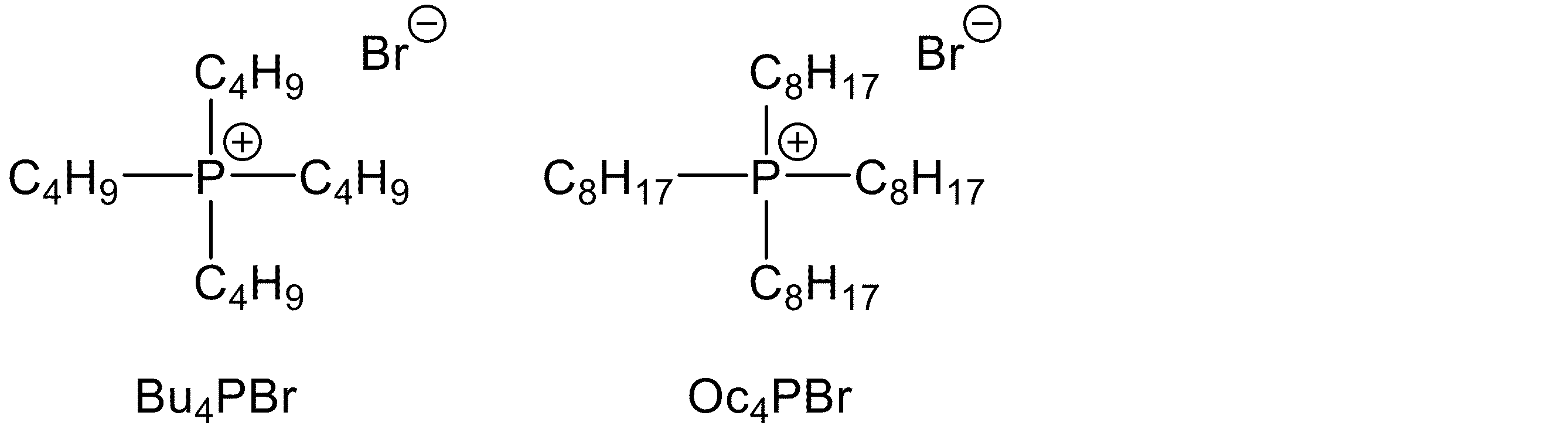
- the phosphonium salts used in Table 1 are as follows.
- the product 2,4-2F-BTF means 2,4-difluorobenzotrifluoride
- 2,4-Cl-F-BTF means 2-chloro-4-fluorobenzo It means trifluoride and/or 4-chloro-2-fluorobenzotrifluoride
- selectivity for 2,4-Cl-F-BTF means total selectivity for 2-chloro-4-fluorobenzotrifluoride and 4-chloro-2-fluorobenzotrifluoride.
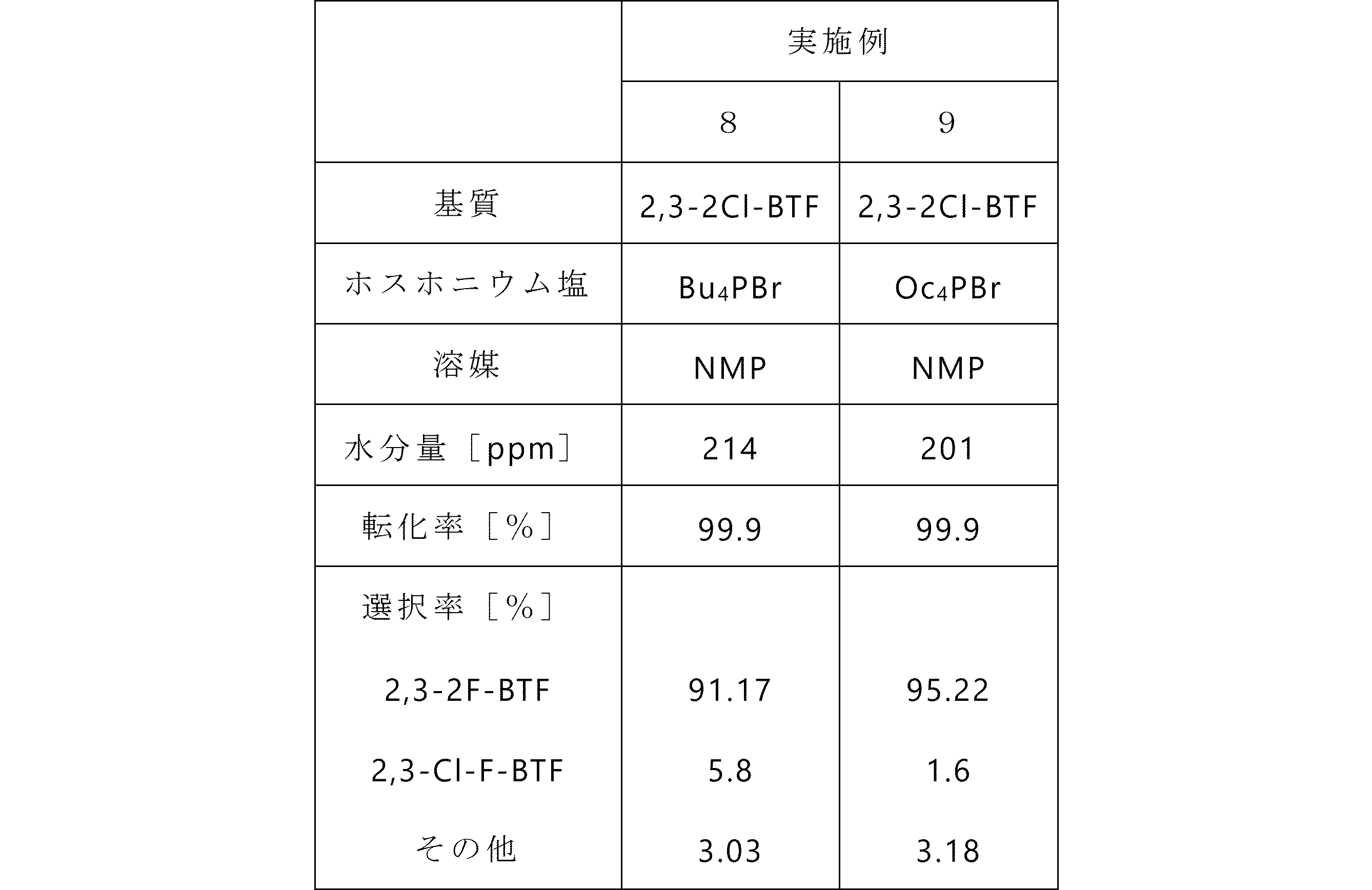
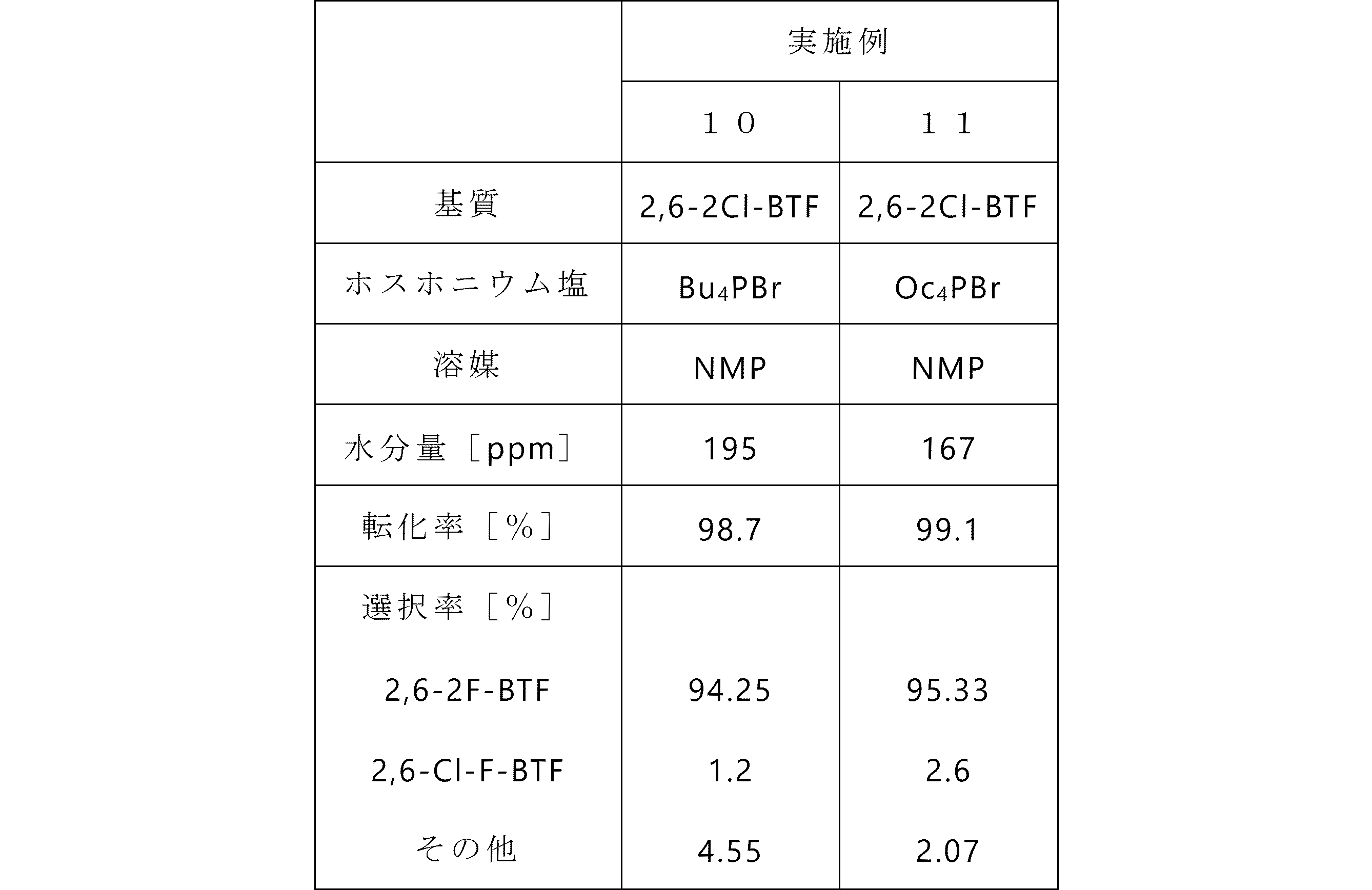
- Examples 8-13 instead of 2,4-dichlorobenzotrifluoride, the substrates shown in Tables 2-4 (0.005 mol) and phosphonium salts shown in Tables 2-4 (0.0014 mol) were used, except that Examples 1-7 were used. A similar reaction was performed.
- the substrate 2,3-2Cl-BTF means 2,3-dichlorobenzotrifluoride
- 2,6-2Cl-BTF means 2,6-dichlorobenzotrifluoride
- 5Cl-BTF means 2,3,4,5,6-pentachlorobenzotrifluoride.
- the product 2,3-2F-BTF means 2,3-difluorobenzotrifluoride
- 2,3-Cl-F-BTF means 2-chloro-3- means fluorobenzotrifluoride and/or 3-chloro-2-fluorobenzotrifluoride
- 2,6-2F-BTF means 2,6-difluorobenzotrifluoride
- 2,6-Cl-F- BTF means 2-chloro-6-fluorobenzotrifluoride
- 5F-BTF means 2,3,4,5,6-pentafluorobenzotrifluoride
- 4F,1Cl-BTF means chlorotetra means fluorobenzotrifluoride (including all isotopes)
- 3F,2Cl-BTF means dichlorotrifluorobenzotrifluoride (including all isotopes)
- the selectivity for 2,3-Cl-F-BTF means the total selectivity for 2-chloro-3-fluorobenzotrifluoride and 3-chloro-2-fluorobenzotrifluoride.
- 4F,1Cl-BTF refers to the total isotopic selectivity of chlorotetrafluorobenzotrifluoride
- the selectivity of 3F,2Cl-BTF is the total isotopic selectivity of dichlorotrifluorobenzotrifluoride.
- selectivity for 2F,3Cl-BTF means total selectivity for trichlorodifluorobenzotrifluoride
- selectivity for 1F,4Cl-BTF means total selectivity for tetrachlorofluorobenzotrifluoride. do.
Landscapes
- Chemical & Material Sciences (AREA)
- Organic Chemistry (AREA)
- Dispersion Chemistry (AREA)
- Engineering & Computer Science (AREA)
- Materials Engineering (AREA)
- Organic Low-Molecular-Weight Compounds And Preparation Thereof (AREA)
Abstract
Description
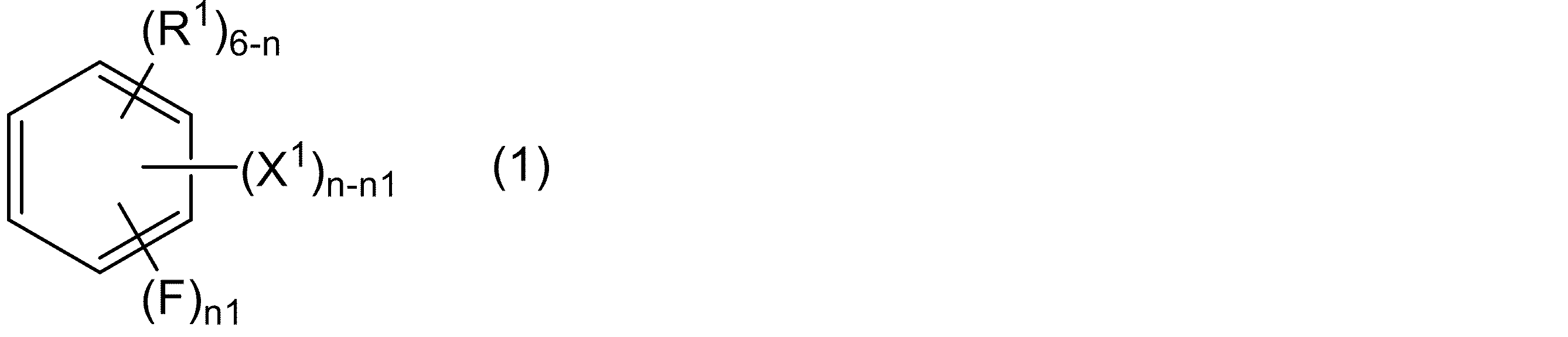
で表される化合物の製造方法であって、
窒素含有有機化合物を含む溶媒中で、
アルキル基を1個以上有するホスホニウム塩の存在下に、
一般式(2):
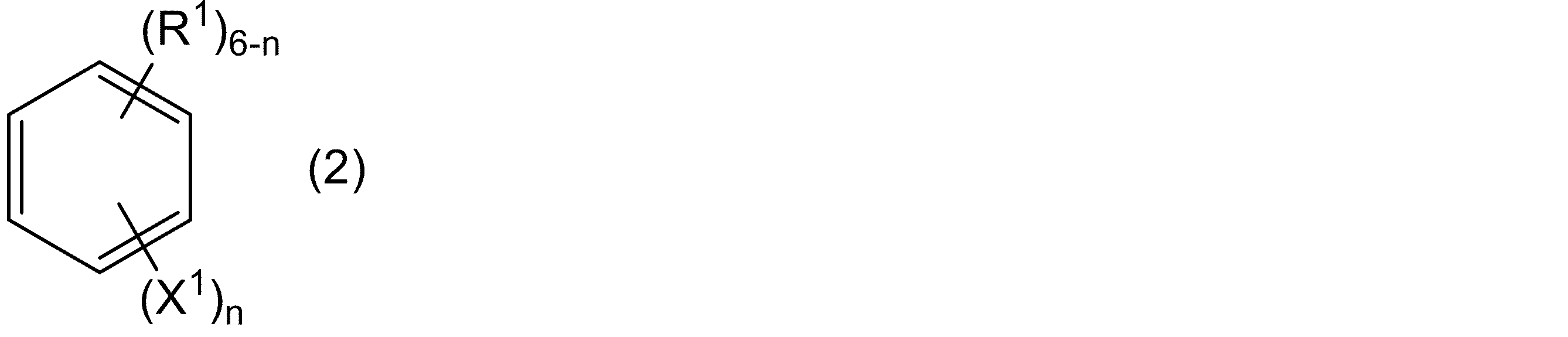
で表される化合物と、
金属フッ化物とを反応させ、nが2以上の整数である場合は2個以上のX1をフッ素化させて、上記一般式(1)で表される化合物を生成させる工程
を備える、製造方法。
本開示の第1の態様に係る製造方法は、
一般式(1):
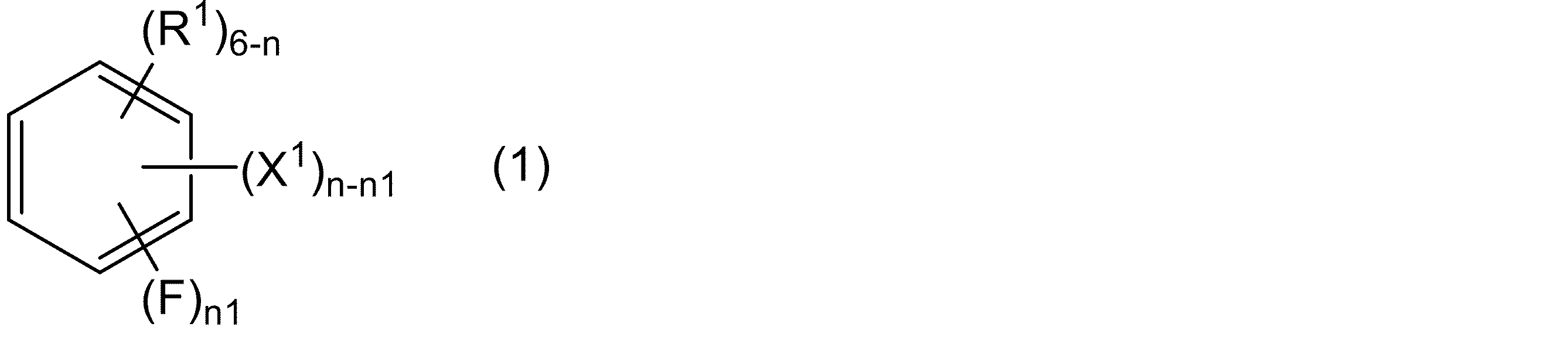
で表される化合物の製造方法であって、
窒素含有有機化合物を含む溶媒中で、
アルキル基を1個以上有するホスホニウム塩の存在下に、
一般式(2):

で表される化合物と、
金属フッ化物とを反応させ、nが2以上の整数である場合は2個以上のX1をフッ素化させて、上記一般式(1)で表される化合物を生成させる工程
を備える。
本開示の第1の態様の製造方法において、一般式(2)で表される化合物は、一般式(2):
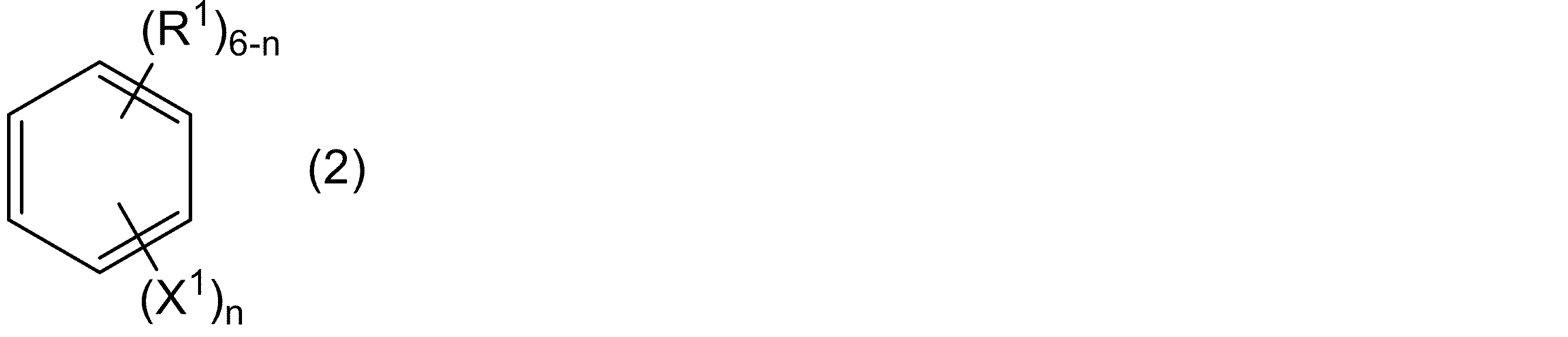
で表される化合物である。
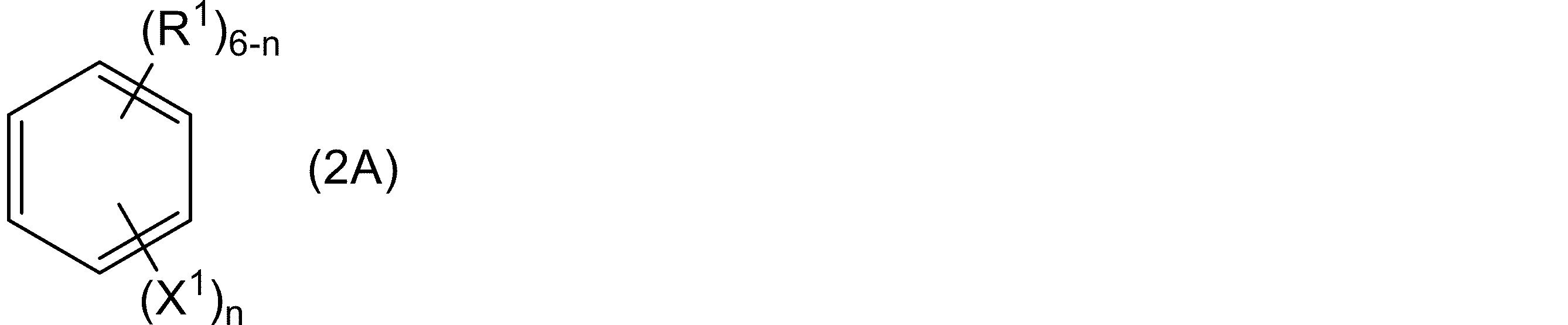
で表される化合物である。


本開示の反応では、上記した一般式(2)で表される化合物において、フッ素以外のハロゲン原子であるX1が、特定のホスホニウム塩の存在下において金属フッ化物によるフッ素化によって、フッ素原子に置換され、上記した一般式(1)で表される化合物が生成される。
本開示の第1の態様の製造方法で使用するホスホニウム塩は、アルキル基を1個以上有するホスホニウム塩である。
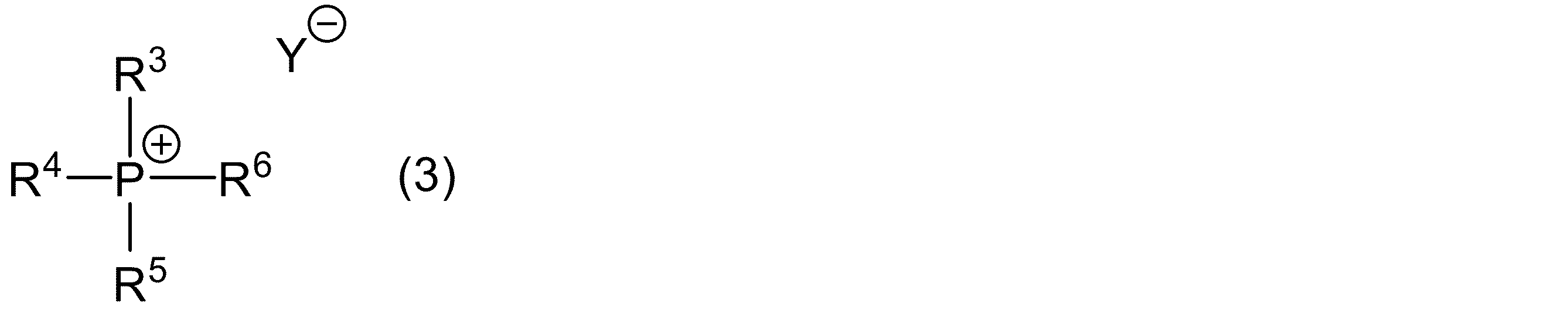
で表されるホスホニウム塩が挙げられる。


金属フッ化物としては一般式(2)で表される化合物におけるフッ素以外のハロゲン原子をフッ素化できるものであれば特に制限はないが、反応の転化率、一般式(1)で表される化合物の選択率、一般式(1)で表される化合物の収率等の観点から、アルカリ金属又はアルカリ土類金属のフッ化物が好ましく、アルカリ金属のフッ化物がより好ましい
このため、金属フッ化物を構成する金属としては、例えば、リチウム、ナトリウム、カリウム、セシウム等のアルカリ金属;マグネシウム、カルシウム、バリウム等のアルカリ土類金属等が挙げられる。これらの金属は、単独で用いることもでき、2種以上を組合せて用いることもできる。
本開示の第1の態様の製造方法における製造方法で使用する溶媒は、特に、一般式(2)で表される化合物、ホスホニウム塩、金属フッ化物等を溶解させ、また、反応の転化率、一般式(1)で表される化合物の選択率、一般式(1)で表される化合物の収率等に優れる観点から、窒素含有有機化合物を含む溶媒、好ましくは窒素含有極性溶媒を使用する。このような溶媒としては、例えば、アミド化合物(N,N-ジメチルホルムアミド、N,N-ジエチルホルムアミド、N,N-ジメチルアセトアミド、N,N-ジイソプロピルホルムアミド、N-メチル-2-ピロリドン、1,3-ジメチル-2-イミダゾリジノン、1,3-ジメチル-3,4,5,6-テトラヒドロピリミジノン、ヘキサメチルリン酸トリアミド等)、アミン化合物(トリエチルアミン、1-メチルピロリジン等)、ピリジン化合物(ピリジン、メチルピリジン等)、キノリン化合物(キノリン、メチルキノリン等)等が挙げられる。なかでも、反応の転化率、一般式(1)で表される化合物の選択率、一般式(1)で表される化合物の収率等の観点から、アミド化合物、ピリジン化合物等が好ましく、N,N-ジメチルホルムアミド、N,N-ジエチルホルムアミド、N,N-ジイソプロピルホルムアミド、N-メチル-2-ピロリドン、1,3-ジメチル-2-イミダゾリジノン、1,3-ジメチル-3,4,5,6-テトラヒドロピリミジノン、ヘキサメチルリン酸トリアミド、ピリジン、メチルピリジン等がより好ましく、N,N-ジメチルホルムアミド、N,N-ジエチルホルムアミド、N,N-ジイソプロピルホルムアミド、N-メチル-2-ピロリドン、ピリジン等がさらに好ましく、N,N-ジメチルホルムアミド、N-メチル-2-ピロリドン、ピリジン等が特に好ましい。
本開示の第1の態様の反応では、反応温度は、温和な条件とすることができ、反応の転化率、一般式(1)で表される化合物の収率、選択率等を向上させやすく、副生成物を低減しやすい観点から、通常0~400℃が好ましく、25~300℃がより好ましく、50~200℃がさらに好ましい。
本開示の第1の態様の反応の反応時間(最高到達温度における維持時間)は反応が十分に進行する程度とすることができ、反応の転化率、一般式(1)で表される化合物の選択率、一般式(1)で表される化合物の収率等の観点から、1分~48時間が好ましく、5分~24時間がより好ましい。
本開示の第1の態様の反応の反応圧力は、反応の転化率、一般式(1)で表される化合物の選択率、一般式(1)で表される化合物の収率等の観点から、-2~2MPaが好ましく、-1~1MPaがより好ましく、-0.5~0.5MPaがさらに好ましい。なお、本開示において、圧力については特に表記が無い場合はゲージ圧とする。
本開示の第1の態様における反応を行う際の雰囲気については、一般式(2)で表される化合物、ホスホニウム塩及び金属フッ化物の劣化を抑制する点から、不活性ガス雰囲気下が好ましい。
このようにして生成される目的化合物は、一般式(1):
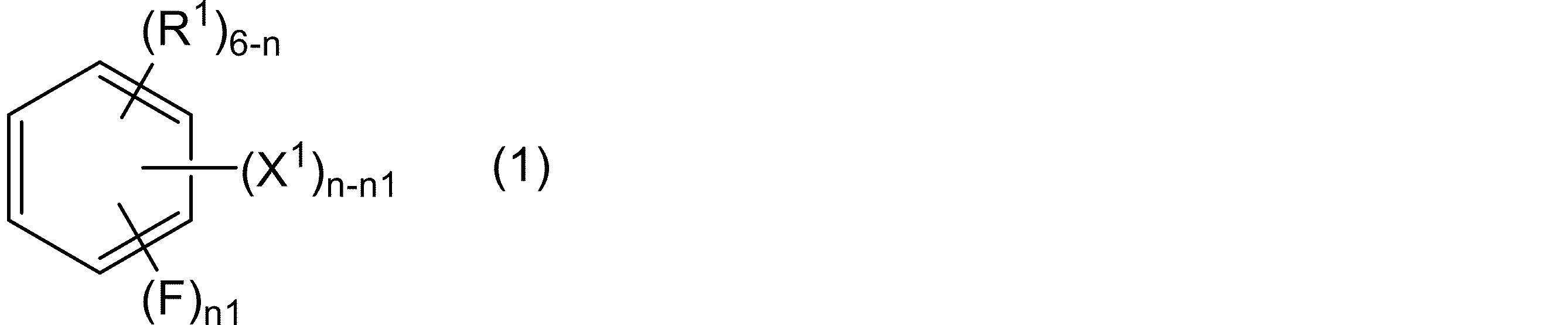
で表される化合物である。
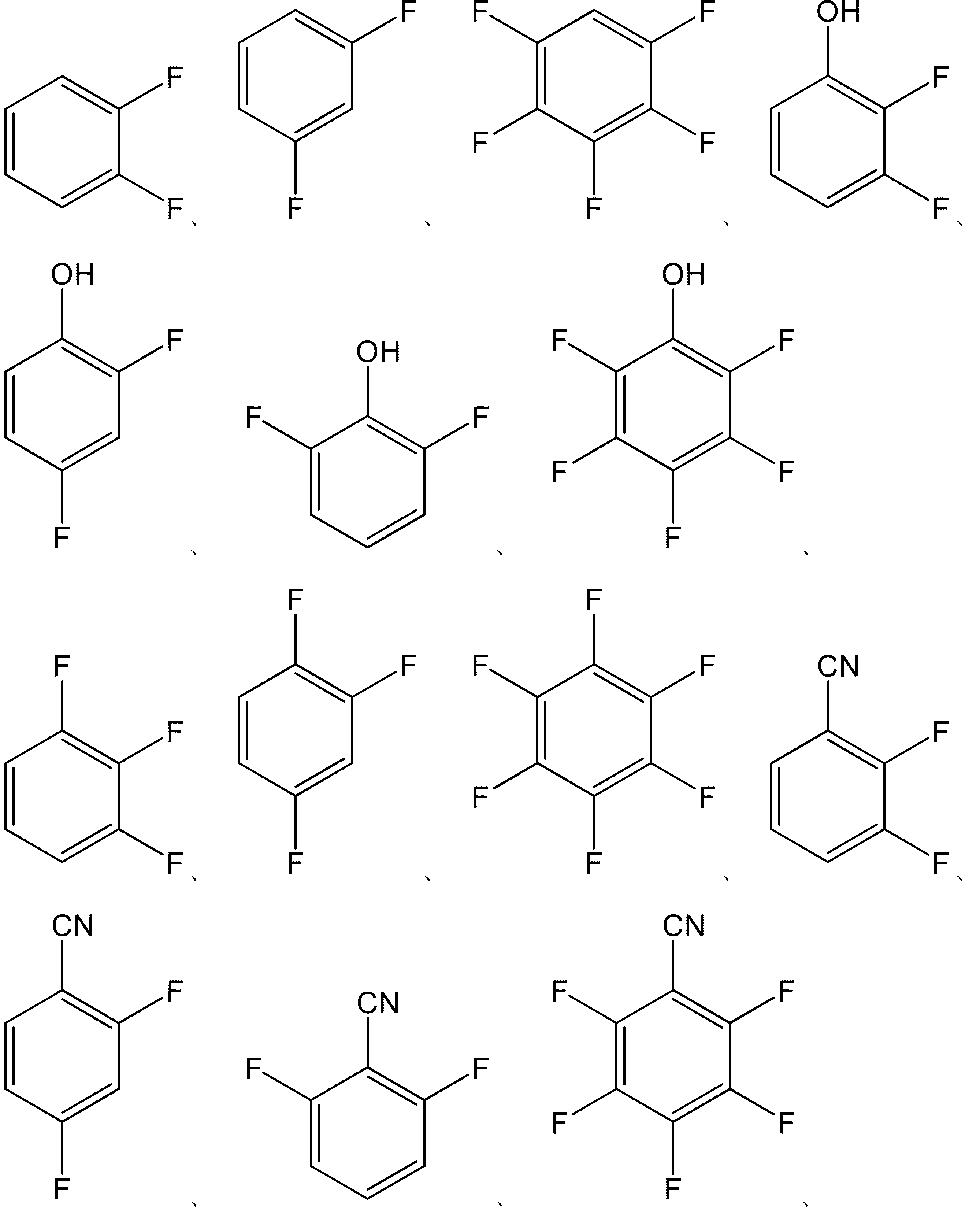

本開示の第2の態様に係る製造方法は、一般式(1A):

で表される化合物の製造方法であって、
アルキル基を1個以上有するホスホニウム塩の存在下に、
一般式(2A):

で表される化合物と、
金属フッ化物とを反応させ、2個以上のX1をフッ素化させて、上記一般式(1A)で表される化合物を生成させる工程
を備える。
本開示の第2の態様において、一般式(2A)で表される化合物は、一般式(2A):
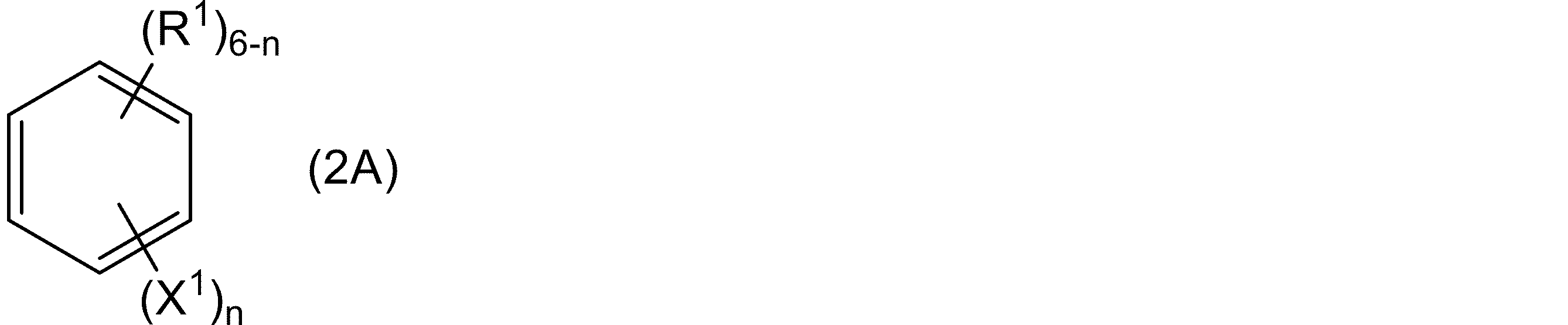
で表される化合物である。


本開示の第2の態様における反応は、上記「(1-2)反応」の説明を採用できる。
本開示の第2の態様における製造方法で使用する溶媒としては、特に制限されないが、特に、一般式(2A)で表される化合物、ホスホニウム塩、金属フッ化物等を溶解させ、また、反応の転化率、一般式(1A)で表される化合物の選択率、一般式(1A)で表される化合物の収率等に優れる観点から極性有機溶媒が好ましい。また、一般式(2A)で表される化合物、ホスホニウム塩、金属フッ化物等を溶解させ、また、反応の転化率、一般式(1A)で表される化合物の選択率、一般式(1A)で表される化合物の収率等に優れる観点から、窒素含有有機化合物を含む溶媒、好ましくは窒素含有極性溶媒がより好ましい。このような溶媒としては、例えば、アミド化合物(N,N-ジメチルホルムアミド、N,N-ジエチルホルムアミド、N,N-ジメチルアセトアミド、N,N-ジイソプロピルホルムアミド、N-メチル-2-ピロリドン、1,3-ジメチル-2-イミダゾリジノン、1,3-ジメチル-3,4,5,6-テトラヒドロピリミジノン、ヘキサメチルリン酸トリアミド等)、アミン化合物(トリエチルアミン、1-メチルピロリジン等)、ピリジン化合物(ピリジン、メチルピリジン等)、キノリン化合物(キノリン、メチルキノリン等)等が挙げられる。なかでも、反応の転化率、一般式(1A)で表される化合物の選択率、一般式(1A)で表される化合物の収率等の観点から、アミド化合物、ピリジン化合物等が好ましく、N,N-ジメチルホルムアミド、N,N-ジエチルホルムアミド、N,N-ジイソプロピルホルムアミド、N-メチル-2-ピロリドン、1,3-ジメチル-2-イミダゾリジノン、1,3-ジメチル-3,4,5,6-テトラヒドロピリミジノン、ヘキサメチルリン酸トリアミド、ピリジン、メチルピリジン等がより好ましく、N,N-ジメチルホルムアミド、N,N-ジエチルホルムアミド、N,N-ジイソプロピルホルムアミド、N-メチル-2-ピロリドン、ピリジン等がさらに好ましく、N,N-ジメチルホルムアミド、N-メチル-2-ピロリドン、ピリジン等が特に好ましい。
このようにして生成される目的化合物は、一般式(1A):

で表される化合物である。
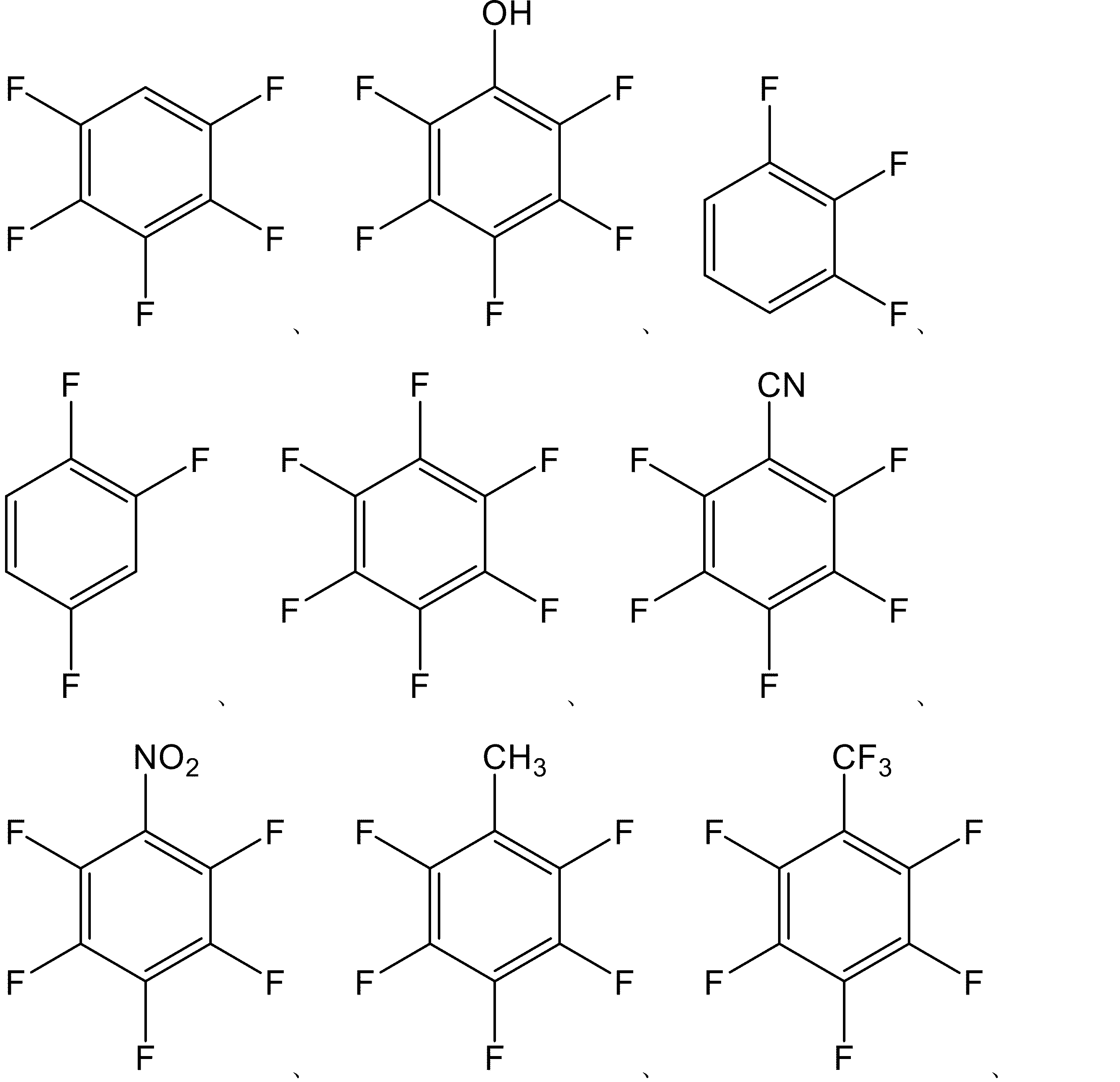

本開示の第3の態様に係る製造方法は、一般式(1):

で表される化合物の製造方法であって、
炭素数3以上のアルキル基を1個以上有するホスホニウム塩の存在下に、
一般式(2):
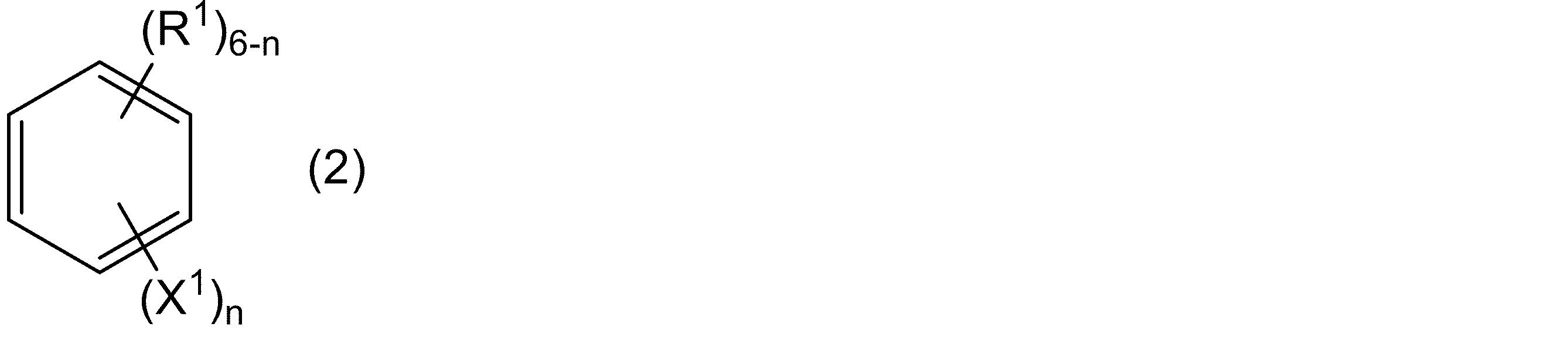
で表される化合物と、
金属フッ化物とを反応させ、nが2以上の整数である場合は2個以上のX1をフッ素化させて、上記一般式(1)で表される化合物を生成させる工程
を備える。
本開示の第3の態様において、出発化合物である一般式(2)で表される化合物は、上記「(1-1)出発化合物(一般式(2))」の説明を採用できる。好ましい種類及び具体例も同様である。
本開示の第3の態様で使用するホスホニウム塩は、炭素数3以上のアルキル基を1個以上有するホスホニウム塩である。

で表されるホスホニウム塩が挙げられる。

以上のようにして、一般式(1)で表される化合物を得ることができるが、一般式(1)で表される化合物としてジフルオロベンゾトリフルオリドと、一般式(2)におけるX1の一部のみがフッ素化された化合物としてクロロフルオロベンゾトリフルオリド、ブロモフルオロベンゾトリフルオリド及びヨードフルオロベンゾトリフルオリドよりなる群から選ばれる少なくとも1種のハロゲン化フルオロベンゾトリフルオリドとを含む組成物の形で得られることもある。
以上のようにして、一般式(1)で表される化合物を得ることができるが、一般式(1)で表される化合物としてペンタフルオロベンゾトリフルオリドと、一般式(2)におけるX1の一部のみがフッ素化された化合物としてクロロテトラフルオロベンゾトリフルオリド、ブロモテトラフルオロベンゾトリフルオリド、ヨードテトラフルオロベンゾトリフルオリド、ジクロロトリフルオロベンゾトリフルオリド、ジブロモトリフルオロベンゾトリフルオリド、ジヨードトリフルオロベンゾトリフルオリド、トリクロロジフルオロベンゾトリフルオリド、トリブロモジフルオロベンゾトリフルオリド、トリヨードジフルオロベンゾトリフルオリド、テトラクロロフルオロベンゾトリフルオリド、テトラブロモフルオロベンゾトリフルオリド、及びテトラヨードフルオロベンゾトリフルオリドよりなる群から選ばれる少なくとも1種のハロゲン化フルオロベンゾトリフルオリドとを含む組成物の形で得られることもある。
オートクレーブに、2,4-ジクロロベンゾトリフルオリド(1g,0.005mol)、フッ化カリウム(0.8g,0.014mol)、溶媒(N-メチル-2-ピロリドン(NMP)又はスルホラン)4.5mL、及び表1に示すホスホニウム塩(0.0014mol)を添加し、蓋をして200℃に加熱し24時間反応を進行させた。


2,4-ジクロロベンゾトリフルオリドの代わりに、表2~4に示す基質(0.005mol)及び表2~4に示すホスホニウム塩(0.0014mol)を用いた以外は、実施例1~7と同様に反応を行った。

Claims (10)
- 一般式(1):

で表される化合物の製造方法であって、
窒素含有有機化合物を含む溶媒中で、
アルキル基を1個以上有するホスホニウム塩の存在下に、
一般式(2):

で表される化合物と、
金属フッ化物とを反応させ、nが2以上の整数である場合は2個以上のX1をフッ素化させて、上記一般式(1)で表される化合物を生成させる工程
を備える、製造方法。 - 水分量が700質量ppm以下である系中で前記フッ素化を行う、請求項1に記載の製造方法。
- 前記nが3~6の整数である、請求項1又は2に記載の製造方法。
- 前記金属フッ化物が、アルカリ金属又はアルカリ土類金属のフッ化物である、請求項1~3のいずれか1項に記載の製造方法。
- ジフルオロベンゾトリフルオリドと、クロロフルオロベンゾトリフルオリド、ブロモフルオロベンゾトリフルオリド及びヨードフルオロベンゾトリフルオリドよりなる群から選ばれる少なくとも1種のハロゲン化フルオロベンゾトリフルオリドとを含有する、組成物。
- 前記組成物の総量を100モル%として、前記ジフルオロベンゾトリフルオリドの含有量が60.0~99.9モル%であり、前記ハロゲン化フルオロベンゾトリフルオリドの含有量が0.1~40.0モル%である、請求項5に記載の組成物。
- 有機合成用溶媒、農薬中間体又は医薬中間体として用いられる、請求項5又は6に記載の組成物。
- ペンタフルオロベンゾトリフルオリドと、クロロテトラフルオロベンゾトリフルオリド、ブロモテトラフルオロベンゾトリフルオリド、ヨードテトラフルオロベンゾトリフルオリド、ジクロロトリフルオロベンゾトリフルオリド、ジブロモトリフルオロベンゾトリフルオリド、ジヨードトリフルオロベンゾトリフルオリド、トリクロロジフルオロベンゾトリフルオリド、トリブロモジフルオロベンゾトリフルオリド、トリヨードジフルオロベンゾトリフルオリド、テトラクロロフルオロベンゾトリフルオリド、テトラブロモフルオロベンゾトリフルオリド、及びテトラヨードフルオロベンゾトリフルオリドよりなる群から選ばれる少なくとも1種のハロゲン化フルオロベンゾトリフルオリドとを含有する、組成物。
- 前記組成物の総量を100モル%として、前記ペンタフルオロベンゾトリフルオリドの含有量が60.0~99.9モル%であり、前記ハロゲン化フルオロベンゾトリフルオリドの含有量が0.1~40.0モル%である、請求項8に記載の組成物。
- エッチングガス又はクリーニングガスとして用いられる、項8又は9に記載の組成物。
Priority Applications (1)
| Application Number | Priority Date | Filing Date | Title |
|---|---|---|---|
| CN202280068988.8A CN118119583A (zh) | 2021-10-13 | 2022-10-11 | 含氟芳香族化合物的制造方法 |
Applications Claiming Priority (2)
| Application Number | Priority Date | Filing Date | Title |
|---|---|---|---|
| JP2021167982A JP7381912B2 (ja) | 2021-10-13 | 2021-10-13 | フッ素含有芳香族化合物の製造方法 |
| JP2021-167982 | 2021-10-13 |
Publications (1)
| Publication Number | Publication Date |
|---|---|
| WO2023063301A1 true WO2023063301A1 (ja) | 2023-04-20 |
Family
ID=85987950
Family Applications (1)
| Application Number | Title | Priority Date | Filing Date |
|---|---|---|---|
| PCT/JP2022/037838 Ceased WO2023063301A1 (ja) | 2021-10-13 | 2022-10-11 | フッ素含有芳香族化合物の製造方法 |
Country Status (4)
| Country | Link |
|---|---|
| JP (2) | JP7381912B2 (ja) |
| CN (1) | CN118119583A (ja) |
| TW (1) | TW202334067A (ja) |
| WO (1) | WO2023063301A1 (ja) |
Citations (6)
| Publication number | Priority date | Publication date | Assignee | Title |
|---|---|---|---|---|
| JPH11246450A (ja) * | 1997-09-16 | 1999-09-14 | Bayer Ag | 2,3,4,5−テトラフルオロベンゼン誘導体の製造方法 |
| JP2008044944A (ja) * | 2001-05-17 | 2008-02-28 | Rhodia Chim | 置換試薬としてのイオン性の組成物の使用、フッ素化試薬を構成する組成物およびそれを用いる方法 |
| CN104693080A (zh) * | 2013-12-04 | 2015-06-10 | 南京正荣医药化学有限公司 | 一种6-取代-2-三氟甲基苯磺酰氯的制备方法 |
| CN107488098A (zh) * | 2017-07-21 | 2017-12-19 | 淄博飞源化工有限公司 | 一种工业化制备2,3‑二氟三氟甲苯、3,4‑二氟苯腈的连续生产方法 |
| CN108069994A (zh) * | 2017-12-20 | 2018-05-25 | 江苏中旗科技股份有限公司 | 一类含硼化合物及其在催化氟化反应中的应用 |
| JP2021068747A (ja) * | 2019-10-18 | 2021-04-30 | キオクシア株式会社 | プラズマエッチング方法及びプラズマエッチング装置 |
-
2021
- 2021-10-13 JP JP2021167982A patent/JP7381912B2/ja active Active
-
2022
- 2022-10-11 WO PCT/JP2022/037838 patent/WO2023063301A1/ja not_active Ceased
- 2022-10-11 CN CN202280068988.8A patent/CN118119583A/zh active Pending
- 2022-10-12 TW TW111138647A patent/TW202334067A/zh unknown
-
2023
- 2023-10-31 JP JP2023186093A patent/JP7636688B2/ja active Active
Patent Citations (6)
| Publication number | Priority date | Publication date | Assignee | Title |
|---|---|---|---|---|
| JPH11246450A (ja) * | 1997-09-16 | 1999-09-14 | Bayer Ag | 2,3,4,5−テトラフルオロベンゼン誘導体の製造方法 |
| JP2008044944A (ja) * | 2001-05-17 | 2008-02-28 | Rhodia Chim | 置換試薬としてのイオン性の組成物の使用、フッ素化試薬を構成する組成物およびそれを用いる方法 |
| CN104693080A (zh) * | 2013-12-04 | 2015-06-10 | 南京正荣医药化学有限公司 | 一种6-取代-2-三氟甲基苯磺酰氯的制备方法 |
| CN107488098A (zh) * | 2017-07-21 | 2017-12-19 | 淄博飞源化工有限公司 | 一种工业化制备2,3‑二氟三氟甲苯、3,4‑二氟苯腈的连续生产方法 |
| CN108069994A (zh) * | 2017-12-20 | 2018-05-25 | 江苏中旗科技股份有限公司 | 一类含硼化合物及其在催化氟化反应中的应用 |
| JP2021068747A (ja) * | 2019-10-18 | 2021-04-30 | キオクシア株式会社 | プラズマエッチング方法及びプラズマエッチング装置 |
Non-Patent Citations (1)
| Title |
|---|
| PEWS, R.G. ; GALL, J.A. ; LITTLE, J.C.: "Aromatic fluorine chemistry. Part 1. 3,4-Difluorobenzoic acid and derivatives via 3,4-difluorobenzotrifluoride", JOURNAL OF FLUORINE CHEMISTRY, ELSEVIER, NL, vol. 50, no. 3, 1 December 1990 (1990-12-01), NL , pages 365 - 370, XP026619660, ISSN: 0022-1139, DOI: 10.1016/S0022-1139(00)85002-2 * |
Also Published As
| Publication number | Publication date |
|---|---|
| JP2024016116A (ja) | 2024-02-06 |
| JP7636688B2 (ja) | 2025-02-27 |
| JP7381912B2 (ja) | 2023-11-16 |
| TW202334067A (zh) | 2023-09-01 |
| CN118119583A (zh) | 2024-05-31 |
| JP2023058169A (ja) | 2023-04-25 |
Similar Documents
| Publication | Publication Date | Title |
|---|---|---|
| CN101796002B (zh) | 2,3,3,3-四氟丙烯的制造方法 | |
| CN1930105B (zh) | 由氨基芳族胺化合物制备氟代芳族化合物的方法 | |
| JPS5857412B2 (ja) | ジアリ−ルエ−テルの製造方法 | |
| JP7636688B2 (ja) | フッ素含有芳香族化合物の製造方法 | |
| CN110950778A (zh) | 制备芳族丙二腈的方法和催化剂体系 | |
| JPH0273049A (ja) | 3―ジアルキルアミノプロピオニトリル、ビス―(2―シアノエチル)―エーテル及び所望によりエチレンシアンヒドリンの共通製法 | |
| US5705674A (en) | Process for preparing ortho-nitrobenzonitriles | |
| WO2023190846A1 (ja) | フッ素含有芳香族化合物の製造方法 | |
| US4424396A (en) | Process for the preparation substituted anilino acids | |
| JPS5824430B2 (ja) | フルオルベンゾニトリル類の製造方法 | |
| US3106557A (en) | Process for the preparation of nu-phenylpiperazines | |
| JP2012193124A (ja) | 2,3−ジクロロピリジンの製造方法 | |
| JP2017002002A (ja) | 含フッ素有機化合物及びこれとグリニャール試薬によるビアリール化合物の製造方法 | |
| CN117500776A (zh) | 单氟烷烃的制造方法 | |
| JPS6144A (ja) | ビス(p−アミノクミル)ベンゼン類の製造方法 | |
| JP7698217B2 (ja) | フッ素含有芳香族化合物の製造方法 | |
| JP7223445B2 (ja) | 脱離基を有する有機化合物と有機ケイ素化合物とのカップリング体の製造方法 | |
| JPH07145110A (ja) | フルオルニトロベンゼンの製法 | |
| JP2010083809A (ja) | 3,3’−ジニトロベンジジン化合物又は3,3’−ジアミノベンジジン化合物の製造方法 | |
| KR101974850B1 (ko) | 아세트아미노펜의 신규한 제조방법 | |
| JPH07278034A (ja) | フルオロフェノール類の製造方法 | |
| JP2004161703A (ja) | 2−フルオロ−4−(トリフルオロメチル)ベンゾニトリルの製造方法 | |
| JPH0124781B2 (ja) | ||
| JP2025100292A (ja) | パーフルオロアルキレン基を有する芳香族化合物の製造方法 | |
| JP2020193181A (ja) | 芳香族ニトリル化合物の製造方法 |
Legal Events
| Date | Code | Title | Description |
|---|---|---|---|
| 121 | Ep: the epo has been informed by wipo that ep was designated in this application |
Ref document number: 22880996 Country of ref document: EP Kind code of ref document: A1 |
|
| WWE | Wipo information: entry into national phase |
Ref document number: 202280068988.8 Country of ref document: CN |
|
| WWE | Wipo information: entry into national phase |
Ref document number: 202447036933 Country of ref document: IN |
|
| NENP | Non-entry into the national phase |
Ref country code: DE |
|
| 32PN | Ep: public notification in the ep bulletin as address of the adressee cannot be established |
Free format text: NOTING OF LOSS OF RIGHTS PURSUANT TO RULE 112(1) EPC (EPO FORM 1205A DATED 18/07/2024) |
|
| 122 | Ep: pct application non-entry in european phase |
Ref document number: 22880996 Country of ref document: EP Kind code of ref document: A1 |