WO2023058331A1 - ヘキサフルオロ-1,3-ブタジエンの製造方法 - Google Patents
ヘキサフルオロ-1,3-ブタジエンの製造方法 Download PDFInfo
- Publication number
- WO2023058331A1 WO2023058331A1 PCT/JP2022/031101 JP2022031101W WO2023058331A1 WO 2023058331 A1 WO2023058331 A1 WO 2023058331A1 JP 2022031101 W JP2022031101 W JP 2022031101W WO 2023058331 A1 WO2023058331 A1 WO 2023058331A1
- Authority
- WO
- WIPO (PCT)
- Prior art keywords
- butadiene
- hexafluoro
- fraction
- tetrachlorohexafluorobutane
- reaction
- Prior art date
- Legal status (The legal status is an assumption and is not a legal conclusion. Google has not performed a legal analysis and makes no representation as to the accuracy of the status listed.)
- Ceased
Links
Images

Classifications
-
- C—CHEMISTRY; METALLURGY
- C07—ORGANIC CHEMISTRY
- C07C—ACYCLIC OR CARBOCYCLIC COMPOUNDS
- C07C17/00—Preparation of halogenated hydrocarbons
- C07C17/23—Preparation of halogenated hydrocarbons by dehalogenation
-
- C—CHEMISTRY; METALLURGY
- C07—ORGANIC CHEMISTRY
- C07C—ACYCLIC OR CARBOCYCLIC COMPOUNDS
- C07C17/00—Preparation of halogenated hydrocarbons
- C07C17/38—Separation; Purification; Stabilisation; Use of additives
- C07C17/42—Use of additives, e.g. for stabilisation
-
- C—CHEMISTRY; METALLURGY
- C07—ORGANIC CHEMISTRY
- C07C—ACYCLIC OR CARBOCYCLIC COMPOUNDS
- C07C21/00—Acyclic unsaturated compounds containing halogen atoms
- C07C21/02—Acyclic unsaturated compounds containing halogen atoms containing carbon-to-carbon double bonds
- C07C21/19—Halogenated dienes
- C07C21/20—Halogenated butadienes
Definitions
- the present invention relates to a method for producing hexafluoro-1,3-butadiene.
- Hexafluoro-1,3-butadiene is useful, for example, as an etching gas for microfabrication of semiconductors.
- Various methods are conventionally known for producing hexafluoro-1,3-butadiene.
- Patent Document 1 discloses a method of dechlorinating 1,2,3,4-tetrachlorohexafluorobutane in 2-propanol in the presence of zinc.
- Patent Document 2 discloses a method of dehalogenating 1,4-diiodoperfluorobutane in tetrahydrofuran in the presence of magnesium.
- An object of the present invention is to provide a production method capable of producing hexafluoro-1,3-butadiene in high yield.
- one aspect of the present invention is as follows [1] to [8].
- [1] In a reaction solution containing 1,2,3,4-tetrachlorohexafluorobutane, zinc, at least one of an antioxidant and a polymerization inhibitor, and an organic solvent, the above 1,2, A method for producing hexafluoro-1,3-butadiene, comprising a reaction step of performing a dechlorination reaction in which chlorine atoms are eliminated from 3,4-tetrachlorohexafluorobutane to produce hexafluoro-1,3-butadiene.
- the ratio of the total molar amount of the antioxidant and the polymerization inhibitor to the molar amount of the 1,2,3,4-tetrachlorohexafluorobutane is 0.01% or more and 10% or less
- [7] The method for producing hexafluoro-1,3-butadiene according to any one of [1] to [6], wherein the organic solvent is alcohol.
- [8] Production of hexafluoro-1,3-butadiene according to [7], wherein the alcohol is at least one of methanol, ethanol, 1-propanol, 2-propanol, 1-butanol, and 2-butanol Method.
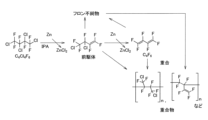
- FIG. 1 is a diagram illustrating reaction pathways in one embodiment of the method for producing hexafluoro-1,3-butadiene according to the present invention.
- 1 is a schematic diagram illustrating the configuration of a hexafluoro-1,3-butadiene production apparatus used in Examples and Comparative Examples.
- FIG. 1 is a diagram illustrating reaction pathways in one embodiment of the method for producing hexafluoro-1,3-butadiene according to the present invention.
- 1 is a schematic diagram illustrating the configuration of a hexafluoro-1,3-butadiene production apparatus used in Examples and Comparative Examples.
- FIG. 1 is a diagram illustrating reaction pathways in one embodiment of the method for producing hexafluoro-1,3-butadiene according to the present invention.
- 1 is a schematic diagram illustrating the configuration of a hexafluoro-1,3-butadiene production apparatus used in Examples and Comparative Examples.
- FIG. 1 is a diagram
- FIG. 1 shows a reaction route for producing hexafluoro-1,3-butadiene (C 4 F 6 ) from 1,2,3,4-tetrachlorohexafluorobutane (C 4 Cl 4 F 6 ) as a raw material. Description will be made with reference to this.
- the method for producing hexafluoro-1,3-butadiene according to the present embodiment includes 1,2,3,4-tetrachlorohexafluorobutane, zinc, at least one of an antioxidant and a polymerization inhibitor, A reaction for performing a dechlorination reaction in which chlorine atoms are eliminated from 1,2,3,4-tetrachlorohexafluorobutane to produce hexafluoro-1,3-butadiene in a reaction solution containing an organic solvent. Have a process.
- At least one of the antioxidant and the polymerization inhibitor suppresses chlorofluorocarbon impurities and by-products of the polymer, resulting in a high yield (for example, It is possible to produce hexafluoro-1,3-butadiene with a yield of 85% or more.
- the amount of hexafluoro-1,3-butadiene, which is the main product, and the amount of freon impurities, which are by-products, can be measured by analysis using gas chromatography.
- the production amount of the polymer is obtained by subtracting the quantitative production amount of hexafluoro-1,3-butadiene and the production amount of Freon impurities from the amount of 1,2,3,4-tetrachlorohexafluorobutane used. can be estimated by
- Fluorocarbon impurities include compounds represented by the chemical formula C4HxClyFz (where x, y, and z represent positive integers ).
- C 4 HF 5 pentafluoro-1,3-butadiene
- C 4 ClF 5 chloropentafluoro-1,3-butadiene
- tetrafluoro-1,3-butadiene C 4 H 2 F 4
- Dichlorohexafluorobutene C 4 Cl 2 F 6 (excluding the precursor 3,4-dichloro compound)
- Fluorocarbon impurities also include compounds represented by the chemical formula C 4 H a O b Cl c F d (a, b, c, and d represent positive integers). Examples include C 4 OF 6 , C 4 OCl 2 F 6 , and multimers thereof such as dimers and trimers. Further, as the polymer, a polymer of hexafluoro-1,3-butadiene, a polymer of 3,4-dichloro as a precursor, a polymer of hexafluoro-1,3-butadiene and 3,4- Copolymers of dichloroforms, polymers of chlorofluorocarbon impurities, and the like can be mentioned (see FIG. 1).
- hexafluoro-1,3-butadiene means "1,1,2,3,4,4-hexafluoro-1,3-butadiene" and "1,2, "3,4-tetrachlorohexafluorobutane” means "1,2,3,4-tetrachloro-1,1,2,3,4,4-hexafluorobutane”.
- antioxidant and polymerization inhibitor The type of antioxidant is a dechlorination reaction (hereinafter simply referred to as “dechlorination reaction ”) is not particularly limited as long as it is difficult to inhibit, has poor reactivity with zinc, and has solubility in organic solvents. agents, radical scavengers, and peroxide decomposers.
- Radical chain initiation inhibitors are classified into hydrazide antioxidants, amide antioxidants, and the like.
- Specific examples of radical chain initiation inhibitors include N-salicyloyl-N'-aldehyde hydrazine, N-salicyloyl-N'-acetylhydrazine, N,N'-diphenyloxamide, N,N'-di(2-hydroxy phenyl) oxamide.
- Radical scavengers are classified into phenol-based antioxidants, amine-based antioxidants, and the like.
- Specific examples of radical scavengers include 3,5-di-tert-butyl-4-hydroxytoluene (C 15 H 24 O), 2,2′-methylenebis(4-methyl-6-tert-butylphenol) (C 23 H 32 NO 2 ), 4-hydroxy-2,2,6,6-tetramethylpiperidine 1-oxyl free radical (C 9 H 18 NO 2 ), N,N'-di-2-naphthyl-1,4 - phenylenediamine ( C26H20N2 ) .
- the peroxide decomposers are classified into sulfur-based antioxidants, phosphorus-based antioxidants, and the like. Specific examples of peroxide decomposers include 10H-phenothiazine (C 12 H 9 NS), methyl-10H-phenothiazine (C 13 H 11 NS), chloro-10H-phenothiazine (C 12 H 8 ClNS), fluoro- 10H-phenothiazine (C 12 H 8 FNS), 2-mercaptobenzimidazole (C 7 H 6 N 2 S), terpene sulfide, triisodecyl phosphite (C 30 H 63 O 3 P), triphenyl phosphite (C 18 H 15 O 3 P).
- a compound having a cyclohexadiene ring structure can be used.
- compounds having a cyclohexadiene ring structure include ⁇ -terpinene (4-methyl-1-(1-methylethyl)-1,3-cyclohexadiene (C 10 H 16 )), ⁇ -terpinene (4- methyl-1-(1-methylethyl)-1,4-cyclohexadiene (C 10 H 16 )), ⁇ -terpinolene (1-methyl-4-isopropylidene-1-cyclohexene (C 10 H 16 )), mentioned.
- One of these antioxidants and polymerization inhibitors may be used alone, or two or more thereof may be used in combination.
- 10H-phenothiazine is most preferable because it is highly effective in improving the yield of hexafluoro-1,3-butadiene.
- the boiling point of 10H-phenothiazine is 371°C and that of hexafluoro-1,3-butadiene is 5.4°C. Therefore, if the reaction temperature of the dechlorination reaction is, for example, 50 to 100° C., the vapor generated by the vaporization of the reaction liquid mainly contains hexafluoro-1,3-butadiene and an organic solvent. Therefore, the amount of 10H-phenothiazine mixed in the steam is considered to be very small.
- the ratio of the total molar amount of antioxidants and polymerization inhibitors to the molar amount of 1,2,3,4-tetrachlorohexafluorobutane should be 0.01% or more and 10% or less. is preferred, more preferably 0.05% or more and 5% or less, and even more preferably 0.1% or more and 2% or less.
- the antioxidant and polymerization inhibitor are dissolved in at least one of an organic solvent and 1,2,3,4-tetrachlorohexafluorobutane, and the solution is supplied to a reaction vessel such as an autoclave for dechlorination reaction.
- a reaction vessel such as an autoclave for dechlorination reaction.
- the dechlorination reaction may be performed by supplying the reaction vessel as it is.
- the order of supplying the antioxidant, the polymerization inhibitor, zinc and the organic solvent to the reaction vessel is not particularly limited. They can be supplied in any order.
- an antioxidant and a polymerization inhibitor may be added to a reaction vessel charged with zinc and an organic solvent, or zinc and an organic solvent may be added to a reaction vessel charged with an antioxidant and a polymerization inhibitor. good too.
- the antioxidant, polymerization inhibitor, zinc, and organic solvent must be charged into the reactor at the same time.
- the form of zinc is not particularly limited as long as the dechlorination reaction proceeds, but from the viewpoint of reactivity and handling, powder form is preferred.
- the average particle diameter of powdered zinc is preferably 0.04 mm or more and 1.0 mm or less, more preferably 0.04 mm or more and 0.50 mm or less, and still more preferably 0.04 mm or more and 0.10 mm or less.
- the amount of zinc used is not particularly limited as long as the dechlorination reaction proceeds.
- 2,3,4-tetrachlorohexafluorobutane is preferably from 0.1 to 10, more preferably from 1.0 to 5.0, and from 2.0 to 3.0 is more preferable.
- Organic solvent is not particularly limited as long as it does not inhibit the dechlorination reaction.
- the organic solvent is preferably one that easily dissolves the antioxidant, has poor reactivity with zinc, is rich in dispersibility of zinc, and has a non-zero solubility of zinc chloride (ZnCl 2 ), which is a by-product. be.
- Organic solvents that can be suitably used include, for example, alcohols, cyclic ethers, acetone (C 2 H 6 CO), acetonitrile (CH 3 CN), aromatic hydrocarbons, amide solvents, organic acids, N-methyl-2- Pyrrolidone (C 5 H 9 NO) or a mixed solvent thereof can be mentioned.
- alcohols are preferable because the dechlorination reaction proceeds favorably.
- alcohols include methanol (CH 3 OH), ethanol (C 2 H 5 OH), 1-propanol (C 3 H 7 OH), 2-propanol (C 3 H 7 OH), 1-butanol (C 4 H 9 OH), 2-butanol (C 4 H 9 OH).
- 2-propanol is most preferable from the point of handleability.
- Cyclic ethers include, for example, tetrahydrofuran (C 4 H 8 O) and 1,4-dioxane (C 4 H 8 O 2 ).
- aromatic hydrocarbons include benzene (C 6 H 6 ) and toluene (C 7 H 8 ).
- Amide solvents include, for example, N,N-dimethylformamide (C 3 H 7 NO).
- Organic acids include, for example, acetic acid (CH 3 COOH). An organic solvent may be used individually by 1 type, and may use 2 or more types together.
- the amount of the organic solvent used is not particularly limited as long as the dechlorination reaction proceeds, but the ratio of the molar amount of the organic solvent to the molar amount of 1,2,3,4-tetrachlorohexafluorobutane (organic Solvent/1,2,3,4-tetrachlorohexafluorobutane) is preferably 0.1 to 10, more preferably 1.0 to 9.0, 3.0 to 8 It is more preferably 0.0 or less.
- reaction temperature of the dechlorination reaction is not particularly limited as long as the dechlorination reaction proceeds, but is preferably 20° C. or higher and 150° C. or lower, more preferably 40° C. or higher and 130° C. or lower. More preferably, the temperature is 70°C or higher and 100°C or lower.
- the reaction pressure of the dechlorination reaction is not particularly limited as long as the dechlorination reaction proceeds, but is preferably 0.01 MPa or more and 1 MPa or less in absolute pressure, and 0.05 MPa or more and 0.5 MPa in absolute pressure. It is more preferably 0.08 MPa or more and 0.2 MPa or less in terms of absolute pressure.
- Example 1 The reaction was carried out using the apparatus for producing hexafluoro-1,3-butadiene shown in FIG. 471 g (7.84 mol) of 2-propanol as an organic solvent and 0.39 g (0.39 g of 0.39 g) of 10H-phenothiazine (denoted as "PTZ" in Table 1) as an antioxidant were added to an autoclave 1 made of SUS316 having an inner volume of 1 L. 0020 mol), and 10H-phenothiazine was dissolved in 2-propanol.
- PTZ 10H-phenothiazine
- This autoclave 1 is equipped with a jacket (not shown) having a heating structure and a stirrer (not shown) in the upper part, and the heating method is a jacket heating method.
- first trap 4A a trap cooled to -78°C, cooled and liquefied, and 263.2 g of the first fraction was collected.
- This first fraction was analyzed by gas chromatography and found to be crude hexafluoro-1,3-butadiene with a hexafluoro-1,3-butadiene content of 95.3% by mass.
- nitrogen gas (N 2 ) was passed through the autoclave 1 at a flow rate of 100 mL/min, and remained in the autoclave 1.
- the product was vaporized.
- the vapor was sent to a trap (second trap 4B) cooled to ⁇ 78° C., cooled and liquefied, and 8.0 g of the second fraction was collected.
- This second fraction was analyzed by gas chromatography and found to be crude hexafluoro-1,3-butadiene with a hexafluoro-1,3-butadiene content of 84.1% by mass.
- yield (%) of C 4 F 6 ⁇ [mass of first fraction] ⁇ [content of hexafluoro-1,3-butadiene in first fraction]/[molecular weight of C 4 F 6 (162 .03)]+[mass of the second fraction] ⁇ [content of hexafluoro-1,3-butadiene in the second fraction]/[molecular weight of C 4 F 6 (162.03)] ⁇ /[ Number of moles of charged 1,2,3,4-tetrachlorohexafluorobutane] ⁇ 100
- the molar ratio (yield) of by-produced C 4 Cl 2 F 6 (excluding the precursor) to the charged 1,2,3,4-tetrachlorohexafluorobutane was 1.8%.
- the number of moles of by-produced flon impurities other than C 4 Cl 2 F 6 (described as “others” in Table 1) with respect to the number of moles of 1,2,3,4-tetrachlorohexafluorobutane charged The ratio (yield) was 6.7%, and the ratio (yield) of the number of moles of the by-produced polymer to the number of moles of 1,2,3,4-tetrachlorohexafluorobutane charged was 6.6%. there were.
- the ratio of the number of moles of C 4 F 6 remaining in the residue to the number of moles of 1,2,3,4-tetrachlorohexafluorobutane charged was 1.9% (C 4 F 6 in the residue yield was 1.9%).
- the conversion rate of the charged 1,2,3,4 -tetrachlorohexafluorobutane was 100% . Anything other than an impurity was assumed to be a polymer.
- the number of moles of the by-produced polymer is not the number of moles converted from the molecular weight of the polymer, but the number of moles of the charged 1,2,3,4-tetrachlorohexafluorobutane. from which the total number of moles of C 4 F 6 , C 4 Cl 2 F 6 (excluding precursors), and flon impurities was subtracted.
- Table 1 The above results are summarized in Table 1.
- the measurement conditions of gas chromatography for the first fraction and the second fraction are as follows.
- Measuring device Gas chromatograph GC-2014 manufactured by Shimadzu Corporation
- Column Gas chromatograph column CP-PoraPLOT Q-HT manufactured by Agilent Technologies, Inc. Column heating conditions: 90 ° C. (0 min) ⁇ (5 ° C./min) ⁇ 230 ° C.
- the measurement conditions for the gas chromatography of the residue are as follows. Measuring device: Gas chromatograph GC-2014 manufactured by Shimadzu Corporation Column: Column DB-1 for gas chromatograph manufactured by Agilent Technologies, Inc. Column heating conditions: 40 ° C. (15 min) ⁇ (10 ° C./min) ⁇ 230 ° C.
- Example 2 A dechlorination reaction was carried out in the same manner as in Example 1, except that the amount of 10H-phenothiazine charged was 3.9 g (0.020 mol). The ratio of the amount (molar amount) of 10H-phenothiazine used to the amount (molar amount) of 1,2,3,4-tetrachlorohexafluorobutane used was 1.0%. As a result, 283.0 g of the first fraction, 7.8 g of the second fraction and a residue were obtained.
- Example 3 Except that 4.4 g (0.020 mol) of 3,5-di-tert-butyl-4-hydroxytoluene (denoted as "BHT" in Table 1) was used instead of 10H-phenothiazine as an antioxidant. carried out a dechlorination reaction in the same manner as in Example 1. The ratio of the amount (molar amount) of 3,5-di-tert-butyl-4-hydroxytoluene used to the amount (molar amount) of 1,2,3,4-tetrachlorohexafluorobutane used was 1.0%. is. As a result, 223.9 g of the first fraction, 32.0 g of the second fraction and a residue were obtained.
- BHT 3,5-di-tert-butyl-4-hydroxytoluene
- Example 4 A dechlorination reaction was carried out in the same manner as in Example 1, except that 2.7 g (0.020 mol) of ⁇ -terpinene, which is a polymerization inhibitor, was used instead of the antioxidant. The ratio of the amount (molar amount) of ⁇ -terpinene used to the amount (molar amount) of 1,2,3,4-tetrachlorohexafluorobutane used was 1.0%. As a result, 208.3 g of the first fraction, 46.8 g of the second fraction and a residue were obtained.
- Example 5 3.4 g (0 The dechlorination reaction was carried out in the same manner as in Example 1, except that 0.020 mol) was used. Ratio of the usage amount (molar amount) of 4-hydroxy-2,2,6,6-tetramethylpiperidine 1-oxyl free radical to the usage amount (molar amount) of 1,2,3,4-tetrachlorohexafluorobutane is 1.0%. As a result, 215.0 g of the first fraction, 40.5 g of the second fraction and a residue were obtained.
- Example 1 A dechlorination reaction was carried out in the same manner as in Example 1, except that no antioxidant or polymerization inhibitor was used. As a result, 207.0 g of the first fraction, 42.7 g of the second fraction and a residue were obtained. Analysis of the first fraction, the second fraction, and the residue by gas chromatography revealed that the content of hexafluoro-1,3-butadiene in the first fraction was 94.6% by mass, and the second fraction The content of hexafluoro-1,3-butadiene was 87.2% by mass. The total yield of hexafluoro-1,3-butadiene from the first fraction and the second fraction was 71.7%. Table 1 summarizes the results of analysis performed in the same manner as in Example 1.
Landscapes
- Chemical & Material Sciences (AREA)
- Organic Chemistry (AREA)
- Organic Low-Molecular-Weight Compounds And Preparation Thereof (AREA)
- Addition Polymer Or Copolymer, Post-Treatments, Or Chemical Modifications (AREA)
- Low-Molecular Organic Synthesis Reactions Using Catalysts (AREA)
Priority Applications (5)
| Application Number | Priority Date | Filing Date | Title |
|---|---|---|---|
| US18/697,946 US20250011261A1 (en) | 2021-10-04 | 2022-08-17 | Method for producing hexafluoro-1,3-butadiene |
| KR1020247010633A KR20240073882A (ko) | 2021-10-04 | 2022-08-17 | 헥사플루오로-1,3-부타디엔의 제조 방법 |
| CN202280066923.XA CN118055914A (zh) | 2021-10-04 | 2022-08-17 | 六氟-1,3-丁二烯的制造方法 |
| JP2023552721A JPWO2023058331A1 (https=) | 2021-10-04 | 2022-08-17 | |
| EP22878202.5A EP4414349A4 (en) | 2021-10-04 | 2022-08-17 | PROCESS FOR THE PRODUCTION OF HEXAFLUORO-1,3-BUTADIENE |
Applications Claiming Priority (2)
| Application Number | Priority Date | Filing Date | Title |
|---|---|---|---|
| JP2021163491 | 2021-10-04 | ||
| JP2021-163491 | 2021-10-04 |
Publications (1)
| Publication Number | Publication Date |
|---|---|
| WO2023058331A1 true WO2023058331A1 (ja) | 2023-04-13 |
Family
ID=85803345
Family Applications (1)
| Application Number | Title | Priority Date | Filing Date |
|---|---|---|---|
| PCT/JP2022/031101 Ceased WO2023058331A1 (ja) | 2021-10-04 | 2022-08-17 | ヘキサフルオロ-1,3-ブタジエンの製造方法 |
Country Status (7)
| Country | Link |
|---|---|
| US (1) | US20250011261A1 (https=) |
| EP (1) | EP4414349A4 (https=) |
| JP (1) | JPWO2023058331A1 (https=) |
| KR (1) | KR20240073882A (https=) |
| CN (1) | CN118055914A (https=) |
| TW (1) | TWI823542B (https=) |
| WO (1) | WO2023058331A1 (https=) |
Citations (4)
| Publication number | Priority date | Publication date | Assignee | Title |
|---|---|---|---|---|
| JP2007063237A (ja) * | 2005-09-02 | 2007-03-15 | Hakuto Co Ltd | 汚れ防止方法 |
| WO2007125972A1 (ja) * | 2006-04-28 | 2007-11-08 | Showa Denko K.K. | ヘキサフルオロ-1,3-ブタジエンの製造方法 |
| JP2008308480A (ja) * | 2007-05-15 | 2008-12-25 | Daikin Ind Ltd | テトラフルオロエチレンの重合禁止剤 |
| JP2019127436A (ja) * | 2018-01-19 | 2019-08-01 | 株式会社片山化学工業研究所 | ビニル系モノマーの重合抑制方法 |
Family Cites Families (10)
| Publication number | Priority date | Publication date | Assignee | Title |
|---|---|---|---|---|
| BE728755R (fr) * | 1968-02-28 | 1969-08-01 | Du Pont | Procédé de préparation de composés organiques non-saturés |
| JPS505681B1 (https=) | 1970-07-28 | 1975-03-06 | ||
| DE2545341C2 (de) * | 1975-10-09 | 1983-02-10 | Bayer Ag, 5090 Leverkusen | Verfahren zur Herstellung von 2,3- Dichlorbutadien-(1,3) |
| JPH05163226A (ja) * | 1991-12-13 | 1993-06-29 | Nippon Shokubai Co Ltd | 4−シアノシクロヘキセンの製造方法 |
| US8030531B2 (en) * | 2007-12-19 | 2011-10-04 | Dupont Performance Elastomers Llc | Process for production of 2,3-dichlorobutadiene-1,3 |
| JP5239998B2 (ja) * | 2008-03-31 | 2013-07-17 | 三菱化学株式会社 | 易重合性化合物の製造方法及び重合防止方法 |
| JP7085537B2 (ja) * | 2017-05-22 | 2022-06-16 | 昭和電工株式会社 | ヘキサフルオロ-1,3-ブタジエンの製造方法 |
| PT3775091T (pt) * | 2018-04-30 | 2023-05-12 | Chemours Co Fc Llc | Composições de fluoro-olefinas estabilizadas e métodos para a sua produção, armazenamento e utilização |
| EP3812357B1 (en) * | 2018-06-22 | 2022-07-20 | Showa Denko K.K. | Method for producing hexafluoro-1,3-butadiene |
| JP7168959B2 (ja) * | 2019-01-24 | 2022-11-10 | 国立大学法人京都工芸繊維大学 | α,ω-パーフルオロアルカジエンの製造方法および金属錯体 |
-
2022
- 2022-08-17 KR KR1020247010633A patent/KR20240073882A/ko active Pending
- 2022-08-17 EP EP22878202.5A patent/EP4414349A4/en active Pending
- 2022-08-17 US US18/697,946 patent/US20250011261A1/en active Pending
- 2022-08-17 JP JP2023552721A patent/JPWO2023058331A1/ja active Pending
- 2022-08-17 CN CN202280066923.XA patent/CN118055914A/zh active Pending
- 2022-08-17 WO PCT/JP2022/031101 patent/WO2023058331A1/ja not_active Ceased
- 2022-08-30 TW TW111132701A patent/TWI823542B/zh active
Patent Citations (4)
| Publication number | Priority date | Publication date | Assignee | Title |
|---|---|---|---|---|
| JP2007063237A (ja) * | 2005-09-02 | 2007-03-15 | Hakuto Co Ltd | 汚れ防止方法 |
| WO2007125972A1 (ja) * | 2006-04-28 | 2007-11-08 | Showa Denko K.K. | ヘキサフルオロ-1,3-ブタジエンの製造方法 |
| JP2008308480A (ja) * | 2007-05-15 | 2008-12-25 | Daikin Ind Ltd | テトラフルオロエチレンの重合禁止剤 |
| JP2019127436A (ja) * | 2018-01-19 | 2019-08-01 | 株式会社片山化学工業研究所 | ビニル系モノマーの重合抑制方法 |
Non-Patent Citations (1)
| Title |
|---|
| See also references of EP4414349A4 * |
Also Published As
| Publication number | Publication date |
|---|---|
| KR20240073882A (ko) | 2024-05-27 |
| US20250011261A1 (en) | 2025-01-09 |
| TWI823542B (zh) | 2023-11-21 |
| CN118055914A (zh) | 2024-05-17 |
| JPWO2023058331A1 (https=) | 2023-04-13 |
| EP4414349A1 (en) | 2024-08-14 |
| TW202317504A (zh) | 2023-05-01 |
| EP4414349A4 (en) | 2025-11-12 |
Similar Documents
| Publication | Publication Date | Title |
|---|---|---|
| KR101756752B1 (ko) | 탄소수 3의 염소화탄화수소의 제조 방법 | |
| US8415516B2 (en) | Production process and purification process for 1,2,3,4-tetrachlorohexafluorobutane | |
| KR100241802B1 (ko) | 1,1,1-트리클로로트리플루오로에탄의 제조방법 | |
| KR20090009272A (ko) | 헥사플루오로-1,3-부타디엔의 제조 방법 | |
| WO2019082872A1 (ja) | ヘキサフルオロブタジエンの製造方法 | |
| US5705779A (en) | Preparation of 1,1,1,3,3-pentachloropropane by photochlorination of 1,1,1,3-tetrachloropropane | |
| JP6470628B2 (ja) | 1,3,7−オクタトリエンの製造方法 | |
| JP5430567B2 (ja) | 1,2,3,4−テトラクロロヘキサフルオロブタンの製造方法 | |
| JP7011197B2 (ja) | ヘキサフルオロブタジエンの製造方法 | |
| WO2023058331A1 (ja) | ヘキサフルオロ-1,3-ブタジエンの製造方法 | |
| WO2006123563A1 (ja) | 含フッ素アルキルエーテルの処理方法 | |
| JP4344915B2 (ja) | パーフルオロアルキン化合物の製造方法 | |
| EP3812357B1 (en) | Method for producing hexafluoro-1,3-butadiene | |
| JP2013095669A (ja) | 含フッ素化アルカンの製造方法 | |
| JP2012171884A (ja) | 含水素フルオロジエン化合物の製造方法 | |
| JP5610917B2 (ja) | クロロプロパンの製造方法 | |
| JP6173908B2 (ja) | クロロ高次アルケンの製造方法 | |
| JP2007091604A (ja) | クロロエチレンカーボネートの製造方法 | |
| JP2013112611A (ja) | モノフルオロメタンの製造方法 | |
| JP2013112610A (ja) | モノフルオロメタンの製造方法 | |
| JP2012254950A (ja) | ポリクロロプロパンの製造方法 | |
| JP5088253B2 (ja) | フルオロアルキルハライドの製造方法 | |
| JP2001226297A (ja) | 1,2−ジクロルエタンの回収方法 | |
| JP2020164433A (ja) | ハロゲン化炭化水素の精製方法、2,2−ジフルオロブタンの精製方法及び2,2−ジフルオロブタンの製造方法 | |
| US20110028768A1 (en) | Process for producing fluoroalkyl iodide telomer |
Legal Events
| Date | Code | Title | Description |
|---|---|---|---|
| 121 | Ep: the epo has been informed by wipo that ep was designated in this application |
Ref document number: 22878202 Country of ref document: EP Kind code of ref document: A1 |
|
| WWE | Wipo information: entry into national phase |
Ref document number: 2023552721 Country of ref document: JP |
|
| ENP | Entry into the national phase |
Ref document number: 20247010633 Country of ref document: KR Kind code of ref document: A |
|
| WWE | Wipo information: entry into national phase |
Ref document number: 18697946 Country of ref document: US Ref document number: 202280066923.X Country of ref document: CN |
|
| WWE | Wipo information: entry into national phase |
Ref document number: 2022878202 Country of ref document: EP |
|
| NENP | Non-entry into the national phase |
Ref country code: DE |
|
| ENP | Entry into the national phase |
Ref document number: 2022878202 Country of ref document: EP Effective date: 20240506 |