WO2023053165A1 - 運転支援装置及びコンピュータプログラムを記録した記録媒体 - Google Patents
運転支援装置及びコンピュータプログラムを記録した記録媒体 Download PDFInfo
- Publication number
- WO2023053165A1 WO2023053165A1 PCT/JP2021/035511 JP2021035511W WO2023053165A1 WO 2023053165 A1 WO2023053165 A1 WO 2023053165A1 JP 2021035511 W JP2021035511 W JP 2021035511W WO 2023053165 A1 WO2023053165 A1 WO 2023053165A1
- Authority
- WO
- WIPO (PCT)
- Prior art keywords
- vehicle
- driving
- risk
- collision
- moving body
- Prior art date
- Legal status (The legal status is an assumption and is not a legal conclusion. Google has not performed a legal analysis and makes no representation as to the accuracy of the status listed.)
- Ceased
Links
Images





Classifications
-
- G—PHYSICS
- G08—SIGNALLING
- G08G—TRAFFIC CONTROL SYSTEMS
- G08G1/00—Traffic control systems for road vehicles
- G08G1/16—Anti-collision systems
- G08G1/166—Anti-collision systems for active traffic, e.g. moving vehicles, pedestrians, bikes
-
- B—PERFORMING OPERATIONS; TRANSPORTING
- B60—VEHICLES IN GENERAL
- B60W—CONJOINT CONTROL OF VEHICLE SUB-UNITS OF DIFFERENT TYPE OR DIFFERENT FUNCTION; CONTROL SYSTEMS SPECIALLY ADAPTED FOR HYBRID VEHICLES; ROAD VEHICLE DRIVE CONTROL SYSTEMS FOR PURPOSES NOT RELATED TO THE CONTROL OF A PARTICULAR SUB-UNIT
- B60W30/00—Purposes of road vehicle drive control systems not related to the control of a particular sub-unit, e.g. of systems using conjoint control of vehicle sub-units
- B60W30/08—Active safety systems predicting or avoiding probable or impending collision or attempting to minimise its consequences
- B60W30/09—Taking automatic action to avoid collision, e.g. braking and steering
-
- B—PERFORMING OPERATIONS; TRANSPORTING
- B60—VEHICLES IN GENERAL
- B60W—CONJOINT CONTROL OF VEHICLE SUB-UNITS OF DIFFERENT TYPE OR DIFFERENT FUNCTION; CONTROL SYSTEMS SPECIALLY ADAPTED FOR HYBRID VEHICLES; ROAD VEHICLE DRIVE CONTROL SYSTEMS FOR PURPOSES NOT RELATED TO THE CONTROL OF A PARTICULAR SUB-UNIT
- B60W30/00—Purposes of road vehicle drive control systems not related to the control of a particular sub-unit, e.g. of systems using conjoint control of vehicle sub-units
- B60W30/08—Active safety systems predicting or avoiding probable or impending collision or attempting to minimise its consequences
- B60W30/095—Predicting travel path or likelihood of collision
-
- B—PERFORMING OPERATIONS; TRANSPORTING
- B60—VEHICLES IN GENERAL
- B60W—CONJOINT CONTROL OF VEHICLE SUB-UNITS OF DIFFERENT TYPE OR DIFFERENT FUNCTION; CONTROL SYSTEMS SPECIALLY ADAPTED FOR HYBRID VEHICLES; ROAD VEHICLE DRIVE CONTROL SYSTEMS FOR PURPOSES NOT RELATED TO THE CONTROL OF A PARTICULAR SUB-UNIT
- B60W30/00—Purposes of road vehicle drive control systems not related to the control of a particular sub-unit, e.g. of systems using conjoint control of vehicle sub-units
- B60W30/08—Active safety systems predicting or avoiding probable or impending collision or attempting to minimise its consequences
- B60W30/095—Predicting travel path or likelihood of collision
- B60W30/0953—Predicting travel path or likelihood of collision the prediction being responsive to vehicle dynamic parameters
-
- B—PERFORMING OPERATIONS; TRANSPORTING
- B60—VEHICLES IN GENERAL
- B60W—CONJOINT CONTROL OF VEHICLE SUB-UNITS OF DIFFERENT TYPE OR DIFFERENT FUNCTION; CONTROL SYSTEMS SPECIALLY ADAPTED FOR HYBRID VEHICLES; ROAD VEHICLE DRIVE CONTROL SYSTEMS FOR PURPOSES NOT RELATED TO THE CONTROL OF A PARTICULAR SUB-UNIT
- B60W30/00—Purposes of road vehicle drive control systems not related to the control of a particular sub-unit, e.g. of systems using conjoint control of vehicle sub-units
- B60W30/08—Active safety systems predicting or avoiding probable or impending collision or attempting to minimise its consequences
- B60W30/095—Predicting travel path or likelihood of collision
- B60W30/0956—Predicting travel path or likelihood of collision the prediction being responsive to traffic or environmental parameters
-
- G—PHYSICS
- G08—SIGNALLING
- G08G—TRAFFIC CONTROL SYSTEMS
- G08G1/00—Traffic control systems for road vehicles
- G08G1/16—Anti-collision systems
-
- B—PERFORMING OPERATIONS; TRANSPORTING
- B60—VEHICLES IN GENERAL
- B60W—CONJOINT CONTROL OF VEHICLE SUB-UNITS OF DIFFERENT TYPE OR DIFFERENT FUNCTION; CONTROL SYSTEMS SPECIALLY ADAPTED FOR HYBRID VEHICLES; ROAD VEHICLE DRIVE CONTROL SYSTEMS FOR PURPOSES NOT RELATED TO THE CONTROL OF A PARTICULAR SUB-UNIT
- B60W2554/00—Input parameters relating to objects
- B60W2554/40—Dynamic objects, e.g. animals, windblown objects
- B60W2554/404—Characteristics
- B60W2554/4044—Direction of movement, e.g. backwards
-
- B—PERFORMING OPERATIONS; TRANSPORTING
- B60—VEHICLES IN GENERAL
- B60W—CONJOINT CONTROL OF VEHICLE SUB-UNITS OF DIFFERENT TYPE OR DIFFERENT FUNCTION; CONTROL SYSTEMS SPECIALLY ADAPTED FOR HYBRID VEHICLES; ROAD VEHICLE DRIVE CONTROL SYSTEMS FOR PURPOSES NOT RELATED TO THE CONTROL OF A PARTICULAR SUB-UNIT
- B60W2554/00—Input parameters relating to objects
- B60W2554/80—Spatial relation or speed relative to objects
- B60W2554/802—Longitudinal distance
Definitions
- the present disclosure relates to a recording medium that records a driving support device and a computer program that support driving of a vehicle based on the risk of collision with obstacles around the vehicle.
- Patent Document 1 proposes a collision avoidance control device that determines whether or not an avoidance route is a safe driving route.
- Patent Document 1 discloses an avoidance route setting means for setting an avoidance route for avoiding a collision with a forward obstacle, a reliability calculation means for calculating the reliability of the avoidance route, and an avoidance route along the avoidance route.
- an automatic steering control means for determining whether or not automatic steering is to be executed; and a unit for specifying whether a unit area formed by dividing an area in front of the vehicle into a plurality of areas is an obstacle area or an unknown area.
- the area identification means is provided, and the cost of the obstacle area is set higher than that of the unknown area at the same distance from the own vehicle, and the reliability calculation means determines the obstacle area existing within the avoidance area including the avoidance route.
- a collision avoidance control device is disclosed that calculates an avoidance area cost based on the number and cost of unknown areas and the number and cost of unknown areas, and calculates the reliability of an avoidance route based on the avoidance area cost.
- Patent Document 2 proposes a system that determines or identifies the behavior that an obstacle tries to perform in its environment and reduces the risk of collision. Specifically, in Patent Document 2, one or more predicted trajectories for each object are calculated based on map and route information, a predicted trajectory set for the object is generated, and using the predicted trajectory set Enumerate multiple combinations of predicted trajectories that an object may travel in the driving environment, calculate a risk value for each combination, generate multiple corresponding risk values, and determine the lowest risk included in the corresponding risk values A system is disclosed for controlling an autonomous vehicle based on a combination having values.
- the collision avoidance control device described in Patent Literature 1 does not consider the movement of other vehicles around the own vehicle, so the movement of other vehicles increases the risk of collision and the risk of obstacles that occur at the time of collision. There is a risk.
- the system described in Patent Document 2 considers the movement of other vehicles, it predicts the movement intention of other vehicles such as left turn, right turn, straight ahead, or backward in consideration of map and route information and traffic rules. However, it is not possible to predict the unpredictable movements of other vehicles from the map and the route. Therefore, even in the system described in Patent Literature 2, there is a possibility that the movement of another vehicle increases the risk of collision and the risk of obstacles that occur at the time of collision.
- the present disclosure has been made in view of the above problems, and an object of the present disclosure is to provide a driving assistance system capable of reducing the risk of collision of the own vehicle with a moving body in consideration of the predicted movement of the moving body.
- An object of the present invention is to provide a device and a recording medium in which a computer program is recorded.
- a driving support device that sets driving conditions for the own vehicle based on the risk of collision with an obstacle around the own vehicle, one or more processors and one or more memories communicatively connected to the one or more processors, the processors detecting a moving object and surrounding environment around the own vehicle, and driving the detected moving object Behavior is predicted, and for each of the predicted driving behaviors of the moving body, movement after a predetermined time based on the distance between the moving body and the own vehicle after a predetermined time and the probability that the moving body will perform each driving behavior
- a driving support device that executes a process including calculating a collision risk between a body and the own vehicle and setting driving conditions for the own vehicle that minimize the collision risk.
- a computer applied to a driving support device that sets driving conditions for the own vehicle based on the risk of collision with an obstacle around the own vehicle A recording medium in which a program is recorded, wherein a processor detects a moving object and surrounding environment around the own vehicle, predicts the detected driving behavior of the moving object, and predicts the driving behavior of the moving object. Calculating the collision risk between the moving body and the own vehicle after a predetermined time based on the distance between the moving body and the own vehicle after the predetermined time and the probability that the moving body will perform the respective driving behavior for each of and setting the driving condition of the own vehicle that minimizes the risk of collision.
- FIG. 1 is a schematic diagram showing a configuration example of a vehicle provided with a driving assistance device according to an embodiment of the present disclosure
- FIG. It is a block diagram which shows the structural example of the driving assistance device which concerns on the same embodiment.
- It is a flowchart which shows an example of a process by the driving assistance device which concerns on the same embodiment.
- FIG. 4 is an explanatory diagram showing an example of predicting the driving behavior of another vehicle by the driving assistance device according to the embodiment
- FIG. 4 is an explanatory diagram showing the positions of other vehicles and own vehicle after a predetermined time predicted by the driving assistance device according to the embodiment;
- FIG. 1 is a schematic diagram showing a configuration example of a vehicle 1 provided with a driving support device 50 according to this embodiment.
- the vehicle 1 shown in FIG. When not required, it is configured as a four-wheel drive vehicle that transmits to the "wheel 3").
- the driving force source 9 may be an internal combustion engine such as a gasoline engine or a diesel engine, or may be a driving motor, or may include both an internal combustion engine and a driving motor.
- the vehicle 1 may be, for example, an electric vehicle equipped with two drive motors, a front wheel drive motor and a rear wheel drive motor, or an electric vehicle equipped with drive motors corresponding to the respective wheels 3. There may be.
- the vehicle 1 is an electric vehicle or a hybrid electric vehicle, the vehicle 1 includes a secondary battery for accumulating electric power supplied to the drive motor, a motor for generating electric power for charging the battery, a fuel cell, and the like.
- a generator is installed.
- the vehicle 1 includes a driving force source 9, an electric steering device 15, and a brake fluid pressure control unit 20 as devices used for operation control of the vehicle 1.
- the drive force source 9 outputs drive torque that is transmitted to the front wheel drive shaft 5F and the rear wheel drive shaft 5R via a transmission (not shown), the front wheel differential mechanism 7F and the rear wheel differential mechanism 7R.
- the drive of the driving force source 9 and the transmission is controlled by a vehicle control device 41 including one or more electronic control units (ECU: Electronic Control Unit).
- ECU Electronic Control Unit
- An electric steering device 15 is provided on the front wheel drive shaft 5F.
- the electric steering device 15 includes an electric motor and a gear mechanism (not shown).
- the electric steering device 15 is controlled by the vehicle control device 41 to adjust the steering angles of the front left wheel 3LF and the front right wheel 3RF.
- the vehicle control device 41 controls the electric steering device 15 based on the steering angle of the steering wheel 13 by the driver during manual driving.
- the vehicle control device 41 controls the electric steering device 15 based on a target steering angle set by the driving support device 50 or an automatic driving control device (not shown).
- the brake system of vehicle 1 is configured as a hydraulic brake system.
- the brake fluid pressure control unit 20 includes brake calipers 17LF, 17RF, 17LR, and 17RR (hereinafter referred to as "brake caliper 17" when no particular distinction is required) provided on the front, rear, left, and right drive wheels 3LF, 3RF, 3LR, and 3RR, respectively. ) are adjusted to generate braking force.
- Driving of the brake fluid pressure control unit 20 is controlled by the vehicle control device 41 .
- the brake fluid pressure control unit 20 is used together with regenerative braking by a drive motor.
- the vehicle control device 41 includes a driving force source 9 that outputs the driving torque of the vehicle 1, an electric steering device 15 that controls the steering angle of the steering wheel 13 or steered wheels, and a brake fluid pressure control unit 20 that controls the braking force of the vehicle 1. includes one or more electronic controllers that control the drive of the vehicle control device 41 may have a function of controlling the driving of a transmission that changes the speed of the output output from the driving force source 9 and transmits the changed speed to the wheels 3 .
- the vehicle control device 41 is configured to be able to acquire information transmitted from the driving support device 50 or an automatic driving control device (not shown), and is configured to be able to execute automatic driving control of the vehicle 1 .
- the vehicle control device 41 acquires information on the amount of operation by the driver, and the driving force source 9 that outputs the driving torque of the vehicle 1, the steering wheel 13, or the steering wheels are steered. It controls the driving of the electric steering device 15 that controls the steering angle and the brake fluid pressure control unit 20 that controls the braking force of the vehicle 1 .
- the vehicle 1 also includes front imaging cameras 31LF and 31RF, a LiDAR (Light Detection And Ranging) 31S, and a vehicle state sensor 35.
- front imaging cameras 31LF and 31RF a LiDAR (Light Detection And Ranging) 31S
- LiDAR Light Detection And Ranging
- the forward imaging cameras 31LF, 31RF and LiDAR 31S constitute a surrounding environment sensor for acquiring information on the surrounding environment of the vehicle 1.
- the forward photographing cameras 31LF and 31RF photograph the front of the vehicle 1 and generate image data.
- the forward shooting cameras 31 LF and 31 RF are provided with imaging elements such as CCD (Charged-Coupled Devices) or CMOS (Complementary Metal-Oxide-Semiconductor), and transmit generated image data to the driving support device 50 .
- CCD Charge-Coupled Devices
- CMOS Complementary Metal-Oxide-Semiconductor
- the front imaging cameras 31LF and 31RF are configured as stereo cameras including a pair of left and right cameras, but they may be monocular cameras.
- the vehicle 1 includes, for example, a rear camera provided at the rear of the vehicle 1 for capturing the rear or a camera provided on the side mirrors 11L and 11R for capturing the left rear or right rear. may be
- the vehicle state sensor 35 consists of one or more sensors that detect the operating state and behavior of the vehicle 1 .
- Vehicle state sensor 35 includes at least one of, for example, a steering angle sensor, an accelerator position sensor, a brake stroke sensor, a brake pressure sensor, or an engine speed sensor. These sensors detect the operating state of the vehicle 1, such as the steering wheel 13 or the steering angle of the steered wheels, the accelerator opening, the amount of brake operation, or the number of engine revolutions.
- the vehicle state sensor 35 includes at least one of, for example, a vehicle speed sensor, an acceleration sensor, and an angular velocity sensor. These sensors detect vehicle behavior such as vehicle speed, longitudinal acceleration, lateral acceleration, and yaw rate.
- the vehicle state sensor 35 may also include a sensor that detects the operation of the direction indicator.
- the vehicle state sensor 35 transmits a sensor signal containing the detected information to the driving assistance device 50 .
- Driving support device Next, the driving support device 50 according to this embodiment will be specifically described.
- the vehicle to be supported on which the driving assistance device 50 is mounted is called the own vehicle, and the vehicles around the own vehicle 1 are called the other vehicles.
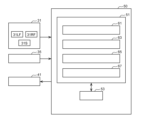
- FIG. 2 is a block diagram showing a configuration example of the driving support device 50 according to this embodiment.
- the driving assistance device 50 functions as a device that assists the driving of the own vehicle 1 by executing a computer program by a processor such as one or more CPUs (Central Processing Units).
- the computer program is a computer program for causing the processor to execute an operation to be executed by the driving support device 50, which will be described later.
- the computer program executed by the processor may be recorded in a recording medium functioning as a storage unit (memory) 53 provided in the driving assistance device 50, or may be recorded in a recording medium built in the driving assistance device 50 or in the driving assistance device. It may be recorded on any recording medium that can be externally attached to the device 50 .
- Recording media for recording computer programs include magnetic media such as hard disks, floppy disks and magnetic tapes, CD-ROMs (Compact Disk Read Only Memory), DVDs (Digital Versatile Disks), and Blu-ray (registered trademark).
- Optical recording media magneto-optical media such as floptical disks, storage elements such as RAM (Random Access Memory) and ROM (Read Only Memory), and flash such as USB (Universal Serial Bus) memory and SSD (Solid State Drive) It may be a memory or other medium capable of storing programs.
- a surrounding environment sensor 31 and a vehicle state sensor 35 are connected to the driving support device 50 via a dedicated line or a communication means such as CAN (Controller Area Network) or LIN (Local InterNet).
- a vehicle control device 41 is connected to the driving support device 50 via a dedicated line or a communication means such as CAN or LIN.
- the driving support device 50 is not limited to the electronic control device mounted on the vehicle 1, and may be a terminal device such as a smart phone or wearable device.
- the driving support device 50 includes a processing unit 51 and a storage unit 53.
- the processing unit 51 includes one or more processors such as CPUs. A part or all of the processing unit 51 may be composed of an updatable device such as firmware, or may be a program module or the like executed by a command from a CPU or the like.
- the storage unit 53 is configured by a memory such as RAM or ROM. Storage unit 53 is communicably connected to processing unit 51 . However, the number and types of storage units 53 are not particularly limited.
- the storage unit 53 stores information such as computer programs executed by the processing unit 51, various parameters used in arithmetic processing, detected data, and arithmetic results.
- the processing unit 51 of the driving support device 50 includes an ambient environment information acquisition unit 61 , own vehicle information acquisition unit 63 , risk calculation unit 65 and driving condition setting unit 67 .
- Each of these units is a function realized by execution of a computer program by a processor such as a CPU. However, part of each of these units may be configured to include an analog circuit.
- a processor such as a CPU.
- part of each of these units may be configured to include an analog circuit.
- the ambient environment information acquisition unit 61 detects the ambient environment of the vehicle 1 based on the detection data transmitted from the ambient environment sensor 31 . Specifically, the surrounding environment information acquisition unit 61 detects at least obstacles and lanes existing around the own vehicle 1 . The surrounding environment information acquisition unit 61 obtains information about obstacles, such as the type, size, position, speed of the detected obstacle, the distance from the vehicle 1 to the obstacle, and the relative speed between the vehicle 1 and the obstacle. . Obstacles to be detected include other running vehicles, parked vehicles, pedestrians, bicycles, side walls, curbs, structures, utility poles, traffic signs, traffic lights, natural objects, and all other objects existing around the own vehicle 1. include. In addition, the ambient environment information acquisition unit 61 may calculate the distance from the own vehicle 1 to the boundary of the driving lane. Boundaries of driving lanes are recognized, for example, by white lines, side walls, curbs, and the like.
- the ambient environment information acquisition unit 61 obtains the yaw rate of the other vehicle.
- the yaw rate of the other vehicle is calculated based on the attitude change of the other vehicle obtained from the image data of the front imaging cameras 31LF and 31RF, for example.
- the ambient environment information acquisition unit 61 acquires necessary information such as yaw rate, yaw acceleration, yaw angular acceleration, vehicle speed and acceleration from the other vehicle through inter-vehicle communication. You may The ambient environment information acquisition unit 61 detects ambient environment information at a predetermined cycle and stores the information in the storage unit 53 .
- the host vehicle information acquisition unit 63 acquires information on the operating state and behavior of the host vehicle 1 based on detection data transmitted from the vehicle state sensor 35 .
- the host vehicle information acquisition unit 63 acquires information on the operation state of the host vehicle 1, such as the steering wheel or steered wheel steering angle, accelerator opening, brake operation amount, or engine speed.
- the own vehicle information acquisition unit 63 also acquires behavior information of the own vehicle 1 such as vehicle speed, longitudinal acceleration, lateral acceleration, and yaw rate.
- the own vehicle information acquisition unit 63 acquires these pieces of information for each predetermined calculation cycle, and stores them in the storage unit 53 .
- the risk calculation unit 65 calculates the collision risk of the own vehicle 1 with respect to the mobile object detected by the surrounding environment information acquisition unit 61 .
- the collision risk may include not only the risk of collision between the mobile object and the own vehicle 1, but also the risk of obstacles that occur when the own vehicle 1 collides with the mobile object.
- the risk calculator 65 predicts a plurality of detected driving behaviors of the moving object. Also, the risk calculator 65 sets a plurality of driving conditions for the own vehicle 1 .
- the risk calculation unit 65 calculates the predicted distance between the moving object and the own vehicle 1 after a predetermined time, the probability that the moving object will operate each driving action, , the risk of collision between the moving body and the own vehicle 1 after a predetermined time is calculated.
- the driving behavior of the moving body refers to the motion state of the moving body defined by the steering angular velocity ⁇ o and the acceleration ⁇ o of the moving body.
- the operating conditions of the own vehicle 1 refer to the operating conditions of the own vehicle 1 defined by the steering angular velocity ⁇ e and the acceleration ⁇ e of the steering wheel of the own vehicle 1 .
- the driving condition setting unit 67 selects the driving condition of the own vehicle 1 that minimizes the collision risk.
- the operating condition setting unit 67 sets the steering angular velocity ⁇ e and the acceleration ⁇ e corresponding to the selected operating condition as target values, and transmits these information to the vehicle control device 41 .
- the vehicle control device 41 that has received the information on the operating conditions controls the driving of each control device based on the information on the set operating conditions. This reduces the risk of the vehicle 1 colliding with the moving object. Alternatively, the risk of an obstacle occurring when the own vehicle 1 collides with a moving object is reduced.
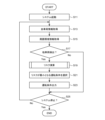
- FIG. 3 shows a flowchart showing an example of processing executed by the processing unit 51 of the driving support device 50 .
- the own vehicle information acquisition unit 63 of the processing unit 51 acquires information of the own vehicle 1 (step S13).
- the host vehicle information acquisition unit 63 acquires information on the operating state and behavior of the host vehicle 1 based on detection data transmitted from the vehicle state sensor 35 .
- the own vehicle information acquisition unit 63 obtains at least the operating state of the own vehicle 1, such as the steering wheel or steering angle of the steered wheels, accelerator opening, brake operation amount, or engine speed, as well as vehicle speed, longitudinal acceleration, lateral acceleration, yaw rate, and the like. of the behavior of the own vehicle 1 is acquired.
- the own vehicle information acquisition unit 63 stores the acquired information in the storage unit 53 .
- the ambient environment information acquisition unit 61 of the processing unit 51 acquires the ambient environment information of the own vehicle 1 (step S15). Specifically, the ambient environment information acquisition unit 61 detects obstacles existing around the vehicle 1 and the lane of the vehicle 1 based on the detection data transmitted from the ambient environment sensor 31 . The ambient environment information acquisition unit 61 also calculates the position, size, orientation, speed of the detected obstacle, the distance from the vehicle 1 to the obstacle, and the relative speed of the obstacle to the vehicle 1 . Furthermore, the ambient environment information acquisition unit 61 calculates the distance from the own vehicle 1 to the detected edge of the driving lane.
- the surrounding environment information acquisition unit 61 performs image processing on image data transmitted from the front imaging cameras 31LF and 31RF, and uses a pattern matching technique or the like to identify obstacles in front of the vehicle 1 and the types of the obstacles. To detect. In addition, the surrounding environment information acquisition unit 61 obtains information about the position of the obstacle in the image data, the size of the obstacle in the image data, and the parallax between the left and right front cameras 31LF and 31RF. Calculate the position, size and distance to the obstacle. The ambient environment information acquisition unit 61 also calculates the relative speed of the obstacle to the vehicle 1 by differentiating the change in distance with time. Furthermore, the ambient environment information acquisition unit 61 calculates the speed of the obstacle by adding the speed of the vehicle 1 to the speed of the obstacle relative to the vehicle 1 .
- the ambient environment information acquisition unit 61 may detect obstacles based on detection data transmitted from the LiDAR 31S. For example, the ambient environment information acquisition unit 61 acquires obstacles based on the information on the time from when an electromagnetic wave is transmitted from the LiDAR 31S to when the reflected wave is received, the direction in which the reflected wave is received, and the range of the measured point group of the reflected wave. The position, type, size, distance from the vehicle 1 to the obstacle, relative speed of the obstacle to the vehicle 1, and speed of the obstacle may be calculated.
- the ambient environment information acquisition unit 61 calculates the orientation of the other vehicle.
- the orientation of the other vehicle can be estimated, for example, based on the inclination of the front or rear portion of the other vehicle with respect to the angle of view of the forward imaging cameras 31LF, 31RF or LiDAR 31S.
- the method of obtaining the orientation of the other vehicle is not limited to the above example.
- the ambient environment information acquisition unit 61 calculates the yaw rate of the other vehicle.
- the yaw rate of the other vehicle can be estimated, for example, based on the attitude change of the other vehicle obtained from the detection data of the front camera 31LF, 31RF or the LiDAR 31S.
- the method of obtaining the yaw rate of the other vehicle is not limited to the above example.
- the ambient environment information acquisition unit 61 obtains information such as yaw rate, yaw acceleration, yaw angular acceleration, vehicle speed and acceleration from the other vehicle through vehicle-to-vehicle communication. may be obtained.
- the ambient environment information acquisition unit 61 stores the acquired ambient environment information in the storage unit 53 .
- the risk calculation unit 65 of the processing unit 51 determines whether or not another vehicle has been detected as an obstacle detected by the surrounding environment information acquisition unit 61 (step S17). If no other vehicle is detected (S17/No), the processing unit 51 determines whether or not the in-vehicle system has stopped (step S25). As long as the in-vehicle system is not stopped (S25/No), the process returns to step S13 and repeats the processing of each step described so far. On the other hand, if another vehicle is detected (S17/Yes), the risk calculator 65 calculates the collision risk of the own vehicle 1 with respect to the other vehicle (step S19).
- FIG. 4 shows a flowchart showing the risk calculation process.
- the risk calculator 65 predicts a plurality of driving behaviors of other vehicles (step S31).
- the risk calculator 65 sets a plurality of steering angular velocities ⁇ o and accelerations ⁇ o of the other vehicle within ranges assumed from the current yaw rate, vehicle speed, and other running states of the other vehicle detected by the ambient environment information acquisition unit 61 .
- data preliminarily setting the range of the steering angular velocity ⁇ o assumed according to the value of the yaw rate and data preliminarily setting the range of the acceleration ⁇ o assumed according to the vehicle speed are stored in the storage unit 53 in advance, and risk calculation is performed.
- the unit 65 refers to these data to set a plurality of steering angular velocities ⁇ o and accelerations ⁇ o of other vehicles. Further, the risk calculator 65 calculates the risk of another vehicle after a predetermined time based on the set steering angular velocity ⁇ o and acceleration ⁇ o, and the position, orientation, vehicle speed, and yaw rate of the other vehicle detected by the ambient environment information acquisition unit 61 . Calculate each position.
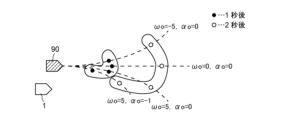
- FIG. 5 is an explanatory diagram showing an example of predicting the driving behavior of another vehicle 90.
- FIG. The other vehicle 90 shown in FIG. 5 is the other vehicle 90 that runs parallel to the own vehicle 1 in the same direction.
- the risk calculator 65 sets a plurality of steering angular velocities ⁇ o and accelerations ⁇ o of the other vehicle 90 within ranges assumed from the vehicle speed and yaw rate of the other vehicle 90 .
- the combination ( ⁇ o, ⁇ o) of the steering angular velocity ⁇ o and acceleration ⁇ o is set to four patterns of (-5, 0), (0, 0), (5, 0), and (5, -1). ing.
- the positions of the other vehicle 90 after 1 second and 2 seconds when the other vehicle 90 travels according to each driving action are calculated.
- the steering angular velocity ⁇ o takes a positive value in the rightward (clockwise) direction.
- the number of driving behaviors to be set is not limited to four. may be set to Also, the time interval indicating the position of the other vehicle 90 does not have to be one second, and may be set to any time.
- the risk calculation unit 65 calculates, for each of the other vehicles, a plurality of assumed driving behaviors and the risk of the other vehicle 90 after a predetermined period of time when the other vehicle 90 travels in each of the driving behaviors. Calculate position.
- the risk calculation unit 65 may consider the presence of obstacles around the other vehicle 90 to predict the driving behavior. For example, the risk calculator 65 may limit the range of the steering angular velocity ⁇ o and the acceleration ⁇ o to be set, considering that the other vehicle 90 takes a driving action to avoid collision with an obstacle.
- the risk calculator 65 sets multiple operating conditions for the own vehicle 1 (step S33).
- the risk calculation unit 65 sets a plurality of steering angular velocities ⁇ e and accelerations ⁇ e of the vehicle 1 within ranges assumed from the current running state of the vehicle 1 acquired by the vehicle information acquisition unit 63 .
- the risk calculation unit 65 also sets a plurality of steering angular velocities ⁇ e and accelerations ⁇ e of the own vehicle 1 by referring to data stored in advance in the storage unit 53 for the own vehicle 1 .
- the risk calculator 65 calculates the position of the vehicle 1 after a predetermined time based on the set steering angular velocity ⁇ e and acceleration ⁇ e, and the current position, orientation, vehicle speed, and steering angle of the vehicle 1. .
- the risk calculation unit 65 calculates the collision risk of the own vehicle 1 with respect to the other vehicle 90 for each of the driving conditions of the own vehicle 1 set in step S33 (step S35).
- the risk calculation unit 65 calculates, for each of the set driving conditions of the own vehicle 1, the risk of the own vehicle 1 and the other vehicle after a predetermined time when the other vehicle 90 runs according to the set driving behavior.
- a collision risk R is calculated based on the distance D to the other vehicle 90 and the probability that the other vehicle 90 will take each driving action. More specifically, in the present embodiment, the risk calculation unit 65 calculates, for each combination of the driving condition of the host vehicle 1 and the driving behavior of the other vehicle 90, at each time from 0 seconds to an arbitrary time t seconds. Let the sum of the risks r be the collision risk R.
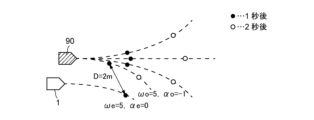
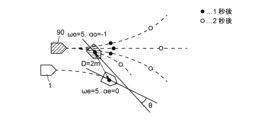
- FIG. 6 shows the position of the vehicle 1 after one second when the combination ( ⁇ e, ⁇ e) of the steering angular velocity ⁇ e and the acceleration ⁇ e is (5, 0) as the operating condition of the vehicle 1 .
- the combination ( ⁇ o, ⁇ o) of the steering angular velocity ⁇ o and the acceleration ⁇ o is (5, ⁇ 1) as the driving behavior of the other vehicle 90
- the other vehicle 90 and A distance D to the own vehicle 1 is 2 m.
- the positions of the other vehicle 90 and the own vehicle 1 may be set in advance at the center of gravity of the vehicle, may be at the center of the front part of the vehicle, or may be set at an arbitrary position.
- the risk calculation unit 65 calculates the risk based on the distance D between the own vehicle 1 and the other vehicle 90 after a predetermined time and the probability that the other vehicle 90 will be operated by each driving action. Calculate r.
- the risk r shown in the following equation (1) is determined by the reciprocal of the distance D between the other vehicle 90 and the own vehicle 1 at the same time, with respect to the position of the own vehicle 1 at each time. It is multiplied by the probability of doing so.
- the probability that the other vehicle 90 exists at the position is expressed as the product of the probability Ps that the set steering angular velocity ⁇ o of the other vehicle 90 is realized and the probability Pa that the acceleration ⁇ o is realized.
- Risk r (1/D) x (Ps) x (Pa) (1) r: Risk at each time D: Distance between other vehicle 90 and host vehicle 1 Ps: Probability of steering angular velocity ⁇ o of other vehicle 90 Pa: Probability of acceleration ⁇ o of other vehicle 90
- the 8 and 9 are explanatory diagrams showing examples of the probability Ps [%] of the steering angular velocity ⁇ o and the probability Pa [%] of the acceleration ⁇ o of the other vehicle 90, respectively.
- the data of the respective probabilities Ps and Pa are obtained based on the frequency of the operation amount obtained from the statistical data of the operation amount of the vehicle in the past.
- the data of the probabilities Ps and Pa may be set according to at least one of the yaw angular acceleration and the longitudinal acceleration of the vehicle.
- the probabilities Ps and Pa of the steering angular velocity ⁇ o and the acceleration ⁇ o with which the other vehicle 90 can be operated can be obtained with higher accuracy by obtaining the respective probabilities Ps and Pa according to the yaw angular acceleration or the longitudinal acceleration of the other vehicle 90. can be done.
- the data of the probabilities Ps and Pa may be prepared in advance and stored in the storage unit 53, or may be stored in an external server that can communicate with the driving support device 50 via mobile wireless communication means.
- the risk calculation unit 65 may calculate the probabilities Ps and Pa that the other vehicle 90 will perform each driving behavior in the detected driving state of the other vehicle 90 and the surrounding environment.
- the driving support device 50 stores the past driving behaviors of not only the own vehicle 1 and the specific other vehicle 90, but also the driving behaviors of a plurality of vehicles in association with the information of the driving state and the surrounding environment when the vehicle is driving. It has a driving behavior database.
- the risk calculation unit 65 extracts the driving behavior data acquired in the same environment from the driving behavior database, and calculates the probability Ps of the steering angular velocity ⁇ o and the acceleration ⁇ o. Calculate the probability Pa of . Accordingly, it is possible to more accurately obtain the probability that the other vehicle 90 will take each driving action.
- the distance D between the own vehicle 1 and the other vehicle 90 after one second is 2 m
- the probability Ps of the steering angular velocity ⁇ o is 10(%)
- the probability Pa of the acceleration ⁇ o is 20(%).
- the risk calculation unit 65 calculates the risk r for each combination of the driving conditions of the own vehicle 1 and the driving behavior of the other vehicle 90 from time 0 seconds to an arbitrary time t seconds, and calculates the sum of the calculated risks r.
- a collision risk R for each driving condition of the own vehicle 1 is assumed. Therefore, for each driving condition of the own vehicle 1, the collision risk R corresponding to the set number of driving behaviors of the other vehicle 90 is calculated.
- the operating condition setting unit 67 selects the operating condition of the own vehicle 1 that minimizes the calculated collision risk R (step S21). Specifically, the driving condition setting unit 67 identifies the minimum collision risk R from among the collision risks R obtained by the risk calculation process, and sets the driving condition of the own vehicle 1 used for calculating the collision risk R to the vehicle It is set as an operating condition to be output to the control device 41 .
- the operating condition setting unit 67 transmits information on the steering angular velocity ⁇ e and the acceleration ⁇ o set as operating conditions to the vehicle control device 41 (step S23).
- the vehicle control device 41 that has received the information on the steering angular velocity ⁇ e and the acceleration ⁇ o executes automatic driving control of the own vehicle 1 using the steering angular velocity ⁇ e and the acceleration ⁇ o as target values. As a result, the collision risk of own vehicle 1 against other vehicle 90 can be reduced.
- the driving assistance device 50 predicts a plurality of driving behaviors of the other vehicle 90 when the other vehicle 90 is detected around the own vehicle 1 , and can set them for the own vehicle 1 .
- the collision risk R after a predetermined time when the other vehicle 90 takes each driving behavior is calculated.
- the driving support device 50 selects the driving condition of the host vehicle 1 that minimizes the collision risk R, and sets the driving condition to be output to the vehicle control device 41 .
- the driving conditions of the own vehicle 1 are set based on the collision risk R reflecting the predicted driving behavior of the other vehicle 90, and the risk of the own vehicle 1 colliding with the other vehicle 90 can be reduced.
- the driving assistance device 50 obtains the position of the own vehicle 1 after a predetermined time for each driving condition that can be set for the own vehicle 1 .
- the driving support device 50 calculates the current yaw rate and speed of the detected other vehicle 90, and the distance between the other vehicle 90 and the own vehicle 1 after a predetermined time based on the assumed steering angular velocity ⁇ o and acceleration ⁇ o of the other vehicle 90. , based on the probability Ps that the other vehicle 90 is operated at the set steering angular velocity ⁇ o and the probability Pa that the other vehicle 90 is operated at the set acceleration ⁇ o. Compute the later risk r.
- the driving support device 50 sets the sum of the risks r from time 0 seconds to an arbitrary time t seconds later as the collision risk R for each driving behavior of the other vehicle 90 for each driving condition of the own vehicle 1 .
- the higher the probability that the other vehicle 90 takes each driving action the higher the collision risk R, and the effect of reducing the collision risk of the own vehicle 1 with respect to the other vehicle 90 can be enhanced.
- the driving conditions of the own vehicle 1 are set based on the risk of collision over a predetermined period, the effect of reducing the risk of collision of the own vehicle 1 with the other vehicle 90 can be enhanced.
- the driving support device 50 is based on a driving behavior database in which past driving behaviors performed by a plurality of vehicles are stored in association with information on the driving state and the surrounding environment when the vehicle is traveling, and the driving behavior of the other vehicle 90 is determined based on the driving behavior database. You can also calculate the probability of taking action. Accordingly, it is possible to more accurately obtain the probability that the other vehicle 90 will take each driving action.
- driving behavior database is stored in a server that can be accessed from the driving support device 50 via mobile communication means
- driving behavior data of a plurality of vehicles can be stored as data of driving conditions and surrounding environment during vehicle driving. It can be sequentially updated or accumulated in association with information. Therefore, the accuracy of the probability that the other vehicle 90 will take each driving action can be improved, and the effect of reducing the collision risk of the own vehicle 1 with the other vehicle 90 can be enhanced.
- the collision risk R is calculated in consideration of the possibility of collision between the own vehicle 1 and the other vehicle 90.
- the collision risk R may be calculated in consideration of the risk of failure that occurs when the vehicle crashes (hereinafter also simply referred to as "failure risk").
- the risk calculator 65 calculates the risk r1 may be calculated.
- the risk calculator 65 calculates the distance D between the own vehicle 1 and the other vehicle 90 after a predetermined time, the probability that the other vehicle 90 will be operated by each driving behavior, and the own vehicle
- the risk r1 is calculated based on the relative speed ⁇ V of the other vehicle 90 with respect to 1 and the angle ⁇ formed by the direction of the own vehicle 1 and the direction of the other vehicle 90 .
- the risk r1 shown in the following formula (2) is the relative speed ⁇ V of the other vehicle 90 with respect to the own vehicle 1 and the direction of the own vehicle 1 and the direction of the other vehicle 90 with respect to the risk r obtained by the above formula (1). is the sum of the reciprocal of the angle ⁇ formed by
- Risk r1 (1/D) ⁇ (Ps) ⁇ (Pa)+( ⁇ V)+(1/ ⁇ ) (2) r1: Risk at each time D: Distance between other vehicle 90 and own vehicle 1 Ps: Probability of steering angular velocity ⁇ o of other vehicle 90 Pa: Probability of acceleration ⁇ o of other vehicle 90 ⁇ V: Other vehicle 90 relative to own vehicle 1 relative velocity ⁇ : the angle formed by the direction of the own vehicle 1 and the direction of the other vehicle 90
- FIG. 10 is an explanatory diagram showing an example of calculating the risk r1 at a predetermined time in consideration of the failure risk.
- FIG. 10 shows the directions of the own vehicle 1 and the other vehicle 90 at the positions of the own vehicle 1 and the other vehicle 90 after one second shown in FIG.
- the orientation of the own vehicle 1 after a predetermined time can be estimated based on the set steering angular velocity ⁇ e and acceleration ⁇ e, and the current running state information such as the vehicle speed, acceleration, and yaw rate of the own vehicle 1 .
- the direction of the other vehicle 90 after a predetermined time can be estimated based on the set steering angular velocity ⁇ o and acceleration ⁇ o, and the current running state information of the other vehicle 90 such as the vehicle speed, acceleration, and yaw rate.
- the risk calculator 65 may further estimate the orientation of the own vehicle 1 or the other vehicle 90 in consideration of the road surface friction state.
- the risk calculation unit 65 calculates the risk r1 for each combination of the driving conditions of the own vehicle 1 and the driving behavior of the other vehicle 90 from time 0 seconds to an arbitrary time t seconds, and calculates the sum of the calculated risks r1.
- a collision risk R for each driving condition of the own vehicle 1 is assumed.
- the risk r1 after a predetermined time period is calculated by taking into account at least one of the relative velocity ⁇ V of the other vehicle 90 with respect to the own vehicle 1 and the angle ⁇ between the orientation of the own vehicle 1 and the orientation of the other vehicle 90. By doing so, it is possible to reduce the risk of the vehicle 1 colliding with the other vehicle 90, and also reduce the risk of an obstacle occurring even when a collision occurs.
- the risk calculation unit 65 may calculate the risk r2 after a predetermined time based on the collision position of the own vehicle 1 with respect to the other vehicle 90.
- the distance D between the own vehicle 1 and the other vehicle 90 after a predetermined time the probability that the other vehicle 90 will be operated by each driving behavior
- a risk r2 is calculated based on the collision position risk Q corresponding to the collision position of the vehicle 1 .
- the risk r2 shown in the following formula (3) is obtained by adding the collision position risk Q corresponding to the assumed collision position to the risk r obtained by the above formula (1).
- Risk r2 (1/D) ⁇ (Ps) ⁇ (Pa)+(Q) (3) r1: Risk at each time D: Distance between other vehicle 90 and own vehicle 1 Ps: Probability of steering angular velocity ⁇ o of other vehicle 90 Pa: Probability of acceleration ⁇ o of other vehicle 90 Q: Own vehicle 1 relative to other vehicle 90 collision position risk
- the collision position risk Q may be, for example, a risk value set for each collision position of the own vehicle 1 based on the characteristics that indicate the impact of the impact that the own vehicle 1 receives upon collision.
- the data of the collision position risk set for each collision position of the own vehicle 1 based on the characteristics indicating the influence of the impact received by the own vehicle 1 due to the collision is stored in advance in the storage unit 53 .
- the collision position risk Q may be a risk value set for each collision position according to the position, build, etc. of the occupant of the own vehicle 1 .
- the driving support device 50 acquires information such as the position, build, age, etc. of the occupant input by the user, and stores the information in the storage unit 53 .
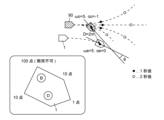
- FIG. 11 is an explanatory diagram showing an example of calculating the risk r2 at a predetermined time in consideration of the collision position risk.
- FIG. 11 shows the directions of the own vehicle 1 and the other vehicle 90, the information of the occupants of the own vehicle 1, and the collision position risk, respectively, at the positions of the own vehicle 1 and the other vehicle 90 after one second shown in FIG. It is.
- the vehicle 1 has a driver D sitting in the driver's seat and an infant B sitting on the right side of the rear seat.
- the collision position risk of the left rear part of the own vehicle 1 near the baby B is set to 100 (points)
- the collision position risk of the left front part and the right rear part is set to 10 (points)
- the collision position risk of the front part is set to 10 (points). is set to 1 (point). Therefore, the risk r2 of the driving condition of the own vehicle 1 that the collision position of the own vehicle 1 with respect to the other vehicle 90 may be the left rear portion increases.
- setting of the collision position risk is not limited to the example shown in FIG.
- the obstacle risk is not limited to the collision position risk set according to the collision position of the own vehicle 1, and other risks related to obstacles that are considered to occur at the time of collision may be arbitrarily set.
- the risk calculator 65 may calculate the collision risk by adding the weight risk set based on the weight of the other vehicle 90 estimated from the type or size of the other vehicle 90 .
- the probability that the other vehicle 90 takes each driving behavior is calculated without considering the driving behavior tendency of the other vehicle 90.
- the probability that the other vehicle 90 will take each driving behavior may be calculated based on the driving characteristics representing For example, the driving support device 50 stores past driving behaviors of a plurality of vehicles, not limited to the own vehicle 1 and a specific other vehicle 90, in an external server that can be accessed via wireless communication means. , a driving behavior database stored in association with information on the driving state and the surrounding environment when the vehicle is running.
- driving characteristics which represent trends in driving behavior, refer to personal characteristics related to driving tendencies and driving behavior tendencies, such as driving style and fear of driving.
- driving styles include “I want to obey the speed limit”, “I want to keep a sufficient distance from the vehicle ahead”, “I want to slow down sufficiently before entering a curve”, and “I want to go as far as possible even if I change lanes”. ', 'I want to shorten the inter-vehicle distance to the preceding vehicle as much as possible', and the like.
- how to feel fear about driving for example, what kind of driving environment would you feel fear in? Examples include a situation in which there are many fast-moving vehicles, a situation in which there is a large amount of traffic, and the like.
- the driving characteristics are stored in association with the identification information of the vehicle as data obtained by evaluating one or a plurality of items representing driving characteristics, such as cautiousness or impatience, on a scale of five, for example.
- the risk calculation unit 65 transmits information that enables identification of the other vehicle 90 to the external server together with information on the detected driving state and surrounding environment of the other vehicle 90 to identify the driving characteristics of the other vehicle 90 .
- the information with which the other vehicle 90 can be identified may be, for example, a numerical example of the license plate specified from the detection data of the forward photographing cameras 31LF and 31RF, or identification information obtained from the other vehicle 90 through inter-vehicle communication. good too. If the other vehicle 90 records the information on the driving characteristics of the other vehicle 90, the risk calculation unit 65 may acquire the information on the driving characteristics from the other vehicle 90 through inter-vehicle communication.
- the risk calculation unit 65 extracts from the driving behavior database the driving behavior data that a vehicle having the same driving characteristics as the other vehicle 90 performed in the same environment in the past. Then, the risk calculation unit 65 predicts a plurality of driving behaviors of the other vehicle 90 based on the past driving behavior data in the same environment extracted from the driving behavior database. A probability that the other vehicle 90 performs each driving behavior in the environment is calculated. Accordingly, it is possible to obtain the probability that the other vehicle 90 will take each driving action in consideration of the detected driving characteristics of the other vehicle 90 . Therefore, the collision risk R that reflects the predicted driving behavior of the other vehicle 90 can be obtained more accurately, and a driving condition with a low risk of collision of the own vehicle 1 with the other vehicle 90 can be set.
- the risk calculation unit 65 sets the driving behavior of the other vehicle 90. However, if the other vehicle 90 is a vehicle that is automatically driving, the risk calculation unit 65 receives the driving condition information from the other vehicle 90. may be obtained. In this case, the risk calculation unit 65 can estimate the position of the other vehicle 90 after a predetermined time by acquiring the information on the planned traveling trajectory, vehicle speed, and acceleration of the other vehicle 90 via inter-vehicle communication, for example. . The risk calculator 65 sets the probability that the other vehicle 90 will perform the driving behavior to 100%, and calculates the risk r of the own vehicle 1 at a predetermined time.
- the collision risk R of the own vehicle 1 with respect to the other vehicle 90 after a predetermined time period is calculated based on information on the driving behavior of the other vehicle 90 with high accuracy, and driving with a low risk of collision of the own vehicle 1 with the other vehicle 90 is performed. Conditions can be set.
- all the functions of the driving support device 50 are installed in the own vehicle 1, but the present disclosure is not limited to such an example.
- some of the functions of the driving assistance device 50 are provided in a server device that can communicate via mobile communication means, and the driving assistance device 50 is configured to transmit and receive data to and from the server device.
- the moving object is the other vehicle 90, but the moving object is not limited to the vehicle.
- the moving object may be a bicycle or a pedestrian.
- the probability of the driving behavior of each moving object can be set based on the statistical data of the driving behavior of the moving object stored in association with, for example, the type of moving object, orientation, surrounding environment, and the like.
- a moving body risk may be set according to the type of moving body, and the collision risk may be calculated by adding the moving body risk.
Landscapes
- Engineering & Computer Science (AREA)
- Automation & Control Theory (AREA)
- Transportation (AREA)
- Mechanical Engineering (AREA)
- Physics & Mathematics (AREA)
- General Physics & Mathematics (AREA)
- Traffic Control Systems (AREA)
Priority Applications (5)
| Application Number | Priority Date | Filing Date | Title |
|---|---|---|---|
| JP2023550756A JP7701459B2 (ja) | 2021-09-28 | 2021-09-28 | 運転支援装置及びコンピュータプログラムを記録した記録媒体 |
| CN202180032003.1A CN116194972A (zh) | 2021-09-28 | 2021-09-28 | 驾驶辅助装置及记录有计算机程序的记录介质 |
| PCT/JP2021/035511 WO2023053165A1 (ja) | 2021-09-28 | 2021-09-28 | 運転支援装置及びコンピュータプログラムを記録した記録媒体 |
| US17/928,421 US12283190B2 (en) | 2021-09-28 | 2021-09-28 | Driver assistance apparatus and recording medium containing computer program |
| DE112021008279.5T DE112021008279T8 (de) | 2021-09-28 | 2021-09-28 | Fahrerassistenzvorrichtung und Aufzeichnungsmedium mit einem Computerprogramm |
Applications Claiming Priority (1)
| Application Number | Priority Date | Filing Date | Title |
|---|---|---|---|
| PCT/JP2021/035511 WO2023053165A1 (ja) | 2021-09-28 | 2021-09-28 | 運転支援装置及びコンピュータプログラムを記録した記録媒体 |
Publications (1)
| Publication Number | Publication Date |
|---|---|
| WO2023053165A1 true WO2023053165A1 (ja) | 2023-04-06 |
Family
ID=85781461
Family Applications (1)
| Application Number | Title | Priority Date | Filing Date |
|---|---|---|---|
| PCT/JP2021/035511 Ceased WO2023053165A1 (ja) | 2021-09-28 | 2021-09-28 | 運転支援装置及びコンピュータプログラムを記録した記録媒体 |
Country Status (5)
| Country | Link |
|---|---|
| US (1) | US12283190B2 (https=) |
| JP (1) | JP7701459B2 (https=) |
| CN (1) | CN116194972A (https=) |
| DE (1) | DE112021008279T8 (https=) |
| WO (1) | WO2023053165A1 (https=) |
Families Citing this family (2)
| Publication number | Priority date | Publication date | Assignee | Title |
|---|---|---|---|---|
| JP7501488B2 (ja) * | 2021-10-06 | 2024-06-18 | トヨタ自動車株式会社 | 運転支援装置、方法、プログラム、及び車両 |
| JP7813145B2 (ja) * | 2022-01-24 | 2026-02-12 | 株式会社Subaru | 車両の運転支援装置 |
Citations (13)
| Publication number | Priority date | Publication date | Assignee | Title |
|---|---|---|---|---|
| JP2000276696A (ja) * | 1999-03-26 | 2000-10-06 | Toyota Motor Corp | 車両衝突回避制御装置 |
| WO2007102405A1 (ja) * | 2006-03-01 | 2007-09-13 | Toyota Jidosha Kabushiki Kaisha | 自車進路決定方法および自車進路決定装置 |
| JP2008191781A (ja) * | 2007-02-01 | 2008-08-21 | Hitachi Ltd | 衝突回避システム |
| JP2008250492A (ja) * | 2007-03-29 | 2008-10-16 | Toyota Motor Corp | 運転者危険度取得装置 |
| WO2008156201A1 (ja) * | 2007-06-20 | 2008-12-24 | Toyota Jidosha Kabushiki Kaisha | 車両走行軌跡推定装置 |
| JP2011096105A (ja) * | 2009-10-30 | 2011-05-12 | Toyota Motor Corp | 運転支援装置 |
| JP2015118510A (ja) * | 2013-12-18 | 2015-06-25 | 富士重工業株式会社 | 車両制御装置 |
| JP2015203948A (ja) * | 2014-04-14 | 2015-11-16 | パナソニックIpマネジメント株式会社 | 無線装置 |
| US20170162050A1 (en) * | 2015-12-03 | 2017-06-08 | Institute For Information Industry | System and method for collision avoidance for vehicle |
| JP2017182563A (ja) * | 2016-03-31 | 2017-10-05 | 株式会社Subaru | 周辺リスク表示装置 |
| JP2020514158A (ja) * | 2017-03-28 | 2020-05-21 | 三菱電機株式会社 | 自車両の制御方法及び自車両の制御システム |
| JP2021026720A (ja) * | 2019-08-08 | 2021-02-22 | 本田技研工業株式会社 | 運転支援装置、車両の制御方法、およびプログラム |
| JP2021142788A (ja) * | 2020-03-10 | 2021-09-24 | トヨタ自動車株式会社 | 運転支援システム |
Family Cites Families (11)
| Publication number | Priority date | Publication date | Assignee | Title |
|---|---|---|---|---|
| US6445308B1 (en) | 1999-01-12 | 2002-09-03 | Toyota Jidosha Kabushiki Kaisha | Positional data utilizing inter-vehicle communication method and traveling control apparatus |
| JP4055656B2 (ja) * | 2003-05-30 | 2008-03-05 | トヨタ自動車株式会社 | 衝突予測装置 |
| JP5189157B2 (ja) * | 2010-11-30 | 2013-04-24 | 株式会社豊田中央研究所 | 可動物の目標状態決定装置及びプログラム |
| US9841762B2 (en) * | 2015-05-27 | 2017-12-12 | Comigo Ltd. | Alerting predicted accidents between driverless cars |
| US11164459B2 (en) | 2017-03-14 | 2021-11-02 | Hyundai Mobis Co., Ltd. | Apparatus and method of safety support for vehicle |
| JP6805965B2 (ja) | 2017-05-23 | 2020-12-23 | トヨタ自動車株式会社 | 衝突回避制御装置 |
| US10782694B2 (en) * | 2017-09-07 | 2020-09-22 | Tusimple, Inc. | Prediction-based system and method for trajectory planning of autonomous vehicles |
| CN110015306B (zh) | 2018-01-10 | 2020-12-04 | 华为技术有限公司 | 驾驶轨迹获取方法及装置 |
| US11260855B2 (en) | 2018-07-17 | 2022-03-01 | Baidu Usa Llc | Methods and systems to predict object movement for autonomous driving vehicles |
| US11465619B2 (en) | 2020-05-27 | 2022-10-11 | Zoox, Inc. | Vehicle collision avoidance based on perturbed object trajectories |
| CN115123237A (zh) | 2022-06-24 | 2022-09-30 | 山东科技大学 | 一种易安装式智能变道辅助系统 |
-
2021
- 2021-09-28 CN CN202180032003.1A patent/CN116194972A/zh active Pending
- 2021-09-28 DE DE112021008279.5T patent/DE112021008279T8/de active Active
- 2021-09-28 WO PCT/JP2021/035511 patent/WO2023053165A1/ja not_active Ceased
- 2021-09-28 JP JP2023550756A patent/JP7701459B2/ja active Active
- 2021-09-28 US US17/928,421 patent/US12283190B2/en active Active
Patent Citations (13)
| Publication number | Priority date | Publication date | Assignee | Title |
|---|---|---|---|---|
| JP2000276696A (ja) * | 1999-03-26 | 2000-10-06 | Toyota Motor Corp | 車両衝突回避制御装置 |
| WO2007102405A1 (ja) * | 2006-03-01 | 2007-09-13 | Toyota Jidosha Kabushiki Kaisha | 自車進路決定方法および自車進路決定装置 |
| JP2008191781A (ja) * | 2007-02-01 | 2008-08-21 | Hitachi Ltd | 衝突回避システム |
| JP2008250492A (ja) * | 2007-03-29 | 2008-10-16 | Toyota Motor Corp | 運転者危険度取得装置 |
| WO2008156201A1 (ja) * | 2007-06-20 | 2008-12-24 | Toyota Jidosha Kabushiki Kaisha | 車両走行軌跡推定装置 |
| JP2011096105A (ja) * | 2009-10-30 | 2011-05-12 | Toyota Motor Corp | 運転支援装置 |
| JP2015118510A (ja) * | 2013-12-18 | 2015-06-25 | 富士重工業株式会社 | 車両制御装置 |
| JP2015203948A (ja) * | 2014-04-14 | 2015-11-16 | パナソニックIpマネジメント株式会社 | 無線装置 |
| US20170162050A1 (en) * | 2015-12-03 | 2017-06-08 | Institute For Information Industry | System and method for collision avoidance for vehicle |
| JP2017182563A (ja) * | 2016-03-31 | 2017-10-05 | 株式会社Subaru | 周辺リスク表示装置 |
| JP2020514158A (ja) * | 2017-03-28 | 2020-05-21 | 三菱電機株式会社 | 自車両の制御方法及び自車両の制御システム |
| JP2021026720A (ja) * | 2019-08-08 | 2021-02-22 | 本田技研工業株式会社 | 運転支援装置、車両の制御方法、およびプログラム |
| JP2021142788A (ja) * | 2020-03-10 | 2021-09-24 | トヨタ自動車株式会社 | 運転支援システム |
Also Published As
| Publication number | Publication date |
|---|---|
| JPWO2023053165A1 (https=) | 2023-04-06 |
| CN116194972A (zh) | 2023-05-30 |
| US20240233545A1 (en) | 2024-07-11 |
| JP7701459B2 (ja) | 2025-07-01 |
| DE112021008279T8 (de) | 2025-01-16 |
| DE112021008279T5 (de) | 2024-08-29 |
| US12283190B2 (en) | 2025-04-22 |
Similar Documents
| Publication | Publication Date | Title |
|---|---|---|
| US10676093B2 (en) | Vehicle control system, vehicle control method, and storage medium | |
| JP6494121B2 (ja) | 車線変更推定装置、車線変更推定方法、およびプログラム | |
| CN113631452B (zh) | 一种变道区域获取方法以及装置 | |
| CN113320541B (zh) | 车辆控制装置、车辆控制方法及存储介质 | |
| US10421394B2 (en) | Driving assistance device, and storage medium | |
| US12344282B2 (en) | Apparatus for switching control between automatic driving and manual driving in vehicles | |
| JP7606628B2 (ja) | 運転支援装置及び車両並びにコンピュータプログラムを記録した記録媒体 | |
| CN115195741A (zh) | 车辆的控制方法、装置、车辆及存储介质 | |
| CN110001644A (zh) | 车辆控制装置、车辆控制方法及存储介质 | |
| CN113525378B (zh) | 车辆控制装置、车辆控制方法及存储介质 | |
| JP2012226635A (ja) | 車両の衝突予防安全装置 | |
| JP7568869B2 (ja) | 運転支援装置及びコンピュータプログラムを記録した記録媒体 | |
| JP7762030B2 (ja) | 運転支援装置及びコンピュータプログラム | |
| US20220306153A1 (en) | Driving assistance apparatus | |
| JP7701459B2 (ja) | 運転支援装置及びコンピュータプログラムを記録した記録媒体 | |
| CN112714718B (zh) | 车辆控制方法及车辆控制装置 | |
| JP7394018B2 (ja) | 車両制御装置 | |
| JP7853131B2 (ja) | 運転支援システム及びコンピュータプログラム | |
| JP7659700B2 (ja) | 運転支援システム及び車両並びにコンピュータプログラムを記録した記録媒体 | |
| US12509069B2 (en) | Driver assistance apparatus, vehicle, recording medium storing computer program, and driver assistance method | |
| JP7788979B2 (ja) | 推定装置、推定方法、およびプログラム | |
| JP7304378B2 (ja) | 運転支援装置、運転支援方法、およびプログラム | |
| CN112208534B (zh) | 车辆控制装置、车辆控制方法及存储介质 | |
| JP7708985B2 (ja) | 運転支援装置、運転支援方法及び記録媒体 | |
| JP2026017704A (ja) | 運転支援制御装置、運転支援方法、及びコンピュータプログラム |
Legal Events
| Date | Code | Title | Description |
|---|---|---|---|
| WWE | Wipo information: entry into national phase |
Ref document number: 17928421 Country of ref document: US |
|
| 121 | Ep: the epo has been informed by wipo that ep was designated in this application |
Ref document number: 21959218 Country of ref document: EP Kind code of ref document: A1 |
|
| WWE | Wipo information: entry into national phase |
Ref document number: 2023550756 Country of ref document: JP |
|
| WWE | Wipo information: entry into national phase |
Ref document number: 112021008279 Country of ref document: DE |
|
| 122 | Ep: pct application non-entry in european phase |
Ref document number: 21959218 Country of ref document: EP Kind code of ref document: A1 |
|
| WWG | Wipo information: grant in national office |
Ref document number: 17928421 Country of ref document: US |