WO2022149441A1 - 粒状洗剤組成物 - Google Patents
粒状洗剤組成物 Download PDFInfo
- Publication number
- WO2022149441A1 WO2022149441A1 PCT/JP2021/046805 JP2021046805W WO2022149441A1 WO 2022149441 A1 WO2022149441 A1 WO 2022149441A1 JP 2021046805 W JP2021046805 W JP 2021046805W WO 2022149441 A1 WO2022149441 A1 WO 2022149441A1
- Authority
- WO
- WIPO (PCT)
- Prior art keywords
- mass
- detergent composition
- water
- granular detergent
- soluble inorganic
- Prior art date
- Legal status (The legal status is an assumption and is not a legal conclusion. Google has not performed a legal analysis and makes no representation as to the accuracy of the status listed.)
- Ceased
Links
Classifications
-
- C—CHEMISTRY; METALLURGY
- C11—ANIMAL OR VEGETABLE OILS, FATS, FATTY SUBSTANCES OR WAXES; FATTY ACIDS THEREFROM; DETERGENTS; CANDLES
- C11D—DETERGENT COMPOSITIONS; USE OF SINGLE SUBSTANCES AS DETERGENTS; SOAP OR SOAP-MAKING; RESIN SOAPS; RECOVERY OF GLYCEROL
- C11D1/00—Detergent compositions based essentially on surface-active compounds; Use of these compounds as a detergent
- C11D1/02—Anionic compounds
- C11D1/12—Sulfonic acids or sulfuric acid esters; Salts thereof
- C11D1/28—Sulfonation products derived from fatty acids or their derivatives, e.g. esters, amides
-
- C—CHEMISTRY; METALLURGY
- C11—ANIMAL OR VEGETABLE OILS, FATS, FATTY SUBSTANCES OR WAXES; FATTY ACIDS THEREFROM; DETERGENTS; CANDLES
- C11D—DETERGENT COMPOSITIONS; USE OF SINGLE SUBSTANCES AS DETERGENTS; SOAP OR SOAP-MAKING; RESIN SOAPS; RECOVERY OF GLYCEROL
- C11D17/00—Detergent materials or soaps characterised by their shape or physical properties
- C11D17/06—Powder; Flakes; Free-flowing mixtures; Sheets
-
- C—CHEMISTRY; METALLURGY
- C11—ANIMAL OR VEGETABLE OILS, FATS, FATTY SUBSTANCES OR WAXES; FATTY ACIDS THEREFROM; DETERGENTS; CANDLES
- C11D—DETERGENT COMPOSITIONS; USE OF SINGLE SUBSTANCES AS DETERGENTS; SOAP OR SOAP-MAKING; RESIN SOAPS; RECOVERY OF GLYCEROL
- C11D3/00—Other compounding ingredients of detergent compositions covered in group C11D1/00
- C11D3/02—Inorganic compounds ; Elemental compounds
- C11D3/04—Water-soluble compounds
Definitions
- the present invention relates to a granular detergent composition and a method for producing the same.
- Patent Document 1 discloses that a water-insoluble inorganic powder such as zeolite is used as the inorganic particles.
- Patent Document 2 discloses that water-soluble alkaline inorganic salt nuclei particles such as surface-treated sodium carbonate are used as the inorganic particles.
- Patent Document 3 discloses that zinc oxide particles are used as the inorganic particles.
- the present invention is a granular detergent composition containing surfactant-containing particles and water-soluble inorganic particles, wherein the water-soluble inorganic particles contain fine particle components having a particle diameter of 30 ⁇ m or less, and the granular detergent composition.
- the content of the fine particle component is 3.0% by mass or more with respect to the content of the surfactant-containing particles.
- the present invention is a method for producing a granular detergent composition containing surfactant-containing particles and water-soluble inorganic particles, wherein the surfactant-containing particles and the water-soluble inorganic particles are mixed and the water-soluble inorganic particles are mixed.
- the sex inorganic particles contain fine particles having a particle diameter of 30 ⁇ m or less, and the content of the fine particles in the granular detergent composition is 3.0% by mass or more with respect to the content of the surfactant-containing particles. be.
- the granular detergent composition according to the embodiment contains surfactant-containing particles and water-soluble inorganic particles.
- the water-soluble inorganic particles contain fine particle components having a particle size of 30 ⁇ m or less, and in the granular detergent composition according to the embodiment, the content b'of the fine particle components is relative to the content A of the surfactant-containing particles. It is 3.0% by mass or more.
- water-soluble in the present application means that the mass dissolved in 100 g of water at 20 ° C. is 5 g or more.
- the water-soluble inorganic particles contain fine particle components having a particle diameter of 30 ⁇ m or less, and the content b'of the fine particle components in the granular detergent composition according to the embodiment is a surfactant.
- the content is 3.0% by mass or more with respect to the content A of the contained particles, excellent storage stability can be obtained.
- the content b'of the fine particle component of the water-soluble inorganic particles is 3.0% by mass or more with respect to the content A of the surfactant-containing particles. Since the particle size of the fine particle component is 30 ⁇ m or less, the fine particle component sufficiently adheres to the surface of the surfactant-containing particles by the action of van der Waals force to modify the surface, for example, high temperature. -It is considered that this is because the development of adhesiveness on the surface of the surfactant-containing particles is restricted even in a high-humidity atmosphere.
- Surfactant-containing particles contain surfactants, builders, anticontamination agents, softeners, optical brighteners, defoamers, enzymes, enzyme stabilizers, colorants, fragrances, water and the like.
- the surfactant examples include anionic surfactants, cationic surfactants, amphoteric surfactants, and nonionic surfactants.
- anionic surfactant examples include linear sodium alkylbenzene sulfonate, sodium alkyl sulfate ester, sodium polyoxyethylene alkyl ether sulfate, fatty acid soap, alkyl ether carboxylate and the like.
- cationic surfactant examples include an aliphatic amine salt and an aliphatic quaternary ammonium salt.
- the nonionic surfactant include polyoxyethylene alkyl ether and polyoxyethylene alkyl phenyl ether.
- amphoteric tenside agent examples include carboxybetaine type compounds and aminocarboxylates.
- the surfactant may contain only one of these, or may contain two or more of them in combination.
- the content of the surfactant in the surfactant-containing particles is, for example, 10% by mass or more and 50% by mass or less.
- Examples of builders include inorganic builders and organic builders.
- Examples of the inorganic builder include water-soluble inorganic salts such as sodium hydroxide, sodium silicate, sodium carbonate, sodium sulfate, crystalline aluminosilicate, and amorphous aluminosilicate.
- Examples of the organic builder include water-soluble organic acid salts such as nitrilotriacetate and ethylenediaminetetraacetate.
- the content of the builder in the surfactant-containing particles is, for example, 40% by mass or more and 80% by mass or less.
- Examples of the anti-recontamination agent include polyacrylic acid salt, carboxymethyl cellulose and the like.
- Examples of the softening agent include silicones and clay minerals.
- Examples of the fluorescent whitening agent include a dimorpholino type fluorescent whitening agent and a hydroxyethylamino type fluorescent whitening agent.
- Examples of the defoaming agent include soap and silicone.
- Examples of the enzyme include protease, cellulase and the like.
- Examples of the enzyme stabilizer include a boron compound and a calcium ion supply compound.
- Examples of the colorant include inorganic pigments and organic pigments.
- Examples of the fragrance include menthol and vanillin.
- the content A of the surfactant-containing particles in the granular detergent composition according to the embodiment is preferably 50% by mass or more, more preferably 60% by mass or more, and is a granular detergent composition from the viewpoint of obtaining excellent detergency. From the viewpoint of obtaining excellent storage stability, the content is preferably 95% by mass or less, more preferably 90% by mass or less.
- the average particle size D of the surfactant-containing particles is preferably 100 ⁇ m or more, more preferably 150 ⁇ m or more, from the viewpoint of suppressing powdering and improving fluidity, and from the viewpoint of suppressing classification and improving solubility. Therefore, it is preferably 600 ⁇ m or less, more preferably 500 ⁇ m or less.
- the average particle size D of the surfactant-containing particles is 5 using a JIS K8801 standard sieve (opening 45 ⁇ m, 63 ⁇ m, 90 ⁇ m, 125 ⁇ m, 180 ⁇ m, 250 ⁇ m, 355 ⁇ m, 500 ⁇ m, 710 ⁇ m, 1000 ⁇ m, 1410 ⁇ m, 2000 ⁇ m). After vibrating for a minute, it is measured by a sieving method in which the volume-based average particle size is calculated from the weight fraction according to the size of the sieve mesh.
- the coarse particle ratio of the surfactant-containing particles having a particle size of 1000 ⁇ m or more is preferably 20% by mass or less, more preferably 10% by mass or less, and further, from the viewpoint of suppressing classification and improving solubility. It is preferably 5% by mass or less, more preferably 1% by mass or less.
- the fine powder ratio of the surfactant-containing particles having a particle size of less than 125 ⁇ m is preferably 40% by mass or less, more preferably 30% by mass or less, and further, from the viewpoint of suppressing powdering and improving fluidity. It is preferably 20% by mass or less, more preferably 10% by mass or less.
- the coarse grain ratio and the fine powder ratio of the surfactant-containing particles are obtained as follows. Twelve sieves having a mesh size of 45 ⁇ m, 63 ⁇ m, 90 ⁇ m, 125 ⁇ m, 180 ⁇ m, 250 ⁇ m, 355 ⁇ m, 500 ⁇ m, 710 ⁇ m, 1000 ⁇ m, 1410 ⁇ m, and 2000 ⁇ m described in JIS Z8801-1: 2019 are prepared. These 12 sieves are stacked on a saucer in order from the bottom to the top so that the opening becomes larger. After 100 g of surfactant-containing particles are dropped on a sieve having a top-level opening of 2000 ⁇ m, 12 sieves are vibrated for 5 minutes.
- the mass of the surfactant-containing particles on each sieve and saucer is measured. Then, the masses of the surfactant-containing particles on the three sieves having an opening of 1000 ⁇ m, 1410 ⁇ m, and 2000 ⁇ m are added up, and the mass ratio with respect to 100 g initially charged is taken as the coarse grain ratio. Further, the masses of the surfactant-containing particles on the saucer and on the three sieves having the openings of 45 ⁇ m, 63 ⁇ m, and 90 ⁇ m are added up, and the mass ratio to 100 g initially charged is defined as the fine powder ratio.
- the bulk density of the surfactant-containing particles is preferably 250 g / L or more, more preferably 300 g / L or more, from the viewpoint of obtaining a good usability and improving the solubility, and from the viewpoint of obtaining a good usability. It is preferably 700 g / L or less, more preferably 600 g / L or less.
- the bulk density of the surfactant-containing particles is measured as an apparent density based on JIS K3362: 2008.
- the flow of the surfactant-containing particles is defined as the time required for 100 mL of the surfactant-containing particles to flow out from the apparent density measurement hopper described in JIS K3362: 2008 as the fluidity of the surfactant-containing particles.
- the property is preferably 4 seconds or more, more preferably 5 seconds or more, and from the same viewpoint, preferably 20 seconds or less, more preferably 12 seconds or less, still more preferably 8 seconds. It is as follows.
- the surfactant-containing particles are, for example, a spray drying method, a dry neutralization method, a dry granulation method, a dry blend method, a fluidized bed drying method, a thin film drying method, an extrusion granulation method, a rolling granulation method, and stirring granulation. It can be prepared by a method, a compact granulation method, a surface active agent carrying method, or a method in which these are combined. Above all, it is preferable to prepare by a spray drying method.
- Water-soluble inorganic particles examples include inorganic salts such as sodium sulfate (Glauber's salt), sodium carbonate, and sodium hydrogen carbonate (baking soda).
- the water-soluble inorganic substance forming the water-soluble inorganic particles preferably contains one or more of these, and more preferably sodium sulfate.
- the water-soluble inorganic particles are preferably pulverized products of the water-soluble inorganic substance from the viewpoint of obtaining excellent storage stability of the granular detergent composition.
- the pulverized product of the water-soluble inorganic particles can be prepared by pulverizing the water-soluble inorganic substance.
- a method for pulverizing water-soluble inorganic particles for example, a dry pulverization method using a roll mill, a jet mill, a high-speed rotary mill, or the like is preferable.
- the content B of the water-soluble inorganic particles in the granular detergent composition according to the embodiment is preferably 5% by mass or more, more preferably 10% by mass or more, from the viewpoint of obtaining excellent storage stability of the granular detergent composition. From the viewpoint of suppressing powdering and improving fluidity, it is preferably 40% by mass or less, more preferably 30% by mass or less.
- the content B of the water-soluble inorganic particles in the granular detergent composition according to the embodiment is preferably 5% by mass with respect to the content A of the surfactant-containing particles from the viewpoint of obtaining excellent storage stability of the granular detergent composition. % Or more, more preferably 10% by mass or more.
- the average particle size d of the water-soluble inorganic particles is preferably 100 ⁇ m or less, more preferably 40 ⁇ m or less, still more preferably 30 ⁇ m or less, still more preferably 24 ⁇ m or less, from the viewpoint of obtaining excellent storage stability of the granular detergent composition. It is more preferably 20 ⁇ m or less.
- the average particle size d of the water-soluble inorganic particles is a volume-based average particle size, and is measured by a laser diffraction / scattering method using a laser diffraction / scattering type particle size distribution measuring device (for example, LA-920 manufactured by HORIBA, Ltd.). Be measured.
- the ratio (d / D) of the average particle size d of the water-soluble inorganic particles to the average particle size D of the surfactant-containing particles is preferably 0.17 or less from the viewpoint of obtaining excellent storage stability of the granular detergent composition. , More preferably 0.085 or less.
- the water-soluble inorganic particles contain fine particle components having a particle size of 30 ⁇ m or less.
- the content b of the fine particle component in the water-soluble inorganic particles is preferably 4% by mass or more, more preferably 13% by mass or more, still more preferably 30% by mass or more, from the viewpoint of obtaining excellent storage stability of the granular detergent composition. It is more preferably 50% by mass or more, further preferably 70% by mass or more, preferably 100% by mass or less, and more preferably 98% by mass or less.
- the content b of the fine particle component in the water-soluble inorganic particles can be determined from the particle size distribution obtained by a laser diffraction / scattering method using, for example, a laser diffraction / scattering type particle size distribution measuring device (for example, LA-920 manufactured by HORIBA, Ltd.). ..
- the content b'of the fine particle component of the water-soluble inorganic particles in the granular detergent composition according to the embodiment is 3.0% by mass or more with respect to the content A of the surfactant-containing particles, but the granular detergent composition From the viewpoint of obtaining excellent storage stability, it is preferably 3.5% by mass or more, more preferably 4.0% by mass or more, still more preferably 5.0% by mass or more, still more preferably 7.0% by mass or more, and further. It is preferably 7.5% by mass or more, preferably 30% by mass or less, more preferably 20% by mass or less, still more preferably 15% by mass or less, from the viewpoint of suppressing dusting and improving fluidity.
- the mass increase rate when the water-soluble inorganic particles are stored in an atmosphere of a temperature of 30 ° C. and a relative humidity of 70% RH for one week includes the water-soluble inorganic particles at the start of storage from the viewpoint of obtaining excellent storage stability.
- it is preferably 20% by mass or less, more preferably 5% by mass or less, further preferably 1% by mass or less, further preferably 0.5% by mass or less, preferably 0.01% by mass or more, and 0. .1% by mass or more is more preferable.
- the granular detergent composition according to the embodiment may contain a detergent component other than the surfactant-containing particles and the water-soluble inorganic particles.
- the average particle size of the granular detergent composition according to the embodiment is preferably 100 ⁇ m or more, more preferably 150 ⁇ m or more, from the viewpoint of suppressing powdering and improving fluidity, suppressing classification and improving solubility. From the viewpoint of allowing the mixture to grow, it is preferably 600 ⁇ m or less, more preferably 500 ⁇ m or less.
- the average particle size of this granular detergent composition is also a volume-based average particle size, and is measured by the same method as the average particle size D of the surfactant-containing particles.
- the coarse grain ratio of the granular detergent composition according to the embodiment having a particle size of 1000 ⁇ m or more is preferably 20% by mass or less, more preferably 10% by mass, from the viewpoint of suppressing classification and improving solubility. Hereinafter, it is more preferably 5% by mass or less, still more preferably 1% by mass or less.
- the fine powder ratio in the granular detergent composition according to the embodiment, which has a particle size of less than 125 ⁇ m, is preferably 40% by mass or less, more preferably 30% by mass, from the viewpoint of suppressing powdering and improving fluidity. Below, it is more preferably 20% by mass or less, still more preferably 10% by mass or less.
- the coarse grain ratio and the fine powder ratio of the granular detergent composition according to the embodiment are measured by the same method as the coarse grain ratio and the fine powder ratio of the surfactant-containing particles.
- the bulk density of the granular detergent composition according to the embodiment is preferably 250 g / L or more, more preferably 300 g / L or more, from the viewpoint of obtaining a good usability and improving the solubility, and provides a good usability. From the viewpoint of obtaining, it is preferably 700 g / L or less, more preferably 600 g / L or less.
- the bulk density of the granular detergent composition according to the embodiment is measured by the same method as the bulk density of the surfactant-containing particles.
- the fluidity of the granular detergent composition according to the embodiment is preferably 4 seconds or longer from the viewpoint of obtaining good handleability, and preferably 20 seconds or less, more preferably 12 seconds or less from the same viewpoint.
- the fluidity of the granular detergent composition according to the embodiment is measured by the same method as the fluidity of the surfactant-containing particles.
- the granular detergent composition according to the embodiment prepares surfactant-containing particles by, for example, a spray-drying method, and prepares water-soluble inorganic particles by dry-grinding the water-soluble inorganic substance, and then contains the surfactant. It can be produced by mixing particles and water-soluble inorganic particles.
- Examples of the mixer that mixes the surfactant-containing particles and the water-soluble inorganic particles include a vertical granulator having a crushing mechanism, a horizontal granulator having a crushing mechanism, and a container rotary mixer having a blade. (Drum type mixer, pan type mixer) and the like.
- the mixer may be a batch type or a continuous type.
- a granular detergent composition containing surfactant-containing particles and water-soluble inorganic particles containing surfactant-containing particles and water-soluble inorganic particles.
- the water-soluble inorganic particles contain fine particle components having a particle size of 30 ⁇ m or less, and the content of the fine particle components in the granular detergent composition is 3.0% by mass with respect to the content of the surfactant-containing particles.
- the granular detergent composition as described above.
- the content of the surfactant-containing particles in the granular detergent composition is preferably 50% by mass or more, more preferably 60% by mass or more, preferably 95% by mass or less, and more preferably 90% by mass.
- ⁇ 3> Described in ⁇ 1> or ⁇ 2>, wherein the average particle size of the surfactant-containing particles is preferably 100 ⁇ m or more, more preferably 150 ⁇ m or more, preferably 600 ⁇ m or less, and more preferably 500 ⁇ m or less.
- Granular detergent composition Described in ⁇ 1> or ⁇ 2>, wherein the average particle size of the surfactant-containing particles is preferably 100 ⁇ m or more, more preferably 150 ⁇ m or more, preferably 600 ⁇ m or less, and more preferably 500 ⁇ m or less.
- Granular detergent composition Described in ⁇ 1> or ⁇ 2>, wherein the average particle size of the surfactant-containing particles is preferably 100 ⁇ m or more, more preferably 150 ⁇ m or more, preferably 600 ⁇ m or less, and more preferably 500 ⁇ m or less.
- the coarse particle ratio of the surfactant-containing particles having a particle size of 1000 ⁇ m or more is preferably 20% by mass or less, more preferably 10% by mass or less, still more preferably 5% by mass or less, still more preferable.
- the fine powder ratio of the surfactant-containing particles having a particle size of less than 125 ⁇ m is preferably 40% by mass or less, more preferably 30% by mass or less, still more preferably 20% by mass or less, still more preferably.
- the bulk density of the surfactant-containing particles is preferably 250 g / L or more, more preferably 300 g / L or more, preferably 700 g / L or less, and more preferably 600 g / L or less ⁇ 1>.
- ⁇ 7> The method according to any one of ⁇ 1> to ⁇ 6>, wherein the water-soluble inorganic substance forming the water-soluble inorganic particles contains one or more of sodium sulfate, sodium carbonate, and sodium hydrogen carbonate.
- Granular detergent composition contains one or more of sodium sulfate, sodium carbonate, and sodium hydrogen carbonate.
- ⁇ 9> The granular detergent composition according to any one of ⁇ 1> to ⁇ 8>, wherein the water-soluble inorganic particles are pulverized products of the water-soluble inorganic substance.
- the content of the water-soluble inorganic particles in the granular detergent composition is preferably 5% by mass or more, more preferably 10% by mass or more, preferably 40% by mass or less, and more preferably 30% by mass or less.
- the content of the water-soluble inorganic particles in the granular detergent composition is preferably 5% by mass or more, more preferably 10% by mass or more, based on the content of the surfactant-containing particles ⁇ 1>.
- the average particle size of the water-soluble inorganic particles is preferably 100 ⁇ m or less, more preferably 40 ⁇ m or less, still more preferably 30 ⁇ m or less, still more preferably 24 ⁇ m or less, still more preferably 20 ⁇ m or less ⁇ 1> to The granular detergent composition according to any one of ⁇ 11>.
- the ratio of the average particle size of the water-soluble inorganic particles to the average particle size of the surfactant-containing particles is preferably 0.17 or less, more preferably 0.085 or less ⁇ 1> to ⁇ 12>.
- the granular detergent composition according to any one of.
- the content of the fine particle component in the water-soluble inorganic particles is preferably 4% by mass or more, more preferably 13% by mass or more, still more preferably 30% by mass or more, still more preferably 50% by mass or more, still more preferably.
- the content of the fine particle component of the water-soluble inorganic particles in the granular detergent composition is preferably 3.5% by mass or more, more preferably 4.0, with respect to the content of the surfactant-containing particles.
- mass or more more preferably 5.0% by mass or more, further preferably 7.0% by mass or more, still more preferably 7.5% by mass or more, preferably 30% by mass or less, more preferably 20% by mass or less.
- the granular detergent composition according to any one of ⁇ 1> to ⁇ 14>, more preferably 15% by mass or less.
- the mass increase rate of the water-soluble inorganic particles when stored in an atmosphere of a temperature of 30 ° C. and a relative humidity of 70% RH for one week does not depend on the water content at the start of storage of the water-soluble inorganic particles. It is preferably 20% by mass or less, more preferably 5% by mass or less, further preferably 1% by mass or less, still more preferably 0.5% by mass or less, preferably 0.01% by mass or more, and more preferably 0.1.
- the average particle size of the granular detergent composition is preferably 100 ⁇ m or more, more preferably 150 ⁇ m or more, preferably 600 ⁇ m or less, and more preferably 500 ⁇ m or less.
- the coarse particle ratio of the granular detergent composition having a particle size of 1000 ⁇ m or more is preferably 20% by mass or less, more preferably 10% by mass or less, still more preferably 5% by mass or less, still more preferably.
- the fine powder ratio of the granular detergent composition having a particle size of less than 125 ⁇ m is preferably 40% by mass or less, more preferably 30% by mass or less, still more preferably 20% by mass or less, still more preferably 10.
- the bulk density of the granular detergent composition according to the embodiment is preferably 250 g / L or more, more preferably 300 g / L or more, preferably 700 g / L or less, and more preferably 600 g / L or less.
- a method for producing a granular detergent composition containing surfactant-containing particles and water-soluble inorganic particles The surfactant-containing particles and the water-soluble inorganic particles are mixed, and the particles are mixed.
- the water-soluble inorganic particles contain fine particle components having a particle size of 30 ⁇ m or less, and the content of the fine particle components in the granular detergent composition is 3.0% by mass with respect to the content of the surfactant-containing particles.
- LAS-Na sodium dodecylbenzene sulfonate
- AS-Na sodium lauryl sulfate
- E-Na polyoxyethylene (2) sodium lauryl ether sulfate
- sodium hydroxide sodium silicate
- sodium carbonate sodium sulfate
- a slurry containing polyethylene glycol (PEG) having a weight average molecular weight of 10,000, a 40% by mass aqueous solution of sodium polyacrylate having a weight average molecular weight of 10,000, and a fluorescent whitening agent, and the balance being water is prepared. Then, this was spray-dried to obtain surfactant-containing particles.
- PEG polyethylene glycol
- the content of each component in the obtained surfactant-containing particles is as shown in Table 1.
- the average particle size D of the surfactant-containing particles was 289 ⁇ m. This average particle size D was measured by a sieving method.
- the coarse grain ratio of the surfactant-containing particles was 0.3% by mass.
- the fine powder ratio was 2.5% by mass.
- the bulk density was 413 g / L.
- the liquidity was 5.95 seconds.
- the mass increase rate of the surfactant-containing particles when stored in an atmosphere of a temperature of 30 ° C. and a relative humidity of 70% RH for 1 week was 5.4 mass%.
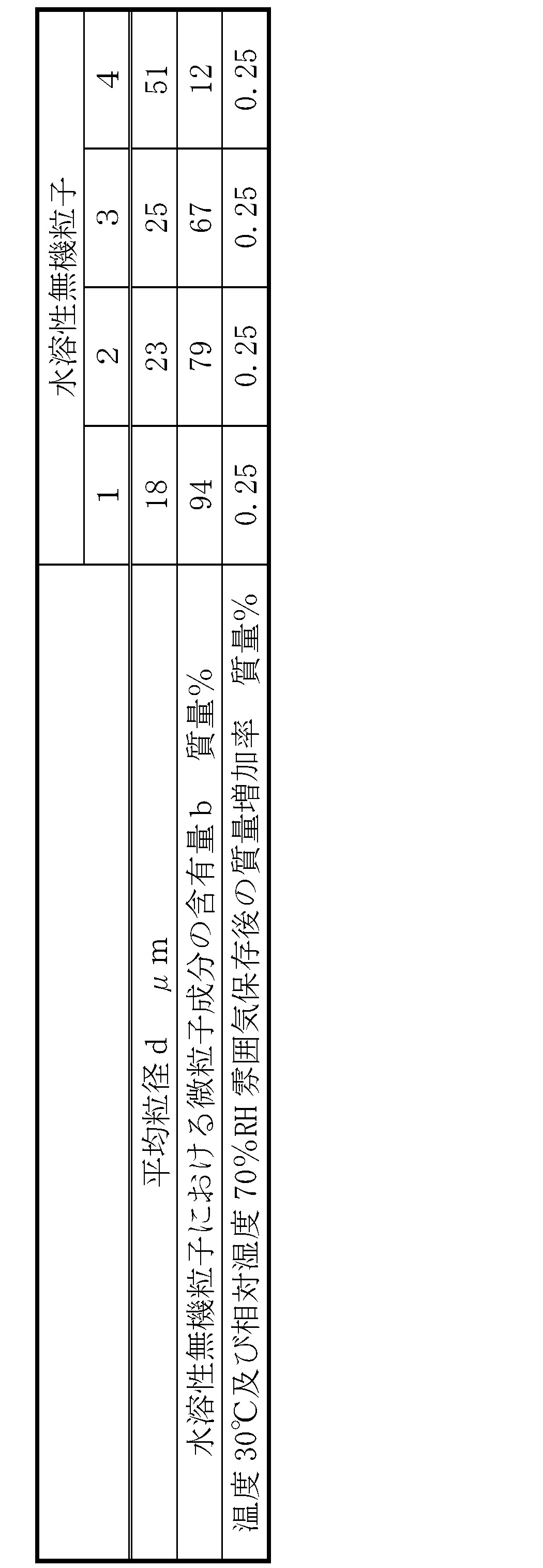
- the average particle diameters d of the obtained water-soluble inorganic particles 1 to 4 were 18 ⁇ m, 23 ⁇ m, 25 ⁇ m, and 51 ⁇ m, respectively.
- the content b of the fine particle component having a particle size of 30 ⁇ m or less in the water-soluble inorganic particles 1 to 4 was 94% by mass, 79% by mass, 67% by mass, and 12% by mass, respectively.
- the average particle size d and the content b of the fine particle components were determined by a laser diffraction / scattering method using a laser diffraction / scattering type particle size distribution measuring device (LA-920, manufactured by HORIBA, Ltd.).
- the mass increase rates were 0.25 mass%, 0.25 mass% and 0.25 mass, respectively. % And 0.25% by mass.
- Example 1 The above-mentioned surfactant-containing particles and water-soluble inorganic particles 1 are added to the container rotary powder mixer so that the respective amounts are 90.9% by mass (A) and 9.1% by mass (B), respectively. I put it in. That is, the input amount of the water-soluble inorganic particles 1 was set to 10% by mass of the input amount of the surfactant-containing particles.
- the container rotary powder mixer was operated to mix the surfactant-containing particles and the water-soluble inorganic particles 1 to obtain a granular detergent composition.
- the obtained granular detergent composition was designated as Example 1.
- the content b'of the fine particle component of the water-soluble inorganic particles 1 is 8.6% by mass, and is 9.5% by mass with respect to the content A of the surfactant-containing particles. %.
- the ratio (d / D) of the average particle size d of the water-soluble inorganic particles 1 to the average particle size D of the surfactant-containing particles is 0.06.
- Example 1 When the granular detergent composition of Example 1 was stored in an atmosphere of a temperature of 30 ° C. and a relative humidity of 70% RH for 1 week, the mass increase rate was 6.59 mass%.
- Example 2 The granular detergent composition obtained in the same manner as in Example 1 except that the water-soluble inorganic particles 2 were used instead of the water-soluble inorganic particles 1 was designated as Example 2.
- the content b'of the fine particle component of the water-soluble inorganic particles 2 is 7.2% by mass, and is 7.9% by mass with respect to the content A of the surfactant-containing particles. %.
- the ratio (d / D) of the average particle size d of the water-soluble inorganic particles 2 to the average particle size D of the surfactant-containing particles is 0.08.
- the mass increase rate of the granular detergent composition of Example 2 when stored in an atmosphere of a temperature of 30 ° C. and a relative humidity of 70% RH for 1 week was 6.64% by mass.
- Example 3 The granular detergent composition obtained in the same manner as in Example 1 except that the water-soluble inorganic particles 3 were used instead of the water-soluble inorganic particles 1 was designated as Example 3.
- the content b'of the fine particle component of the water-soluble inorganic particles 3 is 6.1% by mass, and is 6.7% by mass with respect to the content A of the surfactant-containing particles. %.
- the ratio (d / D) of the average particle size d of the water-soluble inorganic particles 3 to the average particle size D of the surfactant-containing particles is 0.09.
- the average particle size of the granular detergent composition of Example 3 was 289 ⁇ m. This average particle size was measured by a sieving method (the same applies to Examples 4 and 5 below and Comparative Examples).
- the coarse grain ratio of the granular detergent composition of Example 3 was 0.4% by mass.
- the fine powder ratio was 5.8% by mass.
- the bulk density was 411 g / L.
- the liquidity was 7.93 seconds.
- Example 3 When the granular detergent composition of Example 3 was stored in an atmosphere of a temperature of 30 ° C. and a relative humidity of 70% RH for 1 week, the mass increase rate was 7.03 mass%.
- Example 4 Obtained in the same manner as in Example 3 except that the ratios of the amounts of the surfactant-containing particles and the water-soluble inorganic particles 3 were 87.0% by mass (A) and 13.0% by mass (B), respectively.
- the granular detergent composition was designated as Example 4. That is, the input amount of the water-soluble inorganic particles 3 was set to 15% by mass of the input amount of the surfactant-containing particles.
- the content b'of the fine particle component of the water-soluble inorganic particles 3 is 8.7% by mass, and 10.0% by mass with respect to the content A of the surfactant-containing particles. %.
- the average particle size of the granular detergent composition of Example 4 was 283 ⁇ m.
- the coarse grain ratio was 0.4% by mass.
- the fine powder ratio was 9.0% by mass.
- the bulk density was 427 g / L.
- the liquidity was 8.88 seconds.
- Example 4 When the granular detergent composition of Example 4 was stored in an atmosphere of a temperature of 30 ° C. and a relative humidity of 70% RH for 1 week, the mass increase rate was 6.46 mass%.
- Example 5 Obtained in the same manner as in Example 3 except that the ratios of the amounts of the surfactant-containing particles and the water-soluble inorganic particles 3 were 83.3% by mass (A) and 16.7% by mass (B), respectively.
- the granular detergent composition was designated as Example 5. That is, the input amount of the water-soluble inorganic particles 3 was set to 20% by mass of the input amount of the surfactant-containing particles.
- the content b'of the fine particle component of the water-soluble inorganic particles 3 is 11.2% by mass, which is 13.4% by mass with respect to the content A of the surfactant-containing particles. %.
- the average particle size of the granular detergent composition of Example 5 was 279 ⁇ m.
- the coarse grain ratio was 0.2% by mass.
- the fine powder ratio was 11.8% by mass.
- the bulk density was 429 g / L.
- the liquidity was 9.18 seconds.
- the mass increase rate of the granular detergent composition of Example 5 when stored in an atmosphere of a temperature of 30 ° C. and a relative humidity of 70% RH for 1 week was 6.16% by mass.
- the content b'of the fine particle component of the water-soluble inorganic particles 4 is 2.0% by mass, and 2.4% by mass with respect to the content A of the surfactant-containing particles. Is.
- the ratio (d / D) of the average particle size d of the water-soluble inorganic particles 4 to the average particle size D of the surfactant-containing particles is 0.18.
- the average particle size of the granular detergent composition of the comparative example was 271 ⁇ m.
- the coarse grain ratio was 0.3% by mass.
- the fine powder ratio was 17.9% by mass.
- the bulk density was 447 g / L.
- the liquidity was 7.44 seconds.
- the mass increase rate of the granular detergent composition of the comparative example was 5.57 mass% when stored in an atmosphere of a temperature of 30 ° C. and a relative humidity of 70% RH for 1 week.
- the present invention is useful in the technical field of granular detergent compositions and methods for producing them.
Landscapes
- Chemical & Material Sciences (AREA)
- Life Sciences & Earth Sciences (AREA)
- Engineering & Computer Science (AREA)
- Chemical Kinetics & Catalysis (AREA)
- Oil, Petroleum & Natural Gas (AREA)
- Wood Science & Technology (AREA)
- Organic Chemistry (AREA)
- Inorganic Chemistry (AREA)
- Detergent Compositions (AREA)
Abstract
粒状洗剤組成物は、界面活性剤含有粒子と、水溶性無機粒子とを含有する。水溶性無機粒子は、粒子径が30μm以下の微粒子成分を含む。粒状洗剤組成物において、微粒子成分の含有量が界面活性剤含有粒子の含有量に対して3.0質量%以上である。
Description
本発明は、粒状洗剤組成物及びその製造方法に関する。
界面活性剤含有粒子の表面に無機粒子を付着させて表面改質した粒状洗剤組成物が知られている。例えば、特許文献1には、無機粒子として、ゼオライト等の水不溶性無機粉体を用いることが開示されている。特許文献2には、無機粒子として、表面処理した炭酸ナトリウム等の水溶性アルカリ無機塩核粒子を用いることが開示されている。特許文献3には、無機粒子として、酸化亜鉛粒子を用いることが開示されている。
本発明は、界面活性剤含有粒子と、水溶性無機粒子とを含有する粒状洗剤組成物であって、前記水溶性無機粒子は、粒子径が30μm以下の微粒子成分を含み、且つ前記粒状洗剤組成物において、前記微粒子成分の含有量が前記界面活性剤含有粒子の含有量に対して3.0質量%以上である。
本発明は、界面活性剤含有粒子と、水溶性無機粒子とを含有する粒状洗剤組成物の製造方法であって、前記界面活性剤含有粒子と、前記水溶性無機粒子とを混合し、前記水溶性無機粒子は、粒子径が30μm以下の微粒子成分を含み、且つ前記粒状洗剤組成物において、前記微粒子成分の含有量が前記界面活性剤含有粒子の含有量に対して3.0質量%以上である。
以下、実施形態について詳細に説明する。
実施形態に係る粒状洗剤組成物は、界面活性剤含有粒子と、水溶性無機粒子とを含有する。そして、水溶性無機粒子は、粒子径が30μm以下の微粒子成分を含み、且つ実施形態に係る粒状洗剤組成物において、その微粒子成分の含有量b’が界面活性剤含有粒子の含有量Aに対して3.0質量%以上である。ここで、本願における「水溶性」とは、20℃の水100gに溶解する質量が5g以上であることをいう。
実施形態に係る粒状洗剤組成物によれば、水溶性無機粒子が、粒子径が30μm以下の微粒子成分を含み、且つ実施形態に係る粒状洗剤組成物における微粒子成分の含有量b’が界面活性剤含有粒子の含有量Aに対して3.0質量%以上であることにより、優れた保存安定性を得ることができる。
これは、実施形態に係る粒状洗剤組成物において、水溶性無機粒子の微粒子成分の含有量b’が、界面活性剤含有粒子の含有量Aに対して3.0質量%以上であることに加え、その微粒子成分の粒子径が30μm以下であることから、微粒子成分が、ファン・デル・ワールス力の作用により、界面活性剤含有粒子の表面に十分に付着して表面改質するので、例えば高温・高湿の雰囲気下においても、界面活性剤含有粒子の表面での粘着性の発現が規制されるためであると考えられる。
<界面活性剤含有粒子>
界面活性剤含有粒子は、界面活性剤、ビルダー、再汚染防止剤、柔軟化剤、蛍光増白剤、抑泡剤、酵素、酵素安定化剤、着色剤、香料、及び水等を含有する。
界面活性剤含有粒子は、界面活性剤、ビルダー、再汚染防止剤、柔軟化剤、蛍光増白剤、抑泡剤、酵素、酵素安定化剤、着色剤、香料、及び水等を含有する。
界面活性剤としては、陰イオン界面活性剤、陽イオン界面活性剤、両性界面活性剤、及び非イオン界面活性剤が挙げられる。陰イオン界面活性剤としては、例えば、直鎖アルキルベンゼンスルホン酸ナトリウム、アルキル硫酸エステルナトリウム、ポリオキシエチレンアルキルエーテル硫酸ナトリウム、脂肪酸石ケン、アルキルエーテルカルボン酸塩等が挙げられる。陽イオン界面活性剤としては、例えば、脂肪族アミン塩、脂肪族四級アンモニウム塩等が挙げられる。非イオン界面活性剤としては、例えば、ポリオキシエチレンアルキルエーテル、ポリオキシエチレンアルキルフェニルエーテル等が挙げられる。両性界面活性剤としては、例えば、カルボキシベタイン型化合物、アミノカルボン酸塩等が挙げられる。界面活性剤は、これらのうちの1種のみを含んでいても、2種以上を組み合わせて含んでいても、どちらでもよい。界面活性剤含有粒子における界面活性剤の含有量は、例えば10質量%以上50質量%以下である。
ビルダーとしては、無機ビルダー及び有機ビルダーが挙げられる。無機ビルダーとしては、例えば、水酸化ナトリウム、ケイ酸ナトリウム、炭酸ナトリウム、硫酸ナトリウム、結晶性アルミノ珪酸塩、非晶質アルミノ珪酸塩等の水溶性無機塩類が挙げられる。有機ビルダーとしては、例えば、ニトリロトリ酢酸塩、エチレンジアミンテトラ酢酸塩等の水溶性有機酸塩類が挙げられる。界面活性剤含有粒子におけるビルダーの含有量は、例えば40質量%以上80質量%以下である。
再汚染防止剤としては、例えば、ポリアクリル酸塩、カルボキシメチルセルロース等が挙げられる。柔軟化剤としては、例えば、シリコーン類、粘土鉱物等が挙げられる。蛍光増白剤としては、例えば、ジモルホリノ型蛍光増白剤、ヒドロキシエチルアミノ型蛍光増白剤等が挙げられる。抑泡剤としては、例えば、石鹸、シリコーン等が挙げられる。酵素としては、例えば、プロテアーゼ、セルラーゼ等が挙げられる。酵素安定化剤としては、例えば、ホウ素化合物、カルシウムイオン供給化合物等が挙げられる。着色剤としては、例えば、無機顔料、有機顔料等が挙げられる。香料としては、例えば、メントール、ワニリン等が挙げられる。
実施形態に係る粒状洗剤組成物における界面活性剤含有粒子の含有量Aは、優れた洗浄性を得る観点から、好ましくは50質量%以上、より好ましくは60質量%以上であり、粒状洗剤組成物の優れた保存安定性を得る観点から、好ましくは95質量%以下、より好ましくは90質量%以下である。
界面活性剤含有粒子の平均粒径Dは、粉立ちを抑制するとともに流動性を向上させる観点から、好ましくは100μm以上、より好ましくは150μm以上であり、分級を抑制するとともに溶解性を向上させる観点から、好ましくは600μm以下、より好ましくは500μm以下である。この界面活性剤含有粒子の平均粒径Dは、JIS K 8801の標準篩(目開き45μm、63μm、90μm、125μm、180μm、250μm、355μm、500μm、710μm、1000μm、1410μm、2000μm)を用いて5分間振動させた後、篩目のサイズによる重量分率から体積基準平均粒径を算出する、ふるい分け法で測定される。
界面活性剤含有粒子における粒子径が1000μm以上の質量割合である粗粒率は、分級を抑制するとともに溶解性を向上させる観点から、好ましくは20質量%以下、より好ましくは10質量%以下、更に好ましくは5質量%以下、更に好ましくは1質量%以下である。界面活性剤含有粒子における粒子径が125μm未満の質量割合である微粉率は、粉立ちを抑制するとともに流動性を向上させる観点から、好ましくは40質量%以下、より好ましくは30質量%以下、更に好ましくは20質量%以下、更に好ましくは10質量%以下である。
界面活性剤含有粒子の粗粒率及び微粉率は、以下のようにして求められる。JIS Z8801-1:2019に記載された目開きが45μm、63μm、90μm、125μm、180μm、250μm、355μm、500μm、710μm、1000μm、1410μm、2000μmの12個のふるいを準備する。この12個のふるいを、受け皿上に、下から上に順に目開きが大きくなるように積み重ねる。最上位の目開きが2000μmのふるいの上に100gの界面活性剤含有粒子を投下した後、12個のふるいを5分間振動させる。各ふるい及び受け皿上の界面活性剤含有粒子の質量を測定する。そして、目開きが1000μm、1410μm、及び2000μmの3個のふるい上の界面活性剤含有粒子の質量を合算し、最初に投入した100gに対する、その質量割合を粗粒率とする。また、受け皿上、並びに目開きが45μm、63μm、及び90μmの3個のふるい上の界面活性剤含有粒子の質量を合算し、最初に投入した100gに対する、その質量割合を微粉率とする。
界面活性剤含有粒子の嵩密度は、良好な使用感を得るとともに溶解性を向上させる観点から、好ましくは250g/L以上、より好ましくは300g/L以上であり、良好な使用感を得る観点から、好ましくは700g/L以下、より好ましくは600g/L以下である。この界面活性剤含有粒子の嵩密度は、JIS K3362:2008に基づいて見掛け密度として測定される。
JIS K3362:2008に記載された見掛け密度測定用のホッパーから、100mLの界面活性剤含有粒子が流出するのに要する時間を界面活性剤含有粒子の流動性としたとき、界面活性剤含有粒子の流動性は、良好な取り扱い性を得る観点から、好ましくは4秒以上、より好ましくは5秒以上であり、同様の観点から、好ましくは20秒以下、より好ましくは12秒以下、更に好ましくは8秒以下である。
界面活性剤含有粒子は、例えば、噴霧乾燥法、ドライ中和法、乾燥造粒法、ドライブレンド法、流動層乾燥法、薄膜乾燥法、押出し造粒法、転動造粒法、攪拌造粒法、圧密造粒法、界面活性剤担持法、又は、これらを組み合わせた方法により調製することができる。なかでも、噴霧乾燥法により調製することが好ましい。
<水溶性無機粒子>
水溶性無機粒子を形成する水溶性無機物質としては、例えば、硫酸ナトリウム(芒硝)、炭酸ナトリウム、炭酸水素ナトリウム(重曹)等の無機塩が挙げられる。水溶性無機粒子を形成する水溶性無機物質は、これらのうちの1種又は2種以上を含むことが好ましく、硫酸ナトリウムを含むことがより好ましい。
水溶性無機粒子を形成する水溶性無機物質としては、例えば、硫酸ナトリウム(芒硝)、炭酸ナトリウム、炭酸水素ナトリウム(重曹)等の無機塩が挙げられる。水溶性無機粒子を形成する水溶性無機物質は、これらのうちの1種又は2種以上を含むことが好ましく、硫酸ナトリウムを含むことがより好ましい。
水溶性無機粒子は、粒状洗剤組成物の優れた保存安定性を得る観点から、水溶性無機物質の粉砕物であることが好ましい。水溶性無機粒子の粉砕物は、水溶性無機物質を粉砕することにより調製することができる。水溶性無機粒子の粉砕方法は、例えば、ロールミル、ジェットミル、高速回転式ミル等を用いる乾式粉砕法が好ましい。
実施形態に係る粒状洗剤組成物における水溶性無機粒子の含有量Bは、粒状洗剤組成物の優れた保存安定性を得る観点から、好ましくは5質量%以上、より好ましくは10質量%以上であり、粉立ちを抑制するとともに流動性を向上させる観点から、好ましくは40質量%以下、より好ましくは30質量%以下である。
実施形態に係る粒状洗剤組成物における水溶性無機粒子の含有量Bは、粒状洗剤組成物の優れた保存安定性を得る観点から、界面活性剤含有粒子の含有量Aに対し、好ましくは5質量%以上、より好ましくは10質量%以上である。
水溶性無機粒子の平均粒径dは、好ましくは100μm以下であり、粒状洗剤組成物の優れた保存安定性を得る観点から、より好ましくは40μm以下、更に好ましくは30μm以下、更に好ましくは24μm以下、更に好ましくは20μm以下である。この水溶性無機粒子の平均粒径dは、体積基準平均粒径であって、レーザー回折/散乱式粒度分布測定装置(例えば、堀場製作所社製のLA-920)を用いたレーザー回折散乱法により測定される。
界面活性剤含有粒子の平均粒径Dに対する水溶性無機粒子の平均粒径dの比(d/D)は、粒状洗剤組成物の優れた保存安定性を得る観点から、好ましくは0.17以下、より好ましくは0.085以下である。
水溶性無機粒子は、粒子径が30μm以下の微粒子成分を含む。水溶性無機粒子における微粒子成分の含有量bは、粒状洗剤組成物の優れた保存安定性を得る観点から、好ましくは4質量%以上、より好ましくは13質量%以上、更に好ましくは30質量%以上、更に好ましくは50質量%以上、更に好ましくは70質量%以上であり、好ましくは100質量%以下、より好ましくは98質量%以下である。水溶性無機粒子における微粒子成分の含有量bは、例えばレーザー回折/散乱式粒度分布測定装置(例えば、堀場製作所社製のLA-920)を用いたレーザー回折散乱法により得られる粒度分布から求められる。
実施形態に係る粒状洗剤組成物における水溶性無機粒子の微粒子成分の含有量b’は、界面活性剤含有粒子の含有量Aに対して3.0質量%以上であるが、粒状洗剤組成物の優れた保存安定性を得る観点から、好ましくは3.5質量%以上、より好ましくは4.0質量%以上、更に好ましくは5.0質量%以上、更に好ましくは7.0質量%以上、更に好ましくは7.5質量%以上であり、粉立ちを抑制するとともに流動性を向上させる観点から、好ましくは30質量%以下、より好ましくは20質量%以下、更に好ましくは15質量%以下である。
水溶性無機粒子を、温度30℃及び相対湿度70%RHの雰囲気下に1週間保存したときの質量増加率は、優れた保存安定性を得る観点から、水溶性無機粒子の保存開始時の含水量によらず、好ましくは20質量%以下、より好ましくは5質量%以下、更に好ましくは1質量%以下、更に好ましくは0.5質量%以下であり、0.01質量%以上が好ましく、0.1質量%以上がより好ましい。
<粒状洗剤組成物>
実施形態に係る粒状洗剤組成物は、界面活性剤含有粒子及び水溶性無機粒子以外の洗剤成分を含有していてもよい。
実施形態に係る粒状洗剤組成物は、界面活性剤含有粒子及び水溶性無機粒子以外の洗剤成分を含有していてもよい。
実施形態に係る粒状洗剤組成物の平均粒径は、粉立ちを抑制するとともに流動性を向上させる観点から、好ましくは100μm以上、より好ましくは150μm以上であり、分級を抑制するとともに溶解性を向上させる観点から、好ましくは600μm以下、より好ましくは500μm以下である。この粒状洗剤組成物の平均粒径も、体積基準平均粒径であって、界面活性剤含有粒子の平均粒径Dと同様の方法により測定される。
実施形態に係る粒状洗剤組成物における粒子径が1000μm以上の質量割合である粗粒率は、分級を抑制するとともに溶解性を向上させる観点から、好ましくは20質量%以下、より好ましくは10質量%以下、更に好ましくは5質量%以下、更に好ましくは1質量%以下である。実施形態に係る粒状洗剤組成物における粒子径が125μm未満の質量割合である微粉率は、粉立ちを抑制するとともに流動性を向上させる観点から、好ましくは40質量%以下、より好ましくは30質量%以下、更に好ましくは20質量%以下、更に好ましくは10質量%以下である。実施形態に係る粒状洗剤組成物の粗粒率及び微粉率は、界面活性剤含有粒子の粗粒率及び微粉率と同様の方法により測定される。
実施形態に係る粒状洗剤組成物の嵩密度は、良好な使用感を得るとともに溶解性を向上させる観点から、好ましくは250g/L以上、より好ましくは300g/L以上であり、良好な使用感を得る観点から、好ましくは700g/L以下、より好ましくは600g/L以下である。実施形態に係る粒状洗剤組成物の嵩密度は、界面活性剤含有粒子の嵩密度と同様の方法により測定される。
実施形態に係る粒状洗剤組成物の流動性は、良好な取り扱い性を得る観点から、好ましくは4秒以上であり、同様の観点から、好ましくは20秒以下、より好ましくは12秒以下である。実施形態に係る粒状洗剤組成物の流動性は、界面活性剤含有粒子の流動性と同様の方法により測定される。
実施形態に係る粒状洗剤組成物は、例えば噴霧乾燥法により界面活性剤含有粒子を調製するとともに、水溶性無機物質を乾式粉砕することにより水溶性無機粒子を調製した後、それらの界面活性剤含有粒子と水溶性無機粒子とを混合することにより製造することができる。
界面活性剤含有粒子と水溶性無機粒子とを混合する混合機としては、例えば、解砕機構を有する縦型造粒機、解砕機構を有する横型造粒機、ブレードを有する容器回転型混合機(ドラム型混合機、パン型混合機)等が挙げられる。混合機は、回分式であっても、連続式であっても、どちらでもよい。
上述した実施形態に関し、更に以下の構成を開示する。
<1>界面活性剤含有粒子と、水溶性無機粒子とを含有する粒状洗剤組成物であって、
前記水溶性無機粒子は、粒子径が30μm以下の微粒子成分を含み、且つ前記粒状洗剤組成物において、前記微粒子成分の含有量が前記界面活性剤含有粒子の含有量に対して3.0質量%以上である粒状洗剤組成物。
前記水溶性無機粒子は、粒子径が30μm以下の微粒子成分を含み、且つ前記粒状洗剤組成物において、前記微粒子成分の含有量が前記界面活性剤含有粒子の含有量に対して3.0質量%以上である粒状洗剤組成物。
<2>前記粒状洗剤組成物における前記界面活性剤含有粒子の含有量が、好ましくは50質量%以上、より好ましくは60質量%以上であり、好ましくは95質量%以下、より好ましくは90質量%以下である<1>に記載された粒状洗剤組成物。
<3>前記界面活性剤含有粒子の平均粒径が、好ましくは100μm以上、より好ましくは150μm以上であり、好ましくは600μm以下、より好ましくは500μm以下である<1>又は<2>に記載された粒状洗剤組成物。
<4>前記界面活性剤含有粒子における粒子径が1000μm以上の質量割合である粗粒率が、好ましくは20質量%以下、より好ましくは10質量%以下、更に好ましくは5質量%以下、更に好ましくは1質量%以下である<1>乃至<3>のいずれかに記載された粒状洗剤組成物。
<5>前記界面活性剤含有粒子における粒子径が125μm未満の質量割合である微粉率が、好ましくは40質量%以下、より好ましくは30質量%以下、更に好ましくは20質量%以下、更に好ましくは10質量%以下である<1>乃至<4>のいずれかに記載された粒状洗剤組成物。
<6>前記界面活性剤含有粒子の嵩密度が、好ましくは250g/L以上、より好ましくは300g/L以上であり、好ましくは700g/L以下、より好ましくは600g/L以下である<1>乃至<5>のいずれかに記載された粒状洗剤組成物。
<7>前記水溶性無機粒子を形成する水溶性無機物質が、硫酸ナトリウム、炭酸ナトリウム、及び炭酸水素ナトリウムのうちの1種又は2種以上を含む<1>乃至<6>のいずれかに記載された粒状洗剤組成物。
<8>前記水溶性無機粒子を形成する水溶性無機物質が硫酸ナトリウムを含む<7>に記載された粒状洗剤組成物。
<9>前記水溶性無機粒子が水溶性無機物質の粉砕物である<1>乃至<8>のいずれかに記載された粒状洗剤組成物。
<10>前記粒状洗剤組成物における前記水溶性無機粒子の含有量が、好ましくは5質量%以上、より好ましくは10質量%以上であり、好ましくは40質量%以下、より好ましくは30質量%以下である<1>乃至<9>のいずれかに記載された粒状洗剤組成物。
<11>前記粒状洗剤組成物における前記水溶性無機粒子の含有量が、前記界面活性剤含有粒子の含有量に対し、好ましくは5質量%以上、より好ましくは10質量%以上である<1>乃至<10>のいずれかに記載された粒状洗剤組成物。
<12>前記水溶性無機粒子の平均粒径が、好ましくは100μm以下であり、より好ましくは40μm以下、更に好ましくは30μm以下、更に好ましくは24μm以下、更に好ましくは20μm以下である<1>乃至<11>のいずれかに記載された粒状洗剤組成物。
<13>前記界面活性剤含有粒子の平均粒径に対する前記水溶性無機粒子の平均粒径の比が、好ましくは0.17以下、より好ましくは0.085以下である<1>乃至<12>のいずれかに記載された粒状洗剤組成物。
<14>前記水溶性無機粒子における前記微粒子成分の含有量が、好ましくは4質量%以上、より好ましくは13質量%以上、更に好ましくは30質量%以上、更に好ましくは50質量%以上、更に好ましくは70質量%以上であり、好ましくは100質量%以下、より好ましくは98質量%以下である<1>乃至<13>のいずれかに記載された粒状洗剤組成物。
<15>前記粒状洗剤組成物における前記水溶性無機粒子の前記微粒子成分の含有量が、前記界面活性剤含有粒子の含有量に対し、好ましくは3.5質量%以上、より好ましくは4.0質量%以上、更に好ましくは5.0質量%以上、更に好ましくは7.0質量%以上、更に好ましくは7.5質量%以上であり、好ましくは30質量%以下、より好ましくは20質量%以下、更に好ましくは15質量%以下である<1>乃至<14>のいずれかに記載された粒状洗剤組成物。
<16>前記水溶性無機粒子は、温度30℃及び相対湿度70%RHの雰囲気下に1週間保存したときの質量増加率が、前記水溶性無機粒子の保存開始時の含水量によらず、好ましくは20質量%以下、より好ましくは5質量%以下、更に好ましくは1質量%以下、更に好ましくは0.5質量%以下であり、好ましくは0.01質量%以上、より好ましくは0.1質量%以上である<1>乃至<15>のいずれかに記載された粒状洗剤組成物。
<17>前記粒状洗剤組成物の平均粒径が、好ましくは100μm以上、より好ましくは150μm以上であり、好ましくは600μm以下、より好ましくは500μm以下である<1>乃至<16>のいずれかに記載された粒状洗剤組成物。
<18>前記粒状洗剤組成物における粒子径が1000μm以上の質量割合である粗粒率が、好ましくは20質量%以下、より好ましくは10質量%以下、更に好ましくは5質量%以下、更に好ましくは1質量%以下である<1>乃至<17>のいずれかに記載された粒状洗剤組成物。
<19>前記粒状洗剤組成物における粒子径が125μm未満の質量割合である微粉率が、好ましくは40質量%以下、より好ましくは30質量%以下、更に好ましくは20質量%以下、更に好ましくは10質量%以下である<1>乃至<18>のいずれかに記載された粒状洗剤組成物。
<20>前記実施形態に係る粒状洗剤組成物の嵩密度は、好ましくは250g/L以上、より好ましくは300g/L以上であり、好ましくは700g/L以下、より好ましくは600g/L以下である<1>乃至<19>のいずれかに記載された粒状洗剤組成物。
<21>界面活性剤含有粒子と、水溶性無機粒子とを含有する粒状洗剤組成物の製造方法であって、
前記界面活性剤含有粒子と、前記水溶性無機粒子とを混合し、
前記水溶性無機粒子は、粒子径が30μm以下の微粒子成分を含み、且つ前記粒状洗剤組成物において、前記微粒子成分の含有量が前記界面活性剤含有粒子の含有量に対して3.0質量%以上である粒状洗剤組成物の製造方法。
前記界面活性剤含有粒子と、前記水溶性無機粒子とを混合し、
前記水溶性無機粒子は、粒子径が30μm以下の微粒子成分を含み、且つ前記粒状洗剤組成物において、前記微粒子成分の含有量が前記界面活性剤含有粒子の含有量に対して3.0質量%以上である粒状洗剤組成物の製造方法。
<22>前記水溶性無機粒子を、水溶性無機物質を粉砕することにより調製する<21>に記載された粒状洗剤組成物の製造方法。
<23>前記界面活性剤含有粒子を噴霧乾燥法により調製する<21>又は<22>に記載された粒状洗剤組成物の製造方法。
(界面活性剤含有粒子)
以下の界面活性剤含有粒子を調製した。その構成は表1にも示す。
以下の界面活性剤含有粒子を調製した。その構成は表1にも示す。
ドデシルベンゼンスルホン酸ナトリウム(LAS-Na)、ラウリル硫酸ナトリウム(AS-Na)、ポリオキシエチレン(2)ラウリルエーテル硫酸ナトリウム(ES-Na)、水酸化ナトリウム、ケイ酸ナトリウム、炭酸ナトリウム、硫酸ナトリウム、重量平均分子量が1万であるポリエチレングリコール (PEG)、重量平均分子量が1万であるポリアクリル酸ナトリウムの40質量%水溶液、及び蛍光増白剤を含有するとともに、残部を水とするスラリーを作製し、これを噴霧乾燥させて界面活性剤含有粒子を得た。
得られた界面活性剤含有粒子における各成分の含有量は表1に示す通りである。
界面活性剤含有粒子の平均粒径Dは289μmであった。この平均粒径Dは、ふるい分け法により測定した。
界面活性剤含有粒子の粗粒率は0.3質量%であった。微粉率は2.5質量%であった。嵩密度は413g/Lであった。流動性は5.95秒であった。これらの粗粒率、微粉率、嵩密度、及び流動性は、上記実施形態に記載の方法で測定した。
界面活性剤含有粒子を、温度30℃及び相対湿度70%RHの雰囲気下に1週間保存したときの質量増加率は5.4質量%であった。

(水溶性無機粒子)
硫酸ナトリウムを、4水準の粉砕度で乾式粉砕して4種の粉砕物を調製した。それらの4種の粉砕物を粉砕度の高い順に水溶性無機粒子1乃至4とした。それぞれの構成は表2にも示す。
硫酸ナトリウムを、4水準の粉砕度で乾式粉砕して4種の粉砕物を調製した。それらの4種の粉砕物を粉砕度の高い順に水溶性無機粒子1乃至4とした。それぞれの構成は表2にも示す。
得られた水溶性無機粒子1乃至4の平均粒径dは、それぞれ18μm、23μm、25μm、及び51μmであった。水溶性無機粒子1乃至4における粒子径が30μm以下の微粒子成分の含有量bは、それぞれ94質量%、79質量%、67質量%、及び12質量%であった。これらの平均粒径d及び微粒子成分の含有量bは、レーザー回折/散乱式粒度分布測定装置(LA-920 堀場製作所社製)を用いたレーザー回折散乱法により求めた。
水溶性無機粒子1乃至4を、温度30℃及び相対湿度70%RHの雰囲気下に1週間保存したときの質量増加率は、それぞれ0.25質量%、0.25質量%、0.25質量%、及び0.25質量%であった。
(粒状洗剤組成物)
以下の実施例1乃至5及び比較例の粒状洗剤組成物を作製した。それぞれの構成は表3にも示す。
以下の実施例1乃至5及び比較例の粒状洗剤組成物を作製した。それぞれの構成は表3にも示す。
<実施例1>
容器回転式粉体混合機に、上記界面活性剤含有粒子及び水溶性無機粒子1を、それぞれの量の割合が90.9質量%(A)及び9.1質量%(B)となるように投入した。つまり、水溶性無機粒子1の投入量を界面活性剤含有粒子の投入量の10質量%とした。容器回転式粉体混合機を稼働させて界面活性剤含有粒子と水溶性無機粒子1とを混合して粒状洗剤組成物を得た。得られた粒状洗剤組成物を実施例1とした。
容器回転式粉体混合機に、上記界面活性剤含有粒子及び水溶性無機粒子1を、それぞれの量の割合が90.9質量%(A)及び9.1質量%(B)となるように投入した。つまり、水溶性無機粒子1の投入量を界面活性剤含有粒子の投入量の10質量%とした。容器回転式粉体混合機を稼働させて界面活性剤含有粒子と水溶性無機粒子1とを混合して粒状洗剤組成物を得た。得られた粒状洗剤組成物を実施例1とした。
実施例1の粒状洗剤組成物では、水溶性無機粒子1の微粒子成分の含有量b’は、8.6質量%であって、界面活性剤含有粒子の含有量Aに対して9.5質量%である。界面活性剤含有粒子の平均粒径Dに対する水溶性無機粒子1の平均粒径dの比(d/D)は0.06である。
実施例1の粒状洗剤組成物を、温度30℃及び相対湿度70%RHの雰囲気下に1週間保存したときの質量増加率は6.59質量%であった。
<実施例2>
水溶性無機粒子1に代えて水溶性無機粒子2を用いたことを除いて実施例1と同様にして得た粒状洗剤組成物を実施例2とした。
水溶性無機粒子1に代えて水溶性無機粒子2を用いたことを除いて実施例1と同様にして得た粒状洗剤組成物を実施例2とした。
実施例2の粒状洗剤組成物では、水溶性無機粒子2の微粒子成分の含有量b’は、7.2質量%であって、界面活性剤含有粒子の含有量Aに対して7.9質量%である。界面活性剤含有粒子の平均粒径Dに対する水溶性無機粒子2の平均粒径dの比(d/D)は0.08である。
実施例2の粒状洗剤組成物を、温度30℃及び相対湿度70%RHの雰囲気下に1週間保存したときの質量増加率は6.64質量%であった。
<実施例3>
水溶性無機粒子1に代えて水溶性無機粒子3を用いたことを除いて実施例1と同様にして得た粒状洗剤組成物を実施例3とした。
水溶性無機粒子1に代えて水溶性無機粒子3を用いたことを除いて実施例1と同様にして得た粒状洗剤組成物を実施例3とした。
実施例3の粒状洗剤組成物では、水溶性無機粒子3の微粒子成分の含有量b’は、6.1質量%であって、界面活性剤含有粒子の含有量Aに対して6.7質量%である。界面活性剤含有粒子の平均粒径Dに対する水溶性無機粒子3の平均粒径dの比(d/D)は0.09である。
実施例3の粒状洗剤組成物の平均粒径は289μmであった。この平均粒径は、ふるい分け法により測定した(以下の実施例4及び5並びに比較例も同様)。
実施例3の粒状洗剤組成物の粗粒率は0.4質量%であった。微粉率は5.8質量%であった。嵩密度は411g/Lであった。流動性は7.93秒であった。これらの粗粒率、微粉率、嵩密度、及び流動性は、上記実施形態に記載の方法で測定した(以下の実施例4及び5並びに比較例も同様)。
実施例3の粒状洗剤組成物を、温度30℃及び相対湿度70%RHの雰囲気下に1週間保存したときの質量増加率は7.03質量%であった。
<実施例4>
上記界面活性剤含有粒子及び水溶性無機粒子3の量の割合を、それぞれ87.0質量%(A)及び13.0質量%(B)としたことを除いて実施例3と同様にして得た粒状洗剤組成物を実施例4とした。つまり、水溶性無機粒子3の投入量を界面活性剤含有粒子の投入量の15質量%とした。
上記界面活性剤含有粒子及び水溶性無機粒子3の量の割合を、それぞれ87.0質量%(A)及び13.0質量%(B)としたことを除いて実施例3と同様にして得た粒状洗剤組成物を実施例4とした。つまり、水溶性無機粒子3の投入量を界面活性剤含有粒子の投入量の15質量%とした。
実施例4の粒状洗剤組成物では、水溶性無機粒子3の微粒子成分の含有量b’は、8.7質量%であって、界面活性剤含有粒子の含有量Aに対して10.0質量%である。
実施例4の粒状洗剤組成物の平均粒径は283μmであった。粗粒率は0.4質量%であった。微粉率は9.0質量%であった。嵩密度は427g/Lであった。流動性は8.88秒であった。
実施例4の粒状洗剤組成物を、温度30℃及び相対湿度70%RHの雰囲気下に1週間保存したときの質量増加率は6.46質量%であった。
<実施例5>
上記界面活性剤含有粒子及び水溶性無機粒子3の量の割合を、それぞれ83.3質量%(A)及び16.7質量%(B)としたことを除いて実施例3と同様にして得た粒状洗剤組成物を実施例5とした。つまり、水溶性無機粒子3の投入量を界面活性剤含有粒子の投入量の20質量%とした。
上記界面活性剤含有粒子及び水溶性無機粒子3の量の割合を、それぞれ83.3質量%(A)及び16.7質量%(B)としたことを除いて実施例3と同様にして得た粒状洗剤組成物を実施例5とした。つまり、水溶性無機粒子3の投入量を界面活性剤含有粒子の投入量の20質量%とした。
実施例5の粒状洗剤組成物では、水溶性無機粒子3の微粒子成分の含有量b’は、11.2質量%であって、界面活性剤含有粒子の含有量Aに対して13.4質量%である。
実施例5の粒状洗剤組成物の平均粒径は279μmであった。粗粒率は0.2質量%であった。微粉率は11.8質量%であった。嵩密度は429g/Lであった。流動性は9.18秒であった。
実施例5の粒状洗剤組成物を、温度30℃及び相対湿度70%RHの雰囲気下に1週間保存したときの質量増加率は6.16質量%であった。
<比較例>
水溶性無機粒子3に代えて水溶性無機粒子4を用いたことを除いて実施例5と同様にして得た粒状洗剤組成物を比較例とした。
水溶性無機粒子3に代えて水溶性無機粒子4を用いたことを除いて実施例5と同様にして得た粒状洗剤組成物を比較例とした。
比較例の粒状洗剤組成物では、水溶性無機粒子4の微粒子成分の含有量b’は、2.0質量%であって、界面活性剤含有粒子の含有量Aに対して2.4質量%である。界面活性剤含有粒子の平均粒径Dに対する水溶性無機粒子4の平均粒径dの比(d/D)は0.18である。
比較例の粒状洗剤組成物の平均粒径は271μmであった。粗粒率は0.3質量%であった。微粉率は17.9質量%であった。嵩密度は447g/Lであった。流動性は7.44秒であった。
比較例の粒状洗剤組成物を、温度30℃及び相対湿度70%RHの雰囲気下に1週間保存したときの質量増加率は5.57質量%であった。

(保存安定性試験)
濾紙(ADVANTEC社製、No.2)で長さ15cm×幅9cm×高さ6cmの天部のない箱を作り、四隅をステープラーでとめる。実施例1乃至5及び比較例のそれぞれの粒状洗剤組成物を箱に200g入れ、温度30℃及び相対湿度70%RHの雰囲気下に1週間保存した。その後、目開きが4760μmのふるいに通し、そのケーキングレベルを次のように評価した。
濾紙(ADVANTEC社製、No.2)で長さ15cm×幅9cm×高さ6cmの天部のない箱を作り、四隅をステープラーでとめる。実施例1乃至5及び比較例のそれぞれの粒状洗剤組成物を箱に200g入れ、温度30℃及び相対湿度70%RHの雰囲気下に1週間保存した。その後、目開きが4760μmのふるいに通し、そのケーキングレベルを次のように評価した。
SA:塊無し(ふるい透過率=100%)
A:小さな塊有り(80%≦ふるい透過率<100%)
B:塊有るが、容易に崩れる(60%≦ふるい透過率<80%)
C: 大きな塊有り、崩れない(ふるい透過率<60%)
結果を表3に示す。表3の結果によれば、実施例1乃至5は、比較例よりも、ふるい透過率が高い、つまり、表面粘着による経時的な大粒径化が抑制されており、そのため保存安定性が優れることが分かる。
A:小さな塊有り(80%≦ふるい透過率<100%)
B:塊有るが、容易に崩れる(60%≦ふるい透過率<80%)
C: 大きな塊有り、崩れない(ふるい透過率<60%)
結果を表3に示す。表3の結果によれば、実施例1乃至5は、比較例よりも、ふるい透過率が高い、つまり、表面粘着による経時的な大粒径化が抑制されており、そのため保存安定性が優れることが分かる。
本発明は、粒状洗剤組成物及びその製造方法の技術分野について有用である。
Claims (14)
- 界面活性剤含有粒子と、水溶性無機粒子とを含有する粒状洗剤組成物であって、
前記水溶性無機粒子は、粒子径が30μm以下の微粒子成分を含み、且つ前記粒状洗剤組成物において、前記微粒子成分の含有量が前記界面活性剤含有粒子の含有量に対して3.0質量%以上である粒状洗剤組成物。 - 前記水溶性無機粒子が水溶性無機物質の粉砕物である請求項1に記載された粒状洗剤組成物。
- 前記水溶性無機粒子は、温度30℃及び相対湿度70%RHの雰囲気下に1週間保存したときの質量増加率が、前記水溶性無機粒子の保存開始時の含水量によらず、20質量%以下である請求項1又は2に記載された粒状洗剤組成物。
- 前記水溶性無機粒子を形成する水溶性無機物質が硫酸ナトリウムを含む請求項1乃至3のいずれかに記載された粒状洗剤組成物。
- 前記水溶性無機粒子の平均粒径が24μm以下である請求項1乃至4のいずれかに記載された粒状洗剤組成物。
- 前記界面活性剤含有粒子の平均粒径に対する前記水溶性無機粒子の平均粒径の比が0.17以下である請求項1乃至5のいずれかに記載された粒状洗剤組成物。
- 前記水溶性無機粒子における前記微粒子成分の含有量が13質量%以上である請求項1乃至6のいずれかに記載された粒状洗剤組成物。
- 前記水溶性無機粒子における前記微粒子成分の含有量が50質量%以上である請求項7に記載された粒状洗剤組成物。
- 前記水溶性無機粒子における前記微粒子成分の含有量が70質量%以上である請求項8に記載された粒状洗剤組成物。
- 前記粒状洗剤組成物における前記水溶性無機粒子の前記微粒子成分の含有量が、前記界面活性剤含有粒子の含有量に対して7.5質量%以上15質量%以下である請求項1乃至9のいずれかに記載された粒状洗剤組成物。
- 前記粒状洗剤組成物における前記水溶性無機粒子の含有量が10質量%以上40質量%以下である請求項1乃至10のいずれかに記載された粒状洗剤組成物。
- 界面活性剤含有粒子と、水溶性無機粒子とを含有する粒状洗剤組成物の製造方法であって、
前記界面活性剤含有粒子と、前記水溶性無機粒子とを混合し、
前記水溶性無機粒子は、粒子径が30μm以下の微粒子成分を含み、且つ前記粒状洗剤組成物において、前記微粒子成分の含有量が前記界面活性剤含有粒子の含有量に対して3.0質量%以上である粒状洗剤組成物の製造方法。 - 前記水溶性無機粒子を、水溶性無機物質を粉砕することにより調製する請求項12に記載された粒状洗剤組成物の製造方法。
- 前記界面活性剤含有粒子を噴霧乾燥法により調製する請求項12又は13に記載された粒状洗剤組成物の製造方法。
Priority Applications (1)
| Application Number | Priority Date | Filing Date | Title |
|---|---|---|---|
| CN202180086629.0A CN116601274B (zh) | 2021-01-07 | 2021-12-17 | 粒状洗涤剂组合物 |
Applications Claiming Priority (2)
| Application Number | Priority Date | Filing Date | Title |
|---|---|---|---|
| JP2021001232A JP7368399B2 (ja) | 2021-01-07 | 2021-01-07 | 粒状洗剤組成物 |
| JP2021-001232 | 2021-01-07 |
Publications (1)
| Publication Number | Publication Date |
|---|---|
| WO2022149441A1 true WO2022149441A1 (ja) | 2022-07-14 |
Family
ID=82357293
Family Applications (1)
| Application Number | Title | Priority Date | Filing Date |
|---|---|---|---|
| PCT/JP2021/046805 Ceased WO2022149441A1 (ja) | 2021-01-07 | 2021-12-17 | 粒状洗剤組成物 |
Country Status (3)
| Country | Link |
|---|---|
| JP (1) | JP7368399B2 (ja) |
| CN (1) | CN116601274B (ja) |
| WO (1) | WO2022149441A1 (ja) |
Citations (7)
| Publication number | Priority date | Publication date | Assignee | Title |
|---|---|---|---|---|
| JP2006016440A (ja) * | 2004-06-30 | 2006-01-19 | Lion Corp | 粒状洗剤組成物 |
| JP2010254768A (ja) * | 2009-04-22 | 2010-11-11 | Lion Corp | 粒状洗剤組成物の製造方法 |
| JP2013249407A (ja) * | 2012-06-01 | 2013-12-12 | Lion Corp | 粒状洗剤の製造方法 |
| JP2014005367A (ja) * | 2012-06-25 | 2014-01-16 | Lion Corp | 粒状洗浄剤 |
| JP2014193964A (ja) * | 2013-03-29 | 2014-10-09 | Lion Corp | 粒状洗剤組成物 |
| WO2016047788A1 (ja) * | 2014-09-26 | 2016-03-31 | ライオン株式会社 | 粒状洗剤及び洗剤製品 |
| JP2018065973A (ja) * | 2016-10-21 | 2018-04-26 | ライオン株式会社 | 粒状洗剤 |
Family Cites Families (5)
| Publication number | Priority date | Publication date | Assignee | Title |
|---|---|---|---|---|
| JP4753021B2 (ja) * | 2003-04-24 | 2011-08-17 | ライオン株式会社 | 表面処理水溶性無機化合物粒子及びその製造方法、並びに粒状洗剤組成物 |
| KR101134997B1 (ko) * | 2004-06-30 | 2012-04-09 | 라이온 가부시키가이샤 | 높은 벌크밀도의 입상 세제 조성물 및 그 제조 방법 |
| JP5631127B2 (ja) * | 2010-09-06 | 2014-11-26 | 花王株式会社 | 洗剤粒子群の製造方法 |
| JP2012107165A (ja) * | 2010-11-19 | 2012-06-07 | Kao Corp | 洗剤粒子群の製造方法 |
| CN103547665B (zh) * | 2011-05-18 | 2016-04-13 | 花王株式会社 | 洗涤剂颗粒群的制造方法 |
-
2021
- 2021-01-07 JP JP2021001232A patent/JP7368399B2/ja active Active
- 2021-12-17 CN CN202180086629.0A patent/CN116601274B/zh active Active
- 2021-12-17 WO PCT/JP2021/046805 patent/WO2022149441A1/ja not_active Ceased
Patent Citations (7)
| Publication number | Priority date | Publication date | Assignee | Title |
|---|---|---|---|---|
| JP2006016440A (ja) * | 2004-06-30 | 2006-01-19 | Lion Corp | 粒状洗剤組成物 |
| JP2010254768A (ja) * | 2009-04-22 | 2010-11-11 | Lion Corp | 粒状洗剤組成物の製造方法 |
| JP2013249407A (ja) * | 2012-06-01 | 2013-12-12 | Lion Corp | 粒状洗剤の製造方法 |
| JP2014005367A (ja) * | 2012-06-25 | 2014-01-16 | Lion Corp | 粒状洗浄剤 |
| JP2014193964A (ja) * | 2013-03-29 | 2014-10-09 | Lion Corp | 粒状洗剤組成物 |
| WO2016047788A1 (ja) * | 2014-09-26 | 2016-03-31 | ライオン株式会社 | 粒状洗剤及び洗剤製品 |
| JP2018065973A (ja) * | 2016-10-21 | 2018-04-26 | ライオン株式会社 | 粒状洗剤 |
Also Published As
| Publication number | Publication date |
|---|---|
| JP7368399B2 (ja) | 2023-10-24 |
| CN116601274A (zh) | 2023-08-15 |
| JP2022106336A (ja) | 2022-07-20 |
| CN116601274B (zh) | 2024-07-16 |
Similar Documents
| Publication | Publication Date | Title |
|---|---|---|
| JPH05331497A (ja) | タブレット型洗剤組成物 | |
| JP4417195B2 (ja) | 粒状アニオン界面活性剤の製造法 | |
| JP2002266000A (ja) | 高嵩密度洗剤組成物及びその製造方法 | |
| CN103228776B (zh) | 洗涤剂颗粒群的制造方法 | |
| AU2010320064B2 (en) | Method for producing detergent granules | |
| WO2022149441A1 (ja) | 粒状洗剤組成物 | |
| JPH06506720A (ja) | 洗剤組成物で有用な界面活性剤粒状物を調整するための高活性ペーストの凝集法 | |
| JP5851408B2 (ja) | 粒状洗剤組成物及びその製造方法 | |
| WO2012157681A1 (ja) | 洗剤粒子群の製造方法 | |
| EP1550712B1 (en) | Process for producing a granular anionic surfactant | |
| AU2010320062B2 (en) | Method for producing detergent granules | |
| JP6097003B2 (ja) | 粒状洗剤組成物 | |
| JP4480810B2 (ja) | 顆粒状洗剤組成物及びその製造方法 | |
| JP2022026081A (ja) | 衣料用粒状洗剤組成物及び衣料用粒状洗剤組成物の製造方法 | |
| JP6991035B2 (ja) | 粒状洗剤 | |
| AU2010320063A1 (en) | Method for producing surfactant-supporting granule cluster | |
| JP2018065973A (ja) | 粒状洗剤 | |
| JP5971753B2 (ja) | 洗剤粒子の製造方法 | |
| EP2598620B1 (en) | Detergent composition | |
| CN1883784B (zh) | 粒状阴离子表面活性剂的制备方法 | |
| JP2007291382A (ja) | アニオン界面活性剤含有粉粒体の輸送・貯蔵方法および製造方法 | |
| JP2010189488A (ja) | 洗剤粒子 | |
| WO2006016700A1 (ja) | 非イオン性界面活性剤含有粒子およびその製造方法 | |
| WO2018003905A1 (ja) | 粉末洗剤組成物及びその製造方法 | |
| JP2020203959A (ja) | 衣料用粉末洗浄剤組成物 |
Legal Events
| Date | Code | Title | Description |
|---|---|---|---|
| 121 | Ep: the epo has been informed by wipo that ep was designated in this application |
Ref document number: 21917662 Country of ref document: EP Kind code of ref document: A1 |
|
| WWE | Wipo information: entry into national phase |
Ref document number: 202180086629.0 Country of ref document: CN |
|
| NENP | Non-entry into the national phase |
Ref country code: DE |
|
| 122 | Ep: pct application non-entry in european phase |
Ref document number: 21917662 Country of ref document: EP Kind code of ref document: A1 |