WO2022092076A1 - 中空粒子の製造方法及び中空粒子 - Google Patents
中空粒子の製造方法及び中空粒子 Download PDFInfo
- Publication number
- WO2022092076A1 WO2022092076A1 PCT/JP2021/039457 JP2021039457W WO2022092076A1 WO 2022092076 A1 WO2022092076 A1 WO 2022092076A1 JP 2021039457 W JP2021039457 W JP 2021039457W WO 2022092076 A1 WO2022092076 A1 WO 2022092076A1
- Authority
- WO
- WIPO (PCT)
- Prior art keywords
- particles
- hollow particles
- hollow
- solvent
- hydrophobic solvent
- Prior art date
- Legal status (The legal status is an assumption and is not a legal conclusion. Google has not performed a legal analysis and makes no representation as to the accuracy of the status listed.)
- Ceased
Links
Images

Classifications
-
- B—PERFORMING OPERATIONS; TRANSPORTING
- B01—PHYSICAL OR CHEMICAL PROCESSES OR APPARATUS IN GENERAL
- B01J—CHEMICAL OR PHYSICAL PROCESSES, e.g. CATALYSIS OR COLLOID CHEMISTRY; THEIR RELEVANT APPARATUS
- B01J13/00—Colloid chemistry, e.g. the production of colloidal materials or their solutions, not otherwise provided for; Making microcapsules or microballoons
- B01J13/02—Making microcapsules or microballoons
- B01J13/06—Making microcapsules or microballoons by phase separation
- B01J13/14—Polymerisation; cross-linking
-
- B—PERFORMING OPERATIONS; TRANSPORTING
- B01—PHYSICAL OR CHEMICAL PROCESSES OR APPARATUS IN GENERAL
- B01J—CHEMICAL OR PHYSICAL PROCESSES, e.g. CATALYSIS OR COLLOID CHEMISTRY; THEIR RELEVANT APPARATUS
- B01J13/00—Colloid chemistry, e.g. the production of colloidal materials or their solutions, not otherwise provided for; Making microcapsules or microballoons
- B01J13/02—Making microcapsules or microballoons
- B01J13/06—Making microcapsules or microballoons by phase separation
- B01J13/14—Polymerisation; cross-linking
- B01J13/16—Interfacial polymerisation
-
- C—CHEMISTRY; METALLURGY
- C08—ORGANIC MACROMOLECULAR COMPOUNDS; THEIR PREPARATION OR CHEMICAL WORKING-UP; COMPOSITIONS BASED THEREON
- C08F—MACROMOLECULAR COMPOUNDS OBTAINED BY REACTIONS ONLY INVOLVING CARBON-TO-CARBON UNSATURATED BONDS
- C08F12/00—Homopolymers and copolymers of compounds having one or more unsaturated aliphatic radicals, each having only one carbon-to-carbon double bond, and at least one being terminated by an aromatic carbocyclic ring
- C08F12/34—Monomers containing two or more unsaturated aliphatic radicals
- C08F12/36—Divinylbenzene
-
- C—CHEMISTRY; METALLURGY
- C08—ORGANIC MACROMOLECULAR COMPOUNDS; THEIR PREPARATION OR CHEMICAL WORKING-UP; COMPOSITIONS BASED THEREON
- C08F—MACROMOLECULAR COMPOUNDS OBTAINED BY REACTIONS ONLY INVOLVING CARBON-TO-CARBON UNSATURATED BONDS
- C08F2/00—Processes of polymerisation
- C08F2/12—Polymerisation in non-solvents
- C08F2/16—Aqueous medium
- C08F2/18—Suspension polymerisation
-
- C—CHEMISTRY; METALLURGY
- C08—ORGANIC MACROMOLECULAR COMPOUNDS; THEIR PREPARATION OR CHEMICAL WORKING-UP; COMPOSITIONS BASED THEREON
- C08F—MACROMOLECULAR COMPOUNDS OBTAINED BY REACTIONS ONLY INVOLVING CARBON-TO-CARBON UNSATURATED BONDS
- C08F2/00—Processes of polymerisation
- C08F2/44—Polymerisation in the presence of compounding ingredients, e.g. plasticisers, dyestuffs, fillers
-
- C—CHEMISTRY; METALLURGY
- C08—ORGANIC MACROMOLECULAR COMPOUNDS; THEIR PREPARATION OR CHEMICAL WORKING-UP; COMPOSITIONS BASED THEREON
- C08L—COMPOSITIONS OF MACROMOLECULAR COMPOUNDS
- C08L2207/00—Properties characterising the ingredient of the composition
- C08L2207/53—Core-shell polymer
Definitions
- the present disclosure relates to a method for producing hollow particles and hollow particles obtained by the method.
- Hollow particles are particles that have cavities inside, and can scatter light better and reduce light transmission than solid particles whose inside is substantially filled with resin. Therefore, it is widely used as an organic pigment having excellent optical properties such as opacity and whiteness, and as a concealing agent for water-based paints and paper-coated composition. In recent years, it has also been used as a lightweight agent for resins and paints used in various fields such as automobiles, electricity, electronics, and construction, and as a heat insulating agent.
- hollow particles may be contained in the insulating resin layer for the purpose of suppressing the occurrence of crosstalk and the increase in transmission loss.
- Crosstalk and transmission loss in the electronic circuit board can be suppressed by lowering the relative permittivity and the dielectric loss tangent of the insulating resin layer. Since the inside of the hollow particles is hollow, it is attempted to reduce the dielectric constant and the low dielectric loss tangent of the insulating resin layer by adding the hollow particles.
- Patent Document 1 1 to 100% by weight of a crosslinkable monomer and 0 to 99% by weight of a non-crosslinkable monomer are polymerized as hollow crosslinked resin particles used for an organic insulating material having a low dielectric constant. (Here, the total of the crosslinkable monomer and the non-crosslinkable monomer is 100% by weight), the average particle size is 0.03 to 10 ⁇ m, and the particles are present in the particles. Hollow crosslinked resin particles having an average metal ion concentration of 50 ppm or less are disclosed.
- Patent Document 1 a crosslinkable monomer, a non-crosslinkable hydrophilic monomer, and a non-crosslinkable copolymerizable other polymerizable monomer can be used as the polymerizable monomer component. It is described as preferable.
- At least one crosslinkable monomer is used as a polymerizable component in a method for producing hollow polymer fine particles by suspension polymerization, and the at least one crosslinkable monomer is used as a poorly water-soluble solvent.
- Patent Document 2 describes that divinylbenzene, divinylbiphenyl, etc. are used as the crosslinkable monomer, and saturated hydrocarbons having 12 to 18 carbon atoms are used as the poorly water-soluble solvent satisfying the above conditions. There is.
- the hollow crosslinked resin particles described in Patent Document 1 are not sufficiently low in relative permittivity and dielectric loss tangent, and cannot be said to be excellent in electrical insulation characteristics. Further, the hollow crosslinked resin particles described in Patent Document 1 have a problem that the polar organic solvent permeates.
- hollow particles may be contained in an epoxy resin or the like using a polar organic solvent such as methyl ethyl ketone. In that case, if the polar organic solvent permeates the inside of the hollow particles, the effects of the hollow particles on lowering the dielectric constant and reducing the dielectric loss tangent may be reduced.
- the method described in Patent Document 2 has a problem that the poorly water-soluble solvent contained in the hollow polymer fine particles tends to remain.
- the amount of the poorly water-soluble solvent remaining in the hollow particles is large, for example, when the hollow particles are mixed with a resin and biaxially kneaded, the residual solvent may cause ignition or smoke. Further, in the combination of the crosslinkable monomer described in Patent Document 2 and the poorly water-soluble solvent, a hollow portion may not be formed inside the particles.
- An object of the present disclosure is the production of hollow particles capable of reducing the residual amount of the hydrophobic solvent used in the production process, excellent in electrical insulation characteristics, and excellent in solvent resistance to polar organic solvents.
- the purpose is to provide hollow particles obtained by the method and the production method.
- the present inventor has excellent electrical insulation characteristics, excellent solvent resistance to polar organic solvents, and a hollow with a reduced residual amount of the hydrophobic solvent used in the production process.
- hydrocarbons are used as a combination of the polymerizable monomer and the hydrophobic solvent, and the content of the crosslinkable monomer in the polymerizable monomer is set to a specific amount or more. It has been found that it is effective to use a hydrocarbon solvent having the above carbon number.
- the present disclosure is a method for producing hollow particles having a shell containing a resin and a hollow portion surrounded by the shell, and having a porosity of 50% or more.
- a precursor composition having a hollow portion surrounded by a shell containing a resin and containing precursor particles containing the hydrophobic solvent in the hollow portion is prepared.
- the polymerizable monomer is a hydrocarbon monomer, and the content of the crosslinkable monomer containing two or more ethylenically unsaturated double bonds is 70% by mass in 100% by mass of the polymerizable monomer. That's all, Provided is a method for producing hollow particles, wherein the hydrophobic solvent is a hydrocarbon solvent having 5 to 8 carbon atoms.
- the mixed solution contains at least one selected from the group consisting of rosin acid, higher fatty acids and metal salts thereof.
- the dispersion stabilizer is preferably an inorganic dispersion stabilizer, and the inorganic dispersion stabilizer is more preferably a poorly water-soluble metal salt.
- the volume average particle size of the hollow particles is 1 ⁇ m or more and 10 ⁇ m or less.
- the present disclosure comprises hollow particles comprising a resin-containing shell and a hollow portion surrounded by the shell and having a porosity of 50% or more.
- the shell contains a hydrocarbon polymer as the resin, Provided are hollow particles having a relative permittivity of 1.5 or less at a frequency of 1 MHz.
- the dielectric loss tangent at a frequency of 1 MHz is preferably 0.010 or less. Further, in the hollow particles of the present disclosure, the relative permittivity at a frequency of 1 GHz is preferably 1.5 or less, and the dielectric loss tangent at a frequency of 1 GHz is preferably 0.010 or less.
- the porosity is preferably 60% or more.
- the volume average particle size is 1 ⁇ m or more and 10 ⁇ m or less.
- the hollow particles obtained by the production method of the present disclosure are particles including a shell (outer shell) containing a resin and a hollow portion surrounded by the shell.
- the hollow portion is a hollow space clearly distinguished from the shell of hollow particles formed of a resin material.
- the shell of the hollow particles may have a porous structure, in which case the hollow portion is sized to be clearly distinguishable from the large number of microscopic spaces uniformly dispersed within the porous structure. Have.
- the shell of hollow particles can be made dense.
- the hollow portion of the hollow particles can be confirmed, for example, by SEM observation of the cross section of the particles or by TEM observation of the particles as they are.
- the hollow portion of the hollow particles is filled with a gas such as air, or is in a reduced pressure state close to vacuum. Is preferable.
- a gas such as air
- the method for producing hollow particles of the present disclosure and the hollow particles of the present disclosure obtained by the production method of the present disclosure will be described in detail.
- the method for producing hollow particles of the present disclosure is a method for producing hollow particles having a shell containing a resin and a hollow portion surrounded by the shell, and having a porosity of 50% or more.
- a precursor composition having a hollow portion surrounded by a shell containing a resin and containing precursor particles containing the hydrophobic solvent in the hollow portion is prepared.
- the polymerizable monomer is a hydrocarbon monomer, and the content of the crosslinkable monomer containing two or more ethylenically unsaturated double bonds is 70% by mass in 100% by mass of the polymerizable monomer. That's all,
- the hydrophobic solvent is characterized by being a hydrocarbon solvent having 5 to 8 carbon atoms.
- the method for producing hollow particles of the present disclosure is hydrophobic with a polymerizable monomer by suspending a mixed solution containing a polymerizable monomer, a hydrophobic solvent, a polymerization initiator, a dispersion stabilizer, and an aqueous medium.
- a suspension was prepared in which the solvent was phase-separated, the polymerizable monomer was unevenly distributed on the surface side, and the hydrophobic solvent was unevenly distributed in the central part, and the droplets having a distributed structure were dispersed in the aqueous medium. It follows the basic technique of subjecting a suspension to a polymerization reaction to cure the surface of the droplets to form hollow particles with hollow portions filled with a hydrophobic solvent.
- a hydrocarbon monomer is used as the polymerizable monomer, and a hydrocarbon solvent having 5 to 8 carbon atoms is used as the hydrophobic solvent to form a hollow portion clearly distinguished from the shell. It can be formed inside the particles, the residual amount of the hydrophobic solvent in the particles can be reduced, the relative permittivity and the dielectric adjunct of the hollow particles are significantly reduced, and the resistance of the hollow particles to the polar organic solvent is achieved.
- the solvent property can be improved.
- the solvent resistance to polar organic solvents may be simply referred to as solvent resistance.
- the hollow crosslinked resin particles described in Patent Document 1 are inferior in electrical insulation characteristics and solvent resistance.
- the hollow crosslinked resin particles described in Patent Document 1 cannot sufficiently reduce the relative permittivity and the dielectric positive contact by containing a hetero atom derived from methyl methacrylate or the like in the shell, and are polar with the shell. Since the affinity with the organic solvent is good, it is considered that the polar organic solvent easily penetrates the shell.
- the hollow polymer fine particles obtained by the method described in Patent Document 2 have a large residual amount of a poorly water-soluble solvent used in the production process. In the method described in Patent Document 2, saturated hydrocarbons having 12 to 18 carbon atoms are used as a poorly water-soluble solvent in order to satisfy the above-mentioned condition of Y X ⁇ Y P.
- Saturated hydrocarbons with 12 to 18 carbon atoms have a high boiling point, so they tend to remain in the particles. Further, in the method described in Patent Document 2, it is difficult to form a hollow portion in the particles. Since the combination of the crosslinkable monomer and the poorly water-soluble solvent described in Patent Document 2 has good compatibility, the crosslinkable monomer and the poorly water-soluble solvent are sufficiently phase-separated in the droplets dispersed in the suspension. It is considered that it is difficult to form a hollow portion inside the particles without separating them.
- the hydrophobic solvent does not easily volatilize at the polymerization temperature, so that the polymerization reaction can be sufficiently advanced. Moreover, since the hydrophobic solvent contained in the hollow portion is easily removed by the solvent removing step, the residual amount of the hydrophobic solvent can be reduced. Further, in the hollow particles obtained by the production method of the present disclosure, since the polymer constituting the shell is a hydrocarbon polymer and does not contain a heteroatom, the relative permittivity and the dielectric loss tangent are low, and the electrical insulation characteristics are excellent.
- the particles are contained by containing 70% by mass or more of the crosslinkable hydrocarbon monomer containing two or more ethylenically unsaturated double bonds in 100% by mass of the polymerizable monomer. Hollow portions are likely to be formed inside.
- a polymerizable monomer containing a crosslinkable hydrocarbon monomer is polymerized at the above ratio, a polymer having a high crosslink density is produced. It is presumed that the polymer having a high crosslink density is more likely to undergo phase separation from the hydrophobic solvent than the polymer having a low crosslink density.
- the components constituting the shell generated in the droplets and the hydrophobic solvent which is a hydrocarbon solvent having 5 to 8 carbon atoms are appropriate. Since it becomes compatible, it is presumed that the components constituting the shell and the hydrophobic solvent are phase-separated to form a hollow portion in the particles, and a shell clearly distinguished from the hollow portion is formed. If the compatibility between the components constituting the shell and the hydrophobic solvent is too high in the droplets, porous particles will be generated, while if these compatibility is too low, the inside of the hollow particles will be fine. Resin particles are generated.
- the inside of the particles is porous or if fine resin particles are present inside the particles, the space filled with gas exists in a dispersed state even if it has the same porosity, and is one space. The size of is reduced. Therefore, the relative permittivity and the dielectric loss tangent tend to increase in the porous particles and the hollow particles in which many fine resin particles are present inside the particles.
- a hollow hollow portion clearly distinguished from the shell is formed in the particles at a rate of void ratio of 50% or more, and fine resin particles are generated inside the particles.
- hollow particles having further improved electrical insulation characteristics by suppressing an increase in the relative permittivity and the dielectric loss tangent.
- the inside of the particles is porous, the solvent easily permeates the shell due to the structure, so that the solvent resistance tends to deteriorate.
- a hollow hollow portion clearly distinguished from the shell is formed, and the shell tends to be solid. If the shell is solid, it is structurally difficult for the solvent to penetrate the shell.
- the polymerizable monomer contains 70% by mass or more of the crosslinkable monomer, the covalent bond network is densely spread in the shell, and the crosslink density of the shell is high.
- the hollow particles obtained by the production method of the present disclosure are excellent in solvent resistance to polar organic solvents.
- the method for producing hollow particles of the present disclosure includes a step of preparing a mixed solution, a step of preparing a suspension, a step of subjecting the suspension to a polymerization reaction, and may further include steps other than these. Further, as long as it is technically possible, two or more of the above steps and other additional steps may be performed simultaneously as one step, or the order may be changed. For example, the preparation and suspension of the mixture may be performed simultaneously in one process, for example, the material for preparing the mixture is charged and suspended at the same time.
- a production method including the following steps can be mentioned.
- (3) Polymerization step Polymerization of the suspension is a step of preparing a suspension in which droplets of a monomer composition containing a polymerizable monomer, a hydrophobic solvent and a polymerization initiator are dispersed in an aqueous medium.
- a step of preparing a precursor composition having a hollow portion surrounded by a shell containing a resin and containing precursor particles containing a hydrophobic solvent in the hollow portion (4) Solid-liquid separation.
- the hollow particles whose hollow portion is filled with the hydrophobic solvent are referred to as intermediates of the hollow particles whose hollow portion is filled with gas. Considering this, it may be referred to as "precursor particle”.
- the "precursor composition” means a composition containing precursor particles.
- FIG. 1 is a schematic diagram showing an example of the manufacturing method of the present disclosure.
- (1) to (5) in FIG. 1 correspond to the above steps (1) to (5).
- the white arrows between the figures indicate the order of each step.
- FIG. 1 is merely a schematic diagram for explanation, and the manufacturing method of the present disclosure is not limited to that shown in the figure. Further, the structure, dimensions and shapes of the materials used in the manufacturing method of the present disclosure are not limited to the structures, dimensions and shapes of various materials in these figures.
- FIG. 1 (1) is a schematic cross-sectional view showing an embodiment of the mixed liquid in the mixed liquid preparation step. As shown in this figure, the mixed liquid contains an aqueous medium 1 and a low-polarity material 2 dispersed in the aqueous medium 1.
- the low-polarity material 2 means a material having a low polarity and is difficult to mix with the aqueous medium 1.
- the low polar material 2 contains a polymerizable monomer, a hydrophobic solvent and a polymerization initiator.
- FIG. 1 (2) is a schematic cross-sectional view showing an embodiment of the suspension in the suspension step.
- the suspension contains an aqueous medium 1 and droplets 10 of the monomeric composition dispersed in the aqueous medium 1.
- the droplet 10 of the monomer composition contains a polymerizable monomer, a hydrophobic solvent and a polymerization initiator, but the distribution in the droplet is non-uniform.
- FIG. 1 (3) is a schematic cross-sectional view showing an embodiment of a precursor composition obtained by a polymerization step and containing precursor particles containing a hydrophobic solvent in a hollow portion.
- the precursor composition contains a water-based medium 1 and precursor particles 20 having a hydrophobic solvent 4a contained in a hollow portion dispersed in the water-based medium 1.
- the shell 6 forming the outer surface of the precursor particles 20 is formed by the polymerization of the polymerizable monomer in the droplet 10 of the monomer composition, and the weight of the polymerizable monomer is heavy.
- the coalescence is included as a resin.
- FIG. 1 (4) is a schematic cross-sectional view showing an embodiment of precursor particles after the solid-liquid separation step.
- FIG. 1 (4) shows a state in which the water-based medium 1 is removed from the state of FIG. 1 (3).
- FIG. 1 (5) is a schematic cross-sectional view showing an embodiment of hollow particles after the solvent removing step.
- FIG. 1 (5) shows a state in which the hydrophobic solvent 4a is removed from the state of FIG. 1 (4).
- the hydrophobic solvent 4a By removing the hydrophobic solvent from the precursor particles, the hollow particles 100 having the hollow portion 8 filled with gas inside the shell 6 can be obtained.
- the above five steps and other steps will be described in order.
- Mixing solution preparation step This step is a step of preparing a mixed solution containing a polymerizable monomer, a hydrophobic solvent, a polymerization initiator, a dispersion stabilizer, and an aqueous medium.
- the mixed solution may further contain other materials as long as the effects of the present disclosure are not impaired.
- the polymerizable monomer is composed of carbon and hydrogen, and is a single amount of hydrocarbon containing one or more ethylenically unsaturated double bonds capable of addition polymerization.
- the body is used.
- the polymerizable monomer include a non-crosslinkable monomer containing only one ethylenically unsaturated double bond and a crosslinkable monomer containing two or more ethylenically unsaturated double bonds.
- the crosslinkable monomer can form a crosslink bond in the resin by a polymerization reaction.
- the polymerizable monomer used in the production method of the present disclosure contains at least a crosslinkable monomer, and may further contain a non-crosslinkable monomer as long as the effects of the present disclosure are not impaired.
- Crosslinkable monomer Since the crosslinkable monomer has a plurality of ethylenically unsaturated double bonds, the monomers can be linked to each other and the crosslink density of the shell can be increased.
- the crosslinkable monomer used in the production method of the present disclosure is a hydrocarbon monomer having two or more ethylenically unsaturated double bonds, and examples thereof include divinylbenzene, divinylbiphenyl, and divinylnaphthalene. These crosslinkable monomers can be used alone or in combination of two or more.
- divinylbenzene is preferably used because the polymerization reaction is easy to stabilize and hollow particles having excellent strength and heat resistance can be obtained.
- the molecular weight of the crosslinkable monomer is preferably 210 or less, more preferably 200 or less, and further preferably 150 or less.
- the lower limit of the molecular weight of the crosslinkable monomer is not particularly limited, but is preferably 100 or more, and more preferably 120 or more, from the viewpoint of suppressing the volatilization of the crosslinkable monomer during polymerization.
- the content of the crosslinkable monomer is 70% by mass or more in 100% by mass of the polymerizable monomer.
- the components constituting the shell and the hydrophobic solvent are sufficiently phase-separated in the droplets of the monomer composition, so that the hollow portion is formed. It is formed.
- the content of the crosslinkable monomer is 70% by mass or more, the content ratio of the crosslinkable monomer unit in the shell of the hollow particles is sufficiently large, and the covalent bond network is densely formed in the shell.
- the content of the crosslinkable monomer is preferably 80% by mass or more, more preferably 90% by mass or more, and further preferably 95% by mass or more.
- the purity of the crosslinkable monomer in the commercially available product is less than 100%, and when a substance other than the crosslinkable monomer is contained as an impurity, it is described above.
- the content of the crosslinkable monomer is not the content of the commercially available product, but the content of only the crosslinkable monomer excluding impurities.
- an impurity for example, a part of the ethylenically unsaturated double bond possessed by the crosslinkable monomer becomes a single bond, and one ethylenically unsaturated double bond is provided.
- Non-crosslinkable monomer that has only one, or a non-crosslinkable monomer used as a raw material for the above-mentioned crosslinkable monomer.
- the commercially available product of divinylbenzene may contain ethylvinylbenzene, which is a non-crosslinkable monomer, as an impurity.
- the non-crosslinkable monomer which may contain the polymerizable monomer is a hydrocarbon monomer containing only one ethylenically unsaturated double bond, for example, styrene.
- Aromatic vinyl monomers such as vinyltoluene, ⁇ -methylstyrene, p-methylstyrene, ethylvinylbenzene, ethylvinylbiphenyl, and ethylvinylnaphthalene; monoolefin monomers such as ethylene, propylene, butylene; butadiene, isoprene, etc. Diene-based monomers; etc.
- These non-crosslinkable monomers can be used alone or in combination of two or more.
- the non-crosslinkable monomer contained in the polymerizable monomer may be an impurity contained in a commercially available crosslinkable monomer.
- the content of the non-crosslinkable monomer in 100% by mass of the polymerizable monomer is 30% by mass or less, preferably 20% by mass or less, and more preferably 10% by mass or less. More preferably, it is 5% by mass or less.
- the content of the polymerizable monomer in the mixed solution is not particularly limited, but from the viewpoint of the balance between the void ratio, the particle size and the mechanical strength of the hollow particles, the total mass of the components in the mixed solution excluding the aqueous medium is 100. It is preferably 15 to 50% by mass, more preferably 20 to 40% by mass, and further preferably 20 to 30% by mass with respect to the mass%. Further, from the viewpoint of improving the mechanical strength of the hollow particles, the content of the polymerizable monomer with respect to the total mass of 100% by mass of the solid content excluding the hydrophobic solvent in the material which becomes the oil phase in the mixed liquid is set. It is preferably 90% by mass or more, more preferably 95% by mass or more, and further preferably 99% by mass or more.
- the solid content is all components except the solvent, and the liquid polymerizable monomer and the like are included in the solid content.
- the hydrophobic solvent used in the production method of the present disclosure is a non-polymerizable and poorly water-soluble organic solvent.
- the hydrophobic solvent acts as a spacer material that forms a hollow portion inside the particles.
- a suspension in which droplets of the monomer composition containing a hydrophobic solvent are dispersed in an aqueous medium is obtained.
- a hydrophobic solvent having a low polarity tends to collect inside the droplets of the monomer composition.
- a hydrophobic solvent is distributed inside the droplets, and materials other than the hydrophobic solvent are distributed on the periphery thereof according to their respective polarities. Then, in the polymerization step described later, an aqueous dispersion containing hollow particles containing a hydrophobic solvent can be obtained. That is, when the hydrophobic solvent gathers inside the particles, a hollow portion filled with the hydrophobic solvent is formed inside the obtained precursor particles.
- a hydrocarbon solvent consisting of carbon and hydrogen and having 5 to 8 carbon atoms is used as the hydrophobic solvent.
- the hydrocarbon-based solvent having 5 to 8 carbon atoms is at least one selected from the group consisting of a chain aliphatic hydrocarbon-based solvent having 5 to 8 carbon atoms, a cyclic aliphatic hydrocarbon-based solvent, and an aromatic hydrocarbon-based solvent. It is preferable to use seeds.
- the chain aliphatic hydrocarbon solvent having 5 to 8 carbon atoms include pentane, hexane, heptane, octane, 2-methylbutane and 2-methylpentane.
- Examples of the cyclic aliphatic hydrocarbon solvent having 5 to 8 carbon atoms include cyclohexane and cycloheptane.
- Examples of the aromatic hydrocarbon solvent having 5 to 8 carbon atoms include benzene, toluene and xylene. These hydrophobic solvents can be used alone or in combination of two or more.
- the hydrophobic solvents used in the manufacturing method of the present disclosure hollow portions are easily formed, hollow particles having excellent electrical insulation characteristics and solvent resistance are easily obtained, and the residual amount of the hydrophobic solvent is reduced.
- a group hydrocarbon solvent is more preferable, and a chain saturated hydrocarbon solvent having 5 to 8 carbon atoms such as pentane, hexane, heptane, and octane is more preferable, and more preferably from pentane, hexane, heptane, and octane.
- the hydrophobic solvent is a hydrocarbon solvent having 5 to 8 carbon atoms
- the hydrophobic solvent other than the hydrocarbon solvent having 5 to 8 carbon atoms is determined by gas chromatography analysis (GC). It means that it is not detected.
- the boiling point of the hydrophobic solvent is preferably 130 ° C. or lower, more preferably 100 ° C. or lower, because it is easily removed in the solvent removing step described later, and on the other hand, it is contained in the precursor particles. From the point of view of ease, the temperature is preferably 50 ° C. or higher, more preferably 60 ° C. or higher.
- the hydrophobic solvent is a mixed solvent containing a plurality of types of hydrophobic solvents and has a plurality of boiling points
- the boiling point of the solvent having the highest boiling point among the solvents contained in the mixed solvent is not more than the above upper limit value. It is preferable that the solvent having the lowest boiling point among the solvents contained in the mixed solvent has a boiling point of not less than the above lower limit value.
- the hydrophobic solvent used in the production method of the present disclosure preferably has a relative permittivity of 2.0 or less at 20 ° C.
- the relative permittivity is one of the indexes showing the high polarity of the compound.
- the relative permittivity of the hydrophobic solvent is as small as 2.0 or less, it is considered that phase separation proceeds rapidly in the polymerizable monomer droplets and hollows are likely to be formed.
- Examples of hydrophobic solvents having a relative permittivity of 2.0 or less at 20 ° C. are as follows. The values in parentheses are the relative permittivity values. Pentane (1.8), hexane (1.9), heptane (1.9), octane (1.9).
- the porosity of the hollow particles can be adjusted by changing the amount of the hydrophobic solvent in the mixture.
- the polymerization reaction proceeds in a state where the oil droplets containing the crosslinkable monomer or the like contain the hydrophobic solvent. Therefore, the larger the content of the hydrophobic solvent, the more the void ratio of the obtained hollow particles. Tends to be high.
- the content of the hydrophobic solvent in the mixture is more preferably 60 parts by mass or more and 400 parts by mass or less, and more preferably 70 parts by mass or more and 300 parts by mass or less with respect to 100 parts by mass of the polymerizable monomer. Is.
- the mixed solution contains an oil-soluble polymerization initiator as the polymerization initiator.
- an emulsion polymerization method using a water-soluble polymerization initiator and a suspension polymerization method using an oil-soluble polymerization initiator, and oil-soluble polymerization initiation there are an emulsion polymerization method using a water-soluble polymerization initiator and a suspension polymerization method using an oil-soluble polymerization initiator, and oil-soluble polymerization initiation.
- Suspension polymerization can be carried out by using an agent.
- the oil-soluble polymerization initiator is not particularly limited as long as it is lipophilic with a solubility in water of 0.2% by mass or less.
- oil-soluble polymerization initiator examples include benzoyl peroxide, lauroyl peroxide, t-butyl peroxide 1-2-ethylhexanoate, 2,2'-azobis (2,4-dimethylvaleronitrile), and azobisisobutyronitrile. , 2,2'-azobis (4-methoxy-2,4-dimethylvaleronitrile) and the like.
- the content of the oil-soluble polymerization initiator is preferably 0.1 to 10 parts by mass, more preferably 0.5 to 7 parts by mass, and more preferably 100 parts by mass with respect to 100 parts by mass of the polymerizable monomer in the mixed solution. Is 1 to 5 parts by mass.
- the content of the oil-soluble polymerization initiator is within the above range, the polymerization reaction is sufficiently advanced, and the possibility that the oil-soluble polymerization initiator remains after the completion of the polymerization reaction is small, and an unexpected side reaction may proceed. Is also small.
- the dispersion stabilizer is an agent that disperses droplets of a monomer composition in an aqueous medium in a suspension step.
- it is easy to control the particle size of the droplets in the suspension, the particle size distribution of the obtained hollow particles can be narrowed, and the shell becomes too thin to suppress the strength of the hollow particles.
- examples of the inorganic dispersion stabilizer include sulfates such as barium sulfate and calcium sulfate; carbonates such as barium carbonate, calcium carbonate, and magnesium carbonate; phosphates such as calcium phosphate; metals such as aluminum oxide and titanium oxide.
- Inorganic compounds such as oxides; metal hydroxides such as aluminum hydroxide, magnesium hydroxide, calcium hydroxide, barium hydroxide and ferric hydroxide; can be mentioned. These inorganic dispersion stabilizers can be used alone or in combination of two or more.
- the above-mentioned poorly water-soluble metal salts such as sulfates, carbonates, phosphates and metal hydroxides are preferable, metal hydroxides are more preferable, and magnesium hydroxide is particularly preferable.
- the poorly water-soluble metal salt is preferably an inorganic metal salt having a solubility in 100 g of water of 0.5 g or less.
- a colloidal dispersion liquid in which a poorly water-soluble inorganic dispersion stabilizer is dispersed in an aqueous medium in the form of colloidal particles that is, a colloidal dispersion containing the poorly water-soluble inorganic dispersion stabilizer colloidal particles. It is preferable to use it in the state of.
- the poorly water-soluble inorganic dispersion stabilizer in the state of a colloidal dispersion containing the poorly water-soluble inorganic dispersion stabilizer colloidal particles, the particle size distribution of the droplets of the monomer composition can be narrowed. In addition to being able to do so, cleaning can easily keep the residual amount of the inorganic dispersion stabilizer in the obtained hollow particles low.
- the colloidal dispersion containing the poorly water-soluble inorganic dispersion stabilizer colloidal particles includes, for example, at least one selected from an alkali hydroxide metal salt and an alkaline earth hydroxide metal salt, and a water-soluble polyvalent metal salt (hydroxylizing). It can be prepared by reacting with an alkaline earth metal salt (excluding alkaline earth metal salts) in an aqueous medium.
- alkali metal hydroxide salt include lithium hydroxide, sodium hydroxide, potassium hydroxide and the like.
- Examples of the alkaline earth metal hydroxide salt include barium hydroxide and calcium hydroxide.
- the water-soluble polyvalent metal salt may be any polyvalent metal salt exhibiting water solubility other than the compound corresponding to the above alkaline earth metal hydroxide salt, and examples thereof include magnesium chloride, magnesium phosphate, magnesium sulfate and the like.
- magnesium metal salt, calcium metal salt, and aluminum metal salt are preferable, magnesium metal salt is more preferable, and magnesium chloride is particularly preferable.
- the water-soluble polyvalent metal salt can be used alone or in combination of two or more.
- the method for reacting at least one selected from the above-mentioned alkali metal hydroxide metal salt and alkali hydroxide earth metal salt with the above-mentioned water-soluble polyvalent metal salt in an aqueous medium is not particularly limited, but is hydroxylated. Examples thereof include a method of mixing at least one aqueous solution selected from an alkali metal salt and an alkaline earth metal hydroxide salt with an aqueous solution of a water-soluble polyvalent metal salt.
- an aqueous solution of the water-soluble polyvalent metal salt is stirred and hydroxylated in the aqueous solution.
- a method of mixing by gradually adding at least one aqueous solution selected from an alkali metal salt and an alkaline earth hydroxide metal salt is preferable.
- at least one selected from an alkali hydroxide metal salt and an alkaline earth hydroxide metal salt and a water-soluble polyvalent metal salt are water-based. It is preferable to use a colloidal dispersion obtained by setting the temperature at the time of reaction in the medium to 20 ° C. or higher and 50 ° C. or lower.
- the content of the dispersion stabilizer is not particularly limited, but is preferably 0.5 to 10 parts by mass, more preferably 1 part by mass, based on 100 parts by mass of the total mass of the polymerizable monomer and the hydrophobic solvent. It is 9.0 to 8.0 parts by mass.
- the content of the dispersion stabilizer is at least the above lower limit value, the droplets of the monomer composition can be sufficiently dispersed so as not to coalesce in the suspension.
- the content of the dispersion stabilizer is not more than the above upper limit value, it is possible to prevent the viscosity of the suspension from increasing during granulation and to avoid the problem that the suspension is clogged by the granulator. can.
- the content of the dispersion stabilizer is usually 2 parts by mass or more and 15 parts by mass or less, and preferably 3 parts by mass or more and 8 parts by mass or less with respect to 100 parts by mass of the aqueous medium.
- the water-based medium means a medium selected from the group consisting of water, a hydrophilic solvent, and a mixture of water and a hydrophilic solvent.
- the hydrophilic solvent in the present disclosure is not particularly limited as long as it is sufficiently mixed with water and does not cause phase separation.
- the hydrophilic solvent include alcohols such as methanol and ethanol; tetrahydrofuran (THF); dimethyl sulfoxide (DMSO) and the like.
- THF tetrahydrofuran
- DMSO dimethyl sulfoxide
- the mass ratio of water to the hydrophilic solvent may be 99: 1 to 50:50.
- the mixed solution may further contain other materials different from the above-mentioned materials (A) to (E) as long as the effects of the present disclosure are not impaired.
- the mixed solution preferably contains a particle size control agent as another material.
- the particle size control agent By including the particle size control agent in the mixed solution, the particle size of the droplets of the monomer composition and the thickness of the shell of the obtained hollow particles can be appropriately adjusted.
- the particle size control agent at least one selected from the group consisting of rosin acid, higher fatty acids and metal salts thereof can be preferably used. These particle size control agents can appropriately adjust the particle size of the droplets of the monomer composition containing the polymerizable monomer and the hydrophobic solvent in the suspension step described later.
- droplets of the monomeric composition are formed in an aqueous medium by the action of the dispersion stabilizer.
- the material other than the hydrophobic solvent containing the polymerizable monomer and the hydrophobic solvent are phase-separated, and the hydrophobic solvent is unevenly distributed in the center, other than the hydrophobic solvent. Material is unevenly distributed on the surface side.
- the mixed liquid contains a particle size control agent, it is presumed that the particle size control agent is unevenly distributed near the surface of the droplet of the monomer composition and the dispersion stabilizer has a structure of adhering to the surface of the droplet. Will be done.
- the distribution structure of such a material is formed according to the difference in the affinity of each material for an aqueous medium.
- the mixed liquid contains the particle size control agent
- the droplets of the monomer composition in the suspension have the distribution structure of the material as described above, and the dispersion stabilizer and the particle size control agent are formed on the surface of the droplets. It is considered that the dispersibility of the droplet by the dispersion stabilizer is changed due to the interaction, and the particle size of the droplet of the monomer composition can be appropriately adjusted.
- the particle size control agent at least one selected from rosin acid and its alkali metal salt is more preferable.
- Rosinic acid can be obtained from rosins such as gum rosin, tall rosin and wood rosin.
- examples of the components contained in the loginic acid obtained from these rosins include abietic acid, dehydroabietic acid, palastolic acid, isopimalic acid, and pimaric acid.
- the component ratio of rosin acid is not constant and varies depending on the type of rosin, the pine species of the raw material, the production area, and the like.
- loginic acid and its metal salt used in the present disclosure loginic acid containing 50% by mass or more of abietic acids such as abietic acid, dehydroavietic acid, palastolic acid and hydrides thereof and an alkali metal salt thereof are preferable.
- the higher fatty acid is preferably a higher fatty acid having 10 to 25 carbon atoms and does not contain a carbon atom in the carboxyl group.
- Preferred higher fatty acids include, for example, lauric acid (CH 3 (CH 2 ) 10 COOH), tridecanoic acid (CH 3 (CH 2 ) 11 COOH), myristic acid (CH 3 (CH 2 ) 12 COOH), pentadecanoic acid (CH 3 (CH 2) 12 COOH).
- Examples of the metal used for the metal salt of loginic acid or higher fatty acid include alkali metals such as Li, Na and K, and alkaline earth metals such as Mg and Ca. Among them, alkali metals are preferable. At least one selected from Li, Na and K is more preferred.
- the total content of loginic acid, higher fatty acids and metal salts thereof is a polymerizable monomer.
- 100 parts by mass of the total of the hydrophobic solvent and the hydrophobic solvent it is preferably 0.0001 part by mass or more and 0.1 part by mass or less, more preferably 0.001 part by mass or more and 0.01 part by mass or less, and further preferably. Is 0.0015 parts by mass or more and 0.006 parts by mass or less.
- the content is not more than the upper limit, the decrease in the content ratio of the polymerizable monomer can be suppressed, so that the decrease in the strength of the shell can be suppressed and the crushing of the hollow particles can be further suppressed. ..
- a mixed solution is obtained by mixing each of the above-mentioned materials and, if necessary, other materials, and stirring or the like as appropriate.
- the oil phase containing the lipophilic material such as ((A) polymerizable monomer, (B) hydrophobic solvent and (C) polymerization initiator is the (D) dispersion stabilizer and (E). ) It is dispersed in an aqueous phase containing an aqueous medium or the like with a particle size of about several mm. The dispersed state of these materials in the mixed solution can be visually observed depending on the type of the material.
- each of the above-mentioned materials and other materials may be simply mixed and appropriately stirred to obtain a mixed liquid, but the shell tends to be uniform, so that the polymerizable unit amount
- a colloidal dispersion liquid in which a poorly water-soluble inorganic dispersion stabilizer is dispersed in an aqueous medium in the form of colloidal particles can be preferably used as the aqueous phase.
- the suspension step is a step of preparing a suspension in which droplets of a monomer composition containing a hydrophobic solvent are dispersed in an aqueous medium by suspending the above-mentioned mixture.
- the suspension method for forming droplets of the monomer composition is not particularly limited, and for example, a (in-line type) emulsification disperser (manufactured by Pacific Machinery & Engineering Co., Ltd., trade name: Milder, and manufactured by Eurotech Co., Ltd.).
- Product name Horizontal in-line disperser such as Cavitron;
- Product name Vertical in-line disperser such as DRS 2000/5), High-speed emulsification disperser (Product name: T.I.
- a device capable of strong stirring such as K. homomixer MARK II type.
- the suspension prepared in the suspension step droplets of the monomer composition containing the lipophilic material and having a particle size of about 1 to 10 ⁇ m are uniformly dispersed in the aqueous medium. Droplets of such a monomer composition are difficult to observe with the naked eye, and can be observed with a known observation device such as an optical microscope.
- phase separation occurs in the droplets of the monomer composition, so that a low-polarity hydrophobic solvent tends to collect inside the droplets.
- the obtained droplet has a hydrophobic solvent distributed inside the droplet, and a material other than the hydrophobic solvent distributed around the periphery thereof.
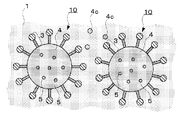
- FIG. 2 is a schematic diagram showing an embodiment of a suspension in a suspension step.
- the droplet 10 of the monomer composition in FIG. 2 schematically shows the cross section thereof. Note that FIG. 2 is only a schematic diagram, and the suspension in the present disclosure is not necessarily limited to that shown in FIG. A part of FIG. 2 corresponds to (2) of FIG. 1 described above.
- FIG. 2 shows how the droplet 10 of the monomer composition and the polymerizable monomer 4c dispersed in the aqueous medium 1 are dispersed in the aqueous medium 1.
- the droplet 10 is formed by surrounding the oil-soluble monomer composition 4 with the dispersion stabilizer 3.
- the monomer composition contains an oil-soluble polymerization initiator 5, a polymerizable monomer and a hydrophobic solvent (neither of which is shown).
- the droplet 10 is a fine oil droplet containing the monomer composition 4, and the oil-soluble polymerization initiator 5 generates a polymerization initiation radical inside the fine oil droplet. Therefore, it is possible to produce precursor particles having a desired particle size without overgrowth of fine oil droplets. In such a suspension polymerization method using an oil-soluble polymerization initiator, there is no opportunity for the polymerization initiator to come into contact with the polymerizable monomer 4c dispersed in the aqueous medium 1. Therefore, by using the oil-soluble polymerization initiator, it is possible to suppress the formation of extra resin particles such as dense real particles having a relatively small particle size in addition to the resin particles having the desired hollow portion.
- This step has a hollow portion surrounded by a shell containing a resin by subjecting the suspension obtained by the above-mentioned suspension step to a polymerization reaction, and the hollow portion has a hydrophobic solvent.
- This is a step of preparing a precursor composition containing precursor particles containing the above.
- the precursor particles are formed by polymerizing the polymerizable monomer contained in the droplets of the monomer composition, and the shell included in the precursor particles contains the polymer of the polymerizable monomer as a resin.
- the polymerization method is not particularly limited, and for example, a batch method, a semi-continuous method, a continuous method, or the like can be adopted.
- the polymerization temperature is preferably 40 to 80 ° C, more preferably 50 to 70 ° C.
- the rate of temperature rise when raising the temperature to the polymerization temperature is preferably 10 ° C./h to 60 ° C./h, more preferably 15 ° C./h to 55 ° C./h.
- the reaction time of the polymerization is preferably 1 to 48 hours, more preferably 4 to 36 hours.
- This step is a step of obtaining a solid component containing precursor particles by solid-liquid separation of the precursor composition containing precursor particles obtained by the above-mentioned polymerization step.
- the method for solid-liquid separation of the precursor composition is not particularly limited, and a known method can be used.
- the solid-liquid separation method include a centrifugal separation method, a filtration method, and a static separation method. Among them, a centrifugal separation method or a filtration method can be adopted, and the centrifugal separation method is used from the viewpoint of ease of operation. May be adopted.
- an arbitrary step such as a pre-drying step may be carried out.
- the pre-drying step include a step of pre-drying the solid component obtained after the solid-liquid separation step with a drying device such as a dryer or a drying device such as a hand dryer.
- Solvent removal step This step is a step of removing the hydrophobic solvent contained in the precursor particles obtained by the solid-liquid separation step. By removing the hydrophobic solvent contained in the precursor particles in the air, the hydrophobic solvent inside the precursor particles is replaced with air, and hollow particles filled with gas can be obtained.
- in the air means an environment in which no liquid is present outside the precursor particles, and a very small amount outside the precursor particles that does not affect the removal of the hydrophobic solvent. It means an environment where only the liquid content of is present.
- the term "in the air” can be rephrased as a state in which the precursor particles are not present in the slurry, or can be rephrased as a state in which the precursor particles are present in the dry powder. That is, in this step, it is important to remove the hydrophobic solvent in an environment where the precursor particles are in direct contact with an external gas.
- the method for removing the hydrophobic solvent in the precursor particles in the air is not particularly limited, and a known method can be adopted.
- the method include a vacuum drying method, a heat drying method, an air flow drying method, or a combination of these methods.
- the heating temperature must be equal to or higher than the boiling point of the hydrophobic solvent and lower than the maximum temperature at which the shell structure of the precursor particles does not collapse. Therefore, depending on the composition of the shell in the precursor particles and the type of the hydrophobic solvent, for example, the heating temperature may be 50 to 200 ° C, 70 to 200 ° C, or 100 to 200 ° C.
- the dry atmosphere is not particularly limited and can be appropriately selected depending on the use of the hollow particles.
- As the dry atmosphere for example, air, oxygen, nitrogen, argon and the like can be considered. Further, by once filling the inside of the hollow particles with a gas and then drying under reduced pressure, hollow particles having a temporary vacuum inside can also be obtained.
- the hydrophobic solvent contained in the precursor particles is used in the slurry containing the precursor particles and the aqueous medium without solid-liquid separation of the slurry-like precursor composition obtained in the polymerization step.
- the hydrophobic solvent may be removed by substituting the slurry with an aqueous medium.
- the hydrophobic solvent contained in the precursor particles can be removed by bubbling the precursor composition with an inert gas at a temperature equal to or higher than the boiling point of the hydrophobic solvent minus 35 ° C. can.
- the boiling point of the hydrophobic solvent in the solvent removing step is the boiling point of the solvent contained in the mixed solvent.
- the boiling point of the solvent having the highest boiling point that is, the highest boiling point among the plurality of boiling points.
- the temperature at which the inert gas is bubbled into the precursor composition should be a temperature equal to or higher than the boiling point of the hydrophobic solvent minus 30 ° C. from the viewpoint of reducing the residual amount of the hydrophobic solvent in the hollow particles. It is preferable that the temperature is equal to or higher than the temperature obtained by subtracting 20 ° C.
- the temperature at the time of bubbling is usually set to a temperature equal to or higher than the polymerization temperature in the polymerization step.
- the temperature at the time of bubbling may be 50 ° C. or higher and 100 ° C. or lower.
- the inert gas to be bubbled is not particularly limited, and examples thereof include nitrogen and argon.
- the bubbling conditions are appropriately adjusted so that the hydrophobic solvent contained in the precursor particles can be removed according to the type and amount of the hydrophobic solvent, and the bubbling conditions are not particularly limited, but for example, 1 to 3 L of the inert gas is used.
- the amount of / min may be bubbling for 1 to 10 hours.
- an aqueous slurry in which the precursor particles contain an aqueous medium can be obtained.
- the hollow particles in which the gas occupies the hollow portion can be obtained.
- the former method has an advantage that the hollow particles are less likely to be crushed in the step of removing the hydrophobic solvent, and the latter method uses an inert gas.
- the residual hydrophobic solvent is reduced by performing the existing bubbling.
- the hydrophobic organic solvent contained in the precursor particles is removed without solid-liquid separation of the slurry-like precursor composition obtained in the polymerization step.
- a method for example, a method of evaporating and distilling off a hydrophobic organic solvent contained in a precursor particle from a precursor composition under a predetermined pressure (high pressure, normal pressure or reduced pressure); under a predetermined pressure (high pressure).
- a method of introducing an inert gas such as nitrogen, argon or helium or water vapor into the precursor composition under normal pressure or reduced pressure) and evaporating and distilling off may be used.
- the cleaning step is a cleaning step in which an acid or an alkali is added to remove the dispersion stabilizer remaining in the precursor composition containing the precursor particles before the solvent removal step. This is the process to be performed.
- the dispersion stabilizer used is an inorganic dispersion stabilizer soluble in acid, it is preferable to add an acid to the precursor composition containing the precursor particles for washing, while the dispersion stabilizer used.
- an inorganic compound soluble in an alkali it is preferable to add an alkali to the precursor composition containing the precursor particles to perform washing.
- an inorganic dispersion stabilizer soluble in acid the acid is added to the precursor composition containing the precursor particles, and the pH is preferably 6.5 or less, more preferably 6. It is preferable to adjust as follows.
- inorganic acids such as sulfuric acid, hydrochloric acid and nitric acid, and organic acids such as formic acid and acetic acid can be used, but the efficiency of removing the dispersion stabilizer is high and the burden on the manufacturing equipment is small. , Sulfuric acid is particularly suitable.
- the revision step of the hollow portion is a step of replacing the gas or liquid inside the hollow particles with another gas or liquid.
- substitution the environment inside the hollow particles can be changed, molecules can be selectively confined inside the hollow particles, and the chemical structure inside the hollow particles can be modified according to the application.
- the hollow particles of the present disclosure are hollow particles having a shell containing a resin and a hollow portion surrounded by the shell, and having a porosity of 50% or more.
- the shell contains a hydrocarbon polymer as the resin, It is characterized in that the relative permittivity at a frequency of 1 MHz is 1.5 or less.
- the hollow particles of the present disclosure can be obtained by the above-mentioned production method of the present disclosure.
- the hollow particles of the present disclosure have a low relative permittivity and dielectric loss tangent, and are excellent in electrical insulation characteristics.
- the relative permittivity of hollow particles at a frequency of 1 MHz can be set to 1.4 or less in a more preferable embodiment.
- the lower limit of the relative permittivity of the hollow particles of the present disclosure at a frequency of 1 MHz is not particularly limited, but is usually 1.0 or more.
- the dielectric loss tangent of the hollow particles at a frequency of 1 MHz can be 0.010 or less, and in a more preferable embodiment, 0.007 or less.
- the lower limit of the dielectric loss tangent at a frequency of 1 MHz of the hollow particles of the present disclosure is not particularly limited, but is usually 0.0001 or more, and may be 0.001 or more. Further, according to the manufacturing method of the present disclosure, the relative permittivity of the hollow particles at a frequency of 1 GHz can be set to 1.5 or less, and in a more preferable embodiment, it can be set to 1.4 or less. The lower limit of the relative permittivity of the hollow particles of the present disclosure at a frequency of 1 GHz is not particularly limited, but is usually 1.0 or more.
- the dielectric loss tangent of the hollow particles at a frequency of 1 GHz can be 0.010 or less, and in a more preferable embodiment, 0.005 or less.
- the lower limit of the dielectric loss tangent of the hollow particles of the present disclosure at a frequency of 1 GHz is not particularly limited, but is usually 0.001 or more.
- the relative permittivity and the dielectric loss tangent of hollow particles are measured using a perturbation type measuring device under the condition of a measurement frequency of 1 MHz or 1 GHz.
- the hydrocarbon polymer in which the hollow particles of the present disclosure are contained as a resin in the shell is a polymer of the above-mentioned polymerizable monomer used in the production method of the present disclosure.
- the content of the hydrocarbon polymer is preferably 99% by mass or more, more preferably 99.5% by mass or more, still more preferably 99.9% by mass or more, based on 100% by mass of the total solid content of the shell.
- the shell provided in the hollow particles of the present disclosure is preferably free of heteroatoms in order to suppress deterioration of electrical insulation characteristics or solvent resistance, but to the extent that the effects of the present disclosure are not impaired, other than hydrocarbons. It may contain a very small amount of the component of.
- the components other than the hydrocarbon that may be contained in the shell include the above-mentioned particle size control agent.
- the content of components other than hydrocarbons contained in the shell is preferably 1% by mass or less, more preferably 0.5% by mass or less, still more preferably 0.1% by mass or less, based on 100% by mass of the total solid content of the shell. Is. By setting the content of components other than hydrocarbons to the above upper limit or less, the electrical insulation characteristics and solvent resistance of the hollow particles can be improved.
- the hollow particles of the present disclosure have a lower limit of the volume average particle size of preferably 1 ⁇ m or more, more preferably 1.5 ⁇ m or more, still more preferably 2 ⁇ m or more.
- the upper limit of the volume average particle size of the hollow particles is preferably 10 ⁇ m or less, more preferably 8 ⁇ m or less, and further preferably 6 ⁇ m or less.
- the volume average particle size of the hollow particles is not more than the above upper limit value, the variation in shell thickness is suppressed, a uniform shell is easily formed, and the hollow particles are less likely to be crushed, so that the hollow particles have high mechanical strength.
- hollow particles having a volume average particle diameter within the above range are suitably used as a material for an electronic circuit board because they do not cause wiring problems even if they are contained in the insulating resin layer of the electronic circuit board.
- a combination of the above-mentioned preferable dispersion stabilizer and particle size control agent is used, and further the above-mentioned preferable hydrophobic solvent is used. It is preferable to use.
- the shape of the hollow particles of the present disclosure is not particularly limited as long as the hollow portion is formed inside, and examples thereof include a spherical shape, an elliptical spherical shape, and an amorphous shape. Among these, a spherical shape is preferable because of ease of manufacture.
- the hollow particles of the present disclosure may have one or more hollow portions, but from the viewpoint of maintaining a good balance between high porosity and mechanical strength, and improving electrical insulation characteristics. Those having only one hollow portion are preferable. Further, the shell provided by the hollow particles of the present disclosure and the partition wall partitioning the adjacent hollow portions when having two or more hollow portions may be porous, but the points of improving the electrical insulation characteristics are improved.
- the hollow particles of the present disclosure may have an average circularity of 0.950 to 0.995.
- An example of the image of the shape of the hollow particles of the present disclosure is a bag made of a thin film and inflated with gas, and the cross-sectional view thereof is as shown in the hollow particles 100 in FIG. 1 (5).
- a thin film is provided on the outside, and the inside is filled with gas.
- the particle shape can be confirmed by, for example, SEM or TEM. Further, the shape inside the particles and the presence of fine resin particles inside the particles can be confirmed by SEM or TEM after the particles are sliced by a known method.
- the particle size distribution of the hollow particles may be, for example, 1.1 or more and 2.5 or less. When the particle size distribution is 2.5 or less, particles having less variation in compressive strength characteristics and heat resistance among the particles can be obtained. Further, when the particle size distribution is 2.5 or less, for example, when manufacturing a sheet-shaped molded product, it is possible to manufacture a product having a uniform thickness.
- the volume average particle size (Dv) and the number average particle size (Dn) of the hollow particles were obtained by, for example, measuring the particle size of the hollow particles with a particle size distribution measuring device and calculating the number average and the volume average, respectively.
- the values can be the number average particle size (Dn) and the volume average particle size (Dv) of the particles.
- the particle size distribution shall be a value obtained by dividing the volume average particle size by the number average particle size.
- the hollow particles of the present disclosure have a porosity of 50% or more, preferably 60% or more, more preferably 70% or more, still more preferably 75% or more.
- the porosity is at least the above lower limit value, the hollow particles are excellent in light weight, heat resistance and heat insulating property, and are excellent in electrical insulating property.
- the upper limit of the porosity of the hollow particles of the present disclosure is not particularly limited, but is preferably 90% or less, more preferably 85% or less, from the viewpoint of suppressing a decrease in the strength of the hollow particles and making it difficult to be crushed. , More preferably 80% or less.
- the porosity of the hollow particles of the present disclosure can be calculated from the addition amount and specific gravity of the material forming the shell used for producing the hollow particles, and the addition amount and specific gravity of the hydrophobic solvent.
- the material forming the shell is a solid content material excluding the hydrophobic solvent from the materials that become the oil phase in the mixed liquid prepared in the above-mentioned mixed liquid preparation step.
- the hydrophobic solvent is a hydrophobic solvent in the mixed solution.
- the content of the polymerizable monomer is 99% by mass or more with respect to 100% by mass of the material forming the shell, it can be considered that the shell is composed of a polymer of the polymerizable monomer, so that it is hollow.
- the void ratio of the particles can be calculated by the following formula (A).
- the "addition amount of the polymerizable monomer / specific gravity of the polymerizable monomer" in the above formula (A) is set to various polymerizable monomers. It is the sum of the calculated "addition amount of polymerizable monomer / specific gravity of polymerizable monomer".
- the "addition amount of hydrophobic solvent / specific gravity of hydrophobic solvent" in the above formula (A) is the “addition amount of hydrophobic solvent” calculated by various hydrophobic solvents. / The total of "specific gravity of hydrophobic solvent”.
- the porosity of the hollow particles of the present disclosure can also be calculated from the apparent density D 1 and the true density D 0 of the hollow particles.
- the method for measuring the apparent density D1 of the hollow particles is as follows. First, a volumetric flask having a capacity of 100 cm 3 is filled with hollow particles having a capacity of about 30 cm 3 , and the mass of the filled hollow particles is accurately weighed. Next, the volumetric flask filled with the hollow particles is accurately filled with isopropanol up to the marked line, being careful not to allow air bubbles to enter. The mass of isopropanol added to the measuring flask is accurately weighed, and the apparent density D 1 (g / cm 3 ) of the hollow particles is calculated based on the following formula (I).
- the apparent density D 1 corresponds to the specific gravity of the entire hollow particle when the hollow portion is regarded as a part of the hollow particle.
- the method for measuring the true density D0 of hollow particles is as follows. After crushing the hollow particles in advance, a measuring flask having a capacity of 100 cm 3 is filled with about 10 g of crushed pieces of hollow particles, and the mass of the filled crushed pieces is accurately weighed. After that, isopropanol is added to the measuring flask in the same manner as in the measurement of the apparent density, the mass of the isopropanol is accurately weighed, and the true density D 0 (g / cm 3 ) of the hollow particles is calculated based on the following formula (II). do.
- Some conventional hollow particles contain fine resin particles having an extremely smaller particle size than the hollow particles, such as the hollow particles obtained in Comparative Example 1 described later.
- the hollow particles of the present disclosure preferably have 3 or less fine resin particles present in the hollow portion, and preferably 1 or less particles. Is more preferable, and 0 particles / 1 particle is further preferable.
- the particle size of the fine resin particles is usually about 0.01 to 0.5 ⁇ m, which is 1/10 or less of the particle size of the hollow particles. According to the manufacturing method of the present disclosure described above, the number of the fine resin particles existing in the hollow portion can be set to be equal to or less than the upper limit value.
- the hollow particles of the present disclosure are excellent in strength by sufficiently containing a crosslinkable monomer unit in the shell, they are not easily crushed during kneading with other materials and during molding after kneading, and when added to a molded product. In addition, it has excellent effects as a weight-reducing material, a heat insulating material, a soundproofing material, a vibration damping material, and the like. Further, since the hollow particles of the present disclosure have a reduced residual amount of the hydrophobic solvent, there is no risk of causing ignition or smoke when kneaded with other materials such as resin. Therefore, the hollow particles of the present disclosure are particularly suitable as an additive for a molded body, and are particularly preferably used as an additive for a resin molded body.
- the molded product containing the hollow particles of the present disclosure includes, as a resin, for example, polyethylene, polypropylene, polyvinyl chloride, polystyrene, polyurethane, epoxy resin, acrylonitrile-butadiene-styrene (ABS) resin, acrylonitrile-styrene (AS) resin, and the like.
- a resin for example, polyethylene, polypropylene, polyvinyl chloride, polystyrene, polyurethane, epoxy resin, acrylonitrile-butadiene-styrene (ABS) resin, acrylonitrile-styrene (AS) resin, and the like.
- a curing agent or a catalyst such as amines, acid anhydrides, and imidazoles.
- the molded body containing the hollow particles of the present disclosure may further contain organic or inorganic fibers such as carbon fiber, glass fiber, aramid fiber and polyethylene fiber.
- the hollow particles of the present disclosure are also used in a molded product formed by using a thermoplastic or thermosetting resin, and a molded product formed by using a material containing a thermoplastic or thermosetting resin and further fibers. , Can be contained as a filler.
- Applications of the resin molded body containing the hollow particles of the present disclosure include, for example, light reflectors, heat insulating materials, sound insulating materials and low dielectric materials used in various fields such as automobiles, electricity, electronics, construction, aviation, and space.
- the hollow particles of the present disclosure are excellent in electrical insulation characteristics and solvent resistance, they are suitably used as a material for realizing low dielectric constant or low transmission loss in the field of electricity or electrons.
- the hollow particles of the present disclosure are suitably used as an electronic circuit board material, and specifically, by incorporating the hollow particles of the present disclosure into the insulating resin layer of the electronic circuit board, the relative permittivity of the insulating resin layer is obtained. The rate can be reduced and the transmission loss of the electronic circuit board can be reduced.
- the hollow particles of the present disclosure include interlayer insulating materials, dry film resists, solder resists, bonding wires, magnet wires, semiconductor encapsulants, epoxy encapsulants, mold underfills, underfills, die bond pastes, and the like. It is suitable for semiconductor materials such as buffer coat materials, copper-clad laminates, flexible substrates, high-frequency device modules, antenna modules, and in-vehicle radars. Among these, especially for semiconductor materials such as interlayer insulation materials, solder resists, magnet wires, epoxy encapsulants, underfills, buffer coat materials, copper-clad laminates, flexible substrates, high-frequency device modules, antenna modules, and in-vehicle radars. Suitable.
- the hollow particles of the present disclosure have a high porosity, are not easily crushed, and have excellent heat resistance, they satisfy the heat insulating property and cushioning property (cushioning property) required for the undercoat material, and are immediately suitable for use in thermal paper. It also meets the heat resistance.
- the hollow particles of the present disclosure are also useful as plastic pigments having excellent gloss, hiding power and the like.
- the hollow particles of the present disclosure can contain useful components such as fragrances, chemicals, pesticides, and ink components by means such as immersion treatment, decompression treatment, or pressure immersion treatment, various types can be obtained depending on the components contained inside. It can be used for various purposes.
- Example 1 (1) Mixture solution preparation step First, the following materials were mixed to prepare an oil phase.
- DVB960 (trade name, manufactured by Nittetsu Chemical & Materials Co., Ltd., purity of divinylbenzene: 96%, content ratio of ethylvinylbenzene: 4%) 26.2 parts 2,2'-azobis (4-methoxy-2,4) -Dimethylvaleronitrile) (oil-soluble polymerization initiator, manufactured by Fujifilm Wako Junyaku Co., Ltd., trade name: V-70) 0.6 part Logonic acid (manufactured by Arakawa Chemical Co., Ltd., trade name: disproportionated rosin Rondis R-CH) , Softening point 150 ° C or higher, acid value: 150-160 mgKOH / g) 0.002 part Hydrophobic solvent: hexane 73.4 parts Next, in a stirring tank, under the temperature condition of 40 ° C, to 225 parts of ion-exchanged
- Example 1 Example 1
- Example 2 to 5 and Comparative Examples follow the same procedure as in Example 1 except that the oil phase material prepared in the above “(1) Mixed liquid preparation step” is as shown in Table 1. 1 to 3 hollow particles were produced.
- volume average particle size The volume average particle size of the hollow particles was measured using a particle size distribution measuring machine (manufactured by Beckman Coulter, trade name: Multisizer 4e). The measurement conditions were aperture diameter: 50 ⁇ m, dispersion medium: Isoton II (trade name), concentration 10%, and number of measured particles: 100,000. Specifically, 0.2 g of a particle sample was placed in a beaker, and an aqueous surfactant solution (manufactured by Fujifilm, trade name: Drywell) was added thereto as a dispersant.
- the hollow particles were intentionally broken with a spatula, and the internal state of the particles was observed using a scanning electron microscope (manufactured by JEOL Ltd., trade name: JSM7610F).
- the hollow particles evaluated as "no internal particles” had a shell of uniform thickness and had a hollow portion that was clearly distinguished from the shell.
- the number of fine resin particles existing in the hollow portion was 1 piece / 1 particle or more and fine resin particles were observed inside the particles, it was evaluated as "with internal particles”.
- the hollow portion was not formed inside the particle and the entire inside of the particle was porous, it was evaluated as "porous”.
- Approximately 100 mg of hollow particles were placed in a glass bottle with a solvent-free 30 mL screw cap and weighed accurately. Subsequently, about 10 g of tetrahydrofuran (THF) was added and weighed accurately. The mixture in the glass bottle was stirred with a stirrer for 1 hour to extract the hydrophobic solvent contained in the hollow particles. After stopping the stirring and precipitating the resin component of the hollow particles insoluble in THF, a filter (manufactured by Advantech Co., Ltd., trade name: Membrane Filter 25JP020AN) was attached to the syringe barrel to obtain a sample solution obtained by filtering the precipitate. rice field. The sample solution was injected into gas chromatography (GC) for analysis.
- GC gas chromatography
- the amount (% by mass) of the hydrophobic solvent per unit mass contained in the hollow particles was determined from the peak area of GC and the calibration curve prepared in advance.
- the detailed analysis conditions are as follows. (Analysis conditions) Equipment: GC-2010 (manufactured by Shimadzu Corporation) Column: DB-5 (manufactured by Agilent Technologies, Inc.) Film thickness 0.25 ⁇ m, inner diameter 0.25 mm, length 30 m Detector: FID Carrier gas: Nitrogen (Linear velocity: 28.8 cm / sec) Injection port temperature: 200 ° C Detector temperature: 250 ° C Oven temperature: Raise from 40 ° C to 230 ° C at a rate of 10 ° C / min and hold at 230 ° C for 2 minutes Sampling amount: 2 ⁇ L Based on the amount of the hydrophobic solvent in the hollow particles obtained above, the solvent removal property was evaluated according to the following evaluation criteria.
- Comparative Example 3 the commercially available product of divinylbenzene used contained 63% by mass of divinylbenzene and 37% by mass of ethylvinylbenzene as an impurity, and was crosslinkable in 100% by mass of the polymerizable monomer used. The content of the monomer was less than 70% by mass.
- Comparative Example 3 the entire inside of the obtained particles was porous, and a hollow portion clearly distinguished from the shell was not formed. Further, the particles obtained in Comparative Example 3 were inferior in solvent resistance and had a high relative permittivity and dielectric loss tangent. In Comparative Example 3, it is presumed that porous particles were generated because the components constituting the shell and the hydrophobic solvent were not sufficiently phase-separated in the droplets of the monomer composition. It is considered that the particles obtained in Comparative Example 3 were inferior in solvent resistance and electrical insulation characteristics because the porous particles were structurally easy to permeate the solvent and tended to have a high relative permittivity and dielectric loss tangent.
- a hydrocarbon monomer is used as the polymerizable monomer, and the content of the crosslinkable monomer in 100% by mass of the polymerizable monomer is 70% by mass or more, which is hydrophobic. Since a hydrocarbon solvent having 5 to 8 carbon atoms was used as the sex solvent, the obtained particles were hollow particles having a hollow portion clearly distinguished from the shell, and were excellent in solvent removal and solvent resistance, and had a specific ratio. It was excellent in electrical insulation characteristics with low dielectric constant and dielectric constant contact.
Landscapes
- Chemical & Material Sciences (AREA)
- Organic Chemistry (AREA)
- Chemical Kinetics & Catalysis (AREA)
- Health & Medical Sciences (AREA)
- Medicinal Chemistry (AREA)
- Polymers & Plastics (AREA)
- Dispersion Chemistry (AREA)
- Polymerisation Methods In General (AREA)
- Addition Polymer Or Copolymer, Post-Treatments, Or Chemical Modifications (AREA)
- Manufacturing Of Micro-Capsules (AREA)
Priority Applications (5)
| Application Number | Priority Date | Filing Date | Title |
|---|---|---|---|
| KR1020237012874A KR20230098160A (ko) | 2020-10-30 | 2021-10-26 | 중공 입자의 제조 방법 및 중공 입자 |
| CN202180070712.9A CN116390958A (zh) | 2020-10-30 | 2021-10-26 | 中空颗粒的制造方法以及中空颗粒 |
| EP21886194.6A EP4238998A4 (en) | 2020-10-30 | 2021-10-26 | METHOD FOR PRODUCING HOLLOW PARTICLES AND HOLLOW PARTICLES |
| JP2022559152A JPWO2022092076A1 (https=) | 2020-10-30 | 2021-10-26 | |
| US18/031,815 US20230383021A1 (en) | 2020-10-30 | 2021-10-26 | Method for producing hollow particles and hollow particles |
Applications Claiming Priority (2)
| Application Number | Priority Date | Filing Date | Title |
|---|---|---|---|
| JP2020-182283 | 2020-10-30 | ||
| JP2020182283 | 2020-10-30 |
Publications (1)
| Publication Number | Publication Date |
|---|---|
| WO2022092076A1 true WO2022092076A1 (ja) | 2022-05-05 |
Family
ID=81383939
Family Applications (1)
| Application Number | Title | Priority Date | Filing Date |
|---|---|---|---|
| PCT/JP2021/039457 Ceased WO2022092076A1 (ja) | 2020-10-30 | 2021-10-26 | 中空粒子の製造方法及び中空粒子 |
Country Status (7)
| Country | Link |
|---|---|
| US (1) | US20230383021A1 (https=) |
| EP (1) | EP4238998A4 (https=) |
| JP (1) | JPWO2022092076A1 (https=) |
| KR (1) | KR20230098160A (https=) |
| CN (1) | CN116390958A (https=) |
| TW (1) | TW202231349A (https=) |
| WO (1) | WO2022092076A1 (https=) |
Cited By (5)
| Publication number | Priority date | Publication date | Assignee | Title |
|---|---|---|---|---|
| WO2023106307A1 (ja) * | 2021-12-10 | 2023-06-15 | 日本ゼオン株式会社 | 中空粒子、樹脂組成物、及び樹脂成形体 |
| WO2023228964A1 (ja) * | 2022-05-26 | 2023-11-30 | 日本ゼオン株式会社 | 中空粒子、樹脂組成物、樹脂成形体、封止用樹脂組成物、硬化物、及び半導体装置 |
| WO2024048093A1 (ja) * | 2022-08-30 | 2024-03-07 | 日本ゼオン株式会社 | 中空粒子、樹脂組成物、及び成形体 |
| WO2024095851A1 (ja) * | 2022-10-31 | 2024-05-10 | 日本ゼオン株式会社 | 中空粒子、中空粒子の製造方法、樹脂組成物及び樹脂構造体 |
| KR20250140113A (ko) | 2023-03-24 | 2025-09-24 | 세키스이가세이힝코교가부시키가이샤 | 중공 수지 입자, 그 제조 방법, 및 그 용도 |
Families Citing this family (2)
| Publication number | Priority date | Publication date | Assignee | Title |
|---|---|---|---|---|
| WO2022107674A1 (ja) * | 2020-11-20 | 2022-05-27 | 日本ゼオン株式会社 | 中空粒子 |
| US20250282116A1 (en) * | 2022-06-21 | 2025-09-11 | Resonac Corporation | Sheet comprising thermal insulation layer and adhesive layer |
Citations (13)
| Publication number | Priority date | Publication date | Assignee | Title |
|---|---|---|---|---|
| JP2000315845A (ja) * | 1999-04-28 | 2000-11-14 | Jsr Corp | 回路基板 |
| JP2000313818A (ja) | 1999-03-03 | 2000-11-14 | Jsr Corp | 架橋樹脂粒子、有機絶縁材用組成物、有機絶縁材、封止材、および回路基板 |
| JP2003181274A (ja) * | 2001-12-18 | 2003-07-02 | Sekisui Chem Co Ltd | 中空ポリマー粒子の製造方法 |
| JP2004190038A (ja) | 2004-03-08 | 2004-07-08 | New Industry Research Organization | 中空高分子微粒子及びその製造法 |
| WO2004067638A1 (ja) * | 2003-01-28 | 2004-08-12 | Matsushita Electric Works, Ltd. | 中空粒子を含有する樹脂組成物、同組成物を含むプリプレグおよび積層板 |
| JP2006008750A (ja) * | 2004-06-22 | 2006-01-12 | Matsushita Electric Works Ltd | 電気絶縁性樹脂組成物、プリプレグ、積層板及び多層プリント配線板 |
| JP2007270096A (ja) * | 2006-03-31 | 2007-10-18 | Kobe Univ | 内部に空隙を有する微粒子の製造方法 |
| JP2008115280A (ja) * | 2006-11-06 | 2008-05-22 | Hitachi Ltd | 低誘電損失樹脂組成物、その硬化物およびそれを用いた電子部品 |
| JP2008231241A (ja) * | 2007-03-20 | 2008-10-02 | Sanyo Chem Ind Ltd | 中空樹脂粒子 |
| JP2013221070A (ja) * | 2012-04-16 | 2013-10-28 | Sanko Kk | 中空ポリマー微粒子とその製造方法 |
| KR20150137783A (ko) * | 2014-05-30 | 2015-12-09 | (주) 유니플라텍 | 저비중 도전 입자를 포함하는 코팅제 조성물을 이용한 전자파 차폐 필름 |
| JP2016210902A (ja) * | 2015-05-11 | 2016-12-15 | コニカミノルタ株式会社 | 中空樹脂粒子およびその製造方法 |
| JP2017119843A (ja) * | 2015-12-28 | 2017-07-06 | 日本合成化学工業株式会社 | 中空ポリマー粒子、ポリマー粒子懸濁液の製造方法、および中空ポリマー粒子の製造方法 |
Family Cites Families (12)
| Publication number | Priority date | Publication date | Assignee | Title |
|---|---|---|---|---|
| US6146749A (en) * | 1999-05-03 | 2000-11-14 | Jsr Corporation | Low dielectric composition, insulating material, sealing material, and circuit board |
| EP2098550A4 (en) * | 2006-12-28 | 2010-02-03 | Zeon Corp | POLYMERIZABLE COMPOSITION |
| US11760857B2 (en) * | 2017-08-01 | 2023-09-19 | Zeon Corporation | Method for producing latex and method for producing hollow resin particles |
| EP4234650B1 (en) * | 2018-03-30 | 2024-11-27 | Zeon Corporation | Hollow resin particles and sheet |
| JP7294345B2 (ja) * | 2018-09-28 | 2023-06-20 | 日本ゼオン株式会社 | 樹脂組成物及びその成形体 |
| EP3922650A4 (en) * | 2019-02-06 | 2022-10-26 | Zeon Corporation | PROCESS FOR MANUFACTURING HOLLOW RESIN PARTICLES |
| JP7342376B2 (ja) * | 2019-02-25 | 2023-09-12 | 日本ゼオン株式会社 | 中空樹脂粒子の製造方法 |
| EP3992213A4 (en) * | 2019-06-27 | 2023-07-26 | Zeon Corporation | PROCESS FOR PRODUCTION OF HOLLOW RESIN PARTICLES |
| US12485399B2 (en) * | 2019-12-06 | 2025-12-02 | Zeon Corporation | Hollow particles, resin composition and molded body |
| WO2021112117A1 (ja) * | 2019-12-06 | 2021-06-10 | 日本ゼオン株式会社 | 中空粒子の製造方法 |
| CN116194495B (zh) * | 2020-09-30 | 2024-06-28 | 日本瑞翁株式会社 | 中空颗粒 |
| WO2022071276A1 (ja) * | 2020-09-30 | 2022-04-07 | 日本ゼオン株式会社 | 中空粒子の製造方法 |
-
2021
- 2021-10-26 KR KR1020237012874A patent/KR20230098160A/ko active Pending
- 2021-10-26 US US18/031,815 patent/US20230383021A1/en active Pending
- 2021-10-26 EP EP21886194.6A patent/EP4238998A4/en active Pending
- 2021-10-26 JP JP2022559152A patent/JPWO2022092076A1/ja active Pending
- 2021-10-26 CN CN202180070712.9A patent/CN116390958A/zh active Pending
- 2021-10-26 WO PCT/JP2021/039457 patent/WO2022092076A1/ja not_active Ceased
- 2021-10-29 TW TW110140187A patent/TW202231349A/zh unknown
Patent Citations (13)
| Publication number | Priority date | Publication date | Assignee | Title |
|---|---|---|---|---|
| JP2000313818A (ja) | 1999-03-03 | 2000-11-14 | Jsr Corp | 架橋樹脂粒子、有機絶縁材用組成物、有機絶縁材、封止材、および回路基板 |
| JP2000315845A (ja) * | 1999-04-28 | 2000-11-14 | Jsr Corp | 回路基板 |
| JP2003181274A (ja) * | 2001-12-18 | 2003-07-02 | Sekisui Chem Co Ltd | 中空ポリマー粒子の製造方法 |
| WO2004067638A1 (ja) * | 2003-01-28 | 2004-08-12 | Matsushita Electric Works, Ltd. | 中空粒子を含有する樹脂組成物、同組成物を含むプリプレグおよび積層板 |
| JP2004190038A (ja) | 2004-03-08 | 2004-07-08 | New Industry Research Organization | 中空高分子微粒子及びその製造法 |
| JP2006008750A (ja) * | 2004-06-22 | 2006-01-12 | Matsushita Electric Works Ltd | 電気絶縁性樹脂組成物、プリプレグ、積層板及び多層プリント配線板 |
| JP2007270096A (ja) * | 2006-03-31 | 2007-10-18 | Kobe Univ | 内部に空隙を有する微粒子の製造方法 |
| JP2008115280A (ja) * | 2006-11-06 | 2008-05-22 | Hitachi Ltd | 低誘電損失樹脂組成物、その硬化物およびそれを用いた電子部品 |
| JP2008231241A (ja) * | 2007-03-20 | 2008-10-02 | Sanyo Chem Ind Ltd | 中空樹脂粒子 |
| JP2013221070A (ja) * | 2012-04-16 | 2013-10-28 | Sanko Kk | 中空ポリマー微粒子とその製造方法 |
| KR20150137783A (ko) * | 2014-05-30 | 2015-12-09 | (주) 유니플라텍 | 저비중 도전 입자를 포함하는 코팅제 조성물을 이용한 전자파 차폐 필름 |
| JP2016210902A (ja) * | 2015-05-11 | 2016-12-15 | コニカミノルタ株式会社 | 中空樹脂粒子およびその製造方法 |
| JP2017119843A (ja) * | 2015-12-28 | 2017-07-06 | 日本合成化学工業株式会社 | 中空ポリマー粒子、ポリマー粒子懸濁液の製造方法、および中空ポリマー粒子の製造方法 |
Non-Patent Citations (2)
| Title |
|---|
| "Chemical Society of Japan", 30 September 1993, MARUZEN PUBLISHING CO., LTD., pages: 498 - 503 |
| See also references of EP4238998A4 |
Cited By (7)
| Publication number | Priority date | Publication date | Assignee | Title |
|---|---|---|---|---|
| WO2023106307A1 (ja) * | 2021-12-10 | 2023-06-15 | 日本ゼオン株式会社 | 中空粒子、樹脂組成物、及び樹脂成形体 |
| WO2023228964A1 (ja) * | 2022-05-26 | 2023-11-30 | 日本ゼオン株式会社 | 中空粒子、樹脂組成物、樹脂成形体、封止用樹脂組成物、硬化物、及び半導体装置 |
| KR20250018484A (ko) | 2022-05-26 | 2025-02-06 | 니폰 제온 가부시키가이샤 | 중공 입자, 수지 조성물, 수지 성형체, 봉지용 수지 조성물, 경화물, 및 반도체 장치 |
| WO2024048093A1 (ja) * | 2022-08-30 | 2024-03-07 | 日本ゼオン株式会社 | 中空粒子、樹脂組成物、及び成形体 |
| KR20250055524A (ko) | 2022-08-30 | 2025-04-24 | 니폰 제온 가부시키가이샤 | 중공 입자, 수지 조성물, 및 성형체 |
| WO2024095851A1 (ja) * | 2022-10-31 | 2024-05-10 | 日本ゼオン株式会社 | 中空粒子、中空粒子の製造方法、樹脂組成物及び樹脂構造体 |
| KR20250140113A (ko) | 2023-03-24 | 2025-09-24 | 세키스이가세이힝코교가부시키가이샤 | 중공 수지 입자, 그 제조 방법, 및 그 용도 |
Also Published As
| Publication number | Publication date |
|---|---|
| EP4238998A4 (en) | 2025-03-26 |
| JPWO2022092076A1 (https=) | 2022-05-05 |
| KR20230098160A (ko) | 2023-07-03 |
| TW202231349A (zh) | 2022-08-16 |
| CN116390958A (zh) | 2023-07-04 |
| US20230383021A1 (en) | 2023-11-30 |
| EP4238998A1 (en) | 2023-09-06 |
Similar Documents
| Publication | Publication Date | Title |
|---|---|---|
| WO2022092076A1 (ja) | 中空粒子の製造方法及び中空粒子 | |
| KR102925492B1 (ko) | 중공 수지 입자의 제조 방법 | |
| JP7635717B2 (ja) | 中空粒子、樹脂組成物及び成形体 | |
| JP7845189B2 (ja) | 中空粒子 | |
| CN116194495B (zh) | 中空颗粒 | |
| CN116745027B (zh) | 中空颗粒 | |
| WO2023106307A1 (ja) | 中空粒子、樹脂組成物、及び樹脂成形体 | |
| CN116209682B (zh) | 中空颗粒的制造方法 | |
| WO2023074651A1 (ja) | 中空粒子、中空粒子の製造方法、樹脂組成物、及び成形体 | |
| WO2024048093A1 (ja) | 中空粒子、樹脂組成物、及び成形体 | |
| JP7782454B2 (ja) | 中空粒子の製造方法及び中空粒子 | |
| JP2023086486A (ja) | 中空粒子の製造方法、及び樹脂組成物の製造方法 | |
| WO2022181580A1 (ja) | 熱伝導率調整剤及び成形体 | |
| TW202426511A (zh) | 空心粒子、空心粒子的製造方法、樹脂組成物及樹脂結構體 | |
| WO2023163084A1 (ja) | 中空粒子、樹脂組成物、及び樹脂成形体 |
Legal Events
| Date | Code | Title | Description |
|---|---|---|---|
| 121 | Ep: the epo has been informed by wipo that ep was designated in this application |
Ref document number: 21886194 Country of ref document: EP Kind code of ref document: A1 |
|
| ENP | Entry into the national phase |
Ref document number: 2022559152 Country of ref document: JP Kind code of ref document: A |
|
| WWE | Wipo information: entry into national phase |
Ref document number: 18031815 Country of ref document: US |
|
| NENP | Non-entry into the national phase |
Ref country code: DE |
|
| ENP | Entry into the national phase |
Ref document number: 2021886194 Country of ref document: EP Effective date: 20230530 |