WO2022075003A1 - 半導体装置 - Google Patents
半導体装置 Download PDFInfo
- Publication number
- WO2022075003A1 WO2022075003A1 PCT/JP2021/033155 JP2021033155W WO2022075003A1 WO 2022075003 A1 WO2022075003 A1 WO 2022075003A1 JP 2021033155 W JP2021033155 W JP 2021033155W WO 2022075003 A1 WO2022075003 A1 WO 2022075003A1
- Authority
- WO
- WIPO (PCT)
- Prior art keywords
- semiconductor
- semiconductor elements
- elements
- semiconductor device
- power terminal
- Prior art date
- Legal status (The legal status is an assumption and is not a legal conclusion. Google has not performed a legal analysis and makes no representation as to the accuracy of the status listed.)
- Ceased
Links
Images





Classifications
-
- H—ELECTRICITY
- H10—SEMICONDUCTOR DEVICES; ELECTRIC SOLID-STATE DEVICES NOT OTHERWISE PROVIDED FOR
- H10W—GENERIC PACKAGES, INTERCONNECTIONS, CONNECTORS OR OTHER CONSTRUCTIONAL DETAILS OF DEVICES COVERED BY CLASS H10
- H10W90/00—Package configurations
-
- H—ELECTRICITY
- H10—SEMICONDUCTOR DEVICES; ELECTRIC SOLID-STATE DEVICES NOT OTHERWISE PROVIDED FOR
- H10W—GENERIC PACKAGES, INTERCONNECTIONS, CONNECTORS OR OTHER CONSTRUCTIONAL DETAILS OF DEVICES COVERED BY CLASS H10
- H10W72/00—Interconnections or connectors in packages
- H10W72/071—Connecting or disconnecting
-
- H—ELECTRICITY
- H10—SEMICONDUCTOR DEVICES; ELECTRIC SOLID-STATE DEVICES NOT OTHERWISE PROVIDED FOR
- H10W—GENERIC PACKAGES, INTERCONNECTIONS, CONNECTORS OR OTHER CONSTRUCTIONAL DETAILS OF DEVICES COVERED BY CLASS H10
- H10W72/00—Interconnections or connectors in packages
- H10W72/50—Bond wires
-
- H—ELECTRICITY
- H10—SEMICONDUCTOR DEVICES; ELECTRIC SOLID-STATE DEVICES NOT OTHERWISE PROVIDED FOR
- H10W—GENERIC PACKAGES, INTERCONNECTIONS, CONNECTORS OR OTHER CONSTRUCTIONAL DETAILS OF DEVICES COVERED BY CLASS H10
- H10W72/00—Interconnections or connectors in packages
- H10W72/90—Bond pads, in general
-
- H—ELECTRICITY
- H10—SEMICONDUCTOR DEVICES; ELECTRIC SOLID-STATE DEVICES NOT OTHERWISE PROVIDED FOR
- H10W—GENERIC PACKAGES, INTERCONNECTIONS, CONNECTORS OR OTHER CONSTRUCTIONAL DETAILS OF DEVICES COVERED BY CLASS H10
- H10W76/00—Containers; Fillings or auxiliary members therefor; Seals
- H10W76/10—Containers or parts thereof
- H10W76/12—Containers or parts thereof characterised by their shape
- H10W76/13—Containers comprising a conductive base serving as an interconnection
- H10W76/138—Containers comprising a conductive base serving as an interconnection having another interconnection being formed by a cover plate parallel to the conductive base, e.g. sandwich type
-
- H—ELECTRICITY
- H10—SEMICONDUCTOR DEVICES; ELECTRIC SOLID-STATE DEVICES NOT OTHERWISE PROVIDED FOR
- H10W—GENERIC PACKAGES, INTERCONNECTIONS, CONNECTORS OR OTHER CONSTRUCTIONAL DETAILS OF DEVICES COVERED BY CLASS H10
- H10W72/00—Interconnections or connectors in packages
- H10W72/071—Connecting or disconnecting
- H10W72/075—Connecting or disconnecting of bond wires
- H10W72/07551—Connecting or disconnecting of bond wires characterised by changes in properties of the bond wires during the connecting
- H10W72/07552—Connecting or disconnecting of bond wires characterised by changes in properties of the bond wires during the connecting changes in structures or sizes
-
- H—ELECTRICITY
- H10—SEMICONDUCTOR DEVICES; ELECTRIC SOLID-STATE DEVICES NOT OTHERWISE PROVIDED FOR
- H10W—GENERIC PACKAGES, INTERCONNECTIONS, CONNECTORS OR OTHER CONSTRUCTIONAL DETAILS OF DEVICES COVERED BY CLASS H10
- H10W72/00—Interconnections or connectors in packages
- H10W72/071—Connecting or disconnecting
- H10W72/075—Connecting or disconnecting of bond wires
- H10W72/07551—Connecting or disconnecting of bond wires characterised by changes in properties of the bond wires during the connecting
- H10W72/07554—Connecting or disconnecting of bond wires characterised by changes in properties of the bond wires during the connecting changes in dispositions
-
- H—ELECTRICITY
- H10—SEMICONDUCTOR DEVICES; ELECTRIC SOLID-STATE DEVICES NOT OTHERWISE PROVIDED FOR
- H10W—GENERIC PACKAGES, INTERCONNECTIONS, CONNECTORS OR OTHER CONSTRUCTIONAL DETAILS OF DEVICES COVERED BY CLASS H10
- H10W72/00—Interconnections or connectors in packages
- H10W72/50—Bond wires
- H10W72/521—Structures or relative sizes of bond wires
- H10W72/527—Multiple bond wires having different sizes
-
- H—ELECTRICITY
- H10—SEMICONDUCTOR DEVICES; ELECTRIC SOLID-STATE DEVICES NOT OTHERWISE PROVIDED FOR
- H10W—GENERIC PACKAGES, INTERCONNECTIONS, CONNECTORS OR OTHER CONSTRUCTIONAL DETAILS OF DEVICES COVERED BY CLASS H10
- H10W72/00—Interconnections or connectors in packages
- H10W72/50—Bond wires
- H10W72/541—Dispositions of bond wires
- H10W72/547—Dispositions of multiple bond wires
- H10W72/5473—Dispositions of multiple bond wires multiple bond wires connected to a common bond pad
-
- H—ELECTRICITY
- H10—SEMICONDUCTOR DEVICES; ELECTRIC SOLID-STATE DEVICES NOT OTHERWISE PROVIDED FOR
- H10W—GENERIC PACKAGES, INTERCONNECTIONS, CONNECTORS OR OTHER CONSTRUCTIONAL DETAILS OF DEVICES COVERED BY CLASS H10
- H10W72/00—Interconnections or connectors in packages
- H10W72/50—Bond wires
- H10W72/551—Materials of bond wires
- H10W72/552—Materials of bond wires comprising metals or metalloids, e.g. silver
- H10W72/5522—Materials of bond wires comprising metals or metalloids, e.g. silver comprising gold [Au]
-
- H—ELECTRICITY
- H10—SEMICONDUCTOR DEVICES; ELECTRIC SOLID-STATE DEVICES NOT OTHERWISE PROVIDED FOR
- H10W—GENERIC PACKAGES, INTERCONNECTIONS, CONNECTORS OR OTHER CONSTRUCTIONAL DETAILS OF DEVICES COVERED BY CLASS H10
- H10W72/00—Interconnections or connectors in packages
- H10W72/50—Bond wires
- H10W72/551—Materials of bond wires
- H10W72/552—Materials of bond wires comprising metals or metalloids, e.g. silver
- H10W72/5524—Materials of bond wires comprising metals or metalloids, e.g. silver comprising aluminium [Al]
-
- H—ELECTRICITY
- H10—SEMICONDUCTOR DEVICES; ELECTRIC SOLID-STATE DEVICES NOT OTHERWISE PROVIDED FOR
- H10W—GENERIC PACKAGES, INTERCONNECTIONS, CONNECTORS OR OTHER CONSTRUCTIONAL DETAILS OF DEVICES COVERED BY CLASS H10
- H10W72/00—Interconnections or connectors in packages
- H10W72/50—Bond wires
- H10W72/551—Materials of bond wires
- H10W72/552—Materials of bond wires comprising metals or metalloids, e.g. silver
- H10W72/5525—Materials of bond wires comprising metals or metalloids, e.g. silver comprising copper [Cu]
-
- H—ELECTRICITY
- H10—SEMICONDUCTOR DEVICES; ELECTRIC SOLID-STATE DEVICES NOT OTHERWISE PROVIDED FOR
- H10W—GENERIC PACKAGES, INTERCONNECTIONS, CONNECTORS OR OTHER CONSTRUCTIONAL DETAILS OF DEVICES COVERED BY CLASS H10
- H10W72/00—Interconnections or connectors in packages
- H10W72/851—Dispositions of multiple connectors or interconnections
- H10W72/853—On the same surface
- H10W72/871—Bond wires and strap connectors
-
- H—ELECTRICITY
- H10—SEMICONDUCTOR DEVICES; ELECTRIC SOLID-STATE DEVICES NOT OTHERWISE PROVIDED FOR
- H10W—GENERIC PACKAGES, INTERCONNECTIONS, CONNECTORS OR OTHER CONSTRUCTIONAL DETAILS OF DEVICES COVERED BY CLASS H10
- H10W72/00—Interconnections or connectors in packages
- H10W72/90—Bond pads, in general
- H10W72/921—Structures or relative sizes of bond pads
- H10W72/926—Multiple bond pads having different sizes
-
- H—ELECTRICITY
- H10—SEMICONDUCTOR DEVICES; ELECTRIC SOLID-STATE DEVICES NOT OTHERWISE PROVIDED FOR
- H10W—GENERIC PACKAGES, INTERCONNECTIONS, CONNECTORS OR OTHER CONSTRUCTIONAL DETAILS OF DEVICES COVERED BY CLASS H10
- H10W72/00—Interconnections or connectors in packages
- H10W72/90—Bond pads, in general
- H10W72/941—Dispositions of bond pads
- H10W72/944—Dispositions of multiple bond pads
-
- H—ELECTRICITY
- H10—SEMICONDUCTOR DEVICES; ELECTRIC SOLID-STATE DEVICES NOT OTHERWISE PROVIDED FOR
- H10W—GENERIC PACKAGES, INTERCONNECTIONS, CONNECTORS OR OTHER CONSTRUCTIONAL DETAILS OF DEVICES COVERED BY CLASS H10
- H10W74/00—Encapsulations, e.g. protective coatings
-
- H—ELECTRICITY
- H10—SEMICONDUCTOR DEVICES; ELECTRIC SOLID-STATE DEVICES NOT OTHERWISE PROVIDED FOR
- H10W—GENERIC PACKAGES, INTERCONNECTIONS, CONNECTORS OR OTHER CONSTRUCTIONAL DETAILS OF DEVICES COVERED BY CLASS H10
- H10W90/00—Package configurations
- H10W90/701—Package configurations characterised by the relative positions of pads or connectors relative to package parts
- H10W90/731—Package configurations characterised by the relative positions of pads or connectors relative to package parts of die-attach connectors
- H10W90/734—Package configurations characterised by the relative positions of pads or connectors relative to package parts of die-attach connectors between a chip and a stacked insulating package substrate, interposer or RDL
-
- H—ELECTRICITY
- H10—SEMICONDUCTOR DEVICES; ELECTRIC SOLID-STATE DEVICES NOT OTHERWISE PROVIDED FOR
- H10W—GENERIC PACKAGES, INTERCONNECTIONS, CONNECTORS OR OTHER CONSTRUCTIONAL DETAILS OF DEVICES COVERED BY CLASS H10
- H10W90/00—Package configurations
- H10W90/701—Package configurations characterised by the relative positions of pads or connectors relative to package parts
- H10W90/751—Package configurations characterised by the relative positions of pads or connectors relative to package parts of bond wires
- H10W90/754—Package configurations characterised by the relative positions of pads or connectors relative to package parts of bond wires between a chip and a stacked insulating package substrate, interposer or RDL
-
- H—ELECTRICITY
- H10—SEMICONDUCTOR DEVICES; ELECTRIC SOLID-STATE DEVICES NOT OTHERWISE PROVIDED FOR
- H10W—GENERIC PACKAGES, INTERCONNECTIONS, CONNECTORS OR OTHER CONSTRUCTIONAL DETAILS OF DEVICES COVERED BY CLASS H10
- H10W90/00—Package configurations
- H10W90/701—Package configurations characterised by the relative positions of pads or connectors relative to package parts
- H10W90/761—Package configurations characterised by the relative positions of pads or connectors relative to package parts of strap connectors
- H10W90/764—Package configurations characterised by the relative positions of pads or connectors relative to package parts of strap connectors between a chip and a stacked insulating package substrate, interposer or RDL
Definitions
- This disclosure relates to semiconductor devices.
- MOSFETs Metal-Oxide-Semiconductor Field-Effect Transistors
- IGBTs Insulated Gate Bipolar Transistors
- a plurality of first semiconductor elements connected in parallel and a plurality of second semiconductor elements connected in parallel are provided, and each of the plurality of first semiconductor elements is provided.
- Each of the plurality of second semiconductor elements is connected in series.
- Each of the first and second semiconductor elements is composed of MOSFETs and has a built-in diode.
- a surge current may flow in each of the first semiconductor elements and each second semiconductor element due to the switching operation of the plurality of first semiconductor elements and the plurality of second semiconductor elements.
- This surge current flows through the built-in diode of each semiconductor element, and the direction of flow is the reverse direction of each semiconductor element (forward direction of the built-in diode).
- Excessive energization of the built-in diode due to this surge current causes deterioration of the characteristics of each semiconductor element (for example, increase in on-resistance).
- one object of the present disclosure is to provide a semiconductor device capable of suppressing excessive energization of the built-in diode of each semiconductor element and suppressing deterioration of characteristics of a plurality of semiconductor elements.
- the semiconductor devices of the present disclosure include a plurality of first semiconductor devices, each of which performs a switching operation and is electrically connected in parallel to each other; and are electrically connected in antiparallel to the plurality of first semiconductor elements.
- the plurality of first semiconductor elements include a first element and a second element having different lengths of the shortest conduction paths to the first power terminal.
- the length of the shortest conduction path of the first element is shorter than the length of the shortest conduction path of the second element.
- the first pad portion is a first portion to which at least the first element of the plurality of first semiconductor elements is bonded, and a second portion to which at least the second element of the plurality of first semiconductor elements is bonded. Includes parts and.
- the number of the first rectifying elements is smaller than the number of the first semiconductor elements, and one of the one or more first rectifying elements is arranged in the first part.
- the configuration based on the present disclosure it is possible to suppress excessive energization of the built-in diode of the semiconductor element and suppress deterioration of the characteristics of the semiconductor element.
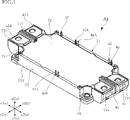
- FIG. 1 It is a perspective view which shows the semiconductor device which concerns on 1st Embodiment.
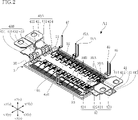
- the heat sink and the case are omitted.
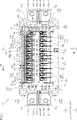
- the heat sink and the case are shown by imaginary lines.
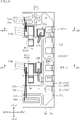
- FIG. 4 It is a partially enlarged view which is a part of FIG. 4 enlarged.
- It is a front view which shows the semiconductor device which concerns on 1st Embodiment.
- It is a side view (left side view) which shows the semiconductor device which concerns on 1st Embodiment.
- the semiconductor device A1 includes a plurality of semiconductor elements 10A, 10B, a plurality of rectifying elements 20A, 20B, a support member 3, a plurality of power terminals 41, 42, 43A, 43B, a pair of signal terminals 44A, 44B, and a plurality of detection terminals 45A. , 45B, 46, 47, a plurality of connecting members 51, 52, 53A, 53B, 54A, 54B, 55A, 55B, 56A, 56A, 57A, 57B, 58, a heat sink 70, and a case 71.
- FIG. 1 is a perspective view showing the semiconductor device A1.
- FIG. 2 is a perspective view of FIG. 1 in which the heat sink 70 and the case 71 are omitted.
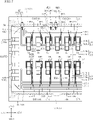
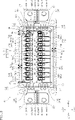
- FIG. 3 is a plan view showing the semiconductor device A1.
- FIG. 4 is a view showing the heat sink 70 and the case 71 as imaginary lines (dashed-dotted lines) in the plan view of FIG.
- FIG. 5 is a partially enlarged view of a part of FIG. 4.
- FIG. 6 is a partially enlarged view of a part of FIG.
- FIG. 7 is a partially enlarged view of a part of FIG. 4.
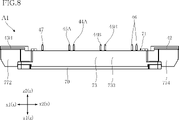
- FIG. 8 is a front view showing the semiconductor device A1.
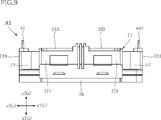
- FIG. 9 is a side view (left side view) showing the semiconductor device A1.
- FIG. 9 is a side view (left side view) showing the semiconductor device A1.
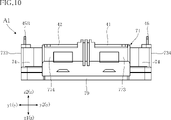
- FIG. 10 is a side view (right side view) showing the semiconductor device A1.
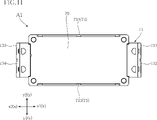
- FIG. 11 is a bottom view showing the semiconductor device A1.
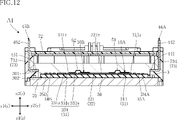
- FIG. 12 is a cross-sectional view taken along the line XII-XII of FIG.
- FIG. 13 is a cut end view along the line XIII-XIII of FIG.
- FIG. 14 is a cut end view taken along the line XIV-XIV of FIG.
- FIG. 15 is a circuit diagram showing an example of the circuit configuration of the semiconductor device A1.
- the three directions orthogonal to each other are the x direction, the y direction, and the z direction.
- the z direction is the thickness direction of the semiconductor device A1.
- the x direction is the left-right direction in the plan view (see FIGS. 3 and 4) of the semiconductor device A1.
- the y direction is the vertical direction in the plan view (see FIGS. 3 and 4) of the semiconductor device A1.
- One in the x direction is the x1 direction
- the other in the x direction is the x2 direction.
- one in the y direction is the y1 direction
- the other in the y direction is the y2 direction
- one in the z direction is the z1 direction
- the other in the z direction is the z2 direction.
- planar view means when viewed in the z direction.
- the z direction is an example of the "thickness direction”.
- the x direction is an example of the "first direction”
- the y direction is an example of the "second direction”, but the present disclosure is not limited thereto.
- the heat radiating plate 70 has a rectangular plate shape in a plan view.
- the heat sink 70 is made of a material having high thermal conductivity, and is made of, for example, copper or a copper alloy.
- the surface of the heat radiating plate 70 may be nickel-plated.
- a cooling member (for example, a heat sink) is attached to the surface of the heat radiating plate 70 on the z1 direction side, if necessary. As shown in FIG. 12, the support member 3 is placed on the heat sink 70.
- Case 71 is approximately a rectangular parallelepiped, as can be seen from FIGS. 1 and 3.
- the case 71 is made of a synthetic resin having electrical insulation and excellent heat resistance, and is made of, for example, PPS (polyphenylene sulfide).
- the case 71 has a rectangular shape having approximately the same size as the heat radiating plate 70 in a plan view.
- the case 71 includes a frame portion 73 fixed to the surface of the heat radiating plate 70 on the z2 direction side, and a top plate 72 fixed to the frame portion 73. As shown in FIGS. 1 and 12, the top plate 72 closes the opening of the frame portion 73 on the z2 direction side. As shown in FIG.
- the top plate 72 faces the heat radiating plate 70 that closes the frame portion 73 on the z1 direction side.
- a circuit accommodation space (a space for accommodating a plurality of semiconductor elements 10A, 10B, a plurality of rectifying elements 20A, 20B, a support member 3, etc.) is partitioned inside the case 71 by a top plate 72, a heat sink 70, and a frame portion 73. ing.
- the frame portion 73 has a pair of side walls 731 and 732 separated in the x direction and a pair of side walls 733 and 734 separated in the y direction.
- Each of the pair of side walls 731 and 732 extends in the y direction in a plan view.
- the side wall 732 is located in the x2 direction with respect to the side wall 731.
- Each of the pair of side walls 733 and 734 extends in the x direction in a plan view.
- the side wall 734 is located in the y2 direction with respect to the side wall 733.
- the side wall 733 is connected to each end edge portion of the pair of side walls 731 and 732 on the y1 direction side, and the side wall 734 is connected to each end edge portion of the pair of side walls 731 and 732 on the y2 direction side.
- two terminal blocks 771 and 772 are formed on the outer surface of the side wall 731.
- the two terminal blocks 771 and 772 are arranged along the y direction.
- the terminal block 771 covers a part of the power terminal 43A, and a part of the power terminal 43A is arranged on the surface on the z2 direction side.
- the terminal block 772 covers a part of the power terminal 43B, and a part of the power terminal 43B is arranged on the surface on the z2 direction side.
- the terminal block 771 is arranged on the y2 direction side with respect to the center of the side wall 731 in the length direction (y direction), and the terminal block 772 is located at the center of the side wall 731 in the length direction (y direction). On the other hand, it is arranged on the y1 direction side.
- These terminal blocks 771,772 are integrally formed with the side wall 731.
- two terminal blocks 773, 774 are formed on the outer surface of the side wall 732.
- the two terminal blocks 773, 774 are arranged along the y direction.
- the terminal block 773 covers a part of the power terminal 41, and a part of the power terminal 41 is arranged on the surface on the z2 direction side.
- the terminal block 774 covers a part of the power terminal 42, and a part of the power terminal 42 is arranged on the surface on the z2 direction side.
- the terminal block 773 is arranged in the y2 direction with respect to the center in the length direction (y direction) of the side wall 732, and the terminal block 774 is arranged with respect to the center in the length direction (y direction) of the side wall 732. It is arranged on the y1 direction side.
- These terminal blocks 773, 774 are integrally formed with the side wall 732.
- nuts are embedded in the terminal blocks 771 to 774. The central axis of the screw hole of the nut coincides with the z direction.
- recesses 74 are formed at each of the four corners on the surface of the frame portion 73 on the z2 direction side.
- the bottom wall of the recess 74 is formed with a mounting through hole 75 that penetrates the bottom wall.
- a tubular metal member 76 is fitted and fixed in the mounting through hole 75.
- the heat radiating plate 70 is formed with a mounting through hole (see FIG. 11) that communicates with the mounting through hole 75.
- the semiconductor device A1 is fixed at a predetermined fixed position to be mounted by a fastener (for example, a bolt) for inserting the mounting through hole 75 of the case 71 and the mounting through hole of the heat sink 70. Cooling means such as the heat sink may be attached by using these attachment through holes 75.
- the plurality of semiconductor elements 10A and 10B are, for example, MOSFETs, respectively.
- Each of the semiconductor elements 10A and 10B may be a field effect transistor including a MISFET (Metal-Insulator-Semiconductor FET), a bipolar transistor such as an IGBT, or the like, instead of a MOSFET.
- Each of the semiconductor elements 10A and 10B has a built-in diode (not shown).
- Each of the semiconductor elements 10A and 10B is made of, for example, SiC (silicon carbide).
- the semiconductor elements 10A and 10B may be made of Si (silicon), GaAs (gallium arsenide), GaN (gallium nitride) or the like instead of SiC.
- Each of the semiconductor elements 10A and 10B has, for example, a rectangular shape in a plan view.
- each of the plurality of semiconductor elements 10A and 10B has an element main surface 100a and an element back surface 100b, respectively.
- the element main surface 100a and the element back surface 100b are separated from each other in the z direction, the element main surface 100a faces the z2 direction, and the element back surface 100b faces the z1 direction.
- the plurality of semiconductor elements 10A and 10B have a first electrode 11, a second electrode 12, a third electrode 13 and a fourth electrode 14, respectively.
- the first electrode 11, the third electrode 13, and the fourth electrode 14 are formed on the element main surface 100a
- the second electrode 12 is formed on the element back surface 100b.
- the semiconductor elements 10A and 10B are MOSFETs
- the first electrode 11 is a source electrode
- the second electrode 12 is a drain electrode
- the third electrode 13 is a gate electrode
- the fourth electrode 14 is a source sense. It is an electrode (electrode for detecting source current).
- the anode is connected to the first electrode 11 (source electrode) and the cathode is connected to the second electrode 12 (drain electrode).
- a drive signal for example, a gate voltage
- the conduction state and the cutoff state are switched according to the drive signal.
- the operation of switching between the conduction state and the cutoff state is called a switching operation.
- a current flows from the second electrode 12 (drain electrode) to the first electrode 11 (source electrode), and in the cutoff state, this current does not flow.
- the semiconductor device A1 converts the DC voltage input between the two power terminals 41 and 42 into, for example, an AC voltage by the switching operation of the plurality of semiconductor elements 10A and 10B.
- the semiconductor device A1 is configured as, for example, a half-bridge type switching circuit.
- the plurality of semiconductor elements 10A form the upper arm circuit of the semiconductor device A1
- the plurality of semiconductor elements 10B form the lower arm circuit of the semiconductor device A1. Therefore, each semiconductor element 10A and each semiconductor element 10B are connected in series to form a bridge.
- the semiconductor device A1 includes 10 semiconductor elements 10A and 10 semiconductor elements 10B.
- the number of the semiconductor elements 10A and 10B is not limited to this configuration, and may be appropriately changed according to the performance required for the semiconductor device A1.
- the plurality of semiconductor elements 10A are mounted on the support member 3 as shown in FIGS. 4 to 7, 12 and 13, respectively.
- the plurality of semiconductor elements 10A are arranged along the x direction, for example, and are separated from each other.
- Each semiconductor element 10A is provided with a support member 3 (described later) via a conductive bonding material (for example, a sintered metal such as sintered silver or sintered copper, a metal paste material such as silver or copper, or solder) which is not shown. It is conductively bonded to the conductor 31) of.
- a conductive bonding material for example, a sintered metal such as sintered silver or sintered copper, a metal paste material such as silver or copper, or solder
- the plurality of semiconductor elements 10A include the first element 101A and the second element 102A.
- the length of the shortest conduction path to the power terminal 41 is different between the first element 101A and the second element 102A.
- the shortest conduction path of the first element 101A is shorter than that of the second element 102A.
- the semiconductor element 10A having the shortest conduction path to the power terminal 41 among the plurality of semiconductor elements 10A is set as the first element 101A, and the shortest conduction path to the power terminal 41 among the plurality of semiconductor elements 10A.
- the longest semiconductor element 10A is the second element 102A.
- the one having the shortest shortest conduction path to the power terminal 41 is the first element 101A
- the one having the longest shortest conduction path to the power terminal 41 is the second element. If it is 102A, the first element 101A does not have to be the semiconductor element 10A having the shortest conduction path to the power terminal 41, and the second element 102A is a semiconductor element having the longest shortest conduction path to the power terminal 41. It does not have to be 10A.
- the plurality of semiconductor elements 10B are mounted on the support member 3 as shown in FIGS. 4 to 7, 12 and 14, respectively.
- the plurality of semiconductor elements 10B are arranged along the x direction, for example, and are separated from each other.
- Each semiconductor element 10B is provided with a support member 3 (described later) via a conductive bonding material (for example, a sintered metal such as sintered silver or sintered copper, a metal paste material such as silver or copper, or solder) which is not shown. It is conductively bonded to the conductor 32) of.
- a conductive bonding material for example, a sintered metal such as sintered silver or sintered copper, a metal paste material such as silver or copper, or solder
- the back surface 100b of the element faces the conductor 32.
- the plurality of semiconductor elements 10A and the plurality of semiconductor elements 10B overlap each other when viewed in the y direction, but they do not have to overlap.
- the plurality of semiconductor elements 10B include the third element 101B and the fourth element 102B.
- the length of the shortest conduction path to the power terminal 41 is different between the third element 101B and the fourth element 102B.
- the shortest conduction path of the fourth element 102B is shorter than that of the third element 101B.
- the semiconductor element 10B having the shortest conduction path to the power terminal 41 among the plurality of semiconductor elements 10B is set as the third element 101B, and the shortest conduction path to the power terminal 41 among the plurality of semiconductor elements 10B.
- the longest semiconductor element 10B is the fourth element 102B.
- the one having the shortest shortest conduction path to the power terminal 41 is the third element 101B, and the one having the longest shortest conduction path to the power terminal 41 is the fourth element. If it is 102B, the third element 101B does not have to be the semiconductor element 10B having the shortest conduction path to the power terminal 41, and the fourth element 102B is a semiconductor element having the longest shortest conduction path to the power terminal 41. It does not have to be 10B.
- the plurality of rectifying elements 20A and 20B are, for example, diodes, respectively.
- a Schottky barrier diode is used as the diode, as shown in FIG.
- a fast recovery diode is used when each of the semiconductor elements 10A and 10B is composed of an IGBT.
- the rectifying elements 20A and 20B are not limited to diodes, and may be any electronic components having a rectifying action, and may be transistors that are switched according to the switching operation of the semiconductor elements 10A and 10B, for example.
- each of the plurality of rectifying elements 20A and 20B has an element main surface 200a and an element back surface 200b, respectively.
- the element main surface 200a and the element back surface 200b are separated from each other in the z direction, the element main surface 200a faces the z2 direction, and the element back surface 200b faces the z1 direction.
- each rectifying element 20A and 20B has a first electrode 21 and a second electrode 22.
- the first electrode 21 is formed on the element main surface 200a
- the second electrode 22 is formed on the element back surface 200b.
- the rectifying elements 20A and 20B are diodes (for example, Schottky barrier diodes)
- the first electrode 21 is an anode electrode
- the second electrode 22 is a cathode electrode.
- the rectifying element 20A is electrically connected in antiparallel to each semiconductor element 10A.
- This anti-parallel connection is a state in which the forward current of each semiconductor element 10A and the forward current of the rectifying element 20A are connected in parallel in opposite directions.
- the first of the semiconductor elements 10A The first electrode 21 (anode electrode) of the rectifying element 20A is connected to the electrode 11 (source electrode), and the second electrode of the rectifying element 20A is connected to the second electrode 12 (drain electrode) of each semiconductor element 10A. 22 (cathode electrode) is connected.
- the first electrode 21 (anode electrode) of the rectifying element 20A conducts to the first electrode 11 (source electrode) of each semiconductor element 10A, and the second electrode 22 (cathode electrode) of the rectifying element 20A becomes each semiconductor. It conducts to the second electrode 12 (drain electrode) of the element 10A.
- a forward current surge current
- the rectifying element 20A is adjacent to the first element 101A.
- the semiconductor device A1 includes one rectifying element 20A, but may include one or more rectifying elements 20A as long as the number of rectifying elements 20A is smaller than the number of a plurality of semiconductor elements 10A.
- the rectifying element 20B is electrically connected to each semiconductor element 10B in antiparallel.
- This anti-parallel connection is a state in which the forward current of each semiconductor element 10B and the forward current of the rectifying element 20B are connected in parallel in opposite directions.
- the first of the semiconductor elements 10B is the first.
- the first electrode 21 (anode electrode) of the rectifying element 20B is connected to the electrode 11 (source electrode), and the second electrode of the rectifying element 20B is connected to the second electrode 12 (drain electrode) of each semiconductor element 10B. 22 (cathode electrode) is connected.
- the first electrode 21 (anode electrode) of the rectifying element 20B conducts to the first electrode 11 (source electrode) of each semiconductor element 10B, and the second electrode 22 (cathode electrode) of the rectifying element 20B becomes each semiconductor. It conducts to the second electrode 12 (drain electrode) of the element 10B.
- a forward current surge current
- the rectifying element 20B is adjacent to the third element 101B.
- the semiconductor device A1 includes one rectifying element 20B, but may include one or more rectifying elements 20B as long as the number of rectifying elements 20B is smaller than that of the plurality of semiconductor elements 10B.
- the support member 3 supports a plurality of semiconductor elements 10A and 10B and a plurality of rectifying elements 20A and 20B.
- the support member 3 includes a plurality of semiconductor elements 10A, 10B, a plurality of rectifying elements 20A, 20B, a plurality of power terminals 41, 42, 43A, 43B, a pair of signal terminals 44A, 44B, and a plurality of detection terminals 45A, 45B. It forms a conduction path with 46 and 47.
- the support member 3 includes an insulating substrate 30, a plurality of conductors 31 to 33, a pair of conductors 34A and 34B, a pair of conductors 35A and 35B, and a pair of conductors 36.
- the insulating substrate 30 has electrical insulation.
- the constituent material of the insulating substrate 30 is, for example, ceramics having excellent thermal conductivity.
- ceramics for example, AlN (aluminum nitride), SiN (silicon nitride), Al 2 O 3 (aluminum oxide) and the like are used.
- the insulating substrate 30 is, for example, a flat plate.
- the insulating substrate 30 has a main surface 301 and a back surface 302.
- the main surface 301 and the back surface 302 are separated from each other in the z direction.
- the main surface 301 faces the z2 direction, and the back surface 302 faces the z1 direction.
- the plurality of conductors 31 to 33, the pair of conductors 34A and 34B, the pair of conductors 35A and 35B and the pair of conductors 36 are arranged on the main surface 301 of the insulating substrate 30 as shown in FIGS. 4 and 12. Has been done.
- the plurality of conductors 31 to 33, the pair of conductors 34A and 34B, the pair of conductors 35A and 35B, and the pair of conductors 36 are, for example, metal layers.
- the plurality of conductors 31 to 33, the pair of conductors 34A and 34B, the pair of conductors 35A and 35B and the pair of conductors 36 are made of, for example, copper or a copper alloy.
- the plurality of conductors 31 to 33, the pair of conductors 34A and 34B, the pair of conductors 35A and 35B and the pair of conductors 36 are made of aluminum or an aluminum alloy instead of copper or a copper alloy. good.
- the plurality of conductors 31 to 33, the pair of conductors 34A and 34B, the pair of conductors 35A and 35B, and the pair of conductors 36 are separated from each other.
- a plurality of semiconductor elements 10A are mounted on the conductor 31.
- the conductor 31 conducts to the power terminal 41.
- the conductor 31 includes a first pad portion 311 and a first joint portion 312 and an extension portion 313.
- the first pad portion 311 and the first joint portion 312 and the extension portion 313 are connected to each other and are integrally formed.
- a plurality of semiconductor elements 10A are bonded to the first pad portion 311, and the first pad portion 311 is electrically connected to each second electrode 12 (drain electrode) of the plurality of semiconductor elements 10A.
- the first pad portion 311 extends from the first joint portion 312 along the x direction. In the example shown in FIG. 4 and the like, the first pad portion 311 has a strip shape in the x direction in the longitudinal direction.
- the plurality of semiconductor elements 10A are arranged along the x direction on the first pad portion 311.
- the first pad portion 311 has a first joint surface 311z as shown in FIGS. 4, 12 and 13.
- the first joint surface 311z faces the z2 direction and is substantially parallel to the xy plane.
- Each of the plurality of semiconductor elements 10A is bonded to the first bonding surface 311z.
- the first pad portion 311 includes the first portion 311a and the second portion 311b.
- the first part 311a and the second part 311b are connected to each other.
- At least the first element 101A is joined to the first part 311a.
- the first part 311a includes five semiconductor elements 10A (including the first element 101A) having a relatively short shortest conduction path to the power terminal 41 among the plurality of semiconductor elements 10A. ) Is joined.
- a rectifying element 20A is joined to the first portion 311a.
- the rectifying element 20A is joined so as to straddle the first portion 311a and the first joining portion 312.
- the second element 102A is joined to the second part 311b.
- the second part 311b includes five semiconductor elements 10A (including the second element 102A) having a relatively long shortest conduction path to the power terminal 41 among the plurality of semiconductor elements 10A. ) Is joined.
- the rectifying element 20A is not bonded to the second part 311b.
- the first pad portion 311 is divided into about half in the x direction, the one closer to the power terminal 41 is referred to as the first portion 311a, and the one farther from the power terminal 41 is referred to as the second portion 311b.
- the semiconductor element 10A arranged at the center in the x direction may be joined to either the first part 311a or the second part 311b.
- the regions of the first part 311a and the second part 311b in the first pad part 311 are not limited to the example shown in FIG. 4, and may be set as follows.
- the region to which the semiconductor element 10A having the shortest conduction path is joined is set as the first part 311a, and the semiconductor element having the longest minimum conduction path is defined as the first part 311a.
- the region to which the 10A is joined may be the second part 311b.
- the region to which the semiconductor elements 10A satisfying the following conditions among the plurality of semiconductor elements 10A are joined may be referred to as the first part 311a, and the remaining region may be referred to as the second part 311b.
- the condition is that the length of each shortest conduction path to the power terminal 41 is smaller than the average length of each of these shortest conduction paths.
- the first joint surface 311z is composed of the upper surfaces (planes facing the z2 direction) of the first part 311a and the second part 311b.
- the power terminal 41 is joined to the first joint portion 312.
- the first joint portion 312 has a strip shape with the y direction as the longitudinal direction.
- the first joint portion 312 is connected to the end edge of the first pad portion 311 on the x2 direction side. Therefore, the first element 101A is the semiconductor element 10A located most in the x2 direction among the plurality of semiconductor elements 10A.
- the second element 102A is the semiconductor element 10A located most in the x1 direction among the plurality of semiconductor elements 10A.
- the extending portion 313 extends in the y direction from the end portion of the first pad portion 311 on the x1 direction side.
- the extending portion 313 is arranged so as to be sandwiched between the conductor 32 (the second joint portion 322 described later) and the conductors 34A and 35A in a plan view.
- a plurality of semiconductor elements 10B are mounted on the conductor 32.
- the conductor 32 conducts to each of the power terminals 43A and 43B.
- the conductor 32 includes a second pad portion 321 and a second joint portion 322.
- the second pad portion 321 and the second joint portion 322 are connected to each other and are integrally formed.
- a plurality of semiconductor elements 10B are bonded to the second pad portion 321 and conduct to each second electrode 12 (drain electrode) of the plurality of semiconductor elements 10B. Further, in the second pad portion 321, a plurality of connecting members 51 are joined to each other, and the second pad portion 321 conducts to the first electrode 11 (source electrode) of each semiconductor element 10A via each connecting member 51.
- the second pad portion 321 extends from the second joint portion 322 along the x direction. In the example shown in FIG. 4 and the like, the second pad portion 321 has a strip shape in the x direction in the longitudinal direction.
- the plurality of semiconductor elements 10B are arranged along the x direction on the second pad portion 321.
- the second pad portion 321 has a second joint surface 321z as shown in FIGS. 4, 12 and 14. The second joint surface 321z faces the z2 direction and is substantially parallel to the xy plane.
- Each of the plurality of semiconductor elements 10B is bonded to the second bonding surface 321z.
- the second pad portion 321 includes the third portion 321a and the fourth portion 321b.
- the third part 321a and the fourth part 321b are connected to each other.
- At least the third element 101B is joined to the third part 321a.
- the third part 321a includes five semiconductor elements 10B (third element 101B) having a relatively short shortest conduction path to the power terminal 41 among the plurality of semiconductor elements 10B. ) Is joined.
- a rectifying element 20B is joined to the third portion 321a.
- the rectifying element 20B is located between the edge near the power terminal 41 and the third element 101B in the x direction of the third unit 321a in a plan view.
- the fourth element 102B is joined to the fourth part 321b.
- the fourth part 321b includes five semiconductor elements 10B (including the fourth element 102B) having a relatively long shortest conduction path to the power terminal 41 among the plurality of semiconductor elements 10B. ) Is joined. Further, the rectifying element 20B is not joined to the fourth part 321b.
- the second pad portion 321 is divided into about half in the x direction, the one closer to the power terminal 41 is referred to as the third portion 321a, and the one farther from the power terminal 41 is referred to as the fourth portion 321b.
- the semiconductor element 10B arranged at the center in the x direction may be joined to either the third part 321a or the fourth part 321b.
- the regions of the third part 321a and the fourth part 321b in the second pad part 321 are not limited to the example shown in FIG. 4, and may be set as follows.
- the region to which the semiconductor element 10B having the shortest conduction path is joined is defined as the third part 321a, and the semiconductor element having the longest minimum conduction path is defined as the third part 321a.
- the region to which the 10B is joined may be the fourth part 321b.
- the region to which the semiconductor elements 10B satisfying the following conditions among the plurality of semiconductor elements 10B are joined may be referred to as the third part 321a, and the remaining region may be referred to as the fourth part 321b.
- the condition is that the length of each shortest conduction path to the power terminal 41 is smaller than the average length of each of these shortest conduction paths.
- the second joint surface 321z is composed of the upper surfaces (planes facing the z2 direction) of the third part 321a and the fourth part 321b.
- a pair of power terminals 43A and 43B are joined to the second joint portion 322.
- the second joint portion 322 has a strip shape with the y direction as the longitudinal direction.
- the second joint portion 322 is connected to the end edge of the second pad portion 321 on the x1 direction side.
- the conductor 33 conducts to the power terminal 42. As shown in FIG. 4, the conductor 33 includes a third pad portion 331 and a third joint portion 332. The third pad portion 331 and the third joint portion 332 are connected to each other and are integrally formed.
- a plurality of connecting members 52 are joined to the third pad portion 331, and the third pad portion 331 conducts to the first electrode 11 (source electrode) of each semiconductor element 10B via each connecting member 52.
- the third pad portion 331 extends from the third joint portion 332 along the x direction.
- the third pad portion 331 has a strip shape in the longitudinal direction in the x direction.
- the third pad portion 331 has a third joint surface 331z as shown in FIGS. 4 and 12.
- the third joint surface 331z faces the z2 direction and is substantially parallel to the xy plane.
- Each of the plurality of connecting members 52 is joined to the third joint surface 331z.
- the third pad portion 331 includes a pair of separating portions 331a, a connecting portion 331b, and a slit 331c.
- the pair of separation portions 331a are separated in the y direction by the slit 331c.
- a plurality of connecting members 52 are joined to one of the pair of separating portions 331a, and the other of the pair of separating portions 331a is connected to the third joining portion 332.
- the pair of separation portions 331a overlap the first portion 311a and the third portion 321a when viewed in the y direction. That is, the slit 331c overlaps the first portion 311a and the third portion 321a when viewed in the y direction.
- the connecting portion 331b is connected to each of the pair of separating portions 331a, and connects the pair of separating portions 331a.
- a plurality of connecting members 52 are joined to the connecting portion 331b.
- the third joint surface 331z is composed of a pair of separation portions 331a and upper surfaces of each connection portion 331b (planes facing the z2 direction).
- the power terminal 42 is joined to the third joint portion 332.
- the third joint portion 332 has a strip shape with the y direction as the longitudinal direction.
- the third joint portion 332 is connected to the end edge of the third pad portion 331 on the x2 direction side.
- the third joint portion 332 is connected to one of the pair of separation portions 331a of the third pad portion 331 (in the example shown in FIG. 5, the separation portion 331a on the y1 direction side).
- the pair of conductors 34A and 34B conduct to the third electrode 13 (gate electrode) of each of the semiconductor elements 10A and 10B, respectively. As shown in FIGS. 5 to 7, the conductor 34A conducts to the third electrode 13 (gate electrode) of each semiconductor element 10A via each connecting member 54A. As shown in FIGS. 5 to 7, the conductor 34B conducts to the third electrode 13 (gate electrode) of each semiconductor element 10B via each connecting member 54B.
- the pair of conductors 35A and 35B are electrically connected to the fourth electrode 14 (source sense electrode) of each of the semiconductor elements 10A and 10B, respectively. As shown in FIGS. 5 to 7, the conductor 35A conducts to the fourth electrode 14 (source sense electrode) of each semiconductor element 10A via each connecting member 55A. As shown in FIGS. 5 to 7, the conductor 35B conducts to the fourth electrode 14 (source sense electrode) of each semiconductor element 10B via each connecting member 55B.
- a thermistor (not shown) is connected.
- the thermistor is arranged so as to straddle the pair of conductors 36.
- a part of each of the plurality of power terminals 41, 42, 43A, 43B, the pair of signal terminals 44A, 44B, and the plurality of detection terminals 45A, 45B, 46, 47 is exposed from the case 71.
- the two power terminals 41 and 42 are connected to a power source, and a power source voltage (for example, a DC voltage) is applied.
- a power source voltage for example, a DC voltage
- the power terminal 41 is a positive electrode (P terminal)
- the power terminal 42 is a negative electrode (N terminal).
- the two power terminals 41 and 42 are separated from each other and are arranged along the y direction. Therefore, the plurality of semiconductor elements 10A and the plurality of semiconductor elements 10B are arranged in the direction (x direction) orthogonal to the direction (y direction) in which the power terminal 41 and the power terminal 42 are arranged, respectively.
- the power terminal 41 conducts to a plurality of semiconductor elements 10A.
- the power terminal 41 includes a tip portion 411, a base portion 412, and a rising portion 413, as shown in FIGS. 2 and 4.
- the tip portion 411 is formed along the surface of the terminal block 773 on the z2 direction side.
- the base portion 412 is arranged in parallel with the tip portion 411 on the z1 direction side of the tip portion 411.
- the rising portion 413 connects the y1 direction side edge portion of the tip portion 411 and the y1 direction side end edge portion of the base portion 412. Most of the base 412 and the rise 413 are embedded inside the side wall 732 and the terminal block 773.
- a comb tooth portion 414 protruding inward of the case 71 is formed at the end edge portion on the x2 direction side of the base portion 412. As shown in FIGS. 4 to 6, the comb tooth portion 414 is joined to the first joint portion 312 of the conductor 31.
- This bonding may be any method such as bonding using a conductive bonding material (for example, solder or sintered metal), laser bonding, or ultrasonic bonding.
- the power terminal 41 conducts to each of the plurality of semiconductor elements 10A via the conductor 31.
- the power terminal 42 conducts to a plurality of semiconductor elements 10B as shown in FIG.
- the power terminal 42 includes a tip portion 421, a base portion 422, and a rising portion 423.
- the tip portion 421 is formed along the surface of the terminal block 774 on the z2 direction side.
- the base portion 422 is arranged in parallel with the tip portion 421 on the z1 direction side of the tip portion 421.
- the rising portion 423 connects the y2 direction side edge portion of the tip portion 411 and the y2 direction side end edge portion of the base portion 422. Most of the base 422 and the rise 423 are embedded inside the side wall 732 and the terminal block 774.
- a comb tooth portion 424 protruding inward of the case 71 is formed at the end edge portion on the x2 direction side of the base portion 422. As shown in FIGS. 4 to 6, the comb tooth portion 424 is joined to the third joint portion 332 of the conductor 33.
- This bonding may be any method such as bonding using a conductive bonding material (for example, solder or sintered metal), laser bonding, or ultrasonic bonding.
- the power terminal 42 conducts to each of the plurality of semiconductor elements 10B via the conductor 33.
- the pair of power terminals 43A and 43B are conductive to the connection points between each of the plurality of semiconductor elements 10A and each of the plurality of semiconductor elements 10B. From the pair of power terminals 43A and 43B, an AC voltage converted into power by a plurality of semiconductor elements 10A and 10B is output. In a configuration different from that of the semiconductor device A1, only one of the pair of power terminals 43A and 43B may be provided. In this case, one of the pair of power terminals 43A and 43B may be arranged at the center in the y direction.
- the pair of power terminals 43A and 43B include a tip portion 431, a base portion 432, and a rising portion 433, respectively.
- the tip portion 431 is formed along the surface of the terminal block 771 on the z2 direction side.
- the base portion 432 is arranged in parallel with the tip portion 431 on the z1 direction side of the tip portion 431.
- the rising portion 433 connects the y1 direction side edge portion of the tip portion 431 and the y1 direction side end edge portion of the base portion 432. Most of the base 432 and the rise 433 are embedded inside the side wall 731 and the terminal block 771.
- a comb tooth portion 434 protruding inward of the case 71 is formed at the end edge portion on the x1 direction side of the base portion 432. As shown in FIGS. 4 and 7, the comb tooth portion 434 is joined to the second joint portion 322 of the conductor 32.
- This bonding may be any method such as bonding using a conductive bonding material (for example, solder or sintered metal), laser bonding, or ultrasonic bonding.
- the power terminal 43B conducts to each of the plurality of semiconductor elements 10A and each of the plurality of semiconductor elements 10B via the conductor 32.
- the tip portion 431 is formed along the surface of the terminal block 772 on the z2 direction side.
- the base portion 432 is arranged in parallel with the tip portion 431 on the z1 direction side of the tip portion 431.
- the rising portion 433 connects the y2 direction side edge portion of the tip portion 431 and the y2 direction side end edge portion of the base portion 432.
- Most of the base 432 and the rise 433 are embedded inside the side wall 731 and the terminal block 772.
- a comb tooth portion 434 protruding inward of the case 71 is formed at the end edge portion on the x1 direction side of the base portion 432. As shown in FIGS. 4 and 7, the comb tooth portion 434 is joined to the second joint portion 322 of the conductor 32.
- This bonding may be any method such as bonding using a conductive bonding material (for example, solder or sintered metal), laser bonding, or ultrasonic bonding.
- a conductive bonding material for example, solder or sintered metal
- laser bonding or ultrasonic bonding.
- insertion holes are formed in each of the plurality of power terminals 41, 42, 43A, and 43B.
- the power supply terminals and loads provided for the mounting target of the semiconductor device A1 are equipped with power terminals 41, 42, 43A, respectively. 43B can be connected.
- a control signal for controlling the switching operation of each of the semiconductor elements 10A and 10B is input to the pair of signal terminals 44A and 44B.
- the signal terminal 44A is conductive to each third electrode 13 (gate electrode) of the plurality of semiconductor elements 10A, and a control signal for controlling the switching operation of each semiconductor element 10A is transmitted to the signal terminal 44A.
- the signal terminal 44B is conductive to each third electrode 13 (gate electrode) of the plurality of semiconductor elements 10B, and a control signal for controlling the switching operation of each semiconductor element 10B is transmitted to the signal terminal 44B. Entered.
- each of the pair of signal terminals 44A and 44B includes a pad portion 441 and a terminal portion 442, respectively.
- the pad portion 441 of each signal terminal 44A and 44B is housed in a case 71 (frame portion 73).
- the pad portion 441 of the signal terminal 44A is joined to the connecting member 56A and conducts to the conductor 34A via the connecting member 56A.
- the pad portion 441 of the signal terminal 44B is joined to the connecting member 56B and conducts to the conductor 34B via the connecting member 56B.
- the terminal portions 442 of the signal terminals 44A and 44B are exposed from the case 71.
- the portion of the signal terminal 44A connecting the pad portion 441 and the terminal portion 442 penetrates the side wall 734. With this configuration, the signal terminal 44A is supported by the case 71 (frame portion 73). The portion of the signal terminal 44B that connects the pad portion 441 and the terminal portion 442 penetrates the side wall 733. With this configuration, the signal terminal 44B is supported by the case 71 (frame portion 73).
- the pair of detection terminals 45A and 45B output a detection signal (source signal) indicating the operating state of each of the semiconductor elements 10A and 10B.
- the detection terminal 45A is conductive to each fourth electrode 14 (source sense electrode) of the plurality of semiconductor elements 10A, and the voltage applied to the fourth electrode 14 of each semiconductor element 10A. (Voltage corresponding to the source current) is output.
- the detection terminal 45B is conductive to each fourth electrode 14 (source sense current) of the plurality of semiconductor elements 10B, and is a voltage applied to the fourth electrode 14 of each semiconductor element 10B. (Voltage corresponding to the source current) is output.
- the pair of detection terminals 45A and 45B include a pad portion 451 and a terminal portion 452, respectively.
- the pad portions 451 of the detection terminals 45A and 45B are housed in the case 71 (frame portion 73).
- the pad portion 451 of the detection terminal 45A is joined to the connecting member 57A and conducts to the conductor 35A via the connecting member 57A.
- the pad portion 451 of the detection terminal 45B conducts to the conductor 35B via the connecting member 57A.
- the terminal portions 452 of the detection terminals 45A and 45B are exposed from the case 71.
- the pair of detection terminals 46 are terminals for detecting the temperature inside the case 71 when the thermistor is connected to the pair of conductors 36. In the example shown in FIG. 5, since the thermistor is not connected to the pair of conductors 36, each of the pair of detection terminals 46 is a dummy terminal.
- each pair of detection terminals 46 includes a pad portion 461 and a terminal portion 462, respectively.
- the pad portion 461 of each detection terminal 46 is housed in a case 71 (frame portion 73).
- the terminal portion 462 of each detection terminal 46 is exposed from the case 71.
- a portion of each detection terminal 46 connecting the pad portion 461 and the terminal portion 462 penetrates the side wall 734. With this configuration, each detection terminal 46 is supported by the case 71 (frame portion 73).
- each detection terminal 46 detects the temperature inside the case 71 by joining a connecting member (for example, a bonding wire) to each pad portion 461 and each conductor 36. It becomes a temperature detection terminal for this.
- the detection terminal 47 outputs a detection signal (power supply voltage signal) corresponding to the DC voltage applied to the second electrode 12 (drain electrode) of each semiconductor element 10A.
- a detection signal power supply voltage signal
- the detection terminal 47 is conductive to each second electrode 12 (drain electrode) of the plurality of semiconductor elements 10A, and the voltage applied to the second electrode 12 of each semiconductor element 10A ( Power supply voltage) is output.
- the detection terminal 47 includes a pad portion 471 and a terminal portion 472.
- the pad portion 471 is housed in a case 71 (frame portion 73).
- the pad portion 471 is joined to the connecting member 58 and conducts to the extending portion 313 (conductor 31) via the connecting member 58.
- the terminal portion 472 is exposed from the case 71.
- the portion of the detection terminal 47 connecting the pad portion 471 and the terminal portion 472 penetrates the side wall 734. With this configuration, the detection terminal 47 is supported by the case 71 (frame portion 73).
- the plurality of connecting members 51, 52, 53A, 53B, 54A, 54B, 55A, 55B, 56A, 56A, 57A, 57B, 58 each conduct two portions separated from each other.
- the plurality of connecting members 51 and 52 are metal plates, respectively.
- Each constituent material of the plurality of connecting members 51 and 52 is, for example, copper or a copper alloy.
- Each of the connecting members 51 and 52 may be a plate-shaped laminated material or a plate-shaped composite material instead of a metal plate.
- each connecting member 51 conducts the first electrode 11 of each semiconductor element 10A and the second pad portion 321.
- each connecting member 51 has a strip shape extending in the y direction in a plan view.
- each connecting member 52 is joined to the first electrode 11 (source electrode) of each semiconductor element 10B and the third pad portion 331 of the conductor 33, respectively. ..
- Each connecting member 52 conducts the first electrode 11 of each semiconductor element 10B and the third pad portion 331.
- each connecting member 52 has a strip shape extending in the y direction in a plan view.
- the plurality of connecting members 53A, 53B, 54A, 54B, 55A, 55B, 56A, 56A, 57A, 57B, 58 are bonding wires, respectively.
- the constituent materials of the plurality of connecting members 53A, 53B, 54A, 54B, 55A, 55B, 56A, 56A, 57A, 57B, 58 are aluminum, gold, copper, or an alloy containing any of these. be.
- the connecting member 53A is joined to the first electrode 21 (anode electrode) of the rectifying element 20A and the second pad portion 321 of the conductor 32 to conduct them. Therefore, the first electrode 21 (anode electrode) of the rectifying element 20A and the first electrode 11 (source electrode) of each semiconductor element 10A are conductive via the connecting member 53A, the conductor 32, and each connecting member 51.
- the connecting member 53B is joined to the first electrode 21 (anode electrode) of the rectifying element 20B and the third pad portion 331 of the conductor 33 to conduct them. Therefore, the first electrode 21 (anode electrode) of the rectifying element 20B and the first electrode 11 (source electrode) of each semiconductor element 10B are conductive via the connecting member 53B, the conductor 33, and each connecting member 52.
- the plurality of connecting members 54A are joined to the third electrode 13 (gate electrode) of each semiconductor element 10A and the conductor 34A to conduct them.
- the plurality of connecting members 54B are joined to the third electrode 13 (gate electrode) of each semiconductor element 10B and the conductor 34B to conduct them.
- the plurality of connecting members 55A are joined to the fourth electrode 14 (source sense electrode) of each semiconductor element 10A and the conductor 35A to conduct them.
- each of the plurality of connecting members 55B is joined to the fourth electrode 14 (source sense electrode) of each semiconductor element 10B and the conductor 35B to conduct them.
- the connecting member 56A is joined to the conductor 34A and the pad portion 441 of the signal terminal 44A to conduct them. Since the conductor 34A conducts to the third electrode 13 (gate electrode) of each semiconductor element 10A via each connecting member 54A, the signal terminal 44A passes through the connecting member 56A, the conductor 34A, and each connecting member 54A. , Conducts to the third electrode 13 (gate electrode) of each semiconductor element 10A. Therefore, the signal terminal 44A serves as an input terminal for a control signal to be input to the third electrode 13 (gate electrode) of each semiconductor element 10A. As shown in FIG. 5, the connecting member 56B is joined to the conductor 34B and the pad portion 441 of the signal terminal 44B to conduct them.
- the signal terminal 44B passes through the connecting member 56B, the conductor 34B, and each connecting member 54B. , Conducts to the third electrode 13 (gate electrode) of each semiconductor element 10B. Therefore, the signal terminal 44B serves as an input terminal for a control signal to be input to the third electrode 13 (gate electrode) of each semiconductor element 10B.
- the connecting member 57A is joined to the conductor 35A and the pad portion 451 of the detection terminal 45A to conduct them. Since the conductor 35A conducts to the fourth electrode 14 (source sense electrode) of each semiconductor element 10A via each connecting member 55A, the detection terminal 45A passes through the connecting member 57A, the conductor 35A, and each connecting member 55A. Then, it conducts to the fourth electrode 14 (source sense electrode) of each semiconductor element 10A. Therefore, the source current output from the fourth electrode 14 (source sense electrode) of each semiconductor element 10A is detected from the detection terminal 45A. As shown in FIG. 5, the connecting member 57B is joined to the conductor 35B and the pad portion 451 of the detection terminal 45B to conduct them.
- the detection terminal 45B passes through the connecting member 57B, the conductor 35B, and each connecting member 55B. Then, it conducts to the fourth electrode 14 (source sense electrode) of each semiconductor element 10B. Therefore, the source current output from the fourth electrode 14 (source sense electrode) of each semiconductor element 10B is detected from the detection terminal 45B.
- the connecting member 58 is joined to the extending portion 313 of the conductor 31 and the pad portion 471 of the detection terminal 47 to conduct them. Since the conductor 31 conducts to the second electrode 12 (drain electrode) of each semiconductor element 10A, the detection terminal 47 is connected to the second electrode 12 (drain) of each semiconductor element 10A via the connecting member 58 and the conductor 31. Conducts to the electrode).
- a connecting member for connecting each conductor 36 and each detection terminal 46 is further provided. May be good.
- the actions and effects of the semiconductor device A1 are as follows.
- the semiconductor device A1 includes a plurality of first semiconductor elements (semiconductor element 10A or semiconductor element 10B) and one or more first rectifying elements (rectifying element 20A or rectifying element 20B).
- the first rectifying element is electrically connected in antiparallel to a plurality of first semiconductor elements. According to this configuration, even if a surge current is generated by each switching operation of the plurality of first semiconductor elements, the current flowing through the built-in diodes of the plurality of first semiconductor elements is reduced by energizing the first rectifying element. Ru. That is, the semiconductor device A1 can suppress the energization of each first semiconductor element to the built-in diode and suppress the deterioration of the characteristics of each first semiconductor element.
- the plurality of semiconductor elements 10A include a first element 101A and a second element 102A having different lengths of the shortest conduction paths to the power terminal 41.
- the length of the shortest conduction path of the first element 101A is shorter than the length of the shortest conduction path of the second element 102A.
- the rectifying element 20A is arranged at least in the first portion 311a to which the first element 101A is joined. According to the research of the inventor, in a semiconductor device not provided with the rectifying element 20A, when a surge current is generated by each switching operation of the plurality of semiconductor elements 10A, the shortest conduction path to the power terminal 41 of the plurality of semiconductor elements 10A.
- the semiconductor element 10A the larger the current flowing through the built-in diode of the semiconductor element 10A. That is, the semiconductor element 10A (first element 101A) having a short shortest conduction path to the power terminal 41 has a longer current flowing through the built-in diode than the semiconductor element 10A (second element 102A) having a long shortest path to the power terminal 41. It became large and there was a high possibility that excessive energization would occur. Therefore, in the semiconductor device A1, by arranging the rectifying element 20A in the first part 311a of the first pad part 311, it flows to the built-in diode of the semiconductor element 10A (first element 101A) in which excessive energization is likely to occur. The current is reduced.
- the semiconductor device A1 can suppress excessive energization of the built-in diode of the first element 101A and suppress deterioration of the characteristics of the first element 101A.
- the number of rectifying elements 20A is smaller than the number of semiconductor elements 10A, and the deterioration of the characteristics of the plurality of semiconductor elements 10A is suppressed without providing the same number of rectifying elements 20A as the plurality of semiconductor elements 10A. be able to.
- the plurality of semiconductor elements 10B include a third element 101B and a fourth element 102B having different lengths of the shortest conduction paths to the power terminal 41.
- the length of the shortest conduction path of the third element 101B is shorter than the length of the shortest conduction path of the fourth element 102B.
- the rectifying element 20B is arranged at least in the third portion 321a to which the third element 101B is joined.
- the semiconductor element 10B having the shortest conduction path to the power terminal 41 among the plurality of semiconductor elements 10B is the semiconductor element. It was found that the current flowing through the built-in diode of 10B increased.
- the semiconductor element 10B (third element 101B) having a short shortest conduction path to the power terminal 41 has a longer current flowing through the built-in diode than the semiconductor element 10B (fourth element 102B) having a long shortest path to the power terminal 41. It became large and there was a high possibility that excessive energization would occur. Therefore, in the semiconductor device A1, by arranging the rectifying element 20B in the third unit 321a of the second pad unit 321, it flows to the built-in diode of the semiconductor element 10B (third element 101B) in which excessive energization is likely to occur. The current is reduced.
- the semiconductor device A1 can suppress excessive energization of the built-in diode of the third element 101B and suppress deterioration of the characteristics of the third element 101B.
- the number of rectifying elements 20B is smaller than the number of semiconductor elements 10B, and the deterioration of the characteristics of the plurality of semiconductor elements 10B is suppressed without providing the same number of rectifying elements 20B as the plurality of semiconductor elements 10B. be able to.
- the first element 101A is the semiconductor element 10A having the shortest shortest conduction path to the power terminal 41 among the plurality of semiconductor elements 10A.
- the rectifying element 20A is adjacent to the first element 101A. According to this configuration, the rectifying element 20A can further suppress excessive energization of the built-in diode of the first element 101A.
- the rectifying element 20A is arranged between the edge connected to the first junction portion 312 to which the power terminal 41 of the first portion 311a is joined and the first element 101A. According to the research of the inventor, arranging the rectifying element 20A at such a position was most effective in reducing the current flowing through the built-in diode of the first element 101A.
- the first element 101A Since the first element 101A has the shortest shortest conduction path to the power terminal 41 among the plurality of semiconductor elements 10A, there is a high possibility that excessive energization of the built-in diode will occur. Therefore, in the semiconductor device A1, the first element 101A, which is likely to generate excessive energization, can suppress the excessive energization of the built-in diode. Therefore, such an arrangement of the rectifying element 20A is such that the plurality of semiconductor elements 10A are arranged. It is preferable in suppressing deterioration of characteristics.
- the third element 101B is the semiconductor element 10B having the shortest shortest conduction path to the power terminal 41 among the plurality of semiconductor elements 10B. Further, the rectifying element 20B is adjacent to the third element 101B. According to this configuration, the rectifying element 20B can further suppress excessive energization of the built-in diode of the third element 101B. Therefore, in the semiconductor device A1, the third element 101B, which is likely to generate excessive energization, can suppress the excessive energization of the built-in diode. Therefore, such an arrangement of the rectifying element 20B is such that the plurality of semiconductor elements 10B are arranged. It is preferable in suppressing deterioration of characteristics.
- the plurality of semiconductor elements 10A are arranged along a direction (x direction) orthogonal to the direction (y direction) in which the power terminal 41 and the power terminal 42 are arranged.
- a large distance difference occurs in each shortest conduction path from the power terminal 41 to the plurality of semiconductor elements 10A. This is a factor that increases the energization of the built-in diode of the first element 101A. Therefore, in the semiconductor device A1, arranging the rectifying element 20A in the vicinity of the first element 101A is effective in suppressing deterioration of the characteristics of each semiconductor element 10A.
- the plurality of semiconductor elements 10B are arranged along a direction (x direction) orthogonal to the direction (y direction) in which the power terminal 41 and the power terminal 42 are arranged. Therefore, in the semiconductor device A1, disposing the rectifying element 20B in the vicinity of the third element 101B is effective in suppressing deterioration of the characteristics of each semiconductor element 10B.
- FIG. 16 shows the semiconductor device A2 according to the second embodiment.
- FIG. 16 is a plan view showing the semiconductor device A2, and the heat sink 70 and the case 71 are omitted.
- the semiconductor device A2 is different from the semiconductor device A1 in that it includes a plurality of rectifying elements 20A and a plurality of rectifying elements 20B.
- the semiconductor device A2 shown in FIG. 16 includes three rectifying elements 20A and three rectifying elements 20B. Each of the three rectifying elements 20A is joined to the first portion 311a of the first pad portion 311. Therefore, also in the semiconductor device A2, like the semiconductor device A1, none of the rectifying elements 20A is joined to the second part 311b.
- the rectifying element 20A and the semiconductor element 10A (first) along the x-direction from the edge of the first part 311a on the x2 direction side (the side closer to the power terminal 41) to the edge on the x1 direction side.
- the element 101A), the semiconductor element 10A, the rectifying element 20A, the semiconductor element 10A, the semiconductor element 10A, the rectifying element 20A, and the semiconductor element 10A are arranged in this order.
- the arrangement of the plurality of rectifying elements 20A is an example, and is not limited to the example shown in FIG.
- a plurality of rectifying elements 20A may be arranged together around the first element 101A.
- Each of the three rectifying elements 20B is joined to the third portion 321a of the second pad portion 321. Therefore, in the semiconductor device A2 as well, none of the rectifying elements 20B is joined to the fourth portion 321b, as in the semiconductor device A1.
- the rectifying element 20B and the semiconductor element 10B (third) along the x direction from the edge of the third part 321a on the x2 direction side (the side closer to the power terminal 41) to the edge on the x1 direction side.
- Element 101B semiconductor element 10B, rectifying element 20B, semiconductor element 10B, semiconductor element 10B, rectifying element 20B, and semiconductor element 10B are arranged in this order.
- the arrangement of the plurality of rectifying elements 20B is an example, and is not limited to the example shown in FIG.
- a plurality of rectifying elements 20B may be arranged together around the third element 101B.
- the semiconductor device A2 can also have the same effect as the semiconductor device A1.
- one of the plurality of rectifying elements 20A is joined at the same position as the rectifying element 20A of the semiconductor device A1. Therefore, also in the semiconductor device A2, as in the semiconductor device A1, the first element 101A (semiconductor element 10A), which is likely to generate excessive energization, can suppress the excessive energization of the built-in diode.
- the semiconductor device A2 one of the plurality of rectifying elements 20B is joined at the same position as the rectifying element 20B of the semiconductor device A1. Therefore, also in the semiconductor device A2, as in the semiconductor device A1, the third element 101B (semiconductor element 10B), which is likely to generate excessive energization, can suppress the excessive energization of the built-in diode.
- the number and arrangement of the plurality of rectifying elements 20A are not limited to the example shown in FIG. As long as at least one of the plurality of rectifying elements 20A is bonded to the first part 311a, the other rectifying elements 20A may be bonded to the first part 311a or bonded to the second part 311b. May be. However, joining all of the plurality of rectifying elements 20A to the first portion 311a has a greater effect of suppressing deterioration of the characteristics of the plurality of semiconductor elements 10A. Similarly, the number and arrangement of the plurality of rectifying elements 20B is not limited to the example shown in FIG.
- the other rectifying elements 20B may be bonded to the third part 321a or may be bonded to the fourth part 321b. May be. However, joining all of the plurality of rectifying elements 20B to the third portion 321a has a greater effect of suppressing deterioration of the characteristics of the plurality of semiconductor elements 10B.
- FIG. 17 shows the semiconductor device A3 according to the third embodiment.
- FIG. 17 is a plan view showing the semiconductor device A3, and the heat sink 70 and the case 71 are omitted.
- the semiconductor device A3 is different from the semiconductor device A1 in the arrangement and connection method of the rectifying element 20A and the rectifying element 20B.
- the rectifying element 20A of the present embodiment is arranged in the y2 direction with respect to the first element 101A. Further, as shown in FIG. 17, the connecting member 51 joined to the first element 101A partially overlaps the rectifying element 20A in a plan view, and the overlapping portion is the first electrode 21 of the rectifying element 20A ( It is bonded to the anode electrode). As a result, the first electrode 21 (anode electrode) of the rectifying element 20A and the first electrode 11 (source electrode) of the first element 101A are conducting with each other via the connecting member 51.
- the rectifying element 20B of this embodiment is arranged in the y2 direction with respect to the third element 101B. Further, as shown in FIG. 17, the connecting member 52 joined to the third element 101B partially overlaps the rectifying element 20B in a plan view, and the overlapping portion is the first electrode 21 of the rectifying element 20B ( It is bonded to the anode electrode). As a result, the first electrode 21 (anode electrode) of the rectifying element 20B and the first electrode 11 (source electrode) of the third element 101B are conducting with each other via the connecting member 52.
- the semiconductor device A3 can also have the same effect as the semiconductor device A1.
- the rectifying element 20A is arranged in the y2 direction with respect to the first element 101A is shown, but the rectifying element 20A may be arranged in the y1 direction with respect to the first element 101A.
- the example in which the rectifying element 20B is arranged in the y2 direction with respect to the third element 101B is shown, but even if the rectifying element 20B is arranged in the y1 direction with respect to the third element 101B. good.
- the semiconductor device A3 includes one rectifying element 20A and one rectifying element 20B is shown, but similarly to the semiconductor device A2, a plurality of rectifying elements 20A and a plurality of rectifying elements 20B are provided. You may. However, the number of rectifying elements 20A is smaller than the number of semiconductor elements 10A, and the number of rectifying elements 20B is smaller than the number of semiconductor elements 10B.
- FIG. 18 shows the semiconductor device A4 according to the fourth embodiment.
- FIG. 18 is a plan view showing the semiconductor device A4, and the heat sink 70 and the case 71 are shown by an imaginary line (dashed-dotted line).
- the semiconductor device A4 is different from the semiconductor device A1 in that the slit 331c is not formed in the third pad portion 331 of the conductor 33.
- the third pad portion 331 is formed in a band shape extending in the x direction from the third joint portion 332. Since the slit 331c is not formed in the third pad portion 331, it is not separated into the pair of separating portions 331a.
- the semiconductor device A4 can also have the same effect as the semiconductor device A1.
- the semiconductor devices A1 to A4 include both one or more rectifying elements 20A and one or more rectifying elements 20B.
- a semiconductor device different from these examples may not include either the rectifying element 20A or the rectifying element 20B.
- each arrangement and shape of a plurality of power terminals 41, 42, 43A, 43B, each arrangement and each shape of a plurality of conductors 31, 32, 33, and a plurality of semiconductor elements 10A and a plurality of semiconductor elements 10B may be small.
- Such a semiconductor device may not include the rectifying element 20A because excessive energization of the built-in diode of each semiconductor element 10A may not occur.
- the distance difference of the shortest conduction path from the power terminal 41 to each semiconductor element 10B may be small.
- Such a semiconductor device may not include the rectifying element 20B because excessive energization of the built-in diode of each semiconductor element 10B may not occur.
- FIG. 19 shows the semiconductor device A5 according to the fifth embodiment.
- FIG. 19 is a plan view showing the semiconductor device A5, and the heat sink 70 and the case 71 are shown by an imaginary line (dashed-dotted line).
- the semiconductor device A5 is different from the semiconductor device A1 in that it does not include the rectifying element 20A and the rectifying element 20B.
- the slit 331c is formed in the third pad portion 331 (conductor 33) as in the semiconductor device A1. According to this configuration, the difference between the shortest conduction paths from the plurality of semiconductor elements 10B to the power terminal 42 can be reduced. As a result, the semiconductor device A5 can reduce the internal inductance as compared with the case where the slit 331c is not formed in the third pad portion 331. This also applies to the semiconductor devices A1 to A3 in which the slit 331c is formed in the third pad portion 331.
- the semiconductor device according to the present disclosure is not limited to the above-described embodiment.
- the specific configuration of each part of the semiconductor device of the present disclosure can be freely redesigned.
- the semiconductor devices of the present disclosure include embodiments described in the following appendix. Appendix 1.
- the plurality of first semiconductor elements include a first element and a second element having different lengths of the shortest conduction paths to the first power terminal.
- the length of the shortest conduction path of the first element is shorter than the length of the shortest conduction path of the second element.
- the first pad portion is a first portion to which at least the first element of the plurality of first semiconductor elements is bonded, and a second portion to which at least the second element of the plurality of first semiconductor elements is bonded.
- the number of the first rectifying elements is smaller than the number of the first semiconductor elements.
- One of the one or more first rectifying elements is a semiconductor device arranged in the first part. Appendix 2. The semiconductor device according to Appendix 1, wherein the number of the first rectifying elements is one.
- Appendix 3 A plurality of second semiconductor devices, each of which performs a switching operation and is electrically connected in parallel to each other.
- a second conductor including a second pad portion to which the plurality of second semiconductor elements are bonded and separated from the first conductor, and a second conductor.
- Appendix 4 A second power terminal conducting on each of the plurality of second semiconductor elements, A third power terminal conducting a connection point between each of the plurality of first semiconductor elements and each of the plurality of second semiconductor elements, The semiconductor device according to Appendix 3, further comprising. Appendix 5.
- the first power terminal is joined to the first conductor and is joined to the first conductor.
- the second power terminal is joined to the third conductor, and the second power terminal is joined to the third conductor.
- the semiconductor device according to Appendix 4 wherein the third power terminal is joined to the second conductor.
- Appendix 6. A plurality of first connecting members, each of which conducts each of the plurality of first semiconductor elements and the second conductor,
- a plurality of second connecting members each of which conducts each of the plurality of second semiconductor elements and the third conductor, Is further equipped with Each of the plurality of first connecting members is further joined to the second pad portion.
- the semiconductor device wherein the third conductor includes a third pad portion to which each of the plurality of second connecting members is joined.
- one or more second rectifying elements connected electrically in antiparallel to the plurality of second semiconductor elements are provided.
- the plurality of second semiconductor elements include a third element and a fourth element having different lengths of the shortest conduction paths to the first power terminal.
- the length of the shortest conduction path of the third element is shorter than the length of the shortest conduction path of the fourth element.
- the second pad portion is a third portion to which at least the third element of the plurality of second semiconductor elements is bonded and a fourth portion to which at least the fourth element of the plurality of second semiconductor elements is bonded.
- the number of the second rectifying elements is smaller than the number of the second semiconductor elements.
- the first conductor further includes a first joining portion that is connected to the first pad portion and to which the first power terminal is joined.
- the first pad portion has a first joint surface to which each of the plurality of first semiconductor elements is bonded, and is viewed from the first joint portion in a thickness direction perpendicular to the first joint surface.
- the semiconductor device according to any one of Supplementary note 7 or Supplementary note 8, which extends along a first direction orthogonal to the thickness direction.
- Appendix 10. The plurality of first semiconductor elements are arranged along the first direction. The first element is the closest to the first junction among the plurality of first semiconductor elements, and the shortest conduction path to the first power terminal among the plurality of first semiconductor elements is the shortest.
- One of the one or more first rectifying elements is arranged between the edge connected to the first joint portion of the first portion and the first element when viewed in the thickness direction.
- the semiconductor device according to Appendix 9.
- the second conductor further includes a second junction portion connected to the second pad portion and to which the third power terminal is bonded.
- the semiconductor device according to Appendix 10 wherein the second pad portion extends from the second joint portion along the first direction when viewed in the thickness direction.
- Appendix 12. The semiconductor device according to Appendix 11, wherein the plurality of second semiconductor elements are arranged along the first direction.
- Appendix 13. The third conductor further includes a third joint portion connected to the third pad portion and to which the second power terminal is bonded.
- the semiconductor device according to Appendix 12, wherein the third pad portion extends from the third joint portion along the first direction when viewed in the thickness direction.
- Appendix 14 The first pad portion, the second pad portion, and the third pad portion overlap each other when viewed in the thickness direction and the second direction orthogonal to the first direction.
- the semiconductor device according to Appendix 13 wherein the first pad portion and the third pad portion are located on opposite sides of the second pad portion in the second direction.
- Appendix 15. The semiconductor device according to Appendix 14, wherein the first power terminal and the second power terminal are arranged along the second direction.
- Appendix 16. The first power terminal, the second power terminal, and the third power terminal sandwich the first pad portion, the second pad portion, and the third pad portion in the first direction.
- Appendix 17. When viewed in the second direction, the plurality of first semiconductor elements and the plurality of second semiconductor elements overlap each other. Each of the plurality of first connecting members extends along the second direction when viewed in the thickness direction.
- each of the plurality of second connecting members extends along the second direction when viewed in the thickness direction.
- the first element and the third element overlap each other and are overlapped with each other.
- the third element has the shortest shortest conduction path to the first power terminal among the plurality of second semiconductor elements.
- One of the one or more second rectifying elements has an edge close to the first power terminal and the third element in the first direction of the third part when viewed in the thickness direction.
- the third pad portion includes a slit extending in the first direction when viewed in the thickness direction and a pair of separation portions separated in the second direction by the slit.
- each of the pair of separation portions overlaps with the third portion when viewed in the second direction.
- Appendix 20 Each of the plurality of first semiconductor elements and each of the plurality of second semiconductor elements are MOSFETs.
- A1 to A5 Semiconductor devices 10A, 10B: Semiconductor element 100a: Element main surface 100b: Element back surface 101A: First element 102A: Second element 101B: Third element 102B: Fourth element 11: First electrode 12: Second Electrode 13: 3rd electrode 14: 4th electrode 20A, 20B: rectifying element 200a: element main surface 200b: element back surface 21: 1st electrode 22: 2nd electrode 3: support member 30: insulating substrate 301: main surface 302: Back surface 31: Conductor 311: First pad part 311a: First part 311b: Second part 311z: First joint surface 312: First joint part 313: Extension part 32: Conductor 321: Second pad part 321a: Part 3 321b: Part 4 321z: Second joint surface 322: Second joint part 33: Conductor 331: Third pad part 331a: Separation part 331b: Connection part 331c: Slit 331z: Third joint surface 332: First 3 Joints 34A, 34B:
Landscapes
- Semiconductor Integrated Circuits (AREA)
- Power Conversion In General (AREA)
- Rectifiers (AREA)
- Inverter Devices (AREA)
- Cooling Or The Like Of Semiconductors Or Solid State Devices (AREA)
Priority Applications (6)
| Application Number | Priority Date | Filing Date | Title |
|---|---|---|---|
| CN202180055481.4A CN116018683A (zh) | 2020-10-06 | 2021-09-09 | 半导体装置 |
| US18/009,920 US12557702B2 (en) | 2020-10-06 | 2021-09-09 | Semiconductor device comprising plurality of switching elements and rectifier elements for preventing excessive current |
| DE212021000231.5U DE212021000231U1 (de) | 2020-10-06 | 2021-09-09 | Halbleiterbauteil |
| DE112021002273.3T DE112021002273T5 (de) | 2020-10-06 | 2021-09-09 | Halbleiterbauteil |
| JP2022555325A JP7781069B2 (ja) | 2020-10-06 | 2021-09-09 | 半導体装置 |
| JP2025202913A JP2026015612A (ja) | 2020-10-06 | 2025-11-25 | 半導体装置 |
Applications Claiming Priority (2)
| Application Number | Priority Date | Filing Date | Title |
|---|---|---|---|
| JP2020169285 | 2020-10-06 | ||
| JP2020-169285 | 2020-10-06 |
Publications (1)
| Publication Number | Publication Date |
|---|---|
| WO2022075003A1 true WO2022075003A1 (ja) | 2022-04-14 |
Family
ID=81126466
Family Applications (1)
| Application Number | Title | Priority Date | Filing Date |
|---|---|---|---|
| PCT/JP2021/033155 Ceased WO2022075003A1 (ja) | 2020-10-06 | 2021-09-09 | 半導体装置 |
Country Status (5)
| Country | Link |
|---|---|
| US (1) | US12557702B2 (https=) |
| JP (2) | JP7781069B2 (https=) |
| CN (1) | CN116018683A (https=) |
| DE (2) | DE212021000231U1 (https=) |
| WO (1) | WO2022075003A1 (https=) |
Families Citing this family (5)
| Publication number | Priority date | Publication date | Assignee | Title |
|---|---|---|---|---|
| NZ535921A (en) | 2002-04-22 | 2007-08-31 | Nielsen Media Res Inc | Methods and apparatus to collect audience information associated with a media presentation |
| WO2005071961A1 (en) | 2004-01-14 | 2005-08-04 | Nielsen Media Research, Inc. | Portable audience measurement architectures and methods for portable audience measurement |
| CA2601037C (en) | 2005-03-08 | 2017-04-04 | Nielsen Media Research, Inc. | Variable encoding and detection apparatus and methods |
| JP7438021B2 (ja) * | 2020-05-19 | 2024-02-26 | 三菱電機株式会社 | 半導体装置 |
| CN119208294B (zh) * | 2024-09-19 | 2025-09-23 | 北京国家新能源汽车技术创新中心有限公司 | 一种全铜互连的封装集成装置及制造方法 |
Citations (4)
| Publication number | Priority date | Publication date | Assignee | Title |
|---|---|---|---|---|
| WO2010131679A1 (ja) * | 2009-05-14 | 2010-11-18 | ローム株式会社 | 半導体装置 |
| WO2014061211A1 (ja) * | 2012-10-15 | 2014-04-24 | 富士電機株式会社 | 半導体装置 |
| WO2016136418A1 (ja) * | 2015-02-26 | 2016-09-01 | ローム株式会社 | 半導体装置 |
| WO2018168924A1 (ja) * | 2017-03-14 | 2018-09-20 | ローム株式会社 | 半導体装置 |
Family Cites Families (2)
| Publication number | Priority date | Publication date | Assignee | Title |
|---|---|---|---|---|
| JP2007336643A (ja) | 2006-06-13 | 2007-12-27 | Toyota Motor Corp | パワーモジュール |
| JP2016225493A (ja) | 2015-06-01 | 2016-12-28 | 株式会社Ihi | パワーモジュール |
-
2021
- 2021-09-09 WO PCT/JP2021/033155 patent/WO2022075003A1/ja not_active Ceased
- 2021-09-09 CN CN202180055481.4A patent/CN116018683A/zh active Pending
- 2021-09-09 DE DE212021000231.5U patent/DE212021000231U1/de active Active
- 2021-09-09 DE DE112021002273.3T patent/DE112021002273T5/de active Pending
- 2021-09-09 JP JP2022555325A patent/JP7781069B2/ja active Active
- 2021-09-09 US US18/009,920 patent/US12557702B2/en active Active
-
2025
- 2025-11-25 JP JP2025202913A patent/JP2026015612A/ja active Pending
Patent Citations (4)
| Publication number | Priority date | Publication date | Assignee | Title |
|---|---|---|---|---|
| WO2010131679A1 (ja) * | 2009-05-14 | 2010-11-18 | ローム株式会社 | 半導体装置 |
| WO2014061211A1 (ja) * | 2012-10-15 | 2014-04-24 | 富士電機株式会社 | 半導体装置 |
| WO2016136418A1 (ja) * | 2015-02-26 | 2016-09-01 | ローム株式会社 | 半導体装置 |
| WO2018168924A1 (ja) * | 2017-03-14 | 2018-09-20 | ローム株式会社 | 半導体装置 |
Also Published As
| Publication number | Publication date |
|---|---|
| DE212021000231U1 (de) | 2022-05-02 |
| DE112021002273T5 (de) | 2023-03-02 |
| US20230246001A1 (en) | 2023-08-03 |
| US12557702B2 (en) | 2026-02-17 |
| JP7781069B2 (ja) | 2025-12-05 |
| JPWO2022075003A1 (https=) | 2022-04-14 |
| CN116018683A (zh) | 2023-04-25 |
| JP2026015612A (ja) | 2026-01-29 |
Similar Documents
| Publication | Publication Date | Title |
|---|---|---|
| JP7781069B2 (ja) | 半導体装置 | |
| US20240178110A1 (en) | Semiconductor module | |
| US11380656B2 (en) | Semiconductor device | |
| US11398448B2 (en) | Semiconductor module | |
| US12557708B2 (en) | Power module with improved conductive paths | |
| WO2021010210A1 (ja) | 半導体装置 | |
| US11862598B2 (en) | Semiconductor device | |
| US11335660B2 (en) | Semiconductor module | |
| JP7795476B2 (ja) | 半導体装置 | |
| JP7231109B2 (ja) | 電気回路及び半導体モジュール | |
| CN113748509B (zh) | 半导体装置 | |
| CN116264219A (zh) | 半导体装置 | |
| JP2023156806A (ja) | 半導体モジュール | |
| US12107029B2 (en) | Power module with graphite plate | |
| JPWO2020149225A1 (ja) | 半導体装置 | |
| WO2024018790A1 (ja) | 半導体装置 | |
| WO2022224935A1 (ja) | 半導体装置 | |
| JP2023134143A (ja) | 半導体モジュール、半導体装置、及び車両 | |
| JP2023168849A (ja) | 半導体装置、及び、半導体装置の製造方法 | |
| WO2022074971A1 (ja) | 半導体装置 | |
| WO2022070741A1 (ja) | 半導体装置 | |
| CN115552602A (zh) | 半导体装置 | |
| WO2024241819A1 (ja) | 電子装置 | |
| WO2022264833A1 (ja) | 半導体装置 | |
| WO2023199808A1 (ja) | 半導体装置 |
Legal Events
| Date | Code | Title | Description |
|---|---|---|---|
| 121 | Ep: the epo has been informed by wipo that ep was designated in this application |
Ref document number: 21877306 Country of ref document: EP Kind code of ref document: A1 |
|
| ENP | Entry into the national phase |
Ref document number: 2022555325 Country of ref document: JP Kind code of ref document: A |
|
| 122 | Ep: pct application non-entry in european phase |
Ref document number: 21877306 Country of ref document: EP Kind code of ref document: A1 |
|
| WWG | Wipo information: grant in national office |
Ref document number: 18009920 Country of ref document: US |