WO2022071120A1 - 酸化セリウム及び研磨剤 - Google Patents
酸化セリウム及び研磨剤 Download PDFInfo
- Publication number
- WO2022071120A1 WO2022071120A1 PCT/JP2021/035109 JP2021035109W WO2022071120A1 WO 2022071120 A1 WO2022071120 A1 WO 2022071120A1 JP 2021035109 W JP2021035109 W JP 2021035109W WO 2022071120 A1 WO2022071120 A1 WO 2022071120A1
- Authority
- WO
- WIPO (PCT)
- Prior art keywords
- cerium oxide
- temperature
- polishing
- desorption
- cerium
- Prior art date
- Legal status (The legal status is an assumption and is not a legal conclusion. Google has not performed a legal analysis and makes no representation as to the accuracy of the status listed.)
- Ceased
Links
Images





Classifications
-
- H—ELECTRICITY
- H10—SEMICONDUCTOR DEVICES; ELECTRIC SOLID-STATE DEVICES NOT OTHERWISE PROVIDED FOR
- H10P—GENERIC PROCESSES OR APPARATUS FOR THE MANUFACTURE OR TREATMENT OF DEVICES COVERED BY CLASS H10
- H10P95/00—Generic processes or apparatus for manufacture or treatments not covered by the other groups of this subclass
- H10P95/06—Planarisation of inorganic insulating materials
- H10P95/062—Planarisation of inorganic insulating materials involving a dielectric removal step
-
- C—CHEMISTRY; METALLURGY
- C09—DYES; PAINTS; POLISHES; NATURAL RESINS; ADHESIVES; COMPOSITIONS NOT OTHERWISE PROVIDED FOR; APPLICATIONS OF MATERIALS NOT OTHERWISE PROVIDED FOR
- C09G—POLISHING COMPOSITIONS; SKI WAXES
- C09G1/00—Polishing compositions
- C09G1/02—Polishing compositions containing abrasives or grinding agents
-
- C—CHEMISTRY; METALLURGY
- C09—DYES; PAINTS; POLISHES; NATURAL RESINS; ADHESIVES; COMPOSITIONS NOT OTHERWISE PROVIDED FOR; APPLICATIONS OF MATERIALS NOT OTHERWISE PROVIDED FOR
- C09K—MATERIALS FOR MISCELLANEOUS APPLICATIONS, NOT PROVIDED FOR ELSEWHERE
- C09K3/00—Materials not provided for elsewhere
- C09K3/14—Anti-slip materials; Abrasives
-
- C—CHEMISTRY; METALLURGY
- C09—DYES; PAINTS; POLISHES; NATURAL RESINS; ADHESIVES; COMPOSITIONS NOT OTHERWISE PROVIDED FOR; APPLICATIONS OF MATERIALS NOT OTHERWISE PROVIDED FOR
- C09K—MATERIALS FOR MISCELLANEOUS APPLICATIONS, NOT PROVIDED FOR ELSEWHERE
- C09K3/00—Materials not provided for elsewhere
- C09K3/14—Anti-slip materials; Abrasives
- C09K3/1409—Abrasive particles per se
-
- C—CHEMISTRY; METALLURGY
- C09—DYES; PAINTS; POLISHES; NATURAL RESINS; ADHESIVES; COMPOSITIONS NOT OTHERWISE PROVIDED FOR; APPLICATIONS OF MATERIALS NOT OTHERWISE PROVIDED FOR
- C09K—MATERIALS FOR MISCELLANEOUS APPLICATIONS, NOT PROVIDED FOR ELSEWHERE
- C09K3/00—Materials not provided for elsewhere
- C09K3/14—Anti-slip materials; Abrasives
- C09K3/1454—Abrasive powders, suspensions and pastes for polishing
- C09K3/1463—Aqueous liquid suspensions
Definitions
- the present invention relates to cerium oxide and an abrasive.
- CMP chemical mechanical polishing method
- STI shallow trench
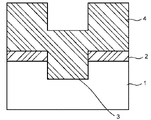
- FIGS. 1A and 1B An example of STI will be described with reference to FIGS. 1A and 1B.
- FIG. 1A after masking the element region of the silicon substrate 1 with a silicon nitride film 2 or the like, a trench 3 is formed in the silicon substrate 1, and an insulating film such as a silicon dioxide film 4 is deposited so as to fill the trench 3. do.
- the silicon dioxide film 4 on the silicon nitride film 2 which is a convex portion is polished and removed while leaving the silicon dioxide film 4 in the trench 3 which is a concave portion by CMP.
- An element separation structure in which the silicon dioxide film 4 is embedded in 3 can be obtained.
- Patent Document 1 discloses an abrasive containing a specific water-soluble polymer, cerium oxide particles, and water and having a pH of 4 to 9. According to the polishing agent of Patent Document 1, the polishing rate for the silicon nitride film can be kept low while maintaining the high polishing rate for the silicon oxide film.
- the silicon nitride film 2 serves as a polishing stopper film, so that a good flat surface can be obtained.
- Patent Document 2 describes cerium (III) in the presence of nitrate ion as a method for preparing a metal-doped cerium composition having excellent thermal stability used as a catalyst for treating exhaust gas.
- a specific method is disclosed in which a solution containing a salt, cerium (IV) and a metal salt is prepared, the solution is contacted with a base to form a precipitate, and the precipitate is heat-treated.
- Non-Patent Document 1 discloses a method for synthesizing hexahedral cerium oxide having 100 exposed surfaces by a hydrothermal synthesis method.
- Non-Patent Document 2 discloses a CO-TPD (Temperature Measured Desorption) measuring method as a method for investigating the redox characteristics of a catalyst on the surface of a cerium oxide crystal.
- CO-TPD is a desorption temperature at which carbon dioxide (CO 2 ) formed by oxygen (O) on the surface of cerium oxide and carbon monoxide (CO) adsorbed on the surface is desorbed from the oxide surface. And a method to evaluate the amount of desorption.
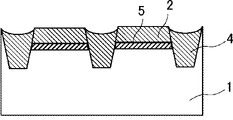
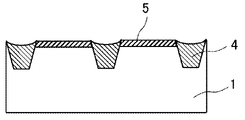
- FIGS. 1A and 1B of STI An example different from FIGS. 1A and 1B of STI will be described with reference to FIGS. 2A and 2B.
- the titanium nitride film 5 and the silicon nitride film 2 are laminated in this order on the element region of the silicon substrate 1, which is different from FIG. 1A.
- conventional polishing agents containing cerium oxide particles are generally used for polishing a silicon oxide film at high speed and suppressing the polishing speed with a silicon nitride film, and the silicon oxide film and the silicon nitride film are simultaneously polished at high speed.
- the present invention has been made in view of the above circumstances, and an object of the present invention is to provide a cerium oxide and an abrasive capable of high-speed polishing a silicon nitride film.
- a first embodiment of cerium oxide according to the present invention has at least one peak of CO 2 desorption amount in the range of 700 ° C. or higher in the temperature rise desorption measurement of CO 2 using oxygen and carbon monoxide. Have.
- the total desorption amount of CO 2 is 35 ⁇ mol / g or more in the temperature-temperature desorption measurement of CO 2 using oxygen and carbon monoxide.
- a third embodiment of cerium oxide according to the present invention is a temperature region of 600 ° C. or higher with respect to the total desorption amount (T) of CO 2 in the temperature-temperature desorption measurement of CO 2 using oxygen and carbon monoxide.
- the ratio (S / T) of the total desorption amount (S) of CO 2 is 0.3 or more.
- a fourth embodiment of cerium oxide according to the present invention is particles having a true density of 5.0 to 6.8 g / cm 3 .
- the cerium oxide may contain one or more metals selected from the group consisting of alkaline earth metals and lanthanoids (excluding cerium).
- the cerium oxide may contain 1 to 20 mol% of the metal.
- the cerium oxide may contain lanthanum as the lanthanoid.
- the cerium oxide may contain one or more of the alkaline earth metals selected from the group consisting of barium and strontium.
- cerium oxide containing the metal may be 0.001 ⁇ to 0.05 ⁇ by subtracting the lattice constant of the cerium oxide not containing the metal from the lattice constant of the cerium oxide containing the metal.
- the abrasive according to the present invention contains the cerium oxide and water.
- a cerium oxide and an abrasive capable of high-speed polishing a silicon nitride film are provided.
- FIG. 4 is a schematic diagram showing the state of cerium oxide in each step of FIG. 3, and FIG. 4A is a schematic diagram showing the initial state of cerium oxide. It is a schematic diagram which shows the cerium oxide which oxygen was supplied to the oxygen defect. It is a schematic diagram which shows the cerium oxide adsorbed by carbon monoxide. It is a schematic diagram which shows the cerium oxide which carbon dioxide was desorbed. It is a warm-up desorption spectrum obtained in Example 4. It is a schematic diagram which shows an example of a polishing apparatus.
- the "surface to be polished” is a surface to be polished, and means, for example, a surface.
- the surface of the intermediate stage appearing on the semiconductor substrate in the process of manufacturing the semiconductor device is also included in the "polished surface".
- the "silicon oxide” is specifically silicon dioxide, but is not limited thereto, and includes silicon oxides other than silicon dioxide.
- the "selection ratio” means the ratio (R SiO2 / R SiN ) of the polishing rate (R SiO2 ) of the silicon oxide film to the polishing rate (R SiN ) of the silicon nitride film.
- "-" indicating a numerical range includes the numerical values described before and after the numerical range as the lower limit value and the upper limit value.
- CO-TPD a temperature rise desorption measurement (CO-TPD) of CO 2 using oxygen and carbon monoxide, which specifies cerium oxide (hereinafter, may be referred to as cerium oxide) according to the present invention.
- CO-TPD can be performed in accordance with the above-mentioned Non-Patent Document 2. This will be specifically described with reference to FIGS. 3 and 4A to 4D.
- FIG. 3 is a graph showing a profile of temperature rise in CO-TPD including pretreatment.
- 4A to 4D are schematic views showing the state of cerium oxide in each step. In this measurement, as shown in FIG. 3, the temperature in the furnace and the gas atmosphere are sequentially adjusted according to the following steps (I) to (III).
- each process can be automatically controlled.
- the steps (I) to (II) are in the preparatory stage, and the measurement of the gas component may be performed at least at the time of carrying out the step (III).
- the gas component can be detected by, for example, a quadrupole mass spectrometer.
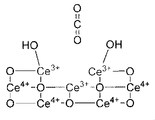
- cerium oxide is presumed to have oxygen defects on a part of the surface as shown in FIG. 4A. It is presumed that oxygen is supplied to the oxygen defect by the step (I), and the oxygen defect is reduced as shown in FIG. 4B. Then, it is presumed that carbon monoxide is mainly adsorbed on the oxygen atom on the surface of cerium oxide as shown in FIG. 4C by the step (II). Up to this point, the pretreatment for this measurement is completed. Then, by raising the temperature as in the above step (III), carbon dioxide is desorbed as shown in FIG. 4D, and a temperature desorption spectrum of CO 2 is obtained.
- FIG. 5 shows an example of the heated desorption spectrum obtained in Example 4 in Examples described later.
- the horizontal axis indicates the elapsed time (minutes), but it can be appropriately converted to temperature by using the temperature curve (broken line).
- the vertical axis indicates the amount of CO 2 desorbed per 1 g of cerium oxide ( ⁇ mol / g).
- the peak separation method includes, for example, vertical division and waveform separation.
- each peak is determined by dividing each point (temperature) that becomes a peak and a valley of the peak with a line perpendicular to the horizontal axis.
- a Gausss function, a Lorentz function, a Voigt function, or the like can be used.
- the peak position (temperature), full width at half maximum, and area (desorption amount) are used as parameters for fitting.
- waveform separation when waveform separation is performed, when the peaks of the desorption temperature are close to each other (about 20 ° C. as a guide), they may be treated as one peak without separation. It is optional to use either vertical division or waveform separation, but peak separation by waveform separation is preferable because there are cases where peaks cannot be picked up by vertical division.
- the amount of desorption of CO 2 can be obtained from the integrated value (area value) of the heated desorption spectrum from the heated desorption spectrum.
- the total desorption amount of CO 2 indicates the integrated value of the heated desorption spectrum corresponding to the entire section of the above step (III), and the total desorption amount of CO 2 in the temperature region of 600 ° C. or higher is The integrated value from the time corresponding to 600 ° C. of the temperature desorption spectrum to the time when the temperature is raised to 900 ° C. and held for 30 minutes is shown.
- the desorption temperature may change slightly depending on the device difference (presence or absence of a vacuum system in the flow in which desorption gas is detected).
- the concentration of gas taken in can be changed by the opening of the flow valve in the mass spectrometer, so the peak area (desorption amount) can change not a little depending on the setting of the opening. There is sex.
- a hexahedral cerium oxide having 100 exposed surfaces obtained by the hydrothermal synthesis method described in Non-Patent Document 1 is used for measurement based on this. If you do so, you can make accurate comparisons even if the device or device settings change.
- the temperature desorption spectrum after the baseline correction and waveform processing is analyzed to determine the characteristics of cerium oxide such as the peak temperature of the CO 2 desorption amount and the CO 2 desorption amount.
- the total desorption amount (T) of CO 2 is obtained from the area of the heated desorption spectrum. Further, the total amount of CO 2 desorption (S) in the temperature region of 600 ° C. or higher can be obtained from the area of the heated desorption spectrum after the time corresponding to 600 ° C. of the heated desorption spectrum.
- [Cerium oxide] This cerium oxide satisfies one or more kinds selected from the following (A) to (D).
- the above-mentioned abrasive using the cerium oxide as abrasive grains has a high polishing rate of the silicon nitride film, and for example, it is possible to polish the silicon oxide film and silicon nitride at a constant speed while maintaining a sufficiently high polishing rate. It becomes.
- the cerium oxide satisfying the above-mentioned (B) has many oxygen defects as active points on the surface and interacts with the surface to be polished. Is estimated to be large. Further, it is presumed that the cerium oxide satisfying the above (A) or (C) tends to form a strong bond because CO 2 is not eliminated until the temperature becomes high. As a result, it is presumed that the chemical interaction with silicon nitride, which is the surface to be polished, is increased and the silicon nitride polishing rate is improved.
- Densities include true density, apparent density, and bulk density.
- True density is defined as the density in which only the volume occupied by the substance itself is used as the volume for density calculation.
- a liquid substitution method and a gas substitution method are known.
- the apparent density is defined as the density in which the volume occupied by the substance itself and the voids inside is used as the volume for density calculation. It is contained in the volume of.
- Known methods for measuring the apparent density include the Le Chatelier specific gravity bottle method, the in-liquid weighing method, the Archimedes method, and the mercury intrusion method.
- Bulk density is defined as the density in which the volume occupied by the substance itself, internal voids and pores is used as the volume for density calculation. The volume of the gap and the volume of the gap between the particles and the container are also included in the volume for density calculation.
- a container method, a funnel method and the like are known.
- the true density is defined as the density.
- the true density is measured by the gas substitution method.
- the true density of the cerium oxide is preferably a density measured by a gas phase substitution method using He as a probe, that is, a true density of 5.0 g / cm 3 or more and 6.8 g / cm 3 or less.
- the true density is preferably 5.5 g / cm 3 or more and 6.7 g / cm 3 or less, and more preferably 6.0 g / cm 3 or more and 6.6 g / cm 3 or less.
- the true density is 6.8 g / cm 3 or less, even when a hard film such as a silicon nitride film is polished at high speed, scratches generated on the silicon nitride film or the like can be suppressed.
- the true density is 5.0 g / cm 3 or more, it is possible to suppress scratches generated on the silicon oxide film or the like while maintaining the desired polishing rate of the silicon oxide film.
- the value of the true density of this cerium oxide is significantly lower than the literature value of the density of cerium oxide of 7.215 g / cm 3 .
- the cerium oxide preferably satisfies one or more selected from the above (A) to (C) from the viewpoint of polishing the silicon nitride film at a higher speed, and satisfies all of the above (A) to (C). Is more preferable.
- the cerium oxide may be composed of cerium and oxygen, or may further contain other atoms. It is preferable to contain an alkaline earth metal and a metal selected from lanthanoids other than cerium from the viewpoint that it is easy to satisfy one or more selected from the group consisting of (A) to (D).
- alkaline earth metal include beryllium, magnesium, calcium, strontium, barium and radium, and strontium or barium is preferable from the viewpoint of the abrasiveness of silicon nitride.
- the lanthanoid examples include lanthanum, placeodim, neodym, promethium, samarium, europium, gadolinium, terbium, dysprosium, holmium, erbium, thulium, ytterbium, and lutetium, and lanthanum is preferable from the viewpoint of the abrasiveness of silicon nitride. ..
- These metals may be used alone or in combination of two or more.
- the content ratio of the metal is preferably 1 to 20 mol%, more preferably 1 to 18 mol%, based on the total amount of the cerium oxide containing the metal or the like.
- the lattice constant (a) of cerium oxide when the above-mentioned alkaline earth metal and a metal selected from lanthanoids other than cerium are contained will be described.
- ⁇ a if the value of ⁇ a is positive, it can be seen that ions having a radius larger than the ionic radius of the cerium ion are taken into the lattice of cerium oxide and the lattice is extended. On the other hand, if the value of ⁇ a is negative, it can be seen that ions having a radius smaller than the ionic radius of the cerium ion are taken into the lattice of cerium oxide and the lattice is shrunk. Further, the larger the absolute value of ⁇ a, the larger the amount of ions having a radius distant from the ionic radius of the cerium ion is incorporated into the lattice, or the larger the amount of ions are incorporated into the lattice.
- ⁇ a is preferably 0.001 ⁇ to 0.05 ⁇ , more preferably 0.002 ⁇ to 0.035 ⁇ . When ⁇ a is within this range, a high polishing rate of the silicon nitride film can be obtained.
- the cerium oxide may contain other atoms as long as the effect of the present invention is exhibited.
- examples of such other atoms include fluorine, carbon, nitrogen, aluminum, silicon and the like. From the viewpoint of the abrasiveness of silicon nitride, these other atoms are preferably 5 mol% or less, more preferably 1 mol% or less, based on the total amount of cerium oxide.
- the fluorine atom may increase the hardness of cerium oxide and damage the polished surface, it is preferably 1 mol% or less, more preferably 0.1 mol% or less, based on the total amount of cerium oxide.
- the average particle size of the cerium oxide particles is preferably 0.01 to 0.5 ⁇ m, more preferably 0.03 ⁇ m to 0.3 ⁇ m. If the average particle size exceeds 0.5 ⁇ m, polishing scratches such as scratches may occur on the surface to be polished. Further, if the average particle size is less than 0.01 ⁇ m, the polishing rate may decrease.
- the preferable particle size of the cerium oxide particles is represented by an average secondary particle diameter. That is, the average particle size indicating the above numerical range is usually the average secondary particle size.
- the average secondary particle size is measured by using a dispersion liquid dispersed in a dispersion medium such as pure water and using a particle size distribution meter such as a laser diffraction / scattering type.
- the crystal structure of cerium oxide is not particularly limited, but a cubic fluorite structure is preferable from the viewpoint of abrasiveness. According to the production method described later, cerium oxide having a cubic fluorite structure can be obtained.
- any method can be selected from the methods for obtaining cerium oxide satisfying at least one selected from the above (A) to (D).
- a manufacturing method including the following steps 1 to 3 (hereinafter, also referred to as the present manufacturing method) can be mentioned. That is, the present manufacturing method is characterized by including the following steps 1 to 3.
- Step 1 A step of adding an aqueous solution containing a dopant containing one or more metals selected from the group consisting of alkaline earth metals and lanthanoids (excluding cerium) to a slurry in which a compound containing poorly soluble cerium is dispersed.
- Step 2 A step of drying the slurry to attach a dopant to the surface of the compound containing cerium.
- Step 3 A step of calcining the cerium-containing compound to which the dopant is attached.
- cerium oxide satisfying at least one selected from the group consisting of the above (A) to (D) can be suitably synthesized. Each process will be described below.
- a slurry in which a compound containing poorly soluble cerium is dispersed and an aqueous solution containing a dopant containing one or more metals selected from the group consisting of alkaline earth metals and lanthanoids are prepared.
- the sparingly soluble cerium include cerium oxide, cerium carbonate, cerium hydroxide, cerium sulfate, cerium phosphate, cerium oxalate, and cerium hydroxide.
- the dispersion medium for sparingly soluble cerium is usually water.
- the aqueous solution is an aqueous solution in which the specific metal is dissolved.
- water-soluble compound containing the metal examples include nitrates, carbonates, acetates, sulfates, oxalates, chlorides, hydroxides, halides and the like.
- the pH of the aqueous solution may be adjusted.
- a compound that is sparingly soluble in water such as an oxide
- those having high solubility in water are suitable in the manufacturing process, and those in which the counter anion of the metal element decomposes or volatilizes at a low temperature are preferable from the viewpoint of polishing characteristics, particularly stability of the polishing rate.
- the compound satisfying such characteristics include oxalate and acetate.
- an aqueous solution in which a carbonate and an organic acid are dissolved or an aqueous solution in which a hydroxide and an organic acid are dissolved is also suitable.
- the aqueous solution is added to the slurry.
- the aqueous solution may be at room temperature or may be heated.
- the slurry is dried.
- any method can be selected from the methods in which the water evaporates.
- it may be heated by a heater or a furnace, heated by a hot bath, or blown with dry air. Stirring is preferable during the drying step from the viewpoint that the dopant is uniformly adhered to the surface of the compound containing cerium.
- the slurry is dried by this drying step.
- the compound containing cerium to which the dried dopant is attached is crushed and fired by heating.
- the heating temperature is preferably 500 ° C. or higher, more preferably 600 ° C. or higher, and even more preferably 700 ° C. or higher from the viewpoint of crystallinity.
- the upper limit of the heating temperature is not particularly limited, but is usually 1000 ° C. or lower, preferably 950 ° C. or lower, and more preferably 900 ° C. or lower, from the viewpoint of suppressing the increase of coarse particles.
- strontium carbonate or barium carbonate may be mixed as impurities in the obtained cerium oxide.
- the carbonate can be removed by washing with an acid aqueous solution having a pH adjusted to about 2 such as hydrochloric acid or nitric acid aqueous solution, if necessary.
- the cerium oxide obtained by the above-mentioned production method satisfies at least one of the characteristics of the present cerium oxide (the above (A) to (C)).
- the cerium oxide can be suitably used, for example, as an abrasive grain of an abrasive in CMP, particularly STI. Since the present cerium oxide improves the polishing rate of the silicon nitride surface, it is possible to perform constant velocity polishing while suppressing a decrease in the polishing rate in the CMP of the silicon oxide surface and the surface to be polished including the silicon nitride surface.
- the cerium oxide When used as an abrasive, it is preferable to disperse the particles of the cerium oxide in a dispersion medium.
- the cerium oxide may be appropriately selected from insoluble or sparingly soluble liquids. In CMP applications, water is particularly preferable as the dispersion medium.
- the abrasive containing the present cerium oxide may appropriately contain a known additive, if necessary.
- the additive is not particularly limited, and examples thereof include a polymer that adjusts the polishing rate of the silicon oxide film and the silicon nitride film, a pH adjuster, and a chelating agent.
- inorganic acids organic acids, basic compounds, amphoteric compounds such as amino acids, and salts thereof can be appropriately selected and used.
- inorganic acid include nitric acid, sulfuric acid, hydrochloric acid, phosphoric acid and the like, and ammonium salts, sodium salts, potassium salts and the like thereof may be used.
- organic acid include carboxylic acids such as picolinic acid, organic sulfonic acids, organic phosphoric acids and the like, and ammonium salts, sodium salts, potassium salts and the like thereof may be used.
- organic basic compound examples include compounds containing nitrogen such as ammonia, potassium hydroxide, tetramethylammonium hydroxide, and ethylenediamine as basic compounds.
- amphoteric compound examples include glycine, alanine and phenylalanine.
- the chelating agent can be appropriately selected from known chelating agents used for polishing agents, and for example, a dicarboxylic acid-based chelating agent, a tricarboxylic acid-based chelating agent, a gluconic acid-based chelating agent, and a nitrilotriacetic acid-based chelating agent. , Iminosuccinic acid-based chelating agent and the like.
- a polishing method using an abrasive containing the present cerium oxide for example, a method in which the surface to be polished and the polishing pad of the object to be polished are brought into contact with each other while the polishing agent is supplied, and polishing is performed by the relative motion of both.
- examples of the surface to be polished include a surface in which a silicon dioxide film and silicon nitride are arranged in a pattern on the surface of a semiconductor substrate.
- silicon nitride is polished using an abrasive containing the cerium oxide, it is preferable to have a silicon nitride film, a polysilicon film, or the like as a base film. Since the polishing rate of the base film of this cerium oxide is low, a flattened surface on which the base film is exposed is formed.
- Examples of the silicon dioxide film in the STI substrate include a so-called PE-TEOS film formed by a plasma CVD method using tetraethoxysilane (TEOS) as a raw material. Further, as the silicon dioxide film, a so-called HDP film formed by a high-density plasma CVD method can be mentioned. Further, a HARP film or FCVD film formed by another CVD method, or an SOD film formed by spin coating can also be used. Examples of the silicon nitride film include those formed by a low-pressure CVD method or a plasma CVD method or those formed by an ALD method using silane or dichlorosilane and ammonia as raw materials.
- FIG. 6 is a schematic view showing an example of a polishing device.
- the polishing apparatus 20 shown in the example of FIG. 6 includes a polishing head 22 for holding a semiconductor substrate 21 such as an STI substrate, a polishing surface plate 23, a polishing pad 24 attached to the surface of the polishing surface plate 23, and polishing.
- the pad 24 is provided with an abrasive supply pipe 26 for supplying the abrasive 25. While supplying the polishing agent 25 from the polishing agent supply pipe 26, the surface to be polished of the semiconductor substrate 21 held by the polishing head 22 is brought into contact with the polishing pad 24, and the polishing head 22 and the polishing surface plate 23 are relatively rotated. It is configured to be moved for polishing.
- the polishing head 22 may perform linear motion as well as rotary motion. Further, the polishing surface plate 23 and the polishing pad 24 may have the same size as or smaller than the semiconductor substrate 21. In that case, it is preferable that the polishing head 22 and the polishing surface plate 23 are relatively moved so that the entire surface of the semiconductor substrate 21 to be polished can be polished. Further, the polishing surface plate 23 and the polishing pad 24 do not have to perform rotary motion, and may be, for example, belt-type and move in one direction.
- the polishing conditions of such a polishing device 20 are not particularly limited, but by applying a load to the polishing head 22 and pressing it against the polishing pad 24, the polishing pressure can be further increased and the polishing speed can be improved.
- the polishing pressure is preferably about 0.5 to 50 kPa, and more preferably about 3 to 40 kPa from the viewpoint of uniformity in the surface to be polished of the semiconductor substrate 21 in polishing speed, flatness, and prevention of polishing defects such as scratches.
- the rotation speed of the polishing surface plate 23 and the polishing head 22 is preferably about 50 to 500 rpm. Further, the supply amount of the polishing agent 25 is appropriately adjusted depending on the composition of the polishing agent, each of the above-mentioned polishing conditions, and the like.
- the polishing pad 24 one made of a non-woven fabric, polyurethane foam, a porous resin, a non-porous resin, or the like can be used. Grooves such as lattice, concentric, and spiral on the surface of the polishing pad 24 in order to promote the supply of the polishing agent 25 to the polishing pad 24 or to allow a certain amount of the polishing agent 25 to accumulate in the polishing pad 24. May be applied. Further, if necessary, the pad conditioner may be brought into contact with the surface of the polishing pad 24 to polish while conditioning the surface of the polishing pad 24.
- Examples 1 to 5 are examples of cerium oxide and a method for producing the same according to the present invention
- Examples 6 to 8 are comparative examples.
- Example 1 This manufacturing method (hereinafter, also referred to as synthesis method A). 42.4 g of cerium carbonate anhydride was put into a firing furnace and fired at 800 ° C. for 1 hour while blowing air. The slurry containing 31.7 g of the cerium oxide powder thus obtained was placed on an evaporating dish. Next, 8.834 g of lanthanum nitrate hexahydrate was taken and dissolved in 40 mL of pure water. The evaporating dish containing the slurry was placed on a hot stirrer, the set temperature was set to 200 ° C., and the mixture was stirred with a stirrer.
- Example 2 cerium oxide of Example 2 was obtained in the same manner as in Example 1 except that the lanthanum nitrate hexahydrate was changed to 13.251 g.
- Example 3 cerium oxide of Example 3 was obtained in the same manner as in Example 1 except that 4.317 g of strontium nitrate was used instead of lanthanum nitrate hexahydrate.
- Example 4 cerium oxide of Example 4 was obtained in the same manner as in Example 1 except that 2.665 g of barium nitrate was used instead of lanthanum nitrate hexahydrate.
- Example 5 cerium oxide of Example 5 was obtained in the same manner as in Example 1 except that 5.331 g of barium nitrate was used instead of lanthanum nitrate hexahydrate.
- Example 6 (Example in which no other metal is added in synthesis method A. Hereinafter, it is also referred to as synthesis method AX).
- 42.4 g of cerium carbonate anhydride was put into a firing furnace and fired at 800 ° C. for 1 hour while blowing air.
- the slurry containing 31.7 g of the cerium oxide powder thus obtained was placed on an evaporating dish.
- the evaporating dish containing the slurry was placed on a hot stirrer, and the temperature was set to 200 ° C., and the mixture was completely dried while stirring with a stirrer.
- the agglomerated precursor was crushed in an agate mortar until it became a powder, and then calcined in an electric furnace.
- the firing temperature was set to 800 ° C. for 8 hours, the temperature was raised to 800 ° C. over 2 hours, and the temperature lowered after firing was allowed to cool naturally.
- the obtained powder was pulverized in an agate mortar and then washed with 300 mL of pure water. The particles were recovered by washing with pure water until the pH of the filtrate became near neutral using a 0.1 ⁇ m membrane filter and a suction filter. The recovered particles were dried in a constant temperature bath at 80 ° C. for 12 hours to completely remove water. The obtained powder was pulverized again in an agate mortar to obtain cerium oxide of Example 6.
- Example 7 Premixing method (hereinafter, also referred to as synthesis method B) At the time of the crystallization reaction (coprecipitation reaction), the cerium source and the foreign element raw material are dissolved together in water to obtain a precipitate (cerium oxide to which different elements are added, cerium carbonate, etc.) and calcining it. This is a method for obtaining cerium oxide. Using cerium carbonate and lanthanum nitrate hexahydrate as raw materials, cerium oxide of Example 7 was obtained by the method.
- Example 8 Hydrothermal synthesis method (hereinafter, also referred to as synthesis method C)
- synthesis method C Hydrothermal synthesis method
- a hexahedral cerium oxide having 100 exposed faces was synthesized by a hydrothermal synthesis method. Specifically, an aqueous solution (precipitate) in which cerium nitrate and sodium hydroxide were mixed was placed in a closed container, and a hydrothermal reaction was carried out at 180 ° C. for 24 hours to obtain cerium oxide of Example 8.
- cerium oxide is thoroughly washed with pure water to remove unreacted components, sodium and nitrate ions, and the sodium and nitrate ions are thoroughly washed by inductively coupled plasma emission spectroscopy (ICP) and conductivity measurement. I confirmed that it was done.
- ICP inductively coupled plasma emission spectroscopy
- the cerium oxide obtained in Examples 1 to 8 was evaluated for X-ray diffraction (XRD) measurement using a high-speed X-ray diffractometer SmartLab manufactured by RIGAKU.
- the measurement conditions are X-ray tube: Cu, voltage: 40 kV, current: 200 mA, scan mode: Step Scan, measurement angle range: 10 ° -150 °, sampling interval: 0.01 °, scan time per step: 2s. was set.
- the obtained XRD profile was collated with a database (JCPDS No .: 34-0394), and it was confirmed that the target product, cerium oxide having a cubic fluorite structure, was obtained.
- cerium oxides of Examples 1 to 5 and Example 7 contained La, Sr or Ba, it was confirmed that each peak was slightly shifted to the low angle side. In the cerium oxides of Examples 1 and 2, no peak derived from other than cerium oxide containing La was confirmed. No peak shift was confirmed for the cerium oxides of Examples 6 and 8.
- each of the cerium oxides obtained in Examples 1 to 8 was placed in a container containing 270 mL of pure water, irradiated with an ultrasonic homogenizer for 5 minutes, and subjected to crushing and dispersion treatment.
- a 5 mm ⁇ zirconia ball was placed so as to have the same volume as pure water, crushed by a ball mill for 30 minutes, and crushed and dispersed.
- the injection collision treatment was repeated 5 times, and crushing and dispersion treatment were performed to obtain a slurry in which cerium oxide of Examples 1 to 8 was dispersed.
- nitric acid was appropriately added as a pH adjuster so that the pH became 3 to 5.
- the homogenizer used was US-600TCVP (device name) manufactured by NIHONSEIKI KAISHA, and the wet jet mill used Starburst Mini (device name) manufactured by Sugino Machine Limited.
- the average secondary particle diameter D of cerium oxide in the obtained slurry was measured using a laser scattering / diffraction device (manufactured by HORIBA, Ltd., trade name: LA-950). The measurement results are shown in Table 1.
- polishing rate of silicon nitride was measured using the slurries of Examples 1 to 8 obtained above.
- a polishing machine a fully automatic CMP apparatus (manufactured by Applied Materials, apparatus name: Mira) was used.
- the polishing pad a two-layer pad (manufactured by DuPont, trade name: K-groove of IC-1000) was used, and conditioning was performed using a diamond disc (manufactured by 3M, trade name: A165).
- the silicon nitride was polished for 1 minute with the supply speed of the slurry as an abrasive being 200 cm 3 / min, the rotation speed of the polishing surface plate being 77 rpm, and the polishing pressure being 3 psi.
- An optical film thickness meter (manufactured by KLA-Tencor, device name: UV-1280SE) was used to measure the polishing rate. The amount of film thickness removed per minute was evaluated as the polishing rate (RR). Further, the polishing rates of each example were compared with the polishing rate of Example 6 as a reference (100). The results are shown in Table 1.
- the temperature rise desorption measurement was evaluated using a fully automatic temperature temperature desorption spectrum apparatus TPD-1-ATw manufactured by Microtrac Bell Co., Ltd. Approximately 100 mg of the sample was collected, and the measurement conditions were as described above according to the measurement program shown in FIG. 3 described above.
- the temperature desorption measurement detected the target gas component with a quadrupole mass spectrometer. The measurement range was 50 ° C. to 900 ° C., the measurement atmosphere was He 50 mL / min, and fragments of m / z 18, 28, 44 were detected.
- the obtained heated desorption spectrum was subjected to baseline correction and waveform analysis according to the above-mentioned method, and (A) maximum peak temperature, (B) total desorption amount of CO 2 and (C) total desorption of CO 2 were performed.
- the ratio (S / T) of the total desorption amount (S) of CO 2 in the temperature region of 600 ° C. or higher to the desorption amount (T) was determined.
- Table 1 [True Density] The true density measurement of cerium oxide obtained in Examples 1 to 8 was evaluated using AccuPycII1340 manufactured by Shimadzu Corporation. He gas was used as a probe, and the set temperature of the circulating constant temperature bath was set to 25 ° C.
- the cerium oxides of Examples 1 to 5 satisfying one or more selected from the following (A) to (D) have a high polishing rate of the silicon nitride film.
- D Particles having a true density of 5.0 to 6.8 g / cm 3 .
- the lattice constant (a) was determined by the pattern obtained by the measurement of powder X-ray diffraction and the assigned Miller index (hkl).
- the powder X-ray diffraction was evaluated using a high-speed X-ray diffractometer SmartLab manufactured by RIGAKU.
- the measurement conditions are X-ray tube: Cu, voltage: 40 kV, current: 200 mA, scan mode: Step Scan, measurement angle range: 10 ° -150 °, sampling interval: 0.01 °, scan time per step: 2s. Was set.
- the cerium oxide of Examples 1 to 5 was selected from the above (A) to (D) because the metal ion having an ionic radius larger than that of the cerium ion was sufficiently incorporated into the lattice. It was possible to obtain a high polishing rate of the silicon nitride film by satisfying one or more of them.
- the cerium oxide of Example 6 to which no metal ion is added and Example 7 produced by the synthetic method B does not satisfy one or more of the above (A) to (D), and is high in silicon nitride. The polishing speed of the film could not be obtained.
Landscapes
- Chemical & Material Sciences (AREA)
- Organic Chemistry (AREA)
- Engineering & Computer Science (AREA)
- Materials Engineering (AREA)
- Compounds Of Alkaline-Earth Elements, Aluminum Or Rare-Earth Metals (AREA)
- Mechanical Treatment Of Semiconductor (AREA)
- Finish Polishing, Edge Sharpening, And Grinding By Specific Grinding Devices (AREA)
Priority Applications (3)
| Application Number | Priority Date | Filing Date | Title |
|---|---|---|---|
| JP2022553899A JP7697473B2 (ja) | 2020-09-30 | 2021-09-24 | 酸化セリウム及び研磨剤 |
| EP21875422.4A EP4223849A4 (en) | 2020-09-30 | 2021-09-24 | CERIUM OXIDE AND POLISHING AGENT |
| JP2025074308A JP2025105845A (ja) | 2020-09-30 | 2025-04-28 | 酸化セリウム及び研磨剤 |
Applications Claiming Priority (2)
| Application Number | Priority Date | Filing Date | Title |
|---|---|---|---|
| JP2020164640 | 2020-09-30 | ||
| JP2020-164640 | 2020-09-30 |
Publications (1)
| Publication Number | Publication Date |
|---|---|
| WO2022071120A1 true WO2022071120A1 (ja) | 2022-04-07 |
Family
ID=80950331
Family Applications (1)
| Application Number | Title | Priority Date | Filing Date |
|---|---|---|---|
| PCT/JP2021/035109 Ceased WO2022071120A1 (ja) | 2020-09-30 | 2021-09-24 | 酸化セリウム及び研磨剤 |
Country Status (4)
| Country | Link |
|---|---|
| EP (1) | EP4223849A4 (https=) |
| JP (2) | JP7697473B2 (https=) |
| TW (1) | TWI906375B (https=) |
| WO (1) | WO2022071120A1 (https=) |
Citations (8)
| Publication number | Priority date | Publication date | Assignee | Title |
|---|---|---|---|---|
| WO2000073211A1 (en) * | 1999-05-28 | 2000-12-07 | Hitachi Chemical Co., Ltd. | Method for producing cerium oxide, cerium oxide abrasive, method for polishing substrate using the same and method for manufacturing semiconductor device |
| JP2004168638A (ja) * | 2002-10-28 | 2004-06-17 | Nissan Chem Ind Ltd | 酸化セリウム粒子及び多段階焼成による製造方法 |
| WO2009031447A1 (ja) * | 2007-09-07 | 2009-03-12 | Asahi Glass Company, Limited | 酸化物結晶微粒子の製造方法 |
| JP2015047568A (ja) * | 2013-09-02 | 2015-03-16 | 株式会社キャタラー | 排気ガス浄化用触媒 |
| JP2015188881A (ja) * | 2014-03-31 | 2015-11-02 | エヌ・イーケムキャット株式会社 | リン捕集材およびそれを用いた自動車排気ガス浄化触媒 |
| JP2017529296A (ja) | 2014-06-24 | 2017-10-05 | ローディア オペレーションズ | 金属ドープ酸化セリウム組成物 |
| JP2019087660A (ja) | 2017-11-08 | 2019-06-06 | Agc株式会社 | 研磨剤と研磨方法、および研磨用添加液 |
| JP2020164640A (ja) | 2019-03-29 | 2020-10-08 | 三菱ケミカル株式会社 | 改質ピッチの製造方法 |
Family Cites Families (3)
| Publication number | Priority date | Publication date | Assignee | Title |
|---|---|---|---|---|
| CN106978089A (zh) * | 2017-04-20 | 2017-07-25 | 德米特(苏州)电子环保材料有限公司 | 一种稀土抛光粉的制备方法 |
| TWI764338B (zh) * | 2019-10-22 | 2022-05-11 | 美商Cmc材料股份有限公司 | 用於氧化矽和碳摻雜之氧化矽化學機械拋光的組合物及方法 |
| EP4209561A4 (en) * | 2020-09-04 | 2024-09-04 | Agc Inc. | Cerium oxide and polishing agent |
-
2021
- 2021-09-24 JP JP2022553899A patent/JP7697473B2/ja active Active
- 2021-09-24 EP EP21875422.4A patent/EP4223849A4/en active Pending
- 2021-09-24 WO PCT/JP2021/035109 patent/WO2022071120A1/ja not_active Ceased
- 2021-09-28 TW TW110135952A patent/TWI906375B/zh active
-
2025
- 2025-04-28 JP JP2025074308A patent/JP2025105845A/ja active Pending
Patent Citations (8)
| Publication number | Priority date | Publication date | Assignee | Title |
|---|---|---|---|---|
| WO2000073211A1 (en) * | 1999-05-28 | 2000-12-07 | Hitachi Chemical Co., Ltd. | Method for producing cerium oxide, cerium oxide abrasive, method for polishing substrate using the same and method for manufacturing semiconductor device |
| JP2004168638A (ja) * | 2002-10-28 | 2004-06-17 | Nissan Chem Ind Ltd | 酸化セリウム粒子及び多段階焼成による製造方法 |
| WO2009031447A1 (ja) * | 2007-09-07 | 2009-03-12 | Asahi Glass Company, Limited | 酸化物結晶微粒子の製造方法 |
| JP2015047568A (ja) * | 2013-09-02 | 2015-03-16 | 株式会社キャタラー | 排気ガス浄化用触媒 |
| JP2015188881A (ja) * | 2014-03-31 | 2015-11-02 | エヌ・イーケムキャット株式会社 | リン捕集材およびそれを用いた自動車排気ガス浄化触媒 |
| JP2017529296A (ja) | 2014-06-24 | 2017-10-05 | ローディア オペレーションズ | 金属ドープ酸化セリウム組成物 |
| JP2019087660A (ja) | 2017-11-08 | 2019-06-06 | Agc株式会社 | 研磨剤と研磨方法、および研磨用添加液 |
| JP2020164640A (ja) | 2019-03-29 | 2020-10-08 | 三菱ケミカル株式会社 | 改質ピッチの製造方法 |
Non-Patent Citations (3)
| Title |
|---|
| See also references of EP4223849A1 |
| WU, Z., LI, M., & OVERBURY, S. H.: "On the structure dependence of CO oxidation over CeO2 nanocrystals with well-defined surface planes", JOURNAL OF CATALYSIS, vol. 285, no. 1, 2012, pages 61 - 73, XP028342928, DOI: 10.1016/j.jcat.2011.09.011 |
| ZILI WU ET AL., LANGMUIR, vol. 26, no. 21, 2010, pages 16595 - 16606 |
Also Published As
| Publication number | Publication date |
|---|---|
| TW202214523A (zh) | 2022-04-16 |
| JP2025105845A (ja) | 2025-07-10 |
| EP4223849A1 (en) | 2023-08-09 |
| EP4223849A4 (en) | 2024-10-23 |
| JPWO2022071120A1 (https=) | 2022-04-07 |
| TWI906375B (zh) | 2025-12-01 |
| JP7697473B2 (ja) | 2025-06-24 |
Similar Documents
| Publication | Publication Date | Title |
|---|---|---|
| JP6827318B2 (ja) | 酸化セリウム砥粒 | |
| US10017669B2 (en) | Polishing composition, polishing method, and method for producing polishing composition | |
| KR20170065533A (ko) | Cmp 연마제 및 그 제조방법, 그리고 기판의 연마방법 | |
| JP7044510B2 (ja) | 酸化セリウム含有複合研磨材 | |
| JP6268069B2 (ja) | 研磨組成物及び研磨方法 | |
| EP2896672A2 (en) | Manufacturing method of polishing agent, polishing method, and manufacturing method of semiconductor integrated circuit device | |
| JP5248096B2 (ja) | 研磨液組成物 | |
| KR101492234B1 (ko) | 산화세륨 입자 제조 방법, 이에 의한 산화세륨 입자 및 이를 포함하는 연마 슬러리 | |
| JP7790349B2 (ja) | 酸化セリウム及び研磨剤 | |
| JP7697473B2 (ja) | 酸化セリウム及び研磨剤 | |
| US9328261B2 (en) | Polishing agent, polishing method, and manufacturing method of semiconductor integrated circuit device | |
| JP6761339B2 (ja) | 酸化セリウム砥粒 | |
| JP7019379B2 (ja) | 複合砥粒 | |
| JP2015035517A (ja) | Cmp用研磨液 | |
| US12503622B2 (en) | Cerium-based particle and polishing slurry composition including the same | |
| JP2015034243A (ja) | Cmp用研磨液 | |
| KR101103748B1 (ko) | 반도체 박막 연마용 산화세륨 슬러리 및 이의 제조방법 | |
| KR20250096253A (ko) | 화학적 기계적 연마 슬러리 조성물 및 반도체 소자의 제조 방법 | |
| KR101483449B1 (ko) | 세륨계 연마입자의 제조방법 및 그에 의한 세륨계 연마입자 |
Legal Events
| Date | Code | Title | Description |
|---|---|---|---|
| 121 | Ep: the epo has been informed by wipo that ep was designated in this application |
Ref document number: 21875422 Country of ref document: EP Kind code of ref document: A1 |
|
| ENP | Entry into the national phase |
Ref document number: 2022553899 Country of ref document: JP Kind code of ref document: A |
|
| NENP | Non-entry into the national phase |
Ref country code: DE |
|
| ENP | Entry into the national phase |
Ref document number: 2021875422 Country of ref document: EP Effective date: 20230502 |