WO2022014635A1 - 顔料組成物、着色組成物、塗料、インキ、インキセット、印刷物、及び包装材料 - Google Patents
顔料組成物、着色組成物、塗料、インキ、インキセット、印刷物、及び包装材料 Download PDFInfo
- Publication number
- WO2022014635A1 WO2022014635A1 PCT/JP2021/026445 JP2021026445W WO2022014635A1 WO 2022014635 A1 WO2022014635 A1 WO 2022014635A1 JP 2021026445 W JP2021026445 W JP 2021026445W WO 2022014635 A1 WO2022014635 A1 WO 2022014635A1
- Authority
- WO
- WIPO (PCT)
- Prior art keywords
- parts
- ink
- group
- resin
- water
- Prior art date
- Legal status (The legal status is an assumption and is not a legal conclusion. Google has not performed a legal analysis and makes no representation as to the accuracy of the status listed.)
- Ceased
Links
Images




Classifications
-
- C—CHEMISTRY; METALLURGY
- C09—DYES; PAINTS; POLISHES; NATURAL RESINS; ADHESIVES; COMPOSITIONS NOT OTHERWISE PROVIDED FOR; APPLICATIONS OF MATERIALS NOT OTHERWISE PROVIDED FOR
- C09B—ORGANIC DYES OR CLOSELY-RELATED COMPOUNDS FOR PRODUCING DYES, e.g. PIGMENTS; MORDANTS; LAKES
- C09B57/00—Other synthetic dyes of known constitution
- C09B57/04—Isoindoline dyes
-
- C—CHEMISTRY; METALLURGY
- C09—DYES; PAINTS; POLISHES; NATURAL RESINS; ADHESIVES; COMPOSITIONS NOT OTHERWISE PROVIDED FOR; APPLICATIONS OF MATERIALS NOT OTHERWISE PROVIDED FOR
- C09D—COATING COMPOSITIONS, e.g. PAINTS, VARNISHES OR LACQUERS; FILLING PASTES; CHEMICAL PAINT OR INK REMOVERS; INKS; CORRECTING FLUIDS; WOODSTAINS; PASTES OR SOLIDS FOR COLOURING OR PRINTING; USE OF MATERIALS THEREFOR
- C09D11/00—Inks
- C09D11/02—Printing inks
- C09D11/03—Printing inks characterised by features other than the chemical nature of the binder
- C09D11/037—Printing inks characterised by features other than the chemical nature of the binder characterised by the pigment
-
- C—CHEMISTRY; METALLURGY
- C09—DYES; PAINTS; POLISHES; NATURAL RESINS; ADHESIVES; COMPOSITIONS NOT OTHERWISE PROVIDED FOR; APPLICATIONS OF MATERIALS NOT OTHERWISE PROVIDED FOR
- C09B—ORGANIC DYES OR CLOSELY-RELATED COMPOUNDS FOR PRODUCING DYES, e.g. PIGMENTS; MORDANTS; LAKES
- C09B67/00—Influencing the physical, e.g. the dyeing or printing properties of dyestuffs without chemical reactions, e.g. by treating with solvents grinding or grinding assistants, coating of pigments or dyes; Process features in the making of dyestuff preparations; Dyestuff preparations of a special physical nature, e.g. tablets, films
- C09B67/0033—Blends of pigments; Mixtured crystals; Solid solutions
- C09B67/0034—Mixtures of two or more pigments or dyes of the same type
-
- C—CHEMISTRY; METALLURGY
- C09—DYES; PAINTS; POLISHES; NATURAL RESINS; ADHESIVES; COMPOSITIONS NOT OTHERWISE PROVIDED FOR; APPLICATIONS OF MATERIALS NOT OTHERWISE PROVIDED FOR
- C09B—ORGANIC DYES OR CLOSELY-RELATED COMPOUNDS FOR PRODUCING DYES, e.g. PIGMENTS; MORDANTS; LAKES
- C09B67/00—Influencing the physical, e.g. the dyeing or printing properties of dyestuffs without chemical reactions, e.g. by treating with solvents grinding or grinding assistants, coating of pigments or dyes; Process features in the making of dyestuff preparations; Dyestuff preparations of a special physical nature, e.g. tablets, films
- C09B67/0071—Process features in the making of dyestuff preparations; Dehydrating agents; Dispersing agents; Dustfree compositions
- C09B67/0084—Dispersions of dyes
-
- C—CHEMISTRY; METALLURGY
- C09—DYES; PAINTS; POLISHES; NATURAL RESINS; ADHESIVES; COMPOSITIONS NOT OTHERWISE PROVIDED FOR; APPLICATIONS OF MATERIALS NOT OTHERWISE PROVIDED FOR
- C09D—COATING COMPOSITIONS, e.g. PAINTS, VARNISHES OR LACQUERS; FILLING PASTES; CHEMICAL PAINT OR INK REMOVERS; INKS; CORRECTING FLUIDS; WOODSTAINS; PASTES OR SOLIDS FOR COLOURING OR PRINTING; USE OF MATERIALS THEREFOR
- C09D11/00—Inks
- C09D11/30—Inkjet printing inks
- C09D11/32—Inkjet printing inks characterised by colouring agents
- C09D11/322—Pigment inks
-
- C—CHEMISTRY; METALLURGY
- C09—DYES; PAINTS; POLISHES; NATURAL RESINS; ADHESIVES; COMPOSITIONS NOT OTHERWISE PROVIDED FOR; APPLICATIONS OF MATERIALS NOT OTHERWISE PROVIDED FOR
- C09D—COATING COMPOSITIONS, e.g. PAINTS, VARNISHES OR LACQUERS; FILLING PASTES; CHEMICAL PAINT OR INK REMOVERS; INKS; CORRECTING FLUIDS; WOODSTAINS; PASTES OR SOLIDS FOR COLOURING OR PRINTING; USE OF MATERIALS THEREFOR
- C09D11/00—Inks
- C09D11/30—Inkjet printing inks
- C09D11/40—Ink-sets specially adapted for multi-colour inkjet printing
-
- C—CHEMISTRY; METALLURGY
- C09—DYES; PAINTS; POLISHES; NATURAL RESINS; ADHESIVES; COMPOSITIONS NOT OTHERWISE PROVIDED FOR; APPLICATIONS OF MATERIALS NOT OTHERWISE PROVIDED FOR
- C09D—COATING COMPOSITIONS, e.g. PAINTS, VARNISHES OR LACQUERS; FILLING PASTES; CHEMICAL PAINT OR INK REMOVERS; INKS; CORRECTING FLUIDS; WOODSTAINS; PASTES OR SOLIDS FOR COLOURING OR PRINTING; USE OF MATERIALS THEREFOR
- C09D4/00—Coating compositions, e.g. paints, varnishes or lacquers, based on organic non-macromolecular compounds having at least one polymerisable carbon-to-carbon unsaturated bond ; Coating compositions, based on monomers of macromolecular compounds of groups C09D183/00 - C09D183/16
- C09D4/06—Organic non-macromolecular compounds having at least one polymerisable carbon-to-carbon unsaturated bond in combination with a macromolecular compound other than an unsaturated polymer of groups C09D159/00 - C09D187/00
-
- C—CHEMISTRY; METALLURGY
- C09—DYES; PAINTS; POLISHES; NATURAL RESINS; ADHESIVES; COMPOSITIONS NOT OTHERWISE PROVIDED FOR; APPLICATIONS OF MATERIALS NOT OTHERWISE PROVIDED FOR
- C09D—COATING COMPOSITIONS, e.g. PAINTS, VARNISHES OR LACQUERS; FILLING PASTES; CHEMICAL PAINT OR INK REMOVERS; INKS; CORRECTING FLUIDS; WOODSTAINS; PASTES OR SOLIDS FOR COLOURING OR PRINTING; USE OF MATERIALS THEREFOR
- C09D7/00—Features of coating compositions, not provided for in group C09D5/00; Processes for incorporating ingredients in coating compositions
- C09D7/40—Additives
- C09D7/41—Organic pigments; Organic dyes
-
- G—PHYSICS
- G03—PHOTOGRAPHY; CINEMATOGRAPHY; ANALOGOUS TECHNIQUES USING WAVES OTHER THAN OPTICAL WAVES; ELECTROGRAPHY; HOLOGRAPHY
- G03G—ELECTROGRAPHY; ELECTROPHOTOGRAPHY; MAGNETOGRAPHY
- G03G9/00—Developers
- G03G9/08—Developers with toner particles
- G03G9/09—Colouring agents for toner particles
- G03G9/0906—Organic dyes
- G03G9/091—Azo dyes
Definitions
- the present invention relates to a pigment composition containing an isoindoline compound.
- Pigments are a typical colorant used in applications such as plastic products, toners, paints, and printing inks. Pigments are roughly classified into inorganic pigments and organic pigments, and organic pigments generally tend to be inferior in weather resistance and heat resistance as compared with inorganic pigments. However, organic pigments are used in various applications because they are superior to inorganic pigments in terms of color sharpness and coloring power. For example, as organic pigments, azo pigments, quinophthalone pigments, isoindoline pigments, isoindolinone pigments, anthraquinone pigments, diketopyrrolopyrrole pigments, quinacridone pigments and the like are known.
- Patent Document 1 discloses an isoindoline pigment for use in coloring plastics.
- Patent Document 2 discloses a dispersion for an inkjet ink, which comprises water, a dispersant, and an isoindoline pigment.
- the conventional isoindoline compound is difficult to disperse and has poor dispersion stability. Further, the coloring composition containing the isoindoline compound has a problem that the weather resistance and the heat resistance are insufficient. Furthermore, when the isoindoline compound is used for water-based inkjet ink applications, it is necessary to set the pH value of the ink to 7 or more and 10 or less in terms of storage stability, but there is a problem of fading over time in a basic atmosphere. ..
- An object of the present invention is to provide a pigment composition containing an isoindoline compound, which is excellent in dispersibility, weather resistance and heat resistance, has good storage stability, and suppresses discoloration over time in a basic atmosphere.
- the pigment composition of the present invention contains an isoindoline compound represented by the following formula (1) and an isoindoline compound represented by the following formula (2).
- R 1 to R 4 represent hydrogen atoms
- R 5 and R 6 each independently represent an alkyl group
- a and A' are the following formulas (3) and (4). Or, it represents a group represented by the following formula (5).
- X represents —O— or —NH— and R 7 represents an alkyl or aryl group.
- R 8 to R 14 independently represent a hydrogen atom, a halogen atom, an alkyl group, an alkoxy group, an aryl group, an aryloxy group, a thioalkyl group, or a thioaryl group.
- a pigment composition containing an isoindoline compound which is excellent in dispersibility, weather resistance and heat resistance, has good storage stability, and suppresses fading over time in a basic atmosphere. .. Further, it is possible to provide an ink set, a printed matter, and a packaging material containing yellow ink, which has good dispersibility and storage stability and can form a highly saturated image or the like.
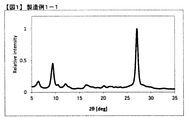
- FIG. 1 is an X-ray diffraction spectrum of the isoindoline compound obtained in Production Example 1-1.
- FIG. 2 is an X-ray diffraction spectrum of the isoindoline compound obtained in Production Example 1-2.
- FIG. 3 is an X-ray diffraction spectrum of the isoindoline compound obtained in Example 1-1.
- FIG. 4 is an X-ray diffraction spectrum of the isoindoline compound obtained in Example 1-2.
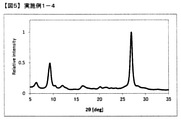
- FIG. 5 is an X-ray diffraction spectrum of the isoindoline compound obtained in Example 1-4.
- FIG. 6 is an X-ray diffraction spectrum of the isoindoline compound obtained in Example 1-5.
- FIG. 7 is an X-ray diffraction spectrum of the isoindoline compound obtained in Example 1-8.
- FIG. 8 is an X-ray diffraction spectrum of the isoindoline compound obtained in Example 1-11.
- the pigment composition of the present invention contains an isoindoline compound represented by the formula (1) and an isoindoline compound represented by the formula (2).
- the pigment composition of the present invention contains two types of isoindoline compounds under the dispersibility, weather resistance, heat resistance, storage stability, and basic atmosphere, which have been the weak points of the isoindoline compounds in the past. Can solve the problem of fading over time.
- the pigment composition of the present invention can be used in a wide range of applications such as plastic molded bodies, toners, paints, printing inks, and inkjet inks.
- isoindoline compound (1) and [isoindoline compound (2)]
- the isoindoline compound represented by the formula (1) is referred to as an isoindoline compound (1)
- isoindoline compound represented by the formula (2) is referred to as an isoindoline compound (2).
- the content of the isoindoline compound (1) in 100% by mass of the pigment composition is preferably 50 to 99% by mass, more preferably 70 to 95% by mass.
- R 1 to R 4 represent a hydrogen atom.
- R 5 and R 6 each independently represent an alkyl group.
- a and A' represent the group represented by the following formula (3), the following formula (4), or the following formula (5).
- R 7 represents an alkyl group or an aryl group.
- R 8 ⁇ R 14 each independently represent a hydrogen atom, a halogen atom, an alkyl group, an alkoxy group, an aryl group, an aryloxy group, a thioalkyl, or a thioaryl group .
- R 5 and R 6 each independently represent an alkyl group.
- the number of carbon atoms of the alkyl group (—R) is preferably 1 to 20, more preferably 1 to 10, and even more preferably 1 to 6.
- the alkyl group may have a linear structure, a branched structure, a monocyclic structure, or a condensed polycyclic structure.
- the alkyl group is not particularly limited, and the alkyl group is, for example, a methyl group, an ethyl group, a propyl group, a butyl group, a pentyl group, a hexyl group, a heptyl group, an octyl group, a nonyl group, a decyl group, a dodecyl group, an octadecyl group, an isopropyl group, and the like.
- Isobutyl group isopentyl group, 2-ethylhexyl group, 2-hexyldodecyl group, sec-butyl group, tert-butyl group, sec-pentyl group, tert-pentyl group, tert-octyl group, neopentyl group, cyclopropyl group, cyclobutyl
- Examples thereof include a group, a cyclopentyl group, a cyclohexyl group, an adamantyl group, a norbornyl group, a boronyl group, a 4-decylcyclohexyl group and the like.
- the alkyl group may be a fluoroalkyl group or a perfluoroalkyl group.
- the fluoroalkyl group include a monofluoromethyl group, a difluoromethyl group and a trifluoromethyl group.
- R 5 and R 6 have the same alkyl group.
- the alkyl group an alkyl group having 1 to 6 carbon atoms is preferable, an alkyl group having 1 to 4 carbon atoms is more preferable, and an alkyl group having 1 or 2 carbon atoms (methyl group, ethyl group) is further preferable.
- X represents -O- or -NH-, and is preferably -NH-.
- R 7 alkyl and aryl groups are as defined above description. From the viewpoint of heat resistance, weather resistance, and dispersion stability, the alkyl group is preferably an alkyl group having 1 to 4 carbon atoms, and more preferably an alkyl group having 1 or 2 carbon atoms.
- the halogen atom in R 8 ⁇ R 14 is not particularly limited, for example, fluorine, chlorine, bromine, or iodine.
- the carbon number of the alkyl group in R 8 ⁇ R 14 (-R) is preferably from 1 to 20, more preferably 1 to 10, 1 to 6 is more preferred.
- the alkyl group may have a linear structure, a branched structure, a monocyclic structure, or a condensed polycyclic structure.
- the alkyl group is not particularly limited, and the alkyl group is, for example, a methyl group, an ethyl group, a propyl group, a butyl group, a pentyl group, a hexyl group, a heptyl group, an octyl group, a nonyl group, a decyl group, a dodecyl group, an octadecyl group, an isopropyl group, and the like.
- Isobutyl group isopentyl group, 2-ethylhexyl group, 2-hexyldodecyl group, sec-butyl group, tert-butyl group, sec-pentyl group, tert-pentyl group, tert-octyl group, neopentyl group, cyclopropyl group, cyclobutyl
- Examples thereof include a group, a cyclopentyl group, a cyclohexyl group, an adamantyl group, a norbornyl group, a boronyl group, a 4-decylcyclohexyl group and the like.
- the alkyl group may be a fluoroalkyl group or a perfluoroalkyl group.
- the fluoroalkyl group include a monofluoromethyl group, a difluoromethyl group and a trifluoromethyl group.
- the alkyl group may have a structure in which two or more alkyl groups (provided that one is an alkylene group) are bonded to each other via a linking group.
- the linking group include an ester bond (-COO-), an ether bond (-O-), and a sulfide bond (-S-). That is, in the present specification, the alkyl group includes, for example, a group represented by "-R'-OR"(R'represents an atomic group obtained by removing one hydrogen atom from the above alkyl group). .. Specific examples include -C 2 H 4- OC 2 H 5 .
- the alkyl group is preferably an alkyl group having 1 to 6 carbon atoms, more preferably an alkyl group having 1 to 4 carbon atoms, and further preferably an alkyl group having 1 or 2 carbon atoms.
- the alkoxy group in R 8 ⁇ R 14 is an alkyl radical as defined above group having an oxygen atom bonded to (-R) (-OR).
- R 8 ⁇ R 14 definitive aryl group (-Ar) is removing one atomic hydrogen atom from an aromatic hydrocarbon.
- the number of carbon atoms is preferably 6 to 30, and more preferably 6 to 20.
- the aryl group is, for example, a phenyl group, a biphenylyl group, a terphenylyl group, a quarterphenylyl group, a pentarenyl group, an indenyl group, a naphthyl group, a binaphthalenyl group, a turnaphthalenyl group, a quarternaphthalenyl group, an azrenyl group, a heptalenyl group, or a biphenylenyl group.
- an aryloxy group in R 8 ⁇ R 14 are the above-mentioned aryl group group which has an oxygen atom bonded to (-Ar) (-OAr).
- the aryloxy group is preferably a phenoxy group.
- thioalkyl group definitive R 8 ⁇ R 14 is a group (-SR) where a sulfur atom is bonded to an alkyl group as defined above.
- the thioalkyl group preferably includes a group in which a sulfur atom is bonded to an alkyl group having a linear structure.
- the thioaryl group is a group (-SAr) in which a sulfur atom is bonded to the above-mentioned aryl group.
- the thioaryl group is preferably a thiophenyl group.
- R 8 to R 14 are independently hydrogen atoms, alkyl groups having 1 to 6 carbon atoms, and fluoroalkyl groups having 1 to 6 carbon atoms, respectively.
- Alkoxy group alkyl group has 1 to 6 carbon atoms
- phenyl group phenoxy group
- thioalkyl group alkyl group has 1 to 6 carbon atoms
- thiophenyl group preferably selected.
- an aryloxy group in R 8 ⁇ R 14 are the above-mentioned aryl group group which has an oxygen atom bonded to (-Ar) (-OAr).
- the aryloxy group is preferably a phenoxy group.
- thioalkyl group definitive R 8 ⁇ R 14 is a group (-SR) where a sulfur atom is bonded to an alkyl group as defined above.
- the thioalkyl group preferably includes a group in which a sulfur atom is bonded to an alkyl group having a linear structure.
- the thioaryl group is a group (-SAr) in which a sulfur atom is bonded to the above-mentioned aryl group.
- the thioaryl group is preferably a thiophenyl group.
- R 8 ⁇ R 14 are each independently a hydrogen atom, an alkyl group having 1 to 6 carbon atoms, fluoroalkyl group having 1 to 6 carbon atoms, an alkoxy group (alkyl The group preferably has 1 to 6 carbon atoms, is preferably selected from the group consisting of a phenyl group, a phenoxy group, a thioalkyl group (the alkyl group has 1 to 6 carbon atoms), and a thiophenyl group.
- the isoindoline compound (1) and the isoindoline compound (2) can be used alone or in combination of two or more.
- the isoindoline compound (1) and the isoindoline compound (2) used in the pigment composition of the present embodiment can be produced by a known synthetic method.
- phthalonitrile represented by the formula (6) hereinafter referred to as compound (6)
- 1,3-diiminoisoindoline represented by the formula (7) hereinafter referred to as compound (6)
- Compound (7) can be used as a starting material for synthesis.
- the synthesis method will be described with reference to specific examples of the isoindoline compound (1) and the isoindoline compound (2).
- the numbers described in each formula will be described as compound numbers.
- the isoindoline compound (1) and the isoindoline compound (2) can be produced according to the following schemes 1-1 and 1-2.
- Scheme 1-1 is a first step (S1) of reacting compound (6) with a base in a solvent to obtain compound (7); then in the presence of water, compound (7) and compound (8). ); Second step (S2); then may include a third step (S3) of reacting compound (9) with compound (10) in the presence of acetic acid.
- the reaction temperature in each step in Scheme 1-1 is preferably about 10 to 100 ° C.
- the reaction temperature in each step in Scheme 1-2 is preferably about 10 to 100 ° C.
- the isoindoline compound (1) and the isoindoline compound (2) constituting the pigment composition may be either a mixture containing an isomer or a single compound, respectively.
- the solvent used in the first step (S1) is, for example, alcohol such as methanol, ethanol, isopropanol, butanol, and glycol, glycol ether, ether such as tetrahydrofuran, formamide, dimethylformamide, dimethylacetamide, N-methylpyrrolidone and the like.
- alcohol such as methanol, ethanol, isopropanol, butanol
- glycol glycol ether, ether such as tetrahydrofuran
- formamide dimethylformamide
- dimethylacetamide N-methylpyrrolidone and the like.
- the solvent can be used alone or in combination of two or more.
- the amount of the solvent used is preferably 5 to 15 times, more preferably 5 to 10 times, the amount of 100 parts by mass of the compound (6).
- the base is, for example, an alkali metal hydroxide, an alkali metal such as lithium, sodium or potassium, an alkali metal amide, an alkali metal hydride; and a primary or primary having an alkyl chain or an alkylene chain having 1 to 10 carbon atoms.
- alkali metal or alkaline earth metal alkoxides derived from secondary or tertiary aliphatic alcohols include alkali metal or alkaline earth metal alkoxides derived from secondary or tertiary aliphatic alcohols.
- sodium hydroxide or potassium carbonate is preferable.
- the isoindoline compound (1) and the isoindoline compound (2) can be produced, for example, according to the following schemes 2-1 and 2-2.
- Scheme 2-1 is a second step (S2) of reacting compound (7) with compound (8) in the presence of aqueous ammonia; then compound (9) and compound (9) in the presence of acetic acid.
- a third step (S3) of reacting with 10) may be included.
- Scheme 2-2 is a second step (S2) of reacting compound (7) with compound (8) in the presence of aqueous ammonia; then compound (9) in the presence of acetic acid.
- a third step (S3) of reacting with compound (12) may be included.
- the amount of the aqueous ammonia solution used is 1 to 20 times the amount of 100 parts by mass of the compound (7) when the 28% aqueous ammonia solution is used. Is preferable, and an amount of 1 to 5 times is more preferable.
- the isoindoline compound (1) and the isoindoline compound (2) are preferably produced according to Schemes 2-1 and 2-2.
- the isoindoline compound (1) and the isoindoline compound (2) can be produced according to the following schemes 3-1 and 3-2.
- Scheme 3-1 is a first step (S1) of reacting compound (6) with a base in a solvent to give compound (7); then compound (7) and compound (10) in the presence of acetic acid. ); Then, a third step (S3) of reacting the compound (14) with the compound (10) in the presence of acetic acid may be included.
- the reaction in each step in Scheme 3-1 is preferably carried out at 10 to 100 ° C.
- the reaction in each step in Scheme 3-2 is preferably carried out at 10 to 100 ° C.
- the isoindoline compound (1) and the isoindoline compound (2) constituting the pigment composition may be either a mixture containing an isomer or a single compound.
- Solvents used in the first step (S1) include, for example, alcohols such as methanol, ethanol, isopropanol, butanol, glycol; ethers such as glycol ether and tetrahydrofuran; and formamide, dimethylformamide, dimethylacetamide, N-methylpyrrolidone and the like.
- examples include acyclic or cyclic amides. Among these, acyclic or cyclic amides are preferable, and tetrahydrofuran or formamide is more preferable.
- the solvent can be used alone or in combination of two or more.
- the amount of the solvent used is preferably 5 to 15 times, more preferably 5 to 10 times, the amount of 100 parts by mass of the compound (6).
- the base is, for example, an alkali metal hydroxide, an alkali metal such as lithium, sodium or potassium, an alkali metal amide, an alkali metal hydride; and a primary, primary having an alkyl or alkylene chain having 1 to 10 carbon atoms.
- alkali metal or alkaline earth metal alkoxides derived from secondary or tertiary aliphatic alcohols include alkali metal or alkaline earth metal alkoxides derived from secondary or tertiary aliphatic alcohols.
- sodium hydroxide or potassium carbonate is preferable.
- the isoindoline compound (1) and the isoindoline compound (2) can be produced according to the following schemes 4-1 and 4-2.
- Scheme 4-1 is a second step (S2) of reacting compound (7) with compound (10) in the presence of acetic acid; then compound (14) and compound (10) in the presence of acetic acid.
- the third step (S3) for reacting with may be included.
- scheme 4-2 is a second step (S2) of reacting compound (7) with compound (12) in the presence of acetic acid; then compound (16) and compound (in the presence of acetic acid).
- a third step (S3) of reacting with 17) may be included.
- the isoindoline compound (1) and the isoindoline compound (2) can be produced according to the following schemes 5-1 and 5-2.
- Scheme 5-1 is a first step (S1) of reacting compound (6) with a base in a solvent to give compound (7); then in the presence of water, compound (7) and compound (19). ); Second step (S2); then may include a third step (S3) of reacting compound (20) with compound (10) in the presence of acetic acid.
- the reaction temperature in each step in Scheme 5-1 is preferably 10 to 100 ° C.
- the reaction temperature in each step in Scheme 5-2 is preferably 10 to 100 ° C.
- the isoindoline compound (1) and the isoindoline compound (2) constituting the pigment composition may be either a mixture containing an isomer or a single compound.
- the solvent used in the first step (S1) is, for example, alcohols such as methanol, ethanol, isopropanol, butanol, and glycol; ethers such as glycol ether and tetrahydrofuran; formamide, dimethylformamide, dimethylacetamide, and N-methylpyrrolidone.
- alcohols such as methanol, ethanol, isopropanol, butanol, and glycol
- ethers such as glycol ether and tetrahydrofuran
- formamide dimethylformamide, dimethylacetamide, and N-methylpyrrolidone.
- the amount of the solvent used is preferably 5 to 15 times, more preferably 5 to 10 times, the amount of 100 parts by mass of the compound (6).
- the base is, for example, an alkali metal hydroxide, an alkali metal such as lithium, sodium or potassium, an alkali metal amide, an alkali metal hydride; and a primary or primary having an alkyl chain or an alkylene chain having 1 to 10 carbon atoms.
- alkali metal or alkaline earth metal alkoxides derived from secondary or tertiary aliphatic alcohols include alkali metal or alkaline earth metal alkoxides derived from secondary or tertiary aliphatic alcohols.
- sodium hydroxide or potassium carbonate is preferable.
- the isoindoline compound (1) and the isoindoline compound (2) can be produced according to the following schemes 6-1 and 6-2.
- Scheme 6-1 is a second step (S2) of reacting compound (7) with compound (19) in the presence of aqueous ammonia; then compound (20) and compound (20) in the presence of acetic acid.
- a third step (S3) of reacting with 10) may be included.
- the amount of the aqueous ammonia solution used is preferably 1 to 20 times the amount of 100 parts by mass of the compound (7) when the 28% aqueous ammonia solution is used. More preferably, the amount is 1 to 5 times.
- Scheme 6-2 is a second step (S2) of reacting compound (7) with compound (19) in the presence of aqueous ammonia; then compound (20) in the presence of acetic acid.
- a third step (S3) of reacting with compound (12) may be included.
- the amount of the aqueous ammonia solution used is preferably 1 to 20 times the amount of 100 parts by mass of the compound (7) when the 28% aqueous ammonia solution is used. More preferably, the amount is 1 to 5 times.
- R 5 and R 6 are alkyl groups in the above-mentioned formula (2).
- the pigment composition of the present specification can also be used for applications such as water-based paints, printing inks, and inkjet inks, to which it has been difficult to apply isoindoline pigments in the past. Further, it can be suitably used as a 5-color ink set including white ink in addition to a 4-color ink set combined with cyan ink, magenta ink, and black ink.
- a pigment composition containing a plurality of pigments shows an X-ray diffraction pattern different from the X-ray diffraction pattern of a physical mixture
- the pigment composition is called a solid solution.
- guest-host type solid solution is a solid solution in which the X-ray diffraction pattern of the solid solution is substantially the same as the X-ray diffraction pattern of one of the components called the host among the solid solution components. The host component is said to accept other components, or guests, into its crystal lattice.
- a “solid compound type solid solution” is a solid solution in which two components cooperate with each other to form one X-ray diffraction pattern different from the X-ray diffraction pattern of any component or physical mixture of the two components. .. The
- the transparency in the ink composition, the dispersed particle size in the coloring composition and the like are further improved. ..
- the isoindoline compound (1) and the isoindoline compound (2) are used after being finely divided and processed into fine particles, respectively or together, and it is more preferable to treat them together.
- the miniaturization treatment include a dissolution precipitation method typified by acid pacing, solvent salt milling, and dry milling.
- the average primary particle size of the pigment particles after miniaturization is preferably 20 to 300 nm, more preferably 50 to 150 nm. Depending on the solvent salt milling conditions, the particle size of the pigment particles may grow.
- the method for producing a pigment composition containing an isoindoline compound (1) and an isoindoline compound (2) is exemplified below.
- (II) a method of mixing an isoindoline compound (1) and an isoindoline compound (2) at the time of preparing a dispersion (III) an isoindoline compound.
- a method of pigmentizing using heat treatment) or the like, and (IV) a method of combining the above methods are included.
- (I) a co-synthesis method (III) a method of pigmenting an isoindoline compound (1) and an isoindoline compound (2) together using an acid pacing method or a solvent salt milling method, (IV).
- the pigment is dissolved in concentrated sulfuric acid and mixed with a large excess of water to precipitate fine pigment particles. Then, filtration and washing with water are repeated and dried to obtain finely divided pigment particles.
- Examples of acid pacing include a method in which a pigment is dissolved in 98% sulfuric acid 5 to 30 times by mass, and the obtained sulfuric acid solution is mixed with water 5 to 30 times by mass.
- the temperature at which the pigment is dissolved in sulfuric acid should be such that reactions such as decomposition and sulfonation of raw materials do not occur.
- the temperature at the time of melting is preferably, for example, 3 to 40 ° C.
- the method of mixing the sulfuric acid solution of the pigment and water, and the conditions such as the mixing temperature are not particularly limited. In many cases, the pigment particles that precipitate tend to be fine when mixed at a lower temperature than a high temperature. Therefore, the temperature at the time of mixing is preferably, for example, 0 ° C to 60 ° C.
- the water used at the time of mixing may be any water that can be industrially used. However, pre-cooled water is preferable from the viewpoint of reducing the temperature rise at the time of precipitation.
- the mixing method of the sulfuric acid solution and water is not particularly limited, and any method may be used as long as the pigment can be completely precipitated.
- the pigment particles can be precipitated by a method of injecting a sulfuric acid solution into ice water prepared in advance, a method of continuously injecting a sulfuric acid solution into running water using a device such as an aspirator, or the like.
- the slurry obtained by the above method is filtered and washed to remove acidic components, and then dried and pulverized to obtain a pigment adjusted to a desired particle size.
- the slurry in which the sulfuric acid solution and water are mixed may be filtered as it is, but if the slurry has poor filterability, the slurry may be heated and stirred and then filtered. Alternatively, the slurry may be neutralized with a base and then filtered.
- a clay-like mixture consisting of at least three components of a pigment, a water-soluble inorganic salt and a water-soluble solvent is strongly kneaded using a kneader or the like.
- the mixture after kneading is put into water and stirred with various stirrers to form a slurry.
- the water-soluble inorganic salt and the water-soluble solvent are removed by filtering the obtained slurry.
- the water-soluble inorganic salt sodium chloride, sodium sulfate, potassium chloride, etc. can be used. These inorganic salts are used in a range of 1 mass times or more, preferably 20 mass times or less of the pigment. When the amount of the inorganic salt is 1 mass times or more, the pigment can be sufficiently refined. Further, when the amount of the inorganic salt is 20 times by weight or less, a large amount of labor for removing the water-soluble inorganic salt and the water-soluble solvent after kneading is not required, and at the same time, the amount of the pigment that can be processed at one time is increased. It is preferable from the viewpoint of productivity because it does not decrease.
- Pigment miniaturization often generates heat with kneading. Therefore, from the viewpoint of safety, it is preferable to use a water-soluble solvent having a boiling point of about 120 to 250 ° C.
- the water-soluble solvent include 2- (methoxymethoxy) ethanol, 2-butoxyethanol, 2- (isopentyloxy) ethanol, 2- (hexyloxy) ethanol, ethylene glycol, diethylene glycol, diethylene glycol monomethyl ether, and diethylene glycol mono.
- Ethyl ether diethylene glycol monobutyl ether, triethylene glycol, triethylene glycol monomethyl ether, liquid polyethylene glycol, 1-methoxy-2-propanol, 1-ethoxy-2-propanol, dipropylene glycol, dipropylene glycol monomethyl ether, dipropylene glycol Examples thereof include monoethyl ether and low molecular weight polypropylene glycol.
- the miniaturization by dry milling is miniaturized by dry pulverizing the pigment using various pulverizers.
- grinding proceeds through collisions or friction between the grinding media.
- the device used for performing dry milling is not particularly limited, and specific examples thereof include a ball mill, an attritor, and a vibration mill, which are dry crushing devices having a built-in crushing medium such as beads.
- the inside of the crushing container may be depressurized or filled with an inert gas such as nitrogen gas, if necessary.
- an inert gas such as nitrogen gas
- the coloring composition of the present invention preferably contains the above pigment composition and a dispersion medium.
- Dispersed medium examples include resins and solvents.
- the resin examples include a resin type dispersant and a binder resin.
- the solvent examples include water and organic solvents. If necessary, a small molecule dispersant such as a surfactant can be used.
- Resin type dispersant for example BASF Japan Ltd. JONCRYL67, JONCRYL678, JONCRYL586, JONCRYL611, JONCRYL683, JONCRYL690, JONCRYL57J, JONCRYL60J, JONCRYL61J, JONCRYL62J, JONCRYL63J, JONCRYLHPD-96J, JONCRYL501J, JONCRYLPDX-6102B, manufactured by BYK Chemie, DISPERBYK180, DISPERBYK187 , DISPERBYK190, DISPERBYK191, DISPERBYK194, DISPERBYK2010, DISPERBYK2015, DISPERBYK2090, DISPERBYK2091, DISPERBYK2095, DISPERBYK2155, Lubrizol Corp. Japan SOLSPERSE24000, SOLSPERSE32000, SOLSPERSE41000,
- the binder resin may be, for example, a polyolefin resin, a polyester resin, a styrene copolymer, an acrylic resin, or a modified resin thereof.
- polyethylene such as high-density polyethylene (HDPE), linear low-density polyethylene (L-LDPE), and low-density polyethylene (LDPE), polymer resins such as polypropylene; polyester resins such as polyethylene terephthalate; styrene-p.
- Resin polyurethane resin, ethylene-vinyl acetate copolymer resin, vinyl acetate resin, nitrocellulose resin, polyamide resin, epoxy resin, xylene resin, polyvinyl butyral resin, polyvinyl acetal resin, cellulose ester resin, alkyd resin, rosin resin, Examples thereof include ketone resins, cyclized rubbers, chlorinated polyolefin resins, terpene resins, kumaron inden resins, alkyd resins, amino resins, petroleum resins, and modified resins thereof.
- Organic solvents can be classified into water-soluble solvents and water-insoluble solvents.
- the water-soluble solvent include ethanol, n-propanol, isopropanol, isobutanol, ethylene glycol, diethylene glycol, triethylene glycol, propylene glycol, glycerin and the like.
- the water-insoluble solvent include toluene, xylene, butyl acetate, methyl acetate, methyl ethyl ketone, methyl isobutyl ketone, butyl alcohol, and aliphatic hydrocarbons.
- Each material constituting the coloring composition can be used alone or in combination of two or more.
- the coloring composition is preferably used as an aqueous coloring composition.
- the water-based coloring composition preferably contains a pigment composition, a resin as a dispersion medium, water, and a water-soluble solvent.
- the resin used as the dispersion medium is preferably a resin-type dispersant.
- the types of resins include, for example, styrene- (meth) acrylic acid copolymer, (meth) acrylic acid- (meth) acrylic acid alkyl ester copolymer, and styrene- (meth) acrylic acid- (meth) acrylic acid alkyl ester.
- Copolymer styrene- ⁇ -methylstyrene- (meth) acrylic acid copolymer, styrene- ⁇ -methylstyrene- (meth) acrylic acid- (meth) acrylic acid alkyl ester copolymer, poly (meth) acrylic acid , Vinylnaphthalene- (meth) acrylic acid copolymer, styrene-maleic acid copolymer, maleic acid-maleic anhydride copolymer, ⁇ -olefin- (anhydrous) maleic acid copolymer, ⁇ -olefin- (anhydrous) malein Examples thereof include acid-polyalkylene glycol allyl ether copolymer vinyl naphthalene-maleic acid copolymer, polyester-modified (meth) acrylic acid polymer, and salts thereof.
- the form of the resin includes a water-soluble resin, an emulsion (water-insoluble resin), and the like.
- the water is preferably ion-exchanged water or distilled water.
- the water-soluble solvent is, for example, 2- (methoxymethoxy) ethanol, 2-butoxyethanol, 2- (isopentyloxy) ethanol, 2- (hexyloxy) ethanol, diethylene glycol, diethylene glycol monomethyl ether, diethylene glycol monoethyl ether, diethylene glycol mono.
- the water-based coloring composition can contain a surfactant.
- the surfactant include anionic surfactants, nonionic surfactants and the like.
- Anionic surfactants include, for example, fatty acid salts, alkyl sulfate esters, alkylaryl sulfonates, alkylnaphthalene sulfonates, dialkyl sulfonates, dialkyl sulfosuccinates, alkyldiaryl ether disulfonates, alkyl phosphates. , Polyoxyethylene alkyl ether sulfate, polyoxyethylene alkylaryl ether sulfate, naphthalene sulfonic acid formarin condensate, polyoxyethylene alkyl phosphate ester salt and the like.
- Nonionic surfactants include, for example, polyoxyethylene alkyl ether, polyoxyethylene alkylaryl ether, polyoxyethylene oxypropylene block copolymer, sorbitan fatty acid ester, polyoxyethylene sorbitan fatty acid ester, polyoxyethylene sorbitol fatty acid ester, and glycerin fatty acid.
- examples thereof include esters, polyoxyethylene fatty acid esters, polyoxyethylene alkylamines, glycerol volate fatty acid esters, polyoxyethylene glycerol fatty acid esters, and the like.
- the content of the surfactant is preferably 0.3 to 20% by mass, more preferably 1 to 10% by mass, based on 100 parts by mass of the aqueous coloring composition.
- the water-based coloring composition can contain other additives.
- other additives include preservatives, pH adjusters, defoamers, wetting agents and the like.
- Preservatives include, for example, sodium dehydroacetate, sodium benzoate, sodium pyridinethion-1-oxide, zinc pyridinethion-1-oxide, 1,2-benzisothiazolin-3-one, 1-benzisothiazolin-3-one. Amine salt and the like can be mentioned.
- the content of the preservative is preferably 0.1 to 2% by mass in 100 parts by mass of the water-based coloring composition.
- pH adjuster examples include various amines, inorganic salts, ammonia, various buffer solutions and the like.
- the defoaming agent is used to prevent the generation of foam when manufacturing an aqueous coloring composition.
- Commercially available antifoaming agents include, for example, Surfinol 104E, Surfinol 104H, Surfinol 104A, Surfinol 104BC, Surfinol 104DPM, Surfinol 104PA, Surfinol 104PG-50, Surfinol 420, Surfinol 440, Surfinol.
- wetting agents are used to obtain a smooth film during printing and coating.
- Commercially available products of the wetting agent are, for example, ADDITOR VXL6237N, ADDITOR XL260N, ADDITOR VXL6212, ADDITOR UVX7301 / 65, ADDITOR XW330, ADDITOR VXW6200, ADDITOR VXW6205, ADDITOR VXW620 Made) and the like.
- Each material used to prepare a water-based coloring composition can be used alone or in combination of two or more.
- the water-based coloring composition can be produced by dispersing and treating a material such as a pigment composition, a resin, water, and other additives if necessary.
- the disperser used for the dispersion treatment is, for example, a horizontal sand mill, a vertical sand mill, an annular bead mill, an attritor, a microfluitizer, a high-speed mixer, a homomixer, a homogenizer, a high-pressure homogenizer, a ball mill, a paint shaker, a roll mill, and a stone mill.
- Examples include a type mill, an ultrasonic disperser, a counter-collision type high-pressure disperser, and an oblique collision type high-pressure disperser.
- a resin-type dispersant which is a water-soluble resin is used as the resin
- the method described in Examples described later that is, a pigment composition, a resin-type dispersant, water, or the like is mixed, and then the resin is mixed.
- the aqueous coloring composition of the present invention can be obtained by a method of performing a dispersion treatment using the above disperser.
- the resin-type dispersant which is a water-insoluble resin
- the resin-type dispersant is dissolved in an organic solvent capable of dissolving the water-insoluble resin, and then mixed with the pigment composition. Then, the dispersion processing is performed using the above-mentioned disperser. Then, the water-based coloring composition of the present invention can be obtained by a method of phase inversion emulsification using water and then distilling off the organic solvent.
- the resin type dispersant on the surface of the pigment composition from the viewpoint that the dispersibility and dispersion stability of the pigment composition in the water-based coloring composition can be particularly improved.
- the redispersibility water-based inkjet ink
- the pigment composition in the water-based inkjet ink can be dispersed again). Therefore, for example, nozzle clogging or "blurring" during continuous printing is possible. Can be suppressed.
- coating the pigment composition with the crosslinked resin type dispersant improvement of weather resistance and pH resistance can be realized.
- the following four methods can be mentioned as a method for producing an aqueous coloring composition containing the crosslinked resin particles containing the pigment composition.
- Step (i) This is a method for producing crosslinked resin particles containing a pigment composition through the following four steps.
- Step (i-1) Pigment composition; a resin-type dispersant having a crosslinkable functional group and a carboxy group, which is neutralized by a basic compound to make the carboxyl group hydrophilic; and water.
- Step (i-3) After the step (i-2), the carboxy group in the resin type dispersant is the same as that of the basic compound (the basic compound used in the step (i-1)).
- Step (i-4) After the above step (i-3), the crosslinkable functional group in the resin type dispersant is reacted with the crosslinker to crosslink, and the water system contains the crosslinked resin particles containing the pigment composition.
- the cross-linking agent may be added at the start of the step (i-4), or may be added at any of the steps (i-1) to (i-3).
- Step (iii) This is a method for producing crosslinked resin particles containing a pigment composition through the following two steps.
- -Step (iii-1) A step of mixing a pigment, a resin having a carboxy group, a basic compound, and water.
- Step (iii-2) After the above step (iii-1), a cross-linking agent is added and cross-linked to obtain a water-based coloring composition containing cross-linked resin particles containing a pigment composition.
- Step (iv) This is a method for producing crosslinked resin particles containing a pigment composition through the following two steps.
- -Step (iv-1) A step of mixing a pigment, a resin having a carboxy group, and an organic solvent.
- -Step (iv-2) A step of adding water after the above step (iv-1) and removing the organic solvent by vacuum distillation or the like.
- Step (iv-3) After the above step (iv-2), a cross-linking agent is added and cross-linked to obtain a water-based coloring composition containing cross-linked resin particles containing a pigment composition.
- the dispersion stability of the isoindoline compound (1) and the isoindoline compound (2) is improved.
- the heat treatment is a treatment in which the water-based coloring composition is heated to 30 to 80 ° C. and held for several hours to one week.
- the aqueous coloring composition is dispersed using an ultrasonic disperser or a collision-type beadless disperser.
- the pre-dispersion treatment can be performed without using water or a water-soluble solvent.
- the apparatus used for the pre-dispersion process include a kneader, a kneaded meat mixer such as a 3-roll mill; a non-volatile disperser such as a 2-roll mill, and a medialess disperser such as an MK mixer.
- aspects of the coloring composition of the present specification include, for example, a pigment composition and a resin (eg, a molding composition, a toner).
- Aspect 2 for example, a solvent-based coloring composition
- examples thereof include the pigment composition described in detail in the upper section, the third aspect (for example, a water-based coloring composition) containing a resin and water, and the like.
- the first aspect includes, for example, a molding composition, a toner, a solvent-free inkjet ink, and the like.
- the second aspect is a solvent-based coloring composition, and examples thereof include paints, printing inks, and inkjet inks.
- Aspect 3 is a water-based coloring composition, and examples thereof include water-based paints, water-based printing inks, and water-based inkjet inks.
- the solvent contains water, it is described as “aqueous”, but when the solvent is "organic solvent", it is not particularly described as "solvent-based”.
- the water is preferably ion-exchanged water or distilled water from which metal ions and the like have been removed.
- the molding composition of the present invention contains a coloring composition (pigment composition, resin).
- the molding composition preferably contains a thermoplastic resin in the resin. It is preferable that the molding composition containing the thermoplastic resin is melted and kneaded and molded into a desired shape to prepare a molded product. For example, when the molding composition is melted and kneaded at 300 ° C., it contains an isoindoline compound (1) and an isoindoline compound (2) having high heat resistance, so that color change can be suppressed.
- the resin is not limited to the thermoplastic resin.
- thermoplastic resin examples include homopolymers or copolymers using ethylene, propylene, butylene, styrene and the like as monomer components. More specifically, polyethylene such as high density polyethylene (HDPE), linear low density polyethylene (L-LDPE), low density polyethylene (LDPE), and polyolefin resins such as polypropylene and polybutylene can be mentioned. Specific examples of other useful resins include polyester resins such as polyethylene terephthalate, polyamide resins such as nylon 6 and nylon 66, polystyrene resins, and thermoplastic ionomer resins. Among these, polyolefin resin and polyester resin are preferable. The number average molecular weight of the thermoplastic resin is preferably more than 30,000 and preferably 200,000 or less.
- the content of the thermoplastic resin is preferably 10,000 to 10,000,000 parts by mass, preferably 10,000 to 2, with respect to 100 parts by mass of the total of the isoindoline compound (1) and the isoindoline compound (2). Million parts by mass is more preferable.
- the molding composition can contain wax.
- the wax consists of low molecular weight polyolefins. These are polymers of olefin monomers such as ethylene, propylene, butylene and may be block, random copolymers or terpolymers. Specifically, it is a polymer of ⁇ -olefins such as low density polyethylene (LDPE), high density polyethylene (HDPE), and polypropylene (PP).
- LDPE low density polyethylene
- HDPE high density polyethylene
- PP polypropylene
- the number average molecular weight of the wax is preferably 1,000 to 30,000, more preferably 2,000 to 25,000. Within this range, the wax is appropriately transferred to the surface of the molded body, so that the balance between slidability and bleed-out suppression is excellent.
- the melting point of the wax is preferably 60 to 150 ° C, more preferably 70 to 140 ° C. Within this range, the processability when the thermoplastic resin and the wax are melt-kneaded is improved.
- melt flow rate (MFR) obtained in accordance with JIS K-7210 of wax Is preferably larger than 100 g / 10 minutes.
- the amount of wax blended is preferably 0.1 to 10 parts by mass with respect to 100 parts by mass of the thermoplastic resin.
- the molding composition can contain other additives.
- Other additives are materials generally used in the technical field of molded products, and are antioxidants, light stabilizers, dispersants, metal soaps, antistatic agents, flame retardants, lubricants, fillers, and isoindoline compounds (1). ) And colorants other than the isoindoline compound (2).
- the molding composition can be produced, for example, by the composition ratio of the molded product. Alternatively, it can be produced as a masterbatch containing a high concentration of the isoindoline compound (1) and the isoindoline compound (2).
- the masterbatch is preferable in that the isoindoline compound (1) and the isoindoline compound (2) can be easily dispersed uniformly in the molded product.
- the masterbatch and the diluted resin (for example, the thermoplastic resin used in the masterbatch) can be melt-kneaded to form a molded product having a desired shape.
- the shape of the masterbatch include pellets, powders, plates and the like.
- a dispersion for example, a blend mixer, a three-roll mill, or the like is preferable.
- the molding resin composition When the molding resin composition is produced as a masterbatch, it is preferable to add 1 to 200 parts by mass of the isoindoline compound (1) and the isoindoline compound (2) to 100 parts by mass of the thermoplastic resin in an amount of 5 to 700 parts. Parts by mass are more preferred.
- thermoplastic resin used in the masterbatch, but if there is no problem with compatibility, another thermoplastic resin may be used.
- melt kneading examples include a single-screw kneading extruder, a twin-screw kneading extruder, and a tandem twin-screw kneading extruder.
- the melt-kneading temperature varies depending on the type of the thermoplastic resin, but is usually about 150 to 300 ° C.
- molding composition examples include, for example, plastic molded bodies, sheets, films and the like.
- the toner of the present specification contains a coloring composition (pigment composition, resin).
- a coloring composition pigment composition, resin
- a thermoplastic resin called a binder resin
- the toner include dry toner and wet toner, and dry toner is preferable.
- the pigment composition and the binder resin are melt-kneaded, cooled, and then pulverized and classified. Next, a post-treatment step of blending and mixing the additives can be performed to produce the product.
- the binder resin is, for example, a styrene-p-chlorstyrene copolymer, a styrene-vinyltoluene copolymer, a styrene-vinylnaphthalene copolymer, a styrene- (meth) acrylic acid ester copolymer, or a styrene- ⁇ -chlor.
- Methyl methacrylate copolymer styrene-acrylonitrile copolymer, styrene-vinyl methyl ether copolymer, styrene-vinyl ethyl ether copolymer, styrene-vinyl methyl ketone copolymer, styrene-butadiene copolymer, styrene- Isoprene copolymer, styrene-acrylonitrile-inden copolymer, polyvinyl chloride, phenol resin, naturally modified phenol resin, natural resin modified maleic acid resin, (meth) acrylic resin, polyvinyl acetate, silicone resin, polyester resin, polyurethane , Polypolymer resin, furan resin, epoxy resin, xylene resin, polyvinyl butyral, terpene resin, kumaron inden resin, petroleum resin and the like.
- polyester resin and styrene-based copolymer are preferable, and polyester resin is more preferable. Since the pigment composition of the present specification has particularly excellent compatibility with the polyester resin, the isoindoline compound (1) and the isoindoline compound (2) are uniformly and finely dispersed in the toner, so that the quality is high. Toner is obtained.
- the weight average molecular weight (Mw) of the polyester resin is preferably 5,000 or more, more preferably 10,000 to 1,000,000, and even more preferably 20,000 to 100,000.
- Mw weight average molecular weight
- the acid value of the polyester resin is preferably 10 to 60 mgKOH / g, more preferably 15 to 55 mgKOH / g.
- a polyester resin having an appropriate acid value is used, it is easy to suppress the release of the release agent, and it is difficult for the image density to decrease in a high humidity environment.
- the hydroxyl value of the polyester resin is preferably 20 mgKOH / g or less, more preferably 15 mgKOH / g or less.
- the hydroxyl value of the polyester resin is preferably 20 mgKOH / g or less, more preferably 15 mgKOH / g or less.
- the glass transition temperature (Tg) of the polyester resin is preferably 50 to 70 ° C, more preferably 50 to 65 ° C. Agglomeration of toner can be suppressed by an appropriate Tg. Tg can be measured with a differential scanning calorimeter (device: DSC-6, manufactured by Shimadzu Corporation).
- the toner can further contain a charge control agent.
- a charge control agent When a charge control agent is used, it is easy to obtain a toner having a stable charge amount.
- a positive or negative charge control agent can be appropriately selected and used.
- the positive charge control agent is, for example, a styrene dye having a niglosin dye, a triphenylmethane dye, an organic tin oxide, a quaternary ammonium salt compound, and a quaternary ammonium salt as functional groups.
- examples thereof include styrene / acrylic polymers copolymerized with an acrylic resin. Of these, quaternary ammonium salt compounds are preferred.
- the quaternary ammonium salt compound include a salt-forming compound of a quaternary ammonium salt and an organic sulfonic acid or molybdenum acid.
- the organic sulfonic acid is preferably naphthalene sulfonic acid.
- the negative charge control agent is, for example, a metal complex of a monoazo dye, a styrene / acrylic polymer copolymerized with a styrene / acrylic resin using a sulfonic acid as a functional group, or an aromatic hydroxycarboxylic acid.
- a metal complex of a monoazo dye e.g., a styrene / acrylic polymer copolymerized with a styrene / acrylic resin using a sulfonic acid as a functional group
- an aromatic hydroxycarboxylic acid examples thereof include metal salt compounds of the above, metal complexes of aromatic hydroxycarboxylic acids, phenol-based condensates, and phosphonium-based compounds.
- the aromatic hydroxycarboxylic acid is preferably salicylic acid, 3,5-di-tert-butylsalicylic acid, 3-hydroxy-2-naphthoic acid, or 3-phenylsalicylic acid.
- the toner can contain a mold release agent.
- the mold release agent include hydrocarbon waxes such as polypropylene wax, polyethylene wax and Fisher Tropsch wax, synthetic ester waxes, carnauba wax, natural ester waxes such as rice wax and the like.
- Toner can be added with a lubricant, a fluidizing agent, an abrasive, a conductivity-imparting agent, an image peeling inhibitor, etc., if necessary.
- Examples of the lubricant include polyvinylidene fluoride, zinc stearate and the like.
- the fluidizing agent include silica, aluminum oxide, titanium oxide, silicon-aluminum co-oxide, and silicon-titanium co-oxide produced by a dry method or a wet method, and a hydrophobized product thereof. Among these, silica, silicon-aluminum co-oxide, and silicon-titanium co-oxide fine powder that have been hydrophobized are preferable.
- Examples of the method for hydrophobizing these fine powders include treatment with silicone oil or a silane coupling agent such as tetramethyldisilazane, dimethyldichlorosilane, or dimethyldimethoxysilane.
- abrasive include silicon nitride, cerium oxide, silicon carbide, strontium titanate, tungsten carbide, calcium carbonate, and hydrophobized products thereof.
- the conductivity-imparting agent include tin oxide.
- the toner can be used as a one-component developer or a two-component developer.
- the two-component developer can further contain carriers.
- the carrier examples include magnetic powders such as iron powder, ferrite powder, and nickel powder, and products whose surfaces are coated with a resin or the like.
- the resin that coats the carrier surface is, for example, a styrene- (meth) acrylic acid ester copolymer, a (meth) acrylic acid ester copolymer, a fluorine-containing resin, a silicone-containing resin, a polyamide resin, an ionomer resin, a polyphenylene sulfide resin, or the like. Can be mentioned. Among these, a silicone-containing resin with less formation of spent toner is preferable.
- the weight average particle size of the carrier is preferably 30 to 100 ⁇ m.
- the paint of the present specification contains a coloring composition (pigment composition, resin, solvent).
- the resin include thermosetting resins and thermoplastic resins.
- the thermosetting resin is preferably a resin having a glass transition temperature of 10 ° C. or higher.
- the type of thermosetting resin include acrylic resin, polyester, polyurethane and the like.
- the thermosetting resin preferably has a functional group capable of reacting with the curing agent. Examples of the functional group include a carboxyl group and a hydroxyl group.
- the curing agent include isocyanate curing agents, epoxy curing agents, aziridine curing agents, amine curing agents and the like.
- the thermoplastic resin is preferably a resin having a glass transition temperature of 30 ° C. or higher. Examples of the thermoplastic resin include nitrocellulose and polyester. The thermosetting resin and the thermoplastic resin can be used together.
- examples of the water-insoluble solvent include toluene, xylene, butyl acetate, methyl acetate, methyl ethyl ketone, methyl isobutyl ketone, butyl alcohol, and aliphatic hydrocarbons.
- examples of the water-soluble solvent include water, monohydric alcohol, divalent alcohol and glycol.
- examples of the water-soluble solvent include ethanol, n-propanol, isopropanol, isobutanol, ethylene glycol, diethylene glycol, triethylene glycol, propylene glycol, and glycerin.
- water-dilutable monoethers derived from polyhydric alcohols can be mentioned.
- the paint can further contain known additives.
- paints for metals are applied to paints for plastics, and the like.
- the printing ink of the present specification contains a coloring composition (pigment composition, resin, solvent).
- the printing ink is an ink other than the injet ink, and examples thereof include an offset printing ink, a flexo printing ink, a gravure printing ink, a silk screen printing ink, and a color filter ink.
- the solvent contains water, it is called a water-based printing ink.
- the resin examples include rosin resin, rosin-modified phenol resin, polyurethane, nitrocellulose, acrylic resin, styrene-acrylic resin, petroleum resin and the like.
- water-insoluble solvent among the solvents examples include toluene, xylene, butyl acetate, methyl acetate, methyl ethyl ketone, methyl isobutyl ketone, butyl alcohol, and aliphatic hydrocarbons.
- water-soluble solvents include ethanol, n-propanol, isopropanol, isobutanol, ethylene glycol, diethylene glycol, triethylene glycol, propylene glycol, and glycerin.
- water-dilutable monoethers derived from polyhydric alcohols For example, methoxypropanol or methoxybutanol can be mentioned.
- water-dilutable glycol ethers such as butyl glycol or butyl diglycol.
- the printing ink can further contain a bright material.
- the bright material is particles having an average thickness of 0.5 to 10 ⁇ m and an average particle diameter of 5 to 50 ⁇ m, and examples thereof include metal flakes, mica, and coated glass flakes.
- the metal flakes include aluminum flakes and gold powder.
- the mica include ordinary mica, coated mica, and the like.
- the coated glass flakes include glass flakes coated with a metal oxide such as titanium oxide.
- the content of the bright material is preferably 0.1 to 10% by mass in 100% by mass of the printing ink.
- other coloring pigments usually used in the art and various additives may be blended as needed.
- the method for producing the printing ink, the coating method, and the drying method are not particularly limited, and a method well known in the art can be used.
- the printing ink can further contain known additives.
- the inkjet ink of the present invention contains a pigment composition and a resin, and preferably contains a solvent.
- Inkjet inks can be roughly classified into (solvent-based) inkjet inks, water-based inkjet inks, and solvent-free inkjet inks depending on the presence or absence of a solvent and its type.
- the water-based inkjet ink in which the isoindoline compound (1) and the isoindoline compound (2) have good dispersibility is preferable.
- the water-based inkjet ink will be mainly described.
- the content of the pigment composition is preferably 0.5 to 30% by mass, more preferably 1 to 15% by mass, based on 100% by mass of the water-based inkjet ink.
- the resin used in the water-based inkjet ink is important for obtaining the fixability of the ink on the printed matter (base material).
- the type of resin include acrylic resin, styrene-acrylic resin, polyester resin, polyamide resin, polyurethane resin and the like.
- the resin form include water-soluble resins and emulsion particles. Among these, emulsion particles are preferable. Emulsion particles include single composition particles, core-shell type particles, and the like, and can be arbitrarily selected and used. When emulsion particles are used, it is easy to reduce the viscosity of the water-based inkjet ink, and a recorded material having excellent water resistance can be easily obtained.
- the resin can be used by neutralizing the acidic functional group with a pH adjuster such as ammonia, various amines, and various inorganic alkalis, if necessary.
- the resin content is preferably 2 to 30% by mass, more preferably 3 to 20% by mass, based on 100% by mass of the non-volatile content of the inkjet ink.
- the resin content is preferably 2 to 30% by mass, more preferably 3 to 20% by mass, based on 100% by mass of the non-volatile content of the inkjet ink.
- the solvent examples include water-insoluble solvents, water, and water-soluble solvents.
- the water-soluble solvent examples include glycol ethers and diols as the water-soluble solvent. These solvents penetrate very quickly into the base material and have low absorption such as coated paper, art paper, vinyl chloride sheet, film and cloth. It penetrates quickly even in liquid and non-liquid absorbent substrates. Therefore, it dries quickly at the time of printing, and accurate printing can be realized. In addition, since it has a high boiling point, it also acts as a wetting agent.
- the water-soluble solvent is important for preventing drying and solidification at the nozzle portion of the printer head of the water-based inkjet ink and for obtaining ink ejection stability.
- the water-soluble solvent include ethylene glycol, diethylene glycol, propylene glycol, triethylene glycol, polyethylene glycol, glycerin, tetraethylene glycol, dipropylene glycol, ketone alcohol, diethylene glycol monobutyl ether, ethylene glycol monobutyl ether, and ethylene glycol monoethyl ether.
- Examples thereof include 1,2-hexanediol, N-methyl-2-pyrrolidone, substituted pyrrolidone, 2,4,6-hexanetriol, tetraflufuryl alcohol, 4-methoxy-4 methylpentanone and the like.
- the content of the water-soluble solvent containing water is preferably 15 to 50% by mass in 100% by mass of the inkjet ink.
- Inkjet ink can further contain additives.
- the additive include a drying accelerator, a penetrant, a preservative, a chelating agent, a pH adjusting agent and the like.
- the drying accelerator is used to accelerate the drying of the water-based inkjet ink after printing.
- the drying accelerator include alcohols such as methanol, ethanol and isopropyl alcohol.
- the content of the drying accelerator is preferably 1 to 50% by mass in 100% by mass of the water-based inkjet ink.
- the penetrant is used to promote the penetration of ink into the base material and to accelerate the apparent drying property.
- the penetrant include surfactants such as polyethylene glycol monolauryl ether, sodium lauryl sulfate, sodium dodecylbenzene sulfonate, sodium oleate, and sodium dioctylsulfosuccinate, in addition to the water-soluble solvent.
- the amount of the penetrant used is preferably 0.1 to 5% by mass in 100% by mass of the water-based inkjet ink. When an appropriate amount is used, problems such as print bleeding and ink omission are unlikely to occur.
- Preservatives include, for example, sodium dehydroacetate, sodium benzoate, sodium pyridinethion-1-oxide, zinc pyridinethion-1-oxide, 1,2-benzisothiazolin-3-one, 1-benzisothiazolin-3-one. Amine salt and the like can be mentioned.
- the amount of the preservative used is preferably 0.05 to 1.0% by mass in 100% by mass of the water-based inkjet ink.
- the chelating agent is used to capture the metal ions contained in the water-based inkjet ink and prevent the precipitation of insoluble matter in the nozzle portion or the ink.
- the chelating agent include ethylenediaminetetraacetic acid, a sodium salt of ethylenediaminetetraacetic acid, a diammonium salt of ethylenediaminetetraacetic acid, and a tetraammonium salt of ethylenediaminetetraacetic acid.
- the amount of the chelating agent used is preferably 0.005 to 0.5% by mass in 100% by mass of the water-based inkjet ink.
- pH adjuster examples include various amines, inorganic salts, ammonia, various buffer solutions and the like.
- Inkjet ink is made by mixing and mixing each material.
- Examples of the mixing include a stirrer using wings, various dispersers, an emulsifier and the like.
- the order of addition of each material and the mixing method are arbitrary.
- the inkjet ink is mixed and then filtered or centrifuged to remove coarse particles. This improves the ejection property from the inkjet printer.
- Known methods can be used for filtration and centrifugation.
- the inkjet ink of the present specification various inkjet methods can be used.
- the inkjet method include a charge control type, a continuous injection type such as a spray type, a piezo method, a thermal method, and an electrostatic suction method.
- a dye derivative can be added to the pigment, the coloring composition, and the coloring curable composition used in the present invention, if necessary.
- the dye derivative a known dye derivative having an acidic group, a basic group, a neutral group, or the like as an organic dye residue can be used.
- a compound having an acidic substituent such as a sulfo group, a carboxy group or a phosphoric acid group, an amine salt thereof, a compound having a basic substituent such as a sulfonamide group or a tertiary amino group at the terminal, a phenyl group or a phthalimide.
- examples thereof include compounds having a neutral substituent such as an alkyl group.
- Organic pigments include, for example, diketopyrrolopyrrole pigments, anthraquinone pigments, quinacridone pigments, dioxazine pigments, perinone pigments, perylene pigments, thiazineindigo pigments, triazine pigments, benzimidazolone pigments, and benzoiso.
- examples thereof include indol pigments such as indole, isoindolin pigments, isoindolinone pigments, quinophthalone pigments, naphthol pigments, slene pigments, metal complex pigments, and azo pigments such as azo, disazo and polyazo.
- diketopyrrolopyrrole dye derivative JP-A-2001-22520, WO2009 / 081930 pamphlet, WO2011 / 052617 pamphlet, WO2012 / 102399 pamphlet, JP-A-2017-156397, phthalocyanine.
- the dye derivative are JP-A-2007-226161, WO2016 / 163351, JP-A-2017-165820, and Patent No. 5735266.
- JP / Triazine-based dye derivatives include JP-A-61-246261, JP-A-11-199796, JP-A-2003-165922, JP-A-2003-168208, and JP-A-2004-217842.
- JP-A-2004-307854 as acidic substituents
- JP-A-2002-201377 JP-A-2003-171594
- JP-A-2005 as basic substituents.
- Examples thereof include known dye derivatives described in JP-A-181383, JP-A-2005-213404, and the like.
- the dye derivative may be described as a derivative, a pigment derivative, a dispersant, a pigment dispersant, or simply a compound, but the above-mentioned organic dye residue includes an acidic group, a basic group, and the like.
- a compound having a substituent such as a sex group is synonymous with a dye derivative.
- the dye derivative may be used alone or in combination of two or more.
- the ink set of the present invention is at least an ink set containing yellow ink, cyan ink, and magenta ink, and it is preferable that the yellow ink contains an ink containing the coloring composition.
- the ink set of the present invention can further contain other inks such as black ink (black ink), white ink (white ink), and spot color ink.
- the ink set of the present invention can be used for printing ink sets such as offset printing inks, flexo printing inks, gravure printing inks, screen printing inks, and ink sets for inkjet inks.
- the gravure printing ink set and the inkjet ink set used for the packaging material are preferable, and the gravure printing ink set is more preferable.
- the yellow ink in the present invention contains the above pigment composition and a binder resin.
- the yellow ink improves the dispersibility and storage stability, which have been the weak points of the isoindoline compounds in the past.
- the binder resin is, for example, polyurethane resin, ethylene-vinyl acetate copolymer resin, vinyl acetate resin, nitrocellulose resin, polyamide resin, polyvinyl acetal resin, cellulose ester resin, polystyrene resin, acrylic resin, polyester resin, alkyd resin, rosin.
- Examples thereof include based resins, rosin-modified maleic acid resins, ketone resins, cyclized rubbers, butyral, petroleum resins, and chlorinated polyolefin resins.
- the content of the binder resin is preferably 4 to 25% by mass, more preferably 6 to 20% by mass in the yellow ink.
- Yellow ink can further contain other pigments, resins, organic solvents, and other additives such as pigment dispersants, leveling agents, defoaming agents, waxes, plasticizers, infrared absorbers, and ultraviolet absorbers, if necessary.
- additives such as pigment dispersants, leveling agents, defoaming agents, waxes, plasticizers, infrared absorbers, and ultraviolet absorbers, if necessary.
- the cyan ink in the present invention is an ink that can obtain a cyan color, and includes a pigment and a binder resin.
- the binder resin the resin already described can be used.
- the magenta ink in the present invention is an ink that can obtain a magenta color, and includes a pigment and a binder resin.
- the binder resin the resin already described can be used.
- the pigment examples include organic pigments and inorganic pigments.
- the following pigments can be used.
- Organic pigment is preferably an organic pigment.
- Organic pigments include, for example, soluble azo-based, insoluble azo-based, azo-based, phthalocyanine-based, halogenated phthalocyanine-based, anthraquinone-based, anthraslon-based, dianthraquinonyl-based, anthrapyrimidine-based, perylene-based, perinone-based, and quinacridone-based. , Thioindigo, dioxazine, isoindolinone, quinophthalone, azomethinazo, flavanthrone, diketopyrrolopyrrole, isoindoline, indanslon and the like.
- pigments examples include C.I. I. Shown by pigment number.
- the indigo pigment is, for example, C.I. I. Pigment Blue 15, C.I. I. Pigment Blue 15: 1, C.I. I. Pigment Blue 15: 2, C.I. I. Pigment Blue 15: 3, C.I. I. Pigment Blue 15: 4, C.I. I. Pigment Blue 15: 6, C.I. I. Pigment Blue 16, C.I. I. Pigment Blue 60 and the like.
- phthalocyanine pigments such as aluminum phthalocyanine (compound (30)) and titanyl phthalocyanine (compound (31)) can also be mentioned.
- the cyan ink preferably contains the above-mentioned indigo pigment. Among these, C.I. I. Pigment Blue 15: 3, C.I. I. Pigment Blue 15: 4 and C.I. I. Pigment Blue 16 is more preferred.
- the red pigment is, for example, C.I. I. Pigment Red 2, C.I. I. Pigment Red 32, C.I. I. Pigment Red 48: 1, C.I. I. Pigment Red 48: 2, C.I. I. Pigment Red 48: 3, C.I. I. Pigment Red 53: 1, C.I. I. Pigment Red 57: 1, C.I. I. Pigment Red 63: 1, C.I. I. Pigment Red 81, C.I. I. Pigment Red 122, C.I. I. Pigment Red 144, C.I. I. Pigment Red 146, C.I. I. Pigment Red 149, C.I. I. Pigment Red 150, C.I. I. Pigment Red 166, C.I. I.
- the magenta ink preferably contains the above red pigment.
- C.I. I. Pigment Red 48: 3, C.I. I. Pigment Red 57: 1, C.I. I. Pigment Red 122, C.I. I. Pigment Red 146, C.I. I. Pigment Red 185, and C.I. I. Pigment Violet 19 is more preferred.
- the yellow pigment is, for example, C.I. I. Pigment Yellow 12, C.I. I. Pigment Yellow 13, C.I. I. Pigment Yellow 14, C.I. I. Pigment Yellow 17, C.I. I. Pigment Yellow 83, C.I. I. Pigment Yellow 93, C.I. I. Pigment Yellow 95, C.I. I. Pigment Yellow 109, C.I. I. Pigment Yellow 110, C.I. I. Pigment Yellow 120, C.I. I. Pigment Yellow 138, C.I. I. Pigment Yellow 139, C.I. I. Pigment Yellow 151, C.I. I. Pigment Yellow 155, C.I. I. Pigment Yellow 174, C.I. I. Pigment Yellow 180, C.I. I. Pigment Yellow 185, C.I. I. Pigment Yellow 234 and the like.
- the above yellow pigment may be contained.
- the purple pigment is, for example, C.I. I. Pigment Violet 23, C.I. I. Pigment Violet 32, C.I. I. Pigment Violet 37 and the like.
- the green pigment is, for example, C.I. I. Pigment Green 7 and the like.
- the orange pigment is, for example, C.I. I. Pigment Orange 13, C.I. I. Pigment Orange 34, C.I. I. Pigment Orange 38, C.I. I. Pigment Orange 43, C.I. I. Pigment Orange 64 and the like.
- spot color ink examples include inks such as purple, grass, and vermilion other than cyan, magenta, and yellow, and it is preferable to include the above-mentioned purple pigment, green pigment, orange pigment, and the like.
- the ink set of the present invention is, for example, Cyan ink. I. Pigment Blue 16, Magenta Ink with C.I. I. Pigment Violet 19 and C.I. I. It is preferable to contain one or more of Pigment Red 122. By including the above pigment, the environmental compatibility and safety and hygiene of the ink can be improved.
- Inorganic pigments include, for example, white inorganic pigments such as titanium oxide, zinc oxide, zinc sulfide, barium sulfate, calcium carbonate, chromium oxide, silica, lithobon, antimony white, and gypsum, carbon black, iron black, and copper / chromium composite oxides.
- Black inorganic pigments such as, aluminum particles, mica (mica), bronze powder, chrome vermillion, yellow lead, cadmium yellow, cadmium red, ultramarine, dark blue, red iron oxide, yellow iron oxide, zinc oxide and the like.
- black ink it is preferable to use carbon black from the viewpoint of excellent coloring power, hiding power, chemical resistance, and weather resistance.
- carbon black For example, C.I. I. Pigment Black 7 and the like.
- titanium oxide as the white ink (white ink) from the viewpoint of excellent coloring power, hiding power, chemical resistance and weather resistance. Titanium oxide is preferably surface-treated with silica and / or alumina from the viewpoint of printing performance.
- Each ink can be used alone or in combination of two or more to obtain the desired color tone.
- the average primary particle size of the pigment is preferably in the range of 10 to 200 nm, more preferably in the range of 50 to 150 nm.
- the content of the pigment in the ink is preferably in the range of 1 to 60% by mass based on the mass of the ink and preferably based on the non-volatile content mass of the ink in order to secure the concentration and coloring power of the ink. Is in the range of 10 to 90% by mass.
- the gravure printing ink set of the present invention preferably includes the above ink set.
- the binder resin used in the gravure printing ink set of the present invention is preferably a polyurethane resin.
- the polyurethane resin includes a polyurethane urea resin.
- the polyurethane resin is synthesized, for example, by (1) reacting a polyol with a diisocyanate compound at a ratio of an excess of isocyanate groups to synthesize a urethane prepolymer having an isocyanate group at the terminal.
- a two-step method for synthesizing a urethane prepolymer having an isocyanate group in a solvent by reacting it with the chain extender having an amino group and / or a terminal blocking agent, (2) polypropylene glycol, a polyol, a diisocyanate compound, and an amino group.
- Examples thereof include a one-step method in which a chain extender and / or a terminal sealant having the above is reacted at once in an appropriate solvent.
- the solvent used for the synthesis is, for example, an ester solvent such as ethyl acetate, propyl acetate or butyl acetate; a ketone solvent such as acetone, methyl ethyl ketone or methyl isobutyl ketone; an alcohol solvent such as methanol, ethanol, isopropyl alcohol or n-butanol.
- Solvents; hydrocarbon-based solvents such as methylcyclohexane and ethylcyclohexane; or mixed solvents thereof; can be mentioned.
- the two-step method is preferable from the viewpoint of obtaining a more uniform polyurethane resin.
- the equivalent ratio of the isocyanate group of the urethane prepolymer to the amino group of the chain extender and the terminal blocker is 1/1. It is preferably 3 to 1 / 0.9.
- the equivalent ratio of the isocyanate group to the amino group is 1 / 1.3 or more, the chain extender and / or the terminal sequestering agent remaining unreacted is reduced, and the polyurethane resin is yellowed and has an odor after printing. It can be suppressed.
- the equivalent ratio of the isocyanate group to the amino group is 1 / 0.9 or less, the molecular weight of the obtained polyurethane resin becomes appropriate, and a resin having suitable film strength after printing can be obtained.
- the weight average molecular weight of the polyurethane resin is preferably in the range of 15,000 to 100,000.
- the weight average molecular weight of the polyurethane resin is 15,000 or more, the blocking resistance of the ink, the strength of the printing film, and the oil resistance are excellent, and when it is 100,000 or less, the viscosity of the obtained ink is in an appropriate range. , Excellent gloss of printing film.
- the polyurethane resin preferably has an amine value from the viewpoint of printability and laminate strength.
- the amine value is preferably 0.5 to 20 mgKOH / g, more preferably 1 to 15 mgKOH / g.
- the content of the binder resin in each color ink is preferably in the range of 4 to 25% by mass, more preferably in the range of 6 to 20% by mass in each ink.
- Organic solvent used in the gravure printing ink set of the present invention is publicly, for example, aromatic organic solvents such as toluene and xylene; ketone organic solvents such as acetone, methyl ethyl ketone and methyl isobutyl ketone; ethyl acetate, n-propyl acetate and acetic acid.
- Ester-based organic solvents such as butyl and propylene glycol monomethyl ether acetate; alcohol-based organic solvents such as methanol, ethanol, n-propanol, isopropanol and n-butanol; glycol ether-based solvents such as ethylene glycol monopropyl ether and propylene glycol monomethyl ether; Can be mentioned. It is preferable to use a mixture of two or more of these organic solvents. In the gravure printing ink set, it is preferable to use a mixed solvent of an ester-based organic solvent and an alcohol-based organic solvent.
- the mass ratio of the ester-based organic solvent to the alcohol-based organic solvent is preferably 95: 5 to 40:60, more preferably 90:10 to 50. : 50.
- the content of the organic solvent in each color ink is preferably in the range of 60 to 90% by mass, more preferably 70 to 85% by mass, based on the mass of the ink.
- the viscosity of each color ink is preferably 10 mPa ⁇ s or more from the viewpoint of preventing the pigment from settling and appropriately dispersing, and preferably 1,000 mPa ⁇ s or less from the viewpoint of workability efficiency during ink production or printing.
- the viscosity is a value measured at 25 ° C. with a B-type viscometer manufactured by Tokimec.
- the gravure printing ink set of the present invention can further contain water.
- water By containing a predetermined amount of water, the dispersibility of the pigment due to the polyurethane resin is improved, and the printability such as highlight transfer property, plate fog property, and trapping property is improved.
- the water content is preferably 0.1 to 10% by mass, more preferably 0.5 to 7% by mass, still more preferably 0.5 to 5% by mass, based on the mass of the gravure printing ink. It is particularly preferably 0.5 to 4% by mass.
- the gravure printing ink set of the present invention can further contain silica particles.
- silica particles By including silica particles, wetting and spreading of the ink during overprinting are promoted, trapping property is improved, and highlight transfer property is maintained.
- the silica particles include natural products, synthetic products, and crystalline, amorphous, hydrophobic, and hydrophilic particles.
- a method for synthesizing silica particles there are a dry method and a wet method.
- the dry method is known as a combustion method and an arc method
- the wet method is known as a sedimentation method and a gel method, and any method may be used for synthesizing the silica particles.
- the silica particles may be hydrophilic silica having a hydrophilic functional group on the surface, or hydrophobic silica obtained by modifying the hydrophilic functional group with alkylsilane or the like to make it hydrophobic. It is preferably hydrophilic silica.
- examples of such silica particles include a nip gel series and a nip sill series manufactured by Tosoh Silica Co., Ltd. and a Mizuka sill series manufactured by Mizusawa Industrial Chemicals Co., Ltd.
- the average particle diameter is preferably 1 to 10 ⁇ m. It is more preferably 1 to 8 ⁇ m, still more preferably 1 to 6 ⁇ m.
- the average particle size of the silica particles means the particle size at an integrated value of 50% (D50) in the particle size distribution, and can be obtained by the Coulter counter method.
- the specific surface area of the silica particles is preferably 50 to 600 m 2 / g by the BET method. More preferably, it is 100 to 450 m 2 / g.
- the silica particles used in the gravure printing ink of the present invention two or more kinds of silica particles having different average particle diameters or BET method specific surface areas can be used in combination.
- the content of the silica particles is preferably 0.1 to 3% by mass, more preferably 0.2 to 2.5% by mass, and further preferably 0.2 to 0.2% by mass based on the mass of the gravure printing ink. It is 2% by mass, and particularly preferably 0.2 to 1.5% by mass.
- the gravure printing ink set of the present invention may be added with other additives such as extender pigments, pigment dispersants, leveling agents, defoamers, waxes, plasticizers, infrared absorbers, ultraviolet absorbers, fragrances, flame retardants, etc., as necessary.
- additives such as extender pigments, pigment dispersants, leveling agents, defoamers, waxes, plasticizers, infrared absorbers, ultraviolet absorbers, fragrances, flame retardants, etc., as necessary.
- the gravure printing ink set of the present invention can further contain clear ink.
- the desorbed layer formed from the clear ink has a function of being neutralized with an alkaline aqueous solution and being dissolved or swollen to be peeled off from the substrate.
- the basic compounds used in the alkaline aqueous solution are, for example, sodium hydroxide (NaOH), potassium hydroxide (KOH), calcium hydroxide (Ca (OH) 2 ), ammonia, barium hydroxide (Ba (OH) 2 ). , Sodium carbonate (Na 2 CO 3 ). More preferably, it is at least one selected from the group consisting of sodium hydroxide and potassium hydroxide.
- the step of neutralizing with an alkaline aqueous solution to dissolve or swell may be referred to as "alkaline treatment”.
- a layer having desorption property by alkaline treatment may be referred to as a "desorption layer”. That is, the print layer formed by the clear ink corresponds to a layer having desorption property (detachable layer).
- the clear ink preferably contains a carboxy group-containing resin.
- a carboxy group-containing resin functions as a primer composition to be printed on a substrate before the color ink.
- the carboxy group-containing resin include acrylic resin, urethane resin, polyester resin, amino resin, phenol resin, epoxy resin, and cellulose. Among these, urethane resin is preferable because it has good laminating suitability.
- the hydroxyl value of the carboxy group-containing urethane resin is preferably 1 to 35 mgKOH / g, more preferably 10 to 30 mgKOH / g. When it is 1 mgKOH / g or more, it is preferable because the desorption property by an alkaline aqueous solution is good, and when it is 35 mgKOH / g or less, it is preferable because the substrate adhesion is good.
- the acid value of the carboxy group-containing urethane resin is preferably 15 mgKOH / g or more. It is more preferably 15 to 70 mgKOH / g, and even more preferably 20 to 50 mgKOH / g.
- hydroxyl value and the acid value are values measured according to JIS K0070.
- the weight average molecular weight of the carboxy group-containing urethane resin is preferably 10,000 to 100,000, more preferably 15,000 to 70,000, and even more preferably 15,000 to 50,000.
- the molecular weight distribution (Mw / Mn) of the carboxy group-containing urethane resin is preferably 6 or less.
- the molecular weight distribution is 6 or less, the influence caused by the excessive high molecular weight component, the unreacted component, the side reaction component and other low molecular weight components can be avoided, and the desorption property and the drying property of the primer composition can be avoided. Good retort resistance.
- the smaller the molecular weight distribution that is, the sharper the molecular weight distribution, the more uniformly the dissolution / exfoliation action by the alkaline aqueous solution occurs and the desorption property is improved, which is preferable.
- the molecular weight distribution is more preferably 5 or less, still more preferably 4 or less.
- the molecular weight distribution is preferably 1.5 or more, more preferably 1.2 or more.
- the carboxy group-containing urethane resin may have an amine value.
- the amine value is preferably 0.1 to 20 mgKOH / g, more preferably 1 to 10 mgKOH / g.
- the carboxy group-containing urethane resin is not particularly limited, and is preferably a resin obtained by reacting a polyol, a hydroxy acid and a polyisocyanate, for example.
- a hydroxy acid an acid value can be imparted to the urethane resin, and the desorption property can be improved.
- it is a resin obtained by reacting a resin obtained by reacting a polyol, a hydroxy acid and a polyisocyanate with a polyamine.
- the clear ink may further contain polyisocyanate as a curing component.
- the polyisocyanate is not particularly limited and can be selected from conventionally known polyisocyanates, and examples thereof include aliphatic polyisocyanates and aromatic aliphatic polyisocyanates.
- the clear ink may contain other components other than the carboxy group-containing resin and polyisocyanate, and like the above-mentioned cyan, yellow, and magenta color inks, it contains additives such as an organic solvent and an anti-blocking agent. can do.
- the inkjet ink set of the present invention preferably includes the above ink set.
- the inkjet inks constituting the inkjet ink set of the present invention are as described above.
- the printed matter of the present invention includes a substrate and a printed layer formed from a gravure printing ink set.
- the print layer is formed by printing cyan ink, yellow ink, and magenta ink on a substrate.
- the gravure printing method is not particularly limited and can be appropriately selected from known methods.
- the gravure printing method is roughly divided into front printing and back printing. For example, when the base material is white paper or white film in front printing, yellow ink, magenta ink, cyan ink, etc. are applied on the base material.
- a printed matter can be obtained by printing in the order of black ink.
- the base material is a transparent film in back printing
- the ink set of the present invention contains a clear ink
- the clear ink is printed on a substrate before the color ink.
- the thickness of the print layer can be appropriately selected depending on the intended use, the type and number of inks used, and the number of times of overprinting, but is usually in the range of 0.5 to 10 ⁇ m.
- the base material is, for example, a polyolefin base material such as polyethylene or polypropylene; a polycarbonate base material; a polyester base material such as polyethylene terephthalate or polylactic acid; a polystyrene base material; a polystyrene resin such as AS or ABS; a polyamide base material such as nylon; Polyvinyl chloride base material; polyvinylidene chloride base material; cellophane base material; paper base material; aluminum foil base material; composite base material composed of these composite materials; The base material may be in the form of a film or a sheet. Of these, polyester base materials and polyamide base materials having a high glass transition point are preferably used.
- the surface of the base material may be vapor-filmed with a metal oxide or the like, or may be coated with polyvinyl alcohol or the like.
- a surface-treated base material examples include GL-AE manufactured by Toppan Printing Co., Ltd. and IB-PET-PXB manufactured by Dai Nippon Printing Co., Ltd., in which aluminum oxide is vapor-deposited on the surface.
- the base material may be treated with additives such as an antistatic agent and an ultraviolet inhibitor, if necessary, and may be corona-treated or low-temperature plasma-treated.
- the printed matter of the present invention may contain a desorption layer.
- the "desorption layer” refers to a person having the property of being neutralized with an alkaline aqueous solution and having the property of peeling from the substrate by dissolving or swelling.
- the layer having desorption property is preferably a layer formed from the above-mentioned clear ink, but other layers may be desorption layers.
- the thickness of the desorbed layer is not particularly limited and is usually in the range of 0.5 to 5 ⁇ m.
- the packaging material of the present invention contains printed matter at least in part thereof.
- the packaging material include a structure in which a printed matter, an adhesive layer, and a sealant base material are sequentially laminated.
- Packaging materials are four-way seal wrapping, three-way seal wrapping, pillow wrapping, stick bag, gusset bag, square bottom bag, standing pouch, deep squeezed container, vacuum wrapping, skin pack, chuck bag, spout pouch, twist wrapping. It can be suitably used for packages having various shapes such as wrapping, shrink wrapping, labels, liquid paper packs, and paper trays.
- the packaged material of the packaging material is, for example, foodstuffs (for example, rice grains, confectionery, seasonings, edible oils and fats, cooked foods, etc.), beverages (for example, alcoholic beverages, soft drinks, mineral water, etc.), daily life / cultural supplies (for example).
- foodstuffs for example, rice grains, confectionery, seasonings, edible oils and fats, cooked foods, etc.
- beverages for example, alcoholic beverages, soft drinks, mineral water, etc.
- daily life / cultural supplies for example.
- pharmaceuticals, cosmetics, stationery, etc. electronic parts, etc.
- the adhesive component that can be used to form the adhesive layer examples include a thermoplastic resin in addition to a laminate adhesive and a hot melt adhesive.
- the adhesive components include a polyether adhesive; a polyurethane adhesive; an epoxy adhesive; a polyvinyl acetate adhesive; a cellulose adhesive; a (meth) acrylic adhesive.
- Agent Among these adhesive components, a polyurethane adhesive is preferably used.
- the adhesive component can be used alone or in combination of two or more.
- the polyurethane-based adhesive is a reactive adhesive containing a polyol and a polyisocyanate, and may be desorbable.
- the removable polyurethane adhesive include the laminated adhesive described in JP-A-2020-0841130.
- the polyurethane adhesive having such desorption property preferably has an acid value of 5 to 45 mgKOH / g.
- the polyol constituting the polyurethane-based adhesive contains a polyester polyol, and the polyisocyanate contains one selected from the group consisting of an aliphatic polyisocyanate and an aromatic aliphatic polyisocyanate.
- the thickness of the adhesive layer is usually in the range of 1 to 6 ⁇ m.
- the sealant base material is a base material constituting the innermost layer of the laminated film, and a resin material that can be fused to each other by heat (having heat-sealing property) is used.
- the sealant base material include unstretched polypropylene (CPP), vapor-deposited unstretched polypropylene film (VMCPP), low-density polyethylene (LDPE), linear low-density polyethylene (LLDPE), ethylene vinyl acetate copolymer (EVA) and the like. Be done.
- the thickness of the sealant base material is not particularly limited, but is preferably in the range of 10 to 200 ⁇ m, more preferably in the range of 15 to 150 ⁇ m, in consideration of processability to the packaging material, heat sealability, and the like. Further, by providing the sealant base material with irregularities having a height difference of 5 to 20 ⁇ m, it is possible to impart slipperiness and tearability of the packaging material to the sealant base material. Further, the method of laminating the sealant base material is not particularly limited.
- a method of laminating the adhesive layer and the sealant base film by heat heat laminating, dry laminating
- a method of melting the sealant base resin extruding it onto the adhesive layer, cooling and solidifying it, and laminating it (extrusion).
- Lamination method and the like.
- Example 1-1 To a four-necked flask equipped with a reflux condenser, a dropping funnel, and a stirrer, 800 parts of water, 60 parts of 1,3-diiminoisoindoline, and 120 parts of 28% ammonia water were added in this order and stirred. A solution prepared by dissolving 42.58 parts of 2-cyano-N-methylacetamide in 160 parts of water was added dropwise over 30 minutes using a dropping funnel. The mixture was heated and stirred at 30 ° C. until the raw material 1,3-diiminoisoindoline disappeared.
- Example 1-2 Except for changing 36.69 parts of barbituric acid of Example 1-1 to 40.36 parts and 4.97 parts of 1,3-dimethylbarbituric acid to 0.50 parts, all of them are the same as Example 1-1. The reaction operation was carried out in the same manner to obtain 86.40 parts of isoindoline compound 1-2.
- Example 1-3 Except for changing 36.69 parts of barbituric acid of Example 1-1 to 28.54 parts and 4.97 parts of 1,3-dimethylbarbituric acid to 14.91 parts, all of them are the same as Example 1-1. The reaction operation was carried out in the same manner to obtain 88.30 parts of isoindoline compound 1-3.
- Example 1-4 To a four-necked flask equipped with a reflux condenser, a dropping funnel, and a stirrer, 800 parts of water, 60 parts of 1,3-diiminoisoindoline, and 120 parts of 28% ammonia water were added in this order and stirred. A solution prepared by dissolving 42.58 parts of 2-cyano-N-methylacetamide in 160 parts of water was added dropwise over 30 minutes using a dropping funnel. The mixture was heated and stirred at 30 ° C. until the raw material 1,3-diiminoisoindoline disappeared. This reaction slurry was filtered off using a Buchner funnel to obtain a non-volatile component.
- Example 1-5 To a four-necked flask equipped with a reflux condenser, a dropping funnel, and a stirrer, 800 parts of water, 60 parts of 1,3-diiminoisoindoline, and 120 parts of 28% ammonia water were added in this order and stirred. A solution prepared by dissolving 42.58 parts of 2-cyano-N-methylacetamide in 160 parts of water was added dropwise over 30 minutes using a dropping funnel. The mixture was heated and stirred at 30 ° C. until the raw material 1,3-diiminoisoindoline disappeared. This reaction slurry was filtered off using a Buchner funnel to obtain a non-volatile component. The disappearance of the raw material was confirmed by UPLC.
- Example 1-6 The reaction operation was carried out in the same manner as in Example 1-4 except that 8.28 parts of 1,3-dimethylbarbituric acid in Example 1-4 was changed to 9.77 parts of 1,3-diethylbarbituric acid. , 86.60 parts of isoindoline compound 1-6 was obtained.
- Example 1--7 Except for changing 36.69 parts of barbituric acid of Example 1-1 to 38.73 parts and 4.97 parts of 1,3-dimethylbarbituric acid to 4.65 parts of 1,3-dicyclohexyl barbituric acid.
- the reaction operation was carried out in the same manner as in Example 1-1 to obtain 89.60 parts of isoindoline compound 1-7.
- Table 1 shows the structures contained in the isoindoline compounds obtained in Examples 1-1 to 1-7 and Production Examples 1-1 to 1-2.
- (1) indicates an isoindoline compound (1)
- (2) indicates an isoindoline compound (2).
- H is hydrogen
- Me is a methyl group
- Et is an ethyl group
- CH is a cyclohexyl group.
- the identification of the obtained isoindoline compound was carried out by comparing the molecular ion peak of the mass spectrum with the mass number (theoretical value) obtained by calculation.
- the measurement of the molecular ion peak of the mass spectrum was carried out using ACQUITY UPLS H-Class (column used: ACQUITY UPLC BEH C18 Colon 130 ⁇ , 1.7 ⁇ m, 2.1 mm ⁇ 50 mm) / Ms TAP XEVO TQD manufactured by Waters.
- Table 1 shows the theoretical molecular weights of the isoindoline compounds (Examples 1-1 to 1-7 and Production Examples 1-1 to 1-2) and the measured values obtained by mass spectrometry. Due to the nature of the measurement, the H (proton) of the compound is desorbed from the measured value, so if the value is the mass number of the theoretical molecular weight ⁇ (minus) 1, the compounds will match.
- Example 2-1 800 parts of water and 800 parts of 80% acetic acid were added to a 4-neck flask equipped with a reflux condenser, a dropping funnel, and a stirrer, and the mixture was stirred. 83.39 parts of barbituric acid and 11.29 parts of 1,3-dimethylbarbituric acid were added thereto, and the mixture was stirred at 65 ° C. to dissolve barbituric acid and 1,3-dimethylbarbituric acid. On the other hand, 800 parts of water and 50.00 parts of 1,3-diiminoisoindoline were added to the glass flask, and the mixture was stirred at 30 ° C.
- This stirring solution was put into the above-mentioned heating and dissolving solution, and the temperature was raised to 85 ° C. to complete the reaction, and the mixture was stirred.
- the heating and stirring was carried out until the above-mentioned non-volatile component used as a raw material disappeared. The disappearance of the raw material was confirmed by UPLC. Then, after cooling to room temperature, it was washed with 2000 parts of water three times to obtain a non-volatile component.
- This non-volatile component was dried in a hot air dryer at 80 ° C. to obtain 124.90 parts of isoindoline compound 2-1.
- Example 2-2 800 parts of water and 800 parts of 80% acetic acid were added to a 4-neck flask equipped with a reflux condenser, a dropping funnel, and a stirrer, and the mixture was stirred. 83.39 parts of barbituric acid was added thereto, and the mixture was stirred at 65 ° C. to dissolve the barbituric acid.
- 720 parts of water and 45.00 parts of 1,3-diiminoisoindoline were added to a glass flask, and the mixture was stirred at 30 ° C. This stirring solution was put into the above-mentioned heat-dissolving solution, and stirring was performed for 1 hour.
- Table 2 shows the structures of the isoindoline compounds obtained in Examples 2-1 to 2-2 and Production Examples 2-1 to 2-2.
- the identification of the obtained isoindoline compound was carried out by comparing the molecular ion peak of the mass spectrum with the mass number (theoretical value) obtained by calculation in the same manner as described above.
- Example 3-1 To a four-necked flask equipped with a reflux condenser, a dropping funnel, and a stirrer, 800 parts of water, 60 parts of 1,3-diiminoisoindoline, and 120 parts of 28% ammonia water were added in this order and stirred. A solution prepared by dissolving 80.37 parts of 2- (4-oxo-3,4-dihydroquinazoline-2-yl) acetonitrile in 160 parts of water was added dropwise thereto using a dropping funnel in 30 minutes. The mixture was heated and stirred at 30 ° C. until the raw material 1,3-diiminoisoindoline disappeared.
- Example 3-2 To a four-necked flask equipped with a reflux condenser, a dropping funnel, and a stirrer, 800 parts of water, 60 parts of 1,3-diiminoisoindoline, and 120 parts of 28% ammonia water were added in this order and stirred. A solution prepared by dissolving 80.38 parts of 2- (4-oxo-3,4-dihydroxoline-2-yl) acetonitrile in 160 parts of water was added dropwise thereto using a dropping funnel in 30 minutes. The mixture was heated and stirred at 30 ° C. until the raw material 1,3-diiminoisoindoline disappeared.
- This reaction slurry was filtered off using a Buchner funnel to obtain a non-volatile component.
- the disappearance of the raw material was confirmed by UPLC.
- 60 parts of the non-volatile content obtained in the previous preparation 480 parts of water, and 162 parts of 80% acetic acid were added and stirred as raw materials.
- 480 parts of water and 162 parts of 80% acetic acid were added to the glass flask, 22.08 parts of barbituric acid was added thereto, and the mixture was stirred at 65 ° C.
- the heated solution of this mixture was put into the above-mentioned non-volatile stirring solution, and the mixture was stirred at 30 ° C. for 3 hours.
- To a glass flask prepared separately 48 parts of water and 16 parts of 80% acetic acid were added, 5.98 parts of 1,3-dimethylbarbituric acid was added thereto, and the mixture was stirred at 65 ° C.
- the heated solution of this mixture was put into the above reaction stirring solution, and the temperature was raised to 85 ° C. for further completion of the reaction, and the mixture was stirred.
- the heating and stirring was carried out until the above-mentioned non-volatile component used as a raw material disappeared. The disappearance of the raw material was confirmed by UPLC.
- Table 3 shows the structures of the isoindoline compounds obtained in Examples 3-1 to 3-2 and Production Examples 3-1 to 3-2.
- the identification of the obtained isoindoline compound was carried out by comparing the molecular ion peak of the mass spectrum with the mass number (theoretical value) obtained by calculation in the same manner as described above.
- Example 1-8) 90 parts of the isoindoline compound (1-8) obtained in Production Example 1-1, 10 parts of the isoindoline compound (1-9) obtained in Production Example 1-2, 1000 parts of sodium chloride, and 150 parts of diethylene glycol. , It was charged in a stainless steel 1-gallon kneader (manufactured by Inoue Seisakusho Co., Ltd.) and kneaded at 60 ° C. for 8 hours (h). Next, the kneaded mixture was put into warm water at about 70 ° C., stirred for 1 hour to form a slurry, filtered and washed with water to remove salt and diethylene glycol, dried at 80 ° C. overnight, and pulverized. 95.5 parts of the finely divided isoindoline compound (1-10) was obtained.
- Example 1-9 100 parts of the isoindoline compound (1-3), 500 parts of sodium chloride, and 150 parts of diethylene glycol obtained in Example 1-3 were placed in a stainless steel 1-gallon kneader (manufactured by Inoue Seisakusho) and 6 at 75 ° C. Time (h) kneaded. Next, the kneaded mixture was put into warm water at about 70 ° C., stirred for 1 hour to form a slurry, filtered and washed with water to remove salt and diethylene glycol, dried at 80 ° C. overnight, and pulverized. 96.2 parts of the finely divided isoindoline compound (1-11) was obtained.
- Example 1-10 95 parts of the isoindoline compound (1-8) obtained in Production Example 1-1, 5 parts of the isoindoline compound (2-4) obtained in Production Example 2-2, 1000 parts of sodium chloride, and 150 parts of diethylene glycol. , It was charged in a stainless steel 1-gallon kneader (manufactured by Inoue Seisakusho Co., Ltd.) and kneaded at 60 ° C. for 8 hours (h). Next, the kneaded mixture was put into warm water at about 70 ° C., stirred for 1 hour to form a slurry, filtered and washed with water to remove salt and diethylene glycol, dried at 80 ° C. overnight, and pulverized. 96.0 parts of the finely divided isoindoline compound (1-12) was obtained.
- Example 1-11 37.0 parts of the isoindoline compound (1-8) obtained in Production Example 1-1 and 3.0 parts of the isoindoline compound (1-9) obtained in Production Example 1-2 were added to 1000 parts of 98% sulfuric acid. The mixture was gradually added with stirring, and the mixture was stirred for 4 hours to dissolve. Next, the solution was gradually added dropwise to 8000 parts of water at 10 ° C. over 30 minutes, filtered, washed with warm water, dried at 80 ° C., and refined isoindoline compound (1-13) 38. .5 copies were obtained. Obtained.
- Example 2-3 95 parts of the isoindoline compound (2-3) obtained in Production Example 2-1 and 5 parts of the isoindoline compound (2-4) obtained in Production Example 2-2, 1000 parts of sodium chloride, and 150 parts of diethylene glycol were added. , It was charged in a stainless steel 1-gallon kneader (manufactured by Inoue Seisakusho Co., Ltd.) and kneaded at 60 ° C. for 8 hours (h). Next, the kneaded mixture was put into warm water at about 70 ° C., stirred for 1 hour to form a slurry, filtered and washed with water to remove salt and diethylene glycol, dried at 80 ° C. overnight, and pulverized. 96.7 parts of the finely divided isoindoline compound (2-5) was obtained.
- Example 3-3 90 parts of the isoindoline compound (3-3) obtained in Production Example 3-1, 10 parts of the isoindoline compound (3-4) obtained in Production Example 3-2, 1000 parts of sodium chloride, and 150 parts of diethylene glycol. , It was charged in a stainless steel 1-gallon kneader (manufactured by Inoue Seisakusho Co., Ltd.) and kneaded at 60 ° C. for 8 hours (h). Next, the kneaded mixture was put into warm water at about 70 ° C., stirred for 1 hour to form a slurry, filtered and washed with water to remove salt and diethylene glycol, dried at 80 ° C. overnight, and pulverized. 94.7 parts of the finely divided isoindoline compound (3-5) was obtained.
- Production Example 1-1 is shown in FIG. 1
- Production Example 1-2 is shown in FIG. 2
- Example 1-1 is shown in FIG. 3
- Example 1-2 is shown in FIG. 4, and
- Example 1-4 is shown.
- 5 is an X-ray diffraction spectrum of Cu—K ⁇ rays measured as shown below, with FIG. 5 for Example 1-5, FIG. 7 for Example 1-8, and FIG. 8 for Example 1-11.
- the measurement conditions were as follows.
- the injection molding was performed under the condition that the residence time of the composition in the barrel was as short as possible.
- the isoindoline compounds used are shown in Table 4.
- a colorimeter CM-700d manufactured by Konica Minolta Co., Ltd.
- CM-700d manufactured by Konica Minolta Co., Ltd.
- each color was measured.
- the average value of the obtained colorimetric values was used as a control (reference value).
- Example A-18 Preparation of molded product 1 part of isoindoline compound 1-4 and 1000 parts of polypropylene resin (product name: Prime Polypropylene J105, manufactured by Prime Polymer Co., Ltd.) are melt-mixed at 220 ° C. using a twin-screw extruder. After smelting, it was cut with a pelletizer to obtain a pellet-shaped molding composition. Next, while melt-kneading the obtained molding composition, injection molding was performed using an injection molding machine set to a molding temperature of 220 ° C. and a mold temperature of 40 ° C., and a molded product (plate) having a thickness of 1 mm was obtained. Got As a result of visually observing the molded product, no coarse particles were observed even in the watermark, and a yellow plate having a good degree of coloring was obtained.
- polypropylene resin product name: Prime Polypropylene J105, manufactured by Prime Polymer Co., Ltd.
- Example A-19 Preparation of molded product 0.5 parts of isoindoline compound 1-4 and 1000 parts of polyethylene terephthalate resin (product name: Vylopet EMC-307, manufactured by Toyobo Co., Ltd.) that has been pre-dried in advance. Melt kneading was carried out at 275 ° C. using a shaft extruder, and then cutting was performed with a pelletizer to obtain a pellet-shaped molding composition. Next, while melt-kneading the obtained molding composition, injection molding was performed using an injection molding machine set to a molding temperature of 275 ° C. and a mold temperature of 85 ° C. to obtain a molded product (plate) having a thickness of 3 mm. Obtained. As a result of visually observing the molded product, no coarse particles were observed even in the watermark, and a yellow plate having a good degree of coloring was obtained.
- polyethylene terephthalate resin product name: Vylopet EMC-307, manufactured by Toy
- Example A-20 Toner evaluation Negatively charged toner was prepared and evaluated.
- 2500 parts of isoindoline compound 1-4 and 2500 parts of polyester resin (product name: M-325, manufactured by Sanyo Chemical Industries, Ltd.) were kneaded at 120 ° C. for 15 minutes using a pressure kneader.
- the obtained kneaded product was taken out from the pressurized kneader, and further kneaded using three rolls having a roll temperature of 95 ° C.
- the obtained kneaded product was cooled and then coarsely pulverized to 10 mm or less to obtain a colored composition.
- the obtained coarsely pulverized product was finely pulverized using a type I jet mill (IDS-2 type) and then classified to obtain toner mother particles.
- IDS-2 type type I jet mill
- 2500 parts of the toner mother particles obtained above and hydrophobic titanium oxide (STT-30A) 12.5 parts were mixed with a Henschel mixer having a volume of 10 L to obtain a negatively charged toner 1.
- negatively charged toner 2 was obtained in the same manner as in Example A-20, except that the isoindoline compound 1-4 of Example A-20 was changed to the isoindoline compound 1-8.
- the obtained negatively charged toner 1 and negatively charged toner 2 were each sliced to a thickness of 0.9 ⁇ m using a microtome to form a sample.
- the dispersed state of the pigment was observed for each sample using a transmission electron microscope.
- the pigment is more uniformly distributed in the negatively charged toner 1 using the compound of the isoindoline compound 1-4 than in the negatively charged toner 2 using the isoindoline compound 1-8, and the dispersibility is improved. I was able to confirm that it was good.
- -Isoindoline compound (1-1) 19 parts-Acrylic resin (DIC, Acridic 47-712): 7.7 parts-Dispersion solvent (toluene: xylene: butyl acetate: ENEOS T-SOL150 FLUID Mixture solvent having a mass ratio of 3: 3: 2: 2): 40.7 parts
- 75.4 parts of Acridic 47-712 and melamine resin (Amidia L-117-60 manufactured by DIC) 17 were added to the above mixture. .2 parts were added and dispersed for another 10 minutes to obtain a dispersion. Then, the steel beads were removed from the dispersion to obtain the base coating material 1 of the isoindoline compound (1-1).
- Examples B-2 to B-17 Comparative Examples B-1 to B-3)
- Preparation of base coating materials 2 to 20 In the method for preparing the base coating material 1 described in Example B-1, the isoindoline compound 1-1 Is changed to isoindoline 1-2 to 1-8, 1-10 to 1-13, 2-1 to 2-3, 2-5, and 3-1 to 3-3, 3-5, respectively.
- the base paints 2 to 20 were obtained in the same manner as in Example B-1.
- -Titanium oxide (Titanium oxide type CR90 manufactured by Ishihara Sangyo Co., Ltd.): 66.6 parts-Acrylic resin (DIC company, Acridic 47-712): 101.7 parts-Melamine resin (DIC company, Amidia L-117-) 60): 21.3 parts-Dispersion solvent (toluene: xylene: butyl acetate: mixed solvent with a mass ratio of T-SOL150 FLUID manufactured by ENEOS 3: 3: 2: 2): 20.9 parts Then, the above dispersion liquid Steel beads were removed from the mixture to obtain a white paint.
- DIC company, Acridic 47-712 101.7 parts-Melamine resin (DIC company, Amidia L-117-) 60): 21.3 parts-Dispersion solvent (toluene: xylene: butyl acetate: mixed solvent with a mass ratio of T-SOL150 FLUID manufactured by ENEOS 3: 3: 2: 2): 20.9 parts
- Examples C-2 to C-17, Comparative Examples C-1 to C-3) Preparation of solid base paints 2 to 20
- the base paint 1 of Example C-1 was changed to the base paints 2 to 20, respectively.
- the solid base paints 2 to 20 were obtained in the same manner as in Example C-1 except for the above.
- the isoindoline compounds of the base paint used in the solid base paints prepared in each Example and each Comparative Example are as shown in Table 6.
- top Coat Clear Paint The following raw materials were stirred using a high-speed stirrer to obtain a top coat clear paint.
- -Acrylic resin (DIC, Acridic 44-179): 120 parts-Melamine resin (DIC, Amidia L117-60): 30 parts-Diluting solvent (toluene, xylene, ENEOS T-SOL150 FLUID, 3 -Mixed solvent with a mass ratio of ethyl ethoxypropionate and ethyl acetate of 3: 2: 2: 1: 2): 50 parts
- Examples D-2 to D-17 Comparative Examples D-1 to D-3) Fabrication of Solid Base Painted Plates 2 to 20
- the solid base paint 1 of Example D-1 was changed to solid base paints 2 to 20, respectively.
- Solid base coated plates 2 to 20 were obtained in the same manner as in Example D-1 except for the above.
- the obtained solid base coated plates 1 to 20 were subjected to a weather resistance test according to the following.
- the weather resistance test uses an ultra-accelerated weather resistance tester (Iwasaki Electric Co., Ltd., Eye Super Xenon Tester SUV-W151), illuminance 90 mW / cm 2 , irradiation (daytime) conditions: 12 hours, temperature 63 ° C, humidity. 70%, irradiation pause (night) conditions: 12 hours, temperature 70 ° C, humidity 99% as one cycle, 48 hours (2 cycles of 12 hours day and night) and 96 hours (4 cycles of 12 hours day and night) I went there.
- the coated plates before and after the weather resistance test were visually observed, and the weather resistance was evaluated according to the following criteria. The results are shown in Table 7. It is considered that the smaller the change in color, the better the weather resistance, and "4", "3" and "2" in the following evaluation criteria are practical levels.
- Example E-2 to E-17 Comparative Examples E-1 to E-3
- Preparation of water-based coloring compositions E-2 to 20 The isoindoline pigment 1-1 of Example E-1 is as shown in Table 8. Water-based coloring compositions E-2 to 20 were obtained in the same manner as in Example E-1 except that the composition was changed to.
- Example E-18 Preparation of water-based coloring composition E-21
- the isoindoline compound 1-1 3.15 parts of Example E-1 was combined with the isoindoline compound 1-8: 2.84 parts and the isoindoline compound 1.
- Water-based coloring composition E-21 was obtained in the same manner as in Example E-1 except that the content was changed to 0.32 part.
- the initial viscosity is less than 5.0 mPa ⁇ s. Very good 3. The initial viscosity is 5.0 mPa ⁇ s or more and less than 7.5 mPa ⁇ s. Good 2. The initial viscosity is 7.5 mPa ⁇ s or more and less than 10.0 mPa ⁇ s. Practical use 1. The initial viscosity is 10.0 mPa ⁇ s or more. Impractical
- the viscosity increase rate is less than 20%. Very good 3. The viscosity increase rate is 20% or more and less than 30%. Good 2. The viscosity increase rate is 30% or more and less than 40%. Practical use 1. The viscosity increase rate is 40% or more. Impractical
- Examples F-2 to F-18, Comparative Examples F-1 to F-3) All except that the water-based coloring composition E-1 of Example F-1 (stored at 25 ° C. for 1 week) was sequentially changed to the water-based coloring compositions E-2 to 21 (stored at 25 ° C. for 1 week each). Water-based paints 2-1 to 21-1 were obtained in the same manner as in Example F-1. Further, the water-based coloring composition E-1 of Example F-1 (stored at 50 ° C. for 1 week) was sequentially changed to the water-based coloring compositions E-2 to 21 (stored at 50 ° C. for 1 week, respectively). Water-based paints 2-2 to 21-2 were obtained in the same manner as in Example F-1 except for the above.
- Example G-1 Preparation of pet film coating 1.
- the water-based paint 1-1 and the water-based paint 1-2 were coated on Lumirror 100T60 (PET film, 100 ⁇ m thickness) using a 6-mil applicator. After the painting, the pet film was dried at room temperature for 18 hours. Then, it was dried at 60 ° C. for 5 minutes and at 140 ° C. for 20 minutes to obtain a pet film coating film 1 having a film thickness of 70 ⁇ m.
- Example G-2 to G-18 Comparative Examples G-1 to G-3
- Preparation of pet film coatings 2 to 21 Water-based paint 1-1 and water-based paint 1-2 of Example G-1 are 2-1. Pet film coatings 2 to 21 were obtained in the same manner as in Example G-1 except that they were changed to ⁇ 21-1, 2-2 to 21-2.
- Weight average molecular weight The weight average molecular weight was determined by measuring the molecular weight distribution using a GPC (gel permeation chromatography) device (HLC-8220 manufactured by Tosoh Corporation) and using polystyrene as a standard material as a converted molecular weight. The measurement conditions are shown below. Column: The following columns were connected in series and used.
- the glass transition temperature (Tg) was determined by DSC (differential scanning calorimetry).
- the measuring machine uses DSC8231 manufactured by Rigaku Co., Ltd., and the measurement temperature range is -70 to 250 ° C, the temperature rise rate is 10 ° C / min, and the midpoint between the heat absorption start temperature and the end temperature based on the glass transition in the DSC curve is glass.
- the transition temperature was used.
- PPG700 polypropylene glycol
- IPDI isophorone diisocyanate
- IPDA isophorone diamine
- 2-ethanolamine 2-ethanolamine
- IPA a mixed solvent of ethyl acetate / isopropanol
- the obtained resin solution of the terminal isocyanate urethane prepolymer was gradually added at 40 ° C., and then reacted at 80 ° C. for 1 hour to have a non-volatile content of 30%, an amine value of 3.5 mgKOH / g, and a hydroxyl value of 7.3 mgKOH.
- a polyurethane resin solution [PU1] having a weight average of 40,000 at / g was obtained.
- the glass transition temperature was ⁇ 32 ° C.
- MEK methyl ethyl ketone
- NPAC n-prop
- Example I-1) ⁇ Printing of gravure printing ink>
- a gravure printing machine equipped with a diluted Helio 175-line gradation plate plate type compressed gradation 100% to 3%
- printing is performed on the following substrate (corona discharge processing surface in the case of OPP) at a printing speed of 80 m / min. This was carried out to obtain printed matter I1-1 (OPP) and I1-2 (CPP).
- OPP Biaxially stretched polypropylene
- CPP Unstretched polypropylene
- Examples I-2 to 17, Comparative Examples I-1 to 3 The gravure inks 2 to 20 shown in Table 11 are printed with the printing configurations shown in Table 12 to obtain printed matter I2-1 to I20-1 (OPP) and I2-2 to I20-2 (CPP). rice field.
- Aqueous Coloring Composition for IJ Preparation of Aqueous Coloring Composition for Ink (hereinafter “Aqueous Coloring Composition for IJ”) (Example J-1) Preparation of Aqueous Coloring Composition 1 for IJ ⁇ Iso Indoline compound (1-1): 19.0 parts ⁇ Styrene-acrylic acid copolymer (BASF Japan, John Krill 61J): 16.4 parts ⁇ Surfactant (Kao, Emargen 420): 5. 0 parts ⁇ Ion-exchanged water: 59.6 parts and 200 parts of 1.25 mm diameter zirconia beads were placed in a 200 ml glass bottle and dispersed in a paint shaker manufactured by Red Devil for 6 hours.
- the obtained liquid was diluted with ion-exchanged water, the zirconia beads for dispersion were separated by filtration, and diluted with ion-exchanged water so that the colorant content was 15% to obtain the isoindoline compound (1-1).
- An aqueous coloring composition 1 for IJ was obtained.
- Examples J-2 to J-17, Comparative Examples J-1 to J-3) Preparation of Aqueous Coloring Compositions 2 to 20 for IJ
- Aqueous coloring compositions 2 to 20 for IJ were obtained in the same manner as in Example J-1 except that the isoindoline compound 1-1 was changed as shown in Table 13.
- Example J-18 Preparation of aqueous coloring composition 21 for IJ
- 1-1 19 parts of the isoindoline compound was added to 1-8: isoindoline.
- An aqueous coloring composition 21 for IJ was obtained in the same manner as in Example J-1 except that it was changed to 17.1 part and 1-9: 1.9 parts of isoindoline.
- PA1 styrene-acrylic acid ester-methacrylate copolymer
- the acid value is a value measured by the same method as the resin in the gravure printing ink, and the number average molecular weight is the same as the device and method in the case of the weight average molecular weight of the resin in the gravure printing ink described above. It is a polystyrene conversion value measured by.
- aqueous coloring composition 22 for IJ 12.8 parts of a styrene-acrylic acid ester-methacrylate copolymer [PA1] solution (nonvolatile content 50%) was added to 0.71 dimethylethanolamine. After neutralizing using the parts, the mixture was mixed with 2.29 parts (1.6 parts as a resin) of a methyl etherified melamine resin (Nikalac MX-041 manufactured by Sanwa Chemical Industry Co., Ltd.). To this mixed solution, 50 parts of an aqueous slurry (nonvolatile content 16%) of the isoindoline compound (1-2) prepared in advance was added with stirring.
- PA1 styrene-acrylic acid ester-methacrylate copolymer
- the mixed solution was suction-filtered and washed with ion-exchanged water until the pH of the washing solution exceeded 6, to obtain an isoindoline compound (1-2) to which the copolymer [PA1] was adhered.
- water was added until the isoindoline compound (1-2) to which the copolymer [PA1] was fixed flowed, and then 0.8 part of dimethylethanolamine was added while stirring with a stirrer. The stirring was continued for 1 hour as it was to obtain a redispersion of the isoindoline compound (1-2) to which the copolymer [PA1] was adhered.
- a water-based coloring composition (Aqueous coloring composition 22 for IJ) containing crosslinked resin particles containing a pigment composition was obtained by adding 0.5% to the amount and carrying out a crosslinking reaction at 95 ° C. for 1 hour.
- a mixed solution consisting of 476 parts of butyl methacrylate, 116 parts of n-butyl acrylate, 150 parts of 2-hydroxyethyl methacrylate, 50 parts of glycidyl methacrylate, 108 parts of methacrylic acid, and 80 parts of tertiary butylperoxy-2-ethylhexanoate. The mixture was added dropwise over 4 hours and reacted at the same temperature for 8 hours.
- Example J-20 Preparation of Aqueous Coloring Composition 23 for IJ 16 parts of the obtained styrene-acrylic acid ester-methacrylate copolymer [PA2] solution (nonvolatile content 50%), isoindoline compound (1) -2) was charged in a 250 ml glass bottle together with 8 parts and 40 parts of methyl ethyl ketone together with 130 parts of glass beads having a diameter of 1.5 mm, and dispersed over 4 hours using a paint shaker manufactured by Red Devil to obtain a dispersion solution.
- PA2 styrene-acrylic acid ester-methacrylate copolymer
- the mixed solution was suction-filtered and washed with ion-exchanged water until the pH of the washing solution exceeded 6, to obtain an isoindoline compound (1-2) to which the copolymer [PA2] was adhered.
- water was added until the isoindoline compound (1-2) to which the copolymer [PA2] was fixed flowed, and then 0.8 part of dimethylethanolamine was added while stirring with a stirrer. The stirring was continued for 1 hour as it was to obtain a redispersion of the isoindoline compound (1-2) to which the copolymer [PA2] was adhered.
- a dropping funnel the remaining 90% of the monomer mixed solution, 0.27 parts of the polymerization chain transfer agent, 60 parts of methyl ethyl ketone, and an azo radical polymerization initiator (manufactured by Wako Pure Chemical Industries, Ltd., V-65). , 2,2'-azobis (2,4-dimethylvaleronitrile)) 2.2 parts of a mixed solution was charged. Under a nitrogen atmosphere, the temperature of the mixture in the reaction vessel was raised to 65 ° C. while stirring, and then the mixture in the dropping funnel was added dropwise over 3 hours. After completion of the dropping, the reaction was carried out at 65 ° C.
- a styrene-acrylic acid ester copolymer [PA3] solution (nonvolatile content concentration 40.9%) having a weight average molecular weight of 5,700 and a weight average molecular weight of 12,500 was obtained.
- This styrene-acrylic acid ester copolymer [PA3] solution was dried under reduced pressure to completely remove the solvent to obtain 32 parts of the resin, which was then mixed with 204 parts of ion-exchanged water, and further, triethanolamine 11. One portion was added to neutralize about 55 mol% of the carboxy group in the copolymer [PA3].
- the mixed solution was heated to 90 ° C. and then stirred for 1 hour to obtain an aqueous dispersion of the copolymer [PA3] in which the copolymer [PA3] was dispersed in water.
- Example J-21 Preparation of aqueous coloring composition 24 for IJ After cooling the aqueous dispersion of the copolymer [PA3] to room temperature, add 100 parts of the isoindoline compound (1-2) and use a stirrer. Then, the mixture was stirred at 20 ° C. for 3 hours. After adding 124 parts of ion-exchanged water to this mixed solution, a 15-pass dispersion treatment was performed at a pressure of 150 MPa using a microfluidizer. Next, using a high-speed cooling centrifuge (Himac CR22G, manufactured by Hitachi Koki Co., Ltd.), the obtained dispersion was centrifuged at a set temperature of 20 ° C.
- Himac CR22G manufactured by Hitachi Koki Co., Ltd.
- aqueous dispersion nonvolatile content concentration of 25%
- isoindoline compound (1-2) To 100 parts of the aqueous dispersion of the isoindoline compound (1-2), 32 parts of ion-exchanged water is added, and further, trimethylolpropane polyglycidyl ether (Denacol EX-321 manufactured by Nagase ChemteX Corporation) is added as a cross-linking agent. .8 parts were added and heated at 70 ° C. for 5 hours with stirring.
- Aqueous IJ Ink Preparation of Aqueous Inkjet Ink (hereinafter referred to as "Aqueous IJ Ink”) Examples for evaluation test by stirring and mixing each component shown in Tables 14 and 15 and then filtering with a 3 ⁇ m membrane filter. Aqueous IJ inks of K-1 to K-23 and Comparative Examples K-1 to K-5 were obtained.
- Tables 14 and 15 the numerical values indicating the amounts of the components are all "parts", and those with "-” mean that the components are not included.
- water used ion-exchanged water.
- Other abbreviations in the table indicate the following meanings.
- ⁇ PG Propylene glycol
- TEA Triethanolamine
- ⁇ AMP 2-Amino-2-methyl-1-propanol ⁇ NH 3 28% aq: 28% aqueous ammonia solution
- the effect of the pigment composition containing the isoindoline compound (1) and the isoindoline compound (2) can be understood.
- a molding composition capable of forming a molded body having excellent heat resistance can be obtained.
- a toner having excellent dispersibility of the pigment can be obtained.
- a paint having excellent weather resistance was obtained. In particular, discoloration can be suppressed.
- the results of the gravure printing ink it can be seen that a printing ink having excellent viscosity change and transparency and excellent scratch resistance and adhesiveness can be obtained even in a printed matter.
- the initial viscosity and the storage stability can be improved.
- the pH resistance to the coloring material is improved, and it can be seen that an inkjet ink capable of suppressing the color change of the ink coating film at the time of long-term storage stability can be obtained.
- the pH resistance can be further improved by using the crosslinked resin particles containing the pigment composition.
- a solvent solution 78 of the obtained terminal isocyanate prepolymer was mixed with 1.031 parts of isophorondiamine, 0.261 parts of di-n-butylamine, 30.4 parts of n-propyl acetate and 19.6 parts of isopropyl alcohol. .718 parts were gradually added at room temperature and then reacted at 50 ° C. for 1 hour to obtain a polyurethane resin solution [PU2] having a non-volatile content of 30%, a weight average molecular weight of 60,000 and an amine value of 3.0 mgKOH / g. ..
- a resin solution of a urethane prepolymer having the above was obtained.
- To the obtained terminal isocyanate group urethane prepolymer resin solution 13.6 parts of 2- (2-aminoethylamino) ethanol (AEA), 0.5 part of ethanolamine (MEA), and 350 parts of isopropyl alcohol (IPA) were added. The mixture was added dropwise at room temperature over 60 minutes, and further reacted at 70 ° C. for 3 hours.
- AEA 2- (2-aminoethylamino) ethanol
- MEA 0.5 part of ethanolamine
- IPA isopropyl alcohol
- a solution [PU3] was obtained.
- the titanylphthalocyanine crude represented by the following chemical formula (31) was obtained.
- Example LY-1 Manufacturing of gravure printing ink
- 7.0 parts of isoindoline compound (1-1), 34.5 parts of polyurethane resin solution [PU2], 20 parts of N-propyl acetate, and 5 parts of isopropyl alcohol are stirred and mixed, kneaded with a sand mill, and then a polyurethane resin solution.
- 20 parts of [PU2], 11 parts of N-propyl acetate and 3 parts of isopropyl alcohol were added to obtain a yellow ink [LY-1].
- Examples LY-2 to LY15 Production Examples LY-1 to LY-2, LC-1 to LC-5, LM-1 to LM-10)
- the inks shown in Table 16 were obtained in the same manner as in Example LY-1 except that 7.0 parts of the isoindoline compound (1-1) was changed to the compounds shown in Table 16 and the amounts shown in Table 16.
- Table 17 shows the pigments used in the manufacture of ink.
- the printing conditions were a temperature of 25 ° C., a humidity of 60%, a printing speed of 100 m / min, and a printing distance of 4000 m.
- Cyan ink uses Helio 175-line gradation version (plate type compressed, 75% solid pattern and 100% to 3% gradation pattern)
- yellow ink uses Helio 175-line gradation version (plate type Elongate, 75% solid pattern and 100% to 100%).
- 3% gradation pattern) was used.
- cyan ink and yellow ink were each placed in a closed container and stored at 40 ° C. for 14 days, then diluted and printed in the same manner as described above to obtain a printed matter (evaluation of trapping property over time).
- the yellow ink and the magenta ink were each diluted with the above-mentioned mixed solvent 1 so as to have a viscosity of 16 seconds (25 ° C., Zahn cup No. 3).
- a printed matter was obtained by overlay printing in the order of yellow and magenta on the corona discharge treated surface of a corona discharge treated polyester film (E-5100 manufactured by Toyobo Co., Ltd.) having a thickness of 12 ⁇ m (initial evaluation of trapping property).
- the printing conditions were a temperature of 25 ° C., a humidity of 60%, a printing speed of 100 m / min, and a printing distance of 4000 m.
- Yellow ink uses Helio 175 line gradation version (plate type Eron gate, 75% solid pattern and 100% to 3% gradation pattern), and magenta ink uses Helio 175 line gradation version (plate type Eron gate, 75% solid pattern and 100% to 3). % Gradation pattern) was used. Further, yellow ink and magenta ink were each placed in a closed container and stored at 40 ° C. for 14 days, then diluted and printed in the same manner as described above to obtain a printed matter (evaluation of trapping property over time).
- the trapping property of the obtained gradation overprinted portion of the printed matter was observed using a microscope (VHX-5000) manufactured by KEYENCE, and evaluated according to the following criteria.
- ⁇ Printing unevenness occurs at a plate depth of less than 70% (good)
- ⁇ Printing unevenness occurs when the plate depth is 70% or more and less than 80% (usable).
- X Printing unevenness occurs at a plate depth of 80% or more, or all the overlapping inks become halftone dots and do not spread wet (cannot be used).
- Printing machine Fuji Machinery 5-color machine Cyan version: Helio 175L / inch, stylus angle 120 °, Elongate magenta version: Helio 175L / inch, stylus angle 120 °, compressed yellow version: Helio 175L / inch, stylus angle 120 °, Compressed printing speed: 150 m / min
- Substrate Corona-treated biaxially stretched polypropylene (OPP) film (Pyrene P-2161, 20 ⁇ m manufactured by Toyo Spinning Co., Ltd.) Drying temperature: 50 ° C
- the density value of the monochromatic solid portion (yellow, magenta, cyan) of the printed matter was measured using Gretag Macbeth D196.
- the monochromatic solid part and the overprinting part were measured under the conditions of a D50 light source, a two-degree observation field of view, a white background (using a standard white plate), and no filters.
- Examples LS-1 to LS-12, LS-16 to LS-20, LS-25 to LS-30, and Comparative Examples LS-3 to LS-7 and LS-12 are Comparative Examples LS. -1 was used as the standard. Further, Examples LS-13 to LS-15 were based on Comparative Example LS-2. Further, Examples LS-35 to LS-40 were based on Comparative Example LS-13. -Indicates that it has not been evaluated. (Evaluation criteria) ⁇ : Area ratio is 90% or more (good) ⁇ : Area ratio is 85% or more and less than 90% (usable) X: Area ratio is less than 85% (cannot be used)
- the gravure printing ink set of the present invention had a gamut ratio equal to or higher than that of the conventional ink set, and had good color reproducibility.
- the viscosity stability of the yellow ink over time was improved, and the storage stability of the ink set was good.
- the trapping property and the color reproducibility (gamut) of each color were also evaluated well over time, and the storage stability as an ink set was also good.
- Example LP-1 Packaging material 1 Cyan ink [LC-1], magenta ink [LM-1], and yellow ink [LY-1] are diluted with the above-mentioned mixed solvent 1 so that the viscosity becomes 16 seconds (25 ° C., Zahn cup No. 3). did.
- a gravure calibration 5-color machine equipped with a gravure plate with a plate depth of 20 ⁇ m, black ink (Rio Alpha R92 ink (manufactured by Toyo Ink Co., Ltd.)), cyan ink [LC-1], magenta ink [ A corona-treated stretched polypropylene film (OPP substrate) having a thickness of 20 ⁇ m using an ink set 101 containing LM-1], yellow ink [LY-1], and white ink (Rioalpha R631 white (manufactured by Toyo Ink Co., Ltd.)).
- an unstretched polyethylene (PE) film having a thickness of 50 ⁇ m is bonded onto the adhesive layer to form an “OPP base material / 5-color layered printing layer / adhesive layer / PE base material”. Obtained a packaging material 1.
- PE polyethylene
- Example LP-2 to LP-614 Packaging materials 2 to 64 Packaging materials 2 to 64 having a desorption layer were obtained in the same manner as in Example LP-1 except that the ink set 101 used in Example LP-1 was changed to the ink set shown in Table 19.
- Example LP-101 Packaging material 101
- the above-mentioned clear ink [1] is prepared to have a viscosity of 15 seconds (25 ° C., Zahn cup No. 3) by using an EA / IPA mixed solvent (mass ratio 70/30). Diluted to. Cyan ink [LC-1], magenta ink [LM-1], and yellow ink [LY-1] are diluted with the above-mentioned mixed solvent 1 so that the viscosity becomes 16 seconds (25 ° C., Zahn cup No. 3). did.
- a printed matter containing a layer having desorption property was obtained.
- a laminate adhesive solution [1] was applied onto the printed layer of the obtained printed matter using a dry laminating machine, and an aluminum-deposited unstretched polypropylene (VMCPP) film having a thickness of 25 ⁇ m at a line speed of 40 m / min.
- VMCPP aluminum-deposited unstretched polypropylene
- Example LP-102 to LP-164 Packaging Materials 102 to 164 In the same manner as in Example LP-101 except that the ink set 201 used in Example LP-101 was changed to the ink set shown in Table 20, the packaging materials 102 to 164 having a desorbing layer were used. Obtained.
- Example MY-1 Preparation of Aqueous Coloring Composition for Inkjet (hereinafter referred to as "Aqueous Coloring Composition for IJ") [MY-1])
- the following materials and 200 parts of 1.25 mm diameter zirconia beads were placed in a 200 ml glass bottle and dispersed in a paint shaker manufactured by Red Devil for 6 hours.
- -Isoindoline compound (1-1) 19.0 parts-Styrene-acrylic acid copolymer (BASF Japan, John Krill 61J): 16.4 parts-Surfactant (Kao, Emargen 420): 5.0 parts-Ion-exchanged water: 59.6 parts
- the zirconia beads were removed from the above dispersion to obtain an aqueous coloring composition for IJ [MY-1].
- water-based IJ ink Preparation of water-based inkjet ink (hereinafter referred to as "water-based IJ ink”) [MY-1]) 33 parts of aqueous IJ dispersion 1, 5 parts of butyl diglycol, 15 parts of 1,2-propanediol, 8.8 parts of Joncryl HPD96 (manufactured by BASF, water-soluble resin), Chemipearl W400S (manufactured by Mitsui Chemicals, Inc.) , Reolefin aqueous dispersion) 1.25 parts, Surfinol DF110D (Nissin Kagaku Kogyo Co., Ltd., defoaming agent) 0.5 parts, BYK-348 (Big Chemie Japan Co., Ltd., silicon-based surfactant) 1 part, triethanolamine 0.1 part, Proxel GXL (Lonza, preservative) 0.15 part, ion exchange water 35.2 parts mixed with high speed mixer and filtered
- Examples MY-2 to MY-15 Production Examples MY-1 to MY-2, MC-1 to MC-3, MM-1 to MM-6) (Water-based coloring composition for IJ [MY-2] to [MY-17], [MC-1] to [MC-3], [MM-1] to [MM-6], and water-based IJ ink [MY-]. 2]-[MY-17], [MC-1]-[MC-3], [MM-1]-[MM-6] preparation) 19.0 parts of the isoindoline compound (1-1) of Production Example MY-1 is shown in Table 21 in the same manner as in Example MY-1 except that the amounts are changed to the compounds shown in Table 21 and the amounts shown in Table 21.
- Table 22 shows the pigments used in the production of ink.
- Viscosity increase rate is less than 15%.
- the viscosity increase rate is 15% or more and less than 25%.
- the viscosity increase rate is 25% or more and less than 40%.
- the viscosity increase rate is 40% or more.
- the color chart part of the obtained printed matter for evaluation was used as a spectrophotometer (i1 i0 manufactured by X-Rite). Colors were measured using Pro) and a color measurement tool (MessurementTool and profilemaker manufactured by X-rite), and the color reproduction area in the L * a * b * color space was plotted.
- the measurement conditions were light source D50, 2 degree visual field, and measurement optics 45/0 °.
- the area was calculated from each of the obtained plots.
- the area ratio when the area of the comparative example as a reference was set to 100% was obtained, and the area ratio was evaluated according to the following criteria.
- Examples MS-1 to MS-12, MS-16 to MS-26, and Comparative Examples MS-3 to MS-8 were based on Comparative Example MS-1. Further, Examples MS-13 to MS-15 were based on Comparative Example MS-2. Further, Examples MS-27 to MS-32 were based on Comparative Example MS-9. (Evaluation criteria) ⁇ : Area ratio is 90% or more (good) ⁇ : Area ratio is 85% or more and less than 90% (usable) X: Area ratio is less than 85% (cannot be used)
- the water-based IJ ink set of the present invention had a gamut ratio equal to or higher than that of the conventional ink set, and had good color reproducibility.
- the viscosity stability of the yellow ink over time was improved, and the storage stability of the ink set was good.
- the evaluation over time was good, and the storage stability as an ink set was good.
Landscapes
- Chemical & Material Sciences (AREA)
- Organic Chemistry (AREA)
- Wood Science & Technology (AREA)
- Life Sciences & Earth Sciences (AREA)
- Engineering & Computer Science (AREA)
- Materials Engineering (AREA)
- Chemical Kinetics & Catalysis (AREA)
- General Chemical & Material Sciences (AREA)
- Physics & Mathematics (AREA)
- General Physics & Mathematics (AREA)
- Dispersion Chemistry (AREA)
- Inks, Pencil-Leads, Or Crayons (AREA)
- Indole Compounds (AREA)
Abstract
Description
さらにイソインドリン化合物を水性インクジェットインキ用途に使用する場合、保存安定性の面でインキのpH値を7以上10以下に設定する必要があるが、塩基性雰囲気下では、経時退色の問題があった。
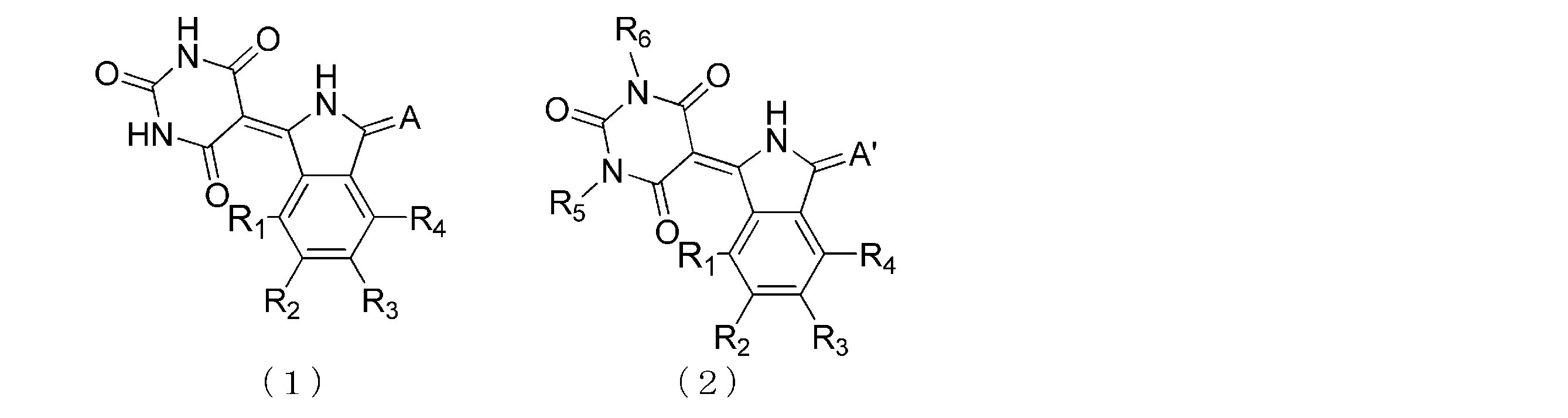

R8~R14は、それぞれ独立して、水素原子、ハロゲン原子、アルキル基、アルコキシ基、アリール基、アリールオキシ基、チオアルキル基、又はチオアリール基を表す。
本発明の顔料組成物は、式(1)で表されるイソインドリン化合物と、式(2)で表されるイソインドリン化合物を含む。
以下、式(1)で表されるイソインドリン化合物をイソインドリン化合物(1)といい、式(2)で表されるイソインドリン化合物をイソインドリン化合物(2)という。
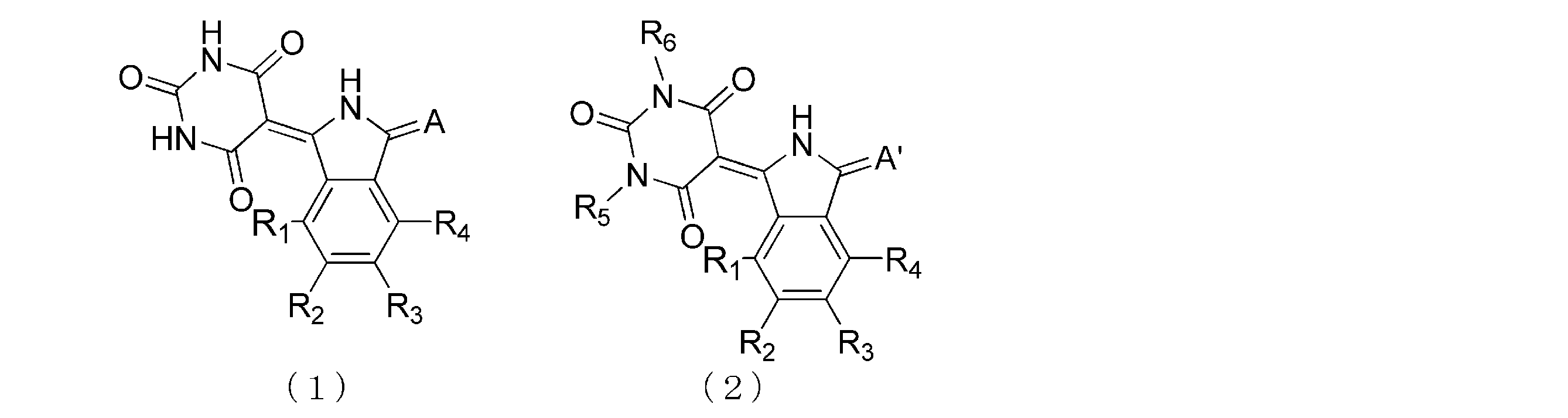
R5、及びR6は、それぞれ独立してアルキル基を表す。
A及びA’は、下式(3)、下式(4)、又は下式(5)で表される基を表す。

式(4)及び式(5)中、R8~R14は、それぞれ独立して、水素原子、ハロゲン原子、アルキル基、アルコキシ基、アリール基、アリールオキシ基、チオアルキル基、又はチオアリール基を表す。
R7において、アルキル基及びアリール基は、先の説明と同義である。耐熱性、耐候性、及び分散安定性の観点から、アルキル基は、炭素数1~4のアルキル基が好ましく、炭素数1又は2のアルキル基がより好ましい。
特に限定されないが、アルキル基は、例えば、メチル基、エチル基、プロピル基、ブチル基、ペンチル基、ヘキシル基、ヘプチル基、オクチル基、ノニル基、デシル基、ドデシル基、オクタデシル基、イソプロピル基、イソブチル基、イソペンチル基、2-エチルヘキシル基、2-ヘキシルドデシル基、sec-ブチル基、tert-ブチル基、sec-ペンチル基、tert-ペンチル基、tert-オクチル基、ネオペンチル基、シクロプロピル基、シクロブチル基、シクロペンチル基、シクロヘキシル基、アダマンチル基、ノルボルニル基、ボロニル基、又は4-デシルシクロヘキシル基等が挙げられる。
上記アリール基は、例えば、フェニル基、ビフェニリル基、ターフェニリル基、クオーターフェニリル基、ペンタレニル基、インデニル基、ナフチル基、ビナフタレニル基、ターナフタレニル基、クオーターナフタレニル基、アズレニル基、ヘプタレニル基、ビフェニレニル基、インダセニル基、フルオランテニル基、アセフェナントリレニル基、アセアントリレニル基、フェナレニル基、フルオレニル基、アントリル基、ビアントラセニル基、ターアントラセニル基、クオーターアントラセニル基、アントラキノリル基、フェナントリル基、トリフェニレニル基、ピレニル基、クリセニル基、ナフタセニル基、プレイアデニル基、ピセニル基、ペリレニル基、ペンタフェニル基、ペンタセニル基、テトラフェニレニル基、ヘキサフェニル基、ヘキサセニル基、ルビセニル基、コロネニル基、トリナフチレニル基、ヘプタフェニル基、ヘプタセニル基、ピラントレニル基、又はオバレニル基等が挙げられる。これらの中でもフェニル基が好ましい。
本実施形態の顔料組成物に使用するイソインドリン化合物(1)及びイソインドリン化合物(2)は、公知の合成方法によって製造ができる。例えば、下記スキーム1に示すように、式(6)で表されるフタロニトリル(以下、化合物(6)という)、又は式(7)で表される1,3-ジイミノイソインドリン(以下、化合物(7)という)を出発原料として合成できる。
以下、イソインドリン化合物(1)及びイソインドリン化合物(2)の具体例に沿って、合成方法を説明する。以下の説明では、各式で記載した番号を化合物の番号として記載する。
一実施形態において、イソインドリン化合物(1)及びイソインドリン化合物(2)は、下記スキーム1-1、1-2に従って製造できる。
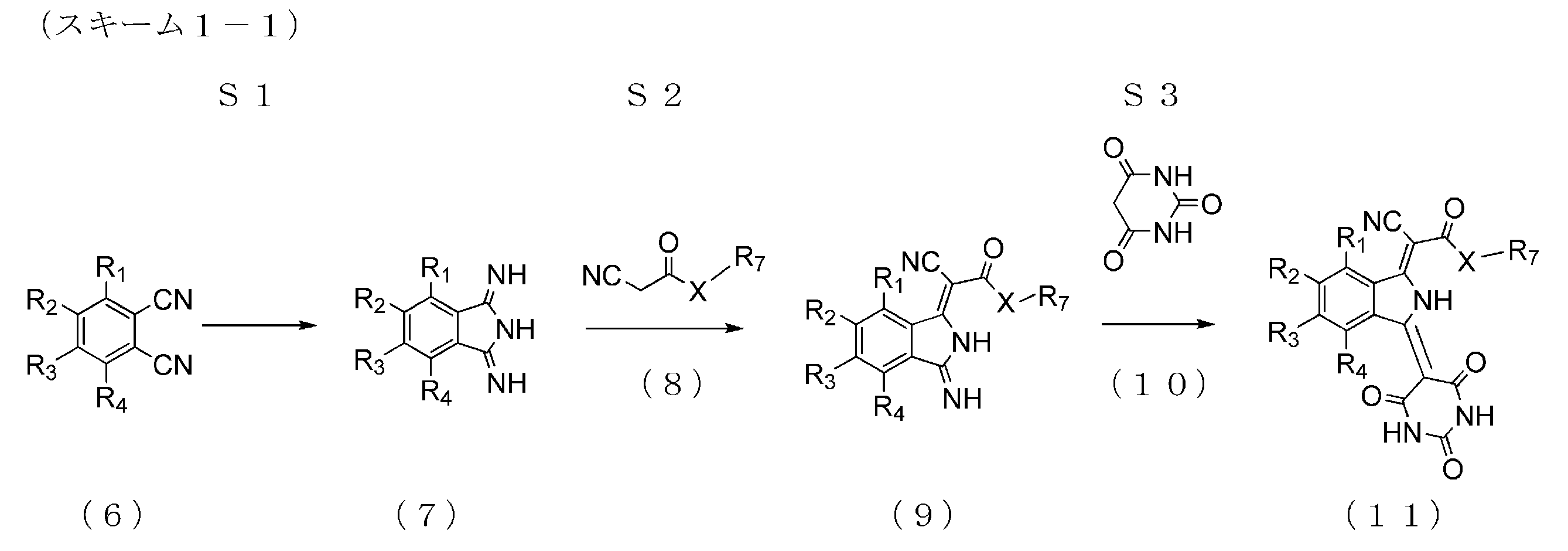

一方、化合物(12)の置換基R5とR6の関係が全て対称である場合、最終生成物は単一の化合物となる。
顔料組成物を構成するイソインドリン化合物(1)及びイソインドリン化合物(2)は、異性体を含む混合物、及びそれぞれ単一の化合物のいずれであってもよい。
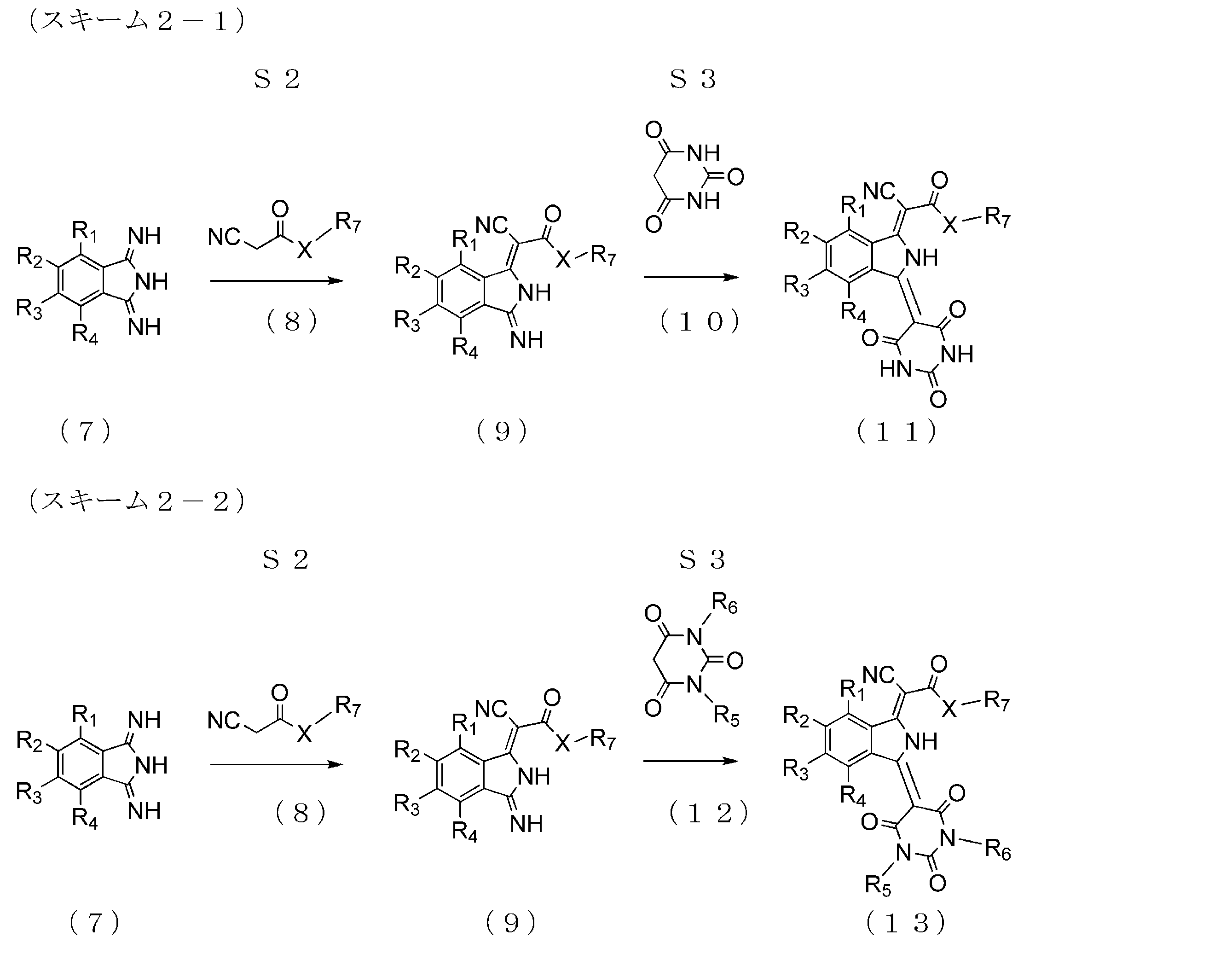
スキーム2-1および2-2の第二工程(S2)において、アンモニア水溶液の使用量は、28%アンモニア水溶液を用いる場合、化合物(7)の100質量部に対して、1~20倍の量が好ましく、1~5倍の量がより好ましい。 なお、イソインドリン化合物(1)及びイソインドリン化合物(2)は、スキーム2-1、2-2に従って製造することが好ましい。
一実施形態において、イソインドリン化合物(1)及びイソインドリン化合物(2)は、下記スキーム3-1、3-2に従って製造できる。
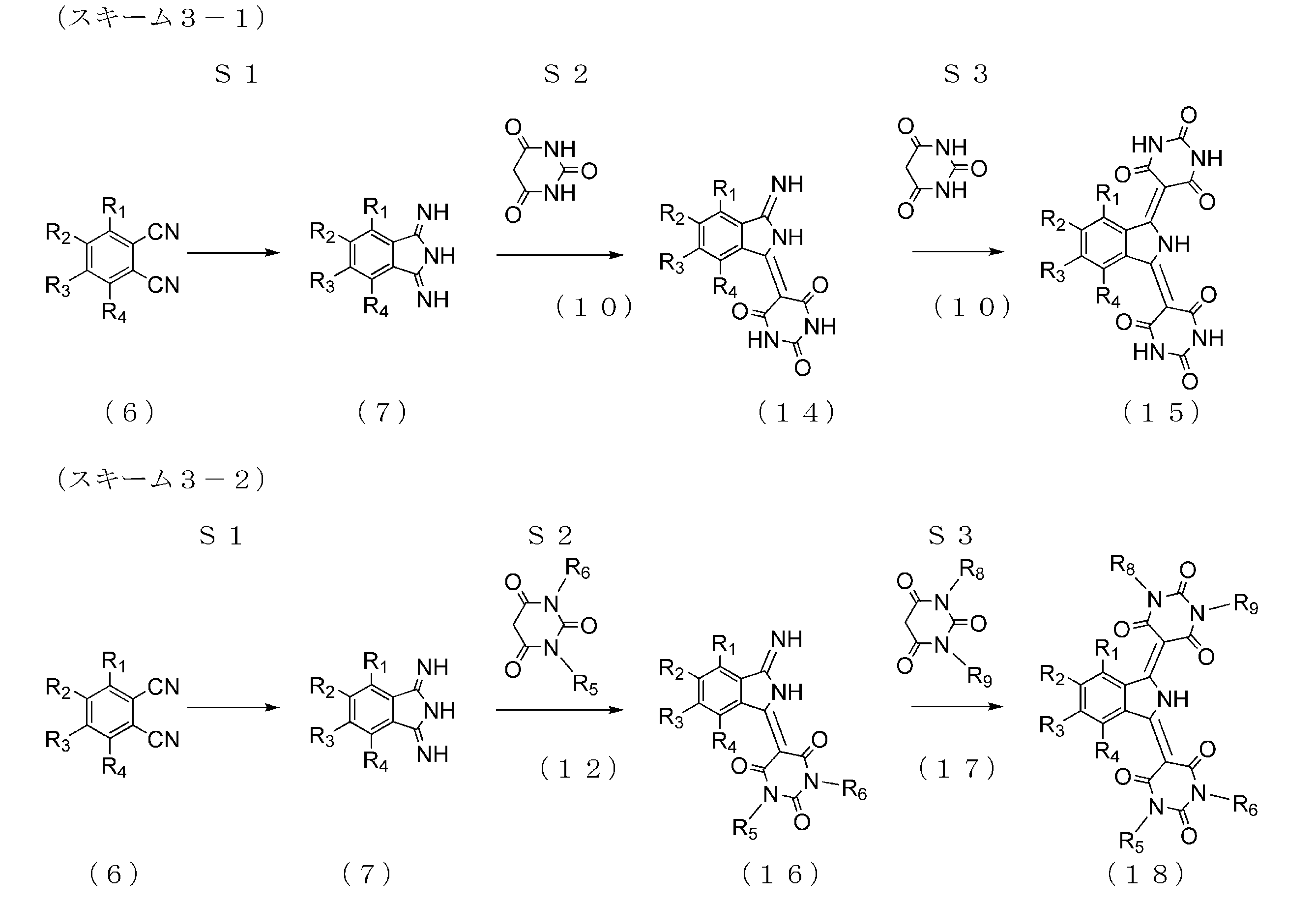
一方、化合物(12)の置換基R5とR6、及び化合物(17)の置換基R8とR9の関係が全て対称である場合、最終生成物は単一の化合物となる。
顔料組成物を構成するイソインドリン化合物(1)及びイソインドリン化合物(2)は、異性体を含む混合物、及び単一の化合物のいずれであってもよい。


一実施形態において、イソインドリン化合物(1)及びイソインドリン化合物(2)は、下記スキーム5-1、5-2に従って製造できる。
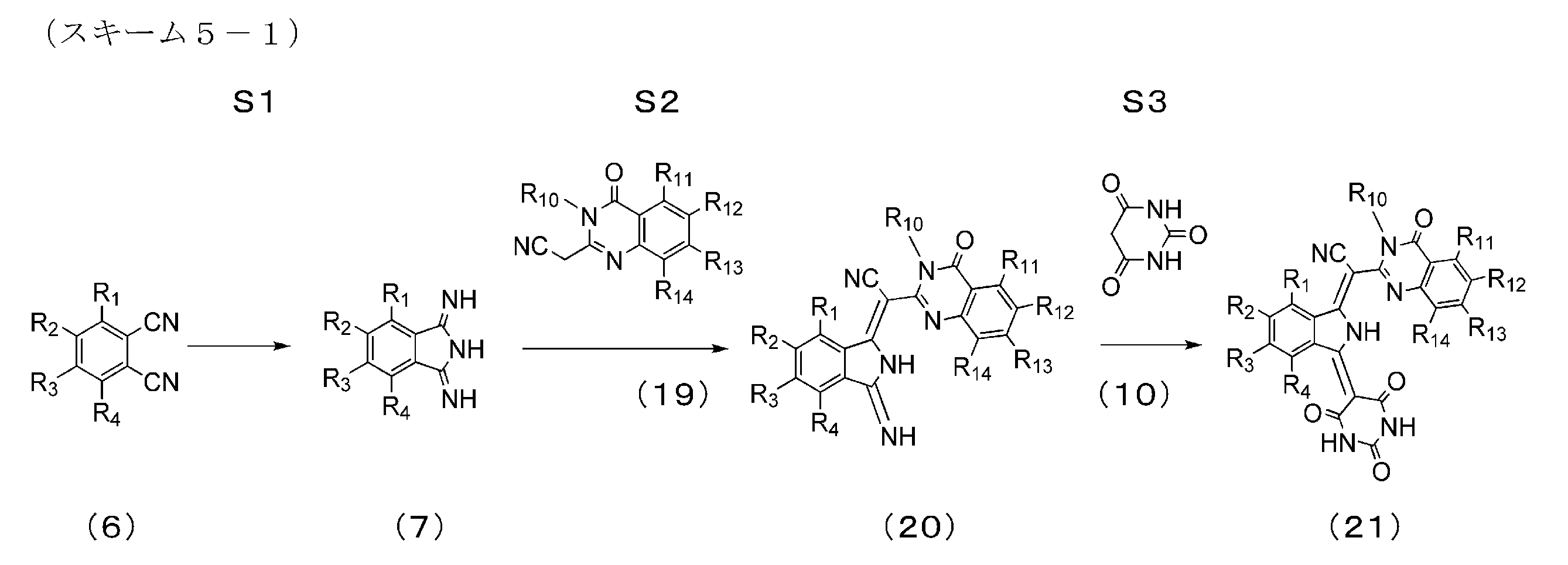

一方、化合物(12)の置換基R5とR6の関係が対称である場合、最終生成物は単一の化合物となる。
顔料組成物を構成するイソインドリン化合物(1)及びイソインドリン化合物(2)は、異性体を含む混合物、及び単一の化合物のいずれであってもよい。
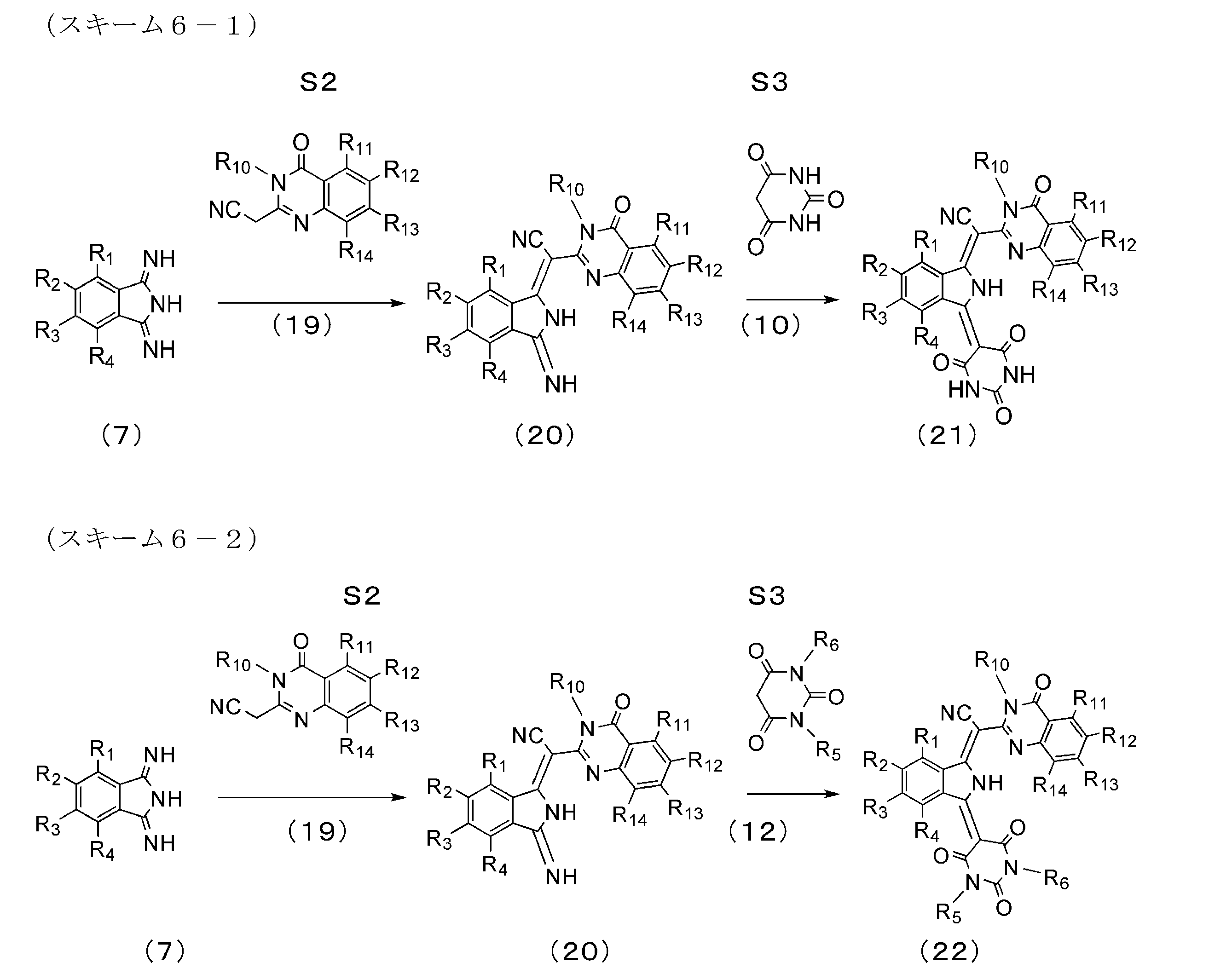
スキーム6-1の第二工程(S2)において、アンモニア水溶液の使用量は、28%アンモニア水溶液を用いた場合、化合物(7)の100質量部に対して、1~20倍の量が好ましく、1~5倍の量がより好ましい。
スキーム6-2の第二工程(S2)において、アンモニア水溶液の使用量は、28%アンモニア水溶液を用いた場合、化合物(7)の100質量部に対して、1~20倍の量が好ましく、1~5倍の量がより好ましい。
(I)2種以上を一度に合成する方法(共合成法)、(II)分散体の作製時にイソインドリン化合物(1)とイソインドリン化合物(2)を混合する方法、(III)イソインドリン化合物(1)とイソインドリン化合物(2)を一緒にアシッドペースティング法、アシッドスラリー法、ドライミリング法、ソルトミリング法、ソルベントソルトミリング法、ソルベント法(アルコールや芳香族溶媒などの高沸点溶媒中で加熱処理すること)等を用いて顔料化する方法、(IV)上記方法を組み合わせた方法。
中でも好ましくは、(I)共合成法、(III)イソインドリン化合物(1)とイソインドリン化合物(2)を一緒にアシッドペースティング法、ソルベントソルトミリング法を用いて顔料化する方法、(IV)(I)と(III)とを組み合わせた方法である。
本発明の着色組成物は、上記顔料組成物および分散媒体を含むことが好ましい。
分散媒体は、樹脂、溶剤が挙げられる。樹脂は、樹脂型分散剤、バインダー樹脂が挙げられる。溶剤は、水、有機溶剤が挙げられる。なお、必要に応じて界面活性剤等の低分子分散剤を使用できる。
水溶性溶剤は、例えばエタノール、n-プロパノール、イソプロパノール、イソブタノール、エチレングリコール、ジエチレングリコール、トリエチレングリコール、プロピレングリコール、及びグリセリン等が挙げられる。非水溶性溶剤は、例えばトルエン、キシレン、ブチルアセテート、メチルアセテート、メチルエチルケトン、メチルイソブチルケトン、ブチルアルコール、及び脂肪族炭化水素等が挙げられる。
本明細書で着色組成物は、水系着色組成物として使用することが好ましい。
水系着色組成物は、顔料組成物、分散媒体として樹脂、水、水溶性溶剤を含むことが好ましい。上記分散媒体として使用される樹脂は、樹脂型分散剤が好ましい。樹脂の種類は、例えば、スチレン-(メタ)アクリル酸共重合体、(メタ)アクリル酸-(メタ)アクリル酸アルキルエステル共重合体、スチレン-(メタ)アクリル酸-(メタ)アクリル酸アルキルエステル共重合体、スチレン-α-メチルスチレン-(メタ)アクリル酸共重合体、スチレン-α-メチルスチレン-(メタ)アクリル酸-(メタ)アクリル酸アルキルエステル共重合体、ポリ(メタ)アクリル酸、ビニルナフタレン-(メタ)アクリル酸共重合物、スチレン-マレイン酸共重合物、マレイン酸-無水マレイン酸共重合物、αオレフィン-(無水)マレイン酸共重合物、αオレフィン-(無水)マレイン酸-ポリアルキレングリコールアリルエーテル共重合物ビニルナフタレン-マレイン酸共重合物、ポリエステル変性(メタ)アクリル酸重合体およびこれらの塩等が挙げられる。
以下の4つの工程を経て、顔料組成物含有架橋樹脂粒子を製造する方法である。
・工程(i-1):顔料組成物;架橋性官能基及びカルボキシ基を有し、当該カルボキシル基が塩基性化合物により中和されることで親水化されている樹脂型分散剤;及び、水を用いて分散処理を行う工程。
・工程(i-2):上記工程(i-1)で作製した顔料組成物の分散液に酸性化合物を添加し、当該分散液のpHを中性または酸性化させることで、前記樹脂型分散剤を顔料組成物表面で析出及び固着させる工程。
・工程(i-3):上記工程(i-2)の後、樹脂型分散剤内のカルボキシ基を、塩基性化合物(工程(i-1)で使用した塩基性化合物と同じものであっても異なるものであってもよい)を用いて中和し、樹脂型分散剤が固着した顔料組成物を、水中に再分散させる工程。
・工程(i-4):上記工程(i-3)の後に、樹脂型分散剤内の架橋性官能基と、架橋剤とを反応させて架橋させ、顔料組成物含有架橋樹脂粒子を含む水系着色組成物を得る工程。なお前記架橋剤は、工程(i-4)の開始時に添加してもよいし、上記工程(i-1)~(i-3)のいずれかの段階で添加していてもよい。
樹脂型分散剤として、自己架橋性官能基及びカルボキシ基を有し、当該カルボキシ基が塩基性化合物により中和されることで親水化されている樹脂型分散剤を使用する以外は、上述した工程(i-1)~(i-3)と同様にして、樹脂型分散剤が固着した顔料組成物を、水中に再分散させる。その後、樹脂型分散剤を自己架橋させ、顔料組成物含有架橋樹脂粒子を含む水系着色組成物を得る方法である。
以下の2つの工程を経て、顔料組成物含有架橋樹脂粒子を製造する方法である。
・工程(iii-1):顔料、カルボキシ基を有する樹脂、塩基性化合物、及び、水を混合する工程。
・工程(iii-2):上記工程(iii-1)の後、架橋剤を添加して架橋処理し、顔料組成物含有架橋樹脂粒子を含む水系着色組成物を得る工程。
以下の2つの工程を経て、顔料組成物含有架橋樹脂粒子を製造する方法である。
・工程(iv-1):顔料、カルボキシ基を有する樹脂、及び、有機溶剤を混合する工程。
・工程(iv-2):上記工程(iv-1)の後、水を添加し、減圧蒸留などにより有機溶剤を除去する工程。
・工程(iv-3):上記工程(iv-2)の後、架橋剤を添加して架橋処理し、顔料組成物含有架橋樹脂粒子を含む水系着色組成物を得る工程。
本発明の成形用組成物は、着色組成物(顔料組成物、樹脂)を含有する。成形用組成物は、樹脂に熱可塑性樹脂を含むことが好ましい。熱可塑性樹脂を含む成形用組成物は、溶融・混錬し、所望の形状に成形して成形体を作製することが好ましい。成形用組成物は、例えば、300℃で溶融・混錬を行う場合、耐熱性が高いイソインドリン化合物(1)及びイソインドリン化合物(2)を含むため、色彩変化を抑制できる。なお、樹脂は、熱可塑性樹脂に限定されない。
は、100g/10分より大きいことが好ましい。
マスターバッチは、例えば、熱可塑性樹脂と顔料組成物を溶融混練し、次いで、次工程で使用しやすい様に任意の形状に成形することが好ましい。次いで、前記マスターバッチと希釈樹脂(例えば、マスターバッチに使用した熱可塑性樹脂)とを溶融混練し、所望の形状の成形体を成形できる。マスターバッチの形状は、例えば、ペレット状、粉末状、板状等が挙げられる。なお、顔料組成物の凝集を防ぐため、予め、顔料組成物とワックスを溶融混練した分散体を製造した後、熱可塑性樹脂と共に、溶融混錬してマスターバッチを製造することが好ましい。分散体に使用する装置は、例えば、ブレンドミキサーや3本ロールミル等が好ましい。
本明細書のトナーは、着色組成物(顔料組成物、樹脂)を含有する。トナーで樹脂は、結着樹脂といい熱可塑性樹脂が好ましい。トナーは、乾式トナー、湿式トナーが挙げられるところ乾式トナーが好ましい。例えば、乾式トナーは、顔料組成物、および結着樹脂を溶融混練し、冷却した後、粉砕、及び分級工程を行う。次いで、添加剤を配合し混合する後処理工程を行い、製造できる。
研磨剤は、窒化珪素、酸化セリウム、炭化ケイ素、チタン酸ストロンチウム、タングステンカーバイド、炭酸カルシウム、及びこれらを疎水化処理したもの等が挙げられる。導電性付与剤は、酸化錫等が挙げられる。
本明細書の塗料は、着色組成物(顔料組成物、樹脂、溶剤)を含有する。
前記樹脂は、熱硬化性樹脂、熱可塑性樹脂が挙げられる。熱硬化性樹脂は、ガラス転移温度が、10℃以上の樹脂が好ましい。熱硬化性樹脂の種類は、例えば、アクリル樹脂、ポリエステル、ポリウレタン等が挙げられる。また、熱硬化性樹脂は、硬化剤と反応可能な官能基を有することが好ましい。前記官能基は、例えば、カルボキシル基、水酸基等が挙げられる。硬化剤は、例えば、イソシアネート硬化剤、エポキシ硬化剤、アジリジン硬化剤、アミン硬化剤等が挙げられる。
熱可塑性樹脂は、ガラス転移温度が30℃以上の樹脂が好ましい。熱可塑性樹脂は、例えば、ニトロセルロース、ポリエステル等が挙げられる。なお、熱硬化性樹脂と熱可塑性樹脂は併用できる、
前記溶剤の中で水溶性溶剤は、例えば、水、一価アルコール、二価のアルコール、グリコールが挙げられる。水溶性溶剤は、例えば、エタノール、n-プロパノール、イソプロパノール、イソブタノール、エチレングリコール、ジエチレングリコール、トリエチレングリコール、プロピレングリコール、及びグリセリンが挙げられる。また、多価アルコールから誘導された水希釈性モノエーテルもあげられる。その具体例は、メトキシプロパノール又はメトキシブタノールが挙げられる。また、例えば、ブチルグリコール又はブチルジグリコールなどの水希釈性グリコールエーテルも挙げられる。なお、塗料は、既に説明した通り溶剤に水を含む場合、水性塗料という。
本明細書の印刷インキは、着色組成物(顔料組成物、樹脂、溶剤)を含有する。印刷インキは、インジェットインキ以外のインキであり、例えば、オフセット印刷用インキ、フレキソ印刷用インキ、グラビア印刷用インキ、シルクスクリーン印刷インキ、カラーフィルタ用インキ等が挙げられる。なお、上記の通り、溶剤が水を含む場合水性印刷インキという。
本発明のインクジェットインキは、顔料組成物、および樹脂を含有し、さらに溶剤を含有することが好ましい。インクジェットインキは、溶剤有無やその種類により、(溶剤系)インクジェットインキ、水性インクジェットインキ、無溶剤インクジェットインキに大別できる。本明細書では、イソインドリン化合物(1)及びイソインドリン化合物(2)の良好な分散性が生きる水性インクジェットインキが好ましい。以下、水性インクジェットインキを中心に説明する。
樹脂の種類は、例えば、アクリル系樹脂、スチレン-アクリル系樹脂、ポリエステル系樹脂、ポリアミド系樹脂、ポリウレタン系樹脂等が挙げられる。また、樹脂の形態は、水溶性樹脂、エマルション粒子等が挙げられる。これらの中でも、エマルション粒子が好ましい。エマルション粒子は、単一組成粒子、コアシェル型粒子等があり任意に選択して使用できる。エマルション粒子を使用すると水性インクジェットインキの低粘度化が容易であり、耐水性に優れた記録物が容易に得られる。樹脂は、必要に応じて、アンモニア、各種アミン、各種無機アルカリ等のpH調整剤によって酸性官能基を中和して使用できる。
本発明に用いる顔料、着色組成物、着色硬化性組成物には、必要に応じて色素誘導体を添加することができる。
本発明のインキセットは、少なくとも、イエローインキ、シアンインキ、及びマゼンタインキを含むインキセットであって、前記イエローインキが、前記着色組成物を含むインキを含むことが好ましい。
本発明におけるイエローインキは、上記顔料組成物と、バインダー樹脂とを含む。
前記イエローインキは、上記の通り2種類のイソインドリン化合物を含むことで、従来、イソインドリン化合物の弱点であった分散性、保存安定性が向上する。
バインダー樹脂は、例えば、ポリウレタン樹脂、エチレン-酢酸ビニル共重合体樹脂、酢酸ビニル樹脂、ニトロセルロース樹脂、ポリアミド樹脂、ポリビニルアセタール樹脂、セルロースエステル樹脂、ポリスチレン樹脂、アクリル樹脂、ポリエステル樹脂、アルキッド樹脂、ロジン系樹脂、ロジン変性マレイン酸樹脂、ケトン樹脂、環化ゴム、ブチラール、石油樹脂、塩素化ポリオレフィン樹脂が挙げられる。
本発明におけるシアンインキは、シアン色が得られるインキであり、顔料、およびバインダー樹脂を含む。なお、バインダー樹脂は、既に説明した樹脂を使用できる。
本発明におけるマゼンタインキは、マゼンタ色が得られるインキであり、顔料、およびバインダー樹脂を含む。なお、バインダー樹脂は、既に説明した樹脂を使用できる。
顔料は、有機顔料、無機顔料が挙げられる。本明細書では、例えば、以下の顔料を使用できる。
顔料は、有機顔料が好ましい。有機顔料は、例えば、溶性アゾ系、不溶性アゾ系、アゾ系、フタロシアニン系、ハロゲン化フタロシアニン系、アントラキノン系、アンサンスロン系、ジアンスラキノニル系、アンスラピリミジン系、ペリレン系、ペリノン系、キナクリドン系、チオインジゴ系、ジオキサジン系、イソインドリノン系、キノフタロン系、アゾメチンアゾ系、フラバンスロン系、ジケトピロロピロール系、イソインドリン系、インダンスロン系等が挙げられる。
シアンインキは、上記藍色顔料を含むことが好ましい。これらの中でもC.I.ピグメントブルー15:3、C.I.ピグメントブルー15:4及びC.I.ピグメントブルー16がより好ましい。

マゼンタインキは、上記赤色顔料を含むことが好ましい。これらの中でもC.I.ピグメントレッド48:3、C.I.ピグメントレッド57:1、C.I.ピグメントレッド122、C.I.ピグメントレッド146、C.I.ピグメントレッド185、及びC.I.ピグメントバイオレット19がより好ましい。
本発明のインキセットを構成するイエローインキに用いる場合、上記黄色顔料を含んでもよい。
無機顔料は、例えば、酸化チタン、酸化亜鉛、硫化亜鉛、硫酸バリウム、炭酸カルシウム、酸化クロム、シリカ、リトボン、アンチモンホワイト、石膏等の白色無機顔料、カーボンブラック、鉄黒、銅・クロム複合酸化物等の黒色無機顔料、アルミニウム粒子、マイカ(雲母)、ブロンズ粉、クロムバーミリオン、黄鉛、カドミウムイエロー、カドミウムレッド、群青、紺青、ベンガラ、黄色酸化鉄、ジルコン等が挙げられる。
インキ中の顔料の含有量は、インキの濃度・着色力を確保するために、インキの質量を基準として、好ましくは1~60質量%の範囲であり、インキの不揮発分質量を基準として、好ましくは10~90質量%の範囲である。
本発明のグラビア印刷インキセットは、上記インキセットを含むことが好ましい。
本発明のグラビア印刷インキセットに使用するバインダー樹脂は、ポリウレタン樹脂が好ましい。なお、ポリウレタン樹脂は、ポリウレタンウレア樹脂を含む。
ポリウレタン樹脂の合成は、例えば、(1)ポリオールとジイソシアネート化合物とをイソシアネート基が過剰となる割合で反応させて得られる末端にイソシアネート基を有するウレタンプレポリマーを合成する。次いで溶剤中でイソシアネート基を有するウレタンプレポリマーに前記アミノ基を有する鎖伸長剤及び/又は末端封鎖剤と反応させて合成する二段法、(2)ポリプロピレングリコール、ポリオール、ジイソシアネート化合物、ならびにアミノ基を有する鎖伸長剤及び/又は末端封鎖剤を、適切な溶剤中で一度に反応させる一段法等が挙げられる。
合成に使用する溶剤は、例えば、酢酸エチル、酢酸プロピル、酢酸ブチルなどのエステル系溶剤;アセトン、メチルエチルケトン、メチルイソブチルケトンなどのケトン系溶剤;メタノール、エタノール、イソプロピルアルコール、n-ブタノールなどのアルコール系溶剤;メチルシクロヘキサン、エチルシクロヘキサンなどの炭化水素系溶剤;あるいはこれらの混合溶剤;が挙げられる。
これらの方法の中でも、より均一なポリウレタン樹脂が得られるという観点から、好ましくは二段法である。ポリウレタン樹脂を二段法で製造する場合、ウレタンプレポリマーのイソシアネート基と、鎖伸長剤及び末端封鎖剤のアミノ基との当量比(イソシアネート基のモル/アミノ基のモル)は、1/1.3~1/0.9が好ましい。イソシアネート基とアミノ基との当量比が1/1.3以上であると、未反応のまま残存する鎖伸長剤及び/又は末端封鎖剤が低減し、ポリウレタン樹脂の黄変、及び印刷後臭気を抑制することができる。イソシアネート基とアミノ基との当量比が1/0.9以下であると、得られるポリウレタン樹脂の分子量が適切となり、印刷後に好適な膜強度をもたらす樹脂を得ることができる。
本発明のグラビア印刷インキセットに使用する有機溶剤は、公例えば、トルエン、キシレン等の芳香族有機溶剤;アセトン、メチルエチルケトン、メチルイソブチルケトン等のケトン系有機溶剤;酢酸エチル、酢酸n-プロピル、酢酸ブチル、プロピレングリコールモノメチルエーテルアセテート等エステル系有機溶剤;メタノール、エタノール、n-プロパノール、イソプロパノール、n-ブタノールなどのアルコール系有機溶剤;エチレングリコールモノプロピルエーテル、プロピレングリコールモノメチルエーテルなどのグリコールエーテル系溶剤;が挙げられる。これらの有機溶剤は、2種以上を混合して使用することが好ましい。
グラビア印刷インキセットにおいては、エステル系有機溶剤とアルコール系有機溶剤との混合溶剤を使用することが好ましい。エステル系有機溶剤とアルコール系有機溶剤との質量比(エステル系有機溶剤の質量:アルコール系有機溶剤の質量)は、好ましくは95:5~40:60であり、より好ましくは90:10~50:50である。
各色インキ中における、有機溶剤の含有率は、インキの質量を基準として、好ましくは60~90質量%であり、より好ましくは70~85質量%の範囲である。
本発明のグラビア印刷インキセットは、さらに、水を含むことができる。所定量の水を含むことで、ポリウレタン樹脂による顔料分散性が向上し、ハイライト転移性、版かぶり性、トラッピング性等の印刷適性が向上する。
水の含有率は、グラビア印刷インキの質量を基準として、好ましくは0.1~10質量%であり、より好ましくは0.5~7質量%であり、さらに好ましくは0.5~5質量%であり、特に好ましくは0.5~4質量%である。
本発明のグラビア印刷インキセットは、さらに、シリカ粒子を含有できる。シリカ粒子を含むことで、重ね印刷時のインキの濡れ・広がりが促進され、トラッピング性が向上し、ハイライト転移性も維持される。
シリカ粒子は、天然産、合成品、あるいは結晶性、非結晶性、あるいは疎水性、親水性のものが挙げられる。シリカ粒子の合成法は、乾式、湿式法があり、乾式法では燃焼法、アーク法、湿式法では沈降法、ゲル法が知られており、いずれの方法で合成されたものでもよい。また、シリカ粒子は、表面に親水性官能基を有する親水性シリカでもよいし、親水性官能基をアルキルシラン等で変性して疎水化した疎水性シリカでもよい。好ましくは親水性シリカである。
このようなシリカ粒子は、例えば、東ソー・シリカ社製のニップジェルシリーズ、ニップシルシリーズ、水澤化学社製のミズカシルシリーズが挙げられる。
シリカ粒子の比表面積は、BET法で50~600m2/gであることが好ましい。より好ましくは100~450m2/gである。本発明のグラビア印刷インキで使用するシリカ粒子は、平均粒子径又はBET法比表面積の異なるものを2種以上組み合わせて使用できる。
本発明のグラビア印刷インキセットは、必要に応じて、体質顔料、顔料分散剤、レベリング剤、消泡剤、ワックス、可塑剤、赤外線吸収剤、紫外線吸収剤、芳香剤、難燃剤等のその他添加剤を含むことができる。
本発明のグラビア印刷インキセットは、さらに、クリアインキを含有できる。当該クリアインキから形成する脱離層は、アルカリ水溶液で中和され、溶解又は膨潤することにより、基材から剥離する機能を有する。
上記アルカリ水溶液に使用する塩基性化合物は、例えば、水酸化ナトリウム(NaOH)、水酸化カリウム(KOH)、水酸化カルシウム(Ca(OH)2)、アンモニア、水酸化バリウム(Ba(OH)2)、炭酸ナトリウム(Na2CO3)が挙げられる。より好ましくは水酸化ナトリウム及び水酸化カリウムからなる群より選ばれる少なくとも1種である。
なお、本明細書において、アルカリ水溶液で中和し、溶解又は膨潤する工程を「アルカリ処理」と言う場合がある。また、アルカリ処理により脱離性を有する層を「脱離層」と言う場合がある。すなわち、当該クリアインキにより形成される印刷層は、脱離性を有する層(脱離層)に該当する。
クリアインキは、カルボキシ基含有樹脂を含有することが好ましい。例えば、色インキより前に基材上に印刷するプライマー組成物として機能する。
前記カルボキシ基含有樹脂は、例えば、アクリル樹脂、ウレタン樹脂、ポリエステル樹脂、アミノ樹脂、フェノール樹脂、エポキシ樹脂、セルロースが挙げられる。これらの中でも、ラミネート適性が良好であることから、ウレタン樹脂が好ましい。
カルボキシ基含有ウレタン樹脂の酸価は、好ましくは15mgKOH/g以上であり、
より好ましくは15~70mgKOH/gであり、さらに好ましくは20~50mgKOH/gである。15mgKOH/g以上であると、アルカリ水溶液による脱離性が良好と
なるため好ましく、70mgKOH/g以下であると、基材密着性が向上し、包装材料とした際の耐レトルト性が良好になる。なお、水酸基価及び酸価は、いずれもJISK0070に従って測定した値である。
また、分子量分布が小さい、即ち分子量分布がシャープであるほど、アルカリ水溶液による溶解・剥離作用が均一に起こり、脱離性が向上するため好ましい。分子量分布は、より好ましくは5以下であり、さらに好ましくは4以下である。また、分子量分布は1.5以上が好ましく、より好ましくは1.2以上である。
また、クリアインキは、カルボキシ基含有樹脂、ポリイソシアネート以外のその他成分を含有してもよく、前述のシアン、イエロー、マゼンタの各色インキと同様に、有機溶剤、ブロッキング防止剤等の添加剤を配合することができる。
本発明のインクジェットインキセットは、上記インキセットを含むことが好ましい。本発明のインクジェットインキセットを構成するインクジェットインキについては、上述の通りである。
本発明の印刷物は、基材、およびグラビア印刷インキセットから形成された印刷層を含む。前記印刷層は、シアンインキ、イエローインキ、マゼンタインキを基材上に印刷して形成する。
グラビア印刷の方式は特に制限されず、公知の方式から適宜選択できる。グラビア印刷の方式は、表刷り印刷と裏刷り印刷に大別され、例えば、表刷り印刷において基材が白色紙や白色フィルムである場合、基材上に、イエローインキ、マゼンタインキ、シアンインキ、ブラックインキの順で印刷を行うことで、印刷物を得ることができる。
また、例えば、裏刷り印刷で基材が透明フィルムである場合、基材上に、ブラックインキ、シアンインキ、マゼンタインキ、イエローインキ、白インキの順で印刷し、印刷物を作製することが好ましい。
本発明のインキセットがクリアインキを含む場合、該クリアインキは、色インキより前に基材上に印刷されることが好ましい。
印刷層の厚みは、用途、使用するインキの種類や数、及び重ね印刷の回数によって適宜選択できるが、通常、0.5~10μmの範囲である。
基材は、例えば、ポリエチレン、ポリプロピレン等のポリオレフィン基材;ポリカーボネート基材;ポリエチレンテレフタレート、ポリ乳酸等のポリエステル基材;ポリスチレン基材;AS、ABS等のポリスチレン系樹脂;ナイロン等のポリアミド基材;ポリ塩化ビニル基材;ポリ塩化ビニリデン基材;セロハン基材;紙基材;アルミニウム箔基材;これらの複合材料からなる複合基材;が挙げられる。基材は、フィルム状、シート状のいずれであってもよい。中でも、ガラス転移点が高いポリエステル基材、ポリアミド基材が好適に用いられる。
本発明の印刷物は、脱離層を含有できる。ここで「脱離層」とは、アルカリ水溶液で中和され、溶解又は膨潤することにより、基材から剥離する性質を有する者を指す。脱離性を有する層は、前述するクリアインキから形成される層が好ましいが、それ以外の層が脱離層であってもよい。
本発明の包装材料は、少なくともその一部に印刷物を含む。包装材料は、例えば、印刷物、接着剤層、およびシーラント基材を順次積層する構成が挙げられる。包装材料は、四方シール包装体、三方シール包装体、ピロー包装体、スティック袋、ガセット袋、角底袋、スタンディングパウチ、深絞り容器、真空包装体、スキンパック、チャック袋、スパウトパウチ、ひねり包装、包み包装、シュリンク包装、ラベル、液体紙パック、紙トレー等の様々な形状を有する包装体に好適に用いることができる。
上記接着剤層の形成に使用できる接着成分は、ラミネート接着剤、ホットメルト接着剤に加え、熱可塑性樹脂が挙げられる。接着成分のうちラミネート接着剤、ホットメルト接着剤は、例えば、ポリエーテル系接着剤;ポリウレタン系接着剤;エポキシ系接着剤;ポリ酢酸ビニル系接着剤;セルロース系接着剤;(メタ)アクリル系接着剤;が挙げられる。これらの接着成分の中でも、ポリウレタン系接着剤が好ましく用いられる。
このような脱離性を有するポリウレタン接着剤は、酸価が、5~45mgKOH/gであることが好ましい。また、ポリウレタン系接着剤を構成するポリオールがポリエステルポリオールを含み、ポリイソシアネートが脂肪族ポリイソシアネート及び芳香脂肪族ポリイソシアネートからなる群より選ばれる一種を含むことが好ましい。
接着剤層の厚みは、通常1~6μmの範囲である。
シーラント基材は、ラミネートフィルムの最内層を構成する基材であり、熱によって相互に融着し得る(ヒートシール性を有する)樹脂材料が使用される。上記シーラント基材としては、無延伸ポリプロピレン(CPP)、蒸着無延伸ポリプロピレンフィルム(VMCPP)、低密度ポリエチレン(LDPE)、リニアー低密度ポリエチレン(LLDPE)、エチレン酢酸ビニル共重合体(EVA)等が挙げられる。
シーラント基材の厚みは特に限定されないが、包装材料への加工性やヒートシール性等を考慮して10~200μmの範囲が好ましく、15~150μmの範囲がより好ましい。また、シーラント基材に高低差5~20μmの凸凹を設けることで、シーラント基材に滑り性や包装材料の引き裂き性を付与することが可能である。
また、シーラント基材を積層する方法は、特に限定されない。例えば、接着剤層とシーラント基材フィルムとを熱によってラミネートする方法(熱ラミネート、ドライラミネート)や、シーラント基材樹脂を溶融させて接着剤層上に押出し、冷却固化させて積層する方法(押出ラミネーション法)等が挙げられる。
(実施例1-1)
還流冷却管、滴下漏斗、及び撹拌機を具備した4口フラスコに、水800部、1,3-ジイミノイソインドリン60部、28%アンモニア水120部の順に加え、撹拌した。そこへ2-シアノ-N-メチルアセトアミド42.58部を水160部に溶解させた溶液を、滴下漏斗を使用して30分間で滴下した。30℃にて原料の1,3-ジイミノイソインドリンが消失するまで加熱撹拌した。この反応スラリーを、ブフナー漏斗を用いてろ別し、不揮発分を得た。なお、原料の消失はUPLC(超高速高分離液体クロマトグラフィ Waters社製)にて確認した。
還流冷却管、滴下漏斗及び、撹拌機を具備した4口フラスコに、上記不揮発分60部相当、水480部、80%酢酸162部を加え、撹拌した。一方で、ガラス製フラスコに、水461部、80%酢酸194部を加え、そこへバルビツール酸36.69部、1,3-ジメチルバルビツール酸4.97部を加え、65℃にて撹拌した。この混合物の加熱溶液を上記不揮発分の撹拌液の中に投入し、さらに反応を完結させるために85℃まで昇温し撹拌を行った。加熱撹拌は、原料として使用した上記不揮発分が消失するまで行った。原料の消失はUPLCにて確認した。
その後、室温まで冷却後、水2400部にて3回洗浄を行い、不揮発分を得た。この不揮発分を80℃の熱風乾燥機にて乾燥させ、イソインドリン化合物1-1を87.50部得た。
実施例1-1のバルビツール酸36.69部を40.36部に、1,3-ジメチルバルビツール酸4.97部を0.50部に変更した以外は、全て実施例1-1と同様に反応操作を行い、イソインドリン化合物1-2を86.40部得た。
実施例1-1のバルビツール酸36.69部を28.54部に、1,3-ジメチルバルビツール酸4.97部を14.91部に変更した以外は、全て実施例1-1と同様に反応操作を行い、イソインドリン化合物1-3を88.30部得た。
還流冷却管、滴下漏斗、及び撹拌機を具備した4口フラスコに、水800部、1,3-ジイミノイソインドリン60部、28%アンモニア水120部の順に加え、撹拌した。そこへ2-シアノ-N-メチルアセトアミド42.58部を水160部に溶解させた溶液を、滴下漏斗を使用して30分間で滴下した。30℃にて原料の1,3-ジイミノイソインドリンが消失するまで加熱撹拌した。この反応スラリーを、ブフナー漏斗を用いてろ別し、不揮発分を得た。なお、原料の消失はUPLCにて確認した。
還流冷却管、滴下漏斗及び、撹拌機を具備した4口フラスコに、原料として先の調製で得た不揮発分60部相当、水480部、80%酢酸162部を加え、撹拌した。一方で、ガラス製フラスコに、水480部、80%酢酸162部を加え、そこへバルビツール酸30.57部を加え、65℃にて撹拌した。この混合物の加熱溶液を上記不揮発分の撹拌液の中に投入し、30℃にて3時間撹拌を行った。さらに別で用意したガラス製フラスコに、水48部、80%酢酸16部を加え、そこへ1,3-ジメチルバルビツール酸8.28部を加え、65℃にて撹拌した。この混合物の加熱溶液を先の反応撹拌液の中に投入し、さらに反応を完結させるために85℃まで昇温し撹拌を行った。加熱撹拌は、原料として使用した上記不揮発分が消失するまで行った。なお、原料の消失はUPLCにて確認した。
その後、室温まで冷却後、水2400部にて3回洗浄を行い、不揮発分を得た。この不揮発分を80℃の熱風乾燥機にて乾燥させ、イソインドリン化合物1-4を86.10部得た。
還流冷却管、滴下漏斗、及び撹拌機を具備した4口フラスコに、水800部、1,3-ジイミノイソインドリン60部、28%アンモニア水120部の順に加え、撹拌した。そこへ2-シアノ-N-メチルアセトアミド42.58部を水160部に溶解させた溶液を、滴下漏斗を使用して30分間で滴下した。30℃にて原料の1,3-ジイミノイソインドリンが消失するまで加熱撹拌した。この反応スラリーを、ブフナー漏斗を用いてろ別し、不揮発分を得た。なお、原料の消失はUPLCにて確認した。
還流冷却管、滴下漏斗及び、撹拌機を具備した4口フラスコに、原料として先の調製で得た不揮発分60部相当、水480部、80%酢酸162部を加え、撹拌した。一方で、ガラス製フラスコに、水326部、80%酢酸138部を加え、そこへバルビツール酸27.18部、1,3-ジメチルバルビツール酸2.07部を加え、65℃にて撹拌した。この混合物の加熱溶液を上記不揮発分の撹拌液の中に投入し、30℃にて3時間撹拌を行った。さらに別で用意したガラス製フラスコに、水134部、80%酢酸57部を加え、そこへ1,3-ジメチルバルビツール酸14.49部を加え、65℃にて撹拌した。この混合物の加熱溶液を先の反応撹拌液の中に投入し、さらに反応を完結させるために85℃まで昇温し撹拌を行った。加熱撹拌は、原料として使用した上記不揮発分が消失するまで行った。原料の消失はUPLCにて確認した。
その後、室温まで冷却後、水2400部にて3回洗浄を行い、不揮発分を得た。この不揮発分を80℃の熱風乾燥機にて乾燥させ、イソインドリン化合物1-5を88.10部得た。
実施例1-4の1,3-ジメチルバルビツール酸8.28部を1,3-ジエチルバルビツール酸9.77部に変更した以外は、全て実施例1-4と同様に反応操作を行い、イソインドリン化合物1-6を86.60部得た。
実施例1-1のバルビツール酸36.69部を38.73部に、1,3-ジメチルバルビツール酸4.97部を1,3-ジシクロヘキシルバルビツール酸4.65部に変更した以外は、全て実施例1-1と同様に反応操作を行い、イソインドリン化合物1-7を89.60部得た。
実施例1-1のバルビツール酸36.69部、および1,3-ジメチルバルビツール酸4.97部をバルビツール酸40.77部に変更した以外は、全て実施例1-1と同様に反応操作を行い、イソインドリン化合物1-8を85.80部得た。
実施例1-1のバルビツール酸36.69部、および1,3-ジメチルバルビツール酸4.97部を1,3-ジメチルバルビツール酸49.69部に変更した以外は、全て実施例1-1と同様に反応操作を行い、イソインドリン化合物1-9を94.20部得た。
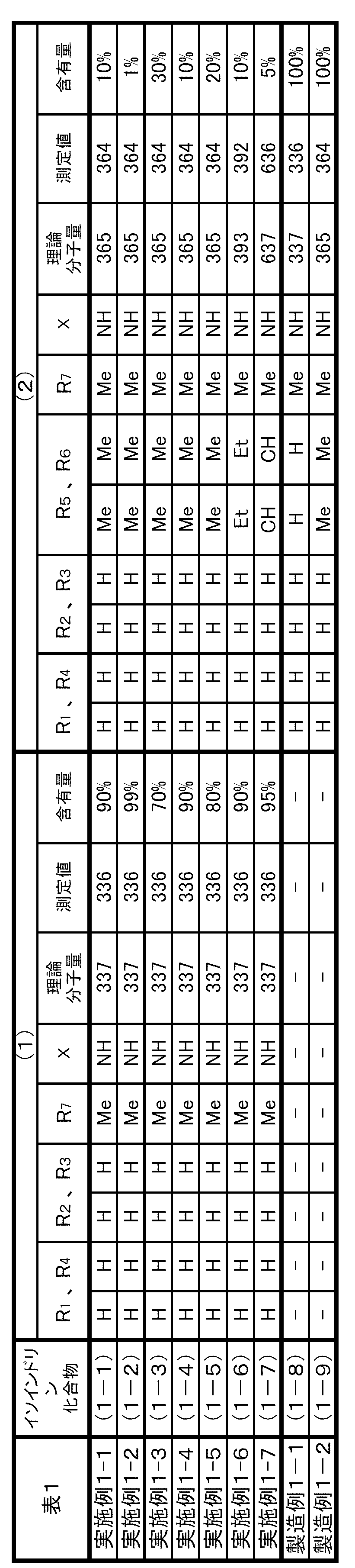
還流冷却管、滴下漏斗及び、撹拌機を具備した4口フラスコに、水800部、80%酢酸800部を加え、撹拌した。そこへバルビツール酸83.39部、1,3-ジメチルバルビツール酸11.29部を加え、65℃にて撹拌し、バルビツール酸および1,3-ジメチルバルビツール酸を溶解させた。一方、ガラス製フラスコに、水800部、1,3-ジイミノイソインドリン50.00部を加え、30℃にて撹拌した。この撹拌液を上記加熱溶解液の中に投入し、さらに反応を完結させるために85℃まで昇温し撹拌を行った。加熱撹拌は、原料として使用した上記不揮発分が消失するまで行った。原料の消失はUPLCにて確認した。
その後、室温まで冷却後、水2000部にて3回洗浄を行い、不揮発分を得た。この不揮発分を80℃の熱風乾燥機にて乾燥させ、イソインドリン化合物2-1を124.90部得た。
還流冷却管、滴下漏斗及び、撹拌機を具備した4口フラスコに、水800部、80%酢酸800部を加え、撹拌した。そこへバルビツール酸83.39部を加え、65℃にて撹拌し、バルビツール酸を溶解させた。一方で、ガラス製フラスコに、水720部、1,3-ジイミノイソインドリン45.00部を加え、30℃にて撹拌した。この撹拌溶液を上記加熱溶解液の中に投入し、撹拌を1時間行った。この反応溶液に1,3-ジメチルバルビツール酸11.29部を追加した。一方で、ガラス製フラスコに、水80部、1,3-ジイミノイソインドリン5.00部を加え、30℃にて撹拌した。この撹拌液を上記反応溶液の中に投入し、さらに反応を完結させるために85℃まで昇温し撹拌を行った。加熱撹拌は、原料として使用した上記不揮発分が消失するまで行った。原料の消失はUPLCにて確認した。
その後、室温まで冷却後、水2000部にて3回洗浄を行い、不揮発分を得た。この不揮発分を80℃の熱風乾燥機にて乾燥させ、イソインドリン化合物2-2を123.00部得た。
実施例2-1のバルビツール酸83.39部、1,3-ジメチルバルビツール酸11.29部をバルビツール酸92.65部に変更した以外は、全て実施例2-1と同様に反応操作を行い、イソインドリン化合物2-3を122.90部得た。
実施例2-1のバルビツール酸83.39部、1,3-ジメチルバルビツール酸11.29部を1,3-ジメチルバルビツール酸112.94部に変更した以外は、全て実施例2-1と同様に反応操作を行い、イソインドリン化合物2-4を141.10部得た。

還流冷却管、滴下漏斗、及び撹拌機を具備した4口フラスコに、水800部、1,3-ジイミノイソインドリン60部、28%アンモニア水120部の順に加え、撹拌した。そこへ2-(4-オキソ-3,4-ジヒドロキナゾリン-2-イル)アセトニトリル80.37部を水160部に溶解させた溶液を、滴下漏斗を使用して30分間で滴下した。30℃にて原料の1,3-ジイミノイソインドリンが消失するまで加熱撹拌した。この反応スラリーを、ブフナー漏斗を用いてろ別し、不揮発分を得た。なお、原料の消失はUPLCにて確認した。
還流冷却管、滴下漏斗及び、撹拌機を具備した4口フラスコに、原料として先の調製で得た不揮発分60部相当、水480部、80%酢酸162部を加え、撹拌した。一方で、ガラス製フラスコに、水461部、80%酢酸194部を加え、そこへバルビツール酸26.49部、1,3-ジメチルバルビツール酸3.59部を加え、65℃にて撹拌した。この混合物の加熱溶液を上記不揮発分の撹拌液の中に投入し、さらに反応を完結させるために85℃まで昇温し撹拌を行った。加熱撹拌は、原料として使用した上記不揮発分が消失するまで行った。原料の消失はUPLCにて確認した。
その後、室温まで冷却後、水2400部にて3回洗浄を行い、不揮発分を得た。この不揮発分を80℃の熱風乾燥機にて乾燥させ、イソインドリン化合物3-1を73.50部得た。
還流冷却管、滴下漏斗、及び撹拌機を具備した4口フラスコに、水800部、1,3-ジイミノイソインドリン60部、28%アンモニア水120部の順に加え、撹拌した。そこへ2-(4-オキソ-3,4-ジヒドロキゾリン-2-イル)アセトニトリル80.38部を水160部に溶解させた溶液を、滴下漏斗を使用して30分間で滴下した。30℃にて原料の1,3-ジイミノイソインドリンが消失するまで加熱撹拌した。この反応スラリーを、ブフナー漏斗を用いてろ別し、不揮発分を得た。なお、原料の消失はUPLCにて確認した。
還流冷却管、滴下漏斗及び、撹拌機を具備した4口フラスコに、原料として先の調製で得た不揮発分60部相当、水480部、80%酢酸162部を加え、撹拌した。一方で、ガラス製フラスコに、水480部、80%酢酸162部を加え、そこへバルビツール酸22.08部を加え、65℃にて撹拌した。この混合物の加熱溶液を上記不揮発分の撹拌液の中に投入し、30℃にて3時間撹拌を行った。さらに別で用意したガラス製フラスコに、水48部、80%酢酸16部を加え、そこへ1,3-ジメチルバルビツール酸5.98部を加え、65℃にて撹拌した。この混合物の加熱溶液を先の反応撹拌液の中に投入し、さらに反応を完結させるために85℃まで昇温し撹拌を行った。加熱撹拌は、原料として使用した上記不揮発分が消失するまで行った。原料の消失はUPLCにて確認した。
その後、室温まで冷却後、水2400部にて3回洗浄を行い、不揮発分を得た。この不揮発分を80℃の熱風乾燥機にて乾燥させ、イソインドリン化合物3-2を74.10部得た。
実施例3-1のバルビツール酸26.49部、1,3-ジメチルバルビツール酸3.59部をバルビツール酸29.44部に変更した以外は、全て実施例3-1と同様に反応操作を行い、イソインドリン化合物3-3を75.20部得た。
実施例3-1のバルビツール酸26.49部、1,3-ジメチルバルビツール酸3.59部を1,3-ジメチルバルビツール酸35.88部に変更した以外は、全て実施例3-1と同様に反応操作を行い、イソインドリン化合物3-4を79.70部得た。

製造例1-1で得られたイソインドリン化合物(1-8)90部、製造例1-2で得られたイソインドリン化合物(1-9)10部、塩化ナトリウム1000部、及びジエチレングリコール150部を、ステンレス製1ガロンニーダー(井上製作所社製)中に仕込み、60℃で8時間(h)混練した。次に、混練した混合物を約70℃の温水に投入し、1時間攪拌してスラリー状として、濾過及び水洗をして食塩及びジエチレングリコールを除いた後、80℃で一昼夜乾燥させ、粉砕することにより微細化されたイソインドリン化合物(1-10)95.5部を得た。
実施例1-3で得られたイソインドリン化合物(1-3)100部、塩化ナトリウム500部、及びジエチレングリコール150部を、ステンレス製1ガロンニーダー(井上製作所社製)中に仕込み、75℃で6時間(h)混練した。次に、混練した混合物を約70℃の温水に投入し、1時間攪拌してスラリー状として、濾過及び水洗をして食塩及びジエチレングリコールを除いた後、80℃で一昼夜乾燥させ、粉砕することにより微細化されたイソインドリン化合物(1-11)96.2部を得た。
製造例1-1で得られたイソインドリン化合物(1-8)95部、製造例2-2で得られたイソインドリン化合物(2-4)5部、塩化ナトリウム1000部、及びジエチレングリコール150部を、ステンレス製1ガロンニーダー(井上製作所社製)中に仕込み、60℃で8時間(h)混練した。次に、混練した混合物を約70℃の温水に投入し、1時間攪拌してスラリー状として、濾過及び水洗をして食塩及びジエチレングリコールを除いた後、80℃で一昼夜乾燥させ、粉砕することにより微細化されたイソインドリン化合物(1-12)96.0部を得た。
98%硫酸1000部に製造例1-1で得られたイソインドリン化合物(1-8)37.0部、製造例1-2で得られたイソインドリン化合物(1-9)3.0部を撹拌しながら徐々に加え、4時間撹拌し溶解させた。次いで、溶解液を10℃の水8000部に撹拌しながら30分かけて徐々に滴下し、濾過、温水洗浄を行い、80℃で乾燥させ、微細化されたイソインドリン化合物(1-13)38.5部を得た。得た。
製造例2-1で得られたイソインドリン化合物(2-3)95部、製造例2-2で得られたイソインドリン化合物(2-4)5部、塩化ナトリウム1000部、及びジエチレングリコール150部を、ステンレス製1ガロンニーダー(井上製作所社製)中に仕込み、60℃で8時間(h)混練した。次に、混練した混合物を約70℃の温水に投入し、1時間攪拌してスラリー状として、濾過及び水洗をして食塩及びジエチレングリコールを除いた後、80℃で一昼夜乾燥させ、粉砕することにより微細化されたイソインドリン化合物(2-5)96.7部を得た。
製造例3-1で得られたイソインドリン化合物(3-3)90部、製造例3-2で得られたイソインドリン化合物(3-4)10部、塩化ナトリウム1000部、及びジエチレングリコール150部を、ステンレス製1ガロンニーダー(井上製作所社製)中に仕込み、60℃で8時間(h)混練した。次に、混練した混合物を約70℃の温水に投入し、1時間攪拌してスラリー状として、濾過及び水洗をして食塩及びジエチレングリコールを除いた後、80℃で一昼夜乾燥させ、粉砕することにより微細化されたイソインドリン化合物(3-5)94.7部を得た。
粉末X線回折測定は、日本工業規格JIS K0131(X線回折分析通則)に準じて、回折角(2θ)が、3°から35°の範囲で測定した。
X線回折装置:リガク社製RINT2100
サンプリング幅:0.02°
スキャンスピード:2.0°/min
発散スリット:1°
発散縦制限スリット:10mm
散乱スリット:2°
受光スリット:0.3mm
管球:Cu
管電圧:40kV
管電流:40mA
得られたイソインドリン化合物を使用して、各種用途の着色組成物を調製し、物性評価を行った。
<耐熱性試験>
(実施例A-1~A-17、比較例A-1~A3)
耐熱性試験は、ドイツ工業規格DIN12877-1に準拠して行った。
得られたイソインドリン化合物と高密度ポリエチレン樹脂(製品名:ハイゼックス(Hizex)2208J、プライムポリマー社製)を使用し、二軸押し出し機にて溶融混錬を行い、バレル内の温度が200℃になる条件でインジェクション成形を行い、着色力がそれぞれSD1/3の濃度になるように調整して厚さ3mmの着色プレートを11枚作製した。なお、インジェクション成形は、バレル内で組成物の滞留時間が可能な限り短くなる条件で行った。使用したイソインドリン化合物を表4に示す。着色プレートは、平均的な色差を検出するために、6枚目~11枚目の6枚の着色プレートについて、全光束測定が可能な測色機(コニカミノルタ社製、CM-700d)を用いて、それぞれ測色した。得られた測色値の平均値をコントロール(基準値)とした。
4.ΔE*が、3.0未満である。非常に良好
3.ΔE*が、3.0以上、6.0未満である。良好
2.ΔE*が、6.0以上10.0未満である。実用可
1.ΔE*が、10.0以上である。実用不可

イソインドリン化合物1-4を1部、ポリプロピレン樹脂(製品名:プライムポリプロJ105、プライムポリマー社製)1000部を二軸押し出し機にて220℃で溶融混錬を行い、次いでペレタイサーでカットしてペレット状の成形用組成物を得た。次に、得られた成形用組成物を溶融混錬しつつ、成形温度220℃、金型温度40℃に設定した射出成型機を用いて射出成形を行い、厚さ1mmの成形体(プレート)を得た。成形体を目視で観察した結果、透かしにおいても粗粒などは認められず、着色度が良好な黄色のプレートが得られた。
イソインドリン化合物1-4を0.5部、予め予備乾燥を行ったポリエチレンテレフタレート樹脂(製品名:Vylopet EMC-307、東洋紡績社製)1000部を二軸押し出し機にて275℃で溶融混錬を行い、次いでペレタイサーでカットしてペレット状の成形用組成物を得た。次に、得られた成形用組成物を溶融混錬しつつ、成形温度275℃、金型温度85℃に設定した射出成型機を用いて射出成形し、厚さ3mmの成形体(プレート)を得た。成形体を目視で観察した結果、透かしにおいても粗粒などは認められず、着色度が良好な黄色のプレートが得られた。
負帯電トナーを作製し、評価した。
(実施例A-20)
イソインドリン化合物1-4を2500部、及びポリエステル樹脂(製品名:M-325、三洋化成社製)2500部を加圧ニーダーを用いて120℃15分間混錬した。次いで、得られた混練物を加圧ニーダーから取り出し、更に、ロール温度95℃の3本ロールを用いて混練を行った。得られた混練物を冷却後、10mm以下に粗粉砕することによって、着色組成物を得た。
得られた着色組成物500部、ポリエステル樹脂4375部、3,5-ジ-tert-ブチルサリチル酸のカルシウム塩化合物(荷電制御剤)50部、及びエチレンホモポリマー(離型剤、分子量850、Mw/Mn=1.08、融点107℃)75部を、20L容積のヘンシェルミキサーを用いて混合(3000rpm、3分)し、さらに二軸混練押出機を用いて、吐出温度120℃にて溶融混練を行った。次いで、混練物を冷却固化した後、ハンマーミルで粗粉砕した。次いで、得られた粗粉砕物について、I式ジェットミル(IDS-2型)を用いて微粉砕化した後、分級することによってトナー母粒子を得た。
次いで、上記で得られたトナー母粒子2500部と疎水性酸化チタン(STT-30A
チタン工業社製)12.5部を10L容積のヘンシェルミキサーで混合し、負帯電トナー1を得た。
得られた負帯電トナー1及び負帯電トナー2を、それぞれミクロトームを用いて厚さ0.9μmにスライスし、サンプルを形成した。次いで、各サンプルについて透過型電子顕微鏡を用いて顔料の分散状態を観察した。その結果、イソインドリン化合物1-8を使用した負帯電トナー2よりも、イソインドリン化合物1-4の化合物を使用した負帯電トナー1の方が、顔料が均一に分配されており、分散性が良いことが確認できた。
<3-1>溶剤系塗料の調製
1.ベース塗料の調製
(実施例B-1) ベース塗料1の調製方法
先ず、以下の原料と、スチールビーズ230部とを225mlのガラス瓶に仕込み、レッドデビル社製ペイントシェーカーを用いて、60分間にわたって分散させ、混合物を得た。
・イソインドリン化合物(1-1):19部
・アクリル樹脂(DIC社製、アクリディック47-712):7.7部
・分散溶媒(トルエン:キシレン:酢酸ブチル:ENEOS社製T-SOL150 FLUIDの質量比が3:3:2:2の混合溶媒):40.7部
次いで、上記混合物に、アクリディック47-712を75.4部、メラミン樹脂(DIC社製アミディアL-117-60)17.2部を加えて、さらに10分、分散させ、分散液を得た。
次いで、上記分散液からスチールビーズを除去して、イソインドリン化合物(1-1)のベース塗料1を得た。
実施例B-1に記載したベース塗料1の調製方法において、イソインドリン化合物1-1をイソインドリン1-2~1-8、1-10~1-13、2-1~2-3、2-5、及び3-1~3-3、3-5に、それぞれ変更した以外は、全て実施例B-1と同様にして、ベース塗料2~20を得た。

以下は、ソリッドベース塗料に使用する白塗料の調製例に関する。
先ず、以下の原料と、スチールビーズ900部とを900mlのガラス瓶に仕込み、レッドデビル社製ペイントシェーカーにて60分間分散させ、分散液を得た。
・酸化チタン(石原産業社製酸化チタン タイペークCR90):66.6部
・アクリル樹脂(DIC社製、アクリディック47-712):101.7部
・メラミン樹脂(DIC社製、アミディアL-117-60):21.3部
・分散溶媒(トルエン:キシレン:酢酸ブチル:ENEOS社製T-SOL150 FLUIDの質量比が3:3:2:2の混合溶媒):20.9部
次いで、上記分散液からスチールビーズを除去して白塗料を得た。
(実施例C-1)-ソリッドベース塗料1の調製
高速撹拌機を用いて、以下の成分を撹拌し、ソリッドベース塗料1を得た。
・実施例B-1で作成したベース塗料1:10部
・白塗料:31.9部
実施例C-1のベース塗料1をベース塗料2~20にそれぞれ変更したことを除き、全て実施例C-1と同様にして、ソリッドベース塗料2~20を得た。
なお、各実施例及び各比較例で調製したソリッドベース塗料で使用したベース塗料のイソインドリン化合物は表6に示したとおりである。

高速撹拌機を用いて、以下の原料を撹拌し、トップコートクリア塗料を得た。
・アクリル樹脂(DIC社製、アクリディック44-179):120部
・メラミン樹脂(DIC社製、アミディアL117-60):30部
・希釈溶媒(トルエン、キシレン、ENEOS社製T-SOL150 FLUID、3-エトキシプロピオン酸エチル、酢酸エチルの質量比が3:2:2:1:2の混合溶媒):50部
(実施例D-1) ソリッドベース塗装板1の作製
ソリッドベース塗料1をスプレーガンで噴霧し、サンドペーパー#1000をかけた鋼板に塗装を行った。噴霧しやすい粘度に調整するため、ソリッドベース塗料に対して同質量を目安に希釈溶媒(トルエン、キシレン、ENEOS社製T-SOL150FLUID、3-エトキシプロピオン酸エチル、酢酸エチルの質量比が3:2:2:1:2の混合溶媒)を適宜混合した。
塗装は9回に分けて行い、その後、6回に分けてトップコートクリア塗料を噴霧した。次いで、25℃で8時間乾燥させた後、140℃で30分乾燥させ、ソリッドベース塗装板1を得た。
実施例D-1のソリッドベース塗料1をソリッドベース塗料2~20にそれぞれ変更したことを除き、全て実施例D-1と同様にして、ソリッドベース塗装板2~20を得た。
得られたソリッドベース塗装板1~20を、以下に従って耐候性試験を行った。
耐候性試験は、超促進耐候性試験機(岩崎電気社製、アイスーパーキセノンテスターSUV-W151)を使用し、照度90mW/cm2、照射(昼)の条件:12時間、温度63℃、湿度70%、照射休止(夜)の条件:12時間、温度70℃、湿度99%を1サイクルとし、48時間(昼夜12時間の2サイクル)と96時間(昼夜12時間の4サイクル)の条件下で行った。耐候性試験前後の塗装板を目視で観察を行い、下記基準に従って、耐候性を評価した。結果を表7に示す。色の変化が小さいほど耐候性に優れていると考えられ、下記評価基準で「4」、「3」及び「2」ば、実用可能なレベルである。
4.ΔE*が、5.0未満である。非常に良好
3.ΔE*が、5.0以上、7.5未満である。良好
2.ΔE*が、7.5以上10.0未満である。実用可
1.ΔE*が、10.0以上である。実用不可

1.水系着色組成物の調製
(実施例E-1)水系着色組成物E-1の調製
以下の原料と、直径1.25mmジルコニアビーズ70部とを70mlのガラス瓶に仕込み、レッドデビル社製ペイントシェーカーを用いて60分間にわたって分散させ、分散液を得た。
・イソインドリン化合物(1-1):3.15部
・ポリエステル変性アクリル酸重合体(Allnex社製、ADDITOL XW 6528):5.25部
・湿潤剤(Allnex社製、ADDITOL XW 6374):0.95部
・消泡剤(Allnex社製、ADDITOL XW 6211):0.63部
・イオン交換水:21.52部
次いで、上記分散液からジルコニアビーズを除去して、水系着色組成物E-1を得た。
実施例E-1のイソインドリン顔料1-1を表8に示す通りに変更した以外は、実施例E-1と同様にして、水系着色組成物E-2~20を得た。
実施例E-1のイソインドリン化合物1-1:3.15部をイソインドリン化合物1-8:2.84部およびイソインドリン化合物1-9:0.32部に変更したことを除き、全て実施例E-1と同様にして、水系着色組成物E-21を得た。
(初期粘度と粘度安定性の評価)
得られた水系着色組成物について、E型粘度計(東機産業社製「ELD型粘度計」)を用いて、25℃における初期粘度を測定した。同様にして、25℃で1週間経時後、及び、50℃で1週間経時促進後の粘度をそれぞれ測定した。得られた測定値に基づき初期粘度に対する粘度増加率を算出し、粘度安定性の一つの指標とし、以下の評価基準に沿って評価した。結果を表8に示す。初期粘度が低いほど分散性に優れている。また、粘度増加率が小さいほど分散安定性に優れている。下記評価基準で「4」、「3」及び「2」であれば、実用可能なレベルである。
4.初期粘度が、5.0mPa・s未満である。極めて良好
3.初期粘度が、5.0mPa・s以上、7.5mPa・s未満である。良好
2.初期粘度が、7.5mPa・s以上、10.0mPa・s未満である。実用可
1.初期粘度が、10.0mPa・s以上である。実用不可
4.粘度増加率が、20%未満である。極めて良好
3.粘度増加率が、20%以上、30%未満である。良好
2.粘度増加率が、30%以上、40%未満である。実用可
1.粘度増加率が、40%以上である。実用不可
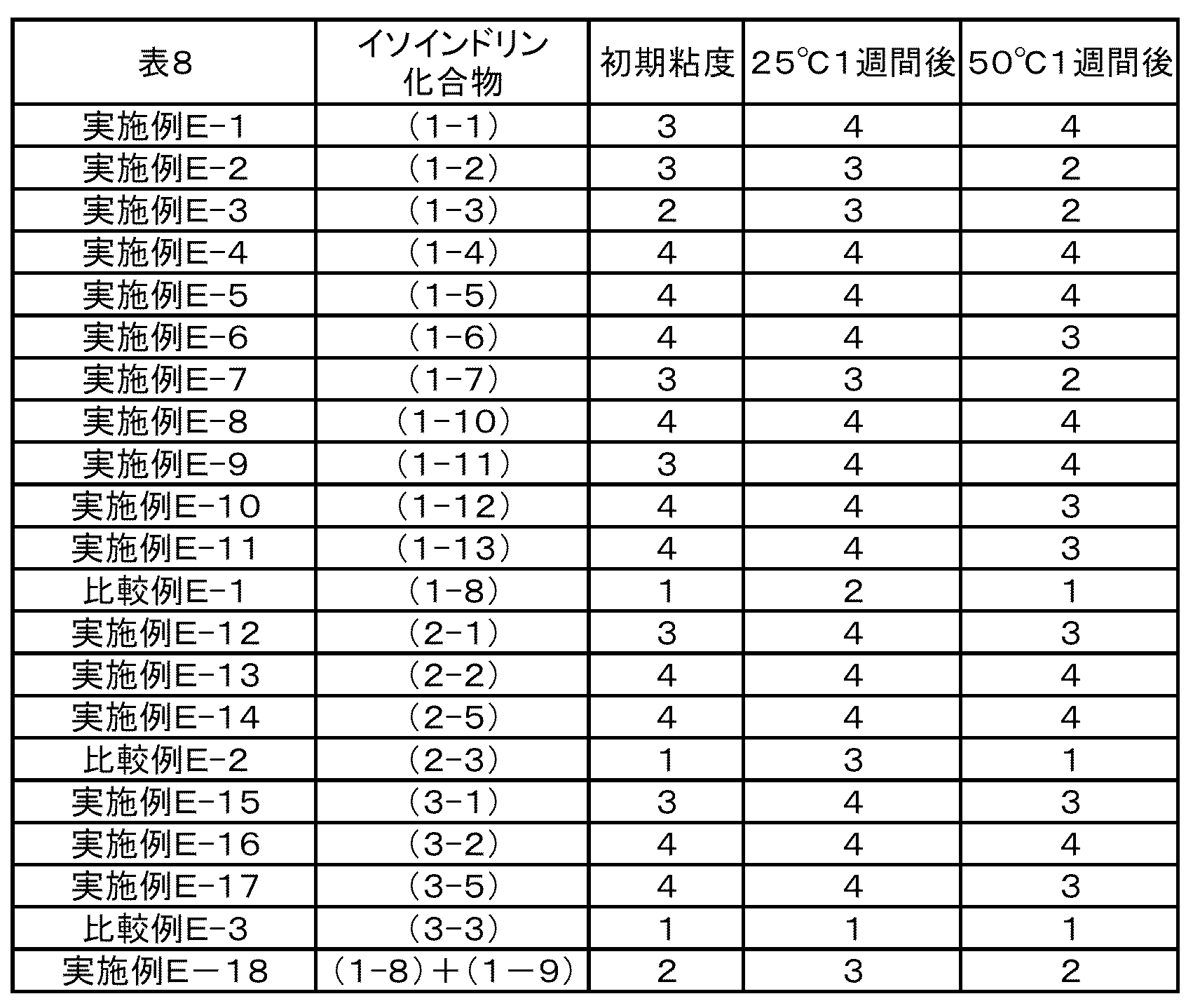
上段で作製した水系着色組成物を使用して水系塗料を作製して評価した。
(実施例F-1)
(1)水性塗料1-1の調製
高速撹拌機を用いて、以下の原料を撹拌し、水性塗料1-1(25℃で1週間保管)を得た。
・水系着色組成物E-1(25℃1週間保管):1.4部
・アクリル樹脂(酸価65.0、OH価50、Mw=15,000、不揮発分35%):13.6部
・メラミン樹脂(Allnex社製、サイメル325):3.4部
高速撹拌機を用いて、以下の原料を撹拌し、水性塗料1-2(50℃で1週間保管)を得た。
・水系着色組成物E-1(50℃1週間保管):1.4部
・アクリル樹脂(酸価65.0、OH価50、Mw=15,000、不揮発分35%):13.6部
・メラミン樹脂(Allnex社製、サイメル325):3.4部
実施例F-1の水系着色組成物E-1(25℃で1週間保管)を水系着色組成物E-2~21(それぞれ25℃で1週間保管)に、順次変更したことを除き、全て実施例F-1と同様にして、水性塗料2-1~21-1を得た。
また、実施例F-1の水系着色組成物E-1(50℃で1週間保管)を、水系着色組成物E-2~21(それぞれ50℃で1週間保管)に、順次変更したことを除き、全て実施例F-1と同様にして、水性塗料2-2~21-2を得た。
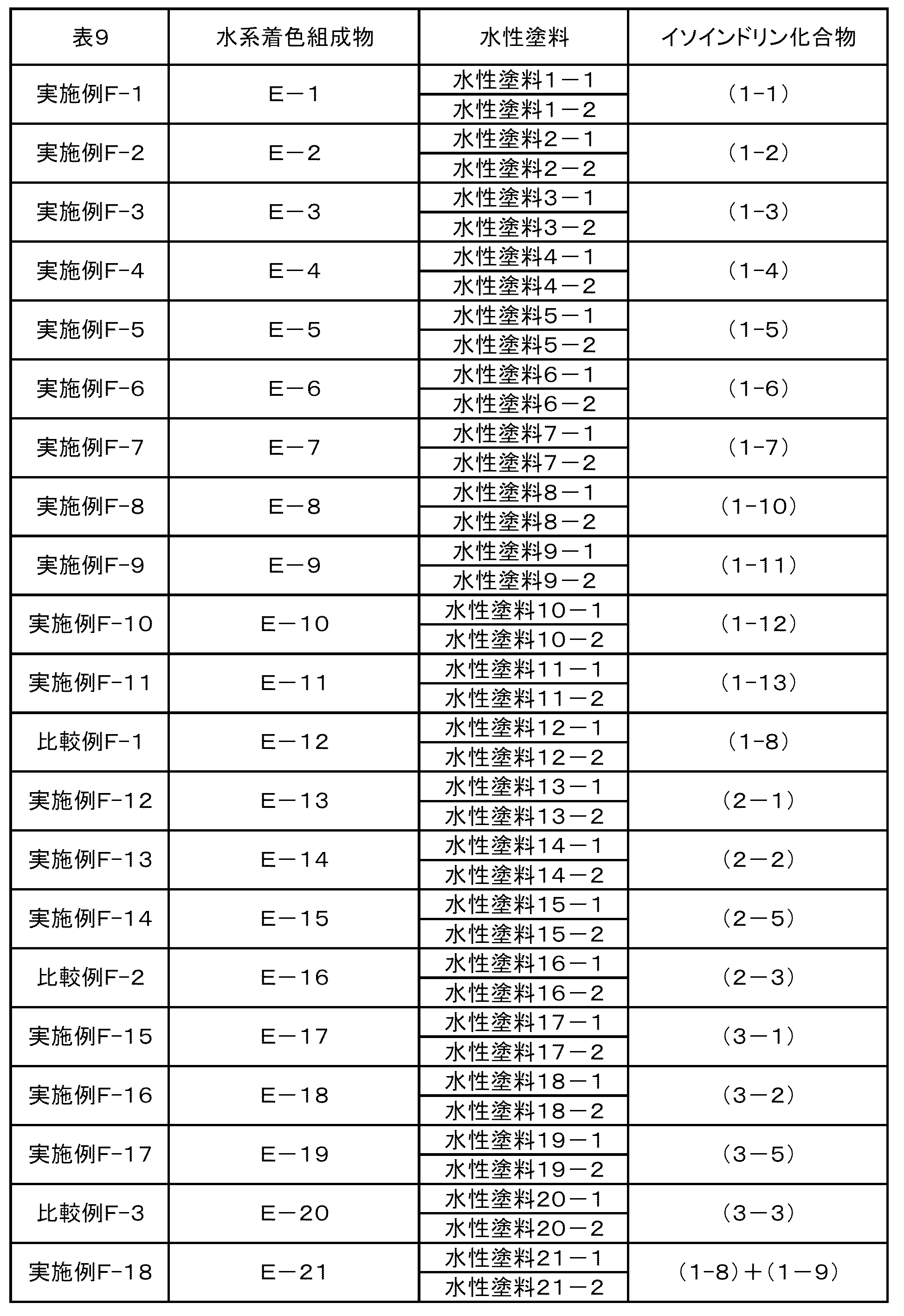
(実施例G-1) ペットフィルム塗装1の作製。
水性塗料1-1と水性塗料1-2を6ミルのアプリケーターを使用し、ルミラー100T60(PETフィルム、100μm厚)に塗装を行った。その塗装後、そのペットフィルムを室温で18時間乾燥させた。その後、60℃で5分、140℃で20分乾燥させ膜厚70μmの被膜を有するペットフィルム塗装1を得た。
実施例G-1の水性塗料1-1と水性塗料1-2を2-1~21-1、2-2~21-2に変更する以外は、全て実施例G-1と同様にして、ペットフィルム塗装2~21を得た。
実施例G-1~G-16、比較例G-1~G-3で得た各々のペットフィルム塗装について、以下の方法に従って色相の安定性を評価した。
測色機(コニカミノルタ社製、CM-700d)を使用して、25℃1週間保存した水系着色組成物の塗料と50℃1週間保存した水系着色組成物の塗料にて塗装したペットフィルムを測色し、その色差(ΔE*)を求め、下記基準で判断した。結果を表10に示す。色差が小さいほど、分散安定性に優れる色材と考えられ、下記評価基準で「4」、「3」及び「2」であれば、実用可能なレベルである。
(評価基準)
4.ΔE*が、1.0未満である。
3.ΔE*が、1.0以上2.0未満である。
2.ΔE*が、2.0以上3.0未満である。
1.ΔE*が、3.0以上である。
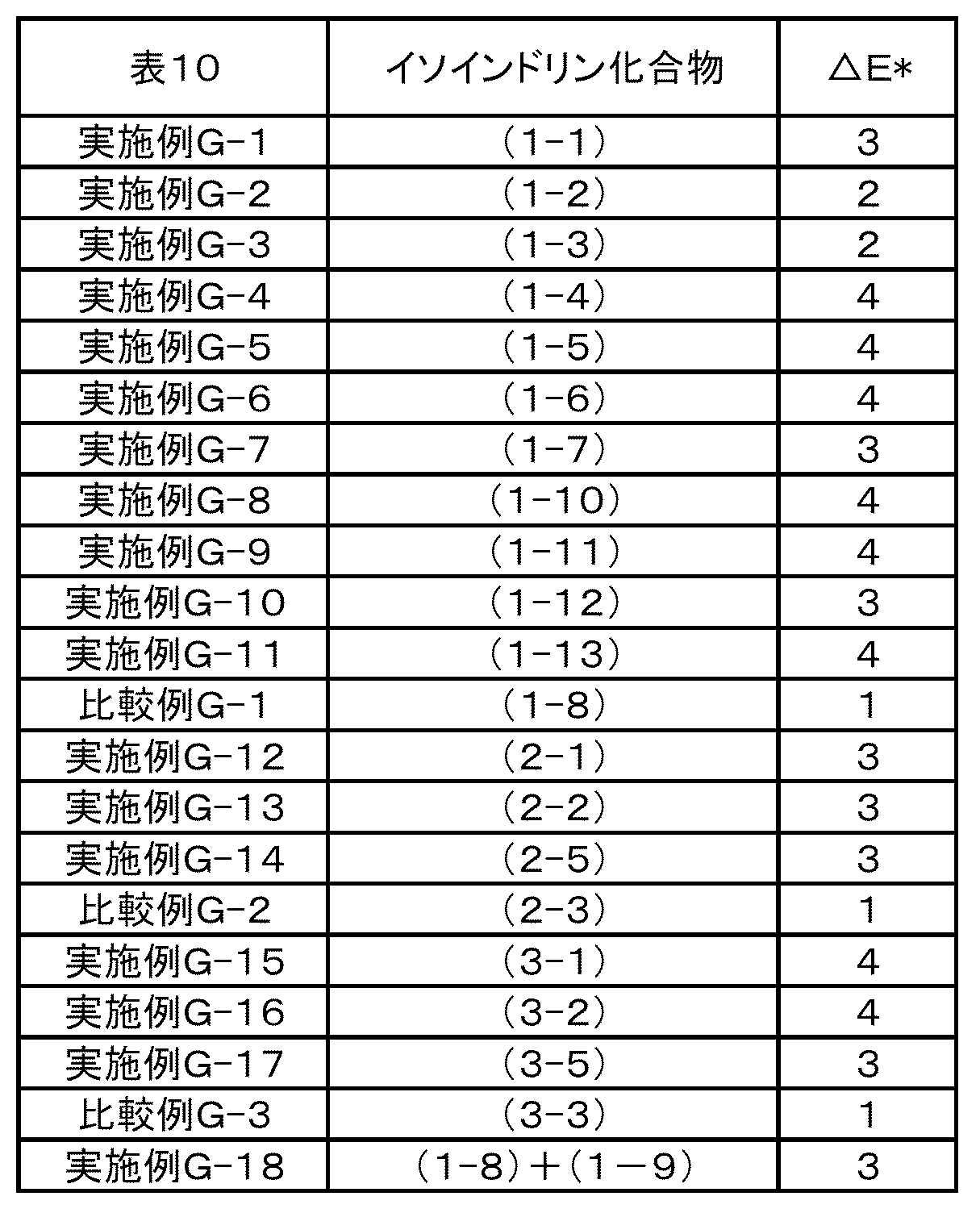
まず、樹脂の測定法を以下説明する。
(水酸基価)
JIS K0070に従って求めた。
(酸価)
JIS K0070に従って求めた。
(アミン価)
アミン価は、樹脂1g中に含有するアミノ基を中和するのに必要とする塩酸の当量と同量の水酸化カリウムのmg数でJIS K0070に準じて以下の方法に従って求めた。
試料を0.5~2g 精秤した( 試料不揮発分:Sg) 。精秤した試料にメタノール/メチルエチルケトン=60/40(質量比)の混合溶液50mLを加え溶解させた。得られた溶液に指示薬としてブロモフェノールブルーを加え、得られた溶液を0.2mol/Lエタノール性塩酸溶液(力価:f)で滴定を行なった。溶液の色が緑から黄に変化した点を終点とし、この時の滴定量(AmL)を用い、下記式によりアミン価を求めた。
アミン価=(A×f×0.2×56.108)/S [mgKOH/g]
重量平均分子量はGPC(ゲルパーミエーションクロマトグラフィー)装置(東ソー社製HLC-8220)を用いて分子量分布を測定し、ポリスチレンを標準物質に用いた換算分子量として求めた。下記に測定条件を示す。
カラム:下記カラムを直列に連結して使用した。
東ソー社製ガードカラムHXL-H
東ソー社製TSKgelG5000HXL
東ソー社製TSKgelG4000HXL
東ソー社製TSKgelG3000HXL
東ソー社製TSKgelG2000HXL
検出器:RI(示差屈折計)
測定条件:カラム温度40℃
溶離液:テトラヒドロフラン
流速:1.0mL/分
ガラス転移温度(Tg)は、DSC(示差走査熱量測定測定)により求めた。なお、測定機はリガク社製DSC8231を使用し、測定温度範囲-70~25 0℃、昇温速度10℃/分、DSC曲線におけるガラス転移に基づく吸熱開始温度と終了温度との中点をガラス転移温度とした。
数平均分子量700のポリプロピレングリコール(以下「PPG700」)200部、イソホロンジイソシアネート(以下「IPDI」)127部、及び酢酸エチル81.8部を窒素気流下にて80℃で4時間反応させ、末端イソシアネートウレタンプレポリマーの樹脂溶液を得た。次いでイソホロンジアミン(以下「IPDA」)49.5部、2-エタノールアミン3部、酢酸エチル/イソプロパノール(以下「IPA」)=50/50(質量比)の混合溶剤803.9部を混合したものに、得られた末端イソシアネートウレタンプレポリマーの樹脂溶液を40℃で徐々に添加し、次に80℃で1時間反応させ、不揮発分30%、アミン価3.5mgKOH/g、水酸基価7.3mgKOH/g、重量平均分子量40,000のポリウレタン樹脂溶液[PU1]を得た。ガラス転移温度は-32℃であった。
バインダー樹脂として、ポリウレタン樹脂溶液[PU1](不揮発分30%)を30部、炭化水素系ワックスとしてポリエチレンワックス(ハネウェル社製A-C400A)を不揮発分換算で0.8部、塩素化ポリプロピレン樹脂(日本製紙社製 製品名:370M
塩素含有率30% 不揮発分50%)を不揮発分換算で0.5部、イソインドリン化合物(1-1)を10部、メチルエチルケトン(以下「MEK」)/酢酸n-プロピル(以下「NPAC」)/IPA=40/40/20(質量比)の溶液58.7部を混合し、アイガーミルで15分間分散し、グラビア印刷インキ1を得た。
実施例H-1に記載したグラビア印刷インキ1の調製方法において、イソインドリン化合物(1-1)を表11に示す通りに変更した以外は、実施例H-1と同様にして、グラビア印刷インキ2~20を得た。
上記で得られたグラビア印刷インキ1を、MEK/NPAC/IPA=40/40/20(質量比)からなる混合溶剤により、粘度が16秒(25℃、ザーンカップNo.3)となるように希釈しヘリオ175線グラデーション版(版式コンプレスト グラデーション100%~3%)を備えたグラビア印刷機により、以下の基材(OPPの場合はコロナ放電処理面)に、印刷を印刷速度80m/分で行い、印刷物I1-1(OPP)、I1-2(CPP)を得た。
<基材>
・OPP:片面コロナ放電処理の2軸延伸ポリプロピレン(OPP)フィルム(フタムラ化学社製 FOR 厚さ25μm)
・CPP:コロナ処理無の未延伸ポリプロピレン(CPP)フィルム(三井化学東セロ社製 CP-S厚さ30μm)
表11に記載されたグラビアインキ2~20について、表12に記載の印刷構成にて印刷を行い、印刷物I2-1~I20-1(OPP)、I2-2~I20-2(CPP)を得た。
グラビアインキ1~20、及び印刷物I1-1~I20-1(OPP)、印刷物I1-2~I20-2(CPP)を用いて、以下の評価を行った。
グラビア印刷インキ1~20についてそれぞれを密閉容器に入れ、40℃で10日間保存を行った。その後、粘度を測定して保存前との粘度変化を評価した。なお粘度の測定は25℃でザーンカップNo.4の流出秒数にて行った。なお、いずれのインキも保存前のB型粘度計における粘度は40~500cps(25℃)の範囲内であった。
(評価基準)
5.粘度変化が2秒未満(良好)
4.粘度変化が2秒以上5秒未満(実用可)
3.粘度変化が5秒以上10秒未満(やや不良)
2.粘度変化が10秒以上15秒未満(不良)
1.粘度変化が15秒以上(極めて不良)
なお、5、4は実用上問題がない範囲である。
透明性に関しては、黒帯のある展色紙に対して展色したうえで、それぞれ色相の近い比較例と比較した際の黒帯上の透過具合を見て判断した。
(評価基準)
5.極めて透明
4.透明
3.同等
2.不透明
1.極めて不透明
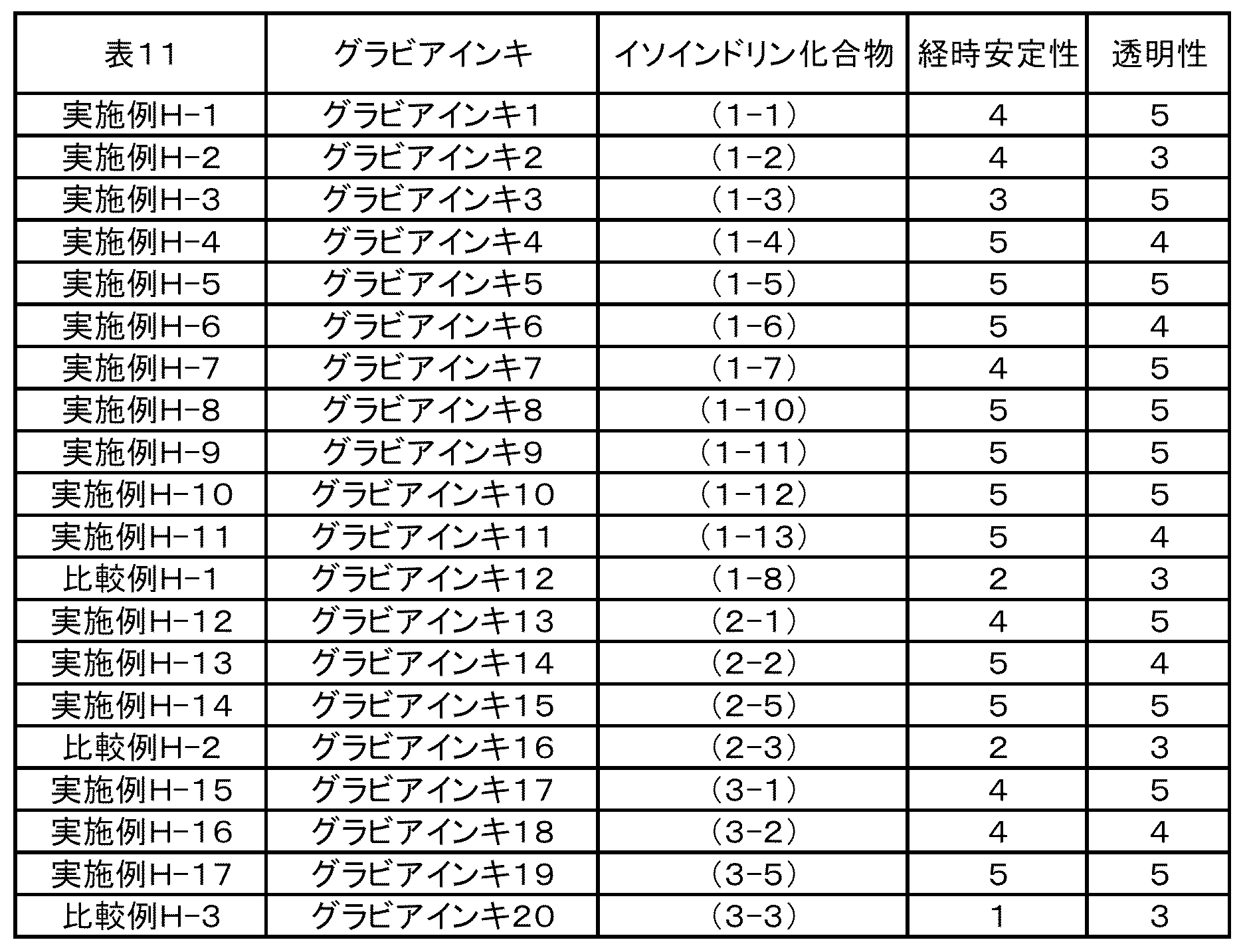
印刷物I1-1~I20-1(OPP)、印刷物I1-2~I20-2(CPP)を用いて、印刷層表面を爪で3ヶ所を擦り、印刷層の傷つき度合を評価した。
(評価基準)
5.印刷層の傷つきなし(良好)
4.印刷層の傷はつかないが僅かに爪の跡が残る。(実用可)
3.印刷層の傷がつき、印刷層表面が僅かに抉れる。(やや不良)
2.印刷層の傷がつき、基材が僅かに見える。(不良)
1.印刷層の傷がつき、基材がはっきり見える。(極めて不良)
なお、5、4は実用上問題がない範囲である。
印刷物I1-1~I20-1(OPP)、印刷物I1-2~I20-2(CPP)について、それぞれ印刷3時間後に、印刷面に幅12mmの粘着テープ(ニチバン社製 セロハンテープ)を貼り付け、これを急速に剥がしたときの印刷面の外観の状態を目視判定した。尚、判定基準は以下の通りとした。
(評価基準)
5.印刷面のインキ被膜が全く剥離しないもの(良好)
4.インキ被膜の剥離面積が1%以上5%未満であるもの(実用可)
3.インキ被膜の剥離面積が5%以上20%未満のもの(やや不良)
2.インキ被膜の剥離面積が20%以上50%未満のもの(不良)
1.インキ被膜が50%以上剥がれるもの(極めて不良)
なお、5、4は実用上問題がない範囲である。

<7-1>インクジェット用水性着色組成物(以下「IJ用水性着色組成物」)の調製
(実施例J-1) IJ用水性着色組成物1の調製
・イソインドリン化合物(1-1):19.0部
・スチレン-アクリル酸共重合体(BASFジャパン社製、ジョンクリル61J):16.4部
・界面活性剤(花王社製、エマルゲン420):5.0部
・イオン交換水:59.6部
と、直径1.25mmジルコニアビーズ200部とを200mlのガラス瓶に仕込み、レッドデビル社製ペイントシェーカーにて6時間にわたって分散させた。得られた液をイオン交換水で希釈し、分散用ジルコニアビーズを濾過分離し、着色剤含有量が15%となるようにイオン交換水で希釈することにより、イソインドリン化合物(1-1)のIJ用水性着色組成物1を得た。
実施例J-1に記載した水性IJ分散液1の調製方法において、イソインドリン化合物1-1を表13に記載した通りにそれぞれ変更した以外は、実施例J-1と同様にして、IJ用水性着色組成物2~20を得た。
実施例J-1に記載した水性IJ分散液1の調製方法において、イソインドリン化合物1-1:19部をイソインドリン1-8:17.1部およびイソインドリン1-9:1.9部に変更した以外は、実施例J-1と同様にして、IJ用水性着色組成物21を得た。
滴下漏斗、温度計、窒素ガス導入管、撹拌機および還流冷却管を備えた3リットルの4口フラスコにメチルエチルケトン1,000部を仕込んで78℃まで昇温した後、スチレン100部、n-ブチルメタクリレート538部、n-ブチルアクリレート104部、2-ヒドロキシエチルメタクリレート150部、メタクリル酸108部、及びターシャリブチルパーオキシ-2-エチルヘキサノエート80部からなる混合液を、4時間かけて滴下し、同温度にて8時間反応させた。反応終了後、更にメチルエチルケトンを加え、不揮発分が50%になるように調整し、酸価70mgKOH/g、数平均分子量6,000のスチレン-アクリル酸エステル-メタクリル酸エステル共重合体[PA1]溶液を得た。なお前記酸価は、グラビア印刷インキ中の樹脂と同様の方法で測定した値であり、前記数平均分子量は、上述したグラビア印刷インキ中の樹脂の重量平均分子量の場合と同様の装置及び方法にて測定した、ポリスチレン換算値である。
スチレン-アクリル酸エステル-メタクリル酸エステル共重合体[PA1]溶液(不揮発分50%)12.8部を、ジメチルエタノールアミン0.71部を用いて中和した後、メチルエーテル化メラミン樹脂(三和ケミカル工業社製、ニカラック MX-041)2.29部(樹脂として1.6部)と混合した。この混合溶液中に、あらかじめ作製しておいたイソインドリン化合物(1-2)の水性スラリー(不揮発分16%)50部を撹拌しながら加えた。次いで、直径1.5mmガラスビーズ130部とともに250mlガラス瓶に仕込み、レッドデビル社製ペイントシェーカーを用いて4時間にわたって分散させ、分散液を得たのちに、混合物と等量のイオン交換水を加えた。その後、1規定塩酸水溶液を撹拌しながら加え、共重合体[PA1]をイソインドリン化合物(1-2)の表面に析出及び固着させた。なお固着させた後の、混合溶液のpHは3~5であった。
その後、混合溶液を吸引濾過し、洗液のpHが6を越えるようになるまでイオン交換水で水洗をして共重合体[PA1]が固着したイソインドリン化合物(1-2)を得た。
次いで、共重合体[PA1]が固着したイソインドリン化合物(1-2)が流動するようになるまで水を加えたのち、撹拌機で撹拌しながら、ジメチルエタノールアミンを0.8部添加した後、そのまま1時間撹拌を継続し、共重合体[PA1]が固着したイソインドリン化合物(1-2)の再分散体を得た。
この再分散体に水を加えて、不揮発分を19%に調整したのち、酸架橋触媒(楠本化成社製、Nacure 2500X)を当該再分散体中に含まれる共重合体[PA1]の量に対して0.5%加え、95℃にて1時間架橋反応を行うことで、顔料組成物含有架橋樹脂粒子を含む水系着色組成物(IJ用水性着色組成物22)を得た。
滴下漏斗、温度計、窒素ガス導入管、撹拌機および還流冷却管を備えた3リットルの4口フラスコに、メチルエチルケトン1,000部を仕込んで78℃まで昇温した後、スチレン100部、n-ブチルメタクリレート476部、n-ブチルアクリレート116部、2-ヒドロキシエチルメタクリレート150部、グリシジルメタクリレート50部、メタクリル酸108部、及びターシャリブチルパーオキシ-2-エチルヘキサノエート80部からなる混合液を、4時間かけて滴下し、同温度にて8時間反応させた。反応終了後、更にメチルエチルケトンを加えて、不揮発分が50%になるように調整し、酸価70mgKOH/g、数平均分子量10,500のスチレン-アクリル酸エステル-メタクリル酸エステル共重合体[PA2]溶液を得た。
得られたスチレン-アクリル酸エステル-メタクリル酸エステル共重合体[PA2]溶液(不揮発分50%)を16部、イソインドリン化合物(1-2)を8部、及び、メチルエチルケトン40部を、直径1.5mmガラスビーズ130部とともに250mlガラス瓶に仕込み、レッドデビル社製ペイントシェーカーを用いて4時間にわたって分散させ、分散液を得た。次いで、この分散液に、親水性エポキシ樹脂(DIC社製、CR-5L)0.8部及びメチルエチルケトン24部を加えて撹拌した後、ガラスビーズを濾過分離した。こうして得られた分散液87.2部を、ジメチルエタノールアミン1.2部及び水100部の混合液中に、撹拌しながら投入したのち、混合物と等量のイオン交換水を加えた。その後、1規定燐酸水溶液を撹拌しながら加え、共重合体[PA2]をイソインドリン化合物(1-2)の表面に析出及び固着させた。なお固着させた後の、混合溶液のpHは5であった。
その後、混合溶液を吸引濾過し、洗液のpHが6を越えるようになるまでイオン交換水で水洗をして共重合体[PA2]が固着したイソインドリン化合物(1-2)を得た。
次いで、共重合体[PA2]が固着したイソインドリン化合物(1-2)が流動するようになるまで水を加えたのち、撹拌機で撹拌しながら、ジメチルエタノールアミンを0.8部添加した後、そのまま1時間撹拌を継続し、共重合体[PA2]が固着したイソインドリン化合物(1-2)の再分散体を得た。
この再分散体に水を加えて、不揮発分を19%に調整したのち、再分散体を95℃に加熱して1時間架橋反応を行うことで、顔料組成物含有架橋樹脂粒子を含む水系着色組成物(IJ用水性着色組成物23)を得た。
アクリル酸62部、スチレン129部、α-メチルスチレン9部を混合し、モノマー混合液を調製した。反応容器内に、メチルエチルケトン20部、2-メルカプトエタノール(重合連鎖移動剤)0.3部、及び、前記モノマー混合液の10%を入れて混合し、窒素ガス置換を十分に行った。また別途、滴下漏斗に、前記モノマー混合液の残りの90%、前記重合連鎖移動剤0.27部、メチルエチルケトン60部、及び、アゾ系ラジカル重合開始剤(和光純薬工業社製、V-65、2,2’-アゾビス(2,4-ジメチルバレロニトリル))2.2部の混合液を仕込んだ。
窒素雰囲気下、前記反応容器内の混合物を撹拌しながら65℃まで昇温したのち、滴下漏斗中の混合物を3時間かけて滴下した。滴下終了後、65℃で1時間反応させた後、更に、前記重合開始剤0.3部をメチルエチルケトン5部に溶解した溶液を加え、65℃で1時間反応を継続した。前記重合開始剤溶液の添加及び反応の継続を更に2回行った後、70℃に昇温し更に1時間反応させた後、メチルエチルケトン200部を加えることで、酸価240mgKOH/g、数平均分子量5,700、重量平均分子量12,500のスチレン-アクリル酸エステル共重合体[PA3]溶液(不揮発分濃度40.9%)を得た。
このスチレン-アクリル酸エステル共重合体[PA3]溶液を減圧乾燥し、溶媒を完全に除去することで樹脂32部を得たのち、イオン交換水204部と混合し、更に、トリエタノールアミン11.1部を加え、共重合体[PA3]中のカルボキシ基の約55モル%を中和した。この混合溶液を90℃まで加熱したのち1時間撹拌することで、共重合体[PA3]が水中に分散した、共重合体[PA3]の水分散液を得た。
共重合体[PA3]の水分散液を室温まで冷却した後、イソインドリン化合物(1-2)を100部加え、撹拌機を用いて、20℃下で3時間撹拌した。この混合溶液にイオン交換水124部を加えたのち、マイクロフルイダイザーを用い、150MPaの圧力で15パス分散処理した。次いで、高速冷却遠心機(日立工機社製、himac CR22G)を用い、得られた分散液を、設定温度20℃、3,660rpmで20分間遠心分離した後、液層部分のみ回収し、更に、孔径5μmのメンブランフィルターで濾過を行い、イソインドリン化合物(1-2)の水分散液(不揮発分濃度25%)を得た。
このイソインドリン化合物(1-2)の水分散液100部に、イオン交換水32部を加え、更に、架橋剤としてトリメチロールプロパンポリグリシジルエーテル(ナガセケムテックス社製、デナコールEX-321)を1.8部加え、撹拌しながら70℃で5時間加熱した。その後室温まで冷却し、孔径5μmのメンブランフィルターで濾過を行い、更にイオン交換水を添加して不揮発分が19%となるように調整することで、顔料組成物含有架橋樹脂粒子を含む水系着色組成物(IJ用水性着色組成物24)を得た。
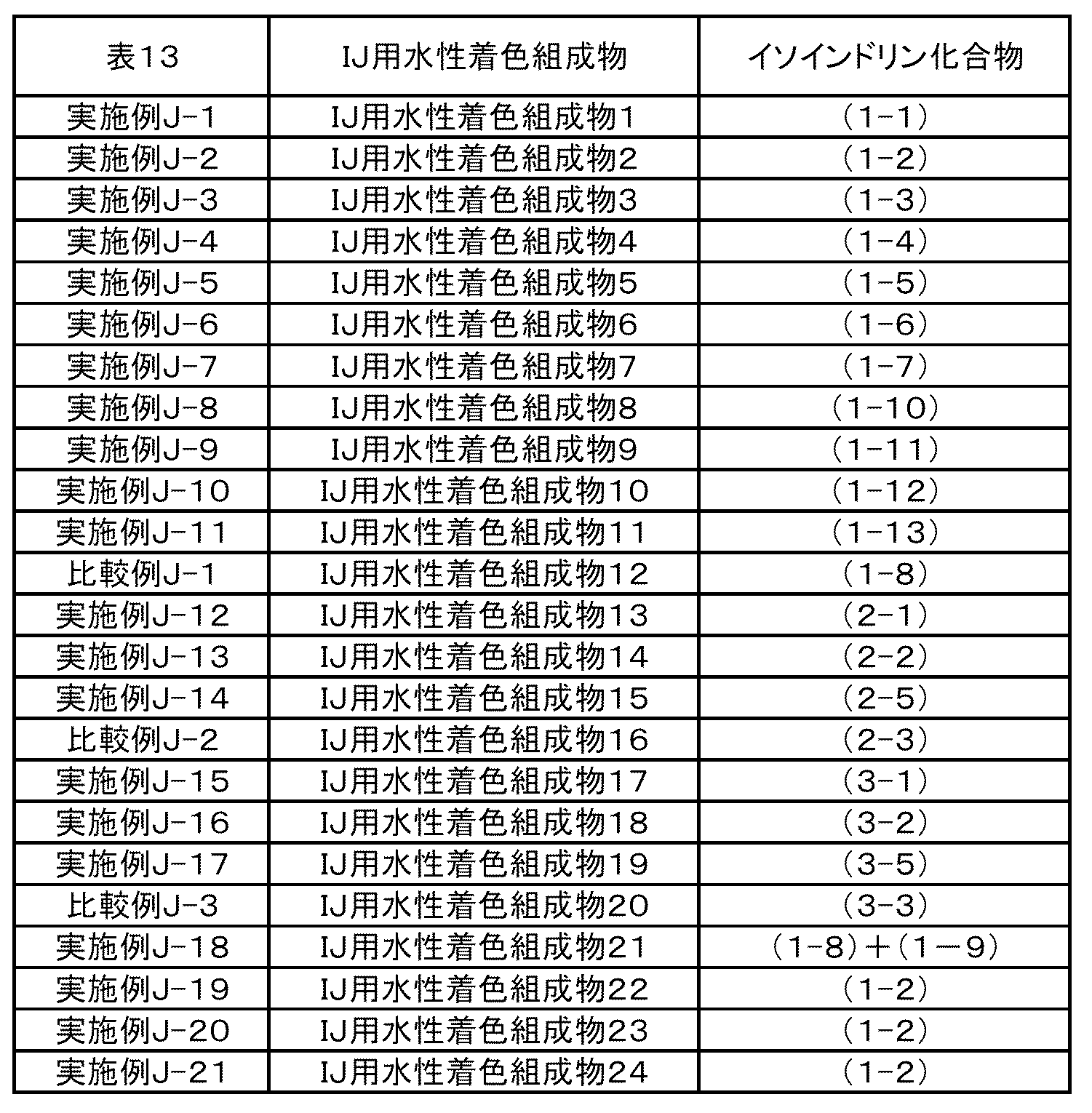
表14及び表15に記載の各成分を撹拌混合した後、3μmのメンブランフィルターでろ過する事により、評価試験用の実施例K-1~K-23、および比較例K-1~K-5の水性IJインキを得た。表14及び表15において、成分の量を示す数値は何れも『部』数であり、『-』を記載したものは、その成分を含まない事を意味する。また、『水』はイオン交換水を使用した。その他表中の略号は以下の意味を示す。
・PG:プロピレングリコール
・TEA:トリエタノールアミン
・AMP:2-アミノ-2-メチル-1-プロパノール
・NH3 28%aq:28%アンモニア水溶液
各実施例及び比較例にて作成した水性IJインキを、マヨネーズ瓶に充填し、50℃オーブンにて4週間保管した。各インキの保管前後のインキを使用し、松尾産業社製K コントロールコーターを使用し、OKトップコートに対し、ウェット膜厚6μmで塗工後、塗工物を70℃オーブンで1分間乾燥させ、塗工物を作製した。
得られた塗工物を使用し、X-Rite社製X-rite eXactを使用し、長期保管前後でのインキ塗膜のL*、a*、b*値を測定した。その数値から、保管前後による色差(ΔE値)を算出し、評価を実施した。下記評価基準で「4」、「3」及び「2」であれば、実用可能な品位である。
(評価基準)
4:色差(ΔE値)が2未満
3:色差(ΔE値)が2以上3未満
2:色差(ΔE値)が3以上5未満
1:色差(ΔE値)が5以上
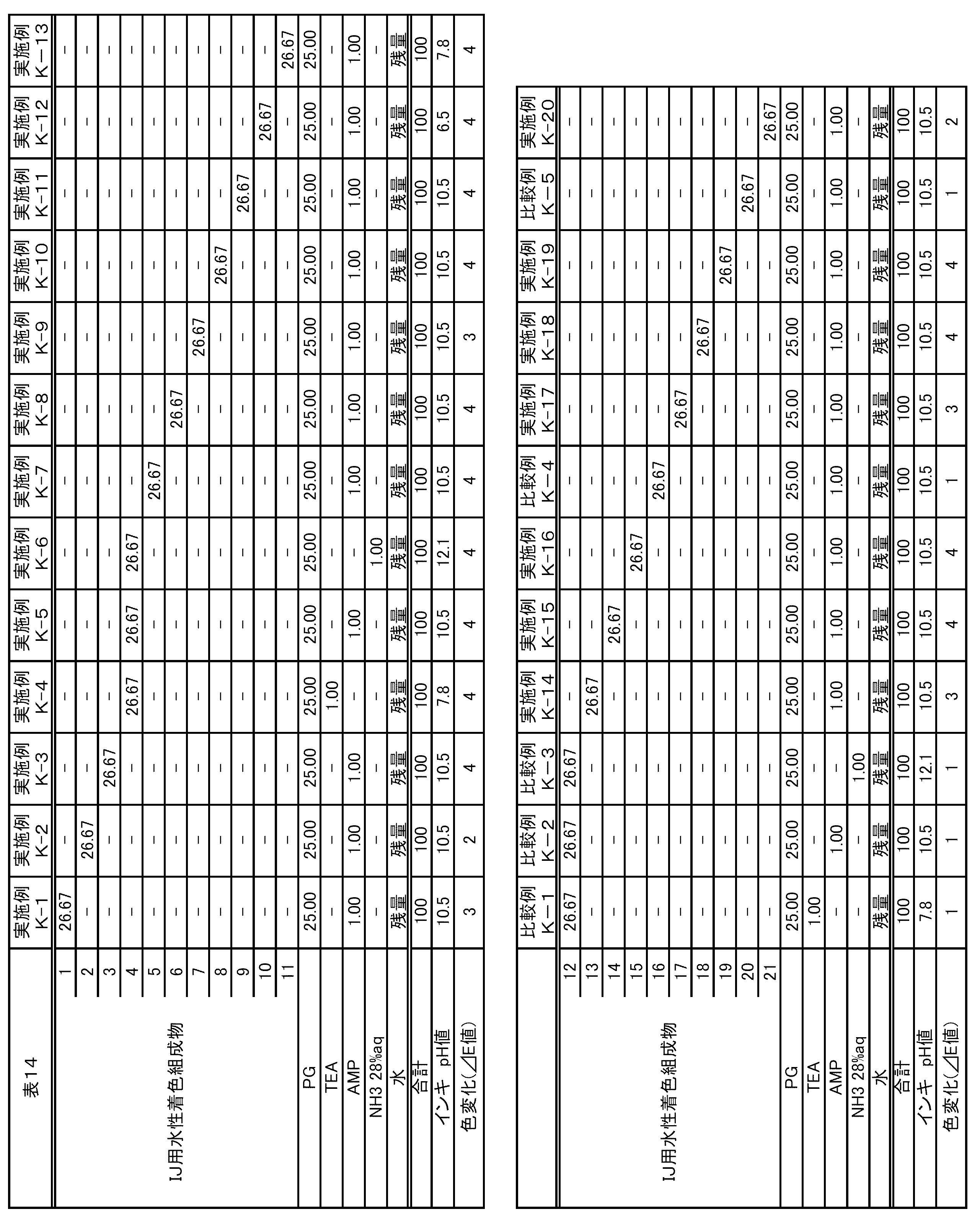

得られたイソインドリン化合物を使用してインキセットを調製し、その特性評価を行った。
アジピン酸と3-メチル-1,5-ペンタンジオールから得られる数平均分子量2,000のポリエステルジオール54.719部、イソホロンジイソシアネート3.989部、酢酸n-プロピル10.0部を窒素気流下に85℃で3時間反応させ、酢酸n-プロピ
ル10.0部を加え冷却し、末端イソシアネートプレポリマーの溶剤溶液78.718部を得た。次いでイソホロンジアミン1.031部、ジ-n-ブチルアミン0.261部、酢酸n-プロピル30.4部及びイソプロピルアルコール19.6部を混合したものに、得られた末端イソシアネートプレポリマーの溶剤溶液78.718部を室温で徐々に添加し、次に50℃で1時間反応させ、不揮発分30%、重量平均分子量60,000、アミン価3.0mgKOH/gのポリウレタン樹脂溶液[PU2]を得た。
還流冷却管、滴下漏斗、ガス導入管、撹拌装置、及び温度計を備えた反応器中で窒素ガスを導入しながら、PPA(数平均分子量2,000のポリ(プロピレングリコール)アジペートジオール)を161.9部、2,2-ジメチロールブタン酸(DMBA)27.7部、イソホロンジイソシアネート(IPDI)96.4部、メチルエチルケトン(MEK)200部を仕込み、90℃で5時間反応させて末端イソシアネート基を有するウレタンプレポリマーの樹脂溶液を得た。得られた末端イソシアネート基ウレタンプレポリマー樹脂溶液に対し、2-(2-アミノエチルアミノ)エタノール(AEA)13.6部、エタノールアミン(MEA)0.5部、イソプロピルアルコール(IPA)350部を混合したものを室温で60分かけて滴下し、更に70℃で3時間反応させた。更にMEK150部を用いて不揮発分を調整し、不揮発分30%、重量平均分子量35,000、Mw/Mn=3.0、酸価35.0mgKOH/g、水酸基価25.7mgKOH/gのポリウレタン樹脂溶液[PU3]を得た。
反応容器に、n-アミルアルコール1250部、フタロジニトリル225部、及び塩化アルミニウム無水物78部を加えて混合攪拌した。これに、DBU(1,8-ジアザビシクロ[5.4.0]ウンデカ-7-エン)266部を加え、昇温し、136℃で5時間還流した。攪拌したまま30℃まで冷却した反応溶液を、メタノール5000部、水10000部からなる混合溶媒中へ攪拌しながら注入し、青色のスラリーを得た。このスラリーを濾過し、メタノール2000部、水4000部からなる混合溶媒で洗浄し、乾燥して、135部の下記化学式(32)で示されるクロロアルミニウムフタロシアニンを得た。
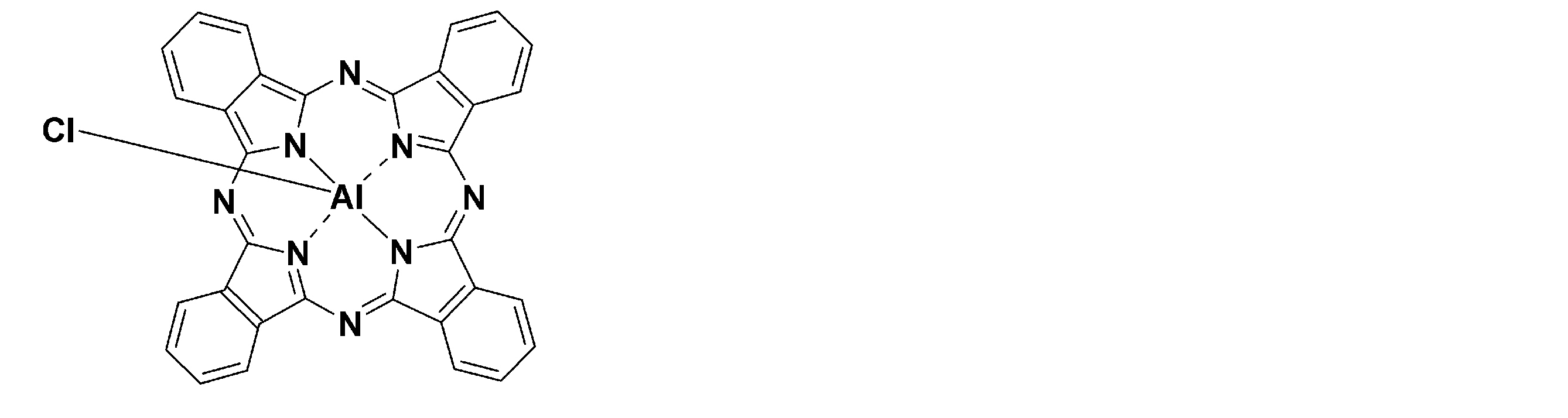
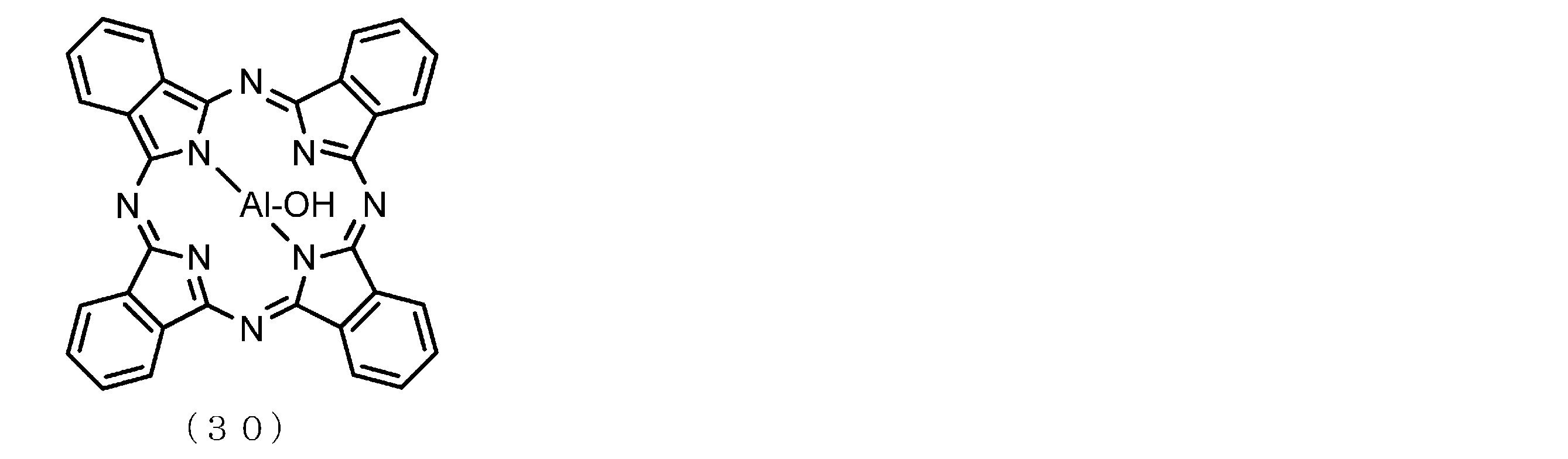

(実施例LY-1)
イソインドリン化合物(1-1)7.0部、ポリウレタン樹脂溶液[PU2]34.5部、N-プロピルアセテート20部、イソプロピルアルコール5部を撹拌混合し、サンドミルで練肉した後、ポリウレタン樹脂溶液[PU2]20部、N-プロピルアセテート11部、イソプロピルアルコール3部を添加し、イエローインキ[LY-1]を得た。
イソインドリン化合物(1-1)7.0部を、表16に示した化合物及び表16記載の量に変更した以外は実施例LY-1と同様にして、表16記載のインキを得た。


イエローインキ[LY-1]~[LY-17]、シアンインキ[LC-1]~[LC-5]、マゼンタインキ[LM-1]~[LM-10]についてそれぞれを密閉容器に入れ、40℃で14日間保存を行った。その後、粘度を測定して、保存前との粘度変化を比較して評価した。なお粘度の測定は25℃でザーンカップNo.4の流出秒数にて行った。なお、いずれのインキも保存前のB型粘度計における粘度は40~500cps(25℃)の範囲内であった。結果を表18に示す。
(評価基準)
○:粘度変化が2秒未満(良好)
△:粘度変化が2秒以上5秒未満(実用可)
×:粘度変化が5秒以上(不良)
得られた各インキを表18に記載のとおり組み合わせて、インキセット1~79とした。
得られたインキセットについて、以下の方法でトラッピング性、ガマットを評価した。結果を表18に示す。
シアンインキ及びイエローインキを、各々、混合溶剤1(メチルエチルケトン:N-プロピルアセテート:イソプロパノール=40:40:20)により、粘度が16秒(25℃、ザーンカップNo.3)となるように希釈した。
厚み12μmのコロナ放電処理ポリエステルフィルム(東洋紡社製 E-5100)のコロナ放電処理面に、シアン、イエローの順で重ね印刷し、印刷物を得た(トラッピング性初期評価)。
印刷条件は、温度25℃、湿度60%、印刷速度100m/分、印刷距離4000mとした。シアンインキはヘリオ175線グラデーション版(版式コンプレスト、75%ベタ柄と100%~3%のグラデーション柄)を用い、イエローインキはヘリオ175線グラデーション版(版式エロンゲート、75%ベタ柄と100%~3%のグラデーション柄)を用いた。
また、シアンインキ及びイエローインキを、各々、密閉容器に入れ、40℃で14日間保存を行った後、上記と同様に希釈、印刷し、印刷物を得た(トラッピング性経時評価)。
イエローインキ及びマゼンタインキを、各々、上記混合溶剤1により、粘度が16秒(25℃、ザーンカップNo.3)となるように希釈した。
厚み12μmのコロナ放電処理ポリエステルフィルム(東洋紡社製 E-5100)のコロナ放電処理面に、イエロー、マゼンタの順で重ね印刷し、印刷物を得た(トラッピング性初期評価)。
印刷条件は、温度25℃、湿度60%、印刷速度100m/分、印刷距離4000mとした。イエローインキはヘリオ175線グラデーション版(版式エロンゲート、75%ベタ柄と100%~3%のグラデーション柄)を用い、マゼンタインキはヘリオ175線グラデーション版(版式エロンゲート、75%ベタ柄と100%~3%のグラデーション柄)を用いた。
また、イエローインキ及びマゼンタインキを、各々、密閉容器に入れ、40℃で14日間保存を行った後、上記と同様に希釈、印刷し、印刷物を得た(トラッピング性経時評価)。
○:印刷ムラが版深70%未満で発生する(良好)
△:印刷ムラが版深70%以上、80%未満で発生する(使用可能)
×:印刷ムラが版深80%以上で発生する、又は、重ねのインキがすべて網点となり、濡れ広がっていない(使用不可)
シアンインキ、マゼンタインキ、イエローインキを、上記混合溶剤1により、粘度が16秒(25℃、ザーンカップNo.3)となるように希釈した。希釈した各インキを用いて、シアン、マゼンタ、イエローの刷り順で印刷し、単色ベタ部(シアン、マゼンタ、イエロー)、単色ベタ刷り重ね部(シアン×マゼンタ、シアン×イエロー、イエロー×マゼンタ)を有する印刷物を得た。印刷条件を以下に示す。
印刷機:富士機械5色機
シアン版:ヘリオ175L/inch、スタイラス角度120°、エロンゲート
マゼンタ版:ヘリオ175L/inch、スタイラス角度120°、コンプレスト
イエロー版:ヘリオ175L/inch、スタイラス角度120°、コンプレスト
印刷速度:150m/分
基材:コロナ処理二軸延伸ポリプロピレン(OPP)フィルム(東洋紡績社製パイレンP-2161、20μm)
乾燥温度:50℃
a*を横軸、b*縦軸とした2次元空間に、単色ベタ部(イエロー、マゼンタ、シアン)、及び、単色ベタ刷り重ね部(シアン×マゼンタ、シアン×イエロー、イエロー×マゼンタ)計6色のa*対b*の値を、プロットした六角形を作成し面積を求めた。基準となる比較例の面積を100%とした場合の面積比を求め、その面積比から以下の基準で評価した。具体的には、実施例LS-1~LS-12、LS-16~LS-20、LS-25~LS-30、及び比較例LS-3~LS-7、LS-12は、比較例LS-1を基準とした。また、実施例LS-13~LS-15は、比較例LS-2を基準とした。また、実施例LS-35~LS-40は、比較例LS-13を基準とした。なお、-は未評価であることを表す。
(評価基準)
○:面積比が90%以上である(良好)
△:面積比が85%以上、90%未満である(使用可能)
×:面積比が85%未満である(使用不可)
シアンインキ、マゼンタインキ、イエローインキを、各々、密閉容器に入れ、40℃で14日間保存を行った後、初期評価と同様に希釈、印刷し、印刷物を得た。
a*を横軸、b*縦軸とした2次元空間に、単色ベタ部(イエロー、マゼンタ、シアン)、及び、単色ベタ刷り重ね部(シアン×マゼンタ、シアン×イエロー、イエロー×マゼンタ)計6色のa*対b*の値を、プロットした六角形を作成した。各実施例・比較例の経時評価における面積を、初期評価の面積で除した面積比を求め、その面積比から以下の基準で評価した。-は未評価であることを表す。
(評価基準)
○:面積比が98%以上である(良好)
△:面積比が95%以上、98%未満である(実用可)
×:面積比が95%未満である(不良)

(クリアインキ[1]の作製)
ポリウレタン樹脂溶液[PU3](不揮発分30%)87部、酢酸エチル(EA)5部、IPA5部、シリカ(水澤化学社製「P-73」、平均粒子径3.8μmの親水性シリカ粒子)3部を、ディスパーを用いて撹拌混合して、クリアインキ[1]を得た。
(ラミネート接着剤溶液[1]の作製)
四つ口セパラブルフラスコに、テレフタル酸82部、イソフタル酸682部、アジピン酸236部、エチレングリコール236部、ネオペンチルグリコール525部、1,6-ヘキサンジオール405部を仕込み、220~260℃でエステル化反応を行った。所定量の水の留出後、徐々に減圧し1mmHg以下、240~260℃で5時間脱グリコール反応を行った。その後、イソホロンジイソシアネート2部を徐々に添加し、150℃で約2時間反応を行い、ポリエステルポリウレタンポリオールを得た。このポリエステルポリウレタンポリオール100部に、無水トリメリット酸2.83部を添加し、180℃で約2時間反応させた。次いで酢酸エチルで不揮発分50%に希釈して、数平均分子量6,000、酸価16.5mgKOH/gである部分酸変性ポリエステルポリオール溶液を得た。
得られたポリオール溶液100部と、HDIビウレットの不揮発分95%酢酸エチル溶液7.94部とを混合し、酢酸エチルを加えて不揮発分30%のラミネート接着剤溶液[1]を得た。
(実施例LP-1)包装材料1
シアンインキ[LC-1]、マゼンタインキ[LM-1]、イエローインキ[LY-1]を、上記混合溶剤1により、粘度が16秒(25℃、ザーンカップNo.3)となるように希釈した。
希釈した各インキを用いて、版深20μmのグラビア版を備えたグラビア校正5色機と、ブラックインキ(リオアルファ R92墨(東洋インキ社製))、シアンインキ[LC-1]、マゼンタインキ[LM-1]、イエローインキ[LY-1]、ホワイトインキ(リオアルファ R631白(東洋インキ社製))を含むインキセット101とを用いて、厚み20μmのコロナ処理延伸ポリプロピレンフィルム(OPP基材)に対し、ブラックインキ、シアンインキ[LC-1]、マゼンタインキ[LM-1]、イエローインキ[LY-1]、ホワイトインキの順で重ね印刷し、各ユニットにおいてはそれぞれ50℃にて乾燥し、「OPP基材/ブラック、シアン、マゼンタ、イエロー又はホワイトの印刷層」の構成である印刷物を得た。
次いで、得られた印刷物の印刷層上に、ウレタン系ラミネート接着剤(東洋モートン社製TM320/CAT13B、不揮発分30%酢酸エチル溶液)を、乾燥後塗布量が2.0g/m2となるように塗工し乾燥した後、接着剤層上に、厚み50μmの未延伸ポリエチレン(PE)フィルムを貼り合わせ、「OPP基材/5色重ね印刷層/接着剤層/PE基材」の構成である包装材料1を得た。
実施例LP-1で使用したインキセット101を、表19に示すインキセットに変更した以外は実施例LP-1と同様にして、脱離層を有する包装材料2~64を得た。

シアンインキ[LC-1]、マゼンタインキ[LM-1]、イエローインキ[LY-1]を、上記混合溶剤1により、粘度が16秒(25℃、ザーンカップNo.3)となるように希釈した。
希釈した各インキを用いて、版深20μmのグラビア版を備えたグラビア校正5色機と、クリアインキ[1]、シアンインキ[LC-1]、マゼンタインキ[LM-1]、及びイエローインキ[LY-1]を含むインキセット201とを用いて、厚み20μmのコロナ処理延伸ポリプロピレンフィルムに対し、クリアインキ[1]、シアンインキ[LC-1]、マゼンタインキ[LM-1]、及びイエローインキ[LY-1]の順で重ね印刷し、各ユニットにおいてはそれぞれ50℃にて乾燥し、「OPP基材/脱離層(クリアインキ)/シアン、マゼンタ又はイエローの印刷層」の構成であり、脱離性を有する層を含む印刷物を得た。
次いで、得られた印刷物の印刷層上に、ドライラミネート機を用いてラミネート接着剤溶液[1]を塗工し、ライン速度40m/分にて、厚み25μmのアルミニウム蒸着無延伸ポリプロピレン(VMCPP)フィルムと貼り合わせ、「OPP基材/脱離性を有する印刷層/3色重ね印刷層/脱離性を有する接着剤層/VMCPP基材」の構成であり、脱離層を有する包装材料101を得た。
包装材料102~164 実施例LP-101で使用したインキセット201を、表20に示すインキセットに変更した以外は実施例LP-101と同様にして、脱離層を有する包装材料102~164を得た。
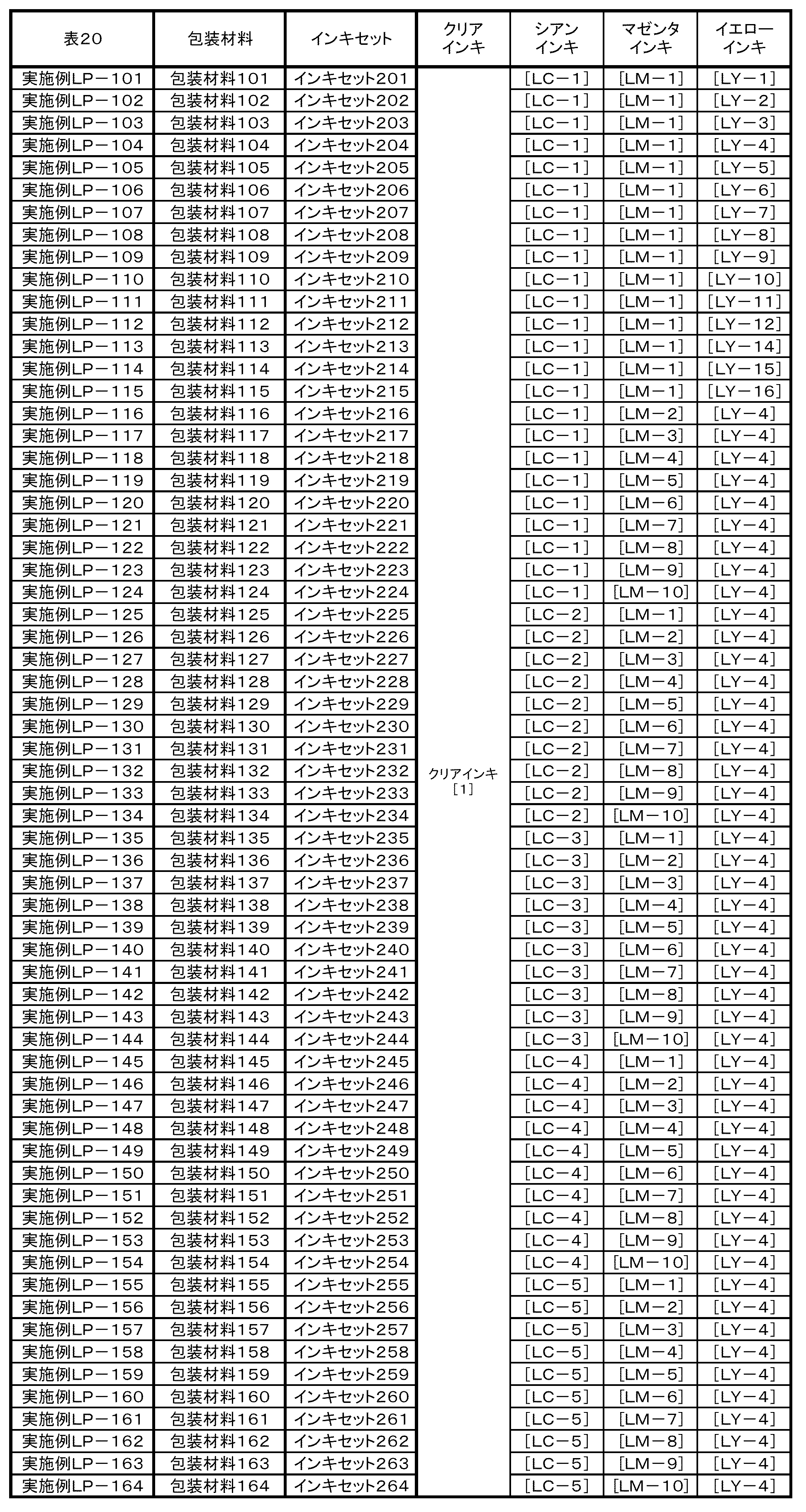
(インクジェット用水性着色組成物(以下「IJ用水性着色組成物」)[MY-1]の調製)
下記の材料と、直径1.25mmジルコニアビーズ200部とを200mlのガラス瓶に仕込み、レッドデビル社製ペイントシェーカーにて6時間分散した。
・イソインドリン化合物(1-1):19.0部
・スチレン-アクリル酸共重合体(BASFジャパン社製、ジョンクリル61J):16.4部
・界面活性剤(花王社製、エマルゲン420):5.0部
・イオン交換水:59.6部
次いで、上記分散液からジルコニアビーズを除去して、IJ用水性着色組成物[MY-1]を得た。
水性IJ分散体1を33部、ブチルジグリコールを5部、1,2-プロパンジオールを15部、Joncryl HPD96(BASF社製、水溶性樹脂)を8.8部、ケミパールW400S(三井化学社製、リオレフィン水性ディスパージョン)を1.25部、サーフィノールDF110D(日信化学工業社製、消泡剤)を0.5部、BYK-348(ビックケミージャパン社製、シリコン系界面活性剤)を1部、トリエタノールアミンを0.1部、プロキセルGXL(Lonza社製、防腐剤)を0.15部、イオン交換水35.2部をハイスピードミキサー混合し、0.5μmメンブランフィルターでろ過し、水性IJインキ[MY-1]を得た。
(IJ用水性着色組成物[MY-2]~[MY-17]、[MC-1]~[MC-3]、[MM-1]~[MM-6]、および水性IJインキ[MY-2]~[MY-17]、[MC-1]~[MC-3]、[MM-1]~[MM-6]の調製)
製造例MY-1のイソインドリン化合物(1-1)19.0部を、表21に示した化合物及び表21記載の量に変更した以外は実施例MY-1同様にして、表21記載に示すIJ用水性着色組成物[MY-2]~[MY-17]、[MC-1]~[MC-3]、[MM-1]~[MM-6]、および水性IJインキ[MY-2]~[MY-17]、[MC-1]~[MC-3]、[MM-1]~[MM-6]を得た。
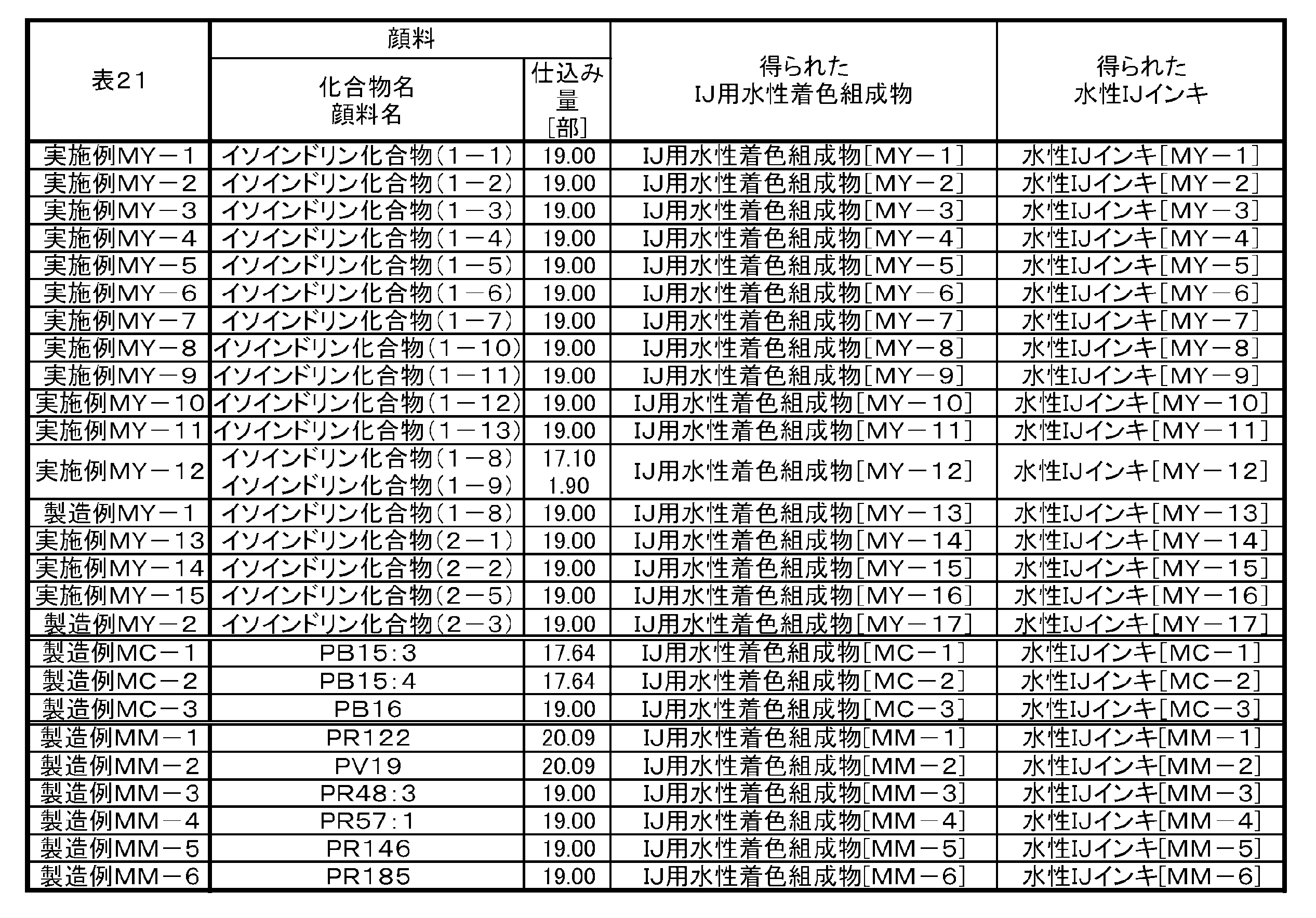
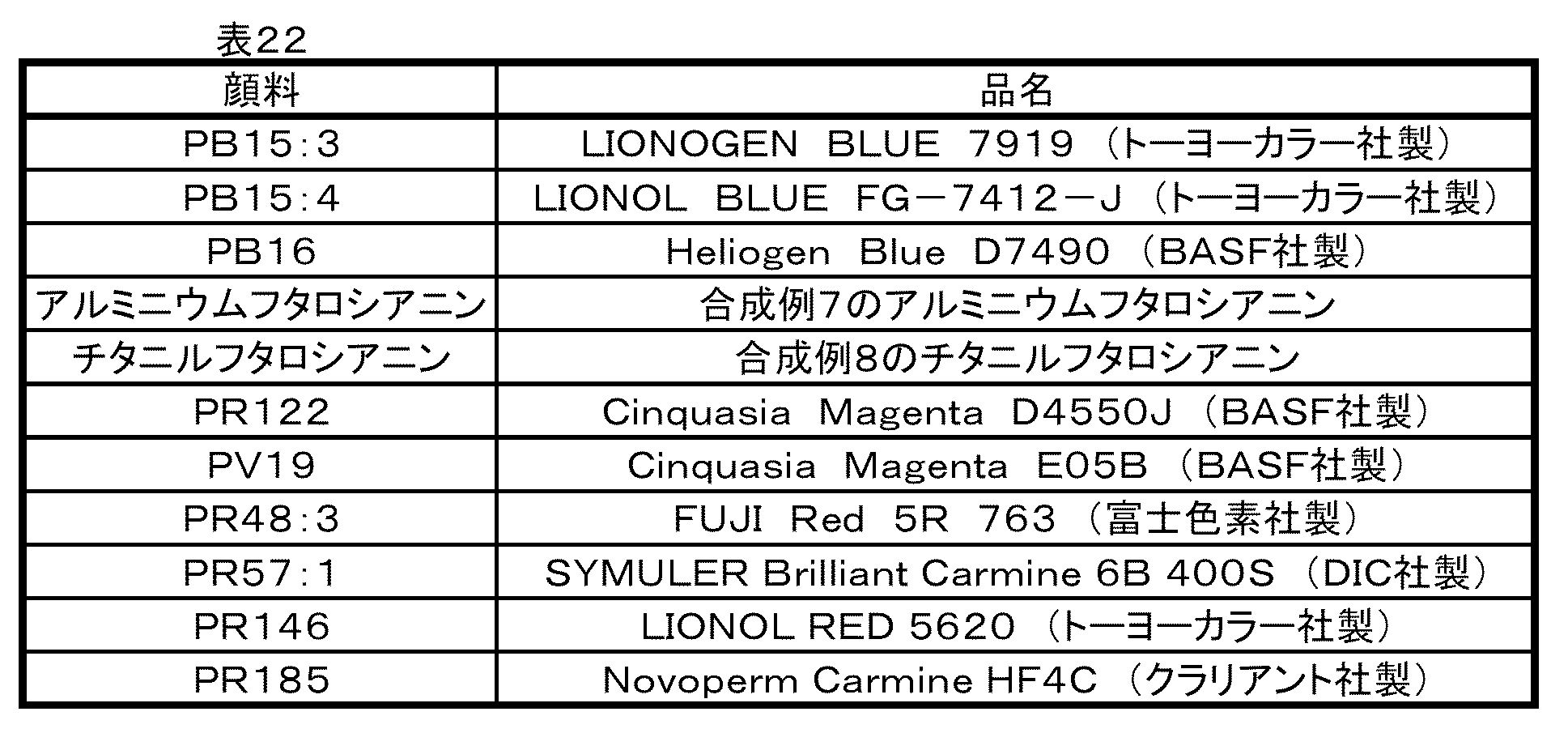
水性IJインキ[MY-1]~[MY-17]、[MC-1]~[MC-3]、[MM-1]~[MM-6]についてE型粘度計(東機産業社製「ELD型粘度計」)を用いて、25℃における初期粘度を測定した。同様にして、25℃で4週間経時後、及び、50℃で4週間経時促進後の粘度を測定した。それぞれの測定値を用いて、初期粘度に対する粘度増加率を算出し、粘度安定性の一つの指標とし、以下の基準に従って評価した。結果を表23に示す。粘度増加率が小さいほど粘度安定性に優れていると考えられ、下記評価基準で「4」、「3」及び「2」であれば、実用可能なレベルである。
4:粘度増加率が、15%未満である。
3:粘度増加率が、15%以上25%未満である。
2:粘度増加率が、25%以上40%未満である。
1:粘度増加率が、40%以上である。
[実施例MS-1~MS-32、比較例MS-1~MS-9]
得られた各水性IJインキを表23に記載のとおり組み合わせて、インキセット301~341とした。
得られたインキセットについて、以下の方法でガマットを評価した。結果を表23に示す。
(初期評価)
幅方向の解像度600dpi、最大吐出周波数30kHzのインクジェットヘッド(京セラ社製「KJ4Bシリーズ」)を用いたラインパス型のインクジェットプリンターにて、各インキセットの、イエローインキ、マゼンタインキ、シアンインキをそれぞれのヘッドに充填して、コート紙(王子製紙社製OKトップコートN、坪量104.7g/m2)に、600×600dpiの解像度で、カラーチャート画像(X-rite製profilemaker用チャート画像「TC3.5 CMYK i1_i0」)を印刷し、評価用印刷物を作成した。
Pro)および測色ツール(X-rite製MesurementToolおよびprofilemaker)を用いて測色し、L*a*b*色空間における色再現領域をプロットした。測定条件は、光源D50、2度視野、測定光学45/0°で行った。得られた各プロットから面積を求めた。基準となる比較例の面積を100%とした場合の面積比を求め、その面積比から以下の基準で評価した。具体的には、実施例MS-1~MS-12、MS-16~MS-26、及び比較例MS-3~MS-8は、比較例MS-1を基準とした。また、実施例MS-13~MS-15は、比較例MS-2を基準とした。また、実施例MS-27~MS-32は、比較例MS-9を基準とした。
(評価基準)
○:面積比が90%以上である(良好)
△:面積比が85%以上、90%未満である(使用可能)
×:面積比が85%未満である(使用不可)
各水性IJインキを、各々、密閉容器に入れ、50℃で4週間保存を行った後、初期評価と同様に印刷し、評価用印刷物を作成した。得られた印刷物について、初期評価と同様に測色し、得られた各プロットから面積を求めた。各実施例・比較例の経時評価における面積を、初期評価の面積で除した面積比を求め、その面積比から以下の基準で評価した。
(評価基準)
○:面積比が98%以上である(良好)
△:面積比が95%以上、98%未満である(実用可)
×:面積比が95%未満である(不良)

Claims (13)
- 下式(1)で表されるイソインドリン化合物と、下式(2)で表されるイソインドリン化合物とを含む顔料組成物。

[式中、R1~R4は、水素原子を表し、
R5、R6は、それぞれ独立してアルキル基を表し、
AおよびA’は、下式(3)、下式(4)、又は下式(5)で表される基を表し、

式中、Xは-O-又は-NH-を表し、R7はアルキル基又はアリール基を表し、
R8~R14は、それぞれ独立して、水素原子、ハロゲン原子、アルキル基、アルコキシ基、又はアリール基を表す。] - 請求項1に記載の顔料組成物および分散媒体を含む、着色組成物。
- 請求項2記載の着色組成物を含む、成形用組成物。
- 請求項2に記載の着色組成物を含む、トナー。
- 請求項2に記載の着色組成物を含む、塗料。
- 請求項2に記載の着色組成物を含む、印刷インキ。
- 請求項2に記載の着色組成物を含む、インクジェットインキ。
- 少なくとも、イエローインキ、シアンインキ、及びマゼンタインキを含むインキセットであって、
前記イエローインキが、請求項2記載の着色組成物を含むインキである、インキセット。 - 少なくとも、イエローインキ、シアンインキ、及びマゼンタインキを含むグラビア印刷インキセットであって、
前記イエローインキが、請求項2記載の着色組成物を含むインキである、グラビア印刷インキセット。 - さらに、クリアインキを含む、請求項9に記載のグラビア印刷インキセット。
- 基材、および請求項9に記載のグラビア印刷インキセットから形成される印刷層を含む、印刷物。
- 基材、請求項9に記載のグラビア印刷インキセットから形成される印刷層、およびクリアインキから形成される脱離層を含む、印刷物。
- 請求項11又は12に記載の印刷物を含む、包装材料。
Priority Applications (3)
| Application Number | Priority Date | Filing Date | Title |
|---|---|---|---|
| CN202180043433.3A CN115916909B (zh) | 2020-07-15 | 2021-07-14 | 颜料及着色组合物、涂料、油墨、油墨组、印刷物及包装材料 |
| US18/014,342 US12606707B2 (en) | 2020-07-15 | 2021-07-14 | Pigment composition, coloring composition, paint, ink, ink set, printed article, and packaging material |
| EP21842211.1A EP4183846A4 (en) | 2020-07-15 | 2021-07-14 | PIGMENT COMPOSITION, COLORING COMPOSITION, PAINT, INK, INK SET, PRINTED ARTICLE AND PACKAGING MATERIAL |
Applications Claiming Priority (4)
| Application Number | Priority Date | Filing Date | Title |
|---|---|---|---|
| JP2020-121014 | 2020-07-15 | ||
| JP2020121014 | 2020-07-15 | ||
| JP2021-095559 | 2021-06-08 | ||
| JP2021095559A JP7017006B1 (ja) | 2020-07-15 | 2021-06-08 | 顔料組成物、着色組成物、塗料、インキ、インキセット、印刷物、及び包装材料 |
Publications (1)
| Publication Number | Publication Date |
|---|---|
| WO2022014635A1 true WO2022014635A1 (ja) | 2022-01-20 |
Family
ID=79554668
Family Applications (1)
| Application Number | Title | Priority Date | Filing Date |
|---|---|---|---|
| PCT/JP2021/026445 Ceased WO2022014635A1 (ja) | 2020-07-15 | 2021-07-14 | 顔料組成物、着色組成物、塗料、インキ、インキセット、印刷物、及び包装材料 |
Country Status (4)
| Country | Link |
|---|---|
| US (1) | US12606707B2 (ja) |
| EP (1) | EP4183846A4 (ja) |
| CN (1) | CN115916909B (ja) |
| WO (1) | WO2022014635A1 (ja) |
Cited By (5)
| Publication number | Priority date | Publication date | Assignee | Title |
|---|---|---|---|---|
| JP7260864B1 (ja) | 2022-04-28 | 2023-04-19 | 東洋インキScホールディングス株式会社 | 印刷インキセット、印刷物、及び包装材料 |
| JPWO2023210555A1 (ja) * | 2022-04-27 | 2023-11-02 | ||
| WO2023243354A1 (ja) * | 2022-06-13 | 2023-12-21 | Dic株式会社 | イソインドリン化合物 |
| WO2025000126A1 (en) | 2023-06-25 | 2025-01-02 | Dic Corporation | Methods for producing furoic acid derivatives, furan derivatives, phthalocyanine derivatives, and isoindoline derivatives |
| EP4582498A4 (en) * | 2022-08-29 | 2026-01-07 | Artience Co Ltd | PRINTING INK SET, PRINTED MATERIAL AND PACKAGING MATERIAL |
Citations (46)
| Publication number | Priority date | Publication date | Assignee | Title |
|---|---|---|---|---|
| JPS4854128A (ja) | 1971-11-08 | 1973-07-30 | ||
| JPS61246261A (ja) | 1985-04-25 | 1986-11-01 | Toyo Ink Mfg Co Ltd | 顔料分散剤 |
| JPS63264674A (ja) | 1987-04-22 | 1988-11-01 | Toyo Ink Mfg Co Ltd | 顔料組成物 |
| JPH039961A (ja) | 1989-06-07 | 1991-01-17 | Toyo Ink Mfg Co Ltd | 顔料組成物および顔料の分散方法 |
| JPH09272812A (ja) | 1996-04-08 | 1997-10-21 | Toyo Ink Mfg Co Ltd | 顔料組成物の製造方法、顔料組成物および着色剤組成物 |
| JPH10140066A (ja) | 1996-10-31 | 1998-05-26 | Bayer Ag | インキ−ジエツト印刷に有用な顔料調製物 |
| JPH10245501A (ja) | 1997-03-03 | 1998-09-14 | Toyo Ink Mfg Co Ltd | 顔料組成物およびその製造方法 |
| JPH10265697A (ja) | 1997-03-24 | 1998-10-06 | Toyo Ink Mfg Co Ltd | 顔料分散剤、及びそれを含有する顔料組成物、顔料分散体、並びに塗料組成物 |
| JPH11199796A (ja) | 1997-11-17 | 1999-07-27 | Toyo Ink Mfg Co Ltd | 顔料分散剤、及びそれを含有する顔料組成物 |
| JP2000273383A (ja) | 1999-03-23 | 2000-10-03 | Toyo Ink Mfg Co Ltd | 水系顔料分散体およびインクジェット用記録液 |
| JP2001172520A (ja) | 1999-12-20 | 2001-06-26 | Toyo Ink Mfg Co Ltd | 顔料分散剤、顔料組成物および顔料分散体 |
| JP2001220520A (ja) | 2000-02-09 | 2001-08-14 | Toyo Ink Mfg Co Ltd | カラーフィルタ用顔料およびその製造方法、それを用いたカラーフィルタ用着色組成物ならびにカラーフィルタ |
| JP2002201377A (ja) | 2000-12-28 | 2002-07-19 | Toyo Ink Mfg Co Ltd | 顔料組成物および顔料分散体 |
| JP2003165922A (ja) | 2001-12-03 | 2003-06-10 | Toyo Ink Mfg Co Ltd | 顔料分散剤、及びそれを含有する顔料組成物 |
| JP2003168208A (ja) | 2001-11-30 | 2003-06-13 | Toyo Ink Mfg Co Ltd | 磁気記録媒体用のバック層用塗料 |
| JP2003167112A (ja) | 2001-11-30 | 2003-06-13 | Dainippon Ink & Chem Inc | 顔料分散組成物、顔料分散レジスト、およびカラーフィルター |
| JP2003171594A (ja) | 2001-12-07 | 2003-06-20 | Toyo Ink Mfg Co Ltd | 顔料組成物および顔料分散体 |
| JP2004217842A (ja) | 2003-01-17 | 2004-08-05 | Toyo Ink Mfg Co Ltd | 顔料分散剤及びそれを含有する顔料組成物並びに顔料分散体 |
| JP2004307854A (ja) | 2003-03-27 | 2004-11-04 | Toyo Ink Mfg Co Ltd | 着色組成物及びカラーフィルタ |
| JP2005181383A (ja) | 2003-12-16 | 2005-07-07 | Toyo Ink Mfg Co Ltd | カラーフィルタ用青色着色組成物およびカラーフィルタ |
| JP2005213404A (ja) | 2004-01-30 | 2005-08-11 | Toyo Ink Mfg Co Ltd | 有機顔料分散液の製造方法 |
| JP2006291194A (ja) | 2005-03-18 | 2006-10-26 | Toyo Ink Mfg Co Ltd | 顔料分散剤、それを用いた顔料組成物、及び顔料分散体 |
| JP2007079094A (ja) | 2005-09-14 | 2007-03-29 | Toyo Ink Mfg Co Ltd | カラーフィルタ用赤色着色組成物およびカラーフィルタ |
| JP2007226161A (ja) | 2006-01-27 | 2007-09-06 | Toyo Ink Mfg Co Ltd | カラーフィルタ用着色組成物およびそれを用いたカラーフィルタ |
| JP2007314681A (ja) | 2006-05-26 | 2007-12-06 | Toyo Ink Mfg Co Ltd | 顔料組成物の製造方法 |
| JP2007314785A (ja) | 2006-04-28 | 2007-12-06 | Toyo Ink Mfg Co Ltd | チアジンインジゴ顔料分散剤、それを用いた顔料組成物、着色組成物およびカラーフィルタ |
| JP2008031281A (ja) | 2006-07-28 | 2008-02-14 | Toyo Ink Mfg Co Ltd | 顔料分散剤、顔料組成物及び顔料分散体 |
| JP2008103474A (ja) * | 2006-10-18 | 2008-05-01 | Toyo Ink Mfg Co Ltd | 有機トランジスタ |
| WO2009025325A1 (ja) | 2007-08-22 | 2009-02-26 | Toyo Ink Mfg. Co., Ltd. | カラーフィルター用顔料組成物及びカラーフィルター用着色組成物 |
| JP2009057478A (ja) | 2007-08-31 | 2009-03-19 | Toyo Ink Mfg Co Ltd | 顔料組成物、顔料分散体およびインキ |
| WO2009081930A1 (ja) | 2007-12-26 | 2009-07-02 | Toyo Ink Mfg. Co., Ltd. | 赤色カラーフィルター用顔料組成物、その製造方法、及びそれを用いた着色組成物、及びカラーフィルター |
| JP2009543917A (ja) | 2006-07-18 | 2009-12-10 | ビーエーエスエフ ソシエタス・ヨーロピア | イソインドリン顔料 |
| WO2011052617A1 (ja) | 2009-10-28 | 2011-05-05 | 東洋インキ製造株式会社 | ジケトピロロピロール顔料分散剤、それを用いた顔料組成物、着色組成物およびカラーフィルタ |
| JP2011162662A (ja) | 2010-02-10 | 2011-08-25 | Toyo Ink Sc Holdings Co Ltd | 顔料分散剤および着色組成物 |
| WO2012102399A1 (ja) | 2011-01-28 | 2012-08-02 | 東洋インキScホールディングス株式会社 | カラーフィルタ用ジケトピロロピロール系顔料組成物、カラーフィルタ用着色組成物、およびカラーフィルタ |
| JP2012172092A (ja) | 2011-02-23 | 2012-09-10 | Toyo Ink Sc Holdings Co Ltd | 顔料分散体およびインキ |
| JP2012208329A (ja) | 2011-03-30 | 2012-10-25 | Toyo Ink Sc Holdings Co Ltd | カラーフィルタ用着色組成物 |
| JP2012226110A (ja) | 2011-04-19 | 2012-11-15 | Toyo Ink Sc Holdings Co Ltd | カラーフィルタ用着色剤、着色組成物、およびカラーフィルタ |
| JP2014005439A (ja) | 2012-05-31 | 2014-01-16 | Toyo Ink Sc Holdings Co Ltd | 顔料分散剤およびそれを用いた顔料組成物、着色組成物、カラーフィルタ |
| JP5753266B2 (ja) | 2011-07-22 | 2015-07-22 | 大日精化工業株式会社 | 緑味青色顔料、該顔料を含む着色剤組成物及び画像記録剤 |
| WO2016163351A1 (ja) | 2015-04-07 | 2016-10-13 | Dic株式会社 | カラーフィルタ用有機顔料組成物、その製造方法及びカラーフィルタ |
| JP2017156397A (ja) | 2016-02-29 | 2017-09-07 | 東洋インキScホールディングス株式会社 | カラーフィルタ用着色組成物及びカラーフィルタ |
| JP2017165820A (ja) | 2016-03-14 | 2017-09-21 | 東洋インキScホールディングス株式会社 | カラーフィルタ用顔料組成物、着色組成物、カラーフィルタおよびカラーフィルタ用顔料組成物の製造方法 |
| JP2019112537A (ja) * | 2017-12-25 | 2019-07-11 | 東洋インキScホールディングス株式会社 | カラーフィルタ用着色剤、着色組成物およびカラーフィルタ |
| JP2020084130A (ja) | 2018-11-30 | 2020-06-04 | 東洋インキScホールディングス株式会社 | 複合フィルムからの脱離性を有するラミネート接着剤、積層体、及びシート状基材のリサイクル方法 |
| JP2020090627A (ja) * | 2018-12-06 | 2020-06-11 | 東洋インキScホールディングス株式会社 | 有機溶剤系印刷インキ、印刷物および積層体 |
Family Cites Families (14)
| Publication number | Priority date | Publication date | Assignee | Title |
|---|---|---|---|---|
| DE3007329A1 (de) * | 1980-02-27 | 1981-09-10 | Basf Ag, 6700 Ludwigshafen | Isoindolinfarbstoffe |
| DE3327564A1 (de) * | 1983-07-30 | 1985-02-07 | Basf Ag, 6700 Ludwigshafen | Lasierende, farbstarke isoindolinpigmente, deren herstellung und verwendung |
| EP0132818B1 (de) * | 1983-07-30 | 1986-12-30 | BASF Aktiengesellschaft | Farbstarke Isoindolinpigmente, deren Herstellung und Verwendung |
| CH668980A5 (de) * | 1985-07-05 | 1989-02-15 | Basf Ag | Verfahren zur formierung von isoindolinpigmenten. |
| US5326872A (en) * | 1991-04-22 | 1994-07-05 | Miles Inc. | Process for preparation of asymmetric isoindoline pigments |
| US5177209A (en) * | 1991-04-22 | 1993-01-05 | Miles Inc. | Process for preparation of asymmetric isoindoline pigments |
| WO1998045756A1 (en) * | 1997-04-09 | 1998-10-15 | Ciba Specialty Chemicals Holding Inc. | Highly transparent, colour-pigmented high molecular weight material |
| US7629360B2 (en) * | 1999-05-07 | 2009-12-08 | Celgene Corporation | Methods for the treatment of cachexia and graft v. host disease |
| JP2008246793A (ja) * | 2007-03-29 | 2008-10-16 | Fujifilm Corp | 活性エネルギー線硬化型インクジェット記録装置 |
| CN101896556A (zh) * | 2007-12-10 | 2010-11-24 | 巴斯夫欧洲公司 | 等轴的异吲哚啉黄色颜料 |
| US9012115B2 (en) * | 2011-06-28 | 2015-04-21 | Canon Kabushiki Kaisha | Yellow toner |
| JP5546028B2 (ja) * | 2011-09-09 | 2014-07-09 | 富士フイルム株式会社 | 複層形成用インクセット、インクジェット記録方法、及び、印刷物 |
| CN107586469B (zh) * | 2016-07-07 | 2021-04-06 | 住友化学株式会社 | 颜料组合物、着色组合物及着色固化性组合物 |
| WO2018021184A1 (ja) * | 2016-07-29 | 2018-02-01 | 富士フイルム株式会社 | 着色組成物、カラーフィルタ、パターン形成方法、固体撮像素子、および、画像表示装置 |
-
2021
- 2021-07-14 US US18/014,342 patent/US12606707B2/en active Active
- 2021-07-14 CN CN202180043433.3A patent/CN115916909B/zh active Active
- 2021-07-14 WO PCT/JP2021/026445 patent/WO2022014635A1/ja not_active Ceased
- 2021-07-14 EP EP21842211.1A patent/EP4183846A4/en active Pending
Patent Citations (46)
| Publication number | Priority date | Publication date | Assignee | Title |
|---|---|---|---|---|
| JPS4854128A (ja) | 1971-11-08 | 1973-07-30 | ||
| JPS61246261A (ja) | 1985-04-25 | 1986-11-01 | Toyo Ink Mfg Co Ltd | 顔料分散剤 |
| JPS63264674A (ja) | 1987-04-22 | 1988-11-01 | Toyo Ink Mfg Co Ltd | 顔料組成物 |
| JPH039961A (ja) | 1989-06-07 | 1991-01-17 | Toyo Ink Mfg Co Ltd | 顔料組成物および顔料の分散方法 |
| JPH09272812A (ja) | 1996-04-08 | 1997-10-21 | Toyo Ink Mfg Co Ltd | 顔料組成物の製造方法、顔料組成物および着色剤組成物 |
| JPH10140066A (ja) | 1996-10-31 | 1998-05-26 | Bayer Ag | インキ−ジエツト印刷に有用な顔料調製物 |
| JPH10245501A (ja) | 1997-03-03 | 1998-09-14 | Toyo Ink Mfg Co Ltd | 顔料組成物およびその製造方法 |
| JPH10265697A (ja) | 1997-03-24 | 1998-10-06 | Toyo Ink Mfg Co Ltd | 顔料分散剤、及びそれを含有する顔料組成物、顔料分散体、並びに塗料組成物 |
| JPH11199796A (ja) | 1997-11-17 | 1999-07-27 | Toyo Ink Mfg Co Ltd | 顔料分散剤、及びそれを含有する顔料組成物 |
| JP2000273383A (ja) | 1999-03-23 | 2000-10-03 | Toyo Ink Mfg Co Ltd | 水系顔料分散体およびインクジェット用記録液 |
| JP2001172520A (ja) | 1999-12-20 | 2001-06-26 | Toyo Ink Mfg Co Ltd | 顔料分散剤、顔料組成物および顔料分散体 |
| JP2001220520A (ja) | 2000-02-09 | 2001-08-14 | Toyo Ink Mfg Co Ltd | カラーフィルタ用顔料およびその製造方法、それを用いたカラーフィルタ用着色組成物ならびにカラーフィルタ |
| JP2002201377A (ja) | 2000-12-28 | 2002-07-19 | Toyo Ink Mfg Co Ltd | 顔料組成物および顔料分散体 |
| JP2003168208A (ja) | 2001-11-30 | 2003-06-13 | Toyo Ink Mfg Co Ltd | 磁気記録媒体用のバック層用塗料 |
| JP2003167112A (ja) | 2001-11-30 | 2003-06-13 | Dainippon Ink & Chem Inc | 顔料分散組成物、顔料分散レジスト、およびカラーフィルター |
| JP2003165922A (ja) | 2001-12-03 | 2003-06-10 | Toyo Ink Mfg Co Ltd | 顔料分散剤、及びそれを含有する顔料組成物 |
| JP2003171594A (ja) | 2001-12-07 | 2003-06-20 | Toyo Ink Mfg Co Ltd | 顔料組成物および顔料分散体 |
| JP2004217842A (ja) | 2003-01-17 | 2004-08-05 | Toyo Ink Mfg Co Ltd | 顔料分散剤及びそれを含有する顔料組成物並びに顔料分散体 |
| JP2004307854A (ja) | 2003-03-27 | 2004-11-04 | Toyo Ink Mfg Co Ltd | 着色組成物及びカラーフィルタ |
| JP2005181383A (ja) | 2003-12-16 | 2005-07-07 | Toyo Ink Mfg Co Ltd | カラーフィルタ用青色着色組成物およびカラーフィルタ |
| JP2005213404A (ja) | 2004-01-30 | 2005-08-11 | Toyo Ink Mfg Co Ltd | 有機顔料分散液の製造方法 |
| JP2006291194A (ja) | 2005-03-18 | 2006-10-26 | Toyo Ink Mfg Co Ltd | 顔料分散剤、それを用いた顔料組成物、及び顔料分散体 |
| JP2007079094A (ja) | 2005-09-14 | 2007-03-29 | Toyo Ink Mfg Co Ltd | カラーフィルタ用赤色着色組成物およびカラーフィルタ |
| JP2007226161A (ja) | 2006-01-27 | 2007-09-06 | Toyo Ink Mfg Co Ltd | カラーフィルタ用着色組成物およびそれを用いたカラーフィルタ |
| JP2007314785A (ja) | 2006-04-28 | 2007-12-06 | Toyo Ink Mfg Co Ltd | チアジンインジゴ顔料分散剤、それを用いた顔料組成物、着色組成物およびカラーフィルタ |
| JP2007314681A (ja) | 2006-05-26 | 2007-12-06 | Toyo Ink Mfg Co Ltd | 顔料組成物の製造方法 |
| JP2009543917A (ja) | 2006-07-18 | 2009-12-10 | ビーエーエスエフ ソシエタス・ヨーロピア | イソインドリン顔料 |
| JP2008031281A (ja) | 2006-07-28 | 2008-02-14 | Toyo Ink Mfg Co Ltd | 顔料分散剤、顔料組成物及び顔料分散体 |
| JP2008103474A (ja) * | 2006-10-18 | 2008-05-01 | Toyo Ink Mfg Co Ltd | 有機トランジスタ |
| WO2009025325A1 (ja) | 2007-08-22 | 2009-02-26 | Toyo Ink Mfg. Co., Ltd. | カラーフィルター用顔料組成物及びカラーフィルター用着色組成物 |
| JP2009057478A (ja) | 2007-08-31 | 2009-03-19 | Toyo Ink Mfg Co Ltd | 顔料組成物、顔料分散体およびインキ |
| WO2009081930A1 (ja) | 2007-12-26 | 2009-07-02 | Toyo Ink Mfg. Co., Ltd. | 赤色カラーフィルター用顔料組成物、その製造方法、及びそれを用いた着色組成物、及びカラーフィルター |
| WO2011052617A1 (ja) | 2009-10-28 | 2011-05-05 | 東洋インキ製造株式会社 | ジケトピロロピロール顔料分散剤、それを用いた顔料組成物、着色組成物およびカラーフィルタ |
| JP2011162662A (ja) | 2010-02-10 | 2011-08-25 | Toyo Ink Sc Holdings Co Ltd | 顔料分散剤および着色組成物 |
| WO2012102399A1 (ja) | 2011-01-28 | 2012-08-02 | 東洋インキScホールディングス株式会社 | カラーフィルタ用ジケトピロロピロール系顔料組成物、カラーフィルタ用着色組成物、およびカラーフィルタ |
| JP2012172092A (ja) | 2011-02-23 | 2012-09-10 | Toyo Ink Sc Holdings Co Ltd | 顔料分散体およびインキ |
| JP2012208329A (ja) | 2011-03-30 | 2012-10-25 | Toyo Ink Sc Holdings Co Ltd | カラーフィルタ用着色組成物 |
| JP2012226110A (ja) | 2011-04-19 | 2012-11-15 | Toyo Ink Sc Holdings Co Ltd | カラーフィルタ用着色剤、着色組成物、およびカラーフィルタ |
| JP5753266B2 (ja) | 2011-07-22 | 2015-07-22 | 大日精化工業株式会社 | 緑味青色顔料、該顔料を含む着色剤組成物及び画像記録剤 |
| JP2014005439A (ja) | 2012-05-31 | 2014-01-16 | Toyo Ink Sc Holdings Co Ltd | 顔料分散剤およびそれを用いた顔料組成物、着色組成物、カラーフィルタ |
| WO2016163351A1 (ja) | 2015-04-07 | 2016-10-13 | Dic株式会社 | カラーフィルタ用有機顔料組成物、その製造方法及びカラーフィルタ |
| JP2017156397A (ja) | 2016-02-29 | 2017-09-07 | 東洋インキScホールディングス株式会社 | カラーフィルタ用着色組成物及びカラーフィルタ |
| JP2017165820A (ja) | 2016-03-14 | 2017-09-21 | 東洋インキScホールディングス株式会社 | カラーフィルタ用顔料組成物、着色組成物、カラーフィルタおよびカラーフィルタ用顔料組成物の製造方法 |
| JP2019112537A (ja) * | 2017-12-25 | 2019-07-11 | 東洋インキScホールディングス株式会社 | カラーフィルタ用着色剤、着色組成物およびカラーフィルタ |
| JP2020084130A (ja) | 2018-11-30 | 2020-06-04 | 東洋インキScホールディングス株式会社 | 複合フィルムからの脱離性を有するラミネート接着剤、積層体、及びシート状基材のリサイクル方法 |
| JP2020090627A (ja) * | 2018-12-06 | 2020-06-11 | 東洋インキScホールディングス株式会社 | 有機溶剤系印刷インキ、印刷物および積層体 |
Non-Patent Citations (1)
| Title |
|---|
| See also references of EP4183846A4 |
Cited By (12)
| Publication number | Priority date | Publication date | Assignee | Title |
|---|---|---|---|---|
| JPWO2023210555A1 (ja) * | 2022-04-27 | 2023-11-02 | ||
| JP7552936B2 (ja) | 2022-04-27 | 2024-09-18 | Dic株式会社 | イソインドリン化合物 |
| JP7260864B1 (ja) | 2022-04-28 | 2023-04-19 | 東洋インキScホールディングス株式会社 | 印刷インキセット、印刷物、及び包装材料 |
| WO2023210260A1 (ja) * | 2022-04-28 | 2023-11-02 | 東洋インキScホールディングス株式会社 | 印刷インキセット、印刷物、及び包装材料 |
| JP2023164228A (ja) * | 2022-04-28 | 2023-11-10 | 東洋インキScホールディングス株式会社 | 印刷インキセット、印刷物、及び包装材料 |
| WO2023243354A1 (ja) * | 2022-06-13 | 2023-12-21 | Dic株式会社 | イソインドリン化合物 |
| JPWO2023243354A1 (ja) * | 2022-06-13 | 2023-12-21 | ||
| JP7552935B2 (ja) | 2022-06-13 | 2024-09-18 | Dic株式会社 | イソインドリン化合物 |
| JP2024164221A (ja) * | 2022-06-13 | 2024-11-26 | Dic株式会社 | イソインドリン化合物 |
| JP7800602B2 (ja) | 2022-06-13 | 2026-01-16 | Dic株式会社 | イソインドリン化合物 |
| EP4582498A4 (en) * | 2022-08-29 | 2026-01-07 | Artience Co Ltd | PRINTING INK SET, PRINTED MATERIAL AND PACKAGING MATERIAL |
| WO2025000126A1 (en) | 2023-06-25 | 2025-01-02 | Dic Corporation | Methods for producing furoic acid derivatives, furan derivatives, phthalocyanine derivatives, and isoindoline derivatives |
Also Published As
| Publication number | Publication date |
|---|---|
| US12606707B2 (en) | 2026-04-21 |
| EP4183846A4 (en) | 2024-08-14 |
| CN115916909A (zh) | 2023-04-04 |
| CN115916909B (zh) | 2024-05-14 |
| US20230365811A1 (en) | 2023-11-16 |
| EP4183846A1 (en) | 2023-05-24 |
Similar Documents
| Publication | Publication Date | Title |
|---|---|---|
| CN115916909B (zh) | 颜料及着色组合物、涂料、油墨、油墨组、印刷物及包装材料 | |
| JP7105024B1 (ja) | 顔料組成物、着色組成物、塗料、インキ、インキセット、印刷物、及び包装材料 | |
| KR102583220B1 (ko) | 스쿠아릴륨 색소 및 이것을 포함하는 조성물 | |
| CA2582104C (en) | Pigment preparations based on py 155 | |
| JP4234355B2 (ja) | 微細化顔料の製造方法および着色用組成物 | |
| CN102822285B (zh) | 树脂处理颜料、该颜料的制造方法以及颜料分散体 | |
| JP7192639B2 (ja) | イソインドリン化合物及びその利用 | |
| JP7017006B1 (ja) | 顔料組成物、着色組成物、塗料、インキ、インキセット、印刷物、及び包装材料 | |
| JP6893277B1 (ja) | 顔料組成物、着色組成物、およびその用途 | |
| JP2024502260A (ja) | 近赤外線(nir)透明性中性黒色ペリレン固溶体 | |
| CN113710758A (zh) | 包含异吲哚啉化合物的着色组合物及其利用 | |
| JP7392216B1 (ja) | 印刷インキセット、印刷物、及び包装材料 | |
| JP7823378B2 (ja) | 顔料組成物、着色組成物、インキ、インキセット、印刷物、及び包装材料 | |
| JP7676976B2 (ja) | インキセット、印刷物、及び包装材料 | |
| CA2610174A1 (en) | C.i. pigment blue 80-based blue dye | |
| JP7260864B1 (ja) | 印刷インキセット、印刷物、及び包装材料 | |
| JP2022098438A (ja) | 顔料組成物、およびその利用 | |
| JP2024140643A (ja) | 印刷インキセット、印刷物、および包装材料 | |
| JP6928750B1 (ja) | 顔料組成物およびその利用 | |
| CN111511851A (zh) | 颜料水分散液的制造方法 | |
| JP2024144374A (ja) | 着色剤、着色組成物、及び着色剤の製造方法 | |
| JP2023088862A (ja) | 顔料処理方法 |
Legal Events
| Date | Code | Title | Description |
|---|---|---|---|
| 121 | Ep: the epo has been informed by wipo that ep was designated in this application |
Ref document number: 21842211 Country of ref document: EP Kind code of ref document: A1 |
|
| WWE | Wipo information: entry into national phase |
Ref document number: 202317002055 Country of ref document: IN |
|
| NENP | Non-entry into the national phase |
Ref country code: DE |
|
| ENP | Entry into the national phase |
Ref document number: 2021842211 Country of ref document: EP Effective date: 20230215 |
|
| WWG | Wipo information: grant in national office |
Ref document number: 18014342 Country of ref document: US |