WO2022004065A1 - 緑液処理剤 - Google Patents
緑液処理剤 Download PDFInfo
- Publication number
- WO2022004065A1 WO2022004065A1 PCT/JP2021/009946 JP2021009946W WO2022004065A1 WO 2022004065 A1 WO2022004065 A1 WO 2022004065A1 JP 2021009946 W JP2021009946 W JP 2021009946W WO 2022004065 A1 WO2022004065 A1 WO 2022004065A1
- Authority
- WO
- WIPO (PCT)
- Prior art keywords
- green
- green liquor
- polymer
- cationic
- present
- Prior art date
- Legal status (The legal status is an assumption and is not a legal conclusion. Google has not performed a legal analysis and makes no representation as to the accuracy of the status listed.)
- Ceased
Links
Images


Classifications
-
- C—CHEMISTRY; METALLURGY
- C08—ORGANIC MACROMOLECULAR COMPOUNDS; THEIR PREPARATION OR CHEMICAL WORKING-UP; COMPOSITIONS BASED THEREON
- C08F—MACROMOLECULAR COMPOUNDS OBTAINED BY REACTIONS ONLY INVOLVING CARBON-TO-CARBON UNSATURATED BONDS
- C08F226/00—Copolymers of compounds having one or more unsaturated aliphatic radicals, each having only one carbon-to-carbon double bond, and at least one being terminated by a single or double bond to nitrogen or by a heterocyclic ring containing nitrogen
-
- D—TEXTILES; PAPER
- D21—PAPER-MAKING; PRODUCTION OF CELLULOSE
- D21C—PRODUCTION OF CELLULOSE BY REMOVING NON-CELLULOSE SUBSTANCES FROM CELLULOSE-CONTAINING MATERIALS; REGENERATION OF PULPING LIQUORS; APPARATUS THEREFOR
- D21C11/00—Regeneration of pulp liquors or effluent waste waters
- D21C11/04—Regeneration of pulp liquors or effluent waste waters of alkali lye
-
- Y—GENERAL TAGGING OF NEW TECHNOLOGICAL DEVELOPMENTS; GENERAL TAGGING OF CROSS-SECTIONAL TECHNOLOGIES SPANNING OVER SEVERAL SECTIONS OF THE IPC; TECHNICAL SUBJECTS COVERED BY FORMER USPC CROSS-REFERENCE ART COLLECTIONS [XRACs] AND DIGESTS
- Y02—TECHNOLOGIES OR APPLICATIONS FOR MITIGATION OR ADAPTATION AGAINST CLIMATE CHANGE
- Y02P—CLIMATE CHANGE MITIGATION TECHNOLOGIES IN THE PRODUCTION OR PROCESSING OF GOODS
- Y02P40/00—Technologies relating to the processing of minerals
- Y02P40/40—Production or processing of lime, e.g. limestone regeneration of lime in pulp and sugar mills
Definitions
- the present invention relates to a green liquid treatment agent, a green liquid treatment method, a calcium carbonate production method, and the like.
- Pulp is produced by adding treated water containing sodium hydroxide to wood chips and steaming them. Then, in the cooking step, the chips are steamed with an alkali (white liquid) to obtain pulp, and the cooking agent and heat energy are recovered from the pulp waste liquid (black liquid). Specifically, the chemicals are recovered by a recovery step including a cooking step, a pulp washing step, a black liquor concentration step, a black liquor burning step, a green liquor manufacturing step, a white liquor manufacturing step, and a lime firing step.
- the smelt generated by burning black liquor contains insoluble impurities (dregs) such as unburned carbon, calcium carbonate, aluminum hydroxide, iron oxide, and silicon dioxide. Furthermore, wood chips are rich in calcium salts, barium salts, phosphates, cellulose, lignin and the like, which are the sources of these insoluble impurities, and insoluble impurities are likely to occur. This insoluble impurity called dregs adversely affects the production of calcium carbonate in the white liquor production process. Therefore, in the green liquor production process, the dregs in the crude green liquor are removed as much as possible to better clarify the green liquor.
- dregs insoluble impurities
- Patent Document 1 For example, in Patent Document 1, 0.5 to 10%, preferably 1 to 5% of the amount of quicklime required for completely causticizing the green liquid is added to the unclarified green liquid being stirred. After that, a method for clarifying the green liquor has been proposed, which comprises removing solid particles from the green liquor.
- the main object of the present invention is to provide a technique for treating green liquor better.
- the present invention provides a green liquor treatment agent containing a cationic polymer having no ester-bonded cationic group.
- the present invention provides a green liquor treatment method in which a cationic polymer having no ester-bonded cationic group is added to a crude green liquor.
- the present invention comprises a calcining / caustic step of producing calcium carbonate using a green liquor clarified by adding an ester-bonded cation group-free cationic polymer to the crude green liquor. It provides a manufacturing method.
- the present invention comprises a green liquor clarification step of clarifying a green liquor by adding an ester-bonded cationic polymer having no cationic group to the crude green liquor. It is an object of the present invention to provide a method for producing calcium carbonate, which comprises a reconciliation / cauterization step of producing calcium carbonate in a reconciliation reaction and a cauterization reaction using the green liquor.
- the cationic polymer is a polymer having at least a structural unit derived from a cationic monomer having no ester bond.
- the cation monomer having no ester bond may be an amine monomer having no ester bond and / or a quaternary ammonium salt monomer having no ester bond.
- the cationic polymer is a polydiallyldimethylammonium salt and / or a copolymer thereof; an acrylamide / 3-acrylamidepropyl (trimethyl) ammonium salt copolymer, an acrylamide / diallyldimethylammonium salt copolymer, an alkylamine / epichlorohydrin. It may be one kind or two or more kinds selected from the polycondensate.
- the green liquor treatment may be green liquor clarification.
- ⁇ indicates a change in the color tone of the green liquor after treatment with each agent of cation + anion or one cation agent
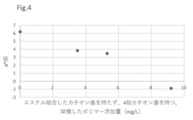
- ⁇ indicates a change in color tone of the green liquor after treatment with each reagent of one anion / amphoteric agent. It is a figure which shows the addition amount of the crosslinked cationic polymer which does not have an ester-bonded cationic group but has a quaternary ammonium base, and the change in the color tone (green direction) of the clarified green liquid.
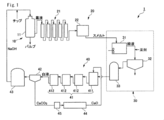
- FIG. 1 is a schematic configuration diagram of a pulp production system 1 provided with a green liquid treatment system according to an embodiment of the present invention, and the present invention is not limited thereto.
- the pulp production system 1 can include a cooking system 10, a black liquor treatment system 20, a green liquor clarification system 30, and a scavenging / caustic system 40. These systems may be communicated with each other by a pipe shown by a solid line in FIG. 1 to form a circulation path as a whole.
- a pipe shown by a solid line in FIG. 1 to form a circulation path as a whole.
- Cooking system > The cooking system 10 has a cooking pot 11, and a pulp refining section may be provided downstream of the cooking pot 11. Wood chips, which are raw materials for pulp, and white liquor containing sodium hydroxide are put into the cooking pot 11, and the wood chips are steamed. The resulting pulp is transferred to the pulp refining section, where it undergoes bleaching and papermaking processes in sequence to produce paper. On the other hand, the black liquor, which is a waste liquid, is transferred to the evaporator 21, which will be described later, for the purpose of recovering sodium hydroxide and the like.
- the black liquor treatment system 20 may have an evaporator 21 and a boiler 22 in order from the upstream.
- the black liquor is concentrated by the evaporator 21 and then transferred to the boiler 22 and burned in the boiler 22.
- the inorganic sodium salt contained in the black liquor is melted and discharged as a smelt from the bottom of the boiler 22.
- the discharged smelt is transferred to the melting tank 31.
- the boiler 22 may be provided with a heat recovery system for recovering heat energy.
- a heat recovery system for recovering heat energy.
- a conventionally known one can be used (see, for example, Japanese Patent Application Laid-Open No. 6-212586).
- Green liquid clarification system The green liquid clarification system 30 may have a dissolution tank 31, a green liquid clarifier 32, and a green liquid tank 33 in order from the upstream.
- the smelt is stirred in water in the dissolution tank 31 to dissolve or disperse.
- the melting tank 31 is provided with a liquid feeding pump (not shown), and the crude green liquid is sucked by the liquid feeding pump and transferred to the green liquid clarifier 32.
- the remaining undissolved components are removed by the green liquor clarifier 32. After that, it is transferred to the green liquid tank 33 and stored, and then transferred to the caustic system 41.
- Examples of the apparatus used for clarification of the green liquid in the present embodiment include, but are not limited to, a gravity sedimentation type apparatus and a forced filtration type apparatus.
- a typical green liquid clarifier of the gravity settling method is preferable.
- the green liquid clarifier is not particularly limited, and examples thereof include a multi-stage clarifier, a unit clarifier, a storage tank combined type clarifier, and a sedimentation concentration type clarifier, and among these, the storage tank combined type is preferable.
- the caustic / caustic system 40 may have a caustic system 41, a white liquid clarifier 42, and a white liquid tank 43.
- the caustic / caustic system 40 may further have a lime mud filter 45 and a kiln 44 located downstream of the white liquor clarifier 42.
- the caustic system 41, the white liquor clarifier 42, and the white liquor tank 43 communicate with each other to form a circulation path as a whole.
- the green liquor transferred to the caustic system 41 is mixed with the calcium oxide supplied from the kiln 44 in the caustic system 41. This mixing will be described in more detail.
- the caustic system 41 may have a slaker 411 and a plurality of caustic reaction tanks 412 located downstream of the slaker 411.
- the green liquor transferred to the slaker 411 (usually 90 to 100 ° C., pH 13 to 14) is mixed with calcium oxide also supplied to the slaker 411.
- calcium oxide is dissolved with water to produce calcium hydroxide.
- sodium carbonate in the green liquor reacts with calcium hydroxide to produce sodium hydroxide and calcium carbonate.
- the white liquor obtained in this way is transferred to the white liquor clarifier 42.
- the white liquor clarifier 42 after the insoluble calcium carbonate is settled and separated, the white liquor is stored in the white liquor tank 43 and eventually circulated to the cooking pot 11 for reuse.
- the separated calcium carbonate is recovered in kiln 44, roasted and returned to calcium oxide, and reused in the caustic system 41.
- Green liquid treatment in this embodiment can provide a green liquor treatment agent containing a cationic polymer having no ester-bonded cationic group as an active ingredient. Further, the present embodiment can provide a green liquid treatment method in which a cationic polymer having no ester-bonded cationic group or a green liquid treatment agent containing the polymer is added to the crude green liquid.
- a green liquor clarified by adding a cationic polymer having no ester-bonded cationic group (hereinafter, also referred to as “cationic polymer of the present embodiment”) to a crude green liquor is used. It is possible to provide a calcium carbonate production method including a cation / caustic step of producing calcium carbonate.
- the "green liquid treatment” in the present embodiment is a green liquid treatment in the green liquid clarification step and / or the deconversion / causticization step in pulp production, and has a broad meaning.
- the color tone (a * value: green (-60) direction) of the green liquor can be further improved by using the cationic polymer of the present embodiment.
- the dregs can be satisfactorily separated from the crude green liquid (water to be treated) containing the dregs, and a green liquid having an excellent color tone according to the present embodiment can be produced.
- calcium carbonate according to the present embodiment can be more stably and better in the reconciliation / cauterization step. Can be manufactured.
- the present inventor has used a cationic polymer having a cationic group having an ester bond (for example, a carboxylic acid ester (R-OOC-R')) (for example, a cationic moiety-OOC-polymer) for a clarification treatment of a crude green liquid.
- a cationic polymer having a cationic group having an ester bond for example, a carboxylic acid ester (R-OOC-R')
- R-OOC-R' carboxylic acid ester
- a cationic moiety-OOC-polymer for example, a cationic moiety-OOC-polymer
- the present inventor considered that the longer the polymer is used in the crude green liquor, the more the ester-bonded portion of the polymer is hydrolyzed, which increases the proportion of the polymer having an anionic group. Then, the present inventor causes a reaction between the anionic group generated by hydrolysis and the unhydrolyzed cationic group, and as a result, an agglomerate is formed, and the agglomerate causes clogging of the dregs filter, etc. I thought that it would be easy to cause troubles.
- the present inventor found that on the high pH side of the crude green liquor, the cationicity of the polymer having a cationic group having an ester bond is further reduced by hydrolysis, and the hydroxide ion OH ⁇ is abundant. It was estimated that the cationic groups would be charge-neutralized, the charge repulsion within the polymer molecule would disappear, the polymer molecule would shrink, and the polymer-specific effects would be less and less exerted.
- a cationic polymer having no ester-bonded cationic group has an excellent green liquid treatment ability.
- the cationic polymer of the present embodiment tends to be less likely to cause hydrolysis even when the green liquid is in a high pH condition, and tends to have a good coagulating action even if the amount of hydroxide ion OH ⁇ is large. Therefore, by using the cationic polymer of the present embodiment, it is possible to stabilize the green liquid clarification step and produce a green liquid having an excellent color tone.
- the particle size can be further increased by secondary agglutination after calcium carbonate production.
- the particle size of the generated calcium carbonate is large, the washing and dehydration with the lime mud filter is improved, and the water content of the calcium carbonate can be reduced.
- the cationic polymer used in this embodiment is a cationic polymer having no ester-bonded cationic group. Unless otherwise specified, the polymer is meant to include homopolymers and copolymers with acrylamide and the like. It is preferable that the cationic polymer of the present embodiment has at least a structural unit derived from a cationic monomer having no ester bond.
- the cationic polymer may contain a small amount of a structural unit derived from an ester-bonded cationic monomer as long as the effect of the present invention is not impaired.
- the cation polymer may be a homopolymer having a structural unit derived from a cation monomer having no ester bond, a structural unit derived from a cation monomer having no ester bond, and another single amount. It may be a copolymer having a constituent unit derived from the body.
- a random copolymer for example, -ABABBA-
- an alternate copolymer for example, -ABABAB-
- a periodic copolymer for example, -ABBABB-
- a block copolymer for example, -ABBABB-
- one of the block copolymers is called a graft copolymer.
- the cationic polymer used in the present embodiment is not particularly limited as long as it is a cationic polymer containing a cationic group having no ester bond, and for example, a homopolymer or a copolymer that can be used for clarification of green liquor has an ester bond.
- a cation polymer introduced with a cation group preferably a quaternary ammonium base
- a cation monomer having no ester bond It may be a polymer having another monomer (which may be an oligomer) as a constituent unit; or the like.
- the "copolymer” in the present embodiment broadly includes a copolymer obtained by polymerizing one or more selected from the same or different monomers, oligomers and polymers as a raw material. Means.
- the "copolymer” include "a copolymer in which a monomer or an oligomer (preferably a monomer) and another crosslinkable monomer are crosslinked” and "a copolymer obtained by polymerizing a monomer and another monomer”. Examples thereof include, but the copolymer is not limited thereto. As other crosslinkable monomers and the like, acrylamide monomers are suitable.
- the colloidal equivalent (meq / g) of the cationic polymer used in the present embodiment is not particularly limited as long as it is cationic, but as a suitable lower limit thereof, it is preferably 0.1 meq / g or more, more preferably 0.2 meq / g. It is g or more, more preferably 1 meq / g or more, more preferably 3 meq / g or more, still more preferably 4 meq / g or more, still more preferably 5 meq / g or more, and the suitable upper limit thereof is not particularly limited, but for example.
- Examples thereof include 15 meq / g or less, 10 meq / g or less, 8 meq / g or less, and preferably 8 meq / g or less.
- the suitable numerical range is preferably 0.1 to 15 meq / g, more preferably 0.2 to 8 meq / g.
- the intrinsic viscosity ([ ⁇ ]) of the cationic polymer used in the present embodiment is not particularly limited, but as a suitable lower limit value thereof, it is preferably 0.001 or more, more preferably 0.01 or more, still more preferably 0.05.
- the above is more preferably 0.1 or more, still more preferably 0.2 or more, and the preferred upper limit thereof is preferably 50 or less, more preferably 25 or less, still more preferably 10 or less, and more preferably 5. Below, it is more preferably 3 or less, and more preferably 1 or less.
- the suitable numerical range is preferably 0.2 to 5.
- the "cationic group having no ester bond” is not particularly limited, and examples thereof include primary to tertiary amines having no ester bond, and quaternary ammonium salts having no ester bond. One or more selected from the group consisting of these cationic groups can be used.
- the cation monomer having no ester bond is not particularly limited, but the cation monomer having no ester bond has an amine monomer having no ester bond and / or an ester bond. It is preferable that the quaternary ammonium salt monomer having no quaternary ammonium salt monomer is contained at least as a constituent unit of the cationic polymer, and among these monomers, the quaternary ammonium salt monomer having no ester bond is preferable. ..
- the amine monomer having no ester bond is not particularly limited, and is, for example, ammonia, monomethylamine, dimethylamine, trimethylamine, monoethylamine, diethylamine, triethylamine, monoisopropylamine, diisopropylamine, triisopropylamine, monobutylamine.
- Primary, secondary to tertiary alkylamines such as dibutylamine; alkanolamines such as monoisopropanolamine, dimethylaminoethanol and diethylaminoethanol, methyldiethanolamine; ethylenediamine, propylenediamine, tetramethylenediamine, hexa Diamines such as methylenediamine; alkyleneimines such as ethyleneimine and propyleneimine; saturated or unsaturated nitrogen-containing monocyclic systems such as saturated heteromonocycles such as piperazine and morpholine and unsaturated heteromonocycles such as pyrazine and pyridine; and Examples thereof include these oligomers.
- alkanolamines such as monoisopropanolamine, dimethylaminoethanol and diethylaminoethanol, methyldiethanolamine
- ethylenediamine, propylenediamine, tetramethylenediamine, hexa Diamines such as methylenedi
- the number of carbon atoms in the hydrocarbon moiety such as alkyl, alkylene, alkanol, and monocycle in the amine group-containing monomer is not particularly limited, but is preferably 1 to 10 carbon atoms, and more preferably 1 to 6 carbon atoms. Is.
- One or more selected from the group consisting of the amine monomers can be used.
- the amine monomer having no ester bond alkylamines, alkanolamines and diamines are preferable, and alkylamines are more preferable.
- the monomer of the alkylamines includes ethyleneamines having 2 carbon atoms in the alkyl.
- the monomer of the ethyleneamines include ethylenediamine.
- the oligomer include polyethylene polyamines such as diethylenetriamine, triethylenetetraamine, tetraethylenepantaamine, pentaethylenehexamine, piperazine, and N-aminoethylpiperazine, and one or two selected from the group consisting of these. The above can be used.
- Quaternary ammonium salt monomer is not particularly limited as long as it exhibits the effects of the present embodiment, and examples thereof include di (meth) acrylic quaternary ammonium salt monomers and vinyl alkylammonium salt monomers. One or more of these groups may be used.
- the "quaternary ammonium salt” is not particularly limited as long as it exhibits the effects of the present embodiment, but for example, diallylmethylethylammonium ethylsulfate, diallyldimethylammonium chloride, dimethacryldimethylammonium chloride, and diallyldiethylammonium iodide.
- N, N-dialkyl-N, N-di (meth) acrylic quaternary ammonium salts such as diallylmethylpropylammonium iodide; 3-acrylamidepropyl (trimethyl) ammonium chloride, 3-methacrylamidopropyl (trimethyl) ammonium chloride
- Examples thereof include N, N, N-trialkyl quaternary ammonium salt-alkyl (meth) acrylamide, and one or more of these may be used.
- the salt is not particularly limited, and examples thereof include halides such as bromide and chloride.
- N, N-dialkyl-N, N-di (meth) acrylic quaternary ammonium salt is more preferable, and diallyldimethylammonium salt is more preferable.
- the "alkyl group" in the "N, N-dialkyl” moiety may be the same or different, and is preferably the same, and the number of carbon atoms of the alkyl group is preferably 1 to 10, more preferably. Is preferably 1 to 3 carbon atoms such as methyl, ethyl and n-propyl.
- the acrylamide monomer is not particularly limited, and examples thereof include acrylamide, dimethylacrylamide, isopropylacrylamide, diacetoneacrylamide, N, N'-methylenebis (meth) acrylamide, and one or more of these are used. can do.
- the cationic polymer used in the present embodiment is not particularly limited, but for example, a partially methylolated partially tertiary amine lower alkylated modified product of polyacrylamide, a diallyldimethylammonium salt polymer and / or a copolymer thereof, N, N'.
- polydiallyldimethylammonium chloride and / or a copolymer thereof acrylamide / 3-acrylamidepropyl (trimethyl) ammonium chloride copolymer, acrylamide / diallyldimethylammonium chloride copolymer, alkylamine / epichlorohydrin polycondensation.
- the thing is preferable.
- Chloride copolymers are preferred.
- Examples of the copolymer of the diallyldimethylammonium salt include a copolymer of a diallyldimethylammonium salt and a monomer copolymerizable with the diallyldimethylammonium salt.
- Examples of the monomer copolymerizable with the diallyldimethylammonium salt include acrylamide, allylamine, diallylamine, methyldiallylamine, acrylic acid, epichlorohydrin, dimethylamine and the like, and one or more of these are used. be able to. Of these, acrylamide, allylamine, and diallylamine are preferable, and acrylamide is more preferable.
- the method for producing the cationic polymer used in the present embodiment is not particularly limited, and a known method for producing the cationic polymer can be adopted.
- the method for producing a cationic polymer is not particularly limited, and examples thereof include a radical polymerization method, an emulsion polymerization method, a suspension polymerization method, a solution polymerization method, and a bulk polymerization method.
- a cationic monomer having no ester bond preferably, a quaternary ammonium salt monomer
- other monomers preferably crosslinkable monomers
- a water-soluble polymerization initiator is added to an aqueous solution containing at least a cation monomer having no ester bond, the atmosphere is replaced with an inert gas, and the mixture is heated to polymerize the ester-bonded cation group.
- a cationic polymer that does not exist can be obtained.
- the oligomer can also be used as a raw material for the monomer.
- the other monomer preferably a crosslinkable monomer
- the polymerization initiator used is not particularly limited, and for example, 2,2'-azobis (2-amidinopropane) dihydrochloride, 4,4'-azobis (4-cyanovaleric acid), 2,2'-azobis [ 2- (2-imidazolin-2-yl) propane] dihydrochloride, 2,2'-azobisisobutyramid dihydrate, azobisisobutyronitrile, 2,2'-azobis (2,4-dimethyl)
- Examples thereof include an azo-based initiator such as valeronitrile), a redox initiator system in which a peroxide such as a persulfate or an alkyl peroxide compound is combined with a sulfite, a ferrous salt, an amine compound and the like.
- a photosensitizer such as benzophenone or benzoin ethyl ether.
- a water-soluble azo-based initiator can be preferably used.
- the production method of this embodiment it is possible to produce a cationic polymer having no ester-bonded cationic group used in this embodiment. Further, it is preferable that the cationic polymer is a polymer having at least a structural unit derived from a cationic monomer having no ester bond, and a crosslinked polymer is more preferable.
- An example of a method for producing a cationic polymer used in this embodiment> As an example of the method for producing the cationic polymer used in the present embodiment, a method for producing a diallyldimethylammonium salt polymer, an acrylamide / diallyldimethylammonium salt copolymer, or an acrylamide / 3-acrylamidepropyl (trimethyl) ammonium salt copolymer. Will be described below.
- diallyldimethylammonium salt polymer (homopolymer) or copolymer (copolymer), or the acrylamide / 3-acrylamidepropyl (trimethyl) ammonium salt copolymer in the present embodiment.
- the salt is preferably chloride.
- a diallyldimethylammonium salt monomer or a 3-acrylamidepropyl (trimethyl) ammonium salt monomer and, if necessary, another monomer (preferably a polyfunctional crosslinkable monomer) are mixed with water.
- a water-soluble polymerization initiator is added to the solution.
- the atmosphere is replaced with an inert gas and heated to obtain a crosslinked diallyldimethylammonium salt polymer or copolymer, or a crosslinked acrylamide / 3-acrylamidepropyl (trimethyl) ammonium salt copolymer.
- an inert gas used to obtain a crosslinked diallyldimethylammonium salt polymer or copolymer, or a crosslinked acrylamide / 3-acrylamidepropyl (trimethyl) ammonium salt copolymer.
- the other monomer used in the present embodiment is not particularly limited, and is, for example, ethylene glycol di (meth) acrylate, diethylene glycol di (meth) acrylate, polyethylene glycol di (meth) acrylate, propylene glycol di (meth) acrylate.
- the other monomer can be used as a polyfunctional crosslinkable monomer.
- a monomer other than the polyfunctional crosslinkable monomer may be further used as long as the effect of the present invention is not impaired, and a monomer other than the polyfunctional crosslinkable monomer may be used.
- the ester-bonded cation monomer is substantially not contained (for example, 1.0% or less or 0.5% or less, 0 in 100% by mass of all the monomer units constituting the polymer. .1% or less, etc.).
- N, N'-methylenebis (meth) acrylamide can be preferably used.
- the other monomer it is preferable to use 0.05 to 500 ppm (weight ratio) with respect to the diallyldimethylammonium salt monomer or the 3-acrylamidepropyl (trimethyl) ammonium salt monomer.
- the amount of the crosslinkable monomer With the amount of the crosslinkable monomer, the degree of crosslinkability does not decrease or become too high, and the performance as a green liquid treatment agent can be sufficiently exhibited.
- the structural unit of the diallyldimethylammonium salt polymer used in this embodiment is not particularly limited.
- a cyclic structure such as a 6-membered piperidinium ring or a 5-membered pyrrolidinium ring may be contained, or a polymer in which these two types of structures coexist may be used.
- a linear or branched (preferably linear) of diallyldimethylammonium salt is preferable to use as a constituent unit.
- diallyldimethylammonium salt copolymer may be a cationic polymer having only a cationic constituent unit, or as long as the effect of the present invention is not impaired, the cationic constituent unit and the anionic constituent unit may be copolymerized. It may be an amphoteric polymer having.
- Examples of the copolymer of diallyldimethylammonium chloride include a copolymer of diallyldimethylammonium chloride and a monomer copolymerizable with the diallyldimethylammonium chloride.
- Examples of the monomer copolymerizable with diallyldimethylammonium chloride include acrylamide, allylamine, diallylamine, methyldiallylamine, acrylic acid, epichlorohydrin, dimethylamine and the like, and one or two selected from the group consisting of these. More than a seed can be used.
- the crosslinked polymer is more preferable. Among them, one or more selected from acrylamide, allylamine, and diallylamine are preferable.
- Green liquid treatment agent of this embodiment The green liquor treatment agent or composition of the present embodiment contains the above-mentioned cationic polymer of the present embodiment as an active ingredient.
- the configuration that overlaps with> is omitted as appropriate.
- the green liquid treatment agent of the present embodiment can be used in an aqueous solution in which the ester-bonded cationic polymer having no cationic group is dissolved or suspended in water, but the present invention is not particularly limited, and for example. It can also be used in the form of slurry or powder.
- the green liquid treatment agent of the present embodiment can also be used as an agent for producing calcium carbonate.
- the cationic polymer having no ester-bonded cationic group of the present embodiment can be satisfactorily treated with a green liquor as an active ingredient. Further, by using the ester-bonded cation group-free cationic polymer of the present embodiment for the green liquor treatment, the green liquor can be clarified better, and the clarified green liquor can be used to calcium carbonate. Can be produced better. Therefore, the cation polymer having no ester-bonded cation group of the present embodiment can be contained in a green liquor treatment agent or an agent for producing calcium carbonate, and can also be contained in a green liquor treatment agent or an agent for producing calcium carbonate. Can be used to produce drugs for.
- the present embodiment can also provide the above-mentioned cationic polymer having no ester-bonded cationic group, or the use thereof, for use in the green liquor treatment or for improving the green liquor treatment.
- the present embodiment can also provide the ester-bonded cationic group-free cationic polymer for use in calcium carbonate production or for better calcium carbonate production, or the use thereof.
- the present embodiment can provide the use of the ester-bonded cationic group-free cationic polymer for green liquor treatment or calcium carbonate production. Further, the present embodiment can also provide a green liquor treatment method, a clarified green liquor production method, and a calcium carbonate production method.
- the present embodiment provides a green liquor treatment method, a clarified green liquor production method, and a calcium carbonate production method, which comprises adding or using the ester-bonded cation polymer having no cation group or a drug containing the polymer. It is also possible.
- the green liquor treatment agent or composition of the present embodiment may contain or mix any agent as an optional component as long as the effects of the present invention are not impaired.
- any agent for example, anticorrosion agent (corrosion inhibitor), antiscale agent, slime control agent, solvent or dispersion medium such as water, dispersant enzyme, bactericidal agent and defoamer, anionic polymer, other than the present embodiment.
- examples thereof include, but are not limited to, cationic polymers, amphoteric polymers, nonionic polymers, and various chemicals that can be generally used for green liquor treatment or calcium carbonate production may be used. One or more selected from the group consisting of these can be used.
- the green liquid treatment agent or composition of the present embodiment may be a one-component type agent containing the cationic polymer of the present embodiment, or may be a two-component type or a three-component type composed of a combination with a selected component. It can also be used as a multi-component type (for example, a drug kit). Further, when the cationic polymer of the present embodiment is used, the selected components may be added to the water to be treated with other chemicals at the same time or separately, and the order of addition may be appropriately set. Can be done.
- any of the selected agents may be added to the same place as the place where the cationic polymer of the present embodiment is added, or to a place upstream or downstream of the place where the cationic polymer is added, which is similar to the place where the cationic polymer is added.
- the green liquor treatment agent or composition may be used as an agent for the production of calcium carbonate.
- the green liquor treatment agent or composition of the present embodiment further contains an anionic polymer from the viewpoint of green liquor treatment and cost.
- the green liquor treatment agent or composition of the present embodiment may be a one-pack type drug containing the cationic polymer of the present embodiment, or may be used as a two-pack type (for example, a drug kit) composed of a combination thereof. Is also possible.
- the anionic polymer when used, it may be added to the cationic polymer of the present embodiment and the water to be treated at the same time or separately.
- the addition of the anionic polymer can be carried out at a location close to the location of addition of the cationic polymer of the present embodiment after or before the addition of the cationic polymer of the present embodiment. Further, it is more preferable to carry out after the addition.
- the green liquor treatment agent or composition may be used as an agent for the production of calcium carbonate.
- the colloidal equivalent (meq / g) of the anionic polymer is not particularly limited as long as it is anionic, but as a suitable upper limit thereof, it is preferably ⁇ 1.0 meq / g or less, more preferably ⁇ 2.0 meq / g or less. It is more preferably -2.5 meq / g or less, and as a suitable lower limit value thereof, it is preferably -8.0 meq / g or more, more preferably -5.0 meq / g or more, still more preferably -4.5 meq / g. It is g or more.
- the suitable numerical range is preferably ⁇ 8.0 to ⁇ 0.5 meq / g, and more preferably ⁇ 4.5 to ⁇ 2.5 meq / g.
- better green liquid treatment for example, maintaining green clarity even when the composition of green liquid fluctuates, stabilizing the amount of drawn legs, stabilizing calcium carbonate production, etc.
- the method for measuring the colloid equivalent is as described in [Example] described later.
- the intrinsic viscosity ([ ⁇ ]) of the anionic polymer is not particularly limited, but is preferably 1 or more, more preferably 5 or more, still more preferably 10 or more, and more preferably 15 or more as a suitable lower limit value.
- the preferred upper limit thereof is preferably 100 or less, more preferably 80 or less, still more preferably 50 or less, and even more preferably 40 or less.
- the suitable numerical range is preferably 5 to 50, more preferably 15 to 40.
- the anionic polymer is not particularly limited, but it is preferable to use one that can be used as a polymer flocculant, and more preferably one that is used for the clarification treatment of green liquor.
- the anion polymer include poly (meth) acrylate-based polymers or copolymers, anionic poly (meth) acrylamide-based polymers, (meth) acrylate-based / (meth) acrylamide copolymers, and the like. One or more selected from the group consisting of these can be used.
- the salt include alkali metal salts (for example, sodium, potassium, etc.), but the salt is not particularly limited thereto. Of these, a poly (meth) acrylate-based polymer or copolymer is preferable, and a (meth) acrylate / (meth) acrylamide copolymer is more preferable.
- the agent of the present embodiment is added to the water to be treated of the green liquid treatment system to treat the green liquid.
- the green liquor can be clarified better, and calcium carbonate having a larger particle size and a lower water content can be efficiently produced from the green liquor.
- the configuration that overlaps with> is omitted as appropriate.
- Water to be treated > Examples of the water to be treated for clarifying the green liquid in the present embodiment include crude green liquid.
- the pH of the water to be treated (20 ° C. at the time of measurement) in the present embodiment is highly alkaline, but for example, it is preferably 9 or more, more preferably 10 or more, more preferably 11 or more, still more preferably 12 or more, and more preferably. 13 or more.
- the suspended solid substance (SS) in the water to be treated in the present embodiment is not particularly limited, but as a suitable lower limit value thereof, it is preferably 100 mg / L or more, more preferably 200 mg / L or more, still more preferably 300 mg / L.
- the above is more preferably 400 mg / L or more, and the preferred upper limit thereof is preferably 1500 mg / L or less, more preferably 1000 mg / L or less, still more preferably 900 mg / L or less, and more preferably 800 mg / L or less. be.
- the total iron in the water to be treated in the present embodiment is not particularly limited, but its suitable lower limit is preferably 1 mg / L or more, more preferably 2 mg / L or more, still more preferably 5 mg / L or more.
- a suitable upper limit value it is preferably 100 mg / L or less, more preferably 80 mg / L or less, and further preferably 50 mg / L or less.
- the ionic iron in the water to be treated in the present embodiment is not particularly limited, but as a suitable lower limit value thereof, it is preferably 0.01 mg / L or more, more preferably 0.05 mg / L or more, still more preferably 0.1 mg. It is / L or more, and the preferable upper limit value thereof is preferably 10 mg / L or less, more preferably 5 mg / L or less, and further preferably 3 mg / L or less.
- the total organic carbon (TOC) in the water to be treated in the present embodiment is not particularly limited, but as a suitable lower limit value thereof, it is preferably 5 mg / L or more, more preferably 10 mg / L or more, still more preferably 50 mg / L. As described above, the preferred upper limit thereof is preferably 2000 mg / L or less, more preferably 1500 mg / L or less, and further preferably 1000 mg / L or less.
- the water quality of the water to be treated in this embodiment is not particularly limited, but it is preferable to consider one or more water quality conditions selected from pH, SS, total iron, ionic iron, and TOC.
- water quality condition is within a suitable range, better green liquid treatment can be performed, and when the water to be treated falls within the numerical range, the cationic polymer of the present embodiment is appropriately used. This is preferable from the viewpoint of clarification of the green liquid and work efficiency.
- the agent of this embodiment can be added to an appropriate place in the green liquid treatment system.
- the place is not particularly limited, and examples thereof include each processing device, processing system, piping, and flow path system.
- the addition of the agent of the present embodiment is preferably at a place where green liquor treatment is required or upstream thereof. At this time, it is desirable that a stirrer or a mixer is provided at the place or upstream so that the water to be treated and the chemical of the present embodiment can be easily mixed.
- the agent of the present embodiment can be added to the dissolution tank 31 or the green liquid clarifier 32, or can be added to water for dissolving the smelt.
- the chemicals of the present embodiment are preferably added between the dissolution tank 31 and the green liquid clarifier 32, and it is more preferable to add the chemicals to the flow paths, pipes, equipment, etc. provided between them from the viewpoint of work efficiency. preferable.
- the cationic polymer of the present embodiment and the anionic polymer are added in combination, it is preferable to add both of them at the same time or separately between the dissolution tank 31 and the green liquid clarifier 32, and green. From the viewpoint of liquid treatment and cost, it is preferable to add the cationic polymer of the present embodiment and then the anionic polymer to the water to be treated in this order.
- the addition amount and addition period of the cationic polymer of the present embodiment may be appropriately set according to the state of the water to be treated, the amount of flowing fluid, and the like.
- the amount to be added is not particularly limited, but is preferably 0.1 mg / L or more as a suitable lower limit value for a fluid (for example, crude green liquid) from the viewpoint of treatment of green liquid and cost. It is preferably 0.5 mg / L or more, more preferably 1 mg / L or more, more preferably 2 mg / L or more, still more preferably 3 mg / L or more, and as a suitable upper limit thereof, 1000 mg / L or less, more preferably.
- the volume of the flowing fluid can be calculated, for example, by arranging a flow meter at an appropriate position in the fluid flow path and based on the measured value.
- the addition period of the cationic polymer of the present embodiment is not particularly limited, but the color tone of the green liquor in the green liquor clarifier or the green liquor tank green liquor can be confirmed and set to a desired color tone. For example, it is also possible to set so that the effect of the present embodiment can be exhibited after addition for 1 to 24 hours (preferably 6 to 20 hours).
- the cationic polymer of the present embodiment may be added continuously or discontinuously (ON / OFF of addition at regular intervals, etc.).
- the amount of the anionic polymer added may be appropriately set according to the state of the water to be treated, the amount of flowing fluid, and the like. Further, from the viewpoint of treatment of green liquor and cost, it is preferable to use 0.01 to 1 part by mass of the anionic polymer with respect to 1 part by mass of the cationic polymer of the present embodiment, and more preferably 0 of the anionic polymer. It is 0.05 to 0.5 parts by mass.
- the amount of the anion polymer added when used in combination is not particularly limited, but is preferably set as a suitable lower limit value for a fluid (for example, crude green liquid) from the viewpoint of treatment of green liquid and cost. It is 0.01 mg / L or more, more preferably 0.05 mg / L or more, still more preferably 0.11 mg / L or more, and suitable upper limit values thereof are 100 mg / L or less, more preferably 50 mg / L or less, and further. It is preferably 10 mg / L or less, more preferably 5 mg / L or less, and the suitable numerical range is preferably 0.01 to 100 mg / L, more preferably 0.01 to 10 mg / L.
- the green liquor treatment method of the present embodiment is excellent in clarification by adding the agent of the present embodiment to the water to be treated (for example, crude green liquor) and performing a green liquor clarification step and a scavenging / causticizing step.
- the next best calcium carbonate can be obtained.
- the green liquor clarified by the green liquor clarification treatment of the present embodiment preferably has a weak red color and a strong green color (a * value -60 direction).
- the range of the numerical values of a * value and b * value is ⁇ 60.
- the a * value of the clarified green liquid is not particularly limited, but is preferably 1.5 or less, more preferably 1.0 or less, more preferably 0 or less, and further. It is preferably ⁇ 0.5 or less, more preferably ⁇ 1.0 or less, still more preferably ⁇ 1.5 or less.
- "less than or equal to" of a * value means approaching -60.
- the calcium carbonate produced by the calcium carbonate production treatment of the present embodiment has a lower limit of the particle size of preferably 5 ⁇ m or more, more preferably 10 ⁇ m or more, and the upper limit thereof is not particularly limited, but is, for example, 150 ⁇ m or less. , 100 ⁇ m or less.
- the larger the particle size the more preferable from the viewpoint of work efficiency and reuse.
- (Measuring method of particle size) Calcium carbonate is dispersed in water, and the particle size of calcium carbonate (median) is measured by a laser diffraction / scattering particle size distribution measurement method (example: laser diffraction / scattering particle size distribution measuring device LA-300 manufactured by Horiba Seisakusho Co., Ltd.). Diameter) is measured.
- the water content of the produced calcium carbonate is preferably 25% or less, more preferably 20% or less.
- Examples include a method using a dryer, a method of heating and drying with infrared rays, and a method using near infrared rays.
- the method using a dryer is carried out according to JIS P8202 for testing the absolute drying rate of pulp, and a sample is taken and left to dry overnight in a constant temperature heating dryer at 105 ° C., and then a desiccator. It is measured by returning to room temperature and determining the water content from the difference in weight of the sample before and after drying.
- the method of heating and drying with infrared rays can quickly measure the moisture content.
- the sample is placed in "Kurigansui” (trade name) manufactured by Kurita Water Industries, Ltd., irradiated with infrared rays, and the water content is measured from the mass change due to evaporation of water.
- the near-infrared method is performed using a near-infrared moisture meter "KJT-130" (trade name) manufactured by Kett Science Institute Co., Ltd.
- Near-infrared light is invisible light that has a longer wavelength than visible light and is outside the red color, and because it absorbs moisture well, it irradiates light containing near-infrared light and measures its reflectance to measure the water content. To measure. In the examples shown in Table 7, it was determined by the method using a dryer.
- the green liquor treatment method of the present embodiment uses (A) a green liquor clarification step of adding the agent of the present embodiment to the crude green liquor to clarify the green liquor, and (B) a caustic using the green liquor. It is preferable to include a calcining / causticizing step of producing calcium carbonate in the reaction and the causticizing reaction. Further, by the green liquor treatment of the present embodiment, the agent of the present embodiment may be added to the crude green liquor to produce a clarified green liquor, and calcium carbonate may be produced using the green liquor. can.
- the agent of the present embodiment it is preferable to add the agent of the present embodiment to the crude green liquor to clarify the green liquor.
- the method for scavenging and causticizing the present embodiment it is preferable to generate calcium carbonate using the green liquor obtained by the green liquor clarification method.
- a scavenging / caustic step of producing calcium carbonate using a green liquor clarified by adding an ester-bonded cation polymer having no cation group to a crude green liquor It is preferable to include.
- the calcium carbonate production method of the present embodiment includes (A) a green liquor clarification step of adding a cationic polymer having substantially no ester-bonded cation group to the crude green liquor to clarify the green liquor, and (B). ) It is preferable to include a soothing / causticizing step of producing calcium carbonate in a soothing reaction and a causticizing reaction using the green liquid. This makes it possible to produce excellent calcium carbonate.
- the processing method of the present invention can also be realized by a control unit including a CPU in a device for managing the above-mentioned green liquid processing (for example, a computer, PLC, server, cloud service, etc.).
- the processing method of the present invention may be stored as a program in a hardware resource including a recording medium (nonvolatile memory (USB memory, etc.), HDD, CD, DVD, Blu-ray, etc.) and realized by the control unit.
- a control unit or a device including the system such as a green liquid treatment system that controls the addition of a chemical to the water to be treated (for example, for adjusting the color tone of the green liquid) by the control unit. ..
- the management device may be provided with an input unit such as a keyboard, a communication unit such as a network, a display unit such as a display, and the like.
- a green liquor treatment agent or composition containing a cationic polymer having no ester-bonded cationic group may be a green liquor treatment agent or composition for use in combination with an anionic polymer.
- the green liquor treatment agent or an agent for producing calcium carbonate may be a green liquor treatment agent for use in combination with an anionic polymer or an agent for producing calcium carbonate.
- the cationic polymer having no ester-bonded cationic group may be used in combination with the anionic polymer.
- Calcium carbonate including a soothing / cauterizing step of producing calcium carbonate using a cation polymer having no ester-bonded cation group or a green liquor clarified by adding the containing treatment agent to the crude green liquor.
- Production method [6] A green liquor clarification step of adding an ester-bonded cationic polymer having no cationic group or the containing treatment agent to the crude green liquor to clarify the green liquor.
- a method for producing calcium carbonate which comprises a soothing / cauterizing step of producing calcium carbonate in a soothing reaction and a causticizing reaction using the green liquid.
- the cationic polymer according to any one of [1] to [6] is a polymer having at least a structural unit derived from a cationic monomer having no ester bond. More preferably, the cation monomer having no ester bond is an amine monomer having no ester bond and / or a quaternary ammonium salt monomer having no ester bond. More preferably, when the polymer is a copolymer, the crosslinked copolymer has a structural unit derived from the cation monomer having no ester bond and a structural unit derived from another crosslinkable monomer. It is a coalescence.
- the structural unit derived from the other crosslinkable monomer is an acrylamide monomer (preferably N, N'-methylenebis (meth) acrylamide).
- the copolymer is preferably a cation copolymer crosslinked with an acrylamide monomer, more preferably a cation copolymer crosslinked with N, N'-methylenebis (meth) acrylamide, and even more preferably N, N'.
- the colloidal equivalent (meq / g) of any one of the above [1] to [7] is 0.1 to 15 meq / g, and / or the intrinsic viscosity of the cationic polymer ([ ⁇ ]). Is preferably 0.2 to 5.
- the cationic monomer having no ester bond of any one of [1] to [8] is a quaternary ammonium salt monomer, and more preferably N, N-. Dialkyl-N, N-di (meth) acrylic quaternary ammonium salt.
- the cationic polymer of any one of [1] to [9] is a polydiallyldimethylammonium salt and / or a copolymer thereof, and a polydiallyldimethylammonium salt crosslinked with N, N'-methylenebis (meth) acrylamide.
- a polydialyldimethylammonium salt copolymer crosslinked with N, N'-methylenebis (meth) acrylamide, an acrylamide / 3-acrylamidepropyl (trimethyl) ammonium salt copolymer, and an acrylamide / diallyldimethylammonium salt are used together.
- the amount of the cationic polymer added to any one of [1] to [10] is 0.1 to 1000 mg / L with respect to the water to be treated.
- anionic polymer a poly (meth) acrylate-based polymer or a copolymer is suitable.
- the order of addition of the cationic polymer and the anionic polymer is not particularly limited, but it is preferable to add the cationic polymer to the water to be treated in the order of the cationic polymer and then the anionic polymer.
- 0.01 to 1 part by mass of the anionic polymer is used with respect to 1 part by mass of the cationic polymer.
- Anion 1 Sodium acrylate / acrylamide copolymer
- Anion 2 Sodium acrylate / acrylamide copolymer
- Anion 3 Sodium acrylate / acrylamide copolymer
- Anion 4 Sodium acrylate / acrylamide copolymer
- Amphoteric 1 Sodium acrylate Acrylamide 2 (methacryloxy) ethyltrimethylammonium chloride-2 (acryloyloxy) ethyltrimethylammonium chloride copolymer
- cation 1 acrylamide-2 (acryloyloxy) ethyltrimethylammonium chloride copolymer
- cation 2 acrylamide-2 (acrylloyl) Oxy) Ethyltrimethylammonium chloride copolymer
- Cationic 3 styrene / 2-methacryloyloxyethyltrimethylammonium chloride copolymer
- Cationic 4 Partial methylmethylammoni
- the crosslinkable monomer is in the range of 0.1 to 100 ppm with respect to the cationic group-containing monomer in terms of weight ratio.
- the experimental conditions of Experimental Example 1 and Experimental Example 2 are as follows.
- Table 1 shows the water qualities of the crude green liquor 1 and the crude green liquor 2 used in the desktop test. A crude green liquor having a high TOC and a high Fe content was used.
- the method for measuring the intrinsic viscosity of the polymer in the present specification is JIS K 7367-1: 2002 "Plastic-How to determine the viscosity of the polymer diluted solution using a capillary viscometer-First. It can be done based on “Part: General rules".
- the intrinsic viscosities of the cationic polymer and the amphoteric polymer are 1.0 N nitrate so as to have concentrations of 0.1%, 0.08%, 0.06%, 0.04% and 0.02%.
- the solvent of a 1.0 N NaCl aqueous solution is such that the intrinsic viscosity of the anionic polymer is 0.08%, 0.06%, 0.05%, 0.04%, 0.02%. Measured at 30 ° C with a Canon Fenceke type viscosity meter (eg, manufactured by Kusano Kagaku), plot each value with the concentration on the horizontal axis and the reduced viscosity on the vertical axis, and extrapolate the straight line to zero concentration. To obtain the intrinsic viscosity.
- a Canon Fenceke type viscosity meter eg, manufactured by Kusano Kagaku
- the pH is measured based on JIS Z 8802 "pH measuring method”.
- the device was a pH meter (model number D-52 manufactured by HORIBA, Ltd.) (20 ° C.).
- the TOC is measured based on JIS K 102 22.1 “Factory Wastewater Test Method Organic Carbon (TOC)”.
- the device was TOC-L (manufactured by Shimadzu Corporation).
- the measurement of SS is carried out based on JIS K 102 14.1 “Factory wastewater test method, turbid substance)”. Suction filtration was performed with a filter, and the weight was determined after drying.
- the total iron is measured based on JIS K 102 57.4 “Factory Wastewater Test Method Iron (Fe) ICP Emission Spectroscopy)”.
- the device was 720ICP-OES (manufactured by Agilent Technologies, Inc.).
- the measurement of ionic iron is performed based on JIS K 102 57.4 Remark 14 “Factory wastewater test method Iron (Fe) ICP emission spectroscopic analysis method) When quantifying dissolved iron”.
- the device was a 5110VDVICP-OES system (manufactured by Agilent Technologies, Inc.). The measurement was performed using a sample filtered through 5 types of filter paper C.
- Example 1 The contents of each drug used in Experimental Example 1 are shown in Tables 2 and 3.
- the term "special” in the table means "a copolymer crosslinked using a crosslinkable monomer".
- the drug cation 7 of Test Example 12 and the drug cation 8 of Test Example 13 are copolymers crosslinked with N, N'-methylenebisacrylamide, respectively.
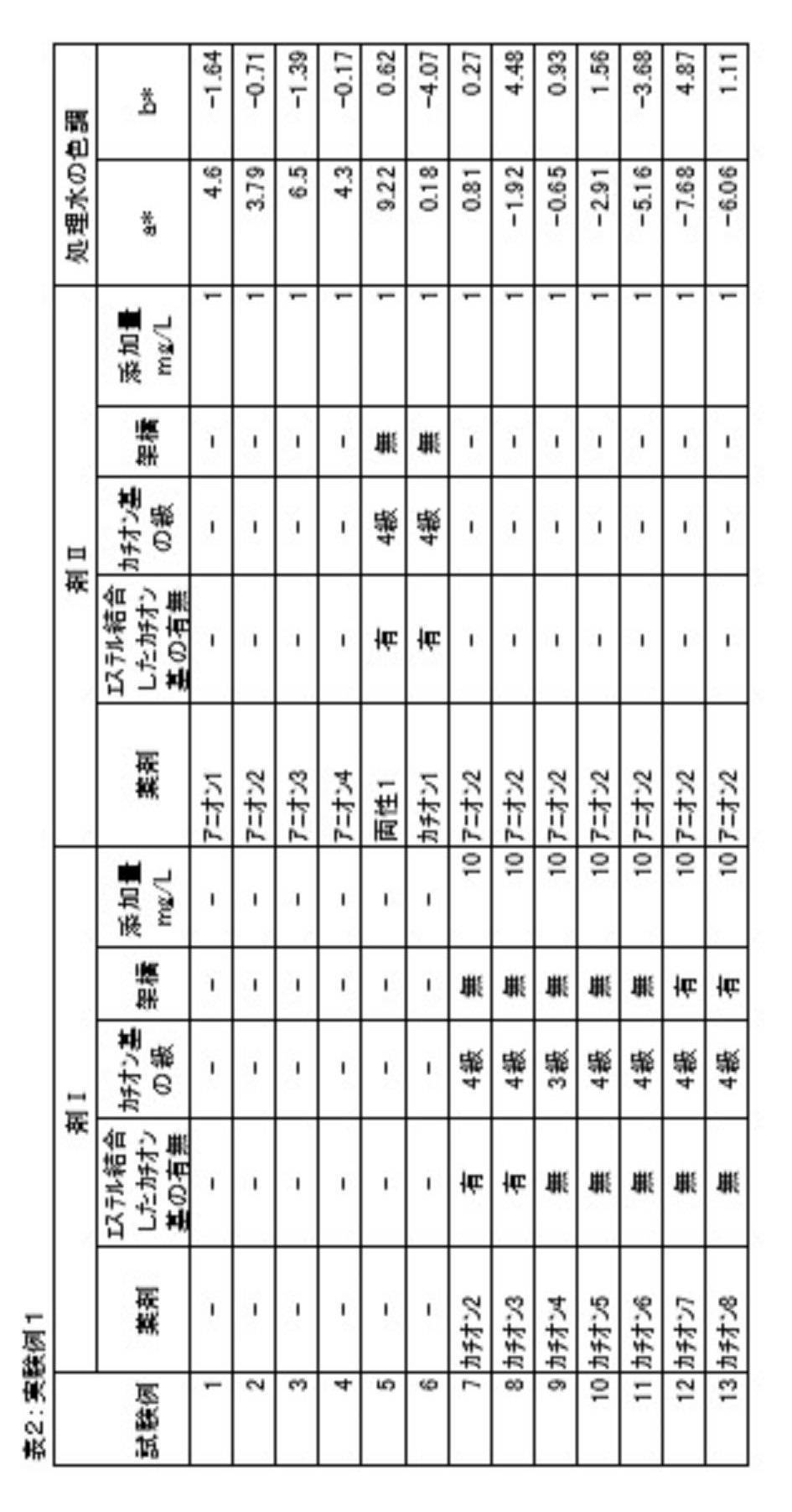
- Table 2 shows the results of desk evaluation using the crude green liquid 1 and each of the agents 1 to 13, and the presence or absence of an ester-bonded cation group, the class of the cation group, and the presence or absence of a crosslinked structure for the drug cations 1 to 8.
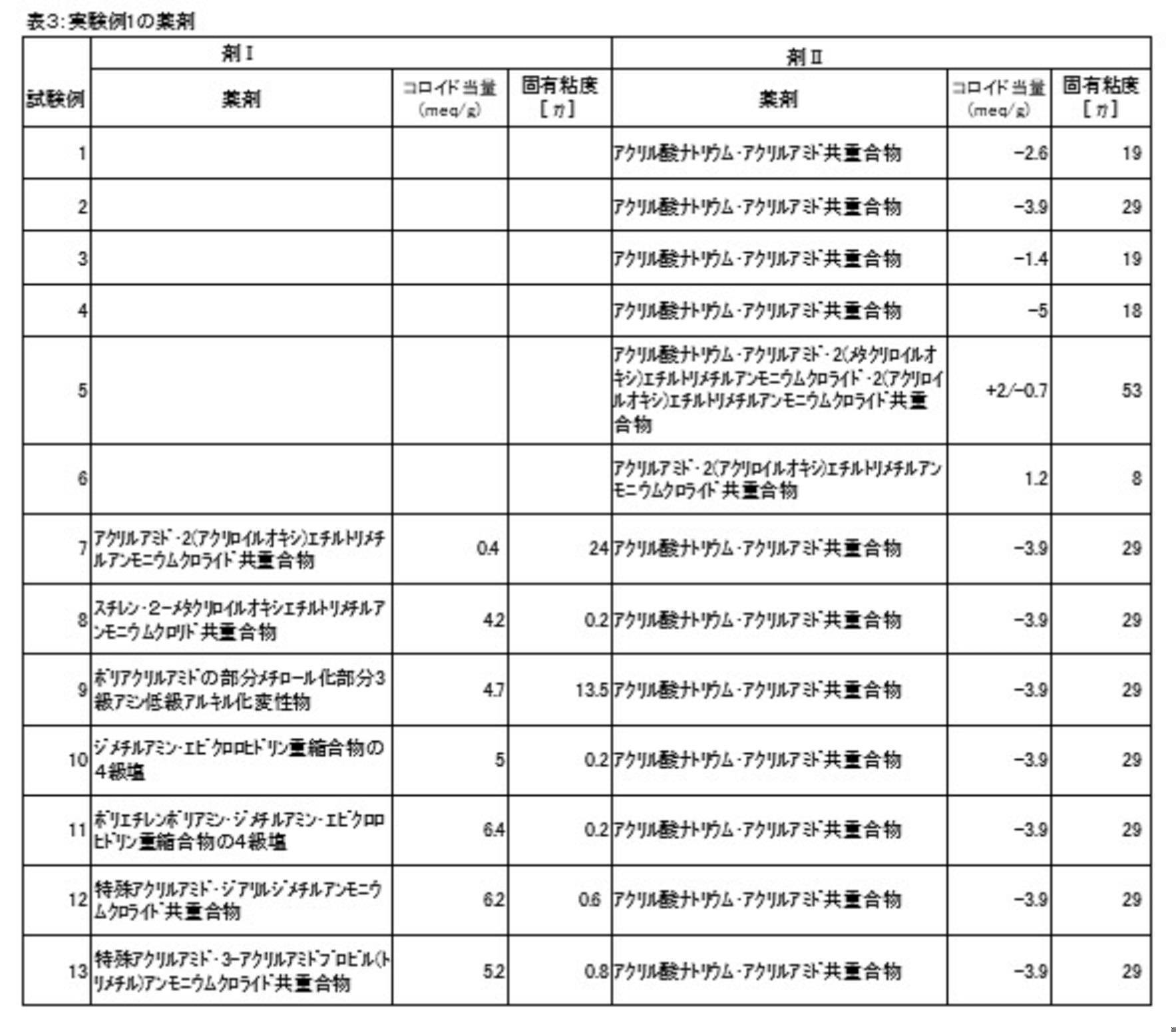
- Table 3 shows the physical characteristics of the drugs used.
- test Examples 1 to 4 various anion polymers (drug anions 1 to 4) were treated with water to be treated (crude green liquid) alone.
- Test Example 5 the water to be treated (crude green liquid) was treated with an amphoteric polymer (drug amphoteric 1 having an ester-bonded cation group alone).
- Test Example 6 a cation having an ester-bonded cation group was performed.
- the water to be treated (crude green liquid) was treated with the polymer (drug cation 1) alone.
- the water to be treated (crude green liquid) was treated with the chemical cations 2 and 3 using the cationic polymer having an ester-bonded cationic group.
- Test Examples 9 to 13 the water to be treated (crude green liquid) was treated with chemical cations 4 to 8 using a cationic polymer having no ester-bonded cationic group.
- various cationic polymers drug cations 2 to 8) were additionally added to the drug anion 2.
- FIG. 2 is a plot of the results of the color tone (a * b * ) of the green liquor for each drug in Table 2.
- a * value is the color tone of the green liquor, it can be seen that the shift left.
- the color tone a * value tends to be low in the crude green liquid treatment using the drug cations 4 to 8 (-60 directions).
- the color tone a * value of the green liquor was improved in the (-60 direction) by the crude green liquor treatment using the polymer having the quaternary salt as a constituent.
- Example 2 The contents of each drug used in Experimental Example 2 are shown in Tables 4 and 5.
- the term "special” in the table means "a copolymer crosslinked using a crosslinkable monomer".
- the drug cation 9 of Test Example 16 is a copolymer crosslinked with N, N'-methylenebisacrylamide. Results of desk evaluation using crude green liquor 2 and each drug 14 to 19 (anions 2, 6, cations 9 to 12), presence or absence of ester-bonded cation groups, and cation group class for drug cations 16 to 19. The presence or absence of a crosslinked structure is shown in Table 5.
- Table 5 shows the physical characteristics of the drugs used. In Test Examples 14 and 15, only the drug anion was treated alone, and in Test Examples 16 to 19, various cationic polymers (drug cations 9 to 12) were additionally added to the drug anion 6.
- the cations 9 to 12 have an effect of lowering the color tone a * value of the green liquor. It is possible to obtain an excellent quality green liquor by showing an excellent clarification effect of the green liquor. Further, among these, the crosslinked drug, cation 9, was able to obtain a more excellent clarified green liquor, and the impurities were significantly reduced, so that a green liquor of better quality could be obtained.
- Example 3 Test Example 20 to Test Example 21
- Table 7 shows the results of the diameter and the water content of the lime mud filter. It was measured by the above-mentioned (measurement method of particle size) and (measurement method of water content).
- Test Example 21 which is the present product, the improvement in the green liquor treatment resulted in the improvement in the production of CaCO 3 in the subsequent step and the dehydration step of CaCO 3.
- the amount is estimated to be 8 mg / L from FIG.
- the amount of the crosslinked cation polymer having no cation group of the ester bond increased, the a * value decreased, the color tone of the treated green liquor moved toward -60 green, and the clarification of the excellent green liquor was excellent. It was found that there was a chemical effect and the quality of the obtained green liquor was excellent, which is in agreement with the results of the above-mentioned actual machine test.
- the color tone a * is improved in the (-60 direction) direction, and the clarified green liquor is more excellent.
- impurities were significantly reduced, and a green liquor of superior quality could be obtained.
- more excellent calcium carbonate could be produced.
- Pulp production system 10 cooking system; 11 cooking pot; 20 black liquor treatment system; 21 evaporator; 22 boiler; 30 green liquor clarification (coarse green liquor treatment) system; 31 dissolution tank (dispersion); 32 green liquor clarifier (Clear); 33 Green liquor tank; 40 Dissolving / caustic system ;; 41 Caustic system; 42 White liquor clarifier; 43 White liquor tank; 44 Kiln; 411 Slaker; 412 Caustic reaction tank; 45 Lime mud filter
Landscapes
- Chemical & Material Sciences (AREA)
- Health & Medical Sciences (AREA)
- Chemical Kinetics & Catalysis (AREA)
- Medicinal Chemistry (AREA)
- Polymers & Plastics (AREA)
- Organic Chemistry (AREA)
- Separation Of Suspended Particles By Flocculating Agents (AREA)
- Paper (AREA)
- Addition Polymer Or Copolymer, Post-Treatments, Or Chemical Modifications (AREA)
- Compounds Of Alkaline-Earth Elements, Aluminum Or Rare-Earth Metals (AREA)
Abstract
Description
このドレッグスと呼ばれる不溶性不純物は、白液製造工程における炭酸カルシウムの生成などに悪影響を及ぼす。このため、緑液製造工程において、粗緑液中のドレッグスをできるだけ除去して、緑液をより良好に清澄化することが行われている。
本発明は、エステル結合したカチオン基を有さないカチオンポリマーを粗緑液に添加する緑液処理方法を提供するものである。
本発明は、エステル結合したカチオン基を有さないカチオンポリマーを粗緑液に添加することにより清澄化された緑液を用いて、炭酸カルシウムを生成する消和・苛性化工程を含む、炭酸カルシウム製造方法を提供するものである。
本発明は、エステル結合したカチオン基を有さないカチオンポリマーを粗緑液に添加することにより緑液を清澄化する緑液清澄化工程と、
当該緑液を用い、消和反応及び苛性化反応にて、炭酸カルシウムを生成する消和・苛性化工程と、を含む、炭酸カルシウム製造方法を提供するものである。
当該エステル結合を有さないカチオン単量体が、エステル結合を有さないアミン単量体及び/又はエステル結合を有さない第4級アンモニウム塩単量体であってもよい。
前記カチオンポリマーが、ポリジアリルジメチルアンモニウム塩及び/又はその共重合体;アクリルアミド・3-アクリルアミドプロピル(トリメチル)アンモニウム塩共重合体、アクリルアミド・ジアリルジメチルアンモニウム塩共重合体、アルキルアミン・エピクロロヒドリン重縮合物から選択される1種又は2種以上であってもよい。
前記緑液処理が、緑液清澄化であってもよい。
<1-1.パルプ製造系の概要>
図1は、本発明の一実施形態に係る緑液処理系を備えたパルプ製造系1の概略構成図であり、本発明はこれに限定されない。
パルプ製造系1は、蒸解系10と、黒液処理系20と、緑液清澄化系30と、消和・苛性化系40と、を備えることができる。これら系は、図1において実線で示される管で互いに連通され、全体として循環路を構成していてもよい。
以下、各構成要素について詳細に説明する。
蒸解系10は、蒸解釜11を有し、この蒸解釜11の下流にはパルプ精製部が設けられていてもよい。蒸解釜11には、パルプの原料である木材チップと、水酸化ナトリウムを含有する白液とが投入され、木材チップの蒸解が行われる。
これによって生じたパルプはパルプ精製部へと移送され、漂白、抄紙工程などを順次受け、紙が製造される。一方で、廃液である黒液は、水酸化ナトリウムの回収などのため、後述するエバポレータ21へと移送される。
黒液処理系20は、上流から順に、エバポレータ21と、ボイラ22と、を有してもよい。黒液は、エバポレータ21で濃縮された後、ボイラ22へと移送され、このボイラ22内で燃焼される。これにより、黒液に含有されていた無機ナトリウム塩が溶融し、ボイラ22の底部からスメルトとして排出される。排出されたスメルトは、溶解タンク31へと移送される。
緑液清澄化系30は、上流から順に、溶解タンク31と、緑液クラリファイア32と、緑液タンク33と、を有してもよい。スメルトは、溶解タンク31において水に撹拌され、溶解又は分散する。これにより、水酸化ナトリウムに加え、炭酸ナトリウムを豊富に含有する緑液(「粗緑液」ともいう。)が生成される。溶解タンク31には、図示しない送液ポンプが設けられており、粗緑液はこの送液ポンプに吸引され、緑液クラリファイア32へと移送される。粗緑液は、残存する未溶解成分が、緑液クラリファイア32において除去される。その後、緑液タンク33へと移送されて貯留され、やがて苛性化系41へと移送される。
緑液クラリファイアとして、特に限定されないが、例えば、多段クラリファイア、ユニットクラリファイア、貯槽兼用型クラリファイア、沈降濃縮式クラリファイアなどが挙げられ、このうち、貯槽兼用型が好ましい。
消和・苛性化系40は、苛性化系41と、白液クラリファイア42と、白液タンク43と、を有してもよい。消和・苛性化系40は、この白液クラリファイア42の下流に位置するライムマッドフィルター45、キルン44をさらに有してもよい。苛性化系41、白液クラリファイア42、白液タンク43は、互いに連通され、全体として循環路を構成する。
本実施形態は、エステル結合したカチオン基を有さないカチオンポリマーを有効成分とする、緑液処理剤を提供することができる。
また、本実施形態は、エステル結合したカチオン基を有さないカチオンポリマー又は当該ポリマーを含有する緑液処理剤を、粗緑液に添加する、緑液処理方法を提供することができる。
本実施形態による緑液清澄化工程において、本実施形態のカチオンポリマーを用いることで、緑液の色調(a*値:緑(-60)方向)をより良好にすることができる。この緑液清澄化により、ドレッグスを含む粗緑液(被処理水)から、ドレッグスを良好に分離し、本実施形態に関する色調に優れた緑液を製造することができる。
さらに、本実施形態に関する色調(a*値:(-60)緑方向)に優れた緑液を用いることで、消和・苛性化工程において、本実施形態に関する炭酸カルシウムをより良好に安定的に製造することができる。
本実施形態のカチオンポリマーは、緑液が高pH状況下でも、加水分解を起こしにくい傾向にあり、水酸化物イオンOH-が多くても良好な凝結作用を持つ傾向にある。このため本実施形態のカチオンポリマーを用いることにより、緑液清澄化工程を安定化させ、色調の優れた緑液を製造することができる。
生成した炭酸カルシウムの粒子径が大きくなると、石灰泥フィルターでの洗浄・脱水が良くなり、炭酸カルシウムの含水率も低減できる。含水率が低減された炭酸カルシウムを用いることで、その後のキルンの重油量を削減でき、焼成率(CaO/(CaO+CaCO3)×100(%))も向上させることができる。
よって、本実施形態に関する緑液処理によって、再利用できる酸化カルシウム(生石灰)の量をより多く確保することができるので、通常購入している生石灰の量を減らすことができる。
本実施形態に用いるカチオンポリマーは、エステル結合したカチオン基を有さないカチオンポリマーである。当該ポリマーは、特に言及しなければ、ホモポリマー、及び、アクリルアミドなどとのコポリマーを含む意味である。
本実施形態のカチオンポリマーは、エステル結合を有さないカチオン単量体由来の構成単位を少なくとも有していることが好適である。なお、当該カチオンポリマーは、本発明の効果を損なわない範囲内であれば、エステル結合したカチオン単量体由来の構成単位を少量含んでもよい。
前記カチオンポリマーは、エステル結合を有さないカチオン単量体由来の構成単位を有するホモポリマーであってもよいし、エステル結合を有さないカチオン単量体由来の構成単位と、他の単量体由来の構成単位とを有するコポリマーであってもよい。なお、一般的に、共重合体として、ランダム共重合体(例えば―ABABBBA―)、交互共重合体(例えば―ABABAB―)、周期的共重合体(例えば―ABBABB―)、ブロック共重合体(例えば―AAABBBBB―)、の4種類の構造があり、また、ブロック共重合体の一種にグラフト共重合体と呼ばれるものがある。
前記エステル結合を有さないアミン単量体として、特に限定されないが、例えば、アンモニア、モノメチルアミン、ジメチルアミン、トリメチルアミン、モノエチルアミン、ジエチルアミン、トリエチルアミン、モノイソプロピルアミン、ジイソプロピルアミン、トリイソプロピルアミン、モノブチルアミン、ジブチルアミンなどの第1級、第2級ないし第3級のアルキルアミン類;モノイソプロパノールアミン、ジメチルアミノエタノール及びジエチルアミノエタノール、メチルジエタノールアミンなどのアルカノールアミン類;エチレンジアミン、プロピレンジアミン、テトラメチレンジアミン、ヘキサメチレンジアミンなどのジアミン類;エチレンイミン及びプロピレンイミンなどのアルキレンイミン類;ピペラジン、モルホリンなど飽和ヘテロ単環やピラジン及びピリジンなど不飽和ヘテロ単環などの飽和又は不飽和の含窒素単環系;及びこれらのオリゴマーなどが挙げられる。
上記アミン基を含有する単量体における、アルキル、アルキレン、アルカノール、単環などの炭化水素部分における炭素数は、特に限定されないが、好ましくは炭素数1~10、より好ましくは炭素数1~6である。
これらのうち、前記エステル結合を有さないアミン単量体としては、アルキルアミン類、アルカノールアミン類、ジアミン類が好ましく、より好ましくはアルキルアミン類である。
前記第4級アンモニウム塩単量体として、本実施形態の効果を発揮すれば特に限定されないが、例えば、ジ(メタ)アクリル第4級アンモニウム塩単量体、ビニルアルキルアンモニウム塩単量体などが挙げられ、これらからなる群から1種又は2種以上を使用してもよい。
前記「N,N-ジアルキル」部分における「アルキル基」は、同一であっても異なってもよく、同一が好ましく、また、当該アルキル基の炭素数は、好ましくは炭素数1~10、より好ましくは、メチル、エチル、n-プロピルなどの炭素数1~3であることが好適である。
アクリルアミド単量体として、特に制限されず、例えば、アクリルアミド、ジメチルアクリルアミド、イソプロピルアクリルアミド、ダイアセトンアクリルアミド、N,N'-メチレンビス(メタ)アクリルアミドなどが挙げられ、これらから1種又は2種以上を使用することができる。
本実施形態に用いるカチオンポリマーとして、特に限定されないが、例えば、ポリアクリルアミドの部分メチロール化部分3級アミン低級アルキル化変性物、ジアリルジメチルアンモニウム塩重合体及び/又はその共重合体、N,N'-メチレンビス(メタ)アクリルアミドで架橋されたジアリルジメチルアンモニウム塩共重合体、アクリルアミド・3-アクリルアミドプロピル(トリメチル)アンモニウム塩共重合体、アクリルアミド・ジアリルジメチルアンモニウム塩共重合体、アルキルアミン・エピクロロヒドリン重縮合物から選択される1種又は2種以上であるものが好ましい。これらはエステル結合のカチオン基を持たず、加水分解を受けにくいので、本発明の効果をより良好に発揮することができる。
さらに、N,N’-メチレンビスアクリルアミドで架橋した、アクリルアミド・3-アクリルアミドプロピル(トリメチル)アンモニウムクロライド共重合体、及び/又は、N,N’-メチレンビスアクリルアミドで架橋した、アクリルアミド・ジアリルジメチルアンモニウムクロライド共重合体が好ましい。
当該ジアリルジメチルアンモニウム塩と共重合可能な単量体としては、例えば、アクリルアミド、アリルアミン、ジアリルアミン、メチルジアリルアミン、アクリル酸、エピクロルヒドリン、ジメチルアミンなどが挙げられ、これらから1種又は2種以上を使用することができる。
このうち、アクリルアミド、アリルアミン、ジアリルアミンが好ましく、さらにアクリルアミドがより好ましい。
本実施形態に用いるカチオンポリマーの製造方法に特に制限はなく、公知のカチオンポリマーの製造方法を採用することができる。カチオンポリマーの製造方法として、特に限定されないが、例えば、ラジカル重合方法、乳化重合方法、懸濁重合方法、溶液重合方法、塊状重合方法などが挙げられる。
どのアゾ系開始剤、過硫酸塩、過酸化アルキル化合物などの過酸化物と亜硫酸塩、第一鉄塩、アミン化合物などとを組み合わせたレドックス開始剤系などを挙げることができる。
また、ベンゾフェノン、ベンゾインエチルエーテルなどの光増感剤の存在下に、光照射して重合させることもできる。これらのなかで、水溶性のアゾ系開始剤を好適に使用することができる。
本実施形態に用いるカチオンポリマーの製造方法の一例として、ジアリルジメチルアンモニウム塩重合体、アクリルアミド・ジアリルジメチルアンモニウム塩共重合体、又はアクリルアミド・3-アクリルアミドプロピル(トリメチル)アンモニウム塩共重合体などの製造方法について、以下に説明する。
例えば、ジアリルジメチルアンモニウム塩単量体と又は3-アクリルアミドプロピル(トリメチル)アンモニウム塩単量体と、必要に応じて他の単量体(好適には多官能の架橋性単量体)とを水に溶解し、その溶解液に水溶性の重合開始剤を添加する。添加後に雰囲気を不活性ガスで置換して加熱することにより、架橋したジアリルジメチルアンモニウム塩重合体もしくは共重合体、又は架橋したアクリルアミド・3-アクリルアミドプロピル(トリメチル)アンモニウム塩共重合体を得ることができる。
これらのうち、N,N'-メチレンビス(メタ)アクリルアミドを好適に使用することができる。
また、ジアリルジメチルアンモニウム塩共重合体は、カチオン性構成単位のみを有するカチオンポリマーでもよく、あるいは、本発明の効果を損なわない範囲内であれば、共重合によりカチオン性構成単位とアニオン性構成単位を有する両性ポリマーであってよい。
なかでも、アクリルアミド、アリルアミン、ジアリルアミンから選択される1種又は2種以上が好ましい。
本実施形態の緑液処理剤又は組成物は、上述した本実施形態のカチオンポリマーを有効成分として含有する。上述の<1.>及び<2.>と重複する構成については、適宜省略する。
本実施形態の緑液処理剤は、前記エステル結合したカチオン基を有さないカチオンポリマーが水に溶解又は懸濁された状態の水溶液で使用することができるが、これに特に限定されず、例えば、スラリー状、粉末状で使用することもできる。本実施形態の緑液処理剤は、炭酸カルシウム製造のための薬剤としても使用することができる。
よって、本実施形態の前記エステル結合したカチオン基を有さないカチオンポリマーは、緑液処理剤又は炭酸カルシウム製造のための薬剤に含有させることができ、また、緑液処理剤又は炭酸カルシウム製造のための薬剤を製造するために使用することができる。
また、本実施形態は、緑液処理に用いるための或いは緑液処理をより良好にするための、前記エステル結合したカチオン基を有さないカチオンポリマー、又はその使用を提供することもできる。本実施形態は、炭酸カルシウム製造に用いるための或いは炭酸カルシウム製造をより良好にするための、前記エステル結合したカチオン基を有さないカチオンポリマー、又はその使用を提供することもできる。本実施形態は、緑液処理のための又は炭酸カルシウム製造のための、前記エステル結合したカチオン基を有さないカチオンポリマーの使用を提供することができる。
また、本実施形態は、緑液処理方法、清澄化緑液の製造方法、炭酸カルシウムの製造方法を提供することも可能である。本実施形態は、前記エステル結合したカチオン基を有さないカチオンポリマー又は当該ポリマーを含む薬剤を添加又は使用する、緑液処理方法、清澄化緑液の製造方法、炭酸カルシウムの製造方法を提供することも可能である。
本実施形態の緑液処理剤又は組成物には、本発明の効果を損なわない範囲で、任意成分としての任意の薬剤を含有又は混合することができる。
任意の薬剤として、例えば、防食剤(腐食抑制剤)、スケール防止剤、スライムコントロール剤、水等の溶媒又は分散媒体、分散剤酵素、殺菌剤及び消泡剤、アニオンポリマー、本実施形態以外のカチオンポリマー、両性ポリマー、非イオン性ポリマーなどが挙げられるが、これらに限定されるものではなく、また一般的に緑液処理或いは炭酸カルシウム製造に使用できる各種薬剤を使用してもよい。これらからなる群から選択される1種又は2種以上を使用することができる。
前記アニオンポリマーとして、例えば、ポリ(メタ)アクリル酸塩系重合体又は共重合体、アニオン性ポリ(メタ)アクリルアミド系、(メタ)アクリル酸塩・(メタ)アクリルアミド共重合体などが挙げられ、これらからなる群から選択される1種又は2種以上を使用することができる。当該塩として、アルカリ金属塩(例えば、ナトリウム、カリウムなど)などが挙げられるが、これらに特に限定されない。
このうち、ポリ(メタ)アクリル酸塩系の重合体又は共重合体が好ましく、より好ましくは(メタ)アクリル酸塩・(メタ)アクリルアミド共重合体である。
<4-1.本実施形態の緑液処理方法>
本実施形態のカチオンポリマー又は当該ポリマーを含有する緑液処理剤(以下、「本実施形態の薬剤」ともいう)は、緑液処理系の被処理水に添加することで、緑液を処理することができる。例えば、より良好に緑液を清澄化することができ、また当該緑液から、粒径がより大きいや含水量がより少ない炭酸カルシウムを効率よく生成することもできる。なお、上述の<1.>~<3.>と重複する構成については、適宜省略する。
本実施形態における緑液清澄化する被処理水として、粗緑液が挙げられる。
本実施形態における被処理水中のpH(測定時20℃)は高アルカリであるが、例えば、好ましくは9以上、さらに好ましくは10以上、より好ましくは11以上、さらに好ましくは12以上、より好ましくは13以上である。
本実施形態における被処理水中のイオン状鉄は、特に限定されないが、その好適な下限値として、好ましくは0.01mg/L以上、より好ましくは0.05mg/L以上、さらに好ましくは0.1mg/L以上であり、その好適な上限値として、好ましくは10mg/L以下、より好ましくは5mg/L以下、さらに好ましくは3mg/L以下である。
本実施形態の薬剤は、緑液処理系における適宜の場所に、添加することができる。当該場所としては、特に限定されず、各処理装置、処理系、配管や流路系などが挙げられる。例えば、本実施形態の薬剤の添加は、緑液処理が求められる場所又はその上流であることが好ましい。このとき、被処理水と本実施形態の薬剤が混合しやすいように、撹拌機や混合機が、その場所又は上流に備えられていることが望ましい。
本実施形態の薬剤の添加は、溶解タンク31と緑液クラリファイア32との間が好ましく、その間に備えられている流路や配管、設備などに添加することが、作業効率の観点から、より好ましい。
また、本実施形態のカチオンポリマーと、アニオンポリマーを併用して添加する場合には、これら両者を溶解タンク31と緑液クラリファイア32との間で同時期又は別々に添加することが好ましく、緑液の処理の観点やコストの観点から、本実施形態のカチオンポリマー、次いでアニオンポリマーの順に被処理水に添加することが好適である。
本実施形態のカチオンポリマーの添加量や添加期間は、被処理水の状態、流通する流体量などに応じて、適宜設定されてもよい。当該添加量は、特に限定されないが、緑液の処理の観点やコストの観点から、流体(例えば粗緑液)に対して、その好適な下限値として、好ましくは0.1mg/L以上、より好ましくは0.5mg/L以上、さらに好ましくは1mg/L以上、より好ましくは2mg/L以上、さらに好ましくは3mg/L以上であり、その好適な上限値として、1000mg/L以下、より好ましくは500mg/L以下、さらに好ましくは100mg/L以下、より好ましくは50mg/L以下、さらに好ましくは30mg/L以下、より好ましくは20mg/L以下であり、当該好適な数値範囲として、好適には0.1~1000mg/L、より好適には1~50mg/Lである。
なお、流通する流体の体積は、例えば、流体流路の適宜の箇所に流量計を配置し、その測定値に基づいて算出できる。
また、本実施形態のカチオンポリマー1質量部に対し、緑液の処理の観点やコストの観点から、アニオンポリマーを0.01~1質量部を使用することが好ましく、より好ましくはアニオンポリマーを0.05~0.5質量部である。
本実施形態の緑液清澄化処理にて清澄化された緑液は、赤色が弱く、緑色が強いもの(a*値-60方向)が好ましい。なおa*値及びb*値の数値の幅は±60である。
さらに、L*a*b*表色系において、清澄化緑液のa*値は、特に限定されないが、好ましくは1.5以下、より好ましくは1.0以下、より好ましくは0以下、さらに好ましくは-0.5以下、より好ましくは-1.0以下、さらに好ましくは-1.5以下である。なお、a*値の「以下」は、-60に近づく意味である。
(粒径の測定方法)
炭酸カルシウムを水に分散し、レーザ回折・散乱粒子径分布測定法(例:株式会社堀場製作所製のレーザ回折・散乱式粒子径分布測定装置LA-300)にて、炭酸カルシウム
の粒径(メジアン径)を測定する。
乾燥機による方法、赤外線による加熱乾燥の方法、近赤外線による方法などが挙げられる。
乾燥機による方法は、パルプの絶乾率を試験するJIS P 8202に準じて行われ、試料を採取して、105℃の恒温加熱乾燥器内で一晩放置して乾固させ、その後、デシケーター中で室温に戻して、乾燥前後の試料の重量差から水分量を求めることにより測定される。
赤外線による加熱乾燥の方法は、含水率を迅速に測定することができる。試料を栗田工業株式会社製「クリガンスイ」(商品名)に入れ、赤外線を照射して水分の蒸発による質量変化から含水率を測定する。
近赤外線による方法は、株式会社ケット科学研究所製の近赤外水分計「KJT-130」(商品名)などを使い行われる。近赤外線とは、可視光線より波長の長く、赤色の外側にある見えない光であり、水分に対しよく吸収するため、近赤外線を含む光を照射してその反射率を測定することで含水率を測定する。
表7に示した実施例では乾燥機による方法にて求めた。
本実施形態の薬剤を用いることで、より良好な清澄化緑液及びより良好な炭酸カルシウムを製造することができる。なお、上述の<1.>~<3.><4-1.>と重複する構成については、適宜省略する。
また、本実施形態の緑液処理によって、本実施形態の薬剤を粗緑液に添加して清澄化された緑液を製造すること、及び、当該緑液を用いて炭酸カルシウムを製造することができる。
本実施形態の消和・苛性化方法は、緑液清澄化方法にて得られた緑液を用いて、炭酸カルシウムを生成することが好適である。
本実施形態の炭酸カルシウム製造方法は、(A)エステル結合したカチオン基を実質的に有さないカチオンポリマーを粗緑液に添加して緑液を清澄化する緑液清澄化工程と、(B)当該緑液を用い、消和反応及び苛性化反応にて、炭酸カルシウムを生成する消和・苛性化工程と、を含むことが好適である。
これにより、優れた炭酸カルシウムを製造することができる。
〔1〕
エステル結合したカチオン基を有さないカチオンポリマーを含有する、緑液処理剤又は組成物。当該緑液処理剤又は組成物は、アニオンポリマーと組み合わせて使用するための緑液処理剤又は組成物であってもよい。
〔2〕
緑液処理剤或いは炭酸カルシウム製造のための薬剤を製造するための、エステル結合したカチオン基を有さないカチオンポリマー又はその使用。当該緑液処理剤或いは炭酸カルシウム製造のための薬剤は、アニオンポリマーと組み合わせて使用するための緑液処理剤或いは炭酸カルシウム製造のための薬剤であってもよい。
〔3〕
緑液処理のための或いは緑液処理に用いるための、エステル結合したカチオン基を有さないカチオンポリマー又はその使用。炭酸カルシウム製造のための或いは炭酸カルシウム製造に用いるための、エステル結合したカチオン基を有さないカチオンポリマー又はその使用。エステル結合したカチオン基を有さないカチオンポリマーは、アニオンポリマーと組み合わせて使用するものであってもよい。
〔4〕
エステル結合したカチオン基を有さないカチオンポリマー又は当該含有処理剤を、粗緑液に添加する、緑液処理方法。当該緑液処理は、緑液清澄化及び/又は消和・苛性化もしくは炭酸カルシウム生成であることが好適である。好適な添加場所は、溶解タンクと緑液クラリファイアとの間である。
〔5〕
エステル結合したカチオン基を有さないカチオンポリマー又は当該含有処理剤を粗緑液に添加して清澄化された緑液を用いて、炭酸カルシウムを生成する消和・苛性化工程を含む、炭酸カルシウム製造方法。
〔6〕
エステル結合したカチオン基を有さないカチオンポリマー又は当該含有処理剤を粗緑液に添加して緑液を清澄化する緑液清澄化工程と、
当該緑液を用い、消和反応及び苛性化反応にて、炭酸カルシウムを生成する消和・苛性化工程と、を含む、炭酸カルシウム製造方法。
前記〔1〕~〔6〕のいずれか1つのカチオンポリマーが、エステル結合を有さないカチオン単量体由来の構成単位を少なくとも有する、重合体であることが好適である。
より好適は、当該エステル結合を有さないカチオン単量体が、エステル結合を有さないアミン単量体及び/又はエステル結合を有さない第4級アンモニウム塩単量体である。
より好適は、当該重合体が、共重合体の場合、前記エステル結合を有さないカチオン単量体由来の構成単位と、他の架橋性単量体由来の構成単位を有する、架橋した共重合体である。当該他の架橋性単量体由来の構成単位が、アクリルアミド単量体(好適には、N,N'-メチレンビス(メタ)アクリルアミド)であることが好適である。当該共重合体は、アクリルアミド単量体で架橋したカチオンコポリマーが好適であり、より好適はN,N'-メチレンビス(メタ)アクリルアミドで架橋されたカチオンコポリマーであり、さらに好適は、N,N’-メチレンビスアクリルアミドで架橋されたカチオンコポリマーである。
〔8〕
前記〔1〕~〔7〕のいずれか1つのカチオンポリマーのコロイド当量(meq/g)は、0.1~15meq/gであること、及び/又は、カチオンポリマーの固有粘度([η])は、0.2~5であること、が好適である。
〔9〕
前記〔1〕~〔8〕のいずれか1つのエステル結合を有さないカチオン単量体が、第4級アンモニウム塩単量体であることが好適であり、より好適には、N,N-ジアルキル-N,N-ジ(メタ)アクリル第4級アンモニウム塩である。
〔10〕
前記〔1〕~〔9〕のいずれか1つのカチオンポリマーが、ポリジアリルジメチルアンモニウム塩及び/又はその共重合体、N,N'-メチレンビス(メタ)アクリルアミドで架橋されたポリジアリルジメチルアンモニウム塩共重合体、アクリルアミド・3-アクリルアミドプロピル(トリメチル)アンモニウム塩共重合体、アクリルアミド・ジアリルジメチルアンモニウム塩共重合体、アルキルアミン・エピクロロヒドリン重縮合物から選択される1種又は2種以上であることが好適である。当該塩として、クロライド又はブロマイドが好適である。より好適には、N,N'-メチレンビス(メタ)アクリルアミドで架橋されたポリジアリルジメチルアンモニウム塩共重合体、アクリルアミド・3-アクリルアミドプロピル(トリメチル)アンモニウム塩共重合体、アクリルアミド・ジアリルジメチルアンモニウム塩共重合体から選択される1種又は2種以上である。
〔11〕
前記〔1〕~〔10〕のいずれか1つのカチオンポリマーの添加量が、被処理水に対して、0.1~1000mg/Lであることが好適である。
〔12〕
前記〔1〕~〔11〕のいずれか1つのカチオンポリマーに、さらにアニオンポリマーを組み合わせて使用することが好適である。
当該アニオンポリマーとして、ポリ(メタ)アクリル酸塩系重合体又は共重合体が好適である。
当該カチオンポリマーと当該アニオンポリマーの添加順は特に限定されないが、好適には、当該カチオンポリマー次いで当該アニオンポリマーの順に被処理水に添加することが好適である。
好適には、当該カチオンポリマー1質量部に対し、当該アニオンポリマーを0.01~1質量部を使用する。
実験例1における試験例(No.)1~13において、粗緑液1(表1)と、各薬剤1~13(表3)を用いた。
実験例2における試験例(No.)14~19において、粗緑液2(表1)と、各薬剤14~19(表5)を用いた。
<表2~5中の薬剤>
アニオン1:アクリル酸ナトリウム・アクリルアミド共重合物
アニオン2:アクリル酸ナトリウム・アクリルアミド共重合物
アニオン3:アクリル酸ナトリウム・アクリルアミド共重合物
アニオン4:アクリル酸ナトリウム・アクリルアミド共重合物
両性1:アクリル酸ナトリウム・アクリルアミド・2(メタクリロイルオキシ)エチルトリメチルアンモニウムクロライド・2(アクリロイルオキシ)エチルトリメチルアンモニウムクロライド共重合物
カチオン1:アクリルアミド・2(アクリロイルオキシ)エチルトリメチルアンモニウムクロライド共重合物
カチオン2:アクリルアミド・2(アクリロイルオキシ)エチルトリメチルアンモニウムクロライド共重合物、
カチオン3:スチレン・2-メタクリロイルオキシエチルトリメチルアンモニウムクロリド共重合物
カチオン4:ポリアクリルアミドの部分メチロール化部分3級アミン低級アルキル化変性物
カチオン5:ジメチルアミン・エピクロロヒドリン重縮合物の4級塩
カチオン6:ポリエチレンポリアミン・ジメチルアミン・エピクロロヒドリン重縮合物の4級塩
カチオン7:特殊アクリルアミド・ジアリルジメチルアンモニウムクロライド共重合物
カチオン8:特殊アクリルアミド・3-アクリルアミドプロピル(トリメチル)アンモニウムクロライド共重合物
カチオン9:特殊ポリジアリルジメチルアンモニウムクロライド
カチオン10:アクリルアミド・ジアリルジメチルアンモニウムクロライド共重合物
カチオン11:アクリルアミド・ジアリルジメチルアンモニウムクロライド共重合物
カチオン12:アクリルアミド・ジアリルジメチルアンモニウムクロライド共重合物
なお、本実験例にて使用した粗緑液は、製紙工場におけるパルプ製造の際に生じたスメルト含有の粗緑液である。
また、カチオンポリマー共重合体の場合、架橋性単量体は、重量比において、カチオン基含有単量体に対して、0.1~100ppmの範囲内にある。
実験例1及び実験例2の実験条件は、以下のとおりである。

緑液クラリファイア処理を、ジャーテストで机上試験にて評価実施した。
被処理水に、剤Iを添加混合後に、剤IIを添加混合した。アニオンポリマーだけの緑液処理に比べ、剤Iを使用することによる処理水の水質の改善を確認した。
緑液500mLをとり、ジャーテスターにかけて測定した。
撹拌条件 150rpm×30秒→ 60rpm×90秒
撹拌停止3分後の上澄みの写真を撮影し、色調の変化をカラーセンサー(Technidyne社製 ColorTouch 2 Model ISO)にかけてL*a*b*色空間(JIS Z 8781-4)のa*値、b*値を求めた。緑液処理が良くなると赤色を帯びている緑液が、緑色になるため、a*値が低い方が良好な処理であることを示す(参考資料1;石川 典夫、日本画像学会誌 2005年,44巻,6号,p.489-498)
本明細書におけるポリマーの固有粘度の測定方法は、JIS K 7367-1:2002 「プラスチック─毛細管形粘度計を用いたポリマー希釈溶液の粘度の求め方─第 1
部:通則」に基づいて行うことができる。
本明細書において、カチオンポリマー、両性ポリマーの固有粘度は、0.1%、0.08%、0.06%、0.04%、0.02%濃度になるように、1.0Nの硝酸ナトリウム水溶液の溶媒で溶解し、キャノンフェンスケ型粘度計(例:草野科学製)にて30℃で測定、濃度を横軸に還元粘度を縦軸にして各値をプロットし、その直線をゼロ濃度まで外挿して固有粘度を求める。
本明細書におけるポリマーのイオン性は、コロイド当量として算出する。本明細書における「コロイド当量(meq/g)」の測定は、「コロイド滴定法」(参考資料2;千手諒一著、南江堂(株)(S44年11月発行))に基づいて行う。
pHの測定は、JIS Z 8802「pH測定方法」に基づいて行う。装置はpHメーター(株式会社堀場製作所製 型番D-52)(20℃)にて行った。
TOCの測定は、JIS K 102 22.1「工場排水試験方法 有機体炭素(TOC)」に基づいて行う。装置はTOC-L(株式会社島津製作所製)で行った。
SSの測定は、JIS K 102 14.1「工場排水試験方法 縣濁物質)」に基づいて行う。ろ過器で吸引ろ過し、乾燥後に重量を求めた。
全鉄の測定は、JIS K 102 57.4「工場排水試験方法 鉄(Fe)ICP発光分光分析法)」に基づいて行う。装置は720ICP-OES(アジレントテクノロジー株式会社製)で行った。
イオン状鉄の測定は、JIS K 102 57.4 備考14「工場排水試験方法 鉄(Fe)ICP発光分光分析法) 溶存鉄を定量する場合」に基づいて行う。装置は5110VDVICP-OESシステム(アジレントテクノロジー株式会社製)で行った。
ろ紙5種Cにてろ過した試料を用いて測定した。
実験例1で使用した各薬剤の内容を、表2及び3に示す。なお、表中の「特殊」とは、「架橋性単量体を用いて、架橋した共重合体」の意味である。
試験例12の薬剤カチオン7、試験例13の薬剤カチオン8は、それぞれN,N’-メチレンビスアクリルアミドで架橋した共重合体である。粗緑液1及び各薬剤1~13を用いた机上評価の結果、及び薬剤カチオン1~8について、エステル結合したカチオン基の有無、カチオン基の級、架橋構造の有無を表2に示した。表3には使用した薬剤の物性値を示す。
試験例7・8において、エステル結合したカチオン基を持つカチオンポリマーを用いた薬剤カチオン2・3にて、被処理水(粗緑液)の処理を行った。
試験例9~13において、エステル結合したカチオン基を有さないカチオンポリマーを用いた薬剤カチオン4~8にて、被処理水(粗緑液)の処理を行った。
なお、試験例7~13は、薬剤アニオン2に、種々のカチオンポリマー(薬剤カチオン2~8)を追加添加したものである。
各アニオン1剤(薬剤アニオン1~4)での処理(試験例1~4)に比べ、両性1剤での処理(試験例5)の方が、色調が悪化した。
エステル結合したカチオン基を持つ薬剤カチオン1での処理(試験例6)では、a*値の大幅な改善にまでは見られなかった。
またエステル結合したカチオン基を持つ薬剤カチオン2・3及び薬剤アニオン2の併用での処理(試験例7・8)では、緑液の色調a*値を下げる改善効果が少なかった。
エステル結合したカチオン基を持たず、カチオン基が第4級塩である薬剤10~13(薬剤カチオン4~8)では、緑液の色調a*値を下げる効果が良くなり、特に架橋構造を持つ薬剤12・13(薬剤カチオン7・8)で優れた効果を示した。
図2は、表2における各薬剤における緑液の色調(a*b*)の結果をプロットしたものである。アニオン1剤での処理では、a*値が右にあるものが、本発明のカチオン2~8を用いた処理で、緑液の色調であるa*値が、左にシフトすることがわかる。
実験例2で使用した各薬剤の内容を、表4及び5に示す。なお、表中の「特殊」とは、「架橋性単量体を用いて、架橋した共重合体」の意味である。試験例16の薬剤カチオン9は、N,N’-メチレンビスアクリルアミドで架橋した共重合体である。粗緑液2及び各薬剤14~19(アニオン2、6、カチオン9~12)を用いた机上評価の結果及び、薬剤カチオン16~19について、エステル結合したカチオン基の有無、カチオン基の級、架橋構造の有無を表5に示した。表5には使用した薬剤の物性値を示す。
試験例14・15は薬剤アニオンだけの単独処理、試験例16~19は薬剤アニオン6に種々のカチオンポリマー(薬剤カチオン9~12)を追加添加したものである。


緑液クラリファイアにおいて、表6に示した粗緑液3の水質時に、従来処理薬剤(試験例20)、又は、本実施薬剤(試験例21)を、添加した際の生成したCaCO3の粒径、ライムマッドフィルターでの含水率の結果を表7に示す。なお、前記(粒径の測定方法)及び(含水率の測定方法)にて、測定した。
本実施品である試験例21において、緑液処理が改善されたことで、後工程のCaCO3の生成、CaCO3の脱水工程での改善がみられた。
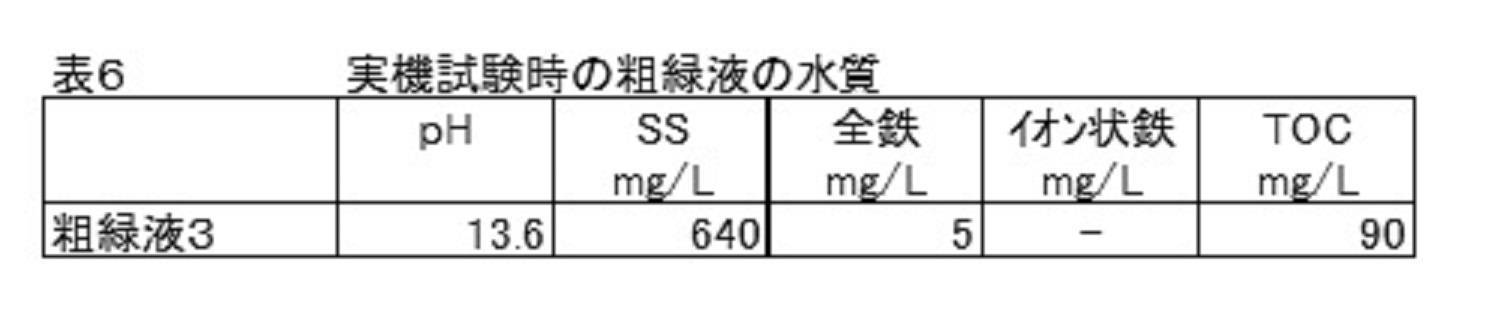
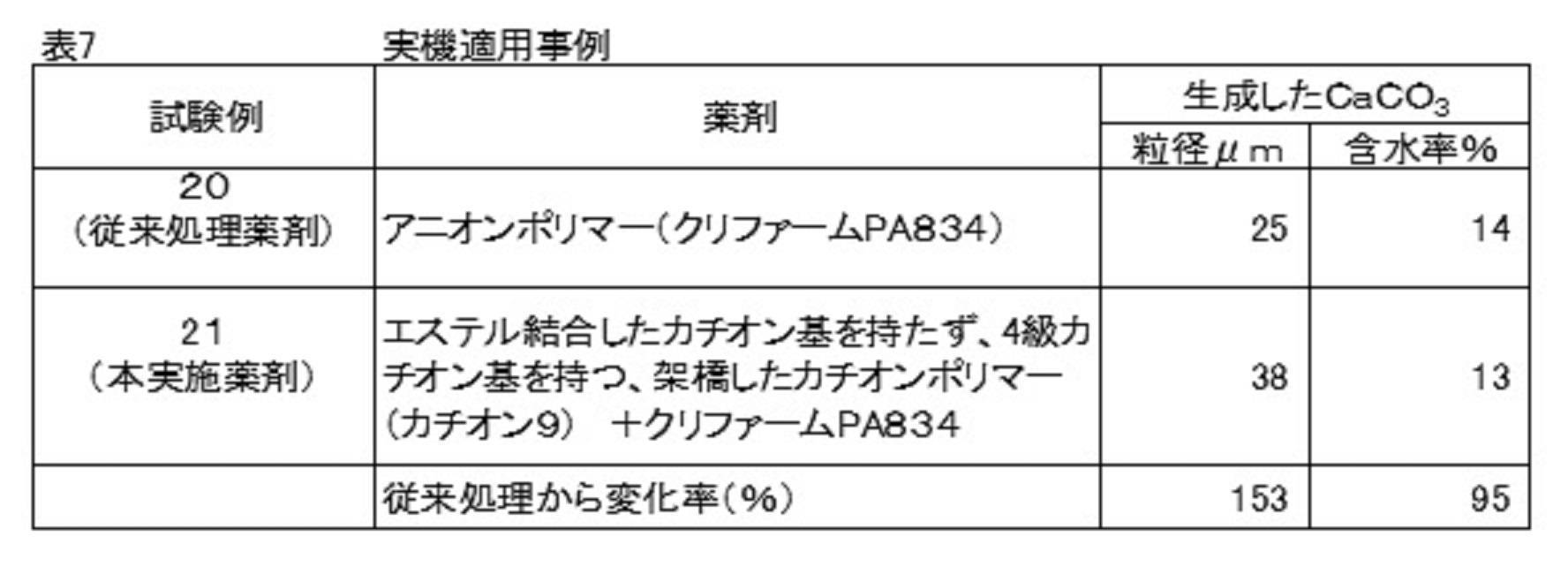
緑液クラリファイアにおいて、図4及び表8に示すように、アニオンポリマー(クリファームPA834栗田工業製)を併用した際、エステル結合したカチオン基を持たず、第4級塩のカチオン基を持つ、架橋したカチオンポリマー(薬剤カチオン9)の添加量を変化させたとき、清澄化緑液のa*値の変化を示した。a*値の目標値は工場毎の操業条件によるため絶対値として示すことはできないが、この現場ではa*値がほぼ0になる点が赤色が緑色になったと判断され、薬剤カチオン9の添加量は8mg/Lと図4から推定される。
このエステル結合のカチオン基を持たない架橋したカチオンポリマーの添加量を増やすにつれ、a*値が低下し、処理された緑液の色調は-60の緑方向に移動し、優れた緑液の清澄化効果があり、得られる緑液の品質が優れていたことがわかり、上記の実機試験の結果とも合致する。
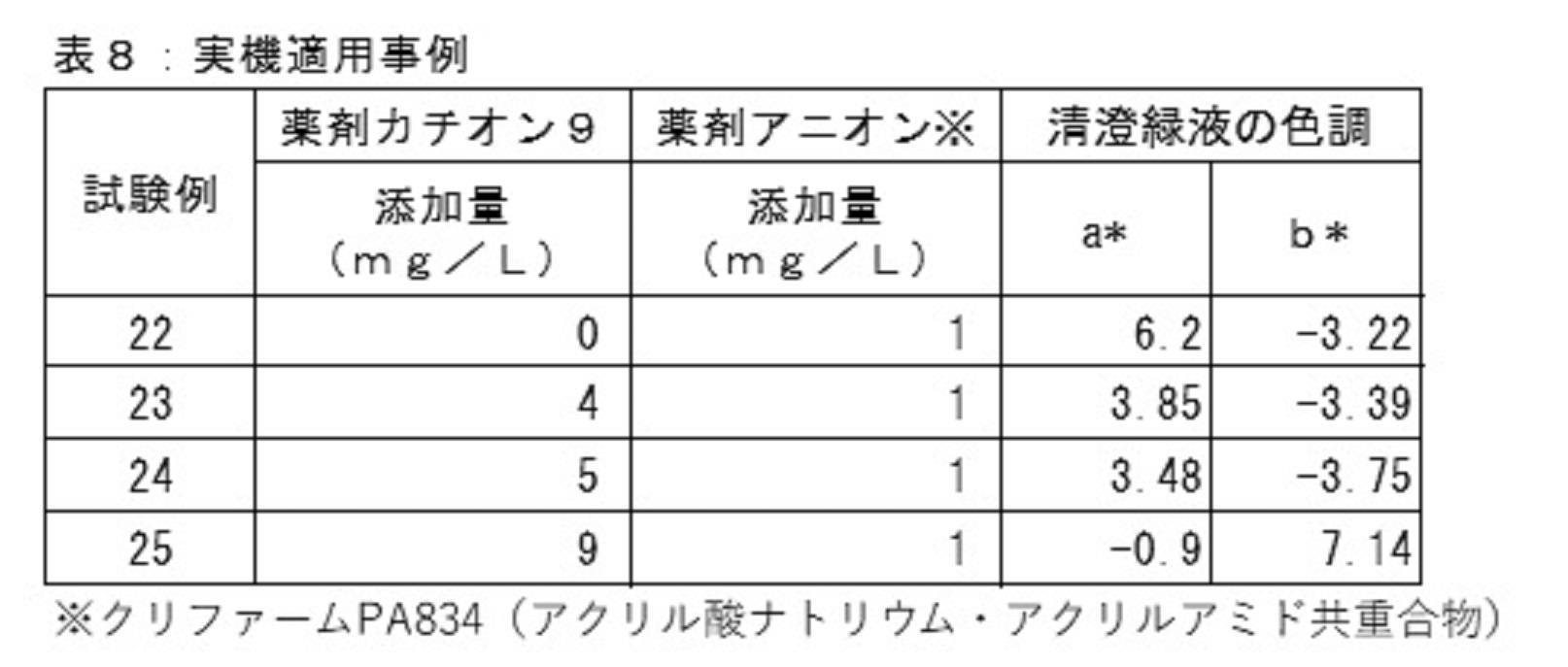
Claims (7)
- エステル結合したカチオン基を有さないカチオンポリマーを含有する、緑液処理剤。
- 前記カチオンポリマーが、エステル結合を有さないカチオン単量体由来の構成単位を少なくとも有する重合体であり、
当該エステル結合を有さないカチオン単量体が、エステル結合を有さないアミン単量体及び/又はエステル結合を有さない第4級アンモニウム塩単量体である、請求項1に記載の緑液処理剤。 - 前記カチオンポリマーが、ポリジアリルジメチルアンモニウム塩及び/又はその共重合体、アクリルアミド・3-アクリルアミドプロピル(トリメチル)アンモニウム塩共重合体、アクリルアミド・ジアリルジメチルアンモニウム塩共重合体、アルキルアミン・エピクロロヒドリン重縮合物から選択される1種又は2種以上である、請求項1又は2に記載の緑液処理剤。
- エステル結合したカチオン基を有さないカチオンポリマーを粗緑液に添加する緑液処理方法。
- 前記緑液処理が、緑液清澄化である、請求項4に記載の緑液処理方法。
- エステル結合したカチオン基を有さないカチオンポリマーを粗緑液に添加することにより清澄化された緑液を用いて、炭酸カルシウムを生成する消和・苛性化工程を含む、炭酸カルシウム製造方法。
- エステル結合したカチオン基を有さないカチオンポリマーを粗緑液に添加することにより緑液を清澄化する緑液清澄化工程と、
当該緑液を用い、消和反応及び苛性化反応にて、炭酸カルシウムを生成する消和・苛性化工程と、を含む、炭酸カルシウム製造方法。
Priority Applications (3)
| Application Number | Priority Date | Filing Date | Title |
|---|---|---|---|
| KR1020227036158A KR102649206B1 (ko) | 2020-07-02 | 2021-03-12 | 녹액처리제 |
| BR112022022126-6A BR112022022126B1 (pt) | 2020-07-02 | 2021-03-12 | Agente para tratamento de licor verde, e, métodos para tratar licor verde e para produzir carbonato de cálcio |
| CN202180044444.3A CN115917079B (zh) | 2020-07-02 | 2021-03-12 | 绿液处理剂 |
Applications Claiming Priority (2)
| Application Number | Priority Date | Filing Date | Title |
|---|---|---|---|
| JP2020114972A JP6901032B1 (ja) | 2020-07-02 | 2020-07-02 | 緑液処理剤 |
| JP2020-114972 | 2020-07-02 |
Publications (1)
| Publication Number | Publication Date |
|---|---|
| WO2022004065A1 true WO2022004065A1 (ja) | 2022-01-06 |
Family
ID=76753061
Family Applications (1)
| Application Number | Title | Priority Date | Filing Date |
|---|---|---|---|
| PCT/JP2021/009946 Ceased WO2022004065A1 (ja) | 2020-07-02 | 2021-03-12 | 緑液処理剤 |
Country Status (5)
| Country | Link |
|---|---|
| JP (1) | JP6901032B1 (ja) |
| KR (1) | KR102649206B1 (ja) |
| CN (1) | CN115917079B (ja) |
| TW (1) | TWI853155B (ja) |
| WO (1) | WO2022004065A1 (ja) |
Families Citing this family (1)
| Publication number | Priority date | Publication date | Assignee | Title |
|---|---|---|---|---|
| JP2026018879A (ja) | 2024-07-25 | 2026-02-05 | 栗田工業株式会社 | 情報処理システム、情報処理方法及びプログラム |
Citations (5)
| Publication number | Priority date | Publication date | Assignee | Title |
|---|---|---|---|---|
| JP2004160347A (ja) * | 2002-11-12 | 2004-06-10 | Nippon Paper Industries Co Ltd | 炭酸ナトリウム含有水溶液の清澄化方法 |
| JP2004238232A (ja) * | 2003-02-04 | 2004-08-26 | Nippon Paper Industries Co Ltd | 炭酸カルシウムの製造方法 |
| JP2005200821A (ja) * | 2003-12-16 | 2005-07-28 | Mitsubishi Paper Mills Ltd | 緑液の清澄化方法 |
| CN103469664A (zh) * | 2013-08-26 | 2013-12-25 | 陕西科技大学 | 一种碱回收工段绿液絮凝除硅方法 |
| CN109650433A (zh) * | 2019-02-13 | 2019-04-19 | 广东鼎丰纸业有限公司 | 制浆碱回收绿液净化制造高纯碳酸钙的方法 |
Family Cites Families (7)
| Publication number | Priority date | Publication date | Assignee | Title |
|---|---|---|---|---|
| US4374102A (en) * | 1981-11-13 | 1983-02-15 | Nalco Chemical Company | Polymers for controlling soda ash crystal formation |
| SE456254B (sv) | 1987-02-12 | 1988-09-19 | Korsnes Ab | Sett att rena gronlut i sulfatmassafabrikers kemikalieatervinning |
| US5989392A (en) * | 1997-09-10 | 1999-11-23 | Nalco Chemical Company | Method of using polyammonium quaternary for controlling anionic trash and pitch deposition in pulp containing broke |
| JP2002166299A (ja) * | 2000-09-25 | 2002-06-11 | Hymo Corp | 汚泥の脱水方法 |
| PT2546410E (pt) * | 2011-07-11 | 2014-02-17 | Omya Int Ag | Partículas de carbonato de cálcio hidrofobizado |
| JP2015188846A (ja) * | 2014-03-28 | 2015-11-02 | 栗田工業株式会社 | 水処理剤及び水処理方法 |
| WO2017138184A1 (ja) * | 2016-02-10 | 2017-08-17 | 栗田工業株式会社 | 凝集剤および水処理方法 |
-
2020
- 2020-07-02 JP JP2020114972A patent/JP6901032B1/ja active Active
-
2021
- 2021-03-12 CN CN202180044444.3A patent/CN115917079B/zh active Active
- 2021-03-12 KR KR1020227036158A patent/KR102649206B1/ko active Active
- 2021-03-12 WO PCT/JP2021/009946 patent/WO2022004065A1/ja not_active Ceased
- 2021-03-17 TW TW110109449A patent/TWI853155B/zh active
Patent Citations (5)
| Publication number | Priority date | Publication date | Assignee | Title |
|---|---|---|---|---|
| JP2004160347A (ja) * | 2002-11-12 | 2004-06-10 | Nippon Paper Industries Co Ltd | 炭酸ナトリウム含有水溶液の清澄化方法 |
| JP2004238232A (ja) * | 2003-02-04 | 2004-08-26 | Nippon Paper Industries Co Ltd | 炭酸カルシウムの製造方法 |
| JP2005200821A (ja) * | 2003-12-16 | 2005-07-28 | Mitsubishi Paper Mills Ltd | 緑液の清澄化方法 |
| CN103469664A (zh) * | 2013-08-26 | 2013-12-25 | 陕西科技大学 | 一种碱回收工段绿液絮凝除硅方法 |
| CN109650433A (zh) * | 2019-02-13 | 2019-04-19 | 广东鼎丰纸业有限公司 | 制浆碱回收绿液净化制造高纯碳酸钙的方法 |
Also Published As
| Publication number | Publication date |
|---|---|
| CN115917079A (zh) | 2023-04-04 |
| KR20230028218A (ko) | 2023-02-28 |
| BR112022022126A2 (pt) | 2023-01-10 |
| KR102649206B1 (ko) | 2024-03-18 |
| JP6901032B1 (ja) | 2021-07-14 |
| JP2022012848A (ja) | 2022-01-17 |
| TW202202693A (zh) | 2022-01-16 |
| TWI853155B (zh) | 2024-08-21 |
| CN115917079B (zh) | 2024-10-01 |
Similar Documents
| Publication | Publication Date | Title |
|---|---|---|
| JP5485901B2 (ja) | ポリマー凝固剤を含む逆乳化ポリマー | |
| ES2210821T3 (es) | Uso de un polimero de poliamonio cuaternario para el control de la deposicion de impurezas anionicas y de resina y para el tratamiento de desechos de fabricacion de papel estucado. | |
| KR100853926B1 (ko) | 양성 수용성 고분자 분산액 및 그 사용방법 | |
| CN108138448B (zh) | 用于在造纸中处理填料的组合物和方法 | |
| JP6901032B1 (ja) | 緑液処理剤 | |
| EP0877120B1 (en) | Papermaking process | |
| US11306441B2 (en) | Composition comprising cross-linked anionic, organic polymeric microparticles, its preparation and use in paper and paperboard making processes | |
| CA2785127C (en) | Polymeric compositions and their production and uses | |
| JP5382705B2 (ja) | 紙の製造方法 | |
| BR112022022126B1 (pt) | Agente para tratamento de licor verde, e, métodos para tratar licor verde e para produzir carbonato de cálcio | |
| JP6929899B2 (ja) | 紙及び紙板の製造方法 | |
| JP7445859B2 (ja) | 両性水溶性高分子からなるピッチコントロール剤 | |
| JP5717278B2 (ja) | 板紙の製造方法 | |
| JP5190877B2 (ja) | 紙の欠陥発生抑制方法 | |
| JP2017209651A (ja) | 紙パルプ汚泥の処理方法 | |
| CN102051836A (zh) | 纸浆制造排水的处理方法 | |
| JP5757651B2 (ja) | 抄紙方法 | |
| JP6257026B2 (ja) | サイズ定着方法 | |
| JP5288538B2 (ja) | 抄紙方法 | |
| JP2003055895A (ja) | 製紙原料処理方法 | |
| JP2008056752A (ja) | 高分子量水溶性重合体を含有する分散液、その製造方法及びそれを用いた抄紙方法 | |
| BR112020004516B1 (pt) | Composição que compreende micropartículas poliméricas orgânicas aniônicas reticuladas, método para produzir papel ou cartão | |
| JP2019157282A (ja) | アニオン性化合物を用いたピッチ低減方法 | |
| MXPA00010298A (en) | Use of polymer dispersions for paper mill color removal |
Legal Events
| Date | Code | Title | Description |
|---|---|---|---|
| 121 | Ep: the epo has been informed by wipo that ep was designated in this application |
Ref document number: 21834165 Country of ref document: EP Kind code of ref document: A1 |
|
| ENP | Entry into the national phase |
Ref document number: 20227036158 Country of ref document: KR Kind code of ref document: A |
|
| REG | Reference to national code |
Ref country code: BR Ref legal event code: B01A Ref document number: 112022022126 Country of ref document: BR |
|
| ENP | Entry into the national phase |
Ref document number: 112022022126 Country of ref document: BR Kind code of ref document: A2 Effective date: 20221031 |
|
| NENP | Non-entry into the national phase |
Ref country code: DE |
|
| 122 | Ep: pct application non-entry in european phase |
Ref document number: 21834165 Country of ref document: EP Kind code of ref document: A1 |