WO2021241333A1 - 電気化学デバイス用電解液および電気化学デバイス - Google Patents
電気化学デバイス用電解液および電気化学デバイス Download PDFInfo
- Publication number
- WO2021241333A1 WO2021241333A1 PCT/JP2021/018827 JP2021018827W WO2021241333A1 WO 2021241333 A1 WO2021241333 A1 WO 2021241333A1 JP 2021018827 W JP2021018827 W JP 2021018827W WO 2021241333 A1 WO2021241333 A1 WO 2021241333A1
- Authority
- WO
- WIPO (PCT)
- Prior art keywords
- electrochemical device
- electrolytic solution
- cation
- amgbl
- dvl
- Prior art date
- Legal status (The legal status is an assumption and is not a legal conclusion. Google has not performed a legal analysis and makes no representation as to the accuracy of the status listed.)
- Ceased
Links
Images
Classifications
-
- H—ELECTRICITY
- H01—ELECTRIC ELEMENTS
- H01G—CAPACITORS; CAPACITORS, RECTIFIERS, DETECTORS, SWITCHING DEVICES, LIGHT-SENSITIVE OR TEMPERATURE-SENSITIVE DEVICES OF THE ELECTROLYTIC TYPE
- H01G11/00—Hybrid capacitors, i.e. capacitors having different positive and negative electrodes; Electric double-layer [EDL] capacitors; Processes for the manufacture thereof or of parts thereof
- H01G11/04—Hybrid capacitors
- H01G11/06—Hybrid capacitors with one of the electrodes allowing ions to be reversibly doped thereinto, e.g. lithium ion capacitors [LIC]
-
- H—ELECTRICITY
- H01—ELECTRIC ELEMENTS
- H01G—CAPACITORS; CAPACITORS, RECTIFIERS, DETECTORS, SWITCHING DEVICES, LIGHT-SENSITIVE OR TEMPERATURE-SENSITIVE DEVICES OF THE ELECTROLYTIC TYPE
- H01G11/00—Hybrid capacitors, i.e. capacitors having different positive and negative electrodes; Electric double-layer [EDL] capacitors; Processes for the manufacture thereof or of parts thereof
- H01G11/22—Electrodes
- H01G11/30—Electrodes characterised by their material
- H01G11/32—Carbon-based
-
- H—ELECTRICITY
- H01—ELECTRIC ELEMENTS
- H01G—CAPACITORS; CAPACITORS, RECTIFIERS, DETECTORS, SWITCHING DEVICES, LIGHT-SENSITIVE OR TEMPERATURE-SENSITIVE DEVICES OF THE ELECTROLYTIC TYPE
- H01G11/00—Hybrid capacitors, i.e. capacitors having different positive and negative electrodes; Electric double-layer [EDL] capacitors; Processes for the manufacture thereof or of parts thereof
- H01G11/22—Electrodes
- H01G11/30—Electrodes characterised by their material
- H01G11/32—Carbon-based
- H01G11/34—Carbon-based characterised by carbonisation or activation of carbon
-
- H—ELECTRICITY
- H01—ELECTRIC ELEMENTS
- H01G—CAPACITORS; CAPACITORS, RECTIFIERS, DETECTORS, SWITCHING DEVICES, LIGHT-SENSITIVE OR TEMPERATURE-SENSITIVE DEVICES OF THE ELECTROLYTIC TYPE
- H01G11/00—Hybrid capacitors, i.e. capacitors having different positive and negative electrodes; Electric double-layer [EDL] capacitors; Processes for the manufacture thereof or of parts thereof
- H01G11/54—Electrolytes
- H01G11/58—Liquid electrolytes
-
- H—ELECTRICITY
- H01—ELECTRIC ELEMENTS
- H01G—CAPACITORS; CAPACITORS, RECTIFIERS, DETECTORS, SWITCHING DEVICES, LIGHT-SENSITIVE OR TEMPERATURE-SENSITIVE DEVICES OF THE ELECTROLYTIC TYPE
- H01G11/00—Hybrid capacitors, i.e. capacitors having different positive and negative electrodes; Electric double-layer [EDL] capacitors; Processes for the manufacture thereof or of parts thereof
- H01G11/54—Electrolytes
- H01G11/58—Liquid electrolytes
- H01G11/60—Liquid electrolytes characterised by the solvent
-
- H—ELECTRICITY
- H01—ELECTRIC ELEMENTS
- H01G—CAPACITORS; CAPACITORS, RECTIFIERS, DETECTORS, SWITCHING DEVICES, LIGHT-SENSITIVE OR TEMPERATURE-SENSITIVE DEVICES OF THE ELECTROLYTIC TYPE
- H01G11/00—Hybrid capacitors, i.e. capacitors having different positive and negative electrodes; Electric double-layer [EDL] capacitors; Processes for the manufacture thereof or of parts thereof
- H01G11/54—Electrolytes
- H01G11/58—Liquid electrolytes
- H01G11/62—Liquid electrolytes characterised by the solute, e.g. salts, anions or cations therein
-
- H—ELECTRICITY
- H01—ELECTRIC ELEMENTS
- H01G—CAPACITORS; CAPACITORS, RECTIFIERS, DETECTORS, SWITCHING DEVICES, LIGHT-SENSITIVE OR TEMPERATURE-SENSITIVE DEVICES OF THE ELECTROLYTIC TYPE
- H01G11/00—Hybrid capacitors, i.e. capacitors having different positive and negative electrodes; Electric double-layer [EDL] capacitors; Processes for the manufacture thereof or of parts thereof
- H01G11/54—Electrolytes
- H01G11/58—Liquid electrolytes
- H01G11/64—Liquid electrolytes characterised by additives
-
- H—ELECTRICITY
- H01—ELECTRIC ELEMENTS
- H01M—PROCESSES OR MEANS, e.g. BATTERIES, FOR THE DIRECT CONVERSION OF CHEMICAL ENERGY INTO ELECTRICAL ENERGY
- H01M10/00—Secondary cells; Manufacture thereof
- H01M10/05—Accumulators with non-aqueous electrolyte
- H01M10/056—Accumulators with non-aqueous electrolyte characterised by the materials used as electrolytes, e.g. mixed inorganic/organic electrolytes
- H01M10/0564—Accumulators with non-aqueous electrolyte characterised by the materials used as electrolytes, e.g. mixed inorganic/organic electrolytes the electrolyte being constituted of organic materials only
- H01M10/0566—Liquid materials
- H01M10/0567—Liquid materials characterised by the additives
-
- H—ELECTRICITY
- H01—ELECTRIC ELEMENTS
- H01G—CAPACITORS; CAPACITORS, RECTIFIERS, DETECTORS, SWITCHING DEVICES, LIGHT-SENSITIVE OR TEMPERATURE-SENSITIVE DEVICES OF THE ELECTROLYTIC TYPE
- H01G11/00—Hybrid capacitors, i.e. capacitors having different positive and negative electrodes; Electric double-layer [EDL] capacitors; Processes for the manufacture thereof or of parts thereof
- H01G11/22—Electrodes
- H01G11/26—Electrodes characterised by their structure, e.g. multi-layered, porosity or surface features
- H01G11/28—Electrodes characterised by their structure, e.g. multi-layered, porosity or surface features arranged or disposed on a current collector; Layers or phases between electrodes and current collectors, e.g. adhesives
-
- Y—GENERAL TAGGING OF NEW TECHNOLOGICAL DEVELOPMENTS; GENERAL TAGGING OF CROSS-SECTIONAL TECHNOLOGIES SPANNING OVER SEVERAL SECTIONS OF THE IPC; TECHNICAL SUBJECTS COVERED BY FORMER USPC CROSS-REFERENCE ART COLLECTIONS [XRACs] AND DIGESTS
- Y02—TECHNOLOGIES OR APPLICATIONS FOR MITIGATION OR ADAPTATION AGAINST CLIMATE CHANGE
- Y02E—REDUCTION OF GREENHOUSE GAS [GHG] EMISSIONS, RELATED TO ENERGY GENERATION, TRANSMISSION OR DISTRIBUTION
- Y02E60/00—Enabling technologies; Technologies with a potential or indirect contribution to GHG emissions mitigation
- Y02E60/10—Energy storage using batteries
Definitions
- the present invention relates to an electrolytic solution for an electrochemical device and an electrochemical device.
- the electrochemical device includes a positive electrode, a negative electrode, and an electrolytic solution.
- An electric double layer capacitor which is an example of an electrochemical device, has a longer life than a secondary battery, can be charged quickly, has excellent output characteristics, and is widely used as a power source for backup.
- the electrolytic solution contains a solvent and an ionic substance.
- ⁇ -butyrolactone is used as the solvent of the electrolytic solution (for example, Patent Document 1).
- the solvent in the electrolytic solution may come into contact with the negative electrode active material and undergo reduction decomposition, resulting in deterioration of the electrolytic solution.
- the performance of the electrochemical device may deteriorate due to the deterioration of the above electrolytic solution.
- one aspect of the present invention comprises a solvent, an ionic substance and an additive, wherein the additive comprises ⁇ -methyl- ⁇ -butyrolactone and ⁇ -valerolactone.
- the additive comprises ⁇ -methyl- ⁇ -butyrolactone and ⁇ -valerolactone.
- Another aspect of the present invention relates to an electrochemical device, comprising a pair of electrodes and an electrolytic solution, wherein the electrolytic solution is the above-mentioned electrolytic solution for an electrochemical device.
- deterioration of the performance of the electrochemical device due to decomposition and deterioration of the electrolytic solution during charging is suppressed.
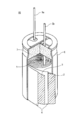
- FIG. 1 is a perspective view in which a part of the electrochemical device according to the embodiment of the present invention is cut out.
- the electrolytic solution for an electrochemical device contains a solvent, an ionic substance, and an additive, and the additive is ⁇ -methyl- ⁇ -butyrolactone (hereinafter referred to as AMGBL). And ⁇ -valerolactone (hereinafter referred to as DVL).
- AMGBL ⁇ -methyl- ⁇ -butyrolactone
- DVL ⁇ -valerolactone
- a high-quality film derived from AMGBL and DVL is formed on the surface of the negative electrode active material during charging.
- the formation of the above-mentioned film is prioritized on the negative electrode side over the reduction decomposition of a solvent such as ⁇ -butyrolactone.
- the total content of AMGBL and DVL in the electrolytic solution may be 3.5% by mass or less. It may be 0.1% by mass or more and 3.5% by mass or less, 0.1% by mass or more and 3.1% by mass or less, 0.1% by mass or more and 1.5% by mass or less. It may be 0.15% by mass or more and 1.5% by mass or less.
- the total content of AMGBL and DVL in the electrolytic solution is 3.1% by mass or less, a film derived from AMGBL and DVL is likely to be formed on the surface of the negative electrode active material with an appropriate thickness, and the resistance of the negative electrode is likely to be reduced. , It is easy to suppress the decrease in capacity due to the increase in negative electrode resistance.
- the total content of AMGBL and DVL in the electrolytic solution is 0.1% by mass or more, the effect of suppressing the decomposition of the solvent in the electrolytic solution during charging can be easily obtained.
- the content of AMGBL in the electrolytic solution may be 0.01% by mass or more and 3.5% by mass or less, and may be 0.05. It may be 5% by mass or more and 3% by mass or less, 0.05% by mass or more and 1% by mass or less, or 0.05% by mass or more and 0.5% by mass or less. From the same viewpoint as above, the content of DVL in the electrolytic solution may be 0.01% by mass or more and 3.5% by mass or less, and may be 0.05% by mass or more and 3% by mass or less. It may be 0.05% by mass or more and 1% by mass or less, or may be 0.05% by mass or more and 0.5% by mass or less.
- the mass ratio of DVL to AMGBL: (DVL / AMGBL) may be 0.03 or more and 70 or less, 0.03 or more and 60 or less, and 0.1 or more and 10 It may be as follows.
- the contents of AMGBL and DVL in the electrolytic solution and their total contents may be within the above ranges.
- a portion of AMGBL and DVL in the electrolyte can be consumed to form a coating on the surface of the negative electrode active material.
- the contents of AMGBL and DVL in the electrolytic solution and their total contents may be smaller than the above range, for example, a trace amount close to the detection limit. If AMGBL and DVL are present in the electrolytic solution in the electrochemical device, the effect of improving the performance of the electrochemical device corresponding to the presence can be obtained.
- the contents of AMGBL and DVL in the electrolytic solution and their total contents are determined by gas chromatography-mass spectrometry (GC / MS) or the like.
- a non-aqueous solvent is used as the solvent contained in the electrolytic solution.
- the non-aqueous solvent include cyclic carbonate compounds, lactone compounds other than AMGBL and DVL, sulfoxide compounds, sulfone compounds, amide compounds, chain carbonate compounds, chain ether compounds, cyclic ether compounds, chain carboxylic acid ester compounds and the like. Be done.
- the non-aqueous solvent one type may be used alone, or two or more types may be used in combination.
- the non-aqueous solvent is at least one solvent having a high relative permittivity selected from the group consisting of a cyclic carbonate compound, a lactone compound, a sulfoxide compound, a sulfone compound and an amide compound. It may be included.
- the non-aqueous solvent is at least one selected from the group consisting of a chain carbonate compound, a chain ether compound, a cyclic ether compound and a chain carboxylic acid ester compound. It may contain a low viscosity solvent of the seed.
- Cyclic carbonate compounds include, for example, ethylene carbonate, 1,2-propylene carbonate, 1,3-propylene carbonate (PC), 1,2-butylene carbonate, 1,3-butylene carbonate, fluoroethylene carbonate and the like.
- the chain carbonate compound includes, for example, dimethyl carbonate, ethylmethyl carbonate, diethyl carbonate and the like.
- Lactones other than AMGBL and DVL include, for example, ⁇ -butyrolactone (GBL), ⁇ -valerolactone, ⁇ -caprolactone, ⁇ -hexanolactone, ⁇ -octanolactone and the like.
- Nitrile compounds include, for example, acetonitrile (AN), propionitrile and the like.
- the amide compound includes N-methylacetamide, N, N-dimethylacetamide, N, N-dimethylformamide, N-methyl-2-pyrrolidone and the like.
- the sulfoxide compound includes, for example, dimethyl sulfoxide, diethyl sulfoxide, diphenyl sulfoxide, thiophene and the like.
- Sulfone compounds include methyl sulfone, diethyl sulfone, diphenyl sulfone, sulfolane, 3-methyl sulfolane, 2,4-dimethyl sulfolane, sulfolene, 3-methyl sulfurene, 3-ethyl sulfurene and the like.
- the cyclic ether compound contains, for example, tetrahydrofuran, 1,3-dioxolane, 1,4-dioxane and the like.
- the chain ether compound includes, for example, 1,2-dimethoxyethane, ethoxymethoxyethane, 1,2-diethoxyethane, ethylene glycol bis (trifluoroethyl) ether, ethylene glycol bis (trifluoromethyl) ether and the like.
- the chain carboxylic acid ester compound contains methyl formate, ethyl formate, methyl acetate, ethyl acetate, methyl propionate, and ethyl propionate.
- a polyhydric alcohol compound such as ethylene glycol and propylene glycol
- a ketone compound such as methyl ethyl ketone, formaldehyde and the like may be used.
- the solvent preferably contains at least one selected from the group consisting of GBL, AN and PC, and more preferably contains GBL.
- the film derived from AMGBL and DVL is likely to be preferentially formed during charging, and the effect of including AMGBL and DVL in the electrolytic solution can be remarkably obtained.
- the detailed reason for this is unknown, but in the case of GBL, it is presumed that the fact that it is a lactone as well as AMGBL and DVL has an effect.
- GBL is excellent in chemical stability and thermal stability.
- AN has a low viscosity and is advantageous in terms of improving the mobility of ions in the electrolytic solution.
- the ratio of GBL in the solvent is preferably 80% by volume or more, more preferably 90% by volume or more.
- the ratio of AN in the solvent is preferably 80% by volume or more, more preferably 90% by volume or more.
- the proportion of PC in the solvent is preferably 70% by volume or more, more preferably 90% by volume or more.
- the solvent may be a mixed solvent of AN and PC.
- the ratio of AN to the mixed solvent is preferably 80% by volume or more and 95% by volume or less.
- the solvent may be a mixed solvent of GBL and PC.
- the ratio of GBL to the mixed solvent is preferably 80% by volume or more and 95% by volume or less.
- the solvent may be a mixed solvent of AN and GBL.
- the ratio of AN to the mixed solvent (total of AN and GBL) is preferably 80% by volume or more and 95% by volume or less.
- a mixed solvent of AN and GBL is preferable from the viewpoint of suppressing an increase in internal resistance due to decomposition and deterioration of the electrolytic solution during charging.
- the ionic substance is dissolved in the solvent and contains cations and anions.
- the ionic substance may contain, for example, a low melting point compound (ionic liquid) that can exist as a liquid near room temperature.
- a low melting point compound ionic liquid
- the cation and the anion one kind may be used alone, or two or more kinds may be used in combination.
- the cation includes, for example, an organic cation such as a quaternary ammonium cation and a quaternary phosphonium cation.
- Quaternary ammonium cations include, for example, cations derived from aliphatic amines, alicyclic amines, and aromatic amines. Specific examples include, for example, diethyldimethylammonium (DEDMA) cation, triethylmethylammonium (TEMA) cation, tetraethylammonium (TEA) cation, tetramethylammonium cation, trimethylethylammonium cation, trimethylpropylammonium cation and the like.
- DEDMA diethyldimethylammonium
- TMA tetraethylammonium
- tetramethylammonium cation trimethylethylammonium cation
- the quaternary ammonium cation may contain a cation derived from a cyclic amine (a cation having a nitrogen-containing heterocycle).
- a cation having a nitrogen-containing heterocycle examples include cations having a skeleton such as imidazole, pyridine, pyrrolidine, and piperidine.
- Examples of the cation having an imidazole skeleton include 1,3-dimethylimidazolium cation, 1-ethyl-3-methylimidazolium cation, 1,3-diethylimidazolium cation, 1,2,3-. Examples thereof include trimethylimidazolium cations, 1,2,3,4-tetramethylimidazolium cations and the like.
- Examples of the cation having a pyridine skeleton (pyridiniums) include 1-methylpyridinium cation, 1-ethylpyridinium cation, 1-butylpyridinium cation and the like.
- Examples of the cation having a pyrrolidine skeleton include 1,1-dimethylpyrrolidinium cation, 1-ethyl-1-methylpyrrolidinium cation, 1,1-diethylpyrrolidinium cation and the like.
- Examples of the cation having a piperidine skeleton include 1,1-dimethylpiperidinium cation, 1-ethyl-1-methylpiperidinium cation, 1,1-diethylpiperidinium cation and the like. Be done.
- the quaternary ammonium cation may contain a cation having a spiro skeleton in which the spiro atom is a nitrogen atom (two rings share and are linked to one nitrogen atom).
- a spiro- (1,1') -bipyrrolidinium (SBP) cation a spiro- (1,1') -bipiperidinium cation, and the like.
- the quaternary ammonium cation may also contain a cation having a 1,4-diazabicyclo [2.2.2] octane (DABCO) skeleton.
- DABCO 1,4-diazabicyclo [2.2.2] octane
- Specific examples include N-methyl-1,4-diazabicyclo [2.2.2] octaneammonium cations and the like.
- the quaternary phosphonium cation includes, for example, a tetraalkylphosphonium cation or the like.
- the tetraalkylphosphonium cation includes, for example, a tetramethylphosphonium cation, a tetraethylphosphonium cation, and the like.
- the cation may contain an inorganic cation such as a metal ion.
- the metal ion includes, for example, an alkali metal ion, an alkaline earth metal ion, and the like.
- the alkali metal ion includes, for example, lithium ion, sodium ion, potassium ion and the like.
- Alkaline earth metal ions include magnesium ions, calcium ions and the like.
- Anion for example, BF 4 -, PF 6 - , AsF 6 -, SbF 6 -, N (FSO 2) 2 -, F -, Cl -, Br -, I -, NO 3 -, NO 2 -, ClO 4 -, AlCl 4 -, AlF 4 -, TaF 6 -, NbF 6 -, SiF 6 -, CN - containing inorganic anions such.
- anion preferably includes an anion of a fluorine-containing acid, BF 4 - and / or PF 6 - is more preferable to contain, BF 4 - it is further preferable to include.
- anions, N (RfSO 3) 2 - , C (RfSO 2) 3 -, RfSO 3 -, CH 3 BF 3 - may include organic anions such.
- Rf is a fluoroalkyl group having 1 to 12 carbon atoms.
- Rf contains a trifluoromethyl group (CF 3 ), a pentafluoroethyl group (C 2 F 5 ) and the like.
- the ionic substance preferably contains a salt (organic salt) in which at least one of a cation and an anion contains an organic substance.
- the organic salt preferably contains a quaternary ammonium salt. Quaternary ammonium salt, a quaternary ammonium cation, the anion of a fluorine-containing acids (in particular BF 4 -) and preferably contains a.
- quaternary ammonium salt examples include diethyldimethylammonium tetrafluoroborate (DODABF 4 ), triethylmethylammonium tetrafluoroborate (TEMABF 4 ), tetraethylammonium tetrafluoroborate (TEABF 4 ), and spiro-.
- DODABF 4 diethyldimethylammonium tetrafluoroborate
- TEMABF 4 triethylmethylammonium tetrafluoroborate
- TEABF 4 tetraethylammonium tetrafluoroborate
- spiro- examples include diethyldimethylammonium tetrafluoroborate (DODABF 4 ), triethylmethylammonium tetrafluoroborate (TEMABF 4 ), tetraethylammonium tetrafluoroborate (TEABF 4 ), and spir
- DEDDMABF 4 , EMPyBF 4 and DMPyBF 4 are preferable, and DEDDMABF 4 and EMPyBF 4 are more preferable, from the viewpoint of excellent oxidation resistance and reduction resistance.
- the concentration of the ionic substance in the electrolytic solution is, for example, 0.5 mol / L or more and 2.0 mol / L or less.
- concentration of the ionic substance in the electrolytic solution is within the above range, it is easy to obtain an electrochemical device having a large capacity and a small internal resistance.
- the electrochemical device includes a pair of electrodes and an electrolytic solution, and the electrolytic solution is the above-mentioned electrolytic solution for an electrochemical device.
- One of the pair of electrodes is a positive electrode and the other of the pair of electrodes is a negative electrode.
- Examples of the electrochemical device include an electric double layer capacitor and a lithium ion capacitor.
- At least one of the pair of electrodes may include an active layer and a current collector that supports the active layer.
- the active layer contains an active material capable of adsorbing and desorbing ions, and contains a carbon material as the active material.
- each of the pair of electrodes positive electrode and negative electrode
- each of the pair of electrodes positive electrode and negative electrode
- one of the pair of electrodes positive electrode
- one of the pair of electrodes may include an active layer and a current collector supporting the active layer.
- the negative electrode used in the lithium ion secondary battery can be used for the other (negative electrode) of the pair of electrodes.
- the negative electrode used in a lithium ion secondary battery contains a negative electrode active material (eg, graphite) capable of occluding and releasing lithium ions.
- the active layer contains a carbon material as an active material as an essential component, and may contain a binder, a conductive agent, etc. as an optional component.
- a carbon material for example, activated carbon, carbon nanotubes, graphite, graphene and the like are used. Of these, activated carbon is preferable as the carbon material.
- raw materials for activated charcoal include wood, coconut shells, pulp effluent, coal-based pitch obtained by pyrolysis of coal or its, petroleum-based pitch obtained by heavy oil or its thermal decomposition, phenolic resin, petroleum coke, and coal coke. And so on.
- the activated carbon is preferably activated.
- binder for example, a resin material such as polytetrafluoroethylene (PTFE), carboxymethyl cellulose (CMC), and styrene-butadiene rubber (SBR) are used.
- PTFE polytetrafluoroethylene
- CMC carboxymethyl cellulose
- SBR styrene-butadiene rubber
- carbon black such as acetylene black is used.
- a slurry containing a carbon material, a binder and / or a conductive agent, and a dispersion medium is applied to the surface of the current collector, the coating film is dried, and the coating film is rolled to form an active layer. Obtained by forming.
- a metal foil such as an aluminum foil is used.
- the separator has ion permeability and has a role of physically separating a pair of electrodes to prevent a short circuit.
- a separator for example, a non-woven fabric containing cellulose as a main component, a glass fiber mat, a microporous film of polyolefin such as polyethylene is used.
- FIG. 1 is a perspective view in which a part of the electrochemical device according to the embodiment of the present invention is cut out.
- the present invention is not limited to the electrochemical device shown in FIG.
- the electrochemical device 10 of FIG. 1 is an electric double layer capacitor and includes a winding type capacitor element 1.
- the capacitor element 1 is configured by winding a sheet-shaped first electrode 2 and a second electrode 3 via a separator 4, respectively.
- the first electrode 2 and the second electrode 3 have a first current collector and a second current collector made of metal, and a first active layer and a second active layer supported on the surface thereof, respectively, and adsorb ions. And the capacity is expressed by desorption.
- the current collector for example, an aluminum foil is used.
- the surface of the current collector may be roughened by a method such as etching.
- the separator 4 for example, a non-woven fabric containing cellulose as a main component is used.
- a first lead wire 5a and a second lead wire 5b are connected to the first electrode 2 and the second electrode 3 as lead-out members, respectively.
- the capacitor element 1 is housed in a cylindrical outer case 6 together with an electrolytic solution (not shown).
- the material of the outer case 6 may be, for example, a metal such as aluminum, stainless steel, copper, iron, or brass.
- the opening of the outer case 6 is sealed by the sealing member 7.
- the lead wires 5a and 5b are led out to the outside so as to penetrate the sealing member 7.
- a rubber material such as butyl rubber is used.
- wound capacitor has been described in the above embodiment, the scope of application of the present invention is not limited to the above, and the present invention may be applied to a capacitor having another structure, for example, a laminated capacitor or a coin capacitor.
- Example 1 As an electrochemical device, a wound electric double layer capacitor ( ⁇ 18 mm ⁇ L (length) 70 mm) having a rated voltage of 2.8 V was manufactured. The specific manufacturing method of the electrochemical device will be described below.
- Electrodes 88 parts by mass of activated carbon as a carbon material, 6 parts by mass of polytetrafluoroethylene as a binder, and 6 parts by mass of acetylene black as a conductive agent were dispersed in water to prepare a slurry. The obtained slurry was applied to an Al foil (thickness 30 ⁇ m), the coating film was dried at 110 ° C., and rolled to form an active layer (thickness 40 ⁇ m) to obtain an electrode.
- a pair of electrodes are prepared, lead wires are connected to each, and a capacitor element is formed by winding through a separator made of cellulose non-woven fabric, and the capacitor element is housed together with an electrolytic solution in a predetermined outer case and sealed with a sealing member.
- the electrochemical device (electric double layer capacitor) A1 was completed. Then, while applying the rated voltage, the aging treatment was performed at 60 ° C. for 16 hours.
- the electrochemical device A1 obtained above was evaluated as follows. [evaluation] (Measurement of capacitance and electrical resistance of electrochemical device before storage) In an environment of ⁇ 30 ° C., constant current charging was performed with a current of 1.5 A until the voltage reached 2.8 V, and then the voltage of 2.8 V was maintained for 7 minutes. Then, in an environment of ⁇ 30 ° C., constant current discharge was performed with a current of 1.35 A until the voltage became 0 V.
- Capacitance C1 Id ⁇ t / V (1)
- Id is the current value at the time of discharge (1.35A)
- V is the value obtained by subtracting 1.12V from 2.24V (1.12V).
- Capacity retention rate (%) (capacitance C2 / capacitance C1) x 100 (3)
- Resistance increase rate (%) (electrical resistance R2 / electric resistance R1) x 100 (4)
- Comparative Example 1 The electrochemical device B1 of Comparative Example 1 was prepared and evaluated by the same method as that of the electrochemical device A1 of Example 1 except that the electrolytic solution did not contain additives (AMGBL and DVL).
- Comparative Example 2 >> The electrochemical device B2 of Comparative Example 2 was prepared and evaluated by the same method as that of the electrochemical device A1 of Example 1 except that the electrolytic solution did not contain DVL.
- Comparative Example 3 The electrochemical device B3 of Comparative Example 3 was prepared and evaluated by the same method as that of the electrochemical device A1 of Example 1 except that the electrolytic solution did not contain AMGBL.
- Table 1 shows the evaluation results of the electrochemical devices A1 and B1 to B3.
- the electrochemical device A1 In the electrochemical device A1, a large capacity retention rate and a small resistance increase rate were obtained, and the reliability was greatly improved.
- the electrochemical device A1 by including both AMGBL and DVL in the electrolytic solution, decomposition and deterioration of the electrolytic solution were significantly suppressed during storage in a charged state to which a voltage of 2.8 V was applied. Therefore, after the electrochemical device A1 was stored, the decrease in capacitance was suppressed and the increase in electrical resistance was suppressed.
- Examples 2 to 13 >> The electrochemical devices A2 to A13 of Examples 2 to 13 were prepared by the same method as the electrochemical device A1 of Example 1 except that the AMGBL content and the DVL content in the electrolytic solution were set to the values shown in Table 2. ,evaluated.
- Table 2 shows the evaluation results of the electrochemical devices A2 to A13. Table 2 also shows the evaluation results of the electrochemical device A1.
- Examples 14 to 21 >> It was used in place of DEDMABF 4 1- ethyl-1-methyl-pyrrolidinium tetrafluoroborate (EMPyBF 4).
- EMPyBF 4 ethyl-1-methyl-pyrrolidinium tetrafluoroborate
- the AMGBL content and DVL content in the electrolytic solution were set to the values shown in Table 3.
- the electrochemical devices A14 to A21 of Examples 14 to 21 were prepared and evaluated by the same method as that of the electrochemical device A1 of Example 1. Table 3 shows the evaluation results of the electrochemical devices A14 to A21.
- Examples 22 to 26 The electrochemical devices A22 to A26 of Examples 22 to 26 were prepared and evaluated by the same method as that of the electrochemical device A3 of Example 3 except that the ionic substances shown in Table 4 were used instead of DEDDMABF 4.
- TEABF 4 is tetraethylammonium tetrafluoroborate
- TEMABF 4 is triethylmethylammonium tetrafluoroborate
- SBPBF 4 is spiro- (1,1') -bipyrrolidinium tetrafluoro. Borate.
- DMPyBF 4 is 1,1-dimethylpyrrolidinium tetrafluoroborate.
- Table 4 shows the evaluation results of the electrochemical devices A22 to A26. Table 4 also shows the evaluation results of the electrochemical device A3.
- All of the electrochemical devices A22 to A26 obtained a large capacity retention rate and a small resistance increase rate.
- Examples 27 to 29 >> The electrochemical devices A27 to A29 of Examples 27 to 29 were prepared by the same method as the electrochemical devices A3, A22 and A23 of Examples 3, 22 and 23 except that acetonitrile (AN) was used instead of GBP. ,evaluated.
- AN acetonitrile
- Comparative Example 4 The electrochemical device B4 of Comparative Example 4 was prepared by the same method as that of the electrochemical device A3 of Example 3 except that AN was used instead of GBL and the electrolytic solution did not contain additives (AMGBL and DVL). ,evaluated.
- Examples 30 to 32 The electrochemical devices A30 to A32 of Examples 30 to 32 were prepared by the same method as the electrochemical devices A3, A22 and A23 of Examples 3, 22 and 23 except that propylene carbonate (PC) was used instead of GBP. And evaluated.
- PC propylene carbonate
- Comparative Example 5 The electrochemical device B5 of Comparative Example 5 was prepared by the same method as that of the electrochemical device A3 of Example 3 except that a PC was used instead of GBL and the electrolytic solution did not contain additives (AMGBL and DVL). ,evaluated.
- Table 5 shows the evaluation results of the electrochemical devices A27 to A32 and B4 to B5.
- All of the electrochemical devices A27 to A32 obtained a large capacity retention rate and a small resistance increase rate.
- the electrolytic solution did not contain additives (AMGBL and DVL), a small capacity retention rate and a large resistance increase rate were obtained.
- Example 33 The electrochemical device A33 of Example 33 was prepared and evaluated by the same method as that of the electrochemical device A3 of Example 3 except that a mixed solvent of AN and PC (volume ratio 95: 5) was used instead of GBL. ..
- Example 34 The electrochemical device A34 of Example 34 was prepared and evaluated by the same method as that of the electrochemical device A3 of Example 3 except that a mixed solvent of GBL and PC (volume ratio 95: 5) was used instead of GBL. ..
- Example 35 The electrochemical device A35 of Example 35 was prepared and evaluated by the same method as that of the electrochemical device A3 of Example 3 except that a mixed solvent of AN and GBL (volume ratio 95: 5) was used instead of GBL. ..
- Table 6 shows the evaluation results of the electrochemical devices A33 to A35.
- All of the electrochemical devices A33 to A35 obtained a large capacity retention rate and a small resistance increase rate.
- Comparative Examples 6 to 8 >> The electrochemical devices B6 to B8 of Comparative Examples 6 to 8 were prepared by the same method as the electrochemical device A3 of Example 3 except that the compounds shown in Table 7 were used instead of AMGBL together with DVL as an additive. ,evaluated.
- Comparative Example 9 The electrochemical device B9 of Comparative Example 9 was prepared and evaluated by the same method as that of the electrochemical device A3 of Example 3 except that ⁇ -valerolactone was used instead of DVL together with AMGBL as an additive.
- Table 7 shows the evaluation results of the electrochemical devices B6 to B9. Table 7 also shows the evaluation results of the electrochemical device A3.
- the numerical values in parentheses in the column of additives in Table 7 indicate the content in the electrolytic solution.
- the electrolytic solution according to the present invention is suitably used for an electrochemical device that requires high reliability.
- Capacitor element 2 1st electrode 3: 2nd electrode 4: Separator 5a: 1st lead wire 5b: 2nd lead wire, 6: Exterior case, 7: Sealing member, 10: Electrochemical device
Landscapes
- Engineering & Computer Science (AREA)
- Power Engineering (AREA)
- Chemical & Material Sciences (AREA)
- Chemical Kinetics & Catalysis (AREA)
- Electrochemistry (AREA)
- Microelectronics & Electronic Packaging (AREA)
- Materials Engineering (AREA)
- Physics & Mathematics (AREA)
- Condensed Matter Physics & Semiconductors (AREA)
- General Physics & Mathematics (AREA)
- Inorganic Chemistry (AREA)
- Manufacturing & Machinery (AREA)
- General Chemical & Material Sciences (AREA)
- Electric Double-Layer Capacitors Or The Like (AREA)
- Secondary Cells (AREA)
Priority Applications (2)
| Application Number | Priority Date | Filing Date | Title |
|---|---|---|---|
| JP2022526918A JP7731074B2 (ja) | 2020-05-26 | 2021-05-18 | 電気化学デバイス用電解液および電気化学デバイス |
| US17/998,270 US11948741B2 (en) | 2020-05-26 | 2021-05-18 | Electrolyte solution for electrochemical device, and electrochemical device |
Applications Claiming Priority (2)
| Application Number | Priority Date | Filing Date | Title |
|---|---|---|---|
| JP2020091693 | 2020-05-26 | ||
| JP2020-091693 | 2020-05-26 |
Publications (1)
| Publication Number | Publication Date |
|---|---|
| WO2021241333A1 true WO2021241333A1 (ja) | 2021-12-02 |
Family
ID=78744547
Family Applications (1)
| Application Number | Title | Priority Date | Filing Date |
|---|---|---|---|
| PCT/JP2021/018827 Ceased WO2021241333A1 (ja) | 2020-05-26 | 2021-05-18 | 電気化学デバイス用電解液および電気化学デバイス |
Country Status (3)
| Country | Link |
|---|---|
| US (1) | US11948741B2 (https=) |
| JP (1) | JP7731074B2 (https=) |
| WO (1) | WO2021241333A1 (https=) |
Families Citing this family (1)
| Publication number | Priority date | Publication date | Assignee | Title |
|---|---|---|---|---|
| JP7731074B2 (ja) * | 2020-05-26 | 2025-08-29 | パナソニックIpマネジメント株式会社 | 電気化学デバイス用電解液および電気化学デバイス |
Citations (6)
| Publication number | Priority date | Publication date | Assignee | Title |
|---|---|---|---|---|
| JP2003163031A (ja) * | 2001-09-12 | 2003-06-06 | Daicel Chem Ind Ltd | 電解液及び非水電気化学装置、並びにα−置換オキシ−γ−ブチロラクトン誘導体 |
| JP2009054884A (ja) * | 2007-08-28 | 2009-03-12 | Bridgestone Corp | キャパシタ用非水電解液及びそれを備えた非水電解液キャパシタ |
| JP2015073014A (ja) * | 2013-10-03 | 2015-04-16 | 三洋化成工業株式会社 | キャパシタ用電解液、およびそれを用いたキャパシタ |
| JP2016184572A (ja) * | 2015-03-26 | 2016-10-20 | パナソニック株式会社 | 電気化学エネルギー蓄積デバイス |
| JP2017028230A (ja) * | 2015-07-28 | 2017-02-02 | カーリットホールディングス株式会社 | 電気二重層キャパシタ用電解液及び電気二重層キャパシタ |
| JP2017069390A (ja) * | 2015-09-30 | 2017-04-06 | ニチコン株式会社 | 電解コンデンサおよびその製造方法 |
Family Cites Families (11)
| Publication number | Priority date | Publication date | Assignee | Title |
|---|---|---|---|---|
| CN100394522C (zh) * | 2001-05-11 | 2008-06-11 | 三菱化学株式会社 | 电解电容器用电解液及使用该电解液的电解电容器 |
| JP4910497B2 (ja) * | 2005-06-30 | 2012-04-04 | 本田技研工業株式会社 | 電気二重層キャパシタ用電解液および電気二重層キャパシタ |
| KR102050964B1 (ko) * | 2012-11-12 | 2019-12-02 | 선천 캡쳄 테크놀로지 컴퍼니 리미티드 | 비수성 전해질 용액 및 이를 포함하는 전기화학 전지 |
| JP6357639B2 (ja) | 2013-10-31 | 2018-07-18 | パナソニックIpマネジメント株式会社 | キャパシタ |
| US9698447B2 (en) * | 2013-11-18 | 2017-07-04 | Basf Corporation | Use of lithium bis(fluorosulfonyl) imide (LiFSI) in non-aqueous electrolyte solutions for use with 4.2v and higher cathode materials for lithium ion batteries |
| JP2015195191A (ja) * | 2014-03-26 | 2015-11-05 | 東レ株式会社 | ラミネート電池およびラミネート電池用外装材 |
| JP6317639B2 (ja) * | 2014-07-18 | 2018-04-25 | 三菱製紙株式会社 | 電気化学素子用セパレータの製造方法 |
| JP6365082B2 (ja) * | 2014-08-01 | 2018-08-01 | セントラル硝子株式会社 | 非水電解液電池用電解液、及びこれを用いた非水電解液電池 |
| CN109478472B (zh) * | 2016-07-29 | 2022-02-22 | 大塚化学株式会社 | 电化学设备用电解质、电解液以及电化学设备 |
| JP2019175774A (ja) * | 2018-03-29 | 2019-10-10 | ダイキン工業株式会社 | 電解液、電気化学デバイス、リチウムイオン二次電池及びモジュール |
| JP7731074B2 (ja) * | 2020-05-26 | 2025-08-29 | パナソニックIpマネジメント株式会社 | 電気化学デバイス用電解液および電気化学デバイス |
-
2021
- 2021-05-18 JP JP2022526918A patent/JP7731074B2/ja active Active
- 2021-05-18 US US17/998,270 patent/US11948741B2/en active Active
- 2021-05-18 WO PCT/JP2021/018827 patent/WO2021241333A1/ja not_active Ceased
Patent Citations (6)
| Publication number | Priority date | Publication date | Assignee | Title |
|---|---|---|---|---|
| JP2003163031A (ja) * | 2001-09-12 | 2003-06-06 | Daicel Chem Ind Ltd | 電解液及び非水電気化学装置、並びにα−置換オキシ−γ−ブチロラクトン誘導体 |
| JP2009054884A (ja) * | 2007-08-28 | 2009-03-12 | Bridgestone Corp | キャパシタ用非水電解液及びそれを備えた非水電解液キャパシタ |
| JP2015073014A (ja) * | 2013-10-03 | 2015-04-16 | 三洋化成工業株式会社 | キャパシタ用電解液、およびそれを用いたキャパシタ |
| JP2016184572A (ja) * | 2015-03-26 | 2016-10-20 | パナソニック株式会社 | 電気化学エネルギー蓄積デバイス |
| JP2017028230A (ja) * | 2015-07-28 | 2017-02-02 | カーリットホールディングス株式会社 | 電気二重層キャパシタ用電解液及び電気二重層キャパシタ |
| JP2017069390A (ja) * | 2015-09-30 | 2017-04-06 | ニチコン株式会社 | 電解コンデンサおよびその製造方法 |
Also Published As
| Publication number | Publication date |
|---|---|
| US20230230777A1 (en) | 2023-07-20 |
| US11948741B2 (en) | 2024-04-02 |
| JP7731074B2 (ja) | 2025-08-29 |
| JPWO2021241333A1 (https=) | 2021-12-02 |
Similar Documents
| Publication | Publication Date | Title |
|---|---|---|
| TWI409834B (zh) | Electrolyte for electrochemical components and electrochemical components for use | |
| US7436651B2 (en) | Electric double layer capacitor and electrolytic solution therefor | |
| JP2012074528A (ja) | 電気二重層キャパシタ用電解液およびこれを用いた電気二重層キャパシタ | |
| US20240128031A1 (en) | Electrochemical capacitor | |
| KR100836550B1 (ko) | 전기화학 캐패시터용 전해액 및 이를 사용한 전기화학캐패시터 | |
| EP3188203A1 (en) | Electrolyte solution and electrochemical device | |
| JP7731074B2 (ja) | 電気化学デバイス用電解液および電気化学デバイス | |
| KR102104687B1 (ko) | 커패시터용 전해액, 전기 이중층 커패시터 및 리튬 이온 커패시터 | |
| JP5275011B2 (ja) | 第4級アンモニウム塩電解質を用いた電解液および電気化学素子 | |
| US11114695B2 (en) | Electrolyte for electrochemical device, electrolytic solution, and electrochemical device | |
| JP2003173936A (ja) | 電気化学キャパシタ用電解液およびそれを用いた電気化学キャパシタ | |
| JP2008277503A (ja) | 電気二重層キャパシタ用電解液及び電気二重層キャパシタ | |
| JPH1154376A (ja) | 電気二重層コンデンサ | |
| JP2012109539A (ja) | 電気二重層キャパシタ用電解液およびこれを用いた電気二重層キャパシタ | |
| JP2011192963A (ja) | 電気二重層キャパシタ用電解液およびこれを用いた電気二重層キャパシタ | |
| JP4997151B2 (ja) | 電気化学素子用電解液及びこれを用いた電気化学素子 | |
| JP5086903B2 (ja) | 電気化学キャパシタ用電解液及びこれを用いた電気化学キャパシタ | |
| KR20110060253A (ko) | 전해질 용액 및 이를 포함하는 초고용량 커패시터 | |
| JP2012129270A (ja) | 電気二重層キャパシタ用電解液及び電気二重層キャパシタ | |
| JP2003324038A (ja) | 電気化学キャパシタ用電解液及びそれを用いた電気化学キャパシタ | |
| JP2003173934A (ja) | 電気化学キャパシタ用電解液およびそれを用いた電気化学キャパシタ | |
| JP2003173935A (ja) | 電気化学キャパシタ用電解液およびそれを用いた電気化学キャパシタ | |
| JP2008091823A (ja) | 電気二重層キャパシタ用電解液及び電気二重層キャパシタ | |
| JP4707425B2 (ja) | 電気二重層キャパシタ用電解質及び電気二重層キャパシタ | |
| JP2012069931A (ja) | 電気二重層キャパシタ用電解液およびこれを用いた電気二重層キャパシタ |
Legal Events
| Date | Code | Title | Description |
|---|---|---|---|
| 121 | Ep: the epo has been informed by wipo that ep was designated in this application |
Ref document number: 21812557 Country of ref document: EP Kind code of ref document: A1 |
|
| ENP | Entry into the national phase |
Ref document number: 2022526918 Country of ref document: JP Kind code of ref document: A |
|
| NENP | Non-entry into the national phase |
Ref country code: DE |
|
| 122 | Ep: pct application non-entry in european phase |
Ref document number: 21812557 Country of ref document: EP Kind code of ref document: A1 |