WO2021240298A1 - 二次電池および車両 - Google Patents
二次電池および車両 Download PDFInfo
- Publication number
- WO2021240298A1 WO2021240298A1 PCT/IB2021/054234 IB2021054234W WO2021240298A1 WO 2021240298 A1 WO2021240298 A1 WO 2021240298A1 IB 2021054234 W IB2021054234 W IB 2021054234W WO 2021240298 A1 WO2021240298 A1 WO 2021240298A1
- Authority
- WO
- WIPO (PCT)
- Prior art keywords
- negative electrode
- secondary battery
- active material
- positive electrode
- electrode active
- Prior art date
- Legal status (The legal status is an assumption and is not a legal conclusion. Google has not performed a legal analysis and makes no representation as to the accuracy of the status listed.)
- Ceased
Links
Images









Classifications
-
- H—ELECTRICITY
- H01—ELECTRIC ELEMENTS
- H01M—PROCESSES OR MEANS, e.g. BATTERIES, FOR THE DIRECT CONVERSION OF CHEMICAL ENERGY INTO ELECTRICAL ENERGY
- H01M10/00—Secondary cells; Manufacture thereof
- H01M10/05—Accumulators with non-aqueous electrolyte
- H01M10/052—Li-accumulators
-
- H—ELECTRICITY
- H01—ELECTRIC ELEMENTS
- H01M—PROCESSES OR MEANS, e.g. BATTERIES, FOR THE DIRECT CONVERSION OF CHEMICAL ENERGY INTO ELECTRICAL ENERGY
- H01M4/00—Electrodes
- H01M4/02—Electrodes composed of, or comprising, active material
- H01M4/13—Electrodes for accumulators with non-aqueous electrolyte, e.g. for lithium-accumulators; Processes of manufacture thereof
-
- H—ELECTRICITY
- H01—ELECTRIC ELEMENTS
- H01M—PROCESSES OR MEANS, e.g. BATTERIES, FOR THE DIRECT CONVERSION OF CHEMICAL ENERGY INTO ELECTRICAL ENERGY
- H01M10/00—Secondary cells; Manufacture thereof
- H01M10/05—Accumulators with non-aqueous electrolyte
- H01M10/056—Accumulators with non-aqueous electrolyte characterised by the materials used as electrolytes, e.g. mixed inorganic/organic electrolytes
- H01M10/0561—Accumulators with non-aqueous electrolyte characterised by the materials used as electrolytes, e.g. mixed inorganic/organic electrolytes the electrolyte being constituted of inorganic materials only
- H01M10/0562—Solid materials
-
- H—ELECTRICITY
- H01—ELECTRIC ELEMENTS
- H01M—PROCESSES OR MEANS, e.g. BATTERIES, FOR THE DIRECT CONVERSION OF CHEMICAL ENERGY INTO ELECTRICAL ENERGY
- H01M10/00—Secondary cells; Manufacture thereof
- H01M10/05—Accumulators with non-aqueous electrolyte
- H01M10/056—Accumulators with non-aqueous electrolyte characterised by the materials used as electrolytes, e.g. mixed inorganic/organic electrolytes
- H01M10/0564—Accumulators with non-aqueous electrolyte characterised by the materials used as electrolytes, e.g. mixed inorganic/organic electrolytes the electrolyte being constituted of organic materials only
- H01M10/0566—Liquid materials
-
- H—ELECTRICITY
- H01—ELECTRIC ELEMENTS
- H01M—PROCESSES OR MEANS, e.g. BATTERIES, FOR THE DIRECT CONVERSION OF CHEMICAL ENERGY INTO ELECTRICAL ENERGY
- H01M4/00—Electrodes
- H01M4/02—Electrodes composed of, or comprising, active material
- H01M4/04—Processes of manufacture in general
- H01M4/0402—Methods of deposition of the material
- H01M4/0404—Methods of deposition of the material by coating on electrode collectors
-
- H—ELECTRICITY
- H01—ELECTRIC ELEMENTS
- H01M—PROCESSES OR MEANS, e.g. BATTERIES, FOR THE DIRECT CONVERSION OF CHEMICAL ENERGY INTO ELECTRICAL ENERGY
- H01M4/00—Electrodes
- H01M4/02—Electrodes composed of, or comprising, active material
- H01M4/13—Electrodes for accumulators with non-aqueous electrolyte, e.g. for lithium-accumulators; Processes of manufacture thereof
- H01M4/139—Processes of manufacture
-
- H—ELECTRICITY
- H01—ELECTRIC ELEMENTS
- H01M—PROCESSES OR MEANS, e.g. BATTERIES, FOR THE DIRECT CONVERSION OF CHEMICAL ENERGY INTO ELECTRICAL ENERGY
- H01M4/00—Electrodes
- H01M4/02—Electrodes composed of, or comprising, active material
- H01M4/36—Selection of substances as active materials, active masses, active liquids
- H01M4/58—Selection of substances as active materials, active masses, active liquids of inorganic compounds other than oxides or hydroxides, e.g. sulfides, selenides, tellurides, halogenides or LiCoFy; of polyanionic structures, e.g. phosphates, silicates or borates
- H01M4/582—Halogenides
-
- H—ELECTRICITY
- H01—ELECTRIC ELEMENTS
- H01M—PROCESSES OR MEANS, e.g. BATTERIES, FOR THE DIRECT CONVERSION OF CHEMICAL ENERGY INTO ELECTRICAL ENERGY
- H01M4/00—Electrodes
- H01M4/02—Electrodes composed of, or comprising, active material
- H01M4/36—Selection of substances as active materials, active masses, active liquids
- H01M4/58—Selection of substances as active materials, active masses, active liquids of inorganic compounds other than oxides or hydroxides, e.g. sulfides, selenides, tellurides, halogenides or LiCoFy; of polyanionic structures, e.g. phosphates, silicates or borates
- H01M4/583—Carbonaceous material, e.g. graphite-intercalation compounds or CFx
- H01M4/587—Carbonaceous material, e.g. graphite-intercalation compounds or CFx for inserting or intercalating light metals
-
- H—ELECTRICITY
- H01—ELECTRIC ELEMENTS
- H01M—PROCESSES OR MEANS, e.g. BATTERIES, FOR THE DIRECT CONVERSION OF CHEMICAL ENERGY INTO ELECTRICAL ENERGY
- H01M4/00—Electrodes
- H01M4/02—Electrodes composed of, or comprising, active material
- H01M4/62—Selection of inactive substances as ingredients for active masses, e.g. binders, fillers
-
- H—ELECTRICITY
- H01—ELECTRIC ELEMENTS
- H01M—PROCESSES OR MEANS, e.g. BATTERIES, FOR THE DIRECT CONVERSION OF CHEMICAL ENERGY INTO ELECTRICAL ENERGY
- H01M4/00—Electrodes
- H01M4/02—Electrodes composed of, or comprising, active material
- H01M4/62—Selection of inactive substances as ingredients for active masses, e.g. binders, fillers
- H01M4/624—Electric conductive fillers
- H01M4/625—Carbon or graphite
-
- H—ELECTRICITY
- H01—ELECTRIC ELEMENTS
- H01M—PROCESSES OR MEANS, e.g. BATTERIES, FOR THE DIRECT CONVERSION OF CHEMICAL ENERGY INTO ELECTRICAL ENERGY
- H01M50/00—Constructional details or processes of manufacture of the non-active parts of electrochemical cells other than fuel cells, e.g. hybrid cells
- H01M50/10—Primary casings; Jackets or wrappings
- H01M50/14—Primary casings; Jackets or wrappings for protecting against damage caused by external factors
- H01M50/143—Fireproof; Explosion-proof
-
- H—ELECTRICITY
- H01—ELECTRIC ELEMENTS
- H01M—PROCESSES OR MEANS, e.g. BATTERIES, FOR THE DIRECT CONVERSION OF CHEMICAL ENERGY INTO ELECTRICAL ENERGY
- H01M4/00—Electrodes
- H01M4/02—Electrodes composed of, or comprising, active material
- H01M2004/026—Electrodes composed of, or comprising, active material characterised by the polarity
- H01M2004/027—Negative electrodes
-
- H—ELECTRICITY
- H01—ELECTRIC ELEMENTS
- H01M—PROCESSES OR MEANS, e.g. BATTERIES, FOR THE DIRECT CONVERSION OF CHEMICAL ENERGY INTO ELECTRICAL ENERGY
- H01M2220/00—Batteries for particular applications
- H01M2220/20—Batteries in motive systems, e.g. vehicle, ship, plane
-
- H—ELECTRICITY
- H01—ELECTRIC ELEMENTS
- H01M—PROCESSES OR MEANS, e.g. BATTERIES, FOR THE DIRECT CONVERSION OF CHEMICAL ENERGY INTO ELECTRICAL ENERGY
- H01M2300/00—Electrolytes
- H01M2300/0017—Non-aqueous electrolytes
- H01M2300/0065—Solid electrolytes
- H01M2300/0068—Solid electrolytes inorganic
- H01M2300/0071—Oxides
-
- H—ELECTRICITY
- H01—ELECTRIC ELEMENTS
- H01M—PROCESSES OR MEANS, e.g. BATTERIES, FOR THE DIRECT CONVERSION OF CHEMICAL ENERGY INTO ELECTRICAL ENERGY
- H01M2300/00—Electrolytes
- H01M2300/0017—Non-aqueous electrolytes
- H01M2300/0065—Solid electrolytes
- H01M2300/0068—Solid electrolytes inorganic
- H01M2300/008—Halides
-
- Y—GENERAL TAGGING OF NEW TECHNOLOGICAL DEVELOPMENTS; GENERAL TAGGING OF CROSS-SECTIONAL TECHNOLOGIES SPANNING OVER SEVERAL SECTIONS OF THE IPC; TECHNICAL SUBJECTS COVERED BY FORMER USPC CROSS-REFERENCE ART COLLECTIONS [XRACs] AND DIGESTS
- Y02—TECHNOLOGIES OR APPLICATIONS FOR MITIGATION OR ADAPTATION AGAINST CLIMATE CHANGE
- Y02E—REDUCTION OF GREENHOUSE GAS [GHG] EMISSIONS, RELATED TO ENERGY GENERATION, TRANSMISSION OR DISTRIBUTION
- Y02E60/00—Enabling technologies; Technologies with a potential or indirect contribution to GHG emissions mitigation
- Y02E60/10—Energy storage using batteries
Definitions
- the present invention relates to a secondary battery having an electrolyte and a method for producing the same. Or, it relates to a portable information terminal having a secondary battery, a vehicle, or the like.
- the uniformity of the present invention relates to a product, a method, or a manufacturing method.
- the invention relates to a process, machine, manufacture, or composition (composition of matter).
- One aspect of the present invention relates to a semiconductor device, a display device, a light emitting device, a power storage device, a lighting device, an electronic device, or a method for manufacturing the same.
- the electronic device refers to all devices having a power storage device, and the electro-optical device having the power storage device, the information terminal device having the power storage device, and the like are all electronic devices.
- a power storage device refers to an element having a power storage function and a device in general.
- a power storage device also referred to as a secondary battery
- a lithium ion secondary battery such as a lithium ion secondary battery, a lithium ion capacitor, an electric double layer capacitor, and the like.
- Lithium-ion secondary batteries which have particularly high output and high energy density, are portable information terminals such as mobile phones, smartphones, or notebook computers, portable music players, digital cameras, medical devices, or hybrid vehicles (HVs), and electric vehicles.
- HVs hybrid vehicles
- EVs electric vehicles
- PSVs plug-in hybrid vehicles
- Lithium-ion secondary batteries have a problem of charging and discharging in a low temperature state or a high temperature state. Since the secondary battery is a power storage means using a chemical reaction, it is difficult to exhibit sufficient performance especially at a low temperature below freezing point. Further, in the lithium ion secondary battery, the life of the secondary battery may be shortened at a high temperature, and an abnormality may occur.
- a secondary battery that can exhibit stable performance regardless of the environmental temperature during use or storage is desired.
- Patent Document 1 discloses a lithium ion secondary battery in which an organic compound having fluorine is used as the secondary battery.
- Silicon-based materials have a high capacity and are used as active materials for secondary batteries.
- the silicon material can be characterized by the chemical shift value obtained from the NMR spectrum (Patent Document 2).
- One aspect of the present invention is to provide a negative electrode that does not easily deteriorate.
- one aspect of the present invention is to provide a novel negative electrode.
- one aspect of the present invention is to provide a secondary battery that does not easily deteriorate.
- one aspect of the present invention is to provide a highly safe secondary battery.
- one aspect of the present invention is to provide a novel secondary battery.
- one aspect of the present invention is to provide a novel substance, active material particles, or a method for producing them.
- One aspect of the present invention is a secondary battery having a positive electrode and a negative electrode, and the negative electrode has a fluorine-containing solvent, a current collector, a negative electrode active material, and graphene.
- the negative electrode further contains a solid electrolyte material, and the solid electrolyte material is an oxide.
- the negative electrode active material preferably contains fluorine.
- the secondary battery preferably has a plurality of different electrolytes.
- the secondary battery preferably has a solvent that does not contain fluorine.
- the negative electrode active material is preferably a material having one or more elements selected from silicon, tin, gallium, aluminum, germanium, lead, antimony, bismuth, silver, zinc, cadmium and indium.
- one aspect of the present invention is a vehicle having the secondary battery according to any one of the above.
- the secondary battery can be used in a wide temperature range, specifically, ⁇ 40 ° C. or higher and 150 ° C. or lower. Therefore, even if the outside temperature of the vehicle equipped with the secondary battery of one aspect of the present invention is ⁇ 40 ° C. or higher and lower than 25 ° C., or 25 ° C. or higher and 85 ° C. or lower, the vehicle uses the secondary battery as a power source. Can be moved.
- the material used for the secondary battery flame-retardant or non-flammable it is possible to realize a secondary battery having high heat resistance and a secondary battery that does not burn. Further, it is also possible to provide a secondary battery whose safety is dramatically improved because the electrolyte contains fluorine.
- a negative electrode with less deterioration. Further, according to one aspect of the present invention, a novel negative electrode can be provided.
- a secondary battery with less deterioration. Further, according to one aspect of the present invention, it is possible to provide a highly safe secondary battery. Further, according to one aspect of the present invention, a novel secondary battery can be provided.
- FIG. 1A is a diagram showing an example of a cross section of a secondary battery.
- FIG. 1B is a diagram showing an example of a cross section of a negative electrode.
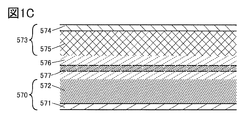
- FIG. 1C is a diagram showing an example of a cross section of a secondary battery.
- FIG. 2 is a diagram showing an example of a cross section of the negative electrode.
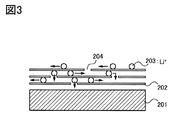
- FIG. 3 is a schematic cross-sectional view of the multilayer graphene and the active material.
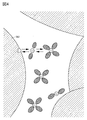
- FIG. 4 is a diagram showing an example of a cross section of the negative electrode.
- 5A is a comparative example
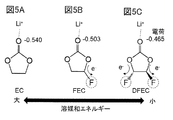
- FIGS. 5B and 5C are a chemical formula showing one aspect of the present invention and a calculated charge of an oxygen atom coordinated with a lithium ion.
- FIG. 5A is a comparative example
- FIGS. 5B and 5C are a chemical formula showing one aspect of the present invention and a calculated charge of an oxygen atom coordinated with a lithium ion.
- FIG. 1A is a comparativ
- FIG. 6 is a graph in which the solvation energy in a state in which one to four organic compounds are coordinated with respect to lithium ions showing one aspect of the present invention is calculated.
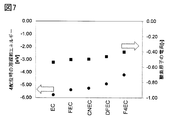
- FIG. 7 is a graph showing an aspect of the present invention in which the charge and solvation energy of an oxygen atom coordinated with a lithium ion are analyzed.
- FIG. 8 is a diagram showing an example of the structure of the positive electrode active material.
- FIG. 9 is a diagram showing an example of the structure of the positive electrode active material.
- 10A is an exploded perspective view of the coin-type secondary battery
- FIG. 10B is a perspective view of the coin-type secondary battery
- FIG. 10C is a sectional perspective view thereof.
- 11A and 11B are examples of a cylindrical secondary battery, FIG.
- FIG. 11C is an example of a plurality of cylindrical secondary batteries
- FIG. 11D is a storage battery having a plurality of cylindrical secondary batteries.
- This is an example of a system.
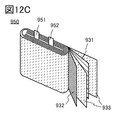
- 12A and 12B are diagrams illustrating an example of a secondary battery
- FIG. 12C is a diagram showing the inside of the secondary battery.
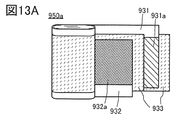
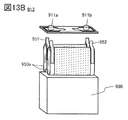
- 13A, 13B, and 13C are diagrams illustrating an example of a secondary battery.
- 14A and 14B are views showing the appearance of the secondary battery.
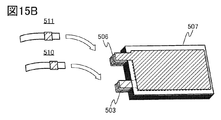
- 15A, 15B, and 15C are diagrams illustrating a method for manufacturing a secondary battery.
- 16A is a perspective view showing a battery pack of one aspect of the present invention
- FIG. 16B is a block diagram of the battery pack
- FIG. 16A is a perspective view showing a battery pack of one aspect of the present invention
- FIG. 16B is a block diagram of the battery pack
- 16C is a block diagram of a vehicle having a motor.
- 17A, 17B, 17C, and 17D are diagrams illustrating an example of a transportation vehicle.
- 18A and 18B are diagrams illustrating a power storage device according to an aspect of the present invention.
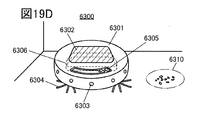
- 19A, 19B, 19C, and 19D are diagrams illustrating an example of an electronic device.
- the crystal plane and the direction are indicated by the Miller index.
- the notation of the crystal plane and direction is to add a superscript bar to the number, but in the present specification etc., due to the limitation of the application notation, instead of adding a bar above the number,-(minus) before the number. It may be expressed with a sign).
- the individual orientation indicating the direction in the crystal is []
- the aggregate orientation indicating all equivalent directions is ⁇ >
- the individual plane indicating the crystal plane is ()
- the aggregate plane having equivalent symmetry is ⁇ . Express each with.
- segregation refers to a phenomenon in which a certain element (for example, B) is spatially unevenly distributed in a solid composed of a plurality of elements (for example, A, B, C).
- the surface layer portion of the particles of the active material or the like is preferably, for example, a region within 50 nm, more preferably 35 nm or less, still more preferably 20 nm or less from the surface.
- the surface created by cracks or cracks can also be called the surface.
- the area deeper than the surface layer is called the inside.
- the layered rock salt type crystal structure of the composite oxide containing lithium and the transition metal has a rock salt type ion arrangement in which cations and anions are alternately arranged, and the transition metal and lithium are present.
- a crystal structure capable of two-dimensional diffusion of lithium because it is regularly arranged to form a two-dimensional plane.
- the layered rock salt crystal structure may have a distorted lattice of rock salt crystals.
- the rock salt type crystal structure means a structure in which cations and anions are alternately arranged. There may be a cation or anion deficiency.
- the pseudo-spinel-type crystal structure of the composite oxide containing lithium and the transition metal is the space group R-3m, and although it is not a spinel-type crystal structure, ions such as cobalt and magnesium are present.
- TEM transmission electron microscope
- STEM scanning transmission electron microscope
- HAADF-STEM high-angle scattering annular dark-field scanning transmission electron microscope
- ABF-STEM Abbreviations: X-ray diffraction
- XRD X-ray diffraction
- electron diffraction neutron diffraction
- the arrangement of cations and anions can be observed as repetition of bright and dark lines.
- the angle formed by the repetition of the bright line and the dark line between the crystals is 5 degrees or less, more preferably 2.5 degrees or less. It can be observed. In some cases, light elements such as oxygen and fluorine cannot be clearly observed in the TEM image or the like, but in that case, the alignment of the metal elements can be used to determine the alignment.
- the theoretical capacity of the positive electrode active material means the amount of electricity when all the lithium that can be inserted and removed from the positive electrode active material is desorbed.
- the theoretical capacity of LiCoO 2 is 274 mAh / g
- the theoretical capacity of LiNiO 2 is 274 mAh / g
- the theoretical capacity of LiMn 2 O 4 is 148 mAh / g.
- the charging depth when all the insertable and desorbable lithium is inserted is 0, and the charging depth when all the insertable and desorbable lithium contained in the positive electrode active material is desorbed is 1. And.
- charging means moving lithium ions from the positive electrode to the negative electrode in the battery and moving electrons from the positive electrode to the negative electrode in an external circuit.
- the release of lithium ions is called charging.
- a positive electrode active material having a charging depth of 0.7 or more and 0.9 or less may be referred to as a positive electrode active material charged at a high charging depth.
- discharging means moving lithium ions from the negative electrode to the positive electrode in the battery and moving electrons from the negative electrode to the positive electrode in an external circuit.
- inserting lithium ions is called electric discharge.
- a positive electrode active material having a charging depth of 0.06 or less, or a positive electrode active material in which 90% or more of the charging capacity is discharged from a state of being charged at a high charging depth is a sufficiently discharged positive electrode active material. do.
- the non-equilibrium phase change means a phenomenon that causes a non-linear change of a physical quantity.
- an unbalanced phase change occurs before and after the peak in the dQ / dV curve obtained by differentiating the capacitance (Q) with the voltage (V) (dQ / dV), and the crystal structure changes significantly. ..
- the secondary battery has, for example, a positive electrode and a negative electrode.
- a positive electrode active material As a material constituting the positive electrode, there is a positive electrode active material.
- the positive electrode active material is, for example, a substance that undergoes a reaction that contributes to the charge / discharge capacity.
- the positive electrode active material may contain a substance that does not contribute to the charge / discharge capacity as a part thereof.
- the positive electrode active material according to one aspect of the present invention may be referred to as a positive electrode material, a positive electrode material for a secondary battery, or the like. Further, in the present specification and the like, it is preferable that the positive electrode active material of one aspect of the present invention has a compound. Further, in the present specification and the like, it is preferable that the positive electrode active material of one aspect of the present invention has a composition. Further, in the present specification and the like, the positive electrode active material according to one aspect of the present invention preferably has a complex.
- the discharge rate is a relative ratio of the current at the time of discharge to the battery capacity, and is expressed in the unit C.
- the current corresponding to 1C is X (A).
- X (A) When discharged with a current of 2X (A), it is said to be discharged at 2C, and when discharged with a current of X / 5 (A), it is said to be discharged at 0.2C.
- the charging rate is also the same.
- When charged with a current of 2X (A) it is said to be charged with 2C, and when charged with a current of X / 5 (A), it is charged with 0.2C. It is said that.
- Constant current charging refers to, for example, a method of charging with a constant charging rate.
- Constant voltage charging refers to, for example, a method of charging by keeping the voltage constant when the charging reaches the upper limit voltage.
- the constant current discharge refers to, for example, a method of discharging with a constant discharge rate.
- One aspect of the present invention is a secondary battery having a positive electrode and a negative electrode.
- Examples of the secondary battery include a lithium ion battery.
- the negative electrode of one aspect of the present invention has an electrolyte containing fluorine.
- the fluorine-containing electrolyte has one or more fluorinated cyclic carbonates and lithium ions.
- the fluorinated cyclic carbonate can improve the flame retardancy of the electrolyte and enhance the safety of the lithium ion secondary battery.
- fluorinated cyclic carbonate fluorinated ethylene carbonate
- fluorinated ethylene carbonate for example, monofluoroethylene carbonate (fluoroethylene carbonate, FEC, F1EC), difluoroethylene carbonate (DFEC, F2EC), trifluoroethylene carbonate (F3EC), tetrafluoroethylene carbonate (F4EC) ) Etc.
- FEC fluorinated ethylene carbonate
- FEC fluoroethylene carbonate
- FEC fluoroethylene carbonate
- F1EC difluoroethylene carbonate
- DFEC difluoroethylene carbonate
- F3EC trifluoroethylene carbonate
- F4EC tetrafluoroethylene carbonate
- Etc fluorinated ethylene carbonate
- DFEC has isomers such as cis-4,5 and trans-4,5. It is operated at a low temperature by solvating lithium ions using one or more kinds of fluorinated cyclic carbonates as an electrolyte and transport
- fluorinated cyclic carbonate is contributed to the transport of lithium ions during charging and discharging rather than as a small amount of additive, it is possible to operate at a low temperature. Lithium ions move in a mass of several or more and several tens in a secondary battery.
- a solvent enters between the lithium ions and the negative electrode, making it difficult for the lithium ions to precipitate as lithium on the negative electrode, and suppressing the formation of lithium dendrites on the surface of the negative electrode active material. Can be done. Further, the electric field is relaxed by the introduction of the solvent between the lithium ion and the negative electrode, and the reaction between the lithium ion and the negative electrode can be suppressed, for example, the decrease in battery capacity due to an irreversible reaction can be suppressed. In addition, the electrochemical reaction between lithium and the negative electrode during charging and discharging can be uniformly generated on the surface of the negative electrode.
- the desolvation energy required for the solvated lithium ions to enter the negative electrode active material particles in the negative electrode can be reduced. If the energy of this desolvation can be reduced, lithium ions can be easily inserted into or desorbed from the negative electrode active material particles even in a low temperature range. Lithium ions may move in a solvated state, but a hopping phenomenon may occur in which the coordinating solvent molecules are replaced. When the solvent is easily desolvated from the lithium ions, the movement due to the hopping phenomenon becomes easy, and the movement of the lithium ions may become easy.
- a plurality of solvated lithium ions may form clusters in the electrolyte and move in the negative electrode, between the positive electrode and the negative electrode, in the positive electrode, and the like.
- the monofluoroethylene carbonate (FEC) is represented by the following formula (1).
- Tetrafluoroethylene carbonate (F4EC) is represented by the following formula (2).
- DFEC Difluoroethylene carbonate
- electrolyte is a generic term that includes solid, liquid, semi-solid materials, and the like.
- Deterioration is likely to occur at the interface existing in the secondary battery, for example, the interface between the negative electrode active material and the electrolyte.
- the electrolyte having fluorine in the negative electrode by having the electrolyte having fluorine in the negative electrode, deterioration that may occur at the interface between the negative electrode active material and the electrolyte, typically alteration of the electrolyte or high viscosity of the electrolyte. It is possible to prevent the change.
- the electrolyte having fluorine may be configured to cling to or retain a binder, graphene, or the like.
- DFEC with two fluorine bonds and F4EC with four fluorine bonds have lower viscosities and smoothness than FEC with one fluorine bond, and the coordination bond with lithium is weak. Therefore, it is possible to reduce the adhesion of highly viscous decomposition products to the negative electrode active material particles. If highly viscous decomposition products adhere to or cling to the negative electrode active material particles, it becomes difficult for lithium ions to move at the interface of the negative electrode active material particles.
- the fluorine-containing electrolyte alleviates the formation of decomposition products on the surface of the active material (positive electrode active material or negative electrode active material) by solvating with lithium. Further, by using an electrolyte having fluorine, it is possible to prevent the generation and growth of dendrites by preventing the adhesion of decomposition products.
- an electrolyte having fluorine is used as a main component, and the electrolyte having fluorine is 5% by volume or more, 10% by volume or more, preferably 30% by volume or more and 100% by volume or less.
- the main component of the electrolyte means that it is 5% by volume or more of the total electrolyte of the secondary battery. Further, 5% by volume or more of the total electrolyte of the secondary battery referred to here refers to the ratio of the total electrolyte measured at the time of manufacturing the secondary battery. In addition, when disassembling after manufacturing a secondary battery, it is difficult to quantify the proportion of each of the multiple types of electrolytes, but one type of organic compound accounts for 5% by volume or more of the total amount of electrolytes. It can be determined whether or not it exists.
- a secondary battery that can operate in a wide temperature range, specifically, -40 ° C or higher and 150 ° C or lower, preferably -40 ° C or higher and 85 ° C or lower is realized. be able to.
- the electrolyte contained in the negative electrode may have a cyclic carbonate such as ethylene carbonate (EC) or propylene carbonate (PC) in addition to the fluorinated cyclic carbonate.
- EC ethylene carbonate
- PC propylene carbonate
- the electrolyte contained in the negative electrode EC, PC and the like may also be coordinated with lithium ions and solvated with lithium ions.
- the electrolyte contained in the negative electrode may have a chain ester, and the chain ester may also be coordinated with lithium ions and solvated with lithium ions.
- the secondary battery of one aspect of the present invention has lithium ions as carrier ions. Further, the secondary battery of one aspect of the present invention is selected from alkali metal ions such as sodium ion and potassium ion, and alkaline earth metal ions such as calcium ion, strontium ion, barium ion, beryllium ion and magnesium ion. You may have one or more as carrier ions. Materials such as fluorinated cyclic carbonate contained in the electrolyte can be coordinated with these carrier ions.
- the concentration of lithium ions in the electrolyte can be adjusted by adjusting the concentration of the lithium salt added to the fluorinated cyclic carbonate or the like contained in the electrolyte.
- the lithium salt include LiPF 6 , LiClO 4 , LiAsF 6 , LiBF 4 , LiAlCl 4 , LiSCN, LiBr, LiI, Li 2 SO 4 , Li 2 B 10 Cl 10 , Li 2 B 12 Cl 12 , LiCF 3 SO 3.
- LiC 4 F 9 SO 3 LiC (CF 3 SO 2 ) 3 , LiC (C 2 F 5 SO 2 ) 3 , LiN (CF 3 SO 2 ) 2 , LiN (C 4 F 9 SO 2 ) (CF 3 SO) 2 ), LiN (C 2 F 5 SO 2 ) 2, etc. can be used.
- an additive such as vinylene carbonate, propane sultone (PS), tert-butylbenzene (TBB), lithium bis (oxalate) borate (LiBOB), or a dinitrile compound such as succinonitrile or adiponitrile is added to the electrolyte, it may be added. good.
- concentration of the additive may be, for example, 0.1% by volume or more and less than 5% by volume with respect to the entire electrolyte.
- the electrolyte may have one or more aprotic organic solvents such as ⁇ -butyrolactone, acetonitrile, dimethoxyethane, and tetrahydrofuran.
- aprotic organic solvents such as ⁇ -butyrolactone, acetonitrile, dimethoxyethane, and tetrahydrofuran.
- Typical examples of the polymer material to be gelled include silicone gel, acrylic gel, acrylonitrile gel, polyethylene oxide gel, polypropylene oxide gel, and fluoropolymer gel.
- polymers having a polyalkylene oxide structure such as polyethylene oxide (PEO), PVDF, polyacrylonitrile and the like, and copolymers containing them can be used.
- PEO polyethylene oxide
- PVDF-HFP which is a copolymer of PVDF and hexafluoropropylene (HFP)
- the polymer to be formed may have a porous shape.
- FIG. 1A is a schematic cross-sectional view showing the inside of the secondary battery.
- the negative electrode 570 includes at least a negative electrode active material layer 527 formed in contact with the negative electrode current collector 571 and the negative electrode current collector 571, and the positive electrode 573 is formed in contact with the positive electrode current collector 574 and the positive electrode current collector 574. It contains at least the positive electrode active material layer 575.
- the secondary battery also has an electrolyte 576 between the negative electrode 570 and the positive electrode 573.
- FIG. 1A shows a case where the secondary battery uses a polymer-based solid electrolyte (PEO or the like) as the electrolyte, but as shown in FIG. 1C, the secondary battery has a separator 577 between the positive electrode and the negative electrode. You may.
- PEO polymer-based solid electrolyte
- FIG. 1B is an enlarged view of a region surrounded by a broken line in FIG. 1A.
- the negative electrode active material layer 572 has an electrolyte 581 and a negative electrode active material 582.
- the electrolyte 581 contains an organic compound having fluorine and lithium ions.
- Various materials can be used as the negative electrode active material 582.
- the material that can be used as the negative electrode active material 582 will be described later. Further, it is preferable to use particles as the negative electrode active material.
- the negative electrode active material layer 572 preferably has a carbon-based material such as graphene, carbon black, graphite, carbon fiber, fullerene, and the like.
- a carbon-based material such as graphene, carbon black, graphite, carbon fiber, fullerene, and the like.
- acetylene black (AB) or the like can be used as the carbon black.
- graphite for example, natural graphite, artificial graphite such as mesocarbon microbeads, or the like can be used.
- These carbon-based materials have high conductivity and can function as a conductive agent in the negative electrode active material layer.
- these carbon-based materials may function as a negative electrode active material.
- FIG. 1B shows an example in which the negative electrode active material layer 572 has graphene 583 and AB584.
- carbon fiber such as mesophase pitch type carbon fiber and isotropic pitch type carbon fiber can be used.
- carbon fiber carbon nanofiber, carbon nanotube, or the like can be used.
- the carbon nanotubes can be produced, for example, by a vapor phase growth method.
- the negative electrode active material layer may have one or more selected from metal powders such as copper, nickel, aluminum, silver, and gold, metal fibers, and conductive ceramic materials as the conductive agent.
- the content of the conductive agent with respect to the total amount of the negative electrode active material layer is preferably 1 wt% or more and 10 wt% or less, and more preferably 1 wt% or more and 5 wt% or less.
- graphene compounds Unlike granular conductive materials such as carbon black that make point contact with active materials, graphene compounds enable surface contact with low contact resistance, so the amount of granular active materials and graphene compounds is smaller than that of ordinary conductive materials. It is possible to improve the electrical conductivity with. Therefore, the ratio of the active material in the active material layer can be increased. As a result, the discharge capacity of the secondary battery can be increased.
- Particle-like carbon-containing compounds such as carbon black and graphite, and fibrous carbon-containing compounds such as carbon nanotubes easily enter minute spaces.
- a carbon-containing compound that easily enters a minute space and a sheet-shaped carbon-containing compound such as graphene that can impart conductivity over multiple particles the density of the electrodes is increased and an excellent conductive path is obtained. Can be formed.
- the secondary battery has the electrolyte of one aspect of the present invention, the operational stability of the secondary battery can be enhanced. That is, the secondary battery of one aspect of the present invention can have both high energy density and stability, and is effective as an in-vehicle secondary battery.
- the energy required to move it increases, and the cruising range also decreases.
- the cruising range can be maintained with almost no change in the total weight of the vehicle equipped with the secondary battery of the same weight.
- the plurality of graphene 583s are arranged so as to face each other, and the negative electrode active material 582 is provided between the plurality of graphene 583s. Further, graphene may be arranged in a three-dimensional network like the negative electrode active material layer 572 shown in FIG.
- the secondary battery of one aspect of the present invention can be miniaturized due to its high energy density, and can be quickly charged because of its high conductivity. Therefore, the configuration of the secondary battery according to one aspect of the present invention is also effective in a portable information terminal.
- the negative electrode active material layer 572 preferably has a binder (not shown).
- the binder binds or fixes the electrolyte and the negative electrode active material, for example. Further, the binder can bind or fix an electrolyte and a carbon-based material, a negative electrode active material and a carbon-based material, a plurality of negative electrode active materials, a plurality of carbon-based materials, and the like.
- a flame-retardant polymer material or a non-flammable polymer material as the binder.
- a fluoropolymer which is a polymer material having fluorine, specifically polyvinylidene fluoride (PVDF) or the like can be used.
- PVDF is a resin having a melting point in the range of 134 ° C. or higher and 169 ° C. or lower, and is a material having excellent thermal stability.
- a polyamide resin, a polycarbonate resin, a polyvinyl chloride resin, a polyphenylene oxide resin and the like can be used.
- the binder it is preferable to use a rubber material such as styrene-butadiene rubber (SBR), styrene-isoprene-styrene rubber, acrylonitrile-butadiene rubber, butadiene rubber, and ethylene-propylene-diene copolymer.
- SBR styrene-butadiene rubber
- fluororubber can be used as the binder.
- a water-soluble polymer for example, a polysaccharide or the like can be used.
- a polysaccharide one or more selected from cellulose derivatives such as carboxymethyl cellulose (CMC), methyl cellulose, ethyl cellulose, hydroxypropyl cellulose, diacetyl cellulose, and regenerated cellulose, and starch and the like can be used. Further, it is more preferable to use these water-soluble polymers in combination with the above-mentioned rubber material.
- the binder may be used in combination of a plurality of the above.
- nonflammable refers to the property that a polymer material is not ignited at all even if a flame is ignited in a combustion test standard such as UL94 standard or JIS oxygen index (OI).
- flame retardant refers to a property that hardly chemically reacts even if a flame is ignited in a polymer material in a combustion test standard such as UL94 standard or JIS oxygen index (OI).
- graphene 583 can cling to the negative electrode active material 582 like natto. Further, for example, the negative electrode active material 582 can be compared to soybean, and graphene 583 can be compared to a sticky component. By arranging graphene 583 between the electrolytes of the negative electrode active material layer 572, a plurality of negative electrode active materials, a plurality of carbon-based materials, and the like, only a good conductive path is formed in the negative electrode active material layer 572. Instead, graphene 583 can be used to bind or secure these materials.
- graphene 583 has a three-dimensional conductive path by forming a three-dimensional network structure with a plurality of graphene 583s and arranging materials such as an electrolyte, a plurality of negative electrode active materials, and a plurality of carbon-based materials in the network. It is possible to suppress the dropout of the negative electrode electrolyte from the current collector. Therefore, graphene 583 may function as a conductive agent and also as a binder in the negative electrode active material layer 572.
- the electrolyte used in the secondary battery of one aspect of the present invention is not limited to the electrolyte having fluorine, and for example, it fulfills the object of providing a secondary battery that can be used in a wide temperature range and is not easily affected by the environmental temperature. Therefore, an electrolyte having fluorine in the negative electrode and an electrolyte between the positive electrode and the negative electrode may be different, and an electrolyte containing no fluorine may be used as the electrolyte between the positive electrode and the negative electrode. It can be said that one aspect of the present invention is limited to a configuration in which at least an electrolyte having fluorine in the negative electrode is used, and the other configurations are not particularly limited.
- the negative electrode may be further impregnated with a solid electrolyte material to improve flame retardancy. It is preferable to use an oxide-based solid electrolyte as the solid electrolyte material.
- Oxide-based solid electrolytes include LiPON, Li 2 O, Li 2 CO 3 , Li 2 MoO 4 , Li 3 PO 4 , Li 3 VO 4 , Li 4 SiO 4 , and LLT (La 2 / 3-x Li 3x TiO). 3 ), lithium composite oxides such as LLZ (Li 7 La 3 Zr 2 O 12 ) and lithium oxide materials can be mentioned.
- LLZ is a garnet-type oxide containing Li, La, and Zr, and may be a compound containing Al, Ga, or Ta.
- a polymer-based solid electrolyte such as PEO (polyethylene oxide) formed by a coating method or the like may be used. Since such a polymer-based solid electrolyte can also function as a binder, when a polymer-based solid electrolyte is used, the number of components of the negative electrode can be reduced, and the manufacturing cost can be reduced.
- PEO polyethylene oxide
- the negative electrode active material 582 can have various shapes such as a rounded shape and a shape having corners. Further, in the cross section of the negative electrode, the negative electrode active material 582 can have various cross-sectional shapes such as a circle, an ellipse, a figure having a curved surface, and a polygon. For example, FIG. 1B shows an example in which the cross section of the negative electrode active material 582 has a rounded shape, but the cross section of the negative electrode active material 582 may have corners as shown in FIG. 2, for example. Further, a part may be rounded and a part may have corners.
- Negative electrode active materials include materials that can react with carrier ions of secondary batteries, materials that can insert and remove carrier-ons, materials that can alloy with metals that become carrier ions, and carrier ions. It is preferable to use a material capable of dissolving and precipitating the metal.
- the negative electrode active material for example, a metal, material or compound having one or more elements selected from silicon, tin, gallium, aluminum, germanium, lead, antimony, bismuth, silver, zinc, cadmium and indium can be used. ..
- a metal, material or compound having one or more elements selected from silicon, tin, gallium, aluminum, germanium, lead, antimony, bismuth, silver, zinc, cadmium and indium can be used. ..
- an alloy-based material using such elements for example, Mg 2 Si, Mg 2 Ge , Mg 2 Sn, SnS 2, V 2 Sn 3, FeSn 2, CoSn 2, Ni 3 Sn 2, Cu 6 Sn 5 , Ag 3 Sn, Ag 3 Sb, Ni 2 MnSb, CeSb 3 , LaSn 3 , La 3 Co 2 Sn 7 , CoSb 3 , InSb, SbSn and the like.
- phosphorus, arsenic, boron, aluminum, gallium and the like may be added to silicon as impurity elements to reduce the resistance.
- the negative electrode active material is preferably particles.
- silicon nanoparticles can be used as the negative electrode active material.
- the average diameter of the silicon nanoparticles is, for example, preferably 5 nm or more and less than 1 ⁇ m, more preferably 10 nm or more and 300 nm or less, and further preferably 10 nm or more and 100 nm or less.
- the silicon nanoparticles may have crystallinity. Further, the silicon nanoparticles may have a crystalline region and an amorphous region.
- the material having silicon for example, a material represented by SiO x (x is preferably smaller than 2, more preferably 0.5 or more and 1.6 or less) can be used.
- a material having silicon for example, a form having a plurality of crystal grains in one particle can be used.
- a form having one or a plurality of silicon crystal grains in one particle can be used.
- the one particle may have silicon oxide around the crystal grain of silicon.
- the silicon oxide may be amorphous.
- Li 2 SiO 3 and Li 4 SiO 4 can be used as the compound having silicon.
- Li 2 SiO 3 and Li 4 SiO 4 may be crystalline or amorphous, respectively.
- Analysis of the compound having silicon can be performed using NMR, XRD, Raman spectroscopy, and the like.
- the negative electrode active material for example, carbon-based materials such as graphite, graphitizable carbon, non-graphitizable carbon, carbon nanotubes, carbon black and graphene can be used.
- the negative electrode active material for example, an oxide having one or more elements selected from titanium, niobium, tungsten and molybdenum can be used.
- the negative electrode active material a plurality of the metals, materials, compounds, etc. shown above can be used in combination.
- Examples of the negative electrode active material include SnO, SnO 2 , titanium dioxide (TIO 2 ), lithium titanium oxide (Li 4 Ti 5 O 12 ), lithium-graphite interlayer compound (Li x C 6 ), and niobium pentoxide (Nb 2 O). 5 ), oxides such as tungsten oxide (WO 2 ) and molybdenum oxide (MoO 2 ) can be used.
- Li 2.6 Co 0.4 N 3 shows a large charge / discharge capacity (900 mAh / g) and is preferable.
- lithium ions are contained in the negative electrode active material, so that it can be combined with materials such as V 2 O 5 and Cr 3 O 8 which do not contain lithium ions as the positive electrode active material, which is preferable. .. Even when a material containing lithium ions is used as the positive electrode active material, a double nitride of lithium and a transition metal can be used as the negative electrode active material by desorbing the lithium ions contained in the positive electrode active material in advance.
- a material that causes a conversion reaction can also be used as a negative electrode active material.
- a transition metal oxide that does not alloy with lithium such as cobalt oxide (CoO), nickel oxide (NiO), and iron oxide (FeO) may be used as the negative electrode active material.
- oxides such as Fe 2 O 3 , CuO, Cu 2 O, RuO 2 , Cr 2 O 3 and sulfides such as CoS 0.89 , NiS and CuS, Zn 3 N 2 , Cu 3 N, Ge 3 N 4 or the like nitride, NiP 2, FeP 2, CoP 3 etc. phosphide, also at the FeF 3, BiF 3 fluoride and the like. Since the potential of the fluoride is high, it may be used as a positive electrode active material.
- the negative electrode active material may change in volume due to charging and discharging, but by arranging an electrolyte having fluorine between a plurality of negative electrode active materials in the negative electrode, slippage occurs even if the volume changes during charging and discharging. Since it is easy to suppress cracks, it has the effect of dramatically improving the cycle characteristics. It is important that an organic compound having fluorine is present between the plurality of active materials constituting the negative electrode.
- the negative electrode active material of one aspect of the present invention preferably has fluorine in the surface layer portion.
- the charge / discharge efficiency may decrease due to an irreversible reaction typified by a reaction between an electrode and an electrolyte.
- the decrease in charge / discharge efficiency may occur remarkably especially in the initial charge / discharge.
- the negative electrode active material of one aspect of the present invention has a halogen on the surface layer portion, it is possible to suppress a decrease in charge / discharge efficiency. It is considered that the negative electrode active material of one aspect of the present invention has a halogen on the surface layer portion, whereby the reaction with the electrolyte on the surface of the active material is suppressed. Further, in the negative electrode active material of one aspect of the present invention, at least a part of the surface of the negative electrode active material may be covered with a region containing halogen. The region may be, for example, membranous.
- the surface layer portion is, for example, a region within 50 nm, more preferably 35 nm or less, still more preferably 20 nm or less from the surface.
- the area deeper than the surface layer is called the inside.
- the negative electrode active material of one aspect of the present invention has a halogen on the surface layer portion, the solvent solvated with the carrier ions in the electrolytic solution may be easily desorbed on the surface of the negative electrode active material. By facilitating the desorption of the solvated solvent, it is possible that excellent characteristics can be realized in a secondary battery at a high charge / discharge rate. It is preferable to use a material obtained by terminating the negative electrode active material with a halogen. For example, a material obtained by terminating silicon with a halogen such as fluorine can be used as a negative electrode active material.
- the negative electrode active material of one aspect of the present invention preferably has fluorine as a halogen.
- the concentration of fluorine is preferably 1 atomic% or more with respect to the total concentration of fluorine, oxygen, lithium and carbon.
- Fluorine has a high electronegativity
- the negative electrode active material having fluorine on the surface layer portion may have an effect of facilitating the desorption of the solvated solvent on the surface of the negative electrode active material.
- the conductive agent contained in the negative electrode active material layer of one aspect of the present invention may also be modified with fluorine.
- fluorine it is preferable to include fluorine in a carbon-based material such as graphene, carbon black, graphite, carbon fiber, fullerene and the like.
- the carbon-based material impregnated with fluorine can also be called a particulate or fibrous fluorinated carbon material.
- concentration of fluorine is preferably 1 atomic% or more with respect to the total concentration of fluorine, oxygen, lithium and carbon.
- Fluorine modification to the negative electrode active material and the conductive agent can be performed, for example, by treatment with a gas having fluorine or heat treatment, plasma treatment in a gas atmosphere having fluorine, or the like.
- a gas having fluorine for example, a fluorine gas, a lower fluorine hydrocarbon gas such as methane fluoride (CF 4 ), or the like can be used.
- a fluorine modification to the negative electrode active material and the conductive agent for example, a solution containing fluorine, boron tetrafluoroacid, phosphoric acid hexafluoride, or the like, a solution containing a fluorine-containing ether compound, or the like may be immersed.
- an excellent secondary battery can be realized by using a fluorine-modified negative electrode active material and a conductive agent.
- the conductive characteristics may be stabilized and high output characteristics may be realized.
- the fluorine-containing material is stable, and by using it as a component of a secondary battery, it is possible to realize stable characteristics, long life, and the like. Therefore, it is preferable to use it for a separator and an exterior body. The details of the separator and the exterior body will be described later.
- the graphene compound is graphene, multi-layer graphene, multi-graphene, graphene oxide, multi-layer graphene oxide, multi-graphene oxide, reduced graphene oxide, reduced multi-layer graphene oxide, reduced multi-graphene oxide, graphene.
- the graphene compound has carbon, has a flat plate shape, a sheet shape, or the like, and has a two-dimensional structure formed by a carbon 6-membered ring.
- the two-dimensional structure formed by the carbon 6-membered ring may be called a carbon sheet.
- the graphene compound may have a functional group. Further, the graphene compound preferably has a bent shape.
- the graphene compound may also be curled up into carbon nanofibers.
- the materials described above can be used in combination.
- graphene oxide has carbon and oxygen, has a sheet-like shape, and has a functional group, particularly an epoxy group, a carboxy group or a hydroxy group.
- the reduced graphene oxide has carbon and oxygen, has a sheet-like shape, and has a two-dimensional structure formed by a carbon 6-membered ring. It may be called a carbon sheet. Although one reduced graphene oxide functions, a plurality of reduced graphene oxides may be laminated.
- the reduced graphene oxide preferably has a portion having a carbon concentration of more than 80 atomic% and an oxygen concentration of 2 atomic% or more and 15 atomic% or less. By setting such carbon concentration and oxygen concentration, it is possible to function as a highly conductive conductive material even in a small amount. Further, it is preferable that the reduced graphene oxide has an intensity ratio G / D of G band to D band of 1 or more in the Raman spectrum. The reduced graphene oxide having such a strength ratio can function as a highly conductive conductive material even in a small amount.
- a material in which the end portion of graphene is terminated with fluorine may be used.
- multi-layer graphene with holes through which lithium ions can pass may be used.
- the sheet-like graphene compound is dispersed substantially uniformly in the internal region of the active material layer. Since the plurality of graphene compounds are formed so as to partially cover the plurality of granular negative electrode active materials or to stick to the surface of the plurality of granular negative electrode active materials, they are in surface contact with each other.
- a network-like graphene compound sheet (hereinafter referred to as graphene compound net or graphene net) can be formed by binding a plurality of graphene compounds to each other.
- the graphene net can also function as a binder for binding the active materials to each other. Therefore, since the amount of the binder can be reduced or not used, the ratio of the active material to the electrode volume and the electrode weight can be improved. That is, the charge / discharge capacity of the secondary battery can be increased.
- graphene oxide as the graphene compound, mix it with an active material to form a layer to be an active material layer, and then reduce the amount. That is, it is preferable that the active material layer after completion has reduced graphene acid.
- the graphene oxide having extremely high dispersibility in a polar solvent for forming the graphene compound
- the graphene compound can be dispersed substantially uniformly in the internal region of the active material layer.
- the graphene compounds remaining in the active material layer partially overlap and are dispersed to such an extent that they are in surface contact with each other. Can form a three-dimensional conductive path.
- the graphene oxide may be reduced, for example, by heat treatment or by using a reducing agent.
- a spray-drying device in advance, it is possible to cover the entire surface of the active material to form a graphene compound as a conductive material as a film, and further to form a conductive path between the active materials with the graphene compound.
- the graphene compound may be mixed with the material used for forming the graphene compound and used for the active material layer.
- particles used as a catalyst for forming a graphene compound may be mixed with the graphene compound.
- the catalyst for forming the graphene compound include particles having silicon oxide (SiO 2 , SiO x (x ⁇ 2)), aluminum oxide, iron, nickel, ruthenium, iridium, platinum, copper, germanium and the like. ..
- the particles preferably have a D50 of 1 ⁇ m or less, and more preferably 100 nm or less.
- FIG. 3 shows a schematic diagram showing the state of the multilayer graphene having a gap (sometimes also referred to as a hole) and the active material.
- a gap sometimes also referred to as a hole
- the electrode 201 in contact with graphene 202 moves to the lower graphene when the potential is negative. (If the electrode 201 has a positive potential, it moves to the upper graphene).
- FIG. 3 and the like for simplification, one lithium ion is shown, but in reality, not a single lithium, but an aggregate of a plurality of lithiums moves in the negative electrode active material.
- This is an idea not described in conventional known literature and conventional books (including textbooks), and is a new solvation model discovered by the inventors. Further, it is considered that the method of solvation differs depending on the number of fluorines to be bound depending on the fluorine-containing electrolyte used.
- FIG. 4 is a schematic view showing a state in the vicinity of the negative electrode active material 582 in the secondary battery, and shows a state in which lithium ions are solvated in the negative electrode.
- FIG. 4 illustrates a state in which four solvent molecules are coordinated with one lithium ion and a state in which two solvent molecules are coordinated with one lithium ion in the negative electrode.
- FIG. 4 shows the movement of lithium ions moving (or diffusing) from the negative electrode active material 582 during charging / discharging of the secondary battery. Specifically, lithium ions move into the negative electrode active material during charging. Further, at the time of discharge, lithium ions are released from the negative electrode active material.
- Lithium ions released from the negative electrode active material during charging and discharging are in a state of being bound to a part of the electrolyte in the negative electrode.
- this bond is due to a weak bond (coordination) such as electrostatic force.
- the state of being bound by this coordination may be called a solvate. Since the organic compound that can be solvated with lithium ions contains fluorine, the desolvation energy required for the solvated lithium ions to enter the negative electrode active material particles is reduced.
- FIG. 5 illustrates examples of lithium ions and three types of organic compounds that can be solvated with lithium ions.
- the ethylene carbonate (EC) shown in FIG. 5A is a comparative example, and the chemical formulas of the monofluoroethylene carbonate (fluoroethylene carbonate, FEC) shown in FIG. 5B and the difluoroethylene carbonate (DFEC) shown in FIG. 5C were calculated.
- the charge of the oxygen atom coordinated with lithium ion is illustrated.
- FIGS. 5B and 5C when an organic compound that can be solvent-compatible with lithium ions contains fluorine, the fluorine attracts electrons, so that the electron density of the oxygen atom coordinated with the lithium ions decreases.
- FIG. 6 shows the results of calculating the state in which one to four organic compounds are coordinated with respect to lithium ions.
- the calculation result of the solvation energy of the cyclic carbonate (CNEC) having a cyano group is also shown in FIG.
- the solvation energy is smaller than that of Comparative Example (EC), and the tetrafluoroethylene carbonate (F4EC) has the smallest solvation energy value.
- the secondary battery can be operated regardless of whether the temperature is low (-40 ° C or higher and lower than 25 ° C) or high temperature (25 ° C or higher and lower than 85 ° C). be able to.
- FIG. 1C shows an example of a secondary battery according to an aspect of the present invention.
- the secondary battery shown in FIG. 1C has a negative electrode 570, a positive electrode 573 and an electrolyte 576.
- the negative electrode 570 includes at least a negative electrode active material layer 527 formed in contact with the negative electrode current collector 571 and the negative electrode current collector 571, and the positive electrode 573 is formed in contact with the positive electrode current collector 574 and the positive electrode current collector 574. It contains at least the positive electrode active material layer 575. Further, the secondary battery has a separator 577 between the negative electrode 570 and the positive electrode 573.
- a liquid electrolyte layer is used for the secondary battery, it is not limited to the electrolyte containing fluorine, and other materials can also be used.
- the electrolyte layer ethylene carbonate (EC), propylene carbonate (PC), butylene carbonate, chloroethylene carbonate, vinylene carbonate, ⁇ -butyrolactone, ⁇ -valerolactone, dimethyl carbonate (DMC), diethyl carbonate (DEC), ethyl methyl Carbonate (EMC), methyl formate, methyl acetate, ethyl acetate, methyl propionate, ethyl propionate, propyl propionate, methyl butyrate, 1,3-dioxane, 1,4-dioxane, dimethoxyethane (DME), dimethyl sulfoxide, One of diethyl ether, methyl diglime, acetonitrile, benzonitrile, tetrahydrofur
- Ionic liquids normally temperature molten salt
- Ionic liquids consist of cations and anions, including organic cations and anions.
- organic cations examples include aliphatic onium cations such as quaternary ammonium cations, tertiary sulfonium cations and quaternary phosphonium cations, and aromatic cations such as imidazolium cations and pyridinium cations.
- a monovalent amide anion a monovalent methide anion, a fluorosulfonic acid anion, a perfluoroalkyl sulfonic acid anion, a tetrafluoroborate anion, a perfluoroalkyl borate anion, a hexafluorophosphate anion, or a perfluoro Examples thereof include alkyl phosphate anions.
- Lithium salts such as SO 2 ) (CF 3 SO 2 ) and LiN (C 2 F 5 SO 2 ) 2 can be used alone, or two or more of them can be used in any combination and ratio.
- the above configuration shows an example of a secondary battery using a liquid electrolyte, but is not particularly limited.
- a semi-solid state battery or an all-solid-state battery can be manufactured.
- the layer arranged between the positive electrode and the negative electrode is referred to as an electrolyte layer.
- the electrolyte layer of the semi-solid state battery can be said to be a layer formed by film formation, and can be distinguished from the liquid electrolyte layer.
- the semi-solid battery means a battery having a semi-solid material in at least one of an electrolyte layer, a positive electrode and a negative electrode.
- the term semi-solid here does not mean that the ratio of solid materials is 50%.
- Semi-solid means that it has solid properties such as small volume change, but also has some properties close to liquid such as flexibility. As long as these properties are satisfied, it may be a single material or a plurality of materials. For example, a liquid material may be infiltrated into a porous solid material.
- the polymer electrolyte secondary battery refers to a secondary battery having a polymer in the electrolyte layer between the positive electrode and the negative electrode.
- Polymer electrolyte secondary batteries include dry (or intrinsic) polymer electrolyte batteries, and polymer gel electrolyte batteries. Further, the polymer electrolyte secondary battery may be referred to as a semi-solid state battery.
- the semi-solid-state battery becomes a secondary battery having a large charge / discharge capacity. Further, a semi-solid state battery having a high charge / discharge voltage can be used. Alternatively, a semi-solid state battery with high safety or reliability can be realized.
- FIG. 1A is used to show an example of manufacturing a semi-solid state battery using an electrolyte having fluorine in the negative electrode.
- FIG. 1A is a schematic cross-sectional view of a secondary battery according to an aspect of the present invention.
- the secondary battery of one aspect of the present invention has a negative electrode 570 and a positive electrode 573.
- the negative electrode 570 includes at least a negative electrode active material layer 527 formed in contact with the negative electrode current collector 571 and the negative electrode current collector 571, and the positive electrode 573 is formed in contact with the positive electrode current collector 574 and the positive electrode current collector 574. It contains at least the positive electrode active material layer 575.
- the secondary battery also has an electrolyte 576 between the negative electrode 570 and the positive electrode 573.
- Electrolyte 576 has a lithium ion conductive polymer and a lithium salt.
- the lithium ion conductive polymer is a polymer having cation conductivity such as lithium. More specifically, it is a polymer compound having a polar group to which a cation can be coordinated.
- the polar group it is preferable to have an ether group, an ester group, a nitrile group, a carbonyl group, a siloxane and the like.
- lithium ion conductive polymer for example, polyethylene oxide (PEO), a derivative having polyethylene oxide as a main chain, polypropylene oxide, polyacrylic acid ester, polymethacrylic acid ester, polysiloxane, polyphosphazene and the like can be used.
- PEO polyethylene oxide
- polypropylene oxide polyacrylic acid ester, polymethacrylic acid ester, polysiloxane, polyphosphazene and the like
- PEO polyethylene oxide
- polyacrylic acid ester polymethacrylic acid ester
- polysiloxane polyphosphazene and the like
- the lithium ion conductive polymer may be branched or crosslinked. It may also be a copolymer.
- the molecular weight is preferably, for example, 10,000 or more, and more preferably 100,000 or more.
- lithium ions move while changing the polar groups that interact with each other due to the partial motion (also called segment motion) of the polymer chain.
- partial motion also called segment motion
- lithium ions move while changing the interacting oxygen due to the segmental motion of the ether chain.
- the temperature is close to or higher than the melting point or softening point of the lithium ion conductive polymer, the crystalline region is melted and the amorphous region is increased, and the movement of the ether chain becomes active, so that the ionic conductivity is increased. It gets higher. Therefore, when PEO is used as the lithium ion conductive polymer, it is preferable to charge and discharge at 60 ° C. or higher.
- the radius of monovalent lithium ions is 0.590 ⁇ for 4-coordination and 0.76 ⁇ for 6-coordination (0). .076 nm), 0.92 ⁇ (0.092 nm) for 8 coordination.
- the radius of the divalent oxygen ion is 1.35 ⁇ (0.135 nm) for bi-coordination, 1.36 ⁇ (0.136 nm) for tri-coordination, and 1.38 ⁇ (0.138 nm) for 4-coordination. ), 1.40 ⁇ (0.140 nm) for 6 coordination, 1.42 ⁇ (0.142 nm) for 8 coordination.
- the distance between the polar groups of the adjacent lithium ion conductive polymer chains is preferably greater than or equal to the distance at which the lithium ions and the anions of the polar groups can stably exist while maintaining the ionic radius as described above. Moreover, it is preferable that the distance is such that the interaction between the lithium ion and the polar group sufficiently occurs. However, since segment motion occurs as described above, it is not always necessary to maintain a constant distance. It suffices as long as it is an appropriate distance for lithium ions to pass through.
- lithium salt for example, a compound having at least one of phosphorus, fluorine, nitrogen, sulfur, oxygen, chlorine, arsenic, boron, aluminum, bromine and iodine can be used together with lithium.
- LiPF 6, LiN (FSO 2) 2 lithium bis (fluorosulfonyl) imide, LiFSI), LiClO 4, LiAsF 6, LiBF 4, LiAlCl 4, LiSCN, LiBr, LiI, Li 2 SO 4, Li 2 B 10 Cl 10 , Li 2 B 12 Cl 12 , LiCF 3 SO 3 , LiC 4 F 9 SO 3 , LiC (CF 3 SO 2 ) 3 , LiC (C 2 F 5 SO 2 ) 3 , LiN (CF 3 SO 2 ) 2 ,
- One type of lithium salt such as LiN (C 4 F 9 SO 2 ) (CF 3 SO 2 ), LiN (C 2 F 5 SO 2 ) 2 , lithium bis (oxalate) borate (LiBOB), or two of them
- LiFSI because the low temperature characteristics are good. Further, LiFSI and LiTFSA are less likely to react with water than LiPF 6 and the like. Therefore, it becomes easy to control the dew point when forming the electrode and the electrolyte layer using LiFSI. For example, it can be handled not only in an inert atmosphere such as argon in which moisture is removed as much as possible, and in a dry room in which the dew point is controlled, but also in a normal atmospheric atmosphere. Therefore, productivity is improved, which is preferable. Further, it is particularly preferable to use a highly dissociative and plasticizing Li salt such as LiFSA and LiTFSA because it can be used in a wide temperature range when lithium conduction utilizing the segment motion of the ether chain is used.
- the binder refers to a polymer compound mixed only for binding an active material, a conductive material, etc. onto a current collector.
- rubber materials such as polyvinylidene fluoride (PVDF), styrene-butadiene rubber (SBR), styrene-isoprene-styrene rubber, butadiene rubber, ethylene-propylene-diene copolymer, fluororubber, polystyrene, polyvinyl chloride, polytetra. It refers to materials such as fluoroethylene, polyethylene, polypropylene, polyisobutylene, and ethylene propylene diene polymer.
- the lithium ion conductive polymer is a polymer compound, it is possible to bind the negative electrode active material 582 and the conductive material on the negative electrode current collector 571 by mixing them well and using them for the negative electrode active material layer 572. Therefore, the negative electrode 570 can be manufactured without using a binder.
- the binder is a material that does not contribute to the charge / discharge reaction. Therefore, the smaller the amount of binder, the more materials that contribute to charging and discharging, such as active materials and electrolytes. Therefore, it is possible to obtain a secondary battery having improved discharge capacity, cycle characteristics, and the like.
- the absence or very small amount of organic solvent makes it possible to obtain a secondary battery that does not easily ignite and ignite, which is preferable because it improves safety.
- the electrolyte 576 has no organic solvent or has a very small amount of an electrolyte layer, it has sufficient strength without a separator and can electrically insulate the positive electrode and the negative electrode. Since it is not necessary to use a separator, it is possible to obtain a highly productive secondary battery. If the electrolyte 576 is an electrolyte layer having an inorganic filler, the strength is further increased, and a secondary battery with higher safety can be obtained.
- the electrolyte 576 is sufficiently dried in order to obtain an electrolyte layer having no or very little organic solvent.
- the weight change of the electrolyte layer when dried under reduced pressure at 90 ° C. for 1 hour is within 5%, it is said that the electrolyte layer is sufficiently dried.
- nuclear magnetic resonance can be used to identify materials such as lithium ion conductive polymers, lithium salts, binders and additives contained in secondary batteries.
- Raman spectroscopy, Fourier transform infrared spectroscopy (FT-IR), time-of-flight secondary ion mass spectrometry (TOF-SIMS), gas chromatography mass spectrometry (GC / MS), thermal decomposition gas chromatography mass spectrometry. (Py-GC / MS), liquid chromatography-mass spectrometry (LC / MS), or the like may be used as a material for judgment. It is preferable to suspend the active material layer in a solvent, separate the active material from other materials, and then perform analysis by NMR or the like.
- This embodiment can be used in combination with other embodiments as appropriate.
- Examples of the positive electrode active material include an olivine-type crystal structure, a layered rock salt-type crystal structure, and a composite oxide having a spinel-type crystal structure.
- Examples thereof include compounds such as LiFePO 4 , LiFeO 2 , LiNiO 2 , LiMn 2 O 4 , V 2 O 5 , Cr 2 O 5 , and MnO 2.
- a lithium manganese composite oxide that can be represented by the composition formula Li a Mn b M c Od can be used.
- the element M a metal element selected from other than lithium and manganese, silicon, and phosphorus are preferably used, and nickel is more preferable.
- the lithium manganese composite oxide refers to an oxide containing at least lithium and manganese, and includes chromium, cobalt, aluminum, nickel, iron, magnesium, molybdenum, zinc, indium, gallium, copper, titanium, niobium, and silicon. And at least one element selected from the group consisting of phosphorus and the like may be contained.
- a material having a layered rock salt type crystal structure such as lithium cobalt oxide (LiCoO 2 ) has a high discharge capacity and is excellent as a positive electrode active material for a secondary battery.
- the material having a layered rock salt type crystal structure include a composite oxide represented by LiMO 2.
- the metal M contains the metal Me1.
- the metal Me1 is one or more metals containing cobalt.
- the metal M can further contain the metal X in addition to the metal Me1.
- Metal X is one or more metals selected from magnesium, calcium, zirconium, lanthanum, barium, copper, potassium, sodium and zinc.
- the positive electrode active material will be described with reference to FIGS. 8 and 9.
- the positive electrode active material produced according to one aspect of the present invention can reduce the displacement of the CoO 2 layer in, for example, lithium cobalt oxide, as described later, in repeated charging and discharging with a high charging depth. Furthermore, the change in volume can be reduced. Therefore, the positive electrode active material of one aspect of the present invention can realize excellent cycle characteristics. Further, the positive electrode active material according to one aspect of the present invention can have a stable crystal structure in a charged state having a high charging depth. Therefore, the positive electrode active material of one aspect of the present invention may not easily cause a short circuit when the charged state with a high charging depth is maintained. In such a case, safety is further improved, which is preferable.
- the crystal contained in the positive electrode active material of one aspect of the present invention has a change in crystal structure and a volume when compared per the same number of transition metal atoms in a fully discharged state and a charged state with a high charging depth. The difference is small.
- the positive electrode active material of one aspect of the present invention has a first region.
- the first region includes a region inside the surface layer portion of the particles. Further, at least a part of the surface layer portion of the particles may be contained in the first region.
- the first region is preferably represented by a layered rock salt structure.
- the first region is represented by the space R-3m.
- the first region is a region having lithium, metal Me1, oxygen and metal X.
- FIG. 8 shows an example of the crystal structure before and after charging / discharging of the first region of the positive electrode active material of one aspect of the present invention.
- FIG. 9 shows an example of the crystal structure of lithium cobalt oxide before and after charging / discharging to which the metal X is not added.
- the surface layer portion of the positive electrode active material has titanium, magnesium and oxygen in addition to or in place of the region represented by the layered rock salt type structure described in FIG. 8 and the like below, and is different from the layered rock salt type structure. It may have a crystal represented by a structure. For example, it may have titanium, magnesium and oxygen, and may have crystals represented by a spinel structure.
- the crystal structure at a charge depth of 0 (discharged state) in FIG. 8 is R-3 m (O3), which is the same as in FIG.
- R-3 m O3
- it has a crystal having a structure different from that of the H1-3 type crystal structure.
- this structure is a space group R-3m and is not a spinel-type crystal structure, ions such as cobalt and magnesium occupy the oxygen 6-coordination position, and the arrangement of cations has symmetry similar to that of the spinel-type. Further, the symmetry of the CoO 2 layer of the structure is the same as type O3.
- this structure is referred to as an O3'type crystal structure or a pseudo-spinel type crystal structure in the present specification and the like.
- lithium may be present at any lithium site with a probability of about 20%, but the present invention is not limited to this. It may be present only in some specific lithium sites.
- magnesium is dilutely present between the CoO 2 layers, that is, in the lithium site.
- halogens such as fluorine may be randomly and dilutely present at the oxygen sites.
- a light element such as lithium may occupy the oxygen 4-coordination position, and in this case as well, the ion arrangement has symmetry similar to that of the spinel type.
- the O3'type crystal structure has Li randomly between layers but is similar to the CdCl 2 type crystal structure.
- This crystal structure similar to CdCl type 2 is similar to the crystal structure when lithium nickel oxide is charged to a charging depth of 0.94 (Li 0.06 NiO 2 ), but contains a large amount of pure lithium cobalt oxide or cobalt. It is known that layered rock salt type positive electrode active materials do not usually have this crystal structure.
- Layered rock salt crystals and anions of rock salt crystals have a cubic close-packed structure (face-centered cubic lattice structure).
- Pseudo-spinel-type crystals are also presumed to have a cubic close-packed structure with anions. When they come into contact, there is a crystal plane in which the orientation of the hexagonal close-packed structure composed of anions is aligned.
- the space group of layered rock salt type crystals and pseudo-spinel type crystals is R-3m
- the space group of rock salt type crystals Fm-3m (space group of general rock salt type crystals) and Fd-3m (simplest symmetry).
- the mirror index of the crystal plane satisfying the above conditions is different between the layered rock salt type crystals and the pseudo-spinel type crystals and the rock salt type crystals.
- the orientations of the crystals are substantially the same when the orientations of the cubic close-packed structures composed of anions are aligned. be.
- the stability of the structure is high even when the charging voltage is high.
- a charging voltage having an H1-3 type crystal structure for example, a voltage of about 4.6 V with respect to the potential of a lithium metal will result in an H1-3 type crystal structure, but one aspect of the present invention.
- the positive electrode active material can retain the crystal structure of R-3m (O3) even at the charging voltage of about 4.6V.
- There is a region where an O3'type crystal structure can be obtained even at a higher charging voltage for example, a voltage of about 4.65 V to 4.7 V with reference to the potential of lithium metal.
- the positive electrode active material of one aspect of the present invention can have an O3'type crystal structure.
- the potential of graphite is about 0.05V to 0.2V based on the potential of lithium metal.
- the positive electrode active material of one aspect of the present invention can retain the crystal structure of R-3m (O3), and further.
- the charging voltage is increased, for example, a region where the O3'type crystal structure can be obtained even when the voltage of the secondary battery exceeds 4.5 V and is 4.6 V or less.
- the positive electrode active material of one aspect of the present invention may have an O3'type crystal structure.
- the crystal structure does not easily collapse even if charging / discharging with a high charging depth is repeated.
- the difference in volume per unit cell between the O3 type crystal structure having a charging depth of 0 and the O3'type crystal structure having a charging depth of 0.8 is 2.5% or less, which is more detailed. Is less than 2.2%.
- the coordinates of cobalt and oxygen in the unit cell are within the range of Co (0,0,0.5), O (0,0,x), 0.20 ⁇ x ⁇ 0.25. Can be indicated by.
- Magnesium which is randomly and dilutely present between the two CoO layers, that is, at the lithium site, has an effect of suppressing the displacement of the two CoO layers when charging with a high charging depth. Therefore , if magnesium is present between the CoO 2 layers, it tends to have an O3'type crystal structure.
- a halogen compound such as a fluorine compound
- lithium cobalt oxide before the heat treatment for distributing magnesium over the entire particles.
- a halogen compound causes a melting point depression of lithium cobalt oxide. By lowering the melting point, it becomes easy to distribute magnesium throughout the particles at a temperature at which cationic mixing is unlikely to occur. Further, if a fluorine compound is present, it can be expected that the corrosion resistance to hydrofluoric acid generated by the decomposition of the electrolyte is improved.
- the number of atoms of magnesium contained in the positive electrode active material produced by one aspect of the present invention is preferably 0.001 times or more and 0.1 times or less the number of atoms of cobalt, and more preferably greater than 0.01 and less than 0.04. , 0.02 is more preferable.
- the concentration of magnesium shown here may be, for example, a value obtained by elemental analysis of the entire particles of the positive electrode active material using ICP-MS or the like, or a value of the blending of raw materials in the process of producing the positive electrode active material. May be based.
- the number of atoms of nickel contained in the positive electrode active material is preferably 7.5% or less, preferably 0.05% or more and 4% or less, and more preferably 0.1% or more and 2% or less of the atomic number of cobalt.
- the concentration of nickel shown here may be, for example, a value obtained by elemental analysis of the entire particles of the positive electrode active material using ICP-MS or the like, or a value of the blending of raw materials in the process of producing the positive electrode active material. May be based.
- the average particle size (D50: also referred to as median diameter) is preferably 1 ⁇ m or more and 100 ⁇ m or less, more preferably 2 ⁇ m or more and 40 ⁇ m or less, and further preferably 5 ⁇ m or more and 30 ⁇ m or less.
- a positive electrode active material exhibits an O3'-type crystal structure when charged at a high charging depth.
- XRD electron diffraction, neutron diffraction, or electron spin resonance (ESR) of a positive electrode charged at a high charging depth.
- NMR Nuclear magnetic resonance
- XRD can analyze the symmetry of transition metals such as cobalt contained in the positive electrode active material with high resolution, compare the height of crystallinity and the orientation of crystals, and analyze the periodic strain and crystallite size of the lattice. It is preferable in that sufficient accuracy can be obtained even if the positive electrode obtained by disassembling the secondary battery is measured as it is.
- the positive electrode active material is characterized in that the crystal structure does not change much between the state of being charged at a high charging depth and the state of being discharged.
- a material in which a crystal structure having a large change from the discharged state occupies 50 wt% or more in a state of being charged at a high charging depth is not preferable because it cannot withstand charging / discharging at a high charging depth.
- the desired crystal structure may not be obtained simply by adding an impurity element. For example, even if lithium cobalt oxide having magnesium and fluorine is common, the O3'type crystal structure becomes 60 wt% or more when charged at a high charging depth, and the H1-3 type crystal structure becomes 50 wt%.
- the O3'type crystal structure becomes approximately 100 wt%, and when the predetermined voltage is further increased, an H1-3 type crystal structure may occur. Therefore, it is preferable that the crystal structure of the positive electrode active material is analyzed by XRD or the like. By using it in combination with measurement such as XRD, more detailed analysis can be performed.
- the positive electrode active material charged or discharged at a high charging depth may change its crystal structure when exposed to the atmosphere.
- the O3'type crystal structure may change to the H1-3 type crystal structure. Therefore, it is preferable to handle all the samples in an inert atmosphere such as an atmosphere containing argon.
- the positive electrode active material shown in FIG. 9 is lithium cobalt oxide (LiCoO 2 ) to which the metal X is not added.
- the crystal structure of lithium cobalt oxide shown in FIG. 9 changes depending on the charging depth.
- the lithium cobaltate is charged depth 0 (discharged state) has a region having a crystal structure of the space group R-3m, CoO 2 layers is present three layers in the unit cell. Therefore, this crystal structure may be referred to as an O3 type crystal structure.
- the CoO 2 layer is a structure in which an octahedral structure in which oxygen is coordinated to cobalt is continuous with a plane in a shared ridge state.
- this crystal structure may be referred to as an O1 type crystal structure.
- Lithium cobalt oxide when the charging depth is about 0.88 has a crystal structure of the space group R-3m.
- This structure can be said to be a structure in which CoO 2 structures such as P-3m1 (O1) and LiCoO 2 structures such as R-3m (O3) are alternately laminated. Therefore, this crystal structure may be referred to as an H1-3 type crystal structure.
- the H1-3 type crystal structure has twice the number of cobalt atoms per unit cell as the other structures.
- the c-axis of the H1-3 type crystal structure is shown as a half of the unit cell.
- the coordinates of cobalt and oxygen in the unit cell are set to Co (0, 0, 0.42150 ⁇ 0.00016), O 1 (0, 0, 0.267671 ⁇ 0.00045). , O 2 (0, 0, 0.11535 ⁇ 0.00045).
- O 1 and O 2 are oxygen atoms, respectively.
- the H1-3 type crystal structure is represented by a unit cell using one cobalt and two oxygens.
- the O3'type crystal structure of one aspect of the present invention is preferably represented by a unit cell using one cobalt and one oxygen.
- the difference in volume is also large.
- the difference in volume between the H1-3 type crystal structure and the discharged state O3 type crystal structure is 3.0% or more.
- the continuous structure of two CoO layers such as P-3m1 (O1) of the H1-3 type crystal structure is likely to be unstable.
- the crystal structure of lithium cobalt oxide collapses when charging and discharging are repeated until a large amount of lithium is desorbed.
- the collapse of the crystal structure causes deterioration of the cycle characteristics. It is considered that this is because the crystal structure collapses, the number of sites where lithium can stably exist decreases, and it becomes difficult to insert and remove lithium.
- This embodiment can be used in combination with other embodiments as appropriate.
- the negative electrode shown in the previous embodiment can be used.
- a positive electrode current collector and a negative electrode current collector metals such as stainless steel, gold, platinum, zinc, iron, copper, aluminum and titanium, and alloys thereof have high conductivity and do not alloy with carrier ions such as lithium. Materials can be used. Further, an aluminum alloy to which an element for improving heat resistance such as silicon, titanium, neodymium, scandium, and molybdenum is added can be used. Further, it may be formed of a metal element that reacts with silicon to form silicide. Metallic elements that react with silicon to form silicide include zirconium, titanium, hafnium, vanadium, niobium, tantalum, chromium, molybdenum, tungsten, cobalt, nickel and the like.
- a sheet-like shape, a net-like shape, a punching metal-like shape, an expanded metal-like shape, or the like can be appropriately used. It is preferable to use a current collector having a thickness of 10 ⁇ m or more and 30 ⁇ m or less.
- the negative electrode current collector preferably uses a material that does not alloy with carrier ions such as lithium.
- a titanium compound may be provided by laminating on the metal element shown above.
- titanium compounds include titanium nitride, titanium oxide, titanium nitride in which part of nitrogen is replaced with oxygen, titanium oxide in which part of oxygen is replaced with nitrogen, and titanium oxide (TIO x N y , 0 ⁇ x).
- titanium oxide titanium oxide
- Ti x N y , 0 ⁇ x titanium oxide
- titanium oxide titanium oxide
- the active material layer contains a compound having oxygen
- the oxidation reaction between the metal element and oxygen can be suppressed.
- the active material layer contains a compound having oxygen
- the oxidation reaction between the metal element and oxygen can be suppressed.
- aluminum is used as a current collector and the active material layer is formed by using graphene oxide described later
- the titanium compound on the aluminum the oxidation reaction between the current collector and graphene oxide can be suppressed.
- the positive electrode has a positive electrode active material layer and a positive electrode current collector.
- the positive electrode active material layer has a positive electrode active material, and may have a conductive material and a binder.
- As the positive electrode active material a positive electrode active material produced by the production method described in the previous embodiment is used.
- the same material as the conductive material and the binder that the negative electrode active material layer can have can be used.
- a separator is placed between the positive electrode and the negative electrode.
- the separator include fibers having cellulose such as paper, non-woven fabrics, glass fibers, ceramics, nylon (polyamide), vinylon (polyvinyl alcohol-based fibers), polyesters, acrylics, polyolefins, synthetic fibers using polyurethane and the like. It is possible to use the one formed by. It is preferable that the separator is processed into a bag shape and arranged so as to wrap either the positive electrode or the negative electrode.
- the separator is a porous material having a hole having a size of about 20 nm, preferably a hole having a size of 6.5 nm or more, and more preferably a hole having a diameter of at least 2 nm. In the case of the semi-solid secondary battery described above, the separator may be omitted.
- the separator may have a multi-layer structure.
- an organic material film such as polypropylene or polyethylene can be coated with a ceramic material, a fluorine material, a polyamide material, or a mixture thereof.
- the ceramic material for example, aluminum oxide particles, silicon oxide particles and the like can be used.
- the fluorine-based material for example, PVDF, polytetrafluoroethylene and the like can be used.
- the polyamide-based material for example, nylon, aramid (meth-based aramid, para-based aramid) and the like can be used.
- the oxidation resistance is improved by coating with a ceramic material, deterioration of the separator during charging / discharging at a high charging depth can be suppressed, and the reliability of the secondary battery can be improved. Further, when a fluorine-based material is coated, the separator and the electrode are easily brought into close contact with each other, and the output characteristics can be improved. Coating a polyamide-based material, particularly aramid, improves heat resistance and thus can improve the safety of the secondary battery.
- a mixed material of aluminum oxide and aramid may be coated on both sides of a polypropylene film.
- the surface of the polypropylene film in contact with the positive electrode may be coated with a mixed material of aluminum oxide and aramid, and the surface in contact with the negative electrode may be coated with a fluorine-based material.
- the safety of the secondary battery can be maintained even if the thickness of the entire separator is thin, so that the capacity per volume of the secondary battery can be increased.
- the exterior body of the secondary battery one or more selected from a metal material such as aluminum and a resin material can be used. Further, a film-like exterior body can also be used.
- a metal thin film having excellent flexibility such as aluminum, stainless steel, copper, and nickel is provided on a film made of a material such as polyethylene, polypropylene, polycarbonate, ionomer, and polyamide, and an exterior is further formed on the metal thin film.
- a film having a three-layer structure provided with an insulating synthetic resin film such as a polyamide resin or a polyester resin can be used as the outer surface of the body. Further, it is preferable to use a fluororesin film as the film.
- the fluororesin film has high stability against acids, alkalis, organic solvents, etc., suppresses side reactions, corrosion, etc. associated with the reaction of the secondary battery, and can realize an excellent secondary battery.
- a fluororesin film PTFE (polytetrafluoroethylene), PFA (perfluoroalkoxyalkane: a copolymer of tetrafluoroethylene and perfluoroalkyl vinyl ether), FEP (perfluoroethylene propene copolymer: a combination of tetrafluoroethylene and hexafluoropropylene).
- Polymer polymer
- ETFE ethylene tetrafluoroethylene copolymer: a copolymer of tetrafluoroethylene and ethylene
- This embodiment can be used in combination with other embodiments as appropriate.
- FIG. 10A is an exploded perspective view of a coin-type (single-layer flat type) secondary battery
- FIG. 10B is an external view
- FIG. 10C is a cross-sectional view thereof.
- Coin-type secondary batteries are mainly used in small electronic devices.
- FIG. 10A in order to make it easy to understand, a schematic diagram is made so that the overlap (vertical relationship and positional relationship) of the members can be understood. Therefore, FIGS. 10A and 10B do not have a completely matching correspondence diagram.
- the positive electrode 304, the separator 310, the negative electrode 307, the spacer 322, and the washer 312 are overlapped. These are sealed with a negative electrode can 302 and a positive electrode can 301.
- the gasket for sealing is not shown.
- the spacer 322 and the washer 312 are used to protect the inside or fix the position inside the can when crimping the positive electrode can 301 and the negative electrode can 302. Stainless steel or insulating material is used for the spacer 322 and the washer 312.
- the laminated structure in which the positive electrode active material layer 306 is formed on the positive electrode current collector 305 is referred to as the positive electrode 304.
- the separator 310 and the ring-shaped insulator 313 are arranged so as to cover the side surface and the upper surface of the positive electrode 304, respectively.
- the separator 310 has a wider plane area than the positive electrode 304.
- FIG. 10B is a perspective view of the completed coin-shaped secondary battery.
- a positive electrode can 301 that also serves as a positive electrode terminal and a negative electrode can 302 that also serves as a negative electrode terminal are insulated and sealed with a gasket 303 that is made of polypropylene or the like.
- the positive electrode 304 is formed by a positive electrode current collector 305 and a positive electrode active material layer 306 provided in contact with the positive electrode current collector 305.
- the negative electrode 307 is formed by a negative electrode current collector 308 and a negative electrode active material layer 309 provided in contact with the negative electrode current collector 308.
- the negative electrode 307 is not limited to the laminated structure, and a lithium metal foil or an alloy foil of lithium and aluminum may be used.
- the positive electrode 304 and the negative electrode 307 used in the coin-type secondary battery 300 may have the active material layer formed on only one side thereof.
- a material having corrosion resistance to the electrolyte can be used.
- metals such as nickel, aluminum and titanium, alloys of these metals, or alloys of these metals with other metals (eg, stainless steel, etc.) can be used. Further, in order to prevent corrosion due to the electrolyte, it is preferable to coat it with nickel, aluminum or the like.
- the positive electrode can 301 is electrically connected to the positive electrode 304
- the negative electrode can 302 is electrically connected to the negative electrode 307.
- the negative electrode 307, the positive electrode 304, and the separator 310 are immersed in an electrolyte, and as shown in FIG. 10C, the positive electrode 304, the separator 310, the negative electrode 307, and the negative electrode can 302 are laminated in this order with the positive electrode can 301 facing down, and the positive electrode can 301 is laminated. And the negative electrode can 302 are crimped via the gasket 303 to manufacture a coin-shaped secondary battery 300.
- the secondary battery By using the secondary battery, it is possible to obtain a coin-type secondary battery 300 having a high capacity, a high charge / discharge capacity, and excellent cycle characteristics.
- the separator 310 may not be required.
- the cylindrical secondary battery 616 has a positive electrode cap (battery lid) 601 on the upper surface and a battery can (exterior can) 602 on the side surface and the bottom surface.
- the battery can (exterior can) 602 is made of a metal material and has excellent water permeability barrier property and gas barrier property.
- the positive electrode cap 601 and the battery can (exterior can) 602 are insulated by a gasket (insulating packing) 610.
- FIG. 11B is a diagram schematically showing a cross section of a cylindrical secondary battery.
- the cylindrical secondary battery shown in FIG. 11B has a positive electrode cap (battery lid) 601 on the upper surface and a battery can (exterior can) 602 on the side surface and the bottom surface.
- These positive electrode caps and the battery can (exterior can) 602 are insulated by a gasket (insulating packing) 610.
- a battery element in which a band-shaped positive electrode 604 and a negative electrode 606 are wound with a separator 605 sandwiched between them is provided inside the hollow cylindrical battery can 602.
- the battery element is wound around the center pin.
- One end of the battery can 602 is closed and the other end is open.
- a material having corrosion resistance to the electrolyte can be used.
- metals such as nickel, aluminum and titanium, alloys of these metals, or alloys of these metals with other metals (eg, stainless steel, etc.) can be used.
- the battery element in which the positive electrode, the negative electrode, and the separator are wound is sandwiched between a pair of insulating plates 608 and insulating plates 609 facing each other. Further, an electrolyte (not shown) is injected into the inside of the battery can 602 provided with the battery element.
- the electrolyte the same electrolyte as that of the coin-type secondary battery can be used.
- the positive electrode and the negative electrode used in the cylindrical storage battery are wound, it is preferable to form active materials on both sides of the current collector.
- a positive electrode terminal (positive electrode current collecting lead) 603 is connected to the positive electrode 604, and a negative electrode terminal (negative electrode current collecting lead) 607 is connected to the negative electrode 606.
- a metal material such as aluminum can be used for both the positive electrode terminal 603 and the negative electrode terminal 607.
- the positive electrode terminal 603 is resistance welded to the safety valve mechanism 613, and the negative electrode terminal 607 is resistance welded to the bottom of the battery can 602.
- the safety valve mechanism 613 is electrically connected to the positive electrode cap 601 via a PTC element (Positive Temperature Coefficient) 611. The safety valve mechanism 613 disconnects the electrical connection between the positive electrode cap 601 and the positive electrode 604 when the increase in the internal pressure of the battery exceeds a predetermined threshold value.
- the PTC element 611 is a heat-sensitive resistance element whose resistance increases when the temperature rises, and the amount of current is limited by the increase in resistance to prevent abnormal heat generation.
- Barium titanate (BaTIO 3 ) -based semiconductor ceramics or the like can be used as the PTC element.
- FIG. 11C shows an example of the power storage system 615.
- the power storage system 615 has a plurality of secondary batteries 616.
- the positive electrode of each secondary battery is in contact with the conductor 624 separated by the insulator 625 and is electrically connected.
- the conductor 624 is electrically connected to the control circuit 620 via the wiring 623.
- the negative electrode of each secondary battery is electrically connected to the control circuit 620 via the wiring 626.
- As the control circuit 620 a charge / discharge control circuit for charging / discharging and a protection circuit for preventing overcharging or overdischarging can be applied.
- the control circuit 620 is, for example, one or more of charge control, discharge control, charge voltage measurement, discharge voltage measurement, charge current measurement, discharge current measurement, and remaining amount measurement using charge amount integration. Has the function of performing. Further, the control circuit 620 has, for example, a function of performing one or more of overcharge detection, overdischarge detection, charge overcurrent detection, and discharge overcurrent detection. Further, it is preferable that the control circuit 620 has a function of stopping charging, stopping discharging, changing charging conditions, and changing discharge conditions based on these detection results.
- FIG. 11D shows an example of the power storage system 615.
- the power storage system 615 has a plurality of secondary batteries 616, and the plurality of secondary batteries 616 are sandwiched between the conductive plate 628 and the conductive plate 614.
- the plurality of secondary batteries 616 are electrically connected to the conductive plate 628 and the conductive plate 614 by wiring 627.
- the plurality of secondary batteries 616 may be connected in parallel, may be connected in series, or may be connected in parallel and then further connected in series.
- a plurality of secondary batteries 616 may be connected in parallel and then further connected in series.
- a temperature control device may be provided between the plurality of secondary batteries 616.
- the secondary battery 616 When the secondary battery 616 is overheated, it can be cooled by the temperature control device, and when the secondary battery 616 is too cold, it can be heated by the temperature control device. Therefore, the performance of the power storage system 615 is less likely to be affected by the outside air temperature.
- the power storage system 615 is electrically connected to the control circuit 620 via the wiring 621 and the wiring 622.
- the wiring 621 is electrically connected to the positive electrode of the plurality of secondary batteries 616 via the conductive plate 628
- the wiring 622 is electrically connected to the negative electrode of the plurality of secondary batteries 616 via the conductive plate 614.
- the secondary battery 913 shown in FIG. 12A has a winding body 950 having a terminal 951 and a terminal 952 inside the housing 930.
- the winding body 950 is immersed in the electrolyte inside the housing 930.
- the terminal 952 is in contact with the housing 930, and the terminal 951 is not in contact with the housing 930 by using an insulating material or the like.
- the housing 930 is shown separately for convenience, but in reality, the winding body 950 is covered with the housing 930, and the terminals 951 and 952 extend outside the housing 930. It exists.
- a metal material for example, aluminum or the like
- a resin material can be used as the housing 930.
- the housing 930 shown in FIG. 12A may be formed of a plurality of materials.
- the housing 930a and the housing 930b are bonded to each other, and the winding body 950 is provided in the region surrounded by the housing 930a and the housing 930b.
- an insulating material such as an organic resin can be used.
- a material such as an organic resin on the surface on which the antenna is formed it is possible to suppress the shielding of the electric field by the secondary battery 913. If the electric field shielding by the housing 930a is small, an antenna may be provided inside the housing 930a.
- a metal material can be used as the housing 930b.
- the wound body 950 has a negative electrode 931, a positive electrode 932, and a separator 933.
- the wound body 950 is a wound body in which the negative electrode 931 and the positive electrode 932 are overlapped and laminated with the separator 933 interposed therebetween, and the laminated sheet is wound.
- a plurality of layers of the negative electrode 931, the positive electrode 932, and the separator 933 may be further laminated.
- the secondary battery 913 having the winding body 950a as shown in FIG. 13 may be used.
- the winding body 950a shown in FIG. 13A has a negative electrode 931, a positive electrode 932, and a separator 933.
- the negative electrode 931 has a negative electrode active material layer 931a.
- the positive electrode 932 has a positive electrode active material layer 932a.
- the negative electrode structure obtained in the first embodiment that is, the electrolyte having fluorine for the negative electrode 931, it is possible to obtain a secondary battery 913 having a high capacity, a high charge / discharge capacity, and excellent cycle characteristics. can.
- the separator 933 has a wider width than the negative electrode active material layer 931a and the positive electrode active material layer 932a, and is wound so as to overlap the negative electrode active material layer 931a and the positive electrode active material layer 932a. Further, it is preferable that the width of the negative electrode active material layer 931a is wider than that of the positive electrode active material layer 932a in terms of safety. Further, the wound body 950a having such a shape is preferable because of its good safety and productivity.
- the negative electrode 931 is electrically connected to the terminal 951.
- the terminal 951 is electrically connected to the terminal 911a.
- the positive electrode 932 is electrically connected to the terminal 952.
- the terminal 952 is electrically connected to the terminal 911b.
- the winding body 950a and the electrolyte are covered with the housing 930 to form the secondary battery 913.
- the housing 930 is provided with a safety valve, an overcurrent protection element, or the like.
- the safety valve is a valve that opens when the inside of the housing 930 reaches a predetermined pressure in order to prevent the battery from exploding.
- the secondary battery 913 may have a plurality of winding bodies 950a. By using a plurality of winding bodies 950a, it is possible to obtain a secondary battery 913 having a larger charge / discharge capacity.
- Other elements of the secondary battery 913 shown in FIGS. 13A and 13B can take into account the description of the secondary battery 913 shown in FIGS. 12A-12C.
- FIGS. 14A and 14B an example of an external view of a laminated secondary battery is shown in FIGS. 14A and 14B.
- 14A and 14B have a positive electrode 503, a negative electrode 506, a separator 507, an exterior body 509, a positive electrode lead electrode 510, and a negative electrode lead electrode 511.
- FIG. 14A shows an external view of the positive electrode 503 and the negative electrode 506.
- the positive electrode 503 has a positive electrode current collector 501, and the positive electrode active material layer 502 is formed on the surface of the positive electrode current collector 501. Further, the positive electrode 503 has a region (hereinafter referred to as a tab region) in which the positive electrode current collector 501 is partially exposed.
- the negative electrode 506 has a negative electrode current collector 504, and the negative electrode active material layer 505 is formed on the surface of the negative electrode current collector 504. Further, the negative electrode 506 has a region where the negative electrode current collector 504 is partially exposed, that is, a tab region.
- the area and shape of the tab region of the positive electrode and the negative electrode are not limited to the example shown in FIG. 14A.
- FIG. 15B shows the negative electrode 506, the separator 507, and the positive electrode 503 laminated.
- FIG. 15B shows the negative electrode 506, the separator 507, and the positive electrode 503 laminated.
- an example in which 5 sets of negative electrodes and 4 sets of positive electrodes are used is shown. It can also be called a laminate consisting of a negative electrode, a separator, and a positive electrode.
- the tab regions of the positive electrode 503 are joined to each other, and the positive electrode lead electrode 510 is joined to the tab region of the positive electrode on the outermost surface.
- ultrasonic welding may be used.
- the tab regions of the negative electrode 506 are bonded to each other, and the negative electrode lead electrode 511 is bonded to the tab region of the negative electrode on the outermost surface.
- the negative electrode 506, the separator 507, and the positive electrode 503 are arranged on the exterior body 509.
- the exterior body 509 is bent at the portion shown by the broken line. After that, the outer peripheral portion of the exterior body 509 is joined. For example, thermocompression bonding may be used for joining. At this time, a region (hereinafter referred to as an introduction port) that is not joined to a part (or one side) of the exterior body 509 is provided so that the electrolyte 508 can be put in later.
- an introduction port a region (hereinafter referred to as an introduction port) that is not joined to a part (or one side) of the exterior body 509 is provided so that the electrolyte 508 can be put in later.
- the exterior body 509 it is preferable to use a film having excellent water permeability barrier property and gas barrier property.
- the exterior body 509 has a laminated structure, and one of the intermediate layers thereof is a metal foil (for example, an aluminum foil), so that high water permeability barrier property and gas barrier property can be realized.
- the electrolyte 508 (not shown) is introduced into the inside of the exterior body 509 from the introduction port provided in the exterior body 509.
- the electrolyte 508 is preferably introduced under a reduced pressure atmosphere or an inert atmosphere.
- the inlet is joined. In this way, the laminated type secondary battery 500 can be manufactured.
- the electrolyte having fluorine for the negative electrode 506 it is possible to obtain a secondary battery 500 having a high capacity, a high charge / discharge capacity, and excellent cycle characteristics. can.
- This embodiment can be used in combination with other embodiments as appropriate.
- the secondary battery of one aspect of the present invention can be mounted on a moving body such as an automobile, a train, an aircraft, or the like.
- a moving body such as an automobile, a train, an aircraft, or the like.
- FIG. 16C shows an example of application to an electric vehicle (EV).
- EV electric vehicle
- the electric vehicle is equipped with a first battery 1301a and 1301b as a main drive secondary battery and a second battery 1311 that supplies electric power to the inverter 1312 that starts the motor 1304.
- the second battery 1311 is also called a cranking battery (also called a starter battery).
- the second battery 1311 only needs to have a high output, and a large capacity is not required so much, and the capacity of the second battery 1311 is smaller than that of the first batteries 1301a and 1301b.
- the internal structure of the first battery 1301a may be the winding type shown in FIG. 12A or the laminated type shown in FIGS. 14A and 14B.
- first batteries 1301a and 1301b are connected in parallel, but three or more batteries may be connected in parallel. Further, if the first battery 1301a can store sufficient electric power, the first battery 1301b may not be present.
- the plurality of secondary batteries may be connected in parallel, may be connected in series, or may be connected in parallel and then further connected in series. Multiple secondary batteries are also called assembled batteries.
- a service plug or a circuit breaker capable of cutting off a high voltage without using a tool is provided, and the first battery 1301a has. It will be provided.
- the electric power of the first batteries 1301a and 1301b is mainly used to rotate the motor 1304, but 42V in-vehicle parts (electric power steering 1307, heater 1308, defogger 1309, etc.) via the DCDC circuit 1306. Power to. Even if the rear wheel has a rear motor 1317, the first battery 1301a is used to rotate the rear motor 1317.
- the second battery 1311 supplies electric power to 14V in-vehicle components (audio 1313, power window 1314, lamps 1315, etc.) via the DCDC circuit 1310.
- first battery 1301a will be described with reference to FIG. 16A.
- FIG. 16A shows an example in which nine square secondary batteries 1300 are used as one battery pack 1415. Further, nine square secondary batteries 1300 are connected in series, one electrode is fixed by a fixing portion 1413 made of an insulator, and the other electrode is fixed by a fixing portion 1414 made of an insulator.
- a fixing portion 1413 made of an insulator In the present embodiment, an example of fixing with the fixing portions 1413 and 1414 is shown, but the configuration may be such that the battery is stored in a battery storage box (also referred to as a housing). Since it is assumed that the vehicle is subjected to vibration or shaking from the outside (road surface, etc.), the fixed portions 1413, 1414 and the like. It is preferable to fix a plurality of secondary batteries in a battery storage box or the like. Further, one of the electrodes is electrically connected to the control circuit unit 1320 by the wiring 1421. The other electrode is electrically connected to the control circuit unit 1320 by wiring 1422.
- control circuit unit 1320 may use a memory circuit including a transistor using an oxide semiconductor.
- a charge control circuit or a battery control system having a memory circuit including a transistor using an oxide semiconductor may be referred to as a BTOS (Battery operating system or Battery oxide semiconductor).
- the control circuit unit 1320 detects the terminal voltage of the secondary battery and manages the charge / discharge state of the secondary battery. For example, in order to prevent overcharging, both the output transistor of the charging circuit and the cutoff switch can be turned off almost at the same time.
- FIG. 16B An example of the block diagram of the battery pack 1415 shown in FIG. 16A is shown in FIG. 16B.
- the control circuit unit 1320 includes at least a switch for preventing overcharging, a switch unit 1324 including a switch for preventing overdischarging, a control circuit 1322 for controlling the switch unit 1324, and a voltage measuring unit for the first battery 1301a.
- the control circuit unit 1320 sets the upper limit voltage and the lower limit voltage of the secondary battery to be used, and limits the upper limit of the current from the outside and the upper limit of the output current to the outside.
- the range of the lower limit voltage or more and the upper limit voltage or less of the secondary battery is within the voltage range recommended for use, and if it is out of the range, the switch unit 1324 operates and functions as a protection circuit.
- control circuit unit 1320 can also be called a protection circuit because it controls the switch unit 1324 to prevent over-discharging and over-charging. For example, when the control circuit 1322 detects a voltage that is likely to cause overcharging, the switch of the switch unit 1324 is turned off to cut off the current. Further, a PTC element may be provided in the charge / discharge path to provide a function of cutting off the current in response to an increase in temperature. Further, the control circuit unit 1320 has an external terminal 1325 (+ IN) and an external terminal 1326 ( ⁇ IN).
- the switch unit 1324 can be configured by combining an n-channel type transistor and a p-channel type transistor.
- the switch unit 1324 is not limited to a switch having a Si transistor using single crystal silicon, and is not limited to, for example, Ge (germanium), SiGe (silicon germanium), GaAs (gallium arsenide), GaAlAs (gallium aluminum arsenide), and InP (phosphide).
- the switch unit 1324 may be formed by a power transistor having (indium), SiC (silicon carbide), ZnSe (zinc selenium), GaN (gallium nitride), GaOx (gallium oxide; x is a real number larger than 0) and the like.
- the storage element using the OS transistor can be freely arranged by stacking it on a circuit using a Si transistor or the like, integration can be easily performed.
- the OS transistor can be manufactured by using the same manufacturing apparatus as the Si transistor, it can be manufactured at low cost. That is, a control circuit unit 1320 using an OS transistor can be stacked on the switch unit 1324 and integrated into one chip. Since the occupied volume of the control circuit unit 1320 can be reduced, the size can be reduced.
- the first batteries 1301a and 1301b mainly supply electric power to a 42V system (high voltage system) in-vehicle device, and the second battery 1311 supplies electric power to a 14V system (low voltage system) in-vehicle device.
- the second battery 1311 is often adopted because a lead storage battery is advantageous in terms of cost.
- Lead-acid batteries have a larger self-discharge than lithium-ion secondary batteries, and have the disadvantage of being easily deteriorated by a phenomenon called sulfation.
- the second battery 1311 as a lithium ion secondary battery, there is an advantage that it is maintenance-free, but if it is used for a long period of time, for example, after 3 years or more, there is a possibility that an abnormality that cannot be discriminated at the time of manufacture occurs.
- the second battery 1311 for starting the inverter becomes inoperable, the second battery 1311 is lead-acid in order to prevent the motor from being unable to start even if the first batteries 1301a and 1301b have remaining capacity.
- power is supplied from the first battery to the second battery, and the battery is charged so as to always maintain a fully charged state.
- a lithium ion secondary battery is used for both the first battery 1301a and the second battery 1311.
- the second battery 1311 may use a lead storage battery, an all-solid-state battery or an electric double layer capacitor.
- the regenerative energy due to the rotation of the tire 1316 is sent to the motor 1304 via the gear 1305, and is charged from one or both of the motor controller 1303 and the battery controller 1302 to the second battery 1311 via the control circuit unit 1321. ..
- the first battery 1301a is charged from the battery controller 1302 via the control circuit unit 1320.
- the first battery 1301b is charged from the battery controller 1302 via the control circuit unit 1320. In order to efficiently charge the regenerative energy, it is desirable that the first batteries 1301a and 1301b can be quickly charged.
- the battery controller 1302 can set the charging voltage, charging current, and the like of the first batteries 1301a and 1301b.
- the battery controller 1302 can set charging conditions according to the charging characteristics of the secondary battery to be used and quickly charge the battery.
- the outlet of the charger or the connection cable of the charger is electrically connected to the battery controller 1302.
- the electric power supplied from the external charger charges the first batteries 1301a and 1301b via the battery controller 1302.
- a control circuit may be provided and the function of the battery controller 1302 may not be used, but the first batteries 1301a and 1301b are charged via the control circuit unit 1320 in order to prevent overcharging. Is preferable.
- the connection cable or the connection cable of the charger is provided with a control circuit.
- the control circuit unit 1320 may be referred to as an ECU (Electronic Control Unit).
- the ECU is connected to a CAN (Controller Area Network) provided in the electric vehicle.
- CAN is one of the serial communication standards used as an in-vehicle LAN.
- the ECU also includes a microcomputer. Further, a CPU or GPU is used as the ECU.
- a next-generation clean energy vehicle such as a hybrid vehicle (HV), an electric vehicle (EV), or a plug-in hybrid vehicle (PHV) is installed.
- HV hybrid vehicle
- EV electric vehicle
- PHS plug-in hybrid vehicle
- agricultural machinery, motorized bicycles including electrically assisted bicycles, motorcycles, electric wheelchairs, electric carts, small or large vessels, submarines, fixed-wing or rotary-wing aircraft and other aircraft, rockets, artificial satellites, space explorers or Secondary batteries can also be mounted on transportation vehicles such as planetary explorers and spacecraft.
- the secondary battery of one aspect of the present invention can be a high-capacity secondary battery. Therefore, the secondary battery of one aspect of the present invention is suitable for miniaturization and weight reduction, and can be suitably used for a transportation vehicle.
- the automobile 2001 shown in FIG. 17A is an electric vehicle that uses an electric motor as a power source for traveling. Alternatively, it is a hybrid vehicle in which an electric motor and an engine can be appropriately selected and used as a power source for traveling.
- an example of the secondary battery shown in the fourth embodiment is installed at one place or a plurality of places.
- the automobile 2001 shown in FIG. 17A has a battery pack 2200, and the battery pack has a secondary battery module to which a plurality of secondary batteries are connected. Further, it is preferable to have a charge control device that is electrically connected to the secondary battery module.
- the automobile 2001 can charge the secondary battery of the automobile 2001 by receiving electric power from an external charging facility by one or more of a plug-in method, a non-contact power feeding method, and the like.
- the charging method, the standard of the connector, and the like may be appropriately performed by a predetermined method such as CHAdeMO (registered trademark) or a combo.
- the secondary battery may be a charging station provided in a commercial facility or a household power source.
- the plug-in technology can charge the power storage device mounted on the automobile 2001 by supplying electric power from the outside. Charging can be performed by converting AC power into DC power via a conversion device such as an ACDC converter.
- a power receiving device on the vehicle and supply electric power from a ground power transmission device in a non-contact manner to charge the vehicle.
- this non-contact power supply system by incorporating a power transmission device on one or both of the road and the outer wall, it is possible to charge the battery not only while the vehicle is stopped but also while the vehicle is running. Further, power may be transmitted and received between the two vehicles by using this contactless power feeding method. Further, a solar cell may be provided on the exterior portion of the vehicle to charge the secondary battery when the vehicle is stopped or running.
- the electromagnetic induction method and the magnetic field resonance method can be used.
- FIG. 17B shows a large transport vehicle 2002 having a motor controlled by electricity as an example of a transport vehicle.
- the secondary battery module of the transport vehicle 2002 has, for example, a secondary battery of 3.5 V or more and 4.7 V or less as a four-cell unit, and has a maximum voltage of 170 V in which 48 cells are connected in series. Since it has the same functions as in FIG. 17A except that the number of secondary batteries constituting the secondary battery module of the battery pack 2201 is different, the description thereof will be omitted.
- FIG. 17C shows, as an example, a large transport vehicle 2003 having a motor controlled by electricity.
- the secondary battery module of the transport vehicle 2003 has, for example, a maximum voltage of 600 V in which 100 or more secondary batteries of 3.5 V or more and 4.7 V or less are connected in series. Therefore, a secondary battery having a small variation in characteristics is required.
- the negative electrode structure described in the first embodiment that is, the secondary battery using the structure having the electrolyte having fluorine in the negative electrode, the secondary battery having stable battery characteristics can be manufactured, and the yield can be obtained. From this point of view, mass production is possible at low cost. Further, since it has the same functions as those in FIG. 17A except that the number of secondary batteries constituting the secondary battery module of the battery pack 2202 is different, the description thereof will be omitted.
- FIG. 17D shows, as an example, an aircraft 2004 with an engine that burns fuel. Since the aircraft 2004 shown in FIG. 17D has wheels for takeoff and landing, it can be said to be a part of a transportation vehicle, and a plurality of secondary batteries are connected to form a secondary battery module, which is charged with the secondary battery module. It has a battery pack 2203 including a control device.
- the secondary battery module of the aircraft 2004 has a maximum voltage of 32V in which eight 4V secondary batteries are connected in series, for example. Since it has the same functions as in FIG. 17A except that the number of secondary batteries constituting the secondary battery module of the battery pack 2203 is different, the description thereof will be omitted.
- This embodiment can be used in combination with other embodiments as appropriate.
- the house shown in FIG. 18A has a power storage device 2612 having a secondary battery, which is one aspect of the present invention, and a solar panel 2610.
- the power storage device 2612 is electrically connected to the solar panel 2610 via wiring 2611 and the like. Further, the power storage device 2612 and the ground-mounted charging device 2604 may be electrically connected.
- the electric power obtained by the solar panel 2610 can be charged to the power storage device 2612. Further, the electric power stored in the power storage device 2612 can be charged to the secondary battery of the vehicle 2603 via the charging device 2604.
- the power storage device 2612 is preferably installed in the underfloor space. By installing it in the underfloor space, the space above the floor can be effectively used. Alternatively, the power storage device 2612 may be installed on the floor.
- the electric power stored in the power storage device 2612 can also supply electric power to other electronic devices in the house. Therefore, even when the power cannot be supplied from the commercial power supply due to a power failure or the like, the electronic device can be used by using the power storage device 2612 according to one aspect of the present invention as an uninterruptible power supply.
- FIG. 18B shows an example of the power storage device 700 according to one aspect of the present invention. As shown in FIG. 18B, the power storage device 791 according to one aspect of the present invention is installed in the underfloor space portion 796 of the building 799.
- a control device 790 is installed in the power storage device 791, and the control device 790 is connected to a distribution board 703, a power storage controller 705 (also referred to as a control device), a display 706, and a router 709 by wiring. It is electrically connected.
- Electric power is sent from the commercial power supply 701 to the distribution board 703 via the drop line mounting portion 710. Further, electric power is transmitted to the distribution board 703 from the power storage device 791 and the commercial power supply 701, and the distribution board 703 transfers the transmitted electric power to a general load via an outlet (not shown). It supplies 707 and the power storage system load 708.
- the general load 707 is, for example, an electric device such as a television or a personal computer
- the storage system load 708 is, for example, an electric device such as a microwave oven, a refrigerator, or an air conditioner.
- the power storage controller 705 includes a measurement unit 711, a prediction unit 712, and a planning unit 713.
- the measuring unit 711 has a function of measuring the amount of electric power consumed by the general load 707 and the power storage system load 708 during one day (for example, from 0:00 to 24:00). Further, the measuring unit 711 may have a function of measuring the electric power of the power storage device 791 and the electric power supplied from the commercial power source 701.
- the prediction unit 712 is based on the amount of electric power consumed by the general load 707 and the power storage system load 708 during the next day, and the demand consumed by the general load 707 and the power storage system load 708 during the next day. It has a function to predict the amount of electric power.
- the planning unit 713 has a function of making a charge / discharge plan of the power storage device 791 based on the power demand amount predicted by the prediction unit 712.
- the amount of electric power consumed by the general load 707 and the power storage system load 708 measured by the measuring unit 711 can be confirmed by the display 706. It can also be confirmed in an electric device such as a television or a personal computer via a router 709. Further, it can be confirmed by a portable electronic terminal such as a smartphone or a tablet via the router 709. In addition, the amount of power demand for each time zone (or every hour) predicted by the prediction unit 712 can be confirmed by the display 706, the electric device, and the portable electronic terminal.
- This embodiment can be used in combination with other embodiments as appropriate.
- Electronic devices that mount secondary batteries include, for example, television devices (also referred to as televisions or television receivers), monitors for computers, digital cameras, digital video cameras, digital photo frames, mobile phones (mobile phones, mobile phones, etc.).
- television devices also referred to as televisions or television receivers
- monitors for computers digital cameras, digital video cameras, digital photo frames, mobile phones (mobile phones, mobile phones, etc.).
- mobile phone device a portable game machine
- mobile information terminal a sound reproduction device
- a large game machine such as a pachinko machine
- Examples of mobile information terminals include notebook personal computers, tablet terminals, electronic books, and mobile phones.
- FIG. 19A shows an example of a mobile phone.
- the mobile phone 2100 includes an operation button 2103, an external connection port 2104, a speaker 2105, a microphone 2106, and the like, in addition to the display unit 2102 incorporated in the housing 2101.
- the mobile phone 2100 has a secondary battery 2107.
- the capacity can be increased by providing the secondary battery 2107 using the negative electrode structure shown in the first embodiment, that is, the structure having the electrolyte having fluorine in the negative electrode, and the space can be saved due to the miniaturization of the housing. It is possible to realize a configuration that can cope with the change.
- the mobile phone 2100 can execute various applications such as mobile phones, e-mails, text viewing and writing, music playback, Internet communication, and computer games.
- the operation button 2103 can have various functions such as power on / off operation, wireless communication on / off operation, manner mode execution / cancellation, and power saving mode execution / cancellation. ..
- the function of the operation button 2103 can be freely set by the operating system incorporated in the mobile phone 2100.
- the mobile phone 2100 can execute short-range wireless communication standardized for communication. For example, by communicating with a headset capable of wireless communication, it is possible to make a hands-free call.
- the mobile phone 2100 is provided with an external connection port 2104, and data can be directly exchanged with another information terminal via a connector. It can also be charged via the external connection port 2104. The charging operation may be performed by wireless power supply without going through the external connection port 2104.
- the mobile phone 2100 preferably has a sensor. It is preferable that one or more sensors selected from, for example, a human body sensor such as a fingerprint sensor, a pulse sensor, and a body temperature sensor, a touch sensor, a pressure sensor, an acceleration sensor, and the like are mounted.
- a human body sensor such as a fingerprint sensor, a pulse sensor, and a body temperature sensor, a touch sensor, a pressure sensor, an acceleration sensor, and the like are mounted.
- FIG. 19B is an unmanned aerial vehicle 2300 with a plurality of rotors 2302.
- the unmanned aerial vehicle 2300 is sometimes called a drone.
- the unmanned aerial vehicle 2300 has a secondary battery 2301, a camera 2303, and an antenna (not shown), which is one aspect of the present invention.
- the unmanned aerial vehicle 2300 can be remotely controlled via an antenna.
- the secondary battery using the negative electrode structure shown in the first embodiment that is, the structure having an electrolyte having fluorine in the negative electrode, has a high energy density and high safety, so that it is safe for a long period of time. It can be used in various ways and is suitable as a secondary battery to be mounted on an unmanned aircraft 2300.
- FIG. 19C shows an example of a robot.
- the robot 6400 shown in FIG. 19C includes a secondary battery 6409, an illuminance sensor 6401, a microphone 6402, an upper camera 6403, a speaker 6404, a display unit 6405, a lower camera 6406 and an obstacle sensor 6407, a moving mechanism 6408, an arithmetic unit, and the like.
- the microphone 6402 has a function of detecting a user's voice, environmental sound, and the like. Further, the speaker 6404 has a function of emitting sound. The robot 6400 can communicate with the user by using the microphone 6402 and the speaker 6404.
- the display unit 6405 has a function of displaying various information.
- the robot 6400 can display the information desired by the user on the display unit 6405.
- the display unit 6405 may be equipped with a touch panel. Further, the display unit 6405 may be a removable information terminal, and by installing the robot 6400 at a fixed position, charging and data transfer are possible.
- the upper camera 6403 and the lower camera 6406 have a function of photographing the surroundings of the robot 6400. Further, the obstacle sensor 6407 can detect the presence / absence of an obstacle in the traveling direction when the robot 6400 moves forward by using the moving mechanism 6408. The robot 6400 can recognize the surrounding environment and move safely by using the upper camera 6403, the lower camera 6406 and the obstacle sensor 6407.
- the robot 6400 includes a secondary battery 6409 according to an aspect of the present invention and a semiconductor device or an electronic component in the internal region thereof.
- the secondary battery using the negative electrode structure shown in the first embodiment that is, the structure having an electrolyte having fluorine in the negative electrode, has a high energy density and high safety, so that it is safe for a long period of time. It can be used in various ways and is suitable as a secondary battery 6409 mounted on the robot 6400.
- FIG. 19D shows an example of a cleaning robot.
- the cleaning robot 6300 has a display unit 6302 arranged on the upper surface of the housing 6301, a plurality of cameras 6303 arranged on the side surface, a brush 6304, an operation button 6305, a secondary battery 6306, various sensors, and the like.
- the cleaning robot 6300 is provided with tires, suction ports, and the like.
- the cleaning robot 6300 is self-propelled, can detect dust 6310, and can suck dust from a suction port provided on the lower surface.
- the cleaning robot 6300 can analyze an image taken by the camera 6303 and determine the presence or absence of an obstacle such as a wall, furniture, or a step. Further, when an object that is likely to be entangled with the brush 6304 such as wiring is detected by image analysis, the rotation of the brush 6304 can be stopped.
- the cleaning robot 6300 includes a secondary battery 6306 according to an aspect of the present invention and a semiconductor device or an electronic component in the internal region thereof.
- the secondary battery using the negative electrode structure shown in the first embodiment that is, the structure having an electrolyte having fluorine in the negative electrode has a high energy density and high safety, so that it is safe for a long period of time. It can be used in various ways and is suitable as a secondary battery 6306 mounted on the cleaning robot 6300.
- This embodiment can be implemented in combination with other embodiments as appropriate.
- 201 Electrode, 202: Graphene, 204: Gap, 300: Secondary battery, 301: Positive electrode can, 302: Negative electrode can, 303: Gasket, 304: Positive electrode, 305: Positive electrode current collector, 306: Positive electrode active material layer, 307: Negative electrode, 308: Negative electrode current collector, 309: Negative electrode active material layer, 310: Separator, 312: Washer, 313: Ring-shaped insulator, 322: Spacer, 500: Secondary battery, 501: Positive electrode current collector, 502: Positive electrode active material layer, 503: Positive electrode, 504: Negative electrode current collector, 505: Negative electrode active material layer, 506: Negative electrode, 507: Separator, 508: Electrode, 509: Exterior body, 510: Positive electrode lead electrode, 511: Negative electrode lead electrode, 570: Negative electrode, 571: Negative electrode current collector, 572: Negative electrode active material layer, 573: Positive electrode, 574: Positive electrode current collector, 575:
Landscapes
- Chemical & Material Sciences (AREA)
- Chemical Kinetics & Catalysis (AREA)
- Electrochemistry (AREA)
- General Chemical & Material Sciences (AREA)
- Engineering & Computer Science (AREA)
- Manufacturing & Machinery (AREA)
- Inorganic Chemistry (AREA)
- Materials Engineering (AREA)
- Physics & Mathematics (AREA)
- Condensed Matter Physics & Semiconductors (AREA)
- General Physics & Mathematics (AREA)
- Secondary Cells (AREA)
- Battery Electrode And Active Subsutance (AREA)
Priority Applications (5)
| Application Number | Priority Date | Filing Date | Title |
|---|---|---|---|
| JP2022527254A JPWO2021240298A1 (https=) | 2020-05-29 | 2021-05-18 | |
| KR1020227042947A KR20230017795A (ko) | 2020-05-29 | 2021-05-18 | 이차 전지 및 차량 |
| CN202180036890.XA CN115917777A (zh) | 2020-05-29 | 2021-05-18 | 二次电池及车辆 |
| US17/926,315 US20230216083A1 (en) | 2020-05-29 | 2021-05-18 | Secondary battery and vehicle |
| DE112021003022.1T DE112021003022T5 (de) | 2020-05-29 | 2021-05-18 | Sekundärbatterie und Fahrzeug |
Applications Claiming Priority (2)
| Application Number | Priority Date | Filing Date | Title |
|---|---|---|---|
| JP2020094390 | 2020-05-29 | ||
| JP2020-094390 | 2020-05-29 |
Publications (1)
| Publication Number | Publication Date |
|---|---|
| WO2021240298A1 true WO2021240298A1 (ja) | 2021-12-02 |
Family
ID=78723035
Family Applications (1)
| Application Number | Title | Priority Date | Filing Date |
|---|---|---|---|
| PCT/IB2021/054234 Ceased WO2021240298A1 (ja) | 2020-05-29 | 2021-05-18 | 二次電池および車両 |
Country Status (6)
| Country | Link |
|---|---|
| US (1) | US20230216083A1 (https=) |
| JP (1) | JPWO2021240298A1 (https=) |
| KR (1) | KR20230017795A (https=) |
| CN (1) | CN115917777A (https=) |
| DE (1) | DE112021003022T5 (https=) |
| WO (1) | WO2021240298A1 (https=) |
Families Citing this family (2)
| Publication number | Priority date | Publication date | Assignee | Title |
|---|---|---|---|---|
| CN119674072A (zh) * | 2023-09-20 | 2025-03-21 | 中国科学院大连化学物理研究所 | 一种涂层、有涂层的锌负极及其制备方法和应用 |
| CN117747937A (zh) * | 2024-02-06 | 2024-03-22 | 河南新太行电源股份有限公司 | 一种准固态电池及其制备方法 |
Citations (5)
| Publication number | Priority date | Publication date | Assignee | Title |
|---|---|---|---|---|
| JP2017041407A (ja) * | 2015-08-21 | 2017-02-23 | 日産自動車株式会社 | リチウムイオン二次電池 |
| JP2018048070A (ja) * | 2016-09-19 | 2018-03-29 | 三星電子株式会社Samsung Electronics Co., Ltd. | 多孔性シリコン複合体クラスタ、それを利用した炭素複合体、並びにそれを含んだ、電極、リチウム電池、電界放出素子、バイオセンサ、半導体素子及び熱電素子 |
| JP2019021451A (ja) * | 2017-07-13 | 2019-02-07 | 株式会社豊田自動織機 | フッ素層被覆−炭素層被覆−負極活物質 |
| WO2019112167A1 (ko) * | 2017-12-04 | 2019-06-13 | 삼성에스디아이 주식회사 | 리튬금속전지용 음극 및 이를 포함한 리튬금속전지 |
| WO2019193450A1 (ja) * | 2018-04-05 | 2019-10-10 | 株式会社半導体エネルギー研究所 | 負極活物質、二次電池、及び電子機器 |
Family Cites Families (11)
| Publication number | Priority date | Publication date | Assignee | Title |
|---|---|---|---|---|
| KR100483522B1 (ko) | 1997-07-23 | 2005-07-25 | 삼성전자주식회사 | 이중게이트절연막을갖는박막트랜지스터액정표시장치및그제조방법 |
| JP2003168480A (ja) * | 2001-12-04 | 2003-06-13 | Hitachi Ltd | リチウム二次電池とその電解液及びその正極 |
| JP5053044B2 (ja) * | 2007-11-13 | 2012-10-17 | ソニー株式会社 | 非水電解質二次電池 |
| JP5262085B2 (ja) * | 2007-11-28 | 2013-08-14 | ソニー株式会社 | 負極、二次電池および電子機器 |
| JP5566825B2 (ja) * | 2010-09-15 | 2014-08-06 | 日立マクセル株式会社 | リチウム二次電池 |
| KR20130007429A (ko) * | 2011-06-24 | 2013-01-18 | 가부시키가이샤 한도오따이 에네루기 켄큐쇼 | 그래핀, 축전 장치 및 전기 기기 |
| CN102522590B (zh) * | 2011-12-26 | 2014-09-17 | 华为技术有限公司 | 一种非水有机电解液、包含它的锂离子二次电池及其制备方法和终端通讯设备 |
| CN107611347A (zh) | 2013-08-21 | 2018-01-19 | 信越化学工业株式会社 | 负极活性物质及其材料及其制造方法、负极电极、锂离子二次电池及其制造方法 |
| KR102165175B1 (ko) * | 2013-10-10 | 2020-10-13 | 삼성전자주식회사 | 리튬 이차 전지용 전해질 및 이를 포함하는 리튬 이차 전지 |
| KR102293958B1 (ko) * | 2014-02-28 | 2021-08-27 | 가부시키가이샤 한도오따이 에네루기 켄큐쇼 | 전자 기기 |
| JPWO2015145288A1 (ja) | 2014-03-24 | 2017-04-13 | 株式会社半導体エネルギー研究所 | リチウムイオン二次電池 |
-
2021
- 2021-05-18 WO PCT/IB2021/054234 patent/WO2021240298A1/ja not_active Ceased
- 2021-05-18 DE DE112021003022.1T patent/DE112021003022T5/de active Pending
- 2021-05-18 CN CN202180036890.XA patent/CN115917777A/zh active Pending
- 2021-05-18 KR KR1020227042947A patent/KR20230017795A/ko active Pending
- 2021-05-18 US US17/926,315 patent/US20230216083A1/en active Pending
- 2021-05-18 JP JP2022527254A patent/JPWO2021240298A1/ja active Pending
Patent Citations (5)
| Publication number | Priority date | Publication date | Assignee | Title |
|---|---|---|---|---|
| JP2017041407A (ja) * | 2015-08-21 | 2017-02-23 | 日産自動車株式会社 | リチウムイオン二次電池 |
| JP2018048070A (ja) * | 2016-09-19 | 2018-03-29 | 三星電子株式会社Samsung Electronics Co., Ltd. | 多孔性シリコン複合体クラスタ、それを利用した炭素複合体、並びにそれを含んだ、電極、リチウム電池、電界放出素子、バイオセンサ、半導体素子及び熱電素子 |
| JP2019021451A (ja) * | 2017-07-13 | 2019-02-07 | 株式会社豊田自動織機 | フッ素層被覆−炭素層被覆−負極活物質 |
| WO2019112167A1 (ko) * | 2017-12-04 | 2019-06-13 | 삼성에스디아이 주식회사 | 리튬금속전지용 음극 및 이를 포함한 리튬금속전지 |
| WO2019193450A1 (ja) * | 2018-04-05 | 2019-10-10 | 株式会社半導体エネルギー研究所 | 負極活物質、二次電池、及び電子機器 |
Also Published As
| Publication number | Publication date |
|---|---|
| CN115917777A (zh) | 2023-04-04 |
| DE112021003022T5 (de) | 2023-03-16 |
| KR20230017795A (ko) | 2023-02-06 |
| US20230216083A1 (en) | 2023-07-06 |
| JPWO2021240298A1 (https=) | 2021-12-02 |
Similar Documents
| Publication | Publication Date | Title |
|---|---|---|
| US20230327092A1 (en) | Electrode, secondary battery, moving vehicle, electronic device, and method for manufacturing electrode for lithium-ion secondary battery | |
| US20250246612A1 (en) | Electrode, negative electrode active material, negative electrode, secondary battery, moving vehicle, electronic device, method for fabricating negative electrode active material, and method for fabricating negative electrode | |
| WO2021240298A1 (ja) | 二次電池および車両 | |
| JP2025128306A (ja) | 二次電池の作製方法 | |
| WO2021181197A1 (ja) | 二次電池およびその作製方法、及び車両 | |
| WO2021255572A1 (ja) | グラフェン化合物、二次電池、移動体および電子機器 | |
| US20230198008A1 (en) | Secondary battery, and vehicle including secondary battery | |
| WO2022172118A1 (ja) | 電極の作製方法 | |
| WO2021191733A1 (ja) | 二次電池、電子機器、車両及び二次電池の作製方法 | |
| JP2022045263A (ja) | 正極活物質、二次電池、二次電池の作製方法、電子機器、及び車両 | |
| JP7794738B2 (ja) | 電極、二次電池、移動体および電子機器 | |
| JP7757387B2 (ja) | 蓄電装置管理システム | |
| KR20230037613A (ko) | 비수용매, 이차 전지, 및 이차 전지를 탑재한 차량 | |
| WO2021234501A1 (ja) | 二次電池および二次電池を有する車両 | |
| JP2022076094A (ja) | 二次電池、及び車両 | |
| JP2022107169A (ja) | 正極活物質の作製方法 |
Legal Events
| Date | Code | Title | Description |
|---|---|---|---|
| 121 | Ep: the epo has been informed by wipo that ep was designated in this application |
Ref document number: 21812372 Country of ref document: EP Kind code of ref document: A1 |
|
| ENP | Entry into the national phase |
Ref document number: 2022527254 Country of ref document: JP Kind code of ref document: A |
|
| 122 | Ep: pct application non-entry in european phase |
Ref document number: 21812372 Country of ref document: EP Kind code of ref document: A1 |