WO2021187401A1 - 剥離紙又は剥離フィルム用オルガノポリシロキサン組成物 - Google Patents
剥離紙又は剥離フィルム用オルガノポリシロキサン組成物 Download PDFInfo
- Publication number
- WO2021187401A1 WO2021187401A1 PCT/JP2021/010295 JP2021010295W WO2021187401A1 WO 2021187401 A1 WO2021187401 A1 WO 2021187401A1 JP 2021010295 W JP2021010295 W JP 2021010295W WO 2021187401 A1 WO2021187401 A1 WO 2021187401A1
- Authority
- WO
- WIPO (PCT)
- Prior art keywords
- component
- composition
- organopolysiloxane composition
- mass
- release
- Prior art date
- Legal status (The legal status is an assumption and is not a legal conclusion. Google has not performed a legal analysis and makes no representation as to the accuracy of the status listed.)
- Ceased
Links
Classifications
-
- C—CHEMISTRY; METALLURGY
- C08—ORGANIC MACROMOLECULAR COMPOUNDS; THEIR PREPARATION OR CHEMICAL WORKING-UP; COMPOSITIONS BASED THEREON
- C08J—WORKING-UP; GENERAL PROCESSES OF COMPOUNDING; AFTER-TREATMENT NOT COVERED BY SUBCLASSES C08B, C08C, C08F, C08G or C08H
- C08J5/00—Manufacture of articles or shaped materials containing macromolecular substances
- C08J5/18—Manufacture of films or sheets
-
- C—CHEMISTRY; METALLURGY
- C08—ORGANIC MACROMOLECULAR COMPOUNDS; THEIR PREPARATION OR CHEMICAL WORKING-UP; COMPOSITIONS BASED THEREON
- C08L—COMPOSITIONS OF MACROMOLECULAR COMPOUNDS
- C08L83/00—Compositions of macromolecular compounds obtained by reactions forming in the main chain of the macromolecule a linkage containing silicon with or without sulfur, nitrogen, oxygen or carbon only; Compositions of derivatives of such polymers
- C08L83/04—Polysiloxanes
-
- D—TEXTILES; PAPER
- D21—PAPER-MAKING; PRODUCTION OF CELLULOSE
- D21H—PULP COMPOSITIONS; PREPARATION THEREOF NOT COVERED BY SUBCLASSES D21C OR D21D; IMPREGNATING OR COATING OF PAPER; TREATMENT OF FINISHED PAPER NOT COVERED BY CLASS B31 OR SUBCLASS D21G; PAPER NOT OTHERWISE PROVIDED FOR
- D21H27/00—Special paper not otherwise provided for, e.g. made by multi-step processes
- D21H27/001—Release paper
-
- B—PERFORMING OPERATIONS; TRANSPORTING
- B32—LAYERED PRODUCTS
- B32B—LAYERED PRODUCTS, i.e. PRODUCTS BUILT-UP OF STRATA OF FLAT OR NON-FLAT, e.g. CELLULAR OR HONEYCOMB, FORM
- B32B27/00—Layered products comprising a layer of synthetic resin
-
- B—PERFORMING OPERATIONS; TRANSPORTING
- B32—LAYERED PRODUCTS
- B32B—LAYERED PRODUCTS, i.e. PRODUCTS BUILT-UP OF STRATA OF FLAT OR NON-FLAT, e.g. CELLULAR OR HONEYCOMB, FORM
- B32B7/00—Layered products characterised by the relation between layers; Layered products characterised by the relative orientation of features between layers, or by the relative values of a measurable parameter between layers, i.e. products comprising layers having different physical, chemical or physicochemical properties; Layered products characterised by the interconnection of layers
- B32B7/04—Interconnection of layers
- B32B7/06—Interconnection of layers permitting easy separation
-
- C—CHEMISTRY; METALLURGY
- C08—ORGANIC MACROMOLECULAR COMPOUNDS; THEIR PREPARATION OR CHEMICAL WORKING-UP; COMPOSITIONS BASED THEREON
- C08G—MACROMOLECULAR COMPOUNDS OBTAINED OTHERWISE THAN BY REACTIONS ONLY INVOLVING UNSATURATED CARBON-TO-CARBON BONDS
- C08G77/00—Macromolecular compounds obtained by reactions forming a linkage containing silicon with or without sulfur, nitrogen, oxygen or carbon in the main chain of the macromolecule
- C08G77/04—Polysiloxanes
- C08G77/06—Preparatory processes
- C08G77/08—Preparatory processes characterised by the catalysts used
-
- C—CHEMISTRY; METALLURGY
- C08—ORGANIC MACROMOLECULAR COMPOUNDS; THEIR PREPARATION OR CHEMICAL WORKING-UP; COMPOSITIONS BASED THEREON
- C08G—MACROMOLECULAR COMPOUNDS OBTAINED OTHERWISE THAN BY REACTIONS ONLY INVOLVING UNSATURATED CARBON-TO-CARBON BONDS
- C08G77/00—Macromolecular compounds obtained by reactions forming a linkage containing silicon with or without sulfur, nitrogen, oxygen or carbon in the main chain of the macromolecule
- C08G77/04—Polysiloxanes
- C08G77/12—Polysiloxanes containing silicon bound to hydrogen
-
- C—CHEMISTRY; METALLURGY
- C08—ORGANIC MACROMOLECULAR COMPOUNDS; THEIR PREPARATION OR CHEMICAL WORKING-UP; COMPOSITIONS BASED THEREON
- C08G—MACROMOLECULAR COMPOUNDS OBTAINED OTHERWISE THAN BY REACTIONS ONLY INVOLVING UNSATURATED CARBON-TO-CARBON BONDS
- C08G77/00—Macromolecular compounds obtained by reactions forming a linkage containing silicon with or without sulfur, nitrogen, oxygen or carbon in the main chain of the macromolecule
- C08G77/04—Polysiloxanes
- C08G77/20—Polysiloxanes containing silicon bound to unsaturated aliphatic groups
-
- C—CHEMISTRY; METALLURGY
- C08—ORGANIC MACROMOLECULAR COMPOUNDS; THEIR PREPARATION OR CHEMICAL WORKING-UP; COMPOSITIONS BASED THEREON
- C08K—Use of inorganic or non-macromolecular organic substances as compounding ingredients
- C08K5/00—Use of organic ingredients
- C08K5/04—Oxygen-containing compounds
- C08K5/14—Peroxides
-
- C—CHEMISTRY; METALLURGY
- C08—ORGANIC MACROMOLECULAR COMPOUNDS; THEIR PREPARATION OR CHEMICAL WORKING-UP; COMPOSITIONS BASED THEREON
- C08K—Use of inorganic or non-macromolecular organic substances as compounding ingredients
- C08K5/00—Use of organic ingredients
- C08K5/56—Organo-metallic compounds, i.e. organic compounds containing a metal-to-carbon bond
-
- C—CHEMISTRY; METALLURGY
- C09—DYES; PAINTS; POLISHES; NATURAL RESINS; ADHESIVES; COMPOSITIONS NOT OTHERWISE PROVIDED FOR; APPLICATIONS OF MATERIALS NOT OTHERWISE PROVIDED FOR
- C09D—COATING COMPOSITIONS, e.g. PAINTS, VARNISHES OR LACQUERS; FILLING PASTES; CHEMICAL PAINT OR INK REMOVERS; INKS; CORRECTING FLUIDS; WOODSTAINS; PASTES OR SOLIDS FOR COLOURING OR PRINTING; USE OF MATERIALS THEREFOR
- C09D183/00—Coating compositions based on macromolecular compounds obtained by reactions forming in the main chain of the macromolecule a linkage containing silicon, with or without sulfur, nitrogen, oxygen, or carbon only; Coating compositions based on derivatives of such polymers
- C09D183/04—Polysiloxanes
-
- C—CHEMISTRY; METALLURGY
- C09—DYES; PAINTS; POLISHES; NATURAL RESINS; ADHESIVES; COMPOSITIONS NOT OTHERWISE PROVIDED FOR; APPLICATIONS OF MATERIALS NOT OTHERWISE PROVIDED FOR
- C09D—COATING COMPOSITIONS, e.g. PAINTS, VARNISHES OR LACQUERS; FILLING PASTES; CHEMICAL PAINT OR INK REMOVERS; INKS; CORRECTING FLUIDS; WOODSTAINS; PASTES OR SOLIDS FOR COLOURING OR PRINTING; USE OF MATERIALS THEREFOR
- C09D7/00—Features of coating compositions, not provided for in group C09D5/00; Processes for incorporating ingredients in coating compositions
- C09D7/40—Additives
- C09D7/60—Additives non-macromolecular
- C09D7/61—Additives non-macromolecular inorganic
-
- C—CHEMISTRY; METALLURGY
- C09—DYES; PAINTS; POLISHES; NATURAL RESINS; ADHESIVES; COMPOSITIONS NOT OTHERWISE PROVIDED FOR; APPLICATIONS OF MATERIALS NOT OTHERWISE PROVIDED FOR
- C09D—COATING COMPOSITIONS, e.g. PAINTS, VARNISHES OR LACQUERS; FILLING PASTES; CHEMICAL PAINT OR INK REMOVERS; INKS; CORRECTING FLUIDS; WOODSTAINS; PASTES OR SOLIDS FOR COLOURING OR PRINTING; USE OF MATERIALS THEREFOR
- C09D7/00—Features of coating compositions, not provided for in group C09D5/00; Processes for incorporating ingredients in coating compositions
- C09D7/40—Additives
- C09D7/60—Additives non-macromolecular
- C09D7/63—Additives non-macromolecular organic
-
- C—CHEMISTRY; METALLURGY
- C09—DYES; PAINTS; POLISHES; NATURAL RESINS; ADHESIVES; COMPOSITIONS NOT OTHERWISE PROVIDED FOR; APPLICATIONS OF MATERIALS NOT OTHERWISE PROVIDED FOR
- C09D—COATING COMPOSITIONS, e.g. PAINTS, VARNISHES OR LACQUERS; FILLING PASTES; CHEMICAL PAINT OR INK REMOVERS; INKS; CORRECTING FLUIDS; WOODSTAINS; PASTES OR SOLIDS FOR COLOURING OR PRINTING; USE OF MATERIALS THEREFOR
- C09D7/00—Features of coating compositions, not provided for in group C09D5/00; Processes for incorporating ingredients in coating compositions
- C09D7/40—Additives
- C09D7/65—Additives macromolecular
-
- C—CHEMISTRY; METALLURGY
- C09—DYES; PAINTS; POLISHES; NATURAL RESINS; ADHESIVES; COMPOSITIONS NOT OTHERWISE PROVIDED FOR; APPLICATIONS OF MATERIALS NOT OTHERWISE PROVIDED FOR
- C09K—MATERIALS FOR MISCELLANEOUS APPLICATIONS, NOT PROVIDED FOR ELSEWHERE
- C09K3/00—Materials not provided for elsewhere
-
- D—TEXTILES; PAPER
- D21—PAPER-MAKING; PRODUCTION OF CELLULOSE
- D21H—PULP COMPOSITIONS; PREPARATION THEREOF NOT COVERED BY SUBCLASSES D21C OR D21D; IMPREGNATING OR COATING OF PAPER; TREATMENT OF FINISHED PAPER NOT COVERED BY CLASS B31 OR SUBCLASS D21G; PAPER NOT OTHERWISE PROVIDED FOR
- D21H19/00—Coated paper; Coating material
- D21H19/10—Coatings without pigments
- D21H19/14—Coatings without pigments applied in a form other than the aqueous solution defined in group D21H19/12
- D21H19/24—Coatings without pigments applied in a form other than the aqueous solution defined in group D21H19/12 comprising macromolecular compounds obtained otherwise than by reactions only involving carbon-to-carbon unsaturated bonds
- D21H19/32—Coatings without pigments applied in a form other than the aqueous solution defined in group D21H19/12 comprising macromolecular compounds obtained otherwise than by reactions only involving carbon-to-carbon unsaturated bonds obtained by reactions forming a linkage containing silicon in the main chain of the macromolecule
-
- C—CHEMISTRY; METALLURGY
- C08—ORGANIC MACROMOLECULAR COMPOUNDS; THEIR PREPARATION OR CHEMICAL WORKING-UP; COMPOSITIONS BASED THEREON
- C08J—WORKING-UP; GENERAL PROCESSES OF COMPOUNDING; AFTER-TREATMENT NOT COVERED BY SUBCLASSES C08B, C08C, C08F, C08G or C08H
- C08J2383/00—Characterised by the use of macromolecular compounds obtained by reactions forming in the main chain of the macromolecule a linkage containing silicon with or without sulfur, nitrogen, oxygen, or carbon only; Derivatives of such polymers
- C08J2383/04—Polysiloxanes
- C08J2383/05—Polysiloxanes containing silicon bound to hydrogen
-
- C—CHEMISTRY; METALLURGY
- C08—ORGANIC MACROMOLECULAR COMPOUNDS; THEIR PREPARATION OR CHEMICAL WORKING-UP; COMPOSITIONS BASED THEREON
- C08J—WORKING-UP; GENERAL PROCESSES OF COMPOUNDING; AFTER-TREATMENT NOT COVERED BY SUBCLASSES C08B, C08C, C08F, C08G or C08H
- C08J2383/00—Characterised by the use of macromolecular compounds obtained by reactions forming in the main chain of the macromolecule a linkage containing silicon with or without sulfur, nitrogen, oxygen, or carbon only; Derivatives of such polymers
- C08J2383/04—Polysiloxanes
- C08J2383/07—Polysiloxanes containing silicon bound to unsaturated aliphatic groups
-
- C—CHEMISTRY; METALLURGY
- C08—ORGANIC MACROMOLECULAR COMPOUNDS; THEIR PREPARATION OR CHEMICAL WORKING-UP; COMPOSITIONS BASED THEREON
- C08L—COMPOSITIONS OF MACROMOLECULAR COMPOUNDS
- C08L2205/00—Polymer mixtures characterised by other features
- C08L2205/02—Polymer mixtures characterised by other features containing two or more polymers of the same C08L -group
- C08L2205/025—Polymer mixtures characterised by other features containing two or more polymers of the same C08L -group containing two or more polymers of the same hierarchy C08L, and differing only in parameters such as density, comonomer content, molecular weight, structure
Definitions
- the present invention is a release paper or release film capable of promoting curing with a smaller amount of platinum group metal than before and curing even when a component that inhibits catalytic activity with respect to a platinum group metal catalyst such as amine is contained. It relates to an organopolysiloxane composition for use.
- a cured film of an organopolysiloxane composition is formed on the surface of the base material to impart peeling characteristics.
- the following method is known as a method for forming an organopolysiloxane cured film on the above-mentioned substrate surface.
- (1) A method of forming a peelable film by addition-reacting an organopolysiloxane containing an alkenyl group with an organohydrogenpolysiloxane using a platinum group metal compound as a catalyst Patent Document 1: JP-A-47-32072). Issue).
- Patent Document 2 Japanese Patent Application Laid-Open No. 35-13709
- Patent Document 3 JP-A-54-162787
- the platinum group metal-based catalyst of (1) which has excellent curability and can meet various demands for peeling characteristics from low-speed peeling to high-speed peeling, is used.
- the peelable film forming method by the addition reaction used is widely used.
- a platinum group metal catalyst is often used as a platinum concentration of 50 to 400 ppm with respect to an organopolysiloxane composition for a release paper or a release film. This is because when the platinum concentration is less than 50 ppm, the curing reaction does not proceed sufficiently, the cured film becomes soft, and the amount of remaining Si—H groups is large, so that the peeling force becomes high. In addition, since unreacted raw material organopolysiloxane exists and becomes a transition component, the organopolysiloxane migrates to the adhesive surface to be attached to the release paper, causing a decrease in adhesive strength.
- the curing of platinum group metal catalysts is inhibited by the mixing of phosphorus compounds, nitrogen-containing compounds, sulfur compounds, and tin compounds.
- the amount of the above-mentioned curing inhibitor compound mixed may act at several ppm, and even if it is contained in a small amount in a base material such as paper or film, the curing of the release paper is greatly inhibited.
- platinum group metals are expensive because they are rare precious metals on the earth, and the proportion of platinum group metal-based catalysts in the cost of producing release paper or release film is large. Therefore, reducing the amount of platinum group metal catalysts leads to lower prices.
- the addition reaction curable silicone rubber composition for a liquid silicone resin adhesive has a half-life temperature of 10 hours.
- a composition containing an organic peroxide having a temperature of 40 ° C. or higher has been proposed (Patent Document 4: Patent No. 4314454).
- Patent Document 4 Patent No. 4314454
- the compounding of an organic peroxide having a 10-hour half-life temperature of 40 ° C. or higher slows the curing time.
- Patent Document 5 Copper compounds, manganese, manganese compounds, iron, iron compounds, silver, and silver compounds, and a composition containing a metal or a metal compound and an acetylacetone-based compound have been proposed (Patent Document 5: Patent No. 4569753). ..
- Patent Document 5 Patent No. 4569753
- the curing time in the examples takes 10 to 100 minutes at 100 ° C., and cannot be used for release paper applications that need to be cured within 60 seconds (preferably within 30 seconds).
- the present invention has been made in view of the above circumstances, and the addition reaction is possible even when the amount of the platinum group metal-based catalyst is smaller than that of the conventional one and the component that inhibits the catalytic activity of the platinum group metal-based catalyst is contained.
- the present inventors have added (C) an organic peroxide to 100 parts by mass of the component (A) in an addition reaction curing type organopolysiloxane composition from 0.01 to 100 parts by mass. It has been found that the above-mentioned problems can be solved by blending 5 parts by mass, and the present invention has been achieved.
- the reason why the result was different from the above-mentioned addition reaction curable silicone rubber composition for liquid silicone resin adhesive is that the addition reaction curable silicone rubber composition for liquid silicone resin adhesive has silica or carbon dioxide in the composition. It is presumed that the cause is that there is a big difference in that a large amount of calcium is mixed.
- the release paper or release film organopolysiloxane composition is cured at the same temperature (120 ° C.) as the release paper or release film organopolysiloxane composition, the release paper or release film organopolysiloxane composition cures in 30 seconds, whereas liquid silicone.
- the addition reaction curable silicone rubber composition for resin adhesives requires more than 1 hour, suggesting that the reaction speeds are different.
- the organic polysiloxane composition for release paper or release film of the present invention does not contain silica or the like compounded in the addition reaction curable silicone rubber composition for the liquid silicone resin adhesive, and further, H / A major difference is that the Vi is 0.41 in the example of Patent Document 5 above, whereas the preferable range is as high as 1.2 to 3.0 and the Si—H group is excessive.
- an organopolysiloxane composition for a release paper or release film containing at least the following components (A) to (D).
- the addition reaction is possible even when the amount of the platinum group metal-based catalyst is small and the component that inhibits the catalytic activity of the platinum group metal-based catalyst is contained, and the release is equivalent to that when the amount of the catalyst is large. It is possible to provide an organopolysiloxane composition for a release paper or a release film having strength. This makes it possible to form a silicone cured film even under conditions where curing has been difficult in the past, and the manufacturing cost can be significantly reduced. In addition, a cured film can be formed by an addition reaction on a substrate containing a catalyst poison.
- the component (A) is an organopolysiloxane having two or more silicon atom-bonded alkenyl groups in one molecule, and can be used alone or in combination of two or more.
- Examples thereof include an organopolysiloxane having a structure represented by the following formula (1).
- M is R 3 SiO 1/2
- M Vi is R 2 PSiO 1/2
- D is R 2 SiO 2/2
- D Vi is RPSiO 2/2
- T is RSiO 3/2
- T Vi is PSiO 3/2
- Q are SiO 4/2
- R is an unsubstituted or substituted monovalent hydrocarbon group having 1 to 12 carbon atoms which does not independently have an aliphatic unsaturated bond
- A, b, d, and f are independently 0 or positive numbers, and b, d. , F do not become 0 at the same time, 2 ⁇ b + d + f ⁇ 500, c is a positive number of 10 to 27,000, e is a positive number of 0 or 200 or less, and g is 0 or 1, It is a positive number of 000 or less.)
- R is an unsubstituted or substituted monovalent hydrocarbon group having 1 to 12 carbon atoms which does not independently have an aliphatic unsaturated bond, and one having 1 to 10 carbon atoms is used. Those having 1 to 8 carbon atoms are preferable, and those having 1 to 8 carbon atoms are more preferable.
- alkyl groups such as methyl group, ethyl group, propyl group, butyl group, pentyl group, hexyl group, octyl group, decyl group and dodecyl group; cycloalkyl group such as cyclohexyl group; phenyl group, naphthyl group, Aryl groups such as trill groups; aralkyl groups such as benzyl groups and phenethyl groups; some of the hydrogen atoms bonded to the carbon atoms of these groups are halogen atoms, epoxy groups, amino groups, polyether groups, cyano groups, hydroxyl groups, etc. The one replaced with is mentioned. Among these, in order to reduce the curability and the peeling power of the obtained cured product, it is preferable that 80 mol% or more of the total number of R is a methyl group.
- a, b, d, and f are independently 0 or positive numbers, and b, d, and f do not become 0 at the same time, 2 ⁇ b + d + f ⁇ 500, and 2 ⁇ b + d + f ⁇ 200 is preferable.
- a is preferably a positive number of 0 or 1 to 100, more preferably a positive number of 0 or 1 to 50
- b is preferably a positive number of 0 or 1 to 100, and more preferably a positive number of 0 or 1 to 50.
- d is preferably a positive number of 0 or 1 to 500, more preferably a positive number of 0 or 1 to 300
- f is preferably a positive number of 0 or 1 to 100, and more preferably a positive number of 0 or 1 to 50.
- c is a positive number of 10 to 27,000, preferably a positive number of 10 to 20,000, and more preferably a positive number of 50 to 15,000.
- c is less than 10
- the amount of mist generated increases when the coating speed is 200 m / min or more, and the coated surface of the organopolysiloxane composition may be roughened.
- c exceeds 27,000, the kinematic viscosity of the organopolysiloxane composition becomes too high, and the coatability deteriorates, resulting in poor smoothness, and there is a risk that the difference in the amount of coating may increase depending on the location. be.
- E is a positive number of 0 or 200 or less, a positive number of 0 or 20 or less is preferable, and a positive number of 0 or 10 or less is more preferable.
- g is a positive number of 0 or 1,000 or less, preferably a positive number of 0 or 10 or less, and more preferably a positive number of 0 or 5 or less.
- the vinyl value of the component (A) is preferably 0.001 to 0.7 mol / 100 g, more preferably 0.005 to 0.5 mol / 100 g, and even more preferably 0.01 to 0.1 mol / 100 g. If the vinyl value is less than 0.001 mol / 100 g, the number of reaction sites may be too small and curing failure may occur. If the vinyl value exceeds 0.7 mol / 100 g, the crosslink density becomes too high and the low-speed peeling force may occur. May become too high and difficult to peel off.
- the weight average molecular weight of the component (A) is preferably 800 or more and 300,000 or less, and more preferably 3,000 or more and 280,000 or less. If the weight average molecular weight of the component (A) is lower than 800, the amount of coating on the base material may be insufficient. On the other hand, if it exceeds 300,000, workability is lowered.
- the weight average molecular weight can be measured by the polystyrene-equivalent weight average molecular weight by gel permeation chromatography (GPC) analysis (solvent: toluene) (hereinafter, the same applies).
- the kinematic viscosity of the component (A) at 25 ° C. measured by an Ostwald viscous meter is 7 mm 2 / s or more and 30 mass% toluene dissolution viscosity (kinematic viscosity of a solution in which organopolysiloxane is dissolved in toluene by 30 mass%) 70,000 mm. is preferably from 2 / s, more preferably at most 50 mm 2 / s or more 30 wt% toluene solution viscosity 60,000mm 2 / s. If the kinematic viscosity is less than 7 mm 2 / s, the coating amount will be insufficient. Further, when the dissolution viscosity of 30% by mass toluene exceeds 70,000 mm 2 / s, the workability is lowered.
- both-terminal alkenyl group-containing polysiloxane both-terminal alkenyl group-containing polysiloxane, side-chain alkenyl group-containing polysiloxane, one-terminal and side-chain alkenyl group-containing polysiloxane, both-terminal and side-chain alkenyl group-containing poly
- examples thereof include siloxane and polysiloxane containing a branched terminal alkenyl group.
- M Vi 2 D c , M 2 D c D Vi d , M Vi 3 D c T 1 , M Vi 4 D c T 2 , M Vi 2 D c D Vi d , M Vi 2 D c Q 1, M a D c D Vi d T Vi f (M, M Vi, D, D Vi, T, T Vi, Q, a, c, d, f are the same. the same applies hereinafter. above) include and the like be able to.
- M Vi 2 D 100 , M 2 D 97 D Vi 3 , M 2 D 26 D Vi 4 , M 2 D 96 D Vi 4 , M 2 D 95 D Vi 5 , M Vi 3 D 100 T 1 , M Vi 4 D 100 T 2 , M Vi 2 D 97 D Vi 1 , M Vi 2 D 95 D Vi 3 , M 3 D 93 D Vi 3 T Vi 1 , M Vi 2 D 20000 , M 2 D 10000 D Vi 20 etc. can be mentioned.
- the component (B) is an organohydrogenpolysiloxane having an average of two or more silicon atom-bonded hydrogen atoms (Si—H groups) in one molecule, and one type alone or two or more types may be used as appropriate. Can be done.
- the Si—H group of the organohydrogenpolysiloxane and the alkenyl group of the component (A) undergo an addition reaction to form an organopolysiloxane crosslinked product.
- Si—H groups silicon atom-bonded hydrogen atoms
- the Si—H group content is preferably 0.001 to 3.5 mol / 100 g, more preferably 0.01 to 2.5 mol / 100 g, and even more preferably 0.02 to 2.0 mol / 100 g. If the Si—H group content is too small, the cure property and adhesion may be deteriorated, and if it is too large, the peeling force may be heavy.
- organohydrogenpolysiloxane of the component (B) those having a structure represented by the following formula (2) are preferable.
- M h M H i D j D H k T L T H m Q n (2) (Wherein, M is R 3 SiO 1/2, M H is R 2 HSiO 1/2, D is R 2 SiO 2/2, D H is RHSiO 2/2, T is RSiO 3/2, T H is HSiO 3/2 , Q is SiO 4/2 , and R is an unsubstituted or substituted monovalent hydrocarbon group having 1 to 12 carbon atoms which does not independently have an aliphatic unsaturated bond, h.
- i, j, L are independently 0 or positive numbers, k is 0 or 100 or less positive numbers, m is 0 or 10 or less positive numbers, and n is 0 or 10 or less positive numbers. Therefore, i, k, and m do not become 0 at the same time, and 2 ⁇ i + k + m ⁇ 100.
- R can be exemplified as the same as R in the above formula (1), and among these, an alkyl group having 1 to 8 carbon atoms is preferable.
- h, i, j, and L are independently 0 or positive numbers, h is preferably 0 or 1 to 10 positive numbers, and i is 0 or 1 to 10 positive numbers. It is preferable that j is a positive number of 0 or 1 to 100, and L is preferably a positive number of 0 or 1 to 10. Further, k is a positive number of 0 or 100 or less, preferably a positive number of 2 to 100, and more preferably a positive number of 10 to 80. m is a positive number of 0 or 10 or less, preferably 0 or 5 or less, and n is a positive number of 0 or 10 or less, preferably 0 or 5 or less. Further, i, k, and m do not become 0 at the same time, i + k + m is a positive number of 2 to 100, preferably a positive number of 3 to 100, and more preferably a positive number of 10 to 80.
- the weight average molecular weight of the component (B) is preferably 194 to 10,000, more preferably 874 to 5,000. If the weight average molecular weight of the component (B) is too small, the adhesiveness may be significantly deteriorated, and if it is too large, the reactivity is deteriorated and the cure property is lowered, and the residual adhesive rate is lowered and the peeling force is increased due to insufficient cure. May be seen.
- a kinematic viscosity at 25 ° C. as measured by an Ostwald viscometer component is preferably 2 ⁇ 500mm 2 / s, more preferably 2 ⁇ 300mm 2 / s, more preferably 5 ⁇ 200mm 2 / s. If the kinematic viscosity at 25 ° C. is less than 2 mm 2 / s, the reactivity is good because the molecular weight is small, but the adhesion to the substrate may deteriorate. On the other hand, if it exceeds 500 mm 2 / s, the reactivity is deteriorated and the cure property is lowered, and the peeling force may be increased due to the decrease in the residual adhesive rate and the insufficient cure.
- organohydrogenpolysiloxane of the component (B) include a polysiloxane containing a hydrogensilyl group at both ends, a polysiloxane containing a sidechain hydrogensilyl group, and a polysiloxane containing one terminal and a sidechain hydrogensilyl group.
- examples thereof include polysiloxanes, polysiloxanes containing both ends and side chain hydrogensilyl groups.
- M H 2 D 10 M H 2 D 100 , M 2 D 27 D H 3 , M 2 D 97 D H 3 , M 2 D 26 D H 4 , M 2 D 25 D H 5 , M 2 D 24 D H 6 , M 2 D 96 D H 4 , M 2 D 95 D H 5 , MH 3 D 100 T 1 , MH 4 D 100 T 2 , MH 2 D 97 D H 1, M H 2 D 95 D H 3 , M 3 D 93 D H 3 TH 1, M 2 D H 30, M 2 D H 60 and the like.
- the blending amount of the component (B) is an amount corresponding to 1 to 5 times the number of moles of Si—H groups with respect to the number of moles of alkenyl groups in the component (A), which is equivalent to 1.2 to 3 times.
- the amount to be used is preferable. If the amount of the component (B) is too small, the cure property and the adhesiveness may be insufficient, and if it is too large, the amount of remaining Si—H groups increases, so that the peeling force increases and the Si—H groups increase over time. Since it decreases, the peeling force may decrease over time.
- the component (C) is an organic peroxide, and the mechanism is unknown, but the addition reaction proceeds with a small amount of the platinum group metal catalyst, so that the effect of increasing the activity of the platinum group metal catalyst is enhanced.
- a cured film can be formed by an addition reaction. It is possible to form a cured film having the same peeling power as the conventional one.
- organic peroxide examples include ketone peroxides, peroxyketals, hydroperoxides, dialkyl peroxides, diacyl peroxides, peroxydicarbonates, peroxyesters and the like.
- a polyfunctional organic peroxide having two or more peroxide bonds in the molecule such as a ketone peroxide or a peroxyketal is preferable, and a peroxyketal is particularly preferable.
- 1,1-di (t-hexylperoxy) cyclohexane, 1,1-di (t-butylperoxy) cyclohexane, and 2,2-di (t-butylperoxy) butane N-Butyl-4,4-di (t-butylperoxy) valerate, 1,1-di (t-amylperoxy) cyclohexane, 1,1-di (t-hexylperoxy) -3,3 Examples thereof include 5-trimethylcyclohexane, 1,1-di (t-hexylperoxy) -2-methylcyclohexane, and 1,1-di (t-butylperoxy) -3,3,5-trimethylcyclohexane.
- the 10-hour half-life temperature referred to here is set to a predetermined temperature after preparing an organic peroxide solution having a concentration of 0.1 mol / L or 0.05 mol / L in benzene and sealing it in a glass tube subjected to nitrogen substitution. It was obtained by immersing it in a constant temperature bath and thermally decomposing it. Examples of the organic peroxide having a 10-hour half-life temperature of 70 ° C. or higher and 120 ° C.
- 1,1-di (t-butylperoxy) cyclohexane 90.7 ° C (measured concentration 0.1 mol / L)) 2,2-di (t-butylperoxy) butane: 103.1 ° C. (measured concentration 0.1 mol / L)) 1,1-di (t-hexyl peroxy) cyclohexane: 87.1 ° C (measurement concentration 0.05 mol / L)
- the heat generation start temperature measured by the differential scanning calorimeter (DSC) of the component (C) is preferably 100 ° C. or higher, more preferably 110 to 160 ° C. If the exothermic start temperature is less than 100 ° C., the addition reaction may proceed during summer storage and cure.
- the DSC was measured by raising the temperature from 25 ° C. to 300 ° C. under the condition of 10 ° C./min.
- the blending amount of the component (C) is 0.01 to 5 parts by mass, preferably 0.05 to 3 parts by mass, and more preferably 0.1 to 2 parts by mass with respect to 100 parts by mass of the component (A). Is. If it is less than 0.01 parts by mass, the cure promoting effect is not clear, while if it exceeds 5 parts by mass, the transfer component increases, so that the residual adhesion rate decreases and the adhesion deteriorates. Since the curability deteriorates when the blending amount is too large, it is considered that the improvement of the curability by the organic peroxide is not due to the polymerization reaction by dehydrogenation.
- platinum group metal-based catalyst (D) a known catalyst used as an addition reaction catalyst can be used.
- platinum group metal-based catalysts include platinum-based, palladium-based, rhodium-based, and ruthenium-based catalysts, and among these, platinum-based catalysts are particularly preferably used.
- platinum-based catalyst include platinum-based compounds such as platinum silica / alumina, platinum alumina / halogen, and platinum rhodium, complexes of platinum and vinylsiloxane, alcohol solutions or aldehyde solutions of platinum chloride, and platinum chloride. Examples thereof include a complex with various olefins, a complex with platinum chloride acid and vinyl siloxane, and the like.
- the organopolysiloxane composition of the present invention enables an addition reaction with a smaller amount of platinum group metal-based catalyst than before, and the blending amount of the component (D) is in the organopolysiloxane composition (that is, that is, (In the total of the components (A), (B), (C), and (D))
- the amount is 1 to 500 ppm in terms of mass of the platinum group metal, preferably 1 to 200 ppm, and more preferably 1 to 150 ppm. Is. If the blending amount of the component (D) is less than 1 ppm, the addition reaction does not proceed and many non-reactive functional groups remain, so that a sufficient cured film is not formed. If it is more than 500 ppm, it may react with water or a control agent, or the pot life may be shortened and the product may harden during work.
- the addition reaction control agent is a component to be blended as necessary to control the catalytic activity of the platinum group metal catalyst, and various organic nitrogen compounds, organic phosphorus compounds, acetylene compounds, oxime compounds, and organic compounds. Examples include chloro compounds.
- Acetylene-based alcohols such as oar and 2-phenyl-3-butyne-2-ol
- acetylene-based compounds such as 3-methyl-3-penten-1-in and 3,5-dimethyl-3-hexene-1-in
- Reaction products of acetylene compounds such as 1,1-dimethylpropynyloxytrimethylsilane and alkoxysilanes or siloxanes or hydrogensilanes
- vinylsiloxanes such as tetramethylvinylsiloxane cyclic compounds
- organic nitrogen compounds such as benzotriazole, and other organic substances. Examples thereof include phosphorus compounds, oxime compounds, maleic acid compounds such as diallyl maleate, and organic chloro compounds.
- the blending amount is preferably 0.01 to 5 parts by mass, more preferably 0.1 to 3 parts by mass with respect to 100 parts by mass of the component (A).
- the pot life may be shortened and curing may occur during work, and if it is too large, the addition reaction may not proceed and a cured film may not be formed.
- An organic solvent can be added to the organopolysiloxane composition of the present invention.
- the organic solvent include an organic solvent (not containing a siloxane solvent) soluble in organopolysiloxane such as toluene, hexane, xylene and methyl ethyl ketone, a low-viscosity cyclic siloxane such as octamethyltetrasiloxane and decamethylpentasiloxane, and M.
- Linear siloxanes such as 2 D p (M and D are the same as above; p is a positive number of 0 or 200, preferably a positive number of 1 to 50), M 2 + q D p T mq (M). , D, T are the same as above.
- P is a positive number of 0 or 200, preferably 1 to 50, and q is a positive number of 1 to 10, preferably 1 to 3.
- other branched chain siloxanes and other organopolysiloxanes are preferably used.
- the amount of the organic solvent used is preferably 3 to 50 times, more preferably 8 to 30 times the total mass of the components (A) and (B).
- the optional additive component examples include high molecular weight linear organopolysiloxane for the purpose of imparting slipperiness, silicone resin having an aryl group for the purpose of adjusting the peeling force, silicone resin, silica and the like.
- the organopolysiloxane composition of the present invention can be obtained by mixing a predetermined amount of each of the above-mentioned components (A) to (D) and, if necessary, the component (E) and an arbitrary component.
- components usually blended in the organopolysiloxane composition for release paper or release film can be blended within a range that does not impair the effects of the present invention.
- the characteristics do not deteriorate even when diluted with an organic solvent.
- the kinematic viscosity of the obtained organopolysiloxane composition at 25 ° C. measured by an Ostwald viscometer is preferably 50 to 1,000 mm 2 / s, more preferably 100 to 500 mm 2 / s.
- the flash point of the organopolysiloxane composition is 250 ° C.
- the flash point of the organopolysiloxane composition is 250 ° C.
- the organopolysiloxane composition of the present invention is applied to a sheet-like substrate such as paper or plastic film with a coating roll (3-roll, 5-roll, gravure roll, offset gravure roll, etc.) and then by a conventional method. Is heat-cured by.
- the silicone cured film of the organopolysiloxane composition of the present invention is formed on one side of the sheet-like base material, and is suitably used as a release sheet or the like.
- the paper base material include glassin paper, polyethylene laminated paper, polyvinyl alcohol resin coated paper, clay coated paper and the like.
- the plastic film include films such as polyethylene, polypropylene, and polyethylene terephthalate.
- the coating amount of the organopolysiloxane composition may be an amount sufficient to form a silicone cured film on the surface of the sheet-like substrate, and is, for example, about 0.1 to 5.0 g / m 2. On the contrary, if an excessive amount is applied, the peeling performance may be deteriorated.
- the temperature at the time of heat curing varies depending on the type of the base material and the amount of coating, but by heating at 80 to 200 ° C., preferably 100 to 180 ° C. for 60 to 1 second, preferably 30 to 2 seconds, on the base material. Can form a cured film.
- Methylhydrogenpolysiloxane (2) Methylhydrogenpolysiloxane ⁇ (CH 3 ) 3 SiO 1/2 ⁇ 2 ⁇ (CH 3 ) HSiO ⁇ 100 with a Si—H group content of 1.62 mol / 100 g and a kinematic viscosity of 35 mm 2 / s in the structure below.
- Methylvinylpolysiloxane (1) 100 parts by mass as component (A), methylhydrogenpolysiloxane (2) 1.77 parts by mass as component (B), perhexa C1 part by mass as component (C), as component (E)
- component (D) After adding 0.3 parts by mass of 1-ethynyl-1-cyclohexanol and stirring until uniform, a complex of platinum and vinylsiloxane as a component (D) was added to (A), (B), (C), (.
- Example 2 1.2 parts by mass of a complex of platinum and vinylsiloxane was added as the component (D), and the total mass of the components (A), (B), (C), (D) and (E) was 60 ppm in terms of platinum atomic weight.
- Example 3 Stirring was performed with the same composition as in Example 1 except that the component (C) was changed to perhexa HC and the amount of the component (E) 1-ethynyl-1-cyclohexanol was increased to 0.5 parts by mass, and the kinematic viscosity was increased.
- a composition of 421 mm 2 / s, H / Vi 1.72, and a flash point of 264 ° C. was prepared.
- Example 4 Stirring was performed with the same composition as in Example 1 except that the component (C) was changed to perhexa HC and the amount of the component (E) 1-ethynyl-1-cyclohexanol was increased to 0.8 parts by mass, and the kinematic viscosity was increased.
- the composition obtained above is applied onto a metal roll of an RI tester (manufactured by IHI Machinery Systems Co., Ltd.), and two rolls consisting of a metal roll and a rubber roll are rotated for 45 seconds to uniformly stretch the composition. After that, the above composition was transferred from the rubber roll to glassine paper ASP (manufactured by Ahlstrom-munksjo). The glassine paper to which the above composition was transferred was heated in a hot air dryer at 120 ° C. for 30 seconds to obtain a release paper having a cured film of the above composition having a thickness of 0.9 to 1.1 g / m 2. .. In this state, after aging at 25 ° C.
- TESA-7475 tape (tea UK Ltd.) is attached to the surface of the cured film of the release paper (the transfer surface side from the rubber roll), and the size is 2.5 cm ⁇ 18 cm. I cut it. This sandwiched between glass plates, after aging 25 ° C. with 70 g / cm under a second load and 70 ° C.
- a tensile tester (N / 50 mm) is used to apply the force (that is, "peeling force") (N / 50 mm) required to pull the paper at a peeling speed of 0.3 m / min in the direction of an angle of 180 degrees with respect to the glass paper. Measurement was performed using AGS-50G type manufactured by Shimadzu Corporation.
- an unused TESA-7475 tape is attached to a polyester film, a load is applied by reciprocating a 2 kg roller once in the same manner as above, and after leaving for 30 minutes, one end of the TESA-7475 tape is peeled off and the end portion is peeled off. It was pulled in a direction of 180 degrees with respect to the polyester film and peeled off at a peeling speed of 0.3 m / min.
- the residual adhesion rate (%) was determined by (A / B) ⁇ 100.
- the composition obtained above is applied onto a metal roll of a tester, and two rolls consisting of a metal roll and a rubber roll are contact-rotated for 45 seconds to uniformly stretch the composition, and then from the rubber roll to a polyethylene laminated paper.
- the above composition was transferred.
- the polyethylene laminated paper to which the above composition was transferred was heated in a hot air dryer at 120 ° C. for 30 seconds to obtain a release paper having a cured film having a thickness of 0.9 to 1.1 g / m 2.
- the release paper was taken out from the dryer, and the cured film surface was rubbed strongly with the index finger 10 times, red magic ink was applied, and the ink density and the cured film state were observed. The results are indicated by "x" when the finger marks look dark, " ⁇ " when they look light, and " ⁇ " when they are rarely seen.
- the leuco dye is a catalytic poison
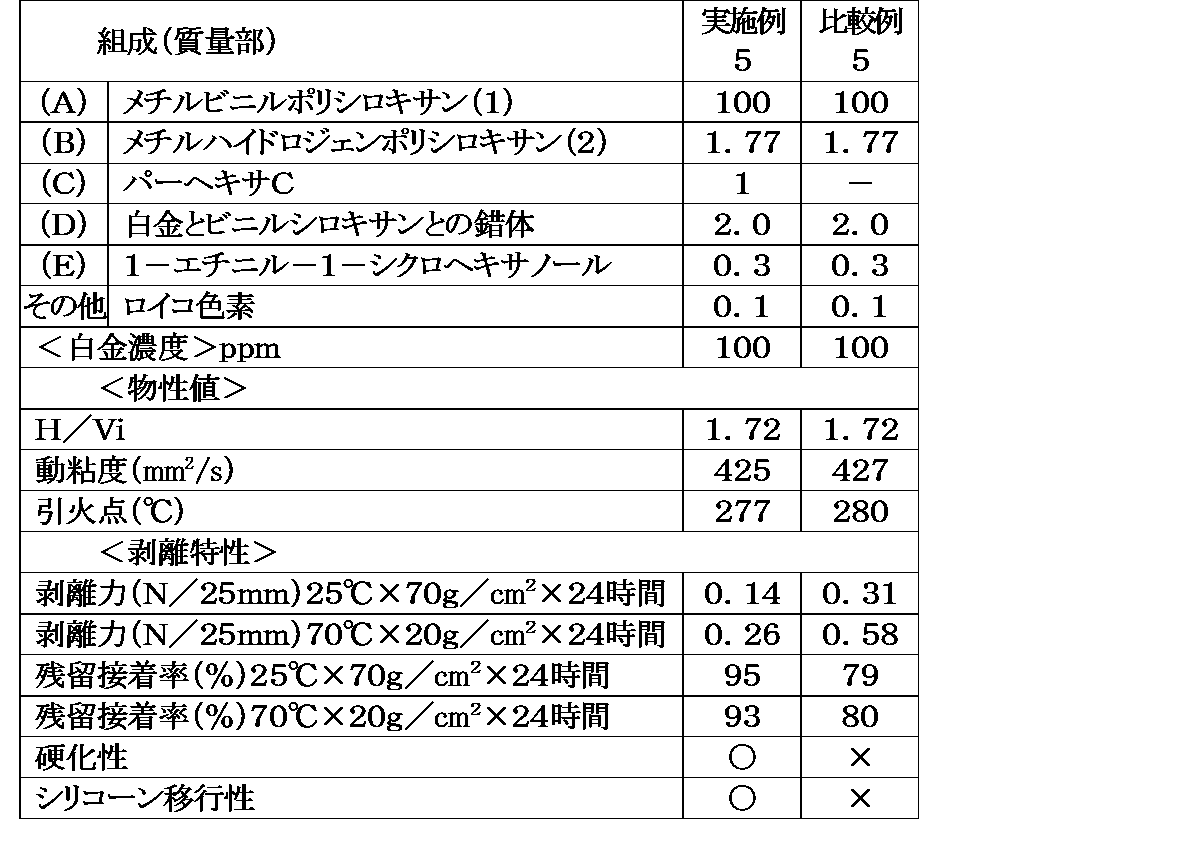
- Comparative Example 5 in which perhexa C was removed from the composition of Example 1 and 0.1 parts by mass of the leuco dye was blended, the curability was deteriorated and the uncured product was transferred. Therefore, the silicone transferability is high, the residual adhesion rate is 80% or less, and the peeling force is nearly three times higher.
- Example 5 in which 1 part by mass of Perhexa C was added to the composition of Comparative Example 5, the curability was improved despite the presence of the leuco dye which is a catalytic poison, and the peeling power, residual adhesive ratio, and silicone transferability were improved. Is also a good value.
Landscapes
- Chemical & Material Sciences (AREA)
- Chemical Kinetics & Catalysis (AREA)
- Organic Chemistry (AREA)
- Polymers & Plastics (AREA)
- Health & Medical Sciences (AREA)
- Medicinal Chemistry (AREA)
- Engineering & Computer Science (AREA)
- Materials Engineering (AREA)
- Wood Science & Technology (AREA)
- Life Sciences & Earth Sciences (AREA)
- Manufacturing & Machinery (AREA)
- Inorganic Chemistry (AREA)
- Compositions Of Macromolecular Compounds (AREA)
- Paints Or Removers (AREA)
Abstract
Description
(1)白金族金属系化合物を触媒として、アルケニル基を含有するオルガノポリシロキサンとオルガノハイドロジェンポリシロキサンとを付加反応させて剥離性皮膜を形成する方法(特許文献1:特開昭47-32072号公報)。
(2)有機金属塩を触媒として、水酸基やアルコキシ基といった官能基を有するオルガノポリシロキサンを縮合反応させて剥離性皮膜を形成する方法(特許文献2:特公昭35-13709号公報)。
(3)紫外線や電子線を用いて、アクリル基を含有するオルガノポリシロキサンと光反応開始剤とをラジカル重合させて剥離性皮膜を形成する方法(特許文献3:特開昭54-162787号公報)。
しかし上記液状シリコーン樹脂接着剤用の付加反応硬化型シリコーンゴム組成物において、10時間半減期温度が40℃以上の有機過酸化物の配合は、硬化時間が遅くなるため、さらなる添加剤として、銅、銅化合物、マンガン、マンガン化合物、鉄、鉄化合物、銀、銀化合物から選ばれる金属又は金属化合物とアセチルアセトン系化合物を配合した組成物が提案されている(特許文献5:特許第4569753号公報)。しかし、実施例における硬化時間は100℃下10分~100分かかっており、60秒以内(好ましくは30秒以内)に硬化する必要のある剥離紙用途には使用することができない。
上記液状シリコーン樹脂接着剤用の付加反応硬化型シリコーンゴム組成物と結果に違いが見られた原因としては、液状シリコーン樹脂接着剤用の付加反応硬化型シリコーンゴム組成物は組成中にシリカや炭酸カルシウムを多量に配合している点が大きく異なっていることが原因と推察する。また剥離紙又は剥離フィルム用オルガノポリシロキサン組成物の硬化と同じ温度(120℃)で硬化させた場合、剥離紙又は剥離フィルム用オルガノポリシロキサン組成物は30秒で硬化するのに対し、液状シリコーン樹脂接着剤用の付加反応硬化型シリコーンゴム組成物では1時間以上の時間を必要としていることからも反応スピードが違っていることを示唆している。
また、本発明の剥離紙又は剥離フィルム用オルガノポリシロキサン組成物は、上記液状シリコーン樹脂接着剤用の付加反応硬化型シリコーンゴム組成物で配合しているシリカ等の配合が無く、さらに、H/Viが上記特許文献5の実施例が0.41であるのに対し、好ましい範囲は1.2~3.0と高くSi-H基過剰である点も大きな相違点である。
〔1〕
少なくとも下記(A)~(D)成分を含有する剥離紙又は剥離フィルム用オルガノポリシロキサン組成物。
(A)1分子中に2個以上のケイ素原子結合アルケニル基を有するオルガノポリシロキサン:100質量部、
(B)1分子中に平均2個以上のケイ素原子結合水素原子(Si-H基)を有するオルガノハイドロジェンポリシロキサン:(A)成分中のアルケニル基のモル数に対し、Si-H基のモル数が1~5倍に相当する量、
(C)有機過酸化物:(A)成分100質量部に対し0.01~5質量部、及び
(D)白金族金属系触媒:(A)、(B)、(C)、(D)成分の合計中白金族金属の質量換算で1~500ppmとなる量。
〔2〕
さらに、(E)付加反応制御剤を(A)成分100質量部に対して0.01~5質量部含有する〔1〕記載の剥離紙又は剥離フィルム用オルガノポリシロキサン組成物。
〔3〕
(C)成分が、分子内に2つ以上の過酸化結合を有する多官能型の有機過酸化物である〔1〕又は〔2〕記載の剥離紙又は剥離フィルム用オルガノポリシロキサン組成物。
〔4〕
(C)成分の10時間半減期温度が、70℃以上120℃以下である〔1〕~〔3〕のいずれかに記載の剥離紙又は剥離フィルム用オルガノポリシロキサン組成物。
〔5〕
(C)成分の有機過酸化物が、パーオキシケタールである〔1〕~〔4〕のいずれかに記載の剥離紙又は剥離フィルム用オルガノポリシロキサン組成物。
〔6〕
(C)成分の有機過酸化物が、DSCで見た発熱開始温度が100℃以上である〔1〕~〔5〕のいずれかに記載の剥離紙又は剥離フィルム用オルガノポリシロキサン組成物。
〔7〕
組成物の引火点が、250℃以上である〔1〕~〔6〕のいずれかに記載の剥離紙又は剥離フィルム用オルガノポリシロキサン組成物。
[(A)成分]
(A)成分は、1分子中に2個以上のケイ素原子結合アルケニル基を有するオルガノポリシロキサンであり、1種単独で又は2種以上を適宜組み合わせて用いることができる。下記式(1)で表される構造を有するオルガノポリシロキサンが挙げられる。
MaMVi bDcDVi dTeTVi fQg (1)
(式中、MはR3SiO1/2、MViはR2PSiO1/2、DはR2SiO2/2、DViはRPSiO2/2、TはRSiO3/2、TViはPSiO3/2、QはSiO4/2であり、Rはそれぞれ独立に脂肪族不飽和結合を有さない炭素原子数1~12の非置換又は置換の一価炭化水素基であり、Pは-(CH2)n-CH=CH2(nは0~6の整数)で表されるアルケニル基である。a、b、d、fはそれぞれ独立に0又は正の数で、b、d、fが同時に0になることはなく、2≦b+d+f≦500であり、cは10~27,000の正数であり、eは0又は200以下の正数であり、gは0又は1,000以下の正数である。)
aは0又は1~100の正数が好ましく、0又は1~50の正数がより好ましく、bは0又は1~100の正数が好ましく、0又は1~50の正数がより好ましく、dは0又は1~500の正数が好ましく、0又は1~300の正数がより好ましく、fは0又は1~100の正数が好ましく、0又は1~50の正数がより好ましい。
構造式で表すと、MVi 2Dc、M2DcDVi d、MVi 3DcT1、MVi 4DcT2、MVi 2DcDVi d、MVi 2DcQ1、MaDcDVi dTVi f(M、MVi、D、DVi、T、TVi、Q、a、c、d、fは上記と同じ。以下同様。)等を挙げることができる。さらに具体的な構造例としては、MVi 2D100、M2D97DVi 3、M2D26DVi 4、M2D96DVi 4、M2D95DVi 5、MVi 3D100T1、MVi 4D100T2、MVi 2D97DVi 1、MVi 2D95DVi 3、M3D93DVi 3TVi 1、MVi 2D20000、M2D10000DVi 20等を挙げることができる。
(B)成分は、1分子中に平均2個以上のケイ素原子結合水素原子(Si-H基)を有するオルガノハイドロジェンポリシロキサンであり、1種単独で又は2種以上を適宜組み合わせて用いることができる。このオルガノハイドロジェンポリシロキサンのSi-H基と、(A)成分のアルケニル基とが付加反応することにより、オルガノポリシロキサン架橋物が形成される。
Si-H基含有量としては、0.001~3.5mol/100gが好ましく、0.01~2.5mol/100gがより好ましく、0.02~2.0mol/100gがさらに好ましい。Si-H基含有量が少なすぎると、キュアー性や密着性が悪くなる場合があり、多すぎると剥離力が重くなる場合がある。
MhMH iDjDH kTLTH mQn (2)
(式中、MはR3SiO1/2、MHはR2HSiO1/2、DはR2SiO2/2、DHはRHSiO2/2、TはRSiO3/2、THはHSiO3/2、QはSiO4/2であり、Rはそれぞれ独立に脂肪族不飽和結合を有さない炭素原子数1~12の非置換又は置換の一価炭化水素基である。h、i、j、Lはそれぞれ独立に0又は正の数であり、kは0又は100以下の正数であり、mは0又は10以下の正数であり、nは0又は10以下の正数であり、i、k、mが同時に0になることはなく、2≦i+k+m≦100である。)
構造式で表すと、MH 2Dj、M2DH k、M2DjDH k、MH 2DjDH k、MH 3DjT1、MH 4DjT2、MhDjDH kTH m(M、MH、D、DH、T、TH、h、j、k、mは上記と同じ。以下同様。)等を挙げることができる。さらに具体的な構造例としては、MH 2D10、MH 2D100、M2D27DH 3、M2D97DH 3、M2D26DH 4、M2D25DH 5、M2D24DH 6、M2D96DH 4、M2D95DH 5、MH 3D100T1、MH 4D100T2、MH 2D97DH 1、MH 2D95DH 3、M3D93DH 3TH 1、M2DH 30、M2DH 60等を挙げることができる。
(C)成分は有機過酸化物であり、明確な機構は分からないが、添加することにより少ない白金族金属系触媒量で付加反応が進行することから、白金族金属系触媒の活性を高める効果を有する。また、本発明のオルガノポリシロキサン組成物に白金族金属系触媒に対して触媒活性を阻害する成分を含有した場合や、触媒毒を含有する基材に対しても付加反応による硬化皮膜の形成が可能で、従来と同等の剥離力を有する硬化皮膜を形成することができる。
有機過酸化物としては、ケトンパーオキサイド、パーオキシケタール、ハイドロパーオキサイド、ジアルキルパーオキサイド、ジアシルパーオキサイド、パーオキシジカーボネート、パーオキシエステル等が挙げられる。これらの中でもケトンパーオキサイドやパーオキシケタール等の分子内に2つ以上の過酸化結合を有する多官能型の有機過酸化物が好ましく、特にはパーオキシケタールが好ましい。
ここで、パーオキシケタールとしては、1,1-ジ(t-ヘキシルパーオキシ)シクロヘキサン、1,1-ジ(t-ブチルパーオキシ)シクロヘキサン、2,2-ジ(t-ブチルパーオキシ)ブタン、n-ブチル-4,4-ジ(t-ブチルパーオキシ)バレレート、1,1-ジ(t-アミルパーオキシ)シクロヘキサン、1,1-ジ(t-ヘキシルパーオキシ)-3,3,5-トリメチルシクロヘキサン、1,1-ジ(t-ヘキシルパーオキシ)-2-メチルシクロヘキサン、1,1-ジ(t-ブチルパーオキシ)-3,3,5-トリメチルシクロヘキサン等が例示できる。
10時間半減期温度が70℃以上120℃以下の有機過酸化物としては、下記が挙げられる。
1,1-ジ(t-ブチルパーオキシ)シクロヘキサン:90.7℃(測定濃度0.1mol/L))
2,2-ジ(t-ブチルパーオキシ)ブタン:103.1℃(測定濃度0.1mol/L))
1,1-ジ(t-ヘキシルパーオキシ)シクロヘキサン:87.1℃(測定濃度0.05mol/L)
(D)白金族金属系触媒としては、付加反応触媒として用いられる公知のものが使用できる。このような白金族金属系触媒としては、例えば、白金系、パラジウム系、ロジウム系、ルテニウム系等の触媒が挙げられ、これらの中で特に白金系触媒が好ましく用いられる。この白金系触媒としては、例えば、白金シリカ・アルミナ、白金アルミナ・ハロゲン、白金ロジウム等の白金系化合物、白金とビニルシロキサン等との錯体、塩化白金酸のアルコール溶液又はアルデヒド溶液、塩化白金酸と各種オレフィン類との錯体、塩化白金酸とビニルシロキサン等との錯体等が挙げられる。
(E)付加反応制御剤は、必要に応じ配合される成分で、白金族金属系触媒の触媒活性を制御するものであり、各種有機窒素化合物、有機リン化合物、アセチレン系化合物、オキシム化合物、有機クロロ化合物等が挙げられる。具体的には、1-エチニル-1-シクロヘキサノール、3-メチル-1-ブチン-3-オール、3,5-ジメチル-1-ヘキシン-3-オール、3-メチル-1-ペンチン-3-オール、2-フェニル-3-ブチン-2-オール等のアセチレン系アルコール、3-メチル-3-ペンテン-1-イン、3,5-ジメチル-3-ヘキセン-1-イン等のアセチレン系化合物、1,1-ジメチルプロピニルオキシトリメチルシラン等のアセチレン系化合物とアルコキシシランもしくはシロキサン又はハイドロジェンシランとの反応物、テトラメチルビニルシロキサン環状体等のビニルシロキサン、ベンゾトリアゾール等の有機窒素化合物及びその他の有機リン化合物、オキシム化合物、マレイン酸ジアリルなどのマレイン酸化合物、有機クロロ化合物等が挙げられる。
本発明のオルガノポリシロキサン組成物には、有機溶剤を配合することができる。有機溶剤としては、トルエン、ヘキサン、キシレン、メチルエチルケトン等のオルガノポリシロキサンに可溶な有機溶剤(シロキサン溶剤を含まない)や、オクタメチルテトラシロキサン、デカメチルペンタシロキサン等の低粘度の環状シロキサン、M2Dp(M、Dは上記と同じ。pは0又は200以下の正数、好ましくは1~50の正数である。)等の直鎖シロキサン、M2+qDpTmq(M、D、Tは上記と同じ。pは0又は200以下の正数、好ましくは1~50の正数であり、qは1~10の正数、好ましくは1~3の正数である。)等の分岐鎖シロキサン等のオルガノポリシロキサン(シロキサン溶剤)を用いるのが好ましい。
有機溶剤の使用量は、(A)、(B)成分の合計質量の3~50倍であることが好ましく、8~30倍であることがより好ましい。
本発明のオルガノポリシロキサン組成物は、上記(A)~(D)成分及び必要に応じて(E)成分や任意成分のそれぞれの所定量を混合することによって得られる。本発明のオルガノポリシロキサン組成物には、剥離紙又は剥離フィルム用オルガノポリシロキサン組成物に通常配合する成分を、本発明の効果を損なわない範囲で配合することができる。なお、有機溶剤に希釈した場合もその特性は低下するものではない。
得られたオルガノポリシロキサン組成物のオストワルド粘度計により測定した25℃における動粘度は、50~1,000mm2/sであることが好ましく、100~500mm2/sであることがより好ましい。
本発明のオルガノポリシロキサン組成物は、例えば、紙、プラスチックフィルム等のシート状基材に塗工ロール(3本ロール、5本ロール、グラビアロール、オフセットグラビアロール等)により塗布した後、常法によって加熱硬化される。こうしてシート状基材の片面に本発明のオルガノポリシロキサン組成物のシリコーン硬化皮膜が形成され、剥離シート等として好適に使用される。紙基材としてはグラシン紙、ポリエチレンラミネート紙、ポリビニルアルコール樹脂コート紙、クレーコート紙等が挙げられる。プラスチックフィルムとしては、例えば、ポリエチレン、ポリプロピレン、ポリエチレンテレフタレート等のフィルムが挙げられる。
加熱硬化時の温度は、基材の種類や塗工量によって異なるが、80~200℃、好ましくは100~180℃で60~1秒、好ましくは30~2秒加熱することにより、基材上に硬化皮膜を形成させることができる。
(A)成分
メチルビニルポリシロキサン(1)
下記構造のビニル価が0.0166mol/100g、動粘度440mm2/sのポリシロキサン
{(CH2=CH)(CH3)2SiO1/2}2{(CH3)2SiO}160
メチルハイドロジェンポリシロキサン(2)
下記構造のSi-H基含有量が1.62mol/100gで動粘度が35mm2/sであるメチルハイドロジェンポリシロキサン
{(CH3)3SiO1/2}2{(CH3)HSiO}100
パーヘキサHC(日本油脂(株)製、1,1-ジ(t-ヘキシルパーオキシ)シクロヘキサン、10時間半減期温度87.1℃、発熱開始温度134℃、測定濃度0.05mol/L)
パーヘキサC(日本油脂(株)製、1,1-ジ(t-ブチルパーオキシ)シクロヘキサン、10時間半減期温度90.7℃、発熱開始温度134℃、測定濃度0.1mol/L)
(その他成分)
ロイコ色素;白金触媒の触媒毒として作用する。
(A)成分としてメチルビニルポリシロキサン(1)100質量部、(B)成分としてメチルハイドロジェンポリシロキサン(2)1.77質量部、(C)成分としてパーヘキサC1質量部、(E)成分として1-エチニル-1-シクロヘキサノール0.3質量部を加え、均一となるまで攪拌した後、(D)成分として白金とビニルシロキサンとの錯体を(A)、(B)、(C)、(D)及び(E)成分の合計質量中白金原子質量換算で100ppmになるように加え、均一となるまで攪拌し、動粘度422mm2/s、H/Vi(組成物中のアルケニル基に対する組成物中のSi-H基の割合)=1.72、引火点277℃の組成物を調製した。
(D)成分として白金とビニルシロキサンとの錯体を1.2質量部加え、(A)、(B)、(C)、(D)及び(E)成分の合計質量中白金原子質量換算で60ppmになるようにした以外は、実施例1と同様の配合組成で、動粘度421mm2/s、H/Vi=1.72、引火点275℃の組成物を調製した。
(C)成分を配合しない以外は実施例1と同様の配合組成で動粘度435mm2/s、H/Vi=1.72、引火点280℃の組成物を調製した。
(C)成分を配合しない以外は実施例2と同様の配合組成で動粘度434mm2/s、H/Vi=1.72、引火点278℃の組成物を調製した。
(C)成分をパーヘキサHCに変え、(E)成分1-エチニル-1-シクロヘキサノール量を0.5質量部に増やした以外は、実施例1と同様の配合組成で攪拌を行い、動粘度421mm2/s、H/Vi=1.72、引火点264℃の組成物を調製した。
(C)成分をパーヘキサHCに変え、(E)成分1-エチニル-1-シクロヘキサノール量を0.8質量部に増やした以外は、実施例1と同様の配合組成で攪拌を行い、動粘度419mm2/s、H/Vi=1.72、引火点252℃の組成物を調製した。
(E)成分1-エチニル-1-シクロヘキサノール量を0.5質量部に増やした以外は、比較例1と同様の配合組成で攪拌を行い、動粘度422mm2/s、H/Vi=1.72、引火点267℃の組成物を調製した。
(E)成分1-エチニル-1-シクロヘキサノール量を0.8質量部に増やした以外は、比較例1と同様の配合組成で攪拌を行い、動粘度420mm2/s、H/Vi=1.72、引火点258℃の組成物を調製した。
実施例1の配合組成に添加成分としてロイコ色素を0.1質量部配合した動粘度425mm2/s、H/Vi=1.72、引火点277℃の組成物を調製した。
比較例1の配合組成に添加成分としてロイコ色素を0.1質量部配合した動粘度427mm2/s、H/Vi=1.72、引火点280℃の組成物を調製した。
上記で得られた組成物をRIテスター((株)IHI機械システム製)の金属ロール上に塗布し、金属ロールとゴムロールからなる2本のロールを45秒間回転させて均一に上記組成物を引き延ばした後、ゴムロールからグラシン紙ASP(Ahlstrom-munksjo社製)へ上記組成物を転写した。上記組成物を転写したグラシン紙を、120℃の熱風式乾燥機中で30秒間加熱して厚さ0.9~1.1g/m2の上記組成物の硬化皮膜を有する剥離紙を得た。この状態で、25℃で24時間エージング後、この剥離紙の硬化皮膜表面(ゴムロールからの転写面側)に、TESA-7475テープ(tesa UK Ltd.)を貼り合わせ、2.5cm×18cmの大きさに切断した。これをガラス板に挟み、25℃で70g/cm2の荷重下及び70℃で20g/cm2の荷重下24時間エージング後、該試験片の一端を剥がしテープの粘着剤付き基材端部をグラシン紙に対して180度の角度の方向に剥離速度0.3m/minで引っ張り、その際に剥離するのに要する力(即ち、「剥離力」)(N/50mm)を、引張試験機((株)島津製作所製AGS-50G型)を用いて測定した。
上記剥離力の測定後のTESA-7475テープをポリエステルフィルムに貼り合わせ、2kgローラーを1回往復させて荷重を加えた。30分放置後、TESA-7475テープの一端を剥がし、その端部をポリエステルフィルムに対して180度の角度の方向に引っ張り、剥離速度0.3m/minで剥がした。その際に剥離するのに要する力:剥離力A(N/25mm)を測定した。
ブランクとして、ポリエステルフィルムに未使用のTESA-7475テープを貼り、上記と同様に2kgローラーを1回往復させて荷重を加え、30分放置後、TESA-7475テープの一端を剥がし、その端部をポリエステルフィルムに対して180度の角度の方向に引っ張り、剥離速度0.3m/minで剥がした。その際に剥離するのに要する力:剥離力B(N/25mm)を測定した。残留接着率(%)を(A/B)×100で求めた。
上記で得られた組成物をテスターの金属ロール上に塗布し、金属ロールとゴムロールからなる2本のロールを45秒間接触回転させて均一に上記組成物を引き延ばした後、ゴムロールからポリエチレンラミネート紙へ上記組成物を転写した。上記組成物を転写したポリエチレンラミネート紙は120℃の熱風式乾燥機中で30秒間加熱して厚さ0.9~1.1g/m2の硬化皮膜を有する剥離紙を得た。乾燥機から剥離紙を取り出して直に硬化皮膜面を人差し指で10回強く擦り、赤マジックインキを塗布してインキの濃さや硬化皮膜状態を観察した。
結果を、指痕が濃く見える場合は「×」、薄く見える場合は「△」、ほとんど見られない場合は「○」で表記した。
剥離力測定の場合と同様にしてポリエチレンラミネート紙表面に形成された上記で得られた組成物の硬化皮膜の表面に、厚さ36μmのポリエチレンテレフタレートフィルムを重ね、室温(25℃)で0.98MPaの加圧下で20時間圧着した後、ポリエチレンテレフタレートフィルムを硬化皮膜から外した。該ポリエチレンテレフタレートフィルムの硬化皮膜と接していた表面に、油性のインキ(商品名:マジックインキ、寺西化学工業(株)製)を塗り、そのハジキ具合により、シリコーン移行性を次の基準で評価した。
結果を、インキのハジキなし(シリコーン移行性なし又はかなり少ない):「○」、インキのハジキあり(シリコーンの移行性多い):「×」で表記した。


Claims (7)
- 少なくとも下記(A)~(D)成分を含有する剥離紙又は剥離フィルム用オルガノポリシロキサン組成物。
(A)1分子中に2個以上のケイ素原子結合アルケニル基を有するオルガノポリシロキサン:100質量部、
(B)1分子中に平均2個以上のケイ素原子結合水素原子(Si-H基)を有するオルガノハイドロジェンポリシロキサン:(A)成分中のアルケニル基のモル数に対し、Si-H基のモル数が1~5倍に相当する量、
(C)有機過酸化物:(A)成分100質量部に対し0.01~5質量部、及び
(D)白金族金属系触媒:(A)、(B)、(C)、(D)成分の合計中白金族金属の質量換算で1~500ppmとなる量。 - さらに、(E)付加反応制御剤を(A)成分100質量部に対して0.01~5質量部含有する請求項1記載の剥離紙又は剥離フィルム用オルガノポリシロキサン組成物。
- (C)成分が、分子内に2つ以上の過酸化結合を有する多官能型の有機過酸化物である請求項1又は2記載の剥離紙又は剥離フィルム用オルガノポリシロキサン組成物。
- (C)成分の10時間半減期温度が、70℃以上120℃以下である請求項1~3のいずれか1項に記載の剥離紙又は剥離フィルム用オルガノポリシロキサン組成物。
- (C)成分の有機過酸化物が、パーオキシケタールである請求項1~4のいずれか1項に記載の剥離紙又は剥離フィルム用オルガノポリシロキサン組成物。
- (C)成分の有機過酸化物が、DSCで見た発熱開始温度が100℃以上である請求項1~5のいずれか1項に記載の剥離紙又は剥離フィルム用オルガノポリシロキサン組成物。
- 組成物の引火点が、250℃以上である請求項1~6のいずれか1項に記載の剥離紙又は剥離フィルム用オルガノポリシロキサン組成物。
Priority Applications (4)
| Application Number | Priority Date | Filing Date | Title |
|---|---|---|---|
| US17/911,882 US12612494B2 (en) | 2020-03-16 | 2021-03-15 | Organopolysiloxane composition for use in release paper or release film |
| KR1020227035442A KR20220154742A (ko) | 2020-03-16 | 2021-03-15 | 박리지 또는 박리 필름용 오르가노폴리실록산 조성물 |
| JP2022508337A JP7364040B2 (ja) | 2020-03-16 | 2021-03-15 | 剥離紙又は剥離フィルム用オルガノポリシロキサン組成物 |
| CN202180021359.5A CN115279862B (zh) | 2020-03-16 | 2021-03-15 | 用于剥离纸或剥离膜的有机聚硅氧烷组合物 |
Applications Claiming Priority (2)
| Application Number | Priority Date | Filing Date | Title |
|---|---|---|---|
| JP2020-044865 | 2020-03-16 | ||
| JP2020044865 | 2020-03-16 |
Publications (1)
| Publication Number | Publication Date |
|---|---|
| WO2021187401A1 true WO2021187401A1 (ja) | 2021-09-23 |
Family
ID=77770901
Family Applications (1)
| Application Number | Title | Priority Date | Filing Date |
|---|---|---|---|
| PCT/JP2021/010295 Ceased WO2021187401A1 (ja) | 2020-03-16 | 2021-03-15 | 剥離紙又は剥離フィルム用オルガノポリシロキサン組成物 |
Country Status (5)
| Country | Link |
|---|---|
| US (1) | US12612494B2 (ja) |
| JP (1) | JP7364040B2 (ja) |
| KR (1) | KR20220154742A (ja) |
| CN (1) | CN115279862B (ja) |
| WO (1) | WO2021187401A1 (ja) |
Cited By (3)
| Publication number | Priority date | Publication date | Assignee | Title |
|---|---|---|---|---|
| JP2023145966A (ja) * | 2022-03-29 | 2023-10-12 | 東洋紡株式会社 | 離型フィルム |
| JPWO2024053483A1 (ja) * | 2022-09-06 | 2024-03-14 | ||
| TWI872495B (zh) * | 2022-03-29 | 2025-02-11 | 日商東洋紡股份有限公司 | 離型膜 |
Families Citing this family (3)
| Publication number | Priority date | Publication date | Assignee | Title |
|---|---|---|---|---|
| WO2020032287A1 (ja) | 2018-08-10 | 2020-02-13 | ダウ・東レ株式会社 | 感圧接着層形成性オルガノポリシロキサン組成物およびその使用 |
| WO2021029412A1 (ja) | 2019-08-13 | 2021-02-18 | ダウ・東レ株式会社 | 感圧接着層形成性オルガノポリシロキサン組成物およびその使用 |
| CN114269876B (zh) * | 2019-08-13 | 2024-05-14 | 陶氏东丽株式会社 | 压敏粘接层形成性聚有机硅氧烷组合物及其使用 |
Citations (8)
| Publication number | Priority date | Publication date | Assignee | Title |
|---|---|---|---|---|
| JP2006131813A (ja) * | 2004-11-09 | 2006-05-25 | Shin Etsu Chem Co Ltd | 自己接着性加熱硬化促進型液状シリコーンゴム組成物 |
| JP2007106905A (ja) * | 2005-10-14 | 2007-04-26 | Shin Etsu Chem Co Ltd | 加熱硬化型液状シリコーンゴム組成物 |
| JP2011252142A (ja) * | 2010-05-07 | 2011-12-15 | Shin-Etsu Chemical Co Ltd | 剥離紙又は剥離フィルム用シリコーン組成物、並びに剥離紙又は剥離フィルムとその製造方法 |
| JP2012092165A (ja) * | 2010-10-25 | 2012-05-17 | Shin-Etsu Chemical Co Ltd | 剥離紙又は剥離フィルム用シリコーンエマルジョン組成物、並びに剥離紙又は剥離フィルムとその製造方法 |
| JP2017025135A (ja) * | 2015-07-16 | 2017-02-02 | 信越化学工業株式会社 | 剥離紙又は剥離フィルム用シリコーン組成物、剥離紙及び剥離フィルム |
| JP2017075218A (ja) * | 2015-10-14 | 2017-04-20 | 信越化学工業株式会社 | 絶縁放熱シート |
| JP2018510240A (ja) * | 2015-03-31 | 2018-04-12 | ロジャーズ コーポレーション | 二重温度硬化性シリコーン組成物、製造の方法、およびそれから調製される物品 |
| WO2018190012A1 (ja) * | 2017-04-11 | 2018-10-18 | 信越化学工業株式会社 | 剥離紙又は剥離フィルム製造用シリコーン組成物 |
Family Cites Families (7)
| Publication number | Priority date | Publication date | Assignee | Title |
|---|---|---|---|---|
| JPS5033276Y2 (ja) | 1971-04-30 | 1975-09-27 | ||
| US4201808A (en) | 1978-06-12 | 1980-05-06 | Union Carbide Corporation | Radiation curable silicone release compositions |
| JP4314454B2 (ja) * | 2002-09-20 | 2009-08-19 | 信越化学工業株式会社 | 自己接着性加熱硬化型液状シリコーンゴム組成物 |
| JP4530147B2 (ja) * | 2004-08-25 | 2010-08-25 | 信越化学工業株式会社 | 一液型オルガノポリシロキサンゲル組成物 |
| JP4569753B2 (ja) | 2004-11-10 | 2010-10-27 | 信越化学工業株式会社 | 自己接着性加熱硬化促進型液状シリコーンゴム組成物 |
| JP5492377B2 (ja) | 2007-11-05 | 2014-05-14 | 東レ・ダウコーニング株式会社 | 溶剤型剥離性皮膜形成性オルガノポリシロキサン組成物および剥離フィルムもしくはシート |
| EP3211139B1 (en) * | 2014-10-22 | 2023-01-25 | Shin-Etsu Chemical Co., Ltd. | Waterproof sheet and method for waterproofing construction |
-
2021
- 2021-03-15 CN CN202180021359.5A patent/CN115279862B/zh active Active
- 2021-03-15 US US17/911,882 patent/US12612494B2/en active Active
- 2021-03-15 KR KR1020227035442A patent/KR20220154742A/ko active Pending
- 2021-03-15 WO PCT/JP2021/010295 patent/WO2021187401A1/ja not_active Ceased
- 2021-03-15 JP JP2022508337A patent/JP7364040B2/ja active Active
Patent Citations (8)
| Publication number | Priority date | Publication date | Assignee | Title |
|---|---|---|---|---|
| JP2006131813A (ja) * | 2004-11-09 | 2006-05-25 | Shin Etsu Chem Co Ltd | 自己接着性加熱硬化促進型液状シリコーンゴム組成物 |
| JP2007106905A (ja) * | 2005-10-14 | 2007-04-26 | Shin Etsu Chem Co Ltd | 加熱硬化型液状シリコーンゴム組成物 |
| JP2011252142A (ja) * | 2010-05-07 | 2011-12-15 | Shin-Etsu Chemical Co Ltd | 剥離紙又は剥離フィルム用シリコーン組成物、並びに剥離紙又は剥離フィルムとその製造方法 |
| JP2012092165A (ja) * | 2010-10-25 | 2012-05-17 | Shin-Etsu Chemical Co Ltd | 剥離紙又は剥離フィルム用シリコーンエマルジョン組成物、並びに剥離紙又は剥離フィルムとその製造方法 |
| JP2018510240A (ja) * | 2015-03-31 | 2018-04-12 | ロジャーズ コーポレーション | 二重温度硬化性シリコーン組成物、製造の方法、およびそれから調製される物品 |
| JP2017025135A (ja) * | 2015-07-16 | 2017-02-02 | 信越化学工業株式会社 | 剥離紙又は剥離フィルム用シリコーン組成物、剥離紙及び剥離フィルム |
| JP2017075218A (ja) * | 2015-10-14 | 2017-04-20 | 信越化学工業株式会社 | 絶縁放熱シート |
| WO2018190012A1 (ja) * | 2017-04-11 | 2018-10-18 | 信越化学工業株式会社 | 剥離紙又は剥離フィルム製造用シリコーン組成物 |
Cited By (4)
| Publication number | Priority date | Publication date | Assignee | Title |
|---|---|---|---|---|
| JP2023145966A (ja) * | 2022-03-29 | 2023-10-12 | 東洋紡株式会社 | 離型フィルム |
| TWI872495B (zh) * | 2022-03-29 | 2025-02-11 | 日商東洋紡股份有限公司 | 離型膜 |
| JP7842966B2 (ja) | 2022-03-29 | 2026-04-09 | 東洋紡株式会社 | 離型フィルム |
| JPWO2024053483A1 (ja) * | 2022-09-06 | 2024-03-14 |
Also Published As
| Publication number | Publication date |
|---|---|
| CN115279862B (zh) | 2025-03-18 |
| KR20220154742A (ko) | 2022-11-22 |
| JP7364040B2 (ja) | 2023-10-18 |
| US20230144102A1 (en) | 2023-05-11 |
| CN115279862A (zh) | 2022-11-01 |
| JPWO2021187401A1 (ja) | 2021-09-23 |
| US12612494B2 (en) | 2026-04-28 |
Similar Documents
| Publication | Publication Date | Title |
|---|---|---|
| WO2021187401A1 (ja) | 剥離紙又は剥離フィルム用オルガノポリシロキサン組成物 | |
| KR102891962B1 (ko) | 박리지 또는 박리 필름용 오가노폴리실록산 조성물 | |
| JP7103416B2 (ja) | 剥離紙又は剥離フィルム用オルガノポリシロキサン組成物 | |
| TW201704347A (zh) | 可固化有機聚矽氧烷組成物、其用途、以及自該組成物製備之層壓體 | |
| JP7626204B2 (ja) | 付加反応硬化型オルガノポリシロキサン組成物 | |
| JP7667744B2 (ja) | 硬化性オルガノポリシロキサン組成物、それからなる剥離コーティング剤、および積層体 | |
| KR102727863B1 (ko) | 경화성 실리콘 박리제 조성물 | |
| JP6563146B1 (ja) | 剥離性シリコーン樹脂組成物及びこれを塗布した剥離フィルム | |
| US20230312925A1 (en) | Silicone compositions containing acrylate cure accelerator | |
| JP7232334B2 (ja) | 白金族金属系触媒及び硬化性オルガノポリシロキサン組成物並びに剥離シート | |
| JP5101888B2 (ja) | 無溶剤型剥離性硬化皮膜形成性オルガノポリシロキサン組成物 | |
| KR102749400B1 (ko) | 무용제형 실리콘 박리제 조성물, 박리 시트 및 그 제조 방법 | |
| JP3813467B2 (ja) | 硬化性シリコーン剥離剤組成物 | |
| JP3891260B2 (ja) | 硬化性シリコ−ン剥離剤組成物及び剥離紙 | |
| JP7455974B2 (ja) | 付加反応硬化型オルガノポリシロキサン組成物、及び剥離紙並びに剥離フィルム | |
| JP4093542B2 (ja) | 硬化性シリコーン剥離剤組成物及びそれを使用してなる剥離紙 | |
| JP4753023B2 (ja) | シリコーン剥離剤組成物及び粘着紙の製造方法 | |
| JP2009215428A (ja) | 剥離剤組成物及び剥離シート | |
| WO2024209860A1 (ja) | 硬化性オルガノポリシロキサン組成物 | |
| TWI403560B (zh) | Solvent - free release silicone paper for use in release paper | |
| WO2026009781A1 (ja) | 剥離シート用オルガノポリシロキサン組成物 | |
| HK40068686B (zh) | 促进有机硅组合物的固化的方法 |
Legal Events
| Date | Code | Title | Description |
|---|---|---|---|
| 121 | Ep: the epo has been informed by wipo that ep was designated in this application |
Ref document number: 21770790 Country of ref document: EP Kind code of ref document: A1 |
|
| ENP | Entry into the national phase |
Ref document number: 2022508337 Country of ref document: JP Kind code of ref document: A |
|
| ENP | Entry into the national phase |
Ref document number: 20227035442 Country of ref document: KR Kind code of ref document: A |
|
| NENP | Non-entry into the national phase |
Ref country code: DE |
|
| 122 | Ep: pct application non-entry in european phase |
Ref document number: 21770790 Country of ref document: EP Kind code of ref document: A1 |
|
| WWG | Wipo information: grant in national office |
Ref document number: 202180021359.5 Country of ref document: CN |