WO2021186670A1 - 空気調和装置の室外機 - Google Patents
空気調和装置の室外機 Download PDFInfo
- Publication number
- WO2021186670A1 WO2021186670A1 PCT/JP2020/012302 JP2020012302W WO2021186670A1 WO 2021186670 A1 WO2021186670 A1 WO 2021186670A1 JP 2020012302 W JP2020012302 W JP 2020012302W WO 2021186670 A1 WO2021186670 A1 WO 2021186670A1
- Authority
- WO
- WIPO (PCT)
- Prior art keywords
- heat
- generating component
- temperature
- outdoor
- unit
- Prior art date
- Legal status (The legal status is an assumption and is not a legal conclusion. Google has not performed a legal analysis and makes no representation as to the accuracy of the status listed.)
- Ceased
Links
Images






Classifications
-
- F—MECHANICAL ENGINEERING; LIGHTING; HEATING; WEAPONS; BLASTING
- F24—HEATING; RANGES; VENTILATING
- F24F—AIR-CONDITIONING; AIR-HUMIDIFICATION; VENTILATION; USE OF AIR CURRENTS FOR SCREENING
- F24F1/00—Room units for air-conditioning, e.g. separate or self-contained units or units receiving primary air from a central station
- F24F1/06—Separate outdoor units, e.g. outdoor unit to be linked to a separate room comprising a compressor and a heat exchanger
- F24F1/20—Electric components for separate outdoor units
-
- F—MECHANICAL ENGINEERING; LIGHTING; HEATING; WEAPONS; BLASTING
- F24—HEATING; RANGES; VENTILATING
- F24F—AIR-CONDITIONING; AIR-HUMIDIFICATION; VENTILATION; USE OF AIR CURRENTS FOR SCREENING
- F24F11/00—Control or safety arrangements
- F24F11/30—Control or safety arrangements for purposes related to the operation of the system, e.g. for safety or monitoring
- F24F11/32—Responding to malfunctions or emergencies
-
- F—MECHANICAL ENGINEERING; LIGHTING; HEATING; WEAPONS; BLASTING
- F24—HEATING; RANGES; VENTILATING
- F24F—AIR-CONDITIONING; AIR-HUMIDIFICATION; VENTILATION; USE OF AIR CURRENTS FOR SCREENING
- F24F11/00—Control or safety arrangements
- F24F11/50—Control or safety arrangements characterised by user interfaces or communication
- F24F11/52—Indication arrangements, e.g. displays
-
- F—MECHANICAL ENGINEERING; LIGHTING; HEATING; WEAPONS; BLASTING
- F24—HEATING; RANGES; VENTILATING
- F24F—AIR-CONDITIONING; AIR-HUMIDIFICATION; VENTILATION; USE OF AIR CURRENTS FOR SCREENING
- F24F11/00—Control or safety arrangements
- F24F11/70—Control systems characterised by their outputs; Constructional details thereof
- F24F11/80—Control systems characterised by their outputs; Constructional details thereof for controlling the temperature of the supplied air
- F24F11/86—Control systems characterised by their outputs; Constructional details thereof for controlling the temperature of the supplied air by controlling compressors within refrigeration or heat pump circuits
-
- F—MECHANICAL ENGINEERING; LIGHTING; HEATING; WEAPONS; BLASTING
- F24—HEATING; RANGES; VENTILATING
- F24F—AIR-CONDITIONING; AIR-HUMIDIFICATION; VENTILATION; USE OF AIR CURRENTS FOR SCREENING
- F24F11/00—Control or safety arrangements
- F24F11/88—Electrical aspects, e.g. circuits
-
- F—MECHANICAL ENGINEERING; LIGHTING; HEATING; WEAPONS; BLASTING
- F24—HEATING; RANGES; VENTILATING
- F24F—AIR-CONDITIONING; AIR-HUMIDIFICATION; VENTILATION; USE OF AIR CURRENTS FOR SCREENING
- F24F11/00—Control or safety arrangements
- F24F11/89—Arrangement or mounting of control or safety devices
-
- F—MECHANICAL ENGINEERING; LIGHTING; HEATING; WEAPONS; BLASTING
- F24—HEATING; RANGES; VENTILATING
- F24F—AIR-CONDITIONING; AIR-HUMIDIFICATION; VENTILATION; USE OF AIR CURRENTS FOR SCREENING
- F24F2140/00—Control inputs relating to system states
-
- Y—GENERAL TAGGING OF NEW TECHNOLOGICAL DEVELOPMENTS; GENERAL TAGGING OF CROSS-SECTIONAL TECHNOLOGIES SPANNING OVER SEVERAL SECTIONS OF THE IPC; TECHNICAL SUBJECTS COVERED BY FORMER USPC CROSS-REFERENCE ART COLLECTIONS [XRACs] AND DIGESTS
- Y02—TECHNOLOGIES OR APPLICATIONS FOR MITIGATION OR ADAPTATION AGAINST CLIMATE CHANGE
- Y02B—CLIMATE CHANGE MITIGATION TECHNOLOGIES RELATED TO BUILDINGS, e.g. HOUSING, HOUSE APPLIANCES OR RELATED END-USER APPLICATIONS
- Y02B30/00—Energy efficient heating, ventilation or air conditioning [HVAC]
- Y02B30/70—Efficient control or regulation technologies, e.g. for control of refrigerant flow, motor or heating
Definitions
- the present disclosure relates to an outdoor unit of an air conditioner, and more particularly to an outdoor unit of an air conditioner having a controller equipped with heat generating parts.
- a controller for controlling the compressor and the blower is installed inside the outdoor unit of the air conditioner.
- a control board on which a plurality of electric components and electronic components are mounted is housed in the controller.
- the compressor is an inverter compressor
- the compressor is controlled by an inverter circuit mounted on a control board.
- a power device such as an IGBT is mounted on the inverter circuit. Power devices are heat-generating components that generate a large amount of heat.
- the control device includes an IPM (Intelligent Power Module) for controlling the compressor.
- the IPM has a heat generating component. Therefore, the IPM is provided with a thermistor and a temperature detection circuit for detecting the temperature of the IPM.
- the microcomputer controls the operating state of the compressor according to the detection temperature of the IPM.
- the temperature of the IPM is detected by a thermistor, and when the temperature of the heat-generating component mounted on the IPM rises, the rotation frequency of the compressor is reduced.
- the controller is also equipped with parts other than heat-generating parts. Even if the calorific value of these parts is relatively small, the temperature of the air in the controller rises due to the heat generated by the heat-generating parts. At that time, parts other than the heat generating parts may accumulate the heat. Many of these parts have a shortened life due to heat buildup.
- it is necessary to incorporate a thermistor in each component.
- the thermistor is an expensive component, there is a problem that incorporating the thermistor into each component in the controller leads to an increase in cost. Therefore, as in Patent Document 1, the thermistor is built in only a part of the parts. However, in that case, the life of the part not provided with the thermistor cannot be estimated, so that the life is suddenly reached. As a result, there is a problem that the reliability of the outdoor unit of the air conditioner is lowered.
- the present disclosure has been made to solve such a problem, and by estimating the life of other parts based on the temperature of the heat-generating part, it is possible to maintain reliability while suppressing costs, and air.
- the purpose is to obtain an outdoor unit for a harmonizer.
- the outdoor unit of the air conditioner includes a refrigerant circuit in which a compressor and an outdoor heat exchanger are connected by a refrigerant pipe, an outdoor blower that blows air to the outdoor heat exchanger, and the compressor.
- a controller having an inverter circuit for driving the above is provided, and the controller is provided in the first heat generating component, the second heat generating component having a smaller heat generation amount than the first heat generating component, and the first heat generating component.
- the temperature acquisition unit that acquires the temperature of the first heat-generating component detected by the temperature detection circuit, and the temperature acquired by the temperature acquisition unit. Therefore, it has an estimation calculation unit that calculates the temperature estimation value of the second heat-generating component and calculates the estimated value of the life of the second heat-generating component based on the temperature estimation value.
- a temperature detection circuit is provided in the first heat generating component, and the life of the second heat generating component is estimated based on the temperature of the first heat generating component, thereby suppressing the cost. Reliability can be maintained.
- FIG. It is a refrigerant circuit diagram which shows the structure of the air conditioner 100 which concerns on Embodiment 1.
- FIG. It is a front view which shows typically the flow of the air in the outdoor unit 1 of the air conditioner 100 which concerns on Embodiment 1.
- FIG. It is a front view which shows the structure of the controller 3 provided in the air conditioner 100 which concerns on Embodiment 1.
- FIG. It is the schematic which shows the structure of the electric power conversion apparatus 50 provided in the air conditioner 100 which concerns on Embodiment 1.
- FIG. 1 It is a flowchart which shows the process flow of the control part 58 of the outdoor unit 1 of the air conditioner 100 which concerns on Embodiment 1.
- FIG. It is a flowchart which shows the process flow of the control part 58 of the outdoor unit 1 of the air conditioner 100 which concerns on Embodiment 1.
- FIG. It is a figure which shows the graph which showed the relationship between the temperature of each component in the outdoor unit 1 of the air conditioner 100 which concerns on Embodiment 1 and the drive frequency of a compressor 4.
- It is a front view which shows the structure of the controller 3 provided in the air conditioner 100 which concerns on Embodiment 2.
- FIG. It is a rear view which shows the structure of the controller 3 provided in the air conditioner 100 which concerns on Embodiment 2.
- FIG. 1 is a perspective view showing the outdoor unit 1 of the air conditioner according to the first embodiment.
- the outdoor unit 1 has an outdoor heat exchanger 2 and a controller 3.
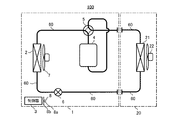
- FIG. 2 is a refrigerant circuit diagram showing the configuration of the air conditioner 100 according to the first embodiment. As shown in FIG. 2, the air conditioner 100 includes an outdoor unit 1 and an indoor unit 20.
- the indoor unit 20 is installed in the indoor space.
- the air conditioner 100 air-conditions the indoor space.
- the outdoor unit 1 is installed outdoors. As shown in FIG. 2, the outdoor unit 1 and the indoor unit 20 are connected to each other by a refrigerant pipe 60.
- the indoor unit 20 includes an indoor heat exchanger 21, an indoor blower 22, and a part of the refrigerant pipe 60.
- the indoor side blower 22 blows indoor air to the indoor side heat exchanger 21.
- the indoor heat exchanger 21 exchanges heat between the refrigerant flowing inside and the indoor air.
- the indoor heat exchanger 21 is, for example, a fin-and-tube heat exchanger.
- the indoor heat exchanger 21 functions as a condenser when the air conditioner 100 is in the heating operation and as an evaporator during the cooling operation.
- the indoor blower 22 is, for example, a propeller fan.
- the indoor blower 22 is composed of a fan motor 22a and a fan 22b, as shown in FIG. 6 to be described later.
- the fan 22b rotates using the fan motor 22a as a power source.
- the outdoor unit 1 includes an outdoor heat exchanger 2, a controller 3, a compressor 4, a flow path switching device 5, an expansion valve 6, an outdoor blower 7 and the like. It has a controller side blower 8 and a part of a refrigerant pipe 60.
- the outdoor unit 1 may further include other components such as an accumulator.
- the compressor 4, the flow path switching device 5, and the expansion valve 6 shown in FIG. 2 are contained in the outdoor unit 1. , The outdoor blower 7 and the controller side blower 8 are provided.
- the outdoor heat exchanger 2 exchanges heat between the refrigerant circulating inside and the outdoor air.
- the outdoor heat exchanger 2 is, for example, a fin-and-tube heat exchanger.
- the outdoor heat exchanger 2 functions as a condenser when the air conditioning system is in the cooling operation and as an evaporator during the heating operation.
- the outdoor blower 7 blows outdoor air to the outdoor heat exchanger 2.
- the outdoor blower 7 is composed of a fan motor 7a and a fan 7b, as shown in FIG. 6 to be described later.
- the fan 7b rotates using the fan motor 7a as a power source.
- the outdoor blower 7 is, for example, a propeller fan.
- the rotation speed of the outdoor blower 7 is controlled by the controller 3.
- FIG. 3 is a front view schematically showing the air flow in the outdoor unit 1 of the air conditioner 100 according to the first embodiment.
- the arrows indicate the air flow.
- the outdoor unit 1 is provided with two outdoor blowers 7. Each of the two outdoor blowers 7 is arranged above the outdoor unit 1.
- the outdoor air is sucked from the suction port 1a provided on the side surface of the outdoor unit 1 by driving the outdoor blowers 7.
- the outdoor air passes through the outdoor heat exchanger 2.
- heat exchange is performed between the outdoor air and the refrigerant flowing inside the outdoor heat exchanger 2. After that, the air is blown out from the air outlet 1b provided in the upper part of the outdoor unit 1.
- the controller 3 is arranged in the air passage and is cooled by the air flow.
- the compressor 4 sucks in a low-pressure gas refrigerant, compresses it, and discharges it as a high-pressure gas refrigerant.
- the compressor 4 is, for example, an inverter compressor.
- the inverter compressor can change the amount of the refrigerant to be sent out per unit time by controlling the inverter circuit or the like.
- the inverter circuit is mounted on the controller 3, for example.
- the flow path switching device 5 is a valve for switching the flow direction of the refrigerant in the refrigerant pipe 60.
- the flow path switching device 5 is composed of, for example, a four-way valve.
- the flow path switching device 5 is switched between the case where the air conditioner 100 is in the cooling operation and the case where the air conditioning device 100 is in the heating operation under the control of the controller 3.
- the flow path switching device 5 is in the state shown by the solid line in FIG. 2, and the refrigerant discharged from the compressor 4 flows into the outdoor heat exchanger 2.
- the flow path switching device 5 is in the state shown by the broken line in FIG. 2, and the refrigerant discharged from the compressor 4 flows into the indoor heat exchanger 21 of the indoor unit 20.
- the expansion valve 6 decompresses the inflowing liquid refrigerant by a squeezing action and flows out so that the refrigerant liquefied by the condenser can be easily evaporated by the evaporator. Further, the expansion valve 6 adjusts the amount of refrigerant so as to maintain an appropriate amount of refrigerant according to the load of the evaporator.
- the expansion valve 6 is composed of, for example, an electronic expansion valve.
- the opening degree of the expansion valve 6 is controlled by the controller 3. As shown in FIG. 2, the expansion valve 6 is connected between the outdoor heat exchanger 2 and the indoor heat exchanger 21 by a refrigerant pipe 60.
- the refrigerant pipe 60 constitutes a refrigerant circuit by connecting a compressor 4, a flow path switching device 5, an outdoor heat exchanger 2, an expansion valve 6, and an indoor heat exchanger 21. doing.
- the controller side blower 8 blows air to the controller 3 to cool the controller 3.
- the controller side blower 8 is composed of a fan motor 8a and a fan 8b.
- the fan 8b rotates using the fan motor 8a as a power source.
- the controller side blower 8 is, for example, a propeller fan.
- the on / off switching of the controller side blower 8 is controlled by the controller 3. Since the rotation speed of the blower 8 on the controller side may be constant, an inverter circuit for driving is not particularly required.
- the controller-side blower 8 does not necessarily have to be provided, and may be provided as needed.
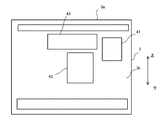
- FIG. 4 is a front view showing the configuration of the controller 3 provided in the air conditioner 100 according to the first embodiment.
- FIG. 5 is a rear view showing the configuration of the controller 3 provided in the air conditioner 100 according to the first embodiment.
- a part of the configuration is transparent and is shown by a broken line.
- the controller 3 has a housing 3a. As shown in FIGS. 4 and 5, a main substrate 3b is provided in the housing 3a. As shown in FIG. 4, a first inverter board 35 and two second inverter boards 39 are provided on the front surface of the main board 3b. Further, as shown in FIG. 5, a first heat sink 42, a second heat sink 43, and a reactor 41 are provided on the back surface of the main substrate 3b.
- the first inverter board 35 is arranged in the central portion of the main board 3b.
- the first inverter board 35 is a rectangular or substantially rectangular plate-shaped member.
- the center of the first inverter board 35 is arranged at the center position in the vertical direction of the controller 3 or at a position shifted downward from the central position in the vertical direction. Further, the center of the first inverter board 35 is arranged at the center position in the left-right direction of the controller 3 or a position shifted to the right from the center position in the left-right direction.
- Each of the two second inverter boards 39 is a rectangular or substantially rectangular plate-shaped member. Further, each of the second inverter boards 39 is arranged above the arrangement position of the first inverter board 35.
- the distance between the first inverter board 35 and the second inverter board 39 is smaller than a certain value, for example, shorter than the short side of the second inverter board 39 or the outer diameter of the main electrolytic capacitor 38.
- the reactor 41 is arranged on the left side of the first inverter board 35 and the second inverter board 39.
- the distance between the reactor 41 and the first inverter board 35 is smaller than a certain value, for example, shorter than the short side of the second inverter board 39.
- the first IPM 36 for driving the compressor 4 and the main electrolytic capacitor 38 are mounted on the first inverter board 35.
- the first IPM 36, the main electrolytic capacitor 38, and the reactor 41 constitute a power conversion device 50 shown in FIG. 6, which will be described later, for driving the compressor 4.
- the power conversion device 50 will be described later.
- the first IPM 36 has a built-in temperature detection circuit 37.
- the temperature detection circuit 37 constantly detects the temperature of the first IPM 36.
- the temperature detection circuit 37 is composed of, for example, a thermistor.
- the first IPM 36 is arranged above the main electrolytic capacitor 38. Therefore, the main electrolytic capacitor 38 is arranged on the windward side of the first IPM 36.
- a first heat sink 42 is provided on the back surface of the main board 3b. As shown in FIG. 5, the first heat sink 42 is arranged so as to correspond to the region where the first IPM 36 is provided. That is, the first heat sink 42 is not provided in the region where the main electrolytic capacitor 38 is provided. The first heat sink 42 releases the heat generated from the first IPM 36 to cool the first IPM 36. Further, the main electrolytic capacitor 38 generates less heat than the first IPM 36. Therefore, by arranging the main electrolytic capacitor 38 on the windward side of the first IPM 36, the main electrolytic capacitor 38 is sufficiently cooled even without a heat sink.
- each of the second inverter boards 39 is equipped with a second IPM 40 that drives each of the outdoor blowers 7.
- the second IPM 40 is a component having a smaller calorific value because the applied power and current values are lower than those of the first IPM 36. Further, since the second IPM 40 has a large temperature margin, it is not necessary to always detect the temperature of the second IPM 40. Therefore, the second IPM 40 does not have a built-in temperature detection circuit.
- a second heat sink 43 is provided on the back surface of the main board 3b. As shown in FIG. 5, the second heat sink 43 is arranged so as to correspond to the region where the second IPM 40 is provided. The second heat sink 43 releases the heat generated from the second IPM 40 to cool the second IPM 40. As described above, the amount of heat generated from the second IPM 40 is small. The air sucked into the outdoor unit 1 flows from the bottom to the top in the outdoor unit 1 as described with reference to FIG. Therefore, the second heat sink 43 is arranged leeward of the first heat sink 42. As a result, the second heat sink 43 is supplied with air warmed by the heat released from the first heat sink 42.
- the calorific value differs between the first IPM36 and the second IPM40, it is desirable to determine the arrangement of each component based on the magnitude of the calorific value. Specifically, it is desirable to arrange the parts with a large calorific value on the windward side and the parts with a small calorific value on the leeward side. Further, since the amount of heat generated differs for each part in this way, it is possible to sequentially arrange each part along the air passage by deciding the arrangement of each part by utilizing the amount of heat generated. This promotes cooling of each component. Further, since the parts that must be arranged on the windward side are limited and other parts can be arranged on the windward side, there is an advantage that the degree of freedom in the arrangement of each part is increased.
- the first IPM 36 is provided with the first heat sink 42
- the second IPM 40 is provided with the second heat sink 43.
- the outdoor unit 1 ensures heat dissipation.
- Both the first heat sink 42 and the second heat sink 43 are arranged in the air passage of the outdoor blower 7. Therefore, the first heat sink 42 and the second heat sink 43 use the wind generated by driving the outdoor blower 7 to cool the first IPM 36 and the second IPM 40.
- one second heat sink 43 is provided for the two second inverter boards 39, but the present invention is not limited to this case.
- One second heat sink 43 may be provided for one second inverter board 39.
- the number of main electrolytic capacitors 38 is 2, but the number is not limited to this, and any number may be set.
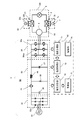
- FIG. 6 is a schematic view showing the configuration of the power conversion device 50 provided in the air conditioner 100 according to the first embodiment.
- the configuration of the power conversion device 50 shown in FIG. 6 is merely an example, and is not limited thereto.
- FIG. 6 shows a power conversion device 50 for driving the compressor 4. Since the configuration of the power conversion device for driving the outdoor blower 7 is basically the same as that of FIG. 6, the description thereof will be omitted here.
- the power conversion device 50 controls the operation of the compressor 4 by using the AC power supplied from the three-phase AC power supply 51.
- the power conversion device 50 is configured to control the drive frequency of the compressor 4. That is, the power conversion device 50 converts the AC power supplied from the three-phase AC power supply 51 into DC power, generates power for driving the compressor 4, and supplies the power to the compressor 4.
- the power conversion device 50 includes a three-phase rectifier 52, a step-down circuit 53, and a first IPM 36.
- the first IPM 36 has an inverter circuit 36a.
- the three-phase rectifier 52 rectifies the AC voltage of the three-phase AC power supply 51 and converts it into a DC voltage.
- the three-phase rectifier 52 is a three-phase full-wave rectifier in which six rectifying diode elements 52a are bridge-connected.
- the step-down circuit 53 is a circuit that steps down the DC voltage supplied from the three-phase rectifier 52 to an arbitrary DC voltage.
- the step-down circuit 53 is feedback-controlled so that the DC bus voltage reaches the target voltage value.
- the step-down circuit 53 includes a main electrolytic capacitor 38, a step-down switching element 55, a reactor 41, a backflow prevention element 56, and a smoothing capacitor 57.
- the step-down switching element 55 has an on state and an off state, and the on / off time is set based on the voltage value for step-down.
- the reactor 41 is responsible for supplying electric power to the load side.
- the backflow prevention element 56 is provided to allow a continuous current to flow.
- the main electrolytic capacitor 38 is connected to the output section of the three-phase rectifier 52 and suppresses the ripple current during switching of the step-down switching element 55. Further, the main electrolytic capacitor 38 acts to suppress the surge voltage generated when the step-down switching element 55 is turned off. Due to the action of the main electrolytic capacitor 38, even when the step-down switching element 55 is turned off while a current is flowing, an excessive surge voltage is not applied to the device. Therefore, the power conversion device 50 can continue to operate normally.
- the three-phase AC power supply 51 includes the impedance of the power supply, and a surge voltage may be generated depending on the inductance component of the impedance of the power supply.
- the smoothing capacitor 57 smoothes the pulsed voltage switched by the step-down switching element 55 and the backflow prevention element 56. That is, the smoothing capacitor 57 is provided to smooth the DC voltage.
- the step-down switching element 55 is composed of a semiconductor element such as a silicon (Si) element. More specifically, the step-down switching element 55 is a semiconductor element such as a MOSFET (Metal-Oxide-Semiconductor Field-Effect Transistor) or an IGBT (Insulated Gate Bipolar Transistor).
- MOSFET Metal-Oxide-Semiconductor Field-Effect Transistor
- IGBT Insulated Gate Bipolar Transistor
- the backflow prevention element 56 is composed of a semiconductor element such as a silicon element.
- the backflow prevention element 56 may be a semiconductor element such as a fast recovery diode.
- the backflow prevention element 56 may be composed of inexpensive contact parts.
- an inexpensive contact component for example, a relay that partially switches with respect to the power supply cycle can be adopted.
- the inverter circuit 36a converts the DC power smoothed by the smoothing capacitor 57 into three-phase AC power.
- the inverter circuit 36a includes a plurality of switching elements 36aa composed of semiconductor elements such as IGBTs. In the example of FIG. 6, in the inverter circuit 36a, six switching elements 36aa are bridge-connected. That is, the inverter circuit 36a converts the DC bus voltage into a three-phase AC voltage by the operation of the six switching elements 36aa, and supplies an AC current to the compressor 4.
- the controller 3 has a control unit 58.
- the control unit 58 includes a temperature acquisition unit 70, a temperature control unit 71, an estimation calculation unit 72, an alarm unit 73, and a storage unit 74.
- the temperature acquisition unit 70 acquires the temperature of the first IPM 36 detected by the temperature detection circuit 37 shown in FIGS. 4 and 5.
- the temperature control unit 71 manages the temperature of the first heat generating component based on the temperature acquired by the temperature acquisition unit 70.
- the first heat-generating component is a component that generates a large amount of heat. Depending on the operating conditions, the first heat-generating component may exceed the abnormal temperature and be damaged.
- the first heat generating component is, for example, the first IPM 36 and the reactor 41.
- the temperature control unit 71 uses the temperature of the first IPM 36 as the temperature of the first heat generating component.
- the temperature control unit 71 performs a first process for lowering the temperature of the first heat generating component when the temperature of the first heat generating component becomes equal to or higher than a preset first threshold value.
- the first treatment is a high temperature protection treatment for protecting the first heat generating component from high temperature.
- Examples of the first process include the following processes (a1) to (d1).
- the first threshold value is a value shown by the dotted line 94 in FIGS. 9 and 10 described later, and is a value lower than the abnormal temperature shown by the dotted line 90. Since the first heat-generating component may be damaged when its temperature reaches an abnormal temperature, the first treatment is performed when the temperature reaches the first threshold value lower than the abnormal temperature.
- the temperature of the first IPM36 is used as the temperature of the first heat generating component. That is, the temperature detection circuit 37 is provided in the first IPM 36. On the other hand, the reactor 41 is not provided with a temperature detection circuit. The reason for this will be explained. Both the first IPM 36 and the reactor 41 are arranged in the housing 3a of the controller 3. Therefore, the first IPM 36 and the reactor 41 are used in the same environment. The temperatures of the first IPM 36 and the reactor 41 change in a similar manner based on the drive frequency of the compressor 4. Therefore, if the temperature detection circuit 37 is provided only for the first heat-generating component having the strictest temperature condition to detect the temperature, it is not necessary to detect the temperature for the other components.
- the temperature detection circuit 37 is provided only in the first IPM 36.
- the temperature detection circuit 37 uses an expensive thermistor.
- the number of temperature detection circuits can be significantly reduced as compared with the case where the temperature detection circuits are provided in each component. Therefore, the cost of the outdoor unit 1 can be suppressed.
- the estimation calculation unit 72 calculates an estimated value of the temperature of the second heat generating component based on the temperature of the first heat generating component.
- the estimated value of the temperature of the second heat generating component is referred to as the temperature estimated value of the second heat generating component.
- the second heat generating component is a component having a smaller heat generation amount than the first heat generating component.
- the second heat generating component has a characteristic that the life is shortened due to the accumulation of heat.
- the second heat generating component is, for example, a main electrolytic capacitor 38.
- the temperature estimation value T2 of the second heat-generating component can be obtained by, for example, the following equation (1).
- the coefficient ⁇ and the coefficient ⁇ are preset for each component and registered in the storage unit 74. Since it is desirable that the coefficient ⁇ and the coefficient ⁇ are also changed according to the rotation speed of the outdoor blower 7, they are set in advance for each component and for each rotation speed of the outdoor blower 7.
- the coefficient ⁇ is a positive value less than 1 (0 ⁇ ⁇ 1).
- the coefficient ⁇ is a positive value or a negative value.
- FIG. 9 is a diagram showing a graph showing the relationship between the temperature of each component in the outdoor unit 1 of the air conditioner 100 according to the first embodiment and the drive frequency of the compressor 4.
- the horizontal axis represents the drive frequency of the compressor 4.
- the vertical axis shows the temperatures of the reactor 41, the first IPM 36, and the main electrolytic capacitor 38.
- the dotted line 90 indicates the abnormal temperature. If the abnormal temperature exceeds 90, the first heat generating component will be damaged.
- the broken line 91 indicates the temperature of the reactor 41.
- the alternate long and short dash line 92 indicates the temperature of the first IPM 36 detected by the temperature detection circuit 37.
- the alternate long and short dash line 93 indicates the temperature of the main electrolytic capacitor 38.
- the dotted line 94 indicates the first threshold value.
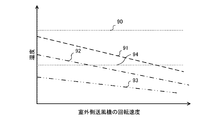
- FIG. 10 is a diagram showing a graph showing the relationship between the temperature of each component in the outdoor unit 1 of the air conditioner 100 according to the first embodiment and the rotation speed of the outdoor blower 7.
- the horizontal axis indicates the rotation speed of the outdoor blower 7.
- the vertical axis shows the temperatures of the reactor 41, the first IPM 36, and the main electrolytic capacitor 38.
- the dotted line 90 indicates the abnormal temperature.
- the broken line 91 indicates the temperature of the reactor 41.
- the alternate long and short dash line 92 indicates the temperature of the first IPM 36 detected by the temperature detection circuit 37.
- the alternate long and short dash line 93 indicates the temperature of the main electrolytic capacitor 38.
- the dotted line 94 indicates the first threshold value.
- the estimation calculation unit 72 further calculates an estimated value of the life of the second heat generating component based on the temperature estimated value T2 of the second heat generating component.
- the estimated value L2 of the life of the second heat-generating component can be obtained by, for example, the following equation (2).
- the equation (2) is as follows from the life Lo when the rated voltage is applied, the upper limit temperature To of the category, and the estimated temperature value T2 at the upper limit temperature of the category.
- L2 Lo ⁇ 2 ⁇ ((To-T2) / 10) (2)
- the product life of the second heat generating component is L1.
- the product life L1 is preset for each part, for example, 15 years or 20 years, based on the product standard or the like.
- the product life L1 is a period from the start of use of a part to the occurrence of a wear failure, and is determined by a reliability test or the like for each part.
- the estimation calculation unit 72 compares the estimated value L2 of the life of the second heat generating component with the product life L1. When L2 is L1 or more, the estimation calculation unit 72 outputs a message prompting the user to replace the second heat generating component from the alarm unit 73. In the following, the message will be referred to as a first alarm.
- the estimated value L2 of the life of the second heat-generating component obtained by calculation has already reached the product life L1, it is better to replace the second heat-generating component promptly, so that the first alarm is issued.
- Output from the alarm unit 73 Specifically, when the product life L1 is 15 years, for example, when the estimated value L2 is 16 years, the first alarm is output.
- the estimation calculation unit 72 performs a second process for protecting the second heat generating component from heat.
- the second threshold value may be arbitrarily determined to be, for example, a value of about 1 to 3 years. That is, if the estimated value L2 of the life of the second heat-generating component obtained by calculation does not reach the product life L1 but is close to the product life L1, it is better to notify that the replacement time of the second heat-generating component is near. Therefore, the second process is carried out.
- the second process include the following processes (a2) to (b2).
- the alarm unit 73 outputs a message to the user that the second heat generating component is thermally damaged.
- the message will be referred to as a second alarm.
- (B2) The operation mode of the air conditioner 100 is switched to the life extension operation mode that reduces the thermal damage of the second heat generating component.
- the life extension operation mode for example, the drive frequency of the compressor 4 is set to a value smaller than that in the normal operation, or the rotation speed of the outdoor blower 7 is set to a value higher than that in the normal operation.
- the estimated value L2 of the life of the second heat generating component is predicted from the accumulated data of the temperature estimated value T2 of the second heat generating component.
- AI Artificial Intelligence
- the estimation calculation unit 72 detects the clogging of the first heat sink 42 and the second heat sink 43, and predicts the failure of the second heat generating component based on the detection by the AI technology. In this case, if the first heat sink 42 and the second heat sink 43 are clogged, the cooling efficiency is lowered.
- the cooling efficiency is estimated based on the level of clogging in the first heat sink 42 and the second heat sink 43 by the AI technology, and based on the estimated cooling efficiency and the accumulated data of the estimated value T2 of the temperature of the second heat generating component. Therefore, the failure of the second heat-generating component is predicted.
- the estimated value of the life of the second heat generating component may be obtained by an arithmetic expression such as the above equation (2), or may be obtained from a data table. In that case, a data table that defines the relationship between the estimated temperature value T2 of the second heat-generating component and the estimated life of the second heat-generating component is stored in advance in the storage unit 74. Then, the estimation calculation unit 72 may use the data table to obtain an estimated value of the life of the second heat generating component.
- a component having a large temperature margin such as the second IPM40, does not fall under any of the first heat generating component and the second heat generating component.
- the alarm unit 73 outputs an alarm to the user in response to a command from the estimation calculation unit 72.
- Alarms are messages, lights, sounds, and so on.
- the alarm unit 73 is composed of, for example, a liquid crystal display, a pilot lamp, a buzzer, or the like.
- the processing circuit is composed of dedicated hardware or a processor.
- the dedicated hardware is, for example, an ASIC (Application Specific Integrated Circuit) or an FPGA (Field Programmable Gate Array).
- the processor executes a program stored in the storage unit 74.
- the storage unit 74 is composed of a memory.
- the memory is a non-volatile or volatile semiconductor memory such as RAM (RandomAccessMemory), ROM (ReadOnlyMemory), flash memory, EPROM (ErasableProgrammableROM), or a disk such as a magnetic disk, flexible disk, or optical disk.
- RAM RandomAccessMemory
- ROM ReadOnlyMemory
- flash memory EPROM (ErasableProgrammableROM)
- disk such as a magnetic disk, flexible disk, or optical disk.
- FIGS. 4 and 5 Although some parts are omitted in FIGS. 4 and 5 for the sake of simplification of the drawings, in addition to the configurations in the outdoor unit 1 shown in FIG.
- the power conversion device 50 and the control unit 58 shown in FIG. 6 are mounted therein.
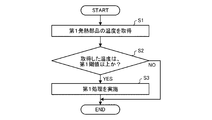
- FIG. 7 and 8 are flowcharts showing a processing flow of the control unit 58 of the outdoor unit 1 of the air conditioner 100 according to the first embodiment.
- FIG. 7 shows a flow of processing for the first heat-generating component in the control unit 58
- FIG. 8 shows a flow of processing for the second heat-generating component in the control unit 58.
- step S1 the temperature acquisition unit 70 acquires the temperature of the first heat generating component detected by the temperature detection circuit 37. Specifically, the temperature acquisition unit 70 acquires the temperature of the first IPM 36.
- step S2 the temperature control unit 71 determines whether or not the temperature acquired in step S1 is equal to or higher than the preset first threshold value. When the temperature is equal to or higher than the first threshold value, the temperature control unit 71 proceeds to step S3. When the temperature is less than the first threshold value, the temperature control unit 71 ends the flow processing of FIG. 7 without doing anything as it is.
- step S3 the temperature control unit 71 performs the above-mentioned first process in order to lower the temperature of the first heat-generating component and protect the first heat-generating component.
- step S11 the temperature acquisition unit 70 acquires the temperature of the first heat generating component detected by the temperature detection circuit 37. Specifically, the temperature acquisition unit 70 acquires the temperature of the first IPM 36.
- step S12 the estimation calculation unit 72 calculates the temperature estimation value T2 of the second heat generating component based on the temperature of the first heat generating component acquired in step S1.
- step S13 the estimation calculation unit 72 calculates the estimated value L2 of the life of the second heat-generating component based on the temperature estimation value T2 of the second heat-generating component.
- step S14 the estimation calculation unit 72 compares the estimated value L2 of the life of the second heat generating component with the product life L1 and determines whether or not L2 is L1 or more. When L2 is L1 or more, the estimation calculation unit 72 proceeds to step S15. If L2 is less than L1, the estimation calculation unit 72 proceeds to step S16.
- step S15 the estimation calculation unit 72 transmits a command signal instructing the alarm unit 73 to output a first alarm prompting the user to replace the second heat generating component. As a result, the alarm unit 73 outputs the first alarm.
- step S16 it is determined whether the difference between L1 and L2 is equal to or less than the second threshold value. If the difference between L1 and L2 is equal to or less than the second threshold value, the process proceeds to step S17. When the difference between L1 and L2 is larger than the second threshold value, the process of FIG. 8 ends.
- step S17 the estimation calculation unit 72 transmits a command signal instructing the user to output a second alarm warning that the second heat generating component has been subjected to thermal damage.
- the alarm unit 73 outputs the second alarm.
- step S17 not only this process but also any of the above-mentioned second processes may be performed.
- the temperature detection circuit 37 is provided for the first heat generating component to detect the temperature of the first heat generating component.
- the temperature control unit 71 performs the first process for lowering the temperature of the first heat-generating component. This makes it possible to prevent the first heat generating component from exceeding the abnormal temperature. As a result, it is possible to prevent damage to the first heat generating component due to an abnormal temperature.
- the temperature detection circuit 37 is provided only in the first component among the first heat generating components.
- the first component is the first IPM36.
- Other parts in the first heat generating part are called second parts.
- the second component is the reactor 41.
- the temperature rise of the second component shows the same tendency as the temperature rise of the first component provided with the temperature detection circuit 37. Therefore, the second component can be prevented from being damaged due to an abnormal temperature by the first treatment based on the temperature of the first component.
- the first component in which the temperature detection circuit 37 is easily incorporated is the first IPM 36, and the second component is the reactor 41. As described above, by providing the temperature detection circuit 37 only on the first component, the number of temperature detection circuits can be reduced. Thereby, the cost of the outdoor unit 1 can be reduced.
- the control unit 58 performs the first process based on the temperature of the first IPM 36 to control the reactor 41 to suppress an excessive temperature rise. That is, if the outdoor unit 1 is driven with a high load when the outside air is hot, the temperature of the reactor 41 exceeds the first threshold value. Therefore, the control unit 58 performs the first process to drive the compressor 4, for example. Decrease the frequency. As a result, it is possible to prevent the reactor 41 from exceeding the abnormal temperature, and it is possible to extend the life of the main electrolytic capacitor 38.
- the main electrolytic capacitor 38 and the reactor 41 are important protective parts that should be protected at high temperature.
- the main electrolytic capacitor 38 and the reactor 41 are arranged in the vicinity of the temperature detection circuit 37. Therefore, the ambient temperature of the main electrolytic capacitor 38 and the reactor 41 can be regarded as the same, and the high temperature protection treatment can be performed.
- the temperature estimated value of the second heat generating component is obtained from the temperature of the first heat generating component.
- the condition for establishing such a process is that both the first heat generating component and the second heat generating component can benefit from the cooling air from the outdoor blower 7. Specifically, it is desirable that at least one of the following three conditions is satisfied.
- Consdition 2) Both the first heat generating component and the second heat generating component are arranged in the same space (that is, in the housing 3a).
- Condition 3) The distance between the first heat generating component and the second heat generating component is equal to or less than a preset third threshold value.
- the first embodiment since the conditions 1 to 3 are satisfied, it is possible to perform the process of obtaining the temperature estimated value of the second heat generating component from the temperature of the first heat generating component. Further, in the first embodiment, since the life of the second heat-generating component is estimated from the temperature estimation value of the second heat-generating component, it is possible to prevent the situation where the second heat-generating component suddenly fails. As a result, the reliability of the outdoor unit 1 of the air conditioner 100 is improved.
- the first embodiment it is possible to suppress an excessive temperature rise of the first heat generating component and the second heat generating component, and it is possible to secure the reliability of the outdoor unit 1. Further, since it is not necessary to provide a plurality of temperature detection circuits 37, the cost and size can be suppressed accordingly. Further, as the number of the temperature detection circuits 37 is reduced, the number of wirings for transmitting the temperature from the temperature detection circuits 37 to the control unit 58 can be reduced, so that the design work of wiring the wiring becomes unnecessary. In addition, since the number of wires is reduced, there are no restrictions on the arrangement of each component, and the degree of freedom in arranging each component is improved.
- FIG. 11 is a front view showing the configuration of the controller 3 provided in the air conditioner 100 according to the second embodiment.
- FIG. 12 is a rear view showing the configuration of the controller 3 provided in the air conditioner 100 according to the second embodiment.
- FIGS. 11 and 12 the same configurations as those in FIGS. 4 and 5 are designated by the same reference numerals, and the description thereof will be omitted here.
- the configuration and operation of the air conditioner 100 according to the second embodiment are basically the same as those of the first embodiment, the configuration of the controller 3 will be described in the second embodiment, and other components will be described. For all configurations and operations, the first embodiment will be referred to.
- the controller 3 is further provided with a power supply board 80, a control board 81, a communication board 82, a noise filter 83, and a terminal block 84.
- the noise filter 83 and the terminal block 84 are arranged on the left side of the first inverter board 35. Further, the noise filter 83 is arranged above the terminal block 84. Further, the reactor 41 is arranged above the noise filter 83.
- the power supply board 80 is arranged on the right side of the second inverter board 39. Further, the control board 81 and the communication board 82 are arranged on the right side of the first inverter board 35. Further, the power supply board 80 is arranged above the control board 81. The control board 81 is arranged above the communication board 82.
- the air flow flows from the bottom to the top as shown in FIG. Therefore, in FIG. 11, the upper side is leeward and the lower side is leeward. Therefore, the parts with a small amount of heat generation are arranged on the leeward side, and the parts with a large amount of heat and heat are arranged on the leeward side. As a result, each component can be efficiently cooled.
- the second embodiment since the second embodiment has the same configuration and operation as the first embodiment, the same effect as that of the first embodiment can be obtained.
Landscapes
- Engineering & Computer Science (AREA)
- Chemical & Material Sciences (AREA)
- Combustion & Propulsion (AREA)
- Mechanical Engineering (AREA)
- General Engineering & Computer Science (AREA)
- Human Computer Interaction (AREA)
- Physics & Mathematics (AREA)
- Thermal Sciences (AREA)
- Air Conditioning Control Device (AREA)
Priority Applications (3)
| Application Number | Priority Date | Filing Date | Title |
|---|---|---|---|
| JP2022507959A JP7309036B2 (ja) | 2020-03-19 | 2020-03-19 | 空気調和装置の室外機 |
| PCT/JP2020/012302 WO2021186670A1 (ja) | 2020-03-19 | 2020-03-19 | 空気調和装置の室外機 |
| US17/794,666 US12025328B2 (en) | 2020-03-19 | 2020-03-19 | Outdoor unit of air-conditioning apparatus |
Applications Claiming Priority (1)
| Application Number | Priority Date | Filing Date | Title |
|---|---|---|---|
| PCT/JP2020/012302 WO2021186670A1 (ja) | 2020-03-19 | 2020-03-19 | 空気調和装置の室外機 |
Publications (1)
| Publication Number | Publication Date |
|---|---|
| WO2021186670A1 true WO2021186670A1 (ja) | 2021-09-23 |
Family
ID=77771968
Family Applications (1)
| Application Number | Title | Priority Date | Filing Date |
|---|---|---|---|
| PCT/JP2020/012302 Ceased WO2021186670A1 (ja) | 2020-03-19 | 2020-03-19 | 空気調和装置の室外機 |
Country Status (3)
| Country | Link |
|---|---|
| US (1) | US12025328B2 (https=) |
| JP (1) | JP7309036B2 (https=) |
| WO (1) | WO2021186670A1 (https=) |
Cited By (1)
| Publication number | Priority date | Publication date | Assignee | Title |
|---|---|---|---|---|
| CN115289551A (zh) * | 2022-08-04 | 2022-11-04 | 珠海格力电器股份有限公司 | 遮挡构件、双风机组件、双风机控制方法及空调 |
Citations (5)
| Publication number | Priority date | Publication date | Assignee | Title |
|---|---|---|---|---|
| JPH03202787A (ja) * | 1989-12-29 | 1991-09-04 | Nemitsuku Ramuda Kk | 電源装置の電解コンデンサ寿命検出装置 |
| JPH03269269A (ja) * | 1990-03-19 | 1991-11-29 | Hitachi Ltd | インバータ装置 |
| JP2012127650A (ja) * | 2012-04-02 | 2012-07-05 | Daikin Industries Ltd | 冷凍装置 |
| JP2014211408A (ja) * | 2013-04-22 | 2014-11-13 | 三菱電機株式会社 | コンデンサ劣化診断装置、インバータ装置、及び家電機器 |
| JP2014222113A (ja) * | 2013-05-13 | 2014-11-27 | 三菱電機株式会社 | 空気調和装置の室外機 |
Family Cites Families (20)
| Publication number | Priority date | Publication date | Assignee | Title |
|---|---|---|---|---|
| US5730217A (en) * | 1994-09-12 | 1998-03-24 | Pes, Inc. | Vacuum insulated converter for extending the life span of electronic components |
| US5720342A (en) * | 1994-09-12 | 1998-02-24 | Pes, Inc. | Integrated converter for extending the life span of electronic components |
| JP2002286306A (ja) | 2001-03-28 | 2002-10-03 | Fujitsu General Ltd | 空気調和機 |
| JP5114917B2 (ja) * | 2006-10-11 | 2013-01-09 | ダイキン工業株式会社 | 空調機の室外ユニット |
| JP4977912B2 (ja) * | 2007-02-16 | 2012-07-18 | 株式会社Kelk | 流体温調装置 |
| JP4823264B2 (ja) | 2008-03-31 | 2011-11-24 | 三菱電機株式会社 | 冷却装置および冷却装置監視システム |
| KR102403512B1 (ko) * | 2015-04-30 | 2022-05-31 | 삼성전자주식회사 | 공기 조화기의 실외기, 이에 적용되는 컨트롤 장치 |
| KR102433388B1 (ko) * | 2015-10-22 | 2022-08-17 | 삼성전자주식회사 | 공기 조화기의 실외기, 이에 적용되는 냉각 유닛 및 냉각 유닛의 제조 방법 |
| WO2017077649A1 (ja) | 2015-11-06 | 2017-05-11 | 三菱電機株式会社 | 空気調和装置の室外機 |
| WO2017163451A1 (ja) * | 2016-03-25 | 2017-09-28 | 東芝キヤリア株式会社 | ヒートポンプ機器 |
| JP6715945B2 (ja) | 2016-10-17 | 2020-07-01 | 三菱電機株式会社 | 空気調和機 |
| JP6778664B2 (ja) * | 2017-08-09 | 2020-11-04 | ダイキン工業株式会社 | 冷凍装置の室外ユニット |
| WO2019159317A1 (ja) * | 2018-02-16 | 2019-08-22 | 三菱電機株式会社 | 電力変換装置およびこれを用いた空気調和装置 |
| JP6963104B2 (ja) * | 2018-05-31 | 2021-11-05 | 三菱電機株式会社 | 室外機及び冷凍サイクル装置 |
| CN112513534B (zh) * | 2018-08-09 | 2022-06-21 | 三菱电机株式会社 | 室外机及空气调节机 |
| CN113016131B (zh) * | 2018-11-07 | 2024-01-16 | 三菱电机株式会社 | 马达驱动装置以及使用该马达驱动装置的空调机 |
| JPWO2020157871A1 (ja) * | 2019-01-30 | 2021-09-09 | 三菱電機株式会社 | 室外機および空気調和機 |
| KR102777315B1 (ko) * | 2019-03-04 | 2025-03-10 | 엘지전자 주식회사 | 공기조화기의 실내기 및 그 제어방법 |
| CN114258631A (zh) * | 2019-08-30 | 2022-03-29 | 三菱电机株式会社 | 空气调节机 |
| DE112019007879T5 (de) * | 2019-11-06 | 2022-09-01 | Mitsubishi Electric Corporation | Klimaanlage |
-
2020
- 2020-03-19 US US17/794,666 patent/US12025328B2/en active Active
- 2020-03-19 JP JP2022507959A patent/JP7309036B2/ja active Active
- 2020-03-19 WO PCT/JP2020/012302 patent/WO2021186670A1/ja not_active Ceased
Patent Citations (5)
| Publication number | Priority date | Publication date | Assignee | Title |
|---|---|---|---|---|
| JPH03202787A (ja) * | 1989-12-29 | 1991-09-04 | Nemitsuku Ramuda Kk | 電源装置の電解コンデンサ寿命検出装置 |
| JPH03269269A (ja) * | 1990-03-19 | 1991-11-29 | Hitachi Ltd | インバータ装置 |
| JP2012127650A (ja) * | 2012-04-02 | 2012-07-05 | Daikin Industries Ltd | 冷凍装置 |
| JP2014211408A (ja) * | 2013-04-22 | 2014-11-13 | 三菱電機株式会社 | コンデンサ劣化診断装置、インバータ装置、及び家電機器 |
| JP2014222113A (ja) * | 2013-05-13 | 2014-11-27 | 三菱電機株式会社 | 空気調和装置の室外機 |
Cited By (1)
| Publication number | Priority date | Publication date | Assignee | Title |
|---|---|---|---|---|
| CN115289551A (zh) * | 2022-08-04 | 2022-11-04 | 珠海格力电器股份有限公司 | 遮挡构件、双风机组件、双风机控制方法及空调 |
Also Published As
| Publication number | Publication date |
|---|---|
| JP7309036B2 (ja) | 2023-07-14 |
| US20230100590A1 (en) | 2023-03-30 |
| US12025328B2 (en) | 2024-07-02 |
| JPWO2021186670A1 (https=) | 2021-09-23 |
Similar Documents
| Publication | Publication Date | Title |
|---|---|---|
| EP2469201B1 (en) | Heat pump apparatus and control method thereof | |
| EP3001114B1 (en) | Outdoor device and air conditioner | |
| CN109945395B (zh) | 检测方法、空调系统及介质 | |
| JP2009127502A (ja) | 電動圧縮機 | |
| CN106949602B (zh) | 空调器及空调器中功率器件的防过热保护方法和装置 | |
| CN107155396A (zh) | 电动机驱动装置和空调机 | |
| JP5858777B2 (ja) | 空気調和装置 | |
| JP5486434B2 (ja) | 電力変換装置 | |
| JP3082669B2 (ja) | 冷却装置 | |
| KR20100012077A (ko) | 공기조화기의 전동기 제어장치 | |
| JP7309036B2 (ja) | 空気調和装置の室外機 | |
| JP2007064542A (ja) | 冷凍装置及びそれに用いられるインバータ装置 | |
| CN104620485B (zh) | 空调机的变换器装置 | |
| JP2010211363A (ja) | 電子機器冷却装置 | |
| JP2015163013A (ja) | 圧縮機制御装置、力率改善回路、電装部品の放熱構造、及び電気機器 | |
| JP2013245904A (ja) | 冷蔵庫 | |
| JP2012163285A (ja) | 空気調和機の室外機 | |
| JP4164554B2 (ja) | 冷凍装置及びそれに用いられるインバータ装置 | |
| KR100395945B1 (ko) | 인버터 공기조화기의 캐리어주파수제어방법 | |
| JP2003287329A (ja) | 冷却装置 | |
| CN114930099A (zh) | 热泵装置、热泵系统、空调机以及制冷机 | |
| WO2018142738A1 (ja) | 空気調和機 | |
| WO2021199135A1 (ja) | 空気調和機 | |
| JPH06213498A (ja) | 空気調和機の制御方法 | |
| JP4389916B2 (ja) | 空調機の制御装置 |
Legal Events
| Date | Code | Title | Description |
|---|---|---|---|
| 121 | Ep: the epo has been informed by wipo that ep was designated in this application |
Ref document number: 20925024 Country of ref document: EP Kind code of ref document: A1 |
|
| ENP | Entry into the national phase |
Ref document number: 2022507959 Country of ref document: JP Kind code of ref document: A |
|
| NENP | Non-entry into the national phase |
Ref country code: DE |
|
| 122 | Ep: pct application non-entry in european phase |
Ref document number: 20925024 Country of ref document: EP Kind code of ref document: A1 |