WO2021144998A1 - 超微粒超硬合金,およびこれを用いた切断用もしくは切削用工具または耐摩耗用工具 - Google Patents
超微粒超硬合金,およびこれを用いた切断用もしくは切削用工具または耐摩耗用工具 Download PDFInfo
- Publication number
- WO2021144998A1 WO2021144998A1 PCT/JP2020/006449 JP2020006449W WO2021144998A1 WO 2021144998 A1 WO2021144998 A1 WO 2021144998A1 JP 2020006449 W JP2020006449 W JP 2020006449W WO 2021144998 A1 WO2021144998 A1 WO 2021144998A1
- Authority
- WO
- WIPO (PCT)
- Prior art keywords
- cemented carbide
- phase
- ultrafine cemented
- ultrafine
- less
- Prior art date
- Legal status (The legal status is an assumption and is not a legal conclusion. Google has not performed a legal analysis and makes no representation as to the accuracy of the status listed.)
- Ceased
Links
Images


Classifications
-
- C—CHEMISTRY; METALLURGY
- C22—METALLURGY; FERROUS OR NON-FERROUS ALLOYS; TREATMENT OF ALLOYS OR NON-FERROUS METALS
- C22C—ALLOYS
- C22C29/00—Alloys based on carbides, oxides, nitrides, borides, or silicides, e.g. cermets, or other metal compounds, e.g. oxynitrides, sulfides
- C22C29/02—Alloys based on carbides, oxides, nitrides, borides, or silicides, e.g. cermets, or other metal compounds, e.g. oxynitrides, sulfides based on carbides or carbonitrides
- C22C29/06—Alloys based on carbides, oxides, nitrides, borides, or silicides, e.g. cermets, or other metal compounds, e.g. oxynitrides, sulfides based on carbides or carbonitrides based on carbides, but not containing other metal compounds
- C22C29/08—Alloys based on carbides, oxides, nitrides, borides, or silicides, e.g. cermets, or other metal compounds, e.g. oxynitrides, sulfides based on carbides or carbonitrides based on carbides, but not containing other metal compounds based on tungsten carbide
-
- B—PERFORMING OPERATIONS; TRANSPORTING
- B22—CASTING; POWDER METALLURGY
- B22F—WORKING METALLIC POWDER; MANUFACTURE OF ARTICLES FROM METALLIC POWDER; MAKING METALLIC POWDER; APPARATUS OR DEVICES SPECIALLY ADAPTED FOR METALLIC POWDER
- B22F3/00—Manufacture of workpieces or articles from metallic powder characterised by the manner of compacting or sintering; Apparatus specially adapted therefor ; Presses and furnaces
- B22F3/10—Sintering only
- B22F3/1003—Use of special medium during sintering, e.g. sintering aid
- B22F3/1007—Atmosphere
-
- B—PERFORMING OPERATIONS; TRANSPORTING
- B22—CASTING; POWDER METALLURGY
- B22F—WORKING METALLIC POWDER; MANUFACTURE OF ARTICLES FROM METALLIC POWDER; MAKING METALLIC POWDER; APPARATUS OR DEVICES SPECIALLY ADAPTED FOR METALLIC POWDER
- B22F3/00—Manufacture of workpieces or articles from metallic powder characterised by the manner of compacting or sintering; Apparatus specially adapted therefor ; Presses and furnaces
- B22F3/10—Sintering only
- B22F3/1039—Sintering only by reaction
-
- B—PERFORMING OPERATIONS; TRANSPORTING
- B22—CASTING; POWDER METALLURGY
- B22F—WORKING METALLIC POWDER; MANUFACTURE OF ARTICLES FROM METALLIC POWDER; MAKING METALLIC POWDER; APPARATUS OR DEVICES SPECIALLY ADAPTED FOR METALLIC POWDER
- B22F3/00—Manufacture of workpieces or articles from metallic powder characterised by the manner of compacting or sintering; Apparatus specially adapted therefor ; Presses and furnaces
- B22F3/12—Both compacting and sintering
- B22F3/14—Both compacting and sintering simultaneously
- B22F3/15—Hot isostatic pressing
-
- B—PERFORMING OPERATIONS; TRANSPORTING
- B23—MACHINE TOOLS; METAL-WORKING NOT OTHERWISE PROVIDED FOR
- B23B—TURNING; BORING
- B23B27/00—Tools for turning or boring machines; Tools of a similar kind in general; Accessories therefor
- B23B27/14—Cutting tools of which the bits or tips or cutting inserts are of special material
- B23B27/148—Composition of the cutting inserts
-
- C—CHEMISTRY; METALLURGY
- C22—METALLURGY; FERROUS OR NON-FERROUS ALLOYS; TREATMENT OF ALLOYS OR NON-FERROUS METALS
- C22C—ALLOYS
- C22C1/00—Making non-ferrous alloys
- C22C1/04—Making non-ferrous alloys by powder metallurgy
- C22C1/05—Mixtures of metal powder with non-metallic powder
- C22C1/051—Making hard metals based on borides, carbides, nitrides, oxides or silicides; Preparation of the powder mixture used as the starting material therefor
- C22C1/053—Making hard metals based on borides, carbides, nitrides, oxides or silicides; Preparation of the powder mixture used as the starting material therefor with in situ formation of hard compounds
- C22C1/056—Making hard metals based on borides, carbides, nitrides, oxides or silicides; Preparation of the powder mixture used as the starting material therefor with in situ formation of hard compounds using gas
-
- C—CHEMISTRY; METALLURGY
- C22—METALLURGY; FERROUS OR NON-FERROUS ALLOYS; TREATMENT OF ALLOYS OR NON-FERROUS METALS
- C22C—ALLOYS
- C22C29/00—Alloys based on carbides, oxides, nitrides, borides, or silicides, e.g. cermets, or other metal compounds, e.g. oxynitrides, sulfides
- C22C29/005—Alloys based on carbides, oxides, nitrides, borides, or silicides, e.g. cermets, or other metal compounds, e.g. oxynitrides, sulfides comprising a particular metallic binder
-
- B—PERFORMING OPERATIONS; TRANSPORTING
- B22—CASTING; POWDER METALLURGY
- B22F—WORKING METALLIC POWDER; MANUFACTURE OF ARTICLES FROM METALLIC POWDER; MAKING METALLIC POWDER; APPARATUS OR DEVICES SPECIALLY ADAPTED FOR METALLIC POWDER
- B22F3/00—Manufacture of workpieces or articles from metallic powder characterised by the manner of compacting or sintering; Apparatus specially adapted therefor ; Presses and furnaces
- B22F3/10—Sintering only
- B22F2003/1032—Sintering only comprising a grain growth inhibitor
-
- B—PERFORMING OPERATIONS; TRANSPORTING
- B22—CASTING; POWDER METALLURGY
- B22F—WORKING METALLIC POWDER; MANUFACTURE OF ARTICLES FROM METALLIC POWDER; MAKING METALLIC POWDER; APPARATUS OR DEVICES SPECIALLY ADAPTED FOR METALLIC POWDER
- B22F5/00—Manufacture of workpieces or articles from metallic powder characterised by the special shape of the product
- B22F2005/001—Cutting tools, earth boring or grinding tool other than table ware
-
- B—PERFORMING OPERATIONS; TRANSPORTING
- B22—CASTING; POWDER METALLURGY
- B22F—WORKING METALLIC POWDER; MANUFACTURE OF ARTICLES FROM METALLIC POWDER; MAKING METALLIC POWDER; APPARATUS OR DEVICES SPECIALLY ADAPTED FOR METALLIC POWDER
- B22F2302/00—Metal Compound, non-Metallic compound or non-metal composition of the powder or its coating
- B22F2302/10—Carbide
-
- B—PERFORMING OPERATIONS; TRANSPORTING
- B22—CASTING; POWDER METALLURGY
- B22F—WORKING METALLIC POWDER; MANUFACTURE OF ARTICLES FROM METALLIC POWDER; MAKING METALLIC POWDER; APPARATUS OR DEVICES SPECIALLY ADAPTED FOR METALLIC POWDER
- B22F2998/00—Supplementary information concerning processes or compositions relating to powder metallurgy
- B22F2998/10—Processes characterised by the sequence of their steps
-
- B—PERFORMING OPERATIONS; TRANSPORTING
- B22—CASTING; POWDER METALLURGY
- B22F—WORKING METALLIC POWDER; MANUFACTURE OF ARTICLES FROM METALLIC POWDER; MAKING METALLIC POWDER; APPARATUS OR DEVICES SPECIALLY ADAPTED FOR METALLIC POWDER
- B22F2999/00—Aspects linked to processes or compositions used in powder metallurgy
Definitions
- This invention relates to ultrafine cemented carbide.
- the present invention also relates to cutting or cutting tools, or wear resistant tools made of ultrafine cemented carbide.
- Cemented carbide includes cutting or cutting tools for metal materials such as steel, cast steel, manganese steel, and stainless steel (for example, microdrills), steel cord wire drawing dies (drawing dies), plugs, nozzles, molding dies, etc. Widely used as a wear-resistant tool.
- Cemented carbide containing tungsten carbide (hereinafter referred to as “WC”) particles that form a mechanically stable hard phase as a main component is widely used.
- Cemented carbide containing fine WC particles with an average particle size of less than 1.0 ⁇ m (a cemented carbide containing such fine particles as a main component is particularly called “ultrafine cemented carbide”) is an average particle.
- the hardness (hardness) is much higher than that of general cemented carbide with a diameter of 1.0 ⁇ m or more.
- Transverse-Rupture-Strength (TRS) is known as a physical property of cemented carbide.
- the bending force is also called Bending Strength and is indicated by the maximum stress when the sample breaks due to the bending load.
- Pascal Pascal (Pa) is generally used as the unit of the bending force.
- the hardness of cemented carbide shows a higher value as the amount of bonding phase for bonding WC particles to each other is smaller. Further, if the amount of the bonded phase is the same, the finer the WC particles, the higher the hardness. On the other hand, it is known that the bending force changes according to the amount of the bonded phase, and that it also increases by using HIP (Hot Isostatic Pressing) for the sintering process. ing.
- Patent Document 1 contains tungsten carbide (WC), titanium carbide nitride (Ti (C, N)), chromium carbide (Cr 3 C 2 ) and cobalt (Co), and is excellent in both hardness and bending resistance. Disclose the cemented carbide.
- An object of the present invention is to provide an ultrafine cemented carbide having a high hardness and an even better bending resistance.
- Another object of the present invention is to provide an ultrafine cemented carbide having excellent bending resistance and having a small decrease in hardness under high temperature conditions.
- the ultrafine cemented carbide according to the present invention contains 80.0 wt% or more and 99.4 wt% or less of a hard phase containing tungsten carbide (WC) as a main component, and titanium (Ti) oxide is carbonitride during sintering. It contains 0.10 wt% or more and 10.0 wt% or less of the carbide phase containing nitride (Ti (C, N)) as a main component, and is selected from cobalt (Co), nickel (Ni) and iron (Fe).
- the bonding phase contains 0.5 wt% or more and 20.0 wt% or less of the bonding phase containing at least one type as a main component, the total of the hard phase, the carbonitride phase and the bonded phase is 100 wt%, and the average particle size of tungsten carbide after sintering is It is 1.0 ⁇ m or less, contains chromium (Cr 3 C 2 ) of 0.10 wt% or more and 20.0 wt% or less with respect to the entire bonded phase, has a nitrogen content of 0.10 wt% or more and 1.25 wt% or less, and has a carbon content. Is 4.80 wt% or more and 6.30 wt% or less.
- Inevitable impurities that is, those that are present in the raw materials of cemented carbide products or are inevitably mixed in the manufacturing process, are originally unnecessary, but they are in trace amounts and affect the characteristics of cemented carbide products. Needless to say, the allowable impurities may be contained in the ultrafine cemented carbide because it does not reach.
- the ultrafine cemented carbide according to the present invention contains tungsten carbide (WC), titanium carbonitride (Ti (C, N)) and chromium carbide (Cr 3 C 2 ), carbon (C) and nitrogen (N) ) Is contained.
- Titanium carbonitride (Ti (C, N)) is used to suppress the grain growth of tungsten carbide (WC) and maintain the WC particles in ultrafine particles (average diameter of 1.0 ⁇ m or less). Titanium carbonitride (Ti (C, N)) itself is not used as a starting material, and an oxide of titanium (Ti) is used as a starting material. Titanium carbonitride (Ti (C, N)) can be obtained by carbonitride of titanium oxide during sintering. As a result, finer titanium carbonitrides can be contained in the ultrafine cemented carbide, and the growth of tungsten carbide (WC), which leads to a decrease in hardness, can be effectively suppressed.
- Carbon (C) and nitrogen (N) are required to carbonitride titanium oxide during sintering to obtain titanium carbonitride (Ti (C, N)).
- the required carbon is supplied by blending the raw material powder of carbon.
- Necessary nitrogen is supplied by sintering treatment in a nitrogen atmosphere.
- the ultrafine cemented carbide according to the present invention containing 0.10 wt% or more and 1.25 wt% or less of nitrogen and 4.80 wt% or more and 6.30 wt% or less of carbon has a hardness of HRA 92.3 or more and a resistance of 3.5 GPa or more. It will have power.
- the nitrogen content of the ultrafine cemented carbide is 0.10 wt% or more and 0.35 wt% or less, and the carbon content of the ultrafine cemented carbide is 5.30 wt% or more and 5.60 wt% or less. ..
- the bending force is 4.0 GPa or more, and an ultrafine cemented carbide having an excellent bending force is provided.
- the nitrogen content in the ultrafine cemented carbide is 0.10 wt% or more and 0.25 wt% or less. It is possible to provide an ultrafine cemented carbide having a larger bending force, for example, a bending force of 4.5 GPa or more.
- the bending force of the ultrafine cemented carbide also varies depending on the amount of carbon contained in the ultrafine cemented carbide.
- the carbon content of the ultrafine cemented carbide is 5.30 wt% or more and 5.43 wt% or less.
- a relatively high bending force can be exerted on the ultrafine cemented carbide.
- the bending force of the ultrafine cemented carbide also varies depending on the content of the carbonitride phase described above.
- the ultrafine cemented carbide contains 0.5 wt% or more and 2.0 wt% or less of the carbonitride phase.
- the bending force can be maximized by containing about 1.30 wt% of the carbonitride phase in the ultrafine cemented carbide.
- the particle size of tungsten carbide also affects the bending force of ultrafine cemented carbide.
- WC tungsten carbide
- the ultrafine cemented carbide contains 10.0 wt% or less of the above-mentioned bonded phase.
- High hardness can be maintained even in high temperature atmospheres such as 400 ° C, 600 ° C, and 800 ° C.
- the present invention also provides cutting or cutting tools (eg, microdrills) and wear resistant tools (eg, dies, plugs, nozzles) made of the above-mentioned ultrafine cemented carbide.
- cutting or cutting tools eg, microdrills
- wear resistant tools eg, dies, plugs, nozzles
- the ultrafine cemented carbide according to the embodiment of the present invention is made by sintering a hard phase (hereinafter referred to as "WC phase” or “hard phase”) containing tungsten carbide (WC) as a main component and titanium oxide (TiO 2 ).
- a hard phase hereinafter referred to as "WC phase” or “hard phase” containing tungsten carbide (WC) as a main component and titanium oxide (TiO 2 ).
- Titanium carbide phase hereinafter referred to as “carbide nitride phase” or “Ti (C, N) phase” containing titanium carbide (Ti (C, N)) as a main component, which is sometimes produced by carbonitride.
- a bonding phase containing cobalt (Co), nickel (Ni) or iron (Fe), or an alloy thereof as a main component, which is a so-called tungsten carbide-based cemented carbide.
- the tungsten carbide forming the hard phase (WC phase) has
- (1) Content of hard phase (WC phase) 80.0 to 99.4 wt% of WC phase is contained in the whole cemented carbide.
- the WC phase is less than 80.0 wt%, the proportion of the bonded phase increases relatively, and it may be difficult to control the grain growth of the WC phase (the grain growth of the WC phase will be described later) (WC after sintering).
- the average particle size may exceed 1.0 ⁇ m).
- the WC average particle size after sintering can be set to 1.0 ⁇ m or less (so-called ultrafine grains).
- the ratio of the bonded phase is relatively reduced, and the bending force of the ultrafine cemented carbide is reduced.
- the ratio of the WC phase to the entire ultrafine cemented carbide can be adjusted by the blending amount of the WC raw material powder.
- the carbonitride phase (Ti (C, N) phase) suppresses the grain growth of the above-mentioned WC phase and makes the WC phase ultrafine. Used to maintain.
- the grain growth of the WC phase is a phenomenon in which the WC phase dissolved in the bonded phase during sintering grows into particles having a large diameter by precipitating in another WC phase.
- Ti (C, N) phase By adding the Ti (C, N) phase, Ti (C, N) are scattered around the WC phase, which reduces the precipitation of the WC phase and suppresses the grain growth of the WC phase.
- the amount of the Ti (C, N) phase suitable for effectively suppressing the grain growth of the WC phase, that is, 0.10 wt% or more with respect to the whole in the ultrafine cemented carbide, and Ti (C, N) ) Is adjusted to an amount that does not or does not easily agglomerate, that is, 10.0 wt% or less.
- the ratio of the Ti (C, N) phase to the entire ultrafine cemented carbide can also be adjusted by the blending amount of the raw material powder (titanium oxide (Titanium 2)) described below.
- the Ti (C, N) phase which functions as a grain growth inhibitor for the WC phase, is produced by carbonitriding titanium oxide (TiO 2 ), which is a raw material powder, during sintering, whereby ultrafine grains as a final product are produced.
- the cemented carbide contains fine Ti (C, N).
- the grain growth of the WC phase can be effectively suppressed with a small content of Ti (C, N).
- Ti (C, N) preferably has an average particle size in the range of 5 to 100 nm.
- Carbon (C) and nitrogen (N) are required to carbonitrid TiO 2 to obtain Ti (C, N).
- carbon (C) is supplied by blending the raw material powder.
- Nitrogen (N) is supplied by sintering in a nitrogen atmosphere.
- the bound phase is used to bond hard and ultrafine WC particles to each other.
- Co Co
- Ni nickel
- Fe iron
- the bonded phase is a metal containing these metal elements as the main components (containing 50.0 wt% or more with respect to the entire bonded phase).
- the bonded phase content of the ultrafine cemented carbide is 0.50 to 20.0 wt%.
- Chromium carbide is used for suppressing the grain growth of the WC phase and the growth of the carbonitride phase. Chromium carbide is also known to contribute to improving the hardness and oxidation resistance of the bonded phase. Chromium carbide can be sufficiently dissolved in the bonded phase by setting the content to 0.10 wt% or more and 20.0 wt% or less with respect to the entire bonded phase.
- the ultrafine cemented carbide as a final product contains carbon and nitrogen. That is, since the ultrafine cemented carbide according to the embodiment of the present invention contains tungsten carbide (WC) and chromium carbide (Cr 3 C 2 ), it inevitably contains carbon (C). Further, the ultrafine cemented carbide according to the embodiment of the present invention contains Ti (C, N) for effective suppression of grain growth in the WC phase, and Ti (C, N) is as described above. Since it is obtained by carbonitriding TiO 2 in a nitrogen atmosphere, the ultrafine cemented carbide as a final product also contains nitrogen (N).
- WC tungsten carbide
- Cr 3 C 2 chromium carbide
- the inventor focused on the amount of carbon and nitrogen contained in the ultrafine cemented carbide as the final product, and adjusted the carbon and nitrogen contents to make the machine of the ultrafine cemented carbide as the final product.
- the characteristics, especially the bending force changed significantly.
- the amount of carbon contained in the ultrafine cemented carbide can be controlled by adjusting the amount of the carbon raw material powder, and the amount of nitrogen is the partial pressure of the nitrogen gas supplied in the sintering process. It can be controlled by adjusting.
- the bending force of the ultrafine cemented carbide also varies depending on the content of the bonding phase that occupies the ultrafine cemented carbide.
- the characteristics of the ultrafine cemented carbide when the carbon content and the nitrogen content are changed and when the content of the bonded phase is changed will be described in detail.
- FIG. 1 is a flowchart showing an example of a manufacturing process of a cemented carbide tool.
- a metal containing cobalt (Co) as a main component is used as the bonding phase.
- Tungsten Carbide (WC) 11, Titanium Oxide (TiO 2 ) 12, Cobalt (Co) 13, Chromium Carbide (Cr 3 C 2 ) 14 and Carbon (C) 15 are placed in a cylindrical container in predetermined amounts, and further.
- a large number of small-diameter balls made of cemented carbide are also placed in the cylindrical container, and the cylindrical container is rotated.
- the raw material powder is crushed and mixed in the container (step 21) (ball mill).
- Organic solvents such as acetone, alcohol, and hexane are also placed in the cylindrical container in order to enhance the crushing effect and prevent the powder from oxidizing, so that the raw material powder becomes a slurry (mud) in the cylindrical container.
- the pulverized and mixed slurry-like raw material powder is then dried by a spray dryer method, a mixer drying method, etc., whereby the organic solvent is removed from the raw material powder (step 22).
- the pulverized and mixed raw material powder from which the organic solvent has been removed is pressed (compacted) by mold molding, rubber molding, extrusion molding, etc., and molded into a predetermined shape (step 23).
- the molded product is sintered in a heating furnace in which nitrogen gas is controlled by a predetermined partial pressure (step 24).
- a predetermined partial pressure step 24.
- tungsten carbide (WC) 11 becomes a hard phase and cobalt (Co) 13 is bonded. It becomes a phase ultrafine cemented carbide.
- titanium oxide (TiO 2 ) 12 which is one of the raw material powders, is placed in the heating furnace. It is carbonitride to produce titanium carbonitride (Ti (C, N)) as described above.
- Ultra-fine cemented carbide may contain very small pores (air bubbles).
- HIP Hot Isostatic Pressing
- hot isostatic pressing method is performed to remove this pore (step 25). For example, argon gas with a gas pressure of 20 to 100 MPa is added, which removes the pores.
- cemented carbide tools cutting tools, cutting tools, wear-resistant tools, etc.
- cemented carbide tools cutting tools, cutting tools, wear-resistant tools, etc.
- Table 1 shows that the content of titanium carbonitride (Ti (C, N)), the amount of carbon (C) blended, and the partial pressure of nitrogen applied to the heating furnace in the sintering process (step 24) are appropriately changed.
- the analysis results of carbon content, nitrogen content, hardness and bending force (TRS) of 32 types (No. 1-32) of samples prepared by are shown.
- the average particle size of tungsten carbide (WC) (0.4 ⁇ m), the content of chromium carbide (Cr 3 C 2 ) (0.24 wt%), and the content of cobalt (Co) (10 wt%) are unified in 32 types of samples. I'm letting you.
- the carbon content of each sample was measured by the non-dispersive infrared absorption method.
- the nitrogen content of each sample was measured by the heat conduction method.
- the bending force was measured by a three-point bending test, and the hardness was measured using a Rockwell hardness tester (A scale). All of the 32 types of samples shown in Table 1 have hardness and bending resistance equal to or higher than those of existing ultrafine cemented carbide (HRA92.3 or higher, bending resistance 3.5 GPa or higher).
- Table 2 shows the measurement results of hardness and bending force (TRS) of another sample (No. 33 to 36) prepared by appropriately changing the content of cobalt (Co) which is a binding phase. .. Refer to Table 1, and the No. 13 sample has high bending resistance. Samples Nos. 33 to 36 shown in Table 2 are obtained by increasing or decreasing the cobalt (Co) content based on the sample No. 13, that is, based on 10 wt% cobalt (Co). As the cobalt (Co) content increases or decreases, the contents of tungsten carbide, titanium carbonitride, and chromium carbide are also adjusted.
- Nitrogen is contained in titanium carbonitride (Ti (C, N)) among a plurality of compositions constituting ultrafine cemented carbide. Therefore, it can be considered that the amount of nitrogen contained in the ultrafine cemented carbide is approximately proportional to the amount of Ti (C, N) contained in the ultrafine cemented carbide. As described above, Ti (C, N) should be 0.10 wt% or more and 10.0 wt% or less in order to effectively suppress the grain growth of the WC phase and prevent the aggregation of Ti (C, N). It will be adjusted.
- sample Nos. 1 to 4 vacuum-sintered with reference to Table 1 also contain about 0.1 wt% nitrogen.
- sample No. 29 has a nitrogen content of 0.25 wt% when Ti (C, N) is 1.30 wt%, so if Ti (C, N) is 10.0 wt%, the nitrogen content is 1.25. It can be estimated that it will be about wt%. That is, when the ultrafine cemented carbide contains 0.10 wt% or more and 10.0 wt% or less of titanium carbonitride (Ti (C, N)), the ultrafine cemented carbide contains 0.10 wt% or more and 1.25 wt% or less of nitrogen. Contains.
- Carbon (C) is contained in three types of compositions, tungsten carbide (WC), titanium carbonitride (Ti (C, N)) and chromium carbide (Cr 3 C 2) contained in ultrafine cemented carbide. It has been.
- the amount of carbon contained in the ultrafine cemented carbide is the addition of the raw material powders of tungsten carbide (WC) 11, titanium oxide (TiO 2 ) 12, chromium (Cr 3 C 2 ) 14 and carbon (C) 15 described above. Adjusted by quantity.
- the cobalt (Co) content (0.50 wt% to 20 wt%) contained in the ultrafine cemented carbide fluctuates, the tungsten carbide (WC) content fluctuates, resulting in ultrafine cemented carbide.
- the amount of carbon contained also fluctuates.
- the cobalt (Co) content is 10 wt%, the minimum value of carbon content in the ultrafine cemented carbide is 5.21 wt% (Sample No. 29), and the maximum value is 5.60 wt%. % (Sample No. 4).
- cobalt (Co) is 0.50 wt%, the content of tungsten carbide (WC) that occupies the ultrafine cemented carbide increases relatively, and as a result, the carbon content in the ultrafine cemented carbide is 6.30 wt%. It is expected to increase to some extent. If cobalt (Co) is 20 wt%, the content of tungsten carbide (WC) that occupies the ultrafine cemented carbide is relatively reduced, and as a result, the carbon content in the ultrafine cemented carbide is about 4.80 wt%. Is thought to be.
- FIG. 2 shows the ultrafine cemented carbide sample (No. 1) containing 1.30 wt% titanium carbonitride (Ti (C, N)) among the 32 types of ultrafine cemented carbide samples shown in Table 1. It is a graph which shows the relationship between the bending force (TRS) (vertical axis) and the nitrogen content (horizontal axis) for each of (8, 13 to 16, 21 to 24, 29 to 32). Focusing on ultrafine cemented carbide with titanium carbonitride (Ti (C, N)) of 1.30 wt%, No. 1 to 32 samples showed the highest bending resistance. It was .6 and No. 13, because both of these samples had a titanium carbide (Ti (C, N)) content of 1.30 wt%.
- the graph in FIG. 2 shows three types of circles: white circles, gray circles, and black circles.
- White circles are those vacuum-sintered in the sintering process (step 24 in FIG. 1) (nitrogen partial pressure is 0 kPa) (No. 1 to 4), and gray circles are nitrogen with a nitrogen partial pressure of 0.1 to 10 kPa in the sintering process.
- the gas is filled in the sintering furnace (No. 5-8, 13-16, 21-24), and the black circles are filled with nitrogen gas with a partial pressure of 10.1 kPa or more in the sintering process. These are distinguished from each other (No. 29-32).
- the nitrogen content of the ultrafine cemented carbide produced in an atmosphere with a partial pressure of nitrogen of 0.1 to 10 kPa was 0.10 to 0.35 wt% (see Nos. 5 to 28 in Table 1).
- the amount of nitrogen is in the range of 0.10 to 0.35 wt%, a relatively high bending force can be exerted on the ultrafine cemented carbide.
- the nitrogen content of the ultrafine cemented carbide is high, the bending force tends to increase.
- the nitrogen content of the ultrafine cemented carbide having a peak resistance (4.7 GPa) is 0.16 wt% (No. 6) and 0.21 wt% (No. 13).
- FIG. 3 is a graph showing the carbon content instead of the nitrogen content on the horizontal axis, and the vertical axis shows the bending force as in FIG. 2.
- the vertical axis shows the bending force as in FIG. 2.
- the relationship between the bending force (vertical axis) and the amount of carbon contained in the ultrafine cemented carbide (horizontal axis) for each of the samples is white circles (vacuum sintering) and gray circles (nitrogen partial pressure of 0.1 to 10 kPa). , Black circles (nitrogen partial pressure of 10.1 kPa or more) are shown separately.
- the bending resistance is improved by controlling the partial pressure of nitrogen during sintering to 0.1 to 10 kPa (gray circle).
- the carbon content of the ultrafine cemented carbide produced by controlling the nitrogen partial pressure to 0.1 to 10 kPa was 5.31 to 5.54 wt% (see Table 1). If the carbon content is in the range of 5.30 to 5.60 wt%, a relatively high bending force can be exerted on the ultrafine cemented carbide.
- the carbon content of the ultrafine cemented carbide with a peak resistance (4.7 GPa) is 5.38 wt% (No. 6) and 5.33 wt% (No. 13), so it is especially 5.30 wt%. It is considered that there is an appropriate range of carbon content that increases the bending force in the range of ⁇ 5.43 wt%.
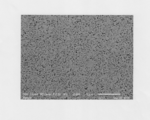
- FIG. 5 shows a SEM (Scanning Electron Microscope) photograph of sample No. 13 ultrafine cemented carbide whose bending force of 4.7 GPa was measured.
- the peak value of the bending force (4.7 GPa) is obtained when the content of titanium carbonitride (Ti (C, N)) is 1.30 wt%.
- Samples with titanium carbonitride (Ti (C, N)) content of 1.70 wt% (No. 9, 10, 17, 18, 25, 26) and samples with titanium carbonitride (Ti (C, N)) content of 2.00 wt% (No. 11, 12) , 19, 20, 27, 28) it was also confirmed from Table 1 that the bending resistance was slightly inferior to that of the sample in which the content of titanium carbonitride (Ti (C, N)) was 1.30 wt%.
- NS It can also be confirmed in Table 1 that it is appropriate that the content of titanium carbonitride (Ti (C, N)) is around 1.30 wt% (0.5 wt% or more and 2.0 wt% or less).
- FIG. 4 shows eight samples prepared by varying the average particle size of tungsten carbide (WC) based on the sample No. 13 in which the peak value of the bending force was obtained in the analysis results shown in Table 1. It is a graph which shows the relationship between the WC particle diameter and the bending force for an ultrafine cemented carbide sample. In this graph, the relationship between the WC average particle size (horizontal axis) and the bending force (vertical axis) measured for each of the eight samples is plotted by eight white circles. The average particle size of tungsten carbide (WC) was measured using the intercept method. The WC average particle size was adjusted by selecting raw material powders having different WC particle sizes.
- the sample having a WC average particle size of about 1.0 ⁇ m and the sample having a WC average particle size of about 0.40 ⁇ m there is a large difference in bending resistance between the sample having a WC average particle size of about 1.0 ⁇ m and the sample having a WC average particle size of about 0.40 ⁇ m.
- the ultrafine cemented carbide In order for the ultrafine cemented carbide to exhibit a relatively high bending force, particularly a high bending force of more than 4.0 GPa and about 4.5 GPa, it is appropriate that the WC average particle size is 0.80 ⁇ m or less.
- Table 3 shows the No. 13 ultrafine cemented carbide samples (cobalt content of 10.0 wt%) for which the peak value of the bending force was obtained in Table 1 at 400 ° C, 600 ° C and 800 ° C.
- the Vickers hardness (unit: Hv) measured in each high-temperature atmosphere and another sample (Sample No. 35) prepared with a cobalt content of 8.0 wt% were similarly measured at 400 ° C, 600 ° C, and 800 ° C, respectively. It shows the Vickers hardness measured in a high temperature atmosphere. The Vickers hardness at each temperature was measured using a high-temperature microhardness meter.
- Table 3 also shows the Vickers hardness of conventional cemented carbides having a composition of WC (2.0 ⁇ m) -10 wt% Co.
Landscapes
- Chemical & Material Sciences (AREA)
- Engineering & Computer Science (AREA)
- Mechanical Engineering (AREA)
- Materials Engineering (AREA)
- Metallurgy (AREA)
- Organic Chemistry (AREA)
- Manufacturing & Machinery (AREA)
- Chemical Kinetics & Catalysis (AREA)
- Powder Metallurgy (AREA)
- Cutting Tools, Boring Holders, And Turrets (AREA)
Priority Applications (3)
| Application Number | Priority Date | Filing Date | Title |
|---|---|---|---|
| CN202080084790.XA CN114786843A (zh) | 2020-01-14 | 2020-02-19 | 超细硬质合金和使用该超细硬质合金的切割用或切削用工具或耐磨用工具 |
| EP20913741.3A EP4091739A4 (en) | 2020-01-14 | 2020-02-19 | ULTRA FINE CARBIDE AND SHEARING TOOL, CUTTING TOOL OR ABRASION RESISTANT TOOL WITH ULTRA FINE CARBIDE |
| US17/836,240 US12428709B2 (en) | 2020-01-14 | 2022-06-09 | Ultra-fine cemented carbide, and cutting tool and wear-resistant tool using the same |
Applications Claiming Priority (2)
| Application Number | Priority Date | Filing Date | Title |
|---|---|---|---|
| JP2020-003496 | 2020-01-14 | ||
| JP2020003496A JP7383498B2 (ja) | 2020-01-14 | 2020-01-14 | 超微粒超硬合金の製造方法 |
Related Child Applications (1)
| Application Number | Title | Priority Date | Filing Date |
|---|---|---|---|
| US17/836,240 Continuation US12428709B2 (en) | 2020-01-14 | 2022-06-09 | Ultra-fine cemented carbide, and cutting tool and wear-resistant tool using the same |
Publications (1)
| Publication Number | Publication Date |
|---|---|
| WO2021144998A1 true WO2021144998A1 (ja) | 2021-07-22 |
Family
ID=76864166
Family Applications (1)
| Application Number | Title | Priority Date | Filing Date |
|---|---|---|---|
| PCT/JP2020/006449 Ceased WO2021144998A1 (ja) | 2020-01-14 | 2020-02-19 | 超微粒超硬合金,およびこれを用いた切断用もしくは切削用工具または耐摩耗用工具 |
Country Status (5)
| Country | Link |
|---|---|
| US (1) | US12428709B2 (https=) |
| EP (1) | EP4091739A4 (https=) |
| JP (1) | JP7383498B2 (https=) |
| CN (1) | CN114786843A (https=) |
| WO (1) | WO2021144998A1 (https=) |
Cited By (4)
| Publication number | Priority date | Publication date | Assignee | Title |
|---|---|---|---|---|
| WO2023042777A1 (ja) * | 2021-09-17 | 2023-03-23 | 日本特殊合金株式会社 | 被覆超微粒超硬合金,およびこれを用いた切削工具または耐摩耗部材 |
| JP2023042362A (ja) * | 2021-09-14 | 2023-03-27 | 住友電気工業株式会社 | 切削工具用の超硬合金素材および切削工具 |
| JP2023042361A (ja) * | 2021-09-14 | 2023-03-27 | 住友電気工業株式会社 | 回転工具用の超硬合金素材および回転工具 |
| CN119899035A (zh) * | 2025-01-20 | 2025-04-29 | 广东工业大学 | 一种高熵碳化物-高熵碳氮化物的陶瓷刀具及其制备方法和应用 |
Families Citing this family (10)
| Publication number | Priority date | Publication date | Assignee | Title |
|---|---|---|---|---|
| WO2023139695A1 (ja) | 2022-01-19 | 2023-07-27 | 住友電気工業株式会社 | 超硬合金およびそれを含む工具 |
| JP7827471B2 (ja) * | 2022-02-01 | 2026-03-10 | 日本特殊合金株式会社 | 超硬合金,被覆超硬合金,ならびにこれらを用いた切削工具および耐摩耗部材 |
| US20250034682A1 (en) | 2022-03-15 | 2025-01-30 | Sumitomo Electric Industries, Ltd. | Cemented carbide |
| JP7338800B1 (ja) * | 2022-03-15 | 2023-09-05 | 住友電気工業株式会社 | 超硬合金 |
| US11913096B1 (en) | 2022-11-18 | 2024-02-27 | Sumitomo Electric Industries, Ltd. | Cemented carbide and tool containing the same |
| US12480187B2 (en) | 2023-02-07 | 2025-11-25 | Sumitomo Electric Industries, Ltd. | Cemented carbide and cutting tool using the same |
| JP7501800B1 (ja) | 2023-02-07 | 2024-06-18 | 住友電気工業株式会社 | 超硬合金およびそれを用いた切削工具 |
| CN119497760A (zh) | 2023-06-21 | 2025-02-21 | 住友电气工业株式会社 | 硬质合金以及使用该硬质合金的切削工具 |
| WO2025027678A1 (ja) | 2023-07-28 | 2025-02-06 | 住友電気工業株式会社 | 超硬合金および切削工具 |
| EP4527962A4 (en) | 2023-07-28 | 2025-11-19 | Sumitomo Electric Industries | CEMENTED CARBIDE AND CUTTING TOOL |
Citations (3)
| Publication number | Priority date | Publication date | Assignee | Title |
|---|---|---|---|---|
| JP2010504426A (ja) * | 2006-09-22 | 2010-02-12 | ハー.ツェー.スタルク ゲゼルシャフト ミット ベシュレンクテル ハフツング | 金属粉末 |
| JP2012251242A (ja) * | 2011-05-12 | 2012-12-20 | Tungaloy Corp | 超硬合金および被覆超硬合金 |
| JP2016098393A (ja) | 2014-11-20 | 2016-05-30 | 日本特殊合金株式会社 | 超硬合金 |
Family Cites Families (8)
| Publication number | Priority date | Publication date | Assignee | Title |
|---|---|---|---|---|
| MXPA02009350A (es) * | 2000-03-24 | 2003-09-22 | Kennametal Inc | Herramienta de carburo cementado y metodo de realizacion. |
| JP2006063416A (ja) * | 2004-08-30 | 2006-03-09 | Tungaloy Corp | クロム含有超硬合金およびその被覆超硬合金 |
| CN102191421B (zh) * | 2011-05-26 | 2012-11-07 | 株洲钻石切削刀具股份有限公司 | 梯度结构的超细硬质合金及其制备工艺 |
| JP6439975B2 (ja) * | 2015-01-16 | 2018-12-19 | 住友電気工業株式会社 | サーメットの製造方法 |
| JP6805454B2 (ja) * | 2016-04-06 | 2020-12-23 | サンアロイ工業株式会社 | 超硬合金及びその製造方法、並びに超硬工具 |
| CN109652697A (zh) * | 2017-10-12 | 2019-04-19 | 刘启乐 | 一种含(V,Ti)(C,N)固溶体粉末的WC-8%Co硬质合金 |
| JP7098969B2 (ja) | 2018-03-09 | 2022-07-12 | 住友電気工業株式会社 | 超硬合金、それを含む切削工具、超硬合金の製造方法および切削工具の製法方法 |
| US11401587B2 (en) * | 2018-04-26 | 2022-08-02 | Sumitomo Electric Industries, Ltd. | Cemented carbide, cutting tool containing the same, and method of manufacturing cemented carbide |
-
2020
- 2020-01-14 JP JP2020003496A patent/JP7383498B2/ja active Active
- 2020-02-19 WO PCT/JP2020/006449 patent/WO2021144998A1/ja not_active Ceased
- 2020-02-19 CN CN202080084790.XA patent/CN114786843A/zh active Pending
- 2020-02-19 EP EP20913741.3A patent/EP4091739A4/en active Pending
-
2022
- 2022-06-09 US US17/836,240 patent/US12428709B2/en active Active
Patent Citations (4)
| Publication number | Priority date | Publication date | Assignee | Title |
|---|---|---|---|---|
| JP2010504426A (ja) * | 2006-09-22 | 2010-02-12 | ハー.ツェー.スタルク ゲゼルシャフト ミット ベシュレンクテル ハフツング | 金属粉末 |
| JP2012251242A (ja) * | 2011-05-12 | 2012-12-20 | Tungaloy Corp | 超硬合金および被覆超硬合金 |
| JP2016098393A (ja) | 2014-11-20 | 2016-05-30 | 日本特殊合金株式会社 | 超硬合金 |
| JP6227517B2 (ja) * | 2014-11-20 | 2017-11-08 | 日本特殊合金株式会社 | 超硬合金 |
Non-Patent Citations (1)
| Title |
|---|
| See also references of EP4091739A4 |
Cited By (5)
| Publication number | Priority date | Publication date | Assignee | Title |
|---|---|---|---|---|
| JP2023042362A (ja) * | 2021-09-14 | 2023-03-27 | 住友電気工業株式会社 | 切削工具用の超硬合金素材および切削工具 |
| JP2023042361A (ja) * | 2021-09-14 | 2023-03-27 | 住友電気工業株式会社 | 回転工具用の超硬合金素材および回転工具 |
| WO2023042777A1 (ja) * | 2021-09-17 | 2023-03-23 | 日本特殊合金株式会社 | 被覆超微粒超硬合金,およびこれを用いた切削工具または耐摩耗部材 |
| JP2023044197A (ja) * | 2021-09-17 | 2023-03-30 | 日本特殊合金株式会社 | 被覆超微粒超硬合金,およびこれを用いた切削工具または耐摩耗部材 |
| CN119899035A (zh) * | 2025-01-20 | 2025-04-29 | 广东工业大学 | 一种高熵碳化物-高熵碳氮化物的陶瓷刀具及其制备方法和应用 |
Also Published As
| Publication number | Publication date |
|---|---|
| US12428709B2 (en) | 2025-09-30 |
| CN114786843A (zh) | 2022-07-22 |
| EP4091739A4 (en) | 2024-01-24 |
| US20220298612A1 (en) | 2022-09-22 |
| EP4091739A1 (en) | 2022-11-23 |
| JP7383498B2 (ja) | 2023-11-20 |
| JP2021110010A (ja) | 2021-08-02 |
Similar Documents
| Publication | Publication Date | Title |
|---|---|---|
| JP7383498B2 (ja) | 超微粒超硬合金の製造方法 | |
| Jung et al. | Effect of ultra-fine powders on the microstructure of Ti (CN)–xWC–Ni cermets | |
| US9079778B2 (en) | Production of near-stoichiometric spherical tungsten carbide particles | |
| JP5810469B2 (ja) | 超硬合金、及び超硬合金の製造方法 | |
| JP4662599B2 (ja) | 靭性を増加したサブミクロン超硬合金の製造方法 | |
| JP6227517B2 (ja) | 超硬合金 | |
| KR100231267B1 (ko) | 경질합금 | |
| TWI281506B (en) | Pre-alloyed bond powders | |
| JP5348537B2 (ja) | 超硬合金 | |
| JP7272353B2 (ja) | 超硬合金、切削工具および超硬合金の製造方法 | |
| JP2010248560A (ja) | 超硬合金 | |
| JP2021528567A (ja) | 代替バインダーを用いた超硬合金 | |
| JPS6112847A (ja) | 微細な炭化タングステン粒子を含有する超硬合金 | |
| JP2580168B2 (ja) | 窒素含有炭化タングステン基焼結合金 | |
| JP5740763B2 (ja) | 超硬合金 | |
| JP5988430B2 (ja) | 立方晶窒化ホウ素焼結体およびその製造方法 | |
| US10196314B2 (en) | Method of preparing a multimodal cubic boron nitride powder | |
| JP2007044807A (ja) | 超硬合金製極小径エンドミル | |
| JP6387627B2 (ja) | 耐熱亀裂性に優れた炭化タングステン基超硬合金製工具の製造方法 | |
| JP2023112274A (ja) | 超硬合金,被覆超硬合金,ならびにこれらを用いた切削工具および耐摩耗部材 | |
| JP2004263251A (ja) | 7a族元素含有超硬合金 | |
| RU2771728C1 (ru) | Твердый сплав с альтернативным связующим | |
| JP4540791B2 (ja) | 切削工具用サーメット | |
| JP2011132057A (ja) | 焼結体 | |
| JPH11229068A (ja) | 耐摩耗性にすぐれた炭窒化チタン系サーメット製切削工具 |
Legal Events
| Date | Code | Title | Description |
|---|---|---|---|
| 121 | Ep: the epo has been informed by wipo that ep was designated in this application |
Ref document number: 20913741 Country of ref document: EP Kind code of ref document: A1 |
|
| NENP | Non-entry into the national phase |
Ref country code: DE |
|
| ENP | Entry into the national phase |
Ref document number: 2020913741 Country of ref document: EP Effective date: 20220816 |