WO2021065320A1 - 非水電解質二次電池用正極および非水電解質二次電池 - Google Patents
非水電解質二次電池用正極および非水電解質二次電池 Download PDFInfo
- Publication number
- WO2021065320A1 WO2021065320A1 PCT/JP2020/033371 JP2020033371W WO2021065320A1 WO 2021065320 A1 WO2021065320 A1 WO 2021065320A1 JP 2020033371 W JP2020033371 W JP 2020033371W WO 2021065320 A1 WO2021065320 A1 WO 2021065320A1
- Authority
- WO
- WIPO (PCT)
- Prior art keywords
- positive electrode
- binder
- aqueous electrolyte
- secondary battery
- electrolyte secondary
- Prior art date
- Legal status (The legal status is an assumption and is not a legal conclusion. Google has not performed a legal analysis and makes no representation as to the accuracy of the status listed.)
- Ceased
Links
Images
Classifications
-
- H—ELECTRICITY
- H01—ELECTRIC ELEMENTS
- H01M—PROCESSES OR MEANS, e.g. BATTERIES, FOR THE DIRECT CONVERSION OF CHEMICAL ENERGY INTO ELECTRICAL ENERGY
- H01M4/00—Electrodes
- H01M4/02—Electrodes composed of, or comprising, active material
- H01M4/13—Electrodes for accumulators with non-aqueous electrolyte, e.g. for lithium-accumulators; Processes of manufacture thereof
- H01M4/131—Electrodes based on mixed oxides or hydroxides, or on mixtures of oxides or hydroxides, e.g. LiCoOx
-
- H—ELECTRICITY
- H01—ELECTRIC ELEMENTS
- H01M—PROCESSES OR MEANS, e.g. BATTERIES, FOR THE DIRECT CONVERSION OF CHEMICAL ENERGY INTO ELECTRICAL ENERGY
- H01M4/00—Electrodes
- H01M4/02—Electrodes composed of, or comprising, active material
- H01M4/36—Selection of substances as active materials, active masses, active liquids
- H01M4/48—Selection of substances as active materials, active masses, active liquids of inorganic oxides or hydroxides
- H01M4/52—Selection of substances as active materials, active masses, active liquids of inorganic oxides or hydroxides of nickel, cobalt or iron
- H01M4/525—Selection of substances as active materials, active masses, active liquids of inorganic oxides or hydroxides of nickel, cobalt or iron of mixed oxides or hydroxides containing iron, cobalt or nickel for inserting or intercalating light metals, e.g. LiNiO2, LiCoO2 or LiCoOxFy
-
- C—CHEMISTRY; METALLURGY
- C01—INORGANIC CHEMISTRY
- C01G—COMPOUNDS CONTAINING METALS NOT COVERED BY SUBCLASSES C01D OR C01F
- C01G53/00—Compounds of nickel
- C01G53/40—Complex oxides containing nickel and at least one other metal element
- C01G53/42—Complex oxides containing nickel and at least one other metal element containing alkali metals, e.g. LiNiO2
- C01G53/44—Complex oxides containing nickel and at least one other metal element containing alkali metals, e.g. LiNiO2 containing manganese
-
- C—CHEMISTRY; METALLURGY
- C01—INORGANIC CHEMISTRY
- C01G—COMPOUNDS CONTAINING METALS NOT COVERED BY SUBCLASSES C01D OR C01F
- C01G53/00—Compounds of nickel
- C01G53/40—Complex oxides containing nickel and at least one other metal element
- C01G53/66—Complex oxides containing nickel and at least one other metal element containing alkaline earth metals, e.g. SrNiO3 or SrNiO2
-
- H—ELECTRICITY
- H01—ELECTRIC ELEMENTS
- H01M—PROCESSES OR MEANS, e.g. BATTERIES, FOR THE DIRECT CONVERSION OF CHEMICAL ENERGY INTO ELECTRICAL ENERGY
- H01M10/00—Secondary cells; Manufacture thereof
- H01M10/05—Accumulators with non-aqueous electrolyte
- H01M10/052—Li-accumulators
-
- H—ELECTRICITY
- H01—ELECTRIC ELEMENTS
- H01M—PROCESSES OR MEANS, e.g. BATTERIES, FOR THE DIRECT CONVERSION OF CHEMICAL ENERGY INTO ELECTRICAL ENERGY
- H01M10/00—Secondary cells; Manufacture thereof
- H01M10/05—Accumulators with non-aqueous electrolyte
- H01M10/052—Li-accumulators
- H01M10/0525—Rocking-chair batteries, i.e. batteries with lithium insertion or intercalation in both electrodes; Lithium-ion batteries
-
- H—ELECTRICITY
- H01—ELECTRIC ELEMENTS
- H01M—PROCESSES OR MEANS, e.g. BATTERIES, FOR THE DIRECT CONVERSION OF CHEMICAL ENERGY INTO ELECTRICAL ENERGY
- H01M4/00—Electrodes
- H01M4/02—Electrodes composed of, or comprising, active material
- H01M4/36—Selection of substances as active materials, active masses, active liquids
- H01M4/362—Composites
- H01M4/364—Composites as mixtures
-
- H—ELECTRICITY
- H01—ELECTRIC ELEMENTS
- H01M—PROCESSES OR MEANS, e.g. BATTERIES, FOR THE DIRECT CONVERSION OF CHEMICAL ENERGY INTO ELECTRICAL ENERGY
- H01M4/00—Electrodes
- H01M4/02—Electrodes composed of, or comprising, active material
- H01M4/36—Selection of substances as active materials, active masses, active liquids
- H01M4/48—Selection of substances as active materials, active masses, active liquids of inorganic oxides or hydroxides
- H01M4/50—Selection of substances as active materials, active masses, active liquids of inorganic oxides or hydroxides of manganese
- H01M4/505—Selection of substances as active materials, active masses, active liquids of inorganic oxides or hydroxides of manganese of mixed oxides or hydroxides containing manganese for inserting or intercalating light metals, e.g. LiMn2O4 or LiMn2OxFy
-
- H—ELECTRICITY
- H01—ELECTRIC ELEMENTS
- H01M—PROCESSES OR MEANS, e.g. BATTERIES, FOR THE DIRECT CONVERSION OF CHEMICAL ENERGY INTO ELECTRICAL ENERGY
- H01M4/00—Electrodes
- H01M4/02—Electrodes composed of, or comprising, active material
- H01M4/62—Selection of inactive substances as ingredients for active masses, e.g. binders, fillers
-
- H—ELECTRICITY
- H01—ELECTRIC ELEMENTS
- H01M—PROCESSES OR MEANS, e.g. BATTERIES, FOR THE DIRECT CONVERSION OF CHEMICAL ENERGY INTO ELECTRICAL ENERGY
- H01M4/00—Electrodes
- H01M4/02—Electrodes composed of, or comprising, active material
- H01M4/62—Selection of inactive substances as ingredients for active masses, e.g. binders, fillers
- H01M4/621—Binders
- H01M4/622—Binders being polymers
-
- H—ELECTRICITY
- H01—ELECTRIC ELEMENTS
- H01M—PROCESSES OR MEANS, e.g. BATTERIES, FOR THE DIRECT CONVERSION OF CHEMICAL ENERGY INTO ELECTRICAL ENERGY
- H01M4/00—Electrodes
- H01M4/02—Electrodes composed of, or comprising, active material
- H01M4/62—Selection of inactive substances as ingredients for active masses, e.g. binders, fillers
- H01M4/621—Binders
- H01M4/622—Binders being polymers
- H01M4/623—Binders being polymers fluorinated polymers
-
- H—ELECTRICITY
- H01—ELECTRIC ELEMENTS
- H01M—PROCESSES OR MEANS, e.g. BATTERIES, FOR THE DIRECT CONVERSION OF CHEMICAL ENERGY INTO ELECTRICAL ENERGY
- H01M4/00—Electrodes
- H01M4/02—Electrodes composed of, or comprising, active material
- H01M2004/026—Electrodes composed of, or comprising, active material characterised by the polarity
- H01M2004/028—Positive electrodes
-
- Y—GENERAL TAGGING OF NEW TECHNOLOGICAL DEVELOPMENTS; GENERAL TAGGING OF CROSS-SECTIONAL TECHNOLOGIES SPANNING OVER SEVERAL SECTIONS OF THE IPC; TECHNICAL SUBJECTS COVERED BY FORMER USPC CROSS-REFERENCE ART COLLECTIONS [XRACs] AND DIGESTS
- Y02—TECHNOLOGIES OR APPLICATIONS FOR MITIGATION OR ADAPTATION AGAINST CLIMATE CHANGE
- Y02E—REDUCTION OF GREENHOUSE GAS [GHG] EMISSIONS, RELATED TO ENERGY GENERATION, TRANSMISSION OR DISTRIBUTION
- Y02E60/00—Enabling technologies; Technologies with a potential or indirect contribution to GHG emissions mitigation
- Y02E60/10—Energy storage using batteries
Definitions
- the present disclosure relates to a positive electrode for a non-aqueous electrolyte secondary battery and a non-aqueous electrolyte secondary battery.
- Non-aqueous electrolyte secondary batteries such as lithium ion secondary batteries are used, for example, for ICT such as personal computers and smartphones, for in-vehicle use, and for storage. In such applications, the non-aqueous electrolyte secondary battery is required to have a higher capacity.
- As one of the methods for increasing the capacity of the non-aqueous electrolyte secondary battery there is a method for increasing the density of the positive electrode active material in the positive electrode.
- Patent Document 1 includes a positive electrode active material layer containing a large particle size active material having an average particle size of 1 ⁇ m to 20 ⁇ m and a small particle size active material having an average particle size of 5 nm to 100 nm, and the filling rate of the active material is 80% or more.
- a positive electrode for a lithium secondary battery was proposed.
- Patent Document 2 includes particles A of layered lithium transition metal oxide and particles B of spinel type lithium transition metal oxide as positive electrode active material in a specific weight ratio range, and the particle size distribution of the positive positive active material is as follows. It has a peak based on particle A and a peak based on particle B in the range of 1 to 50 ⁇ m, and the particle size (D50) of particle A and the particle size (D50) of particle B in the particle size distribution of the volume standard are We propose a non-aqueous electrolyte secondary battery that satisfies a specific formula and the particle size (D95) of the particle A and the particle size (D95) of the particle B satisfy the specific formula.
- Patent Document 3 in the general formula Li p Ni x Co y Mn z M q F particles of the lithium composite oxide represented by a is formed by a number agglomerated, the average particle size D50 3 ⁇ 15 [mu] m, compression fracture A positive electrode active material powder containing a first granular powder having a strength of 50 MPa or more and a second granular powder having a compressive fracture strength of less than 40 MPa in a specific weight ratio range is used as a positive electrode for a lithium secondary battery. I am proposing that.
- Patent Documents 1 and 2 control of particle size is complicated. Further, when positive electrode active material particle groups having different average particle sizes are used, the dispersed state tends to be non-uniform. When positive electrode active material particles having different intensities are used as in Patent Document 3, the types of positive electrode active materials to be combined are limited.
- the positive electrode active material particles can be pulverized, a positive electrode active material particle group having a different average particle size may be used, or a positive electrode active material particle group having a different strength may be used. It is considered that the density of the positive electrode active material can be increased without it.
- the positive electrode mixture layer contains a positive electrode active material, a first binder, and a second binder.
- the positive electrode active material has the following formula (1): Li a Ni x Co y Me ( 1-x-y) O 2 (1) (Here, 0.97 ⁇ a ⁇ 1.2, 0.5 ⁇ x ⁇ 1, and 0 ⁇ y ⁇ 0.1, and the elements Me are Al, Mn, B, W, Sr, Mg, Mo. , Nb, Ti, Si, and Zr, including at least one selected from the group.) Contains the composite oxide represented by The first binder is a polymer binder containing at least vinylidene fluoride units.
- the second binder is a polymer binder containing at least a diene unit.
- the present invention relates to a positive electrode for a non-aqueous electrolyte secondary battery, wherein the ratio of the second binder to the total amount of the first binder and the second binder is 5% by mass or more and 35% by mass or less.
- Another aspect of the present disclosure relates to a non-aqueous electrolyte secondary battery comprising the above-mentioned positive electrode, negative electrode, and lithium ion conductive non-aqueous electrolyte.
- a high density of positive electrode active material can be ensured in the positive electrode of a non-aqueous electrolyte secondary battery.
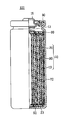
- FIG. 1 is a vertical cross-sectional view schematically showing a non-aqueous electrolyte secondary battery according to an embodiment of the present disclosure.
- the positive electrode for a non-aqueous electrolyte secondary battery includes a positive electrode mixture layer.
- the positive electrode usually includes a positive electrode mixture layer and a positive electrode current collector.
- the positive electrode mixture layer contains a positive electrode active material, a first binder, and a second binder.
- the positive electrode active material has the following formula (1): Li a Ni x Co y Me ( 1-x-y) O 2 (1) (Here, 0.97 ⁇ a ⁇ 1.2, 0.5 ⁇ x ⁇ 1, and 0 ⁇ y ⁇ 0.1, and the elements Me are Al, Mn, B, W, Sr, Mg, Mo. , Nb, Ti, Si, and Zr, including at least one selected from the group.) Includes composite oxides represented by. Hereinafter, the composite oxide represented by the formula (1) may be referred to as an oxide (1).
- the first binder is a polymer binder containing at least vinylidene fluoride units.
- the second binder is a polymeric binder containing at least a diene unit.
- the ratio of the second binder to the total amount of the first binder and the second binder is 5% by mass or more and 35% by mass or less.
- the diene unit also includes a hydrogenated agent of the diene unit.
- Oxide (1) particles tend to have relatively high compressive fracture strength. Since such particles are difficult to be pulverized when forming the positive electrode mixture layer, there is a limit to high filling in the positive electrode mixture layer.
- the first binder and the second binder are used in a specific ratio. By using the first binder and the second binder in a specific ratio, the dispersed state of the first binder in the positive electrode mixture can be appropriately controlled, and the ratio of the crystal portion of the first binder can be increased. Since the crystal portion of the first binder has rigidity, the friction coefficient of the positive electrode mixture can be appropriately increased.
- the positive electrode mixture layer is formed by pressurizing the positive electrode mixture.
- the stress associated with the pressurization of the positive electrode mixture is likely to be applied to the particles of the oxide (1) when the positive electrode mixture layer is formed, and the particles are easily broken.
- the positive electrode active material can be highly filled in the positive electrode mixture layer, so that the density of the active material in the positive electrode can be increased.
- the ratio of the second binder to the total amount of the first binder and the second binder exceeds 35% by mass and is less than 5% by mass, the friction coefficient of the positive electrode mixture layer becomes low, and the positive electrode combination It becomes difficult to increase the density of the active material in the agent layer. If the proportion of the second binder exceeds 35% by mass, the dispersed state of the first binder cannot be maintained appropriately, the crystallinity of the first binder is lowered, and the rigidity is lowered, so that the friction coefficient of the positive electrode mixture layer is lowered. .. Further, when the ratio of the second binder is less than 5% by mass, the influence of the physical properties of the first binder is dominant, and the effect of adding the second binder is hardly obtained.
- the ratio of the second binder is 35% by mass or less, and may be 34% by mass or less.
- the ratio of the second binder is 5% by mass or more, and may be 8% by mass or more.
- the ratio of the total amount of the first binder and the second binder to the positive electrode mixture layer is, for example, 0.1% by mass or more, preferably 0.4% by mass or more.
- the ratio of the total amount of the first binder and the second binder is, for example, 3% by mass or less, preferably 1.5% by mass or less.
- the composition of the oxide (1) is the composition at the positive electrode of the non-aqueous electrolyte secondary battery when fully charged.
- the a value indicating the molar ratio of lithium increases or decreases with charge and discharge.
- the battery When fully charged, when the rated capacity of the battery is C, the battery is charged until, for example, a charged state (SOC: State of Charge) of 0.98 ⁇ C or more is reached.
- SOC State of Charge
- the composition of the oxide (1) at the time of full charge is determined for a positive electrode taken out from a fully charged battery, washed with ethyl methyl carbonate (EMC) and dried. More specifically, the composition of the oxide (1) can be obtained by collecting a predetermined amount of the positive electrode mixture from the dried positive electrode and quantitatively analyzing the elements by inductively coupled plasma emission spectroscopic analysis.
- the friction coefficient of the positive electrode mixture layer is preferably 0.3 or more, and may be 0.31 or more. When the friction coefficient of the positive electrode mixture layer is in such a range, it is possible to ensure that the particles of the oxide (1) have low slipperiness in the positive electrode mixture. Therefore, the particles of the oxide (1) can be more easily pulverized when the positive electrode mixture layer is formed.
- the friction coefficient of the positive electrode mixture layer is preferably 0.5 or less, and may be 0.4 or less. When the friction coefficient of the positive electrode mixture layer is in such a range, it is possible to secure an appropriate slipperiness of the particles of the oxide (1), and the particles are easily arranged in the positive electrode mixture layer. It is advantageous for highly filling the positive electrode active material in the mixture layer.
- the coefficient of friction of the positive electrode mixture layer means the coefficient of static friction.
- the coefficient of friction of the positive electrode mixture layer is measured according to the coefficient of friction test method for plastic films and sheets of JIS K 7125: 1999.
- the coefficient of friction of the positive electrode mixture layer is measured for the positive electrode mixture layer of the positive electrode taken out of the positive electrode before assembling the non-aqueous electrolyte secondary battery or the non-aqueous electrolyte secondary battery, washed with EMC, and dried. To.
- the coefficient of friction is measured, for example, using a precision universal testing machine (AUTOGRAPH AG-X plus) manufactured by Shimadzu Corporation.
- the density of the positive electrode active material can be increased. More specifically, the density of the positive electrode active material in the positive electrode mixture layer, for example, 3.67 g / cm 3 or more (preferably 3.68 g / cm 3 or higher) can be increased to.
- the upper limit of the density of the positive electrode active material is not particularly limited, but the density of the positive electrode active material may be 3.75 g / cm 3 or less from the viewpoint of easily ensuring high cycle characteristics.
- the density of the positive electrode active material in the positive electrode mixture layer is the positive electrode mixture layer of the positive electrode taken out from the positive electrode before assembling the non-aqueous electrolyte secondary battery or the non-aqueous electrolyte secondary battery, washed with EMC, and dried. Can be obtained by the following procedure.
- the thickness of the positive electrode mixture layer is measured in a relatively flat region of the positive electrode mixture layer having a size of 50 mm in length ⁇ 50 mm in width excluding the reed connection portion and the like.
- the apparent volume of the positive electrode mixture layer in this region is determined from the vertical and horizontal sizes and thickness.
- the positive electrode mixture in this region is peeled off from the positive electrode current collector, and the mass of the positive electrode active material is determined by quantitative analysis of the elements by inductively coupled plasma emission spectroscopy or atomic absorption spectrometry. By dividing this mass by the apparent volume, the density of the positive electrode active material in the positive electrode mixture layer can be obtained.
- the ratio x of Ni in the oxide (1) may be 0.8 ⁇ x ⁇ 1. Further, when the ratio of Ni is large, the particles are difficult to be crushed when forming the positive electrode mixture layer. According to the present disclosure, by using the first binder and the second binder in a specific ratio as described above, the particles of the positive electrode active material containing the oxide (1) are easily pulverized. Therefore, even in the case of 0.8 ⁇ x ⁇ 1, the particles of the oxide (1) can be easily refined, and the positive electrode active material can be highly filled in the positive electrode mixture layer.
- the element Me in the oxide (1) contains at least Al. Further, when the element Me contains Al, the particles of the oxide (1) are difficult to be crushed when forming the positive electrode mixture layer. According to the present disclosure, by using the first binder and the second binder in a specific ratio, the particles of the positive electrode active material containing the oxide (1) are easily pulverized. Therefore, even when the element Me contains at least Al, the particles of the oxide (1) can be easily refined, and the positive electrode active material can be highly filled in the positive electrode mixture layer.
- the ratio y of Co may be 0.01 ⁇ y.
- the compressive fracture strength of the oxide (1) particles can be increased, and the efficiency of particle miniaturization can be increased. From the viewpoint of cost reduction, it is preferable to set y ⁇ 0.05.
- Me contains Al
- it may further contain Mn.
- the Mn / Al ratio may be 0.7 or less. From the viewpoint of easily ensuring high thermal stability, the Mn / Al ratio is preferably 0.4 or more.
- the positive electrode includes a positive electrode mixture layer.
- the positive electrode usually includes a positive electrode current collector that holds the positive electrode mixture layer.
- the positive electrode mixture layer may be formed on one surface of the positive electrode current collector, or may be formed on both surfaces.
- the positive electrode current collector for example, a metal foil can be used.
- the metal constituting the positive electrode current collector include aluminum (Al), titanium (Ti), alloys containing these metal elements, and stainless steel.
- the positive electrode mixture layer contains a positive electrode active material, a first binder and a second binder as essential components, and may contain a conductive agent, an additive and the like as optional components.
- a known material can be used as the additive.
- the positive electrode active material contains an oxide (1).
- the oxide (1) contains a layered rock salt type crystal structure. Since the oxide (1) has a high proportion of Ni, it is advantageous for increasing the capacity and reducing the cost. Further, since the oxide (1) contains Co, it is advantageous for extending the life of the battery.
- the element Me is preferably at least one selected from the group consisting of Al, Mn, W, Mg, Mo, Nb, Ti, Si and Zr. It is considered that Mn, W, Nb, Mg, Zr and the like contribute to the stabilization of the crystal structure.
- the atomic ratio Co / Al may be set to 0 to 1.0.
- the positive electrode active material may contain an oxide other than the oxide (1).
- oxides include, for example, Li ⁇ CoO 2 , Li ⁇ NiO 2 , Li ⁇ MnO 2 , Li ⁇ Co ⁇ M 1- ⁇ O ⁇ (M is Na, Mg, Sc, Y, Mn, Fe, At least one selected from the group consisting of Cu, Zn, Al, Cr, Pb, Sb and B), LiMPO 4, (M is Na, Mg, Sc, Y, Mn, Fe, Co, Ni, Cu, At least one selected from the group consisting of Zn, Al, Cr, Pb, Sb and B) and the like.
- the ⁇ value which indicates the molar ratio of lithium, increases or decreases with charge and discharge.
- the composition of these oxides is the same as that of the oxide (1) when fully charged.
- the ratio of the oxide (1) to the entire positive electrode active material is, for example, 50% by mass or more, and may be 80% by mass or more or 90% by mass or more.
- the positive electrode active material may be composed of only the oxide (1).
- the positive electrode mixture layer contains at least a first binder and a second binder as binders.
- the positive electrode mixture may contain a third binder other than the first binder and the second binder.
- the first binder is a polymer binder containing at least vinylidene fluoride (VDF) units.
- VDF vinylidene fluoride
- the first binder include polyvinylidene fluoride (PVDF), a copolymer containing a VDF unit and a comonomer unit, and the like.
- the copolymer include a copolymer of VDF and at least one selected from the group consisting of an olefin unit and a halogenated olefin unit.
- the olefin include ethylene and propylene.
- halogenated olefin include an olefin having at least one of fluorine and chlorine.
- the halogenated olefin may be, for example, a perfluoroolefin.
- a perfluoroolefin examples include tetrafluoroethylene and hexafluoropropylene.
- these comonomeres are merely examples and are not limited thereto.
- the ratio of VDF units to the VDF copolymer is, for example, 50 mol% or more, and may be 80 mol% or more.
- the second binder includes a diene unit.
- the diene unit include a conjugated diene unit, a non-conjugated diene unit, and hydrogenated products thereof.
- the second binder preferably contains at least a conjugated diene unit or a hydrogenated product thereof.
- the conjugated diene unit include a butadiene unit, an isoprene unit, a pentadiene unit, or a substitute thereof.
- Examples of the butadiene unit include 1,3-butadiene unit and 2,3-dimethyl-1,3-butadiene unit.
- the second binder may contain one or more diene units.
- the second binder may contain other comonomer units other than the diene unit.
- examples of other comonomer units in the second binder include vinyl cyanide units, acrylic monomers, ⁇ , ⁇ -unsaturated carboxylic acids or acid anhydrides thereof, vinyl monomers, allyl monomers, and olefins.
- Examples of the vinyl cyanide unit include acrylonitrile and methacrylonitrile.
- the acrylic monomer include acrylic acid, methacrylic acid, acrylic acid ester, methacrylic acid ester, acrylic acid amide, and methacrylic acid amide.
- Examples of the ⁇ , ⁇ -unsaturated carboxylic acid include ⁇ , ⁇ -unsaturated carboxylic acids other than acrylic acid and methacrylic acid. Examples of such unsaturated carboxylic acids include maleic acid and fumaric acid.
- Examples of the vinyl-based monomer include vinyl esters, vinyl ethers, aromatic vinyl compounds or halides thereof, vinyl halides and the like. Examples of the allyl monomer include allyl esters and allyl ethers.
- Examples of the olefin include ethylene, propylene, and halides thereof. Examples of the halide of the vinyl-based monomer (including vinyl halide) and the halide of the olefin include fluoride and chloride.
- Other comonomer may have a substituent.
- substituents include a hydroxy group, a hydroxyalkyl group, an alkoxy group, a carboxy group, an alkoxycarbonyl group, an acyl group, a sulfonic acid group, a sulfonic acid ester group, a phosphonic acid group, a phosphoric acid ester group, and a phosphonic acid ester group.
- substituent include a hydroxy group, a hydroxyalkyl group, an alkoxy group, a carboxy group, an alkoxycarbonyl group, an acyl group, a sulfonic acid group, a sulfonic acid ester group, a phosphonic acid group, a phosphoric acid ester group, and a phosphonic acid ester group.
- Examples thereof include, but are not limited to, an amino group, an alkylamino group and an acylamino group.
- the second binder may contain one or more other
- the third binder examples include fluorine resin, polyolefin resin, polyamide resin, polyimide resin, acrylic resin, vinyl resin, polyvinylpyrrolidone, polyether sulfone, and rubber particles. However, the third binder is different from the first binder and the second binder.
- the positive electrode mixture layer may contain one type of third binder, or may contain two or more types.
- the ratio of the total amount of the first binder and the second binder to the total binder contained in the positive electrode mixture layer is, for example, 50% by mass or more, and may be 80% by mass or more or 90% by mass or more.
- the entire binder contained in the positive electrode mixture layer may be composed of only the first binder and the second binder.
- the conductive agent for example, a known one can be used.
- the conductive agent include carbon black, conductive fibers, and carbon fluoride.
- carbon black include acetylene black.
- conductive fibers include carbon fibers and metal fibers. Carbon fibers also include carbon nanotubes.
- the positive electrode mixture layer may contain one type of conductive agent or two or more types.
- the positive electrode mixture layer can be formed by applying a positive electrode slurry in which a positive electrode mixture containing a positive electrode active material, a binder, a conductive agent, etc. is dispersed in a dispersion medium to the surface of a positive electrode current collector and drying it.
- the dried coating film is usually compressed in the thickness direction of the coating film.
- the average particle size of the positive electrode active material used in the positive electrode slurry is preferably 10 ⁇ m or more from the viewpoint that stress is easily applied to the positive electrode active material particles when forming the positive electrode mixture layer. From the viewpoint of easy cost reduction, the average particle size of the positive electrode active material used in the positive electrode slurry is preferably 13 ⁇ m or less.
- the average particle size of the positive electrode active material used in the positive electrode slurry means a particle size (in other words, volume average particle size) at which the integrated volume value is 50% in the particle size distribution measured by the laser diffraction / scattering method. ..
- the negative electrode includes, for example, a negative electrode mixture layer containing a negative electrode active material and a negative electrode current collector that supports the negative electrode mixture layer.
- the negative electrode active material contains at least a carbon material that occludes and releases lithium ions.
- a metal foil can be used for the negative electrode current collector.
- the metal constituting the negative electrode current collector is preferably a metal that does not react with lithium metal, and examples thereof include copper, nickel, iron, and alloys containing these metal elements.
- the negative electrode mixture layer can be formed, for example, by applying a negative electrode slurry in which the negative electrode mixture is dispersed in a dispersion medium to the surface of the negative electrode current collector and drying it. The dried coating film may be rolled if necessary.
- the negative electrode mixture layer may be formed on one surface of the negative electrode current collector, or may be formed on both surfaces.
- the negative electrode mixture contains a negative electrode active material as an essential component, and may contain a binder, a conductive agent, a thickener, and the like as optional components.
- a binder As the binder, the conductive agent, and the thickener, for example, known materials can be used.
- the binder may be selected from the first to third binders exemplified for the positive electrode mixture layer.
- the conductive agent may be selected from those exemplified for the positive electrode mixture layer.
- the negative electrode active material contains a carbon material that occludes and releases lithium ions as an essential component.
- Examples of carbon materials that occlude and release lithium ions include graphite, graphitized carbon, and graphitized carbon.
- Graphitized carbon is sometimes referred to as soft carbon.
- Graphitized carbon is sometimes referred to as hard carbon.
- graphite is preferable because it has excellent charge / discharge stability and has a small irreversible capacity.
- the negative electrode active material may contain a material other than the carbon material. It is preferable that 80% by mass or more or 90% by mass or more of the negative electrode active material is graphite.
- Graphite is a carbon material having a developed graphite-type crystal structure, and may be, for example, graphite having a plane spacing d002 of the (002) plane measured by an X-ray diffraction method of 3.4 ⁇ or less.
- the crystallite size of graphite may be 100 ⁇ or more. The crystallite size is measured, for example, by the Scherrer method.
- Alloy-based materials can be mentioned as materials other than carbon materials that can be used as negative electrode active materials.
- the alloy-based material is a material containing at least one kind of metal capable of forming an alloy with lithium, and examples thereof include silicon, tin, silicon alloys, tin alloys, and silicon compounds.
- a composite material having a lithium ion conductive phase and silicon particles dispersed in the phase may be used.
- a silicate phase or a silicon oxide phase in which 95% by mass or more is silicon dioxide may be used.
- Non-aqueous electrolyte contains a non-aqueous solvent and a lithium salt dissolved in the non-aqueous solvent.
- concentration of lithium salt in the non-aqueous electrolyte is, for example, 0.5 to 2 mol / L.
- the non-aqueous electrolyte may contain known additives.
- non-aqueous solvent for example, a cyclic carbonate ester, a chain carbonate ester, a cyclic carboxylic acid ester, or the like is used.
- cyclic carbonic acid ester include propylene carbonate and ethylene carbonate.
- chain carbonic acid ester include diethyl carbonate, ethyl methyl carbonate, dimethyl carbonate and the like.
- cyclic carboxylic acid ester include ⁇ -butyrolactone and ⁇ -valerolactone.
- one type may be used alone, or two or more types may be used in combination.
- lithium salt for example, a lithium salt of a chlorine-containing acid, a lithium salt of a fluorine-containing acid, a lithium salt of a fluorine-containing acid imide, a lithium halide and the like can be used.
- the lithium salt of the chlorine-containing acid include LiClO 4 , LiAlCl 4 , LiB 10 and Cl 10 .
- the lithium salt of the fluorine-containing acid include LiPF 6 , LiBF 4 , LiSbF 6 , LiAsF 6 , LiCF 3 SO 3 , and LiCF 3 CO 2 .
- lithium salt of the fluorine-containing acid imide examples include LiN (CF 3 SO 2 ) 2 , LiN (CF 3 SO 2 ) (C 4 F 9 SO 2 ), and LiN (C 2 F 5 SO 2 ) 2 .
- lithium halide examples include LiCl, LiBr, LiI and the like. One type of lithium salt may be used alone, or two or more types may be used in combination.
- a separator may be interposed between the positive electrode and the negative electrode.
- the separator has high ion permeability and has appropriate mechanical strength and insulation.
- a microporous thin film, a woven fabric, a non-woven fabric, or the like can be used.
- polyolefins such as polypropylene and polyethylene are preferable.
- Non-aqueous electrolyte secondary battery The type and shape of the non-aqueous electrolyte secondary battery are not particularly limited. For example, it can be appropriately selected from various shapes such as a cylindrical type, a coin type, a square type, a sheet type, and a flat type.
- the form of the electrode group is not particularly limited, and may be, for example, a wound type or a laminated type.
- FIG. 1 shows a vertical cross-sectional view of a cylindrical non-aqueous electrolyte secondary battery.
- the non-aqueous electrolyte secondary battery 100 includes a retractable electrode group 40 and a non-aqueous electrolyte (not shown).
- the electrode group 40 includes a strip-shaped positive electrode 10, a negative electrode 20, and a separator 30, respectively.
- a positive electrode lead 13 is connected to the positive electrode 10, and a negative electrode lead 23 is connected to the negative electrode 20.
- One end of the positive electrode lead 13 in the length direction is connected to the positive electrode 10, and the other end is connected to the sealing plate 90.
- the sealing plate 90 includes a positive electrode terminal 15.
- the negative electrode lead 23 is connected to the bottom of the battery case 70, one end of which is connected to the negative electrode 20 and the other end of which is the negative electrode terminal.
- the battery case (battery can) 70 is made of metal, for example, iron.
- a resin upper insulating ring 80 and a lower insulating ring 60 are arranged above and below the electrode group 40, respectively.
- a cylindrical battery including a winding type electrode group has been described, but the present embodiment is not limited to this case.
- a positive electrode slurry was prepared by mixing lithium nickel composite oxide, which is a positive electrode active material, a binder, acetylene black, and N-methyl-2-pyrrolidone (NMP) in a predetermined mass ratio.
- the binder polyvinylidene fluoride as the first binder and modified butadiene rubber (including acrylonitrile unit) as the second binder were used.
- the ratio of the second binder to the total amount of the first binder and the second binder is the value shown in Table 1.
- the ratio of the total amount of the first binder and the second binder to the solid content of the positive electrode slurry was 1% by mass.
- Lithium-nickel composite oxides include NCA1 (LiNi 0.9 Co 0.05 Al 0.05 O 2 , D50: 12 ⁇ m) or NCA2 (LiNi 0.9 Co 0.04 Al 0.06 O 2 , D50: 12 ⁇ m). ) was used.
- a positive electrode slurry was applied to both surfaces of the aluminum foil, which is a positive electrode current collector, the coating film was dried, and then rolled to form a positive electrode mixture layer on both surfaces of the aluminum foil. In this way, a positive electrode for a non-aqueous electrolyte secondary battery was produced.
- Comparative Examples 2 and 3 A positive electrode was produced in the same manner as in Example 1 or Example 3 except that the second binder was not used.
- Friction coefficient The friction coefficient on the surface of the positive electrode mixture layer of the positive electrode was determined by the procedure described above.
- Density of positive electrode active material The density of the positive electrode active material in the positive electrode was determined by the procedure described above.
- the friction coefficient of the positive electrode mixture layer was low and the density of the positive electrode active material was also low.
- the friction coefficient of the positive electrode mixture layer is larger than that in the comparative example, and the density of the positive electrode active material can be improved. ing.
- Non-aqueous electrolyte secondary battery was prepared using the positive electrode prepared in the example.
- the non-aqueous electrolyte secondary battery was manufactured by the following procedure. (1) Preparation of Negative Electrode Artificial graphite (average particle size 30 ⁇ m), acetylene black, and polyvinylidene fluoride were mixed at a predetermined mass ratio, and NMP was added to prepare a negative electrode slurry. Next, a negative electrode slurry was applied to the surface of the electrolytic copper foil, which is a negative electrode current collector, the coating film was dried, and then rolled to form negative electrode mixture layers on both sides of the copper foil.
- a non-aqueous electrolyte solution was prepared by dissolving LiPF 6 at a concentration of 1.0 mol / L in a mixed solvent containing ethylene carbonate and diethyl carbonate in a volume ratio of 3: 7.
- (3) Assembly of non-aqueous electrolyte secondary battery Lead tabs are attached to the positive electrode and the negative electrode, respectively, and the positive electrode and the negative electrode are spirally wound through a separator so that the leads are located on the outermost periphery to form an electrode group.
- the electrode group is inserted into an outer body made of a laminated film having an aluminum foil as a barrier layer, vacuum dried at 105 ° C. for 2 hours, then an electrolytic solution is injected, the opening of the outer body is sealed, and non-water is used.
- An electrolyte secondary battery was obtained.
- the non-aqueous electrolyte secondary battery provided with the positive electrode according to the present disclosure has a high capacity, it is used in combination with electronic devices such as mobile phones, smartphones and tablet terminals, hybrids, electric vehicles including plug-in hybrids, and solar cells. It can be used as a storage battery or the like.
Landscapes
- Chemical & Material Sciences (AREA)
- Chemical Kinetics & Catalysis (AREA)
- Electrochemistry (AREA)
- General Chemical & Material Sciences (AREA)
- Engineering & Computer Science (AREA)
- Inorganic Chemistry (AREA)
- Materials Engineering (AREA)
- Organic Chemistry (AREA)
- Manufacturing & Machinery (AREA)
- Composite Materials (AREA)
- Life Sciences & Earth Sciences (AREA)
- General Life Sciences & Earth Sciences (AREA)
- Geology (AREA)
- Battery Electrode And Active Subsutance (AREA)
Priority Applications (4)
| Application Number | Priority Date | Filing Date | Title |
|---|---|---|---|
| EP20872124.1A EP4039652A4 (en) | 2019-09-30 | 2020-09-03 | POSITIVE ELECTRODE FOR NON-AQUEOUS ELECTROLYTE RECHARGEABLE BATTERY AND NON-AQUEOUS ELECTROLYTE RECHARGEABLE BATTERY |
| JP2021550480A JP7617435B2 (ja) | 2019-09-30 | 2020-09-03 | 非水電解質二次電池用正極および非水電解質二次電池 |
| CN202080067980.0A CN114467192A (zh) | 2019-09-30 | 2020-09-03 | 非水电解质二次电池用正极和非水电解质二次电池 |
| US17/764,789 US20220352513A1 (en) | 2019-09-30 | 2020-09-03 | Positive electrode for non-aqueous electrolyte secondary battery and non-aqueous electrolyte secondary battery |
Applications Claiming Priority (2)
| Application Number | Priority Date | Filing Date | Title |
|---|---|---|---|
| JP2019179619 | 2019-09-30 | ||
| JP2019-179619 | 2019-09-30 |
Publications (1)
| Publication Number | Publication Date |
|---|---|
| WO2021065320A1 true WO2021065320A1 (ja) | 2021-04-08 |
Family
ID=75337174
Family Applications (1)
| Application Number | Title | Priority Date | Filing Date |
|---|---|---|---|
| PCT/JP2020/033371 Ceased WO2021065320A1 (ja) | 2019-09-30 | 2020-09-03 | 非水電解質二次電池用正極および非水電解質二次電池 |
Country Status (5)
| Country | Link |
|---|---|
| US (1) | US20220352513A1 (https=) |
| EP (1) | EP4039652A4 (https=) |
| JP (1) | JP7617435B2 (https=) |
| CN (1) | CN114467192A (https=) |
| WO (1) | WO2021065320A1 (https=) |
Families Citing this family (1)
| Publication number | Priority date | Publication date | Assignee | Title |
|---|---|---|---|---|
| KR20240066860A (ko) | 2022-11-08 | 2024-05-16 | 에스케이이노베이션 주식회사 | 리튬 이차 전지용 양극 및 이를 포함하는 리튬 이차 전지 |
Citations (3)
| Publication number | Priority date | Publication date | Assignee | Title |
|---|---|---|---|---|
| JP2009146788A (ja) | 2007-12-14 | 2009-07-02 | Panasonic Corp | リチウム二次電池用正極形成用塗工液、リチウム二次電池用正極およびリチウム二次電池 |
| JP2010033924A (ja) * | 2008-07-30 | 2010-02-12 | Nec Tokin Corp | リチウムイオン二次電池用正極、およびそれを用いたリチウムイオン二次電池 |
| JP2018120706A (ja) * | 2017-01-24 | 2018-08-02 | 三星エスディアイ株式会社Samsung SDI Co., Ltd. | 非水電解質二次電池用負極及び非水電解質二次電池 |
Family Cites Families (10)
| Publication number | Priority date | Publication date | Assignee | Title |
|---|---|---|---|---|
| JP4602254B2 (ja) * | 2003-09-18 | 2010-12-22 | パナソニック株式会社 | リチウムイオン二次電池 |
| CN100492720C (zh) * | 2003-09-18 | 2009-05-27 | 松下电器产业株式会社 | 锂离子二次电池 |
| JP2012033381A (ja) * | 2010-07-30 | 2012-02-16 | Panasonic Corp | 非水電解質二次電池及びその製造方法 |
| JP6413242B2 (ja) * | 2014-01-15 | 2018-10-31 | 日本ゼオン株式会社 | 二次電池正極用スラリーの製造方法、二次電池用正極の製造方法、及び二次電池の製造方法 |
| JP6523443B2 (ja) * | 2014-10-02 | 2019-05-29 | エルジー・ケム・リミテッド | ゴム系バインダーを含む正極活物質スラリー及びこれから製造された正極 |
| JP6494273B2 (ja) * | 2014-12-22 | 2019-04-03 | 三星エスディアイ株式会社Samsung SDI Co., Ltd. | 非水電解質二次電池用電極巻回素子、それを用いた非水電解質二次電池、及び非水電解質二次電池用電極巻回素子の製造方法 |
| HUE054156T2 (hu) * | 2014-12-26 | 2021-08-30 | Zeon Corp | Kötõanyag készítmény nem-vizes szekunder cella pozitív elektródjához, készítmény nem-vizes szekunder cella pozitív elektródjához, nem-vizes szekunder cella pozitív elektród és nem-vizes szekunder cella, és eljárás nem-vizes szekunder cella pozitív elektródjához való készítmény, nem-vizes szekunder cella pozitív elektród és nem-vizes szekunder cella elõállítására |
| JP6470081B2 (ja) * | 2015-03-19 | 2019-02-13 | 株式会社東芝 | 負極及び非水電解質電池 |
| KR102666367B1 (ko) * | 2018-08-28 | 2024-05-20 | 삼성전자주식회사 | 양극 및 이를 포함하는 리튬전지 |
| KR102774902B1 (ko) * | 2019-05-08 | 2025-03-04 | 주식회사 엘지에너지솔루션 | 전고체전지의 전극 제조방법 및 이를 이용하여 제조된 전고체전지 전극 |
-
2020
- 2020-09-03 JP JP2021550480A patent/JP7617435B2/ja active Active
- 2020-09-03 EP EP20872124.1A patent/EP4039652A4/en active Pending
- 2020-09-03 CN CN202080067980.0A patent/CN114467192A/zh active Pending
- 2020-09-03 WO PCT/JP2020/033371 patent/WO2021065320A1/ja not_active Ceased
- 2020-09-03 US US17/764,789 patent/US20220352513A1/en not_active Abandoned
Patent Citations (3)
| Publication number | Priority date | Publication date | Assignee | Title |
|---|---|---|---|---|
| JP2009146788A (ja) | 2007-12-14 | 2009-07-02 | Panasonic Corp | リチウム二次電池用正極形成用塗工液、リチウム二次電池用正極およびリチウム二次電池 |
| JP2010033924A (ja) * | 2008-07-30 | 2010-02-12 | Nec Tokin Corp | リチウムイオン二次電池用正極、およびそれを用いたリチウムイオン二次電池 |
| JP2018120706A (ja) * | 2017-01-24 | 2018-08-02 | 三星エスディアイ株式会社Samsung SDI Co., Ltd. | 非水電解質二次電池用負極及び非水電解質二次電池 |
Non-Patent Citations (1)
| Title |
|---|
| See also references of EP4039652A4 |
Also Published As
| Publication number | Publication date |
|---|---|
| JP7617435B2 (ja) | 2025-01-20 |
| US20220352513A1 (en) | 2022-11-03 |
| JPWO2021065320A1 (https=) | 2021-04-08 |
| CN114467192A (zh) | 2022-05-10 |
| EP4039652A4 (en) | 2024-07-31 |
| EP4039652A1 (en) | 2022-08-10 |
Similar Documents
| Publication | Publication Date | Title |
|---|---|---|
| JP7361116B2 (ja) | 電気化学デバイス用組成物、正極合剤、正極構造体および二次電池 | |
| JP6876996B2 (ja) | 非水電解質二次電池 | |
| KR101477873B1 (ko) | 비수전해액형 리튬 이온 2차 전지 | |
| US10586983B2 (en) | Positive electrode active material for nonaqueous electrolyte secondary batteries, production method thereof, and nonaqueous electrolyte secondary battery | |
| CN101331643A (zh) | 锂离子二次电池 | |
| JP2018530113A (ja) | 二次電池の正極形成用組成物、及びこれを用いて製造した二次電池用正極並びに二次電池 | |
| JP6493409B2 (ja) | 非水電解質二次電池 | |
| JP6697377B2 (ja) | リチウムイオン二次電池 | |
| JP2009043477A (ja) | 正極活物質、これを用いた正極および非水電解質電池 | |
| JP7454559B2 (ja) | 非水電解質二次電池用の負極、及び非水電解質二次電池 | |
| CN107851839B (zh) | 非水电解质二次电池 | |
| JP2013114848A (ja) | リチウムイオン二次電池とその製造方法 | |
| JP7454796B2 (ja) | 非水電解質二次電池およびこれに用いる電解液 | |
| JP5203632B2 (ja) | 非水電解質電池 | |
| JP2023015188A (ja) | 非水電解質二次電池用正極活物質の製造方法 | |
| JP2023523139A (ja) | リチウム二次電池用の正極およびリチウム二次電池 | |
| JPWO2020017581A1 (ja) | 非水電解質蓄電素子、及び蓄電装置 | |
| WO2013094037A1 (ja) | リチウム二次電池 | |
| JPWO2020158169A1 (ja) | 非水電解質二次電池およびこれに用いる電解液 | |
| JP7617435B2 (ja) | 非水電解質二次電池用正極および非水電解質二次電池 | |
| CN111742436A (zh) | 非水电解质二次电池 | |
| JP2023525012A (ja) | リチウム二次電池用正極およびリチウム二次電池 | |
| JP2007095534A (ja) | 非水電解液二次電池の製造方法 | |
| CN114342110A (zh) | 二次电池用负极和非水电解质二次电池 | |
| EP4723199A1 (en) | Positive electrode for secondary battery, secondary battery, and positive electrode mixture slurry |
Legal Events
| Date | Code | Title | Description |
|---|---|---|---|
| 121 | Ep: the epo has been informed by wipo that ep was designated in this application |
Ref document number: 20872124 Country of ref document: EP Kind code of ref document: A1 |
|
| ENP | Entry into the national phase |
Ref document number: 2021550480 Country of ref document: JP Kind code of ref document: A |
|
| NENP | Non-entry into the national phase |
Ref country code: DE |
|
| ENP | Entry into the national phase |
Ref document number: 2020872124 Country of ref document: EP Effective date: 20220502 |