WO2021038959A1 - 容器 - Google Patents
容器 Download PDFInfo
- Publication number
- WO2021038959A1 WO2021038959A1 PCT/JP2020/017497 JP2020017497W WO2021038959A1 WO 2021038959 A1 WO2021038959 A1 WO 2021038959A1 JP 2020017497 W JP2020017497 W JP 2020017497W WO 2021038959 A1 WO2021038959 A1 WO 2021038959A1
- Authority
- WO
- WIPO (PCT)
- Prior art keywords
- film layer
- layer
- film
- surface side
- container
- Prior art date
- Legal status (The legal status is an assumption and is not a legal conclusion. Google has not performed a legal analysis and makes no representation as to the accuracy of the status listed.)
- Ceased
Links
Images




Classifications
-
- B—PERFORMING OPERATIONS; TRANSPORTING
- B65—CONVEYING; PACKING; STORING; HANDLING THIN OR FILAMENTARY MATERIAL
- B65D—CONTAINERS FOR STORAGE OR TRANSPORT OF ARTICLES OR MATERIALS, e.g. BAGS, BARRELS, BOTTLES, BOXES, CANS, CARTONS, CRATES, DRUMS, JARS, TANKS, HOPPERS, FORWARDING CONTAINERS; ACCESSORIES, CLOSURES, OR FITTINGS THEREFOR; PACKAGING ELEMENTS; PACKAGES
- B65D75/00—Packages comprising articles or materials partially or wholly enclosed in strips, sheets, blanks, tubes or webs of flexible sheet material, e.g. in folded wrappers
- B65D75/28—Articles or materials wholly enclosed in composite wrappers, i.e. wrappers formed by associating or interconnecting two or more sheets or blanks
-
- B—PERFORMING OPERATIONS; TRANSPORTING
- B32—LAYERED PRODUCTS
- B32B—LAYERED PRODUCTS, i.e. PRODUCTS BUILT-UP OF STRATA OF FLAT OR NON-FLAT, e.g. CELLULAR OR HONEYCOMB, FORM
- B32B1/00—Layered products having a non-planar shape
-
- B—PERFORMING OPERATIONS; TRANSPORTING
- B32—LAYERED PRODUCTS
- B32B—LAYERED PRODUCTS, i.e. PRODUCTS BUILT-UP OF STRATA OF FLAT OR NON-FLAT, e.g. CELLULAR OR HONEYCOMB, FORM
- B32B27/00—Layered products comprising a layer of synthetic resin
- B32B27/06—Layered products comprising a layer of synthetic resin as the main or only constituent of a layer, which is next to another layer of the same or of a different material
- B32B27/08—Layered products comprising a layer of synthetic resin as the main or only constituent of a layer, which is next to another layer of the same or of a different material of synthetic resin
-
- B—PERFORMING OPERATIONS; TRANSPORTING
- B32—LAYERED PRODUCTS
- B32B—LAYERED PRODUCTS, i.e. PRODUCTS BUILT-UP OF STRATA OF FLAT OR NON-FLAT, e.g. CELLULAR OR HONEYCOMB, FORM
- B32B27/00—Layered products comprising a layer of synthetic resin
- B32B27/16—Layered products comprising a layer of synthetic resin specially treated, e.g. irradiated
-
- B—PERFORMING OPERATIONS; TRANSPORTING
- B32—LAYERED PRODUCTS
- B32B—LAYERED PRODUCTS, i.e. PRODUCTS BUILT-UP OF STRATA OF FLAT OR NON-FLAT, e.g. CELLULAR OR HONEYCOMB, FORM
- B32B27/00—Layered products comprising a layer of synthetic resin
- B32B27/28—Layered products comprising a layer of synthetic resin comprising synthetic resins not wholly covered by any one of the sub-groups B32B27/30 - B32B27/42
-
- B—PERFORMING OPERATIONS; TRANSPORTING
- B32—LAYERED PRODUCTS
- B32B—LAYERED PRODUCTS, i.e. PRODUCTS BUILT-UP OF STRATA OF FLAT OR NON-FLAT, e.g. CELLULAR OR HONEYCOMB, FORM
- B32B27/00—Layered products comprising a layer of synthetic resin
- B32B27/30—Layered products comprising a layer of synthetic resin comprising vinyl (co)polymers; comprising acrylic (co)polymers
- B32B27/302—Layered products comprising a layer of synthetic resin comprising vinyl (co)polymers; comprising acrylic (co)polymers comprising aromatic vinyl (co)polymers, e.g. styrenic (co)polymers
-
- B—PERFORMING OPERATIONS; TRANSPORTING
- B32—LAYERED PRODUCTS
- B32B—LAYERED PRODUCTS, i.e. PRODUCTS BUILT-UP OF STRATA OF FLAT OR NON-FLAT, e.g. CELLULAR OR HONEYCOMB, FORM
- B32B27/00—Layered products comprising a layer of synthetic resin
- B32B27/30—Layered products comprising a layer of synthetic resin comprising vinyl (co)polymers; comprising acrylic (co)polymers
- B32B27/304—Layered products comprising a layer of synthetic resin comprising vinyl (co)polymers; comprising acrylic (co)polymers comprising vinyl halide (co)polymers, e.g. PVC, PVDC, PVF, PVDF
-
- B—PERFORMING OPERATIONS; TRANSPORTING
- B32—LAYERED PRODUCTS
- B32B—LAYERED PRODUCTS, i.e. PRODUCTS BUILT-UP OF STRATA OF FLAT OR NON-FLAT, e.g. CELLULAR OR HONEYCOMB, FORM
- B32B27/00—Layered products comprising a layer of synthetic resin
- B32B27/30—Layered products comprising a layer of synthetic resin comprising vinyl (co)polymers; comprising acrylic (co)polymers
- B32B27/306—Layered products comprising a layer of synthetic resin comprising vinyl (co)polymers; comprising acrylic (co)polymers comprising vinyl acetate or vinyl alcohol (co)polymers
-
- B—PERFORMING OPERATIONS; TRANSPORTING
- B32—LAYERED PRODUCTS
- B32B—LAYERED PRODUCTS, i.e. PRODUCTS BUILT-UP OF STRATA OF FLAT OR NON-FLAT, e.g. CELLULAR OR HONEYCOMB, FORM
- B32B27/00—Layered products comprising a layer of synthetic resin
- B32B27/30—Layered products comprising a layer of synthetic resin comprising vinyl (co)polymers; comprising acrylic (co)polymers
- B32B27/308—Layered products comprising a layer of synthetic resin comprising vinyl (co)polymers; comprising acrylic (co)polymers comprising acrylic (co)polymers
-
- B—PERFORMING OPERATIONS; TRANSPORTING
- B32—LAYERED PRODUCTS
- B32B—LAYERED PRODUCTS, i.e. PRODUCTS BUILT-UP OF STRATA OF FLAT OR NON-FLAT, e.g. CELLULAR OR HONEYCOMB, FORM
- B32B27/00—Layered products comprising a layer of synthetic resin
- B32B27/32—Layered products comprising a layer of synthetic resin comprising polyolefins
-
- B—PERFORMING OPERATIONS; TRANSPORTING
- B32—LAYERED PRODUCTS
- B32B—LAYERED PRODUCTS, i.e. PRODUCTS BUILT-UP OF STRATA OF FLAT OR NON-FLAT, e.g. CELLULAR OR HONEYCOMB, FORM
- B32B27/00—Layered products comprising a layer of synthetic resin
- B32B27/34—Layered products comprising a layer of synthetic resin comprising polyamides
-
- B—PERFORMING OPERATIONS; TRANSPORTING
- B32—LAYERED PRODUCTS
- B32B—LAYERED PRODUCTS, i.e. PRODUCTS BUILT-UP OF STRATA OF FLAT OR NON-FLAT, e.g. CELLULAR OR HONEYCOMB, FORM
- B32B27/00—Layered products comprising a layer of synthetic resin
- B32B27/36—Layered products comprising a layer of synthetic resin comprising polyesters
-
- B—PERFORMING OPERATIONS; TRANSPORTING
- B32—LAYERED PRODUCTS
- B32B—LAYERED PRODUCTS, i.e. PRODUCTS BUILT-UP OF STRATA OF FLAT OR NON-FLAT, e.g. CELLULAR OR HONEYCOMB, FORM
- B32B27/00—Layered products comprising a layer of synthetic resin
- B32B27/36—Layered products comprising a layer of synthetic resin comprising polyesters
- B32B27/365—Layered products comprising a layer of synthetic resin comprising polyesters comprising polycarbonates
-
- B—PERFORMING OPERATIONS; TRANSPORTING
- B32—LAYERED PRODUCTS
- B32B—LAYERED PRODUCTS, i.e. PRODUCTS BUILT-UP OF STRATA OF FLAT OR NON-FLAT, e.g. CELLULAR OR HONEYCOMB, FORM
- B32B7/00—Layered products characterised by the relation between layers; Layered products characterised by the relative orientation of features between layers, or by the relative values of a measurable parameter between layers, i.e. products comprising layers having different physical, chemical or physicochemical properties; Layered products characterised by the interconnection of layers
- B32B7/04—Interconnection of layers
- B32B7/06—Interconnection of layers permitting easy separation
-
- B—PERFORMING OPERATIONS; TRANSPORTING
- B65—CONVEYING; PACKING; STORING; HANDLING THIN OR FILAMENTARY MATERIAL
- B65D—CONTAINERS FOR STORAGE OR TRANSPORT OF ARTICLES OR MATERIALS, e.g. BAGS, BARRELS, BOTTLES, BOXES, CANS, CARTONS, CRATES, DRUMS, JARS, TANKS, HOPPERS, FORWARDING CONTAINERS; ACCESSORIES, CLOSURES, OR FITTINGS THEREFOR; PACKAGING ELEMENTS; PACKAGES
- B65D75/00—Packages comprising articles or materials partially or wholly enclosed in strips, sheets, blanks, tubes or webs of flexible sheet material, e.g. in folded wrappers
- B65D75/008—Standing pouches, i.e. "Standbeutel"
-
- B—PERFORMING OPERATIONS; TRANSPORTING
- B65—CONVEYING; PACKING; STORING; HANDLING THIN OR FILAMENTARY MATERIAL
- B65D—CONTAINERS FOR STORAGE OR TRANSPORT OF ARTICLES OR MATERIALS, e.g. BAGS, BARRELS, BOTTLES, BOXES, CANS, CARTONS, CRATES, DRUMS, JARS, TANKS, HOPPERS, FORWARDING CONTAINERS; ACCESSORIES, CLOSURES, OR FITTINGS THEREFOR; PACKAGING ELEMENTS; PACKAGES
- B65D75/00—Packages comprising articles or materials partially or wholly enclosed in strips, sheets, blanks, tubes or webs of flexible sheet material, e.g. in folded wrappers
- B65D75/52—Details
- B65D75/58—Opening or contents-removing devices added or incorporated during package manufacture
- B65D75/5861—Spouts
- B65D75/5872—Non-integral spouts
-
- B—PERFORMING OPERATIONS; TRANSPORTING
- B29—WORKING OF PLASTICS; WORKING OF SUBSTANCES IN A PLASTIC STATE IN GENERAL
- B29B—PREPARATION OR PRETREATMENT OF THE MATERIAL TO BE SHAPED; MAKING GRANULES OR PREFORMS; RECOVERY OF PLASTICS OR OTHER CONSTITUENTS OF WASTE MATERIAL CONTAINING PLASTICS
- B29B17/00—Recovery of plastics or other constituents of waste material containing plastics
- B29B17/02—Separating plastics from other materials
-
- B—PERFORMING OPERATIONS; TRANSPORTING
- B29—WORKING OF PLASTICS; WORKING OF SUBSTANCES IN A PLASTIC STATE IN GENERAL
- B29B—PREPARATION OR PRETREATMENT OF THE MATERIAL TO BE SHAPED; MAKING GRANULES OR PREFORMS; RECOVERY OF PLASTICS OR OTHER CONSTITUENTS OF WASTE MATERIAL CONTAINING PLASTICS
- B29B17/00—Recovery of plastics or other constituents of waste material containing plastics
- B29B17/04—Disintegrating plastics, e.g. by milling
- B29B17/0412—Disintegrating plastics, e.g. by milling to large particles, e.g. beads, granules, flakes, slices
-
- B—PERFORMING OPERATIONS; TRANSPORTING
- B29—WORKING OF PLASTICS; WORKING OF SUBSTANCES IN A PLASTIC STATE IN GENERAL
- B29B—PREPARATION OR PRETREATMENT OF THE MATERIAL TO BE SHAPED; MAKING GRANULES OR PREFORMS; RECOVERY OF PLASTICS OR OTHER CONSTITUENTS OF WASTE MATERIAL CONTAINING PLASTICS
- B29B17/00—Recovery of plastics or other constituents of waste material containing plastics
- B29B17/02—Separating plastics from other materials
- B29B2017/0213—Specific separating techniques
- B29B2017/0286—Cleaning means used for separation
- B29B2017/0289—Washing the materials in liquids
-
- B—PERFORMING OPERATIONS; TRANSPORTING
- B29—WORKING OF PLASTICS; WORKING OF SUBSTANCES IN A PLASTIC STATE IN GENERAL
- B29L—INDEXING SCHEME ASSOCIATED WITH SUBCLASS B29C, RELATING TO PARTICULAR ARTICLES
- B29L2031/00—Other particular articles
- B29L2031/712—Containers; Packaging elements or accessories, Packages
-
- B—PERFORMING OPERATIONS; TRANSPORTING
- B32—LAYERED PRODUCTS
- B32B—LAYERED PRODUCTS, i.e. PRODUCTS BUILT-UP OF STRATA OF FLAT OR NON-FLAT, e.g. CELLULAR OR HONEYCOMB, FORM
- B32B2250/00—Layers arrangement
- B32B2250/04—4 layers
-
- B—PERFORMING OPERATIONS; TRANSPORTING
- B32—LAYERED PRODUCTS
- B32B—LAYERED PRODUCTS, i.e. PRODUCTS BUILT-UP OF STRATA OF FLAT OR NON-FLAT, e.g. CELLULAR OR HONEYCOMB, FORM
- B32B2250/00—Layers arrangement
- B32B2250/24—All layers being polymeric
-
- B—PERFORMING OPERATIONS; TRANSPORTING
- B32—LAYERED PRODUCTS
- B32B—LAYERED PRODUCTS, i.e. PRODUCTS BUILT-UP OF STRATA OF FLAT OR NON-FLAT, e.g. CELLULAR OR HONEYCOMB, FORM
- B32B2255/00—Coating on the layer surface
- B32B2255/10—Coating on the layer surface on synthetic resin layer or on natural or synthetic rubber layer
-
- B—PERFORMING OPERATIONS; TRANSPORTING
- B32—LAYERED PRODUCTS
- B32B—LAYERED PRODUCTS, i.e. PRODUCTS BUILT-UP OF STRATA OF FLAT OR NON-FLAT, e.g. CELLULAR OR HONEYCOMB, FORM
- B32B2255/00—Coating on the layer surface
- B32B2255/20—Inorganic coating
-
- B—PERFORMING OPERATIONS; TRANSPORTING
- B32—LAYERED PRODUCTS
- B32B—LAYERED PRODUCTS, i.e. PRODUCTS BUILT-UP OF STRATA OF FLAT OR NON-FLAT, e.g. CELLULAR OR HONEYCOMB, FORM
- B32B2255/00—Coating on the layer surface
- B32B2255/26—Polymeric coating
-
- B—PERFORMING OPERATIONS; TRANSPORTING
- B32—LAYERED PRODUCTS
- B32B—LAYERED PRODUCTS, i.e. PRODUCTS BUILT-UP OF STRATA OF FLAT OR NON-FLAT, e.g. CELLULAR OR HONEYCOMB, FORM
- B32B2255/00—Coating on the layer surface
- B32B2255/28—Multiple coating on one surface
-
- B—PERFORMING OPERATIONS; TRANSPORTING
- B32—LAYERED PRODUCTS
- B32B—LAYERED PRODUCTS, i.e. PRODUCTS BUILT-UP OF STRATA OF FLAT OR NON-FLAT, e.g. CELLULAR OR HONEYCOMB, FORM
- B32B2307/00—Properties of the layers or laminate
- B32B2307/30—Properties of the layers or laminate having particular thermal properties
- B32B2307/31—Heat sealable
-
- B—PERFORMING OPERATIONS; TRANSPORTING
- B32—LAYERED PRODUCTS
- B32B—LAYERED PRODUCTS, i.e. PRODUCTS BUILT-UP OF STRATA OF FLAT OR NON-FLAT, e.g. CELLULAR OR HONEYCOMB, FORM
- B32B2307/00—Properties of the layers or laminate
- B32B2307/40—Properties of the layers or laminate having particular optical properties
- B32B2307/402—Coloured
- B32B2307/4023—Coloured on the layer surface, e.g. ink
-
- B—PERFORMING OPERATIONS; TRANSPORTING
- B32—LAYERED PRODUCTS
- B32B—LAYERED PRODUCTS, i.e. PRODUCTS BUILT-UP OF STRATA OF FLAT OR NON-FLAT, e.g. CELLULAR OR HONEYCOMB, FORM
- B32B2307/00—Properties of the layers or laminate
- B32B2307/40—Properties of the layers or laminate having particular optical properties
- B32B2307/406—Bright, glossy, shiny surface
-
- B—PERFORMING OPERATIONS; TRANSPORTING
- B32—LAYERED PRODUCTS
- B32B—LAYERED PRODUCTS, i.e. PRODUCTS BUILT-UP OF STRATA OF FLAT OR NON-FLAT, e.g. CELLULAR OR HONEYCOMB, FORM
- B32B2307/00—Properties of the layers or laminate
- B32B2307/50—Properties of the layers or laminate having particular mechanical properties
- B32B2307/514—Oriented
-
- B—PERFORMING OPERATIONS; TRANSPORTING
- B32—LAYERED PRODUCTS
- B32B—LAYERED PRODUCTS, i.e. PRODUCTS BUILT-UP OF STRATA OF FLAT OR NON-FLAT, e.g. CELLULAR OR HONEYCOMB, FORM
- B32B2307/00—Properties of the layers or laminate
- B32B2307/70—Other properties
- B32B2307/72—Density
-
- B—PERFORMING OPERATIONS; TRANSPORTING
- B32—LAYERED PRODUCTS
- B32B—LAYERED PRODUCTS, i.e. PRODUCTS BUILT-UP OF STRATA OF FLAT OR NON-FLAT, e.g. CELLULAR OR HONEYCOMB, FORM
- B32B2307/00—Properties of the layers or laminate
- B32B2307/70—Other properties
- B32B2307/724—Permeability to gases, adsorption
- B32B2307/7242—Non-permeable
-
- B—PERFORMING OPERATIONS; TRANSPORTING
- B32—LAYERED PRODUCTS
- B32B—LAYERED PRODUCTS, i.e. PRODUCTS BUILT-UP OF STRATA OF FLAT OR NON-FLAT, e.g. CELLULAR OR HONEYCOMB, FORM
- B32B2307/00—Properties of the layers or laminate
- B32B2307/70—Other properties
- B32B2307/732—Dimensional properties
-
- B—PERFORMING OPERATIONS; TRANSPORTING
- B32—LAYERED PRODUCTS
- B32B—LAYERED PRODUCTS, i.e. PRODUCTS BUILT-UP OF STRATA OF FLAT OR NON-FLAT, e.g. CELLULAR OR HONEYCOMB, FORM
- B32B2307/00—Properties of the layers or laminate
- B32B2307/70—Other properties
- B32B2307/748—Releasability
-
- B—PERFORMING OPERATIONS; TRANSPORTING
- B32—LAYERED PRODUCTS
- B32B—LAYERED PRODUCTS, i.e. PRODUCTS BUILT-UP OF STRATA OF FLAT OR NON-FLAT, e.g. CELLULAR OR HONEYCOMB, FORM
- B32B2307/00—Properties of the layers or laminate
- B32B2307/70—Other properties
- B32B2307/75—Printability
-
- B—PERFORMING OPERATIONS; TRANSPORTING
- B32—LAYERED PRODUCTS
- B32B—LAYERED PRODUCTS, i.e. PRODUCTS BUILT-UP OF STRATA OF FLAT OR NON-FLAT, e.g. CELLULAR OR HONEYCOMB, FORM
- B32B2439/00—Containers; Receptacles
- B32B2439/40—Closed containers
- B32B2439/46—Bags
-
- B—PERFORMING OPERATIONS; TRANSPORTING
- B32—LAYERED PRODUCTS
- B32B—LAYERED PRODUCTS, i.e. PRODUCTS BUILT-UP OF STRATA OF FLAT OR NON-FLAT, e.g. CELLULAR OR HONEYCOMB, FORM
- B32B2439/00—Containers; Receptacles
- B32B2439/40—Closed containers
- B32B2439/60—Bottles
-
- Y—GENERAL TAGGING OF NEW TECHNOLOGICAL DEVELOPMENTS; GENERAL TAGGING OF CROSS-SECTIONAL TECHNOLOGIES SPANNING OVER SEVERAL SECTIONS OF THE IPC; TECHNICAL SUBJECTS COVERED BY FORMER USPC CROSS-REFERENCE ART COLLECTIONS [XRACs] AND DIGESTS
- Y02—TECHNOLOGIES OR APPLICATIONS FOR MITIGATION OR ADAPTATION AGAINST CLIMATE CHANGE
- Y02W—CLIMATE CHANGE MITIGATION TECHNOLOGIES RELATED TO WASTEWATER TREATMENT OR WASTE MANAGEMENT
- Y02W30/00—Technologies for solid waste management
- Y02W30/50—Reuse, recycling or recovery technologies
- Y02W30/62—Plastics recycling; Rubber recycling
Definitions
- the present invention relates to containers and containerized products.
- Patent Document 1 Japanese Patent No. 6193535
- the present invention is a container composed of a sheet material in which a plurality of film layers including a first film layer and a second film layer are laminated, and at least a part of peripheral portions of the sheet material is bonded to each other.
- a storage area for accommodating the contained material is formed inside the second film layer, and the first film is formed between the first film layer and the second film layer. It has a film joint portion in which the layer and the second film layer are bonded, and a filler encapsulation portion in which a filler is present and bulges in the thickness direction of the sheet material from the film joint portion.
- a print layer containing an ink layer is formed on at least one surface selected from the outer surface side and the inner surface side surface of the first film layer and the outer surface side and inner surface side surfaces of the second film layer, and the print layer is formed.
- the present invention relates to a container that can be removed from the surface of the film layer by washing with an aqueous solvent.
- the sheet material container described in Patent Document 1 Since the structure of the sheet material container described in Patent Document 1 is maintained by enclosing the filler in the filler encapsulating portion, the sheet material can be thinned and the contained material is used up. After that, the filler can be removed from the filler encapsulation portion to lose its rigidity, and the container can be crushed into small pieces, so that waste can be reduced.
- further improvements in environmental characteristics and the like are required for various sheet material containers. According to the study of the present inventor, the sheet material container described in Patent Document 1 is excellent in that waste can be reduced, but from the viewpoint of improving recyclability in particular, a recycled material recycled from this sheet material container. There is room for further improvement in terms of quality, etc.
- the container according to the present invention is a container made of a sheet material in which a plurality of film layers are laminated, and includes the following embodiments.
- At least a part of the peripheral edges of the sheet material including the first film layer 1 and the second film layer 2 are joined to each other.
- a storage area for accommodating the contained material is formed inside the second film layer 2, and the outer surface side surface 11 and the inner surface side surface 13 of the first film layer 1 and the first
- a printing layer 7 including an ink layer 7-2 is formed on at least one surface selected from the outer surface side surface 21 and the inner surface side surface 23 of the two film layers 2.
- the second embodiment of the container according to the present invention is arranged inside the second film layer in addition to the first film layer 1 and the second film layer 2, as shown in FIGS. 6 and 7, for example.
- a bag is made by joining at least a part of the peripheral edges of the sheet material including the third film layer 3, and a storage area for storing the container is formed inside the third film layer 3.
- a print layer 7 including an ink layer 7-2 is formed on one surface.
- the print layer 7 is also formed on the outer surface side surface 31 and / or the inner surface side surface 33 of the third film layer 3.
- the container according to the present invention includes a third film layer 3 arranged inside the second film layer in addition to the first film layer 1 and the second film layer 2.
- a bag is formed by joining at least a part of the peripheral edges of the sheet material to each other to form a storage area for storing the contents inside the third film layer 3, and further, the first film layer 1 is formed.
- Outer and inner surfaces (11, 13), outer and inner surfaces of the second film layer 2 (21, 23), and outer and inner surfaces of the third film layer 3 (31, 33). ) May be formed on at least one surface of the print layer 7 including the ink layer 7-2. Also in this embodiment, it is more preferable that the print layer 7 is formed on the outer surface side surface 31 and / or the inner surface side surface 33 of the third film layer 3.
- the surface that becomes the outer side (outer side) of the container when the container is formed is referred to as the "outer surface side surface", and the inside of the container.
- the surface on the side (inside (accommodation area side)) is called the “inner surface side surface”.
- the print layer 7 can be removed from the surface of the film layer by washing with an aqueous solvent (warm water, alkaline water, acidic water, etc.).
- aqueous solvent warm water, alkaline water, acidic water, etc.
- "demovable by washing with an aqueous solvent” means that the printing layer 7 comes into contact with an aqueous solvent (water or a hydrophilic solvent containing 50% by mass or more of water) from the surface of the film layer. It means that the structure can be desorbed, and in addition to immersion in an aqueous solvent and running water, further physical force such as stirring, electrolytic cleaning, spray cleaning, scrub cleaning, and ultrasonic cleaning is applied. Configurations that can be detached by method are also included.
- the configuration is not limited to immersion in an aqueous solvent, and includes, for example, a configuration that can be desorbed by a method using heated steam (steam or the like).
- "desorption of the print layer" from the surface of the film layer means that at least 90% or more of the ink layer 7-2 of the print layer 7 formed on the surface of the film layer is desorbed. This ratio is preferably 95% or more, and more preferably 98% or more. Then, 90% or more of the entire print layer 7 may be detached from this surface.
- the ratio referred to here means a mass ratio.
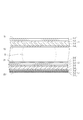
- FIGS. 3, 5 to 7 the first film layer 1, the second film layer 2 and the third film layer 3 are separated for convenience in order to show the film layer structure of the container according to the present invention in an easy-to-understand manner. It is shown as a state. However, in the state where these film layers are film-bonded, the film layers may be in non-bonding contact with each other in the filler-encapsulated portion 5 and the non-bonded region before the filler is sealed.
- the filler encapsulating portion 5 is formed so as to be connected along the peripheral edge of the container body. Further, before or after accommodating the container, a non-bonding region provided integrally with the film layer and communicating with the filler encapsulation portion 5 reaches the outer edge of the filler encapsulation portion 5 of the container.
- the filler is introduced from the filler introduction portion or the like, and the filler encapsulation portion 5 swells in the thickness direction of the sheet material to impart rigidity to the container body. That is, high independence, compressive strength and squeeze back property are imparted to the container body.
- the filler introduction portion is sealed by an appropriate method after the filler is introduced, and is cut off if necessary.
- the filler encapsulating portions 5 may be formed in plurality independently of each other instead of being connected to each other, and may be formed in addition to the peripheral edge of the container body, and the number and the forming region thereof are not particularly limited. .. Then, after the container contained in the container is used up, the container body loses its rigidity by removing the filler from the filler encapsulating portion 5, so that the container body can be easily crushed into small pieces. As a result, reduction of waste and, by extension, reduction of environmental load can be expected.
- the filler enclosed in the filler encapsulating portion 5 can be a fluid (gas or liquid), a solid (for example, powder or granular material, resin pellets, etc.) or a semi-solid (for example, a foam material), but is a gas. Is preferable. Examples of the gas used as the filler include air, nitrogen, oxygen, and an inert gas (argon, helium, etc.), and it is preferable to use air from the viewpoint of cost and the like.
- the internal pressure of the filler encapsulating portion 5 is not limited, but is, for example, 10 kPa or more in terms of gauge pressure from the viewpoint of imparting sufficient rigidity when a flexible container is formed. Is preferable, and 20 kPa or more is more preferable. Then, it is preferably 500 kPa or less, and more preferably 100 kPa or less.
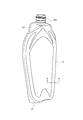
- the second film layer 2 is arranged inside the first film layer 1 (inside the container), such as the shape shown in FIG. 1, and the inclusions are directly placed inside the second film layer 2. That is, the inclusions are contained so as to be in direct contact with the second film layer 2, or indirectly, that is, so that the inclusions are in direct contact with the inside of another film layer arranged inside the second film layer 2. It is possible to form a flexible container according to the present invention, which has a storage area to be used and the filler is sealed in the filler sealing portion 5. As shown in FIG.
- the container according to the present invention may be provided with a bottom gusset portion 101 which is a bottom portion of the container so as to be self-supporting, and further, the bottom gusset portion 101 May be provided with a gusset portion 102 serving as a container top surface portion at the opposite end portion.
- the container according to the present invention may be in a form assuming that the container is laid down without standing on its own.
- the container according to the present invention is provided with an opening for accommodating or discharging the contained matter, and the opening is further sealed with a cap with a pump as shown in FIG. 1, for example.
- a spout 103 may be provided.
- the spout 103 is preferably made of the same material as any of the film layers, or is easily separated from the film layer. Further, the spout 103 may be provided with a screw thread for sealing the above-mentioned opening.
- the opening thereof is a non-bonded portion of the film layer in the accommodating region, and the container is accommodated from this non-bonded portion, and the container is not formed by ultrasonic sealing, bonding agent sealing, heat sealing, or the like.
- the joint portion may be sealed, and can be appropriately selected depending on the shape of the container body, the structure of the film layer, and the like.
- the container according to the present invention it is possible to obtain a container-filled product in which the contents are contained in the storage area.
- the contained material contained in the container is used, the contained material is discharged from the opening by squeeze play, pumping, or the like.
- the type of the container contained in the container according to the present invention is not particularly limited, and examples thereof include shampoo, conditioner, body soap, facial cleanser, detergent, bleach, fabric softener, beverage, food, engine oil and the like.
- the container is recycled (material recycling), a small amount of the contained material remaining in the container's storage area is generally removed by washing, but the contained material residue is washed at the same time as the printing layer 7 is removed.
- the container is washable with an aqueous solvent.
- the container may be a liquid (including a paste), a solid (for example, a granular one (including a granular one), or a powdery one). good.
- its viscosity is preferably 1 mPa ⁇ s or more, preferably 120,000 mPa ⁇ s or less, and 60,000 mPa ⁇ s or less, for example, at 30 ° C. It is more preferable (both are measured by a B-type viscometer (for example, Viscometer TV-10 or Viscometer TVB-10 manufactured by Toki Sangyo Co., Ltd.)).
- the first film layer 1 and the first film layer 1 as the outermost film layer (a film layer arranged on the outermost side when the container is formed and covering the entire container). It is composed of a second film layer 2 arranged inside the film layer 1 and a sheet material in which a plurality of film layers including the second film layer 2 are laminated. That is, the second film layer 2 is arranged inside the first film layer 1, which is the outermost film layer, and at least a part of the peripheral edge portion of the sheet material is bonded to the inside of the second film layer 2. There is a containment area for accommodating the inclusions formed by bagging.
- a filler exists between the first film layer 1 and the second film layer 2 and swells in the thickness direction of the sheet material from the film joint portion, and has a function of maintaining the rigidity of the container body. It is provided with a filler encapsulating portion 5 having a filler, and a film joining portion formed so as to surround the filler encapsulating portion 5 to which the first film layer 1 and the second film layer 2 are bonded.
- a filler encapsulating portion 5 having a filler, and a film joining portion formed so as to surround the filler encapsulating portion 5 to which the first film layer 1 and the second film layer 2 are bonded.
- the film joint portion is from the viewpoint of ease of forming the filler encapsulation portion 5.
- the heat sealing conditions at this time may be appropriately set according to the characteristics of the above materials, and for example, a sealing temperature of 110 ° C. or higher and 230 ° C. or lower, a sealing pressure of 0.1 MPa or higher and 1.0 MPa or lower, 0.1 seconds or longer.
- the sealing time is 10 seconds or less.
- the first film layer 1 and the second film layer 2 in the first embodiment of the container according to the present invention are layers that serve as a base material for the sheet material, and are composed of, but not limited to, a resin material. It is preferable to be done. This is because it is possible to recycle into a recycled material (recycled resin) composed of a resin material.
- a recycled material recycled resin
- nylon Polyethylene terephthalate (PET), polytrimethylene terephthalate (PTT), polybutylene terephthalate (PBT), polyethylene naphthalate (PEN), polybutylene naphthalate (PBN), polylactic acid (PLA), poly.
- first film layer 1 and the second film layer 2 may be composed of a single base material layer (layer serving as a base material of the film), or the base material layer or the base material layer and other than this. A configuration in which a plurality of layers are laminated may be used.
- this laminate includes a structure in which the laminate is laminated by heat-sealing (not including the laminate bonding layer), or a laminate bonding layer laminated by bonding by dry lamination, extrusion lamination, coextrusion molding, or the like. It may be any of. Further, as a layer (additional layer) other than the base material layer of these film layers, a layer having a function of increasing ink adhesion as a base of the print layer 7 may be provided on the surface of the film layer on which the print layer 7 is formed. good.
- the first film layer 1 includes a 1-1 base material layer, a 1-2 base material layer, a 1-3 base material layer, and a 1-4 base material layer.
- a four-layer structure is formed by laminating in this order from the outer surface side of the container.
- the 1-1 base material layer is made of, for example, polyethylene terephthalate (PET) or stretched nylon (ONy).
- PET polyethylene terephthalate
- ONy stretched nylon
- the 1-2 base material layer is, for example, a transparent vapor-deposited PET composed of polyethylene terephthalate in which silica and / or alumina is vapor-deposited on the surface of the 1-2 base material layer on the 1-1 base material layer side. It is a layer.
- the main function of the 1-2 base material layer is to provide a gas barrier property to the container.
- the 1-3 base material layer is made of, for example, stretched nylon.
- the main function of the 1-3 base material layer is to secure the pinhole resistance of the container.
- the 1-4 base material layer is composed of, for example, linear low density polyethylene (LLDPE).
- LLDPE linear low density polyethylene
- the layer structure of the second film layer 2 is the same as that of the 1-1 base material layer to the 1-4 base material layer of the first film layer 1, as also shown in FIGS. 2 to 5.
- a structure including a 2-5 base material layer composed of, for example, linear low density polyethylene (LLDPE) can be mentioned.
- the 2-5th base material layer is a layer adjacent to the 2-1 base material layer, and constitutes a surface of the second film layer 2 opposite to the 2-4 base material layer.
- the main function of the 2-5 base material layer is to secure heat sealability with the first film layer 1.
- the layer structure of the first film layer 1 and the second film layer 2 is not limited to the above example, and the materials of the respective layers constituting the first film layer 1 and the second film layer 2 are also included in the above example. Not exclusively.
- the plurality of film layers (particularly the base material layer) constituting the sheet material are all common resins (molecular chemistry). It contains a material composed of (resin having a common molecular skeleton of main chain and side chain) as a structure, and this material includes high density polyethylene (HDPE), medium density polyethylene (MDPE), low density polyethylene (LDPE), Polyethylene-based materials such as linear low-density polyethylene (LLDPE), ultra-low-density polyethylene (ULDPE), ethylene-vinyl alcohol copolymer (EVOH), or stretched polypropylene (OPP), unstretched polypropylene (CPP), iso Polypropylene materials such as tactic PP, syndiotactic PP, tactic PP, random PP, block PP, or polyethylene terephthalate (PET), amorphous polyethylene terephthalate (acrystalline PET), polyethylene terephthalate (PET), amorphous polyethylene terephthalate (acrystalline PET),
- the plurality of film layers constituting the sheet material include other film layers in addition to the first film layer 1 and the second film layer 2, at least one of the plurality of film layers
- the first film layer 1 and the second film layer 2 may include a material made of a common resin, and this material may be the polyethylene-based material or the like.
- the container is recycled, the first film layer 1 and the second film layer 2 are separated and recovered, and the first film layer 1 and the second film layer 2 are used as recycling raw materials. Is preferable. This is because cleaning of the contents can be omitted in the recycling process.
- the outer surface side surface 11 and the inner surface side surface 13 of the first film layer 1, and the outer surface side surface 21 and the inner surface side surface 23 of the second film layer 2 A print layer 7 including an ink layer 7-2 is formed on at least one surface selected from the above.
- the printing layer 7 can be removed from the surface of the formed film layer by washing with an aqueous solvent (warm water, alkaline water, acidic water, etc.).
- the printing layer 7 in the first embodiment of the container according to the present invention is a layer containing at least an ink layer 7-2 composed of printing ink (pigment, binder resin, etc.), and the ink layer 7-2.
- a coat layer 7-1 or the like having a function of protecting the surface of the ink layer may be included.
- the ink layer 7-2 can be formed by, for example, offset printing, screen printing, gravure printing, flexographic printing, or the like.
- the coat layer 7-1 may be a medium printing layer which is a colorless printing layer.
- the print layer 7 may be provided with a base layer 7-3 which is soluble in an aqueous solvent.
- the base layer 7-3 can be formed by, for example, offset printing, screen printing, gravure printing, flexographic printing, or the like, but it can also be formed by a method other than printing.
- the print layer 7 may have a structure that can be removed by washing with an aqueous solvent as the print layer 7.
- the printing layer 7 has a base layer 7-3 that is soluble in an aqueous solvent formed on the surface of the film layer and an ink layer 7-2 formed on the surface of the base layer 7-3.
- the configuration including the coat layer 7-1 formed on the surface of the ink layer 7-2 and the like are exemplified.
- the base layer 7-3 is soluble in an aqueous solvent, so that the print layer 7 including the ink layer 7-2 can be seen from the surface of the film layer. It can be removed by washing.
- the ink layer 7-2 contains a material which is soluble in an aqueous solvent.
- a material which is soluble in the aqueous solvent used for the ink layer 7-2 polyester, polyurethane, acrylic resin and the like (for example, one or more selected from the group consisting of these) are the main components of the vehicle (for example, 80% by mass or more, and further. Is 90% by mass or more), and the main component thereof may be a copolymer or the like.
- examples of the ink that dissolves in water include an ink containing a resin having many hydrophilic groups (for example, 1 mL% or more) such as a carboxy group, a hydroxy group, an ester group, an ether group, an amide group, and a urethane group. Be done.
- a resin having many hydrophilic groups for example, 1 mL% or more
- an ink in which 10% by mass or more of the resin forming the vehicle has a carboxy group is preferable.
- an ink that dissolves in acidic water an ink in which 10% by mass or more of the resin forming the vehicle has an amino group is preferable.
- a binder resin constituting the binder resin of the ink layer 7-2 (preferably 30% by mass or more, more preferably 50% by mass or more of the ink layer 7-2).
- a binder resin constituting the binder resin of the ink layer 7-2 (preferably 30% by mass or more, more preferably 50% by mass or more of the ink layer 7-2).
- the printing layer 7 has a structure that can be separated from the surface of the film layer by washing with warm water at 30 ° C. or higher, preferably 40 ° C. or higher, more preferably 50 ° C. or higher, and even more preferably 60 ° C. or higher, that is, printing. It is preferable that the layer 7 contains a material that is soluble in warm water at 30 ° C. or higher, preferably 40 ° C. or higher, more preferably 50 ° C. or higher, and even more preferably 60 ° C. or higher.
- the print layer 7 has a structure that does not separate from the surface of the film layer when washed with water below 30 ° C., that is, the print layer 7 contains a material that does not dissolve in water below 30 ° C. preferable. That is, the print layer 7 does not separate from the surface of the film layer when washed with water below 30 ° C., and the film is washed with warm water at a specific temperature (for example, 40 ° C., 50 ° C., or 60 ° C.) or higher, which is 30 ° C. or higher. It preferably has a temperature responsiveness that allows it to be removed from the surface of the layer.
- a specific temperature for example, 40 ° C., 50 ° C., or 60 ° C.
- a monomer unit A having a hydrophilic group other than the hydrophilic group constituting the polymerization related to the formation of the resin there are a monomer unit A having a hydrophilic group other than the hydrophilic group constituting the polymerization related to the formation of the resin, and a hydrophilic group other than the hydrophilic group constituting the polymerization related to the formation of the resin.
- An example is a temperature-responsive water-soluble resin having a monomer unit B which does not have a monomer unit B and a ratio of the monomer unit A to the total of all the monomer units being 5 mol% or more and 35 mol% or less.
- a mixture of 100 parts by mass of the water-soluble resin and 1 part by mass or more and 10 parts by mass or less of a salt other than the water-soluble resin may be used.
- Such a temperature-responsive water-soluble resin has an extremely high dissolution rate in hot water of 30 ° C. or higher while having excellent moisture resistance. And, even when this temperature-responsive water-soluble resin is used for the base layer 7-3, the adhesiveness with the ink layer 7-2 and the like is very good.
- the temperature-responsive water-soluble resin will be described in detail below.
- the monomer unit A has a hydrophilic group other than the hydrophilic group constituting the polymerization related to the formation of the resin.
- the monomer unit A is not particularly limited as long as it is a monomer unit having the above hydrophilic group. Further, the monomer for inducing the monomer unit A is also referred to as monomer A.
- the hydrophilic groups include a primary amino group and a secondary amino group from the viewpoint of improving the solubility of the water-soluble resin in neutral water and the ease of polymerization reaction during the production of the water-soluble polyester resin. Selected from the group consisting of a group, a tertiary amino group, a quaternary ammonium base, an oxyalkylene group, a hydroxy group, a carboxy group, a carboxy group, a phosphoric acid group, a phosphate base, a sulfonic acid group, and a sulfonic acid base 1 More than a species is exemplified.
- one or more selected from the group consisting of a quaternary ammonium base, an oxyalkylene group, a carboxy base, a phosphate base, and a sulfonic acid base is preferable, and the fourth type is preferable.
- One or more selected from the group consisting of a quaternary ammonium base, an oxyalkylene group, and a sulfonic acid base is more preferable, and a sulfonic acid base is further preferable.
- the sulfonic acid base is -SO 3 M 3 (however, M 3 is One or more selected from the group consisting of metal ions and ammonium ions is preferable from the viewpoint of showing the counter ion of the sulfonic acid group constituting the sulfonic acid base and improving the solubility of the water-soluble resin in neutral water, and the metal ion.
- One or more selected from the group consisting of alkali metal ions is more preferable, one or more selected from the group consisting of alkali metal ions and alkaline earth metal ions is further preferable, and one or more selected from the group consisting of alkali metal ions is further preferable.
- One or more selected from the group consisting of sodium ion and potassium ion is more preferable, and sodium ion is more preferable).
- the ratio of the monomer unit A to the total of all the monomer units of the water-soluble resin is 5 mol% or more, preferably 7 mol% or more, and 10 mol% or more from the viewpoint of improving the solubility of the water-soluble resin in neutral water. Is more preferable, 12 mol% or more is further preferable, and from the viewpoint of improving moisture absorption resistance, it is 35 mol% or less, 30 mol% or less is preferable, 20 mol% or less is more preferable, 15 mol% or less is further preferable, and 13 mol% or less is preferable. More preferred.
- the ratio of the monomer unit A to the total of all the monomer units of the water-soluble resin is 5 to 35 mol% from the viewpoint of improving the solubility and moisture absorption resistance of the water-soluble resin in neutral water, and is 7 to 7. It is preferably 30 mol%, more preferably 10 to 20 mol%, still more preferably 12 to 15 mol%.
- the monomer unit B does not have the hydrophilic group.
- the monomer for inducing the monomer unit B is also referred to as monomer B.
- the ratio of the amount of substance of the monomer unit B in the water-soluble resin to the total amount of substance of all the monomer units in the water-soluble resin is preferably 15 mol% or more from the viewpoint of improving the moisture absorption resistance of the water-soluble resin. 25 mol% or more is more preferable, 30 mol% or more is further preferable, and from the viewpoint of improving the solubility of the water-soluble resin in neutral water, 45 mol% or less is more preferable, 42 mol% or less is more preferable, and 40 mol% or less is further preferable. ..
- the ratio of the amount of substance of the monomer unit B in the water-soluble resin to the total amount of substance of all the monomer units in the water-soluble resin improves the solubility and moisture absorption resistance of the water-soluble resin in neutral water. From the viewpoint of making the mixture, 15 to 45 mol% is preferable, 25 to 42 mol% is more preferable, and 30 to 40 mol% is further preferable.
- the weight average molecular weight of the water-soluble resin is preferably 1000 or more, more preferably 5000 or more, further preferably 10000 or more, further preferably 15000 or more, and neutral water of the water-soluble resin from the viewpoint of layer strength of the printing layer 7 or the like. From the viewpoint of improving the solubility in, 80,000 or less is preferable, 50,000 or less is more preferable, 30,000 or less is further preferable, and 20,000 or less is further preferable.
- the weight average molecular weight is measured in terms of standard polystyrene by gel permeation chromatography (GPC) using tetrahydrofuran as a solvent.
- water-soluble resins include water-soluble polyester resins, water-soluble polyamide resins, water-soluble polyimide resins, water-soluble acrylic resins, water-soluble polyurethane resins, water-soluble polyallylamine resins, water-soluble phenol resins, water-soluble epoxy resins, and water-soluble resins.
- water-soluble resins include sex phenoxy resins, water-soluble urea resins, water-soluble melamine resins, and polyvinyl alcohol resins, and modified products of these resins. These can be used alone or in combination of two or more. Among these, one or more selected from the group consisting of a water-soluble polyester resin and a water-soluble polyamide resin is preferable, and a water-soluble polyester resin is more preferable.
- the water-soluble polyester resin includes a hydrophilic monomer unit having the above-mentioned hydrophilic group (monomer unit A), the above-mentioned dicarboxylic acid monomer unit having no hydrophilic group (monomer unit B), and a water-soluble polyester having the diol monomer unit.
- a resin can be exemplified.
- the water-soluble polyester resin has a hydrophilic monomer unit having the above hydrophilic group.
- the hydrophilic monomer unit is not particularly limited as long as it is a monomer unit having the hydrophilic group, but has the hydrophilic group from the viewpoint of improving the solubility of the water-soluble resin in neutral water and the hygroscopicity.
- Aromatic dicarboxylic acid monomer units are preferred.
- the monomer A is composed of a carboxylic acid, an amine, and an amino acid from the viewpoint of improving the solubility and moisture absorption resistance of the water-soluble resin in neutral water and the ease of polymerization reaction during the production of the water-soluble polyester resin.
- a carboxylic acid is more preferable.
- an aromatic carboxylic acid is preferable from the same viewpoint, and contains a hydroxy group-containing aromatic dicarboxylic acid, a primary amino group-containing aromatic dicarboxylic acid, a sulfonic acid group-containing aromatic dicarboxylic acid, and a sulfonic acid base.
- one or more selected from the group consisting of aromatic dicarboxylic acids More preferably, one or more selected from the group consisting of aromatic dicarboxylic acids.
- one or more selected from the group consisting of hydroxyphthalic acid, aminophthalic acid, sulfophthalic acid, and sulfonaphthalenedicarboxylic acid is preferable, and one or more selected from the group consisting of sulfophthalic acid is more preferable, and sulfo.
- One or more selected from the group consisting of isophthalic acid and sulfoterephthalic acid is more preferable, and 5-sulfoisophthalic acid is further preferable.
- the content of the hydrophilic group in the water-soluble polyester resin is preferably 0.5 mmol / g or more, more preferably 0.6 mmol / g or more, from the viewpoint of improving the solubility of the water-soluble resin in neutral water. , 0.7 mmol / g or more, more preferably 3.0 mmol / g or less, more preferably 2.0 mmol / g or less, still more preferably 1.5 mmol / g or less, from the viewpoint of improving moisture absorption resistance.
- the content of the hydrophilic group in the water-soluble polyester resin is preferably 0.5 to 3.0 mmol / g from the viewpoint of improving the solubility and moisture absorption resistance of the water-soluble resin in neutral water. It is more preferably 0.6 to 2.0 mmol / g, and even more preferably 0.7 to 1.5 mmol / g.
- the ratio of the hydrophilic monomer unit to the total of all the monomer units of the water-soluble polyester resin is 5 mol% or more, preferably 7 mol% or more, preferably 10 mol, from the viewpoint of improving the solubility of the water-soluble resin in neutral water. % Or more is more preferable, 12 mol% or more is further preferable, and from the viewpoint of improving moisture absorption resistance, it is 35 mol% or less, 30 mol% or less is preferable, 20 mol% or less is more preferable, 15 mol% or less is further preferable, and 13 mol% or less. The following is more preferable.
- the ratio of the hydrophilic monomer unit to the total of all the monomer units of the water-soluble polyester resin is 5 to 35 mol% from the viewpoint of improving the solubility and moisture absorption resistance of the water-soluble resin in neutral water. 7 to 30 mol% is preferable, 10 to 20 mol% is more preferable, and 12 to 15 mol% is further preferable.
- the water-soluble polyester resin has the dicarboxylic acid monomer unit having no hydrophilic group (hereinafter, also referred to as a hydrophobic dicarboxylic acid monomer unit).
- the dicarboxylic acid for inducing this hydrophobic dicarboxylic acid monomer unit is also referred to as a dicarboxylic acid.
- the dicarboxylic acid is an aromatic dicarboxylic acid or an aliphatic dicarboxylic acid from the viewpoint of improving the solubility and moisture absorption resistance of the water-soluble resin in neutral water and the ease of polymerization reaction during the production of the water-soluble polyester resin.
- One or more selected from the group consisting of an acid and an alicyclic dicarboxylic acid is preferable.
- terephthalic acid More preferably one or more selected from the group consisting of terephthalic acid, 2,5-furandicarboxylic acid, and 2,6-naphthalenedicarboxylic acid, more preferably one or more selected from the group consisting of terephthalic acid, 2,6-naphthalenedicarboxylic acid, and 2,6-naphthalenedicarboxylic acid. More preferred.
- the ratio of the amount of the hydrophobic dicarboxylic acid monomer unit in the water-soluble polyester resin to the total amount of all the monomer units in the water-soluble polyester resin is 15 mol from the viewpoint of improving the moisture absorption resistance of the water-soluble resin. % Or more is preferable, 25 mol% or more is more preferable, 30 mol% or more is further preferable, and from the viewpoint of improving the solubility of the water-soluble resin in neutral water, 45 mol% or less is preferable, 42 mol% or less is more preferable, and 40 mol is more preferable. % Or less is more preferable.
- the ratio of the amount of substance of the hydrophobic dicarboxylic acid monomer unit in the water-soluble polyester resin to the total amount of substance of all the monomer units in the water-soluble polyester resin is the solubility of the water-soluble resin in neutral water and From the viewpoint of improving moisture absorption resistance, 15 to 45 mol% is preferable, 25 to 42 mol% is more preferable, and 30 to 40 mol% is further preferable.
- the mol ratio of the hydrophilic monomer unit and the hydrophobic dicarboxylic acid monomer unit in the water-soluble polyester resin is the dissolution of the water-soluble resin in neutral water. From the viewpoint of improving properties and moisture absorption resistance, 10/90 or more is preferable, 15/85 or more is more preferable, 18/82 or more is further preferable, 20/80 or more is further preferable, and 70/30 or less is preferable from the same viewpoint. Is more preferable, 65/35 or less is more preferable, 60/40 or less is further preferable, 40/60 or less is further preferable, and 30/70 or less is further preferable.
- the water-soluble polyester resin has a diol monomer unit.
- the diol for inducing this diol monomer unit is also referred to as diol C.
- diol C an aliphatic diol, an aromatic diol, or the like can be used. From the viewpoint of the production cost of the water-soluble polyester resin, an aliphatic diol is preferable.
- the carbon number of the diol C is preferably 2 or more from the viewpoint of improving the solubility and moisture absorption resistance of the water-soluble resin in neutral water, preferably 31 or less, and more preferably 25 or less from the same viewpoint. 20 or less is more preferable, and 15 or less is further preferable.
- Examples of the aliphatic diol include one or more selected from the group consisting of chain diols and cyclic diols.
- a chain diol is preferable from the viewpoint of improving the solubility of the water-soluble resin in neutral water and the moisture absorption resistance.
- the number of carbon atoms of the chain diol is preferably 2 or more from the viewpoint of improving the solubility and moisture absorption resistance of the water-soluble resin in neutral water, preferably 6 or less, and more preferably 4 or less from the same viewpoint. 3 or less is more preferable, and 2 is even more preferable.
- the diol C may have ether oxygen, but when the diol C is a chain aliphatic diol, from the viewpoint of improving the solubility of the water-soluble resin in neutral water and the moisture absorption resistance.
- the number of ether oxygen is preferably 1 or less, and when the diol C1 is a cyclic aliphatic diol, the number of ether oxygen is preferably 2 or less from the same viewpoint.
- the chain diol is made from ethylene glycol, 1,2-propanediol, 1,3-propanediol, diethylene glycol, and dipropylene glycol from the viewpoint of improving the solubility and moisture absorption resistance of the water-soluble resin in neutral water.
- One or more selected from the group consisting of ethylene glycol, 1,2-propanediol, and 1,3-propanediol are more preferable, and ethylene glycol is further preferable.
- the diol C contains one or more selected from the group consisting of ethylene glycol, 1,2-propanediol, 1,3-propanediol, diethylene glycol, and dipropylene glycol, all diol monomers in the water-soluble polyester resin
- the ratio of the total of ethylene glycol, 1,2-propanediol, 1,3-propanediol, diethylene glycol, and dipropylene glycol to the total of the units determines the solubility and moisture absorption resistance of the water-soluble resin in neutral water.
- this substantially 100 mol% means a case where a substance other than ethylene glycol, 1,2-propanediol, 1,3-propanediol, diethylene glycol, and dipropylene glycol is unavoidably mixed.
- the water-soluble polyester resin is the ratio of the hydrophilic monomer unit to the total of all the dicarboxylic acid monomer units including the hydrophilic monomer unit from the viewpoint of improving the solubility and moisture absorption resistance of the water-soluble resin in neutral water.
- the proportions of the dicarboxylic acid monomer unit are 10 to 70 mol% and 30 to 90 mol%, respectively, and the dicarboxylic acid for obtaining the dicarboxylic acid monomer unit is 2,6-naphthalenedicarboxylic acid. Is preferable.
- the water-soluble polyester resin the following general formula (1) can be exemplified.
- p1 represents the degree of polymerization of ethylene 2,6-naphthalenedicarboxylate
- q1 represents the number of degrees of polymerization of ethylene 5-sulfoisophthalate.
- ethylene 2,6-naphthalenedicarboxylate is represented.
- the rate and ethylene 5-sulfoisophthalate are block bonds or random bonds, and random bonds are more preferable from the viewpoint of improving the solubility of the water-soluble resin composition in neutral water.
- the water-soluble polyester resin may have a monomer unit other than the hydrophilic monomer unit, the hydrophobic dicarboxylic acid monomer unit, and the diol monomer unit as long as the effect is not impaired.
- the method for producing the water-soluble polyester resin is not particularly limited, and a conventionally known method for producing a polyester resin can be applied.
- the water-soluble resin composition containing the water-soluble resin may contain a salt (component ⁇ ) other than the water-soluble resin.
- a salt component ⁇
- an organic salt compound represented by the following general formula (2) is preferable from the viewpoint of improving the solubility and heat resistance of the water-soluble resin composition in neutral water.
- R 1 represents a hydrocarbon group having 1 to 30 carbon atoms which may have a substituent
- n represents a number of 1 or 2
- X n + represents sodium ion, potassium ion, lithium ion, ammonium ion, or phosphonium ion
- X n + represents magnesium ion, calcium ion, barium ion, or zinc ion.
- R 1 may have a substituent from the viewpoint of improving the solubility and heat resistance of the water-soluble resin composition in neutral water, and the carbon including the substituent may be used.
- the hydrocarbon group may be any of an aliphatic hydrocarbon group, an alicyclic hydrocarbon group, and an aromatic hydrocarbon group.
- the number of carbon atoms of the hydrocarbon group is preferably 1 or more from the viewpoint of improving the solubility and heat resistance of the water-soluble resin composition in neutral water.
- the hydrocarbon group is an alicyclic hydrocarbon group
- the number of carbon atoms of the hydrocarbon group is preferably 3 or more from the viewpoint of improving the solubility and heat resistance of the water-soluble resin composition in neutral water. 5 or more is more preferable, 6 or more is further preferable, 10 or more is further preferable, 30 or less is more preferable, 25 or less is more preferable, and 20 or less is further preferable.
- the number of carbon atoms of the hydrocarbon group is preferably 6 or more, preferably 8 or more, from the viewpoint of improving the solubility and heat resistance of the water-soluble resin composition in neutral water.
- the above is more preferable, 10 or more is further preferable, 30 or less is preferable, and 25 or less is more preferable.
- a carbon atom, an oxygen atom, a nitrogen atom, a sulfur atom, a phosphorus atom, a silicon atom, and a halogen are used from the viewpoint of improving the solubility and heat resistance of the water-soluble resin composition in neutral water.
- Those containing at least one selected from the group consisting of atoms are preferable, and among them, a hydrocarbon group having 1 to 22 carbon atoms or an alkyl halide group having 1 to 22 carbon atoms is preferable, and a hydrocarbon group having 1 to 16 carbon atoms or Alkyl halide groups having 1 to 22 carbon atoms are more preferable, hydrocarbon groups having 1 to 12 carbon atoms or alkyl halides are even more preferable, and hydrocarbon groups having 1 to 12 carbon atoms are even more preferable.
- Xn + is sodium ion, potassium ion, lithium ion, ammonium ion, phosphonium ion, magnesium from the viewpoint of improving the solubility and heat resistance of the water-soluble resin composition in neutral water.
- lithium ion or phosphonium ion is further preferable, and phosphonium ion is even more preferable.
- phosphonium ions tetraalkylphosphonium ions are preferable, and tetrabutylphosphonium ions are more preferable, from the viewpoint of improving the solubility and heat resistance of the water-soluble resin composition in neutral water.
- n is preferably 1 from the viewpoint of improving the solubility and heat resistance of the water-soluble resin composition in neutral water.
- the content of the organic salt compound of the water-soluble resin composition from the viewpoint of improving the solubility in neutral water of the water-soluble resin composition, alkylsulfonate ion of the organic salt compound (R 1 -SO 3
- Amount / total of the amount of substance of the water-acidic group of the water-soluble resin and the amount of substance of the sulfonic acid base) is preferably 0.005 or more, more preferably 0.01 or more, further preferably 0.02 or more, and 0.03.
- the above is more preferable, and from the viewpoint of improving the heat resistance of the water-soluble resin composition, 0.35 or less is preferable, 0.25 or less is more preferable, and 0.2 or less is further preferable.
- the water-soluble resin may be a water-soluble resin composition containing a compatibilizer.
- the compatibilizer include Bondfast (registered trademark) 7B, Bondfast 7M (above, manufactured by Sumitomo Chemical Co., Ltd.), Rotada (registered trademark) AX8840 (manufactured by Arkema), JONCRYL (registered trademark) ADR4370S, JONCRYL ADR4368CS, JONCRYL ADR4368F, JONCRYL ADR4368F.
- Examples thereof include ADR4300S (above, manufactured by BASF), ARUFON (registered trademark) UG4035, ARUFON UG4040, and ARUFON UG4070 (above, manufactured by Toagosei).
- Examples of the reactive compatibilizer having an acid anhydride group include Umex (registered trademark) 1010 (manufactured by Sanyo Kasei Co., Ltd.), Admer (registered trademark) (manufactured by Mitsui Chemicals Co., Ltd.), and Modiper (registered trademark) A8200 (manufactured by Nippon Oil & Fats Co., Ltd.) ), OREVAC (registered trademark) (manufactured by Alchema), FG1901, FG1924 (above, Kraton Polymer), Toughtech (registered trademark) M1911, Toughtech M1913, Toughtech M1943 (above, manufactured by Asahi Kasei Chemicals).
- the content of the component ⁇ with respect to 100 parts by mass of the water-soluble resin (component ⁇ ) of the water-soluble resin composition is preferably 1 part by mass or more, more preferably 2 parts by mass or more, from the viewpoint of the layer strength of the printing layer 7 or the like. Preferably, 3 parts by mass or more is more preferable, and from the same viewpoint, 20 parts by mass or less is preferable, and 10 parts by mass or less is more preferable.
- the water-soluble resin composition may contain other components as long as the effects of the present invention are not impaired.
- other components include resins other than the above component ⁇ , plasticizers such as polyalkylene glycol diester benzoate, calcium carbonate, magnesium carbonate, glass spheres, graphite, carbon black, carbon fiber, glass fiber, talc, and wallast.
- plasticizers such as polyalkylene glycol diester benzoate, calcium carbonate, magnesium carbonate, glass spheres, graphite, carbon black, carbon fiber, glass fiber, talc, and wallast.
- fillers such as knight, mica, alumina, silica, kaolin, whisker, and silicon carbonate, and elastomers.
- elastomer examples include acrylic elastomers, olefin elastomers, styrene elastomers, polyester elastomers, urethane elastomers, polyamide elastomers, and silicone elastomers.
- acrylic elastomers and styrene elastomers is preferable, and acrylic elastomers are more preferable.
- the styrene-based elastomer one or more selected from the group consisting of a styrene-butadiene copolymer and a styrene-butadiene-ethylene copolymer is preferable.
- the acrylic elastomer a methacrylic acid-alkyl acrylate copolymer is preferable. Examples of commercially available products of the elastomer include Clarity (registered trademark) LA2250, Clarity LA2140, and Clarity LA4285 (all manufactured by Kuraray Co., Ltd.).
- Examples of the olefin-based elastomer include Kraton (registered trademark) ERS polymer (manufactured by Kraton Polymer Co., Ltd.), Kraton A polymer, Kraton G polymer (manufactured by Kraton Polymer Co., Ltd.), "Tough Tech H” series, and “Tough Tech P” series (Asahi Kasei). Examples include Chemicals), Septon (registered trademark), and Hybler (registered trademark) (above, Kraton Plastics).
- the content of the elastomer of the water-soluble resin composition with respect to 100 parts by mass of the component ⁇ is preferably 0.1 part by mass or more, more preferably 1 part by mass or more, and 10 parts by mass from the viewpoint of improving the layer strength of the printing layer 7 or the like. More than parts are more preferable, and from the same viewpoint, 100 parts by mass or less is preferable, 60 parts by mass or less is more preferable, 40 parts by mass or less is further preferable, and 20 parts by mass or less is further preferable.
- a temperature-responsive water-soluble resin which is an example of a material soluble in warm water of 30 ° C. or higher, and a water-soluble resin composition containing the water-soluble resin.
- the print layer 7 is not between the layers of the first film layer 1 and between the layers of the second film layer 2, but the first film. It needs to be selectively formed on at least one surface selected from the outer surface side surface 11 and the inner surface side surface 13 of the layer 1, and the outer surface side surface 21 and the inner surface side surface 23 of the second film layer 2. That is, it is necessary that the print layer 7 is not included between the layers of the first film layer 1 and between the layers of the second film layer 2.
- the print layer 7 is formed in a region of the inner surface side surface 13 of the first film layer 1 and / or the outer surface side surface 21 of the second film layer 2 excluding the joint surface 6 of the film joint portion.
- the configuration is shown as a preferred embodiment.
- the printing layer 7 also serves as a non-bonding material (so-called glue killing agent), and the filler encapsulating portion 5 and the film bonding portion can be formed without using a dedicated mold or the like. It can be done easily.
- glue killing agent glue killing agent
- An ink layer 7-2 is formed as a printing layer 7 in a region of the surface facing the film layer 2 other than the bonding surface 6 of the film bonding portion, and further, a surface 21 on the outer surface side of the second film layer 2, that is, a second film.
- the ink layer 7-2 is formed as the printing layer 7 in the region of the surface facing the first film layer 1 excluding the bonding surface 6 of the film bonding portion.
- these ink layers 7-2 use toner, and at least a part of the binder resin thereof is made of a material that can be dissolved in an aqueous solvent. Then, as shown in FIG. 4, the inner surface side surface 13 of the first film layer 1 and the outer surface side surface 21 of the second film layer 2 are film-bonded in a region where the print layer 7 is not formed. A joint surface 6 is formed, and a filler encapsulation portion 5 is formed in a region other than the joint surface 6. That is, in the present embodiment, the print layer 7 is formed in the region of the surface 13 on the inner surface side of the first film layer 1 and the surface 21 on the outer surface side of the second film layer 2 in contact with the filler encapsulation portion 5. ing.
- the print layer 7 formed on the inner surface side surface 13 of the first film layer 1 and the print layer 21 formed on the outer surface side surface 21 of the second film layer 2. 7 does not have to completely overlap these front and back surfaces.
- the print layer 7 can be arbitrarily formed as long as it is a region that does not affect the film bonding between the first film layer 1 and the second film layer 2.
- the print layer 7 can be formed very easily, and the print layer 7 can be formed even after the container is molded. Since the container and the print layer 7 are not in direct contact with each other and there are at least two layers, the first film layer 1 and the second film layer 2, between the print layer 7 and the container. There is very little concern about ink bleeding. Further, since the filler encapsulating portion 5 protrudes outward from the outer surface side surface 11 of the first film layer 1, the outer surface side surface 11 of the first film layer 1 excluding the filler encapsulating portion 5 is other than the other. It is difficult to make contact with the container.
- the filler encapsulating portion 5 acts as a cushion, the printing layer 7 formed on the outer surface side surface 11 of the first film layer 1 is rubbed more than the container not provided with the filler encapsulating portion 5. hard.
- the print layer 7 has a coat layer 7-1 on the outer surface side of the ink layer 7-2 in order to further suppress rubbing and peeling of the print layer 7 due to an impact from the outside of the container. Is preferable.
- the second film layer 2 is formed on the outer surface side surface 11 of the first film layer 1, that is, the 1-1 base material layer of the first film layer 1.
- the print layer 7 is formed on the surface opposite to the surface facing the surface.
- the printing layer 7 is a base layer 7-3 that is soluble in an aqueous solvent formed on the surface of the 1-1 base material layer, and the base layer 7-3, in this order from the inside of the container to the outside of the container. It has an ink layer 7-2 formed on the surface and a coat layer 7-1 formed on the surface of the ink layer 7-2.
- the formation region of the print layer 7 is not limited, and the print layer 7 can be formed in an arbitrary region on the surface 11 on the outer surface side of the first film layer 1. Further, in order to easily prevent rubbing and the like, the print layer 7 is provided in a region excluding a portion of the surface 11 on the outer surface side of the first film layer 1 that bulges in the thickness direction of the sheet material constituting the filler encapsulation portion 5. It may be a formed configuration. Further, the configuration including the coat layer 7-1 further enhances the effect of preventing deterioration of the print layer 7 (including peeling due to rubbing) due to the environment outside the container.
- the printing layer 7 is formed on the surface of the film layer in contact with the accommodating region (for example, the inner surface side surface 23 of the second film layer 2 when the accommodating region is formed by the second film layer 2).
- the configuration shown is shown as another modification.
- the container including the storage area is recycled after the contents are used up, it is necessary to remove the contents adhering to and remaining in the storage area by washing, but the configuration is similar to this modification.
- the printed layer 7 can be detached at the same time as washing the contained material.
- the accommodating region is formed by the second film layer 2, and the surface 23 on the inner surface side of the second film layer 2, that is, the second film layer 2.
- the print layer 7 is formed on the surface opposite to the surface facing the first film layer 1.
- the printing layer 7 is a base layer 7-3 that is soluble in an aqueous solvent formed on the surface of the 2-4 base material layer, and the base layer 7-3, in this order from the outside of the container to the inside of the container. It has an ink layer 7-2 formed on the surface and a coat layer 7-1 formed on the surface of the ink layer 7-2.
- the coat layer 7-1 is a layer that comes into direct contact with the contained material.
- the printed layer 7 can be detached at the same time as the inclusions adhering to and remaining on the coat layer 7-1 are removed.
- the formation region of the print layer 7 is not limited, and the print layer 7 can be formed in an arbitrary region on the inner surface side surface 23 of the second film layer 2.
- the above-mentioned printing layer 7 is not limited to the bonding surface 6 of the film bonding portion between the first film layer 1 and the second film layer 2 in order to facilitate bonding. It is preferable that the sheet material is not formed on the side seal portion, which is the outermost portion to be sealed when the sheet material is made into a bag.
- a second embodiment of the container according to the present invention includes a first film layer 1 as the outermost film layer, a second film layer 2 arranged inside the first film layer 1, and the second film layer 2. It is composed of a third film layer 3 arranged inside the sheet material and a sheet material in which a plurality of film layers including the third film layer 3 are laminated. That is, the second film layer 2 is arranged inside the first film layer 1 which is the outermost film layer, the third film layer 3 is arranged inside the second film layer 2, and the third film layer 3 Inside, there is a storage area (inner container formed by the third film layer 3) that directly stores the container formed by joining at least a part of the peripheral edges of the sheet material to each other to form a bag. Exists.
- a film layer (third film layer 3) is further arranged between the second film layer 2 and the accommodating region of the first embodiment.
- the third film layer 3 forming the inner container may be provided with a spout 103 or the like as an opening. Further, the third film layer 3 and the second film layer 2 are not bonded to each other as a whole, or at least a part of the peripheral edge portion between the third film layer 3 and the second film layer 2 is bonded to each other. If this is the case, the inner container is easily reduced when the container is used, and the container is easily discharged to the end. However, even when the third film layer 3 and the second film layer 2 are not bonded as a whole, the third film layer 3 serving as an inner container may be held inside the second film layer 2. preferable. Then, an outside air introduction portion for introducing outside air may be provided between the third film layer 3 and the second film layer 2 in order to facilitate the shrinkage of the inner container as described above.
- At least a filler is present between the first film layer 1 and the second film layer 2, and the sheet material is more than the film joint.
- a filler encapsulating portion 5 that swells in the thickness direction of the container body and has a function of maintaining the rigidity of the container body, and a first film layer 1 and a second film layer 2 formed so as to surround the filler encapsulating portion 5. It is provided with a film joint to which is joined.
- the bonding between the second film layer 2 and the third film layer 3 is performed by the above-mentioned first film layer 1. It is preferable that the film is easier to peel off than the film joint where the second film layer 2 and the second film layer 2 are bonded.
- the bonding between the second film layer 2 and the third film layer 3 is provided on the inner surface side surface 23 of the second film layer 2 and / or the outer surface side surface 31 of the third film layer 3, corona treatment.
- the surface that has been subjected to either powder treatment or oil treatment such as silicone is bonded by heat sealing or the like, or the bonding layer between the second film layer 2 and the third film layer 3 ( In the embodiment of FIGS.
- the 2-4 base material layer and the 3-1 base material layer) are joined by using an easy-peel base material layer.
- the first film layer 1 and the second film layer 2 (outer container) provided with the film joint portion and the third film layer 3 (inner container) can be easily separated. .. Then, by separating and collecting the outer container and using it as a recycled raw material, the quality of the obtained recycled material is further improved.
- a PE-based resin material as the easy-peel base material layer, recyclability is further improved.
- the first film layer 1, the second film layer 2, and the third film layer 3 of the second embodiment are also the layers that serve as the base material of the sheet material as in the first embodiment described above, and are limited. Although it is not a thing, it is preferably composed of a resin material. As the resin material, the same material as that shown in the first embodiment is shown as a preferable example. Further, these film layers may be composed of a single base material layer as in the first embodiment described above, or may have a base material layer or a base material layer and a plurality of other layers. It may be a laminated structure.
- this laminate includes a structure in which the laminate is laminated by heat-sealing (not including the laminate bonding layer), or a laminate bonding layer laminated by bonding by dry lamination, extrusion lamination, coextrusion molding, or the like. It may be any of.
- a layer (additional layer) other than the base material layer of these film layers a layer having a function of serving as a base for the print layer 7 and enhancing ink adhesion is provided on the surface of the film layer on which the print layer 7 is formed. It may be provided.
- the third film layer 3 constituting the inner container is, for example, a three-layer structure formed by laminating the 3-1 base material layer, the 3-2 base material layer, and the 3-3 base material layer in this order. It has a structure.
- the 3-1 substrate layer is made of, for example, linear low-density polyethylene.
- the main function of the 3-1 base material layer is to secure heat-sealing property with the outer container (heat-sealing property with the second film layer 2 constituting the outer container).
- the 3-2 base material layer is, for example, a transparent vapor-deposited stretched nylon composed of stretched nylon in which silica and / or alumina is vapor-deposited on the surface of the 3-2 base material layer on the side of the 3-1 base material layer. It is a layer.
- the main function of the 3-2 base material layer is to secure gas barrier properties and pinhole resistance.
- the 3rd-3rd base material layer is made of, for example, linear low-density polyethylene.
- the main function of the 3rd 3rd base material layer is to secure the heat sealability between the 3rd film layers 3.
- the layer structure of the third film layer 3 is not limited to the structure described here. Further, the structures of the first film layer 1 and the second film layer 2 are exemplified to have the same structure as that of the first embodiment described above.
- the plurality of film layers (particularly the base material layer) constituting the sheet material are all common.
- this material is high density polyethylene (HDPE), medium density polyethylene (MDPE), low density polyethylene (LDPE), linear low density polyethylene (LLDPE), ultra low density polyethylene (ULDPE).
- Polyethylene-based material such as ethylene-vinyl alcohol copolymer (EVOH), or stretched polypropylene (OPP), unstretched polypropylene (CPP), isotactic PP, syndiotactic PP, tactic PP, random PP, block Polypropylene-based materials such as PP, or polyethylene terephthalate (PET), amorphous polyethylene terephthalate (acrystalline PET), polybutylene terephthalate (PBT), polyethylene naphthalate (PEN), polybutylene naphthalate (PBN), etc.
- PET polyethylene terephthalate
- PBT polyethylene terephthalate
- PEN polyethylene naphthalate
- PBN polybutylene naphthalate
- any of a polypropylene-based material or a polyamide-based material such as stretched nylon (ONy), unstretched nylon (CNy), nylon 6, nylon 66, nylon 11, nylon 12, and MXD6, and the polyethylene-based material described above.
- stretched nylon ONy
- unstretched nylon CNy
- nylon 6 nylon 6
- nylon 11 nylon 12
- MXD6 polyethylene-based material
- At least the first film layer 1 and the second film layer 2 of the plurality of film layers constituting the sheet material are made of a common resin, as in the first embodiment described above.
- a material may be included, and the material may be the above-mentioned polyethylene-based material or the like.
- the container when the container is recycled, the first film layer 1 and the second film layer 2 are separated and collected, and the first film layer 1 and the second film layer 2 are recycled. It is preferably used as a raw material.
- the outer surface side surface 11 and the inner surface side surface 13 of the first film layer 1, and the outer surface side surface 21 and the inner surface side surface 23 of the second film layer 2 A print layer 7 including an ink layer 7-2 is formed on at least one surface selected from the above. Further, the print layer 7 including the ink layer 7-2 may be formed on the outer surface side surface 31 and / or the inner surface side surface 33 of the third film layer 3. Alternatively, the print layer 7 is not formed on the outer surface side surface 11 and the inner surface side surface 13 of the first film layer 1, and the outer surface side surface 21 and the inner surface side surface 23 of the second film layer 2, and the third film layer 2 is formed. The print layer 7 may be formed on the surface 31 on the outer surface side and / or the surface 33 on the inner surface side of the film layer 3.
- the printing layer 7 in the second embodiment is also a layer containing at least an ink layer 7-2 composed of printing ink, and in addition to the ink layer 7-2, a coat layer 7-1 and the like may be included.
- the ink layer 7-2 can be formed by, for example, offset printing, screen printing, gravure printing, flexographic printing, or the like.
- the coat layer 7-1 may be a medium printing layer which is a colorless printing layer.
- the print layer 7 may be provided with a base layer 7-3 which is soluble in an aqueous solvent in order to make the print layer 7 removable.
- the base layer 7-3 can be formed by, for example, offset printing, screen printing, gravure printing, flexographic printing, or the like, but it can also be formed by a method other than printing.
- the print layer 7 can be removed from the surface of the formed film layer by washing with an aqueous solvent, as in the first embodiment described above.
- the print layer 7 is the surface of the film layer.
- Any structure may be used as long as the print layer 7 can be desorbed by an aqueous solvent, such as a structure containing 7-1.
- the ink layer 7-2 may contain a material that is soluble in an aqueous solvent as described above.
- the printing layer 7 is more preferably configured to contain a material that is soluble in warm water at 30 ° C. or higher, preferably 40 ° C. or higher, more preferably 50 ° C. or higher, and even more preferably 60 ° C. or higher. ..
- a material that is soluble in warm water at 30 ° C. or higher, preferably 40 ° C. or higher, more preferably 50 ° C. or higher, and even more preferably 60 ° C. or higher. ..
- the temperature-responsive water-soluble resin exemplified in the above-mentioned first embodiment is shown.
- the print layer 7 is laminated between the first film layer 1 and the second film layer 2.
- a configuration in which the print layer 7 is formed on the inner surface side surface 23 of the second film layer 2 and / or the outer surface side surface 31 of the third film layer 3 is exemplified.
- An ink layer 7-2 is formed as a printing layer 7 on the surface to be printed, and further, a second film layer 2 is formed on the outer surface side surface 31 of the third film layer 3, that is, the 3-1 base material layer of the third film layer 3.
- An ink layer 7-2 is formed as a print layer 7 on the surface facing the surface. Note that these ink layers 7-2 use toner, and at least a part of the binder resin thereof is made of a material that can be dissolved in an aqueous solvent.
- the second film layer 2 The print layer 7 can be formed on an arbitrary region on the surface 23 on the inner surface side and the surface 31 on the outer surface of the third film layer 3.
- the print layer 7 does not have to include the coat layer 7-1 because there is little concern about the influence from the outside environment and the ink oozing out to the contained material.
- a character printing layer is formed on the inner surface side surface 23 of the second film layer 2 on which characters for displaying the contents and its components are printed, and a figure, a pattern, etc.
- the print layer 7 is further formed on the outer surface side surface 11 of the first film layer 1, that is, the print layer 7 is the outer surface side surface 11 and the second of the first film layer 1.
- the configuration may be formed on three surfaces, a surface 23 on the inner surface side of the film layer 2 and a surface 31 on the outer surface side of the third film layer 3.
- the statutory labeling items, which are mandatory labeling requirements for products stipulated by the laws of each country, such as usage, dosage, etc., include the surface 11 on the outer surface side of the first film layer and the surface of the film layer in contact with the storage area.
- a print layer 7 formed on at least one surface selected from the surfaces of other film layers to be excluded, for example, in this second embodiment, the inner surface side surface 13 of the first film layer 1 and the outer surface side of the second film layer 2.
- a print layer 7 (more preferably, these print layers 7) formed on at least one surface selected from the surface 21, the surface 23 on the inner surface side of the second film layer 2, and the outer surface side surface of the third film layer 3.
- the other Rot numbers, patterns, patterns, backgrounds, etc. are printed and displayed on the print layer 7 formed on the outermost layer (the surface 11 on the outer surface side of the first film layer 1). Is preferable.
- the statutory display items are displayed only by the print layer 7 formed on the inner surface side surface 23 of the second film layer 2. With such a configuration, the statutory display items are not rubbed or peeled off, and are in a very easy-to-see state until the contained material is used up, while the other backgrounds and the like are printed on the outermost layer. The design is further improved.
- the surface 11 on the outer surface side of the first film layer 1, that is, the surface of the 1-1 base material layer of the first film layer 1 facing the second film layer 2 A printing layer 7 such as a background is formed on the surface on the opposite side, and further, the surface 23 on the inner surface side of the second film layer 2, that is, the second-4 base material layer of the second film layer 2 is combined with the third film layer 3. It is highly preferable that the print layer 7 on which the legal display items are printed is formed on the opposite surfaces.
- the print layer 7 is a surface 13 on the inner surface side of the first film layer 1 and / or a surface 21 on the outer surface side of the second film layer 2.
- the structure is also shown, and the structure in which the print layer 7 is formed on the surface of the film layer in contact with the accommodating region (the surface 33 on the inner surface side of the third film layer 3) and the like are also shown.
- the print layer 7 is not only the joint surface 6 of the film joint portion between the first film layer 1 and the second film layer 2 in order to facilitate the film joint.
- the structure is such that the side seal portion, which is the outermost portion to be sealed when the sheet material is arranged, and the joint portion between the second film layer 2 and the third film layer 3 are not formed. preferable.
- the thickness of the entire sheet material (dimension measured perpendicular to the main surface of the sheet material) before filling the filler is , 20 ⁇ m or more, and more preferably 30 ⁇ m or more. Then, it is preferably 300 ⁇ m or less, and more preferably 200 ⁇ m or less.
- the thickness of each film layer is preferably 5 ⁇ m or more, and more preferably 10 ⁇ m or more. Then, each is preferably 80 ⁇ m or less, and more preferably 50 ⁇ m or less.
- Such a container according to the present invention has a very thin wall while having the rigidity of the container body.
- the base material layers of all the film layers are made of a material made of a common resin, and other than this material. It is more preferable that the material of the above is not substantially contained. In addition, this "substantially free” means that the mass ratio is less than 1% of the film, preferably less than 0.5%, and most preferably 0%.
- the thickness of the printing layer 7 formed on the surface of the film layer of the sheet material (measured perpendicular to the main surface of the sheet material).
- the dimensions to be formed are preferably 0.5 ⁇ m or more.
- it is preferably 30 ⁇ m or less, and more preferably 10 ⁇ m or less.
- each film layer of the sheet material in the first embodiment and the second embodiment of the container according to the present invention is deformed in various ways depending on the characteristics required when the container is formed, the type of the container, and the like. It is possible, and is not limited to the above embodiment.
- the container according to the present invention including the above-described embodiment maintains the rigidity as a container by the filler encapsulation portion 5, and further depends on printability (characteristics that a print layer is easily formed, rubbing of the formed print layer, and the like). It is a highly recyclable container while having the property of being less likely to peel off. In addition, since the end of the film is hard in a thick container, it may hurt when touched by a hand (the feeling of gripping the container is poor), but in the container according to the present invention, the sheet material can be thinned. , The grip feeling of the container is also improved.
- the container body is crushed into small pieces, and if necessary, an opening (spout 103, etc.), a cap, etc. Can be easily obtained as a high-quality recycled raw material by separating, shredding and washing.
- the printing layer 7 of the container according to the present invention can be separated from the film layer by washing with the above-mentioned aqueous solvent, by using such a recycled raw material, a high-quality recycled material with less ink coloring is used. Can be easily obtained.
- the method for manufacturing the container according to the present invention is not limited, but the following methods are exemplified.
- a print layer 7 including an ink layer 7-2 is formed on the surface of the film layer.
- the first film layer 1 and the second film layer 2 are laminated with each other, and these are partially bonded (for example, heat-sealed) to prepare a sheet material having a film bonding portion and a filler encapsulating portion 5.
- a third film layer 3 or the like constituting the inner container is laminated with each other to prepare a sheet material.
- the peripheral edge of the inner container may be arranged slightly inside the peripheral edge of the sheet material.
- the bottom gusset portion 101, the top gusset portion 102, the spout 103, and the like may be attached to the sheet material. Then, the sheet material is folded and the peripheral edges of the sheet material are joined to each other to form a sheet material in which a plurality of film layers including the first film layer 1 and the second film layer 2 are laminated.
- a bag is made by joining at least a part of the peripheral edges of the sheet material to each other, and a storage area for storing the container is formed inside, and between the first film layer 1 and the second film layer 2.
- a container sheet in which a printing layer 7 including an ink layer 7-2 is formed on at least one surface of the film is produced. Then, in this container sheet, the filler is introduced into the filler encapsulation portion 5 from the filler introduction portion or the like and sealed.
- the container according to the present invention can be manufactured in which the filler encapsulating portion 5 swells in the thickness direction of the sheet material and is imparted with rigidity. After that, the container can be obtained by filling the storage area (inner container or the like) from the spout 103 or the like of this container and sealing the container with a cap with a pump or the like.
- a container composed of a sheet material in which a plurality of film layers including a first film layer and a second film layer are laminated.
- a bag is formed by joining at least a part of the peripheral edges of the sheet material to each other, and a storage area for storing the content is formed inside the second film layer.
- Between the first film layer and the second film layer there is a film joint portion where the first film layer and the second film layer are bonded, and a filler is present from the film joint portion. Also has a filler encapsulation portion that bulges in the thickness direction of the sheet material.
- a print layer containing an ink layer is formed on at least one surface selected from the outer surface side and inner surface side of the first film layer and the outer surface side and inner surface side surfaces of the second film layer.
- the sheet material further includes a third film layer arranged inside the second film layer, and is made into a bag by joining at least a part of the peripheral edges of the sheet material to each other.
- the container according to ⁇ 1> or ⁇ 2>, wherein the storage area for storing the container is formed inside the third film layer.
- a container composed of a sheet material in which a plurality of film layers including a first film layer, a second film layer, and a third film layer are laminated.
- a bag is formed by joining at least a part of the peripheral edges of the sheet material to each other, and a storage area for storing the content is formed inside the third film layer.
- Between the first film layer and the second film layer there is a film joint portion where the first film layer and the second film layer are bonded, and a filler is present from the film joint portion. Also has a filler encapsulation portion that bulges in the thickness direction of the sheet material.
- a print layer containing the layer is formed,
- ⁇ 6> At least a part of the second film layer and the third film layer is bonded, and the bonding between the second film layer and the third film layer is the bonding between the first film layer and the first film layer.
- the bonding between the second film layer and the third film layer is provided on the surface on the inner surface side of the second film layer and / or the outer surface side surface of the third film layer, and is subjected to corona treatment.
- the container according to ⁇ 6> which is a joint on a vertical surface.
- ⁇ 8> The container according to any one of ⁇ 3> to ⁇ 7>, wherein the printing layer is formed on the outer surface side and / or the inner surface side surface of the third film layer.
- ⁇ 9> Any one of ⁇ 3> to ⁇ 8>, wherein the printing layer is formed on the surface on the inner surface side of the second film layer and / or on the outer surface side of the third film layer.
- the print layer is formed in a region of the surface on the inner surface side of the first film layer and / or the surface on the outer surface side of the second film layer, excluding the joint surface of the film joint portion.
- ⁇ 12> The print layer is formed in a region of the surface on the inner surface side of the first film layer and the surface on the outer surface side of the second film layer in contact with the filler encapsulation portion.
- ⁇ 13> The container according to any one of ⁇ 1> to ⁇ 12>, wherein the printing layer is formed on the surface on the outer surface side of the first film layer.
- ⁇ 14> The container according to any one of ⁇ 1> to ⁇ 13>, wherein the print layer is formed on the surface of the film layer in contact with the storage area.
- the statutory display item is at least one selected from the surface of the film layer on the outer surface side of the first film layer, the surface of the film layer in contact with the accommodating region, and the surface of the other film layer excluding the surface.
- ⁇ 16> The container according to ⁇ 15>, wherein the statutory display items are displayed by the printing layer formed on the surface on the inner surface side of the second film layer.
- ⁇ 17> The container according to ⁇ 15> or ⁇ 16>, wherein the printing excluding the legally indicated items is printed on the printing layer formed on the surface on the outer surface side of the first film layer.
- the printed layer can be detached from the surface of the film layer by washing with warm water at 30 ° C. or higher, preferably 40 ° C. or higher, more preferably 50 ° C. or higher, and even more preferably 60 ° C. or higher.
- ⁇ 19> The printed layer does not separate from the surface of the film layer when washed with water below 30 ° C., and is separated from the surface of the film layer by washing with warm water at a specific temperature of 30 ° C. or higher.
- the printing layer has a monomer unit A having a hydrophilic group other than the hydrophilic group constituting the polymerization related to the formation of the resin, and a hydrophilic group other than the hydrophilic group constituting the polymerization related to the formation of the resin.
- ⁇ 18> or ⁇ 19> which comprises a temperature-responsive water-soluble resin having no monomer unit B and having a ratio of the monomer unit A to a total of all the monomer units of 5 mol% or more and 35 mol% or less.
- At least the first film layer and the second film layer include a material made of a common resin.
- the material composed of the common resin is a polyethylene-based material
- the polyethylene-based material is high-density polyethylene (HDPE), medium-density polyethylene (MDPE), low-density polyethylene (LDPE), and linear low-density polyethylene.
- HDPE high-density polyethylene
- MDPE medium-density polyethylene
- LDPE low-density polyethylene
- LLDPE ultra-low density polyethylene
- EVOH ethylene / vinyl alcohol copolymer
- the base material layers of the plurality of film layers are all made of a material made of a common resin, and substantially do not contain any material other than the material made of the common resin.
- the container according to any one of 1> to ⁇ 21>.
- ⁇ 23> The container according to any one of ⁇ 1> to ⁇ 22>, wherein the thickness of the printing layer is 0.5 ⁇ m or more and 30 ⁇ m or less.
- the thickness of the entire sheet material (dimension measured perpendicular to the main surface of the sheet material) before filling the filler is 20 ⁇ m or more, preferably 30 ⁇ m or more, and 300 ⁇ m.
- the container according to any one of ⁇ 1> to ⁇ 23> which is the following, preferably 200 ⁇ m or less.
- ⁇ 25> Any of ⁇ 1> to ⁇ 24>, each of which has a thickness of 5 ⁇ m or more, preferably 10 ⁇ m or more, and 80 ⁇ m or less, preferably 50 ⁇ m or less, respectively.
- a container-packed product comprising the container according to any one of ⁇ 1> to ⁇ 25> and the container contained in the storage area of the container.
Landscapes
- Engineering & Computer Science (AREA)
- Mechanical Engineering (AREA)
- Chemical & Material Sciences (AREA)
- Composite Materials (AREA)
- Wrappers (AREA)
- Laminated Bodies (AREA)
Priority Applications (4)
| Application Number | Priority Date | Filing Date | Title |
|---|---|---|---|
| CN202080006192.0A CN113039131A (zh) | 2019-08-30 | 2020-04-23 | 容器 |
| JP2020563577A JPWO2021038959A1 (https=) | 2019-08-30 | 2020-04-23 | |
| EP20856544.0A EP3842356A4 (en) | 2019-08-30 | 2020-04-23 | CONTAINER |
| US17/281,113 US20210339929A1 (en) | 2019-08-30 | 2020-04-23 | Container |
Applications Claiming Priority (2)
| Application Number | Priority Date | Filing Date | Title |
|---|---|---|---|
| JP2019034166 | 2019-08-30 | ||
| JPPCT/JP2019/034166 | 2019-08-30 |
Publications (1)
| Publication Number | Publication Date |
|---|---|
| WO2021038959A1 true WO2021038959A1 (ja) | 2021-03-04 |
Family
ID=74685428
Family Applications (1)
| Application Number | Title | Priority Date | Filing Date |
|---|---|---|---|
| PCT/JP2020/017497 Ceased WO2021038959A1 (ja) | 2019-08-30 | 2020-04-23 | 容器 |
Country Status (6)
| Country | Link |
|---|---|
| US (1) | US20210339929A1 (https=) |
| EP (1) | EP3842356A4 (https=) |
| JP (1) | JPWO2021038959A1 (https=) |
| CN (1) | CN113039131A (https=) |
| TW (1) | TW202108459A (https=) |
| WO (1) | WO2021038959A1 (https=) |
Cited By (1)
| Publication number | Priority date | Publication date | Assignee | Title |
|---|---|---|---|---|
| WO2025018463A1 (ko) * | 2023-07-14 | 2025-01-23 | 대상웰라이프 주식회사 | 접이식 영양 조성물 용기 |
Families Citing this family (3)
| Publication number | Priority date | Publication date | Assignee | Title |
|---|---|---|---|---|
| EP3483086B1 (en) * | 2017-03-07 | 2021-07-21 | Kao Corporation | Sheet material container |
| JP7288139B2 (ja) * | 2020-03-13 | 2023-06-06 | 花王株式会社 | シート材容器 |
| WO2021181691A1 (ja) * | 2020-03-13 | 2021-09-16 | 花王株式会社 | シート材容器 |
Citations (3)
| Publication number | Priority date | Publication date | Assignee | Title |
|---|---|---|---|---|
| JP2000345089A (ja) * | 1999-06-08 | 2000-12-12 | Hayakawa Rubber Co Ltd | 印刷膜の製造方法、印刷膜、被印刷体のリサイクル方法及びインキ組成物 |
| JP2002088172A (ja) * | 2000-09-18 | 2002-03-27 | Mitsubishi Rayon Co Ltd | 熱収縮性ポリエステルフィルム |
| JP6193535B1 (ja) | 2017-03-07 | 2017-09-06 | 花王株式会社 | 容器 |
Family Cites Families (6)
| Publication number | Priority date | Publication date | Assignee | Title |
|---|---|---|---|---|
| JP3934292B2 (ja) * | 1999-10-29 | 2007-06-20 | 大日精化工業株式会社 | 脱離層を有する物品、該物品から該表面層を脱離、除去する方法 |
| JP4367490B2 (ja) * | 2007-01-26 | 2009-11-18 | セイコーエプソン株式会社 | インクジェット記録用インク組成物、記録方法、および記録物 |
| BR112014027878A2 (pt) * | 2012-05-07 | 2017-06-27 | Procter & Gamble | recipientes flexíveis |
| CN105705430A (zh) * | 2013-11-06 | 2016-06-22 | 宝洁公司 | 与短储存寿命产品一起使用的柔性容器,以及用于加速分配柔性容器的方法 |
| US10399759B2 (en) * | 2015-03-09 | 2019-09-03 | Bemis Company, Inc. | Manually openable recyclable package |
| JP6803306B2 (ja) * | 2017-08-09 | 2020-12-23 | 花王株式会社 | 容器 |
-
2020
- 2020-04-23 US US17/281,113 patent/US20210339929A1/en not_active Abandoned
- 2020-04-23 CN CN202080006192.0A patent/CN113039131A/zh active Pending
- 2020-04-23 EP EP20856544.0A patent/EP3842356A4/en not_active Withdrawn
- 2020-04-23 WO PCT/JP2020/017497 patent/WO2021038959A1/ja not_active Ceased
- 2020-04-23 JP JP2020563577A patent/JPWO2021038959A1/ja active Pending
- 2020-05-14 TW TW109115985A patent/TW202108459A/zh unknown
Patent Citations (3)
| Publication number | Priority date | Publication date | Assignee | Title |
|---|---|---|---|---|
| JP2000345089A (ja) * | 1999-06-08 | 2000-12-12 | Hayakawa Rubber Co Ltd | 印刷膜の製造方法、印刷膜、被印刷体のリサイクル方法及びインキ組成物 |
| JP2002088172A (ja) * | 2000-09-18 | 2002-03-27 | Mitsubishi Rayon Co Ltd | 熱収縮性ポリエステルフィルム |
| JP6193535B1 (ja) | 2017-03-07 | 2017-09-06 | 花王株式会社 | 容器 |
Non-Patent Citations (1)
| Title |
|---|
| See also references of EP3842356A4 |
Cited By (1)
| Publication number | Priority date | Publication date | Assignee | Title |
|---|---|---|---|---|
| WO2025018463A1 (ko) * | 2023-07-14 | 2025-01-23 | 대상웰라이프 주식회사 | 접이식 영양 조성물 용기 |
Also Published As
| Publication number | Publication date |
|---|---|
| US20210339929A1 (en) | 2021-11-04 |
| EP3842356A4 (en) | 2022-06-08 |
| TW202108459A (zh) | 2021-03-01 |
| CN113039131A (zh) | 2021-06-25 |
| EP3842356A1 (en) | 2021-06-30 |
| JPWO2021038959A1 (https=) | 2021-03-04 |
Similar Documents
| Publication | Publication Date | Title |
|---|---|---|
| JP7495541B2 (ja) | 容器のリサイクル方法 | |
| WO2021038959A1 (ja) | 容器 | |
| JP4814104B2 (ja) | 耐引裂性を有する剥離可能な容器用シール | |
| JP6775709B1 (ja) | シート材容器 | |
| JP5092521B2 (ja) | 多層積層フィルム | |
| JP5003222B2 (ja) | バリア性を有するヒ−トシ−ル性フィルム | |
| JP6511713B2 (ja) | 包装材用積層体 | |
| JP2003312678A (ja) | 透明インモールドラベル容器 | |
| JP7258090B2 (ja) | ガゼット袋およびスパウト付ガゼット袋 | |
| JP5774270B2 (ja) | 積層体およびそれを用いたチューブ容器 | |
| JP2008221733A (ja) | バリア性を有するヒ−トシ−ル性フィルム | |
| JP7405169B2 (ja) | 手切り開封用低吸着性積層体と、該積層体を用いた包装材料及び包装体 | |
| JP5632118B2 (ja) | バリア性を有するヒ−トシ−ル性フィルム | |
| JP6511712B2 (ja) | 包装材用積層体 | |
| JP5309456B2 (ja) | バリア性を有するヒ−トシ−ル性フィルム | |
| JP2015054470A (ja) | 非吸着性シーラントフィルム | |
| JP2014048564A (ja) | 熱収縮性回転防止ラベル及び炭酸飲料用容器 | |
| JP5003221B2 (ja) | バリア性を有するヒ−トシ−ル性フィルム | |
| JP2021031095A (ja) | 容器用シート | |
| JP2015066801A (ja) | 非吸着性シーラントフィルム及びそれよりなる包装材用積層体 | |
| JP2008155438A (ja) | バリア性を有するヒ−トシ−ル性フィルム | |
| JP2007320054A (ja) | イ−ジ−ピ−ルシ−ラント | |
| JP2025040296A (ja) | 印刷部付き基材フィルム、積層体、包装袋及び包装製品 | |
| JP6435690B2 (ja) | 積層体、蓋材、分配包装容器、及び分配包装体 | |
| HK1148252A1 (en) | Distribution packed body and distribution packed body stuffing product |
Legal Events
| Date | Code | Title | Description |
|---|---|---|---|
| ENP | Entry into the national phase |
Ref document number: 2020563577 Country of ref document: JP Kind code of ref document: A |
|
| ENP | Entry into the national phase |
Ref document number: 2020856544 Country of ref document: EP Effective date: 20210323 |
|
| 121 | Ep: the epo has been informed by wipo that ep was designated in this application |
Ref document number: 20856544 Country of ref document: EP Kind code of ref document: A1 |
|
| NENP | Non-entry into the national phase |
Ref country code: DE |