WO2020261866A1 - バスバー及びモータ - Google Patents
バスバー及びモータ Download PDFInfo
- Publication number
- WO2020261866A1 WO2020261866A1 PCT/JP2020/021083 JP2020021083W WO2020261866A1 WO 2020261866 A1 WO2020261866 A1 WO 2020261866A1 JP 2020021083 W JP2020021083 W JP 2020021083W WO 2020261866 A1 WO2020261866 A1 WO 2020261866A1
- Authority
- WO
- WIPO (PCT)
- Prior art keywords
- motor
- bus bar
- main body
- motor connecting
- terminal
- Prior art date
- Legal status (The legal status is an assumption and is not a legal conclusion. Google has not performed a legal analysis and makes no representation as to the accuracy of the status listed.)
- Ceased
Links
Images




Classifications
-
- H—ELECTRICITY
- H02—GENERATION; CONVERSION OR DISTRIBUTION OF ELECTRIC POWER
- H02K—DYNAMO-ELECTRIC MACHINES
- H02K3/00—Details of windings
- H02K3/46—Fastening of windings on the stator or rotor structure
- H02K3/52—Fastening salient pole windings or connections thereto
- H02K3/521—Fastening salient pole windings or connections thereto applicable to stators only
- H02K3/522—Fastening salient pole windings or connections thereto applicable to stators only for generally annular cores with salient poles
-
- H—ELECTRICITY
- H02—GENERATION; CONVERSION OR DISTRIBUTION OF ELECTRIC POWER
- H02K—DYNAMO-ELECTRIC MACHINES
- H02K5/00—Casings; Enclosures; Supports
- H02K5/04—Casings or enclosures characterised by the shape, form or construction thereof
- H02K5/22—Auxiliary parts of casings not covered by groups H02K5/06-H02K5/20, e.g. shaped to form connection boxes or terminal boxes
- H02K5/225—Terminal boxes or connection arrangements
-
- H—ELECTRICITY
- H02—GENERATION; CONVERSION OR DISTRIBUTION OF ELECTRIC POWER
- H02K—DYNAMO-ELECTRIC MACHINES
- H02K3/00—Details of windings
- H02K3/46—Fastening of windings on the stator or rotor structure
- H02K3/50—Fastening of winding heads, equalising connectors, or connections thereto
-
- H—ELECTRICITY
- H02—GENERATION; CONVERSION OR DISTRIBUTION OF ELECTRIC POWER
- H02K—DYNAMO-ELECTRIC MACHINES
- H02K2203/00—Specific aspects not provided for in the other groups of this subclass relating to the windings
- H02K2203/09—Machines characterised by wiring elements other than wires, e.g. bus rings, for connecting the winding terminations
-
- Y—GENERAL TAGGING OF NEW TECHNOLOGICAL DEVELOPMENTS; GENERAL TAGGING OF CROSS-SECTIONAL TECHNOLOGIES SPANNING OVER SEVERAL SECTIONS OF THE IPC; TECHNICAL SUBJECTS COVERED BY FORMER USPC CROSS-REFERENCE ART COLLECTIONS [XRACs] AND DIGESTS
- Y02—TECHNOLOGIES OR APPLICATIONS FOR MITIGATION OR ADAPTATION AGAINST CLIMATE CHANGE
- Y02T—CLIMATE CHANGE MITIGATION TECHNOLOGIES RELATED TO TRANSPORTATION
- Y02T10/00—Road transport of goods or passengers
- Y02T10/60—Other road transportation technologies with climate change mitigation effect
- Y02T10/64—Electric machine technologies in electromobility
Definitions
- the present invention relates to a bus bar and a motor.
- a bus bar that relays the electrical connection between the coil of the motor and the external terminal is known.
- the bus ring (bus bar) disclosed in Patent Document 1 has a ring body and a plate-shaped piece.
- the ring body has a plate shape included in a plane orthogonal to the axial direction of the ring body.
- the plate-shaped piece is formed by bending from one end in the circumferential direction of the ring body in the direction along the axial direction of the ring body.
- the terminal portion extending outward in the radial direction of the ring body is connected to the coil terminal of the motor.
- the tip of the plate-shaped piece is connected to the control circuit as an external terminal via the connection terminal of the coupler.
- the thickness, material, etc. In order to reduce the manufacturing cost of the bus bar, it is preferable to standardize the thickness, material, etc. and standardize the members constituting the bus bar.
- external terminals such as control circuits and external power supplies are often supplied by users.
- the thickness, material, etc. of the connection portion of the bus bar with the external terminal may be specified by the user.
- connection part with the external terminal If the thickness, material, etc. of the connection part with the external terminal are changed each time according to the specifications, it is not possible to standardize the busbar members. As a result, reducing the manufacturing cost of busbars has been hampered.
- the present invention has been made in view of these points, and its main purpose is to reduce manufacturing costs in a bus bar that relays an electrical connection between a motor coil and an external terminal.
- the bus bar according to the first embodiment of the present application is a bus bar used for a motor, and is a member different from the motor connecting member electrically connected to the coil provided in the motor and the motor connecting member.
- the motor connecting member includes a terminal member that is configured and electrically connected to an external terminal, and the motor connecting member includes a main body portion that is electrically connected to the coil and, at one end of the main body portion, the main body portion. It has a bent portion that bends in an intersecting direction, and the terminal member is connected to the bent portion.
- the manufacturing cost can be reduced.
- FIG. 1 is a cross-sectional view showing a configuration of a motor according to an embodiment of the present invention.
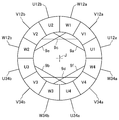
- FIG. 2 is a diagram conceptually showing a coil connection configuration according to an embodiment of the present invention.
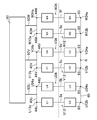
- FIG. 3 is a diagram conceptually showing a circuit configuration of a coil according to an embodiment of the present invention.
- FIG. 4 is a perspective view showing a bus bar and a bus bar holder according to an embodiment of the present invention.
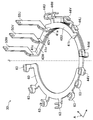
- FIG. 5 is a perspective view showing a bus bar according to an embodiment of the present invention.
- FIG. 6 is a perspective view showing a motor connecting member and a terminal member according to an embodiment of the present invention.
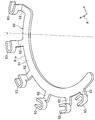
- FIG. 7 is a perspective view showing a neutral point member according to an embodiment of the present invention.
- FIG. 8 is a diagram schematically showing a welding method between the terminal member and the motor connecting member according to the embodiment of the present invention.
- FIG. 9 is a diagram corresponding to FIG. 6 according to a modified example of the embodiment of the present
- FIG. 1 is a cross-sectional view showing a configuration of a motor 1 according to an embodiment of the present invention, in which the upper side in FIG. 1 is referred to as one side in the axial direction and the lower side is referred to as the other side in the axial direction.
- the entire combination of a plurality of motor connecting members, a plurality of terminal members, and a neutral point member, which will be described later, is referred to as a "bus bar”.
- the motor 1 includes a shaft 2.
- the shaft 2 is rotatably supported about the axial direction.
- the motor 1 includes a rotor 3 and a stator 4.
- the rotor 3 is fixed to the shaft 2 and rotates integrally with the shaft 2.
- the rotor 3 has a rotor core 3a and a rotor magnet 3b.
- the rotor core 3a is formed by laminating metal plates such as electromagnetic steel plates, and is fitted to the shaft 2.
- the rotor magnet 3b is fixed to the outer peripheral portion of the rotor core 3a.
- the stator 4 is arranged radially outside the rotor 3.
- the shaft 2, the rotor 3, and the stator 4 are housed in the housing 20.
- the housing 20 has a bottom portion 23 and a wall portion 21 extending axially from the bottom portion 23.
- the housing 20 has, for example, a bottomed substantially cylindrical shape or the like.
- the housing 20 has an opening 22 on one side in the axial direction.
- the opening 22 is covered with a bracket (not shown).
- the stator 4 fits into the inner wall surface 21a of the wall portion 21 of the housing 20.
- the motor 1 includes a first bearing 5 and a second bearing 6 that rotatably support the shaft 2.
- the motor 1 includes a first bearing 5 located on the other side in the axial direction from the stator 4, and a second bearing 6 located on the other side in the axial direction from the stator 4.
- the first bearing 5 is held in the housing 20.
- the first bearing 5 is held by a holding portion 23a provided on the bottom portion 23.
- the second bearing 6 is held by a bearing holder 7 fixed to the housing 20 on one side in the axial direction with respect to the stator 4.
- the bearing holder 7 fits into the inner wall surface 21a of the housing 20.
- the stator 4 is formed by laminating metal plates such as electromagnetic steel plates.
- the stator 4 has a core back 4a extending in the circumferential direction, and a plurality of teeth 4b extending inward in the radial direction from the inner peripheral surface of the core back 4a and arranged in the circumferential direction over the entire circumference. ..
- the stator 4 has 12 teeth 4b.
- the stator 4 is provided with an insulator 8.
- the insulator 8 is made of a resin which is an insulator, and covers both the axial end surfaces and the circumferential end surfaces of each tooth 4b.
- a coil 10 is formed by winding a lead wire 9 around each tooth 4b via an insulator 8.
- the motor 1 includes twelve coils 10 arranged in the circumferential direction over the entire circumference.
- the motor 1 includes a bus bar holder 70 and a bus bar 30 housed in the bus bar holder 70 on one side in the axial direction with respect to the stator 4 and on the other side in the axial direction with respect to the bearing holder 7. Details of the bus bar 30 and the bus bar holder 70 will be described later.
- the motor 1 of the present embodiment is a three-phase induction motor (three-phase motor) having a U-phase, a V-phase, and a W-phase.
- the motor 1 includes four U-phase coils U1 to U4, four V-phase coils V1 to V4, and four W-phase coils W1 to W4.
- each of these phase coils is arranged in the order of U1, V1, W1, U2, V2, W2, U3, V3, W3, U4, V4, W4 at equal intervals in the circumferential direction.
- each W34 is composed of one continuous lead wire 9a to 9f.
- each coil pair two coils constituting each coil pair are connected in series.
- U1 and U2 are connected in series.
- both one end U12a of the coil vs. U12 and one end U34a of the coil vs. U34 are electrically connected to the motor connection member 40U of the bus bar 30, which will be described later.
- Both one end V12a of the coil vs. V12 and one end V34a of the coil vs. V34 are electrically connected to the motor connecting member 40V of the bus bar 30.
- Both one end W12a of the coil vs. W12 and one end W34a of the coil vs. W34 are electrically connected to the motor connecting member 40W of the bus bar 30.
- the motor connecting members 40U, 40V, and 40W are connected to the external such as a control circuit and an external power supply via the terminal members 50U, 50V, and 50W of the bus bar 30, respectively. It is electrically connected to the terminal 90.
- the other ends U12b, U34b, V12b, V34b, W12b, W34b of each coil pair U12, U34, V12, V34, W12, W34 are electrically connected to the neutral point member 60 of the bus bar 30, which will be described later. It is connected to each other and constitutes a Y connection at the neutral point N.
- FIG. 5 is a perspective view showing the bus bar 30.
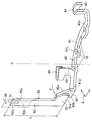
- FIG. 6 is a perspective view showing the motor connecting member 40 and the terminal member 50.
- FIG. 7 is a perspective view showing the neutral point member 60.
- the bus bar 30 includes a plurality of motor connecting members 40, a plurality of terminal members 50, and a neutral point member 60.
- the plurality of motor connecting members 40 include a U-phase motor connecting member 40U, a V-phase motor connecting member 40V, and a W-phase motor connecting member 40W.
- the plurality of terminal members 50 include a terminal member 50U for the U phase, a terminal member 50V for the V phase, and a terminal member 50W for the W phase, which correspond to the motor connecting members 40U, 40V, and 40W.
- each motor connecting member 40 is formed of a single plate-shaped member made of a conductive metal material such as copper.
- Each motor connecting member 40 is formed by bending one plate-shaped member, and has a main body portion 41 and a bent portion 42.
- the main body 41 extends in an arc along one plane.
- each motor connecting member 40 can be arranged along the circumferential direction of the motor 1.
- the coils 10 are arranged along the circumferential direction of the motor 1. That is, since the motor connecting member 40 can be arranged in the same direction as the direction in which each coil 10 is arranged, the lead wire 9 extending from each coil 10 is connected to each motor connecting member 40 without crawling as much as possible. Can be done.
- the bent portion 42 bends at one end portion 41a of the main body portion 41 in a direction intersecting the extending direction of the main body portion 41, specifically, in a direction orthogonal to the extending direction.
- the central axis of the arc of the main body 41 is arranged concentrically with the central axis J of the motor 1. That is, the main body 41 extends in the circumferential direction along the plane A orthogonal to the axial direction of the motor 1.
- the bent portion 42 bends in the axial direction of the motor 1.
- the thickness direction of the main body 41 of each motor connecting member 40 coincides with the axial direction of the motor 1. That is, each motor connecting member 40 is arranged in a so-called horizontal arrangement (hereinafter, referred to as a horizontal arrangement).
- the main body 41 extends along the plane A orthogonal to the axial direction and the bent portion 42 extends in the radial direction. It bends in the axial direction without. As a result, it is possible to prevent the bus bar 30 from becoming large in the radial direction.
- Each motor connecting member 40 has two coil connecting terminals 44 provided on the outer side in the radial direction of the outer peripheral portion 41c of the main body portion 41 via a substantially L-shaped connecting portion 43, respectively.
- the two coil connection terminals 44 are arranged at intervals in the circumferential direction.
- the two coil connection terminals 44 provided in the main body 41 of each motor connection member 40 are electrically connected to the coil 10 provided in the motor 1.
- the coil connection terminals 44U and 44U of the motor connection member 40U are electrically connected to the coil pairs U12 and U34 at one ends U12a and U34a.
- the coil connection terminals 44V and 44V of the motor connection member 40V are electrically connected to one ends V12a and V34a of the coil pairs V12 and V34.
- the coil connection terminals 44W and 44W of the motor connection member 40W are electrically connected to one ends W12a and W34a of the coil pairs W12 and W34.
- a plurality of holes 45 are provided in the main body 41 of each motor connecting member 40. These holes 45 are used for inserting an instrument (not shown) for positioning each motor connecting member 40 in the bus bar holder 70.
- Each terminal member 50 is composed of a member separate from each motor connecting member 40, and is formed of a plate-shaped member made of a conductive metal material such as copper.
- Each terminal member 50 has a first stretched portion 51 and a second stretched portion 52 that intersect each other.
- each terminal member 50 has a substantially L-shape in which the first stretched portion 51 and the second stretched portion 52 are orthogonal to each other.
- the end portion 51a of the first stretched portion 51 is connected to the first surface 42a of the bent portion 42 facing the main body portion 41 by, for example, resistance welding.
- the first stretched portion 51 extends radially outward from the end portion 51a and connects to the second stretched portion 52.
- the second stretched portion 52 extends in the axial direction.
- the end portion 52a of the second extending portion 52 is connected to the connection terminal 91 of the external terminal 90.
- the connection terminal 91 is connected to the surface 50b of the end portion 52a of the second extending portion 52 opposite to the surface 50a facing the main body portion 41.
- the "surface facing the main body” refers to a surface located closer to the main body 41 with respect to the direction in which the bent portion 42 bends (the direction in which the bent portion 42 extends), and is not necessarily the main body 41. You don't have to face each other.
- the "face opposite to the surface facing the main body” means the surface on the back side with respect to the "face facing the main body”.
- Welding of the terminal member 50 and the motor connecting member 40 is performed, for example, as follows. As shown in FIG. 8, the main body 41 of the motor connecting member 40 is held by the jig 101, and the second extension 52 of the terminal member 50 is held by the jig 102. Here, the welding jig 100 is pressed against the one end portion 41a of the main body portion 41 from the thickness direction thereof. As a result, the motor connecting member 40 does not move with respect to the receiving jig 101. That is, the position of the first surface 42a of the bent portion 42 in the motor connecting member 40 is fixed. The receiving jig 101 extends along the extending direction of the main body 41.
- the receiving jig 102 extends along the extending direction of the second stretching portion 52.
- the welding jig 100 extends in the thickness direction of the main body 41. That is, the welding jig 100 extends parallel to the extending direction of the receiving jig 102.
- the end portion 52a of the second stretched portion 52 of the terminal member 50 is connected to the first surface 42a of the bent portion 42 of the motor connecting member 40 by, for example, resistance welding.
- the second stretched portion 52 is positioned so as to be radially outward from the bent portion 42 (one end portion 41a) of the motor connecting member 40. That is, the welding jig 100 pressed against the one end portion 41a of the main body portion 41 does not interfere with the second stretching portion 52. Therefore, even if the welding jig 100 is received and inserted in parallel with the jig 102, the welding jig 100 does not interfere with the second stretched portion 52, and the end portion 51a and the bent portion 42 of the first stretched portion 51 Can be welded to the first surface 42a of the above.
- the neutral point member 60 is formed of a plate-shaped member made of a conductive metal material such as copper.
- the neutral point member 60 has a main body portion 61 extending in an arc shape.
- the central axis of the arc of the main body 61 is arranged concentrically with the central axis J of the motor 1.
- the neutral point member 60 extends in the circumferential direction along the plane A orthogonal to the axial direction of the motor 1.
- the neutral point member 60 has six coil connection terminals 63 provided radially outside the outer peripheral portion 61a of the main body portion 61 via a substantially L-shaped connecting portion 62, respectively.
- the six coil connection terminals 63 are arranged at intervals in the circumferential direction.
- the neutral point member 60 is electrically connected to each coil 10 in the plurality of coils 10 provided in the motor 1 to form a neutral point.
- each coil connection terminal 63 in the six coil connection terminals 63 of the neutral point member 60 is the other end of each coil pair U12, U34, V12, V34, W12, W34. It connects to U12b, U34b, V12b, V34b, W12b, W34b.
- the neutral point member 60 connects the U-phase, V-phase, and W-phase coils to Y as the neutral point N.
- the neutral point N can be formed only by connecting the U-phase, V-phase, and W-phase coils to the neutral point member 60, so that the structure is simple.
- the motor connecting members 40U, 40V, and 40W are arranged so as to overlap each other in the thickness direction (axial direction) of each plate-shaped main body 41.
- the motor connecting member 40W, the motor connecting member 40V, and the motor connecting member 40U are arranged so as to overlap each other in this order from the other side to the one side in the axial direction, and partially overlap each other in the circumferential direction.
- the bus bar 30 it is possible to prevent the bus bar 30 from becoming larger than when the motor connecting members 40 are arranged in the width direction of the main body 41.
- the motor connecting members 40 can be arranged so as to overlap each other in the axial direction which is the thickness direction of the main body 41.
- the bus bar 30 it is possible to prevent the bus bar 30 from becoming larger in the radial direction as compared with the case where the motor connecting members 40 are arranged in the radial direction which is the width direction of the main body 41.
- the radial positions of the coil connection terminals 44 of the motor connection members 40 can be matched with each other.
- the neutral point member 60 is arranged so as to overlap the motor connecting member 40V from one side in the axial direction.
- the neutral point member 60 has a portion that partially overlaps with the motor connecting member 40V in the circumferential direction.
- each motor connecting member 40U, 40V, 40W is arranged so as to extend in the same direction. Specifically, as shown in FIG. 5, the main body 41 of each motor connecting member 40U, 40V, 40W extends clockwise from one end 41a to 41b in the axial direction when viewed from one side in the axial direction.
- the terminal members 50U, 50V, and 50W provided on the one end 41a side can be centrally arranged in one place.
- the welding work between the external terminal 90 and each terminal member 50 can be concentrated at one place, so that the welding work becomes easy.
- the bus bar 30 is housed in the bus bar holder 70.
- the bus bar holder 70 is made of an insulating material such as resin.
- the bus bar holder 70 is an insert molded product.
- the bus bar 30 is molded by the bus bar holder 70.
- the bus bar holder 70 has a ring-shaped main body portion 71, a connecting portion 72, and three leg portions 73.
- the central axis of the main body 71 is arranged concentrically with the central axis J of the motor 1.
- the main body 71 covers each motor connecting member 40 of the bus bar 30.
- the coil connection terminals 44, 63 of the motor connecting members 40U, 40V, 40W and the neutral point member 60 are exposed radially outward from the outer peripheral portion 71a of the main body portion 71.
- the connecting portion 72 extends from the main body portion 71 in one axial direction and holds three terminal members 50U, 50V, and 50W.
- the connecting portions 72U, 72V, 72W cover the rising portions of the terminal members 50U, 50V, 50W. That is, the connecting portion 72 covers at least the connecting portion between the terminal member 50 and the motor connecting member 40.
- the connection portions 72U, 72V, 72W are connected in the circumferential direction. By providing the connecting portion 72, it is possible to prevent the terminal member 50 from being displaced.
- the connecting portions 72 are provided at one location, but may be provided at two or more locations depending on the configuration of the bus bar 30.
- the three legs 73 are arranged at substantially equal intervals in the circumferential direction of the main body 71.
- Each leg portion 73 projects radially outward from the coil connection terminals 44 and 63, and is supported on the outer peripheral side of the stator 4 as shown in FIG. Specifically, the tip portion of the leg portion 73 fits into a groove portion (not shown) formed on the outer peripheral surface of the stator 4. As a result, the bus bar holder 70 is stably fixed in the circumferential direction with respect to the stator 4.
- the motor 1 includes a bus bar 30.
- the bus bar 30 is composed of a motor connecting member 40 that is electrically connected to the coil 10 provided in the motor 1 and a member that is separate from the motor connecting member 40 and is electrically connected to the external terminal 90.
- the motor connecting member 40 has a main body portion 41 electrically connected to the coil 10 and a bent portion 42 at one end portion 41a of the main body portion 41 that bends in a direction intersecting the main body portion 41.
- the terminal member 50 is connected to the bent portion 42.
- the terminal member 50 can adopt a member selected each time according to the specifications.
- the motor connecting member 40 the same common member can be adopted regardless of the specifications. That is, the motor connecting member 40 can be standardized and mass-produced. Therefore, it is possible to flexibly change the thickness, material, etc. of the connection portion with the external terminal 90 (connection terminal 91) according to the specifications, and reduce the manufacturing cost by standardizing the members. be able to.
- the bent portion 42 is provided not in the terminal member 50 in which the thickness, material, etc. are selected each time according to the specifications, but in the motor connecting member 40 which is standardized and mass-produced. As a result, the bending process of the member can be incorporated into the mass production process of the motor connecting member 40, so that the manufacturing cost can be further reduced.
- the terminal member 50 which is the connecting portion with the external terminal 90, often uses a material that is more expensive than the motor connecting member 40.
- the bent portion 42 on the motor connecting member 40 side the dimension L of the terminal member 50 can be reduced accordingly. As a result, the use of expensive materials can be reduced and the manufacturing cost can be reduced.
- the manufacturing cost of the bus bar 30 can be reduced, and the manufacturing cost of the motor 1 as a whole can be reduced.
- the thickness and the material of the terminal member 50 and the motor connecting member 40 are different.
- the neutral point member 60 and the motor connecting member 40 have the same thickness and material.
- the neutral point member 60 and the terminal member 50 are different in thickness and material. That is, the terminal member 50 has a different thickness from the motor connecting member 40 and the neutral point member 60.
- the material of the terminal member 50 is different from that of the motor connecting member 40 and the neutral point member 60.
- a plate material having a thickness of 1.0 mm made of tough pitch copper (C1100) may be used for each motor connecting member 40 and the neutral point member 60.
- a plate material having a thickness of 0.8 mm made of a Cu—Fe based alloy (C19400) may be used for the terminal member 50.
- the thickness of the motor connecting member 40 and the terminal member 50 are different, so that the thickness of the motor connecting member 40 is standardized to reduce the manufacturing cost, and the terminal member which is a connecting portion with the external terminal 90.
- the thickness of 50 can be flexibly changed according to the specifications.
- the thickness of the neutral point member 60 and the motor connecting member 40 By making the thickness of the neutral point member 60 and the motor connecting member 40 the same, it is possible to manufacture with the same member, and the manufacturing cost can be reduced. Further, since the thickness of the welded portion with the lead wire 9 (coil 10) of each of the neutral point member 60 and the motor connecting member 40 is the same, the welding workability is improved.
- the terminal member 50 and the motor connecting member 40 may have at least one of the same thickness or material. At least one of the thickness and the material of the neutral point member 60 and the motor connecting member 40 may be different. The neutral point member 60 and the terminal member 50 may have at least one of the same thickness or material. Further, members of the same material and the same thickness may be used for all of them.
- FIG. 9 shows each motor connecting member 40 and each terminal member 50 according to a modified example of the embodiment of the present invention.
- the end portion 51a of the first extending portion 51 of each terminal member 50 is connected to the second surface 42b of the bent portion 42 opposite to the first surface 42a facing the main body portion 41.
- the connection terminal 91 of the external terminal 90 is connected to the surface 50b of the end portion 52a of the second extending portion 52 opposite to the surface 50a facing the main body 41.
- each motor connecting member 40 is formed in a shape in which the bent portion 42 intersects the main body portion 41 by bending one plate-shaped member. Therefore, a springback force F that tries to return to the original shape before being bent acts on the motor connecting member 40.
- the direction of the springback force F is a direction from the side closer to the main body 41 to the side farther from the main body 41 with reference to the direction in which the bent portion 42 is bent (the direction in which the bent portion 42 extends). That is, from the other end 41b to the one end 41a, the direction is counterclockwise when viewed from one side in the axial direction.
- the terminal member 50 by connecting the terminal member 50 to the second surface 42b of the bent portion 42, the terminal member 50 receives a springback force F that tries to return the bent portion 42 to its original posture. Oppose. That is, the bent portion 42 is prevented from returning to the original posture before being bent. As a result, the bent portion 42 becomes less likely to move as compared with the case where each terminal member 50 is connected to the first surface 42a of the bent portion 42 (see FIG. 6). As a result, misalignment of the end portion 52a of the terminal member 50, which is a welded portion with the external terminal 90 (connection terminal 91), is suppressed, and reliability can be improved.
- the bent portion 42 bends in a direction orthogonal to the extending direction of the main body portion 41, but the present invention is not limited to this, and if it bends in an intersecting direction, for example, it may be bent at an acute angle or an obtuse angle. Good.
- Each motor connecting member 40 may be arranged in a so-called vertical position in which the width direction of the main body 41 coincides with the axial direction of the motor 1.
- the main body 41 may not extend in an arc shape, but may extend in a linear shape, an L shape, an S shape, or the like, for example.
- Each motor connecting member 40 may extend in opposite directions to each other.
- the terminal members 50U, 50V, and 50W are distributed and arranged at a plurality of locations.
- the motor connecting members 40 may be arranged along the plane A instead of being arranged so as to overlap each other in the axial direction.
- Each motor connecting member 40 is not limited to a plate shape but has any shape such as a rod shape as long as it has a bent portion 42 at one end portion 41a of the main body portion 41 that bends in a direction intersecting the main body portion 41. You may.
- the terminal member 50 and the neutral point member 60 are not limited to the plate shape, and may have any shape such as a rod shape.
- the motor 1 is not limited to a three-phase motor, and may be, for example, a single-phase motor or a multi-phase motor.
- the application of the motor 1 of this embodiment is not particularly limited, and can be used as, for example, a motor for automobiles, industries, and home appliances.
- the motor 1 of the present embodiment can be preferably used for an EV (Electric Vehicle) drive motor, an HEV (Hybrid Electric Vehicle) drive motor, and the like.
Landscapes
- Engineering & Computer Science (AREA)
- Power Engineering (AREA)
- Insulation, Fastening Of Motor, Generator Windings (AREA)
- Motor Or Generator Frames (AREA)
Priority Applications (4)
| Application Number | Priority Date | Filing Date | Title |
|---|---|---|---|
| US17/620,739 US20220416615A1 (en) | 2019-06-28 | 2020-05-28 | Bus bar and motor |
| CN202080047263.1A CN114026770A (zh) | 2019-06-28 | 2020-05-28 | 母线及马达 |
| DE112020003124.1T DE112020003124T5 (de) | 2019-06-28 | 2020-05-28 | Sammelschiene und motor |
| JP2021527520A JPWO2020261866A1 (https=) | 2019-06-28 | 2020-05-28 |
Applications Claiming Priority (2)
| Application Number | Priority Date | Filing Date | Title |
|---|---|---|---|
| JP2019-120776 | 2019-06-28 | ||
| JP2019120776 | 2019-06-28 |
Publications (1)
| Publication Number | Publication Date |
|---|---|
| WO2020261866A1 true WO2020261866A1 (ja) | 2020-12-30 |
Family
ID=74060854
Family Applications (1)
| Application Number | Title | Priority Date | Filing Date |
|---|---|---|---|
| PCT/JP2020/021083 Ceased WO2020261866A1 (ja) | 2019-06-28 | 2020-05-28 | バスバー及びモータ |
Country Status (5)
| Country | Link |
|---|---|
| US (1) | US20220416615A1 (https=) |
| JP (1) | JPWO2020261866A1 (https=) |
| CN (1) | CN114026770A (https=) |
| DE (1) | DE112020003124T5 (https=) |
| WO (1) | WO2020261866A1 (https=) |
Cited By (2)
| Publication number | Priority date | Publication date | Assignee | Title |
|---|---|---|---|---|
| DE102021102761B3 (de) | 2021-02-05 | 2022-08-04 | Nidec Motors & Actuators (Germany) Gmbh | Bürstenloser Elektromotor mit Sammelschieneneinheit |
| CN115694030A (zh) * | 2021-07-30 | 2023-02-03 | 日本电产株式会社 | 马达 |
Families Citing this family (4)
| Publication number | Priority date | Publication date | Assignee | Title |
|---|---|---|---|---|
| JP7695818B2 (ja) * | 2021-04-21 | 2025-06-19 | ミネベアミツミ株式会社 | モータ |
| JP7767761B2 (ja) | 2021-08-06 | 2025-11-12 | 株式会社デンソー | 回転電機 |
| CN115173608A (zh) * | 2022-07-28 | 2022-10-11 | 华域三电汽车空调有限公司 | 一种簇组件、电动马达及电动压缩机 |
| TWI886710B (zh) * | 2023-12-26 | 2025-06-11 | 台全電機股份有限公司 | 電機及其定子 |
Citations (6)
| Publication number | Priority date | Publication date | Assignee | Title |
|---|---|---|---|---|
| JP2010200400A (ja) * | 2009-02-23 | 2010-09-09 | Nippon Densan Corp | ステータ、バスバーユニット、モータ、及びパワーステアリング装置 |
| KR20130061283A (ko) * | 2011-12-01 | 2013-06-11 | 엘지이노텍 주식회사 | Eps모터의 스테이터 |
| JP2018512037A (ja) * | 2015-04-15 | 2018-04-26 | エルジー イノテック カンパニー リミテッド | ターミナルアセンブリー及びこれを含むモーター |
| JP2018537063A (ja) * | 2015-11-05 | 2018-12-13 | エルジー イノテック カンパニー リミテッド | バスバー、モーター、およびこれを含む動力伝達システム |
| WO2020013078A1 (ja) * | 2018-07-13 | 2020-01-16 | 日本電産株式会社 | モータ及び電動パワーステアリング装置 |
| WO2020039961A1 (ja) * | 2018-08-20 | 2020-02-27 | 日本電産株式会社 | モータ、電動パワーステアリング装置、モータの製造方法、バスバーユニット、及びバスバーユニットの製造方法 |
Family Cites Families (16)
| Publication number | Priority date | Publication date | Assignee | Title |
|---|---|---|---|---|
| JP3733312B2 (ja) * | 2001-10-26 | 2006-01-11 | 住友電装株式会社 | 車両用薄型ブラシレスモータの集中配電部材に用いるバスバーの製造方法 |
| JP2008029138A (ja) * | 2006-07-21 | 2008-02-07 | Showa Corp | 回転電機用ターミナル |
| JP2009033786A (ja) * | 2007-07-24 | 2009-02-12 | Mabuchi Motor Co Ltd | バスバーを内蔵したインナーロータブラシレスモータ |
| JP2010200575A (ja) * | 2009-02-27 | 2010-09-09 | Denso Corp | 電動モータ |
| KR101163475B1 (ko) * | 2010-03-08 | 2012-07-18 | 현대자동차주식회사 | 하이브리드 차량의 구동모터용 터미널 장치 |
| JP5801216B2 (ja) * | 2012-02-06 | 2015-10-28 | 愛三工業株式会社 | モータ及び電動ポンプ |
| JP5930801B2 (ja) * | 2012-03-30 | 2016-06-08 | 日立オートモティブシステムズ株式会社 | 車載用モータ、及びそれを用いた電動パワーステアリング装置 |
| KR102051599B1 (ko) * | 2013-09-16 | 2020-01-08 | 엘지이노텍 주식회사 | 버스바, 인슐레이터 및 이를 포함하는 모터 |
| US9871422B2 (en) * | 2014-09-04 | 2018-01-16 | Hyundai Mobis Co., Ltd. | Terminal unit of vehicle traction motor and method of manufacturing the same |
| DE102015200089B4 (de) * | 2015-01-07 | 2017-03-02 | Robert Bosch Gmbh | Stator für eine elektrische Maschine und Verfahren zum Herstellen eines solchen |
| WO2018180447A1 (ja) * | 2017-03-31 | 2018-10-04 | 日本電産株式会社 | バスバーユニットおよびモータ |
| KR102527781B1 (ko) * | 2018-01-05 | 2023-05-02 | 엘지이노텍 주식회사 | 모터 |
| WO2021031783A1 (zh) * | 2019-08-20 | 2021-02-25 | 安徽威灵汽车部件有限公司 | 汇流排、汇流排主体、电机、电动助力转向系统和车辆 |
| KR102763630B1 (ko) * | 2019-08-23 | 2025-02-07 | 현대모비스 주식회사 | 일체형 구조를 갖는 차량용 구동모터의 터미널 어셈블리 및 그 제조 방법 |
| KR102836088B1 (ko) * | 2020-11-20 | 2025-07-18 | 현대모비스 주식회사 | 모터 |
| WO2022237589A1 (zh) * | 2021-05-14 | 2022-11-17 | 安徽威灵汽车部件有限公司 | 汇流组件、电机、电动助力转向系统和车辆 |
-
2020
- 2020-05-28 JP JP2021527520A patent/JPWO2020261866A1/ja active Pending
- 2020-05-28 WO PCT/JP2020/021083 patent/WO2020261866A1/ja not_active Ceased
- 2020-05-28 CN CN202080047263.1A patent/CN114026770A/zh active Pending
- 2020-05-28 DE DE112020003124.1T patent/DE112020003124T5/de not_active Withdrawn
- 2020-05-28 US US17/620,739 patent/US20220416615A1/en not_active Abandoned
Patent Citations (6)
| Publication number | Priority date | Publication date | Assignee | Title |
|---|---|---|---|---|
| JP2010200400A (ja) * | 2009-02-23 | 2010-09-09 | Nippon Densan Corp | ステータ、バスバーユニット、モータ、及びパワーステアリング装置 |
| KR20130061283A (ko) * | 2011-12-01 | 2013-06-11 | 엘지이노텍 주식회사 | Eps모터의 스테이터 |
| JP2018512037A (ja) * | 2015-04-15 | 2018-04-26 | エルジー イノテック カンパニー リミテッド | ターミナルアセンブリー及びこれを含むモーター |
| JP2018537063A (ja) * | 2015-11-05 | 2018-12-13 | エルジー イノテック カンパニー リミテッド | バスバー、モーター、およびこれを含む動力伝達システム |
| WO2020013078A1 (ja) * | 2018-07-13 | 2020-01-16 | 日本電産株式会社 | モータ及び電動パワーステアリング装置 |
| WO2020039961A1 (ja) * | 2018-08-20 | 2020-02-27 | 日本電産株式会社 | モータ、電動パワーステアリング装置、モータの製造方法、バスバーユニット、及びバスバーユニットの製造方法 |
Cited By (2)
| Publication number | Priority date | Publication date | Assignee | Title |
|---|---|---|---|---|
| DE102021102761B3 (de) | 2021-02-05 | 2022-08-04 | Nidec Motors & Actuators (Germany) Gmbh | Bürstenloser Elektromotor mit Sammelschieneneinheit |
| CN115694030A (zh) * | 2021-07-30 | 2023-02-03 | 日本电产株式会社 | 马达 |
Also Published As
| Publication number | Publication date |
|---|---|
| CN114026770A (zh) | 2022-02-08 |
| US20220416615A1 (en) | 2022-12-29 |
| JPWO2020261866A1 (https=) | 2020-12-30 |
| DE112020003124T5 (de) | 2022-05-05 |
Similar Documents
| Publication | Publication Date | Title |
|---|---|---|
| WO2020261866A1 (ja) | バスバー及びモータ | |
| JP5930801B2 (ja) | 車載用モータ、及びそれを用いた電動パワーステアリング装置 | |
| US11025129B2 (en) | Wire support for motor stator | |
| EP3051671B1 (en) | Bus bar unit, method for manufacturing bus bar unit, and brushless motor | |
| JP5652004B2 (ja) | 配電構造部品およびその製造方法 | |
| JP2009261082A (ja) | 回転電機の集配電リング | |
| US10840656B2 (en) | Bus bar unit and rotary electric machine having the same | |
| JP2021164218A (ja) | モータおよび組み付け方法 | |
| CN105432002A (zh) | 汇流条单元以及马达 | |
| JP2021164220A (ja) | バスバーユニットおよびモータ | |
| JP2021164221A (ja) | モータ | |
| JP2022127366A (ja) | バスバーユニット、ステータ、モータ | |
| JP5019558B2 (ja) | 集中配電部品 | |
| WO2022234825A1 (ja) | 多相モータ用絶縁構造及び多相モータ | |
| JP4465396B2 (ja) | 回転電機の配電接続構造および回転電機の配電接続構造の製造方法 | |
| JP2014090532A (ja) | 回転電機のステータ | |
| US11677290B2 (en) | Motor | |
| JP2006174547A (ja) | 回転電機の固定子 | |
| JP4913538B2 (ja) | 集中配電部品 | |
| CN109586479B (zh) | 马达和电动助力转向装置 | |
| JP2021111998A (ja) | ステータ | |
| WO2019021680A1 (ja) | モータ | |
| JP2008086080A (ja) | 集中配電部品 | |
| JP2019037028A (ja) | 回転電機ステータ | |
| JP6745230B2 (ja) | 回転電機のステータ |
Legal Events
| Date | Code | Title | Description |
|---|---|---|---|
| 121 | Ep: the epo has been informed by wipo that ep was designated in this application |
Ref document number: 20831442 Country of ref document: EP Kind code of ref document: A1 |
|
| ENP | Entry into the national phase |
Ref document number: 2021527520 Country of ref document: JP Kind code of ref document: A |
|
| 122 | Ep: pct application non-entry in european phase |
Ref document number: 20831442 Country of ref document: EP Kind code of ref document: A1 |