WO2020235287A1 - 車両用装置及びプログラム - Google Patents
車両用装置及びプログラム Download PDFInfo
- Publication number
- WO2020235287A1 WO2020235287A1 PCT/JP2020/017324 JP2020017324W WO2020235287A1 WO 2020235287 A1 WO2020235287 A1 WO 2020235287A1 JP 2020017324 W JP2020017324 W JP 2020017324W WO 2020235287 A1 WO2020235287 A1 WO 2020235287A1
- Authority
- WO
- WIPO (PCT)
- Prior art keywords
- vehicle
- point
- facility
- unit
- related application
- Prior art date
- Legal status (The legal status is an assumption and is not a legal conclusion. Google has not performed a legal analysis and makes no representation as to the accuracy of the status listed.)
- Ceased
Links
Images

Classifications
-
- G—PHYSICS
- G01—MEASURING; TESTING
- G01C—MEASURING DISTANCES, LEVELS OR BEARINGS; SURVEYING; NAVIGATION; GYROSCOPIC INSTRUMENTS; PHOTOGRAMMETRY OR VIDEOGRAMMETRY
- G01C21/00—Navigation; Navigational instruments not provided for in groups G01C1/00 - G01C19/00
- G01C21/26—Navigation; Navigational instruments not provided for in groups G01C1/00 - G01C19/00 specially adapted for navigation in a road network
-
- G—PHYSICS
- G06—COMPUTING OR CALCULATING; COUNTING
- G06Q—INFORMATION AND COMMUNICATION TECHNOLOGY [ICT] SPECIALLY ADAPTED FOR ADMINISTRATIVE, COMMERCIAL, FINANCIAL, MANAGERIAL OR SUPERVISORY PURPOSES; SYSTEMS OR METHODS SPECIALLY ADAPTED FOR ADMINISTRATIVE, COMMERCIAL, FINANCIAL, MANAGERIAL OR SUPERVISORY PURPOSES, NOT OTHERWISE PROVIDED FOR
- G06Q50/00—Information and communication technology [ICT] specially adapted for implementation of business processes of specific business sectors, e.g. utilities or tourism
- G06Q50/10—Services
-
- G—PHYSICS
- G08—SIGNALLING
- G08G—TRAFFIC CONTROL SYSTEMS
- G08G1/00—Traffic control systems for road vehicles
- G08G1/09—Arrangements for giving variable traffic instructions
- G08G1/0962—Arrangements for giving variable traffic instructions having an indicator mounted inside the vehicle, e.g. giving voice messages
- G08G1/0968—Systems involving transmission of navigation instructions to the vehicle
- G08G1/0969—Systems involving transmission of navigation instructions to the vehicle having a display in the form of a map
-
- G—PHYSICS
- G09—EDUCATION; CRYPTOGRAPHY; DISPLAY; ADVERTISING; SEALS
- G09B—EDUCATIONAL OR DEMONSTRATION APPLIANCES; APPLIANCES FOR TEACHING, OR COMMUNICATING WITH, THE BLIND, DEAF OR MUTE; MODELS; PLANETARIA; GLOBES; MAPS; DIAGRAMS
- G09B29/00—Maps; Plans; Charts; Diagrams, e.g. route diagram
-
- G—PHYSICS
- G09—EDUCATION; CRYPTOGRAPHY; DISPLAY; ADVERTISING; SEALS
- G09B—EDUCATIONAL OR DEMONSTRATION APPLIANCES; APPLIANCES FOR TEACHING, OR COMMUNICATING WITH, THE BLIND, DEAF OR MUTE; MODELS; PLANETARIA; GLOBES; MAPS; DIAGRAMS
- G09B29/00—Maps; Plans; Charts; Diagrams, e.g. route diagram
- G09B29/10—Map spot or coordinate position indicators; Map reading aids
Definitions
- This disclosure relates to vehicle equipment and programs.
- This disclosure was made in view of the above circumstances, and the purpose is related to points related to point cards and smartphone payments at the facility store when a user in a vehicle arrives at the facility and purchases products, etc.
- the purpose is to provide a vehicle device and a program that eliminates the trouble of searching for an application.
- the regular road determination unit sets the vehicle on the regular road based on the past travel history information on which the vehicle has traveled in the past and the current position of the vehicle. Determine if you are traveling along.
- the facility narrowing section narrows down the facilities along the regular road determined by the regular road judgment section and the facilities that can use the point-related application.
- the activation instruction unit instructs the mobile terminal to activate the target point-related application that can be used in the facility when the current position reaches the position of the facility narrowed down by the facility narrowing unit. Therefore, the user can avoid the trouble of starting the point-related application at the arriving facility.
- facilities may carry out limited-time campaigns and point doubling services depending on the date and time and day of the week, but users often miss the opportunity to give and receive these services without noticing the timing. ..
- the notification processing unit notifies and processes useful information that allows the user to receive service benefits by using the point-related application at the facility.
- the activation application information storage unit can receive useful information and point-related applications for a limited time by allowing the user to use the point-related applications at the facility.
- the notification processing unit collates the limited period indicated by the useful information with the current date, day, or time, and determines that the facility is suitable for the period in which the service benefit can be received. In some cases, the information of the facility is notified and processed. Therefore, it is possible to notify the facility to guide the user at an appropriate timing.
- FIG. 1 is a block diagram of a vehicle cooperation system according to the first embodiment.
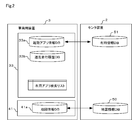
- FIG. 2 is an explanatory diagram of data transmitted / received between the vehicle device and the center device.
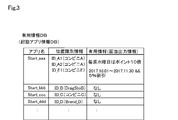
- FIG. 3 is an explanatory diagram of the stored contents of the useful information database.
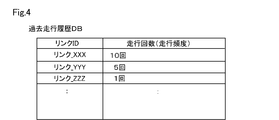
- FIG. 4 is an explanatory diagram of the stored contents of the past driving history database.
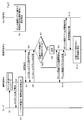
- FIG. 5 is a sequence diagram showing the contents of inquiry response between each device.
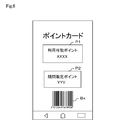
- FIG. 6 is an example of a screen after starting the point-related application.
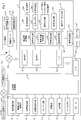
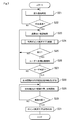
- FIG. 7 is a flowchart illustrating the processing contents of the vehicle device.
- FIG. 1 is a block diagram of a vehicle cooperation system according to the first embodiment.
- FIG. 2 is an explanatory diagram of data transmitted / received between the vehicle device and the center device.
- FIG. 3 is an explanatory diagram of the stored contents of the useful information database.
- FIG. 4 is an explanatory diagram of the stored contents of the past driving history database.
- FIG. 5 is a sequence diagram showing the contents
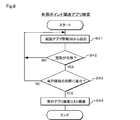
- FIG. 8 is a flowchart illustrating the search processing content of the useful point-related application.
- FIG. 9 is an explanatory diagram of the useful application search list.
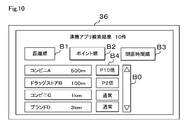
- FIG. 10 is Part 1 of a display screen example of the display device.
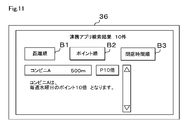
- FIG. 11 is Part 2 of the display screen example of the display device.
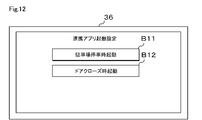
- FIG. 12 is an example of a setting screen for starting the point-related application according to the second embodiment.
- the vehicle cooperation system 1 shown in FIG. 1 is configured by communicating and connecting a center device 2 and a vehicle device 3, and has a function of linking with a mobile terminal 4 such as a smartphone or tablet possessed by the user.
- a mobile terminal 4 such as a smartphone or tablet possessed by the user.
- the mobile terminal 4 may be any terminal such as a tablet terminal, a laptop computer, an electronic paper terminal, or any other terminal that the user can bring into the vehicle.
- the mobile terminal 4 includes a terminal-side control unit 5, a telephone communication unit 6, a wireless LAN communication unit 7, a position detection unit 8, an acceleration detection unit 9, a key input unit 10, a storage unit 11, a display unit 12, a microphone 13, and a speaker 14. , And I / F15 and the like.
- the terminal-side control unit 5 is mainly composed of a microcomputer having a CPU, ROM, RAM, I / O bus (none of which is shown), and the like.
- the terminal-side control unit 5 controls all operations of the mobile terminal 4, such as communication operations and data management operations.
- the terminal-side control unit 5 realizes a communication operation, a data management operation, and the like by using software according to a computer program stored in the ROM or the storage unit 11. Further, the terminal side control unit 5 realizes various functions by using software by executing various applications stored in the storage unit 11. In particular, the terminal-side control unit 5 realizes a function of activating and executing the point-related application stored in the storage unit 11 by software. The specific contents of each function will be described later.
- the telephone communication unit 6 executes telephone communication or data communication with the communication network 16.
- the communication network 16 provides a mobile phone communication service using a well-known public line network such as a mobile phone base station or a base station control device (not shown).
- the mobile terminal 4 can perform telephone communication or data communication with another mobile terminal 4 via the telephone communication unit 6 and the telephone communication network. Further, the mobile terminal 4 can acquire (download) various information, applications, and the like from the application providing server 17a connected to the communication network 16 via the telephone communication unit 6.
- the wireless LAN communication unit 7 can execute wireless LAN communication with the wireless LAN communication unit (not shown) of another electric device.
- Examples of other electric devices include a wearable device worn by the user, a driver monitor provided with a camera, a microphone, and the like that can detect the behavior of the user.
- the mobile terminal 4 is configured so that it can connect to the communication network 16 through the wireless LAN communication line through the wireless LAN communication unit 7 and connect to the application providing server 17a to acquire (download) various information and applications. Has been done.
- the I / F15 is, for example, by a Bluetooth (registered trademark) communication module, a USB interface, or the like, and can communicate by establishing a connection with the I / F32 provided in the vehicle device 3.
- the vehicle device 3 can receive various information such as information on the point-related application from the mobile terminal 4, and conversely, the vehicle device 3 can transmit various information to the mobile terminal 4.
- the position detection unit 8 is composed of, for example, a GPS receiver, detects the current position of the mobile terminal 4, and transmits the detected current position information to the terminal side control unit 5.
- the acceleration detection unit 9 is composed of, for example, a G sensor, detects the acceleration acting on the mobile terminal 4, and transmits the detected acceleration detection information to the terminal side control unit 5.
- the display unit 12 is composed of, for example, a liquid crystal display or an organic EL display.
- the display unit 12 displays various information based on the display command signal of the terminal side control unit 5.
- the display unit 12 displays, for example, a well-known telephone directory, received mail, various information, a display related to destination setting, an operation screen, and the like.
- the key input unit 10 is composed of a touch switch (so-called touch panel) provided on the screen of the display unit 12.
- the key input unit 10 outputs an operation detection signal to the terminal side control unit 5 in response to the user operating the key.
- the terminal-side control unit 5 analyzes the operation detection signal input from the key input unit 10 to specify the operation content by the user.
- the key input unit 10 may be configured by providing a mechanical switch around or in the vicinity of the display unit 12.
- the storage unit 11 has a storage area for storing various data, and is composed of an EEPROM, a flash memory, an SD memory, or the like. In this case, the storage unit 11 also stores software such as an application downloaded from the application providing server 17a via the telephone communication unit 6 or the wireless LAN communication unit 7.
- the microphone 13 inputs the voice uttered by the user during a call as the transmitted voice.
- the speaker 14 outputs the voice received by the telephone communication unit 6 from the other party as the received voice.
- the vehicle device 3 is mainly composed of the device side control unit 30, and the communication unit 31, I / F 32, storage unit 33, voice processing unit 34, display control unit 35, display device 36, operation input unit 37, The operation device 38, the signal input unit 39, the position detector 40, the map data input device 41, and the like are connected to each other.
- the vehicle device 3 may be composed of a single navigation ECU (electronic control unit: Electronic Control Unit), or a plurality of electronic control devices such as the navigation ECU and a data communication module (DCM (Data Communication Module)). May be configured so that each ECU cooperates by connecting to a network. When each ECU cooperates, information is exchanged through a network such as CAN configured in the vehicle or a dedicated communication line.
- a network such as CAN configured in the vehicle or a dedicated communication line.
- the device-side control unit 30 is mainly composed of a microcomputer having a CPU, ROM, RAM, I / O bus, etc. (none of which are shown).
- the device-side control unit 30 controls the overall operation of the vehicle device 3, such as communication operation, data management operation, and cooperation operation with the mobile terminal 4, according to a computer program stored in the ROM, the storage unit 33, or the like.
- the device-side control unit 30 realizes each function as the position identification unit 42, the regular road determination unit 43, the facility narrowing unit 44, and the activation instruction unit 45 by executing a computer program.
- the position specifying unit 42 is a function of specifying the current position of the vehicle detected by the position detector 40.
- the regular road determination unit 43 is a function of determining whether the current position is traveling along the regular road based on the past travel history information on which the vehicle has traveled in the past.
- the facility narrowing unit 44 has a function of narrowing down facilities along the regular road determined by the regular road determination unit 43 and which can use an application for a point card or a smartphone payment (hereinafter abbreviated as a point-related application).
- the activation instruction unit 45 is a function for instructing the mobile terminal 4 to activate a target point-related application that can be used in the facility when the current position reaches the position of the facility narrowed down by the facility narrowing unit 44. ..
- the device-side control unit 30 has a function of setting the destination when the operation device 38 is operated by the user and the destination is set. Further, the device-side control unit 30 has a route search function for searching a destination set by the mobile terminal 4 and transmitted from the mobile terminal 4 or a route set by the operation device 38 of the vehicle device 3. Has. Further, the device-side control unit 30 has a route guidance function for guiding the route along the searched and set route.
- the communication unit 31 is composed of a so-called data communication module (DCM), and can communicate with the center device 2 through a communication network 48 outside the vehicle.
- the communication network 48 may partially overlap with the communication network 16 or may be the same as or different from the communication network 16.
- the storage unit 33 is configured to include a non-volatile storage medium such as a hard disk drive or an SD memory, and has a storage area for storing various data.
- the storage unit 33 may be configured to be built in the vehicle device 3 or may be configured to use an external storage medium that can be removed from the vehicle device 3.
- a start application information database 33a and a past travel history database 33b are constructed in the storage unit 33.
- the startup application information database 33a is configured as a startup application information storage unit.
- the information in the useful information database 51 of the center device 2 described later is sequentially updated in the activated application information database 33a based on the information of the point-related application received from the mobile terminal 4, and the contents will be described later.
- the device-side control unit 30 of the vehicle device 3 specifies the current position of the vehicle by the position specifying unit 42, and the travel history data can be accumulated when the vehicle travels on the road.
- the device-side control unit 30 stores the travel history data in the past travel history database 33b of the storage unit 33.
- the past travel history database 33b stores the past travel history of the vehicle, and the link ID of the road and the number of travels are linked.
- a microphone 46 and a speaker 47 are connected to the voice processing unit 34 shown in FIG.
- the microphone 46 is installed in a portion such as the vicinity of the steering wheel in the vehicle interior where it is easy to collect the sound emitted by the user.
- An audio amplifier (not shown) is attached to the speaker 47.
- the speaker 47 is provided inside the vehicle interior outside the vehicle device 3, and is connected to the voice processing unit 34 via an audio amplifier.
- the voice processing unit 34 performs well-known voice input processing and voice output processing, and inputs and outputs various information to and from the device side control unit 30. When the speaker 47 inputs sound from the voice processing unit 34, the input sound is output to the vehicle interior.
- the display control unit 35 is connected to the display device 36, and controls the content to be displayed on the display device 36, that is, the display screen, based on the instruction from the device side control unit 30.
- the voice processing unit 34 and the display control unit 35 indicate a block that functions as a notification processing unit that notifies facility information in the vehicle interior.
- the display device 36 is composed of, for example, a liquid crystal display or an organic EL display, and displays various information based on a display command signal of the display control unit 35.
- the display device 36 is provided with a touch switch (so-called touch panel) on the screen thereof.
- the display device 36 displays various displays related to navigation, an operation screen for inputting various operations on the vehicle device 3, and the like.
- Examples of the navigation-related display include the display of a map around the current position of the vehicle and the display of the own vehicle position mark.
- the own vehicle position mark is displayed so as to be superimposed on the map display, and indicates the current position and the traveling direction of the vehicle.
- the display device 36 displays a screen for route guidance when the route guidance to the destination is executed. At that time, among the roads on the map, the road corresponding to the guide route is highlighted by coloring or the like.
- the operation input unit 37 is connected to an operation device 38 including a touch switch provided on the display device 36 and a mechanical switch provided around the display device 36.
- the operation input unit 37 detects the operation of the operation device 38 by the user, and outputs the operation detection signal to the device side control unit 30. Specifically, when the user operates a touch switch or the like and an operation detection signal is input from the operation device 38, the operation input unit 37 outputs the input operation detection signal to the device side control unit 30.
- the device-side control unit 30 analyzes the operation detection signal input from the operation input unit 37 to specify the operation content by the user.
- the signal input unit 39 is connected so as to input an ACC signal and an IG signal from a power switch (not shown) mounted on the vehicle.
- the signal input unit 39 outputs the ACC signal to the device side control unit 30.
- the device-side control unit 30 is adapted to turn on / off the power supply to the device including the device-side control unit 30 based on the on / off of the ACC signal output from the signal input unit 39. That is, the device-side control unit 30 starts the vehicle device 3 by turning on the device power at the timing when the ACC signal transitions from off to on, or turns on the device power at the timing when the ACC signal transitions from on to off. It is possible to stop the vehicle device 3 by turning it off.
- the signal input unit 39 is connected so as to input a door O / C signal from a door sensor that detects the opening / closing of the passenger compartment door (particularly the driver's side door).
- the signal input unit 39 inputs the door O / C signal
- the signal input unit 39 outputs the door O / C signal to the device side control unit 30.
- the device-side control unit 30 can execute various controls based on the open signal or the close signal of the door O / C signal output from the signal input unit 39.
- the signal input unit 39 is connected so as to input a PKB signal from the parking brake sensor that detects the operating state of the parking brake.
- the signal input unit 39 inputs a PKB signal
- the signal input unit 39 outputs the PKB signal to the device side control unit 30.
- the device-side control unit 30 can execute various controls based on the PKB signal output from the signal input unit 39.
- the position detector 40 is configured by connecting a well-known geomagnetic sensor (not shown), a gyroscope, a vehicle speed sensor, a GPS receiver, and the like.
- the position detector 40 can detect the current position of the vehicle by interpolating the detection signals input from the geomagnetic sensor, the gyroscope, the vehicle speed sensor, the GPS receiver, and the like.
- the position detector 40 detects the current position of the vehicle with high accuracy while interpolating the detection signals of the above position detection elements. Depending on the required detection accuracy, only a part of these may be used, or an acceleration sensor or the like for detecting acceleration may be connected to detect the current position of the vehicle in consideration of the acceleration sensor information. May be good.
- the position detector 40 outputs the detected current position information of the vehicle to the device side control unit 30.
- the position specifying unit 42 of the device side control unit 30 can specify the current position of the vehicle based on the information detected by the position detector 40.
- the device-side control unit 30 can perform so-called navigation processing based on the current position of the vehicle.
- the map data input unit 41 uses a large-capacity information storage medium such as a CD-ROM, DVD-ROM, hard disk, non-volatile semiconductor memory, etc., and uses road map data or the like as a map information database 41a (see FIG. 2). It constitutes.
- Road map data is stored in a state where a link ID is assigned to each road that is subdivided into roads, and the position information corresponding to this link ID, road shape, road width, and road type (general road, prefectural road, etc.)
- Various road information such as national roads, highways, etc. are stored.
- road map data includes data such as traffic lights and crossings, as well as convenience stores, supermarkets, drug stores, restaurants, gas stations, coffee shops, ATMs, pharmacies, public toilets, brand specialty stores, and parking lots around each road. It also includes location information of various facilities such as gas stations and facility business hours (opening hours, closing hours). The road map data is used as data for displaying on the screen of the display device 36.
- the center device 2 includes an information server 49, a map information database 50, and a useful information database 51.
- the map information database 50 various information such as location information of facilities around the road and business hours are accumulated together with the latest road map data. Therefore, the device-side control unit 30 of the vehicle device 3 can sequentially update the map information database 41a of the map data input device 41 to the latest information by communicating with the information server 49 of the center device 2 through the communication unit 31. .. As a result, the vehicle device 3 can store the latest road map data and information on various facilities in the map information database 41a of the map data input device 41 as shown in FIG.
- the useful information database 51 of the center device 2 identifies the name information of the point-related application that can be used on the mobile terminal 4 and the location of the facility that can use the point-related application.
- the position identification information and the useful information are stored in association with each other.
- the useful information indicates service benefits that can be given and received by the user using the point-related application installed on the mobile terminal 4, and service benefits that can be given and received only by the user visiting the facility.
- a point doubling service for a limited period of time or irregularly can be mentioned.
- Other service benefits include, for example, a free service for crude products and the ability to purchase products at a discount of several tens of percent when visiting a facility.
- Useful information is defined for each facility and includes information on campaigns for a limited time, point multiplication related to the point doubling service, and information on a limited period for providing the service benefits.
- the mobile terminal 4 and the vehicle device 3 Can cooperate with each other by executing the programs installed in each.
- various information of the application installed on the mobile terminal 4 and various information set on the mobile terminal 4 can be used on the vehicle device 3 according to the operation of the mobile terminal 4 by the user. It is possible to operate in cooperation with the mobile terminal 4.
- the procedure for conveniently launching point-related applications will be explained below.
- the user downloads and installs the point-related application from the application providing server 17a by operating the key input unit 10 of the mobile terminal 4.
- the point-related application is stored in the storage unit 11 of the mobile terminal 4.
- the terminal-side control unit 5 notifies the installation completion of the point-related application through the display unit 12 in S2.
- An identification number is given to the point card issued by the facility, and when the user registers the information including the identification number of the point card in the point-related application, the terminal side control unit 5 of the mobile terminal 4 can use the point-related application.
- the identification number information of the point card can be stored in the storage unit 11 in association with the identification information of. Further, the terminal-side control unit 5 links the identification number information of the point card and the identification information of the point-related application through the communication network 16 and registers them in the point management server 17b.
- the terminal-side control unit 5 accepts this operation input and executes the point-related application, as shown in FIG.
- the usage screen is displayed on the display unit 12.
- the display unit 12 displays the information on the available points P1, the information on the limited-time points P2, and the information on the barcode Bx, together with the activation information of the point-related application.
- the point management server 17b connected to the communication network 16 is valid for the identification number of the point-related application or the point card, the available points P1 and the limited-time point P2 associated with the identification number, and the limited-time point P2. It manages a limited period of time.
- the terminal side control unit 5 receives the points associated with the identification number of the point card or the point-related application from the point management server 17b by communicating with the point management server 17b through the telephone communication unit 6 or the wireless LAN communication unit 7. , Is displayed on the display unit 12.
- the user brings the mobile terminal 4 to a facility such as a convenience store affiliated with a point card issuing company or a point-related application provider, presents the usage screen of the display unit 12, and purchases a product.
- a facility such as a convenience store affiliated with a point card issuing company or a point-related application provider
- the clerk of the facility performs the purchase procedure of the product and reads the bar code Bx with the bar code reader.
- the bar code terminal of the facility communicates with the point management server 17b, and the point management server 17b adds the points P1 or P2 associated with the identification number of the point card or the point-related application.
- the user can accumulate points P1 or P2 by purchasing the product.
- the facility clerk When the user informs the facility clerk that he / she will purchase the product using points P1 or P2, the facility clerk operates and inputs the point usage to the barcode terminal. Then, the bar code terminal of the facility communicates with the point management server 17b, and the point management server 17b is updated to subtract points from the available points P1 and the limited-time points P2. As a result, the user can use the accumulated points P1 or P2 to provide the service of the facility.
- the mobile terminal 4 and the vehicle device 3 can communicate with each other by establishing communication through I / F15 and 32 in S4.
- the device-side control unit 30 of the vehicle device 3 inquires about the application information installed in the mobile terminal 4 in S5.
- the terminal-side control unit 5 of the mobile terminal 4 responds with a list of application information installed in S6.
- the device-side control unit 30 of the vehicle device 3 determines in S7 whether or not the application included in the application information list is registered in the activation application information database 33a of the storage unit 33, and registers the application in the activation application information database 33a. If there is an application that is not available, register it in S8.
- the device-side control unit 30 inquires the mobile terminal 4 of the point-related application information related to the point card or the smartphone payment in S9.
- the terminal-side control unit 5 of the mobile terminal 4 responds to the vehicle device 3 with a point-related application list including point-related application information.
- the device-side control unit 30 requests the center device 2 for useful information of the point-related application based on the point-related application information input from the mobile terminal 4.
- the center device 2 sequentially updates useful information about the point-related application in Sa from an information providing block or the like (not shown) to the useful information database 51. Therefore, when useful information is requested from the vehicle device 3, the center device 2 can respond to the useful information registered in the useful information database 51 in S12.
- the device-side control unit 30 of the vehicle device 3 inputs useful information from the center device 2, the device-side control unit 30 updates the useful information in S13 by associating the activation application information database 33a with the point-related application.
- the latest useful information can be constantly updated in association with the point-related application installed in the mobile terminal 4 owned by the user with respect to the activated application information database 33a.
- the user often drives with the mobile terminal 4 placed in a place such as a bag or a glove box in the vehicle interior. In this case, it becomes difficult for the mobile terminal 4 to acquire the information on the current position. It is also assumed that the user has set the position information calculation function of the mobile terminal 4 to be effective only when a specific application is started. Therefore, it is assumed that the position accuracy will deteriorate even if the position information is calculated only by the mobile terminal 4, and the position identification function by the position identification unit 42 in the vehicle device 3 is performed rather than using the position information of the mobile terminal 4. It is desirable to use it. Therefore, the vehicle device 3 may perform processing in cooperation with the mobile terminal 4 as follows.
- the device-side control unit 30 of the vehicle device 3 detects the current position of the vehicle by the position detector 40, collates it with the map data input from the map data input device 41 in S21, and collates with the travel road. To judge. In this case, if the map information data is sequentially updated from the map information database 50 of the center device 2 to the map information database 41a of the map data input device 41, the device side control unit 30 determines the traveling road based on this information. Then it is good.
- the device side control unit 30 determines in S22 whether or not this driving road is a regular road. At this time, the device-side control unit 30 refers to the past travel history database 33b stored in the storage unit 33, and determines whether or not the past travel history database 33b records that the vehicle has traveled more than a predetermined number of times. It is good to judge whether it is a regular road or not.
- the device-side control unit 30 If the device-side control unit 30 does not satisfy the condition that the traveling road is a regular road, it returns to S21 and continues the process, but if it determines that the road is a regular road, it determines YES in S22 and in S23. A facility along this regular road is searched based on the map information database 41a of the map data input device 41.
- the device-side control unit 30 uses a facility that can arrive within a predetermined distance or a predetermined time from the current position of the vehicle as a search result, searches for a useful point-related application corresponding to the search result in S24, and narrows down the facility 44. Narrow down the facilities by. At this time, the facility narrowing-down unit 44 of the device-side control unit 30 can search for a useful point-related application by referring to the activation application information database 33a in the storage unit 33, and can use the searched and corresponding point-related application. Narrow down the facilities.
- the device-side control unit 30 reads the association between the facility and the point-related application from the activation application information database 33a in S41, and activates the facility with the search result described above in S42. It is determined whether or not the facility matches the facility stored in the application information database 33a.
- the device-side control unit 30 determines in S42 that the facilities match, it refers to the startup application information database 33a in S43 and determines whether or not it conforms to the period indicated by the useful information. At this time, the device-side control unit 30 collates the limited period indicated by the useful information corresponding to the facility with the current date, day of the week, or time, and determines whether or not the facility is suitable for the period for receiving the service privilege. ..
- the device side control unit 30 uses convenience store A as a search result as a facility near the current position.
- the device side control unit 30 recognizes that the current day of the week is Wednesday and the current time is 12:00 by the internal clock, it determines that the period indicated by the useful information of the convenience store A is met, and in S43. Judge YES.
- the device-side control unit 30 builds a useful application search list by listing various facility information (distance information from the current position, position information indicating the address, business hours, etc.) in S44. As a result, the device-side control unit 30 can construct a useful application search list as shown in FIG. 9 and store it in the storage unit 33.
- the device-side control unit 30 displays the priority, the name information of the point-related application, the name information of the facility, the position information indicating the relative distance and the absolute position from the current position, the business hours, and the useful information. It shows how it is listed as a useful application search list.
- the priority indicates the display priority for displaying information on the display device 36 of the vehicle device 3, and it is preferable to determine the priority by using factors such as the distance from the current position, useful information, and the business hours of the facility. Specifically, as will be described later, it is advisable to set priorities such as "distance order", "point order", and "closed time order".
- the name information of the point-related application, the name information of the facility, the location information, the business hours, and the useful information are listed corresponding to each facility.
- the device-side control unit 30 returns to S23 and repeats the process if there is no useful point-related application as a result of searching for the useful point-related application in S24, but the useful application in S24. If the search list can be constructed, it is determined that there is a useful point-related application in S25, and useful information is notified to the user in S26.
- Figure 10 shows an example of displaying useful information about point-related applications. It is desirable that the display priority of the above-mentioned useful application search list can be set as an option by inputting the user's operation, but FIG. 10 also shows a priority setting screen by the user. For example, it is desirable to be able to set display priorities in "distance order", "point order”, and "closed time order”. At this time, it is advisable to set "distance order" to the initial setting (default).
- the device side control unit 30 When the user presses the "distance order" button B1 displayed on the screen of the display device 36, the device side control unit 30 receives this operation input from the operation input unit 37 and rearranges them in the order of distance from the current position.
- a useful application search list is constructed so as to be displayed on the display screen of the display device 36.
- the device-side control unit 30 can draw the user's attention to the facility by displaying the facility having a high display priority at the top even if there are many search results of the point-related application.
- the up / down slide bar B0 if the device side control unit 30 receives this operation input from the operation input unit 37, the user slides and displays a lower facility in the useful application search list. You can also.
- the device side control unit 30 receives this operation input from the operation input unit 37 and rearranges them in descending order of points.
- a useful application search list is constructed and displayed on the display screen of the display device 36.
- FIG. 9 shows a useful application search list arranged in order of points
- FIG. 10 shows a display example at this time.
- the distance to convenience store A is 500 m, which is 10 times the points even though it is located far away from drug store B, so the display priority of convenience store A is high.
- "P10 times” indicates a service privilege of 10 times the points
- the device side control unit 30 performs this operation from the operation input unit 37.
- Acceptance, as shown in FIG. 11, the details of the service privilege of the facility to the effect that "every Wednesday is 10 times the points" may be displayed on the display screen of the display device 36. By grasping this service benefit, the user can determine the destination based on the information.
- the useful information may include a point multiplier, a discount service benefit at the time of product purchase, a free service, etc., but the detailed priority of these useful information can be set in advance by the user. Is also good.
- the device-side control unit 30 sets the facility with the high point magnification as the facility with the high display priority.
- the device-side control unit 30 can also raise the display priority of the facility having the free service.
- the device side control unit 30 receives this operation input from the operation input unit 37 and closes the store. It is also possible to construct a useful application search list so that it can be arranged in order of earliest time and display it on the display screen of the display device 36.
- the device-side control unit 30 considers that the user has consented in S27, and the useful information in S28.
- the facility indicated by is used as a guide point.
- the device-side control unit 30 calculates the route to the guidance point in S29 and starts guidance.
- the device-side control unit 30 instructs the mobile terminal 4 to activate the target point-related application that can be used in the facility when the current position reaches the position of the facility.
- the terminal-side control unit 5 of the mobile terminal 4 can start the point-related application that can be used at the facility where the user is guided by the vehicle device 3 without user operation.
- the user can avoid the hassle of launching the point-related application when arriving at the facility.
- the device-side control unit 30 determines whether the current position of the vehicle is traveling on the regular road based on the past travel history information and the current position of the vehicle, and sets the vehicle on the regular road. If the facilities that are along the line and the facilities that can use the point-related application are narrowed down and the narrowed down facilities are approved by the user, the points related that can be used at the facility when the current position reaches the position of the facility. The application is instructed to start the mobile terminal 4. Therefore, the user can avoid the trouble of starting the point-related application at the arriving facility. The consent process by the user of S27 may be provided as needed, and the point-related application may be automatically instructed to start the mobile terminal 4 when the current position reaches the position of the facility.
- the device-side control unit 30 of the vehicle device 3 collates the traveling road with the traveling history information, determines the position information of each facility that may stop in advance, and sets the current time.
- the user is notified at an appropriate timing. You will be able to guide.
- the device side control unit 30 displays and controls useful information on the screen of the display device 36 by the display control unit 35. Therefore, the user can easily grasp useful information about the facility where the point-related application can be used, and the user can determine the destination based on this useful information.
- the device-side control unit 30 can select the optimum point-related application installed on the mobile terminal 4 and automatically instruct it to start, and provides services according to useful information such as a limited-time campaign for each facility and a point doubling service. It will be possible to provide it to users.
- the mobile terminal 4 When the device-side control unit 30 determines that it has arrived at the guided guidance location, the mobile terminal 4 automatically selects the optimum point-related application from a plurality of point-related applications and gives an activation instruction. Now it can be launched, eliminating the need for users to manually launch point-related apps.
- FIG. 12 shows an explanatory diagram of the second embodiment.
- the device-side control unit 30 causes the display device 36 to display the "start when the parking lot is stopped" button B11 and the “start when the door is closed” button B12 through the display control unit 35, and activate them. You may let the user choose the method.
- the device side control unit 30 receives the PKB from the parking brake sensor through the signal input unit 39.
- a signal is input, and it is determined that the parking brake has been activated based on this PKB signal, and when the current position of the vehicle is located near the facility, it is determined that the vehicle has parked in the parking lot provided by the facility.
- the device-side control unit 30 gives an activation instruction to the mobile terminal 4, so that the same effect as that of the above-described embodiment can be obtained.
- the device side control unit 30 ACCs from the signal input unit 39 through the power switch.
- a signal is input and a door O / C signal is input from a door sensor that detects the opening / closing of the door on the driver's side.
- the device-side control unit 30 determines that the vehicle has arrived at the facility and has disembarked from the vehicle when the ACC signal is off and the door O / C signal changes from open to closed. Then, the device-side control unit 30 instructs the mobile terminal 4 to activate the target point-related application that can be used in the facility.
- the device-side control unit 30 gives an activation instruction to the mobile terminal 4, so that the same effect as that of the above-described embodiment can be obtained.
- the user can select when to start the point-related application, which can improve convenience.
- the embodiment is not limited to the above, and for example, the following modifications or extensions are possible.
- the form in which the useful application search list is constructed on the vehicle device 3 side is shown, the present invention is not limited to this.
- the information server 49 of the center device 2 constructs a useful search list by transmitting the information of the start application information database 33a and the information of the facilities (stores) along the road to the center device 2. You may.
- the useful application search list is transmitted to the vehicle device 3, and the device side control unit 30 displays the useful application search list through the display control unit 35. It may be displayed in. In this case as well, the same effect as that of the above-described embodiment can be obtained.
- 1 is a vehicle cooperation system
- 3 is a vehicle device
- 4 is a mobile terminal
- 33a is a start application information database (start application information storage unit)
- 34 is a voice processing unit (notification processing unit)
- 35 is a display control unit.
- Notification processing unit 42 is a position identification unit
- 43 is a regular road determination unit
- 44 is a facility narrowing unit
- 45 is an activation instruction unit.
- the controls and methods thereof described in the present disclosure are realized by a dedicated computer provided by configuring a processor and memory programmed to perform one or more functions embodied by a computer program. You may.
- the control unit and its method described in the present disclosure may be realized by a dedicated computer provided by configuring a processor with one or more dedicated hardware logic circuits.
- the control unit and method thereof described in the present disclosure may be a combination of a processor and memory programmed to perform one or more functions and a processor composed of one or more hardware logic circuits. It may be realized by one or more dedicated computers configured.
- the computer program may be stored in a computer-readable non-transitional tangible recording medium as an instruction executed by the computer.
Landscapes
- Engineering & Computer Science (AREA)
- Physics & Mathematics (AREA)
- Theoretical Computer Science (AREA)
- General Physics & Mathematics (AREA)
- Business, Economics & Management (AREA)
- Radar, Positioning & Navigation (AREA)
- Remote Sensing (AREA)
- Educational Technology (AREA)
- Tourism & Hospitality (AREA)
- Educational Administration (AREA)
- Mathematical Physics (AREA)
- General Health & Medical Sciences (AREA)
- Health & Medical Sciences (AREA)
- Economics (AREA)
- Automation & Control Theory (AREA)
- Human Resources & Organizations (AREA)
- Marketing (AREA)
- Primary Health Care (AREA)
- Strategic Management (AREA)
- General Business, Economics & Management (AREA)
- Navigation (AREA)
- Instructional Devices (AREA)
- Traffic Control Systems (AREA)
Priority Applications (1)
| Application Number | Priority Date | Filing Date | Title |
|---|---|---|---|
| CN202080036086.7A CN113825976A (zh) | 2019-05-17 | 2020-04-22 | 车辆用装置以及程序 |
Applications Claiming Priority (2)
| Application Number | Priority Date | Filing Date | Title |
|---|---|---|---|
| JP2019093704A JP7115416B2 (ja) | 2019-05-17 | 2019-05-17 | 車両用装置及びプログラム |
| JP2019-093704 | 2019-05-17 |
Publications (1)
| Publication Number | Publication Date |
|---|---|
| WO2020235287A1 true WO2020235287A1 (ja) | 2020-11-26 |
Family
ID=73221745
Family Applications (1)
| Application Number | Title | Priority Date | Filing Date |
|---|---|---|---|
| PCT/JP2020/017324 Ceased WO2020235287A1 (ja) | 2019-05-17 | 2020-04-22 | 車両用装置及びプログラム |
Country Status (3)
| Country | Link |
|---|---|
| JP (1) | JP7115416B2 (enExample) |
| CN (1) | CN113825976A (enExample) |
| WO (1) | WO2020235287A1 (enExample) |
Families Citing this family (2)
| Publication number | Priority date | Publication date | Assignee | Title |
|---|---|---|---|---|
| JP2022082197A (ja) * | 2020-11-20 | 2022-06-01 | 株式会社ダイナミックラボラトリー | 情報通信システム、情報通信装置、端末装置及び情報通信システムの制御方法 |
| JP7679911B1 (ja) * | 2024-07-25 | 2025-05-20 | 三菱電機ビルソリューションズ株式会社 | 施設管理システム、施設管理方法及びプログラム |
Citations (9)
| Publication number | Priority date | Publication date | Assignee | Title |
|---|---|---|---|---|
| JP2007334793A (ja) * | 2006-06-19 | 2007-12-27 | Denso Corp | 車載通信装置 |
| JP2009222503A (ja) * | 2008-03-14 | 2009-10-01 | Denso Corp | ナビゲーション用通信システム、携帯端末、ナビゲーション装置、携帯端末用プログラム及びナビゲーション装置用プログラム |
| JP2010076483A (ja) * | 2008-09-24 | 2010-04-08 | Denso Corp | 降車支援装置 |
| JP2012220993A (ja) * | 2011-04-04 | 2012-11-12 | Denso Corp | 情報配信システム |
| JP2013257200A (ja) * | 2012-06-12 | 2013-12-26 | Alpine Electronics Inc | 車載機器 |
| JP2015151811A (ja) * | 2014-02-18 | 2015-08-24 | 株式会社デンソー | スマートキーシステム |
| JP2017171175A (ja) * | 2016-03-24 | 2017-09-28 | 日産自動車株式会社 | 車両用シートの退避動作制御方法及び制御装置 |
| JP2019008712A (ja) * | 2017-06-28 | 2019-01-17 | 本田技研工業株式会社 | 情報配信装置及び情報配信方法 |
| JP2019020162A (ja) * | 2017-07-12 | 2019-02-07 | 株式会社ユピテル | 電子機器及びプログラム |
Family Cites Families (4)
| Publication number | Priority date | Publication date | Assignee | Title |
|---|---|---|---|---|
| US10974695B2 (en) * | 2015-10-21 | 2021-04-13 | Honda Motor Co., Ltd. | Notification system |
| JP6805559B2 (ja) * | 2016-06-09 | 2020-12-23 | 株式会社デンソー | リプログマスタ |
| JP6769383B2 (ja) * | 2017-04-13 | 2020-10-14 | トヨタ自動車株式会社 | 自動運転装置、及び通知方法 |
| CN107393029A (zh) * | 2017-08-16 | 2017-11-24 | 株洲新科力科技有限公司 | 基于智能手机的停车场停车结算方法及其系统装置 |
-
2019
- 2019-05-17 JP JP2019093704A patent/JP7115416B2/ja active Active
-
2020
- 2020-04-22 CN CN202080036086.7A patent/CN113825976A/zh active Pending
- 2020-04-22 WO PCT/JP2020/017324 patent/WO2020235287A1/ja not_active Ceased
Patent Citations (9)
| Publication number | Priority date | Publication date | Assignee | Title |
|---|---|---|---|---|
| JP2007334793A (ja) * | 2006-06-19 | 2007-12-27 | Denso Corp | 車載通信装置 |
| JP2009222503A (ja) * | 2008-03-14 | 2009-10-01 | Denso Corp | ナビゲーション用通信システム、携帯端末、ナビゲーション装置、携帯端末用プログラム及びナビゲーション装置用プログラム |
| JP2010076483A (ja) * | 2008-09-24 | 2010-04-08 | Denso Corp | 降車支援装置 |
| JP2012220993A (ja) * | 2011-04-04 | 2012-11-12 | Denso Corp | 情報配信システム |
| JP2013257200A (ja) * | 2012-06-12 | 2013-12-26 | Alpine Electronics Inc | 車載機器 |
| JP2015151811A (ja) * | 2014-02-18 | 2015-08-24 | 株式会社デンソー | スマートキーシステム |
| JP2017171175A (ja) * | 2016-03-24 | 2017-09-28 | 日産自動車株式会社 | 車両用シートの退避動作制御方法及び制御装置 |
| JP2019008712A (ja) * | 2017-06-28 | 2019-01-17 | 本田技研工業株式会社 | 情報配信装置及び情報配信方法 |
| JP2019020162A (ja) * | 2017-07-12 | 2019-02-07 | 株式会社ユピテル | 電子機器及びプログラム |
Also Published As
| Publication number | Publication date |
|---|---|
| JP2020187091A (ja) | 2020-11-19 |
| JP7115416B2 (ja) | 2022-08-09 |
| CN113825976A (zh) | 2021-12-21 |
Similar Documents
| Publication | Publication Date | Title |
|---|---|---|
| JP5640962B2 (ja) | サービス提供システム | |
| JP5931108B2 (ja) | ナビゲーションサーバ及びプログラム | |
| KR20180090866A (ko) | 지불 거래와 관련하여 차량 연결성을 이용한 시스템 및 방법 | |
| US9759571B2 (en) | Navigation system and navigation method of electronic device | |
| JP5585515B2 (ja) | 情報配信システム | |
| WO2016031584A1 (ja) | 携帯電子機器、情報提供方法、情報提供プログラム、及び情報提供システム | |
| JP2006107421A (ja) | 情報連携サービスシステム、電子機器、携帯端末、認証装置及び通信方法 | |
| US20020059190A1 (en) | Registration and search system for obtaining information on facilities | |
| JP5471751B2 (ja) | ナビゲーション装置 | |
| JP6638579B2 (ja) | 情報提供装置及びコンピュータプログラム | |
| EP3112807B1 (en) | Mobile terminal and method for controlling the same | |
| US8510036B2 (en) | Information providing device and information providing system | |
| WO2020235287A1 (ja) | 車両用装置及びプログラム | |
| CN101382433A (zh) | 导航设备 | |
| KR20100041544A (ko) | 내비게이션 장치 및 그 방법 | |
| JP2022125075A (ja) | 情報生成装置、情報生成方法及び情報処理装置 | |
| JP2004288000A (ja) | 車両情報提供方法、車両情報提供システム、情報端末装置およびセンター | |
| JP2016205885A (ja) | 車両行動提案装置及び方法 | |
| JP7370260B2 (ja) | 広告情報提供システム、広告情報提供装置及びコンピュータプログラム | |
| JP2019158354A (ja) | 駐車支援システム及び駐車支援装置 | |
| JP4444002B2 (ja) | ナビゲーション装置およびナビゲーション方法 | |
| JP2009053751A (ja) | カーナビゲーション連携システム、それに用いる装置、方法およびプログラム | |
| JP2011022951A (ja) | 車載装置、決済システム、サーバ装置、決済意思確認方法、車載装置用プログラム及びサーバ装置用プログラム | |
| WO2010075878A2 (en) | Navigation device and method of generating routing instructions | |
| JP2007263628A (ja) | ナビゲーションシステム。 |
Legal Events
| Date | Code | Title | Description |
|---|---|---|---|
| 121 | Ep: the epo has been informed by wipo that ep was designated in this application |
Ref document number: 20809534 Country of ref document: EP Kind code of ref document: A1 |
|
| NENP | Non-entry into the national phase |
Ref country code: DE |
|
| 122 | Ep: pct application non-entry in european phase |
Ref document number: 20809534 Country of ref document: EP Kind code of ref document: A1 |