WO2020189633A1 - 熱可塑性エラストマー組成物およびその成形体 - Google Patents
熱可塑性エラストマー組成物およびその成形体 Download PDFInfo
- Publication number
- WO2020189633A1 WO2020189633A1 PCT/JP2020/011501 JP2020011501W WO2020189633A1 WO 2020189633 A1 WO2020189633 A1 WO 2020189633A1 JP 2020011501 W JP2020011501 W JP 2020011501W WO 2020189633 A1 WO2020189633 A1 WO 2020189633A1
- Authority
- WO
- WIPO (PCT)
- Prior art keywords
- thermoplastic elastomer
- elastomer composition
- mass
- parts
- copolymer
- Prior art date
- Legal status (The legal status is an assumption and is not a legal conclusion. Google has not performed a legal analysis and makes no representation as to the accuracy of the status listed.)
- Ceased
Links
Classifications
-
- C—CHEMISTRY; METALLURGY
- C08—ORGANIC MACROMOLECULAR COMPOUNDS; THEIR PREPARATION OR CHEMICAL WORKING-UP; COMPOSITIONS BASED THEREON
- C08L—COMPOSITIONS OF MACROMOLECULAR COMPOUNDS
- C08L23/00—Compositions of homopolymers or copolymers of unsaturated aliphatic hydrocarbons having only one carbon-to-carbon double bond; Compositions of derivatives of such polymers
- C08L23/02—Compositions of homopolymers or copolymers of unsaturated aliphatic hydrocarbons having only one carbon-to-carbon double bond; Compositions of derivatives of such polymers not modified by chemical after-treatment
- C08L23/04—Homopolymers or copolymers of ethene
- C08L23/08—Copolymers of ethene
- C08L23/0807—Copolymers of ethene with unsaturated hydrocarbons only containing four or more carbon atoms
- C08L23/0815—Copolymers of ethene with unsaturated hydrocarbons only containing four or more carbon atoms with aliphatic 1-olefins containing one carbon-to-carbon double bond
-
- B—PERFORMING OPERATIONS; TRANSPORTING
- B32—LAYERED PRODUCTS
- B32B—LAYERED PRODUCTS, i.e. PRODUCTS BUILT-UP OF STRATA OF FLAT OR NON-FLAT, e.g. CELLULAR OR HONEYCOMB, FORM
- B32B27/00—Layered products comprising a layer of synthetic resin
- B32B27/06—Layered products comprising a layer of synthetic resin as the main or only constituent of a layer, which is next to another layer of the same or of a different material
- B32B27/08—Layered products comprising a layer of synthetic resin as the main or only constituent of a layer, which is next to another layer of the same or of a different material of synthetic resin
-
- B—PERFORMING OPERATIONS; TRANSPORTING
- B32—LAYERED PRODUCTS
- B32B—LAYERED PRODUCTS, i.e. PRODUCTS BUILT-UP OF STRATA OF FLAT OR NON-FLAT, e.g. CELLULAR OR HONEYCOMB, FORM
- B32B27/00—Layered products comprising a layer of synthetic resin
- B32B27/18—Layered products comprising a layer of synthetic resin characterised by the use of special additives
-
- B—PERFORMING OPERATIONS; TRANSPORTING
- B32—LAYERED PRODUCTS
- B32B—LAYERED PRODUCTS, i.e. PRODUCTS BUILT-UP OF STRATA OF FLAT OR NON-FLAT, e.g. CELLULAR OR HONEYCOMB, FORM
- B32B27/00—Layered products comprising a layer of synthetic resin
- B32B27/32—Layered products comprising a layer of synthetic resin comprising polyolefins
-
- C—CHEMISTRY; METALLURGY
- C08—ORGANIC MACROMOLECULAR COMPOUNDS; THEIR PREPARATION OR CHEMICAL WORKING-UP; COMPOSITIONS BASED THEREON
- C08K—Use of inorganic or non-macromolecular organic substances as compounding ingredients
- C08K5/00—Use of organic ingredients
- C08K5/16—Nitrogen-containing compounds
- C08K5/20—Carboxylic acid amides
-
- C—CHEMISTRY; METALLURGY
- C08—ORGANIC MACROMOLECULAR COMPOUNDS; THEIR PREPARATION OR CHEMICAL WORKING-UP; COMPOSITIONS BASED THEREON
- C08L—COMPOSITIONS OF MACROMOLECULAR COMPOUNDS
- C08L23/00—Compositions of homopolymers or copolymers of unsaturated aliphatic hydrocarbons having only one carbon-to-carbon double bond; Compositions of derivatives of such polymers
- C08L23/02—Compositions of homopolymers or copolymers of unsaturated aliphatic hydrocarbons having only one carbon-to-carbon double bond; Compositions of derivatives of such polymers not modified by chemical after-treatment
- C08L23/04—Homopolymers or copolymers of ethene
- C08L23/08—Copolymers of ethene
- C08L23/0807—Copolymers of ethene with unsaturated hydrocarbons only containing four or more carbon atoms
- C08L23/083—Copolymers of ethene with unsaturated hydrocarbons only containing four or more carbon atoms with aliphatic polyenes, i.e. containing two or more carbon-to-carbon double bonds
-
- C—CHEMISTRY; METALLURGY
- C08—ORGANIC MACROMOLECULAR COMPOUNDS; THEIR PREPARATION OR CHEMICAL WORKING-UP; COMPOSITIONS BASED THEREON
- C08L—COMPOSITIONS OF MACROMOLECULAR COMPOUNDS
- C08L23/00—Compositions of homopolymers or copolymers of unsaturated aliphatic hydrocarbons having only one carbon-to-carbon double bond; Compositions of derivatives of such polymers
- C08L23/02—Compositions of homopolymers or copolymers of unsaturated aliphatic hydrocarbons having only one carbon-to-carbon double bond; Compositions of derivatives of such polymers not modified by chemical after-treatment
- C08L23/10—Homopolymers or copolymers of propene
- C08L23/12—Polypropene
-
- C—CHEMISTRY; METALLURGY
- C08—ORGANIC MACROMOLECULAR COMPOUNDS; THEIR PREPARATION OR CHEMICAL WORKING-UP; COMPOSITIONS BASED THEREON
- C08L—COMPOSITIONS OF MACROMOLECULAR COMPOUNDS
- C08L61/00—Compositions of condensation polymers of aldehydes or ketones; Compositions of derivatives of such polymers
- C08L61/04—Condensation polymers of aldehydes or ketones with phenols only
-
- C—CHEMISTRY; METALLURGY
- C08—ORGANIC MACROMOLECULAR COMPOUNDS; THEIR PREPARATION OR CHEMICAL WORKING-UP; COMPOSITIONS BASED THEREON
- C08L—COMPOSITIONS OF MACROMOLECULAR COMPOUNDS
- C08L61/00—Compositions of condensation polymers of aldehydes or ketones; Compositions of derivatives of such polymers
- C08L61/04—Condensation polymers of aldehydes or ketones with phenols only
- C08L61/06—Condensation polymers of aldehydes or ketones with phenols only of aldehydes with phenols
- C08L61/14—Modified phenol-aldehyde condensates
-
- C—CHEMISTRY; METALLURGY
- C08—ORGANIC MACROMOLECULAR COMPOUNDS; THEIR PREPARATION OR CHEMICAL WORKING-UP; COMPOSITIONS BASED THEREON
- C08L—COMPOSITIONS OF MACROMOLECULAR COMPOUNDS
- C08L91/00—Compositions of oils, fats or waxes; Compositions of derivatives thereof
-
- C—CHEMISTRY; METALLURGY
- C09—DYES; PAINTS; POLISHES; NATURAL RESINS; ADHESIVES; COMPOSITIONS NOT OTHERWISE PROVIDED FOR; APPLICATIONS OF MATERIALS NOT OTHERWISE PROVIDED FOR
- C09K—MATERIALS FOR MISCELLANEOUS APPLICATIONS, NOT PROVIDED FOR ELSEWHERE
- C09K3/00—Materials not provided for elsewhere
- C09K3/10—Materials in mouldable or extrudable form for sealing or packing joints or covers
-
- B—PERFORMING OPERATIONS; TRANSPORTING
- B32—LAYERED PRODUCTS
- B32B—LAYERED PRODUCTS, i.e. PRODUCTS BUILT-UP OF STRATA OF FLAT OR NON-FLAT, e.g. CELLULAR OR HONEYCOMB, FORM
- B32B2250/00—Layers arrangement
- B32B2250/02—2 layers
-
- B—PERFORMING OPERATIONS; TRANSPORTING
- B32—LAYERED PRODUCTS
- B32B—LAYERED PRODUCTS, i.e. PRODUCTS BUILT-UP OF STRATA OF FLAT OR NON-FLAT, e.g. CELLULAR OR HONEYCOMB, FORM
- B32B2250/00—Layers arrangement
- B32B2250/24—All layers being polymeric
- B32B2250/242—All polymers belonging to those covered by group B32B27/32
-
- B—PERFORMING OPERATIONS; TRANSPORTING
- B32—LAYERED PRODUCTS
- B32B—LAYERED PRODUCTS, i.e. PRODUCTS BUILT-UP OF STRATA OF FLAT OR NON-FLAT, e.g. CELLULAR OR HONEYCOMB, FORM
- B32B2270/00—Resin or rubber layer containing a blend of at least two different polymers
-
- B—PERFORMING OPERATIONS; TRANSPORTING
- B32—LAYERED PRODUCTS
- B32B—LAYERED PRODUCTS, i.e. PRODUCTS BUILT-UP OF STRATA OF FLAT OR NON-FLAT, e.g. CELLULAR OR HONEYCOMB, FORM
- B32B2274/00—Thermoplastic elastomer material
-
- B—PERFORMING OPERATIONS; TRANSPORTING
- B32—LAYERED PRODUCTS
- B32B—LAYERED PRODUCTS, i.e. PRODUCTS BUILT-UP OF STRATA OF FLAT OR NON-FLAT, e.g. CELLULAR OR HONEYCOMB, FORM
- B32B2307/00—Properties of the layers or laminate
- B32B2307/50—Properties of the layers or laminate having particular mechanical properties
- B32B2307/51—Elastic
-
- B—PERFORMING OPERATIONS; TRANSPORTING
- B32—LAYERED PRODUCTS
- B32B—LAYERED PRODUCTS, i.e. PRODUCTS BUILT-UP OF STRATA OF FLAT OR NON-FLAT, e.g. CELLULAR OR HONEYCOMB, FORM
- B32B2307/00—Properties of the layers or laminate
- B32B2307/50—Properties of the layers or laminate having particular mechanical properties
- B32B2307/536—Hardness
-
- B—PERFORMING OPERATIONS; TRANSPORTING
- B32—LAYERED PRODUCTS
- B32B—LAYERED PRODUCTS, i.e. PRODUCTS BUILT-UP OF STRATA OF FLAT OR NON-FLAT, e.g. CELLULAR OR HONEYCOMB, FORM
- B32B2307/00—Properties of the layers or laminate
- B32B2307/50—Properties of the layers or laminate having particular mechanical properties
- B32B2307/54—Yield strength; Tensile strength
-
- B—PERFORMING OPERATIONS; TRANSPORTING
- B32—LAYERED PRODUCTS
- B32B—LAYERED PRODUCTS, i.e. PRODUCTS BUILT-UP OF STRATA OF FLAT OR NON-FLAT, e.g. CELLULAR OR HONEYCOMB, FORM
- B32B2419/00—Buildings or parts thereof
-
- B—PERFORMING OPERATIONS; TRANSPORTING
- B32—LAYERED PRODUCTS
- B32B—LAYERED PRODUCTS, i.e. PRODUCTS BUILT-UP OF STRATA OF FLAT OR NON-FLAT, e.g. CELLULAR OR HONEYCOMB, FORM
- B32B2581/00—Seals; Sealing equipment; Gaskets
-
- B—PERFORMING OPERATIONS; TRANSPORTING
- B32—LAYERED PRODUCTS
- B32B—LAYERED PRODUCTS, i.e. PRODUCTS BUILT-UP OF STRATA OF FLAT OR NON-FLAT, e.g. CELLULAR OR HONEYCOMB, FORM
- B32B2605/00—Vehicles
-
- C—CHEMISTRY; METALLURGY
- C08—ORGANIC MACROMOLECULAR COMPOUNDS; THEIR PREPARATION OR CHEMICAL WORKING-UP; COMPOSITIONS BASED THEREON
- C08K—Use of inorganic or non-macromolecular organic substances as compounding ingredients
- C08K5/00—Use of organic ingredients
- C08K5/0008—Organic ingredients according to more than one of the "one dot" groups of C08K5/01 - C08K5/59
- C08K5/0016—Plasticisers
-
- C—CHEMISTRY; METALLURGY
- C08—ORGANIC MACROMOLECULAR COMPOUNDS; THEIR PREPARATION OR CHEMICAL WORKING-UP; COMPOSITIONS BASED THEREON
- C08L—COMPOSITIONS OF MACROMOLECULAR COMPOUNDS
- C08L2205/00—Polymer mixtures characterised by other features
- C08L2205/22—Mixtures comprising a continuous polymer matrix in which are dispersed crosslinked particles of another polymer
-
- C—CHEMISTRY; METALLURGY
- C09—DYES; PAINTS; POLISHES; NATURAL RESINS; ADHESIVES; COMPOSITIONS NOT OTHERWISE PROVIDED FOR; APPLICATIONS OF MATERIALS NOT OTHERWISE PROVIDED FOR
- C09K—MATERIALS FOR MISCELLANEOUS APPLICATIONS, NOT PROVIDED FOR ELSEWHERE
- C09K3/00—Materials not provided for elsewhere
- C09K3/10—Materials in mouldable or extrudable form for sealing or packing joints or covers
- C09K2003/1034—Materials or components characterised by specific properties
- C09K2003/1053—Elastomeric materials
-
- C—CHEMISTRY; METALLURGY
- C09—DYES; PAINTS; POLISHES; NATURAL RESINS; ADHESIVES; COMPOSITIONS NOT OTHERWISE PROVIDED FOR; APPLICATIONS OF MATERIALS NOT OTHERWISE PROVIDED FOR
- C09K—MATERIALS FOR MISCELLANEOUS APPLICATIONS, NOT PROVIDED FOR ELSEWHERE
- C09K2200/00—Chemical nature of materials in mouldable or extrudable form for sealing or packing joints or covers
- C09K2200/06—Macromolecular organic compounds, e.g. prepolymers
- C09K2200/0645—Macromolecular organic compounds, e.g. prepolymers obtained otherwise than by reactions involving carbon-to-carbon unsaturated bonds
-
- C—CHEMISTRY; METALLURGY
- C09—DYES; PAINTS; POLISHES; NATURAL RESINS; ADHESIVES; COMPOSITIONS NOT OTHERWISE PROVIDED FOR; APPLICATIONS OF MATERIALS NOT OTHERWISE PROVIDED FOR
- C09K—MATERIALS FOR MISCELLANEOUS APPLICATIONS, NOT PROVIDED FOR ELSEWHERE
- C09K3/00—Materials not provided for elsewhere
- C09K3/10—Materials in mouldable or extrudable form for sealing or packing joints or covers
- C09K3/1006—Materials in mouldable or extrudable form for sealing or packing joints or covers characterised by the chemical nature of one of its constituents
Definitions
- the present invention relates to a thermoplastic elastomer composition and a molded product thereof.
- the molded body made of a thermoplastic elastomer material containing a rubber component, a resin component, etc. has a multi-layer structure in which a slidable coating body is formed on the surface (for example, a portion requiring slidability) of a substrate constituting the molded body.
- a slidable coating body is formed on the surface (for example, a portion requiring slidability) of a substrate constituting the molded body.
- An example of such a multi-layered molded product is a glass run channel of an automobile.
- the material used for the slidable coating of the glass run channel of an automobile is required to have various characteristics in a well-balanced manner. Such characteristics include, in particular, oil resistance, low oil bleeding at high temperatures (hereinafter, also referred to as "heat aging resistance”), hardness, mechanical strength, and the like.
- Patent Document 1 by devising the structure of the laminated body, specifically, "ratio of oil softener (oil) to amount of amorphous component in surface layer material (sliding material) ⁇ amorphous in lower layer material". Attempts have been made to improve the heat-resistant aging property (to suppress the generation of solid surface when exposed to high temperatures) by setting the ratio of the oil-based softener to the amount of the component.
- thermoplastic elastomer constituting the surface layer material and the lower layer material
- 10 to 60 parts by weight of the polyolefin resin As the thermoplastic elastomer constituting the surface layer material and the lower layer material, 10 to 60 parts by weight of the polyolefin resin, 30 to 70 parts by weight of the ethylene / ⁇ -olefin / non-conjugated polyene copolymer, and 5 to 50 parts by weight of the oil-based softening agent ( The total of these is 100 parts by weight.) Is dynamically heat-treated in the presence of a cross-linking agent.
- the ratio of the softening agent (oil) in the coating material / the ratio of the softening agent in the substrate is 0. It is "00 or more and less than 0.30".
- polypropylene is blended with 200 phr for EPDM 100 phr. Note that this document does not describe the strength of the molded product.
- Patent Document 3 discloses a polyolefin resin composition for a skin member in which polypropylene, filler, fatty acid amide, etc. are blended with a completely or partially crosslinked thermoplastic elastomer. Note that this document does not describe the hardness, mechanical strength, etc. of the molded product formed from the composition.
- the present invention provides a thermoplastic elastomer composition having excellent heat aging resistance, hardness and mechanical properties (tensile modulus, tensile breaking strength), and excellent moldability, and a molded product using the same.
- the purpose is to do.
- thermoplastic elastomer composition (I) according to any one of [1] to [3] above, wherein the crystalline polyolefin (B) is a propylene-based polymer.
- thermoplastic elastomer composition (I) according to any one of the above [1] to [4], wherein the softener (C) is paraffin oil.
- thermoplastic elastomer composition (I) according to any one of the above [1] to [5], wherein the lubricant (D) is an erucic acid amide.
- the ethylene / ⁇ -olefin / non-conjugated polyene copolymer (A) and at least a part of the crystalline polyolefin (B) are dynamically heat-treated in the presence of the phenolic resin-based cross-linking agent (E).
- the thermoplastic elastomer composition (I) according to any one of the above [1] to [6].
- thermoplastic elastomer composition (I) according to any one of [1] to [7], wherein the amount of the phenolic resin-based cross-linking agent (E) is 2 to 9 parts by mass with respect to 100 parts by mass of the copolymer (A). ).
- thermoplastic elastomer composition (I) according to any one of [1] to [8].
- thermoplastic elastomer composition (I) obtained by laminating a layer containing the thermoplastic elastomer composition (I) according to any one of [1] to [8] and a layer containing a soft material.
- the soft material contains a thermoplastic elastomer composition (II) containing a thermoplastic elastomer, the composition (II) contains a softener, and the mass fraction of the softener in the composition (II) (W 2c). ) Is 30 to 50% by mass, the laminate of the above [12].
- thermoplastic elastomer composition of the present invention is excellent in heat aging resistance, hardness and mechanical properties (tensile modulus, tensile strength), and also excellent in moldability. Further, the molded body and the laminated body of the present invention are excellent in heat aging resistance, hardness and mechanical properties (tensile elastic modulus, tensile breaking strength).
- thermoplastic Elastomer composition (I) is Presence of a phenol resin-based cross-linking agent (E) capable of cross-linking an ethylene / ⁇ -olefin / non-conjugated polyene copolymer (A) or a mixture containing the copolymer (A) with the copolymer (A). It contains a heat-treated product (a crosslinked product of the copolymer (A) with the cross-linking agent (E)) obtained by dynamically heat-treating underneath, and contains a crystalline polyolefin (B), a softening agent (C), and a lubricant. It is characterized by containing (D).
- E phenol resin-based cross-linking agent
- the ethylene / ⁇ -olefin / non-conjugated polyene copolymer (A) used in the present invention (hereinafter, also simply referred to as “copolymer (A)”) is a structural unit derived from ethylene and has at least one carbon number.
- Examples of ⁇ -olefins having 3 to 20 carbon atoms include propylene (3 carbon atoms), 1-butene (4 carbon atoms), 1-nonen (9 carbon atoms), 1-decene (10 carbon atoms), and 1-nonadecene (10 carbon atoms).
- Linear ⁇ -olefins without side chains such as 19) carbon number, 1-eicosene (20 carbon number); 4-methyl-1-pentene, 9-methyl-1-decene, 11-methyl-1-dodecene , ⁇ -olefin having a side chain such as 12-ethyl-1-tetradecene and the like.
- These ⁇ -olefins may be used alone or in combination of two or more.
- propylene is preferable from the viewpoint of heat resistance.
- Non-conjugated polyenes include chains of 1,4-hexadiene, 1,6-octadien, 2-methyl-1,5-hexadiene, 6-methyl-1,5-heptadiene, 7-methyl-1,6-octadene and the like.
- Non-conjugated diene cyclohexadiene, dicyclopentadiene, methyltetrahydroinden, 5-vinyl-2-norbornene, 5-ethylidene-2-norbornene, 5-methylene-2-norbornene, 5-isopropylidene-2-norbornene, 6 Cyclic non-conjugated diene such as -chloromethyl-5-isopropenyl-2-norbornene; 2,3-diisopropylidene-5-norbornene, 2-ethylidene-3-isopropylidene-5-norbornene, 2-propenyl-2, 5-norbornene, 1,3,7-octatriene, 1,4,9-decatorien, 4,8-dimethyl-1,4,5-decatorien, 4-ethylidene-8-methyl-1,7-nonadien, etc.
- Non-conjugated polyenes may be used alone or in combination of two or more.
- a mixture of cyclic non-conjugated diene such as 1,4-hexadiene, 5-ethylidene-2-norbornene, 5-vinyl-2-norbornene, 5-ethylidene-2-norbornene and 5-vinyl-2-norbornene
- 5-ethylidene-2-norbornene and 5-vinyl-2-norbornene are more preferable.
- Examples of the copolymer (A) include ethylene / propylene / 1,4-hexadiene copolymer, ethylene / 1-pentene / 1,4-hexadiene copolymer, and ethylene / 1-hexene / 1,4-hexaziene common weight.
- the copolymer (A) may be used alone or in combination of two or more.
- the copolymer (A) preferably satisfies the following requirement (a1). More preferably, the requirement (a2) is further satisfied, and more preferably, the requirement (a3) is further satisfied together with the requirements (a1) and (a2).
- Requirement (a1) The molar ratio [(e) / (o)] of the structural unit (e) derived from ethylene to the structural unit (o) derived from ⁇ -olefin is 50/50 to 85/15. , Preferably 60/40 to 80/20.
- Requirement (a2) The ratio of the structural unit derived from the non-conjugated polyene to the total structural units of the copolymer (A) is 0.5 to 6.0 mol%.
- Requirement (a3) The ultimate viscosity [ ⁇ ] measured in 135 ° C. decalin is 1.0 to 10 dL / g, preferably 1.5 to 8 dL / g.
- the copolymer (A) can be produced, for example, by the method described in International Publication No. 2018/181121 [0028]-[0145].
- the crystalline polyolefin (B) is not particularly limited as long as it is a crystalline polymer obtained from an olefin, but is a crystalline polyolefin obtained by polymerizing one or more kinds of monoolefins by either a high pressure method or a low pressure method. It is preferably a polymer composed of a high molecular weight solid product. Examples of such a polymer include an isotactic monoolefin polymer and a syndiotactic monoolefin polymer.
- the crystalline polyolefin (B) may be obtained by synthesizing it by a conventionally known method, or a commercially available product may be used.
- the crystalline polyolefin (B) may be used alone or in combination of two or more.
- olefins used as raw materials for crystalline polyolefin (B) are ethylene, propylene, 1-butene, 1-pentene, 1-hexene, 1-octene, 1-decene, 2-methyl-1-propene, 3-.
- ⁇ -olefins having 2 to 20 carbon atoms (excluding propylene) such as methyl-1-pentene, 4-methyl-1-pentene, and 5-methyl-1-hexene. These may be used alone or in combination of two or more.
- a propylene homopolymer obtained from an olefin mainly composed of propylene or a propylene-based (co) polymer which is a propylene copolymer is preferable, and tensile.
- a propylene homopolymer is more preferable from the viewpoint of breaking strength.
- the content of the structural unit derived from propylene is preferably 40 mol% or more, more preferably 50 mol% or more, and the olefin which is a structural unit derived from a monomer other than propylene is used.
- ⁇ -olefin (excluding propylene) having 2 to 20 carbon atoms, and more preferably ethylene and butene.
- the polymerization mode may be a random type or a block type.
- the melt flow rate (MFR) (ASTM D1238-65T, 230 ° C., 2.16 kg load) of the crystalline polyolefin (B) is usually 0.01 to 100 g / 10 minutes, preferably 0.05 to 50 g / 10 minutes. From the viewpoint of elastic modulus, it is more preferably 0.1 to 9.0 g / 10 minutes, and further preferably 0.1 to 6.0 g / 10 minutes.
- the melting point (Tm) of the crystalline polyolefin (B) obtained by differential scanning calorimetry (DSC) is usually 100 ° C. or higher, preferably 105 ° C. or higher, and more preferably 150 to 170 ° C. When the melting point is in this range, physical properties (hardness, mechanical properties and moldability) suitable for the object of the present invention can be exhibited. The value of this melting point is when the measurement is performed under the following conditions.
- ⁇ Measurement conditions About 5 mg of the sample is packed in a special aluminum pan, and the temperature is raised from 30 ° C. to 200 ° C. at 320 ° C./min using DSCPyris1 or DSC7 manufactured by PerkinElmer Co., Ltd. The melting point is obtained from the endothermic curve when the temperature is lowered from to 30 ° C. at 10 ° C./min, held at 30 ° C. for another 5 minutes, and then raised at 10 ° C./min. When a plurality of peaks are detected during DSC measurement, the peak temperature detected on the highest temperature side is defined as the melting point (Tm).
- the crystalline polyolefin (B) plays a role in improving the fluidity and heat resistance of the thermoplastic elastomer composition.
- the crystalline polyolefin (B) is usually used in a proportion of 360 to 460 parts by mass, preferably 370 to 440 parts by mass, and more preferably 370 to 420 parts by mass with respect to 100 parts by mass of the copolymer (A).
- the amount of the crystalline polyolefin (B) is less than the above range, the hardness of the thermoplastic elastomer composition or its molded product is low, and if it is more than the above range, the thermoplastic elastomer composition Poor moldability (extrusion workability).
- Softening agent (C) As the softener (C), a softener usually used for rubber can be used.
- the softening agent (C) petroleum-based softeners such as process oil, lubricating oil, paraffin oil, liquid paraffin, petroleum asphalt, and vaseline; hydrocarbon-based softeners such as hydrocarbon and colital pitch; castor oil and flaxseed oil.
- Petroleum-based softeners such as rapeseed oil, soybean oil, and coconut oil; tall oil; sub (factis); waxes such as beeswax, carnauba wax, and lanolin; Fatty acids or fatty acid salts such as calcium phosphate, zinc laurate; naphthenic acid; pine oil, rosin or derivatives thereof; synthetic polymer substances such as terpene resin, petroleum resin, atactic polypropylene, kumaron inden resin; dioctylphthalate, dioctyl adipate, Ester-based softeners such as dioctyl sebacate; examples thereof include microcrystallin wax, liquid polybutadiene, modified liquid polybutadiene, liquid thiocol, and hydrocarbon-based synthetic lubricating oil.
- the softening agent (C) is usually used in a proportion of 70 to 140 parts by mass, preferably 80 to 120 parts by mass, and more preferably 90 to 110 parts by mass with respect to 100 parts by mass of the copolymer (A).
- the softening agent (C) is used in such an amount, the fluidity during preparation and molding of the composition is excellent, it is difficult to reduce the mechanical properties of the obtained molded body, and the obtained molded body is heat resistant. Has excellent properties and heat aging properties.
- lubricant (D) As the lubricant (D), a known one that is blended in a generally widely recognized plastic can be used. For example, the one described on pages 1037 to 1038 of the Chemical Handbook Applied Edition, Revised 2nd Edition (edited by the Chemical Society of Japan, 1973, published by Maruzen Co., Ltd.) can be used. Specific examples thereof include organopolysiloxanes, fluoropolymers, fatty acid amides, metal soaps, esters, calcium carbonate, and silicates.
- fatty acid amide examples include Monoamides of higher fatty acids such as stearoamides, oxystearoamides, oleylamides, erucic acid amides (also known as erucic acid amides), laurylamides, palmitylamides and behenamides; Amides of higher fatty acids such as methylolamide, methylene bisstearoamide, ethylene bisstearoamide, ethylene bisoleyl amide and ethylene bislauryl amide; Complex amides such as stearyl oleyl amide, N-stearyl ercamide and N-oleyl palmitoamide; and special fatty acid amides commercially available under the trade names of plastrodin and plastrodin S (Fujisawa Pharmaceutical Co., Ltd.) Be done.
- Monoamides of higher fatty acids such as stearoamides, oxystearoamides, oleylamides, erucic acid amides (also known as erucic
- esters are esters of fatty alcohols and dicarboxylic acids or fatty acids. Specific examples of such esters include esters of cetyl alcohol and acetic acid, esters of cetyl alcohol and propionic acid, esters of cetyl alcohol and butyric acid, esters of beef fat alcohol and acetic acid, and beef fat alcohol and propionic acid.
- esters of distearyl alcohol and phthalic acid glycerin monooleate, glycerin monostearate, stearic acid ester, and glycerin ester of montanic acid are preferable, and particularly ester of distearyl alcohol and phthalic acid, glycerin monostearate , Montanic acid glycerin ester is preferred.
- the formulas M 2 O, mSiO 2 , nH 2 O in the formula, M is an alkali metal atom, and m and n are the number of moles of SiO 2 or H 2 O per mole of M 2 O, respectively.
- the compound represented by.) Is exemplified, and specific examples thereof include sodium silicate, potassium silicate, and lithium silicate.
- fatty acid amides are preferable, higher fatty acid monoamides are more preferable, and erucic acid amides are particularly preferable.
- the lubricant (D) is usually used in a proportion of 2 to 6 parts by mass, preferably 3 to 5 parts by mass with respect to 100 parts by mass of the copolymer (A). When the lubricant (D) is used in such an amount, the mechanical properties and molding processability of the thermoplastic elastomer composition of the present invention are good.
- the phenolic resin-based cross-linking agent (E) (also referred to as “cross-linking agent (E)” in the present invention) is a resole resin, which is a condensation of an alkyl-substituted phenol or an unsubstituted phenol with an aldehyde in an alkaline medium, preferably formaldehyde. It is also preferable to produce by condensing with or by condensing bifunctional phenol dialcohols.
- the alkyl-substituted phenol is preferably an alkyl group substituted product having 1 to 10 carbon atoms.
- the phenolic resin-based cured resin is typically a thermosetting resin, and is also called a phenolic resin-based crosslinking agent or a phenolic resin.
- the cross-linking agent (E) usually has a function of cross-linking the copolymer (A).
- phenol resin-based cured resin examples include those represented by the following general formula [E1].
- Q is, -CH 2 - and -CH 2 -O-CH 2 - is a bivalent group selected from the group consisting of, m is 0 or a positive integer of 1 ⁇ 20, R ' Is an organic group.
- Q is a divalent radical -CH 2 -O-CH 2 - and is, m is 0 or a positive integer of 1 ⁇ 10, R 'is an organic radical having less than 20 carbon atoms. More preferably, m is 0 or a positive integer of 1-5 and R'is an organic group having 4-12 carbon atoms.
- Specific examples thereof include an alkylphenol formaldehyde resin, a methylolated alkylphenol resin, and a halogenated alkylphenol resin, preferably a halogenated alkylphenol resin, and more preferably a terminal hydroxyl group brominated.
- An example of a phenolic resin-based cured resin having a brominated terminal is represented by the following general formula [E2].
- n is an integer of 0 to 10 and R is a saturated hydrocarbon group having 1 to 15 carbon atoms.
- phenol resin-based cured resin examples include Tackiroll (registered trademark) 201 (alkylphenol formaldehyde resin, manufactured by Taoka Chemical Industry Co., Ltd.) and Takkiroll (registered trademark) 250-I (bromination rate of 4%).
- Alkylphenol formaldehyde resin manufactured by Taoka Chemical Industry Co., Ltd.
- Tackiroll registered trademark 250-III (brominated alkylphenol formaldehyde resin, manufactured by Taoka Chemical Industry Co., Ltd.), PR-4507 (Gunei Chemical Industry Co., Ltd.)
- Vulkarest 510E Hoechst
- Vulkarest 532E Hoechst
- Vulkalesen E Hoechst
- Vulkalesen105E Hoechst
- Vulkaresen130E Hoechst
- Vulkeresen130E Hoechst
- Sumilite Resin registered trademark
- PR-22193 manufactured by Sumitomo Durez Co., Ltd.
- Symphon-C-100 manufactured by Anchor Chem.
- Symphon-C-1001 manufactured by Archor Chem.
- halogenated phenolic resin-based cross-linking agents are preferable, and brominated alkylphenol formaldehyde resins such as Tackylol (registered trademark) 250-I, Tuckylol (registered trademark) 250-III, and Scienceday SP1055F can be used more preferably.
- thermoplastic vulcanized rubber with phenolic resin Specific examples of cross-linking of thermoplastic vulcanized rubber with phenolic resin are described in US Pat. No. 4,311,628, US Pat. No. 2,972,600 and US Pat. No. 3,287,440. Described, these techniques can also be used in the present invention.
- US Pat. No. 4,311,628 discloses a phenolic curative system consisting of a phenolic curing resin and a cure activator.
- Basic components of the system are substituted phenol in an alkaline medium (e.g., halogen substituted phenol, C 1 -C 2 alkyl substituted phenol) or unsubstituted phenol with an aldehyde, preferably either by condensation with formaldehyde, or bifunctional phenol
- It is a phenolic resin-based cross-linking agent produced by condensation of dialcohols (preferably dimethylolphenols in which the para position is substituted with a C 5- C 10 alkyl group).
- Halogenated alkyl-substituted phenolic resin-based crosslinkers produced by halogenation of alkyl-substituted phenolic resin-based crosslinkers are particularly suitable.
- Phenolic resin-based cross-linking agents consisting of methylolphenol curable resins, halogen donors and metal compounds are particularly recommended and are described in detail in US Pat. Nos. 3,287,440 and 3,709,840. Has been done.
- the non-halogenated phenolic resin-based cross-linking agent is used together with the halogen donor, preferably with a hydrogen halide scavenger.
- a hydrogen halide phenol resin-based cross-linking agent preferably a brominated phenol resin-based cross-linking agent containing 2 to 10% by mass of bromine, does not require a halogen donor, but for example, iron oxide, titanium oxide, or oxidation.
- a halogen donor but for example, iron oxide, titanium oxide, or oxidation.
- hydrogen halide scavengers such as magnesium, magnesium silicate, silicon dioxide and zinc oxide, preferably metal oxides such as zinc oxide.
- These hydrogen halide scavengers such as zinc oxide are usually used in an amount of 1 to 20 parts by mass with respect to 100 parts by mass of the phenol resin-based cross-linking agent.
- Suitable halogen donors include stannous chloride, ferric chloride, or halogen-donating weights such as chlorinated paraffins, chlorinated polyethylene, chlorosulfonated polyethylene and polychlorobutadiene (neoprene rubber). Coalescence is mentioned.
- Suitable phenolic resin-based cross-linking agents and brominated phenolic resin-based cross-linking agents are commercially available, for example such cross-linking agents are from Scientific Chemicals, Inc. Can be purchased from under the trade names "SP-1045", “CRJ-352”, “SP-1055F” and "SP-1056". Similar operatively equivalent phenolic resin-based crosslinkers can also be obtained from other suppliers.
- the phenolic resin-based cross-linking agent (E) is a suitable cross-linking agent from the viewpoint of preventing fogging because it generates less decomposition products.
- Peroxy cross-linking aids such as benzene, diphenylguanidine, trimethylolpropane-N, N'-m-phenylenedi maleimide, divinylbenzene, triallyl cyanurate, ethylene glycol dimethacrylate, diethylene glycol dimethacrylate, polyethylene glycol dimethacrylate, tri Auxiliary agents such as polyfunctional methacrylate monomers such as methylolpropane trimethacrylate and allyl methacrylate and polyfunctional vinyl monomers such as vinyl butyrate and vinyl stearate can be blended.
- a dispersion-promoting agent may be used.
- Degradation accelerators include tertiary amines such as triethylamine, tributylamine, 2,4,6-tri (dimethylamino) phenol; aluminum, cobalt, vanadium, copper, calcium, zirconium, manganese, magnesium, lead, mercury, etc. Examples thereof include naphthenate of naphthenic acid and various metals (for example, Pb, Co, Mn, Ca, Cu, Ni, Fe, Zn, rare earths).
- the cross-linking agent (E) is usually used in a proportion of 2 to 9 parts by mass, preferably 2.5 to 8.5 parts by mass with respect to 100 parts by mass of the copolymer (A). When the cross-linking agent (E) is used in such an amount, the mechanical properties and molding processability of the thermoplastic elastomer composition of the present invention are good.
- the degree of cross-linking of the copolymer (A) in the present invention is not particularly limited, but can be adjusted by changing the amount of the cross-linking agent (E) within the range of the present invention.
- the composition of the present invention may contain additives as long as the effects of the present invention are not impaired.
- the additive include a colorant, an antioxidant, an inorganic filler, a reinforcing agent, an antiaging agent (stabilizer), a processing aid, an activator, a hygroscopic agent, a foaming agent, a foaming aid, and the above-mentioned cross-linking aid.
- Each of these additives may be used alone or in combination of two or more.
- the blending amounts of additives are, for example, relative to 100 parts by mass of the copolymer (A). It is about 0.01 to 0.80 parts by mass, preferably about 0.10 to 0.50 parts by mass.
- Colorants, inorganic fillers, reinforcing agents, activators, hygroscopic agents, foaming agents, foaming aids, cross-linking aids described above, decomposition accelerators described above, etc. are not particularly limited in the amount to be blended, but when blended, Each additive is usually blended in an amount of 0.01 to 10 parts by mass, preferably 1 to 8 parts by mass, based on 100 parts by mass of the copolymer (A).
- thermoplastic Elastomer composition (I) contains the copolymer (A) crosslinked with the phenolic resin-based cross-linking agent (E), and 360 to 460 parts by mass of the crystalline polyolefin (B), It is characterized by containing 70 to 140 parts by mass of the softener (C) and 2 to 6 parts by mass of the lubricant (D) (however, the amount of the copolymer (A) is 100 parts by mass). It is said.
- thermoplastic elastomer composition (I) is It can be obtained by dynamically heat-treating the copolymer (A), the phenolic resin-based cross-linking agent (E), and at least a part of the crystalline polyolefin (B).
- the dynamic heat treatment is preferably performed in a non-open type device, and is preferably performed in an atmosphere of an inert gas such as nitrogen or carbon dioxide.
- the temperature of the heat treatment is usually in the range of 300 ° C. from the melting point of the copolymer (A), preferably 150 to 280 ° C., more preferably 170 to 270 ° C.
- the kneading time is usually 1 to 20 minutes, preferably 1 to 10 minutes.
- the dynamic heat treatment of the mixture can be performed using a conventionally known kneading apparatus.
- the kneading device include a mixing roll, an intensive mixer (for example, a Banbury mixer, a pressurized kneader), a single-screw or twin-screw extruder, and a non-open type dark blue kneader is preferable, and a twin-screw extruder is particularly preferable. ..
- thermoplastic elastomer composition (I) of the present invention uses the above-mentioned copolymer (A) and the cross-linking agent (E) as raw materials, it is a heat-treated product obtained by dynamically heat-treating the raw materials containing these.
- the copolymer (A) is usually crosslinked in the above.
- the copolymer (A), the cross-linking agent (E), and at least a part of the crystalline polyolefin (B) are used.
- the entire amount of the crystalline polyolefin (B) may be subjected to the dynamic heat treatment, and the softener (C), the lubricant (D) and any additive may be subjected to the dynamic heat treatment, respectively.
- It may be dynamically heat-treated together with at least a part of the copolymer (A), the cross-linking agent (E), and the crystalline polyolefin (B), or may be mixed with the heat-treated product, and these may be mixed.
- thermoplastic elastomer composition (I) a composition containing paraffin oil as the softening agent (C) is preferable.
- the molded product according to the present invention is characterized by containing the thermoplastic elastomer composition (I) according to the present invention.
- the molded product according to the present invention can be formed from the thermoplastic elastomer composition (I) according to the present invention.
- As a molding method a conventionally known molding method can be applied.
- the molded product according to the present invention is excellent in sliding performance and workability.
- the laminate according to the present invention is formed by laminating a layer containing the thermoplastic elastomer composition (I) according to the present invention (that is, a layer which is a molded product according to the present invention) and a layer containing a soft material. It is characterized by that.
- the soft material examples include a soft material having a hardness (A hardness) of 65 to 95, preferably 65 to 85.
- the soft material examples include thermoplastic elastomers (hereinafter, also referred to as “thermoplastic elastomer composition (II)”).
- thermoplastic elastomer composition (II) preferably, the thermoplastic elastomer composition (I) according to the present invention and the phenol resin-based cross-linking agent (E) in the thermoplastic elastomer composition (I) according to the present invention are used. Examples thereof include those replaced with other cross-linking agents and those in which the blending ratio of the raw materials is changed in these thermoplastic elastomer compositions.
- the cross-linking agent is a phenol resin-based cross-linking agent (E).
- the thermoplastic elastomer composition (II) is more preferably 10 to 60 parts by mass of the polyolefin resin (X) and an ethylene / ⁇ -olefin / non-conjugated polyene copolymer rubber (or polyisobutylene or butyl rubber thereof). Rubber component to which other rubber such as propylene / ethylene copolymer is added) (Y) 30 to 70 parts by mass and oil-based softener (Z) 5 to 50 parts by mass [(X), (Y) and (Z) The total is 100 parts by mass. ] And are manufactured by dynamically heat-treating in the presence of a cross-linking agent.
- the components (X), (Y) and (Z) mean the same components (B), (A) and (C) used in the thermoplastic elastomer composition (I) of the present invention, respectively. ..
- the mass fraction (W c ) of the softener in the thermoplastic elastomer composition used in the present invention is defined as follows. That is, in the thermoplastic elastomer used in the present invention, the ethylene / ⁇ -olefin / non-conjugated polyene copolymer (A), the crystalline polyolefin (B), the softening agent (C) and the cross-linking agent (E') (cross-linking agent). (E') is a concept that also includes the phenolic resin-based cross-linking agent (E).) Let W c be a value obtained by expressing the mass ratio of the softening agent (C) to the total mass of the total mass. Further, W c in the thermoplastic elastomer composition (I) will be referred to as W 1c , and W c in the thermoplastic elastomer composition (II) will be referred to as W 2 c .
- the mass fraction (W 2c ) of the softener (C) in the thermoplastic elastomer composition (II) is preferably 30 to 50% by mass, more preferably 33 to 45% by mass.
- the mass fraction of the softener (C) in the thermoplastic elastomer composition (I) (W 1c ) is the mass fraction of the softener in the thermoplastic elastomer composition (II).
- the ratio (W 2c) (W 1c / W 2c) is preferably 0.60 or less, more preferably 0.50 or less.
- the softener (oil) from the layer containing the thermoplastic elastomer composition (I) to the layer containing the soft material (thermoplastic elastomer composition (II)).
- the sliding performance of the layer containing the thermoplastic elastomer composition (I) is not impaired.
- the lower limit of W 1c / W 2c is not particularly limited, but is preferably 0.30, more preferably 0.40.
- the laminate of the present invention may further have layers other than the above two layers.
- the thickness of the layer containing the thermoplastic elastomer composition (I) is, for example, 30 ⁇ m to 1000 ⁇ m, and the thickness of the layer containing the soft material (thermoplastic elastomer composition (II)).
- the size is, for example, 0.1 mm to 3.0 mm.
- thermoplastic elastomer composition (I) and its molded product according to the present invention have excellent heat aging resistance, appropriate hardness, and excellent mechanical strength, the lamination according to the present invention using the same.
- the body is particularly useful for automotive seal members (glass run channels), which produce low-grade sounds (creaking noise, rattling noise) when the glass run channel makes strong contact with glass at the bottom. It is considered possible to reduce it.
- the laminate of the present invention can be preferably applied to articles such as window frame seals and gaskets for building materials, in addition to glass run channels.
- thermoplastic elastomer composition was measured or evaluated by the following method.
- MFR melt flow rate of pellets of a thermoplastic elastomer composition at 230 ° C. and a load of 10 kg was measured using a melt indexer (manufactured by Toyo Seiki Seisakusho Co., Ltd.) in accordance with JIS K7112.
- thermoplastic elastomer composition (A hardness) Using a 100t electric heating automatic press (manufactured by Shoji Co., Ltd.), the obtained pellets of the thermoplastic elastomer composition are press-molded at 230 ° C. for 6 minutes, and then cooled and pressed at room temperature for 5 minutes to obtain a press sheet having a thickness of 2 mm. Made. Using the sheet, in accordance with ISO7619, a type A measuring instrument was used to read the scale immediately after the needle was contacted.
- ⁇ -olefin which is a structural unit derived from ethylene, produced by a known technique using a metallocene catalyst as a polymerization catalyst as an ethylene / ⁇ -olefin / non-conjugated polyene copolymer (o).
- Is 64/36 the ratio of structural units derived from non-conjugated polyenes to all constituent units is 5.4 mol%, and the ultimate viscosity measured in 135 ° C. decalin.
- EPDM-1 ethylene / propylene / diene copolymer
- crystalline polyolefin (B) the following propylene homopolymers h-PP1 to h-PP3 produced by a known technique were used.
- the following raw materials are used. did.
- Example 1 (Production of Thermoplastic Elastomer Composition-1) EPDM-1, h-PP1, softener, lubricant, cross-linking agent, colorant and antioxidant were introduced into a twin-screw extruder (HYPER KTX 46, manufactured by Kobe Steel Co., Ltd.) at the ratio shown in Table 1. Then, the cylinder temperature: 50 to 250 ° C.
- thermoplastic elastomer composition (I) the temperature of the dynamic heat treatment described in the above-mentioned "Thermoplastic elastomer composition (I) and its manufacturing method” is 250 ° C.
- the die temperature Pellets of a thermoplastic elastomer composition (hereinafter, also referred to as “thermoplastic elastomer composition-1”) were obtained by melt-kneading under the conditions of 200 ° C., screw rotation speed: 550 pm, and extrusion rate: 40 kg / hour.
- the evaluation results are shown in Table 1.
- thermoplastic elastomer composition (II) As a material for the layer containing the soft material (thermoplastic elastomer composition (II)), a thermoplastic elastomer composition having a mass fraction (W 2c ) of 33% by mass or 42% by mass of the softener was prepared.
- thermoplastic elastomer composition 24 parts by mass of the polyolefin resin (h-PP1), 37 parts by mass of the ethylene / ⁇ -olefin / non-conjugated polyene copolymer (EPDM-1), and 33 parts by mass of the softener are 6 parts.
- a cross-linking agent the brominated alkylphenol formaldehyde resin
- the thermoplastic elastomer composition (hereinafter, "" TPV-1 ”) was manufactured.
- thermoplastic elastomer composition (hereinafter referred to as "TPV-2") is dynamically heat-treated under the same conditions as in the production of the above-mentioned thermoplastic elastomer composition-1. ”) was manufactured.
- a laminate in which a layer containing a soft material (TPV-1 or TPV-2) and a sliding layer containing a thermoplastic elastomer composition-1 are laminated using a coextruder. ⁇ 250 ⁇ m, total thickness of the laminate 2 mm) was prepared. Table 1 shows the evaluation results of heat aging resistance using this laminate as a test sample.
- thermoplastic elastomer composition Pellets of the thermoplastic elastomer composition were obtained in the same manner as in Example 1 except that the type or amount of the raw material was changed as shown in Table 1, and a laminate was further prepared. The evaluation results are shown in Table 1.
- thermoplastic elastomer composition of the example was excellent in a good balance in various physical properties.
- thermoplastic elastomer composition of Comparative Example 1 in which the amount of the crystalline polyolefin (B) was too small had a low hardness.
- thermoplastic elastomer composition of Comparative Example 2 in which the amount of the crystalline polyolefin (B) was excessive was inferior in extrusion processability.
- the thermoplastic elastomer composition of Comparative Example 3 in which the amount of the softener (C) was excessive and the cross-linking agent (D) was not used was inferior in terms of hardness and oil bleeding.
Landscapes
- Chemical & Material Sciences (AREA)
- Organic Chemistry (AREA)
- Health & Medical Sciences (AREA)
- Chemical Kinetics & Catalysis (AREA)
- Medicinal Chemistry (AREA)
- Polymers & Plastics (AREA)
- Oil, Petroleum & Natural Gas (AREA)
- Engineering & Computer Science (AREA)
- Materials Engineering (AREA)
- Compositions Of Macromolecular Compounds (AREA)
- Laminated Bodies (AREA)
Abstract
Description
エチレン・α-オレフィン・非共役ポリエン共重合体(A)(ただし、α-オレフィンの炭素数は3~20である。)のフェノール樹脂系架橋剤(E)による架橋体を含み、かつ
結晶性ポリオレフィン(B)を360~460質量部、
軟化剤(C)を70~140質量部、および
滑剤(D)を2~6質量部(ただし、前記共重合体(A)の量を100質量部とする。)含む熱可塑性エラストマー組成物(I)。
前記エチレン・α-オレフィン・非共役ポリエン共重合体(A)が、下記要件(a1)を充足する前記[1]の熱可塑性エラストマー組成物(I)。
要件(a1):エチレンに由来する構造単位(e)の、α-オレフィンに由来する構造単位(o)に対するモル比[(e)/(o)]が、50/50~85/15である。
前記結晶性ポリオレフィン(B)の、示差走査熱量分析により測定される融点が150~170℃である前記[1]または[2]の熱可塑性エラストマー組成物(I)。
前記結晶性ポリオレフィン(B)がプロピレン系重合体である前記[1]~[3]のいずれかの熱可塑性エラストマー組成物(I)。
前記軟化剤(C)がパラフィンオイルである前記[1]~[4]のいずれかの熱可塑性エラストマー組成物(I)。
前記滑剤(D)がエルカ酸アミドである前記[1]~[5]のいずれかの熱可塑性エラストマー組成物(I)。
前記エチレン・α-オレフィン・非共役ポリエン共重合体(A)と、前記結晶性ポリオレフィン(B)の少なくとも一部とを、前記フェノール樹脂系架橋剤(E)の存在下にて動的熱処理して得られたものである前記[1]~[6]のいずれかの熱可塑性エラストマー組成物(I)。
前記フェノール樹脂系架橋剤(E)の量が前記共重合体(A)100質量部に対し2~9質量部である前記[1]~[7]のいずれかの熱可塑性エラストマー組成物(I)。
前記[1]~[8]のいずれかの熱可塑性エラストマー組成物(I)を含む成形体。
前記[1]~[8]のいずれかの熱可塑性エラストマー組成物(I)を含む層と軟質材料を含む層とが積層されてなる積層体。
前記軟質材料の硬度(A硬度)が65~95である前記[10]の積層体。
前記軟質材料が熱可塑性エラストマーを含む前記[11]の積層体。
前記軟質材料が熱可塑性エラストマーを含む熱可塑性エラストマー組成物(II)を含み、前記組成物(II)が軟化剤を含み、前記組成物(II)に占める前記軟化剤の質量分率(W2c)が30~50質量%である前記[12]の積層体。
前記熱可塑性エラストマー組成物(I)に占める前記軟化剤(C)の質量分率(W1c)の、前記熱可塑性エラストマー組成物(II)に占める前記軟化剤の質量分率(W2c)に対する比(W1c/W2c)が0.60以下である、前記[13]の積層体。
前記[10]~[14]のいずれかの積層体を含む物品。
窓枠シール、グラスランチャンネルまたは建材用ガスケットである前記[15]の物品。
また、本発明の成形体および積層体は、耐熱老化性に優れ、硬度および機械物性(引張り弾性率、引張り破断強度)にも優れている。
本発明に係る熱可塑性エラストマー組成物(I)は、
エチレン・α-オレフィン・非共役ポリエン共重合体(A)または前記共重合体(A)を含有する混合物を、前記共重合体(A)を架橋可能なフェノール樹脂系架橋剤(E)の存在下で動的に熱処理して得られる熱処理物(前記共重合体(A)の前記架橋剤(E)による架橋体)を含み、かつ
結晶性ポリオレフィン(B)、軟化剤(C)、および滑剤(D)を含有することを特徴としている。
本発明で用いるエチレン・α-オレフィン・非共役ポリエン共重合体(A)(以下、単に「共重合体(A)」とも記載する。)は、エチレン由来の構造単位、少なくとも1種の炭素数3~20のα-オレフィンに由来する構造単位、及び少なくとも一種の非共役ポリエンに由来する構造単位を含むエチレン・α-オレフィン・非共役ポリエン共重合体である。
共重合体(A)は、好ましくは下記要件(a1)を充足する。より好ましくはさらに要件(a2)を充足し、さらに好ましくは要件(a1)および(a2)とともにさらに要件(a3)を充足する。
要件(a2):共重合体(A)の全構成単位に占める非共役ポリエンに由来する構造単位の割合が0.5~6.0モル%である。
要件(a3):135℃デカリン中で測定される極限粘度[η]が1.0~10dL/gであり、好ましくは1.5~8dL/gである。
共重合体(A)は、例えば、国際公開第2018/181121号の[0028]-[0145]に記載の方法で製造することができる。
結晶性ポリオレフィン(B)は、オレフィンから得られる結晶性の重合体であれば特に制限されないが、1種以上のモノオレフィンを、高圧法又は低圧法の何れかにより重合して得られる結晶性の高分子量固体生成物からなる重合体であることが好ましい。このような重合体としては、アイソタクチックモノオレフィン重合体、シンジオタクチックモノオレフィン重合体等が挙げられる。
結晶性ポリオレフィン(B)は、1種単独で用いてもよいし、2種以上組み合わせて用いてもよい。
結晶性ポリオレフィン(B)のメルトフローレート(MFR)(ASTM D1238-65T、230℃、2.16kg荷重)は、通常0.01~100g/10分、好ましくは0.05~50g/10分であり、弾性率の観点からより好ましくは0.1~9.0g/10分であり、さらに好ましくは0.1~6.0g/10分である。
試料5mg程度を専用アルミパンに詰め、(株)パーキンエルマー社製DSCPyris1又はDSC7を用い、30℃から200℃までを320℃/分で昇温し、200℃で5分間保持したのち、200℃から30℃までを10℃/分で降温し、30℃で更に5分間保持し、次いで10℃/分で昇温する際の吸熱曲線より融点を求める。なお、DSC測定時に、複数のピークが検出される場合は、最も高温側で検出されるピーク温度を融点(Tm)と定義する。
結晶性ポリオレフィン(B)は、共重合体(A)100質量部に対して、通常360~460質量部、好ましくは370~440質量部、より好ましくは370~420質量部の割合で用いられる。一方、結晶性ポリオレフィン(B)の量が、上記範囲よりも過少であると、熱可塑性エラストマー組成物ないしその成形体の硬度が低く、上記範囲よりも過大であると、熱可塑性エラストマー組成物の成形性(押出加工性)が劣る。
軟化剤(C)としては、通常ゴムに使用される軟化剤を用いることができる。軟化剤(C)としては、プロセスオイル、潤滑油、パラフィンオイル、流動パラフィン、石油アスファルト、ワセリンなどの石油系軟化剤;コールタール、コールタールピッチなどのコールタール系軟化剤;ヒマシ油、アマニ油、ナタネ油、大豆油、ヤシ油などの脂肪油系軟化剤;トール油;サブ(ファクチス);蜜ロウ、カルナウバロウ、ラノリン等のロウ類;リシノール酸、パルミチン酸、ステアリン酸、ステアリン酸バリウム、ステアリン酸カルシウム、ラウリン酸亜鉛等の脂肪酸又は脂肪酸塩;ナフテン酸;パイン油、ロジン又はその誘導体;テルペン樹脂、石油樹脂、アタクチックポリプロピレン、クマロンインデン樹脂等の合成高分子物質;ジオクチルフタレート、ジオクチルアジペート、ジオクチルセバケート等のエステル系軟化剤;マイクロクリスタリンワックス、液状ポリブタジエン、変性液状ポリブタジエン、液状チオコール、炭化水素系合成潤滑油などが挙げられる。
軟化剤(C)は、共重合体(A)100質量部に対して、通常70~140質量部、好ましくは80~120質量部、より好ましくは90~110質量部の割合で用いられる。軟化剤(C)をこのような量で用いると、組成物の調製時及び成形時の流動性に優れ、得られる成形体の機械的物性を低下させ難く、また、得られる成形体は、耐熱性、耐熱老化性に優れる。
滑剤(D)としては、一般的に広く認識されているプラスチックに配合されている公知のものを用いることができる。例えば化学便覧応用編、改訂2版(日本化学会編、1973年、丸善株式会社発行)の1037~1038頁に記載のものを使用できる。その具体例としては、オルガノポリシロキサン、フッ素系ポリマー、脂肪酸アミド、金属セッケン、エステル類、炭酸カルシウム、シリケートが挙げられる。
ステアロアミド、オキシステアロアミド、オレイルアミド、エルシルアミド(別名:エルカ酸アミド)、ラウリルアミド、パルミチルアミドおよびベヘンアミド等の高級脂肪酸のモノアミド;
メチロールアミド、メチレンビスステアロアミド、エチレンビスステアロアミド、エチレンビスオレイルアミドおよびエチレンビスラウリルアミド等の高級脂肪酸のアミド;
ステアリルオレイルアミド、N-ステアリルエルクアミドおよびN-オレイルパルミトアミド等の複合型アミド;ならびに
プラストロジンおよびプラストロジンSの商品名(藤沢薬品工業(株))として市販されている特殊脂肪酸アミドが挙げられる。
前記エステル類は、脂肪族アルコールと、ジカルボン酸または脂肪酸とのエステルである。このようなエステル類の具体例としては、セチルアルコールと酢酸とのエステル、セチルアルコールとプロピオン酸とのエステル、セチルアルコールと酪酸とのエステル、牛脂アルコールと酢酸とのエステル、牛脂アルコールとプロピオン酸とのエステル、牛脂アルコールと酪酸とのエステル、ステアリルアルコールと酢酸とのエステル、ステアリルアルコールとプロピオン酸とのエステル、ステアリルアルコールと酪酸とのエステル、ジステアリルアルコールとフタル酸とのエステル、グリセリンモノオレート、グリセリンモノステアレート、12-水酸化ステアレート、グリセリントリステアレート、トリメチロールプロパントリステアレート、ペンタエリスリトールテトラステアレート、ブチルステアレート、イソブチルステアレート、ステアリン酸エステル、オレイン酸エステル、ベヘン酸エステル、カルシウムソープ含有エステル、イソトリデシルステアレート、セチルパルミテート、セチルステアレート、ステアリールステアレート、ベヘニルベヘネート、モンタン酸エチレングリコールエステル、モンタン酸グリセリンエステル、モンタン酸ペンタエリスリトールエステル、カルシウム含有モンタン酸エステルが挙げられる。
滑剤(D)は、共重合体(A)100質量部に対して、通常2~6質量部、好ましくは3~5質量部の割合で用いられる。滑剤(D)をこのような量で用いると、本発明の熱可塑性エラストマー組成物の機械物性や成型加工性が良好である。
フェノール樹脂系架橋剤(E)(本発明において「架橋剤(E)」とも称す。)としては、レゾール樹脂でありアルキル置換フェノール又は非置換フェノールのアルカリ媒体中のアルデヒドでの縮合、好ましくはホルムアルデヒドでの縮合、又は二官能性フェノールジアルコール類の縮合により製造されることも好ましい。アルキル置換フェノールは1~10の炭素原子のアルキル基置換体が好ましい。更にはパラ位において1~10の炭素原子を有するアルキル基で置換されたジメチロールフェノール類又はフェノール樹脂が好ましい。フェノール樹脂系硬化樹脂は、典型的には、熱架橋性樹脂であり、フェノール樹脂系架橋剤又はフェノール樹脂とも呼ばれる。架橋剤(E)は、通常、共重合体(A)を架橋する働きをするものである。

具体的にはアルキルフェノールホルムアルデヒド樹脂、メチロール化アルキルフェノール樹脂、ハロゲン化アルキルフェノール樹脂等が挙げられ、好ましくはハロゲン化アルキルフェノール樹脂であり、更に好ましくは、末端の水酸基を臭素化したものである。フェノール樹脂系硬化樹脂において、末端が臭素化されたものの一例を下記一般式[E2]で表す。

本発明においては、架橋剤(E)の存在下での熱処理に際し、硫黄、p-キノンジオキシム、p,p’-ジベンゾイルキノンジオキシム、N-メチル-N,4-ジニトロソアニリン、ニトロソベンゼン、ジフェニルグアニジン、トリメチロールプロパン-N,N’-m-フェニレンジマレイミドのようなペルオキシ架橋助剤、ジビニルベンゼン、トリアリルシアヌレート、エチレングリコールジメタクリレート、ジエチレングリコールジメタクリレート、ポリエチレングリコールジメタクリレート、トリメチロールプロパントリメタクリレート、アリルメタクリレートなどの多官能性メタクリレートモノマー、ビニルブチラート、ビニルステアレートなどの多官能性ビニルモノマー等の助剤を配合することができる。
本発明の組成物には、上述した成分以外にも、本発明の効果を損なわない範囲において添加剤が配合されていてもよい。
前記添加剤としては、着色剤、酸化防止剤、無機充填剤、補強剤、老化防止剤(安定剤)、加工助剤、活性剤、吸湿剤、発泡剤、発泡助剤、上述の架橋助剤、上述の分解促進剤などが挙げられる。
これら添加剤は、それぞれ1種単独で用いてもよく、2種以上を組み合わせて用いてもよい。
本発明に係る熱可塑性エラストマー組成物(I)は、
フェノール樹脂系架橋剤(E)により架橋された前記共重合体(A)を含有し、かつ、
前記結晶性ポリオレフィン(B)を360~460質量部、
前記軟化剤(C)を70~140質量部、および
前記滑剤(D)を2~6質量部(ただし、前記共重合体(A)の量を100質量部とする。)含有することを特徴としている。
前記共重合体(A)と、フェノール樹脂系架橋剤(E)と、前記結晶性ポリオレフィン(B)のうちの少なくとも一部とを動的熱処理することにより得ることができる。
本発明に係る熱可塑性エラストマー組成物(I)としては、前記軟化剤(C)としてパラフィンオイルを含む組成物が好ましい。
本発明に係る成形体は、本発明に係る熱可塑性エラストマー組成物(I)を含むことを特徴としている。
本発明に係る成形体は、本発明に係る熱可塑性エラストマー組成物(I)から形成することができる。成形方法としては、従来公知の成形方法を適用することができる。
本発明に係る成形体は、摺動性能、加工性に優れている。
本発明に係る積層体は、本発明に係る熱可塑性エラストマー組成物(I)を含む層(すなわち、本発明に係る成形体である層。)と、軟質材料を含む層とが積層されてなることを特徴としている。
前記軟質材料としては、例えば熱可塑性エラストマー(以下「熱可塑性エラストマー組成物(II)」とも記載する。)を挙げることができる。
この積層体において、前記熱可塑性エラストマー組成物(I)に占める前記軟化剤(C)の質量分率(W1c)の、前記熱可塑性エラストマー組成物(II)に占める前記軟化剤の質量分率(W2c)に対する比(W1c/W2c)は、好ましくは0.60以下、より好ましくは0.50以下である。前記比(W1c/W2c)が前記範囲にあると、熱可塑性エラストマー組成物(I)を含む層から軟質材料(熱可塑性エラストマー組成物(II))を含む層への軟化剤(オイル)の移行が少なく、かつ熱可塑性エラストマー組成物(I)を含む層の摺動性能が阻害されない。なおW1c/W2cの下限値は、特に制限はないが、好ましくは0.30、より好ましくは0.40である。
積層体の用途にも依存するが、熱可塑性エラストマー組成物(I)を含む層の厚さは、たとえば30μm~1000μmであり、軟質材料(熱可塑性エラストマー組成物(II))を含む層の厚さは、たとえば0.1mm~3.0mmである。
本発明の積層体は、グラスランチャンネルの他、窓枠シール、建材用ガスケット等の物品にも好ましく適用することができる。
[測定ないし評価方法]
<原料>
以下の方法により、原料の物性を測定した。
(エチレン・α-オレフィン・非共役ポリエン共重合体中の各構成単位の割合)
エチレン・α-オレフィン・非共役ポリエン共重合体に含まれるエチレンに由来する構造単位の割合、α-オレフィンに由来する構造単位の割合、および非共役ポリエンに由来する構造単位の割合は、13C-NMRによって測定した。
以下の方法により、熱可塑性エラストマー組成物を測定ないし評価した。
(MFR)
メルトインデックサ((株)東洋精機製作所製)を用い、JIS K7112に準拠し、230℃、10kg荷重での熱可塑性エラストマー組成物のペレットのメルトフローレート(MFR)を測定した。
100t電熱自動プレス(ショージ社製)を用いて、得られた熱可塑性エラストマー組成物のペレットを230℃で6分間プレス成形し、その後、室温で5分間冷却プレスして厚さ2mmのプレスシートを作製した。該シートを用いて、ISO7619に準拠して、A型測定器を用い、押針接触後直ちに目盛りを読み取った。
熱可塑性エラストマー組成物のペレットから50tプレス機を用いて調整した20cm×20cm×2mmのシートサンプルを被験試料とし、JIS K 6252-3に準拠し、デュロメーターD硬度計により硬度を測定した。
熱可塑性エラストマー組成物のペレットから50tプレス機を用いて調整した20cm×20cm×2mmのシートサンプルを被験試料とし、JIS 6251に準拠して、温度25℃、引張速度500mm/分の条件で引張試験を行い、M100(100%伸び時の応力)、TB(引張破断強度)、およびEB(引張破断点伸び)を測定した。
熱可塑性エラストマー組成物のペレットから50tプレス機を用いて調整した20cm×20cm×2mmのシートサンプルを被験試料とし、325メッシュの金属カゴに被験試料を入れ、140℃のパラキシレン溶媒に24時間浸漬し、金属カゴに残存したものの重量を測定し、下式により残存ゲル分率を算出した。
ゲル分率(%)=(残存物の重量[g]/被験試料の重量[g])×100
熱可塑性エラストマー組成物のペレットから50tプレス機を用いて調整した20cm×20cm×2mmのシートサンプルを被験試料とし、125℃のパラフィンオイルに72時間浸漬した。浸漬の前後の重量を測定し、下式により膨潤率を算出した。
膨潤率(%)=(浸漬後の重量[g])/(浸漬前の重量[g])×100
実施例等で製造した積層体を、空気中、80℃で72時間放置してその積層体のうち、摺動層(熱可塑性エラストマー組成物(I))側の表面状態を目視および指触により確認し、放置前の表面状態と比較した。表1中の符号の意味は以下のとおりである。
〇:表面状態に変化なし
△:表面に光沢が生じたが、ベタツキは生じなかった
×:表面に光沢が生じ、かつベタツキが生じた
熱可塑性エラストマー組成物のペレットについて、200℃に設定したL/D=30のキャピラリーレオメーターにより測定した、せん断速度24s-1でのダイスウェル値、およびせん断速度2400s-1でのダイスウェル値から、下式によりスウェル比を算出した。
スウェル比=[せん断速度2400s-1でのダイスウェル値]/[せん断速度24s-1でのダイスウェル値]
このスウェル比が大きいことは、低せん断域と高せん断域とでダイスウェル値の差が大きく押出加工性が劣ることを表す。
エチレン・α-オレフィン・非共役ポリエン共重合体として、重合触媒にメタロセン触媒を用いて公知の技術により製造された、エチレンに由来する構造単位(e)のα-オレフィンに由来する構造単位(o)に対するモル比[(e)/(o)]が64/36、全構成単位に占める非共役ポリエンに由来する構造単位の割合が5.4モル%、135℃デカリン中で測定される極限粘度[η]が2.5dL/gであるエチレン・α-オレフィン・非共役ポリエン共重合体(エチレン・プロピレン・ジエン共重合体、以下「EPDM-1」と記載する。)を使用した。
・h-PP1:MFR(230℃、2.16kg荷重)=0.5g/10分、融点160℃のプロピレン単独重合体
・h-PP2:MFR(230℃、2.16kg荷重)=2.0g/10分、融点160℃のプロピレン単独重合体
・h-PP3:MFR(230℃、2.16kg荷重)=9.0g/10分、融点160℃のプロピレン単独重合体
さらに、以下の原料を使用した。
・軟化剤:PW90(商品名、出光興産(株)製)(パラフィンオイル)
・滑剤:エルカ酸アミド
・架橋剤:臭素化アルキルフェノールホルムアルデヒド樹脂(商品名、SP-1055F、schenectady社製)
・着色剤:カーボンブラックマスターバッチ(DIC(株)製、F23287MM)
・酸化防止剤:フェノール系酸化防止剤(Irganox 1010(BASFジャパン(株)製))、ベンゾトリアゾール系紫外線吸収剤(Tinuvin 326(BASFジャパン(株)製)、およびヒンダードアミン(HALS)系耐候安定剤(Tinuvin 770(BASFジャパン(株)製)の混合物
(熱可塑性エラストマー組成物-1の製造)
EPDM-1、h-PP1、軟化剤、滑剤、架橋剤、着色剤および酸化防止剤を、表1に記載した割合で二軸押出機((株)神戸製鋼所製、HYPER KTX 46)に導入し、これらをシリンダー温度:50~250℃(すなわち前述した「熱可塑性エラストマー組成物(I)およびその製造方法」の個所で述べた動的な熱処理の温度は250℃である)、ダイス温度:200℃、スクリュー回転数:550pm、かつ押出量:40kg/時の条件で溶融混練し、熱可塑性エラストマー組成物(以下「熱可塑性エラストマー組成物-1」とも記載する。)のペレットを得た。評価結果を表1に示す。
軟質材料(熱可塑性エラストマー組成物(II))を含む層の材料として、軟化剤の質量分率(W2c)が33質量%、または42質量%の熱可塑性エラストマー組成物を準備した。
この積層体を被験試料とした耐熱老化性の評価結果を表1に示す。
原料の種類または量を表1に記載のように変更したこと以外は実施例1と同様にして、熱可塑性エラストマー組成物のペレットを得て、さらに積層体を作製した。評価結果を表1に示す。
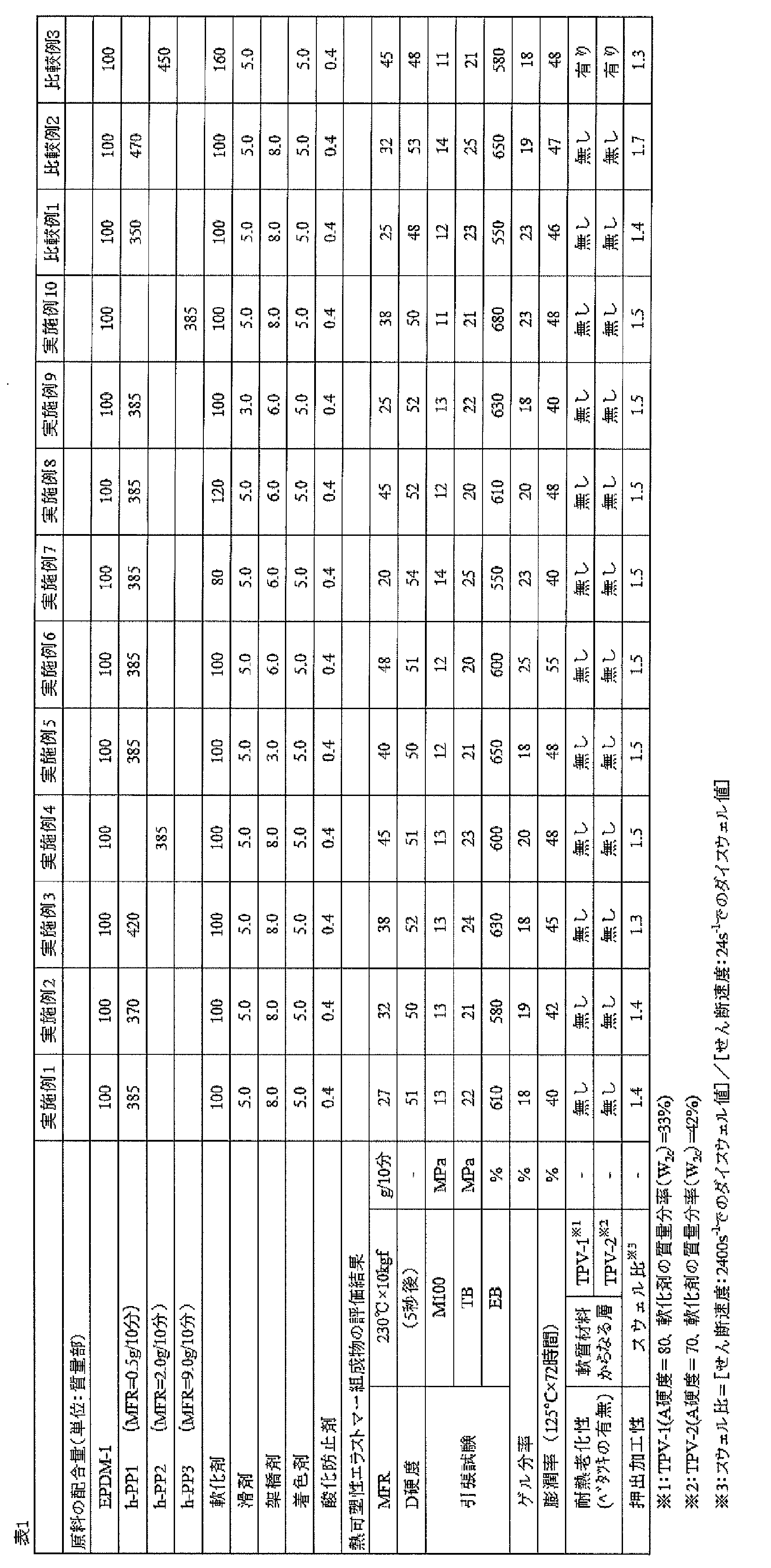
一方、結晶性ポリオレフィン(B)の量が過少である比較例1の熱可塑性エラストマー組成物は、硬度が低かった。
また、結晶性ポリオレフィン(B)の量が過大である比較例2の熱可塑性エラストマー組成物は、押出加工性に劣っていた。
軟化剤(C)の量が過大であり、かつ架橋剤(D)が用いられなかった比較例3の熱可塑性エラストマー組成物は、オイルブリードが発生し、かつ硬度の点で劣っていた。
Claims (16)
- エチレン・α-オレフィン・非共役ポリエン共重合体(A)(ただし、α-オレフィンの炭素数は3~20である。)のフェノール樹脂系架橋剤(E)による架橋体を含み、かつ
結晶性ポリオレフィン(B)を360~460質量部、
軟化剤(C)を70~140質量部、および
滑剤(D)を2~6質量部(ただし、前記共重合体(A)の量を100質量部とする。)含む熱可塑性エラストマー組成物(I)。 - 前記エチレン・α-オレフィン・非共役ポリエン共重合体(A)が、下記要件(a1)を充足する請求項1に記載の熱可塑性エラストマー組成物(I)。
要件(a1):エチレンに由来する構造単位(e)の、α-オレフィンに由来する構造単位(o)に対するモル比[(e)/(o)]が、50/50~85/15である。 - 前記結晶性ポリオレフィン(B)の、示差走査熱量分析により測定される融点が150~170℃である請求項1または2に記載の熱可塑性エラストマー組成物(I)。
- 前記結晶性ポリオレフィン(B)がプロピレン系重合体である請求項1~3のいずれか一項に記載の熱可塑性エラストマー組成物(I)。
- 前記軟化剤(C)がパラフィンオイルである請求項1~4のいずれか一項に記載の熱可塑性エラストマー組成物(I)。
- 前記滑剤(D)がエルカ酸アミドである請求項1~5のいずれか一項に記載の熱可塑性エラストマー組成物(I)。
- 前記エチレン・α-オレフィン・非共役ポリエン共重合体(A)と、前記結晶性ポリオレフィン(B)の少なくとも一部とを、前記フェノール樹脂系架橋剤(E)の存在下にて動的熱処理して得られたものである請求項1~6のいずれか一項に記載の熱可塑性エラストマー組成物(I)。
- 前記フェノール樹脂系架橋剤(E)の量が前記共重合体(A)100質量部に対し2~9質量部である、請求項1~7のいずれか一項に記載の熱可塑性エラストマー組成物(I)。
- 請求項1~8のいずれか一項に記載の熱可塑性エラストマー組成物(I)を含む成形体。
- 請求項1~8のいずれか一項に記載の熱可塑性エラストマー組成物(I)を含む層と軟質材料を含む層とが積層されてなる積層体。
- 前記軟質材料の硬度(A硬度)が65~95である請求項10に記載の積層体。
- 前記軟質材料が熱可塑性エラストマーを含む請求項11に記載の積層体。
- 前記軟質材料が熱可塑性エラストマーを含む熱可塑性エラストマー組成物(II)を含み、前記組成物(II)が軟化剤を含み、前記組成物(II)に占める前記軟化剤の質量分率(W2c)が30~50質量%である請求項12記載の積層体。
- 前記熱可塑性エラストマー組成物(I)に占める前記軟化剤(C)の質量分率(W1c)の、前記熱可塑性エラストマー組成物(II)に占める前記軟化剤の質量分率(W2c)に対する比(W1c/W2c)が0.60以下である、請求項13に記載の積層体。
- 請求項10~14のいずれか一項に記載の積層体を含む物品。
- 窓枠シール、グラスランチャンネルまたは建材用ガスケットである請求項15に記載の物品。
Priority Applications (5)
| Application Number | Priority Date | Filing Date | Title |
|---|---|---|---|
| KR1020217031035A KR102615588B1 (ko) | 2019-03-18 | 2020-03-16 | 열가소성 엘라스토머 조성물 및 그의 성형체 |
| EP20772785.0A EP3943300B1 (en) | 2019-03-18 | 2020-03-16 | Thermoplastic elastomer composition and molded body of same |
| US17/439,727 US20220153972A1 (en) | 2019-03-18 | 2020-03-16 | Thermoplastic elastomer composition and molded article of the same |
| JP2021507344A JP7126604B2 (ja) | 2019-03-18 | 2020-03-16 | 熱可塑性エラストマー組成物およびその成形体 |
| CN202080021963.3A CN113573904B (zh) | 2019-03-18 | 2020-03-16 | 热塑性弹性体组合物及其成型体 |
Applications Claiming Priority (2)
| Application Number | Priority Date | Filing Date | Title |
|---|---|---|---|
| JP2019-049728 | 2019-03-18 | ||
| JP2019049728 | 2019-03-18 |
Publications (1)
| Publication Number | Publication Date |
|---|---|
| WO2020189633A1 true WO2020189633A1 (ja) | 2020-09-24 |
Family
ID=72520127
Family Applications (1)
| Application Number | Title | Priority Date | Filing Date |
|---|---|---|---|
| PCT/JP2020/011501 Ceased WO2020189633A1 (ja) | 2019-03-18 | 2020-03-16 | 熱可塑性エラストマー組成物およびその成形体 |
Country Status (7)
| Country | Link |
|---|---|
| US (1) | US20220153972A1 (ja) |
| EP (1) | EP3943300B1 (ja) |
| JP (1) | JP7126604B2 (ja) |
| KR (1) | KR102615588B1 (ja) |
| CN (1) | CN113573904B (ja) |
| TW (1) | TWI834844B (ja) |
| WO (1) | WO2020189633A1 (ja) |
Cited By (5)
| Publication number | Priority date | Publication date | Assignee | Title |
|---|---|---|---|---|
| KR20230056260A (ko) * | 2021-10-20 | 2023-04-27 | 한국신발피혁연구원 | 내구성과 저장 안정성이 우수한 동적 가교형 열가소성탄성체 조성물 및 이를 이용한 자동차 웨더스트립의 제조방법 |
| KR20240033577A (ko) * | 2022-09-05 | 2024-03-12 | 한국소재융합연구원 | 영구압축줄음율과 내열성이 우수한 동적 가교형 열가소성탄성체 조성물 및 이를 이용한 자동차 웨더스트립의 제조방법 |
| WO2024058210A1 (ja) * | 2022-09-14 | 2024-03-21 | 三井化学株式会社 | 摺動性組成物及びその用途、ならびに摺動性組成物の製造方法 |
| WO2024058181A1 (ja) | 2022-09-13 | 2024-03-21 | 三井化学株式会社 | 熱可塑性エラストマー組成物およびその成形体 |
| WO2026094996A1 (ja) * | 2024-10-31 | 2026-05-07 | 三井化学株式会社 | 熱可塑性エラストマー組成物およびその製造方法 |
Families Citing this family (1)
| Publication number | Priority date | Publication date | Assignee | Title |
|---|---|---|---|---|
| DE112023003108T9 (de) * | 2022-09-29 | 2025-08-21 | The Yokohama Rubber Co., Ltd. | Harzzusammensetzung, verfahren zu deren herstellung und kältemittelbeförderungsschlauch |
Citations (12)
| Publication number | Priority date | Publication date | Assignee | Title |
|---|---|---|---|---|
| US2972600A (en) | 1957-09-27 | 1961-02-21 | Schenectady Varnish Company In | Substituted phenols |
| US3093613A (en) | 1957-06-12 | 1963-06-11 | Exxon Research Engineering Co | Vulcanization of synthetic rubber with polyhalomethyl phenol substances |
| US3287440A (en) | 1961-11-24 | 1966-11-22 | Albert Ag Chem Werke | Process for the cross-linking of unsaturated copolymers and ethylene-propylene terpolymers |
| US3709840A (en) | 1970-10-08 | 1973-01-09 | Vanderbilt Co R T | Curing agent for epoxy resin comprising a cyclic anhydride treated with an amino alcohol |
| US4311628A (en) | 1977-11-09 | 1982-01-19 | Monsanto Company | Thermoplastic elastomeric blends of olefin rubber and polyolefin resin |
| JP2000212351A (ja) * | 1999-01-20 | 2000-08-02 | Yokohama Rubber Co Ltd:The | 熱可塑性エラストマ―組成物および止水シ―ト |
| JP2001138440A (ja) | 1999-09-03 | 2001-05-22 | Mitsui Chemicals Inc | 熱可塑性エラストマー積層体 |
| JP2006265367A (ja) * | 2005-03-24 | 2006-10-05 | C I Kasei Co Ltd | 防水シート |
| JP2011052031A (ja) * | 2009-08-31 | 2011-03-17 | Kinugawa Rubber Ind Co Ltd | 摺動性組成物および摺動製品 |
| JP2013067818A (ja) * | 2013-01-23 | 2013-04-18 | Mitsui Chemicals Inc | 熱可塑性エラストマー組成物 |
| JP2016000485A (ja) | 2014-06-12 | 2016-01-07 | 鬼怒川ゴム工業株式会社 | 多層構造エラストマー成形体およびウェザーストリップ |
| WO2018181121A1 (ja) | 2017-03-27 | 2018-10-04 | 三井化学株式会社 | 熱可塑性エラストマー組成物、並びにその成形体及びその製造方法 |
Family Cites Families (11)
| Publication number | Priority date | Publication date | Assignee | Title |
|---|---|---|---|---|
| JP3583216B2 (ja) | 1995-12-11 | 2004-11-04 | アドバンスド エラストマー システムズ,エル.ピー. | 表皮部材用ポリオレフィン樹脂組成物及びその積層物 |
| US5952425A (en) * | 1996-12-31 | 1999-09-14 | Advanced Elastomer Systems, L.P. | Preferred structure of phenolic resin curative for thermoplastic vulcanizate |
| US5750625A (en) * | 1997-06-09 | 1998-05-12 | Advanced Elastomer Systems, L.P. | Phenolic resin curatives which form nonstaining thermoplastic elastomers |
| AU2002351440A1 (en) * | 2001-12-05 | 2003-06-17 | Dsm Ip Assets B.V. | Thermoplastic elastomer with improved properties |
| KR100632603B1 (ko) * | 2003-08-20 | 2006-10-09 | 에스케이 주식회사 | 열가소성 에라스토머 조성물 및 이의 제조방법 |
| EP2275457B1 (en) * | 2005-05-18 | 2016-11-23 | Mitsui Chemicals, Inc. | Propylene-based polymer composition, and molded products, sheets, films, laminates and non-woven fabrics obtained therefrom |
| US8207270B2 (en) * | 2006-09-29 | 2012-06-26 | Exxonmobil Chemical Patents Inc. | Thermoplastic elastomer compositions, methods of making and articles made from the same |
| JP5550215B2 (ja) * | 2008-07-18 | 2014-07-16 | 三井化学株式会社 | 発泡用熱可塑性エラストマー組成物、その発泡成形体、その複合成形体および自動車用インストゥルメントパネル |
| JP6181465B2 (ja) * | 2013-08-21 | 2017-08-16 | リケンテクノス株式会社 | 複合成形用水発泡熱可塑性エラストマー組成物 |
| CN107428956B (zh) * | 2015-03-20 | 2022-05-17 | 三井化学株式会社 | 热塑性弹性体组合物、其用途、其制造方法、乙烯-α-烯烃-非共轭多烯共聚物及其用途 |
| JP6839597B2 (ja) * | 2017-04-17 | 2021-03-10 | 三井化学株式会社 | 熱可塑性エラストマー組成物、並びにその用途及び製造方法 |
-
2020
- 2020-03-16 JP JP2021507344A patent/JP7126604B2/ja active Active
- 2020-03-16 EP EP20772785.0A patent/EP3943300B1/en active Active
- 2020-03-16 KR KR1020217031035A patent/KR102615588B1/ko active Active
- 2020-03-16 CN CN202080021963.3A patent/CN113573904B/zh active Active
- 2020-03-16 US US17/439,727 patent/US20220153972A1/en active Pending
- 2020-03-16 WO PCT/JP2020/011501 patent/WO2020189633A1/ja not_active Ceased
- 2020-03-17 TW TW109108741A patent/TWI834844B/zh active
Patent Citations (12)
| Publication number | Priority date | Publication date | Assignee | Title |
|---|---|---|---|---|
| US3093613A (en) | 1957-06-12 | 1963-06-11 | Exxon Research Engineering Co | Vulcanization of synthetic rubber with polyhalomethyl phenol substances |
| US2972600A (en) | 1957-09-27 | 1961-02-21 | Schenectady Varnish Company In | Substituted phenols |
| US3287440A (en) | 1961-11-24 | 1966-11-22 | Albert Ag Chem Werke | Process for the cross-linking of unsaturated copolymers and ethylene-propylene terpolymers |
| US3709840A (en) | 1970-10-08 | 1973-01-09 | Vanderbilt Co R T | Curing agent for epoxy resin comprising a cyclic anhydride treated with an amino alcohol |
| US4311628A (en) | 1977-11-09 | 1982-01-19 | Monsanto Company | Thermoplastic elastomeric blends of olefin rubber and polyolefin resin |
| JP2000212351A (ja) * | 1999-01-20 | 2000-08-02 | Yokohama Rubber Co Ltd:The | 熱可塑性エラストマ―組成物および止水シ―ト |
| JP2001138440A (ja) | 1999-09-03 | 2001-05-22 | Mitsui Chemicals Inc | 熱可塑性エラストマー積層体 |
| JP2006265367A (ja) * | 2005-03-24 | 2006-10-05 | C I Kasei Co Ltd | 防水シート |
| JP2011052031A (ja) * | 2009-08-31 | 2011-03-17 | Kinugawa Rubber Ind Co Ltd | 摺動性組成物および摺動製品 |
| JP2013067818A (ja) * | 2013-01-23 | 2013-04-18 | Mitsui Chemicals Inc | 熱可塑性エラストマー組成物 |
| JP2016000485A (ja) | 2014-06-12 | 2016-01-07 | 鬼怒川ゴム工業株式会社 | 多層構造エラストマー成形体およびウェザーストリップ |
| WO2018181121A1 (ja) | 2017-03-27 | 2018-10-04 | 三井化学株式会社 | 熱可塑性エラストマー組成物、並びにその成形体及びその製造方法 |
Non-Patent Citations (1)
| Title |
|---|
| KAGAKU BINRAN, OYO-HEN: "Handbook of Chemistry: Applied Chemistry", 1973, MARUZEN CO., LTD. |
Cited By (10)
| Publication number | Priority date | Publication date | Assignee | Title |
|---|---|---|---|---|
| KR20230056260A (ko) * | 2021-10-20 | 2023-04-27 | 한국신발피혁연구원 | 내구성과 저장 안정성이 우수한 동적 가교형 열가소성탄성체 조성물 및 이를 이용한 자동차 웨더스트립의 제조방법 |
| KR102566123B1 (ko) * | 2021-10-20 | 2023-08-11 | 한국신발피혁연구원 | 내구성과 저장 안정성이 우수한 동적 가교형 열가소성탄성체 조성물 및 이를 이용한 자동차 웨더스트립의 제조방법 |
| KR20240033577A (ko) * | 2022-09-05 | 2024-03-12 | 한국소재융합연구원 | 영구압축줄음율과 내열성이 우수한 동적 가교형 열가소성탄성체 조성물 및 이를 이용한 자동차 웨더스트립의 제조방법 |
| KR102695861B1 (ko) * | 2022-09-05 | 2024-08-16 | 한국소재융합연구원 | 영구압축줄음율과 내열성이 우수한 동적 가교형 열가소성탄성체 조성물 및 이를 이용한 자동차 웨더스트립의 제조방법 |
| WO2024058181A1 (ja) | 2022-09-13 | 2024-03-21 | 三井化学株式会社 | 熱可塑性エラストマー組成物およびその成形体 |
| JPWO2024058181A1 (ja) * | 2022-09-13 | 2024-03-21 | ||
| KR20250033285A (ko) | 2022-09-13 | 2025-03-07 | 미쯔이가가꾸가부시끼가이샤 | 열가소성 엘라스토머 조성물 및 그 성형체 |
| JP7855076B2 (ja) | 2022-09-13 | 2026-05-07 | 三井化学株式会社 | 熱可塑性エラストマー組成物およびその成形体 |
| WO2024058210A1 (ja) * | 2022-09-14 | 2024-03-21 | 三井化学株式会社 | 摺動性組成物及びその用途、ならびに摺動性組成物の製造方法 |
| WO2026094996A1 (ja) * | 2024-10-31 | 2026-05-07 | 三井化学株式会社 | 熱可塑性エラストマー組成物およびその製造方法 |
Also Published As
| Publication number | Publication date |
|---|---|
| EP3943300B1 (en) | 2023-10-18 |
| JPWO2020189633A1 (ja) | 2021-12-23 |
| CN113573904B (zh) | 2023-04-18 |
| EP3943300A1 (en) | 2022-01-26 |
| US20220153972A1 (en) | 2022-05-19 |
| TWI834844B (zh) | 2024-03-11 |
| CN113573904A (zh) | 2021-10-29 |
| EP3943300A4 (en) | 2022-11-23 |
| KR20210135263A (ko) | 2021-11-12 |
| TW202045609A (zh) | 2020-12-16 |
| KR102615588B1 (ko) | 2023-12-19 |
| JP7126604B2 (ja) | 2022-08-26 |
Similar Documents
| Publication | Publication Date | Title |
|---|---|---|
| KR102615588B1 (ko) | 열가소성 엘라스토머 조성물 및 그의 성형체 | |
| JP7293261B2 (ja) | 熱可塑性エラストマー組成物及びその用途 | |
| JP7083957B2 (ja) | オレフィン系重合体組成物及びその成形体 | |
| CN110461933B (zh) | 成型外观优异的热塑性弹性体组合物及其成型体 | |
| JP6839597B2 (ja) | 熱可塑性エラストマー組成物、並びにその用途及び製造方法 | |
| JP6512054B2 (ja) | 樹脂組成物の製造方法 | |
| JP7088679B2 (ja) | 熱可塑性エラストマー組成物 | |
| JP7855076B2 (ja) | 熱可塑性エラストマー組成物およびその成形体 | |
| JP7849181B2 (ja) | 動的架橋型熱可塑性エラストマー及びその製造方法並びに成形体 | |
| JPH0812719A (ja) | 射出成形用熱可塑性エラストマー組成物 | |
| JP7847656B2 (ja) | 摺動性組成物及びその用途、ならびに摺動性組成物の製造方法 | |
| JP7061034B2 (ja) | 重合体組成物及び重合体組成物からなる成形体 | |
| JP2019098677A (ja) | 共押出発泡成形に適した熱可塑性エラストマー組成物を用いた積層体及びシール材 | |
| JP2022068980A (ja) | 重合体組成物からなる成形体 | |
| JP2024093241A (ja) | 熱可塑性エラストマー組成物およびその成形体 | |
| JP2018154681A (ja) | 熱可塑性エラストマー組成物 | |
| JP2020007460A (ja) | 重合体組成物及び重合体組成物からなる成形体 | |
| JP2023146519A (ja) | 熱可塑性エラストマー組成物およびその用途 | |
| JP2024041456A (ja) | 熱可塑性エラストマー組成物およびその用途 |
Legal Events
| Date | Code | Title | Description |
|---|---|---|---|
| 121 | Ep: the epo has been informed by wipo that ep was designated in this application |
Ref document number: 20772785 Country of ref document: EP Kind code of ref document: A1 |
|
| ENP | Entry into the national phase |
Ref document number: 2021507344 Country of ref document: JP Kind code of ref document: A |
|
| NENP | Non-entry into the national phase |
Ref country code: DE |
|
| ENP | Entry into the national phase |
Ref document number: 20217031035 Country of ref document: KR Kind code of ref document: A |
|
| ENP | Entry into the national phase |
Ref document number: 2020772785 Country of ref document: EP Effective date: 20211018 |