WO2020138314A1 - ウニの冷凍保管時劣化抑制剤 - Google Patents
ウニの冷凍保管時劣化抑制剤 Download PDFInfo
- Publication number
- WO2020138314A1 WO2020138314A1 PCT/JP2019/051183 JP2019051183W WO2020138314A1 WO 2020138314 A1 WO2020138314 A1 WO 2020138314A1 JP 2019051183 W JP2019051183 W JP 2019051183W WO 2020138314 A1 WO2020138314 A1 WO 2020138314A1
- Authority
- WO
- WIPO (PCT)
- Prior art keywords
- sea urchin
- extract
- frozen
- aqueous solution
- raw
- Prior art date
- Legal status (The legal status is an assumption and is not a legal conclusion. Google has not performed a legal analysis and makes no representation as to the accuracy of the status listed.)
- Ceased
Links
Images

Classifications
-
- A—HUMAN NECESSITIES
- A23—FOODS OR FOODSTUFFS; TREATMENT THEREOF, NOT COVERED BY OTHER CLASSES
- A23B—PRESERVATION OF FOODS, FOODSTUFFS OR NON-ALCOHOLIC BEVERAGES; CHEMICAL RIPENING OF FRUIT OR VEGETABLES
- A23B2/00—Preservation of foods or foodstuffs, in general
- A23B2/80—Freezing; Subsequent thawing; Cooling
- A23B2/85—Freezing; Subsequent thawing; Cooling with addition of or treatment with chemicals
-
- A—HUMAN NECESSITIES
- A23—FOODS OR FOODSTUFFS; TREATMENT THEREOF, NOT COVERED BY OTHER CLASSES
- A23L—FOODS, FOODSTUFFS OR NON-ALCOHOLIC BEVERAGES, NOT OTHERWISE PROVIDED FOR; PREPARATION OR TREATMENT THEREOF
- A23L17/00—Food-from-the-sea products; Fish products; Fish meal; Fish-egg substitutes; Preparation or treatment thereof
Definitions
- the present invention relates to a deterioration inhibiting agent for sea urchin during frozen storage, an aqueous solution for dipping treatment of active sea urchin, and a method for producing sea urchin or frozen sea urchin using the aqueous solution.
- Sea urchin has a unique flavor and is a popular ingredient among seafood. There are processed sea urchin, salted sea urchin, steamed sea urchin, etc., but raw sea urchin eaten with sushi seeds and sashimi is the most preferred. However, the quality of raw sea urchin deteriorates particularly quickly among marine products whose quality is difficult to maintain, and freshness can only be maintained for about a few days even after storage at low temperature. For this reason, the range of safe, fresh fresh sea urchins that can be transported is limited.
- Patent Document 1 describes that by immersing raw sea urchin in a liquid preparation prepared by dissolving chitosan in an aqueous solution of organic acid, the flavor of raw sea urchin is not impaired and the body can be prevented from crumbing for a long time.
- this technique uses an organic acid, there is a drawback that the sour taste derived from the organic acid is transferred to the raw sea urchin and the original flavor of the sea urchin is impaired.
- the literature only evaluates the flavor and crumbs of raw sea urchin after storage refrigerated at 5° C., and does not mention the flavor or crumbles after freezing and thawing.
- the skin of fresh sea urchins is heat-treated and coagulated (blanching treatment) before freezing to prevent the destruction of epidermal tissue during thawing.
- the method to do is implemented.
- the blanching-treated frozen raw sea urchin does not have sufficient shape-retaining property after thawing and cannot sufficiently prevent crumble. If the heating time by blanching treatment is increased or the heating temperature is increased to prevent body crumble more, the rich flavor and smooth texture of sea urchin originally deteriorated are significantly deteriorated compared to raw sea urchin before blanching treatment. I will end up.
- the purpose of the present invention is to provide a sea urchin deterioration-inhibiting agent during frozen storage, which is used to provide sea urchin in which gelatinization due to deterioration of the original rich flavor of sea urchin after freezing and thawing and crushing of sea urchin is suppressed. It is an object of the present invention to provide an aqueous solution for soaking treatment of live sea urchin, and a method for producing sea urchin or frozen sea urchin using the aqueous solution.
- an object of one embodiment of the present invention is due to freezing and thawing of raw sea urchin after blanching treatment, a decrease in the rich flavor and smooth texture of sea urchin original, and collapse of the body.
- a blanching pretreatment agent for frozen raw sea urchin used to provide raw sea urchin with suppressed gelatinization, an aqueous solution for dipping treatment of active sea urchin to be subjected to blanching treatment, and raw sea urchin using the aqueous solution Alternatively, it is to provide a method for producing frozen raw sea urchin.
- the inventors of the present invention kept the active sea urchin for a specific time by immersing it in an aqueous solution of a specific sodium chloride concentration containing a specific amount of a specific extract. It is possible to suppress the deterioration of the flavor and the gelatinization that may occur after freezing and thawing, and to suppress the deterioration of the flavor and texture that may occur when the fresh sea urchin is subjected to the blanching treatment and the freezing and thawing and the gelatinization. Heading out, the present invention has been completed.
- the first aspect of the present invention relates to a sea urchin deterioration inhibitor during frozen storage, which contains at least one extract selected from the group consisting of enokitake mushroom extract, yeast extract and barley extract.
- the sea urchin deterioration inhibitor during frozen storage preferably contains the extract in a dry weight of 50 to 100% by weight based on the total dry weight of the sea urchin frozen storage deterioration inhibitor.
- the sea urchin deterioration inhibitor during frozen storage is a blanching pretreatment agent for frozen raw sea urchin.
- the second aspect of the present invention is that it contains at least one extract selected from the group consisting of enokitake mushroom extract, yeast extract and barley extract in a solid content of 0.1 to 800 ppm and a sodium chloride concentration of 2 to 3. It relates to an aqueous solution for dipping treatment of active sea urchin before frozen storage, which is 5% by weight.
- the aqueous solution for dipping treatment of the active sea urchin may use the deterioration inhibitor for storage of the sea urchin during frozen storage.
- the aqueous solution for immersion treatment of the active sea urchin before frozen storage is an aqueous solution for immersion treatment of active sea urchin to be subjected to blanching treatment, and the aqueous solution is deteriorated during freezing storage of the sea urchin.
- An inhibitor may be used.
- the third aspect of the present invention relates to a live sea urchin immersed in the aqueous solution having a temperature in the range of 1 to 25° C. for 10 to 15000 minutes in a state where oxygen is supplied. It also relates to frozen raw sea urchin in which the active sea urchin is frozen, and to raw sea urchin in which the frozen raw sea urchin is thawed.
- the live sea urchin also relates to a frozen cooked sea urchin frozen after shelling and cooking, and to a cooked sea urchin in which the frozen sea urchin is thawed.
- the shell of the live sea urchin that has been immersed for 10 to 15000 minutes in the state of being supplied with oxygen in the aqueous solution whose temperature is in the range of 1 to 25° C. is peeled off and subjected to a blanching treatment.
- Fresh sea urchin, frozen raw sea urchin in which the raw sea urchin is frozen, or raw sea urchin in which the frozen raw sea urchin is thawed is provided.
- a fourth aspect of the present invention is to contain at least one extract selected from the group consisting of enokitake mushroom extract, yeast extract and barley extract in a solid content of 0.1 to 800 ppm and a sodium chloride concentration of 2 to 3.
- Process for producing frozen raw sea urchins characterized by immersing live sea urchins in an aqueous solution containing 5% by weight and a temperature in the range of 1 to 25° C. for 10 to 15000 minutes in a state where oxygen is supplied, and then freezing.
- the present invention also relates to a method for producing a frozen and cooked sea urchin, which comprises immersing live sea urchin in the same manner as described above, followed by shelling and cooking, followed by freezing.
- At least one extract selected from the group consisting of enokitake mushroom extract, yeast extract and barley extract is contained in a solid content of 0.1 to 800 ppm, and the sodium chloride concentration is 2 ⁇ 3.5% by weight
- the active sea urchin is soaked in an aqueous solution with a temperature in the range of 1 ⁇ 25°C for 10 ⁇ 15000 minutes in a state where oxygen is supplied.
- a method for producing frozen raw sea urchin is provided.
- a sea urchin deterioration inhibitor during frozen storage which is used to provide sea urchins in which the original rich flavor of sea urchin after freezing and thawing is suppressed and gelatinization due to body collapse is suppressed. It is possible to provide an aqueous solution for immersion treatment of live sea urchin, and a method for producing sea urchin or frozen sea urchin using the aqueous solution. According to the present invention, even if the sea urchin is frozen and thawed, it is possible to suppress the deterioration of the rich flavor inherent in the sea urchin and the gelatinization due to the collapse of the body, and to prevent so-called freezing damage.
- the inhibitor for deterioration during freezing storage and the aqueous solution for immersion treatment of the present invention do not need to contain a component having an off taste such as an organic acid, it is possible to prevent the off taste from these from adhering to sea urchin. Furthermore, since the deterioration suppressor for frozen storage and the aqueous solution for immersion treatment of the present invention do not necessarily require materials for which labeling of food additives is required, labeling of food additives can be avoided.
- the original rich flavor of the sea urchin is reduced and gelatinization due to body collapse is suppressed, so that the original rich flavor and appearance of the sea urchin were maintained.
- the area where sea urchins can be transported can be expanded.
- the sea urchin frozen storage deterioration inhibitor of the present invention is for suppressing the rich flavor deterioration of the sea urchin originally caused by freezing and thawing of sea urchin and suppressing gelatinization due to crushing of the sea urchin, and contains a specific extract.
- the sea urchin frozen storage deterioration inhibitor of the present invention is used by being mixed with salt water, and before freezing the sea urchin, the active sea urchin is immersed in salt water containing the sea urchin frozen storage deterioration inhibitor of the present invention. By doing so, the object of the present invention can be achieved.
- the blanching pretreatment agent for frozen raw sea urchin according to the particular aspect of the present invention which can be caused by freezing and thawing of raw sea urchin after blanching treatment, has a rich rich flavor and smooth texture reduction inherent in sea urchin, and body. It is intended to prevent gelatinization due to collapse and contains a specific extract.
- the blanching pretreatment agent for frozen raw sea urchin according to a specific embodiment of the present invention is used by being mixed with salt water, and contains the blanching pretreatment agent for frozen raw sea urchin before blanching treatment of raw sea urchin.
- the purpose of the specific embodiment of the present invention can be achieved by immersing live sea urchin in salt water.
- the extract used in the sea urchin deterioration inhibitor during frozen storage of the present invention (including a blanching pretreatment agent for frozen raw sea urchin according to a specific embodiment, the same applies hereinafter) is composed of an enokitake extract, a yeast extract and a barley extract. It is at least one extract selected from the group.
- the enokitake mushroom extract is not particularly limited, for example, an extract obtained by extracting fruit bodies of enokitake mushrooms with an extraction solvent such as hot water and/or alcohol, heat after decomposing the fruit bodies of enokitake mushrooms with an enzyme or an alkaline solvent.
- the extract include extracts extracted with an extraction solvent such as water or alcohol, concentrated solutions obtained by concentrating these extracts, and powders obtained by drying the extracts or the concentrated solutions. From the perspective of consumers' safety and security, these extracts are preferably extracts using no solvent other than water or naturally occurring ethanol. However, considering cost, water is more preferable.
- a suitable temperature range may vary depending on the type of the extraction solvent, but in general, the boiling point (° C.) of the extraction solvent at atmospheric pressure ⁇ 20° C. to the extraction solvent at the atmospheric pressure Boiling point (° C.) is preferred.
- the temperature of the extraction solvent at the time of extraction is lower than the boiling point (° C.) ⁇ 20° C.
- an effect of suppressing the rich flavor of sea urchin's original richness and suppressing gelatinization due to body collapse may be further weakened, and when the temperature is higher than the boiling point (° C.) under atmospheric pressure, a special pressurizing facility is required, and thus the extraction method is It can be complicated.
- the above-mentioned Enoki mushroom refers to a species of Flammulina verutipes, which is a kind of mushroom in the family Tamabariaceae. Although not particularly limited, artificially cultivated white and bean sprouts-like commercially available enoki mushrooms can be used. Such commercially available Enoki mushrooms are generally edible and easily available.
- the yeast extract is not particularly limited, for example, an extract obtained by extracting yeast with an extraction solvent such as hot water or alcohol, with an extraction solvent such as hot water or alcohol after decomposing the yeast with an enzyme or an alkaline solvent.
- examples include extracted extracts, concentrated solutions obtained by concentrating these extracts, powders obtained by drying the extract or concentrated solutions, and the like. From the perspective of consumers' safety and security, these extracts are preferably extracts using no solvent other than water or naturally occurring ethanol. However, considering cost, water is more preferable.
- a suitable temperature range may vary depending on the type of the extraction solvent, but in general, the boiling point (° C.) of the extraction solvent at atmospheric pressure ⁇ 20° C. to the extraction solvent at the atmospheric pressure Boiling point (° C.) is preferred.
- the temperature of the extraction solvent at the time of extraction is lower than the boiling point (° C.) ⁇ 20° C.
- an effect of suppressing the rich flavor of sea urchin's original richness and suppressing gelatinization due to body collapse may be further weakened, and when the temperature is higher than the boiling point (° C.) under atmospheric pressure, a special pressurizing facility is required, and thus the extraction method is It can be complicated.
- the yeast is a microorganism that assimilates sugar to produce alcohol when fermenting in an anaerobic environment.
- Specific examples include yeasts belonging to the genus Saccharomyces, yeasts belonging to the genus Candida, etc., but are not particularly limited. From the viewpoint of abundant food experience, the yeast may be Saccharomyces cerevisiae, and from the viewpoint of many findings in research, the yeast is Candida utilis. May be.
- the barley extract is not particularly limited, for example, an extract obtained by extracting barley with an extraction solvent such as hot water or alcohol, with an extraction solvent such as hot water or alcohol after decomposing barley with an enzyme or an alkaline solvent.
- Examples include extracted extracts, concentrated solutions obtained by concentrating these extracts, powders obtained by drying the extract or concentrated solutions, and the like. From the perspective of consumers' safety and security, these extracts are preferably extracts using no solvent other than water or naturally occurring ethanol. However, considering cost, water is more preferable.
- a suitable temperature range may vary depending on the type of the extraction solvent, but in general, the boiling point (° C.) of the extraction solvent at atmospheric pressure ⁇ 20° C. to the extraction solvent at the atmospheric pressure Boiling point (° C.) is preferred.
- the temperature of the extraction solvent at the time of extraction is lower than the boiling point (° C.) ⁇ 20° C.
- an effect of suppressing the rich flavor of sea urchin's original richness and suppressing gelatinization due to body collapse may be further weakened, and when the temperature is higher than the boiling point (° C.) under atmospheric pressure, a special pressurizing facility is required, and thus the extraction method is It can be complicated.
- the barley is a plant of the Gramineae family native to Central Asia, and the scientific name is Hordeum vulgare. It is classified into two-row barley and six-row barley, barley and bare barley, and glutinous and glutinous species.
- the sea urchin frozen storage deterioration inhibitor of the present invention comprises at least one extract selected from the group consisting of enokitake extract, yeast extract and barley extract, and the dry weight thereof relative to the total dry weight of the deterioration inhibitor. It is preferable that the content is 50 to 100% by weight. It is more preferably 70 to 100% by weight, and even more preferably 90 to 100% by weight. When the amount is less than 50% by weight, the effect of suppressing the deep flavor of the sea urchin itself and the gelatinization due to crushing of the sea urchin (in a particular embodiment, the effect of further suppressing the deterioration of smooth texture) may not be exhibited. is there.
- the solid content other than the extract that can be contained in the deterioration suppressing agent is not particularly limited, and any solid content derived from nature may be contained, and examples thereof include dextrin, starch, lactose and the like.
- the shape of the sea urchin deterioration inhibitor during frozen storage of the present invention is not particularly limited, and may be liquid such as an aqueous solution, or solid such as powder, granule, or block. ..
- the frozen storage deterioration inhibitor of sea urchin of the present invention can be used for preparing an aqueous solution for immersion treatment of the active sea urchin of the present invention described below by adding this to fresh water, sea water, or salt water. it can.
- the aqueous solution for soaking treatment of live sea urchin of the present invention contains the above extract. It is used by immersing live sea urchin in the aqueous solution, and after this use, the live sea urchin is taken out of the aqueous solution, shelled or cooked if necessary, and then stored frozen and then thawed. It is possible to suppress the rich flavor deterioration and the gelatinization due to body collapse. Further, an aqueous solution for dipping treatment of live sea urchin to be subjected to blanching treatment according to a particular embodiment of the present invention also contains the extract, and is used by immersing live sea urchin in the aqueous solution.
- the aqueous solution for dipping treatment of live sea urchin of the present invention may contain the extract in a solid content of 0.1 to 800 ppm. preferable.
- the content is more preferably 1 to 700 ppm, further preferably 6 to 600 ppm, particularly preferably 30 to 600 ppm. If it is less than 0.1 ppm, the effect of suppressing the deep flavor of the sea urchin itself and the gelatinization due to crushing of the sea urchin (in a particular aspect, the effect of further suppressing the deterioration of smooth texture) may not be exhibited. .. If it exceeds 800 ppm, the pigment component derived from the extract may adhere to the sea urchin, or the original rich flavor of the sea urchin (in the specific embodiment, smooth texture) may be impaired.
- the concentration of sodium chloride in the aqueous solution for immersing the live sea urchin of the present invention is preferably 2 to 3.5% by weight, more preferably 2.3 to 3.5% by weight, further preferably 2.3 to 3.2% by weight. Preferably, 2.5 to 3% by weight is particularly preferable.
- the sodium chloride concentration is less than 2% by weight or more than 3.5% by weight, sea urchins cannot grow in the aqueous solution, but rather the sea urchin's original rich flavor (in a specific embodiment, smooth texture) is impaired. May be
- the aqueous solution for dipping treatment of live sea urchin of the present invention may contain salts other than sodium chloride as long as the above sodium chloride concentration is satisfied. However, it is preferable that the content of salts other than sodium chloride is limited to 1/3 of the weight of sodium chloride.
- the type of salt other than sodium chloride is not particularly limited as long as it can be used as a food additive.
- the aqueous solution for immersion treatment may be one produced by adding salt to fresh water as long as the sodium chloride concentration is satisfied, seawater is used, or the sodium chloride concentration of seawater is adjusted. It may be manufactured by using one.
- the sea urchin in which the original rich flavor reduction and gelatinization due to body collapse were suppressed can be manufactured.
- An example of the embodiment of the manufacturing is as follows. After sterilizing the aqueous solution as necessary, the temperature of the aqueous solution is preferably set in the range of 1 to 25° C., the active sea urchin is immersed while supplying oxygen to the aqueous solution, and preferably held for 10 to 15000 minutes. To do.
- sea urchin After that, by removing the active sea urchin from the aqueous solution, even if the sea urchin is frozen and thawed without being cooked after that, the raw rich taste of the sea urchin is reduced and the gelatinization due to body collapse is suppressed. You can get sea urchin.
- the sea urchin that has not been cooked may be shelled or not shelled before freezing.
- the cooked food even if the sea urchin is removed from the aqueous solution, and then shelled and cooked, and then frozen and thawed, the cooked food has suppressed the rich flavor of the sea urchin and the gelatinization due to crumble. You can get sea urchin.
- the rich flavor and smoothness of the sea urchin original it is possible to produce a sea urchin in which the deterioration of the texture is suppressed and the gelatinization due to the body collapse is suppressed.
- An example of the embodiment of the manufacturing is as follows.
- the temperature of the aqueous solution is preferably set in the range of 1 to 25° C.
- the active sea urchin is immersed while supplying oxygen to the aqueous solution, and preferably held for 10 to 15000 minutes. To do.
- the rich flavor and smooth texture of the sea urchin are reduced, and It is possible to obtain sea urchins in which gelatinization due to body collapse is suppressed.
- the sterilization method of the aqueous solution is not particularly limited, and for example, sterilization by ultraviolet irradiation, ozone sterilization, chlorine sterilization, etc. may be performed.
- the temperature of the aqueous solution is preferably controlled in the range of 1 to 25°C, more preferably 1 to 20°C, further preferably 3 to 17°C, particularly preferably 5 to 15°C.
- the temperature is lower than 1° C. or higher than 25° C., the activity of the active sea urchin in the aqueous solution is reduced, and the effect of suppressing the rich flavor of the sea urchin's original flavor and suppressing gelatinization due to body collapse (in a specific embodiment) In addition, it may not be possible to exert the effect of suppressing smooth texture deterioration).
- the method of supplying oxygen to the aqueous solution may be any method as long as the dissolved oxygen concentration necessary for sea urchin growth can be secured.
- the immersion time for holding the live sea urchin in the aqueous solution is preferably 10 to 15000 minutes, more preferably 10 to 9000 minutes, further preferably 50 to 7200 minutes, particularly preferably 100 to 3000 minutes, and particularly preferably 150 to 2000 minutes. preferable. If the soaking time is shorter than 10 minutes, the soaking time will be insufficient, and the effect of suppressing the rich flavor of sea urchin's original taste and the gelatinization due to body crumbs (in a specific mode, further suppressing the deterioration of smooth texture). It may not be possible to exert the effect. If it is longer than 15,000 minutes, the rich flavor of the sea urchin (in the specific embodiment, smooth texture) may be impaired.
- the dipping treatment of the live sea urchin in the aqueous solution for dipping treatment of the live sea urchin of the present invention described above may be performed in a static water tank or may be performed while transporting the whole water tank. Even when the dipping treatment is carried out during transportation, according to the method of the present invention, it is not necessary to perform strict temperature control if the temperature of the aqueous solution is within the above-mentioned range, so that conventional seafood can be used. The transportation cost can be suppressed as compared with the method of transporting as it is.
- the frozen raw sea urchin obtained according to the method for producing frozen raw sea urchin of the present invention is prepared by immersing the active sea urchin in the aqueous solution for a specific time as described above, then landing and then peeling the shell, or refrigerating the shell with the shell. Even if it is thawed after being stored for about a week to 24 months, gelatinization due to crushing of the body is suppressed, and the sea urchin's original rich flavor is retained.
- the frozen cooked sea urchin obtained according to the method for producing a frozen cooked sea urchin of the present invention after immersing the active sea urchin in the aqueous solution for a specific time as described above, after landing and shelling and cooking, Even if it is frozen and stored for 1 week to 24 months and then thawed, gelatinization due to crumbs is suppressed, and the original rich flavor of sea urchin is retained.
- the specific heating method is not particularly limited and may be a known method. For example, a method of immersing in hot water, steaming, or rubbing may be mentioned.
- the blanching treatment is a treatment in which the raw sea urchin is heated for a short period of time to coagulate only the epidermis of the sea urchin while maintaining the raw state inside the sea urchin.
- the blanching treatment may be a known treatment and is not particularly limited, and examples thereof include a method of immersing raw sea urchin in heated water, steaming, and rubbing. It is preferable that the raw sea urchin after the blanching treatment is cooled immediately.
- the heating time and the heating temperature during the blanching treatment are not particularly limited as long as they are conditions that satisfy the purpose of coagulating only the epidermis of the sea urchin while maintaining the raw state of the inside of the sea urchin.
- the heating temperature can be appropriately set within the range of 60° C. or higher and 130° C. or lower. More specifically, it is preferable to select the heating time and heating temperature within the range shown in FIG.
- FIG. 1 is a graph showing the relationship between suitable heating time and heating temperature under blanching conditions. Areas surrounded by broken lines in FIG. 1 are (1 second, 130° C.), (1 second, 80° C.), (5 seconds, 60° C.), (30 seconds, 60° C.), (7 seconds, 130° C.).
- the preferable heating time is 1 to about 16 seconds. More preferable heating time is 1 to 10 seconds, more preferably 1 to 5 seconds, and even more preferably 1 to 3 seconds.
- the raw sea urchin obtained according to the method for producing raw sea urchin according to the specific embodiment of the present invention has a suppressed gelatinization due to crushing even if it is thawed after storing for 1 week to 24 months in freezing after the blanching. It retains the rich flavor and smooth texture of the sea urchin.
- the type of sea urchin to which the present invention is applicable is not particularly limited as long as it is a sea urchin capable of peeling the shell and eating the gonad of the sea urchin.
- Specific examples thereof include sea urchin, sea urchin sea urchin, sea urchin sea urchin, sea urchin sea urchin, sea urchin sea urchin, sea urchin sea urchin, sea urchin sea urchin, sea urchin sea urchin, sea urchin sea urchin, sea urchin sea urchin, sea urchin sea urchin, sea urchin sea urchin, sea urchin sea urchin, sea urchin sea urchin, and the like.
- C The evaluation of the rich flavor and the evaluation of the gelatinization due to the collapse of the body are all 3.0 or more and 5.0 or less, and at least one of 3.0 or more and less than 4.0.
- D The evaluation of the rich flavor and the evaluation of the gelatinization due to the collapse of the body were all 2.0 or more and 5.0 or less, and at least one of 2.0 or more and less than 3.0.
- E At least one of less than 2.0 in the evaluation of rich flavor and the evaluation of gelatinization due to body collapse.
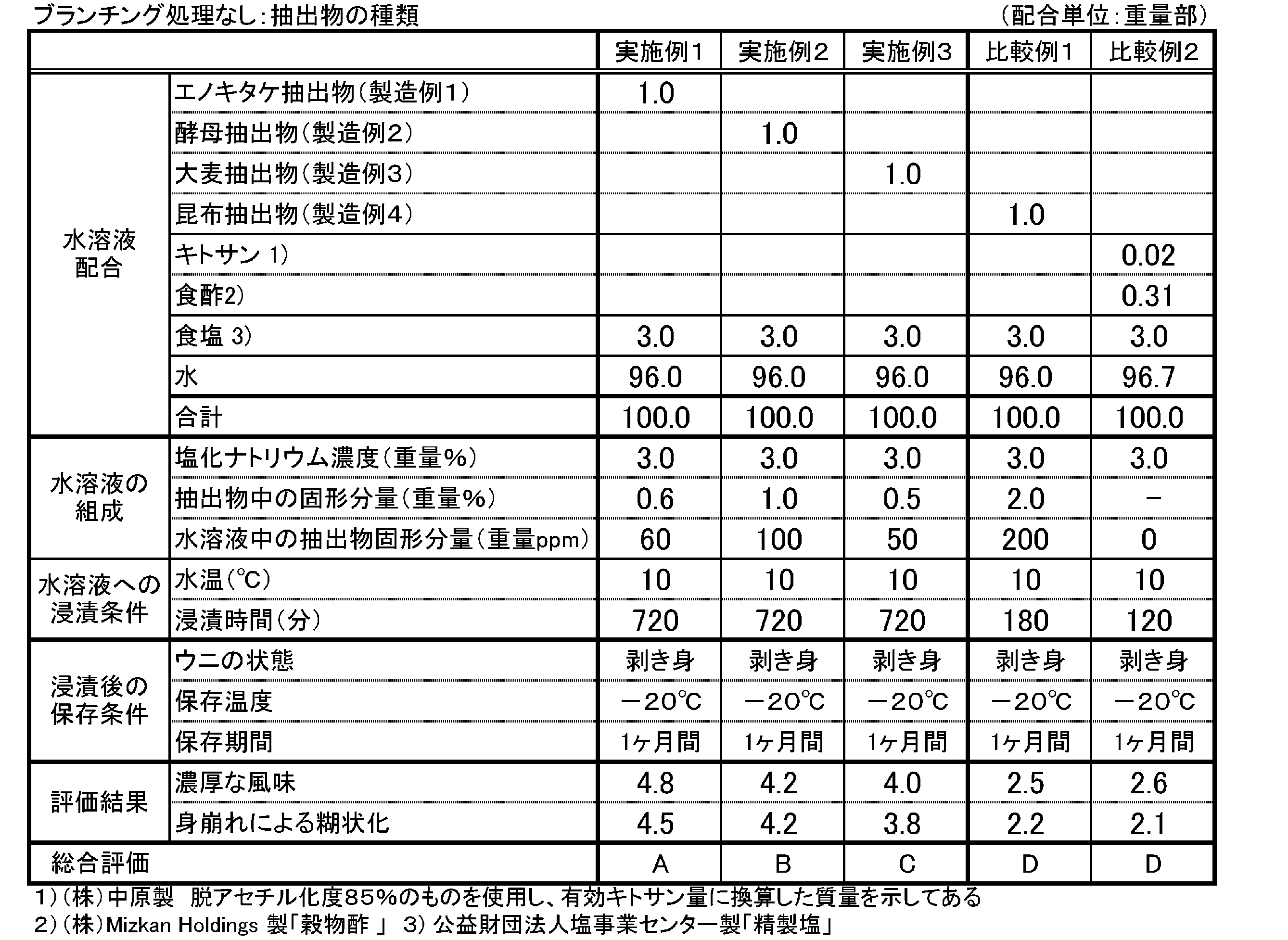
- Example 1 According to the formulation of Table 1, 200 liters of an aqueous solution containing 1% by weight of the Enokitake mushroom extract obtained in Production Example 1 and 3% by weight of salt was filled in a water tank, and the water temperature was controlled at 10°C. Ten live sea urchins were immersed in the water tank, kept for 720 minutes while supplying oxygen, and then landed. After landing, the shells of the live sea urchins were quickly peeled off, the meat was taken out, washed with 3% saline, packaged, and frozen at -20°C. After frozen storage at that temperature for 1 month, the frozen raw sea urchin was taken out from the freezer and left at 0° C. for 6 hours to thaw. The resulting raw sea urchin was evaluated for its rich flavor and gelatinization due to crushing. The results are shown in Table 1.
- Example 2 Raw sea urchin was obtained in the same manner as in Example 1 except that the yeast extract obtained in Production Example 2 was added instead of the Enokitake mushroom extract according to the formulation in Table 1. The resulting raw sea urchin was evaluated for its rich flavor and gelatinization due to crushing. The results are shown in Table 1.
- Example 3 Raw sea urchin was obtained in the same manner as in Example 1 except that the barley extract obtained in Production Example 3 was used instead of the Enoki mushroom extract according to the formulation shown in Table 1. The resulting raw sea urchin was evaluated for its rich flavor and gelatinization due to crushing. The results are shown in Table 1.
- Comparative example 2 This comparative example is based on the formulation of the immersion liquid described in Example 1 of Patent Document 1 (JP 2008-307039 A).
- Raw sea urchin was obtained in the same manner as in Example 1 except that chitosan and vinegar were blended according to the formulation of Table 1 without blending the enokitake extract.
- the resulting raw sea urchin was evaluated for its rich flavor and gelatinization due to crushing. The results are shown in Table 1.
- enokitake extract (Production Example 1), yeast having a viscosity of 0.5% (W/W) solid content of the extract at 20° C. in the range of 3 to 50 mPa ⁇ s, yeast Raw sea urchins (Examples 1 to 3) obtained by immersing in extract (Production Example 2) or a saline solution containing barley extract (Production Example 3) and thawing by cooling were all the original sea urchin contents. The rich flavor was strongly felt and it was not gelatinized.
- the taste and degree of gelatinization of the raw sea urchin (Example 1) obtained by immersing in a saline solution containing an enokitake extract and thawing with cold were extremely good evaluations.
- the resulting raw sea urchin (Comparative Example 1) was difficult to sense the rich flavor of the sea urchin, and was crumbled and more than half was gelatinized.
- raw sea urchin (Comparative Example 2) obtained by immersing in cold saline solution containing chitosan and vinegar and cooling and thawing was difficult to feel the rich flavor of sea urchin, and more than half of the sea urchin was gelatinized. Was there.
- Example 4 Comparative Example 3
- the amount of the enokitake extract compounded is from 1.0 wt% to 0.1 wt% (Example 4), 10.0 wt% (Example 5), or 15.0 wt% ( Raw sea urchin was obtained in the same manner as in Example 1 except that Comparative Example 3) was used. The resulting raw sea urchin was evaluated for its rich flavor and gelatinization due to crushing. The results are shown in Table 2.
- Example 4 Raw sea urchin was obtained in the same manner as in Example 1 except that an aqueous solution prepared according to the formulation of Table 2 and not containing the enokitake mushroom extract was used. The resulting raw sea urchin was evaluated for its rich flavor and gelatinization due to crushing. The results are shown in Table 2.
- raw sea urchin obtained by immersing in a saline solution having a solid content of the enokitake mushroom extract of 900 ppm and thawing by cooling was difficult to sense the rich flavor of the sea urchin.
- raw sea urchin obtained by immersing in salt solution containing no enokitake extract and cooling and thawing, the rich flavor unique to sea urchin was hardly sensed, and the sea urchin crumbled completely and completely. It was gelatinized.
- Example 6 Raw sea urchin was obtained in the same manner as in Example 1 except that the type of aqueous solution containing salt was changed from saline to seawater according to the conditions in Table 3. The resulting raw sea urchin was evaluated for its rich flavor and gelatinization due to crushing. The results are shown in Table 3.
- Comparative example 5 This comparative example is based on the quality improving agent for shellfish described in Example 1-1 of JP2010-154799A. According to the formulation of Table 3, except that the type of salt to be added to the aqueous solution was changed from sodium chloride to sodium lactate and sodium hydrogen carbonate, the active sea urchin was immersed and held in the same manner as in Example 1, and then the landed product was frozen and stored. Without doing so, the rich flavor and the gelatinization due to crushing of the body were evaluated. The results are shown in Table 3.
- Example 7 Raw sea urchin was obtained in the same manner as in Example 1 except that the water temperature of the aqueous solution was changed from 10°C to 5°C (Example 7) or 20°C (Example 8) according to the conditions in Table 4. .. The resulting raw sea urchin was evaluated for its rich flavor and gelatinization due to crushing. The results are shown in Table 4.
- Examples 9-11, Comparative Examples 6 and 7 According to the conditions in Table 5, the immersion time of the sea urchin in the aqueous solution was changed from 720 minutes to 15 minutes (Example 9), 3000 minutes (Example 10), 14400 minutes (Example 11), 5 minutes (Comparative Example 6), Alternatively, raw sea urchin was obtained in the same manner as in Example 1 except that the time was changed to 17280 minutes (Comparative Example 7). The resulting raw sea urchin was evaluated for its rich flavor and gelatinization due to crushing. The results are shown in Table 5.
- Example 12 Raw sea urchins were obtained in the same manner as in Example 1 except that the frozen storage period was changed from 1 month to 6 months (Example 12) or 0 hour (Example 13) according to the conditions in Table 6. It was The resulting raw sea urchin was evaluated for its rich flavor and gelatinization due to crushing. The results are shown in Table 6.
- raw sea urchin obtained by freezing and storing for 6 months and thawing hardly felt the rich flavor of the sea urchin, and was extremely crumbled and completely gelatinized.
- Example 14 According to the conditions in Table 6, the live sea urchin was immersed in a water tank in the same manner as in Example 1, and after landing, the step of peeling the shell was omitted, and the cold thawing in the bare meat of Example 1 was performed with the shell still attached.
- Raw sea urchin was obtained in the same manner as in Example 1 except that the above procedure was changed to cold thawing.
- the resulting raw sea urchin was evaluated for its rich flavor and gelatinization due to crushing. The results are shown in Table 6.
- C Evaluation of rich flavor, evaluation of smooth texture, and evaluation of gelatinization due to crumble were all 3.0 or more and 5.0 or less, and 3.0 or more and less than 4.0. There is at least one.
- D The evaluation of rich flavor, the evaluation of smooth texture, and the evaluation of gelatinization due to crumble were all 2.0 or more and 5.0 or less, and 2.0 or more and less than 3.0. There is at least one.
- E At least one of less than 2.0 in the evaluation of rich flavor, the evaluation of smooth texture, and the evaluation of gelatinization due to body crumble.
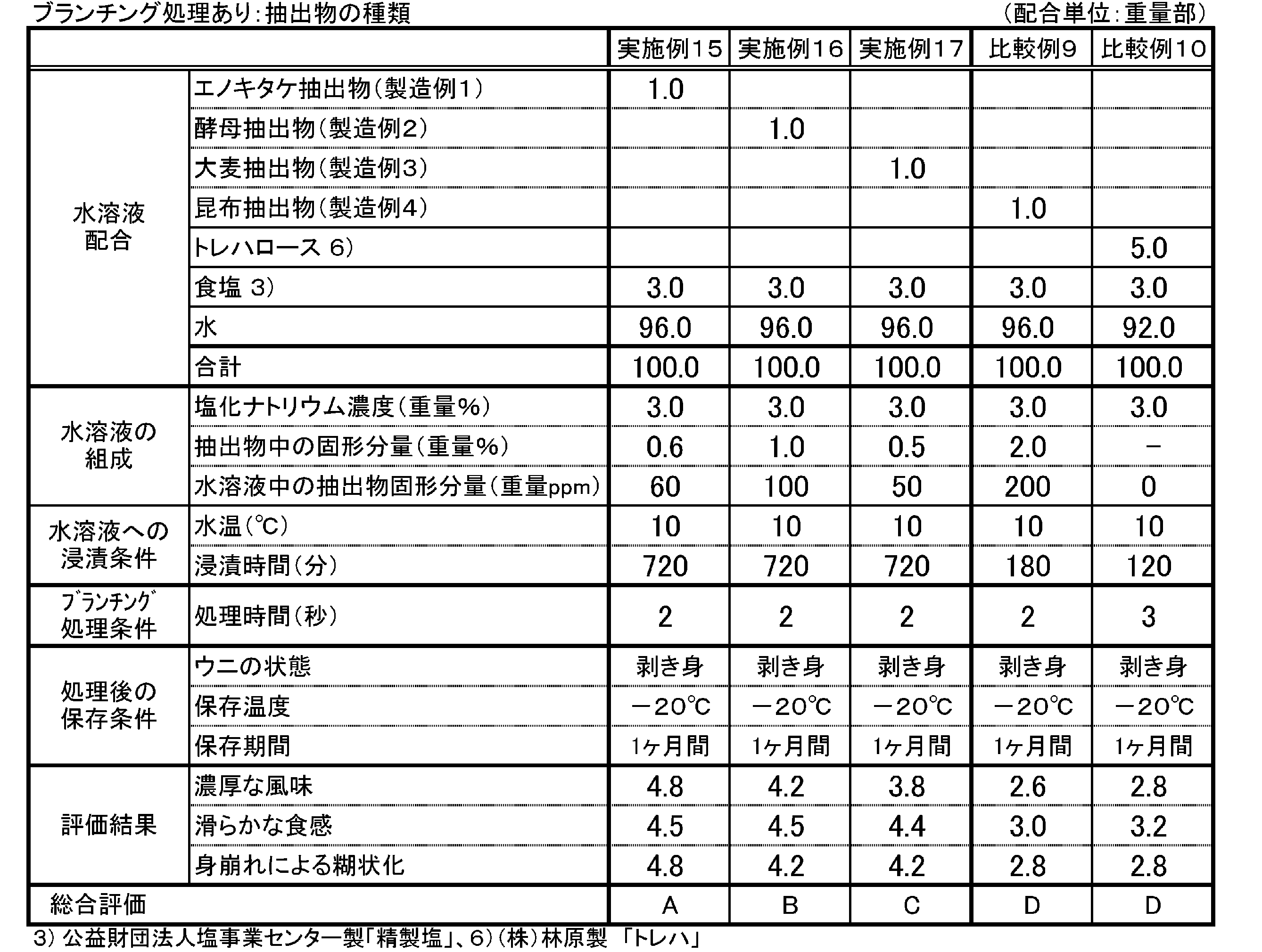
- Example 15 According to the formulation in Table 7, 200 liters of an aqueous solution containing 1% by weight of the enokitake mushroom extract obtained in Production Example 1 and 3% by weight of salt was filled in a water tank, and the water temperature was controlled at 10°C. Ten live sea urchins were immersed in the water tank, kept for 720 minutes while supplying oxygen, and then landed. After landing, the shell of the sea urchin was quickly peeled off, the meat was taken out, washed with 3% saline and then passed through hot water at 100°C for 2 seconds (blanching treatment) and cooled to 5°C. The resulting raw sea urchin was packaged and frozen at -20°C.
- Example 16 Raw sea urchins were obtained in the same manner as in Example 15 except that the yeast extract obtained in Production Example 2 was blended in place of the Enokitake mushroom extract according to the formulation of Table 7. The raw sea urchin thus obtained was evaluated for its rich flavor, smooth texture, and gelatinization due to crushing. The results are shown in Table 7.
- Example 17 Raw sea urchin was obtained in the same manner as in Example 15 except that the barley extract obtained in Production Example 3 was used instead of the Enoki mushroom extract according to the formulation shown in Table 7. The raw sea urchin thus obtained was evaluated for its rich flavor, smooth texture, and gelatinization due to crushing. The results are shown in Table 7.
- Comparative Example 10 This comparative example is based on the formulation of Sample A described in the example of Patent Document 2 (JP 2004-81136 A).
- Raw sea urchin was obtained in the same manner as in Example 15 except that trehalose was not added and the above Enokitake mushroom extract was not added according to the formulation of Table 7.
- the raw sea urchin thus obtained was evaluated for its rich flavor, smooth texture, and gelatinization due to crushing. The results are shown in Table 7.
- enokitake extract yeast having a viscosity of 0.5% (W/W) solid content of the extract at 20° C. in the range of 3 to 50 mPa ⁇ s
- yeast The raw sea urchins obtained by immersing the extract (Production Example 2) or the salt solution containing the barley extract (Production Example 3), blanching and cooling and thawing were all
- the sea urchin's original rich flavor was felt, the texture was smooth, and it was not gelatinized.
- the sea urchin (Example 15) obtained by immersing in a saline solution containing the enokitake mushroom extract, blanching, and thawing was evaluated very well for the flavor, texture and degree of gelatinization.
- a 0.5% (W/W) solid content aqueous solution of the extract was immersed in a saline solution containing a kelp extract (Production Example 4) having a viscosity of 120 mPa ⁇ s at 20° C., blanching treatment and cooling.
- the raw sea urchin obtained by thawing (Comparative Example 9), it was difficult to sense the rich flavor of the sea urchin, and more than half of the raw sea urchin was gelatinized.
- Example 18 Comparative Example 11
- the amount of the enokitake extract compounded is from 1.0 wt% to 0.1 wt% (Example 18), 10.0 wt% (Example 19), or 15.0 wt%
- Raw sea urchin was obtained in the same manner as in Example 15 except that Comparative Example 11) was used.
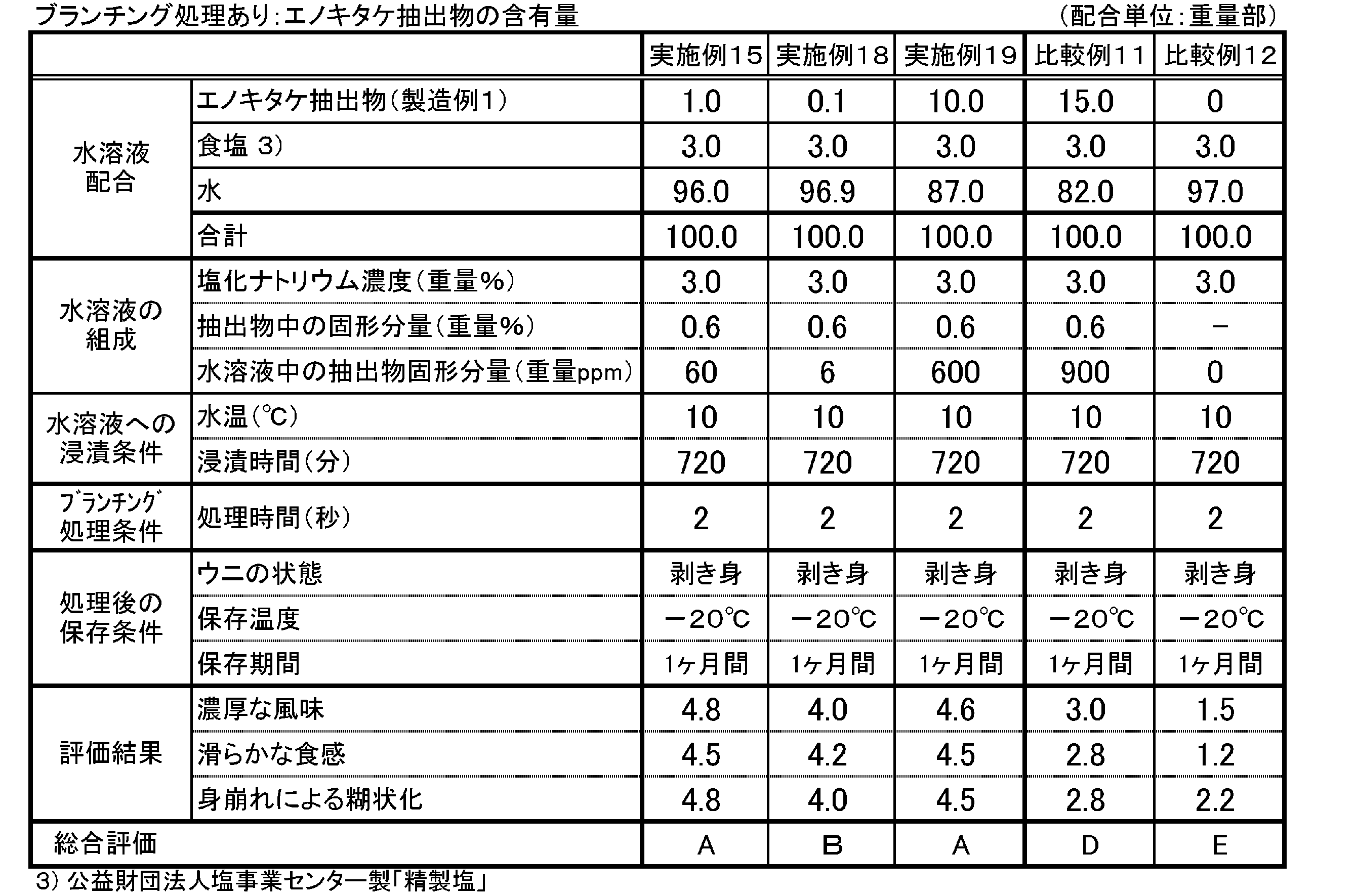
- the raw sea urchin thus obtained was evaluated for its rich flavor, smooth texture, and gelatinization due to crushing. The results are shown in Table 8.
- the taste, texture and degree of gelatinization of raw sea urchin (Example 15) obtained by immersing in salt solution having a solid content of 60 ppm, blanching and thawing were extremely good evaluations. ..
- the raw sea urchin (Comparative Example 12) obtained by immersing in a saline solution containing no enokitake mushroom extract, blanching, and chilling and thawing hardly had the original rich flavor of sea urchin, and was very rough. It had a texture and crumbled and more than half became gelatinous.
- Example 20 Raw sea urchin was obtained in the same manner as in Example 15 except that the type of the aqueous solution containing salt was changed from saline to seawater according to the conditions in Table 9. The raw sea urchin thus obtained was evaluated for its rich flavor, smooth texture, and gelatinization due to crushing. The results are shown in Table 9.
- Comparative Example 13 This comparative example is based on the quality improving agent for shellfish described in Example 1-1 of JP2010-154799A. According to the formulation of Table 9, except that the type of salt added to the aqueous solution was changed from sodium chloride to sodium lactate and sodium hydrogen carbonate, the sea urchins were immersed and retained in the same manner as in Example 15, and then the ones landed were stored frozen. Without doing so, each evaluation of the rich flavor, smooth texture, and gelatinization due to crushing of the body was performed. The results are shown in Table 9.
- Example 21 and 22 Raw sea urchin was obtained in the same manner as in Example 15 except that the water temperature of the aqueous solution was changed from 10°C to 5°C (Example 21) or 20°C (Example 22) according to the conditions in Table 10. .. The raw sea urchin thus obtained was evaluated for its rich flavor, smooth texture, and gelatinization due to crushing. The results are shown in Table 10.
- Examples 23-25, Comparative Examples 14 and 15 According to the conditions in Table 11, the dipping time of the sea urchin in the aqueous solution was changed from 720 minutes to 15 minutes (Example 23), 3000 minutes (Example 24), 14400 minutes (Example 25), 5 minutes (Comparative Example 14), Alternatively, raw sea urchin was obtained in the same manner as in Example 15 except that the time was changed to 17280 minutes (Comparative Example 15). The raw sea urchin thus obtained was evaluated for its rich flavor, smooth texture, and gelatinization due to crushing. The results are shown in Table 11.
- Example 15 except that the blanching time was changed from 2 seconds to 0 seconds (Example 26), 5 seconds (Example 27), or 10 seconds (Example 28) according to the conditions in Table 12.
- Raw sea urchin was obtained in the same manner as. The raw sea urchin thus obtained was evaluated for its rich flavor, smooth texture, and gelatinization due to crushing. The results are shown in Table 12.
- raw sea urchins obtained by immersing in a saline solution containing no enokitake mushroom extract, blanching for 0 to 10 seconds, and thawing by cooling were Almost no rich flavor was felt, and the texture was very rough.
- the degree of gelatinization tended to improve as the blanching time increased, but in the comparative example 12 in which the blanching process was performed for 2 seconds, half of the crumbs collapsed. The above was gelatinized, and in Comparative Example 16 in which no blanching treatment was performed, it was completely gelatinized.
- Example 29 and 30 Raw sea urchin was obtained in the same manner as in Example 15 except that the frozen storage period was changed from 1 month to 6 months (Example 29) or 0 hour (Example 30) according to the conditions of Table 13. It was The raw sea urchin thus obtained was evaluated for its rich flavor, smooth texture, and gelatinization due to crushing. The results are shown in Table 13.
- raw sea urchin obtained by peeling the landed flesh from the salt solution and subjecting to the blanching treatment without freezing, and peeling the landed flesh from the saline solution and blanching treatment for one month
- the sea urchin obtained by freezing and thawing for a while was thawed, and the flavor, texture and degree of gelatinization were extremely good evaluations.
- raw sea urchins obtained by immersing in salt solution containing no enokitake mushroom extract, peeling off the body, blanching and freezing and storing for 1 month or 6 months, and thawing (Comparative Examples 12 and 19)
- the rich flavor of the sea urchin was hardly felt, and it had a very rough texture, and it crumbled and more than half was gelatinized.
Landscapes
- Life Sciences & Earth Sciences (AREA)
- Engineering & Computer Science (AREA)
- Zoology (AREA)
- Chemical & Material Sciences (AREA)
- Food Science & Technology (AREA)
- Polymers & Plastics (AREA)
- Wood Science & Technology (AREA)
- Marine Sciences & Fisheries (AREA)
- Health & Medical Sciences (AREA)
- Nutrition Science (AREA)
- Meat, Egg Or Seafood Products (AREA)
Abstract
エノキタケ抽出物、酵母抽出物及び大麦抽出物からなる群より選ばれる少なくとも1種の抽出物を含む、ウニの冷凍保管時劣化抑制剤。該抑制剤は冷凍生ウニ用ブランチング前処理剤であってもよい。エノキタケ抽出物、酵母抽出物及び大麦抽出物からなる群より選ばれる少なくとも1種の抽出物を固形分で0.1~800ppm含有し、塩化ナトリウム濃度が2~3.5重量%である、冷凍保管前の活ウニの浸漬処理用水溶液。該水溶液は、ブランチング処理に供する活ウニの浸漬処理用水溶液であってもよい。
Description
本発明は、ウニの冷凍保管時劣化抑制剤、活ウニの浸漬処理用水溶液、及び、該水溶液を用いたウニ又は冷凍ウニの製造方法に関する。
ウニは特異な風味を持ち、魚介類の中でも人気が高い食材である。ウニには塩ウニ、焼きウニ、蒸しウニ等の加工品もあるが、すし種、刺身等で食される生ウニが最も好まれている。しかしながら、生ウニは、品質保持が難しい海産物の中でも特に品質の劣化が速く、水揚げ後、低温下で保存しても2、3日程度しか鮮度を保持できない。そのため、安全で鮮度の良い生ウニを輸送できる範囲は限定されている。これまで、流通している生ウニのほとんどはミョウバン(硫酸アルミニウムカリウム)水溶液に浸漬させており、これによると独特の苦味・エグ味が生じ、ウニ本来の風味が損なわれる。また、少しでも遠方に運ぶために、水槽に海水を入れて酸素を供給しながら魚介類を生きたまま定温輸送する方法があるが、この方法では温度管理や酸素管理に大型の装置を必要とし、経済効率の点で望ましいものではなかった。
そこで、水揚げ直後の生ウニを冷凍してから輸送または保存し、解凍した生ウニを食することが一般的に行われている。しかし、生ウニを冷凍・解凍すると、ウニ本来の濃厚な風味が低下したり、ウニが身崩れして糊状に溶解(糊状化)する、いわゆる冷凍障害が発生することで商品価値が低くなる問題があった。
特許文献1では、有機酸水溶液にキトサンを溶解してなる液体製剤に、生ウニを浸漬することによって、生ウニの風味を損なわず、身崩れを長期間防止できることが記載されている。しかし、この技術は有機酸を用いるものであるため、有機酸に由来する酸味が生ウニに移り、ウニ本来の風味が損なわれる欠点がある。また、該文献では5℃で冷蔵保存後の生ウニの風味や身崩れが評価されているにすぎず、冷凍・解凍後における風味や身崩れに関しては何ら言及されていない。
また、チリやロシアからの冷凍生ウニの輸入に際しては、生ウニの表皮部を加熱処理し凝固させる処理(ブランチング処理)を行ってから冷凍することで、解凍時の表皮組織の崩壊を抑制する手法が実施されている。しかし、ブランチング処理された冷凍生ウニであっても、解凍後の保形性は十分ではなく身崩れを十分に防止することはできない。身崩れをより防止しようとブランチング処理による加熱時間を長くしたり加熱温度を上げると、ブランチング処理前の生ウニと比較してウニ本来の濃厚な風味や滑らかな食感が著しく劣化してしまう。
特許文献2では、生ウニにトレハロースを含有せしめた後、表皮部を加熱処理し、凍結することによって、旨味の減少と、エグ味の増加を起こすことなく長期間の保存を可能とし、解凍時の身崩れを抑制することが記載されている。しかし、この方法によっても、ブランチング処理後の冷凍・解凍による身崩れを抑制する効果は十分ではなく、また、生ウニ本来の濃厚な風味や滑らかな食感が損なわれていた。
本発明の目的は、ウニの冷凍・解凍後におけるウニ本来の濃厚な風味の低下及び身崩れによる糊状化が抑制されたウニを提供するために使用される、ウニの冷凍保管時劣化抑制剤、活ウニの浸漬処理用水溶液、及び、該水溶液を用いたウニ又は冷凍ウニの製造方法を提供することである。
また、本発明の一態様(以下、特定態様ともいう)における目的は、ブランチング処理後の生ウニの冷凍・解凍による、ウニ本来の濃厚な風味及び滑らかな食感の低下、並びに身崩れによる糊状化が抑制された生ウニを提供するために使用される、冷凍生ウニ用ブランチング前処理剤、ブランチング処理に供する活ウニの浸漬処理用水溶液、及び、該水溶液を用いた生ウニ又は冷凍生ウニの製造方法を提供することである。
また、本発明の一態様(以下、特定態様ともいう)における目的は、ブランチング処理後の生ウニの冷凍・解凍による、ウニ本来の濃厚な風味及び滑らかな食感の低下、並びに身崩れによる糊状化が抑制された生ウニを提供するために使用される、冷凍生ウニ用ブランチング前処理剤、ブランチング処理に供する活ウニの浸漬処理用水溶液、及び、該水溶液を用いた生ウニ又は冷凍生ウニの製造方法を提供することである。
本発明者らは上記課題を解決するために鋭意研究を重ねた結果、特定の抽出物を特定量含有した特定の塩化ナトリウム濃度の水溶液に、活ウニを特定時間浸漬保持することで、その後の冷凍・解凍後に生じ得る風味の低下及び糊状化を抑制できること、また、生ウニにブランチング処理及び冷凍・解凍を行った際に生じ得る風味や食感の低下及び糊状化も抑制できることを見出し、本発明を完成するに至った。
即ち、本発明の第一は、エノキタケ抽出物、酵母抽出物及び大麦抽出物からなる群より選ばれる少なくとも1種の抽出物を含む、ウニの冷凍保管時劣化抑制剤に関する。当該ウニの冷凍保管時劣化抑制剤は、前記抽出物を、前記ウニの冷凍保管時劣化抑制剤の乾燥重量全体中、乾燥重量で50~100重量%含むことが好ましい。また、本発明の特定態様によると、前記ウニの冷凍保管時劣化抑制剤が、冷凍生ウニ用ブランチング前処理剤である。
本発明の第二は、エノキタケ抽出物、酵母抽出物及び大麦抽出物からなる群より選ばれる少なくとも1種の抽出物を固形分で0.1~800ppm含有し、塩化ナトリウム濃度が2~3.5重量%である、冷凍保管前の活ウニの浸漬処理用水溶液に関する。当該活ウニの浸漬処理用水溶液は、前記ウニの冷凍保管時劣化抑制剤を用いたものであってよい。また、本発明の特定態様によると、前記冷凍保管前の活ウニの浸漬処理用水溶液が、ブランチング処理に供する活ウニの浸漬処理用水溶液であり、該水溶液は、前記ウニの冷凍保管時劣化抑制剤を用いたものであってよい。
本発明の第三は、温度が1~25℃の範囲にある前記水溶液中に、酸素が供給された状態で10~15000分間浸漬された活ウニに関する。また、前記活ウニが冷凍された冷凍生ウニにも関し、前記冷凍生ウニが解凍された生ウニにも関する。さらに、前記活ウニが、殻剥き及び加熱調理後に冷凍された冷凍加熱調理ウニにも関し、前記冷凍加熱調理ウニが解凍された加熱調理ウニにも関する。また、本発明の特定態様によると、温度が1~25℃の範囲にある前記水溶液中に、酸素が供給された状態で10~15000分間浸漬された活ウニの殻を剥き、ブランチング処理された生ウニ、前記生ウニが冷凍された冷凍生ウニ、または、前記冷凍生ウニが解凍された生ウニが提供される。
本発明の第四は、エノキタケ抽出物、酵母抽出物及び大麦抽出物からなる群より選ばれる少なくとも1種の抽出物を固形分で0.1~800ppm含有し、塩化ナトリウム濃度が2~3.5重量%、温度が1~25℃の範囲にある水溶液中に、酸素が供給された状態で活ウニを10~15000分間浸漬し、その後冷凍することを特徴とする、冷凍生ウニの製造方法に関する。また、前記と同様に活ウニを浸漬し、その後殻剥き及び加熱調理してから冷凍することを特徴とする、冷凍加熱調理ウニの製造方法にも関する。また、本発明の特定態様によると、エノキタケ抽出物、酵母抽出物及び大麦抽出物からなる群より選ばれる少なくとも1種の抽出物を固形分で0.1~800ppm含有し、塩化ナトリウム濃度が2~3.5重量%、温度が1~25℃の範囲にある水溶液中に、酸素が供給された状態で活ウニを10~15000分間浸漬した後、殻を剥き、ブランチング処理してから冷凍することを特徴とする、冷凍生ウニの製造方法が提供される。
本発明の第二は、エノキタケ抽出物、酵母抽出物及び大麦抽出物からなる群より選ばれる少なくとも1種の抽出物を固形分で0.1~800ppm含有し、塩化ナトリウム濃度が2~3.5重量%である、冷凍保管前の活ウニの浸漬処理用水溶液に関する。当該活ウニの浸漬処理用水溶液は、前記ウニの冷凍保管時劣化抑制剤を用いたものであってよい。また、本発明の特定態様によると、前記冷凍保管前の活ウニの浸漬処理用水溶液が、ブランチング処理に供する活ウニの浸漬処理用水溶液であり、該水溶液は、前記ウニの冷凍保管時劣化抑制剤を用いたものであってよい。
本発明の第三は、温度が1~25℃の範囲にある前記水溶液中に、酸素が供給された状態で10~15000分間浸漬された活ウニに関する。また、前記活ウニが冷凍された冷凍生ウニにも関し、前記冷凍生ウニが解凍された生ウニにも関する。さらに、前記活ウニが、殻剥き及び加熱調理後に冷凍された冷凍加熱調理ウニにも関し、前記冷凍加熱調理ウニが解凍された加熱調理ウニにも関する。また、本発明の特定態様によると、温度が1~25℃の範囲にある前記水溶液中に、酸素が供給された状態で10~15000分間浸漬された活ウニの殻を剥き、ブランチング処理された生ウニ、前記生ウニが冷凍された冷凍生ウニ、または、前記冷凍生ウニが解凍された生ウニが提供される。
本発明の第四は、エノキタケ抽出物、酵母抽出物及び大麦抽出物からなる群より選ばれる少なくとも1種の抽出物を固形分で0.1~800ppm含有し、塩化ナトリウム濃度が2~3.5重量%、温度が1~25℃の範囲にある水溶液中に、酸素が供給された状態で活ウニを10~15000分間浸漬し、その後冷凍することを特徴とする、冷凍生ウニの製造方法に関する。また、前記と同様に活ウニを浸漬し、その後殻剥き及び加熱調理してから冷凍することを特徴とする、冷凍加熱調理ウニの製造方法にも関する。また、本発明の特定態様によると、エノキタケ抽出物、酵母抽出物及び大麦抽出物からなる群より選ばれる少なくとも1種の抽出物を固形分で0.1~800ppm含有し、塩化ナトリウム濃度が2~3.5重量%、温度が1~25℃の範囲にある水溶液中に、酸素が供給された状態で活ウニを10~15000分間浸漬した後、殻を剥き、ブランチング処理してから冷凍することを特徴とする、冷凍生ウニの製造方法が提供される。
本発明に従えば、ウニの冷凍・解凍後におけるウニ本来の濃厚な風味の低下及び身崩れによる糊状化が抑制されたウニを提供するために使用される、ウニの冷凍保管時劣化抑制剤、活ウニの浸漬処理用水溶液、及び、該水溶液を用いたウニ又は冷凍ウニの製造方法を提供することができる。本発明によると、ウニを冷凍・解凍してもウニ本来の濃厚な風味の低下及び身崩れによる糊状化が抑制され、いわゆる冷凍障害を抑制することができる。また、本発明の特定態様に従えば、ブランチング処理後の生ウニの冷凍・解凍による、ウニ本来の濃厚な風味及び滑らかな食感の低下、並びに身崩れによる糊状化が抑制された生ウニを提供するために使用される、冷凍生ウニ用ブランチング前処理剤、ブランチング処理に供する活ウニの浸漬処理用水溶液、及び、該水溶液を用いた生ウニ又は冷凍生ウニの製造方法を提供することができる。本発明の特定態様によると、生ウニのブランチング処理及び冷凍・解凍を行っても、ウニ本来の濃厚な風味及び滑らかな食感の低下、並びに身崩れによる糊状化が抑制され、いわゆる冷凍障害を抑制することができる。
また、本発明の冷凍保管時劣化抑制剤及び浸漬処理用水溶液は、有機酸など異味を呈する成分を含む必要がないので、これらに由来する異味がウニに付着することも回避できる。更には、本発明の冷凍保管時劣化抑制剤及び浸漬処理用水溶液は、食品添加物の表示が要請される材料を必須とするものではないので、食品添加物表示を避けることが可能である。
本発明によると、ウニを長時間冷凍保存してから解凍してもウニ本来の濃厚な風味の低下及び身崩れによる糊状化が抑制されるので、ウニ本来の濃厚な風味と外観を維持したウニを輸送可能なエリアを拡大することができる。また、本発明の特定態様によると、生ウニのブランチング処理後に長時間の冷凍保存を行い解凍しても、ウニ本来の濃厚な風味及び滑らかな食感の低下、並びに身崩れによる糊状化が抑制されるので、ウニ本来の濃厚な風味、滑らかな食感と外観を維持した生ウニを輸送可能なエリアを拡大することができる。
以下、本発明につき、さらに詳細に説明する。本発明のウニの冷凍保管時劣化抑制剤は、ウニの冷凍・解凍によって生じ得るウニ本来の濃厚な風味の低下及び身崩れによる糊状化を抑制するためのもので、特定の抽出物を含有する。本発明のウニの冷凍保管時劣化抑制剤は、塩水に配合して使用されるもので、ウニを冷凍する前に、本発明のウニの冷凍保管時劣化抑制剤を含む塩水に活ウニを浸漬することで本発明の目的を達成することができる。
また、本発明の特定態様による冷凍生ウニ用ブランチング前処理剤は、ブランチング処理後の生ウニの冷凍・解凍によって生じ得る、ウニ本来の濃厚な風味及び滑らかな食感の低下、並びに身崩れによる糊状化を抑制するためのもので、特定の抽出物を含有する。本発明の特定態様による冷凍生ウニ用ブランチング前処理剤は、塩水に配合して使用されるもので、生ウニをブランチング処理する前に、前記冷凍生ウニ用ブランチング前処理剤を含む塩水に活ウニを浸漬することで本発明の特定態様における目的を達成することができる。
本発明のウニの冷凍保管時劣化抑制剤(特定態様による冷凍生ウニ用ブランチング前処理剤を含む。以下同じ)で使用する抽出物は、エノキタケ抽出物、酵母抽出物及び大麦抽出物からなる群より選ばれる少なくとも1種の抽出物である。
前記エノキタケ抽出物としては特に限定されないが、例えば、エノキタケの子実体を熱水及び/又はアルコール等の抽出溶媒で抽出した抽出物、酵素やアルカリ性の溶媒でエノキタケの子実体を分解してから熱水やアルコール等の抽出溶媒で抽出した抽出物、更にはこれら抽出物を濃縮した濃縮液、前記抽出物または前記濃縮液を乾燥して得られた粉末等が挙げられる。これら抽出物は、消費者の安心安全志向から、水や天然由来エタノール以外の溶媒を用いない抽出物が好ましい。但し、コスト面を考えると、水がより好ましい。
抽出時の抽出溶媒の温度は、抽出溶媒の種類によって好適な温度幅が変動し得るが、一般に、抽出溶媒の大気圧下での沸点(℃)-20℃~抽出溶媒の大気圧下での沸点(℃)が好ましい。抽出時の抽出溶媒の温度が、該抽出溶媒の大気圧下での沸点(℃)-20℃より低いと、ウニ本来の濃厚な風味の低下及び身崩れによる糊状化を抑制する効果(特定態様では、更に、滑らかな食感の低下を抑制する効果)が弱くなる場合があり、大気圧下での沸点(℃)より高くなると、特殊な加圧設備が必要となるため、抽出方法が複雑になる場合がある。
前記エノキタケは、タマバリタケ科のキノコの一種であるFlammulina属velutipes種のことをいう。特に限定されないが、人工的に栽培した白色かつもやし状の市販エノキタケを使用することができる。かかる市販エノキタケは、一般に食用とされており、容易に入手可能である。
前記酵母抽出物としては特に限定されないが、例えば、酵母を熱水やアルコール等の抽出溶媒で抽出した抽出物、酵素やアルカリ性の溶媒で酵母を分解してから熱水やアルコール等の抽出溶媒で抽出した抽出物、更にはこれら抽出物を濃縮した濃縮液、前記抽出物または前記濃縮液を乾燥して得られた粉末等が挙げられる。これら抽出物は、消費者の安心安全志向から、水や天然由来エタノール以外の溶媒を用いない抽出物が好ましい。但し、コスト面を考えると、水がより好ましい。
抽出時の抽出溶媒の温度は、抽出溶媒の種類によって好適な温度幅が変動し得るが、一般に、抽出溶媒の大気圧下での沸点(℃)-20℃~抽出溶媒の大気圧下での沸点(℃)が好ましい。抽出時の抽出溶媒の温度が、該抽出溶媒の大気圧下での沸点(℃)-20℃より低いと、ウニ本来の濃厚な風味の低下及び身崩れによる糊状化を抑制する効果(特定態様では、更に、滑らかな食感の低下を抑制する効果)が弱くなる場合があり、大気圧下での沸点(℃)より高くなると、特殊な加圧設備が必要となるため、抽出方法が複雑になる場合がある。
前記酵母は、嫌気環境下で発酵する際に、糖を資化してアルコールを生成する微生物のことをいう。具体例として、サッカロミセス(Saccharomyces)属に属する酵母や、キャンディダ(Candida)属に属する酵母等が挙げられるが、特に限定されない。食経験が豊富である観点から、前記酵母は、サッカロミセス・セレビジエ(Saccharomyces cerevisiae)であってもよく、研究等で知見が多い観点から、前記酵母は、キャンディダ・ユーティリス(Candida utilis)であってもよい。
前記大麦抽出物としては特に限定されないが、例えば、大麦を熱水やアルコール等の抽出溶媒で抽出した抽出物、酵素やアルカリ性の溶媒で大麦を分解してから熱水やアルコール等の抽出溶媒で抽出した抽出物、更にはこれら抽出物を濃縮した濃縮液、前記抽出物または前記濃縮液を乾燥して得られた粉末等が挙げられる。これら抽出物は、消費者の安心安全志向から、水や天然由来エタノール以外の溶媒を用いない抽出物が好ましい。但し、コスト面を考えると、水がより好ましい。
抽出時の抽出溶媒の温度は、抽出溶媒の種類によって好適な温度幅が変動し得るが、一般に、抽出溶媒の大気圧下での沸点(℃)-20℃~抽出溶媒の大気圧下での沸点(℃)が好ましい。抽出時の抽出溶媒の温度が、該抽出溶媒の大気圧下での沸点(℃)-20℃より低いと、ウニ本来の濃厚な風味の低下及び身崩れによる糊状化を抑制する効果(特定態様では、更に、滑らかな食感の低下を抑制する効果)が弱くなる場合があり、大気圧下での沸点(℃)より高くなると、特殊な加圧設備が必要となるため、抽出方法が複雑になる場合がある。
前記大麦は、中央アジア原産のイネ科の植物で、学名をHordeum vulgareといい、二条大麦と六条大麦、皮麦とはだか麦、うるち種ともち種に分類されるものをいう。
本発明のウニの冷凍保管時劣化抑制剤は、エノキタケ抽出物、酵母抽出物及び大麦抽出物からなる群より選ばれる少なくとも1種の抽出物を、該劣化抑制剤の乾燥重量全体に対し乾燥重量で50~100重量%含有することが好ましい。より好ましくは70~100重量%であり、さらに好ましくは90~100重量%である。50重量%よりも少ないと、ウニ本来の濃厚な風味の低下及び身崩れによる糊状化を抑制する効果(特定態様では、更に、滑らかな食感の低下を抑制する効果)を発揮できない場合がある。当該劣化抑制剤に含まれ得る前記抽出物以外の固形分としては特に限定されず、天然由来の固形分であれば何を含有しても良く、例えば、デキストリン、澱粉、乳糖等が挙げられる。
本発明のウニの冷凍保管時劣化抑制剤の形状は特に限定されず、水溶液等の液体の形状であってもよいし、粉末状、顆粒状、ブロック状等の固形の形状であってもよい。
本発明のウニの冷凍保管時劣化抑制剤は、これを真水、海水、または塩水に添加することで、次に説明する本発明の活ウニの浸漬処理用水溶液を調製するために使用することができる。また、収穫した活ウニを一時的に飼育している生け簀に、当該劣化抑制剤を投入することで、ウニ本来の濃厚な風味の低下及び身崩れによる糊状化を抑制する効果(特定態様では、更に、滑らかな食感の低下を抑制する効果)を得ることもできる。
本発明の活ウニの浸漬処理用水溶液は、前記抽出物を含有するものである。該水溶液に活ウニを浸漬することで使用され、この使用後に、活ウニを前記水溶液から取り出し、必要に応じて殻剥き又は加熱調理をしてから、冷凍保存、次いで解凍した際に、ウニ本来の濃厚な風味の低下及び身崩れによる糊状化を抑制することができる。また、本発明の特定態様によるブランチング処理に供する活ウニの浸漬処理用水溶液も、前記抽出物を含有し、該水溶液に活ウニを浸漬することで使用され、この使用後に、活ウニを前記水溶液から取り出し、殻を剥いて得た生ウニをブランチング処理に供し、次いで冷凍保存、さらに解凍した際に、ウニ本来の濃厚な風味及び滑らかな食感の低下、並びに身崩れによる糊状化が抑制された生ウニを得ることができる。
本発明の活ウニの浸漬処理用水溶液(特定態様によるブランチング処理に供する活ウニの浸漬処理用水溶液を含む。以下同じ)は、前記抽出物を固形分で0.1~800ppm含有することが好ましい。当該含有量は、1~700ppmがより好ましく、6~600ppmが更に好ましく、30~600ppmが特に好ましい。0.1ppmより少ないと、ウニ本来の濃厚な風味の低下及び身崩れによる糊状化を抑制する効果(特定態様では、更に、滑らかな食感の低下を抑制する効果)を発揮できない場合がある。800ppmを越えると前記抽出物に由来する色素成分がウニに付着したり、ウニ本来の濃厚な風味(特定態様では、更に、滑らかな食感)が損なわれる場合がある。
本発明の活ウニの浸漬処理用水溶液の塩化ナトリウム濃度は、2~3.5重量%が好ましく、2.3~3.5重量%がより好ましく、2.3~3.2重量%がさらに好ましく、2.5~3重量%が特に好ましい。塩化ナトリウム濃度が2重量%未満、又は3.5重量%を超えると、該水溶液中でウニが生育できず、却ってウニ本来の濃厚な風味(特定態様では、更に、滑らかな食感)が損なわれる場合がある。
本発明の活ウニの浸漬処理用水溶液は、上記塩化ナトリウム濃度を満足する限り、塩化ナトリウム以外の塩類を含有していてもよい。しかし、塩化ナトリウム以外の塩類の含有量は、塩化ナトリウム重量に対して1/3の重量までに制限することが好ましい。塩化ナトリウム以外の塩類の種類としては食品添加物として使用し得る塩類であれば特に限定されない。
前記浸漬処理用水溶液は、上記塩化ナトリウム濃度を満足する限り、真水に食塩を添加して製造されたものであってもよいし、海水を利用して、又は、海水の塩化ナトリウム濃度を調整したものを利用して製造されたものであってもよい。
ウニを冷凍する前に、本発明の活ウニの浸漬処理用水溶液に活ウニを浸漬し一定時間保持することで、ウニ本来の濃厚な風味の低下及び身崩れによる糊状化が抑制されたウニを製造することができる。当該製造の実施形態の一例は以下のとおりである。必要に応じ前記水溶液を殺菌した後、該水溶液の温度を、好適には1~25℃の範囲とし、該水溶液に酸素を供給しつつ活ウニを浸漬して、好適には10~15000分間保持する。その後、該水溶液から活ウニを取り出すことで、その後、加熱調理をせずにウニの冷凍・解凍を行っても、ウニ本来の濃厚な風味の低下及び身崩れによる糊状化が抑制された生ウニを得ることができる。なお、加熱調理をしていないウニの冷凍の前には、殻剥きを行ってもよいし、殻剥きを行わなくてもよい。また、前記水溶液から活ウニを取り出した後、殻剥き及び加熱調理を行ってから冷凍・解凍を行っても、ウニ本来の濃厚な風味の低下及び身崩れによる糊状化が抑制された加熱調理ウニを得ることができる。
本発明の特定態様によると、生ウニをブランチング処理に供する前に、本発明の活ウニの浸漬処理用水溶液に活ウニを浸漬し一定時間保持することで、ウニ本来の濃厚な風味及び滑らかな食感の低下、並びに身崩れによる糊状化が抑制されたウニを製造することができる。当該製造の実施形態の一例は以下のとおりである。必要に応じ前記水溶液を殺菌した後、該水溶液の温度を、好適には1~25℃の範囲とし、該水溶液に酸素を供給しつつ活ウニを浸漬して、好適には10~15000分間保持する。その後、該水溶液から活ウニを取り出すことで、その後、殻を剥いて得た生ウニのブランチング処理及び冷凍・解凍を行っても、ウニ本来の濃厚な風味及び滑らかな食感の低下、並びに身崩れによる糊状化が抑制されたウニを得ることができる。
水溶液の殺菌方法としては特に限定されず、例えば、紫外線照射による殺菌、オゾン殺菌、塩素殺菌などを行えばよい。
前記水溶液の温度は1~25℃の範囲でコントロールすることが好ましく、1~20℃がより好ましく、3~17℃が更に好ましく、5~15℃が特に好ましい。該温度が1℃より低い又は25℃より高いと、前記水溶液中で活ウニの活動が低下して、ウニ本来の濃厚な風味の低下及び身崩れによる糊状化を抑制する効果(特定態様では、更に、滑らかな食感の低下を抑制する効果)を発揮できない場合がある。
前記水溶液への酸素の供給方法としては、ウニの生育に必要な溶存酸素濃度を確保できれば、どのような方法であってもよい。
活ウニを前記水溶液中で保持する浸漬時間は、10~15000分間が好ましく、10~9000分間がより好ましく、50~7200分間が更に好ましく、100~3000分間が特に好ましく、150~2000分間が極めて好ましい。浸漬時間が10分間より短いと浸漬処理時間が不足し、ウニ本来の濃厚な風味の低下及び身崩れによる糊状化を抑制する効果(特定態様では、更に、滑らかな食感の低下を抑制する効果)を発揮できない場合がある。また15000分間より長いとウニ本来の濃厚な風味(特定態様では、更に、滑らかな食感)が損なわれる場合がある。
以上で説明した本発明の活ウニの浸漬処理用水溶液への活ウニの浸漬処理は、静置した水槽で行ってもよいし、水槽ごと輸送しつつ行ってもよい。輸送しながら該浸漬処理を行う場合であっても、本発明の方法によると、水溶液の温度が前述した範囲内にあれば厳格な温度管理を行う必要がないので、従来の魚介類を生きたまま輸送する方法と比較して輸送コストを抑制することができる。
本発明の冷凍生ウニの製造方法に従って得られた冷凍生ウニは、前述のように活ウニを前記水溶液に特定時間浸漬した後、水揚げしてから殻剥き、または、殻付きのまま冷凍で1週間~24カ月間程度保存後に解凍しても、身崩れによる糊状化が抑制されており、ウニ本来の濃厚な風味を保持している。また、本発明の冷凍加熱調理ウニの製造方法に従って得られた冷凍加熱調理ウニは、前述のように活ウニを前記水溶液に特定時間浸漬した後、水揚げしてから殻剥き及び加熱調理し、その後に冷凍で1週間~24カ月間程度保存後に解凍しても、身崩れによる糊状化が抑制されており、ウニ本来の濃厚な風味を保持している。なお、活ウニを殻剥きしてから加熱調理する場合、その具体的な加熱方法は特に限定されず、公知の方法であってよい。例えば、熱水に浸漬したり、蒸したり、あぶったりする方法が挙げられる。
本発明の特定態様による生ウニの製造方法によると、前述のように活ウニを前記水溶液に特定時間浸漬した後、水揚げしてから殻を剥き、得た生ウニをブランチング処理に供する。ブランチング処理とは、生ウニを短時間加熱して、ウニの内部は生の状態を維持したまま、ウニの表皮部のみを凝固させる処理をいう。ブランチング処理は公知の処理であってよく、特に限定されないが、例えば、加温した水に生ウニを浸漬したり、蒸したり、あぶったりする方法が挙げられる。なお、ブランチング処理後の生ウニは速やかに冷却することが好ましい。
ブランチング処理時の加熱時間と加熱温度としては、ウニの内部は生の状態を維持したまま、ウニの表皮部のみを凝固させる目的を満足する条件であれば特に限定されないが、例えば、加熱時間は30秒間以下、加熱温度は60℃以上130℃以下の範囲内において適宜設定することができる。より具体的には、図1で示す領域の範囲内にある加熱時間と加熱温度を選択することが好ましい。図1は、ブランチング条件における好適な加熱時間と加熱温度の関係を示すグラフである。図1中の破線で囲まれた領域は、(1秒、130℃)、(1秒、80℃)、(5秒、60℃)、(30秒、60℃)、(7秒、130℃)の5点を結んだ領域である。この領域の範囲内にある加熱時間と加熱温度にてブランチング処理を行うことで、本発明の特定態様による効果をより好適に達成することができる。一例として、加熱温度が100℃の場合、好ましい加熱時間は1~約16秒間である。より好ましい加熱時間は1~10秒間、さらに好ましくは1~5秒間、より更に好ましくは1~3秒間である。
本発明の特定態様では活ウニを前記水溶液に特定時間浸漬することで、ブランチング処理の時間が短めであったり、又は温度が低めであっても、身崩れによる糊状化を抑制する効果を得ることができる。また、ブランチング処理の時間を短くしたり、又は温度を低くすることができるので、生ウニ本来の濃厚な風味や滑らかな食感を、ブランチング処理で大きく損なうことなく、維持することができる。
本発明の特定態様による生ウニの製造方法に従って得られた生ウニは、前記ブランチング後に冷凍で1週間~24カ月間程度保存後、解凍しても、身崩れによる糊状化が抑制されており、ウニ本来の濃厚な風味や滑らかな食感を保持している。
本発明を適用可能なウニの種類は、殻を剥いてウニの生殖巣を食することができるウニであれば、特に限定されない。具体例としては、バフンウニ、エゾバフンウニ、ムラサキウニ、キタムラサキウニ、ツガルウニ、シラヒゲウニ、アカウニ、サンショウウニ等が挙げられる。
以下に実施例を示し、本発明をより具体的に説明するが、本発明はこれらの実施例に何ら限定されるものではない。なお、実施例において「部」や「%」は重量基準である。
(製造例1) エノキタケ抽出物の作製
市販のエノキタケ(子実体)100gに100℃に加熱した熱水200mlを加え、2時間保持した。その後固形分を濾別して、固形分量が0.6重量%のエノキタケ抽出物を得た。得られたエノキタケ抽出物の0.5重量%(W/W)固形分濃度の水溶液の20℃における粘度は17mPa・sであった。
市販のエノキタケ(子実体)100gに100℃に加熱した熱水200mlを加え、2時間保持した。その後固形分を濾別して、固形分量が0.6重量%のエノキタケ抽出物を得た。得られたエノキタケ抽出物の0.5重量%(W/W)固形分濃度の水溶液の20℃における粘度は17mPa・sであった。
(製造例2) 酵母抽出物の作製
パン酵母(株式会社カネカ製「カネカイーストGA」)100gに100℃に加熱した熱水200mlを加え、2時間保持した。その後固形分を濾別して、固形分量が1.0重量%の酵母抽出物を得た。得られた酵母抽出物の0.5重量%(W/W)固形分濃度の水溶液の20℃における粘度は8mPa・sであった。
パン酵母(株式会社カネカ製「カネカイーストGA」)100gに100℃に加熱した熱水200mlを加え、2時間保持した。その後固形分を濾別して、固形分量が1.0重量%の酵母抽出物を得た。得られた酵母抽出物の0.5重量%(W/W)固形分濃度の水溶液の20℃における粘度は8mPa・sであった。
(製造例3) 大麦抽出物の作製
大麦粉(石橋工業株式会社製「大麦粉」)100gに100℃に加熱した熱水200mlを加え、2時間保持した。その後固形分を濾別して、固形分量が0.5重量%の大麦抽出物を得た。得られた大麦抽出物の0.5重量%(W/W)固形分濃度の水溶液の20℃における粘度は5mPa・sであった。
大麦粉(石橋工業株式会社製「大麦粉」)100gに100℃に加熱した熱水200mlを加え、2時間保持した。その後固形分を濾別して、固形分量が0.5重量%の大麦抽出物を得た。得られた大麦抽出物の0.5重量%(W/W)固形分濃度の水溶液の20℃における粘度は5mPa・sであった。
(製造例4) 昆布抽出物の作製
真昆布(株式会社くらこん製「真昆布」)100gに100℃に加熱した熱水200mlを加え、2時間保持した。その後固形分を濾別して、固形分量が2.0重量%のコンブ抽出物を得た。得られたコンブ抽出物の0.5重量%(W/W)固形分濃度の水溶液の20℃における粘度は120mPa・sであった。
真昆布(株式会社くらこん製「真昆布」)100gに100℃に加熱した熱水200mlを加え、2時間保持した。その後固形分を濾別して、固形分量が2.0重量%のコンブ抽出物を得た。得られたコンブ抽出物の0.5重量%(W/W)固形分濃度の水溶液の20℃における粘度は120mPa・sであった。
<<表1~6:ブランチング処理を実施しない態様について>>
<表1~6の濃厚な風味の評価>
表1~6の実施例および比較例において得たウニの濃厚な風味は、訓練された10名(男性5人、女性5人)のパネラーに生ウニを食してもらい、以下の基準により評価した。10人の各評価点の平均値を評価値とした。
5点:実施例9のウニよりも非常に良く、濃厚な風味を非常に強く感じる。
4点:実施例9のウニよりも良く、濃厚な風味を強く感じる。
3点:実施例9のウニと同等で、濃厚な風味が感じられる。
2点:実施例9のウニよりも悪く、濃厚な風味が感じられ難い。
1点:実施例9のウニよりも非常に悪く、濃厚な風味がほとんど感じられない。
<表1~6の濃厚な風味の評価>
表1~6の実施例および比較例において得たウニの濃厚な風味は、訓練された10名(男性5人、女性5人)のパネラーに生ウニを食してもらい、以下の基準により評価した。10人の各評価点の平均値を評価値とした。
5点:実施例9のウニよりも非常に良く、濃厚な風味を非常に強く感じる。
4点:実施例9のウニよりも良く、濃厚な風味を強く感じる。
3点:実施例9のウニと同等で、濃厚な風味が感じられる。
2点:実施例9のウニよりも悪く、濃厚な風味が感じられ難い。
1点:実施例9のウニよりも非常に悪く、濃厚な風味がほとんど感じられない。
<表1~6の身崩れによる糊状化の評価>
表1~6の実施例および比較例において得たウニの身崩れによる糊状化の程度は、訓練された10名(男性5人、女性5人)のパネラーにより、以下の基準に基づき目視で評価し、その平均値を評価値とした。
5点:実施例9のウニよりも全く身崩れしておらず、冷凍前と変わらない形を維持している。
4点:実施例9のウニよりも身崩れが少なく、ほぼ糊状化していない。
3点:実施例9のウニと同等で、やや身崩れしているが、あまり糊状化していない。
2点:実施例9のウニよりも身崩れし、半数以上糊状化している。
1点:実施例9のウニよりも非常に身崩れし、完全に糊状化している。
表1~6の実施例および比較例において得たウニの身崩れによる糊状化の程度は、訓練された10名(男性5人、女性5人)のパネラーにより、以下の基準に基づき目視で評価し、その平均値を評価値とした。
5点:実施例9のウニよりも全く身崩れしておらず、冷凍前と変わらない形を維持している。
4点:実施例9のウニよりも身崩れが少なく、ほぼ糊状化していない。
3点:実施例9のウニと同等で、やや身崩れしているが、あまり糊状化していない。
2点:実施例9のウニよりも身崩れし、半数以上糊状化している。
1点:実施例9のウニよりも非常に身崩れし、完全に糊状化している。
<表1~6の総合評価>
表1~6の実施例および比較例では、濃厚な風味の評価、及び、身崩れによる糊状化の評価結果を基に、総合評価を行った。その際の評価基準は以下の通りである。
A:濃厚な風味の評価、及び、身崩れによる糊状化の評価が全て4.5点以上5.0点以下を満たしているもの。
B:濃厚な風味の評価、及び、身崩れによる糊状化の評価が全て4.0点以上5.0点以下であって、且つ4.0以上4.5未満が少なくとも一つあるもの。
C:濃厚な風味の評価、及び、身崩れによる糊状化の評価が全て3.0点以上5.0点以下であって、且つ3.0以上4.0未満が少なくとも一つあるもの。
D:濃厚な風味の評価、及び、身崩れによる糊状化の評価が全て2.0点以上5.0点以下であって、且つ2.0以上3.0未満が少なくとも一つあるもの。
E:濃厚な風味の評価、及び、身崩れによる糊状化の評価において、2.0未満が少なくとも一つあるもの。
表1~6の実施例および比較例では、濃厚な風味の評価、及び、身崩れによる糊状化の評価結果を基に、総合評価を行った。その際の評価基準は以下の通りである。
A:濃厚な風味の評価、及び、身崩れによる糊状化の評価が全て4.5点以上5.0点以下を満たしているもの。
B:濃厚な風味の評価、及び、身崩れによる糊状化の評価が全て4.0点以上5.0点以下であって、且つ4.0以上4.5未満が少なくとも一つあるもの。
C:濃厚な風味の評価、及び、身崩れによる糊状化の評価が全て3.0点以上5.0点以下であって、且つ3.0以上4.0未満が少なくとも一つあるもの。
D:濃厚な風味の評価、及び、身崩れによる糊状化の評価が全て2.0点以上5.0点以下であって、且つ2.0以上3.0未満が少なくとも一つあるもの。
E:濃厚な風味の評価、及び、身崩れによる糊状化の評価において、2.0未満が少なくとも一つあるもの。
(実施例1)
表1の配合に従い、製造例1で得られたエノキタケ抽出物1重量%と、食塩3重量%を配合した水溶液200リットルを水槽に満たし、水温を10℃にコントロールした。該水槽に、活ウニ10体を浸漬し、酸素を供給しながら、720分間保持した後、水揚げした。水揚げ後、速やかに活ウニの殻を剥いて身を取り出し、3%の食塩水で洗浄した後、包装して-20℃で冷凍した。その温度で1ヶ月間冷凍保存した後、冷凍生ウニを冷凍庫から取り出し、0℃で6時間放置して解凍した。得られた生ウニについて、濃厚な風味、及び、身崩れによる糊状化の各評価を行った。それらの結果を表1に示した。
表1の配合に従い、製造例1で得られたエノキタケ抽出物1重量%と、食塩3重量%を配合した水溶液200リットルを水槽に満たし、水温を10℃にコントロールした。該水槽に、活ウニ10体を浸漬し、酸素を供給しながら、720分間保持した後、水揚げした。水揚げ後、速やかに活ウニの殻を剥いて身を取り出し、3%の食塩水で洗浄した後、包装して-20℃で冷凍した。その温度で1ヶ月間冷凍保存した後、冷凍生ウニを冷凍庫から取り出し、0℃で6時間放置して解凍した。得られた生ウニについて、濃厚な風味、及び、身崩れによる糊状化の各評価を行った。それらの結果を表1に示した。
(実施例2)
表1の配合に従い、前記エノキタケ抽出物の代わりに、製造例2で得られた酵母抽出物を配合した以外は、実施例1と同様にして生ウニを得た。得られた生ウニについて、濃厚な風味、及び、身崩れによる糊状化の各評価を行った。それらの結果を表1に示した。
表1の配合に従い、前記エノキタケ抽出物の代わりに、製造例2で得られた酵母抽出物を配合した以外は、実施例1と同様にして生ウニを得た。得られた生ウニについて、濃厚な風味、及び、身崩れによる糊状化の各評価を行った。それらの結果を表1に示した。
(実施例3)
表1の配合に従い、前記エノキタケ抽出物の代わりに、製造例3で得られた大麦抽出物を配合した以外は、実施例1と同様にして生ウニを得た。得られた生ウニについて、濃厚な風味、及び、身崩れによる糊状化の各評価を行った。それらの結果を表1に示した。
表1の配合に従い、前記エノキタケ抽出物の代わりに、製造例3で得られた大麦抽出物を配合した以外は、実施例1と同様にして生ウニを得た。得られた生ウニについて、濃厚な風味、及び、身崩れによる糊状化の各評価を行った。それらの結果を表1に示した。
(比較例1)
表1の配合に従い、前記エノキタケ抽出物の代わりに、製造例4で得られた昆布抽出物を配合した以外は、実施例1と同様にして生ウニを得た。得られた生ウニについて、濃厚な風味、及び、身崩れによる糊状化の各評価を行った。それらの結果を表1に示した。
表1の配合に従い、前記エノキタケ抽出物の代わりに、製造例4で得られた昆布抽出物を配合した以外は、実施例1と同様にして生ウニを得た。得られた生ウニについて、濃厚な風味、及び、身崩れによる糊状化の各評価を行った。それらの結果を表1に示した。
(比較例2)
この比較例は、特許文献1(特開2008-307039号公報)の実施例1に記載された浸漬液の配合に準拠したものである。表1の配合に従い、前記エノキタケ抽出物を配合せず、キトサン、及び、食酢を配合した以外は実施例1と同様にして生ウニを得た。得られた生ウニについて、濃厚な風味、及び、身崩れによる糊状化の各評価を行った。それらの結果を表1に示した。
この比較例は、特許文献1(特開2008-307039号公報)の実施例1に記載された浸漬液の配合に準拠したものである。表1の配合に従い、前記エノキタケ抽出物を配合せず、キトサン、及び、食酢を配合した以外は実施例1と同様にして生ウニを得た。得られた生ウニについて、濃厚な風味、及び、身崩れによる糊状化の各評価を行った。それらの結果を表1に示した。
表1から明らかなように、抽出物の0.5%(W/W)固形分濃度の水溶液の20℃における粘度が3~50mPa・sの範囲にあるエノキタケ抽出物(製造例1)、酵母抽出物(製造例2)、又は、大麦抽出物(製造例3)を含む食塩水に浸漬し、冷解凍して得られた生ウニ(実施例1~3)は、いずれも、ウニ本来の濃厚な風味が強く感じられ、あまり糊状化していなかった。特にエノキタケ抽出物を含む食塩水に浸漬し、冷解凍して得られた生ウニ(実施例1)の風味及び糊状化の程度は極めて良好な評価であった。一方、抽出物の0.5%(W/W)固形分濃度の水溶液の20℃における粘度が120mPa・sの昆布抽出物(製造例4)を含む食塩水に浸漬し、冷解凍して得られた生ウニ(比較例1)は、ウニ本来の濃厚な風味が感じられ難く、身崩れして半数以上が糊状化していた。また、キトサンと食酢を含む食塩水に浸漬し、冷解凍して得られた生ウニ(比較例2)も、ウニ本来の濃厚な風味が感じられ難く、身崩れして半数以上が糊状化していた。
(実施例4及び5、比較例3)
表2の配合に従い、エノキタケ抽出物の配合量を1.0重量%から、0.1重量%(実施例4)、10.0重量%(実施例5)、又は、15.0重量%(比較例3)に変更した以外は、実施例1と同様にして生ウニを得た。得られた生ウニについて、濃厚な風味、及び、身崩れによる糊状化の各評価を行った。それらの結果を表2に示した。
表2の配合に従い、エノキタケ抽出物の配合量を1.0重量%から、0.1重量%(実施例4)、10.0重量%(実施例5)、又は、15.0重量%(比較例3)に変更した以外は、実施例1と同様にして生ウニを得た。得られた生ウニについて、濃厚な風味、及び、身崩れによる糊状化の各評価を行った。それらの結果を表2に示した。

(比較例4)
表2の配合に従い、エノキタケ抽出物を配合せずに調製した水溶液を使用した以外は、実施例1と同様にして生ウニを得た。得られた生ウニについて、濃厚な風味、及び、身崩れによる糊状化の各評価を行った。それらの結果を表2に示した。
表2の配合に従い、エノキタケ抽出物を配合せずに調製した水溶液を使用した以外は、実施例1と同様にして生ウニを得た。得られた生ウニについて、濃厚な風味、及び、身崩れによる糊状化の各評価を行った。それらの結果を表2に示した。
表2から明らかなように、水溶液中のエノキタケ抽出物の固形分量が0.1~800ppmの範囲にある食塩水に浸漬し、冷解凍して得られた生ウニ(実施例1、4、及び5)は、いずれも、ウニ本来の濃厚な風味が強く感じられ、あまり糊状化していなかった。特に前記固形分量が60ppmの食塩水に浸漬し、冷解凍して得られた生ウニ(実施例1)の風味及び糊状化の程度は極めて良好な評価であった。一方、エノキタケ抽出物の固形分量が900ppmの食塩水に浸漬し、冷解凍して得られた生ウニ(比較例3)は、ウニ本来の濃厚な風味が感じられ難かった。また、エノキタケ抽出物を含有しない食塩水に浸漬し、冷解凍して得られた生ウニ(比較例4)は、ウニ本来の濃厚な風味がほとんど感じられず、非常に身崩れし、完全に糊状化していた。
(実施例6)
表3の条件に従い、塩を含む水溶液の種類を食塩水から海水へ変更した以外は、実施例1と同様にして生ウニを得た。得られた生ウニについて、濃厚な風味、及び、身崩れによる糊状化の各評価を行った。それらの結果を表3に示した。
表3の条件に従い、塩を含む水溶液の種類を食塩水から海水へ変更した以外は、実施例1と同様にして生ウニを得た。得られた生ウニについて、濃厚な風味、及び、身崩れによる糊状化の各評価を行った。それらの結果を表3に示した。

(比較例5)
この比較例は、特開2010-154799号公報の実施例1-1に記載された貝類の品質改良剤に準拠したものである。表3の配合に従い、水溶液に添加する塩の種類を食塩から乳酸ナトリウムと炭酸水素ナトリウムへ変えた以外は、実施例1と同様にして活ウニを浸漬保持した後、水揚げしたものを冷凍保管せずにそのまま、濃厚な風味、及び、身崩れによる糊状化の各評価を行った。それらの結果を表3に示した。
この比較例は、特開2010-154799号公報の実施例1-1に記載された貝類の品質改良剤に準拠したものである。表3の配合に従い、水溶液に添加する塩の種類を食塩から乳酸ナトリウムと炭酸水素ナトリウムへ変えた以外は、実施例1と同様にして活ウニを浸漬保持した後、水揚げしたものを冷凍保管せずにそのまま、濃厚な風味、及び、身崩れによる糊状化の各評価を行った。それらの結果を表3に示した。
表3から明らかなように、エノキタケ抽出物を含み塩化ナトリウム濃度が2~3.5重量%の範囲にある水溶液に浸漬し、冷解凍して得られた生ウニ(実施例1、及び6)は、いずれも、ウニ本来の濃厚な風味が非常に強く感じられ、全く身崩れしておらず、冷凍前と変わらない形を維持していた。一方、エノキタケ抽出物を含有するが塩化ナトリウムの代わりに乳酸ナトリウムと炭酸水素ナトリウムの合計濃度を3.5重量%とした水溶液に浸漬した活ウニ(比較例5)は、720分間の浸漬によって死滅し、ウニ本来の濃厚な風味がほとんど感じられず、非常に身崩れし、完全に糊状化していた。
(実施例7及び8)
表4の条件に従い、水溶液の水温を10℃から、5℃(実施例7)、又は、20℃(実施例8)にそれぞれ変更した以外は、実施例1と同様にして生ウニを得た。得られた生ウニについて、濃厚な風味、及び、身崩れによる糊状化の各評価を行った。それらの結果を表4に示した。
表4の条件に従い、水溶液の水温を10℃から、5℃(実施例7)、又は、20℃(実施例8)にそれぞれ変更した以外は、実施例1と同様にして生ウニを得た。得られた生ウニについて、濃厚な風味、及び、身崩れによる糊状化の各評価を行った。それらの結果を表4に示した。

表4から明らかなように、エノキタケ抽出物を含み水温が1~25℃の食塩水に浸漬し、冷解凍して得られた生ウニ(実施例1、7、及び8)は、いずれも、ウニ本来の濃厚な風味が感じられ、あまり糊状化していなかった。特にエノキタケ抽出物を含み水温が10℃の食塩水に浸漬し、冷解凍して得られたもの(実施例1)の風味及び糊状化の程度は極めて良好な評価であった。
(実施例9-11、比較例6及び7)
表5の条件に従い、水溶液へのウニの浸漬時間を720分間から、15分間(実施例9)、3000分間(実施例10)、14400分間(実施例11)、5分間(比較例6)、又は、17280分間(比較例7)に変更した以外は、実施例1と同様にして生ウニを得た。得られた生ウニについて、濃厚な風味、及び、身崩れによる糊状化の各評価を行った。それらの結果を表5に示した。
表5の条件に従い、水溶液へのウニの浸漬時間を720分間から、15分間(実施例9)、3000分間(実施例10)、14400分間(実施例11)、5分間(比較例6)、又は、17280分間(比較例7)に変更した以外は、実施例1と同様にして生ウニを得た。得られた生ウニについて、濃厚な風味、及び、身崩れによる糊状化の各評価を行った。それらの結果を表5に示した。
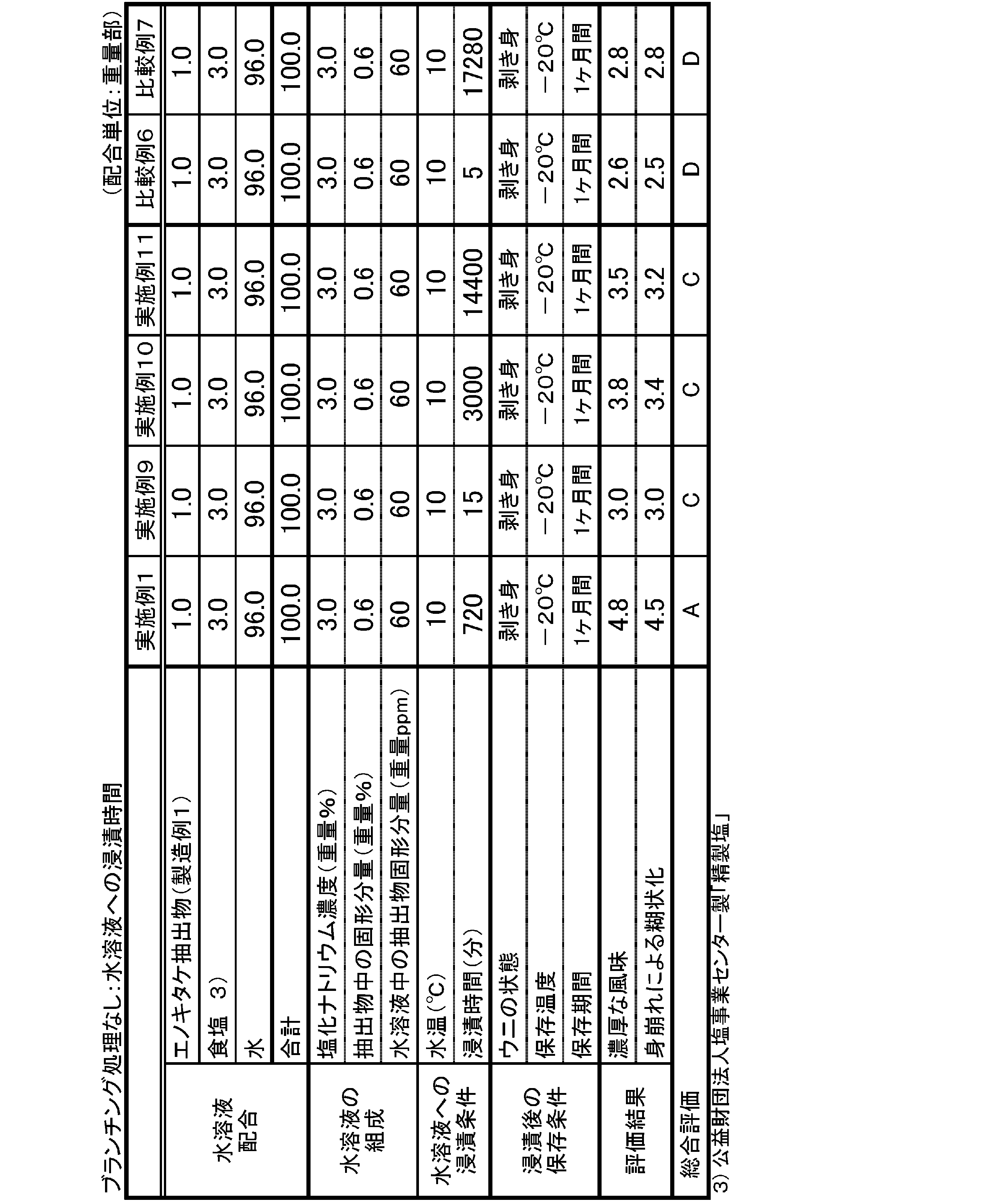
表5から明らかなように、エノキタケ抽出物を含む食塩水に10~15000分間浸漬し、冷解凍して得られた生ウニ(実施例1、及び9-11)は、いずれも、ウニ本来の濃厚な風味が感じられ、あまり糊状化していなかった。特に浸漬時間を720分間とした生ウニ(実施例1)の風味及び糊状化の程度は極めて良好な評価であった。一方、浸漬時間が5分間の生ウニ(比較例6)、及び、浸漬時間が17280分間の生ウニ(比較例7)は、いずれも、ウニ本来の濃厚な風味が感じられ難く、身崩れして半数以上が糊状化していた。
(実施例12及び13)
表6の条件に従い、冷凍保存期間を1カ月間から、6カ月間(実施例12)、又は、0時間(実施例13)に変更した以外は実施例1と同様にして、生ウニを得た。得られた生ウニについて、濃厚な風味、及び、身崩れによる糊状化の各評価を行った。それらの結果を表6に示した。
表6の条件に従い、冷凍保存期間を1カ月間から、6カ月間(実施例12)、又は、0時間(実施例13)に変更した以外は実施例1と同様にして、生ウニを得た。得られた生ウニについて、濃厚な風味、及び、身崩れによる糊状化の各評価を行った。それらの結果を表6に示した。

(比較例8)
表6の条件に従い、冷凍保存期間を1カ月間から、6カ月間に変更した以外は比較例4と同様にして、生ウニを得た。得られた生ウニについて、濃厚な風味、及び、身崩れによる糊状化の各評価を行った。それらの結果を表6に示した。
表6の条件に従い、冷凍保存期間を1カ月間から、6カ月間に変更した以外は比較例4と同様にして、生ウニを得た。得られた生ウニについて、濃厚な風味、及び、身崩れによる糊状化の各評価を行った。それらの結果を表6に示した。
表6から明らかなように、エノキタケ抽出物を含む食塩水に浸漬した後、0時間~6カ月間冷凍保存し、解凍して得られた生ウニ(実施例1、12及び13)はいずれも、ウニ本来の濃厚な風味が強く感じられ、あまり糊状化していなかった。特に、食塩水から水揚げ後即座に身を剥いて冷凍保存せずに得られた生ウニ(実施例13)、及び、食塩水から水揚げ後身を剥いて1カ月間冷凍保存し、解凍して得られた生ウニ(実施例1)の風味及び糊状化の程度は極めて良好な評価であった。一方、エノキタケ抽出物を含有しない食塩水に浸漬した後、1カ月間冷凍保存し、解凍して得られた生ウニ(比較例4)、及び、エノキタケ抽出物を含有しない食塩水に浸漬した後、6カ月間冷凍保存し、解凍して得られた生ウニ(比較例8)は、ウニ本来の濃厚な風味がほとんど感じられず、非常に身崩れし、完全に糊状化していた。
(実施例14)
表6の条件に従い、実施例1と同様にして活ウニを水槽中に浸漬し、水揚げした後、殻を剥く工程を省略し、実施例1の剥き身での冷解凍を、殻が付いたままでの冷解凍に変更した以外は、実施例1と同様にして生ウニを得た。得られた生ウニについて、濃厚な風味、及び、身崩れによる糊状化の各評価を行った。それらの結果を表6に示した。
表6の条件に従い、実施例1と同様にして活ウニを水槽中に浸漬し、水揚げした後、殻を剥く工程を省略し、実施例1の剥き身での冷解凍を、殻が付いたままでの冷解凍に変更した以外は、実施例1と同様にして生ウニを得た。得られた生ウニについて、濃厚な風味、及び、身崩れによる糊状化の各評価を行った。それらの結果を表6に示した。
表6から明らかなように、エノキタケ抽出物を含む食塩水に浸漬した後、殻つきのまま1ヶ月間冷凍保存し、解凍して得られた生ウニ(実施例14)は、ウニ本来の濃厚な風味が強く感じられ、身崩れは少なくほぼ糊状化していなかった。
<<表7~13:ブランチング処理を実施する特定態様について>>
<表7~13の濃厚な風味の評価>
表7~13の実施例および比較例において得たウニの濃厚な風味は、訓練された10名(男性5人、女性5人)のパネラーに生ウニを食してもらい、以下の基準により評価した。10人の各評価点の平均値を評価値とした。
5点:実施例23のウニよりも非常に良く、濃厚な風味を非常に強く感じる。
4点:実施例23のウニよりも良く、濃厚な風味を強く感じる。
3点:実施例23のウニと同等で、濃厚な風味が感じられる。
2点:実施例23のウニよりも悪く、濃厚な風味が感じられ難い。
1点:実施例23のウニよりも非常に悪く、濃厚な風味がほとんど感じられない。
<表7~13の濃厚な風味の評価>
表7~13の実施例および比較例において得たウニの濃厚な風味は、訓練された10名(男性5人、女性5人)のパネラーに生ウニを食してもらい、以下の基準により評価した。10人の各評価点の平均値を評価値とした。
5点:実施例23のウニよりも非常に良く、濃厚な風味を非常に強く感じる。
4点:実施例23のウニよりも良く、濃厚な風味を強く感じる。
3点:実施例23のウニと同等で、濃厚な風味が感じられる。
2点:実施例23のウニよりも悪く、濃厚な風味が感じられ難い。
1点:実施例23のウニよりも非常に悪く、濃厚な風味がほとんど感じられない。
<表7~13の滑らかな食感の評価>
表7~13の実施例および比較例において得たウニの滑らかな食感は、訓練された10名(男性5人、女性5人)のパネラーに生ウニを食してもらい、以下の基準により評価した。10人の各評価点の平均値を評価値とした。
5点:実施例23のウニよりも非常に良く、非常に滑らかな食感である。
4点:実施例23のウニよりも良く、滑らかな食感である。
3点:実施例23のウニと同等で、やや表面が固いが滑らかな食感である。
2点:実施例23のウニよりも悪く、ザラザラした食感である。
1点:実施例23のウニよりも非常に悪く、非常にザラザラした食感である。
表7~13の実施例および比較例において得たウニの滑らかな食感は、訓練された10名(男性5人、女性5人)のパネラーに生ウニを食してもらい、以下の基準により評価した。10人の各評価点の平均値を評価値とした。
5点:実施例23のウニよりも非常に良く、非常に滑らかな食感である。
4点:実施例23のウニよりも良く、滑らかな食感である。
3点:実施例23のウニと同等で、やや表面が固いが滑らかな食感である。
2点:実施例23のウニよりも悪く、ザラザラした食感である。
1点:実施例23のウニよりも非常に悪く、非常にザラザラした食感である。
<表7~13の身崩れによる糊状化の評価>
表7~13の実施例および比較例において得たウニの身崩れによる糊状化の程度は、訓練された10名(男性5人、女性5人)のパネラーにより、以下の基準に基づき目視で評価し、その平均値を評価値とした。
5点:実施例23のウニよりも全く身崩れしておらず、冷凍前と変わらない形を維持している。
4点:実施例23のウニよりも身崩れが少なく、糊状化していない。
3点:実施例23のウニと同等で、やや身崩れしているが、糊状化していない。
2点:実施例23のウニよりも身崩れし、半数以上糊状化している。
1点:実施例23のウニよりも非常に身崩れし、完全に糊状化している。
表7~13の実施例および比較例において得たウニの身崩れによる糊状化の程度は、訓練された10名(男性5人、女性5人)のパネラーにより、以下の基準に基づき目視で評価し、その平均値を評価値とした。
5点:実施例23のウニよりも全く身崩れしておらず、冷凍前と変わらない形を維持している。
4点:実施例23のウニよりも身崩れが少なく、糊状化していない。
3点:実施例23のウニと同等で、やや身崩れしているが、糊状化していない。
2点:実施例23のウニよりも身崩れし、半数以上糊状化している。
1点:実施例23のウニよりも非常に身崩れし、完全に糊状化している。
<表7~13の総合評価>
表7~13の実施例および比較例では、濃厚な風味の評価、滑らかな食感の評価、及び、身崩れによる糊状化の評価結果を基に、総合評価を行った。その際の評価基準は以下の通りである。
A:濃厚な風味の評価、滑らかな食感の評価、及び、身崩れによる糊状化の評価が全て4.5点以上5.0点以下を満たしているもの。
B:濃厚な風味の評価、滑らかな食感の評価、及び、身崩れによる糊状化の評価が全て4.0点以上5.0点以下であって、且つ4.0以上4.5未満が少なくとも一つあるもの。
C:濃厚な風味の評価、滑らかな食感の評価、及び、身崩れによる糊状化の評価が全て3.0点以上5.0点以下であって、且つ3.0以上4.0未満が少なくとも一つあるもの。
D:濃厚な風味の評価、滑らかな食感の評価、及び、身崩れによる糊状化の評価が全て2.0点以上5.0点以下であって、且つ2.0以上3.0未満が少なくとも一つあるもの。
E:濃厚な風味の評価、滑らかな食感の評価、及び、身崩れによる糊状化の評価において、2.0未満が少なくとも一つあるもの。
表7~13の実施例および比較例では、濃厚な風味の評価、滑らかな食感の評価、及び、身崩れによる糊状化の評価結果を基に、総合評価を行った。その際の評価基準は以下の通りである。
A:濃厚な風味の評価、滑らかな食感の評価、及び、身崩れによる糊状化の評価が全て4.5点以上5.0点以下を満たしているもの。
B:濃厚な風味の評価、滑らかな食感の評価、及び、身崩れによる糊状化の評価が全て4.0点以上5.0点以下であって、且つ4.0以上4.5未満が少なくとも一つあるもの。
C:濃厚な風味の評価、滑らかな食感の評価、及び、身崩れによる糊状化の評価が全て3.0点以上5.0点以下であって、且つ3.0以上4.0未満が少なくとも一つあるもの。
D:濃厚な風味の評価、滑らかな食感の評価、及び、身崩れによる糊状化の評価が全て2.0点以上5.0点以下であって、且つ2.0以上3.0未満が少なくとも一つあるもの。
E:濃厚な風味の評価、滑らかな食感の評価、及び、身崩れによる糊状化の評価において、2.0未満が少なくとも一つあるもの。
(実施例15)
表7の配合に従い、製造例1で得られたエノキタケ抽出物1重量%と、食塩3重量%を配合した水溶液200リットルを水槽に満たし、水温を10℃にコントロールした。該水槽に、活ウニ10体を浸漬し、酸素を供給しながら、720分間保持した後、水揚げした。水揚げ後、速やかにウニの殻を剥いて身を取り出し、3%の食塩水で洗浄した後、100℃の熱水に2秒間くぐらせて(ブランチング処理)、5℃まで冷却した。得られた生ウニを包装して-20℃で冷凍した。その温度で1ヶ月間冷凍保存した後、ウニを冷凍庫から取り出し、0℃で6時間放置して解凍した。得られた生ウニについて、濃厚な風味、滑らかな食感、及び、身崩れによる糊状化の各評価を行った。それらの結果を表7に示した。
表7の配合に従い、製造例1で得られたエノキタケ抽出物1重量%と、食塩3重量%を配合した水溶液200リットルを水槽に満たし、水温を10℃にコントロールした。該水槽に、活ウニ10体を浸漬し、酸素を供給しながら、720分間保持した後、水揚げした。水揚げ後、速やかにウニの殻を剥いて身を取り出し、3%の食塩水で洗浄した後、100℃の熱水に2秒間くぐらせて(ブランチング処理)、5℃まで冷却した。得られた生ウニを包装して-20℃で冷凍した。その温度で1ヶ月間冷凍保存した後、ウニを冷凍庫から取り出し、0℃で6時間放置して解凍した。得られた生ウニについて、濃厚な風味、滑らかな食感、及び、身崩れによる糊状化の各評価を行った。それらの結果を表7に示した。
(実施例16)
表7の配合に従い、前記エノキタケ抽出物の代わりに、製造例2で得られた酵母抽出物を配合した以外は、実施例15と同様にして生ウニを得た。得られた生ウニについて、濃厚な風味、滑らかな食感、及び、身崩れによる糊状化の各評価を行った。それらの結果を表7に示した。
表7の配合に従い、前記エノキタケ抽出物の代わりに、製造例2で得られた酵母抽出物を配合した以外は、実施例15と同様にして生ウニを得た。得られた生ウニについて、濃厚な風味、滑らかな食感、及び、身崩れによる糊状化の各評価を行った。それらの結果を表7に示した。
(実施例17)
表7の配合に従い、前記エノキタケ抽出物の代わりに、製造例3で得られた大麦抽出物を配合した以外は、実施例15と同様にして生ウニを得た。得られた生ウニについて、濃厚な風味、滑らかな食感、及び、身崩れによる糊状化の各評価を行った。それらの結果を表7に示した。
表7の配合に従い、前記エノキタケ抽出物の代わりに、製造例3で得られた大麦抽出物を配合した以外は、実施例15と同様にして生ウニを得た。得られた生ウニについて、濃厚な風味、滑らかな食感、及び、身崩れによる糊状化の各評価を行った。それらの結果を表7に示した。
(比較例9)
表7の配合に従い、前記エノキタケ抽出物の代わりに、製造例4で得られた昆布抽出物を配合した以外は、実施例15と同様にして生ウニを得た。得られた生ウニについて、濃厚な風味、滑らかな食感、及び、身崩れによる糊状化の各評価を行った。それらの結果を表7に示した。
表7の配合に従い、前記エノキタケ抽出物の代わりに、製造例4で得られた昆布抽出物を配合した以外は、実施例15と同様にして生ウニを得た。得られた生ウニについて、濃厚な風味、滑らかな食感、及び、身崩れによる糊状化の各評価を行った。それらの結果を表7に示した。
(比較例10)
この比較例は、特許文献2(特開2004-81136号公報)の実施例に記載されたサンプルAの配合に準拠したものである。表7の配合に従い、前記エノキタケ抽出物を配合せず、トレハロースを配合した以外は実施例15と同様にして生ウニを得た。得られた生ウニについて、濃厚な風味、滑らかな食感、及び、身崩れによる糊状化の各評価を行った。それらの結果を表7に示した。
この比較例は、特許文献2(特開2004-81136号公報)の実施例に記載されたサンプルAの配合に準拠したものである。表7の配合に従い、前記エノキタケ抽出物を配合せず、トレハロースを配合した以外は実施例15と同様にして生ウニを得た。得られた生ウニについて、濃厚な風味、滑らかな食感、及び、身崩れによる糊状化の各評価を行った。それらの結果を表7に示した。
表7から明らかなように、抽出物の0.5%(W/W)固形分濃度の水溶液の20℃における粘度が3~50mPa・sの範囲にあるエノキタケ抽出物(製造例1)、酵母抽出物(製造例2)、又は、大麦抽出物(製造例3)を含む食塩水に浸漬し、ブランチング処理及び冷解凍して得られた生ウニ(実施例15~17)は、いずれも、ウニ本来の濃厚な風味が感じられ、滑らかな食感であり、糊状化していなかった。特にエノキタケ抽出物を含む食塩水に浸漬し、ブランチング処理及び冷解凍して得られた生ウニ(実施例15)の風味、食感及び糊状化の程度は極めて良好な評価であった。一方、抽出物の0.5%(W/W)固形分濃度の水溶液の20℃における粘度が120mPa・sの昆布抽出物(製造例4)を含む食塩水に浸漬し、ブランチング処理及び冷解凍して得られた生ウニ(比較例9)は、ウニ本来の濃厚な風味が感じられ難く、身崩れして半数以上が糊状化していた。また、トレハロースを含む食塩水に浸漬し、ブランチング処理及び冷解凍して得られた生ウニ(比較例10)も、ウニ本来の濃厚な風味が感じられ難く、身崩れして半数以上が糊状化していた。
(実施例18及び19、比較例11)
表8の配合に従い、エノキタケ抽出物の配合量を1.0重量%から、0.1重量%(実施例18)、10.0重量%(実施例19)、又は、15.0重量%(比較例11)に変更した以外は、実施例15と同様にして生ウニを得た。得られた生ウニについて、濃厚な風味、滑らかな食感、及び、身崩れによる糊状化の各評価を行った。それらの結果を表8に示した。
表8の配合に従い、エノキタケ抽出物の配合量を1.0重量%から、0.1重量%(実施例18)、10.0重量%(実施例19)、又は、15.0重量%(比較例11)に変更した以外は、実施例15と同様にして生ウニを得た。得られた生ウニについて、濃厚な風味、滑らかな食感、及び、身崩れによる糊状化の各評価を行った。それらの結果を表8に示した。
(比較例12)
表8の配合に従い、エノキタケ抽出物を配合せずに調製した水溶液を使用した以外は、実施例15と同様にして生ウニを得た。得られた生ウニについて、濃厚な風味、滑らかな食感、及び、身崩れによる糊状化の各評価を行った。それらの結果を表8に示した。
表8の配合に従い、エノキタケ抽出物を配合せずに調製した水溶液を使用した以外は、実施例15と同様にして生ウニを得た。得られた生ウニについて、濃厚な風味、滑らかな食感、及び、身崩れによる糊状化の各評価を行った。それらの結果を表8に示した。
表8から明らかなように、水溶液中のエノキタケ抽出物の固形分量が0.1~800ppmの範囲にある食塩水に浸漬し、ブランチング処理及び冷解凍して得られた生ウニ(実施例15、18、及び19)は、いずれも、ウニ本来の濃厚な風味が強く感じられ、滑らかな食感であり、糊状化していなかった。特に前記固形分量が60ppmの食塩水に浸漬し、ブランチング処理及び冷解凍して得られた生ウニ(実施例15)の風味、食感及び糊状化の程度は極めて良好な評価であった。一方、エノキタケ抽出物の固形分量が900ppmの食塩水に浸漬し、ブランチング処理及び冷解凍して得られた生ウニ(比較例11)は、ザラザラした食感であり、身崩れして半数以上が糊状化していた。また、エノキタケ抽出物を含有しない食塩水に浸漬し、ブランチング処理及び冷解凍して得られた生ウニ(比較例12)は、ウニ本来の濃厚な風味がほとんど感じられず、非常にザラザラした食感であり、身崩れして半数以上が糊状化していた。
(実施例20)
表9の条件に従い、塩を含む水溶液の種類を食塩水から海水へ変更した以外は、実施例15と同様にして生ウニを得た。得られた生ウニについて、濃厚な風味、滑らかな食感、及び、身崩れによる糊状化の各評価を行った。それらの結果を表9に示した。
表9の条件に従い、塩を含む水溶液の種類を食塩水から海水へ変更した以外は、実施例15と同様にして生ウニを得た。得られた生ウニについて、濃厚な風味、滑らかな食感、及び、身崩れによる糊状化の各評価を行った。それらの結果を表9に示した。

(比較例13)
この比較例は、特開2010-154799号公報の実施例1-1に記載された貝類の品質改良剤に準拠したものである。表9の配合に従い、水溶液に添加する塩の種類を食塩から乳酸ナトリウムと炭酸水素ナトリウムへ変えた以外は、実施例15と同様にして活ウニを浸漬保持した後、水揚げしたものを冷凍保管せずにそのまま、濃厚な風味、滑らかな食感、及び、身崩れによる糊状化の各評価を行った。それらの結果を表9に示した。
この比較例は、特開2010-154799号公報の実施例1-1に記載された貝類の品質改良剤に準拠したものである。表9の配合に従い、水溶液に添加する塩の種類を食塩から乳酸ナトリウムと炭酸水素ナトリウムへ変えた以外は、実施例15と同様にして活ウニを浸漬保持した後、水揚げしたものを冷凍保管せずにそのまま、濃厚な風味、滑らかな食感、及び、身崩れによる糊状化の各評価を行った。それらの結果を表9に示した。
表9から明らかなように、エノキタケ抽出物を含み塩化ナトリウム濃度が2~3.5重量%の範囲にある水溶液に浸漬し、ブランチング処理及び冷解凍して得られた生ウニ(実施例15、及び20)は、いずれも、ウニ本来の濃厚な風味が非常に強く感じられ、非常に滑らかな食感であり、全く身崩れしておらず、冷凍前と変わらない形を維持していた。一方、エノキタケ抽出物を含有するが塩化ナトリウムの代わりに乳酸ナトリウムと炭酸水素ナトリウムの合計濃度を3.5重量%とした水溶液に浸漬した活ウニ(比較例13)は、720分間の浸漬によって死滅し、滑らかな食感であったが、ウニ本来の濃厚な風味がほとんど感じられず、非常に身崩れし、完全に糊状化していた。
(実施例21及び22)
表10の条件に従い、水溶液の水温を10℃から、5℃(実施例21)、又は、20℃(実施例22)にそれぞれ変更した以外は、実施例15と同様にして生ウニを得た。得られた生ウニについて、濃厚な風味、滑らかな食感、及び、身崩れによる糊状化の各評価を行った。それらの結果を表10に示した。
表10の条件に従い、水溶液の水温を10℃から、5℃(実施例21)、又は、20℃(実施例22)にそれぞれ変更した以外は、実施例15と同様にして生ウニを得た。得られた生ウニについて、濃厚な風味、滑らかな食感、及び、身崩れによる糊状化の各評価を行った。それらの結果を表10に示した。

表10から明らかなように、エノキタケ抽出物を含み水温が1~25℃の食塩水に浸漬し、ブランチング処理及び冷解凍して得られた生ウニ(実施例15、21、及び22)は、いずれも、ウニ本来の濃厚な風味が感じられ、滑らかな食感であり、糊状化していなかった。特にエノキタケ抽出物を含み水温が10℃の食塩水に浸漬し、ブランチング処理及び冷解凍して得られたもの(実施例15)の風味、食感及び糊状化の程度は極めて良好な評価であった。
(実施例23-25、比較例14及び15)
表11の条件に従い、水溶液へのウニの浸漬時間を720分間から、15分間(実施例23)、3000分間(実施例24)、14400分間(実施例25)、5分間(比較例14)、又は、17280分間(比較例15)に変更した以外は、実施例15と同様にして生ウニを得た。得られた生ウニについて、濃厚な風味、滑らかな食感、及び、身崩れによる糊状化の各評価を行った。それらの結果を表11に示した。
表11の条件に従い、水溶液へのウニの浸漬時間を720分間から、15分間(実施例23)、3000分間(実施例24)、14400分間(実施例25)、5分間(比較例14)、又は、17280分間(比較例15)に変更した以外は、実施例15と同様にして生ウニを得た。得られた生ウニについて、濃厚な風味、滑らかな食感、及び、身崩れによる糊状化の各評価を行った。それらの結果を表11に示した。
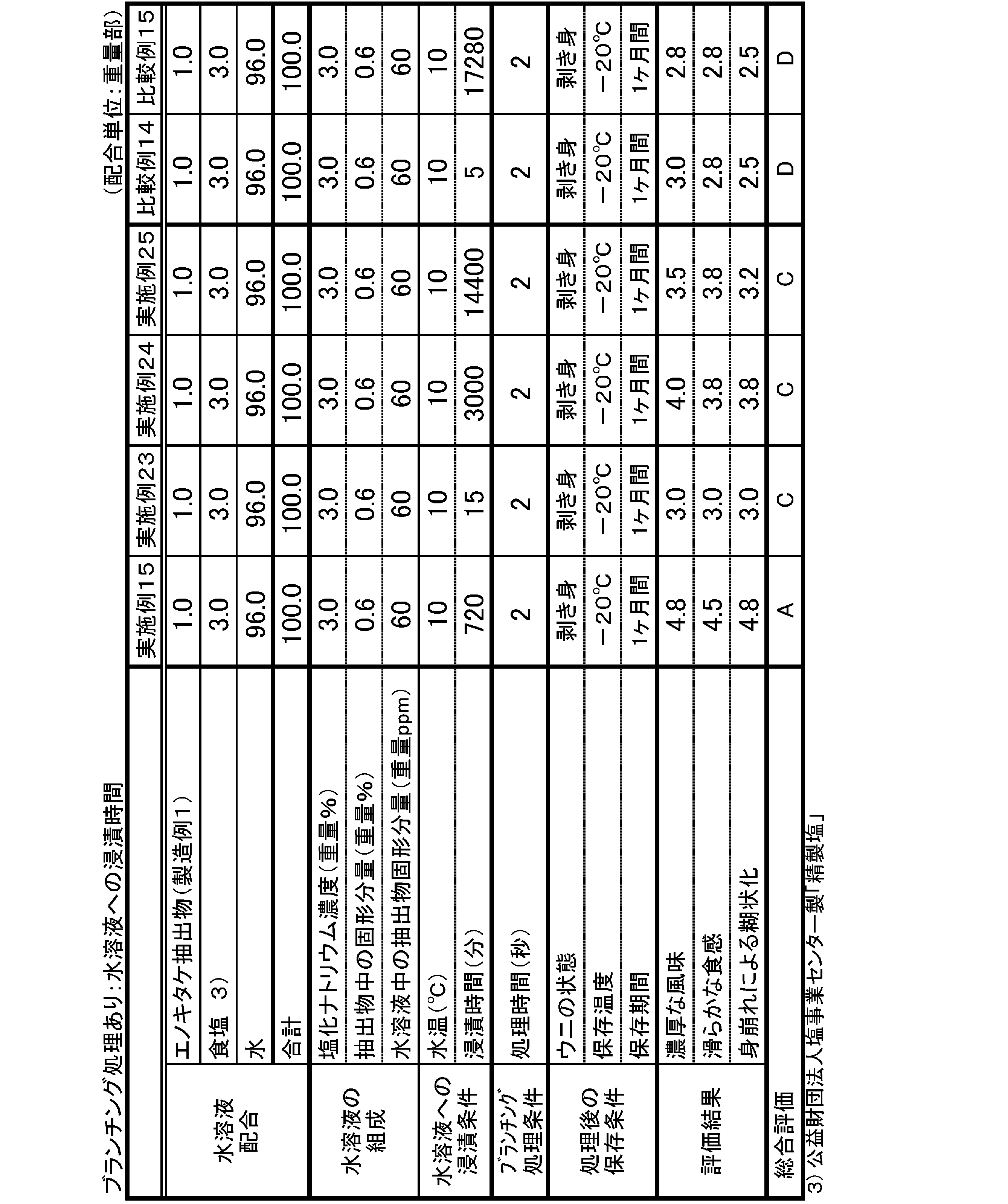
表11から明らかなように、エノキタケ抽出物を含む食塩水に10~15000分間浸漬し、ブランチング処理及び冷解凍して得られた生ウニ(実施例15、及び23-25)は、いずれも、ウニ本来の濃厚な風味が感じられ、滑らかな食感であり、糊状化していなかった。特に浸漬時間を720分間とした生ウニ(実施例15)の風味、食感及び糊状化の程度は極めて良好な評価であった。一方、浸漬時間が5分間の生ウニ(比較例14)は、ザラザラした食感であり、身崩れして半数以上が糊状化していた。また、浸漬時間が17280分間の生ウニ(比較例15)は、ウニ本来の濃厚な風味が感じられ難く、ザラザラした食感であり、身崩れして半数以上が糊状化していた。
(実施例26-28)
表12の条件に従い、ブランチング処理の時間を2秒間から、0秒間(実施例26)、5秒間(実施例27)、又は、10秒間(実施例28)に変更した以外は、実施例15と同様にして生ウニを得た。得られた生ウニについて、濃厚な風味、滑らかな食感、及び、身崩れによる糊状化の各評価を行った。それらの結果を表12に示した。
表12の条件に従い、ブランチング処理の時間を2秒間から、0秒間(実施例26)、5秒間(実施例27)、又は、10秒間(実施例28)に変更した以外は、実施例15と同様にして生ウニを得た。得られた生ウニについて、濃厚な風味、滑らかな食感、及び、身崩れによる糊状化の各評価を行った。それらの結果を表12に示した。
(比較例16-18)
表12の条件に従い、ブランチング処理の時間を2秒間から、0秒間(比較例16)、5秒間(比較例17)、又は、10秒間(比較例18)に変更した以外は、比較例12と同様にして生ウニを得た。得られた生ウニについて、濃厚な風味、滑らかな食感、及び、身崩れによる糊状化の各評価を行った。それらの結果を表12に示した。
表12の条件に従い、ブランチング処理の時間を2秒間から、0秒間(比較例16)、5秒間(比較例17)、又は、10秒間(比較例18)に変更した以外は、比較例12と同様にして生ウニを得た。得られた生ウニについて、濃厚な風味、滑らかな食感、及び、身崩れによる糊状化の各評価を行った。それらの結果を表12に示した。
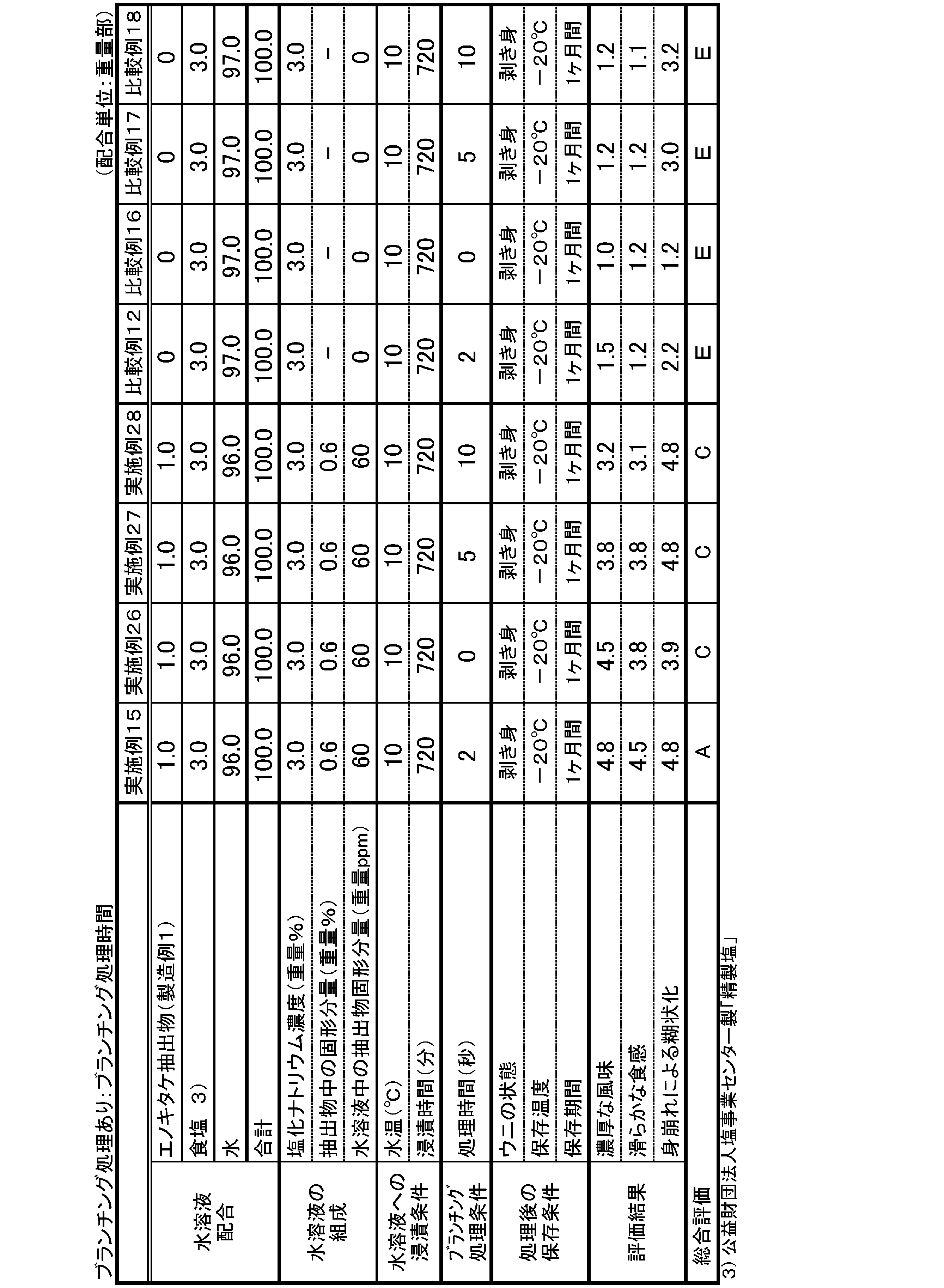
表12から明らかなように、エノキタケ抽出物を含む食塩水に浸漬した後ブランチング処理を0~10秒間行い、冷解凍して得られた生ウニ(実施例15、及び26-28)は、いずれも、ウニ本来の濃厚な風味が感じられ、滑らかな食感であり、糊状化していなかった。特にブランチング処理を2秒間行い、冷解凍して得られた生ウニ(実施例15)の風味、食感及び糊状化の程度は極めて良好な評価であった。一方、エノキタケ抽出物を含有しない食塩水に浸漬した後ブランチング処理を0~10秒間行い、冷解凍して得られた生ウニ(比較例12、及び16-18)は、いずれも、ウニ本来の濃厚な風味がほとんど感じられず、非常にザラザラした食感であった。またこれらの比較例では、ブランチング処理の時間が長くなるにつれて糊状化の程度は改善する傾向が見られたものの、2秒間のブランチング処理を行った比較例12では、身崩れして半数以上が糊状化しており、ブランチング処理を行っていない比較例16では完全に糊状化していた。
(実施例29及び30)
表13の条件に従い、冷凍保存期間を1カ月間から、6カ月間(実施例29)、又は、0時間(実施例30)に変更した以外は実施例15と同様にして、生ウニを得た。得られた生ウニについて、濃厚な風味、滑らかな食感、及び、身崩れによる糊状化の各評価を行った。それらの結果を表13に示した。
表13の条件に従い、冷凍保存期間を1カ月間から、6カ月間(実施例29)、又は、0時間(実施例30)に変更した以外は実施例15と同様にして、生ウニを得た。得られた生ウニについて、濃厚な風味、滑らかな食感、及び、身崩れによる糊状化の各評価を行った。それらの結果を表13に示した。

(比較例19)
表13の条件に従い、冷凍保存期間を1カ月間から、6カ月間に変更した以外は比較例12と同様にして、生ウニを得た。得られた生ウニについて、濃厚な風味、滑らかな食感、及び、身崩れによる糊状化の各評価を行った。それらの結果を表13に示した。
表13の条件に従い、冷凍保存期間を1カ月間から、6カ月間に変更した以外は比較例12と同様にして、生ウニを得た。得られた生ウニについて、濃厚な風味、滑らかな食感、及び、身崩れによる糊状化の各評価を行った。それらの結果を表13に示した。
表13から明らかなように、エノキタケ抽出物を含む食塩水に浸漬した後、ブランチング処理を行い、0時間~6カ月間冷凍保存し、解凍して得られた生ウニ(実施例15、29及び30)はいずれも、ウニ本来の濃厚な風味が強く感じられ、滑らかな食感であり、糊状化していなかった。特に、食塩水から水揚げ後身を剥いてブランチング処理を行い冷凍保存せずに得られた生ウニ(実施例30)、及び、食塩水から水揚げ後身を剥いてブランチング処理を行い1カ月間冷凍保存し、解凍して得られた生ウニ(実施例15)の風味、食感及び糊状化の程度は極めて良好な評価であった。一方、エノキタケ抽出物を含有しない食塩水に浸漬した後、身を剥いてブランチング処理を行い1カ月間又は6カ月間冷凍保存し、解凍して得られた生ウニ(比較例12及び19)は、ウニ本来の濃厚な風味がほとんど感じられず、非常にザラザラした食感であり、身崩れして半数以上が糊状化していた。
Claims (18)
- エノキタケ抽出物、酵母抽出物及び大麦抽出物からなる群より選ばれる少なくとも1種の抽出物を含む、ウニの冷凍保管時劣化抑制剤。
- 前記抽出物を、前記ウニの冷凍保管時劣化抑制剤の乾燥重量全体中、乾燥重量で50~100重量%含む、請求項1に記載のウニの冷凍保管時劣化抑制剤。
- 前記ウニの冷凍保管時劣化抑制剤が、冷凍生ウニ用ブランチング前処理剤である、請求項1又は2に記載のウニの冷凍保管時劣化抑制剤。
- エノキタケ抽出物、酵母抽出物及び大麦抽出物からなる群より選ばれる少なくとも1種の抽出物を固形分で0.1~800ppm含有し、塩化ナトリウム濃度が2~3.5重量%である、冷凍保管前の活ウニの浸漬処理用水溶液。
- 請求項1又は2に記載のウニの冷凍保管時劣化抑制剤を用いた請求項4に記載の水溶液。
- 前記冷凍保管前の活ウニの浸漬処理用水溶液が、ブランチング処理に供する活ウニの浸漬処理用水溶液である、請求項4に記載の水溶液。
- 請求項3に記載のウニの冷凍保管時劣化抑制剤を用いた請求項6に記載の水溶液。
- 温度が1~25℃の範囲にある請求項4又は5に記載の水溶液中に、酸素が供給された状態で10~15000分間浸漬された活ウニ。
- 請求項8に記載の活ウニが冷凍された冷凍生ウニ。
- 請求項9に記載の冷凍生ウニが解凍された生ウニ。
- 請求項8に記載の活ウニが、殻剥き及び加熱調理後に冷凍された冷凍加熱調理ウニ。
- 請求項11に記載の冷凍加熱調理ウニが解凍された加熱調理ウニ。
- 温度が1~25℃の範囲にある請求項6又は7に記載の水溶液中に、酸素が供給された状態で10~15000分間浸漬された活ウニの殻を剥き、ブランチング処理された生ウニ。
- 請求項13に記載の生ウニが冷凍された冷凍生ウニ。
- 請求項14に記載の冷凍生ウニが解凍された生ウニ。
- エノキタケ抽出物、酵母抽出物及び大麦抽出物からなる群より選ばれる少なくとも1種の抽出物を固形分で0.1~800ppm含有し、塩化ナトリウム濃度が2~3.5重量%、温度が1~25℃の範囲にある水溶液中に、酸素が供給された状態で活ウニを10~15000分間浸漬し、その後冷凍することを特徴とする、冷凍生ウニの製造方法。
- エノキタケ抽出物、酵母抽出物及び大麦抽出物からなる群より選ばれる少なくとも1種の抽出物を固形分で0.1~800ppm含有し、塩化ナトリウム濃度が2~3.5重量%、温度が1~25℃の範囲にある水溶液中に、酸素が供給された状態で活ウニを10~15000分間浸漬し、その後殻剥き及び加熱調理してから冷凍することを特徴とする、冷凍加熱調理ウニの製造方法。
- エノキタケ抽出物、酵母抽出物及び大麦抽出物からなる群より選ばれる少なくとも1種の抽出物を固形分で0.1~800ppm含有し、塩化ナトリウム濃度が2~3.5重量%、温度が1~25℃の範囲にある水溶液中に、酸素が供給された状態で活ウニを10~15000分間浸漬した後、殻を剥き、ブランチング処理してから冷凍することを特徴とする、冷凍生ウニの製造方法。
Applications Claiming Priority (4)
| Application Number | Priority Date | Filing Date | Title |
|---|---|---|---|
| JP2018244879A JP7232039B2 (ja) | 2018-12-27 | 2018-12-27 | ウニの冷凍保管時劣化抑制剤 |
| JP2018-244880 | 2018-12-27 | ||
| JP2018244880A JP7232040B2 (ja) | 2018-12-27 | 2018-12-27 | 冷凍生ウニ用ブランチング前処理剤 |
| JP2018-244879 | 2018-12-27 |
Publications (1)
| Publication Number | Publication Date |
|---|---|
| WO2020138314A1 true WO2020138314A1 (ja) | 2020-07-02 |
Family
ID=71129499
Family Applications (1)
| Application Number | Title | Priority Date | Filing Date |
|---|---|---|---|
| PCT/JP2019/051183 Ceased WO2020138314A1 (ja) | 2018-12-27 | 2019-12-26 | ウニの冷凍保管時劣化抑制剤 |
Country Status (1)
| Country | Link |
|---|---|
| WO (1) | WO2020138314A1 (ja) |
Citations (7)
| Publication number | Priority date | Publication date | Assignee | Title |
|---|---|---|---|---|
| JPS6214740A (ja) * | 1985-07-10 | 1987-01-23 | Showa Denko Kk | 生鮮雲丹類の凍結方法 |
| JPS63279766A (ja) * | 1987-05-11 | 1988-11-16 | Tokai Kinzoku Kk | 生ウニの加工方法 |
| JP2004081136A (ja) * | 2002-08-28 | 2004-03-18 | Toyo Suisan Kaisha Ltd | 冷凍生ウニ製造方法およびこれにより製造された冷凍生ウニ |
| JP2005104875A (ja) * | 2003-09-29 | 2005-04-21 | Univ Kansai | 穀物種子抽出物およびその用途 |
| WO2012026339A1 (ja) * | 2010-08-25 | 2012-03-01 | 株式会社カネカ | 担子菌由来の氷結晶化阻害剤 |
| JP2012231687A (ja) * | 2011-04-28 | 2012-11-29 | Erimo Shokuhin Corp | 冷凍ウニおよびその製造方法 |
| JP2014230540A (ja) * | 2013-05-01 | 2014-12-11 | 興人ライフサイエンス株式会社 | 冷凍保存性向上剤 |
-
2019
- 2019-12-26 WO PCT/JP2019/051183 patent/WO2020138314A1/ja not_active Ceased
Patent Citations (7)
| Publication number | Priority date | Publication date | Assignee | Title |
|---|---|---|---|---|
| JPS6214740A (ja) * | 1985-07-10 | 1987-01-23 | Showa Denko Kk | 生鮮雲丹類の凍結方法 |
| JPS63279766A (ja) * | 1987-05-11 | 1988-11-16 | Tokai Kinzoku Kk | 生ウニの加工方法 |
| JP2004081136A (ja) * | 2002-08-28 | 2004-03-18 | Toyo Suisan Kaisha Ltd | 冷凍生ウニ製造方法およびこれにより製造された冷凍生ウニ |
| JP2005104875A (ja) * | 2003-09-29 | 2005-04-21 | Univ Kansai | 穀物種子抽出物およびその用途 |
| WO2012026339A1 (ja) * | 2010-08-25 | 2012-03-01 | 株式会社カネカ | 担子菌由来の氷結晶化阻害剤 |
| JP2012231687A (ja) * | 2011-04-28 | 2012-11-29 | Erimo Shokuhin Corp | 冷凍ウニおよびその製造方法 |
| JP2014230540A (ja) * | 2013-05-01 | 2014-12-11 | 興人ライフサイエンス株式会社 | 冷凍保存性向上剤 |
Similar Documents
| Publication | Publication Date | Title |
|---|---|---|
| JP7194014B2 (ja) | カニミソの冷解凍後の風味低下抑制剤 | |
| CN106615039B (zh) | 一种冻虾仁的生产方法 | |
| JP6877653B2 (ja) | 牡蠣の風味低下抑制剤、活牡蠣の保持用水溶液、及び、風味低下が抑制された牡蠣の製造方法 | |
| CN102987312A (zh) | 一种麻辣蕨菜的制备方法 | |
| KR101666595B1 (ko) | 전복가공방법 | |
| CN104621234A (zh) | 一种冷冻脱壳白对虾品质改良剂及其应用 | |
| CN105029468A (zh) | 一种发酵捆蹄的制备方法 | |
| CN110692960A (zh) | 一种形态完整及可快速复水冻干牡蛎的制备方法 | |
| KR20200080857A (ko) | 해파리 젓갈의 제조방법 및 이로부터 제조되는 해파리 젓갈 | |
| JP2020031553A (ja) | アワビ又はサザエの保管時劣化抑制剤、活アワビ又は活サザエの保持用水溶液、及び、保管時劣化が抑制されたアワビ又はサザエの製造方法 | |
| JP4701193B2 (ja) | カニ類加工食品の製造方法 | |
| JP2019122328A (ja) | 柿ペーストの製造方法及び柿アイスクリームの製造方法 | |
| JP7075314B2 (ja) | ホタテ貝の食感低下抑制剤、活ホタテ貝の保持用水溶液、及び、食感低下が抑制されたホタテ貝の製造方法 | |
| JP7145008B2 (ja) | アサリ又はハマグリの保管時劣化抑制剤、活アサリ又は活ハマグリの保持用水溶液、及び、保管時劣化が抑制されたアサリ又はハマグリの製造方法 | |
| CN108064926B (zh) | 一种海虾的保鲜方法 | |
| WO2020138314A1 (ja) | ウニの冷凍保管時劣化抑制剤 | |
| JP7232040B2 (ja) | 冷凍生ウニ用ブランチング前処理剤 | |
| US7625592B1 (en) | Process and formulation for dried tomatoes | |
| KR100411989B1 (ko) | 버섯이 함유된 창란젓갈의 제조방법 | |
| JP7232039B2 (ja) | ウニの冷凍保管時劣化抑制剤 | |
| JP7194013B2 (ja) | カニの冷解凍後の食感及び身離れの悪化抑制剤 | |
| KR101325161B1 (ko) | 즉석 성게국 제조방법 | |
| JP2010200726A (ja) | 長期保存性フライ加工食品の製造方法 | |
| JPWO2010134149A1 (ja) | 海ぶどうの加工処理方法及び海ぶどうの加工処理品 | |
| KR100928251B1 (ko) | 옥수수를 원료로 하는 낚시용 미끼 제조방법 |
Legal Events
| Date | Code | Title | Description |
|---|---|---|---|
| 121 | Ep: the epo has been informed by wipo that ep was designated in this application |
Ref document number: 19905986 Country of ref document: EP Kind code of ref document: A1 |
|
| NENP | Non-entry into the national phase |
Ref country code: DE |
|
| 122 | Ep: pct application non-entry in european phase |
Ref document number: 19905986 Country of ref document: EP Kind code of ref document: A1 |