WO2020137007A1 - プレコートされた金属素形材、複合体の製造方法および複合体 - Google Patents
プレコートされた金属素形材、複合体の製造方法および複合体 Download PDFInfo
- Publication number
- WO2020137007A1 WO2020137007A1 PCT/JP2019/034527 JP2019034527W WO2020137007A1 WO 2020137007 A1 WO2020137007 A1 WO 2020137007A1 JP 2019034527 W JP2019034527 W JP 2019034527W WO 2020137007 A1 WO2020137007 A1 WO 2020137007A1
- Authority
- WO
- WIPO (PCT)
- Prior art keywords
- rubber
- metal
- inorganic
- layer
- organic
- Prior art date
- Legal status (The legal status is an assumption and is not a legal conclusion. Google has not performed a legal analysis and makes no representation as to the accuracy of the status listed.)
- Ceased
Links
Classifications
-
- B—PERFORMING OPERATIONS; TRANSPORTING
- B32—LAYERED PRODUCTS
- B32B—LAYERED PRODUCTS, i.e. PRODUCTS BUILT-UP OF STRATA OF FLAT OR NON-FLAT, e.g. CELLULAR OR HONEYCOMB, FORM
- B32B15/00—Layered products comprising a layer of metal
- B32B15/04—Layered products comprising a layer of metal comprising metal as the main or only constituent of a layer, which is next to another layer of the same or of a different material
-
- B—PERFORMING OPERATIONS; TRANSPORTING
- B32—LAYERED PRODUCTS
- B32B—LAYERED PRODUCTS, i.e. PRODUCTS BUILT-UP OF STRATA OF FLAT OR NON-FLAT, e.g. CELLULAR OR HONEYCOMB, FORM
- B32B15/00—Layered products comprising a layer of metal
- B32B15/04—Layered products comprising a layer of metal comprising metal as the main or only constituent of a layer, which is next to another layer of the same or of a different material
- B32B15/08—Layered products comprising a layer of metal comprising metal as the main or only constituent of a layer, which is next to another layer of the same or of a different material of synthetic resin
-
- B—PERFORMING OPERATIONS; TRANSPORTING
- B32—LAYERED PRODUCTS
- B32B—LAYERED PRODUCTS, i.e. PRODUCTS BUILT-UP OF STRATA OF FLAT OR NON-FLAT, e.g. CELLULAR OR HONEYCOMB, FORM
- B32B25/00—Layered products comprising a layer of natural or synthetic rubber
- B32B25/04—Layered products comprising a layer of natural or synthetic rubber comprising rubber as the main or only constituent of a layer, which is next to another layer of the same or of a different material
-
- C—CHEMISTRY; METALLURGY
- C23—COATING METALLIC MATERIAL; COATING MATERIAL WITH METALLIC MATERIAL; CHEMICAL SURFACE TREATMENT; DIFFUSION TREATMENT OF METALLIC MATERIAL; COATING BY VACUUM EVAPORATION, BY SPUTTERING, BY ION IMPLANTATION OR BY CHEMICAL VAPOUR DEPOSITION, IN GENERAL; INHIBITING CORROSION OF METALLIC MATERIAL OR INCRUSTATION IN GENERAL
- C23C—COATING METALLIC MATERIAL; COATING MATERIAL WITH METALLIC MATERIAL; SURFACE TREATMENT OF METALLIC MATERIAL BY DIFFUSION INTO THE SURFACE, BY CHEMICAL CONVERSION OR SUBSTITUTION; COATING BY VACUUM EVAPORATION, BY SPUTTERING, BY ION IMPLANTATION OR BY CHEMICAL VAPOUR DEPOSITION, IN GENERAL
- C23C22/00—Chemical surface treatment of metallic material by reaction of the surface with a reactive liquid, leaving reaction products of surface material in the coating, e.g. conversion coatings, passivation of metals
- C23C22/05—Chemical surface treatment of metallic material by reaction of the surface with a reactive liquid, leaving reaction products of surface material in the coating, e.g. conversion coatings, passivation of metals using aqueous solutions
- C23C22/06—Chemical surface treatment of metallic material by reaction of the surface with a reactive liquid, leaving reaction products of surface material in the coating, e.g. conversion coatings, passivation of metals using aqueous solutions using aqueous acidic solutions with pH less than 6
- C23C22/40—Chemical surface treatment of metallic material by reaction of the surface with a reactive liquid, leaving reaction products of surface material in the coating, e.g. conversion coatings, passivation of metals using aqueous solutions using aqueous acidic solutions with pH less than 6 containing molybdates, tungstates or vanadates
- C23C22/44—Chemical surface treatment of metallic material by reaction of the surface with a reactive liquid, leaving reaction products of surface material in the coating, e.g. conversion coatings, passivation of metals using aqueous solutions using aqueous acidic solutions with pH less than 6 containing molybdates, tungstates or vanadates containing also fluorides or complex fluorides
-
- C—CHEMISTRY; METALLURGY
- C23—COATING METALLIC MATERIAL; COATING MATERIAL WITH METALLIC MATERIAL; CHEMICAL SURFACE TREATMENT; DIFFUSION TREATMENT OF METALLIC MATERIAL; COATING BY VACUUM EVAPORATION, BY SPUTTERING, BY ION IMPLANTATION OR BY CHEMICAL VAPOUR DEPOSITION, IN GENERAL; INHIBITING CORROSION OF METALLIC MATERIAL OR INCRUSTATION IN GENERAL
- C23C—COATING METALLIC MATERIAL; COATING MATERIAL WITH METALLIC MATERIAL; SURFACE TREATMENT OF METALLIC MATERIAL BY DIFFUSION INTO THE SURFACE, BY CHEMICAL CONVERSION OR SUBSTITUTION; COATING BY VACUUM EVAPORATION, BY SPUTTERING, BY ION IMPLANTATION OR BY CHEMICAL VAPOUR DEPOSITION, IN GENERAL
- C23C28/00—Coating for obtaining at least two superposed coatings either by methods not provided for in a single one of groups C23C2/00 - C23C26/00 or by combinations of methods provided for in subclasses C23C and C25C or C25D
Definitions
- the present invention relates to a precoated coated metal base material, a method for producing a composite, and a composite.
- a metal plate or its press-molded product which is given a shape by heat or pressure on a metal, or a so-called "metal raw material” which is a metal member molded by casting, forging, cutting, powder metallurgy, etc.
- a composite body in which molded articles of a resin composition are joined is known.
- a composite in which a metal base material and a molded body of a resin composition are joined is lighter in weight than a component made of only metal and has higher strength than a component made of only resin, so that a mobile phone, a personal computer, etc. Used in various electronic devices.
- Patent Document 1 a surface of an electrogalvanized metal that has been subjected to a specific chromate treatment and a chlorinated vulcanized rubber are joined using a synthetic resin adhesive. A method of making a metal bonded composite is described.
- the vulcanized rubber can be bonded to the metal by the above method, and it is not necessary to vulcanize the rubber at the time of bonding, so that it is possible to easily and inexpensively manufacture the rubber-metal adhesive composite. ing.
- the present invention has been made in view of the above points, and is a metal raw material that has been pre-coated to have a bondability with rubber by precoating, and exhibits adhesiveness that affects these during storage and movement.
- a precoated metal base material having sufficient jointability to vulcanized rubber, a composite of metal and rubber joined using the precoated metal base material
- a pre-coated metal casting material according to an embodiment of the present invention for solving the above-mentioned problems is a metal casting material, an inorganic-organic composite layer arranged on the metal casting material, and the inorganic-organic composite.
- the method for producing a composite body according to one embodiment of the present invention for solving the above-mentioned problems the surface of the precoated metal base material, a rubber molded body containing a vulcanized rubber composition, the rubber And a step of arranging the rubber layer in contact with the layer, and heating the rubber layer in contact with the rubber molded body to bond the precoated metal base material and the rubber molded body.
- a composite body according to an embodiment of the present invention for solving the above-mentioned problems, a metal matrix, an inorganic-organic composite layer arranged on the metal matrix, and a surface of the inorganic-organic composite layer.
- a rubber layer containing a vulcanized halogen rubber, and a rubber molded body containing a vulcanized rubber composition arranged in contact with the surface of the rubber layer.
- the metal raw material is preliminarily provided with the bondability with the rubber by the pre-coating, and does not exhibit the adhesiveness that affects these during storage and movement, while it is bonded with the rubber.
- a precoated metal matrix having sufficient bondability to vulcanized rubber a method for producing a composite in which metal and rubber are bonded using the precoated metal matrix, and the precoat Provided is a composite made from the prepared metal profile.
- Pre-coated metal matrix material is a metal matrix material, an inorganic/organic composite layer arranged on the metal matrix material, and a metal/organic composite layer arranged in contact with the surface of the inorganic/organic composite layer.
- the rubber layer includes a halogen rubber and a vulcanizing agent for the halogen rubber.
- the precoated metal matrix has a bondability with a rubber molded body containing a vulcanized rubber composition, and thus the metal matrix and the rubber molded body are bonded together (hereinafter, (Also referred to simply as "complex").
- the rubber layer since the halogen rubber is partially vulcanized at the time of forming the rubber layer, the rubber layer does not have adhesiveness enough to affect storage and movement. On the other hand, in the rubber layer, since the halogen rubber is partially unvulcanized, the rubber layer can be satisfactorily joined to the rubber molded body by thermocompression bonding. In addition, in the present embodiment, the inorganic-organic composite layer has an action of increasing the bonding strength of the rubber layer to the metal matrix material.
- Metal forming material refers to a metal that has been given a shape by being formed or subjected to a force.
- the metal blank is a metal plate, a press-molded product thereof, or a metal member molded by casting, forging, cutting, powder metallurgy, or the like.
- the type of metal blank is not particularly limited. Examples of metal blanks include metal plates, pressed products of metal plates, and metal members.
- the metal plate examples include a zinc-plated steel plate, a Zn-Al alloy-plated steel plate, a Zn-Al-Mg-alloy plated steel plate, a Zn-Al-Mg-Si alloy-plated steel plate, an aluminum-plated steel plate, a stainless steel plate (austenitic steel, martens). (Including site-based, ferrite-based, and ferrite-martensite two-phase systems), aluminum plates, aluminum alloy plates, and copper plates.
- the metal plate may be a rolled steel plate such as a cold rolled steel plate.
- the metal member include various metal members formed by casting, forging, cutting, powder metallurgy, etc., including aluminum die casting and zinc die casting.
- the metal base material may be subjected to known pretreatments such as degreasing and pickling, if necessary.
- Inorganic-organic composite layer The inorganic-organic composite layer is in contact with the surface of the metal matrix or through another layer such as the plating layer between the surface of the metal matrix and the metal matrix. It is placed on the surface of the profile.
- the above-mentioned inorganic-organic composite layer is a layer containing an inorganic compound and an organic compound.
- the above-mentioned inorganic compound may be any compound capable of reacting with the above-mentioned organic compound to form a bond or form a chelate.
- the inorganic compound preferably contains a metal that forms a polyvalent ion. More preferably, it is an oxide, hydroxide or fluoride of a metal selected from the group consisting of Group 4 metals, Group 5 metals or Group 6 metals.
- the metal is preferably a metal other than chromium, and is Ti, Zr, Hf, V, Nb, Ta, Mo or W. It is preferable.
- These metals are metal ions eluted from the surface of the metal base material (for example, when the metal base material is a stainless steel plate, metal ions such as Cr, Ni, Mo, and Fe, and the metal base material is plated. When it has a layer, it reacts with the ions of the metal constituting the plating such as Zn, Mg and Al) to form a poorly soluble chemical conversion coating having excellent corrosion resistance. Further, these metals react with an organic compound to crosslink the organic compound and form a sparingly soluble inorganic-organic composite compound in which the inorganic compound and the organic compound are composited.
- the inorganic-organic composite layer having a dense skeleton made of the inorganic-organic composite compound thus formed has high adhesion to the metal base material and can also improve the corrosion resistance of the metal base material.
- these metals can act as a vulcanizing agent for the halogen rubber contained in the rubber layer. Therefore, these metals are bonded to the halogen rubber in the rubber layer when the rubber molded body is thermocompression-bonded to the precoated metal base material, and the bonding strength between the inorganic-organic composite layer and the rubber layer is increased. It is possible to further improve the bonding strength of the rubber molded body bonded to the rubber layer to the metal base material.
- the inorganic-organic composite layer contains an inorganic compound containing Ti (hereinafter, also referred to as “titanium compound”)
- the amount of Ti (titanium atom) conversion is 1 mg/m 2 or more and 100 mg/m 2 or less. It is preferable to contain the titanium compound of.
- the inorganic-organic composite layer contains an inorganic compound containing Zr (hereinafter, also referred to as “zirconium compound”)
- the amount of Zr (zirconium atom) conversion is 0.1 mg/m 2 or more and 30 mg/m 2 or more. It is preferable to contain 2 or less zirconium compounds.
- the inorganic-organic composite layer may be a so-called chromate-free chemical conversion coating that does not substantially contain chromium as the metal. Therefore, the pre-coated metal matrix having the inorganic-organic composite layer can be chromate-free.
- chromate-free means that the precoated metal matrix material does not substantially contain hexavalent chromium. “Chromate-free” means that, for example, four 50 mm ⁇ 50 mm test pieces are cut out from the precoated metal base material, immersed in 100 mL of boiling pure water for 10 minutes, and then immersed in the pure water.
- concentration analysis method according to JIS H8625 (1993) Annex 2.4.1 “Diphenylcarbazide colorimetric method”
- the metal mainly forms an amorphous oxide or hydroxide in the inorganic-organic composite layer to form the dense skeleton.
- the metal may be present in the inorganic-organic composite layer as a poorly soluble fluoride. After the fluoride is dissolved in the water in the atmosphere, it is re-precipitated as a hardly soluble oxide or hydroxide on the surface of the metal matrix exposed from the defect portion to fill the defect portion. That is, the so-called self-repairing action can be exhibited, which is preferable.
- organic compounds examples include organic acids and organic resins.
- the organic compound is an organic acid from the viewpoint of facilitating the formation of a chelate with the metal and forming a dense inorganic-organic composite layer having excellent adhesion to a metal matrix and corrosion resistance. Is preferred.
- the above organic compounds have a high action of forming intermolecular forces and hydrogen bonds. Therefore, the organic compound forms an interaction with the halogen rubber constituting the rubber layer to enhance the adhesiveness of the rubber layer to the inorganic-organic composite layer, whereby the rubber molded body to be bonded to the rubber layer is formed. It is possible to increase the bonding strength to the metal base material.
- the above-mentioned organic compound acts as a binder of the rubber layer and enhances the adhesion of the rubber layer to the inorganic-organic composite layer.
- the organic compound is transferred from the rubber layer of the precoated metal matrix to the rubber layer of the other precoated metal matrix in a non-heated state such as during transfer and storage. (Hereinafter, also referred to as “blocking”, in which the rubber layer of the precoated metal matrix is unintentionally adhered to another surface when not heated and cannot be easily separated).
- the organic acid when the inorganic-organic composite treatment liquid is applied to the metal base material and dried by heating to form the inorganic-organic composite layer, water is removed and the treatment liquid is concentrated. The pH of the liquid locally drops. Due to this local decrease in pH, the surface in contact with the inorganic-organic composite layer on the side of the metal matrix is finely etched. Therefore, the organic acid, by the etching, to widen the contact area between the surface of the metal matrix and the inorganic-organic composite layer, it is also possible to increase the bonding strength of the inorganic-organic composite layer to the metal matrix. it can.
- the organic acid causes metal salts and oxides to be eluted from the metal matrix into the inorganic-organic composite layer during the etching. Since the eluted metal salts and oxides also act as a vulcanizing material for halogen rubber, the inorganic-organic composite layer (metal salts and oxides) and rubber layer (metal salts and oxides) are heated by heating when joining the rubber moldings. It is also possible to increase the bonding strength of the inorganic-organic composite layer to the metal matrix after bonding the rubber molded body by bonding with a halogen rubber).
- the organic acid may be an organic compound having a hydroxyl group in the molecule, and is preferably an organic compound having a carboxyl group in the molecule. Further, the organic acid is preferably a polyvalent organic acid having two or more hydroxyl groups or carboxyl groups in the molecule. Examples of such organic acids include tartaric acid, tannic acid, citric acid, oxalic acid, malonic acid, lactic acid, 2-phosphonobutane-1,2,4-tricarboxylic acid (PBTC) and the like.
- PBTC 2-phosphonobutane-1,2,4-tricarboxylic acid
- polyhydric phenols such as tannic acid and organic phosphonic acids such as PBTC easily form stable inorganic-organic composite compounds, and also have an action of complementing the self-repairing action of the above-mentioned metal fluorides. Since it has, the adhesiveness of the said inorganic organic composite layer can be improved more. Further, since the polyhydric phenols and the organic phosphonic acid are soluble even in strong acidity, even when concentrated in the treatment liquid when forming the inorganic-organic composite layer, the surface of the metal matrix is etched by the etching. The effect of improving the bonding strength can be more remarkably exhibited.
- organic acid may form a salt with Mg, Al, Fe, Ni, Zn, Mo and the like.
- organic resin examples include phenol resin, acrylic resin, acrylic olefin resin, and urethane resin.
- the above-mentioned inorganic-organic composite layer may further contain components other than the above-mentioned components.
- examples of such other ingredients include anticorrosive ingredients, waxes and inorganic lubricants.
- examples of the rust preventive components include porous silica, metal phosphates and complex phosphates.
- examples of the above wax include various organic waxes of fluorine type, polyethylene type and styrene type.
- Examples of the above inorganic lubricants include silica, molybdenum disulfide and talc.
- composition in the inorganic-organic composite layer can be confirmed by, for example, a Fourier transform infrared spectrophotometer for organic components and a fluorescent X-ray analyzer for inorganic components.
- the amount of the inorganic-organic composite layer attached is preferably 10 mg/m 2 or more and 300 mg/m 2 or less, and more preferably 30 mg/m 2 or more and 200 mg/m 2 or less.
- the inorganic-organic composite layer is formed by applying a water-based inorganic-organic composite treatment liquid (dispersion or solution) containing the inorganic compound and the organic compound, and optionally other components, onto the metal casting. It can be formed by a method of heating and drying.
- the above-mentioned inorganic-organic composite treatment liquid is, for example, when forming an inorganic-organic composite layer containing a titanium compound as the above-mentioned inorganic compound, K n TiF 6 (K: alkali metal or alkaline earth metal, n: 1 or 2) , K 2 [TiO(COO) 2 ], (NH 4 ) 2 TiF 6 , H 2 TiF 6 , TiCl 4 , TiOSO 4 , Ti(SO 4 ) 2 , Ti(OH) 4 , (NH 4 ) 2 TiF 6 , H 2 TiF 6 and KnTiF 6 may be contained.
- K n TiF 6 K: alkali metal or alkaline earth metal, n: 1 or 2
- K 2 [TiO(COO) 2 K 2 [TiO(COO) 2
- (NH 4 ) 2 TiF 6 , H 2 TiF 6 , TiCl 4 , TiOSO 4 Ti(SO 4 ) 2
- zirconate such as zirconium oxide and sodium zirconate, or fluorinated It suffices to contain zirconic acid and a fluorozirconate such as sodium fluorozirconate.
- the inorganic-organic composite treatment liquid may contain the above-mentioned organic acid or its salt or the above-mentioned organic resin as the above-mentioned organic compound.
- the method of applying the inorganic-organic composite treatment liquid is not particularly limited and may be appropriately selected from known methods including a roll coating method, a curtain flow method, a spin coating method, a spray method, a dipping and pulling method and the like.
- the conditions for heating and drying the inorganic-organic composite treatment liquid may be appropriately set according to the composition and amount of the inorganic-organic composite treatment liquid. For example, by putting the metal base material coated with the inorganic-organic composite treatment liquid in a drying oven and drying it with a hot air dryer so that the surface temperature of the metal base material falls within the range of 110 to 200° C., A uniform inorganic-organic composite layer can be formed on the surface of the metal matrix.
- the rubber layer is a layer containing a halogen rubber as a main component and a vulcanizing agent for the halogen rubber.
- the term “main component” means that 50% by mass or more of the organic resin contained in the rubber layer is a halogen rubber.
- halogen rubber Since the above-mentioned halogen rubber has high adhesion to both the inorganic-organic composite layer and the rubber molded body, it is possible to increase the bonding strength of the rubber molded body to the metal base material.
- halogen rubber examples include vinylidene fluoride rubber, fluorine-containing vinyl ether rubber, and fluorine-containing fluorinated rubber such as phosphazene rubber, chloroprene rubber, chlorosulfonated polyethylene rubber, epichlorohydrin rubber, chlorinated butyl rubber, chlorinated polyethylene. It includes rubber, chlorinated rubber containing maleic acid-modified chlorinated polyethylene rubber, chlorinated rubber obtained by chlorinating natural rubber, and brominated rubber containing brominated butyl rubber.
- chlorinated rubbers are preferable, and chloroprene rubbers, chlorosulfonated polyethylene rubbers, and chlorinated rubbers are more preferable, from the viewpoint of further enhancing the bondability to the inorganic-organic composite layer and the rubber molded body.
- the vulcanizing agent may be any compound that can vulcanize the halogen rubber.
- examples of the vulcanizing agent include metal oxides, metal salts of unsaturated fatty acids, organic peroxides, thiourea compounds, and the like.
- metal oxides as the vulcanizing agent include magnesium oxide and zinc oxide.
- Examples of unsaturated fatty acid metal salts as the vulcanizing agent include zinc salts and magnesium salts of unsaturated fatty acids having 3 to 8 carbon atoms.
- organic peroxide as the vulcanizing agent examples include dicumyl peroxide, di-t-butyl peroxide, 2,5-dimethyl-2,5-di(t-butylperoxy)-3-hexyne. , 2,5-Dimethyl-2,5-di(t-butylperoxy)hexane, dialkyl peroxides including 1,3-bis(t-butylperoxyisopropyl)benzene, benzoyl peroxide, and iso Diacyl peroxides including butyryl peroxide, and peroxyesters including 2,5-dimethyl-2,5-bis(benzoylperoxy)hexane and t-butylperoxyisopropyl carbonate, etc. are included. ..
- thiourea compounds as the vulcanizing agent include ethylene thiourea, diethyl thiourea, dibutyl thiourea, and trimethyl thiourea.
- the inorganic-organic composite layer contains, in addition to the components described above, an aldehyde-ammonia system, an aldehyde-amine system, an imidazoline system, a thiourea system, a guanidine system, a thiazole system, a sulfenamide system, a thiuram system, a dithiocarbamate system, It may contain a vulcanization accelerator such as xanthate.
- the halogen rubber is partially vulcanized by the vulcanizing agent during heating when forming the rubber layer, and the reactivity and fluidity of the halogen rubber are reduced. Therefore, the adhesiveness to other rubber layers and the like is not so high in the unheated state such as during transfer and storage.
- the halogen rubber since the halogen rubber remains partially unvulcanized, the halogen rubber becomes fluid when heated. Therefore, when the rubber molded body is brought into contact with the rubber layer and is thermocompression-bonded, the molecules of the halogen rubber having fluidity permeate into the outermost layer of the rubber molded body and are entangled with the molecules constituting the rubber molded body. When the heating is continued in this state, the halogen rubber is vulcanized and cured by the vulcanizing agent while being entangled with the molecules forming the rubber molded body. Therefore, the rubber layer can increase the bonding strength of the rubber molded body to the metal base material.
- partially vulcanized (or partially unvulcanized) can be confirmed by a known method.
- the rubber layer contains a vulcanizing agent in an amount of 1% by mass or more and 50% by mass or less based on the total mass of the halogen rubber. Is preferable, and it is more preferable that the amount is 10% by mass or more and 30% by mass or less.
- the adhesion thickness of the rubber layer is preferably 1 ⁇ m or more and 200 ⁇ m or less, more preferably 5 ⁇ m or more and 60 ⁇ m or less.
- the rubber layer is preferably a non-vulcanized halogen rubber and a vulcanizing agent, and other components optionally added, a pre-coat film liquid dispersed or dissolved in an organic solvent on the surface of the inorganic-organic composite layer. It can be formed by a method of coating, heating and drying.
- the method for applying the precoat film liquid is not particularly limited, and may be appropriately selected from known methods including a roll coating method, a curtain flow method, a spin coating method, a spray method, a dipping and pulling method and the like.
- the conditions for heating and drying the precoat film liquid may be appropriately set according to the composition of the precoat film liquid and the amount to be applied, but it is preferable to perform the conditions such that the rubber layer is partially vulcanized.
- the metal base material coated with the precoat film liquid is put into a drying oven so that the surface temperature of the metal base material falls within the range of 120 to 200° C., and the hot air dryer is used for 10 seconds to 3 minutes. By drying for about a minute, the rubber layer in which the halogen rubber is partially vulcanized can be formed. Under the heating conditions of this level, the halogen rubber is not completely vulcanized but remains partially vulcanized.
- the rubber molded body is a molded body having a desired shape and containing a vulcanized rubber composition.
- the rubber composition may be a rubber composition having a bondability with the halogen rubber contained in the rubber layer, but particularly a natural rubber, a chloroprene rubber, a nitrile butadiene rubber, or a diene-based polymer having an unsaturated bond in its main chain. Rubber is preferred.
- the above rubber composition is a vulcanized rubber composition.
- the precoated metal matrix has sufficient bondability with the vulcanized rubber composition. Therefore, the rubber molded body does not need to be vulcanized at the time of joining, does not require an apparatus for vulcanization and preparations, and enables a simple and inexpensive production of a composite.
- the above rubber molded body may have a shape according to the application. From the viewpoint of enhancing the bondability to the pre-coated metal base material, the surface of the molded body that contacts the rubber layer has substantially the same shape as the surface of the rubber layer that contacts the molded body. It is preferable to have.
- the composite is a step of arranging a rubber molding containing a vulcanized rubber composition in contact with the rubber layer on the surface of the precoated metal matrix, and the step of contacting with the rubber molding. It can be manufactured by a method including a step of heating the rubber layer to bond the precoated metal base material and the rubber molded body.
- Step of arranging the rubber molded body on the surface of the precoated metal base material In this step, the above-mentioned precoated metal base material is prepared, and the rubber molded body is placed on the surface thereof in contact with the rubber layer. To do.
- the pre-coated metal matrix, the above-mentioned inorganic-organic composite treatment liquid is applied on the metal matrix and heated and dried to form an inorganic-organic composite layer, and then the inorganic-organic composite layer is formed.
- the prepared product may be prepared by applying the above-mentioned precoating film liquid on the surface, heating and drying.
- the rubber molded body is arranged in contact with the rubber layer with respect to the pre-coated metal base material.
- the rubber molded body has at least a portion to be joined of the rubber molded body and a portion to be joined of the pre-coated metal base material which are in contact with each other via the rubber layer, Placed against a pre-coated metal blank.
- the part to be joined of the rubber molded body and the part to be joined of the precoated metal base material are at least at the time of performing a heating step described later, via a rubber layer. All you have to do is contact.
- the rubber molded body and the precoated metal base material are pressed and attached to each other by a fixing jig or the like from the viewpoint of preventing misalignment.
- Step of heating the rubber layer In this step, the contact portion between the rubber layer of the preformed metal material and the rubber molded body is heated to heat-bond the rubber layer and the rubber molded body. Then, the rubber molded body is bonded to the metal base material. At this time, at the same time, since the halogen rubber contained in the rubber layer is further vulcanized, it is possible to more firmly bond the rubber molded body and the metal base material.
- the heating may be performed on at least a part of the surface in contact with the rubber layer and the rubber molded body, but from the viewpoint of further improving the adhesiveness, it is performed on the entire surface in contact. It is preferable.
- the heating method is not particularly limited and may be appropriately selected from known methods. Examples of such heating methods include heating by hot press, heating by hot roller, electromagnetic induction heating, direct current heating, heating by resistance heating, heating by ultrasonic wave, laser heating, heating by hot air heating furnace, and heater chip. Heating by etc. is included.
- Molecules of the halogen rubber contained in the rubber layer are sufficiently entangled with the molecules constituting the rubber molded body, and from the viewpoint of further increasing the bonding strength between the rubber molded body and the metal raw material, at the time of heating. It is preferable to press either or both of the rubber molded body and the precoated metal base material so that they are biased toward each other.
- the conditions such as temperature and pressure during heating may be set so that the halogen rubber is sufficiently vulcanized.
- the halogen rubber is sufficiently vulcanized by heating for 10 to 30 minutes so that the surface temperature of the metal raw material falls within the range of 150 to 300° C. It can be bonded to the metal base material with sufficient strength.
- a pressure of 0.5 MPa or more may be applied between the rubber molded body and the precoated metal base material, and a pressure of 2 MPa or more is preferably applied. ..
- the upper limit of the pressure is not particularly limited, but may be 100 MPa or less, for example.
- Composite Body Another embodiment of the present invention relates to a composite body manufactured by the above manufacturing method.
- the composite includes a metal matrix, an inorganic-organic composite layer disposed on the metal matrix, and a vulcanized halogen rubber disposed in contact with the surface of the inorganic-organic composite layer. It has a rubber layer and a rubber molded object which is arranged in contact with the surface of the rubber layer and which contains a vulcanized rubber composition.
- the above metal matrix and inorganic-organic composite layer have substantially the same components as the metal matrix and inorganic-organic composite layer described above for the precoated metal matrix.
- the vulcanized rubber layer is a layer derived from the rubber layer described above for the precoated metal matrix, provided that the halogen rubber contained in the rubber layer is vulcanized in the present embodiment. ..
- the above-mentioned rubber molded body is a rubber molded body joined to the above-mentioned pre-coated metal base material.
- a clear boundary may not be formed between the rubber molded body and the vulcanized rubber layer, and an interface region in which both rubbers are mixed in the thickness direction may be formed.
- Preparation of precoated metal base material 1-1 Preparation of Inorganic-Organic Composite Treatment Liquid As organic acids, tannic acid, which is a polyhydric phenol, and 2-phosphonobutane-1,2,4-tricarboxylic acid (PBTC), which is an organic phosphonic acid, were prepared.
- tannic acid which is a polyhydric phenol
- PBTC 2-phosphonobutane-1,2,4-tricarboxylic acid
- treatment liquid 1 An organic compound (organic acid) and an inorganic compound (compound containing a metal that forms a polyvalent ion) in the combinations shown in Table 1 were dissolved in ion-exchanged water so that each content was 2% by mass.
- Inorganic-organic composite treatment liquid 1 to inorganic-organic composite treatment liquid 8 (hereinafter referred to as “treatment liquid 1" to “treatment liquid 8", respectively) were prepared.
- Comparative Treatment Liquid 1 Ion-exchanged water to which neither organic compounds nor inorganic compounds were added was designated as Comparative Treatment Liquid 1. Further, the organic compounds or the inorganic compounds shown in Table 2 were dissolved in ion-exchanged water so that the content was 2% by mass to prepare Comparative Treatment Liquids 2 to 6.
- precoat film liquid Chlorosulfonated polyethylene rubber (15 parts by mass), which is a halogen rubber, was dissolved in toluene (85 parts by mass). Furthermore, zinc oxide (5 parts by mass), which is a vulcanizing agent, was added to this solution, and the mixture was uniformly stirred to give Precoat film liquid 1 (hereinafter, "precoat film liquid” is referred to as "film liquid”). Prepared.
- a film liquid 2 was prepared in the same manner as the film liquid 1 except that the halogen rubber was changed to chloroprene.
- Comparative coating solution 1 prepared in the same manner as coating solution 1 except that the vulcanizing agent was not added, and comparative coating solution prepared in the same manner as coating solution 1 except that the vulcanizing agent was added in a small amount of 100% based on the total amount of the halogen rubber. Liquid 2 was prepared.
- pre-coated metal base material A hot-dip galvanized steel sheet having a plate thickness of 1.6 mm was prepared, degreased with ethanol as a solvent, and dried.
- the inorganic-organic composite treatment liquid 1 was applied to the surface of the plated layer of the steel sheet by a bar coater so that the coating thickness was 4 ⁇ m (adhesion amount when dried: 65 mg/m 2 ).
- the steel plate was put into an electric hot air oven, and the inorganic-organic composite treatment liquid 1 was dried at an atmospheric temperature of 300° C. for 5 to 10 seconds so that the steel plate surface temperature was 150° C., to form an inorganic-organic composite layer.
- the steel plate temperature was measured by directly attaching a thermocouple to the hot-dip galvanized steel plate of the base material.
- the precoat film liquid 1 was applied to the surface of the inorganic-organic composite layer with a bar coater so that the coating thickness was 50 ⁇ m and the thickness after drying was 20 ⁇ m. After that, the steel plate is put into an electric hot air oven, and the precoat film liquid 1 is dried at an ambient temperature of 300°C so that the steel plate surface temperature is 160°C to form a partially vulcanized rubber layer. A metal blank 1 was obtained.
- the combination of the inorganic-organic composite treatment liquid and the precoat film liquid was changed to the combination shown in Table 3 to obtain precoated metal matrix materials 2 to precoat metal matrix material 10.
- the pre-coated metal element shown in Table 3 is prepared by using one of Comparative Treatment Liquids 1 to 6 instead of the Inorganic-organic composite treatment liquid 1 or by using the Comparative Pre-coat film liquid 1 instead of the Pre-coat treatment liquid 1. Profile 11 to pre-coated metal matrix 18 were obtained.
- the precoated metal matrix 23 and the precoated metal matrix 24 shown in Table 3 were obtained in the same manner as the precoated metal matrix 1 or the precoated metal matrix 6 except that the rubber layer was not formed.
- Pre-coated metal base material 1 to pre-coated metal base material 20 are cut into 25 mm width x 60 mm length, respectively, so that the surface of the rubber layer is exposed in a 25 mm square area. Both ends of the metal base material in the long side direction were sealed with heat-resistant fluorine tape of 17.5 mm.
- a vulcanized nitrile rubber having a hardness of 60 degrees and a thickness of 6 mm cut out into a width of 25 mm and a length of 125 mm is aligned with one end face in the long side direction of the cut out precoated metal base material, and the exposed rubber layer I also made contact.
- the precoated metal base material and the vulcanized nitrile rubber were thermocompression bonded under the conditions of 170° C. and 98 MPa for 15 minutes to bond them to each other to obtain a composite.
- the obtained composite was fixed to the test jig shown in FIG. 1 of JIS K6256-1-2, and the end surface of the vulcanized nitrile rubber that did not come into contact with the precoated metal matrix was grasped with a width of 50 mm, and the tensile tester ( Shimadzu Corp., device name "Autograph AG-IS") was used to peel 90 degrees at a speed of 50 mm/min, and the peeling force at which cohesive failure of the vulcanized nitrile rubber occurred was measured. The bonding strength of the vulcanized rubber was evaluated. ⁇ Cohesive failure occurred when maximum peeling force was 4 N/mm or more. ⁇ Cohesive failure occurred when maximum peeling force was 2 N/mm or more and less than 4 N/mm ⁇ Cohesive failure occurred when maximum peeling force was less than 2 N/mm.
- Table 4 shows the evaluation results.
- the preparation conditions presence or absence of addition of an inorganic compound, an organic compound, a halogen rubber and a vulcanizing agent
- “ ⁇ ” means that each of the above components was added
- "X” indicates that the above components were not added.
- Pre-coated metal casting materials 1 to pre-coat having a metal casting material, an inorganic-organic composite layer arranged on the metal casting material, and a rubber layer arranged in contact with the surface of the inorganic organic composite layer
- the metal base material 10 was less likely to cause blocking and had a high bonding strength with the vulcanized rubber.
- the pre-coated metal base material 14 to pre-coated metal base material 16 to which the organic compound was not added to the inorganic-organic composite layer were likely to cause blocking, and it was difficult to increase the bonding strength of the vulcanized rubber. This is because there is no interaction between the organic acid and the halogen rubber, and the organic acid etches the metal matrix and the metal salts and oxides eluted from the metal matrix and the halogen rubber. It is probable that the bond between and did not occur.
- the pre-coated metal base material 17 and the pre-coated metal base material 18 in which the vulcanizing agent was not added to the rubber layer were likely to cause blocking, and it was difficult to increase the bonding strength of the vulcanized rubber. This is because the rubber layer was not partially vulcanized during the production of the precoated metal blank, so the bondability to other rubber layers did not deteriorate, and the halogen rubber was added during thermocompression bonding with the rubber molding. It is considered that the halogen rubber did not cure sufficiently because it did not vulcanize.
- the pre-coated metal base material of the present invention hardly causes blocking during storage and movement, and has good bondability to a vulcanized rubber molding.
- the composite body obtained by joining the pre-coated metal base material and the rubber molded body of the present invention is suitable for various electronic devices, household appliances, medical devices, automobile bodies, vehicle mounted articles, building materials, etc. Used.
Landscapes
- Chemical & Material Sciences (AREA)
- Chemical Kinetics & Catalysis (AREA)
- Engineering & Computer Science (AREA)
- Materials Engineering (AREA)
- Mechanical Engineering (AREA)
- Metallurgy (AREA)
- Organic Chemistry (AREA)
- General Chemical & Material Sciences (AREA)
- Laminated Bodies (AREA)
- Chemical Treatment Of Metals (AREA)
- Other Surface Treatments For Metallic Materials (AREA)
Abstract
本発明は、プレコートによりゴムとの接合性が予め付与された金属素形材であって、保管および移動時にはこれらに影響を及ぼすような接着性を発揮せず、一方でゴムとの接合時には加硫されたゴムへの十分な接合性を有する、プレコートされた金属素形材を提供することを目的とする。上記目的を達成するための本発明は、金属素形材と、上記金属素形材の上に配置された無機有機複合層と、上記無機有機複合層の表面に接して配置されたゴム層と、を有する、プレコートされた金属素形材に関する。前記ゴム層は、ハロゲンゴムと、前記ハロゲンゴムの加硫剤と、を含有する。
Description
本発明は、プレコートされた塗装金属素形材、複合体の製造方法および複合体に関する。
金属に熱または圧力などにより形状を付与した、金属板もしくはそのプレス成形品、または鋳造、鍛造、切削、粉末冶金などにより成形された金属製の部材である、いわゆる「金属素形材」に、樹脂組成物の成形体を接合させた複合体が知られている。金属素形材と樹脂組成物の成形体とが接合された複合体は、金属のみからなる部品よりも軽量であり、かつ樹脂のみからなる部品よりも強度が高いため、携帯電話機やパーソナルコンピューターなどの様々な電子機器に使用されている。
一方で、金属素形材の表面にゴムを接合しようとするとき、従来は、接着剤を用いて上記金属素形材とゴムとを接合させていた。たとえば、特許文献1には、電気亜鉛めっきされた金属の表面に特定のクロメート処理を施したものと、塩素化処理をした加硫ゴムとを、合成樹脂接着剤を用いて接合する、ゴム・金属接着複合体の製造方法が記載されている。
特許文献1によれば、上記方法では加硫ゴムを金属に接合させることができ、接合時にゴムの加硫を行う必要がないため、簡易かつ安価にゴム・金属接着複合体を製造できるとされている。
しかし、接着剤を使用して加硫ゴムを金属素形材に接合する方法では、接着剤を塗布した後すぐに接合(接着)を行う必要がある。そのため、接合される金属素形材およびゴムのいずれかの形状が複雑であるときや、接合面積が広いときなどには、これらの接合面への接着剤の塗布およびその後の接合の工程の時間調整が困難である。また、2液型の接着剤を用いるときは、主剤と硬化剤とを混合した後の可使時間(ポットライフ)および接合強度を十分に高めるための硬化時間などの調整が製造工程への負担となりやすい。
これに対し、ゴム用接着剤を予め大面積にプレコートした金属を加工してなる、ゴムへの接着性が予め付与された金属素形材を用意しておけば、所望のタイミングで金属素形材とゴムとを接合させることができるため、上記接着剤の塗布が製造工程へ与える負担も軽減されるとも考えられる。しかし、この方法では、可使時間などの制限がない接着剤を使用する必要があるため、特許文献1に記載されたような共有結合などの一次結合による接着剤は実用的ではなく、水素結合および分子間力などの二次結合による接着剤しか使用できない。そして、二次結合による接着剤は、塗布した時点で接着性を発揮してしまうため、二次結合による接着剤を塗布した金属素形材は、積載したりコイル状に巻いたりしての保管および移送などを行うことが困難である。
本発明は、かかる点に鑑みてなされたものであり、プレコートによりゴムとの接合性が予め付与された金属素形材であって、保管および移動時にはこれらに影響を及ぼすような接着性を発揮せず、一方でゴムとの接合時には加硫されたゴムへの十分な接合性を有するプレコートされた金属素形材、当該プレコートされた金属素形材を用いて金属とゴムとが接合した複合体を製造する方法、および当該プレコートされた金属素形材から製造される複合体を提供することをその目的とする。
上記課題を解決するための本発明の一実施形態に関するプレコートされた金属素形材は、金属素形材と、上記金属素形材の上に配置された無機有機複合層と、上記無機有機複合層の表面に接して配置されたゴム層と、を有し、上記ゴム層は、ハロゲンゴムと、上記ハロゲンゴムの加硫剤と、を含有する。
また、上記課題を解決するための本発明の一実施形態に関する複合体の製造方法は、上記プレコートされた金属素形材の表面に、加硫されたゴム組成物を含むゴム成形体を前記ゴム層に接して配置する工程と、上記ゴム成形体と接している上記ゴム層を加熱して、上記プレコートされた金属素形材と上記ゴム成形体とを接合させる工程と、を有する。
また、上記課題を解決するための本発明の一実施形態に関する複合体は、金属素形材と、上記金属素形材の上に配置された無機有機複合層と、上記無機有機複合層の表面に接して配置された、加硫されたハロゲンゴムを含むゴム層と、上記ゴム層の表面に接して配置された、加硫されたゴム組成物を含むゴム成形体と、を有する。
本発明によれば、プレコートによりゴムとの接合性が予め付与された金属素形材であって、保管および移動時にはこれらに影響を及ぼすような接着性を発揮せず、一方でゴムとの接合時には加硫されたゴムへの十分な接合性を有するプレコートされた金属素形材、当該プレコートされた金属素形材を用いて金属とゴムとが接合した複合体を製造する方法、および当該プレコートされた金属素形材から製造される複合体が提供される。
1.プレコートされた金属素形材
本発明の一実施形態は、金属素形材と、上記金属素形材の上に配置された無機有機複合層と、上記無機有機複合層の表面に接して配置されたゴム層と、を有する、プレコートされた金属素形材に関する。上記プレコートされた金属素形材において、上記ゴム層は、ハロゲンゴムと、上記ハロゲンゴムの加硫剤と、を含む。上記プレコートされた金属素形材は、加硫されたゴム組成物を含むゴム成形体との接合性を有するため、上記金属素形材と上記ゴム成形体とが接合された複合体(以下、単に「複合体」ともいう。)を製造するために用いることができる。
本発明の一実施形態は、金属素形材と、上記金属素形材の上に配置された無機有機複合層と、上記無機有機複合層の表面に接して配置されたゴム層と、を有する、プレコートされた金属素形材に関する。上記プレコートされた金属素形材において、上記ゴム層は、ハロゲンゴムと、上記ハロゲンゴムの加硫剤と、を含む。上記プレコートされた金属素形材は、加硫されたゴム組成物を含むゴム成形体との接合性を有するため、上記金属素形材と上記ゴム成形体とが接合された複合体(以下、単に「複合体」ともいう。)を製造するために用いることができる。
本実施形態において、上記ゴム層は、その形成時に上記ハロゲンゴムが部分的に加硫されるため、保管および移動になどに影響を及ぼすほどの接着性は有さない。一方では、上記ゴム層は、上記ハロゲンゴムが部分的に未加硫のままであるため、加熱圧着によってゴム成形体と良好に接合できる。また、本実施形態において、上記無機有機複合層は、金属素形材への上記ゴム層の接合強度を高めるなどの作用を有する。
1-1.金属素形材
金属素形材とは、金属が、成形されたり力などが加えられたりして、形を与えられたものをいう。具体的には、金属素形材は、金属板、そのプレス成形品、あるいは、鋳造、鍛造、切削、粉末冶金などにより成形された金属製の部材である。金属素形材の種類は、特に限定されない。金属素形材の例には、金属板、金属板のプレス加工品および金属部材などが含まれる。上記金属板の例には、亜鉛めっき鋼板、Zn-Al合金めっき鋼板、Zn-Al-Mg合金めっき鋼板、Zn-Al-Mg-Si合金めっき鋼板、アルミニウムめっき鋼板、ステンレス鋼板(オーステナイト系、マルテンサイト系、フェライト系、およびフェライト・マルテンサイト二相系を含む)、アルミニウム板、アルミニウム合金板、および銅板などが含まれる。金属板は、冷延鋼板などの圧延された鋼板でもよい。上記金属部材の例には、アルミダイカストおよび亜鉛ダイカストを含む鋳造、鍛造、切削加工、および粉末冶金などにより成形された各種金属部材などが含まれる。金属素形材は、必要に応じて、脱脂、酸洗などの公知の塗装前処理が施されていてもよい。
金属素形材とは、金属が、成形されたり力などが加えられたりして、形を与えられたものをいう。具体的には、金属素形材は、金属板、そのプレス成形品、あるいは、鋳造、鍛造、切削、粉末冶金などにより成形された金属製の部材である。金属素形材の種類は、特に限定されない。金属素形材の例には、金属板、金属板のプレス加工品および金属部材などが含まれる。上記金属板の例には、亜鉛めっき鋼板、Zn-Al合金めっき鋼板、Zn-Al-Mg合金めっき鋼板、Zn-Al-Mg-Si合金めっき鋼板、アルミニウムめっき鋼板、ステンレス鋼板(オーステナイト系、マルテンサイト系、フェライト系、およびフェライト・マルテンサイト二相系を含む)、アルミニウム板、アルミニウム合金板、および銅板などが含まれる。金属板は、冷延鋼板などの圧延された鋼板でもよい。上記金属部材の例には、アルミダイカストおよび亜鉛ダイカストを含む鋳造、鍛造、切削加工、および粉末冶金などにより成形された各種金属部材などが含まれる。金属素形材は、必要に応じて、脱脂、酸洗などの公知の塗装前処理が施されていてもよい。
1-2.無機有機複合層
上記無機有機複合層は、上記金属素形材の表面に接触して、あるいは上記金属素形材の表面との間に上記めっき層などの他の層を介して、上記金属素形材の表面の上に配置される。
上記無機有機複合層は、上記金属素形材の表面に接触して、あるいは上記金属素形材の表面との間に上記めっき層などの他の層を介して、上記金属素形材の表面の上に配置される。
上記無機有機複合層は、無機化合物と有機化合物とを含む層である。
上記無機化合物は、上記有機化合物と反応して、結合できるか、またはキレートを形成することができる化合物であればよい。より多くの結合部位またはキレートを有機化合物との間に形成して、無機有機複合層をより緻密で強固とする観点からは、上記無機化合物は、多価イオンを形成する金属を含むことが好ましく、4族金属、5族金属または6族金属からなる群から選択される金属の、酸化物、水酸化物またはフッ化物であることがより好ましい。ただし、上記プレコートされた金属素形材をクロメートフリー化する観点からは、上記金属は、クロム以外の金属であることが好ましく、Ti、Zr、Hf、V、Nb、Ta、MoまたはWであることが好ましい。
これらの金属は、金属素形材の表面から溶出した金属イオン(たとえば、金属素形材がステンレス鋼板であるときはCr、Ni、Mo、Feなどの金属イオンであり、金属素形材がめっき層を有するときはZn、Mg、Alなどのめっきを構成する金属のイオン)と反応し、耐食性に優れた難溶性の化成皮膜を形成する。また、これらの金属は、有機化合物と反応して上記有機化合物を架橋などさせて、上記無機化合物と上記有機化合物とが複合化した難溶性の無機有機複合化合物を形成する。このようにして形成された無機有機複合化合物による緻密な骨格を有する無機有機複合層は、金属素形材への密着性が高く、かつ、金属素形材の耐食性を高めることもできる。
また、これらの金属は、ゴム層が含有するハロゲンゴムに対する加硫剤としても作用し得る。そのため、これらの金属は、上記プレコートされた金属素形材にゴム成形体を熱圧着させるときに、ゴム層中のハロゲンゴムと結合して、無機有機複合層とゴム層との間の接合強度をより高めて、ゴム層に接合したゴム成形体の、金属素形材への接合強度を高めることができる。
たとえば、上記無機有機複合層は、Tiを含む無機化合物(以下、「チタン化合物」ともいう。)を含有するときは、Ti(チタン原子)換算付着量で1mg/m2以上100mg/m2以下のチタン化合物を含有することが好ましい。また、上記無機有機複合層は、Zrを含む無機化合物(以下、「ジルコニウム化合物」ともいう。)を含有するときは、Zr(ジルコニウム原子)換算付着量で0.1mg/m2以上30mg/m2以下のジルコニウム化合物を含有することが好ましい。
一方で、上記無機有機複合層は、上記金属としてのクロムを実質的に含有しない、いわゆるクロメートフリーの化成処理皮膜であってもよい。したがって、上記無機有機複合層を有する上記プレコートされた金属素形材は、クロメートフリーとなり得る。
ここで「クロメートフリー」とは、上記プレコートされた金属素形材が6価クロムを実質的に含有しないことを意味する。「クロメートフリー」であることは、例えば、上記プレコートされた金属素形材から50mm×50mmの試験片4枚を切り出し、沸騰している純水100mLに10分間浸漬した後、当該純水中に溶出した6価クロムを、JIS H8625(1993年)付属書の2.4.1の「ジフェニルカルバジッド比色法」に準拠する濃度の分析方法で定量したときに、検出値が検出限界以下であること、によって確認することができる。
上記金属は、上記無機有機複合層中では主として非晶質の酸化物または水酸化物となって上記緻密な骨格を構成していると考えられる。あるいは、上記金属は、難溶性のフッ化物として上記無機有機複合層中に存在していてもよい。上記フッ化物は、雰囲気中の水分に溶け出した後、欠陥部から露出している金属素形材の表面に難溶性酸化物または水酸化物となって再析出して、上記欠陥部を埋めるという、いわゆる自己修復作用を発揮できるため好ましい。
上記有機化合物の例には、有機酸および有機樹脂が含まれる。これらのうち、上記金属とキレートを形成させやすくして、金属素形材への密着性および耐食性に優れた、緻密な無機有機複合層を形成する観点から、上記有機化合物は有機酸であることが好ましい。
上記有機化合物は、分子間力および水素結合などを形成する作用が高い。そのため、上記有機化合物は、ゴム層を構成するハロゲンゴムとの間に相互作用を形成して、無機有機複合層に対するゴム層の密着性を高め、これにより、ゴム層に接合するゴム成形体の金属素形材への接合強度を高めることができる。
また、上記有機化合物は、ゴム層のバインダーとして作用し、無機有機複合層に対するゴム層の密着性を高めるとも考えられる。これにより、上記有機化合物は、移動および保管時などの加熱されていない状態における、上記プレコートされた金属素形材が有するゴム層の、他のプレコートされた金属素形材が有するゴム層などへの接着(以下、プレコートされた金属素形材が有するゴム層が非加熱時に意図せず他の表面に接着して容易には分離できなくなることを、「ブロッキング」ともいう。)を抑制する。
特に、上記有機酸は、金属素形材へ無機有機複合処理液を塗布して加熱乾燥させて無機有機複合層を形成する際に、水分が除去されて上記処理液が濃縮するため、上記処理液のpHが局所的に低下する。この局所的なpHの低下により、金属素形材側の無機有機複合層と接する表面は微細にエッチングされる。そのため、上記有機酸は、上記エッチングにより、上記金属素形材側の表面と無機有機複合層との接触面積を広くして、無機有機複合層の金属素形材への接合強度も高めることができる。
また、上記有機酸は、上記エッチングの際に金属素形材から金属の塩および酸化物などを無機有機複合層中へと溶出させる。この溶出した金属の塩および酸化物などは、ハロゲンゴムの加硫材としても作用するため、ゴム成形体を接合させる際の加熱により無機有機複合層(金属の塩および酸化物)とゴム層(ハロゲンゴム)とを結合させて、ゴム成形体を接合させた後の無機有機複合層の金属素形材への接合強度も高めることができる。
上記有機酸は、分子内に水酸基を有する有機化合物であればよく、分子内にカルボキシル基を有する有機化合物であることが好ましい。また、上記有機酸は、分子内に2個以上の水酸基またはカルボキシル基を有する多価有機酸であることが好ましい。このような有機酸の例には、酒石酸、タンニン酸、クエン酸、蓚酸、マロン酸、乳酸、および2-ホスホノブタン-1,2,4-トリカルボン酸(PBTC)などが含まれる。
これらのうち、タンニン酸などの多価フェノール類や、PBTCなどの有機ホスホン酸は、安定した無機有機複合化合物を形成しやすく、かつ、上記金属のフッ化物などによる自己修復作用を補完する作用も有するため、上記無機有機複合層の密着性をより高めることができる。また、上記多価フェノール類および有機ホスホン酸は強酸性でも可溶であるため、無機有機複合層を形成する際に処理液中で濃縮したときにも、金属素形材側の表面のエッチングによる接合強度の向上効果をより顕著に奏することができる。
なお、上記有機酸は、Mg、Al、Fe、Ni、Zn、Moなどと塩を形成していてもよい。
上記有機樹脂の例には、フェノール樹脂、アクリル樹脂、アクリルオレフィン樹脂、およびウレタン樹脂などが含まれる。
なお、上記無機有機複合層は、前述した成分以外の他の成分をさらに含有していてもよい。当該他の成分の例には、防錆成分、ワックスおよび無機潤滑剤が含まれる。上記防錆成分の例には、多孔質シリカ、金属リン酸塩および複合リン酸塩が含まれる。上記ワックスの例には、フッ素系、ポリエチレン系およびスチレン系の各種有機ワックスが含まれる。上記無機潤滑剤の例には、シリカ、二硫化モリブデンおよびタルクが含まれる。
上記無機有機複合層中の組成は、例えば、有機成分であればフーリエ変換赤外分光光度計、無機成分であれば蛍光X線分析装置によってそれぞれ確認することが可能である。
上記無機有機複合層の付着量は、10mg/m2以上300mg/m2以下であることが好ましく、30mg/m2以上200mg/m2以下であることがより好ましい。
上記無機有機複合層は、上記無機化合物および有機化合物と、任意に添加される他の成分と、を有する水系の無機有機複合処理液(分散液または溶液)を金属素形材の上に塗布し、加熱して乾燥させる方法により、形成することができる。
上記無機有機複合処理液は、たとえば、上記無機化合物としてチタン化合物を含有する無機有機複合層を形成するときは、KnTiF6(K:アルカリ金属またはアルカリ土類金属,n:1または2)、K2[TiO(COO)2]、(NH4)2TiF6、H2TiF6、TiCl4、TiOSO4、Ti(SO4)2、Ti(OH)4、(NH4)2TiF6、H2TiF6、およびKnTiF6などを含有すればよく、上記無機化合物としてジルコニウム化合物を含有する無機有機複合層を形成するときは、酸化ジルコニウムおよびジルコニウム酸ナトリウムなどのジルコニウム酸塩や、フッ化ジルコニウム酸およびフッ化ジルコニウム酸ナトリウムなどのフッ化ジルコニウム酸塩などを含有すればよい。
また、上記無機有機複合処理液は、上記有機化合物としては上記有機酸もしくはその塩、または上記有機樹脂を含有すればよい。
無機有機複合処理液の塗布方法は、特に限定されず、ロールコート法、カーテンフロー法、スピンコート法、スプレー法、浸漬引き上げ法などを含む公知の方法から適宜選択すればよい。
無機有機複合処理液を加熱および乾燥させる条件は、無機有機複合処理液の組成および付与量などに応じて適宜設定すればよい。たとえば、無機有機複合処理液を塗布した金属素形材を乾燥オーブン内に投入し、金属素形材の表面温度が110~200℃の範囲内となるように熱風乾燥機で乾燥させることで、金属素形材の表面に均一な無機有機複合層を形成することができる。
1-3.ゴム層
上記ゴム層は、主成分であるハロゲンゴムと、上記ハロゲンゴムの加硫剤と、を含む層である。なお、主成分であるとは、上記ゴム層に含まれる有機樹脂のうち50質量%以上がハロゲンゴムであることを意味する。
上記ゴム層は、主成分であるハロゲンゴムと、上記ハロゲンゴムの加硫剤と、を含む層である。なお、主成分であるとは、上記ゴム層に含まれる有機樹脂のうち50質量%以上がハロゲンゴムであることを意味する。
上記ハロゲンゴムは、無機有機複合層およびゴム成形体の双方への密着性が高いため、金属素形材へのゴム成形体の接合強度を高めることができる。
上記ハロゲンゴムの例には、ビニリデンフルオロライドゴム、含フッ素ビニルエーテルゴム、および含フッ素ホスファゼンゴムなどのフッ素化ゴム、クロロプレンゴム、クロロスルホン化ポリエチレンゴム、エピクロロヒドリンゴム、塩素化ブチルゴム、塩素化ポリエチレンゴム、マレイン酸変性塩素化ポリエチレンゴム、および天然ゴムを塩素化してなる塩化ゴムなどを含む塩素化ゴム、ならびに臭素化ブチルゴムなどを含む臭素化ゴムなどが含まれる。
これらのハロゲンゴムのうち、無機有機複合層およびゴム成形体への接合性をより高める観点からは、塩素化ゴムが好ましく、クロロプレンゴム、クロロスルホン化ポリエチレンゴム、および塩化ゴムがより好ましい。
上記加硫剤は、上記ハロゲンゴムを加硫させることができる化合物であればよい。上記加硫剤の例には、金属酸化物、不飽和脂肪酸の金属塩、有機過酸化物、およびチオ尿素化合物などが含まれる。
上記加硫剤としての金属酸化物の例には、酸化マグネシウムおよび酸化亜鉛などが含まれる。
上記加硫剤としての不飽和脂肪酸の金属塩の例には、炭素数3以上8以下の不飽和脂肪酸の亜鉛塩およびマグネシウム塩が含まれる。
上記加硫剤としての有機過酸化物の例には、ジクミルパーオキサイド、ジ-t-ブチルパーオキサイド、2,5-ジメチル-2,5-ジ(t-ブチルパーオキシ)-3-ヘキシン、2,5-ジメチル-2,5-ジ(t-ブチルパーオキシ)ヘキサン、および1,3-ビス(t-ブチルパーオキシイソプロピル)ベンゼンなどを含むジアルキルパーオキサイド類、ベンゾイルパーオキサイド、およびイソブチリルパーオキサイドなどを含むジアシルパーオキサイド類、ならびに、2,5-ジメチル-2,5-ビス(ベンゾイルパーオキシ)ヘキサン、およびt-ブチルパーオキシイソプロピルカーボネートなどを含むパーオキシエステル類などが含まれる。
上記加硫剤としてのチオ尿素化合物の例には、エチレンチオ尿素、ジエチルチオ尿素、ジブチルチオ尿素、およびトリメチルチオ尿素などが含まれる。
なお、上記無機有機複合層は、前述した成分以外に、アルデヒド-アンモニア系、アルデヒド-アミン系、イミダゾリン系、チオウレア系、グアニジン系、チアゾール系、スルフェンアミド系、チウラム系、ジチオカルバミン酸塩系、キサントゲン酸塩系などの加硫促進剤を含有していてもよい。
上記ゴム層は、ゴム層を形成する際の加熱時に、上記加硫剤によって上記ハロゲンゴムが部分的に加硫されて、上記ハロゲンゴムの反応性および流動性が低下している。そのため、移動および保管時などの加熱されていない状態では、他のゴム層などへの接着性はさほど高くない。
一方で、上記ゴム層は、ハロゲンゴムが部分的に未加硫のままであるため、加熱によってハロゲンゴムが流動性を生じる。そのため、上記ゴム層にゴム成形体を接触させて加熱圧着させると、流動性を生じたハロゲンゴムの分子がゴム成形体の最表層に浸透し、ゴム成形体を構成する分子と絡まり合う。この状態で加熱を続けること、ハロゲンゴムは、ゴム成形体を構成する分子と絡まり合ったまま加硫剤によって加硫して硬化する。そのため、上記ゴム層は、金属素形材へのゴム成形体の接合強度を高めることができる。
なお、部分的に加硫されていること(または部分的に未加硫のままであること)は、公知の方法により確認することができる。
ゴム層の形成時に、上記所定の加硫状態を達成する観点から、ゴム層は、上記ハロゲンゴムの全質量に対して、加硫剤を1質量%以上50質量%以下の量で含有することが好ましく、10質量%以上30質量%以下の量で含有することがより好ましい。
上記ゴム層の付着厚みは、1μm以上200μm以下であることが好ましく、5μm以上60μm以下であることがより好ましい。
上記ゴム層は、好ましくは未加硫の上記ハロゲンゴムおよび加硫剤と、任意に添加される他の成分と、を有機溶剤に分散または溶解させたプレコート皮膜液を無機有機複合層の表面に塗布し、加熱して乾燥させる方法により、形成することができる。
プレコート皮膜液の塗布方法は、特に限定されず、ロールコート法、カーテンフロー法、スピンコート法、スプレー法、浸漬引き上げ法などを含む公知の方法から適宜選択すればよい。
プレコート皮膜液を加熱および乾燥させる条件は、プレコート皮膜液の組成および付与量などに応じて適宜設定すればよいが、上記ゴム層が部分的に加硫される程度の条件で行うことが好ましい。たとえば、プレコート皮膜液を塗布した金属素形材を乾燥オーブン内に投入し、金属素形材の表面温度が120~200℃の範囲内となるようにして、熱風乾燥機で10秒~3分分程度、乾燥させることで、上記ハロゲンゴムが部分的に加硫した上記ゴム層を形成することができる。なお、この程度の加熱条件では、上記ハロゲンゴムは完全には加硫せず、部分的に加硫した状態に留まる。
1-4.ゴム成形体
上記ゴム成形体は、所望の形状を有する、加硫されたゴム組成物を含む成形体である。
上記ゴム成形体は、所望の形状を有する、加硫されたゴム組成物を含む成形体である。
上記ゴム組成物は、上記ゴム層が含有するハロゲンゴムとの接合性を有するゴム組成物であればよいが、特に天然ゴム、クロロプレンゴム、ニトリルブタジエンゴムなど主鎖に不飽和結合を有するジエン系ゴムが好ましい。
上記ゴム組成物は、加硫されたゴム組成物である。そして、上記プレコートされた金属素形材は、加硫されたゴム組成物との十分な接合性を有する。そのため、上記ゴム成形体は、接合時に加硫を行う必要がなく、加硫のための装置および下準備を不要として、簡易かつ安価に複合体を作製することを可能にする。
上記ゴム成形体は、用途に応じた形状を有すればよい。上記プレコートされた金属素形材への接合性を高める観点からは、上記成形体のうち上記ゴム層と接触する面が、上記ゴム層のうち上記成形体と接触する面と略同一の形状を有することが好ましい。
2.複合体の製造方法
本発明の他の実施形態は、上記複合体の製造方法に関する。上記複合体は、上記プレコートされた金属素形材の表面に、加硫されたゴム組成物を含むゴム成形体を上記ゴム層に接して配置する工程と、上記ゴム成形体と接している上記ゴム層を加熱して、上記プレコートされた金属素形材と上記ゴム成形体とを接合させる工程と、を有する方法により、製造することができる。
本発明の他の実施形態は、上記複合体の製造方法に関する。上記複合体は、上記プレコートされた金属素形材の表面に、加硫されたゴム組成物を含むゴム成形体を上記ゴム層に接して配置する工程と、上記ゴム成形体と接している上記ゴム層を加熱して、上記プレコートされた金属素形材と上記ゴム成形体とを接合させる工程と、を有する方法により、製造することができる。
2-1.プレコートされた金属素形材の表面にゴム成形体を配置する工程
本工程では、上述したプレコートされた金属素形材を用意し、その表面に、ゴム層に接して、上記ゴム成形体を配置する。
本工程では、上述したプレコートされた金属素形材を用意し、その表面に、ゴム層に接して、上記ゴム成形体を配置する。
上記プレコートされた金属素形材は、金属素形材の上に上述した無機有機複合処理液を塗布して加熱および乾燥させて、無機有機複合層を形成し、その後、上記無機有機複合層の表面に上述したプレコート皮膜液を塗布して加熱および乾燥させて、作製したものを用意すればよい。
上記ゴム成形体は、上記プレコートされた金属素形材に対して、上記ゴム層に接して配置される。
たとえば、上記ゴム成形体は、少なくとも、上記ゴム成形体の接合されるべき部分と、上記プレコートされた金属素形材の接合されるべき部分とが、上記ゴム層を介して接するように、上記プレコートされた金属素形材に対して配置される。なお、当該工程において、上記ゴム成形体の接合されるべき部分と、上記プレコートされた金属素形材の接合されるべき部分とは、少なくとも後述する加熱工程を行う時点で、ゴム層を介して接触していればよい。このとき、上記ゴム成形体および上記プレコートされた金属素形材は、固定用の治具などによって互いに押圧されて付着していることが、位置ずれ防止などの観点から好ましい。
2-2.ゴム層を加熱する工程
本工程では、上記プレコートされた金属素形材が有するゴム層と上記ゴム成形体との接触部を加熱して、上記ゴム層と上記ゴム成形体とを加熱融着させて、上記ゴム成形体を上記金属素形材に接合させる。このとき、同時に、上記ゴム層が含有するハロゲンゴムがさらに加硫するため、上記ゴム成形体と上記金属素形材とをより強固に接合させることができる。
本工程では、上記プレコートされた金属素形材が有するゴム層と上記ゴム成形体との接触部を加熱して、上記ゴム層と上記ゴム成形体とを加熱融着させて、上記ゴム成形体を上記金属素形材に接合させる。このとき、同時に、上記ゴム層が含有するハロゲンゴムがさらに加硫するため、上記ゴム成形体と上記金属素形材とをより強固に接合させることができる。
上記加熱は、上記ゴム層と上記ゴム成形体とが接触している面の少なくとも一部に行えばよいが、より密着性を高める観点からは、上記接触している面の全面に対して行うことが好ましい。
加熱方法は、特に限定されず、公知の方法から適宜選択すればよい。そのような加熱方法の例には、熱プレスによる加熱、熱ローラーによる加熱、電磁誘導加熱、直接通電加熱、抵抗発熱による加熱、超音波による加熱、レーザー加熱、熱風加熱炉による加熱、およびヒータチップによる加熱などが含まれる。
上記ゴム層に含まれるハロゲンゴムの分子を、上記ゴム成形体を構成する分子に十分に絡ませて、ゴム成形体と金属素形材との間の接合強度をより高める観点からは、上記加熱時に、上記ゴム成形体と上記プレコートされた金属素形材が互いに向けて付勢されるように、これらのいずれかまたは双方を加圧することが好ましい。
加熱時の温度および圧力などの条件は、ハロゲンゴムが十分に加硫する条件とすればよい。
たとえば、金属素形材の表面温度が150~300℃の範囲内となるようにして、10~30分程度、加熱することで、上記ハロゲンゴムを十分に加硫させて、上記ゴム成形体を上記金属素形材に十分な強度で接合させることができる。
また、このとき、上記ゴム成形体と上記プレコートされた金属素形材との間には、0.5MPa以上の圧力が印加されていればよく、2MPa以上の圧力が印加されていることが好ましい。上記圧力の上限は特に限定されないが、たとえば100MPa以下とすることができる。
3.複合体
本発明の他の実施形態は、上記製造方法により製造された複合体に関する。上記複合体は、金属素形材と、上記金属素形材の上に配置された無機有機複合層と、上記無機有機複合層の表面に接して配置された、加硫されたハロゲンゴムを含むゴム層と、上記ゴム層の表面に接して配置された、加硫されたゴム組成物を含むゴム成形体と、を有する。
本発明の他の実施形態は、上記製造方法により製造された複合体に関する。上記複合体は、金属素形材と、上記金属素形材の上に配置された無機有機複合層と、上記無機有機複合層の表面に接して配置された、加硫されたハロゲンゴムを含むゴム層と、上記ゴム層の表面に接して配置された、加硫されたゴム組成物を含むゴム成形体と、を有する。
上記金属素形材および無機有機複合層は、プレコートされた金属素形材について上述した金属素形材および無機有機複合層と略同様の成分を有する。
上記加硫されたゴム層は、プレコートされた金属素形材について上述したゴム層に由来する層であり、ただし、上記ゴム層に含有されるハロゲンゴムが、本実施形態では加硫している。
上記ゴム成形体は、上述したプレコートされた金属素形材に接合されたゴム成形体である。上記ゴム成形体と、上記加硫されたゴム層と、の間には、明瞭な境界が形成されず、両者のゴムが厚み方向に入り混じった界面領域を形成していてもよい。
以下、本発明について実施例を参照して詳細に説明するが、本発明はこれらの実施例により限定されない。
1.プレコートされた金属素形材の作製
1-1.無機有機複合処理液の調製
有機酸として多価フェノールであるタンニン酸および有機ホスホン酸である2-ホスホノブタン-1,2,4-トリカルボン酸(PBTC)を用意した。
1-1.無機有機複合処理液の調製
有機酸として多価フェノールであるタンニン酸および有機ホスホン酸である2-ホスホノブタン-1,2,4-トリカルボン酸(PBTC)を用意した。
表1に記載の組み合わせの有機化合物(有機酸)と無機化合物(多価イオンを形成する金属を含む化合物)とを、含有量がいずれも2質量%となるようにイオン交換水に溶解させて、無機有機複合処理液1~無機有機複合処理液8(以下、それぞれ「処理液1」~「処理液8」とする。)を調製した。

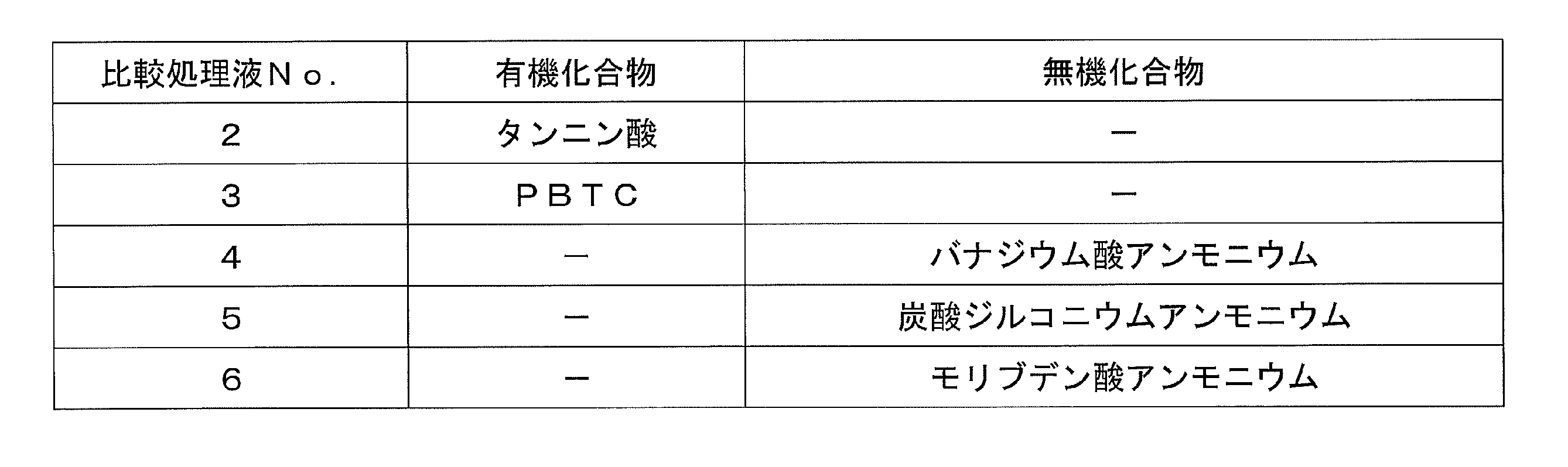
有機化合物および無機化合物のいずれも添加しないイオン交換水を、比較処理液1とした。また、表2に記載の有機化合物または無機化合物を、含有量が2質量%となるようにイオン交換水に溶解させて、比較処理液2~比較処理液6を調製した。
1-2.プレコート皮膜液の調製
ハロゲンゴムであるクロロスルホン化ポリエチレンゴム(15質量部)を、トルエン(85質量部)に溶解させた。さらに、この溶液に加硫剤である酸化亜鉛(5質量部)を添加し、均一に攪拌して、プレコート皮膜液1(以下、「プレコート皮膜液」を「皮膜液」と表記する。)を調製した。
ハロゲンゴムであるクロロスルホン化ポリエチレンゴム(15質量部)を、トルエン(85質量部)に溶解させた。さらに、この溶液に加硫剤である酸化亜鉛(5質量部)を添加し、均一に攪拌して、プレコート皮膜液1(以下、「プレコート皮膜液」を「皮膜液」と表記する。)を調製した。
ハロゲンゴムをクロロプレンにした以外は皮膜液1と同様にして、皮膜液2を調製した。
加硫剤を添加しなかった以外は皮膜液1と同様にした比較皮膜液1を、加硫剤をハロゲンゴム全量に対して100%と微量添加した以外は皮膜液1と同様にした比較皮膜液2を調製した。
1-3.プレコートされた金属素形材の作製
板厚1.6mmの溶融亜鉛めっき鋼板を用意して、エタノールで溶剤脱脂して乾燥させた。この鋼板のめっき層の表面に、塗布厚み4μm(乾燥時の付着量:65mg/m2)となるように無機有機複合処理液1をバーコーターで塗布した。その後、電気式熱風オーブンに鋼板を入れて、鋼板表面温度が150℃となるよう、雰囲気温度300℃で無機有機複合処理液1を5~10秒乾燥させて、無機有機複合層を形成した。鋼板温度は基材の溶融亜鉛めっき鋼板に直接熱電対を貼り付けて測定した。
板厚1.6mmの溶融亜鉛めっき鋼板を用意して、エタノールで溶剤脱脂して乾燥させた。この鋼板のめっき層の表面に、塗布厚み4μm(乾燥時の付着量:65mg/m2)となるように無機有機複合処理液1をバーコーターで塗布した。その後、電気式熱風オーブンに鋼板を入れて、鋼板表面温度が150℃となるよう、雰囲気温度300℃で無機有機複合処理液1を5~10秒乾燥させて、無機有機複合層を形成した。鋼板温度は基材の溶融亜鉛めっき鋼板に直接熱電対を貼り付けて測定した。
その後、無機有機複合層の表面に、塗布厚み50μm、乾燥後厚み20μmとなるようにプレコート皮膜液1をバーコーターで塗布した。その後、電気式熱風オーブンに鋼板を入れて、鋼板表面温度が160℃となるよう、雰囲気温度300℃でプレコート皮膜液1を乾燥させて部分的に加硫されているゴム層を形成し、プレコート金属素形材1を得た。
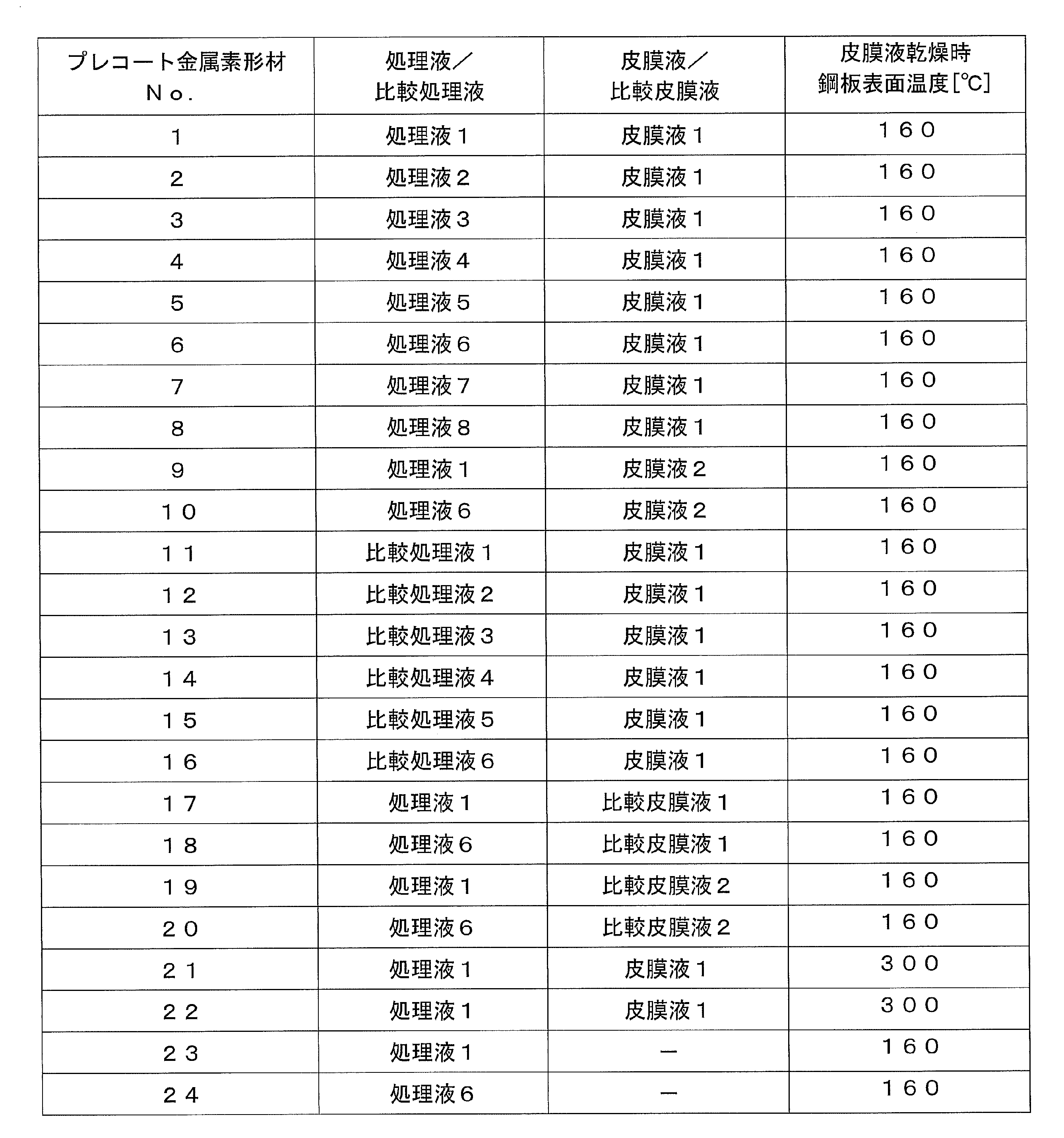
無機有機複合処理液とプレコート皮膜液との組み合わせを表3に記載の組み合わせに変更して、プレコート金属素形材2~プレコート金属素形材10を得た。
無機有機複合処理液1の代わりに比較処理液1~比較処理液6のいずれかを用いるか、またはプレコート処理液1の代わりに比較プレコート皮膜液1を用いて、表3に記載のプレコート金属素形材11~プレコート金属素形材18を得た。
皮膜液1のかわりに加硫剤の量が過剰である比較皮膜液2を用いるか、ゴム層を形成する際の温度を高くして、ゴム層が完全に加硫されたプレコート金属素形材19~プレコート金属素形材22を得た。
ゴム層を形成しなかった以外はプレコート金属素形材1またはプレコート金属素形材6と同様にして、表3に記載のプレコート金属素形材23およびプレコート金属素形材24を得た。
2.評価
2-1.耐ブロッキング性
プレコート金属素形材1~プレコート金属素形材20をそれぞれ50mm角に切り出して、切り出したプレコート金属素形材のゴム層同士を重ね合わせ、23℃、2MPaで24時間圧着した。その後、プレコート金属素形材を引き剥がし、重ねた鋼板へゴム層が転写剥離した面積を測定して、以下の基準で耐ブロッキング性を評価した。
○ 転写剥離した面積は5%以下であった
× 転写剥離した面積は5%超であった
2-1.耐ブロッキング性
プレコート金属素形材1~プレコート金属素形材20をそれぞれ50mm角に切り出して、切り出したプレコート金属素形材のゴム層同士を重ね合わせ、23℃、2MPaで24時間圧着した。その後、プレコート金属素形材を引き剥がし、重ねた鋼板へゴム層が転写剥離した面積を測定して、以下の基準で耐ブロッキング性を評価した。
○ 転写剥離した面積は5%以下であった
× 転写剥離した面積は5%超であった
2-2.加硫済ゴムの接合強度
プレコート金属素形材1~プレコート金属素形材20をそれぞれ25mm幅×60mm長に切り出して、ゴム層の表面が25mm角の広さで露出するように、切り出したプレコート金属素形材の長辺方向への両端を17.5mmの耐熱フッ素テープでシールした。25mm幅×125mm長に切り出した厚さ6mmの硬度60度の加硫済ニトリルゴムを、切り出したプレコート金属素形材の長辺方向における片側の端面に位置合わせして配置し、露出したゴム層にも接触させた。その後、プレコート金属素形材および加硫済ニトリルゴムを、170℃、98MPaの条件で15分間熱圧着して、両者を接合させ、複合体を得た。
プレコート金属素形材1~プレコート金属素形材20をそれぞれ25mm幅×60mm長に切り出して、ゴム層の表面が25mm角の広さで露出するように、切り出したプレコート金属素形材の長辺方向への両端を17.5mmの耐熱フッ素テープでシールした。25mm幅×125mm長に切り出した厚さ6mmの硬度60度の加硫済ニトリルゴムを、切り出したプレコート金属素形材の長辺方向における片側の端面に位置合わせして配置し、露出したゴム層にも接触させた。その後、プレコート金属素形材および加硫済ニトリルゴムを、170℃、98MPaの条件で15分間熱圧着して、両者を接合させ、複合体を得た。
JIS K6256-2の図1に記載の試験ジグに得られた複合体を固定し、加硫済ニトリルゴムのプレコート金属素形材とは接触しない端面を50mmの幅で掴んで、引っ張り試験機(島津製作所 社製、装置名「オートグラフAG-IS」)を用いて速度50mm/minで90度剥離して、加硫済ニトリルゴムの凝集破壊が生じた剥離力を測定し、以下の基準で加硫済ゴムの接合強度を評価した。
○ 最大剥離力が4N/mm以上で凝集破壊が生じた
△ 最大剥離力が2N/mm以上4N/mm未満で凝集破壊が生じた
× 最大剥離力が2N/mm未満で凝集破壊が生じた
○ 最大剥離力が4N/mm以上で凝集破壊が生じた
△ 最大剥離力が2N/mm以上4N/mm未満で凝集破壊が生じた
× 最大剥離力が2N/mm未満で凝集破壊が生じた
評価結果を表4に示す。なお、表4の備考には、それぞれのプレコート金属素形材の作製条件(無機化合物、有機化合物、ハロゲンゴムおよび加硫剤の添加の有無:「○」は上記各成分が添加されたこと、「×」は上記各成分が添加されなかったことを、それぞれ表す。)を示す。
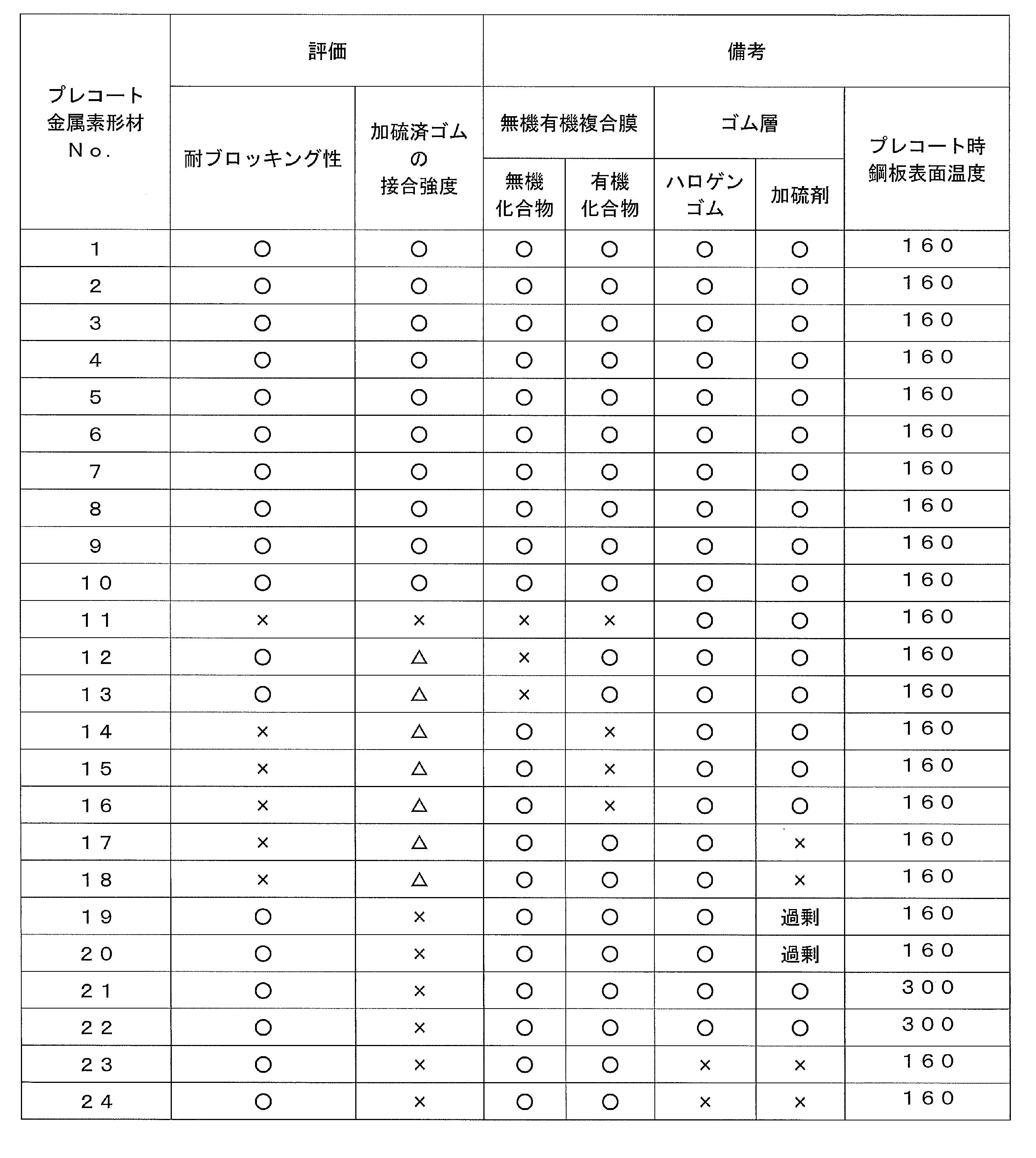
金属素形材と、上記金属素形材の上に配置された無機有機複合層と、上記無機有機複合層の表面に接して配置されたゴム層と、を有するプレコート金属素形材1~プレコート金属素形材10は、ブロッキングが生じにくく、かつ加硫済ゴムの接合強度も高かった。
一方で、無機有機複合層を形成しなかったプレコート金属素形材11は、ブロッキングが生じやすく、加硫済ゴムの接合強度は低かった。これは、無機有機複合層がないため無機有機複合層に対するゴム層の密着性が低く、かつ、ゴム層と金属素形材表面の加硫反応が不完全であるため、ゴム層と金属素形材との接合が得られなかったためと考えられる。
また、無機有機複合層に無機化合物を添加しなかったプレコート金属素形材12およびプレコート金属素形材13は、加硫済ゴムの接合強度が高まりにくかった。これは、金属素形材に由来する金属と有機酸との塩による凝集破壊されやすい硬質皮膜が形成されたからと考えられる。
また、無機有機複合層に有機化合物を添加しなかったプレコート金属素形材14~プレコート金属素形材16は、ブロッキングが生じやすく、加硫済ゴムの接合強度が高まりにくかった。これは、有機酸とハロゲンゴムとの間の相互作用が生じず、また、有機酸が金属素形材をエッチングすることにより金属素形材から溶出した金属の塩および酸化物などと、ハロゲンゴムと、の間の結合も生じなかったためと考えられる。
また、ゴム層に加硫剤を添加しなかったプレコート金属素形材17およびプレコート金属素形材18は、ブロッキングが生じやすく、加硫済ゴムの接合強度が高まりにくかった。これは、プレコート金属素形材の作製時にゴム層が部分的に加硫しなかったため他のゴム層への接合性が低下せず、また、ゴム成形体との熱圧着時にもハロゲンゴムが加硫しないためハロゲンゴムが十分に硬化しなかったためと考えられる。
また、ゴム層が完全に加硫されたプレコート金属素形材19~プレコート金属素形材22は、加硫済ゴムの接合強度が高まりにくかった。これは、加熱によって流動性を生じたハロゲンゴムの分子がゴム成形体の最表層に浸透しにくく、ゴム成形体を構成する分子と絡まり合いにくかったためと考えられる。
また、ゴム層を形成しなかったプレコート金属素形材23およびプレコート金属素形材24は、ゴム層がないため、ブロッキングは生じにくかったが、加硫済ゴムの接合強度が高まりにくかった。
本出願は、2018年12月28日出願の日本国出願番号2018-247246号に基づく優先権を主張する出願であり、当該出願の特許請求の範囲および明細書に記載された内容は本出願に援用される。
本発明のプレコートされた金属素形材は、保管および移動時のブロッキングが生じにくく、かつ、加硫されたゴム成形体への良好な接合性を有する。本発明のプレコートされた金属素形材とゴム成形体とを接合してなる複合体は、たとえば各種電子機器、家庭用電化製品、医療機器、自動車車体、車両搭載用品、建築資材などに好適に用いられる。
Claims (10)
- 金属素形材と、
前記金属素形材の上に配置された無機有機複合層と、
前記無機有機複合層の表面に接して配置されたゴム層と、を有し、
前記ゴム層は、ハロゲンゴムと、前記ハロゲンゴムの加硫剤と、を含有する、
プレコートされた金属素形材。 - 前記無機有機複合層は、
4族金属、5族金属および6族金属からなる群から選択される金属の酸化物、水酸化物またはフッ化物と、
有機酸と、
を含む、請求項1に記載のプレコートされた金属素形材。 - 前記4族金属、5族金属または6族金属からなる群から選択される金属は、Ti、Zr、Hf、V、Nb、Ta、MoおよびWからなる群から選択される金属である、請求項2に記載のプレコートされた金属素形材。
- 前記無機有機複合層は、有機ホスホン酸およびその塩、ならびに多価フェノールおよびその塩からなる群から選択される有機酸を含む、請求項1~3のいずれか1項に記載のプレコートされた金属素形材。
- 前記無機有機複合層の付着量は、10mg/m2以上200mg/m2以下である、請求項1~4のいずれか1項に記載のプレコートされた金属素形材。
- 前記ハロゲンゴムは、クロロプレン、クロロスルホン化ポリエチレン、および塩化ゴムからなる群から選択されるハロゲンゴムである、請求項1~5のいずれか1項に記載のプレコートされた金属素形材。
- 前記加硫剤は、金属酸化物、不飽和脂肪酸の金属塩、有機過酸化物、およびチオ尿素化合物からなる群から選択される加硫剤である、請求項1~6のいずれか1項に記載のプレコートされた金属素形材。
- 前記ゴム層は、前記ハロゲンゴムが部分的に加硫されている、請求項1~7のいずれか1項に記載のプレコートされた金属素形材。
- 請求項1~8のいずれか1項に記載のプレコートされた金属素形材の表面に、加硫されたゴム組成物を含むゴム成形体を前記ゴム層に接して配置する工程と、
前記ゴム成形体と接している前記ゴム層を加熱して、前記プレコートされた金属素形材と前記ゴム成形体とを接合させる工程と、を有する、
複合体の製造方法。 - 金属素形材と、
前記金属素形材の上に配置された無機有機複合層と、
前記無機有機複合層の表面に接して配置された、加硫されたハロゲンゴムを含むゴム層と、
前記ゴム層の表面に接して配置された、加硫されたゴム組成物を含むゴム成形体と、を有する、
複合体。
Applications Claiming Priority (2)
| Application Number | Priority Date | Filing Date | Title |
|---|---|---|---|
| JP2018247246A JP7163769B2 (ja) | 2018-12-28 | 2018-12-28 | プレコートされた金属素形材、および複合体の製造方法 |
| JP2018-247246 | 2018-12-28 |
Publications (1)
| Publication Number | Publication Date |
|---|---|
| WO2020137007A1 true WO2020137007A1 (ja) | 2020-07-02 |
Family
ID=71127880
Family Applications (1)
| Application Number | Title | Priority Date | Filing Date |
|---|---|---|---|
| PCT/JP2019/034527 Ceased WO2020137007A1 (ja) | 2018-12-28 | 2019-09-03 | プレコートされた金属素形材、複合体の製造方法および複合体 |
Country Status (3)
| Country | Link |
|---|---|
| JP (1) | JP7163769B2 (ja) |
| TW (1) | TW202026150A (ja) |
| WO (1) | WO2020137007A1 (ja) |
Citations (3)
| Publication number | Priority date | Publication date | Assignee | Title |
|---|---|---|---|---|
| JPH0725954A (ja) * | 1993-07-09 | 1995-01-27 | Asahi Glass Co Ltd | 接着性弗素ゴムおよびそれを用いた積層体 |
| JP2003328143A (ja) * | 2002-05-10 | 2003-11-19 | Nisshin Steel Co Ltd | ガスケット用表面処理ステンレス鋼板およびゴム被覆ステンレス鋼板 |
| WO2014087939A1 (ja) * | 2012-12-04 | 2014-06-12 | Nok株式会社 | 金属表面処理剤 |
-
2018
- 2018-12-28 JP JP2018247246A patent/JP7163769B2/ja active Active
-
2019
- 2019-09-03 WO PCT/JP2019/034527 patent/WO2020137007A1/ja not_active Ceased
- 2019-09-19 TW TW108133855A patent/TW202026150A/zh unknown
Patent Citations (3)
| Publication number | Priority date | Publication date | Assignee | Title |
|---|---|---|---|---|
| JPH0725954A (ja) * | 1993-07-09 | 1995-01-27 | Asahi Glass Co Ltd | 接着性弗素ゴムおよびそれを用いた積層体 |
| JP2003328143A (ja) * | 2002-05-10 | 2003-11-19 | Nisshin Steel Co Ltd | ガスケット用表面処理ステンレス鋼板およびゴム被覆ステンレス鋼板 |
| WO2014087939A1 (ja) * | 2012-12-04 | 2014-06-12 | Nok株式会社 | 金属表面処理剤 |
Also Published As
| Publication number | Publication date |
|---|---|
| JP7163769B2 (ja) | 2022-11-01 |
| TW202026150A (zh) | 2020-07-16 |
| JP2020105615A (ja) | 2020-07-09 |
Similar Documents
| Publication | Publication Date | Title |
|---|---|---|
| CA2898584C (en) | Shaped and coated metallic material, composite, and method for manufacturing shaped and coated metallic material and composite | |
| JP2011157585A (ja) | 金属表面処理剤及び金属表面処理方法 | |
| JP6262951B2 (ja) | 複合体およびその製造方法 | |
| JP5701268B2 (ja) | 耐食性などに優れた亜鉛系めっき鋼板用の表面処理剤および該表面処理剤で被覆された亜鉛系めっき鋼板 | |
| JP6644631B2 (ja) | 金属表面処理用水溶液及び金属表面の処理方法 | |
| JP5901389B2 (ja) | 溶融Al、Mg含有Znめっき鋼板 | |
| JP4935902B2 (ja) | アクリルゴム−金属複合体 | |
| WO2020137007A1 (ja) | プレコートされた金属素形材、複合体の製造方法および複合体 | |
| AU2016213296B2 (en) | Method for producing coated metal strip | |
| JP6080807B2 (ja) | 塗装金属素形材、複合体およびそれらの製造方法 | |
| JP2000265281A (ja) | 耐食性、潤滑性、塗料密着性に優れたリン酸塩複合被覆鋼板 | |
| WO2016092785A1 (ja) | 金属素形材用処理液 | |
| JP2006291246A (ja) | 燃料容器に適した表面処理めっき鋼板 | |
| JP2003328143A (ja) | ガスケット用表面処理ステンレス鋼板およびゴム被覆ステンレス鋼板 | |
| JP2003277945A (ja) | 非クロム型表面処理鋼板 | |
| JP2008163364A (ja) | 加工後の塗膜密着性およびフィルム接着性に優れた化成処理鋼板 | |
| JP2822864B2 (ja) | 接着性に優れた表面層を有するAl系およびZn−Al系めっき鋼板 | |
| JP2004035988A (ja) | 塗膜密着性に優れたノンクロム型アルミニウム下地処理材 | |
| JP3905786B2 (ja) | 表面処理亜鉛系メッキ鋼板 | |
| JP4765902B2 (ja) | 接着性と皮膜密着性に優れた表面処理金属材 | |
| JPH01312082A (ja) | 耐食性および塗膜密着性に優れた有機被覆鋼板の製造方法 | |
| JPH043900B2 (ja) | ||
| JP6203924B2 (ja) | 前処理Zn系めっき鋼板、および塗装Zn系めっき鋼板 | |
| JP4254398B2 (ja) | ステンレス鋼−ニトリルゴム複合体 | |
| JPH04189130A (ja) | ゴムコートガスケット用積層物 |
Legal Events
| Date | Code | Title | Description |
|---|---|---|---|
| 121 | Ep: the epo has been informed by wipo that ep was designated in this application |
Ref document number: 19905433 Country of ref document: EP Kind code of ref document: A1 |
|
| NENP | Non-entry into the national phase |
Ref country code: DE |
|
| 122 | Ep: pct application non-entry in european phase |
Ref document number: 19905433 Country of ref document: EP Kind code of ref document: A1 |