WO2020128743A1 - 半導体装置および電池パック - Google Patents
半導体装置および電池パック Download PDFInfo
- Publication number
- WO2020128743A1 WO2020128743A1 PCT/IB2019/060740 IB2019060740W WO2020128743A1 WO 2020128743 A1 WO2020128743 A1 WO 2020128743A1 IB 2019060740 W IB2019060740 W IB 2019060740W WO 2020128743 A1 WO2020128743 A1 WO 2020128743A1
- Authority
- WO
- WIPO (PCT)
- Prior art keywords
- circuit
- insulator
- secondary battery
- oxide
- conductor
- Prior art date
- Legal status (The legal status is an assumption and is not a legal conclusion. Google has not performed a legal analysis and makes no representation as to the accuracy of the status listed.)
- Ceased
Links
Images































Classifications
-
- H—ELECTRICITY
- H02—GENERATION; CONVERSION OR DISTRIBUTION OF ELECTRIC POWER
- H02J—ELECTRIC POWER NETWORKS; CIRCUIT ARRANGEMENTS OR SYSTEMS FOR SUPPLYING OR DISTRIBUTING ELECTRIC POWER; SYSTEMS FOR STORING ELECTRIC ENERGY
- H02J7/00—Circuit arrangements for charging or discharging batteries or for supplying loads from batteries
- H02J7/02—Circuit arrangements for charging or discharging batteries or for supplying loads from batteries for charging batteries from AC mains by converters
- H02J7/04—Regulation of charging current or voltage
- H02J7/06—Regulation of charging current or voltage using discharge tubes or semiconductor devices
-
- G—PHYSICS
- G01—MEASURING; TESTING
- G01R—MEASURING ELECTRIC VARIABLES; MEASURING MAGNETIC VARIABLES
- G01R31/00—Arrangements for testing electric properties; Arrangements for locating electric faults; Arrangements for electrical testing characterised by what is being tested not provided for elsewhere
- G01R31/36—Arrangements for testing, measuring or monitoring the electrical condition of accumulators or electric batteries, e.g. capacity or state of charge [SoC]
- G01R31/392—Determining battery ageing or deterioration, e.g. state of health
-
- G—PHYSICS
- G01—MEASURING; TESTING
- G01R—MEASURING ELECTRIC VARIABLES; MEASURING MAGNETIC VARIABLES
- G01R31/00—Arrangements for testing electric properties; Arrangements for locating electric faults; Arrangements for electrical testing characterised by what is being tested not provided for elsewhere
- G01R31/36—Arrangements for testing, measuring or monitoring the electrical condition of accumulators or electric batteries, e.g. capacity or state of charge [SoC]
- G01R31/382—Arrangements for monitoring battery or accumulator variables, e.g. SoC
- G01R31/3828—Arrangements for monitoring battery or accumulator variables, e.g. SoC using current integration
-
- G—PHYSICS
- G01—MEASURING; TESTING
- G01R—MEASURING ELECTRIC VARIABLES; MEASURING MAGNETIC VARIABLES
- G01R19/00—Arrangements for measuring currents or voltages or for indicating presence or sign thereof
- G01R19/165—Indicating that current or voltage is either above or below a predetermined value or within or outside a predetermined range of values
- G01R19/16533—Indicating that current or voltage is either above or below a predetermined value or within or outside a predetermined range of values characterised by the application
- G01R19/16538—Indicating that current or voltage is either above or below a predetermined value or within or outside a predetermined range of values characterised by the application in AC or DC supplies
- G01R19/16542—Indicating that current or voltage is either above or below a predetermined value or within or outside a predetermined range of values characterised by the application in AC or DC supplies for batteries
-
- G—PHYSICS
- G01—MEASURING; TESTING
- G01R—MEASURING ELECTRIC VARIABLES; MEASURING MAGNETIC VARIABLES
- G01R19/00—Arrangements for measuring currents or voltages or for indicating presence or sign thereof
- G01R19/165—Indicating that current or voltage is either above or below a predetermined value or within or outside a predetermined range of values
- G01R19/16566—Circuits and arrangements for comparing voltage or current with one or several thresholds and for indicating the result not covered by subgroups G01R19/16504, G01R19/16528, G01R19/16533
-
- G—PHYSICS
- G01—MEASURING; TESTING
- G01R—MEASURING ELECTRIC VARIABLES; MEASURING MAGNETIC VARIABLES
- G01R31/00—Arrangements for testing electric properties; Arrangements for locating electric faults; Arrangements for electrical testing characterised by what is being tested not provided for elsewhere
- G01R31/36—Arrangements for testing, measuring or monitoring the electrical condition of accumulators or electric batteries, e.g. capacity or state of charge [SoC]
- G01R31/382—Arrangements for monitoring battery or accumulator variables, e.g. SoC
- G01R31/3842—Arrangements for monitoring battery or accumulator variables, e.g. SoC combining voltage and current measurements
-
- G—PHYSICS
- G01—MEASURING; TESTING
- G01R—MEASURING ELECTRIC VARIABLES; MEASURING MAGNETIC VARIABLES
- G01R31/00—Arrangements for testing electric properties; Arrangements for locating electric faults; Arrangements for electrical testing characterised by what is being tested not provided for elsewhere
- G01R31/36—Arrangements for testing, measuring or monitoring the electrical condition of accumulators or electric batteries, e.g. capacity or state of charge [SoC]
- G01R31/396—Acquisition or processing of data for testing or for monitoring individual cells or groups of cells within a battery
-
- H—ELECTRICITY
- H01—ELECTRIC ELEMENTS
- H01M—PROCESSES OR MEANS, e.g. BATTERIES, FOR THE DIRECT CONVERSION OF CHEMICAL ENERGY INTO ELECTRICAL ENERGY
- H01M10/00—Secondary cells; Manufacture thereof
- H01M10/42—Methods or arrangements for servicing or maintenance of secondary cells or secondary half-cells
- H01M10/425—Structural combination with electronic components, e.g. electronic circuits integrated to the outside of the casing
-
- H—ELECTRICITY
- H01—ELECTRIC ELEMENTS
- H01M—PROCESSES OR MEANS, e.g. BATTERIES, FOR THE DIRECT CONVERSION OF CHEMICAL ENERGY INTO ELECTRICAL ENERGY
- H01M10/00—Secondary cells; Manufacture thereof
- H01M10/42—Methods or arrangements for servicing or maintenance of secondary cells or secondary half-cells
- H01M10/44—Methods for charging or discharging
-
- H—ELECTRICITY
- H01—ELECTRIC ELEMENTS
- H01M—PROCESSES OR MEANS, e.g. BATTERIES, FOR THE DIRECT CONVERSION OF CHEMICAL ENERGY INTO ELECTRICAL ENERGY
- H01M10/00—Secondary cells; Manufacture thereof
- H01M10/42—Methods or arrangements for servicing or maintenance of secondary cells or secondary half-cells
- H01M10/48—Accumulators combined with arrangements for measuring, testing or indicating the condition of cells, e.g. the level or density of the electrolyte
-
- H—ELECTRICITY
- H02—GENERATION; CONVERSION OR DISTRIBUTION OF ELECTRIC POWER
- H02J—ELECTRIC POWER NETWORKS; CIRCUIT ARRANGEMENTS OR SYSTEMS FOR SUPPLYING OR DISTRIBUTING ELECTRIC POWER; SYSTEMS FOR STORING ELECTRIC ENERGY
- H02J7/00—Circuit arrangements for charging or discharging batteries or for supplying loads from batteries
- H02J7/80—Circuit arrangements for charging or discharging batteries or for supplying loads from batteries including monitoring or indicating arrangements
- H02J7/84—Control of state of health [SOH]
-
- H—ELECTRICITY
- H02—GENERATION; CONVERSION OR DISTRIBUTION OF ELECTRIC POWER
- H02J—ELECTRIC POWER NETWORKS; CIRCUIT ARRANGEMENTS OR SYSTEMS FOR SUPPLYING OR DISTRIBUTING ELECTRIC POWER; SYSTEMS FOR STORING ELECTRIC ENERGY
- H02J7/00—Circuit arrangements for charging or discharging batteries or for supplying loads from batteries
- H02J7/90—Regulation of charging or discharging current or voltage
- H02J7/933—Regulation of charging or discharging current or voltage the cycle being controlled or terminated in response to electric parameters
-
- H—ELECTRICITY
- H10—SEMICONDUCTOR DEVICES; ELECTRIC SOLID-STATE DEVICES NOT OTHERWISE PROVIDED FOR
- H10D—INORGANIC ELECTRIC SEMICONDUCTOR DEVICES
- H10D30/00—Field-effect transistors [FET]
- H10D30/60—Insulated-gate field-effect transistors [IGFET]
- H10D30/67—Thin-film transistors [TFT]
- H10D30/674—Thin-film transistors [TFT] characterised by the active materials
- H10D30/6755—Oxide semiconductors, e.g. zinc oxide, copper aluminium oxide or cadmium stannate
-
- H—ELECTRICITY
- H01—ELECTRIC ELEMENTS
- H01M—PROCESSES OR MEANS, e.g. BATTERIES, FOR THE DIRECT CONVERSION OF CHEMICAL ENERGY INTO ELECTRICAL ENERGY
- H01M10/00—Secondary cells; Manufacture thereof
- H01M10/42—Methods or arrangements for servicing or maintenance of secondary cells or secondary half-cells
- H01M10/425—Structural combination with electronic components, e.g. electronic circuits integrated to the outside of the casing
- H01M2010/4271—Battery management systems including electronic circuits, e.g. control of current or voltage to keep battery in healthy state, cell balancing
-
- H—ELECTRICITY
- H01—ELECTRIC ELEMENTS
- H01M—PROCESSES OR MEANS, e.g. BATTERIES, FOR THE DIRECT CONVERSION OF CHEMICAL ENERGY INTO ELECTRICAL ENERGY
- H01M2220/00—Batteries for particular applications
- H01M2220/20—Batteries in motive systems, e.g. vehicle, ship, plane
-
- H—ELECTRICITY
- H02—GENERATION; CONVERSION OR DISTRIBUTION OF ELECTRIC POWER
- H02J—ELECTRIC POWER NETWORKS; CIRCUIT ARRANGEMENTS OR SYSTEMS FOR SUPPLYING OR DISTRIBUTING ELECTRIC POWER; SYSTEMS FOR STORING ELECTRIC ENERGY
- H02J7/00—Circuit arrangements for charging or discharging batteries or for supplying loads from batteries
- H02J7/60—Circuit arrangements for charging or discharging batteries or for supplying loads from batteries including safety or protection arrangements
-
- Y—GENERAL TAGGING OF NEW TECHNOLOGICAL DEVELOPMENTS; GENERAL TAGGING OF CROSS-SECTIONAL TECHNOLOGIES SPANNING OVER SEVERAL SECTIONS OF THE IPC; TECHNICAL SUBJECTS COVERED BY FORMER USPC CROSS-REFERENCE ART COLLECTIONS [XRACs] AND DIGESTS
- Y02—TECHNOLOGIES OR APPLICATIONS FOR MITIGATION OR ADAPTATION AGAINST CLIMATE CHANGE
- Y02E—REDUCTION OF GREENHOUSE GAS [GHG] EMISSIONS, RELATED TO ENERGY GENERATION, TRANSMISSION OR DISTRIBUTION
- Y02E60/00—Enabling technologies; Technologies with a potential or indirect contribution to GHG emissions mitigation
- Y02E60/10—Energy storage using batteries
Definitions
- One embodiment of the present invention relates to a semiconductor device and a method for operating the semiconductor device. Further, one embodiment of the present invention relates to a charge control circuit, an abnormality detection circuit, a secondary battery control system, and an electronic device.
- one embodiment of the present invention is not limited to the above technical field.
- the technical field of the invention disclosed in this specification and the like relates to an object, a method, or a manufacturing method.
- one embodiment of the present invention relates to a process, a machine, a manufacture, or a composition (composition of matter). Therefore, as a technical field of one embodiment of the present invention disclosed more specifically in this specification, a display device, a light-emitting device, a power storage device, an imaging device, a storage device, a driving method thereof, or a manufacturing method thereof, Can be mentioned as an example.
- a semiconductor device generally means a device that can function by utilizing semiconductor characteristics. Therefore, semiconductor elements such as transistors and diodes and semiconductor circuits are semiconductor devices. Further, a display device, a light emitting device, a lighting device, an electro-optical device, an electronic device, and the like may include a semiconductor element or a semiconductor circuit. Therefore, a display device, a light-emitting device, a lighting device, an electro-optical device, an imaging device, an electronic device, and the like may also be called semiconductor devices.
- lithium-ion secondary batteries with high output and high energy density are used in mobile information terminals such as mobile phones, smartphones, tablets, or notebook computers, game devices, portable music players, digital cameras, medical devices, or hybrid vehicles.
- HEV electric vehicles
- PHEV plug-in hybrid vehicles
- electric motorcycles etc.
- Patent Document 1 discloses a charge control circuit that can reduce deterioration of a secondary battery during constant current charging in CCCV (Constant Current Constant Voltage) charging.
- Patent Document 1 shows a charge control circuit for reducing deterioration of the secondary battery during charging in CCCV charging.
- the secondary battery deteriorates by repeating charging and discharging.
- a secondary battery causes a defect such as a micro short circuit due to repeated charging and discharging.
- One object of one embodiment of the present invention is to provide a semiconductor device or the like which detects a defect in a secondary battery by monitoring a charge characteristic of the secondary battery. Another object is to provide a semiconductor device or the like which reduces power consumption. Another object is to provide a semiconductor device or the like with good detection accuracy of charge characteristics. Another object is to provide a semiconductor device or the like whose operation is stable. Another object is to provide a highly reliable semiconductor device or the like. Another object is to provide a novel semiconductor device or the like.
- Charging/discharging of the secondary battery can be performed as follows, for example.
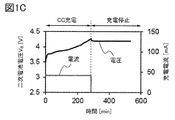
- CC charging is a charging method in which a constant current is supplied to the secondary battery during the entire charging period and charging is stopped when a predetermined voltage is reached. It is assumed that the secondary battery is an equivalent circuit of the internal resistance R and the secondary battery capacity C as shown in FIG. 1A. In this case, the secondary battery voltage V B is the sum of the voltage V C applied to the voltage V R and the secondary battery capacity C according to the internal resistance R.
- the switch is turned on and a constant current I flows through the secondary battery.
- the voltage V C applied to the secondary battery capacity C increases with the passage of time. Therefore, the secondary battery voltage V B increases with the passage of time.
- the secondary battery voltage V B reaches a predetermined voltage, for example, 4.3 V
- charging is stopped.
- a predetermined voltage for example, 4.3 V
- FIG. 1C An example of the secondary battery voltage V B and the charging current during CC charging and after stopping the CC charging is shown in FIG. 1C. It is shown that the secondary battery voltage V B , which was rising during CC charging, is slightly decreased after CC charging is stopped.
- CCCV charging is a charging method in which the CC charging is first performed to a predetermined voltage, and then the CV (constant voltage) charging is performed until the flowing current decreases, specifically, until the final current value is reached. ..
- the switch of the constant current power source is turned on and the switch of the constant voltage power source is turned off, and a constant current I flows through the secondary battery.
- the voltage V C applied to the secondary battery capacity C increases with the passage of time. Therefore, the secondary battery voltage V B increases with the passage of time.
- the CC charging is switched to the CV charging.
- a predetermined voltage for example, 4.3 V
- the switch of the constant voltage power source is turned on and the switch of the constant current power source is turned off, and the secondary battery voltage V B becomes constant.
- the charging is stopped.
- a predetermined current for example, a current equivalent to 0.01 C
- the charging is stopped.
- the secondary battery voltage V B is hardly lowered. Therefore, the secondary battery voltage V B becomes equal to the voltage V C applied to the secondary battery capacity C.
- FIG. 2D An example of the secondary battery voltage V B and the charging current during the CCCV charging and after the CCCV charging is stopped is shown in FIG. 2D. It is shown that the secondary battery voltage V B hardly drops after the CCCV charging is stopped.
- CC discharge which is one of the discharging methods, will be described.
- CC discharge is a discharge method in which a constant current is supplied from the secondary battery during the entire discharge period and the discharge is stopped when the secondary battery voltage V B reaches a predetermined voltage, for example, 2.5V.
- the discharge rate is the relative ratio of the current at the time of discharge to the battery capacity, and is expressed in the unit C.
- the current equivalent to 1C is X.
- X the current equivalent to 1C
- 2X When discharged with a current of 2X, it is said to be discharged at 2C, and when discharged with a current of 0.2X, it is said to be discharged at 0.2C.
- the charging rate is also the same, and it is said that charging is performed at 2C when charging with a 2X current, and that charging is performed at 0.2C when charging with a 0.2X current.
- FIG. 32 shows, as an example, a graph in which charging is performed with the vertical axis representing voltage and the horizontal axis representing time, and a micro short circuit has occurred in the vicinity of 20 minutes.
- abnormal behavior is detected, and the result is notified to a control circuit or a processor, so that a power cutoff switch is turned off, whereby power supply to a secondary battery can be stopped.
- one aspect of the present invention can detect deterioration of the secondary battery from the charging characteristics of the secondary battery. Note that the deterioration of the secondary battery also includes abnormalities such as micro shorts.
- One embodiment of the present invention is a semiconductor device including a first circuit and a second circuit.
- the first circuit has a fuel gauge and an abnormal current detection circuit.
- the fuel gauge has a shunt circuit and an integrating circuit.
- the abnormal current detection circuit has a first memory, a second memory, and a first comparator.
- the integration circuit can convert the detection current detected by the shunt circuit into a detection voltage.
- the abnormal current detection circuit is supplied with a detection voltage, a first signal given at a first time, and a second signal given at a second time.
- the abnormal current detection circuit can store the detection voltage at the first time in the first memory according to the first signal.
- the abnormal current detection circuit can store the detected voltage at the second time in the second memory according to the second signal.
- the first comparator outputs the change in the detected voltage at the first time and the change in the detected voltage at the second time as a first output signal to the second circuit.
- the first comparator when the detection voltage stored in the first memory is higher than the detection voltage stored in the second memory, the first comparator outputs the first output signal to the second circuit.
- the first comparator inverts the first output signal and outputs the inverted first output signal to the second circuit. ..
- the fuel gauge has a second comparator having a hysteresis characteristic, and the second comparator determines the detection voltage using the first determination voltage and the second determination voltage. be able to.
- the output signal of the second comparator can invert the output polarity of the shunt circuit.
- the output signal of the second comparator can invert the output polarity of the shunt circuit.
- the output signal of the second comparator is output to the second circuit.
- the second circuit can generate the first signal and the second signal from the output signal of the second comparator.
- the second circuit can set the set time.
- the second circuit can output the first signal or the second signal after a set time from the change point of the output signal of the second comparator.
- the second circuit is preferably a control circuit or a processor.
- the semiconductor device preferably includes a transistor, and the transistor preferably includes an oxide semiconductor in a semiconductor layer.
- Another aspect of the present invention is a battery pack including a semiconductor device provided on a flexible substrate, an insulating sheet, and a secondary battery.
- One embodiment of the present invention can provide a semiconductor device or the like that detects a defect in a secondary battery by monitoring the charge characteristics of the secondary battery.
- a semiconductor device or the like with reduced power consumption can be provided.
- a semiconductor device or the like whose operation is stable can be provided.
- a highly reliable semiconductor device or the like can be provided.
- a novel semiconductor device or the like can be provided.
- FIGS. 1A to 1C are diagrams illustrating a method of charging a secondary battery.
- 2A to 2D are diagrams illustrating a method of charging a secondary battery.
- FIG. 3 is a diagram illustrating a configuration example of a semiconductor device.
- FIG. 4 is a diagram illustrating a configuration example of a semiconductor device.
- FIG. 5 is a diagram illustrating a circuit example of a semiconductor device.
- FIG. 6 is a diagram illustrating an operation example of a semiconductor device.
- FIG. 7 is a diagram illustrating an operation example of a semiconductor device.
- 8A to 8C are diagrams illustrating a coin-type secondary battery.
- 9A to 9D are diagrams illustrating a cylindrical secondary battery.
- 10A and 10B are diagrams illustrating an example of a secondary battery.
- 11A to 11D are diagrams illustrating an example of a secondary battery.
- 12A and 12B are diagrams illustrating an example of a secondary battery.
- FIG. 13 is a diagram illustrating an example of a secondary battery.
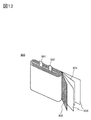
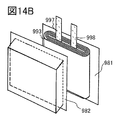
- FIG. 14A to FIG. 14C are diagrams for explaining a bonded secondary battery.
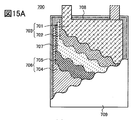
- FIG. 15A and FIG. 15B are diagrams for explaining a bonded secondary battery.
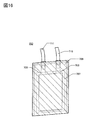
- FIG. 16 is a diagram showing the appearance of the secondary battery.
- FIG. 17 is a diagram showing the appearance of the secondary battery.
- 18A to 18C are views for explaining a method for manufacturing a secondary battery.
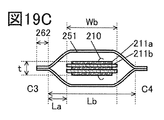
- 19A to 19E are diagrams illustrating a bendable secondary battery.
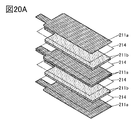
- 20A and 20B are diagrams illustrating a bendable secondary battery.
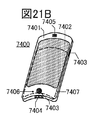
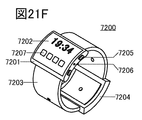
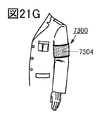
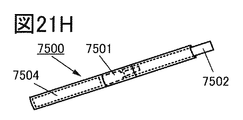
- 21A to 21H are diagrams illustrating examples of electronic devices.
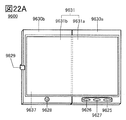
- 22A and 22B are diagrams illustrating examples of electronic devices.
- FIG. 22C is a block diagram illustrating a charge/discharge control circuit of an electronic device.
- FIG. 23 is a diagram illustrating an example of an electronic device.
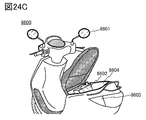
- 24A to 24C are diagrams illustrating an example of a vehicle.
- FIG. 25 is a diagram illustrating a configuration example of a semiconductor device.
- FIG. 26 is a diagram illustrating a configuration example of a semiconductor device.
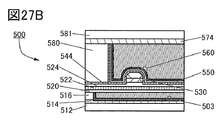
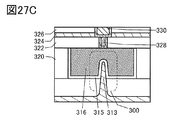
- 27A to 27C are diagrams illustrating structural examples of transistors.
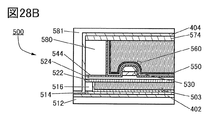
- 28A and 28B are diagrams illustrating a structural example of a transistor.
- FIG. 29 is a diagram illustrating a configuration example of a semiconductor device.
- FIGS. 30A and 30B are diagrams illustrating a structural example of a transistor.
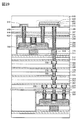
- FIG. 31 is a diagram illustrating a configuration example of a semiconductor device.
- FIG. 32 is a diagram illustrating a micro short circuit.
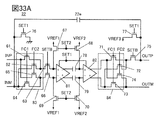
- FIG. 33A is a circuit diagram illustrating an amplifier circuit.
- FIG. 33B is a diagram illustrating a timing chart.
- FIG. 34A is a chip photograph.
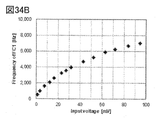
- FIG. 34B is a diagram illustrating electric characteristics of a semiconductor device.
- the position, size, range, etc. of each configuration shown in the drawings, etc. may not represent the actual position, size, range, etc., for easy understanding of the invention. Therefore, the disclosed invention is not necessarily limited to the position, size, range, or the like disclosed in the drawings and the like.
- a resist mask or the like may be unintentionally reduced due to a process such as etching. However, it may not be reflected in the drawing for easy understanding.
- top view also called “plan view”
- perspective view some of the components may be omitted to make the drawing easier to understand.
- electrode and “wiring” do not functionally limit these constituent elements.
- electrode may be used as part of “wiring” and vice versa.
- the terms “electrode” and “wiring” also include the case where a plurality of “electrodes” and “wirings” are integrally formed.
- a resistor is integrally formed in “wiring” is also included.
- terminal in an electric circuit means a portion where current is input or output, voltage is input or output, and/or signals are received or transmitted. Therefore, part of the wiring or the electrode may function as a terminal.
- electrode B on insulating layer A it is not necessary that the electrode B is directly formed on the insulating layer A, and another structure is provided between the insulating layer A and the electrode B. Do not exclude those that contain elements.
- the functions of the source and the drain are switched depending on operating conditions such as when transistors of different polarities are used or when the direction of current flows in circuit operation. Therefore, which is the source or the drain is limited. Is difficult. Therefore, in this specification, the terms source and drain can be used interchangeably.
- “electrically connected” includes a case of being directly connected and a case of being connected through “thing having some electric action”.
- the “object having some kind of electrical action” is not particularly limited as long as it can transfer an electric signal between the connection targets. Therefore, even in the case of being expressed as “electrically connected”, there are cases where the actual circuit does not have a physical connection portion and only the wiring extends.
- the expression “direct connection” includes the case where the connection is made to a different conductive layer through a contact. Note that there are cases where the wiring has different conductive layers containing one or more same elements and cases where the wiring contains different elements.
- parallel means a state in which, for example, two straight lines are arranged at an angle of ⁇ 10° or more and 10° or less. Therefore, a case of -5° or more and 5° or less is also included.
- vertical and orthogonal refer to, for example, a state in which two straight lines are arranged at an angle of 80° or more and 100° or less. Therefore, the case of 85° or more and 95° or less is also included.
- the voltage often indicates a potential difference between a certain potential and a reference potential (eg, ground potential or source potential). Therefore, the voltage and the potential can be paraphrased in many cases. In this specification and the like, voltage and potential can be paraphrased unless otherwise specified.
- ordinal numbers such as “first” and “second” in this specification and the like are added to avoid confusion among components and do not indicate any order or order such as a process order or a stacking order. .. Further, even in the present specification and the like, even a term to which an ordinal number is not attached may have an ordinal number in the claims in order to avoid confusion of constituent elements. Further, even in this specification and the like, even if a term has an ordinal number, a different ordinal number may be attached in the claims. Further, even if a term has an ordinal number in this specification and the like, the ordinal number may be omitted in the claims and the like.
- the “on state” of a transistor means a state where the source and drain of the transistor can be regarded as being electrically short-circuited (also referred to as “conduction state”). Further, the “off state” of a transistor refers to a state where the source and drain of the transistor can be considered to be electrically disconnected (also referred to as a “non-conduction state”).
- the “on-state current” may mean a current flowing between the source and the drain when the transistor is on.
- the “off current” may mean a current flowing between the source and the drain when the transistor is off.
- the high power supply potential VDD (hereinafter, also simply referred to as “VDD” or “H potential”) refers to a power supply potential higher than the low power supply potential VSS.
- the low power supply potential VSS (hereinafter, also simply referred to as “VSS” or “L potential”) refers to a power supply potential that is lower than the high power supply potential VDD.
- the ground potential can be used as VDD or VSS. For example, when VDD is the ground potential, VSS is lower than the ground potential, and when VSS is the ground potential, VDD is higher than the ground potential.
- gate refers to part or all of a gate electrode and a gate wiring.
- a gate wiring refers to a wiring for electrically connecting a gate electrode of at least one transistor to another electrode or another wiring.
- a source refers to part or all of a source region, a source electrode, and a source wiring.
- the source region refers to a region of the semiconductor layer whose resistivity is equal to or lower than a certain value.
- the source electrode refers to a conductive layer in a portion connected to the source region.
- a source wiring refers to a wiring for electrically connecting a source electrode of at least one transistor to another electrode or another wiring.
- drain means part or all of a drain region, a drain electrode, and a drain wiring.
- the drain region refers to a region of the semiconductor layer whose resistivity is equal to or lower than a certain value.
- the drain electrode refers to a conductive layer in a portion connected to the drain region.
- the drain wiring refers to a wiring for electrically connecting the drain electrode of at least one transistor to another electrode or another wiring.
- FIG. 3 is a configuration example illustrating a semiconductor device.
- the semiconductor device includes a circuit 10 and a circuit 40.
- the circuit 10 includes a fuel gauge 20, an abnormal current detection circuit 30, an output circuit 11, an output circuit 12, and terminals 10a to 10h.
- the fuel gauge 20 has terminals 20a to 20f.
- the abnormal current detection circuit 30 has terminals 30a to 30d.
- the circuit 40 has terminals 40a to 40d.
- the secondary battery 42 is electrically connected to the wiring 52 via the monitor resistor 41 for detecting the secondary battery current of the secondary battery 42.
- One of the electrodes of the resistor 41 is electrically connected to the terminal 20a via the terminal 10a.
- the other of the electrodes of the resistor 41 is electrically connected to the terminal 20d via the terminal 10d.
- the terminal 10b is electrically connected to the terminal 10c via the capacitive element 15.
- the terminal 10b is electrically connected to the terminal 20b.
- the terminal 10c is electrically connected to the terminal 20c.
- the terminal 20e is electrically connected to the terminal 10e via the output circuit 11.
- the terminal 20f is electrically connected to the terminal 30a.
- the terminal 30b is electrically connected to the terminal 10g via the output circuit 12.
- the terminal 10e is electrically connected to the terminal 40a and one of the electrodes of the resistor 43.
- the terminal 10g is electrically connected to the terminal 40c and one of the electrodes of the resistor 44.
- the other electrode of the resistor 43 and the other electrode of the resistor 44 are electrically connected to the wiring 53.
- the terminal 40b is electrically connected to the terminal 30c via the terminal 10f.
- the terminal 40d is electrically connected to the terminal 30d via the terminal 10h.
- the fuel gauge 20 has a shunt circuit for shunting the current of the secondary battery 42, an integrating circuit for integrating the detected current and converting it into a voltage, and a first comparison circuit for comparing the converted voltage.
- the shunt circuit can detect a current change from the voltage of the secondary battery 42 and generate a reference potential.
- the integrating circuit can integrate the current of the secondary battery 42 and generate a detection voltage. Furthermore, the integrating circuit can provide the detected voltage to the abnormal current detection circuit 30.
- the first comparison circuit can output the result of comparing the detected voltage with the reference voltage.
- the first comparison circuit uses the hysteresis characteristic when comparing the detection voltages.
- the hysteresis characteristic has a hysteresis width.
- the hysteresis width is set by the first determination voltage and the second determination voltage.
- the first determination voltage and the second determination voltage are preferably set by the circuit 40.
- the fuel gauge 20 notifies the circuit 40 by using the first output signal.
- the abnormal current detection circuit can reverse the output polarity of the secondary battery 42 by the first output signal.
- the output circuit 11 or the output circuit 12 can use an open drain output method. Details of the output circuit 11 will be described as an example.
- An Nch transistor is used for the output circuit 11.
- the first output signal is applied to the gate of the transistor via the terminal 20e of the fuel gauge 20.
- the source of the transistor is electrically connected to the wiring 54.
- the resistor 43 connected to the drain of the transistor functions as a pull-up resistor.
- the voltage applied to the wiring 53 is preferably the power supply voltage of the input/output interface of the circuit 40.
- the open drain output format is suitable for outputting a signal to the circuit 40 that operates at a power supply voltage different from the power supply voltage applied to the circuit 10.
- a transistor used for the open drain output method a transistor including an oxide semiconductor which is a kind of metal oxide in a semiconductor layer in which a channel is formed (also referred to as an “OS transistor”) can be used.
- the off-state current of the OS transistor can be extremely reduced. Specifically, the off-state current per 1 ⁇ m of the channel width can be less than 1 ⁇ 10 ⁇ 20 A, preferably less than 1 ⁇ 10 ⁇ 22 A, and more preferably less than 1 ⁇ 10 ⁇ 24 A at room temperature.
- the OS transistor has almost no increase in off current even in a high temperature environment. Specifically, the off-current hardly increases even under the ambient temperature of room temperature or higher and 200° C. or lower.
- an OS transistor as a transistor included in a semiconductor device, a semiconductor device with stable operation even in a high temperature environment and favorable reliability can be realized.
- the OS transistor for the output circuit 11 or the output circuit 12, it is possible to suppress the current flowing through the pull-up resistor to the wiring 54 and reduce the power consumption. Further, the OS transistor has a high breakdown voltage between the source and the drain. By using the OS transistor, a highly reliable semiconductor device or the like can be provided.
- the circuit 40 can output the first signal or the second signal after the set time has elapsed.
- the set time can be set by the circuit 40.
- the time until the first output signal changes from “H” to “L” and the first signal is output can be referred to as the first period.
- the time from when the first output signal changes from "H” to "L” to when the second signal is output can be set as the second period.
- the abnormal current detection circuit 30 has a first memory, a second memory, and a second comparison circuit.
- the abnormal current detection circuit 30 is supplied with a detection voltage, a first signal given after the first period, and a second signal given after the second period.
- the first signal can store the detected voltage after the first period in the first memory.
- the second signal can store the detected voltage after the second period in the second memory. Note that the time at which the detected voltage is stored in the first memory can be referred to as the first time, and the time at which the detected voltage is stored in the second memory can be referred to as the second time.
- the second comparison circuit can output the magnitude relationship between the detection voltage at the first time and the detection voltage at the second time as a second output signal to the circuit 40 via the output circuit 12.
- the abnormal current detection circuit 30 can output a second output signal to the circuit 40 when the detection voltage stored in the first memory is higher than the detection voltage stored in the second memory. In addition, the abnormal current detection circuit 30 inverts the second output signal and outputs it to the circuit 40 when the detection voltage stored in the second memory is higher than the detection voltage stored in the first memory. You can
- the circuit 40 can use a processor.
- the circuit 40 can use a control circuit configured by an FPGA (Field Programmable Gate Array), a PLD (Programmable Logic Device), or the like.
- the circuit 10 may include the circuit 40. If the circuit 10 includes the circuit 40, the output circuit 11, the output circuit 12, or the pull-up resistor is not required. Therefore, the number of parts can be reduced.
- FIG. 4 is a diagram illustrating in detail a configuration example of the semiconductor device described in FIG. In FIG. 4, different points from FIG. 3 will be described, and in the configuration of the invention (or the configuration of the embodiment), the same reference numeral is commonly used in different drawings for the same portion or a portion having a similar function. The repeated description is omitted.
- the fuel gauge 20 has a shunt circuit 21, an integrating circuit 22, and a comparator 23.
- the shunt circuit 21 can detect the current of the secondary battery 42.
- the integrating circuit 22 can integrate the detected current and convert it into a voltage.
- the comparator 23 can compare the integrated voltages. The comparator 23 corresponds to the first comparison circuit.
- the shunt circuit 21 has terminals 21a to 21g.
- the integrating circuit 22 has a terminal 22a and a terminal 22b.
- the comparator 23 has terminals 23a to 23c.
- the terminal 20a is electrically connected to the terminal 21a.
- the terminal 20b is electrically connected to the terminal 21b.
- the terminal 20c is electrically connected to the terminal 21c.
- the terminal 20d is electrically connected to the terminal 21d.
- the terminal 21g is electrically connected to the terminal 22a.
- the terminal 22b is electrically connected to the terminal 23a and the terminal 20f.
- the terminal 23b is electrically connected to the terminal 21e.
- the terminal 23c is electrically connected to the terminal 21f.
- the shunt circuit 21 can detect a current change of the secondary battery 42.
- the integrating circuit 22 can generate a detection voltage by integrating the current of the secondary battery 42.
- the integrating circuit 22 can supply the detected voltage to the abnormal current detecting circuit 30 via the terminal 22b of the integrating circuit 22 and the terminal 20f of the fuel gauge 20.
- the judgment voltage Bias1 and the judgment voltage Bias2 are given to the comparator 23.
- the comparator 23 has a hysteresis characteristic, and the hysteresis width is set by the determination voltage Bias1 and the determination voltage Bias2.
- the determination voltage Bias1 and the determination voltage Bias2 are preferably set by the circuit 40.
- the output signal of the comparator 23 is given to the terminal 20e and the terminal 21e via the terminal 23b.
- the output signal of the comparator 23 provided to the terminal 20e is provided to the circuit 40 via the output circuit 11.
- the comparator 23 notifies the circuit 40 using the output signal of the comparator 23.
- the output signal of the comparator 23 given to the terminal 21e of the shunt circuit 21 can invert the output polarity of the shunt circuit 21.
- FIG. 5 is a diagram illustrating a circuit example of the circuit 10 included in the semiconductor device which is one embodiment of the present invention. 5, the circuit 10 described in FIG. 4 will be described in detail, and in the configuration of the invention (or the configuration of the embodiment), the same portions or portions having the same function are denoted by the same reference numerals in different drawings. The description will not be repeated.
- the shunt circuit 21 includes resistors R1 to R4, a switch S1, and a switch S2.
- the resistance value of the resistance can be determined by the length of the wiring.
- the resistor can be formed by being connected to a conductive layer having a conductivity different from that of the conductive layer used for the wiring through a contact.
- One electrode of the resistor R1 is electrically connected to the terminal 21a.
- the other electrode of the resistor R1 is electrically connected to one electrode of the resistor R2, one electrode of the switch S1 and the terminal 21b.
- the other electrode of the resistor R2 is electrically connected to one electrode of the resistor R3 and the terminal 21h.
- the other electrode of the resistor R3 is electrically connected to one electrode of the resistor R4, one electrode of the switch S2, and the terminal 21c.
- the other electrode of the resistor R4 is electrically connected to the terminal 21d.
- the other electrode of the switch S1 is electrically connected to the other electrode of the switch S2 and the terminal 21g.
- the resistor R1 preferably has the same resistance value as the resistor R4.
- the resistance R2 preferably has the same resistance value as the resistance R3.
- the resistance value includes variations.
- the resistance value has a variation range of -5% or more and +5% or less, preferably the resistance value has a variation range of -3% or more and +3% or less, and more preferably a resistance value of -1% or more and +1% or less. It is a range.
- the output voltage given to the terminal 21h is given to the terminal 22f as the reference voltage of the integrating circuit 22.
- the detection current given to the terminal 21g is given to the terminal 22a as an input signal of the integrating circuit 22.
- the switch S1 is controlled by the output signal of the comparator 23 provided to the terminal 21e.
- the switch S2 is controlled by the inverted signal of the output signal of the comparator 23 given to the terminal 21f. Therefore, when the switch S1 is on and the switch S2 is off during charging, the detection current supplied to the terminal 21g is a positive current with respect to the reference voltage. When the switch S2 is on and the switch S1 is off, the detection current supplied to the terminal 21g is a negative current with respect to the reference voltage.
- the integrating circuit has an amplifier circuit 22c, a resistor 22d, and a capacitor 22e.
- the amplifier circuit 22c has a non-inverting input terminal, an inverting input terminal, and an output terminal.
- the terminal 22a is electrically connected to one electrode of the resistor 22d.
- the other electrode of the resistor 22d is electrically connected to the non-inverting input terminal of the amplifier circuit 22c and one electrode of the capacitor 22e.
- the terminal 22f is electrically connected to the inverting input terminal of the amplifier circuit 22c.
- the output terminal of the amplifier circuit 22c is electrically connected to the other electrode of the capacitor 22e and the terminal 22b.
- the current given to the terminal 22a is integrated by the integration circuit 22 to generate a detection voltage.
- the detection voltage applied to the terminal 22b is a positive voltage with respect to the reference voltage applied to the terminal 22f.
- the detection voltage applied to the terminal 22b is a negative voltage with respect to the reference voltage applied to the terminal 22f.
- a capacitor has a structure in which two electrodes face each other via a dielectric.
- the capacitance value is proportional to the overlapping area of the electrodes facing each other and the relative permittivity of the dielectric, and is inversely proportional to the distance between the two electrodes.
- the capacitance 22e is provided, if the capacitance value is too large, the area occupied by the semiconductor device tends to increase, which is not preferable. Further, when the capacitance value of the capacitance 22e is large, the response of the integrating circuit is deteriorated.
- the capacitance value of the capacitance 22e is preferably 0.01 fF or more and 100 pF or less, more preferably 0.05 fF or more and 10 pF or less, and further preferably 0.1 fF or more and 1 pF or less.
- the detection voltage generated by the integration circuit 22 is given to the terminal 30a of the abnormal current detection circuit 30 via the terminal 23a of the comparator 23 and the terminal 20f.
- the comparator 23 has an amplifier circuit 23e, an amplifier circuit 23f, a circuit 23g, and a circuit 23h. Note that the circuits 23g and 23h are logic gates each having a first input terminal, a second input terminal, and an output terminal and operating as a NAND.
- the terminal 23a is electrically connected to the non-inverting input terminal of the amplifier circuit 23e and the inverting input terminal of the amplifier circuit 23f.
- the determination voltage Bias1 is applied to the inverting input terminal of the amplifier circuit 23e.
- the determination voltage Bias2 is applied to the non-inverting input terminal of the amplifier circuit 23f.
- the output terminal of the amplifier circuit 23e is electrically connected to the first input terminal of the circuit 23g.
- the output terminal of the amplifier circuit 23f is electrically connected to the second input terminal of the circuit 23h.
- the output terminal of the circuit 23g is electrically connected to the terminal 21f of the shunt circuit via the first input terminal of the circuit 23h and the terminal 23c.
- the output terminal of the circuit 23h is electrically connected to the terminal 21e of the shunt circuit via the second input terminal of the circuit 23g and the terminal 23b.
- the terminal 23b is electrically connected to the output circuit 11 via the terminal 20e of the fuel gauge 20.
- the abnormal current detection circuit 30 has a memory 32a, a memory 32b, and an amplifier circuit 31a.
- the amplifier circuit 31a functions as a second comparison circuit.
- the memory 32a has a switch 31b and a capacity 31d.
- the memory 32b has a switch 31c and a capacity 31e.
- the terminal 30a is electrically connected to the input terminal of the memory 32a and the input terminal of the memory 32b.
- the output terminal of the memory 32a is electrically connected to the inverting input terminal of the amplifier circuit 31a.
- the output terminal of the memory 32b is electrically connected to the non-inverting input terminal of the amplifier circuit 31a.
- the output terminal of the amplifier circuit 31a is electrically connected to the output circuit 12 via the terminal 30b.
- the detection signal generated by the integration circuit 22 is applied to the terminal 30a as the signal iout.
- the abnormal current detection circuit 30 will be described in more detail.
- the terminal 30a is electrically connected to one electrode of the switch 31b.
- the other electrode of the switch 31b is electrically connected to one electrode of the capacitor 31d and the inverting input terminal of the amplifier circuit 31a.
- the other electrode of the capacitor 31d is electrically connected to the wiring 54.
- the terminal 30a of the abnormal current detection circuit 30 is electrically connected to one electrode of the switch 31c.
- the other electrode of the switch 31c is electrically connected to one electrode of the capacitor 31e and the non-inverting input terminal of the amplifier circuit 31a.
- the other electrode of the capacitor 31e is electrically connected to the wiring 54.
- the switch 31b is controlled by the signal SHN given from the circuit 40 via the terminal 10h.
- the switch 31c is controlled by the signal SHP supplied from the circuit 40 via the terminal 10f.
- the switch 31b and the switch 31b are preferably OS transistors. Since the OS transistor can have extremely low off-state current, it is suitable for holding the voltage applied to the memory.
- the off current hardly increases even in a high temperature environment (for example, an environment of 50° C. or higher and 150° C. or lower). Therefore, even in a high temperature environment, the voltage (charge) supplied to the memory element (memory 32a or memory 32b) can be held for a long time.
- a high temperature environment for example, an environment of 50° C. or higher and 150° C. or lower. Therefore, even in a high temperature environment, the voltage (charge) supplied to the memory element (memory 32a or memory 32b) can be held for a long time.
- the memory element is composed of the OS transistor and the capacitor.
- a memory element using an OS transistor as a transistor included in the memory element may be called an “OS memory”.
- the circuit 40 uses the time management function of the circuit 40 to generate the signal SHP and the signal SHN.
- the circuit 40 performs time management from the change point of the output signal of the comparator 23 (the output circuit 11 changes from the OFF state to the ON state), and sets the signal SHP to “H” after the first period set from the change point. Put in a state.
- the memory 32b stores the detection voltage applied to the terminal 30a while the signal SHP is "H".
- the circuit 40 performs time management from the change point of the output signal of the comparator 23 (the output circuit 11 changes from the OFF state to the ON state), and sets the signal SHN to “H” after the second period set from the change point.
- the memory 32a stores the detection voltage applied to the terminal 30a while the signal SHN is "H".
- the circuit 40 preferably outputs the signal SHP at a timing different from that of the signal SHN. Therefore, the signal SHP and the signal SHN can detect the change in the detected voltage with respect to the time when the signal SHP and the signal SHN are given. Therefore, the time interval between the signal SHP and the signal SHN is preferably large.
- the time interval may include a plurality of change points of the signal CCNT. In addition, the time interval may be changed according to the number of charging cycles or may be changed according to the detected voltage at the start of charging the secondary battery 42.
- the amplifier circuit 31a When the detected voltage stored in the memory 32b is higher than the detected voltage stored in the memory 32a, the amplifier circuit 31a outputs a signal of "H", and the output circuit 12 converts the signal into a signal of "L” and the circuit 40 Output to.
- the amplifier circuit 31a when the detection voltage stored in the memory 32a is higher than the detection voltage stored in the memory 32b, the amplifier circuit 31a outputs a signal of “L” and the output circuit 12 outputs a signal of “H”.
- the converted data is output to the circuit 40.
- the output signal (signal ABNC) of the amplifier circuit 31a can be given to the circuit 40 via the terminal 10g.
- the circuit 40 determines the change in the output of the secondary battery 42 using the signal ABNC.
- the signal ABNC determined by the circuit 40 represents the slope of the charging characteristic of the secondary battery 42.
- the output of the signal ABNC is "H”
- the charging characteristic of the secondary battery 42 shows a change in voltage increase.
- the output of the signal ABNC is "L”
- the charging characteristic of the secondary battery 42 shows a change in voltage drop.
- the output signal (signal CCNT) of the output circuit 11 can be given to the circuit 40 via the terminal 10e. Therefore, the output signal of the comparator 23 can notify the circuit 40 via the output circuit 11 that the detected voltage is out of the hysteresis width.
- the time of the signal CCNT during the “H” period or the “L” period of the signal CCNT changes according to the slope of the charging characteristics of the secondary battery 42. For example, in the case where the charging characteristic voltage of the secondary battery 42 shows a rising change, the cycle time becomes shorter depending on the magnitude of the rising change. When the voltage of the charging characteristic of the secondary battery 42 shows a decrease, the cycle time becomes shorter depending on the magnitude of the decrease.
- FIG. 6 illustrates an operation example when the secondary battery 42 is normally charged.
- FIG. 6 shows, as an example, charge characteristics when the secondary battery 42 is normally charged.
- FIG. 6 shows charging characteristics when the secondary battery 42 is charged by CCCV charging.
- CCCV charging it is important to manage the CC charging period and the CV charging period.
- the secondary battery 42 is charged by applying a constant charging current from the constant current source. Since the charging current is constant, the voltage applied to the internal resistance of the secondary battery 42 is also constant according to Ohm's law. On the other hand, the voltage applied to the secondary battery capacity increases with the passage of time. Therefore, the charging voltage of the secondary battery 42 increases with the passage of time.
- the CC charging period shifts to the CV charging period.
- the secondary battery 42 is charged by applying a constant charging voltage from the constant voltage source. Since the voltage applied to the secondary battery capacity C increases with the passage of time, the voltage applied to the internal resistance of the secondary battery 42 decreases with the passage of time. As the voltage applied to the internal resistance decreases, the charging current flowing in the secondary battery 42 also decreases according to Ohm's law.
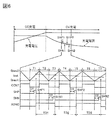
- FIG. 6 the operation of the semiconductor device will be further described using a timing chart.
- the timing chart will be described using an arbitrary period during CV charging.
- the signal iout is a detection voltage generated by the integration circuit 22.
- the output of the shunt circuit 21 is inverted, and as a result, the direction of change of the signal iout is inverted. Since the signal iout is generated by the integration circuit 22, the slope of the signal iout increases as the amount of change in the charging voltage of the secondary battery 42 detected by the shunt circuit 21 increases. Further, the decrease in the charging voltage of the secondary battery 42 detected by the shunt circuit 21 decreases the inclination of the signal iout.
- the output signal of the comparator 23 changes the time of the cycles T1 to T7 due to the slope of the signal iout.
- the change point of the output signal of the comparator 23 coincides with the change point of the signal iout. Therefore, the output signal of the comparator 23 is synchronized with the signal CCNT.
- the circuit 40 (hereinafter, described as a control unit) generates a signal SHP and a signal SHN when detecting a change point of the signal CCNT.
- a period in which the signal SHP is output from the change point of the signal CCNT is referred to as a period D1.
- a period in which the signal SHN is output from the change point of the signal CCNT is referred to as a period D2.
- the signal SHP1 turns on the switch 31c after the set period D1 from the change point of the signal CCNT. Therefore, the signal SHP1 changes to the "H" signal.
- the signal SHN1 turns on the switch 31b after the set period D2 from the change point of the signal CCNT. Therefore, the signal SHN1 changes to the "H" signal.
- the period D1 is preferably the same set time as the period D2.
- the memory 32b stores the detected voltage at the first time (the signal SHP changes from “H” to “L”).
- the memory 32a stores the detection voltage at the second time (the signal SHN changes from “H” to “L”).
- the amplifier circuit 31a included in the abnormal current detection circuit 30 compares the detected voltage stored in the memory 32a with the detected voltage stored in the memory 32b.
- the detection voltage stored in the memories 32a and 32b can represent the slope of the change amount of the detection voltage.
- the control unit detects the length of the period such as the period TD1 to the period TD3 by using the time when the signal ABNC changes from “H” to “L” or “L” to “H”.
- FIG. 6 is an example showing a tendency that the charging current decreases during CV charging. Therefore, the timing chart shows that the voltage of the signal iout stored in the memory becomes smaller due to the signal SHP1, the signal SHN1, the signal SHP2, and the signal SHN2 in order. Therefore, the control unit can determine that the cycle of TD1 to TD3 output by the signal ABNC becomes longer and thus the charging curve of the secondary battery 42 tends to decrease.
- FIG. 7 is a diagram illustrating, as an example, a case where the secondary battery 42 deteriorates and exhibits charging characteristics different from the normal state shown in FIG. 6.
- FIG. 7 shows the characteristic that the charging current increases during CV charging. Therefore, the times of the periods T1 to T7 of the signal CCNT and the signal ABNC sequentially decrease.
- FIG. 7 is an example showing a tendency that the charging currents of the signal SHP1, the signal SHN1, the signal SHP2, and the signal SHN2 increase in sequence during CV charging.
- the timing chart shows that the voltage of the signal iout stored in the memory increases due to the signal SHP1, the signal SHN1, the signal SHP2, and the signal SHN2 in order. Therefore, the control unit can determine that the cycles TD1 to TD3 output by the signal ABNC are shortened and thus the charging curve of the secondary battery 42 tends to increase.
- the semiconductor device which is one embodiment of the present invention can monitor the charge characteristics and control the charge when the secondary battery 42 is charged. For example, during CV charging, the deterioration state of the secondary battery 42 can be detected by managing the slope of the charging current. Therefore, the semiconductor device functions as an abnormality detection circuit for the secondary battery 42.
- the circuit 40 can efficiently use the secondary battery 42 in order to operate various electronic devices as described in Embodiment 3 or Embodiment 4. .. Note that when utilizing the function of the processor included in the electronic device, the semiconductor device can be restated as a secondary battery control system.
- the semiconductor device which is one embodiment of the present invention can handle the case where the charging characteristics of the secondary battery 42 change abruptly or gradually.
- the case where the charging characteristic of the secondary battery 42 changes abruptly includes an abrupt change such as a micro short circuit as shown in FIG. 32. Therefore, by monitoring the charging characteristics of the secondary battery 42, the electronic device can be operated stably. Further, power consumption can be reduced by using an OS transistor.
- a charge control circuit using an OS transistor, an abnormality detection circuit, a secondary battery control system, or the like may be referred to as a BTOS (Battery operating system, or Battery oxide semiconductor).
- BTOS Battery operating system, or Battery oxide semiconductor
- the semiconductor device according to one embodiment of the present invention is not construed as being limited to the circuit diagram shown in this embodiment.
- the semiconductor device according to one embodiment of the present invention also includes a case where the semiconductor device has a circuit configuration equivalent to the circuit configuration described in this embodiment.
- FIG. 8A is an external view of a coin type (single-layer flat type) secondary battery
- FIG. 8B is a cross-sectional view thereof.
- a positive electrode can 301 also serving as a positive electrode terminal and a negative electrode can 302 also serving as a negative electrode terminal are insulated and sealed with a gasket 303 made of polypropylene or the like.
- the positive electrode 304 is formed of a positive electrode current collector 305 and a positive electrode active material layer 306 provided so as to be in contact with the positive electrode current collector 305.
- the negative electrode 307 is formed of the negative electrode current collector 308 and the negative electrode active material layer 309 provided so as to be in contact with the negative electrode current collector 308.
- the positive electrode 304 and the negative electrode 307 used in the coin-type secondary battery 300 may have active material layers formed on only one surface.
- the positive electrode can 301 and the negative electrode can 302 metals such as nickel, aluminum, and titanium having corrosion resistance to an electrolytic solution, or alloys thereof or alloys of these with other metals (for example, stainless steel) are used. it can. Further, in order to prevent corrosion by the electrolytic solution, it is preferable to coat with nickel, aluminum or the like.
- the positive electrode can 301 and the negative electrode can 302 are electrically connected to the positive electrode 304 and the negative electrode 307, respectively.
- An electrolyte is impregnated with the negative electrode 307, the positive electrode 304, and the separator 310, and the positive electrode 304, the separator 310, the negative electrode 307, and the negative electrode can 302 are stacked in this order with the positive electrode can 301 facing down, as shown in FIG. 8B.
- the coin-shaped secondary battery 300 is manufactured by pressure-bonding 301 and the negative electrode can 302 via the gasket 303.
- the flow of current when charging the secondary battery will be described with reference to FIG. 8C.
- the secondary battery using lithium is regarded as one closed circuit, the movement of lithium ions and the current flow are in the same direction.
- the anode (anode) and the cathode (cathode) are exchanged by charging and discharging, and the oxidation reaction and the reduction reaction are exchanged. Therefore, the electrode having a high reaction voltage is called the positive electrode, The electrode with a low reaction voltage is called the negative electrode. Therefore, in the present specification, the positive electrode is a “positive electrode” or a “positive electrode”, whether it is charging, discharging, flowing a reverse pulse current, or flowing a charging current.
- the positive electrode will be referred to as a "positive electrode” and the negative electrode will be referred to as a "negative electrode” or a “negative electrode”.
- anode (anode) and cathode (cathode) related to the oxidation reaction and the reduction reaction are used, the charging time and the discharging time are reversed, which may cause confusion. Therefore, the terms anode (anode) and cathode (cathode) will not be used herein. If the terms anode (anode) and cathode (cathode) are used, indicate whether they are charging or discharging and also indicate whether they correspond to the positive electrode (positive electrode) or the negative electrode (negative electrode). To do.
- a charger is connected to the two terminals shown in FIG. 8C to charge the secondary battery 300. As the charging of the secondary battery 300 progresses, the voltage difference between the electrodes increases.
- FIG. 9A An external view of the cylindrical secondary battery 800 is shown in FIG. 9A.
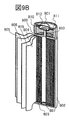
- FIG. 9B is a diagram schematically showing a cross section of a cylindrical secondary battery 800.
- a cylindrical secondary battery 800 has a positive electrode cap (battery lid) 801 on the upper surface and battery cans (exterior cans) 802 on the side and bottom surfaces.
- the positive electrode cap and the battery can (outer can) 802 are insulated by a gasket (insulating packing) 810.
- a battery element in which a strip-shaped positive electrode 804 and a negative electrode 806 are wound with a separator 805 sandwiched therebetween is provided inside the hollow cylindrical battery can 802.
- the battery can 802 has one end closed and the other end open.
- a metal such as nickel, aluminum, or titanium having corrosion resistance to an electrolytic solution, or an alloy thereof or an alloy of these and another metal (for example, stainless steel or the like) can be used. .. Further, in order to prevent corrosion due to the electrolytic solution, it is preferable to coat the battery can 802 with nickel, aluminum or the like.
- the battery element in which the positive electrode, the negative electrode, and the separator are wound is sandwiched by a pair of insulating plates 808 and 809 facing each other.
- a non-aqueous electrolytic solution (not shown) is injected into the inside of the battery can 802 provided with the battery element.
- the non-aqueous electrolyte the same one as the coin type secondary battery can be used.
- a positive electrode terminal (positive electrode current collecting lead) 803 is connected to the positive electrode 804, and a negative electrode terminal (negative electrode current collecting lead) 807 is connected to the negative electrode 806. Both the positive electrode terminal 803 and the negative electrode terminal 807 can use a metal material such as aluminum.
- the positive electrode terminal 803 is resistance-welded to the safety valve mechanism 812, and the negative electrode terminal 807 is resistance-welded to the bottom of the battery can 802.
- the safety valve mechanism 812 is electrically connected to the positive electrode cap 801 via a PTC element (Positive Temperature Coefficient) 811.
- the safety valve mechanism 812 disconnects the electrical connection between the positive electrode cap 801 and the positive electrode 804 when the increase in the internal pressure of the battery exceeds a predetermined threshold value.
- the PTC element 811 is a PTC element whose resistance increases when the temperature rises, and limits the amount of current due to the increase in resistance to prevent abnormal heat generation. Barium titanate (BaTiO 3 ) based semiconductor ceramics or the like can be used for the PTC element.
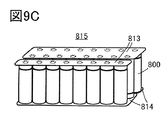
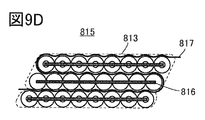
- a plurality of secondary batteries 800 may be sandwiched between conductive plates 813 and 814 to form a module 815.
- the plurality of secondary batteries 800 may be connected in parallel, may be connected in series, or may be connected in parallel and then further connected in series.
- FIG. 9D is a top view of the module 815.
- the conductive plate 813 is shown by a dotted line for the sake of clarity.
- the module 815 may include a conductive wire 816 that electrically connects the plurality of secondary batteries 800.
- a conductive plate can be provided so as to overlap with the conductive wire 816.
- the temperature control device 817 may be provided between the plurality of secondary batteries 800. When the secondary battery 800 is overheated, it can be cooled by the temperature control device 817, and when the secondary battery 800 is too cold, it can be heated by the temperature control device 817. Therefore, the performance of the module 815 is less likely to be affected by the outside temperature.
- the heat medium included in the temperature control device 817 preferably has insulating properties and nonflammability.
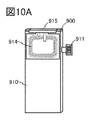
- FIGS. 10A and 10B are diagrams showing an external view of the secondary battery.
- the secondary battery 913 is connected to the antenna 914 and the antenna 915 via the circuit board 900.
- a label 910 is attached to the secondary battery 913. Further, as shown in FIG. 10B, the secondary battery 913 is connected to the terminal 951 and the terminal 952.
- the circuit board 900 has a terminal 911 and a circuit 912.
- the terminal 911 is connected to the terminal 951, the terminal 952, the antenna 914, the antenna 915, and the circuit 912.
- a plurality of terminals 911 may be provided and each of the plurality of terminals 911 may serve as a control signal input terminal, a power supply terminal, or the like.
- the circuit 912 may be provided on the back surface of the circuit board 900.
- the antennas 914 and 915 are not limited to the coil shape, and may have a linear shape or a plate shape, for example. Further, an antenna such as a planar antenna, an aperture antenna, a traveling wave antenna, an EH antenna, a magnetic field antenna, or a dielectric antenna may be used.
- the antenna 914 or the antenna 915 may be a flat conductor. This plate-shaped conductor can function as one of the electric field coupling conductors. That is, the antenna 914 or the antenna 915 may function as one of the two conductors included in the capacitor. As a result, not only the electromagnetic field and the magnetic field but also the electric field can be used to exchange electric power.
- the line width of the antenna 914 is preferably larger than the line width of the antenna 915. Accordingly, the amount of power received by the antenna 914 can be increased.
- the secondary battery has a layer 916 between the antenna 914 and the antenna 915 and the secondary battery 913.
- the layer 916 has a function of blocking an electromagnetic field from the secondary battery 913, for example.
- a magnetic substance can be used as the layer 916.
- an antenna may be provided on each of a pair of opposing surfaces of the secondary battery 913 shown in FIGS. 10A and 10B.
- 11A is an external view showing one of the pair of surfaces
- FIG. 11B is an external view showing the other of the pair of surfaces.
- 10A and 10B the description of the secondary battery shown in FIGS. 10A and 10B can be incorporated as appropriate.
- an antenna 914 is provided on one of a pair of surfaces of a secondary battery 913 with a layer 916 interposed therebetween, and as shown in FIG. 11B, a layer 917 is provided on the other of the pair of surfaces of the secondary battery 913.
- An antenna 918 is provided so as to be sandwiched.
- the layer 917 has a function of blocking an electromagnetic field from the secondary battery 913, for example.
- a magnetic substance can be used as the layer 917.
- the antenna 918 has a function of performing data communication with an external device, for example.
- an antenna having a shape applicable to the antenna 914 can be used.
- a communication system between the secondary battery and another device via the antenna 918 a response system that can be used between the secondary battery and another device, such as NFC (Near Field Communication), should be applied. You can
- a display device 920 may be provided on the secondary battery 913 shown in FIGS. 10A and 10B.
- the display device 920 is electrically connected to the terminal 911.
- the label 910 may not be provided in the portion where the display device 920 is provided.
- 10A and 10B the description of the secondary battery shown in FIGS. 10A and 10B can be incorporated as appropriate.
- the display device 920 may display, for example, an image showing whether or not charging is in progress, an image showing the amount of electricity stored, and the like.
- the display device 920 for example, electronic paper, a liquid crystal display device, an electroluminescent (also referred to as EL) display device, or the like can be used.
- power consumption of the display device 920 can be reduced by using electronic paper.
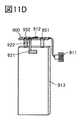
- the sensor 921 may be provided in the secondary battery 913 shown in FIGS. 10A and 10B.
- the sensor 921 is electrically connected to the terminal 911 via the terminal 922.
- 10A and 10B the description of the secondary battery shown in FIGS. 10A and 10B can be incorporated as appropriate.
- Examples of the sensor 921 include displacement, position, velocity, acceleration, angular velocity, rotation speed, distance, light, liquid, magnetism, temperature, chemical substance, sound, time, hardness, electric field, current, voltage, power, radiation, flow rate. It should have a function capable of measuring humidity, gradient, vibration, odor, or infrared rays. By providing the sensor 921, for example, data (temperature or the like) indicating the environment where the secondary battery is placed can be detected and stored in the memory in the circuit 912.
- the secondary battery 913 shown in FIG. 12A has a wound body 950 in which a terminal 951 and a terminal 952 are provided inside a housing 930.
- the wound body 950 is impregnated with the electrolytic solution inside the housing 930.
- the terminal 952 is in contact with the housing 930, and the terminal 951 is not in contact with the housing 930 by using an insulating material or the like.
- the housing 930 is illustrated separately in FIG. 12A for convenience, the wound body 950 is actually covered with the housing 930, and the terminals 951 and 952 extend outside the housing 930.
- Existence A metal material (for example, aluminum) or a resin material can be used for the housing 930.
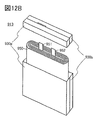
- the housing 930 shown in FIG. 12A may be made of a plurality of materials.
- a housing 930a and a housing 930b are attached to each other, and a wound body 950 is provided in a region surrounded by the housings 930a and 930b.
- An insulating material such as an organic resin can be used for the housing 930a.
- a material such as an organic resin for the surface on which the antenna is formed shielding of the electric field by the secondary battery 913 can be suppressed.
- antennas such as the antenna 914 and the antenna 915 may be provided inside the housing 930a as long as the electric field is shielded by the housing 930a.
- a metal material, for example, can be used for the housing 930b.
- FIG. 13 shows the structure of the wound body 950.
- the wound body 950 includes a negative electrode 931, a positive electrode 932, and a separator 933.
- the wound body 950 is a wound body in which the negative electrode 931 and the positive electrode 932 are laminated with the separator 933 sandwiched therebetween and the laminated sheet is wound. Note that a plurality of stacked layers of the negative electrode 931, the positive electrode 932, and the separator 933 may be further stacked.
- the negative electrode 931 is connected to the terminal 911 shown in FIG. 10 via one of the terminal 951 and the terminal 952.
- the positive electrode 932 is connected to the terminal 911 shown in FIG. 10 through the other of the terminal 951 and the terminal 952.
- bonded secondary battery Next, an example of a bonded secondary battery will be described with reference to FIGS. If the bonded secondary battery is configured to have flexibility, if it is mounted on an electronic device having at least a part having flexibility, the secondary battery can be bent in accordance with deformation of the electronic device. You can also
- the laminated secondary battery 980 will be described with reference to FIG.
- the laminated secondary battery 980 has a wound body 993 shown in FIG. 14A.
- the wound body 993 includes a negative electrode 994, a positive electrode 995, and a separator 996. Similar to the wound body 950 described with reference to FIG. 13, the wound body 993 is obtained by stacking the negative electrode 994 and the positive electrode 995 with the separator 996 interposed therebetween and winding the laminated sheet.
- the number of stacked layers including the negative electrode 994, the positive electrode 995, and the separator 996 may be appropriately designed according to the required capacity and element volume.
- the negative electrode 994 is connected to a negative electrode current collector (not shown) via one of the lead electrode 997 and the lead electrode 998
- the positive electrode 995 is connected to the positive electrode current collector (not shown) via the other of the lead electrode 997 and the lead electrode 998. Connected).
- the wound body 993 described above is housed in a space formed by bonding a film 981 to be an outer package and a film 982 having a recess by thermocompression bonding or the like.
- the secondary battery 980 can be manufactured.
- the wound body 993 has a lead electrode 997 and a lead electrode 998, and is impregnated with the electrolytic solution inside the film 981 and the film 982 having a recess.
- a metal material such as aluminum or a resin material can be used.
- a resin material is used as a material for the film 981 and the film 982 having a depression, the film 981 and the film 982 having a depression can be deformed when external force is applied, so that a flexible storage battery is manufactured. be able to.
- a space may be formed by bending one film and the wound body 993 described above may be housed in the space.
- FIG. 14 the example of the secondary battery 980 having the wound body in the space formed by the film serving as the outer package has been described.
- FIG. 15 for example, in the space formed by the film serving as the outer package, A secondary battery having a plurality of strip-shaped positive electrodes, a separator and a negative electrode may be used.
- a bonded secondary battery 700 shown in FIG. 15A includes a positive electrode 703 having a positive electrode current collector 701 and a positive electrode active material layer 702, a negative electrode 706 having a negative electrode current collector 704 and a negative electrode active material layer 705, and a separator. 707, an electrolytic solution 708, and an exterior body 709.
- a separator 707 is provided between a positive electrode 703 and a negative electrode 706 provided inside the outer package 709. Further, the inside of the exterior body 709 is filled with the electrolytic solution 708.
- the electrolytic solution 708 the electrolytic solution described in Embodiment 2 can be used.
- the positive electrode current collector 701 and the negative electrode current collector 704 also serve as terminals for making electrical contact with the outside. Therefore, a part of the positive electrode current collector 701 and the negative electrode current collector 704 may be arranged so as to be exposed to the outside from the outer package 709. In addition, the positive electrode current collector 701 and the negative electrode current collector 704 are not exposed to the outside from the outer package 709, and the lead electrode and the positive electrode current collector 701 or the negative electrode current collector 704 are ultrasonic-waved using a lead electrode. The lead electrodes may be exposed to the outside by bonding.
- the outer package 709 is made of, for example, a film made of a material such as polyethylene, polypropylene, polycarbonate, ionomer, and polyamide, and is excellent in flexibility such as aluminum, stainless steel, copper, and nickel.
- a laminated film having a three-layer structure in which a metal thin film is provided and an insulating synthetic resin film such as a polyamide resin or a polyester resin is further provided on the metal thin film as the outer surface of the outer package can be used.
- FIG. 15B shows an example of a cross-sectional structure of the laminated secondary battery 700.
- FIG. 15A shows an example in which two current collectors are used, but in reality, as shown in FIG. 15B, a plurality of electrode layers are used.
- the number of electrode layers is 16 as an example. Note that the secondary battery 700 has flexibility even when the number of electrode layers is 16.
- FIG. 15B shows a structure in which the negative electrode current collector 704 has eight layers and the positive electrode current collector 701 has eight layers, which is a total of 16 layers. Note that FIG. 15B shows a cross section of the take-out portion of the negative electrode, in which eight layers of the negative electrode current collector 704 are ultrasonically bonded.
- the number of electrode layers is not limited to 16, and may be large or small. When the number of electrode layers is large, the secondary battery can have a larger capacity. Further, when the number of electrode layers is small, the secondary battery can be made thin and excellent in flexibility.
- FIGS. 16 and 17 each include a positive electrode 703, a negative electrode 706, a separator 707, an outer package 709, a positive electrode lead electrode 710, and a negative electrode lead electrode 711.
- FIG. 18A shows an external view of the positive electrode 703 and the negative electrode 706.
- the positive electrode 703 has a positive electrode current collector 701, and the positive electrode active material layer 702 is formed on the surface of the positive electrode current collector 701. Further, the positive electrode 703 has a region (hereinafter referred to as a tab region) where the positive electrode current collector 701 is partially exposed.
- the negative electrode 706 has a negative electrode current collector 704, and the negative electrode active material layer 705 is formed on the surface of the negative electrode current collector 704.
- the negative electrode 706 has a region where the negative electrode current collector 704 is partially exposed, that is, a tab region.
- the area and shape of the tab regions of the positive electrode and the negative electrode are not limited to the example shown in FIG. 18A.
- the negative electrode 706, the separator 707, and the positive electrode 703 are laminated.
- 18B shows the negative electrode 706, the separator 707, and the positive electrode 703 that are stacked.
- an example in which 5 sets of negative electrodes and 4 sets of positive electrodes are used is shown.
- the tab regions of the positive electrode 703 are bonded to each other, and the positive electrode lead electrode 710 is bonded to the tab region of the positive electrode on the outermost surface. Ultrasonic welding or the like may be used for joining, for example.
- the tab regions of the negative electrode 706 are joined together, and the negative electrode lead electrode 711 is joined to the tab region of the outermost negative electrode.
- the negative electrode 706, the separator 707, and the positive electrode 703 are arranged on the outer package 709.
- the exterior body 709 is bent at the portion indicated by the broken line. Then, the outer peripheral portion of the exterior body 709 is joined. For joining, for example, thermocompression bonding may be used. At this time, a region (hereinafter referred to as an inlet) which is not joined to a part (or one side) of the outer package 709 is provided so that the electrolytic solution 708 can be added later.
- an inlet a region which is not joined to a part (or one side) of the outer package 709 is provided so that the electrolytic solution 708 can be added later.
- the electrolytic solution 708 (not shown) is introduced into the inside of the exterior body 709 from the inlet provided in the exterior body 709.
- the introduction of the electrolytic solution 708 is preferably performed under a reduced pressure atmosphere or an inert atmosphere.
- the inlet is joined. In this way, the bonded secondary battery 700 can be manufactured.
- FIG. 19A shows a schematic top view of a bendable secondary battery 250.
- 19B, 19C, and 19D are schematic cross-sectional views taken along the cutting line C1-C2, the cutting line C3-C4, and the cutting line A1-A2 in FIG. 19A, respectively.
- the secondary battery 250 has an exterior body 251, and a positive electrode 211a and a negative electrode 211b housed inside the exterior body 251.
- the lead 212a electrically connected to the positive electrode 211a and the lead 212b electrically connected to the negative electrode 211b extend to the outside of the exterior body 251. Further, in a region surrounded by the exterior body 251, an electrolytic solution (not shown) is sealed in addition to the positive electrode 211a and the negative electrode 211b.
- FIG. 20A is a perspective view illustrating the stacking order of the positive electrode 211a, the negative electrode 211b, and the separator 214.
- FIG. 20B is a perspective view showing the lead 212a and the lead 212b in addition to the positive electrode 211a and the negative electrode 211b.
- the secondary battery 250 has a plurality of strip-shaped positive electrodes 211a, a plurality of strip-shaped negative electrodes 211b, and a plurality of separators 214.
- Each of the positive electrode 211a and the negative electrode 211b has a protruding tab portion and a portion other than the tab portion.
- the positive electrode active material layer is formed on a portion of the positive electrode 211a other than the tab, and the negative electrode active material layer is formed on a portion of the negative electrode 211b other than the tab.
- the positive electrode 211a and the negative electrode 211b are stacked so that the surfaces of the positive electrode 211a on which the positive electrode active material layer is not formed are in contact with the surfaces of the negative electrode 211b on which the negative electrode active material layer is not formed.
- a separator 214 is provided between the surface of the positive electrode 211a on which the positive electrode active material layer is formed and the surface of the negative electrode 211b on which the negative electrode active material layer is formed.
- the separator 214 is indicated by a dotted line for easy viewing.
- the plurality of positive electrodes 211a and the leads 212a are electrically connected at the joint portion 215a. Further, the plurality of negative electrodes 211b and the leads 212b are electrically connected to each other at the joint portion 215b.
- the outer body 251 has a film-like shape and is folded in two so as to sandwich the positive electrode 211a and the negative electrode 211b.
- the exterior body 251 has a bent portion 261, a pair of seal portions 262, and a seal portion 263.
- the pair of seal portions 262 are provided so as to sandwich the positive electrode 211a and the negative electrode 211b, and can also be referred to as side seals.
- the seal portion 263 has a portion overlapping the leads 212a and 212b, and can be called a top seal.
- the exterior body 251 preferably has a corrugated shape in which ridge lines 271 and valley lines 272 are alternately arranged in a portion overlapping the positive electrode 211a and the negative electrode 211b. Further, it is preferable that the seal portion 262 and the seal portion 263 of the exterior body 251 are flat.
- FIG. 19B is a cross section cut at a portion overlapping the ridge line 271
- FIG. 19C is a cross section cut at a portion overlapping the valley line 272.
- 19B and 19C both correspond to the cross section in the width direction of the secondary battery 250 and the positive electrode 211a and the negative electrode 211b.
- the distance La is the distance between the widthwise ends of the positive electrodes 211a and the negative electrodes 211b, that is, the ends of the positive electrodes 211a and the negative electrodes 211b, and the seal portion 262.
- the positive electrode 211a and the negative electrode 211b are deformed so as to be displaced from each other in the longitudinal direction as described later.
- the outer body 251 may be strongly rubbed with the positive electrode 211a and the negative electrode 211b, and the outer body 251 may be damaged.
- the metal film of the exterior body 251 is exposed, the metal film may be corroded by the electrolytic solution. Therefore, it is preferable to set the distance La as long as possible.
- the distance La is made too large, the volume of the secondary battery 250 will increase.
- the distance La between the positive electrode 211a and the negative electrode 211b and the seal portion 262 is preferable to increase the distance La between the positive electrode 211a and the negative electrode 211b and the seal portion 262 as the total thickness of the stacked positive electrode 211a and the negative electrode 211b increases.
- the distance La is 0.8 times or more and 3.0 times or less the thickness t, It is preferably 0.9 times or more and 2.5 times or less, more preferably 1.0 times or more and 2.0 times or less.
- the distance between the pair of seal portions 262 is Lb
- the distance Lb be sufficiently larger than the width of the positive electrode 211a and the negative electrode 211b (here, the width Wb of the negative electrode 211b).
- the difference between the distance Lb between the pair of seal portions 262 and the width Wb of the negative electrode 211b is 1.6 times or more and 6.0 times or less, preferably 1.8 times or more the thickness t of the positive electrode 211a and the negative electrode 211b. It is preferable to satisfy at least 2.0 times and at most 5.0 times, more preferably at least 2.0 times and 4.0 times.
- the distance Lb, the width Wb, and the thickness t satisfy the relationship of Expression 1 below.
- a satisfies 0.8 or more and 3.0 or less, preferably 0.9 or more and 2.5 or less, and more preferably 1.0 or more and 2.0 or less.
- FIG. 19D is a cross section including the lead 212a, and corresponds to the cross section in the length direction of the secondary battery 250, the positive electrode 211a, and the negative electrode 211b. As shown in FIG. 19D, in the bent portion 261, it is preferable to have a space 273 between the lengthwise ends of the positive electrode 211a and the negative electrode 211b and the outer casing 251.
- FIG. 19E shows a schematic sectional view when the secondary battery 250 is bent.
- FIG. 19E corresponds to the cross section along the cutting line B1-B2 in FIG. 19A.
- the portion located outside the exterior body 251 is deformed so that the wave amplitude is small and the wave period is large.
- the portion located inside the exterior body 251 is deformed so that the amplitude of the wave is large and the cycle of the wave is small. In this way, the deformation of the exterior body 251 relieves the stress applied to the exterior body 251 due to the bending, so that the material itself forming the exterior body 251 does not need to expand or contract. As a result, the outer casing 251 is not damaged, and the secondary battery 250 can be bent with a small force.
- the positive electrode 211a and the negative electrode 211b are relatively displaced from each other.
- the plurality of stacked positive electrodes 211a and negative electrodes 211b have one end on the seal portion 263 side fixed by the fixing member 217, the plurality of stacked positive electrodes 211a and negative electrodes 211b are displaced so that the closer they are to the bent portion 261, the larger the shift amount becomes.
- the stress applied to the positive electrode 211a and the negative electrode 211b is relieved, and the positive electrode 211a and the negative electrode 211b themselves do not need to expand and contract.
- the secondary battery 250 can be bent without damaging the positive electrode 211a and the negative electrode 211b.
- the positive electrode 211a and the negative electrode 211b located inside when bent are not in contact with the outer casing 251 and are relatively in contact with each other. You can shift to.
- FIGS. 21A to 21H show an example of mounting the bendable secondary battery described in part of Embodiment 2 on an electronic device.
- an electronic device to which a bendable secondary battery is applied for example, a television device (also referred to as a television or a television receiver), a monitor for a computer, a digital camera, a digital video camera, a digital photo frame, a mobile phone, and the like.
- a television device also referred to as a television or a television receiver
- a monitor for a computer a digital camera, a digital video camera, a digital photo frame, a mobile phone, and the like.
- a portable game device a portable information terminal, a sound reproducing device, a large game device such as a pachinko machine, or the like.
- a secondary battery with a flexible shape along the inner or outer wall of a house or building, or along the curved surface of the interior or exterior of an automobile.
- the mobile phone 7400 includes a display portion 7402 incorporated in a housing 7401, operation buttons 7403, an external connection port 7404, a speaker 7405, a microphone 7406, and the like.
- the mobile phone 7400 includes a secondary battery 7407.
- the secondary battery 7407 By using the secondary battery of one embodiment of the present invention for the secondary battery 7407, a lightweight and long-life mobile phone can be provided.
- FIG. 21B shows a state where the mobile phone 7400 is curved.
- the secondary battery 7407 provided therein is also bent.
- 21C shows the state of the secondary battery 7407 which is bent at that time.
- the secondary battery 7407 is a thin storage battery.
- the secondary battery 7407 is fixed in a bent state.
- the secondary battery 7407 has a lead electrode electrically connected to the current collector.
- the current collector is a copper foil, which is partly alloyed with gallium to improve the adhesion to the active material layer in contact with the current collector and to improve the reliability of the secondary battery 7407 in a bent state. It has a high configuration.
- FIG. 21D shows an example of a bangle type display device.
- the portable display device 7100 includes a housing 7101, a display portion 7102, operation buttons 7103, and a secondary battery 7104.
- FIG. 21E shows a state of the secondary battery 7104 which is bent. When the secondary battery 7104 is attached to the user's arm in a bent state, the housing is deformed and the curvature of part or all of the secondary battery 7104 is changed.
- the curvature radius what represents the degree of bending at an arbitrary point of the curve is represented by the value of the radius of the corresponding circle is called the curvature radius, and the reciprocal of the curvature radius is called the curvature.
- a part or all of the main surface of the housing or the secondary battery 7104 changes within the range of the radius of curvature of 40 mm or more and 150 mm or less.
- the radius of curvature on the main surface of the secondary battery 7104 is in the range of 40 mm or more and 150 mm or less, high reliability can be maintained.
- FIG. 21F shows an example of a wristwatch type portable information terminal.
- the mobile information terminal 7200 includes a housing 7201, a display portion 7202, a band 7203, a buckle 7204, operation buttons 7205, an input/output terminal 7206, and the like.
- the mobile information terminal 7200 can execute various applications such as mobile phone, e-mail, text browsing and creation, music playback, Internet communication, and computer games.
- the display portion 7202 is provided with a curved display surface, and display can be performed along the curved display surface.
- the display portion 7202 includes a touch sensor and can be operated by touching the screen with a finger, a stylus, or the like.
- the application can be started by touching the icon 7207 displayed on the display portion 7202.
- the operation button 7205 can have various functions such as power on/off operation, wireless communication on/off operation, manner mode execution/cancellation, and power saving mode execution/cancellation in addition to time setting. ..
- the function of the operation button 7205 can be freely set by the operating system incorporated in the portable information terminal 7200.
- the portable information terminal 7200 can execute short-range wireless communication that is a communication standard. For example, by communicating with a headset capable of wireless communication, it is possible to talk hands-free.
- the portable information terminal 7200 has an input/output terminal 7206, and can directly exchange data with another information terminal via a connector.
- charging can be performed through the input/output terminal 7206. Note that the charging operation may be performed by wireless power feeding without using the input/output terminal 7206.
- the display portion 7202 of the portable information terminal 7200 includes the secondary battery of one embodiment of the present invention.
- the secondary battery of one embodiment of the present invention a lightweight and long-life portable information terminal can be provided.
- the secondary battery 7104 illustrated in FIG. 21E can be incorporated in the housing 7201 in a curved state or in the band 7203 in a bendable state.
- Personal digital assistant 7200 preferably has a sensor.
- a human body sensor such as a fingerprint sensor, a pulse sensor, a body temperature sensor, a touch sensor, a pressure sensor, an acceleration sensor, or the like is preferably mounted as the sensor.
- FIG. 21G shows an example of an armband type display device.
- the display device 7300 has a display portion 7304 and has the secondary battery of one embodiment of the present invention.
- the display device 7300 can include a touch sensor in the display portion 7304 and can function as a portable information terminal.
- the display surface of the display portion 7304 is curved, and display can be performed along the curved display surface.
- the display device 7300 can change the display status by short-range wireless communication or the like that is a communication standard.
- the display device 7300 has an input/output terminal and can directly exchange data with another information terminal via a connector. Also, charging can be performed through the input/output terminal. Note that the charging operation may be performed by wireless power feeding without using the input/output terminal.
- the secondary battery of one embodiment of the present invention as the secondary battery included in the display device 7300, a lightweight and long-life display device can be provided.
- FIGS. 21H, 22 and 23 An example of mounting a secondary battery on an electronic device will be described with reference to FIGS. 21H, 22 and 23.
- a lightweight and long-life product can be provided.
- daily electronic devices include electric toothbrushes, electric shavers, and electric beauty devices.
- the secondary batteries for these products are stick-shaped, compact, and lightweight, considering the ease of holding by the user. A large-capacity secondary battery is desired.
- FIG. 21H is a perspective view of a device also called a cigarette-containing smoking device (electronic cigarette).
- the electronic cigarette 7500 includes an atomizer 7501 including a heating element, a secondary battery 7504 for supplying electric power to the atomizer, and a cartridge 7502 including a liquid supply bottle, a sensor, and the like.
- a protection circuit for preventing overcharge or overdischarge of the secondary battery 7504 may be electrically connected to the secondary battery 7504.
- the secondary battery 7504 shown in FIG. 21H has an external terminal so that it can be connected to a charging device. Since the secondary battery 7504 becomes a tip portion when held, it is desirable that the total length be short and the weight be light. Since the secondary battery of one embodiment of the present invention has high capacity and favorable cycle characteristics, a small and lightweight electronic cigarette 7500 that can be used for a long time and a long time can be provided.
- FIGS. 22A and 22B show an example of a tablet terminal that can be folded in two.
- a tablet terminal 9600 illustrated in FIGS. 22A and 22B includes a housing 9630a, a housing 9630b, a movable portion 9640 that connects the housing 9630a and the housing 9630b, a display portion 9631 including a display portion 9631a and a display portion 9631b, and a switch 9625.
- a switch 9627 Through a switch 9627, a fastener 9629, and an operation switch 9628.
- 22A shows a state in which the tablet terminal 9600 is opened
- FIG. 22B shows a state in which the tablet terminal 9600 is closed.
- the tablet terminal 9600 has a power storage unit 9635 inside the housing 9630a and the housing 9630b.
- the power storage unit 9635 is provided over the housings 9630a and 9630b through the movable portion 9640.
- All or part of the display portion 9631 can be a touch panel area, and data can be input by touching an image including an icon, a character, an input form, or the like displayed in the area.
- a keyboard button may be displayed on the entire surface of the display portion 9631a on the housing 9630a side and information such as characters and images may be displayed on the display portion 9631b on the housing 9630b side.
- a keyboard may be displayed on the display portion 9631b on the housing 9630b side and information such as characters and images may be displayed on the display portion 9631a on the housing 9630a side.
- a keyboard display switching button of a touch panel may be displayed on the display portion 9631 and the keyboard may be displayed on the display portion 9631 by touching the button with a finger, a stylus, or the like.
- touch input can be performed simultaneously on the touch panel area of the display portion 9631a on the housing 9630a side and the touch panel area of the display portion 9631b on the housing 9630b side.
- the switches 9625 to 9627 may be not only an interface for operating the tablet terminal 9600 but also an interface capable of switching various functions.
- at least one of the switches 9625 to 9627 may function as a switch for switching on and off the power of the tablet terminal 9600.
- at least one of the switches 9625 to 9627 may have a function of switching the display direction such as vertical display or horizontal display, or a function of switching between monochrome display and color display.
- at least one of the switches 9625 to 9627 may have a function of adjusting the luminance of the display portion 9631.
- the brightness of the display portion 9631 can be optimal depending on the amount of external light at the time of use, which is detected by an optical sensor incorporated in the tablet terminal 9600.
- the tablet terminal may include not only the optical sensor but also other detection devices such as a sensor for detecting the inclination such as a gyro and an acceleration sensor.
- the display area of the display portion 9631a on the housing 9630a side and the display area of the display portion 9631b on the housing 9630b side are substantially the same, but the display areas of the display portion 9631a and the display portion 9631b are particularly
- one size may be different from the other size, and the display quality may be different.
- FIG. 22B shows a state in which the tablet terminal 9600 is closed in half, and the tablet terminal 9600 has a housing 9630, a solar cell 9633, and a charge/discharge control circuit 9634 including a DCDC converter 9636.
- the power storage unit 9635 the power storage unit according to one embodiment of the present invention is used.
- the housing 9630a and the housing 9630b can be folded so as to overlap with each other when not in use. Since the display portion 9631 can be protected by folding, the durability of the tablet terminal 9600 can be improved. Since the power storage unit 9635 including the secondary battery of one embodiment of the present invention has high capacity and favorable cycle characteristics, a tablet terminal 9600 which can be used for a long time over a long period can be provided.
- the tablet terminal 9600 shown in FIGS. 22A and 22B displays a function of displaying various information (still images, moving images, text images, etc.), a calendar, date or time on the display unit.
- a function, a touch input function of performing a touch input operation or editing of information displayed on the display portion, a function of controlling processing by various software (programs), and the like can be provided.
- Electric power can be supplied to a touch panel, a display portion, a video signal processing portion, or the like by a solar cell 9633 attached to the surface of the tablet terminal 9600.
- the solar cell 9633 can be provided on one side or both sides of the housing 9630, and the power storage unit 9635 can be charged efficiently.
- a lithium ion battery is used as the power storage unit 9635, there are advantages such as downsizing.
- FIG. 22C illustrates the solar cell 9633, the power storage unit 9635, the DCDC converter 9636, the converter 9637, the switches SW1 to SW3, and the display portion 9631.
- the power storage unit 9635, the DCDC converter 9636, the converter 9637, and the switches SW1 to SW3 are This is a portion corresponding to the charge/discharge control circuit 9634 shown in FIG. 22B.
- the solar cell 9633 is shown as an example of a power generation unit, it is not particularly limited and a structure in which the power storage unit 9635 is charged by another power generation unit such as a piezoelectric element (piezo element) or a thermoelectric conversion element (Peltier element).
- a non-contact power transmission module that wirelessly (contactlessly) transmits and receives electric power to charge the battery, or another charging means may be combined.
- FIG. 23 shows examples of other electronic devices.
- a display device 8000 is an example of an electronic device including a secondary battery 8004 according to one embodiment of the present invention.
- the display device 8000 corresponds to a display device for receiving TV broadcast, and includes a housing 8001, a display portion 8002, a speaker portion 8003, a secondary battery 8004, and the like.
- the secondary battery 8004 according to one embodiment of the present invention is provided inside the housing 8001.
- the display device 8000 can be supplied with power from a commercial power source or can use power stored in the secondary battery 8004. Therefore, even when power cannot be supplied from a commercial power source due to a power failure or the like, the display device 8000 can be used by using the secondary battery 8004 of one embodiment of the present invention as an uninterruptible power source.
- a liquid crystal display device a light emitting device including a light emitting element such as an organic EL element in each pixel, an electrophoretic display device, a DMD (Digital Micromirror Device), a PDP (Plasma Display Panel), and an FED (Field Emission Display).
- a semiconductor display device can be used.
- the display device includes all information display devices such as those for receiving TV broadcasts, personal computers, and advertisements.
- a stationary lighting device 8100 is an example of an electronic device including a secondary battery 8103 according to one embodiment of the present invention.
- the lighting device 8100 includes a housing 8101, a light source 8102, a secondary battery 8103, and the like.
- FIG. 23 illustrates the case where the secondary battery 8103 is provided inside the ceiling 8104 in which the housing 8101 and the light source 8102 are installed, the secondary battery 8103 is provided inside the housing 8101. It may be.
- the lighting device 8100 can be supplied with power from a commercial power source or can use power stored in the secondary battery 8103. Therefore, even when power cannot be supplied from a commercial power source due to a power failure or the like, the lighting device 8100 can be used by using the secondary battery 8103 of one embodiment of the present invention as an uninterruptible power source.
- the secondary battery according to one embodiment of the present invention is not limited to the ceiling 8104; for example, the sidewall 8105, the floor 8106, the window 8107, and the like. It can also be used for a stationary lighting device provided in, or for a desktop lighting device.
- an artificial light source that artificially obtains light by using electric power can be used.
- an incandescent lamp, a discharge lamp such as a fluorescent lamp, and a light emitting element such as an LED and an organic EL element are given as examples of the artificial light source.
- an air conditioner including an indoor unit 8200 and an outdoor unit 8204 is an example of an electronic device including a secondary battery 8203 according to one embodiment of the present invention.
- the indoor unit 8200 includes a housing 8201, a ventilation port 8202, a secondary battery 8203, and the like.
- FIG. 23 illustrates the case where the secondary battery 8203 is provided in the indoor unit 8200, the secondary battery 8203 may be provided in the outdoor unit 8204. Alternatively, the secondary battery 8203 may be provided in both the indoor unit 8200 and the outdoor unit 8204.
- the air conditioner can be supplied with power from a commercial power source or can use power stored in the secondary battery 8203.
- the secondary battery 8203 when the secondary battery 8203 is provided in both the indoor unit 8200 and the outdoor unit 8204, the secondary battery 8203 according to one embodiment of the present invention can be used even when power cannot be supplied from a commercial power source due to a power failure or the like.
- an uninterruptible power supply By using as an uninterruptible power supply, it becomes possible to use an air conditioner.
- FIG. 23 exemplifies a separate type air conditioner composed of an indoor unit and an outdoor unit
- an integrated type air conditioner having the function of the indoor unit and the function of the outdoor unit in one housing is provided.
- the secondary battery according to one embodiment of the present invention can be used.
- an electric refrigerator-freezer 8300 is an example of an electronic device including a secondary battery 8304 according to one embodiment of the present invention.
- the electric refrigerator-freezer 8300 includes a housing 8301, a refrigerator compartment door 8302, a freezer compartment door 8303, a secondary battery 8304, and the like.
- a secondary battery 8304 is provided inside the housing 8301.
- the electric refrigerator-freezer 8300 can be supplied with electric power from a commercial power source and can also use electric power stored in the secondary battery 8304. Therefore, even when power cannot be supplied from a commercial power source due to a power failure or the like, the electric refrigerator-freezer 8300 can be used by using the secondary battery 8304 of one embodiment of the present invention as an uninterruptible power source.
- high-frequency heating devices such as microwave ovens and electronic devices such as electric rice cookers require high power in a short time. Therefore, by using the secondary battery of one embodiment of the present invention as an auxiliary power source for supplementing electric power that cannot be covered by the commercial power source, the breaker of the commercial power source can be prevented from dropping when the electronic device is used. ..
- the electronic device when the electronic device is not used, particularly when the ratio of the amount of power actually used (called power usage rate) to the total amount of power that can be supplied by the commercial power supply source is low,
- power usage rate the ratio of the amount of power actually used
- the secondary battery 8304 By storing the electric power in the secondary battery, it is possible to prevent the power usage rate from increasing outside the above time period.
- the electric refrigerator/freezer 8300 electric power is stored in the secondary battery 8304 at night when the temperature is low and the refrigerator compartment door 8302 and the freezer compartment door 8303 are not opened or closed. Then, by using the secondary battery 8304 as an auxiliary power source during the daytime when the temperature rises and the refrigerator door 8302 and the freezer door 8303 are opened and closed, the power usage rate during the daytime can be suppressed.
- the cycle characteristics of the secondary battery are favorable and reliability can be improved. Further, according to one embodiment of the present invention, a high-capacity secondary battery can be obtained; therefore, the characteristics of the secondary battery can be improved, and thus the secondary battery itself can be made smaller and lighter. it can. Therefore, by mounting the secondary battery which is one embodiment of the present invention on the electronic device described in this embodiment, the electronic device can have a longer life and a lighter weight. This embodiment can be implemented in appropriate combination with any of the other embodiments.
- next-generation clean energy vehicles such as hybrid vehicles (HEV), electric vehicles (EV), or plug-in hybrid vehicles (PHEV) can be realized.
- HEV hybrid vehicles
- EV electric vehicles
- PHEV plug-in hybrid vehicles
- FIG. 24 illustrates a vehicle using the secondary battery which is one embodiment of the present invention.
- a vehicle 8400 shown in FIG. 24A is an electric vehicle that uses an electric motor as a power source for traveling. Alternatively, it is a hybrid vehicle in which an electric motor and an engine can be appropriately selected and used as a power source for traveling. By using one embodiment of the present invention, a vehicle with a long cruising range can be realized.
- the automobile 8400 has a secondary battery.
- the modules of the secondary battery shown in FIGS. 9C and 9D may be arranged and used on the floor portion in the vehicle.
- a battery pack in which a plurality of secondary batteries shown in FIG. 12 are combined may be installed on the floor portion inside the vehicle.
- the secondary battery can supply power to a light-emitting device such as a headlight 8401 or a room light (not shown).
- the secondary battery can supply power to a display device such as a speedometer and a tachometer of the automobile 8400.
- the secondary battery can supply power to a semiconductor device such as a navigation system included in the automobile 8400.
- the automobile 8500 shown in FIG. 24B can be charged by receiving power from an external charging facility in a secondary battery of the automobile 8500 by a plug-in method, a contactless power feeding method, or the like.
- FIG. 24B shows a state in which a charging device 8021 installed on the ground is charging a secondary battery 8024 mounted on an automobile 8500 via a cable 8022.
- the charging method, the standard of the connector, etc. may be appropriately performed by a predetermined method such as CHAdeMO (registered trademark) or a combo.
- the charging device 8021 may be a charging station provided in a commercial facility or may be a home power source.
- the plug-in technology the secondary battery 8024 mounted on the automobile 8500 can be charged by external power supply. Charging can be performed by converting AC power into DC power via a converter such as an ACDC converter.
- a power receiving device can be mounted on the vehicle and electric power can be supplied from the power transmitting device on the ground in a contactless manner for charging.
- this non-contact power feeding method by incorporating a power transmission device on a road or an outer wall, charging can be performed not only when the vehicle is stopped but also when the vehicle is running. Moreover, you may transmit and receive electric power between vehicles using this non-contact electric power feeding system.
- a solar cell may be provided on the exterior of the vehicle to charge the secondary battery when the vehicle is stopped or running.
- an electromagnetic induction method or a magnetic field resonance method can be used.
- FIG. 24C is an example of a motorcycle using the secondary battery of one embodiment of the present invention.
- the scooter 8600 illustrated in FIG. 24C includes a secondary battery 8602, a side mirror 8601, and a direction indicator light 8603.
- the secondary battery 8602 can supply electricity to the direction indicator light 8603.
- the scooter 8600 shown in FIG. 24C can store the secondary battery 8602 in the under-seat storage 8604.
- the secondary battery 8602 can be stored in the under-seat storage 8604 even if the under-seat storage 8604 is small.
- the secondary battery 8602 is removable, and when charging, the secondary battery 8602 may be carried indoors, charged, and stored before traveling.
- the cycle characteristics of the secondary battery are improved, and the capacity of the secondary battery can be increased. Therefore, the secondary battery itself can be reduced in size and weight. If the secondary battery itself can be made smaller and lighter, it contributes to the weight reduction of the vehicle, and thus the cruising range can be improved. Further, the secondary battery mounted on the vehicle can be used as a power supply source other than the vehicle. In this case, for example, it is possible to avoid using the commercial power source at the peak of power demand. If it is possible to avoid using the commercial power source at the peak of power demand, it is possible to contribute to energy saving and reduction of carbon dioxide emission. Further, if the cycle characteristics are good, the secondary battery can be used for a long period of time, so that the amount of rare metals such as cobalt used can be reduced.
- This embodiment can be implemented in combination with any of the other embodiments as appropriate.
- the semiconductor device illustrated in FIG. 25 includes a transistor 390, a transistor 500, and a capacitor 600.
- 27A is a cross-sectional view of the transistor 500 in the channel length direction
- FIG. 27B is a cross-sectional view of the transistor 500 in the channel width direction
- FIG. 27C is a cross-sectional view of the transistor 390 in the channel width direction.
- the transistor 500 is an OS transistor.
- the off-state current of the transistor 500 is small. Therefore, for example, when the OS transistor described in any of the above embodiments has a structure similar to that of the transistor 500, voltage can be held for a long time.
- the semiconductor device described in this embodiment includes a transistor 390, a transistor 500, and a capacitor 600 as illustrated in FIG.
- the transistor 500 is provided above the transistor 390
- the capacitor 600 is provided above the transistor 390 and the transistor 500.
- the transistor described in the above embodiment can have a structure similar to that of the transistor 390 and the capacitor can have a structure similar to that of the capacitor 600.
- the transistor 390 is provided over the substrate 311 and includes a conductor 316, an insulator 315, a semiconductor region 313 formed of part of the substrate 311, a low-resistance region 314a serving as a source or drain region, and a low-resistance region 314b. ..
- the transistor 390 As shown in FIG. 27C, in the transistor 390, the upper surface of the semiconductor region 313 and the side surface in the channel width direction are covered with the conductor 316 with the insulator 315 interposed therebetween. As described above, by making the transistor 390 a Fin type, the effective channel width increases. Accordingly, the on characteristics of the transistor 390 can be improved. In addition, since the electric field contribution of the gate electrode can be increased, the off characteristics of the transistor 390 can be improved.
- the transistor 390 may be either a p-channel type or an n-channel type.
- a region of the semiconductor region 313 in which a channel is formed, a region in the vicinity thereof, a low-resistance region 314a and a low-resistance region 314b which serve as a source region or a drain region, and the like preferably contain a semiconductor such as a silicon-based semiconductor, and a single crystal. It preferably contains silicon. Alternatively, it may be formed of a material having Ge (germanium), SiGe (silicon germanium), GaAs (gallium arsenide), GaAlAs (gallium aluminum arsenide), or the like. A structure may be used in which silicon is used in which the effective mass is controlled by applying stress to the crystal lattice and changing the lattice spacing. Alternatively, the transistor 390 may be a HEMT (High Electron Mobility Transistor) by using GaAs and GaAlAs.
- HEMT High Electron Mobility Transistor
- the low-resistance region 314a and the low-resistance region 314b impart an n-type conductivity imparting element such as arsenic or phosphorus, or a p-type conductivity imparting boron, in addition to the semiconductor material applied to the semiconductor region 313. Including the element to do.
- the conductor 316 functioning as a gate electrode is a semiconductor material such as silicon, a metal material, or an alloy containing an element imparting n-type conductivity such as arsenic or phosphorus, or an element imparting p-type conductivity such as boron.
- a material or a conductive material such as a metal oxide material can be used.
- the threshold voltage of the transistor can be adjusted by selecting the material of the conductor. Specifically, it is preferable to use a material such as titanium nitride or tantalum nitride for the conductor. Further, in order to achieve both conductivity and embedding properties, it is preferable to use a metal material such as tungsten or aluminum as a laminate for the conductor, and it is particularly preferable to use tungsten in terms of heat resistance.
- the transistor 390 illustrated in FIG. 25 is an example, and the structure thereof is not limited, and an appropriate transistor may be used depending on a circuit configuration or a driving method.
- the transistor 390 may have a structure similar to that of the transistor 500 which is an OS transistor as illustrated in FIG. Note that details of the transistor 500 will be described later.
- the transistor 390 illustrated in FIG. 26 for example, an n-channel transistor as illustrated in FIG. 26 can be applied.
- a unipolar circuit indicates, for example, a circuit in which all transistors are transistors of the same polarity.
- a circuit in which all transistors are n-channel transistors can be said to be a unipolar circuit.
- An insulator 320, an insulator 322, an insulator 324, and an insulator 326 are sequentially stacked so as to cover the transistor 390.
- the insulator 320, the insulator 322, the insulator 324, and the insulator 326 for example, silicon oxide, silicon oxynitride, silicon nitride oxide, silicon nitride, aluminum oxide, aluminum oxynitride, aluminum nitride oxide, aluminum nitride, or the like is used. Good.
- silicon oxynitride refers to a material whose content of oxygen is higher than that of nitrogen
- silicon oxynitride is a material whose content of nitrogen is higher than that of oxygen.
- aluminum oxynitride refers to a material having a higher oxygen content than nitrogen as its composition
- aluminum oxynitride means a material having a higher nitrogen content than oxygen as its composition.
- the insulator 322 may have a function as a flattening film for flattening a step formed by the transistor 390 and the like provided below the insulator 322.
- the upper surface of the insulator 322 may be flattened by a flattening treatment using a chemical mechanical polishing (CMP) method or the like in order to improve flatness.
- CMP chemical mechanical polishing
- the insulator 324 it is preferable to use a film having a barrier property such that hydrogen and impurities do not diffuse from the substrate 311, the transistor 390, or the like to a region where the transistor 500 is provided.
- a film having a barrier property against hydrogen for example, silicon nitride formed by a CVD method can be used.
- silicon nitride formed by a CVD method when hydrogen diffuses into a semiconductor element including an oxide semiconductor, such as the transistor 500, characteristics of the semiconductor element might be deteriorated in some cases. Therefore, it is preferable to use a film which suppresses diffusion of hydrogen between the transistor 500 and the transistor 390.
- the film that suppresses hydrogen diffusion is a film in which the amount of released hydrogen is small.
- the desorption amount of hydrogen can be analyzed using, for example, a thermal desorption gas analysis method (TDS).
- TDS thermal desorption gas analysis method
- the desorption amount of hydrogen in the insulator 324 is calculated by converting the desorption amount converted into hydrogen atoms into the area of the insulator 324 in the range of the surface temperature of the film from 50° C. to 500° C. Therefore, it may be 10 ⁇ 10 15 atoms/cm 2 or less, preferably 5 ⁇ 10 15 atoms/cm 2 or less.
- the insulator 326 preferably has a lower relative permittivity than the insulator 324.
- the dielectric constant of the insulator 326 is preferably less than 4, and more preferably less than 3.
- the relative dielectric constant of the insulator 326 is preferably 0.7 times or less, and more preferably 0.6 times or less that of the insulator 324.
- a conductor 328 which is connected to the capacitor 600 or the transistor 500, a conductor 330, and the like are embedded.
- the conductor 328 and the conductor 330 have a function as a plug or a wiring.
- a conductor having a function as a plug or a wiring may have a plurality of structures collectively given the same reference numeral. In this specification and the like, the wiring and the plug connected to the wiring may be integrated. That is, part of the conductor may function as a wiring, and part of the conductor may function as a plug.
- a conductive material such as a metal material, an alloy material, a metal nitride material, or a metal oxide material is used as a single layer or a laminated layer. be able to. It is preferable to use a high melting point material such as tungsten or molybdenum, which has both heat resistance and conductivity, and it is preferable to use tungsten. Alternatively, it is preferably formed of a low resistance conductive material such as aluminum or copper. Wiring resistance can be reduced by using a low-resistance conductive material.
- a wiring layer may be provided on the insulator 326 and the conductor 330.
- an insulator 350, an insulator 352, and an insulator 354 are sequentially stacked and provided.
- a conductor 356 is formed over the insulator 350, the insulator 352, and the insulator 354.
- the conductor 356 has a function as a plug connected to the transistor 390 or a wiring. Note that the conductor 356 can be provided using a material similar to that of the conductor 328 or the conductor 330.
- the insulator 350 is preferably an insulator having a barrier property against hydrogen, like the insulator 324.
- the conductor 356 preferably contains a conductor having a barrier property against hydrogen.
- a conductor having a hydrogen barrier property is formed in an opening provided in the insulator 350 having a hydrogen barrier property.
- tantalum nitride or the like may be used as the conductor having a barrier property against hydrogen. Further, by stacking tantalum nitride and tungsten having high conductivity, diffusion of hydrogen from the transistor 390 can be suppressed while maintaining conductivity as a wiring. In this case, it is preferable that the tantalum nitride layer having a hydrogen barrier property is in contact with the insulator 350 having a hydrogen barrier property.
- a wiring layer may be provided on the insulator 354 and the conductor 356.
- an insulator 360, an insulator 362, and an insulator 364 are sequentially stacked and provided.
- a conductor 366 is formed over the insulator 360, the insulator 362, and the insulator 364.
- the conductor 366 functions as a plug or a wiring. Note that the conductor 366 can be provided using a material similar to that of the conductor 328 or the conductor 330.
- the insulator 360 it is preferable to use an insulator having a barrier property against hydrogen, like the insulator 324.
- the conductor 366 preferably contains a conductor having a barrier property against hydrogen.
- a conductor having a hydrogen barrier property is formed in an opening provided in the insulator 360 having a hydrogen barrier property.
- a wiring layer may be provided on the insulator 364 and the conductor 366.
- an insulator 370, an insulator 372, and an insulator 374 are sequentially stacked and provided. Further, a conductor 376 is formed over the insulator 370, the insulator 372, and the insulator 374.
- the conductor 376 has a function as a plug or a wiring. Note that the conductor 376 can be provided using a material similar to that of the conductor 328 or the conductor 330.
- the insulator 370 is preferably an insulator having a barrier property against hydrogen, like the insulator 324.
- the conductor 376 preferably includes a conductor having a barrier property against hydrogen.
- a conductor having a hydrogen barrier property is formed in an opening provided in the insulator 370 having a hydrogen barrier property.
- a wiring layer may be provided on the insulator 374 and the conductor 376.
- an insulator 380, an insulator 382, and an insulator 384 are sequentially stacked and provided. Further, a conductor 386 is formed over the insulator 380, the insulator 382, and the insulator 384.
- the conductor 386 has a function as a plug or a wiring. Note that the conductor 386 can be provided using a material similar to that of the conductor 328 or the conductor 330.
- the insulator 380 it is preferable to use an insulator having a barrier property against hydrogen, like the insulator 324.
- the conductor 386 preferably contains a conductor having a barrier property against hydrogen.
- a conductor having a hydrogen barrier property is formed in an opening provided in the insulator 380 having a hydrogen barrier property.
- the semiconductor device has been described above, the semiconductor device according to this embodiment It is not limited to this.
- the number of wiring layers similar to the wiring layer including the conductor 356 may be three or less, or the number of wiring layers similar to the wiring layer including the conductor 356 may be five or more.
- An insulator 510, an insulator 512, an insulator 514, and an insulator 516 are sequentially stacked on the insulator 384. Any of the insulator 510, the insulator 512, the insulator 514, and the insulator 516 is preferably formed using a substance having a barrier property against oxygen and hydrogen.
- the insulator 510 and the insulator 514 it is preferable to use a film having a barrier property such that hydrogen and impurities do not diffuse from the substrate 311 or the like, or from the region where the transistor 390 is provided to the region where the transistor 500 is provided. .. Therefore, it is preferable to use a material similar to that of the insulator 324.
- silicon nitride formed by a CVD method can be used as an example of a film having a barrier property against hydrogen.
- silicon nitride formed by a CVD method when hydrogen diffuses into a semiconductor element including an oxide semiconductor, such as the transistor 500, characteristics of the semiconductor element might be deteriorated in some cases. Therefore, it is preferable to use a film which suppresses diffusion of hydrogen between the transistor 500 and the transistor 390.
- the film that suppresses the diffusion of hydrogen is specifically a film in which the amount of released hydrogen is small.
- the film having a barrier property against hydrogen for example, it is preferable to use a metal oxide such as aluminum oxide, hafnium oxide, or tantalum oxide for the insulator 510 and the insulator 514.
- a metal oxide such as aluminum oxide, hafnium oxide, or tantalum oxide for the insulator 510 and the insulator 514.
- aluminum oxide has a high blocking effect that does not allow the film to permeate both oxygen and impurities such as hydrogen and moisture that cause fluctuations in the electrical characteristics of the transistor. Therefore, aluminum oxide can prevent impurities such as hydrogen and moisture from entering the transistor 500 during and after the manufacturing process of the transistor. In addition, release of oxygen from the metal oxide included in the transistor 500 can be suppressed. Therefore, it is suitable to be used as a protective film for the transistor 500.
- the same material as that of the insulator 320 can be used for the insulator 512 and the insulator 516. Further, by applying a material having a relatively low dielectric constant to these insulators, it is possible to reduce the parasitic capacitance generated between the wirings.
- a silicon oxide film, a silicon oxynitride film, or the like can be used as the insulator 512 and the insulator 516.
- a conductor 518 in the insulator 510, the insulator 512, the insulator 514, and the insulator 516, a conductor 518, a conductor (eg, the conductor 503) included in the transistor 500, and the like are embedded.
- the conductor 518 has a function of a plug connected to the capacitor 600 or the transistor 390 or a wiring.
- the conductor 518 can be provided using a material similar to that of the conductor 328 or the conductor 330.
- the conductor 510 in a region which is in contact with the insulator 510 and the insulator 514 is preferably a conductor having a barrier property against oxygen, hydrogen, and water.
- the transistor 390 and the transistor 500 can be separated by a layer having a barrier property against oxygen, hydrogen, and water, and diffusion of hydrogen from the transistor 390 to the transistor 500 can be suppressed.
- the transistor 500 is provided above the insulator 514.
- a transistor 500 includes a conductor 503 which is arranged so as to be embedded in an insulator 514 and an insulator 516, and an insulator 520 which is arranged over the insulator 516 and the conductor 503.
- the oxide 530b arranged, the conductor 542a and the conductor 542b arranged apart from each other on the oxide 530b, and the conductor 542a and the conductor 542b arranged between the conductor 542a and the conductor 542b.
- An insulator 580 in which an opening is formed so as to overlap with each other, an oxide 530c arranged in a bottom surface and a side surface of the opening, an insulator 550 arranged in a surface where the oxide 530c is formed, and an insulator 550 is arranged in a surface where the insulator 550 is formed.
- a conductor 560 that is formed.
- the insulator 544 is preferably provided between the oxide 530a, the oxide 530b, the conductor 542a, the conductor 542b, and the insulator 580.
- the conductor 560 includes a conductor 560a provided inside the insulator 550 and a conductor 560b provided so as to be embedded inside the conductor 560a. It is preferable to have.
- the insulator 574 is preferably provided over the oxide 530c, the insulator 580, the conductor 560, and the insulator 550.
- the oxide 530a, the oxide 530b, and the oxide 530c may be collectively referred to as the oxide 530.
- the transistor 500 has a structure in which three layers of an oxide 530a, an oxide 530b, and an oxide 530c are stacked in a region where a channel is formed and in the vicinity thereof, the present invention is not limited to this. Not a thing.
- a single layer of the oxide 530b, a two-layer structure of the oxide 530b and the oxide 530a, a two-layer structure of the oxide 530b and the oxide 530c, or a stacked structure of four or more layers may be provided.
- the conductor 560 is illustrated as a stacked structure of two layers, but the present invention is not limited to this.
- the conductor 560 may have a single-layer structure or a stacked structure including three or more layers.
- the transistor 500 illustrated in FIGS. 25, 26, 27A, and 27B is an example, and the structure is not limited thereto, and an appropriate transistor may be used depending on a circuit configuration or a driving method.
- the conductor 560 functions as a gate electrode of the transistor 500, and the conductors 542a and 542b function as a source electrode and a drain electrode, respectively.
- the conductor 560 is formed so as to be embedded in the opening of the insulator 580 and the region between the conductor 542a and the conductor 542b.
- the arrangement of the conductor 560, the conductor 542a, and the conductor 542b is selected in a self-aligned manner with respect to the opening of the insulator 580. That is, in the transistor 500, the gate electrode can be arranged in a self-aligned manner between the source electrode and the drain electrode. Therefore, the conductor 560 can be formed without providing a positioning margin, so that the area occupied by the transistor 500 can be reduced. As a result, the semiconductor device can be miniaturized and highly integrated.
- the conductor 560 is formed in a region between the conductor 542a and the conductor 542b in a self-aligned manner, the conductor 560 does not have a region overlapping with the conductor 542a or the conductor 542b. Accordingly, parasitic capacitance formed between the conductor 560 and the conductors 542a and 542b can be reduced. Therefore, the switching speed of the transistor 500 is improved and high frequency characteristics can be obtained.
- the conductor 560 may function as a first gate (also referred to as a top gate) electrode.
- the conductor 503 may function as a second gate (also referred to as a bottom gate) electrode.
- the threshold voltage of the transistor 500 can be controlled by changing the voltage applied to the conductor 503 independently of the voltage applied to the conductor 560 and independently.
- the threshold voltage of the transistor 500 can be made higher than 0 V and the off-state current can be reduced. Therefore, applying a negative voltage to the conductor 503 can reduce the drain current when the voltage applied to the conductor 560 is 0 V, as compared to the case where no voltage is applied.
- the conductor 503 is arranged so as to have a region overlapping with the oxide 530 and the conductor 560. Thus, when a voltage is applied to the conductor 560 and the conductor 503, the electric field generated from the conductor 560 and the electric field generated from the conductor 503 are connected to cover a channel formation region formed in the oxide 530.
- a structure of a transistor in which a channel formation region is electrically surrounded by an electric field of a first gate electrode and a second gate electrode is referred to as a surrounded channel (s-channel) structure.
- the conductor 503 has the same structure as the conductor 518, and the conductor 503a is formed in contact with the inner walls of the openings of the insulator 514 and the insulator 516, and the conductor 503b is formed further inside.
- the transistor 500 has a structure in which the conductor 503a and the conductor 503b are stacked, the present invention is not limited to this.
- the conductor 503 may have a single-layer structure or a stacked structure including three or more layers.
- the conductor 503a is preferably made of a conductive material having a function of suppressing diffusion of impurities such as hydrogen atoms, hydrogen molecules, water molecules, and copper atoms (the above impurities are difficult to permeate).
- impurities such as hydrogen atoms, hydrogen molecules, water molecules, and copper atoms
- a conductive material having a function of suppressing diffusion of oxygen eg, at least one of oxygen atoms, oxygen molecules, and the like
- the function of suppressing diffusion of impurities or oxygen is a function of suppressing diffusion of any one or all of the above impurities and oxygen.
- the conductor 503a since the conductor 503a has a function of suppressing diffusion of oxygen, it is possible to prevent the conductor 503b from being oxidized and being reduced in conductivity.
- the conductor 503 when the conductor 503 also has a function of wiring, it is preferable that the conductor 503b be formed using a conductive material having high conductivity, which contains tungsten, copper, or aluminum as its main component. In that case, the conductor 503a does not necessarily have to be provided.
- the conductor 503b is illustrated as a single layer, it may have a laminated structure, for example, a laminate of titanium or titanium nitride and the above conductive material.
- the insulator 520, the insulator 522, and the insulator 524 have a function as a second gate insulating film.
- the insulator 524 which is in contact with the oxide 530, it is preferable to use an insulator containing more oxygen than the oxygen which satisfies the stoichiometric composition. That is, it is preferable that the insulator 524 be formed with an excess oxygen region. By providing such an insulator containing excess oxygen in contact with the oxide 530, oxygen vacancies in the oxide 530 can be reduced and the reliability of the transistor 500 can be improved.
- an oxide material in which part of oxygen is released by heating is preferably used.
- An oxide that desorbs oxygen by heating means that the amount of desorbed oxygen in terms of oxygen atoms is 1.0 ⁇ 10 18 atoms/cm 3 or more, preferably 1 or more by TDS (Thermal Desorption Spectroscopy) analysis. It is an oxide film having a density of 0.0 ⁇ 10 19 atoms/cm 3 or more, more preferably 2.0 ⁇ 10 19 atoms/cm 3 or more, or 3.0 ⁇ 10 20 atoms/cm 3 or more.
- the surface temperature of the film during the TDS analysis is preferably 100° C. or higher and 700° C. or lower, or 100° C. or higher and 400° C. or lower.
- any one or more of heat treatment, microwave treatment, and RF treatment may be performed by contacting the insulator having the above-described excess oxygen region and the oxide 530.
- water or hydrogen in the oxide 530 can be removed.
- dehydrogenation can be performed by causing a reaction of breaking a bond of VoH, that is, a reaction of “VoH ⁇ Vo+H”.
- Part of the hydrogen generated at this time may be combined with oxygen and converted into H 2 O, which is removed from the oxide 530 or the insulator in the vicinity of the oxide 530.
- part of hydrogen may be diffused or captured (also referred to as gettering) in the conductor 542 (the conductor 542a and the conductor 542b).
- a device having a power source for generating high-density plasma or a device having a power source for applying RF to the substrate side for the microwave treatment.
- a high-density oxygen radical can be generated by using a gas containing oxygen and using high-density plasma.
- oxygen radicals generated by high-density plasma can be efficiently introduced into the oxide 530 or the insulator in the vicinity of the oxide 530.
- the pressure may be 133 Pa or higher, preferably 200 Pa or higher, more preferably 400 Pa or higher.
- oxygen and argon are used, and an oxygen flow rate ratio (O 2 /(O 2 +Ar)) is 50% or less, preferably 10% or more and 30% or less. Good to do.
- heat treatment is preferably performed with the surface of the oxide 530 exposed.
- the heat treatment may be performed at 100 °C to 450 °C inclusive, more preferably 350 °C to 400 °C inclusive, for example.
- the heat treatment is performed in an atmosphere of nitrogen gas or an inert gas, or an atmosphere containing an oxidizing gas in an amount of 10 ppm or higher, 1% or higher, or 10% or higher.
- the heat treatment is preferably performed in an oxygen atmosphere. Accordingly, oxygen can be supplied to the oxide 530 to reduce oxygen vacancies (V 2 O 3 ).
- the heat treatment may be performed under reduced pressure.
- the heat treatment may be performed in an atmosphere containing an oxidizing gas in an amount of 10 ppm or higher, 1% or higher, or 10% or higher in order to supplement desorbed oxygen after the heat treatment is performed in a nitrogen gas or inert gas atmosphere.
- the heat treatment may be performed in an atmosphere containing an oxidizing gas in an amount of 10 ppm or more, 1% or more, or 10% or more, and then continuously performed in a nitrogen gas or inert gas atmosphere.
- the insulator 522 when the insulator 524 has an excess oxygen region, the insulator 522 preferably has a function of suppressing diffusion of oxygen (eg, oxygen atoms, oxygen molecules) (the oxygen is less likely to permeate).
- oxygen eg, oxygen atoms, oxygen molecules
- the insulator 522 has a function of suppressing diffusion of oxygen and impurities, oxygen contained in the oxide 530 does not diffuse to the insulator 520 side, which is preferable. Further, the conductor 503 can be prevented from reacting with oxygen contained in the insulator 524 or the oxide 530.
- the insulator 522 is, for example, aluminum oxide, hafnium oxide, an oxide containing aluminum and hafnium (hafnium aluminate), tantalum oxide, zirconium oxide, lead zirconate titanate (PZT), strontium titanate (SrTiO 3 ), or It is preferable to use an insulator containing a so-called high-k material such as (Ba, Sr)TiO 3 (BST) in a single layer or a laminated layer. As miniaturization and higher integration of transistors progress, thinning of the gate insulating film may cause problems such as leakage current. By using a high-k material for the insulator functioning as a gate insulating film, it is possible to reduce the gate voltage during transistor operation while maintaining the physical film thickness.
- a so-called high-k material such as (Ba, Sr)TiO 3 (BST)
- an insulator containing an oxide of one or both of aluminum and hafnium which is an insulating material having a function of suppressing diffusion of impurities, oxygen, and the like (oxygen does not easily penetrate).
- the insulator containing one or both oxides of aluminum and hafnium aluminum oxide, hafnium oxide, an oxide containing aluminum and hafnium (hafnium aluminate), or the like is preferably used.
- the insulator 522 is formed using such a material, the insulator 522 suppresses release of oxygen from the oxide 530 and mixture of impurities such as hydrogen from the peripheral portion of the transistor 500 into the oxide 530. Functions as a layer.
- aluminum oxide, bismuth oxide, germanium oxide, niobium oxide, silicon oxide, titanium oxide, tungsten oxide, yttrium oxide, or zirconium oxide may be added to these insulators.
- these insulators may be nitrided. Silicon oxide, silicon oxynitride, or silicon nitride may be stacked over the above insulator and used.
- the insulator 520 is preferably thermally stable.
- silicon oxide and silicon oxynitride are preferable because they are thermally stable.
- an insulator of a high-k material by combining an insulator of a high-k material with silicon oxide or silicon oxynitride, an insulator 520 having a stacked structure which is thermally stable and has a high relative dielectric constant can be obtained.
- the insulator 520, the insulator 522, and the insulator 524 are illustrated as the second gate insulating film having a stacked-layer structure of three layers.
- the insulating film may have a single layer, two layers, or a laminated structure of four or more layers.
- the laminated structure is not limited to the same material, and may be a laminated structure made of different materials.
- the oxide 530 including the channel formation region it is preferable to use a metal oxide which functions as an oxide semiconductor.
- a metal oxide which functions as an oxide semiconductor.
- the oxide 530 an In-M-Zn oxide (the element M is aluminum, gallium, yttrium, copper, vanadium, beryllium, boron, titanium, iron, nickel, germanium, zirconium, molybdenum, lanthanum, cerium, neodymium). It is preferable to use a metal oxide such as one or more selected from hafnium, tantalum, tungsten, magnesium, and the like.
- the In-M-Zn oxide that can be applied as the oxide 530 is preferably a CAAC-OS (C-Axls Aligned Crystal Oxide Semiconductor) or a CAC-OS (Clood-Aligned Composite Oxide Semiconductor).
- a CAAC-OS C-Axls Aligned Crystal Oxide Semiconductor
- CAC-OS Clood-Aligned Composite Oxide Semiconductor
- an In—Ga oxide or an In—Zn oxide may be used as the oxide 530.
- the CAAC-OS and CAC-OS will be described later.
- a metal oxide having a low carrier concentration for the transistor 500 it is preferable to use a metal oxide having a low carrier concentration for the transistor 500.
- the concentration of impurities in the metal oxide may be lowered and the density of defect states may be lowered.
- low impurity concentration and low defect level density are referred to as high-purity intrinsic or substantially high-purity intrinsic.
- the impurities in the metal oxide include, for example, hydrogen, nitrogen, alkali metals, alkaline earth metals, iron, nickel, silicon and the like.
- hydrogen contained in a metal oxide reacts with oxygen bonded to a metal atom to be water, which may cause oxygen vacancies in the metal oxide.
- oxygen vacancies and hydrogen combine to form a V O H.
- V O H acts as a donor, sometimes electrons serving as carriers are generated.
- part of hydrogen may be bonded to oxygen which is bonded to a metal atom to generate an electron which is a carrier. Therefore, a transistor including a metal oxide containing a large amount of hydrogen is likely to have normally-on characteristics.
- the metal oxide easily moves due to stress such as heat and an electric field; therefore, when a large amount of hydrogen is contained in the metal oxide, reliability of the transistor might be deteriorated.
- the highly purified intrinsic or substantially highly purified intrinsic it is preferable that the highly purified intrinsic or substantially highly purified intrinsic.
- the impurities such as hydrogen (dehydration, may be described as dehydrogenation.)
- oxygenation treatment it is important to supply oxygen to the metal oxide to fill oxygen vacancies (sometimes referred to as oxygenation treatment).
- the metal oxide impurities is sufficiently reduced such V O H By using the channel formation region of the transistor, it is possible to have stable electrical characteristics.
- Deficiency in which hydrogen is contained in oxygen vacancies can function as a metal oxide donor.
- the metal oxide may be evaluated not by the donor concentration but by the carrier concentration. Therefore, in this specification and the like, a carrier concentration which is assumed to be a state where an electric field is not applied is sometimes used as a parameter of a metal oxide, instead of a donor concentration. That is, the “carrier concentration” described in this specification and the like can be called the “donor concentration” in some cases.
- the hydrogen concentration obtained by secondary ion mass spectrometry is less than 1 ⁇ 10 20 atoms/cm 3 , preferably 1 ⁇ 10 19 atoms/cm 3. It is less than 3 , more preferably less than 5 ⁇ 10 18 atoms/cm 3 , and even more preferably less than 1 ⁇ 10 18 atoms/cm 3 .
- the carrier concentration of the metal oxide in the channel formation region is preferably 1 ⁇ 10 18 cm ⁇ 3 or lower, and less than 1 ⁇ 10 17 cm ⁇ 3. Is more preferable, less than 1 ⁇ 10 16 cm ⁇ 3 is more preferable, less than 1 ⁇ 10 13 cm ⁇ 3 is still more preferable, and less than 1 ⁇ 10 12 cm ⁇ 3 is further preferable.
- the lower limit of the carrier concentration of the metal oxide in the channel formation region is not particularly limited, but can be set to, for example, 1 ⁇ 10 ⁇ 9 cm ⁇ 3 .
- the conductor 542 (the conductor 542a and the conductor 542b) and the oxide 530 are in contact with each other, so that oxygen in the oxide 530 diffuses into the conductor 542,
- the conductor 542 may be oxidized. Oxidation of the conductor 542 is likely to reduce the conductivity of the conductor 542. Note that diffusion of oxygen in the oxide 530 to the conductor 542 can be restated as absorption of oxygen in the oxide 530 by the conductor 542.
- oxygen in the oxide 530 diffuses into the conductor 542 (the conductor 542a and the conductor 542b), so that the conductor 542a and the oxide 530b are separated from each other and the conductor 542b and the oxide 530b are separated from each other.
- a different layer is formed. Since the different layer contains more oxygen than the conductor 542, it is estimated that the different layer has an insulating property.
- the three-layer structure of the conductor 542, the different layer, and the oxide 530b can be regarded as a three-layer structure including a metal-insulator-semiconductor, which is called a MIS (Metal-Insulator-Semiconductor) structure. , Or a diode junction structure mainly composed of a MIS structure.
- the different layer is not limited to being formed between the conductor 542 and the oxide 530b.
- a different layer may be formed between the conductor 542 and the oxide 530c.
- it may be formed between the conductor 542 and the oxide 530b and between the conductor 542 and the oxide 530c.
- a metal oxide having a bandgap of 2 eV or more, preferably 2.5 eV or more as a metal oxide which functions as a channel formation region in the oxide 530.
- the oxide 530 has the oxide 530a below the oxide 530b, it is possible to suppress the diffusion of impurities from the structure formed below the oxide 530a to the oxide 530b. In addition, by having the oxide 530c over the oxide 530b, impurities can be prevented from diffusing into the oxide 530b from a structure formed above the oxide 530c.
- the oxide 530 preferably has a stacked-layer structure by using oxides in which the atomic ratio of each metal atom is different.
- the atomic ratio of the element M in the constituent elements is higher than the atomic ratio of the element M in the constituent elements in the metal oxide used for the oxide 530b.
- the atomic ratio of the element M to In is preferably higher than the atomic ratio of the element M to In in the metal oxide used for the oxide 530b.
- the atomic ratio of In to the element M is preferably higher than the atomic ratio of In to the element M in the metal oxide used for the oxide 530a.
- a metal oxide that can be used for the oxide 530a or the oxide 530b can be used.
- laminated structure of gallium oxide and In:Ga:Zn 4:2:3 [atomic ratio].
- the energy at the bottom of the conduction band of the oxides 530a and 530c be higher than the energy at the bottom of the conduction band of the oxide 530b.
- the electron affinity of the oxide 530a and the oxide 530c be smaller than the electron affinity of the oxide 530b.
- the energy level at the bottom of the conduction band changes gently at the junction of the oxide 530a, the oxide 530b, and the oxide 530c.
- the energy level at the bottom of the conduction band at the junction of the oxide 530a, the oxide 530b, and the oxide 530c is continuously changed or continuously joined.
- the oxide 530a and the oxide 530b, and the oxide 530b and the oxide 530c have a common element other than oxygen (as a main component), so that a mixed layer with low density of defect states is formed. can do.
- the oxide 530b is an In—Ga—Zn oxide, In—Ga—Zn oxide, Ga—Zn oxide, gallium oxide, or the like may be used as the oxide 530a and the oxide 530c.
- the main carrier path is the oxide 530b.
- the oxide 530a and the oxide 530c have the above structure, the density of defect states in the interface between the oxide 530a and the oxide 530b and the interface between the oxide 530b and the oxide 530c can be reduced. .. Therefore, the influence of interface scattering on carrier conduction is reduced and the transistor 500 can have high on-state current.
- the semiconductor material that can be used for the oxide 530 is not limited to the above metal oxide.
- a semiconductor material having a band gap (a semiconductor material that is not a zero-gap semiconductor) may be used.
- a semiconductor of a simple element such as silicon, a compound semiconductor such as gallium arsenide, a layered substance functioning as a semiconductor (also referred to as an atomic layer substance, a two-dimensional material, or the like) is preferably used as a semiconductor material.
- the layered substance is a general term for a group of materials having a layered crystal structure.
- the layered crystal structure is a structure in which layers formed by a covalent bond or an ionic bond are stacked via a bond weaker than the covalent bond or the ionic bond, such as van der Waals force.
- the layered material has high electric conductivity in the unit layer, that is, high two-dimensional electric conductivity.
- Layered substances include graphene, silicene, chalcogenides, etc.
- a chalcogenide is a compound containing chalcogen.
- chalcogen is a general term for elements belonging to Group 16 and includes oxygen, sulfur, selenium, tellurium, polonium, and livermolium.
- Examples of chalcogenides include transition metal chalcogenides and group 13 chalcogenides.
- a transition metal chalcogenide which functions as a semiconductor is preferably used.
- Specific examples of the transition metal chalcogenide applicable as the oxide 530 include molybdenum sulfide (typically MoS 2 ), molybdenum selenide (typically MoSe 2 ), molybdenum tellurium (typically MoTe 2 ).
- Tungsten sulfide typically WS 2
- tungsten selenide typically WSe 2
- tungsten tellurium typically WTe 2
- hafnium sulfide typically HfS 2
- hafnium selenide typically HFSE 2
- the sulfide zirconium typically ZrS 2 is
- the selenide zirconium typically ZrSe 2
- the conductor 542a and the conductor 542b which function as a source electrode and a drain electrode are provided over the oxide 530b.
- Examples of the conductor 542a and the conductor 542b are aluminum, chromium, copper, silver, gold, platinum, tantalum, nickel, titanium, molybdenum, tungsten, hafnium, vanadium, niobium, manganese, magnesium, zirconium, beryllium, indium, and ruthenium. It is preferable to use a metal element selected from iridium, strontium, and lanthanum, an alloy containing the above metal element as a component, an alloy in which the above metal elements are combined, or the like.
- tantalum nitride, titanium nitride, nitride containing tungsten and titanium and aluminum, nitride containing tantalum and aluminum, ruthenium oxide, ruthenium nitride, oxide containing strontium and ruthenium, oxide containing lanthanum and nickel, and the like are used. It is preferable. Further, tantalum nitride, titanium nitride, nitride containing titanium and aluminum, nitride containing tantalum and aluminum, ruthenium oxide, ruthenium nitride, oxide containing strontium and ruthenium, and oxide containing lanthanum and nickel are difficult to oxidize. A conductive material or a material that maintains conductivity even when absorbing oxygen is preferable. Further, a metal nitride film such as tantalum nitride is preferable because it has a barrier property against hydrogen or oxygen.
- the conductor 542a and the conductor 542b are shown as a single-layer structure in FIG. 27, they may have a laminated structure of two or more layers.
- a tantalum nitride film and a tungsten film may be stacked.
- a titanium film and an aluminum film may be stacked.
- a two-layer structure in which an aluminum film is stacked over a tungsten film a two-layer structure in which a copper film is stacked over a copper-magnesium-aluminum alloy film, a two-layer structure in which a copper film is stacked over a titanium film, and a tungsten film is formed over the tungsten film.
- a two-layer structure in which copper films are laminated may be used.
- a titanium film or a titanium nitride film a three-layer structure in which an aluminum film or a copper film is stacked over the titanium film or the titanium nitride film, and a titanium film or a titanium nitride film is further formed thereover, a molybdenum film, or
- a molybdenum nitride film and an aluminum film or a copper film are stacked over the molybdenum film or the molybdenum nitride film, and a molybdenum film or a molybdenum nitride film is formed thereover.
- a transparent conductive material containing indium oxide, tin oxide, or zinc oxide may be used.
- regions 543a and 543b may be formed as low resistance regions at the interface of the oxide 530 with the conductor 542a (conductor 542b) and in the vicinity thereof.
- the region 543a functions as one of the source region and the drain region
- the region 543b functions as the other of the source region and the drain region.
- a channel formation region is formed in a region between the region 543a and the region 543b.
- the oxygen concentration in the region 543a (region 543b) may be reduced.
- a metal compound layer containing a metal contained in the conductor 542a (conductor 542b) and a component of the oxide 530 may be formed in the region 543a (region 543b). In such a case, the carrier concentration of the region 543a (region 543b) increases, and the region 543a (region 543b) becomes a low resistance region.
- the insulator 544 is provided so as to cover the conductor 542a and the conductor 542b, and suppresses oxidation of the conductor 542a and the conductor 542b. At this time, the insulator 544 may be provided so as to cover a side surface of the oxide 530 and be in contact with the insulator 524.
- insulator 544 a metal oxide containing one kind or two or more kinds selected from hafnium, aluminum, gallium, yttrium, zirconium, tungsten, titanium, tantalum, nickel, germanium, neodymium, lanthanum, magnesium, and the like is used. be able to.
- silicon nitride oxide, silicon nitride, or the like can be used as the insulator 544.
- the insulator 544 it is preferable to use aluminum oxide, hafnium oxide, or an oxide containing aluminum and hafnium (hafnium aluminate), which is an insulator containing one or both oxides of aluminum and hafnium. ..
- hafnium aluminate has higher heat resistance than the hafnium oxide film. Therefore, crystallization is less likely to occur in heat treatment in a later step, which is preferable.
- the insulator 544 is not an essential component if the conductors 542a and 542b are materials having an oxidation resistance or the conductivity does not significantly decrease even when oxygen is absorbed. It may be designed as appropriate according to the desired transistor characteristics.
- impurities such as water and hydrogen contained in the insulator 580 can be suppressed from diffusing into the oxide 530b through the oxide 530c and the insulator 550.
- oxidation of the conductor 560 due to excess oxygen in the insulator 580 can be suppressed.
- the insulator 550 functions as a first gate insulating film.
- the insulator 550 is preferably arranged so as to be in contact with the inside (top surface and side surface) of the oxide 530c.
- the insulator 550 is preferably formed using an insulator that contains excess oxygen and releases oxygen by heating.
- silicon oxide having excess oxygen silicon oxynitride, silicon nitride oxide, silicon nitride, silicon oxide having fluorine added, silicon oxide having carbon added, silicon oxide having carbon and nitrogen added, and voids
- silicon oxide which it has can be used.
- silicon oxide and silicon oxynitride are preferable because they are stable to heat.
- the insulator 550 By providing an insulator from which oxygen is released by heating as the insulator 550 in contact with the upper surface of the oxide 530c, oxygen is effectively supplied from the insulator 550 to the channel formation region of the oxide 530b through the oxide 530c. can do. Further, like the insulator 524, it is preferable that the concentration of impurities such as water or hydrogen in the insulator 550 be reduced.
- the thickness of the insulator 550 is preferably 1 nm or more and 20 nm or less.
- a metal oxide may be provided between the insulator 550 and the conductor 560 in order to efficiently supply the excess oxygen included in the insulator 550 to the oxide 530.
- the metal oxide preferably has a function of suppressing oxygen diffusion from the insulator 550 to the conductor 560.
- the metal oxide having a function of suppressing diffusion of oxygen diffusion of excess oxygen from the insulator 550 to the conductor 560 is suppressed. That is, a decrease in the excess oxygen amount supplied to the oxide 530 can be suppressed.
- oxidation of the conductor 560 due to excess oxygen can be suppressed.
- a material that can be used for the insulator 544 may be used.
- the insulator 550 may have a stacked structure like the second gate insulating film. As miniaturization and higher integration of transistors progress, thinning of the gate insulating film may cause problems such as leakage current. Therefore, the insulator functioning as a gate insulating film has a stacked structure of a high-k material and a thermally stable material, so that the gate voltage during transistor operation can be increased while maintaining the physical film thickness. It becomes possible to reduce. Further, it is possible to form a laminated structure that is thermally stable and has a high relative dielectric constant.
- the conductor 560 functioning as the first gate electrode is shown as a two-layer structure in FIGS. 27A and 27B, it may have a single-layer structure or a stacked structure of three or more layers.
- the conductor 560a has a function of suppressing diffusion of impurities such as hydrogen atoms, hydrogen molecules, water molecules, nitrogen atoms, nitrogen molecules, nitric oxide molecules (N 2 O, NO, NO 2, etc.), and copper atoms. It is preferable to use materials. Alternatively, it is preferable to use a conductive material having a function of suppressing diffusion of oxygen (eg, at least one of oxygen atoms and oxygen molecules). Since the conductor 560a has a function of suppressing diffusion of oxygen, it is possible to prevent the conductor 560b from being oxidized by oxygen contained in the insulator 550 and thus lowering conductivity.
- impurities such as hydrogen atoms, hydrogen molecules, water molecules, nitrogen atoms, nitrogen molecules, nitric oxide molecules (N 2 O, NO, NO 2, etc.), and copper atoms. It is preferable to use materials. Alternatively, it is preferable to use a conductive material having a function of suppressing diffusion of oxygen (eg, at least one of oxygen
- a conductive material having a function of suppressing diffusion of oxygen for example, tantalum, tantalum nitride, ruthenium, ruthenium oxide, or the like is preferably used.
- an oxide semiconductor which can be used for the oxide 530 can be used as the conductor 560a. In that case, by forming a film of the conductor 560b by a sputtering method, the electric resistance value of the conductor 560a can be reduced to be a conductor. This can be called an OC (Oxide Conductor) electrode.
- the conductor 560b is preferably made of a conductive material containing tungsten, copper, or aluminum as a main component. Since the conductor 560b also functions as a wiring, it is preferable to use a conductor having high conductivity. For example, a conductive material containing tungsten, copper, or aluminum as its main component can be used. Further, the conductor 560b may have a stacked structure, for example, a stacked structure of titanium or titanium nitride and the above conductive material.
- the insulator 580 is provided on the conductors 542a and 542b through the insulator 544.
- the insulator 580 preferably has an excess oxygen region.
- silicon oxide, silicon oxynitride, silicon nitride oxide, silicon nitride, fluorine-added silicon oxide, carbon-added silicon oxide, carbon, and nitrogen-added silicon oxide void-containing oxide It is preferable to have silicon, resin, or the like.
- silicon oxide and silicon oxynitride are preferable because they are thermally stable.
- silicon oxide and silicon oxide having vacancies are preferable because an excess oxygen region can be easily formed in a later step.
- the insulator 580 preferably has an excess oxygen region.
- oxygen in the insulator 580 is efficiently supplied to the oxide 530a and the oxide 530b through the oxide 530c. Can be supplied. Note that the concentration of impurities such as water or hydrogen in the insulator 580 is preferably reduced.
- the opening of the insulator 580 is formed so as to overlap with the region between the conductor 542a and the conductor 542b. Accordingly, the conductor 560 is formed so as to be embedded in the opening of the insulator 580 and the region between the conductor 542a and the conductor 542b.
- the conductor 560 can have a shape with a high aspect ratio.
- the conductor 560 is provided so as to be embedded in the opening of the insulator 580, even if the conductor 560 has a high aspect ratio, the conductor 560 is not collapsed during the process. Can be formed.
- the insulator 574 is preferably provided in contact with the top surface of the insulator 580, the top surface of the conductor 560, and the top surface of the insulator 550.
- the excess oxygen region can be provided in the insulator 550 and the insulator 580. Accordingly, oxygen can be supplied into the oxide 530 from the excess oxygen region.
- insulator 574 a metal oxide containing one kind or two or more kinds selected from hafnium, aluminum, gallium, yttrium, zirconium, tungsten, titanium, tantalum, nickel, germanium, magnesium, or the like is used. You can
- aluminum oxide has a high barrier property and can suppress the diffusion of hydrogen and nitrogen even if it is a thin film of 0.5 nm or more and 3.0 nm or less. Therefore, aluminum oxide formed by a sputtering method can have a function as a barrier film against impurities such as hydrogen as well as an oxygen supply source.
- the insulator 581 functioning as an interlayer film over the insulator 574.
- the insulator 581 preferably has a reduced concentration of impurities such as water or hydrogen in the film.
- the conductor 540a and the conductor 540b are arranged in the openings formed in the insulator 581, the insulator 574, the insulator 580, and the insulator 544.
- the conductor 540a and the conductor 540b are provided to face each other with the conductor 560 interposed therebetween.
- the conductors 540a and 540b have the same structures as conductors 546 and 548 described later.
- An insulator 582 is provided on the insulator 581.
- the insulator 582 it is preferable to use a substance having a barrier property against oxygen and hydrogen. Therefore, a material similar to that of the insulator 514 can be used for the insulator 582.
- the insulator 582 is preferably formed using a metal oxide such as aluminum oxide, hafnium oxide, or tantalum oxide.
- aluminum oxide has a high blocking effect that does not allow the film to permeate both oxygen and impurities such as hydrogen and moisture that cause fluctuations in the electrical characteristics of the transistor. Therefore, aluminum oxide can prevent impurities such as hydrogen and moisture from entering the transistor 500 during and after the manufacturing process of the transistor. Further, release of oxygen from the oxide included in the transistor 500 can be suppressed. Therefore, it is suitable to be used as a protective film for the transistor 500.
- an insulator 586 is provided on the insulator 582.
- a material similar to that of the insulator 320 can be used.
- a material having a relatively low dielectric constant to these insulators, it is possible to reduce the parasitic capacitance generated between the wirings.
- a silicon oxide film, a silicon oxynitride film, or the like can be used as the insulator 586.
- the insulator 520, the insulator 522, the insulator 524, the insulator 544, the insulator 580, the insulator 574, the insulator 581, the insulator 582, and the insulator 586 include the conductor 546, the conductor 548, and the like. Is embedded.
- the conductor 546 and the conductor 548 have a function as a plug or a wiring connected to the capacitor 600, the transistor 500, or the transistor 390.
- the conductor 546 and the conductor 548 can be provided using a material similar to that of the conductor 328 or the conductor 330.
- an opening may be formed so as to surround the transistor 500, and an insulator having a high barrier property against hydrogen or water may be formed so as to cover the opening.
- the plurality of transistors 500 may be collectively wrapped with an insulator having a high barrier property against hydrogen or water.
- the opening so as to surround the transistor 500 for example, the opening reaching the insulator 514 or the insulator 522 is formed and the above-described insulator having a high barrier property is formed so as to be in contact with the insulator 514 or the insulator 522.
- the transistor 500 can serve as part of a manufacturing process of the transistor 500, which is preferable.
- the insulator having a high barrier property against hydrogen or water a material similar to that of the insulator 522 may be used, for example.
- the capacitor element 600 is provided above the transistor 500.
- the capacitor 600 has a conductor 610, a conductor 620, and an insulator 630.
- the conductor 612 may be provided over the conductor 546 and the conductor 548.
- the conductor 612 has a function as a plug connected to the transistor 500 or a wiring.
- the conductor 610 has a function as an electrode of the capacitor 600. Note that the conductor 612 and the conductor 610 can be formed at the same time.
- a metal film containing an element selected from molybdenum, titanium, tantalum, tungsten, aluminum, copper, chromium, neodymium, and scandium, or a metal nitride film containing the above element as a component (Tantalum nitride film, titanium nitride film, molybdenum nitride film, tungsten nitride film) or the like can be used.
- indium tin oxide, indium oxide containing tungsten oxide, indium zinc oxide containing tungsten oxide, indium oxide containing titanium oxide, indium tin oxide containing titanium oxide, indium zinc oxide, or silicon oxide is added. It is also possible to apply a conductive material such as indium tin oxide.
- the conductor 612 and the conductor 610 have a single-layer structure, but the structure is not limited thereto and a stacked structure of two or more layers may be used.
- a conductor having a barrier property and a conductor having high adhesion to the conductor having high conductivity may be formed between the conductor having barrier property and the conductor having high conductivity.
- a conductor 620 is provided so as to overlap with the conductor 610 through the insulator 630.
- the conductor 620 can be formed using a conductive material such as a metal material, an alloy material, or a metal oxide material. It is preferable to use a high-melting-point material such as tungsten or molybdenum that has both heat resistance and conductivity, and it is particularly preferable to use tungsten.
- a low resistance metal material such as Cu (copper) or Al (aluminum) may be used.
- An insulator 640 is provided on the conductor 620 and the insulator 630.
- the insulator 640 can be provided using a material similar to that of the insulator 320. Further, the insulator 640 may function as a flattening film that covers the uneven shape below the insulator 640.
- a semiconductor device including a transistor including an oxide semiconductor can be miniaturized or highly integrated.
- FIGS. 28A and 28B are modified examples of the transistor 500 shown in FIGS. 27A and 27B.
- 27A is a cross-sectional view of the transistor 500 in the channel length direction
- FIG. 27B is a cross-sectional view of the transistor 500 in the channel width direction. Note that the structure illustrated in FIGS. 28A and 28B can be applied to the other transistors included in the semiconductor device of one embodiment of the present invention, such as the transistor 390.
- FIG. 28A is a cross-sectional view of the transistor 500 in the channel length direction
- FIG. 28B is a cross-sectional view of the transistor 500 in the channel width direction.
- the transistor 500 illustrated in FIGS. 28A and 28B is different from the transistor 500 illustrated in FIGS. 27A and 27B in that it includes an insulator 402 and an insulator 404.
- 27A and 27B in that the insulator 552 is provided in contact with the side surface of the conductor 540a and the insulator 552 is provided in contact with the side surface of the conductor 540b.
- the transistor 500 is different from the transistor 500 in FIGS. 27A and 27B in that the insulator 520 is not provided.
- the insulator 402 is provided over the insulator 512. Further, the insulator 404 is provided over the insulator 574 and the insulator 402.
- the insulator 514, the insulator 516, the insulator 522, the insulator 524, the insulator 544, the insulator 580, and the insulator 574 are patterned, and the insulator 404 is formed of these. It is structured to cover. That is, the insulator 404 includes the upper surface of the insulator 574, the side surface of the insulator 574, the side surface of the insulator 580, the side surface of the insulator 544, the side surface of the insulator 524, the side surface of the insulator 522, the side surface of the insulator 516, and the insulating surface. The side surface of the body 514 and the upper surface of the insulator 402 are in contact with each other. Accordingly, the oxide 530 and the like are isolated from the outside by the insulator 404 and the insulator 402.
- the insulator 402 and the insulator 404 preferably have a high function of suppressing diffusion of hydrogen (for example, at least one of hydrogen atom and hydrogen molecule) or water molecule.
- hydrogen for example, at least one of hydrogen atom and hydrogen molecule
- water molecule for example, water molecule.
- silicon nitride or silicon nitride oxide which is a material having a high hydrogen barrier property, is preferably used. Accordingly, hydrogen or the like can be suppressed from diffusing into the oxide 530, so that deterioration of the characteristics of the transistor 500 can be suppressed. Therefore, reliability of the semiconductor device of one embodiment of the present invention can be improved.
- the insulator 552 is provided in contact with the insulator 581, the insulator 404, the insulator 574, the insulator 580, and the insulator 544.
- the insulator 552 preferably has a function of suppressing diffusion of hydrogen or water molecules.
- an insulator such as silicon nitride, aluminum oxide, or silicon nitride oxide, which is a material having a high hydrogen barrier property.
- silicon nitride is a material having a high hydrogen barrier property, it is preferable to use it as the insulator 552.
- the reliability of the semiconductor device of one embodiment of the present invention can be improved.
- FIG. 29 is a cross-sectional view showing a configuration example of a semiconductor device when the transistors 500 and 390 have the configurations shown in FIGS. 28A and 28B.
- An insulator 552 is provided on a side surface of the conductor 546.
- FIGS. 30A and 30B are modifications of the transistors shown in FIGS. 28A and 28B.
- 30A is a cross-sectional view of the transistor in the channel length direction
- FIG. 30B is a cross-sectional view of the transistor in the channel width direction.
- the transistors illustrated in FIGS. 30A and 30B are different from the transistors illustrated in FIGS. 28A and 28B in that the oxide 530c has a two-layer structure of the oxide 530c1 and the oxide 530c2.
- the oxide 530c1 is in contact with the top surface of the insulator 524, the side surface of the oxide 530a, the top surface and side surface of the oxide 530b, the side surfaces of the conductors 542a and 542b, the side surface of the insulator 544, and the side surface of the insulator 580.
- the oxide 530c2 is in contact with the insulator 550.
- an In-Zn oxide can be used as the oxide 530c1.
- a material similar to the material that can be used for the oxide 530c when the oxide 530c has a one-layer structure can be used.
- In:Ga:Zn 1:3:4 [atomic ratio]
- Ga:Zn 2:1 [atomic ratio]
- the oxide 530c has a two-layer structure including the oxide 530c1 and the oxide 530c2
- the on-state current of the transistor can be increased more than when the oxide 530c has a one-layer structure. Therefore, the transistor can be, for example, a power MOS transistor.
- the oxide 530c included in the transistor illustrated in FIGS. 27A and 27B can also have a two-layer structure of the oxide 530c1 and the oxide 530c2.
- the transistors illustrated in FIGS. 30A and 30B can be applied to the transistor 390, for example.
- the OS transistor illustrated in FIG. 26 in the above embodiment can be applied. Therefore, in the case of having a function as an output transistor, the on-state current of the OS transistor can be increased and the accuracy of the voltage output from the semiconductor device of one embodiment of the present invention can be increased.
- the structure illustrated in FIGS. 30A and 30B can be applied to a transistor other than the transistor 390 included in the semiconductor device of one embodiment of the present invention, such as the transistor 500.
- FIG. 31 is a cross-sectional view showing a configuration example of a semiconductor device when the transistor 500 has the configuration shown in FIGS. 27A and 27B and the transistor 390 has the configuration shown in FIGS. 30A and 30B.
- the insulator 552 is provided on the side surface of the conductor 546.
- both the transistors 390 and 500 can be OS transistors and the transistors 390 and 500 can have different structures.
- This embodiment can be implemented in appropriate combination with the configurations described in the other embodiments and the like.
- a transistor was formed with a 360 nm, Top-gate-self-aligned CAAC-IGZO FET technology laminated on Si-Wafer.
- the overlap between the Top-gate and the source or the drain is reduced as compared with the Top-gate-self-aligned structure, and the parasitic capacitance due to the overlap is reduced.
- the small parasitic capacitance can reduce charge injection and feedthrough and improve the sampling accuracy of the sample hold circuit.
- the gate control method of the CAAC-IGZO transistor was a dual-gate type or a back-gate type, and these types were mixedly mounted on the same substrate. In the dual-gate type, the front front-gate and the bottom back-gate are connected.
- the back-gate type can independently control the voltage of the front-gate and the back-gate.
- the threshold voltage can be positively shifted, that is, a low off-state current can be exhibited. Therefore, the dual-gate type transistor is applied to a circuit other than the sample hold circuit such as a comparison circuit to realize a high gain due to a high on-current.
- the back-gate type transistor is applied to a sample hold circuit to realize a long hold time.
- FIG. 33A is a circuit diagram illustrating in detail the amplifier circuit 22c corresponding to the produced integrating circuit 22.
- the amplifier circuit 22c includes a transconductance amplifier 81, a transconductance amplifier 82, transistors 61 to 77, a capacitor 78, and a capacitor 79.
- the chopper circuit 83 includes a transistor 61, a transistor 62, a transistor 64, and a transistor 65, and the chopper circuit 84 includes transistors 71 to 74.
- the amplifier circuit 22c has an offset cancel function.
- the offset component of the transconductance amplifier 81 can be canceled by applying the offset correction voltage to the capacitors 78 and 79 while VREF1 is applied to the input of the first-stage transconductance amplifier 81.
- a chopper circuit is provided at the input of the transconductance amplifier 81 and the output of the transconductance amplifier 82.
- the amplifier circuit 22c has an input terminal INP (input terminal 22a in FIG. 5) and an input terminal INM (input terminal 22f in FIG. 5), and an output terminal OUTP (input terminal 22b in FIG. 5) and an output terminal OUTM.
- the input terminal INP is electrically connected to one of a source and a drain of the transistor 61 and one of a source and a drain of the transistor 65.
- the input terminal INM is electrically connected to one of a source and a drain of the transistor 64 and one of a source and a drain of the transistor 62.
- the other of the source and the drain of the transistor 61 is electrically connected to one of the source and the drain of the transistor 63 and the other of the source and the drain of the transistor 62.
- the other of the source and the drain of the transistor 64 is electrically connected to one of the source and the drain of the transistor 66 and the other of the source and the drain of the transistor 65.
- the wiring FC1 is electrically connected to the gate of the transistor 61 and the gate of the transistor 64.
- the wiring FC2 is electrically connected to the gate of the transistor 62 and the gate of the transistor 65.
- the wiring SETB is electrically connected to the gate of the transistor 63 and the gate of the transistor 66.
- the other of the source and the drain of the transistor 63 is electrically connected to the non-inverting input terminal of the transconductance amplifier 81 and one of the source and the drain of the transistor 67.
- the other of the source and the drain of the transistor 66 is electrically connected to the inverting input terminal of the transconductance amplifier 81 and one of the source and the drain of the transistor 69.
- the inverting output terminal of the transconductance amplifier 81 is electrically connected to the non-inverting input terminal of the transconductance amplifier 82 and one of the source and the drain of the transistor 68 via the capacitor 78.
- the non-inverting output terminal of the transconductance amplifier 81 is electrically connected to the inverting input terminal of the transconductance amplifier 82 and one of the source and the drain of the transistor 70 via the capacitor 79.
- the wiring SET2 is electrically connected to the gates of the transistors 67 to 70.
- the wiring VREF1 is electrically connected to the other of the source and the drain of the transistor 67 and the other of the source and the drain of the transistor 69.
- the wiring VREF2 is electrically connected to the other of the source and the drain of the transistor 68 and the other of the source and the drain of the transistor 70.
- the inverting output terminal of the transconductance amplifier 82 is electrically connected to one of the source and drain of the transistor 71 and one of the source and drain of the transistor 74.
- the non-inverting output terminal of the transconductance amplifier 82 is electrically connected to one of the source and drain of the transistor 72 and one of the source and drain of the transistor 73.
- the other of the source and the drain of the transistor 71 is electrically connected to the other of the source and the drain of the transistor 72 and one of the source and the drain of the transistor 75.
- the other of the source and the drain of the transistor 73 is electrically connected to the other of the source and the drain of the transistor 74 and the output terminal OUTM.
- the wiring FC1 is electrically connected to the gate of the transistor 71 and the gate of the transistor 73.
- the wiring FC2 is electrically connected to the gate of the transistor 72 and the gate of the transistor 74.
- the wiring SETB is electrically connected to the gate of the transistor 75.
- the other of the source and the drain of the transistor 75 is electrically connected to the output terminal OUTP, one of the source and the drain of the transistor 77, and one of the electrodes of the capacitor 22e.
- the other of the source and the drain of the transistor 77 is electrically connected to the wiring VREF3.
- the other electrode of the capacitor 22e is electrically connected to one of the source and the drain of the transistor 76 and the input terminal INM.
- the other of the source and the drain of the transistor 76 is electrically connected to the common GND.
- the wiring SET1 is electrically connected to the gate of the transistor 76 and the gate of the transistor 77.
- the signal supplied to the wiring SET1 initializes the capacitor 22a. Further, the signal applied to the wiring SET1 applies an arbitrary voltage to the sample hold circuit included in the transconductance amplifier 81 and the transconductance amplifier 82. Therefore, the current value during the period when the transconductance amplifier 81 and the transconductance amplifier 82 output High is programmed in the sample hold circuit.
- the signal SENSEP applied to the terminal INP terminal 10a in FIG. 3
- the voltage generated at one of the electrodes of the resistor 41 shown in FIG. 3 is applied via the terminal 10a.
- the signal SENSEM applied to the terminal INM terminal 10d in FIG. 3
- the voltage generated on the other electrode of the resistor 41 shown in FIG. 3 is applied via the terminal 10d.
- a signal delayed from the signal given to the wiring SET1 is given to the wiring SET2.
- the offset component of the transconductance amplifier 81 is programmed in the capacitor 78 or the capacitor 79 by the signal applied to the wiring SET2. Therefore, it is preferable that the signal supplied to the wiring SETB be LOW while the capacitance 78 or the capacitance 79 is programmed with the offset component of the transconductance amplifier 81.
- An inversion signal of the signal given to the wiring FC2 (not shown in the timing chart of FIG. 33B) is given to the wiring FC1. While the signal applied to the wiring FC1 is LOW, the amplifier circuit 22c operates as an integrating circuit in which the voltage held in the capacitor 22e gradually decreases. While the signal supplied to the wiring FC1 is HIGH, the amplifier circuit 22c operates as an integrating circuit in which the voltage held in the capacitor 22e sequentially increases. Note that the integration circuit 22 is initialized by signals given to the wiring SET1, the wiring SET2, and the wiring SETB.
- FIG. 34A is a chip photograph. This is a semiconductor device that detects deterioration of an actually manufactured secondary battery.
- FIG. 34B shows the output frequency (Frequency of FC1) with respect to the input voltage (Input voltage). It was confirmed that the output frequency monotonically increased with respect to the input voltage. When the input voltage becomes high, the linearity may be lost, but by obtaining the correction data in advance, the correction can be performed by the digital circuit. As a result of producing a current monitor circuit using only OS transistors, an amplifier with a high amplification rate equipped with a sample hold circuit with a small leak current was realized, and detection of a GND level signal was realized.
- Bias1 determination voltage
- Bias2 determination voltage
- R1 resistance
- R2 resistance
- R3 resistance
- R4 resistance
- S2 switch
- SW1 switch
- SW3 switch
- 10 circuit
- 11 output circuit
- 12 output circuit
- 15 capacitive element
- 20 fuel gauge
- 21 shunt circuit
- 22 integrating circuit
- 22c amplifier circuit
- 22d resistor
- 22e capacitance
- 23 comparator
- 23e amplifier circuit, 23f.
- Switch, 9628 operation switch
- 9630 housing
- 9630a housing
- 9630b housing
- 9631 display portion
- 9631a display portion
- 9631b display portion
- 9633 solar cell
- 9634 charge/discharge control circuit
- 9635 Power storage unit
- 9636 DCDC converter
- 9637 Converter
- 9640 Moving part
Landscapes
- Engineering & Computer Science (AREA)
- General Physics & Mathematics (AREA)
- Physics & Mathematics (AREA)
- Power Engineering (AREA)
- Chemical Kinetics & Catalysis (AREA)
- Electrochemistry (AREA)
- General Chemical & Material Sciences (AREA)
- Chemical & Material Sciences (AREA)
- Manufacturing & Machinery (AREA)
- Microelectronics & Electronic Packaging (AREA)
- Charge And Discharge Circuits For Batteries Or The Like (AREA)
- Secondary Cells (AREA)
- Health & Medical Sciences (AREA)
- General Health & Medical Sciences (AREA)
- Medical Informatics (AREA)
- Semiconductor Integrated Circuits (AREA)
Priority Applications (4)
| Application Number | Priority Date | Filing Date | Title |
|---|---|---|---|
| CN201980083725.2A CN113196546A (zh) | 2018-12-20 | 2019-12-13 | 半导体装置及电池组 |
| US17/312,475 US11988720B2 (en) | 2018-12-20 | 2019-12-13 | Semiconductor device and battery pack |
| KR1020217021950A KR102930487B1 (ko) | 2018-12-20 | 2019-12-13 | 반도체 장치 및 전지 팩 |
| JP2020560642A JP7526671B2 (ja) | 2018-12-20 | 2019-12-13 | 半導体装置および電池パック |
Applications Claiming Priority (4)
| Application Number | Priority Date | Filing Date | Title |
|---|---|---|---|
| JP2018238529 | 2018-12-20 | ||
| JP2018-238529 | 2018-12-20 | ||
| JP2019-123810 | 2019-07-02 | ||
| JP2019123810 | 2019-07-02 |
Publications (1)
| Publication Number | Publication Date |
|---|---|
| WO2020128743A1 true WO2020128743A1 (ja) | 2020-06-25 |
Family
ID=71100422
Family Applications (1)
| Application Number | Title | Priority Date | Filing Date |
|---|---|---|---|
| PCT/IB2019/060740 Ceased WO2020128743A1 (ja) | 2018-12-20 | 2019-12-13 | 半導体装置および電池パック |
Country Status (5)
| Country | Link |
|---|---|
| US (1) | US11988720B2 (https=) |
| JP (1) | JP7526671B2 (https=) |
| KR (1) | KR102930487B1 (https=) |
| CN (1) | CN113196546A (https=) |
| WO (1) | WO2020128743A1 (https=) |
Cited By (1)
| Publication number | Priority date | Publication date | Assignee | Title |
|---|---|---|---|---|
| CN115877210A (zh) * | 2022-12-08 | 2023-03-31 | 青岛艾测科技有限公司 | 一种保压可调容性负载绝缘检测方法、装置和设备 |
Families Citing this family (5)
| Publication number | Priority date | Publication date | Assignee | Title |
|---|---|---|---|---|
| WO2020174299A1 (ja) | 2019-02-25 | 2020-09-03 | 株式会社半導体エネルギー研究所 | 二次電池の保護回路及び二次電池の異常検知システム |
| WO2021084368A1 (ja) * | 2019-11-01 | 2021-05-06 | 株式会社半導体エネルギー研究所 | 蓄電装置および蓄電装置の動作方法 |
| CN114336012B (zh) * | 2021-12-31 | 2023-07-25 | 云谷(固安)科技有限公司 | 显示模组及电子设备 |
| PL442076A1 (pl) * | 2022-08-23 | 2024-02-26 | Waven Spółka Z Ograniczoną Odpowiedzialnością | Urządzenie magazynujące energię elektryczną ładowane bezprzewodowo |
| CN116756638B (zh) * | 2023-08-17 | 2023-11-14 | 广东电网有限责任公司汕头供电局 | 电动车用电负荷需求检测方法、装置、设备及存储介质 |
Citations (2)
| Publication number | Priority date | Publication date | Assignee | Title |
|---|---|---|---|---|
| JP2011054413A (ja) * | 2009-09-01 | 2011-03-17 | Nissan Motor Co Ltd | 二次電池の劣化状態判別システム、および二次電池の劣化状態判別方法 |
| WO2016136788A1 (ja) * | 2015-02-24 | 2016-09-01 | 学校法人同志社 | 電池劣化診断方法および電池劣化診断装置 |
Family Cites Families (123)
| Publication number | Priority date | Publication date | Assignee | Title |
|---|---|---|---|---|
| US5218607A (en) | 1989-06-23 | 1993-06-08 | Kabushiki Kaisha Toshiba | Computer having a resume function and operable on an internal power source |
| US5378912A (en) | 1993-11-10 | 1995-01-03 | Philips Electronics North America Corporation | Lateral semiconductor-on-insulator (SOI) semiconductor device having a lateral drift region |
| US5498988A (en) | 1994-11-25 | 1996-03-12 | Motorola, Inc. | Low power flip-flop circuit and method thereof |
| JPH11505377A (ja) | 1995-08-03 | 1999-05-18 | フィリップス エレクトロニクス ネムローゼ フェンノートシャップ | 半導体装置 |
| JP3625598B2 (ja) | 1995-12-30 | 2005-03-02 | 三星電子株式会社 | 液晶表示装置の製造方法 |
| GB9614800D0 (en) | 1996-07-13 | 1996-09-04 | Plessey Semiconductors Ltd | Programmable logic arrays |
| US6046606A (en) | 1998-01-21 | 2000-04-04 | International Business Machines Corporation | Soft error protected dynamic circuit |
| JP2000150861A (ja) | 1998-11-16 | 2000-05-30 | Tdk Corp | 酸化物薄膜 |
| JP3276930B2 (ja) | 1998-11-17 | 2002-04-22 | 科学技術振興事業団 | トランジスタ及び半導体装置 |
| TW460731B (en) | 1999-09-03 | 2001-10-21 | Ind Tech Res Inst | Electrode structure and production method of wide viewing angle LCD |
| KR20020038482A (ko) | 2000-11-15 | 2002-05-23 | 모리시타 요이찌 | 박막 트랜지스터 어레이, 그 제조방법 및 그것을 이용한표시패널 |
| JP3997731B2 (ja) | 2001-03-19 | 2007-10-24 | 富士ゼロックス株式会社 | 基材上に結晶性半導体薄膜を形成する方法 |
| JP4090716B2 (ja) | 2001-09-10 | 2008-05-28 | 雅司 川崎 | 薄膜トランジスタおよびマトリクス表示装置 |
| EP1443130B1 (en) | 2001-11-05 | 2011-09-28 | Japan Science and Technology Agency | Natural superlattice homologous single crystal thin film, method for preparation thereof, and device using said single crystal thin film |
| JP4083486B2 (ja) | 2002-02-21 | 2008-04-30 | 独立行政法人科学技術振興機構 | LnCuO(S,Se,Te)単結晶薄膜の製造方法 |
| US6639827B2 (en) | 2002-03-12 | 2003-10-28 | Intel Corporation | Low standby power using shadow storage |
| US7049190B2 (en) | 2002-03-15 | 2006-05-23 | Sanyo Electric Co., Ltd. | Method for forming ZnO film, method for forming ZnO semiconductor layer, method for fabricating semiconductor device, and semiconductor device |
| JP3933591B2 (ja) | 2002-03-26 | 2007-06-20 | 淳二 城戸 | 有機エレクトロルミネッセント素子 |
| US7339187B2 (en) | 2002-05-21 | 2008-03-04 | State Of Oregon Acting By And Through The Oregon State Board Of Higher Education On Behalf Of Oregon State University | Transistor structures |
| JP2004022625A (ja) | 2002-06-13 | 2004-01-22 | Murata Mfg Co Ltd | 半導体デバイス及び該半導体デバイスの製造方法 |
| US7105868B2 (en) | 2002-06-24 | 2006-09-12 | Cermet, Inc. | High-electron mobility transistor with zinc oxide |
| US6989702B2 (en) | 2002-07-11 | 2006-01-24 | Texas Instruments Incorporated | Retention register with normal functionality independent of retention power supply |
| US7067843B2 (en) | 2002-10-11 | 2006-06-27 | E. I. Du Pont De Nemours And Company | Transparent oxide semiconductor thin film transistors |
| KR100519787B1 (ko) | 2002-11-07 | 2005-10-10 | 삼성전자주식회사 | 슬립 모드에서 데이터 보존이 가능한 mtcmos플립플롭 회로 |
| US6775180B2 (en) | 2002-12-23 | 2004-08-10 | Intel Corporation | Low power state retention |
| JP4108633B2 (ja) | 2003-06-20 | 2008-06-25 | シャープ株式会社 | 薄膜トランジスタおよびその製造方法ならびに電子デバイス |
| US7262463B2 (en) | 2003-07-25 | 2007-08-28 | Hewlett-Packard Development Company, L.P. | Transistor including a deposited channel region having a doped portion |
| EP1737044B1 (en) | 2004-03-12 | 2014-12-10 | Japan Science and Technology Agency | Amorphous oxide and thin film transistor |
| US7282782B2 (en) | 2004-03-12 | 2007-10-16 | Hewlett-Packard Development Company, L.P. | Combined binary oxide semiconductor device |
| US7297977B2 (en) | 2004-03-12 | 2007-11-20 | Hewlett-Packard Development Company, L.P. | Semiconductor device |
| US7145174B2 (en) | 2004-03-12 | 2006-12-05 | Hewlett-Packard Development Company, Lp. | Semiconductor device |
| US7211825B2 (en) | 2004-06-14 | 2007-05-01 | Yi-Chi Shih | Indium oxide-based thin film transistors and circuits |
| JP2006100760A (ja) | 2004-09-02 | 2006-04-13 | Casio Comput Co Ltd | 薄膜トランジスタおよびその製造方法 |
| US7285501B2 (en) | 2004-09-17 | 2007-10-23 | Hewlett-Packard Development Company, L.P. | Method of forming a solution processed device |
| US7298084B2 (en) | 2004-11-02 | 2007-11-20 | 3M Innovative Properties Company | Methods and displays utilizing integrated zinc oxide row and column drivers in conjunction with organic light emitting diodes |
| US7829444B2 (en) | 2004-11-10 | 2010-11-09 | Canon Kabushiki Kaisha | Field effect transistor manufacturing method |
| US7863611B2 (en) | 2004-11-10 | 2011-01-04 | Canon Kabushiki Kaisha | Integrated circuits utilizing amorphous oxides |
| US7791072B2 (en) | 2004-11-10 | 2010-09-07 | Canon Kabushiki Kaisha | Display |
| RU2358354C2 (ru) | 2004-11-10 | 2009-06-10 | Кэнон Кабусики Кайся | Светоизлучающее устройство |
| US7453065B2 (en) | 2004-11-10 | 2008-11-18 | Canon Kabushiki Kaisha | Sensor and image pickup device |
| KR100998527B1 (ko) | 2004-11-10 | 2010-12-07 | 고쿠리츠다이가쿠호진 토쿄고교 다이가꾸 | 비정질 산화물 및 전계 효과 트랜지스터 |
| EP1815530B1 (en) | 2004-11-10 | 2021-02-17 | Canon Kabushiki Kaisha | Field effect transistor employing an amorphous oxide |
| DE102004055006B4 (de) | 2004-11-15 | 2012-09-13 | Infineon Technologies Ag | Flipflop mit zusätzlicher Zustandsspeicherung bei Abschaltung |
| US7579224B2 (en) | 2005-01-21 | 2009-08-25 | Semiconductor Energy Laboratory Co., Ltd. | Method for manufacturing a thin film semiconductor device |
| TWI481024B (zh) | 2005-01-28 | 2015-04-11 | 半導體能源研究所股份有限公司 | 半導體裝置,電子裝置,和半導體裝置的製造方法 |
| TWI505473B (zh) | 2005-01-28 | 2015-10-21 | 半導體能源研究所股份有限公司 | 半導體裝置,電子裝置,和半導體裝置的製造方法 |
| US7858451B2 (en) | 2005-02-03 | 2010-12-28 | Semiconductor Energy Laboratory Co., Ltd. | Electronic device, semiconductor device and manufacturing method thereof |
| US7948171B2 (en) | 2005-02-18 | 2011-05-24 | Semiconductor Energy Laboratory Co., Ltd. | Light emitting device |
| US20060197092A1 (en) | 2005-03-03 | 2006-09-07 | Randy Hoffman | System and method for forming conductive material on a substrate |
| US8681077B2 (en) | 2005-03-18 | 2014-03-25 | Semiconductor Energy Laboratory Co., Ltd. | Semiconductor device, and display device, driving method and electronic apparatus thereof |
| US7544967B2 (en) | 2005-03-28 | 2009-06-09 | Massachusetts Institute Of Technology | Low voltage flexible organic/transparent transistor for selective gas sensing, photodetecting and CMOS device applications |
| US7645478B2 (en) | 2005-03-31 | 2010-01-12 | 3M Innovative Properties Company | Methods of making displays |
| US8300031B2 (en) | 2005-04-20 | 2012-10-30 | Semiconductor Energy Laboratory Co., Ltd. | Semiconductor device comprising transistor having gate and drain connected through a current-voltage conversion element |
| JP2006344849A (ja) | 2005-06-10 | 2006-12-21 | Casio Comput Co Ltd | 薄膜トランジスタ |
| US7402506B2 (en) | 2005-06-16 | 2008-07-22 | Eastman Kodak Company | Methods of making thin film transistors comprising zinc-oxide-based semiconductor materials and transistors made thereby |
| US7691666B2 (en) | 2005-06-16 | 2010-04-06 | Eastman Kodak Company | Methods of making thin film transistors comprising zinc-oxide-based semiconductor materials and transistors made thereby |
| US7507618B2 (en) | 2005-06-27 | 2009-03-24 | 3M Innovative Properties Company | Method for making electronic devices using metal oxide nanoparticles |
| KR100711890B1 (ko) | 2005-07-28 | 2007-04-25 | 삼성에스디아이 주식회사 | 유기 발광표시장치 및 그의 제조방법 |
| JP2007059128A (ja) | 2005-08-23 | 2007-03-08 | Canon Inc | 有機el表示装置およびその製造方法 |
| JP2007073705A (ja) | 2005-09-06 | 2007-03-22 | Canon Inc | 酸化物半導体チャネル薄膜トランジスタおよびその製造方法 |
| JP4850457B2 (ja) | 2005-09-06 | 2012-01-11 | キヤノン株式会社 | 薄膜トランジスタ及び薄膜ダイオード |
| JP5116225B2 (ja) | 2005-09-06 | 2013-01-09 | キヤノン株式会社 | 酸化物半導体デバイスの製造方法 |
| JP4280736B2 (ja) | 2005-09-06 | 2009-06-17 | キヤノン株式会社 | 半導体素子 |
| EP1998373A3 (en) | 2005-09-29 | 2012-10-31 | Semiconductor Energy Laboratory Co, Ltd. | Semiconductor device having oxide semiconductor layer and manufacturing method thereof |
| US20070085585A1 (en) | 2005-10-13 | 2007-04-19 | Arm Limited | Data retention in operational and sleep modes |
| JP5037808B2 (ja) | 2005-10-20 | 2012-10-03 | キヤノン株式会社 | アモルファス酸化物を用いた電界効果型トランジスタ、及び該トランジスタを用いた表示装置 |
| CN101577231B (zh) | 2005-11-15 | 2013-01-02 | 株式会社半导体能源研究所 | 半导体器件及其制造方法 |
| TWI292281B (en) | 2005-12-29 | 2008-01-01 | Ind Tech Res Inst | Pixel structure of active organic light emitting diode and method of fabricating the same |
| US7867636B2 (en) | 2006-01-11 | 2011-01-11 | Murata Manufacturing Co., Ltd. | Transparent conductive film and method for manufacturing the same |
| JP4977478B2 (ja) | 2006-01-21 | 2012-07-18 | 三星電子株式会社 | ZnOフィルム及びこれを用いたTFTの製造方法 |
| US7576394B2 (en) | 2006-02-02 | 2009-08-18 | Kochi Industrial Promotion Center | Thin film transistor including low resistance conductive thin films and manufacturing method thereof |
| US7977169B2 (en) | 2006-02-15 | 2011-07-12 | Kochi Industrial Promotion Center | Semiconductor device including active layer made of zinc oxide with controlled orientations and manufacturing method thereof |
| KR20070101595A (ko) | 2006-04-11 | 2007-10-17 | 삼성전자주식회사 | ZnO TFT |
| US20070252928A1 (en) | 2006-04-28 | 2007-11-01 | Toppan Printing Co., Ltd. | Structure, transmission type liquid crystal display, reflection type display and manufacturing method thereof |
| JP5028033B2 (ja) | 2006-06-13 | 2012-09-19 | キヤノン株式会社 | 酸化物半導体膜のドライエッチング方法 |
| JP4999400B2 (ja) | 2006-08-09 | 2012-08-15 | キヤノン株式会社 | 酸化物半導体膜のドライエッチング方法 |
| JP4609797B2 (ja) | 2006-08-09 | 2011-01-12 | Nec液晶テクノロジー株式会社 | 薄膜デバイス及びその製造方法 |
| JP4954639B2 (ja) | 2006-08-25 | 2012-06-20 | パナソニック株式会社 | ラッチ回路及びこれを備えた半導体集積回路 |
| JP4332545B2 (ja) | 2006-09-15 | 2009-09-16 | キヤノン株式会社 | 電界効果型トランジスタ及びその製造方法 |
| JP5164357B2 (ja) | 2006-09-27 | 2013-03-21 | キヤノン株式会社 | 半導体装置及び半導体装置の製造方法 |
| JP4224094B2 (ja) | 2006-09-27 | 2009-02-12 | 株式会社東芝 | 半導体集積回路装置 |
| JP4274219B2 (ja) | 2006-09-27 | 2009-06-03 | セイコーエプソン株式会社 | 電子デバイス、有機エレクトロルミネッセンス装置、有機薄膜半導体装置 |
| US7622371B2 (en) | 2006-10-10 | 2009-11-24 | Hewlett-Packard Development Company, L.P. | Fused nanocrystal thin film semiconductor and method |
| US7772021B2 (en) | 2006-11-29 | 2010-08-10 | Samsung Electronics Co., Ltd. | Flat panel displays comprising a thin-film transistor having a semiconductive oxide in its channel and methods of fabricating the same for use in flat panel displays |
| JP2008140684A (ja) | 2006-12-04 | 2008-06-19 | Toppan Printing Co Ltd | カラーelディスプレイおよびその製造方法 |
| US7868677B2 (en) | 2006-12-28 | 2011-01-11 | Stmicroelectronics Pvt. Ltd. | Low power flip-flop circuit |
| KR101303578B1 (ko) | 2007-01-05 | 2013-09-09 | 삼성전자주식회사 | 박막 식각 방법 |
| US8207063B2 (en) | 2007-01-26 | 2012-06-26 | Eastman Kodak Company | Process for atomic layer deposition |
| KR100851215B1 (ko) | 2007-03-14 | 2008-08-07 | 삼성에스디아이 주식회사 | 박막 트랜지스터 및 이를 이용한 유기 전계 발광표시장치 |
| US7626434B2 (en) | 2007-03-30 | 2009-12-01 | Intel Corporation | Low leakage state retention circuit |
| US7795613B2 (en) | 2007-04-17 | 2010-09-14 | Toppan Printing Co., Ltd. | Structure with transistor |
| KR101325053B1 (ko) | 2007-04-18 | 2013-11-05 | 삼성디스플레이 주식회사 | 박막 트랜지스터 기판 및 이의 제조 방법 |
| KR20080094300A (ko) | 2007-04-19 | 2008-10-23 | 삼성전자주식회사 | 박막 트랜지스터 및 그 제조 방법과 박막 트랜지스터를포함하는 평판 디스플레이 |
| KR101334181B1 (ko) | 2007-04-20 | 2013-11-28 | 삼성전자주식회사 | 선택적으로 결정화된 채널층을 갖는 박막 트랜지스터 및 그제조 방법 |
| WO2008133345A1 (en) | 2007-04-25 | 2008-11-06 | Canon Kabushiki Kaisha | Oxynitride semiconductor |
| KR101345376B1 (ko) | 2007-05-29 | 2013-12-24 | 삼성전자주식회사 | ZnO 계 박막 트랜지스터 및 그 제조방법 |
| US8289060B2 (en) | 2007-06-22 | 2012-10-16 | Freescale Semiconductor, Inc. | Pulsed state retention power gating flip-flop |
| US8202365B2 (en) | 2007-12-17 | 2012-06-19 | Fujifilm Corporation | Process for producing oriented inorganic crystalline film, and semiconductor device using the oriented inorganic crystalline film |
| US7791389B2 (en) | 2008-01-30 | 2010-09-07 | Freescale Semiconductor, Inc. | State retaining power gated latch and method therefor |
| TWI508282B (zh) | 2008-08-08 | 2015-11-11 | Semiconductor Energy Lab | 半導體裝置及其製造方法 |
| JP4623179B2 (ja) | 2008-09-18 | 2011-02-02 | ソニー株式会社 | 薄膜トランジスタおよびその製造方法 |
| JP5451280B2 (ja) | 2008-10-09 | 2014-03-26 | キヤノン株式会社 | ウルツ鉱型結晶成長用基板およびその製造方法ならびに半導体装置 |
| KR101291384B1 (ko) | 2008-11-21 | 2013-07-30 | 가부시키가이샤 한도오따이 에네루기 켄큐쇼 | 반도체 장치 |
| TWI489628B (zh) | 2009-04-02 | 2015-06-21 | 半導體能源研究所股份有限公司 | 半導體裝置和其製造方法 |
| TWI476917B (zh) | 2009-04-16 | 2015-03-11 | 半導體能源研究所股份有限公司 | 半導體裝置和其製造方法 |
| TWI397184B (zh) | 2009-04-29 | 2013-05-21 | Ind Tech Res Inst | 氧化物半導體薄膜電晶體 |
| JP4966998B2 (ja) | 2009-06-18 | 2012-07-04 | パナソニック株式会社 | 充電制御回路、電池パック、及び充電システム |
| EP2887395B1 (en) | 2009-11-20 | 2019-05-08 | Semiconductor Energy Laboratory Co., Ltd. | Nonvolatile latch circuit and logic circuit, and semiconductor device using the same |
| US8242826B2 (en) | 2010-04-12 | 2012-08-14 | Taiwan Semiconductor Manufacturing Co., Ltd. | Retention flip-flop |
| JP5755443B2 (ja) | 2010-12-28 | 2015-07-29 | ルネサスエレクトロニクス株式会社 | 半導体装置 |
| TWI562142B (en) | 2011-01-05 | 2016-12-11 | Semiconductor Energy Lab Co Ltd | Storage element, storage device, and signal processing circuit |
| US8493120B2 (en) | 2011-03-10 | 2013-07-23 | Arm Limited | Storage circuitry and method with increased resilience to single event upsets |
| US10298043B2 (en) | 2011-12-23 | 2019-05-21 | Semiconductor Energy Laboratory Co., Ltd. | Method for charging lithium ion secondary battery and battery charger |
| US8754693B2 (en) | 2012-03-05 | 2014-06-17 | Semiconductor Energy Laboratory Co., Ltd. | Latch circuit and semiconductor device |
| US9087573B2 (en) | 2012-03-13 | 2015-07-21 | Semiconductor Energy Laboratory Co., Ltd. | Memory device and driving method thereof |
| US20130265010A1 (en) | 2012-04-06 | 2013-10-10 | Semiconductor Energy Laboratory Co., Ltd. | Protective circuit module and battery pack |
| JP6227890B2 (ja) | 2012-05-02 | 2017-11-08 | 株式会社半導体エネルギー研究所 | 信号処理回路および制御回路 |
| US9083327B2 (en) | 2012-07-06 | 2015-07-14 | Semiconductor Energy Laboratory Co., Ltd. | Semiconductor device and method of driving semiconductor device |
| US9054678B2 (en) | 2012-07-06 | 2015-06-09 | Semiconductor Energy Laboratory Co., Ltd. | Semiconductor device and driving method thereof |
| CN104769842B (zh) | 2012-11-06 | 2017-10-31 | 株式会社半导体能源研究所 | 半导体装置以及其驱动方法 |
| JP6143492B2 (ja) | 2013-02-26 | 2017-06-07 | エスアイアイ・セミコンダクタ株式会社 | 充放電制御回路、充放電制御装置及びバッテリ装置 |
| JP6410496B2 (ja) | 2013-07-31 | 2018-10-24 | 株式会社半導体エネルギー研究所 | マルチゲート構造のトランジスタ |
| JP6767769B2 (ja) * | 2016-04-27 | 2020-10-14 | ラピスセミコンダクタ株式会社 | 半導体装置、電池監視システム、及び検出方法 |
-
2019
- 2019-12-13 KR KR1020217021950A patent/KR102930487B1/ko active Active
- 2019-12-13 WO PCT/IB2019/060740 patent/WO2020128743A1/ja not_active Ceased
- 2019-12-13 US US17/312,475 patent/US11988720B2/en active Active
- 2019-12-13 JP JP2020560642A patent/JP7526671B2/ja active Active
- 2019-12-13 CN CN201980083725.2A patent/CN113196546A/zh active Pending
Patent Citations (2)
| Publication number | Priority date | Publication date | Assignee | Title |
|---|---|---|---|---|
| JP2011054413A (ja) * | 2009-09-01 | 2011-03-17 | Nissan Motor Co Ltd | 二次電池の劣化状態判別システム、および二次電池の劣化状態判別方法 |
| WO2016136788A1 (ja) * | 2015-02-24 | 2016-09-01 | 学校法人同志社 | 電池劣化診断方法および電池劣化診断装置 |
Cited By (2)
| Publication number | Priority date | Publication date | Assignee | Title |
|---|---|---|---|---|
| CN115877210A (zh) * | 2022-12-08 | 2023-03-31 | 青岛艾测科技有限公司 | 一种保压可调容性负载绝缘检测方法、装置和设备 |
| CN115877210B (zh) * | 2022-12-08 | 2023-07-21 | 青岛艾测科技有限公司 | 一种保压可调容性负载绝缘检测方法、装置和设备 |
Also Published As
| Publication number | Publication date |
|---|---|
| CN113196546A (zh) | 2021-07-30 |
| JP7526671B2 (ja) | 2024-08-01 |
| KR102930487B1 (ko) | 2026-02-26 |
| JPWO2020128743A1 (https=) | 2020-06-25 |
| KR20210119963A (ko) | 2021-10-06 |
| US20220052387A1 (en) | 2022-02-17 |
| US11988720B2 (en) | 2024-05-21 |
Similar Documents
| Publication | Publication Date | Title |
|---|---|---|
| JP7405763B2 (ja) | 蓄電装置及び蓄電装置の動作方法 | |
| JP7526671B2 (ja) | 半導体装置および電池パック | |
| JP7507097B2 (ja) | 半導体装置 | |
| JP7330986B2 (ja) | 半導体装置及び半導体装置の動作方法 | |
| JP7463298B2 (ja) | 半導体装置及び半導体装置の動作方法 | |
| KR20220143061A (ko) | 반도체 장치, 축전 장치, 전지 제어 회로, 전자 부품, 차량, 및 전자 기기 | |
| WO2020128722A1 (ja) | ヒステリシスコンパレータ、半導体装置、及び蓄電装置 | |
| JPWO2020099984A1 (ja) | 電池保護回路、蓄電装置、及び電気機器 | |
| JP2022119979A (ja) | 電池保護回路、及び、蓄電装置 | |
| JP7222657B2 (ja) | 二次電池の残量計測回路 | |
| JP2025163226A (ja) | 二次電池の制御回路 | |
| WO2020008297A1 (ja) | 電池管理回路、蓄電装置、及び電気機器 |
Legal Events
| Date | Code | Title | Description |
|---|---|---|---|
| 121 | Ep: the epo has been informed by wipo that ep was designated in this application |
Ref document number: 19899137 Country of ref document: EP Kind code of ref document: A1 |
|
| ENP | Entry into the national phase |
Ref document number: 2020560642 Country of ref document: JP Kind code of ref document: A |
|
| NENP | Non-entry into the national phase |
Ref country code: DE |
|
| 122 | Ep: pct application non-entry in european phase |
Ref document number: 19899137 Country of ref document: EP Kind code of ref document: A1 |