WO2020116101A1 - 粘着剤組成物および粘着シート - Google Patents
粘着剤組成物および粘着シート Download PDFInfo
- Publication number
- WO2020116101A1 WO2020116101A1 PCT/JP2019/044372 JP2019044372W WO2020116101A1 WO 2020116101 A1 WO2020116101 A1 WO 2020116101A1 JP 2019044372 W JP2019044372 W JP 2019044372W WO 2020116101 A1 WO2020116101 A1 WO 2020116101A1
- Authority
- WO
- WIPO (PCT)
- Prior art keywords
- group
- pressure
- sensitive adhesive
- meth
- hydroxy group
- Prior art date
- Legal status (The legal status is an assumption and is not a legal conclusion. Google has not performed a legal analysis and makes no representation as to the accuracy of the status listed.)
- Ceased
Links
Classifications
-
- C—CHEMISTRY; METALLURGY
- C09—DYES; PAINTS; POLISHES; NATURAL RESINS; ADHESIVES; COMPOSITIONS NOT OTHERWISE PROVIDED FOR; APPLICATIONS OF MATERIALS NOT OTHERWISE PROVIDED FOR
- C09J—ADHESIVES; NON-MECHANICAL ASPECTS OF ADHESIVE PROCESSES IN GENERAL; ADHESIVE PROCESSES NOT PROVIDED FOR ELSEWHERE; USE OF MATERIALS AS ADHESIVES
- C09J133/00—Adhesives based on homopolymers or copolymers of compounds having one or more unsaturated aliphatic radicals, each having only one carbon-to-carbon double bond, and at least one being terminated by only one carboxyl radical, or of salts, anhydrides, esters, amides, imides, or nitriles thereof; Adhesives based on derivatives of such polymers
- C09J133/04—Homopolymers or copolymers of esters
- C09J133/14—Homopolymers or copolymers of esters of esters containing halogen, nitrogen, sulfur or oxygen atoms in addition to the carboxy oxygen
-
- C—CHEMISTRY; METALLURGY
- C09—DYES; PAINTS; POLISHES; NATURAL RESINS; ADHESIVES; COMPOSITIONS NOT OTHERWISE PROVIDED FOR; APPLICATIONS OF MATERIALS NOT OTHERWISE PROVIDED FOR
- C09J—ADHESIVES; NON-MECHANICAL ASPECTS OF ADHESIVE PROCESSES IN GENERAL; ADHESIVE PROCESSES NOT PROVIDED FOR ELSEWHERE; USE OF MATERIALS AS ADHESIVES
- C09J163/00—Adhesives based on epoxy resins; Adhesives based on derivatives of epoxy resins
- C09J163/10—Epoxy resins modified by unsaturated compounds
-
- C—CHEMISTRY; METALLURGY
- C09—DYES; PAINTS; POLISHES; NATURAL RESINS; ADHESIVES; COMPOSITIONS NOT OTHERWISE PROVIDED FOR; APPLICATIONS OF MATERIALS NOT OTHERWISE PROVIDED FOR
- C09J—ADHESIVES; NON-MECHANICAL ASPECTS OF ADHESIVE PROCESSES IN GENERAL; ADHESIVE PROCESSES NOT PROVIDED FOR ELSEWHERE; USE OF MATERIALS AS ADHESIVES
- C09J175/00—Adhesives based on polyureas or polyurethanes; Adhesives based on derivatives of such polymers
- C09J175/04—Polyurethanes
-
- C—CHEMISTRY; METALLURGY
- C09—DYES; PAINTS; POLISHES; NATURAL RESINS; ADHESIVES; COMPOSITIONS NOT OTHERWISE PROVIDED FOR; APPLICATIONS OF MATERIALS NOT OTHERWISE PROVIDED FOR
- C09J—ADHESIVES; NON-MECHANICAL ASPECTS OF ADHESIVE PROCESSES IN GENERAL; ADHESIVE PROCESSES NOT PROVIDED FOR ELSEWHERE; USE OF MATERIALS AS ADHESIVES
- C09J7/00—Adhesives in the form of films or foils
- C09J7/20—Adhesives in the form of films or foils characterised by their carriers
-
- C—CHEMISTRY; METALLURGY
- C09—DYES; PAINTS; POLISHES; NATURAL RESINS; ADHESIVES; COMPOSITIONS NOT OTHERWISE PROVIDED FOR; APPLICATIONS OF MATERIALS NOT OTHERWISE PROVIDED FOR
- C09J—ADHESIVES; NON-MECHANICAL ASPECTS OF ADHESIVE PROCESSES IN GENERAL; ADHESIVE PROCESSES NOT PROVIDED FOR ELSEWHERE; USE OF MATERIALS AS ADHESIVES
- C09J7/00—Adhesives in the form of films or foils
- C09J7/30—Adhesives in the form of films or foils characterised by the adhesive composition
- C09J7/38—Pressure-sensitive adhesives [PSA]
-
- C—CHEMISTRY; METALLURGY
- C09—DYES; PAINTS; POLISHES; NATURAL RESINS; ADHESIVES; COMPOSITIONS NOT OTHERWISE PROVIDED FOR; APPLICATIONS OF MATERIALS NOT OTHERWISE PROVIDED FOR
- C09J—ADHESIVES; NON-MECHANICAL ASPECTS OF ADHESIVE PROCESSES IN GENERAL; ADHESIVE PROCESSES NOT PROVIDED FOR ELSEWHERE; USE OF MATERIALS AS ADHESIVES
- C09J2301/00—Additional features of adhesives in the form of films or foils
- C09J2301/30—Additional features of adhesives in the form of films or foils characterized by the chemical, physicochemical or physical properties of the adhesive or the carrier
- C09J2301/312—Additional features of adhesives in the form of films or foils characterized by the chemical, physicochemical or physical properties of the adhesive or the carrier parameters being the characterizing feature
Definitions
- the present invention relates to an adhesive composition and an adhesive sheet.
- the present application claims priority based on Japanese Patent Application No. 2018-229960 filed in Japan on December 7, 2018, the contents of which are incorporated herein by reference.
- the front plate of a smartphone is conventionally manufactured by a method of cutting out a plurality of glass plates of a desired size from one large glass plate and polishing the cut surfaces of the cut glass plates by a mechanical polishing process.
- a method of making the cut surface smooth by dissolving the cut surface of the glass plate with an etching solution such as a hydrofluoric acid solution is used.
- an etching solution such as a hydrofluoric acid solution
- a method of protecting the non-etched portion of the glass plate from the etching solution a method of attaching a protective tape to the non-etched portion of the glass plate has been used.
- Patent Document 1 describes a glass-etching protective sheet that is attached to a non-etching portion when the glass is etched to protect the non-etching portion from an etching solution.
- the glass etching protective sheet described in Patent Document 1 includes a base material and an adhesive layer provided on one surface of the base material.
- the gel fraction of the pressure-sensitive adhesive forming the pressure-sensitive adhesive layer is 60% or more, and the pressure-sensitive adhesive is an acrylic pressure-sensitive adhesive containing an acrylic polymer as a main component.
- the main monomer contains as a main component a monomer in which R 2 in the above formula is an alkyl group having 6 or more carbon atoms.
- the surface may be plated to improve the design.
- a protective tape is attached to the non-plated portion of the glass housing.
- surface treatment such as acid treatment and alkali treatment is performed on the glass surface.
- the treatment liquid used for the surface treatment may enter the interface between the pressure-sensitive adhesive sheet and the adherend and cause adverse effects.
- the treatment liquid used for the pretreatment of the plating process will enter the interface between the adhesive sheet and the adherend.
- the surface of the adherend was eroded. Therefore, the pressure-sensitive adhesive sheet that protects the surface of the adherend that is subjected to the plating treatment is required to have improved resistance to the acidic treatment liquid and the alkaline treatment liquid used in the pretreatment of the plating treatment.
- the present invention has been made in view of the above circumstances, when used as a material for forming the pressure-sensitive adhesive layer of the pressure-sensitive adhesive sheet, it is possible to suppress the infiltration of the treatment liquid to the interface with the adherend, and the pressure-sensitive adhesive sheet
- An object of the present invention is to provide a pressure-sensitive adhesive composition that can obtain a pressure-sensitive adhesive sheet that is unlikely to cause adhesive residue on the surface of an adherend that has been peeled off.
- this invention makes it a subject to provide the adhesive sheet which has an adhesive layer containing the said adhesive composition.
- the present inventor has earnestly studied to solve the above problems.
- the present invention was conceived by finding that it is necessary to form That is, the first aspect of the present invention relates to the following pressure-sensitive adhesive composition.
- [1] contains (a) a hydroxy group-containing (meth) acrylic resin, (b) a hydroxy group-containing modified unsaturated epoxy ester resin, (c) a polyisocyanate compound, and (d) a photopolymerization initiator,
- the (b) hydroxy group-containing modified unsaturated epoxy ester resin is an ethylenically unsaturated group bonded to an epoxy group-derived secondary carbon atom through an oxy group, and an epoxy group-derived primary carbon atom.
- the (b) hydroxy group-containing modified unsaturated epoxy ester resin having an ⁇ , ⁇ -unsaturated monobasic acid group bonded to an atom has or does not have an epoxy group, and the ⁇ , ⁇ - The number of unsaturated monobasic acid groups is more than the number of epoxy groups, and said (c) polyisocyanate compound is polyisocyanate derived from aliphatic diisocyanate,
- the adhesive composition characterized by the above-mentioned.
- the pressure-sensitive adhesive composition of the first aspect preferably includes the following features.
- the [b] hydroxy group-containing modified unsaturated epoxy ester resin has an unsaturated epoxy ester resin structure derived from a reaction product of a bisphenol type epoxy resin and (meth)acrylic acid. Adhesive composition.
- R 1 are independently a hydrogen atom or a methyl group
- R 2 is a hydrogen atom or a group having an ethylenically unsaturated bond
- X is a group derived from an epoxy resin. is a repeating unit containing; n is 1 to 100 is an integer; R 2 is hydrogen atom, [X] n is a group having an ethylenically unsaturated bond has at least one; n is 2 to 100 In some cases, X may be only one type or two or more types.
- R 3 are independently a hydrogen atom or a methyl group
- R 4 is a hydrogen atom or a group having an ethylenically unsaturated bond.
- R 5 are independently a hydrogen atom or a methyl group
- R 6 is a hydrogen atom or a group having an ethylenically unsaturated bond.
- the content of the (c) polyisocyanate compound is 1 to 10 relative to 100 parts by mass in total of (a) a hydroxy group-containing (meth) acrylic resin and (b) a hydroxy group-containing modified unsaturated epoxy ester resin.
- the pressure-sensitive adhesive composition according to any one of [1] to [4], which is parts by mass.
- the mass ratio of the (a) hydroxy group-containing (meth)acrylic resin to the (b) hydroxy group-containing modified unsaturated epoxy ester resin is 60:40 to 40:60 [1] to [5] ]
- the adhesive composition in any one of these.
- the second aspect of the present invention relates to the following pressure-sensitive adhesive sheet.
- An adhesive layer is provided on one surface of the substrate, A pressure-sensitive adhesive sheet, wherein the pressure-sensitive adhesive layer contains the pressure-sensitive adhesive composition according to any one of [1] to [6].
- a pressure-sensitive adhesive sheet having a pressure-sensitive adhesive layer containing the pressure-sensitive adhesive composition of the present invention it is possible to suppress the infiltration of the treatment liquid to the interface with the adherend, and adhesive residue on the surface of the adherend peeled off the pressure-sensitive adhesive sheet Hateful.
- the (b) hydroxy group-containing modified unsaturated epoxy ester resin an ethylenically unsaturated group is introduced into a part of the secondary hydroxy group in the unsaturated epoxy ester resin structure, and the epoxy group of the epoxy resin as a raw material
- the present inventors have found that, when a resin to which 50 mol% or more of ⁇ , ⁇ -unsaturated monobasic acid is added is used in a pressure-sensitive adhesive composition, favorable results are obtained.
- the pressure-sensitive adhesive composition contains (a) the hydroxy group-containing (meth) acrylic resin, (b) the hydroxy group-containing modified unsaturated epoxy ester resin, and (c) the polyisocyanate compound. Therefore, the hydroxy group contained in the components (a) and (b) and the isocyanato group in the component (c) react by heating to form a crosslinked structure. Therefore, it is possible to form a pressure-sensitive adhesive layer having excellent resistance to an acid solution and an alkaline solution and having high adhesion to an adherend such as a glass plate. Therefore, the pressure-sensitive adhesive sheet having the pressure-sensitive adhesive layer containing the above-mentioned pressure-sensitive adhesive composition can suppress the infiltration of the treatment liquid into the interface with the adherend.
- the pressure-sensitive adhesive layer containing the above-mentioned pressure-sensitive adhesive composition is irradiated with light such as ultraviolet rays (UV) to react with the (b) ethylenically unsaturated group in the hydroxy group-containing modified unsaturated epoxy ester resin. To form a further crosslinked structure and cure. As a result, the adhesive strength changes. Specifically, before light-irradiating the pressure-sensitive adhesive layer containing the pressure-sensitive adhesive composition, a sufficient pressure-sensitive adhesive force is obtained for the adherend, and after light irradiation, the pressure-sensitive adhesive force is reduced, The peeling can be facilitated and the adhesive residue on the adherend after the peeling can be prevented.
- UV ultraviolet rays
- the pressure-sensitive adhesive composition of the present embodiment includes (a) a hydroxy group-containing (meth) acrylic resin and (b) a hydroxy group-containing modified unsaturated epoxy ester resin (hereinafter referred to as "modified epoxy ester resin”). In some cases)), (c) polyisocyanate compound, and (d) photopolymerization initiator.
- modified epoxy ester resin a hydroxy group-containing modified unsaturated epoxy ester resin
- (c) polyisocyanate compound hereinafter referred to as "modified epoxy ester resin”
- photopolymerization initiator a hydroxy group-containing modified unsaturated epoxy ester resin
- the (a) hydroxy group-containing (meth)acrylic resin contained in the pressure-sensitive adhesive composition of the present embodiment is a polymer having a structural unit derived from a (meth)acrylic acid ester monomer as a main component.
- the (a) hydroxy group-containing (meth)acrylic resin is a copolymer, it may be a random copolymer, a block copolymer or an alternating copolymer.
- the (a) hydroxy group-containing (meth)acrylic resin has one or more hydroxy groups in one molecule.
- the hydroxy group of the (a) hydroxy group-containing (meth)acrylic resin serves as a crosslinking point for reacting with the (c) polyisocyanate compound by heat. Therefore, by including (a) the hydroxy group-containing (meth)acrylic resin, the pressure-sensitive adhesive composition has an excellent cohesive force and is capable of obtaining a pressure-sensitive adhesive layer that hardly causes adhesive residue.
- the (a) hydroxy group-containing (meth)acrylic resin may be contained in the pressure-sensitive adhesive composition of the present embodiment in only one kind, or in two or more kinds.
- the (a) hydroxy group-containing (meth)acrylic resin preferably has a weight average molecular weight of 200,000 to 2,000,000, more preferably 200,000 to 1,500,000, and further preferably 400,000 to 1,000,000. preferable.
- a weight average molecular weight of the (a) hydroxy group-containing (meth)acrylic resin is 200,000 or more, a pressure-sensitive adhesive composition can be obtained in which a pressure-sensitive adhesive layer in which adhesive residue is less likely to occur is obtained.
- the weight average molecular weight of the (a) hydroxy group-containing (meth)acrylic resin is 2,000,000 or less, a pressure-sensitive adhesive composition having a viscosity that is easy to apply is easily obtained, which is preferable.
- the (a) hydroxy group-containing (meth)acrylic resin one having a glass transition temperature (Tg) of ⁇ 80 to 0° C. is preferably used, more preferably ⁇ 60 to ⁇ 10° C., and ⁇ 40. More preferably, it is from -10°C.
- Tg glass transition temperature
- the glass transition temperature of the (a) hydroxy group-containing (meth)acrylic resin is ⁇ 80° C. or higher, the compatibility with the (b) hydroxy group-containing modified unsaturated epoxy ester resin is excellent.
- the pressure-sensitive adhesive composition can be obtained in which the pressure-sensitive adhesive force is likely to be reduced after irradiation with light, and the pressure-sensitive adhesive layer in which adhesive residue is further less likely to occur.
- the pressure-sensitive adhesive composition has a pressure-sensitive adhesive layer having better adhesive strength.
- the (a) hydroxy group-containing (meth)acrylic resin it is preferable to use one having a hydroxyl value of more than 0 to 40 mgKOH/g, more preferably 1 to 20 mgKOH/g, and more preferably 1 to 10 mgKOH/g. It is more preferable to use one.
- the hydroxyl value is more than 0, the hydroxy group of the (a) hydroxy group-containing (meth)acrylic resin becomes a crosslinking point for reacting with the (c) polyisocyanate. Therefore, a pressure-sensitive adhesive composition can be obtained which has a sufficient cohesive force, is less likely to leave an adhesive residue, and can sufficiently suppress the intrusion of the treatment liquid into the interface with the adherend. Further, when the hydroxyl value is 40 mgKOH/g or less, the pressure-sensitive adhesive composition can form a pressure-sensitive adhesive layer having a sufficient initial adhesive force.
- the (a) hydroxy group-containing (meth)acrylic resin it is preferable to use one having an acid value of 0 to 40 mgKOH/g, more preferably 1 to 20 mgKOH/g, and 3 to 10 mgKOH/g. Is more preferable.
- the pressure-sensitive adhesive composition (a) where the hydroxy group-containing (meth)acrylic resin has an acid value in the range of 0 to 40 mgKOH/g the pressure-sensitive adhesive layer is unlikely to swell even when contacted with an alkaline solution.
- the pressure-sensitive adhesive sheet having the pressure-sensitive adhesive layer containing the pressure-sensitive adhesive composition having the acid value of the (a) hydroxy group-containing (meth)acrylic resin in the above range infiltration of the treatment liquid into the interface with the adherend is prevented. It can be further suppressed.
- the (a) hydroxy group-containing (meth)acrylic resin can be produced by an arbitrarily selected method, and can be produced by a method of polymerizing a raw material monomer containing a (meth)acrylic acid ester monomer.
- a monomer having a hydroxy group such as hydroxyethyl (meth)acrylate as a raw material monomer, and an alkyl (meth)acrylate, and a method of copolymerizing these to produce a monomer.
- the (a) hydroxy group-containing (meth)acrylic resin may be produced by a method of copolymerizing a raw material monomer containing glycidyl (meth)acrylate and then ring-opening an epoxy group to generate a hydroxy group.
- the (meth)acrylic acid ester monomer used as a raw material monomer of the hydroxy group-containing (meth)acrylic resin may be used alone or in combination of two or more. ..
- the (meth)acrylic acid ester monomer used as a raw material monomer for the hydroxy group-containing (meth)acrylic resin is not particularly limited, and includes a hydroxy group-containing (meth)acrylate, a carboxy group-containing (meth)acrylate, and an alkyl.
- (meth)acrylate means at least one selected from acrylate and methacrylate.
- the hydroxy group-containing (meth)acrylate is (a) hydroxy group-containing (meth)acryl. It is a monomer useful for containing a hydroxy group in a resin.
- Examples of the hydroxy group-containing (meth)acrylate include 2-hydroxyethyl (meth)acrylate, 2-hydroxypropyl (meth)acrylate, 4-hydroxybutyl (meth)acrylate, 1,3-butanediol (meth)acrylate, Examples thereof include 1,4-butanediol (meth)acrylate, 1,6-hexanediol (meth)acrylate and 3-methylpentanediol (meth)acrylate.
- 2-hydroxyethyl (meth)acrylate is particularly preferable because it has good reactivity with the (c) polyisocyanate compound and is easily available.
- carboxy group-containing (meth)acrylate examples include ⁇ -carboxyethyl (meth)acrylate, carboxypentyl (meth)acrylate, 2-(meth)acryloyloxyethyl succinic acid, and 2-(meth)acryloyloxyethyl phthalate. Acid, 2-(meth)acryloyloxyethyl hexahydrophthalic acid and the like can be mentioned.
- the carboxy group contained in the (a) carboxy group-containing (meth) acrylate used as a raw material for the hydroxy group-containing (meth) acrylic resin is a cross-link that reacts with the (c) polyisocyanate compound in the (a) hydroxy group-containing (meth) acrylic resin. It becomes a point. Therefore, by containing the carboxy group-containing (meth)acrylate, the pressure-sensitive adhesive composition has a more excellent cohesive force and is capable of obtaining a pressure-sensitive adhesive layer that is less likely to leave an adhesive residue.
- alkyl(meth)acrylate examples include methyl(meth)acrylate, ethyl(meth)acrylate, n-propyl(meth)acrylate, n-butyl(meth)acrylate, tert-butyl(meth)acrylate, isobutyl(meth)acrylate.
- Acrylate 2-ethylhexyl (meth)acrylate, isodecyl (meth)acrylate, n-hexyl (meth)acrylate, isooctyl (meth)acrylate, isostearyl (meth)acryl
- alkyl(meth)acrylate it is preferable to use an alkyl(meth)acrylate having an alkyl group having 1 to 4 carbon atoms.
- the (meth)acrylic acid ester monomer used as a raw material for the hydroxy group-containing (meth)acrylic resin contains an alkyl(meth)acrylate having an alkyl group having 1 to 4 carbon atoms, so that the adherend is further adhered.
- the resulting pressure-sensitive adhesive composition has a pressure-sensitive adhesive layer having excellent adhesiveness with.
- cyclic alkyl (meth)acrylate examples include cyclohexyl (meth)acrylate, norbornyl (meth)acrylate, isobornyl (meth)acrylate, norbornanyl (meth)acrylate, dicyclopentenyl (meth)acrylate, dicyclopentenyloxyethyl (meth). ) Acrylate, dicyclopentanyl (meth)acrylate, dicyclopentanyloxyethyl (meth)acrylate, tricyclodecane dimethylol di(meth)acrylate and the like.
- alkoxyalkyl (meth)acrylate examples include ethoxyethyl (meth)acrylate, methoxyethyl (meth)acrylate, butoxyethyl (meth)acrylate, 2-methoxyethoxyethyl (meth)acrylate, 2-ethoxyethoxyethyl (meth). Acrylate etc. are mentioned.
- alkoxy(poly)alkylene glycol(meth)acrylate examples include methoxydiethylene glycol(meth)acrylate, ethoxydiethylene glycol(meth)acrylate, methoxydipropylene glycol(meth)acrylate and the like.
- Examples of the (meth)acrylamide include (meth)acrylamide, N-methyl(meth)acrylamide, N-ethyl(meth)acrylamide, N-propyl(meth)acrylamide, N-isopropylacrylamide, N-hexyl(meth)acrylamide. , N,N-dimethyl(meth)acrylamide, N,N-diethyl(meth)acrylamide, (meth)acryloylmorpholine, diacetone acrylamide and the like.
- Examples of the sulfonic acid group-containing (meth)acrylate include 2-sulfoethyl (meth)acrylate.
- Examples of fluorinated alkyl (meth)acrylates include octafluoropentyl (meth)acrylate.
- Examples of the (meth)acrylate having an epoxy group include glycidyl (meth)acrylate.
- Examples of the (meth)acrylate having a plurality of (meth)acryloyl groups include polyethylene glycol di(meth)acrylate, diethylene glycol di(meth)acrylate, neopentyl glycol di(meth)acrylate, triethylene glycol di(meth)acrylate.
- the raw material monomer of the (a) hydroxy group-containing (meth)acrylic resin contains at least one other polymerizable monomer that is not a (meth)acrylic acid ester monomer as a copolymerization component, as long as the polymerizability is not impaired. May be.
- the other polymerizable monomer it is particularly preferable to contain (meth)acrylic acid.
- the carboxy group (—COOH) contained in (meth)acrylic acid serves as a crosslinking point for reacting with the (c) polyisocyanate compound in the (a) hydroxy group-containing (meth)acrylic resin.
- the pressure-sensitive adhesive composition containing the (a) hydroxy group-containing (meth)acrylic resin produced by copolymerizing the raw material monomer containing (meth)acrylic acid has more excellent cohesive force and further adhesive residue. It is possible to obtain a pressure-sensitive adhesive layer that is difficult to do. Therefore, it is preferable to use (meth)acrylic acid as one of the raw material monomers.
- the usage ratio (content) of (meth)acrylic acid in the raw material monomer is preferably 0.1 to 5% by mass, and more preferably 0.5 to 3% by mass.
- the usage ratio of (meth)acrylic acid is 0.1% by mass or more, the (a) hydroxy group-containing (meth)acrylic resin reacts with the (c) polyisocyanate compound to improve cohesive force,
- the pressure-sensitive adhesive composition can further reduce the adhesive residue on the adherend.
- the use ratio of (meth)acrylic acid is 5% by mass or less, the pressure-sensitive adhesive composition has sufficient adhesive force to the adherend.
- Examples of the polymerizable monomer other than (meth)acrylic acid include acrylonitrile, methacrylonitrile, styrene, ⁇ -methylstyrene, vinyl acetate, vinyl propionate, vinyl stearate, vinyl chloride, vinylidene chloride, alkyl vinyl ether, and the like.
- Examples thereof include vinyltoluene, vinylpyridine, vinylpyrrolidone, itaconic acid dialkyl ester, fumaric acid dialkyl ester, allyl alcohol, acrylic chloride, methyl vinyl ketone, allyl trimethyl ammonium chloride, dimethyl allyl vinyl ketone.
- a pressure-sensitive adhesive composition that has a good water resistance and an excellent resistance to an acid solution and an alkaline solution can be obtained.
- Acrylate and preferably further contains one or more kinds of monomers selected from carboxy group-containing (meth)acrylate and alkyl (meth)acrylate.
- the raw material monomer examples include 2-hydroxyethyl (meth)acrylate as the hydroxy group-containing (meth)acrylate, and n-butyl (meth)acrylate and ethyl (meth)acrylate which are alkyl (meth)acrylates. It is more preferable to use one containing at least one selected from the group consisting of methyl (meth)acrylate and methacrylic acid and/or acrylic acid.
- the preferred use ratio of the following monomers in the raw material monomers of the (a) hydroxy group-containing (meth)acrylic resin is as follows.
- the ratio of the hydroxy group-containing (meth)acrylate used in the raw material monomer is preferably 0.1 to 5% by mass, more preferably 0.5 to 3% by mass.
- the (a) hydroxy group-containing (meth)acrylic resin reacts with the (c) polyisocyanate compound to improve cohesive force.
- a pressure-sensitive adhesive composition that can reduce adhesive residue on an adherend.
- the use ratio of the hydroxy group-containing (meth)acrylate is 5% by mass or less, the pressure-sensitive adhesive composition has a sufficient adhesive force to the adherend.
- the use ratio of the carboxy group-containing (meth)acrylate in the raw material monomer is preferably 0.1 to 5% by mass, more preferably 0.5 to 3% by mass.
- the (a) hydroxy group-containing (meth)acrylic resin reacts with the (c) polyisocyanate compound to improve cohesive force.
- the pressure-sensitive adhesive composition can further reduce the adhesive residue on the adherend.
- the usage ratio of the carboxy group-containing (meth)acrylate is 5% by mass or less, the pressure-sensitive adhesive composition has sufficient adhesive force to the adherend.
- the use ratio of the alkyl (meth)acrylate in the raw material monomer is preferably 70 to 99% by mass, more preferably 80 to 95% by mass.
- the pressure-sensitive adhesive composition has a pressure-sensitive adhesive layer having excellent resistance to an acid solution and an alkaline solution.
- the usage ratio of the alkyl (meth)acrylate is 99% by mass or less, the pressure-sensitive adhesive composition can be obtained which can reduce the adhesive residue on the adherend.
- the usage ratio in the raw material monomer of the total of monomers other than the hydroxy group-containing (meth)acrylate, the carboxy group-containing (meth)acrylate, the (meth)acrylic acid, and the alkyl (meth)acrylate contained in the raw material monomer is %, preferably 0.1 to 15% by mass, more preferably 1 to 5% by mass.
- the method of polymerizing the raw material monomer for producing the (a) hydroxy group-containing (meth)acrylic resin is not particularly limited, and solution polymerization, emulsion polymerization, bulk polymerization, suspension polymerization, alternating copolymerization, etc. Known methods can be used. Among these polymerization methods, solution polymerization is particularly preferable in terms of the cost of the (a) hydroxy group-containing (meth)acrylic resin.
- a polymerization initiator can be used when polymerizing a raw material monomer for manufacturing the (a) hydroxy group-containing (meth)acrylic resin.
- the polymerization initiator is not particularly limited and can be appropriately selected and used from known ones.
- 2,2'-azobis(isobutyronitrile), 2,2'-azobis(4-methoxy-2,4-dimethylvaleronitrile), 2,2'-azobis(2,4-dimethylvaleronitrile) 2,2'-azobis(2-methylbutyronitrile), 1,1'-azobis(cyclohexane-1-carbonitrile), 2,2'-azobis(2,4,4-trimethylpentane), dimethyl- Azo polymerization initiators such as 2,2-azobis(2-methylpropionate); benzoyl peroxide, t-butyl hydroperoxide, di-t-butyl peroxide, t-butylperoxybenzoate, dicumylper Oil solubility of peroxides,
- the amount of the polymerization initiator used can be arbitrarily selected, and is preferably 0.01 to 5 parts by mass with respect to 100 parts by mass of the total raw material monomers used for the polymerization of the (a) hydroxy group-containing (meth)acrylic resin, and 0.02 It is more preferably 4 to 4 parts by mass, further preferably 0.03 to 3 parts by mass.
- esters such as ethyl acetate, n-propyl acetate and n-butyl acetate, aromatic hydrocarbons such as toluene, xylene and benzene, aliphatic hydrocarbons such as n-hexane and n-heptane, Examples thereof include alicyclic hydrocarbons such as cyclohexane and methylcyclohexane, and organic solvents such as ketones such as methyl ethyl ketone and methyl isobutyl ketone. These solvents may be used alone or in combination of two or more.
- the hydroxy group-containing modified unsaturated epoxy ester resin (b) contained in the adhesive composition is a modified product of the unsaturated epoxy ester resin (b-1).
- B-1 Unsaturated epoxy ester resin is described in, for example, "Eiichiro Takiyama, Polyester Resin Handbook” (edited by Nikkan Kogyo Shimbun, 1988) or "Dictionary of Paint Terms” (edited by the Coloring Materials Association, 1993). Has been done.
- the (b) hydroxy group-containing modified unsaturated epoxy ester resin has an ethylenically unsaturated group in a part of the secondary hydroxy group in the unsaturated epoxy ester resin structure of the (b) hydroxy group-containing modified unsaturated epoxy ester resin. It is a resin that has been introduced.
- the (b) hydroxy group-containing modified unsaturated epoxy ester resin is obtained by introducing an ethylenically unsaturated group into a part of the secondary hydroxy group in the (b-1) unsaturated epoxy ester resin before modification. It is a resin.
- the modification means that an ethylenically unsaturated group is introduced into a part of the secondary hydroxy group in the unsaturated epoxy ester resin (b-1).
- the (b) hydroxy group-containing modified unsaturated epoxy ester resin may be contained in the pressure-sensitive adhesive composition of the present embodiment in only one kind or in two or more kinds.
- the (b) hydroxy group-containing modified unsaturated epoxy ester resin has the following formula (5) derived from the epoxy group of the (b-2) epoxy resin which is a raw material of the (b-1) unsaturated epoxy ester resin before modification.
- the hydroxy group-containing modified unsaturated epoxy ester resin has one or more hydroxy groups in one molecule.
- the hydroxy group of the (b) modified epoxy ester resin becomes a cross-linking point that reacts with the (c) polyisocyanate compound when the pressure-sensitive adhesive composition is heated.
- the hydroxy group of the modified epoxy ester resin (b) is preferably a residue generated by ring opening of the epoxy group.
- the hydroxy group is (b) a secondary carbon atom derived from the epoxy group of the hydroxy group-containing modified unsaturated epoxy ester resin, which is a secondary carbon atom to which an ethylenically unsaturated group is not bonded via an oxy group. It is preferably attached to an atom.
- the ethylenically unsaturated group bonded to the secondary carbon atom derived from the epoxy group of the raw material (b-2) epoxy resin through the oxy group is A crosslinked structure is formed by irradiation with light such as ultraviolet rays (UV).
- UV ultraviolet rays
- the hydroxy group-containing modified unsaturated epoxy ester resin (b) has a function of lowering the adhesive force after light irradiation in the pressure-sensitive adhesive layer containing the pressure-sensitive adhesive composition. If at least one (b) hydroxy group-containing modified unsaturated epoxy ester resin contains at least one ethylenically unsaturated group bonded to the secondary carbon atom derived from the epoxy group via the oxy group, Good.
- the ethylenically unsaturated group may be bonded to the primary carbon atom derived from the epoxy group of the (b) hydroxy group-containing modified unsaturated epoxy ester resin via an oxa bond.
- the ethylenically unsaturated group bonded to the secondary carbon atom derived from the epoxy group via the oxy group is a group having an ethylenically unsaturated bond, and is, for example, ⁇ , ⁇ -unsaturated monobasic acid to hydroxy. Examples thereof include a residue excluding a group and a group having a (meth)acryloyl group.
- a pressure-sensitive adhesive composition having good photocurability can be obtained, and (b) raw materials used for producing a hydroxy group-containing modified unsaturated epoxy ester resin can be easily obtained.
- a CH 2 ⁇ C(CH 3 )COOCH 2 CH 2 —NHCO— or (meth)acryloyl group is preferred.
- B When the hydroxy group-containing modified unsaturated epoxy ester resin has a plurality of ethylenically unsaturated groups in one molecule, only one kind of ethylenically unsaturated group in the molecule may be used. Two or more kinds may be used.
- the ethylenic non-sulfur group is introduced through the oxy group.
- the number of the saturated groups bonded is preferably 30 to 95 mol %, more preferably 40 to 90 mol %.
- the pressure-sensitive adhesive composition is exposed to light such as ultraviolet rays (UV). By irradiation, a sufficient crosslinked structure is formed.
- the adhesive force after light irradiation in the adhesive layer containing the adhesive composition is sufficiently reduced.
- the number of the ethylenically unsaturated groups is 95 mol% or less, it is a secondary carbon atom derived from an epoxy group and has no ethylenically unsaturated group bonded via an oxy group. A hydroxy group can be attached to the secondary carbon atom. This makes it possible to sufficiently secure the number of hydroxy groups that react with the (c) polyisocyanate compound contained in the (b) hydroxy group-containing modified unsaturated epoxy ester resin. Therefore, the pressure-sensitive adhesive composition can have a water-resistant pressure-sensitive adhesive layer having excellent resistance to an acid solution and an alkaline solution.
- the number of ⁇ , ⁇ -unsaturated monobasic acid groups in the hydroxy group-containing modified unsaturated epoxy ester resin is not less than the number of epoxy groups.
- the (b) hydroxy group-containing modified unsaturated epoxy ester resin is obtained by adding 50 mol% or more of ⁇ , ⁇ -unsaturated monobasic acid to the epoxy group of the raw material (b-2) epoxy resin. Yes, the number of ⁇ , ⁇ -unsaturated monobasic acid groups is greater than or equal to the number of remaining epoxy groups.
- the ⁇ , ⁇ -unsaturated monobasic acid group with respect to the total number of moles of the number of ⁇ , ⁇ -unsaturated monobasic acid groups bonded to the primary carbon atom derived from the epoxy group and the number of epoxy groups Is 50 mol% or more.
- the (b) hydroxy group-containing modified unsaturated epoxy ester resin is preferably 65 to 100 mol %, more preferably 80 to 100 mol% ⁇ , relative to the epoxy group of the raw material (b-2) epoxy resin.
- a resin having a ⁇ -unsaturated monobasic acid group added thereto is preferable.
- the hydroxy group-containing modified unsaturated epoxy ester resin may not have an epoxy group or may have an unreacted epoxy group to which an ⁇ , ⁇ -unsaturated monobasic acid group is not added. May be.
- the ⁇ , ⁇ -unsaturated monobasic acid group bonded to the primary carbon atom derived from the epoxy group is ⁇ , ⁇ -unsaturated such as methacrylic acid, acrylic acid, crotonic acid, cinnamic acid and sorbic acid.
- a residue obtained by removing a hydrogen atom from a monobasic acid can be mentioned.
- the (meth)acryloyloxy group is particularly preferable because the adhesive strength of the adhesive layer containing the adhesive composition after irradiation with light becomes good.
- the hydroxyl value of the (b) hydroxy group-containing unsaturated unsaturated epoxy ester resin is preferably 5 to 90 mgKOH/g, more preferably 15 to 85 mgKOH/g, and further preferably 30 to 80 mgKOH/g. If necessary, the amount may be 30 to 60 mgKOH/g or 40 to 70 mgKOH/g. When the hydroxyl value is 5 mgKOH/g or more, the hydroxy group-containing modified unsaturated epoxy ester resin (b) contains a sufficient amount of hydroxy groups.
- the hydroxy group of the (b) hydroxy group-containing modified unsaturated epoxy ester resin becomes a crosslinking point for reacting with (c) polyisocyanate when the pressure-sensitive adhesive composition is heated, and sufficient cohesive force is obtained, It is a pressure-sensitive adhesive composition capable of forming a pressure-sensitive adhesive layer that is less likely to leave an adhesive residue and can sufficiently suppress the intrusion of a treatment liquid into the interface with an adherend. Further, when the hydroxyl value is 90 mgKOH/g or less, the pressure-sensitive adhesive composition can form a pressure-sensitive adhesive layer having a sufficient initial adhesive force.
- the hydroxyl value of the (b) hydroxy group-containing modified unsaturated epoxy ester resin can be measured by the same method as the hydroxyl value of the (a) hydroxy group-containing (meth)acrylic resin.
- the hydroxy group-containing modified unsaturated epoxy ester resin preferably has an unsaturated epoxy ester resin structure derived from the reaction product of a bisphenol type epoxy resin and an ⁇ , ⁇ -unsaturated monobasic acid. That is, the (b) hydroxy group-containing modified unsaturated epoxy ester resin is preferably a resin in which an ⁇ , ⁇ -unsaturated monobasic acid group is added to the epoxy group of the bisphenol type epoxy resin.
- the hydroxy group-containing modified unsaturated epoxy ester resin has an unsaturated epoxy ester resin structure derived from a bisphenol type epoxy resin, a pressure-sensitive adhesive sheet having a pressure-sensitive adhesive layer containing the pressure-sensitive adhesive composition of the present embodiment, The decrease in adhesive strength due to light irradiation becomes remarkable.
- the hydroxy group-containing modified unsaturated epoxy ester resin (b) preferably has an unsaturated epoxy ester resin structure derived from a reaction product of a bisphenol type epoxy resin and (meth)acrylic acid.
- the (b) hydroxy group-containing modified unsaturated epoxy ester resin is preferably a compound represented by the following formula (1).
- R 1 are independently a hydrogen atom or a methyl group.
- R 2 is a hydrogen atom or a group having an ethylenically unsaturated bond.
- X is a group derived from an epoxy resin.
- the repeating unit includes n is an integer of 1 to 100.
- R 2 is a hydrogen atom
- [X] n has at least one group having an ethylenically unsaturated bond, and n is 2 to 100. In some cases, X may be only one type or two or more types.
- two R 1's are independently a hydrogen atom or a methyl group. It is preferable that the two R 1 s in the formula (1) are the same, because they can be easily produced.
- R 2 is a hydrogen atom or a group having an ethylenically unsaturated bond.
- R 2 is a hydrogen atom, that is, when —OR 2 is a hydroxy group
- the pressure-sensitive adhesive composition is heated to (b) the hydroxy group of the hydroxy group-containing modified unsaturated epoxy ester resin and (c) the poly group. Reacts with isocyanate compounds.
- the (b) hydroxy group-containing modified unsaturated epoxy ester resin has a cross-linked structure with the (a) hydroxy group-containing (meth)acrylic resin through the (c) polyisocyanate compound.
- R 2 is a group having an ethylenically unsaturated bond
- R 2 is the same as the above-mentioned ethylenically unsaturated group bonded to the secondary carbon atom derived from the epoxy group via an oxy group.
- a residue obtained by removing a hydroxy group from an ⁇ , ⁇ -unsaturated monobasic acid such as a (meth)acryloyl group or a crotonyl group CH 2 ⁇ CHCOOCH 2 CH 2 —NHCO—, CH 2 ⁇ C
- Examples thereof include a group bonded by a urethane bond such as (CH 3 )COOCH 2 CH 2 —NHCO—.
- R 2 is a (meth)acryloyl group or CH 2 ⁇ C(CH 3 )COOCH 2 CH 2 because the peeling property after UV irradiation is particularly good. It is preferably —NHCO—.
- R 2 is a group bonded by a urethane bond (—NHCO—)
- the pressure-sensitive adhesive composition containing the (b) hydroxy group-containing modified unsaturated epoxy ester resin is more suitable for an acid solution and an alkaline solution. It is preferable because it has excellent resistance.
- X is a repeating unit containing a group derived from the (b-2) epoxy resin.
- X is preferably a group obtained by ring-opening the epoxy group by polymerizing a compound containing an epoxy group.
- n is an integer of 1 to 100, preferably an integer of 1 to 10, and more preferably an integer of 1 to 4. More preferably n is 1, 2, 3 and/or 4.
- n is 2 to 100, X may be only one type or two or more types.
- [X] n has at least one group having an ethylenically unsaturated bond. Examples of the group having an ethylenically unsaturated bond contained in [X] n include the same groups as those usable as R 2 .
- X in the formula (1) is represented by the following formula (2) or the following formula (3). It is preferably one.
- R 3 are independently a hydrogen atom or a methyl group.
- R 4 is a hydrogen atom or a group having an ethylenically unsaturated bond.
- R 5 are independently a hydrogen atom or a methyl group.
- R 6 is a hydrogen atom or a group having an ethylenically unsaturated bond.
- R 3 s in formula (2) are independently a hydrogen atom or a methyl group.
- n in the formula (1) is 2 or more, all of the plurality of X constituting [X] n may have the same R 3 , or some or all of the plurality of Xs. 3 may be different.
- R 4 in the formula (2) is a hydrogen atom or a group having an ethylenically unsaturated bond.
- n in the formula (1) is 2 or more, a plurality of R 4 (in other words, a plurality of R 4 contained in [X] n ) contained in the (b) hydroxy group-containing modified unsaturated epoxy ester resin is , All may be the same, or some or all may be different.
- R 2 in the formula (1) is a hydrogen atom
- [X] n has at least one group having an ethylenically unsaturated bond. Therefore, when R 2 in formula (1) is a hydrogen atom, at least one of one or more R 4 in formula (1) is a group having an ethylenically unsaturated bond. Examples of the group having an ethylenically unsaturated bond used as R 4 include the same groups as those usable as R 2 in formula (1).
- the (b) hydroxy group-containing modified unsaturated epoxy ester resin is a resin containing a hydroxy group
- R 2 in the formula (1) is a group having an ethylenically unsaturated bond
- [X] n Has at least one hydroxy group. Therefore, when R 2 in formula (1) is a group having an ethylenically unsaturated bond, at least one of the one or more R 4 in formula (1) is a hydrogen atom.
- R 5 s in formula (3) are independently a hydrogen atom or a methyl group.
- n in the formula (1) is 2 or more, all R 5 s of the plurality of X constituting [X] n may be the same, or some or all of Rs of the plurality of Xs. 5 may be different.
- R 6 in the formula (3) is a hydrogen atom or a group having an ethylenically unsaturated bond.
- n in the formula (1) is 2 or more, (b) a plurality of R 6 contained in the hydroxy group-containing modified unsaturated epoxy ester resin (in other words, a plurality of R 6 contained in [X] n ) is , All may be the same, or some or all may be different.
- R 2 in the formula (1) is a hydrogen atom
- [X] n has at least one group having an ethylenically unsaturated bond. Therefore, when R 2 in formula (1) is a hydrogen atom, at least one of one or more R 6 in formula (1) is a group having an ethylenically unsaturated bond. Examples of the group having an ethylenically unsaturated bond used as R 6 include the same groups as those usable as R 2 in the formula (1).
- the (b) hydroxy group-containing modified unsaturated epoxy ester resin is a resin containing a hydroxy group
- R 2 in the formula (1) is a group having an ethylenically unsaturated bond
- [X] n Has at least one hydroxy group. Therefore, when R 2 in formula (1) is a group having an ethylenically unsaturated bond, at least one of the one or more R 6 in formula (1) is a hydrogen atom.
- the (b) hydroxy group-containing modified unsaturated epoxy ester resin of the present embodiment is produced by introducing an ethylenically unsaturated group into a part of the secondary hydroxy group in the (b-1) unsaturated epoxy ester resin. it can.
- the unsaturated epoxy ester resin (b-1) which is a raw material of the hydroxy group-containing modified unsaturated epoxy ester resin, is an ⁇ , ⁇ -unsaturated monobasic base with respect to the epoxy group of the epoxy resin (b-2).
- the acid can be produced by a method of reacting by a known method in an amount of 50 mol% or more, preferably 80 mol% or more.
- unreacted epoxy groups that have not reacted with the ⁇ , ⁇ -unsaturated monobasic acid may remain.
- Examples of the epoxy resin (b-2) used as a raw material for the unsaturated epoxy ester resin (b-1) include a bisphenol type epoxy resin, a novolac type epoxy resin, a naphthol aralkyl type epoxy resin, a phenol aralkyl type epoxy resin, and tetraphenylol.
- Examples thereof include an ethane type epoxy resin, a cycloaliphatic epoxy resin, triglycidyl isocyanurate, and an epoxy resin obtained by introducing a halogen atom such as a bromine atom into these.
- Examples of the bisphenol type of the bisphenol type epoxy resin include biphenol, bisphenol A type, hydrogenated bisphenol A type, bisphenol F type, hydrogenated bisphenol F type, bisphenol S type, bisphenol SH type, bisphenol Z type, 4,4′. -Bishydroxybenzophenone, 2,4'-dihydroxybenzophenone, bis(4-hydroxyphenyl)fluorene, catechol, resorcin, hydroquinone, bisphenols such as dihydroxynaphthalene, and tetrachlorobisphenol A.
- novolac type of novolac type epoxy resin examples include phenol novolac, cresol novolac, bisphenol A novolac, and dicyclopentadiene-phenol novolac.
- a bisphenol type epoxy resin is particularly preferably used among the above.
- the bisphenol type epoxy resins it is particularly preferable to use at least one selected from bisphenol A type, bisphenol F type, hydrogenated bisphenol A type, and hydrogenated bisphenol F type.
- the hydroxy group-containing modified unsaturated epoxy ester resin is a compound represented by the formula (1), wherein X in the formula (1) is represented by the formula (2), and R 3 in the formula (2) is When producing a resin having a methyl group, it is preferable to use a bisphenol A type epoxy resin as the epoxy resin (b-2).
- the hydroxy group-containing modified unsaturated epoxy ester resin is a compound represented by the formula (1), wherein X in the formula (1) is represented by the formula (2), and R 3 in the formula (2) is When producing hydrogen atoms, it is preferable to use a bisphenol F type epoxy resin as the epoxy resin (b-2).
- the hydroxy group-containing modified unsaturated epoxy ester resin is a compound represented by the formula (1), wherein X in the formula (1) is represented by the formula (3), and R 5 in the formula (3) is When producing a resin having a methyl group, it is preferable to use a hydrogenated bisphenol A type epoxy resin as the epoxy resin (b-2).
- the hydroxy group-containing modified unsaturated epoxy ester resin is a compound represented by the formula (1), wherein X in the formula (1) is represented by the formula (3), and R 5 in the formula (3) is When producing a hydrogen atom, it is preferable to use a hydrogenated bisphenol F type epoxy resin as the epoxy resin (b-2).
- Examples of the ⁇ , ⁇ -unsaturated monobasic acid used as the raw material of the unsaturated epoxy ester resin (b-1) include (meth)acrylic acid, crotonic acid, cinnamic acid, and sorbic acid. Among these ⁇ , ⁇ -unsaturated monobasic acids, (meth)acrylic acid is preferably used. When the compound represented by formula (1) is produced as the hydroxy group-containing modified unsaturated epoxy ester resin (b), it is preferable to use (meth)acrylic acid as the ⁇ , ⁇ -unsaturated monobasic acid.
- a catalyst and/or polymerization inhibition may be added, if necessary.
- Agents may be used.
- a catalyst for example, a conventionally known catalyst such as triphenylphosphine can be used.
- a conventionally known polymerization inhibitor such as methylhydroquinone can be used.
- (B-1) Method for modifying unsaturated epoxy ester resin Then, an ethylenically unsaturated group is introduced into a part of the secondary hydroxy group in the unsaturated epoxy ester resin (b-1) thus obtained to modify it, and (b) a hydroxy group-containing modification An unsaturated epoxy ester resin is produced.
- the method for modifying the unsaturated epoxy ester resin (b-1) is not particularly limited, and examples thereof include method (I) or (II) shown below.
- the hydroxy group-containing modified unsaturated epoxy ester resin (b) for example, in the case of producing a compound represented by the formula (1), an ethylenically unsaturated group is introduced into the unsaturated epoxy ester resin (b-1).
- the secondary hydroxy group may be only a group to which R 2 in the formula (1) is bonded, or may be only one existing in X in the formula (1), or both. It may be.
- ethylene is added to at least one of the secondary hydroxy groups present in X in the formula (1). Introduce an unsaturated group.
- Method of (I) In the method (I), an ⁇ , ⁇ -ethylenically unsaturated monoisocyanate is used to introduce an ethylenically unsaturated group into a part of the secondary hydroxy group in the unsaturated epoxy ester resin. Therefore, in the above method (I), a part of the secondary hydroxy group reacts with the isocyanate group (—NCO) to form a urethane bond (—NHCO—).
- Examples of the ⁇ , ⁇ -ethylenically unsaturated monoisocyanate used in the above method (I) include (meth)acryloyl isocyanate, 2-isocyanatoethyl (meth)acrylate, 1,1-bis(meth)acryloyloxymethyl. Examples include ethyl isocyanate. These ⁇ , ⁇ -ethylenically unsaturated monoisocyanates may be used alone or in combination of two or more.
- the pressure-sensitive adhesive sheet having a pressure-sensitive adhesive layer containing the pressure-sensitive adhesive composition causes a remarkable decrease in the adhesive force due to light irradiation.
- Isocyanatoethyl (meth)acrylate and/or 1,1-bis(meth)acryloyloxymethylethyl isocyanate are preferred.
- a known urethanization reaction method is used as a method for adding ⁇ , ⁇ -ethylenically unsaturated monoisocyanate to a part of the secondary hydroxy group in the unsaturated epoxy ester resin.
- a known urethanization reaction method is used. be able to.
- an unsaturated epoxy ester resin, an ⁇ , ⁇ -ethylenically unsaturated monoisocyanate, and a urethanization catalyst used as necessary are reacted in the presence of a solvent or in the absence of a solvent. Any method can be used.
- the urethanization catalyst for example, dibutyltin dilaurate, dioctyltin dilaurate, diazabicyclooctane (DABCO) and the like can be used.
- an ethylenically unsaturated group-containing acid anhydride is used to introduce an ethylenically unsaturated group into a part of the secondary hydroxy group in the unsaturated epoxy ester resin.
- the ethylenic unsaturated group-containing acid anhydride used in the method (II) include anhydrous (meth)acrylic acid.
- (meth)acrylic acid anhydride from the viewpoint that free acrylic acid generated by the reaction with the unsaturated epoxy ester resin can be easily removed in the subsequent drying step.
- ethylenically unsaturated group-containing acid anhydrides may be used alone or in combination of two or more.
- the mass ratio (a):(b) of (a) hydroxy group-containing (meth)acrylic resin and (b) hydroxy group-containing modified unsaturated epoxy ester resin in the pressure-sensitive adhesive composition of the present embodiment is 60:40. It is preferably from 40:60, more preferably from 55:45 to 45:55.
- the mass ratio (a):(b) is 60:40 to 40:60, the pressure-sensitive adhesive sheet having the pressure-sensitive adhesive layer containing the pressure-sensitive adhesive composition has more adhesive residue on the adherend after peeling. It is less likely to occur, and it is possible to more effectively prevent the treatment liquid from entering the interface with the adherend.
- the (c) polyisocyanate compound of the present embodiment is a polyisocyanate derived from an aliphatic diisocyanate.
- the aliphatic diisocyanate is a non-aromatic diisocyanate, and may be an acyclic aliphatic diisocyanate or a cycloaliphatic diisocyanate.
- the polyisocyanate compound When the polyisocyanate compound is derived from an aliphatic diisocyanate, it has excellent resistance to an acid solution and an alkaline solution as compared with the case where it is derived from an aromatic diisocyanate.
- the resulting pressure-sensitive adhesive composition is capable of forming the pressure-sensitive adhesive layer. This is because aliphatic amides have a lower elimination ability than aromatic amides, so that (a) hydroxy group-containing (meth)acrylic resin and (b) hydroxy group-containing modified unsaturated epoxy ester resin are (c) polyisocyanates. This is because the urethane bond formed through the compound is less likely to be decomposed.
- Examples of the (c) polyisocyanate compound include isocyanurate bodies, which are trimers of aliphatic diisocyanates, and aliphatic diisocyanate adducts with polyhydric alcohols.
- isocyanurate bodies which are trimers of aliphatic diisocyanates, and aliphatic diisocyanate adducts with polyhydric alcohols.
- HDI hexamethylene diisocyanate
- isocyanurates of isophorone diisocyanate which is a trimer of the formula aliphatic diisocyanate.
- the pressure-sensitive adhesive composition of the present embodiment may contain only one type of (c) polyisocyanate compound, or may include two or more types.
- Examples of the acyclic aliphatic diisocyanate used as a raw material for the polyisocyanate compound include diisocyanates having a chain aliphatic hydrocarbon in the molecule and no aromatic hydrocarbon. Specific examples thereof include butane diisocyanate, pentane diisocyanate, hexamethylene diisocyanate (HDI), trimethylhexamethylene diisocyanate, lysine diisocyanate, and the like.
- cyclic aliphatic diisocyanate used as a raw material of the (c) polyisocyanate compound a diisocyanate having a cyclic aliphatic hydrocarbon having no aromaticity in the molecule can be mentioned.
- Specific examples include isophorone diisocyanate, hydrogenated xylylene diisocyanate, hydrogenated diphenylmethane diisocyanate, and 1,4-cyclohexane diisocyanate.
- the content of the (c) polyisocyanate compound in the pressure-sensitive adhesive composition is 0.5 with respect to a total of 100 parts by mass of the (a) hydroxy group-containing acrylic resin and the (b) hydroxy group-containing modified unsaturated epoxy ester resin.
- the amount is preferably ⁇ 15 parts by mass, more preferably 1 to 10 parts by mass, still more preferably 2 to 6 parts by mass.
- the pressure-sensitive adhesive composition has better resistance to an acid solution and an alkaline solution.
- the (d) photopolymerization initiator in the present embodiment can be arbitrarily selected, and examples thereof include a carbonyl photopolymerization initiator, a sulfide photopolymerization initiator, a quinone photopolymerization initiator, an azo photopolymerization initiator, and a sulfochloride. Examples thereof include a system photopolymerization initiator, a thioxanthone system photopolymerization initiator, and a peroxide system photopolymerization initiator.
- the photopolymerization initiator (d) may be contained alone or in combination of two or more.
- Examples of the carbonyl-based photopolymerization initiator include benzophenone, benzyl, benzoin, ⁇ -bromoacetophenone, chloroacetone, acetophenone, 2,2-diethoxyacetophenone, 2,2-dimethoxy-2-phenylacetophenone, 2,2- Dimethoxy-1,2-diphenylethan-1-onebenzyl, p-dimethylaminoacetophenone, p-dimethylaminopropiophenone, 2-chlorobenzophenone, p,p'-dichlorobenzophenone, p,p'-bisdiethylaminobenzophenone, Michler's ketone, benzoin methyl ether, benzoin isobutyl ether, benzoin-n-butyl ether, benzyl methyl ketal, 1-hydroxycyclohexyl phenyl ketone, 2-hydroxy-2-methyl-1-phenylpropan-1-one, 1-(4-
- Examples of the sulfide-based photopolymerization initiator include diphenyl disulfide, dibenzyl disulfide, tetraethylthiuram disulfide, tetramethylammonium monosulfide, and the like.
- Examples of the quinone-based photopolymerization initiator include benzoquinone and anthraquinone.
- Examples of the azo photopolymerization initiator include azobisisobutyronitrile, 2,2′-azobispropane, hydrazine and the like.
- Examples of the thioxanthone photopolymerization initiator include thioxanthone, 2-chlorothioxanthone, 2-methylthioxanthone and the like.
- Examples of peroxide-based photopolymerization initiators include benzoyl peroxide and di-t-butyl peroxide.
- Examples of the photopolymerization initiator (d) include 2,2-dimethoxy-1,2-diphenylethan-1-onebenzyl, 1-hydroxycyclohexylphenyl ketone, and 2-hydroxy from the viewpoint of solubility in the pressure-sensitive adhesive composition. It is preferable to use one or more selected from -2-methyl-1-phenylpropan-1-one.
- the content of the (d) photopolymerization initiator in the pressure-sensitive adhesive composition is 100 parts by mass in total of (a) a hydroxy group-containing (meth) acrylic resin and (b) a hydroxy group-containing modified unsaturated epoxy ester resin. Therefore, the range of 0.1 to 5 parts by mass is preferable. If necessary, it may be 0.1 to 0.5 parts by mass, 0.5 to 1.5 parts by mass, 1.0 to 3.0 parts by mass, or 2.0 to 5.0 parts by mass. good.
- the pressure-sensitive adhesive sheet having the pressure-sensitive adhesive layer containing the above-mentioned pressure-sensitive adhesive composition is cured at a curing speed and a pressure-sensitive adhesive force are reduced. It is possible to prevent the adhesive residue from being left on the adherend after peeling the pressure-sensitive adhesive sheet more effectively.
- the amount of the (d) photopolymerization initiator used is 5 parts by mass or less, the (d) photopolymerization initiator is applied to the surface of the adherend after the pressure-sensitive adhesive sheet having the pressure-sensitive adhesive layer containing the pressure-sensitive adhesive composition is peeled off. It is possible to suppress the remaining.
- the pressure-sensitive adhesive composition of the present embodiment contains (a) a hydroxy group-containing (meth) acrylic resin, (b) a modified epoxy ester resin, (c) a polyisocyanate compound, and (d) a photopolymerization initiator. Further, if necessary, it may contain a tackifier, various additives and an organic solvent.
- tackifier conventionally known tackifiers can be used without particular limitation.
- terpene tackifying resin phenolic tackifying resin, rosin tackifying resin, aliphatic petroleum resin, aromatic petroleum resin, copolymer petroleum resin, alicyclic petroleum resin, xylene resin, epoxy type
- tackifying resins polyamide tackifying resins, ketone tackifying resins, and elastomer tackifying resins.
- these tackifiers may be used alone or in combination of two or more.
- the amount used is preferably 30 parts by mass or less based on 100 parts by mass of the (a) hydroxy group-containing (meth)acrylic resin.
- the additive can be arbitrarily selected and is a light stabilizer such as a plasticizer, a surface lubricant, a leveling agent, a softening agent, an antioxidant, an antiaging agent, a light stabilizer, an ultraviolet absorber, a polymerization inhibitor, and a benzotriazole type.
- a light stabilizer such as a plasticizer, a surface lubricant, a leveling agent, a softening agent, an antioxidant, an antiaging agent, a light stabilizer, an ultraviolet absorber, a polymerization inhibitor, and a benzotriazole type.
- Agents, phosphate ester type and other flame retardants, and antistatic agents such as surfactants.
- the organic solvent can be used as a diluent in adjusting the viscosity when applying the pressure-sensitive adhesive composition.
- the organic solvent can be arbitrarily selected, and examples thereof include methyl ethyl ketone, methyl isobutyl ketone, acetone, ethyl acetate, n-propyl acetate, tetrahydrofuran, dioxane, cyclohexanone, n-hexane, toluene, xylene, n-propanol, and isopropanol. Can be mentioned. These organic solvents may be used alone or in combination of two or more.
- the pressure-sensitive adhesive composition of the present embodiment further comprises (a) a hydroxy group-containing (meth) acrylic resin, (b) a modified epoxy ester resin, (c) a polyisocyanate compound, (d) a photopolymerization initiator, and It can be produced by a method of mixing any one or more of a tackifier, various additives and an organic solvent, which are contained as necessary, by a known method and stirring.
- the pressure-sensitive adhesive composition contains an organic solvent, the solvent used when producing each component constituting the pressure-sensitive adhesive composition may be used as it is as the organic solvent.
- the pressure-sensitive adhesive sheet of the present embodiment has a pressure-sensitive adhesive layer provided on one surface of a base material.
- the pressure-sensitive adhesive sheet of the present embodiment has a substrate, preferably a sheet-shaped or film-shaped substrate.
- a known material can be appropriately selected and used.
- the base material it is preferable to use a transparent base material, for example, a resin sheet made of a transparent resin material, so that the pressure-sensitive adhesive sheet can be irradiated with light from the base material side.
- the resin material examples include polyolefins such as polyethylene (PE) and polypropylene (PP); polyesters such as polyethylene terephthalate (PET), polybutylene terephthalate (PBT) and polyethylene naphthalate; polyvinyl chloride (PVC); polyimide (PI); Examples thereof include polyphenylene sulfide (PPS); ethylene vinyl acetate (EVA); polytetrafluoroethylene (PTFE).
- PE polyethylene
- PP polypropylene
- PET polyethylene terephthalate
- PBT polybutylene terephthalate
- PI polyethylene naphthalate
- PVC polyvinyl chloride
- PI polyimide
- Examples thereof include polyphenylene sulfide (PPS); ethylene vinyl acetate (EVA); polytetrafluoroethylene (PTFE).
- PTFE polytetrafluoroethylene
- the resin material used for the base material may be only one kind or a mixture of
- the resin sheet When a resin sheet is used as the base material, the resin sheet may have a single layer or a multilayer structure of two or more layers (for example, a three-layer structure).
- the resin material forming each layer may be a resin material containing only one kind alone, or a resin material containing two or more kinds.
- a resin sheet When a resin sheet is used as the base material, it can be produced by appropriately adopting a conventionally known general sheet molding method (for example, extrusion molding, T-die molding, inflation molding, or uniaxial or biaxial stretching molding).
- a conventionally known general sheet molding method for example, extrusion molding, T-die molding, inflation molding, or uniaxial or biaxial stretching molding.
- the thickness of the base material can be appropriately selected according to the application of the adhesive sheet, the material of the base material, and the like.
- the thickness of the base material is preferably 10 to 1000 ⁇ m, and more preferably 50 to 300 ⁇ m.
- the rigidity (stiffness) of the pressure-sensitive adhesive sheet increases. Therefore, when the pressure-sensitive adhesive sheet is attached to the adherend, it tends to be difficult for the pressure-sensitive adhesive sheet to be wrinkled or to float between the pressure-sensitive adhesive sheet and the adherend.
- the thickness of the substrate is 10 ⁇ m or more, swelling and infiltration (immersion) of the treatment liquid from the pressure-sensitive adhesive sheet surface can be suppressed.
- the thickness of the base material is 10 ⁇ m or more, the pressure-sensitive adhesive sheet attached to the adherend is easily peeled off from the adherend, and the workability (handlability, handling) is improved.
- the thickness of the base material is 1000 ⁇ m or less, the pressure-sensitive adhesive sheet has appropriate flexibility and workability becomes good.
- the surface of the base material on which the pressure-sensitive adhesive layer is provided is subjected to a surface treatment (treatment for obtaining anchorage of the pressure-sensitive adhesive) in order to improve the adhesiveness between the base material and the pressure-sensitive adhesive layer.
- a surface treatment treatment for obtaining anchorage of the pressure-sensitive adhesive
- examples of the surface treatment include corona discharge treatment, acid treatment, ultraviolet irradiation treatment, plasma treatment, and primer coating (primer) coating.
- the pressure-sensitive adhesive layer of the pressure-sensitive adhesive sheet of the present embodiment contains the pressure-sensitive adhesive composition of the present embodiment, and is preferably composed only of the pressure-sensitive adhesive composition of the present embodiment.
- the thickness of the pressure-sensitive adhesive layer can be arbitrarily selected, but is preferably 1 to 100 ⁇ m, more preferably 2 to 80 ⁇ m, and further preferably 5 to 50 ⁇ m. When the thickness of the pressure-sensitive adhesive layer is 1 ⁇ m or more, the pressure-sensitive adhesive layer having a uniform thickness can be formed with high accuracy. When the thickness of the pressure-sensitive adhesive layer is 100 ⁇ m or less, the problem of odor due to the solvent remaining in the pressure-sensitive adhesive layer is less likely to occur, which is preferable.
- the pressure-sensitive adhesive sheet of the present embodiment may have a release sheet (separator) on the pressure-sensitive adhesive surface of the pressure-sensitive adhesive sheet, that is, on the surface of the pressure-sensitive adhesive layer opposite to the base material.
- a release sheet separator
- the pressure-sensitive adhesive surface of the pressure-sensitive adhesive sheet (the surface of the pressure-sensitive adhesive layer) can be protected until just before being adhered to the adherend.
- known materials can be appropriately selected and used.
- a resin sheet used as a base material can be used as the material of the release sheet.
- the thickness of the release sheet can be appropriately selected according to the application of the adhesive sheet, the material of the release sheet, and the like.
- the thickness of the release sheet is, for example, preferably 5 to 300 ⁇ m, more preferably 10 to 200 ⁇ m, and further preferably 25 to 100 ⁇ m.
- the release surface of the release sheet (the surface placed in contact with the pressure-sensitive adhesive layer) is optionally subjected to a release treatment using a conventionally known release agent such as a silicone-based, long-chain alkyl-based, or fluorine-based release agent. May be.
- the pressure-sensitive adhesive sheet of the present embodiment can be manufactured, for example, by the method described below.
- the pressure-sensitive adhesive composition is applied onto the substrate so as to have a predetermined film thickness.
- the applied pressure-sensitive adhesive composition is heated and dried to be cured to form a pressure-sensitive adhesive layer.
- a method for applying the pressure-sensitive adhesive composition a known method can be used. Specifically, a coating method using an applicator and a conventional coater, for example, a gravure roll coater, a reverse roll coater, a kiss roll coater, a dip roll coater, a bar coater, a knife coater, a spray coater, a comma coater, or a direct coater. Is mentioned.
- the pressure-sensitive adhesive layer is formed on the base material by a method of transferring (transferring) the pressure-sensitive adhesive layer onto the base material after forming the pressure-sensitive adhesive layer on the separator such as a release film by the above method. Good.
- the separator is removed after this, but it may be used as a release sheet as it is, if necessary.
- a release sheet is laminated and stuck on the pressure-sensitive adhesive layer formed on the base material, that is, on the exposed surface of the pressure-sensitive adhesive layer.
- the pressure-sensitive adhesive sheet of the present embodiment may be formed into a predetermined shape according to the shape of the adherend by a punching method or the like.
- the release sheet is peeled off at the time of use to expose the pressure-sensitive adhesive layer (pasting surface).
- the exposed pressure-sensitive adhesive layer is arranged facing the adherend and pressure-bonded.
- the adhesive sheet and the adherend are brought into close contact with each other. In this state, for example, the adherend is subjected to pretreatment for plating.
- the pressure-sensitive adhesive sheet is no longer needed, the pressure-sensitive adhesive sheet is irradiated with light, preferably from the base material side to reduce the pressure-sensitive adhesive force of the pressure-sensitive adhesive sheet, and the pressure-sensitive adhesive sheet is peeled from the adherend.
- the light for irradiating the pressure-sensitive adhesive sheet can be arbitrarily selected as needed, but it is preferable to use ultraviolet rays (UV).
- UV ultraviolet rays
- Examples of the light source used when performing UV irradiation include a high pressure mercury lamp, an ultrahigh pressure mercury lamp, a carbon arc lamp, a xenon lamp, a metal halide lamp, a chemical lamp, a black light, and a light emitting diode (LED). It is preferable to use a lamp or a metal halide lamp.
- Dose of UV for the pressure-sensitive adhesive sheet when used a high-pressure mercury lamp, preferably from 50 ⁇ 3000mJ / cm 2, more preferably 100 ⁇ 600mJ / cm 2.
- the UV irradiation amount with which the pressure-sensitive adhesive sheet is irradiated is 50 mJ/cm 2 or more, the effect of reducing the pressure-sensitive adhesive force of the pressure-sensitive adhesive sheet by UV irradiation can be sufficiently obtained.
- the pressure-sensitive adhesive layer is photo-cured at a sufficiently high curing rate to increase the elastic modulus, and the pressure-sensitive adhesive force of the pressure-sensitive adhesive layer to the adherend becomes sufficiently small. Even if the UV irradiation amount for irradiating the pressure-sensitive adhesive sheet is 3000 mJ/cm 2 or more, the effect of reducing the pressure-sensitive adhesive force of the pressure-sensitive adhesive layer corresponding thereto cannot be obtained.
- the pressure-sensitive adhesive sheet of the present embodiment is one in which a pressure-sensitive adhesive layer containing the pressure-sensitive adhesive composition of the present embodiment is provided on one surface of a base material. Therefore, the pressure-sensitive adhesive layer of the pressure-sensitive adhesive sheet of the present embodiment has excellent resistance to an acid solution and an alkaline solution, and can prevent the treatment liquid from entering the interface with the adherend. Therefore, by sticking the pressure-sensitive adhesive sheet of the present embodiment to the adherend and performing the surface treatment, it is possible to prevent the portion of the adherend that does not require the surface treatment from being treated.
- the adhesive force of the pressure-sensitive adhesive layer is reduced by irradiating with light after being attached to the adherend, and adhesive residue is less likely to be left on the surface of the adherend from which the pressure-sensitive adhesive sheet has been peeled off.
- the pressure-sensitive adhesive sheet of this embodiment can be suitably used as a mask for protecting the surface of an adherend.
- the adherend protected by the pressure-sensitive adhesive sheet of the present embodiment for example, one made of glass or metal can be preferably used.
- the adherend made of metal include a stainless (SUS) plate, an aluminum plate, and a copper plate.
- the pressure-sensitive adhesive sheet of the present embodiment is subjected to a pretreatment (degreasing treatment) for a plating treatment using an acidic solution and an alkaline solution when etching (erosion polishing treatment) with an etching solution such as a hydrofluoric acid solution.
- a pretreatment for a plating treatment using an acidic solution and an alkaline solution when etching (erosion polishing treatment) with an etching solution such as a hydrofluoric acid solution.
- an etching solution such as a hydrofluoric acid solution.
- the acidic solution include a mixed solution containing one or more selected from hydrochloric acid, sulfuric acid, nitric acid, phosphoric acid, and hydrofluoric acid.
- a hydrofluoric acid solution is preferably used for etching the cut surface of the glass plate.
- the acidic solution one having a pH of 1 or less can be used.
- the alkaline solution potassium hydroxide, sodium hydroxide or the like can be used.
- ⁇ Acrylic resin (A-1)> A reaction apparatus equipped with a stirrer, a temperature controller, a reflux condenser, a dropping funnel, and a thermometer was charged with the raw material monomer and 130 parts of ethyl acetate as a solvent, and the mixture was heated under reflux to initiate polymerization with azobisiso 0.1 part of butyronitrile was added. Then, the reaction was carried out at the ethyl acetate reflux temperature for 3 hours.
- the raw material monomer 80 parts of n-butyl acrylate, 60 parts of ethyl acrylate, 6.3 parts of methyl methacrylate, 1 part of acrylic acid, and 0.8 part of 2-hydroxyethyl acrylate were used.
- a solution prepared by dissolving 0.1 part of azobisisobutyronitrile in 4 parts of toluene as a solvent was added to the reaction solution which had been reacted for 3 hours, and the reaction was carried out at reflux temperature for a further 4 hours. Then, by diluting with toluene, an acrylic resin (A-1) solution having a resin content of 40% was obtained.
- the weight average molecular weight (Mw), glass transition temperature (Tg), hydroxyl value and acid value of the acrylic resin (A-1) in the acrylic resin (A-1) solution were measured by the following methods.
- the weight average molecular weight (Mw) of the acrylic resin (A-1) was 550,000
- the glass transition temperature (Tg) was ⁇ 35.2° C.
- the hydroxyl value was 3 mgKOH/g
- the acid value was 5 mgKOH/g. ..
- Glass transition temperature (Tg) Glass transition temperature (Tg)
- DSC7000X Different scanning calorimeter
- A-10 mg sample was collected from the obtained solid content.
- DSC differential scanning calorimeter
- the temperature of the sample was changed from ⁇ 80° C. to 200° C. at a temperature rising rate of 10° C./min, and the differential scanning calorimetry was measured, and the endotherm due to the observed glass transition was measured.
- the starting temperature was taken as the glass transition temperature (Tg). When two Tg's were observed, the average value of the two Tg's was used.
- the hydroxyl value of the (a) hydroxy group-containing (meth)acrylic resin is a hydroxyl value measured according to JIS K0070.
- the hydroxyl value means the number of mg of potassium hydroxide required to neutralize free acetic acid when 1 g of resin is acetylated. Specifically, it was determined by acetylating the hydroxy group in the sample using acetic anhydride and titrating the free acetic acid generated at that time with a potassium hydroxide solution.
- the acid value of the (a) hydroxy group-containing (meth)acrylic resin was measured using a mixed indicator of bromothymol blue and phenollet according to JIS K6901 5.3.2.
- the acid value means the number of mg of potassium hydroxide required to neutralize the acidic component contained in 1 g of the resin.
- a reaction apparatus equipped with a stirrer, a temperature controller, a reflux condenser, a dropping funnel, and a thermometer was charged with the raw material monomer and 130 parts of ethyl acetate as a solvent, and heating and refluxing was started. Then, 0.2 part of azobisisobutyronitrile was added as a polymerization initiator, and the mixture was reacted at a reflux temperature of ethyl acetate for 8 hours. Then, by diluting with toluene, an acrylic resin (A-2) having a resin content of 40% was obtained.
- raw material monomers 55 parts of n-butyl acrylate, 85 parts of methyl acrylate, 5.8 parts of methyl metallate, 1 part of acrylic acid, and 1.5 parts of 2-hydroxyethyl acrylate were used.
- the weight average molecular weight (Mw), glass transition temperature (Tg), hydroxyl value and acid value were measured in the same manner as the acrylic resin (A-1).
- the weight average molecular weight (Mw) of the acrylic resin (A-2) was 610,000
- the glass transition temperature (Tg) was -15.2°C
- the hydroxyl value was 5 mgKOH/g
- the acid value was 5 mgKOH/g. .. Met.
- ⁇ Hydroxy group-containing modified unsaturated epoxy ester resin (B-1)> A reaction device equipped with a stirrer, a temperature controller, a reflux condenser, a dropping funnel, and a thermometer, 100 parts of a bisphenol A type epoxy resin (manufactured by Asahi Kasei Co., Ltd., trade name Araldite AER2603, epoxy equivalent 189) (number of moles of epoxy group) 0.53 mol), 38 parts of acrylic acid, which is an ⁇ , ⁇ -unsaturated monobasic acid (0.53 mol of carboxy groups), and 0.6 parts of triphenylphosphine, which is a catalyst, and polymerization inhibition. 0.12 parts of methyl hydroquinone as an agent was charged, and the reaction was continued at 120° C. for 8 hours while blowing air to obtain an unsaturated epoxy ester resin.
- a bisphenol A type epoxy resin manufactured by Asahi Kasei Co., Ltd., trade name Araldite AER2603, epoxy
- the temperature of the reaction liquid containing the unsaturated epoxy ester resin was lowered to 60° C., and ⁇ , ⁇ -ethylenically unsaturated monoisocyanate, 2-isocyanatoethylmethacrylate (produced by Showa Denko KK, trade name Karenz MOI) was passed through a dropping funnel. (Registered trademark)) 49 parts (the number of moles of isocyanate group: 0.32 mol) and 0.02 part of dibutyltin dilaurate which is a urethanization catalyst were added dropwise. The reaction liquid after completion of the dropping was kept at 70° C. for 4 hours to eliminate the isocyanato group in the reaction liquid.
- the number of ⁇ , ⁇ -unsaturated monobasic acid groups bonded to the primary carbon atom derived from the epoxy group, which is the compound represented by the formula (1), and the number of epoxy groups A modified epoxy ester resin (B-1) having a weight average molecular weight of 1300 and having a ratio of ⁇ , ⁇ -unsaturated monobasic acid groups of 100 mol% with respect to the total number of moles of the above was obtained.
- the modified epoxy ester resin (B-1) two R 1 's in the formula (1) are hydrogen atoms.
- R 2 in the formula (1) is CH 2 ⁇ C(CH 3 )COOCH 2 CH 2 —NHCO—.
- X in Formula (1) is represented by Formula (2).
- R 3 s in formula (2) are methyl groups.
- n is 1 or 2. That is, the modified epoxy ester resin (B-1) is a mixture of a resin in which n is 1 and a resin in which n is 2.
- R 4 is a hydrogen atom.
- n is 2, there are two kinds of X, one of two R 4 s in the formula (1) is a hydrogen atom, and the other is CH 2 ⁇ C(CH 3 )COOCH 2 CH 2 —NHCO.
- the weight average molecular weight of the modified epoxy ester resin (B-1) was measured in the same manner as the acrylic resin (A-1). Further, regarding the modified epoxy ester resin (B-1) and the unsaturated epoxy ester resin produced in the manufacturing process of the modified epoxy ester resin (B-1), the hydroxy group in the resin was measured by the neutralization titration method of JIS K 0070, respectively. Was calculated. As a result, the number of moles of hydroxy groups in the modified epoxy ester resin (B-1) was 0.24 mole, and the number of moles of hydroxy groups in the unsaturated epoxy ester resin was 0.56 mole. Further, the hydroxyl value of the modified epoxy ester resin (B-1) was measured in the same manner as the acrylic resin (A-1). As a result, it was 74 mgKOH/g.
- ⁇ , ⁇ -unsaturated monobasic acid 31 parts acrylic acid (carboxy group mole number 0.43 mole), and catalyst triphenylphosphine 0. 4 parts and 0.08 part of methylhydroquinone which is a polymerization inhibitor were charged, and the reaction was continued at 120° C. for 8 hours while blowing air to obtain an unsaturated epoxy ester resin.
- the temperature of the reaction liquid containing the unsaturated epoxy ester resin was lowered to 60° C., and ⁇ , ⁇ -ethylenically unsaturated monoisocyanate, 2-isocyanatoethylmethacrylate (produced by Showa Denko KK, trade name Karenz MOI) was passed through a dropping funnel. (Registered trademark)) 45 parts (the number of moles of isocyanate group: 0.29 mol) and 0.02 parts of dibutyltin dilaurate which is a urethanization catalyst were added dropwise. The reaction solution after completion of the dropping was kept at 70° C. for 4 hours to eliminate the isocyanato group in the reaction solution.
- the number of ⁇ , ⁇ -unsaturated monobasic acid groups and the number of epoxy groups bonded to the primary carbon atom derived from the epoxy group A modified epoxy ester resin (B-2) having a weight average molecular weight of 1400 was obtained, in which the ratio of ⁇ , ⁇ -unsaturated monobasic acid groups to the total number of moles of was 100 mol %.
- the modified epoxy ester resin (B-2) two R 1 's in the formula (1) are hydrogen atoms.
- R 2 in the formula (1) is CH 2 ⁇ C(CH 3 )COOCH 2 CH 2 —NHCO—.
- X in Formula (1) is represented by Formula (3).
- Two R 5 s in formula (3) are methyl groups.
- n 1 or 2. That is, the modified epoxy ester resin (B-2) is a mixture of a resin in which n is 1 and a resin in which n is 2.
- R 6 is a hydrogen atom.
- X is two kinds, one of the two R 6 in the formula (1) is a hydrogen atom, and the other is CH 2 ⁇ C(CH 3 )COOCH 2 CH 2 —NHCO.
- the weight average molecular weight of the modified epoxy ester resin (B-2) was measured in the same manner as the acrylic resin (A-1). Further, regarding the modified epoxy ester resin (B-2) and the unsaturated epoxy ester resin produced in the production process of the modified epoxy ester resin (B-2), the hydroxy group in the resin was measured by the neutralization titration method of JIS K 0070, respectively. Was calculated. As a result, the number of moles of hydroxy groups in the modified epoxy ester resin (B-2) was 0.23 moles, and the number of moles of hydroxy groups in the unsaturated epoxy ester resin was 0.52 moles. The hydroxyl value of the modified epoxy ester resin (B-2) was measured in the same manner as the acrylic resin (A-1). As a result, it was 84 mgKOH/g.
- the compound represented by the formula (1) the number of ⁇ , ⁇ -unsaturated monobasic acid groups and the number of epoxy groups bonded to the primary carbon atom derived from the epoxy group A modified epoxy ester resin (B-3) having a weight average molecular weight of 1100 was obtained, in which the ratio of ⁇ , ⁇ -unsaturated monobasic acid groups to the total number of moles of was 100 mol %.
- the modified epoxy ester resin (B-3) two R 1 s in the formula (1) are hydrogen atoms.
- R 2 in the formula (1) is a methacryloyl group.
- X in Formula (1) is represented by Formula (2).
- Two R 3 s in formula (2) are methyl groups.
- n is 1 or 2.
- the modified epoxy ester resin (B-3) is a mixture of a resin in which n is 1 and a resin in which n is 2.
- n is 1, R 4 is a hydrogen atom.
- X is two kinds, one of two R 4 in the formula (1) is a hydrogen atom, and the other is a methacryloyl group.
- the weight average molecular weight of the modified epoxy ester resin (B-3) was measured in the same manner as the acrylic resin (A-1). With respect to the modified epoxy ester resin (B-3), the number of moles of hydroxy groups in the resin was determined by the neutralization titration method of JIS K0070. As a result, the number of moles of hydroxy groups in the modified epoxy ester resin (B-3) was 0.21 mole. Further, the hydroxyl value of the modified epoxy ester resin (B-3) was measured in the same manner as the acrylic resin (A-1). As a result, it was 80 mgKOH/g.
- Example 1 (A) Hydroxy group-containing (meth)acrylic resin, (b) Hydroxy group-containing modified unsaturated epoxy ester resin, and (c) Polyisocyanate compound shown in Table 1 in a plastic container in a room shielded from ultraviolet rays (UV). And (d) the photopolymerization initiator were added in the proportions shown in Table 1, mixed and stirred to obtain the pressure-sensitive adhesive composition of Example 1.
- the pressure-sensitive adhesive composition of Example 1 was applied onto a substrate made of a polyethylene terephthalate (PET) film having a thickness of 50 ⁇ m so that the film thickness after drying was 20 ⁇ m, and the temperature was kept at 105° C. for 2 minutes. Then, it was dried by heating to form an adhesive layer. Then, a release sheet made of the same PET film as the base material was attached onto the pressure-sensitive adhesive layer to obtain a pressure-sensitive adhesive sheet of Example 1.
- PET polyethylene terephthalate
- Examples 2-9, Comparative Examples 1-3 The pressure-sensitive adhesive compositions of Examples 2 to 9 and Comparative Examples 1 to 3 were prepared in the same manner as in Example 1 except that the raw materials shown in Table 1 or Table 2 were used in the proportions shown in Table 1 or Table 2. Obtained. Then, the pressure-sensitive adhesive sheets of Examples 2 to 9 and Comparative Examples 1 to 3 were obtained in the same manner as in Example 1 except that the pressure-sensitive adhesive compositions of Examples 2 to 9 and Comparative Examples 1 to 3 were used. ..
- the numerical values of the (a) hydroxy group-containing (meth)acrylic resin (A-1) (A-2) in Table 1 and Table 2 are the (meth)acrylic resin (A-1) (A-2) as solid content. ) Content (mass %).
- the solid content of the (meth)acrylic resins (A-1) and (A-2) was measured by the following method.
- the numerical values of (c) polyisocyanate compound and (d) photopolymerization initiator in Table 1 and Table 2 are the solid content of (a) hydroxy group-containing (meth) acrylic resin and (b) hydroxy group-containing modified unsaturated, respectively. It is the content (parts by mass) with respect to the total of 100 parts by mass with the epoxy ester resin (polyfunctional acrylate in Comparative Example 3).
- the pressure-sensitive adhesive sheet was cut into a size of 25 mm in length and 100 mm in width, and then the release sheet was peeled off to expose the pressure-sensitive adhesive layer. Next, the pressure-sensitive adhesive sheet was attached to the glass plate so that the exposed pressure-sensitive adhesive layer (measurement surface) was in contact with the glass plate, and a 2 kg rubber roller (width: about 50 mm) was reciprocated once to make the sample before UV irradiation. did.
- Acidic treatment liquid Aqueous mixed solution consisting of hydrofluoric acid, sulfuric acid, nitric acid and phosphoric acid with a pH of 1 or less
- alkaline treatment liquid KOH 1 mol/L
- the pressure-sensitive adhesive sheets of Examples 1 to 9 had an adhesive force before UV irradiation of 13.0 N/25 mm or more, and had a sufficiently high adhesive force before UV irradiation. Moreover, in the pressure-sensitive adhesive sheets of Examples 1 to 9, the adhesive force after UV irradiation was less than 1.0 N/25 mm, and the adhesive force after UV irradiation was sufficiently low. Further, the adhesive sheets of Examples 1 to 9 were evaluated as “adhesive residue” and “processing solution infiltration property” with “ ⁇ (good)” or “ ⁇ (acceptable)”.
- the present invention by using as a material for forming the pressure-sensitive adhesive layer of the pressure-sensitive adhesive sheet, it is possible to suppress the infiltration of the treatment liquid into the interface with the adherend and to paste the surface of the adherend from which the pressure-sensitive adhesive sheet has been peeled off. It is possible to provide a pressure-sensitive adhesive composition that can obtain a pressure-sensitive adhesive sheet that is unlikely to leave a residue.
Landscapes
- Chemical & Material Sciences (AREA)
- Organic Chemistry (AREA)
- Adhesives Or Adhesive Processes (AREA)
- Adhesive Tapes (AREA)
Abstract
Description
本願は、2018年12月7日に、日本に出願された特願2018-229960号に基づき優先権を主張し、その内容をここに援用する。
エッチング液を用いてガラス板の切断面を処理する場合、エッチングしない部分(ガラス板の切断面以外の部分)をエッチング液から保護する必要がある。従来、ガラス板のエッチングしない部分をエッチング液から保護する方法として、ガラス板のエッチングしない部分に保護テープを貼る方法が用いられている。
例えば、特許文献1には、ガラスをエッチングする際に非エッチング部分に貼り付けて該非エッチング部分をエッチング液から保護するガラスエッチング用保護シートが記載されている。特許文献1に記載のガラスエッチング用保護シートは、基材と該基材の片面に設けられた粘着剤層とを備える。粘着剤層を構成する粘着剤のゲル分率は60%以上であり、粘着剤がアクリル系ポリマーを主成分とするアクリル系粘着剤である。このアクリル系ポリマーは、CH2=CR1COOR2(式中、R1は水素原子またはメチル基、R2はアルキル基を示す)で表わされるモノマーを主モノマーとして含むモノマー原料を重合して合成され、主モノマーは前記式のR2が炭素数6以上のアルキル基であるモノマーを主成分として含む。
また、本発明は、上記粘着剤組成物を含む粘着剤層を有する粘着シートを提供することを課題とする。
前記(b)ヒドロキシ基含有変性不飽和エポキシエステル樹脂は、エポキシ基に由来する第2級炭素原子にオキシ基を介して結合されたエチレン性不飽和基と、エポキシ基に由来する第1級炭素原子に結合されたα,β-不飽和一塩基酸基とを有し、前記(b)ヒドロキシ基含有変性不飽和エポキシエステル樹脂は、エポキシ基を有し又は有さず、前記α,β-不飽和一塩基酸基の数がエポキシ基の数以上であり、 前記(c)ポリイソシアネート化合物が、脂肪族ジイソシアネートから誘導されるポリイソシアネートであることを特徴とする粘着剤組成物。
[2]前記(b)ヒドロキシ基含有変性不飽和エポキシエステル樹脂が、ビスフェノール型エポキシ樹脂と(メタ)アクリル酸との反応生成物に由来する不飽和エポキシエステル樹脂構造を有する[1]に記載の粘着剤組成物。



[6]前記(a)ヒドロキシ基含有(メタ)アクリル樹脂と前記(b)ヒドロキシ基含有変性不飽和エポキシエステル樹脂との質量比が、60:40~40:60である[1]~[5]のいずれかに記載の粘着剤組成物。
[7]基材の一方の面上に粘着剤層が設けられ、
前記粘着剤層が、[1]~[6]のいずれかに記載の粘着剤組成物を含むことを特徴とする粘着シート。
〔粘着剤組成物〕
本発明者らは、鋭意検討を重ね、その結果、(a)ヒドロキシ基含有(メタ)アクリル樹脂と、(b)ヒドロキシ基含有変性不飽和エポキシエステル樹脂と、(c)ポリイソシアネート化合物と、(d)光重合開始剤とを含み、(b)ヒドロキシ基含有変性不飽和エポキシエステル樹脂は、エポキシ基に由来する第2級炭素原子にオキシ基を介して結合されたエチレン性不飽和基と、エポキシ基に由来する第1級炭素原子に結合されたα,β-不飽和一塩基酸基とを有し、α,β-不飽和一塩基酸基の数がエポキシ基の数以上であり、(c)ポリイソシアネート化合物が、脂肪族ジイソシアネートから誘導されるポリイソシアネートである粘着剤組成物を用いれば、非常に優れた結果が得られること見出した。
それぞれの成分について、以下に詳細に説明する。
本明細書中において「(メタ)アクリル樹脂」とは、アクリル樹脂およびメタクリル樹脂から選択される少なくとも一種を意味する。
本実施形態の粘着剤組成物に含まれる(a)ヒドロキシ基含有(メタ)アクリル樹脂は、(メタ)アクリル酸エステルモノマー由来の構成単位を主成分として有する重合体である。
(a)ヒドロキシ基含有(メタ)アクリル樹脂が共重合体である場合、ランダム共重合体、ブロック共重合体、交互共重合体のいずれでもよい。
本実施形態の粘着剤組成物中に(a)ヒドロキシ基含有(メタ)アクリル樹脂は、1種のみ含まれていてもよいし、2種類以上含まれていてもよい。
(a)ヒドロキシ基含有(メタ)アクリル樹脂は、任意に選択される方法で製造でき、(メタ)アクリル酸エステルモノマーを含む原料モノマーを重合する方法により製造できる。特に、原料モノマーとして、ヒドロキシエチル(メタ)アクリレートのようなヒドロキシ基を有するモノマーと、アルキル(メタ)アクリレートとを用い、これらを共重合する方法を用いて製造することが、簡便で好ましい。(a)ヒドロキシ基含有(メタ)アクリル樹脂は、グリシジル(メタ)アクリレートを含む原料モノマーを共重合した後、エポキシ基を開環させてヒドロキシ基を生成させる方法を用いて製造しても良い。
また、本明細書中において「(メタ)アクリロイル基」とは、CH2=CH-CO-およびCH2=C(CH3)-CO-から選択される少なくとも1種を意味する。
フッ化アルキル(メタ)アクリレートとしては、例えば、オクタフルオロペンチル(メタ)アクリレート等が挙げられる。
エポキシ基を有する(メタ)アクリレートとしては、例えば、グリシジル(メタ)アクリレート等が挙げられる。
他の重合性モノマーとしては、特に(メタ)アクリル酸を含むことが好ましい。(メタ)アクリル酸に含まれるカルボキシ基(-COOH)は、(a)ヒドロキシ基含有(メタ)アクリル樹脂において(c)ポリイソシアネート化合物と反応する架橋点となる。したがって、(メタ)アクリル酸を含む原料モノマーを共重合して製造した(a)ヒドロキシ基含有(メタ)アクリル樹脂を含む粘着剤組成物は、より優れた凝集力を有し、より一層糊残りしにくい粘着剤層が得られるものとなる。そのため、(メタ)アクリル酸を原料モノマーの1つとして使用することが好ましい。
ヒドロキシ基含有(メタ)アクリレートの原料モノマー中における使用比率は、好ましくは0.1~5質量%、より好ましくは0.5~3質量%である。ヒドロキシ基含有(メタ)アクリレートの使用比率が、0.1質量%以上であると、(a)ヒドロキシ基含有(メタ)アクリル樹脂が(c)ポリイソシアネート化合物と反応して、凝集力が向上し、被着体への糊残りを低減できる粘着剤組成物となる。ヒドロキシ基含有(メタ)アクリレートの使用比率が、5質量%以下であると、被着体に対して十分な粘着力を有する粘着剤組成物となる。
これらの重合開始剤は、単独で使用してもよいし、2種以上を組み合わせて使用してもよい。
粘着剤組成物に含まれる(b)ヒドロキシ基含有変性不飽和エポキシエステル樹脂は、(b-1)不飽和エポキシエステル樹脂の変性物である。(b-1)不飽和エポキシエステル樹脂は、例えば「滝山栄一郎著、ポリエステル樹脂ハンドブック」(日刊工業新聞社編、1988年刊)または「塗料用語辞典」(色材協会編、1993年刊)などに記載されている。
本実施形態の粘着剤組成物中に、(b)ヒドロキシ基含有変性不飽和エポキシエステル樹脂は、1種のみ含まれていてもよいし、2種類以上含まれていてもよい。

(b)ヒドロキシ基含有変性不飽和エポキシエステル樹脂の水酸基価は、(a)ヒドロキシ基含有(メタ)アクリル樹脂の水酸基価と同様の方法で測定できる。

R2が水素原子である場合、すなわち-OR2がヒドロキシ基である場合、粘着剤組成物が加熱されることにより(b)ヒドロキシ基含有変性不飽和エポキシエステル樹脂のヒドロキシ基と(c)ポリイソシアネート化合物とが反応する。そして、(b)ヒドロキシ基含有変性不飽和エポキシエステル樹脂が、(c)ポリイソシアネート化合物を介して(a)ヒドロキシ基含有(メタ)アクリル樹脂と架橋構造をとる。その結果、上記粘着剤組成物を含む粘着剤層を有する粘着シートは、剥離後の被着体への糊残りをより効果的に防止できる。
式(1)中、nは1~100の整数であり、1~10の整数であることが好ましく、1~4の整数であることがより好ましい。nは1、2、3及び/又は4であることがより好ましい。nが2~100である場合、Xは1種のみであってもよいし2種以上であってもよい。
式(1)中、R2が水素原子である場合、[X]nはエチレン性不飽和結合を有する基を少なくとも1つ有する。[X]nの有するエチレン性不飽和結合を有する基としては、R2として用いることができるものと同様の基が挙げられる。


式(1)中のXが、式(2)で表されるものである場合、式(2)中のR4は水素原子またはエチレン性不飽和結合を有する基である。式(1)におけるnが2以上である場合、(b)ヒドロキシ基含有変性不飽和エポキシエステル樹脂に含まれる複数のR4(言い換えると、[X]n中に含まれる複数のR4)は、全て同じであってもよいし、一部または全部が異なっていてもよい。
式(1)中のXが、式(3)で表されるものである場合、式(3)中のR6は水素原子またはエチレン性不飽和結合を有する基である。式(1)におけるnが2以上である場合、(b)ヒドロキシ基含有変性不飽和エポキシエステル樹脂に含まれる複数のR6(言い換えると、[X]n中に含まれる複数のR6)は、全て同じであってもよいし、一部または全部が異なっていてもよい。
本実施形態の(b)ヒドロキシ基含有変性不飽和エポキシエステル樹脂は、(b-1)不飽和エポキシエステル樹脂中の2級ヒドロキシ基の一部に、エチレン性不飽和基を導入することにより製造できる。
(b)ヒドロキシ基含有変性不飽和エポキシエステル樹脂の原料である(b-1)不飽和エポキシエステル樹脂は、(b-2)エポキシ樹脂のエポキシ基に対して、α,β-不飽和一塩基酸を50モル%以上、好ましくは80モル%以上の量で、公知の方法により反応させる方法により製造できる。本実施形態では、(b-1)不飽和エポキシエステル樹脂の有するエポキシ基のうち、α,β-不飽和一塩基酸と反応していない未反応のエポキシ基が残留していてもよい。
これらのα,β-不飽和一塩基酸の中でも特に、(メタ)アクリル酸を用いることが好ましい。(b)ヒドロキシ基含有変性不飽和エポキシエステル樹脂として、式(1)で表される化合物を製造する場合、α,β-不飽和一塩基酸として(メタ)アクリル酸を用いることが好ましい。
次に、このようにして得られた(b-1)不飽和エポキシエステル樹脂中の2級ヒドロキシ基の一部に、エチレン性不飽和基を導入して変性し、(b)ヒドロキシ基含有変性不飽和エポキシエステル樹脂を製造する。
(b-1)不飽和エポキシエステル樹脂を変性する方法としては、特に限定されず、例えば、以下に示す(I)または(II)の方法が挙げられる。
(II)不飽和エポキシエステル樹脂中の2級ヒドロキシ基の一部に、エチレン性不飽和基含有酸無水物を付加させる方法。
上記(I)の方法では、α,β-エチレン性不飽和モノイソシアネートを用いて、不飽和エポキシエステル樹脂中の2級ヒドロキシ基の一部に、エチレン性不飽和基を導入する。このため、上記(I)の方法では、2級ヒドロキシ基の一部とイソシアネート基(-NCO)とが反応してウレタン結合(-NHCO-)が形成される。
ウレタン化触媒としては、例えば、ジブチル錫ジラウレート、ジオクチル錫ジラウレート、ジアザビシクロオクタン(DABCO)などを用いることができる。
上記(II)の方法では、エチレン性不飽和基含有酸無水物を用いて、不飽和エポキシエステル樹脂中の2級ヒドロキシ基の一部にエチレン性不飽和基を導入する。
上記(II)の方法において用いるエチレン性不飽和基含有酸無水物としては、無水(メタ)アクリル酸などが挙げられる。エチレン性不飽和基含有酸無水物として無水(メタ)アクリル酸を用いることで、(b)ヒドロキシ基含有変性不飽和エポキシエステル樹脂を含む粘着剤組成物が、酸溶液およびアルカリ溶液に対してより優れた耐性を有するものとなる。また、不飽和エポキシエステル樹脂との反応により発生した遊離したアクリル酸を、続く乾燥工程で容易に除去できる点からも、無水(メタ)アクリル酸を用いることが好ましい。これらのエチレン性不飽和基含有酸無水物は、1種のみ用いてもよいし、2種以上用いてもよい。
本実施形態の(c)ポリイソシアネート化合物は、脂肪族ジイソシアネートから誘導されたポリイソシアネートである。脂肪族ジイソシアネートは、非芳香族性のジイソシアネートであり、非環式脂肪族ジイソシアネートであってもよいし、環式脂肪族ジイソシアネートであってもよい。
具体的には、鎖状脂肪族ジイソシアネートの3量体の一種であるヘキサメチレンジイソシアネート(以下、「HDI」ともいう。)のイソシアヌレート体、多価アルコールであるトリメチロールプロパンのHDI付加物、環式脂肪族ジイソシアネートの3量体であるイソホロンジイソシアネートのイソシアヌレート体などが挙げられる。これらの(c)ポリイソシアネート化合物を用いることで、これを含む粘着剤組成物が、アルカリ溶液に対してより優れた耐性を有するものとなる。
本実施形態の粘着剤組成物中に、(c)ポリイソシアネート化合物は、1種のみ含まれていてもよいし、2種類以上含まれていてもよい。
本実施形態における(d)光重合開始剤としては任意に選択でき、例えば、カルボニル系光重合開始剤、スルフィド系光重合開始剤、キノン系光重合開始剤、アゾ系光重合開始剤、スルホクロリド系光重合開始剤、チオキサントン系光重合開始剤又は過酸化物系光重合開始剤などが挙げられる。
本実施形態の粘着剤組成物中に、(d)光重合開始剤は、1種のみ含まれていてもよいし、2種類以上含まれていてもよい。
キノン系光重合開始剤としては、例えば、ベンゾキノン、アントラキノン等が挙げられる。
アゾ系光重合開始剤としては、例えば、アゾビスイソブチロニトリル、2,2’-アゾビスプロパン、ヒドラジン等が挙げられる。
チオキサントン系光重合開始剤としては、例えば、チオキサントン、2-クロロチオキサントン又は2-メチルチオキサントン等が挙げられる。
過酸化物系光重合開始剤としては、例えば、過酸化ベンゾイル又はジ-t-ブチルペルオキシド等が挙げられる。
粘着剤組成物が粘着付与剤を含む場合、その使用量は、(a)ヒドロキシ基含有(メタ)アクリル樹脂100質量部に対して、30質量部以下とすることが好ましい。
有機溶媒としては、任意に選択でき、例えば、メチルエチルケトン、メチルイソブチルケトン、アセトン、酢酸エチル、酢酸n-プロピル、テトラヒドロフラン、ジオキサン、シクロヘキサノン、n-へキサン、トルエン、キシレン、n-プロパノール、イソプロパノールなどが挙げられる。これらの有機溶媒は、1種のみ単独で使用してもよいし、2種以上を混合して用いてもよい。
本実施形態の粘着剤組成物は、(a)ヒドロキシ基含有(メタ)アクリル樹脂と、(b)変性エポキシエステル樹脂と、(c)ポリイソシアネート化合物と、(d)光重合開始剤と、さらに必要に応じて含有される粘着付与剤、各種添加剤、有機溶媒のいずれか1種以上を、公知の方法により混合し、攪拌する方法により製造できる。
粘着剤組成物が有機溶媒を含有する場合、有機溶媒として、粘着剤組成物を構成する各成分を製造する際に用いた溶媒をそのまま使用してもよい。
本実施形態の粘着シートは、基材の一方の面上に粘着剤層が設けられたものである。
(基材)
本実施形態の粘着シートは、基材、好ましくはシート状またはフィルム状の基材を有する。基材の材料としては、公知の材料を適宜選択して使用できる。基材としては、粘着シートへの光照射を基材側から行うことができるように、透明な基材、例えば透明な樹脂材料からなる樹脂シートを用いることが好ましい。
表面処理としては、例えば、コロナ放電処理、酸処理、紫外線照射処理、プラズマ処理、下塗剤(プライマー)塗付等が挙げられる。
本実施形態の粘着シートの粘着剤層は、本実施形態の粘着剤組成物を含むものであり、本実施形態の粘着剤組成物のみからなるものであることが好ましい。
粘着剤層の厚みは、任意に選択できるが、1~100μmとすることが好ましく、2~80μmとすることがより好ましく、5~50μmとすることがさらに好ましい。粘着剤層の厚みが1μm以上であると、厚みの均一な粘着剤層を高精度で形成できる。粘着剤層の厚みが100μm以下であると、粘着剤層中に残留する溶媒に起因する臭気の問題が発生しにくく、好ましい。
本実施形態の粘着シートは、粘着シートの粘着面、すなわち、粘着剤層の基材と反対側の面に、剥離シート(セパレーター)を有していても良い。剥離シートを有することにより、粘着シートの粘着面(粘着剤層の表面)を被着体に接着する直前まで保護できる。また、粘着シートの使用時に、剥離シートを剥がして粘着剤層(貼付面)を露出させて、効率よく被着体に圧着する作業を行うことができる。
剥離シートの材料としては、公知の材料を適宜選択して使用できる。例えば、剥離シートの材料として、基材として使用される樹脂シートを用いることができる。
剥離シートの剥離面(粘着剤層に接して配置される面)には、必要に応じて従来公知のシリコーン系、長鎖アルキル系、フッ素系等の剥離剤を用いて剥離処理が施されていてもよい。
本実施形態の粘着シートは、例えば、以下に示す方法により製造できる。
基材上に、所定の膜厚となるように粘着剤組成物を塗布する。次に塗布した粘着剤組成物を、加熱乾燥して硬化させることにより、粘着剤層を形成する。
粘着剤組成物の塗布方法としては、公知の方法を用いることができる。具体的には、アプリケーターおよび慣用のコーター、例えば、グラビヤロールコーター、リバースロールコーター、キスロールコーター、ディップロールコーター、バーコーター、ナイフコーター、スプレーコーター、コンマコーター、ダイレクトコーターなどを用いて塗布する方法が挙げられる。
次に、基材上に形成された粘着剤層の上に、すなわち粘着剤層の露出面に、剥離シートを積層して貼り合わせる。このことにより、基材と粘着剤層と剥離シートとが、この順に積層された粘着シートが得られる。
本実施形態の粘着シートは、打ち抜き法などにより、被着体の形状に応じた所定の形状とされたものであっても良い。
粘着シートが剥離シートを有する場合、使用時に剥離シートを剥がして粘着剤層(貼付面)を露出させる。次に、露出した粘着剤層を被着体に対向して配置し、圧着する。このことにより、粘着シートと被着体とを密着させる。この状態で、例えば、被着体にメッキ処理の前処理を施す。そして、粘着シートが不要となった段階で、粘着シートに光を照射、好ましくは基材側から光を照射して、粘着シートの粘着力を低下させ、被着体から粘着シートを剥離する。
酸性溶液としては、塩酸、硫酸、硝酸、リン酸、フッ酸から選ばれる1種または2種以上を含む混合液などが挙げられる。これらの酸性溶液のうち、ガラス板の切断面のエッチングには、フッ酸溶液が好ましく使用される。酸性溶液としては、pH1以下のものを用いることができる。アルカリ性溶液としては、水酸化カリウム、水酸化ナトリウムなどを用いることができる。
攪拌機、温度調節器、還流冷却器、滴下ロート、温度計を付した反応装置に、原料モノマーと、溶剤としての酢酸エチル130部とを仕込み、加熱還流を開始し、重合開始剤としてアゾビスイソブチロニトリル0.1部を加えた。この後、酢酸エチル還流温度で3時間反応させた。原料モノマーとしては、n-ブチルアクリレート80部、エチルアクリレート60部、メチルメタクリレート6.3部、アクリル酸1部、2-ヒドロキシエチルアクリレート0.8部を用いた。
アクリル樹脂(A-1)溶液中のアクリル樹脂(A-1)の重量平均分子量(Mw)、ガラス転移温度(Tg)、水酸基価および酸価を、以下に示す方法により測定した。その結果、アクリル樹脂(A-1)の重量平均分子量(Mw)は55万、ガラス転移温度(Tg)は-35.2℃、水酸基価は3mgKOH/g、酸価は5mgKOH/gであった。
ゲル・パーミエーション・クロマトグラフィー(昭和電工株式会社製、ショウデックス(登録商標) GPC-101)を用いて、下記条件にて常温で測定し、ポリスチレン換算にて算出した。
カラム:昭和電工株式会社製、ショウデックス(登録商標) LF-804カラム温度:40℃
試料:アクリル樹脂(A-1)の0.2質量%テトラヒドロフラン溶液流量:1ml/分
溶離液:テトラヒドロフラン
示差走査熱量計(株式会社日立ハイテクサイエンス社製、DSC7000X)を用いて測定した。
具体的には、アクリル樹脂(A-1)溶液から1g採取し、100℃で10分間乾燥させて、溶剤を揮発させて固形分とした。得られた固形分から10mg試料を採取した。そして、示差走査熱量計(DSC)を用いて、10℃/分の昇温速度で-80℃から200℃まで試料の温度を変化させて示差走査熱量測定を行い、観察されたガラス転移による吸熱開始温度をガラス転移温度(Tg)とした。なお、Tgが2つ観察された場合には、2つのTgの平均値とした。
(a)ヒドロキシ基含有(メタ)アクリル樹脂の水酸基価は、JIS K0070に従って測定された水酸基価である。水酸基価とは、樹脂1gをアセチル化させたときの遊離酢酸を中和するのに必要とする水酸化カリウムのmg数を意味する。具体的には、無水酢酸を用いて試料中のヒドロキシ基をアセチル化し、その際に生じる遊離酢酸を水酸化カリウム溶液で滴定することにより求めた。
(a)ヒドロキシ基含有(メタ)アクリル樹脂の酸価は、JIS K6901 5.3.2に従って、ブロモチモールブルーとフェノールレットの混合指示薬を用いて測定した。酸価とは、樹脂1g中に含まれる酸性成分を中和するのに要する水酸化カリウムのmg数を意味する。
攪拌機、温度調節器、還流冷却器、滴下ロート、温度計を付した反応装置に、原料モノマーと溶剤としての酢酸エチル130部とを仕込み、加熱還流を開始した。その後、重合開始剤としてアゾビスイソブチロニトリル0.2部を加え、酢酸エチル還流温度で8時間反応させた。その後、トルエンにて希釈することにより、樹脂分40%であるアクリル樹脂(A-2)を得た。原料モノマーとしては、n-ブチルアクリレート55部、メチルアクリレート85部、メチルメタリレート5.8部、アクリル酸1部、2-ヒドロキシエチルアクリレート1.5部を用いた。
であった。
攪拌機、温度調節器、還流冷却器、滴下ロート、温度計を付した反応装置に、ビスフェノールA型エポキシ樹脂(旭化成株式会社製、商品名アラルダイトAER2603、エポキシ当量189)100部(エポキシ基のモル数0.53モル)と、α,β-不飽和一塩基酸であるアクリル酸38部(カルボキシ基のモル数0.53モル)と、触媒であるトリフェニルフォスフィン0.6部と、重合禁止剤であるメチルハイドロキノン0.12部とを仕込み、空気を吹き込みながら、120℃で8時間反応を続け、不飽和エポキシエステル樹脂を得た。
変性エポキシエステル樹脂(B-1)において、式(1)中の2つのR1は水素原子である。式(1)中のR2はCH2=C(CH3)COOCH2CH2-NHCO-である。式(1)中のXは式(2)で表される。式(2)中の2つのR3はメチル基である。nは1または2である。すなわち、変性エポキシエステル樹脂(B-1)は、nが1である樹脂とnが2である樹脂との混合物である。nが1の場合にはR4は水素原子である。nが2の場合には、Xは2種であり、式(1)中の2つのR4のうち一方は水素原子であり、他方はCH2=C(CH3)COOCH2CH2-NHCO-である。
また、変性エポキシエステル樹脂(B-1)および変性エポキシエステル樹脂(B-1)の製造過程で生成した不飽和エポキシエステル樹脂について、それぞれJIS K 0070の中和滴定法により、樹脂中のヒドロキシ基のモル数を求めた。その結果、変性エポキシエステル樹脂(B-1)中のヒドロキシ基のモル数は0.24モルであり、不飽和エポキシエステル樹脂中のヒドロキシ基のモル数は0.56モルであった。
また、変性エポキシエステル樹脂(B-1)の水酸基価を、アクリル樹脂(A-1)と同様にして測定した。その結果、74mgKOH/gであった。
攪拌機、温度調節器、還流冷却器、滴下ロート、温度計を付した反応装置に、水添ビスフェノールA型エポキシ樹脂(新日鐵化学株式会社製、商品名ST-3000、エポキシ当量230)100部(エポキシ基のモル数0.43モル)と、α,β-不飽和一塩基酸であるアクリル酸31部(カルボキシ基のモル数0.43モル)と、触媒であるトリフェニルフォスフィン0.4部と、重合禁止剤であるメチルハイドロキノン0.08部と、を仕込み、空気を吹き込みながら、120℃で8時間反応を続け、不飽和エポキシエステル樹脂を得た。
変性エポキシエステル樹脂(B-2)において、式(1)中の2つのR1は水素原子である。式(1)中のR2はCH2=C(CH3)COOCH2CH2-NHCO-である。式(1)中のXは式(3)で表される。式(3)中の2つのR5はメチル基である。nは1または2である。すなわち、変性エポキシエステル樹脂(B-2)は、nが1である樹脂とnが2である樹脂との混合物である。nが1の場合にはR6は水素原子である。nが2の場合には、Xは2種であり、式(1)中の2つのR6のうち一方は水素原子であり、他方はCH2=C(CH3)COOCH2CH2-NHCO-である。
また、変性エポキシエステル樹脂(B-2)および変性エポキシエステル樹脂(B-2)の製造過程で生成した不飽和エポキシエステル樹脂について、それぞれJIS K 0070の中和滴定法により、樹脂中のヒドロキシ基のモル数を求めた。その結果、変性エポキシエステル樹脂(B-2)中のヒドロキシ基のモル数は0.23モルであり、不飽和エポキシエステル樹脂中のヒドロキシ基のモル数は0.52モルであった。
また、変性エポキシエステル樹脂(B-2)の水酸基価を、アクリル樹脂(A-1)と同様にして測定した。その結果、84mgKOH/gであった。
変性エポキシエステル樹脂(B-1)と同様にして不飽和エポキシエステル樹脂を含む反応液を得た。
不飽和エポキシエステル樹脂を含む反応液の温度を130℃まで上げ、滴下ロートを通じてエチレン性不飽和基含有酸無水物である無水メタクリル酸(エボニックデグサジャパン株式会社製、商品名MAAH)49部(0.32モル)と、触媒であるトリフェニルフォスフィン0.4部との混合液を滴下した。滴下終了後の反応液を130℃で2時間保持して反応液中の酸無水物を消失させた。その後、水洗浄工程とトルエン洗浄工程と真空脱水工程とを順次行った。
変性エポキシエステル樹脂(B-3)において、式(1)中の2つのR1は水素原子である。式(1)中のR2はメタクリロイル基である。式(1)中のXは式(2)で表される。式(2)中の2つのR3はメチル基である。nは1または2である。すなわち、変性エポキシエステル樹脂(B-3)は、nが1である樹脂とnが2である樹脂との混合物である。nが1の場合にはR4は水素原子である。nが2の場合には、Xは2種であり、式(1)中の2つのR4のうち一方は水素原子であり、他方はメタクリロイル基である。
また、変性エポキシエステル樹脂(B-3)について、JIS K 0070の中和滴定法により、樹脂中のヒドロキシ基のモル数を求めた。その結果、変性エポキシエステル樹脂(B-3)中のヒドロキシ基のモル数は0.21モルであった。
また、変性エポキシエステル樹脂(B-3)の水酸基価を、アクリル樹脂(A-1)と同様にして測定した。その結果、80mgKOH/gであった。
紫外線(UV)の遮断された室内でプラスチック製容器に、表1に示す(a)ヒドロキシ基含有(メタ)アクリル樹脂と(b)ヒドロキシ基含有変性不飽和エポキシエステル樹脂と(c)ポリイソシアネート化合物と(d)光重合開始剤とを、表1に示す割合で加えて、混合・攪拌し、実施例1の粘着剤組成物を得た。
次に、厚さ50μmのポリエチレンテレフタレート(PET)フィルムからなる基材上に、乾燥後の膜厚が20μmになるように、実施例1の粘着剤組成物を塗工し、105℃で2分間、加熱乾燥して、粘着剤層を形成した。その後、粘着剤層の上に、基材と同じPETフィルムからなる剥離シートを貼り合せ、実施例1の粘着シートを得た。
表1または表2に示す原料を、表1または表2に示す割合で用いたこと以外は、実施例1と同様にして、実施例2~9、比較例1~3の粘着剤組成物を得た。
そして、実施例2~9、比較例1~3の粘着剤組成物を用いたこと以外は、実施例1と同様にして、実施例2~9、比較例1~3の粘着シートを得た。

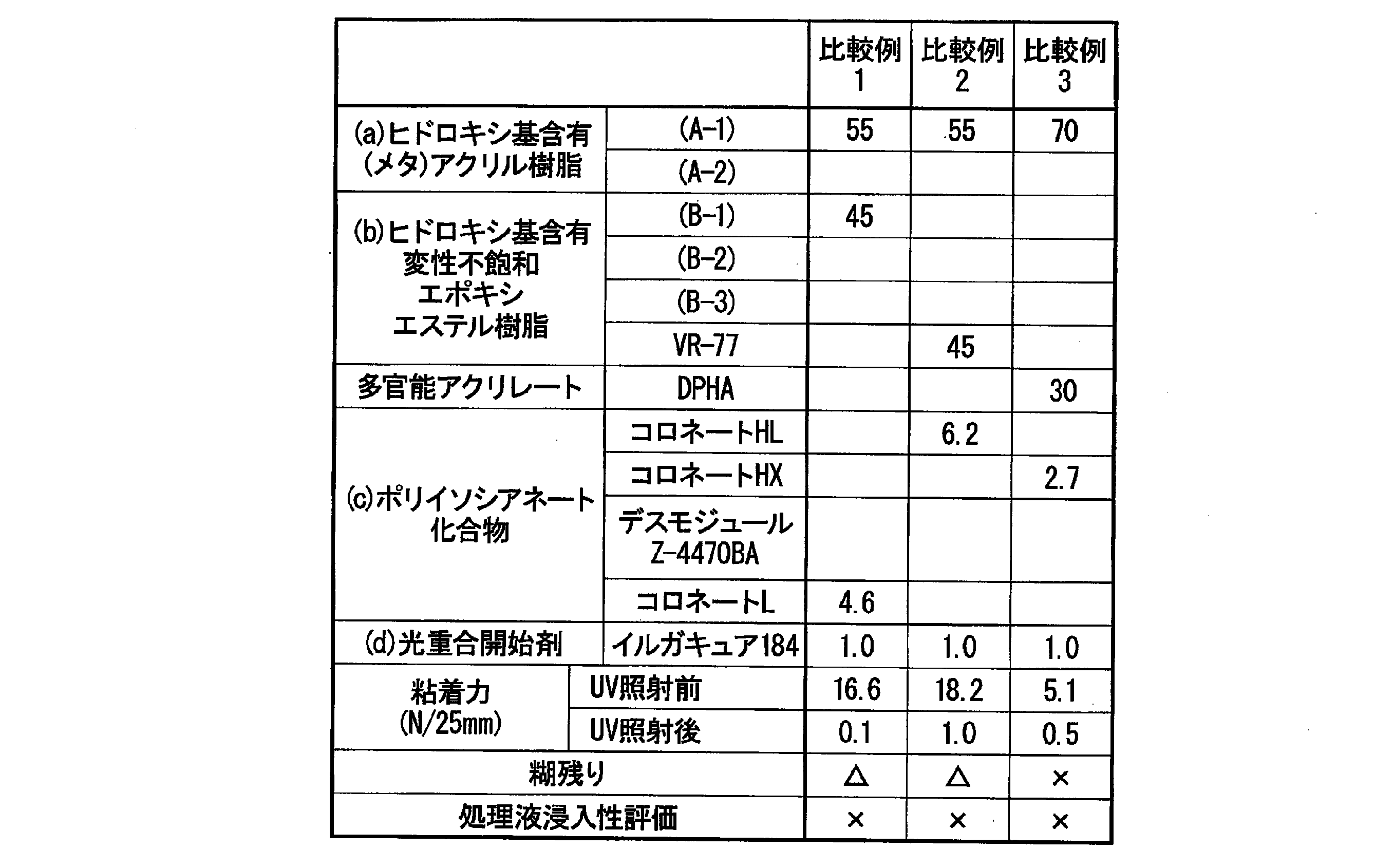
「VR-77」ビスフェノールA型エポキシアクリレート(昭和電工株式会社製)「DPHA」ジペンタエリスリトールヘキサアクリレート(日本化薬株式会社製、商品名KAYARAD)
「コロネート(登録商標)HL」トリメチロールプロパンのヘキサメチレンジイソシアネート(HDI)付加物の75%酢酸エチル溶液(東ソー株式会社製)「コロネート(登録商標)HX」ヘキサメチレンジイソシアネート(HDI)のイソシアヌレート体(東ソー株式会社製)
「デスモジュールZ-4470BA」イソホロンジイソシアネートのイソシアヌレート体(住化コベストロウレタン株式会社製)
「コロネートL」トリレンジイソシアネート付加物(東ソー株式会社製)「イルガキュア184」1-ヒドロキシ-シクロヘキシル-フェニル-ケトン(BASF社製)
表1および表2中の(c)ポリイソシアネート化合物と(d)光重合開始剤の数値は、それぞれ(a)ヒドロキシ基含有(メタ)アクリル樹脂の固形分と(b)ヒドロキシ基含有変性不飽和エポキシエステル樹脂(比較例3においては、多官能アクリレート)との合計100質量部に対する含有量(質量部)である。
(メタ)アクリル樹脂(A-1)(A-2)を、それぞれ2g秤量し、これを空気中で110℃で5時間乾燥した後、再度、秤量を行った。そして、乾燥前の質量と乾燥後の質量を用いて、下記の式から求めた。
なお、(メタ)アクリル樹脂(A-1)(A-2)中の固形分は、全て共重合体であるとみなす。
固形分(%)=[A/B]×100
A:乾燥後の質量
B:乾燥前の質量
粘着シートを縦25mm、横100mmの大きさに切り取り、その後、剥離シートを剥がして粘着剤層を露出させた。次に、露出させた粘着剤層(測定面)がガラス板に接するように、粘着シートをガラス板に貼付し、2kgのゴムローラー(幅:約50mm)を1往復させ、UV照射前サンプルとした。
UV照射前サンプルを、23℃、湿度50%RHの環境下で24時間放置した。その後、JIS Z0237に準じて、剥離速度300mm/分で180°方向の引張試験を行い、ガラス板と粘着シート間の粘着力(N/25mm)を測定した。
UV照射前サンプルを、23℃、湿度50%RHの環境下で24時間放置した。その後、基材側に、高圧水銀ランプを用いて、UV照射量500mJ/cm2の条件でUV照射し、UV照射後サンプルとした。
(UV照射後サンプルの粘着力の測定)
UV照射後サンプルに対して、JIS Z0237に準じて、剥離速度300mm/分で180°方向の引張試験を行い、ガラス板と粘着シート間の粘着力(N/25mm)を測定した。
上記のUV照射後サンプルから粘着シートを剥がし、ガラス板に粘着剤が残っているかどうかを目視で確認し、以下に示す基準により評価した。
○(良):被着体に粘着剤が残っていない。
△(可):被着体の一部に粘着剤が残る。
×(不可):被着体の全面に粘着剤が残る。
上記のUV照射前サンプルを、以下に示す酸性処理液に10分間浸漬させた。その後、さらに以下に示すアルカリ性処理液に10分間浸漬させた。その後、酸性処理液およびアルカリ性処理液に浸漬させたUV照射前サンプルを、粘着シートの表面から目視で観察し、以下に示す基準により、粘着シートとガラス板との間への処理液の侵入を評価した。
○(良):処理液の浸入が見られない。
△(可):処理液の浸入が一部に見られた。
×(不可):処理液の浸入が界面全体に見られた。
フッ酸と硫酸と硝酸とリン酸とからなるpH1以下の混合水溶液「アルカリ性処理液」
KOH1mol/L
また、実施例1~実施例9の粘着シートは、糊残りおよび処理液侵入性の評価が「○(良)」または「△(可)」であった。
エチレン性不飽和基で変性していない不飽和エポキシエステル樹脂には、(b)ヒドロキシ基含有変性不飽和エポキシエステル樹脂と比較して、ヒドロキシ基が多く存在している。エチレン性不飽和基で変性していない不飽和エポキシエステル樹脂中の過剰なヒドロキシ基は、これを含む粘着剤組成物を用いた粘着シートにおいて、耐水性を低下させる。このため、酸性処理液が含侵しやすくなる。その結果、比較例2では、処理液侵入性の評価が「×(不可)」になったものを推定される。
Claims (9)
- (a)ヒドロキシ基含有(メタ)アクリル樹脂と、
(b)ヒドロキシ基含有変性不飽和エポキシエステル樹脂と、
(c)ポリイソシアネート化合物と、
(d)光重合開始剤とを含み、
前記(b)ヒドロキシ基含有変性不飽和エポキシエステル樹脂は、
エポキシ基に由来する第2級炭素原子にオキシ基を介して結合されたエチレン性不飽和基と、
エポキシ基に由来する第1級炭素原子に結合されたα,β-不飽和一塩基酸基と、を有し、
前記(b)ヒドロキシ基含有変性不飽和エポキシエステル樹脂は、エポキシ基を有し又は有さず、
前記α,β-不飽和一塩基酸基の数がエポキシ基の数以上であり、
前記(c)ポリイソシアネート化合物が、脂肪族ジイソシアネートから誘導されるポリイソシアネートであることを特徴とする粘着剤組成物。
- 前記(b)ヒドロキシ基含有変性不飽和エポキシエステル樹脂が、ビスフェノール型エポキシ樹脂と(メタ)アクリル酸との反応生成物に由来する不飽和エポキシエステル樹脂構造を有する請求項1に記載の粘着剤組成物。
- 前記(b)ヒドロキシ基含有変性不飽和エポキシエステル樹脂が、下記式(1)で表される化合物である請求項1または請求項2に記載の粘着剤組成物。

- 前記Xが、下記式(2)または下記式(3)で表される請求項3に記載の粘着剤組成物。


- 前記(c)ポリイソシネート化合物の含有量が、(a)ヒドロキシ基含有(メタ)アクリル樹脂と(b)ヒドロキシ基含有変性不飽和エポキシエステル樹脂との合計100質量部に対して0.5~15質量部である請求項1~請求項4のいずれか一項に記載の粘着剤組成物。
- 前記(a)ヒドロキシ基含有(メタ)アクリル樹脂と前記(b)ヒドロキシ基含有変性不飽和エポキシエステル樹脂との質量比が、60:40~40:60である請求項1~請求項5のいずれか一項に記載の粘着剤組成物。
- 基材の一方の面上に粘着剤層が設けられ、
前記粘着剤層が、請求項1~請求項6のいずれか一項に記載の粘着剤組成物を含むことを特徴とする粘着シート。 - 前記(a)ヒドロキシ基含有(メタ)アクリル樹脂と前記(b)ヒドロキシ基含有変性不飽和エポキシエステル樹脂との質量比が、60:40~40:60であり、
(c)ポリイソシアネート化合物の含有量は、(a)ヒドロキシ基含有アクリル樹脂と(b)ヒドロキシ基含有変性不飽和エポキシエステル樹脂の合計100質量部に対して、0.5~15質量部であり、
(d)光重合開始剤の含有量は、(a)ヒドロキシ基含有(メタ)アクリル樹脂と(b)ヒドロキシ基含有変性不飽和エポキシエステル樹脂との合計100質量部に対して、0.1~5質量部である、請求項1~請求項6のいずれか一項に記載の粘着剤組成物。 - 前記基材が、透明なシート状またはフィルム状の基材である、請求項7に記載の粘着シート。
Priority Applications (3)
| Application Number | Priority Date | Filing Date | Title |
|---|---|---|---|
| JP2020559845A JP7396297B2 (ja) | 2018-12-07 | 2019-11-12 | 粘着剤組成物および粘着シート |
| CN201980079059.5A CN113166612B (zh) | 2018-12-07 | 2019-11-12 | 粘着剂组合物及粘着片 |
| KR1020217012832A KR102470435B1 (ko) | 2018-12-07 | 2019-11-12 | 점착제 조성물 및 점착 시트 |
Applications Claiming Priority (2)
| Application Number | Priority Date | Filing Date | Title |
|---|---|---|---|
| JP2018229960 | 2018-12-07 | ||
| JP2018-229960 | 2018-12-07 |
Publications (1)
| Publication Number | Publication Date |
|---|---|
| WO2020116101A1 true WO2020116101A1 (ja) | 2020-06-11 |
Family
ID=70974552
Family Applications (1)
| Application Number | Title | Priority Date | Filing Date |
|---|---|---|---|
| PCT/JP2019/044372 Ceased WO2020116101A1 (ja) | 2018-12-07 | 2019-11-12 | 粘着剤組成物および粘着シート |
Country Status (5)
| Country | Link |
|---|---|
| JP (1) | JP7396297B2 (ja) |
| KR (1) | KR102470435B1 (ja) |
| CN (1) | CN113166612B (ja) |
| TW (1) | TWI811485B (ja) |
| WO (1) | WO2020116101A1 (ja) |
Cited By (2)
| Publication number | Priority date | Publication date | Assignee | Title |
|---|---|---|---|---|
| WO2024122170A1 (ja) * | 2022-12-06 | 2024-06-13 | 株式会社レゾナック | 粘着剤組成物、及び粘着シート |
| WO2025243620A1 (ja) * | 2024-05-23 | 2025-11-27 | 株式会社レゾナック | 粘着シート付電子部品、及び転写シート |
Families Citing this family (1)
| Publication number | Priority date | Publication date | Assignee | Title |
|---|---|---|---|---|
| CN119684950B (zh) * | 2024-12-30 | 2025-11-04 | 苏州赛伍应用技术股份有限公司 | 一种环氧树脂双固化粘接剂及其制备方法和应用 |
Citations (4)
| Publication number | Priority date | Publication date | Assignee | Title |
|---|---|---|---|---|
| JP2013040323A (ja) * | 2011-07-21 | 2013-02-28 | Nitto Denko Corp | ガラスエッチング用保護シート |
| JP2015147898A (ja) * | 2014-02-07 | 2015-08-20 | 東洋インキScホールディングス株式会社 | 活性エネルギー線重合性組成物、コート剤、および接着剤とそれらを用いてなる積層体 |
| JP2015174935A (ja) * | 2014-03-17 | 2015-10-05 | 東洋インキScホールディングス株式会社 | 活性エネルギー線重合性組成物、コート剤、および接着剤とそれらを用いてなる積層体 |
| JP2019019150A (ja) * | 2017-07-11 | 2019-02-07 | 昭和電工株式会社 | 粘着剤組成物および粘着シート |
Family Cites Families (2)
| Publication number | Priority date | Publication date | Assignee | Title |
|---|---|---|---|---|
| US4054480A (en) * | 1975-05-22 | 1977-10-18 | National Starch And Chemical Corporation | Anaerobic adhesive and sealant compositions containing alpha-hydroxysulfone |
| JP4318743B1 (ja) | 2008-10-07 | 2009-08-26 | 昭和高分子株式会社 | 紫外線硬化型再剥離性粘着剤組成物及びこれを用いた粘着シート |
-
2019
- 2019-11-12 KR KR1020217012832A patent/KR102470435B1/ko active Active
- 2019-11-12 WO PCT/JP2019/044372 patent/WO2020116101A1/ja not_active Ceased
- 2019-11-12 JP JP2020559845A patent/JP7396297B2/ja active Active
- 2019-11-12 CN CN201980079059.5A patent/CN113166612B/zh active Active
- 2019-11-18 TW TW108141739A patent/TWI811485B/zh active
Patent Citations (4)
| Publication number | Priority date | Publication date | Assignee | Title |
|---|---|---|---|---|
| JP2013040323A (ja) * | 2011-07-21 | 2013-02-28 | Nitto Denko Corp | ガラスエッチング用保護シート |
| JP2015147898A (ja) * | 2014-02-07 | 2015-08-20 | 東洋インキScホールディングス株式会社 | 活性エネルギー線重合性組成物、コート剤、および接着剤とそれらを用いてなる積層体 |
| JP2015174935A (ja) * | 2014-03-17 | 2015-10-05 | 東洋インキScホールディングス株式会社 | 活性エネルギー線重合性組成物、コート剤、および接着剤とそれらを用いてなる積層体 |
| JP2019019150A (ja) * | 2017-07-11 | 2019-02-07 | 昭和電工株式会社 | 粘着剤組成物および粘着シート |
Cited By (2)
| Publication number | Priority date | Publication date | Assignee | Title |
|---|---|---|---|---|
| WO2024122170A1 (ja) * | 2022-12-06 | 2024-06-13 | 株式会社レゾナック | 粘着剤組成物、及び粘着シート |
| WO2025243620A1 (ja) * | 2024-05-23 | 2025-11-27 | 株式会社レゾナック | 粘着シート付電子部品、及び転写シート |
Also Published As
| Publication number | Publication date |
|---|---|
| JP7396297B2 (ja) | 2023-12-12 |
| KR20210068506A (ko) | 2021-06-09 |
| CN113166612A (zh) | 2021-07-23 |
| CN113166612B (zh) | 2022-12-30 |
| JPWO2020116101A1 (ja) | 2021-10-21 |
| KR102470435B1 (ko) | 2022-11-25 |
| TWI811485B (zh) | 2023-08-11 |
| TW202031848A (zh) | 2020-09-01 |
Similar Documents
| Publication | Publication Date | Title |
|---|---|---|
| CN102361947B (zh) | 保护粘着膜、屏板及携带电子终端 | |
| JP5701892B2 (ja) | 光硬化性透明粘着シート用組成物 | |
| JP5232736B2 (ja) | 複合フィルム | |
| JP5854404B2 (ja) | 光硬化性透明粘着シート用組成物 | |
| CN107207920B (zh) | 半导体加工用粘合片 | |
| TW201606028A (zh) | 活性能量射線硬化性黏接劑組成物、黏接劑及黏接片 | |
| JP2019019150A (ja) | 粘着剤組成物および粘着シート | |
| JP7012427B2 (ja) | 光硬化性組成物、及び粘着シート | |
| JP6062806B2 (ja) | ガラスエッチング向け再剥離保護テープ用活性線硬化型粘着剤組成物、ガラスエッチング向け再剥離保護テープ | |
| JP7396297B2 (ja) | 粘着剤組成物および粘着シート | |
| CN112424308A (zh) | 粘接片 | |
| JP2021120449A (ja) | 粘着剤組成物、粘着剤層、及び粘着シート | |
| TW201404848A (zh) | 透明黏接著薄片用組成物、其製造方法及透明黏接著薄片 | |
| TWI649397B (zh) | Adhesive, adhesive film, adhesive tape and film substrate | |
| JP6213609B2 (ja) | 粘着剤、粘着シートおよびディスプレイ | |
| JP2023153337A (ja) | 保護フィルム付きフレキシブルプリント配線基板 | |
| JP6640023B2 (ja) | 粘着剤組成物、粘着シート、タッチパネル、画像表示装置 | |
| JP2022039945A (ja) | 光硬化性粘着シート | |
| CN115698211B (zh) | 光学构件用粘合带 | |
| KR20230155558A (ko) | 점착제 조성물 및 보호 시트 | |
| KR20240011805A (ko) | 에틸렌성 불포화기 함유 우레탄 폴리머, 그 제조 방법 및 점착제 조성물 | |
| KR20240090759A (ko) | 점착제 조성물 및 보호 시트 |
Legal Events
| Date | Code | Title | Description |
|---|---|---|---|
| 121 | Ep: the epo has been informed by wipo that ep was designated in this application |
Ref document number: 19892871 Country of ref document: EP Kind code of ref document: A1 |
|
| ENP | Entry into the national phase |
Ref document number: 2020559845 Country of ref document: JP Kind code of ref document: A |
|
| ENP | Entry into the national phase |
Ref document number: 20217012832 Country of ref document: KR Kind code of ref document: A |
|
| NENP | Non-entry into the national phase |
Ref country code: DE |
|
| 122 | Ep: pct application non-entry in european phase |
Ref document number: 19892871 Country of ref document: EP Kind code of ref document: A1 |