WO2020095528A1 - 配管シール部材 - Google Patents
配管シール部材 Download PDFInfo
- Publication number
- WO2020095528A1 WO2020095528A1 PCT/JP2019/035300 JP2019035300W WO2020095528A1 WO 2020095528 A1 WO2020095528 A1 WO 2020095528A1 JP 2019035300 W JP2019035300 W JP 2019035300W WO 2020095528 A1 WO2020095528 A1 WO 2020095528A1
- Authority
- WO
- WIPO (PCT)
- Prior art keywords
- pipe
- tubular portion
- seal member
- partition wall
- pipes
- Prior art date
- Legal status (The legal status is an assumption and is not a legal conclusion. Google has not performed a legal analysis and makes no representation as to the accuracy of the status listed.)
- Ceased
Links
Images

Classifications
-
- B—PERFORMING OPERATIONS; TRANSPORTING
- B60—VEHICLES IN GENERAL
- B60H—ARRANGEMENTS OF HEATING, COOLING, VENTILATING OR OTHER AIR-TREATING DEVICES SPECIALLY ADAPTED FOR PASSENGER OR GOODS SPACES OF VEHICLES
- B60H1/00—Heating, cooling or ventilating devices
- B60H1/32—Cooling devices
Definitions
- the disclosure in this specification relates to a pipe seal member.
- Patent Document 1 discloses a seal structure in which a grommet is installed in a gap between the waterproof container and the piping member. This seal structure prevents water from entering a waterproof container that contains electronic components that may malfunction or break down when wet.
- the configuration of the prior art discloses a seal structure in the case where the piping member is inserted straight into the waterproof container, and a structure in the case where the piping member is obliquely provided with respect to the waterproof container is disclosed. Absent. When the wall to which the grommet is attached and the pipe member that inserts the grommet are provided obliquely, the grommet after inserting the pipe member cannot be properly attached only by moving in parallel along the pipe member. Therefore, in addition to the parallel movement along the pipe member, it is necessary to apply an external force so as to incline the pipe member so that the mounting portion of the grommet is mounted parallel to the wall.
- the portion between the seal portion in contact with the piping member and the mounted portion in contact with the wall is locally greatly stretched. Therefore, the grommet is easily deformed before and after the grommet is mounted on the wall, and a gap is likely to be formed between the piping member and the seal portion. Alternatively, the grommet that is forcibly stretched is likely to break, causing a problem. In view of the above and other points not mentioned, there is a need for further improvements in pipe seal members.
- One object to be disclosed is to provide a pipe sealing member capable of stably sealing the partition wall and the pipe even when the partition wall and the pipe penetrating the partition wall are obliquely provided. Especially.
- the pipe sealing member disclosed herein is used for a vehicle having a partition wall that divides the interior and exterior of the vehicle compartment and a pipe that is provided so as to obliquely penetrate the partition wall.
- the pipe sealing member includes a tubular portion that extends obliquely with respect to the partition wall along the pipe in a state where the pipe sealing member is mounted on the partition wall, and a tubular portion that is radially inward of the tubular portion.
- An annular seal part that is provided so as to project from the section and is in contact with the pipe in a state of being pressed in a direction orthogonal to the pipe, and a mounting outer periphery for mounting the pipe seal member on the partition wall where the pipe penetrates. And a section.
- FIG. 3 is a partial sectional view showing a section taken along line III-III in FIG. 2. It is a plane sectional view showing typically an air-conditioner for vehicles in a positioning process. It is a plane sectional view which shows typically the vehicle air conditioner in a mounting process.
- the pipe seal member 50 is used in a vehicle.
- the pipe seal member 50 is a seal member attached to a wall through which the pipe member penetrates and seals between the wall and the pipe member.
- the pipe seal member 50 is a member that prevents fluid from freely passing between the wall and the pipe member. Further, the pipe seal member 50 is a member that travels along the outer peripheral surface of the pipe member and prevents the liquid from unintentionally entering beyond the wall.
- the pipe sealing member 50 is also called a grommet.
- the pipe seal member 50 is provided, for example, on a partition wall that separates a vehicle interior and a vehicle exterior. More specifically, the pipe seal member 50 can be provided on the dash panel 91 that separates the vehicle interior from the engine room.
- the installation location of the pipe sealing member 50 is not limited to the dash panel 91. For example, you may provide in the partition wall which divides a vehicle interior and a luggage compartment. For example, it may be provided on a partition wall that separates the luggage compartment from the outside of the vehicle compartment.
- the dash panel 91 provides an example of a partition wall.
- a dash panel 91 separates the vehicle interior from the engine room.
- the dash panel 91 is made of metal.
- the space on the rear side of the dash panel 91 is the space inside the vehicle compartment.
- a space in front of the dash panel 91 is an engine room.
- An air conditioning case 11 and the like, which form a part of the vehicle air conditioning device 10, are provided on the vehicle interior side.
- an engine 30 and a heater 40 are provided on the engine room side.
- the dash panel 91 also functions as a sound insulation wall that suppresses the sound generated by driving the engine 30 from being transmitted to the vehicle interior.
- the vehicle air conditioner 10 includes an air conditioning case 11.
- a fan 15, an evaporator 21, a first heat exchanger 31, and a second heat exchanger 41 are housed inside the air conditioning case 11.
- the air conditioning case 11 also functions as a duct that guides the air sent by the blower 15 to the evaporator 21, the first heat exchanger 31, and the second heat exchanger 41.
- the evaporator 21 forms part of the refrigeration cycle device mounted on the vehicle.
- the evaporator 21 evaporates the liquid refrigerant flowing inside the evaporator 21 to change the phase to a gas refrigerant. This functions as a cooling heat exchanger that draws heat from the air around the evaporator 21 to lower the ambient temperature.
- the first heat exchanger 31 causes the high temperature engine cooling water heated by the waste heat of the engine 30 to flow inside the first heat exchanger 31, thereby exchanging heat between the ambient air and the engine cooling water.
- the first heat exchanger 31 functions as a heating heat exchanger that raises the temperature around the first heat exchanger 31.
- the first heat exchanger 31 is also called a heater core.
- the second heat exchanger 41 causes the high temperature heat medium heated by the heater 40 to flow inside the second heat exchanger 41, thereby exchanging heat between the ambient air and the heat medium.
- the second heat exchanger 41 functions as a heating heat exchanger that raises the temperature around the second heat exchanger 41.
- the heater 40 various types of heating devices such as an electric heater and a combustion heater can be used.
- the heater 40 it is preferable to use a PTC heater which is a heating device having a positive temperature coefficient. Since the electric resistance of the PTC heater increases as the temperature rises, it is easy to stabilize the PTC heater at a constant temperature.
- heat may be obtained from heat-generating components such as a traveling motor, an inverter device, and a battery pack.
- the second heat exchanger 41 is also called a heater core.
- the engine 30 and the first heat exchanger 31 are connected by a first inlet pipe 32 and a first outlet pipe 33.
- the engine 30 and the first heat exchanger 31 form a first heating circuit in which the engine cooling water can circulate by the first inlet pipe 32 and the first outlet pipe 33.
- An engine cooling water pump 35 is provided in the first heating circuit.
- the engine cooling water pump 35 is a fluid transportation device driven by using the driving force of the engine 30. Therefore, the engine cooling water pump 35 cannot circulate the engine cooling water in the first heating circuit while the engine 30 is stopped.
- the first inlet pipe 32 provides an example of the pipe
- the first outlet pipe 33 provides an example of the pipe.
- the heater 40 and the second heat exchanger 41 are connected by a second inlet pipe 42 and a second outlet pipe 43.
- the heater 40 and the second heat exchanger 41 form a second heating circuit in which the heat medium can be circulated by the second inlet pipe 42 and the second outlet pipe 43.
- a heat medium pump 45 is provided in the second heating circuit.
- the heat medium pump 45 is a fluid transportation device driven by using electric power. Therefore, the heat medium pump 45 can circulate the heat medium in the second heating circuit at an arbitrary timing and output.
- the second inlet piping 42 provides an example of piping.
- the second outlet piping 43 provides an example of piping.
- the heating capacity can be covered only by the first heating circuit that uses the exhaust heat of the engine 30, only the first heating circuit is used and the second heating circuit is not used.
- the first heating circuit alone does not have sufficient heating capacity, or when high temperature engine cooling water cannot flow to the first heat exchanger 31 due to the engine 30 being stopped, the second heating circuit is heated to a high temperature. Circulate the heat carrier. Thereby, highly efficient heating operation using the waste heat of the engine 30 can be provided.
- a stable heating operation can be provided by supplementing the heating capacity, which is not sufficient with the waste heat of the engine 30, with the heater 40.
- the dash panel 91 has a through hole that penetrates the vehicle interior and the engine room.
- a pipe seal member 50 is provided in the through hole of the dash panel 91.
- the first inlet pipe 32, the first outlet pipe 33, the second inlet pipe 42, and the second outlet pipe 43 are inserted through the pipe sealing member 50.
- the vehicle interior and the engine room are partitioned by the dash panel 91 and the pipe seal member 50, and are configured so that fluid does not unintentionally move back and forth.
- the first inlet pipe 32 is not orthogonal to the surface around the through hole in the dash panel 91.
- the first inlet pipe 32 is arranged in the dash panel 91 so as to pass through the through hole at an oblique angle with respect to the mounting surface on which the pipe sealing member 50 is mounted.
- the first inlet pipe 32, the first outlet pipe 33, the second inlet pipe 42, and the second outlet pipe 43 are parallel to each other in a portion penetrating the dash panel 91. Therefore, the first outlet pipe 33, the second inlet pipe 42, and the second outlet pipe 43 are also arranged so as to penetrate obliquely with respect to the surface formed by the dash panel 91, similarly to the first inlet pipe 32.
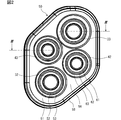
- FIG. 2 is a front view of the pipe seal member 50 as viewed from the engine room side.
- the pipe seal member 50 has a substantially rhombus shape.
- the pipe seal member 50 includes a peripheral edge portion 59 that forms an outer peripheral edge of the pipe seal member 50.
- the peripheral portion 59 comes into contact with the surface of the dash panel 91 in the pipe sealing member 50 attached to the dash panel 91. Since the peripheral edge portion 59 comes into contact with the front surface of the pipe seal member 50 in the mounting direction, the peripheral surface portion 59 comes into contact with the engine room side surface of the dash panel 91.
- the pipe sealing member 50 includes a first tubular portion 52 and a second tubular portion 62 for inserting the pipes 32, 33, 42, 43 inside.
- the first tubular portion 52 and the second tubular portion 62 are both cylindrical.
- the inner diameter of the second tubular portion 62 is smaller than the inner diameter of the first tubular portion 52.
- the first tubular portion 52 is provided at two locations on the pipe sealing member 50.
- the two first tubular portions 52 are arranged apart from each other at two acute corners of the four corners of the substantially rhombic pipe sealing member 50. In other words, the two first tubular portions 52 are arranged apart from each other in the longitudinal direction of the substantially rhombic pipe sealing member 50.
- the second tubular portion 62 is provided at two places on the pipe sealing member 50.
- the two second tubular portions 62 are arranged apart from each other at two obtuse corners of the four corners of the substantially rhombic pipe sealing member 50. In other words, the two second tubular portions 62 are arranged so as to be separated from each other in the lateral direction of the substantially rhombic pipe sealing member 50.
- the first tubular portion 52 provides an example of a tubular portion.
- the second tubular portion 62 provides an example of a tubular portion.
- a connecting portion 56 is formed between the first tubular portion 52 and the second tubular portion 62 and the peripheral edge portion 59.
- a part of the connecting portion 56 is a flat portion having a flat surface.
- a part of the connecting portion 56 is a first bending portion 53 and a second bending portion 63 that can be elastically deformed vertically and horizontally.
- the first flexible portion 53 is provided in an annular shape having a central axis at the same position as the central axis of the first tubular portion 52, continuously from the outer peripheral portion of the first tubular portion 52.
- the second flexible portion 63 is provided in an annular shape having a central axis at the same position as the central axis of the second tubular portion 62, continuing from the outer peripheral portion of the second tubular portion 62.
- the first bending portion 53 and the second bending portion 63 are made to follow the pipes 32, 33, 42, 43 by causing the first annular seal portion 51 and the second annular seal portion 61 to follow the pipes by bending with respect to stress. It is a department.
- the first bending portion 53 and the second bending portion 63 may be portions that are more easily deformed or expanded / contracted than the flat portion of the connecting portion 56.
- the followability may be improved by using a material having high elasticity.
- the followability may be enhanced by using an elastic member such as a spring.
- the first bending portion 53 provides an example of the bending portion.
- the second bending portion 63 provides an example of the bending portion.
- a first annular seal portion 51 is formed inside the first tubular portion 52.
- the first annular seal portion 51 has an annular shape, and is provided so as to project inward in the circumferential direction from the inner peripheral surface of the first tubular portion 52.
- the first annular seal portion 51 is in continuous annular contact with the outer peripheral surface of the first inlet pipe 32 or the outer peripheral surface of the first outlet pipe 33 without a gap.
- the first annular seal portion 51 provides an example of an annular seal portion.
- a second annular seal portion 61 is formed inside the second tubular portion 62.
- the second annular seal portion 61 has an annular shape, and is provided so as to project inward in the circumferential direction from the inner peripheral surface of the second tubular portion 62.
- the second annular seal portion 61 is in continuous annular contact with the outer peripheral surface of the second inlet pipe 42 or the outer peripheral surface of the second outlet pipe 43 without a gap.
- the second annular seal portion 61 provides an example of an annular seal portion.
- At least a part of the second tubular portion 62 is located between the first tubular portion 52 through which the first inlet pipe 32 is inserted and the first tubular portion 52 through which the first outlet pipe 33 is inserted. There is. In other words, at least a part of the second tubular portion 62 is arranged in the projection region from the one first tubular portion 52 toward the other first tubular portion 52. In other words, the line connecting the central axes of the first tubular portions 52 and the line connecting the central axes of the second tubular portions 62 intersect. Further, the distance from the first tubular portion 52 to the second tubular portion 62 is smaller than the distance between the first tubular portions 52.
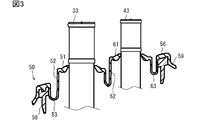
- FIG. 3 is a partial cross-sectional view of the pipe sealing member 50.
- the first outlet pipe 33 and the second outlet pipe 43 show not the cross section but the outer surface.
- the inner peripheral end portion of the first annular seal portion 51 is in contact with the outer surface of the first outlet pipe 33.
- the inner peripheral end portion of the first annular seal portion 51 is in a state in which a pressing force is applied to the first outlet pipe 33 inward in the radial direction.
- the direction of the pressing force applied to the first outlet pipe 33 by the first annular seal portion 51 is a direction orthogonal to the axial direction of the first outlet pipe 33.
- the inner peripheral end of the second annular seal portion 61 is in contact with the outer surface of the second outlet pipe 43.
- the inner peripheral end portion of the second annular seal portion 61 is in a state in which a pressing force is applied to the second outlet pipe 43 inward in the radial direction.
- the direction of the pressing force applied to the second outlet pipe 43 by the second annular seal portion 61 is a direction orthogonal to the axial direction of the second outlet pipe 43.
- the pipe seal member 50 includes a mounting outer peripheral portion 58.
- the mounting outer peripheral portion 58 is continuously formed in an annular shape along the peripheral edge portion 59.
- the mounting outer peripheral portion 58 has a claw portion for sandwiching the dash panel 91 and attaching and fixing the pipe seal member 50 to an appropriate position of the dash panel 91.
- the claw portion is provided so as to project outward from the outer peripheral surface of the mounting outer peripheral portion 58.
- the claws are linearly formed in the respective central portions of the four sides of the mounting outer peripheral portion 58 having a substantially rhombic shape, and the claws are formed at the corners of the mounting outer peripheral portion 58 having a substantially rhombic shape. Absent.
- the pipe seal member 50 is fitted and fixed to the dash panel 91 by being inserted into the through hole of the dash panel 91 and sandwiching the peripheral portion of the through hole of the dash panel 91 by the mounting outer peripheral portion 58.
- the peripheral portion 59 is made of an elastic material such as rubber.
- the rubber material ethylene propylene diene rubber (EPDM) having excellent weather resistance, water resistance and cold resistance can be used.
- the mounting outer peripheral portion 58 is formed of a material such as resin that is less elastically deformable than rubber. That is, the pipe seal member 50 is two-color molded using two different types of materials.
- the connecting portion 56 is not formed between the first tubular portion 52 and the second tubular portion 62,
- the first tubular portion 52 and the second tubular portion 62 are continuously and integrally formed.
- the portion where the first tubular portion 52 and the second tubular portion 62 are continuously and integrally formed has a U-shaped cross section.
- the length from the lower end portion to the upper end portion of the first tubular portion 52 is the lower end portion of the second tubular portion 62. Is less than the length from the top to the top.
- the first bending portion 53 and the second bending portion 63 have a U-shaped cross section.
- the thickness of the first flexible portion 53 is smaller than the thickness of the first annular seal portion 51.
- the thickness of the first flexible portion 53 is smaller than the thickness of the flat portion of the connecting portion 56.
- the wall thickness of the second flexible portion 63 is smaller than the wall thickness of the second annular seal portion 61.
- the wall thickness of the second flexible portion 63 is smaller than the wall thickness of the flat portion of the connecting portion 56.
- the first bending portion 53 bends in the up-down direction and the left-right direction, so that the state in which the first annular seal portion 51 appropriately contacts the first outlet pipe 33 can be maintained.
- the second bending portion 63 bends in the up-down direction and the left-right direction, so that the state in which the second annular seal portion 61 appropriately contacts the second outlet pipe 43 can be maintained.
- the position of the mounting outer peripheral portion 58 differs in the direction along the axial direction of the first tubular portion 52 depending on the location. That is, when the direction along the central axis of the first tubular portion 52 is the front-rear direction, a part of the mounting outer peripheral portion 58 is located in front of the first annular seal portion 51, and the mounting outer peripheral portion 58. The other part is positioned rearward of the first annular seal portion 51.
- the first annular seal portion 51 and the second annular seal portion 61 are located in front of the virtual wall surface defined by the dash panel 91. In other words, the first annular seal portion 51 and the second annular seal portion 61 project toward the engine room side.
- the process of mounting the vehicle air conditioner 10 on the vehicle includes a positioning process, a mounting process, and a pipe connecting process. Each step of mounting the vehicle air conditioner 10 on the vehicle will be sequentially described below.
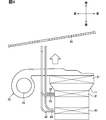
- FIG. 4 schematically shows the vehicle air conditioner 10 in the positioning process.
- the air-conditioning case 11 with the air-conditioning components such as the blower 15 stored therein is located behind the appropriate position with respect to the dash panel 91, and the vertical position and the horizontal position are set to appropriate positions. It is in the state of being positioned while being positioned.
- the first inlet pipe 32 and the first outlet pipe 33 are in a state of being divided into a portion continuously extending from the first heat exchanger 31 and a portion continuously extending from the engine 30.
- the second inlet pipe 42 and the second outlet pipe 43 are in a state of being divided into a portion continuously extending from the second heat exchanger 41 and a portion continuously extending from the heater 40. All of the first inlet pipe 32, the first outlet pipe 33, the second inlet pipe 42, and the second outlet pipe 43 are in a state before they penetrate the dash panel 91. Further, the pipe seal member 50 is not attached to the dash panel 91, and the through hole formed in the dash panel 91 is not closed.
- the position is set appropriately with respect to the dash panel 91 in the front-back direction.
- the first inlet pipe 32, the first outlet pipe 33, the second inlet pipe 42, and the second outlet pipe 43 are projected from the vehicle interior side to the engine room side through the through holes of the dash panel 91.
- the position of the vehicle air conditioner 10 is fixed in a state in which it is arranged at an appropriate position in any of the vertical direction, the horizontal direction, and the front-back direction, and the positioning step is completed.
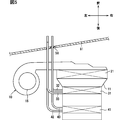
- the first inlet pipe 32, the first outlet pipe 33, the second inlet pipe 42, and the second outlet pipe 43 project toward the engine room.
- the pipe seal member 50 is inserted through the projecting first inlet pipe 32, the first outlet pipe 33, the second inlet pipe 42, and the second outlet pipe 43 from the end side, and approaches the vehicle compartment from the engine room side.
- the pipe seal member 50 is gradually moved in the direction.
- the pipe sealing member 50 with the pipes 32, 33, 42, 43 inserted therein can be moved smoothly by pushing in a direction parallel to the extending direction of the pipes 32, 33, 42, 43.
- the dash panel 91 is sandwiched between the mounting outer peripheral portions 58 of the pipe seal member 50 and attached and fixed. As a result, the pipe seal member 50 seals between the pipes 32, 33, 42, 43 and the dash panel 91.
- the first tubular portion 52 and the second tubular portion 62 are parallel to the pipes 32, 33, 42, 43, and the mounting outer peripheral portion 58 and the dash panel 91 are parallel to each other. is there.
- the pipe seal member 50 has almost the same shape as the shape before the pipes 32, 33, 42, 43 are inserted and the shape in which the pipes 32, 33, 42, 43 are inserted and attached to the dash panel 91. is there. In other words, the deformation due to the pipe seal member 50 being greatly stretched in order to mount the pipe seal member 50 through which the pipes 32, 33, 42, 43 are inserted in the dash panel 91 is not caused. Therefore, the pipe seal member 50 mounted on the dash panel 91 and appropriately performing the sealing function is in a state in which excessive tension is not locally applied.
- the first bending portion 53 and the second bending portion 63 of the pipe sealing member 50 bend.
- the pipes 32, 33, 42, 43 are followed to some extent.
- the first bending portion 53 and the second bending portion 63 can absorb the difference from the optimum position when the vehicle air conditioner 10 is positioned on the vehicle.
- the pipe sealing member 50 is mounted and fixed to the dash panel 91, and the mounting process is completed.
- a pipe connecting step for properly connecting the pipes 32, 33, 42, 43 forming part of the vehicle air conditioner 10 is carried out.
- a portion continuously extending from the engine 30 and a portion continuously extending from the first heat exchanger 31 are provided with a rubber hose or the like. Connect using.
- the engine cooling water can be appropriately circulated in the first heating circuit.
- a portion continuously extending from the heater 40 and a portion continuously extending from the second heat exchanger 41 are connected using a rubber hose or the like.
- a highly elastic member having high elasticity such as a rubber hose
- vibrations during traveling of the vehicle and vibrations caused by fluid flowing inside the pipes 32, 33, 42, 43 Can be absorbed by the rubber hose. Therefore, it is easy to stably maintain the state where the pipes 32, 33, 42, and 43 are properly connected.
- the method of connecting the pipes 32, 33, 42, 43 is not limited to the rubber hose.
- the connection may be made by using a metal pipe joint instead of the rubber hose.
- the ends of the pipes 32, 33, 42, 43 may be spread in a conical shape and connected in a flare manner.
- the mounting process of the pipe sealing member 50 is a retrofitting process in which the pipe sealing member 50 is mounted later on the dash panel 91 through which the pipes 32, 33, 42, 43 penetrate. That is, the pipe sealing member 50 is attached to the dash panel 91 in advance, and is not attached in advance by inserting the pipes 32, 33, 42, and 43.
- the pipe sealing member 50 when mounted on the dash panel 91, extends obliquely with respect to the dash panel 91 along the central axis of the first inlet pipe 32.
- the unit 52 is provided. Therefore, even when the first inlet pipe 32 is obliquely provided with respect to the dash panel 91, the state in which the first tubular portion 52 extends parallel to the first inlet pipe 32 is maintained. It's easy to do. Therefore, it is easy to smoothly insert the first inlet pipe 32 into the first tubular portion 52.
- the first tubular portion 52 for the first outlet pipe 33 is also easy to smoothly insert the first outlet pipe 33 into the first tubular portion 52. ..
- the second tubular portion 62 for the second inlet pipe 42 similarly to the first tubular portion 52 for the first inlet pipe 32, it is easy to smoothly insert the second inlet pipe 42 into the second tubular portion 62. .. As with the first tubular portion 52 for the first inlet pipe 32, the second tubular portion 62 for the second outlet pipe 43 is also easy to smoothly insert the second outlet pipe 43 into the second tubular portion 62. ..
- the connecting portion 56 is greatly applied with the force of being pulled by the first inlet pipe 32 and the force of being compressed by the first inlet pipe 32. Hateful. Therefore, deformation is unlikely to occur before and after the pipe seal member 50 is attached. Therefore, it is easy to stably maintain the shape of the pipe seal member 50. In other words, it is easy to stably exhibit the sealing function of the pipe sealing member 50.
- the first tubular portion 52 with respect to the first inlet pipe 32 can easily stably exhibit the sealing function of the pipe sealing member 50.
- the second tubular portion 62 for the second inlet pipe 42 can easily stably exhibit the sealing function of the pipe sealing member 50.
- the second tubular portion 62 for the second outlet pipe 43 can easily stably exhibit the sealing function of the pipe sealing member 50.
- the pipe seal member 50 includes a first annular seal portion 51 that is pressed in a direction orthogonal to the first inlet pipe 32 and is in contact with the first inlet pipe 32. Therefore, the pressing force of the first annular seal portion 51 acting on the first inlet pipe 32 is not applied to the first inlet pipe 32 in an oblique direction. In other words, the first tubular portion 52 is unlikely to be displaced in the axial direction of the central axis of the first inlet pipe 32. Therefore, the first annular seal portion 51 appropriately contacts the first inlet pipe 32, and it is easy to maintain the state in which the normal sealing function is exhibited.
- the first annular seal portion 51 for the first inlet pipe 32 the first annular seal portion 51 for the first outlet pipe 33 can easily maintain a state in which the normal sealing function is exhibited.
- the second annular seal portion 61 for the second inlet pipe 42 it is easy to maintain the state in which the normal sealing function is exhibited.
- the second annular seal portion 61 for the second outlet pipe 43 can easily maintain a state in which the normal sealing function is exhibited.
- the first annular seal portion 51 and the second annular seal portion 61 are in contact with the pipes 32, 33, 42, 43 instead of the entire first tubular portion 52 and the second tubular portion 62. Therefore, the contact resistance when the pipes 32, 33, 42, 43 are inserted into the pipe seal member 50 can be suppressed. Therefore, the pipes 32, 33, 42, 43 can be easily inserted into the pipe seal member 50 smoothly.
- the pipe sealing member 50 includes a mounting outer peripheral portion 58 for mounting on the dash panel 91 in a state where the pipes 32, 33, 42, and 43 penetrate. Therefore, the mounting outer peripheral portion 58 can be used to mount the dash panel 91. That is, the pipe seal member 50 is not mounted by using a member different from the pipe seal member 50 such as an adhesive or a screw, but the pipe seal member 50 is provided with the pipe seal member 50 using the shape provided in the pipe seal member 50. The member 50 can be attached. Therefore, the pipe seal member 50 can be easily attached to the dash panel 91 smoothly.
- the pipe seal member 50 has a peripheral edge portion 59 that is in contact with the surface of the dash panel 91 on the engine room side. Therefore, on the surface of the dash panel 91 that is easily exposed to sand or rainwater on the engine room side, it is easy to prevent powder or fluid from entering a slight gap between the dash panel 91 and the pipe sealing member 50. ..
- the pipe sealing member 50 includes a first flexible portion 53 having a U-shaped cross section between the first tubular portion 52 and the mounting outer peripheral portion 58. Therefore, the first bending portion 53 can absorb the difference from the optimum position when the vehicle air conditioner 10 is positioned on the vehicle. Therefore, even when the vehicle air conditioner 10 is displaced from the target position, it is easy to properly install the pipe seal member 50 and exert the sealing function.
- the second flexible portion 63 can be easily mounted with the pipe seal member 50 appropriately so as to exhibit the sealing function. Therefore, it is easy to properly assemble the components related to the vehicle air conditioner 10 including the pipe seal member 50 to the vehicle. In other words, it is easy to improve the manufacturability of the vehicle equipped with the vehicle air conditioner 10.
- At least a part of the second tubular portion 62 is arranged between the first tubular portions 52.
- at least a part of the second tubular portion 62 is arranged in the projection area extending from the one first tubular portion 52 to the other first tubular portion 52. Therefore, it is possible to effectively utilize the projection area from one first tubular portion 52 to the other first tubular portion 52, which would be a dead space if the second tubular portion 62 is not arranged.
- the distance between the first tubular portion 52 and the second tubular portion 62 can be reduced to facilitate downsizing of the pipe sealing member 50.
- the engine room side of the dash panel 91 is easily exposed to sand and rainwater outside the passenger compartment. For this reason, if the pipe sealing member 50 is not properly sealed, sand or rainwater may enter the vehicle interior, and the vehicle interior may become dirty. According to the present embodiment, the pipe seal member 50 mounted on the dash panel 91 that separates the vehicle interior from the engine room can perform stable and appropriate sealing, and can keep the vehicle interior comfortable.
- the dash panel 91 is susceptible to not only the vibration of the vehicle running but also the vibration of the engine 30. For this reason, it is difficult for the pipe sealing member 50 provided on the dash panel 91 to stably maintain an appropriate sealed state, but according to the present embodiment, the pipe sealing member 50 has a stable sealing function. Can be demonstrated.
- a high temperature fluid flows through the pipes 32, 33, 42 and 43. Therefore, when the high temperature fluid flows through the pipes 32, 33, 42 and 43, the temperature of the pipe seal member 50 is likely to rise. On the other hand, when a high-temperature fluid does not flow in the pipes 32, 33, 42, 43, the temperature of the pipe seal member 50 is likely to correspond to the outside air temperature. That is, when the outside air temperature is low such as in winter, the temperature difference in the pipe seal member 50 is likely to be significantly large. The volume of the pipe sealing member 50 changes due to the temperature difference. According to the present embodiment, the pipe seal member 50, which contacts the pipes 32, 33, 42, 43 through which the high-temperature fluid flows and seals, can perform stable and proper sealing.
- the pipe seal member 50 is not limited to the pipe member through which the four pipes 32, 33, 42, 43 are inserted.
- the number of pipes may be less than four, for example, one pipe member may be inserted for sealing.
- the number of pipes may be more than four such as by inserting six pipe members.
- the pipe member to which the pipe seal member 50 is applied is not limited to the one in which a high-temperature fluid flows inside the pipe member.
- the pipe seal member 50 may be applied to a pipe member that flows in a low-temperature refrigerant forming a refrigeration cycle.
- it may be applied to a piping member for discharging condensed water generated on the surface of the evaporator 21 to the outside of the vehicle compartment.
- the inside may be applied to a piping member through which the brake hydraulic fluid flows.
- the pipe seal member 50 may be deformed before and after being mounted on the vehicle.
- the tubular parts 52, 62 have a contracted bellows shape, and when the pipes 32, 33, 42, 43 are inserted, the tubular parts are inserted.
- 52, 62 may be configured to extend along the pipes 32, 33, 42, 43.
- the disclosure herein is not limited to the illustrated embodiments.
- the disclosure encompasses the illustrated embodiments and variations on them based on them.
- the disclosure is not limited to the combination of parts and / or elements shown in the embodiments.
- the disclosure can be implemented in various combinations.
- the disclosure may have additional parts that may be added to the embodiments.
- the disclosure includes omissions of parts and / or elements of the embodiments.
- the disclosure encompasses replacements or combinations of parts and / or elements between one embodiment and another.
- the disclosed technical scope is not limited to the description of the embodiments. It is to be understood that some technical scopes disclosed are shown by the description of the claims, and further include meanings equivalent to the description of the claims and all modifications within the scope.
Landscapes
- Physics & Mathematics (AREA)
- Thermal Sciences (AREA)
- Engineering & Computer Science (AREA)
- Mechanical Engineering (AREA)
- Gasket Seals (AREA)
- Air-Conditioning For Vehicles (AREA)
Priority Applications (1)
| Application Number | Priority Date | Filing Date | Title |
|---|---|---|---|
| CN201980072541.6A CN112969606A (zh) | 2018-11-07 | 2019-09-09 | 配管密封部件 |
Applications Claiming Priority (2)
| Application Number | Priority Date | Filing Date | Title |
|---|---|---|---|
| JP2018-209983 | 2018-11-07 | ||
| JP2018209983A JP2020075614A (ja) | 2018-11-07 | 2018-11-07 | 配管シール部材 |
Publications (1)
| Publication Number | Publication Date |
|---|---|
| WO2020095528A1 true WO2020095528A1 (ja) | 2020-05-14 |
Family
ID=70611552
Family Applications (1)
| Application Number | Title | Priority Date | Filing Date |
|---|---|---|---|
| PCT/JP2019/035300 Ceased WO2020095528A1 (ja) | 2018-11-07 | 2019-09-09 | 配管シール部材 |
Country Status (3)
| Country | Link |
|---|---|
| JP (1) | JP2020075614A (https=) |
| CN (1) | CN112969606A (https=) |
| WO (1) | WO2020095528A1 (https=) |
Citations (4)
| Publication number | Priority date | Publication date | Assignee | Title |
|---|---|---|---|---|
| JPH08216668A (ja) * | 1995-02-13 | 1996-08-27 | Zexel Corp | クーリングユニットの配管接続用コネクタ |
| JP2004312927A (ja) * | 2003-04-09 | 2004-11-04 | Denso Corp | 配管シール部材 |
| JP2007173139A (ja) * | 2005-12-26 | 2007-07-05 | Yazaki Corp | 防水グロメット |
| JP2014231874A (ja) * | 2013-05-29 | 2014-12-11 | カルソニックカンセイ株式会社 | 空調装置用グロメット構造 |
Family Cites Families (6)
| Publication number | Priority date | Publication date | Assignee | Title |
|---|---|---|---|---|
| JPH05149477A (ja) * | 1991-11-29 | 1993-06-15 | Nippondenso Co Ltd | 配管用グロメツト |
| JP2004040940A (ja) * | 2002-07-05 | 2004-02-05 | Toyota Motor Corp | グロメット |
| JP4516461B2 (ja) * | 2005-03-22 | 2010-08-04 | 日信工業株式会社 | グロメット |
| JP2009168192A (ja) * | 2008-01-18 | 2009-07-30 | Toyota Motor Corp | 防水容器の配管挿通口のシール構造 |
| JP5814622B2 (ja) * | 2011-05-26 | 2015-11-17 | 大和化成工業株式会社 | グロメット |
| CN106461086B (zh) * | 2014-06-10 | 2019-01-15 | Nok株式会社 | 密封装置 |
-
2018
- 2018-11-07 JP JP2018209983A patent/JP2020075614A/ja active Pending
-
2019
- 2019-09-09 CN CN201980072541.6A patent/CN112969606A/zh active Pending
- 2019-09-09 WO PCT/JP2019/035300 patent/WO2020095528A1/ja not_active Ceased
Patent Citations (4)
| Publication number | Priority date | Publication date | Assignee | Title |
|---|---|---|---|---|
| JPH08216668A (ja) * | 1995-02-13 | 1996-08-27 | Zexel Corp | クーリングユニットの配管接続用コネクタ |
| JP2004312927A (ja) * | 2003-04-09 | 2004-11-04 | Denso Corp | 配管シール部材 |
| JP2007173139A (ja) * | 2005-12-26 | 2007-07-05 | Yazaki Corp | 防水グロメット |
| JP2014231874A (ja) * | 2013-05-29 | 2014-12-11 | カルソニックカンセイ株式会社 | 空調装置用グロメット構造 |
Also Published As
| Publication number | Publication date |
|---|---|
| CN112969606A (zh) | 2021-06-15 |
| JP2020075614A (ja) | 2020-05-21 |
Similar Documents
| Publication | Publication Date | Title |
|---|---|---|
| US11453267B2 (en) | Integrated heat pump bundled module mounting manifold | |
| US11518444B2 (en) | Front end structure | |
| US7484379B2 (en) | Air conditioner | |
| JP5998413B2 (ja) | 空調装置用グロメット構造 | |
| JP5949483B2 (ja) | ダッシュパネルの透過音低減構造 | |
| WO2019181180A1 (ja) | 配管支持機構付空調装置 | |
| WO2020095528A1 (ja) | 配管シール部材 | |
| JP4788657B2 (ja) | 内燃機関用吸気装置 | |
| JP6406065B2 (ja) | 振動抑制装置及びこれを備える冷凍サイクル装置 | |
| WO2013128804A1 (ja) | 車両用空調装置 | |
| JP5949448B2 (ja) | 空調ケース | |
| JP6926792B2 (ja) | 車両用空調装置 | |
| JP4099361B2 (ja) | 車両用空調装置 | |
| JP4405774B2 (ja) | 車両用空気調和装置 | |
| JP7645048B2 (ja) | 車両用空調ユニットの取付構造 | |
| US9889722B2 (en) | Air exhaust device for vehicle body panel | |
| JP2023135736A (ja) | ラジエータ配管の保持構造 | |
| WO2018079286A1 (ja) | 空調ユニット | |
| JP3890993B2 (ja) | 車両用空調装置 | |
| JP7848651B2 (ja) | 車載装置搭載構造 | |
| CN115366659B (zh) | 车辆用热交换装置 | |
| WO2011096224A1 (ja) | 車両用空調装置 | |
| KR101692272B1 (ko) | 차량용 공조장치 | |
| KR101425878B1 (ko) | 차량의 냉매 파이프용 진동 감쇠 구조 | |
| JP2006248476A (ja) | 自動車用空気調和装置 |
Legal Events
| Date | Code | Title | Description |
|---|---|---|---|
| 121 | Ep: the epo has been informed by wipo that ep was designated in this application |
Ref document number: 19882873 Country of ref document: EP Kind code of ref document: A1 |
|
| NENP | Non-entry into the national phase |
Ref country code: DE |
|
| 122 | Ep: pct application non-entry in european phase |
Ref document number: 19882873 Country of ref document: EP Kind code of ref document: A1 |