WO2020066722A1 - ヘモグロビンの測定試薬、測定キット及び測定方法 - Google Patents
ヘモグロビンの測定試薬、測定キット及び測定方法 Download PDFInfo
- Publication number
- WO2020066722A1 WO2020066722A1 PCT/JP2019/036235 JP2019036235W WO2020066722A1 WO 2020066722 A1 WO2020066722 A1 WO 2020066722A1 JP 2019036235 W JP2019036235 W JP 2019036235W WO 2020066722 A1 WO2020066722 A1 WO 2020066722A1
- Authority
- WO
- WIPO (PCT)
- Prior art keywords
- hemoglobin
- haptoglobin
- antibody
- sample
- insoluble carrier
- Prior art date
- Legal status (The legal status is an assumption and is not a legal conclusion. Google has not performed a legal analysis and makes no representation as to the accuracy of the status listed.)
- Ceased
Links
Classifications
-
- G—PHYSICS
- G01—MEASURING; TESTING
- G01N—INVESTIGATING OR ANALYSING MATERIALS BY DETERMINING THEIR CHEMICAL OR PHYSICAL PROPERTIES
- G01N33/00—Investigating or analysing materials by specific methods not covered by groups G01N1/00 - G01N31/00
- G01N33/48—Biological material, e.g. blood, urine; Haemocytometers
- G01N33/50—Chemical analysis of biological material, e.g. blood, urine; Testing involving biospecific ligand binding methods; Immunological testing
- G01N33/72—Chemical analysis of biological material, e.g. blood, urine; Testing involving biospecific ligand binding methods; Immunological testing involving blood pigments, e.g. haemoglobin, bilirubin or other porphyrins; involving occult blood
- G01N33/721—Haemoglobin
-
- C—CHEMISTRY; METALLURGY
- C07—ORGANIC CHEMISTRY
- C07K—PEPTIDES
- C07K16/00—Immunoglobulins [IG], e.g. monoclonal or polyclonal antibodies
- C07K16/18—Immunoglobulins [IG], e.g. monoclonal or polyclonal antibodies against material from animals or humans
-
- G—PHYSICS
- G01—MEASURING; TESTING
- G01N—INVESTIGATING OR ANALYSING MATERIALS BY DETERMINING THEIR CHEMICAL OR PHYSICAL PROPERTIES
- G01N33/00—Investigating or analysing materials by specific methods not covered by groups G01N1/00 - G01N31/00
- G01N33/48—Biological material, e.g. blood, urine; Haemocytometers
- G01N33/50—Chemical analysis of biological material, e.g. blood, urine; Testing involving biospecific ligand binding methods; Immunological testing
- G01N33/53—Immunoassay; Biospecific binding assay; Materials therefor
- G01N33/543—Immunoassay; Biospecific binding assay; Materials therefor with an insoluble carrier for immobilising immunochemicals
- G01N33/54306—Solid-phase reaction mechanisms
-
- G—PHYSICS
- G01—MEASURING; TESTING
- G01N—INVESTIGATING OR ANALYSING MATERIALS BY DETERMINING THEIR CHEMICAL OR PHYSICAL PROPERTIES
- G01N33/00—Investigating or analysing materials by specific methods not covered by groups G01N1/00 - G01N31/00
- G01N33/48—Biological material, e.g. blood, urine; Haemocytometers
- G01N33/50—Chemical analysis of biological material, e.g. blood, urine; Testing involving biospecific ligand binding methods; Immunological testing
- G01N33/53—Immunoassay; Biospecific binding assay; Materials therefor
- G01N33/543—Immunoassay; Biospecific binding assay; Materials therefor with an insoluble carrier for immobilising immunochemicals
- G01N33/544—Immunoassay; Biospecific binding assay; Materials therefor with an insoluble carrier for immobilising immunochemicals the carrier being organic
- G01N33/545—Synthetic resin
-
- G—PHYSICS
- G01—MEASURING; TESTING
- G01N—INVESTIGATING OR ANALYSING MATERIALS BY DETERMINING THEIR CHEMICAL OR PHYSICAL PROPERTIES
- G01N33/00—Investigating or analysing materials by specific methods not covered by groups G01N1/00 - G01N31/00
- G01N33/48—Biological material, e.g. blood, urine; Haemocytometers
- G01N33/50—Chemical analysis of biological material, e.g. blood, urine; Testing involving biospecific ligand binding methods; Immunological testing
- G01N33/53—Immunoassay; Biospecific binding assay; Materials therefor
- G01N33/543—Immunoassay; Biospecific binding assay; Materials therefor with an insoluble carrier for immobilising immunochemicals
- G01N33/551—Immunoassay; Biospecific binding assay; Materials therefor with an insoluble carrier for immobilising immunochemicals the carrier being inorganic
- G01N33/553—Metal or metal coated
-
- G—PHYSICS
- G01—MEASURING; TESTING
- G01N—INVESTIGATING OR ANALYSING MATERIALS BY DETERMINING THEIR CHEMICAL OR PHYSICAL PROPERTIES
- G01N33/00—Investigating or analysing materials by specific methods not covered by groups G01N1/00 - G01N31/00
- G01N33/48—Biological material, e.g. blood, urine; Haemocytometers
- G01N33/50—Chemical analysis of biological material, e.g. blood, urine; Testing involving biospecific ligand binding methods; Immunological testing
- G01N33/53—Immunoassay; Biospecific binding assay; Materials therefor
- G01N33/563—Immunoassay; Biospecific binding assay; Materials therefor involving antibody fragments
-
- G—PHYSICS
- G01—MEASURING; TESTING
- G01N—INVESTIGATING OR ANALYSING MATERIALS BY DETERMINING THEIR CHEMICAL OR PHYSICAL PROPERTIES
- G01N33/00—Investigating or analysing materials by specific methods not covered by groups G01N1/00 - G01N31/00
- G01N33/48—Biological material, e.g. blood, urine; Haemocytometers
- G01N33/50—Chemical analysis of biological material, e.g. blood, urine; Testing involving biospecific ligand binding methods; Immunological testing
- G01N33/72—Chemical analysis of biological material, e.g. blood, urine; Testing involving biospecific ligand binding methods; Immunological testing involving blood pigments, e.g. haemoglobin, bilirubin or other porphyrins; involving occult blood
-
- G—PHYSICS
- G01—MEASURING; TESTING
- G01N—INVESTIGATING OR ANALYSING MATERIALS BY DETERMINING THEIR CHEMICAL OR PHYSICAL PROPERTIES
- G01N2474/00—Immunochemical assays or immunoassays characterised by detection mode or means of detection
Definitions
- Detection of blood contained in specimens such as feces, urine, and saliva is useful for diagnosis of many diseases.
- a fecal occult blood test for detecting blood in feces is used for screening for colorectal cancer.
- an immunological technique for detecting hemoglobin contained in occult blood in a specimen such as feces using an anti-hemoglobin antibody is known.
- a specimen to be subjected to an occult blood test is usually collected by a subject in a container containing a preservation solution, and sent to a laboratory such as a hospital.
- the preservation solution containing the specimen is stored for several days before it is actually tested, during which time it is often subjected to high temperatures.
- Hemoglobin is unstable in solution and is particularly prone to denaturation or decomposition under high temperature conditions. If the structure of the epitope or its peripheral site changes due to denaturation or degradation of hemoglobin, the antibody cannot recognize hemoglobin, and therefore, the accuracy of hemoglobin detection by immunological techniques decreases.
- Haptoglobin is a protein that exists in the blood of a wide range of animals and plays a role in recovering hemoglobin released into the blood by hemolysis of red blood cells. It is known that haptoglobin rapidly and irreversibly binds to hemoglobin to form a stable hemoglobin-haptoglobin complex.
- haptoglobin By adding haptoglobin to the storage solution or the like in advance, when the sample is added to the storage solution or the like, hemoglobin contained in the sample is stabilized by forming a hemoglobin-haptoglobin complex.
- the object of the present invention is to provide a reagent for measuring hemoglobin and a method for measuring hemoglobin that can more accurately measure the amount of hemoglobin while suppressing a decrease in the measured value of hemoglobin caused by the addition of haptoglobin.
- the present inventors have conducted intensive studies in order to solve the above-mentioned problems of the prior art, and as a result, by coexisting an insoluble carrier to which an anti-hemoglobin antibody is bound and an insoluble carrier to which an anti-haptoglobin antibody is bound.
- the present inventors have found that a decrease in the measured value of hemoglobin caused by the addition of haptoglobin can be suppressed, and the amount of hemoglobin can be measured more accurately, and the present invention has been completed.
- a reagent for measuring hemoglobin comprising: an insoluble carrier carrying an anti-hemoglobin antibody; and an insoluble carrier carrying an anti-haptoglobin antibody.
- the reagent of [1], wherein the anti-hemoglobin antibody is at least two kinds.
- the reagent of any one of [1] to [3], wherein the anti-hemoglobin antibody and the anti-haptoglobin antibody are monoclonal antibodies.
- a method for measuring hemoglobin in a sample (1) mixing a sample and haptoglobin to form a hemoglobin-haptoglobin complex, and obtaining a sample containing the hemoglobin-haptoglobin complex; (2) a step of bringing the sample obtained in step (1) into contact with an insoluble carrier carrying an anti-hemoglobin antibody and an insoluble carrier carrying an anti-haptoglobin antibody to cause immunoaggregation; And a method for measuring hemoglobin.
- the hemoglobin in the sample includes at least one selected from the group consisting of free hemoglobin, a hemoglobin-haptoglobin complex intermediate, and a complete hemoglobin-haptoglobin complex, and at least a part of the free hemoglobin is obtained by the step ( The method according to any one of [6] to [12], wherein after the step 1), the above-mentioned haptoglobin and a hemoglobin-haptoglobin complex intermediate and / or a complete hemoglobin-haptoglobin complex are formed.
- a method for measuring hemoglobin in a sample comprising a step of bringing a sample into contact with an insoluble carrier carrying an anti-hemoglobin antibody and an insoluble carrier carrying an anti-haptoglobin antibody to immunoaggregate.
- a method for suppressing a decrease in the measured value of hemoglobin in a sample comprising a step of bringing a sample into contact with an insoluble carrier carrying an anti-hemoglobin antibody and an insoluble carrier carrying an anti-haptoglobin antibody to immunoaggregate.
- a kit for measuring hemoglobin in a sample comprising: an insoluble carrier carrying an anti-hemoglobin antibody; an insoluble carrier carrying an anti-haptoglobin antibody; and haptoglobin.
- a kit for measuring hemoglobin in a sample comprising a reagent according to any one of [1] to [5] and haptoglobin.
- a measurement reagent and a measurement method capable of measuring the amount of hemoglobin more accurately are provided.
- Hemoglobin-haptoglobin complex Hemoglobin is a protein present in erythrocytes and has a tetrameric structure [ ⁇ ] composed of two types of subunits called ⁇ subunit (or ⁇ chain) and ⁇ subunit (or ⁇ chain). 2 ⁇ 2 ].
- Haptoglobin is a protein that exists in plasma and binds to hemoglobin released in blood, and has three types of structures. For example, type 1-1 haptoglobin has a tetrameric structure [ ⁇ 2 ⁇ 2 ] composed of two types of subunits called ⁇ subunit (or ⁇ chain) and ⁇ subunit (or ⁇ chain) Having.
- Hemoglobin and haptoglobin form a stable complex. Usually, one molecule of hemoglobin is bound to one molecule of haptoglobin. Such a complex is called a hemoglobin-haptoglobin complex, and is also referred to herein as a complete hemoglobin-haptoglobin complex.
- hemoglobin haptoglobin
- a complex called a hemoglobin-haptoglobin complex intermediate
- the body tends to form (JV PASTEWKA et al., Biochimica et Biophysica Acta, 386 (1975) 530-537).
- hemoglobin-haptoglobin complex intermediate one molecule of tetrameric hemoglobin [ ⁇ 2 ⁇ 2 ] dissociates into two molecules of dimer ( ⁇ ), and each ⁇ dimer becomes haptoglobin.
- hemoglobin-haptoglobin complex intermediate is considered to be a complex in which one molecule of haptoglobin [ ⁇ 2 ⁇ 2 ] is bound to 1 / molecule of hemoglobin ( ⁇ ).
- the hemoglobin-haptoglobin complex includes both a complete hemoglobin-haptoglobin complex and a hemoglobin-haptoglobin complex intermediate, unless otherwise specified.
- the specimen in the present specification is a biological sample containing or possibly containing hemoglobin collected from a subject.
- the specimen may be faeces, saliva, or urine, particularly preferably faeces.
- whole blood, serum, plasma, and the like can be used as samples, and measuring the amount of these hemoglobins can be useful, for example, as an index for treatment using hemolysis or a haptoglobin preparation.
- the sample in the present specification contains a sample, and particularly is obtained by mixing the sample with haptoglobin.
- Free hemoglobin in the sample forms a stable hemoglobin-haptoglobin complex when mixed with haptoglobin. That is, in the sample, free hemoglobin not forming a complex with haptoglobin, a hemoglobin-haptoglobin complex originally present in the sample (a hemoglobin-haptoglobin complex derived from the sample), and / or a haptoglobin formed by addition of haptoglobin
- the prepared hemoglobin-haptoglobin complex (prepared hemoglobin-haptoglobin complex) may be included.
- a prepared hemoglobin-haptoglobin complex in a sample in which a specimen and haptoglobin are mixed, it is preferable that all free hemoglobin forms a complex with haptoglobin to form a prepared hemoglobin-haptoglobin complex. It preferably comprises a hemoglobin-haptoglobin complex of origin and a prepared hemoglobin-haptoglobin complex.
- the sample is obtained, for example, by immediately adding a sample to a sample storage solution containing haptoglobin (hereinafter, sometimes referred to as “storage solution”) after the subject collects the sample.
- the sample may be stored at room temperature for several days until the measurement of hemoglobin, and is preferably stored refrigerated at 2 to 10 ° C.
- the preservation solution may be filtered to remove the solid and used as a sample.
- the storage solution refers to a sample storage solution for storing a sample, and preferably contains haptoglobin.
- the storage solution preferably further contains a buffer and the like.
- buffers include 2-morpholinoethanesulfonic acid (MES), 2- [4- (2-hydroxyethyl) -1-piperazinyl] -ethanesulfonic acid (HEPES), piperazine-1,4-bis (2- It may be a buffer containing a good buffer such as ethanesulfonic acid) (PIPES), and may be a phosphate buffer, a Tris buffer or a glycine buffer.
- the pH of the stock solution may be between 5 and 10, and between 6 and 8.
- the concentration of haptoglobin in the storage solution depends on the type and amount of the sample, but is, for example, 0.05 unit / L to 50 units / L, 0.1 unit / L to 10 units / L, or 0.2 unit / L to 10 units / L. Unit / L to 2 units / L.
- one unit means the amount of haptoglobin that binds to 1 mg of hemoglobin.
- the haptoglobin concentration in the above range is a concentration that is sufficient to cause all hemoglobin in the sample to form a complex with haptoglobin.
- the amount ratio of the sample to the haptoglobin is 0.075 g / unit. It may be up to 5000 g / unit.
- the haptoglobin in the present invention is not particularly limited as long as it forms a hemoglobin-haptoglobin complex by complexing with the hemoglobin to be measured.
- the binding between hemoglobin and haptoglobin has a low species specificity, so that a wide range of haptoglobin can be used.
- haptoglobin derived from humans, horses, pigs, monkeys, dogs, rabbits, rats, and the like can be used. Haptoglobin does not necessarily need to be used in a highly purified state.
- additives that can be used during storage of hemoglobin such as an antibacterial agent such as sodium azide (NaN 3 ), a pH adjuster, and a salt for adjusting ionic strength may be further added to the storage solution.
- Antimicrobial agents include antibiotics and lytic enzymes.
- additives are known to have an effect of stabilizing hemoglobin, such as amino acids such as lysine and histidine, albumin, protease inhibitors, water-soluble complexes of transition metal ions, and ethylenediaminetetraacetic acid (EDTA).
- EDTA ethylenediaminetetraacetic acid
- albumin include serum albumin such as bovine serum albumin (BSA), and albumin derived from egg white (ovalbumin).
- the hemoglobin measurement reagent includes an insoluble carrier carrying an anti-hemoglobin antibody and an insoluble carrier carrying an anti-haptoglobin antibody.
- an immunological technique is used, and the immunological technique may be a known immunological technique using an anti-hemoglobin antibody. , Latex agglutination method, or colloidal gold agglutination method), immunochromatography, and ELISA.
- the reagent of the present invention is suitably used particularly for an immunoagglutination method, more preferably a latex agglutination method.
- the hemoglobin measuring reagent measures the total amount of hemoglobin by measuring both free hemoglobin and hemoglobin-haptoglobin complex at the time of measurement.
- the reagent of the present invention has almost the same reactivity as a hemoglobin in the immunoassay (particularly in the immunoagglutination method) for each antigen of free hemoglobin, complete hemoglobin-haptoglobin complex, and hemoglobin-haptoglobin complex intermediate. Is shown.
- hemoglobin by coexisting an anti-haptoglobin antibody bound to an insoluble carrier, the same reactivity as hemoglobin ("equivalent reactivity to hemoglobin") with respect to both antigens of the complete hemoglobin-haptoglobin complex and the hemoglobin-haptoglobin complex intermediate ).
- hemoglobin refers to the case where free hemoglobin, complete hemoglobin-haptoglobin complex, hemoglobin-haptoglobin complex intermediate, or each antigen of a mixture thereof is present in the sample at the same concentration as hemoglobin.
- the hemoglobin concentration measured by the immunoagglutination reaction of the insoluble carrier is substantially equal for each antigen.
- substantially equal hemoglobin concentration measured by the immunoagglutination reaction of the insoluble carrier means that when the measured value of free hemoglobin is 100%, other various antigens having the same concentration as hemoglobin were measured.
- the lower limit of the measured value of the hemoglobin concentration at that time is 80% or more, preferably 90% or more, more preferably 95% or more, and the upper limit of the measured value is 120% or less, preferably 110% or less. And more preferably means 105% or less.
- the reagent of the present invention in addition to the conventional insoluble carrier carrying an anti-hemoglobin antibody, also includes an insoluble carrier carrying an anti-haptoglobin antibody, thereby suppressing a decrease in the measured value of hemoglobin due to the addition of the conventional haptoglobin. .
- the molar ratio (hemoglobin / haptoglobin) of haptoglobin to be added and free hemoglobin in the sample is less than 1, that is, even when a hemoglobin-haptoglobin complex intermediate is present, the measured value of hemoglobin is reduced. And the hemoglobin in the sample can be accurately detected and measured.
- haptoglobin is not added to the specimen, even if haptoglobin (regardless of free haptoglobin, hemoglobin-haptoglobin complex intermediate or hemoglobin-haptoglobin complex) is originally present in the specimen, the measured value of hemoglobin decreases. And the hemoglobin in the sample can be accurately detected and measured.
- the present inventors believe that the decrease in the measured value of hemoglobin due to the conventional addition of haptoglobin is attributable to the presence of the hemoglobin-haptoglobin complex intermediate, and the addition of an insoluble carrier carrying an anti-haptoglobin antibody was considered. Solved this problem.
- the insoluble carrier may be any one that can carry an anti-hemoglobin antibody or an anti-haptoglobin antibody, and is preferably an insoluble particle that can be used for an immunological technique, and generally used metal colloid particles such as gold colloid particles, latex particles , Silica particles, magnetic particles, fluorescent particles, red blood cells, and the like, but are not limited thereto.
- metal colloid particles such as gold colloid particles, latex particles , Silica particles, magnetic particles, fluorescent particles, red blood cells, and the like, but are not limited thereto.
- latex particles are preferred, and polystyrene-based latex particles are more preferred.
- the insoluble carrier is preferably in the form of particles, and the average particle size is preferably from 5 to 1,000 nm, more preferably from 30 to 500 nm, and still more preferably from 75 to 350 nm. Is possible.
- Carrying an antibody means that the antibody is immobilized by physical adsorption or chemical bonding on the surface of the insoluble carrier.
- a supporting method an immobilizing method
- an immobilizing method for example, a known technique is used in which an antibody and an insoluble carrier particle are mixed, and the antibody is physically adsorbed on the surface of the insoluble carrier particle to thereby react the antibody with the insoluble carrier particle. Can be fixed.
- insoluble carrier particles having amino groups or carboxyl groups introduced on the surface are used, the antibody can be immobilized on the surfaces of the insoluble carrier particles by chemical bonding using glutaraldehyde or a carboximide reagent.
- the amount of the antibody carried is not particularly limited, but may be 0.5 to 2000 ⁇ g / mg latex, and may be 1 to 1000 ⁇ g / mg latex or 2 to 500 ⁇ g / mg latex.
- the amount of antibody carried can be calculated by subtracting the amount of antibody after immobilization from the amount of antibody before immobilization on the insoluble carrier.
- the anti-hemoglobin antibody is not particularly limited, but is preferably capable of recognizing an epitope of hemoglobin in a hemoglobin-haptoglobin complex and not causing cross-reaction with haptoglobin.
- the antibody may be a polyclonal antibody or a monoclonal antibody, but is preferably a monoclonal antibody from the viewpoint of specificity, and more preferably an anti-human hemoglobin monoclonal antibody.
- the measurement reagent contains at least one, and preferably at least two, anti-hemoglobin antibodies.
- the anti-haptoglobin antibody is not particularly limited, but is preferably capable of recognizing an epitope of haptoglobin in a hemoglobin-haptoglobin complex and not causing cross-reaction with hemoglobin.
- the anti-haptoglobin antibody does not aggregate at least in the insoluble carrier carrying the free haptoglobin and the anti-haptoglobin antibody within the range of the amount of free haptoglobin in which at least free hemoglobin is used to form the hemoglobin-haptoglobin complex. Is preferred.
- the anti-haptoglobin antibody does not aggregate in an insoluble carrier carrying free haptoglobin and anti-haptoglobin antibody.
- the anti-haptoglobin antibody may be a polyclonal antibody or a monoclonal antibody, but is preferably a monoclonal antibody, and more preferably an anti-haptoglobin monoclonal antibody.
- the anti-haptoglobin antibody is a monoclonal antibody, its recognition site may be the ⁇ -chain ( ⁇ -chain-recognizing antibody) or ⁇ -chain ( ⁇ -chain-recognizing antibody) of haptoglobin.
- the measurement reagent contains at least one anti-haptoglobin antibody.
- the above-mentioned antibodies that can be used in the present invention include, but are not limited to, animal species derived therefrom, and include, for example, antibodies derived from animals such as rabbits, goats, mice, rats, horses, sheep, and the like. Either a polyclonal obtained from the serum of an animal immunized with the subject or a monoclonal antibody obtained by fusing the spleen of the animal immunized with the subject with myeloma cells may be used. In addition, fragments thereof (for example, F (ab ') 2, Fab, Fab', or Fv) can be used.
- the insoluble carrier used to carry the anti-hemoglobin antibody is at least one, but may be at least two.
- One or more insoluble carriers may carry one or more anti-hemoglobin antibodies.
- one kind of anti-hemoglobin antibody may be carried on one kind or two or more kinds of insoluble carriers.
- two or more anti-hemoglobin antibodies may be supported on the same insoluble carrier.
- a plurality of insoluble carriers in which one anti-hemoglobin antibody is carried by one insoluble carrier may be used in combination.
- the insoluble carriers used to carry different types of anti-hemoglobin antibodies may be the same type of insoluble carriers, or may be different types of insoluble carriers having different materials or particle sizes.
- the insoluble carrier used to carry the anti-haptoglobin antibody is at least one, but may be at least two.
- One or more insoluble carriers may carry one or more anti-haptoglobin antibodies.
- one kind of anti-haptoglobin antibody may be carried on one kind or two or more kinds of insoluble carriers.
- the form of the measurement reagent is not particularly limited.
- a two-reagent system of a reagent containing no insoluble carrier (first reagent) and a reagent containing an insoluble carrier carrying an antibody (antibody carrying insoluble carrier) (second reagent) is used. It may be constituted by a single reagent system containing only the reagent containing the insoluble carrier carrying the antibody.
- the first reagent can be used to adjust the measurement environment, for example, by using it as a diluent in terms of adjusting the concentration of an object to be measured or contaminants in the reaction system, adjusting the reaction rate, and the like.
- the second reagent contains an insoluble carrier carrying an antibody, and is mixed with the first reagent and the sample to generate an immunoagglutination reaction.
- the first reagent and the second reagent can appropriately contain a pH buffer, a salt, a surfactant, an aggregation promoter, a preservative, and the like.
- the pH during the agglutination reaction is preferably from 5 to 9.
- the measurement reagent is mixed with the storage solution to obtain a reaction solution.
- the concentration of the insoluble carrier in the reaction solution is, for example, 0.0001 mg / mL to 0.0001 mg / mL in accordance with the particle size of the insoluble carrier used and the design of the entire measurement system. It can be appropriately selected from the range of 10 mg / mL.
- the concentration of the insoluble carrier carrying the anti-hemoglobin antibody in the measurement reagent may be 0.01 to 20 mg / mL, or 0.05 to 1 mg / mL, and the concentration of the insoluble carrier carrying the anti-haptoglobin antibody is 0. It may be from 01 to 20 mg / mL, or from 0.05 to 1 mg / mL.
- the concentration of the insoluble carrier in the second reagent is diluted by mixing with the storage solution at the time of use or by mixing with the first reagent and the storage solution.
- the concentration can be appropriately selected according to the dilution factor. For example, when using two-fold dilution, 0.004 mg / mL to 80 mg / mL, when using three-fold dilution, 0.06 mg / mL. It can be adjusted appropriately so as to be up to 120 mg / mL.
- step (1) the specimen and haptoglobin are mixed to form a hemoglobin-haptoglobin complex, and a sample containing the hemoglobin-haptoglobin complex is obtained.
- the hemoglobin-haptoglobin complex contained in the sample may include both the complete hemoglobin-haptoglobin complex and the hemoglobin-haptoglobin complex intermediate.
- the sample may also include free hemoglobin from the sample, hemoglobin-haptoglobin complex from the sample, and other components from the sample, and may further include free haptoglobin that does not form a complex with hemoglobin.
- Haptoglobin for mixing with the sample may be included in the sample storage solution, and when haptoglobin is added in a form included in the sample storage solution, the sample is stored in addition to free haptoglobin that does not form a complex with hemoglobin.
- the amount of haptoglobin mixed with the specimen may be an excess amount relative to the free hemoglobin in the specimen.
- Step (2) In the step (2), the sample obtained in the step (1) is brought into contact with an insoluble carrier carrying an anti-hemoglobin antibody and an insoluble carrier carrying an anti-haptoglobin antibody to cause an immunoagglutination reaction.
- the anti-hemoglobin antibody recognizes hemoglobin in the sample, whereby the insoluble carrier carrying the anti-hemoglobin antibody binds to hemoglobin or the hemoglobin-haptoglobin complex, and the insoluble carriers aggregate. Since the turbidity of the solution changes due to the aggregation of the insoluble carrier, the change in the turbidity of the solution is measured, and the hemoglobin concentration in the sample is determined by a calibration curve prepared using hemoglobin having a known hemoglobin concentration or a hemoglobin-haptoglobin complex. You can ask.
- a method of measuring the change in turbidity includes a method of measuring the absorbance, scattered light, and the like of the immunoreaction solution by an optical method.
- the optical method for example, a general-purpose optical measuring device may be used.
- a biochemical automatic analyzer “JCA-BM2250” manufactured by JEOL Ltd.
- JCA-BM6070 JEOL Ltd.
- the measurement method of the present invention in addition to the insoluble carrier carrying the conventional anti-hemoglobin antibody, by contacting the sample also the insoluble carrier carrying the anti-haptoglobin antibody, the measurement value of the hemoglobin due to the addition of the conventional haptoglobin The decrease can be suppressed, and hemoglobin in the sample can be detected and measured more accurately.
- haptoglobin is not added when measuring hemoglobin in a sample (that is, when step (1) is not performed)
- haptoglobin free haptoglobin, hemoglobin-haptoglobin complex intermediate, complete hemoglobin
- the specimen is brought into contact with an insoluble carrier carrying an anti-hemoglobin antibody and an insoluble carrier carrying an anti-haptoglobin antibody to allow immunoaggregation (ie, step (2) ) Only), it is possible to accurately detect and measure hemoglobin in the sample while suppressing a decrease in the measured value of hemoglobin.
- the present invention further provides a kit that can be used when detecting hemoglobin in a sample by the above method.
- the kit may include components such as a measurement reagent containing an insoluble carrier carrying an anti-hemoglobin antibody and an insoluble carrier carrying an anti-haptoglobin antibody, haptoglobin (preferably, a storage solution containing haptoglobin), a calibrator, and a control. And a storage solution for storing a sample.
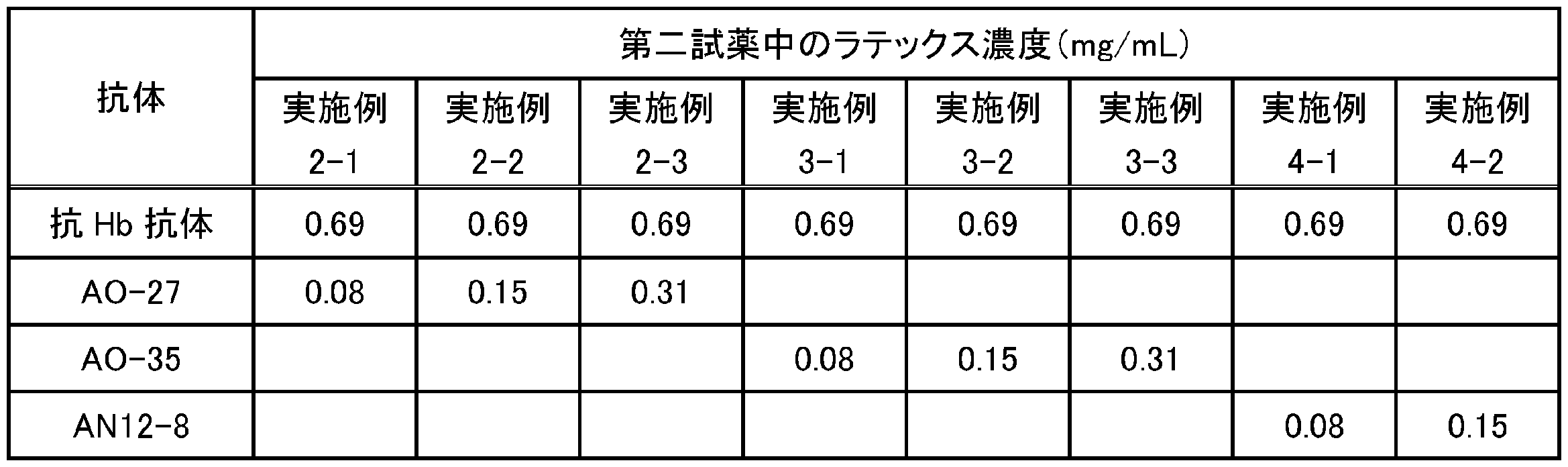
- Example 1 By mixing at the concentrations shown in Table 1, the reagents for measuring the immunoagglutination reaction of Examples 1-1 to 1-4 and Comparative Example 1 having the final latex concentrations shown in Table 1 were prepared. Similarly, as the second reagent, Examples 2-1 to 2-3, Examples 3-1 to 3-3, and Example 4 having the final latex concentration shown in Table 2 mixed at a predetermined concentration Reagents for measuring the immunoagglutination reaction of -1 to 4-2 were prepared.
- a AO-53 ( ⁇ chain recognition), AO-27 ( ⁇ chain recognition), AO-35 ( ⁇ chain recognition), or AN12-8 ( ⁇ chain recognition) were used as anti-haptoglobin monoclonal antibodies.
- the anti-haptoglobin antibody used was confirmed to be free from aggregation with the insoluble carrier carrying the anti-haptoglobin antibody in the amount of free haptoglobin added in the item [Preparation of sample] below.
- the antibody-loaded polystyrene latex was prepared by a known method. That is, each anti-hemoglobin monoclonal antibody or anti-haptoglobin monoclonal antibody was mixed with polystyrene latex particles (average particle size: 200 nm) to prepare an anti-hemoglobin monoclonal antibody or anti-haptoglobin monoclonal antibody on the polystyrene latex particle surface.
- JCA-BM2250 The measurement conditions in JCA-BM2250 are as follows. Sample volume: 2.0 ⁇ L First reagent: 60 ⁇ L Second reagent: 30 ⁇ L Measurement wavelength: 658 nm
- Example 1-1 a reagent was prepared by mixing a free anti-haptoglobin antibody not supported on the latex with an anti-hemoglobin antibody-carrying latex. Agglomeration reaction was similarly caused by adding to samples 0 to 6, and the converted value of hemoglobin concentration and the relative value (%) of hemoglobin were calculated.
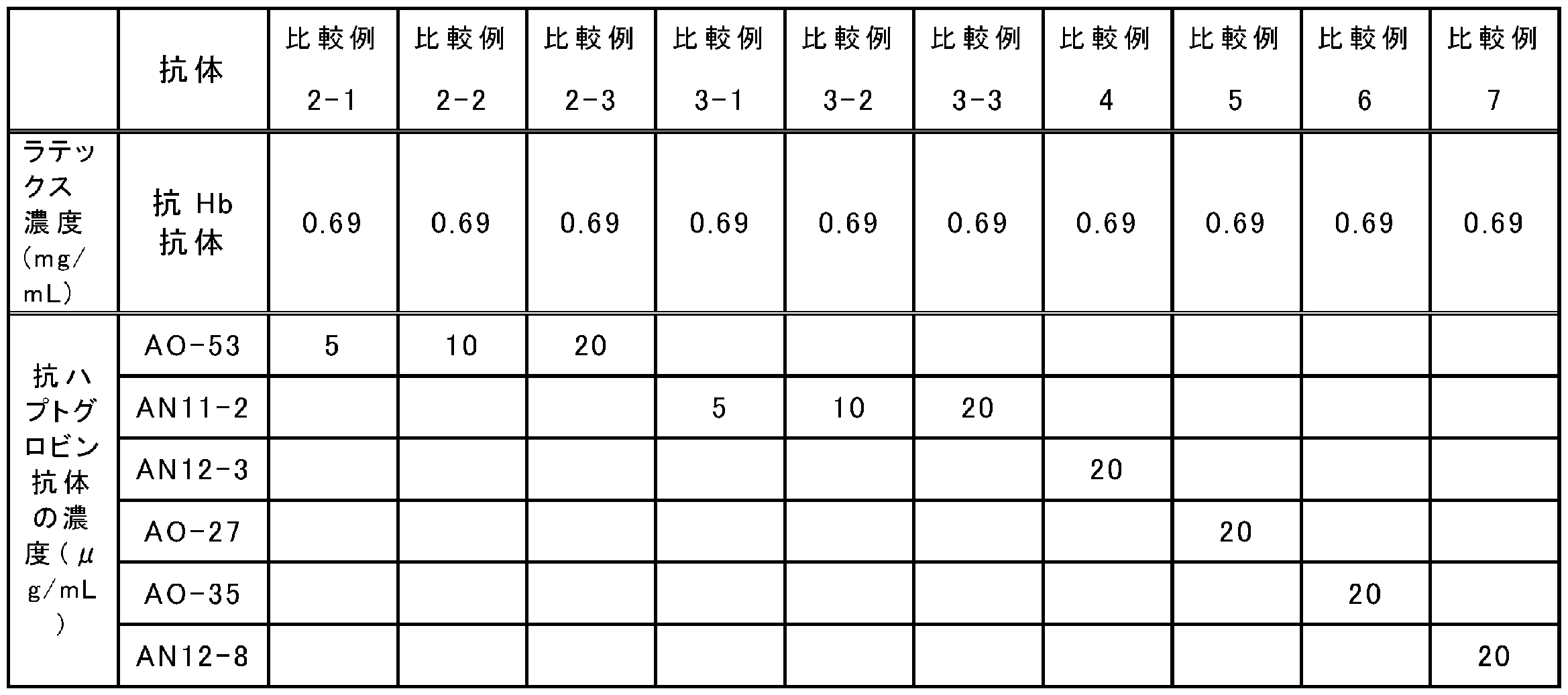
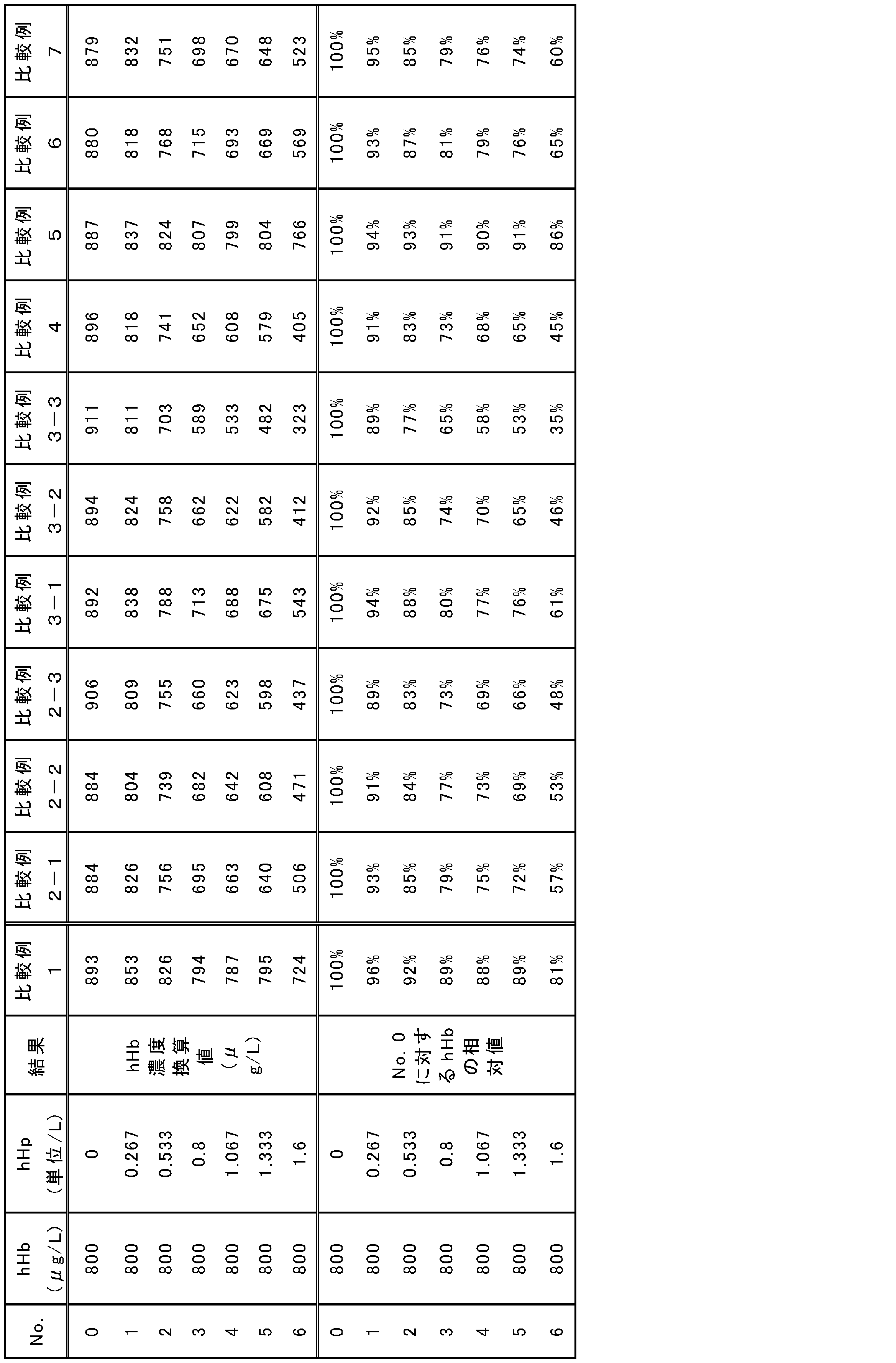
- Table 4 shows the composition of the reagent of each comparative example, and Table 5 shows the results.
- the anti-haptoglobin antibodies AN11-2 and AN12-3 are ⁇ -chain-recognizing anti-haptoglobin monoclonal antibodies, and were prepared by a known method.
- the reagents for measuring the immunoagglutination reaction of Examples 5-1 to 5-5 and Comparative Example 8 having the final latex concentrations shown in Table 6 were prepared.
- AO-53 (recognition of ⁇ chain) or AN12-8 (recognition of ⁇ chain) was used as an anti-haptoglobin monoclonal antibody.
- the anti-haptoglobin antibody used was confirmed to be free from aggregation with the insoluble carrier carrying the anti-haptoglobin antibody in the amount of free haptoglobin added in the item of [Sample preparation] below.
- the confirmation method was that a polystyrene latex 1.0 mg / mL carrying AO-53 ( ⁇ chain recognition) or AN12-8 ( ⁇ chain recognition) was used as the second reagent, and 0 ng of free haptoglobin was used as a sample.
- / ML or 24.5 pmol / mL except that a solution (without hemoglobin) added to a stock solution (Hb calibrator diluent 'Eiken' (manufactured by Eiken Chemical Co., Ltd.)) was used. It carried out similarly to the sample preparation and the immunoaggregation method described later.
- the haptoglobin concentration of 24.5 pmol / mL corresponds to a free haptoglobin concentration of 1.2 units / L.
- the antibody-loaded polystyrene latex was prepared by a known method. That is, each anti-hemoglobin monoclonal antibody or anti-haptoglobin monoclonal antibody was mixed with polystyrene latex particles (average particle size: 200 nm) to prepare an anti-hemoglobin monoclonal antibody or anti-haptoglobin monoclonal antibody on the polystyrene latex particle surface.
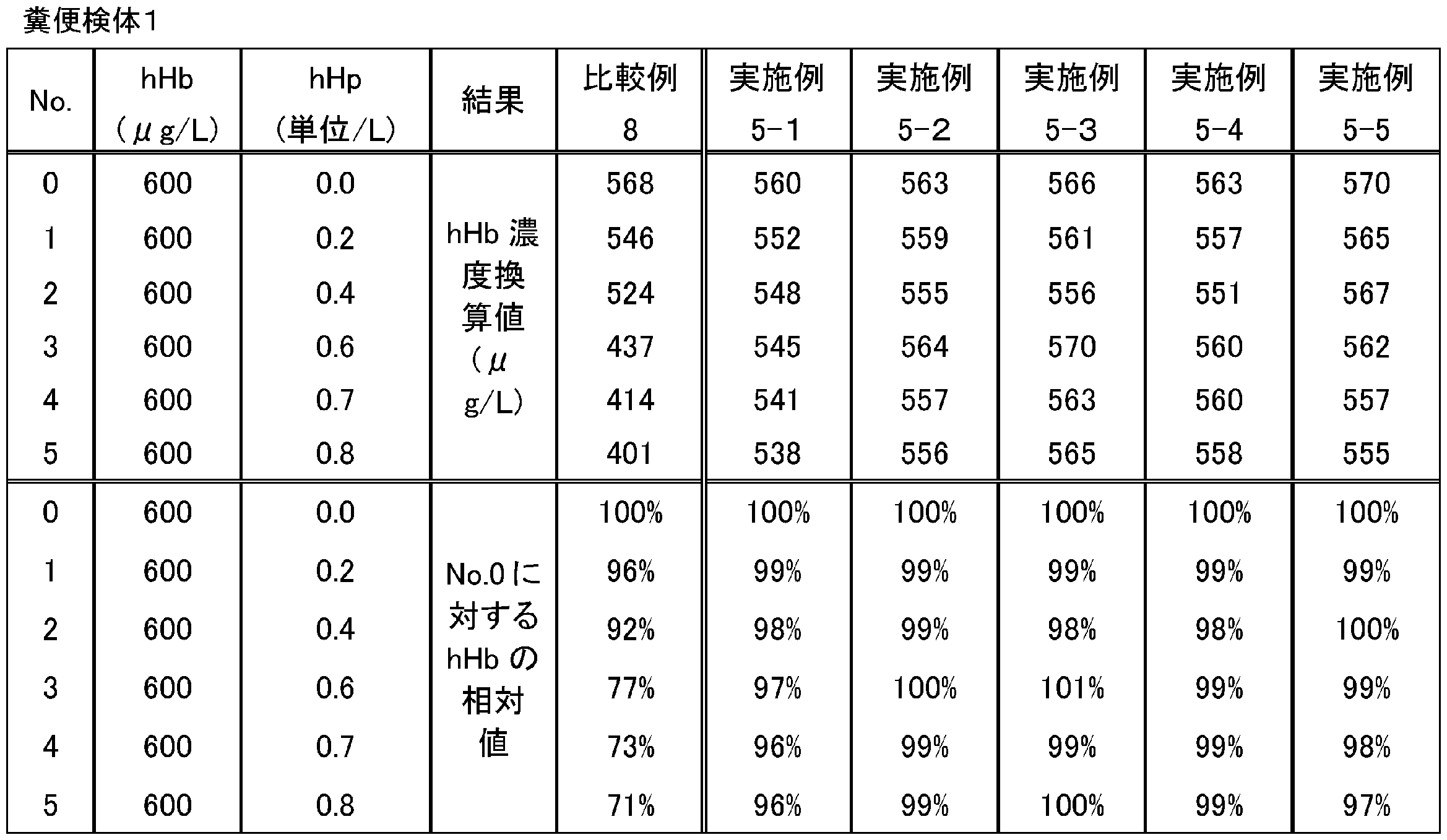
- sample preparation Two stool samples (stool samples 1 and 2) were collected from healthy subjects. Each stool specimen was prepared so that the stool concentration was 0.5% (W / V%), and human hemoglobin (hHb) and human haptoglobin (hHp) (Haptoglobin Human, Phenotype) purified from human blood. 1-1 (manufactured by SIGMA)) was mixed in a storage solution (Hb calibrator diluent 'Eiken' (manufactured by Eiken Chemical Co., Ltd.)) so as to have the concentrations shown in Tables 7 and 8. 0-5 samples were prepared. No. No. 3 is a mixture of human hemoglobin (600 ⁇ g / L) and human haptoglobin (0.6 unit / L), and hemoglobin and haptoglobin all form a complete hemoglobin-haptoglobin complex.
- JCA-BM6070 The measurement conditions in JCA-BM6070 are as follows. Sample volume: 2.0 ⁇ L First reagent: 60 ⁇ L Second reagent: 30 ⁇ L Measurement wavelength: 658 nm
Landscapes
- Health & Medical Sciences (AREA)
- Life Sciences & Earth Sciences (AREA)
- Immunology (AREA)
- Engineering & Computer Science (AREA)
- Chemical & Material Sciences (AREA)
- Hematology (AREA)
- Molecular Biology (AREA)
- Biomedical Technology (AREA)
- Urology & Nephrology (AREA)
- Medicinal Chemistry (AREA)
- General Health & Medical Sciences (AREA)
- Biochemistry (AREA)
- Physics & Mathematics (AREA)
- Pathology (AREA)
- Microbiology (AREA)
- Analytical Chemistry (AREA)
- Cell Biology (AREA)
- Biotechnology (AREA)
- General Physics & Mathematics (AREA)
- Food Science & Technology (AREA)
- Organic Chemistry (AREA)
- Inorganic Chemistry (AREA)
- Biophysics (AREA)
- Genetics & Genomics (AREA)
- Proteomics, Peptides & Aminoacids (AREA)
- Chemical Kinetics & Catalysis (AREA)
- Investigating Or Analysing Biological Materials (AREA)
- Peptides Or Proteins (AREA)
Abstract
Description
[1] 抗ヘモグロビン抗体を担持する不溶性担体と、抗ハプトグロビン抗体を担持する不溶性担体とを含む、ヘモグロビンを測定するための試薬。
[2] 抗ヘモグロビン抗体が少なくとも2種である、[1]の試薬。
[3] 不溶性担体がラテックス粒子及び/又は金コロイド粒子である、[1]又は[2]のいずれかの試薬。
[4] 抗ヘモグロビン抗体及び抗ハプトグロビン抗体がモノクローナル抗体である、[1]~[3]のいずれかの試薬。
[5] 抗ハプトグロビン抗体が1種である、[1]~[4]のいずれかの試薬。
[6] 検体中のヘモグロビンを測定するための方法であって、
(1)検体とハプトグロビンとを混合し、ヘモグロビン-ハプトグロビン複合体を形成させ、ヘモグロビン-ハプトグロビン複合体を含む試料を得る工程と、
(2)工程(1)で得られた試料と、抗ヘモグロビン抗体を担持する不溶性担体、及び抗ハプトグロビン抗体を担持する不溶性担体とを接触させ、免疫凝集させる工程と、
を含むヘモグロビンの測定方法。
[7] 抗ヘモグロビン抗体が少なくとも2種である、[6]の測定方法。
[8] 不溶性担体がラテックス粒子及び/又は金コロイド粒子である、[6]又は[7]の測定方法。
[9] 抗ヘモグロビン抗体及び抗ハプトグロビン抗体がモノクローナル抗体である、[6]~[8]のいずれかの測定方法。
[10] 検体が糞便、唾液、又は尿である、[6]~[9]のいずれかの測定方法。
[11] ハプトグロビンが検体保存用溶液に含まれる、[6]~[10]のいずれかの測定方法。
[12] 検体保存用溶液におけるハプトグロビン濃度が0.05単位/L~50単位/Lである、[11]の測定方法。
[13] 検体中のヘモグロビンが、遊離ヘモグロビン、ヘモグロビン-ハプトグロビン複合体中間体、及び完全ヘモグロビン-ハプトグロビン複合体からなる群から選ばれる少なくとも一つを含み、上記遊離ヘモグロビンの少なくとも一部は、工程(1)の後に、上記ハプトグロビンと、ヘモグロビン-ハプトグロビン複合体中間体及び/又は完全ヘモグロビン-ハプトグロビン複合体を形成する、[6]~[12]のいずれかの測定方法。
[14] 検体と、抗ヘモグロビン抗体を担持する不溶性担体、及び抗ハプトグロビン抗体を担持する不溶性担体とを接触させ、免疫凝集させる工程を含む、検体中のヘモグロビンを測定するための方法。
[15] 検体と、抗ヘモグロビン抗体を担持する不溶性担体、及び抗ハプトグロビン抗体を担持する不溶性担体とを接触させ、免疫凝集させる工程を含む、検体中のヘモグロビンの測定値の低下を抑制する方法。
[16] 検体中のヘモグロビンを測定するためのキットであって、抗ヘモグロビン抗体を担持する不溶性担体と、抗ハプトグロビン抗体を担持する不溶性担体と、ハプトグロビンとを含む、キット。
[17] [1]~[5]のいずれかの試薬と、ハプトグロビンとを含む、検体中のヘモグロビンを測定するためのキット。
[ヘモグロビン-ハプトグロビン複合体]
ヘモグロビンは、赤血球の中に存在するタンパク質であり、αサブユニット(又はα鎖)とβサブユニット(又はβ鎖)と呼ばれる2種類のサブユニットそれぞれ2つから構成される四量体構造[α2β2]を有している。ハプトグロビンは、血漿中に存在し、血中に遊離したヘモグロビンと結合するタンパク質であり、3つの型の構造を有する。例えば、1-1型ハプトグロビンは、αサブユニット(又はα鎖)とβサブユニット(又はβ鎖)と呼ばれる2種類のサブユニットそれぞれ2つから構成される四量体構造[α2β2]を有する。
本明細書における検体は、ヘモグロビンを含む又は含む可能性のある、被検対象から採取した生体サンプルである。検体は、糞便、唾液、又は尿であってよく、特に糞便であることが好ましい。また、全血、血清、血漿等を検体とすることもでき、これらのヘモグロビン量を測定することは、例えば、溶血やハプトグロビン製剤を用いた治療の指標として有用となりうる。
本明細書における試料は、検体を含むものであり、特に検体とハプトグロビンとを混合して得られたものである。検体中の遊離ヘモグロビンは、ハプトグロビンと混合することで、安定なヘモグロビン-ハプトグロビン複合体を形成する。
すなわち、試料中において、ハプトグロビンと複合体を形成していない遊離ヘモグロビン、検体中に元々存在していたヘモグロビン-ハプトグロビン複合体(検体由来のヘモグロビン-ハプトグロビン複合体)、及び/又はハプトグロビンの添加によって形成されたヘモグロビン-ハプトグロビン複合体(調製ヘモグロビン-ハプトグロビン複合体)が含まれ得る。
特に、安定性の点から、検体とハプトグロビンを混合した試料中において、全ての遊離ヘモグロビンがハプトグロビンと複合体を形成して調製ヘモグロビン-ハプトグロビン複合体を形成していることが好ましく、試料は、検体由来のヘモグロビン-ハプトグロビン複合体及び調製ヘモグロビン-ハプトグロビン複合体からなることが好ましい。
保存溶液は、検体を保存するための検体保存用溶液を意味し、ハプトグロビンを含むものであることが好ましい。
本発明の一実施形態のヘモグロビンの測定試薬は、抗ヘモグロビン抗体を担持する不溶性担体と、抗ハプトグロビン抗体を担持する不溶性担体とを含む。本発明の試薬が用いられる測定法としては免疫学的手法が用いられ、免疫学的手法としては、抗ヘモグロビン抗体を利用する公知の免疫学的手法であってよく、例えば、免疫凝集法(例えば、ラテックス凝集法、又は金コロイド凝集法)、イムノクロマトグラフ法、ELISA法が挙げられる。本発明の試薬は特に免疫凝集法、より好ましくはラテックス凝集法に好適に用いられる。
[工程(1)]
工程(1)において、検体とハプトグロビンとを混合し、ヘモグロビン-ハプトグロビン複合体を形成させ、ヘモグロビン-ハプトグロビン複合体を含む試料を得る。
工程(2)において、工程(1)で得られた試料と、抗ヘモグロビン抗体を担持する不溶性担体、及び抗ハプトグロビン抗体を担持する不溶性担体とを接触させ、免疫凝集反応を生じさせる。
[測定試薬の調製]
測定試薬として、第1試薬及び第2試薬を調製した。
第1試薬として、50mM HEPES緩衝液(pH7.4)を用いた。
第2試薬として50mM HEPES緩衝液(pH7.4)と、複数種の抗ヘモグロビンモノクローナル抗体(抗Hb抗体)それぞれの抗体を担持する各ポリスチレンラテックス、及び抗ハプトグロビンモノクローナル抗体を担持するポリスチレンラテックスを、表1に示す濃度で混合して、表1に示す最終的なラテックス濃度を有する実施例1-1~1-4及び比較例1の免疫凝集反応測定用の試薬を調製した。同様に、第2試薬として、所定の濃度で混合し、表2に示す最終的なラテックス濃度を有する実施例2-1~2-3、実施例3-1~3-3、及び実施例4-1~4-2の免疫凝集反応測定用の試薬を調製した。

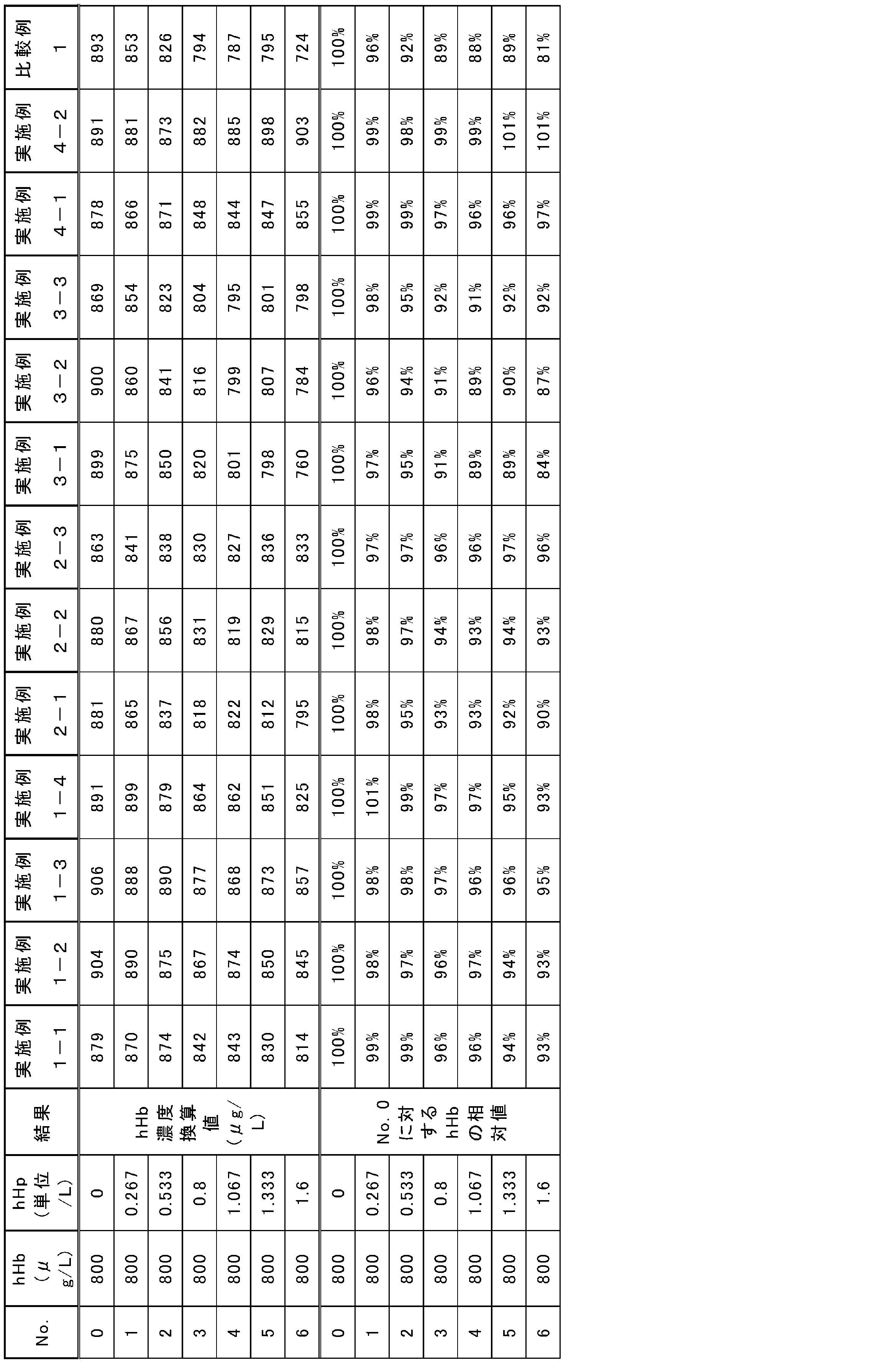
ヒト血液から精製したヒト・ヘモグロビン(hHb)、及びヒト・ハプトグロビン(hHp)(Haptoglobin Human, Phenotype 1-1(SIGMA社製))をHbキャリブレータ希釈液‘栄研’(栄研化学株式会社製)中に、表3に示す濃度となるように混合し、No.0~6の試料を調製した。No.3は、ヒト・ヘモグロビン800μg/Lに対してヒト・ハプトグロビン0.8単位/Lを混合しており、ヘモグロビンとハプトグロビンがすべて完全ヘモグロビン-ハプトグロビン複合体を形成している。
No.0~6の試料に、それぞれ実施例1-1~1-4、実施例2-1~2-3、実施例3-1~3-3、実施例4-1~4-2及び比較例1の測定試薬を添加し自動分析機BM2250を用いて濁度を測定し、あらかじめ作成した検量線に基づき、ヘモグロビンの濃度換算値を算出した。さらにNo.0(ヒト・ハプトグロビンを含まない試料)に対するヘモグロビンの相対値(%)も算出した。結果を表3に示す。
検体量:2.0μL
第1試薬:60μL
第2試薬:30μL
測定波長:658nm
実施例1-1における抗ハプトグロビン抗体担持ラテックスの代わりに、ラテックスに担持されていない遊離の抗ハプトグロビン抗体を、抗ヘモグロビン抗体担持ラテックスと混合した試薬を調製し、No.0~6の試料に添加し、同様に凝集反応を生じさせ、ヘモグロビンの濃度換算値及びヘモグロビンの相対値(%)を算出した。各比較例の試薬の組成は表4に、結果は表5に示す。なお、抗ハプトグロビン抗体AN11-2及びAN12-3はβ鎖認識抗ハプトグロビンモノクローナル抗体であり、公知の方法により作製した。
[測定試薬の調製]
測定試薬として、第1試薬及び第2試薬を調製した。
第1試薬として、50mM HEPES緩衝液(pH7.4)を用いた。
第2試薬として50mM HEPES緩衝液(pH7.4)と、複数種の抗ヘモグロビンモノクローナル抗体(抗Hb抗体)それぞれの抗体を担持する各ポリスチレンラテックス、及び抗ハプトグロビンモノクローナル抗体を担持するポリスチレンラテックスを、表6に示す濃度で混合して、表6に示す最終的なラテックス濃度を有する実施例5-1~5-5及び比較例8の免疫凝集反応測定用の試薬を調製した。
抗ハプトグロビンモノクローナル抗体としてAO-53(α鎖認識)、若しくはAN12-8(β鎖認識)を使用した。抗ハプトグロビン抗体は、下記の[試料の調製]の項目において添加する量の遊離ハプトグロビンでは、抗ハプトグロビン抗体を担持した不溶性担体と凝集しないことを確認したものを用いた。

健常者から糞便検体を2つ(糞便検体1及び2)採取した。それぞれの糞便検体を、糞便濃度が0.5%(W/V%)となるように、また、ヒト血液から精製したヒト・ヘモグロビン(hHb)、及びヒト・ハプトグロビン(hHp)(Haptoglobin Human, Phenotype 1-1(SIGMA社製))を、表7及び8に示す濃度となるように、保存溶液(Hbキャリブレータ希釈液‘栄研’(栄研化学株式会社製))中に混合し、No.0~5の試料を調製した。No.3は、ヒト・ヘモグロビン600μg/Lに対してヒト・ハプトグロビン0.6単位/Lを混合しており、ヘモグロビンとハプトグロビンがすべて完全ヘモグロビン-ハプトグロビン複合体を形成している。
糞便検体1及び2のそれぞれのNo.0~5の試料に、それぞれ実施例5-1~5-5及び比較例8の測定試薬を添加し自動分析機JCA-BM6070を用いて濁度を測定し、あらかじめ作成した検量線に基づき、ヘモグロビンの濃度換算値を算出した。さらにNo.0(ヒト・ハプトグロビンを含まない試料)に対するヘモグロビンの相対値(%)も算出した。結果を表7及び8に示す。
検体量:2.0μL
第1試薬:60μL
第2試薬:30μL
測定波長:658nm

Claims (15)
- 抗ヘモグロビン抗体を担持する不溶性担体と、抗ハプトグロビン抗体を担持する不溶性担体とを含む、ヘモグロビンを測定するための試薬。
- 抗ヘモグロビン抗体が少なくとも2種である、請求項1に記載の試薬。
- 不溶性担体がラテックス粒子及び/又は金コロイド粒子である、請求項1又は2に記載の試薬。
- 抗ヘモグロビン抗体及び抗ハプトグロビン抗体がモノクローナル抗体である、請求項1~3のいずれか一項に記載の試薬。
- 抗ハプトグロビン抗体が1種である、請求項1~4のいずれか一項に記載の試薬。
- 検体中のヘモグロビンを測定するための方法であって、
(1)検体とハプトグロビンとを混合し、ヘモグロビン-ハプトグロビン複合体を形成させ、ヘモグロビン-ハプトグロビン複合体を含む試料を得る工程と、
(2)工程(1)で得られた試料と、抗ヘモグロビン抗体を担持する不溶性担体、及び抗ハプトグロビン抗体を担持する不溶性担体とを接触させ、免疫凝集させる工程と
を含むヘモグロビンの測定方法。 - 抗ヘモグロビン抗体が少なくとも2種である、請求項6に記載の測定方法。
- 不溶性担体がラテックス粒子及び/又は金コロイド粒子である、請求項6又は7に記載の測定方法。
- 抗ヘモグロビン抗体及び抗ハプトグロビン抗体がモノクローナル抗体である、請求項6~8のいずれか一項に記載の測定方法。
- 検体が糞便、唾液、又は尿である、請求項6~9のいずれか一項に記載の測定方法。
- ハプトグロビンが検体保存用溶液に含まれる、請求項6~10のいずれか一項に記載の測定方法。
- 検体保存用溶液におけるハプトグロビン濃度が0.05単位/L~50単位/Lである、請求項11に記載の測定方法。
- 検体中のヘモグロビンが、遊離ヘモグロビン、ヘモグロビン-ハプトグロビン複合体中間体、及び完全ヘモグロビン-ハプトグロビン複合体からなる群から選ばれる少なくとも一つを含み、前記遊離ヘモグロビンの少なくとも一部は、工程(1)の後に、前記ハプトグロビンと、ヘモグロビン-ハプトグロビン複合体中間体及び/又は完全ヘモグロビン-ハプトグロビン複合体を形成する、請求項6~12のいずれか一項に記載の測定方法。
- 検体と、抗ヘモグロビン抗体を担持する不溶性担体、及び抗ハプトグロビン抗体を担持する不溶性担体とを接触させ、免疫凝集させる工程を含む、検体中のヘモグロビンを測定するための方法。
- 検体と、抗ヘモグロビン抗体を担持する不溶性担体、及び抗ハプトグロビン抗体を担持する不溶性担体とを接触させ、免疫凝集させる工程を含む、検体中のヘモグロビンの測定値の低下を抑制する方法。
Priority Applications (10)
| Application Number | Priority Date | Filing Date | Title |
|---|---|---|---|
| SG11202102265UA SG11202102265UA (en) | 2018-09-26 | 2019-09-13 | Hemoglobin assay reagent, assay kit and assay method |
| EP19866240.5A EP3859338B1 (en) | 2018-09-26 | 2019-09-13 | Hemoglobin assay reagent, assay kit and assay method |
| KR1020217011239A KR102839014B1 (ko) | 2018-09-26 | 2019-09-13 | 헤모글로빈의 측정 시약, 측정 키트 및 측정 방법 |
| ES19866240T ES2987836T3 (es) | 2018-09-26 | 2019-09-13 | Reactivo de ensayo de hemoglobina, kit de ensayo y método de ensayo |
| US17/278,647 US12405277B2 (en) | 2018-09-26 | 2019-09-13 | Hemoglobin assay reagent, assay kit and assay method |
| JP2020548484A JP7005785B2 (ja) | 2018-09-26 | 2019-09-13 | ヘモグロビンの測定試薬、測定キット及び測定方法 |
| CN201980062760.6A CN112752974A (zh) | 2018-09-26 | 2019-09-13 | 血红蛋白的测定试剂、测定试剂盒和测定方法 |
| AU2019350257A AU2019350257B2 (en) | 2018-09-26 | 2019-09-13 | Hemoglobin assay reagent, assay kit and assay method |
| JP2022000465A JP7508494B2 (ja) | 2018-09-26 | 2022-01-05 | ヘモグロビンの測定試薬、測定キット及び測定方法 |
| JP2024098996A JP7784481B2 (ja) | 2018-09-26 | 2024-06-19 | ヘモグロビンの測定試薬、測定キット及び測定方法 |
Applications Claiming Priority (2)
| Application Number | Priority Date | Filing Date | Title |
|---|---|---|---|
| JP2018179952 | 2018-09-26 | ||
| JP2018-179952 | 2018-09-26 |
Publications (1)
| Publication Number | Publication Date |
|---|---|
| WO2020066722A1 true WO2020066722A1 (ja) | 2020-04-02 |
Family
ID=69951999
Family Applications (1)
| Application Number | Title | Priority Date | Filing Date |
|---|---|---|---|
| PCT/JP2019/036235 Ceased WO2020066722A1 (ja) | 2018-09-26 | 2019-09-13 | ヘモグロビンの測定試薬、測定キット及び測定方法 |
Country Status (10)
| Country | Link |
|---|---|
| US (1) | US12405277B2 (ja) |
| EP (1) | EP3859338B1 (ja) |
| JP (3) | JP7005785B2 (ja) |
| KR (1) | KR102839014B1 (ja) |
| CN (1) | CN112752974A (ja) |
| AU (1) | AU2019350257B2 (ja) |
| ES (1) | ES2987836T3 (ja) |
| SG (1) | SG11202102265UA (ja) |
| TW (1) | TWI832901B (ja) |
| WO (1) | WO2020066722A1 (ja) |
Cited By (2)
| Publication number | Priority date | Publication date | Assignee | Title |
|---|---|---|---|---|
| WO2024106336A1 (ja) * | 2022-11-16 | 2024-05-23 | 栄研化学株式会社 | 遊離ヘモグロビン測定方法および遊離ヘモグロビン測定試薬 |
| WO2024181457A1 (ja) | 2023-02-27 | 2024-09-06 | 栄研化学株式会社 | 脱糖鎖化ハプトグロビンを用いたヘモグロビンの免疫学的測定方法 |
Families Citing this family (3)
| Publication number | Priority date | Publication date | Assignee | Title |
|---|---|---|---|---|
| EP3859338B1 (en) * | 2018-09-26 | 2024-07-24 | Eiken Kagaku Kabushiki Kaisha | Hemoglobin assay reagent, assay kit and assay method |
| US11509681B2 (en) * | 2021-03-11 | 2022-11-22 | Virtustream Ip Holding Company Llc | Relative risk ranking of cloud assets used in multi-cloud workloads |
| CN115902201A (zh) * | 2022-10-14 | 2023-04-04 | 安徽惠邦生物工程有限公司 | 尿液中结合珠蛋白含量检测的化学发光免疫分析试剂盒及其分析方法 |
Citations (7)
| Publication number | Priority date | Publication date | Assignee | Title |
|---|---|---|---|---|
| JPH02193071A (ja) * | 1989-01-20 | 1990-07-30 | Green Cross Corp:The | ハプトグロビン―ヘモグロビン複合体測定用試薬キット及びそれを用いるハプトグロビン―ヘモグロビン複合体の測定法 |
| JPH03272698A (ja) * | 1990-03-20 | 1991-12-04 | Green Cross Corp:The | 遊離ヘモグロビンの測定法及びそれに用いる遊離ヘモグロビン測定用試薬キット |
| JPH05322889A (ja) * | 1992-05-18 | 1993-12-07 | Toyobo Co Ltd | ハプトグロビン−ヘモグロビン複合体の定量方法およびハプトグロビン−ヘモグロビン複合体の定量キット |
| JPH10132824A (ja) | 1996-10-28 | 1998-05-22 | Eiken Chem Co Ltd | ヘモグロビンの安定化方法 |
| JPH11201969A (ja) * | 1998-01-14 | 1999-07-30 | Wakamoto Pharmaceut Co Ltd | 簡易遊離ヘモグロビン測定方法および測定用キット |
| JP2010014586A (ja) * | 2008-07-04 | 2010-01-21 | Wako Pure Chem Ind Ltd | 便検体中ヘモグロビンの測定方法及び測定試薬キット |
| WO2017209001A1 (ja) * | 2016-05-30 | 2017-12-07 | 栄研化学株式会社 | 抗ヒトヘモグロビンモノクローナル抗体若しくは抗体キット、抗ヒトヘモグロビンモノクローナル抗体固定化不溶性担体粒子、及びこれらを用いた測定試薬若しくは測定方法 |
Family Cites Families (13)
| Publication number | Priority date | Publication date | Assignee | Title |
|---|---|---|---|---|
| DE3532868A1 (de) * | 1985-09-14 | 1987-03-26 | Boehringer Mannheim Gmbh | Verfahren und reagenz zur bestimmung von glykosiliertem haemoglobin sowie hierzu geeignete verbindungen und verfahren zu deren herstellung |
| JP3032891B2 (ja) * | 1989-03-04 | 2000-04-17 | 吉富製薬株式会社 | 遊離ヘモグロビン測定用試薬キット及びそれを用いる遊離ヘモグロビンの測定法 |
| JP2654181B2 (ja) | 1989-05-10 | 1997-09-17 | 日東電工株式会社 | ヒトヘモグロビンの検出方法 |
| JPH05322888A (ja) * | 1992-05-18 | 1993-12-07 | Toyobo Co Ltd | 遊離ヘモグロビンの定量方法および遊離ヘモグロビン定量キット |
| JPH07103978A (ja) * | 1993-09-30 | 1995-04-21 | Wakamoto Pharmaceut Co Ltd | 遊離ヘモグロビン測定 |
| JPH08313530A (ja) * | 1995-05-22 | 1996-11-29 | Wakamoto Pharmaceut Co Ltd | 総ヘモグロビン測定方法及び測定キット |
| JP4039590B2 (ja) | 1998-01-30 | 2008-01-30 | 栄研化学株式会社 | ヘモグロビン試料の安定化 |
| JPH11242027A (ja) | 1998-02-25 | 1999-09-07 | Eiken Chem Co Ltd | 免疫学的便潜血試験の精度管理方法 |
| US8900882B2 (en) * | 2008-07-31 | 2014-12-02 | Nitto Boseki Co., Ltd. | Method of assaying complex and kit to be used therefor |
| JP5268606B2 (ja) | 2008-12-08 | 2013-08-21 | 日本化薬株式会社 | フェノール樹脂、エポキシ樹脂、エポキシ樹脂組成物およびその硬化物 |
| JP6434843B2 (ja) | 2015-03-31 | 2018-12-05 | 栄研化学株式会社 | ヘムタンパク質の保存液及びヘムタンパク質の安定化方法 |
| JP7325334B2 (ja) | 2017-12-01 | 2023-08-14 | 栄研化学株式会社 | ヘモグロビンとハプトグロビンとの複合体を安定化する方法、及びヘモグロビンを含む検体を保存するための保存溶液 |
| EP3859338B1 (en) * | 2018-09-26 | 2024-07-24 | Eiken Kagaku Kabushiki Kaisha | Hemoglobin assay reagent, assay kit and assay method |
-
2019
- 2019-09-13 EP EP19866240.5A patent/EP3859338B1/en active Active
- 2019-09-13 JP JP2020548484A patent/JP7005785B2/ja active Active
- 2019-09-13 CN CN201980062760.6A patent/CN112752974A/zh active Pending
- 2019-09-13 SG SG11202102265UA patent/SG11202102265UA/en unknown
- 2019-09-13 KR KR1020217011239A patent/KR102839014B1/ko active Active
- 2019-09-13 WO PCT/JP2019/036235 patent/WO2020066722A1/ja not_active Ceased
- 2019-09-13 AU AU2019350257A patent/AU2019350257B2/en active Active
- 2019-09-13 ES ES19866240T patent/ES2987836T3/es active Active
- 2019-09-13 US US17/278,647 patent/US12405277B2/en active Active
- 2019-09-19 TW TW108133784A patent/TWI832901B/zh active
-
2022
- 2022-01-05 JP JP2022000465A patent/JP7508494B2/ja active Active
-
2024
- 2024-06-19 JP JP2024098996A patent/JP7784481B2/ja active Active
Patent Citations (7)
| Publication number | Priority date | Publication date | Assignee | Title |
|---|---|---|---|---|
| JPH02193071A (ja) * | 1989-01-20 | 1990-07-30 | Green Cross Corp:The | ハプトグロビン―ヘモグロビン複合体測定用試薬キット及びそれを用いるハプトグロビン―ヘモグロビン複合体の測定法 |
| JPH03272698A (ja) * | 1990-03-20 | 1991-12-04 | Green Cross Corp:The | 遊離ヘモグロビンの測定法及びそれに用いる遊離ヘモグロビン測定用試薬キット |
| JPH05322889A (ja) * | 1992-05-18 | 1993-12-07 | Toyobo Co Ltd | ハプトグロビン−ヘモグロビン複合体の定量方法およびハプトグロビン−ヘモグロビン複合体の定量キット |
| JPH10132824A (ja) | 1996-10-28 | 1998-05-22 | Eiken Chem Co Ltd | ヘモグロビンの安定化方法 |
| JPH11201969A (ja) * | 1998-01-14 | 1999-07-30 | Wakamoto Pharmaceut Co Ltd | 簡易遊離ヘモグロビン測定方法および測定用キット |
| JP2010014586A (ja) * | 2008-07-04 | 2010-01-21 | Wako Pure Chem Ind Ltd | 便検体中ヘモグロビンの測定方法及び測定試薬キット |
| WO2017209001A1 (ja) * | 2016-05-30 | 2017-12-07 | 栄研化学株式会社 | 抗ヒトヘモグロビンモノクローナル抗体若しくは抗体キット、抗ヒトヘモグロビンモノクローナル抗体固定化不溶性担体粒子、及びこれらを用いた測定試薬若しくは測定方法 |
Non-Patent Citations (1)
| Title |
|---|
| J. V. PASTEWKA ET AL., BIOCHIMICA ET BIOPHYSICA ACTA, vol. 386, 1975, pages 530 - 537 |
Cited By (3)
| Publication number | Priority date | Publication date | Assignee | Title |
|---|---|---|---|---|
| WO2024106336A1 (ja) * | 2022-11-16 | 2024-05-23 | 栄研化学株式会社 | 遊離ヘモグロビン測定方法および遊離ヘモグロビン測定試薬 |
| WO2024181457A1 (ja) | 2023-02-27 | 2024-09-06 | 栄研化学株式会社 | 脱糖鎖化ハプトグロビンを用いたヘモグロビンの免疫学的測定方法 |
| EP4675276A1 (en) | 2023-02-27 | 2026-01-07 | Eiken Kagaku Kabushiki Kaisha | Method for immunologically measuring hemoglobin using deglycosylated haptoglobin |
Also Published As
| Publication number | Publication date |
|---|---|
| EP3859338A4 (en) | 2022-06-08 |
| JP2024107496A (ja) | 2024-08-08 |
| TWI832901B (zh) | 2024-02-21 |
| US12405277B2 (en) | 2025-09-02 |
| JPWO2020066722A1 (ja) | 2021-09-16 |
| KR102839014B1 (ko) | 2025-07-25 |
| JP7005785B2 (ja) | 2022-02-10 |
| EP3859338B1 (en) | 2024-07-24 |
| CN112752974A (zh) | 2021-05-04 |
| AU2019350257A1 (en) | 2021-04-01 |
| JP7508494B2 (ja) | 2024-07-01 |
| JP7784481B2 (ja) | 2025-12-11 |
| KR20210064272A (ko) | 2021-06-02 |
| JP2022033286A (ja) | 2022-02-28 |
| TW202020455A (zh) | 2020-06-01 |
| EP3859338A1 (en) | 2021-08-04 |
| ES2987836T3 (es) | 2024-11-18 |
| SG11202102265UA (en) | 2021-04-29 |
| US20220043008A1 (en) | 2022-02-10 |
| AU2019350257B2 (en) | 2025-10-23 |
Similar Documents
| Publication | Publication Date | Title |
|---|---|---|
| JP7784481B2 (ja) | ヘモグロビンの測定試薬、測定キット及び測定方法 | |
| JPH10132824A (ja) | ヘモグロビンの安定化方法 | |
| CN107533053A (zh) | L‑fabp的免疫测定方法以及用于所述方法的测定试剂 | |
| JP5191291B2 (ja) | 便検体中ヘモグロビンの測定方法及び測定試薬キット | |
| CN101836113B (zh) | 利用免疫学微粒凝集反应的样品中丙烯醛加合物的测定方法及测定用试剂盒 | |
| JP7612748B2 (ja) | ヘモグロビンとハプトグロビンとの複合体を安定化する方法、及びヘモグロビンを含む検体を保存するための保存溶液 | |
| JP6818675B2 (ja) | ヘムタンパク質の保存液及びヘムタンパク質の安定化方法 | |
| HK40049478B (en) | Hemoglobin assay reagent, assay kit and assay method | |
| HK40049478A (en) | Hemoglobin assay reagent, assay kit and assay method | |
| JPWO2008029873A1 (ja) | 抗原およびその抗原に対する抗体を測定する方法、並びにそれに用いる測定用試薬 | |
| HK40025683B (zh) | 使血红蛋白与触珠蛋白的复合物稳定的方法和用於保存含有血红蛋白的样本的保存溶液 | |
| EP4675276A1 (en) | Method for immunologically measuring hemoglobin using deglycosylated haptoglobin | |
| JPH08262020A (ja) | ヒトヘモグロビンの安定化方法 | |
| TW202417843A (zh) | 游離血紅素測定試劑、游離血紅素的測定方法及抗血紅素抗體 | |
| HK40129003A (en) | Method for immunologically measuring hemoglobin using deglycosylated haptoglobin | |
| TW202429079A (zh) | 游離血紅素的測定方法及游離血紅素的測定試劑 | |
| JP2003057238A (ja) | ペルオキシダーゼ標識抗体を含有する水溶液 |
Legal Events
| Date | Code | Title | Description |
|---|---|---|---|
| 121 | Ep: the epo has been informed by wipo that ep was designated in this application |
Ref document number: 19866240 Country of ref document: EP Kind code of ref document: A1 |
|
| ENP | Entry into the national phase |
Ref document number: 2020548484 Country of ref document: JP Kind code of ref document: A |
|
| NENP | Non-entry into the national phase |
Ref country code: DE |
|
| ENP | Entry into the national phase |
Ref document number: 2019350257 Country of ref document: AU Date of ref document: 20190913 Kind code of ref document: A |
|
| ENP | Entry into the national phase |
Ref document number: 20217011239 Country of ref document: KR Kind code of ref document: A |
|
| ENP | Entry into the national phase |
Ref document number: 2019866240 Country of ref document: EP Effective date: 20210426 |
|
| WWG | Wipo information: grant in national office |
Ref document number: 17278647 Country of ref document: US |