WO2020032224A1 - 被覆生物活性物質 - Google Patents
被覆生物活性物質 Download PDFInfo
- Publication number
- WO2020032224A1 WO2020032224A1 PCT/JP2019/031543 JP2019031543W WO2020032224A1 WO 2020032224 A1 WO2020032224 A1 WO 2020032224A1 JP 2019031543 W JP2019031543 W JP 2019031543W WO 2020032224 A1 WO2020032224 A1 WO 2020032224A1
- Authority
- WO
- WIPO (PCT)
- Prior art keywords
- resin
- temperature
- meth
- water
- coated
- Prior art date
- Legal status (The legal status is an assumption and is not a legal conclusion. Google has not performed a legal analysis and makes no representation as to the accuracy of the status listed.)
- Ceased
Links
Classifications
-
- A—HUMAN NECESSITIES
- A01—AGRICULTURE; FORESTRY; ANIMAL HUSBANDRY; HUNTING; TRAPPING; FISHING
- A01N—PRESERVATION OF BODIES OF HUMANS OR ANIMALS OR PLANTS OR PARTS THEREOF; BIOCIDES, e.g. AS DISINFECTANTS, AS PESTICIDES OR AS HERBICIDES; PEST REPELLANTS OR ATTRACTANTS; PLANT GROWTH REGULATORS
- A01N25/00—Biocides, pest repellants or attractants, or plant growth regulators, characterised by their forms, or by their non-active ingredients or by their methods of application, e.g. seed treatment or sequential application; Substances for reducing the noxious effect of the active ingredients to organisms other than pests
- A01N25/26—Biocides, pest repellants or attractants, or plant growth regulators, characterised by their forms, or by their non-active ingredients or by their methods of application, e.g. seed treatment or sequential application; Substances for reducing the noxious effect of the active ingredients to organisms other than pests in coated particulate form
-
- C—CHEMISTRY; METALLURGY
- C05—FERTILISERS; MANUFACTURE THEREOF
- C05G—MIXTURES OF FERTILISERS COVERED INDIVIDUALLY BY DIFFERENT SUBCLASSES OF CLASS C05; MIXTURES OF ONE OR MORE FERTILISERS WITH MATERIALS NOT HAVING A SPECIFIC FERTILISING ACTIVITY, e.g. PESTICIDES, SOIL-CONDITIONERS, WETTING AGENTS; FERTILISERS CHARACTERISED BY THEIR FORM
- C05G3/00—Mixtures of one or more fertilisers with additives not having a specially fertilising activity
-
- Y—GENERAL TAGGING OF NEW TECHNOLOGICAL DEVELOPMENTS; GENERAL TAGGING OF CROSS-SECTIONAL TECHNOLOGIES SPANNING OVER SEVERAL SECTIONS OF THE IPC; TECHNICAL SUBJECTS COVERED BY FORMER USPC CROSS-REFERENCE ART COLLECTIONS [XRACs] AND DIGESTS
- Y02—TECHNOLOGIES OR APPLICATIONS FOR MITIGATION OR ADAPTATION AGAINST CLIMATE CHANGE
- Y02A—TECHNOLOGIES FOR ADAPTATION TO CLIMATE CHANGE
- Y02A40/00—Adaptation technologies in agriculture, forestry, livestock or agroalimentary production
- Y02A40/10—Adaptation technologies in agriculture, forestry, livestock or agroalimentary production in agriculture
Definitions
- the present invention relates to a coated bioactive substance whose surface is coated with a resin composition. More specifically, the present invention relates to a coated fertilizer or a coated pesticide having a small temperature dependence of a dissolution rate of the fertilizer or the pesticide.
- the dissolution rate of conventional coated fertilizers and pesticides is affected by the temperature of the soil or water to which they are applied. As the temperature increases, the dissolution rate increases, and conversely, as the temperature decreases, the dissolution rate decreases.
- Such a change in the dissolution rate with a change in temperature is referred to as the temperature dependence of the dissolution rate, and ordinary coated fertilizers have this temperature dependence.
- the elution rate In the case of an extreme temperature rise, the elution rate also becomes extremely large, so that the crop tends to be in a state of excessive fertilizer. Conversely, when the soil temperature is kept low, the dissolution rate becomes extremely low, and the necessary fertilizer is not supplied.
- a coated fertilizer having reduced temperature dependency for example, a coated fertilizer coated with polyurethane obtained by a reaction between tripropylene glycol and isocyanate is known (Patent Document 1). However, a coated fertilizer and a coated pesticide with lower temperature dependence are desired.
- the present invention relates to a coated fertilizer or a coated pesticide having a small temperature dependency of a dissolution rate of a fertilizer or a pesticide, for example, an increase in the dissolution rate of a fertilizer or a pesticide in a high-temperature region (for example, 35 ° C.) is suppressed, or a low-temperature region (for example, It is an object of the present invention to provide a coated fertilizer or a coated pesticide having a small difference in dissolution rate at 15 to 25 ° C.) and a small temperature dependency.
- the present invention provides a coated bioactive substance in which particles of one or more types of bioactive substances (E) selected from the group consisting of fertilizers and pesticides are coated with a resin composition (D).
- the composition (D) is a composition containing the temperature-responsive resin (A) having a lower critical solution temperature (LCST) for water in the range of 10 to 40 ° C. and the water-absorbent resin (B) as constituent components.
- the present invention it is possible to provide a coated fertilizer or a coated pesticide having a small temperature dependence of an elution rate.
- ADVANTAGE OF THE INVENTION it becomes possible to provide the coated fertilizer and coated agricultural chemical in which the increase of the elution rate of a biologically active substance was suppressed in the high temperature area, for example.
- the coated bioactive substance of the present invention contains a fertilizer, by using the coated bioactive substance, even when an extreme temperature rise occurs, the elution rate of the fertilizer follows the temperature rise.
- a temperature-responsive resin (A) having a small value of the lower critical solution temperature (LCST) for water as a component of the resin composition for coating the fertilizer, the elution rate of the fertilizer can be reduced even when the temperature decreases. There is no extreme decrease, and crops and the like are unlikely to fall into a state of nutrition starvation. The same effect is exhibited when the coated bioactive substance contains a pesticide.
- the coated bioactive substance (F) of the present invention is a coated bioactive substance in which particles of at least one bioactive substance (E) selected from the group consisting of fertilizers and pesticides are coated with a resin composition (D).
- the resin composition (D) comprises a temperature-responsive resin (A) having a lower critical solution temperature (LCST) for water in the range of 10 to 40 ° C. and a water-absorbent resin (B) as constituents.
- a composition comprising: Also, preferably, the biologically active substance (E) is a pesticide or a fertilizer.
- the temperature-responsive resin (A) and the water-absorbent resin (B) are preferably contained in the resin composition (D) in the form of particles.
- the resin composition (D) includes particles of the temperature-responsive resin (A) and particles of the water-absorbent resin (B).
- the shape of the particles is not particularly limited, and may be, for example, a sphere (including a true sphere), an ellipsoid, a filler, or the like.
- the coated bioactive substance (F) of the present invention has a small temperature dependence of the dissolution rate of one or more bioactive substances (E) selected from the group consisting of fertilizers and pesticides. In one embodiment of the present invention, an increase in the elution rate of the biologically active substance (E) due to an increase in temperature can be suppressed at a high temperature.
- a decrease in the elution rate of the biologically active substance (E) due to a decrease in the temperature can be suppressed.
- a high temperature refers to a temperature of 25 ° C. or higher
- a low temperature refers to a temperature of 25 ° C. or lower unless otherwise specified. 25 ° C. may be either high temperature or low temperature.
- the temperature-responsive resin (A) is a resin having a lower critical solution temperature (LCST) for water in the range of 10 to 40 ° C.
- the lower critical solution temperature (LCST) for water refers to a temperature at which the material is not dissolved in water at a temperature higher than that temperature, does not dissolve in contact with water, and dissolves in water at a temperature lower than that temperature.
- the measuring method of LCST is as follows. The transmittance (normal wavelength: 670 nm) of a 1.0% by weight aqueous solution of the temperature-responsive resin (A) at 5 to 60 ° C. was measured using a UV-vis spectrophotometer (for example, UV-2550, manufactured by Shimadzu Corporation).
- the temperature at which the transmittance is measured and becomes 50% is defined as LCST.
- a resin having an LCST of 25 to 35 ° C. is preferable as the temperature-responsive resin (A).
- a resin having an LCST of 15 to 25 ° C. is preferable as the temperature-responsive resin (A).
- the temperature-responsive resin (A) having an LCST in the range of 10 to 40 ° C. used in the present invention a polymer or copolymer containing the following monomers as constituent monomers can be used.
- the monomer include N-alkyl (meth) acrylamide (a1) (the alkyl group has 1 to 3 carbon atoms), N-vinylalkylamide (a2), N-ethoxyethyl (meth) acrylamide, and methyl vinyl ether.
- examples include, but are not limited to, vinyl ether derivatives and water-soluble cellulose ethers such as methyl cellulose.
- the above monomer is also referred to as a monomer that imparts temperature responsiveness.
- the temperature-responsive resin (A) is preferably a resin containing one or more of the above monomers in the constituent monomers.
- a resin containing N-alkyl (meth) acrylamide (a1) and / or N-vinylalkylamide (a2) as a constituent monomer is preferable. Resins containing N-alkyl (meth) acrylamide (a1) are more preferred.
- the N-alkyl (meth) acrylamide (a1) and the N-vinylalkylamide (a2) may each be one type, or two or more types.
- the temperature-responsive resin (A) is composed of N-alkyl (meth) acrylamide (a1) and / or N-vinyl as a constituent monomer. It is preferable that the resin (A1) contains an alkylamide (a2) and a crosslinking agent (c) and does not contain (meth) acrylic acid (salt) (b) as a constituent monomer.
- the resin composition (D) containing such a resin as the temperature-responsive resin (A) it is possible to effectively increase the elution rate of the bioactive substance (E) at a high temperature. Can be suppressed.
- N-alkyl (meth) acrylamide (a1) and / or the N-vinylalkylamide (a2) N-alkyl (meth) acrylamide (a1) is preferably used. More preferably, the temperature-responsive resin (A) contains N-alkyl (meth) acrylamide (a1) and a cross-linking agent (c) as constituent monomers, and comprises (meth) acrylic acid (salt) (b). Resin (A1-1) not contained as a monomer.
- the temperature-responsive resin (A) contains N-alkyl (meth) acrylamide (a1) and / or N-vinylalkylamide (a2) and a crosslinking agent (c) in the constituent monomers
- the N-alkyl The total weight of the (meth) acrylamide (a1) and the N-vinylalkylamide (a2) and the weight ratio of the crosslinking agent (c) ((a1) + (a2)) / (c) is 95/5 to 99. 9 / 0.1 is preferred.
- the total amount of N-alkyl (meth) acrylamide (a1) and N-vinylalkylamide (a2) used is preferably 50 to 99.9% by weight based on the constituent monomers of the temperature-responsive resin (A).
- the weight ratio (a1) / (c) of the N-alkyl (meth) acrylamide (a1) in the constituent monomers of the resin (A1-1) and the crosslinking agent (c) is 95/5 to 99.9 /. 0.1 is preferred.
- the amount of N-alkyl (meth) acrylamide (a1) to be used is preferably 50 to 99.9% by weight based on the constituent monomers of the resin (A1-1).
- “(meth) acrylic acid (salt)” refers to (meth) acrylic acid and / or a salt thereof.
- N-alkyl (meth) acrylamide (a1) examples include those in which a hydrogen atom bonded to a nitrogen atom of acrylamide or methacrylamide is substituted with one alkyl group or two alkyl groups. Examples thereof include a linear or branched alkyl group having 1 to 3 carbon atoms.
- Examples of the N-alkyl (meth) acrylamide (a1) include N-isopropylacrylamide, N, N′-diethylacrylamide, Nn-propylacrylamide, Nn-propylmethacrylamide and the like.
- N-isopropylacrylamide and N, N'-diethylacrylamide are preferred in view of the temperature-dependent index (K) of the coated bioactive substance (F), and N-isopropylacrylamide is more preferred.
- N-vinyl alkylamide (a2) examples include N-vinyl n-propyl amide (N-vinyl-n-propyl amide), N-vinyl isopropyl amide, and the like, with N-vinyl n-propyl amide being preferred.
- poly (N-isopropylacrylamide) obtained by polymerizing N-isopropylacrylamide dissolves in water at a temperature lower than about 32 ° C., and dissolves in water at a temperature lower than about 32 ° C. Then it becomes insoluble.
- the rate at which the fertilizer or the pesticide permeates the resin composition (D) is considered to depend on the water absorption of the resin composition, and the lower the water absorption, the lower the permeability of the fertilizer or the pesticide. Therefore, for example, particles of the resin (A1-1) containing N-isopropylacrylamide and the crosslinking agent (c), which are hardly soluble in water on the high temperature side of 32 ° C.
- the addition can suppress an increase in the elution rate of the biologically active substance (E) at a high temperature (for example, 35 ° C.).
- the temperature at which this dissolution changes from insoluble to insoluble depends on the type of the alkyl group.
- N-normal-propylacrylamide has a temperature of 23 ° C.
- the LCST of poly (N-vinyl normal propyl amide) obtained by polymerizing N-vinyl normal propyl amide is 32 ° C.
- two or more N-alkyl (meth) acrylamides (a1) and / or N-vinylalkylamides (a2) can be used in combination, whereby the swelling temperature can be adjusted.
- N-alkyl (meth) acrylamide (a1) and / or N-vinyl are used as the temperature-responsive resin (A) as constituent monomers.
- the resin (A3) in which the constituent ratio of the (meth) acrylic acid (salt) (b) in the monomer is less than 5 mol% is preferred.
- N-alkyl (meth) acrylamide (a1) and N-vinylalkylamide (a2) are the same as described above.
- the LCST of the temperature-responsive resin (A) can be reduced.
- the temperature can be adjusted to 15 to 25 ° C.
- the N-alkyl (meth) acrylamide (a1) and / or N-vinylalkylamide (a2) are preferably N-alkyl (meth) acrylamide (a1).
- the total of the N-alkyl (meth) acrylamide (a1) and the N-vinylalkylamide (a2) in the constituent monomers and the (meth) acrylic acid alkyl ester (h) The molar ratio ((a1) + (a2)) / (h) is preferably from 85/15 to 95/5.
- the weight ratio of the sum of the N-alkyl (meth) acrylamide (a1) and the N-vinylalkylamide (a2) and the crosslinking agent (c) ((a1 ) + (A2)) / (c) is preferably from 95/5 to 99.9 / 0.1.
- the total amount of N-alkyl (meth) acrylamide (a1) and N-vinylalkylamide (a2) used is preferably 50 to 99.9% by weight of the constituent monomers in the resins (A2) and (A3). .
- the resin (A2) preferably contains, as constituent monomers, an N-alkyl (meth) acrylamide (a1), an alkyl (meth) acrylate (h) and a crosslinking agent (c). It is.
- the resin (A3) preferably has N-alkyl (meth) acrylamide (a1), an alkyl (meth) acrylate (h), a crosslinking agent (c) and a (meth) acrylic acid (salt) as constituent monomers.
- B wherein the constituent ratio of (meth) acrylic acid (salt) (b) in the constituent monomer is less than 5 mol%.
- the molar ratio (a1) / (N-alkyl (meth) acrylamide (a1) and alkyl (meth) acrylate (h) in the constituent monomers was used. h) is preferably from 85/15 to 95/5.
- the weight ratio (a1) / (c) of the N-alkyl (meth) acrylamide (a1) and the crosslinking agent (c) is 95/5 to 99.9. /0.1 is preferred.
- the amount of the N-alkyl (meth) acrylamide (a1) to be used is preferably 50 to 99.9% by weight in the constituent monomers of the resins (A2-1) and (A3-1).
- alkyl (meth) acrylate (h) examples include methyl acrylate, methyl methacrylate, ethyl acrylate, ethyl methacrylate, propyl acrylate, propyl methacrylate, butyl methacrylate, butyl acrylate, lauryl acrylate, 2-ethylhexyl methacrylate, glycidyl acrylate, and glycidyl. Methacrylate and the like.
- the alkyl (meth) acrylate (h) is preferably propyl acrylate, propyl methacrylate, butyl methacrylate, or butyl acrylate, more preferably butyl acrylate or butyl methacrylate, and still more preferably butyl methacrylate.
- the alkyl (meth) acrylate (h) is preferably contained in the resins (A2) and (A3) in an amount of 5 to 15 mol% in the constituent monomers.
- the resin (A3) contains (meth) acrylic acid (salt) (b) in its constituent monomer, and the constituent ratio of (meth) acrylic acid (salt) (b) in the constituent monomer is 5 mol. %.
- the content of the (meth) acrylic acid (salt) (b) in the constituent monomer of the resin (A3) is preferably 0.01 mol% or more and less than 5 mol%, more preferably 0.01 to 3 mol%.
- the constituent ratio of (meth) acrylic acid (salt) (b) is the total molar ratio of (meth) acrylic acid and its salt in the constituent monomers.
- Examples of the salt of (meth) acrylic acid in (meth) acrylic acid (salt) (b) include alkali metal salts such as sodium salt, potassium salt, and lithium salt, ammonium salts, and amine salts. Of these, alkali metal salts are preferred, and sodium salts are more preferred.
- crosslinking agent (c) examples include a crosslinking agent having two or more radically polymerizable unsaturated groups.
- a crosslinking agent having two or more radically polymerizable unsaturated groups For example, N, N'-methylenebis (meth) acrylamide, ethylene glycol di (meth) acrylate, polyethylene glycol di (meth) acrylate, propylene glycol di (meth) acrylate, glycerin di (meth) acrylate, glycerin tri (meth) acrylate , Trimethylolpropane tri (meth) acrylate, triallylamine, triallyl cyanurate, triallyl isocyanurate, tetraallyloxyethane and pentaerythritol triallyl ether.
- N, N'-methylenebis (meth) acrylamide and pentaerythritol triallyl ether are preferred, and N, N'-methylenebis (meth) acryl
- the temperature-responsive resin (A) may contain a monomer other than the above.
- the monomer that imparts the above-described temperature responsiveness and the monomer that is copolymerized with a monomer such as the crosslinking agent (c) include a hydrophilic monomer and a hydrophobic monomer. There are monomers and one or more of those monomers can be used.
- the LCST of the temperature-responsive resin (A) can be adjusted by selecting the type and amount of other monomers to be copolymerized. For example, it becomes possible to move LCST to a low temperature side by copolymerization with a hydrophobic monomer, and to move LCST to a high temperature side by copolymerization with a hydrophilic monomer.
- copolymerizable hydrophilic monomer examples include hydroxyethyl methacrylate, hydroxyethyl acrylate, hydroxypropyl acrylate, hydroxypropyl methacrylate, N-vinyl-2-pyrrolidone, various methoxypolyethylene glycol acrylates, various methoxypolyethylene glycol methacrylates, acrylamide , Methacrylamide and the like are preferably one or more selected from the group.
- hydrophobic monomer examples include Nn-butylacrylamide, Nt-butylacrylamide, Nn-hexylacrylamide, Nt-octylacrylamide, Nn-octylacrylamide, Nn -Dodecyl acrylamide, Nn-butyl methacrylamide, Nt-butyl methacrylamide, Nn-hexyl methacrylamide, Nn-octyl methacrylamide, Nt-octyl methacrylamide, Nn-dodecyl methacryl N-alkyl (meth) acrylamide derivatives such as amides (the alkyl group has 4 or more carbon atoms, preferably 4 to 12); N, N-diglycidylacrylamide, N- (4-glycidoxybutyl) acrylamide, N- (5-glycidoxypentyl) acrylamide, N- (6-glycidide) N- ( ⁇ -glycidoxyalkyl) such as (c
- the temperature-responsive resin (A) is preferably in the form of particles, and preferably has a volume average particle diameter of 1 to 100 ⁇ m. When the volume average particle diameter of the temperature-responsive resin (A) is within the above range, the dispersibility of the resin (C) described below will be good.
- the volume average particle diameter of the temperature-responsive resin (A) is more preferably from 10 to 80 ⁇ m.
- the volume average particle diameter of the temperature-responsive resin (A) can be measured by a dry particle size distribution analyzer (for example, LS13320, manufactured by Beckman Coulter, Inc.) according to JIS Z8825.
- the water-absorbing resin (B) used in the coated bioactive substance (F) of the present invention is not particularly limited, and for example, absorbs water of 10 times or more (preferably 30 times or more) to about 1000 times its own weight.
- a hydrophilic cross-linked polymer capable of forming a carboxylic acid (salt) group, a sulfonic acid (salt) group, a phosphoric acid (salt) group, a tertiary amino group, a quaternary ammonium base, and a hydroxyl group.
- a water-absorbing resin having a hydrophilic group such as polyethylene oxide.
- the water-absorbent resin (B) is used together with the temperature-responsive resin (A) for the purpose of controlling the elution rate of the biologically active substance (E).
- Carboxylic acid (salt) refers to carboxylic acid and / or its salt. The same applies to sulfonic acid (salt), phosphoric acid (salt) and the like.
- the volume average particle diameter of the water-absorbent resin (B) is preferably from 1 to 200 ⁇ m, more preferably from 5 to 100 ⁇ m, and furthermore Preferably it is 20 to 70 ⁇ m.
- volume average particle diameter of the water-absorbent resin (B) is less than 1 ⁇ m, the change in the elution time and the elution rate by the water-absorbent resin (B) may be small, and may not be suitable from the viewpoint of controlling the elution behavior. Further, when the volume average particle diameter exceeds 200 ⁇ m, it becomes difficult to produce a coated bioactive substance having good uniformity, and a defect may easily occur in the coating.
- the volume average particle diameter can be measured by a dry particle size distribution analyzer (for example, LS13320, manufactured by Beckman Coulter, Inc.) according to JIS Z 8825.
- the water absorption capacity of the water-absorbent resin (B) is usually 10 to 1,000 times, preferably 30 to 900 times, and more preferably 50 to 800 times.
- the water absorption ratio of the water-absorbent resin (B) is less than 10 times, it may be difficult to supply sufficient water to the plant together with the biologically active substance (E).
- a water-absorbent resin having a water absorption ratio of more than 1,000 times is currently difficult to produce.
- the above-mentioned “water absorption capacity” can be measured, for example, by the following method.
- Water absorption ratio (W2-W1) / W1
- the weights W1 and W2 can be measured using, for example, a precision electronic balance (LIBROR AEG-220; LIBROR EB-3200-D, manufactured by Shimadzu Corporation). preferable.
- a precision electronic balance LIBROR AEG-220; LIBROR EB-3200-D, manufactured by Shimadzu Corporation.
- the water absorbing resin (B) a dried powder or the like may be used, or a hydrogel polymer may be used without drying.
- the amount of the water-absorbent resin (B) varies depending on its volume average particle diameter and water absorption ratio, but is usually from 0.4 to 50% by weight (in the resin composition (D)) based on the resin composition (D). Is preferably 1 to 50% by weight, more preferably 2 to 20% by weight, and still more preferably 3 to 15% by weight.
- the amount of the water-absorbent resin (B) used is less than 0.4% by weight of the resin composition (D), the change in the elution time and the elution rate due to the water-absorbent resin (B) is small, so that it is suitable from the viewpoint of controlling the elution behavior. May not be.
- the amount of the water-absorbing resin (B) exceeds 50% by weight of the resin composition (D), the hydrophilicity becomes too large, and it may be difficult to adjust the dissolution start time. In addition, it may be difficult to form a uniform coating.
- the water-absorbent resin (B) preferably contains a carboxylic acid (salt) having an unsaturated bond as a constituent monomer.
- the carboxylic acid (salt) having an unsaturated bond preferably contains (meth) acrylic acid (salt) (b).
- examples of the (meth) acrylic acid (salt) (b) include (meth) acrylic acid or a salt thereof (eg, an alkali metal salt, an ammonium salt, and an amine salt).
- (meth) acrylic acid and its salts are preferred, and acrylic acid and its salts are more preferred.
- (meth) acrylic acid salts examples include alkali metal salts such as sodium, potassium, and lithium salts of (meth) acrylic acid, ammonium salts, and amine salts. Of these, alkali metal salts are preferred, and sodium salts are most preferred.
- the constituent ratio of (meth) acrylic acid (salt) (b) in the constituent monomer of the water absorbent resin (B) is preferably from 95 to 99.99 mol%.
- the water-absorbent resin (B) may also contain a crosslinking agent (c) in its constituent monomer.
- a crosslinking agent (c) the crosslinking agent (c) exemplified for the temperature-responsive resin (A) can be used.
- the constituent monomer of the water-absorbent resin (B) at least one selected from the above hydrophilic monomers and hydrophobic monomers exemplified for the temperature-responsive resin (A) may be used.
- the water-absorbing resin (B) is derived from natural products such as polyaspartate-based water-absorbent resin, polyglutamate-based water-absorbent resin, polyalginate-based water-absorbent resin, starch-based water-absorbent resin, and cellulose-based water-absorbent resin.
- a water-absorbing resin can also be used.
- a resin (B2) containing (meth) acrylic acid (salt) (b) and a crosslinking agent (c) as constituent monomers is preferable, and as the constituent monomer, A resin (B1) containing (meth) acrylic acid (salt) (b) and a cross-linking agent (c) and containing no N-alkyl (meth) acrylamide (a1) as a constituent monomer is more preferable.
- the resin (B1) is more preferably a resin that does not contain N-alkyl (meth) acrylamide (a1) and N-vinylalkylamide (a2) in the constituent monomers.
- the constituent ratio of (meth) acrylic acid (salt) (b) in the constituent monomers of the resins (B1) and (B2) is preferably from 95 to 99.99 mol%.
- the temperature-responsive resin (A) contains N-alkyl (meth) acrylamide (a1) and / or N-vinylalkylamide (a2) as a constituent monomer and a crosslinking agent (c). And (meth) acrylic acid (salt) (b) as a constituent monomer.
- the water-absorbent resin (B) is a resin (A1) containing (meth) acrylic acid (salt) ( It is preferable that the resin (B1) contains b) and a crosslinking agent (c) and does not contain N-alkyl (meth) acrylamide (a1) as a constituent monomer.
- the N-alkyl (meth) acrylamide (a1) and / or N-vinylalkylamide (a2) are preferably N-alkyl (meth) acrylamide (a1).
- the resin (A1) is preferably the above-mentioned resin (A1-1).
- the resin composition (D) contains the above-mentioned temperature-responsive resin and the resin (B1), it is possible to effectively suppress an increase in the elution rate of the bioactive substance (E) at a high temperature.
- the resin composition (D) is made of the temperature-responsive resin (A) and the resin (A). It is preferable to include B1).
- the temperature-responsive resin (A) comprises N-alkyl (meth) acrylamide (a1) and / or N-vinylalkylamide (a2) as constituent monomers and alkyl (meth) acrylate A resin (A2) containing an ester (h) and a crosslinking agent (c), and / or N-alkyl (meth) acrylamide (a1) and / or N-vinylalkylamide (a2) as constituent monomers.
- (Meth) acrylic acid alkyl ester (h), crosslinking agent (c), and (meth) acrylic acid (salt) (b), and (meth) acrylic acid (salt) ( b) is a resin (A3) having a composition ratio of less than 5 mol%, and the water-absorbent resin (B) comprises (meth) acrylic acid (salt) (b) as a constituent monomer and a crosslinking agent (c).
- the resin composition (D) contains the resin (A2) and / or (A3) and the resin (B2), it effectively suppresses a decrease in the elution rate of the bioactive substance (E) at a low temperature.
- the resin composition (D) is made of the resin (A2) and / or (A3). (Preferably (A2) or (A3)) and a resin (B2).
- the resin (B2) is preferably a resin (B1) containing no N-alkyl (meth) acrylamide (a1) as a constituent monomer.
- the N-alkyl (meth) acrylamide (a1) and / or N-vinylalkylamide (a2) are preferably N-alkyl (meth) acrylamide (a1).
- the resin (A2) is preferably the above resin (A2-1), and the resin (A3) is preferably the above resin (A3-1).
- Examples of the method for producing the temperature-responsive resin (A) and the water-absorbent resin (B) include an aqueous solution polymerization method, a reverse phase suspension polymerization method, a spray polymerization method, a photoinitiated polymerization method, and a radiation polymerization method.
- a preferred polymerization method is an aqueous solution polymerization method using a radical polymerization initiator.
- the kind and amount of the radical polymerization initiator and the radical polymerization conditions are not particularly limited, and can be the same as usual.
- various additives, a chain transfer agent (for example, a thiol compound), a surfactant and the like may be added to these polymerization systems as needed.
- the weight ratio (A) / (B) of the temperature-responsive resin (A) and the water-absorbent resin (B) contained in the resin composition (D) coating the bioactive substance (E) of the present invention is eluted. From the viewpoint of speed and temperature dependence, the ratio is preferably 30/70 to 97/3, more preferably 35/65 to 90/10, and still more preferably 40/60 to 80/20.
- the content of the temperature-responsive resin (A) contained in the resin composition (D) is preferably 1 to 30% by weight, based on the weight of the resin composition (D), from the viewpoint of temperature dependency, and is 2 to 28%. % By weight, more preferably 3 to 28% by weight, still more preferably 4 to 25% by weight, and particularly preferably 5 to 25% by weight.
- the resin composition (D) preferably contains a resin (C) in addition to the temperature-responsive resin (A) and the water-absorbent resin (B).
- the resin composition (D) is a resin that is different from the temperature-responsive resin (A), the water-absorbent resin (B), and the temperature-responsive resin (A) and the water-absorbent resin (B). It is preferable that the resin composition contains (C) and the particles of the temperature-responsive resin (A) and the particles of the water-absorbent resin (B) are dispersed in the resin (C). For example, it is preferable to form the resin composition (D) by uniformly dispersing the particles of the temperature-responsive resin (A) and the particles of the water-absorbent resin (B) in the resin (C).
- the resin (C) examples include a polyurethane resin, a polyolefin resin, an alkyd resin, and a combination of two or more thereof.
- the resin composition (D) preferably contains at least one resin (C) selected from the group consisting of a polyurethane resin, a polyethylene resin and an alkyd resin. Of these, polyurethane resins and polyethylene resins are preferred because they are often used as resin coatings for fertilizers, and polyurethane resins are more preferred.
- the content of the resin (C) in the resin composition (D) is preferably from 75 to 98% by weight, more preferably from 85 to 98% by weight.
- Preferred polyurethane resin compositions include polyurethane resins obtained by curing a polyol component, a polyisocyanate, and an amine compound.
- polyol component examples include castor oil, castor oil derivatives, and adducts of alkylene oxides such as ethylene oxide and propylene oxide.
- Castor oil derivatives include partially hydrolyzed castor oil, castor oil diols (transesterified transesterified castor oil with diols (eg, ethylene glycol, propylene glycol)), castor oil and glycerin, and polyols such as trimethylolpropane.
- a derivative (ester exchanger) obtained by transesterifying castor oil with ethylene glycol or propylene glycol is preferably used.
- the polyisocyanate is not particularly limited, but is preferably an aromatic polyisocyanate.
- TDI tolylene diisocyanate
- MDI diphenylmethane diisocyanate
- naphthalene diisocyanate polyphenyl polymethylene polyisocyanate
- phenylene diisocyanate xylylene diisocyanate
- tetramethyl xylene diisocyanate or a modified product thereof, for example, , Urea-modified, dimer, trimer, carbodiimide, allohanate-modified, buret-modified and the like.
- MDI crude MDI
- carbodiimidated MDI liquid MDI
- TDI crude TDI
- the like are particularly preferred.
- the polyisocyanate is preferably used as an isocyanate group-terminated prepolymer prepared from the above polyisocyanate.
- Such an isocyanate group-terminated prepolymer can be prepared by reacting a polyisocyanate with a polyol.
- the polyol used for preparing the isocyanate group-terminated prepolymer the above-mentioned castor oil or castor oil derivative is preferable.
- the polyurethane resin is preferably a polyurethane resin obtained by curing a polyol component, an isocyanate group-terminated prepolymer, and an amine compound.
- the method for preparing the isocyanate group-terminated prepolymer may be a known method, and the equivalent ratio of NCO group / active hydrogen group of polyisocyanate and polyol is set to 1.1 to 50.0, preferably 1.2 to 25. It can be obtained by performing the reaction at 30 to 130 ° C., preferably 40 to 90 ° C. for 1 to 5 hours as 0.
- an alkylamine or an amine-based polyol is used as the amine compound in the present invention.
- the alkylamines include trimethylamine, triethylamine, dimethylethylamine, dimethylisopropylamine and the like.
- the amine-based polyol include low-molecular-weight amine-based polyols such as di- or tri-ethanolamine and N-methyl-N, N'-diethanolamine, and ethylenediamine, 1,3-propanediamine, and 1,6-hexanediamine.
- AO alkylene oxide
- PO propylene oxide
- EO ethylene oxide
- Examples of the amine-based polyol obtained by adding AO to an amino compound include N, N, N ', N'-tetrakis [2-hydroxypropyl] ethylenediamine, N, N, N', N'-tetrakis [2-hydroxyethyl] Ethylenediamine, N, N, N ', N'-tetrakis [2-hydroxypropyl] -1,3-propanediamine, N, N, N', N'-tetrakis [2-hydroxyethyl] -1,6-hexane Diamines and the like can be mentioned.
- an amine-based polyol is preferably used as the amine compound.
- an amine-based polyol is used, good compatibility between the obtained polyurethane resin, the temperature-responsive resin (A) and the water-absorbent resin (B) is obtained, and a uniform coating is easily formed.
- the amine polyol promotes the reaction and also acts as a cross-linking agent and a chain extender, so that good curability and tough film properties can be obtained.
- the coated biologically active substance (F) contains a temperature-dependent index (K 1 ) calculated by the following equation (1).
- K 1 a temperature-dependent index calculated by the following equation (1).
- the temperature dependence index (K 1 ) is 0.5 to 2.0, an increase in the elution rate of the biologically active substance (E) at a high temperature can be effectively suppressed, and the temperature dependence of the elution rate can be reduced. can do.
- the temperature dependence index (K 1 ) is more preferably 0.8 to 1.5.
- the temperature-dependent index (K 1 ) is the ratio of the number of days when the dissolution rate of the bioactive substance (E) from the coated bioactive substance (F) reaches 80% in water whose water temperature is adjusted to 25 ° C. or 35 ° C. Is represented.
- the elution rate of the biologically active substance (E) is calculated by the following method. The following is a method for determining the elution rate of the biologically active substance (E) in water at 25 ° C. or 35 ° C.
- the bioactive substance contained in the coated bioactive substance (F) before the start of the test (before pouring water) (the bioactive substance contained in the coated bioactive substance (F) before the start of the test (The ratio of the amount (g) of E) to the amount (g) of the bioactive substance (E) dissolved in water in the glass container is defined as the elution rate (%) of the bioactive substance (E). That is, the elution rate (%) of the biologically active substance (E) is calculated by the following equation.
- Dissolution rate (%) of bioactive substance (E) 100 ⁇ (amount (g) of bioactive substance (E) dissolved in water in a glass container) / (included in coated bioactive substance (F) before starting test) (G) of bioactive substance (E)
- the number of days required until the dissolution rate of the bioactive substance (E) in water at a temperature of 25 ° C reaches 80% is P25, and the number of days until the dissolution rate of the bioactive substance (E) in water at a temperature of 35 ° C reaches 80%.
- the number of days required for P is 35 .
- the amount of the bioactive substance (E) dissolved in the water in the glass container is measured by sampling the aqueous solution in the glass container at regular intervals after the start of the test.
- the dissolution rate of the bioactive substance (E) reaches 80% by plotting and plotting the value of the dissolution rate of the bioactive substance (E) obtained by sampling and measurement against the number of days from the start of the test. The number of days can be determined.
- the temperature-dependent index (K 1 ) is obtained by determining the ratio of the number of days required for the elution rate of the biologically active substance (E) to reach 80% at 25 ° C. and 35 ° C. (P 25 / P 35 ).
- the amount of the biologically active substance (E) can be measured by a method according to the type of the biologically active substance (E).
- the amount of urea in the sampling solution can be measured by the following method. 80 ⁇ L of a measurement solution containing urease is added to 20 ⁇ L of the sampling solution, and a kit for measuring the urea concentration in water by a colorimetric method (for example, a QuantiChrom Urea Assay Kit II from BioAssay Systems) is used.
- the absorbance at the absorption wavelength of urea (557 nm) is measured using PowerTEX XS (BioTEK Instruments), and the amount of urea is calculated from the aqueous urea solution adjusted to a predetermined concentration.
- the coated biologically active substance (F) contains a temperature-dependent index (K) calculated by the following equation (2).
- K is preferably from 0.5 to 2.0.
- the temperature dependence index (K 2 ) is 0.5 to 2.0, it is possible to effectively suppress a decrease in the elution rate of the biologically active substance (E) at a low temperature, and to reduce the temperature dependence of the elution rate. can do.
- the temperature dependence index (K 2 ) is 0.8 to 1.5.
- the temperature-dependent index (K 2 ) refers to the number of days (P) at which the rate of elution of the bioactive substance (E) from the coated bioactive substance (F) reaches 80% in water whose water temperature is adjusted to 15 ° C. or 25 ° C. 15 , P 25 ) (P 15 / P 25 ).
- the dissolution rate of the biologically active substance (E) in water at a temperature of 25 ° C. can be determined by adjusting the water temperature to 25 ° C. by the above-mentioned method for determining the dissolution rate of the biologically active substance (E).
- the elution rate of the biologically active substance (E) in water at a temperature of 15 ° C. can be determined by adjusting the water temperature to 15 ° C. by the above-mentioned method for determining the elution rate of the biologically active substance (E).
- the coating state of the coated bioactive substance (F) may not be completely coated as long as the elution rate of the bioactive substance (E) is controlled, but it is preferable to cover the entire surface.
- the method of coating the particles of the bioactive substance (E) with the resin composition (D) is not particularly limited, but the components constituting the resin composition (D) on the particles of the bioactive substance (E) in a fluidized state. You can add In order to bring the particles of the bioactive substance (E) into a fluidized state, a device such as a fluidized bed or a spouted bed can be used.
- the particles of the temperature-responsive resin (A) and the particles of the water-absorbent resin (B), which are components of the resin composition (D), are partially or wholly added to the resin (C) as a matrix in advance.
- the components can be mixed and added to the particles of the bioactive substance (E) to form a coating of the resin composition (D).
- the particles of the temperature-responsive resin (A), the particles of the water-absorbent resin (B), and the resin (C) as a matrix are independently added to the particles of the bioactive substance (E) and mixed in a coating apparatus.
- a film of the resin composition (D) can be formed on the surface of the active substance (E).
- the thickness of the film of the resin composition (D) in the coated bioactive substance (F) is not particularly limited, but is preferably, for example, 10 to 200 ⁇ m.
- the biologically active substance (E) used in the present invention means a substance having activity against organisms related to agriculture, forestry, horticulture, etc., and specifically, plants such as agricultural crops and useful plants. It is used for the purpose of cultivation and protection of crops, and has the effect of increasing the yield, improving the quality of crops, controlling disease and insects, controlling pests, controlling weeds, and further promoting the growth of crops, suppressing growth, and dwarfing. And fertilizers and pesticides in the present invention.
- the fertilizer examples include a nitrogenous fertilizer, a phosphate fertilizer, a potassium fertilizer, and a fertilizer containing essential plant elements such as calcium, magnesium, sulfur, iron, trace elements, and silicon.
- the fertilizer may be one kind or two or more kinds.
- the fertilizer is preferably solid at room temperature, more preferably granular.
- Nitrogenous fertilizers include ammonium sulfate, urea, ammonium nitrate, isobutyraldehyde condensed urea, acetaldehyde condensed urea, and the like. Examples thereof include sulfuric acid potassium, chloride potassium, and silicic acid potassium fertilizer, and the form is not particularly limited.
- Advanced chemical fertilizers, compound fertilizers, and organic fertilizers having a total content of the three components of the fertilizer of 30% or more can be used in the present invention, as well as fertilizers to which nitrification inhibitors and pesticides are added.
- the particles of the bioactive substance (E) are urea particles, a relatively high effect can be obtained for the purpose of use.
- urea is preferred as the bioactive substance (E).
- pesticides examples include disease control agents, pest control agents, pest control agents, weed control agents, plant growth regulators, and the like, and any of these can be used without limitation.
- Disease control agents are agents used to protect agricultural products and the like from the harmful effects of pathogenic microorganisms, and mainly include fungicides.
- Pest control agents are agents that control pests that damage crops and the like, and include mainly insecticides.
- Pest control agents are agents used to control plant parasitic mites, plant parasitic nematodes, wild rats, birds, and other pests that damage crops and the like.
- a weed control agent is an agent used for controlling plant plants that are harmful to agricultural crops, trees, and the like, and is also called a herbicide.
- a plant growth regulator is a drug used for the purpose of promoting or suppressing the physiological function of a plant.
- pesticides having both insecticidal and / or bactericidal activities are preferred in the present invention, and can be used without any limitation.
- the pesticides used in the present invention are solid and granular at room temperature.
- the pesticide may be water-soluble, hardly water-soluble, or water-insoluble, and is not particularly limited. Among them, in the present invention, a systemic pesticide which migrates into a plant to be protected by contact or the like and exhibits a medicinal effect is preferable. Specific examples of the pesticides that can be used in the present invention are shown below, but the present invention is not limited thereto. Further, the pesticide may be one kind or may be composed of two or more kinds of composite components.
- the particle diameter of the particles of the bioactive substance (E) is not particularly limited, but the number average particle diameter is preferably 0.3 to 15 mm.
- the number average particle size of the particles of the bioactive substance (E) is preferably 1.0 to 11.0 mm from the viewpoint of easy handling and low dust generation in the case of fertilizer, for example. In the case of pesticides, it is preferably 0.3 to 3.0 mm from the viewpoint of easy handling and low dust generation.
- the number average particle diameter can be measured by observing particles of the biologically active substance (E) with a digital microscope (for example, VHX-200, manufactured by Keyence Corporation) and performing image processing according to JIS 8827-1. it can.
- the particles of the biologically active substance (E) used in the present invention are particles containing the biologically active substance (E), which are granulated with the biologically active substance alone, or clay, kaolin, talc, bentonite, calcium carbonate and the like. It may be granulated using a carrier or a binder such as polyvinyl alcohol, sodium carboxymethylcellulose, and starch. Further, if necessary, for example, those containing a surfactant such as polyoxyethylene nonyl phenyl ether, molasses, animal oil, vegetable oil, hydrogenated oil, fatty acid, fatty acid metal salt, paraffin, wax, glycerin, etc. I do not care.
- a surfactant such as polyoxyethylene nonyl phenyl ether, molasses, animal oil, vegetable oil, hydrogenated oil, fatty acid, fatty acid metal salt, paraffin, wax, glycerin, etc. I do not care.
- the coated bioactive substance (F) of the present invention has the same elution rate of the bioactive substance even in the cultivation environment where the temperature changes, and the temperature rises and falls (or falls and rises) during the cultivation period over the summer and winter seasons. ) Can be preferably applied in a cropping style in which) occurs.
- Crops to which the coated bioactive substance (F) of the present invention can be applied include, but are not particularly limited to, food crops, feed crops, craft crops, horticultural crops (fruit trees, vegetables, flowers, and the like).
- Edible crops include, for example, rice, wheat, corn, potatoes, legumes, and the like.
- Vegetables include, for example, leafy vegetables, fruity vegetables, and root vegetables. , Two-year grasses, and vines. Among them, it is suitably used for cultivation of a crop having a high growth rate and a sharp growth response to temperature conditions.
- the coated bioactive substance (F) of the present invention can be applied, for example, to soil or water for cultivating crops.
- the volume average particle size of the temperature-responsive resin (A) and the water-absorbent resin (B) was measured according to JIS Z8825.
- a dry particle size distribution analyzer (LS 13320, manufactured by Beckman Coulter, Inc.) was used.
- the water-absorbent resins (B-1) and (B-2) described below had a volume average particle size of 35 ⁇ m.
- the number average particle diameter of the urea particles used as the biologically active substance (E) can be determined by observing the particles with a digital microscope (manufactured by Keyence Corporation, VHX-200) and performing image processing according to JIS 8827-1. It was measured.
- the particle dispersion was centrifuged (15000 rpm) to separate the resin particles from the supernatant, and the precipitated resin particles were redispersed in water. This operation was repeated three times to purify particles of poly (N-isopropylacrylamide) (A-1).
- the volume average particle diameter of the obtained particles (A-1) was 35 ⁇ m.
- the lower critical solution temperature (LCST) of poly (N-isopropylacrylamide) (A-1) was 32 ° C.
- Production Example 2 ⁇ Production of poly (N-vinyl normal propyl amide) (A-2)> The same operation as in Production Example 1 was carried out except that N-vinyl normal propylamide was used instead of N-isopropylacrylamide in Production Example 1, to obtain particles of poly (N-vinyl normal propyl amide) (A-2). Produced.
- the volume average particle diameter of the obtained particles of poly (N-vinyl normal propyl amide) (A-2) was 35 ⁇ m.
- LCST of the poly (N-vinyl normal propyl amide) (A-2) was 32 ° C.
- N-isopropylacrylamide-butyl methacrylate copolymer (A-3) 5 parts of N-isopropylacrylamide, 0.6 parts of butyl methacrylate, 0.06 parts of N, N-methylenebisacrylamide and 30 parts of 1,4-dioxane were added to the reaction vessel, and the mixture was stirred at 200 rpm at 25 ° C. The atmosphere was replaced with nitrogen for 5 minutes. Subsequently, polymerization was started by adding 0.1 parts of azobisisobutyronitrile (AIBN) to the reaction vessel, and the polymerization was performed at 70 ° C. for 4 hours.
- AIBN azobisisobutyronitrile
- the volume average particle diameter of the obtained particles was 35 ⁇ m.
- LCST of the N-isopropylacrylamide-butyl methacrylate copolymer (A-3) was 20 ° C.
- Production Example 4 ⁇ Production of poly (N-ethylacrylamide) (A′-2)> Poly (N-ethylacrylamide) (A'-2) particles were produced in the same manner as in Production Example 1, except that N-ethylacrylamide was used instead of N-isopropylacrylamide.
- LCST of poly (N-ethylacrylamide) (A′-2) was 73 ° C.
- Example 1 Preparation of coated bioactive substance (F-1)> 7.2 parts of particles of poly (N-isopropylacrylamide) (A-1) produced in Production Example 1 and 1.8 parts of particles of water-absorbent resin (B-1) ("Sunfresh ST-500MPSA", 35.4 parts of castor oil, 8.3 parts of amine compound (C-1-1) (Newpole NP-300, manufactured by Sanyo Chemical Industries, Ltd.), 1.0 part Was mixed, and 47.3 parts of an isocyanate group-terminated prepolymer (C-1-2) produced in Production Example 5 was added, followed by stirring.
- B-1 Water-absorbent resin
- castor oil, amine compound (C-1-1) and isocyanate group-terminated prepolymer (C-1-2), particles of poly (N-isopropylacrylamide) (A-1), and water-absorbent resin (B-1) ) was obtained.
- a fluidized coating apparatus with a spouted bed 60 g of this mixed solution is added to 1 kg of commercially available urea (number average particle diameter 3 mm) suspended in the apparatus by spray spraying, coating is performed, and the coating is performed by curing at room temperature.
- a biologically active substance (F-1) was prepared.
- the film thickness of the coated bioactive substance (F-1) was 60 ⁇ m.
- the coated bioactive substance (F-1) is a coated bioactive substance obtained by coating urea particles with a resin composition containing the particles of (A-1), the particles of (B-1) and the polyurethane resin (C-1). Substance.
- the polyurethane resin (C-1) is a polyurethane resin formed by the reaction of the castor oil, the amine compound (C-1-1) and the isocyanate group-terminated prepolymer (C-1-2).
- Example 1 is the same as Example 1 except that the amounts of the poly (N-isopropylacrylamide) (A-1) particles and the water-absorbent resin (B-1) particles were changed to the amounts shown in Table 1.
- the operation was performed to produce coated bioactive substances (F-2) to (F-4).
- the film thickness of the coated bioactive substances (F-2) to (F-4) was 60 ⁇ m.
- Example 5 Preparation of coated bioactive substances (F-5) to (F-7)>
- the particles of poly (N-vinyl normal propylamide) (A-2) produced in Production Example 2 were used instead of the particles of poly (N-isopropylacrylamide) (A-1), -Vinyl normal propyl amide) (A-2) and the water absorbent resin (B-1) were used in the same manner as in Example 1 except that the amount of the particles used was changed to the amount shown in Table 1.
- (F-5) to (F-7) were produced.
- the film thickness of the coated bioactive substances (F-5) to (F-7) was 60 ⁇ m.
- Examples 8 to 10 ⁇ Preparation of coated bioactive substances (F-8) to (F-10)>
- particles of poly (N-vinyl normal propyl amide) (A-2) were further used, and poly (N-isopropyl acryl amide) (A-1) and poly (N-vinyl normal propyl amide) (A-
- the same operation as in Example 1 was carried out except that the amount of the particles of 2) and the water-absorbent resin (B-1) was changed to the amount shown in Table 1, to obtain the coated bioactive substances (F-8) to (F-8). -10).
- the film thickness of the coated bioactive substances (F-8) to (F-10) was 60 ⁇ m.
- Example 11 Preparation of coated bioactive substance (F-11)>
- particles of the water-absorbent resin (B-2) (“Sunfresh ST-100MC”, manufactured by Sanyo Chemical Industries, Ltd.) were used, and the poly ( The same operation as in Example 1 was carried out except that the amounts of the particles of (N-isopropylacrylamide) (A-1) and the water-absorbent resin (B-2) were changed to the amounts shown in Table 1, and the coated bioactive substance ( F-11).
- the film thickness of the coated bioactive substance (F-11) was 60 ⁇ m.
- Example 12 ⁇ Preparation of coated bioactive substance (F-12)> 11.5 parts of particles of poly (N-isopropylacrylamide) (A-1) produced in Production Example 1 and 11.5 parts of particles of water-absorbent resin (B-1) ("Sunfresh ST-500MPSA", (Sanyo Chemical Industry Co., Ltd.) and 77 parts of polyethylene were mixed and stirred.
- B-1 water-absorbent resin
- 60 g of this mixed solution is added to 1 kg of commercially available urea (number average particle diameter 3 mm) suspended in the apparatus by spray spraying, coating is performed, and the coating is performed by curing at room temperature.
- a bioactive substance (F-12) was prepared.
- the film thickness of the coated bioactive substance (F-12) was 60 ⁇ m.
- the coated bioactive substance (F-12) is a coated bioactive substance obtained by coating urea particles with a resin composition containing particles (A-1), particles (B-1) and a polyethylene resin (C-2). Substance.
- Example 13 to 15 Preparation of coated bioactive substances (F-13) to (F-15)>
- the particles of the N-isopropylacrylamide-butyl methacrylate copolymer (A-3) produced in Production Example 3 were used instead of the particles of the poly (N-isopropylacrylamide) (A-1).
- the same operation as in Example 1 was performed, except that the amounts of the particles of -isopropylacrylamide-butyl methacrylate copolymer (A-3) and the water absorbent resin (B-1) were changed to the amounts shown in Table 2, Coated bioactive substances (F-13) to (F-15) were prepared.
- the film thickness of the coated bioactive substances (F-13) to (F-15) was 60 ⁇ m.
- Example 16 Preparation of coated bioactive substance (F-16)>
- particles of the N-isopropylacrylamide-butyl methacrylate copolymer (A-3) produced in Production Example 3 were used instead of the particles of the poly (N-isopropylacrylamide) (A-1), The same operation as in Example 12 was performed except that the amount of the particles of the N-isopropylacrylamide-butyl methacrylate copolymer (A-3) and the water-absorbent resin (B-1) was changed to the amount shown in Table 2.
- a coated bioactive substance (F-16) was prepared.
- the film thickness of the coated bioactive substance (F-16) was 60 ⁇ m.
- Example 1 Preparation of coated bioactive substance (F′-1)>
- the same amount of castor oil and amine compound (C-1) as in Example 1 were used without using particles of poly (N-isopropylacrylamide) (A-1) and particles of water-absorbent resin (B-1).
- -1) Newpole NP-300, manufactured by Sanyo Kasei Kogyo Co., Ltd.
- an isocyanate group-terminated prepolymer (C-1-2) was added, followed by stirring.
- Urea was coated with the obtained solution in the same manner as in Example 1 to prepare a coated bioactive substance (F'-1) having a resin coating (D'-1) for comparison.
- the thickness of the film (D′-1) was 60 ⁇ m.
- Example 1 Preparation of coated bioactive substance (F'-2)> Example 1 Example 1 was repeated except that the particles of the water-absorbent resin (B-1) were changed to the amounts shown in Table 3 without using the particles of the poly (N-isopropylacrylamide) (A-1). The same operation as described above was performed to prepare a coated bioactive substance (F'-2) having a resin coating (D'-2) for comparison. The thickness of the film (D′-2) was 60 ⁇ m.
- Comparative Example 3 ⁇ Preparation of coated bioactive substance (F'-3)> Comparative Example 1 was carried out in the same manner as in Example 1 except that polyacrylamide (A′-1) particles were used instead of poly (N-isopropylacrylamide) (A-1) particles. A coated bioactive substance (F'-3) having a resin coating (D'-3) for was prepared. The thickness of the film (D′-3) was 60 ⁇ m. In addition, polyacrylamide (A'-1) does not have LCST.
- Example 4 Preparation of coated bioactive substance (F'-4)>
- the particles of poly (N-ethylacrylamide) (A′-2) produced in Production Example 4 were used instead of the particles of poly (N-isopropylacrylamide) (A-1), Ethylacrylamide) (A'-2) and the water-absorbent resin (B-1) were changed to the amounts shown in Table 3 in the same manner as in Example 1 to obtain the coated bioactive substance (F '-4) was prepared.
- the film thickness of the coated bioactive substance (F'-4) was 60 ⁇ m.
- Tables 1 to 3 show the composition and the like of the resin composition constituting the coating film for the coated bioactive substance (F) or (F ') of Examples and Comparative Examples.
- the urea elution rate was calculated by the following method. 10 g of each of the coated bioactive substances (F-1) to (F-16) and (F'-1) to (F'-4) is allowed to stand at the bottom of a glass container having a volume of 250 mL, and the temperature is set at 15 ° C., 25 ° C. or 200 mL of water adjusted to 35 ° C. was poured so that the coated bioactive substance was immersed, the lid of the glass container was closed, and the glass container was set at 15 ° C., 25 ° C. or 35 ° C., a small environmental tester (manufactured by Espec Corporation, SU -222).
- the amount of urea contained in the coated bioactive substance before the start of the test (g) and the amount of urea dissolved in water in the glass container after the start of the test (g)
- the ratio of urea was determined as the urea elution rate (%).
- the urea elution rate (%) was calculated by the following equation.
- Urea dissolution rate (%) 100 ⁇ (amount (g) of urea dissolved in water in a glass container) / (amount (g) of urea contained in the coated bioactive substance before the start of the test)
- the temperature of the water was adjusted to 15 ° C., 25 ° C., or 35 ° C., and the number of days required for the urea elution rate to reach 80% at each temperature was defined as P 15 , P 25 , and P 35 .
- the method of measuring the amount of urea is as follows: 1 ml of the urea is sampled every 7 days, an aqueous solution in a glass container is sampled, 80 ⁇ l of a measurement solution containing urease is added to 10 ⁇ l of the sampled solution, and QuantiChrom Urea Assay Kit II of BioAssay Systems is used.
- the absorbance at the absorption wavelength of urea (557 nm) was measured using PowerWave XS manufactured by BioTEK Instruments, and the amount of urea was calculated from the aqueous urea solution adjusted to a predetermined concentration.
- the value of the urea dissolution rate obtained by sampling every 7 days is plotted against the number of days from the start of the test and a graph is drawn, so that the urea dissolution rate in water at 15 ° C, 25 ° C or 35 ° C reaches 80%.
- the number of days required was calculated.
- Urea dissolution rate in water of the resulting temperature from the number of days required to reach 80% to obtain a temperature dependence exponent K 1 and K 2 below.
- the urea dissolution rate 30 days after the start of the test at 15 ° C., 25 ° C. or 35 ° C. was determined from the graph in which the urea dissolution rate was plotted.
- Table 1 shows the ratio of (%) (the ratio of the urea elution rate (%) at 35 ° C./the urea elution rate (%) at 25 ° C.).
- Table 2 shows the ratio of (%) (the ratio of the urea elution rate (%) at 25 ° C./the urea elution rate (%) at 15 ° C.).
- Table 3 shows the urea dissolution rate 30 days after the start of the test at 15 ° C., 25 ° C. or 35 ° C. for Comparative Examples 1 to 4.
- the ratio of the urea dissolution rate (%) in water at 25 ° C. to the urea dissolution rate (%) in water at 15 ° C. calculated from these (urea dissolution rate (%) at 25 ° C./urea dissolution rate at 15 ° C.) (%),
- Table 3 shows the urea elution rate (%) ratio.
- the coated bioactive substances obtained in Examples 1 to 12 were compared with the coated bioactive substances of Comparative Examples 1 to 4 at 25 ° C. and 35 ° C., respectively. Since the dissolution rate ratio is much closer to 1, it is believed that within this temperature range, bioactive substances such as fertilizers can be released at an equal rate independent of temperature. Since the ratio of the dissolution rate at 15 ° C. and 25 ° C. of the coated bioactive substances obtained in Examples 13 to 16 is closer to 1 as compared with the coated bioactive substances of Comparative Examples 1 to 4, it depends on the temperature within this temperature range. It is believed that bioactive substances, such as fertilizers, can be released at an equivalent rate without the need.
- the coated bioactive substance of the present invention specifically a fertilizer or pesticide, stably supplies an active ingredient of a fertilizer or pesticide to a crop even under an environment with a large temperature change, and grows and yields. To improve.
Landscapes
- Life Sciences & Earth Sciences (AREA)
- Pest Control & Pesticides (AREA)
- Health & Medical Sciences (AREA)
- General Health & Medical Sciences (AREA)
- Dentistry (AREA)
- Plant Pathology (AREA)
- Toxicology (AREA)
- Engineering & Computer Science (AREA)
- Agronomy & Crop Science (AREA)
- Wood Science & Technology (AREA)
- Zoology (AREA)
- Environmental Sciences (AREA)
- Chemical & Material Sciences (AREA)
- Organic Chemistry (AREA)
- Fertilizers (AREA)
- Agricultural Chemicals And Associated Chemicals (AREA)
Abstract
本発明は肥料又は農薬の溶出速度の温度依存性が小さい被覆肥料又は被覆農薬、例えば高温領域(例えば35℃)における肥料又は農薬の溶出速度の上昇が抑制された、又は、低温領域(例えば15~25℃)における溶出速度の差が小さく、温度依存性が小さい被覆肥料や被覆農薬提供することを目的とする。本発明は、肥料及び農薬からなる群より選ばれる1種類以上である生物活性物質(E)の粒子が、樹脂組成物(D)で被覆された被覆生物活性物質であって、前記樹脂組成物(D)が、水に対する下限臨界溶液温度(LCST)が10~40℃の範囲にある温度応答性樹脂(A)と、吸水性樹脂(B)とを構成成分として含む組成物である被覆生物活性物質(F)に関する。
Description
本発明は表面を樹脂組成物で被覆された被覆生物活性物質に関する。詳しくは、肥料又は農薬の溶出速度の温度依存性が小さい被覆肥料又は被覆農薬に関する。
従来の被覆肥料や被覆農薬の溶出速度は、それが施用された土壌ないし水の温度の影響を受ける。温度が上昇すれば溶出速度は上昇し、反対に、温度が低下すれば溶出速度は低下する。このように温度の変化に伴って溶出速度が変化することを、溶出速度の温度依存性といい、通常の被覆肥料はこの温度依存性を有している。
極端な温度上昇の場合、溶出速度も極端に大きくなることから、作物にとって肥料過多の状態となりやすい。反対に、地温が低く推移した場合には、その溶出速度が極端に小さくなり、必要な肥料が供給されない。
極端な温度上昇の場合、溶出速度も極端に大きくなることから、作物にとって肥料過多の状態となりやすい。反対に、地温が低く推移した場合には、その溶出速度が極端に小さくなり、必要な肥料が供給されない。
温度依存性を低減した被覆肥料としては、例えばトリプロピレングリコールとイソシアネートとの反応によって得られるポリウレタンで被覆された被覆肥料が知られている(特許文献1)。しかし、さらに温度依存性の小さい被覆肥料や被覆農薬が望まれている。
本発明は、肥料又は農薬の溶出速度の温度依存性が小さい被覆肥料又は被覆農薬、例えば高温領域(例えば35℃)における肥料又は農薬の溶出速度の上昇が抑制された、又は、低温領域(例えば15~25℃)における溶出速度の差が小さい、温度依存性の小さい被覆肥料や被覆農薬を提供することを目的とする。
本発明者らは、上記の目的を達成するべく検討を行った結果、本発明に到達した。すなわち、本発明は、肥料及び農薬からなる群より選ばれる1種類以上である生物活性物質(E)の粒子が、樹脂組成物(D)で被覆された被覆生物活性物質であって、前記樹脂組成物(D)が、水に対する下限臨界溶液温度(LCST)が10~40℃の範囲にある温度応答性樹脂(A)と、吸水性樹脂(B)とを構成成分として含む組成物である被覆生物活性物質(F)である。
本発明によれば、溶出速度の温度依存性が小さい被覆肥料や被覆農薬を提供することができる。本発明によれば、例えば高温領域において生物活性物質の溶出速度の上昇が抑制された被覆肥料や被覆農薬を提供することが可能となる。また、本発明によれば、低温領域における溶出速度の差が小さく、温度依存性の小さい被覆肥料や被覆農薬を提供することが可能となる。本発明の被覆生物活性物質が肥料を含む場合は、該被覆生物活性物質を使用することにより、極端な温度上昇が起こった場合であっても、温度上昇に追随して肥料の溶出速度が極端に大きくなることがなく、作物にとって肥料過多の状態になり難い。また、肥料を被覆する樹脂組成物の成分に、例えば水に対する下限臨界溶液温度(LCST)の値が小さな温度応答性樹脂(A)を用いることで、温度が低下しても肥料の溶出速度が極端に減少することはなく、作物等が栄養飢餓の状態に陥り難い。また前記被覆生物活性物質が農薬を含む場合においても同様の効果を示す。
本発明の被覆生物活性物質(F)は、肥料及び農薬からなる群より選ばれる1種類以上である生物活性物質(E)の粒子が、樹脂組成物(D)で被覆された被覆生物活性物質であって、樹脂組成物(D)が、水に対する下限臨界溶液温度(LCST)が10~40℃の範囲にある温度応答性樹脂(A)と、吸水性樹脂(B)とを構成成分として含む組成物である。また、好ましくは、生物活性物質(E)は農薬又は肥料である。
温度応答性樹脂(A)及び吸水性樹脂(B)は、粒子の形態で樹脂組成物(D)に含まれていることが好ましい。好ましい態様においては、樹脂組成物(D)は、温度応答性樹脂(A)の粒子及び吸水性樹脂(B)の粒子を含む。粒子の形状は特に限定されず、例えば、球(真球を含む)、楕円体、フィラー等の形状であってよい。
本発明の被覆生物活性物質(F)は、肥料及び農薬からなる群より選ばれる1種類以上である生物活性物質(E)の溶出速度の温度依存性が小さいものである。
本発明の一態様においては、高温において、温度上昇による生物活性物質(E)の溶出速度の上昇を抑制することができる。また別の一態様においては、低温において、温度低下による生物活性物質(E)の溶出速度の低下を抑制することができる。本明細書中、特に断らない場合は、溶出速度の温度依存性に関して、高温とは25℃以上の温度を指し、低温とは25℃以下の温度を指す。25℃は、高温、低温のいずれであってもよい。
温度応答性樹脂(A)及び吸水性樹脂(B)は、粒子の形態で樹脂組成物(D)に含まれていることが好ましい。好ましい態様においては、樹脂組成物(D)は、温度応答性樹脂(A)の粒子及び吸水性樹脂(B)の粒子を含む。粒子の形状は特に限定されず、例えば、球(真球を含む)、楕円体、フィラー等の形状であってよい。
本発明の被覆生物活性物質(F)は、肥料及び農薬からなる群より選ばれる1種類以上である生物活性物質(E)の溶出速度の温度依存性が小さいものである。
本発明の一態様においては、高温において、温度上昇による生物活性物質(E)の溶出速度の上昇を抑制することができる。また別の一態様においては、低温において、温度低下による生物活性物質(E)の溶出速度の低下を抑制することができる。本明細書中、特に断らない場合は、溶出速度の温度依存性に関して、高温とは25℃以上の温度を指し、低温とは25℃以下の温度を指す。25℃は、高温、低温のいずれであってもよい。
温度応答性樹脂(A)は、水に対する下限臨界溶液温度(LCST)が10~40℃の範囲にある樹脂である。
水に対する下限臨界溶液温度(LCST)とは、その温度より高い温度では水に溶解せず、水と接触してもこれに溶解せず、その温度以下では水に溶解する温度をいう。LCSTの測定方法は以下の通りである。温度応答性樹脂(A)1.0重量%水溶液の5~60℃における透過率(通常波長670nm)をUV-vis分光光度計(例えば、(株)島津製作所製、UV-2550)を用いて測定し、透過率50%となる温度をLCSTとする。
一態様において、高温における生物活性物質(E)の溶出速度の上昇を抑制する観点から、温度応答性樹脂(A)として、LCSTが25~35℃の樹脂が好ましい。別の一態様において、低温における生物活性物質(E)の溶出速度の低下を抑制する観点からは、温度応答性樹脂(A)として、LCSTが15~25℃の樹脂が好ましい。
水に対する下限臨界溶液温度(LCST)とは、その温度より高い温度では水に溶解せず、水と接触してもこれに溶解せず、その温度以下では水に溶解する温度をいう。LCSTの測定方法は以下の通りである。温度応答性樹脂(A)1.0重量%水溶液の5~60℃における透過率(通常波長670nm)をUV-vis分光光度計(例えば、(株)島津製作所製、UV-2550)を用いて測定し、透過率50%となる温度をLCSTとする。
一態様において、高温における生物活性物質(E)の溶出速度の上昇を抑制する観点から、温度応答性樹脂(A)として、LCSTが25~35℃の樹脂が好ましい。別の一態様において、低温における生物活性物質(E)の溶出速度の低下を抑制する観点からは、温度応答性樹脂(A)として、LCSTが15~25℃の樹脂が好ましい。
本発明に用いられる前記LCSTが10~40℃の範囲にある温度応答性樹脂(A)として、構成単量体に以下の単量体を含む重合体又は共重合体を使用することができる。単量体としては、N-アルキル(メタ)アクリルアミド(a1)(アルキル基の炭素数は1~3)、N-ビニルアルキルアミド(a2)、N-エトキシエチル(メタ)アクリルアミド、メチルビニルエーテル等のビニルエーテル誘導体、メチルセルロース等の水溶性セルロースエーテル等が挙げられるがこれらに限られない。上記の単量体を、温度応答性を付与する単量体ともいう。本明細書における「(メタ)アクリル」は「アクリル」又は「メタクリル」を意味する。
温度応答性樹脂(A)は、構成単量体に上記の単量体1種又は2種以上を含む樹脂であることが好ましい。一態様において、温度応答性樹脂(A)として、構成単量体にN-アルキル(メタ)アクリルアミド(a1)及び/又はN-ビニルアルキルアミド(a2)を含む樹脂が好ましく、構成単量体にN-アルキル(メタ)アクリルアミド(a1)を含む樹脂がより好ましい。N-アルキル(メタ)アクリルアミド(a1)及びN-ビニルアルキルアミド(a2)は、それぞれ1種であってもよく、2種以上であってもよい。
温度応答性樹脂(A)は、構成単量体に上記の単量体1種又は2種以上を含む樹脂であることが好ましい。一態様において、温度応答性樹脂(A)として、構成単量体にN-アルキル(メタ)アクリルアミド(a1)及び/又はN-ビニルアルキルアミド(a2)を含む樹脂が好ましく、構成単量体にN-アルキル(メタ)アクリルアミド(a1)を含む樹脂がより好ましい。N-アルキル(メタ)アクリルアミド(a1)及びN-ビニルアルキルアミド(a2)は、それぞれ1種であってもよく、2種以上であってもよい。
高温における生物活性物質(E)の溶出速度の上昇を抑制する観点からは、温度応答性樹脂(A)は、構成単量体にN-アルキル(メタ)アクリルアミド(a1)及び/又はN-ビニルアルキルアミド(a2)と、架橋剤(c)とを含み、(メタ)アクリル酸(塩)(b)を構成単量体として含まない樹脂(A1)であることが好ましい。温度応答性樹脂(A)としてこのような樹脂を含む樹脂組成物(D)で生物活性物質(E)を被覆することにより、高温における生物活性物質(E)の溶出速度の上昇を効果的に抑制することができる。N-アルキル(メタ)アクリルアミド(a1)及び/又はN-ビニルアルキルアミド(a2)として、好ましくはN-アルキル(メタ)アクリルアミド(a1)を使用する。より好ましくは、温度応答性樹脂(A)は、構成単量体としてN-アルキル(メタ)アクリルアミド(a1)と架橋剤(c)を含み、(メタ)アクリル酸(塩)(b)を構成単量体として含まない樹脂(A1-1)である。
温度応答性樹脂(A)が、構成単量体にN-アルキル(メタ)アクリルアミド(a1)及び/又はN-ビニルアルキルアミド(a2)と、架橋剤(c)とを含む場合、N-アルキル(メタ)アクリルアミド(a1)及びN-ビニルアルキルアミド(a2)の合計重量と、架橋剤(c)の重量比率((a1)+(a2))/(c)は、95/5~99.9/0.1が好ましい。また、N-アルキル(メタ)アクリルアミド(a1)及びN-ビニルアルキルアミド(a2)の合計使用量が、温度応答性樹脂(A)の構成単量体中に50~99.9重量%が好ましい。
樹脂(A1-1)の構成単量体中のN-アルキル(メタ)アクリルアミド(a1)と、架橋剤(c)の重量比率(a1)/(c)は、95/5~99.9/0.1が好ましい。N-アルキル(メタ)アクリルアミド(a1)の使用量は、樹脂(A1-1)の構成単量体中に50~99.9重量%が好ましい。
本明細書中、「(メタ)アクリル酸(塩)」は、(メタ)アクリル酸及び/又はその塩を指す。
温度応答性樹脂(A)が、構成単量体にN-アルキル(メタ)アクリルアミド(a1)及び/又はN-ビニルアルキルアミド(a2)と、架橋剤(c)とを含む場合、N-アルキル(メタ)アクリルアミド(a1)及びN-ビニルアルキルアミド(a2)の合計重量と、架橋剤(c)の重量比率((a1)+(a2))/(c)は、95/5~99.9/0.1が好ましい。また、N-アルキル(メタ)アクリルアミド(a1)及びN-ビニルアルキルアミド(a2)の合計使用量が、温度応答性樹脂(A)の構成単量体中に50~99.9重量%が好ましい。
樹脂(A1-1)の構成単量体中のN-アルキル(メタ)アクリルアミド(a1)と、架橋剤(c)の重量比率(a1)/(c)は、95/5~99.9/0.1が好ましい。N-アルキル(メタ)アクリルアミド(a1)の使用量は、樹脂(A1-1)の構成単量体中に50~99.9重量%が好ましい。
本明細書中、「(メタ)アクリル酸(塩)」は、(メタ)アクリル酸及び/又はその塩を指す。
前記N-アルキル(メタ)アクリルアミド(a1)としては、アクリルアミド又はメタクリルアミドの窒素原子と結合した水素原子が1個のアルキル基、又は2個のアルキル基で置換されたものが挙げられ、アルキル基としては炭素数が1~3個の直鎖又は分岐のアルキル基が挙げられる。N-アルキル(メタ)アクリルアミド(a1)として、例えば、N-イソプロピルアクリルアミド、N,N’-ジエチルアクリルアミド、N-n-プロピルアクリルアミド、N-n-プロピルメタクリルアミド等が挙げられる。これらのうち、被覆生物活性物質(F)の温度依存指数(K)の観点で好ましくはN-イソプロピルアクリルアミド、N,N’-ジエチルアクリルアミドであり、より好ましくは、N-イソプロピルアクリルアミドである。
N-ビニルアルキルアミド(a2)として、N-ビニルノルマルプロピルアミド(N-ビニル-n-プロピルアミド)、N-ビニルイソプロピルアミド等が挙げられ、N-ビニルノルマルプロピルアミドが好ましい。
N-ビニルアルキルアミド(a2)として、N-ビニルノルマルプロピルアミド(N-ビニル-n-プロピルアミド)、N-ビニルイソプロピルアミド等が挙げられ、N-ビニルノルマルプロピルアミドが好ましい。
例えば、前記温度応答性樹脂(A)のうち、N-イソプロピルアクリルアミドを重合して得られるポリ(N-イソプロピルアクリルアミド)は、32℃付近を境にこれより低温側では水に溶解し、高温側では不溶となる。肥料又は農薬が樹脂組成物(D)を透過する速度は樹脂組成物の吸水性に依存すると考えられ、吸水性が低くなるほど肥料又は農薬の透過性が低下する。したがって、例えば、32℃以上の高温側で水に溶けにくくなるN-イソプロピルアクリルアミドと架橋剤(c)とを構成単量体とする樹脂(A1-1)の粒子を樹脂組成物(D)に添加することで高温(例えば35℃)時の生物活性物質(E)の溶出速度の上昇を抑制できると考えられる。
また、アルキル基の種類によってこの溶解から不溶解に変わる温度は異なり、例えばN-ノルマル-プロピルアクリルアミドは23℃である。また、N-ビニルノルマルプロピルアミドを重合して得られるポリ(N-ビニルノルマルプロピルアミド)では、LCSTは32℃である。本発明ではN-アルキル(メタ)アクリルアミド(a1)及び/又はN-ビニルアルキルアミド(a2)としては2種以上を併用することができ、それによって膨潤の温度を調整できる。
また、アルキル基の種類によってこの溶解から不溶解に変わる温度は異なり、例えばN-ノルマル-プロピルアクリルアミドは23℃である。また、N-ビニルノルマルプロピルアミドを重合して得られるポリ(N-ビニルノルマルプロピルアミド)では、LCSTは32℃である。本発明ではN-アルキル(メタ)アクリルアミド(a1)及び/又はN-ビニルアルキルアミド(a2)としては2種以上を併用することができ、それによって膨潤の温度を調整できる。
低温における生物活性物質(E)の溶出速度の低下を抑制する観点からは、温度応答性樹脂(A)として、構成単量体としてN-アルキル(メタ)アクリルアミド(a1)及び/若しくはN-ビニルアルキルアミド(a2)と、(メタ)アクリル酸アルキルエステル(h)と、架橋剤(c)とを含む樹脂(A2)、及び/又は、構成単量体としてN-アルキル(メタ)アクリルアミド(a1)及び/若しくはN-ビニルアルキルアミド(a2)と、(メタ)アクリル酸アルキルエステル(h)と、架橋剤(c)と、(メタ)アクリル酸(塩)(b)とを含み、構成単量体中の(メタ)アクリル酸(塩)(b)の構成比率が5モル%未満である樹脂(A3)が好ましい。
N-アルキル(メタ)アクリルアミド(a1)及びN-ビニルアルキルアミド(a2)は上記と同じである。
N-アルキル(メタ)アクリルアミド(a1)及び/又はN-ビニルアルキルアミド(a2)と、(メタ)アクリル酸アルキルエステル(h)とを併用することにより、温度応答性樹脂(A)のLCSTを、例えば15~25℃に調整することができる。N-アルキル(メタ)アクリルアミド(a1)及び/又はN-ビニルアルキルアミド(a2)は、好ましくはN-アルキル(メタ)アクリルアミド(a1)である。
樹脂(A2)及び(A3)において、構成単量体中のN-アルキル(メタ)アクリルアミド(a1)及びN-ビニルアルキルアミド(a2)の合計と(メタ)アクリル酸アルキルエステル(h)とのモル比率((a1)+(a2))/(h)は、85/15~95/5が好ましい。樹脂(A2)及び(A3)において、構成単量体中のN-アルキル(メタ)アクリルアミド(a1)及びN-ビニルアルキルアミド(a2)の合計と、架橋剤(c)の重量比率((a1)+(a2))/(c)は、95/5~99.9/0.1が好ましい。N-アルキル(メタ)アクリルアミド(a1)及びN-ビニルアルキルアミド(a2)の合計使用量は、樹脂(A2)及び(A3)において、構成単量体中に50~99.9重量%が好ましい。
N-アルキル(メタ)アクリルアミド(a1)及びN-ビニルアルキルアミド(a2)は上記と同じである。
N-アルキル(メタ)アクリルアミド(a1)及び/又はN-ビニルアルキルアミド(a2)と、(メタ)アクリル酸アルキルエステル(h)とを併用することにより、温度応答性樹脂(A)のLCSTを、例えば15~25℃に調整することができる。N-アルキル(メタ)アクリルアミド(a1)及び/又はN-ビニルアルキルアミド(a2)は、好ましくはN-アルキル(メタ)アクリルアミド(a1)である。
樹脂(A2)及び(A3)において、構成単量体中のN-アルキル(メタ)アクリルアミド(a1)及びN-ビニルアルキルアミド(a2)の合計と(メタ)アクリル酸アルキルエステル(h)とのモル比率((a1)+(a2))/(h)は、85/15~95/5が好ましい。樹脂(A2)及び(A3)において、構成単量体中のN-アルキル(メタ)アクリルアミド(a1)及びN-ビニルアルキルアミド(a2)の合計と、架橋剤(c)の重量比率((a1)+(a2))/(c)は、95/5~99.9/0.1が好ましい。N-アルキル(メタ)アクリルアミド(a1)及びN-ビニルアルキルアミド(a2)の合計使用量は、樹脂(A2)及び(A3)において、構成単量体中に50~99.9重量%が好ましい。
樹脂(A2)は、好ましくは、構成単量体としてN-アルキル(メタ)アクリルアミド(a1)と(メタ)アクリル酸アルキルエステル(h)と架橋剤(c)とを含む樹脂(A2-1)である。樹脂(A3)は、好ましくは、構成単量体としてN-アルキル(メタ)アクリルアミド(a1)と(メタ)アクリル酸アルキルエステル(h)と架橋剤(c)と(メタ)アクリル酸(塩)(b)とを含み、構成単量体中の(メタ)アクリル酸(塩)(b)の構成比率が5モル%未満である樹脂(A3-1)である。
樹脂(A2-1)及び(A3-1)において、構成単量体中のN-アルキル(メタ)アクリルアミド(a1)と、(メタ)アクリル酸アルキルエステル(h)のモル比率(a1)/(h)は、85/15~95/5が好ましい。樹脂(A2-1)及び(A3-1)において、N-アルキル(メタ)アクリルアミド(a1)と、架橋剤(c)の重量比率(a1)/(c)は、95/5~99.9/0.1が好ましい。N-アルキル(メタ)アクリルアミド(a1)の使用量は、樹脂(A2-1)及び(A3-1)において、構成単量体中に50~99.9重量%が好ましい。
樹脂(A2-1)及び(A3-1)において、構成単量体中のN-アルキル(メタ)アクリルアミド(a1)と、(メタ)アクリル酸アルキルエステル(h)のモル比率(a1)/(h)は、85/15~95/5が好ましい。樹脂(A2-1)及び(A3-1)において、N-アルキル(メタ)アクリルアミド(a1)と、架橋剤(c)の重量比率(a1)/(c)は、95/5~99.9/0.1が好ましい。N-アルキル(メタ)アクリルアミド(a1)の使用量は、樹脂(A2-1)及び(A3-1)において、構成単量体中に50~99.9重量%が好ましい。
上記(メタ)アクリル酸アルキルエステル(h)としては、メチルアクリレート、メチルメタクリレート、エチルアクリレート、エチルメタクリレート、プロピルアクリレート、プロピルメタクリレート、ブチルメタクリレート、ブチルアクリレート、ラウリルアクリレート、2-エチルヘキシルメタクリレート、グリシジルアクリレート、グリシジルメタクリレート等が挙げられる。中でも、(メタ)アクリル酸アルキルエステル(h)として、好ましくはプロピルアクリレート、プロピルメタクリレート、ブチルメタクリレート、ブチルアクリレートであり、より好ましくはブチルアクリレート、ブチルメタクリレートであり、さらに好ましくはブチルメタクリレートである。(メタ)アクリル酸アルキルエステル(h)は、樹脂(A2)及び(A3)において、構成単量体中に5~15モル%含まれることが好ましい。
上記樹脂(A3)は、その構成単量体に(メタ)アクリル酸(塩)(b)を含み、構成単量体中の(メタ)アクリル酸(塩)(b)の構成比率が5モル%未満である。(メタ)アクリル酸(塩)(b)は、樹脂(A3)の構成単量体中に0.01モル%以上5モル%未満が好ましく、より好ましくは0.01~3モル%である。(メタ)アクリル酸(塩)(b)の構成比率は、構成単量体中の(メタ)アクリル酸及びその塩の合計のモル比率である。(メタ)アクリル酸(塩)(b)における(メタ)アクリル酸の塩としては、例えばナトリウム塩、カリウム塩、及びリチウム塩などのアルカリ金属塩、アンモニウム塩、並びにアミン塩が挙げられる。これらのうち、アルカリ金属塩が好ましく、ナトリウム塩がより好ましい。
前記架橋剤(c)としては、ラジカル重合性不飽和基を2個以上有する架橋剤が挙げられる。例えば、N,N’-メチレンビス(メタ)アクリルアミド、エチレングリコールジ(メタ)アクリレート、ポリエチレングリコールジ(メタ)アクリレート、プロピレングリコールジ(メタ)アクリレート、グリセリンジ(メタ)アクリレート、グリセリントリ(メタ)アクリレート、トリメチロールプロパントリ(メタ)アクリレート、トリアリルアミン、トリアリルシアヌレート、トリアリルイソシアヌレート、テトラアリロキシエタン及びペンタエリスリトールトリアリルエーテル等が挙げられる。これらのうち、好ましくはN,N’-メチレンビス(メタ)アクリルアミド、ペンタエリスリトールトリアリルエーテルであり、より好ましくは、N,N’-メチレンビス(メタ)アクリルアミドである。
前記温度応答性樹脂(A)には上記以外の単量体を配合することもできる。上記の温度応答性を付与する単量体、架橋剤(c)等の単量体と共重合させる単量体(その他の単量体ともいう)としては、親水性単量体及び疎水性単量体があり、それらの1種類以上の単量体を使用することができる。この場合、共重合するその他の単量体の種類と量を選ぶことにより温度応答性樹脂(A)のLCSTを調節可能である。例えば、疎水性単量体との共重合によりLCSTを低温側へ、親水性単量体との共重合によりLCSTを高温側に移動させることが可能となる。
共重合可能な親水性単量体としては、例えばヒドロキシエチルメタクリレート、ヒドロキシエチルアクリレート、ヒドロキシプロピルアクリレート、ヒドロキシプロピルメタクリレート、N-ビニル-2-ピロリドン、各種メトキシポリエチレングリコールアクリレート、各種メトキシポリエチレングリコールメタクリレート、アクリルアミド、メタクリルアミド等のグループより選ばれる一種又は二種以上が好ましい。また、疎水性単量体としては、例えば、N-n-ブチルアクリルアミド、N-t-ブチルアクリルアミド、N-n-ヘキシルアクリルアミド、N-t-オクチルアクリルアミド、N-n-オクチルアクリルアミド、N-n-ドデシルアクリルアミド、N-n-ブチルメタクリルアミド、N-t-ブチルメタクリルアミド、N-n-ヘキシルメタクリルアミド、N-n-オクチルメタクリルアミド、N-t-オクチルメタクリルアミド、N-n-ドデシルメタクリルアミド等のN-アルキル(メタ)アクリルアミド誘導体(アルキル基の炭素数は4以上、好ましくは4~12);N,N-ジグリシジルアクリルアミド、N-(4-グリシドキシブチル)アクリルアミド、N-(5-グリシドキシペンチル)アクリルアミド、N-(6-グリシドキシヘキシル)アクリルアミド、N,N-ジグリシジルメタクリルアミド、N-(4-グリシドキシペンチル)メタクリルアミド、N-(5-グリシドキシヘキシル)メタクリルアミド等のN-(ω-グリシドキシアルキル)(メタ)アクリルアミド誘導体;アクリロニトリル、メタクリロニトリル、酢酸ビニル、塩化ビニル、エチレン、プロピレン、ブテン等のオレフィン類;スチレン、α-メチルスチレン、ブタジエン、イソプレン等のグループより選ばれる一種又は二種以上が好ましい。
温度応答性樹脂(A)は、粒子の形態であることが好ましく、体積平均粒子径は、1~100μmであることが好ましい。温度応答性樹脂(A)の体積平均粒子径が上記範囲であると、後記の樹脂(C)に対する分散性が良好となる。温度応答性樹脂(A)の体積平均粒子径は、10~80μmがより好ましい。
温度応答性樹脂(A)の体積平均粒子径は、JIS Z 8825に準じて、乾式粒度分布測定装置(例えば、ベックマン・コールター社製、LS 13320)で測定することができる。
温度応答性樹脂(A)の体積平均粒子径は、JIS Z 8825に準じて、乾式粒度分布測定装置(例えば、ベックマン・コールター社製、LS 13320)で測定することができる。
本発明の被覆生物活性物質(F)に使用される吸水性樹脂(B)としては、特に限定されず、例えば自重の10倍以上(好ましくは30倍以上)から1000倍程度の水を吸収する能力のある親水性架橋高分子であって、その構成単位にカルボン酸(塩)基、スルホン酸(塩)基、リン酸(塩)基、第三級アミノ基、第四級アンモニウム塩基、水酸基、ポリエチレンオキシドなどの親水性基を有する吸水性樹脂を挙げることができる。吸水性樹脂(B)は、生物活性物質(E)の溶出速度を制御する目的で温度応答性樹脂(A)と併用される。カルボン酸(塩)は、カルボン酸及び/又はその塩を指す。スルホン酸(塩)、リン酸(塩)等についても同様である。
樹脂組成物(D)からの生物活性物質(E)の溶出挙動の観点から、吸水性樹脂(B)の体積平均粒子径は、1~200μmが好ましく、より好ましくは5~100μmであり、さらに好ましくは20~70μmである。吸水性樹脂(B)の体積平均粒子径が1μm未満では吸水性樹脂(B)による溶出時期、溶出速度の変化が小さい場合があり、溶出挙動の制御の観点で適さない場合がある。また、体積平均粒子径が200μmを超えると均一性の良い被覆生物活性物質の作製が困難となってしまい、被膜に欠陥を生じやすい場合がある。体積平均粒子径は、JIS Z 8825に準じて、乾式粒度分布測定装置(例えば、ベックマン・コールター社製、LS 13320)で測定することができる。
樹脂組成物(D)からの生物活性物質(E)の溶出挙動の観点から、吸水性樹脂(B)の体積平均粒子径は、1~200μmが好ましく、より好ましくは5~100μmであり、さらに好ましくは20~70μmである。吸水性樹脂(B)の体積平均粒子径が1μm未満では吸水性樹脂(B)による溶出時期、溶出速度の変化が小さい場合があり、溶出挙動の制御の観点で適さない場合がある。また、体積平均粒子径が200μmを超えると均一性の良い被覆生物活性物質の作製が困難となってしまい、被膜に欠陥を生じやすい場合がある。体積平均粒子径は、JIS Z 8825に準じて、乾式粒度分布測定装置(例えば、ベックマン・コールター社製、LS 13320)で測定することができる。
吸水性樹脂(B)の吸水倍率は、通常10~1,000倍であり、好ましくは30~900倍であり、より好ましくは50~800倍である。吸水性樹脂(B)の吸水倍率が10倍未満であると、植物体に生物活性物質(E)とともに充分な水分を供給することが困難な場合がある。吸水倍率が1,000倍を超える吸水性樹脂は現在製造しにくい。本発明において、上記した「吸水倍率」は、例えば、以下の方法により測定可能である。
(吸水倍率の測定)
乾燥吸水性樹脂(B)の一定量(W1g)を秤取り、過剰量(例えば、前記吸水性樹脂の予想吸水量の1.5倍以上の重量)のイオン交換水(電気伝導度5μS/cm以下)に浸漬し、25℃で48時間恒温槽中に放置して、前記吸水性樹脂(B)を膨潤させる。余剰の水を濾過により除去した後、吸水膨潤した吸水性樹脂(B)の重量(W2g)を測定し、次式により吸水倍率を求める。
吸水倍率=(W2-W1)/W1
この吸水倍率の測定に際しては、重量W1、W2の測定は、例えば、精密な電子天秤((株)島津製作所製、LIBROR AEG-220; LIBROR EB-3200-D等)を用いて測定することが好ましい。
上記の吸水性樹脂(B)は乾燥した粉末等を用いてもよいし、乾燥せずに含水ゲル重合体をそのまま用いてもよい。
(吸水倍率の測定)
乾燥吸水性樹脂(B)の一定量(W1g)を秤取り、過剰量(例えば、前記吸水性樹脂の予想吸水量の1.5倍以上の重量)のイオン交換水(電気伝導度5μS/cm以下)に浸漬し、25℃で48時間恒温槽中に放置して、前記吸水性樹脂(B)を膨潤させる。余剰の水を濾過により除去した後、吸水膨潤した吸水性樹脂(B)の重量(W2g)を測定し、次式により吸水倍率を求める。
吸水倍率=(W2-W1)/W1
この吸水倍率の測定に際しては、重量W1、W2の測定は、例えば、精密な電子天秤((株)島津製作所製、LIBROR AEG-220; LIBROR EB-3200-D等)を用いて測定することが好ましい。
上記の吸水性樹脂(B)は乾燥した粉末等を用いてもよいし、乾燥せずに含水ゲル重合体をそのまま用いてもよい。
吸水性樹脂(B)の添加量はその体積平均粒子径や吸水倍率によって異なるが、通常、樹脂組成物(D)に基づいて(樹脂組成物(D)中に)0.4~50重量%が好ましく、1~50重量%が好ましく、2~20重量%がより好ましく、3~15重量%であることがさらに好ましい。吸水性樹脂(B)の使用量が樹脂組成物(D)の0.4重量%未満では吸水性樹脂(B)による溶出時期、溶出速度の変化が小さいため、溶出挙動の制御の観点で適さない場合がある。また、吸水性樹脂(B)の使用量が樹脂組成物(D)の50重量%を超えると親水性が大きくなりすぎるため、溶出開始時期の調節が困難となる場合がある。加えて、均一な被膜の形成も困難となる場合がある。
前記吸水性樹脂(B)は、その構成単量体として不飽和結合を有するカルボン酸(塩)を含むことが好ましい。不飽和結合を有するカルボン酸(塩)として、(メタ)アクリル酸(塩)(b)を含むことが好ましい。(メタ)アクリル酸(塩)(b)としては、(メタ)アクリル酸又はその塩(例えばアルカリ金属塩、アンモニウム塩、アミン塩)が挙げられる。(メタ)アクリル酸(塩)(b)以外の不飽和結合を有するカルボン酸(塩)として、マレイン酸(塩)、ビニルスルホン酸(塩)、スチレンスルホン酸(塩)、2-(メタ)アクリルアミド-2-メチルプロパンスルホン酸(塩)、2-(メタ)アクリロイルエタンスルホン酸(塩)、及び2-(メタ)アクリロイルプロパンスルホン酸(塩)などのアニオン性不飽和単量体が挙げられる。これらのうち、好ましくは、(メタ)アクリル酸とその塩、より好ましいものはアクリル酸とその塩である。(メタ)アクリル酸の塩の例としては、(メタ)アクリル酸のナトリウム塩、カリウム塩、及びリチウム塩などのアルカリ金属塩、アンモニウム塩、並びにアミン塩が挙げられる。これらのうち、アルカリ金属塩が好ましく、ナトリウム塩が最も好ましい。吸水性樹脂(B)の構成単量体中の(メタ)アクリル酸(塩)(b)の構成比率は95~99.99モル%であることが好ましい。
前記吸水性樹脂(B)は、その構成単量体に架橋剤(c)を含むこともできる。前記架橋剤(c)としては、温度応答性樹脂(A)で例示した架橋剤(c)を用いることができる。
吸水性樹脂(B)の構成単量体として、温度応答性樹脂(A)で例示した上記の親水性単量体及び疎水性単量体から選択される1種以上を使用してもよい。
吸水性樹脂(B)の構成単量体として、温度応答性樹脂(A)で例示した上記の親水性単量体及び疎水性単量体から選択される1種以上を使用してもよい。
吸水性樹脂(B)として、ポリアスパラギン酸塩系吸水性樹脂、ポリグルタミン酸塩系吸水性樹脂、ポリアルギン酸塩系吸水性樹脂、デンプン系吸水性樹脂、セルロース系吸水性樹脂等の天然物由来の吸水性樹脂を使用することもできる。
一態様において、吸水性樹脂(B)として、構成単量体として(メタ)アクリル酸(塩)(b)と架橋剤(c)とを含む樹脂(B2)が好ましく、構成単量体として(メタ)アクリル酸(塩)(b)と架橋剤(c)を含み、N-アルキル(メタ)アクリルアミド(a1)を構成単量体として含まない樹脂(B1)がより好ましい。樹脂(B1)は、構成単量体にN-アルキル(メタ)アクリルアミド(a1)及びN-ビニルアルキルアミド(a2)を含まない樹脂であることがさらに好ましい。樹脂(B1)及び(B2)の構成単量体中の(メタ)アクリル酸(塩)(b)の構成比率は95~99.99モル%であることが好ましい。
一態様においては、温度応答性樹脂(A)が、構成単量体としてN-アルキル(メタ)アクリルアミド(a1)及び/又はN-ビニルアルキルアミド(a2)と、架橋剤(c)とを含み、(メタ)アクリル酸(塩)(b)を構成単量体として含まない樹脂(A1)であり、前記吸水性樹脂(B)が、構成単量体として(メタ)アクリル酸(塩)(b)と架橋剤(c)とを含みN-アルキル(メタ)アクリルアミド(a1)を構成単量体として含まない樹脂(B1)であることが好ましい。N-アルキル(メタ)アクリルアミド(a1)及び/又はN-ビニルアルキルアミド(a2)は、好ましくはN-アルキル(メタ)アクリルアミド(a1)である。樹脂(A1)は、好ましくは上記の樹脂(A1-1)である。樹脂組成物(D)が上記の温度応答性樹脂及び樹脂(B1)を含むと、高温における生物活性物質(E)の溶出速度の上昇を効果的に抑制することができる。後記の被覆生物活性物質(F)の温度依存指数(K1)を0.5~2.0とする観点からも、樹脂組成物(D)は上記温度応答性樹脂樹脂(A)及び樹脂(B1)を含むことが好ましい。
別の一態様においては、温度応答性樹脂(A)が、構成単量体としてN-アルキル(メタ)アクリルアミド(a1)及び/若しくはN-ビニルアルキルアミド(a2)と、(メタ)アクリル酸アルキルエステル(h)と、架橋剤(c)とを含む樹脂(A2)、及び/又は、構成単量体としてN-アルキル(メタ)アクリルアミド(a1)及び/若しくはN-ビニルアルキルアミド(a2)と、(メタ)アクリル酸アルキルエステル(h)と、架橋剤(c)と、(メタ)アクリル酸(塩)(b)とを含み、構成単量体中の(メタ)アクリル酸(塩)(b)の構成比率が5モル%未満である樹脂(A3)であり、吸水性樹脂(B)が、構成単量体として(メタ)アクリル酸(塩)(b)と架橋剤(c)とを含む樹脂(B2)であることが好ましい。樹脂組成物(D)が上記の樹脂(A2)及び/又は(A3)と、樹脂(B2)とを含むと、低温における生物活性物質(E)の溶出速度の低下を効果的に抑制することができる。後記の被覆生物活性物質(F)の温度依存指数(K2)を0.5~2.0とする観点からも、樹脂組成物(D)は上記の樹脂(A2)及び/又は(A3)(好ましくは(A2)又は(A3))と、樹脂(B2)とを含むことが好ましい。樹脂(B2)は、N-アルキル(メタ)アクリルアミド(a1)を構成単量体として含まない樹脂(B1)であることが好ましい。N-アルキル(メタ)アクリルアミド(a1)及び/又はN-ビニルアルキルアミド(a2)は、好ましくはN-アルキル(メタ)アクリルアミド(a1)である。樹脂(A2)は、好ましくは上記の樹脂(A2-1)であり、樹脂(A3)は、好ましくは上記の樹脂(A3-1)である。
温度応答性樹脂(A)及び吸水性樹脂(B)の製造法としては、例えば水溶液重合法、逆相懸濁重合法、噴霧重合法、光開始重合法、放射線重合法等が例示される。好ましい重合方法は、ラジカル重合開始剤を使用した水溶液重合法である。この場合のラジカル重合開始剤の種類と使用量、ラジカル重合条件についても特に限定はなく、通常と同様にできる。なお、これらの重合系に必要に応じて各種添加剤、連鎖移動剤(例えば、チオール化合物等)、界面活性剤等を添加しても差し支えない。
本発明の生物活性物質(E)を被覆する樹脂組成物(D)に含まれる前記温度応答性樹脂(A)と前記吸水性樹脂(B)の重量比率(A)/(B)は、溶出速度及び温度依存性の観点から、30/70~97/3が好ましく、35/65~90/10がより好ましく、40/60~80/20がさらに好ましい。
樹脂組成物(D)に含まれる温度応答性樹脂(A)の含有量は、温度依存性の観点から、樹脂組成物(D)の重量に基づいて1~30重量%が好ましく、2~28重量%がより好ましく、3~28重量%がさらに好ましく、4~25重量%がさらにより好ましく、5~25重量%が特に好ましい。
前記樹脂組成物(D)は、前記温度応答性樹脂(A)と前記吸水性樹脂(B)の他に樹脂(C)を含有していることが好ましい。樹脂組成物(D)は、温度応答性樹脂(A)の粒子、吸水性樹脂(B)の粒子、及び、温度応答性樹脂(A)及び吸水性樹脂(B)とは異なる樹脂である樹脂(C)を含み、樹脂(C)中に温度応答性樹脂(A)の粒子及び吸水性樹脂(B)の粒子が分散している樹脂組成物であることが好ましい。例えば均一に温度応答性樹脂(A)の粒子と吸水性樹脂(B)の粒子をこの樹脂(C)中に分散させることで樹脂組成物(D)を形成することが好ましい。
前記樹脂(C)としては、ポリウレタン樹脂、ポリオレフィン樹脂、アルキド樹脂及びこれらの2種以上の併用が挙げられる。樹脂組成物(D)は、ポリウレタン樹脂、ポリエチレン樹脂及びアルキド樹脂からなる群より選ばれる1種類以上の樹脂(C)を含むことが好ましい。これらのうち、肥料の樹脂被膜としてよく使われる点で、ポリウレタン樹脂、ポリエチレン樹脂が好ましく、さらにポリウレタン樹脂が好ましい。
樹脂組成物(D)中の樹脂(C)の含有量は、75~98重量%が好ましく、85~98重量%がより好ましい。
樹脂組成物(D)中の樹脂(C)の含有量は、75~98重量%が好ましく、85~98重量%がより好ましい。
好ましいポリウレタン樹脂の組成としては、ポリオール成分、ポリイソシアネート及びアミン化合物を硬化させて得られるポリウレタン樹脂が挙げられる。
ポリオール成分としては、ひまし油、ひまし油誘導体、又はそれらのエチレンオキサイド若しくはプロピレンオキサイドなどのアルキレンオキサイドの付加物が挙げられる。ひまし油誘導体としては、ひまし油の一部加水分解物、ひまし油のジオール類(ひまし油をジオール類(例えばエチレングリコール、プロピレングリコール)でエステル交換したエステル交換体)、ひまし油とグリセリン、トリメチロールプロパンなどのポリオールとのエステル交換体を挙げることができる。これらの中で、ひまし油をエチレングリコール又はプロピレングリコールでエステル交換した誘導体(エステル交換体)が好ましく使用される。
ポリイソシアネートは、特に限定されないが、芳香族系のポリイソシアネートが好ましい。具体的には、例えば、トリレンジイソシアネート(TDI)、ジフェニルメタンジイソシアネート(MDI)、ナフタレンジイソシアネート、ポリフェニルポリメチレンポリイソシアネート、フェニレンジイソシアネート、キシリレンジイソシアネート、テトラメチルキシレンジイソシアネート等、あるいはこれらの変性体、例えば、ウレア変性体、二量体、三量体、カルボジイミド体、アロハネート変性体、ビュレット変性体などが挙げられる。これらは2種類以上を併せて使用することができ、また、工業的に使用されるいわゆる「粗製」ポリイソシアネートであってもよい。上記のうちMDI、粗製MDI、カルボジイミド化MDI(液状MDI)、TDI、粗製TDIなどが特に好ましい。
また、ポリイソシアネートは、上記のポリイソシアネートから調製されたイソシアネート基末端プレポリマーとして使用することが好ましい。かかるイソシアネート基末端プレポリマーは、ポリイソシアネートと、ポリオールとを反応させることにより調製することができる。イソシアネート基末端プレポリマーを調製するのに使用するポリオールとして、上記のひまし油又はひまし油誘導体が好ましい。一態様において、ポリウレタン樹脂は、ポリオール成分、イソシアネート基末端プレポリマー及びアミン化合物を硬化させて得られるポリウレタン樹脂であることが好ましい。イソシアネート基末端プレポリマーを調製する方法は、公知の方法でよく、ポリイソシアネートとポリオールとのNCO基/活性水素基の当量比を、1.1~50.0、好ましくは1.2~25.0として、30~130℃、好ましくは40~90℃で1~5時間反応を行うことにより得られる。
本発明におけるアミン化合物としては、アルキルアミン類又はアミン系ポリオールが用いられる。アルキルアミン類としては、トリメチルアミン、トリエチルアミン、ジメチルエチルアミン、ジメチルイソプロピルアミンなどが挙げられる。また、アミン系ポリオールとしては、ジ-又はトリ-エタノールアミン、N-メチル-N,N’-ジエタノールアミン等の低分子アミン系ポリオール、あるいはエチレンジアミン、1,3-プロパンジアミン、1,6-ヘキサンジアミンのようなアミノ化合物にプロピレンオキサイド(PO)又はエチレンオキサイド(EO)等のアルキレンオキサイド(AO)を付加したアミン系ポリオールが挙げられる。アミノ化合物にAOを付加したアミン系ポリオールとして、例えば、N,N,N’,N’-テトラキス[2-ヒドロキシプロピル]エチレンジアミン、N,N,N’,N’-テトラキス[2-ヒドロキシエチル]エチレンジアミン、N,N,N’,N’-テトラキス[2-ヒドロキシプロピル]-1,3-プロパンジアミン、N,N,N’,N’-テトラキス[2-ヒドロキシエチル]-1,6-ヘキサンジアミン等が挙げられる。特に好ましいものは、反応性と物性が良好となることから、N,N,N’,N’-テトラキス[2-ヒドロキシプロピル]エチレンジアミン、及び、N,N,N’,N’-テトラキス[2-ヒドロキシエチル]エチレンジアミン又はそれらを主成分とするオキシプロピレン化エチレンジアミン、オキシエチレン化エチレンジアミンである。
本発明において、アミン化合物としてアミン系ポリオールが好ましく用いられる。アミン系ポリオールを用いた場合には、得られるポリウレタン樹脂と、温度応答性樹脂(A)及び吸水性樹脂(B)との良好な相溶性が得られ、均一な被膜が容易に形成される。アミン系ポリオールは反応を促進すると共に架橋剤及び鎖延長剤としても働き、良好な硬化性と強靭な被膜物性が得られる。
本発明の一態様において、高温における生物活性物質(E)の溶出速度の上昇を抑制する観点から、被覆生物活性物質(F)は、下記式(1)によって算出される温度依存指数(K1)が0.5~2.0であることが好ましい。温度依存指数(K1)が0.5~2.0であると、高温における生物活性物質(E)の溶出速度の上昇を効果的に抑制することができ、溶出速度の温度依存性を小さくすることができる。温度依存性の観点により、温度依存指数(K1)は0.8~1.5であることがより好ましい。
式(1)
K1= P25/P35
[P25:温度25℃の水中における生物活性物質(E)の溶出率が80%に達する日数、
P35:温度35℃の水中における生物活性物質(E)の溶出率が80%に達する日数]
式(1)
K1= P25/P35
[P25:温度25℃の水中における生物活性物質(E)の溶出率が80%に達する日数、
P35:温度35℃の水中における生物活性物質(E)の溶出率が80%に達する日数]
前記温度依存指数(K1)は1に近い値である程、温度に対する溶出量の依存性が小さいことを示す。
前記温度依存指数(K1)とは、水温を25℃又は35℃に調整した水中において、被覆生物活性物質(F)からの生物活性物質(E)の溶出率が80%に達する日数の比を表したものである。
生物活性物質(E)の溶出率の算出は、以下の方法で行う。以下は、25℃又は35℃の水中における生物活性物質(E)の溶出率を求める場合の方法である。
被覆生物活性物質(F)10gを容積250mLのガラス容器の底部に静置させ、25℃又は35℃に調整した水を被覆生物活性物質(F)が浸るように200mL注ぎ、ガラス容器の蓋を閉めて、ガラス容器を25℃又は35℃に設定した小型環境試験機(例えば、エスペック社製、SU-222)に設置する。試験開始前(水を注ぐ前)の被覆生物活性物質(F)に含まれる生物活性物質(E)の量を基準として、試験開始前の被覆生物活性物質(F)に含まれる生物活性物質(E)の量(g)と、ガラス容器の水中へ溶解した生物活性物質(E)の量(g)との比率を生物活性物質(E)の溶出率(%)とする。即ち生物活性物質(E)の溶出率(%)は、下記式により算出する。
生物活性物質(E)の溶出率(%)=100×(ガラス容器の水中へ溶解した生物活性物質(E)の量(g))/(試験開始前の被覆生物活性物質(F)に含まれる生物活性物質(E)の量(g))
温度25℃の水中における上記生物活性物質(E)の溶出率が80%に達するまでに要する日数をP25、温度35℃の水中における生物活性物質(E)の溶出率が80%に達するまでに要する日数をP35とする。ガラス容器の水中へ溶解した生物活性物質(E)の量は、試験開始後、一定期間ごとにガラス容器の水溶液をサンプリングして測定する。サンプリング及び測定によって得られる生物活性物質(E)の溶出率の値を、試験開始からの日数に対してプロットしグラフを描くことで、生物活性物質(E)の溶出率が80%に到達する日数を求めることができる。例えば、7日ごとに1mL、ガラス容器の水溶液をサンプリングして、サンプリング溶液中の生物活性物質(E)の量を測定し、7日ごとのサンプリングによって得られる生物活性物質(E)の溶出率の値を、試験開始からの日数に対してプロットしグラフを描くことで、生物活性物質(E)の溶出率が80%に到達する日数を求めることができる。25℃及び35℃下における生物活性物質(E)の溶出率が80%に達するまでに要する日数の比率(P25/P35)を求めることで、前記温度依存指数(K1)を得る。
前記温度依存指数(K1)とは、水温を25℃又は35℃に調整した水中において、被覆生物活性物質(F)からの生物活性物質(E)の溶出率が80%に達する日数の比を表したものである。
生物活性物質(E)の溶出率の算出は、以下の方法で行う。以下は、25℃又は35℃の水中における生物活性物質(E)の溶出率を求める場合の方法である。
被覆生物活性物質(F)10gを容積250mLのガラス容器の底部に静置させ、25℃又は35℃に調整した水を被覆生物活性物質(F)が浸るように200mL注ぎ、ガラス容器の蓋を閉めて、ガラス容器を25℃又は35℃に設定した小型環境試験機(例えば、エスペック社製、SU-222)に設置する。試験開始前(水を注ぐ前)の被覆生物活性物質(F)に含まれる生物活性物質(E)の量を基準として、試験開始前の被覆生物活性物質(F)に含まれる生物活性物質(E)の量(g)と、ガラス容器の水中へ溶解した生物活性物質(E)の量(g)との比率を生物活性物質(E)の溶出率(%)とする。即ち生物活性物質(E)の溶出率(%)は、下記式により算出する。
生物活性物質(E)の溶出率(%)=100×(ガラス容器の水中へ溶解した生物活性物質(E)の量(g))/(試験開始前の被覆生物活性物質(F)に含まれる生物活性物質(E)の量(g))
温度25℃の水中における上記生物活性物質(E)の溶出率が80%に達するまでに要する日数をP25、温度35℃の水中における生物活性物質(E)の溶出率が80%に達するまでに要する日数をP35とする。ガラス容器の水中へ溶解した生物活性物質(E)の量は、試験開始後、一定期間ごとにガラス容器の水溶液をサンプリングして測定する。サンプリング及び測定によって得られる生物活性物質(E)の溶出率の値を、試験開始からの日数に対してプロットしグラフを描くことで、生物活性物質(E)の溶出率が80%に到達する日数を求めることができる。例えば、7日ごとに1mL、ガラス容器の水溶液をサンプリングして、サンプリング溶液中の生物活性物質(E)の量を測定し、7日ごとのサンプリングによって得られる生物活性物質(E)の溶出率の値を、試験開始からの日数に対してプロットしグラフを描くことで、生物活性物質(E)の溶出率が80%に到達する日数を求めることができる。25℃及び35℃下における生物活性物質(E)の溶出率が80%に達するまでに要する日数の比率(P25/P35)を求めることで、前記温度依存指数(K1)を得る。
生物活性物質(E)量の測定は、生物活性物質(E)の種類に応じた方法で行うことができる。例えば、生物活性物質(E)に尿素を使用した場合、サンプリング溶液中の尿素量の測定は以下の方法で行うことができる。
前記サンプリング溶液20μLにウレアーゼを含む測定溶液80μLを加え、水中の尿素濃度を比色法により測定するキット(例えば、BioAssay Systems社のQuantiChrom Urea Assay Kit II)を使用して、分光光度計(例えば、BioTEK Instruments社のPowerWave XS)を用いて尿素の吸収波長(557nm)における吸光度を測定し、所定濃度に調製した尿素水溶液から尿素量を算出する。
前記サンプリング溶液20μLにウレアーゼを含む測定溶液80μLを加え、水中の尿素濃度を比色法により測定するキット(例えば、BioAssay Systems社のQuantiChrom Urea Assay Kit II)を使用して、分光光度計(例えば、BioTEK Instruments社のPowerWave XS)を用いて尿素の吸収波長(557nm)における吸光度を測定し、所定濃度に調製した尿素水溶液から尿素量を算出する。
別の一態様においては、低温における生物活性物質(E)の溶出速度の低下を抑制する観点からは、被覆生物活性物質(F)は、下記式(2)によって算出される温度依存指数(K2)が0.5~2.0であることが好ましい。温度依存指数(K2)が0.5~2.0であると、低温における生物活性物質(E)の溶出速度の低下を効果的に抑制することができ、溶出速度の温度依存性を小さくすることができる。温度依存指数(K2)は0.8~1.5であることがより好ましい。
式(2)
K2= P15/P25
[P15:温度15℃の水中における生物活性物質(E)の溶出率が80%に達する日数、
P25:温度25℃の水中における生物活性物質(E)の溶出率が80%に達する日数]
式(2)
K2= P15/P25
[P15:温度15℃の水中における生物活性物質(E)の溶出率が80%に達する日数、
P25:温度25℃の水中における生物活性物質(E)の溶出率が80%に達する日数]
前記温度依存指数(K2)は1に近い値である程、温度に対する溶出量の依存性が小さいことを示す。
前記温度依存指数(K2)とは、水温を15℃又は25℃に調整した水中において、被覆生物活性物質(F)からの生物活性物質(E)の溶出率が80%に達する日数(P15、P25)の比(P15/P25)を表したものである。
前記温度依存指数(K2)とは、水温を15℃又は25℃に調整した水中において、被覆生物活性物質(F)からの生物活性物質(E)の溶出率が80%に達する日数(P15、P25)の比(P15/P25)を表したものである。
温度25℃の水中における生物活性物質(E)の溶出率は、上記の生物活性物質(E)の溶出率を求める方法で水温を25℃に調整して求めることができる。温度15℃の水中における生物活性物質(E)の溶出率は、上記の生物活性物質(E)の溶出率を求める方法で、水温を15℃に調整して求めることができる。
被覆生物活性物質(F)の被覆状態は、生物活性物質(E)の溶出速度がコントロールされれば表面を完全に被覆されていなくても差し支えないが、表面全体を被覆することが好ましい。
前記生物活性物質(E)の粒子に樹脂組成物(D)を被覆する方法は、特に限定されないが、流動状態とした生物活性物質(E)の粒子に樹脂組成物(D)を構成する成分を加えればよい。生物活性物質(E)の粒子を流動状態にするには、流動層又は噴流層等の装置が使用できる。その際に、樹脂組成物(D)を構成する成分の温度応答性樹脂(A)の粒子と吸水性樹脂(B)の粒子とを、マトリックスとしての樹脂(C)に予め一部又は全部の成分を混合してそれを生物活性物質(E)の粒子に加えて、樹脂組成物(D)の被膜を形成することができる。また温度応答性樹脂(A)の粒子と吸水性樹脂(B)の粒子とマトリックスとしての樹脂(C)をそれぞれ独立に生物活性物質(E)の粒子に加えて被覆装置内で混合させ、生物活性物質(E)の表面に樹脂組成物(D)の被膜を形成することもできる。被覆生物活性物質(F)における樹脂組成物(D)の被膜の厚さは特に限定されないが、例えば、10~200μmが好ましい。
前記生物活性物質(E)の粒子に樹脂組成物(D)を被覆する方法は、特に限定されないが、流動状態とした生物活性物質(E)の粒子に樹脂組成物(D)を構成する成分を加えればよい。生物活性物質(E)の粒子を流動状態にするには、流動層又は噴流層等の装置が使用できる。その際に、樹脂組成物(D)を構成する成分の温度応答性樹脂(A)の粒子と吸水性樹脂(B)の粒子とを、マトリックスとしての樹脂(C)に予め一部又は全部の成分を混合してそれを生物活性物質(E)の粒子に加えて、樹脂組成物(D)の被膜を形成することができる。また温度応答性樹脂(A)の粒子と吸水性樹脂(B)の粒子とマトリックスとしての樹脂(C)をそれぞれ独立に生物活性物質(E)の粒子に加えて被覆装置内で混合させ、生物活性物質(E)の表面に樹脂組成物(D)の被膜を形成することもできる。被覆生物活性物質(F)における樹脂組成物(D)の被膜の厚さは特に限定されないが、例えば、10~200μmが好ましい。
本発明で使用する生物活性物質(E)とは、農業、林業、園芸などに関連する生物に対して活性を有する物質のことを意味するが、具体的には農作物や有用植物などの植物体の育成、保護の目的で用いられるものであり、増収、農作物の高品質化、病害防除、害虫防除、有害動物防除、雑草防除、更には、農作物の生育促進、生育抑制、矮化などの効果をもたらすものであって、本発明においては肥料及び農薬である。
肥料としては、窒素質肥料、燐酸質肥料、加里質肥料、植物必須要素のカルシウム、マグネシウム、硫黄、鉄、微量要素やケイ素等を含有する肥料を挙げることができる。肥料は1種であっても、2種以上であってもよい。肥料は、好ましくは常温で固体であり、より好ましくは粒状である。窒素質肥料として硫酸アンモニア、尿素、硝酸アンモニア、イソブチルアルデヒド縮合尿素、アセトアルデヒド縮合尿素等が挙げられ、燐酸質肥料としては過燐酸石灰、熔成リン肥、焼成リン肥等が挙げられ、加里質肥料としては硫酸加里、塩化加里、けい酸加里肥料等が挙げられ、その形態としては特に限定はない。肥料の三要素の合計成分量が30%以上の高度化成肥料や配合肥料、有機質肥料、さらに、硝酸化成抑制材や農薬を添加した肥料も本発明に使用することができる。その中でも、生物活性物質(E)の粒子が尿素の粒子であると、その使用目的に対して比較的高い効果が得られる。一態様において、生物活性物質(E)として、尿素が好ましい。
農薬としては病害防除剤、害虫防除剤、有害動物防除剤、雑草防除剤、植物生長調節剤などを挙げることができ、これらであればその種類に制限なく使用することができる。病害防除剤とは、病原微生物の有害作用から農作物等を保護するために用いられる薬剤であり、主として殺菌剤が挙げられる。害虫防除剤とは、農作物等を加害する害虫を防除する薬剤であり、主として殺虫剤が挙げられる。有害動物防除剤とは、農作物等を加害する植物寄生性ダニ、植物寄生性線虫、野鼠、鳥、その他の有害動物を防除するために用いる薬剤である。雑草防除剤とは、農作物や樹木等に有害となる草木植物の防除に用いられる薬剤であり、除草剤とも呼ばれる。植物生長調節剤とは、植物の生理機能の増進あるいは抑制を目的に用いられる薬剤である。その中でも、殺虫作用及び殺菌作用の両方又は片方の作用を有する農薬は本発明に好ましく、その種類に制限なく使用することができる。
本発明において使用する農薬は、常温で固体の粒状である。また、本発明においては、農薬が水溶性であっても、水難溶性であっても、水不溶性のものであっても用いることができ特に限定されるものではない。その中でも本発明においては、接触等により保護すべき植物体内に移行し薬効を示す浸透移行性の農薬が好ましい。本発明に利用できる農薬の具体例を下記に挙げるが、本発明はこれらに限定されるものではない。また、農薬は1種であっても、2種以上の複合成分からなるものであっても良い。
具体的には、1-(6-クロロ-3-ピリジルメチル)-N-ニトロイミダゾリジン-2-イリデンアミン(一般名:イミダクロプリド)、o,o-ジエチル-S-2-(エチルチオ)エチルホスホロジチオエート(一般名:エチルチオメトン)、2,3-ジヒドロ-2,2-ジメチル-7-ベンゾ〔b〕フラニル=N-ジブチルアミノチオ-N-メチルカルバマート(一般名:カルボスルファン)、(E)-N-(6-クロロ-3-ピリジルメチル)-N-エチル-N´-メチル-2-ニトロビニリデンジアミン(一般名:ニテンピラム)、(±)-5-アミノ-(2,6-ジクロロ-α,α,α-トリフルオロ-p-トルイル)-4-トリフルオロメチルスルフィニルピラゾール-3-カルボニトリル(一般名:フィプロニル)、ブチル=2,3-ジヒドロ-2,2-ジメチルベンゾフラン-7-イル=N,N´-ジメチル-N,N´-チオジカルバマート(一般名:フラチオカルブ)、エチル=N-〔2,3-ジヒドロ-2,2-ジメチルベンゾフラン-7-イルオキシカルボニル(メチル)アミノチオ〕-N-イソプロピル-β-アラニナート(一般名:ベンフラカルブ)、
1-ナフチル-N-メチルカーバメート(一般名:NAC)、(1RS,3SR)-2,2-ジクロロ-N-[1-(4-クロロフェニル)エチル]-1-エチル-3-メチルシクロプロパンカルボキサミド(一般名:カルプロパミド)、(RS)-2-シアノ-N-[(R)-1-(2,4-ジクロロフェニル)エチル]-3,3-ジメチルブチラミド(一般名:ジクロシメット)、5-メチル-1,2,4-トリアゾロ〔3,4-b〕ベンゾチアゾール(一般名:トリシクラゾール)、1,2,5,6-テトラヒドロピロロ〔3,2,1-ij〕キノリン-4-オン(一般名:ピロキロン)、(RS)-5-クロロ-N-(1,3-ジヒドロ-1,1,3-トリメチルイソベンゾフラン-4-イル)-1,3-ジメチルピラゾール-4-カルボキサミド(一般名:フラメトピル)、3-アリルオキシ-1,2-ベンゾイソチアゾール-1,1-ジオキシド(一般名:プロベナゾール)、2-クロロ-4-エチルアミノ-6-イソプロピルアミノ-s-トリアジン(一般名:アトラジン)、1-(2-クロロイミダゾ[1,2-a]ピリジン-3-イルスルホニル)-3-(4,6-ジメトキシピリミジン-2-イル尿素(一般名:イマゾスルフロン)、S-ベンジル=1,2-ジメチルプロピル(エチル)チオカルバマート(一般名:エスプロカルブ)、エチル=(RS)-2-[4-(6-クロロキノキサリン-2-イルオキシ)フェノキシ]プロピオナート(一般名:キザロホップブチル)、ブチル=(R)-2-[4-(4-シアノ-2-フルオノフェノキシ)フェノキシ]プロピオナート(一般名:シハロホップブチル)、2-メチルチオ-4-エチルアミノ-6-(1,2-ジメチルプロピルアミノ)-s-トリアジン(一般名:ジメタメトリン)、2-メチルチオ-4,6-ビス(エチルアミノ)-s-トリアジン(一般名:シメトリン)、1-(α,α-ジメチルベンジル)-3-(パラトリル)尿素(一般名:ダイムロン)、2-クロロ-N-(3-メトキシ-2-テニル)-2´,6´-ジメチルアセトアニリド(一般名:テニルクロール)、α-(2-ナフトキシ)プロピオンアニリド(一般名:ナプロアニリド)、メチル=3-クロロ-5-(4,6-ジメトキシピリミジン-2-イルカルバモイルスルファモイル)-1-メチルピラゾール-4-カルボキシラート(一般名:ハロスルフロンメチル)、エチル=5-(4,6-ジメトキシピリミジン-2-イルカルバモイルスルファモイル)-1-メチルピラゾール-4-カルボキシラート(一般名:ピラゾスルフロンエチル)、S-(4-クロロベンジル)-N,N-ジエチルチオカーバメート(一般名:ベンチオカーブ)、メチル=α-(4,6-ジメトキシピリミジン-2-イルカルバモイルスルファモイル)-o-トルアート(一般名:ベンスルフロンメチル)、2-ベンゾチアゾール-2-イルオキシ-N-メチルアセトアニリド(一般名:メフェナセット)等を挙げることができる。
生物活性物質(E)の粒子の粒子径は特に限定されるものではないが、個数平均粒子径が好ましくは0.3~15mmである。生物活性物質(E)の粒子の個数平均粒子径は、例えば、肥料の場合においては、容易に取扱いができ、発塵の少なさの観点により1.0~11.0mmであることが好ましく、農薬の場合においては容易に取扱いができ、発塵の少なさの観点により0.3~3.0mmであることが好ましい。
個数平均粒子径は、JIS 8827-1に準じて、生物活性物質(E)の粒子をデジタルマイクロスコープ(例えば、キーエンス社製、VHX-200)で観察して画像処理することにより測定することができる。
個数平均粒子径は、JIS 8827-1に準じて、生物活性物質(E)の粒子をデジタルマイクロスコープ(例えば、キーエンス社製、VHX-200)で観察して画像処理することにより測定することができる。
本発明で用いる生物活性物質(E)の粒子は、生物活性物質(E)を含む粒子であり、生物活性物質単独で造粒されたもの、あるいはクレー、カオリン、タルク、ベントナイト、炭酸カルシウムなどの担体や、ポリビニルアルコール、カルボキシメチルセルロースナトリウム、澱粉類などの結合剤を用いて造粒したものであっても構わない。
また、必要に応じ、例えばポリオキシエチレンノニルフェニルエーテル等の界面活性剤や廃糖蜜、動物油、植物油、水素添加油、脂肪酸、脂肪酸金属塩、パラフィン、ワックス、グリセリンなどを含有したものであっても構わない。
また、必要に応じ、例えばポリオキシエチレンノニルフェニルエーテル等の界面活性剤や廃糖蜜、動物油、植物油、水素添加油、脂肪酸、脂肪酸金属塩、パラフィン、ワックス、グリセリンなどを含有したものであっても構わない。
本発明の被覆生物活性物質(F)は、温度変化が生じる栽培環境でも生物活性物質の溶出速度が変化せず、夏期や冬期を跨いで栽培期間中に温度の上昇と下降(又は下降と上昇)が生じる作型において好ましく適用できる。
本発明の被覆生物活性物質(F)が適用できる作物としては、特に限定されるものではないが、食用作物、飼料作物、工芸作物、園芸作物(果樹、蔬菜、花卉等)等が挙げられる。食用作物としては、例えば、イネ、ムギ類、トウモロコシ、イモ類、マメ類等が挙げられ、蔬菜としては、例えば、葉菜類、果菜類、根菜類が挙げられ、花卉としては、例えば、1年草、2年草、宿根草が挙げられる。これらの中でも、生育速度が早く温度条件への生育反応が鋭敏である作物の栽培に好適に用いられる。
本発明の被覆生物活性物質(F)は、例えば、作物を栽培する土壌や水に施用することができる。
本発明の被覆生物活性物質(F)は、例えば、作物を栽培する土壌や水に施用することができる。
以下、実施例及び比較例により本発明をさらに説明するが、本発明はこれらに限定されるものではない。以下、特に定めない限り、%は重量%、部は重量部を示す。
<粒子径の測定方法>
温度応答性樹脂(A)及び吸水性樹脂(B)の体積平均粒子径は、JIS Z 8825に準じて測定した。測定には、乾式粒度分布測定装置(ベックマン・コールター社製、LS 13320)を用いた。後記の吸水性樹脂(B-1)及び(B-2)の体積平均粒子径は35μmであった。
生物活性物質(E)として使用した尿素の粒子の個数平均粒子径は、JIS 8827-1に準じて、デジタルマイクロスコープ(キーエンス社製、VHX-200)で粒子を観察し、画像処理することにより測定した。
温度応答性樹脂(A)及び吸水性樹脂(B)の体積平均粒子径は、JIS Z 8825に準じて測定した。測定には、乾式粒度分布測定装置(ベックマン・コールター社製、LS 13320)を用いた。後記の吸水性樹脂(B-1)及び(B-2)の体積平均粒子径は35μmであった。
生物活性物質(E)として使用した尿素の粒子の個数平均粒子径は、JIS 8827-1に準じて、デジタルマイクロスコープ(キーエンス社製、VHX-200)で粒子を観察し、画像処理することにより測定した。
製造例1<ポリ(N-イソプロピルアクリルアミド)(A-1)の製造>
反応容器にN-イソプロピルアクリルアミド10gとN,N-メチレンビスアクリルアミド0.025g、イオン交換水85gを加え、200rpmで撹拌しながら、70℃で30分間窒素置換を行った。続いて、5gのイオン交換水に2,2’-アゾビス(2-メチルプロピオンアミジン)二塩酸塩(V-50)0.1gを溶解させ、この水溶液を系内に滴下することで重合を開始させ、重合は70℃で1時間かけて行った。反応終了後、粒子分散液を遠心分離(15000rpm)することにより、樹脂粒子と上澄み液を分離し、沈殿させた樹脂粒子を水に再分散させた。この操作を3回繰り返してポリ(N-イソプロピルアクリルアミド)(A-1)の粒子を精製した。得られた(A-1)の粒子の体積平均粒子径は35μmであった。ポリ(N-イソプロピルアクリルアミド)(A-1)の下限臨界溶液温度(LCST)は、32℃であった。
反応容器にN-イソプロピルアクリルアミド10gとN,N-メチレンビスアクリルアミド0.025g、イオン交換水85gを加え、200rpmで撹拌しながら、70℃で30分間窒素置換を行った。続いて、5gのイオン交換水に2,2’-アゾビス(2-メチルプロピオンアミジン)二塩酸塩(V-50)0.1gを溶解させ、この水溶液を系内に滴下することで重合を開始させ、重合は70℃で1時間かけて行った。反応終了後、粒子分散液を遠心分離(15000rpm)することにより、樹脂粒子と上澄み液を分離し、沈殿させた樹脂粒子を水に再分散させた。この操作を3回繰り返してポリ(N-イソプロピルアクリルアミド)(A-1)の粒子を精製した。得られた(A-1)の粒子の体積平均粒子径は35μmであった。ポリ(N-イソプロピルアクリルアミド)(A-1)の下限臨界溶液温度(LCST)は、32℃であった。
製造例2<ポリ(N-ビニルノルマルプロピルアミド)(A-2)の製造>
製造例1において、N-イソプロピルアクリルアミドの代わりにN-ビニルノルマルプロピルアミドを用いること以外は、製造例1と同じ操作を行い、ポリ(N-ビニルノルマルプロピルアミド)(A-2)の粒子を作製した。得られたポリ(N-ビニルノルマルプロピルアミド)(A-2)の粒子の体積平均粒子径は35μmであった。ポリ(N-ビニルノルマルプロピルアミド)(A-2)のLCSTは、32℃であった。
製造例1において、N-イソプロピルアクリルアミドの代わりにN-ビニルノルマルプロピルアミドを用いること以外は、製造例1と同じ操作を行い、ポリ(N-ビニルノルマルプロピルアミド)(A-2)の粒子を作製した。得られたポリ(N-ビニルノルマルプロピルアミド)(A-2)の粒子の体積平均粒子径は35μmであった。ポリ(N-ビニルノルマルプロピルアミド)(A-2)のLCSTは、32℃であった。
製造例3<N-イソプロピルアクリルアミド-ブチルメタアクリレート共重合体(A-3)の製造>
反応容器にN-イソプロピルアクリルアミド5部とブチルメタクリレート0.6部と、N,N-メチレンビスアクリルアミド0.06部と、1,4-ジオキサン30部を加え、200rpmで撹拌しながら、25℃で5分間窒素置換を行った。続いて、アゾビスイソブチロニトリル(AIBN)0.1部を上記反応容器に添加することで重合を開始させ、重合は70℃で4時間かけて行った。反応終了後、メタノール/水=1/1混合溶液で再沈殿させ、減圧乾燥することによりN-イソプロピルアクリルアミド-ブチルメタクリレート共重合体(A-3)の粒子を精製した。得られた粒子の体積平均粒子径は35μmであった。N-イソプロピルアクリルアミド-ブチルメタクリレート共重合体(A-3)のLCSTは、20℃であった。
反応容器にN-イソプロピルアクリルアミド5部とブチルメタクリレート0.6部と、N,N-メチレンビスアクリルアミド0.06部と、1,4-ジオキサン30部を加え、200rpmで撹拌しながら、25℃で5分間窒素置換を行った。続いて、アゾビスイソブチロニトリル(AIBN)0.1部を上記反応容器に添加することで重合を開始させ、重合は70℃で4時間かけて行った。反応終了後、メタノール/水=1/1混合溶液で再沈殿させ、減圧乾燥することによりN-イソプロピルアクリルアミド-ブチルメタクリレート共重合体(A-3)の粒子を精製した。得られた粒子の体積平均粒子径は35μmであった。N-イソプロピルアクリルアミド-ブチルメタクリレート共重合体(A-3)のLCSTは、20℃であった。
製造例4<ポリ(N-エチルアクリルアミド)(A’-2)の製造>
製造例1において、N-イソプロピルアクリルアミドの代わりにN-エチルアクリルアミドを用いること以外は、製造例1と同じ操作を行い、ポリ(N-エチルアクリルアミド)(A’-2)の粒子を作製した。得られたポリ(N-エチルアクリルアミド)(A’-2)の粒子の体積平均粒子径は35μmであった。ポリ(N-エチルアクリルアミド)(A’-2)のLCSTは、73℃であった。
製造例1において、N-イソプロピルアクリルアミドの代わりにN-エチルアクリルアミドを用いること以外は、製造例1と同じ操作を行い、ポリ(N-エチルアクリルアミド)(A’-2)の粒子を作製した。得られたポリ(N-エチルアクリルアミド)(A’-2)の粒子の体積平均粒子径は35μmであった。ポリ(N-エチルアクリルアミド)(A’-2)のLCSTは、73℃であった。
製造例5<ポリウレタン樹脂(C-1)製造用のイソシアネート基末端プレポリマー(C-1-2)の製造>
反応容器にひまし油32部とジフェニルメタンジイソシアネート68部を仕込み、70℃で3時間反応させることで、NCO%が19%のイソシアネート基末端プレポリマー(C-1-2)を得た。
反応容器にひまし油32部とジフェニルメタンジイソシアネート68部を仕込み、70℃で3時間反応させることで、NCO%が19%のイソシアネート基末端プレポリマー(C-1-2)を得た。
実施例1 <被覆生物活性物質(F-1)の作製>
製造例1で製造した7.2部のポリ(N-イソプロピルアクリルアミド)(A-1)の粒子、1.8部の吸水性樹脂(B-1)の粒子(「サンフレッシュ ST-500MPSA」、三洋化成工業(株)製)、35.4部のひまし油、8.3部のアミン化合物(C-1-1)(ニューポール NP-300、三洋化成工業(株)製)、1.0部のエチルメチルケトンを混合した後、製造例5で製造した47.3部のイソシアネート基末端プレポリマー(C-1-2)を添加し、撹拌を行った。これにより、ひまし油、アミン化合物(C-1-1)及びイソシアネート基末端プレポリマー(C-1-2)、ポリ(N-イソプロピルアクリルアミド)(A-1)の粒子及び吸水性樹脂(B-1)を含む混合溶液を得た。この混合溶液60gを噴流層による流動コーティング装置を用い、装置内で浮遊している市販の尿素(個数平均粒子径3mm)1kgに対してスプレー噴霧で添加し被覆を行い、室温硬化させることで被覆生物活性物質(F-1)を作製した。被覆生物活性物質(F-1)の被膜の膜厚は60μmであった。
被覆生物活性物質(F-1)は、尿素粒子が、(A-1)の粒子、(B-1)の粒子及びポリウレタン樹脂(C-1)を含む樹脂組成物で被覆された被覆生物活性物質である。ポリウレタン樹脂(C-1)は、上記のひまし油、アミン化合物(C-1-1)及びイソシアネート基末端プレポリマー(C-1-2)が反応して生成したポリウレタン樹脂である。
製造例1で製造した7.2部のポリ(N-イソプロピルアクリルアミド)(A-1)の粒子、1.8部の吸水性樹脂(B-1)の粒子(「サンフレッシュ ST-500MPSA」、三洋化成工業(株)製)、35.4部のひまし油、8.3部のアミン化合物(C-1-1)(ニューポール NP-300、三洋化成工業(株)製)、1.0部のエチルメチルケトンを混合した後、製造例5で製造した47.3部のイソシアネート基末端プレポリマー(C-1-2)を添加し、撹拌を行った。これにより、ひまし油、アミン化合物(C-1-1)及びイソシアネート基末端プレポリマー(C-1-2)、ポリ(N-イソプロピルアクリルアミド)(A-1)の粒子及び吸水性樹脂(B-1)を含む混合溶液を得た。この混合溶液60gを噴流層による流動コーティング装置を用い、装置内で浮遊している市販の尿素(個数平均粒子径3mm)1kgに対してスプレー噴霧で添加し被覆を行い、室温硬化させることで被覆生物活性物質(F-1)を作製した。被覆生物活性物質(F-1)の被膜の膜厚は60μmであった。
被覆生物活性物質(F-1)は、尿素粒子が、(A-1)の粒子、(B-1)の粒子及びポリウレタン樹脂(C-1)を含む樹脂組成物で被覆された被覆生物活性物質である。ポリウレタン樹脂(C-1)は、上記のひまし油、アミン化合物(C-1-1)及びイソシアネート基末端プレポリマー(C-1-2)が反応して生成したポリウレタン樹脂である。
実施例2~4 <被覆生物活性物質(F-2)~(F-4)の作製>
実施例1において、ポリ(N-イソプロピルアクリルアミド)(A-1)の粒子及び吸水性樹脂(B-1)の粒子の使用量を表1に示す量に変更した以外は、実施例1と同じ操作を行い、被覆生物活性物質(F-2)~(F-4)を作製した。被覆生物活性物質(F-2)~(F-4)の被膜の膜厚は60μmであった。
実施例1において、ポリ(N-イソプロピルアクリルアミド)(A-1)の粒子及び吸水性樹脂(B-1)の粒子の使用量を表1に示す量に変更した以外は、実施例1と同じ操作を行い、被覆生物活性物質(F-2)~(F-4)を作製した。被覆生物活性物質(F-2)~(F-4)の被膜の膜厚は60μmであった。
実施例5~7 <被覆生物活性物質(F-5)~(F-7)の作製>
実施例1において、ポリ(N-イソプロピルアクリルアミド)(A-1)の粒子の代わりに製造例2で製造したポリ(N-ビニルノルマルプロピルアミド)(A-2)の粒子を用い、ポリ(N-ビニルノルマルプロピルアミド)(A-2)及び吸水性樹脂(B-1)の粒子の使用量を表1に示す量に変更した以外は、実施例1と同じ操作を行い、被覆生物活性物質(F-5)~(F-7)を作製した。被覆生物活性物質(F-5)~(F-7)の被膜の膜厚は60μmであった。
実施例1において、ポリ(N-イソプロピルアクリルアミド)(A-1)の粒子の代わりに製造例2で製造したポリ(N-ビニルノルマルプロピルアミド)(A-2)の粒子を用い、ポリ(N-ビニルノルマルプロピルアミド)(A-2)及び吸水性樹脂(B-1)の粒子の使用量を表1に示す量に変更した以外は、実施例1と同じ操作を行い、被覆生物活性物質(F-5)~(F-7)を作製した。被覆生物活性物質(F-5)~(F-7)の被膜の膜厚は60μmであった。
実施例8~10 <被覆生物活性物質(F-8)~(F-10)の作製>
実施例1において、ポリ(N-ビニルノルマルプロピルアミド)(A-2)の粒子をさらに用い、ポリ(N-イソプロピルアクリルアミド)(A-1)、ポリ(N-ビニルノルマルプロピルアミド)(A-2)及び吸水性樹脂(B-1)の粒子の使用量を表1に示す量に変更したこと以外は、実施例1と同じ操作を行い、被覆生物活性物質(F-8)~(F-10)を作製した。被覆生物活性物質(F-8)~(F-10)の被膜の膜厚は60μmであった。
実施例1において、ポリ(N-ビニルノルマルプロピルアミド)(A-2)の粒子をさらに用い、ポリ(N-イソプロピルアクリルアミド)(A-1)、ポリ(N-ビニルノルマルプロピルアミド)(A-2)及び吸水性樹脂(B-1)の粒子の使用量を表1に示す量に変更したこと以外は、実施例1と同じ操作を行い、被覆生物活性物質(F-8)~(F-10)を作製した。被覆生物活性物質(F-8)~(F-10)の被膜の膜厚は60μmであった。
実施例11 <被覆生物活性物質(F-11)の作製>
実施例1において、吸水性樹脂(B-1)の粒子の代わりに吸水性樹脂(B-2)の粒子(「サンフレッシュ ST-100MC」、三洋化成工業(株)製)を用い、ポリ(N-イソプロピルアクリルアミド)(A-1)及び吸水性樹脂(B-2)の粒子の使用量を表1に示す量に変更した以外は、実施例1と同じ操作を行い、被覆生物活性物質(F-11)を作製した。被覆生物活性物質(F-11)の被膜の膜厚は60μmであった。
実施例1において、吸水性樹脂(B-1)の粒子の代わりに吸水性樹脂(B-2)の粒子(「サンフレッシュ ST-100MC」、三洋化成工業(株)製)を用い、ポリ(N-イソプロピルアクリルアミド)(A-1)及び吸水性樹脂(B-2)の粒子の使用量を表1に示す量に変更した以外は、実施例1と同じ操作を行い、被覆生物活性物質(F-11)を作製した。被覆生物活性物質(F-11)の被膜の膜厚は60μmであった。
実施例12 <被覆生物活性物質(F-12)の作製>
製造例1で製造した11.5部のポリ(N-イソプロピルアクリルアミド)(A-1)の粒子、11.5部の吸水性樹脂(B-1)の粒子(「サンフレッシュ ST-500MPSA」、三洋化成工業(株)製)、77部のポリエチレンを混合し、撹拌を行った。この混合溶液60gを噴流層による流動コーティング装置を用い、装置内で浮遊している市販の尿素(個数平均粒子径3mm)1kgに対してスプレー噴霧で添加し被覆を行い、室温硬化させることで被覆生物活性物質(F-12)を作製した。被覆生物活性物質(F-12)の被膜の膜厚は60μmであった。被覆生物活性物質(F-12)は、尿素粒子が、(A-1)の粒子、(B-1)の粒子及びポリエチレン樹脂(C-2)を含む樹脂組成物で被覆された被覆生物活性物質である。
製造例1で製造した11.5部のポリ(N-イソプロピルアクリルアミド)(A-1)の粒子、11.5部の吸水性樹脂(B-1)の粒子(「サンフレッシュ ST-500MPSA」、三洋化成工業(株)製)、77部のポリエチレンを混合し、撹拌を行った。この混合溶液60gを噴流層による流動コーティング装置を用い、装置内で浮遊している市販の尿素(個数平均粒子径3mm)1kgに対してスプレー噴霧で添加し被覆を行い、室温硬化させることで被覆生物活性物質(F-12)を作製した。被覆生物活性物質(F-12)の被膜の膜厚は60μmであった。被覆生物活性物質(F-12)は、尿素粒子が、(A-1)の粒子、(B-1)の粒子及びポリエチレン樹脂(C-2)を含む樹脂組成物で被覆された被覆生物活性物質である。
実施例13~15 <被覆生物活性物質(F-13)~(F-15)の作製>
実施例1において、ポリ(N-イソプロピルアクリルアミド)(A-1)の粒子の代わりに製造例3で製造したN-イソプロピルアクリルアミド-ブチルメタアクリレート共重合体(A-3)の粒子を用い、N-イソプロピルアクリルアミド-ブチルメタアクリレート共重合体(A-3)及び吸水性樹脂(B-1)の粒子の使用量を表2に示す量に変更した以外は、実施例1と同じ操作を行い、被覆生物活性物質(F-13)~(F-15)を作製した。被覆生物活性物質(F-13)~(F-15)の被膜の膜厚は60μmであった。
実施例1において、ポリ(N-イソプロピルアクリルアミド)(A-1)の粒子の代わりに製造例3で製造したN-イソプロピルアクリルアミド-ブチルメタアクリレート共重合体(A-3)の粒子を用い、N-イソプロピルアクリルアミド-ブチルメタアクリレート共重合体(A-3)及び吸水性樹脂(B-1)の粒子の使用量を表2に示す量に変更した以外は、実施例1と同じ操作を行い、被覆生物活性物質(F-13)~(F-15)を作製した。被覆生物活性物質(F-13)~(F-15)の被膜の膜厚は60μmであった。
実施例16 <被覆生物活性物質(F-16)の作製>
実施例12において、ポリ(N-イソプロピルアクリルアミド)(A-1)の粒子の代わりに、製造例3で製造したN-イソプロピルアクリルアミド-ブチルメタアクリレート共重合体(A-3)の粒子を用い、N-イソプロピルアクリルアミド-ブチルメタアクリレート共重合体(A-3)及び吸水性樹脂(B-1)の粒子の使用量を表2に示す量に変更した以外は、実施例12と同じ操作を行い、被覆生物活性物質(F-16)を作製した。被覆生物活性物質(F-16)の被膜の膜厚は60μmであった。
実施例12において、ポリ(N-イソプロピルアクリルアミド)(A-1)の粒子の代わりに、製造例3で製造したN-イソプロピルアクリルアミド-ブチルメタアクリレート共重合体(A-3)の粒子を用い、N-イソプロピルアクリルアミド-ブチルメタアクリレート共重合体(A-3)及び吸水性樹脂(B-1)の粒子の使用量を表2に示す量に変更した以外は、実施例12と同じ操作を行い、被覆生物活性物質(F-16)を作製した。被覆生物活性物質(F-16)の被膜の膜厚は60μmであった。
比較例1 <被覆生物活性物質(F’-1)の作製>
実施例1において、ポリ(N-イソプロピルアクリルアミド)(A-1)の粒子と吸水性樹脂(B-1)の粒子を用いずに、実施例1と同量のひまし油、アミン化合物(C-1-1)(ニューポール NP-300、三洋化成工業(株)製)を混合した後、イソシアネート基末端プレポリマー(C-1-2)を添加し、撹拌を行った。得られた溶液を用いて実施例1と同様の操作で尿素を被覆して、比較のための樹脂被膜(D’-1)を有する被覆生物活性物質(F’-1)を作製した。被膜(D’-1)の膜厚は60μmであった。
実施例1において、ポリ(N-イソプロピルアクリルアミド)(A-1)の粒子と吸水性樹脂(B-1)の粒子を用いずに、実施例1と同量のひまし油、アミン化合物(C-1-1)(ニューポール NP-300、三洋化成工業(株)製)を混合した後、イソシアネート基末端プレポリマー(C-1-2)を添加し、撹拌を行った。得られた溶液を用いて実施例1と同様の操作で尿素を被覆して、比較のための樹脂被膜(D’-1)を有する被覆生物活性物質(F’-1)を作製した。被膜(D’-1)の膜厚は60μmであった。
比較例2 <被覆生物活性物質(F’-2)の作製>
実施例1において、ポリ(N-イソプロピルアクリルアミド)(A-1)の粒子を用いず、吸水性樹脂(B-1)の粒子の使用量を表3に示す量に変更した以外は実施例1と同じ操作を行い、比較のための樹脂被膜(D’-2)を有する被覆生物活性物質(F’-2)を作製した。被膜(D’-2)の膜厚は60μmであった。
実施例1において、ポリ(N-イソプロピルアクリルアミド)(A-1)の粒子を用いず、吸水性樹脂(B-1)の粒子の使用量を表3に示す量に変更した以外は実施例1と同じ操作を行い、比較のための樹脂被膜(D’-2)を有する被覆生物活性物質(F’-2)を作製した。被膜(D’-2)の膜厚は60μmであった。
比較例3 <被覆生物活性物質(F’-3)の作製>
実施例1において、ポリ(N-イソプロピルアクリルアミド)(A-1)の粒子の代わりにポリアクリルアミド(A’-1)の粒子を用いること以外は、実施例1と同様の操作を行うことで比較のための樹脂被膜(D’-3)を有する被覆生物活性物質(F’-3)を作製した。被膜(D’-3)の膜厚は60μmであった。なお、ポリアクリルアミド(A’-1)はLCSTを有さない。
実施例1において、ポリ(N-イソプロピルアクリルアミド)(A-1)の粒子の代わりにポリアクリルアミド(A’-1)の粒子を用いること以外は、実施例1と同様の操作を行うことで比較のための樹脂被膜(D’-3)を有する被覆生物活性物質(F’-3)を作製した。被膜(D’-3)の膜厚は60μmであった。なお、ポリアクリルアミド(A’-1)はLCSTを有さない。
比較例4 <被覆生物活性物質(F’-4)の作製>
実施例1において、ポリ(N-イソプロピルアクリルアミド)(A-1)の粒子の代わりに製造例4で製造したポリ(N-エチルアクリルアミド)(A’-2)の粒子を用い、ポリ(N-エチルアクリルアミド)(A’-2)及び吸水性樹脂(B-1)の粒子の使用量を表3に示す量に変更した以外は、実施例1と同じ操作を行い、被覆生物活性物質(F’-4)を作製した。被覆生物活性物質(F’-4)の被膜の膜厚は60μmであった。
実施例1において、ポリ(N-イソプロピルアクリルアミド)(A-1)の粒子の代わりに製造例4で製造したポリ(N-エチルアクリルアミド)(A’-2)の粒子を用い、ポリ(N-エチルアクリルアミド)(A’-2)及び吸水性樹脂(B-1)の粒子の使用量を表3に示す量に変更した以外は、実施例1と同じ操作を行い、被覆生物活性物質(F’-4)を作製した。被覆生物活性物質(F’-4)の被膜の膜厚は60μmであった。
実施例及び比較例の被覆生物活性物質(F)又は(F’)について、被膜を構成する樹脂組成物の組成などを表1~3に示す。
実施例と比較例で得られた被覆生物活性物質(F)又は(F’)を用いて以下の方法で溶出試験を行った。
<尿素溶出率>
尿素溶出率の算出は以下の方法で行った。
被覆生物活性物質(F-1)~(F-16)、(F’-1)~(F’-4)それぞれ10gを容積250mLのガラス容器の底部に静置させ、15℃、25℃または35℃に調整した水を被覆生物活性物質が浸るように200mL注ぎ、ガラス容器の蓋を閉めて、ガラス容器を15℃、25℃又は35℃に設定した小型環境試験機(エスペック社製、SU-222)に設置した。
試験開始前の被覆生物活性物質に含まれる尿素量を基準として、試験開始前の被覆生物活性物質に含まれる尿素量(g)と、試験開始後にガラス容器の水中へ溶解した尿素量(g)との比率を尿素溶出率(%)とした。尿素溶出率(%)は、下記式により算出した。
尿素溶出率(%)=100×(ガラス容器の水中へ溶解した尿素量(g))/(試験開始前の被覆生物活性物質に含まれる尿素量(g))
水の温度を15℃、25℃又は35℃に調整し、各温度において、上記尿素溶出率が80%に達するまでに要する日数をP15、P25、P35とした。
尿素量の測定方法は、7日ごとに1mL、ガラス容器中の水溶液をサンプリングして、前記サンプリング溶液10μLにウレアーゼを含む測定溶液80μLを加えBioAssay Systems社のQuantiChrom Urea Assay Kit IIを使用して、BioTEK Instruments社のPowerWave XSを用いて尿素の吸収波長(557nm)における吸光度を測定し、所定濃度に調製した尿素水溶液から尿素量を算出した。7日ごとのサンプリングによって得られる尿素溶出率の値を、試験開始からの日数に対してプロットしグラフを描くことで、15℃、25℃又は35℃の水中における尿素溶出率が80%に達するまでに要する日数を求めた。得られた各温度の水中における尿素溶出率が80%に達するまでに要する日数から、下記の温度依存指数K1及びK2を得た。
また、上記の尿素溶出率をプロットしたグラフから、15℃、25℃又は35℃における試験開始から30日後の尿素溶出率を求めた。
実施例1~12について、25℃又は35℃の水中における試験開始から30日後の尿素溶出率と、これらから計算した25℃の水中における尿素溶出率(%)に対する35℃の水中における尿素溶出率(%)の比(35℃での尿素溶出率(%)/25℃での尿素溶出率(%)の比)の表1に示す。
実施例13~16について、15℃又は25℃の水中における試験開始から30日後の尿素溶出率と、これらから計算した15℃の水中における尿素溶出率(%)に対する25℃の水中における尿素溶出率(%)の比(25℃での尿素溶出率(%)/15℃での尿素溶出率(%)の比)の表2に示す。
比較例1~4について、15℃、25℃又35℃における試験開始から30日後の尿素溶出率を表3に示す。また、これらから計算した15℃の水中における尿素溶出率(%)に対する25℃の水中における尿素溶出率(%)の比(25℃での尿素溶出率(%)/15℃での尿素溶出率(%)の比)、及び、25℃の水中における尿素溶出率(%)に対する35℃の水中における尿素溶出率(%)の比(35℃での尿素溶出率(%)/25℃での尿素溶出率(%)の比)を表3に示す。
尿素溶出率の算出は以下の方法で行った。
被覆生物活性物質(F-1)~(F-16)、(F’-1)~(F’-4)それぞれ10gを容積250mLのガラス容器の底部に静置させ、15℃、25℃または35℃に調整した水を被覆生物活性物質が浸るように200mL注ぎ、ガラス容器の蓋を閉めて、ガラス容器を15℃、25℃又は35℃に設定した小型環境試験機(エスペック社製、SU-222)に設置した。
試験開始前の被覆生物活性物質に含まれる尿素量を基準として、試験開始前の被覆生物活性物質に含まれる尿素量(g)と、試験開始後にガラス容器の水中へ溶解した尿素量(g)との比率を尿素溶出率(%)とした。尿素溶出率(%)は、下記式により算出した。
尿素溶出率(%)=100×(ガラス容器の水中へ溶解した尿素量(g))/(試験開始前の被覆生物活性物質に含まれる尿素量(g))
水の温度を15℃、25℃又は35℃に調整し、各温度において、上記尿素溶出率が80%に達するまでに要する日数をP15、P25、P35とした。
尿素量の測定方法は、7日ごとに1mL、ガラス容器中の水溶液をサンプリングして、前記サンプリング溶液10μLにウレアーゼを含む測定溶液80μLを加えBioAssay Systems社のQuantiChrom Urea Assay Kit IIを使用して、BioTEK Instruments社のPowerWave XSを用いて尿素の吸収波長(557nm)における吸光度を測定し、所定濃度に調製した尿素水溶液から尿素量を算出した。7日ごとのサンプリングによって得られる尿素溶出率の値を、試験開始からの日数に対してプロットしグラフを描くことで、15℃、25℃又は35℃の水中における尿素溶出率が80%に達するまでに要する日数を求めた。得られた各温度の水中における尿素溶出率が80%に達するまでに要する日数から、下記の温度依存指数K1及びK2を得た。
また、上記の尿素溶出率をプロットしたグラフから、15℃、25℃又は35℃における試験開始から30日後の尿素溶出率を求めた。
実施例1~12について、25℃又は35℃の水中における試験開始から30日後の尿素溶出率と、これらから計算した25℃の水中における尿素溶出率(%)に対する35℃の水中における尿素溶出率(%)の比(35℃での尿素溶出率(%)/25℃での尿素溶出率(%)の比)の表1に示す。
実施例13~16について、15℃又は25℃の水中における試験開始から30日後の尿素溶出率と、これらから計算した15℃の水中における尿素溶出率(%)に対する25℃の水中における尿素溶出率(%)の比(25℃での尿素溶出率(%)/15℃での尿素溶出率(%)の比)の表2に示す。
比較例1~4について、15℃、25℃又35℃における試験開始から30日後の尿素溶出率を表3に示す。また、これらから計算した15℃の水中における尿素溶出率(%)に対する25℃の水中における尿素溶出率(%)の比(25℃での尿素溶出率(%)/15℃での尿素溶出率(%)の比)、及び、25℃の水中における尿素溶出率(%)に対する35℃の水中における尿素溶出率(%)の比(35℃での尿素溶出率(%)/25℃での尿素溶出率(%)の比)を表3に示す。
<温度依存指数(K)>
実施例1~12及び比較例1~4の被覆生物活性物質(F)及び(F’)の温度依存指数(K1)は、温度25℃の水中における尿素溶出率が80%に達する日数(P25)、温度35℃の水中における尿素溶出率が80%に達する日数(P35)から下記式(1)で求めた。結果を表1及び3に示す。
式(1)
K1= P25/P35
[P25:温度25℃の水中における尿素溶出率が80%に達する日数、
P35:温度35℃の水中における尿素溶出率が80%に達する日数]
実施例1~12及び比較例1~4の被覆生物活性物質(F)及び(F’)の温度依存指数(K1)は、温度25℃の水中における尿素溶出率が80%に達する日数(P25)、温度35℃の水中における尿素溶出率が80%に達する日数(P35)から下記式(1)で求めた。結果を表1及び3に示す。
式(1)
K1= P25/P35
[P25:温度25℃の水中における尿素溶出率が80%に達する日数、
P35:温度35℃の水中における尿素溶出率が80%に達する日数]
実施例13~16及び比較例1~4の被覆生物活性物質(F)及び(F’)の温度依存指数(K2)は、温度15℃の水中における尿素溶出率が80%に達する日数(P15)、温度25℃の水中における尿素溶出率が80%に達する日数(P25)から下記式(2)で求めた。結果を表2及び3に示す。
式(2)
K2= P15/P25
[P15:温度15℃の水中における尿素溶出率が80%に達する日数、
P25:温度25℃の水中における尿素溶出率が80%に達する日数]
式(2)
K2= P15/P25
[P15:温度15℃の水中における尿素溶出率が80%に達する日数、
P25:温度25℃の水中における尿素溶出率が80%に達する日数]

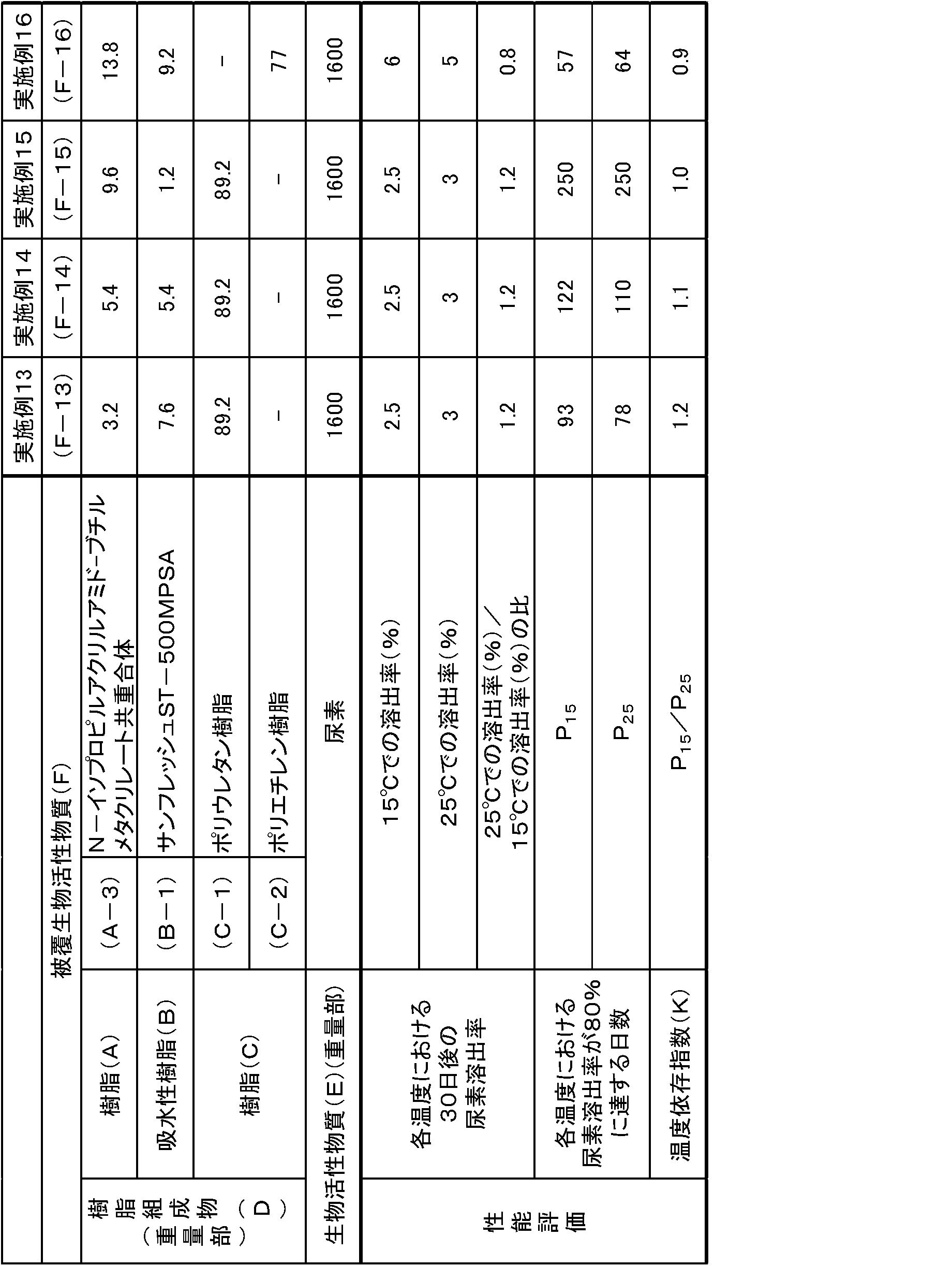
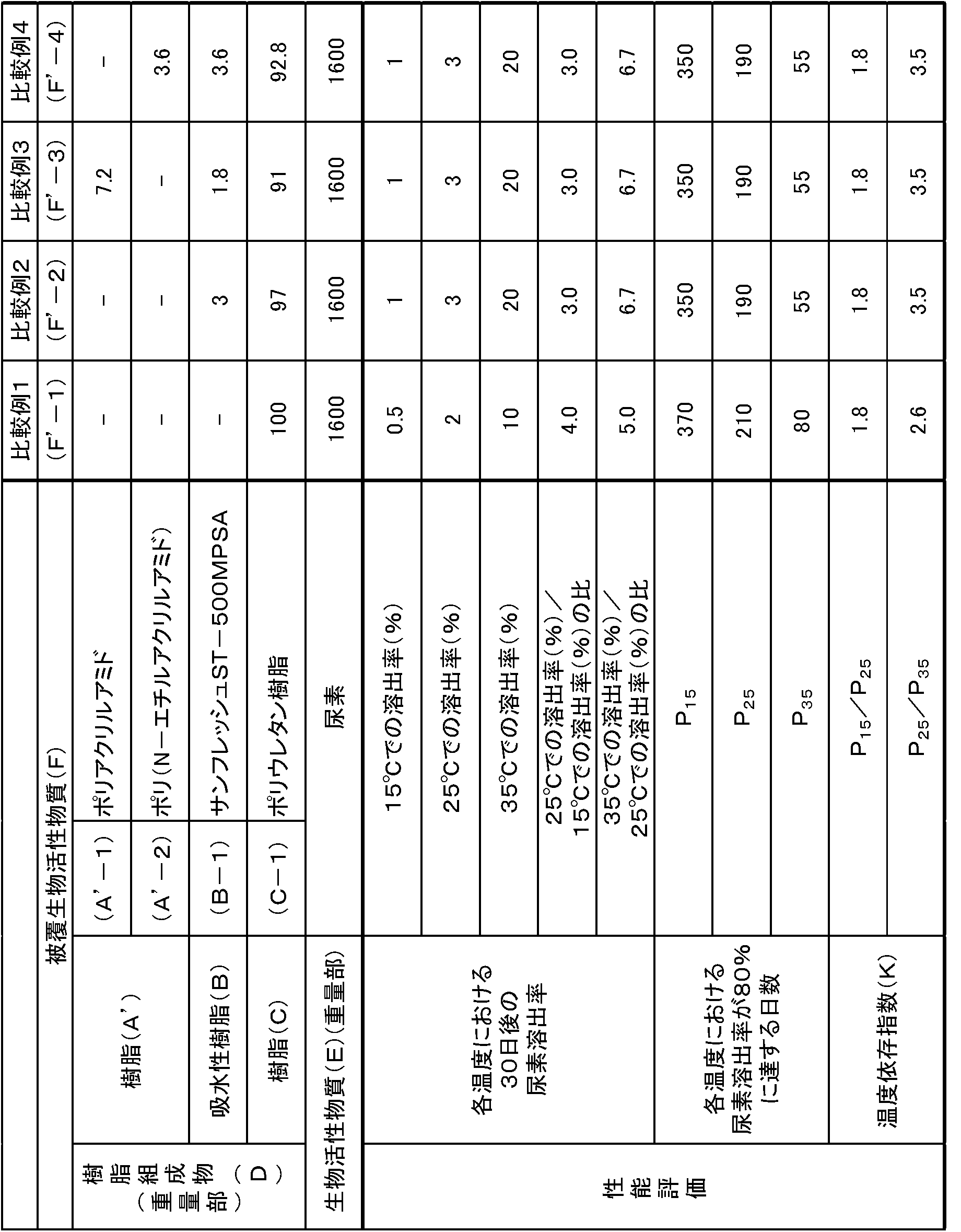
表1~3から明らかなように、実施例1~12で得られた被覆生物活性物質は比較例1~4の被覆生物活性物質に比べ、25℃と35℃の生物活性物質(E)の溶出速度比がはるかに1に近いので、この温度範囲内において温度に依存せずに同等の速度で肥料などの生物活性物質を放出できると考えられる。
実施例13~16で得られた被覆生物活性物質は比較例1~4の被覆生物活性物質に比べ、15℃と25℃の溶出速度比が1に近いので、この温度範囲内において温度に依存せずに同等の速度で肥料などの生物活性物質を放出できると考えられる。
実施例13~16で得られた被覆生物活性物質は比較例1~4の被覆生物活性物質に比べ、15℃と25℃の溶出速度比が1に近いので、この温度範囲内において温度に依存せずに同等の速度で肥料などの生物活性物質を放出できると考えられる。
本発明の被覆された生物活性物質、具体的には肥料や農薬は、温度変化の大きい環境下であっても、作物に対して安定的に肥料や農薬の有効成分を供給し、生育と収量の向上をもたらす。
Claims (14)
- 肥料及び農薬からなる群より選ばれる1種類以上である生物活性物質(E)の粒子が、樹脂組成物(D)で被覆された被覆生物活性物質であって、前記樹脂組成物(D)が、水に対する下限臨界溶液温度(LCST)が10~40℃の範囲にある温度応答性樹脂(A)と、吸水性樹脂(B)とを構成成分として含む組成物である被覆生物活性物質(F)。
- 前記樹脂組成物(D)に含まれる前記温度応答性樹脂(A)と、前記吸水性樹脂(B)との重量比率(A)/(B)が30/70~97/3である請求項1に記載の被覆生物活性物質。
- 下記式(1)によって算出される温度依存指数(K1)が0.5~2.0である請求項1又は2に記載の被覆生物活性物質。
式(1)
K1= P25/P35
[P25:温度25℃の水中における生物活性物質(E)の溶出率が80%に達する日数、
P35:温度35℃の水中における生物活性物質(E)の溶出率が80%に達する日数] - 前記温度応答性樹脂(A)が、構成単量体としてN-アルキル(メタ)アクリルアミド(a1)及び/又はN-ビニルアルキルアミド(a2)と、架橋剤(c)とを含み(メタ)アクリル酸(塩)(b)を構成単量体として含まない樹脂(A1)であり、
前記吸水性樹脂(B)が、構成単量体として(メタ)アクリル酸(塩)(b)と架橋剤(c)とを含みN-アルキル(メタ)アクリルアミド(a1)を構成単量体として含まない樹脂(B1)である請求項1~3いずれかに記載の被覆生物活性物質。 - 前記吸水性樹脂(B)の構成単量体中の(メタ)アクリル酸(塩)(b)の構成比率が95~99.99モル%である請求項4に記載の被覆生物活性物質。
- 前記温度応答性樹脂(A)の構成単量体のN-アルキル(メタ)アクリルアミド(a1)が、N-イソプロピルアクリルアミドである請求項4又は5に記載の被覆生物活性物質。
- 下記式(2)によって算出される温度依存指数(K2)が0.5~2.0である請求項1又は2に記載の被覆生物活性物質。
式(2)
K2= P15/P25
[P15:温度15℃の水中における生物活性物質(E)の溶出率が80%に達する日数、
P25:温度25℃の水中における生物活性物質(E)の溶出率が80%に達する日数] - 前記温度応答性樹脂(A)が、構成単量体としてN-アルキル(メタ)アクリルアミド(a1)及び/若しくはN-ビニルアルキルアミド(a2)と、(メタ)アクリル酸アルキルエステル(h)と、架橋剤(c)とを含む樹脂(A2)、及び/又は、構成単量体としてN-アルキル(メタ)アクリルアミド(a1)及び/若しくはN-ビニルアルキルアミド(a2)と、(メタ)アクリル酸アルキルエステル(h)と、架橋剤(c)と、(メタ)アクリル酸(塩)(b)とを含み、構成単量体中の(メタ)アクリル酸(塩)(b)の構成比率が5モル%未満である樹脂(A3)であり、
吸水性樹脂(B)が、構成単量体として(メタ)アクリル酸(塩)(b)と架橋剤(c)とを含む樹脂(B2)である請求項1、2及び7のいずれかに記載の被覆生物活性物質。 - 前記N-アルキル(メタ)アクリルアミド(a1)及び/又はN-ビニルアルキルアミド(a2)が、N-アルキル(メタ)アクリルアミド(a1)であり、
温度応答性樹脂(A)の構成単量体中のN-アルキル(メタ)アクリルアミド(a1)と(メタ)アクリル酸アルキルエステル(h)のモル比率(a1)/(h)が85/15~95/5である請求項8に記載の被覆生物活性物質。 - 前記吸水性樹脂(B)の構成単量体中の(メタ)アクリル酸(塩)(b)の構成比率が95~99.99モル%である請求項8又は9に記載の被覆生物活性物質。
- 前記温度応答性樹脂(A)の構成単量体のN-アルキル(メタ)アクリルアミド(a1)が、N-イソプロピルアクリルアミドである請求項8~10いずれかに記載の被覆生物活性物質。
- 前記温度応答性樹脂(A)の含有量が前記樹脂組成物(D)の重量に基づいて1~30重量%である請求項1~11いずれかに記載の被覆生物活性物質。
- 前記樹脂組成物(D)がポリウレタン樹脂、ポリエチレン樹脂及びアルキド樹脂からなる群より選ばれる1種類以上の樹脂(C)を含む、請求項1~12いずれかに記載の被覆生物活性物質。
- 生物活性物質(E)の粒子の個数平均粒子径が0.3~15mmである請求項1~13いずれかに記載の被覆生物活性物質。
Priority Applications (1)
| Application Number | Priority Date | Filing Date | Title |
|---|---|---|---|
| JP2020535897A JP7399860B2 (ja) | 2018-08-10 | 2019-08-09 | 被覆生物活性物質 |
Applications Claiming Priority (4)
| Application Number | Priority Date | Filing Date | Title |
|---|---|---|---|
| JP2018151065 | 2018-08-10 | ||
| JP2018-151065 | 2018-08-10 | ||
| JP2018170130 | 2018-09-12 | ||
| JP2018-170130 | 2018-09-12 |
Publications (1)
| Publication Number | Publication Date |
|---|---|
| WO2020032224A1 true WO2020032224A1 (ja) | 2020-02-13 |
Family
ID=69414144
Family Applications (1)
| Application Number | Title | Priority Date | Filing Date |
|---|---|---|---|
| PCT/JP2019/031543 Ceased WO2020032224A1 (ja) | 2018-08-10 | 2019-08-09 | 被覆生物活性物質 |
Country Status (2)
| Country | Link |
|---|---|
| JP (1) | JP7399860B2 (ja) |
| WO (1) | WO2020032224A1 (ja) |
Cited By (2)
| Publication number | Priority date | Publication date | Assignee | Title |
|---|---|---|---|---|
| JP2024162106A (ja) * | 2023-05-09 | 2024-11-21 | 三洋化成工業株式会社 | リン酸可溶化剤及び土壌改良方法 |
| KR20250172806A (ko) | 2023-04-19 | 2025-12-09 | 후소카가쿠코교 가부시키가이샤 | 농업용 조성물 및 농업용 수성 분산액 |
Citations (6)
| Publication number | Priority date | Publication date | Assignee | Title |
|---|---|---|---|---|
| JPH1077201A (ja) * | 1996-09-03 | 1998-03-24 | M & M Kenkyusho:Kk | 植物体コーティング剤およびコーティング方法 |
| JP2000007736A (ja) * | 1998-06-18 | 2000-01-11 | Nippon Chem Ind Co Ltd | 抗菌感温性吸水性樹脂およびその製造方法 |
| JP2004307523A (ja) * | 2003-02-19 | 2004-11-04 | Ajinomoto Co Inc | 温度応答性生分解性ゲル |
| JP2006273773A (ja) * | 2005-03-30 | 2006-10-12 | Yasuo Hatate | カプセル壁材に温度応答機能を付与することにより内包した油溶性昆虫フェロモンを蒸散コントロール可能なマイクロカプセル |
| JP2007514518A (ja) * | 2003-10-02 | 2007-06-07 | トラスティーズ オブ スティーヴンス インスティチュート オブ テクノロジー | 水素結合によって結合した多層中性ポリマーフィルムのカプセル |
| JP2008001550A (ja) * | 2006-06-21 | 2008-01-10 | Chisso Asahi Hiryo Kk | 被覆粒状肥料 |
-
2019
- 2019-08-09 JP JP2020535897A patent/JP7399860B2/ja active Active
- 2019-08-09 WO PCT/JP2019/031543 patent/WO2020032224A1/ja not_active Ceased
Patent Citations (6)
| Publication number | Priority date | Publication date | Assignee | Title |
|---|---|---|---|---|
| JPH1077201A (ja) * | 1996-09-03 | 1998-03-24 | M & M Kenkyusho:Kk | 植物体コーティング剤およびコーティング方法 |
| JP2000007736A (ja) * | 1998-06-18 | 2000-01-11 | Nippon Chem Ind Co Ltd | 抗菌感温性吸水性樹脂およびその製造方法 |
| JP2004307523A (ja) * | 2003-02-19 | 2004-11-04 | Ajinomoto Co Inc | 温度応答性生分解性ゲル |
| JP2007514518A (ja) * | 2003-10-02 | 2007-06-07 | トラスティーズ オブ スティーヴンス インスティチュート オブ テクノロジー | 水素結合によって結合した多層中性ポリマーフィルムのカプセル |
| JP2006273773A (ja) * | 2005-03-30 | 2006-10-12 | Yasuo Hatate | カプセル壁材に温度応答機能を付与することにより内包した油溶性昆虫フェロモンを蒸散コントロール可能なマイクロカプセル |
| JP2008001550A (ja) * | 2006-06-21 | 2008-01-10 | Chisso Asahi Hiryo Kk | 被覆粒状肥料 |
Cited By (2)
| Publication number | Priority date | Publication date | Assignee | Title |
|---|---|---|---|---|
| KR20250172806A (ko) | 2023-04-19 | 2025-12-09 | 후소카가쿠코교 가부시키가이샤 | 농업용 조성물 및 농업용 수성 분산액 |
| JP2024162106A (ja) * | 2023-05-09 | 2024-11-21 | 三洋化成工業株式会社 | リン酸可溶化剤及び土壌改良方法 |
Also Published As
| Publication number | Publication date |
|---|---|
| JPWO2020032224A1 (ja) | 2021-08-10 |
| JP7399860B2 (ja) | 2023-12-18 |
Similar Documents
| Publication | Publication Date | Title |
|---|---|---|
| US5129180A (en) | Temperature sensitive seed germination control | |
| EA026063B1 (ru) | Сополимер, синтезированный из по меньшей мере трех различных моноэтиленненасыщенных мономеров | |
| KR100362798B1 (ko) | 피복농약입제,이의제조방법및이의용도 | |
| BRPI0917068B1 (pt) | Processo para preparação de copolímeros com radicais aleatórios, copolímero com radicais aleatórios, processo para preparação de uma composição de substância agroquimicamente ativa, composição de substância agroquimicamente ativa e método para controle de organismos daninhos | |
| JP7399860B2 (ja) | 被覆生物活性物質 | |
| KR100481269B1 (ko) | 벼종자처리용조성물 | |
| JP7419083B2 (ja) | 被覆型農林園芸用粒状薬剤 | |
| JPS61209507A (ja) | 乾燥被膜により被覆された種子 | |
| JP4889894B2 (ja) | 被覆生物活性物質、生物活性物質組成物、および作物の栽培方法 | |
| KR102647453B1 (ko) | 코팅 벼 종자 및 그 제조 방법 | |
| JPH06239709A (ja) | S−ベンジルチオールカーバメートおよびその稲田における雑草抑制剤としての使用 | |
| US20200208053A1 (en) | Method for reducing water stress in plants | |
| JP2004224609A (ja) | 被覆生物活性物質粒子 | |
| EP0312763A1 (en) | Methods and compositions for protecting crop plants from undesirable effects of insecticidal compounds and herbicidal compounds | |
| CN101151291B (zh) | 聚合物组合物及其在制备活性或有效成分组合物中的用途 | |
| JPS58124707A (ja) | 除草剤 | |
| JP4617530B2 (ja) | 固形農薬組成物 | |
| US5102447A (en) | Methods and compositions for protecting crop plants from undesirable effects of insecticidal compounds | |
| JP3621127B2 (ja) | 改良農薬製剤 | |
| US3977861A (en) | Herbicide composition | |
| JP4736567B2 (ja) | 生物活性物質含有被覆粒状物の製造方法 | |
| JPS6157504A (ja) | 放出速度制御製剤およびその用途 | |
| JPS60260502A (ja) | 除草剤の薬害軽減方法及び組成物 | |
| JPH08133914A (ja) | 改良された農薬粒剤 | |
| JP3669054B2 (ja) | 被覆除草粒剤混合物およびその使用方法 |
Legal Events
| Date | Code | Title | Description |
|---|---|---|---|
| 121 | Ep: the epo has been informed by wipo that ep was designated in this application |
Ref document number: 19846188 Country of ref document: EP Kind code of ref document: A1 |
|
| ENP | Entry into the national phase |
Ref document number: 2020535897 Country of ref document: JP Kind code of ref document: A |
|
| NENP | Non-entry into the national phase |
Ref country code: DE |
|
| 122 | Ep: pct application non-entry in european phase |
Ref document number: 19846188 Country of ref document: EP Kind code of ref document: A1 |