WO2020022490A1 - ロールインマーガリン、その製造方法、及び層状食品 - Google Patents
ロールインマーガリン、その製造方法、及び層状食品 Download PDFInfo
- Publication number
- WO2020022490A1 WO2020022490A1 PCT/JP2019/029463 JP2019029463W WO2020022490A1 WO 2020022490 A1 WO2020022490 A1 WO 2020022490A1 JP 2019029463 W JP2019029463 W JP 2019029463W WO 2020022490 A1 WO2020022490 A1 WO 2020022490A1
- Authority
- WO
- WIPO (PCT)
- Prior art keywords
- oil
- margarine
- roll
- danish
- fat
- Prior art date
- Legal status (The legal status is an assumption and is not a legal conclusion. Google has not performed a legal analysis and makes no representation as to the accuracy of the status listed.)
- Ceased
Links
Classifications
-
- A—HUMAN NECESSITIES
- A21—BAKING; EDIBLE DOUGHS
- A21D—TREATMENT OF FLOUR OR DOUGH FOR BAKING, e.g. BY ADDITION OF MATERIALS; BAKING; BAKERY PRODUCTS
- A21D13/00—Finished or partly finished bakery products
- A21D13/10—Multi-layered products
- A21D13/16—Multi-layered pastry, e.g. puff pastry; Danish pastry or laminated dough
-
- A—HUMAN NECESSITIES
- A23—FOODS OR FOODSTUFFS; TREATMENT THEREOF, NOT COVERED BY OTHER CLASSES
- A23D—EDIBLE OILS OR FATS, e.g. MARGARINES, SHORTENINGS OR COOKING OILS
- A23D7/00—Edible oil or fat compositions containing an aqueous phase, e.g. margarines
-
- A—HUMAN NECESSITIES
- A23—FOODS OR FOODSTUFFS; TREATMENT THEREOF, NOT COVERED BY OTHER CLASSES
- A23D—EDIBLE OILS OR FATS, e.g. MARGARINES, SHORTENINGS OR COOKING OILS
- A23D7/00—Edible oil or fat compositions containing an aqueous phase, e.g. margarines
- A23D7/02—Edible oil or fat compositions containing an aqueous phase, e.g. margarines characterised by the production or working-up
- A23D7/04—Working-up
Definitions
- the present invention relates to roll-in margarine, a method for producing the same, and a layered food using the roll-in margarine.
- Roll-in margarine in sheet form is used in the production of layered foods such as danish and croissant.
- Roll-in margarine is layered on dough, folded, stretched and fired to produce layered food.
- the amount of roll-in margarine required at that time is generally as large as 40 to 50 parts by weight based on 100 parts by weight of the dough flour.
- low calorie foods have tended to be favored due to consumers' health consciousness, and therefore the use of roll-in margarine has also tended to be reduced.
- Patent Literature 1 a fat and oil composition is passed through a quenching and kneading machine to crystallize the fat and oil, and then the roll is rolled and molded before the crystal grows and forms a network structure of the crystal.
- a method for making margarine is disclosed.
- Patent Document 1 According to the method described in Patent Document 1, it is possible to stably produce a thin roll-in margarine, but in addition to poor productivity because it is rolled out of the quenching and kneading machine and rolled out, There was also a problem that thin roll-in margarine was difficult to package.
- An object of the present invention is to provide a thin roll-in margarine that can be manufactured stably and with high productivity in view of the above-mentioned current situation, has good workability at the time of producing a layered food using the same, and has a small amount of end dough,
- An object of the present invention is to provide a roll-in margarine which can form a layer well in a prepared layered food and achieve good floating, and a method for producing the same. It is still another object of the present invention to provide a layered food product having a good layer and good floating, despite the low content of fats and oils derived from roll-in margarine.
- the present inventors have conducted intensive studies to solve the above problems, and as a result, the water-in-oil emulsified oil / fat composition in which the oil / fat is in a molten state is cooled to a specific temperature range, held for a specific time, and then crystallized. And then heated to a specific temperature range while softening by mixing, filling the pillow packaging with the fluid water-in-oil emulsified oil / fat composition by adjusting the viscosity to a specific value so as to have a specific thickness.
- the sheet After forming into a roll, the sheet is allowed to stand at a specific temperature for a specific time, whereby a roll-in margarine having a sheet thickness smaller than that of a normal roll-in margarine can be obtained stably and with high productivity, and a layered food is formed using the roll-in margarine. It has been found that workability is good when it is produced, the amount of end dough is small, the layered food produced has good layers, and good floating can be achieved, and the present invention has been completed.
- a first aspect of the present invention is that a water-in-oil type emulsified fat / oil composition in a state where a fat / oil is melted is cooled to 0 to 25 ° C., kept at the temperature for 10 to 300 seconds, crystallized, and then mixed. While being softened, the temperature is raised to 10 to 35 ° C., and the fluid water-in-oil type emulsified fat / oil composition whose viscosity is adjusted to 10 to 250 Pa ⁇ s is filled in a pillow package, and has a thickness of 2 to 7 mm.
- the present invention relates to a pillow-packaged roll-in margarine which has been formed into a sheet and left to stand at ⁇ 30 ° C.
- the fluid water-in-oil type emulsified fat / oil composition filled in a pillow package is pressed between two flat plates and formed into a sheet having a thickness of 2 to 7 mm.
- the second aspect of the present invention is to cool the water-in-oil emulsified oil / fat composition in a state where the oil / fat is melted, cool to 0 to 25 ° C., hold the temperature for 10 to 300 seconds, crystallize, and then soften by mixing.
- the temperature was raised to 10 to 35 ° C. while adjusting the viscosity to 10 to 250 Pa ⁇ s.
- the adjusted water-in-oil emulsified fat / oil composition was filled in a pillow package, and the thickness was 2 to 7 mm.
- the present invention relates to a method for producing roll-in margarine, characterized in that the method is rolled into a sheet, molded, and allowed to stand at ⁇ 30 ° C. to 30 ° C.
- the content of palm oil and / or fractionated palm oil in the whole roll-in margarine fat is 50 to 95% by weight
- the water-in-oil emulsified fat / oil composition in a state where the fat / oil is melted is 0 to 95% by weight.
- the viscosity was adjusted to 10 to 250 Pa ⁇ s
- the adjusted water-in-oil type emulsified fat and oil composition was filled in a pillow package, and rolled into a sheet having a thickness of 2 to 7 mm.
- the substrate is subjected to a tempering treatment at a temperature of 15 to 30 ° C. for 10 to 100 hours, and then left at ⁇ 30 ° C. to 30 ° C. for 24 hours or more.
- the third aspect of the present invention relates to a layered food using the roll-in margarine according to the first aspect of the present invention.
- a thin roll-in margarine that can be manufactured stably and with high productivity, has good workability when producing a layered food using the same, has a small amount of end dough, and has a small thickness.
- a roll-in margarine capable of achieving a good float by forming a layer, and a method for producing the same. Furthermore, it is possible to provide a layered food having a good layer and good floating, despite the low content of oils and fats derived from roll-in margarine.
- the roll-in margarine of the present invention crystallizes a water-in-oil emulsified oil / fat composition in a specific state by lowering the temperature to a specific temperature range, holding it for a specific time, crystallizing, and then softening by mixing. After raising the temperature to the temperature range, adjusting the viscosity to a specific value, filling the pillow packaging with the fluidized water-in-oil emulsified fat / oil composition, molding it to a specific thickness, and then allowing it to stand at a specific temperature for a specific time
- the roll-in margarine is characterized in that it has a small thickness.
- the water-in-oil type emulsified oil / fat composition refers to an emulsion in which an aqueous phase is dispersed in an oil phase.
- the amount of the oil phase in the whole oil / fat composition is 30 to 99.5% by weight, Is from 0.5 to 70% by weight.
- the roll-in margarine of the present invention is obtained by crystallizing the water-in-oil type emulsified fat or oil composition into a solid, and, like the water-in-oil type emulsified fat / oil composition, the amount of the oil phase in the roll-in margarine. Is 30 to 99.5% by weight, and the amount of the aqueous phase is 0.5 to 70% by weight. Therefore, the roll-in margarine referred to in the present invention includes margarine having an oil content of more than 80% and fat spread having an oil content of less than 80%.
- the fats and oils contained in the water-in-oil type emulsified fat and oil composition are not particularly limited as long as they are generally used for roll-in margarine.
- One type may be used alone, or two or more types may be used in combination.
- palm oil and / or fractionated palm oil be contained in the whole fat and oil in an amount of 50 to 95% by weight, and it is more preferable that palm oil be contained in the whole oil and fat in an amount of 50 to 95% by weight.
- the fractionated palm oil is an oil or fat that is separated from palm oil as a raw material, such as palm stearin, palm hard stearin, palm olein, palm double olein, palm super olein, palm top olein, and palm melting point. Is mentioned.
- the water-in-oil emulsified oil / fat composition may appropriately contain components which can be usually added to roll-in margarine, in addition to the oil / fat and water.
- Such components include, for example, emulsifiers, flavors, antioxidants, coloring agents, sugars, salt, thickeners, sweeteners, sour agents, taste materials and the like.
- emulsifier examples include soybean lecithin, egg yolk lecithin, glycerin fatty acid ester, polyglycerin fatty acid ester, sorbitan fatty acid ester, and sucrose fatty acid ester.
- Examples of the flavor include butter flavor, milk flavor and the like.
- antioxidants examples include tocopherol, ⁇ -carotene, tea extract (catechin and the like) and the like.
- coloring agent examples include ⁇ -carotene, caramel, and red yeast dye.
- saccharide examples include sugar, fructose, glucose, starch syrup, reduced starch syrup, honey, isomerized sugar, invert sugar, oligosaccharide, trehalose, sugar alcohol, and the like.
- thickening stabilizer examples include guar gum, locust bean gum, carrageenan, gum arabic, alginic acids, pectin, xanthan gum, agar, glucomannan, gelatin, starch and the like.
- sweetener examples include aspartame, acesulfame potassium, sucralose, alitame, neotame, licorice extract (glycyrrhizin), saccharin, saccharin sodium, stevia extract, stevia powder and the like.
- Examples of the acidulant include acetic acid, lactic acid, and gluconic acid.
- Examples of the taste material include dairy products, flavor extracts, and other ingredients having a taste, excluding the sugars, the sweetener, and the sour agent.
- Examples of the dairy products include whole milk powder, skim milk powder, condensed milk powder, heat-treated and enzymatically processed milk fat, milk, sweetened condensed milk, fermented milk, fresh cream, cheese and the like.
- Examples of the flavor extracts include kelp extract, fermented seasoning and the like.
- Examples of the other ingredients having a taste include egg yolk, whole eggs, coffee, cacao ingredients, matcha, green tea, bean jam, fruit juice, pulp, vegetable paste, powdered vegetables, and the like.
- the water-in-oil type emulsified fat / oil composition in which the fat / oil is melted is cooled to a specific temperature.
- the water-in-oil emulsified fat / oil composition in a state where the fat / oil is melted is prepared by heating and melting the fat / oil, and adding an oil-soluble component such as an emulsifier, if necessary, to the oil phase. It is prepared by adding water and, if necessary, water-soluble components such as salt, flavors and flavoring materials, and adding a stirred aqueous phase, and emulsifying while maintaining the molten state of fats and oils.
- the sterilization method may be a batch type in a tank or a continuous type using a plate type heat exchanger or a scraping type heat exchanger.
- a cooling device such as a closed type continuous tube cooler that is a margarine manufacturing machine such as a votator, a combinator, and a perfector, a plate-type heat exchanger, and a combination of an open-type diacooler and a complexor.
- a cooling kneading device may be used.
- the minimum temperature of the water-in-oil emulsified oil / fat composition upon cooling is preferably 0 to 25 ° C, more preferably 1 to 20 ° C, and still more preferably 5 to 15 ° C.
- water in the water-in-oil type emulsified oil / fat composition may freeze and damage the equipment. If the minimum temperature at the time of cooling is higher than 25 ° C., the oil / fat does not sufficiently crystallize. In a layered food product, there is a case where a sufficient gap is not formed between the layers, and the floating is poor.
- the cooling rate for cooling is not particularly limited, but a cooling rate of ⁇ 10 to ⁇ 100 ° C./min is preferable.
- the water-in-oil emulsified oil / fat composition cooled as described above is crystallized while being kept in a predetermined temperature zone in the apparatus used for cooling.
- the temperature range to be maintained is preferably from 0 to 25 ° C, more preferably from 1 to 20 ° C, still more preferably from 5 to 15 ° C.
- the time held in the temperature zone for crystallization (hereinafter, also referred to as cooling holding time) is from the time when the temperature of the water-in-oil type emulsified fat / oil composition reaches 25 ° C.
- the time until the water-in-oil type emulsified oil / fat composition is carried out from the device used for cooling preferably from 10 to 300 seconds, more preferably from 20 to 200 seconds, and more preferably from 30 to 300 seconds. More preferred is 150 seconds. If the cooling holding time is less than 10 seconds, the fats and oils do not sufficiently crystallize, the roll-in margarine does not uniformly spread during the production of the layered food, and the workability is poor.
- the float may be poor, and if it exceeds 300 seconds, the kneading of the water-in-oil type emulsified oil / fat composition by the device used for cooling becomes excessive, and the hardness and stiffness of the obtained roll-in margarine are reduced. May be inferior.
- the minimum temperature during cooling is 10 to 20 ° C.
- the cooling holding time is It is preferably for 10 to 100 seconds.
- the minimum temperature during cooling is 5 to 15 ° C.
- the cooling holding time is It is preferably for 30 to 150 seconds.
- the water-in-oil type emulsified fat / oil composition crystallized by the cooling is heated to a specific temperature while being softened by mixing using a mixing heating device.
- the mixing and heating device include a scraping heat exchanger such as an onlator, a multi-tube cylindrical heat exchanger, a heat exchanger with a built-in static mixer, and a pin machine.
- a closed type continuous tube cooler, or cooling may be performed again using a cooling device or a cooling kneading device. The recooling is performed within a range that satisfies the viscosity of the emulsified oil / fat composition.
- the temperature of the water-in-oil type emulsified fat / oil composition after the temperature is raised by the mixing temperature raising device is higher than the temperature maintained for the above-mentioned crystallization, and is preferably from 10 to 35 ° C, more preferably from 15 to 30 ° C. Is more preferable, and 20 to 25 ° C. is still more preferable. Also, after passing through the mixing and heating device, when the cooling is performed again using a closed-type continuous tube cooler or a cooling device or a cooling kneading device, the water-in-oil emulsified fat / oil composition after recooling is also used.
- Is higher than the temperature maintained for the above-mentioned crystallization and is preferably from 10 to 35 ° C, more preferably from 15 to 30 ° C, even more preferably from 20 to 25 ° C. If the temperature of the water-in-oil type emulsified fat composition after heating or re-cooling is less than 10 ° C, the viscosity at the time of filling is too high or the viscosity is increased during filling, and the viscosity increases. In some cases, cracks or air holes may occur during molding. On the other hand, when the temperature exceeds 35 ° C., most of the crystals may be melted, the aqueous phase may be separated after filling, or physical properties unsuitable for roll-in margarine may occur.
- the viscosity of the water-in-oil type emulsified fat / oil composition after the temperature is raised by the mixing temperature raising device is preferably from 10 to 250 Pa ⁇ s, more preferably from 20 to 200 Pa ⁇ s, even more preferably from 50 to 150 Pa ⁇ s. If it is less than 10 Pa ⁇ s, a sufficient gap is not formed between each layer in the prepared layered food, and the float may be poor. If it exceeds 250 Pa ⁇ s, roll-in margarine is produced stably and with high productivity. It may not be possible.
- the viscosity can be controlled by changing the shear by the mixing heating device. The viscosity can be measured according to a standard method using a viscometer, a rotary viscometer, a falling ball viscometer, a capillary viscometer, or the like.
- the viscosity of the water-in-oil type emulsified fat / oil composition after heating by the mixing temperature raising device is within the above range, the penetration value of the water-in-oil type emulsified fat / oil composition at the time of filling in a pillow package described below is obtained. Since it is 140 to 460, the pene value of the roll-in margarine at the time of folding is easily controlled to 50 to 130, which is preferable.
- a pillow package is filled with a fluid water-in-oil emulsified oil / fat composition having a viscosity within the above range.
- the pillow packaging means a packaging film processed into a bag shape having an opening, filled with contents, and the opening is closed to package the contents.
- the pillow package preferably has easy peelability in order to achieve both sealing performance and openability.
- the opening of the pillow package is closed immediately after the fluid water-in-oil emulsified oil / fat composition is charged from the opening of the pillow package and filled in the pillow package.
- a method of closing the opening of the pillow package include a method such as heat sealing, chucking, and clipping.
- the fluidized water-in-oil type emulsified fat / oil composition is rolled into a sheet together with pillow packaging to form a desired thickness.
- the molding method after filling the pillow packaging with the fluid water-in-oil emulsified oil / fat composition, the whole pillow packaging is rolled, so that in the roll-in margarine of the present invention produced, the packaging constituting the pillow packaging The inner surface of the film will be in close contact with the surface of the roll-in margarine in the pillow package.
- the water-in-oil type emulsified fat / oil composition filled in the pillow package is sandwiched between two flat plates having (1) an appropriate clearance. And (3) adjusting the inner volume relative to the bag capacity, and then vibrating to naturally adjust the thickness, and the like.
- the pillow-packaged sheet-like water-in-oil emulsified fat / oil composition is allowed to stand at a specific temperature for a specific time or more, whereby the pillow-packaged roll-in margarine of the present invention is produced.
- the oil-and-fat emulsified oil-and-fat composition is allowed to stand still under specific conditions as described above, the crystallization of the oil and fat in the water-in-oil emulsified fat and oil composition is advanced and the crystals are stabilized, whereby the production of roll-in margarine can be realized.
- the temperature at the time of standing is preferably ⁇ 30 to 30 ° C., more preferably ⁇ 20 to 25 ° C., and still more preferably 0 to 10 ° C. If the temperature is lower than ⁇ 30 ° C., it is disadvantageous in terms of storage cost. If the temperature is higher than 30 ° C., roll-in margarine does not easily spread at the time of producing a layered food, and the workability is poor. A gap may not be formed, lifting may be poor, and roll-in margarine may be oil-immersed or deformed.
- the standing time is 24 hours or more. When the time is less than 24 hours, the crystals of the fat or oil do not sufficiently precipitate or are not stable, and the physical properties of the produced roll-in margarine become insufficient. It may not be formed and lifting may be poor.
- the upper limit of the standing time is preferably two years from the viewpoint of storage cost, but is not particularly limited to this.
- the sheet thickness of the roll-in margarine is preferably 2 to 7 mm, more preferably 2 to 6 mm, and still more preferably 2 to 5 mm. If the sheet thickness is less than 2 mm, the roll-in margarine may be broken when the sheet is taken out of the pillow package. When the thickness exceeds 7 mm, when the amount of roll-in margarine is reduced to produce a layered food, roll-in margarine does not sufficiently expand, and many end doughs in which roll-in margarine is not sandwiched between doughs may occur. .
- the occurrence rate of product defects such as waving or uneven shape and thickness is 5% or less.
- the content of palm oil and / or fractionated oil of palm oil is 50 to 95% by weight in the whole fats and oils contained in the roll-in margarine, and the oils and fats are in a water-in-oil state in a molten state.
- the emulsified oil or fat composition is cooled to a temperature within a specific temperature range and a specific range lower than the melting point of the oil phase of the oil or fat composition, crystallized, and then softened by mixing.
- the viscosity is adjusted to a specific range, and a fluid water-in-oil type emulsified oil / fat composition is filled into a pillow package while maintaining the viscosity, and is rolled into a sheet to have the desired thickness.
- the device After performing the tempering process at a specific temperature for a specific time, the device is allowed to stand still for a specific time in a specific temperature range lower than the tempering temperature.
- the minimum temperature during cooling is preferably in the range of 0 to 25 ° C. and 15 to 40 ° C. lower than the melting point of the oil phase, and 20 to 40 ° C. lower than the melting point of the oil phase.
- a temperature lower by 0 ° C. is more preferable, a temperature lower by 25 to 40 ° C. than the melting point of the oil phase part is still more preferable, and a temperature lower by 25 to 35 ° C. than the melting point of the oil phase part is particularly preferable.
- water in the water-in-oil type emulsified oil / fat composition may freeze and damage the equipment, and if the minimum temperature during cooling exceeds 25 ° C., the oil / fat does not sufficiently crystallize and is produced.
- the oil In a layered food product, there is a case where a sufficient gap is not formed between the layers, and the floating is poor. If the oil is cooled only to a temperature not lower than 15 ° C. from the melting point of the oil phase, the fat or oil may not sufficiently crystallize. May be too costly.
- the cooling rate during cooling is preferably from -20 to -110 ° C / min.
- the temperature of the water-in-oil type emulsified fat / oil composition after cooling again using the apparatus, the viscosity of the water-in-oil type emulsified fat / oil composition heated while being softened, the sheet thickness after rolling into a sheet, etc. Is the same as described above.
- the tempering treatment is preferably performed at 15 to 30 ° C. for 10 to 100 hours.
- the tempering temperature is more preferably from 18 to 27 ° C, even more preferably from 20 to 25 ° C. If the temperature at the time of tempering is less than 15 ° C., a sufficient tempering effect cannot be obtained, so that the physical properties of the roll-in margarine may be insufficiently improved by the tempering treatment. If the temperature exceeds 30 ° C., the roll-in margarine is required. Because of the above softening or oil immersion, the quality of roll-in margarine may deteriorate.
- the tempering time is more preferably from 18 to 72 hours, even more preferably from 24 to 48 hours. If the time is less than 10 hours, the tempering effect may not be sufficiently obtained. On the other hand, if the tempering is performed for more than 100 hours, the effect may reach a plateau and the productivity may decrease.
- the temperature during standing is preferably ⁇ 30 to 25 ° C., more preferably ⁇ 20 to 25 ° C., and even more preferably 0 to 10 ° C. If the temperature is lower than ⁇ 30 ° C., it is disadvantageous in terms of storage cost. If the temperature is higher than 25 ° C., roll-in margarine does not easily spread at the time of producing a layered food, and the workability is poor. A gap may not be formed and lifting may be poor.
- the standing time is preferably 24 hours or more.
- the upper limit of the standing time is preferably two years from the viewpoint of storage cost, but is not particularly limited to this.
- the roll-in margarine of the present invention can be used for preparing a layered food by wrapping in a dough, stretching and then baking, like roll-in margarine produced by a conventional production method.
- the layered food includes, for example, Danish, croissant, pie, etc., but is not particularly limited.
- the amount of the roll-in margarine of the present invention in the layered food varies depending on the type of the layered food to be produced, and is not particularly limited as long as the effects of the present invention are exhibited. However, when the roll-in margarine of the present invention is used, the amount of the roll-in margarine in the layered food can be reduced, and despite the low content of the fat or oil derived from the roll-in margarine, the layer comes out well to give a good float. A layered food having the same can be produced. Specifically, the amount of the roll-in margarine of the present invention is preferably 15 to 40% by weight based on the total amount of the raw materials for the layered food.
- the method for producing the layered food of the present invention is not particularly limited, and a known blending method and a known method can be adopted using a known raw material except for using the roll-in margarine of the present invention.
- productivity-related time The productivity of roll-in margarine is from 200 kg of emulsified matter in which oils and fats are melted to a closed-type continuous tube cooler, until 100 kg of the emulsion is discharged from a mixing heater or molding nozzle.
- productivity-related time was evaluated according to the following criteria. :: Time related to productivity is less than 90 minutes. ⁇ : Time related to productivity is 90 to 120 minutes. ⁇ : Time related to productivity exceeds 120 minutes.
- the edge fabric refers to a region where the roll-in margarine does not extend and is not sandwiched between the fabrics.
- 5 points The end fabric area generated when the fabric is stretched to a thickness of 4 mm in the first folding is less than 5% of the entire fabric area.
- 4 points The end dough area generated when the dough is stretched to a thickness of 4 mm in the first folding is less than 5 to 7% of the entire dough area.
- C Productivity in production of roll-in margarine is ⁇ or ⁇ , stability in production of roll-in margarine, workability at the time of producing Danish, waste amount of edge fabric at the time of producing Danish, and floating of Danish are all 3. Those having a score of 0 or more and 5.0 or less and at least one of 3.0 or more and less than 3.5.
- D Productivity in production of roll-in margarine is ⁇ or ⁇ , stability in production of roll-in margarine, workability at the time of producing Danish, waste amount of end fabric at the time of producing Danish, and floating of Danish are all 2. Those having a score of 0 or more and 5.0 or less and at least one of 2.0 or more and less than 3.0.
- Example 1 According to the composition shown in Table 1, 55.0 parts by weight of palm oil, 8.1 parts by weight of palm stearin, 1.6 parts by weight of extremely hardened palm oil, 8.1 parts by weight of palm kernel oil, and 8.1 parts by weight of rapeseed oil are mixed. did. 0.5 parts by weight of monoglyceride, 0.5 parts by weight of soybean lecithin and 0.1 parts by weight of butter flavor were added to this oil / fat mixture, melted at 70 ° C., and kept at 65 to 70 ° C. to obtain an oil phase. The melting point of the oil phase was 38 ° C.
- 1.0 part by weight of salt and 0.5 part by weight of skim milk powder are added to 16.5 parts by weight of water, stirred, sterilized at 80 to 85 ° C. for 20 minutes, and kept at 65 to 70 ° C. to form an aqueous phase. did.
- the aqueous phase was added to the oil phase and emulsified for 20 minutes or more to obtain an emulsion.
- the obtained emulsion in which the fats and oils are melted is put into a closed-type continuous tube cooler (combinator: 1.3 L capacity), and kneaded at a cooling rate of ⁇ 30 to ⁇ 50 ° C./min. Cooled to 10 ° C. In this cooling process, the temperature of the product reaches 25 ° C. in the closed-type continuous tube cooler in the line of the roll-in margarine production device, and then reaches 10 ° C. to increase the mixing temperature (pin machine: 2.0 L). Capacity), the emulsion is held in the cooler for 94 seconds, then transferred to a mixing and heating device, softened by the mixing and heating device, heated to 23 ° C., and then filled into pillow packaging did.
- the total pipe capacity from the closed type continuous tube cooler to the mixing and heating apparatus was 0.7 L.
- the viscosity of the emulsion was measured 10 seconds after filling, and the value of the viscosity was substantially the same as that of the emulsion immediately before filling.
- Table 1 shows the values of the viscosity and the penetration value measured 10 seconds after filling.
- Danish was prepared using the obtained roll-in margarine. That is, according to the composition shown in Table 2, the raw materials excluding the roll-in margarine and shortening were mixed by a mixer for 3 minutes at low speed and 3 minutes at medium and high speeds, then the shortening was mixed, and further mixed for 3 minutes at low speed and 3 minutes at medium and high speed. The kneading temperature was 25 ° C. After fermenting the dough at room temperature for 30 minutes, the dough was cooled at 1 ° C. for 5 hours.
- the dough is stretched stepwise every 5 mm until it becomes 10 mm thick, then stepwise every 2 mm, and finally, the dough is adjusted using a reverse sheeter adjusted to 4 mm thick. It extended to a thickness of 4 mm. At this time, the amount of waste of the end fabric at the time of producing the Danish was evaluated. Subsequently, the dough was folded in three, and then the dough was extended to a thickness of 3 mm using a reverse sheeter adjusted to a thickness of 3 mm. After cooling the obtained dough at 1 ° C. for 10 hours, it was further folded into three pieces, and then the dough was stretched to a thickness of 2.5 mm using a reverse sheeter adjusted to a thickness of 2.5 mm.
- Example 2 Roll-in margarine was obtained in the same manner as in Example 1 except that the obtained emulsion was cooled to a final temperature of 3 ° C. and the cooling holding time was set to 29 seconds in accordance with the production conditions in Table 1.
- the number of defective products having a shape and weight of one was one.
- the time related to productivity was 25 minutes.
- Table 1 shows the values of the viscosity and the penetration value measured 10 seconds after filling.
- Example 3 Roll-in margarine was obtained in the same manner as in Example 1 except that the obtained emulsion was cooled to a final temperature of 16 ° C. and the cooling holding time was set to 131 seconds in accordance with the production conditions in Table 1.
- the number of defective articles having a shape and weight of two was two.
- the time related to productivity was 113 minutes.
- Table 1 shows the values of the viscosity and the penetration value measured 10 seconds after filling.
- Example 4 Roll-in margarine was obtained in the same manner as in Example 1 except that the obtained emulsion was cooled to a final temperature of 3 ° C. according to the production conditions in Table 1. When 100 pieces of roll-in margarine were manufactured, the number of defective articles having a shape and weight of 6 pieces was found. In the above process, the time related to productivity was 81 minutes. Table 1 shows the values of the viscosity and the penetration value measured 10 seconds after filling.
- Example 5 Roll-in margarine was obtained in the same manner as in Example 1, except that the obtained emulsion was cooled to a final temperature of 22 ° C. according to the production conditions in Table 1. When 100 pieces of roll-in margarine were manufactured, the number of defective articles having a shape and weight of 8 pieces was found. In the above process, the time related to productivity was 81 minutes. Table 1 shows the values of the viscosity and the penetration value measured 10 seconds after filling.
- Comparative Example 2 Roll-in margarine was obtained in the same manner as in Comparative Example 1, except that the obtained emulsion was cooled to a final temperature of 6 ° C. and the cooling holding time was set to 29 seconds in accordance with the production conditions in Table 1. When 100 pieces of roll-in margarine were manufactured, the number of defective articles having the shape and weight of 39 sheets was found. In the above process, the time related to productivity was 29 minutes. Table 1 shows values of viscosity and penetration value measured 10 seconds after discharging from the molding nozzle.
- the roll-in margarines of Examples 1 to 5 were obtained by cooling a water-in-oil type emulsified fat or oil composition in a state where the fat or oil was melted to a temperature of 0 to 25 ° C.
- the pillow packaging is filled with the fluid water-in-oil type emulsified oil / fat composition which has been softened by mixing and heated to a temperature in the range of 10 to 35 ° C. to adjust the viscosity to the range of 10 to 250 Pa ⁇ s. And formed into a sheet having a thickness in the range of 2 to 7 mm and then allowed to stand at ⁇ 30 ° C. to 30 ° C. for 24 hours or more. Both were good.
- the roll-in margarine is uniformly stretched in the dough, the workability is very good, the waste amount of the end dough is extremely small, and the obtained danish Had good floating, and there was a sufficient gap between most of the layers, and the overall evaluation was good.
- the roll-in margarines of Comparative Examples 1 to 6 were not filled in a pillow package, but were held in a closed-type continuous tube cooler and then obtained through a molding nozzle. Although the evaluation of the Danish made using inmargarine was good, at least one of the stability and productivity during roll-in margarine production was poor, and the overall evaluation was poor. In addition, the roll-in margarine of Comparative Example 5 was insufficient in crystallization of fats and oils, so that it could not be formed into a roll-in margarine shape and a Danish could not be produced.
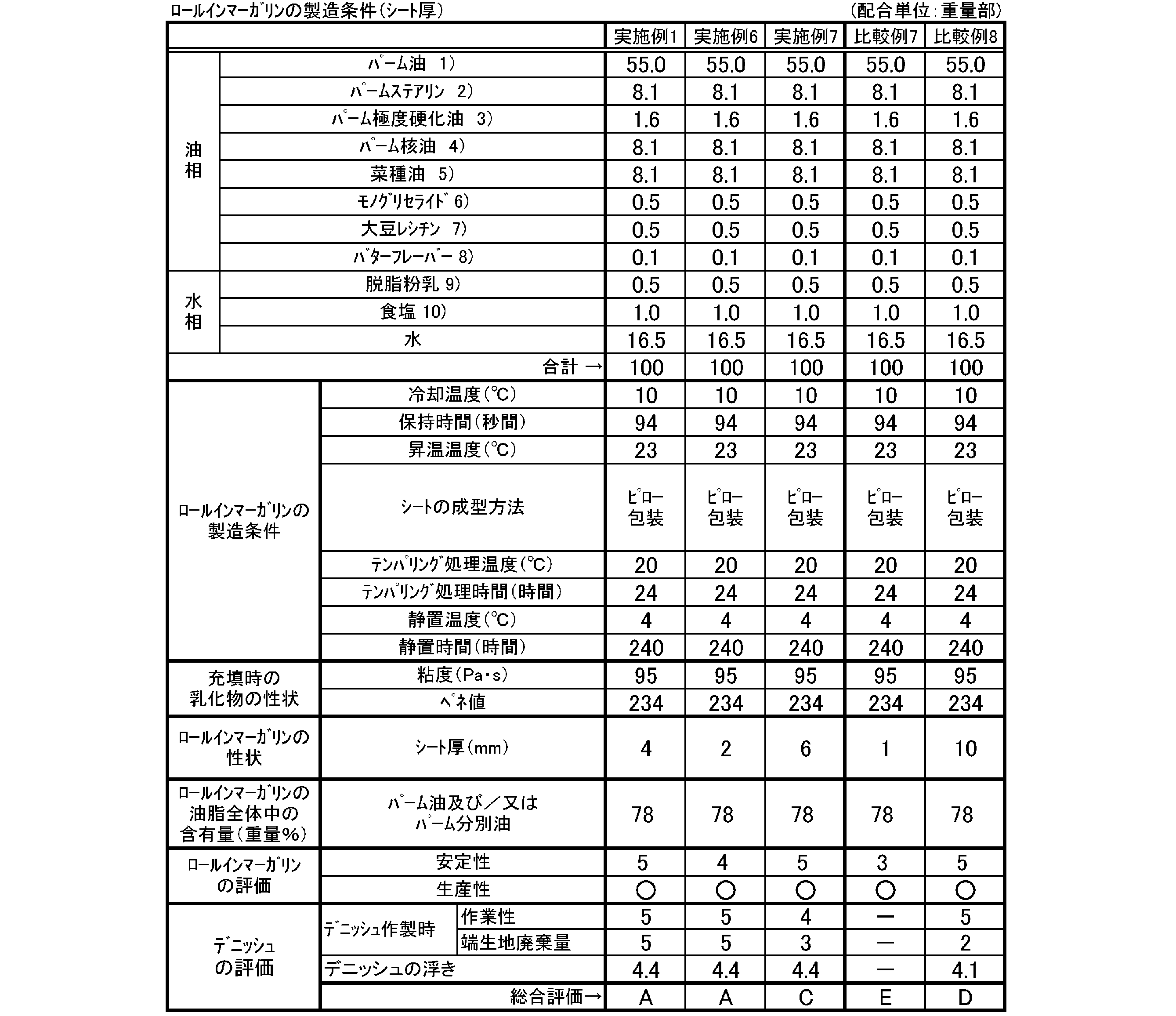
- Example 6 Roll-in margarine was obtained in the same manner as in Example 1 except that the sheet thickness was changed to 2 mm in accordance with the production conditions in Table 3. When 100 pieces of roll-in margarine were manufactured, the number of defective articles having a shape and weight of 8 pieces was found. In the above process, the time related to productivity was 81 minutes. Table 3 shows values of viscosity and penetration value measured 10 seconds after filling.
- Example 7 Roll-in margarine was obtained in the same manner as in Example 1 except that the sheet thickness was changed to 6 mm in accordance with the production conditions in Table 3. When 100 pieces of roll-in margarine were manufactured, the number of defective articles having a shape and weight of two was two. In the above process, the time related to productivity was 81 minutes. Table 3 shows values of viscosity and penetration value measured 10 seconds after filling.
- Example 7 Roll-in margarine was obtained in the same manner as in Example 1 except that the sheet thickness was changed to 1 mm in accordance with the production conditions in Table 3. When 100 sheets of roll-in margarine were manufactured, the number of defective articles having the shape and weight of 11 sheets was found. In the above process, the time related to productivity was 81 minutes. Table 3 shows values of viscosity and penetration value measured 10 seconds after filling.
- a danish was prepared in the same manner as in Example 1 using the obtained roll-in margarine.
- the roll-in margarine was broken in the process of being taken out of the pillow packaging and placed on the dough, and thus a danish was prepared.
- a danish was prepared.
- Example 8 Roll-in margarine was obtained in the same manner as in Example 1 except that the sheet thickness was changed to 10 mm in accordance with the production conditions shown in Table 3. When 100 roll-in margarines were manufactured, the number of defective products having a shape and weight of 0 was zero. In the above process, the time related to productivity was 81 minutes. Table 3 shows values of viscosity and penetration value measured 10 seconds after filling.
- the roll-in margarines of Examples 1, 6 and 7 were formed into a sheet having a thickness in the range of 2 to 7 mm. Was also good. Then, when producing a danish using these roll-in margarines, the workability was very good because the stretch was evenly spread in the dough, and the amount of scrap of the end dough was slightly smaller than that of the roll-in margarine in Example 7. Although the density was slightly increased and the others were extremely small, the obtained danish was well lifted and had sufficient gaps between most layers, and the overall evaluation was good.
- the roll-in margarine of Comparative Example 7 was formed into a sheet having a thickness of 1 mm, and although both stability and productivity were good, the roll-in margarine was taken out of the pillow packaging and placed on the dough. The roll-in margarine was broken and could not be used for producing Danish. Further, the roll-in margarine of Comparative Example 8 was formed into a sheet having a thickness of 10 mm, and although both stability and productivity were good, production of a danish using this roll-in margarine Occasionally, the end fabric was discarded a lot and the overall evaluation was poor.
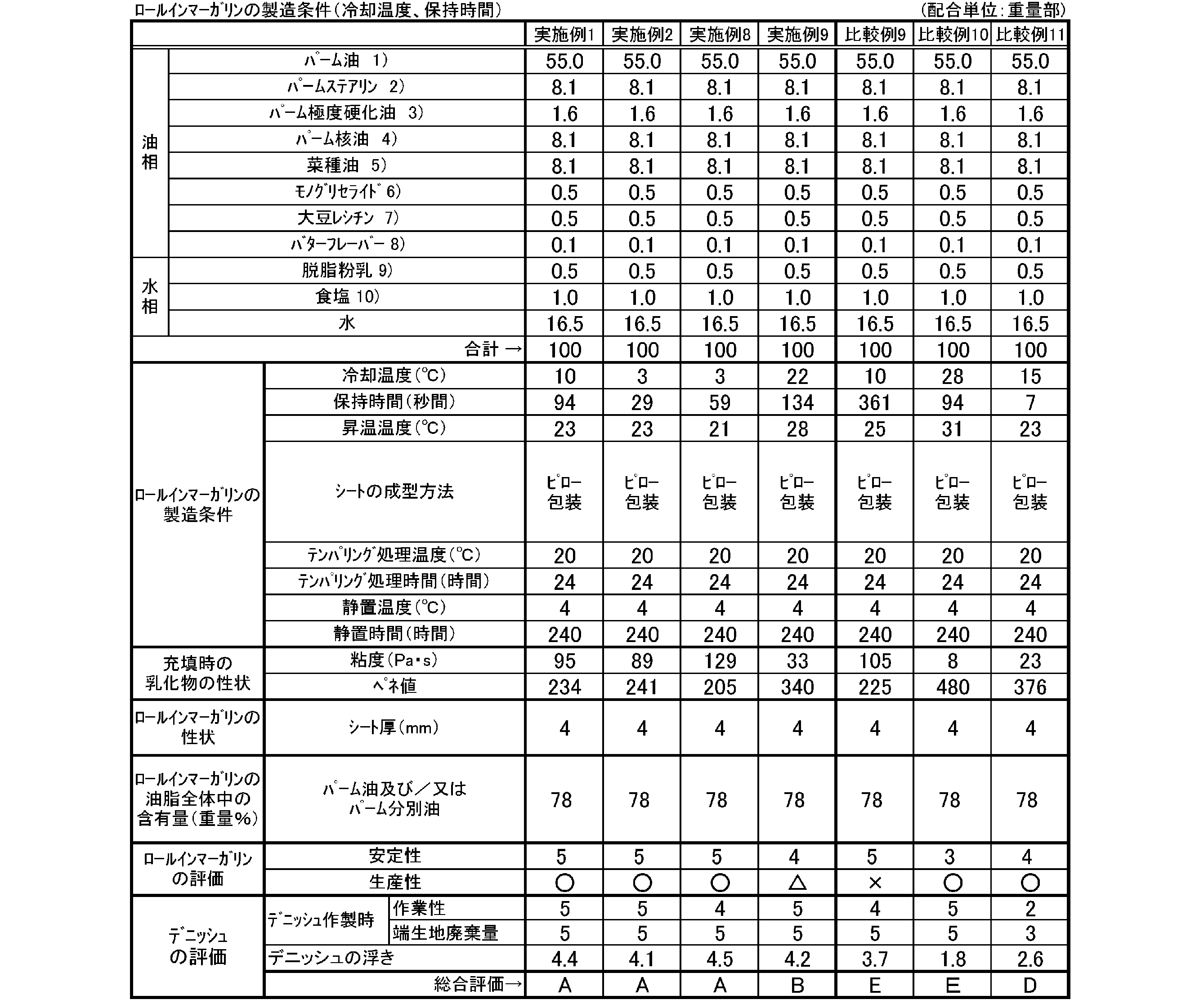
- Example 8 According to the production conditions of Table 4, the obtained emulsion was cooled to a final temperature of 3 ° C., the cooling holding time was set to 59 seconds, and the temperature was increased to 21 ° C. by softening with a mixing heating device. Roll-in margarine was obtained in the same manner as in 1. When 100 pieces of roll-in margarine were manufactured, the number of defective products having a shape and weight was 3 pieces. In the above process, the time related to productivity was 69 minutes. Table 4 shows the values of the viscosity and the penetration value measured 10 seconds after filling.
- Example 9 According to the production conditions of Table 4, the obtained emulsion was cooled to a final temperature of 22 ° C, the cooling holding time was set to 134 seconds, and the temperature was increased to 28 ° C by softening with a mixing and heating device.
- Roll-in margarine was obtained in the same manner as in 1. When 100 pieces of roll-in margarine were manufactured, the number of defective articles having a shape and weight of 8 pieces was found. In the above process, the time related to productivity was 94 minutes. Table 4 shows the values of the viscosity and the penetration value measured 10 seconds after filling.
- the roll-in margarines of Examples 1, 2, 8 and 9 were prepared by cooling the water-in-oil emulsified oil / fat composition in a state where the oil / fat at the time of production was melted to a temperature in the range of 0 to 25 ° C.
- the retention time of the roll-in margarine was 10 to 300 seconds, and both of the roll-in margarines were excellent in both stability and productivity.
- the workability is very good because it stretches uniformly in the dough, the amount of waste of the end dough is extremely small, and the obtained danish has no floating. It was good, with sufficient gaps between most layers, and the overall evaluation was good.
- the roll-in margarine of Comparative Example 9 has a long holding time of 361 seconds at 10 ° C. of the water-in-oil type emulsified fat / oil composition in a state where the fat / oil at the time of production is melted.
- the evaluation of the Danish prepared as described above was good, the productivity of roll-in margarine was poor and the overall evaluation was poor.
- the roll-in margarine of Comparative Example 10 had a high cooling temperature of 28 ° C.
- the productivity was good, the Danish obtained using this roll-in margarine had very poor lifting, most of the dough did not have a sufficient gap between the dough, and the overall evaluation was poor .
- the roll-in margarine of Comparative Example 11 had a short retention time of 15 seconds at 15 ° C. of the water-in-oil type emulsified oil / fat composition in a state where the oil / fat at the time of production was melted.
- the roll-in margarine had many portions that were not uniformly stretched during the production of the danish, resulting in poor workability, and the resulting danish also had poor lifting, and between layers. There were many parts without sufficient gaps, and the overall evaluation was poor.
- Example 10 According to the production conditions in Table 5, the obtained emulsion was cooled to a final temperature of 11 ° C., the cooling holding time was set to 134 seconds, the mixture was softened by a mixing and heating device, the temperature was raised to 13 ° C., and the tempering treatment was performed for 25 minutes.
- a roll-in margarine was obtained in the same manner as in Example 1 except that the reaction was carried out at a temperature of ° C. When 100 pieces of roll-in margarine were manufactured, the number of defective articles having a shape and weight of 7 sheets was found. In the above process, the time related to productivity was 113 minutes. Table 5 shows values of viscosity and penetration value measured 10 seconds after filling.
- Example 11 According to the production conditions shown in Table 5, the obtained emulsion was cooled to a final temperature of 5 ° C., the cooling holding time was set to 59 seconds, the mixture was softened by a mixing and heating device, the temperature was raised to 32 ° C., and the tempering treatment was performed for 18 minutes.
- a roll-in margarine was obtained in the same manner as in Example 1 except that the reaction was carried out at a temperature of ° C. When 100 pieces of roll-in margarine were manufactured, the number of defective articles having a shape and weight of 7 sheets was found. In the above process, the time related to productivity was 69 minutes. Table 5 shows values of viscosity and penetration value measured 10 seconds after filling.
- Example 12 Roll-in margarine was obtained in the same manner as in Example 1 except that the standing temperature after tempering the block margarine was set to ⁇ 20 ° C. in accordance with the production conditions in Table 5. When 100 pieces of roll-in margarine were manufactured, the number of defective articles having a shape and weight of two was two. In the above process, the time related to productivity was 81 minutes. Table 5 shows values of viscosity and penetration value measured 10 seconds after filling.
- Example 13 Roll-in margarine was obtained in the same manner as in Example 1 except that the standing temperature after tempering the block margarine was set to 27 ° C. in accordance with the production conditions in Table 5. When 100 pieces of roll-in margarine were manufactured, the number of defective articles having a shape and weight of two was two. In the above process, the time related to productivity was 81 minutes. Table 5 shows values of viscosity and penetration value measured 10 seconds after filling.
- Example 14 Roll-in margarine was obtained in the same manner as in Example 1 except that the standing time after tempering the block margarine was set to 36 hours in accordance with the production conditions in Table 5. When 100 pieces of roll-in margarine were manufactured, the number of defective articles having a shape and weight of two was two. In the above process, the time related to productivity was 81 minutes. Table 5 shows values of viscosity and penetration value measured 10 seconds after filling.
- Example 15 According to the composition shown in Table 5, the composition of the oil and fat was 8.1 parts by weight of palm stearin, 14.6 parts by weight of rapeseed oil, 21.8 parts by weight of the transesterified oil and fat of Production Example 1, and 36.4 parts by weight of lard. , Palm hardened oil and palm kernel oil were not used. The melting point of the oil phase was 36 ° C. Further, according to the production conditions shown in Table 5, the obtained emulsion was cooled to a final ultimate temperature of 16 ° C., softened by a mixing and heating device, and heated to 24 ° C., and the tempering treatment was not performed. Except for the above, a roll-in margarine was obtained in the same manner as in Example 1. When 100 roll-in margarines were manufactured, the number of defective products having a shape and weight of 0 was zero. In the above process, the time related to productivity was 81 minutes. Table 5 shows values of viscosity and penetration value measured 10 seconds after filling.
- a danish was produced in the same manner as in Example 1 using the obtained roll-in margarine.
- the workability at the time of producing the danish, the disposal amount of the edge cloth at the time of the danish production, and the floating of the obtained danish were evaluated. The results are shown in Table 5.
- the roll-in margarines of Examples 1 and 10 to 15 were formed into sheets in the range of 10 to 35 ° C. when the temperature of the water-in-oil emulsified oil / fat composition during the production of the roll-in margarine was softened. After the molding, the roll-in margarine was allowed to stand at ⁇ 30 ° C. to 30 ° C. for 24 hours or more, and both of the roll-in margarines were excellent in both stability and productivity.
- the roll-in margarine of Comparative Example 12 had a high temperature rising temperature of 37 ° C. at the time of softening of the water-in-oil type emulsified fat / oil composition during production of the roll-in margarine, and exhibited stability during production of the roll-in margarine.
- the productivity was good, the Danish obtained by using this roll-in margarine had poor floating, many portions without sufficient gaps between the layers, and the overall evaluation was poor.
- the roll-in margarine of Comparative Example 13 had a high standing temperature of 33 ° C. after being formed into a sheet, and although the stability and productivity during roll-in margarine production were good, At the time of producing a danish using this roll-in margarine, the roll-in margarine does not stretch, a lump of roll-in margarine is seen in the dough, workability is extremely poor, and the obtained danish has a very poor lift, There was not enough space between most of the doughs, and the overall evaluation was poor.
- the roll-in margarine of Comparative Example 14 had a short standing time at 4 ° C. of 12 hours after being formed into a sheet, and the stability and productivity during roll-in margarine production were good.
- the Danish obtained by using this roll-in margarine had poor floating, many portions without sufficient gaps between the layers, and the overall evaluation was poor.
- Example 16 Production of danish A danish was obtained in the same manner as in Example 1 except that the roll-in margarine of Example 1 was used and the amount was changed from 50 parts by weight to 40 parts by weight.
- the workability during the production of the danish was 5 points
- the waste amount of the end fabric was 5 points
- the lift of the obtained danish was 4.1 points.
- the roll-in margarine stretches uniformly in the dough, the workability is very good, the amount of scrap of the end dough is extremely small, and the obtained danish has good floating, and the Had sufficient gaps, and the overall evaluation was good.
Landscapes
- Chemical & Material Sciences (AREA)
- Life Sciences & Earth Sciences (AREA)
- Engineering & Computer Science (AREA)
- Food Science & Technology (AREA)
- Oil, Petroleum & Natural Gas (AREA)
- Polymers & Plastics (AREA)
- Edible Oils And Fats (AREA)
- Bakery Products And Manufacturing Methods Therefor (AREA)
Abstract
油脂が融解した状態の油中水型乳化油脂組成物が、0~25℃まで冷却されて該温度に10~300秒間保持され晶析された後、混和により軟化させられながら10~35℃に昇温されて、粘度が10~250Pa・sに調整された流動状の前記油中水型乳化油脂組成物がピロー包装に充填され、厚みが2~7mmのシート状に成形されてから-30℃~30℃で24時間以上静置された、ピロー包装されたロールインマーガリン。
Description
本発明は、ロールインマーガリン、その製造方法、及び該ロールインマーガリンを用いた層状食品に関する。
シート形状のロールインマーガリンは、デニッシュやクロワッサン等の層状食品を製造するにあたって使用され、ロールインマーガリンを生地に重ねて折り込み、伸展した後、焼成することで層状食品が製造される。その際に必要なロールインマーガリンの使用量は、一般的に生地の小麦粉100重量部に対し40~50重量部と多い。しかし近年、消費者の健康志向により、低カロリーの食品が好まれる傾向があり、そのためロールインマーガリンの使用量も少なくしようとする傾向がある。
しかし、現状のロールインマーガリンの厚み(10~20mm程度)を維持したままその使用量を減らすと、折り込み時に生地に練り込まれないロールインマーガリンの量が減り、層状食品の層が十分に出ずに、浮きが悪くなるといった問題がある。ロールインマーガリンの使用量を減らしつつ層状食品の各層の間に十分な隙間を持たせようとすると、薄いロールインマーガリンを製造する必要がある。しかし、通常の急冷・捏和機を通して油脂を結晶化させた後、休止管(レスティングチューブ)で結晶を更に成長させ、結晶の網目構造を作る前に成型ノズルでシート状に成型する従来法では、製造されるロールインマーガリンが波打ったり、形や厚さが不均一になり、薄いロールインマーガリンを安定的に製造することができなかった。
特許文献1では、油脂組成物を急冷・捏和機に通して油脂を結晶化させた後、結晶が成長し結晶の網目構造を作る前にロールで圧延して成型することで、薄いロールインマーガリンを製造する方法が開示されている。
特許文献1に記載の方法によれば、薄いロールインマーガリンを安定的に製造することは可能であるが、急冷・捏和機を出てからロールで圧延するため生産性が悪いことに加え、薄いロールインマーガリンは包装しにくいという問題もあった。
一方、現状の厚みがあるロールインマーガリンを用いて層状食品を作製する際には、ロールインマーガリンが生地上で均一に伸びにくく、生地に折り込む作業に時間がかかったり、十分に伸展せずに生地間にロールインマーガリンが挟まれていない領域(端生地)が多く生じてその廃棄量が増加するという問題もあった。
本発明の目的は、上記現状に鑑み、安定的かつ生産性高く製造可能な薄いロールインマーガリンであって、これを用いた層状食品作製時には作業性が良好で、端生地の廃棄量が少なく、作製された層状食品で層が良く出て良好な浮きが達成できるロールインマーガリン、及び、その製造方法を提供することである。さらには、ロールインマーガリン由来の油脂含量が少ないにも関わらず、層が良く出て良好な浮きを有する層状食品を提供することである。
本発明者らは上記課題を解決するために鋭意研究を重ねた結果、油脂が融解状態の油中水型乳化油脂組成物を、特定の温度域まで温度を下げてから特定時間保持して晶析せしめ、その後、混和により軟化させながら特定温度域まで昇温させ、粘度を特定値に調整して流動状の油中水型乳化油脂組成物をピロー包装に充填して特定の厚みになるように成形した後、特定温度で特定時間静置することで、シート厚が通常のロールインマーガリンより薄いロールインマーガリンが安定的且つ高生産性で得られ、該ロールインマーガリンを用いて層状食品を作製すると作業性が良好で、端生地の廃棄量が少なく、作製された層状食品では層が良く出て良好な浮きを達成できることを見出し、本発明を完成するに至った。
即ち、本発明の第一は、油脂が融解した状態の油中水型乳化油脂組成物が、0~25℃まで冷却されて該温度に10~300秒間保持され晶析された後、混和により軟化させられながら10~35℃に昇温されて、粘度が10~250Pa・sに調整された流動状の前記油中水型乳化油脂組成物がピロー包装に充填され、厚みが2~7mmのシート状に成形されてから-30℃~30℃で24時間以上静置された、ピロー包装されたロールインマーガリンに関する。好ましくは、ピロー包装に充填された流動状の前記油中水型乳化油脂組成物が、2枚の平板で押し挟まれて厚みが2~7mmのシート状に成形されたものである。
本発明の第二は、油脂が融解した状態の油中水型乳化油脂組成物を、0~25℃まで冷却して該温度に10~300秒間保持し晶析せしめた後、混和により軟化させながら10~35℃に昇温させて、粘度を10~250Pa・sに調整し、調整後の流動状の前記油中水型乳化油脂組成物をピロー包装に充填し、厚みが2~7mmのシート状に圧延して成形し、-30℃~30℃で24時間以上静置することを特徴とする、ロールインマーガリンの製造方法に関する。好ましくは、ロールインマーガリンの油脂全体中、パーム油及び/又はパーム分別油の含有量が50~95重量%であり、該油脂が融解した状態の油中水型乳化油脂組成物を、0~25℃であって、かつ油相部の融点から15~40℃低い温度まで冷却して該温度に10~300秒間保持し晶析せしめた後、混和により軟化させながら10~35℃に昇温させて、粘度を10~250Pa・sに調整し、調整後の流動状の前記油中水型乳化油脂組成物をピロー包装に充填し、厚みが2~7mmのシート状に圧延して成形した後、15~30℃の温度で10~100時間テンパリング処理してから、-30℃~30℃で24時間以上静置する。
本発明の第三は、本発明の第一に係るロールインマーガリンを用いてなる層状食品に関する。
本発明に従えば、安定的かつ生産性高く製造可能な薄いロールインマーガリンであって、これを用いた層状食品作製時には作業性が良好で、端生地の廃棄量が少なく、作製された層状食品で層が良く出て良好な浮きが達成できるロールインマーガリン、及び、その製造方法を提供することができる。さらには、ロールインマーガリン由来の油脂含量が少ないにも関わらず、層が良く出て良好な浮きを有する層状食品を提供することができる。
以下、本発明につき、さらに詳細に説明する。本発明のロールインマーガリンは、特定の状態にある油中水型乳化油脂組成物を、特定の温度域まで温度を下げてから特定時間保持して晶析せしめ、その後、混和により軟化させながら特定温度域まで昇温させ、粘度を特定値に調整して流動状の油中水型乳化油脂組成物をピロー包装に充填して特定の厚みになるように成形した後、特定温度で特定時間静置して得られ、該ロールインマーガリンは厚みが薄いことを特徴とする。
前記油中水型乳化油脂組成物とは、水相が油相に分散するタイプの乳化物を指し、通常、油脂組成物全体中の油相の量は30~99.5重量%、水相の量は0.5~70重量%である。本発明のロールインマーガリンは、前記油中水型乳化油脂組成物を固体状に晶析せしめたものであり、前記油中水型乳化油脂組成物と同様、ロールインマーガリン中の油相の量は30~99.5重量%、水相の量は0.5~70重量%である。よって、本発明でいうロールインマーガリンには、油分が80%を超えるマーガリンの他、油分が80%未満のファットスプレッドも包含される。
前記油中水型乳化油脂組成物に含まれる油脂としては、一般的にロールインマーガリンに使用される油脂であれば特に限定されない。例えば、パーム油、パーム核油、ヤシ油、ナタネ油、大豆油、コーン油、サフラワー油、綿実油、落花生油、米ぬか油、コーン油、オリーブ油、ヒマワリ油、ゴマ油、シア脂、サル脂、カカオ脂等の植物性油脂;乳脂、牛脂、ラード等の動物性油脂;それらの分別油、硬化油、エステル交換油などが挙げられる。1種のみを使用してもよいし、2種以上を併用してもよい。原料コストの観点から、パーム油及び/又はパーム油分別油を前記油脂全体中50~95重量%含むことが好ましく、パーム油を前記油脂全体中50~95重量%含むことがより好ましい。なお、パーム分別油とは、パーム油を原料に分別されてできる油脂であり、例えば、パームステアリン、パームハードステアリン、パームオレイン、パームダブルオレイン、パームスーパーオレイン、パームトップオレイン、パーム中融点部等が挙げられる。
前記油中水型乳化油脂組成物は、前記油脂と水以外に、通常ロールインマーガリンに配合できる成分を適宜含有することができる。そのような成分としては、例えば、乳化剤、香料、酸化防止剤、着色料、糖類、食塩、増粘安定剤、甘味料、酸味料、呈味素材等を挙げることができる。
前記乳化剤としては、大豆レシチン、卵黄レシチン、グリセリン脂肪酸エステル、ポリグリセリン脂肪酸エステル、ソルビタン脂肪酸エステル、ショ糖脂肪酸エステル等を挙げることができる。
前記香料としては、バターフレーバー、ミルクフレーバー等を挙げることができる。
前記酸化防止剤としては、トコフェロール、β-カロテン、茶抽出物(カテキン等)等を挙げることができる。
前記着色料としては、β-カロテン、カラメル、紅麹色素等を挙げることができる。
前記糖類としては、砂糖、果糖、ブドウ糖、水飴、還元水飴、はちみつ、異性化糖、転化糖、オリゴ糖、トレハロース、糖アルコール等を挙げることができる。
前記増粘安定剤としては、グアーガム、ローカストビーンガム、カラギーナン、アラビアガム、アルギン酸類、ペクチン、キサンタンガム、寒天、グルコマンナン、ゼラチン、澱粉等を挙げることができる。
前記甘味料としては、アスパルテーム、アセスルファムカリウム、スクラロース、アリテーム、ネオテーム、カンゾウ抽出物(グリチルリチン)、サッカリン、サッカリンナトリウム、ステビア抽出物、ステビア粉末等を挙げることができる。
前記酸味料としては、酢酸、乳酸、グルコン酸等を挙げることができる。
前記呈味素材としては、前記糖類、前記甘味料、前記酸味料は除かれ、乳製品、風味エキス類、その他呈味を有する原料等を挙げることができる。前記乳製品としては、全粉乳、脱脂粉乳、練乳粉、乳脂の加熱処理物や酵素処理物、牛乳、加糖練乳、発酵乳、生クリーム、チーズ等を挙げることができる。前記風味エキス類としては、昆布エキス、発酵調味料等を挙げることができる。前記その他呈味を有する原料としては、卵黄、全卵、コーヒー、カカオ原料、抹茶、緑茶、餡類、果汁、果肉、野菜ペースト、粉末野菜等を挙げることができる。
以下に、本発明のロールインマーガリンの製造方法を具体的に説明する。まず、油脂が融解した状態の油中水型乳化油脂組成物を特定温度まで冷却する。ここで油脂が融解した状態の油中水型乳化油脂組成物とは、油脂を加熱融解し、必要に応じて乳化剤などの油溶性成分を添加して油相を調製し、該油相に、水や、必要に応じて食塩、香料や呈味素材などの水溶性成分を加えて攪拌した水相を加え、油脂の融解状態を維持しつつ乳化させることで調製され、その油脂の融解状態が維持されている油中水型乳化油脂組成物のことをいう。また、油相と水相を混合してから、乳化する前後何れかで殺菌処理を行なうことが望ましい。殺菌方法は、タンクでのバッチ式でも、プレート型熱交換機や掻き取り式熱交換機を用いた連続式でもよい。
前記冷却に用いる装置としては、ボテーター、コンビネーター、パーフェクター等のマーガリン製造機である密閉型連続式チューブ冷却機、プレート型熱交換機、開放型のダイアクーラーとコンプレクターとの組合せ等の冷却機器または冷却捏和装置が挙げられる。
前記冷却時の油中水型乳化油脂組成物の最低温度は、0~25℃が好ましく、1~20℃がより好ましく、5~15℃が更に好ましい。0℃未満まで冷却すると、油中水型乳化油脂組成物中の水分が凍結して設備を傷める場合があり、冷却時の最低温度が25℃より高いと油脂が十分に結晶化せず、作製した層状食品において各層の間に十分な隙間が形成されず、浮きが悪い場合がある。冷却する際の冷却速度は特に限定されないが、-10~-100℃/分の冷却速度が好ましい。
以上のように冷却された油中水型乳化油脂組成物を、前記冷却に用いる装置内で所定の温度帯に保持して晶析させる。保持する温度帯は0~25℃が好ましく、1~20℃がより好ましく、5~15℃が更に好ましい。晶析のために前記温度帯で保持する時間(以下、冷却保持時間ともいう)は、前記冷却に用いる装置内で油中水型乳化油脂組成物の温度が25℃になった時点から、前記冷却に用いる装置から油中水型乳化油脂組成物を搬出する(後述する混和昇温装置に移送する)までの時間を意味し、10~300秒間が好ましく、20~200秒間がより好ましく、30~150秒間が更に好ましい。冷却保持時間が10秒間未満であると油脂が十分に結晶化せず、層状食品作製時にロールインマーガリンが均一に伸展せず作業性が悪く、また、作製した層状食品において各層の間に十分な隙間が形成されず、浮きが悪い場合があり、300秒間を超えると、前記冷却に用いる装置による油中水型乳化油脂組成物の練りが過剰になり、得られるロールインマーガリンの硬さやコシが劣る場合がある。
なお、油中水型乳化油脂組成物に含まれる油脂がエステル交換油及び/又は硬化油を40重量%以上含む場合は、前記冷却時の最低温度は10~20℃で、前記冷却保持時間は10~100秒間が好ましい。また、油中水型乳化油脂組成物に含まれる油脂がパーム油及び/又はパーム分別油を40重量%以上含む場合は、前記冷却時の最低温度は5~15℃で、前記冷却保持時間は30~150秒間が好ましい。
次いで、前記冷却によって晶析された油中水型乳化油脂組成物を、混和昇温装置を用いて混和により軟化させながら特定温度に昇温させる。前記混和昇温装置としては、オンレーターなどの掻き取り式熱交換機、多管円筒式熱交換機、スタティックミキサー内蔵式熱交換器、ピンマシン等が挙げられる。また、前記混和昇温装置を通した後に、密閉型連続式チューブ冷却機や、冷却機器または冷却捏和装置を用いて再度冷却を行なっても良いが、その場合も、後述する油中水型乳化油脂組成物の粘度を満足する範囲で該再冷却を行なう。
混和昇温装置による昇温後の油中水型乳化油脂組成物の温度は、前述した晶析のために保持する温度よりも高い温度であって、10~35℃が好ましく、15~30℃がより好ましく、20~25℃が更に好ましい。また、前記混和昇温装置を通した後に、密閉型連続式チューブ冷却機や、冷却機器または冷却捏和装置を用いて再度冷却を行なう場合も、再冷却後の油中水型乳化油脂組成物の温度は、前述した晶析のために保持する温度よりも高い温度であって、10~35℃が好ましく、15~30℃がより好ましく、20~25℃が更に好ましい。昇温後または再冷却後の油中水型乳化油脂組成物の温度が10℃未満であると、充填時の粘度が高すぎたり充填中に硬化して粘度が上がることで、充填後にシート状に成形加工する際に割れたり空気穴が空いたりする場合がある。一方、35℃を超えると、大部分の結晶が溶けて充填後に水相部が分離したり、ロールインマーガリンに不適な物性となる場合がある。
混和昇温装置による昇温後の油中水型乳化油脂組成物の粘度は、10~250Pa・sが好ましく、20~200Pa・sがより好ましく、50~150Pa・sが更に好ましい。10Pa・s未満であると、作製した層状食品において各層の間に十分な隙間が形成されず、浮きが悪い場合があり、250Pa・sを超えると、ロールインマーガリンを安定的かつ生産性高く製造できない場合がある。前記粘度は、混和昇温装置による剪断を変更することでコントロールすることができる。なお、粘度は、振動式粘度計、回転式粘度計、落球式粘度計、細管式粘度計等を用いて定法に従い測定することができる。
また、混和昇温装置による昇温後の油中水型乳化油脂組成物の粘度が上記範囲内にあれば、後述するピロー包装への充填時の油中水型乳化油脂組成物のペネ値が140~460になることから、相関的に、折り込み時のロールインマーガリンのペネ値を50~130にコントロールしやすく好ましい。
次に、粘度が上記範囲内にある流動状の油中水型乳化油脂組成物をピロー包装に充填する。ここで、ピロー包装とは、包装フィルムを、開口部を有する袋状に加工した後、内容物を充填し、前記開口部を閉じて該内容物を包装するものをいう。前記ピロー包装は、密封性と開封作業性を両立するため、イージーピール性を有する方が好ましい。
流動状の油中水型乳化油脂組成物をピロー包装の開口部から投入してピロー包装に充填した直後に、ピロー包装の開口部を閉じることが衛生面から好ましい。ピロー包装の開口部を閉じる方法としては、ヒートシール、チャック、クリップで挟む等の方法が挙げられる。
その後、流動状の油中水型乳化油脂組成物を、ピロー包装と共に、シート状に圧延して所望の厚みに成形する。当該成形方法によると、流動状の油中水型乳化油脂組成物をピロー包装に充填してから、ピロー包装ごと圧延するので、作製される本発明のロールインマーガリンでは、ピロー包装を構成する包装フィルムの内面と、ピロー包装内のロールインマーガリンの表面が密接することになる。
シート状に圧延して所望のシート厚に成形するには、ピロー包装に充填された油中水型乳化油脂組成物を、(1)適切なクリアランスを保持した2枚の平板で挟む、(2)適切なクリアランスを保持した2つのローラー間に通す、(3)袋容量に対する内容量を調整した上で、振動させ自然に厚みを揃える、などの方法が挙げられる。
次いで、ピロー包装されたシート状の油中水型乳化油脂組成物を、特定温度で特定時間以上静置することで、本発明のピロー包装されたロールインマーガリンが製造される。このように特定条件で静置することで、油中水型乳化油脂組成物中の油脂の結晶化を進行させ、結晶を安定化させることで、ロールインマーガリンの製造を実現できる。
静置する際の温度は、-30~30℃が好ましく、-20~25℃がより好ましく、0~10℃が更に好ましい。-30℃より低いと保管コストの点で不利であり、30℃を超えると、層状食品作製時にロールインマーガリンが伸展しにくく、作業性が悪かったり、作製した層状食品において各層の間に十分な隙間が形成されず、浮きが悪い場合があり、また、ロールインマーガリンに油浸や変形が発生する場合がある。
静置する時間は、24時間以上であることが好ましい。24時間未満であると、油脂の結晶が十分に析出せず、または安定しておらず、製造されたロールインマーガリンの物性が不十分となり、作製した層状食品において各層の間に十分な隙間が形成されず、浮きが悪い場合がある。静置時間の上限としては、保管コストの観点から2年が好ましいが、特にこれに限定されない。
ロールインマーガリンのシート厚は2~7mmが好ましく、2~6mmがより好ましく、2~5mmが更に好ましい。シート厚が2mm未満であると、ピロー包装から取り出す際にロールインマーガリンが折れたりする場合がある。7mmを超えると、ロールインマーガリンの使用量を減らして層状食品を作製した際に、ロールインマーガリンが十分に伸展せず生地間にロールインマーガリンが挟まれていない端生地が多く生じる場合がある。
本発明により作製するロールインマーガリンにおいて、波打ったり、形や厚さが不均一になる製品不良の発生率は、5%以下であることが好ましい。
本発明の好適な実施形態では、ロールインマーガリンに含まれる油脂全体中、パーム油及び/又はパーム油分別油の含有量が50~95重量%であり、該油脂が融解した状態の油中水型乳化油脂組成物を、特定温度範囲内であって、かつ該油脂組成物の油相部の融点から特定範囲の低い温度に冷却し、晶析せしめた後、混和により軟化させながら前記特定温度に昇温させて、粘度を特定範囲に調整し、前記粘度を保った状態で流動状の油中水型乳化油脂組成物をピロー包装に充填し、シート状に圧延して前記所望の厚みにした後、特定温度で特定時間テンパリング処理してから、テンパリング処理温度より低い特定温度範囲で特定時間静置する。
前記好適な実施形態において、冷却時の最低温度は、0~25℃の範囲内であって、かつ油相部の融点から15~40℃低い温度が好ましく、油相部の融点から20~40℃低い温度がより好ましく、油相部の融点から25~40℃低い温度が更に好ましく、油相部の融点から25~35℃低い温度が特に好ましい。0℃未満まで冷却すると、油中水型乳化油脂組成物中の水分が凍結して設備を傷める場合があり、冷却時の最低温度が25℃を超えると油脂が十分に結晶化せず、作製した層状食品において各層の間に十分な隙間が形成されず、浮きが悪い場合がある。また、油相部の融点から15℃以下とならない温度までしか冷却しないと、油脂が十分に結晶化しない場合があり、油相部の融点から40℃を超えて低い温度まで冷却すると、冷却のためのコストがかかりすぎる場合がある。また冷却の際の冷却速度は、-20~-110℃/分が好ましい。
晶析後の混和昇温装置内における昇温後の油中水型乳化油脂組成物の温度、前記混和昇温装置を通した後に、密閉型連続式チューブ冷却機や、冷却機器または冷却捏和装置を用いて再度冷却を行なった後の油中水型乳化油脂組成物の温度、軟化させながら昇温された油中水型乳化油脂組成物の粘度、シート状に圧延した後のシート厚などは、上述したものと同様である。
前記テンパリング処理は、15~30℃で10~100時間行うことが好ましい。テンパリング処理温度は18~27℃がより好ましく、更に好ましくは20~25℃である。テンパリング時の温度が15℃未満であるとテンパリング効果が十分に得られないため、テンパリング処理によるロールインマーガリンの物性改善が不十分となる場合があり、30℃を超えると、ロールインマーガリンが必要以上に軟化したり、油浸を起こすため、ロールインマーガリンの品質が悪くなる場合がある。テンパリング処理時間は18~72時間がより好ましく、24~48時間が更に好ましい。10時間未満であるとテンパリング効果が十分に得られない場合があり、一方、100時間を超えてテンパリングしても効果が頭打ちとなり、生産性が落ちる場合がある。
前記テンパリング処理後には、テンパリング処理温度より低い特定温度で特定時間以上静置する必要がある。具体的には、静置時の温度は-30~25℃が好ましく、-20~25℃がより好ましく、0~10℃が更に好ましい。-30℃より低いと保管コストの点で不利であり、25℃を超えると、層状食品作製時にロールインマーガリンが伸展しにくく、作業性が悪かったり、作製した層状食品において各層の間に十分な隙間が形成されず、浮きが悪い場合がある。静置する時間は24時間以上であることが好ましい。24時間未満であると、油脂の結晶が十分に析出せず、または安定しておらず、製造されたロールインマーガリンの物性が不十分となり、作製した層状食品において各層の間に十分な隙間が形成されず、浮きが悪い場合がある。静置時間の上限としては、保管コストの観点から2年が好ましいが、特にこれに限定されない。
本発明のロールインマーガリンは、従来の製造方法で製造したロールインマーガリンと同様に、生地に包み込んで伸展し、その後、焼成することにより、層状食品の作製に用いることができる。
該層状食品としては、例えばデニッシュ、クロワッサン、パイ等が挙げられるが、特に限定されない。
また、該層状食品における本発明のロールインマーガリンの配合量は、製造する層状食品の種類によって異なり、本発明の効果を奏する限り、特に限定されない。しかし、本発明のロールインマーガリンを用いると、層状食品におけるロールインマーガリンの配合量を減らすことができ、ロールインマーガリン由来の油脂含量が少ないにも関わらず、層が良く出て良好な浮きを有する層状食品を製造することができる。具体的には、本発明のロールインマーガリンの配合量は、層状食品の配合原料全体中15~40重量%が好ましい。
本発明の層状食品の製造方法は、特に限定されず、本発明のロールインマーガリンを用いること以外は、公知の原料を使用し、公知の配合および公知の方法を採用することができる。
以下に実施例を示し、本発明をより具体的に説明するが、本発明はこれらの実施例に何ら限定されるものではない。なお、実施例において「部」や「%」は重量基準である。
実施例及び比較例で使用した原料は以下のとおりである。
1)(株)カネカ製「パーム油」
2)(株)カネカ製「パームステアリン」
3)(株)カネカ製「パーム極度硬化油」
4)(株)カネカ製「パーム核油」
5)(株)カネカ製「菜種油」
6)理研ビタミン(株)製「エマルジーMS」
7)J-オイルミルズ(株)製「大豆レシチン」
8)高砂香料(株)製「バターフレーバー」
9)雪印メグミルク(株)製「脱脂粉乳」
10)財団法人塩事業センター製「精製塩」
11)日清製粉(株)製「ミリオン」
12)日清製粉(株)製「バイオレット」
13)(株)カネカ製「カネカイーストGK」
14)日新製糖(株)製「上白糖P」
15)(株)赤城鶏卵GPセンター製「卵」
16)(株)カネカ製「エバーライトG」
17)(株)カネカ製「ニューフードC」
18)(株)カネカ製「ラード」
1)(株)カネカ製「パーム油」
2)(株)カネカ製「パームステアリン」
3)(株)カネカ製「パーム極度硬化油」
4)(株)カネカ製「パーム核油」
5)(株)カネカ製「菜種油」
6)理研ビタミン(株)製「エマルジーMS」
7)J-オイルミルズ(株)製「大豆レシチン」
8)高砂香料(株)製「バターフレーバー」
9)雪印メグミルク(株)製「脱脂粉乳」
10)財団法人塩事業センター製「精製塩」
11)日清製粉(株)製「ミリオン」
12)日清製粉(株)製「バイオレット」
13)(株)カネカ製「カネカイーストGK」
14)日新製糖(株)製「上白糖P」
15)(株)赤城鶏卵GPセンター製「卵」
16)(株)カネカ製「エバーライトG」
17)(株)カネカ製「ニューフードC」
18)(株)カネカ製「ラード」
<安定性>
ロールインマーガリンの生産における安定性は、実施例1~15及び比較例1~14のロールインマーガリンを100枚製造する過程で発生する成形不良品の発生枚数によって、以下の基準で評価した。
5点:ロールインマーガリンを100枚製造した際、形状や重量の不良品発生枚数が5枚以下である。
4点:ロールインマーガリンを100枚製造した際、形状や重量の不良品発生枚数が6~10枚である。
3点:ロールインマーガリンを100枚製造した際、形状や重量の不良品発生枚数が11~20枚である。
2点:ロールインマーガリンを100枚製造した際、形状や重量の不良品発生枚数が21~30枚である。
1点:ロールインマーガリンを100枚製造した際、形状や重量の不良品発生枚数が31枚以上である。
ロールインマーガリンの生産における安定性は、実施例1~15及び比較例1~14のロールインマーガリンを100枚製造する過程で発生する成形不良品の発生枚数によって、以下の基準で評価した。
5点:ロールインマーガリンを100枚製造した際、形状や重量の不良品発生枚数が5枚以下である。
4点:ロールインマーガリンを100枚製造した際、形状や重量の不良品発生枚数が6~10枚である。
3点:ロールインマーガリンを100枚製造した際、形状や重量の不良品発生枚数が11~20枚である。
2点:ロールインマーガリンを100枚製造した際、形状や重量の不良品発生枚数が21~30枚である。
1点:ロールインマーガリンを100枚製造した際、形状や重量の不良品発生枚数が31枚以上である。
<生産性>
ロールインマーガリンの生産性は、油脂が融解した状態の乳化物200kgが密閉型連続式チューブ冷却機に投入されてから、その内の100kgが混和昇温装置または成型ノズルより外に排出されるまでの時間(以下、生産性に関する時間という)によって、以下の基準で評価した。
○:生産性に関する時間が90分未満である。
△:生産性に関する時間が90~120分である。
×:生産性に関する時間が120分を超える。
ロールインマーガリンの生産性は、油脂が融解した状態の乳化物200kgが密閉型連続式チューブ冷却機に投入されてから、その内の100kgが混和昇温装置または成型ノズルより外に排出されるまでの時間(以下、生産性に関する時間という)によって、以下の基準で評価した。
○:生産性に関する時間が90分未満である。
△:生産性に関する時間が90~120分である。
×:生産性に関する時間が120分を超える。
<デニッシュ作製時の作業性>
デニッシュの作製において、15℃で3時間温調した実施例1~15、比較例1~4、6、8~14のロールインマーガリンを、それぞれ生地に折り込んだ際の作業性を以下の基準で総合的に評価した。
5点:生地の中でロールインマーガリンが均一に伸び、作業時間が非常に短い。
4点:ロールインマーガリンの伸び方に偏りは殆ど見られず、作業時間は短い。
3点:ロールインマーガリンの伸び方に少し偏りが見られるが、作業時間は短い。
2点:ロールインマーガリンが均一に伸びていない部分が多く、作業時間が長い。
1点:ロールインマーガリンが伸びず、生地にロールインマーガリンの塊が見られ、作業時間が非常に長い。
デニッシュの作製において、15℃で3時間温調した実施例1~15、比較例1~4、6、8~14のロールインマーガリンを、それぞれ生地に折り込んだ際の作業性を以下の基準で総合的に評価した。
5点:生地の中でロールインマーガリンが均一に伸び、作業時間が非常に短い。
4点:ロールインマーガリンの伸び方に偏りは殆ど見られず、作業時間は短い。
3点:ロールインマーガリンの伸び方に少し偏りが見られるが、作業時間は短い。
2点:ロールインマーガリンが均一に伸びていない部分が多く、作業時間が長い。
1点:ロールインマーガリンが伸びず、生地にロールインマーガリンの塊が見られ、作業時間が非常に長い。
<デニッシュ作製時の端生地の廃棄量>
デニッシュの作製において、1回目の折り込みで生地を4mm厚に伸展した後に生じる端生地面積の、生地全体の面積に対する比によって、以下の基準で評価した。なお、端生地とは、生地と生地の間にロールインマーガリンが伸展せず、挟まれていない領域を指す。
5点:1回目の折り込みで生地を4mm厚に伸展した際に生じる端生地面積が、生地全体の面積の5%未満である。
4点:1回目の折り込みで生地を4mm厚に伸展した際に生じる端生地面積が、生地全体の面積の5~7%未満である。
3点:1回目の折り込みで生地を4mm厚に伸展した際に生じる端生地面積が、生地全体の面積の7~10%未満である
2点:1回目の折り込みで生地を4mm厚に伸展した際に生じる端生地面積が、生地全体の面積の10~15%未満である。
1点:1回目の折り込みで生地を4mm厚に伸展した際に生じる端生地面積が、生地全体の面積の15%を超える。
デニッシュの作製において、1回目の折り込みで生地を4mm厚に伸展した後に生じる端生地面積の、生地全体の面積に対する比によって、以下の基準で評価した。なお、端生地とは、生地と生地の間にロールインマーガリンが伸展せず、挟まれていない領域を指す。
5点:1回目の折り込みで生地を4mm厚に伸展した際に生じる端生地面積が、生地全体の面積の5%未満である。
4点:1回目の折り込みで生地を4mm厚に伸展した際に生じる端生地面積が、生地全体の面積の5~7%未満である。
3点:1回目の折り込みで生地を4mm厚に伸展した際に生じる端生地面積が、生地全体の面積の7~10%未満である
2点:1回目の折り込みで生地を4mm厚に伸展した際に生じる端生地面積が、生地全体の面積の10~15%未満である。
1点:1回目の折り込みで生地を4mm厚に伸展した際に生じる端生地面積が、生地全体の面積の15%を超える。
<デニッシュの浮き>
実施例1~15及び比較例1~4、6、8~14で作製したデニッシュを切断し、熟練した10名のパネラーがその断面を観察して、以下の基準で評価した。各人の評価値の平均値を示した。
5点:非常に浮きが良く、各層の間に十分な隙間がある。
4点:浮きが良く、ほとんどの層の間に十分な隙間がある。
3点:浮きが良く、各層の間に十分な隙間のない部分がある。
2点:浮きが悪く、各層の間に十分な隙間のない部分が多い。
1点:非常に浮きが悪く、ほとんどの生地と生地の間に十分な隙間がない。
実施例1~15及び比較例1~4、6、8~14で作製したデニッシュを切断し、熟練した10名のパネラーがその断面を観察して、以下の基準で評価した。各人の評価値の平均値を示した。
5点:非常に浮きが良く、各層の間に十分な隙間がある。
4点:浮きが良く、ほとんどの層の間に十分な隙間がある。
3点:浮きが良く、各層の間に十分な隙間のない部分がある。
2点:浮きが悪く、各層の間に十分な隙間のない部分が多い。
1点:非常に浮きが悪く、ほとんどの生地と生地の間に十分な隙間がない。
<総合評価>
ロールインマーガリンの生産における安定性、及び生産性、デニッシュ作製時の作業性、デニッシュ作製時の端生地の廃棄量、及びデニッシュの浮きの各評価結果を基に、総合評価を行った。その際の評価基準は以下の通りである。
A:ロールインマーガリンの生産における生産性が○で、ロールインマーガリンの生産における安定性、デニッシュ作製時の作業性、デニッシュ作製時の端生地の廃棄量、及びデニッシュの浮きが全て4.0点以上5.0点以下を満たすもの。
B:ロールインマーガリンの生産における生産性が○又は△で、ロールインマーガリンの生産における安定性、デニッシュ作製時の作業性、デニッシュ作製時の端生地の廃棄量、及びデニッシュの浮きが全て3.5点以上5.0点以下であって、且つ3.5以上4.0未満が少なくとも一つあるもの。又は、ロールインマーガリンの生産における生産性が△で、ロールインマーガリンの生産における安定性、デニッシュ作製時の作業性、デニッシュ作製時の端生地の廃棄量、及びデニッシュの浮きが全て3.5点以上5.0点以下であるもの。
C:ロールインマーガリンの生産における生産性が○又は△で、ロールインマーガリンの生産における安定性、デニッシュ作製時の作業性、デニッシュ作製時の端生地の廃棄量、及びデニッシュの浮きが全て3.0点以上5.0点以下であって、且つ3.0以上3.5未満が少なくとも一つあるもの。
D:ロールインマーガリンの生産における生産性が○又は△で、ロールインマーガリンの生産における安定性、デニッシュ作製時の作業性、デニッシュ作製時の端生地の廃棄量、及びデニッシュの浮きが全て2.0点以上5.0点以下であって、且つ2.0以上3.0未満が少なくとも一つあるもの。
E:ロールインマーガリンの生産における生産性が×、又はロールインマーガリンの生産における安定性、デニッシュ作製時の作業性、デニッシュ作製時の端生地の廃棄量、及びデニッシュの浮きの何れかが2点未満、又はデニッシュの評価ができなかったもの。
ロールインマーガリンの生産における安定性、及び生産性、デニッシュ作製時の作業性、デニッシュ作製時の端生地の廃棄量、及びデニッシュの浮きの各評価結果を基に、総合評価を行った。その際の評価基準は以下の通りである。
A:ロールインマーガリンの生産における生産性が○で、ロールインマーガリンの生産における安定性、デニッシュ作製時の作業性、デニッシュ作製時の端生地の廃棄量、及びデニッシュの浮きが全て4.0点以上5.0点以下を満たすもの。
B:ロールインマーガリンの生産における生産性が○又は△で、ロールインマーガリンの生産における安定性、デニッシュ作製時の作業性、デニッシュ作製時の端生地の廃棄量、及びデニッシュの浮きが全て3.5点以上5.0点以下であって、且つ3.5以上4.0未満が少なくとも一つあるもの。又は、ロールインマーガリンの生産における生産性が△で、ロールインマーガリンの生産における安定性、デニッシュ作製時の作業性、デニッシュ作製時の端生地の廃棄量、及びデニッシュの浮きが全て3.5点以上5.0点以下であるもの。
C:ロールインマーガリンの生産における生産性が○又は△で、ロールインマーガリンの生産における安定性、デニッシュ作製時の作業性、デニッシュ作製時の端生地の廃棄量、及びデニッシュの浮きが全て3.0点以上5.0点以下であって、且つ3.0以上3.5未満が少なくとも一つあるもの。
D:ロールインマーガリンの生産における生産性が○又は△で、ロールインマーガリンの生産における安定性、デニッシュ作製時の作業性、デニッシュ作製時の端生地の廃棄量、及びデニッシュの浮きが全て2.0点以上5.0点以下であって、且つ2.0以上3.0未満が少なくとも一つあるもの。
E:ロールインマーガリンの生産における生産性が×、又はロールインマーガリンの生産における安定性、デニッシュ作製時の作業性、デニッシュ作製時の端生地の廃棄量、及びデニッシュの浮きの何れかが2点未満、又はデニッシュの評価ができなかったもの。
(製造例1)エステル交換油脂の製造
パーム油55重量部、パーム極度硬化油18重量部、パーム核分別軟質油(ヨウ素価24.5)27重量部を混合し、500Paの減圧下で90℃に加熱し、0.2重量部のナトリウムメチラートを加えて30分攪拌してエステル交換油脂を得た。
パーム油55重量部、パーム極度硬化油18重量部、パーム核分別軟質油(ヨウ素価24.5)27重量部を混合し、500Paの減圧下で90℃に加熱し、0.2重量部のナトリウムメチラートを加えて30分攪拌してエステル交換油脂を得た。
(実施例1)
表1に示す配合に従って、パーム油55.0重量部、パームステアリン8.1重量部、パーム極度硬化油1.6重量部、パーム核油8.1重量部、菜種油8.1重量部を混合した。この油脂混合物にモノグリセライド0.5重量部、大豆レシチン0.5重量部、バターフレーバー0.1重量部を加え、70℃で融解後、65~70℃に保持して油相とした。油相の融点は38℃であった。また、水16.5重量部に食塩1.0重量部、脱脂粉乳0.5重量部を加えて攪拌し、80~85℃で20分殺菌後、65~70℃に保持して水相とした。水相を油相に加えて20分以上乳化させて乳化物を得た。
表1に示す配合に従って、パーム油55.0重量部、パームステアリン8.1重量部、パーム極度硬化油1.6重量部、パーム核油8.1重量部、菜種油8.1重量部を混合した。この油脂混合物にモノグリセライド0.5重量部、大豆レシチン0.5重量部、バターフレーバー0.1重量部を加え、70℃で融解後、65~70℃に保持して油相とした。油相の融点は38℃であった。また、水16.5重量部に食塩1.0重量部、脱脂粉乳0.5重量部を加えて攪拌し、80~85℃で20分殺菌後、65~70℃に保持して水相とした。水相を油相に加えて20分以上乳化させて乳化物を得た。
得られた油脂が融解状態の乳化物を密閉型連続式チューブ冷却機(コンビネーター:1.3L容量)に投入し、-30~-50℃/分の冷却速度で捏和しながら最終到達温度10℃まで冷却した。この冷却過程で、ロールインマーガリンの製造装置のライン中における密閉型連続式チューブ冷却機内で25℃の品温に達してから、10℃に達温して混和昇温装置(ピンマシン:2.0L容量)に移送するまで94秒間、前記乳化物を該冷却機内に保持した後、混和昇温装置に移送し、該混和昇温装置で軟化させて23℃に昇温させ、その後ピロー包装に充填した。ここで密閉型連続式チューブ冷却機から混和昇温装置に至る全配管容量は0.7Lであった。
充填10秒後に乳化物の粘度とペネ値を測定してから、厚さ4mmのシート状の容量となるようにピロー包装を速やかにヒートシーリングしてから2枚の平板で挟んで圧延し、厚さ4mmのブロックマーガリンを得た。このブロックマーガリンを20℃で24時間テンパリング処理した後、4℃で240時間静置して、シート厚4mmのロールインマーガリンを得た。ロールインマーガリンを100枚製造した際、形状や重量の不良品発生枚数が2枚であった。また、上記過程で、生産性に関する時間は81分であった。なお、乳化物の粘度は充填10秒後に測定したが、当該粘度の値は、充填直前の乳化物が示す粘度の値と実質的に同じものである。表1には、充填10秒後に測定した粘度とペネ値の値を記載した。

次に、得られたロールインマーガリンを用いてデニッシュを作製した。即ち、表2に示す配合に従って、ロールインマーガリンとショートニングを除いた原料をミキサーにて低速3分間、中高速3分間ミキシングした後、ショートニングを混合し、更に低速3分間、中高速3分間ミキシングし、捏ね上げ温度を25℃とした。室温で30分間生地を発酵させた後、生地を1℃で5時間冷却した。
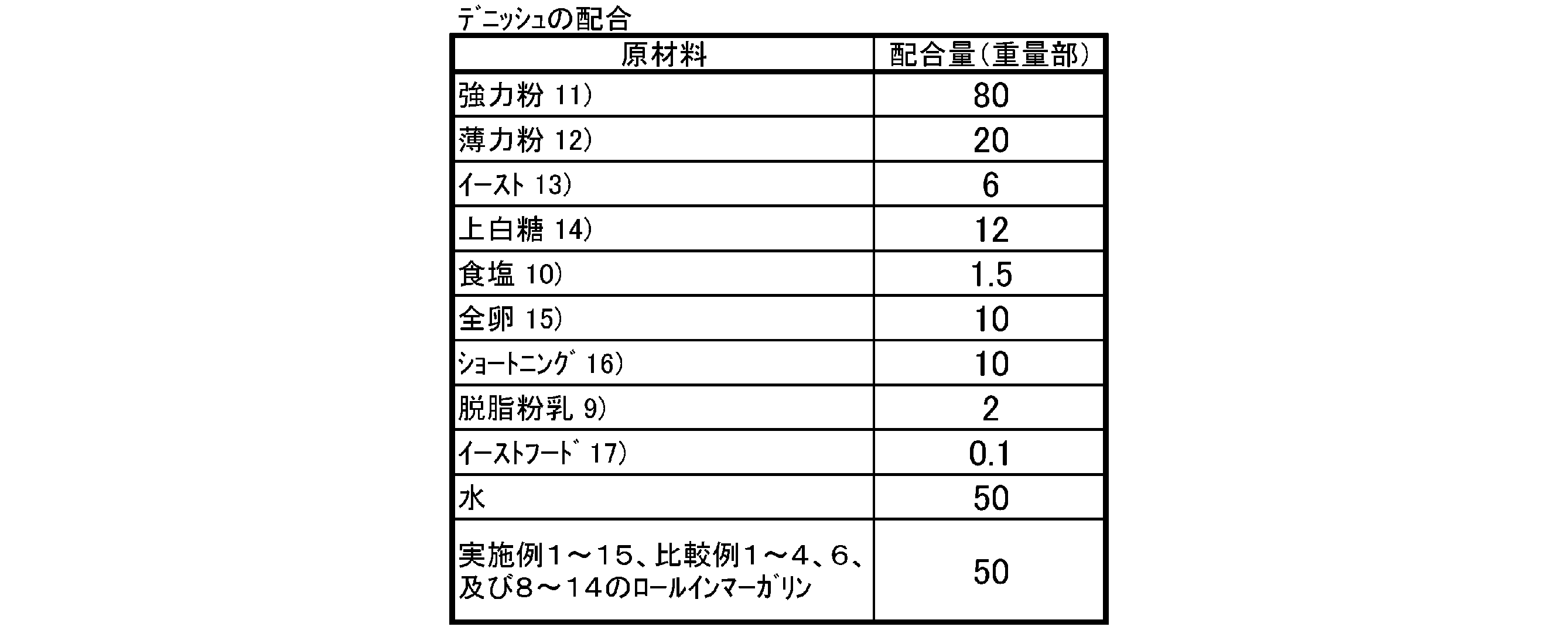
冷却後の生地1916gを成形してから、15℃に温調したロールインマーガリン500gを載置し、包み込んだ。このとき、ロールインマーガリンを包んだ伸展前の生地のサイズは、実施例1~5、8~15および比較例1~4、9~14で36cm(縦)×36cm(横)×2cm(厚)、実施例6および比較例6で36cm(縦)×72cm(横)×1cm(厚)、実施例7で36cm(縦)×24cm(横)×3cm(厚)、比較例8で36cm(縦)×14.4cm(横)×5cm(厚)であった。この生地を、リバースシーターを用いて10mm厚になるまでは5mmごとに段階的に伸展し、その後は2mmごとに段階的に伸展し、最後は4mm厚に調整したリバースシーターを用いて、生地を4mm厚に伸展した。この時、デニッシュ作製時の端生地の廃棄量を評価した。続けて生地を3つ折りした後、3mm厚に調整したリバースシーターを用い、生地を3mm厚に伸展した。得られた生地を1℃で10時間冷却後、更に3つ折りした後、2.5mm厚に調整したリバースシーターを用いて生地を2.5mm厚に伸展した。生地を成形後、35℃、湿度70%のホイロで1時間最終発酵した後、200℃のオーブンで15分間焼成し、デニッシュを得た。デニッシュを作製する際の作業性及び得られたデニッシュの浮きについて評価し、その結果を表1にまとめた。
(実施例2)
表1の製造条件に従って、得られた乳化物を最終到達温度3℃まで冷却し、冷却保持時間を29秒間にした以外は、実施例1と同様にしてロールインマーガリンを得た。ロールインマーガリンを100枚製造した際、形状や重量の不良品発生枚数が1枚であった。また、上記過程で、生産性に関する時間は25分であった。表1には、充填10秒後に測定した粘度とペネ値の値を記載した。
表1の製造条件に従って、得られた乳化物を最終到達温度3℃まで冷却し、冷却保持時間を29秒間にした以外は、実施例1と同様にしてロールインマーガリンを得た。ロールインマーガリンを100枚製造した際、形状や重量の不良品発生枚数が1枚であった。また、上記過程で、生産性に関する時間は25分であった。表1には、充填10秒後に測定した粘度とペネ値の値を記載した。
次いで、得られたロールインマーガリンを用いて実施例1と同様にして、デニッシュを作製した。デニッシュを作製する際の作業性及びデニッシュ作製時の端生地の廃棄量及び得られたデニッシュの浮きについて評価し、その結果を表1に示した。
(実施例3)
表1の製造条件に従って、得られた乳化物を最終到達温度16℃まで冷却し、冷却保持時間を131秒間にした以外は、実施例1と同様にしてロールインマーガリンを得た。ロールインマーガリンを100枚製造した際、形状や重量の不良品発生枚数が2枚であった。また、上記過程で、生産性に関する時間は113分であった。表1には、充填10秒後に測定した粘度とペネ値の値を記載した。
表1の製造条件に従って、得られた乳化物を最終到達温度16℃まで冷却し、冷却保持時間を131秒間にした以外は、実施例1と同様にしてロールインマーガリンを得た。ロールインマーガリンを100枚製造した際、形状や重量の不良品発生枚数が2枚であった。また、上記過程で、生産性に関する時間は113分であった。表1には、充填10秒後に測定した粘度とペネ値の値を記載した。
次いで、得られたロールインマーガリンを用いて実施例1と同様にして、デニッシュを作製した。デニッシュを作製する際の作業性及びデニッシュ作製時の端生地の廃棄量及び得られたデニッシュの浮きについて評価し、その結果を表1に示した。
(実施例4)
表1の製造条件に従って、得られた乳化物を最終到達温度3℃まで冷却した以外は、実施例1と同様にしてロールインマーガリンを得た。ロールインマーガリンを100枚製造した際、形状や重量の不良品発生枚数が6枚であった。また、上記過程で、生産性に関する時間は81分であった。表1には、充填10秒後に測定した粘度とペネ値の値を記載した。
表1の製造条件に従って、得られた乳化物を最終到達温度3℃まで冷却した以外は、実施例1と同様にしてロールインマーガリンを得た。ロールインマーガリンを100枚製造した際、形状や重量の不良品発生枚数が6枚であった。また、上記過程で、生産性に関する時間は81分であった。表1には、充填10秒後に測定した粘度とペネ値の値を記載した。
次いで、得られたロールインマーガリンを用いて実施例1と同様にして、デニッシュを作製した。デニッシュを作製する際の作業性及びデニッシュ作製時の端生地の廃棄量及び得られたデニッシュの浮きについて評価し、その結果を表1に示した。
(実施例5)
表1の製造条件に従って、得られた乳化物を最終到達温度22℃まで冷却した以外は、実施例1と同様にしてロールインマーガリンを得た。ロールインマーガリンを100枚製造した際、形状や重量の不良品発生枚数が8枚であった。また、上記過程で、生産性に関する時間は81分であった。表1には、充填10秒後に測定した粘度とペネ値の値を記載した。
表1の製造条件に従って、得られた乳化物を最終到達温度22℃まで冷却した以外は、実施例1と同様にしてロールインマーガリンを得た。ロールインマーガリンを100枚製造した際、形状や重量の不良品発生枚数が8枚であった。また、上記過程で、生産性に関する時間は81分であった。表1には、充填10秒後に測定した粘度とペネ値の値を記載した。
次いで、得られたロールインマーガリンを用いて実施例1と同様にして、デニッシュを作製した。デニッシュを作製する際の作業性及びデニッシュ作製時の端生地の廃棄量及び得られたデニッシュの浮きについて評価し、その結果を表1に示した。
(比較例1)
表1の製造条件に従って、得られた乳化物を密閉型連続式チューブ冷却機内で保持した後、レスティングチューブ(17.0L容量、20℃)に排出して成型ノズルを通して厚さ4mmのブロックマーガリンを得た以外は、実施例1と同様にしてブロックマーガリンを得た。ここで密閉型連続式チューブ冷却機からレスティングチューブに至る全配管容量は0.7Lであった。
表1の製造条件に従って、得られた乳化物を密閉型連続式チューブ冷却機内で保持した後、レスティングチューブ(17.0L容量、20℃)に排出して成型ノズルを通して厚さ4mmのブロックマーガリンを得た以外は、実施例1と同様にしてブロックマーガリンを得た。ここで密閉型連続式チューブ冷却機からレスティングチューブに至る全配管容量は0.7Lであった。
このブロックマーガリンを4℃で240時間静置して、所望のロールインマーガリンを得た。ロールインマーガリンを100枚製造した際、形状や重量の不良品発生枚数が24枚であった。また、上記過程で、生産性に関する時間は95分であった。表1には、成型ノズルから排出10秒後に測定した粘度とペネ値の値を記載した。
次いで、得られたロールインマーガリンを用いて実施例1と同様にして、デニッシュを作製した。デニッシュを作製する際の作業性及びデニッシュ作製時の端生地の廃棄量及び得られたデニッシュの浮きについて評価し、その結果を表1に示した。
(比較例2)
表1の製造条件に従って、得られた乳化物を最終到達温度6℃まで冷却し、冷却保持時間を29秒間にした以外は、比較例1と同様にしてロールインマーガリンを得た。ロールインマーガリンを100枚製造した際、形状や重量の不良品発生枚数が39枚であった。また、上記過程で、生産性に関する時間は29分であった。表1には、成型ノズルから排出10秒後に測定した粘度とペネ値の値を記載した。
表1の製造条件に従って、得られた乳化物を最終到達温度6℃まで冷却し、冷却保持時間を29秒間にした以外は、比較例1と同様にしてロールインマーガリンを得た。ロールインマーガリンを100枚製造した際、形状や重量の不良品発生枚数が39枚であった。また、上記過程で、生産性に関する時間は29分であった。表1には、成型ノズルから排出10秒後に測定した粘度とペネ値の値を記載した。
次いで、得られたロールインマーガリンを用いて実施例1と同様にして、デニッシュを作製した。デニッシュを作製する際の作業性及びデニッシュ作製時の端生地の廃棄量及び得られたデニッシュの浮きについて評価し、その結果を表1に示した。
(比較例3)
表1の製造条件に従って、得られた乳化物を最終到達温度14℃まで冷却し、冷却保持時間を131秒間にした以外は、比較例1と同様にしてロールインマーガリンを得た。ロールインマーガリンを100枚製造した際、形状や重量の不良品発生枚数が21枚であった。また、上記過程で、生産性に関する時間は133分であった。表1には、成型ノズルから排出10秒後に測定した粘度とペネ値の値を記載した。
表1の製造条件に従って、得られた乳化物を最終到達温度14℃まで冷却し、冷却保持時間を131秒間にした以外は、比較例1と同様にしてロールインマーガリンを得た。ロールインマーガリンを100枚製造した際、形状や重量の不良品発生枚数が21枚であった。また、上記過程で、生産性に関する時間は133分であった。表1には、成型ノズルから排出10秒後に測定した粘度とペネ値の値を記載した。
次いで、得られたロールインマーガリンを用いて実施例1と同様にして、デニッシュを作製した。デニッシュを作製する際の作業性及びデニッシュ作製時の端生地の廃棄量及び得られたデニッシュの浮きについて評価し、その結果を表1に示した。
(比較例4)
表1の製造条件に従って、得られた乳化物を最終到達温度3℃まで冷却した以外は、比較例1と同様にしてロールインマーガリンを得た。ロールインマーガリンを100枚製造した際、形状や重量の不良品発生枚数が21枚であった。また、上記過程で、生産性に関する時間は95分であった。表1には、成型ノズルから排出10秒後に測定した粘度とペネ値の値を記載した。
表1の製造条件に従って、得られた乳化物を最終到達温度3℃まで冷却した以外は、比較例1と同様にしてロールインマーガリンを得た。ロールインマーガリンを100枚製造した際、形状や重量の不良品発生枚数が21枚であった。また、上記過程で、生産性に関する時間は95分であった。表1には、成型ノズルから排出10秒後に測定した粘度とペネ値の値を記載した。
次いで、得られたロールインマーガリンを用いて実施例1と同様にして、デニッシュを作製した。デニッシュを作製する際の作業性及びデニッシュ作製時の端生地の廃棄量及び得られたデニッシュの浮きについて評価し、その結果を表1に示した。
(比較例5)
表1の製造条件に従って、得られた乳化物を最終到達温度22℃まで冷却した以外は、比較例1と同様にしてロールインマーガリンを得ようとしたが、成型ノズルから排出されるブロックマーガリンが柔らかすぎて成形はできなかった。ロールインマーガリンを100枚製造した際、全てが形状や重量の不良品であった。また、上記過程で、生産性に関する時間は95分であった。表1には、成型ノズルから排出10秒後に測定した粘度とペネ値の値を記載した。
表1の製造条件に従って、得られた乳化物を最終到達温度22℃まで冷却した以外は、比較例1と同様にしてロールインマーガリンを得ようとしたが、成型ノズルから排出されるブロックマーガリンが柔らかすぎて成形はできなかった。ロールインマーガリンを100枚製造した際、全てが形状や重量の不良品であった。また、上記過程で、生産性に関する時間は95分であった。表1には、成型ノズルから排出10秒後に測定した粘度とペネ値の値を記載した。
(比較例6)
表1の製造条件に従って、シート厚を2mmにした以外は、比較例1と同様にしてロールインマーガリンを得た。ロールインマーガリンを100枚製造した際、形状や重量の不良品発生枚数が58枚であった。また、上記過程で、生産性に関する時間は95分であった。表1には、成型ノズルから排出10秒後に測定した粘度とペネ値の値を記載した。
表1の製造条件に従って、シート厚を2mmにした以外は、比較例1と同様にしてロールインマーガリンを得た。ロールインマーガリンを100枚製造した際、形状や重量の不良品発生枚数が58枚であった。また、上記過程で、生産性に関する時間は95分であった。表1には、成型ノズルから排出10秒後に測定した粘度とペネ値の値を記載した。
次いで、得られたロールインマーガリンを用いて実施例1と同様にして、デニッシュを作製した。デニッシュを作製する際の作業性及びデニッシュ作製時の端生地の廃棄量及び得られたデニッシュの浮きについて評価し、その結果を表1に示した。
表1より、実施例1~5のロールインマーガリンは、油脂が融解した状態の油中水型乳化油脂組成物を、0~25℃の範囲に冷却して該温度での保持時間が10~300秒間で、混和により軟化され10~35℃の範囲に昇温されて、粘度が10~250Pa・sの範囲に調整された流動状の前記油中水型乳化油脂組成物をピロー包装に充填し、厚みを2~7mmの範囲のシート状に成形してから-30℃~30℃の範囲で24時間以上静置したものであって、何れのロールインマーガリンも、安定性及び生産性のどちらも良好なものであった。そして、これらのロールインマーガリンを使用したデニッシュの作製時には、生地の中でロールインマーガリンが均一に伸び、作業性が非常に良好で、端生地の廃棄量も極めて少なく、また、得られたデニッシュは浮きも良く、ほとんどの層の間に十分な隙間があるものであり、総合評価は良好であった。
一方、比較例1~6のロールインマーガリンは、ピロー包装充填ではなく、密閉型連続式チューブ冷却機内で保持した後、成型ノズルを通して得られたものであり、比較例1~4及び6のロールインマーガリンを使用して作製されたデニッシュの評価は良好であったものの、ロールインマーガリン製造時の安定性または生産性の少なくともどちらかが悪いものであり、総合評価は悪かった。また、比較例5のロールインマーガリンは油脂の結晶化が不十分であるため、ロールインマーガリンの形状に成形ができず、デニッシュの作製ができなかった。
(実施例6)
表3の製造条件に従って、シート厚を2mmにした以外は、実施例1と同様にしてロールインマーガリンを得た。ロールインマーガリンを100枚製造した際、形状や重量の不良品発生枚数が8枚であった。また、上記過程で、生産性に関する時間は81分であった。表3には、充填10秒後に測定した粘度とペネ値の値を記載した。
表3の製造条件に従って、シート厚を2mmにした以外は、実施例1と同様にしてロールインマーガリンを得た。ロールインマーガリンを100枚製造した際、形状や重量の不良品発生枚数が8枚であった。また、上記過程で、生産性に関する時間は81分であった。表3には、充填10秒後に測定した粘度とペネ値の値を記載した。
次いで、得られたロールインマーガリンを用いて実施例1と同様にして、デニッシュを作製した。デニッシュを作製する際の作業性及びデニッシュ作製時の端生地の廃棄量及び得られたデニッシュの浮きについて評価し、その結果を表3に示した。
(実施例7)
表3の製造条件に従って、シート厚を6mmにした以外は、実施例1と同様にしてロールインマーガリンを得た。ロールインマーガリンを100枚製造した際、形状や重量の不良品発生枚数が2枚であった。また、上記過程で、生産性に関する時間は81分であった。表3には、充填10秒後に測定した粘度とペネ値の値を記載した。
表3の製造条件に従って、シート厚を6mmにした以外は、実施例1と同様にしてロールインマーガリンを得た。ロールインマーガリンを100枚製造した際、形状や重量の不良品発生枚数が2枚であった。また、上記過程で、生産性に関する時間は81分であった。表3には、充填10秒後に測定した粘度とペネ値の値を記載した。
次いで、得られたロールインマーガリンを用いて実施例1と同様にして、デニッシュを作製した。デニッシュを作製する際の作業性及びデニッシュ作製時の端生地の廃棄量及び得られたデニッシュの浮きについて評価し、その結果を表3に示した。
(比較例7)
表3の製造条件に従って、シート厚を1mmにした以外は、実施例1と同様にしてロールインマーガリンを得た。ロールインマーガリンを100枚製造した際、形状や重量の不良品発生枚数が11枚であった。また、上記過程で、生産性に関する時間は81分であった。表3には、充填10秒後に測定した粘度とペネ値の値を記載した。
表3の製造条件に従って、シート厚を1mmにした以外は、実施例1と同様にしてロールインマーガリンを得た。ロールインマーガリンを100枚製造した際、形状や重量の不良品発生枚数が11枚であった。また、上記過程で、生産性に関する時間は81分であった。表3には、充填10秒後に測定した粘度とペネ値の値を記載した。
次いで、得られたロールインマーガリンを用いて実施例1と同様にして、デニッシュを作製しようとしたが、ピロー包装から取り出して生地に載せる過程で該ロールインマーガリンが折れてしまったため、デニッシュの作製に使用できなかった。
(比較例8)
表3で示した製造条件に従って、シート厚を10mmにした以外は、実施例1と同様にしてロールインマーガリンを得た。ロールインマーガリンを100枚製造した際、形状や重量の不良品発生枚数が0枚であった。また、上記過程で、生産性に関する時間は81分であった。表3には、充填10秒後に測定した粘度とペネ値の値を記載した。
表3で示した製造条件に従って、シート厚を10mmにした以外は、実施例1と同様にしてロールインマーガリンを得た。ロールインマーガリンを100枚製造した際、形状や重量の不良品発生枚数が0枚であった。また、上記過程で、生産性に関する時間は81分であった。表3には、充填10秒後に測定した粘度とペネ値の値を記載した。
次いで、得られたロールインマーガリンを用いて実施例1と同様にして、デニッシュを作製した。デニッシュを作製する際の作業性及びデニッシュ作製時の端生地の廃棄量及び得られたデニッシュの浮きについて評価し、その結果を表3に示した。
表3より、実施例1,6及び7のロールインマーガリンは、厚みが2~7mmの範囲のシート状に成形されたものであって、何れのロールインマーガリンも、安定性及び生産性のどちらも良好なものであった。そして、これらのロールインマーガリンを使用したデニッシュの作製時には、生地の中で均一に伸びて作業性が非常に良好であり、端生地の廃棄量は実施例7のロールインマーガリンの伸び方にわずかに偏りが見られ若干多かったものの、他は極めて少なく、また、得られたデニッシュは浮きも良く、ほとんどの層の間に十分な隙間があるものであり、総合評価は良好であった。
一方、比較例7のロールインマーガリンは、厚みが1mmのシート状に成形されたものであって、安定性及び生産性のどちらも良好であったものの、ピロー包装から取り出して生地に載せる過程で該ロールインマーガリンが折れてしまったため、デニッシュの作製に使用できなかった。また、比較例8のロールインマーガリンは、厚みが10mmのシート状に成形されたものであって、安定性及び生産性のどちらも良好であったものの、このロールインマーガリンを使用したデニッシュの作製時には、端生地の廃棄量が多く、総合評価は悪かった。
(実施例8)
表4の製造条件に従って、得られた乳化物を最終到達温度3℃まで冷却し、冷却保持時間を59秒間にし、混和昇温装置で軟化させて21℃に昇温させた以外は、実施例1と同様にしてロールインマーガリンを得た。ロールインマーガリンを100枚製造した際、形状や重量の不良品発生枚数が3枚であった。また、上記過程で、生産性に関する時間は69分であった。表4には、充填10秒後に測定した粘度とペネ値の値を記載した。
表4の製造条件に従って、得られた乳化物を最終到達温度3℃まで冷却し、冷却保持時間を59秒間にし、混和昇温装置で軟化させて21℃に昇温させた以外は、実施例1と同様にしてロールインマーガリンを得た。ロールインマーガリンを100枚製造した際、形状や重量の不良品発生枚数が3枚であった。また、上記過程で、生産性に関する時間は69分であった。表4には、充填10秒後に測定した粘度とペネ値の値を記載した。
次いで、得られたロールインマーガリンを用いて実施例1と同様にして、デニッシュを作製した。デニッシュを作製する際の作業性及びデニッシュ作製時の端生地の廃棄量及び得られたデニッシュの浮きについて評価し、その結果を表4に示した。
(実施例9)
表4の製造条件に従って、得られた乳化物を最終到達温度22℃まで冷却し、冷却保持時間を134秒間にし、混和昇温装置で軟化させて28℃に昇温させた以外は、実施例1と同様にしてロールインマーガリンを得た。ロールインマーガリンを100枚製造した際、形状や重量の不良品発生枚数が8枚であった。また、上記過程で、生産性に関する時間は94分であった。表4には、充填10秒後に測定した粘度とペネ値の値を記載した。
表4の製造条件に従って、得られた乳化物を最終到達温度22℃まで冷却し、冷却保持時間を134秒間にし、混和昇温装置で軟化させて28℃に昇温させた以外は、実施例1と同様にしてロールインマーガリンを得た。ロールインマーガリンを100枚製造した際、形状や重量の不良品発生枚数が8枚であった。また、上記過程で、生産性に関する時間は94分であった。表4には、充填10秒後に測定した粘度とペネ値の値を記載した。
次いで、得られたロールインマーガリンを用いて実施例1と同様にして、デニッシュを作製した。デニッシュを作製する際の作業性及びデニッシュ作製時の端生地の廃棄量及び得られたデニッシュの浮きについて評価し、その結果を表4に示した。
(比較例9)
表4の製造条件に従って、冷却保持時間を361秒間にし、混和昇温装置で軟化させて25℃に昇温させた以外は、実施例1と同様にしてロールインマーガリンを得た。ロールインマーガリンを100枚製造した際、形状や重量の不良品発生枚数が3枚であった。また、上記過程で、生産性に関する時間は171分であった。表4には、充填10秒後に測定した粘度とペネ値の値を記載した。
表4の製造条件に従って、冷却保持時間を361秒間にし、混和昇温装置で軟化させて25℃に昇温させた以外は、実施例1と同様にしてロールインマーガリンを得た。ロールインマーガリンを100枚製造した際、形状や重量の不良品発生枚数が3枚であった。また、上記過程で、生産性に関する時間は171分であった。表4には、充填10秒後に測定した粘度とペネ値の値を記載した。
次いで、得られたロールインマーガリンを用いて実施例1と同様にして、デニッシュを作製した。デニッシュを作製する際の作業性及びデニッシュ作製時の端生地の廃棄量及び得られたデニッシュの浮きについて評価し、その結果を表4に示した。
(比較例10)
表4の製造条件に従って、得られた乳化物を最終到達温度28℃まで冷却し、混和昇温装置で軟化させて31℃に昇温させた以外は、実施例1と同様にしてロールインマーガリンを得た。ロールインマーガリンを100枚製造した際、形状や重量の不良品発生枚数が12枚であった。また、上記過程で、生産性に関する時間は81分であった。表4には、充填10秒後に測定した粘度とペネ値の値を記載した。
表4の製造条件に従って、得られた乳化物を最終到達温度28℃まで冷却し、混和昇温装置で軟化させて31℃に昇温させた以外は、実施例1と同様にしてロールインマーガリンを得た。ロールインマーガリンを100枚製造した際、形状や重量の不良品発生枚数が12枚であった。また、上記過程で、生産性に関する時間は81分であった。表4には、充填10秒後に測定した粘度とペネ値の値を記載した。
次いで、得られたロールインマーガリンを用いて実施例1と同様にして、デニッシュを作製した。デニッシュを作製する際の作業性及びデニッシュ作製時の端生地の廃棄量及び得られたデニッシュの浮きについて評価し、その結果を表4に示した。
(比較例11)
表4の製造条件に従って、得られた乳化物を最終到達温度15℃まで冷却し、冷却保持時間を7秒間にした以外は、実施例1と同様にしてロールインマーガリンを得た。ロールインマーガリンを100枚製造した際、形状や重量の不良品発生枚数が8枚であった。また、上記過程で、生産性に関する時間は12分であった。表4には、充填10秒後に測定した粘度とペネ値の値を記載した。
表4の製造条件に従って、得られた乳化物を最終到達温度15℃まで冷却し、冷却保持時間を7秒間にした以外は、実施例1と同様にしてロールインマーガリンを得た。ロールインマーガリンを100枚製造した際、形状や重量の不良品発生枚数が8枚であった。また、上記過程で、生産性に関する時間は12分であった。表4には、充填10秒後に測定した粘度とペネ値の値を記載した。
次いで、得られたロールインマーガリンを用いて実施例1と同様にして、デニッシュを作製した。デニッシュを作製する際の作業性及びデニッシュ作製時の端生地の廃棄量及び得られたデニッシュの浮きについて評価し、その結果を表4に示した。
表4より、実施例1,2,8及び9のロールインマーガリンは、製造時の油脂が融解した状態の油中水型乳化油脂組成物を、0~25℃の範囲に冷却して該温度での保持時間が10~300秒間のものであって、何れのロールインマーガリンも、安定性及び生産性のどちらも良好なものであった。そして、これらのロールインマーガリンを使用したデニッシュの作製時には、生地の中で均一に伸びて作業性が非常に良好であり、端生地の廃棄量は極めて少なく、また、得られたデニッシュは浮きも良く、ほとんどの層の間に十分な隙間があるものであり、総合評価は良好であった。
一方、比較例9のロールインマーガリンは、製造時の油脂が融解した状態の油中水型乳化油脂組成物の10℃での保持時間が361秒間と長いものであって、このロールインマーガリンを使用して作製されたデニッシュの評価は良好であったものの、ロールインマーガリンの生産性が悪く、総合評価が悪かった。また、比較例10のロールインマーガリンは、製造時の油脂が融解した状態の油中水型乳化油脂組成物の冷却温度が28℃と高いものであって、ロールインマーガリン生産時の安定性及び生産性は良好であったものの、このロールインマーガリンを使用して得られたデニッシュは浮きが非常に悪く、ほとんどの生地と生地の間に十分な隙間がないものであり、総合評価は悪かった。更に、比較例11のロールインマーガリンは、製造時の油脂が融解した状態の油中水型乳化油脂組成物の15℃での保持時間が7秒間と短いものであって、ロールインマーガリン生産時の安定性及び生産性は良好であったものの、デニッシュ作製時に、ロールインマーガリンが均一に伸びていない部分が多くて作業性が悪く、また、得られたデニッシュは浮きも悪く、各層の間に十分な隙間のない部分が多いものであり、総合評価は悪かった。
(実施例10)
表5の製造条件に従って、得られた乳化物を最終到達温度11℃まで冷却し、冷却保持時間を134秒間にし、混和昇温装置で軟化させて13℃に昇温させ、またテンパリング処理を25℃で行った以外は、実施例1と同様にしてロールインマーガリンを得た。ロールインマーガリンを100枚製造した際、形状や重量の不良品発生枚数が7枚であった。また、上記過程で、生産性に関する時間は113分であった。表5には、充填10秒後に測定した粘度とペネ値の値を記載した。
表5の製造条件に従って、得られた乳化物を最終到達温度11℃まで冷却し、冷却保持時間を134秒間にし、混和昇温装置で軟化させて13℃に昇温させ、またテンパリング処理を25℃で行った以外は、実施例1と同様にしてロールインマーガリンを得た。ロールインマーガリンを100枚製造した際、形状や重量の不良品発生枚数が7枚であった。また、上記過程で、生産性に関する時間は113分であった。表5には、充填10秒後に測定した粘度とペネ値の値を記載した。
次いで、得られたロールインマーガリンを用いて実施例1と同様にして、デニッシュを作製した。デニッシュを作製する際の作業性及びデニッシュ作製時の端生地の廃棄量及び得られたデニッシュの浮きについて評価し、その結果を表5に示した。
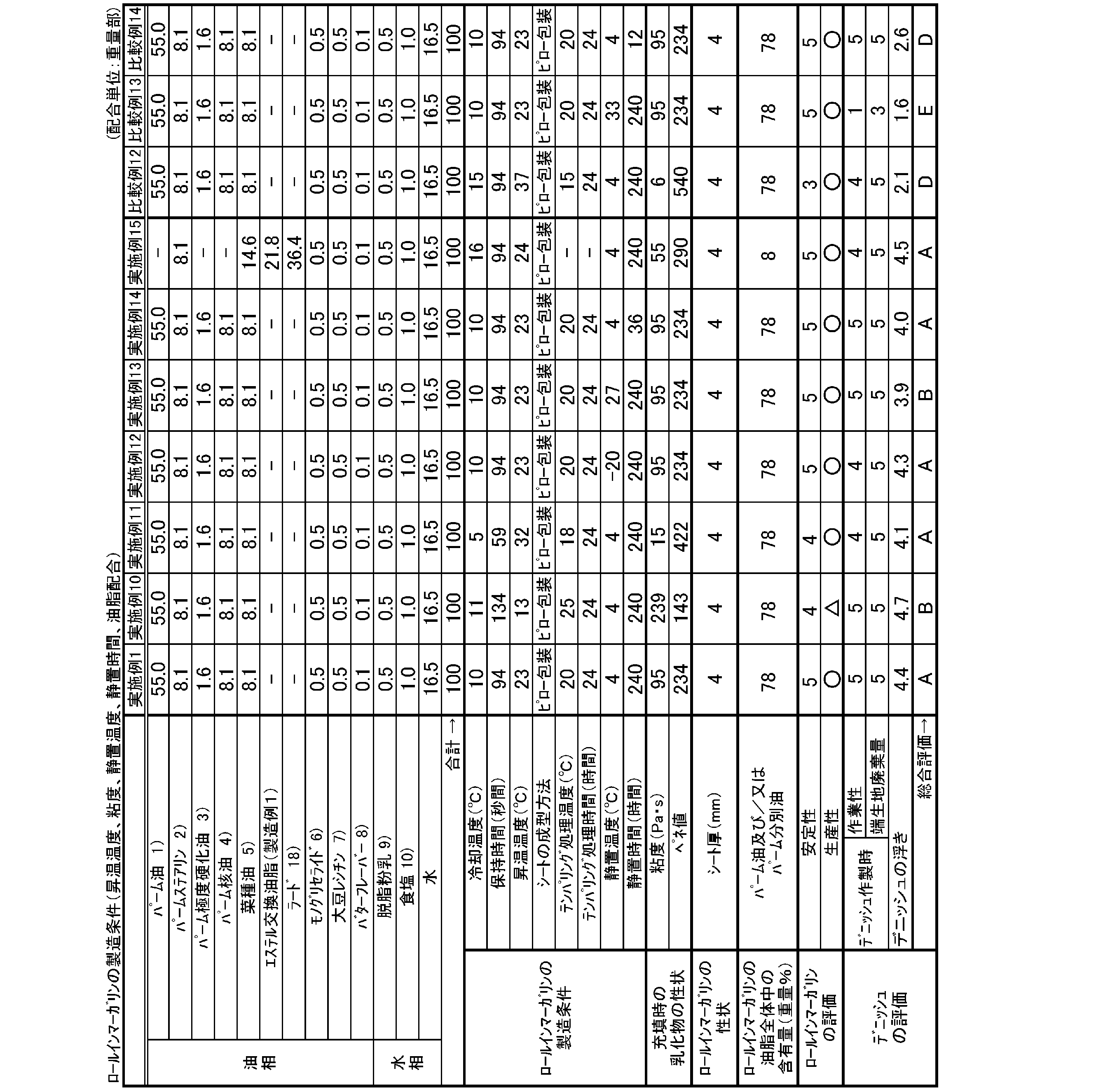
(実施例11)
表5の製造条件に従って、得られた乳化物を最終到達温度5℃まで冷却し、冷却保持時間を59秒間にし、混和昇温装置で軟化させて32℃に昇温させ、またテンパリング処理を18℃で行った以外は、実施例1と同様にしてロールインマーガリンを得た。ロールインマーガリンを100枚製造した際、形状や重量の不良品発生枚数が7枚であった。また、上記過程で、生産性に関する時間は69分であった。表5には、充填10秒後に測定した粘度とペネ値の値を記載した。
表5の製造条件に従って、得られた乳化物を最終到達温度5℃まで冷却し、冷却保持時間を59秒間にし、混和昇温装置で軟化させて32℃に昇温させ、またテンパリング処理を18℃で行った以外は、実施例1と同様にしてロールインマーガリンを得た。ロールインマーガリンを100枚製造した際、形状や重量の不良品発生枚数が7枚であった。また、上記過程で、生産性に関する時間は69分であった。表5には、充填10秒後に測定した粘度とペネ値の値を記載した。
次いで、得られたロールインマーガリンを用いて実施例1と同様にして、デニッシュを作製した。デニッシュを作製する際の作業性及びデニッシュ作製時の端生地の廃棄量及び得られたデニッシュの浮きについて評価し、その結果を表5に示した。
(実施例12)
表5の製造条件に従って、ブロックマーガリンをテンパリング処理した後の静置温度を-20℃にした以外は、実施例1と同様にしてロールインマーガリンを得た。ロールインマーガリンを100枚製造した際、形状や重量の不良品発生枚数が2枚であった。また、上記過程で、生産性に関する時間は81分であった。表5には、充填10秒後に測定した粘度とペネ値の値を記載した。
表5の製造条件に従って、ブロックマーガリンをテンパリング処理した後の静置温度を-20℃にした以外は、実施例1と同様にしてロールインマーガリンを得た。ロールインマーガリンを100枚製造した際、形状や重量の不良品発生枚数が2枚であった。また、上記過程で、生産性に関する時間は81分であった。表5には、充填10秒後に測定した粘度とペネ値の値を記載した。
次いで、得られたロールインマーガリンを用いて実施例1と同様にして、デニッシュを作製した。デニッシュを作製する際の作業性及びデニッシュ作製時の端生地の廃棄量及び得られたデニッシュの浮きについて評価し、その結果を表5に示した。
(実施例13)
表5の製造条件に従って、ブロックマーガリンをテンパリング処理した後の静置温度を27℃にした以外は、実施例1と同様にしてロールインマーガリンを得た。ロールインマーガリンを100枚製造した際、形状や重量の不良品発生枚数が2枚であった。また、上記過程で、生産性に関する時間は81分であった。表5には、充填10秒後に測定した粘度とペネ値の値を記載した。
表5の製造条件に従って、ブロックマーガリンをテンパリング処理した後の静置温度を27℃にした以外は、実施例1と同様にしてロールインマーガリンを得た。ロールインマーガリンを100枚製造した際、形状や重量の不良品発生枚数が2枚であった。また、上記過程で、生産性に関する時間は81分であった。表5には、充填10秒後に測定した粘度とペネ値の値を記載した。
次いで、得られたロールインマーガリンを用いて実施例1と同様にして、デニッシュを作製した。デニッシュを作製する際の作業性及びデニッシュ作製時の端生地の廃棄量及び得られたデニッシュの浮きについて評価し、その結果を表5に示した。
(実施例14)
表5の製造条件に従って、ブロックマーガリンをテンパリング処理した後の静置時間を36時間にした以外は、実施例1と同様にしてロールインマーガリンを得た。ロールインマーガリンを100枚製造した際、形状や重量の不良品発生枚数が2枚であった。また、上記過程で、生産性に関する時間は81分であった。表5には、充填10秒後に測定した粘度とペネ値の値を記載した。
表5の製造条件に従って、ブロックマーガリンをテンパリング処理した後の静置時間を36時間にした以外は、実施例1と同様にしてロールインマーガリンを得た。ロールインマーガリンを100枚製造した際、形状や重量の不良品発生枚数が2枚であった。また、上記過程で、生産性に関する時間は81分であった。表5には、充填10秒後に測定した粘度とペネ値の値を記載した。
次いで、得られたロールインマーガリンを用いて実施例1と同様にして、デニッシュを作製した。デニッシュを作製する際の作業性及びデニッシュ作製時の端生地の廃棄量及び得られたデニッシュの浮きについて評価し、その結果を表5に示した。
(実施例15)
表5に示す配合に従って、油脂の配合を、パームステアリン8.1重量部、菜種油14.6重量部、製造例1のエステル交換油脂21.8重量部、ラード36.4重量部とし、パーム油、パーム極度硬化油及びパーム核油を使用しなかった。油相の融点は36℃であった。さらに、表5に示す製造条件に従って、得られた乳化物を最終到達温度16℃まで冷却し、混和昇温装置で軟化させて昇温させた温度を24℃とし、テンパリング処理を行なわなかったこと以外は、実施例1と同様にしてロールインマーガリンを得た。ロールインマーガリンを100枚製造した際、形状や重量の不良品発生枚数が0枚であった。また、上記過程で、生産性に関する時間は81分であった。表5には、充填10秒後に測定した粘度とペネ値の値を記載した。
表5に示す配合に従って、油脂の配合を、パームステアリン8.1重量部、菜種油14.6重量部、製造例1のエステル交換油脂21.8重量部、ラード36.4重量部とし、パーム油、パーム極度硬化油及びパーム核油を使用しなかった。油相の融点は36℃であった。さらに、表5に示す製造条件に従って、得られた乳化物を最終到達温度16℃まで冷却し、混和昇温装置で軟化させて昇温させた温度を24℃とし、テンパリング処理を行なわなかったこと以外は、実施例1と同様にしてロールインマーガリンを得た。ロールインマーガリンを100枚製造した際、形状や重量の不良品発生枚数が0枚であった。また、上記過程で、生産性に関する時間は81分であった。表5には、充填10秒後に測定した粘度とペネ値の値を記載した。
次いで、得られたロールインマーガリンを用いて実施例1と同様にして、デニッシュを作製した。デニッシュを作製する際の作業性及びデニッシュ作製時の端生地の廃棄量及び得られたデニッシュの浮きについて評価し、その結果を表5に示した。
(比較例12)
表5の製造条件に従って、得られた乳化物を最終到達温度15℃まで冷却し、混和昇温装置で軟化させて37℃に昇温させ、テンパリング処理を15℃で行った以外は、実施例1と同様にしてロールインマーガリンを得た。ロールインマーガリンを100枚製造した際、形状や重量の不良品発生枚数が18枚であった。また、上記過程で、生産性に関する時間は81分であった。表5には、充填10秒後に測定した粘度とペネ値の値を記載した。
表5の製造条件に従って、得られた乳化物を最終到達温度15℃まで冷却し、混和昇温装置で軟化させて37℃に昇温させ、テンパリング処理を15℃で行った以外は、実施例1と同様にしてロールインマーガリンを得た。ロールインマーガリンを100枚製造した際、形状や重量の不良品発生枚数が18枚であった。また、上記過程で、生産性に関する時間は81分であった。表5には、充填10秒後に測定した粘度とペネ値の値を記載した。
次いで、得られたロールインマーガリンを用いて実施例1と同様にして、デニッシュを作製した。デニッシュを作製する際の作業性及びデニッシュ作製時の端生地の廃棄量及び得られたデニッシュの浮きについて評価し、その結果を表5に示した。
(比較例13)
表5の製造条件に従って、ブロックマーガリンをテンパリング処理した後の静置温度を33℃にした以外は、実施例1と同様にしてロールインマーガリンを得た。ロールインマーガリンを100枚製造した際、形状や重量の不良品発生枚数が2枚であった。また、上記過程で、生産性に関する時間は81分であった。表5には、充填10秒後に測定した粘度とペネ値の値を記載した。
表5の製造条件に従って、ブロックマーガリンをテンパリング処理した後の静置温度を33℃にした以外は、実施例1と同様にしてロールインマーガリンを得た。ロールインマーガリンを100枚製造した際、形状や重量の不良品発生枚数が2枚であった。また、上記過程で、生産性に関する時間は81分であった。表5には、充填10秒後に測定した粘度とペネ値の値を記載した。
次いで、得られたロールインマーガリンを用いて実施例1と同様にして、デニッシュを作製した。デニッシュを作製する際の作業性及びデニッシュ作製時の端生地の廃棄量及び得られたデニッシュの浮きについて評価し、その結果を表5に示した。
(比較例14)
表5の製造条件に従って、ブロックマーガリンをテンパリング処理した後の静置時間を12時間にした以外は、実施例1と同様にしてロールインマーガリンを得た。ロールインマーガリンを100枚製造した際、形状や重量の不良品発生枚数が2枚であった。また、上記過程で、生産性に関する時間は81分であった。表5には、充填10秒後に測定した粘度とペネ値の値を記載した。
表5の製造条件に従って、ブロックマーガリンをテンパリング処理した後の静置時間を12時間にした以外は、実施例1と同様にしてロールインマーガリンを得た。ロールインマーガリンを100枚製造した際、形状や重量の不良品発生枚数が2枚であった。また、上記過程で、生産性に関する時間は81分であった。表5には、充填10秒後に測定した粘度とペネ値の値を記載した。
次いで、得られたロールインマーガリンを用いて実施例1と同様にして、デニッシュを作製した。デニッシュを作製する際の作業性及びデニッシュ作製時の端生地の廃棄量及び得られたデニッシュの浮きについて評価し、その結果を表5に示した。
表5より、実施例1及び10~15のロールインマーガリンは、ロールインマーガリン製造時の油中水型乳化油脂組成物の軟化時の昇温温度が10~35℃の範囲で、シート状に成形してから-30℃~30℃の範囲で24時間以上静置したものであって、何れのロールインマーガリンも、安定性及び生産性のどちらも良好なものであった。そして、これらのロールインマーガリンを使用したデニッシュの作製時には、生地の中でロールインマーガリンが均一に伸び、作業性が非常に良好で、端生地の廃棄量も極めて少なく、また、得られたデニッシュは浮きも良く、ほとんどの層の間に十分な隙間があるものであり、総合評価は良好であった。一方、比較例12のロールインマーガリンは、ロールインマーガリン製造時の油中水型乳化油脂組成物の軟化時の昇温温度が37℃と高いものであって、ロールインマーガリン生産時の安定性及び生産性は良好であったものの、このロールインマーガリンを使用して得られたデニッシュは浮きが悪く、各層の間に十分な隙間のない部分が多いものであり、総合評価は悪かった。また、比較例13のロールインマーガリンは、シート状に成形してからの静置温度が33℃と高いものであって、ロールインマーガリン生産時の安定性及び生産性は良好であったものの、このロールインマーガリンを使用したデニッシュの作製時に、ロールインマーガリンが伸びず、生地にロールインマーガリンの塊が見られ、作業性が非常に悪く、また、得られたデニッシュは浮きも非常に悪く、ほとんどの生地と生地の間に十分な隙間がないものであり、総合評価は悪かった。更に、比較例14のロールインマーガリンは、シート状に成形してから4℃での静置時間が12時間と短いものであって、ロールインマーガリン生産時の安定性及び生産性は良好であったものの、このロールインマーガリンを使用して得られたデニッシュは浮きが悪く、各層の間に十分な隙間のない部分が多いものであり、総合評価は悪かった。
(実施例16)デニッシュの作製
実施例1のロールインマーガリンを使用し、その配合量を50重量部から40重量部に変えた以外は、実施例1と同様にして、デニッシュを得た。デニッシュ作製時の作業性は5点、端生地の廃棄量は5点、得られたデニッシュの浮きは4.1点であった。デニッシュの作製時には、生地の中でロールインマーガリンが均一に伸び、作業性が非常に良好で、端生地の廃棄量も極めて少なく、また、得られたデニッシュは浮きも良く、ほとんどの層の間に十分な隙間があるものであり、総合評価は良好であった。
実施例1のロールインマーガリンを使用し、その配合量を50重量部から40重量部に変えた以外は、実施例1と同様にして、デニッシュを得た。デニッシュ作製時の作業性は5点、端生地の廃棄量は5点、得られたデニッシュの浮きは4.1点であった。デニッシュの作製時には、生地の中でロールインマーガリンが均一に伸び、作業性が非常に良好で、端生地の廃棄量も極めて少なく、また、得られたデニッシュは浮きも良く、ほとんどの層の間に十分な隙間があるものであり、総合評価は良好であった。
Claims (5)
- 油脂が融解した状態の油中水型乳化油脂組成物が、0~25℃まで冷却されて該温度に10~300秒間保持され晶析された後、混和により軟化させられながら10~35℃に昇温されて、粘度が10~250Pa・sに調整された流動状の前記油中水型乳化油脂組成物がピロー包装に充填され、厚みが2~7mmのシート状に成形されてから-30℃~30℃で24時間以上静置された、ピロー包装されたロールインマーガリン。
- ピロー包装に充填された流動状の前記油中水型乳化油脂組成物が、2枚の平板で押し挟まれて厚みが2~7mmのシート状に成形された、請求項1に記載のロールインマーガリン。
- 油脂が融解した状態の油中水型乳化油脂組成物を、0~25℃まで冷却して該温度に10~300秒間保持し晶析せしめた後、混和により軟化させながら10~35℃に昇温させて、粘度を10~250Pa・sに調整し、調整後の流動状の前記油中水型乳化油脂組成物をピロー包装に充填し、厚みが2~7mmのシート状に圧延して成形し、-30℃~30℃で24時間以上静置することを特徴とする、ロールインマーガリンの製造方法。
- ロールインマーガリンの油脂全体中、パーム油及び/又はパーム分別油の含有量が50~95重量%であり、
該油脂が融解した状態の油中水型乳化油脂組成物を、0~25℃であって、かつ油相部の融点から15~40℃低い温度まで冷却して該温度に10~300秒間保持し晶析せしめた後、混和により軟化させながら10~35℃に昇温させて、粘度を10~250Pa・sに調整し、調整後の流動状の前記油中水型乳化油脂組成物をピロー包装に充填し、厚みが2~7mmのシート状に圧延して成形した後、15~30℃の温度で10~100時間テンパリング処理してから、-30℃~30℃で24時間以上静置する、請求項3に記載のロールインマーガリンの製造方法。 - 請求項1又は2に記載のロールインマーガリンを用いてなる層状食品。
Priority Applications (2)
| Application Number | Priority Date | Filing Date | Title |
|---|---|---|---|
| CN201980044579.2A CN112351686A (zh) | 2018-07-27 | 2019-07-26 | 裹入用人造黄油、其制造方法和层状食品 |
| JP2020532505A JP7360388B2 (ja) | 2018-07-27 | 2019-07-26 | ロールインマーガリンの製造方法 |
Applications Claiming Priority (2)
| Application Number | Priority Date | Filing Date | Title |
|---|---|---|---|
| JP2018141368 | 2018-07-27 | ||
| JP2018-141368 | 2018-07-27 |
Publications (1)
| Publication Number | Publication Date |
|---|---|
| WO2020022490A1 true WO2020022490A1 (ja) | 2020-01-30 |
Family
ID=69181611
Family Applications (1)
| Application Number | Title | Priority Date | Filing Date |
|---|---|---|---|
| PCT/JP2019/029463 Ceased WO2020022490A1 (ja) | 2018-07-27 | 2019-07-26 | ロールインマーガリン、その製造方法、及び層状食品 |
Country Status (3)
| Country | Link |
|---|---|
| JP (1) | JP7360388B2 (ja) |
| CN (1) | CN112351686A (ja) |
| WO (1) | WO2020022490A1 (ja) |
Cited By (1)
| Publication number | Priority date | Publication date | Assignee | Title |
|---|---|---|---|---|
| JP2019193610A (ja) * | 2018-04-27 | 2019-11-07 | 株式会社カネカ | 新規ロールインマーガリン製法 |
Citations (9)
| Publication number | Priority date | Publication date | Assignee | Title |
|---|---|---|---|---|
| JPS5095441A (ja) * | 1973-12-27 | 1975-07-29 | ||
| JPH02174629A (ja) * | 1988-08-23 | 1990-07-06 | Fuji Oil Co Ltd | シート状食品及びその製造法 |
| JP2002121585A (ja) * | 2000-10-16 | 2002-04-26 | Kanegafuchi Chem Ind Co Ltd | 油脂組成物及びその製造方法 |
| WO2006120785A1 (ja) * | 2005-05-12 | 2006-11-16 | Fuji Oil Company, Limited | 業務用シート状食品の包装方法 |
| JP2007060912A (ja) * | 2005-08-29 | 2007-03-15 | Kaneka Corp | シート状油中水型乳化油脂組成物およびその製造法 |
| JP2007129949A (ja) * | 2005-11-10 | 2007-05-31 | Nof Corp | 低トランス酸植物性油脂組成物 |
| JP2010111727A (ja) * | 2008-11-05 | 2010-05-20 | Boso Oil & Fat Co Ltd | 風味良好な低トランス酸植物性油脂組成物 |
| JP2013512693A (ja) * | 2009-12-08 | 2013-04-18 | キャラヴァン イングリーディエンツ アイエヌシー. | 高ジグリセリド構造性組成物ならびにこれを用いる製品および方法 |
| JP2013135629A (ja) * | 2011-12-28 | 2013-07-11 | Riken Vitamin Co Ltd | 油脂のクリーミング性向上剤およびそれを含有する油脂組成物 |
Family Cites Families (3)
| Publication number | Priority date | Publication date | Assignee | Title |
|---|---|---|---|---|
| JPH08173034A (ja) * | 1994-12-21 | 1996-07-09 | Kanegafuchi Chem Ind Co Ltd | 油脂組成物の成型方法 |
| JP4375922B2 (ja) | 2001-05-24 | 2009-12-02 | 株式会社Adeka | ロールイン用油脂組成物及びその製造方法 |
| CN101511200B (zh) * | 2006-09-06 | 2011-11-30 | 不二制油株式会社 | 层状小麦粉膨化食品用可塑性油包水型乳化物 |
-
2019
- 2019-07-26 JP JP2020532505A patent/JP7360388B2/ja active Active
- 2019-07-26 WO PCT/JP2019/029463 patent/WO2020022490A1/ja not_active Ceased
- 2019-07-26 CN CN201980044579.2A patent/CN112351686A/zh active Pending
Patent Citations (9)
| Publication number | Priority date | Publication date | Assignee | Title |
|---|---|---|---|---|
| JPS5095441A (ja) * | 1973-12-27 | 1975-07-29 | ||
| JPH02174629A (ja) * | 1988-08-23 | 1990-07-06 | Fuji Oil Co Ltd | シート状食品及びその製造法 |
| JP2002121585A (ja) * | 2000-10-16 | 2002-04-26 | Kanegafuchi Chem Ind Co Ltd | 油脂組成物及びその製造方法 |
| WO2006120785A1 (ja) * | 2005-05-12 | 2006-11-16 | Fuji Oil Company, Limited | 業務用シート状食品の包装方法 |
| JP2007060912A (ja) * | 2005-08-29 | 2007-03-15 | Kaneka Corp | シート状油中水型乳化油脂組成物およびその製造法 |
| JP2007129949A (ja) * | 2005-11-10 | 2007-05-31 | Nof Corp | 低トランス酸植物性油脂組成物 |
| JP2010111727A (ja) * | 2008-11-05 | 2010-05-20 | Boso Oil & Fat Co Ltd | 風味良好な低トランス酸植物性油脂組成物 |
| JP2013512693A (ja) * | 2009-12-08 | 2013-04-18 | キャラヴァン イングリーディエンツ アイエヌシー. | 高ジグリセリド構造性組成物ならびにこれを用いる製品および方法 |
| JP2013135629A (ja) * | 2011-12-28 | 2013-07-11 | Riken Vitamin Co Ltd | 油脂のクリーミング性向上剤およびそれを含有する油脂組成物 |
Non-Patent Citations (1)
| Title |
|---|
| TSUJI, JUNSAKU: "General View of the Recent Chilling and Working Equipments for Margarins and Shortenings", JOURNAL OF JAPAN OIL CHEMISTS SOCIETY, vol. 16, no. 5, 1967, pages 275 - 283 * |
Cited By (2)
| Publication number | Priority date | Publication date | Assignee | Title |
|---|---|---|---|---|
| JP2019193610A (ja) * | 2018-04-27 | 2019-11-07 | 株式会社カネカ | 新規ロールインマーガリン製法 |
| JP7116615B2 (ja) | 2018-04-27 | 2022-08-10 | 株式会社カネカ | 新規ロールインマーガリン製法 |
Also Published As
| Publication number | Publication date |
|---|---|
| JP7360388B2 (ja) | 2023-10-12 |
| CN112351686A (zh) | 2021-02-09 |
| JPWO2020022490A1 (ja) | 2021-08-02 |
Similar Documents
| Publication | Publication Date | Title |
|---|---|---|
| JP7116615B2 (ja) | 新規ロールインマーガリン製法 | |
| JP7261792B2 (ja) | 新規ロールインマーガリン | |
| JP7007050B2 (ja) | 油中水型乳化油脂組成物 | |
| JP6940263B2 (ja) | ロールイン用可塑性油脂組成物 | |
| JP6319832B2 (ja) | 製パン練り込み用油中水型乳化油脂組成物 | |
| JP5004847B2 (ja) | 油中水型乳化油脂組成物 | |
| JP2010268751A (ja) | フラワーペースト類 | |
| JP7360388B2 (ja) | ロールインマーガリンの製造方法 | |
| JP7353709B2 (ja) | 可塑性油脂組成物の製造方法 | |
| JP5982173B2 (ja) | 可塑性油脂組成物 | |
| JP4587613B2 (ja) | ロールイン用油脂組成物の製造方法 | |
| EP0542202A2 (en) | Fat composition for puff pastries | |
| JP6788764B2 (ja) | 高生産性ロールインマーガリン製法 | |
| JP4493471B2 (ja) | フラワーペースト又はカスタード | |
| JP7449676B2 (ja) | ロールインマーガリン、及びその製造方法 | |
| JP7597727B2 (ja) | シート状マーガリン、及びその製造方法 | |
| JP7449677B2 (ja) | ロールインマーガリン、及びその製造方法 | |
| JP2021073957A (ja) | ロールインマーガリン、及びその製造方法 | |
| JP7777932B2 (ja) | ロールインマーガリン | |
| JP2021065145A (ja) | ロールイン用油脂組成物 | |
| JP2021073958A (ja) | ロールインマーガリン、及びその製造方法 | |
| JP6124664B2 (ja) | 可塑性油脂組成物 | |
| JP2005073582A (ja) | 積層状生地 | |
| JP2004305048A (ja) | ペストリー練り込み用油脂組成物 | |
| JP2022177982A (ja) | シート状ロールイン油脂組成物 |
Legal Events
| Date | Code | Title | Description |
|---|---|---|---|
| 121 | Ep: the epo has been informed by wipo that ep was designated in this application |
Ref document number: 19840819 Country of ref document: EP Kind code of ref document: A1 |
|
| ENP | Entry into the national phase |
Ref document number: 2020532505 Country of ref document: JP Kind code of ref document: A |
|
| NENP | Non-entry into the national phase |
Ref country code: DE |
|
| 122 | Ep: pct application non-entry in european phase |
Ref document number: 19840819 Country of ref document: EP Kind code of ref document: A1 |