WO2019225630A1 - 膨化食品およびその製造方法と、加工食品 - Google Patents
膨化食品およびその製造方法と、加工食品 Download PDFInfo
- Publication number
- WO2019225630A1 WO2019225630A1 PCT/JP2019/020203 JP2019020203W WO2019225630A1 WO 2019225630 A1 WO2019225630 A1 WO 2019225630A1 JP 2019020203 W JP2019020203 W JP 2019020203W WO 2019225630 A1 WO2019225630 A1 WO 2019225630A1
- Authority
- WO
- WIPO (PCT)
- Prior art keywords
- food
- puffed food
- mass
- content
- casein
- Prior art date
- Legal status (The legal status is an assumption and is not a legal conclusion. Google has not performed a legal analysis and makes no representation as to the accuracy of the status listed.)
- Ceased
Links
Images






























Classifications
-
- A—HUMAN NECESSITIES
- A23—FOODS OR FOODSTUFFS; TREATMENT THEREOF, NOT COVERED BY OTHER CLASSES
- A23L—FOODS, FOODSTUFFS OR NON-ALCOHOLIC BEVERAGES, NOT OTHERWISE PROVIDED FOR; PREPARATION OR TREATMENT THEREOF
- A23L5/00—Preparation or treatment of foods or foodstuffs, in general; Food or foodstuffs obtained thereby; Materials therefor
-
- A—HUMAN NECESSITIES
- A21—BAKING; EDIBLE DOUGHS
- A21D—TREATMENT OF FLOUR OR DOUGH FOR BAKING, e.g. BY ADDITION OF MATERIALS; BAKING; BAKERY PRODUCTS
- A21D13/00—Finished or partly finished bakery products
- A21D13/06—Products with modified nutritive value, e.g. with modified starch content
- A21D13/064—Products with modified nutritive value, e.g. with modified starch content with modified protein content
-
- A—HUMAN NECESSITIES
- A21—BAKING; EDIBLE DOUGHS
- A21D—TREATMENT OF FLOUR OR DOUGH FOR BAKING, e.g. BY ADDITION OF MATERIALS; BAKING; BAKERY PRODUCTS
- A21D2/00—Treatment of flour or dough by adding materials thereto before or during baking
- A21D2/08—Treatment of flour or dough by adding materials thereto before or during baking by adding organic substances
- A21D2/24—Organic nitrogen compounds
- A21D2/26—Proteins
-
- A—HUMAN NECESSITIES
- A23—FOODS OR FOODSTUFFS; TREATMENT THEREOF, NOT COVERED BY OTHER CLASSES
- A23L—FOODS, FOODSTUFFS OR NON-ALCOHOLIC BEVERAGES, NOT OTHERWISE PROVIDED FOR; PREPARATION OR TREATMENT THEREOF
- A23L7/00—Cereal-derived products; Malt products; Preparation or treatment thereof
- A23L7/10—Cereal-derived products
-
- A—HUMAN NECESSITIES
- A23—FOODS OR FOODSTUFFS; TREATMENT THEREOF, NOT COVERED BY OTHER CLASSES
- A23L—FOODS, FOODSTUFFS OR NON-ALCOHOLIC BEVERAGES, NOT OTHERWISE PROVIDED FOR; PREPARATION OR TREATMENT THEREOF
- A23L7/00—Cereal-derived products; Malt products; Preparation or treatment thereof
- A23L7/10—Cereal-derived products
- A23L7/109—Types of pasta, e.g. macaroni or noodles
-
- A—HUMAN NECESSITIES
- A23—FOODS OR FOODSTUFFS; TREATMENT THEREOF, NOT COVERED BY OTHER CLASSES
- A23L—FOODS, FOODSTUFFS OR NON-ALCOHOLIC BEVERAGES, NOT OTHERWISE PROVIDED FOR; PREPARATION OR TREATMENT THEREOF
- A23L7/00—Cereal-derived products; Malt products; Preparation or treatment thereof
- A23L7/10—Cereal-derived products
- A23L7/117—Flakes or other shapes of ready-to-eat type; Semi-finished or partly-finished products therefor
- A23L7/135—Individual or non-extruded flakes, granules or shapes having similar size, e.g. breakfast cereals
Definitions
- the present invention relates to a puffed food, a method for producing the same, and a processed food.
- Protein is an important nutrient for body building and health maintenance. In recent years, the importance of ingesting protein without a deficiency has been widely recognized not only by people who are sporting or dieting, but also by everyone. Milk is a highly nutritious food containing many nutrients such as calcium and protein. About 80% of the protein contained in milk is composed of casein. Casein forms a micelle structure in milk, and the casein in a state where the micelle structure is formed is particularly called micellar casein or micellar casein. Micellar casein is generally contained in dairy products such as milk or skim milk, and is obtained, for example, by subjecting skim milk to membrane separation.
- micellar casein is excellent in heat stability and emulsion stability and exhibits a natural and light milk flavor (Non-patent Document 1).
- MCC having higher protein content than milk and better flavor than soy protein can be applied to foods, a large amount of protein can be consumed with regular diet. .
- MCC when MCC is applied unprocessed to food, it has a property of embracing water and may not be suitable for processing.
- An object of the present invention is to provide a food that can consume a large amount of protein and a method for producing the same.
- a puffed food which is an extruded product containing 45% to 96% by mass of the total solid content of miscellar casein.
- a processed food comprising the expanded food according to any one of [1] to [5].
- the processed food according to [6] which is one or more foods selected from the group consisting of flour foods, rice foods, and cereal foods.
- a raw material mixture containing miscellar casein is put into a biaxial extruder and extruded while being pressurized and heated to obtain an expanded food containing 45 to 96% by mass of the total solids of miscellar casein. Production method.
- micellar casein refers to a casein that forms a micelle structure, particularly a casein that maintains the micelle structure found in milk.
- Micellar casein is generally contained in dairy products such as milk or skim milk, and is obtained, for example, by subjecting skim milk to membrane separation.
- a milk protein concentrate obtained from skim milk is used as a miscellar casein material. Since micellar casein is obtained by membrane separation treatment, it is not exposed to acid precipitation and / or alkali dissolution treatment as performed in the production process of caseinate such as sodium caseinate material. Therefore, it is conceivable that the micellar casein maintains a “micellar structure” that casein holds in milk.
- micellar casein in the present invention is preferably derived from milk, more preferably derived from bovine milk.
- Miscellar casein from bovine milk is generally an assembly such as ⁇ s1 -casein, ⁇ s2 -casein, ⁇ -casein or ⁇ -casein.
- Small micelles called sub-micelles are assembled to form micellar casein.
- calcium phosphate is involved in the three-dimensional structure of each casein and the binding portion between casein submicelles, it is characterized by containing a large amount of calcium. That is, the micelle casein in the present invention may be a micelle composed of casein and calcium phosphate.
- micellar casein in the present invention is a micellar casein containing 2.3 to 3.5 g, preferably 2.6 to 3.2 g of calcium per 100 g. It is preferred that the micellar casein is not denatured, i.e. has a native structure. Miscellar casein may contain calcium phosphate in addition to casein. That is, the micelle casein may be a micelle composed of casein and calcium phosphate.
- the native structure refers to, for example, a state in which the three-dimensional structure of each casein constituting the micellar casein is not collapsed and maintains the micelle structure as an assembly of sub-micelles.
- casein cannot form an aggregate and cannot maintain hydrophilicity, and thus becomes insoluble in water.
- non-native casein loses the binding ability with calcium phosphate, it does not contain calcium phosphate in the molecular structure.
- One aspect of the micellar casein in the present invention is a micellar casein that can be dispersed in neutral water at a concentration of 1% by mass or more and contains calcium phosphate in its molecular structure.
- micellar casein Another aspect of the micellar casein according to the present invention is a micellar casein in which the three-dimensional structure of the contained casein and the cross-linked structure between sub-micelles are not collapsed. Miscellar casein is excellent in heat stability and emulsion stability. Moreover, since the micellar casein exhibits a milk flavor, it has a higher flavor than soy protein while being high protein.
- Miscellar casein is contained in dairy products such as milk or skim milk.
- Micellar casein can be concentrated, for example, by membrane separation of skim milk.
- skim milk skim milk obtained by skimming raw milk, concentrated skim milk obtained by concentrating the skim milk, a solution of skim milk powder, or desalted skim milk may be used.
- the concentrate obtained as a result of the above concentration may be used in the present technology as a material for providing a micellar casein to the raw material mixture. That is, in the production method of the present technology, the raw material mixture may include a milkercasein-containing milk protein concentrate.
- the caser containing the micellar casein and the micellar casein contained in the raw material mixture may be derived from the milker casein-containing milk protein concentrate. Moreover, you may use the powder obtained by spray-drying the concentrate obtained in the said membrane separation as a milkercasein containing milk protein concentrate. Since micellar casein can be concentrated by the above membrane separation, it is not necessary to carry out an acid precipitation treatment or an alkali dissolution treatment performed in the production process of caseinate such as sodium caseinate. As a result, the micellar casein only needs to maintain the micelle structure in milk, and may be subjected to acid precipitation treatment or alkali dissolution treatment as long as the micelle structure is maintained. That is, the micellar casein-containing milk protein concentrate used in the present technology is more preferably not subjected to acid precipitation treatment and / or alkali dissolution treatment.
- micellar casein is larger than whey protein (sometimes referred to herein as whey protein), the ratio of micellar casein in milk protein is increased by membrane separation using a membrane having a predetermined pore size. It is possible. When microfiltration (MF) is used as the membrane separation treatment, micellar casein does not permeate the membrane but whey protein permeates the membrane, so that the proportion of miscellar casein in milk protein is increased. In general, the size of micellar casein is 20 to 600 nm, and the average size is about 0.2 ⁇ m. On the other hand, whey protein and other components (such as lactose and minerals) are several nm or less.
- whey protein and other components such as lactose and minerals
- micellar casein-containing milk protein concentrate used in the present technology may be obtained by the membrane separation treatment.
- the ratio of micellar casein: whey protein in milk is generally about 8: 2.
- Casein is concentrated by microfiltration (MF) of skim milk, resulting in a milk protein concentrate having a micellar casein: whey protein ratio of about 9: 1.
- a milk protein concentrate having a ratio of micellar casein: whey protein of about 9: 1 is generally called MCC (Micellar Casein Concentrate), and the protein content of MCC is based on the total solid weight of the milk protein concentrate. About 80% by mass.
- MCC Macellar Casein Concentrate
- MCI Micellar Casein Isolate
- These milk protein concentrates are available from, for example, Replino Foods.
- the protein content ratio in the milk protein concentrate is determined by the combustion method, more specifically, the combustion method (improvement), which is a protein measurement procedure described in the “Japanese Food Standard Composition Table 2015 (7th Edition) Analysis Manual”. Dumas method).
- the ratio of micellar casein: whey protein may be determined based on ISO17997-1 (IDF29-1) (Milk-Determination of casein-nitrogen content-Indirect method (Reference method)). Therefore, the content of micellar casein used in the puffed food of the present invention is determined by measuring the protein content ratio in the milk protein concentrate by the above combustion method, and by the method described in ISO17997-1 (IDF29-1). It can be determined by measuring the ratio of cellar casein: whey protein and apportioning the protein content by the determined ratio of micellar casein: whey protein.
- micellar casein when using ultrafiltration (UF) as a membrane separation treatment for micellar casein, neither micellar casein nor whey protein permeates the membrane, so the micellar in the milk protein concentrate obtained by the ultrafiltration.
- the casein: whey protein ratio is about 8: 2, the same as in milk.
- the pore size of the membrane used for the ultrafiltration is generally 100 nm or less, particularly 1 to 100 nm, and more particularly 1 to 10 nm.
- Milk protein concentrates having a micellar casein: whey protein ratio of about 8: 2 and a protein content of about 80% by weight relative to the total solid weight of the milk protein concentrate are generally TMP (Total Milk Protein) or MPC (Milk Protein Concentrate).
- a milk protein concentrate in which the mass ratio of micellar casein: whey protein is about 8: 2 and the protein content is about 90% by mass relative to the total solid weight of the milk protein concentrate is generally MPI. It is called (Milk Protein Isolate).
- micellar casein for example, a milk protein concentrate containing micellar casein (MCC, MCI, TMP, MPC, MPI, etc.) produced by the above-described method may be used. Also good.
- micellar casein with respect to the solid weight of the puffed food is 45 to 96% by mass, preferably 45 to 90% by mass, and more preferably 50 to 80% by mass.
- the solid weight is the total weight of the puffed food minus the moisture weight. If the content of micellar casein is not less than the above lower limit, a puffed food containing a sufficient amount of protein can be obtained. If the content of micellar casein is less than or equal to the above upper limit, processability is enhanced.
- “weight” is used synonymously with “mass”.
- solid weight is synonymous with “mass of solid content”
- total weight of puffed food is synonymous with “total mass of puffed food”
- moisture weight It is synonymous with “mass of”.
- the content of miscellar casein relative to the solid weight of the expanded food is the above content
- the content of whey protein relative to the solid weight of the expanded food is 0 to 55% by mass.
- the other side surface is 4 to 50% by mass, and the other side surface is 10 to 50% by mass.
- the sum of the content of miscellar casein and the content of whey protein does not exceed 100 mass% with respect to the solid weight of the puffed food.
- the puffed food of the present invention may contain milk-derived solids such as non-micellar casein and lactose other than micellar casein and whey protein.
- the puffed food further contains starch. If the puffed food further contains starch, the processability is further increased.
- starch include wheat starch, corn starch, potato starch, rice starch, tapioca starch, sweet potato starch, ⁇ -starch, dextrin, carboxymethyl starch, and waste starch, and tapioca starch is preferred. These starches may be raw raw starches or processed starches that have been subjected to known enzymatic processing, physical processing, chemical processing, and the like. These starches are commercially available. These starches may be used alone or in combination of two or more.
- the starch content relative to the solid weight of the puffed food is preferably 2 to 50% by mass, more preferably 3 to 45% by mass, and even more preferably 4 to 40% by mass. If content of starch is more than the above-mentioned lower limit, processability will increase more. If the starch content is not more than the above upper limit value, it can be stably expanded. As one aspect of the present invention, the content of miscellar casein is 45 to 80% by mass, the content of whey protein is 3 to 10% by mass, and the starch content is based on the solid weight of the puffed food Is 2 to 40% by mass.
- the puffed food of the present invention may contain milk-derived solids such as non-micellar casein and lactose other than micellar casein, whey protein and starch.
- the puffed food further includes at least one of calcium carbonate and silicon dioxide. If the puffed food further contains at least one of calcium carbonate and silicon dioxide, stable production can be expected. Calcium carbonate and silicon dioxide are commercially available. The puffed food preferably contains both calcium carbonate and silicon dioxide.
- the content of calcium carbonate with respect to the solid weight of the puffed food is preferably 0.1 to 1.0% by mass, more preferably 0.1 to 0.5% by mass, and further preferably 0.1 to 0.3% by mass.
- the content of silicon dioxide with respect to the solid weight of the puffed food is preferably 0.01 to 2.00% by mass, more preferably 0.02 to 1.00% by mass, and further preferably 0.03 to 0.80% by mass.
- the content of miscellar casein is 50 to 80% by mass
- the content of whey protein is 15 to 40% by mass
- the starch content is based on the solid weight of the puffed food.
- the content is 2 to 20% by mass
- the content of calcium carbonate is 0.1 to 0.3% by mass
- the content of silicon dioxide is 0.03 to 0.08% by mass.
- the sum of the content of micellar casein, the content of whey protein, the content of starch, the content of calcium carbonate and the content of silicon dioxide does not exceed 100% by mass with respect to the solid weight of the puffed food .
- the puffed food of the present invention may contain milk-derived solids such as non-micellar casein and lactose other than micellar casein, whey protein, starch, calcium carbonate and silicon dioxide.
- the puffed food may contain components (optional components) other than micellar casein, starch, calcium carbonate, and silicon dioxide.
- Optional ingredients include milk proteins that do not contain miscellar casein (such as whey protein concentrate (WPC), whey protein isolate (WPI)), soy protein, pea protein, and wheat protein.
- WPC whey protein concentrate
- WPI whey protein isolate
- the content of milk protein that does not contain miscellar casein, based on the solid weight of the puffed food, is preferably 4 to 50% by mass, more preferably 5 to 30% by mass, and even more preferably 6 to 18% by mass.
- the moisture content of the puffed food is preferably 3 to 15% by mass, more preferably 3 to 12% by mass, and even more preferably 5 to 11% by mass with respect to the total mass of the puffed food. If the water content of the puffed food is less than the above lower limit, it may become dark and black. If the moisture content of the puffed food is not more than the above upper limit value, the shelf life is excellent. That is, if the water content of the puffed food is not less than the above lower limit value, it can be suppressed from becoming dark and black, and if the water content of the puffed food is not more than the above upper limit value, the storage stability is excellent. .
- the water content of the puffed food is a value measured by a normal pressure heating / drying aid method.
- the amount of sample collected is 3 g, dried at a drying temperature of 105 ° C. to obtain a constant weight (mass after drying), and the water content (unit: mass%) is determined by the following formula.
- Water content ⁇ (mass of sample before drying ⁇ mass of sample after drying) / mass of sample before drying ⁇ ⁇ 100
- the bulk specific gravity of the puffed food is preferably 6 to 60 g / 100 mL, more preferably 10 to 60 g / 100 mL, and still more preferably 20 to 45 g / 100 mL. If the bulk specific gravity of the puffed food is not less than the above lower limit value, the protein content per weight can be sufficiently secured. If the bulk specific gravity of the puffed food is equal to or less than the above upper limit value, the puffed food is difficult to be hardened and a good texture can be maintained.
- the bulk specific gravity of puffed food is a value measured with a graduated cylinder. More specifically, it is a value obtained by weighing 100 ml of expanded food into a 3 cm diameter measuring cylinder and then measuring the weight of the expanded food.
- the average particle size of the puffed food is preferably 3 to 30 mm, more preferably 5 to 30 mm, and even more preferably 5 to 15 mm. If the average particle size of the puffed food is within the above range, it is easy to chew.
- the particle size of the puffed food is the diameter of a sphere having the same volume as the puffed food. The particle diameter is obtained for 10 randomly selected puffed foods, and the average value is taken as the average particle diameter of the puffed food.
- the volume of the puffed food can be measured by, for example, a non-contact 3D scanner type three-dimensional measuring machine using laser light.
- the diameter of each puffed food is measured using a magnifying glass and a scale, and the average value is the average particle of the puffed food. It can also be a diameter. In this measurement method, the maximum diameter of the puffed food can be treated as the diameter of the puffed food.
- the puffed food of the present invention has a circular shape, an oval shape, an oval shape (excluding the circular shape and the oval shape), a ring shape, a star shape polygon, a polygon shape (the star shape polygon shape). (Including a convex polygon, etc.), a heart shape, a crescent shape, or a composite shape of these shapes.
- the shape of the puffed food is the shape of the cut surface when the extruded product is cut in a direction perpendicular to the extrusion direction of the extruded product.
- the puffed food of the present invention has at least one cut surface, and in another aspect, the puffed food of the present invention has two cut surfaces.
- the cut surface does not need to be a smooth flat surface, and may be a cut surface that can determine the shape of the puffed food.
- the puffed food of the present invention has a cut surface having a circular shape, an elliptical shape, an oval shape (excluding the circular shape and the elliptical shape), a ring shape, a star-shaped polygon shape, a polygonal shape (described above). Except for a star polygon, for example, including a convex polygon), a heart shape, a crescent shape, or a composite shape of these shapes, and having a columnar portion extending from the cut surface, It may be straight, curled, or twisted in a spiral.
- the maximum length / diameter of the circumscribed circle of the cut surface of the expanded food is referred to as the aspect ratio of the expanded food.
- the aspect ratio of the expanded food is 0.5 to 10, more preferably 0.8 to 5, and still more preferably 1 to 2.
- the puffed food may have a coating layer on its surface.
- the coating agent constituting the coating layer may be, for example, an oily composition containing chocolate or vegetable oil or fat, or an aqueous composition containing water, sugar, fruit juice or the like and not containing oil or fat.
- the puffed food has a step of putting a raw material mixture containing miscellar casein into a biaxial extruder and extruding while applying pressure and heating to obtain a puffed food containing 45 to 96 mass% of the total solid casein content. It can be manufactured by the method.
- the raw material mixture is obtained by mixing miscellane casein, starch as necessary, at least one of calcium carbonate and silicon dioxide, and optional components.
- content of each component such as a miscellar casein with respect to the solid weight of a raw material mixture, and content of each component with respect to the solid weight of the puffed food obtained using this raw material mixture do not change.
- the amount of water and water vapor added is preferably such that the water content of the raw material mixture is 5 to 45% by mass, more preferably 15 to 40% by mass, and even more preferably 20%, based on the total mass of the raw material mixture. Is 35% by mass.
- water and water vapor steam to a raw material mixture beforehand, you may throw this into a biaxial extruder.
- the biaxial extruder pressure heating is performed while kneading the raw material mixture, and the kneaded product is extruded from a die having a predetermined shape provided at the discharge port of the biaxial extruder.
- a die having a predetermined shape provided at the discharge port of the biaxial extruder.
- One or more types of die shapes can be selected from various types. Since the cut surface shape of the puffed food greatly depends on the shape of the discharge port of the die, a die having an optimal discharge port shape can be selected according to the shape of the desired puffed food.
- Examples of the shape of the die outlet include a circle, an ellipse, an oval (excluding the circle and the ellipse), a ring, a star polygon, and a polygon (excluding the star polygon, for example, convex) Including a polygonal shape), a heart shape, a crescent shape, or a composite shape of these shapes.
- the heating temperature is preferably 50 to 200 ° C, more preferably 60 to 170 ° C, and even more preferably 70 to 150 ° C.
- the pressure is preferably 1.5 to 9.0 MPa, more preferably 2.0 to 6.0 MPa, and even more preferably 2.5 to 4.5 MPa.
- the pressure heating time is preferably 60 to 300 seconds, more preferably 90 to 240 seconds, and further preferably 100 to 180 seconds.
- the kneaded material discharged from the biaxial extruder is expanded at the same time as the die is discharged, and then cut into a predetermined length by a cutter such as a rotary blade provided near the discharge port of the die.
- the length of the kneaded material cut by the cutter can be arbitrarily set according to the shape of the desired puffed food, and can be determined to be, for example, the aforementioned average particle diameter or aspect ratio. Examples of the length of the kneaded material cut by the cutter include 1 to 180 mm.
- the cut product is dried to adjust the water content to a desired value, and further subjected to a coating treatment as necessary to obtain a desired puffed food.
- the method for drying the cut product is not particularly limited, and known methods such as a method of naturally drying, a method of drying by blowing warm air, a method of drying under reduced pressure, and the like are applicable. Among these drying methods, a method of drying by blowing warm air is preferable.
- the temperature of the cut product during the drying process and the temperature of the hot air sprayed on the cut product are not particularly limited.
- the drying temperature is preferably 50 to 200 ° C, more preferably 60 to 150 ° C, and further preferably 70 to 130 ° C.
- the heat treatment time is preferably 20 to 120 minutes, more preferably 25 to 100 minutes, and further preferably 30 to 80 minutes.
- the water content of the puffed food of the present invention can be 3 to 15% by mass, 3 to 12% by mass, or 5 to 11% by mass with respect to the total mass of the puffed food.
- the cut product after drying may be further coated with a coating agent.
- the coating method is not particularly limited, and a known method such as a dipping method, a spray method, or an enrobing method can be applied.
- a coating agent the coating agent comprised from the oil-based composition or aqueous composition illustrated previously in description of the puffed food is mentioned.
- micellar casein has a higher protein content than milk and a better flavor than soy protein, etc., it can be consumed with a large amount of protein in a regular diet. Moreover, the puffed food of the present invention is less likely to hold water compared to the pre-puffed miscellar casein and is suitable for processing. Therefore, the puffed food of the present invention is a food that can consume a large amount of protein. In addition, according to the method for producing a puffed food of the present invention, a food that can consume a large amount of protein can be easily produced.
- the puffed food of the present invention can be used as a food material or ingredient in addition to eating as it is. When the puffed food of the present invention is used as a food material or ingredients, it is combined with other food materials to obtain a processed food.
- the processed food of the present invention includes the above-described expanded food of the present invention.
- the puffed food itself having the coating layer is treated as not included in the concept of the processed food of the present invention. That is, when the above-mentioned puffed food of the present invention has a coating layer, the puffed food having a coating layer is further handled as the processed food of the present invention when it has a structure of processed food described later.
- Processed food may be, for example, a combination of puffed food and other food ingredients, or a mixture of puffed food and other food ingredients and cooked (baked, boiled, fried, boiled, etc.) It may be.
- the content of the puffed food in the processed food is preferably 0.5% by mass or more and less than 100% by mass, more preferably 2 to 70% by mass, and further preferably 3 to 20% by mass with respect to the total mass of the processed food. 5 to 15% by mass is particularly preferable.
- the content of the puffed food is within the above range, a large amount of protein can be ingested without inhibiting the original taste of the processed food.
- Processed foods include cereal foods, and specifically, flour foods, rice foods, cereal foods, and the like.
- flour-made foods examples include breads (bread, French bread, sweet bread, cooked bread, etc.), noodles (udon, Chinese noodles, buckwheat, pasta, etc.), sweets (cake, donuts, waffles, etc.), fried food, lasagna, Gratin, okonomiyaki, snacks and so on.
- the flour-made food containing the puffed food is obtained by mixing the puffed food with the food material of the flour-made food and cooking it, or by topping the puffed food with the puffed food as an ingredient.
- an example of the food made from flour including the puffed food will be described.
- the bread dough (dough) containing the expanded food is formed into a desired shape, then fermented, and then baked at a predetermined temperature and time.
- the added amount of the puffed food is exemplified by 0.5 to 20 parts by mass with respect to 100 parts by mass of the dough.
- Food materials other than the puffed food contained in the bread dough, fermentation conditions, baking conditions, and the like are appropriately determined according to the type of bread.
- miscellaneous casein as it is to bread dough and manufacturing bread
- miscellaneous casein has the property of embracing water, and formation of bread dough is not easy.
- bread is easy to shrink compared with the case where it is manufactured without using miscellar casein.
- the puffed food of the present invention bread dough can be easily formed, and bread is less likely to shrink than when produced without using miscellar casein.
- the flour food When the flour food is noodles, it can be obtained by boiling the noodles together with the puffed food.
- the amount of the puffed food added is not particularly limited, and can be determined according to the desired protein intake. For example, 5 to 100 parts by mass, preferably 5 to 10 parts by mass with respect to 100 parts by mass of noodles. Illustrated.
- miscellaneous casein when miscellaneous casein is boiled with noodles as it is, it is easy to spill the juice.
- miscellar casein tends to adhere to the inner wall surface of the pan used for cooking, and it takes time to clean the pan.
- the puffed food of the present invention even if it is boiled with noodles, the boiled juice is not easily spilled.
- the puffed food hardly adheres to the inner wall surface of the pan used for cooking, the pan can be easily washed.
- Examples of rice-made foods include cooked rice, red rice, pilaf, cooked rice, rice cake, risotto, rice balls, sushi, and taro.
- the rice-made food containing the puffed food can be obtained by cooking the puffed food together with the rice. Moreover, you may process the white rice etc. which were obtained in this way into a rice ball, sushi, etc.
- the added amount of the puffed food is 2 to 30 parts by mass, preferably 2 to 20 parts by mass with respect to 100 parts by mass of rice before water absorption.
- miscellar casein is cooked with rice as it is, the bottom of the rice cooker may burn, and it takes time to clean the rice cooker.
- the bottom of the pot is difficult to burn even when cooked with rice, so that the rice cooking pot can be easily washed.
- the cereal food containing the puffed food can be obtained by adding the puffed food as an ingredient to the commercially available cereal. You may add milk etc. further to the cereal which added the puffed food. Moreover, you may manufacture cereals by well-known methods, such as using corn, oats, wheat, barley, rice, etc. mixed with puffed food and crushing them into thin pieces (flakes).
- the amount of the puffed food added is not particularly limited and can be determined according to the desired protein intake. For example, 10 to 10000 parts by mass, preferably 10 to 100 parts by mass with respect to 100 parts by mass of cereal, More preferably, 15 to 30 parts by mass are exemplified.
- micellar casein when the micellar casein is added to the cereal as it is, the micellar casein tends to accumulate at the bottom of the container and is not easily mixed with the cereal.
- miscellaneous casein (insoluble matter) remaining in the milk tends to float or adhere to the inner wall surface of the container, and insoluble matter tends to remain in the container after eating. For this reason, there is a concern about missing leftovers of miscellar casein.
- the size of cereals and grains are similar, so that they are easily mixed with cereals.
- the cereal and the puffed food are appropriately dispersed, so that there is no fear of leaving the puffed food and the protein can be sufficiently consumed.
- Examples of processed foods include instant foods, processed agricultural products, processed fishery products, processed livestock products and the like in addition to the above-mentioned cereal foods.
- Examples of instant food include instant noodles, cup noodles, retort / cooked food, cooking canned food, microwave food, instant soup / stew, instant miso soup / soup, canned soup, freeze-dried food, and other instant foods.
- Examples of processed agricultural products include canned agricultural products, canned fruits, jams and marmalades, pickles, boiled beans, dried agricultural products, and the like.
- Examples of processed fishery products include canned fishery products, fish hams and sausages, marine products, marine delicacies, and tsukudani.
- Examples of livestock processed products include canned livestock, pastes, livestock ham, sausages and the like. These processed foods containing puffed foods can be obtained by adding puffed foods as ingredients to commercial products.
- the obtained raw material mixture, water and water vapor are continuously supplied to the biaxial extruder, heated under pressure while kneading, and the predetermined shape provided at the discharge port of the biaxial extruder
- the kneaded material was extruded from the die.
- the kneaded material discharged from the biaxial extruder was expanded at the same time as the die was discharged, and then cut to about 3 mm by a cutter comprising a rotary blade provided in the vicinity of the die outlet. Then, the cut product was blown for 1 minute in a drum dryer and preliminarily dried.
- the bulk specific gravity was measured by weighing 100 ml of bulked food into a 3 cm diameter glass or plastic measuring cylinder and then measuring the weight of the swollen food.
- Example 2 A puffed food was obtained in the same manner as in Example 1 except that the amount of MCC was changed to 90 kg, the amount of tapioca starch was changed to 25 kg, and the extruder conditions were changed to those shown below. Milk protein content, micellar casein content and tapioca starch content relative to the solid weight of the raw material mixture were determined from the protein content and water content in each raw material and the blending ratio of each raw material. The results are shown in Table 1. (Extruder condition) -Extruder cylinder set temperature: Divided into 3 equal parts from upstream to downstream, and from upstream, compartment 1 was set at 30 ° C, compartment 2 at 90 ° C, and compartment 3 at 80 ° C.
- Example 3 A puffed food was obtained in the same manner as in Example 1 except that the amount of tapioca starch was changed to 5 kg and the extruder conditions were changed to those shown below. Milk protein content, micellar casein content and tapioca starch content relative to the solid weight of the raw material mixture were determined from the protein content and water content in each raw material and the blending ratio of each raw material. The results are shown in Table 1. (Extruder condition) -Extruder cylinder set temperature: Divided into 3 equal parts from upstream to downstream, and from upstream, compartment 1 was set at 30 ° C, compartment 2 at 90 ° C, and compartment 3 at 80 ° C.
- the kneaded material discharged from the biaxial extruder was expanded at the same time as the die was discharged, and then cut to about 3 mm by a cutter comprising a rotary blade provided in the vicinity of the die outlet. Then, the cut product was blown for 1 minute in a drum dryer and preliminarily dried. Then, it dried with the warm air of 115 degreeC for 35 minutes with the conveyor type dryer (3 steps
- the shape of the cut surface when the puffed food was cut in a direction perpendicular to the extrusion direction was circular.
- the obtained puffed food, the bulk specific gravity, the water content, and the average particle diameter were measured in the same manner as in Example 1. The results are shown in Table 2.
- Example 5 Example except that the amount of MCC was changed to 120 kg, the amount of tapioca starch was changed to 5 kg, the amount of calcium carbonate was changed to 0.250 kg, the amount of silicon dioxide was changed to 0.063 kg, and the extruder conditions were changed to those shown below.
- a puffed food was obtained. Milk protein content, micellar casein content, whey protein content, tapioca starch content, calcium carbonate content and silicon dioxide content relative to the solid weight of the raw material mixture, each content in each raw material and each raw material It was calculated from the blending ratio. The results are shown in Table 2.
- Example 2 About the obtained puffed food, the bulk specific gravity, the water content, and the average particle diameter were measured in the same manner as in Example 1. The results are shown in Table 2.
- Extruder condition -Extruder cylinder set temperature: Divided into 3 equal parts from upstream to downstream. From upstream, compartment 1 was set at 30 ° C, compartment 2 at 70 ° C, and compartment 3 at 70 ° C.
- Example 6> After changing the amount of MCC to 90 kg, the amount of tapioca starch to 20.5 kg, the amount of calcium carbonate to 0.262 kg and the amount of silicon dioxide to 0.065 kg, whey protein concentrate (Milei, A puffed food was obtained in the same manner as in Example 4 except that 20 kg of product name “Milei 80”) was further added and the extruder conditions were changed to those shown below. Milk protein content, micellar casein content, whey protein content, tapioca starch content, calcium carbonate content and silicon dioxide content relative to the solid weight of the raw material mixture, each content in each raw material and each raw material It calculated
- Example 2 About the obtained puffed food, the bulk specific gravity, the water content, and the average particle diameter were measured in the same manner as in Example 1. The results are shown in Table 2.
- Extruder condition -Extruder cylinder set temperature: Divided into 3 equal parts from upstream to downstream. From upstream, compartment 1 was set at 30 ° C, compartment 2 at 70 ° C, and compartment 3 at 70 ° C.
- Example 2 About the obtained extrusion-molded product, the bulk specific gravity, the water content, and the average particle diameter were measured in the same manner as in Example 1. The results are shown in Table 2.
- Extruder condition -Extruder cylinder set temperature: Divided into 3 equal parts from upstream to downstream. From upstream, compartment 1 was set at 30 ° C, compartment 2 at 70 ° C, and compartment 3 at 70 ° C.
- ⁇ Reference Example 1 Production of bread> Bread ingredients were kneaded at a brewing temperature of 26 ° C. with the formulation shown in Table 3 to obtain bread dough. The obtained bread dough was fermented at 27 ° C. for 90 minutes (primary fermentation). Next, the bread dough after fermentation was divided so as to be 400 g per piece, and the divided bread dough was rounded and allowed to stand at room temperature (25 ° C.) for 20 minutes. Next, the dough was degassed and molded using a molder, and then fermented at 40 ° C. and a humidity of 85% for 60 minutes (secondary fermentation).
- the bread dough was filled into a mold (length: 18.5 cm, width: 9.5 cm, height: 8.5 cm), and baked in an upper stage 170 and a lower stage at 120 ° C. for 35 minutes using an oven. Manufactured.
- the obtained bread (1 ⁇ ) was equally sliced into seven pieces, and the height was measured for the central three pieces. The results are shown in Table 3.
- the photograph of the bread (three pieces in the center) after slicing is shown in FIG. 1A.
- Example 7 Except for changing to the composition shown in Table 3, bread (1 ⁇ ) was produced in the same manner as in Reference Example 1, sliced equally into 7 sheets, and the height of 3 sheets in the center was measured. The results are shown in Table 3. Moreover, the photograph of the bread (three pieces in the center) after slicing is shown in FIG. 1B. In addition, the puffed food obtained in Example 5 (milk protein content 80% by mass with respect to the total mass of the puffed food) was used as the puffed food.
- Food C food in Table 3 is yeast food. As shown in Table 3 and the results of FIGS. 1A and 1B, the bread obtained in Example 7 using the puffed food had the same height as the bread obtained in Reference Example 1. . In Example 7, it was difficult to feel stickiness when kneading bread ingredients. Moreover, the bread obtained in Example 7 contains about 47 g of protein per jar (about 12 g in terms of two cuts of 8 pieces), and consumes more protein than the bread obtained in Reference Example 1. it can. On the other hand, as shown in the result of FIG. 1C, the bread obtained in Comparative Example 2 using the non-expanded MCC was shrunk compared to the bread obtained in Reference Example 1. Further, in Comparative Example 2, it was easy to feel stickiness when kneading bread ingredients, and MCC or the like was likely to adhere to the surface of the bowl used for kneading.
- ⁇ Reference Example 2 Cooking Udon> Dilute commercially available concentrated noodle soup twice, add 400 g of diluted noodle soup to the pan, add commercially available udon noodles (180 g), boil on high heat (Pw100), then boil over medium heat (Pw30 ) For 2 minutes to cook udon.
- Fig. 2A shows a photo of the pan before heating
- Fig. 3A shows a photo of the pan being heated on medium heat
- Fig. 4A shows a photo of the pan after heating
- Fig. 5A shows a photo of the pan after serving.
- Example 8 Udon was cooked in the same manner as in Reference Example 2 except that 13 g of puffed food was added before adding udon to the pan.
- the puffed food obtained in Example 3 milk protein content 78% by mass with respect to the total mass of the puffed food
- the addition amount of the puffed food corresponds to 2.2% by mass with respect to the total mass of the diluted noodle soup, udon, and puffed food.
- Fig. 2B shows a photo of the pan before heating
- Fig. 3B shows a photo of the pan heated on medium heat
- Fig. 4B shows a photo of the pan after heating
- Fig. 5B shows a photo of the pan after serving.
- ⁇ Reference Example 3 Cooked rice> 140 g of commercially available rice (Nishigata Koshihikari) was treated with tap water (hereinafter referred to as “filtered water”) filtered through a water purifier in one washing step and two sharpening steps. Next, after the treated rice was immersed in 180 mL of filtered water at room temperature (25 ° C.) for 60 minutes (immersion step), it was transferred to a one-handed pan with a lid having a diameter of 180 mm, and a commercial electromagnetic cooker (manufactured by Fuji Mac, Using the product name “FIC907510TD”), the cooked rice was cooked with the dial 5 for 20 minutes. After cooking, the steaming operation by standing for 10 minutes was performed as it was to obtain cooked rice.
- FIG. 6A shows a photo of the pan before cooking rice
- FIG. 7A shows a photo of the pan after cooking rice
- FIG. 8A shows a photo of the pan bottom after cooking rice.
- Example 9 The amount of filtered water in the dipping process was changed to 182 mL, and cooked rice was obtained in the same manner as in Reference Example 3 except that 28 g of puffed food was further added to the pan immediately before cooking with heating.
- the puffed food obtained in Example 3 milk protein content 78% by mass with respect to the total mass of the puffed food
- the addition amount of the puffed food corresponds to 8% by mass with respect to the total mass of the rice, the filtered water used in the dipping process, and the puffed food.
- the photograph of the pan before cooking rice is shown in FIG. 6B
- the photograph of the pan after cooking rice is shown in FIG. 7B
- the photograph of the pan bottom after cooking rice is shown in FIG. 8B.
- Example 9 As shown in the results of FIG. 7B and FIG. 7C, in the case of Example 9 where rice was cooked using the puffed food, gloss was confirmed on the surface of the rice grains. On the other hand, in the case of Comparative Example 4 in which rice was cooked using MCC that was not expanded, a film was stretched on the surface of the rice grain. Further, as shown in the results of FIGS. 8A to 8C, in the case of Reference Example 3 and Example 9, no scorch was confirmed on the pan bottom, but in the case of Comparative Example 4, the pan bottom was scorched. In addition, in the case of Example 9, about 10 g of protein is contained per 1 rice cooked rice (about 150 g), and more protein can be ingested than 1 rice cooked rice of Reference Example 3.
- Example 10 In a container, 50 g of commercially available cereal (product name “Furugura” manufactured by Calbee, Inc.) and 9.6 g of puffed food were placed, and 200 mL of milk was added and mixed. In addition, the puffed food obtained in Example 3 (milk protein content 78% by mass with respect to the total mass of the puffed food) was used as the puffed food. Moreover, as shown in Table 6, the addition amount of the puffed food corresponds to 3.7% by mass with respect to the total mass of the cereal, puffed food, and milk.
- the photograph of the cereal before adding milk is shown in FIG. 9B
- the photograph of the cereal after adding milk is shown in FIG. 10B
- the photograph of the container after eating is shown in FIG. 11B.
- Example 10 As shown in the results of FIGS. 9B and 9C, in the case of Example 10, the size of the cereal and the puffed food is almost the same and there is no sense of incongruity. It was easy to collect at the bottom, and it was difficult to mix uniformly. Further, as shown in the results of FIGS. 10A to 10C, in the case of Reference Example 4 and Example 10, even when milk was added, it was uniformly dispersed, but in the case of Comparative Example 5, MCC (insoluble matter) remained undissolved in the milk. ) Floated or adhered to the inner wall of the container. As shown in the results of FIGS. 11A to 11C, in Reference Example 4 and Example 10, no grains remained after eating, but in Comparative Example 5, insoluble matters remained in the container after eating. In the case of Example 10, about 10 g of protein is included per cereal meal (about 60 g), and a larger amount of protein can be ingested than the cereal meal of Reference Example 4.
Landscapes
- Health & Medical Sciences (AREA)
- Nutrition Science (AREA)
- Life Sciences & Earth Sciences (AREA)
- Chemical & Material Sciences (AREA)
- Engineering & Computer Science (AREA)
- Food Science & Technology (AREA)
- Polymers & Plastics (AREA)
- Grain Derivatives (AREA)
- General Preparation And Processing Of Foods (AREA)
- Cereal-Derived Products (AREA)
- Bakery Products And Manufacturing Methods Therefor (AREA)
- Noodles (AREA)
Abstract
本発明は、ミセラーカゼインを全固形分の45~96質量%含む押出し成形物である膨化食品および前記膨化食品を含む加工食品、ならびにミセラーカゼインを含む原料混合物を二軸エクストルーダーに投入し、加圧加熱しながら押出し成形する膨化食品の製造方法等に関する。
Description
本発明は、膨化食品およびその製造方法と、加工食品に関する。
本願は、2018年5月23日に、日本に出願された特願2018-98741号に基づき優先権を主張し、その内容をここに援用する。
本願は、2018年5月23日に、日本に出願された特願2018-98741号に基づき優先権を主張し、その内容をここに援用する。
タンパク質は体作りや健康維持のために重要な栄養成分である。最近では、スポーツをする人やダイエット中の人だけでなく、すべての人において不足なくタンパク質を摂取することの大切さが広く認識されるようになっている。
牛乳はカルシウムやタンパク質といった栄養成分を多く含む栄養価の高い食品である。
牛乳に含まれるタンパク質の約80%はカゼインで構成されている。カゼインは乳中でミセル構造を形成しており、ミセル構造を形成した状態のカゼインを特にミセラーカゼインやミセル性カゼインと呼ぶ。
ミセラーカゼインは、一般的には乳または脱脂乳などの乳製品に含まれており、例えば、脱脂乳を膜分離処理することによって得られる。前記膜分離処理の結果、脱脂乳から得られる乳タンパク質濃縮物が、ミセラーカゼイン素材として使用される。特に精密膜処理などにより乳タンパク質中のミセラーカゼイン含有割合を高めた乳タンパク質濃縮物はMCC(Micellar Casein Concentrate)と呼ばれている。ミセラーカゼインは熱安定性および乳化安定性に優れ、ナチュラルであっさりした乳風味を呈していることが知られている(非特許文献1)。
牛乳はカルシウムやタンパク質といった栄養成分を多く含む栄養価の高い食品である。
牛乳に含まれるタンパク質の約80%はカゼインで構成されている。カゼインは乳中でミセル構造を形成しており、ミセル構造を形成した状態のカゼインを特にミセラーカゼインやミセル性カゼインと呼ぶ。
ミセラーカゼインは、一般的には乳または脱脂乳などの乳製品に含まれており、例えば、脱脂乳を膜分離処理することによって得られる。前記膜分離処理の結果、脱脂乳から得られる乳タンパク質濃縮物が、ミセラーカゼイン素材として使用される。特に精密膜処理などにより乳タンパク質中のミセラーカゼイン含有割合を高めた乳タンパク質濃縮物はMCC(Micellar Casein Concentrate)と呼ばれている。ミセラーカゼインは熱安定性および乳化安定性に優れ、ナチュラルであっさりした乳風味を呈していることが知られている(非特許文献1)。
濃縮ミセラーカゼイン、Think USA Dairy、 [平成30年4月4日検索]、インターネット<http://www.thinkusadairy.org/Documents/Microsites/ja_2016%20MCC.pdf>
最近の健康ブームの高まりから、本発明者等は、牛乳よりもタンパク質の含有量が高く、大豆タンパク質などよりも風味が良好なMCCを食品へ適用できれば、常食でタンパク質を多く摂取できると考えた。
一方、MCCを食品へ未加工のまま適用した場合、水を抱き込む性質があり、加工に適さない場合がある。
一方、MCCを食品へ未加工のまま適用した場合、水を抱き込む性質があり、加工に適さない場合がある。
本発明は、タンパク質を多く摂取できる食品およびその製造方法を提供することを目的とする。
本発明は以下の態様を有する。
[1] ミセラーカゼインを全固形分の45~96質量%含む押出し成形物である、膨化食品。
[2] 前記膨化食品のかさ比重が10~60g/100mLである、[1]の膨化食品。
[3] 前記膨化食品の水分含有量が3~15質量%である、[1]または[2]の膨化食品。
[4] デンプンをさらに含む、[1]~[3]のいずれかの膨化食品。
[5] 炭酸カルシウムおよび二酸化ケイ素の少なくとも一方をさらに含む、[1]~[4]のいずれかの膨化食品。
[6] [1]~[5]のいずれかの膨化食品を含む、加工食品。
[7] 小麦粉製食品、米製食品およびシリアル食品からなる群より選択される1種以上の食品である、[6]の加工食品。
[8] ミセラーカゼインを含む原料混合物を二軸エクストルーダーに投入し、加圧加熱しながら押出し成形し、ミセラーカゼインを全固形分の45~96質量%含む膨化食品を得る、膨化食品の製造方法。
[9] 前記原料混合物はデンプンをさらに含む、[8]の膨化食品の製造方法。
[10] 前記原料混合物は炭酸カルシウムおよび二酸化ケイ素の少なくとも一方をさらに含む、[8]または[9]の膨化食品の製造方法。
[1] ミセラーカゼインを全固形分の45~96質量%含む押出し成形物である、膨化食品。
[2] 前記膨化食品のかさ比重が10~60g/100mLである、[1]の膨化食品。
[3] 前記膨化食品の水分含有量が3~15質量%である、[1]または[2]の膨化食品。
[4] デンプンをさらに含む、[1]~[3]のいずれかの膨化食品。
[5] 炭酸カルシウムおよび二酸化ケイ素の少なくとも一方をさらに含む、[1]~[4]のいずれかの膨化食品。
[6] [1]~[5]のいずれかの膨化食品を含む、加工食品。
[7] 小麦粉製食品、米製食品およびシリアル食品からなる群より選択される1種以上の食品である、[6]の加工食品。
[8] ミセラーカゼインを含む原料混合物を二軸エクストルーダーに投入し、加圧加熱しながら押出し成形し、ミセラーカゼインを全固形分の45~96質量%含む膨化食品を得る、膨化食品の製造方法。
[9] 前記原料混合物はデンプンをさらに含む、[8]の膨化食品の製造方法。
[10] 前記原料混合物は炭酸カルシウムおよび二酸化ケイ素の少なくとも一方をさらに含む、[8]または[9]の膨化食品の製造方法。
本発明によれば、タンパク質を多く摂取できる食品およびその製造方法を提供できる。
<膨化食品>
本発明の膨化食品は、ミセラーカゼインを含む押出し成形物である。ミセラーカゼインとはミセル構造を形成しているカゼインをいい、特に乳中においてみられるミセル構造を維持しているカゼインをいう。
ミセラーカゼインは、一般的には乳または脱脂乳などの乳製品に含まれており、例えば、脱脂乳を膜分離処理することによって得られる。前記膜分離処理の結果、脱脂乳から得られる乳タンパク質濃縮物が、ミセラーカゼイン素材として使用される。ミセラーカゼインは、膜分離処理により得られることから、例えば、カゼインナトリウム素材等のカゼイネートの製造工程において行われるような酸沈殿および/またはアルカリ溶解処理に晒されることがない。よって、前記ミセラーカゼインは、乳中においてカゼインが保持しているとされる“ミセル構造”を維持していることが考えられる。
本発明の膨化食品は、ミセラーカゼインを含む押出し成形物である。ミセラーカゼインとはミセル構造を形成しているカゼインをいい、特に乳中においてみられるミセル構造を維持しているカゼインをいう。
ミセラーカゼインは、一般的には乳または脱脂乳などの乳製品に含まれており、例えば、脱脂乳を膜分離処理することによって得られる。前記膜分離処理の結果、脱脂乳から得られる乳タンパク質濃縮物が、ミセラーカゼイン素材として使用される。ミセラーカゼインは、膜分離処理により得られることから、例えば、カゼインナトリウム素材等のカゼイネートの製造工程において行われるような酸沈殿および/またはアルカリ溶解処理に晒されることがない。よって、前記ミセラーカゼインは、乳中においてカゼインが保持しているとされる“ミセル構造”を維持していることが考えられる。
本発明におけるミセラーカゼインは、乳由来であることが好ましく、より好ましくはウシの乳由来のものである。ウシの乳由来のミセラーカゼインは一般的にαs1-カゼイン、αs2-カゼイン、β-カゼインまたはκ-カゼインなどの集合体である。サブミセルと呼ばれる小さなミセルが会合してミセラーカゼインを形成している。また、各カゼインの立体構造やカゼインサブミセル同士の結合部分にはリン酸カルシウムが関与しているため、カルシウムを多く含むことが特徴である。すなわち、本発明におけるミセラーカゼインはカゼインとリン酸カルシウムから構成されるミセルであっても良い。文献(「乳製品製造学」、14頁、光琳社、2004年、伊藤肇躬/著)によれば、ウシの乳由来ミセル100gあたり2.9gのカルシウムを含むとされている。本発明におけるミセラーカゼインの1つの側面は、100gあたり、2.3~3.5g、好ましくは2.6~3.2gのカルシウムを含むミセラーカゼインである。
ミセラーカゼインは変性しておらず、すなわちネイティブな構造を有することが好ましい。ミセラーカゼインはカゼインに加えてリン酸カルシウムを含んでいてもよい。すなわち、ミセラーカゼインはカゼインとリン酸カルシウムから構成されるミセルであってもよい。ネイティブな構造とは、例えば、ミセラーカゼインを構成する各カゼインの立体構造が崩壊しておらず、サブミセルの集合体としてのミセル構造を維持している状態を指す。酸などの影響でミセル構造が変性しネイティブな構造を維持できなくなった場合、カゼインは集合体を形成できず、また親水性を維持できないため、水に不溶となる。また、ネイティブでないカゼインはリン酸カルシウムと結合能が失われているため、分子構造内にリン酸カルシウムを含まない。本発明におけるミセラーカゼインの1つの側面は、中性の水に1質量%以上の濃度で分散することができ、その分子構造内にリン酸カルシウムを含むミセラーカゼインである。本発明におけるミセラーカゼインの別の側面は、含まれるカゼインの立体構造およびサブミセル間の架橋構造が崩壊していないミセラーカゼインである。
ミセラーカゼインは熱安定性、乳化安定性に優れる。しかも、ミセラーカゼインは乳風味を呈するので、高タンパク質でありながら大豆タンパク質などに比べて風味が良好である。
ミセラーカゼインは変性しておらず、すなわちネイティブな構造を有することが好ましい。ミセラーカゼインはカゼインに加えてリン酸カルシウムを含んでいてもよい。すなわち、ミセラーカゼインはカゼインとリン酸カルシウムから構成されるミセルであってもよい。ネイティブな構造とは、例えば、ミセラーカゼインを構成する各カゼインの立体構造が崩壊しておらず、サブミセルの集合体としてのミセル構造を維持している状態を指す。酸などの影響でミセル構造が変性しネイティブな構造を維持できなくなった場合、カゼインは集合体を形成できず、また親水性を維持できないため、水に不溶となる。また、ネイティブでないカゼインはリン酸カルシウムと結合能が失われているため、分子構造内にリン酸カルシウムを含まない。本発明におけるミセラーカゼインの1つの側面は、中性の水に1質量%以上の濃度で分散することができ、その分子構造内にリン酸カルシウムを含むミセラーカゼインである。本発明におけるミセラーカゼインの別の側面は、含まれるカゼインの立体構造およびサブミセル間の架橋構造が崩壊していないミセラーカゼインである。
ミセラーカゼインは熱安定性、乳化安定性に優れる。しかも、ミセラーカゼインは乳風味を呈するので、高タンパク質でありながら大豆タンパク質などに比べて風味が良好である。
ミセラーカゼインは乳または脱脂乳などの乳製品に含まれている。ミセラーカゼインは例えば脱脂乳を膜分離することにより濃縮可能である。前記脱脂乳としては、生乳を脱脂することにより得られる脱脂乳、前記脱脂乳を濃縮した濃縮脱脂乳、脱脂粉乳の溶解液、または脱塩処理した脱脂乳が用いられてよいが、これらに限定されない。上記濃縮の結果得られた濃縮物を、本技術において原料混合物にミセラーカゼインを与える材料として用いられてよい。すなわち、本技術の製造方法において、原料混合物はミセラーカゼイン含有乳タンパク質濃縮物を含むものであってよい。本技術において、原料混合物に含まれるミセラーカゼインおよびミセラーカゼインを含むカゼインは、ミセラーカゼイン含有乳タンパク質濃縮物に由来するものであってよい。また、上記膜分離において得られた濃縮物を噴霧乾燥して得られた粉末をミセラーカゼイン含有乳タンパク質濃縮物として用いてもよい。
ミセラーカゼインは上記膜分離により濃縮されることができるので、カゼイン酸ナトリウム等のカゼイネートの製造工程において行われる酸沈殿処理またはアルカリ溶解処理が行われる必要はない。その結果、ミセラーカゼインは、乳中におけるミセル構造を維持していれば良く、ミセル構造を維持する範囲であれば、酸沈殿処理またはアルカリ溶解処理を行っても良い。すなわち、本技術において用いられるミセラーカゼイン含有乳タンパク質濃縮物は、酸沈殿処理および/またはアルカリ溶解処理を経ていないものがより好ましい。
ミセラーカゼインは上記膜分離により濃縮されることができるので、カゼイン酸ナトリウム等のカゼイネートの製造工程において行われる酸沈殿処理またはアルカリ溶解処理が行われる必要はない。その結果、ミセラーカゼインは、乳中におけるミセル構造を維持していれば良く、ミセル構造を維持する範囲であれば、酸沈殿処理またはアルカリ溶解処理を行っても良い。すなわち、本技術において用いられるミセラーカゼイン含有乳タンパク質濃縮物は、酸沈殿処理および/またはアルカリ溶解処理を経ていないものがより好ましい。
ミセラーカゼインはホエイタンパク質(本明細書において、乳清タンパク質と称する場合がある)よりも大きいため、所定の孔径の膜を用いた膜分離処理によって、乳タンパク質中のミセラーカゼインの割合を高めることが可能である。
膜分離処理として精密ろ過(MF)を用いる場合、ミセラーカゼインは膜を透過しないがホエイタンパク質は膜を透過するので、乳タンパク質中のミセラーカゼインの割合が高められる。一般的にミセラーカゼインのサイズは20~600nmのサイズであり、その平均サイズは約0.2μmである。一方、ホエイタンパク質および他の成分(乳糖およびミネラル等)は数nm以下である。このサイズの差を利用して、ミセラーカゼインの割合を高めることが可能である。前記精密ろ過に用いられる膜の孔径は例えば0.01μm~1μm、特には0.02μm~0.6μm、より特には0.05μm~0.2μm、さらにより特には0.1μm~0.2μmである。すなわち、本技術において用いられるミセラーカゼイン含有乳タンパク質濃縮物は、上記膜分離処理により得られたものであってよい。
また、乳中のミセラーカゼイン:ホエイタンパク質の比は一般的には約8:2である。
脱脂乳を前記精密ろ過(MF)することによってカゼインが濃縮され、その結果ミセラーカゼイン:ホエイタンパク質の比が約9:1である乳タンパク質濃縮物が得られる。ミセラーカゼイン:ホエイタンパク質の比が約9:1である乳タンパク質濃縮物は一般にMCC(Micellar Casein Concentrate)と呼ばれ、MCCのタンパク質含有割合は、乳タンパク質濃縮物の総固形重量に対して、約80質量%程度である。また、ミセラーカゼイン:ホエイタンパク質の比が約9:1であり且つタンパク質含有割合を、乳タンパク質濃縮物の総固形重量に対して、約90質量%にさらに高めた乳タンパク質濃縮物は、MCCの一種ではあるが、一般にMCI(Micellar Casein Isolate)と呼ばれる。これら乳タンパク質濃縮物は、例えばレプリノフーズ社から入手可能である。乳タンパク質濃縮物中のタンパク質含有割合は、燃焼法、より具体的には、「日本食品標準成分表2015年版(七訂)分析マニュアル」に記載されているタンパク質の測定手順である燃焼法(改良デュマ法)、により測定されてよい。また、ミセラーカゼイン:ホエイタンパク質の比は、ISO17997-1(IDF29-1)(Milk - Determination of casein-nitrogencontent - Indirect method (Reference method))に基づき決定されてよい。
したがって、本発明の膨化食品に使用されるミセラーカゼインの含有量は、上記燃焼法により乳タンパク質濃縮物中のタンパク質含有割合を測定し、ISO17997-1(IDF29-1)記載の方法によって、ミセラーカゼイン:ホエイタンパク質の比を測定し、求められたミセラーカゼイン:ホエイタンパク質の比によって、前記タンパク質含有割合を按分することによって決定され得る。
膜分離処理として精密ろ過(MF)を用いる場合、ミセラーカゼインは膜を透過しないがホエイタンパク質は膜を透過するので、乳タンパク質中のミセラーカゼインの割合が高められる。一般的にミセラーカゼインのサイズは20~600nmのサイズであり、その平均サイズは約0.2μmである。一方、ホエイタンパク質および他の成分(乳糖およびミネラル等)は数nm以下である。このサイズの差を利用して、ミセラーカゼインの割合を高めることが可能である。前記精密ろ過に用いられる膜の孔径は例えば0.01μm~1μm、特には0.02μm~0.6μm、より特には0.05μm~0.2μm、さらにより特には0.1μm~0.2μmである。すなわち、本技術において用いられるミセラーカゼイン含有乳タンパク質濃縮物は、上記膜分離処理により得られたものであってよい。
また、乳中のミセラーカゼイン:ホエイタンパク質の比は一般的には約8:2である。
脱脂乳を前記精密ろ過(MF)することによってカゼインが濃縮され、その結果ミセラーカゼイン:ホエイタンパク質の比が約9:1である乳タンパク質濃縮物が得られる。ミセラーカゼイン:ホエイタンパク質の比が約9:1である乳タンパク質濃縮物は一般にMCC(Micellar Casein Concentrate)と呼ばれ、MCCのタンパク質含有割合は、乳タンパク質濃縮物の総固形重量に対して、約80質量%程度である。また、ミセラーカゼイン:ホエイタンパク質の比が約9:1であり且つタンパク質含有割合を、乳タンパク質濃縮物の総固形重量に対して、約90質量%にさらに高めた乳タンパク質濃縮物は、MCCの一種ではあるが、一般にMCI(Micellar Casein Isolate)と呼ばれる。これら乳タンパク質濃縮物は、例えばレプリノフーズ社から入手可能である。乳タンパク質濃縮物中のタンパク質含有割合は、燃焼法、より具体的には、「日本食品標準成分表2015年版(七訂)分析マニュアル」に記載されているタンパク質の測定手順である燃焼法(改良デュマ法)、により測定されてよい。また、ミセラーカゼイン:ホエイタンパク質の比は、ISO17997-1(IDF29-1)(Milk - Determination of casein-nitrogencontent - Indirect method (Reference method))に基づき決定されてよい。
したがって、本発明の膨化食品に使用されるミセラーカゼインの含有量は、上記燃焼法により乳タンパク質濃縮物中のタンパク質含有割合を測定し、ISO17997-1(IDF29-1)記載の方法によって、ミセラーカゼイン:ホエイタンパク質の比を測定し、求められたミセラーカゼイン:ホエイタンパク質の比によって、前記タンパク質含有割合を按分することによって決定され得る。
また、ミセラーカゼインの膜分離処理として限外ろ過(UF)を用いる場合、ミセラーカゼインおよびホエイタンパク質のいずれも膜を透過しないので、前記限外ろ過により得られる乳タンパク質濃縮物中のミセラーカゼイン:ホエイタンパク質の比は、乳中の比と同じ約8:2である。前記限外ろ過に用いられる膜の孔径は一般に100nm以下であり、特には1~100nmであり、より特には1~10nmである。ミセラーカゼイン:ホエイタンパク質の比が約8:2であり且つタンパク質含有割合が、乳タンパク質濃縮物の総固形重量に対して、約80質量%である乳タンパク質濃縮物は、一般にTMP(Total Milk Protein)またはMPC(Milk Protein Concentrate)と呼ばれる。また、ミセラーカゼイン:ホエイタンパク質の質量比が約8:2であり且つタンパク質含有割合が、乳タンパク質濃縮物の総固形重量に対して、約90質量%である乳タンパク質濃縮物は、一般にMPI(Milk Protein Isolate)と呼ばれる。
ミセラーカゼインを含む原材料としては、例えば上述した方法で製造した、ミセラーカゼインを含有する乳タンパク質濃縮物(MCC、MCI、TMP、MPC、MPI等)を用いてもよく、市販品を用いてもよい。
膨化食品の固形重量に対するミセラーカゼインの含有量は、45~96質量%であり、45~90質量%が好ましく、50~80質量%がより好ましい。固形重量とは、膨化食品の総重量から水分重量を差し引いたものである。ミセラーカゼインの含有量が上記下限値以上であれば、充分な量のタンパク質を含む膨化食品が得られる。ミセラーカゼインの含有量が上記上限値以下であれば、加工性が高まる。
本明細書において、「重量」は「質量」と同義で用いられる。したがって、例えば、「固形重量」は、「固形分の質量」と同義であり、「膨化食品の総重量」は、「膨化食品の総質量」と同義であり、「水分重量」は、「水分の質量」と同義である。
本発明の1つの側面として、膨化食品の固形重量に対するミセラーカゼインの含有量が前記含有量であるとき、膨化食品の固形重量に対するホエイタンパク質の含有量は、0~55質量%であり、別の側面として4~50質量%であり、更に別の側面として10~50質量%である。ここで、ミセラーカゼインの含有量およびホエイタンパク質の含有量の和は、膨化食品の固形重量に対して100質量%を超えない。本発明の膨化食品は、ミセラーカゼインおよびホエイタンパク質以外の、非ミセル性カゼインや乳糖などの乳由来の固形分を含んでいてもよい。
本明細書において、「重量」は「質量」と同義で用いられる。したがって、例えば、「固形重量」は、「固形分の質量」と同義であり、「膨化食品の総重量」は、「膨化食品の総質量」と同義であり、「水分重量」は、「水分の質量」と同義である。
本発明の1つの側面として、膨化食品の固形重量に対するミセラーカゼインの含有量が前記含有量であるとき、膨化食品の固形重量に対するホエイタンパク質の含有量は、0~55質量%であり、別の側面として4~50質量%であり、更に別の側面として10~50質量%である。ここで、ミセラーカゼインの含有量およびホエイタンパク質の含有量の和は、膨化食品の固形重量に対して100質量%を超えない。本発明の膨化食品は、ミセラーカゼインおよびホエイタンパク質以外の、非ミセル性カゼインや乳糖などの乳由来の固形分を含んでいてもよい。
膨化食品は、デンプンをさらに含むことが好ましい。膨化食品がデンプンをさらに含んでいれば、加工性がより高まる。
デンプンとしては、小麦デンプン、トウモロコシデンプン、馬鈴薯デンプン、米デンプン、タピオカデンプン、甘藷デンプン、α-デンプン、デキストリン、カルボキシメチルデンプン、くずデンプンなどが挙げられ、タピオカデンプンなどが好ましい。これらのデンプンは、未加工の生デンプンでもよいし、公知の酵素的加工、物理的加工、化学的加工等が施された加工デンプンでもよい。これらのデンプンは市販品から入手可能である。
これらのデンプンは、1種を単独で用いてもよく、2種以上を併用してもよい。
デンプンとしては、小麦デンプン、トウモロコシデンプン、馬鈴薯デンプン、米デンプン、タピオカデンプン、甘藷デンプン、α-デンプン、デキストリン、カルボキシメチルデンプン、くずデンプンなどが挙げられ、タピオカデンプンなどが好ましい。これらのデンプンは、未加工の生デンプンでもよいし、公知の酵素的加工、物理的加工、化学的加工等が施された加工デンプンでもよい。これらのデンプンは市販品から入手可能である。
これらのデンプンは、1種を単独で用いてもよく、2種以上を併用してもよい。
膨化食品の固形重量に対するデンプンの含有量は、2~50質量%が好ましく、3~45質量%がより好ましく、4~40質量%がさらに好ましい。デンプンの含有量が上記下限値以上であれば、加工性がより高まる。デンプンの含有量が上記上限値以下であれば、安定して膨化できるようになる。
本発明の1つの側面として、膨化食品の固形重量に対し、ミセラーカゼインの含有量は45~80質量%であり、ホエイタンパク質の含有量は3~10質量%であり、かつデンプンの含有量は2~40質量%である。ここで、ミセラーカゼインの含有量、ホエイタンパク質の含有量およびデンプンの含有量の和は、膨化食品の固形重量に対して100質量%を超えない。本発明の膨化食品は、ミセラーカゼイン、ホエイタンパク質およびデンプン以外の、非ミセル性カゼインや乳糖などの乳由来の固形分を含んでいてもよい。
本発明の1つの側面として、膨化食品の固形重量に対し、ミセラーカゼインの含有量は45~80質量%であり、ホエイタンパク質の含有量は3~10質量%であり、かつデンプンの含有量は2~40質量%である。ここで、ミセラーカゼインの含有量、ホエイタンパク質の含有量およびデンプンの含有量の和は、膨化食品の固形重量に対して100質量%を超えない。本発明の膨化食品は、ミセラーカゼイン、ホエイタンパク質およびデンプン以外の、非ミセル性カゼインや乳糖などの乳由来の固形分を含んでいてもよい。
膨化食品は、炭酸カルシウムおよび二酸化ケイ素の少なくとも一方をさらに含むことが好ましい。膨化食品が炭酸カルシウムおよび二酸化ケイ素の少なくとも一方をさらに含んでいれば、安定した製造が期待できる。
炭酸カルシウムおよび二酸化ケイ素は、市販品から入手可能である。
膨化食品は、炭酸カルシウムおよび二酸化ケイ素の両方を含むことが好ましい。
炭酸カルシウムおよび二酸化ケイ素は、市販品から入手可能である。
膨化食品は、炭酸カルシウムおよび二酸化ケイ素の両方を含むことが好ましい。
膨化食品の固形重量に対する炭酸カルシウムの含有量は、0.1~1.0質量%が好ましく、0.1~0.5質量%がより好ましく、0.1~0.3質量%がさらに好ましい。
膨化食品の固形重量に対する二酸化ケイ素の含有量は、0.01~2.00質量%が好ましく、0.02~1.00質量%がより好ましく、0.03~0.80質量%がさらに好ましい。
本発明の1つの側面として、膨化食品の固形重量に対し、ミセラーカゼインの含有量は50~80質量%であり、ホエイタンパク質の含有量は15~40質量%であり、デンプンの含有量は2~20質量%であり、炭酸カルシウムの含有量は0.1~0.3質量%であり、かつ二酸化ケイ素の含有量は0.03~0.08質量%である。ここで、ミセラーカゼインの含有量、ホエイタンパク質の含有量、デンプンの含有量、炭酸カルシウムの含有量および二酸化ケイ素の含有量の和は、膨化食品の固形重量に対して100質量%を超えない。本発明の膨化食品は、ミセラーカゼイン、ホエイタンパク質、デンプン、炭酸カルシウムおよび二酸化ケイ素以外の、非ミセル性カゼインや乳糖などの乳由来の固形分を含んでいてもよい。
膨化食品の固形重量に対する二酸化ケイ素の含有量は、0.01~2.00質量%が好ましく、0.02~1.00質量%がより好ましく、0.03~0.80質量%がさらに好ましい。
本発明の1つの側面として、膨化食品の固形重量に対し、ミセラーカゼインの含有量は50~80質量%であり、ホエイタンパク質の含有量は15~40質量%であり、デンプンの含有量は2~20質量%であり、炭酸カルシウムの含有量は0.1~0.3質量%であり、かつ二酸化ケイ素の含有量は0.03~0.08質量%である。ここで、ミセラーカゼインの含有量、ホエイタンパク質の含有量、デンプンの含有量、炭酸カルシウムの含有量および二酸化ケイ素の含有量の和は、膨化食品の固形重量に対して100質量%を超えない。本発明の膨化食品は、ミセラーカゼイン、ホエイタンパク質、デンプン、炭酸カルシウムおよび二酸化ケイ素以外の、非ミセル性カゼインや乳糖などの乳由来の固形分を含んでいてもよい。
膨化食品は、ミセラーカゼイン、デンプン、炭酸カルシウムおよび二酸化ケイ素以外の成分(任意成分)を含んでいてもよい。
任意成分としては、ミセラーカゼインを含まない乳タンパク質(乳清タンパク質濃縮物(WPC)、乳清タンパク質分離物(WPI)等)、大豆タンパク質、えんどう豆タンパク質、小麦タンパク質などが挙げられる。
任意成分としては、ミセラーカゼインを含まない乳タンパク質(乳清タンパク質濃縮物(WPC)、乳清タンパク質分離物(WPI)等)、大豆タンパク質、えんどう豆タンパク質、小麦タンパク質などが挙げられる。
膨化食品の固形重量に対する、ミセラーカゼインを含まない乳タンパク質の含有量は、4~50質量%が好ましく、5~30質量%がより好ましく、6~18質量%がさらに好ましい。
膨化食品の水分含有量は、膨化食品の総質量に対して3~15質量%が好ましく、3~12質量%がより好ましく、5~11質量%がさらに好ましい。膨化食品の水分含有量が上記下限値未満であれば、こげついて黒くなることがある。膨化食品の水分含有量が上記上限値以下であれば、保存性に優れている。すなわち、膨化食品の水分含有量が上記下限値以上であれば、こげついて黒くなることを抑制することができ、膨化食品の水分含有量が上記上限値以下であれば、保存性に優れている。
膨化食品の水分含有量は、常圧加熱・乾燥助剤法により測定した値である。試料の採取量は3gとし、乾燥温度105℃で乾燥させて恒量(乾燥後の質量)を得、下記式によって水分含有量(単位:質量%)を求める。
水分含有量={(乾燥前の試料の質量-乾燥後の試料の質量)/乾燥前の試料の質量}×100
水分含有量={(乾燥前の試料の質量-乾燥後の試料の質量)/乾燥前の試料の質量}×100
膨化食品のかさ比重は、6~60g/100mLが好ましく、10~60g/100mLがより好ましく、20~45g/100mLがさらに好ましい。膨化食品のかさ比重が上記下限値以上であれば、重量あたりのタンパク質含有量を充分に確保できる。膨化食品のかさ比重が上記上限値以下であれば、膨化食品が硬くなりにくく、良好な食感を維持できる。
膨化食品のかさ比重は、メスシリンダーにより測定した値である。より具体的には、直径3cmのメスシリンダーに100mLのかさの膨化食品を量り取り、その後その膨化食品の重量を計測して測定した値である。
膨化食品の平均粒子径は、3~30mmが好ましく5~30mmがより好ましく、5~15mmがさらに好ましい。膨化食品の平均粒子径が上記範囲内であれば咀嚼しやすい。
なお、本発明において、膨化食品の粒子径とは、前記膨化食品と同じ体積を持つ球の直径のことである。無作為に選択した膨化食品10個について粒子径を求め、その平均値を膨化食品の平均粒子径とする。ここで、膨化食品の体積は、例えば、レーザー光を用いる非接触3Dスキャナ型三次元測定機により測定することができる。また、膨化食品がほぼ球形である場合、30~50個の膨化食品を無作為に選択し、拡大鏡とスケールを用いて各膨化食品の直径を測定し、その平均値を膨化食品の平均粒子径とすることもできる。本測定方法においては、膨化食品の最大径を、膨化食品の直径として扱うことができる。
なお、本発明において、膨化食品の粒子径とは、前記膨化食品と同じ体積を持つ球の直径のことである。無作為に選択した膨化食品10個について粒子径を求め、その平均値を膨化食品の平均粒子径とする。ここで、膨化食品の体積は、例えば、レーザー光を用いる非接触3Dスキャナ型三次元測定機により測定することができる。また、膨化食品がほぼ球形である場合、30~50個の膨化食品を無作為に選択し、拡大鏡とスケールを用いて各膨化食品の直径を測定し、その平均値を膨化食品の平均粒子径とすることもできる。本測定方法においては、膨化食品の最大径を、膨化食品の直径として扱うことができる。
膨化食品の形状としては特に制限されないが、円状、楕円状、多角形状、ドーナッツ状、星状、ハート状、三日月状、またはテトラポッド状など、あらゆる形状が適用可能である。
膨化食品の形状の別の側面において、本発明の膨化食品は、円形、楕円形、オーバル形(前記円形及び楕円形を除く)、リング形、星形多角形、多角形(前記星形多角形を除き、例えば、凸多角形などを含む)、ハート形、三日月形、またはこれらの形状の複合形の形状を有する。
なお、本発明において、膨化食品の形状とは、押出し成形物の押出し方向に対して垂直方向に押出し成形物を切断したときの切断面の形状である。
1つの側面において、本発明の膨化食品は、少なくとも1つの切断面を有し、別の側面において、本発明の膨化食品は2つの切断面を有する。ここで、前記切断面とは、平滑な平面である必要はなく、前記膨化食品の形状を判別可能な程度の切断面であればよい。
膨化食品の形状の別の側面において、本発明の膨化食品は、円形、楕円形、オーバル形(前記円形及び楕円形を除く)、リング形、星形多角形、多角形(前記星形多角形を除き、例えば、凸多角形などを含む)、ハート形、三日月形、またはこれらの形状の複合形の形状を有する。
なお、本発明において、膨化食品の形状とは、押出し成形物の押出し方向に対して垂直方向に押出し成形物を切断したときの切断面の形状である。
1つの側面において、本発明の膨化食品は、少なくとも1つの切断面を有し、別の側面において、本発明の膨化食品は2つの切断面を有する。ここで、前記切断面とは、平滑な平面である必要はなく、前記膨化食品の形状を判別可能な程度の切断面であればよい。
膨化食品の立体形状の1つの側面において、本発明の膨化食品は、切断面が円形、楕円形、オーバル形(前記円形及び楕円形を除く)、リング形、星形多角形、多角形(前記星形多角形を除き、例えば、凸多角形などを含む)、ハート形、三日月形、またはこれらの形状の複合形であって、前記切断面から延伸する柱状部を有し、前記柱状部は、まっすぐであってもよく、カールしていてもよく、またはらせん状にねじれていてもよい。
本明細書において、膨化食品の切断面の外接円の直径と、前記切断面に対して垂直な方向における膨化食品の最大長さの比の値(切断面に対して垂直な方向における膨化食品の最大長さ/膨化食品の切断面の外接円の直径)を、膨化食品のアスペクト比と称する。本発明の膨化食品が2つの切断面を有し、それぞれの切断面を基準とするアスペクト比が異なる場合、大きい方の値を、かかる膨化食品のアスペクト比として採用することとする。また、無作為に選択した膨化食品10個についてアスペクト比を求め、その平均値を本発明の膨化食品のアスペクト比とする。
本発明の1つの側面において、本発明の膨化食品のアスペクト比は、0.5~10、より好ましくは0.8~5、更に好ましくは1~2である。
本明細書において、膨化食品の切断面の外接円の直径と、前記切断面に対して垂直な方向における膨化食品の最大長さの比の値(切断面に対して垂直な方向における膨化食品の最大長さ/膨化食品の切断面の外接円の直径)を、膨化食品のアスペクト比と称する。本発明の膨化食品が2つの切断面を有し、それぞれの切断面を基準とするアスペクト比が異なる場合、大きい方の値を、かかる膨化食品のアスペクト比として採用することとする。また、無作為に選択した膨化食品10個についてアスペクト比を求め、その平均値を本発明の膨化食品のアスペクト比とする。
本発明の1つの側面において、本発明の膨化食品のアスペクト比は、0.5~10、より好ましくは0.8~5、更に好ましくは1~2である。
膨化食品は、その表面にコーティング層を有していてもよい。コーティング層を構成するコーティング剤は、例えばチョコレートや植物性油脂を含む油性組成物、または、水、糖類、果汁等を含み油脂を含まない水性組成物でもよい。
(膨化食品の製造方法)
膨化食品は、ミセラーカゼインを含む原料混合物を二軸エクストルーダーに投入し、加圧加熱しながら押出し成形し、ミセラーカゼインを全固形分の45~96質量%含む膨化食品を得る工程を有する方法で製造できる。
膨化食品は、ミセラーカゼインを含む原料混合物を二軸エクストルーダーに投入し、加圧加熱しながら押出し成形し、ミセラーカゼインを全固形分の45~96質量%含む膨化食品を得る工程を有する方法で製造できる。
原料混合物は、ミセラーカゼインと、必要に応じてデンプンと、炭酸カルシウムおよび二酸化ケイ素の少なくとも一方と、任意成分とを混合することで得られる。
なお、原料混合物の固形重量に対するミセラーカゼイン等の各成分の含有量と、この原料混合物を用いて得られる膨化食品の固形重量に対する各成分の含有量は変化しない。
なお、原料混合物の固形重量に対するミセラーカゼイン等の各成分の含有量と、この原料混合物を用いて得られる膨化食品の固形重量に対する各成分の含有量は変化しない。
原料混合物を二軸エクストルーダーに投入する。この際、水と水蒸気を原料混合物に添加する。水と水蒸気の添加量は、原料混合物の水分含有量が、原料混合物の総質量に対して5~45質量%となる量が好ましく、より好ましくは15~40質量%であり、さらに好ましくは20~35質量%である。
なお、予め水と水蒸気を原料混合物に添加しておいてから、これを二軸エクストルーダーに投入してもよい。
なお、予め水と水蒸気を原料混合物に添加しておいてから、これを二軸エクストルーダーに投入してもよい。
二軸エクストルーダーでは、原料混合物を混練しながら加圧加熱を施し、二軸エクストルーダーの排出口に設けられた所定形状のダイから混練物を押出し成形する。ダイの形状は様々な種類のものから一種類あるいは複数種類を選択することができる。膨化食品の切断面形状は、ダイの排出口の形状に大きく依存するため、所望の膨化食品の形状に応じて最適な排出口の形状を有するダイを選択できる。ダイの排出口の形状としては、例えば、円形、楕円形、オーバル形(前記円形及び楕円形を除く)、リング形、星形多角形、多角形(前記星形多角形を除き、例えば、凸多角形などを含む)、ハート形、三日月形、またはこれらの形状の複合形の形状などの中から選択することができる。
加熱温度は50~200℃が好ましく、60~170℃がより好ましく、70~150℃がさらに好ましい。
圧力は1.5~9.0MPaが好ましく、2.0~6.0MPaがより好ましく、2.5~4.5MPaがさらに好ましい。
加圧加熱の時間は、60~300秒が好ましく、90~240秒がより好ましく、100~180秒がさらに好ましい。
加熱温度は50~200℃が好ましく、60~170℃がより好ましく、70~150℃がさらに好ましい。
圧力は1.5~9.0MPaが好ましく、2.0~6.0MPaがより好ましく、2.5~4.5MPaがさらに好ましい。
加圧加熱の時間は、60~300秒が好ましく、90~240秒がより好ましく、100~180秒がさらに好ましい。
二軸エクストルーダーから排出された混練物は、ダイ排出と同時に膨化させ、次いで、ダイの排出口の近傍に設けられた回転刃等のカッターにより所定の長さに切断される。前記カッターによって切断される混錬物の長さは、所望の膨化食品の形状に応じて任意に設定することができ、例えば、前述の平均粒子径またはアスペクト比になるよう決定することができる。前記カッターによって切断される混錬物の長さとしては、1~180mmが例示される。
その後、切断物を乾燥処理して水分含有量を所望の値に調整し、さらに必要に応じてコーティング処理を行い、目的の膨化食品を得る。
その後、切断物を乾燥処理して水分含有量を所望の値に調整し、さらに必要に応じてコーティング処理を行い、目的の膨化食品を得る。
切断物を乾燥処理する方法は特に制限されず、自然に乾燥させる方法、温風を吹き付けて乾燥させる方法、減圧して乾燥させる方法等の公知の方法が適用可能である。これらの乾燥方法の中でも、温風を吹き付けて乾燥させる方法が好ましい。
乾燥処理する際の切断物の温度および切断物に吹き付ける温風の温度は特に制限されない。例えば、乾燥温度としては、50~200℃が好ましく、60~150℃がより好ましく、70~130℃がさらに好ましい。この温度で乾燥させる場合、前記加熱処理の時間は、20~120分間が好ましく、25~100分間がより好ましく、30~80分間がさらに好ましい。
前記乾燥処理によって、本発明の膨化食品の水分含有量が、膨化食品の総質量に対して3~15質量%、3~12質量%、または5~11質量%にされ得る。
乾燥処理する際の切断物の温度および切断物に吹き付ける温風の温度は特に制限されない。例えば、乾燥温度としては、50~200℃が好ましく、60~150℃がより好ましく、70~130℃がさらに好ましい。この温度で乾燥させる場合、前記加熱処理の時間は、20~120分間が好ましく、25~100分間がより好ましく、30~80分間がさらに好ましい。
前記乾燥処理によって、本発明の膨化食品の水分含有量が、膨化食品の総質量に対して3~15質量%、3~12質量%、または5~11質量%にされ得る。
乾燥後の切断物に、さらにコーティング剤でコーティング処理を施してもよい。
コーティング方法は特に制限されず、ディッピング法、スプレー法、またはエンロービング法等の公知の方法が適用可能である。
コーティング剤としては、膨化食品の説明において先に例示した油性組成物または水性組成物から構成されるコーティング剤が挙げられる。
コーティング方法は特に制限されず、ディッピング法、スプレー法、またはエンロービング法等の公知の方法が適用可能である。
コーティング剤としては、膨化食品の説明において先に例示した油性組成物または水性組成物から構成されるコーティング剤が挙げられる。
(効果)
以上説明した本発明の膨化食品は、特定量のミセラーカゼインを含む押出し成形物である。ミセラーカゼインは牛乳よりもタンパク質の含有量が高く、大豆タンパク質などよりも風味が良好であることから、常食でタンパク質を多く摂取できる。しかも、本発明の膨化食品であれば、膨化前のミセラーカゼインに比べて水を抱き込みにくく、加工にも適している。
よって、本発明の膨化食品は、タンパク質を多く摂取できる食品である。
また、本発明の膨化食品の製造方法によれば、タンパク質を多く摂取できる食品を容易に製造できる。
以上説明した本発明の膨化食品は、特定量のミセラーカゼインを含む押出し成形物である。ミセラーカゼインは牛乳よりもタンパク質の含有量が高く、大豆タンパク質などよりも風味が良好であることから、常食でタンパク質を多く摂取できる。しかも、本発明の膨化食品であれば、膨化前のミセラーカゼインに比べて水を抱き込みにくく、加工にも適している。
よって、本発明の膨化食品は、タンパク質を多く摂取できる食品である。
また、本発明の膨化食品の製造方法によれば、タンパク質を多く摂取できる食品を容易に製造できる。
(用途)
本発明の膨化食品は、そのまま食す以外に、食品素材や具材として用いることができる。本発明の膨化食品を食品素材や具材として用いる場合、他の食品素材と組み合わせて加工食品とする。
本発明の膨化食品は、そのまま食す以外に、食品素材や具材として用いることができる。本発明の膨化食品を食品素材や具材として用いる場合、他の食品素材と組み合わせて加工食品とする。
<加工食品>
本発明の加工食品は、上述した本発明の膨化食品を含む。ただし、前記コーティング層を有する膨化食品それ自体は、本発明の加工食品の概念には含めないものとして扱うものとする。すなわち、上述した本発明の膨化食品がコーティング層を有するとき、コーティング層を有する膨化食品が、さらに後述の加工食品の構成を有するとき、本発明の加工食品として扱うものとする。
加工食品は、例えば膨化食品と他の食品素材とを組み合わせただけのものであってもよく、膨化食品と他の食品素材とを混合し、調理(焼く、茹でる、揚げる、煮る等)したものであってもよい。
加工食品中の膨化食品の含有量は、加工食品の総質量に対して、0.5質量%以上100質量%未満が好ましく、2~70質量%がより好ましく、3~20質量%がさらに好ましく、5~15質量%が特に好ましい。膨化食品の含有量が上記範囲内であれば、加工食品本来の味を阻害することなく、タンパク質を多く摂取できる。
本発明の加工食品は、上述した本発明の膨化食品を含む。ただし、前記コーティング層を有する膨化食品それ自体は、本発明の加工食品の概念には含めないものとして扱うものとする。すなわち、上述した本発明の膨化食品がコーティング層を有するとき、コーティング層を有する膨化食品が、さらに後述の加工食品の構成を有するとき、本発明の加工食品として扱うものとする。
加工食品は、例えば膨化食品と他の食品素材とを組み合わせただけのものであってもよく、膨化食品と他の食品素材とを混合し、調理(焼く、茹でる、揚げる、煮る等)したものであってもよい。
加工食品中の膨化食品の含有量は、加工食品の総質量に対して、0.5質量%以上100質量%未満が好ましく、2~70質量%がより好ましく、3~20質量%がさらに好ましく、5~15質量%が特に好ましい。膨化食品の含有量が上記範囲内であれば、加工食品本来の味を阻害することなく、タンパク質を多く摂取できる。
加工食品としては、穀物製食品が挙げられ、具体的には、小麦粉製食品、米製食品、シリアル食品などが挙げられる。
(小麦粉製食品)
小麦粉製食品としては、例えばパン類(食パン、フランスパン、菓子パン、調理パン等)、麺類(うどん、中華麺、そば、パスタ等)、菓子類(ケーキ、ドーナッツ、ワッフル等)、揚げ物、ラザニア、グラタン、お好み焼き、スナック菓子などが挙げられる。
膨化食品を含む小麦粉製食品は、膨化食品を小麦粉製食品の食品素材と混合して調理したり、調理後の小麦粉製食品に膨化食品を具材としてトッピングしたりして得られる。
以下、膨化食品を含む小麦粉製食品の一例を説明する。
小麦粉製食品としては、例えばパン類(食パン、フランスパン、菓子パン、調理パン等)、麺類(うどん、中華麺、そば、パスタ等)、菓子類(ケーキ、ドーナッツ、ワッフル等)、揚げ物、ラザニア、グラタン、お好み焼き、スナック菓子などが挙げられる。
膨化食品を含む小麦粉製食品は、膨化食品を小麦粉製食品の食品素材と混合して調理したり、調理後の小麦粉製食品に膨化食品を具材としてトッピングしたりして得られる。
以下、膨化食品を含む小麦粉製食品の一例を説明する。
小麦粉製食品がパン類の場合、膨化食品を含むパン生地(ドウ)を所望の形状の成形した後、発酵を経て、所定の温度および時間でパン生地を焼成することで得られる。膨化食品の添加量は、ドウ100質量部に対して、0.5~20質量部が例示される。
パン生地に含まれる膨化食品以外の食品材料および発酵条件や焼成条件等は、パンの種類に応じて適宜決定される。
なお、ミセラーカゼインをそのままパン生地に添加してパンを製造する場合、ミセラーカゼインは水を抱き込む性質があり、パン生地の形成が容易ではない。また、ミセラーカゼインを用いずに製造した場合に比べてパンが縮みやすい。
しかし、本発明の膨化食品であればパン生地の形成が容易であるとともに、ミセラーカゼインを用いずに製造した場合と比べてもパンが縮みにくい。
パン生地に含まれる膨化食品以外の食品材料および発酵条件や焼成条件等は、パンの種類に応じて適宜決定される。
なお、ミセラーカゼインをそのままパン生地に添加してパンを製造する場合、ミセラーカゼインは水を抱き込む性質があり、パン生地の形成が容易ではない。また、ミセラーカゼインを用いずに製造した場合に比べてパンが縮みやすい。
しかし、本発明の膨化食品であればパン生地の形成が容易であるとともに、ミセラーカゼインを用いずに製造した場合と比べてもパンが縮みにくい。
小麦粉製食品が麺類の場合、膨化食品と共に麺を茹でることで得られる。膨化食品の添加量は、特に限定されず、所望のタンパク質摂取量に応じて決定することができ、例えば、麺100質量部に対して、5~100質量部、好ましくは5~10質量部が例示される。
なお、ミセラーカゼインをそのまま麺と一緒に茹でる場合、茹で汁が吹きこぼれやすい。また、調理に使用した鍋の内側壁面にミセラーカゼインが付着しやすく、鍋の洗浄に手間がかかる。
しかし、本発明の膨化食品であれば麺と一緒に茹でても茹で汁が吹きこぼれにくい。また、調理に使用した鍋の内側壁面に膨化食品が付着しにくいので、鍋を容易に洗浄できる。
なお、ミセラーカゼインをそのまま麺と一緒に茹でる場合、茹で汁が吹きこぼれやすい。また、調理に使用した鍋の内側壁面にミセラーカゼインが付着しやすく、鍋の洗浄に手間がかかる。
しかし、本発明の膨化食品であれば麺と一緒に茹でても茹で汁が吹きこぼれにくい。また、調理に使用した鍋の内側壁面に膨化食品が付着しにくいので、鍋を容易に洗浄できる。
小麦粉製食品が揚げ物の場合、膨化食品をから揚げ粉やパン粉等の粉に混ぜて、またはこれらの粉の代替品として用いる。
(米製食品)
米製食品としては、例えば炊飯白米、赤飯、ピラフ、炊き込みご飯、粥、リゾット、おにぎり、寿司、あられなどが挙げられる。
膨化食品を含む米製食品は、米と共に膨化食品を炊くことで得られる。また、このようにして得られた白米等をおにぎりや寿司等に加工してもよい。膨化食品の添加量は、吸水前の米100質量部に対して、2~30質量部、好ましくは2~20質量部が例示される。
なお、ミセラーカゼインをそのまま米と一緒に炊く場合、炊飯鍋の底などが焦げる場合があり、炊飯鍋の洗浄に手間がかかる。
しかし、本発明の膨化食品であれば米と一緒に炊いても鍋底等が焦げにくいので、炊飯鍋を容易に洗浄できる。
米製食品としては、例えば炊飯白米、赤飯、ピラフ、炊き込みご飯、粥、リゾット、おにぎり、寿司、あられなどが挙げられる。
膨化食品を含む米製食品は、米と共に膨化食品を炊くことで得られる。また、このようにして得られた白米等をおにぎりや寿司等に加工してもよい。膨化食品の添加量は、吸水前の米100質量部に対して、2~30質量部、好ましくは2~20質量部が例示される。
なお、ミセラーカゼインをそのまま米と一緒に炊く場合、炊飯鍋の底などが焦げる場合があり、炊飯鍋の洗浄に手間がかかる。
しかし、本発明の膨化食品であれば米と一緒に炊いても鍋底等が焦げにくいので、炊飯鍋を容易に洗浄できる。
(シリアル食品)
膨化食品を含むシリアル食品は、市販のシリアルに膨化食品を具材として添加することで得られる。膨化食品を添加したシリアルに牛乳等をさらに添加してもよい。また、トウモロコシ、オーツ麦、小麦、大麦、米などの穀物に膨化食品を混ぜたものを用い、押しつぶして薄い破片(フレーク)にする等の公知の方法によりシリアルを製造してもよい。膨化食品の添加量は、特に限定されず、所望のタンパク質摂取量に応じて決定することができ、例えば、シリアル100質量部に対して、10~10000質量部、好ましくは10~100質量部、より好ましくは15~30質量部が例示される。
なお、ミセラーカゼインをそのままシリアルに添加すると、ミセラーカゼインが容器の底に溜まりやすく、シリアルと均一に混ざりにくい。また、牛乳をさらに加える場合、牛乳に溶け残ったミセラーカゼイン(不溶物)が浮いたり容器の内側壁面に付着したりしやすく、食べ終わった容器に不溶物が残りやすい。そのため、ミセラーカゼインの食べ残しが懸念される。
しかし、本発明の膨化食品であればシリアルと粒の大きさが近似するので、シリアルと混ざりやすい。しかも、牛乳をさらに加えても適度にシリアルと膨化食品が分散するので、膨化食品を食べ残す恐れがなく、タンパク質を充分に摂取できる。
膨化食品を含むシリアル食品は、市販のシリアルに膨化食品を具材として添加することで得られる。膨化食品を添加したシリアルに牛乳等をさらに添加してもよい。また、トウモロコシ、オーツ麦、小麦、大麦、米などの穀物に膨化食品を混ぜたものを用い、押しつぶして薄い破片(フレーク)にする等の公知の方法によりシリアルを製造してもよい。膨化食品の添加量は、特に限定されず、所望のタンパク質摂取量に応じて決定することができ、例えば、シリアル100質量部に対して、10~10000質量部、好ましくは10~100質量部、より好ましくは15~30質量部が例示される。
なお、ミセラーカゼインをそのままシリアルに添加すると、ミセラーカゼインが容器の底に溜まりやすく、シリアルと均一に混ざりにくい。また、牛乳をさらに加える場合、牛乳に溶け残ったミセラーカゼイン(不溶物)が浮いたり容器の内側壁面に付着したりしやすく、食べ終わった容器に不溶物が残りやすい。そのため、ミセラーカゼインの食べ残しが懸念される。
しかし、本発明の膨化食品であればシリアルと粒の大きさが近似するので、シリアルと混ざりやすい。しかも、牛乳をさらに加えても適度にシリアルと膨化食品が分散するので、膨化食品を食べ残す恐れがなく、タンパク質を充分に摂取できる。
(その他)
加工食品としては、上述した穀物製食品以外にも、例えば即席食品、農産加工品、水産加工品、畜産加工品などが挙げられる。
即席食品としては、例えば即席麺、カップ麺、レトルト・調理食品、調理缶詰め、電子レンジ食品、即席スープ・シチュー、即席みそ汁・吸い物、スープ缶詰め、フリーズ・ドライ食品、その他の即席食品などが挙げられる。
農産加工品としては、例えば農産缶詰め、果実缶詰め、ジャム・マーマレード類、漬物、煮豆類、農産乾物類などが挙げられる。
水産加工品としては、例えば水産缶詰め、魚肉ハム・ソーセージ、水産練り製品、水産珍味類、つくだ煮類などが挙げられる。
畜産加工品としては、例えば畜産缶詰め・ペースト類、畜肉ハム・ソーセージなどが挙げられる。
膨化食品を含むこれらの加工食品は、市販品に膨化食品を具材として添加することで得られる。
加工食品としては、上述した穀物製食品以外にも、例えば即席食品、農産加工品、水産加工品、畜産加工品などが挙げられる。
即席食品としては、例えば即席麺、カップ麺、レトルト・調理食品、調理缶詰め、電子レンジ食品、即席スープ・シチュー、即席みそ汁・吸い物、スープ缶詰め、フリーズ・ドライ食品、その他の即席食品などが挙げられる。
農産加工品としては、例えば農産缶詰め、果実缶詰め、ジャム・マーマレード類、漬物、煮豆類、農産乾物類などが挙げられる。
水産加工品としては、例えば水産缶詰め、魚肉ハム・ソーセージ、水産練り製品、水産珍味類、つくだ煮類などが挙げられる。
畜産加工品としては、例えば畜産缶詰め・ペースト類、畜肉ハム・ソーセージなどが挙げられる。
膨化食品を含むこれらの加工食品は、市販品に膨化食品を具材として添加することで得られる。
また、膨化食品を味付けしてそのまま食してもいい。そのような加工食品としては、例えばスナック菓子、あられ、膨化食品を含むチョコレート菓子などが挙げられる。
以下に実施例を用いて本発明をさらに詳しく説明するが、本発明はこれら実施例に限定されるものではない。
<実施例1>
MCC(イングレディア社製、製品名「Prodiet 87B Fluid」、ミセラーカゼイン:ホエイタンパク質=9:1、固形分に対する乳タンパク質含有量87質量%)120kgと、タピオカデンプン(Banpong Tapioca Flour Industrial Co.LTD社製、タピオカデンプンを化学的加工した酢酸デンプン)80kgとをパドルミキサーで5分間混合し、原料混合物を得た。原料混合物の固形重量に対する乳タンパク質含有量、ミセラーカゼイン含有量およびタピオカデンプン含有量を、各原料中のタンパク質含有量と水分含有量および各原料の配合比率から求めた。結果を表1に示す。
下記の条件で、得られた原料混合物と、水および水蒸気とを連続的に二軸エクストルーダーに供給し、混練しながら加圧加熱を施し、二軸エクストルーダーの排出口に設けられた所定形状のダイから混練物を押出し成形した。二軸エクストルーダーから排出された混練物をダイ排出と同時に膨化させ、次いで、ダイの排出口の近傍に設けられた回転刃からなるカッターにより約3mmに切断した。
その後、切断物をドラム乾燥機にて1分間、送風し、予備乾燥した。引き続き、コンベア式乾燥機(3段)で35分間、115℃の温風により乾燥し、水分含有量を7.5質量%程度に調整した。その後、上段篩(15mm×15mm)と下段篩(4×4mm)からなる2段式の金属網を用いて篩分けし、下段篩を通過しなかったものを膨化食品として回収した。膨化食品を押出し方向に対して垂直方向に切断したときの切断面の形状は円状であった。
得られた膨化食品について、以下に示す方法によりかさ比重、水分含有量および平均粒子径を測定した。結果を表1に示す。
MCC(イングレディア社製、製品名「Prodiet 87B Fluid」、ミセラーカゼイン:ホエイタンパク質=9:1、固形分に対する乳タンパク質含有量87質量%)120kgと、タピオカデンプン(Banpong Tapioca Flour Industrial Co.LTD社製、タピオカデンプンを化学的加工した酢酸デンプン)80kgとをパドルミキサーで5分間混合し、原料混合物を得た。原料混合物の固形重量に対する乳タンパク質含有量、ミセラーカゼイン含有量およびタピオカデンプン含有量を、各原料中のタンパク質含有量と水分含有量および各原料の配合比率から求めた。結果を表1に示す。
下記の条件で、得られた原料混合物と、水および水蒸気とを連続的に二軸エクストルーダーに供給し、混練しながら加圧加熱を施し、二軸エクストルーダーの排出口に設けられた所定形状のダイから混練物を押出し成形した。二軸エクストルーダーから排出された混練物をダイ排出と同時に膨化させ、次いで、ダイの排出口の近傍に設けられた回転刃からなるカッターにより約3mmに切断した。
その後、切断物をドラム乾燥機にて1分間、送風し、予備乾燥した。引き続き、コンベア式乾燥機(3段)で35分間、115℃の温風により乾燥し、水分含有量を7.5質量%程度に調整した。その後、上段篩(15mm×15mm)と下段篩(4×4mm)からなる2段式の金属網を用いて篩分けし、下段篩を通過しなかったものを膨化食品として回収した。膨化食品を押出し方向に対して垂直方向に切断したときの切断面の形状は円状であった。
得られた膨化食品について、以下に示す方法によりかさ比重、水分含有量および平均粒子径を測定した。結果を表1に示す。
(エクストルーダー条件)
・エクストルーダーのシリンダー設定温度:上流から下流に向かって3等分に区画し、上流側から区画1を30℃、区画2を90℃、区画3を80℃に設定した。
・圧力:4~5MPa
・原料混合物の供給量:280kg/h
・エクストルーダー回転数:370rpm~400rpm・カッター回転数:500rpm~600rpmになるように調整した。
・加水量(水および水蒸気の添加量):運転中の原料混合物の総質量に対する水分含有量が、30~35質量%となる量を加水した。
・エクストルーダーのシリンダー設定温度:上流から下流に向かって3等分に区画し、上流側から区画1を30℃、区画2を90℃、区画3を80℃に設定した。
・圧力:4~5MPa
・原料混合物の供給量:280kg/h
・エクストルーダー回転数:370rpm~400rpm・カッター回転数:500rpm~600rpmになるように調整した。
・加水量(水および水蒸気の添加量):運転中の原料混合物の総質量に対する水分含有量が、30~35質量%となる量を加水した。
(かさ比重の測定)
かさ比重は、直径3cmのガラス製、もしくはプラスチック製のメスシリンダーに100mLのかさの膨化食品を量り取り、その後その膨化食品の重量を計測することで測定した。
かさ比重は、直径3cmのガラス製、もしくはプラスチック製のメスシリンダーに100mLのかさの膨化食品を量り取り、その後その膨化食品の重量を計測することで測定した。
(水分含有量の測定)
水分含有量の値は、常圧加熱・乾燥助剤法により測定した。試料の採取量は3gとし、乾燥温度105℃で乾燥させて恒量(乾燥後の質量)を得、下記式によって水分含有量(単位:質量%)を求めた。
水分含有量={(乾燥前の試料の質量-乾燥後の試料の質量)/乾燥前の試料の質量}×100
水分含有量の値は、常圧加熱・乾燥助剤法により測定した。試料の採取量は3gとし、乾燥温度105℃で乾燥させて恒量(乾燥後の質量)を得、下記式によって水分含有量(単位:質量%)を求めた。
水分含有量={(乾燥前の試料の質量-乾燥後の試料の質量)/乾燥前の試料の質量}×100
(平均粒子径の測定)
30~50個の膨化食品を無作為に選択し、拡大鏡とスケールを用いて各膨化食品の直径を測定し、その平均値を膨化食品の平均粒子径とした。本測定方法においては、膨化食品の最大径を、膨化食品の直径とした。
30~50個の膨化食品を無作為に選択し、拡大鏡とスケールを用いて各膨化食品の直径を測定し、その平均値を膨化食品の平均粒子径とした。本測定方法においては、膨化食品の最大径を、膨化食品の直径とした。
<実施例2>
MCCの量を90kg、タピオカデンプンの量を25kgに変更し、エクストルーダー条件を下記に示すものに変更した以外は、実施例1と同様にして膨化食品を得た。原料混合物の固形重量に対する乳タンパク質含有量、ミセラーカゼイン含有量およびタピオカデンプン含有量を、各原料中のタンパク質含有量と水分含有量および各原料の配合比率から求めた。結果を表1に示す。
(エクストルーダー条件)
・エクストルーダーのシリンダー設定温度:上流から下流に向かって3等分に区画し、上流側から区画1を30℃、区画2を90℃、区画3を80℃に設定した。
・圧力:4MPa
・原料混合物の供給量:280kg/h→260kg/h・エクストルーダー回転数:370rpm
・カッター回転数:530rpm
・加水量(水および水蒸気の添加量):運転中の原料混合物の総質量に対する水分含有量が、28~30質量%となる量を加水した。
MCCの量を90kg、タピオカデンプンの量を25kgに変更し、エクストルーダー条件を下記に示すものに変更した以外は、実施例1と同様にして膨化食品を得た。原料混合物の固形重量に対する乳タンパク質含有量、ミセラーカゼイン含有量およびタピオカデンプン含有量を、各原料中のタンパク質含有量と水分含有量および各原料の配合比率から求めた。結果を表1に示す。
(エクストルーダー条件)
・エクストルーダーのシリンダー設定温度:上流から下流に向かって3等分に区画し、上流側から区画1を30℃、区画2を90℃、区画3を80℃に設定した。
・圧力:4MPa
・原料混合物の供給量:280kg/h→260kg/h・エクストルーダー回転数:370rpm
・カッター回転数:530rpm
・加水量(水および水蒸気の添加量):運転中の原料混合物の総質量に対する水分含有量が、28~30質量%となる量を加水した。
<実施例3>
タピオカデンプンの量を5kgに変更し、エクストルーダー条件を下記に示すものに変更した以外は、実施例1と同様にして膨化食品を得た。原料混合物の固形重量に対する乳タンパク質含有量、ミセラーカゼイン含有量およびタピオカデンプン含有量を、各原料中のタンパク質含有量と水分含有量および各原料の配合比率から求めた。結果を表1に示す。
(エクストルーダー条件)
・エクストルーダーのシリンダー設定温度:上流から下流に向かって3等分に区画し、上流側から区画1を30℃、区画2を90℃、区画3を80℃に設定した。
・圧力:3.0MPa
・原料混合物の供給量:220kg/h
・エクストルーダー回転数:400rpm→440rpm→460rpm・カッター回転数:530rpm→580rpm
・加水量(水および水蒸気の添加量):運転中の原料混合物の総質量に対する水分含有量が、30~40質量%となる量を加水した。
タピオカデンプンの量を5kgに変更し、エクストルーダー条件を下記に示すものに変更した以外は、実施例1と同様にして膨化食品を得た。原料混合物の固形重量に対する乳タンパク質含有量、ミセラーカゼイン含有量およびタピオカデンプン含有量を、各原料中のタンパク質含有量と水分含有量および各原料の配合比率から求めた。結果を表1に示す。
(エクストルーダー条件)
・エクストルーダーのシリンダー設定温度:上流から下流に向かって3等分に区画し、上流側から区画1を30℃、区画2を90℃、区画3を80℃に設定した。
・圧力:3.0MPa
・原料混合物の供給量:220kg/h
・エクストルーダー回転数:400rpm→440rpm→460rpm・カッター回転数:530rpm→580rpm
・加水量(水および水蒸気の添加量):運転中の原料混合物の総質量に対する水分含有量が、30~40質量%となる量を加水した。
<実施例4>
MCC(イングレディア社製、製品名「Prodiet 87B Fluid」、ミセラーカゼイン:ホエイタンパク質=9:1、固形分に対する乳タンパク質含有量87質量%)105kgと、タピオカデンプン(Banpong Tapioca Flour Industrial Co.LTD社製、タピオカデンプンを化学的加工した酢酸デンプン)20kgと、炭酸カルシウム(白石カルシウム株式会社社製)0.251kgと、二酸化ケイ素(DSLジャパン株式会社社製)0.063kgとをパドルミキサーで5分間混合し、原料混合物を得た。原料混合物の固形重量に対する乳タンパク質含有量、ミセラーカゼイン含有量、乳清タンパク質含有量、タピオカデンプン含有量、炭酸カルシウム含有量および二酸化ケイ素含有量を、各原料中のそれぞれの含有量および各原料の配合比率から求めた。結果を表2に示す。
下記の条件で、得られた原料混合物と、水および水蒸気とを連続的に二軸エクストルーダーに供給し、混練しながら加圧加熱を施し、二軸エクストルーダーの排出口に設けられた所定形状のダイから混練物を押出し成形した。二軸エクストルーダーから排出された混練物をダイ排出と同時に膨化させ、次いで、ダイの排出口の近傍に設けられた回転刃からなるカッターにより約3mmに切断した。
その後、切断物をドラム乾燥機にて1分間、送風し、予備乾燥した。引き続き、コンベア式乾燥機(3段)で35分間、115℃の温風により乾燥し、水分含有量を7.5質量%程度に調整した。その後、上段篩(15mm×15mm)と下段篩(2.8×2.8mm)からなる2段式の金属網を用いて篩分けし、下段篩を通過しなかったものを膨化食品として回収した。膨化食品を押出し方向に対して垂直方向に切断したときの切断面の形状は円状であった。
得られた膨化食品について、実施例1と同様にしてかさ比重、水分含有量および平均粒子径を測定した。結果を表2に示す。
MCC(イングレディア社製、製品名「Prodiet 87B Fluid」、ミセラーカゼイン:ホエイタンパク質=9:1、固形分に対する乳タンパク質含有量87質量%)105kgと、タピオカデンプン(Banpong Tapioca Flour Industrial Co.LTD社製、タピオカデンプンを化学的加工した酢酸デンプン)20kgと、炭酸カルシウム(白石カルシウム株式会社社製)0.251kgと、二酸化ケイ素(DSLジャパン株式会社社製)0.063kgとをパドルミキサーで5分間混合し、原料混合物を得た。原料混合物の固形重量に対する乳タンパク質含有量、ミセラーカゼイン含有量、乳清タンパク質含有量、タピオカデンプン含有量、炭酸カルシウム含有量および二酸化ケイ素含有量を、各原料中のそれぞれの含有量および各原料の配合比率から求めた。結果を表2に示す。
下記の条件で、得られた原料混合物と、水および水蒸気とを連続的に二軸エクストルーダーに供給し、混練しながら加圧加熱を施し、二軸エクストルーダーの排出口に設けられた所定形状のダイから混練物を押出し成形した。二軸エクストルーダーから排出された混練物をダイ排出と同時に膨化させ、次いで、ダイの排出口の近傍に設けられた回転刃からなるカッターにより約3mmに切断した。
その後、切断物をドラム乾燥機にて1分間、送風し、予備乾燥した。引き続き、コンベア式乾燥機(3段)で35分間、115℃の温風により乾燥し、水分含有量を7.5質量%程度に調整した。その後、上段篩(15mm×15mm)と下段篩(2.8×2.8mm)からなる2段式の金属網を用いて篩分けし、下段篩を通過しなかったものを膨化食品として回収した。膨化食品を押出し方向に対して垂直方向に切断したときの切断面の形状は円状であった。
得られた膨化食品について、実施例1と同様にしてかさ比重、水分含有量および平均粒子径を測定した。結果を表2に示す。
(エクストルーダー条件)
・エクストルーダーのシリンダー設定温度:上流から下流に向かって3等分に区画し、上流側から区画1を30℃、区画2を70℃、区画3を70℃に設定した。
・圧力:4.4MPa
・原料混合物の供給量:240kg/h
・エクストルーダー回転数:360rpm
・カッター回転数:1000rpm
・加水量(水および水蒸気の添加量):運転中の原料混合物の総質量に対する水分含有量が、24質量%となる量を加水した。
・エクストルーダーのシリンダー設定温度:上流から下流に向かって3等分に区画し、上流側から区画1を30℃、区画2を70℃、区画3を70℃に設定した。
・圧力:4.4MPa
・原料混合物の供給量:240kg/h
・エクストルーダー回転数:360rpm
・カッター回転数:1000rpm
・加水量(水および水蒸気の添加量):運転中の原料混合物の総質量に対する水分含有量が、24質量%となる量を加水した。
<実施例5>
MCCの量を120kg、タピオカデンプンの量を5kg、炭酸カルシウムの量を0.250kg、二酸化ケイ素の量を0.063kgに変更し、エクストルーダー条件を下記に示すものに変更した以外は、実施例4と同様にして膨化食品を得た。原料混合物の固形重量に対する乳タンパク質含有量、ミセラーカゼイン含有量、乳清タンパク質含有量、タピオカデンプン含有量、炭酸カルシウム含有量および二酸化ケイ素含有量を、各原料中のそれぞれの含有量および各原料の配合比率から求めた。結果を表2に示す。得られた膨化食品について、実施例1と同様にしてかさ比重、水分含有量および平均粒子径を測定した。結果を表2に示す。
(エクストルーダー条件)
・エクストルーダーのシリンダー設定温度:上流から下流に向かって3等分に区画し、上流側から区画1を30℃、区画2を70℃、区画3を70℃に設定した。
・圧力:4.8MPa
・原料混合物の供給量:240kg/h
・エクストルーダー回転数:350rpm→400rpm・カッター回転数:1000rpm→1200rpm
・加水量(水および水蒸気の添加量):運転中の原料混合物の総質量に対する水分含有量が、30~35質量%となる量を加水した。
MCCの量を120kg、タピオカデンプンの量を5kg、炭酸カルシウムの量を0.250kg、二酸化ケイ素の量を0.063kgに変更し、エクストルーダー条件を下記に示すものに変更した以外は、実施例4と同様にして膨化食品を得た。原料混合物の固形重量に対する乳タンパク質含有量、ミセラーカゼイン含有量、乳清タンパク質含有量、タピオカデンプン含有量、炭酸カルシウム含有量および二酸化ケイ素含有量を、各原料中のそれぞれの含有量および各原料の配合比率から求めた。結果を表2に示す。得られた膨化食品について、実施例1と同様にしてかさ比重、水分含有量および平均粒子径を測定した。結果を表2に示す。
(エクストルーダー条件)
・エクストルーダーのシリンダー設定温度:上流から下流に向かって3等分に区画し、上流側から区画1を30℃、区画2を70℃、区画3を70℃に設定した。
・圧力:4.8MPa
・原料混合物の供給量:240kg/h
・エクストルーダー回転数:350rpm→400rpm・カッター回転数:1000rpm→1200rpm
・加水量(水および水蒸気の添加量):運転中の原料混合物の総質量に対する水分含有量が、30~35質量%となる量を加水した。
<実施例6>
MCCの量を90kg、タピオカデンプンの量を20.5kg、炭酸カルシウムの量を0.262kg、二酸化ケイ素の量を0.065kgに変更した上で、これらに乳清タンパク質濃縮物(Milei社製、製品名「Milei 80」)20kgをさらに添加し、エクストルーダー条件を下記に示すものに変更した以外は、実施例4と同様にして膨化食品を得た。原料混合物の固形重量に対する乳タンパク質含有量、ミセラーカゼイン含有量、乳清タンパク質含有量、タピオカデンプン含有量、炭酸カルシウム含有量および二酸化ケイ素含有量を、各原料中のそれぞれの含有量および各原料の配合比率から求めた。結果を表2に示す。得られた膨化食品について、実施例1と同様にしてかさ比重、水分含有量および平均粒子径を測定した。結果を表2に示す。
(エクストルーダー条件)
・エクストルーダーのシリンダー設定温度:上流から下流に向かって3等分に区画し、上流側から区画1を30℃、区画2を70℃、区画3を70℃に設定した。
・圧力:3.2MPa
・原料混合物の供給量:240kg/h
・エクストルーダー回転数:420rpm
・カッター回転数:1300rpm→1000rpm→900rpm・加水量(水および水蒸気の添加量):運転中の原料混合物の総質量に対する水分含有量が、30~35質量%となる量を加水した。
MCCの量を90kg、タピオカデンプンの量を20.5kg、炭酸カルシウムの量を0.262kg、二酸化ケイ素の量を0.065kgに変更した上で、これらに乳清タンパク質濃縮物(Milei社製、製品名「Milei 80」)20kgをさらに添加し、エクストルーダー条件を下記に示すものに変更した以外は、実施例4と同様にして膨化食品を得た。原料混合物の固形重量に対する乳タンパク質含有量、ミセラーカゼイン含有量、乳清タンパク質含有量、タピオカデンプン含有量、炭酸カルシウム含有量および二酸化ケイ素含有量を、各原料中のそれぞれの含有量および各原料の配合比率から求めた。結果を表2に示す。得られた膨化食品について、実施例1と同様にしてかさ比重、水分含有量および平均粒子径を測定した。結果を表2に示す。
(エクストルーダー条件)
・エクストルーダーのシリンダー設定温度:上流から下流に向かって3等分に区画し、上流側から区画1を30℃、区画2を70℃、区画3を70℃に設定した。
・圧力:3.2MPa
・原料混合物の供給量:240kg/h
・エクストルーダー回転数:420rpm
・カッター回転数:1300rpm→1000rpm→900rpm・加水量(水および水蒸気の添加量):運転中の原料混合物の総質量に対する水分含有量が、30~35質量%となる量を加水した。
<比較例1>
MCC105kgに代えて乳清タンパク質濃縮物(Milei社製社製、製品名「Milei 80」)100kgを用い、タピオカデンプンの量を16.5kg、炭酸カルシウムの量を0.234kg、二酸化ケイ素の量を0.058kgに変更し、エクストルーダー条件を下記に示すものに変更した以外は、実施例4と同様にして押出し成形した。原料混合物の固形重量に対する乳タンパク質含有量、ミセラーカゼイン含有量、乳清タンパク質含有量、タピオカデンプン含有量、炭酸カルシウム含有量および二酸化ケイ素含有量を、各原料中のそれぞれの含有量および各原料の配合比率から求めた。結果を表2に示す。得られた押出し成形品について、実施例1と同様にしてかさ比重、水分含有量および平均粒子径を測定した。結果を表2に示す。
(エクストルーダー条件)
・エクストルーダーのシリンダー設定温度:上流から下流に向かって3等分に区画し、上流側から区画1を30℃、区画2を70℃、区画3を70℃に設定した。
・圧力:3.2MPa~3.4MPa
・原料混合物の供給量:240kg/h→260kg/h→280kg/h・エクストルーダー回転数:400rpm→420rpm→440rpm・カッター回転数:1200rpm
・加水量(水および水蒸気の添加量):運転中の原料混合物の総質量に対する水分含有量が、28~38質量%となる量を加水した。
MCC105kgに代えて乳清タンパク質濃縮物(Milei社製社製、製品名「Milei 80」)100kgを用い、タピオカデンプンの量を16.5kg、炭酸カルシウムの量を0.234kg、二酸化ケイ素の量を0.058kgに変更し、エクストルーダー条件を下記に示すものに変更した以外は、実施例4と同様にして押出し成形した。原料混合物の固形重量に対する乳タンパク質含有量、ミセラーカゼイン含有量、乳清タンパク質含有量、タピオカデンプン含有量、炭酸カルシウム含有量および二酸化ケイ素含有量を、各原料中のそれぞれの含有量および各原料の配合比率から求めた。結果を表2に示す。得られた押出し成形品について、実施例1と同様にしてかさ比重、水分含有量および平均粒子径を測定した。結果を表2に示す。
(エクストルーダー条件)
・エクストルーダーのシリンダー設定温度:上流から下流に向かって3等分に区画し、上流側から区画1を30℃、区画2を70℃、区画3を70℃に設定した。
・圧力:3.2MPa~3.4MPa
・原料混合物の供給量:240kg/h→260kg/h→280kg/h・エクストルーダー回転数:400rpm→420rpm→440rpm・カッター回転数:1200rpm
・加水量(水および水蒸気の添加量):運転中の原料混合物の総質量に対する水分含有量が、28~38質量%となる量を加水した。

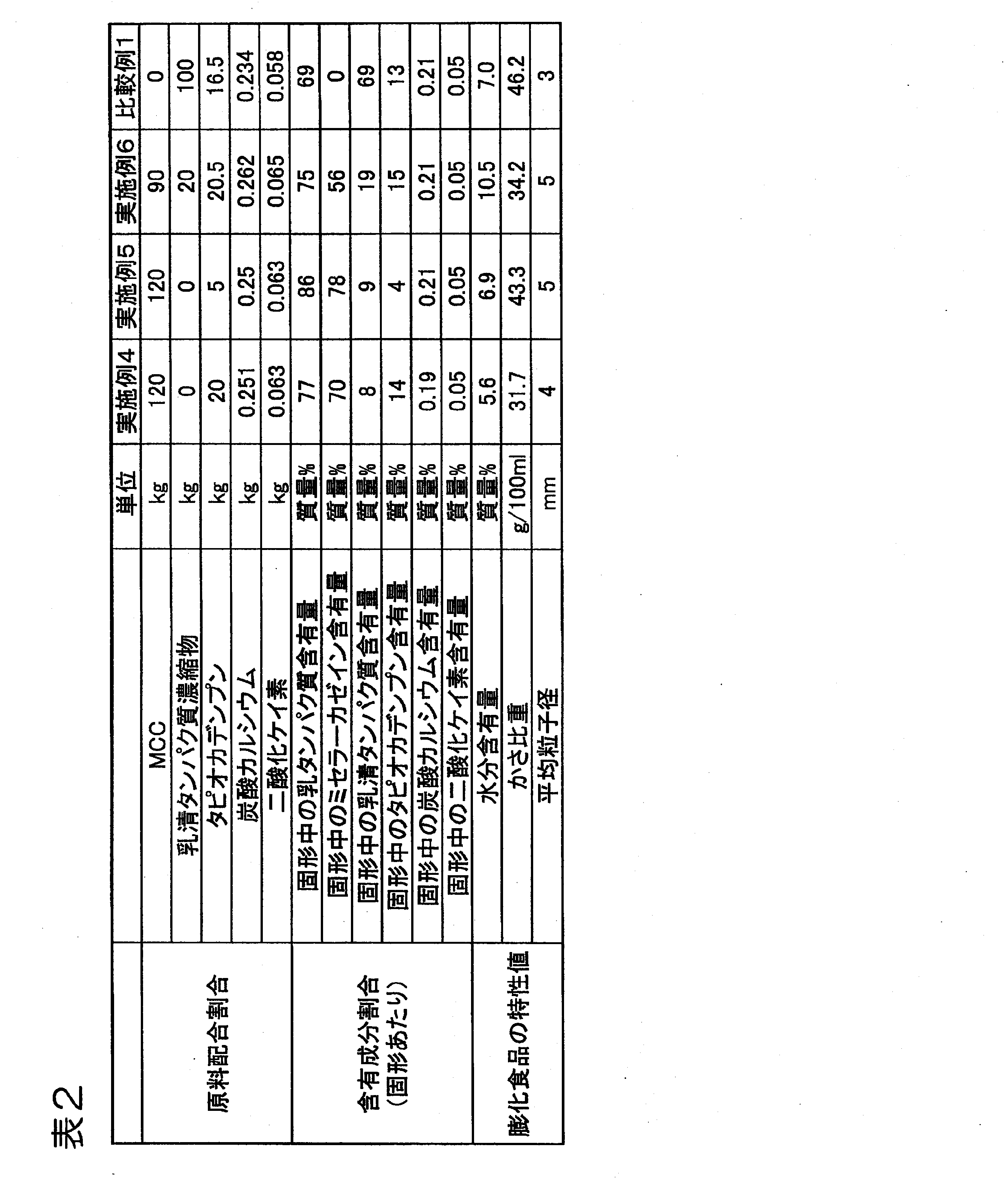
各実施例では膨化食品を製造できた。
対して、比較例1では膨化しなかった。
対して、比較例1では膨化しなかった。
<参考例1:パンの製造>
表3に示す配合組成でパンの原料を捏上温度26℃で捏ね、パン生地を得た。得られたパン生地を27℃で90分発酵させた(一次発酵)。次いで、発酵後のパン生地を1個あたり400gとなるように分割し、分割したパン生地を丸めて室温(25℃)で20分間放置した。次いで、モルダーを用いてパン生地のガス抜きと成形を行った後、40℃、湿度85%で60分発酵させた(二次発酵)。次いで、パン生地を型(縦18.5cm、横9.5cm、高さ8.5cm)に充填し、オーブンを用いて上段170、下段120℃で35分焼成し、山型のパン(1斤)を製造した。
得られたパン(1斤)を7枚に均等にスライスし、中央の3枚について高さを測定した。結果を表3に示す。また、スライス後のパン(中央の3枚)の写真を図1Aに示す。
表3に示す配合組成でパンの原料を捏上温度26℃で捏ね、パン生地を得た。得られたパン生地を27℃で90分発酵させた(一次発酵)。次いで、発酵後のパン生地を1個あたり400gとなるように分割し、分割したパン生地を丸めて室温(25℃)で20分間放置した。次いで、モルダーを用いてパン生地のガス抜きと成形を行った後、40℃、湿度85%で60分発酵させた(二次発酵)。次いで、パン生地を型(縦18.5cm、横9.5cm、高さ8.5cm)に充填し、オーブンを用いて上段170、下段120℃で35分焼成し、山型のパン(1斤)を製造した。
得られたパン(1斤)を7枚に均等にスライスし、中央の3枚について高さを測定した。結果を表3に示す。また、スライス後のパン(中央の3枚)の写真を図1Aに示す。
<実施例7>
表3に示す配合組成に変更した以外は、参考例1と同様にしてパン(1斤)を製造し、7枚に均等にスライスし、中央の3枚について高さを測定した。結果を表3に示す。また、スライス後のパン(中央の3枚)の写真を図1Bに示す。なお、膨化食品として実施例5で得られた膨化食品(膨化食品の総質量に対して、乳タンパク質含有量80質量%)を用いた。
表3に示す配合組成に変更した以外は、参考例1と同様にしてパン(1斤)を製造し、7枚に均等にスライスし、中央の3枚について高さを測定した。結果を表3に示す。また、スライス後のパン(中央の3枚)の写真を図1Bに示す。なお、膨化食品として実施例5で得られた膨化食品(膨化食品の総質量に対して、乳タンパク質含有量80質量%)を用いた。
<比較例2>
表3に示す配合組成に変更した以外は、参考例1と同様にしてパン(1斤)を製造し、7枚に均等にスライスし、中央の3枚について高さを測定した。結果を表3に示す。また、スライス後のパン(中央の3枚)の写真を図1Cに示す。なお、MCCとしてイングレディア社製の製品名「Prodiet 87B Fluid」(ミセラーカゼイン:ホエイタンパク質=9:1、固形分に対する乳タンパク質含有量87質量%)を用いた。
表3に示す配合組成に変更した以外は、参考例1と同様にしてパン(1斤)を製造し、7枚に均等にスライスし、中央の3枚について高さを測定した。結果を表3に示す。また、スライス後のパン(中央の3枚)の写真を図1Cに示す。なお、MCCとしてイングレディア社製の製品名「Prodiet 87B Fluid」(ミセラーカゼイン:ホエイタンパク質=9:1、固形分に対する乳タンパク質含有量87質量%)を用いた。

表3中の「フードCフード」とは、イーストフードである。
表3ならびに図1Aおよび図1Bの結果に示されるように、膨化食品を用いた実施例7で得られたパンは、参考例1で得られたパンと同程度の高さを有していた。また、実施例7ではパンの原料を捏ねる際に、ベタツキを感じにくかった。しかも、実施例7で得られたパンは、1斤あたりタンパク質を約47g(8枚切りの2枚換算で約12g)含んでおり、参考例1で得られたパンに比べてタンパク質を多く摂取できる。
対して、図1Cの結果に示されるように、膨化させていないMCCを用いた比較例2で得られたパンは、参考例1で得られたパンに比べて縮んでいた。また、比較例2ではパンの原料を捏ねる際に、ベタツキを感じやすく、捏ねる際に用いたボウルの表面にMCC等が付着しやすかった。
表3ならびに図1Aおよび図1Bの結果に示されるように、膨化食品を用いた実施例7で得られたパンは、参考例1で得られたパンと同程度の高さを有していた。また、実施例7ではパンの原料を捏ねる際に、ベタツキを感じにくかった。しかも、実施例7で得られたパンは、1斤あたりタンパク質を約47g(8枚切りの2枚換算で約12g)含んでおり、参考例1で得られたパンに比べてタンパク質を多く摂取できる。
対して、図1Cの結果に示されるように、膨化させていないMCCを用いた比較例2で得られたパンは、参考例1で得られたパンに比べて縮んでいた。また、比較例2ではパンの原料を捏ねる際に、ベタツキを感じやすく、捏ねる際に用いたボウルの表面にMCC等が付着しやすかった。
<参考例2:うどんの調理>
市販の濃縮タイプのめんつゆを2倍に希釈し、希釈しためんつゆ400gを鍋に入れ、さらに市販の生麺のうどん(180g)を加えて、強火(Pw100)で沸騰させた後、中火(Pw30)で2分間加熱し、うどんを調理した。
加熱前の鍋の写真を図2A、中火で加熱中の鍋の写真を図3A、加熱後の鍋の写真を図4A、盛り付け後の鍋の写真を図5Aに示す。
市販の濃縮タイプのめんつゆを2倍に希釈し、希釈しためんつゆ400gを鍋に入れ、さらに市販の生麺のうどん(180g)を加えて、強火(Pw100)で沸騰させた後、中火(Pw30)で2分間加熱し、うどんを調理した。
加熱前の鍋の写真を図2A、中火で加熱中の鍋の写真を図3A、加熱後の鍋の写真を図4A、盛り付け後の鍋の写真を図5Aに示す。
<実施例8>
鍋にうどんを加える前に膨化食品13gを添加した以外は、参考例2と同様にしてうどんを調理した。なお、膨化食品として実施例3で得られた膨化食品(膨化食品の総質量に対して、乳タンパク質含有量78質量%)を用いた。また、表4に示すように、膨化食品の添加量は、希釈しためんつゆと、うどんと、膨化食品との総質量に対して、2.2質量%に相当する。
加熱前の鍋の写真を図2B、中火で加熱中の鍋の写真を図3B、加熱後の鍋の写真を図4B、盛り付け後の鍋の写真を図5Bに示す。
鍋にうどんを加える前に膨化食品13gを添加した以外は、参考例2と同様にしてうどんを調理した。なお、膨化食品として実施例3で得られた膨化食品(膨化食品の総質量に対して、乳タンパク質含有量78質量%)を用いた。また、表4に示すように、膨化食品の添加量は、希釈しためんつゆと、うどんと、膨化食品との総質量に対して、2.2質量%に相当する。
加熱前の鍋の写真を図2B、中火で加熱中の鍋の写真を図3B、加熱後の鍋の写真を図4B、盛り付け後の鍋の写真を図5Bに示す。
<比較例3>
鍋にうどんを加える前にミセラーカゼイン12gを添加した以外は、参考例2と同様にしてうどんを調理した。なお、MCCとしてイングレディア社製の製品名「Prodiet 87B Fluid」(ミセラーカゼイン:ホエイタンパク質=9:1、固形分に対する乳タンパク質含有量87質量%)を用いた。また、表4に示すように、MCCの添加量は、希釈しためんつゆと、うどんと、MCCとの総質量に対して、2質量%に相当する。
加熱前の鍋の写真を図2C、中火で加熱中の鍋の写真を図3C、加熱後の鍋の写真を図4C、盛り付け後の鍋の写真を図5Cに示す。
鍋にうどんを加える前にミセラーカゼイン12gを添加した以外は、参考例2と同様にしてうどんを調理した。なお、MCCとしてイングレディア社製の製品名「Prodiet 87B Fluid」(ミセラーカゼイン:ホエイタンパク質=9:1、固形分に対する乳タンパク質含有量87質量%)を用いた。また、表4に示すように、MCCの添加量は、希釈しためんつゆと、うどんと、MCCとの総質量に対して、2質量%に相当する。
加熱前の鍋の写真を図2C、中火で加熱中の鍋の写真を図3C、加熱後の鍋の写真を図4C、盛り付け後の鍋の写真を図5Cに示す。
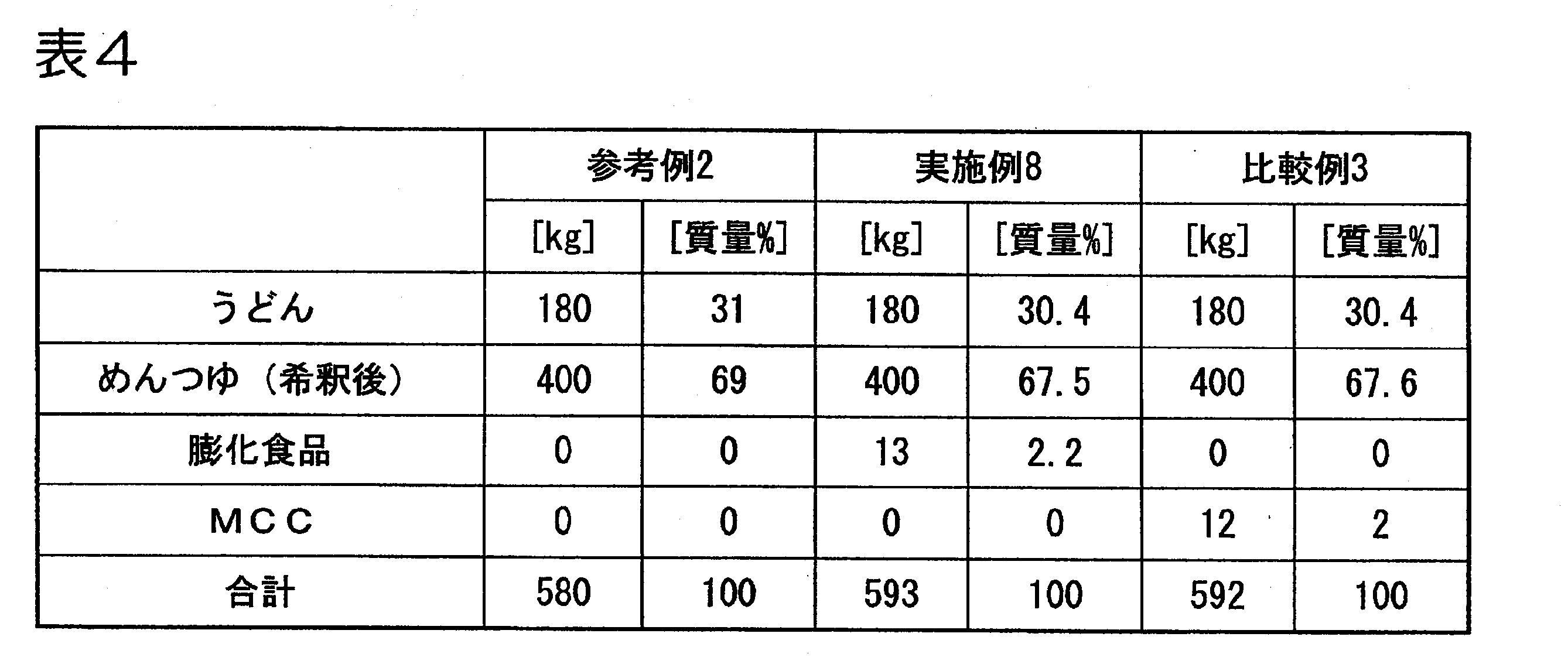
図3Aおよび図3Bの結果に示されるように、参考例2および膨化食品を用いてうどんを調理した実施例8の場合、加熱中に茹で汁(めんつゆ)が吹きこぼれることはなかった。一方、膨化させていないMCCを用いてうどんを調理した比較例3の場合、加熱中に茹で汁が吹きこぼれやすかった。
また、図4A~Cおよび図5A~Cの結果からに示されるように、参考例2および実施例8の場合、鍋の内側壁面に付着物は確認されなかったが、比較例3の場合はMCCが付着していた。
なお、実施例8の場合、うどん1杯(約600g)あたりタンパク質を約10g含んでおり、参考例2のうどん1杯に比べてタンパク質を多く摂取できる。
また、図4A~Cおよび図5A~Cの結果からに示されるように、参考例2および実施例8の場合、鍋の内側壁面に付着物は確認されなかったが、比較例3の場合はMCCが付着していた。
なお、実施例8の場合、うどん1杯(約600g)あたりタンパク質を約10g含んでおり、参考例2のうどん1杯に比べてタンパク質を多く摂取できる。
<参考例3:炊飯>
市販の米(新潟産コシヒカリ)140gを浄水器にて濾過した水道水(以下、「濾過水」という。)にて1回の洗浄工程と2回の研ぎ工程で処理した。次いで、処理後の米を180mLの濾過水に室温下(25℃)、60分間浸漬させた後(浸漬工程)、直径180mmの蓋付き片手鍋に移し、業務用電磁調理器(フジマック社製、製品名「FIC907510TD」)を用い、ダイヤル5にて20分間、加熱炊飯を行った。炊飯後はそのまま10分間の静置による蒸らし操作を行い、米飯を得た。
炊飯前の鍋の写真を図6A、炊飯後の鍋の写真を図7A、炊飯後の鍋底の写真を図8Aに示す。
市販の米(新潟産コシヒカリ)140gを浄水器にて濾過した水道水(以下、「濾過水」という。)にて1回の洗浄工程と2回の研ぎ工程で処理した。次いで、処理後の米を180mLの濾過水に室温下(25℃)、60分間浸漬させた後(浸漬工程)、直径180mmの蓋付き片手鍋に移し、業務用電磁調理器(フジマック社製、製品名「FIC907510TD」)を用い、ダイヤル5にて20分間、加熱炊飯を行った。炊飯後はそのまま10分間の静置による蒸らし操作を行い、米飯を得た。
炊飯前の鍋の写真を図6A、炊飯後の鍋の写真を図7A、炊飯後の鍋底の写真を図8Aに示す。
<実施例9>
浸漬工程での濾過水の量を182mLに変更し、加熱炊飯の直前に、鍋に膨化食品28gをさらに添加した以外は、参考例3と同様にして米飯を得た。なお、膨化食品として実施例3で得られた膨化食品(膨化食品の総質量に対して、乳タンパク質含有量78質量%)を用いた。また、表5に示すように、膨化食品の添加量は、米と、浸漬工程で用いた濾過水と、膨化食品との総質量に対して、8質量%に相当する。
炊飯前の鍋の写真を図6B、炊飯後の鍋の写真を図7B、炊飯後の鍋底の写真を図8Bに示す。
浸漬工程での濾過水の量を182mLに変更し、加熱炊飯の直前に、鍋に膨化食品28gをさらに添加した以外は、参考例3と同様にして米飯を得た。なお、膨化食品として実施例3で得られた膨化食品(膨化食品の総質量に対して、乳タンパク質含有量78質量%)を用いた。また、表5に示すように、膨化食品の添加量は、米と、浸漬工程で用いた濾過水と、膨化食品との総質量に対して、8質量%に相当する。
炊飯前の鍋の写真を図6B、炊飯後の鍋の写真を図7B、炊飯後の鍋底の写真を図8Bに示す。
<比較例4>
浸漬工程での濾過水の量を182mLに変更し、かつ濾過水にミセラーカゼイン26gをさらに添加した以外は、参考例3と同様にして米飯を得た。なお、MCCとしてイングレディア社製の製品名「Prodiet 87B Fluid」(ミセラーカゼイン:ホエイタンパク質=9:1、固形分に対する乳タンパク質含有量87質量%)を用いた。また、表5に示すように、MCCの添加量は、米と、浸漬工程で用いた濾過水と、MCCとの総質量に対して、7.5質量%に相当する。
炊飯前の鍋の写真を図6C、炊飯後の鍋の写真を図7C、炊飯後の鍋底の写真を図8Cに示す。
浸漬工程での濾過水の量を182mLに変更し、かつ濾過水にミセラーカゼイン26gをさらに添加した以外は、参考例3と同様にして米飯を得た。なお、MCCとしてイングレディア社製の製品名「Prodiet 87B Fluid」(ミセラーカゼイン:ホエイタンパク質=9:1、固形分に対する乳タンパク質含有量87質量%)を用いた。また、表5に示すように、MCCの添加量は、米と、浸漬工程で用いた濾過水と、MCCとの総質量に対して、7.5質量%に相当する。
炊飯前の鍋の写真を図6C、炊飯後の鍋の写真を図7C、炊飯後の鍋底の写真を図8Cに示す。
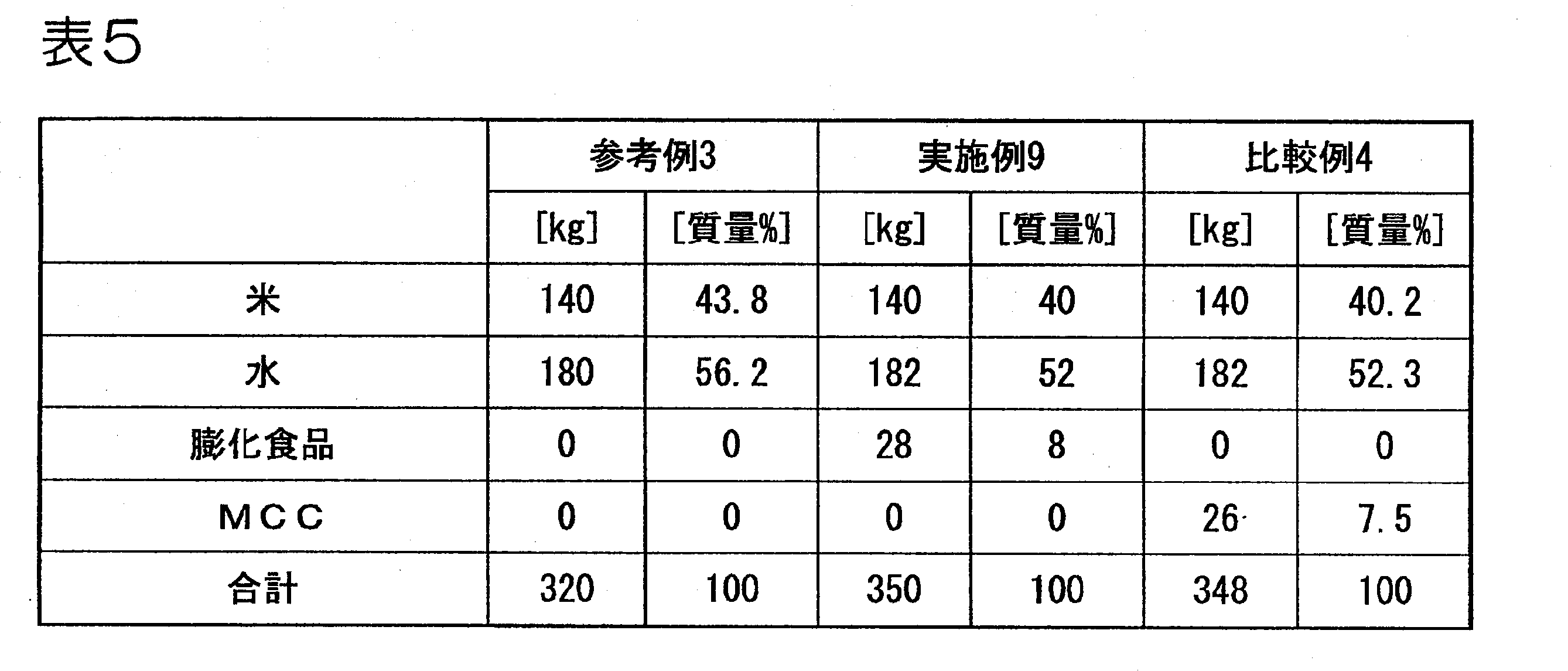
図7Bおよび図7Cの結果に示されるように、膨化食品を用いて炊飯を行った実施例9の場合、米粒表面につやが確認された。一方、膨化させていないMCCを用いて炊飯を行った比較例4の場合、米粒表面に膜が張っていた。
また、図8A~Cの結果に示されるように、参考例3および実施例9の場合、鍋底に焦げは確認されなかったが、比較例4の場合は鍋底が焦げていた。
なお、実施例9の場合、米飯1膳(約150g)あたりタンパク質を約10g含んでおり、参考例3の米飯1膳に比べてタンパク質を多く摂取できる。
また、図8A~Cの結果に示されるように、参考例3および実施例9の場合、鍋底に焦げは確認されなかったが、比較例4の場合は鍋底が焦げていた。
なお、実施例9の場合、米飯1膳(約150g)あたりタンパク質を約10g含んでおり、参考例3の米飯1膳に比べてタンパク質を多く摂取できる。
<参考例4:シリアル>
容器に市販のシリアル(カルビー社製、製品名「フルグラ」)50gを入れ、これに牛乳200mLを加えて混合した。
牛乳を添加する前のシリアルの写真を図9A、牛乳を添加した後のシリアルの写真を図10A、喫食後の容器の写真を図11Aに示す。
容器に市販のシリアル(カルビー社製、製品名「フルグラ」)50gを入れ、これに牛乳200mLを加えて混合した。
牛乳を添加する前のシリアルの写真を図9A、牛乳を添加した後のシリアルの写真を図10A、喫食後の容器の写真を図11Aに示す。
<実施例10>
容器に市販のシリアル(カルビー社製、製品名「フルグラ」)50gと膨化食品9.6gを入れ、これに牛乳200mLを加えて混合した。なお、膨化食品として実施例3で得られた膨化食品(膨化食品の総質量に対して、乳乳タンパク質含有量78質量%)を用いた。また、表6に示すように、膨化食品の添加量は、シリアルと、膨化食品と、牛乳との総質量に対して、3.7質量%に相当する。
牛乳を添加する前のシリアルの写真を図9B、牛乳を添加した後のシリアルの写真を図10B、喫食後の容器の写真を図11Bに示す。
容器に市販のシリアル(カルビー社製、製品名「フルグラ」)50gと膨化食品9.6gを入れ、これに牛乳200mLを加えて混合した。なお、膨化食品として実施例3で得られた膨化食品(膨化食品の総質量に対して、乳乳タンパク質含有量78質量%)を用いた。また、表6に示すように、膨化食品の添加量は、シリアルと、膨化食品と、牛乳との総質量に対して、3.7質量%に相当する。
牛乳を添加する前のシリアルの写真を図9B、牛乳を添加した後のシリアルの写真を図10B、喫食後の容器の写真を図11Bに示す。
<比較例5>
容器に市販のシリアル(カルビー社製、製品名「フルグラ」)50gとミセラーカゼイン9.2gを入れ、これに牛乳200mLを加えて混合した。なお、MCCとしてイングレディア社製の製品名「Prodiet 87B Fluid」(ミセラーカゼイン:ホエイタンパク質=9:1、固形分に対する乳タンパク質含有量87質量%)を用いた。また、表6に示すように、MCCの添加量は、シリアルと、MCCと、牛乳との総質量に対して、3.5質量%に相当する。
牛乳を添加する前のシリアルの写真を図9C、牛乳を添加した後のシリアルの写真を図10C、喫食後の容器の写真を図11Cに示す。
容器に市販のシリアル(カルビー社製、製品名「フルグラ」)50gとミセラーカゼイン9.2gを入れ、これに牛乳200mLを加えて混合した。なお、MCCとしてイングレディア社製の製品名「Prodiet 87B Fluid」(ミセラーカゼイン:ホエイタンパク質=9:1、固形分に対する乳タンパク質含有量87質量%)を用いた。また、表6に示すように、MCCの添加量は、シリアルと、MCCと、牛乳との総質量に対して、3.5質量%に相当する。
牛乳を添加する前のシリアルの写真を図9C、牛乳を添加した後のシリアルの写真を図10C、喫食後の容器の写真を図11Cに示す。
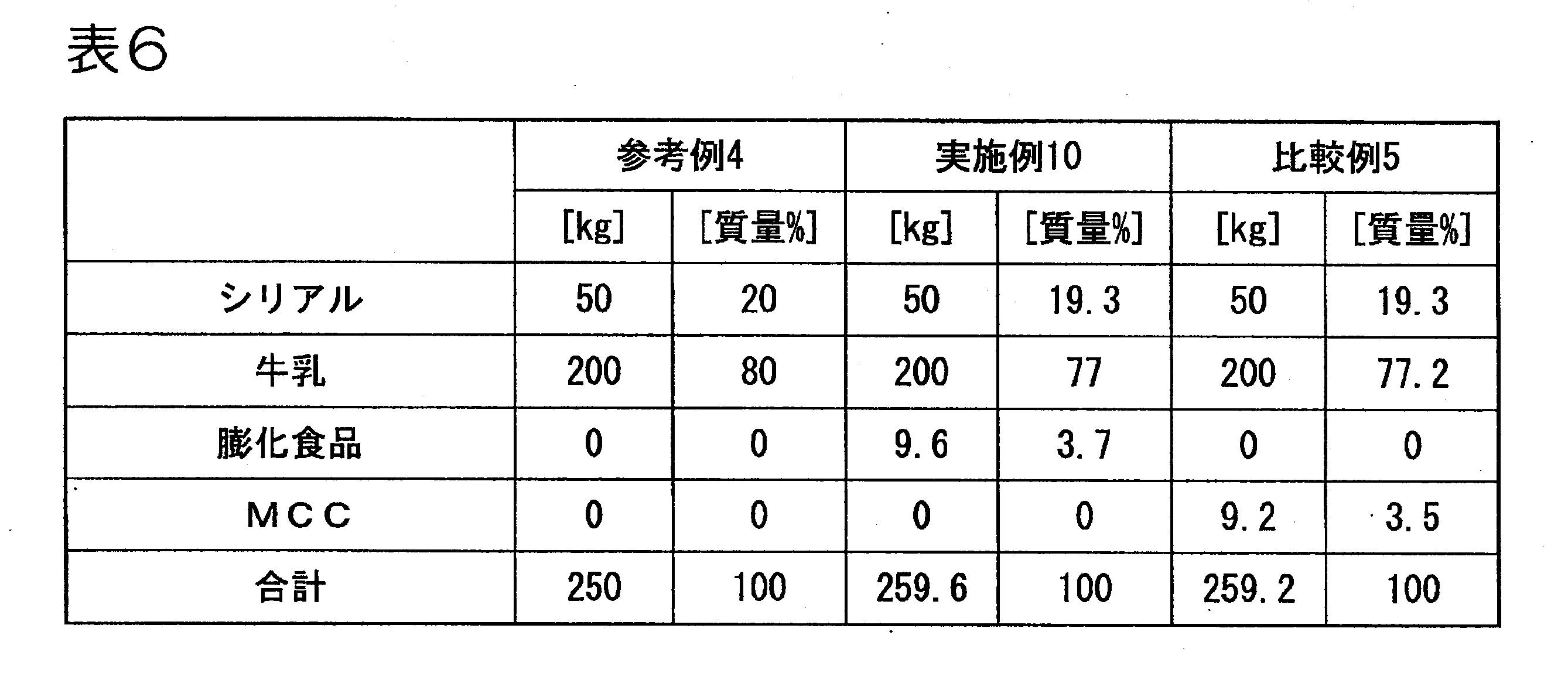
図9Bおよび図9Cの結果に示されるように、実施例10の場合はシリアルと膨化食品の大きさがほぼ同じであり違和感がないが、比較例5の場合は膨化させていないMCCが容器の底に溜まりやすく、均一に混合しにくかった。
また、図10A~Cの結果に示されるように、参考例4および実施例10の場合は牛乳を添加しても均一分散したが、比較例5の場合は牛乳に溶け残ったMCC(不溶物)が浮いたり容器の内側壁面に付着したりしていた。
また、図11A~Cの結果に示されるように、参考例4および実施例10の場合は喫食後に粒が残らないが、比較例5の場合は喫食後に容器に不溶物が残っていた。
なお、実施例10の場合、シリアル1食(約60g)あたりタンパク質を約10g含んでおり、参考例4のシリアル1食に比べてタンパク質を多く摂取できる。
また、図10A~Cの結果に示されるように、参考例4および実施例10の場合は牛乳を添加しても均一分散したが、比較例5の場合は牛乳に溶け残ったMCC(不溶物)が浮いたり容器の内側壁面に付着したりしていた。
また、図11A~Cの結果に示されるように、参考例4および実施例10の場合は喫食後に粒が残らないが、比較例5の場合は喫食後に容器に不溶物が残っていた。
なお、実施例10の場合、シリアル1食(約60g)あたりタンパク質を約10g含んでおり、参考例4のシリアル1食に比べてタンパク質を多く摂取できる。
本発明によれば、タンパク質を多く摂取できる食品およびその製造方法を提供できる。
Claims (10)
- ミセラーカゼインを全固形分の45~96質量%含む押出し成形物である、膨化食品。
- 前記膨化食品のかさ比重が10~60g/100mLである、請求項1に記載の膨化食品。
- 前記膨化食品の水分含有量が3~15質量%である、請求項1または2に記載の膨化食品。
- デンプンをさらに含む、請求項1~3のいずれか一項に記載の膨化食品。
- 炭酸カルシウムおよび二酸化ケイ素の少なくとも一方をさらに含む、請求項1~4のいずれか一項に記載の膨化食品。
- 請求項1~5のいずれか一項に記載の膨化食品を含む、加工食品。
- 小麦粉製食品、米製食品、シリアル食品からなる群より選択される1種以上の食品である、請求項6に記載の加工食品。
- ミセラーカゼインを含む原料混合物を二軸エクストルーダーに投入し、加圧加熱しながら押出し成形し、ミセラーカゼインを全固形分の45~96質量%含む膨化食品を得る、膨化食品の製造方法。
- 前記原料混合物はデンプンをさらに含む、請求項8に記載の膨化食品の製造方法。
- 前記原料混合物は炭酸カルシウムおよび二酸化ケイ素の少なくとも一方をさらに含む、請求項8または9に記載の膨化食品の製造方法。
Applications Claiming Priority (2)
| Application Number | Priority Date | Filing Date | Title |
|---|---|---|---|
| JP2018098741A JP2019201582A (ja) | 2018-05-23 | 2018-05-23 | 膨化食品およびその製造方法と、加工食品 |
| JP2018-098741 | 2018-05-23 |
Publications (1)
| Publication Number | Publication Date |
|---|---|
| WO2019225630A1 true WO2019225630A1 (ja) | 2019-11-28 |
Family
ID=68616963
Family Applications (1)
| Application Number | Title | Priority Date | Filing Date |
|---|---|---|---|
| PCT/JP2019/020203 Ceased WO2019225630A1 (ja) | 2018-05-23 | 2019-05-22 | 膨化食品およびその製造方法と、加工食品 |
Country Status (2)
| Country | Link |
|---|---|
| JP (1) | JP2019201582A (ja) |
| WO (1) | WO2019225630A1 (ja) |
Citations (7)
| Publication number | Priority date | Publication date | Assignee | Title |
|---|---|---|---|---|
| JPS5467055A (en) * | 1977-10-17 | 1979-05-30 | Roussel Uclaf | Novel or known food having cellular structure and production |
| JP2001224308A (ja) * | 2000-02-10 | 2001-08-21 | Asahi Denka Kogyo Kk | シュー用乳化油脂組成物およびこれを用いたシューケース |
| US20040022902A1 (en) * | 2000-06-07 | 2004-02-05 | Reginald Allouche | High-protein and low-calorie dough for making products imitating bread-type products, and preparation method |
| JP2009504188A (ja) * | 2005-08-17 | 2009-02-05 | ソレイ リミテッド ライアビリティ カンパニー | 糖アルコールを含んでなり改善されたテクスチャー及び賞味期限を有する高タンパク質食品バー |
| JP2013158323A (ja) * | 2012-02-07 | 2013-08-19 | Healthy Food Kk | 即席パン粥様食品及びパン粥様食品 |
| JP2018042532A (ja) * | 2016-09-16 | 2018-03-22 | 理研ビタミン株式会社 | 冷凍パン生地用品質改良剤 |
| WO2018180667A1 (ja) * | 2017-03-28 | 2018-10-04 | 森永乳業株式会社 | 焼成食品の製造方法及び焼成食品 |
-
2018
- 2018-05-23 JP JP2018098741A patent/JP2019201582A/ja active Pending
-
2019
- 2019-05-22 WO PCT/JP2019/020203 patent/WO2019225630A1/ja not_active Ceased
Patent Citations (7)
| Publication number | Priority date | Publication date | Assignee | Title |
|---|---|---|---|---|
| JPS5467055A (en) * | 1977-10-17 | 1979-05-30 | Roussel Uclaf | Novel or known food having cellular structure and production |
| JP2001224308A (ja) * | 2000-02-10 | 2001-08-21 | Asahi Denka Kogyo Kk | シュー用乳化油脂組成物およびこれを用いたシューケース |
| US20040022902A1 (en) * | 2000-06-07 | 2004-02-05 | Reginald Allouche | High-protein and low-calorie dough for making products imitating bread-type products, and preparation method |
| JP2009504188A (ja) * | 2005-08-17 | 2009-02-05 | ソレイ リミテッド ライアビリティ カンパニー | 糖アルコールを含んでなり改善されたテクスチャー及び賞味期限を有する高タンパク質食品バー |
| JP2013158323A (ja) * | 2012-02-07 | 2013-08-19 | Healthy Food Kk | 即席パン粥様食品及びパン粥様食品 |
| JP2018042532A (ja) * | 2016-09-16 | 2018-03-22 | 理研ビタミン株式会社 | 冷凍パン生地用品質改良剤 |
| WO2018180667A1 (ja) * | 2017-03-28 | 2018-10-04 | 森永乳業株式会社 | 焼成食品の製造方法及び焼成食品 |
Non-Patent Citations (1)
| Title |
|---|
| THINK USA DAIRY, June 2015 (2015-06-01), Retrieved from the Internet <URL:http://www.thinkusadairy.org/documents/microsites/ja_2016%20MCC.pdf> [retrieved on 20190805] * |
Also Published As
| Publication number | Publication date |
|---|---|
| JP2019201582A (ja) | 2019-11-28 |
Similar Documents
| Publication | Publication Date | Title |
|---|---|---|
| TWI887271B (zh) | 組成物 | |
| JP4426349B2 (ja) | シリアル食品様のビスケット | |
| WO2018014020A1 (en) | Brewer's spent-grain based protein powder | |
| CN102771540A (zh) | 一种低脂低糖紫薯慕斯蛋糕及其制备方法 | |
| CN108601380B (zh) | 面条类食品及其制造法 | |
| CN115399400A (zh) | 质地乳蛋白 | |
| JP7558381B2 (ja) | 食感が改善されたタンパク麺製造用組成物、それを用いたタンパク麺の製造方法及びそれを用いて製造されたタンパク麺。 | |
| CN107279225A (zh) | 一种含胶原蛋白的高蛋白高膳食纤维饼干及其制备方法 | |
| KR102033675B1 (ko) | 쌀 치즈 핫도그의 제조 방법 및 이에 의해 제조된 쌀 치즈 핫도그 | |
| CN101816389A (zh) | 蛋粉食品 | |
| KR101910138B1 (ko) | 기능성 피자 도우 및 이의 제조 방법 | |
| WO2012029486A1 (ja) | 穀類加工食品およびその製造方法 | |
| EP2247192B1 (en) | Batter and method for preparing a pasta | |
| JP2022152094A (ja) | パテ様食品の製造方法 | |
| WO2019225630A1 (ja) | 膨化食品およびその製造方法と、加工食品 | |
| JP2022152868A (ja) | 麺類の製造方法、麺類用組成物、麺類用生地、及び麺類 | |
| RU2796838C1 (ru) | Способ производства крекера из медузы | |
| JPS5871865A (ja) | 液化乳化食品の製造法 | |
| JP4675354B2 (ja) | フィキシング及びその製造方法 | |
| JP2009038995A (ja) | 焼き菓子 | |
| EP4615232A1 (en) | Food products and methods of preparation | |
| Gallego Castillo | Biofortified recipes | |
| WO2017030082A1 (ja) | 冷凍調理済み調味麺類の製造方法 | |
| MXPA06014104A (es) | Pasta baja en carbohidratos, alta en proteina. | |
| RU2247511C1 (ru) | Вермишель и способ ее производства |
Legal Events
| Date | Code | Title | Description |
|---|---|---|---|
| 121 | Ep: the epo has been informed by wipo that ep was designated in this application |
Ref document number: 19806667 Country of ref document: EP Kind code of ref document: A1 |
|
| NENP | Non-entry into the national phase |
Ref country code: DE |
|
| 122 | Ep: pct application non-entry in european phase |
Ref document number: 19806667 Country of ref document: EP Kind code of ref document: A1 |