WO2019150654A1 - 化学強化用ガラス - Google Patents
化学強化用ガラス Download PDFInfo
- Publication number
- WO2019150654A1 WO2019150654A1 PCT/JP2018/037115 JP2018037115W WO2019150654A1 WO 2019150654 A1 WO2019150654 A1 WO 2019150654A1 JP 2018037115 W JP2018037115 W JP 2018037115W WO 2019150654 A1 WO2019150654 A1 WO 2019150654A1
- Authority
- WO
- WIPO (PCT)
- Prior art keywords
- glass
- less
- chemical strengthening
- mgo
- zro
- Prior art date
- Legal status (The legal status is an assumption and is not a legal conclusion. Google has not performed a legal analysis and makes no representation as to the accuracy of the status listed.)
- Ceased
Links
Images



Classifications
-
- C—CHEMISTRY; METALLURGY
- C03—GLASS; MINERAL OR SLAG WOOL
- C03C—CHEMICAL COMPOSITION OF GLASSES, GLAZES OR VITREOUS ENAMELS; SURFACE TREATMENT OF GLASS; SURFACE TREATMENT OF FIBRES OR FILAMENTS MADE FROM GLASS, MINERALS OR SLAGS; JOINING GLASS TO GLASS OR OTHER MATERIALS
- C03C3/00—Glass compositions
- C03C3/04—Glass compositions containing silica
- C03C3/076—Glass compositions containing silica with 40% to 90% silica, by weight
- C03C3/083—Glass compositions containing silica with 40% to 90% silica, by weight containing aluminium oxide or an iron compound
- C03C3/085—Glass compositions containing silica with 40% to 90% silica, by weight containing aluminium oxide or an iron compound containing an oxide of a divalent metal
-
- C—CHEMISTRY; METALLURGY
- C03—GLASS; MINERAL OR SLAG WOOL
- C03C—CHEMICAL COMPOSITION OF GLASSES, GLAZES OR VITREOUS ENAMELS; SURFACE TREATMENT OF GLASS; SURFACE TREATMENT OF FIBRES OR FILAMENTS MADE FROM GLASS, MINERALS OR SLAGS; JOINING GLASS TO GLASS OR OTHER MATERIALS
- C03C21/00—Treatment of glass, not in the form of fibres or filaments, by diffusing ions or metals in the surface
- C03C21/001—Treatment of glass, not in the form of fibres or filaments, by diffusing ions or metals in the surface in liquid phase, e.g. molten salts, solutions
- C03C21/002—Treatment of glass, not in the form of fibres or filaments, by diffusing ions or metals in the surface in liquid phase, e.g. molten salts, solutions to perform ion-exchange between alkali ions
-
- C—CHEMISTRY; METALLURGY
- C03—GLASS; MINERAL OR SLAG WOOL
- C03C—CHEMICAL COMPOSITION OF GLASSES, GLAZES OR VITREOUS ENAMELS; SURFACE TREATMENT OF GLASS; SURFACE TREATMENT OF FIBRES OR FILAMENTS MADE FROM GLASS, MINERALS OR SLAGS; JOINING GLASS TO GLASS OR OTHER MATERIALS
- C03C21/00—Treatment of glass, not in the form of fibres or filaments, by diffusing ions or metals in the surface
-
- C—CHEMISTRY; METALLURGY
- C03—GLASS; MINERAL OR SLAG WOOL
- C03C—CHEMICAL COMPOSITION OF GLASSES, GLAZES OR VITREOUS ENAMELS; SURFACE TREATMENT OF GLASS; SURFACE TREATMENT OF FIBRES OR FILAMENTS MADE FROM GLASS, MINERALS OR SLAGS; JOINING GLASS TO GLASS OR OTHER MATERIALS
- C03C3/00—Glass compositions
- C03C3/04—Glass compositions containing silica
- C03C3/076—Glass compositions containing silica with 40% to 90% silica, by weight
- C03C3/078—Glass compositions containing silica with 40% to 90% silica, by weight containing an oxide of a divalent metal, e.g. an oxide of zinc
-
- C—CHEMISTRY; METALLURGY
- C03—GLASS; MINERAL OR SLAG WOOL
- C03C—CHEMICAL COMPOSITION OF GLASSES, GLAZES OR VITREOUS ENAMELS; SURFACE TREATMENT OF GLASS; SURFACE TREATMENT OF FIBRES OR FILAMENTS MADE FROM GLASS, MINERALS OR SLAGS; JOINING GLASS TO GLASS OR OTHER MATERIALS
- C03C3/00—Glass compositions
- C03C3/04—Glass compositions containing silica
- C03C3/076—Glass compositions containing silica with 40% to 90% silica, by weight
- C03C3/083—Glass compositions containing silica with 40% to 90% silica, by weight containing aluminium oxide or an iron compound
- C03C3/085—Glass compositions containing silica with 40% to 90% silica, by weight containing aluminium oxide or an iron compound containing an oxide of a divalent metal
- C03C3/087—Glass compositions containing silica with 40% to 90% silica, by weight containing aluminium oxide or an iron compound containing an oxide of a divalent metal containing calcium oxide, e.g. common sheet or container glass
-
- C—CHEMISTRY; METALLURGY
- C03—GLASS; MINERAL OR SLAG WOOL
- C03C—CHEMICAL COMPOSITION OF GLASSES, GLAZES OR VITREOUS ENAMELS; SURFACE TREATMENT OF GLASS; SURFACE TREATMENT OF FIBRES OR FILAMENTS MADE FROM GLASS, MINERALS OR SLAGS; JOINING GLASS TO GLASS OR OTHER MATERIALS
- C03C3/00—Glass compositions
- C03C3/04—Glass compositions containing silica
- C03C3/076—Glass compositions containing silica with 40% to 90% silica, by weight
- C03C3/089—Glass compositions containing silica with 40% to 90% silica, by weight containing boron
- C03C3/091—Glass compositions containing silica with 40% to 90% silica, by weight containing boron containing aluminium
- C03C3/093—Glass compositions containing silica with 40% to 90% silica, by weight containing boron containing aluminium containing zinc or zirconium
-
- C—CHEMISTRY; METALLURGY
- C03—GLASS; MINERAL OR SLAG WOOL
- C03C—CHEMICAL COMPOSITION OF GLASSES, GLAZES OR VITREOUS ENAMELS; SURFACE TREATMENT OF GLASS; SURFACE TREATMENT OF FIBRES OR FILAMENTS MADE FROM GLASS, MINERALS OR SLAGS; JOINING GLASS TO GLASS OR OTHER MATERIALS
- C03C3/00—Glass compositions
- C03C3/04—Glass compositions containing silica
- C03C3/076—Glass compositions containing silica with 40% to 90% silica, by weight
- C03C3/095—Glass compositions containing silica with 40% to 90% silica, by weight containing rare earths
-
- C—CHEMISTRY; METALLURGY
- C03—GLASS; MINERAL OR SLAG WOOL
- C03C—CHEMICAL COMPOSITION OF GLASSES, GLAZES OR VITREOUS ENAMELS; SURFACE TREATMENT OF GLASS; SURFACE TREATMENT OF FIBRES OR FILAMENTS MADE FROM GLASS, MINERALS OR SLAGS; JOINING GLASS TO GLASS OR OTHER MATERIALS
- C03C3/00—Glass compositions
- C03C3/04—Glass compositions containing silica
- C03C3/076—Glass compositions containing silica with 40% to 90% silica, by weight
- C03C3/097—Glass compositions containing silica with 40% to 90% silica, by weight containing phosphorus, niobium or tantalum
-
- C—CHEMISTRY; METALLURGY
- C03—GLASS; MINERAL OR SLAG WOOL
- C03C—CHEMICAL COMPOSITION OF GLASSES, GLAZES OR VITREOUS ENAMELS; SURFACE TREATMENT OF GLASS; SURFACE TREATMENT OF FIBRES OR FILAMENTS MADE FROM GLASS, MINERALS OR SLAGS; JOINING GLASS TO GLASS OR OTHER MATERIALS
- C03C2201/00—Glass compositions
- C03C2201/06—Doped silica-based glasses
- C03C2201/30—Doped silica-based glasses containing metals
- C03C2201/34—Doped silica-based glasses containing metals containing rare earth metals
- C03C2201/3411—Yttrium
Definitions
- the present invention relates to a glass for chemical strengthening.
- cover glasses made of chemically tempered glass have been used for the purpose of protecting and improving the appearance of mobile devices such as mobile phones, smartphones, personal digital assistants (PDAs), and tablet devices.
- mobile devices such as mobile phones, smartphones, personal digital assistants (PDAs), and tablet devices.
- PDAs personal digital assistants
- Patent Document 1 describes that the surface compressive stress can be increased while suppressing the internal tensile stress by forming a stress profile represented by a bent line by a two-step chemical strengthening treatment. Specifically, a method of using a KNO 3 / NaNO 3 mixed salt having a relatively low K concentration for the first-stage chemical strengthening and a KNO 3 / NaNO 3 mixed salt having a relatively high K concentration for the second-stage chemical strengthening. Etc. have been proposed.
- Patent Document 2 discloses lithium aluminosilicate glass that can obtain a relatively large surface compressive stress and compressive stress layer depth by two-step chemical strengthening treatment. Lithium aluminosilicate glass can increase both CS and DOL by a two-step chemical strengthening treatment using a sodium salt for the first-step chemical strengthening treatment and a potassium salt for the second-step chemical strengthening treatment.
- An object of this invention is to provide the glass for chemical strengthening which cannot produce devitrification easily and can achieve big CS and big DOL.
- the present invention is expressed in mole percentages based on oxides, 45 to 75% of SiO 2 , 1 to 30% of Al 2 O 3 , 1 to 20% of Li 2 O, Containing Y 2 O 3 0-5%, ZrO 2 0-5%, and TiO 2 0-1%, 1 to 20% in total of at least one of MgO, CaO, SrO, BaO and ZnO,
- the total content of Na 2 O and K 2 O is 0-10%
- the total content of B 2 O 3 and P 2 O 5 is 0 to 10%
- a glass for chemical strengthening having an M value represented by the following formula of 1000 or more is provided.
- the surface compressive stress value after chemical strengthening by immersion in 450 ° C. sodium nitrate for 1 hour becomes 300 MPa or more, and after immersion in 450 ° C. sodium nitrate for 3 hours, 1.5 ° C. in 450 ° C. potassium nitrate is obtained.
- the surface compressive stress after chemical immersion and time immersion is 800 MPa or more, and the matrix composition of the chemically strengthened glass is expressed in mole percentages based on oxides.
- CS surface compressive stress value
- DOL compressive stress layer depth
- FIG. 1 is a diagram showing the relationship between I value and crystal growth rate.
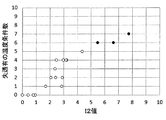
- FIG. 2 is a diagram showing the relationship between the I2 value and the devitrification characteristics.
- FIG. 3 is an example of a graph showing the relationship between the virtual temperature and the refractive index.
- FIG. 4 is a schematic view of a platinum container used for crystal growth rate measurement.
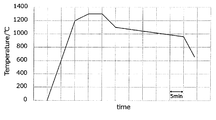
- FIG. 5 is a temperature profile of the float simulated temperature drop condition.
- chemically tempered glass refers to glass after being subjected to chemical tempering treatment.
- chemical strengthening glass refers to glass before chemical strengthening treatment.
- the glass composition of the chemically strengthened glass is sometimes referred to as a mother composition of the chemically strengthened glass.
- a compressive stress layer by ion exchange is usually formed on the glass surface portion, so that the glass composition of the portion not ion-exchanged matches the mother composition of chemically strengthened glass.
- the glass composition is expressed in terms of a mole percentage based on an oxide, and mol% may be simply described as%.
- “to” indicating a numerical range is used in the sense of including the numerical values described before and after the numerical value as a lower limit value and an upper limit value.
- “Substantially not contained” in the glass composition means that it is not contained except for inevitable impurities contained in raw materials and the like, that is, it is not intentionally contained. Specifically, for example, the content in the glass composition is less than 0.1 mol%.
- the “stress profile” is a pattern representing a compressive stress value with the depth from the glass surface as a variable.
- a negative compressive stress value means tensile stress.
- the “friability” of glass refers to the property that fragments are easily scattered when the glass is broken.
- the “surface compressive stress value” of glass is 0.5 ° C./min after holding a glass plate having a thickness of 0.8 mm at a temperature 50 ° C. higher than the glass transition point Tg for 1 hour or more unless otherwise specified. It is a surface compressive stress value when a chemical strengthening process is performed using a glass plate that is gradually cooled at a cooling rate. The surface compressive stress generated by the chemical strengthening treatment tends to increase as the fictive temperature of the glass decreases, and the fictive temperature of the glass is affected by the thermal history (for example, cooling rate) received by the glass. Evaluation is performed by removing the influence of fictive temperature by heat treatment and slow cooling.
- the “ ⁇ -OH value” is a transmittance X 1 (%) at a reference wavelength of 4000 cm ⁇ 1 measured by the FT-IR method, and a minimum transmittance X 2 (%) around 3570 cm ⁇ 1, which is the absorption wavelength of a hydroxyl group. ) And the thickness t (unit: mm) of the glass plate is obtained by the equation (1).
- ⁇ -OH value (1 / t) log 10 (X 1 / X 2 ) (1)
- the ⁇ -OH value can be adjusted by the amount of water contained in the glass raw material and the dissolution conditions.
- the glass for chemical strengthening of the present invention (hereinafter sometimes referred to as “the present glass”) is expressed in terms of mole percentage based on oxides. 45 to 75% of SiO 2 Al 2 O 3 1-30%, 1 to 20% of Li 2 O, Y 2 O 3 from 0 to 5%, ZrO 2 0-5%, TiO 2 0-1%, 1 to 20% in total containing at least one of MgO, CaO, SrO, BaO and ZnO, The total content of Na 2 O and K 2 O is 0-10%, The total content of B 2 O 3 and P 2 O 5 is 0 to 10%.
- the present glass has an M value represented by the following formula of 1000 or more.
- M ⁇ 5 ⁇ [SiO 2 ] + 121 ⁇ [Al 2 O 3 ] + 50 ⁇ [Li 2 O] ⁇ 35 ⁇ [Na 2 O] + 32 ⁇ [K 2 O] + 85 ⁇ [MgO] + 54 ⁇ [CaO] ⁇ 41 ⁇ [SrO] ⁇ 4 ⁇ [P 2 O 5 ] + 218 ⁇ [Y 2 O 3 ] + 436 ⁇ [ZrO 2 ] ⁇ 1180
- [SiO 2 ], [Al 2 O 3 ], [Li 2 O], [Na 2 O], [K 2 O], [MgO], [CaO], [SrO], [P 2 O 5 ], [Y 2 O 3 ] and [ZrO 2 ] represent the content of each component in terms of mole percentage. The same applies to the following.
- the present inventors have studied the relationship between the glass composition of the glass for chemical strengthening, the relationship between the compressive stress value after chemical strengthening and the chemical strengthening characteristics, and the glass having a large M value can be introduced by a chemical strengthening treatment. It has been found that the stress value is large and devitrification (crystal) does not easily occur.
- the inventors investigated the surface compression stress and the crystal growth rate at 850 ° C. to 1200 ° C. when chemical strengthening treatment was performed for various glass compositions. As chemical strengthening treatment conditions, when strengthened by immersion in sodium nitrate at 450 ° C. for 1 hour (one-step strengthening treatment), after immersion in sodium nitrate at 450 ° C. for 3 hours, 1.5 hours in 450 ° C. potassium nitrate The case of chemical strengthening by immersion (two-stage strengthening treatment) was evaluated.
- the surface compressive stress (CS1) after the first-stage strengthening treatment immersed in sodium nitrate at 450 ° C. for 1 hour was 300 MPa or more.
- the surface compressive stress (CS2) after the two-stage strengthening treatment of immersing in 450 ° C. sodium nitrate for 3 hours and then immersing in 450 ° C. potassium nitrate for 1.5 hours was 800 MPa or more.
- a glass having a large M value has a low crystal growth rate at 850 to 1200 ° C., and a tendency to suppress generation of defects due to devitrification during glass production was also observed. A method for evaluating the crystal growth rate will be described later.
- the M value is more preferably 1100 or more, and still more preferably 1200 or more. However, if the M value is too large, the glass may be fragile. Therefore, it is preferably 1800 or less, more preferably 1650 or less, still more preferably 1500 or less, and typically 1350 or less.
- the present glass preferably has an I value represented by the following formula of 850 or less, and more preferably 600 or less.
- I ⁇ 4.8 ⁇ [SiO 2 ] + 102 ⁇ [Al 2 O 3 ] + 81 ⁇ [Li 2 O] ⁇ 272 ⁇ [Na 2 O] ⁇ 281 ⁇ [K 2 O] ⁇ 16 ⁇ [MgO] ⁇ 25 ⁇ [Y 2 O 3 ] + 0.028 ⁇ [ZrO 2 ] +63
- the inventors of the present invention have studied the glass composition and devitrification characteristics of the chemically strengthened glass, and found that there is a high correlation between the I value and the crystal growth rate at 700 ° C. to 1200 ° C. of the glass described later.
- FIG. 1 is a graph plotting the relationship between the I value and the crystal growth rate for glasses of Examples and Comparative Examples described later.
- the I value is preferably 850 or less, more preferably 600 or less, devitrification during glass production is unlikely to occur.
- the I value is more preferably 500 or less, even more preferably 400 or less, particularly preferably 300 or less, and most preferably 200 or less.
- the lower limit of the I value is not particularly limited, but when the compressive stress value due to chemical strengthening of the glass is taken into consideration, it is preferably more than 50, more preferably 80 or more, and particularly preferably 100 or more.
- the I2 value represented by the following formula is preferably 5 or less.
- I2 0.27 ⁇ [SiO 2 ] + 1.4 ⁇ [Al 2 O 3 ] ⁇ 1.1 ⁇ [Na 2 O] ⁇ 1.7 ⁇ [K 2 O] + 0.38 ⁇ [MgO] ⁇ 1.
- the present inventors have studied the glass composition and devitrification characteristics of the chemically strengthened glass. If the glass composition has a small I2 value, devitrification occurs when the glass is cooled from a temperature higher than the liquidus temperature. I found it difficult.
- the inventors prepared glasses (A1 to A18) having the compositions shown in Tables 1 and 2 and held them at 1300 ° C. for 30 minutes, and then placed them in the second stage processing temperature column (850 ° C. to 1200 ° C.). The presence or absence of devitrification was observed by performing a two-stage heat treatment for 10 minutes at the indicated temperature.
- Tables 1 and 2 describe the presence or absence of devitrification and the number of temperature conditions at which devitrification occurred for each second stage treatment temperature.
- “N” indicates that devitrification was not observed
- “ ⁇ ” indicates that devitrification was observed.
- devitrification was observed under two conditions of 850 ° C.
- the I2 value is 5 or less, devitrification during melting is less likely to occur.
- the I2 value is more preferably 4 or less, further preferably 3 or less, particularly preferably 2 or less, and most preferably 1 or less.
- the lower limit of the I2 value is not particularly limited, but in consideration of the brittleness of the glass, it is preferably more than -5, more preferably -3 or more, and particularly preferably -1 or more.
- Table 1 also shows the results of observing the presence or absence of devitrification at high temperatures when cooling is performed under conditions simulating the cooling conditions in the case of producing a glass plate by the float process (hereinafter referred to as “float simulated temperature-falling conditions”). 2 is shown together.
- FIG. 2 plots the relationship between the results of these devitrification tests and the I2 value. From this figure, it can be seen that the glass having a small I2 value is not easily devitrified when a glass plate is formed by the float process. In particular, the glass having an I2 value of 5 or less hardly caused devitrification.
- the average cooling rate from 1200 ° C. to 600 ° C. is approximately 15 ° C./min.
- glass having a large number of temperature conditions where devitrification appears was devitrified even in this test.
- this glass satisfies the composition range described above, and at least one of the M value, I value, and I2 value satisfies the above-described range, and the range in which two or all three values are described above is preferable. It is also preferable to satisfy.
- SiO 2 is a component constituting the skeleton of glass. Moreover, it is a component which raises chemical durability, and is a component which reduces generation
- the content of SiO 2 is preferably 45% or more.
- the content of SiO 2 is more preferably 55% or more, further preferably 60% or more, particularly preferably 63% or more, and typically 65% or more.
- the content of SiO 2 is 75% or less, preferably 72% or less, more preferably 70% or less, and particularly preferably 68% or less.
- Al 2 O 3 is an effective component from the viewpoint of improving the ion exchange performance during chemical strengthening and increasing the surface compressive stress after strengthening.
- the content of Al 2 O 3 is preferably 1% or more.
- Al 2 O 3 is a component that increases the glass transition point, and also a component that increases the Young's modulus.
- the content of Al 2 O 3 is preferably 8% or more, more preferably 9% or more, still more preferably 10% or more, particularly preferably 11% or more, and typically 12%. % Or more.
- the content of Al 2 O 3 is too large, the crystal growth rate increases and the problem of yield reduction due to devitrification defects increases. Further, the viscosity of the glass increases and the meltability decreases.
- the content of Al 2 O 3 is 30% or less, preferably 20% or less, more preferably 18% or less, still more preferably 16% or less, and typically 14% or less.
- Li 2 O is a component that forms surface compressive stress by ion exchange and is a component that improves the meltability of glass.
- the chemical tempered glass contains Li 2 O, whereby Li ions on the glass surface are ion-exchanged to Na ions, and Na ions are ion-exchanged to K ions. A profile is obtained.
- the content of Li 2 O is preferably 1% or more, more preferably 5% or more, still more preferably 7% or more, particularly preferably 9% or more, typically 10%. That's it.
- the content of Li 2 O is too large, the crystal growth rate at the time of glass melting increases, and the problem of yield reduction due to devitrification defects increases.
- the content of Li 2 O is preferably 20% or less, more preferably 15% or less, still more preferably 13% or less, and typically 12% or less.
- Na 2 O and K 2 O are not essential, but are components that improve the meltability of the glass and reduce the crystal growth rate of the glass, and may be added for the purpose of improving the ion exchange performance.
- Na 2 O is a component that forms a surface compressive stress layer in a chemical strengthening treatment using a potassium salt, and is a component that can improve the meltability of glass.
- the content of Na 2 O is preferably 1% or more, more preferably 2% or more, further preferably 3% or more, particularly preferably 4% or more, typically 5% or more. is there.
- K 2 O may be contained for the purpose of improving ion exchange performance.
- the content is preferably 0.5% or more, more preferably 1% or more, still more preferably 1.5% or more, particularly preferably 2% or more, and typically 3% or more. It is.
- the surface compressive stress (CS) from being lowered by the potassium salt, it is preferably 10% or less, more preferably 5% or less, further preferably 3% or less, and particularly preferably 2% or less.
- the total content of Na 2 O and K 2 O ([Na 2 O] + [K 2 O]) is preferably 0 to 10%, more preferably 5% or more, and further preferably 6% or more. On the other hand, 8% or less is more preferable, and 7% or less is particularly preferable.
- [Li 2 O] / [Na 2 O] + [K 2 O]) is preferably 3 or less, more preferably 2.5 or less, and even more preferably 2 or less from the viewpoint of reducing the growth rate of devitrification.
- [Li 2 O] / ([Na 2 O] + [K 2 O]) is preferably 0.5 or more, and 0.9 or more. More preferred is 1.3 or more.
- ([Al 2 O 3 ] + [Li 2 O]) / ([Na 2 O] + [K 2 O] + [MgO] + [CaO] + [SrO] + [BaO] + [ZnO] + [ZrO 2 ] + [Y 2 O 3 ]) is preferably 4 or less, more preferably 3 or less, and even more preferably 2 or less from the viewpoint of reducing the growth rate of devitrification.
- MgO, CaO, SrO, BaO and ZnO are not essential, but preferably contain one or more of them from the viewpoint of enhancing the stability of the glass.
- the total of these contents [MgO] + [CaO] + [SrO] + [BaO] + [ZnO] is preferably 1% or more, more preferably 2% or more, still more preferably 3% or more, and particularly preferably 4% or more.
- 20% or less is preferable, 15% or less is more preferable, 10% or less is more preferable, and 8% or less is more preferable.
- [MgO] / ([CaO] + [SrO] + [BaO] + “ZnO” from the viewpoint of reducing the surface reflectance of the glass. ”)" Is preferably 10 or more, more preferably 15 or more, still more preferably 20 or more, and particularly preferably 25 or more. This is because CaO, SrO, BaO and ZnO have a higher refractive index than MgO.
- [MgO] / ([CaO] + [SrO] + [BaO] + “ZnO”) is preferably 60 or less, more preferably 55 or less, still more preferably 50 or less, from the viewpoint of lowering the devitrification temperature.
- MgO is preferably contained from the viewpoint of reducing the crystal growth rate while increasing the meltability of the chemically strengthened glass.
- the content of MgO is preferably 1% or more, more preferably 2% or more, further preferably 3% or more, particularly preferably 4% or more, and typically 5% or more.
- the content of MgO is preferably 15% or less, more preferably 10% or less, further preferably 8% or less, and particularly preferably 6% or less.
- CaO is a component that improves the meltability of the glass for chemical strengthening, and may be contained.
- the content is preferably 0.1% or more, more preferably 0.15% or more, and further preferably 0.5% or more.
- the CaO content is preferably 5% or less, more preferably 3% or less, still more preferably 1% or less, and typically 0.5% or less.
- SrO is a component that improves the meltability of the glass for chemical strengthening, and may be contained.
- the content is preferably 0.1% or more, more preferably 0.15% or more, and further preferably 0.5% or more.
- the SrO content is preferably 3% or less, more preferably 2% or less, still more preferably 1% or less, and typically 0.5% or less.
- BaO is a component that improves the meltability of the glass for chemical strengthening, and may be contained.
- the content when BaO is contained is preferably 0.1% or more, more preferably 0.15% or more, and further preferably 0.5% or more.
- the BaO content is preferably 3% or less, more preferably 2% or less, still more preferably 1% or less, and typically 0.5% or less.
- ZnO is a component that improves the meltability of the glass for chemical strengthening and may be contained.
- the content when ZnO is contained is preferably 0.1% or more, more preferably 0.15% or more, and further preferably 0.5% or more.
- the ZnO content is preferably 3% or less, more preferably 2% or less, still more preferably 1% or less, and typically 0.5% or less.
- ZrO 2 may not be contained, but is preferably contained from the viewpoint of increasing the surface compressive stress of the chemically strengthened glass.
- the ZrO 2 content is preferably at least 0.1%, more preferably at least 0.2%, even more preferably at least 0.5%, particularly preferably at least 0.8%, typically at least 1%. is there.
- the content of ZrO 2 is preferably 5% or less, more preferably 3% or less, still more preferably 2% or less, and particularly preferably 1.5% or less.
- TiO 2 is a component that suppresses solarization of glass and may be contained.
- the content in the case of containing TiO 2 is preferably 0.02% or more, more preferably 0.05% or more, still more preferably 0.1% or more, and particularly preferably 0.12% or more. Yes, typically 0.15% or more.
- the content of TiO 2 is preferably 1% or less, more preferably 0.5% or less, and still more preferably 0.25% or less.
- Y 2 O 3 may not be contained, but is preferably contained because it is a component that decreases the crystal growth rate while increasing the surface compressive stress of the chemically strengthened glass.
- the content of Y 2 O 3 is preferably at least 0.1%, more preferably at least 0.2%, even more preferably at least 0.5%, particularly preferably at least 0.8%, typically 1% That's it.
- the content of Y 2 O 3 is preferably 5% or less, more preferably 3% or less, still more preferably 2% or less, and particularly preferably 1.5% or less.
- B 2 O 3 is not essential, but may be contained for the purpose of reducing the brittleness of the glass and improving the crack resistance, and for the purpose of improving the meltability of the glass.
- the content is preferably 0.5% or more, preferably 1% or more, and more preferably 2% or more.
- the content of B 2 O 3 is more preferably 6% or less, still more preferably 4% or less, and typically 2% or less. It is more preferable not to contain substantially from the viewpoint of preventing the problem of striae during melting.
- P 2 O 5 is not essential, but may be contained for the purpose of increasing the compressive stress layer during chemical strengthening.
- the content in the case of containing P 2 O 5 is preferably 0.5% or more, preferably 1% or more, and more preferably 2% or more.
- the content of P 2 O 5 is preferably 6% or less, more preferably 4% or less, and still more preferably 2% or less. It is more preferable not to contain substantially from a viewpoint of preventing that striae generate
- the total content of B 2 O 3 and P 2 O 5 is preferably 0 to 10%, and the lower limit is more preferably 1% or more, and further preferably 2% or more. Further, the total content of B 2 O 3 and P 2 O 5 is more preferably 6% or less, and further preferably 4% or less.
- La 2 O 3 , Nb 2 O 5, Ta 2 O 5 , and Gd 2 O 3 are components that reduce the crystal growth rate of the glass and improve the meltability, and may be contained.
- the content is preferably 0.1% or more, more preferably 0.2% or more, still more preferably 0.5% or more, and particularly preferably 0.8% or more. Specifically, it is 1% or more.
- the content is preferably 3% or less, more preferably 2% or less, and even more preferably 1% or less. Especially preferably, it is 0.5% or less.
- Fe 2 O 3 absorbs heat rays, it has an effect of improving the solubility of the glass, and it is preferably contained when the glass is mass-produced using a large melting furnace.
- the content is preferably 0.002% or more, more preferably 0.005% or more, still more preferably 0.007% or more, and particularly preferably 0.01% or more in terms of weight% based on oxide.
- Fe 2 O 3 is contained excessively, coloring occurs, so that the content is preferably 0.3% or less in terms of weight percent on the oxide basis, more preferably from the viewpoint of enhancing the transparency of the glass. It is 04% or less, more preferably 0.025% or less, and particularly preferably 0.015% or less.
- a coloring component may be added within a range that does not hinder achievement of desired chemical strengthening characteristics.
- the coloring component include Co 3 O 4 , MnO 2 , NiO, CuO, Cr 2 O 3 , V 2 O 5 , Bi 2 O 3 , SeO 2 , CeO 2 , Er 2 O 3 , and Nd 2 O 3.
- the content of the coloring component is preferably 5% or less in total in terms of oxide-based mole percentage. If it exceeds 5%, the glass may be easily devitrified.
- the content of the coloring component is preferably 3% or less, more preferably 1% or less. When it is desired to increase the transmittance of the glass, it is preferable that these components are not substantially contained.
- SO 3 As a fining agent for melting the glass, SO 3 , chloride, fluoride and the like may be appropriately contained. It is preferable not to contain As 2 O 3 . When containing Sb 2 O 3 content of preferably 0.3% or less, more preferably 0.1% or less, and most preferably not contained.
- Beta-OH value of the glass is preferably at least 0.1 mm -1, and more preferably 0.15 mm -1 or higher, 0.2 mm -1 or more preferably, 0.22 mm -1 or higher are particularly preferred, 0.25 mm Most preferred is ⁇ 1 or more. Glass having a large ⁇ -OH value, which is an indicator of the amount of moisture in the glass, tends to have a low softening point and bend easily. On the other hand, from the viewpoint of improving the strength by chemical strengthening of the glass, if the ⁇ -OH value of the glass is increased, the value of the surface compressive stress (CS) after the chemical strengthening treatment is decreased and it is difficult to improve the strength. Therefore, beta-OH value is preferably 0.5 mm -1 or less, more preferably 0.4 mm -1 or less, more preferably 0.3 mm -1 or less.
- the Young's modulus of the present glass is preferably 80 GPa or more, more preferably 82 GPa or more, still more preferably 84 GPa or more, and particularly preferably 85 GPa or more for the purpose of improving the crushability of the glass.
- the upper limit of the Young's modulus is not particularly limited, but glass having a high Young's modulus may have low acid resistance, and is, for example, 110 GPa or less, preferably 100 GPa or less, and more preferably 90 GPa or less.
- the Young's modulus can be measured by, for example, an ultrasonic pulse method.
- the density of the present glass is preferably 3.0 g / cm 3 or less, more preferably 2.8 g / cm 3 or less, even more preferably 2.6 g / cm 3 or less, particularly preferably from the viewpoint of reducing the weight of the product. Is 2.55 g / cm 3 or less.
- the lower limit of the density is not particularly limited, but glass having a low density tends to have low acid resistance and the like. For example, 2.3 g / cm 3 or more, preferably 2.4 g / cm 3 or more, particularly preferably 2.45 g / cm 3 or more.
- the refractive index of the present glass is preferably 1.6 or less, more preferably 1.58 or less, further preferably 1.56 or less, and particularly preferably 1.54 or less, from the viewpoint of reducing the surface reflection of visible light.
- the lower limit of the refractive index is not particularly limited, but glass having a small refractive index tends to have low acid resistance, and is, for example, 1.5 or more, preferably 1.51 or more, more preferably 1.52. That's it.
- the photoelastic constant of the present glass is preferably 33 nm / cm / MPa or less, more preferably 32 nm / cm / MPa or less, still more preferably 31 nm / cm / MPa or less, particularly preferably 30 nm / mm or less, from the viewpoint of reducing optical strain. cm / MPa or less. Further, since the glass having a small photoelastic constant tends to have low acid resistance, the photoelastic constant of the present glass is, for example, 24 nm / cm / MPa or more, more preferably 25 nm / cm / MPa or more, and further preferably 26 nm / cm. / MPa or more.
- the average linear thermal expansion coefficient (thermal expansion coefficient) at 50 to 350 ° C. of the present glass is preferably 95 ⁇ 10 ⁇ 7 / ° C. or less, more preferably 90 ⁇ 10 ⁇ 7 from the viewpoint of reducing warpage after chemical strengthening. / ° C. or less, more preferably 88 ⁇ 10 ⁇ 7 / ° C. or less, particularly preferably 86 ⁇ 10 ⁇ 7 / ° C. or less, and most preferably 84 ⁇ 10 ⁇ 7 / ° C. or less.
- the lower limit of the thermal expansion coefficient is not particularly limited, but glass having a small thermal expansion coefficient may be difficult to melt, so the average linear thermal expansion coefficient (thermal expansion coefficient) of 50 to 350 ° C.
- this glass is 60 ⁇ 10 ⁇ 7 / ° C. or higher, preferably 70 ⁇ 10 ⁇ 7 / ° C. or higher, more preferably 74 ⁇ 10 ⁇ 7 / ° C. or higher, and further preferably 76 ⁇ 10 ⁇ 7 / ° C. or higher.
- the glass transition point (Tg) is preferably 500 ° C. or higher, more preferably 520 ° C. or higher, and further preferably 540 ° C. or higher, from the viewpoint of reducing warpage after chemical strengthening. In terms of easy float forming, it is preferably 750 ° C. or lower, more preferably 700 ° C. or lower, further preferably 650 ° C. or lower, particularly preferably 600 ° C. or lower, and most preferably 580 ° C. or lower.
- the temperature (T2) at which the viscosity is 10 2 dPa ⁇ s is preferably 1750 ° C. or less, more preferably 1700 ° C. or less, particularly preferably 1650 ° C. or less, and typically 1600 ° C. or less.
- the temperature (T2) is a temperature that serves as a standard for the melting temperature of the glass, and the lower the T2, the easier it is to manufacture the glass.
- T2 is usually 1400 ° C. or higher, preferably 1450 ° C. or higher because glass with low T2 may have poor stability.
- the temperature (T4) at which the viscosity is 10 4 dPa ⁇ s is preferably 1350 ° C. or less, more preferably 1250 ° C. or less, further preferably 1200 ° C. or less, and particularly preferably 1150 ° C. or less.
- the temperature (T4) is a temperature that serves as a guideline for forming the glass into a plate shape, and a glass having a high T4 tends to increase the load on the forming equipment.
- the lower limit of T4 is not particularly limited, glass having a low T4 may have poor glass stability. Therefore, T4 is usually 900 ° C. or higher, preferably 950 ° C. or higher, more preferably 1000 ° C. or higher. It is.
- the devitrification temperature of the present glass is preferably 120 ° C. or higher than the temperature (T4) at which the viscosity is 10 4 dPa ⁇ s, because devitrification hardly occurs during molding by the float process.
- the devitrification temperature is more preferably at most 100 ° C. higher than T4, more preferably at most 50 ° C. higher than T4, particularly preferably at most T4.
- the crystal growth rate of the present glass at 850 to 1200 ° C. is preferably 600 ⁇ m / h or less because devitrification hardly occurs.
- the crystal growth rate at 850 to 1200 ° C. is more preferably 500 ⁇ m / h or less, further preferably 400 ⁇ m / h or less, particularly preferably 300 ⁇ m / h or less.
- the maximum crystal growth rate at 700 to 1200 ° C. is preferably 600 ⁇ m / h or less.
- the crystal growth rate at 950 ° C. of the present glass is preferably 600 ⁇ m / h or less, more preferably 500 ⁇ m / h or less, further preferably 400 ⁇ m / h or less, and particularly preferably 300 ⁇ m / h or less.
- the glass does not devitrify when cooled under the above-described simulated float temperature drop condition.
- the softening point of the present glass is preferably 850 ° C. or less, more preferably 820 ° C. or less, and further preferably 790 ° C. or less. This is because the lower the softening point of the glass, the lower the heat treatment temperature in bending and the lower the energy consumption, and the smaller the load on the equipment. From the viewpoint of lowering the bending temperature, the lower the softening point, the better. However, in ordinary glass for chemical strengthening, it is 700 ° C. or higher. Glass with a softening point that is too low tends to relax the stress introduced during the chemical strengthening treatment and tends to be low in strength, so the softening point is preferably 700 ° C. or higher. More preferably, it is 720 degreeC or more, More preferably, it is 740 degreeC or more. The softening point can be measured by a fiber drawing method described in JIS R3103-1: 2001.
- This glass preferably has a crystallization peak temperature measured by the following measuring method higher than the softening point. More preferably, no crystallization peak is observed. That is, about 70 mg of glass is crushed, ground in an agate mortar, and measured from room temperature to 1000 ° C. using a differential scanning calorimeter (DSC) at a temperature rising rate of 10 ° C./min.
- DSC differential scanning calorimeter
- the surface compressive stress value (CS1) when this glass is chemically strengthened by immersing in sodium nitrate at 450 ° C. for 1 hour is preferably 300 MPa or more, more preferably 350 MPa or more, and further preferably 400 MPa or more.
- CS1 is preferably as large as possible.
- 800 MPa or less is preferable, more preferably 600 MPa or less, and further preferably 500 MPa or less.
- the compressive stress layer depth (DOL1) is preferably 70 ⁇ m or more, more preferably 80 ⁇ m or more, still more preferably 90 ⁇ m or more, and particularly preferably 100 ⁇ m or more.
- the upper limit of DOL1 is not particularly limited, but in the case of considering the yield reduction due to strengthening cracks in the chemical strengthening treatment step, for example, it is preferably 200 ⁇ m or less, more preferably 150 ⁇ m or less, still more preferably 130 ⁇ m or less, particularly preferably. Is 120 ⁇ m or less.
- CS1 and DOL1 can be measured using a scattered light photoelastic stress meter (for example, SLP-1000 manufactured by Orihara Seisakusho). Further, the measurement can be performed by the following procedure using a birefringence imaging system Abrio-IM manufactured by Tokyo Instruments Inc.
- the cross section of chemically strengthened glass having a size of 10 mm ⁇ 10 mm or more and a thickness of about 0.2 to 2 mm is polished into a range of 150 to 250 ⁇ m and thinned.
- the surface compressive stress value CS2 by the Na—K ion exchange layer when the glass is immersed in 450 ° C. sodium nitrate for 3 hours and then chemically strengthened by immersion in 450 ° C. potassium nitrate for 1.5 hours is preferably 800 MPa or more. More preferably, it is 850 MPa or more, More preferably, it is 900 MPa or more, Especially preferably, it is 950 MPa or more, Furthermore, it is 1000 MPa or more.
- the upper limit of CS2 is not particularly limited, but in the chemical strengthening treatment step, when it is desired to reduce the yield reduction due to strengthening cracks as much as possible, it is preferably 1500 MPa or less, more preferably 1300 MPa or less, even more preferably 1200 MPa or less, Preferably it is 1100 MPa or less.
- CS2 and DOL2 can be measured by, for example, a surface stress meter FSM-6000 manufactured by Orihara Seisakusho.
- the compressive stress layer depth DOL3 in the Li—Na exchange bath is 100 ⁇ m or more.
- it is 110 ⁇ m or more, more preferably 120 ⁇ m or more, and particularly preferably 130 ⁇ m or more.
- the upper limit of DOL3 is not particularly limited, but in the case of considering the yield reduction due to strengthening cracks in the chemical strengthening treatment step, for example, it is preferably 200 ⁇ m or less, more preferably 180 ⁇ m or less, and even more preferably 170 ⁇ m.
- DOL3 can be measured by the above-described method using a scattered light photoelastic stress meter (for example, SLP-1000 manufactured by Orihara Seisakusho) or a birefringence imaging system Abrio-IM manufactured by Tokyo Instruments Inc.
- a scattered light photoelastic stress meter for example, SLP-1000 manufactured by Orihara Seisakusho
- Abrio-IM birefringence imaging system Abrio-IM manufactured by Tokyo Instruments Inc.
- the fictive temperature of the present glass is preferably a temperature that is 80 ° C. higher than the glass transition point (Tg) (hereinafter referred to as “Tg + 80 ° C.”), and is preferably Tg + 50 ° C. or lower. More preferably, Tg + 40 ° C. or lower is more preferable, Tg + 30 ° C. or lower is further preferable, Tg + 20 ° C. or lower is further preferable, and Tg + 10 ° C. or lower is particularly preferable.
- Tg + 80 ° C.” glass transition point
- the fictive temperature is preferably Tg-30 ° C or higher, more preferably Tg-10 ° C or higher, and further preferably Tg or higher.
- the fictive temperature of glass can be experimentally determined from the refractive index of glass.
- a plurality of glass pieces having the same glass composition and different fictive temperatures are prepared by a method of rapidly cooling glass held at a certain temperature from the temperature. Since the fictive temperature of these glass pieces is the temperature that was maintained before quenching, a calibration curve in which the refractive index is plotted against the fictive temperature can be created by measuring the refractive index of these glass pieces. An example is shown in FIG. Even if the cooling rate is unknown, the fictive temperature can be obtained from the calibration curve by measuring the refractive index. However, since the calibration curve is different when the glass composition is different, it is necessary to use a calibration curve created using a glass having the same composition as the glass whose virtual temperature is to be obtained.
- the fictive temperature of glass depends on the cooling rate when the molten glass is cooled, and the fictive temperature tends to increase if the cooling rate is fast, and the fictive temperature tends to decrease if the cooling rate is slow. Moreover, there exists a tendency for the surface compressive stress after chemical strengthening to become large, so that virtual temperature is low.
- the glass for chemical strengthening of the present invention can be produced by a usual method.
- the raw material of each component of glass is prepared and heated and melted in a glass melting furnace. Thereafter, the glass is homogenized by a known method, formed into a desired shape such as a glass plate, and slowly cooled.
- the glass plate forming method examples include a float method, a press method, a fusion method, and a downdraw method.
- a float method suitable for mass production is preferable.
- continuous molding methods other than the float method, for example, the fusion method and the downdraw method are also preferable.
- the molded glass is ground and polished as necessary to form a glass substrate.
- the glass substrate is cut into a predetermined shape and size, or when the glass substrate is chamfered, if the glass substrate is cut or chamfered before the chemical strengthening process described later, the subsequent chemical strengthening process is performed. Is preferable because a compressive stress layer is also formed on the end face.
- the chemically strengthened glass of the present invention has a matrix composition equal to that of the glass for chemical strengthening described above.
- the chemically tempered glass of the present invention preferably has a surface compressive stress value of 800 MPa or more.
- the chemically strengthened glass of the present invention can be produced by subjecting the obtained glass plate to a chemical strengthening treatment, followed by washing and drying.
- the chemical strengthening treatment can be performed by a known method. In the chemical strengthening treatment, the glass plate is brought into contact with a melt of a metal salt (for example, potassium nitrate) containing a metal ion (typically, K ions) having a large ionic radius by dipping or the like.
- a metal ion with a small ionic radius (typically Na ion or Li ion) and a metal ion with a large ionic radius (typically K ion for Na ion and Na ion for Li ion) Replaced.
- the chemical strengthening treatment is not particularly limited. For example, by immersing the glass plate in a molten salt such as potassium nitrate heated to 360 to 600 ° C. for 0.1 to 500 hours. It can be carried out.
- the heating temperature of the molten salt is preferably 375 to 500 ° C.
- the immersion time of the glass plate in the molten salt is preferably 0.3 to 200 hours.
- Examples of molten salts for performing chemical strengthening treatment include nitrates, sulfates, carbonates, and chlorides.
- examples of the nitrate include lithium nitrate, sodium nitrate, potassium nitrate, cesium nitrate, and silver nitrate.
- examples of the sulfate include lithium sulfate, sodium sulfate, potassium sulfate, cesium sulfate, and silver sulfate.
- Examples of the carbonate include lithium carbonate, sodium carbonate, and potassium carbonate.
- Examples of the chloride include lithium chloride, sodium chloride, potassium chloride, cesium chloride, silver chloride and the like. These molten salts may be used alone or in combination of two or more.
- the treatment conditions for the chemical strengthening treatment are not particularly limited, and the characteristics / composition of the glass and the type of the molten salt, as well as the surface compressive stress and compressive stress layer desired for the chemically strengthened glass finally obtained.
- Appropriate conditions may be selected in consideration of chemical strengthening characteristics such as depth.
- the chemical strengthening treatment may be performed only once, or multiple times of chemical strengthening treatment (multi-stage strengthening) may be performed under two or more different conditions.
- first-stage chemical strengthening process the chemical strengthening process is performed under the condition that the DOL is large and the CS is relatively small.
- second-stage chemical strengthening treatment when the chemical strengthening treatment is performed under the condition that the DOL is small and the CS is relatively high, the CS of the outermost surface of the chemically strengthened glass is increased and the internal tensile stress area (St) As a result, the internal tensile stress (CT) can be kept low.
- the thickness (t) is not particularly limited, but is, for example, 2 mm or less from the viewpoint of enhancing the effect of chemical strengthening.
- the thickness is preferably 1.5 mm or less, more preferably 1 mm or less, still more preferably 0.9 mm or less, particularly preferably 0.8 mm or less, and most preferably 0.7 mm or less.
- the plate thickness is, for example, 0.1 mm or more, preferably 0.2 mm or more, more preferably 0.4 mm or more, from the viewpoint of obtaining a sufficient strength improvement effect by the chemical strengthening treatment. More preferably, it is 0.5 mm or more.
- the shape of the present glass may be a shape other than a plate shape depending on a product to be applied, an application, and the like.
- the glass plate may have an edge shape etc. from which the outer periphery thickness differs.
- the form of the glass plate is not limited to this, and for example, the two main surfaces may not be parallel to each other, and one or both of the two main surfaces may be all or part of a curved surface. More specifically, the glass plate may be, for example, a flat glass plate without warpage or a curved glass plate having a curved surface.
- This glass is particularly useful as a cover glass used for mobile devices such as mobile phones, smartphones, personal digital assistants (PDAs), and tablet terminals.
- non-portable products such as televisions (TVs), personal computers (PCs), cover glass for display devices such as touch panels, wall surfaces of elevators, wall surfaces of buildings such as houses and buildings (full display), and construction of window glass, etc.
- TVs televisions
- PCs personal computers
- cover glass for display devices such as touch panels, wall surfaces of elevators, wall surfaces of buildings such as houses and buildings (full display), and construction of window glass, etc.
- materials such as construction materials, table tops, interiors of automobiles, airplanes, etc., and cover glasses thereof, and for applications such as a casing having a curved surface shape that is not a plate shape by bending or molding.
- Example 25 is a comparative example, and the others are examples.
- a blank represents that it has not measured.
- a glass plate was prepared by melting a platinum crucible so that each glass composition represented by mole percentages based on oxides shown in Tables 3 to 6 was obtained. Commonly used glass materials such as oxides, hydroxides, carbonates or nitrates were appropriately selected and weighed so as to give 1000 g of glass. Next, the mixed raw material was put into a platinum crucible, put into a resistance heating electric furnace at 1500 to 1700 ° C., melted for about 3 hours, defoamed and homogenized. The obtained molten glass was poured into a mold material, held at a temperature of glass transition point + 50 ° C.
- platinum cell 1 platinum cell 1 for devitrification evaluation
- the glass was put into a temperature gradient furnace maintained at a predetermined temperature, subjected to heat treatment for a certain time (T), and then taken out to room temperature and rapidly cooled.
- T heat treatment for a certain time
- the maximum crystal growth rate within a predetermined temperature range can be measured.
- the glass after the heat treatment was observed with a polarizing microscope (Nikon Corporation: ECLIPSE LV100ND), and the diameter (L ⁇ m) of the largest crystal among the observed crystals was measured. The observation was performed under the conditions of 10 times the eyepiece, 5 to 100 times the objective lens, transmitted light, and polarized light observation.
- the crystal growth rate is L / (2T) [unit: ⁇ m / h].
- T the crystal growth rate
- a crystal not precipitated from the interface with the container was selected. This is because crystal growth at the metal interface tends to be different from the crystal growth behavior that occurs inside the glass or at the glass-atmosphere interface.
- ⁇ Devitrification temperature> The crushed glass particles were put in a platinum dish and heat-treated for 17 hours in an electric furnace controlled at a constant temperature. The glass after heat treatment was observed with a polarizing microscope, and the devitrification temperature was estimated by an evaluation method for the presence or absence of devitrification. For example, when “1050-1078 ° C.” is described in the table, it means devitrification when heat-treated at 1050 ° C. but not devitrification at 1078 ° C. In this case, the devitrification temperature is 1050 ° C. or higher and lower than 1078 ° C.
- a cylindrical glass sample of about ⁇ 20 mm ⁇ 15 mm was prepared from the glass block. This cylindrical glass sample is placed in a crucible made of platinum-gold alloy with a diameter of 40 mm, and after heat treatment simulating the temperature drop condition of the float kiln in an electric furnace, the atmosphere side of the sample (fire-making) The presence or absence of devitrification on the surface side was evaluated. In the table, “N” indicates that no devitrification was observed. In addition, the temperature is lowered in 5 minutes from 1300 ° C.
- CS1 and CS3 (unit: MPa) and the compressive stress layer depths DOL1 and DOL3 (unit: ⁇ m) were measured using a measuring machine SLP1000 manufactured by Orihara Seisakusho.
- the surface compressive stress (CS2) (unit: MPa) and the compressive stress layer depth (DOL2) (unit: ⁇ m) were measured with a surface stress meter FSM-6000 manufactured by Orihara Seisakusho.
- CS1 and DOL1 indicate the surface compressive stress and the compressive stress layer depth after one-step strengthening, respectively, in which the obtained glass for chemical strengthening is immersed in sodium nitrate at 450 ° C. for 1 hour for chemical strengthening.
- CS2 and DOL2 are two-stage strengthened Na-K ion exchange layers in which the obtained glass for chemical strengthening is immersed in 450 ° C sodium nitrate for 3 hours and then immersed in 450 ° C potassium nitrate for 1.5 hours for chemical strengthening.
- the surface compressive stress and the compressive stress layer depth are shown respectively.
- CS3 and DOL3 were obtained by immersing the obtained glass for chemical strengthening in sodium nitrate at 450 ° C. for 3 hours, and then by chemical tempering by immersing in potassium nitrate at 450 ° C. for 1.5 hours.
- the surface compressive stress and the compressive stress layer depth by the exchange layer are shown, respectively.
- Glasses of Examples 1 to 23, 30 to 32, and 37 having an M value of 1000 or more, an I value of 600 or less, and an I2 value of 5 or less have a large surface compressive stress CS1 due to one-step strengthening, and surface compression due to two-step strengthening. It can be seen that the stress CS2 is large and the crystal growth rate is small. About these glass compositions, it means that devitrification defects are hardly generated in a mass production process such as a float process, and a high yield can be expected, and a high strength can be realized in practical use of a cover glass or the like.
- Examples 33 to 36 which have an M value of 1000 or more and an I2 value of 5 or less but a slightly large I value, are higher in devitrification temperature and slightly devitrified than Examples 1 and the like. It can be seen that strength is obtained. Even when the M value is less than 1000, Examples 24, 26, and 27 having small I and I2 values may have insufficient surface compressive stress due to chemical strengthening, but have a low crystal growth rate and are difficult to devitrify. .
- Example 25 having a small M value and large I and I2 values is a glass that has a high crystal growth rate and is difficult to produce.
Landscapes
- Chemical & Material Sciences (AREA)
- Life Sciences & Earth Sciences (AREA)
- Engineering & Computer Science (AREA)
- Chemical Kinetics & Catalysis (AREA)
- General Chemical & Material Sciences (AREA)
- Geochemistry & Mineralogy (AREA)
- Materials Engineering (AREA)
- Organic Chemistry (AREA)
- Ceramic Engineering (AREA)
- Glass Compositions (AREA)
- Surface Treatment Of Glass (AREA)
Abstract
Description
また、特許文献2には2段階の化学強化処理により、比較的大きい表面圧縮応力と圧縮応力層深さが得られるリチウムアルミノシリケートガラスが開示されている。リチウムアルミノシリケートガラスは、1段目の化学強化処理にナトリウム塩を用い、2段目の化学強化処理にカリウム塩を用いる2段階の化学強化処理によって、CSとDOLをともに大きくできる。
しかし、リチウムアルミノシリケートガラスは、ガラスの製造工程において、または、得られたガラスを曲げ成形等する工程において、失透しやすい傾向がある。
本発明は、失透が生じにくく、かつ、大きなCSと大きなDOLを達成可能な化学強化用ガラスの提供を目的とする。
SiO2を45~75%、Al2O3を1~30%、Li2Oを1~20%、
Y2O3を0~5%、ZrO2を0~5%、及びTiO2を0~1%を含有し、
MgO、CaO、SrO、BaOおよびZnOのいずれか1種以上を合計で1~20%、
Na2OおよびK2Oの含有量の合計が0~10%、
B2O3およびP2O5の含有量の合計が0~10%、かつ、
次式で表されるM値が1000以上の化学強化用ガラスを提供する。
M=-5×[SiO2]+121×[Al2O3]+50×[Li2O]-35×[Na2O]+32×[K2O]+85×[MgO]+54×[CaO]-41×[SrO]-4×[P2O5]+218×[Y2O3]+436×[ZrO2]-1180
SiO2を45~75%、Al2O3を1~30%、Li2Oを1~20%、
Y2O3を0~5%、ZrO2を0~5%、及びTiO2を0~1%を含有し、
MgO、CaO、SrO、BaOおよびZnOのいずれか1種以上を合計で1~20%、
Na2OおよびK2Oの含有量の合計が0~10%、
B2O3およびP2O5の含有量の合計が0~10%、かつ、
前記式で表されるM値が1000以上の化学強化用ガラスを提供する。
本明細書において、「化学強化ガラス」は、化学強化処理を施した後のガラスを指す。また、「化学強化用ガラス」は、化学強化処理を施す前のガラスを指す。
本明細書において化学強化用ガラスのガラス組成を、化学強化ガラスの母組成ということがある。化学強化ガラスでは通常、ガラス表面部分にイオン交換による圧縮応力層が形成されるので、イオン交換されていない部分のガラス組成は化学強化ガラスの母組成と一致する。
ガラス組成において「実質的に含有しない」とは、原材料等に含まれる不可避の不純物を除いて含有しない、すなわち、意図的に含有させたものではないことを意味する。具体的には、たとえば、ガラス組成中の含有量が、0.1モル%未満である。
本明細書において、ガラスの「破砕性」とは、ガラスが破壊された際に破片が飛散しやすい性質をいう。
β-OH値=(1/t)log10(X1/X2)・・・・・(1)
なお、β-OH値は、ガラス原料に含まれる水分量や溶解条件によって調節できる。
本発明の化学強化用ガラス(以下「本ガラス」ということがある)は、酸化物基準のモル百分率表示で、
SiO2を45~75%、
Al2O3を1~30%、
Li2Oを1~20%、
Y2O3を0~5%、
ZrO2を0~5%、
TiO2を0~1%、
MgO、CaO、SrO、BaOおよびZnOのいずれか1種以上を合計で1~20%、含有し、
Na2OおよびK2Oの含有量の合計が0~10%、
B2O3およびP2O5の含有量の合計が0~10%である。
M=-5×[SiO2]+121×[Al2O3]+50×[Li2O]-35×[Na2O]+32×[K2O]+85×[MgO]+54×[CaO]-41×[SrO]-4×[P2O5]+218×[Y2O3]+436×[ZrO2]-1180
式中、[SiO2]、[Al2O3]、[Li2O]、[Na2O]、[K2O]、[MgO]、[CaO]、[SrO]、[P2O5]、[Y2O3]および[ZrO2]は、各成分のモル百分率表示の含有量を表す。以下においても同様である。
本発明者らは種々のガラス組成について、化学強化処理を行った時の表面圧縮応力と850℃~1200℃における結晶成長速度とを、調査した。化学強化処理条件としては、450℃の硝酸ナトリウムに1時間浸漬して強化した場合(1段強化処理)と、450℃の硝酸ナトリウムに3時間浸漬した後、450℃の硝酸カリウムに1.5時間浸漬して化学強化した場合(2段強化処理)について評価した。
M値は、より好ましくは1100以上、さらに好ましくは1200以上である。しかしM値が大きすぎる場合は、ガラスがもろくなる恐れがあるので、好ましくは1800以下、より好ましくは1650以下、さらに好ましくは1500以下、典型的には1350以下である。
I=-4.8×[SiO2]+102×[Al2O3]+81×[Li2O]-272×[Na2O]-281×[K2O]-16×[MgO]-25×[Y2O3]+0.028×[ZrO2]+63
本発明者らは、化学強化用ガラスのガラス組成と失透特性を研究し、前記I値と後述するガラスの700℃~1200℃における結晶成長速度に高い相関があることを見出した。
I値は、好ましくは850以下、さらに好ましくは600以下であると、ガラス製造時の失透が起きにくい。I値は、より好ましくは500以下、よりさらに好ましくは400以下、特に好ましくは300以下、最も好ましくは200以下である。I値の下限は特に限定されないが、ガラスの化学強化による圧縮応力値を考慮に入れる場合は、50超が好ましく、80以上がより好ましく、100以上が特に好ましい。
I2=0.27×[SiO2]+1.4×[Al2O3]-1.1×[Na2O]-1.7×[K2O]+0.38×[MgO]-1.36×[Y2O3]-0.59×[ZrO2]-23
本発明者らは、化学強化用ガラスのガラス組成と失透特性を研究し、前記I2値が小さいガラス組成であれば、液相温度以上の温度からガラスを冷却する際に失透が発生しにくいことを見出した。


フロート模擬降温条件によれば、1200℃から600℃の平均冷却速度はおよそ15℃/分である。前述の2段処理試験で、失透の現れる温度条件数が多いガラスは、この試験でも失透が生じた。
SiO2はガラスの骨格を構成する成分である。また、化学的耐久性を上げる成分であり、ガラス表面に傷がついた時のクラックの発生を低減させる成分である。
SiO2の含有量は45%以上が好ましい。SiO2の含有量は、より好ましくは、55%以上、さらに好ましくは60%以上、特に好ましくは63%以上、典型的には65%以上である。一方、溶融性をよくする観点から、SiO2の含有量は75%以下であり、好ましくは72%以下、さらに好ましくは70%以下、特に好ましくは68%以下である。
Al2O3の含有量は1%以上が好ましい。Al2O3はガラス転移点を高くする成分であり、ヤング率を高くする成分でもある。Al2O3の含有量は、好ましくは8%以上であり、より好ましくは、9%以上であり、さらに好ましくは10%以上であり、特に好ましくは11%以上であり、典型的には12%以上である。一方、Al2O3の含有量が多すぎると結晶成長速度が大きくなり、失透欠点による歩留まり低下の問題が大きくなる。また、ガラスの粘性が増大し溶融性が低下する。Al2O3の含有量は、30%以下であり、20%以下が好ましく、より好ましくは18%以下であり、さらに好ましくは16%以下であり、典型的には14%以下である。
一方、Li2Oの含有量が多すぎるとガラス溶融時の結晶成長速度が大きくなり、失透欠点による歩留まり低下の問題が大きくなる。Li2Oの含有量は、20%以下が好ましく、より好ましくは15%以下であり、さらに好ましくは13%以下であり、典型的には12%以下である。
Na2Oは、カリウム塩を用いる化学強化処理において表面圧縮応力層を形成させる成分であり、またガラスの溶融性を向上させ得る成分である。
その効果を得るために、Na2Oの含有量は、1%以上が好ましく、より好ましくは2%以上、さらに好ましくは3%以上、特に好ましくは4%以上、典型的には5%以上である。一方、ナトリウム塩による強化処理において表面圧縮応力(CS)が低下するのを避ける観点から、10%以下が好ましく、8%以下がより好ましく、6%以下がさらに好ましく、5%以下が特に好ましい。
なお、ここではガラス中の鉄酸化物をすべてFe2O3として説明したが、実際には、酸化状態のFe(III)と還元状態のFe(II)が混在しているのが普通である。このうちFe(III)は黄色の着色を生じ、Fe(II)は青色の着色を生じ、両者のバランスでガラスに緑色の着色が生じる。
着色成分の含有量は、酸化物基準のモル百分率表示で、合計で5%以下が好ましい。5%を超えるとガラスが失透しやすくなる場合がある。着色成分の含有量は好ましくは3%以下、さらに好ましくは1%以下である。ガラスの透過率を高くしたい場合は、これらの成分は実質的に含有しないことが好ましい。
ガラス中の水分量の指標であるβ-OH値が大きいガラスは軟化点が低くなり曲げ加工しやすくなる傾向がある。一方、ガラスの化学強化による強度向上の観点からは、ガラスのβ-OH値が大きくなると、化学強化処理後の表面圧縮応力(CS)の値が小さくなり、強度向上が困難になる。そのために、β-OH値は、0.5mm-1以下が好ましく、0.4mm-1以下がより好ましく、0.3mm-1以下がさらに好ましい。
また、本ガラスにおける950℃における結晶成長速度は、600μm/h以下が好ましく、500μm/h以下がより好ましく、400μm/h以下がさらに好ましく、300μm/h以下が特に好ましい。
軟化点はJIS R3103-1:2001に記載の繊維引き伸ばし法で測定できる。
すなわち、約70mgのガラスを砕いて、メノウ乳鉢ですりつぶし、昇温速度を10℃/分として室温から1000℃まで示差走査熱量計(DSC)を用いて測定する。
10mm×10mm以上の大きさで厚さが0.2~2mm程度の化学強化ガラスの断面を150~250μmの範囲に研磨し薄片化を行う。こうして得られた200μm~1mm程度に薄片化されたサンプルに対し、光源に波長546nmの単色光を用い、透過光での測定を行い、複屈折イメージングシステムにより、化学強化ガラスが有する位相差(リタデーション)を測定し、得られた値と下記式(2)とから応力を算出する。
1.28×F=δ/(C×t’)・・・式(2)
式(2)中、Fは応力[単位:MPa]、δは位相差[単位:nm]、Cは光弾性定数[単位:nm/cm/MPa]、t’はサンプルの厚さ[単位:cm]である。
CS2およびDOL2は例えば、折原製作所社製の表面応力計FSM-6000で測定できる。
DOL3は散乱光光弾性応力計(たとえば、折原製作所製SLP-1000)、もしくは株式会社東京インスツルメンツ製複屈折イメージングシステムAbrio-IMを用いた前述の方法で測定できる。
ガラスの仮想温度は、ガラス原料を高温で溶融して冷却する方法でガラスを得る場合には、溶融後の冷却速度が小さい程低くなる。そこで、仮想温度が非常に低いガラスを得るためには、長時間かけてゆっくりと冷却する必要がある。ガラスをゆっくりと冷却する場合、ガラス組成によっては、冷却中に結晶が析出する失透現象が起きやすくなる。そこでガラスの生産効率や失透現象の抑制を考慮すると、仮想温度はTg-30℃以上が好ましく、Tg-10℃以上がより好ましく、Tg以上がさらに好ましい。
ただし、ガラス組成が異なると、検量線も異なるので、仮想温度を求めたいガラスと同じ組成のガラスを用いて作成した検量線を用いることを要する。
本発明の化学強化ガラスは、母組成が前述の化学強化用ガラスのガラス組成と等しい。本発明の化学強化ガラスは、表面圧縮応力値が800MPa以上であることが好ましい。
本発明の化学強化ガラスは、得られたガラス板に化学強化処理を施した後、洗浄および乾燥することにより、製造できる。
化学強化処理は、公知の方法によって行える。化学強化処理においては、大きなイオン半径の金属イオン(典型的には、Kイオン)を含む金属塩(例えば、硝酸カリウム)の融液に、浸漬などによってガラス板を接触させることにより、ガラス板中の小さなイオン半径の金属イオン(典型的には、NaイオンまたはLiイオン)が大きなイオン半径の金属イオン(典型的には、Naイオンに対してはKイオン、Liイオンに対してはNaイオン)と置換される。
表3~表6中に示される酸化物基準のモル百分率表示の各ガラス組成となるようにガラス板を白金るつぼ溶融にて作製した。酸化物、水酸化物、炭酸塩または硝酸塩等一般に使用されているガラス原料を適宜選択し、ガラスとして1000gになるように秤量した。次いで、混合した原料を白金るつぼに入れ、1500~1700℃の抵抗加熱式電気炉に投入して3時間程度溶融し、脱泡、均質化した。得られた溶融ガラスを型材に流し込み、ガラス転移点+50℃の温度において1時間保持した後、0.5℃/分の速度で室温まで冷却し、ガラスブロックを得た。得られたガラスブロックを切断、研削し、最後に両面を鏡面に加工して、縦50mm×横50mm×板厚0.8mmの板状ガラスを得た。
<密度>
密度測定は液中ひょう量法(JISZ8807:2012 固体の密度及び比重の測定方法)で行った。単位は、g/cm3である。
<ヤング率>
化学強化前のガラスについて、超音波パルス法(JIS R1602:1995)によりヤング率(E)(単位;GPa)を測定した。
温度50~350℃における平均線膨張係数(α50-350)(単位;10-7/℃)およびガラス転移点は、JISR3102:1995『ガラスの平均線膨張係数の試験方法』の方法に準じて測定した。
<T2、T4>
化学強化前のガラスについて、回転粘度計(ASTM C 965-96に準ずる)により粘度が102dPa・sとなる温度T2および104dPa・sとなる温度T4を測定した。
<DSCピーク高さ>
前述の方法でDSC測定を行い、ピーク高さ(単位;mcal/s)を測定した。
結晶成長速度を以下の手順で測定した。
ガラス片を乳鉢で粉砕して分級し、3.35mmメッシュの篩を通過し、2.36mmメッシュの篩を通過しなかったガラス粒子をイオン交換水で洗浄し、乾燥したものを試験に用いた。
図4に示すような、多数の凹部を有する細長い白金セル(失透評価用白金セル1)の個々の凹部2にガラス粒子3を1個ずつ乗せ、1000~1100℃の電気炉内にてガラス粒子の表面が溶けて平滑になるまで加熱した。
次いで、そのガラスを、所定の温度に保った温度傾斜炉中に投入し、一定時間(Tとする)、熱処理を行った後、室温に取り出して急冷した。この方法によれば、温度傾斜炉内に細長い容器を設置して同時に多数のガラス粒子を加熱処理できるので、所定の温度範囲内での最大結晶成長速度が測定できる。
熱処理後のガラスを、偏光顕微鏡(ニコン社製:ECLIPSE LV100ND)で観察し、観察された結晶の内、最大の大きさのものの直径(Lμmとする)を測定した。接眼レンズ10倍、対物レンズ5倍~100倍、透過光、偏光観察の条件で観察した。失透による結晶は等方的に成長すると考えてよいので、結晶成長速度はL/(2T)[単位:μm/h]である。
ただし、測定する結晶は、容器との界面から析出していない結晶を選択した。金属界面における結晶成長はガラス内部やガラス-雰囲気界面で起こる結晶成長挙動とは異なる傾向にあるからである。
白金製皿に粉砕されたガラス粒子を入れ、一定温度に制御された電気炉中で17時間熱処理を行った。熱処理後のガラスを偏光顕微鏡で観察し、失透の有無を評価方法で失透温度を見積もった。たとえば表中、「1050-1078℃」と記載した場合、1050℃で熱処理すると失透したが1078℃の処理では失透しなかったことを意味する。この場合、失透温度は1050℃以上1078℃未満である。
ガラスブロックから約φ20mm×15mmの円柱状ガラスサンプルを作製した。この円柱状ガラスサンプルをφ40mmの白金-金合金製のるつぼに入れて、電気炉にてフロート窯の降温条件を模擬した温熱処理を行った後、光学顕微鏡にてサンプルの雰囲気面側(火づくり面側)の失透有無を評価した。表中「N」は失透が認められなかったものである。
なお、降温時のガラス粘性η(単位:dPa・s)がフロート成形時と同様になるように、1300℃からlogηが約4.4となる温度まで5分で降温し、ついでlogηが約5.5となる温度まで25分で降温したのち、logηが約9.9となる温度まで4分で降温し、その後ガラスが割れない程度の冷却速度で冷却した。そのため、降温時の温度プログラムは、ガラス組成によって異なる。一例として、表1におけるA1のガラス場合の温度プログラムを図5に示す。
精密屈折率計(島津製作所製 KPR-2000)を用いて、d線(He光源、波長587.6nm)での屈折率を測定した。
<光弾性定数>
窯業協会誌Vol.87,(1979)No.1010,p519に記載の円板圧縮法を準用し、光源としてはナトリウムランプを用いて測定した。
表面圧縮応力CS1およびCS3(単位:MPa)、圧縮応力層深さDOL1およびDOL3(単位:μm)は、折原製作所社製の測定機SLP1000を用いて測定した。表面圧縮応力(CS2)(単位:MPa)、圧縮応力層深さ(DOL2)(単位:μm)は、折原製作所社製の表面応力計FSM-6000により測定した。
なお、表中CS1及びDOL1は、得られた化学強化用ガラスを450℃の硝酸ナトリウムに1時間浸漬して化学強化した1段強化後の表面圧縮応力及び圧縮応力層深さをそれぞれ示す。CS2及びDOL2は得られた化学強化用ガラスを450℃の硝酸ナトリウムに3時間浸漬した後、450℃の硝酸カリウムに1.5時間浸漬して化学強化した2段強化後のNa-Kイオン交換層による表面圧縮応力及び圧縮応力層深さをそれぞれ示す。また、CS3及DOL3は得られた化学強化用ガラスを450℃の硝酸ナトリウムに3時間浸漬した後、450℃の硝酸カリウムに1.5時間浸漬して化学強化した2段強化後のLi-Naイオン交換層による表面圧縮応力及び圧縮応力層深さをそれぞれ示す。

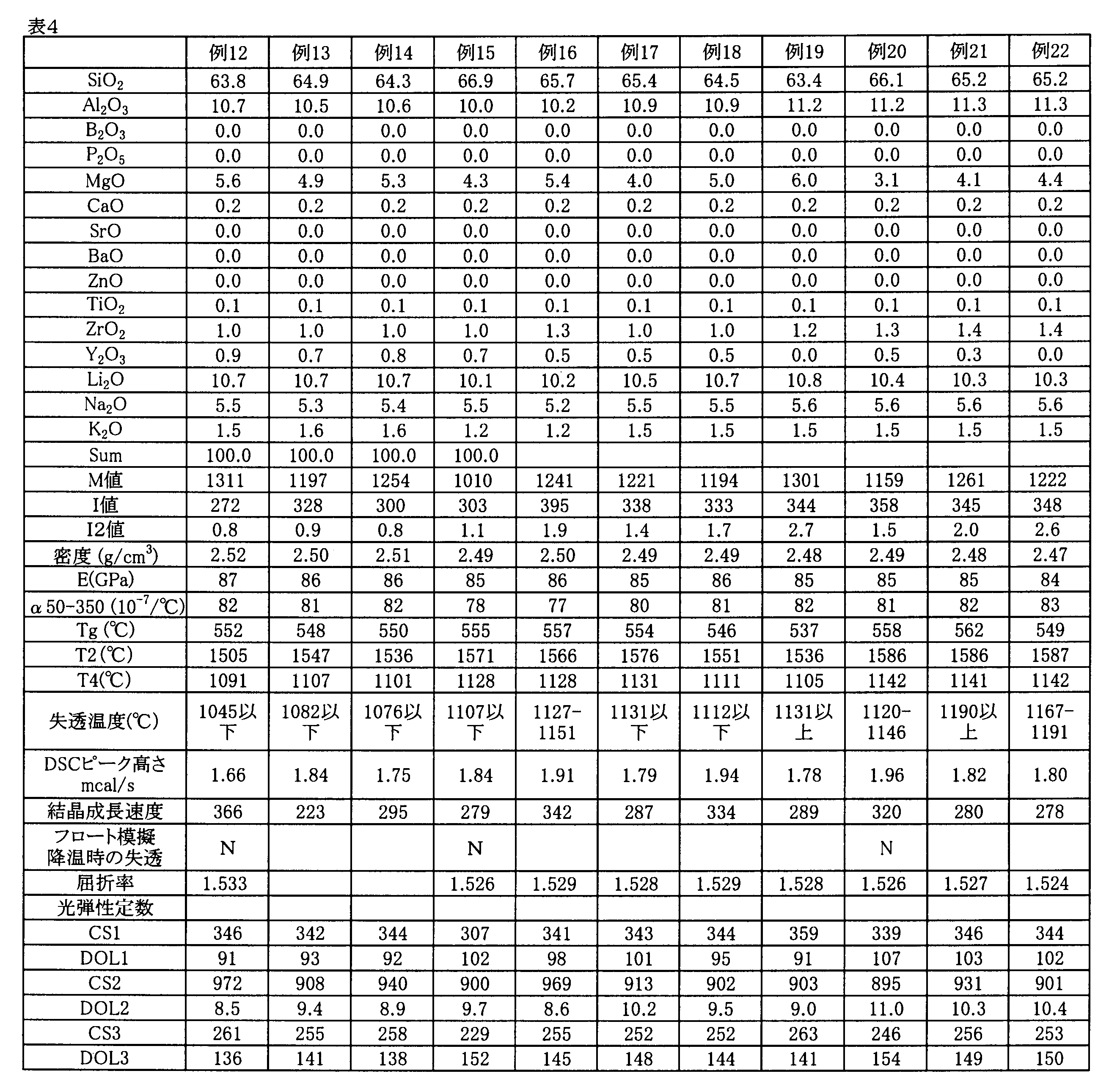


M値が1000以上でI2値が5以下だがI値がやや大きい例33~36は、例1等と比較すると失透温度が高く、やや失透しやすいガラスであるが、化学強化により優れた強度が得られることがわかる。
M値が1000未満でも、I値およびI2値が小さい例24、26、27は、化学強化による表面圧縮応力は不充分な場合があるが、結晶成長速度が小さく、失透しにくいことがわかる。
M値が小さく、I値およびI2値が大きい例25は、結晶成長速度が大きく、製造困難なガラスである。
2 凹部
3 ガラス粒子
Claims (8)
- 酸化物基準のモル百分率表示で、
SiO2を45~75%、
Al2O3を1~30%、
Li2Oを1~20%、
Y2O3を0~5%、
ZrO2を0~5%、及び
TiO2を0~1%を含有し、
MgO、CaO、SrO、BaOおよびZnOのいずれか1種以上を合計で1~20%、
Na2OおよびK2Oの含有量の合計が0~10%、
B2O3およびP2O5の含有量の合計が0~10%、かつ、
次式で表されるM値が1000以上の化学強化用ガラス。
M=-5×[SiO2]+121×[Al2O3]+50×[Li2O]-35×[Na2O]+32×[K2O]+85×[MgO]+54×[CaO]-41×[SrO]-4×[P2O5]+218×[Y2O3]+436×[ZrO2]-1180
ただし[SiO2]、[Al2O3]、[Li2O]、[Na2O]、[K2O]、[MgO]、[CaO]、[SrO]、[P2O5]、[Y2O3]および[ZrO2]は、各成分のモル百分率表示の含有量である。 - 酸化物基準のモル百分率表示で、
SiO2を45~75%、
Al2O3を1~30%、
Li2Oを1~20%、
Y2O3を0~5%、
ZrO2を0~5%、及び
TiO2を0~1%を含有し、
MgO、CaO、SrO、BaOおよびZnOのいずれか1種以上を合計で1~20%、
Na2OおよびK2Oの含有量の合計が0~10%、
B2O3およびP2O5の含有量の合計が0~10%、かつ、
次式で表されるI値が600以下である化学強化用ガラス。
I=-4.8×[SiO2]+102×[Al2O3]+81×[Li2O]-272×[Na2O]-281×[K2O]-16×[MgO]-25×[Y2O3]+0.028×[ZrO2]+63
ただし[SiO2]、[Al2O3]、[Li2O]、[Na2O]、[K2O]、[MgO]、[Y2O3]および[ZrO2]は、各成分のモル百分率表示の含有量である。 - 酸化物基準のモル百分率表示で、
SiO2を45~75%、
Al2O3を1~30%、
Li2Oを1~20%、
Y2O3を0~5%、
ZrO2を0~5%、及び
TiO2を0~1%を含有し、
MgO、CaO、SrO、BaOおよびZnOのいずれか1種以上を合計で1~20%、
Na2OおよびK2Oの含有量の合計が0~10%、
B2O3およびP2O5の含有量の合計が0~10%、かつ、
次式で表されるI2値が5以下である化学強化用ガラス。
I2=0.27×[SiO2]+1.4×[Al2O3]-1.1×[Na2O]-1.7×[K2O]+0.38×[MgO]-1.36×[Y2O3]-0.59×[ZrO2]-23
ただし[SiO2]、[Al2O3]、[Na2O]、[K2O]、[MgO]、[Y2O3]および[ZrO2]は、各成分のモル百分率表示の含有量である。 - 次式で表されるI値が850以下である請求項1または3に記載の化学強化用ガラス。
I=-4.8×[SiO2]+102×[Al2O3]+81×[Li2O]-272×[Na2O]-281×[K2O]-16×[MgO]-25×[Y2O3]+0.028×[ZrO2]+63
ただし[SiO2]、[Al2O3]、[Li2O]、[Na2O]、[K2O]、[MgO]、[Y2O3]および[ZrO2]は、各成分のモル百分率表示の含有量である。 - 次式で表されるI2値が5以下である請求項1、2または4に記載の化学強化用ガラス。
I2=0.27×[SiO2]+1.4×[Al2O3]-1.1×[Na2O]-1.7×[K2O]+0.38×[MgO]-1.36×[Y2O3]-0.59×[ZrO2]-23
ただし[SiO2]、[Al2O3]、[Na2O]、[K2O]、[MgO]、[Y2O3]および[ZrO2]は、各成分のモル百分率表示の含有量である。 - 粘度が104dPa・sとなる温度(T4)が1350℃以下である請求項1~5のいずれか一項に記載の化学強化用ガラス。
- 酸化物基準のモル百分率表示で、Y2O3を0.1~5%含有する請求項1~6のいずれか1項に記載の化学強化用ガラス。
- 450℃の硝酸ナトリウムに1時間浸漬して化学強化した後の表面圧縮応力値が300MPa以上になり、かつ、
450℃の硝酸ナトリウムに3時間浸漬した後、450℃の硝酸カリウムに1.5時間浸漬して化学強化した後の表面圧縮応力値が800MPa以上となる、請求項1~7のいずれか一項に記載の化学強化用ガラス。
Priority Applications (6)
| Application Number | Priority Date | Filing Date | Title |
|---|---|---|---|
| CN201880088438.6A CN111670172A (zh) | 2018-02-05 | 2018-10-03 | 化学强化用玻璃 |
| KR1020207019565A KR102564323B1 (ko) | 2018-02-05 | 2018-10-03 | 화학 강화용 유리 |
| JP2019568578A JP6798629B2 (ja) | 2018-02-05 | 2018-10-03 | 化学強化用ガラス |
| CN202511150877.3A CN120965096A (zh) | 2018-02-05 | 2018-10-03 | 化学强化用玻璃和化学强化玻璃 |
| US16/911,878 US11572305B2 (en) | 2018-02-05 | 2020-06-25 | Glass for chemical strengthening |
| US18/068,547 US11827560B2 (en) | 2018-02-05 | 2022-12-20 | Glass for chemical strengthening |
Applications Claiming Priority (2)
| Application Number | Priority Date | Filing Date | Title |
|---|---|---|---|
| JP2018-018508 | 2018-02-05 | ||
| JP2018018508 | 2018-02-05 |
Related Child Applications (1)
| Application Number | Title | Priority Date | Filing Date |
|---|---|---|---|
| US16/911,878 Continuation US11572305B2 (en) | 2018-02-05 | 2020-06-25 | Glass for chemical strengthening |
Publications (1)
| Publication Number | Publication Date |
|---|---|
| WO2019150654A1 true WO2019150654A1 (ja) | 2019-08-08 |
Family
ID=67478036
Family Applications (1)
| Application Number | Title | Priority Date | Filing Date |
|---|---|---|---|
| PCT/JP2018/037115 Ceased WO2019150654A1 (ja) | 2018-02-05 | 2018-10-03 | 化学強化用ガラス |
Country Status (6)
| Country | Link |
|---|---|
| US (2) | US11572305B2 (ja) |
| JP (3) | JP6798629B2 (ja) |
| KR (1) | KR102564323B1 (ja) |
| CN (2) | CN120965096A (ja) |
| TW (1) | TWI838347B (ja) |
| WO (1) | WO2019150654A1 (ja) |
Cited By (7)
| Publication number | Priority date | Publication date | Assignee | Title |
|---|---|---|---|---|
| CN114901608A (zh) * | 2019-11-27 | 2022-08-12 | 康宁股份有限公司 | 含y2o3的玻璃组合物、基材、及制品 |
| CN115667164A (zh) * | 2020-05-28 | 2023-01-31 | 日本电气硝子株式会社 | 支承玻璃基板及使用该支承玻璃基板的层叠基板 |
| CN115734948A (zh) * | 2020-07-03 | 2023-03-03 | Agc株式会社 | 玻璃、微晶玻璃和化学强化玻璃 |
| CN115776973A (zh) * | 2020-07-10 | 2023-03-10 | Agc株式会社 | 玻璃和化学强化玻璃 |
| WO2023136224A1 (ja) * | 2022-01-14 | 2023-07-20 | Agc株式会社 | 結晶化ガラス、高周波デバイス用ガラス基板、液晶アンテナ、非晶質ガラスおよび結晶化ガラスの製造方法 |
| EP4151607A4 (en) * | 2020-06-30 | 2024-07-17 | Nippon Sheet Glass Company, Limited | Glass composition for chemical strengthening and chemically strengthened glass article |
| WO2026018624A1 (ja) * | 2024-07-16 | 2026-01-22 | Agc株式会社 | ガラス物品 |
Families Citing this family (18)
| Publication number | Priority date | Publication date | Assignee | Title |
|---|---|---|---|---|
| WO2019150654A1 (ja) * | 2018-02-05 | 2019-08-08 | Agc株式会社 | 化学強化用ガラス |
| KR102716148B1 (ko) * | 2018-08-30 | 2024-10-15 | 코닝 인코포레이티드 | 적층물용 연질의, 화학적-강화가능한 유리 |
| WO2020121888A1 (ja) | 2018-12-11 | 2020-06-18 | Agc株式会社 | 化学強化ガラス板、並びに化学強化ガラスを含むカバーガラス及び電子機器 |
| WO2022066408A1 (en) * | 2020-09-25 | 2022-03-31 | Corning Incorporated | Stress profiles of glass-based articles having improved drop performance |
| WO2022066574A1 (en) * | 2020-09-25 | 2022-03-31 | Corning Incorporated | Stress profiles of glass-based articles having improved drop performance |
| CN116529216B (zh) * | 2020-12-04 | 2025-08-01 | Agc株式会社 | 化学强化玻璃和电子设备壳体 |
| KR102585577B1 (ko) * | 2021-02-09 | 2023-10-06 | 공주대학교 산학협력단 | 화학강화용 유리 조성물과 이로부터 제조된 화학강화 유리 박판 및 이의 제조 방법 |
| CN114956602A (zh) * | 2021-02-26 | 2022-08-30 | Agc株式会社 | 化学强化玻璃及其制造方法 |
| JP2024540112A (ja) * | 2021-10-26 | 2024-10-31 | コーニング インコーポレイテッド | 破壊靱性が高いイオン交換可能なガラス |
| EP4430007A1 (en) * | 2021-11-10 | 2024-09-18 | Corning Incorporated | Fusion formable high fracture toughness glasses |
| CN114634308B (zh) * | 2022-03-30 | 2022-11-15 | 安徽汉柔光电科技有限公司 | 一种碱铝硅玻璃 |
| CN117510067A (zh) * | 2022-07-26 | 2024-02-06 | 重庆鑫景特种玻璃有限公司 | 具有改善的抗应力松弛能力的化学强化玻璃及基材玻璃 |
| CN117486502B (zh) * | 2022-07-26 | 2025-01-14 | 重庆鑫景特种玻璃有限公司 | 一种含y2o3的化学强化玻璃及其应用 |
| CN117486487B (zh) * | 2022-07-26 | 2025-08-08 | 重庆鑫景特种玻璃有限公司 | 一种基材玻璃及由基材玻璃制得的化学强化玻璃 |
| CN117486488B (zh) * | 2022-07-26 | 2025-07-18 | 重庆鑫景特种玻璃有限公司 | 一种化学强化玻璃及包含化学强化玻璃的玻璃器件 |
| CN116119924A (zh) * | 2022-11-21 | 2023-05-16 | 河北光兴半导体技术有限公司 | 玻璃组合物、玻璃及其制备方法和应用 |
| EP4450467B1 (en) * | 2023-02-28 | 2025-12-10 | Nitto Boseki Co., Ltd. | Glass composition for glass fibers, glass fibers, woven glass fiber fabric, and glass-fiber-reinforced resin composition |
| CN116553821B (zh) * | 2023-05-15 | 2024-01-30 | 北京工业大学 | 一种抗摔耐划碱铝硅玻璃及制备方法 |
Citations (6)
| Publication number | Priority date | Publication date | Assignee | Title |
|---|---|---|---|---|
| US4156755A (en) * | 1978-04-19 | 1979-05-29 | Ppg Industries, Inc. | Lithium containing ion exchange strengthened glass |
| JP2000357318A (ja) * | 1999-04-13 | 2000-12-26 | Asahi Glass Co Ltd | 情報記録媒体基板用ガラスおよび情報記録媒体用ガラス基板 |
| JP2005314159A (ja) * | 2004-04-28 | 2005-11-10 | Hoya Corp | 情報記録媒体用ガラス基板およびその製造方法並びに情報記録媒体およびその製造方法 |
| JP2012020921A (ja) * | 2010-06-18 | 2012-02-02 | Asahi Glass Co Ltd | ディスプレイ装置用のガラスおよびガラス板 |
| JP2012232882A (ja) * | 2011-04-18 | 2012-11-29 | Asahi Glass Co Ltd | 化学強化ガラスの製造方法および化学強化用ガラス |
| JP2013520385A (ja) * | 2010-02-26 | 2013-06-06 | ショット グラス テクノロジーズ (スゾウ) カンパニー リミテッド | 3次元精密成形用薄リチウムアルミノケイ酸ガラス |
Family Cites Families (16)
| Publication number | Priority date | Publication date | Assignee | Title |
|---|---|---|---|---|
| US6387510B1 (en) | 1999-04-13 | 2002-05-14 | Asahi Glass Company, Limited | Glass for a data storage medium substrate and glass substrate for data storage media |
| FR2796637B1 (fr) * | 1999-07-21 | 2002-06-07 | Corning Inc | Verre borosilicate ou aluminosilicate pour amplification optique |
| JP2001172043A (ja) * | 1999-12-20 | 2001-06-26 | Asahi Glass Co Ltd | 情報記録媒体基板用ガラスおよび情報記録媒体用ガラス基板 |
| JP2003099913A (ja) * | 2001-09-27 | 2003-04-04 | Hitachi Ltd | 磁気ディスク用ガラス基板及びそれを用いた磁気ディスク |
| CN101448753B (zh) * | 2006-05-25 | 2012-07-25 | 日本电气硝子株式会社 | 无碱玻璃及无碱玻璃基板 |
| TWI577653B (zh) | 2007-03-02 | 2017-04-11 | 日本電氣硝子股份有限公司 | 強化板玻璃及其製造方法 |
| DE102010009584B4 (de) | 2010-02-26 | 2015-01-08 | Schott Ag | Chemisch vorgespanntes Glas, Verfahren zu seiner Herstellung sowie Verwendung desselben |
| DE102010032113B9 (de) * | 2010-07-23 | 2017-06-22 | Schott Ag | Transparente oder transparente eingefärbte Lithiumaluminiumsilikat-Glaskeramik mit einstellbarer thermischer Ausdehnung und deren Verwendung |
| US20140227525A1 (en) | 2011-09-29 | 2014-08-14 | Central Glass Company, Limited | Cover glass for display device, and manufacturing method for same |
| WO2013065489A1 (ja) * | 2011-10-31 | 2013-05-10 | 旭硝子株式会社 | ガラス基板およびその製造方法 |
| US10118858B2 (en) | 2014-02-24 | 2018-11-06 | Corning Incorporated | Strengthened glass with deep depth of compression |
| CN115650601B (zh) | 2016-01-21 | 2024-07-12 | Agc株式会社 | 化学强化玻璃以及化学强化用玻璃 |
| WO2017126605A1 (ja) * | 2016-01-21 | 2017-07-27 | 旭硝子株式会社 | 化学強化ガラス及び化学強化ガラスの製造方法 |
| US10348974B2 (en) | 2016-08-02 | 2019-07-09 | Cree, Inc. | Solid state lighting fixtures and image capture systems |
| CN116395986B (zh) | 2016-10-18 | 2025-09-12 | Agc株式会社 | 化学强化用玻璃、化学强化玻璃以及化学强化玻璃的制造方法 |
| WO2019150654A1 (ja) * | 2018-02-05 | 2019-08-08 | Agc株式会社 | 化学強化用ガラス |
-
2018
- 2018-10-03 WO PCT/JP2018/037115 patent/WO2019150654A1/ja not_active Ceased
- 2018-10-03 CN CN202511150877.3A patent/CN120965096A/zh active Pending
- 2018-10-03 JP JP2019568578A patent/JP6798629B2/ja active Active
- 2018-10-03 CN CN201880088438.6A patent/CN111670172A/zh active Pending
- 2018-10-03 KR KR1020207019565A patent/KR102564323B1/ko active Active
- 2018-10-04 TW TW107135069A patent/TWI838347B/zh active
-
2020
- 2020-06-25 US US16/911,878 patent/US11572305B2/en active Active
- 2020-10-30 JP JP2020182685A patent/JP7184073B2/ja active Active
-
2022
- 2022-11-18 JP JP2022185049A patent/JP7435706B2/ja active Active
- 2022-12-20 US US18/068,547 patent/US11827560B2/en active Active
Patent Citations (6)
| Publication number | Priority date | Publication date | Assignee | Title |
|---|---|---|---|---|
| US4156755A (en) * | 1978-04-19 | 1979-05-29 | Ppg Industries, Inc. | Lithium containing ion exchange strengthened glass |
| JP2000357318A (ja) * | 1999-04-13 | 2000-12-26 | Asahi Glass Co Ltd | 情報記録媒体基板用ガラスおよび情報記録媒体用ガラス基板 |
| JP2005314159A (ja) * | 2004-04-28 | 2005-11-10 | Hoya Corp | 情報記録媒体用ガラス基板およびその製造方法並びに情報記録媒体およびその製造方法 |
| JP2013520385A (ja) * | 2010-02-26 | 2013-06-06 | ショット グラス テクノロジーズ (スゾウ) カンパニー リミテッド | 3次元精密成形用薄リチウムアルミノケイ酸ガラス |
| JP2012020921A (ja) * | 2010-06-18 | 2012-02-02 | Asahi Glass Co Ltd | ディスプレイ装置用のガラスおよびガラス板 |
| JP2012232882A (ja) * | 2011-04-18 | 2012-11-29 | Asahi Glass Co Ltd | 化学強化ガラスの製造方法および化学強化用ガラス |
Cited By (11)
| Publication number | Priority date | Publication date | Assignee | Title |
|---|---|---|---|---|
| CN114901608A (zh) * | 2019-11-27 | 2022-08-12 | 康宁股份有限公司 | 含y2o3的玻璃组合物、基材、及制品 |
| US11613497B2 (en) * | 2019-11-27 | 2023-03-28 | Corning Incorporated | Y2O3-containing glass compositions, substrates, and articles |
| CN114901608B (zh) * | 2019-11-27 | 2024-04-09 | 康宁股份有限公司 | 含y2o3的玻璃组合物、基材、及制品 |
| CN115667164A (zh) * | 2020-05-28 | 2023-01-31 | 日本电气硝子株式会社 | 支承玻璃基板及使用该支承玻璃基板的层叠基板 |
| KR20230017178A (ko) | 2020-05-28 | 2023-02-03 | 니폰 덴키 가라스 가부시키가이샤 | 지지 유리 기판 및 이것을 사용한 적층 기판 |
| EP4151607A4 (en) * | 2020-06-30 | 2024-07-17 | Nippon Sheet Glass Company, Limited | Glass composition for chemical strengthening and chemically strengthened glass article |
| CN115734948A (zh) * | 2020-07-03 | 2023-03-03 | Agc株式会社 | 玻璃、微晶玻璃和化学强化玻璃 |
| CN115734948B (zh) * | 2020-07-03 | 2025-03-18 | Agc株式会社 | 玻璃、微晶玻璃和化学强化玻璃 |
| CN115776973A (zh) * | 2020-07-10 | 2023-03-10 | Agc株式会社 | 玻璃和化学强化玻璃 |
| WO2023136224A1 (ja) * | 2022-01-14 | 2023-07-20 | Agc株式会社 | 結晶化ガラス、高周波デバイス用ガラス基板、液晶アンテナ、非晶質ガラスおよび結晶化ガラスの製造方法 |
| WO2026018624A1 (ja) * | 2024-07-16 | 2026-01-22 | Agc株式会社 | ガラス物品 |
Also Published As
| Publication number | Publication date |
|---|---|
| JPWO2019150654A1 (ja) | 2020-11-26 |
| JP6798629B2 (ja) | 2020-12-09 |
| US20230119617A1 (en) | 2023-04-20 |
| US11572305B2 (en) | 2023-02-07 |
| TWI838347B (zh) | 2024-04-11 |
| KR20200117993A (ko) | 2020-10-14 |
| CN111670172A (zh) | 2020-09-15 |
| US20200325066A1 (en) | 2020-10-15 |
| JP7435706B2 (ja) | 2024-02-21 |
| US11827560B2 (en) | 2023-11-28 |
| CN120965096A (zh) | 2025-11-18 |
| TW201934507A (zh) | 2019-09-01 |
| JP7184073B2 (ja) | 2022-12-06 |
| JP2023009302A (ja) | 2023-01-19 |
| KR102564323B1 (ko) | 2023-08-08 |
| JP2021008401A (ja) | 2021-01-28 |
Similar Documents
| Publication | Publication Date | Title |
|---|---|---|
| JP7435706B2 (ja) | 化学強化用ガラス | |
| JP7327533B2 (ja) | 化学強化用ガラス、化学強化ガラスおよび化学強化ガラスの製造方法 | |
| KR102569434B1 (ko) | 화학 강화 유리 및 화학 강화용 유리 | |
| JP7248020B2 (ja) | 化学強化用ガラス | |
| JP7136096B2 (ja) | 化学強化ガラス、その製造方法および化学強化用ガラス | |
| WO2019017404A1 (ja) | 強化ガラス | |
| JP7722372B2 (ja) | ガラスおよび化学強化ガラス | |
| WO2023149384A1 (ja) | ガラス、化学強化ガラスおよびカバーガラス | |
| CN115605448A (zh) | 化学强化玻璃物品及其制造方法 | |
| WO2023243574A1 (ja) | 化学強化用ガラス及びガラス | |
| JP2025091351A (ja) | 化学強化ガラス、化学強化ガラスの製造方法、カバーガラス、太陽電池モジュール | |
| JP2025178950A (ja) | 結晶化ガラス、化学強化結晶化ガラス及び結晶化ガラスの試験方法 |
Legal Events
| Date | Code | Title | Description |
|---|---|---|---|
| 121 | Ep: the epo has been informed by wipo that ep was designated in this application |
Ref document number: 18903439 Country of ref document: EP Kind code of ref document: A1 |
|
| ENP | Entry into the national phase |
Ref document number: 20207019565 Country of ref document: KR Kind code of ref document: A |
|
| ENP | Entry into the national phase |
Ref document number: 2019568578 Country of ref document: JP Kind code of ref document: A |
|
| NENP | Non-entry into the national phase |
Ref country code: DE |
|
| 122 | Ep: pct application non-entry in european phase |
Ref document number: 18903439 Country of ref document: EP Kind code of ref document: A1 |