WO2019065878A1 - ハードコートフィルム - Google Patents
ハードコートフィルム Download PDFInfo
- Publication number
- WO2019065878A1 WO2019065878A1 PCT/JP2018/036042 JP2018036042W WO2019065878A1 WO 2019065878 A1 WO2019065878 A1 WO 2019065878A1 JP 2018036042 W JP2018036042 W JP 2018036042W WO 2019065878 A1 WO2019065878 A1 WO 2019065878A1
- Authority
- WO
- WIPO (PCT)
- Prior art keywords
- hard coat
- film
- coat layer
- peak area
- curable resin
- Prior art date
- Legal status (The legal status is an assumption and is not a legal conclusion. Google has not performed a legal analysis and makes no representation as to the accuracy of the status listed.)
- Ceased
Links
Classifications
-
- C—CHEMISTRY; METALLURGY
- C08—ORGANIC MACROMOLECULAR COMPOUNDS; THEIR PREPARATION OR CHEMICAL WORKING-UP; COMPOSITIONS BASED THEREON
- C08J—WORKING-UP; GENERAL PROCESSES OF COMPOUNDING; AFTER-TREATMENT NOT COVERED BY SUBCLASSES C08B, C08C, C08F, C08G or C08H
- C08J7/00—Chemical treatment or coating of shaped articles made of macromolecular substances
- C08J7/04—Coating
- C08J7/043—Improving the adhesiveness of the coatings per se, e.g. forming primers
-
- C—CHEMISTRY; METALLURGY
- C08—ORGANIC MACROMOLECULAR COMPOUNDS; THEIR PREPARATION OR CHEMICAL WORKING-UP; COMPOSITIONS BASED THEREON
- C08J—WORKING-UP; GENERAL PROCESSES OF COMPOUNDING; AFTER-TREATMENT NOT COVERED BY SUBCLASSES C08B, C08C, C08F, C08G or C08H
- C08J7/00—Chemical treatment or coating of shaped articles made of macromolecular substances
- C08J7/04—Coating
- C08J7/046—Forming abrasion-resistant coatings; Forming surface-hardening coatings
-
- B—PERFORMING OPERATIONS; TRANSPORTING
- B32—LAYERED PRODUCTS
- B32B—LAYERED PRODUCTS, i.e. PRODUCTS BUILT-UP OF STRATA OF FLAT OR NON-FLAT, e.g. CELLULAR OR HONEYCOMB, FORM
- B32B27/00—Layered products comprising a layer of synthetic resin
- B32B27/06—Layered products comprising a layer of synthetic resin as the main or only constituent of a layer, which is next to another layer of the same or of a different material
- B32B27/08—Layered products comprising a layer of synthetic resin as the main or only constituent of a layer, which is next to another layer of the same or of a different material of synthetic resin
-
- B—PERFORMING OPERATIONS; TRANSPORTING
- B32—LAYERED PRODUCTS
- B32B—LAYERED PRODUCTS, i.e. PRODUCTS BUILT-UP OF STRATA OF FLAT OR NON-FLAT, e.g. CELLULAR OR HONEYCOMB, FORM
- B32B27/00—Layered products comprising a layer of synthetic resin
- B32B27/30—Layered products comprising a layer of synthetic resin comprising vinyl (co)polymers; comprising acrylic (co)polymers
-
- C—CHEMISTRY; METALLURGY
- C08—ORGANIC MACROMOLECULAR COMPOUNDS; THEIR PREPARATION OR CHEMICAL WORKING-UP; COMPOSITIONS BASED THEREON
- C08J—WORKING-UP; GENERAL PROCESSES OF COMPOUNDING; AFTER-TREATMENT NOT COVERED BY SUBCLASSES C08B, C08C, C08F, C08G or C08H
- C08J5/00—Manufacture of articles or shaped materials containing macromolecular substances
- C08J5/18—Manufacture of films or sheets
-
- C—CHEMISTRY; METALLURGY
- C09—DYES; PAINTS; POLISHES; NATURAL RESINS; ADHESIVES; COMPOSITIONS NOT OTHERWISE PROVIDED FOR; APPLICATIONS OF MATERIALS NOT OTHERWISE PROVIDED FOR
- C09D—COATING COMPOSITIONS, e.g. PAINTS, VARNISHES OR LACQUERS; FILLING PASTES; CHEMICAL PAINT OR INK REMOVERS; INKS; CORRECTING FLUIDS; WOODSTAINS; PASTES OR SOLIDS FOR COLOURING OR PRINTING; USE OF MATERIALS THEREFOR
- C09D133/00—Coating compositions based on homopolymers or copolymers of compounds having one or more unsaturated aliphatic radicals, each having only one carbon-to-carbon double bond, and at least one being terminated by only one carboxyl radical, or of salts, anhydrides, esters, amides, imides, or nitriles thereof; Coating compositions based on derivatives of such polymers
- C09D133/04—Homopolymers or copolymers of esters
- C09D133/06—Homopolymers or copolymers of esters of esters containing only carbon, hydrogen and oxygen, the oxygen atom being present only as part of the carboxyl radical
- C09D133/062—Copolymers with monomers not covered by C09D133/06
- C09D133/066—Copolymers with monomers not covered by C09D133/06 containing -OH groups
-
- C—CHEMISTRY; METALLURGY
- C08—ORGANIC MACROMOLECULAR COMPOUNDS; THEIR PREPARATION OR CHEMICAL WORKING-UP; COMPOSITIONS BASED THEREON
- C08F—MACROMOLECULAR COMPOUNDS OBTAINED BY REACTIONS ONLY INVOLVING CARBON-TO-CARBON UNSATURATED BONDS
- C08F20/00—Homopolymers and copolymers of compounds having one or more unsaturated aliphatic radicals, each having only one carbon-to-carbon double bond, and only one being terminated by only one carboxyl radical or a salt, anhydride, ester, amide, imide or nitrile thereof
-
- C—CHEMISTRY; METALLURGY
- C08—ORGANIC MACROMOLECULAR COMPOUNDS; THEIR PREPARATION OR CHEMICAL WORKING-UP; COMPOSITIONS BASED THEREON
- C08J—WORKING-UP; GENERAL PROCESSES OF COMPOUNDING; AFTER-TREATMENT NOT COVERED BY SUBCLASSES C08B, C08C, C08F, C08G or C08H
- C08J2367/00—Characterised by the use of polyesters obtained by reactions forming a carboxylic ester link in the main chain; Derivatives of such polymers
- C08J2367/02—Polyesters derived from dicarboxylic acids and dihydroxy compounds
Definitions
- the present invention relates to a hard coat film, and more specifically, flat panel displays such as liquid crystal display devices, plasma display devices, electroluminescence (EL) display devices, display device parts such as touch panels, and buildings, automobiles, train windows
- the present invention relates to a hard coat film provided with a hard coat layer that can be used as a protective film such as glass.
- a flood panel display such as a liquid crystal display (LCD)
- LCD liquid crystal display
- scratch resistance it is common practice to impart scratch resistance using a hard coat film in which a hard coat layer is provided on a base film.
- a hard coat film having optical visibility maintenance and scratch resistance. It is rising.
- polyethylene terephthalate film, polyethylene naphthalate, and cycloolefin film which are excellent in transparency, heat resistance, dimensional stability, and low hygroscopicity, are expected to be used for optical member applications, and have low birefringence. And cycloolefin films excellent in optical isotropy are particularly expected.
- providing a hard coat layer is performed.
- such a base film has a problem that the adhesion between the base film and the hard coat layer is inferior because the number of polar groups on the film surface is small.
- Patent Document 1 corona treatment, plasma treatment, UV treatment and the like have been disclosed in Patent Document 1 as a method for imparting easy adhesion to a hard coat layer to a cycloolefin film, but with these methods, cycloolefin films and The adhesion to the hard coat layer is insufficient, and in particular, there is a problem that adhesion failure with time tends to occur.
- Patent Document 2 discloses that an anchor coating agent made of an olefin resin is coated on a cycloolefin film.
- the adhesion between the cycloolefin film and the hard coat layer is improved to some extent by this anchor coat treatment, the heat resistance condition is achieved in the anchor coat layer in which the coat is flexible and stretched and the hard coat layer in which the coat is hard and does not stretch.
- cracks film cracks, cracks, etc.
- the present invention provides a hard film having excellent adhesion over time and durability of the hard coat layer under ordinary conditions and moisture and heat resistance conditions, even for base films having few polar groups such as cycloolefin films and poor adhesion.
- the purpose is to provide a coated film.
- the inventors of the present invention conducted intensive studies to solve the above problems, and as a result, by using a resin having a characteristic in the infrared spectrum for the hard coat layer, there are few polar groups such as cycloolefin films and the like, and adhesion is poor. The inventors have also found that the adhesion to the hard coat layer can be improved with respect to the base film, and the present invention has been completed.
- the present invention has the following constitution.
- the peak area appearing at 1650 to 1800 cm -1 is E.)
- the ionizing radiation curable resin contains an acrylic resin containing a (meth) acryloyl group.
- the substrate film is any one selected from a cycloolefin film, polyethylene terephthalate and polyethylene naphthalate.
- a hard film having excellent adhesion over time and durability of the hard coat layer under ordinary conditions and moisture and heat resistance conditions is also obtained for base films having few polar groups such as cycloolefin films and poor adhesion.
- a coated film can be provided.
- the present invention is a hard coat film provided with a hard coat layer containing an ionizing radiation curable resin on at least one surface of a substrate film, and the ionizing radiation curable resin satisfies the following condition (I): Hard coat film.
- the base film of the hard coat film is not particularly limited, and for example, films or sheets of polyethylene terephthalate, polyamide, polyethylene, polyimide, polypropylene, acrylic resin, polystyrene, cellulose acetate, polyvinyl chloride, etc. may be mentioned.
- films or sheets of polyethylene terephthalate, polyamide, polyethylene, polyimide, polypropylene, acrylic resin, polystyrene, cellulose acetate, polyvinyl chloride, etc. may be mentioned.
- the cycloolefin film is a film in which cycloolefin units are alternately or randomly polymerized in a polymer skeleton to have an alicyclic structure in a molecular structure, and a norbornene compound, a monocyclic olefin, a cyclic conjugated diene and a vinyl.
- a cycloolefin copolymer film or a cycloolefin polymer film, which is a (co) polymer comprising at least one compound selected from alicyclic hydrocarbons, is a target and any one can be appropriately selected and used.
- the thickness of the base film is appropriately selected according to the application for which the hard coat film is used, but in the range of 10 ⁇ m to 300 ⁇ m from the viewpoint of mechanical strength, handling property, etc. Is more preferable, and more preferably in the range of 20 ⁇ m to 200 ⁇ m.
- the heat resistance of the above-mentioned base film when used for hard coat film application, is a thermogravimetric measurement (TG) method or differential scanning calorimetry that measures the thermal change when the sample is given a temperature change. It is preferable to use a film having a glass transition temperature of about 120 ° C. to about 170 ° C. measured by the (DSC) method or the like.
- TG thermogravimetric measurement
- DSC differential scanning calorimetry
- the transmittance at a wavelength of 380 nm as measured by a spectrophotometer is preferably 10% or less. More preferably, it is 7% or less.
- any resin that forms a film can be used without particular limitation, but in particular, the surface hardness (pencil hardness, scratch resistance) of the hard coat layer is imparted.
- an ionizing radiation curable resin in that the degree of crosslinking can be adjusted by the amount of exposure to ultraviolet light, and the surface hardness of the hard coat layer can be adjusted.
- the ionizing radiation-curable resin used in the present invention is a transparent resin that is cured by irradiation with ultraviolet light (hereinafter abbreviated as “UV”) or electron beam (hereinafter abbreviated as "EB”), It is preferable that it is what contains acrylic resin containing a (meth) acryloyl group, and it is still more preferable that it is urethane acrylate resin containing a (meth) acryloyl group.
- UV ultraviolet light
- EB electron beam
- Ionizing radiation curing resin used in the present invention in the infrared spectrum measured in the uncured state, the area of peak range appearing in the 3250 ⁇ 3500 cm -1 is A, the area of peak range appearing in the 1500 ⁇ 1580 cm -1 It is important that condition (I): Peak area ratio 1 (A / C ⁇ 100) is 5% or more, where B is the area of the peak range appearing at 1650 to 1800 cm ⁇ 1. % Or more is preferable.
- the peak area ratio 2 (B / C ⁇ 100) is preferably 5% or more, more preferably 10% or more.
- a peak appearing at 1650 to 1800 cm -1 represents a carbon-carbon double bond of acryloyl group.
- the peak appearing at 3250 to 3500 cm -1 is presumed to represent a nitrogen-hydrogen bond derived from an amide group or an oxygen-hydrogen bond derived from a hydroxyl group.
- the adhesion of the hard coat layer to the substrate by the acryloyl group and the hard coat layer cure and shrink in the layer
- the balance between the interface of the substrate film and the peeling force with which the force is applied in a different direction is maintained, so that no modification of the anchor layer or the substrate film is necessary even for a cycloolefin film with few polar groups.
- the adhesion to the substrate film can be remarkably improved.
- the peak appearing at 1500 to 1580 cm -1 represents a nitrogen-hydrogen bond derived from an amide group, a carbon-hydrogen bond derived from a phenyl ring, or a nitrogen-nitrogen double bond derived from an azo group.
- the adhesion to the substrate film can be remarkably improved by having a peak appearing at 1500 to 1580 cm -1 which is a fixed ratio or more with respect to the existing ratio of the acryloyl group.
- polyethylene, polypropylene, polystyrene, polycarbonate, polyester, acrylic, styrene-acrylic, cellulose, etc. in addition to the above-mentioned ionizing radiation curable resin having specific IR peak Thermoplastic resins and thermosetting resins such as phenol resins, urea resins, unsaturated polyesters, epoxy resins, silicone resins, etc. are blended within the range that does not impair the effects of the present invention, the hardness of the hard coat layer, and the scratch resistance. May be
- Acetophenones such as commercial IRGACURE 651 and IRGACURE 184 (all are brand names: BASF company make), IRGACURE 500 (commodity) Name: It is possible to use benzophenones such as those manufactured by BASF AG and is not particularly limited, but it is preferable to use an organic peroxide such as diacyl peroxides in order to further improve the adhesion.
- inorganic oxide fine particles may be contained in the above-mentioned hard coat layer to further improve the surface hardness (abrasion resistance).
- the average particle diameter of the inorganic oxide fine particles is preferably in the range of 5 to 50 nm, and more preferably in the range of 10 to 20 nm.
- the average particle size is less than 5 nm, it is difficult to obtain a sufficient surface hardness.
- the average particle size exceeds 50 nm, the gloss and transparency of the hard coat layer may be reduced, and the flexibility may also be reduced.
- examples of the inorganic oxide fine particles include alumina and silica.
- alumina containing aluminum as a main component is particularly preferable because it has high hardness and can be obtained at a smaller amount than silica.
- the content of the inorganic oxide fine particles is preferably 0.1 to 10.0 parts by weight with respect to 100 parts by weight of the solid content of the hard coat layer coating composition. If the content of the inorganic oxide fine particles is less than 0.1 parts by weight, it is difficult to obtain the effect of improving the surface hardness (abrasion resistance). On the other hand, when the content exceeds 10.0 parts by weight, the haze is unfavorably increased.
- a leveling agent for the purpose of improving the coating property, and for example, known leveling agents such as fluorine type, acrylic type, siloxane type and their adducts or mixtures are used. It is usable.
- the compounding amount can be compounded in the range of 0.03 part by weight to 3.0 parts by weight with respect to 100 parts by weight of the solid content of the resin of the hard coat layer.
- adhesion to the optical transparent resin OCR is required for the purpose of bonding with a cover glass (CG) of a touch panel terminal, a transparent conductive member (TSP), a liquid crystal module (LCM), etc. in touch panel applications
- an acrylic leveling agent having a high surface free energy (approximately 40 mJ / cm 2 or more) or a fluorine-based leveling agent.
- antifoaming agents As other additives to be added to the above hard coat layer, antifoaming agents, surface tension adjusters, antifouling agents, antioxidants, antistatic agents, ultraviolet light absorbers, light stable, as long as the effects of the present invention are not impaired You may mix
- the hard coat layer is formed by applying and drying a paint in which a polymerization initiator, other additives, and the like are dissolved and dispersed in an appropriate solvent in addition to the above-described ionizing radiation curable resin on the base film and dried. Be done.
- the solvent can be appropriately selected according to the solubility of the above-described resin to be blended, and any solvent can be used as long as it can uniformly dissolve or disperse at least solid content (resin, polymerization initiator, other additives).
- Such solvents include, for example, aromatic solvents such as toluene, xylene and n-heptane, aliphatic solvents such as cyclohexane, methylcyclohexane and ethylcyclohexane, methyl acetate, ethyl acetate, propyl acetate, isopropyl acetate, acetic acid
- aromatic solvents such as toluene, xylene and n-heptane
- aliphatic solvents such as cyclohexane, methylcyclohexane and ethylcyclohexane, methyl acetate, ethyl acetate, propyl acetate, isopropyl acetate
- acetic acid such as ester solvents such as butyl and methyl lactate, ketone solvents such as acetone, methyl ethyl ketone, methyl isobutyl ketone and
- the coating method of the hard coat layer is not particularly limited, but gravure coating, microgravure coating, fountain bar coating, slide die coating, slot die coating, screen printing method, spray coating method, etc. After coating by a known coating method, it is usually dried at a temperature of about 50 to 120.degree.
- the thickness of the hard coat layer is preferably, but not limited to, in the range of, for example, 1.0 ⁇ m to 12.0 ⁇ m.
- the coating film thickness is less than 1.0 ⁇ m, it is difficult to obtain the required surface hardness.
- the coating film thickness exceeds 12.0 ⁇ m, curling is strongly generated, which is not preferable because the handleability is lowered in the manufacturing process and the like.
- the coating film thickness of a hard-coat layer can be measured by measuring with a micrometer.
- a coating for a hard coat layer containing the above-mentioned ionizing radiation-curable resin is applied to a substrate film, and after drying, UV or EB irradiation causes photopolymerization to occur and a coating film having excellent hard properties ( Hard coat layer can be obtained.
- the hard coat layer preferably has a pencil hardness of B to 2H defined in JIS K5600-5-4.
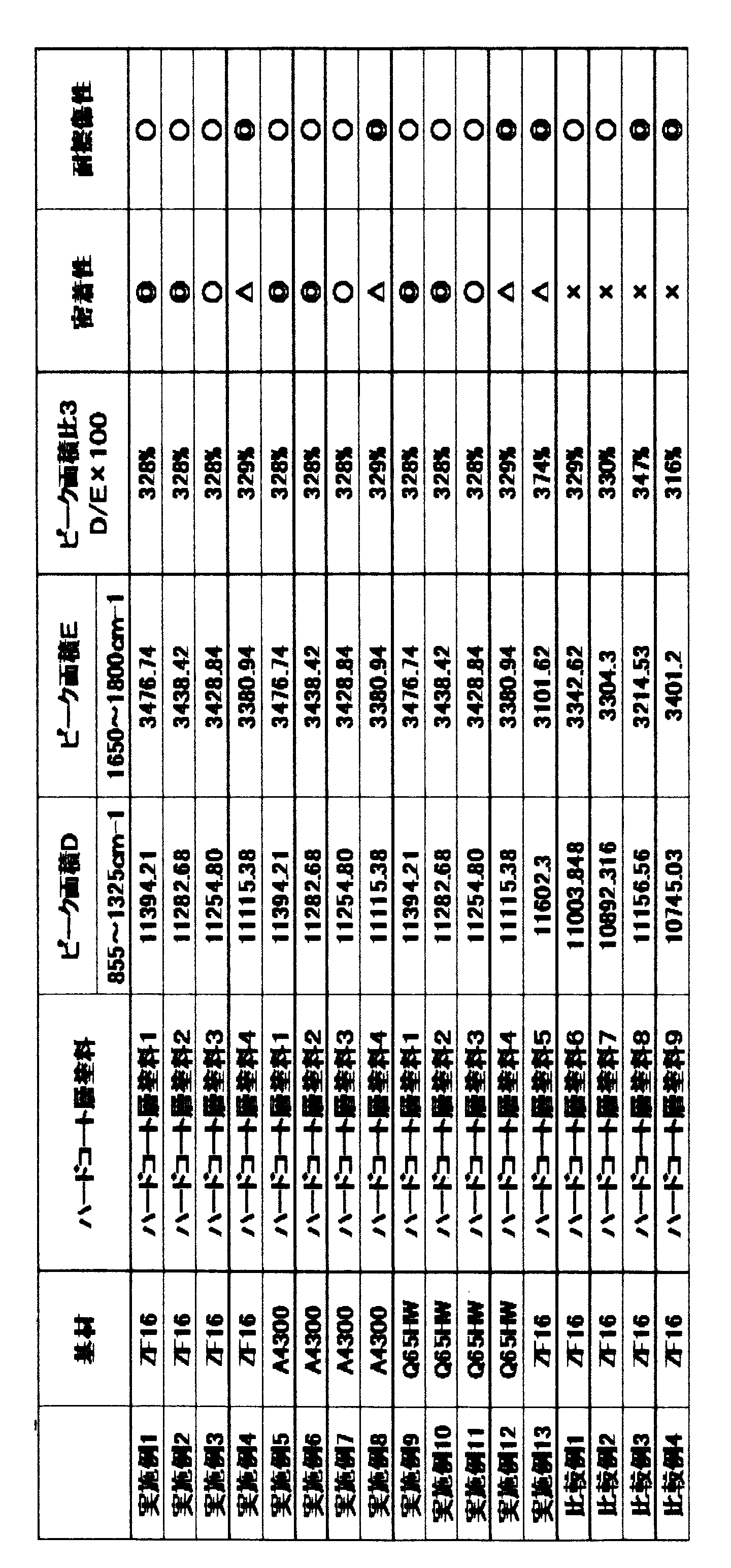
- the area of the peak appearing at 855 to 1325 cm -1 in the infrared spectrum measurement of the hard coat layer after curing is D
- the area of the peak appearing at 1650 to 1800 cm -1 is E
- the peak area ratio 3 (D / E ⁇ 100) is preferably less than 400%, and more preferably 380% or less.
- the lower limit of the peak area ratio 3 is preferably 300% or more. If the hard coat layer has a peak area ratio of 3 satisfying the range of the present invention, good adhesion is also obtained to a base film having few polar groups such as cycloolefin films and polyimide films and to which the hard coat layer is difficult to adhere. You can get an appearance.
- the peak of the infrared spectrum appearing at 1650 to 1800 cm -1 in the hard coat layer after curing is assumed to be equivalent to the peak appearing in the ionizing radiation curable resin described above.
- the peak of infrared spectrum appearing at 855 to 1325 cm -1 is carbon-oxygen stretching vibration of ether group or ester group or carbon-hydrogen variation of carbonyl group. It is derived from various structures such as angular vibration and inorganic fine particles such as a silica skeleton and an aluminum oxide skeleton. It is surmised that, by setting the peak appearing at 855 to 1325 cm -1 which is a fixed ratio or less relative to the proportion of the acryloyl group, it is possible to balance the adhesion to the substrate film.
- Hard coat layer paint 3 was obtained in the same manner as in Production Example 2 except that the solid content blending ratio of TOMAX FA-3312-2 and A-9550 in Production Example 2 was changed to 75/25.
- Production Example 4 A hard coat layer paint 4 was obtained in the same manner as in Production Example 2 except that the solid content blending ratio of TOMAX FA-3312-2 to A-9550 in Production Example 2 was changed to 50/50.
- Production Example 5 A hard coat layer paint 5 was obtained in the same manner as in Production Example 1 except that TOMAX FA-3312-2 in Production Example 1 was changed to TOMAX FA-3312-4.
- Production Example 6 A hard coat layer paint 6 was obtained in the same manner as in Production Example 2 except that the solid content blending ratio of TOMAX FA-3312-2 and A-9550 in Production Example 2 was changed to 30/70.
- Production Example 7 A hard coat layer paint 7 was obtained in the same manner as in Production Example 2 except that the solid content blending ratio of TOMAX FA-3312-2 and A-9550 in Production Example 2 was changed to 10/90.
- Production Example 9 A urethane acrylate ultraviolet curable resin “BS-575CSB” (solid content 100%, manufactured by Arakawa Chemical Industries, Ltd.) was used instead of “TOMAX FA-3312-2” used for the hard coat layer of Production Example 1 Hard coat layer paint 9 was obtained in the same manner as in Production Example 1 except for the above.
- Examples 1 to 13 and Comparative Examples 1 to 4 The base film and the hard coat layer paint are selected so as to obtain the combination described in Table 2, and each hard coat layer paint described above is applied on one side of each base film using a bar coater, and 80 ° C. Hot air drying was performed for 1 minute in a drying oven to form a coating layer having a coating thickness of 2.5 ⁇ m. This is cured at a UV irradiation dose of 250 mJ / cm 2 using a UV irradiation device set at a height of 60 mm from the coated surface to form a hard coat layer, and Examples 1 to 13 and Comparative Examples 1 to 4 Hard coated film was obtained.
- Peak area ratio of ionizing radiation curable resin 1 to 2 The infrared spectrum (infrared absorption spectrum) was measured by the ATR method for the ionizing radiation curable resin in the uncured state using an infrared spectrophotometer.
- the infrared spectrophotometer used FT-IR Spectrometer Spectrum 100 (made by Perkin-Elmer Japan).
- Adhesion The adhesion was subjected to a cross-cut peeling test in accordance with JIS-K5600-5-6. Using a cutter knife, cut 11 grids and 11 grids at 1mm intervals in a grid pattern on the hardcoat film-formed surface of the hardcoat film and cut a square grid of 100 squares in total, Sekisui Chemical Co., Ltd. A pressure-sensitive adhesive tape No. 252 manufactured by company was attached thereon, pressed uniformly using a spatula, and peeled in a 60 ° direction, and the remaining number of hard coat layers was evaluated in four steps. Judgment was performed after pressing and peeling 5 times in the same place. The evaluation criteria are as follows, and the ⁇ and ⁇ ⁇ evaluations were judged to be acceptable for adhesion, but ⁇ evaluations are also practically acceptable.
- the notation of the base material in Table 2 is as follows.
- ZF16 cycloolefin film (thickness 100 ⁇ m, manufactured by Nippon Zeon Co., Ltd.)
- A4300 Polyethylene terephthalate film (thickness 100 ⁇ m, manufactured by Toyobo Co., Ltd.)
- Q65HW Polyethylene naphthalate film (100 ⁇ m thick, manufactured by Teijin Films Solutions Ltd.)
- the adhesion and durability of the hard coat layer are excellent even for base films having few polar groups such as cycloolefin films and poor adhesion.
- a hard coat film can be provided.
- the adhesion is particularly inferior.
Landscapes
- Chemical & Material Sciences (AREA)
- Organic Chemistry (AREA)
- Health & Medical Sciences (AREA)
- Chemical Kinetics & Catalysis (AREA)
- Medicinal Chemistry (AREA)
- Polymers & Plastics (AREA)
- Engineering & Computer Science (AREA)
- Manufacturing & Machinery (AREA)
- Materials Engineering (AREA)
- Life Sciences & Earth Sciences (AREA)
- Wood Science & Technology (AREA)
- Laminated Bodies (AREA)
- Coating Of Shaped Articles Made Of Macromolecular Substances (AREA)
- Liquid Crystal (AREA)
- Surface Treatment Of Optical Elements (AREA)
Abstract
Description
(1)基材フィルムの少なくとも片面に、電離放射線硬化型樹脂を含有するハードコート層を設けたハードコートフィルムであって、該電離放射線硬化型樹脂が下記条件(I)を満たすことを特徴とするハードコートフィルム。
条件(I):ピーク面積比1(A/C×100)が5%以上
(但し、未硬化の電離放射線硬化型樹脂の赤外分光スペクトル測定で3250~3500cm-1に現れるピーク面積をAとし、1650~1800cm-1に現れるピーク面積をCとする。)
(2)前記電離放射線硬化型樹脂が、さらに下記条件(II)を満たすことを特徴とする(1)に記載のハードコートフィルム。
条件(II):ピーク面積比2(B/C×100)が5%以上
(但し、未硬化の電離放射線硬化型樹脂の赤外分光スペクトル測定で1500~1580cm-1に現れるピーク面積をBとし、1650~1800cm-1に現れるピーク面積をCとする。)
(3)前記ハードコート層が、下記条件(III)を、さらに満たすことを特徴とする(1)~(2)いずれかに記載のハードコートフィルム。
条件(III):ピーク面積比3(D/E×100)が400%未満
(但し、硬化後のハードコート層の赤外分光スペクトル測定で、855~1325cm-1に現れるピーク面積をDとし、1650~1800cm-1に現れるピーク面積をEとする。)
(4)前記電離放射線硬化型樹脂は、(メタ)アクリロイル基を含むアクリル系樹脂を含むことを特徴とする(1)~(3)のいずれかに記載のハードコートフィルム。
(5)前記基材フィルムは、シクロオレフィンフィルム、ポリエチレンテレフタレート、ポリエチレンナフタレートから選ばれるいずれかであることを特徴とする(1)~(4)のいずれかに記載のハードコートフィルム。
本発明は、基材フィルムの少なくとも片面に、電離放射線硬化型樹脂を含有するハードコート層を設けたハードコートフィルムであって、該電離放射線硬化型樹脂が下記条件(I)を満たすことを特徴とするハードコートフィルムである。
条件(I):ピーク面積比1(A/C×100)が5%以上
(但し、未硬化の電離放射線硬化型樹脂の赤外分光スペクトル測定で3250~3500cm-1に現れるピーク面積をAとし、1650~1800cm-1に現れるピーク面積をCとする。)
まず、ハードコートフィルムの基材フィルムについて説明する。
次に、上記ハードコート層について説明する。
硬化後のハードコート層で1650~1800cm-1に現れる赤外分光スペクトルのピークは、上述される電離放射線硬化型樹脂で現れるピークと同等であると想定される。
また、本発明においては、硬化後のハードコート層で、855~1325cm-1に現れる赤外分光スペクトルのピークは、エーテル基やエステル基の炭素-酸素伸縮振動や、カルボニル基の炭素-水素変角振動、及び無機微粒子であるシリカ骨格、酸化アルミニウム骨格など、様々な構造に由来している。アクリロイル基の存在割合に対し、一定割合以下の855~1325cm-1に現れるピークとすることで、基材フィルムに対する密着性とのバランスをとることができると推察される。
ウレタンアクリレート系紫外線硬化型樹脂「TOMAX FA-3312-2」(固形分40%、日本化工塗料株式会社製)を主剤とし、酢酸ブチルで紫外線硬化型樹脂の塗料中の固形分濃度が30%となるまで希釈し十分攪拌してハードコート層塗料1を調製した。
上記ウレタンアクリレート系紫外線硬化型樹脂「TOMAX FA-3312-2」(固形分40%、日本化工塗料株式会社製)とウレタンアクリレート系紫外線硬化型樹脂「A-9550」(固形分100%、新中村化学株式会社製)を主剤として、TOMAX FA-3312-2とA-9550の固形分配合比が80/20となるように配合し、酢酸ブチルで紫外線硬化型樹脂の塗料中の固形分濃度が30%となるまで希釈し十分攪拌してハードコート層塗料2を調製した。
製造例2のTOMAX FA-3312-2とA-9550の固形分配合比を75/25とした以外は製造例2と同様にしてハードコート層塗料3を得た。
製造例2のTOMAX FA-3312-2とA-9550の固形分配合比を50/50とした以外は製造例2と同様にしてハードコート層塗料4を得た。
製造例1のTOMAX FA-3312-2をTOMAX FA-3312-4とした以外は製造例1と同様にしてハードコート層塗料5を得た。
製造例2のTOMAX FA-3312-2とA-9550の固形分配合比を30/70とした以外は製造例2と同様にしてハードコート層塗料6を得た。
製造例2のTOMAX FA-3312-2とA-9550の固形分配合比を10/90とした以外は製造例2と同様にしてハードコート層塗料7を得た。
製造例1のハードコート層に用いた「TOMAX FA-3312-2」の代わりにウレタンアクリレート系紫外線硬化型樹脂「A-9550」(固形分100%、新中村化学株式会社製)を用いたこと以外は、製造例1と同様にしてハードコート層塗料8を得た。
製造例1のハードコート層に用いた「TOMAX FA-3312-2」の代わりにウレタンアクリレート系紫外線硬化型樹脂「BS-575CSB」(固形分100%、荒川化学工業株式会社製)を用いたこと以外は、製造例1と同様にしてハードコート層塗料9を得た。
参考例として、希釈溶剤として用いた酢酸ブチル100%を示す。

表2記載の組合せとなるように基材フィルム及びハードコート層塗料を選択し、各基材フィルムの片面に、上記の各ハードコート層塗料を、バーコーターを用いて塗工し、80℃の乾燥炉で1分間熱風乾燥させ、塗膜厚み2.5μmの塗工層を形成した。これを、塗工面より60mmの高さにセットされたUV照射装置を用い、UV照射量250mJ/cm2にて硬化させてハードコート層を形成し、実施例1~13及び比較例1~4のハードコートフィルムを得た。
得られた上記各実施例および各比較例のハードコートフィルムを下記の基準で評価した。その結果を纏めて表1に示した。
赤外分光光度計を用いて未硬化の状態の電離放射線硬化型樹脂に対するATR法により、赤外分光スペクトル(赤外吸収スペクトル)を測定した。赤外分光光度計はFT-IR Spectrometer Spectrum 100 (パーキンエルマージャパン社製)を使用した。
赤外分光光度計を用いてハードコートフィルムのハードコート層表面に対するATR法により、赤外分光スペクトル(赤外吸収スペクトル)を測定した。赤外分光光度計はFT-IR Spectrometer Spectrum 100(パーキンエルマージャパン社製)を使用した。得られた横軸を波数(cm-1)とし、縦軸を吸光度としたスペクトルチャート上において、855~1325cm-1、1650~1800cm-1にそれぞれベースラインを引き、このベースラインとスペクトル曲線とで囲まれる面積をそれぞれD、及びEとし、その比(D/E×100)をピーク面積比3とした。
密着性は、JIS-K5600-5-6に準じて碁盤目剥離試験を行った。ハードコートフィルムのハードコート層形成面に、カッターナイフを用いて、碁盤目状に1mm間隔で縦11本、横11本の切り込みを入れて合計100マスの正方形の升目を刻み、積水化学工業株式会社製の粘着テープNo.252をその上に貼り付け、ヘラを用いて均一に押し付け後、60度方向に剥離し、ハードコート層の残存個数を4段階評価した。同じ箇所で5回、圧着・剥離を行った後に判定を行った。評価基準は下記の通りであり、◎と○評価品を密着性は合格と判定したが、△評価品も実用上可である。
◎:100個 ○:99~90個 △:89~50個 ×:49~0個
実施例、比較例で作製した各ハードコートフィルムについて、JIS-K5600-5-10に準じた試験方法にて、ハードコート層面を、スチールウール#0000を用い、荷重250g/cm2をかけ10往復摩擦し、傷のつき具合を次の基準で評価した。○評価品を耐擦傷性は良好としたが、△評価品も製品として使用可能である。
◎:傷の発生なし。○:傷が1~5本発生する。△:傷が6~10本発生する。×:傷が10本以上発生する。
ZF16:シクロオレフィンフィルム(厚み100μm、日本ゼオン株式会社製)
A4300:ポリエチレンテレフタレートフィルム(厚み100μm、東洋紡株式会社製)
Q65HW:ポリエチレンナフタレートフィルム(厚み100μm、帝人フィルムソリューションズ株式会社製)
Claims (5)
- 基材フィルムの少なくとも片面に、電離放射線硬化型樹脂を含有するハードコート層を設けたハードコートフィルムであって、該電離放射線硬化型樹脂が下記条件(I)を満たすことを特徴とするハードコートフィルム。
条件(I):ピーク面積比1(A/C×100)が5%以上
(但し、未硬化の電離放射線硬化型樹脂の赤外分光スペクトル測定で3250~3500cm-1に現れるピーク面積をAとし、1650~1800cm-1に現れるピーク面積をCとする。) - 前記電離放射線硬化型樹脂が、さらに下記条件(II)を満たすことを特徴とする請求項1に記載のハードコートフィルム。
条件(II):ピーク面積比2(B/C×100)が5%以上
(但し、未硬化の電離放射線硬化型樹脂の赤外分光スペクトル測定で1500~1580cm-1に現れるピーク面積をBとし、1650~1800cm-1に現れるピーク面積をCとする。) - 前記ハードコート層が、下記条件(III)を、さらに満たすことを特徴とする請求項1又は2に記載のハードコートフィルム。
条件(III):ピーク面積比3(D/E×100)が400%未満
(但し、硬化後のハードコート層の赤外分光スペクトル測定で、855~1325cm-1に現れるピーク面積をDとし、1650~1800cm-1に現れるピーク面積をEとする。) - 前記電離放射線硬化型樹脂は、(メタ)アクリロイル基を含むアクリル系樹脂を含むことを特徴とする請求項1乃至3のいずれかに記載のハードコートフィルム。
- 前記基材フィルムは、シクロオレフィンフィルム、ポリエチレンテレフタレート、ポリエチレンナフタレートから選ばれるいずれかであることを特徴とする請求項1乃至4のいずれかに記載のハードコートフィルム。
Priority Applications (5)
| Application Number | Priority Date | Filing Date | Title |
|---|---|---|---|
| KR1020207007909A KR102696592B1 (ko) | 2017-09-28 | 2018-09-27 | 하드 코트 필름 |
| CN201880056195.8A CN111164139B (zh) | 2017-09-28 | 2018-09-27 | 硬涂膜 |
| JP2019545624A JP7257725B2 (ja) | 2017-09-28 | 2018-09-27 | ハードコートフィルム |
| JP2023051929A JP2023089976A (ja) | 2017-09-28 | 2023-03-28 | ハードコートフィルム |
| JP2025062084A JP2025102959A (ja) | 2017-09-28 | 2025-04-03 | ハードコートフィルム |
Applications Claiming Priority (2)
| Application Number | Priority Date | Filing Date | Title |
|---|---|---|---|
| JP2017188772 | 2017-09-28 | ||
| JP2017-188772 | 2017-09-28 |
Publications (1)
| Publication Number | Publication Date |
|---|---|
| WO2019065878A1 true WO2019065878A1 (ja) | 2019-04-04 |
Family
ID=65901616
Family Applications (1)
| Application Number | Title | Priority Date | Filing Date |
|---|---|---|---|
| PCT/JP2018/036042 Ceased WO2019065878A1 (ja) | 2017-09-28 | 2018-09-27 | ハードコートフィルム |
Country Status (5)
| Country | Link |
|---|---|
| JP (3) | JP7257725B2 (ja) |
| KR (1) | KR102696592B1 (ja) |
| CN (1) | CN111164139B (ja) |
| TW (1) | TWI835749B (ja) |
| WO (1) | WO2019065878A1 (ja) |
Cited By (2)
| Publication number | Priority date | Publication date | Assignee | Title |
|---|---|---|---|---|
| JPWO2022210769A1 (ja) * | 2021-03-30 | 2022-10-06 | ||
| JPWO2022210792A1 (ja) * | 2021-03-30 | 2022-10-06 |
Families Citing this family (2)
| Publication number | Priority date | Publication date | Assignee | Title |
|---|---|---|---|---|
| KR102766812B1 (ko) * | 2020-06-29 | 2025-02-17 | 후지필름 가부시키가이샤 | 적층체, 적층체의 제조 방법, 적층체를 포함하는 화상 표시 장치용 표면 보호 필름, 적층체를 구비한 물품 및 화상 표시 장치 |
| JPWO2024202869A1 (ja) * | 2023-03-24 | 2024-10-03 |
Citations (5)
| Publication number | Priority date | Publication date | Assignee | Title |
|---|---|---|---|---|
| JPS54127994A (en) * | 1978-03-28 | 1979-10-04 | Ppg Industries Inc | Amid modified urethane acrylate radiation curable hardenable compound* coating composition and preparation thereof |
| JPH09296152A (ja) * | 1996-03-06 | 1997-11-18 | Nippon Steel Chem Co Ltd | 多官能ウレタンアクリレート系ハードコート剤 |
| JP2002037849A (ja) * | 2000-07-27 | 2002-02-06 | Kohjin Co Ltd | 新規なウレタンアクリルアミド類および該ウレタンアクリルアミド類を含有した紫外線及び電子線硬化性樹脂組成物 |
| JP2015069071A (ja) * | 2013-09-30 | 2015-04-13 | 凸版印刷株式会社 | ハードコートフィルム、ハードコートフィルム付偏光板および透過型液晶ディスプレイ |
| WO2017047615A1 (ja) * | 2015-09-16 | 2017-03-23 | Kjケミカルズ株式会社 | (メタ)アクリルアミド系ウレタンオリゴマー及びそれを含有する活性エネルギー線硬化性樹脂組成物 |
Family Cites Families (10)
| Publication number | Priority date | Publication date | Assignee | Title |
|---|---|---|---|---|
| JP2001147304A (ja) | 1999-11-19 | 2001-05-29 | Nippon Sheet Glass Co Ltd | シリカ化合物被覆の樹脂正立等倍レンズアレイ組立体およびその製造方法 |
| JP2006110875A (ja) | 2004-10-15 | 2006-04-27 | Toppan Printing Co Ltd | ハードコートフィルムおよび表示媒体 |
| JP2009006513A (ja) * | 2007-06-26 | 2009-01-15 | Nof Corp | 紫外線吸収性を有するハードコートフィルム |
| JP2013252689A (ja) * | 2012-06-08 | 2013-12-19 | Mitsubishi Rayon Co Ltd | 積層体 |
| EP3008137B1 (de) * | 2013-06-14 | 2019-08-14 | Covestro Deutschland AG | Strahlungshärtbares beschichtungsmittel |
| JP5673881B1 (ja) * | 2014-05-26 | 2015-02-18 | 東洋インキScホールディングス株式会社 | 活性エネルギー線硬化型コーティングワニスおよびその印刷物 |
| WO2016047796A1 (ja) * | 2014-09-26 | 2016-03-31 | 日本製紙株式会社 | ハードコートフィルム及びその製造方法 |
| JPWO2017022704A1 (ja) | 2015-08-05 | 2018-07-05 | 日本製紙株式会社 | 成型用コーティングフィルム |
| JP6844286B2 (ja) * | 2017-02-06 | 2021-03-17 | 日油株式会社 | インサート成形用ハードコートフィルムおよびこれを用いた樹脂成形品 |
| JP6294999B1 (ja) * | 2017-06-05 | 2018-03-14 | 日本化工塗料株式会社 | 環状オレフィン系樹脂基材上に硬化被膜を形成するための活性エネルギー線硬化型組成物及びハードコートフィルムの製造方法 |
-
2018
- 2018-09-27 JP JP2019545624A patent/JP7257725B2/ja active Active
- 2018-09-27 KR KR1020207007909A patent/KR102696592B1/ko active Active
- 2018-09-27 CN CN201880056195.8A patent/CN111164139B/zh active Active
- 2018-09-27 WO PCT/JP2018/036042 patent/WO2019065878A1/ja not_active Ceased
- 2018-09-28 TW TW107134426A patent/TWI835749B/zh active
-
2023
- 2023-03-28 JP JP2023051929A patent/JP2023089976A/ja active Pending
-
2025
- 2025-04-03 JP JP2025062084A patent/JP2025102959A/ja active Pending
Patent Citations (5)
| Publication number | Priority date | Publication date | Assignee | Title |
|---|---|---|---|---|
| JPS54127994A (en) * | 1978-03-28 | 1979-10-04 | Ppg Industries Inc | Amid modified urethane acrylate radiation curable hardenable compound* coating composition and preparation thereof |
| JPH09296152A (ja) * | 1996-03-06 | 1997-11-18 | Nippon Steel Chem Co Ltd | 多官能ウレタンアクリレート系ハードコート剤 |
| JP2002037849A (ja) * | 2000-07-27 | 2002-02-06 | Kohjin Co Ltd | 新規なウレタンアクリルアミド類および該ウレタンアクリルアミド類を含有した紫外線及び電子線硬化性樹脂組成物 |
| JP2015069071A (ja) * | 2013-09-30 | 2015-04-13 | 凸版印刷株式会社 | ハードコートフィルム、ハードコートフィルム付偏光板および透過型液晶ディスプレイ |
| WO2017047615A1 (ja) * | 2015-09-16 | 2017-03-23 | Kjケミカルズ株式会社 | (メタ)アクリルアミド系ウレタンオリゴマー及びそれを含有する活性エネルギー線硬化性樹脂組成物 |
Cited By (6)
| Publication number | Priority date | Publication date | Assignee | Title |
|---|---|---|---|---|
| JPWO2022210769A1 (ja) * | 2021-03-30 | 2022-10-06 | ||
| WO2022210769A1 (ja) * | 2021-03-30 | 2022-10-06 | 日本製紙株式会社 | ハードコートフィルム |
| JPWO2022210792A1 (ja) * | 2021-03-30 | 2022-10-06 | ||
| WO2022210792A1 (ja) * | 2021-03-30 | 2022-10-06 | 日本製紙株式会社 | ハードコートフィルム |
| JP7270867B2 (ja) | 2021-03-30 | 2023-05-10 | 日本製紙株式会社 | ハードコートフィルム |
| JP7302116B2 (ja) | 2021-03-30 | 2023-07-03 | 日本製紙株式会社 | ハードコートフィルム |
Also Published As
| Publication number | Publication date |
|---|---|
| KR20200060373A (ko) | 2020-05-29 |
| TWI835749B (zh) | 2024-03-21 |
| CN111164139B (zh) | 2023-07-21 |
| JP2025102959A (ja) | 2025-07-08 |
| JP7257725B2 (ja) | 2023-04-14 |
| JP2023089976A (ja) | 2023-06-28 |
| KR102696592B1 (ko) | 2024-08-21 |
| TW201920527A (zh) | 2019-06-01 |
| JPWO2019065878A1 (ja) | 2020-11-26 |
| CN111164139A (zh) | 2020-05-15 |
Similar Documents
| Publication | Publication Date | Title |
|---|---|---|
| JP6041372B1 (ja) | ハードコートフィルム | |
| JP2023089976A (ja) | ハードコートフィルム | |
| JP7840631B2 (ja) | ハードコートフィルムの製造方法 | |
| JP6453689B2 (ja) | ハードコートフィルム | |
| JP2018132665A (ja) | ハードコートフィルム | |
| JP7061833B2 (ja) | ハードコートフィルム | |
| JP7302116B2 (ja) | ハードコートフィルム | |
| JP7270867B2 (ja) | ハードコートフィルム | |
| JP2023092294A (ja) | ハードコートフィルム | |
| JP6453690B2 (ja) | ハードコートフィルム | |
| JP6406563B1 (ja) | ハードコートフィルム及びその製造方法 | |
| JP7214824B1 (ja) | ハードコートフィルム | |
| WO2023120474A1 (ja) | ハードコートフィルム | |
| TW201723047A (zh) | 硬塗膜及硬塗塗料 | |
| JP2021157143A (ja) | ハードコートフィルム | |
| JP2023092295A (ja) | ハードコートフィルム | |
| JP2020012973A (ja) | ハードコートフィルム及びその製造方法 | |
| JP2020012974A (ja) | ハードコートフィルム及びその製造方法 |
Legal Events
| Date | Code | Title | Description |
|---|---|---|---|
| 121 | Ep: the epo has been informed by wipo that ep was designated in this application |
Ref document number: 18861659 Country of ref document: EP Kind code of ref document: A1 |
|
| ENP | Entry into the national phase |
Ref document number: 2019545624 Country of ref document: JP Kind code of ref document: A |
|
| ENP | Entry into the national phase |
Ref document number: 20207007909 Country of ref document: KR Kind code of ref document: A |
|
| NENP | Non-entry into the national phase |
Ref country code: DE |
|
| 122 | Ep: pct application non-entry in european phase |
Ref document number: 18861659 Country of ref document: EP Kind code of ref document: A1 |