WO2019029358A1 - 钼钒双金属氧化物催化剂及其在低碳烷烃化学链脱氢中的应用 - Google Patents
钼钒双金属氧化物催化剂及其在低碳烷烃化学链脱氢中的应用 Download PDFInfo
- Publication number
- WO2019029358A1 WO2019029358A1 PCT/CN2018/096942 CN2018096942W WO2019029358A1 WO 2019029358 A1 WO2019029358 A1 WO 2019029358A1 CN 2018096942 W CN2018096942 W CN 2018096942W WO 2019029358 A1 WO2019029358 A1 WO 2019029358A1
- Authority
- WO
- WIPO (PCT)
- Prior art keywords
- molybdenum
- vanadium
- oxygen
- metal oxide
- oxide catalyst
- Prior art date
- Legal status (The legal status is an assumption and is not a legal conclusion. Google has not performed a legal analysis and makes no representation as to the accuracy of the status listed.)
- Ceased
Links
Images


Classifications
-
- B—PERFORMING OPERATIONS; TRANSPORTING
- B01—PHYSICAL OR CHEMICAL PROCESSES OR APPARATUS IN GENERAL
- B01J—CHEMICAL OR PHYSICAL PROCESSES, e.g. CATALYSIS OR COLLOID CHEMISTRY; THEIR RELEVANT APPARATUS
- B01J23/00—Catalysts comprising metals or metal oxides or hydroxides, not provided for in group B01J21/00
- B01J23/16—Catalysts comprising metals or metal oxides or hydroxides, not provided for in group B01J21/00 of arsenic, antimony, bismuth, vanadium, niobium, tantalum, polonium, chromium, molybdenum, tungsten, manganese, technetium or rhenium
- B01J23/24—Chromium, molybdenum or tungsten
- B01J23/28—Molybdenum
-
- B—PERFORMING OPERATIONS; TRANSPORTING
- B01—PHYSICAL OR CHEMICAL PROCESSES OR APPARATUS IN GENERAL
- B01J—CHEMICAL OR PHYSICAL PROCESSES, e.g. CATALYSIS OR COLLOID CHEMISTRY; THEIR RELEVANT APPARATUS
- B01J23/00—Catalysts comprising metals or metal oxides or hydroxides, not provided for in group B01J21/00
- B01J23/90—Regeneration or reactivation
- B01J23/92—Regeneration or reactivation of catalysts comprising metals, oxides or hydroxides provided for in groups B01J23/02 - B01J23/36
-
- B—PERFORMING OPERATIONS; TRANSPORTING
- B01—PHYSICAL OR CHEMICAL PROCESSES OR APPARATUS IN GENERAL
- B01J—CHEMICAL OR PHYSICAL PROCESSES, e.g. CATALYSIS OR COLLOID CHEMISTRY; THEIR RELEVANT APPARATUS
- B01J37/00—Processes, in general, for preparing catalysts; Processes, in general, for activation of catalysts
- B01J37/02—Impregnation, coating or precipitation
- B01J37/0201—Impregnation
-
- B—PERFORMING OPERATIONS; TRANSPORTING
- B01—PHYSICAL OR CHEMICAL PROCESSES OR APPARATUS IN GENERAL
- B01J—CHEMICAL OR PHYSICAL PROCESSES, e.g. CATALYSIS OR COLLOID CHEMISTRY; THEIR RELEVANT APPARATUS
- B01J38/00—Regeneration or reactivation of catalysts, in general
- B01J38/04—Gas or vapour treating; Treating by using liquids vaporisable upon contacting spent catalyst
- B01J38/12—Treating with free oxygen-containing gas
-
- B—PERFORMING OPERATIONS; TRANSPORTING
- B01—PHYSICAL OR CHEMICAL PROCESSES OR APPARATUS IN GENERAL
- B01J—CHEMICAL OR PHYSICAL PROCESSES, e.g. CATALYSIS OR COLLOID CHEMISTRY; THEIR RELEVANT APPARATUS
- B01J6/00—Heat treatments such as Calcining; Fusing ; Pyrolysis
- B01J6/001—Calcining
-
- C—CHEMISTRY; METALLURGY
- C07—ORGANIC CHEMISTRY
- C07C—ACYCLIC OR CARBOCYCLIC COMPOUNDS
- C07C5/00—Preparation of hydrocarbons from hydrocarbons containing the same number of carbon atoms
- C07C5/32—Preparation of hydrocarbons from hydrocarbons containing the same number of carbon atoms by dehydrogenation with formation of free hydrogen
- C07C5/321—Catalytic processes
- C07C5/322—Catalytic processes with metal oxides or metal sulfides
-
- C—CHEMISTRY; METALLURGY
- C07—ORGANIC CHEMISTRY
- C07C—ACYCLIC OR CARBOCYCLIC COMPOUNDS
- C07C5/00—Preparation of hydrocarbons from hydrocarbons containing the same number of carbon atoms
- C07C5/42—Preparation of hydrocarbons from hydrocarbons containing the same number of carbon atoms by dehydrogenation with a hydrogen acceptor
- C07C5/48—Preparation of hydrocarbons from hydrocarbons containing the same number of carbon atoms by dehydrogenation with a hydrogen acceptor with oxygen as an acceptor
-
- B—PERFORMING OPERATIONS; TRANSPORTING
- B01—PHYSICAL OR CHEMICAL PROCESSES OR APPARATUS IN GENERAL
- B01J—CHEMICAL OR PHYSICAL PROCESSES, e.g. CATALYSIS OR COLLOID CHEMISTRY; THEIR RELEVANT APPARATUS
- B01J21/00—Catalysts comprising the elements, oxides, or hydroxides of magnesium, boron, aluminium, carbon, silicon, titanium, zirconium, or hafnium
- B01J21/02—Boron or aluminium; Oxides or hydroxides thereof
- B01J21/04—Alumina
-
- B—PERFORMING OPERATIONS; TRANSPORTING
- B01—PHYSICAL OR CHEMICAL PROCESSES OR APPARATUS IN GENERAL
- B01J—CHEMICAL OR PHYSICAL PROCESSES, e.g. CATALYSIS OR COLLOID CHEMISTRY; THEIR RELEVANT APPARATUS
- B01J21/00—Catalysts comprising the elements, oxides, or hydroxides of magnesium, boron, aluminium, carbon, silicon, titanium, zirconium, or hafnium
- B01J21/06—Silicon, titanium, zirconium or hafnium; Oxides or hydroxides thereof
- B01J21/063—Titanium; Oxides or hydroxides thereof
-
- B—PERFORMING OPERATIONS; TRANSPORTING
- B01—PHYSICAL OR CHEMICAL PROCESSES OR APPARATUS IN GENERAL
- B01J—CHEMICAL OR PHYSICAL PROCESSES, e.g. CATALYSIS OR COLLOID CHEMISTRY; THEIR RELEVANT APPARATUS
- B01J21/00—Catalysts comprising the elements, oxides, or hydroxides of magnesium, boron, aluminium, carbon, silicon, titanium, zirconium, or hafnium
- B01J21/06—Silicon, titanium, zirconium or hafnium; Oxides or hydroxides thereof
- B01J21/08—Silica
-
- B—PERFORMING OPERATIONS; TRANSPORTING
- B01—PHYSICAL OR CHEMICAL PROCESSES OR APPARATUS IN GENERAL
- B01J—CHEMICAL OR PHYSICAL PROCESSES, e.g. CATALYSIS OR COLLOID CHEMISTRY; THEIR RELEVANT APPARATUS
- B01J2208/00—Processes carried out in the presence of solid particles; Reactors therefor
- B01J2208/02—Processes carried out in the presence of solid particles; Reactors therefor with stationary particles
- B01J2208/023—Details
- B01J2208/027—Beds
- B01J2208/028—Beds rotating
-
- B—PERFORMING OPERATIONS; TRANSPORTING
- B01—PHYSICAL OR CHEMICAL PROCESSES OR APPARATUS IN GENERAL
- B01J—CHEMICAL OR PHYSICAL PROCESSES, e.g. CATALYSIS OR COLLOID CHEMISTRY; THEIR RELEVANT APPARATUS
- B01J2235/00—Indexing scheme associated with group B01J35/00, related to the analysis techniques used to determine the catalysts form or properties
- B01J2235/15—X-ray diffraction
-
- C—CHEMISTRY; METALLURGY
- C07—ORGANIC CHEMISTRY
- C07C—ACYCLIC OR CARBOCYCLIC COMPOUNDS
- C07C2523/00—Catalysts comprising metals or metal oxides or hydroxides, not provided for in group C07C2521/00
- C07C2523/16—Catalysts comprising metals or metal oxides or hydroxides, not provided for in group C07C2521/00 of arsenic, antimony, bismuth, vanadium, niobium, tantalum, polonium, chromium, molybdenum, tungsten, manganese, technetium or rhenium
- C07C2523/24—Chromium, molybdenum or tungsten
- C07C2523/28—Molybdenum
-
- C—CHEMISTRY; METALLURGY
- C07—ORGANIC CHEMISTRY
- C07C—ACYCLIC OR CARBOCYCLIC COMPOUNDS
- C07C2523/00—Catalysts comprising metals or metal oxides or hydroxides, not provided for in group C07C2521/00
- C07C2523/70—Catalysts comprising metals or metal oxides or hydroxides, not provided for in group C07C2521/00 of the iron group metals or copper
- C07C2523/89—Catalysts comprising metals or metal oxides or hydroxides, not provided for in group C07C2521/00 of the iron group metals or copper combined with noble metals
-
- Y—GENERAL TAGGING OF NEW TECHNOLOGICAL DEVELOPMENTS; GENERAL TAGGING OF CROSS-SECTIONAL TECHNOLOGIES SPANNING OVER SEVERAL SECTIONS OF THE IPC; TECHNICAL SUBJECTS COVERED BY FORMER USPC CROSS-REFERENCE ART COLLECTIONS [XRACs] AND DIGESTS
- Y02—TECHNOLOGIES OR APPLICATIONS FOR MITIGATION OR ADAPTATION AGAINST CLIMATE CHANGE
- Y02P—CLIMATE CHANGE MITIGATION TECHNOLOGIES IN THE PRODUCTION OR PROCESSING OF GOODS
- Y02P20/00—Technologies relating to chemical industry
- Y02P20/50—Improvements relating to the production of bulk chemicals
- Y02P20/52—Improvements relating to the production of bulk chemicals using catalysts, e.g. selective catalysts
-
- Y—GENERAL TAGGING OF NEW TECHNOLOGICAL DEVELOPMENTS; GENERAL TAGGING OF CROSS-SECTIONAL TECHNOLOGIES SPANNING OVER SEVERAL SECTIONS OF THE IPC; TECHNICAL SUBJECTS COVERED BY FORMER USPC CROSS-REFERENCE ART COLLECTIONS [XRACs] AND DIGESTS
- Y02—TECHNOLOGIES OR APPLICATIONS FOR MITIGATION OR ADAPTATION AGAINST CLIMATE CHANGE
- Y02P—CLIMATE CHANGE MITIGATION TECHNOLOGIES IN THE PRODUCTION OR PROCESSING OF GOODS
- Y02P20/00—Technologies relating to chemical industry
- Y02P20/50—Improvements relating to the production of bulk chemicals
- Y02P20/584—Recycling of catalysts
Definitions
- the present invention relates to a technique for dehydrogenating a lower alkane using a metal oxide, and more particularly to a method and application of a supported molybdenum vanadium double metal oxide for the oxidative dehydrogenation of a lower alkane to an olefin.
- shale gas is rich in low-carbon alkanes. It is of great energy and environmental significance to convert low-carbon alkanes in shale gas into higher-value chemical products. In recent years, the use of alkane dehydrogenation to produce corresponding olefins has been fully developed.
- the conventional oxygen-free dehydrogenation (PDH) technology uses Pt-based or Cr-based catalysts.
- the PDH reaction has high selectivity for propylene under the catalytic conditions of Pt-based catalysts, but due to thermodynamic limitations.
- the single pass conversion rate can not be effectively improved, and the oxygen-free dehydrogenation as the endothermic reaction consumes a lot of energy in the reaction stage; although the Cr-based catalyst solves the problem of high cost of the Pt-based catalyst, Cr is highly toxic to the environment and the human body, and thermodynamics The restrictions have not been resolved, prompting people to find a more economical and efficient way to produce propylene from propane.
- aerobic dehydrogenation introduces molecular oxygen into the reaction system, breaking through thermodynamic constraints.
- propane and propylene are prone to complete oxidation reaction to form CO 2 . It affects the selectivity and economy of the reaction, and there is a safety hazard in the mixing of reducing gas and oxygen.
- the control of the reaction conditions is demanding, so industrial promotion is difficult.
- C-ODH chemical chain oxidative dehydrogenation
- the apparatus and process for propane chemical chain oxidative dehydrogenation are as shown in Fig. 1.
- a metal oxide catalyst is disposed in a fixed bed reactor, and a gas switching device is disposed on the intake line, and the gas switching device is respectively used for the raw material gas.
- the road, the inert gas path and the oxidizing gas path are connected and can be switched so that the intake line can be respectively connected to the raw material gas path, the inert gas gas path and the oxidizing gas path.
- a raw material gas path for introducing a raw material low-carbon alkane into the fixed bed reactor, and an inert gas gas path for purging an inert atmosphere into the intake pipe and the fixed bed reactor to carry out the reaction under anaerobic conditions .
- An oxidizing gas path for introducing oxygen or air into the fixed bed reactor to oxidatively regenerate the metal oxide catalyst.
- the lower alkanes are reacted, and the activity of the metal oxide catalyst is monitored during the reaction, such as product composition, reaction time, metal oxide valence state, etc., when the metal oxide catalyst activity is near the limit, the oxygen gas path is replaced by oxygen or Air, in order to oxidize and regenerate the metal oxide catalyst, from a low-cost state to a high-valence state; after regeneration, the inert gas path is replaced to remove oxygen, the raw material gas path is replaced for reaction, and the oxidizing gas path is replaced for regeneration.
- a reaction system using a combination of two or more fixed bed reactors ensures that at least one fixed bed reactor is in the reaction stage at any time, and the remaining fixed bed reactors are in a regeneration stage or a deoxygenation stage to achieve continuous production of the entire reaction process.
- oxygen carriers for CL-ODH are mainly one-component metal oxides, including vanadium oxide, chromium oxide, tungsten oxide, and the like.
- their lattice oxygen activity is affected by various factors, and it is not possible to activate propane carbon-hydrogen bonds to form propylene with high activity and high selectivity. Therefore, how to adjust the lattice oxygen activity reasonably and controllable by constructing composite metal oxides has important scientific and economic benefits.
- a catalyst for the dehydrogenation of alkanes and used in fixed bed, moving bed and circulating fluidized bed reactors.
- the catalyst of the invention is non-noble metal, non-toxic and harmless, and can be continuously reacted and regenerated in a reactor compatible with the catalyst. While maintaining high catalytic activity, the selectivity of the catalyst needs to be further improved.
- the invention aims to overcome the defects of the prior art, such as thermodynamic limitation, low propylene selectivity and low reaction economy, and provides a molybdenum-vanadium double metal oxide catalyst and its chemical chain dehydrogenation in lower alkanes.
- the application of the molybdenum-vanadium double metal oxide catalyst as an oxygen carrier the lattice oxygen in the oxygen carrier reacts with the hydrogen atom in the activated propane to form water, which effectively pushes the reaction to move in the direction of generating propylene.
- the surface oxygen activity of the addition of Mo is significantly inhibited, and the conversion of propane reaction and the selectivity of propylene are significantly improved, which effectively improves the yield and reaction economy of propylene.
- the molybdenum-vanadium double metal oxide catalyst is a solid solution composed of an oxide of a metal molybdenum and an oxide of a metal vanadium, and the molar ratio of the metal Mo to the metal V is 1: (4 to 30), preferably 1: (6 to 18).
- Mo metal into the bulk lattice V 2 O 5 and V 2 O 5 causes the lattice distortion, molybdenum, vanadium, solid solution is formed.
- the catalyst is a supported catalyst
- the carrier is Al 2 O 3 , TiO 2 , SiO 2 or a molecular sieve
- the mass percentage of the oxide of molybdenum ie, the mass of the oxide of molybdenum / the mass of the carrier
- the mass percentage of vanadium oxide is 4 to 60%, preferably 40 to 60%.
- Step 1 the ammonium metavanadate and oxalic acid are uniformly dispersed in deionized water, and then mixed with ammonium molybdate according to the atomic ratio of molybdenum to vanadium to form an immersion liquid;
- Step 2 immersing the carrier in the impregnation liquid prepared in the step 1 for equal volume impregnation
- Step 3 the carrier impregnated in step 2 is dried at room temperature of 20 to 25 degrees Celsius for 8 to 12 hours, then dried at 70 to 90 ° C for 8 to 12 hours, and finally calcined at 500 to 600 ° C for 2 to 4 hours in an air atmosphere.
- a molybdenum-vanadium double metal oxide catalyst having a molecular formula of Mo 1 V y is obtained , wherein y represents the amount of V relative to 1 mol of Mo, that is, the molar ratio of metal V to metal Mo.
- the mass ratio of oxalic acid to ammonium metavanadate is (2.8 to 3): (1.5 to 2).
- the support is Al 2 O 3 , TiO 2 , SiO 2 or molecular sieves.
- step 3 it is dried at room temperature of 20 to 25 degrees Celsius for 10 to 12 hours, then dried at 80 to 90 ° C for 10 to 12 hours, and finally calcined at 550 to 600 ° C for 2 to 4 hours in an air atmosphere.
- step 3 the molybdenum-vanadium double metal oxide catalyst powder is tableted to form a particulate catalyst having a size of 20 to 40 mesh.
- the use of the catalyst of the invention in the dehydrogenation of a lower alkane chemical chain the reaction is carried out under an anaerobic condition, the catalyst is used as an oxygen carrier, and the oxidative dehydrogenation reaction with the lower alkane is carried out, and the lattice oxygen in the oxygen carrier is low. Hydrogen atoms in the carbon alkane combine to form water, the oxygen carrier is reduced to a lower state, and the lower alkane is oxidized to the corresponding olefin.
- the lower alkane is an alkane of at least one carbon atom, more preferably a linear alkane comprising one carbon atom, and most preferably, the alkane comprises preferably ethane, propane, n-butane or isobutane.
- the lattice oxygen in the catalyst participates in the reaction, so as the reaction proceeds, the lattice oxygen is gradually consumed, resulting in a decrease in catalyst activity, and therefore, it is necessary to carry out cyclic regeneration of the catalyst.
- the low-cost oxygen carrier is oxidized to a high valence state by reaction with air or oxygen, and the lattice oxygen is regained and recycled back to the reactor for reaction.
- the gas-solid two-phase (the gas phase is mainly the raw material low-carbon alkane and the product low-carbon olefin, and the solid phase is mainly the metal oxide oxygen carrier).
- the contact modes mainly include gas-solid countercurrent contact and gas-solid cocurrent contact.
- kind of operation Specifically selected fixed bed reactors, moving bed reactors or circulating fluidized beds.
- the catalyst and quartz sand are mixed and used uniformly, and the reaction is carried out under normal pressure at a reaction temperature of 450 to 500 ° C, nitrogen gas is introduced to remove oxygen and air, and then propane is introduced, and the total flow rate of propane and nitrogen is 20-50 ml/min, the propane volume percentage is 10 to 30%.
- the mass ratio of the catalyst to the quartz sand is (0.2 to 1):1, preferably (0.5 to 0.8):1.
- the present invention has benefits such as:
- the present invention is a supported double metal oxide, and vanadium oxide and molybdenum oxide form a bimetallic composite oxide.
- the selectivity of lower olefins is significantly improved compared to a single vanadium oxide; the conversion of lower alkanes is improved compared to a single molybdenum oxide.
- By adjusting the ratio of molybdenum to vanadium the optimum values of conversion and selectivity can be obtained.
- the oxygen carrier of the present invention is prepared by the impregnation method, has simple operation and low cost.
- the oxygen carrier can maintain a higher conversion and selectivity after lattice oxygen consumption.
- the oxygen carrier basically maintains the stability of structure and performance after undergoing several redox regeneration cycles, and the conversion rate and selectivity are basically unchanged.
- the catalyst needs to be supplied with oxygen or air during the regeneration stage. On the one hand, it can oxidize the low-value oxygen carrier to supplement the lattice oxygen, and on the other hand, the oxygen carrier is oxidized to an exothermic reaction, and is accompanied by the burning of carbon deposits.
- the heat can enter the reactor through the thermal conduction of the oxygen carrier to provide heat for the dehydrogenation reaction, and the heat can be completely matched by adjusting the mass of the oxygen carrier.
- the alkane dehydrogenation catalyst of the present invention is used in a chemical chain dehydrogenation reactor, and the outstanding advantage of the present invention is that the single-pass conversion of the alkane is high, the selectivity of the desired product olefin is high, and the catalyst is compared with the prior art.
- the active component is a non-noble metal and has no adverse effect on the environment and is free of the introduction of a vulcanization medium.
- Figure 1 is a schematic illustration of the apparatus and process for the dehydrogenation of propane chemical chain used in the present invention.
- Figure 2 is a graph showing the results of activity tests using different amounts of Mo added catalyst in the chemical chain dehydrogenation of propane.
- Figure 3 is a graph showing the results of activity tests at different temperatures during the dehydrogenation of propane chemical chain.
- Figure 4 is a graph showing the results of activity tests at different space velocities during propane chemical chain dehydrogenation.
- Figure 5 is a graph showing the results of activity tests at different reaction times when VO x and Mo1V6 catalysts were used in the chemical chain dehydrogenation of propane, respectively.
- Figure 6 is a graph showing the results of H 2 -TPR test of fresh oxygen carriers (catalysts) prepared by the present invention.
- Figure 7 is a graph showing the results of XRD test of a fresh oxygen carrier (catalyst) prepared by the present invention.
- Figure 8 is a graph showing the results of a cycle stability test using a catalyst Mo1V6 for a reaction regeneration cycle in a chemical chain dehydrogenation process of propane.
- Fig. 9 is a graph showing the results of oxygen carrier test before and after the reaction regeneration cycle using the catalyst Mo1V6 in the chemical chain dehydrogenation of propane.
- Figure 10 is a graph showing the results of lattice oxygen consumption of the catalysts VO x and Mo1V6 at different reaction times in the chemical chain dehydrogenation of propane.
- Figure 11 is a schematic diagram showing the phase changes of the catalysts VO x and Mo1V6 at different reaction times in the chemical chain dehydrogenation of propane.
- step 1 1.8 parts by mass of ammonium metavanadate (NH 4 VO 3 ) and 2.9 parts by mass of oxalic acid (C 2 H 2 O 4 ) are dissolved in 3 mL of deionized water. After the reaction is completed, the atomic ratio of molybdenum to vanadium is added. A certain mass of ammonium molybdate ((MH 4 ) 6 Mo 7 O 24 .4H 2 O), 2.0 parts by mass of Al 2 O 3 was immersed in the above solution.
- ammonium molybdate (MH 4 ) 6 Mo 7 O 24 .4H 2 O)
- Step 2 the material obtained in the step 1 is dried at room temperature 25 ° C for 12 h, then dried at 70 ° C for 12 h, and finally calcined at 600 ° C for 4 h in an air atmosphere to obtain a molybdenum-vanadium bimetallic composite oxide supported on alumina.
- Its molecular formula is Mo 1 V y .
- step 3 a solid powder of Mo 1 V y is tableted into a pelletized catalyst having a size of 20 to 40 mesh.
- the reaction was carried out by the method of Example 1, except that the mass of the ammonium molybdate of the step (1) was 0, and a VO x catalyst was obtained.
- Step 1 Take 1.472 parts by mass of ammonium molybdate ((MH 4 ) 6 Mo 7 O 24 .4H 2 O), dissolve in 3 mL of deionized water, and immerse 2.0 parts by mass of Al 2 O 3 in the above solution, and dry at room temperature. 12h, dried at 80 ° C for 2h;
- Step 2 the material obtained in the step 1 is dried at room temperature 25 ° C for 12 h, then dried at 70 ° C for 12 h, and finally calcined at 600 ° C for 4 h in an air atmosphere to obtain molybdenum oxide supported on alumina, the molecular formula of which is MoO x .
- step 3 the MoO x solid powder is tableted into a pelletized catalyst having a size of 20 to 40 mesh.
- the VO x , Mo 1 V y , and MoO x oxygen carriers (ie, three kinds of oxide catalysts) obtained in Examples 1 to 3 were respectively weighed and mixed with 0.25-0.8 g and 2 mL of quartz sand (SiC), and added to a fixed bed tube.
- the reactor was tested at 450 to 500 ° C under normal pressure.
- N 2 was introduced to exclude oxygen and air, followed by propane, wherein the total flow of propane and nitrogen was 21 ml/min and the volume fraction of propane was 20%.
- the product composition is detected by gas chromatography.
- the propane conversion rate is calculated by the following formula:
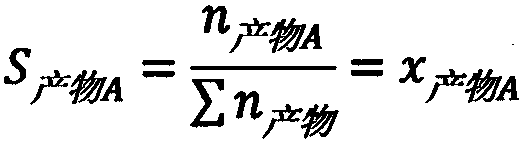
- the gas phase selectivity of the product is calculated by the following formula:
- the gas phase product A includes: C 3 H 6 , CO x (carbon oxides, ie, carbon monoxide, carbon dioxide), CH 4 , C 2 H 6 , C 2 H 4 .
- the catalyst reactivity of the above examples was the activity at a reaction time of 5 min.
- the histogram is the product conversion rate or selectivity, and the star corresponds to the propylene yield.
- the highest selectivity of propylene under Mo1V6 was 89%; pure vanadium oxide VO x , surface oxygen activity is higher, resulting in complete oxidation of propane or propylene to CO x ; pure molybdenum oxide MoO x , low surface oxidation, resulting in lower propane conversion, complete oxidation of propane or propylene to lower CO x ( VO x , Mo 1 V y , MoO x , using both VO x and MoO x ).
- the molybdenum-vanadium double metal oxide can effectively increase the selectivity of propylene while suppressing the surface oxygen activity. Excessive addition of molybdenum results in a decrease in the conversion of propane and the selectivity of propylene. Therefore, the optimum Mo addition amount of molybdenum vanadium double metal oxide is Mo1V6. (The product represented by the histogram in each figure is identical to Figure 2).
- the airspeed adjustment is achieved by changing the mass of the catalyst while the gas flow rate remains unchanged. As the reaction space velocity decreases, the conversion of propane increases, but the selectivity of propylene decreases, mainly because of the retention. The reduction in time causes the propane or propylene to be completely oxidized by the more active oxide on the surface to form CO x .
- Figure 5 is a graph showing the activity test results at different reaction times when using VO x and Mo1V6 catalysts in the chemical chain dehydrogenation process of propane.
- the histogram corresponds to the propylene yield
- the curve 1-4 corresponds to the curve of the metal V oxide catalyst.
- Curve 1 is propylene selectivity
- curve 2 is propane conversion
- curve 3 is carbon oxide selectivity
- curve 4 is selectivity for methane, ethane and ethylene
- curve 5-8 corresponds to metal molybdenum vanadium bimetallic catalyst.
- the curve, curve 5 is propylene selectivity
- curve 6 is propane conversion
- curve 7 is carbon oxide selectivity
- curve 8 is selectivity for methane, ethane and ethylene.
- the fresh oxygen carrier (catalyst) prepared in the present invention was subjected to H 2 -TPR test, and as shown in Fig. 6, there were mainly two types of oxygen species, OI and OII, in the oxygen carrier, and at a lower temperature.
- the oxygen OI activity of the lower oxygen release is higher, and it is the main oxygen species that completely oxidizes propane or propylene.
- the lattice oxygen OII released at a higher temperature has moderate activity and can selectively dehydrogenate propane to Propylene.
- the increase of Mo content the reduction peak of OI species is gradually weakened, and the reduction peak of OII species gradually increases, which also indicates that the addition of Mo does effectively regulate the activity of lattice oxygen species in the oxygen carrier, and the inhibitory activity. Strong OI species.
- the XRD experiment was carried out on an X-ray diffractometer of model Rigaku C/mx-2500. As shown in Fig. 7, the fresh catalyst just prepared mainly contains V 2 O 5 , and the characteristics of V 2 O 5 with the addition of Mo content. peak offset angularly, illustrating Mo V 2 O 5 into the lattice phase, V 2 O 5 causes the lattice distortion, the lattice constant changes, providing evidence for the formation of molybdenum-vanadium solid solution.
- the left side is the catalyst VO x and the right side is the catalyst Mo1V6.
- the lattice oxygen consumption results and phase changes of the catalysts VO x and Mo1V6 at different reaction times in the chemical chain dehydrogenation process of propane schematic diagram. As the reaction time increases, the lattice oxygen in the oxygen carrier is gradually consumed, and the consumption in the early stage is obvious. The main reason is that the propane and propylene are completely oxidized to CO x , and the lattice oxygen is consumed in a large amount, which urges the lattice oxygen continuously.
- the preparation of the catalyst of the present invention can be achieved by adjusting the preparation parameters according to the present invention to achieve efficient catalysis against propane.
- the present invention has been described in detail above, and it should be understood that any simple modifications, alterations, or other equivalents of those skilled in the art without Scope of protection of the invention
Landscapes
- Chemical & Material Sciences (AREA)
- Organic Chemistry (AREA)
- Chemical Kinetics & Catalysis (AREA)
- Engineering & Computer Science (AREA)
- Materials Engineering (AREA)
- Physics & Mathematics (AREA)
- Thermal Sciences (AREA)
- Organic Low-Molecular-Weight Compounds And Preparation Thereof (AREA)
- Catalysts (AREA)
- Low-Molecular Organic Synthesis Reactions Using Catalysts (AREA)
Abstract
Description


Claims (15)
- 钼钒双金属氧化物催化剂,其特征在于,由金属钼的氧化物和金属钒的氧化物组成的固溶体,金属Mo和金属V的摩尔比为1∶(4~30),金属Mo进入了V 2O 5的体相晶格,造成了V 2O 5晶格畸变,形成钼钒固溶体。
- 根据权利要求1所述的钼钒双金属氧化物催化剂,其特征在于,金属Mo和金属V的摩尔比为1∶(6~18)。
- 根据权利要求1或者2所述的钼钒双金属氧化物催化剂,其特征在于,催化剂为负载型催化剂,载体为Al 2O 3、TiO 2、SiO 2或者分子筛,钼的氧化物质量百分比为1~30%,钒的氧化物质量百分比为4~60%。
- 根据权利要求3所述的钼钒双金属氧化物催化剂,其特征在于,钼的氧化物质量百分比为10~20%,钒的氧化物质量百分比为40~60%。
- 钼钒双金属氧化物催化剂的制备方法,其特征在于,按照下述步骤进行:步骤1,将偏钒酸铵和草酸均匀分散在去离子水中,按照钼钒原子比再加入钼酸铵混合均匀,形成浸渍液;步骤2,将载体浸渍于步骤1制备的浸渍液中进行等体积浸渍;步骤3,经过步骤2浸渍的载体在室温20~25摄氏度下干燥8~12h,再在70~90℃下干燥8~12h,最后在500~600℃下空气气氛下焙烧2~4h,即可得到钼钒双金属氧化物催化剂,其分子式为Mo 1V y,其中,y表示V相对于1molMo的物质的量,即金属V和金属Mo的摩尔比。
- 根据权利要求5所述的钼钒双金属氧化物催化剂的制备方法,其特征在于,在步骤1中,草酸和偏钒酸铵的质量比为(2.8~3)∶(1.5~2)。
- 根据权利要求5所述的钼钒双金属氧化物催化剂的制备方法,其特征在于,在步骤2中,载体为Al 2O 3、TiO 2、SiO 2或者分子筛。
- 根据权利要求5所述的钼钒双金属氧化物催化剂的制备方法,其特征在于,在步骤3中,在室温20~25摄氏度下干燥10~12h,再在80~90℃下干燥10~12h,最后在550~600℃下空气气氛下焙烧2~4h。
- 如权利要求1~4之一所述的钼钒双金属氧化物催化剂在低碳烷烃化学链脱氢中的应用。
- 根据权利要求9所述的钼钒双金属氧化物催化剂在低碳烷烃化学链脱氢中的应用,其特征在于,反应在无氧条件下进行以催化剂为载氧体,与低碳烷烃发生氧化脱氢反应,载氧体中的晶格氧与低碳烷烃中的氢原子结合生成水,载氧体被还原为低价态,低碳烷烃被氧化为对应的烯烃。
- 根据权利要求9或者10所述的钼钒双金属氧化物催化剂在低碳烷烃化学链脱氢中的应用,其特征在于,低碳烷烃为乙烷、丙烷、正丁烷或异丁烷
- 根据权利要求9或者10所述的钼钒双金属氧化物催化剂在低碳烷烃化学链脱氢中的应用,其特征在于,在氧化脱氢反应中,气固两相接触方式有气固逆流接触和气固并流接触两种操作方式,具体选择固定床反应器、移动床反应器或者循环流化床。
- 根据权利要求10所述的钼钒双金属氧化物催化剂在低碳烷烃化学链脱氢中的应用,其特征在于,催化剂的晶格氧参与反应,随着反应的进行,晶格氧会逐渐消耗,造成催化剂活性降低,进行催化剂的循环再生,低价态载氧体与空气或者氧气反应被氧化为高价态,重新获得晶格氧并再次循环返回反应器进行反应。
- 根据权利要求9或者10所述的钼钒双金属氧化物催化剂在低碳烷烃化学链脱氢中的应用,其特征在于,在进行使用时,将催化剂和石英砂混合均匀进行使用,在常压下进行反应,反应温度为450~500℃,通入氮气以排除氧气和空气,之后通入丙烷,丙烷和氮气总流量为20~50ml/min,丙烷体积百分数为10~30%,催化剂和石英砂的质量比为(0.2~1)∶1。
- 根据权利要求14所述的钼钒双金属氧化物催化剂在低碳烷烃化学链脱氢中的应用,其特征在于,在进行使用时,催化剂和石英砂的质量比为(0.5~0.8)∶1。
Priority Applications (1)
| Application Number | Priority Date | Filing Date | Title |
|---|---|---|---|
| US16/605,504 US10987655B2 (en) | 2017-08-08 | 2018-07-25 | Molybdenum-vanadium bimetallic oxide catalyst and its application in chemical looping oxidative dehydrogenation of alkane |
Applications Claiming Priority (2)
| Application Number | Priority Date | Filing Date | Title |
|---|---|---|---|
| CN201710672211.3 | 2017-08-08 | ||
| CN201710672211.3A CN109382090B (zh) | 2017-08-08 | 2017-08-08 | 钼钒双金属氧化物催化剂及其在低碳烷烃化学链脱氢中的应用 |
Publications (1)
| Publication Number | Publication Date |
|---|---|
| WO2019029358A1 true WO2019029358A1 (zh) | 2019-02-14 |
Family
ID=65270897
Family Applications (1)
| Application Number | Title | Priority Date | Filing Date |
|---|---|---|---|
| PCT/CN2018/096942 Ceased WO2019029358A1 (zh) | 2017-08-08 | 2018-07-25 | 钼钒双金属氧化物催化剂及其在低碳烷烃化学链脱氢中的应用 |
Country Status (3)
| Country | Link |
|---|---|
| US (1) | US10987655B2 (zh) |
| CN (1) | CN109382090B (zh) |
| WO (1) | WO2019029358A1 (zh) |
Cited By (1)
| Publication number | Priority date | Publication date | Assignee | Title |
|---|---|---|---|---|
| US20240278219A1 (en) * | 2019-09-04 | 2024-08-22 | Nova Chemicals (International) S.A. | Molybdenum-vanadium-iron- and/or molybdenum-vanadium-aluminium-based oxidative dehydrogenation catalyst materials |
Families Citing this family (6)
| Publication number | Priority date | Publication date | Assignee | Title |
|---|---|---|---|---|
| CN111874912A (zh) * | 2020-07-06 | 2020-11-03 | 安徽凤砂矿业集团有限公司 | 一种石英砂及其提纯方法 |
| CN114349591B (zh) * | 2020-10-12 | 2024-09-20 | 中石化南京化工研究院有限公司 | 一种二氧化碳氧化乙烷制乙烯高效催化剂 |
| CN115608405B (zh) * | 2021-07-16 | 2024-02-20 | 中国石油化工股份有限公司 | 毫米级球形复合载体和脱氢催化剂及其制备方法以及应用 |
| CN115999564B (zh) * | 2022-06-30 | 2024-10-18 | 湘潭大学 | 一种催化生物油脂加氢脱氧制备碳氢燃料的Ni-Mo/SiO2催化剂 |
| CN119075973A (zh) * | 2024-09-14 | 2024-12-06 | 浙江工业大学 | 双金属氧化物催化剂、制备方法及应用 |
| CN120155245B (zh) * | 2025-02-21 | 2025-12-05 | 浙江工业大学 | 抗积碳有机改性负载钼钒氧化物的蒙脱石催化剂及其制备方法和应用 |
Family Cites Families (9)
| Publication number | Priority date | Publication date | Assignee | Title |
|---|---|---|---|---|
| JP2682628B2 (ja) * | 1987-12-28 | 1997-11-26 | バブコツク日立株式会社 | 窒素酸化物除去方法および除去用触媒 |
| US6521808B1 (en) * | 2000-02-17 | 2003-02-18 | The Ohio State University | Preparation and use of a catalyst for the oxidative dehydrogenation of lower alkanes |
| US7145051B2 (en) * | 2002-03-22 | 2006-12-05 | Exxonmobil Chemical Patents Inc. | Combined oxydehydrogenation and cracking catalyst for production of olefins |
| US8202482B2 (en) * | 2006-07-26 | 2012-06-19 | Babcock-Hitachi Kabushiki Kaisha | Apparatus for removing of trace of toxic substance from exhaust gas and method of operating the same |
| US7824574B2 (en) * | 2006-09-21 | 2010-11-02 | Eltron Research & Development | Cyclic catalytic upgrading of chemical species using metal oxide materials |
| CN104230624B (zh) * | 2013-06-17 | 2017-05-17 | 中国石油化工股份有限公司 | 用于低碳烷烃脱氢制烯烃的钒基催化剂、制备方法及其工艺方法 |
| CN106582614B (zh) * | 2015-10-16 | 2019-04-12 | 中国石油化工股份有限公司 | 用于异丁烷脱氢的催化剂 |
| US10358398B2 (en) * | 2016-05-17 | 2019-07-23 | Iowa State University Research Foundation, Inc. | Dehydrogenation of propane using a metal-containing catalyst on a support |
| US9878305B2 (en) * | 2016-06-14 | 2018-01-30 | King Fahd University Of Petroleum And Minerals | Fluidizable vanadium catalyst for oxidative dehydrogenation of alkanes to olefins in a gas phase oxygen free environment |
-
2017
- 2017-08-08 CN CN201710672211.3A patent/CN109382090B/zh active Active
-
2018
- 2018-07-25 WO PCT/CN2018/096942 patent/WO2019029358A1/zh not_active Ceased
- 2018-07-25 US US16/605,504 patent/US10987655B2/en active Active
Non-Patent Citations (3)
| Title |
|---|
| MIGUEL A. BAN~ARES ET AL.: "Structure - activity relationships in alumina-supported Structure - activity relationships in alumina-supported oxidative de hydrogenation", CATALYSIS TODAY, vol. 96, no. 4, 24 August 2004 (2004-08-24), pages 251 - 257, XP004578291, ISSN: 0920-5861, DOI: 10.1016/j.cattod.2004.06.152 * |
| VIVIANA MURGIA ET AL.: "Influence of concentration and order of aggregation of the active phases in V - Mo - 0 catalysts in the oxidative dehydrogenation of propane", CATALYSIS TODAY, vol. 133-135, 5 March 2008 (2008-03-05), pages 87 - 91, XP022573964, ISSN: 0920-5861, DOI: 10.1016/j.cattod.2007.12.038 * |
| YU XIAOCHUAN: "Study on the active sites of Supported Vanadium-Based Catalysts in Oxidative Dehydrogenation of Propane", CHINA MASTER'S THESES FULL-TEXT DATABASE, 31 October 2009 (2009-10-31) * |
Cited By (1)
| Publication number | Priority date | Publication date | Assignee | Title |
|---|---|---|---|---|
| US20240278219A1 (en) * | 2019-09-04 | 2024-08-22 | Nova Chemicals (International) S.A. | Molybdenum-vanadium-iron- and/or molybdenum-vanadium-aluminium-based oxidative dehydrogenation catalyst materials |
Also Published As
| Publication number | Publication date |
|---|---|
| US20200122121A1 (en) | 2020-04-23 |
| CN109382090B (zh) | 2021-08-17 |
| US10987655B2 (en) | 2021-04-27 |
| CN109382090A (zh) | 2019-02-26 |
Similar Documents
| Publication | Publication Date | Title |
|---|---|---|
| WO2019029358A1 (zh) | 钼钒双金属氧化物催化剂及其在低碳烷烃化学链脱氢中的应用 | |
| CN111215045B (zh) | 一种铈基双金属氧化物催化剂及其制备方法和在低碳烷烃脱氢中的应用 | |
| CN102745648A (zh) | 一种甲烷二氧化碳重整生产合成气的催化剂的制备方法 | |
| WO2017173791A1 (zh) | 一种用于合成气直接制备烯烃的碳化钴基催化剂及其制备方法和应用 | |
| CN110227539A (zh) | 一种合成气直接转化制低碳烯烃的双功能催化剂、制备方法及应用 | |
| CN112791721B (zh) | 负载型催化剂前体、负载型催化剂及制备方法和活化方法 | |
| CN113058634B (zh) | 一种Fe改性-Silicalite-1负载GaN催化剂及其催化应用 | |
| CN102159312B (zh) | 氧化还原能高的烷基芳族化合物的脱氢催化剂及其制造方法以及利用该催化剂的脱氢方法 | |
| CN115703073B (zh) | 一种金属氧化物@分子筛核壳型氧载体在低碳烷烃化学链脱氢耦合氢气选择性氧化过程中的应用 | |
| JP5747326B2 (ja) | プロピレンの製造方法 | |
| CN105622386A (zh) | 一种环己酮合成己二酸的绿色工艺 | |
| JP2020522380A (ja) | 安定性、転換率、及び選択度が向上したオレフィン製造用触媒及びその製造方法 | |
| CN114618476B (zh) | 一种单原子铂基催化剂及其制备方法和应用 | |
| CN112808295B (zh) | 一种单位点Co(Ⅱ)催化剂的制备方法及其应用 | |
| CN110871075A (zh) | 负载铁钴钾的二氧化锆催化剂、制备方法及其应用 | |
| KR102628005B1 (ko) | 알칸족 가스로부터 올레핀 제조용 탈수소촉매 및 그 제조방법 | |
| CN116099543B (zh) | 钒铁基双金属氧化物催化剂及其制备方法和应用 | |
| CN115957738B (zh) | 一种丙烷脱氢制丙烯催化剂的制备方法及应用 | |
| CN102249890A (zh) | 一种以甘油为原料制备丙烯酸的方法 | |
| CN111530498A (zh) | 一种用于己二酸装置中多种污染物协同净化的催化剂、制备及应用 | |
| CN109772422A (zh) | 一种异质结催化剂的制备方法及催化剂 | |
| CN111054410A (zh) | 液相脱氢催化剂、制备及用途 | |
| CN116510739A (zh) | 镍钼合金复合材料及其制备方法和应用、二氧化碳氧化低碳烷烃脱氢制低碳烯烃的方法 | |
| CN101182275A (zh) | 负载纳米金催化醇氧化反应制备醛酮的方法 | |
| KR20210114227A (ko) | 알칸족 가스로부터 올레핀 제조용 탈수소촉매 및 그 제조방법 |
Legal Events
| Date | Code | Title | Description |
|---|---|---|---|
| 121 | Ep: the epo has been informed by wipo that ep was designated in this application |
Ref document number: 18845181 Country of ref document: EP Kind code of ref document: A1 |
|
| NENP | Non-entry into the national phase |
Ref country code: DE |
|
| 122 | Ep: pct application non-entry in european phase |
Ref document number: 18845181 Country of ref document: EP Kind code of ref document: A1 |
|
| 32PN | Ep: public notification in the ep bulletin as address of the adressee cannot be established |
Free format text: NOTING OF LOSS OF RIGHTS PURSUANT TO RULE 112(1) EPC (EPO FORM 1205A DATED 04/09/2020) |
|
| 122 | Ep: pct application non-entry in european phase |
Ref document number: 18845181 Country of ref document: EP Kind code of ref document: A1 |