WO2018199154A1 - 繊維強化樹脂成形材料及びその製造方法、並びに繊維強化樹脂成形品 - Google Patents
繊維強化樹脂成形材料及びその製造方法、並びに繊維強化樹脂成形品 Download PDFInfo
- Publication number
- WO2018199154A1 WO2018199154A1 PCT/JP2018/016779 JP2018016779W WO2018199154A1 WO 2018199154 A1 WO2018199154 A1 WO 2018199154A1 JP 2018016779 W JP2018016779 W JP 2018016779W WO 2018199154 A1 WO2018199154 A1 WO 2018199154A1
- Authority
- WO
- WIPO (PCT)
- Prior art keywords
- fiber
- reinforced resin
- molding material
- resin molding
- less
- Prior art date
- Legal status (The legal status is an assumption and is not a legal conclusion. Google has not performed a legal analysis and makes no representation as to the accuracy of the status listed.)
- Ceased
Links
Images
Classifications
-
- B—PERFORMING OPERATIONS; TRANSPORTING
- B29—WORKING OF PLASTICS; WORKING OF SUBSTANCES IN A PLASTIC STATE IN GENERAL
- B29C—SHAPING OR JOINING OF PLASTICS; SHAPING OF MATERIAL IN A PLASTIC STATE, NOT OTHERWISE PROVIDED FOR; AFTER-TREATMENT OF THE SHAPED PRODUCTS, e.g. REPAIRING
- B29C70/00—Shaping composites, i.e. plastics material comprising reinforcements, fillers or preformed parts, e.g. inserts
- B29C70/04—Shaping composites, i.e. plastics material comprising reinforcements, fillers or preformed parts, e.g. inserts comprising reinforcements only, e.g. self-reinforcing plastics
- B29C70/06—Fibrous reinforcements only
- B29C70/10—Fibrous reinforcements only characterised by the structure of fibrous reinforcements, e.g. hollow fibres
- B29C70/16—Fibrous reinforcements only characterised by the structure of fibrous reinforcements, e.g. hollow fibres using fibres of substantial or continuous length
- B29C70/20—Fibrous reinforcements only characterised by the structure of fibrous reinforcements, e.g. hollow fibres using fibres of substantial or continuous length oriented in a single direction, e.g. roofing or other parallel fibres
-
- B—PERFORMING OPERATIONS; TRANSPORTING
- B29—WORKING OF PLASTICS; WORKING OF SUBSTANCES IN A PLASTIC STATE IN GENERAL
- B29B—PREPARATION OR PRETREATMENT OF THE MATERIAL TO BE SHAPED; MAKING GRANULES OR PREFORMS; RECOVERY OF PLASTICS OR OTHER CONSTITUENTS OF WASTE MATERIAL CONTAINING PLASTICS
- B29B15/00—Pretreatment of the material to be shaped, not covered by groups B29B7/00 - B29B13/00
- B29B15/08—Pretreatment of the material to be shaped, not covered by groups B29B7/00 - B29B13/00 of reinforcements or fillers
- B29B15/10—Coating or impregnating independently of the moulding or shaping step
- B29B15/12—Coating or impregnating independently of the moulding or shaping step of reinforcements of indefinite length
- B29B15/122—Coating or impregnating independently of the moulding or shaping step of reinforcements of indefinite length with a matrix in liquid form, e.g. as melt, solution or latex
-
- B—PERFORMING OPERATIONS; TRANSPORTING
- B29—WORKING OF PLASTICS; WORKING OF SUBSTANCES IN A PLASTIC STATE IN GENERAL
- B29C—SHAPING OR JOINING OF PLASTICS; SHAPING OF MATERIAL IN A PLASTIC STATE, NOT OTHERWISE PROVIDED FOR; AFTER-TREATMENT OF THE SHAPED PRODUCTS, e.g. REPAIRING
- B29C70/00—Shaping composites, i.e. plastics material comprising reinforcements, fillers or preformed parts, e.g. inserts
- B29C70/04—Shaping composites, i.e. plastics material comprising reinforcements, fillers or preformed parts, e.g. inserts comprising reinforcements only, e.g. self-reinforcing plastics
- B29C70/06—Fibrous reinforcements only
-
- B—PERFORMING OPERATIONS; TRANSPORTING
- B29—WORKING OF PLASTICS; WORKING OF SUBSTANCES IN A PLASTIC STATE IN GENERAL
- B29C—SHAPING OR JOINING OF PLASTICS; SHAPING OF MATERIAL IN A PLASTIC STATE, NOT OTHERWISE PROVIDED FOR; AFTER-TREATMENT OF THE SHAPED PRODUCTS, e.g. REPAIRING
- B29C70/00—Shaping composites, i.e. plastics material comprising reinforcements, fillers or preformed parts, e.g. inserts
- B29C70/04—Shaping composites, i.e. plastics material comprising reinforcements, fillers or preformed parts, e.g. inserts comprising reinforcements only, e.g. self-reinforcing plastics
- B29C70/06—Fibrous reinforcements only
- B29C70/10—Fibrous reinforcements only characterised by the structure of fibrous reinforcements, e.g. hollow fibres
- B29C70/16—Fibrous reinforcements only characterised by the structure of fibrous reinforcements, e.g. hollow fibres using fibres of substantial or continuous length
- B29C70/22—Fibrous reinforcements only characterised by the structure of fibrous reinforcements, e.g. hollow fibres using fibres of substantial or continuous length oriented in at least two directions forming a two-dimensional [2D] structure
-
- B—PERFORMING OPERATIONS; TRANSPORTING
- B29—WORKING OF PLASTICS; WORKING OF SUBSTANCES IN A PLASTIC STATE IN GENERAL
- B29K—INDEXING SCHEME ASSOCIATED WITH SUBCLASSES B29B, B29C OR B29D, RELATING TO MOULDING MATERIALS OR TO MATERIALS FOR MOULDS, REINFORCEMENTS, FILLERS OR PREFORMED PARTS, e.g. INSERTS
- B29K2031/00—Use of polyvinylesters or derivatives thereof as moulding material
-
- B—PERFORMING OPERATIONS; TRANSPORTING
- B29—WORKING OF PLASTICS; WORKING OF SUBSTANCES IN A PLASTIC STATE IN GENERAL
- B29K—INDEXING SCHEME ASSOCIATED WITH SUBCLASSES B29B, B29C OR B29D, RELATING TO MOULDING MATERIALS OR TO MATERIALS FOR MOULDS, REINFORCEMENTS, FILLERS OR PREFORMED PARTS, e.g. INSERTS
- B29K2307/00—Use of elements other than metals as reinforcement
- B29K2307/04—Carbon
Definitions
- the present invention relates to a fiber reinforced resin molding material, a method for producing the same, and a fiber reinforced resin molded product.
- fiber reinforced resin molded products are widely used because they are lightweight and have high strength.
- a fiber reinforced resin molding material used for manufacturing a fiber reinforced resin molded product a prepreg in which a resin composition is impregnated with a reinforcing fiber sheet formed of continuous fibers (long fibers) made of reinforcing fibers is widely used.
- a fiber reinforced resin molded product can be obtained by laminating a plurality of prepregs in a mold and then heating and pressing with the mold.
- a thermosetting resin composition is often used, and an epoxy resin composition is often used from the viewpoint of good mechanical properties (Patent Documents 1 and 2).
- the present invention provides a fiber-reinforced resin molding material that can easily obtain a lightweight and high-strength fiber-reinforced resin molded product, a method for producing the fiber-reinforced resin molding material, and fiber reinforcement using the fiber-reinforced resin molding material. It aims at providing a resin molded product.
- the present invention has the following configuration.
- a fiber-reinforced resin molding material in which a resin composition is impregnated in a reinforcing fiber sheet having a basis weight of 200 g / m 2 or more and 3,000 g / m 2 or less, When the total amount of the resin composition contained in the fiber reinforced resin molding material is 100% by mass, The thickness from the first surface in the thickness direction of the fiber reinforced resin molding material to the position occupied by 10% by mass of the resin composition is defined as d1 ( ⁇ m), When the thickness from the second surface opposite to the first surface to the position occupied by 10% by mass of the resin composition is d2 ( ⁇ m), A fiber-reinforced resin molding material having an absolute value (
- the reinforcing fiber sheet is at least one selected from the group consisting of a unidirectional sheet in which a plurality of continuous fibers are aligned in one direction, a woven fabric in which continuous fibers are woven, and a non-crimp fabric including continuous fibers.
- R which is a ratio of the sum of d1 and d2 to the basis weight of the reinforcing fiber sheet, is 0.2 or more and 0.5 or less.
- a reinforced fiber sheet comprising at least one selected from the group consisting of a unidirectional sheet in which a plurality of continuous fibers are aligned in one direction, a woven fabric in which continuous fibers are woven, and a non-crimp fabric including continuous fibers.
- the fiber-reinforced resin molding material of the present invention is used, a lightweight and high-strength fiber-reinforced resin molded product can be easily obtained.
- a fiber-reinforced resin molding material capable of easily obtaining a lightweight and high-strength fiber-reinforced resin molded product can be produced.
- the fiber-reinforced resin molded article of the present invention can be easily manufactured, and is lightweight and has high strength.
- the fiber-reinforced resin molding material of the present invention is a fiber-reinforced resin molding material in which a reinforcing fiber sheet is impregnated with a resin composition.
- the reinforcing fiber sheet is composed of a unidirectional sheet (UD sheet) in which a plurality of continuous fibers are aligned in one direction, a woven fabric (cross material) in which continuous fibers are woven, and a non-crimp fabric (NCF) including continuous fibers.
- the continuous fiber means a reinforcing fiber continuous in a length of 75 mm or more in at least one direction, preferably 500,000 mm or less, more preferably 100 mm or more and 10,000 mm or less.
- the upper limit of the length range may be the amount of winding per bobbin of carbon fiber that is a raw material of the reinforcing fiber sheet.
- any one of a unidirectional sheet, a woven fabric, and a non-crimp fabric may be used alone, or two or more of the unidirectional sheet, the woven fabric, and the non-crimp fabric are used in combination. Also good.
- a woven fabric and a non-crimp fabric are preferable from the viewpoint of strength, and a non-crimp fabric is more preferable because a reinforced fiber composite molded product having a small continuous fiber crimp and excellent mechanical properties can be obtained.
- the way of weaving the woven fabric is not particularly limited, and examples thereof include plain weave, twill weave, satin weave, birch weave, and triaxial weave.
- the non-crimp fabric is a sheet-like base material integrated with auxiliary fiber yarns that form a warp knitted structure in a state where a plurality of continuous fibers do not cross each other.
- a non-crimp fabric a publicly known aspect can be adopted, for example, a form in which a plurality of continuous fibers are arranged in a layer in one direction and has one layer or two or more layers.
- the fiber axis directions of the continuous fibers in each layer may be parallel or cross each other.
- the auxiliary fiber yarn is not particularly limited, and examples thereof include monofilament yarn or multifilament yarn made of polyester, polyamide, polyethylene, polylactic acid, aramid fiber, cotton yarn, silk yarn, and the like.
- the continuous fiber is not particularly limited, and examples thereof include inorganic fibers, organic fibers, metal fibers, or reinforced fibers having a hybrid configuration in which these are combined.
- examples of the inorganic fiber include carbon fiber, graphite fiber, silicon carbide fiber, alumina fiber, tungsten carbide fiber, boron fiber, and glass fiber.
- examples of the organic fibers include aramid fibers, high density polyethylene fibers, other general nylon fibers, and polyester fibers.
- Examples of metal fibers include fibers such as stainless steel and iron, and carbon fibers coated with metal may be used.
- 1 type may be used independently and 2 or more types may be used together.
- the average fiber diameter of the continuous fibers is preferably 1 ⁇ m or more and 50 ⁇ m or less, and more preferably 5 ⁇ m or more and 20 ⁇ m or less.
- the continuous fiber is preferably carbon fiber from the viewpoint of mechanical properties such as strength of the fiber-reinforced resin molded product.
- the carbon fiber preferably has a strand tensile strength of 1.0 GPa or more and 9.0 GPa or less, more preferably 1.5 GPa or more and 9.0 GPa or less, as measured in accordance with JIS R 7601: 1986.
- the carbon fiber preferably has a strand tensile modulus measured according to JIS R 7601: 1986 of 150 GPa or more and 1000 GPa or less, and more preferably 200 GPa or more and 1000 GPa or less.
- Basis weight of the reinforcing fiber sheet 200 g / m 2 or more 3,000 g / m 2 or less, preferably 300 g / m 2 or more 2,500 g / m 2 or less, 400 g / m 2 or more 2,000 g / m 2 or less More preferred. If the basis weight of the reinforcing fiber sheet is 200 g / m 2 or more, preferably 300 g / m 2 or more, more preferably 400 g / m 2 or more, the lamination of the reinforcing fiber sheets is possible even when producing a thick fiber-reinforced resin molded product.
- Basis weight of the reinforcing fiber sheet is 3,000 g / m 2 or less, preferably 2,500 g / m 2 or less, if more preferably 2,000 g / m 2 or less, impregnation of the resin composition into the reinforcing fiber sheet Excellent.
- the content of the resin composition in the fiber reinforced resin molding material of the present invention is 25% to 55% by volume, preferably 30% to 50% by volume, based on the total volume of the fiber reinforced resin molding material. 35 volume% or more and 45 volume% or less is more preferable. If the content of the resin composition is 55% by volume or less, preferably 50% by volume or less, more preferably 45% by volume or less, a lightweight fiber-reinforced resin molded product can be obtained, and the ratio of continuous fibers is relative. The fiber reinforced resin molded article becomes high strength by becoming higher. Moreover, it can suppress that the tackiness of the surface of a fiber reinforced resin molding material becomes high too much.
- the content of the resin composition is 25% by volume or more, preferably 30% by volume or more, and more preferably 35% by volume or more, it is possible to suppress the resin withering and the appearance of the fiber-reinforced resin molded product from being deteriorated.
- the thickness from the first surface in the thickness direction of the fiber reinforced resin molding material to the position occupied by 10% by mass of the resin composition is defined as d2 ( ⁇ m).
- ) of the difference between d1 and d2 is 50 ⁇ m or less, preferably 20 ⁇ m or less, and more preferably 15 ⁇ m or less.
- the absolute value of the difference between d1 and d2 is less than or equal to the upper limit of the above range, it is easy to suppress the tackiness of the surface of the fiber-reinforced resin molding material from becoming excessively high. Therefore, for example, when laminating a plurality of fiber reinforced resin molding materials, the positions are shifted, and even when the fiber reinforced resin molding materials once laminated are re-laminated, the fiber reinforced resin molding materials are less likely to adhere to each other and work is facilitated.
- the sum of d1 and d2 is preferably 10 ⁇ m or more and 1500 ⁇ m or less.
- d1 and d2 are 10 ⁇ m or more, more preferably 15 ⁇ m or more, further preferably 20 ⁇ m or more, and particularly preferably 30 ⁇ m or more, it is easy to suppress the tackiness of the fiber-reinforced resin molding material from becoming excessively high.
- the positions are shifted, and even when the fiber reinforced resin molding materials once laminated are re-laminated, the fiber reinforced resin molding materials are less likely to adhere to each other and work is facilitated.
- the sum of d1 and d2 is 1500 ⁇ m or less, more preferably 1200 ⁇ m or less, further preferably 1000 ⁇ m or less, and particularly preferably 800 ⁇ m or less, the tackiness of the fiber-reinforced resin molding material becomes sufficient, and thus laminated fibers The reinforced resin molding material is less likely to slip.
- the 1st surface of the thickness direction in this invention is a lower surface (direction of gravity) at the time of manufacture of a fiber reinforced resin molding material
- the fiber reinforced resin molding material is a manufacturing apparatus illustrated in FIG.
- the surface is in contact with the carrier film transport unit 14, and the second surface on the opposite side is the surface located on the opposite side of the first surface.
- the ratio R ((d1 + d2) / (weight)) of the sum ( ⁇ m) of d1 and d2 to the weight (g / m 2 ) of the reinforcing fiber sheet is: A range of 0.2 or more and 0.5 or less is preferable.
- the thickness d1 is preferably 5 ⁇ m or more and 750 ⁇ m or less, preferably 7 ⁇ m or more and 600 ⁇ m or less, more preferably 10 ⁇ m or more and 500 ⁇ m or less, and particularly preferably 15 ⁇ m or more and 400 ⁇ m or less. If the thickness d1 is 5 ⁇ m or more, more preferably 7 ⁇ m or more, more preferably 10 ⁇ m or more, and particularly preferably 15 ⁇ m or more, it is easy to suppress the tackiness of the first surface of the fiber-reinforced resin molding material from becoming excessively high. .
- the positions are shifted, and even when the fiber reinforced resin molding materials once laminated are re-laminated, the fiber reinforced resin molding materials are less likely to adhere to each other and work is facilitated.
- the thickness d1 is 750 ⁇ m or less, more preferably 600 ⁇ m or less, more preferably 500 ⁇ m or less, and particularly preferably 400 ⁇ m or less, the tackiness of the first surface of the fiber-reinforced resin molding material is sufficient, and thus laminated fiber reinforced The resin molding material is less likely to slip.
- the preferable range of the thickness d2 is preferably 5 ⁇ m or more and 750 ⁇ m or less, more preferably 7 ⁇ m or more and 600 ⁇ m or less, and preferably 10 ⁇ m or more and 500 ⁇ m or less, and 15 ⁇ m or more and 400 ⁇ m or less because of the tackiness on the second surface similar to the thickness d1. Is particularly preferred.
- the fiber volume content (Vf) of the fiber reinforced resin molding material of the present invention is preferably 45% to 75% by volume, more preferably 50% to 70% by volume, and 55% to 65% by volume. Further preferred. When the fiber volume content (Vf) is 45% by volume or more, more preferably 50% by volume or more, and still more preferably 55% by volume or more, a high-strength fiber-reinforced resin molded product is easily obtained. If the fiber volume content (Vf) is 75% by volume or less, more preferably 70% by volume or less, and even more preferably 65% by volume or less, the fiber reinforcement is excellent in impregnation property, easy to control resin withering, and excellent in appearance. Resin molded products are easily obtained. In addition, fiber volume content (Vf) is a value obtained by the measuring method based on JISK7075.
- the resin composition preferably contains a thermosetting resin.
- the thermosetting resin include an epoxy resin, a vinyl ester resin, an unsaturated polyester resin, a polyimide resin, a maleimide resin, and a phenol resin.
- 1 type may be used independently and 2 or more types may be used together.
- thermosetting resin an epoxy resin and a vinyl ester resin are preferable from the viewpoint of adhesion to carbon fibers, and a fiber-reinforced resin molding material capable of producing a lightweight and high-strength fiber-reinforced resin molded product is easily obtained.
- a vinyl ester resin is more preferable.
- the vinyl ester resin is preferably a resin obtained by addition reaction of an epoxy compound having two or more epoxy groups in the molecule, (meth) acrylic acid, and, if necessary, a polybasic acid or its anhydride.
- the epoxy compound examples include epoxy resins such as bisphenol A type epoxy resin, bisphenol F type epoxy resin, hydrogenated bisphenol type epoxy resin, phenol novolac type epoxy resin, cresol novolac type epoxy resin; neopentyl glycol diglycidyl ether, polypropylene
- examples thereof include glycidyl ethers of polyhydric alcohols such as glycol diglycidyl ether and trimethylolpropane triglycidyl ether; glycidyl esters of polybasic acids such as phthalic acid diglycidyl ether and dimer acid diglycidyl ether.
- 1 type may be used independently and 2 or more types may be used together.
- polybasic acid or anhydride thereof examples include ⁇ , ⁇ -unsaturated dibasic acids such as maleic acid, maleic anhydride, fumaric acid and itaconic acid; saturated dibasic acids such as oxalic acid, malonic acid and succinic acid; Pyromellitic acid; trimellitic acid; trimer acid; polybutadiene having carboxyl group; butadiene-acrylonitrile copolymer having carboxyl group; ⁇ , ⁇ -unsaturated dibasic acid and / or saturated dibasic acid and polyhydric alcohol
- 1 type may be used independently and 2 or more types may be used together.
- the content of the thermosetting resin in the resin composition is preferably 30% by volume to 50% by volume and more preferably 35% by volume to 45% by volume with respect to the total volume of the resin composition. If content of a thermosetting resin is more than the lower limit of the said range, a high strength fiber reinforced resin molded product will be easy to be obtained. If the content of the thermosetting resin is not more than the upper limit of the above range, it is easy to obtain a fiber-reinforced resin molded article having excellent impregnation properties, easily suppressing resin withering, and excellent appearance.
- the resin composition may include a thermoplastic resin such as a polyamide resin or a polyolefin resin.
- Resin compositions are hardeners, flame retardants, weather resistance improvers, antioxidants, heat stabilizers, UV absorbers, plasticizers, lubricants, colorants, phases, depending on the required physical properties of the fiber reinforced resin material molded product.
- Additives such as a solubilizing agent and a conductive filler may be included. As these additives, 1 type may be used independently and 2 or more types may be used together.
- the curing agent known materials suitable for the resin composition to be used can be used.
- a vinyl ester resin or an unsaturated polyester resin is used, a general organic peroxide is preferable.
- an epoxy resin an amine-based or acid anhydride-based curing agent is preferable.
- the fiber-reinforced resin molding material of the present invention comprises at least one selected from the above-described unidirectional sheet, woven fabric, and non-crimp fabric, and has a basis weight of 200 g / m 2 or more and 3,000 g / m.
- the resin composition is impregnated so that the content is 2 volume% or more and 55 volume% or less in 2 or less reinforcing fiber sheets. Since the reinforcing fiber sheet has a high basis weight that satisfies the above range, even when a thick fiber reinforced resin molded product is manufactured, the number of laminated fiber reinforced resin molding materials can be reduced.
- the content of the resin composition is a small amount that satisfies the above range, the surface tackiness of the fiber-reinforced resin molding material can be prevented from becoming excessively high. Therefore, for example, when laminating a plurality of fiber reinforced resin molding materials, the positions are shifted, and even when the fiber reinforced resin molding materials once laminated are re-laminated, the fiber reinforced resin molding materials are less likely to adhere to each other and work is facilitated. . From these things, a fiber reinforced resin molded product can be easily manufactured by using the fiber reinforced resin molding material of the present invention. Moreover, since the fiber-reinforced resin molded product can be reduced in weight because the content of the resin composition is small, a high-strength fiber-reinforced resin molded product can be obtained because the content of continuous fibers is relatively high.
- the manufacturing method of the fiber reinforced resin molding material of this invention is a method of manufacturing the above-mentioned fiber reinforced resin molding material of this invention.
- the method for producing a fiber reinforced resin molding material at least selected from the group consisting of a unidirectional sheet in which a plurality of continuous fibers are aligned in one direction, a woven fabric in which continuous fibers are woven, and a non-crimp fabric including continuous fibers.
- the basis weight was the impregnated with 200 g / m 2 or more 3,000 g / m 2 or less of the reinforcing fiber sheet to the resin composition, fiber-reinforced content of the resin composition is 55 vol% or less than 25 vol% A resin molding material is obtained.
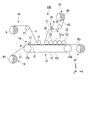
- the fiber reinforced resin molding material manufacturing apparatus 100 illustrated in FIG. 1 (hereinafter simply referred to as “manufacturing apparatus 100”) is used.
- manufactured apparatus 100 an XYZ rectangular coordinate system is set, and the positional relationship of each member will be described with reference to the XYZ rectangular coordinate system as necessary.
- the manufacturing apparatus 100 includes a reinforcing fiber sheet supply unit 10, a first unwinding machine 12, a carrier film transport unit 14, a first coating unit 16, a second unwinding machine 18, and a second coating unit 20. And an impregnation unit 22 and a winder 24.
- the first unwinding machine 12 is provided with a first raw roll R1 around which a long first carrier film C1 is wound.
- the first unwinding machine 12 unwinds the long first carrier film C ⁇ b> 1 from the first raw roll R ⁇ b> 1 and supplies it to the carrier film transport unit 14.
- the carrier film transport unit 14 includes a conveyor 15 in which an endless belt 15c is hung between a pair of pulleys 15a and 15b.
- the conveyor 15 rotates the endless belt 15c by rotating the pair of pulleys 15a and 15b in the same direction, and conveys the first carrier film C1 toward the right side in the X-axis direction on the surface of the endless belt 15c.
- the endless belt 15c for example, a mesh belt can be used.
- the first coating unit 16 is located immediately above the pulley 15a side in the carrier film transport unit 14, and includes a doctor blade 17 that coats the resin composition P.
- the resin composition P is applied with a predetermined thickness on the surface of the first carrier film C1 by the doctor blade 17, and the first resin sheet S1 is formed. It is formed.
- the first resin sheet S1 travels along with the conveyance of the first carrier film C1.
- the reinforcing fiber sheet supply unit 10 is a part that supplies a long reinforcing fiber sheet F.
- the raw fabric roll R around which the reinforcing fiber sheet F is wound around the bobbin is held in a rotatable manner by the creel.
- the reinforcing fiber sheet F supplied by the reinforcing fiber sheet supply unit 10 is continuously laminated on the first resin sheet S ⁇ b> 1 that travels along with the conveyance of the first carrier film C ⁇ b> 1 by the guide roll 11. .
- the second unwinding machine 18 is provided with a second raw roll R2 around which a long second carrier film C2 is wound.
- the second unwinding machine 18 unwinds the long second carrier film C2 from the second raw fabric roll R2, and the plurality of guide rolls 19 supply the reinforcing fiber sheet F on the carrier film transport unit 14. It is supplied downstream from the position.
- the second carrier film C2 unwound from the second unwinder 18 is transported in the direction opposite to the transport direction of the first carrier film C1 (left side in the X-axis direction), and then the transport direction is a plurality of guide rolls. 19 is reversed in the same direction as the first carrier film C1.
- the 2nd coating part 20 is located directly on the 2nd carrier film C2 currently conveyed in the direction opposite to the conveyance direction of the 1st carrier film C1, and is provided with the doctor blade 21 which coats the resin composition P. .
- the resin composition P is applied with a predetermined thickness on the surface of the second carrier film C2 by the doctor blade 21, and the second resin sheet S2 is formed. It is formed.
- the second resin sheet S2 travels along with the conveyance of the second carrier film C2.
- the impregnation portion 22 is a portion that is bonded to the reinforcing fiber sheet F with the second resin sheet S2 and pressed to impregnate the reinforcing fiber sheet F with the resin composition P to form a fiber reinforced resin molding material.
- the impregnation part 22 is located downstream from the position where the reinforcing fiber sheet F is supplied on the carrier film transport part 14.
- the impregnation unit 22 includes a plurality of pressure rolls 23. The plurality of pressure rolls 23 are arranged so as to contact the back surface of the second carrier film C2 reversed in the same direction as the first carrier film C1, that is, the surface opposite to the second resin sheet S2.
- the first carrier film C1 and the second carrier film C2 are overlapped with the first resin sheet S1, the reinforcing fiber sheet F, and the second resin sheet S2 sandwiched therebetween, and a plurality of pressure rolls 23 while being pressurized. Thereby, the resin composition P of the first resin sheet S1 and the second resin sheet S2 is impregnated in the reinforcing fiber sheet F, and the raw fabric R3 of the fiber reinforced resin molding material is obtained.
- the original fabric R3 is wound around the winder 24.
- the original fabric R3 can be cut into a predetermined length and used for molding.
- the first carrier film C1 and the second carrier film C2 are peeled from the fiber reinforced resin molding material before molding.
- the first unwinding machine 12 unwinds the long first carrier film C ⁇ b> 1 from the first raw fabric roll R ⁇ b> 1 and supplies it to the carrier film transport unit 14. .
- the resin composition P is apply
- the first resin sheet S1 on the first carrier film C1 is caused to travel.
- the resin composition P a resin composition having an initial viscosity of 1 Pa ⁇ s or less and a viscosity of 5,000 Pa ⁇ s or more and 150,000 Pa ⁇ s or less after standing at 25 ° C. for 7 days is used. It is preferable. By using the resin composition, a fiber reinforced resin molding material having a high basis weight and a low resin content can be easily produced.
- the initial viscosity of the resin composition is a viscosity measured at 25 ° C. using a B-type viscometer according to JIS 8803 immediately after the preparation of the resin composition.
- the initial viscosity of the resin composition is preferably 0.05 Pa ⁇ s to 1 Pa ⁇ s, more preferably 0.075 Pa ⁇ s to 0.75 Pa ⁇ s, and more preferably 0.1 Pa ⁇ s to 0.55 Pa ⁇ s. Further preferred. If the initial viscosity of the resin composition is 1 Pa ⁇ s or less, more preferably 0.75 Pa ⁇ s or less, and even more preferably 0.55 Pa ⁇ s or less, the impregnation property of the resin composition to the reinforcing fiber sheet is more excellent. Thus, the resin composition is sufficiently impregnated into the inside of the reinforcing fiber sheet in the thickness direction.
- the initial viscosity of the resin composition is 0.05 Pa ⁇ s or more, more preferably 0.075 Pa ⁇ s or more, and further preferably 0.1 Pa ⁇ s or more, a high-strength fiber-reinforced resin molded product is easily obtained.
- the viscosity of the resin composition after standing at 25 ° C. for 7 days after preparation is preferably 5,000 Pa ⁇ s to 150,000 Pa ⁇ s, more preferably 7,500 Pa ⁇ s to 150,000 Pa ⁇ s, More preferably, it is 10,000 Pa ⁇ s or more and 150,000 Pa ⁇ s or less. If the viscosity of the resin composition after standing is 5,000 Pa ⁇ s or more, more preferably 7,500 Pa ⁇ s or more, and still more preferably 10,000 Pa ⁇ s or more, a high-strength fiber-reinforced resin molded product is obtained. It is easy to be done.
- the viscosity of the resin composition after standing is 150,000 Pa ⁇ s or less, the impregnation property of the resin composition into the reinforcing fiber sheet becomes more excellent, and the inside of the reinforcing fiber sheet in the thickness direction is sufficient.
- the resin composition is easily impregnated.
- the viscosity of the resin composition after standing was measured at 25 ° C. using a Brookfield digital viscometer HBDV-I + Prime according to JIS 8803 after the prepared resin composition was allowed to stand at 25 ° C. for 7 days. Viscosity measured in
- the reinforcing fiber sheet F is unwound from the raw fabric roll R by the reinforcing fiber sheet supply unit 10, and is continuously supplied and laminated on the first resin sheet S 1 by the guide roll 11.
- the reinforcing fiber sheet F is at least one selected from the group consisting of a unidirectional sheet in which a plurality of continuous fibers are aligned in one direction, a woven fabric in which continuous fibers are woven, and a non-crimp fabric including continuous fibers. Therefore, a reinforcing fiber sheet having a basis weight of 200 g / m 2 or more and 3,000 g / m 2 or less is used.
- the second unwinding machine 18 unwinds the long second carrier film C2 from the second raw fabric roll R2, and the second coating unit 20 deposits the resin composition P on the surface of the second carrier film C2 with a predetermined thickness.
- the second coating unit 20 deposits the resin composition P on the surface of the second carrier film C2 with a predetermined thickness.
- a second resin sheet S2 As resin composition P which forms 2nd resin sheet S2, the same thing as resin composition P which forms 1st resin sheet S1 is preferable.
- the second resin sheet S2 is caused to travel by conveying the second carrier film C2, and the second resin sheet S2 is bonded onto the reinforcing fiber sheet F, and is pressed with a plurality of pressure rolls 23 in the impregnation unit 22,
- the reinforcing fiber sheet F is impregnated with the resin composition P of the first resin sheet S1 and the second resin sheet S2.
- the raw fabric R3 in which the fiber reinforced resin molding material in which the resin composition P is impregnated into the reinforcing fiber sheet F is sandwiched between the first carrier film C1 and the second carrier film C2 is obtained.
- the original fabric R3 is wound around the winder 24.
- a fiber-reinforced resin molding material of the present invention capable of easily obtaining a lightweight and high-strength fiber-reinforced resin molded product can be produced.
- the manufacturing method of the fiber reinforced resin molding material of this invention is not limited to the method of using the above-mentioned manufacturing apparatus 100.
- the fiber reinforced resin molded product of the present invention is a fiber reinforced resin molded product obtained by heating and pressing the fiber reinforced resin molded material of the present invention.
- the fiber reinforced resin molded article of the present invention can be obtained, for example, by laminating a plurality of the fiber reinforced resin molding materials of the present invention and then heating the laminated body while applying pressure to cure the thermosetting resin.
- the molding method is not particularly limited, and examples thereof include a press molding method, an autoclave molding method, and a bagging molding method.
- the use of the fiber reinforced resin molded product of the present invention is not particularly limited, and examples thereof include sports use; general industrial use such as structural materials such as automobiles, ships, and railway vehicles; and aerospace use.
- the fiber-reinforced resin molded product of the present invention described above uses the fiber-reinforced resin molded material of the present invention, it can be easily manufactured and is lightweight and has high strength.
- F-1 Non-crimp fabric containing continuous fibers made of carbon fibers (product name “TKI600B”, manufactured by TK Industries, basis weight: 600 g / m 2 ).
- F-2 Non-crimp fabric containing continuous fibers made of carbon fibers (product name “TKI300UD”, manufactured by TK Industries, basis weight: 300 g / m 2 ).
- F-3 A woven fabric obtained by plain weaving continuous fibers made of carbon fibers (product name “TR3110”, manufactured by Mitsubishi Chemical Corporation, basis weight: 200 g / m 2 ).
- F-4 Fabric containing continuous fibers made of aramid fibers (product name “Style 1356”, manufactured by C. Cramer, basis weight: 470 g / m 2 ).
- F-5 Non-crimp fabric containing continuous fibers made of glass fibers (product name “Glass Klamath UD600”, manufactured by Kurashiki Spinning Co., Ltd., basis weight: 625 g / m 2 ).
- the reinforcing fiber sheet F-1 is bonded to the resin surface of the resin sheet obtained by coating the resin composition P-1 on a polyethylene film (carrier film) using a doctor blade so that the basis weight is 235 g / m 2. Then, another resin sheet was bonded to the surface of the reinforcing fiber sheet F-1 in the same manner as described above, and they were pressed with a plurality of pressure rolls to obtain a fiber reinforced resin molding material having a length of 600 mm ⁇ width of 600 mm. .
- the basis weight of the obtained fiber reinforced resin molding material was 1,070 g / m 2 , the content of the resin composition was 44% by mass, and the fiber volume content was 46% by volume.
- Four of the obtained fiber reinforced resin molding materials were laminated, and heated and pressed under the conditions of a temperature of 140 ° C. and a pressure of 8 MPa with a press machine to obtain a plate-like fiber reinforced resin molded product.
- Example 8 A fiber-reinforced resin molding material was produced in the same manner as in Example 1 except that the type of the reinforcing fiber sheet used and the basis weight of the resin sheet were changed as shown in Table 1. Further, a plate-like fiber reinforced resin molded product was produced in the same manner as in Example 1 except that the fiber reinforced resin molding material was used.
- Example 7 The reinforcing fiber sheet F-1 is bonded to the resin surface of the resin sheet obtained by coating the resin composition P-1 on a polyethylene film (carrier film) with a doctor blade so that the basis weight is 322 g / m 2.
- a fiber reinforced resin molding material was produced in the same manner as in Example 6 except that a carrier film not coated with resin was laminated on the reinforcing fiber sheet F-1 side.
- a plate-like fiber-reinforced resin molded product was produced.
- Example 1 A fiber-reinforced resin molding material was produced in the same manner as in Example 1 except that the basis weight of the resin sheet was changed as shown in Table 1. Further, a plate-like fiber reinforced resin molded product was produced in the same manner as in Example 1 except that the fiber reinforced resin molding material was used.
- Table 1 shows the production conditions and evaluation results of Examples and Comparative Examples. Note that “F-1 * 2” in Table 1 means that two reinforcing fiber sheets F-1 were laminated and used.
- Comparative Example 2 using a fiber reinforced resin molding material having too little content of the resin composition, resin impregnation occurs due to nonuniform impregnation of the resin composition into the reinforced fiber sheet, resulting in fiber reinforced resin.
- the appearance of the molded product was inferior.
- the laminated fiber reinforced resin molding material easily shifted and the laminating workability was poor.
- the fiber-reinforced resin molding material of the present invention is used, a lightweight and high-strength fiber-reinforced resin molded product can be provided. Moreover, the manufacturing method of the fiber reinforced resin molding material which can manufacture the fiber reinforced resin molding material which can obtain a lightweight and high intensity
- SYMBOLS 10 Reinforcement fiber sheet supply part 12 ... 1st unwinding machine 14 ... Carrier film conveyance part 16 ... 1st coating part 18 ... 2nd unwinding machine 20 ... 2nd coating part 22 ... Impregnation part 24 ... Winding machine DESCRIPTION OF SYMBOLS 100 ... Manufacturing apparatus of fiber reinforced resin molding material F ... Reinforcement fiber sheet P ... Resin composition C1 ... 1st carrier film C2 ... 2nd carrier film S1 ... 1st resin sheet S2 ... 2nd resin sheet
Landscapes
- Engineering & Computer Science (AREA)
- Mechanical Engineering (AREA)
- Textile Engineering (AREA)
- Chemical & Material Sciences (AREA)
- Composite Materials (AREA)
- Reinforced Plastic Materials (AREA)
- Nonwoven Fabrics (AREA)
- Woven Fabrics (AREA)
- Moulding By Coating Moulds (AREA)
Priority Applications (6)
| Application Number | Priority Date | Filing Date | Title |
|---|---|---|---|
| EP18791381.9A EP3616870B1 (en) | 2017-04-25 | 2018-04-25 | Fiber-reinforced resin molding material and method for manufacturing same, and fiber-reinforced resin molded article |
| ES18791381T ES2981972T3 (es) | 2017-04-25 | 2018-04-25 | Material de moldeo de resina reforzado con fibras y método para fabricar el mismo, y artículo moldeado de resina reforzado con fibras |
| JP2018526961A JP6587034B2 (ja) | 2017-04-25 | 2018-04-25 | 繊維強化樹脂成形材料及びその製造方法、並びに繊維強化樹脂成形品 |
| CN201880016576.3A CN110382189A (zh) | 2017-04-25 | 2018-04-25 | 纤维增强树脂成型材料及其制造方法、以及纤维增强树脂成型品 |
| US16/655,841 US20200047430A1 (en) | 2017-04-25 | 2019-10-17 | Fiber-reinforced resin molding material and method for manufacturing same, and fiber-reinforced resin molded article |
| US17/368,889 US12269221B2 (en) | 2017-04-25 | 2021-07-07 | Fiber-reinforced resin molding material and method for manufacturing same, and fiber-reinforced resin molded article |
Applications Claiming Priority (2)
| Application Number | Priority Date | Filing Date | Title |
|---|---|---|---|
| JP2017-085860 | 2017-04-25 | ||
| JP2017085860 | 2017-04-25 |
Related Child Applications (1)
| Application Number | Title | Priority Date | Filing Date |
|---|---|---|---|
| US16/655,841 Continuation US20200047430A1 (en) | 2017-04-25 | 2019-10-17 | Fiber-reinforced resin molding material and method for manufacturing same, and fiber-reinforced resin molded article |
Publications (1)
| Publication Number | Publication Date |
|---|---|
| WO2018199154A1 true WO2018199154A1 (ja) | 2018-11-01 |
Family
ID=63918364
Family Applications (1)
| Application Number | Title | Priority Date | Filing Date |
|---|---|---|---|
| PCT/JP2018/016779 Ceased WO2018199154A1 (ja) | 2017-04-25 | 2018-04-25 | 繊維強化樹脂成形材料及びその製造方法、並びに繊維強化樹脂成形品 |
Country Status (6)
| Country | Link |
|---|---|
| US (2) | US20200047430A1 (https=) |
| EP (1) | EP3616870B1 (https=) |
| JP (2) | JP6587034B2 (https=) |
| CN (1) | CN110382189A (https=) |
| ES (1) | ES2981972T3 (https=) |
| WO (1) | WO2018199154A1 (https=) |
Cited By (4)
| Publication number | Priority date | Publication date | Assignee | Title |
|---|---|---|---|---|
| KR20220024575A (ko) * | 2019-08-23 | 2022-03-03 | 요코하마 고무 가부시키가이샤 | 프리프레그 및 그 제조 방법 |
| JP2023503293A (ja) * | 2019-12-31 | 2023-01-27 | コーロン インダストリーズ インク | プレプレグ、その製造方法およびそれから製造される繊維強化複合材料 |
| JP2023070333A (ja) * | 2021-11-09 | 2023-05-19 | 帝人株式会社 | 繊維強化複合材料用プリプレグおよびその製造方法 |
| EP4067036A4 (en) * | 2019-11-25 | 2023-12-27 | DIC Corporation | METHOD FOR PRODUCING A SHEET-SHAPED MOLDING COMPOUND AND MOLDED BODY |
Families Citing this family (1)
| Publication number | Priority date | Publication date | Assignee | Title |
|---|---|---|---|---|
| JP6913864B1 (ja) * | 2020-10-23 | 2021-08-04 | 株式会社松栄防水 | 成膜装置 |
Citations (9)
| Publication number | Priority date | Publication date | Assignee | Title |
|---|---|---|---|---|
| JP2010195844A (ja) * | 2009-02-21 | 2010-09-09 | Toho Tenax Co Ltd | 部分含浸プリプレグ及びその製造方法並びにそれを用いた繊維強化複合材料の製造方法 |
| JP2012167229A (ja) | 2011-02-16 | 2012-09-06 | Mitsubishi Rayon Co Ltd | プリプレグの製造方法 |
| WO2012118208A1 (ja) * | 2011-03-03 | 2012-09-07 | 三菱レイヨン株式会社 | マトリックス樹脂組成物、プリプレグとその製造方法、ならびに繊維強化複合材料 |
| JP2012201067A (ja) * | 2011-03-28 | 2012-10-22 | Toray Ind Inc | ロボットフォーク用プリプレグおよびその製造方法、ならびにロボットフォークの製造方法 |
| JP2014162858A (ja) * | 2013-02-26 | 2014-09-08 | Toray Ind Inc | プリプレグおよびその製造方法、ならびに繊維強化複合材料 |
| JP2015003938A (ja) * | 2013-06-19 | 2015-01-08 | 東レ株式会社 | エポキシ樹脂組成物及びそれを用いた繊維強化複合材料 |
| JP2015209549A (ja) | 2014-04-25 | 2015-11-24 | エボニック インダストリーズ アクチエンゲゼルシャフトEvonik Industries AG | 貯蔵安定性エポキシプリプレグの製造方法及び該プリプレグから製造されたラジカル重合性の酸及びエポキシドをベースとする複合材 |
| JP2017085860A (ja) | 2015-10-30 | 2017-05-18 | シャープ株式会社 | 充電制御回路およびバッテリーパック |
| WO2017110616A1 (ja) * | 2015-12-25 | 2017-06-29 | 東レ株式会社 | 基材積層体および繊維強化プラスチックの製造方法 |
Family Cites Families (15)
| Publication number | Priority date | Publication date | Assignee | Title |
|---|---|---|---|---|
| CA989288A (en) * | 1972-09-07 | 1976-05-18 | Raymond W. Meyer | Continuous strand sheet molding compound and method for making |
| US5445701A (en) * | 1987-05-08 | 1995-08-29 | Research Association For New Technology Development Of High Performance Polymer | Apparatus of manufacturing a sheet-prepreg reinforced with fibers |
| GB0020216D0 (en) | 2000-08-16 | 2000-10-04 | Scott & Fyfe Ltd | Reinforced panel structure |
| EP2578388A3 (en) * | 2002-07-18 | 2013-08-14 | Mitsubishi Rayon Co., Ltd. | Method for the fabrication of prepregs |
| US20090126974A1 (en) * | 2005-09-30 | 2009-05-21 | Maroshi Yuasa | Manufacturing Process for a Prepreg with a Carrier, Prepreg with a Carrier, Manufacturing Process for a Thin Double-Sided Plate, Thin Double-Sided Plate and Manufacturing Process for a Multilayer-Printed Circuit Board |
| JP4779754B2 (ja) | 2006-03-29 | 2011-09-28 | 東レ株式会社 | プリプレグ積層体及び繊維強化プラスチック |
| JP5917004B2 (ja) | 2011-03-10 | 2016-05-11 | キヤノン株式会社 | 撮像装置及び撮像装置の制御方法 |
| JP5304963B2 (ja) | 2011-07-27 | 2013-10-02 | パナソニック株式会社 | リユースペーストの製造方法とリユースペーストおよびリユースペーストを用いた配線基板の製造方法 |
| CN102380957B (zh) * | 2011-09-02 | 2013-08-14 | 天津海天长丰科技开发有限公司 | 大丝束碳纤维、玻璃纤维复合材料预浸设备 |
| ES2704634T3 (es) * | 2011-12-26 | 2019-03-19 | Toray Industries | Base de fibras de carbono, preimpregnado y material compuesto reforzado con fibras de carbono |
| EP2803687A1 (de) * | 2013-05-13 | 2014-11-19 | Basf Se | Epoxidharzzusammensetzung für Faser-Matrix-Halbzeuge |
| JP6368160B2 (ja) | 2014-06-17 | 2018-08-01 | 住友電気工業株式会社 | 電波センサ、検知方法および検知プログラム |
| US20180001588A1 (en) | 2015-03-25 | 2018-01-04 | Disha KATHARANI | Automated multi-purpose quilling device |
| JP6414315B2 (ja) | 2015-12-16 | 2018-10-31 | 三菱ケミカル株式会社 | プリプレグテープ及びその利用 |
| JP6123878B1 (ja) | 2015-12-22 | 2017-05-10 | ダイキン工業株式会社 | 空気調和装置 |
-
2018
- 2018-04-25 JP JP2018526961A patent/JP6587034B2/ja active Active
- 2018-04-25 WO PCT/JP2018/016779 patent/WO2018199154A1/ja not_active Ceased
- 2018-04-25 ES ES18791381T patent/ES2981972T3/es active Active
- 2018-04-25 EP EP18791381.9A patent/EP3616870B1/en active Active
- 2018-04-25 CN CN201880016576.3A patent/CN110382189A/zh active Pending
-
2019
- 2019-09-04 JP JP2019161366A patent/JP6996535B2/ja active Active
- 2019-10-17 US US16/655,841 patent/US20200047430A1/en not_active Abandoned
-
2021
- 2021-07-07 US US17/368,889 patent/US12269221B2/en active Active
Patent Citations (9)
| Publication number | Priority date | Publication date | Assignee | Title |
|---|---|---|---|---|
| JP2010195844A (ja) * | 2009-02-21 | 2010-09-09 | Toho Tenax Co Ltd | 部分含浸プリプレグ及びその製造方法並びにそれを用いた繊維強化複合材料の製造方法 |
| JP2012167229A (ja) | 2011-02-16 | 2012-09-06 | Mitsubishi Rayon Co Ltd | プリプレグの製造方法 |
| WO2012118208A1 (ja) * | 2011-03-03 | 2012-09-07 | 三菱レイヨン株式会社 | マトリックス樹脂組成物、プリプレグとその製造方法、ならびに繊維強化複合材料 |
| JP2012201067A (ja) * | 2011-03-28 | 2012-10-22 | Toray Ind Inc | ロボットフォーク用プリプレグおよびその製造方法、ならびにロボットフォークの製造方法 |
| JP2014162858A (ja) * | 2013-02-26 | 2014-09-08 | Toray Ind Inc | プリプレグおよびその製造方法、ならびに繊維強化複合材料 |
| JP2015003938A (ja) * | 2013-06-19 | 2015-01-08 | 東レ株式会社 | エポキシ樹脂組成物及びそれを用いた繊維強化複合材料 |
| JP2015209549A (ja) | 2014-04-25 | 2015-11-24 | エボニック インダストリーズ アクチエンゲゼルシャフトEvonik Industries AG | 貯蔵安定性エポキシプリプレグの製造方法及び該プリプレグから製造されたラジカル重合性の酸及びエポキシドをベースとする複合材 |
| JP2017085860A (ja) | 2015-10-30 | 2017-05-18 | シャープ株式会社 | 充電制御回路およびバッテリーパック |
| WO2017110616A1 (ja) * | 2015-12-25 | 2017-06-29 | 東レ株式会社 | 基材積層体および繊維強化プラスチックの製造方法 |
Non-Patent Citations (1)
| Title |
|---|
| See also references of EP3616870A4 |
Cited By (7)
| Publication number | Priority date | Publication date | Assignee | Title |
|---|---|---|---|---|
| KR20220024575A (ko) * | 2019-08-23 | 2022-03-03 | 요코하마 고무 가부시키가이샤 | 프리프레그 및 그 제조 방법 |
| KR102714801B1 (ko) * | 2019-08-23 | 2024-10-11 | 요코하마 고무 가부시키가이샤 | 프리프레그 및 그 제조 방법 |
| EP4067036A4 (en) * | 2019-11-25 | 2023-12-27 | DIC Corporation | METHOD FOR PRODUCING A SHEET-SHAPED MOLDING COMPOUND AND MOLDED BODY |
| JP2023503293A (ja) * | 2019-12-31 | 2023-01-27 | コーロン インダストリーズ インク | プレプレグ、その製造方法およびそれから製造される繊維強化複合材料 |
| JP7366262B2 (ja) | 2019-12-31 | 2023-10-20 | コーロン インダストリーズ インク | プレプレグの製造方法およびそれから製造される繊維強化複合材料 |
| JP2023070333A (ja) * | 2021-11-09 | 2023-05-19 | 帝人株式会社 | 繊維強化複合材料用プリプレグおよびその製造方法 |
| JP7849162B2 (ja) | 2021-11-09 | 2026-04-21 | 帝人株式会社 | 繊維強化複合材料用プリプレグおよびその製造方法 |
Also Published As
| Publication number | Publication date |
|---|---|
| JP2019210487A (ja) | 2019-12-12 |
| ES2981972T3 (es) | 2024-10-14 |
| EP3616870B1 (en) | 2024-06-05 |
| US20210331428A1 (en) | 2021-10-28 |
| US20200047430A1 (en) | 2020-02-13 |
| CN110382189A (zh) | 2019-10-25 |
| EP3616870A4 (en) | 2021-02-24 |
| US12269221B2 (en) | 2025-04-08 |
| EP3616870A1 (en) | 2020-03-04 |
| JP6587034B2 (ja) | 2019-10-09 |
| JP6996535B2 (ja) | 2022-01-17 |
| JPWO2018199154A1 (ja) | 2019-06-27 |
Similar Documents
| Publication | Publication Date | Title |
|---|---|---|
| JP6996535B2 (ja) | 繊維強化樹脂成形材料及びその製造方法、並びに繊維強化樹脂成形品 | |
| US11421089B2 (en) | Prepreg sheet, method for manufacturing same, unit layer with a covering material, method for manufacturing fiber-reinforced composite, and fiber-reinforced composite | |
| JPWO2017094633A1 (ja) | 現場重合型熱可塑性プリプレグ、熱可塑性コンポジット及びその製造方法 | |
| JP5173358B2 (ja) | 保護フィルム付プリプレグ | |
| US20230139781A1 (en) | Stitched fiber-reinforced substrate material, preform material, fiber reinforced composite material, and manufacturing method for same | |
| JP4989822B2 (ja) | プリプレグの製造方法 | |
| JP2011207930A (ja) | プリプレグおよびその製造方法、繊維強化樹脂成形体 | |
| JPWO2017163605A1 (ja) | 補強用炭素繊維シート | |
| US20220227024A1 (en) | Method for producing fiber-reinforced plastic substrate, and fiber-reinforced plastic substrate and integrated molding thereof | |
| US20250289210A1 (en) | Hybrid-type fiber-reinforced composite material and apparatus for producing same | |
| JPWO2020031771A1 (ja) | 強化繊維テープ材料およびその製造方法、強化繊維テープ材料を用いた強化繊維積層体および繊維強化樹脂成形体 | |
| KR20180130693A (ko) | 계면접착성 및 내마모성이 우수한 하이브리드 프리프레그 및 이의 제조방법 | |
| JP2004224979A (ja) | プリプレグおよび該プリプレグを用いた繊維強化複合材料成形品の製造方法。 | |
| CN114945626A (zh) | 复合预浸料坯和使用其的预成型体、纤维增强复合材料接合体及其制造方法 | |
| US12043020B2 (en) | Stitched fiber-reinforced substrate material, preform material, fiber reinforced composite material, and manufacturing method for same | |
| JP2004268440A (ja) | プリプレグ並びにその製造方法および繊維強化複合材料の製造方法。 | |
| JP2020045481A (ja) | プリプレグ、離型シート付プリプレグおよび繊維強化複合材料 | |
| JP2007276249A (ja) | ガラススクリムクロスプリプレグ材およびその製造方法 | |
| JP2007260930A (ja) | プリフォーム基材及びプリフォームの製造方法 | |
| JP7537126B2 (ja) | 繊維強化樹脂基材の製造方法、繊維強化樹脂基材、およびその一体化成形品 | |
| JP2006168165A (ja) | Frp用プリフォーム基材及びプリフォームの製造方法 | |
| JP2009019313A (ja) | 樹脂が含浸した強化繊維織物中間材料の製造方法 | |
| JP2012251043A (ja) | 糸条、シート状の強化繊維基材、プリフォーム及び繊維強化複合材料の製造方法 | |
| JP2006328292A (ja) | ハニカムコキュア用プリプレグおよび製造方法 | |
| KR101951629B1 (ko) | 내마모성이 우수한 얇은 폭 프리프레그, 이를 이용한 프리프레그 직물 및 이의 제조방법 |
Legal Events
| Date | Code | Title | Description |
|---|---|---|---|
| ENP | Entry into the national phase |
Ref document number: 2018526961 Country of ref document: JP Kind code of ref document: A |
|
| 121 | Ep: the epo has been informed by wipo that ep was designated in this application |
Ref document number: 18791381 Country of ref document: EP Kind code of ref document: A1 |
|
| NENP | Non-entry into the national phase |
Ref country code: DE |
|
| ENP | Entry into the national phase |
Ref document number: 2018791381 Country of ref document: EP Effective date: 20191125 |