WO2018180403A1 - 2ピース缶用鋼板及びその製造方法 - Google Patents
2ピース缶用鋼板及びその製造方法 Download PDFInfo
- Publication number
- WO2018180403A1 WO2018180403A1 PCT/JP2018/009398 JP2018009398W WO2018180403A1 WO 2018180403 A1 WO2018180403 A1 WO 2018180403A1 JP 2018009398 W JP2018009398 W JP 2018009398W WO 2018180403 A1 WO2018180403 A1 WO 2018180403A1
- Authority
- WO
- WIPO (PCT)
- Prior art keywords
- less
- piece
- rolling
- steel plate
- temperature
- Prior art date
- Legal status (The legal status is an assumption and is not a legal conclusion. Google has not performed a legal analysis and makes no representation as to the accuracy of the status listed.)
- Ceased
Links
Classifications
-
- C—CHEMISTRY; METALLURGY
- C21—METALLURGY OF IRON
- C21D—MODIFYING THE PHYSICAL STRUCTURE OF FERROUS METALS; GENERAL DEVICES FOR HEAT TREATMENT OF FERROUS OR NON-FERROUS METALS OR ALLOYS; MAKING METAL MALLEABLE, e.g. BY DECARBURISATION OR TEMPERING
- C21D6/00—Heat treatment of ferrous alloys
- C21D6/005—Heat treatment of ferrous alloys containing Mn
-
- C—CHEMISTRY; METALLURGY
- C21—METALLURGY OF IRON
- C21D—MODIFYING THE PHYSICAL STRUCTURE OF FERROUS METALS; GENERAL DEVICES FOR HEAT TREATMENT OF FERROUS OR NON-FERROUS METALS OR ALLOYS; MAKING METAL MALLEABLE, e.g. BY DECARBURISATION OR TEMPERING
- C21D9/00—Heat treatment, e.g. annealing, hardening, quenching or tempering, adapted for particular articles; Furnaces therefor
- C21D9/46—Heat treatment, e.g. annealing, hardening, quenching or tempering, adapted for particular articles; Furnaces therefor for sheet metals
-
- B—PERFORMING OPERATIONS; TRANSPORTING
- B32—LAYERED PRODUCTS
- B32B—LAYERED PRODUCTS, i.e. PRODUCTS BUILT-UP OF STRATA OF FLAT OR NON-FLAT, e.g. CELLULAR OR HONEYCOMB, FORM
- B32B15/00—Layered products comprising a layer of metal
- B32B15/04—Layered products comprising a layer of metal comprising metal as the main or only constituent of a layer, which is next to another layer of the same or of a different material
- B32B15/08—Layered products comprising a layer of metal comprising metal as the main or only constituent of a layer, which is next to another layer of the same or of a different material of synthetic resin
- B32B15/09—Layered products comprising a layer of metal comprising metal as the main or only constituent of a layer, which is next to another layer of the same or of a different material of synthetic resin comprising polyesters
-
- B—PERFORMING OPERATIONS; TRANSPORTING
- B32—LAYERED PRODUCTS
- B32B—LAYERED PRODUCTS, i.e. PRODUCTS BUILT-UP OF STRATA OF FLAT OR NON-FLAT, e.g. CELLULAR OR HONEYCOMB, FORM
- B32B15/00—Layered products comprising a layer of metal
- B32B15/18—Layered products comprising a layer of metal comprising iron or steel
-
- B—PERFORMING OPERATIONS; TRANSPORTING
- B32—LAYERED PRODUCTS
- B32B—LAYERED PRODUCTS, i.e. PRODUCTS BUILT-UP OF STRATA OF FLAT OR NON-FLAT, e.g. CELLULAR OR HONEYCOMB, FORM
- B32B27/00—Layered products comprising a layer of synthetic resin
- B32B27/36—Layered products comprising a layer of synthetic resin comprising polyesters
-
- C—CHEMISTRY; METALLURGY
- C21—METALLURGY OF IRON
- C21D—MODIFYING THE PHYSICAL STRUCTURE OF FERROUS METALS; GENERAL DEVICES FOR HEAT TREATMENT OF FERROUS OR NON-FERROUS METALS OR ALLOYS; MAKING METAL MALLEABLE, e.g. BY DECARBURISATION OR TEMPERING
- C21D6/00—Heat treatment of ferrous alloys
- C21D6/008—Heat treatment of ferrous alloys containing Si
-
- C—CHEMISTRY; METALLURGY
- C21—METALLURGY OF IRON
- C21D—MODIFYING THE PHYSICAL STRUCTURE OF FERROUS METALS; GENERAL DEVICES FOR HEAT TREATMENT OF FERROUS OR NON-FERROUS METALS OR ALLOYS; MAKING METAL MALLEABLE, e.g. BY DECARBURISATION OR TEMPERING
- C21D8/00—Modifying the physical properties of ferrous metals or ferrous alloys by deformation combined with, or followed by, heat treatment
- C21D8/02—Modifying the physical properties of ferrous metals or ferrous alloys by deformation combined with, or followed by, heat treatment during manufacturing of plates or strips
-
- C—CHEMISTRY; METALLURGY
- C21—METALLURGY OF IRON
- C21D—MODIFYING THE PHYSICAL STRUCTURE OF FERROUS METALS; GENERAL DEVICES FOR HEAT TREATMENT OF FERROUS OR NON-FERROUS METALS OR ALLOYS; MAKING METAL MALLEABLE, e.g. BY DECARBURISATION OR TEMPERING
- C21D8/00—Modifying the physical properties of ferrous metals or ferrous alloys by deformation combined with, or followed by, heat treatment
- C21D8/02—Modifying the physical properties of ferrous metals or ferrous alloys by deformation combined with, or followed by, heat treatment during manufacturing of plates or strips
- C21D8/0221—Modifying the physical properties of ferrous metals or ferrous alloys by deformation combined with, or followed by, heat treatment during manufacturing of plates or strips characterised by the working steps
- C21D8/0226—Hot rolling
-
- C—CHEMISTRY; METALLURGY
- C21—METALLURGY OF IRON
- C21D—MODIFYING THE PHYSICAL STRUCTURE OF FERROUS METALS; GENERAL DEVICES FOR HEAT TREATMENT OF FERROUS OR NON-FERROUS METALS OR ALLOYS; MAKING METAL MALLEABLE, e.g. BY DECARBURISATION OR TEMPERING
- C21D8/00—Modifying the physical properties of ferrous metals or ferrous alloys by deformation combined with, or followed by, heat treatment
- C21D8/02—Modifying the physical properties of ferrous metals or ferrous alloys by deformation combined with, or followed by, heat treatment during manufacturing of plates or strips
- C21D8/0247—Modifying the physical properties of ferrous metals or ferrous alloys by deformation combined with, or followed by, heat treatment during manufacturing of plates or strips characterised by the heat treatment
-
- C—CHEMISTRY; METALLURGY
- C22—METALLURGY; FERROUS OR NON-FERROUS ALLOYS; TREATMENT OF ALLOYS OR NON-FERROUS METALS
- C22C—ALLOYS
- C22C38/00—Ferrous alloys, e.g. steel alloys
-
- C—CHEMISTRY; METALLURGY
- C22—METALLURGY; FERROUS OR NON-FERROUS ALLOYS; TREATMENT OF ALLOYS OR NON-FERROUS METALS
- C22C—ALLOYS
- C22C38/00—Ferrous alloys, e.g. steel alloys
- C22C38/001—Ferrous alloys, e.g. steel alloys containing N
-
- C—CHEMISTRY; METALLURGY
- C22—METALLURGY; FERROUS OR NON-FERROUS ALLOYS; TREATMENT OF ALLOYS OR NON-FERROUS METALS
- C22C—ALLOYS
- C22C38/00—Ferrous alloys, e.g. steel alloys
- C22C38/002—Ferrous alloys, e.g. steel alloys containing In, Mg, or other elements not provided for in one single group C22C38/001 - C22C38/60
-
- C—CHEMISTRY; METALLURGY
- C22—METALLURGY; FERROUS OR NON-FERROUS ALLOYS; TREATMENT OF ALLOYS OR NON-FERROUS METALS
- C22C—ALLOYS
- C22C38/00—Ferrous alloys, e.g. steel alloys
- C22C38/02—Ferrous alloys, e.g. steel alloys containing silicon
-
- C—CHEMISTRY; METALLURGY
- C22—METALLURGY; FERROUS OR NON-FERROUS ALLOYS; TREATMENT OF ALLOYS OR NON-FERROUS METALS
- C22C—ALLOYS
- C22C38/00—Ferrous alloys, e.g. steel alloys
- C22C38/04—Ferrous alloys, e.g. steel alloys containing manganese
-
- C—CHEMISTRY; METALLURGY
- C22—METALLURGY; FERROUS OR NON-FERROUS ALLOYS; TREATMENT OF ALLOYS OR NON-FERROUS METALS
- C22C—ALLOYS
- C22C38/00—Ferrous alloys, e.g. steel alloys
- C22C38/06—Ferrous alloys, e.g. steel alloys containing aluminium
-
- B—PERFORMING OPERATIONS; TRANSPORTING
- B32—LAYERED PRODUCTS
- B32B—LAYERED PRODUCTS, i.e. PRODUCTS BUILT-UP OF STRATA OF FLAT OR NON-FLAT, e.g. CELLULAR OR HONEYCOMB, FORM
- B32B2250/00—Layers arrangement
- B32B2250/03—3 layers
-
- B—PERFORMING OPERATIONS; TRANSPORTING
- B32—LAYERED PRODUCTS
- B32B—LAYERED PRODUCTS, i.e. PRODUCTS BUILT-UP OF STRATA OF FLAT OR NON-FLAT, e.g. CELLULAR OR HONEYCOMB, FORM
- B32B2250/00—Layers arrangement
- B32B2250/40—Symmetrical or sandwich layers, e.g. ABA, ABCBA, ABCCBA
-
- B—PERFORMING OPERATIONS; TRANSPORTING
- B32—LAYERED PRODUCTS
- B32B—LAYERED PRODUCTS, i.e. PRODUCTS BUILT-UP OF STRATA OF FLAT OR NON-FLAT, e.g. CELLULAR OR HONEYCOMB, FORM
- B32B2255/00—Coating on the layer surface
- B32B2255/06—Coating on the layer surface on metal layer
-
- B—PERFORMING OPERATIONS; TRANSPORTING
- B32—LAYERED PRODUCTS
- B32B—LAYERED PRODUCTS, i.e. PRODUCTS BUILT-UP OF STRATA OF FLAT OR NON-FLAT, e.g. CELLULAR OR HONEYCOMB, FORM
- B32B2255/00—Coating on the layer surface
- B32B2255/20—Inorganic coating
- B32B2255/205—Metallic coating
-
- B—PERFORMING OPERATIONS; TRANSPORTING
- B32—LAYERED PRODUCTS
- B32B—LAYERED PRODUCTS, i.e. PRODUCTS BUILT-UP OF STRATA OF FLAT OR NON-FLAT, e.g. CELLULAR OR HONEYCOMB, FORM
- B32B2307/00—Properties of the layers or laminate
- B32B2307/50—Properties of the layers or laminate having particular mechanical properties
-
- B—PERFORMING OPERATIONS; TRANSPORTING
- B32—LAYERED PRODUCTS
- B32B—LAYERED PRODUCTS, i.e. PRODUCTS BUILT-UP OF STRATA OF FLAT OR NON-FLAT, e.g. CELLULAR OR HONEYCOMB, FORM
- B32B2307/00—Properties of the layers or laminate
- B32B2307/70—Other properties
- B32B2307/706—Anisotropic
-
- B—PERFORMING OPERATIONS; TRANSPORTING
- B32—LAYERED PRODUCTS
- B32B—LAYERED PRODUCTS, i.e. PRODUCTS BUILT-UP OF STRATA OF FLAT OR NON-FLAT, e.g. CELLULAR OR HONEYCOMB, FORM
- B32B2307/00—Properties of the layers or laminate
- B32B2307/70—Other properties
- B32B2307/714—Inert, i.e. inert to chemical degradation, corrosion
-
- B—PERFORMING OPERATIONS; TRANSPORTING
- B32—LAYERED PRODUCTS
- B32B—LAYERED PRODUCTS, i.e. PRODUCTS BUILT-UP OF STRATA OF FLAT OR NON-FLAT, e.g. CELLULAR OR HONEYCOMB, FORM
- B32B2307/00—Properties of the layers or laminate
- B32B2307/70—Other properties
- B32B2307/732—Dimensional properties
-
- B—PERFORMING OPERATIONS; TRANSPORTING
- B32—LAYERED PRODUCTS
- B32B—LAYERED PRODUCTS, i.e. PRODUCTS BUILT-UP OF STRATA OF FLAT OR NON-FLAT, e.g. CELLULAR OR HONEYCOMB, FORM
- B32B2439/00—Containers; Receptacles
- B32B2439/70—Food packaging
Definitions
- the present invention relates to a steel plate for cans suitable for application to can container materials used in food cans, beverage cans, aerosol cans and the like, and a method for producing the same, and in particular, a steel plate for two-piece cans excellent in workability and the production thereof. Regarding the method.
- the crystal orientation of the steel sheet was randomized by setting the heating rate during recrystallization annealing to 5 ° C./s or more in the range of 15 to 0.60 mm and ⁇ r value in the range of +0.15 to ⁇ 0.08.
- a steel plate for a drawing can which is extremely excellent in the earring characteristics, which is characteristic, is described.
- Patent Document 2 includes, by weight, C: 0.01 to 0.05%, N: 0.004% or less, and (N present as AlN) / (containing N) ⁇ 0.5. There is described a steel plate for a two-piece container excellent in neck wrinkle resistance characterized by being.
- Patent Document 3 discloses an original sheet used for a resin-coated steel sheet suitable for use in a thinned deep-drawn ironing can, and the component of the original sheet is C: 0.008-0. 08%, Si ⁇ 0.05%, Mn ⁇ 0.9%, P ⁇ 0.04%, S ⁇ 0.04%, Al ⁇ 0.03%, N ⁇ 0.0035%, balance Fe and inevitable
- the component composition is, by mass, C: 0.010 to 0.050%, Si: 0.03% or less, Mn: 0.30. %: P: 0.02% or less, S: 0.02% or less, Al: 0.04% or less, N: 0.004% or less, B: 0.0010 to 0.0025%, the balance being Fe and BN precipitation comprising unavoidable impurities, ferrite average crystal grain size of 10.0 ⁇ m or less, yield strength of 280 MPa or less, grain size of 80 nm or more and AlN precipitate of grain size of 50 nm or less.
- a steel plate for a can excellent in workability and rough skin resistance, characterized in that the content of the product is not less than the content of the AlN precipitate.
- Patent Document 1 discloses that when a steel plate for cans that is soft and excellent in aging resistance is manufactured as a material other than earrings, an overaging treatment is performed by a box annealing method after continuous annealing.
- an overaging treatment is performed by a box annealing method after continuous annealing.
- box annealing there is a problem that not only the variation in the coil is large but also sufficient softening and aging resistance cannot be obtained.
- box annealing requires additional manufacturing costs.
- This invention is made in view of the said subject, Comprising: It exists in providing the steel plate for 2 piece cans which has the moldability excellent in drawing processing and ironing processing, and its manufacturing method.
- the inventors of the present invention conducted intensive research to solve the above problems. Specifically, the inventors of the present invention conducted earnest research to find compatibility between the earring characteristics and strain stretcher characteristics necessary for drawing processing and the yield point advantageous for ironing processing. , ⁇ r, and yield elongation are adjusted within a specific range, and the present inventors have found that the above problems can be solved, and the present invention has been completed based on this finding.
- the steel plate for a two-piece can according to the present invention is in mass%, C: 0.010% or more and less than 0.030%, Si: 0.04% or less, Mn: 0.10% or more and less than 0.40%, P : 0.02% or less, S: 0.020% or less, Al: 0.030% to 0.100% or less, N: 0.0005% or more and less than 0.0030%, B: 0.0005% or more 0030% or less, the balance consists of Fe and inevitable impurities, the N amount ([N as BN]) and the total N amount ([N]) present as BN satisfy the following formula (1), The yield point is more than 280 MPa and less than 420 MPa, the yield elongation is 3% or less, and ⁇ r is ⁇ 0.30 or more and 0.20 or less. [N as BN] / [N]> 0.5 (1)
- the steel plate for a two-piece can according to the present invention is characterized in that, in the above invention, the plate thickness is more than 0.20 mm and not more than 0.40 mm.
- the steel plate for a two-piece can according to the present invention is characterized in that, in the above invention, a film laminate layer having a thickness of 5 ⁇ m or more and 40 ⁇ m or less is provided on both sides or one side.
- the method for producing a steel plate for a two-piece can according to the present invention is a method for producing a steel plate for a two-piece can according to the present invention, wherein a heating step of heating a slab at a heating temperature of 1100 ° C. or higher, and after the heating step A hot rolling process in which a slab is hot rolled at a hot rolling finish temperature of 820 ° C. or higher and 920 ° C. or lower, and a hot rolled sheet obtained in the hot rolling process is wound at a winding temperature of 600 ° C. or higher and 700 ° C. or lower.
- Stretching the annealing plate obtained in the continuous annealing process and the continuous annealing process Characterized in that it comprises a temper rolling step of rolling at a rate of 0.5% to 2.0% or less of the conditions, the.
- a steel plate for a two-piece can having excellent formability in a drawing process and an ironing process, and a manufacturing method thereof.
- the steel plate for a two-piece can according to the present invention is in mass%, C: 0.010% or more and less than 0.030%, Si: 0.04% or less, Mn: 0.10% or more and less than 0.40%, P : 0.02% or less, S: 0.020% or less, Al: 0.030% to 0.100% or less, N: 0.0005% or more and less than 0.0030%, B: 0.0005% or more Containing 0030% or less, the balance is Fe and inevitable impurities, and the BN content ([N as BN]) and the total N content ([N]) satisfy the following formula (1) .
- the yield point of the steel plate for a two-piece can according to the present invention is more than 280 MPa and less than 420 MPa, the yield elongation is 3% or less, and ⁇ r is ⁇ 0.30 or more and 0.20 or less.
- ⁇ r is an index for evaluating the anisotropy of the material, the Rankford value (r 0 ) in the rolling direction, the Rankford value (r 45 ) in the 45 ° direction from the rolling direction, and a right angle from the rolling direction. It is a value calculated by the following mathematical formula (2) using the Rankford value (r 90 ) of the direction.
- the Rankford value in each direction can be measured by the method described in JIS Z2254.
- C is an important element for simultaneously obtaining a desired yield point, yield elongation, and ⁇ r. If the C content is 0.030% or more, the yield point becomes 420 MPa or more, and the molding load in the ironing process becomes excessive. In addition, since solid solution C tends to remain, the yield elongation becomes larger than 3%, which causes stretcher strain. Furthermore, ⁇ r decreases (becomes larger on the minus side) and large earrings are generated. For this reason, the upper limit of the C content is less than 0.030%, preferably 0.025% or less.
- the yield point is 280 MPa or less, and it is difficult to ensure the strength of the can body at a portion where the degree of processing of the can body is low.
- the ferrite grain size becomes excessively coarse during annealing and a laminated steel sheet is used, rough skin occurs during can-making processing, and the adhesion between the film laminate layer and the steel sheet decreases, resulting in a decrease in corrosion resistance.
- the lower limit of the C content is 0.010% or more.
- Si 0.04% or less
- the upper limit of Si content is 0.04% or less, preferably 0.03% or less.
- Mn has an effect of improving the yield point of the steel sheet by solid solution strengthening, and it is easy to ensure a yield point of 280 MPa or more. Moreover, when Mn forms MnS, the fall of hot ductility resulting from S contained in steel can be prevented. Furthermore, stabilizing cementite contributes to the reduction of the amount of dissolved C, and the yield elongation can be stably reduced. In order to obtain these effects, the lower limit of the Mn content needs to be 0.10% or more. On the other hand, when the Mn content is 0.40% or more, the anisotropy increases and the absolute value of ⁇ r increases, so the upper limit of the Mn amount needs to be less than 0.40%.
- the upper limit of the P content is 0.02% or less, and from the viewpoint of lowering the yield point, the upper limit of the P content is preferably 0.015% or less.
- Al forms N and AlN to reduce solute N in the steel, lower yield elongation, and suppress stretcher strain.
- the lower limit of the Al content needs to exceed 0.030%.
- the lower limit of the Al content is preferably 0.040% or more.
- the upper limit of Al content needs to be 0.100% or less.
- N 0.0005% or more and less than 0.0030%
- B [B: 0.0005% to 0.0030%, [N as BN] / [N]> 0.5]
- B forms N and BN to reduce the solute N and lower the yield elongation.
- the lower limit of B content needs to be 0.0005% or more.
- the upper limit of the B content is set to 0.0030% or less.
- the yield elongation is 3% or less.
- the yield point can be reduced to less than 420 MPa.
- the balance other than the above essential components is Fe and inevitable impurities.
- yield point more than 280 MPa and less than 420 MPa
- the upper limit of the yield point is preferably 360 MPa or less, more preferably 320 MPa or less.
- the lower limit of the yield point is over 280 MPa.
- yield elongation 3% or less
- the occurrence of stretcher strain in the drawing process can be suppressed. More preferably, it is 2% or less.
- the absolute value of the in-plane anisotropy ⁇ r of the Rankford value (r value), which is an index of plastic anisotropy, is small. If the directivity ⁇ r is ⁇ 0.30 or more and 0.20 or less, the occurrence of earrings is at a level that causes no problem in practice. Preferably it is -0.15 or more and 0.15 or less.
- the average rankford value (average r value) is preferably 1.1 or more from the viewpoint of improving the drawing workability, and further, the rolling direction, the 45-degree direction from the rolling direction, and the perpendicular direction from the rolling direction.
- the r value of each is 1.0 or more.
- the average r value is as follows using the Rankford value (r 0 ) in the rolling direction, the Rankford value (r 45 ) in the direction 45 degrees from the rolling direction, and the Rankford value (r 90 ) in the direction perpendicular to the rolling direction. It is a value calculated by the mathematical formula (2) shown.
- the plate thickness means the thickness of the steel plate, and in the case of a laminated steel plate having a film laminate layer, it means the thickness of the original plate not including the film laminate layer.
- the heating step is a step of heating the slab at a heating temperature of 1100 ° C. or higher. If the heating temperature before hot rolling is too low, a part of the nitride becomes undissolved. This undissolved becomes a cause of generation of coarse AlN that lowers the canability. Therefore, the heating temperature in the heating step is 1100 ° C. or higher, preferably 1130 ° C. or higher.
- the upper limit of the heating temperature is not particularly defined, but if the heating temperature is too high, excessive scale is generated, resulting in defects on the product surface. Therefore, the upper limit of the heating temperature is preferably 1250 ° C.
- Hot rolling finishing temperature 820 ° C or higher and 920 ° C or lower
- the hot rolling finishing temperature is less than 820 ° C.
- the anisotropy increases, the absolute value of ⁇ r increases, and the can-making property decreases.
- the lower limit of the hot rolling finishing temperature is 820 ° C. or higher, preferably 850 ° C. or higher.
- the hot rolling finish temperature is higher than 920 ° C.
- the ferrite grain size in the hot rolled sheet becomes coarse
- the ferrite grain size in the annealed sheet becomes coarse, and the yield point decreases.
- the upper limit of hot rolling finishing temperature shall be 920 degrees C or less.
- the upper limit of coiling temperature shall be 700 degrees C or less.
- the coiling temperature is less than 600 ° C., the generation of carbides in the hot rolled sheet becomes insufficient, and the absolute value of ⁇ r of the annealed sheet increases due to an increase in the amount of solute C in the hot rolled sheet. Earrings are generated during squeezing.
- the minimum of coiling temperature is 600 degreeC or more, More preferably, it is 640 degreeC or more, More preferably, it exceeds 650 degreeC.
- the pickling process is a process of pickling the hot-rolled sheet after the winding process.
- the pickling conditions are not particularly limited as long as the surface scale can be removed. Pickling can be performed by a conventional method.
- the rolling rate of cold rolling is an important production condition for reducing the absolute value of ⁇ r in order to prevent the occurrence of earrings during the drawing process.
- ⁇ r becomes positively large.
- the minimum of the rolling rate of cold rolling shall be 85% or more.
- the upper limit of the rolling rate of cold rolling be 90% or less.
- the lower limit of the annealing temperature is 650 ° C. or higher, preferably 680 ° C. or higher, more preferably 690 ° C. or higher.
- annealing temperature is too high, the ferrite grain size becomes coarse and the yield point is remarkably lowered, so the upper limit of the annealing temperature needs to be 750 ° C. or less.
- annealing time shall be 15 s or more from a viewpoint of heating uniformly in a coil.
- the annealing temperature is performed to an overaging temperature zone of 380 ° C. or more and 500 ° C. or less, and an overaging treatment is performed for a residence time of 30 seconds or more in the overaging temperature zone.
- the upper limit of the overaging temperature exceeds 500 ° C., carbide formation does not proceed and solid solution C remains, resulting in a large yield elongation, which causes stretcher strain.
- the yield point rises excessively.
- the upper limit of an overaging temperature range shall be 500 degrees C or less.
- the overaging temperature is too low, the formation of carbides does not proceed and solid solution C remains, resulting in a large yield elongation, which causes stretcher strain.
- the lower limit of the overaging temperature zone needs to be 380 ° C. or higher.
- the carbide is reprecipitated by overaging at a temperature of 380 ° C. or more and 500 ° C. or less for a certain period of time, thereby reducing the amount of solute C and reducing the yield elongation. If the residence time in the overaging temperature zone is short, the formation of carbides does not proceed and the effect of overaging becomes small, so the residence time is 30 s or more. From the viewpoint of reducing the yield elongation and lowering the yield point, it is preferable to accelerate the formation of carbide by setting the cooling rate from the annealing temperature to the overaging temperature zone to 40 ° C./s or more.
- temper rolling elongation 0.5% or more and 2.0% or less
- the lower limit of elongation is 0.5% or more in order to reduce yield elongation.
- the upper limit of the elongation rate is 2.0% or less.
- the upper limit of the elongation rate is preferably less than 1.5%.
- the total cold pressure ratio ((hot rolled thickness ⁇ thickness after temper rolling) / hot rolled thickness ⁇ 100) obtained by combining cold rolling and temper rolling is 90. It is preferable to make it 0.0% or less.
- the steel plate for a two-piece can according to the present invention is obtained.
- surface treatment of a steel plate Sn plating, Ni plating, Cr plating, etc. may be given, and also organic films, such as chemical conversion treatment and a laminate, may be given.
- organic films such as chemical conversion treatment and a laminate, may be given.
- a steel slab was obtained by melting steel containing components of steel symbols A to P shown in Table 1 below, with the balance being Fe and inevitable impurities.
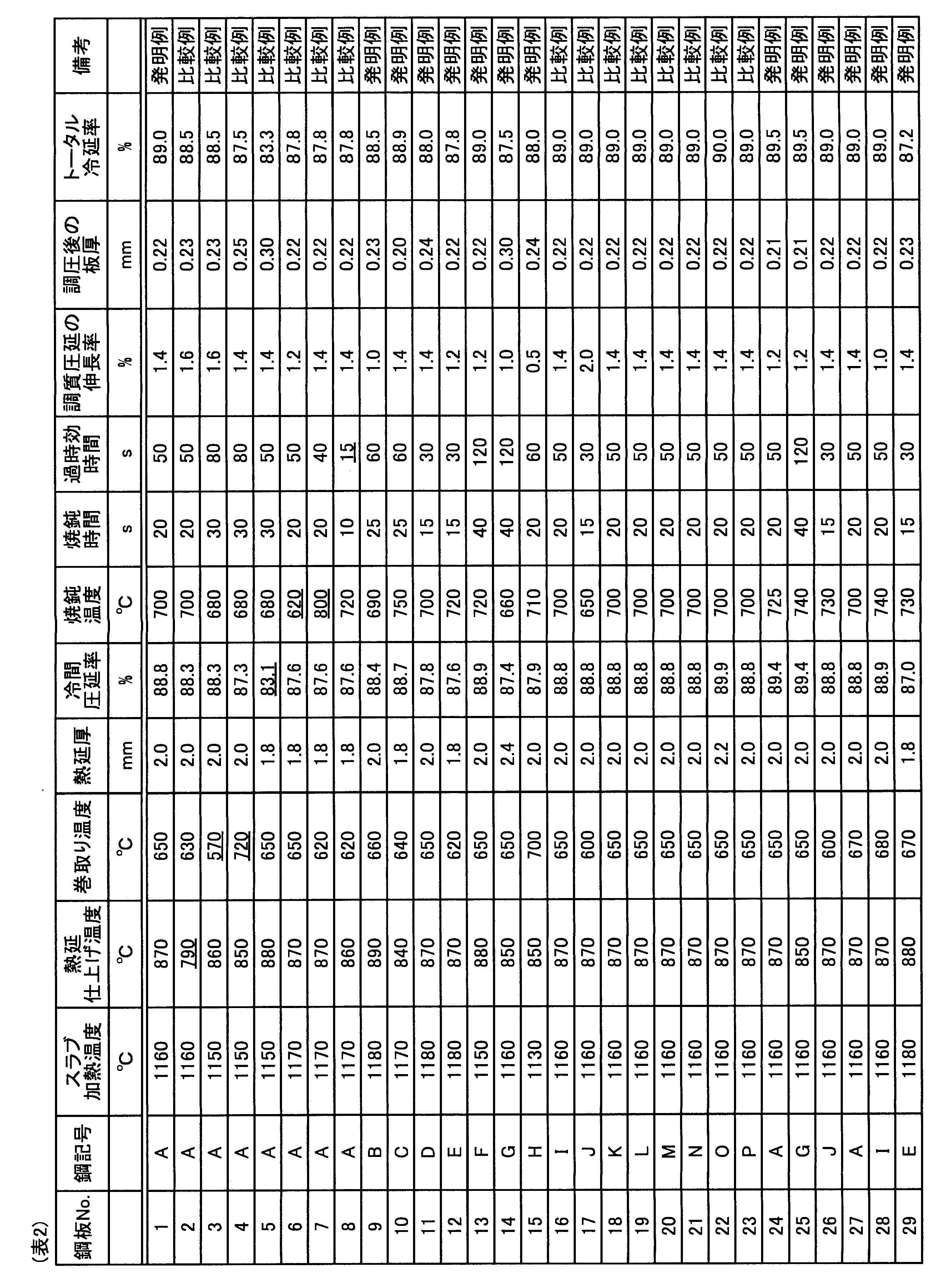
- the obtained steel slab was heated and hot-rolled under the conditions shown in Table 2 below, rolled, wound, scale removed by pickling, cold-rolled, annealed in a continuous annealing furnace, and 380.
- An over-aging treatment was performed in an over-aging temperature range of 0 ° C. to 500 ° C., and temper rolling was performed to obtain steel plates (steel plates No. 1 to 29) having a thickness of 0.20 mm to 0.30 mm.
- the steel plate was subjected to electrolytic Cr acid treatment as a surface treatment, and then a laminated steel plate in which a PET film having a thickness of 20 ⁇ m was thermally fused on both surfaces of the steel plate was produced.
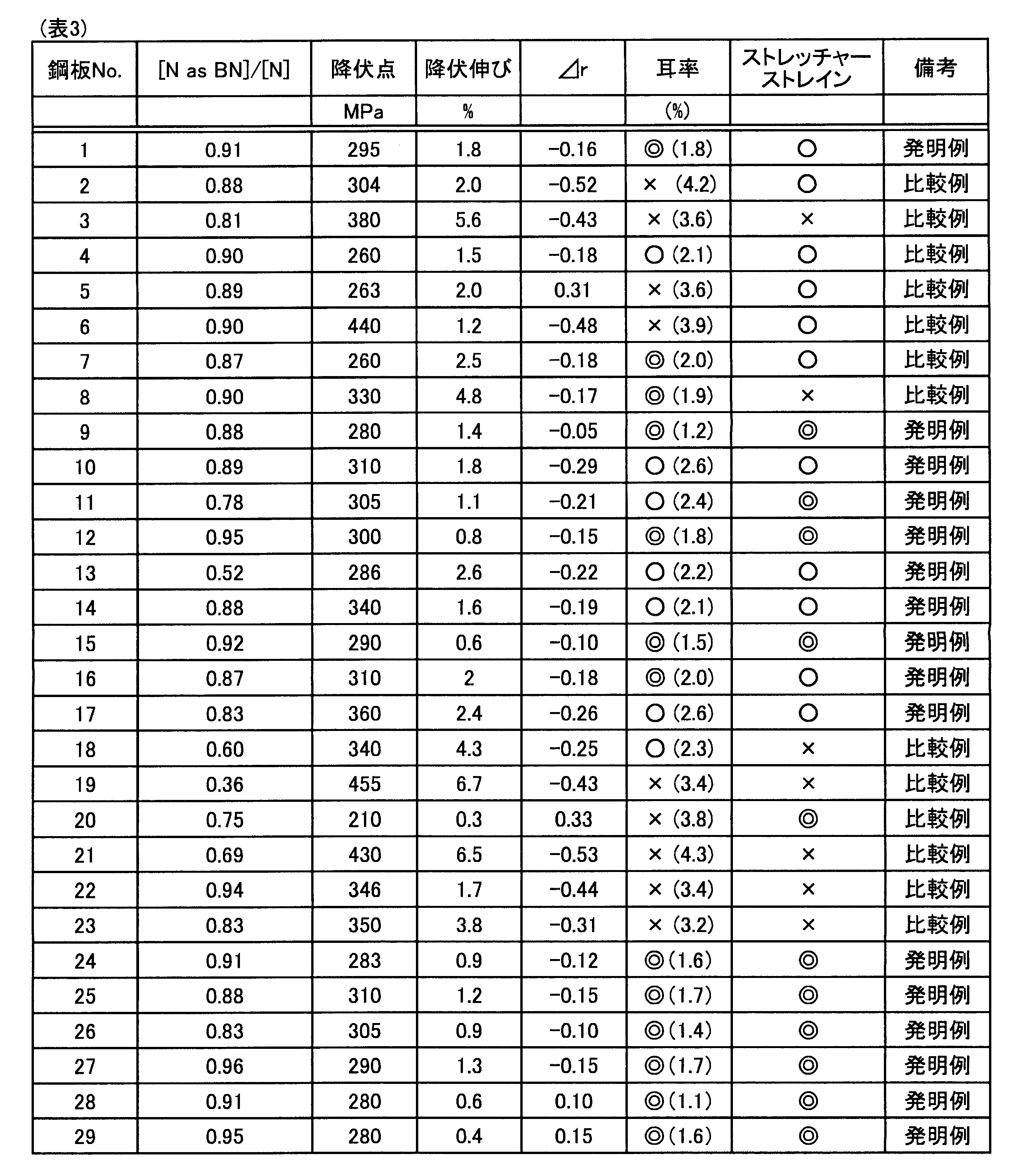
- the following items 1 to 4 were evaluated for the manufactured laminated steel sheets.
- a steel plate for a two-piece can having excellent formability in a drawing process and an ironing process, and a manufacturing method thereof.
Landscapes
- Chemical & Material Sciences (AREA)
- Engineering & Computer Science (AREA)
- Mechanical Engineering (AREA)
- Materials Engineering (AREA)
- Metallurgy (AREA)
- Organic Chemistry (AREA)
- Physics & Mathematics (AREA)
- Thermal Sciences (AREA)
- Crystallography & Structural Chemistry (AREA)
- Heat Treatment Of Sheet Steel (AREA)
Abstract
Description
[N as BN]/[N]>0.5 …(1)
本発明に係る2ピース缶用鋼板は、質量%で、C:0.010%以上0.030%未満、Si:0.04%以下、Mn:0.10%以上0.40%未満、P:0.02%以下、S:0.020%以下、Al:0.030%超え0.100%以下、N:0.0005%以上0.0030%未満、B:0.0005%以上0.0030%以下を含有し、残部はFe及び不可避的不純物からなり、BNとなっているN量([N as BN])と全N量([N])が以下に示す数式(1)を満たす。
Cは、所望の降伏点、降伏伸び、及びΔrを同時に得るために重要な元素である。C含有量が0.030%以上では、降伏点が420MPa以上となってしごき加工での成形負荷が過剰となってしまう。加えて、固溶Cが残存しやすくなるために降伏伸びが3%より大きくなり、ストレッチャーストレインの原因となる。さらに、Δrが低下し(マイナス側に大となり)、大きなイヤリングが発生してしまう。このため、C含有量の上限は0.030%未満、好ましくは0.025%以下とする。一方、C含有量が0.010%未満では、降伏点が280MPa以下となり、缶体の加工度が低い部分の缶体強度を確保することが困難になる。また、焼鈍時にフェライト粒径が過剰に粗大になって、ラミネート鋼板とする場合は製缶加工時に肌荒れが発生し、フィルムラミネート層と鋼板との密着性が低下して耐食性が低下する。このため、C含有量の下限は0.010%以上とする。
Siを多量に含有すると、表面濃化により表面処理性が劣化し、耐食性が低下する。加えて、固溶強化によって降伏点が上昇する。このため、Si含有量の上限は0.04%以下、好ましくは0.03%以下である。
Mnは、固溶強化によって鋼板の降伏点を向上させる効果を有し、280MPa以上の降伏点を確保することが容易となる。また、MnがMnSを形成することにより、鋼中に含まれるSに起因する熱間延性の低下を防止できる。さらに、セメンタイトを安定化させることで固溶C量の低減に寄与し、降伏伸びを安定して低下させることができる。これらの効果を得るためにはMn含有量の下限を0.10%以上にする必要がある。一方、Mn含有量が0.40%以上では、異方性が大きくなり、Δrの絶対値が大きくなるため、Mn量の上限は0.40%未満とする必要がある。
Pを多量に含有すると過剰な硬質化や中央偏析によって成形性が低下する。また、Pを多量に含有すると耐食性が低下する。このため、P含有量の上限は0.02%以下とし、降伏点を低下させる観点からはP含有量の上限は0.015%以下が好適である。
Sは、鋼中で硫化物を形成して熱間延性を低下させる。よって、S含有量の上限は0.020%以下とする。一方、Sは孔食を抑制する効果があるため、S含有量の下限は0.008%以上とすることが好ましい。
Alは、NとAlNを形成することにより鋼中の固溶Nを減少させ、降伏伸びを低下させ、ストレッチャーストレインを抑制する。このため、Al含有量の下限は0.030%超えにする必要がある。降伏伸びを低減して製缶性を向上させる観点から、Al含有量の下限は0.040%以上であることが好ましい。一方、Al含有量が過剰になるとアルミナが多量に発生して、アルミナが鋼板内に残存して製缶性が低下する。このため、Al含有量の上限は0.100%以下とする必要がある。
Nは固溶Nとして存在すると、降伏伸びが増加し、しぼり加工時にストレッチャーストレインが発生して表面外観が不良となることに加え、板厚が不均一になっているために次工程での製缶トラブルの要因となり製缶性が低下する。このため、N含有量の上限は0.0030%未満、好ましくは0.0025%以下とする。一方、N含有量を安定して0.0005%未満とすることは難しく、N含有量を0.0005%未満にしようとすると製造コストも上昇する。このため、N含有量の下限は0.0005%以上とする。
Bは、NとBNを形成して固溶Nを減少させて、降伏伸びを低下させる。このため、Bを含有することが好ましく、B添加の効果を得るためにはB含有量の下限は0.0005%以上とする必要がある。一方、Bを過剰に含有しても、上記の効果が飽和するだけでなく、異方性が劣化してΔrの絶対値が大きくなってイヤリングが発生する。このため、B含有量の上限は0.0030%以下とする。加えて、BNとして存在するN量[N as BN]と全N含有量[N]との比[N as BN]/[N]を0.5超えとすることにより、降伏伸びを3%以下にしつつ、降伏点を420MPa未満に低下させることができる。好ましくは[N as BN]/[N]≧0.6である。
降伏点の上限を420MPa未満とすることによりしごき加工時の成形負荷が低減し、効率的な製缶が可能となる。降伏点の上限は、好ましくは360MPa以下、さらに好ましくは320MPa以下である。一方、2ピース缶では、缶底部や缶底部近傍の加工硬化が小さいため、降伏点の下限が280MPa以下では缶底部や缶底部近傍の缶体強度を確保することが困難となる。このため、降伏点の下限は280MPa超えとする。
降伏伸びの下限が3%以下であれば、しぼり加工でのストレッチャーストレインの発生を抑制することができる。さらに好ましくは2%以下である。
しぼり加工でのイヤリングの発生を抑制するためには、塑性異方性の指標であるランクフォード値(r値)の面内異方性Δrの絶対値が小さいことが必要であり、面内異方性Δrが-0.30以上0.20以下であれば、イヤリングの発生は実用上問題無いレベルとなる。好ましくは-0.15以上0.15以下である。加えて、しぼり加工性を向上させる観点から平均ランクフォード値(平均r値)が1.1以上であることが好ましく、さらには、圧延方向、圧延方向から45度方向、及び圧延方向から直角方向のr値がいずれも1.0以上であることが好ましい。平均r値は、圧延方向のランクフォード値(r0)、圧延方向から45度方向のランクフォード値(r45)、及び圧延方向から直角方向のランクフォード値(r90)を用いて以下に示す数式(2)により算出される値である。
板厚が0.20mm以下と薄い場合、しぼり加工及びしごき加工後の缶胴厚が薄くなりすぎるため缶体強度が不足する。このため、板厚の下限は0.20mm超え、好ましくは0.21mm以上である。一方、板厚が0.40mm超えの場合、缶体の軽量化の効果が十分に得られないため、板厚の上限は0.40mm以下とする。ここで、板厚とは、鋼板の厚さを意味し、フィルムラミネート層を有するラミネート鋼板の場合、フィルムラミネート層を含まない原板の厚さを意味する。
塗装工程を省略し、且つ、耐食性を確保することができるため、本発明の鋼板の両面又は片面に厚さ5μm以上40μm以下のフィルムラミネート層を貼り、ラミネート鋼板とすることが好ましい。フィルムラミネート層の厚さが5μm未満では、製缶後に十分な耐食性が得られないため、厚さの下限は5μm以上とする。一方、フィルムラミネート層の厚さを40μm超えとしても、効果が飽和するのみならず、製造コストが上昇してしまうため、厚さの上限は40μm以下とする。
〔加熱温度:1100℃以上〕
加熱工程とは、スラブを加熱温度1100℃以上にて加熱する工程である。熱間圧延前の加熱温度が低すぎると、窒化物の一部が未溶解となる。この未溶解は、製缶性を低下させる粗大AlN発生の要因となる。そこで、加熱工程における加熱温度は、1100℃以上、好ましくは1130℃以上とする。加熱温度の上限は特に規定しないが、加熱温度が高すぎるとスケールが過剰に発生して製品表面の欠陥になる。そこで、加熱温度の上限は1250℃とすることが好ましい。
熱延仕上げ温度が820℃未満となると、異方性が大きくなり、Δrの絶対値が大きくなって製缶性が低下する。このため、熱延仕上げ温度の下限は、820℃以上、好ましくは850℃以上とする。一方、熱延仕上げ温度が920℃よりも高くなると、熱延板におけるフェライト粒径が粗大になって、焼鈍板のフェライト粒径が粗大になり、降伏点が低下する。このため、熱延仕上げ温度の上限は920℃以下とする。
巻取り温度が700℃を超えると、熱延板におけるフェライト粒径が粗大になって、焼鈍板のフェライト粒径が粗大になり、焼鈍板のフェライト粒径が過剰に粗大になり、降伏点が低下する。このため、巻取り温度の上限は700℃以下とする。一方、巻取り温度が600℃未満となると、熱延板での炭化物の生成が不十分になり、熱延板中の固溶C量が増加することで焼鈍板のΔrの絶対値が大きくなり、しぼり加工時にイヤリングが発生する。このため、巻取り温度の下限は600℃以上、より好ましくは640℃以上、さらに好ましくは650℃超えである。
酸洗工程とは、巻取り工程後の熱延板を酸洗する工程である。酸洗条件は表層スケールを除去できればよく、特に条件は規定しない。常法により酸洗することができる。
冷間圧延の圧延率は、しぼり加工時のイヤリングの発生を防止するためにΔrの絶対値を小とするために重要な製造条件である。冷間圧延の圧延率が85%未満では、Δrがプラスに大となる。このため、冷間圧延の圧延率の下限は85%以上とする。一方、冷間圧延における圧延率が大きくなりすぎると、Δrがマイナスに大となり、イヤリングが発生する場合がある。このため、冷間圧延の圧延率の上限は90%以下とすることが好ましい。
焼鈍中に十分に再結晶させ、異方性の小さい集合組織を形成させるため、また炭化物を一度固溶させて、後述する過時効処理にて炭化物を再析出させるために、焼鈍温度の下限は650℃以上、好ましくは680℃以上、さらに好ましくは690℃超えとする。特に降伏点を低下させる観点からは、焼鈍温度の下限を720℃超えとすることが一層好ましい。一方、焼鈍温度が高すぎると、フェライト粒径が粗大化して降伏点が著しく低下するため、焼鈍温度の上限は750℃以下とする必要がある。また、コイル内にて均一に加熱する観点から焼鈍時間を15s以上とすることが好ましい。
調質圧延では降伏伸びを減少させるため、伸張率の下限は0.5%以上とする。一方、伸長率が大きすぎると降伏点が上昇するため、伸張率の上限は2.0%以下とする。また、低い降伏点を得る観点から、伸張率の上限は1.5%未満とすることが好ましい。また、Δrの絶対値を小さくする観点からは、冷間圧延と調質圧延を合わせた全冷圧率((熱延厚-調質圧延後の板厚)/熱延厚×100)を90.0%以下とすることが好ましい。
上記ラミネート鋼板から濃硫酸にて有機被覆を除去した後、鋼板を臭素メタノール溶液にて溶解し、残渣を硫酸・リン酸混合溶液にて分解させ、溶液中のB量を測定し、得られたB量が全量BNを形成しているとしてN量に換算した。
上記ラミネート鋼板から濃硫酸にてPETフィルムを除去した後、圧延向からJIS5号引張試験を採取し、JIS Z2241に従って降伏点、伸び(全伸び)、及び降伏伸びを評価した。
上記ラミネート鋼板から濃硫酸にてPETフィルムを除去した後、圧延方向、圧延方向から45度方向、及び圧延方向から直角方向についてJIS5号引張試験片を切り出し、JIS Z2254に記載の塑性ひずみ比試験方法(引張法)にてΔrを測定した。
製缶性を評価するため、上記ラミネート鋼板を円形に打抜いた後、しぼり比1.88のしぼり加工によって円筒カップを成形した。カップ縁部の高さを15度間隔で測定し、(最大縁高さ-最小縁高さ)/平均縁高さ×100にて耳率を算出し、耳率が3%以下であれば「○」、2%以下であれば「◎」、3%超えであれば「×」とした。また、カップを目視で観察し、ストレッチャーストレインがほとんど見えないものを「◎」、軽微なストレッチャーストレインが認められるものを「○」、ストレッチャーストレインの顕著なものを「×」とした。

Claims (4)
- 質量%で、C:0.010%以上0.030%未満、Si:0.04%以下、Mn:0.10%以上0.40%未満、P:0.02%以下、S:0.020%以下、Al:0.030%超え0.100%以下、N:0.0005%以上0.0030%未満、B:0.0005%以上0.0030%以下を含有し、残部はFe及び不可避的不純物からなり、BNとして存在するN量([N as BN])と全N量([N])とが下記数式(1)式を満たし、降伏点が280MPa超え420MPa未満であり、降伏伸びが3%以下であり、Δrが-0.30以上0.20以下であることを特徴とする2ピース缶用鋼板。
[N as BN]/[N]>0.5 …(1) - 板厚が0.20mm超え0.40mm以下であることを特徴とする請求項1に記載の2ピース缶用鋼板。
- 両面又は片面に厚さ5μm以上40μm以下のフィルムラミネート層を有することを特徴とする請求項1又は2に記載の2ピース缶用鋼板。
- 請求項1~3のうち、いずれか1項に記載の2ピース缶用鋼板の製造方法であって、
スラブを加熱温度1100℃以上にて加熱する加熱工程と、
前記加熱工程後のスラブを熱延仕上げ温度820℃以上920℃以下の条件で熱間圧延する熱間圧延工程と、
前記熱間圧延工程で得られた熱延板を巻取り温度600℃以上700℃以下にて巻取る巻取り工程と、
前記巻取り工程後の熱延板を酸洗する酸洗工程と、
前記酸洗後の熱延板を圧延率85%以上の条件で冷間圧延する冷間圧延工程と、
前記冷間圧延工程で得られた冷延板を焼鈍温度650℃以上750℃以下の条件で焼鈍後に380℃以上500℃以下の温度域での滞留時間を30s以上とする過時効処理を行う連続焼鈍工程と、
前記連続焼鈍工程で得られた焼鈍板を伸長率0.5%以上2.0%以下の条件で圧延する調質圧延工程と、
を含むことを特徴とする2ピース缶用鋼板の製造方法。
Priority Applications (6)
| Application Number | Priority Date | Filing Date | Title |
|---|---|---|---|
| MYPI2019005481A MY194622A (en) | 2017-03-27 | 2018-03-12 | Steel sheet for two-piece can and manufacturing method thefefor |
| US16/495,991 US11486018B2 (en) | 2017-03-27 | 2018-03-12 | Steel sheet for two-piece can and manufacturing method therefor |
| KR1020197031435A KR102262364B1 (ko) | 2017-03-27 | 2018-03-12 | 2피스 캔용 강판 및 그의 제조 방법 |
| JP2018534882A JP6455639B1 (ja) | 2017-03-27 | 2018-03-12 | 2ピース缶用鋼板及びその製造方法 |
| CN201880020724.9A CN110494581B (zh) | 2017-03-27 | 2018-03-12 | 两片罐用钢板及其制造方法 |
| PH1/2019/550186A PH12019550186B1 (en) | 2017-03-27 | 2018-03-12 | Steel sheet for two-piece can and manufacturing method therefor |
Applications Claiming Priority (2)
| Application Number | Priority Date | Filing Date | Title |
|---|---|---|---|
| JP2017-060541 | 2017-03-27 | ||
| JP2017060541 | 2017-03-27 |
Publications (1)
| Publication Number | Publication Date |
|---|---|
| WO2018180403A1 true WO2018180403A1 (ja) | 2018-10-04 |
Family
ID=63675475
Family Applications (1)
| Application Number | Title | Priority Date | Filing Date |
|---|---|---|---|
| PCT/JP2018/009398 Ceased WO2018180403A1 (ja) | 2017-03-27 | 2018-03-12 | 2ピース缶用鋼板及びその製造方法 |
Country Status (8)
| Country | Link |
|---|---|
| US (1) | US11486018B2 (ja) |
| JP (1) | JP6455639B1 (ja) |
| KR (1) | KR102262364B1 (ja) |
| CN (1) | CN110494581B (ja) |
| MY (1) | MY194622A (ja) |
| PH (1) | PH12019550186B1 (ja) |
| TW (1) | TWI649428B (ja) |
| WO (1) | WO2018180403A1 (ja) |
Cited By (1)
| Publication number | Priority date | Publication date | Assignee | Title |
|---|---|---|---|---|
| JP6897878B1 (ja) * | 2020-02-17 | 2021-07-07 | 日本製鉄株式会社 | 缶用鋼板およびその製造方法 |
Families Citing this family (1)
| Publication number | Priority date | Publication date | Assignee | Title |
|---|---|---|---|---|
| CN115261730B (zh) * | 2022-08-12 | 2023-10-20 | 安徽富凯特材有限公司 | 一种炼镁还原罐用耐热不锈钢及其制备方法 |
Citations (5)
| Publication number | Priority date | Publication date | Assignee | Title |
|---|---|---|---|---|
| JPH01184229A (ja) * | 1988-01-18 | 1989-07-21 | Nippon Steel Corp | 伸びフランジ成形性の優れたdi缶用鋼板の製造法 |
| JPH09249938A (ja) * | 1996-03-14 | 1997-09-22 | Nkk Corp | 面内異方性の小さい2ピース缶用鋼板の製造方法 |
| JPH1044318A (ja) * | 1996-08-06 | 1998-02-17 | Toyo Kohan Co Ltd | 薄肉化深絞りしごき缶用ポリエステル樹脂被覆鋼板 |
| JP2000087145A (ja) * | 1998-09-11 | 2000-03-28 | Nkk Corp | 面内異方性のコイル内均一性に優れた2ピース缶用鋼板の製造方法 |
| JP2002060900A (ja) * | 2000-08-15 | 2002-02-28 | Nippon Steel Corp | イヤリング性の極めて優れた絞り缶用鋼板および製造方法 |
Family Cites Families (18)
| Publication number | Priority date | Publication date | Assignee | Title |
|---|---|---|---|---|
| JPS6444318A (en) | 1987-08-10 | 1989-02-16 | Mazda Motor | Air intake structure for automobile |
| JP2595609B2 (ja) * | 1988-01-26 | 1997-04-02 | 大同特殊鋼株式会社 | 浸炭焼入れ用快削鋼 |
| JP2689148B2 (ja) | 1988-11-19 | 1997-12-10 | 新日本製鐵株式会社 | 耳発生の小さい絞り缶用鋼板の製造法 |
| US5587027A (en) | 1994-02-17 | 1996-12-24 | Kawasaki Steel Corporation | Method of manufacturing canning steel sheet with non-aging property and superior workability |
| JPH10280095A (ja) | 1997-04-10 | 1998-10-20 | Nippon Steel Corp | ネック縮径時の耐しわ性に優れた2ピース容器用鋼板およびその製造方法。 |
| JP3852210B2 (ja) | 1997-08-18 | 2006-11-29 | Jfeスチール株式会社 | 変形3ピース缶用鋼板およびその製造方法 |
| CN1170951C (zh) | 1998-05-29 | 2004-10-13 | 东洋钢钣股份有限公司 | 运用薄壁式深拉罐用的树脂包覆钢板及其使用的钢板 |
| JP3931455B2 (ja) * | 1998-11-25 | 2007-06-13 | Jfeスチール株式会社 | 缶用鋼板およびその製造方法 |
| JP4788030B2 (ja) | 2000-03-23 | 2011-10-05 | Jfeスチール株式会社 | 軽量2ピース缶用鋼板およびその製造方法 |
| JP4810766B2 (ja) | 2001-07-05 | 2011-11-09 | Jfeスチール株式会社 | 軽量2ピース缶用極薄高強度鋼板の製造方法 |
| JP3899014B2 (ja) * | 2002-11-06 | 2007-03-28 | 新日本製鐵株式会社 | 母材および溶接熱影響部の靱性に優れた引張強さ570ないし800MPa級高強度鋼板およびその製造方法 |
| WO2007111188A1 (ja) * | 2006-03-16 | 2007-10-04 | Jfe Steel Corporation | 冷延鋼板およびその製造方法、電池及びその製造方法 |
| JP5958038B2 (ja) * | 2011-04-21 | 2016-07-27 | Jfeスチール株式会社 | 外圧に対する缶胴部の座屈強度が高く、成形性および成形後の表面性状に優れた缶用鋼板およびその製造方法 |
| JP5874771B2 (ja) | 2013-03-28 | 2016-03-02 | Jfeスチール株式会社 | 加工性と耐肌荒れ性に優れた缶用鋼板およびその製造方法 |
| CN104946969B (zh) * | 2014-03-31 | 2017-02-15 | 上海梅山钢铁股份有限公司 | 一种空调压缩机壳体用热轧酸洗钢板及其制造方法 |
| WO2016031234A1 (ja) * | 2014-08-29 | 2016-03-03 | Jfeスチール株式会社 | 缶用鋼板及びその製造方法 |
| US20170306436A1 (en) * | 2014-10-28 | 2017-10-26 | Jfe Steel Corporation | Steel sheet for two-piece can and manufacturing method therefor |
| CN107109558B (zh) * | 2014-11-17 | 2019-01-18 | 新日铁住金株式会社 | 拉深罐用钢板及其制造方法 |
-
2018
- 2018-03-12 PH PH1/2019/550186A patent/PH12019550186B1/en unknown
- 2018-03-12 CN CN201880020724.9A patent/CN110494581B/zh active Active
- 2018-03-12 MY MYPI2019005481A patent/MY194622A/en unknown
- 2018-03-12 WO PCT/JP2018/009398 patent/WO2018180403A1/ja not_active Ceased
- 2018-03-12 JP JP2018534882A patent/JP6455639B1/ja active Active
- 2018-03-12 US US16/495,991 patent/US11486018B2/en active Active
- 2018-03-12 KR KR1020197031435A patent/KR102262364B1/ko active Active
- 2018-03-22 TW TW107109851A patent/TWI649428B/zh active
Patent Citations (5)
| Publication number | Priority date | Publication date | Assignee | Title |
|---|---|---|---|---|
| JPH01184229A (ja) * | 1988-01-18 | 1989-07-21 | Nippon Steel Corp | 伸びフランジ成形性の優れたdi缶用鋼板の製造法 |
| JPH09249938A (ja) * | 1996-03-14 | 1997-09-22 | Nkk Corp | 面内異方性の小さい2ピース缶用鋼板の製造方法 |
| JPH1044318A (ja) * | 1996-08-06 | 1998-02-17 | Toyo Kohan Co Ltd | 薄肉化深絞りしごき缶用ポリエステル樹脂被覆鋼板 |
| JP2000087145A (ja) * | 1998-09-11 | 2000-03-28 | Nkk Corp | 面内異方性のコイル内均一性に優れた2ピース缶用鋼板の製造方法 |
| JP2002060900A (ja) * | 2000-08-15 | 2002-02-28 | Nippon Steel Corp | イヤリング性の極めて優れた絞り缶用鋼板および製造方法 |
Cited By (2)
| Publication number | Priority date | Publication date | Assignee | Title |
|---|---|---|---|---|
| JP6897878B1 (ja) * | 2020-02-17 | 2021-07-07 | 日本製鉄株式会社 | 缶用鋼板およびその製造方法 |
| WO2021166026A1 (ja) * | 2020-02-17 | 2021-08-26 | 日本製鉄株式会社 | 缶用鋼板およびその製造方法 |
Also Published As
| Publication number | Publication date |
|---|---|
| KR102262364B1 (ko) | 2021-06-07 |
| MY194622A (en) | 2022-12-07 |
| TWI649428B (zh) | 2019-02-01 |
| US11486018B2 (en) | 2022-11-01 |
| CN110494581A (zh) | 2019-11-22 |
| TW201835339A (zh) | 2018-10-01 |
| JP6455639B1 (ja) | 2019-01-23 |
| CN110494581B (zh) | 2021-07-09 |
| PH12019550186A1 (en) | 2020-06-08 |
| PH12019550186B1 (en) | 2022-08-12 |
| US20200102624A1 (en) | 2020-04-02 |
| KR20190132451A (ko) | 2019-11-27 |
| JPWO2018180403A1 (ja) | 2019-04-04 |
Similar Documents
| Publication | Publication Date | Title |
|---|---|---|
| JP6274302B2 (ja) | 2ピース缶用鋼板及びその製造方法 | |
| JP6455640B1 (ja) | 2ピース缶用鋼板及びその製造方法 | |
| KR101918426B1 (ko) | 캔용 강판 및 캔용 강판의 제조 방법 | |
| JP5939368B1 (ja) | 缶用鋼板及びその製造方法 | |
| WO2016157878A1 (ja) | 缶用鋼板及び缶用鋼板の製造方法 | |
| CN106795600A (zh) | 不锈钢冷轧钢板用材料 | |
| TWI479031B (zh) | 耐壓強度高且加工性優異之氣溶膠罐底部用鋼板及其製造方法 | |
| JP6455639B1 (ja) | 2ピース缶用鋼板及びその製造方法 | |
| JP6198011B2 (ja) | 硬質容器用鋼板の製造方法 | |
| JP4265574B2 (ja) | 2ピース変形缶用鋼板およびその製造方法 | |
| JP3728911B2 (ja) | 耐時効性に優れかつ耳発生率の小さい表面処理鋼板用原板およびその製造方法 | |
| JP5929739B2 (ja) | エアゾール缶ボトム用鋼板およびその製造方法 | |
| JP6108044B2 (ja) | 缶蓋用鋼板およびその製造方法 | |
| JPS63286522A (ja) | Di缶用鋼板の製造法 |
Legal Events
| Date | Code | Title | Description |
|---|---|---|---|
| ENP | Entry into the national phase |
Ref document number: 2018534882 Country of ref document: JP Kind code of ref document: A |
|
| 121 | Ep: the epo has been informed by wipo that ep was designated in this application |
Ref document number: 18777681 Country of ref document: EP Kind code of ref document: A1 |
|
| NENP | Non-entry into the national phase |
Ref country code: DE |
|
| ENP | Entry into the national phase |
Ref document number: 20197031435 Country of ref document: KR Kind code of ref document: A |
|
| 122 | Ep: pct application non-entry in european phase |
Ref document number: 18777681 Country of ref document: EP Kind code of ref document: A1 |