WO2018180179A1 - 水中油型化粧料 - Google Patents
水中油型化粧料 Download PDFInfo
- Publication number
- WO2018180179A1 WO2018180179A1 PCT/JP2018/007823 JP2018007823W WO2018180179A1 WO 2018180179 A1 WO2018180179 A1 WO 2018180179A1 JP 2018007823 W JP2018007823 W JP 2018007823W WO 2018180179 A1 WO2018180179 A1 WO 2018180179A1
- Authority
- WO
- WIPO (PCT)
- Prior art keywords
- oil
- acid
- water
- ether
- glycol
- Prior art date
- Legal status (The legal status is an assumption and is not a legal conclusion. Google has not performed a legal analysis and makes no representation as to the accuracy of the status listed.)
- Ceased
Links
Classifications
-
- A—HUMAN NECESSITIES
- A61—MEDICAL OR VETERINARY SCIENCE; HYGIENE
- A61K—PREPARATIONS FOR MEDICAL, DENTAL OR TOILETRY PURPOSES
- A61K8/00—Cosmetics or similar toiletry preparations
- A61K8/02—Cosmetics or similar toiletry preparations characterised by special physical form
- A61K8/04—Dispersions; Emulsions
- A61K8/06—Emulsions
- A61K8/062—Oil-in-water emulsions
-
- A—HUMAN NECESSITIES
- A61—MEDICAL OR VETERINARY SCIENCE; HYGIENE
- A61K—PREPARATIONS FOR MEDICAL, DENTAL OR TOILETRY PURPOSES
- A61K8/00—Cosmetics or similar toiletry preparations
- A61K8/02—Cosmetics or similar toiletry preparations characterised by special physical form
- A61K8/04—Dispersions; Emulsions
- A61K8/06—Emulsions
-
- A—HUMAN NECESSITIES
- A61—MEDICAL OR VETERINARY SCIENCE; HYGIENE
- A61K—PREPARATIONS FOR MEDICAL, DENTAL OR TOILETRY PURPOSES
- A61K8/00—Cosmetics or similar toiletry preparations
- A61K8/18—Cosmetics or similar toiletry preparations characterised by the composition
- A61K8/30—Cosmetics or similar toiletry preparations characterised by the composition containing organic compounds
- A61K8/33—Cosmetics or similar toiletry preparations characterised by the composition containing organic compounds containing oxygen
- A61K8/37—Esters of carboxylic acids
-
- A—HUMAN NECESSITIES
- A61—MEDICAL OR VETERINARY SCIENCE; HYGIENE
- A61K—PREPARATIONS FOR MEDICAL, DENTAL OR TOILETRY PURPOSES
- A61K8/00—Cosmetics or similar toiletry preparations
- A61K8/18—Cosmetics or similar toiletry preparations characterised by the composition
- A61K8/30—Cosmetics or similar toiletry preparations characterised by the composition containing organic compounds
- A61K8/40—Cosmetics or similar toiletry preparations characterised by the composition containing organic compounds containing nitrogen
- A61K8/44—Aminocarboxylic acids or derivatives thereof, e.g. aminocarboxylic acids containing sulfur; Salts; Esters or N-acylated derivatives thereof
-
- A—HUMAN NECESSITIES
- A61—MEDICAL OR VETERINARY SCIENCE; HYGIENE
- A61K—PREPARATIONS FOR MEDICAL, DENTAL OR TOILETRY PURPOSES
- A61K8/00—Cosmetics or similar toiletry preparations
- A61K8/18—Cosmetics or similar toiletry preparations characterised by the composition
- A61K8/72—Cosmetics or similar toiletry preparations characterised by the composition containing organic macromolecular compounds
- A61K8/81—Cosmetics or similar toiletry preparations characterised by the composition containing organic macromolecular compounds obtained by reactions involving only carbon-to-carbon unsaturated bonds
-
- A—HUMAN NECESSITIES
- A61—MEDICAL OR VETERINARY SCIENCE; HYGIENE
- A61K—PREPARATIONS FOR MEDICAL, DENTAL OR TOILETRY PURPOSES
- A61K8/00—Cosmetics or similar toiletry preparations
- A61K8/18—Cosmetics or similar toiletry preparations characterised by the composition
- A61K8/72—Cosmetics or similar toiletry preparations characterised by the composition containing organic macromolecular compounds
- A61K8/84—Cosmetics or similar toiletry preparations characterised by the composition containing organic macromolecular compounds obtained by reactions otherwise than those involving only carbon-carbon unsaturated bonds
- A61K8/89—Polysiloxanes
-
- A—HUMAN NECESSITIES
- A61—MEDICAL OR VETERINARY SCIENCE; HYGIENE
- A61Q—SPECIFIC USE OF COSMETICS OR SIMILAR TOILETRY PREPARATIONS
- A61Q1/00—Make-up preparations; Body powders; Preparations for removing make-up
-
- A—HUMAN NECESSITIES
- A61—MEDICAL OR VETERINARY SCIENCE; HYGIENE
- A61Q—SPECIFIC USE OF COSMETICS OR SIMILAR TOILETRY PREPARATIONS
- A61Q19/00—Preparations for care of the skin
-
- A—HUMAN NECESSITIES
- A61—MEDICAL OR VETERINARY SCIENCE; HYGIENE
- A61Q—SPECIFIC USE OF COSMETICS OR SIMILAR TOILETRY PREPARATIONS
- A61Q5/00—Preparations for care of the hair
-
- A—HUMAN NECESSITIES
- A61—MEDICAL OR VETERINARY SCIENCE; HYGIENE
- A61K—PREPARATIONS FOR MEDICAL, DENTAL OR TOILETRY PURPOSES
- A61K2800/00—Properties of cosmetic compositions or active ingredients thereof or formulation aids used therein and process related aspects
- A61K2800/40—Chemical, physico-chemical or functional or structural properties of particular ingredients
- A61K2800/48—Thickener, Thickening system
Definitions
- the present invention relates to the improvement of the stability of oil-in-water cosmetics and the provision of water resistance.
- polar oils such as ester oils are also widely used.
- organic sun absorbers are also used in large quantities for sunscreen agents (see Patent Document 1).
- the use of a large amount of these polar oils tends to impair the stability of the oil-in-water emulsion composition, and the use of a large amount of a polymer substance as an emulsion stabilizer causes a significant deterioration in the feeling of use such as stickiness.
- the present invention has been made in view of the above circumstances, and an object thereof is to provide an oil-in-water cosmetic that has excellent usability and water resistance while maintaining freshness.
- the present inventors have dispersed the core-corona type microgel as a stabilizer in the aqueous phase containing the emulsified particles, thereby maintaining the freshness and feeling of use. It has been found that an oil-in-water cosmetic excellent in water resistance and excellent in water resistance can be provided, and the present invention has been completed. In particular, when a large amount of ester oil such as an organic ultraviolet absorber is used in a sunscreen or foundation, an excellent feeling of use can be imparted.
- the oil-in-water cosmetic according to the present invention is (A) emulsified particles comprising the following (a1) and (a2); (A1) oil phase (a2) emulsifier (B) water phase in which the following (b1) is dispersed; (B1) A core-corona type microgel having a hydrophilic group partially provided on the surface of the hydrophobic gel fine particles.
- the oil-in-water cosmetic preferably includes (C) a thickener.
- (a1) the oil phase contains an ultraviolet absorber.
- the cosmetic according to the present invention is characterized by comprising the oil-in-water emulsion composition.
- the core-corona type microgel is dispersed as a stabilizer of the emulsified particles in the aqueous phase containing the emulsified particles, thereby maintaining freshness and excellent usability and water resistance.
- An oil-in-water cosmetic is obtained.
- the oil-in-water cosmetic according to the present invention includes (A) emulsified particles and (B) an aqueous phase.
- A emulsified particles
- B aqueous phase
- the emulsified particles comprise (a1) an oil phase and (a2) an emulsifier.
- the oil phase component is not particularly limited, and is usually a hydrocarbon oil, higher fatty acid, higher alcohol, synthetic ester oil, oil-soluble UV absorber, silicone oil, liquid, etc.
- examples include fats and oils, solid fats and oils, waxes, fragrances, and powders.
- hydrocarbon oil examples include isododecane, isohexadecane, isoparaffin, liquid paraffin, ozokerite, squalane, pristane, paraffin, ceresin, squalene, petrolatum, microcrystalline wax, and the like.
- higher fatty acid examples include lauric acid, myristic acid, palmitic acid, stearic acid, behenic acid, oleic acid, undecylenic acid, toluic acid, isostearic acid, linoleic acid, linolenic acid, eicosapentaenoic acid (EPA), docosahexaenoic acid ( DHA) and the like.
- Examples of the higher alcohol include straight chain alcohols (for example, lauryl alcohol, cetyl alcohol, stearyl alcohol, behenyl alcohol, myristyl alcohol, oleyl alcohol, cetostearyl alcohol), branched chain alcohols (for example, monostearyl glycerol ether (batyl alcohol) ) -2-decyltetradecinol, lanolin alcohol, cholesterol, phytosterol, hexyl decanol, isostearyl alcohol, octyldodecanol, etc.).
- straight chain alcohols for example, lauryl alcohol, cetyl alcohol, stearyl alcohol, behenyl alcohol, myristyl alcohol, oleyl alcohol, cetostearyl alcohol
- branched chain alcohols for example, monostearyl glycerol ether (batyl alcohol) ) -2-decyltetradecinol, lanolin alcohol, cholesterol, phytosterol, hexyl decano
- Synthetic ester oils include, for example, octyl octoate, nonyl nonanoate, cetyl octanoate, isopropyl myristate, octyldodecyl myristate, isopropyl palmitate, butyl stearate, hexyl laurate, myristyl myristate, decyl oleate, dimethyl Hexyldecyl octoate, cetyl lactate, myristyl lactate, lanolin acetate, isocetyl stearate, isocetyl isostearate, cholesteryl 12-hydroxystearate, ethylene glycol di-2-ethylhexanoate, dipentaerythritol fatty acid ester, monoisostearic acid N- Alkyl glycol, neopentyl glycol dicaprate, tripropylene glycol pivalate, diisosteary
- oil-soluble ultraviolet absorber examples include paraaminobenzoic acid (PABA), PABA monoglycerin ester, N, N-dipropoxy PABA ethyl ester, N, N-diethoxy PABA ethyl ester, N, N-dimethyl PABA ethyl ester, N Benzoic acid UV absorbers such as N-dimethyl PABA butyl ester; Anthranilic acid UV absorbers such as homomenthyl-N-acetylanthranilate; Amyl salicylate, menthyl salicylate, homomenthyl salicylate, octyl salicylate, phenyl salicylate, benzyl Salicylic acid UV absorbers such as salicylate and p-isopropanolphenyl salicylate; octylcinnamate, ethyl-4-isopropylcinnamate, methyl-2,5-diisopropylsilane Namate
- silicone oil examples include chain polysiloxanes (for example, dimethylpolysiloxane, methylphenylpolysiloxane, diphenylpolysiloxane, etc.), cyclic polysiloxanes (for example, octamethylcyclotetrasiloxane, decamethylcyclopentasiloxane, dodecamethylcyclohexane).
- chain polysiloxanes for example, dimethylpolysiloxane, methylphenylpolysiloxane, diphenylpolysiloxane, etc.
- cyclic polysiloxanes for example, octamethylcyclotetrasiloxane, decamethylcyclopentasiloxane, dodecamethylcyclohexane.
- Silicone resins, silicone rubber, various modified polysiloxanes as amino-modified polysiloxane, polyether-modified polysiloxane, alkyl
- liquid oils examples include avocado oil, camellia oil, turtle oil, macadamia nut oil, corn oil, mink oil, olive oil, rapeseed oil, egg yolk oil, sesame oil, persic oil, wheat germ oil, southern castor oil, castor oil, linseed oil , Safflower oil, cottonseed oil, eno oil, soybean oil, peanut oil, tea seed oil, kaya oil, rice bran oil, cinnagiri oil, Japanese kiri oil, jojoba oil, germ oil, triglycerin and the like.
- solid fat examples include cacao butter, palm oil, horse fat, hydrogenated palm oil, palm oil, beef tallow, sheep fat, hydrogenated beef tallow, palm kernel oil, pork fat, beef bone fat, owl kernel oil, hydrogenated oil, cattle Leg fats, moles, hydrogenated castor oil and the like.
- waxes examples include beeswax, candelilla wax, cotton wax, carnauba wax, bayberry wax, ibota wax, whale wax, montan wax, nuka wax, lanolin, kapok wax, lanolin acetate, liquid lanolin, sugarcane wax, lanolin fatty acid isopropyl, hexyl laurate, Examples include reduced lanolin, jojoballow, hard lanolin, shellac wax, POE lanolin alcohol ether, POE lanolin alcohol acetate, POE cholesterol ether, lanolin fatty acid polyethylene glycol, and POE hydrogenated lanolin alcohol ether.
- the oil-in-water cosmetic it is preferable to blend a hydrophobic powder in the (a1) oil phase.
- a hydrophobic powder in the (a1) oil phase.
- the water resistance can be further improved by blending the core corona and the hydrophobic powder together.
- Hydrophobic powder is not particularly limited as long as the surface of the powder is hydrophobic.
- the powder itself is hydrophobic, such as silicone resin powder and fluororesin powder.
- the surface of the inorganic powder particles is coated with silicones such as methyl hydrogen polysiloxane and dimethyl polysiloxane, dextrin fatty acid ester, higher fatty acid, higher alcohol, fatty acid ester, metal soap, alkyl phosphate ether, fluorine compound, or squalane.
- silicones such as methyl hydrogen polysiloxane and dimethyl polysiloxane, dextrin fatty acid ester, higher fatty acid, higher alcohol, fatty acid ester, metal soap, alkyl phosphate ether, fluorine compound, or squalane.
- the average particle diameter of hydrophobic powder needs to be smaller than the emulsified particles that are the oil phase of the present invention.
- the average particle size after crushing with a wet disperser is 100 nm or less.
- the inorganic powder particles to be hydrophobized include titanium oxide, zinc oxide, talc, mica, sericite, kaolin, titanium mica, black iron oxide, yellow iron oxide, bengara, ultramarine blue, bitumen, chromium oxide, water. Examples include chromium oxide.
- the blending amount of the oil phase is preferably 5 to 80% by mass in the oil-in-water cosmetic. More preferably, the content is 10 to 75% by mass.
- the emulsifier is one or two amphoteric surfactants, cationic surfactants, anionic surfactants, hydrophilic nonionic surfactants, hydrophilic nonionic surfactants, and polymeric surfactants. It is characterized by including above.
- the amphoteric surfactant has at least one cationic functional group and one anionic functional group, becomes cationic when the solution is acidic, and anionic when the solution is alkaline, and is close to a nonionic surfactant near the isoelectric point. It has properties.
- Amphoteric surfactants are classified into carboxylic acid type, sulfate ester type, sulfonic acid type and phosphate ester type depending on the type of anionic group.
- the carboxylic acid type, sulfate type and sulfonic acid type are preferred in the present invention.
- Carboxylic acid types are further classified into amino acid types and betaine types. Particularly preferred is a betaine type.
- imidazoline-based amphoteric surfactants for example, 2-undecyl-N, N, N- (hydroxyethylcarboxymethyl) -2-imidazoline sodium, 2-cocoyl-2-imidazolinium hydroxide) 1-carboxyethyloxy disodium salt
- betaine surfactants for example, 2-heptadecyl-N-carboxymethyl-N-hydroxyethylimidazolinium betaine, lauryldimethylaminoacetic acid betaine, alkylbetaine, amide betaine, sulfone) Betaine
- cationic surfactant examples include quaternary ammonium salts such as cetyltrimethylammonium chloride, stearyltrimethylammonium chloride, behenyltrimethylammonium chloride, behenyldimethylhydroxyethylammonium chloride, stearyldimethylbenzylammonium chloride, and cetyltriethylammonium methylsulfate. Is mentioned.
- stearic acid diethylaminoethylamide stearic acid dimethylaminoethylamide, palmitic acid diethylaminoethylamide, palmitic acid dimethylaminoethylamide, myristic acid diethylaminoethylamide, myristic acid dimethylaminoethylamide, behenic acid diethylaminoethylamide, behenic acid dimethyl Aminoethylamide, stearic acid diethylaminopropylamide, stearic acid dimethylaminopropylamide, palmitic acid diethylaminopropylamide, palmitic acid dimethylaminopropylamide, myristic acid diethylaminopropylamide, myristic acid dimethylaminopropylamide, behenic acid diethylaminopropylamide, behenine Amidoamino such as dimethylaminopropylamide Compounds
- Anionic surfactants include fatty acid soap, N-acyl glutamate, carboxylate type such as alkyl ether acetic acid, sulfonic acid type such as ⁇ -olefin sulfonate, alkane sulfonate, alkylbenzene sulfonic acid, higher alcohol sulfuric acid It is classified into a sulfate ester salt type such as an ester salt and a phosphate ester salt type. Carboxylate type, sulfonic acid type and sulfate ester type are preferred, and sulfate ester type is particularly preferred.
- fatty acid soap eg, sodium laurate, sodium palmitate, etc.
- higher alkyl sulfate ester salt eg, sodium lauryl sulfate, potassium lauryl sulfate
- alkyl ether sulfate ester salt eg, POE- Lauryl sulfate triethanolamine, POE-sodium lauryl sulfate, etc.
- N-acyl sarcosine acid eg, sodium lauroyl sarcosine, etc.
- higher fatty acid amide sulfonate eg, sodium N-myristoyl-N-methyltaurine, coconut oil fatty acid
- phosphoric acid ester salts POE-oleyl ether sodium phosphate, POE-stearyl ether phosphoric acid etc.
- sulfosuccinates eg di-2-ethy
- the nonionic surfactant is a surfactant that is ionized in an aqueous solution and has no charge.
- a type using alkyl and a type using dimethyl silicone are known.
- the former for example, glycerin fatty acid ester, ethylene oxide derivative of glycerin fatty acid ester, polyglycerin fatty acid ester, propylene glycol fatty acid ester, ethylene oxide derivative of propylene glycol fatty acid ester, polyethylene glycol fatty acid ester, polyethylene glycol alkyl ether, Examples include polyethylene glycol alkylphenyl ether, polyethylene glycol castor oil derivatives, polyethylene glycol hydrogenated castor oil derivatives, and the like. Examples of the latter include polyether-modified silicone and polyglycerin-modified silicone.
- a type using alkyl as a hydrophobic group is preferred.
- sorbitan fatty acid esters for example, sorbitan monooleate, sorbitan monoisostearate, sorbitan monolaurate, sorbitan monopalmitate, sorbitan monostearate, Sorbitan sesquioleate, sorbitan trioleate, diglycerol sorbitan penta-2-ethylhexylate, diglycerol sorbitan tetra-2-ethylhexylate), glycerin polyglycerin fatty acids (eg mono cottonseed oil fatty acid glycerin, glyceryl monoerucate, sesquiolein) Acid glycerin, glyceryl monostearate, ⁇ , ⁇ '-oleic acid pyroglutamate glycerin, monostearate glycerin malate, etc.), propylene glycol fatty acid ester And the like (
- hydrophilic nonionic surfactants include POE-sorbitan fatty acid esters (for example, POE-sorbitan monooleate, POE-sorbitan monostearate, POE-sorbitan monooleate, POE-sorbitan tetraoleate).
- POE-sorbitan fatty acid esters for example, POE-sorbitan monooleate, POE-sorbitan monostearate, POE-sorbitan monooleate, POE-sorbitan tetraoleate.
- POE sorbite fatty acid esters eg, POE-sorbite monolaurate, POE-sorbite monooleate, POE-sorbite pentaoleate, POE-sorbite monostearate, etc.
- POE-glycerin fatty acid esters eg, POE- Glycerol monostearate, POE-glycerol monoisostearate, POE-monooleate such as POE-glycerol triisostearate
- POE-fatty acid esters for example, POE-distearate, OE-monodiolate, ethylene glycol distearate, etc.
- POE-alkyl ethers for example, POE-lauryl ether, POE-oleyl ether, POE-stearyl ether, POE-behenyl ether, POE-2-octyldodecyl ether, POE-core
- Stanol ether etc.
- polymeric surfactant examples include hydrophobically modified alkyl cellulose, (acrylates / alkyl acrylate (C10-30)) crosspolymer, and the like.
- emulsifier (acrylates / alkyl acrylate (C10-30)) crosspolymer, sucrose stearate, sorbitan stearate, polysorbate 60 and the like can be suitably used.
- emulsifiers Commercial products can be used as the emulsifier. Examples include Pemulen TR-2 Polymeric Emulsifier (manufactured by Lubrizol Advanced Materials, Inc.), DK ester S-160N (manufactured by Daiichi Kogyo Seiyaku Co., Ltd.), Nikkor TS-10V (manufactured by Nippon Surfactant Co., Ltd.).
- the blending amount of the emulsifier is preferably 0.01 to 10% by mass in the oil-in-water cosmetic. More preferably, the content is 0.03 to 5% by mass.
- the core-corona type microgel according to the present invention can be obtained by radical polymerization of monomers represented by the following formulas (1) to (3) or (1), (2) and (4) under specific conditions. .
- R 1 is an alkyl group having 1 to 3 carbon atoms, and n is a number of 8 to 200.
- X is H or CH 3 .
- R1 is an alkyl group having 1 to 3 carbon atoms, and n is a number of 8 to 200.
- X is H or CH3.
- the polyethylene oxide macromonomer represented by the above formula (1) is preferably an acrylic acid derivative or a methacrylic acid derivative.
- a commercial product commercially available from Aldrich or a commercial product such as Bremer (registered trademark) marketed by NOF Corporation may be used.
- R 2 is an alkyl group having 1 to 3 carbon atoms.
- R 3 is an alkyl group having 1 to 12 carbon atoms, and more preferably an alkyl group having 1 to 8 carbon atoms.
- the hydrophobic monomer represented by the above formula (2) is preferably an acrylic acid derivative or a methacrylic acid derivative.
- methyl acrylate, ethyl acrylate, propyl acrylate, butyl acrylate, pentyl acrylate, acrylic Hexyl acrylate, heptyl acrylate, octyl acrylate, decyl acrylate, dodecyl acrylate, methyl methacrylate, ethyl methacrylate, propyl methacrylate, butyl methacrylate, pentyl methacrylate, hexyl methacrylate, heptyl methacrylate, methacryl Octyl acid, decyl methacrylate, dodecyl methacrylate and the like can be used.
- methyl methacrylate also known as methyl methacrylate
- butyl methacrylate also known as butyl methacrylate
- octyl methacrylate are particularly suitable.
- These hydrophobic monomers are general-purpose raw materials and can be easily obtained as general industrial raw materials. For example, you may use the commercial item marketed from Aldrich or Tokyo Kasei.
- the crosslinkable monomer represented by the formula (3) can be obtained as a commercial product or an industrial raw material.
- This crosslinkable monomer is preferably hydrophobic.
- the value of m is preferably 0-2.
- EGDMA ethylene glycol dimethacrylate
- Blemmer registered trademark
- R 4 and R 5 each independently represents an alkyl group having 1 to 3 carbon atoms, and m is a number from 0 to 2.
- R 6 represents H or an alkyl group having 1 to 3 carbon atoms
- R 7 and R 8 represent H or a substituent containing an alkyl group having 1 to 12 carbon atoms
- R6 represents H or an alkyl group having 1 to 3 carbon atoms
- R7 and R8 represent H or a substituent containing an alkyl group having 1 to 12 carbon atoms.
- the hydrophobic monomer represented by the above formula (4) is preferably an acrylamide derivative or a methacrylamide derivative.
- t-butylacrylamide, N, N-dimethylacrylamide, N- [3- (dimethylamino) propyl] acrylamide, t-butylmethacrylamide, octylacrylamide, octylmethacrylamide, octadecylacrylamide and the like can be suitably used.
- t-butylacrylamide, N, N-dimethylacrylamide, and N- [3- (dimethylamino) propyl] acrylamide are particularly preferable.
- These hydrophobic monomers are available as commercial products or industrial raw materials.
- the core-corona type microgel represented by the formulas (1) to (3) according to the present invention is obtained by radical polymerization of the above monomers under the following conditions (A) to (E).
- (A) The molar ratio represented by the charged molar amount of the polyethylene oxide macromonomer / the charged molar amount of the hydrophobic monomer is 1:10 to 1: 250.
- (B) The charge amount of the crosslinkable monomer is 0.1 to 1.5% by mass with respect to the charge amount of the hydrophobic monomer.
- the hydrophobic monomer represented by the formula (2) has a monomer composition in which one or more methacrylic acid derivatives having an alkyl group having 1 to 8 carbon atoms are mixed.
- the polymerization solvent is a mixed solvent of water and an organic solvent
- a polyol is used as the organic solvent
- one or more selected from dipropylene glycol, 1,3-butylene glycol, and isoprene glycol are used.
- the charged amount of the crosslinkable monomer relative to the charged amount of the hydrophobic monomer is defined as a crosslinking density (mass%).
- the crosslinking density of the core-corona type microgel used in the present invention is such that the amount of the crosslinkable monomer charged is 0.1 to 1.5% by mass based on the amount of the hydrophobic monomer, depending on the condition (B). Must.
- the dispersion stabilization by the polyethylene oxide macromonomer becomes incomplete, and the hydrophobic polymer by the insoluble hydrophobic monomer aggregates and precipitates.
- composition (B) By copolymerizing the crosslinkable monomer, it is possible to polymerize the microgel in which the hydrophobic polymer in the core portion is crosslinked.
- the charge amount of the crosslinkable monomer is less than 0.1% by mass of the charge amount of the hydrophobic monomer, the crosslink density is low, and the microgel collapses when swollen.
- the charged amount exceeds 1.5% by mass, aggregation of microgel particles occurs, and suitable microgel particles having a narrow particle size distribution cannot be polymerized.
- the amount of the crosslinkable monomer charged is preferably 0.2 to 1.0, more preferably 0.2 to 0.8, and most preferably 0.2 to 0.5% by mass.
- the hydrophobic monomer represented by the formula (2) needs to have a monomer composition in which one or more methacrylic acid derivatives having an alkyl group having 1 to 8 carbon atoms are mixed. If the number of carbon atoms is 0 (a monomer having no terminal ester bond), the monomer may be too hydrophilic to perform emulsion polymerization well. On the other hand, when the number of carbon atoms is 9 or more, there may be a steric hindrance during polymerization, and a crosslinked structure may not be successfully constructed.
- the polymerization solvent needs to be a mixed solvent of water-organic solvent.
- the organic solvent ethanol, propanol, butanol, polyol, and the like can be used.
- the polyol is used, the hydrophobic monomer represented by the formula (2) and the crosslinkable monomer represented by the formula (3) are dissolved. What can be done is preferred.
- the polyol used in the present invention needs to be dipropylene glycol, 1,3-butylene glycol, or isoprene glycol.
- the solvent mixed with water is ethanol, propanol, butanol, etc. when applied to the skin It is preferably an polyol that can be blended into cosmetics for general purposes, not an organic solvent in which irritation is a concern.
- the mixing ratio of the organic solvent is 10 to 90 volume ratio.
- the mixing ratio of the organic solvent When the mixing ratio of the organic solvent is lower than 10 volume ratio, the dissolving ability of the hydrophobic monomer becomes extremely low, polymerization proceeds in a monomer droplet state, and a huge mass is formed, and a microgel is not generated.
- the mixing ratio of the organic solvent exceeds 90 volume ratio, an emulsion of a hydrophobic monomer due to hydrophobic interaction is not generated, emulsion polymerization does not proceed, and a microgel cannot be obtained.
- the core-corona type microgel represented by the formulas (1), (2) and (4) according to the present invention is obtained by radical polymerization of the above monomers under the following conditions (A) ′ to (E) ′. . (A) ′
- the molar ratio represented by the charged molar amount of the polyethylene oxide macromonomer / (the acrylate derivative monomer and / or the acrylamide derivative monomer) is 1:10 to 1: 250.
- the macromonomer represented by the following formula (1) is an acrylic acid derivative or a methacrylic acid derivative having a polyethylene glycol group having a repeating unit of 8 to 200
- the acrylate derivative monomer represented by the following formula (2) is an acrylic acid derivative or a methacrylic acid derivative having a substituent containing an alkyl group having 1 to 12 carbon atoms
- the acrylamide derivative monomer represented by the following formula (3) is an acrylamide derivative or a methacrylamide derivative having a substituent containing an alkyl group having 1 to 12 carbon atoms
- the polymerization solvent is a water-alcohol mixed solvent, and the alcohol is one or more selected from dipropylene glycol, 1,3-butylene glycol, and isoprene glycol.
- the charged molar amount is preferably 1:10 to 1: 200, more preferably 1:25 to 1: 100.
- the molar amount of the hydrophobic monomer is less than 10 times the molar amount of the polyethylene oxide macromonomer, the polymer to be polymerized becomes water-soluble and does not form core-corona type particles.
- the dispersion stabilization by the polyethylene oxide macromonomer becomes incomplete, and the hydrophobic polymer by the insoluble hydrophobic monomer aggregates and precipitates. To do.
- Condition (B) ′ includes the following three conditions (B-1) ′ to (B-3) ′.
- the macromonomer represented by the formula (1) is an acrylic acid derivative or a methacrylic acid derivative having a polyethylene glycol group having 8 to 200 repeating units. When the repeating unit is 7 or less, particles stably dispersed in the solvent may not be obtained, and when it exceeds 200, the particles may be made fine and unstable when blended in a cosmetic.
- the acrylate derivative monomer represented by the formula (2) is an acrylic acid derivative or a methacrylic acid derivative having a substituent containing an alkyl group having 1 to 12 carbon atoms.
- the acrylamide derivative monomer represented by the formula (3) is an acrylamide derivative or a methacrylamide derivative having a substituent containing an alkyl group having 1 to 18 carbon atoms.
- the hydrophobic monomer according to the present invention has a monomer composition in which one or more selected from the acrylate derivative monomer represented by the above formula (2) and the acrylamide derivative monomer represented by the formula (3) are mixed. is required.
- hydrophobic monomers methyl methacrylate and butyl methacrylate, or methyl methacrylate, t-butylacrylamide, N, N-dimethylacrylamide, and N- [3- (dimethylamino) propyl] acrylamide are used. It is particularly preferable to use four types. In the combination of these hydrophobic monomers, it is further preferable to use methoxypolyethylene glycol monomethacrylate as a macromonomer.
- the polymerization solvent needs to be a water-alcohol mixed solvent.
- alcohol what can melt
- the mixing ratio of alcohol is lower than 10 volume ratio, the dissolving ability of the hydrophobic monomer becomes extremely low, and microparticles may not be generated.
- the mixing ratio of alcohol exceeds 90 volume ratio, an emulsion of a hydrophobic monomer due to hydrophobic interaction may not be generated, and emulsion polymerization may not proceed and microparticles may not be obtained.
- the core-corona-type microgel according to the present invention obtained by using a polyol is a water-polyol mixed solvent as a polymerization solvent, and does not contain ethanol. Can get to.
- polymerization initiator used in the polymerization system a commercially available polymerization initiator used for usual water-soluble thermal radical polymerization can be used. In this polymerization system, even if the polymerization is carried out without strictly controlling the stirring conditions, it is possible to obtain a polymer having a very narrow particle size distribution.
- the core-corona type microgel according to the present invention is a microgel stabilized with a polyethylene oxide chain which is a nonionic polymer, and its dispersion stability in water can be expected to have acid resistance and salt resistance.
- the microgel used in the present invention produces a core-corona polymer microgel in which hydrophilic macromonomer and hydrophobic monomer are ordered in a solvent, the particle diameter is almost constant, and the core part is crosslinked. I think that.
- the amount of the core-corona type microgel of the present invention in the oil-in-water cosmetic is preferably 0.01 to 9% by mass in the oil-in-water emulsified cosmetic. If the blending amount of the core-corona type microgel is less than 0.01% by mass, water resistance may not be obtained. If the blending amount exceeds 9% by mass, the composition may not be preferable from the viewpoint of stability during long-term storage under high-temperature conditions, or the usability may be poor.
- water phase components water, water-soluble alcohols, thickeners and the like that are usually used in cosmetics, quasi drugs, and the like can be blended.
- Preservatives, pigments and the like can be appropriately blended.
- the water contained in the oil-in-water emulsified cosmetic of the present invention is not particularly limited, and examples thereof include purified water, ion exchange water, and tap water.
- water-soluble alcohols include lower alcohols, polyhydric alcohols, polyhydric alcohol polymers, divalent alcohol alkyl ethers, dihydric alcohol alkyl ethers, dihydric alcohol ether esters, glycerin monoalkyl ethers, sugar alcohols, Examples thereof include monosaccharides, oligosaccharides, polysaccharides, and derivatives thereof.
- lower alcohols examples include ethanol, propanol, isopropanol, isobutyl alcohol, t-butyl alcohol and the like.
- polyhydric alcohol examples include dihydric alcohols (eg, dipropylene glycol, 1,3-butylene glycol, ethylene glycol, trimethylene glycol, 1,2-butylene glycol, tetramethylene glycol, 2,3-butylene glycol, Pentamethylene glycol, 2-butene-1,4-diol, hexylene glycol, octylene glycol, etc.), trihydric alcohol (eg, glycerin, trimethylolpropane, etc.), tetrahydric alcohol (eg, diglycerin, 1,2, , 6-hexanetriol, etc.), pentahydric alcohol (eg, xylitol, triglycerin, etc.), hexahydric alcohol (eg, sorbitol, mannitol, etc.), polyhydric alcohol polymer (eg, diethylene glycol) Dipropylene glycol-triethylene glycol, polypropylene glycol, tetra
- monosaccharides include tricarbon sugars (for example, D-glyceryl aldehyde, dihydroxyacetone, etc.), tetracarbon sugars (for example, D-erythrose, D-erythrose, D-threoose, erythritol, etc.), Pentose sugars (for example, L-arabinose, D-xylos, L-lyxose, D-arabinose, D-ribose, D-ribose, D-xylulose, L- Xylose, etc.), hexose (eg D-glucose, D-talose, D-bucikose, D-galactose, D-fructose, L-galactose, L- Mannose, D-tagatose, etc.), heptose sugar (eg, aldoheptose, heproose, etc.), octose sugar (eg
- Oligosaccharides include, for example, sucrose, guntianose, umbelliferose, lactose, planteose, isoliquinoses, ⁇ , ⁇ -trehalose, raffinose, lycnose, umbilicin, stachyose verbus courses, and the like.
- polysaccharide examples include cellulose, quince seed, starch, galactan, dermatan sulfate, glycogen, gum arabic, heparan sulfate-tragacanth gum, keratan sulfate, chondroitin, xanthan gum, guar gum, dextran, kerato sulfate, locust bean gum, saxino glucan, etc. Is mentioned.
- polystyrene resin examples include polyoxyethylene methyl glucoside (Glucam E-10), polyoxypropylene methyl glucoside (Glucam P-10) and the like.
- natural water-soluble polymers include plant-based polymers (for example, gum arabic, gum tragacanth, galactan, guar gum, carob gum, colored yam, carrageenan, pectin, agar, quince seed (malmello), alge colloid (guckweed extract), starch (Rice, corn, potato, wheat), glycyrrhizic acid), microbial polymers (eg, xanthan gum, dextran, succinoglucan, pullulan, etc.), animal polymers (eg, collagen, casein, albumin, gelatin, etc.), etc. Is mentioned.
- plant-based polymers for example, gum arabic, gum tragacanth, galactan, guar gum, carob gum, colored yam, carrageenan, pectin, agar, quince seed (malmello), alge colloid (guckweed extract), starch (Rice, corn, potato, wheat), glycyrrhizic acid),
- semi-synthetic water-soluble polymers include starch polymers (eg, carboxymethyl starch, methylhydroxypropyl starch, etc.), cellulose polymers (methylcellulose, ethylcellulose, methylhydroxypropylcellulose, hydroxyethylcellulose, sodium cellulose sulfate). Hydroxypropylcellulose, carboxymethylcellulose, sodium carboxymethylcellulose, crystalline cellulose, cellulose powder, etc.), alginic acid polymers (for example, sodium alginate, propylene glycol alginate, etc.) and the like.
- starch polymers eg, carboxymethyl starch, methylhydroxypropyl starch, etc.
- cellulose polymers methylcellulose, ethylcellulose, methylhydroxypropylcellulose, hydroxyethylcellulose, sodium cellulose sulfate. Hydroxypropylcellulose, carboxymethylcellulose, sodium carboxymethylcellulose, crystalline cellulose, cellulose powder, etc.
- alginic acid polymers for example, sodium alginate
- Examples of the synthetic water-soluble polymer include vinyl polymers (for example, polyvinyl alcohol, polyvinyl methyl ether, polyvinyl pyrrolidone, carboxyvinyl polymer, etc.) and polyoxyethylene polymers (for example, polyethylene glycol 20,000, 40). , 000, 60,000, etc.), acrylic polymers (for example, sodium polyacrylate, polyethyl acrylate, polyacrylamide, etc.), polyethyleneimine, cationic polymers and the like.
- vinyl polymers for example, polyvinyl alcohol, polyvinyl methyl ether, polyvinyl pyrrolidone, carboxyvinyl polymer, etc.
- polyoxyethylene polymers for example, polyethylene glycol 20,000, 40. , 000, 60,000, etc.
- acrylic polymers for example, sodium polyacrylate, polyethyl acrylate, polyacrylamide, etc.
- polyethyleneimine for example, sodium polyacrylate, polyethyl acrylate, polyacrylamide, etc.
- humectant examples include chondroitin sulfate, hyaluronic acid, mucoitin sulfate, caronic acid, atelocollagen, cholesteryl-12-hydroxystearate, sodium lactate, bile salt, DL-pyrrolidone carboxylate, short chain soluble collagen, Diglycerin (EO) PO adduct, Izayoi rose extract, Achillea millefolium extract, Merirot extract and the like can be mentioned.
- EO Diglycerin
- sequestering agent examples include 1-hydroxyethane-1,1-diphosphonic acid, 1-hydroxyethane-1,1-diphosphonic acid tetrasodium salt, disodium edetate, trisodium edetate, and tetrasodium edetate.
- amino acids examples include neutral amino acids (eg, threonine, cysteine, etc.), basic amino acids (eg, hydroxylysine, etc.), and the like.
- amino acid derivatives include acyl sarcosine sodium (lauroyl sarcosine sodium), acyl glutamate, acyl ⁇ -alanine sodium, glutathione and the like.
- pH adjuster examples include buffers such as lactic acid-sodium lactate, citric acid-sodium citrate, and succinic acid-sodium succinate.
- thickener examples include xanthan gum, gum arabic, carrageenan, colored gum, tragacanth gum, carob gum, quince seed (malmello), casein, dextrin, gelatin, sodium pectate, sodium alginate, methylcellulose, ethylcellulose, CMC, hydroxyethylcellulose, Hydroxypropyl cellulose, PVA, PVM, PVP, sodium polyacrylate, carboxyvinyl polymer, locust bean gum, guar gum, tamarind gum, cellulose dialkyldimethylammonium sulfate, magnesium aluminum silicate, bentonite, hectorite, A1Mg silicate (Beegum), Examples thereof include laponite and silicic anhydride.
- fragrances examples include natural fragrances obtained from animals or plants, synthetic fragrances produced by chemical synthesis means, and blended fragrances that are mixtures thereof, and are not particularly limited. By blending a fragrance, it is possible to obtain a cosmetic with excellent fragrance sustainability.
- fragrances include acetylenol, anisaldehyde, anethole, amyl acetate, amyl salicylate, allyl amyl glycolate, allyl caproate, aldehyde C6-20, ambretride, ambretlide, ambroxan, ionone, ISOE Super, Eugenol, Auranthiol, Galaxolide, Calone, Coumarin, Geraniol, Geranyl acetate, Sandaroa, Santalol, Sandera, Cyclamenaldehyde, Cis-3-hexenyl acetate, Cis-3-hexenol, Citral, Citronellyl acetate, Citronellol , Cineol, Dihydromyrcenol, Jasmolactone, Cinamic Alcohol, Cinamic Aldehyde, Styraryl Acetate, Cedryl Acetate , Cedrol, damascon, damassenone, decalact
- composition according to the present invention includes other components usually used in cosmetics, quasi-drugs and the like, for example, ultraviolet absorbers, powders, organic amines, polymer emulsions, as long as the effects of the present invention are not impaired. , Vitamins, antioxidants and the like can be appropriately blended.
- water-soluble ultraviolet absorber examples include 2,4-dihydroxybenzophenone, 2,2′-dihydroxy-4-methoxybenzophenone, 2,2′-dihydroxy-4,4′-dimethoxybenzophenone, 2,2 ′, 4, 4'-teto * lahydroxybenzophenone, 2-hydroxy-4-methoxybenzophenone, 2-hydroxy-4-methoxy-4'-methylbenzophenone, 2-hydroxy-4-methoxybenzophenone-5-sulfonate, 4-phenyl Benzophenone UV absorbers such as benzophenone, 2-ethylhexyl-4′-phenyl-benzophenone-2-carboxylate, 2-hydroxy-4-n-octoxybenzophenone, 4-hydroxy-3-carboxybenzophenone, phenylbenzimidazole 5-s Benzimidazole ultraviolet absorbers such as phonic acid and its salts, phenylene-bis-benzimidazole-tetrasulfonic acid and its salts
- the powder component examples include inorganic powders (for example, talc, kaolin, mica, sericite (sericite), muscovite, phlogopite, synthetic mica, saucite, biotite, permiculite, magnesium carbonate, calcium carbonate, silicic acid.
- inorganic powders for example, talc, kaolin, mica, sericite (sericite), muscovite, phlogopite, synthetic mica, saucite, biotite, permiculite, magnesium carbonate, calcium carbonate, silicic acid.
- Organic pigment Red No. 3, Red No. 104, Red No. 106, Red No. 227, Red No. 230, Red No. 401, Red No. 505, Orange No. 205, Yellow No. 4, Yellow No. 5, Yellow No. 202, Yellow No. 203 , Green No. 3 and Blue No. 1
- natural pigments for example, chlorophyll, ⁇ -carotene, etc.
- organic amine examples include monoethanolamine, diethanolamine, triethanolamine, morpholine, tetrakis (2-hydroxypropyl) ethylenediamine, triisopropanolamine, 2-amino-2-methyl-1,3-propanediol, 2-amino Examples include -2-methyl-1-propanol.
- polymer emulsion examples include acrylic resin emulsion, polyethyl acrylate emulsion, acrylic resin liquid, polyacryl alkyl ester emulsion, polyvinyl acetate resin emulsion, natural rubber latex, and the like.
- vitamins examples include vitamins A, B1, B2, B6, C, E and derivatives thereof, pantothenic acid and derivatives thereof, and biotin.
- ingredients that can be blended include, for example, preservatives (methylparaben, ethylparaben, butylparaben, phenoxyethanol, etc.), anti-inflammatory agents (for example, glycyrrhizic acid derivatives, glycyrrhetinic acid derivatives, salicylic acid derivatives, hinokitiol, zinc oxide, allantoin, etc.), Whitening agents (eg, placenta extract, yukinoshita extract, arbutin, etc.), various extracts (eg, buckwheat, auren, shikon, peonies, assembly, birch, sage, loquat, carrot, aloe, mallow, iris, grape, yokoinin , Loofah, lily, saffron, senkyu, ginger, hypericum, onionis, garlic, pepper, chimpanchi, seaweed, etc.), activator (eg, royal jelly, photosensitizer
- antioxidants examples include tocopherols, dibutylhydroxytoluene, butylhydroxyanisole, gallic acid esters and the like.
- antioxidant assistant examples include phosphoric acid, citric acid, ascorbic acid, maleic acid, malonic acid, succinic acid, fumaric acid, kephalin, hexametaphosphate, phytic acid, and ethylenediaminetetraacetic acid.
- the oil-in-water cosmetic according to the present invention comprises a lotion, a cosmetic liquid, a pack, a cleansing, a facial cleansing foam, a hand cream, a shampoo, a rinse, a conditioner, a treatment, a hair mask, a hair wax, a hair cream, a hair mist, It can be in any product form such as hair oil, hair mousse, sunscreen.
- a product in view of having high water resistance, it is particularly preferable to produce a product as a skin cosmetic such as a point makeup cosmetic, a foundation, or a sunscreen cosmetic.
- the blending amount is expressed in mass% with respect to the system in which the component is blended.
- concentration of the aqueous solution is shown.
- ⁇ Water resistance> Apply a 2mg / cm2 sample to the water resistance test method resin plate in Tables 1 to 4, and measure the UV spectrum from 290 to 400nm. Affix the plate to a 20L container wall with water with double-sided tape and 500min for 30min. Measure the spectrum again after exposure to water flow. The ratio% of the integral value of the spectrum before and after the water bath is water resistance, and if it is 100%, it indicates that the protective effect is not deteriorated at all even if the water bath 5 is ⁇ : 80% or more ⁇ : less than 80%
- Oil-in-water cosmetics were evaluated according to the following criteria using a tapping test method.
- the present inventors examined whether excellent water resistance could be imparted to oil-in-water cosmetics.
- the present inventors prepared oil-in-water cosmetics for each sample shown in Table 1 below by the following production method, and evaluated them according to the above evaluation criteria. The results are shown in Table 1.
- the present inventors examined the type of emulsifier.
- the inventors prepared oil-in-water cosmetics according to the above production method and evaluated the samples shown in Table 2 below according to the above evaluation criteria. The results are shown in Table 2.
- the present inventors have confirmed whether water resistance is improved by adding a core-corona type microgel even in a system to which a thickener is added in order to further improve the usability.
- the inventors prepared oil-in-water cosmetics according to the above-described production methods and evaluated the samples shown in Table 3 below according to the above evaluation criteria. The results are shown in Table 3.
- the present inventors used the present invention for lip cosmetics.
- the inventors prepared oil-in-water cosmetics according to the above production method and evaluated the samples shown in Table 5 below according to the above evaluation criteria. The results are shown in Table 5.
- the present inventors used the present invention for cosmetics for eyelashes.
- the inventors prepared oil-in-water cosmetics according to the above production method and evaluated the samples shown in Table 6 below based on the above evaluation criteria. The results are shown in Table 6.
- the inventors then used the invention for the treatment.
- Cetyl 2-ethylhexanoate 1.0 Dimethylpolysiloxane 6CS 2.0 Stearyltrimethylammonium chloride 0.25 (Acrylates / Methoxymethacrylate PEG-90) Crosspolymer 1.0 Ethanol 5.0 Cetanol 0.5 Behenyl alcohol 3.0 BG 3.0 Citric acid 0.05 Sodium lactate solution 0.01 Ethyl hexyl methoxycinnamate 0.1 Hydroxyethyl cellulose 0.1 EDTA-2Na ⁇ 2H2O 0.1 Paraoxybenzoic acid ester Appropriate amount Purified water Residual perfume Appropriate amount
Landscapes
- Health & Medical Sciences (AREA)
- Life Sciences & Earth Sciences (AREA)
- Public Health (AREA)
- Veterinary Medicine (AREA)
- Animal Behavior & Ethology (AREA)
- General Health & Medical Sciences (AREA)
- Epidemiology (AREA)
- Birds (AREA)
- Chemical & Material Sciences (AREA)
- Dispersion Chemistry (AREA)
- Dermatology (AREA)
- Emergency Medicine (AREA)
- Oil, Petroleum & Natural Gas (AREA)
- Cosmetics (AREA)
Abstract
【課題】
【解決手段】 (A)次の(a1)と(a2)からなる乳化粒子と、
(a1)油相
(a2)乳化剤
(B)次の(b1)が分散している水相と、
(b1)疎水性ゲル微粒子表面に、部分的に親水基を設けたコア-コロナ型ミクロゲル
を含むことを特徴とする水中油型乳化組成物。
Description
本出願は、2017年3月29日付け出願の日本国特許出願2017-066448号の優先権を主張しており、ここに折り込まれるものである。
本発明は水中油型化粧料の安定性の改良と耐水性の付与に関する。
化粧品の油性成分としてエステル油等の極性油も汎用され、特に、サンスクリーン剤には、有機紫外線吸収剤も大量に用いられる(特許文献1参照)。これらの極性油の大量使用は水中油型乳化組成物の安定性を害しやすく、乳化安定化剤として高分子物質を大量に用いると、べたつき等の使用感の著しい悪化の原因ともなっている。
本発明は、上記事情を鑑みなされたものであり、みずみずしさを維持しつつ、使用感に優れ、耐水性にも優れた水中油型化粧料を提供することを目的としている。
本発明者らは、上記課題を解決するために鋭意検討した結果、乳化粒子を含む水相中に、コア-コロナ型ミクロゲルを安定剤として分散させることによって、みずみずしさを維持しつつ、使用感に優れ、耐水性にも優れた水中油型化粧料を提供できることを見いだして、本発明を完成するに至った。
特に、サンスクリーンや、ファンデーションにおいて、有機紫外線吸収剤等のエステル油を多く用いる場合も、優れた使用感を付与できる。
特に、サンスクリーンや、ファンデーションにおいて、有機紫外線吸収剤等のエステル油を多く用いる場合も、優れた使用感を付与できる。
すなわち、本発明に係る水中油型化粧料は、
(A)次の(a1)と(a2)からなる乳化粒子と、
(a1)油相
(a2)乳化剤
(B)次の(b1)が分散している水相と、
(b1)疎水性ゲル微粒子表面に、部分的に親水基を設けたコア-コロナ型ミクロゲル
を含むことを特徴とする。
前記水中油型化粧料において、(C)増粘剤を含むことが好適である。
前記水中油型化粧料において、(a1)油相中に紫外線吸収剤を含むことが好適である。
本発明にかかる化粧料は、前記水中油型乳化組成物からなることを特徴とする。
(A)次の(a1)と(a2)からなる乳化粒子と、
(a1)油相
(a2)乳化剤
(B)次の(b1)が分散している水相と、
(b1)疎水性ゲル微粒子表面に、部分的に親水基を設けたコア-コロナ型ミクロゲル
を含むことを特徴とする。
前記水中油型化粧料において、(C)増粘剤を含むことが好適である。
前記水中油型化粧料において、(a1)油相中に紫外線吸収剤を含むことが好適である。
本発明にかかる化粧料は、前記水中油型乳化組成物からなることを特徴とする。
本発明によれば、乳化粒子を含む水相中に、乳化粒子の安定剤としてコア-コロナ型ミクロゲルを分散させることによって、みずみずしさを維持しつつ、使用感に優れ、耐水性にも優れた水中油型化粧料が得られる。
以下、本発明について詳細に説明する。
本発明に係る水中油型化粧料は、(A)乳化粒子と、(B)水相を含むものである。まず、本発明の乳化粒子の構成成分について説明する。
本発明に係る水中油型化粧料は、(A)乳化粒子と、(B)水相を含むものである。まず、本発明の乳化粒子の構成成分について説明する。
(A)乳化粒子は、(a1)油相と、(a2)乳化剤からなる。
(a1)油相成分としては、特に限定されず、通常化粧料、医薬部外品等に用いられる炭化水素油、高級脂肪酸、高級アルコール、合成エステル油、油溶性紫外線吸収剤、シリコーン油、液体油脂、固体油脂、ロウ、香料、粉末等が挙げられる。
炭化水素油としては、例えば、イソドデカン、イソヘキサデカン、イソパラフィン、流動パラフィン、オゾケライト、スクワラン、プリスタン、パラフィン、セレシン、スクワレン、ワセリン、マイクロクリスタリンワックス等が挙げられる。
高級脂肪酸としては、例えば、ラウリン酸、ミリスチン酸、パルミチン酸、ステアリン酸、ベヘン酸、オレイン酸、ウンデシレン酸、トール酸、イソステアリン酸、リノール酸、リノレイン酸、エイコサペンタエン酸(EPA)、ドコサヘキサエン酸(DHA)等が挙げられる。
高級アルコールとしては、例えば、直鎖アルコール(例えば、ラウリルアルコール、セチルアルコール、ステアリルアルコール、ベヘニルアルコール、ミリスチルアルコール、オレイルアルコール、セトステアリルアルコール等)、分枝鎖アルコール(例えば、モノステアリルグリセリンエーテル(バチルアルコール)-2-デシルテトラデシノール、ラノリンアルコール、コレステロール、フィトステロール、ヘキシルドデカノール、イソステアリルアルコール、オクチルドデカノール等)等が挙げられる。
合成エステル油としては、例えば、オクタン酸オクチル、ノナン酸ノニル、オクタン酸セチル、ミリスチン酸イソプロピル、ミリスチン酸オクチルドデシル、パルミチン酸イソプロピル、ステアリン酸ブチル、ラウリン酸ヘキシル、ミリスチン酸ミリスチル、オレイン酸デシル、ジメチルオクタン酸ヘキシルデシル、乳酸セチル、乳酸ミリスチル、酢酸ラノリン、ステアリン酸イソセチル、イソステアリン酸イソセチル、12-ヒドロキシステアリン酸コレステリル、ジ-2-エチルヘキサン酸エチレングリコール、ジペンタエリスリトール脂肪酸エステル、モノイソステアリン酸N-アルキルグリコール、ジカプリン酸ネオペンチルグリコール、ピバリン酸トリプロピレングリコール、リンゴ酸ジイソステアリル、ジ-2-ヘプチルウンデカン酸グリセリン、ジイソステアリン酸グリセリン、トリ-2-エチルヘキサン酸トリメチロールプロパン、トリイソステアリン酸トリメチロールプロパン、テトラ-2-エチルヘキサン酸ペンタエリスリトール、トリ-2-エチルヘキサン酸グリセリン、トリオクタン酸グリセリン、トリイソパルミチン酸グリセリン、トリイソステアリン酸トリメチロールプロパン、セチル2-エチルヘキサノエート-2-エチルヘキシルパルミテート、トリミリスチン酸グリセリン、トリ-2-ヘプチルウンデカン酸グリセライド、ヒマシ油脂肪酸メチルエステル、オレイン酸オレイル、アセトグリセライド、パルミチン酸2-ヘプチルウンデシル、アジピン酸ジイソブチル、N-ラウロイル-L-グルタミン酸-2-オクチルドデシルエステル、アジピン酸ジ-2-ヘプチルウンデシル、エチルラウレート、セバシン酸ジ-2-エチルヘキシル、ミリスチン酸2-ヘキシルデシル、パルミチン酸2-ヘキシルデシル、アジピン酸2-ヘキシルデシル、セバシン酸ジイソプロピル、コハク酸2-エチルヘキシル、クエン酸トリエチル等が挙げられる。
油溶性紫外線吸収剤としては、例えば、パラアミノ安息香酸(PABA)、PABAモノグリセリンエステル、N,N-ジプロポキシPABAエチルエステル、N,N-ジエトキシPABAエチルエステル、N,N-ジメチルPABAエチルエステル、N,N-ジメチルPABAブチルエステル等の安息香酸系紫外線吸収剤;ホモメンチル-N-アセチルアントラニレート等のアントラニル酸系紫外線吸収剤;アミルサリシレート、メンチルサリシレート、ホモメンチルサリシレート、オクチルサリシレート、フェニルサリシレート、ベンジルサリシレート、p-イソプロパノールフェニルサリシレート等のサリチル酸系紫外線吸収剤;オクチルシンナメート、エチル-4-イソプロピルシンナメート、メチル-2,5-ジイソプロピルシンナメート、エチル-2,4-ジイソプロピルシンナメート、メチル-2,4-ジイソプロピルシンナメート、プロピル-p-メトキシシンナメート、イソプロピル-p-メトキシシンナメート、イソアミル-p-メトキシシンナメート、オクチル-p-メトキシシンナメート、2-エチルヘキシル-p-メトキシシンナメート、2-エトキシエチル-p-メトキシシンナメート、シクロヘキシル-p-メトキシシンナメート、エチル-α-シアノ-β-フェニルシンナメート、2-エチルヘキシル-α-シアノ-β-フェニルシンナメート、グリセリルモノ-2-エチルヘキサノイル-ジパラメトキシシンナメート、3,4,5-トリメトキシケイ皮酸3-メチル-4-[メチルビス(トリメチルシリキシ)シリル]ブチル等のケイ皮酸系紫外線吸収剤;2-フェニル-5-メチルベンゾキサゾール、2,2’-ヒドロキシ-5-メチルフェニルベンゾトリアゾール、2-(2’-ヒドロキシ-5’-t-オクチルフェニル)ベンゾトリアゾール、2-(2’-ヒドロキシ-5’-メチルフェニルベンゾトリアゾール、ジベンザラジン、ジアニソイルメタン、4-メトキシ-4’-t-ブチルジベンゾイルメタン、5-(3,3-ジメチル-2-ノルボルニリデン)-3-ペンタン-2-オン、オクトクリレン等が挙げられる。
シリコーン油としては、例えば、鎖状ポリシロキサン(例えば、ジメチルポリシロキサン、メチルフェニルポリシロキサン、ジフェニルポリシロキサン等)、環状ポリシロキサン(例えば、オクタメチルシクロテトラシロキサン、デカメチルシクロペンタシロキサン、ドデカメチルシクロヘキサシロキサン等)、3次元網目構造を形成しているシリコーン樹脂、シリコーンゴム、各種変性ポリシロキサン(アミノ変性ポリシロキサン、ポリエーテル変性ポリシロキサン、アルキル変性ポリシロキサン、フッ素変性ポリシロキサン等)、アクリルシリコーン類等が挙げられる。
液体油脂としては、例えば、アボガド油、ツバキ油、タートル油、マカデミアナッツ油、トウモロコシ油、ミンク油、オリーブ油、ナタネ油、卵黄油、ゴマ油、パーシック油、小麦胚芽油、サザンカ油、ヒマシ油、アマニ油、サフラワー油、綿実油、エノ油、大豆油、落花生油、茶実油、カヤ油、コメヌカ油、シナギリ油、日本キリ油、ホホバ油、胚芽油、トリグリセリン等が挙げられる。
固体油脂としては、例えば、カカオ脂、ヤシ油、馬脂、硬化ヤシ油、パーム油、牛脂、羊脂、硬化牛脂、パーム核油、豚脂、牛骨脂、モクロウ核油、硬化油、牛脚脂、モクロウ、硬化ヒマシ油等が挙げられる。
ロウ類としては、例えば、ミツロウ、キャンデリラロウ、綿ロウ、カルナウバロウ、ベイベリーロウ、イボタロウ、鯨ロウ、モンタンロウ、ヌカロウ、ラノリン、カポックロウ、酢酸ラノリン、液状ラノリン、サトウキビロウ、ラノリン脂肪酸イソプロピル、ラウリン酸ヘキシル、還元ラノリン、ジョジョバロウ、硬質ラノリン、セラックロウ、POEラノリンアルコールエーテル、POEラノリンアルコールアセテート、POEコレステロールエーテル、ラノリン脂肪酸ポリエチレングリコール、 POE水素添加ラノリンアルコールエーテル等が挙げられる。
本発明にかかる水中油型化粧料において、(a1)油相中に疎水性粉体を配合することが好ましい。本発明によれば、大量の界面活性剤によるゲル化あるいは高分子物質による増粘を図らなくても、安定性を改善できるため、疎水性粉体の耐水性を十分に発揮させることが可能となる。
コアコロナ、疎水性紛体それぞれが耐水性を向上させることができるので、コアコロナと疎水性紛体を併せて配合することでさらに耐水性の向上が可能となる
コアコロナ、疎水性紛体それぞれが耐水性を向上させることができるので、コアコロナと疎水性紛体を併せて配合することでさらに耐水性の向上が可能となる
疎水性粉体は、粉体の表面が疎水性を有するものであれば特に限定されるものではないが、例えば、シリコーン樹脂粉体、フッ素樹脂粉体など、粉体自体が疎水性を有するもののほか、無機粉体粒子の表面を、メチルハイドロジェンポリシロキサン、ジメチルポリシロキサン等のシリコーン類、デキストリン脂肪酸エステル、高級脂肪酸、高級アルコール、脂肪酸エステル、金属石鹸、アルキルリン酸エーテル、フッ素化合物、またはスクワラン、パラフィン等の炭化水素類を用いて、溶媒を使用する湿式法、気相法、メカノケミカル法等により疎水化処理したものが挙げられる。なお、疎水性粉体の平均粒子径は本発明の油相である乳化粒子よりも小さい必要がある。特に、粉体を紫外線散乱剤として使用する場合には、湿式分散機で破砕後の平均粒子径が100nm以下のものが好ましい。疎水化処理される無機粉体粒子としては、例えば、酸化チタン、酸化亜鉛、タルク、マイカ、セリサイト、カオリン、雲母チタン、黒酸化鉄、黄酸化鉄、ベンガラ、群青、紺青、酸化クロム、水酸化クロム等が挙げられる。
(a1)油相の配合量は、水中油型化粧料中、5~80質量%であることが好ましい。より好ましくは、10~75質量%であることがより好ましい。
(a2)乳化剤は、両性界面活性剤、カチオン性界面活性剤、アニオン界面活性剤、親水性非イオン界面活性剤、親水性非イオン界面活性剤、高分子系界面活性剤を1種または2種以上含むことを特徴とする。
両性界面活性剤は、カチオン性官能基及びアニオン性官能基を少なくとも1つずつ有し、溶液が酸性のときにはカチオン性、アルカリ性のときにはアニオン性となり、等電点付近では非イオン界面活性剤に近い性質を有している。
両性界面活性剤は、アニオン基の種類により、カルボン酸型、硫酸エステル型、スルホン酸型およびリン酸エステル型に分類される。本発明に好ましくはカルボン酸型、硫酸エステル型およびスルホン酸型である。カルボン酸型はさらにアミノ酸型とベタイン型に分類される。特に好ましくはベタイン型である。
具体的には、例えば、イミダゾリン系両性界面活性剤(例えば、2-ウンデシル-N,N,N-(ヒドロキシエチルカルボキシメチル)-2-イミダゾリンナトリウム、2-ココイル-2-イミダゾリニウムヒドロキサイド-1-カルボキシエチロキシ2ナトリウム塩等);ベタイン系界面活性剤(例えば、2-ヘプタデシル-N-カルボキシメチル-N-ヒドロキシエチルイミダゾリニウムベタイン、ラウリルジメチルアミノ酢酸ベタイン、アルキルベタイン、アミドベタイン、スルホベタイン等)等が挙げられる。
両性界面活性剤は、アニオン基の種類により、カルボン酸型、硫酸エステル型、スルホン酸型およびリン酸エステル型に分類される。本発明に好ましくはカルボン酸型、硫酸エステル型およびスルホン酸型である。カルボン酸型はさらにアミノ酸型とベタイン型に分類される。特に好ましくはベタイン型である。
具体的には、例えば、イミダゾリン系両性界面活性剤(例えば、2-ウンデシル-N,N,N-(ヒドロキシエチルカルボキシメチル)-2-イミダゾリンナトリウム、2-ココイル-2-イミダゾリニウムヒドロキサイド-1-カルボキシエチロキシ2ナトリウム塩等);ベタイン系界面活性剤(例えば、2-ヘプタデシル-N-カルボキシメチル-N-ヒドロキシエチルイミダゾリニウムベタイン、ラウリルジメチルアミノ酢酸ベタイン、アルキルベタイン、アミドベタイン、スルホベタイン等)等が挙げられる。
カチオン性界面活性剤としては、例えば、塩化セチルトリメチルアンモニウム、塩化ステアリルトリメチルアンモニウム、塩化ベヘニルトリメチルアンモニウム、塩化ベヘニルジメチルヒドロキシエチルアンモニウム、塩化ステアリルジメチルベンジルアンモニウム、セチルトリエチルアンモニウムメチルサルフェート等の第4級アンモニウム塩が挙げられる。また、ステアリン酸ジエチルアミノエチルアミド、ステアリン酸ジメチルアミノエチルアミド、パルミチン酸ジエチルアミノエチルアミド、パルミチン酸ジメチルアミノエチルアミド、ミリスチン酸ジエチルアミノエチルアミド、ミリスチン酸ジメチルアミノエチルアミド、ベヘニン酸ジエチルアミノエチルアミド、ベヘニン酸ジメチルアミノエチルアミド、ステアリン酸ジエチルアミノプロピルアミド、ステアリン酸ジメチルアミノプロピルアミド、パルミチン酸ジエチルアミノプロピルアミド、パルミチン酸ジメチルアミノプロピルアミド、ミリスチン酸ジエチルアミノプロピルアミド、ミリスチン酸ジメチルアミノプロピルアミド、ベヘニン酸ジエチルアミノプロピルアミド、ベヘニン酸ジメチルアミノプロピルアミド等のアミドアミン化合物等が挙げられる。
アニオン界面活性剤としては、脂肪酸石鹸、N-アシルグルタミン酸塩、アルキルエーテル酢酸等のカルボン酸塩型、α-オレフィンスルホン酸塩、アルカンスルホン酸塩、アルキルベンゼンスルホン酸等のスルホン酸型、高級アルコール硫酸エステル塩等の硫酸エステル塩型、リン酸エステル塩型等に分類される。好ましくは、カルボン酸塩型、スルホン酸型および硫酸エステル塩型であり、特に好ましくは硫酸エステル塩型である。
具体的には、例えば、脂肪酸石鹸(例えば、ラウリン酸ナトリウム、パルミチン酸ナトリウム等)、高級アルキル硫酸エステル塩(例えば、ラウリル硫酸ナトリウム、ラウリル硫酸カリウム等)、アルキルエーテル硫酸エステル塩(例えば、POE-ラウリル硫酸トリエタノールアミン、POE-ラウリル硫酸ナトリウム等)、N-アシルサルコシン酸(例えば、ラウロイルサルコシンナトリウム等)、高級脂肪酸アミドスルホン酸塩(例えば、N-ミリストイル-N-メチルタウリンナトリウム、ヤシ油脂肪酸メチルタウリッドナトリウム、ラウリルメチルタウリッドナトリウム等)、リン酸エステル塩(POE-オレイルエーテルリン酸ナトリウム、POE-ステアリルエーテルリン酸等)、スルホコハク酸塩(例えば、ジ-2-エチルヘキシルスルホコハク酸ナトリウム、モノラウロイルモノエタノールアミドポリオキシエチレンスルホコハク酸ナトリウム、ラウリルポリプロピレングリコールスルホコハク酸ナトリウム等)、アルキルベンゼンスルホン酸塩(例えば、リニアドデシルベンゼンスルホン酸ナトリウム、リニアドデシルベンゼンスルホン酸トリエタノールアミン、リニアドデシルベンゼンスルホン酸等)、高級脂肪酸エステル硫酸エステル塩(例えば、硬化ヤシ油脂肪酸グリセリン硫酸ナトリウム等)、N-アシルグルタミン酸塩(例えば、N-ラウロイルグルタミン酸モノナトリウム、N-ステアロイルグルタミン酸ジナトリウム、N-ミリストイル-L-グルタミン酸モノナトリウム等)、硫酸化油(例えば、ロート油等)、POE-アルキルエーテルカルボン酸、POE-アルキルアリルエーテルカルボン酸塩、α-オレフィンスルホン酸塩、高級脂肪酸エステルスルホン酸塩、二級アルコール硫酸エステル塩、高級脂肪酸アルキロールアミド硫酸エステル塩、ラウロイルモノエタノールアミドコハク酸ナトリウム、N-パルミトイルアスパラギン酸ジトリエタノールアミン、カゼインナトリウム等が挙げられる。
具体的には、例えば、脂肪酸石鹸(例えば、ラウリン酸ナトリウム、パルミチン酸ナトリウム等)、高級アルキル硫酸エステル塩(例えば、ラウリル硫酸ナトリウム、ラウリル硫酸カリウム等)、アルキルエーテル硫酸エステル塩(例えば、POE-ラウリル硫酸トリエタノールアミン、POE-ラウリル硫酸ナトリウム等)、N-アシルサルコシン酸(例えば、ラウロイルサルコシンナトリウム等)、高級脂肪酸アミドスルホン酸塩(例えば、N-ミリストイル-N-メチルタウリンナトリウム、ヤシ油脂肪酸メチルタウリッドナトリウム、ラウリルメチルタウリッドナトリウム等)、リン酸エステル塩(POE-オレイルエーテルリン酸ナトリウム、POE-ステアリルエーテルリン酸等)、スルホコハク酸塩(例えば、ジ-2-エチルヘキシルスルホコハク酸ナトリウム、モノラウロイルモノエタノールアミドポリオキシエチレンスルホコハク酸ナトリウム、ラウリルポリプロピレングリコールスルホコハク酸ナトリウム等)、アルキルベンゼンスルホン酸塩(例えば、リニアドデシルベンゼンスルホン酸ナトリウム、リニアドデシルベンゼンスルホン酸トリエタノールアミン、リニアドデシルベンゼンスルホン酸等)、高級脂肪酸エステル硫酸エステル塩(例えば、硬化ヤシ油脂肪酸グリセリン硫酸ナトリウム等)、N-アシルグルタミン酸塩(例えば、N-ラウロイルグルタミン酸モノナトリウム、N-ステアロイルグルタミン酸ジナトリウム、N-ミリストイル-L-グルタミン酸モノナトリウム等)、硫酸化油(例えば、ロート油等)、POE-アルキルエーテルカルボン酸、POE-アルキルアリルエーテルカルボン酸塩、α-オレフィンスルホン酸塩、高級脂肪酸エステルスルホン酸塩、二級アルコール硫酸エステル塩、高級脂肪酸アルキロールアミド硫酸エステル塩、ラウロイルモノエタノールアミドコハク酸ナトリウム、N-パルミトイルアスパラギン酸ジトリエタノールアミン、カゼインナトリウム等が挙げられる。
非イオン性界面活性剤としては、水溶液中で電離して電荷を有することのない界面活性剤である。疎水基としてはアルキルを用いたタイプおよびジメチルシリコーンを用いたタイプ等が知られている。前者としては具体的には、例えばグリセリン脂肪酸エステル、グリセリン脂肪酸エステルの酸化エチレン誘導体、ポリグリセリン脂肪酸エステル、プロピレングリコール脂肪酸エステル、プロピレングリコール脂肪酸エステルの酸化エチレン誘導体、ポリエチレングリコール脂肪酸エステル、ポリエチレングリコールアルキルエーテル、ポリエチレングリコールアルキルフェニルエーテル、ポリエチレングリコールヒマシ油誘導体、ポリエチレングリコール硬化ヒマシ油誘導体等が挙げられる。後者としてはポリエーテル変性シリコーン、ポリグリセリン変性シリコーン等が挙げられる。好ましくは疎水基としてアルキルを用いたタイプである。
具体的には、親油性非イオン界面活性剤としては、例えば、ソルビタン脂肪酸エステル類(例えば、ソルビタンモノオレエート、ソルビタンモノイソステアレート、ソルビタンモノラウレート、ソルビタンモノパルミテート、ソルビタンモノステアレート、ソルビタンセスキオレエート、ソルビタントリオレエート、ペンタ-2-エチルヘキシル酸ジグリセロールソルビタン、テトラ-2-エチルヘキシル酸ジグリセロールソルビタン等)、グリセリンポリグリセリン脂肪酸類(例えば、モノ綿実油脂肪酸グリセリン、モノエルカ酸グリセリン、セスキオレイン酸グリセリン、モノステアリン酸グリセリン、α,α’-オレイン酸ピログルタミン酸グリセリン、モノステアリン酸グリセリンリンゴ酸等)、プロピレングリコール脂肪酸エステル類(例えば、モノステアリン酸プロピレングリコール等)、硬化ヒマシ油誘導体、グリセリンアルキルエーテル等が挙げられる。
親水性非イオン界面活性剤としては、例えば、POE-ソルビタン脂肪酸エステル類(例えば、POE-ソルビタンモノオレエート、POE-ソルビタンモノステアレート、POE-ソルビタンモノオレエート、POE-ソルビタンテトラオレエート等)、POEソルビット脂肪酸エステル類(例えば、POE-ソルビットモノラウレート、POE-ソルビットモノオレエート、POE-ソルビットペンタオレエート、POE-ソルビットモノステアレート等)、POE-グリセリン脂肪酸エステル類(例えば、POE-グリセリンモノステアレート、POE-グリセリンモノイソステアレート、POE-グリセリントリイソステアレート等のPOE-モノオレエート等)、POE-脂肪酸エステル類(例えば、POE-ジステアレート、POE-モノジオレエート、ジステアリン酸エチレングリコール等)、POE-アルキルエーテル類(例えば、POE-ラウリルエーテル、POE-オレイルエーテル、POE-ステアリルエーテル、POE-ベヘニルエーテル、POE-2-オクチルドデシルエーテル、POE-コレスタノールエーテル等)、プルロニック型類(例えば、プルロニック等)、POE・POP-アルキルエーテル類(例えば、POE・POP-セチルエーテル、POE・POP-2-デシルテトラデシルエーテル、POE・POP-モノブチルエーテル、POE・POP-水添ラノリン、POE・POP-グリセリンエーテル等)、テトラ POE・テトラPOP-エチレンジアミン縮合物類(例えば、テトロニック等)、POE-ヒマシ油硬化ヒマシ油誘導体(例えば、POE-ヒマシ油、POE-硬化ヒマシ油、POE-硬化ヒマシ油モノイソステアレート、POE-硬化ヒマシ油トリイソステアレート、POE-硬化ヒマシ油モノピログルタミン酸モノイソステアリン酸ジエステル、POE-硬化ヒマシ油マレイン酸等)、POE-ミツロウ・ラノリン誘導体(例えば、POE-ソルビットミツロウ等)、アルカノールアミド(例えば、ヤシ油脂肪酸ジエタノールアミド、ラウリン酸モノエタノールアミド、脂肪酸イソプロパノールアミド等)、POE-プロピレングリコール脂肪酸エステル、POE-アルキルアミン、POE-脂肪酸アミド、ショ糖脂肪酸エステル、アルキルエトキシジメチルアミンオキシド-トリオレイルリン酸等が挙げられる。
高分子系界面活性剤としては、疎水変性アルキルセルロース、(アクリレーツ/アクリル酸アルキル(C10―30))クロスポリマーなどが挙げられる
これらの中でも、本発明においては、乳化剤としては、(アクリレーツ/アクリル酸アルキル(C10―30))クロスポリマー、ステアリン酸スクロース、ステアリン酸ソルビタン、ポリソルベート60などが好適に用いることが出来る。
乳化剤としては、市販品を用いることができる。たとえば、Pemulen TR-2 Polymeric Emulsifier (Lubrizol Advanced Materials, Inc. 製)、DKエステル S-160N ( 第一工業製薬株式会社 製)、ニッコール TS-10V (日本サーファクタント工業株式会社 製)等が挙げられる。
(a2)乳化剤の配合量は、水中油型化粧料中、0.01~10質量%であることが好ましい。より好ましくは、0.03~5質量%であることがより好ましい。
(B)水相は、(b1)疎水性ゲル微粒子表面に、部分的に親水基を設けたコア-コロナ型ミクロゲルが分散している。
本発明にかかるコア-コロナ型ミクロゲルは、下記式(1)~(3)もしくは(1)、(2)、(4)で示されるモノマーを特定の条件下でラジカル重合して得ることができる。

R1は炭素数1~3のアルキル基であり、nは8~200の数である。XはHまたはCH3である。
上記式(1)で表されるポリエチレンオキサイドマクロモノマーは、アクリル酸誘導体またはメタクリル酸誘導体であることが好ましい。例えば、Aldrich社から市販されている市販品、あるいは日油株式会社から発売されているブレンマー(登録商標)等の市販品を用いることができる。例として、メトキシポリエチレングリコールモノメタクリレートであるPME-400、PME-1000、PME-4000(式(1)におけるn値がそれぞれ、n=9、n=23、n=90、全て日油株式会社製)を用いてもよい。
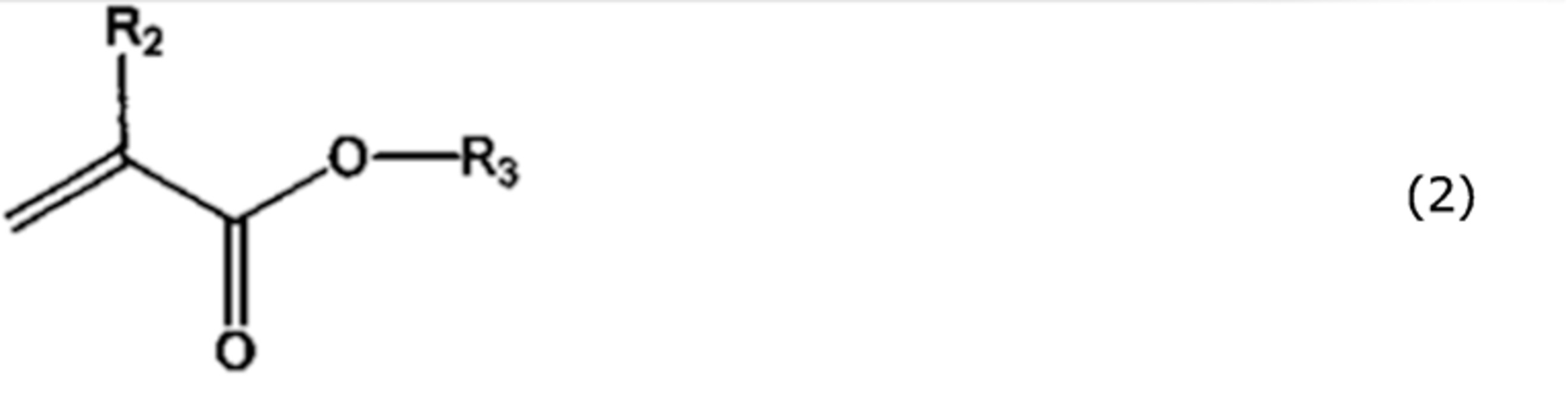
R3は炭素数1~12のアルキル基であって、炭素数1~8のアルキル基であることがより好ましい。
上記式(2)で表される疎水性モノマーは、アクリル酸誘導体またはメタクリル酸誘導体であることが好ましく、例えば、アクリル酸メチル、アクリル酸エチル、アクリル酸プロピル、アクリル酸ブチル、アクリル酸ペンチル、アクリル酸ヘキシル、アクリル酸へプチル、アクリル酸オクチル、アクリル酸デシル、アクリル酸ドデシル、メタクリル酸メチル、メタクリル酸エチル、メタクリル酸プロピル、メタクリル酸ブチル、メタクリル酸ペンチル、メタクリル酸ヘキシル、メタクリル酸へプチル、メタクリル酸オクチル、メタクリル酸デシル、メタクリル酸ドデシル等を用いることができる。このうち、メタクリル酸メチル(別名:メチルメタクリレート)、メタクリル酸ブチル(別名:ブチルメタクリレート)、メタクリル酸オクチルが特に好適である。
これらの疎水性モノマーは汎用原料であり、一般工業原料としても容易に入手することができる。例えば、Aldrich社もしくは東京化成社から市販されている市販品を用いてもよい。
これらの疎水性モノマーは汎用原料であり、一般工業原料としても容易に入手することができる。例えば、Aldrich社もしくは東京化成社から市販されている市販品を用いてもよい。
式(3)で示される架橋性モノマーは、市販品あるいは工業用原料として入手が可能である。この架橋性モノマーは疎水性であることが好ましい。
mの値は0~2であることが好ましい。具体的には、Aldrich社から発売されているエチレングリコールジメタクリレート(以下、EGDMAと略すことがある)、日油社から発売されているブレンマー(登録商標)PDE-50等を用いることが好ましい。
mの値は0~2であることが好ましい。具体的には、Aldrich社から発売されているエチレングリコールジメタクリレート(以下、EGDMAと略すことがある)、日油社から発売されているブレンマー(登録商標)PDE-50等を用いることが好ましい。

R4とR5はそれぞれ独立に炭素数1~3のアルキル基を表し、mは0~2の数である。
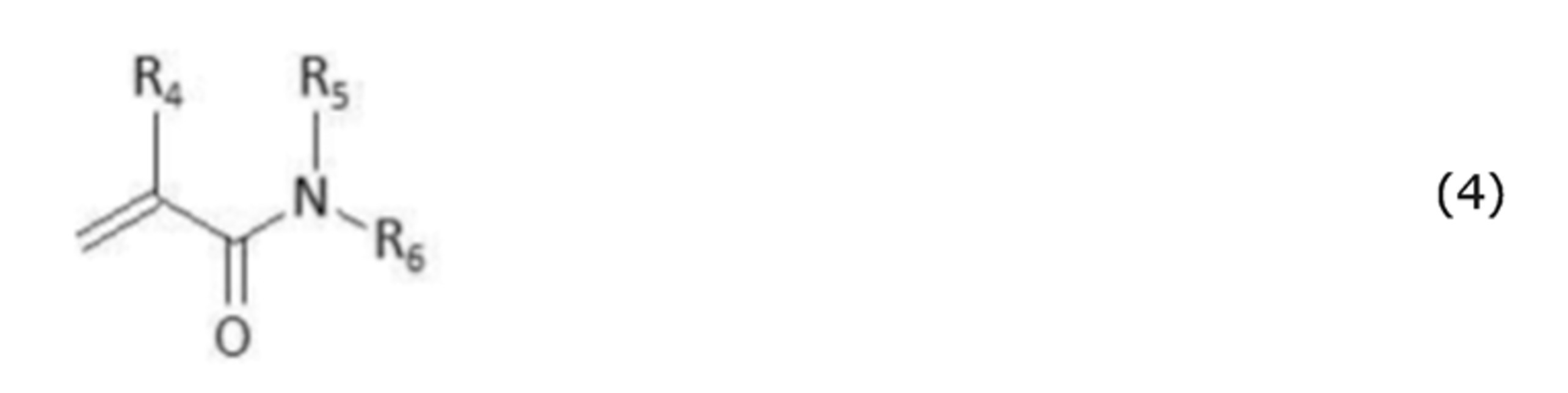
R6はHまたは炭素数1~3のアルキル基を表し、R7及びR8はHまたは炭素数1~12のアルキル基を含む置換基を表す。
上記式(4)で表される疎水性モノマーは、アクリルアミド誘導体またはメタクリルアミド誘導体であることが好ましい。例えば、t-ブチルアクリルアミド、N,N-ジメチルアクリルアミド、N-[3-(ジメチルアミノ)プロピル]アクリルアミド、t-ブチルメタクリルアミド、オクチルアクリルアミド、オクチルメタクリルアミド、オクタデシルアクリルアミド等を好適に用いることができる。このうち、t-ブチルアクリルアミド、N,N-ジメチルアクリルアミド、N-[3-(ジメチルアミノ)プロピル]アクリルアミドが特に好適である。
これらの疎水性モノマーは、市販品あるいは工業用原料として入手が可能である。
これらの疎水性モノマーは、市販品あるいは工業用原料として入手が可能である。
本発明にかかる式(1)~(3)で示されるコア-コロナ型ミクロゲルは、以下の(A)~(E)の条件で、上記モノマーをラジカル重合したものである。
(A)前記ポリエチレンオキシドマクロモノマーの仕込みモル量/前記疎水性モノマーの仕込みモル量で表されるモル比が1:10~1:250であること。
(B)前記架橋性モノマーの仕込み量が、前記疎水性モノマーの仕込み量に対して、0.1~1.5質量%であること。
(C)式(2)で示される疎水性モノマーは、炭素数1~8のアルキル基を有するメタクリル酸誘導体の1種又は2種以上を混合したモノマー組成であること。
(D)重合溶媒が水-有機溶媒の混合溶媒であり、有機溶媒としてポリオールを用いる場合には、ジプロピレングリコール、1,3-ブチレングリコール、イソプレングリコールから選択される1種または2種以上であること。
(E)水-有機溶媒の混合溶媒の溶媒組成が、20℃の質量比で、水:有機溶媒=90~10:10~90であること。
(A)前記ポリエチレンオキシドマクロモノマーの仕込みモル量/前記疎水性モノマーの仕込みモル量で表されるモル比が1:10~1:250であること。
(B)前記架橋性モノマーの仕込み量が、前記疎水性モノマーの仕込み量に対して、0.1~1.5質量%であること。
(C)式(2)で示される疎水性モノマーは、炭素数1~8のアルキル基を有するメタクリル酸誘導体の1種又は2種以上を混合したモノマー組成であること。
(D)重合溶媒が水-有機溶媒の混合溶媒であり、有機溶媒としてポリオールを用いる場合には、ジプロピレングリコール、1,3-ブチレングリコール、イソプレングリコールから選択される1種または2種以上であること。
(E)水-有機溶媒の混合溶媒の溶媒組成が、20℃の質量比で、水:有機溶媒=90~10:10~90であること。
なお、本発明において「前記疎水性モノマーの仕込み量に対する、前記架橋性モノマーの仕込み量」を、架橋密度(質量%)と定義する。本発明に用いるコア-コロナ型ミクロゲルの架橋密度は、(B)の条件により、前記架橋性モノマーの仕込み量が、前記疎水性モノマーの仕込み量に対して、0.1~1.5質量%でなければならない。
(条件(A))
ポリエチレンオキサイドマクロモノマーと疎水性モノマーの仕込みモル量は、ポリエチレンオキサイドマクロモノマー:疎水性モノマー=1:10~1:250(モル比)の範囲で重合可能である。前記仕込みモル量は、1:10~1:200が好ましく、1:25~1:100がより好ましい。
ポリエチレンオキサイドマクロモノマーのモル量に対して疎水性モノマーのモル量が10倍以下になると、重合されるポリマーは水溶性になりコア-コロナ型ポリマーミクロゲルは形成しない。またポリエチレンオキサイドマクロモノマーのモル量に対して疎水性モノマーのモル量が250倍以上になるとポリエチレンオキサイドマクロモノマーによる分散安定化が不完全になり不溶性の疎水性モノマーによる疎水性ポリマーが凝集、沈殿する。
ポリエチレンオキサイドマクロモノマーと疎水性モノマーの仕込みモル量は、ポリエチレンオキサイドマクロモノマー:疎水性モノマー=1:10~1:250(モル比)の範囲で重合可能である。前記仕込みモル量は、1:10~1:200が好ましく、1:25~1:100がより好ましい。
ポリエチレンオキサイドマクロモノマーのモル量に対して疎水性モノマーのモル量が10倍以下になると、重合されるポリマーは水溶性になりコア-コロナ型ポリマーミクロゲルは形成しない。またポリエチレンオキサイドマクロモノマーのモル量に対して疎水性モノマーのモル量が250倍以上になるとポリエチレンオキサイドマクロモノマーによる分散安定化が不完全になり不溶性の疎水性モノマーによる疎水性ポリマーが凝集、沈殿する。
(条件(B))
架橋性モノマーを共重合することでコア部分の疎水性ポリマーが架橋されたミクロゲルを重合することができる。
架橋性モノマーの仕込み量が疎水性モノマーの仕込み量の0.1質量%未満であると、架橋密度が低く、ミクロゲルは膨潤時に崩壊してしまう。また仕込み量が1.5質量%を上回ると、ミクロゲル粒子同士の凝集が生じ、粒度分布の狭い好適なミクロゲル粒子を重合することはできない。架橋性モノマーの仕込み量は、0.2~1.0が好ましく、0.2~0.8がより好ましく、0.2~0.5質量%が最も好ましい。
架橋性モノマーを共重合することでコア部分の疎水性ポリマーが架橋されたミクロゲルを重合することができる。
架橋性モノマーの仕込み量が疎水性モノマーの仕込み量の0.1質量%未満であると、架橋密度が低く、ミクロゲルは膨潤時に崩壊してしまう。また仕込み量が1.5質量%を上回ると、ミクロゲル粒子同士の凝集が生じ、粒度分布の狭い好適なミクロゲル粒子を重合することはできない。架橋性モノマーの仕込み量は、0.2~1.0が好ましく、0.2~0.8がより好ましく、0.2~0.5質量%が最も好ましい。
(条件(C))
式(2)で示される疎水性モノマーは、炭素数1~8のアルキル基を有するメタクリル酸誘導体の1種または2種以上を混合したモノマー組成であることが必要である。炭素数が0である(末端エステル結合がないモノマーである)と、モノマーが親水的すぎてうまく乳化重合をすることができない場合がある。一方、炭素数が9以上であると、重合の際の立体障害となり、うまく架橋構造を構築できない場合がある。
式(2)で示される疎水性モノマーは、炭素数1~8のアルキル基を有するメタクリル酸誘導体の1種または2種以上を混合したモノマー組成であることが必要である。炭素数が0である(末端エステル結合がないモノマーである)と、モノマーが親水的すぎてうまく乳化重合をすることができない場合がある。一方、炭素数が9以上であると、重合の際の立体障害となり、うまく架橋構造を構築できない場合がある。
(条件(D))
重合溶媒は、水-有機溶媒の混合溶媒であることが必要である。有機溶媒としては、エタノール、プロパノール、ブタノール、ポリオールなどを用いることができるが、ポリオールを用いる場合には、式(2)で示される疎水性モノマーおよび式(3)で示される架橋性モノマーを溶解できるものが好ましい。本発明に用いられるポリオールとしては、ジプロピレングリコール、1,3-ブチレングリコール、イソプレングリコールであることが必要である。
工業的に製造可能である、すなわち透析等の精製工程を要さず重合液をそのまま原料体として用いることを考えた場合、水と混合する溶媒はエタノールやプロパノール、ブタノール等、肌への塗布時に刺激性が懸念される有機溶剤ではなく、汎用的に化粧料へ配合できるポリオールであることが好適である。
重合溶媒は、水-有機溶媒の混合溶媒であることが必要である。有機溶媒としては、エタノール、プロパノール、ブタノール、ポリオールなどを用いることができるが、ポリオールを用いる場合には、式(2)で示される疎水性モノマーおよび式(3)で示される架橋性モノマーを溶解できるものが好ましい。本発明に用いられるポリオールとしては、ジプロピレングリコール、1,3-ブチレングリコール、イソプレングリコールであることが必要である。
工業的に製造可能である、すなわち透析等の精製工程を要さず重合液をそのまま原料体として用いることを考えた場合、水と混合する溶媒はエタノールやプロパノール、ブタノール等、肌への塗布時に刺激性が懸念される有機溶剤ではなく、汎用的に化粧料へ配合できるポリオールであることが好適である。
(条件(E))
重合溶媒である水-有機溶媒の混合溶媒の溶媒組成は、20℃の質量比で、水:有機溶媒=90~10:10~90であることが必要である。水-有機溶媒の混合溶媒の溶媒組成が、水:有機溶媒=90~10:10~90(20℃の容積比)であることが好ましく、水:有機溶媒=80~20:20~80(20℃の容積比)であることがより好ましい。
重合溶媒は疎水性モノマーを均一溶解するために有機溶媒を加えることが必要である。有機溶媒の混合比は10~90容量比である。有機溶媒の混合比が10容量比より低い場合は疎水性モノマーの溶解能が極めて低くなり、モノマー滴状態で重合が進行し巨大塊となり、ミクロゲルが生成しない。また有機溶媒の混合比が90容量比を上回ると、疎水性相互作用による疎水性モノマーのエマルションが生成せず、乳化重合が進行せずミクロゲルは得られない。
重合溶媒である水-有機溶媒の混合溶媒の溶媒組成は、20℃の質量比で、水:有機溶媒=90~10:10~90であることが必要である。水-有機溶媒の混合溶媒の溶媒組成が、水:有機溶媒=90~10:10~90(20℃の容積比)であることが好ましく、水:有機溶媒=80~20:20~80(20℃の容積比)であることがより好ましい。
重合溶媒は疎水性モノマーを均一溶解するために有機溶媒を加えることが必要である。有機溶媒の混合比は10~90容量比である。有機溶媒の混合比が10容量比より低い場合は疎水性モノマーの溶解能が極めて低くなり、モノマー滴状態で重合が進行し巨大塊となり、ミクロゲルが生成しない。また有機溶媒の混合比が90容量比を上回ると、疎水性相互作用による疎水性モノマーのエマルションが生成せず、乳化重合が進行せずミクロゲルは得られない。
本発明にかかる式(1)、(2)、(4)で示されるコア-コロナ型ミクロゲルは、以下の(A)’~(E)’の条件で、上記モノマーをラジカル重合したものである。
(A)’前記ポリエチレンオキサイドマクロモノマーの仕込みモル量/(前記アクリレート誘導体モノマー及び/またはアクリルアミド誘導体モノマー)の仕込みモル量で表されるモル比が1:10~1:250であること。
(B)’下記式(1)で示されるマクロモノマーは、繰り返し単位が8~200のポリエチレングリコール基を有するアクリル酸誘導体またはメタクリル酸誘導体であり、
下記式(2)で示されるアクリレート誘導体モノマーは、炭素数1~12のアルキル基を含む置換基を有するアクリル酸誘導体またはメタクリル酸誘導体であり、
下記式(3)で示されるアクリルアミド誘導体モノマーは、炭素数1~12のアルキル基を含む置換基を有するアクリルアミド誘導体またはメタクリルアミド誘導体であること、
(C)’重合溶媒が水-アルコール混合溶媒であり、アルコールがジプロピレングリコール、1,3-ブチレングリコール、イソプレングリコールから選択される1種または2種以上であること。
(D)’水-アルコール混合溶媒の溶媒組成が、20℃の質量比で、水:アルコール=90~10:10~90であること。
(A)’前記ポリエチレンオキサイドマクロモノマーの仕込みモル量/(前記アクリレート誘導体モノマー及び/またはアクリルアミド誘導体モノマー)の仕込みモル量で表されるモル比が1:10~1:250であること。
(B)’下記式(1)で示されるマクロモノマーは、繰り返し単位が8~200のポリエチレングリコール基を有するアクリル酸誘導体またはメタクリル酸誘導体であり、
下記式(2)で示されるアクリレート誘導体モノマーは、炭素数1~12のアルキル基を含む置換基を有するアクリル酸誘導体またはメタクリル酸誘導体であり、
下記式(3)で示されるアクリルアミド誘導体モノマーは、炭素数1~12のアルキル基を含む置換基を有するアクリルアミド誘導体またはメタクリルアミド誘導体であること、
(C)’重合溶媒が水-アルコール混合溶媒であり、アルコールがジプロピレングリコール、1,3-ブチレングリコール、イソプレングリコールから選択される1種または2種以上であること。
(D)’水-アルコール混合溶媒の溶媒組成が、20℃の質量比で、水:アルコール=90~10:10~90であること。
以下に、各条件についてさらに詳述する。
(条件(A)’)
前記ポリエチレンオキサイドマクロモノマーと、前記疎水性モノマー(すなわち、アクリレート誘導体モノマー及び/またはアクリルアミド誘導体モノマーの総和)の仕込みモル量は、ポリエチレンオキサイドマクロモノマー:疎水性モノマー=1:10~1:250(モル比)の範囲内で重合可能である。前記仕込みモル量は、1:10~1:200が好ましく、1:25~1:100がより好ましい。
ポリエチレンオキサイドマクロモノマーのモル量に対する疎水性モノマーのモル量が10倍未満になると、重合されるポリマーは水溶性になり、コア-コロナ型の粒子は形成しない。また、ポリエチレンオキサイドマクロモノマーのモル量に対する疎水性モノマーのモル量が250倍以上になると、ポリエチレンオキサイドマクロモノマーによる分散安定化が不完全になり、不溶性の疎水性モノマーによる疎水性ポリマーが凝集、沈殿する。
(条件(A)’)
前記ポリエチレンオキサイドマクロモノマーと、前記疎水性モノマー(すなわち、アクリレート誘導体モノマー及び/またはアクリルアミド誘導体モノマーの総和)の仕込みモル量は、ポリエチレンオキサイドマクロモノマー:疎水性モノマー=1:10~1:250(モル比)の範囲内で重合可能である。前記仕込みモル量は、1:10~1:200が好ましく、1:25~1:100がより好ましい。
ポリエチレンオキサイドマクロモノマーのモル量に対する疎水性モノマーのモル量が10倍未満になると、重合されるポリマーは水溶性になり、コア-コロナ型の粒子は形成しない。また、ポリエチレンオキサイドマクロモノマーのモル量に対する疎水性モノマーのモル量が250倍以上になると、ポリエチレンオキサイドマクロモノマーによる分散安定化が不完全になり、不溶性の疎水性モノマーによる疎水性ポリマーが凝集、沈殿する。
(条件(B)’)
条件(B)’は、下記(B-1)’~(B-3)’の3条件からなる。
(B-1)’
式(1)で表されるマクロモノマーは、繰り返し単位が8~200のポリエチレングリコール基を有するアクリル酸誘導体またはメタクリル酸誘導体である。繰り返し単位が7以下であると、溶媒に安定分散した粒子が得られない場合があり、200を超えると、粒子が微細化し化粧料に配合した際に不安定になる場合がある。
(B-2)’
前記式(2)で示されるアクリレート誘導体モノマーは、炭素数1~12のアルキル基を含む置換基を有するアクリル酸誘導体またはメタクリル酸誘導体である。炭素数が0である(末端エステル結合がないモノマーである)と、モノマーが親水的すぎてうまく乳化重合をすることができない場合がある。一方、炭素数が13以上であると好ましい使用感が得られない場合がある。
(B-3)’
前記式(3)で示されるアクリルアミド誘導体モノマーは、炭素数1~18のアルキル基を含む置換基を有するアクリルアミド誘導体またはメタクリルアミド誘導体である。
条件(B)’は、下記(B-1)’~(B-3)’の3条件からなる。
(B-1)’
式(1)で表されるマクロモノマーは、繰り返し単位が8~200のポリエチレングリコール基を有するアクリル酸誘導体またはメタクリル酸誘導体である。繰り返し単位が7以下であると、溶媒に安定分散した粒子が得られない場合があり、200を超えると、粒子が微細化し化粧料に配合した際に不安定になる場合がある。
(B-2)’
前記式(2)で示されるアクリレート誘導体モノマーは、炭素数1~12のアルキル基を含む置換基を有するアクリル酸誘導体またはメタクリル酸誘導体である。炭素数が0である(末端エステル結合がないモノマーである)と、モノマーが親水的すぎてうまく乳化重合をすることができない場合がある。一方、炭素数が13以上であると好ましい使用感が得られない場合がある。
(B-3)’
前記式(3)で示されるアクリルアミド誘導体モノマーは、炭素数1~18のアルキル基を含む置換基を有するアクリルアミド誘導体またはメタクリルアミド誘導体である。
本発明にかかる疎水性モノマーは、上記式(2)で表されるアクリレート誘導体モノマー及び式(3)で表されるアクリルアミド誘導体モノマーから選ばれる1種または2種以上を混合したモノマー組成であることが必要である。
本発明においては、疎水性モノマーとして、メチルメタクリレート及びブチルメタクリレートの2種類、または、メチルメタクリレート、t-ブチルアクリルアミド、N,N-ジメチルアクリルアミド、及びN-[3-(ジメチルアミノ)プロピル]アクリルアミドの4種類を用いることが特に好ましい。これらの疎水性モノマーの組み合わせにおいて、さらに、マクロモノマーとしてメトキシポリエチレングリコールモノメタクリレートを用いることが好適である。
これによって限定されるものではないが、本発明において最も好ましいマクロモノマー及び疎水性モノマーの組み合わせとして、
・ポリエチレングリコール基の繰り返し単位が8~90、最も好ましくは15であるメトキシポリエチレングリコールモノメタクリレート、メチルメタクリレート、及びブチルメタクリレート、
・ポリエチレングリコール基の繰り返し単位が8~200、最も好ましくは90であるメトキシポリエチレングリコールモノメタクリレート、メチルメタクリレート、ブチルメタクリレート、t-ブチルアクリルアミド、N,N-ジメチルアクリルアミド、及びN-[3-(ジメチルアミノ)プロピル]アクリルアミド、t-ブチルメタクリルアミド、オクチルアクリルアミド、オクチルメタクリルアミド、オクタデシルアクリルアミドが挙げられる。
これによって限定されるものではないが、本発明において最も好ましいマクロモノマー及び疎水性モノマーの組み合わせとして、
・ポリエチレングリコール基の繰り返し単位が8~90、最も好ましくは15であるメトキシポリエチレングリコールモノメタクリレート、メチルメタクリレート、及びブチルメタクリレート、
・ポリエチレングリコール基の繰り返し単位が8~200、最も好ましくは90であるメトキシポリエチレングリコールモノメタクリレート、メチルメタクリレート、ブチルメタクリレート、t-ブチルアクリルアミド、N,N-ジメチルアクリルアミド、及びN-[3-(ジメチルアミノ)プロピル]アクリルアミド、t-ブチルメタクリルアミド、オクチルアクリルアミド、オクチルメタクリルアミド、オクタデシルアクリルアミドが挙げられる。
(条件(C))’
重合溶媒は、水-アルコール混合溶媒であることが必要である。アルコールとしては、式(2)及び(3)で示される疎水性モノマーを溶解できるものが好ましい。よって、ジプロピレングリコール、1,3-ブチレングリコール、イソプレングリコールから選択される1種または2種以上が好適である。
重合溶媒は、水-アルコール混合溶媒であることが必要である。アルコールとしては、式(2)及び(3)で示される疎水性モノマーを溶解できるものが好ましい。よって、ジプロピレングリコール、1,3-ブチレングリコール、イソプレングリコールから選択される1種または2種以上が好適である。
(条件(D))’
重合溶媒である水-アルコール混合溶媒の溶媒組成は、20℃の質量比で、水:アルコール=90~10:10~90であることが好ましく、さらに好ましくは水:アルコール=80~20:20~80である。アルコールの混合比が10容量比より低い場合には、疎水性モノマーの溶解能が極めて低くなり、ミクロ粒子が生成しない場合がある。また、アルコールの混合比が90容量比を上回る場合には、疎水性相互作用による疎水性モノマーのエマルションが生成せず、乳化重合が進行せずミクロ粒子が得られない場合がある。
重合溶媒である水-アルコール混合溶媒の溶媒組成は、20℃の質量比で、水:アルコール=90~10:10~90であることが好ましく、さらに好ましくは水:アルコール=80~20:20~80である。アルコールの混合比が10容量比より低い場合には、疎水性モノマーの溶解能が極めて低くなり、ミクロ粒子が生成しない場合がある。また、アルコールの混合比が90容量比を上回る場合には、疎水性相互作用による疎水性モノマーのエマルションが生成せず、乳化重合が進行せずミクロ粒子が得られない場合がある。
ポリオールを用いて得られた本発明にかかるコア-コロナ型ミクロゲルは、重合溶媒が水-ポリオール混合溶媒であって、エタノールを含まず、敏感肌のユーザーにも皮膚刺激性のない化粧料を簡便に得ることができる。
重合系に用いられる重合開始剤は、通常の水溶性熱ラジカル重合に用いられる市販の重合開始剤を用いることが出来る。この重合系では特に攪拌条件を厳密にコントロールすることなく重合を行っても、重合されるミクロゲル粒子の粒度分布は非常に狭いものを得ることができる。
なお、従来の合成高分子によるミクロゲルは、いずれも高分子電解質、例えばポリアクリル酸を応用したものであり、その水への分散性に耐酸性や耐塩性がないものであった。しかしながら、医薬品や化粧料の配合成分として応用を考える際、生理的条件下での適応においては耐酸性や耐塩性は非常に重要な性能である。本発明にかかるコア-コロナ型ミクロゲルは、非イオン性高分子であるポリエチレンオキサイド鎖で安定化されたミクロゲルであり、その水中での分散安定性は耐酸性や耐塩性が期待できる。
本発明で使用するミクロゲルは、親水性マクロモノマーと疎水性モノマーとが溶媒中にて秩序化が起り、粒子径がほぼ一定で、かつコア部分が架橋されたコア-コロナ型高分子ミクロゲルが生成すると考えられる。
本発明で使用するミクロゲルは、親水性マクロモノマーと疎水性モノマーとが溶媒中にて秩序化が起り、粒子径がほぼ一定で、かつコア部分が架橋されたコア-コロナ型高分子ミクロゲルが生成すると考えられる。
水中油型化粧料における本発明のコア-コロナ型ミクロゲルの配合量(純分 以下、単に%で示す)は、水中油型乳化化粧料中0.01~9質量%であることが好ましい。コア-コロナ型ミクロゲルの配合量が0.01質量%未満では、耐水性が得られない場合がある。配合量が 9質量%を超えると、高温条件下での長期保存において安定性の観点から組成物として好ましくない場合や、使用感に劣る場合がある。
また、その他水相成分としては、通常化粧料、医薬部外品等に使用される水、水溶性アルコール、増粘剤等を配合することができ、さらに所望に応じて、保湿剤、キレート剤、防腐剤、色素等を適宜配合することができる。
本発明の水中油型乳化化粧料に含まれる水は特に限定されず、例えば、精製水、イオン交換水、水道水等が挙げられる。
水溶性アルコールとしては、例えば、低級アルコール、多価アルコール、多価アルコール重合体、2価のアルコールアルキルエーテル類、2価アルコールアルキルエーテル類、2価アルコールエーテルエステル、グリセリンモノアルキルエーテル、糖アルコール、単糖、オリゴ糖、多糖およびそれらの誘導体等が挙げられる。
低級アルコールとしては、例えば、エタノール、プロパノール、イソプロパノール、イソブチルアルコール、t-ブチルアルコール等が挙げられる。
多価アルコールとしては、例えば、2価アルコール(例えば、ジプロピレングリコール、1,3-ブチレングリコール、エチレングリコール、トリメチレングリコール、1,2-ブチレングリコール、テトラメチレングリコール、2,3-ブチレングリコール、ペンタメチレングリコール、2-ブテン-1,4-ジオール、ヘキシレングリコール、オクチレングリコール等)、3価アルコール(例えば、グリセリン、トリメチロールプロパン等)、4価アルコール(例えば、ジグリセリン、1,2,6-ヘキサントリオール等のペンタエリスリトール等)、5価アルコール(例えば、キシリトール、トリグリセリン等)、6価アルコール(例えば、ソルビトール、マンニトール等)、多価アルコール重合体(例えば、ジエチレングリコール、ジプロピレングリコールートリエチレングリコール、ポリプロピレングリコール、テトラエチレングリコール、ジグリセリンートリグリセリン、テトラグリセリン、ポリグリセリン等)、2価のアルコールアルキルエーテル類(例えば、エチレングリコールモノメチルエーテル、エチレングリコールモノエチルエーテル、エチレングリコールモノブチルエーテル、エチレングリコールモノフェニルエーテル、エチレングリコールモノヘキシルエーテル、エチレングリコールモノ2-メチルヘキシルエーテル、エチレングリコールイソアミルエーテル、エチレングリコールベンジルエーテル、エチレングリコールイソプロピルエーテル、エチレングリコールジメチルエーテル、エチレングリコールジエチルエーテル、エチレングリコールジブチルエーテル等)、2価アルコールアルキルエーテル類(例えば、ジエチレングリコールモノメチルエーテル、ジエチレングリコールモノエチルエーテル、ジエチレングリコールモノブチルエーテル、ジエチレングリコールジメチルエーテル、ジエチレングリコールジエチルエーテル、ジエチレングリコールブチルエーテル、ジエチレングリコールメチルエチルエーテルトリエチレングリコールモノメチルエーテルトリエチレングリコールモノエチルエーテル、プロピレングリコールモノメチルエーテル、プロピレングリコールモノエチルエーテル、プロピレングリコールモノブチルエーテル、プロピレングリコールイソプロピルエーテル、ジプロピレングリコールメチルエーテル、ジプロピレングリコールエチルエーテル、ジプロピレングリコールブチルエーテル等)、2価アルコールエーテルエステル(例えば、エチレングリコールモノメチルエーテルアセテート、エチレングリコールモノエチルエーテルアセテート、エチレングリコールモノブチルエーテルアセテート、エチレングリコールモノフェニルエーテルアセテート、エチレングリコールジアジベート、エチレングリコールジサクシネート、ジエチレングリコールモノエチルエーテルアセテート、ジエチレングリコールモノブチルエーテルアセテート、プロピレングリコールモノメチルエーテルアセテート、プロピレングリコールモノエチルエーテルアセテート、プロピレングリコールモノプロピルエーテルアセテート、プロピレングリコールモノフェニルエーテルアセテート等)、グリセリンモノアルキルエーテル(例えば、キシルアルコール、セラキルアルコール、バチルアルコール等)、糖アルコール(例えば、マルトトリオ-ス、マンニトール、ショ糖、エリトリトール、グルコ-ス、フルクト-ス、デンプン分解糖、マルト-ス、デンプン分解糖還元アルコール等)、グリソリッド、テトラハイドロフルフリルアルコール、POE-テトラハイドロフルフリルアルコール、POP-ブチルエーテル、POP・POE-ブチルエーテルトリポリオキシプロピレングリセリンエーテル、POP-グリセリンエーテル、POP-グリセリンエーテルリン酸、POP・POE-ペンタンエリスリトールエーテル、ポリグリセリン等が挙げられる。
単糖としては、例えば、三炭糖(例えば、D-グリセリルアルデヒド、ジヒドロキシアセトン等)、四炭糖(例えば、D-エリトロ-ス、D-エリトルロ-ス、Dートレオ-ス、エリスリトール等)、五炭糖(例えば、L-アラビノ-ス、D-キシロ-ス、L-リキソ-ス、D-アラビノ-ス、D-リボ-ス、D-リブロ-ス、D-キシルロ-ス、L-キシルロ-ス等)、六炭糖(例えば、D-グルコ-ス、D-タロ-ス、D-ブシコ-ス、D-ガラクト-ス、D-フルクト-ス、L-ガラクト-ス、L-マンノ-ス、D-タガト-ス等)、七炭糖(例えば、アルドヘプト-ス、ヘプロ-ス等)、八炭糖(例えば、オクツロ-ス等)、デオキシ糖(例えば、2-デオキシ-D-リボ-ス、6-デオキシ-L-ガラクト-ス、6-デオキシ-L-マンノ-ス等)、アミノ糖(例えば、D-グルコサミン、D-ガラクトサミン、シアル酸、アミノウロン酸、ムラミン酸等)、ウロン酸(例えば、D-グルクロン酸、D-マンヌロン酸、L-グルロン酸、D-ガラクツロン酸、L-イズロン酸等)等が挙げられる。
オリゴ糖としては、例えば、ショ糖、グンチアノース、ウンベリフェロース、ラクトース、プランテオース、イソリクノース類、α,α-トレハロース、ラフィノース、リクノース類、ウンビリシン、スタキオースベルバスコース類等が挙げられる。
多糖としては、例えば、セルロース、クインスシード、デンプン、ガラクタン、デルマタン硫酸、グリコーゲン、アラビアガム、ヘパラン硫酸-トラガントガム、ケラタン硫酸、コンドロイチン、キサンタンガム、グアガム、デキストラン、ケラト硫酸、ローカストビーンガム、サクシノグルカン等が挙げられる。
その他のポリオールとしては、例えば、ポリオキシエチレンメチルグルコシド(グルカムE-10)、ポリオキシプロピレンメチルグルコシド(グルカムP-10)等が挙げられる。
天然の水溶性高分子としては、例えば、植物系高分子(例えば、アラビアガム、トラガカントガム、ガラクタン、グアガム、キャロブガム、カラーヤガム、カラギーナン、ペクチン、カンテン、クインスシード(マルメロ)、アルゲコロイド(カッソウエキス)、デンプン(コメ、トウモロコシ、バレイショ、コムギ)、グリチルリチン酸)、微生物系高分子(例えば、キサンタンガム、デキストラン、サクシノグルカン、プルラン等)、動物系高分子(例えば、コラーゲン、カゼイン、アルブミン、ゼラチン等)等が挙げられる。
半合成の水溶性高分子としては、例えば、デンプン系高分子(例えば、カルボキシメチルデンプン、メチルヒドロキシプロピルデンプン等)、セルロース系高分子(メチルセルロース、エチルセルロース、メチルヒドロキシプロピルセルロース、ヒドロキシエチルセルロース、セルロース硫酸ナトリウム、ヒドロキシプロピルセルロース、カルボキシメチルセルロース、カルボキシメチルセルロースナトリウム、結晶セルロース、セルロース末等)、アルギン酸系高分子(例えば、アルギン酸ナトリウム、アルギン酸プロピレングリコールエステル等)等が挙げられる。
合成の水溶性高分子としては、例えば、ビニル系高分子(例えば、ポリビニルアルコール、ポリビニルメチルエーテル、ポリビニルピロリドン、カルボキシビニルポリマー等)、ポリオキシエチレン系高分子(例えば、ポリエチレングリコール20,000、40,000、60,000等)、アクリル系高分子(例えば、ポリアクリル酸ナトリウム、ポリエチルアクリレート、ポリアクリルアミド等)、ポリエチレンイミン、カチオンポリマー等が挙げられる。
保湿剤としては、例えば、コンドロイチン硫酸、ヒアルロン酸、ムコイチン硫酸、カロニン酸、アテロコラ-ゲン、コレステリル-12-ヒドロキシステアレート、乳酸ナトリウム、胆汁酸塩、DL-ピロリドンカルボン酸塩、短鎖可溶性コラーゲン、ジグリセリン(EO)PO付加物、イザヨイバラ抽出物、セイヨウノコギリソウ抽出物、メリロート抽出物等が挙げられる。
金属イオン封鎖剤としては、例えば、1-ヒドロキシエタン-1,1-ジフォスホン酸、1-ヒドロキシエタン-1,1-ジフォスホン酸四ナトリウム塩、エデト酸二ナトリウム、エデト酸三ナトリウム、エデト酸四ナトリウム、クエン酸ナトリウム、ポリリン酸ナトリウム、メタリン酸ナトリウム、グルコン酸、リン酸、クエン酸、アスコルビン酸、コハク酸、エデト酸、エチレンジアミンヒドロキシエチル三酢酸3ナトリウム等が挙げられる。
アミノ酸としては、例えば、中性アミノ酸(例えば、スレオニン、システイン等)、塩基性アミノ酸(例えば、ヒドロキシリジン等)等が挙げられる。また、アミノ酸誘導体として、例えば、アシルサルコシンナトリウム(ラウロイルサルコシンナトリウム)、アシルグルタミン酸塩、アシルβ-アラニンナトリウム、グルタチオン等が挙げられる。
pH調整剤としては、例えば、乳酸-乳酸ナトリウム、クエン酸-クエン酸ナトリウム、コハク酸-コハク酸ナトリウム等の緩衝剤等が挙げられる。
増粘剤としては、例えば、キサンタンガム、アラビアガム、カラギーナン、カラーヤガム、トラガカントガム、キャロブガム、クインスシード(マルメロ)、カゼイン、デキストリン、ゼラチン、ペクチン酸ナトリウム、アラギン酸ナトリウム、メチルセルロース、エチルセルロース、CMC、ヒドロキシエチルセルロース、ヒドロキシプロピルセルロース、PVA、PVM、PVP、ポリアクリル酸ナトリウム、カルボキシビニルポリマー、ローカストビーンガム、グアガム、タマリントガム、ジアルキルジメチルアンモニウム硫酸セルロース、ケイ酸アルミニウムマグネシウム、ベントナイト、ヘクトライト、ケイ酸A1Mg(ビーガム)、ラポナイト、無水ケイ酸等が挙げられる。
本発明において、安定性を考慮すると、増粘剤を0.01~5質量%配合することが好ましい。
香料としては、動物又は植物より得られる天然香料と、化学的合成手段によって製造される合成香料、及びそれらの混合物である調合香料が挙げられ、特に限定されない。香料を配合することで、香りの持続性に優れた化粧料を得ることができる。
香料としては、具体的には、アセチベノール、アニスアルデヒド、アネトール、アミルアセテート、アミルサリシレート、アリルアミルグリコレート、アリルカプロエート、アルデヒドC6~20、アンブレットライド、アンブレットリド、アンブロキサン、イオノン、イソイースーパー、オイゲノール、オウランチオール、ガラクソリド、カローン、クマリン、ゲラニオール、ゲラニルアセテート、サンダロア、サンタロール、サンデラ、シクラメンアルデヒド、シス-3-ヘキセニルアセテート、シス-3-ヘキセノール、シトラール、シトロネリルアセテート、シトロネロール、シネオール、ジハイドロミルセノール、ジャスモラクトン、シンナミックアルコール、シンナミックアルデヒド、スチラリルアセテート、セドリルアセテート、セドロール、ダマスコン、ダマセノン、デカラクトン、テルピニルアセテート、テルピネオール、トナリッド、トナリド、トリプラール、ネロール、バクダノール、バニリン、ヒドロキシシトロネラール、フェニルエチルアセテート、フェニルエチルアルコール、ヘキシルサリシレート、ベチベリルアセテート、ヘディオン、ヘリオトロピン、ヘリオナール、ベルトフィックス、ベンジルアセテート、ベンジルサリシレート、ベンジルベンゾエート、ペンタリッド、ペンタリド、ボルニルアセテート、マイオール、ムスクケトン、メチルアンスラニレート、メチルジヒドロジャスモネート、ヤラヤラ、ライムオキサイド、リナリルアセテート、リナロール、リモネン、リラール、リリアール、ローズオキサイド、ロジノール、アンジェリカオイル、アニスオイル、アルモアゼオイル、バジルオイル、ベイオイル、ベルガモットオイル、カラムスオイル、カンファーオイル、カナンガオイル、カルダモンオイル、カッシアオイル、セダーウッドオイル、セロリオイル、カモミールオイル、シナモンオイル、クローブオイル、コリアンダーオイル、クミンオイル、ディルオイル、エレミオイル、エストラゴンオイル、ユーカリオイル、フェンネルオイル、フェヌグリークオイル、ガルバナムオイル、ゼラニウムオイル、ジンジャーオイル、グレープフルーツオイル、ガヤックウッドオイル、ヒバオイル、ヒノキオイル、ジュニパーベリーオイル、ラバンジンオイル、ラベンダーオイル、レモンオイル、ライムオイル、マンダリンオイル、ジラムオイル、モミザオイル、ペパーミントオイル、スペアミントオイル、ミルオイル、ミルトルオイル、ナツメグオイル、オークモスオイル、オリバナムオイル、オポポナックスオイル、オレンジオイル、パセリオイル、パチュリオイル、ペッパーオイル、ペリラオイル、プチグレンオイル、ネロリオイル、オレンジフラワーオイル、ピメントオイル、オールスパイスオイル、パインオイル、ローズオイル、ローズマリーオイル、クラリセージオイル、セージオイル、サンダルウッドオイル、スチラックスオイル、タジェオイル、タイムオイル、チュベローズオイル、バレリアンオイル、ベチバーオイル、バイオレットリーフオイル、ウィンターグリーンオイル、ワームウッドオイル、イランイランオイル、ユズオイル、カッシーアブソリュート、ジュネアブソリュート、ヒヤシンスアブソリュート、インモルテルアブソリュート、ジャスミンアブソリュート、ジョンキルアブソリュート、ナルシスアブソリュート、ローズアブソリュート、バイオレットリーフアブソリュート、ベンベンゾイン等が挙げられる。
[その他の成分]
本発明にかかる組成物には、本発明の効果を損なわない範囲内で、通常化粧料や医薬部外品等に用いられる他の成分、例えば、紫外線吸収剤、粉末、有機アミン、高分子エマルジョン、ビタミン類、酸化防止剤等を適宜配合することができる。
本発明にかかる組成物には、本発明の効果を損なわない範囲内で、通常化粧料や医薬部外品等に用いられる他の成分、例えば、紫外線吸収剤、粉末、有機アミン、高分子エマルジョン、ビタミン類、酸化防止剤等を適宜配合することができる。
水溶性紫外線吸収剤としては、例えば2,4-ジヒドロキシベンゾフェノン、2,2’-ジヒドロキシ-4-メトキシベンゾフェノン、2,2’-ジヒドロキシ-4,4’-ジメトキシベンゾフェノン、2,2’,4,4’-テト*ラヒドロキシベンゾフェノン、2-ヒドロキシ-4-メトキシベンゾフェノン、2-ヒドロキシ-4-メトキシ-4’-メチルベンゾフェノン、2-ヒドロキシ-4-メトキシベンゾフェノン-5-スルホン酸塩、4-フェニルベンゾフェノン、2-エチルヘキシル-4’-フェニル-ベンゾフェノン-2-カルボキシレート、2-ヒドロキシ-4-n-オクトキシベンゾフェノン、4-ヒドロキシ-3-カルボキシベンゾフェノン等のベンゾフェノン系紫外線吸収剤、フェニルベンズイミダゾール-5-スルホン酸およびその塩、フェニレン-ビス-ベンゾイミダゾール-テトラスルホン酸およびその塩等のベンゾイミダゾール系紫外線吸収剤、3-(4’-メチルベンジリデン)-d,l-カンファー、3-ベンジリデン-d,l-カンファー、ウロカニン酸、ウロカニン酸エチルエステル等が挙げられる。
粉末成分としては、例えば、無機粉末(例えば、タルク、カオリン、雲母、絹雲母(セリサイト)、白雲母、金雲母、合成雲母、紅雲母、黒雲母、パーミキュライト、炭酸マグネシウム、炭酸カルシウム、ケイ酸アルミニウム、ケイ酸バリウム、ケイ酸カルシウム、ケイ酸マグネシウム、ケイ酸ストロンチウム、タングステン酸金属塩、マグネシウム、シリカ、ゼオライト、硫酸バリウム、焼成硫酸カルシウム(焼セッコウ)、リン酸カルシウム、弗素アパタイト、ヒドロキシアパタイト、セラミックパウダー、金属石鹸(例えば、ミリスチン酸亜鉛、パルミチン酸カルシウム、ステアリン酸アルミニウム)、窒化ホウ素等)、有機粉末(例えば、ポリアミド樹脂粉末(ナイロン粉末)、ポリエチレン粉末、ポリメタクリル酸メチル粉末、ポリスチレン粉末、スチレンとアクリル酸の共重合体樹脂粉末、ベンゾグアナミン樹脂粉末、ポリ四弗化エチレン粉末、セルロース粉末等)、無機白色顔料(例えば、二酸化チタン、酸化亜鉛等)、無機赤色系顔料(例えば、酸化鉄(ベンガラ)、チタン酸鉄等)、無機褐色系顔料(例えば、γ-酸化鉄等)、無機黄色系顔料(例えば、黄酸化鉄、黄土等)、無機黒色系顔料(例えば、黒酸化鉄、低次酸化チタン等)、無機紫色系顔料(例えば、マンゴバイオレット、コバルトバイオレット等)、無機緑色系顔料(例えば、酸化クロム、水酸化クロム、チタン酸コバルト等)、無機青色系顔料(例えば、群青、紺青等)、パール顔料(例えば、酸化チタンコ-テッドマイカ、酸化チタンコーテッドオキシ塩化ビスマス、酸化チタンコーテッドタルク、着色酸化チタンコーテッドマイカ、オキシ塩化ビスマス、魚鱗箔等)、金属粉末顔料(例えば、アルミニウムパウダー、カッパーパウダー等)、ジルコニウム、バリウム又はアルミニウムレ-キ等の有機顔料(例えば、赤色201号、赤色202号、赤色204号、赤色205号、赤色220号、赤色226号、赤色228号、赤色405号、橙色203号、橙色204号、黄色205号、黄色401号、及び青色404号等の有機顔料、赤色3号、赤色104号、赤色106号、赤色227号、赤色230号、赤色401号、赤色505号、橙色205号、黄色4号、黄色5号、黄色202号、黄色203号、緑色3号及び青色1号等)、天然色素(例えば、クロロフィル、β-カロチン等)等が挙げられる。
有機アミンとしては、例えば、モノエタノールアミン、ジエタノールアミン、トリエタノールアミン、モルホリン、テトラキス(2-ヒドロキシプロピル)エチレンジアミン、トリイソプロパノールアミン、2-アミノ-2-メチル-1,3-プロパンジオール、2-アミノ-2-メチル-1-プロパノール等が挙げられる。
高分子エマルジョンとしては、例えば、アクリル樹脂エマルジョン、ポリアクリル酸エチルエマルジョン、アクリルレジン液、ポリアクリルアルキルエステルエマルジョン、ポリ酢酸ビニル樹脂エマルジョン、天然ゴムラテックス等が挙げられる。
ビタミン類としては、例えば、ビタミンA、B1、B2、B6、C、E及びその誘導体、パントテン酸及びその誘導体、ビオチン等が挙げられる。
その他の配合可能成分としては、例えば、防腐剤(メチルパラベン、エチルパラベン、ブチルパラベン、フェノキシエタノール等)、消炎剤(例えば、グリチルリチン酸誘導体、グリチルレチン酸誘導体、サリチル酸誘導体、ヒノキチオール、酸化亜鉛、アラントイン等)、美白剤(例えば、胎盤抽出物、ユキノシタ抽出物、アルブチン等)、各種抽出物(例えば、オウバク、オウレン、シコン、シャクヤク、センブリ、バーチ、セージ、ビワ、ニンジン、アロエ、ゼニアオイ、アイリス、ブドウ、ヨクイニン、ヘチマ、ユリ、サフラン、センキュウ、ショウキュウ、オトギリソウ、オノニス、ニンニク、トウガラシ、チンピートキ、海藻等)、賦活剤(例えば、ローヤルゼリー、感光素、コレステロール誘導体等)、血行促進剤(例えば、ノニル酸ワレニルアミド、ニコチン酸ベンジルエステル、ニコチン酸β-ブトキシエチルエステル、カプサイシン、ジンゲロン、カンタリスチンキ、イクタモール、タンニン酸、α-ボルネオール、ニコチン酸トコフェロール、イノシトールヘキサニコチネート、シクランデレート、シンナリジン、トラゾリン、アセチルコリン、ベラパミル、セファランチン、γ-オリザノール等)、抗脂漏剤(例えば、硫黄、チアントール等)、抗炎症剤(例えば、トラネキサム酸、チオタウリン、ヒポタウリン等)等が挙げられる。
酸化防止剤としては、例えば、トコフェロール類、ジブチルヒドロキシトルエン、ブチルヒドロキシアニソール、没食子酸エステル類等が挙げられる。
酸化防止助剤としては、例えば、リン酸、クエン酸、アスコルビン酸、マレイン酸、マロン酸、コハク酸、フマル酸、ケファリン、ヘキサメタフォスフェイト、フィチン酸、エチレンジアミン四酢酸等が挙げられる。
酸化防止助剤としては、例えば、リン酸、クエン酸、アスコルビン酸、マレイン酸、マロン酸、コハク酸、フマル酸、ケファリン、ヘキサメタフォスフェイト、フィチン酸、エチレンジアミン四酢酸等が挙げられる。
本発明に係る水中油型化粧料は、配合する成分により、化粧水、美容液、パック、クレンジング、洗顔フォーム、ハンドクリーム、シャンプー、リンス、コンディショナー、トリートメント、ヘアマスク、ヘアワックス、ヘアクリーム、ヘアミスト、ヘアオイル、ヘアムース、日焼け止め等、任意の製品形態とすることができる。
高い耐水性を有するという点において、特に好ましくは、ポイントメーキャップ化粧料、ファンデーション、サンスクリーン化粧料などの皮膚化粧料として製品化することができる。
高い耐水性を有するという点において、特に好ましくは、ポイントメーキャップ化粧料、ファンデーション、サンスクリーン化粧料などの皮膚化粧料として製品化することができる。
以下、実施例を挙げて本発明について詳述するが、本発明はこれらにより何ら限定されるものではない。配合量は特記しない限り、その成分が配合される系に対する質量%で示す。また、特記しない限り、水溶液濃度を示している。
まず、以下の試験で用いた評価方法及び評価基準について説明する。
<使用感>
水中油型化粧料を、肌に塗布した際の使用感触(塗布中のみずみずしさ)について、10名の専門パネルにより下記の基準で評価した。
◎:10名中8名以上が、使用感触が良いと回答した。
○:10名中6名以上8名未満が、使用感触が良いと回答した。
△:10名中3名以上6名未満が、使用感触が良いと回答した。
×:10名中3名未満が、使用感触が良いと回答した。
<使用感>
水中油型化粧料を、肌に塗布した際の使用感触(塗布中のみずみずしさ)について、10名の専門パネルにより下記の基準で評価した。
◎:10名中8名以上が、使用感触が良いと回答した。
○:10名中6名以上8名未満が、使用感触が良いと回答した。
△:10名中3名以上6名未満が、使用感触が良いと回答した。
×:10名中3名未満が、使用感触が良いと回答した。
<耐水性>
表1~4の耐水性試験法
樹脂プレートにサンプルを2mg/cm2 塗布し、290~400nm のUV スペクトルを測定。そ
のプレートを水の入った20L 程度の容器壁面に両面テープで貼って、500rpm で30min
の水流にさらしたのち、再度スペクトルを同様に測定。水浴前後のスペクトルの積分値の
比率%を耐水性とし、100%であれば水浴5 してもまったく防御効果が低下しないことを示す
○:80%以上
×:80%未満
表1~4の耐水性試験法
樹脂プレートにサンプルを2mg/cm2 塗布し、290~400nm のUV スペクトルを測定。そ
のプレートを水の入った20L 程度の容器壁面に両面テープで貼って、500rpm で30min
の水流にさらしたのち、再度スペクトルを同様に測定。水浴前後のスペクトルの積分値の
比率%を耐水性とし、100%であれば水浴5 してもまったく防御効果が低下しないことを示す
○:80%以上
×:80%未満
<耐水性>
表5、6の耐水性試験法
水中油型化粧料を、タッピング試験法を用いて以下の基準で評価した。
◎:10名中8名以上が、使用感触が良いと回答した。
○:10名中6名以上8名未満が、使用感触が良いと回答した。
△:10名中3名以上6名未満が、使用感触が良いと回答した。
×:10名中3名未満が、使用感触が良いと回答した。
表5、6の耐水性試験法
水中油型化粧料を、タッピング試験法を用いて以下の基準で評価した。
◎:10名中8名以上が、使用感触が良いと回答した。
○:10名中6名以上8名未満が、使用感触が良いと回答した。
△:10名中3名以上6名未満が、使用感触が良いと回答した。
×:10名中3名未満が、使用感触が良いと回答した。
<安定性>
得られた水中油型化粧料を、50℃1か月経時保証を行った。
○:問題なし
△:やや油浮き
×:分離
得られた水中油型化粧料を、50℃1か月経時保証を行った。
○:問題なし
△:やや油浮き
×:分離
まず、本発明者らは、水中油型化粧料に、優れた耐水性を付与できないか検討した。本発明者らは、下記表1に示す各試料を、下記製造方法により水中油型化粧料を調製し、上記評価基準で評価した。結果を表1に示す。
(製造方法)
まず、水相成分である水、保湿剤、アルコール、中和剤、防腐剤、及び乳化剤を混合する。
紫外線防御剤を含む油性成分を混合する。
得られた油相を、前記水相に添加して、水相中の乳化剤により乳化して、水相中に乳化粒子を作る。
さらに、前記水相に、(b1)コアーコロナ型ミクロゲルを加えることで、本発明に係る乳化粒子を得た。
まず、水相成分である水、保湿剤、アルコール、中和剤、防腐剤、及び乳化剤を混合する。
紫外線防御剤を含む油性成分を混合する。
得られた油相を、前記水相に添加して、水相中の乳化剤により乳化して、水相中に乳化粒子を作る。
さらに、前記水相に、(b1)コアーコロナ型ミクロゲルを加えることで、本発明に係る乳化粒子を得た。
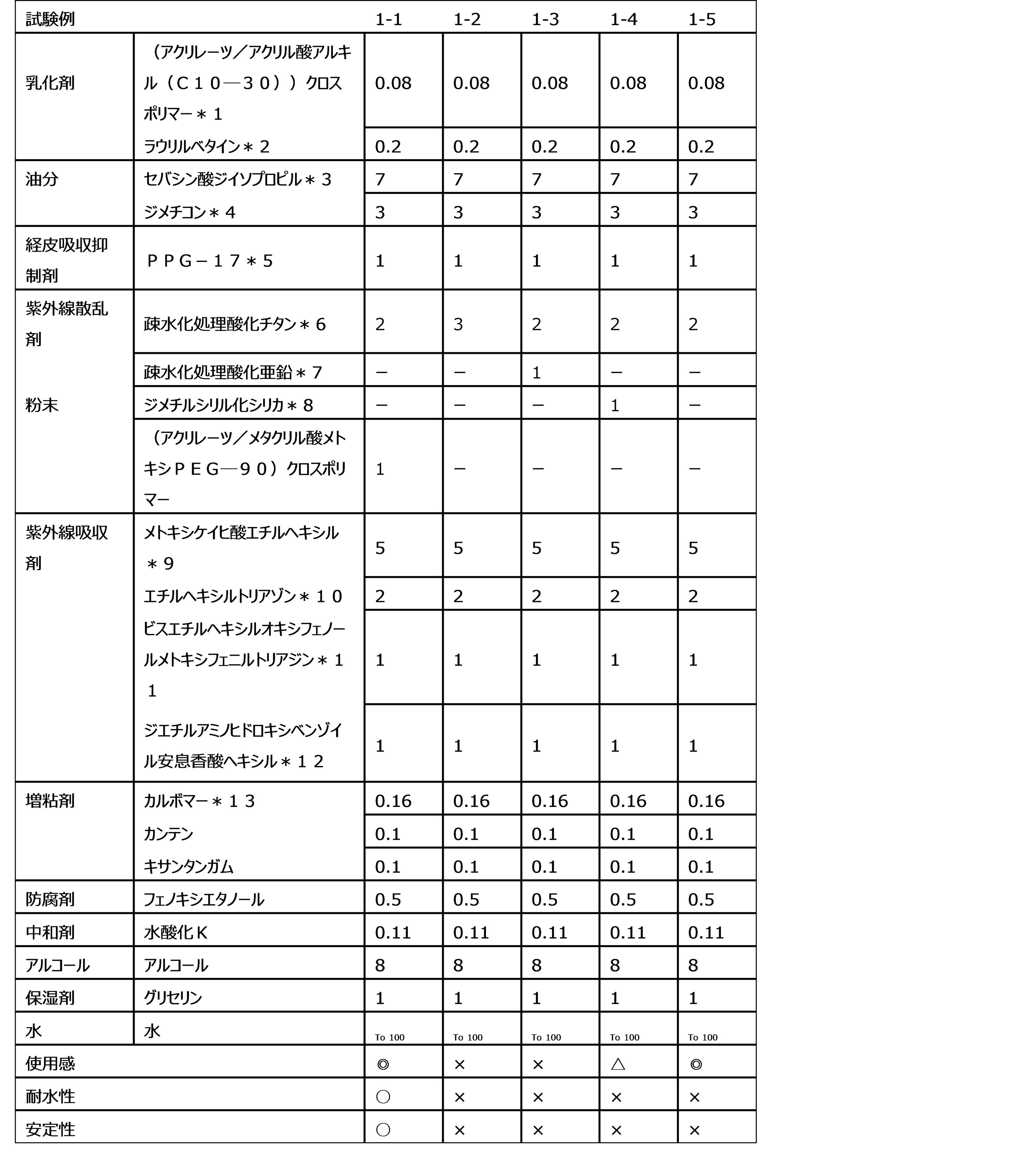
*1 PEMULEN TR-2
*2 アノン BL-SF
*3 エセラン 200
*4 シリコーンKF-96L-1.5CS
*5 PPG-1000
*6 OTQ-MT-100Si
*7 OTS-FZO-50
*8 アエロジル R972
*9 オクチル メトキシシンナメート
*10 ユビナール T150
*11 チノソーブ S
*12 ユビナール A プラス
*13 カーボポール 980
*2 アノン BL-SF
*3 エセラン 200
*4 シリコーンKF-96L-1.5CS
*5 PPG-1000
*6 OTQ-MT-100Si
*7 OTS-FZO-50
*8 アエロジル R972
*9 オクチル メトキシシンナメート
*10 ユビナール T150
*11 チノソーブ S
*12 ユビナール A プラス
*13 カーボポール 980
試験例1-1~1-5から分かるように、乳化剤のみでは、安定姓、使用感に優れた水中油型化粧料は得られなかった。コア-コロナ型ミクロゲルを配合すると、使用感と安定性に優れ、さらに耐水性にも優れた水中油型化粧料が得られることが分かった。
次に、本発明者らは、乳化剤の種類を検討した。本発明者らは、下記表2に示す各試料を、上記製造方法により水中油型化粧料を調製し、上記評価基準で評価した。結果を表2に示す。

*14 サンジェロース
*15 ニッコールHCO60
*16 メチルポリシロキサン20CS
*17 シリコーンKF-96A-6T
*18 SUGEL
*19 レオパールKL
*15 ニッコールHCO60
*16 メチルポリシロキサン20CS
*17 シリコーンKF-96A-6T
*18 SUGEL
*19 レオパールKL
試験例2-1~2-3から分かるように、(アクリレーツ/アクリル酸アルキル(C10―30))クロスポリマー以外の乳化剤を用いた系においても、コア-コロナ型ミクロゲルを配合すると、優れた耐水性を発揮することが分かった。
さらに、本発明者らは、使用感をさらに向上するために、増粘剤を加えた系でも、コア-コロナ型ミクロゲルを配合すると、耐水性が向上するか確認した。本発明者らは、下記表3に示す各試料を、上記製造方法により水中油型化粧料を調製し、上記評価基準で評価した。結果を表3に示す。
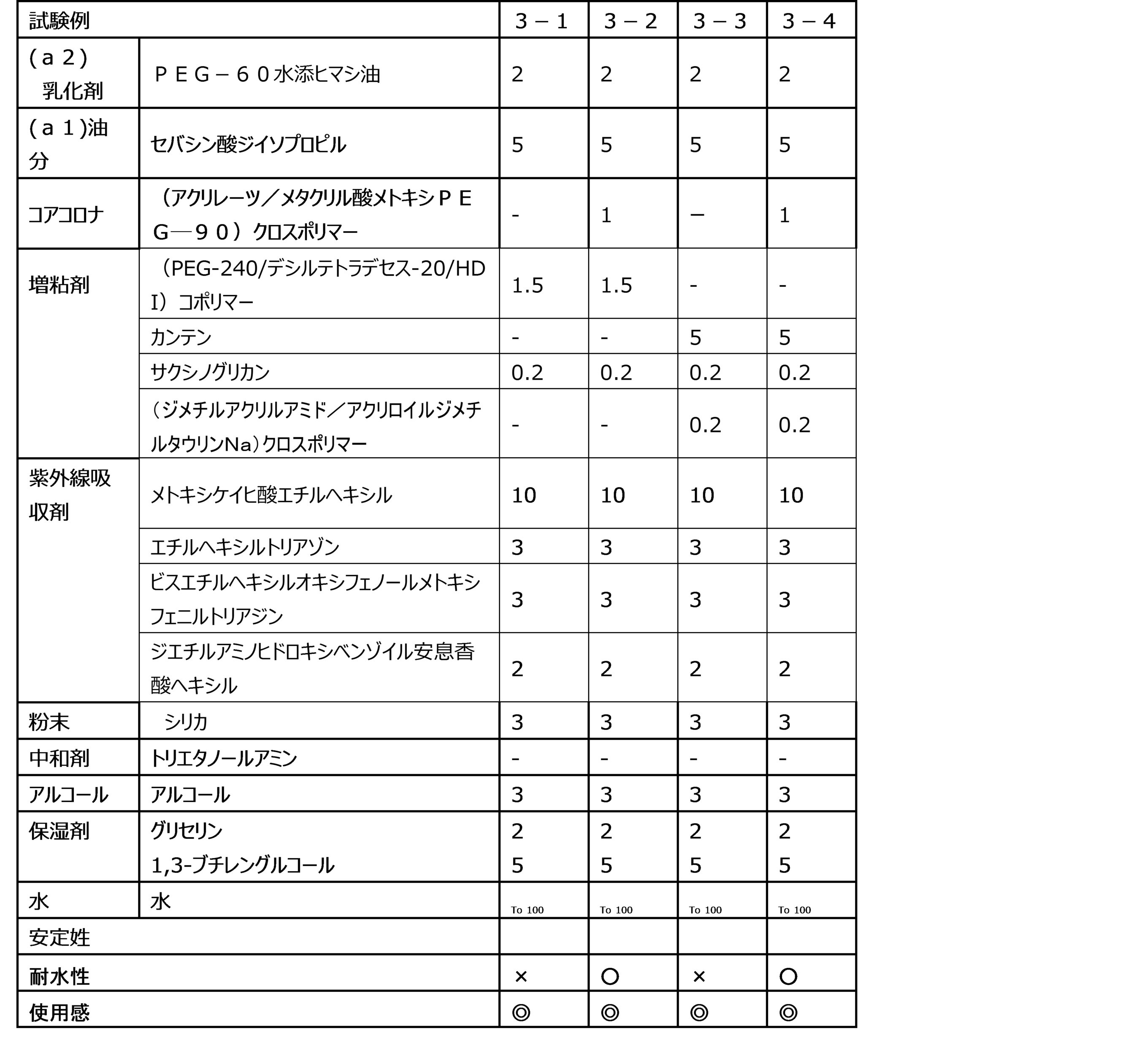
試験例3-1~3-4から分かるように、増粘剤を加えた系でも、コア-コロナ型ミクロゲルを配合すると、耐水性が向上することが分かった。
次に、(A)乳化粒子の(a1)油相に、粉末を加え、使用感をさらに向上するために、増粘剤を加えた系でも、コア-コロナ型ミクロゲルを配合すると、耐水性が向上するか確認した。本発明者らは、下記表4に示す各試料を、上記製造方法により水中油型化粧料を調製し、上記評価基準で評価した。結果を表4に示す。
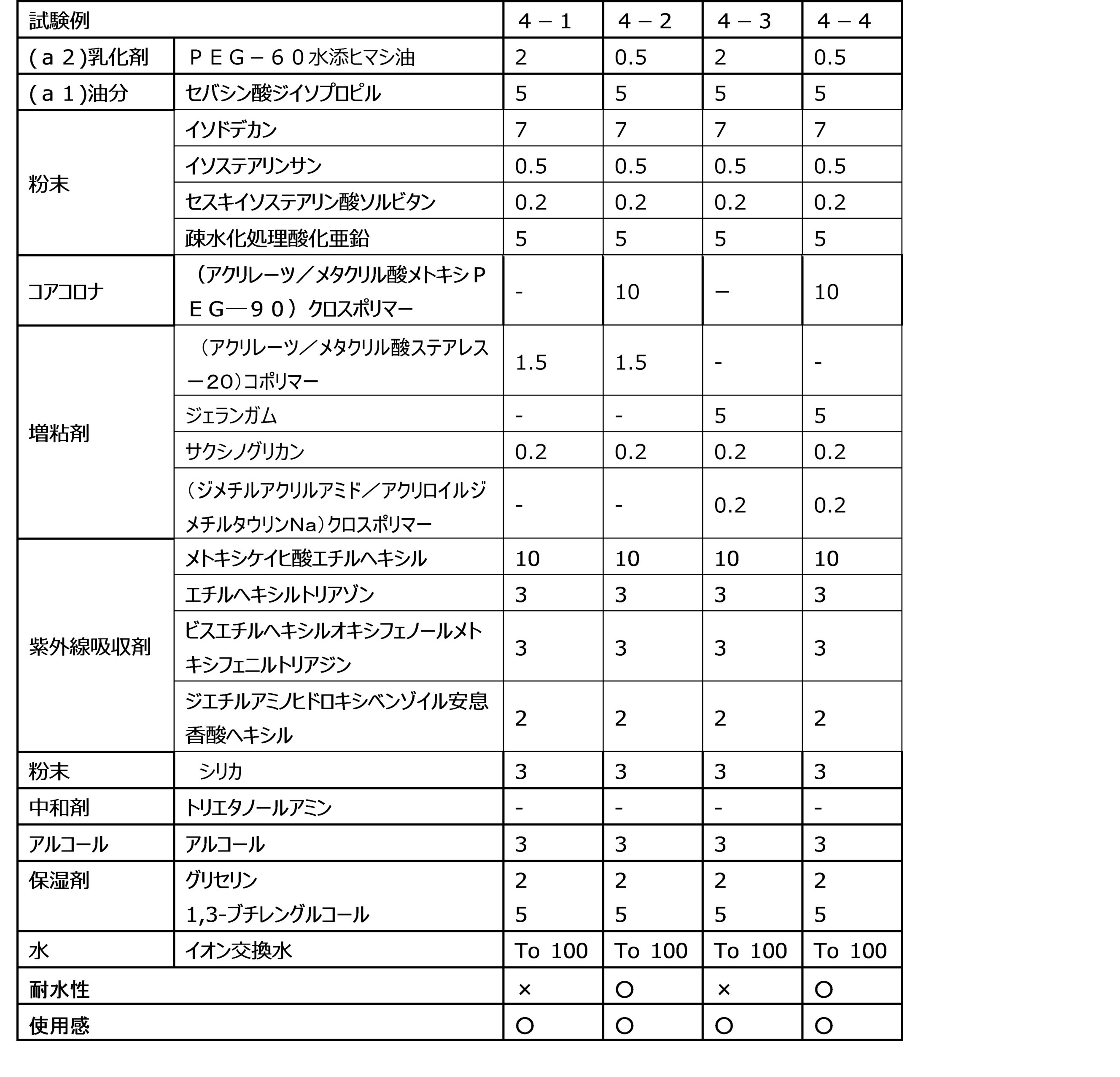
試験例4-1~4-5から分かるように、乳化粒子内に粉末を加え、増粘剤を加えた系においても、コア-コロナ型ミクロゲルを配合すると、耐水性と使用感に優れた水中油型化粧料が得られることが分かった。
次に、本発明者らは、唇用化粧料に本発明を用いた。本発明者らは、下記表5に示す各試料を、上記製造方法により水中油型化粧料を調製し、上記評価基準で評価した。結果を表5に示す。

いずれも、コア-コロナ型ミクロゲルを配合すると、耐水性と使用感に優れた唇用化粧料が得られた。
次に本発明者らは、まつ毛用化粧料に本発明を用いた。本発明者らは、下記表6に示す各試料を、上記製造方法により水中油型化粧料を調製し、上記評価基準で評価した。結果を表6に示す。
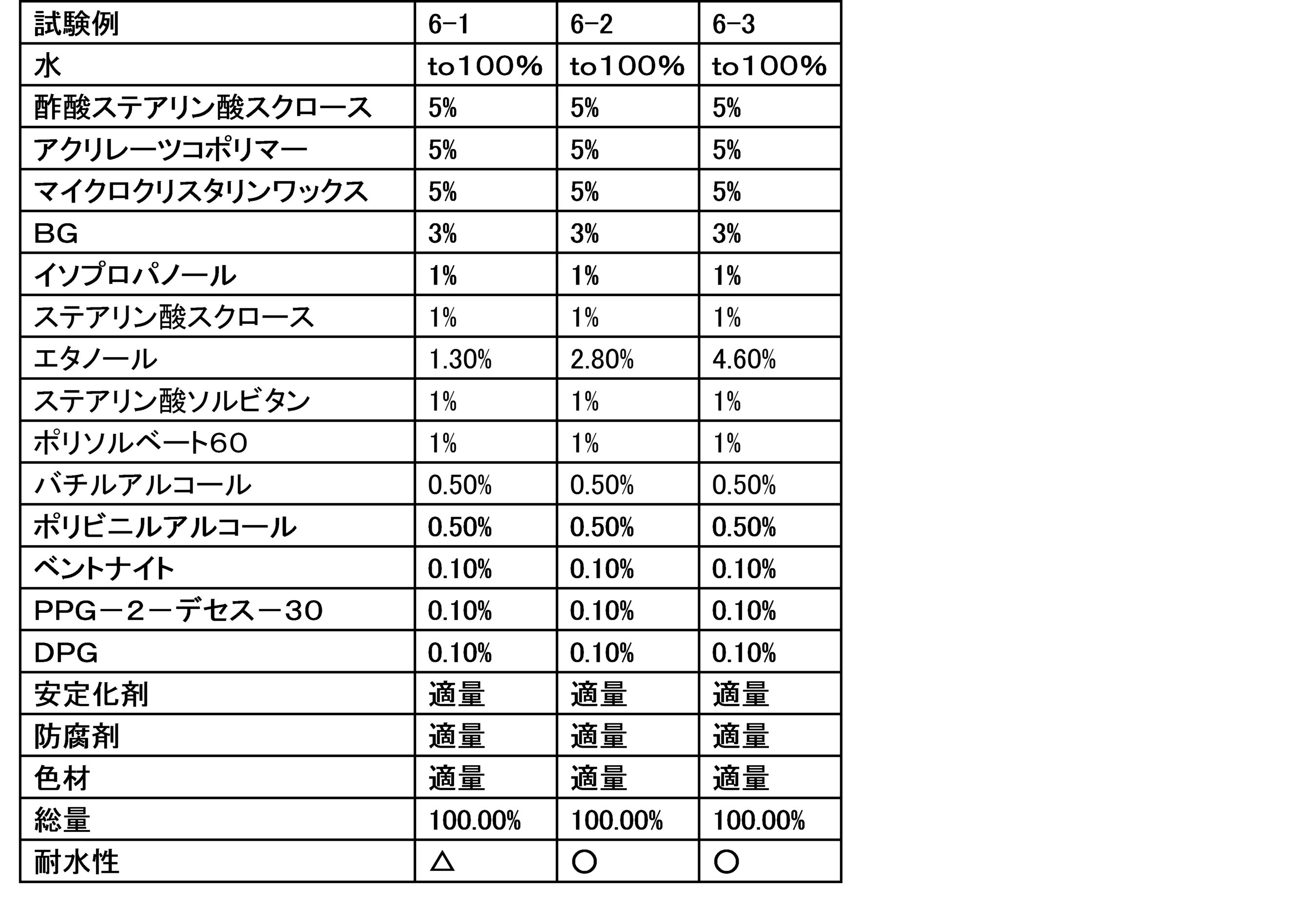
いずれも、コア-コロナ型ミクロゲルを配合すると、耐水性と使用感に優れた眉毛用化粧料が得られた。
次に本発明者らは、トリートメントに本発明を用いた。
2-エチルヘキサン酸セチル 1.0
ジメチルポリシロキサン 6CS 2.0
塩化ステアリルトリメチルアンモニウム 0.25
(アクリレーツ/メタクリル酸メトキシPEG―90)クロスポリマー 1.0
エタノール 5.0
セタノール 0.5
ベヘニルアルコール 3.0
BG 3.0
クエン酸 0.05
乳酸ナトリウム液 0.01
メトキシケイヒ酸エチルヘキシル 0.1
ヒドロキシエチルセルロース 0.1
EDTA-2Na・2H2O 0.1
パラオキシ安息香酸エステル 適量
精製水 残余
香料 適量
ジメチルポリシロキサン 6CS 2.0
塩化ステアリルトリメチルアンモニウム 0.25
(アクリレーツ/メタクリル酸メトキシPEG―90)クロスポリマー 1.0
エタノール 5.0
セタノール 0.5
ベヘニルアルコール 3.0
BG 3.0
クエン酸 0.05
乳酸ナトリウム液 0.01
メトキシケイヒ酸エチルヘキシル 0.1
ヒドロキシエチルセルロース 0.1
EDTA-2Na・2H2O 0.1
パラオキシ安息香酸エステル 適量
精製水 残余
香料 適量
次に本発明者らは、ヘアワックスに本発明を用いた
水 残余
エタノール 10.0
ジプロピレングリコール 5.0
セテス-25 1.5
ステアリン酸グリセリル(SE) 0.5
ベヘニルアルコール 3.5
カルナバロウ 5.0
キャンデリラロウ 5.0
マイクロクリスタリンワックス 2.5
ワセリン 10.0
テトラエチルヘキサン酸ペンタエリスリチル 2.0
ジメチルポリシロキサン 6CS 2.0
(アクリレーツ/メタクリル酸メトキシPEG―90)クロスポリマー 1.0
(VP/VA)コポリマー 1.5
メトキシケイヒ酸エチルヘキシル 0.1
乳酸Na 0.05
乳酸 0.1
カルボマー 0.1
フェノキシエタノール 0.5
EDTA-2Na・2H2O 0.02
香料 適量
エタノール 10.0
ジプロピレングリコール 5.0
セテス-25 1.5
ステアリン酸グリセリル(SE) 0.5
ベヘニルアルコール 3.5
カルナバロウ 5.0
キャンデリラロウ 5.0
マイクロクリスタリンワックス 2.5
ワセリン 10.0
テトラエチルヘキサン酸ペンタエリスリチル 2.0
ジメチルポリシロキサン 6CS 2.0
(アクリレーツ/メタクリル酸メトキシPEG―90)クロスポリマー 1.0
(VP/VA)コポリマー 1.5
メトキシケイヒ酸エチルヘキシル 0.1
乳酸Na 0.05
乳酸 0.1
カルボマー 0.1
フェノキシエタノール 0.5
EDTA-2Na・2H2O 0.02
香料 適量
これらは、いずれも、使用感、耐水性に優れたものであった。
Claims (5)
- (A)次の(a1)と(a2)からなる乳化粒子と、
(a1)油相
(a2)乳化剤
(B)次の(b1)が分散している水相と、
(b1)疎水性ゲル微粒子表面に、部分的に親水基を設けたコア-コロナ型ミクロゲル
を含むことを特徴とする水中油型乳化組成物。 - 請求項1記載の水中油型乳化組成物において、(C)増粘剤を含むことを特徴とする水中油型乳化組成物。
- 請求項1又は2に記載の水中油型乳化組成物において、(a1)油相中に紫外線吸収剤を含むことを特徴とする水中油型乳化組成物。
- 請求項1~3のいずれかに記載の水中油型乳化組成物
- 請求項1~4のいずれかに記載の水中油型乳化組成物からなることを特徴とする化粧料。
Priority Applications (2)
| Application Number | Priority Date | Filing Date | Title |
|---|---|---|---|
| CN201880021467.0A CN110461301B (zh) | 2017-03-29 | 2018-03-01 | 水包油型化妆品 |
| KR1020197031775A KR102563845B1 (ko) | 2017-03-29 | 2018-03-01 | 수중유형 화장료 |
Applications Claiming Priority (2)
| Application Number | Priority Date | Filing Date | Title |
|---|---|---|---|
| JP2017-066448 | 2017-03-29 | ||
| JP2017066448A JP6985025B2 (ja) | 2017-03-29 | 2017-03-29 | 水中油型化粧料 |
Publications (1)
| Publication Number | Publication Date |
|---|---|
| WO2018180179A1 true WO2018180179A1 (ja) | 2018-10-04 |
Family
ID=63675472
Family Applications (1)
| Application Number | Title | Priority Date | Filing Date |
|---|---|---|---|
| PCT/JP2018/007823 Ceased WO2018180179A1 (ja) | 2017-03-29 | 2018-03-01 | 水中油型化粧料 |
Country Status (5)
| Country | Link |
|---|---|
| JP (1) | JP6985025B2 (ja) |
| KR (1) | KR102563845B1 (ja) |
| CN (1) | CN110461301B (ja) |
| TW (1) | TWI778033B (ja) |
| WO (1) | WO2018180179A1 (ja) |
Cited By (1)
| Publication number | Priority date | Publication date | Assignee | Title |
|---|---|---|---|---|
| CN114641274A (zh) * | 2019-11-08 | 2022-06-17 | 株式会社资生堂 | 水包油型组合物 |
Families Citing this family (11)
| Publication number | Priority date | Publication date | Assignee | Title |
|---|---|---|---|---|
| JP6927833B2 (ja) * | 2017-09-29 | 2021-09-01 | 株式会社マンダム | 水中油型皮膚化粧料 |
| KR20190131588A (ko) * | 2017-09-29 | 2019-11-26 | 가부시키가이샤 만다무 | 수중유형 피부 화장료 |
| JP6927832B2 (ja) * | 2017-09-29 | 2021-09-01 | 株式会社マンダム | 水中油型皮膚化粧料 |
| JP7208621B2 (ja) * | 2019-01-30 | 2023-01-19 | 株式会社日本色材工業研究所 | 水中油型乳化化粧料 |
| CN114845692A (zh) * | 2019-12-27 | 2022-08-02 | 株式会社资生堂 | 油性粒子及外用组合物 |
| WO2023120180A1 (ja) * | 2021-12-20 | 2023-06-29 | 株式会社 資生堂 | 水中油型乳化化粧料 |
| CN118401218A (zh) * | 2022-01-20 | 2024-07-26 | 株式会社资生堂 | 水包油型乳化唇部用化妆品 |
| KR102909388B1 (ko) | 2023-08-21 | 2026-01-09 | 주식회사 코스메카코리아 | 에탄올 프리 저자극 비분리형 저점도 유화 화장료 조성물 또는 이의 제조방법 |
| WO2025182527A1 (ja) * | 2024-02-29 | 2025-09-04 | Dic株式会社 | 水中油型乳化組成物 |
| JP7729511B1 (ja) * | 2024-02-29 | 2025-08-26 | Dic株式会社 | 水中油型乳化組成物 |
| WO2025249162A1 (ja) * | 2024-05-27 | 2025-12-04 | 株式会社 資生堂 | 水中油型乳化化粧料 |
Citations (5)
| Publication number | Priority date | Publication date | Assignee | Title |
|---|---|---|---|---|
| JP2001181514A (ja) * | 1999-12-24 | 2001-07-03 | Kawamura Inst Of Chem Res | コア−コロナ型機能性マイクロエマルジョン、機能性微粒子及びその製造方法 |
| JP2006160725A (ja) * | 2004-11-09 | 2006-06-22 | Shiseido Co Ltd | 化粧料 |
| JP2013147486A (ja) * | 2011-12-22 | 2013-08-01 | Shiseido Co Ltd | コロナ−コア型ミクロゲル乳化剤及び水中油型乳化組成物 |
| WO2017057563A1 (ja) * | 2015-09-30 | 2017-04-06 | 株式会社 資生堂 | 水中油中粉体型組成物 |
| WO2017188319A1 (ja) * | 2016-04-28 | 2017-11-02 | 株式会社 資生堂 | 水中油型乳化化粧料 |
Family Cites Families (6)
| Publication number | Priority date | Publication date | Assignee | Title |
|---|---|---|---|---|
| JP2006161026A (ja) | 2004-11-09 | 2006-06-22 | Shiseido Co Ltd | 有機溶媒膨潤性ミクロゲル及びその製造方法 |
| JP2007238521A (ja) | 2006-03-09 | 2007-09-20 | Shiseido Co Ltd | 包接体及びこれを含有する皮膚外用剤 |
| JP2009292734A (ja) * | 2008-06-02 | 2009-12-17 | Shiseido Co Ltd | 水中油型乳化皮膚化粧料 |
| EP3031444B1 (en) * | 2011-08-02 | 2018-10-10 | Shiseido Company, Ltd. | Oil-in-water-type emulsion cosmetic |
| JP5913475B2 (ja) * | 2014-08-06 | 2016-04-27 | 株式会社 資生堂 | 化粧料用原料 |
| JP6580907B2 (ja) | 2014-11-20 | 2019-09-25 | 花王株式会社 | 皮膚化粧料 |
-
2017
- 2017-03-29 JP JP2017066448A patent/JP6985025B2/ja active Active
-
2018
- 2018-03-01 CN CN201880021467.0A patent/CN110461301B/zh active Active
- 2018-03-01 KR KR1020197031775A patent/KR102563845B1/ko active Active
- 2018-03-01 WO PCT/JP2018/007823 patent/WO2018180179A1/ja not_active Ceased
- 2018-03-20 TW TW107109452A patent/TWI778033B/zh active
Patent Citations (5)
| Publication number | Priority date | Publication date | Assignee | Title |
|---|---|---|---|---|
| JP2001181514A (ja) * | 1999-12-24 | 2001-07-03 | Kawamura Inst Of Chem Res | コア−コロナ型機能性マイクロエマルジョン、機能性微粒子及びその製造方法 |
| JP2006160725A (ja) * | 2004-11-09 | 2006-06-22 | Shiseido Co Ltd | 化粧料 |
| JP2013147486A (ja) * | 2011-12-22 | 2013-08-01 | Shiseido Co Ltd | コロナ−コア型ミクロゲル乳化剤及び水中油型乳化組成物 |
| WO2017057563A1 (ja) * | 2015-09-30 | 2017-04-06 | 株式会社 資生堂 | 水中油中粉体型組成物 |
| WO2017188319A1 (ja) * | 2016-04-28 | 2017-11-02 | 株式会社 資生堂 | 水中油型乳化化粧料 |
Cited By (2)
| Publication number | Priority date | Publication date | Assignee | Title |
|---|---|---|---|---|
| CN114641274A (zh) * | 2019-11-08 | 2022-06-17 | 株式会社资生堂 | 水包油型组合物 |
| CN114641274B (zh) * | 2019-11-08 | 2024-06-04 | 株式会社资生堂 | 水包油型组合物 |
Also Published As
| Publication number | Publication date |
|---|---|
| TWI778033B (zh) | 2022-09-21 |
| KR102563845B1 (ko) | 2023-08-03 |
| JP6985025B2 (ja) | 2021-12-22 |
| CN110461301B (zh) | 2022-10-04 |
| KR20190128726A (ko) | 2019-11-18 |
| JP2018168087A (ja) | 2018-11-01 |
| CN110461301A (zh) | 2019-11-15 |
| TW201841669A (zh) | 2018-12-01 |
Similar Documents
| Publication | Publication Date | Title |
|---|---|---|
| JP5207424B1 (ja) | コロナ−コア型ミクロゲル乳化剤及び水中油型乳化組成物 | |
| JP5913475B2 (ja) | 化粧料用原料 | |
| WO2018180179A1 (ja) | 水中油型化粧料 | |
| JP6949714B2 (ja) | 水中油中粉体型組成物 | |
| JP6403854B2 (ja) | コア−コロナ型ミクロ粒子を用いた化粧料原料及び水中油型乳化化粧料 | |
| JP6061594B2 (ja) | 水中油型乳化組成物 | |
| KR102251072B1 (ko) | 수중유형 유화 조성물 | |
| JP7356998B2 (ja) | 油中水型乳化組成物 | |
| WO2022210144A1 (ja) | 水中油型化粧料 | |
| HK40009630A (en) | Oil-in-water-type emulsion composition | |
| HK40008220A (zh) | 使用了核-壳型微粒的化妆品原料和水包油型乳化化妆品 | |
| HK1200397B (en) | Core-corona type microgel emulsifier, and oil-in-water emulsion composition | |
| HK1238535A1 (en) | Starting material for cosmetics | |
| HK1238535B (zh) | 化妆品用原料 |
Legal Events
| Date | Code | Title | Description |
|---|---|---|---|
| 121 | Ep: the epo has been informed by wipo that ep was designated in this application |
Ref document number: 18777809 Country of ref document: EP Kind code of ref document: A1 |
|
| NENP | Non-entry into the national phase |
Ref country code: DE |
|
| ENP | Entry into the national phase |
Ref document number: 20197031775 Country of ref document: KR Kind code of ref document: A |
|
| 122 | Ep: pct application non-entry in european phase |
Ref document number: 18777809 Country of ref document: EP Kind code of ref document: A1 |